Article

Affective Restoration in Bamboo Green Spaces: A Controlled Photo-Based Experiment Linking Place Structure, Visual Attention, and Electroencephalography (EEG) Responses


College of Landscape Architecture, Sichuan Agricultural University, Chengdu 611130, China
*
Author to whom correspondence should be addressed.
Horticulturae 2026, 12(3), 284; https://doi.org/10.3390/horticulturae12030284
Submission received: 18 January 2026 / Revised: 11 February 2026 / Accepted: 17 February 2026 / Published: 27 February 2026
(This article belongs to the Section Outreach, Extension, and Education)

Abstract

Urban mental health burdens are increasing, prompting interest in how nearby green spaces aid emotional restoration. Bamboo-dominant green spaces are widespread in East Asia, but evidence connecting their management and structural features to restorative experiences is limited. This study conducted a controlled photo-exposure experiment in Ya’an, China, to examine how bamboo space typology and structural attributes relate to visual attention, affective responses, and short-term physiological recovery. One hundred and twenty participants viewed 50 photographs representing five bamboo space types (ecological conservation, productive–economic, protective–greenbelt, landscape–recreational, and understory–composite). Each image was linked to a matched field plot, enabling integration of structural indicators with eye tracking, EEG β/α, and repeated ratings of relaxation, pleasure, and preference. Results showed that landscape–recreational spaces received the highest affective ratings, while understory–composite spaces had longer fixations, indicating higher visual processing demands. Vertical stratification and groundcover coverage were robust predictors of affect beyond typology. Eye-movement metrics did not mediate structure–affect associations, and EEG β/α, as an auxiliary and context-dependent indicator under brief photo-based exposure, showed limited sensitivity. These findings offer insights into structural elements that can inform the design and management of bamboo green spaces for improved emotional restoration.

1. Introduction

Rapid urbanization has coincided with a growing mental-health burden, with anxiety-, depression- and stress-related symptoms increasingly reported in high-density living contexts and accompanied by substantial social costs [1,2]. Against this backdrop, evidence from environmental psychology and public health indicates that contact with natural environments can support stress recovery and psychological restoration [3,4,5], and participation in green exercise in wild or urban green spaces yields measurable psychological benefits [6]. In parallel, research on health-supportive environments has moved beyond the “amount of nature” to ask how and through which cues everyday scenes shape affective responses, preference, and perceived restoration [5,7,8,9,10,11]. This shift places the visual pathway at the center of inquiry: what is seen (element types, proportions, naturalness, and spatial organization) and how it is processed (fixations, saccades, and pupil responses) jointly contribute to emotional appraisal and restoration-related judgements [12,13,14,15].
Syntheses and multimodal evidence suggest that higher visible greenness (e.g., Green View Index, GVI) and more legible scene organization are often associated with greater relaxation, lower perceived stress, and stronger preference [5,11,16,17,18,19,20]. Eye tracking provides behavioral markers of attentional allocation and processing demands (e.g., fixation duration, search dynamics, and pupil responses), allowing the mechanism “visual exposure to attention to affect” to be tested with observable viewing behavior rather than inferred [12,14,15,21,22,23,24,25,26]. Physiologically, EEG offers a complementary window into the tension–relaxation continuum; exposure to greener or natural views has been linked to changes in α/β activity patterns (including findings based on passive viewing and video and VR exposure), although sensitivity can depend on exposure conditions and stimulus heterogeneity [27,28,29,30,31,32,33]. Together, these approaches enable a mechanism-oriented evaluation of the pathway from visual structure to visual behavior to affective and physiological responses, which can be translated into actionable cues for everyday nature design and management [9,10,34,35,36]. Bamboo landscapes are a particularly informative testbed in this context. Compared with many mixed forests, bamboo spaces often exhibit strong orderliness and controllable stand structure, and they are widely experienced in East Asian cities and peri-urban settings [37,38,39,40]. Importantly, different management goals can systematically reconfigure openness and permeability, vertical layering, and ground-layer conditions, producing repeatable structural contrasts that are meaningful to perception and use [39,40]. These properties make bamboo environments suitable for linking measurable structure to viewing behavior and restorative experience in a way that is potentially more design-translatable than broad “green vs. non-green” contrasts [9,10,11,37,41].

1.1. Evidence Synthesis: Perception and Structure Pathways

Prior work suggests two complementary ways through which everyday green space encounters may support affective restoration [42,43,44]. The perception pathway emphasizes visual exposure and attentional processing: what is visible and how it is inspected can shape momentary affect, preference, and restoration-related judgements, with eye tracking providing observable fixation- and pupil-based markers of viewing dynamics [45,46,47,48,49]. The structure pathway emphasizes how measurable vegetation configuration shapes scene legibility and related qualities (e.g., permeability and complexity), which are repeatedly linked to affective appraisal and restorative potential [41,50,51,52,53,54]. These pathways converge because vegetation structure constrains what is visually available and can guide how attention unfolds [55,56,57,58]. Bamboo green spaces offer a tractable context for testing this convergence, as management practices generate repeatable variation in density, vertical layering, and ground-layer conditions that are meaningful for both use and perception [59,60].

1.2. Unresolved Gaps and Guiding Questions

Despite increasing evidence that green space quality matters beyond quantity, three gaps remain for bamboo-rich urban contexts. First, bamboo places are managed for distinct functions, yet an operational typology that can be compared alongside objective structural indicators remains limited [37,41]. Second, it is unclear which stand and understory attributes act as the most influential and interpretable “levers” for affective outcomes once typology is accounted for [53,54,61]. Third, while attention is frequently proposed as a mechanism linking visual structure to affect, few studies test the structure–attention–affect chain using designs that simultaneously address repeated measures and stimulus heterogeneity [37]. Addressing these gaps is necessary to translate bamboo place characteristics into design- and management-relevant evidence.

1.3. Study Objectives

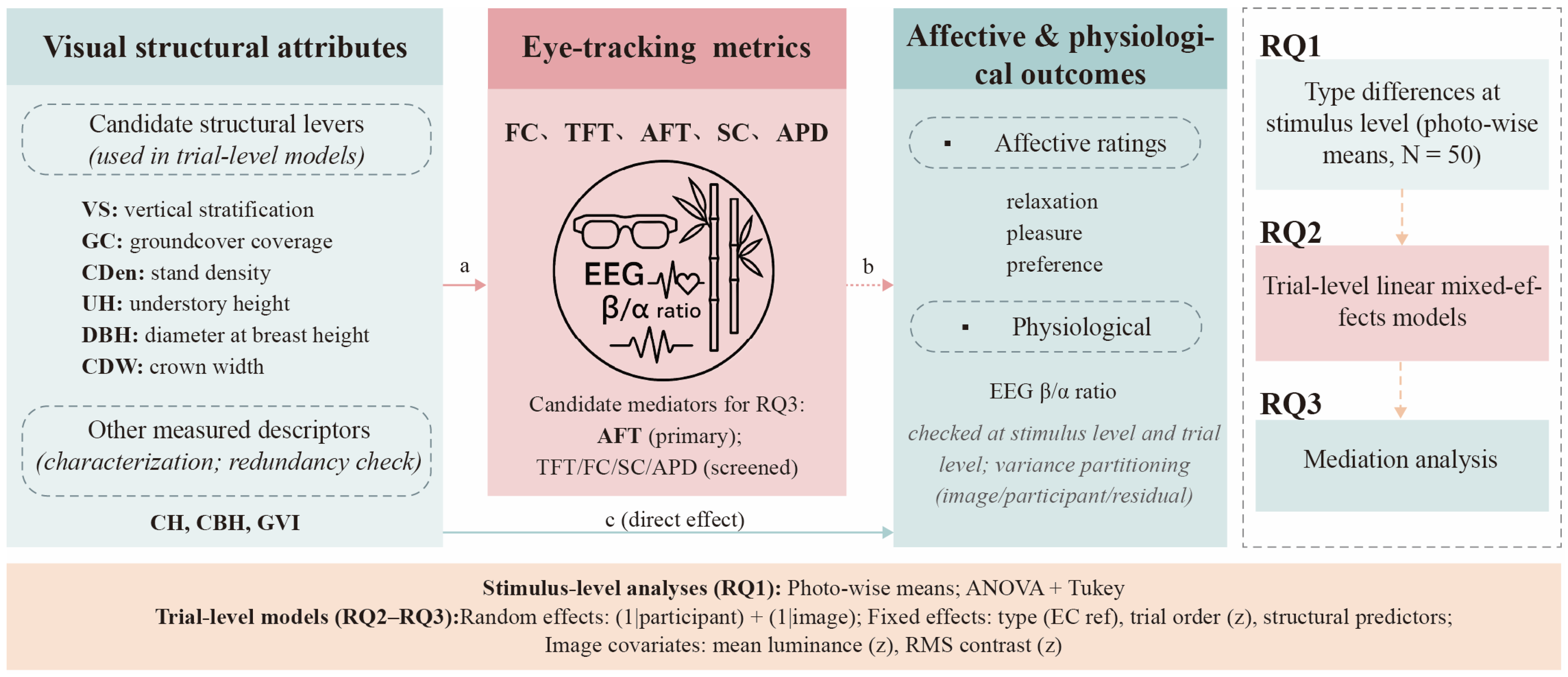
This study aims to strengthen place-based evidence on affective restoration in bamboo-rich urban spaces by linking management-defined bamboo typology with fine-scale, field-measured structural indicators and psychophysiological responses under standardized exposure conditions [37,41]. Using synchronized eye tracking, mobile EEG, and trial-level crossed mixed-effects models (participants × images), this study provides: (i) a replicable approach to specifying green space quality beyond area- or proximity-based metrics, (ii) empirical estimates of interpretable structural “levers” for affective restoration that can inform routine design and maintenance, and (iii) a mechanism-screening test of whether visual attention plausibly connects place structure to affective outcomes (Figure 1). By moving from coarse greenness measures to actionable place-quality indicators in a bamboo-dominated urban context, the findings offer practical insights on how to manage nearby nature to better support affective restoration in everyday spaces and settings with limited access to restorative environments [62,63,64,65,66].
Based on environmental psychology and restorative theory, we hypothesize that vertical stratification (VS) and groundcover coverage (GC) in bamboo spaces are positively correlated with affective restoration, where higher VS and greater GC are expected to enhance relaxation, pleasure, and preference. This hypothesis is grounded in the understanding that well-organized, layered structures provide clearer depth cues, reduce perceptual ambiguity, and facilitate positive emotional responses and preference formation.

2. Materials and Methods

2.1. Study Design and Overall Procedure

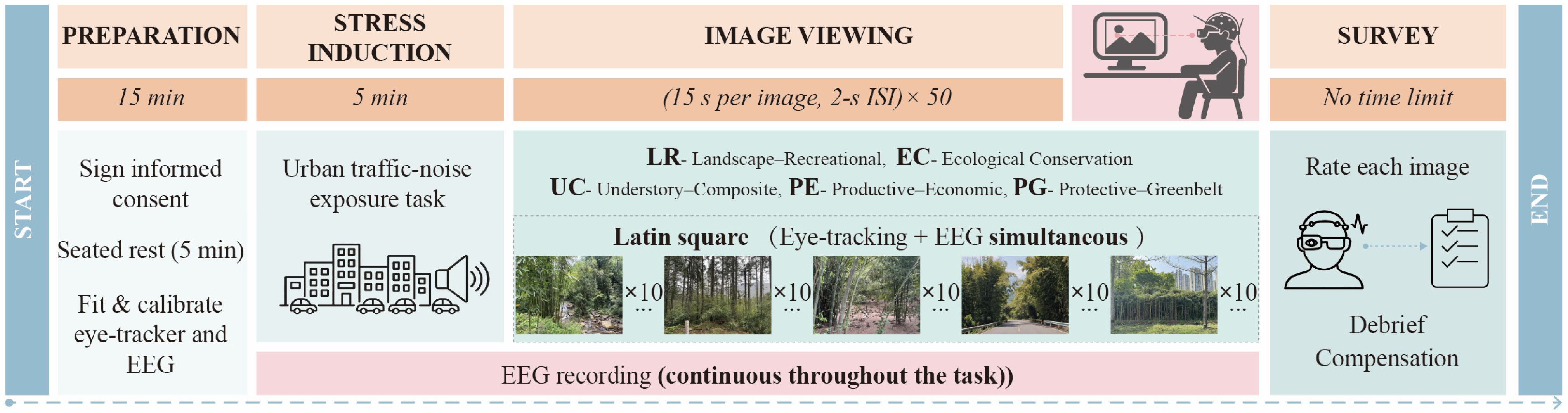
We conducted a laboratory-based photo-exposure experiment to test how management-defined bamboo space typology and measurable stand and understory attributes relate to visual attention, affective appraisal, and short-term physiological recovery. Five bamboo space types in Ya’an were defined as a priori by management and use context: ecological conservation (EC), productive–economic (PE), protective–greenbelt (PG), landscape–recreational (LR), and understory–composite (UC). We retained 10 representative photographs per type (50 stimuli total) and linked each photograph one-to-one to a matched field plot with corresponding structural indicators [21,67,68]. Sessions were conducted under controlled indoor conditions (10–30 May 2025). After informed consent and device setup, participants completed: (i) a preparation phase (resting and calibration) [13,69] and (ii) a brief traffic-noise exposure to standardize pre-viewing arousal followed by recording a post-stress EEG baseline used for baseline-corrected β/α [70]. Stress induction was achieved through the presentation of traffic noise, based on established protocols for noise-based stress induction in environmental psychology research. Previous studies have shown the effectiveness of this procedure in eliciting physiological stress responses. We treated β/α as a complementary physiological marker whose sensitivity may depend on exposure duration and stimulus heterogeneity; therefore, inference relies on trial-level models with appropriate covariate control. Participants also completed (iii) photo viewing (50 images; 15 s per image; 2 s inter-stimulus interval) with counterbalanced order [71,72], and (iv) scene-level ratings of relaxation, pleasure, and preference for each image. Eye movements and EEG were recorded continuously during viewing; each view-and-rate cycle was treated as one trial. The 15 s viewing duration was selected based on common practice in photo-based eye-tracking studies. Brief exposures in the 10–20 s range are typically used to capture stable fixation and scanning behaviors without inducing fatigue, making it ideal for repeated-measures designs. This study protocol was reviewed and approved by the Academic Ethics Committee of Sichuan Agricultural University. All procedures were conducted in accordance with research ethics principles and relevant institutional regulations (Approval No.: H20260004). The procedure is summarized in Figure 2.

2.2. Participants

Participants were recruited via campus advertisements and social media. To reduce bias associated with disciplinary training, we enrolled adults without formal education in landscape architecture or forestry. Eligibility required an age of 18–30 years, normal (or corrected-to-normal) vision and color vision, and no self-reported psychiatric history, substance dependence, or current use of psychotropic or hormonal medication. Participants were asked to avoid alcohol, strenuous exercise, and self-medication within 24 h before testing. Additional restrictions were applied to maximize eye-tracking quality (e.g., avoiding contact lenses and prominent eye makeup). In total, 120 participants completed the experiment with an approximately balanced distribution of age and sex [73,74].

2.3. Classification of Bamboo Forest Space Types

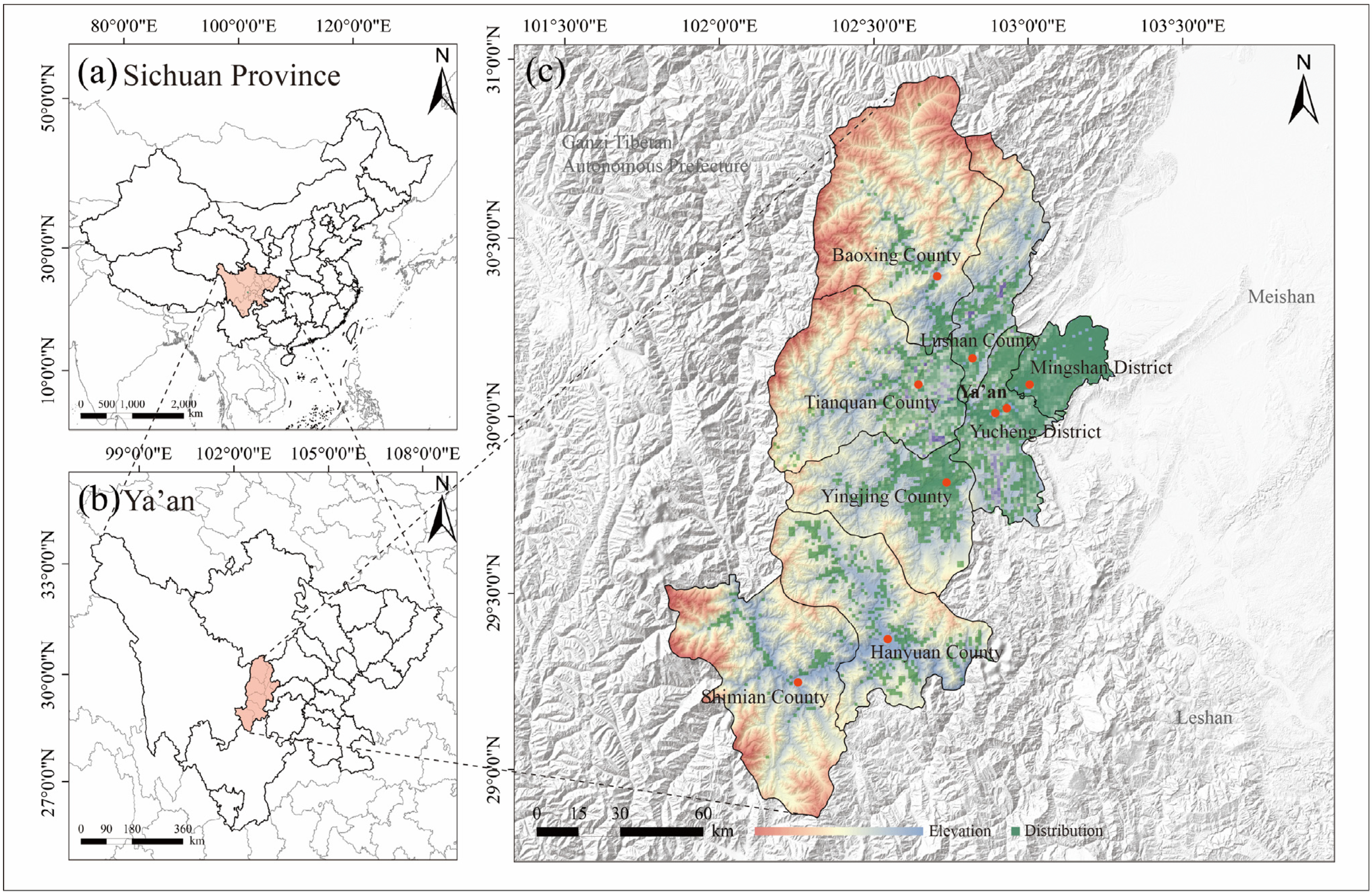
Ya’an is in the transition zone between the western Sichuan Basin and the eastern margin of the Qinghai–Tibet Plateau, characterized by pronounced topographic gradients and widespread bamboo habitats (Figure 3). Field surveys have reported more than 20 bamboo species (e.g., Bambusa emeiensis, Phyllostachys edulis, and Chimonobambusa quadrangularis), which contribute to carbon storage, microclimate regulation, and urban ecological patterning.
Conventional forest typologies defined by ecological function or management objectives (e.g., protective, economic, and landscape forests) offer limited resolution for distinguishing visual form and perceptual differences [52,64,65]. In line with recent work emphasizing the joint role of ecological function, spatial organization, and visual cues in restorative outcomes and environmental preference [10,28], we developed a perception-oriented typology based on site function and management and use context documented during field investigation. Type assignment was completed before any quantitative extraction and did not rely on the structural indicators analyzed below. We then collected stand-structure measurements and the green view index (GVI) to (i) characterize sites objectively and (ii) test whether continuous structural variation explains additional outcome variance beyond type-level contrasts.
The five types were defined as follows: EC (ecological conservation), conservation-priority stands with minimal disturbance and restricted human use; PE (productive–economic), stands primarily managed for bamboo timber or shoot production with routine silvicultural operations; PG (protective–greenbelt), belt-shaped stands along roads, rivers, or settlement edges serving buffering and boundary functions; LR (landscape–recreational), park-oriented stands managed for public access and recreation (e.g., walking, resting, viewing) [55]; and UC (understory–composite), stands integrating a bamboo overstory with systematic understory use (e.g., crop cultivation or ecological breeding) within a composite livelihood and management system. This typology provides an operational basis for comparing type-specific mechanisms linking bamboo-space attributes to visual behavior and restorative responses, and for informing health-oriented green space planning and management [55,56]. For clarity and comparability, we summarize the five bamboo space types, their primary management goals, and their expected structural characteristics in Table S1.

2.4. Visual Structural Features of Bamboo Spaces

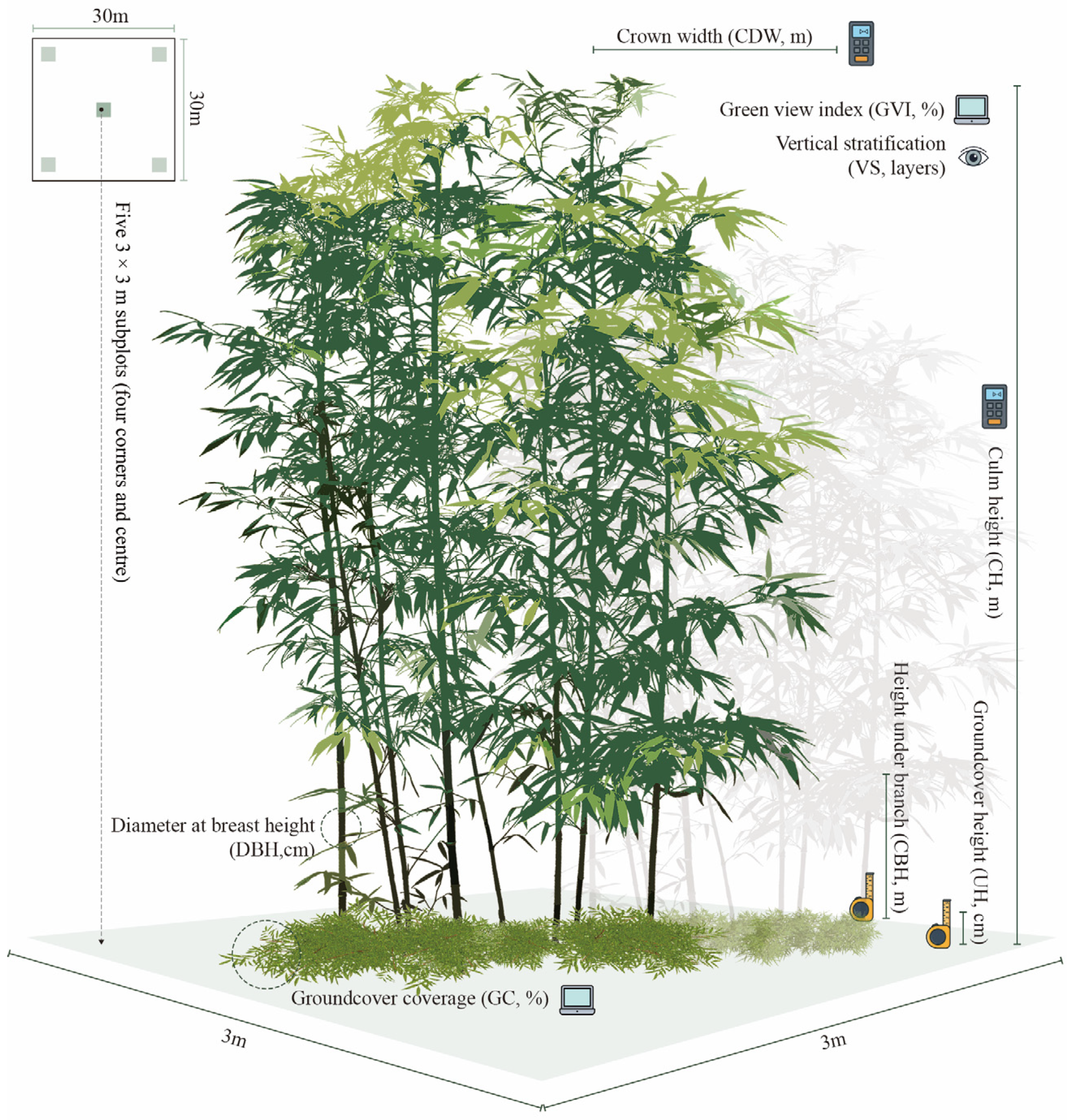
To quantify the visual structure of bamboo spaces and relate it to visual behavior and affective and physiological responses, nine indicators were selected [41,50] (Figure 4). Stand structure was described by stand density (CDen) [75], diameter at breast height (DBH), culm height (CH) [75], height under branch (CBH), vertical stratification (VS) [50], and crown width (CDW) [76]. Understory conditions were characterized by groundcover coverage (GC) and groundcover height (UH; operationalized as the mean height of understory or groundcover vegetation within quadrats) [77]. Visual exposure was captured by the green view index (GVI) [78]. Together, these indicators represent key visual cues of spatial structure, vegetation morphology, and visible greenness that are commonly linked to perceived scene complexity and legibility [9,10,11].
Field measurements followed a standardized plot–quadrat protocol (Figure 4). At each site, a 30 m × 30 m plot was established with five 3 m × 3 m quadrats (four corners and the center) [77]. Quadrat-level GC and UH were measured in all five quadrats and averaged to derive plot-level understory descriptors. Stand-level metrics (CDen, DBH, CH, CBH, VS, and CDW) were measured at the plot scale using a consistent field procedure. GVI was computed from the final stimulus photographs as the proportion of visible green pixels within the image. All structural and visual indicators were linked one-to-one to the corresponding stimuli and were integrated with eye-tracking, EEG, and self-report outcomes in subsequent analyses.

2.5. Measurement of Behavioral, Physiological and Subjective Indices

2.5.1. Eye-Tracking Metrics

Eye movements were recorded using a wearable eye tracker ((Tobii Pro Glasses 2; Tobii Pro AB, Stockholm, Sweden)) at 100 Hz while stimuli were presented on a 17.3-inch monitor at a fixed viewing distance. We extracted five image-level metrics commonly used to characterize free-viewing behavior: fixation count (FC), total fixation time (TFT), average fixation time (AFT), saccade count (SC), and average pupil diameter (APD). To ensure accurate measures of visual attention, we applied standard outlier handling procedures to remove extreme values and performed blink-related exclusions, particularly for pupil diameter (APD). To reduce bias from low-level image properties, stimulus photometric characteristics were quantified and included as covariates where relevant [79,80,81,82,83].

2.5.2. Electroencephalography Metrics

EEG was recorded with a mobile 16-channel system ((MB8600; BoYing BI, China)) following the international 10–20 layout. For each trial, spectral power was computed over the 15 s viewing epoch; alpha and beta bands were defined as 8–13 Hz and 13–30 Hz, and β/α was baseline-corrected using the post-noise segment recorded immediately after stress induction [84,85,86]. β/α values were averaged across prefrontal and occipital channels (Fp1, Fp2, F3, F4, O1, O2). Standard preprocessing and quality control procedures were applied [85,87]. Participants were retained for EEG analyses only when a valid baseline and all 50 viewing epochs met quality criteria, yielding an analytic EEG sample of 65 participants (3250 trials). Because mobile EEG is sensitive to motion artifacts and impedance fluctuations, stringent participant-level quality criteria were applied; consequently, the analyzable EEG sample was reduced, which may decrease sensitivity to detect small-type effects under brief, static photo exposure (15 s).

2.5.3. Subjective Perception Indices

Subjective responses were assessed with three scene-level ratings: relaxation, pleasure, and preference, reflecting immediate affective appraisal during viewing [7]. Participants were instructed to imagine arriving at and staying in the depicted bamboo setting after mental fatigue and to report their immediate feelings. After the viewing phase, each image was rated individually on 7-point Likert scales: relaxation (“I feel relaxed when viewing this scene”; 1 = very tense, 7 = very relaxed), pleasure (“This environment makes me feel pleasant”; 1 = very unpleasant, 7 = very pleasant), and preference (“I like this scene and would like to stay here”; 1 = strongly dislike or unwilling to stay, 7 = strongly like or very willing to stay). These ratings were analyzed jointly with eye-tracking and EEG measures in the subsequent models.

2.6. Statistical Analysis

All analyses were conducted in Python (version 3.11), using pandas and numpy for data handling and statsmodels and SciPy for statistical modeling. Trial-level linear mixed-effects models were fitted in statsmodels, and all tests were two-tailed with α = 0.05. For RQ1, analyses were conducted at the stimulus level (N = 50 photographs). Participant responses were averaged within photographs to obtain photo-wise means. One-way ANOVAs compared the five bamboo space types (EC, PE, PG, LR, UC) for structural and visual parameters, eye-tracking metrics (TFT, AFT, FC, SC, APD), affective ratings, and the EEG β/α. Tukey’s HSD was used for post hoc comparisons. Effect sizes are reported as ω2 with 95% confidence intervals [88]. For RQ2, Spearman correlations based on photo-wise means (N = 50) were computed descriptively. Primary inference used trial-level linear mixed-effects models with crossed random intercepts for participant and image [63,64,89]. Fixed effects included bamboo space type (EC as reference) and trial order; additional structural predictors were specified as a priori and z standardized. Mean luminance and RMS contrast were included in APD and β/α models. We treated baseline-corrected β/α as a complementary physiological marker; therefore, inference and interpretation primarily rely on trial-level mixed-effects estimates rather than stimulus-level ANOVA contrasts. For FC and SC, robustness was assessed using log(1 + count) LMMs and Poisson mixed models [90]. For RQ3, mediation was tested at the trial level using crossed mixed-effects models with random intercepts for participant and image and fixed effects controlling for bamboo space type (EC as reference) and z-standardized trial order; indirect effects were estimated as a × b and evaluated using 95% Monte Carlo confidence intervals based on 5000 draws, with mediation inferred when the interval excluded zero [66] (Table 1).

3. Results

3.1. Group Differences in Structural, Visual and Affective and Physiological Indices (RQ1)

For RQ1, outcomes were analyzed at the stimulus level (N = 50 photographs). Eye-tracking metrics, affective ratings, and EEG indices were averaged across participants within each photograph to obtain photo-wise means. Photo-wise values were compared across bamboo space types using one-way ANOVA with Tukey HSD post hoc tests (Figure 5 and Figure 6).

3.1.1. Structural Characteristics of the Five Bamboo Space Types

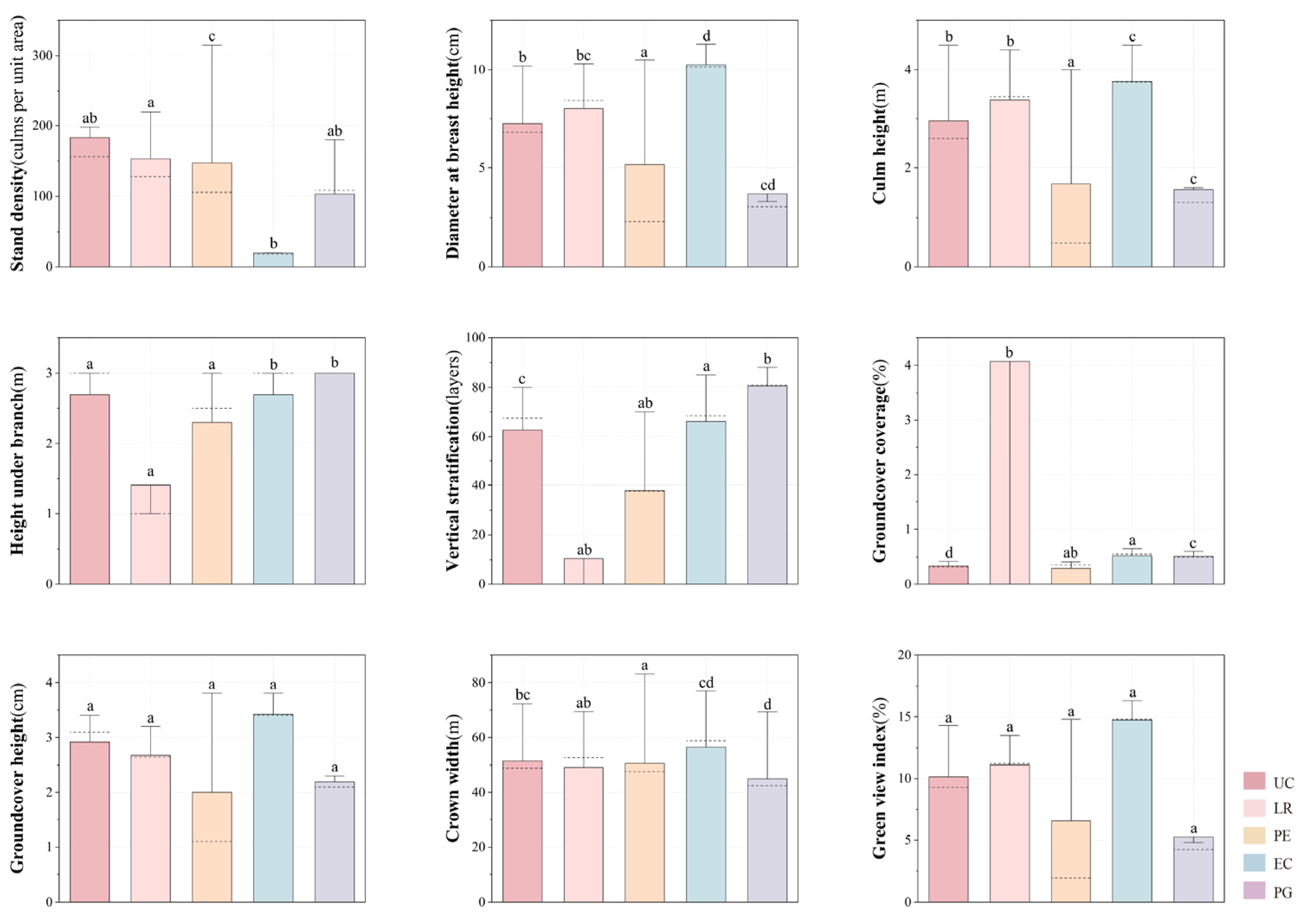
Because the typology was assigned a priori based on management and use context, we first examined whether the five bamboo space types could be differentiated by the measured structural and visual parameters (Figure 5). CDen, DBH, CH, CBH, VS, GC, and CDW differed among types (all p < 0.001), whereas UH and GVI did not (p = 0.506 and 0.592). Effect sizes were large, particularly for GC (ω2 = 0.658, 95% CI [0.435, 0.700]), VS (ω2 = 0.430, 95% CI [0.155, 0.541]), and CDen (ω2 = 0.373, 95% CI [0.096, 0.498]); full ω2 estimates with 95% CIs are reported in Table S2. Descriptively, PE showed the lowest density (CDen = 19.7) but the largest culm size and canopy development (DBH = 10.26 cm; CH = 14.76 m; CDW = 3.42 m). LR, UC, and PG were much denser (CDen = 183.2/152.8/147.0), whereas EC showed the highest stratification and the most continuous ground layer (VS = 3.0; GC = 80.6%). UC combined high density with sparse groundcover (GC = 10.5%). The non-significant UH and GVI differences indicate broadly comparable understory height and visible greenness across the stimulus set.

3.1.2. Eye-Tracking Indices

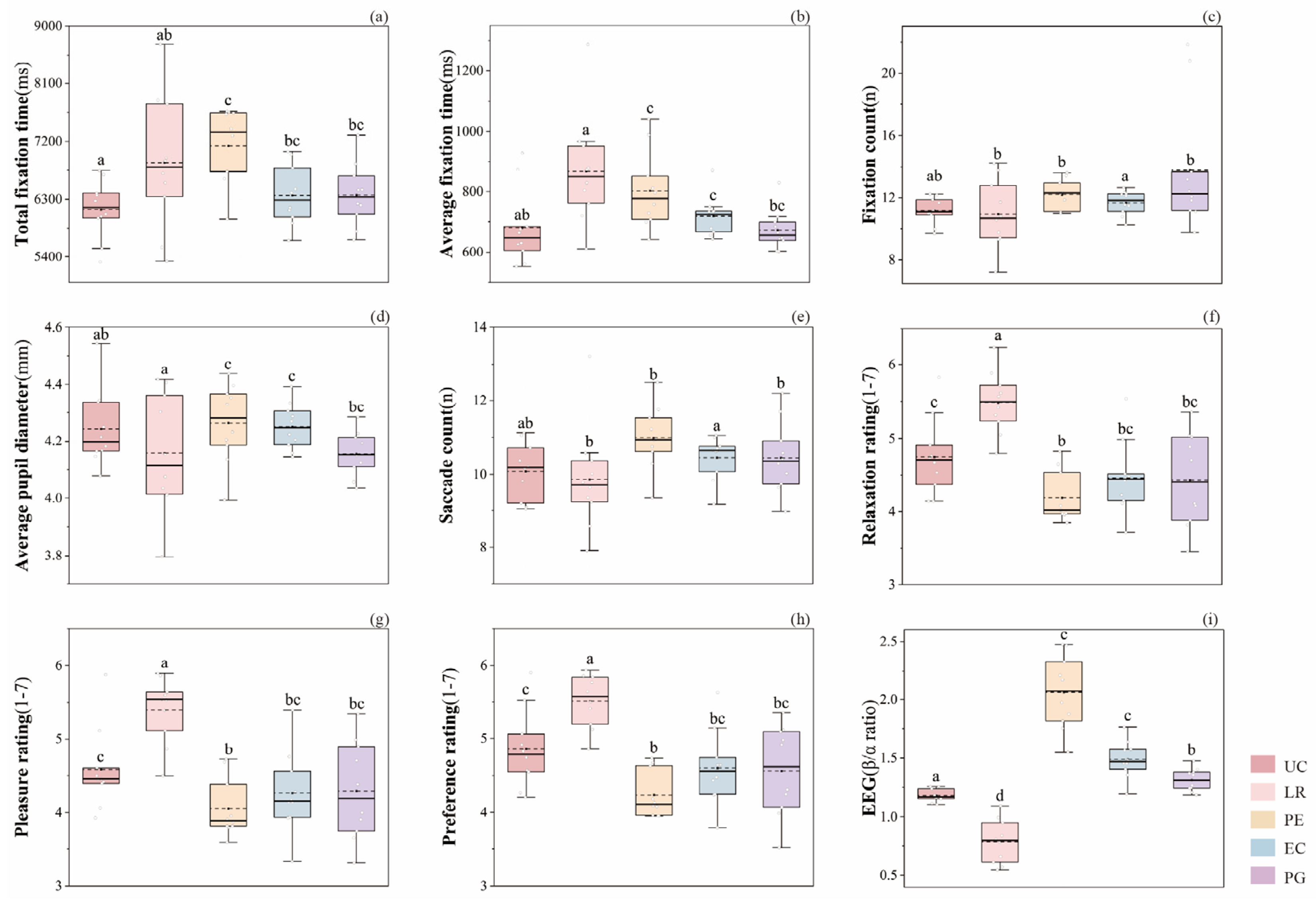
At the stimulus level, bamboo space type differed for fixation-based indices (Figure 6). TFT and AFT varied across types (TFT: F = 4.043, p = 0.007; AFT: F = 4.837, p = 0.002), and FC showed a smaller but significant effect (F = 2.656, p = 0.045). Tukey HSD comparisons indicated the longest TFT in UC (with LR also relatively high) and the longest AFT in LR; PE and EC tended to be lower, with PG intermediate (Figure 6). APD and SC did not differ across types (both p > 0.10). Importantly, higher TFT and AFT should not be equated with a more restorative experience; under free viewing, these indices can reflect either effortful parsing of occluded and information-dense scenes or sustained, fluent viewing of coherent scenes, and therefore should be interpreted alongside affective ratings and structural context.

3.1.3. Affective Ratings and β/α Ratio

Stimulus-level type differences in EEG β/α are reported descriptively; inferential conclusions are based on trial-level crossed mixed-effects models that account for participant- and image-level heterogeneity. Affective ratings showed a consistent typological gradient (Figure 6): relaxation, pleasure, and preference were highest in LR and lowest in UC (Tukey HSD). At the stimulus level, β/α also differed among types (F = 63.507, p < 0.001), with higher photo-wise means in UC and lower means in LR.
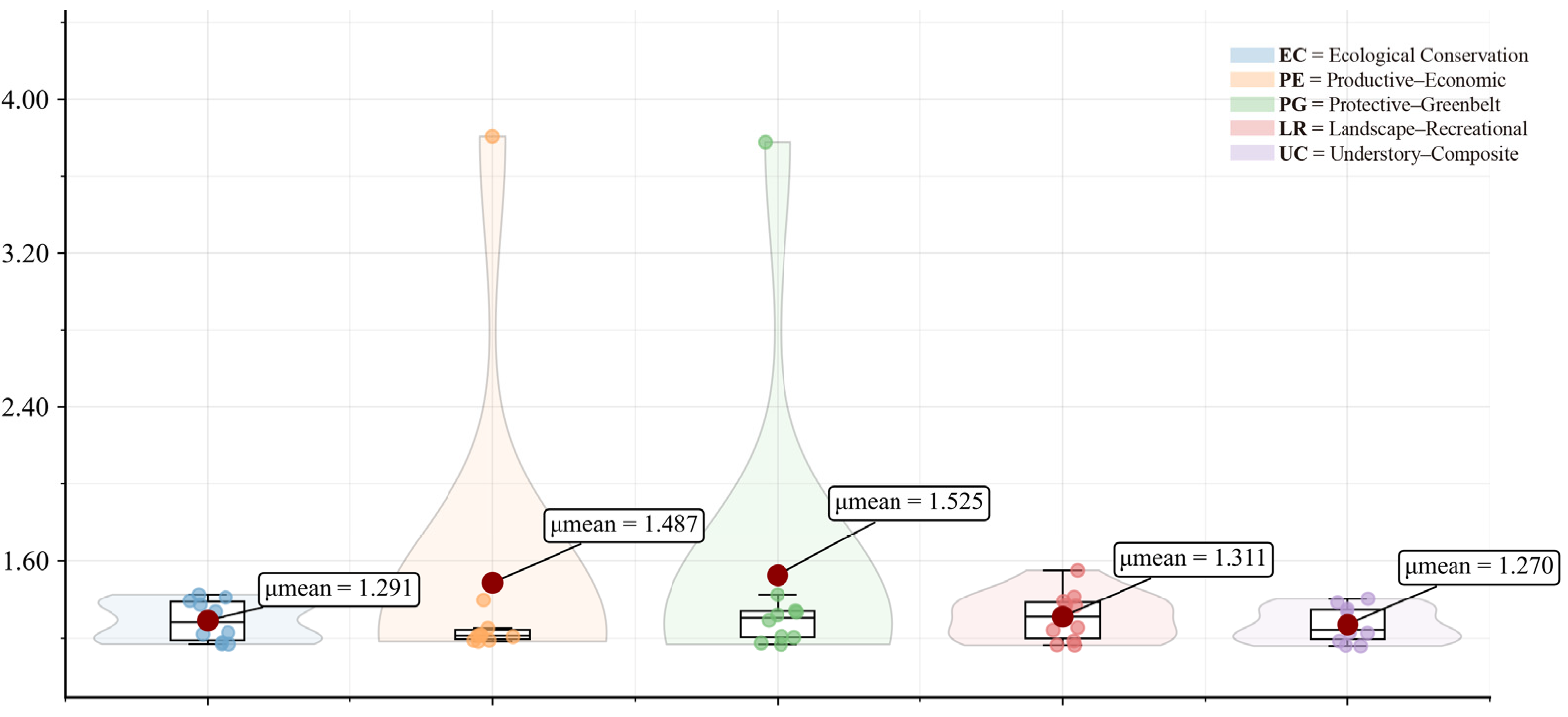
To evaluate whether this contrast persisted once trial-level variability was modeled, we fitted crossed random-intercepts mixed-effects models (participants × images). Adding bamboo space type (M1) and additional covariates (M2) provided no evidence of improved fit relative to the intercept-only model (M0), as indicated by higher AIC and BIC (Table 2). Consistently, in the trial-level model, fixed effects of type, trial order, and photometric covariates (mean luminance and RMS contrast) were not statistically reliable for β/α (all p > 0.14; Table 3). This null pattern is consistent with (i) the context-dependent sensitivity of β/α under brief (15 s) static photo exposure, (ii) substantial image-level heterogeneity (see variance partitioning below), and (iii) reduced statistical sensitivity to small-type effects due to the reduced analyzable EEG sample after stringent quality control. Figure 7 shows substantial within-type dispersion in image-wise β/α, including a small number of extreme photographs. Variance partitioning indicated that image-level heterogeneity accounted for 67.6% of total β/α variance, between-participant variance for 0.03%, and residual trial-level variance for 32.4% (Table S3). Accordingly, the stimulus-level between-type differences in β/α are treated as descriptive patterns shaped by within-type, image-specific variability, whereas inference in subsequent analyses involving β/α relies on the mixed-effects estimates.

3.2. Associations Between Visual Structure, Visual Behavior and Affective and Physiological Responses (RQ2)

3.2.1. Descriptive Associations and Redundancy Diagnostics

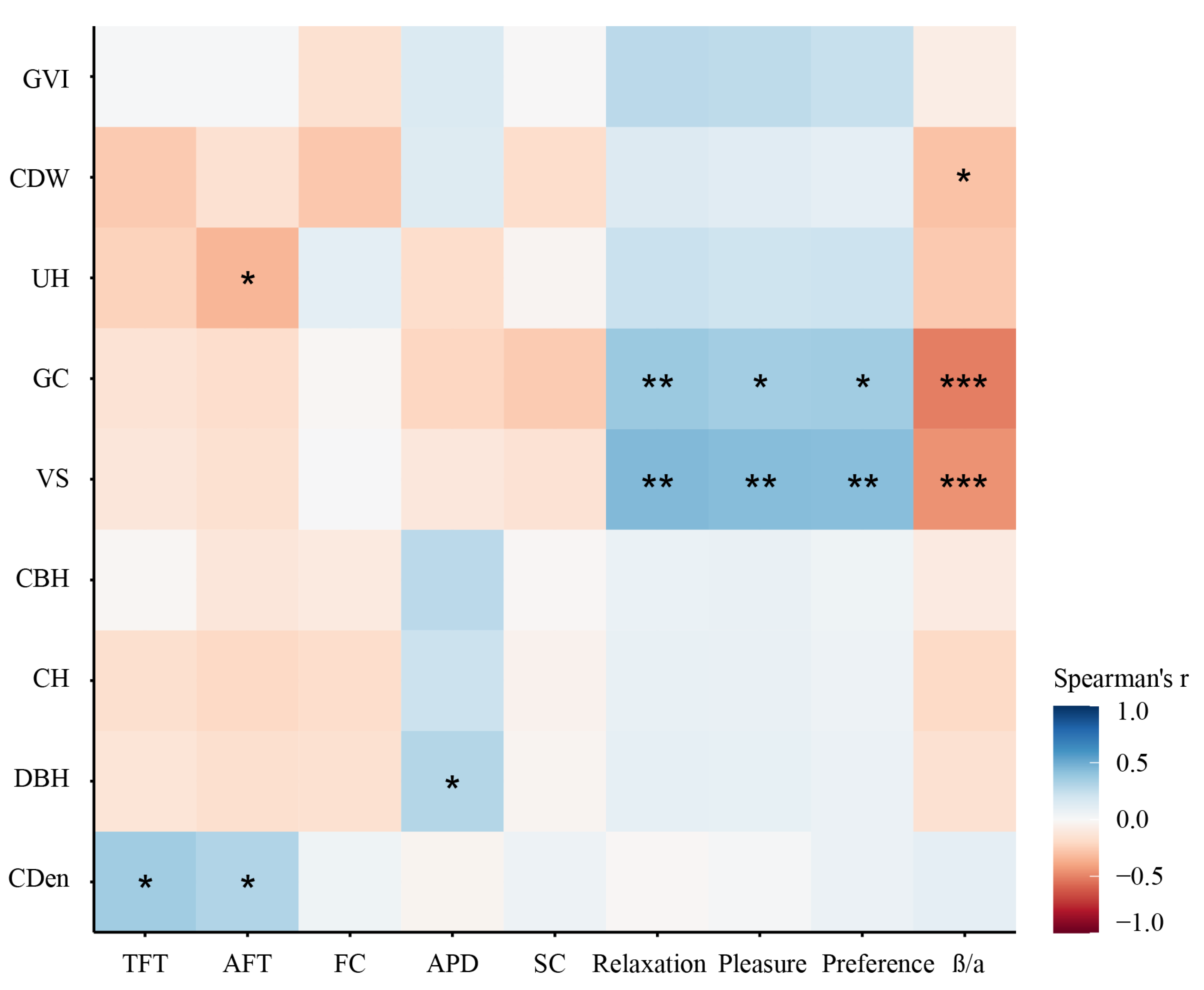
Stimulus-level Spearman correlations based on photo-wise means (N = 50) were used to summarize bivariate patterns and screen for redundancy among structural indicators (Figure 8). Several size-related stand metrics were strongly intercorrelated, supporting parsimonious trial-level specifications. In the outcome domain, CDen correlated with TFT (ρ = 0.355) and AFT (ρ = 0.304), DBH correlated with APD (ρ = 0.295), and UH correlated negatively with AFT (ρ = −0.338) (Figure 8). VS and GC showed the clearest affective links (ρ = 0.43–0.45 with relaxation, pleasure, and preference) and were inversely related to β/α (VS: ρ = −0.455; GC: ρ = −0.515). These correlations are reported descriptively; inference for RQ2 is based on the trial-level mixed-effects models below.

3.2.2. Trial-Level Mixed-Effects Models for Visual Behavior and Physiological Responses

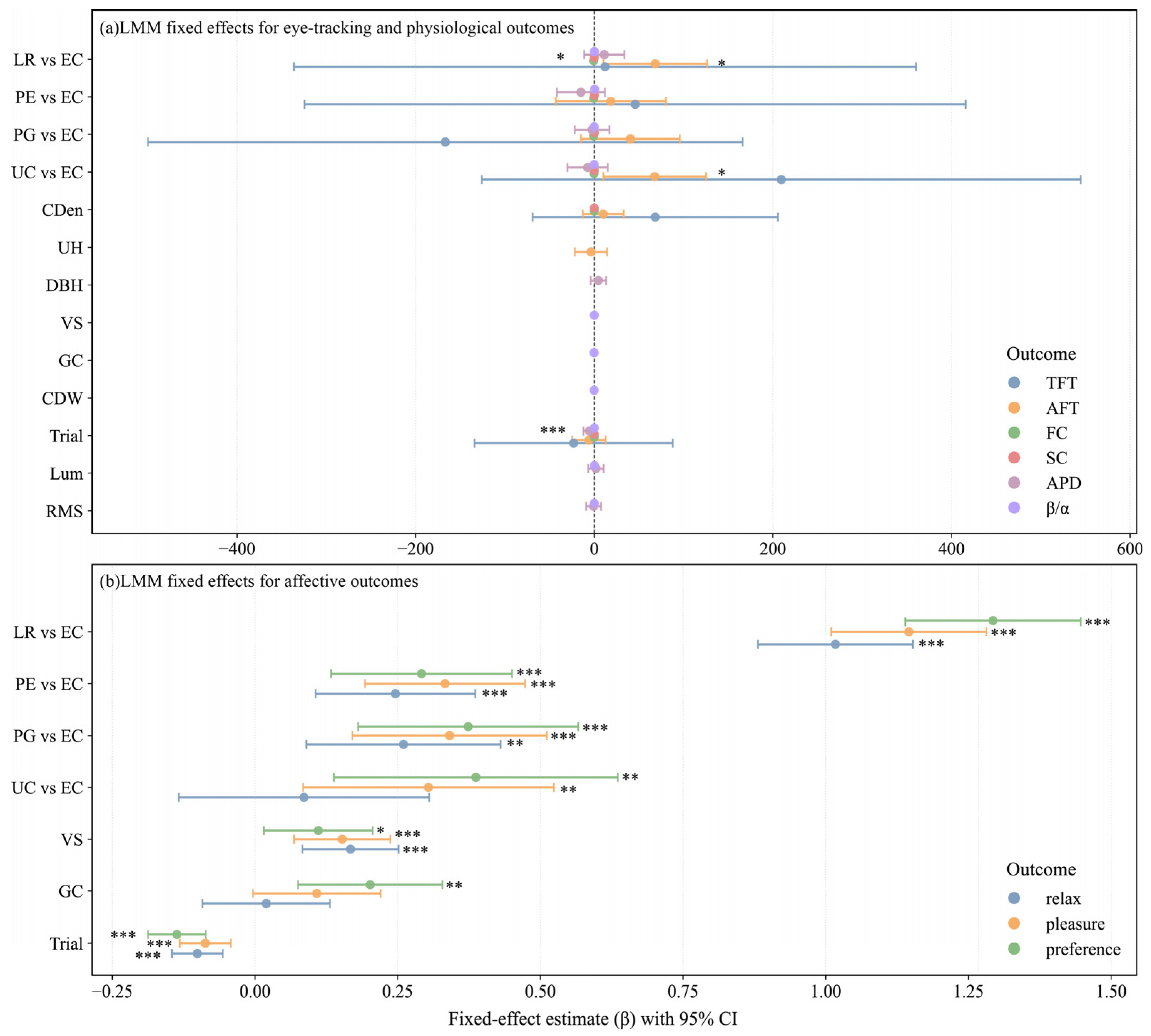
RQ2 was evaluated using trial-level linear mixed-effects models (LMMs) with crossed random intercepts for participant and image, and fixed effects for type (EC as reference), trial order, and pre-specified structural predictors (Table 4; Figure 9a). Mean luminance and RMS contrast were additionally included for APD and β/α. Across outcomes, models were fitted to n = 3250 trials. After adjustment, CDen was not associated with TFT, FC, or SC (all p > 0.22), whereas AFT was higher in LR and UC than in EC and FC was slightly lower in LR (Table 4; Figure 9a). As noted above, higher AFT and TFT should not be interpreted as inherently more restorative and is therefore discussed jointly with affective ratings. SC decreased across trials (p < 0.001). Sensitivity analyses for FC and SC using log(1 + count) LMMs and Poisson mixed models yielded consistent conclusions (Table S4). No fixed effects were detected for APD (all p ≥ 0.10) or β/α (all p > 0.14) once covariates were accounted for.

3.2.3. Trial-Level Mixed-Effects Models for Affective Responses

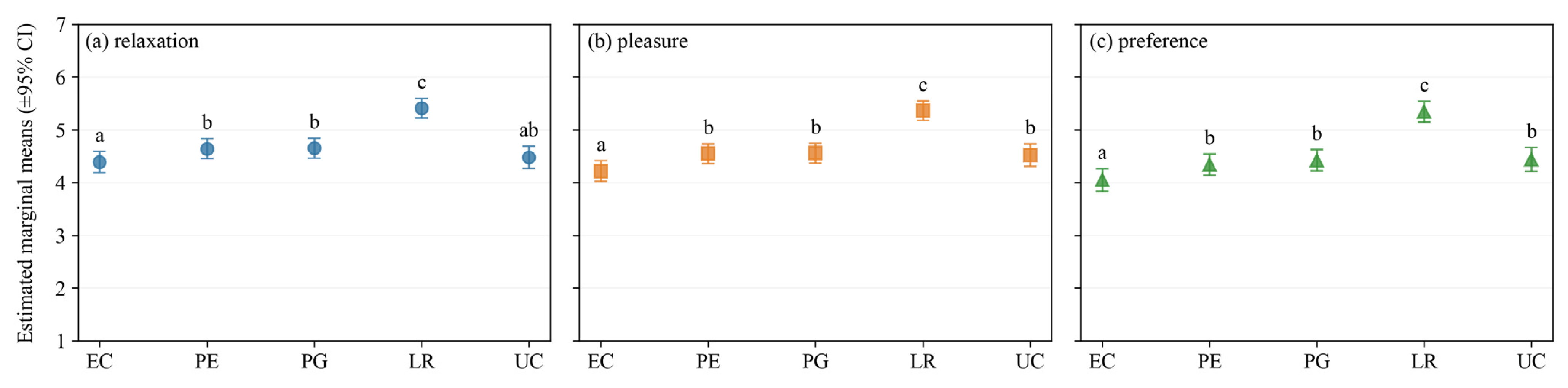
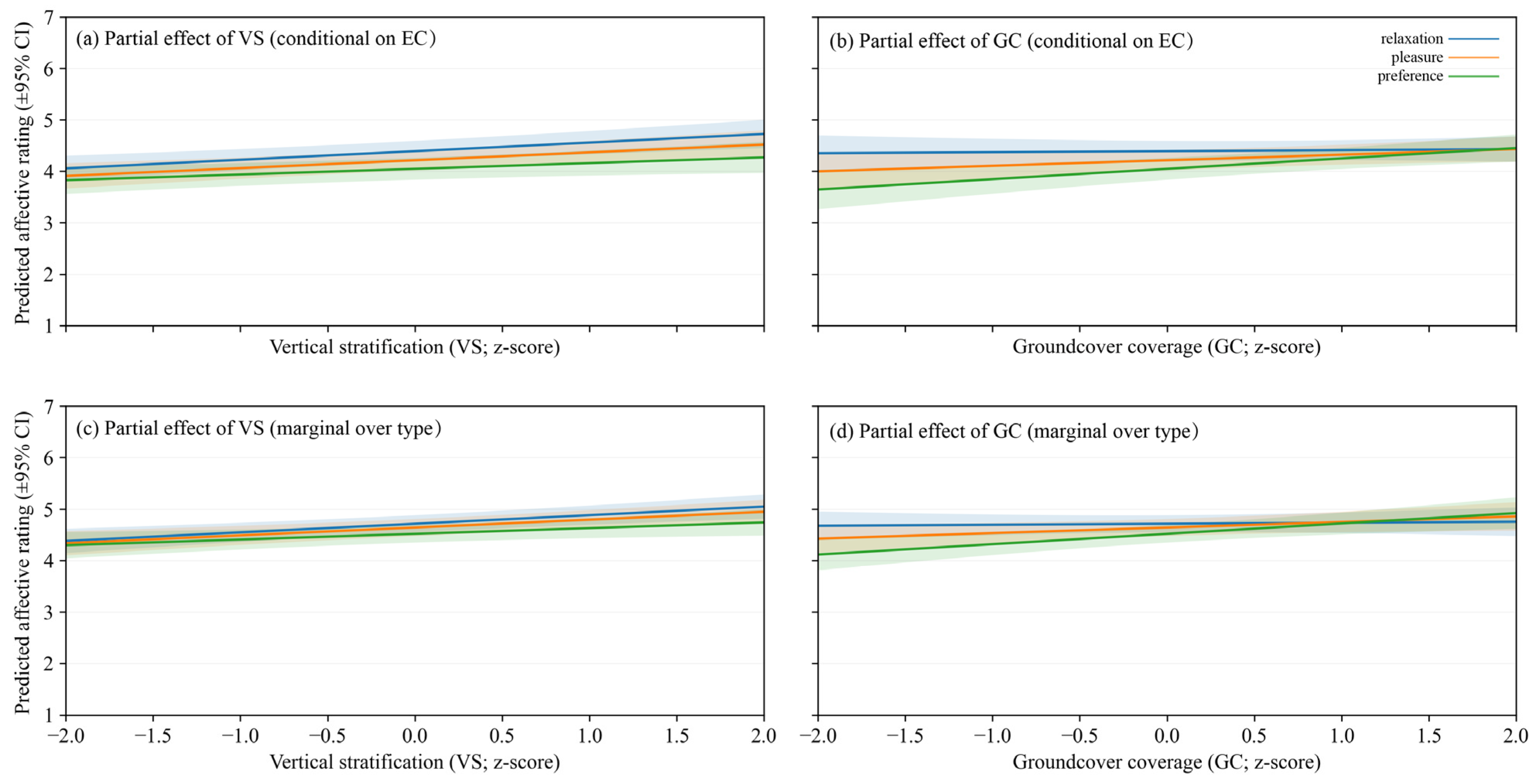
Affective ratings showed robust type contrasts and additional structure-related associations (Table 5; Figure 9b). Relative to EC, LR showed the largest positive contrasts across outcomes. VS was a positive predictor of relaxation, pleasure, and preference after controlling for type and trial order, while GC contributed primarily to preference. Trial order was negatively associated with all affective ratings (all p < 0.001). Model-based EMMs are shown in Figure 10 and partial effects in Figure 11.

3.3. Mediation Analyses (RQ3)

Mediation was tested at the trial level using crossed mixed-effects models. Across the primary structural cues (VS and GC) and affective outcomes, indirect effects via AFT were small and their 95% Monte Carlo confidence intervals (5000 draws) included zero (Table 6), providing no evidence of mediation, and adding AFT did not materially change the corresponding structure–affect estimates. Extending the same tests to alternative mediators (TFT, FC, SC, and APD) and to type contrasts (each type vs. EC) yielded the same null pattern (Table S5). Importantly, this lack of statistically supported mediation should be interpreted as limited evidence for the specific hypothesized structure–attention–affect pathway under the present design and operationalization, rather than as evidence that eye-tracking measures are uninformative. Trial order showed systematic associations with several oculomotor indices and modest shifts in affective ratings; it was retained as a covariate to account for within-session adaptation.

4. Discussion

4.1. Differences in Visual Behavior and Affective Physiological Responses Across Bamboo Space Types

Clear typological contrasts emerged in affective experience. LR scenes consistently elicited higher relaxation, pleasure, and preference, whereas UC scenes tended to score lowest on these ratings. A mechanism consistent with both the typological definition and the measured structure is that LR settings typically support more fluent scene appraisal by offering clearer spatial organization and visual access—features that align with higher legibility and coherence cues [18,34,46,91,92]—whereas UC scenes often combine high stand density with understory-integrated use, which can introduce more occlusion, local heterogeneity, and fragmented depth cues that increase perceptual parsing demands and dampen affective evaluation [14,48,93,94,95].
Typological differences were also expressed in fixation-based eye-tracking metrics, but their direction did not map one-to-one onto affect. At the stimulus level, fixation duration measures (TFT and AFT) varied across types, indicating systematic differences in how viewers allocated attention among bamboo settings. Importantly, trial-level models clarified that the most reliable gaze patterns were selective: AFT was higher in LR and UC relative to EC, FC was slightly lower in LR, and SC showed a robust decline with trial order rather than stable type-specific contrasts. This configuration suggests that longer fixations can reflect at least two qualitatively different processes under free viewing: (i) effortful parsing in visually occluded or information-dense scenes (plausibly more common in UC), and (ii) sustained, stable viewing in scenes that are aesthetically coherent and easy to integrate (plausibly more common in LR). Consequently, fixation prolongation should not be interpreted as inherently “better” or “worse” without considering concurrent affective reports and the structural context that likely drives the processing mode [14,96,97].
Physiologically, EEG β/α did not show reliable space-type effects in trial-level mixed models, and variance partitioning indicated that β/α variability was dominated by image-level heterogeneity and residual trial-wise noise rather than typology. This pattern is consistent with the broader methodological insight that mobile EEG indices during brief exposures may be more responsive to coarse contextual contrasts than to fine-grained structural differentiation among natural scenes, particularly when stimulus-specific variance is strong [98,99,100,101]. Accordingly, in the present trial-level design β/α is most defensible as an auxiliary physiological signal interpreted alongside self-report and gaze. Notably, the co-occurrence of type differences in affect and gaze should not be taken as evidence of attentional mediation; this mechanism is evaluated directly in Section 4.3.

4.2. Structural Attributes as Design Levers Beyond Bamboo Space Type

Beyond broad contrasts between bamboo space types, trial-level models indicated that a small set of structural attributes—specifically vertical stratification (VS) and groundcover coverage (GC) explained incremental variance in affective outcomes after accounting for type and trial order. VS showed a robust positive association with relaxation, pleasure, and preference, whereas GC contributed most clearly to preference, with weaker and less consistent evidence for pleasure. These results imply that, within an already bamboo-dominated (high-greenness) stimulus set, how vegetation is organized vertically and at the ground layer is more informative for affective appraisal than further increasing visible greenness per se [19,20].
Mechanistically, higher VS likely provides clearer depth cues and more organized near–mid–far layering, supporting coherent scene interpretation and facilitating positive affect and preference. Consistent with information-processing accounts, preference benefits of richness and complexity tend to depend on perceived order and organization [36,44,53,98,99]. In contrast, GC operates via pedestrian-level cues: a continuous but visually controlled ground layer can signal care and maintenance while preserving visual access, whereas sparse or highly heterogeneous ground conditions may increase ambiguity in walkability and safety cues [18,19,102]. This distinction may help explain why GC effects concentrated on preference (an evaluative “like–dislike” judgment) while evidence for pleasure was comparatively weaker. After redundancy control and simultaneous adjustment for space type and key structural cues (especially VS and GC), geometric descriptors did not emerge as stable incremental levers. This does not imply these features are unimportant; rather, their informative content is partly shared with typology and with VS and GC, so unique contributions may be attenuated under multicollinearity and become specification-sensitive [103,104]. Accordingly, a non-significant increment should be interpreted as “not uniquely identifiable under the current specification,” rather than “no effect” [104].
Finally, trial order showed a consistent negative association with affective ratings, consistent with habituation and fatigue during rapid, repeated exposure. This suggests that even structurally high-quality bamboo scenes may yield diminishing marginal affective gains when experienced monotonously, highlighting the value of episodic variation in layering or ground-layer texture along routes or within sites.

4.3. Attention as a Mediator Linking Structure to Affective Outcomes

Given the robust associations of bamboo space type and key structural cues (VS and GC) with affective ratings, we tested the proposed attentional pathway using trial-level crossed mixed-effects mediation within the same framework as RQ2 (random intercepts for participant and image). Across VS and GC and all three affective outcomes, indirect effects were consistently small with confidence intervals spanning zero, and inclusion of gaze mediators produced negligible attenuation of the structure–affect estimates. This suggests that, once participant dependence and image-specific heterogeneity were modeled, the structure-related affective advantages did not operate through systematic shifts in global scene-level gaze duration, fixation frequency, or overall scanning intensity.
A parsimonious interpretation is that affective appraisal in bamboo scenes may rely primarily on rapid, holistic evaluation of scene organization and meaning, as emphasized in classic restorative and preference frameworks that foreground fluent processing and low effort [11,43,44]. Global metrics aggregated over a 15 s interval (e.g., mean fixation duration or total fixation time) are relatively coarse and can reflect both “soft fascination” and increased processing demand depending on context; in dense natural scenes, longer fixations may arise from occlusion, clutter, or reduced visual permeability rather than uniquely positive engagement [15,26,49,105]. Therefore, attention-related pathways may be stimulus-contingent and better captured by mechanism-matched mediators (e.g., AOI-based dwell time, early vs. late viewing phases, or scan-path organization) under longer or more immersive exposure [33,46].

4.4. Implications, Limitations, and Future Research Directions

These findings have practical implications for bamboo-space planning and management in bamboo-rich urban contexts. First, function- and management-based typologies provide a useful operational starting point for describing bamboo settings, but the results also motivate within-type structural tuning rather than a single-minded pursuit of visible greenness. In design terms, prioritizing clearer vertical organization (higher VS) and maintaining a continuous—but not visually overwhelming—ground layer (GC) appears more consistently linked to positive affective appraisal than simply maximizing overall green proportion within already green-dominant scenes. Second, the results underscore the potential value of everyday, accessible bamboo spaces for emotional well-being; along frequently used corridors, combining layered structure, coherent ground conditions, and clear sightlines may help transform routine exposure into more reliably positive experiences. Third, although global eye-tracking metrics did not mediate structural effects on affect, the integrated use of eye tracking, EEG, and self-reports provides a practical multi-method toolkit for evaluating bamboo scenes and flagging configurations that may induce visual fatigue or diminished comfort already at the design stage.
Several limitations temper interpretation and point to specific next steps. First, stimuli were static photographs rather than in situ experiences or immersive environments. While this enabled strict control over composition and a precise one-to-one linkage between measured structure and visual exposure, it cannot reproduce multisensory aspects of bamboo stands (microclimate, soundscapes, bodily movement) that are known to shape affective and physiological outcomes. Second, the sample consisted of non-specialist university students from a single institution, which reduces confounding by professional training but limits generalizability across age groups, residents with long-term familiarity, and professional users. Third, indicators were intentionally parsimonious: baseline-corrected β/α was used as the primary EEG outcome, and global image-level eye-tracking metrics were emphasized, which may be insufficiently sensitive to fine-grained attentional mechanisms [106]. Finally, the structural set focused on geometric configuration and visible greenness; biodiversity, seasonality, and cultural meaning—factors repeatedly linked to nature-related benefits—were not explicitly modeled. Moreover, the cultural context of the study (Ya’an, China) may limit the generalizability of the findings to other regions with different cultural perceptions of bamboo landscapes. Bamboo landscape perception may vary across different cultures, and further research is needed to validate these findings in other cultural contexts [7,93,107].
Future research should validate these findings under more naturalistic exposure (field or immersive VR) and in broader community samples. Mechanistic tests may benefit from combining time-resolved or ROI-based eye-tracking analyses with additional physiological markers, and from incorporating biodiversity, seasonality, and culturally salient cues. Longitudinal or intervention designs (e.g., before–after management changes along bamboo corridors) would further strengthen causal inference and increase relevance for place-based planning decisions.

5. Conclusions

Using a controlled photo-exposure design with field-to-image linkage, this study shows that management-defined bamboo space types differ reliably in affective appraisal, and that interpretable structural attributes help explain additional variance beyond typology. Landscape–recreational scenes elicited the highest relaxation, pleasure, and preference, whereas understory–composite scenes were consistently lowest and showed longer fixation durations, suggesting greater visual processing demands. Across models, vertical stratification and groundcover coverage emerged as robust “levers” associated with better affective outcomes. In contrast, baseline-corrected EEG β/α and global eye-movement summaries did not provide consistent mechanistic mediation, implying that affective appraisal may be driven more by holistic scene evaluation under brief, static exposure. Together, the findings translate bamboo place structure into actionable targets for routine design and management aimed at supporting everyday affective restoration.

Supplementary Materials

The following supporting information can be downloaded at https://www.mdpi.com/article/10.3390/horticulturae12030284/s1, Table S1: Bamboo space typology: expected vs. observed tendencies. Table S2: One-way ANOVA results and effect sizes (ω2) for structural and visual indicators across bamboo space types (n = 10 per type; N = 50). Table S3: Variance components and variance partitioning for EEG β/α ratio from the full trial-level mixed-effects model (M2). Table S4: Sensitivity analyses for count outcomes (FC and SC). Table S5: Trial-level LMM fixed effects for eye-tracking and physiological outcomes (RQ2).

Author Contributions

H.L.: Writing—original draft, Visualization, Software, Investigation, Data curation, Formal analysis, Methodology. X.D.: Validation, Methodology, Investigation, Funding acquisition, Data curation. Q.C.: Writing—review and editing, Supervision, Resources, Project administration, Methodology, Funding acquisition, Conceptualization. C.J.: Writing—original draft, Investigation. B.L.: Investigation, Formal analysis. C.M.: Supervision, Methodology. B.S.: Methodology, Investigation. All authors have read and agreed to the published version of the manuscript.

Funding

This research was funded by the National Natural Science Foundation of China (Nos. 32271944) and the Ya’an Yucheng District and University Cooperation Program (2024QXHZ05).

Data Availability Statement

The original contributions presented in this study are included in the article and Supplementary Materials. Further inquiries can be directed to the corresponding author.

Conflicts of Interest

We declare that this manuscript is original, has not been published before and is not currently being considered for publication elsewhere. We confirm that the manuscript has been read and approved by all named authors and that there are no other persons who satisfied the criteria for authorship but are not listed. We further confirm that the order of authors listed in the manuscript has been approved by all of us.

Abbreviations

The following abbreviations are used in this manuscript:
VSVertical stratification
GCGroundcover coverage
CDWCrown width
DBHDiameter at breast height
CDenStand density
CHCulm height
CBHHeight under branch
UHGroundcover height
GVIGreen view index
EEG β/αElectroencephalography beta-to-alpha ratio
FCFixation Count
TFTTotal Fixation Time
AFTAverage Fixation Time
SCSaccade Count
APDAverage Pupil Diameter
ECEcological conservation
PEProductive–economic
PGProtective-greenbelt
LRLandscape–recreational
UCUnderstory–composite

References

  1. World Health Organization. World Mental Health Report: Transforming Mental Health for All; World Health Organization: Geneva, Switzerland, 2022. [Google Scholar]
  2. GBD 2019 Mental Disorders Collaborators. Global, regional, and national burden of 12 mental disorders in 204 countries and territories, 1990–2019: A systematic analysis for the Global Burden of Disease Study 2019. Lancet Psychiatry 2022, 9, 137–150. [Google Scholar] [CrossRef] [PubMed]
  3. Ulrich, R.S.; Simons, R.F.; Losito, B.D.; Fiorito, E.; Miles, M.A.; Zelson, M. Stress recovery during exposure to natural and urban environments. J. Environ. Psychol. 1991, 11, 201–230. [Google Scholar] [CrossRef]
  4. Hartig, T.; Mitchell, R.; De Vries, S.; Frumkin, H. Nature and health. Annu. Rev. Public Health 2014, 35, 207–228. [Google Scholar] [CrossRef] [PubMed]
  5. Twohig-Bennett, C.; Jones, A. The health benefits of the great outdoors: A systematic review and meta-analysis of greenspace exposure and health outcomes. Environ. Res. 2018, 166, 628–637. [Google Scholar] [CrossRef]
  6. Li, H.; Zhang, X.; Bi, S.; Cao, Y.; Zhang, G. Psychological benefits of green exercise in wild or urban greenspaces: A meta-analysis of controlled trials. Urban For. Urban Green. 2022, 68, 127458. [Google Scholar] [CrossRef]
  7. Velarde, M.D.; Fry, G.; Tveit, M. Health effects of viewing landscapes–Landscape types in environmental psychology. Urban For. Urban Green. 2007, 6, 199–212. [Google Scholar] [CrossRef]
  8. Daniel, T.C. Whither scenic beauty? Visual landscape quality assessment in the 21st century. Landsc. Urban Plan. 2001, 54, 267–281. [Google Scholar] [CrossRef]
  9. Tveit, M.; Ode, Å.; Fry, G. Key concepts in a framework for analysing visual landscape character. Landsc. Res. 2006, 31, 229–255. [Google Scholar] [CrossRef]
  10. Ode, Å.; Tveit, M.S.; Fry, G. Capturing landscape visual character using indicators: Touching base with landscape aesthetic theory. Landsc. Res. 2008, 33, 89–117. [Google Scholar] [CrossRef]
  11. Stamps, A.E., III. Mystery, complexity, legibility and coherence: A meta-analysis. J. Environ. Psychol. 2004, 24, 1–16. [Google Scholar] [CrossRef]
  12. Lu, Z.; Pesarakli, H. Seeing is believing: Using eye-tracking devices in environmental research. HERD Health Environ. Res. Des. J. 2023, 16, 15–52. [Google Scholar] [CrossRef] [PubMed]
  13. Valtakari, N.V.; Hooge, I.T.; Viktorsson, C.; Nyström, P.; Falck-Ytter, T.; Hessels, R.S. Eye tracking in human interaction: Possibilities and limitations. Behav. Res. Methods 2021, 53, 1592–1608. [Google Scholar] [CrossRef] [PubMed]
  14. Skaramagkas, V.; Giannakakis, G.; Ktistakis, E.; Manousos, D.; Karatzanis, I.; Tachos, N.S.; Tripoliti, E.; Marias, K.; Fotiadis, D.I.; Tsiknakis, M. Review of eye tracking metrics involved in emotional and cognitive processes. IEEE Rev. Biomed. Eng. 2021, 16, 260–277. [Google Scholar] [CrossRef] [PubMed]
  15. Cronin, D.A.; Hall, E.H.; Goold, J.E.; Hayes, T.R.; Henderson, J.M. Eye movements in real-world scene photographs: General characteristics and effects of viewing task. Front. Psychol. 2020, 10, 2915. [Google Scholar] [CrossRef]
  16. Hou, J.; Wang, Y.; Zhang, X.; Qiu, L.; Gao, T. The effect of visibility on green space recovery, perception and preference. Trees For. People 2024, 16, 100538. [Google Scholar] [CrossRef]
  17. Yetkin, E.; Akpınar, A. Exploring the Restorative Effects of Urban Green Spaces on People’s Psycho-Physiological Health: A Focus on Perceived Sensory Dimensions in Turkey. Urban For. Urban Green. 2025, 113, 129010. [Google Scholar] [CrossRef]
  18. Wang, R.; Zhao, J.; Meitner, M.J.; Hu, Y.; Xu, X. Characteristics of urban green spaces in relation to aesthetic preference and stress recovery. Urban For. Urban Green. 2019, 41, 6–13. [Google Scholar] [CrossRef]
  19. Jiang, B.; Chang, C.-Y.; Sullivan, W.C. A dose of nature: Tree cover, stress reduction, and gender differences. Landsc. Urban Plan. 2014, 132, 26–36. [Google Scholar] [CrossRef]
  20. Jiang, B.; Larsen, L.; Deal, B.; Sullivan, W.C. A dose–response curve describing the relationship between tree cover density and landscape preference. Landsc. Urban Plan. 2015, 139, 16–25. [Google Scholar] [CrossRef]
  21. Dupont, L.; Antrop, M.; Van Eetvelde, V. Eye-tracking analysis in landscape perception research: Influence of photograph properties and landscape characteristics. Landsc. Res. 2014, 39, 417–432. [Google Scholar] [CrossRef]
  22. Gao, Y.; Zhang, T.; Zhang, W.; Meng, H.; Zhang, Z. Research on visual behavior characteristics and cognitive evaluation of different types of forest landscape spaces. Urban For. Urban Green. 2020, 54, 126788. [Google Scholar] [CrossRef]
  23. Wang, P.; Yang, W.; Wang, D.; He, Y. Insights into public visual behaviors through eye-tracking tests: A study based on national park system pilot area landscapes. Land 2021, 10, 497. [Google Scholar] [CrossRef]
  24. Fu, H.; Xue, P. Cognitive restoration in following exposure to green infrastructure: An eye-tracking study. J. Green Build. 2023, 18, 65–88. [Google Scholar] [CrossRef]
  25. Liu, L.; Qu, H.; Ma, Y.; Wang, K.; Qu, H. Restorative benefits of urban green space: Physiological, psychological restoration and eye movement analysis. J. Environ. Manag. 2022, 301, 113930. [Google Scholar] [CrossRef]
  26. Franěk, M.; Šefara, D.; Petružálek, J.; Cabal, J.; Myška, K. Differences in eye movements while viewing images with various levels of restorativeness. J. Environ. Psychol. 2018, 57, 10–16. [Google Scholar] [CrossRef]
  27. Bolouki, A. Neurobiological effects of urban built and natural environment on mental health: Systematic review. Rev. Environ. Health 2023, 38, 169–179. [Google Scholar] [CrossRef]
  28. Olszewska-Guizzo, A.; Escoffier, N.; Chan, J.; Yok, T.P. Window view and the brain: Effects of floor level and green cover on the alpha and beta rhythms in a passive exposure eeg experiment. Int. J. Environ. Res. Public Health 2018, 15, 2358. [Google Scholar] [CrossRef]
  29. Imperatori, C.; Massullo, C.; De Rossi, E.; Carbone, G.A.; Theodorou, A.; Scopelliti, M.; Romano, L.; Del Gatto, C.; Allegrini, G.; Carrus, G. Exposure to nature is associated with decreased functional connectivity within the distress network: A resting state EEG study. Front. Psychol. 2023, 14, 1171215. [Google Scholar] [CrossRef]
  30. Reece, R.; Bornioli, A.; Bray, I.; Alford, C. Exposure to green and historic urban environments and mental well-being: Results from EEG and psychometric outcome measures. Int. J. Environ. Res. Public Health 2022, 19, 13052. [Google Scholar] [CrossRef]
  31. Grassini, S.; Segurini, G.V.; Koivisto, M. Watching nature videos promotes physiological restoration: Evidence from the modulation of alpha waves in electroencephalography. Front. Psychol. 2022, 13, 871143. [Google Scholar] [CrossRef]
  32. Olszewska-Guizzo, A.; Sia, A.; Fogel, A.; Ho, R. Can exposure to certain urban green spaces trigger frontal alpha asymmetry in the brain?—Preliminary findings from a passive task EEG study. Int. J. Environ. Res. Public Health 2020, 17, 394. [Google Scholar] [CrossRef]
  33. Yu, C.-P.; Lee, H.-Y.; Luo, X.-Y. The effect of virtual reality forest and urban environments on physiological and psychological responses. Urban For. Urban Green. 2018, 35, 106–114. [Google Scholar] [CrossRef]
  34. Baumann, H.; Grêt-Regamey, A. Exploring the interplay of urban form and greenery in residents’ affective and cognitive responses. Urban For. Urban Green. 2024, 101, 128553. [Google Scholar] [CrossRef]
  35. Xiang, L.; Cai, M.; Ren, C.; Ng, E. Modeling pedestrian emotion in high-density cities using visual exposure and machine learning: Tracking real-time physiology and psychology in Hong Kong. Build. Environ. 2021, 205, 108273. [Google Scholar] [CrossRef]
  36. Ewan, R.F. With people in mind: Design and management of everyday nature. Landsc. J. 1999, 18, 99–101. [Google Scholar] [CrossRef]
  37. Zhu, C.; Feng, X.; Luo, J.; Fu, S.; Li, T.; Wang, W.; Li, X. Effects of different audiovisual landscapes in bamboo forest space on physical and mental restorative potential of university students: Based on eye-tracking experiments. Front. For. Glob. Change 2024, 7, 1415514. [Google Scholar] [CrossRef]
  38. Li, X.; Du, H.; Mao, F.; Zhou, G.; Xing, L.; Liu, T.; Han, N.; Liu, E.; Ge, H.; Liu, Y. Mapping spatiotemporal decisions for sustainable productivity of bamboo forest land. Land Degrad. Dev. 2020, 31, 939–958. [Google Scholar] [CrossRef]
  39. Shen, J.; Zeng, X.; Fan, S.; Liu, G. Impacts of Intensive Management Practices on the Long-Term Sustainability of Soil and Water Conservation Functions in Bamboo Forests: A Mechanistic Review from Silvicultural Perspectives. Forests 2025, 16, 787. [Google Scholar] [CrossRef]
  40. Paudyal, K.; Yanxia, L.; Long, T.T.; Adhikari, S.; Lama, S.; Bhatta, K.P. Ecosystem Services from Bamboo Forests: Key Findings, Lessons Learnt and Call for Actions from Global Synthesis; INBAR: Beijing, China, 2022. [Google Scholar] [CrossRef]
  41. Wang, Y.; Liu, G.; Jiang, M.; Yang, Q.; Chen, Q.; Li, X.; Luo, Z.; Song, H.; Du, J.; Yu, X. Effects of forest spatial types, element compositions and forest stands on restorative potential and aesthetic preference. Front. For. Glob. Change 2023, 6, 1218134. [Google Scholar] [CrossRef]
  42. Hartig, T.; Böök, A.; Garvill, J.; Olsson, T.; Gärling, T. Environmental influences on psychological restoration. Scand. J. Psychol. 1996, 37, 378–393. [Google Scholar] [CrossRef]
  43. Ulrich, R.S. Aesthetic and affective response to natural environment. In Behavior and the Natural Environment; Springer: Berlin/Heidelberg, Germany, 1983; pp. 85–125. [Google Scholar] [CrossRef]
  44. Kaplan, R.; Kaplan, S. The Experience of Nature: A Psychological Perspective; Cambridge University Press: New York, NY, USA, 1989. [Google Scholar]
  45. White, M.P.; Alcock, I.; Grellier, J.; Wheeler, B.W.; Hartig, T.; Warber, S.L.; Bone, A.; Depledge, M.H.; Fleming, L.E. Spending at least 120 minutes a week in nature is associated with good health and wellbeing. Sci. Rep. 2019, 9, 7730. [Google Scholar] [CrossRef]
  46. Li, J.; Zhang, Z.; Jing, F.; Gao, J.; Ma, J.; Shao, G.; Noel, S. An evaluation of urban green space in Shanghai, China, using eye tracking. Urban For. Urban Green. 2020, 56, 126903. [Google Scholar] [CrossRef]
  47. Martínez-Soto, J.L.A.; De la Fuente Suárez, L.; Gonzáles-Santos, F.A. Barrios, Observation of environments with different restorative potential results in differences in eye patron movements and pupillary size. IBRO Rep. 2019, 7, 52–58. [Google Scholar] [CrossRef] [PubMed]
  48. Gao, S.; Ma, Y.; Wang, C.; Xue, H.; Zhu, K.; Hou, S.; Feng, C. Assessing urban greenery impact on human psychological and physiological responses through virtual reality. Build. Environ. 2025, 272, 112696. [Google Scholar] [CrossRef]
  49. Hwang, A.D.; Wang, H.-C.; Pomplun, M. Semantic guidance of eye movements in real-world scenes. Vis. Res. 2011, 51, 1192–1205. [Google Scholar] [CrossRef]
  50. Hao, J.; Li, Y.; Hu, T.; Ma, Y.; Wang, X.; Liu, J.; Gao, T.; Qiu, L. Vegetation diversity in structure, species or colour: Coupling effects of the different characteristics of urban green spaces on preference and perceived restoration. Ecol. Indic. 2024, 169, 112897. [Google Scholar] [CrossRef]
  51. Shen, Y.; Wang, Q.; Liu, H.; Luo, J.; Liu, Q.; Lan, Y. Landscape design intensity and its associated complexity of forest landscapes in relation to preference and eye movements. Forests 2023, 14, 761. [Google Scholar] [CrossRef]
  52. Chiang, Y.-C.; Li, D.; Jane, H.-A. Wild or tended nature? The effects of landscape location and vegetation density on physiological and psychological responses. Landsc. Urban Plan. 2017, 167, 72–83. [Google Scholar] [CrossRef]
  53. Zhang, G.; Yang, J.; Wu, G.; Hu, X. Exploring the interactive influence on landscape preference from multiple visual attributes: Openness, richness, order, and depth. Urban For. Urban Green. 2021, 65, 127363. [Google Scholar] [CrossRef]
  54. Zhang, G.; Yang, J.; Jin, J. Assessing relations among landscape preference, informational variables, and visual attributes. J. Environ. Eng. Landsc. Manag. 2021, 29, 294–304. [Google Scholar] [CrossRef]
  55. Zhou, W.; Wang, J.; Cadenasso, M.L. Effects of the spatial configuration of trees on urban heat mitigation: A comparative study. Remote Sens. Environ. 2017, 195, 1–12. [Google Scholar] [CrossRef]
  56. Lin, W.; Zeng, C.; Lam, N.S.-N.; Liu, Z.; Tao, J.; Zhang, X.; Lyu, B.; Li, N.; Li, D.; Chen, Q. Study of the relationship between the spatial structure and thermal comfort of a pure forest with four distinct seasons at the microscale level. Urban For. Urban Green. 2021, 62, 127168. [Google Scholar] [CrossRef]
  57. Perini, K.; Magliocco, A. Effects of vegetation, urban density, building height, and atmospheric conditions on local temperatures and thermal comfort. Urban For. Urban Green. 2014, 13, 495–506. [Google Scholar] [CrossRef]
  58. Wang, Y.; Ni, Z.; Peng, Y.; Xia, B. Local variation of outdoor thermal comfort in different urban green spaces in Guangzhou, a subtropical city in South China. Urban For. Urban Green. 2018, 32, 99–112. [Google Scholar] [CrossRef]
  59. Li, W.; Liu, Y. The influence of visual and auditory environments in parks on visitors’ landscape preference, emotional state, and perceived restorativeness. Humanit. Soc. Sci. Commun. 2024, 11, 1491. [Google Scholar] [CrossRef]
  60. Zhang, N.; Zheng, X.; Wang, X. Assessment of aesthetic quality of urban landscapes by integrating objective and subjective factors: A case study for riparian landscapes. Front. Ecol. Evol. 2022, 9, 735905. [Google Scholar] [CrossRef]
  61. Ding, Y.; Qu, H.; Qu, H. A dose–response curve of restorative benefits of plant communities: Based on visual distances and yellow to green hue range. J. For. Res. 2026, 37, 2. [Google Scholar] [CrossRef]
  62. Kruiper, C.; Glenthøj, B.Y.; Oranje, B. Effects of clonidine on MMN and P3a amplitude in schizophrenia patients on stable medication. Neuropsychopharmacology 2019, 44, 1062–1067. [Google Scholar] [CrossRef]
  63. Gelman, A.; Hill, J. Data Analysis Using Regression and Multilevel/Hierarchical Models; Cambridge University Press: Cambridge, UK, 2007. [Google Scholar]
  64. Preacher, K.J.; Zyphur, M.J.; Zhang, Z. A general multilevel SEM framework for assessing multilevel mediation. Psychol. Methods 2010, 15, 209–233. [Google Scholar] [CrossRef]
  65. Bauer, D.J.; Preacher, K.J.; Gil, K.M. Conceptualizing and testing random indirect effects and moderated mediation in multilevel models: New procedures and recommendations. Psychol. Methods 2006, 11, 142–163. [Google Scholar] [CrossRef]
  66. Preacher, K.J.; Selig, J.P. Advantages of Monte Carlo confidence intervals for indirect effects. Commun. Methods Meas. 2012, 6, 77–98. [Google Scholar] [CrossRef]
  67. Zhou, S.; Gao, Y.; Zhang, Z.; Zhang, W.; Meng, H.; Zhang, T. Visual behaviour and cognitive preferences of users for constituent elements in forest landscape spaces. Forests 2022, 13, 47. [Google Scholar] [CrossRef]
  68. Zhang, Z.; Gao, Y.; Zhou, S.; Zhang, T.; Zhang, W.; Meng, H. Psychological cognitive factors affecting visual behavior and satisfaction preference for forest recreation space. Forests 2022, 13, 136. [Google Scholar] [CrossRef]
  69. Holmqvist, K.; Nyström, M.; Andersson, R.; Dewhurst, R.; Jarodzka, H.; Van de Weijer, J. Eye Tracking: A Comprehensive Guide to Methods and Measures; Oup: Oxford, UK, 2011. [Google Scholar]
  70. Basner, M.; Babisch, W.; Davis, A.; Brink, M.; Clark, C.; Janssen, S.; Stansfeld, S. Auditory and non-auditory effects of noise on health. Lancet 2014, 383, 1325–1332. [Google Scholar] [CrossRef]
  71. Fisher, R.A.; Fisher, R.A. The Design of Experiments; Springer: Berlin/Heidelberg, Germany, 1971. [Google Scholar]
  72. Zhang, Z.; Zhuo, K.; Wei, W.; Li, F.; Yin, J.; Xu, L. Emotional responses to the visual patterns of urban streets: Evidence from physiological and subjective indicators. Int. J. Environ. Res. Public Health 2021, 18, 9677. [Google Scholar] [CrossRef]
  73. Liu, Y.; Hu, M.; Zhao, B. Audio-visual interactive evaluation of the forest landscape based on eye-tracking experiments. Urban For. Urban Green. 2019, 46, 126476. [Google Scholar] [CrossRef]
  74. Oldfield, R.C. The assessment and analysis of handedness: The Edinburgh inventory. Neuropsychologia 1971, 9, 97–113. [Google Scholar] [CrossRef]
  75. Avery, T.E.; Burkhart, H.E. Forest Measurements; Waveland Press: Long Grove, IL, USA, 2015. [Google Scholar]
  76. Pretzsch, H.; Biber, P.; Uhl, E.; Dahlhausen, J.; Rötzer, T.; Caldentey, J.; Koike, T.; Van Con, T.; Chavanne, A.; Seifert, T. Crown size and growing space requirement of common tree species in urban centres, parks, and forests. Urban For. Urban Green. 2015, 14, 466–479. [Google Scholar] [CrossRef]
  77. Ellenberg, D.; Mueller-Dombois, D. Aims and Methods of Vegetation Ecology; Wiley: New York, NY, USA, 1974. [Google Scholar]
  78. Li, X.; Zhang, C.; Li, W.; Ricard, R.; Meng, Q.; Zhang, W. Assessing street-level urban greenery using Google Street View and a modified green view index. Urban For. Urban Green. 2015, 14, 675–685. [Google Scholar] [CrossRef]
  79. Kerimova, N.; Sivokhin, P.; Kodzokova, D.; Nikogosyan, K.; Klucharev, V. Visual processing of green zones in shared courtyards during renting decisions: An eye-tracking study. Urban For. Urban Green. 2022, 68, 127460. [Google Scholar] [CrossRef]
  80. Pan, J.; Sun, X.; Park, E.; Kaufmann, M.; Klimova, M.; McGuire, J.T.; Ling, S. The effects of emotional arousal on pupil size depend on luminance. Sci. Rep. 2024, 14, 21895. [Google Scholar] [CrossRef] [PubMed]
  81. Pan, J.; Klímová, M.; McGuire, J.T.; Ling, S. Arousal-based pupil modulation is dictated by luminance. Sci. Rep. 2022, 12, 1390. [Google Scholar] [CrossRef] [PubMed]
  82. Mathôt, S.; Vilotijević, A. Methods in cognitive pupillometry: Design, preprocessing, and statistical analysis. Behav. Res. Methods 2023, 55, 3055–3077. [Google Scholar] [CrossRef] [PubMed]
  83. Peli, E. Contrast in complex images. J. Opt. Soc. Am. A 1990, 7, 2032–2040. [Google Scholar] [CrossRef]
  84. Klem, G.H. The ten-twenty electrode system of the international federation. The international federation of clinical neurophysiology. Electroencephalogr. Clin. Neurophysiol. Suppl. 1999, 52, 3–6. [Google Scholar]
  85. Welch, P. The use of fast Fourier transform for the estimation of power spectra: A method based on time averaging over short, modified periodograms. IEEE Trans. Audio Electroacoust. 2003, 15, 70–73. [Google Scholar] [CrossRef]
  86. Delorme, A.; Makeig, S. EEGLAB: An open source toolbox for analysis of single-trial EEG dynamics including independent component analysis. J. Neurosci. Methods 2004, 134, 9–21. [Google Scholar] [CrossRef]
  87. Klimesch, W. EEG alpha and theta oscillations reflect cognitive and memory performance: A review and analysis. Brain Res. Rev. 1999, 29, 169–195. [Google Scholar] [CrossRef]
  88. Olejnik, S.; Algina, J. Generalized eta and omega squared statistics: Measures of effect size for some common research designs. Psychol. Methods 2003, 8, 434–447. [Google Scholar] [CrossRef]
  89. Barr, D.J.; Levy, R.; Scheepers, C.; Tily, H.J. Random effects structure for confirmatory hypothesis testing: Keep it maximal. J. Mem. Lang. 2013, 68, 255–278. [Google Scholar] [CrossRef]
  90. Bolker, B.M.; Brooks, M.E.; Clark, C.J.; Geange, S.W.; Poulsen, J.R.; Stevens, M.H.H.; White, J.-S.S. Generalized linear mixed models: A practical guide for ecology and evolution. Trends Ecol. Evol. 2009, 24, 127–135. [Google Scholar] [CrossRef] [PubMed]
  91. Zhou, X.; Cen, Q.; Qiu, H. Effects of urban waterfront park landscape elements on visual behavior and public preference: Evidence from eye-tracking experiments. Urban For. Urban Green. 2023, 82, 127889. [Google Scholar] [CrossRef]
  92. Hooyberg, A.; Michels, N.; Allaert, J.; Vandegehuchte, M.B.; Everaert, G.; De Henauw, S.; Roose, H. ‘Blue’coasts: Unravelling the perceived restorativeness of coastal environments and the influence of their components. Landsc. Urban Plan. 2022, 228, 104551. [Google Scholar] [CrossRef]
  93. Marselle, M.R.; Irvine, K.N.; Lorenzo-Arribas, A.; Warber, S.L. Does perceived restorativeness mediate the effects of perceived biodiversity and perceived naturalness on emotional well-being following group walks in nature? J. Environ. Psychol. 2016, 46, 217–232. [Google Scholar] [CrossRef]
  94. Hur, M.; Nasar, J.L.; Chun, B. Neighborhood satisfaction, physical and perceived naturalness and openness. J. Environ. Psychol. 2010, 30, 52–59. [Google Scholar] [CrossRef]
  95. Yang, S.; Dane, G.; van den Berg, P.; Arentze, T. Influences of cognitive appraisal and individual characteristics on citizens’ perception and emotion in urban environment: Model development and virtual reality experiment. J. Environ. Psychol. 2024, 96, 102309. [Google Scholar] [CrossRef]
  96. Henderson, J.M. Human gaze control during real-world scene perception. Trends Cogn. Sci. 2003, 7, 498–504. [Google Scholar] [CrossRef]
  97. Tatler, B.W.; Hayhoe, M.M.; Land, M.F.; Ballard, D.H. Eye guidance in natural vision: Reinterpreting salience. J. Vis. 2011, 11, 5. [Google Scholar] [CrossRef]
  98. Malcolm, B.R.; Foxe, J.J.; Butler, J.S.; De Sanctis, P. The aging brain shows less flexible reallocation of cognitive resources during dual-task walking: A mobile brain/body imaging (MoBI) study. Neuroimage 2015, 117, 230–242. [Google Scholar] [CrossRef]
  99. Yuan, Y.; Wang, L.; Wu, W.; Zhong, S.; Wang, M. Locally contextualized psycho-physiological wellbeing effects of environmental exposures: An experimental-based evidence. Urban For. Urban Green. 2023, 88, 128070. [Google Scholar] [CrossRef]
  100. Kim, S. Cognitive efficiency in VR simulated natural indoor environments examined through EEG and affective responses. Sci. Rep. 2025, 15, 33398. [Google Scholar] [CrossRef] [PubMed]
  101. Grassini, S. EEG for the Study of Environmental Neuroscience, Environmental Neuroscience; Springer: Berlin/Heidelberg, Germany, 2024; pp. 547–561. [Google Scholar] [CrossRef]
  102. Dormann, C.F.; Elith, J.; Bacher, S.; Buchmann, C.; Carl, G.; Carré, G.; Marquéz, J.R.G.; Gruber, B.; Lafourcade, B.; Leitão, P.J. Collinearity: A review of methods to deal with it and a simulation study evaluating their performance. Ecography 2013, 36, 27–46. [Google Scholar] [CrossRef]
  103. Graham, M.H. Confronting multicollinearity in ecological multiple regression. Ecology 2003, 84, 2809–2815. [Google Scholar] [CrossRef]
  104. Azen, R.; Budescu, D.V. The dominance analysis approach for comparing predictors in multiple regression. Psychol. Methods 2003, 8, 129–148. [Google Scholar] [CrossRef]
  105. Ulrich, R.S. View through a window may influence recovery from surgery. Science 1984, 224, 420–421. [Google Scholar] [CrossRef]
  106. Negi, S.; Mitra, R. Native language subtitling of educational videos: A multimodal analysis with eye tracking, EEG and self-reports. Br. J. Educ. Technol. 2022, 53, 1793–1816. [Google Scholar] [CrossRef]
  107. Bikomeye, J.C.; Beyer, A.M.; Kwarteng, J.L.; Beyer, K.M. Greenspace; inflammation; cardiovascular health, and cancer: A review and conceptual framework for greenspace in cardio-oncology research. Int. J. Environ. Res. Public Health 2022, 19, 2426. [Google Scholar] [CrossRef]
Figure 1. Conceptual framework and analytical workflow.
Horticulturae 12 00284 g001
Figure 2. Experimental procedure for the photo-based bamboo image exposure task.
Horticulturae 12 00284 g002
Figure 3. Spatial distribution of bamboo space in Ya’an. (a) Location of Sichuan Province within China; (b) location of Ya’an within Sichuan Province; (c) topography (elevation) and the distribution of bamboo spaces in Ya’an, with the main administrative centers indicated by red dots.
Horticulturae 12 00284 g003
Figure 4. Schematic illustration of bamboo stands structure and visual–structural metrics.
Horticulturae 12 00284 g004
Figure 5. Structural characteristics of the five bamboo space types. Different letters above indicate significant differences among types (Tukey’s HSD, p < 0.05). ANOVAs and Tukey HSD tests were conducted on photo-wise means (N = 50).
Horticulturae 12 00284 g005
Figure 6. Type differences in eye-tracking metrics, affective ratings and EEG across five bamboo space types. (a) Total fixation time (TFT); (b) Average fixation time (AFT); (c) Fixation count (FC); (d) Average pupil diameter (APD); (e) Saccade count (SC); (f) Relaxation rating; (g) Pleasure rating; (h) Preference rating; (i) EEG β/α ratio. Boxes represent the interquartile range with medians (solid lines) and means (dashed lines); whiskers denote 1.5× IQR. Group comparisons and letter annotations were based on photo-wise means (N = 50) with Tukey HSD (p < 0.05). UC: Understory–Composite; LR: Landscape–Recreational; PE: Productive–Economic; EC: Ecological Conservation; PG: Protective–Greenbelt.
Horticulturae 12 00284 g006
Figure 7. Within-type dispersion of image-wise EEG β/α ratio across bamboo space types. Each dot represents the mean β/α ratio for one photograph averaging across participants (n = 10 photographs per type). Boxes indicate the interquartile range with the median line; whiskers denote 1.5× IQR. Red markers indicate type-wise means.
Horticulturae 12 00284 g007
Figure 8. Spearman rank correlation matrix between bamboo stands structural and visual characteristics and behavioral, affective, and physiological outcomes (stimulus level; N = 50 photographs). Cell values indicate Spearman’s ρ. Significance: * p < 0.05, ** p < 0.01, *** p < 0.001.
Horticulturae 12 00284 g008
Figure 9. Fixed-effect estimates from trial-level linear mixed-effects models with cross random interceptions for participant and image. Points indicate estimates and horizontal bars show 95% confidence intervals: the vertical dashed line marks zero. Type effects are contrasts relative to the reference category (EC). Continuous predictors were z standardized. Panel (a) shows models for eye-tracking and physiological outcomes; panel (b) shows models for affective outcomes. Significance levels: * p < 0.05; ** p < 0.01; *** p < 0.001.
Horticulturae 12 00284 g009
Figure 10. Estimated marginal means (EMMs) of affective ratings by bamboo space type from trial-level linear mixed-effects models (crossed random intercepts for participant and image). Points and error bars show EMMs with 95% confidence intervals, evaluated at the meaning of continuous covariates (z = 0). Compact letter displays indicate multiplicity-adjusted pairwise differences within each outcome (types sharing a letter are not significantly different at α = 0.05).
Horticulturae 12 00284 g010
Figure 11. Partial effects of vertical stratification (VS) and groundcover coverage (GC) on affective ratings from trial-level linear mixed-effects models (crossed random intercepts for participant and image). Lines show fixed-effect predictions and shaded bands denote 95% confidence intervals. Panels (a,b) show conditional effects with type fixed at the reference category (EC) and other continuous covariates set to their means (z = 0); panels (c,d) show marginal effects averaged over bamboo space types using the empirical type of distribution.
Horticulturae 12 00284 g011
Table 1. Measures, data levels, and model roles across RQ1–RQ3.
DomainVariablesData Level and SourceRole in Analyses
TypologyType
(EC/PE/PG/LR/UC)
Stimulus-level
(Site-assigned a priori)
Group (RQ1)
Fixed (RQ2, RQ3)
Structural CDen, DBH, CH, CBH, VS, CDW, GC, UH, GVIImage-level
(plot measures)
Describe (RQ1) Predict (RQ2, RQ3)
OutcomesEye-tracking,
Affective, β/α
Trial-level
(participant × image)
Endpoints
ControlsTrial order (z)Trial-levelCovariate
Note: RQ1 uses photo-wise means (N = 50); RQ2–RQ3 use trial-level LMMs (participant × image).
Table 2. Model comparison for trial-level mixed-effects models predicting baseline-corrected EEG β/α (participants × images).
ModelFixed Effects (Added Sequentially)n_obsAICBIC
M0Intercept only325018,607.5718,656.26
M1M0 + Type325018,609.2618,664.04
M2M1 + Trial order + Mean luminance + RMS contrast325018,610.7018,677.65
Notes: M0 included an intercept only; M1 added bamboo space type; M2 further added trial order and photometric covariates (mean luminance and RMS contrast). All models included crossed random intercepts for participants and images and were fitted using maximum likelihood. Lower AIC and BIC values indicate better fitness. n_obs denotes the number of trials included in model fitting.
Table 3. Trial-level crossed random-intercepts mixed-effects model predicting EEG β/α ratio.
PredictorEstimate (B)SE95% CI (Lower)95% CI (Upper)zp
Intercept1.2440.1690.9141.5757.38<0.001
LR (vs. EC)0.1630.250−0.3260.6530.650.513
PE (vs. EC)0.2530.245−0.2270.7341.030.302
PG (vs. EC)0.2030.235−0.2580.6630.860.388
UC (vs. EC)0.0430.238−0.4240.5100.180.858
Trial order (z)0.0660.081−0.0920.2250.820.412
Mean luminance (z)0.1290.105−0.0780.3351.220.221
RMS contrast (z)−0.0050.101−0.2040.193−0.050.957
Notes: Values are fixed-effect estimates (B) with standard errors (SE), Wald z statistics, p values, and 95% confidence intervals. Bamboo space type was dummy coded with EC as the reference category. Trial order, meaning luminance, and RMS contrast were z standardized. The model included crossed random intercepts for participants and images and was fitted by maximum likelihood.
Table 4. Trial-level mixed-effects models predicting eye-tracking and physiological outcomes.
OutcomePredictorβ95% CIp
TFTType: LR vs. EC12.095[−336.273, 360.463]0.946
TFTType: PE vs. EC45.866[−324.321, 416.053]0.808
TFTType: PG vs. EC−166.773[−499.691, 166.144]0.326
TFTType: UC vs. EC209.473[−125.867, 544.813]0.221
TFTCDen (z)68.296[−69.066, 205.659]0.33
TFTTrial order (z)−23.074[−134.01, 87.863]0.684
AFTType: LR vs. EC68.331[10.293, 126.369]0.021
AFTType: PE vs. EC18.582[−43.078, 80.241]0.555
AFTType: PG vs. EC40.45[−14.995, 95.894]0.153
AFTType: UC vs. EC67.701[10.224, 125.177]0.021
AFTCDen (z)10.075[−12.871, 33.02]0.389
AFTUH (z)−3.643[−21.719, 14.433]0.693
AFTTrial order (z)−5.959[−24.672, 12.755]0.533
FCType: LR vs. EC−0.719[−1.412, −0.025]0.042
FCType: PE vs. EC−0.123[−0.863, 0.616]0.744
FCType: PG vs. EC0.097[−0.568, 0.762]0.775
FCType: UC vs. EC−0.104[−0.773, 0.565]0.761
FCCDen (z)0.143[−0.134, 0.42]0.312
FCTrial order (z)−0.01[−0.035, 0.014]0.411
SCType: LR vs. EC−0.014[−0.072, 0.043]0.632
SCType: PE vs. EC−0.023[−0.084, 0.038]0.46
SCType: PG vs. EC−0.003[−0.058, 0.052]0.917
SCType: UC vs. EC0.007[−0.049, 0.064]0.8
SCCDen (z)−0.001[−0.024, 0.022]0.916
SCTrial order (z)−0.079[−0.097, −0.061]<0.001
APDType: LR vs. EC11.261[−11.229, 33.75]0.326
APDType: PE vs. EC−14.939[−41.841, 11.964]0.276
APDType: PG vs. EC−2.428[−21.808, 16.952]0.806
APDType: UC vs. EC−7.486[−30.062, 15.091]0.516
APDDBH (z)4.613[−4.017, 13.242]0.295
APDTrial order (z)−5.521[−12.093, 1.051]0.1
APDMean luminance (z)1.899[−6.703, 10.501]0.665
APDRMS contrast (z)−0.744[−9.039, 7.552]0.861
β/αType: LR vs. EC0.229[−0.306, 0.764]0.402
β/αType: PE vs. EC0.422[−0.159, 1.002]0.154
β/αType: PG vs. EC−0.006[−0.659, 0.646]0.986
β/αType: UC vs. EC−0.104[−0.906, 0.699]0.8
β/αVS (z)0.087[−0.241, 0.414]0.604
β/αGC (z)−0.172[−0.61, 0.266]0.442
β/αCDW (z)−0.148[−0.353, 0.056]0.156
β/αTrial order (z)0.064[−0.102, 0.23]0.449
β/αMean luminance (z)0.158[−0.053, 0.368]0.142
β/αRMS contrast (z)0.024[−0.18, 0.228]0.815
Notes: Trial-level LMMs with cross random intercepts for participant and image. Type was dummy coded with EC as the reference. Continuous predictors were z standardized. Photometric covariates (meaning luminance; RMS contrast) were included for APD and β/α. n = 3250 trials for all outcomes.
Table 5. Trial-level mixed-effects models predicting affective ratings.
OutcomePredictorβ95% CIp
RelaxationType: LR vs. EC1.02[0.88, 1.15]<0.001
Type: PE vs. EC0.25[0.11, 0.39]<0.001
Type: PG vs. EC0.26[0.09, 0.43]0.003
Type: UC vs. EC0.09[−0.13, 0.31]0.444
VS (z)0.17[0.08, 0.25]<0.001
GC (z)0.02[−0.09, 0.13]0.730
Trial order (z)−0.10[−0.15, −0.06]<0.001
PleasureType: LR vs. EC1.15[1.01, 1.28]<0.001
Type: PE vs. EC0.33[0.19, 0.47]<0.001
Type: PG vs. EC0.34[0.17, 0.51]<0.001
Type: UC vs. EC0.30[0.08, 0.52]0.007
VS (z)0.15[0.07, 0.24]<0.001
GC (z)0.11[−0.00, 0.22]0.058
Trial order (z)−0.09[−0.13, −0.04]<0.001
PreferenceType: LR vs. EC1.29[1.14, 1.45]<0.001
Type: PE vs. EC0.29[0.13, 0.45]<0.001
Type: PG vs. EC0.37[0.18, 0.57]<0.001
Type: UC vs. EC0.39[0.14, 0.64]0.002
VS (z)0.11[0.02, 0.21]0.023
GC (z)0.20[0.08, 0.33]0.002
Trial order (z)−0.14[−0.19, −0.09]<0.001
Table 6. Indirect effects (ab) for AFT mediating associations between structural cues (VS, GC) and affective ratings (trial-level mixed-effects mediation).
Predictor (X)Outcome (Y)Indirect Effect, ab95% CI for ab95% CI Includes 0
VSRelaxation6.0 × 10−5[−1.34 × 10⁻³, 1.59 × 10⁻³]Yes
VSPleasure1.0 × 10−5[−1.46 × 10⁻³, 1.49 × 10⁻³]Yes
VSPreference2.0 × 10−4[−1.31 × 10⁻³, 2.13 × 10⁻³]Yes
GCRelaxation6.0 × 10−5[−1.58 × 10⁻³, 1.85 × 10⁻³]Yes
GCPleasure2.0 × 10−5[−1.70 × 10⁻³, 1.73 × 10⁻³]Yes
GCPreference1.7 × 10−4[−1.61 × 10⁻³, 2.43 × 10⁻³]Yes
Notes: Indirect effects were estimated as the product of coefficients (a × b). The mediator model regressed AFT on X and covariates; the outcome model regressed Y on AFT and X, controlling bamboo space type (EC as reference) and z-standardized trial order, with crossed random intercepts for participant and image. Continuous predictors (VS, GC, AFT) were z standardized. Indirect effects were estimated as the product of coefficients (a × b). Confidence intervals for the indirect effect were computed using a Monte Carlo method with 5000 draws. Mediation was considered supported when the 95% confidence interval excluded zero.
Disclaimer/Publisher’s Note: The statements, opinions and data contained in all publications are solely those of the individual author(s) and contributor(s) and not of MDPI and/or the editor(s). MDPI and/or the editor(s) disclaim responsibility for any injury to people or property resulting from any ideas, methods, instructions or products referred to in the content.