Article

Improving Tomato Graft Healing Efficiency Through Regulation of Red/Blue Light Ratios and Supplemental Green Light

1
Jilin Academy of Vegetable and Flower Sciences, Changchun 130119, China
2
College of Agricultural Engineering, Jiangsu University, Zhenjiang 212013, China
3
Key Laboratory of Facility Vegetable, Changchun 130119, China
*
Authors to whom correspondence should be addressed.
Horticulturae 2026, 12(3), 270; https://doi.org/10.3390/horticulturae12030270
Submission received: 22 January 2026 / Revised: 22 February 2026 / Accepted: 24 February 2026 / Published: 26 February 2026

Abstract

As both an energy source and a signaling cue, light quality regulates graft healing by modulating endogenous phytohormone homeostasis, callus formation, and vascular reconnection. To elucidate the regulatory roles of red/blue (R/B) light ratios and green light supplementation on healing and seedling quality of grafted tomato (Solanum lycopersicum L.), a controlled-environment experiment was conducted in a plant factory using ‘Zhongza 105’ as the scion and ‘Zhezhen No. 1’ as the rootstock. LED lighting treatments were established with different R/B ratios (1.0, 2.5, 4.0, 5.5 and 7.0) with or without supplemental green light. The results show that moderate R/B ratios (4.0–5.5) significantly increased scion elongation, the stem diameter of both scion and rootstock, the mechanical strength of the graft union, and sap flow, while also enhancing leaf chlorophyll content, photosynthetic rate, and root activity. Under optimal R/B conditions, indole-3-acetic acid (IAA) and gibberellin (GA) levels were elevated, whereas abscisic acid (ABA) was reduced, favoring callus proliferation and vascular reconnection. Green light supplementation under moderate R/B further promoted stem thickening, leaf area expansion, water transport across the graft union, and total biomass accumulation. Overall, an R/B ratio of 4.0–5.5 combined with appropriate green light supplementation optimized the morphology, structure, and physiological performance of grafted tomato seedlings during the healing stage. The results aim to provide a scientific basis for optimizing light environments in a controlled environment, thus enhancing the stability and quality of grafted tomato seedlings.

1. Introduction

China ranks first worldwide in tomato production and plays a pivotal role in the vegetable production and supply system. Statistics indicate that in 2022, China’s tomato-planting area reached 1.33 million hectares with a total output exceeding 65 million tons, accounting for 22.0% and 34.7% of the global totals, respectively [1]. However, under intensive cultivation systems, the aggravation of continuous cropping obstacles, frequent outbreaks of soil-borne diseases, and compounded salinity–alkalinity stress severely constrain stable and efficient tomato production [2,3,4].
Grafting combines elite scions with stress-tolerant rootstocks to achieve functional complementary between the root and shoot, thereby markedly enhancing seedling stress resistance and improving yield and fruit quality in subsequent cultivation [5]. Consequently, grafted seedling production has become one of the key technological approaches for achieving efficient, safe, and sustainable production in modern protected horticulture and plant factory systems [6,7].
Compared with countries where protected horticulture is highly developed, the application rate of grafted tomato seedlings in China remains relatively low, accounting for only about 1% of total tomato production [8]. A major constraint lies in the complex and environmentally sensitive physiological regulation of graft union healing between scion and rootstock [9,10], which limits the stable supply of high-quality grafted seedlings. After grafting, seedlings sequentially undergo isolation layer formation, parenchyma cell dedifferentiation, callus proliferation, and vascular system reconnection [11].
At present, regulation of the healing environment in commercial production relies largely on empirical practices and lacks precise, physiology-based light management strategies. For example, some studies have adopted 60–90% shading [12], 3–5 d of dark treatment [13], or pre-conditioning of scions and rootstocks [14]. However, light requirements vary markedly among scion–rootstock combinations, and inappropriate light intensity often restricts carbon assimilation and induces necrosis at the graft interface [15]. Other studies have attempted to promote graft healing by supplementing or shortening the photoperiod, which may also increase stress injury in seedlings [16,17]. Moreover, most healing chambers regulate only light intensity or duration while neglecting spectral composition [18]; in practice, white light or natural diffuse light is commonly used without distinguishing the specific roles of red light in vascular differentiation and blue light in stomatal regulation and antioxidant responses [19], resulting in large fluctuations in survival rate.
Previous studies have demonstrated that LED spectral composition, particularly the red/blue (R/B) and red/far-red (R/Fr) ratios, is a key environmental factor regulating the healing process, endogenous hormone balance, morphological development, and assimilate accumulation in grafted tomato seedlings, thereby markedly improving seedling quality [20]. For instance, a high R/Fr ratio (R/Fr ≈ 16) favors compact plant architecture and increases the root-to-shoot ratio, whereas excessive red light (overly high R/B combined with reduced R/Fr or additional far-red supplementation) readily induces excessive stem elongation and consequently weakens healing quality [21].
During watermelon graft healing, red light combined with a small proportion of blue light (blue light accounting for 12–24%) significantly outperforms monochromatic red or blue light in terms of biomass accumulation, leaf area expansion, and root regeneration [22], which is highly consistent with the finding of tomato that an R/B ratio of 7:3 promotes graft healing and growth [20]. Owing to its high luminous efficiency, narrow spectral output, and low heat emission, LED lighting has become the principal supplemental light source for vegetable graft healing [23,24].
Current studies mainly focus on the effects of red, blue, and far-red light ratios on graft healing, emphasizing survival rate and morphological responses, whereas the mechanisms by which light quality regulates vascular reconnection and hormonal crosstalk and assimilates transport remain insufficiently understood [20]. In addition, the design of healing-stage light environments generally overlooks the potential roles of green light in canopy penetration, maintenance of carbon assimilation, and signal regulation, which may lead to uneven energy supply and metabolic limitation at the graft interface [19]. Therefore, introducing appropriate green light on the basis of optimized R/B ratios to construct a multi-wavelength coordinated regulation system has important research value for improving the stability of graft healing and the quality of grafted seedlings.
Although previous studies have clarified the roles of red and blue light ratios in regulating the growth performance of grafted seedlings, the mechanisms underlying tomato graft union formation and functional recovery under multi-wavelength light environments remain insufficiently understood. Most existing work has focused on survival rate and morphological responses under discrete R/B combinations, while the interactive regulation of additional wavebands with red and blue light during the critical healing stage has received limited attention. In particular, green light, which exhibits superior canopy penetration and signaling properties, has rarely been incorporated into spectral optimization for graft healing. Its potential involvement in coordinating hormonal balance, vascular reconnection, photosynthetic recovery and biomass accumulation at the graft interface remains largely unexplored. Consequently, the synergistic effects of R/B ratios combined with green light supplementation on graft union quality and subsequent seedling performance of tomato are still unclear. Accordingly, this study used tomato as a model to systematically evaluate the effects of R/B ratios and green light supplementation on healing-related physiological traits, biomass accumulation, and photosynthetic performance of grafted seedlings. Specifically, we aim to clarify how these light treatments influence physiological traits such as graft union healing, hormone balance, and seedling biomass, and to determine optimal lighting conditions for improving the survival rate and quality of grafted seedlings. The results provide a technical basis for producing high-quality grafted tomato seedlings, improving transplant survival, shortening the healing period, and reducing energy consumption in plant factory systems.

2. Materials and Methods

2.1. Experimental Materials and Design

Tomato (Solanum lycopersicum L.) was used as the experimental material, with ‘Zhongza No. 105’ as the scion and ‘Zhezhen No. 1’ as the rootstock. The experiment was conducted in a controlled environment chamber (healing room) at the Jilin Academy of Vegetable and Flower Sciences (43°53’ N, 125°20 E). After hot-water seed priming, scion and rootstock seeds were sown separately in a plant factory with artificial lighting using 72-cell plug trays filled with a substrate mixture of peat, vermiculite, and perlite (3v:1v:1v). Scions were sown one week later than rootstocks, with 30 trays for each.
During seedling cultivation, the plant factory was maintained at (24 ± 1)/(18 ± 1) °C (day/night), a relative humidity of (60 ± 5)%/(70 ± 5)%, and a CO2 concentration of (500 ± 50) µmol/mol. After emergence, rootstock seedlings were illuminated with fluorescent lamps for one week at 200 μmol/(m2·s) with a 14 h/d photoperiod. When the first true leaf appeared, both scion and rootstock seedlings were placed under the same fluorescent conditions for approximately two weeks until the rootstock stem diameter reached about 2.0 mm, at which point grafting was performed.
Grafting was conducted using the splice grafting method with double root removal and a silicone clip. Grafted seedlings were inserted into freshly prepared substrate and transferred to the healing room for 1 d of dark acclimation. Healing room conditions were maintained at (24 ± 1)/(18 ± 1) °C, a relative humidity of (80 ± 5)%/(90 ± 5)%, and a CO2 concentration of (500 ± 50) µmol/mol.
After dark treatment, grafted seedlings were placed back into the plant factory under different LED light environments. Adjustable LED fixtures (Ushio Trading Co., Tokyo, Japan) were used to establish red/blue (R/B) ratios of 1.0, 2.5, 4.0, 5.5, and 7.0, designated as T1G1, T2G1, T3G1, T4G1, and T5G1, respectively. The photosynthetic photon flux density (PPFD) was set at 150 μmol/(m2·s) with a 14 h/d photoperiod. In parallel, an additional set of treatments was supplemented with 20 μmol/(m2·s) green light, designated as T1G2, T2G2, T3G2, T4G2, and T5G2, respectively, with the same photoperiod. The peak wavelengths of red (R), blue (B), and green (G) LEDs were 630, 460, and 520 nm, respectively.
Each treatment contained three trays of grafted seedlings. During the experiment, temperature, relative humidity, and CO2 concentration in the plant factory were kept constant. Seedlings were irrigated every two days by subirrigation using a Yamazaki tomato nutrient solution. (The electrical conductivity was approximately 1.3 mS/cm, and the adjusted pH was approximately 5.8.) Each treatment was replicated three times, and grafted seedlings were cultured for one additional week for subsequent measurements.

2.2. Measurement Methods

2.2.1. Measurement of Morphological Traits

On day 8 after grafting, tomato-grafted seedlings under different LED light treatments were sampled to determine morphological traits. Measurements included scion elongation (increase in length from the graft junction to the apical meristem), scion stem diameter (measured 1 cm above the graft union), rootstock stem diameter (measured 1 cm below the graft union), and total leaf area per plant.
Leaf area was determined by scanning each leaf using a leaf area scanner (LiDE-110, Canon Inc., Ho Chi Minh City, Vietnam) and summing the values. Detailed procedures followed Song et al. (2022) [25]. Eight plants per treatment were used for measurements.

2.2.2. Measurement of Graft Union Healing

Stem segments containing the graft union with 2 cm above and below the junction (total length 4 cm) were excised and fixed in a texture analyzer (TA.XT-plus, Stable Micro Systems Co., London, UK). The maximum tensile force at the moment of separation between scion and rootstock was recorded as graft union strength.
Subsequently, the basal stem was removed, and plants were placed in a 1% (w/v) acid fuchsin solution for 3 h for dye uptake. Entire scion tissues were then homogenized and centrifuged, and the absorbance of the supernatant was measured using a UV–Vis spectrophotometer (UV5500, Shjingmi Co., Shanghai, China) to calculate sap flow across the graft union. Detailed methods followed Song et al. (2022) [25]. Eight plants per treatment were analyzed.

2.2.3. Measurement of Antioxidant Capacity

Superoxide dismutase (SOD) activity was determined using the nitro blue tetrazolium (NBT) reduction method. Briefly, 0.5 g of fresh tissue was homogenized in an ice bath with 2 mL pre-chilled phosphate buffer (pH 7.8) containing 1% polyvinylpyrrolidone. The homogenate was brought to 10 mL, and 5 mL of extract was centrifuged at 10,000 r/min for 15 min at 4 °C. After adding reaction reagents, absorbance was measured at 560 nm, and SOD activity was calculated accordingly. Procedures followed Gao et al. (2006) [26]. Six plants per treatment were analyzed.
Peroxidase (POD) activity was determined using the guaiacol colorimetric method. Fresh tissue (0.5–1.0 g) was homogenized in an ice bath, diluted to 50 mL with distilled water, and centrifuged at 10,000 r/min for 10 min. One milliliter of supernatant was mixed with 1 mL 0.1% guaiacol, 6.9 mL of distilled water, and 1 mL of 0.18% H2O2; incubated at 25 °C for 10 min; and terminated with 0.2 mL of 5% metaphosphoric acid. POD activity was calculated using a standard curve following Gao et al. (2006) [26]. Six plants per treatment were used.

2.2.4. Measurement of Endogenous Hormone Content

Indole-3-acetic acid (IAA), gibberellins (GAs), and abscisic acid (ABA) in scion leaves were quantified by high-performance liquid chromatography (HPLC). Approximately 0.5 g of fresh leaf tissue was homogenized in pre-cooled 80% methanol containing 1 mmol/L of BHT under ice conditions. Extracts were centrifuged at 12,000 r/min for 15 min at 4 °C. Residues were washed twice with 40% methanol and combined with the supernatant. The pooled extract was purified using a C18 solid-phase extraction cartridge, eluted with methanol, concentrated to near dryness by rotary evaporation, redissolved in 1 mL of methanol, and filtered through a 0.22 μm of membrane before HPLC analysis. Detailed procedures followed Pan et al. (2010) [27]. Six plants per treatment were analyzed.

2.2.5. Measurement of Photosynthetic Activity

Approximately 0.07 g of fresh leaf tissue was ground and extracted in 10 mL of 80% (v/v) acetone for 48 h in darkness. Absorbance at 663, 645, and 470 nm was measured using a UV–Vis spectrophotometer (UV5500, Shjingmi Co., Shanghai China) to calculate chlorophyll a, chlorophyll b, carotenoids, total chlorophyll content, and the chlorophyll a/b ratio. Methods followed Lakhiar et al. (2019) [28]. Six plants per treatment were used.
Leaf gas-exchange parameters were measured using a portable photosynthesis system (LI-6400XT, LI-COR Inc., Lincoln, NE, USA). Measurement conditions were set as follows: PPFD, 200 μmol/(m2·s); leaf temperature, 24 °C; CO2 concentration, 500 μmol/mol; and airflow rate, 500 μmol/s. Procedures followed Tunio et al. (2022) [29]. Eight plants per treatment were measured.

2.2.6. Measurement of Biomass Accumulation

For biomass determination, grafted seedlings were separated into belowground and aboveground parts. Fresh weight was recorded immediately after sampling. Samples were then placed in kraft envelopes, heated at 105 °C for 2 h to deactivate metabolism, and further dried at 85 °C to constant weight. The dry weight of each part was recorded to calculate total fresh and dry biomass. Methods followed Dou et al. (2024) [30]. Eight plants per treatment were analyzed.

2.3. Data Processing and Statistical Analysis

Data processing and figure preparation were performed using Microsoft Excel 2019. Statistical analyses were conducted using SPSS 24.0. Differences among treatments (R/B ratios and green light supplementation) were evaluated by one-way analysis followed by least significant difference (LSD) tests at p = 0.05. In addition, two-way analysis of variance (ANOVA) was used to examine the interaction effects between R/B ratio and green light supplementation.

3. Results

3.1. Influence of Light Quality on Growth Morphology of Grafted Tomato Seedlings

Different light quality combinations significantly affected morphological development of grafted tomato seedlings in the plant factory (Table 1). Under the non-green-light condition (G1), as the R/B ratio increased from 1.0 to 4.0, scion elongation, scion stem diameter, rootstock stem diameter, graft union diameter, and total leaf area showed an overall increasing trend. The T3G1 treatment was significantly higher than those under T1G1 and T2G1 (p < 0.05). When the R/B ratio was further increased to 5.5 and 7.0, the increments of these morphological traits became moderate or slightly declined.
Under green light supplementation (G2), growth performance of grafted seedlings was generally superior to that of the corresponding G1 treatments. T3G2 and T4G2 exhibited the most favorable morphological characteristics. In particular, T3G2 represented the highest levels among all treatments, being significantly greater than those under low R/B ratios (p < 0.05). Compared with no green light, green light supplementation under moderate R/B conditions markedly enhanced stem thickening and leaf area expansion of grafted seedlings.
Two-way ANOVA indicated that the R/B ratio (T) exerted highly significant effects on scion elongation, scion stem diameter, rootstock stem diameter, graft union diameter, and total leaf area (p < 0.01). Green light supplementation (G) significantly affected all traits except rootstock stem diameter (p < 0.05). Moreover, significant interaction effects between T and G were detected for these parameters (p < 0.05).

3.2. Influence of Light Quality on Graft Union Healing in Tomato Seedlings

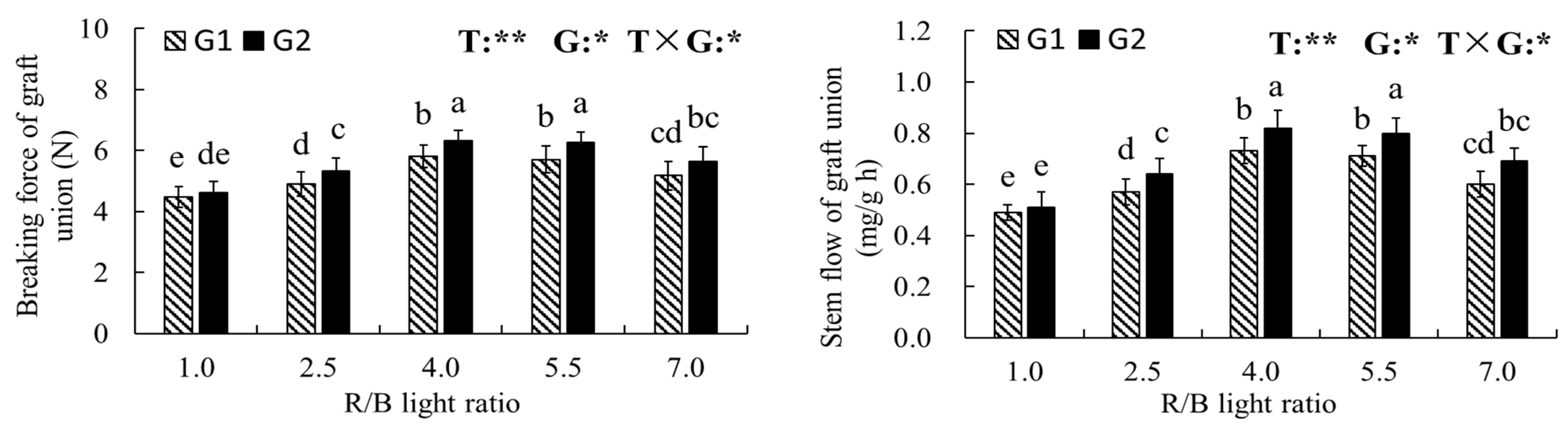
Different light quality combinations significantly affected the mechanical strength and water transport capacity of the graft union in tomato seedlings (Figure 1). Under the non-green-light condition (G1), increasing the R/B ratio from 1.0 to 4.0 markedly enhanced graft union strength and stem sap flow. When the R/B ratio was further increased to 7.0, both parameters declined relative to T3G1.
With green light supplementation (G2), graft union strength and sap flow were generally higher than in the corresponding G1 treatments, with significant differences observed at R/B ratios of 2.5, 4.0, and 5.5. T3G2 and T4G2 showed superior performance. In particular, T3G2 represented the highest values among all treatments, being significantly greater than those under low R/B ratios (p < 0.05). When the R/B ratio was further increased to 7.0, both indices decreased compared with T3G2 and T4G2.
Two-way ANOVA indicated that the R/B ratio (T) exerted highly significant effects on graft union strength and water transport capacity (p < 0.01), while green light supplementation (G) also had significant effects on both parameters (p < 0.05). Moreover, significant interaction effects between T and G were detected (p < 0.05).

3.3. Influence of Light Quality on Antioxidant Capacity of Grafted Tomato Seedlings

3.3.1. Influence of Light Quality on Antioxidant Enzyme Activities in Grafted Tomato Seedlings

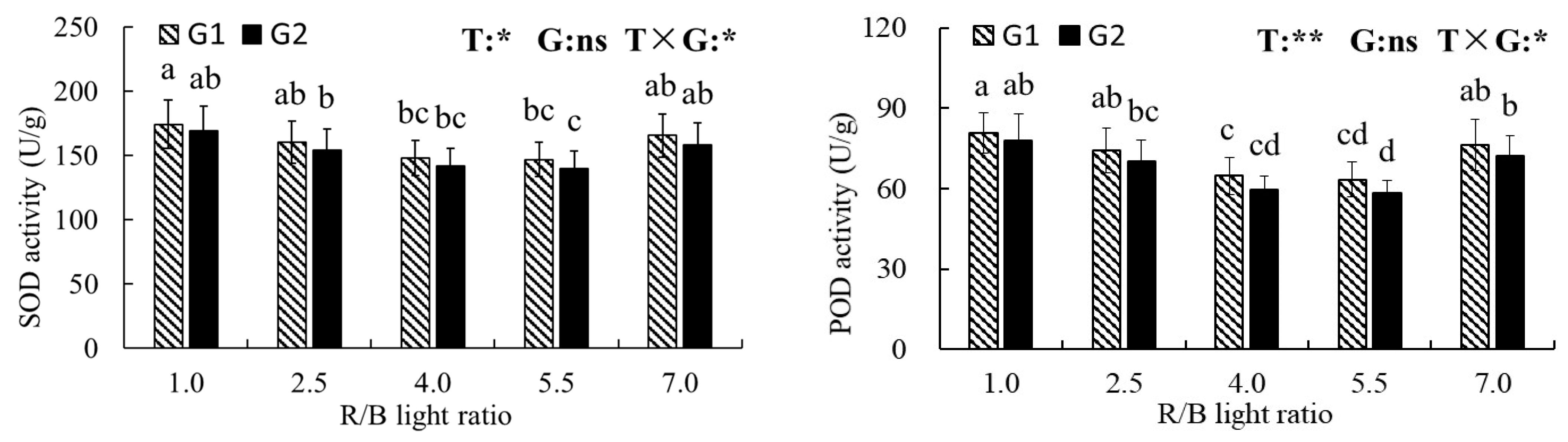
Different light quality combinations significantly influenced antioxidant enzyme activities in grafted tomato seedlings during the healing stage (Figure 2). Under the non-green-light condition (G1), changes in the R/B ratio resulted in an overall pattern of initial decline followed by an increase in both SOD and POD activities. Specifically, the T1G1 treatment exhibited the highest SOD activity at 174.32 U/g, which was significantly higher than T3G1 and T4G1 (p < 0.05), whereas no significant difference was observed between T3G1 and T4G1. POD activity peaked at 80.66 U/g in T1G1, significantly exceeding that of T3G1 and T4G1 (p < 0.05); T4G1 showed a lower level at 63.44 U/g, which was not significantly different from T3G1.
Under green light supplementation (G2), SOD and POD activities were generally similar to the corresponding G1 treatments, indicating that green light addition had no significant effect on antioxidant enzyme activities in grafted seedlings. In detail, T1G2 showed an SOD activity of 169.44 U/g, significantly higher than T4G2 (p < 0.05), but not significantly different from T2G2, T3G2, or T5G2. POD activity reached 78.14 U/g in T1G2, significantly higher than T3G2 and T4G2 (p < 0.05), but similar to T2G2 and T5G2. The lowest POD activity was observed in T4G2.
Two-way ANOVA indicated that the R/B ratio (T) had a significant effect on SOD activity (p < 0.05) and a highly significant effect on POD activity (p < 0.01), while green light supplementation (G) had no significant influence on either enzyme. Significant interaction effects between T and G were observed for both SOD and POD activities (p < 0.05).

3.3.2. Influence of Light Quality on Root Activity in Grafted Tomato Seedlings

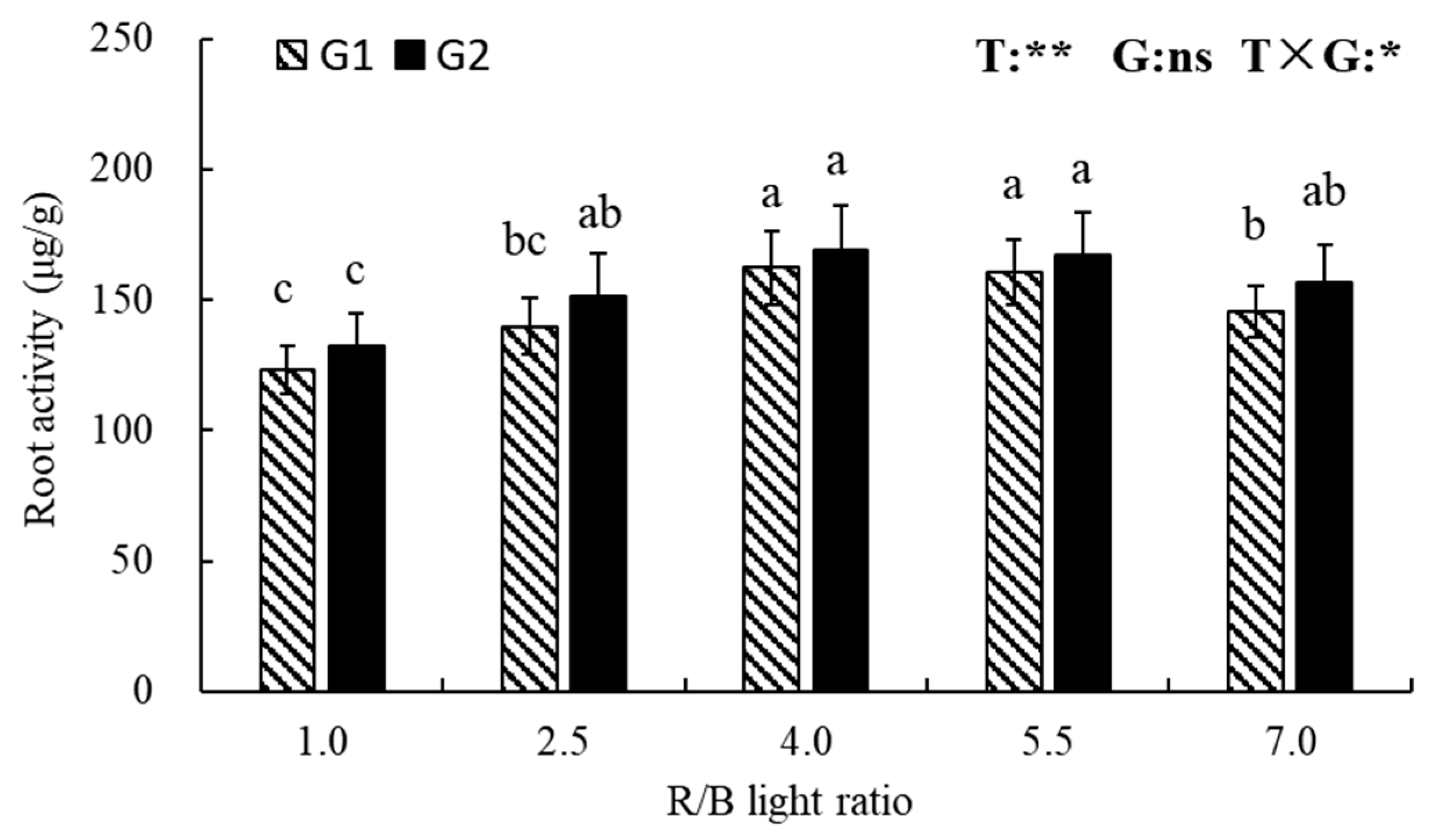
Different R/B ratios and green light supplementation significantly affected root activity in grafted tomato seedlings (Figure 3). Under the non-green-light condition (G1), root activity increased significantly as the R/B ratio increased from 1.0 to 4.0 and 5.5. T3G1 and T4G1 exhibited significantly higher root activity than T1G1 and T2G1 (p < 0.05), with no significant difference between T3G1 and T4G1. The lowest root activity was observed in T1G1. When the R/B ratio increased to 7.0, root activity declined to 145.73 μg/g, significantly lower than that in T3G1 and T4G1 (p < 0.05).
Under green light supplementation (G2), root activity showed no significant differences compared with the corresponding G1 treatments. T3G2 and T4G2 were not significantly different from T2G2 and T5G2. Under low R/B conditions, T1G2 exhibited the lowest root activity (132.44 μg/g), significantly lower than the medium and high R/B treatments (p < 0.05).
Two-way ANOVA revealed that the R/B ratio (T) had a highly significant effect on root activity (p < 0.01), while green light supplementation (G) had no significant effect (p > 0.05). A significant interaction between T and G was observed (p < 0.05).

3.4. Influence of Light Quality on Endogenous Hormones in Grafted Tomato Seedlings

Different R/B ratios and green light supplementation significantly influenced endogenous hormone levels in grafted tomato seedlings during the healing stage (Table 2). Under the non-green-light condition (G1), increasing the R/B ratio from 1.0 to 4.0 and 5.5 significantly increased IAA and GA contents, while ABA levels showed a clearly decreasing trend. In T3G1 and T4G1, IAA contents were significantly higher than T1G1 and T2G1 (p < 0.05). GA levels in T3G1 and T4G1 were significantly higher than those in low and higher R/B treatments (p < 0.05). ABA content was highest in T1G1 and decreased to 151.42 and 153.27 μg/kg in T3G1 and T4G1, respectively, significantly lower than in T1G1 and T2G1 (p < 0.05). When the R/B ratio increased to T5, IAA and GA contents declined relative to T3 and T4, while ABA content correspondingly increased.
Under green light supplementation (G2), IAA and GA contents were generally slightly higher than the corresponding G1 treatments, and ABA was slightly lower, although differences were not statistically significant. T3G2 represented the highest values among all treatments, significantly higher than low R/B treatments (p < 0.05); T4G2 did not differ significantly from T3G2. ABA contents were lowest in T3G2 and T4G2, significantly lower than T1G2, T2G2, and T5G2 (p < 0.05).
Two-way ANOVA indicated that the R/B ratio (T) had a highly significant effect on IAA, GA, and ABA contents (p < 0.01). Green light supplementation (G) had a significant effect on IAA and GA (p < 0.05) but not on ABA. Significant interactions between T and G were observed for all three hormones (p < 0.05).

3.5. Influence of Light Quality on Photosynthetic Activity of Grafted Tomato Seedlings

3.5.1. Influence of Light Quality on Photosynthetic Pigment Contents of Grafted Tomato Seedlings

Different R/B ratios and green light supplementation significantly affected photosynthetic pigment contents in grafted tomato seedling leaves (Table 3). Under the non-green-light condition (G1), increasing the R/B ratio from 1.0 to 4.0 and 5.5 generally enhanced chlorophyll a, chlorophyll b, carotenoid, and total chlorophyll contents. In T3G1, chlorophyll a and chlorophyll b were significantly higher than in T1G1 and T2G1 (p < 0.05), while T4G1 did not differ significantly from T3G1. Carotenoid content peaked at 0.42 mg/g in T3G1, significantly higher than in low R/B treatments (p < 0.05). Total chlorophyll content was highest in T3G1, significantly exceeding T1G1 and T2G1 (p < 0.05). When the R/B ratio increased to 7.0, pigment contents decreased slightly relative to T3G1 and T4G1.
Under green light supplementation (G2), pigment contents were generally slightly higher than the corresponding G1 treatments. Except for chlorophyll b, differences between G2 and G1 were not significant. In T3G2 and T4G2, chlorophyll a and chlorophyll b contents represented relatively high levels and significantly higher than low R/B treatments (p < 0.05). Carotenoid content peaked at 0.44 mg/g in T3G2, significantly exceeding T1G2 and T2G2 (p < 0.05). Total chlorophyll contents in T3G2 and T4G2 were significantly higher than other treatments (p < 0.05). When the R/B ratio was further increased to 7.0, chlorophyll a, chlorophyll b, and total chlorophyll contents decreased relative to T3G2 and T4G2. Chlorophyll a/b ratios showed no significant differences among treatments.
Two-way ANOVA indicated that the R/B ratio (T) had a highly significant effect on chlorophyll a, chlorophyll b, carotenoid, and total chlorophyll contents (p < 0.01). Green light supplementation (G) significantly influenced all pigments (p < 0.05) but had no effect on the chlorophyll a/b ratio. Significant interactions between T and G were observed for all pigment contents (p < 0.05), while no significant interaction was detected for the chlorophyll a/b ratio.

3.5.2. Influence of Light Quality on Photosynthetic Characteristics of Grafted Tomato Seedlings

Different R/B ratios and green light supplementation significantly influenced the photosynthetic characteristics of grafted tomato seedlings (Table 4). Under the non-green-light condition (G1), increasing the R/B ratio from 1.0 to 4.0 and 5.5 led to gradual increases in net photosynthetic rate (Pn), stomatal conductance (Gs), and transpiration rate (Tr), while intercellular CO2 concentration (Ci) decreased. Pn and Gs in T3G1 treatment were significantly higher than T1G1 and T2G1 (p < 0.05). Ci was highest in T1G1 and lower in T3G1 and T4G1. Tr peaked at 3.18 mmol/(m2·s) in T3G1, significantly exceeding values under low R/B ratios (p < 0.05). When the R/B ratio increased to 7.0, Pn, Gs, and Tr decreased relative to T3G1 and T4G1, while the increase in Ci was not significant.
Under green light supplementation (G2), Pn, Gs, and Tr were generally slightly higher than in the corresponding G1 treatments, with significant differences observed only at an R/B ratio of 5.5. In T3G2 and T4G2 treatments, Pn, Gs and Tr were significantly higher than in low R/B treatments (p < 0.05). Ci in T3G2 and T4G2 was significantly lower than in T1G2, T2G2, and T5G2 (p < 0.05).
Two-way ANOVA indicated that the R/B ratio (T) had significant or highly significant effects on Pn, Gs, Ci, and Tr (Pn, Gs, Tr: p < 0.01; Ci: p < 0.05). Green light supplementation (G) significantly affected Pn, Gs, and Tr (p < 0.05) but had no significant effect on Ci. Significant interactions between T and G were observed for all four photosynthetic parameters (p < 0.05).

3.6. Influence of Light Quality on Biomass Accumulation of Grafted Tomato Seedlings

3.6.1. Influence of Light Quality on Biomass Accumulation in Different Organs of Grafted Tomato Seedlings

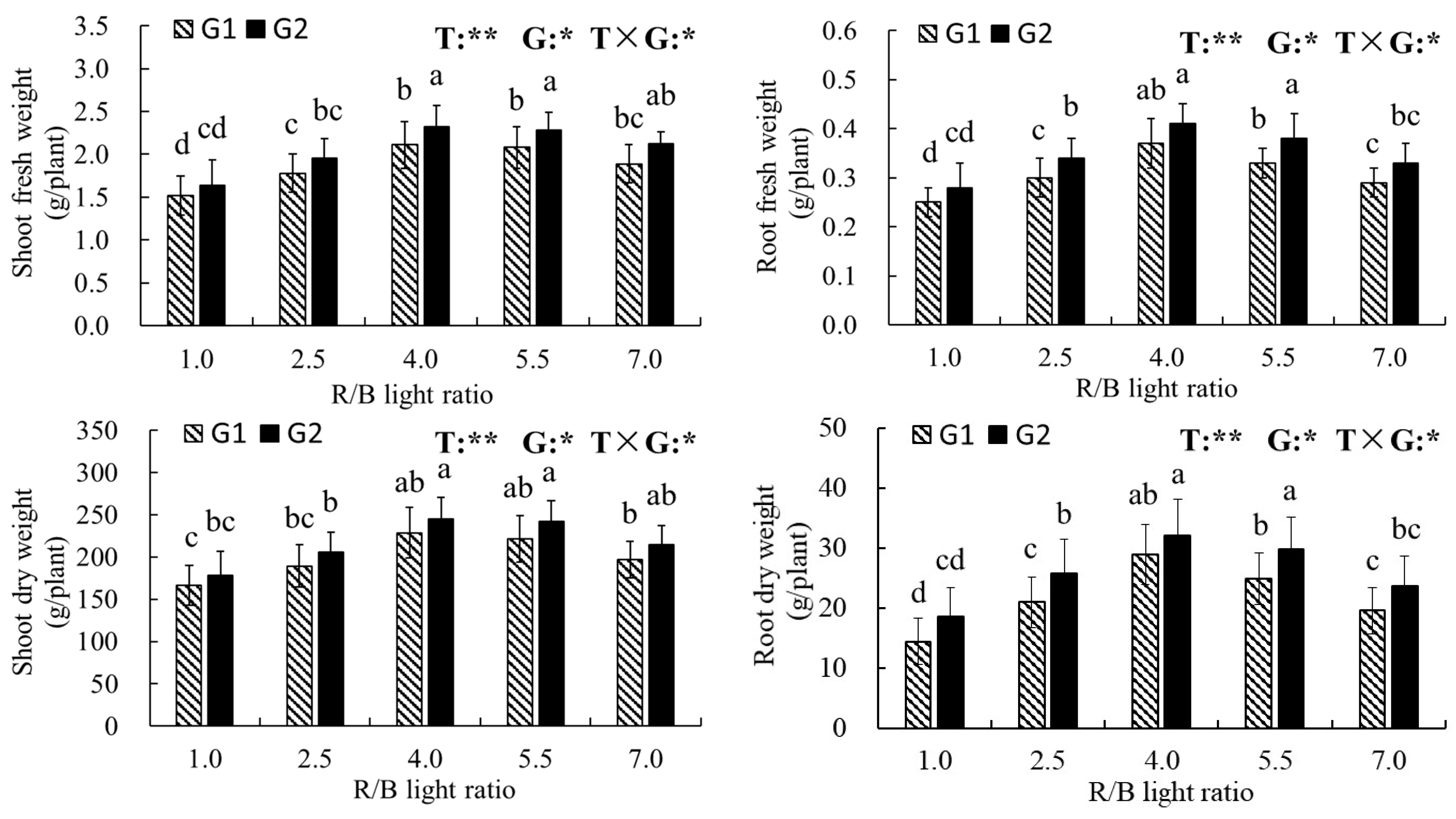
Different R/B ratios (T) and green light supplementation (G) significantly affected biomass accumulation in grafted tomato seedlings (Figure 4). Under the non-green-light condition (G1), increasing the R/B ratio from 1.0 to 4.0 generally enhanced both shoot and root fresh weights. Shoot fresh weight in the T3G1 treatment was significantly higher than T1G1 and T2G1 (p < 0.05), while root fresh weight was significantly higher than T1G1 (p < 0.05). When the R/B ratio increased to 5.5, shoot and root fresh weights showed no significant differences compared with T3G1. At R/B 7.0, both shoot and root fresh weights slightly decreased relative to T3G1, with root fresh weight showing a significant reduction. Shoot and root dry weights under G1 also varied significantly with R/B ratio. Only the shoot dry weight in T1G1 was significantly lower than other treatments, whereas other treatments showed no significant differences. Root dry weight in T3G1 reached 28.94 mg/plant, significantly higher than T1G1, T2G1, and T5G1 (p < 0.05), but not significantly different from T4G1.
Under green light supplementation (G2), shoot fresh weight was significantly increased at R/B ratios of 4.0 and 5.5. Root fresh and dry weights were significantly enhanced at R/B ratios of 2.5 and 5.5, while no significant differences were observed at R/B 4.0. Shoot fresh weights in T3G2 and T4G2, were significantly higher than low R/B treatments (p < 0.05). Root fresh weights represented the highest levels among treatments. Shoot dry weights in T3G2 and T4G2 were significantly higher than low R/B treatments (p < 0.05), while root dry weights were the highest among all treatments.
Two-way ANOVA indicated that the R/B ratio (T) had a highly significant effect on shoot fresh weight, root fresh weight, total fresh weight, shoot dry weight, and root dry weight (p < 0.01). Green light supplementation (G) significantly affected all biomass parameters (p < 0.05), and significant interactions between T and G were observed for all traits (p < 0.05).

3.6.2. Influence of Light Quality on Total Biomass Accumulation of Grafted Tomato Seedlings

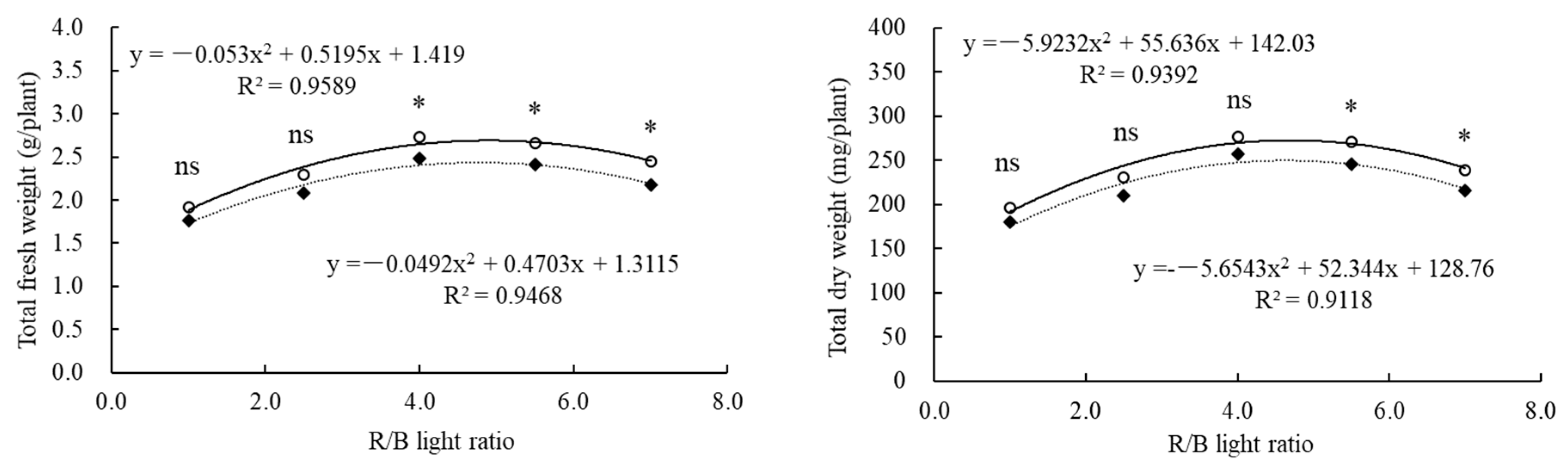
As shown in Figure 5, the trends in total fresh and dry biomass across treatments were generally consistent with those of shoot and root biomass, exhibiting a pattern of initial increase followed by a decline as the R/B ratio increased. At R/B ratios of 5.5 and 7.0, green light supplementation significantly enhanced both total fresh and dry weights. Quadratic regression analysis indicated that the optimal R/B ratio ranged from 4.62 to 4.90.

4. Discussion

Graft union quality directly determines subsequent transplant survival and production potential [25]. In plant factory conditions, the light environment is one of the most precisely controllable key factors [31], influencing not only photosynthetic energy supply but also, through photoreceptor-mediated signaling pathways, the morphological development, endogenous hormone metabolism, callus formation, and vascular reconstruction of grafted seedlings [20,32]. Previous studies have shown that an appropriate red-to-blue (R/B) light ratio improves grafted seedling growth quality, enhances photosynthetic efficiency, and accelerates healing [33]. Moreover, introducing moderate green light into a red–blue light background can further promote graft union healing and root regeneration, regulate endogenous hormone balance, and enhance biomass accumulation and stress tolerance [19,34].

4.1. Effects on Morphological Development and Structural Stability

A single blue light typically induces compact tomato seedlings, characterized by reduced plant height and total biomass, whereas red light primarily promotes stem elongation and leaf expansion [35]. Combining red and blue lights integrates these effects, enhancing overall seedling vigor [36]. For example, Hernández et al. (2016) [37] reported that tomato seedlings grown under 70% red and 30% blue light (R7:B3) exhibited significantly higher leaf area and dry biomass (both shoot and root) than under monochromatic red or blue light.
In this study, increasing R/B from 1.0 to 4.0 significantly enhanced scion elongation, stem diameter, graft union diameter, and total leaf area. When R/B further increased to 7.0, growth gains plateaued or slightly decreased, showing a “rise-then-fall” response. Under low R/B, excessive blue light suppresses etiolation but limits photosynthetic assimilation and biomass accumulation [38], consistent with Soltani et al. (2023) [39] in tomato grafting studies. Conversely, high R/B dominance of red light promotes stem elongation but can compromise plant architecture and mechanical stability [40], aligning with Pham et al. (2019) [41], who reported that high red light alters auxin polar transport, leading to upward leaf positioning. Moderate R/B balances stem elongation and thickening, favoring structural stability, consistent with Ji et al. (2023) [42], who suggested that optimal R/B enhances graft stability via “anti-etiolation—morphological optimization—vascular stabilization” effects.
Mechanistically, red light drives cell elongation and leaf expansion, while blue light maintains compactness, with their synergistic effects supporting balanced morphology [43,44]. Our results further confirm that red–blue composite light is superior to single-wavelength light. Notably, green light supplementation in T3G2 markedly increased stem diameter and leaf area compared with non-green treatments, highlighting its role in improving canopy light distribution and leaf light uniformity [45,46], consistent with Trojak et al. (2022) [47]. Although green light has lower chlorophyll absorption efficiency than red or blue light, its superior tissue penetration allows for deeper mesophyll illumination, indirectly promoting organ expansion [19].

4.2. Effects on Graft Union Mechanical Properties and Vascular Function

Graft union tensile strength and stem sap flow were used to evaluate the mechanical integrity and water transport capacity of the union. With R/B increasing to 4.0, both parameters significantly increased, peaking in T3G2; further increases in R/B caused declines. Appropriate R/B thus supports not only external morphology but also internal graft connectivity and functional integration.
Previous studies indicate blue light primarily promotes early-stage cell division and callus formation, while red light supports late-stage xylem differentiation and photosynthetic recovery [33]. In this study, moderate R/B met the temporal requirements of both callus formation and vascular differentiation, synchronously enhancing graft union strength and water transport [48]. This aligns with Bantis et al. (2021) [49], who reported that adding 12–24% blue light under red light facilitates callus and vascular development. Differences in optimal ratios likely reflect species-specific light responses, though trends are consistent [49].
Moreover, supplementation with green light at R/B ratios of 2.5, 4.0, and 5.5 significantly increased graft union tensile strength and sap flow, indicating that green light may enhance vascular connectivity and water transport efficiency by promoting an orderly cell arrangement and continuous lumen formation in the healing zone [19,50]. This finding is consistent with the results of Wu et al. (2025) [34], who reported that adding 30% green light to an R7:B3 background promoted the development of the isolation layer and callus tissue, thereby accelerating wound repair at the graft interface. Similarly, Li et al. (2021) [19] showed that green light advanced the timing of vascular reconnection and increased the stem water transport rate by more than 12%.
However, some studies suggest that green light can suppress the stomatal opening and reduce transpiration during the early stage after grafting, thereby decreasing scion sap flow [51]. The discrepancy with our results may be attributed to differences in the measurement period: previous studies mainly focused on the initial water-stress phase immediately after grafting, whereas measurements in the present study were conducted at the later healing stage when sap flow had stabilized, allowing the promotive effect of green light on vascular function to be fully manifested.

4.3. Effects on Oxidative Stress Regulation and Root Activity

Grafting imposes mechanical wounding stress, rapidly inducing ROS accumulation [52,53]. Red–blue light treatments enhance antioxidant enzyme activity, mitigating ROS and lipid peroxidation [54]. In this study, a low R/B maintained high SOD and POD activity, whereas a moderate R/B slightly reduced activity; green light had no significant effect. This suggests that elevated antioxidant activity may reflect higher oxidative stress rather than improved graft quality [55].
High blue light can enhance electron transport in chloroplasts and mitochondria, inducing transient ROS accumulation and activating antioxidant systems [56]. As R/B approaches moderate ratios, red light enhances photosynthetic efficiency and carbon assimilation, reducing ROS production per unit time and consequently lowering the induction of antioxidant enzymes [35,57], consistent with Song et al. [58].
In the present study, root activity measurements further supported these findings. The T3 and T4 treatments significantly enhanced the TTC reduction capacity, indicating that appropriate R/B ratios increased root metabolic intensity and energy supply. This result is highly consistent with Guo et al. (2023) [59], who reported that red and blue light (8R:2B) significantly increased root number, root length, and root vigor. As an important “sink organ,” enhanced root activity facilitates the effective transport of photoassimilates to belowground tissues, thereby maintaining the overall physiological stability of grafted seedlings [18].
Green light did not exert a significant direct effect on root activity but showed an interaction with the R/B ratio, suggesting that green light more likely influences root physiological function indirectly by optimizing canopy light structure and improving the uniformity of light utilization [60]. Notably, Li et al. (2021) [19] found that adding 30% green light to a red–blue background from the fourth day after grafting significantly increased root activity, which may be attributed to the fact that the regulatory effects of green light depend strongly on its synergistic interaction with red–blue ratios and light intensity [60].

4.4. Effects on Endogenous Hormone Regulation and Healing

Endogenous hormones are key regulators of cell division, elongation, and differentiation during graft union formation, and light quality can markedly influence the healing process by modulating hormone biosynthesis, distribution, and polar transport [61]. Our results show that increasing the R/B ratio to 4.0–5.5 significantly enhanced indole-3-acetic acid (IAA) and gibberellin (GA) contents, while concurrently reducing abscisic acid (ABA) levels. Consequently, the T3 and T4 treatments established a coordinated hormonal profile characterized by a high IAA, high GA, and low ABA. Such a hormonal balance is considered favorable for promoting callus proliferation and vascular tissue reconstruction at the graft interface.
From a physiological perspective, IAA primarily regulates polar transport and vascular differentiation, GA accelerates tissue reconstruction by promoting cell elongation, whereas ABA is mainly associated with xylem formation and tissue differentiation during the later stages of healing [62,63]. Previous studies on grafted tomato and melon seedlings have consistently shown that IAA and GA concentrations increase markedly as the healing process progresses, thereby enhancing cellular metabolic activity and accelerating graft union formation [63,64], which is highly consistent with our findings.
In contrast, the dynamic behavior of ABA appears more complex and may be linked to stress modulation during the later phases of graft healing, although related evidence remains limited [65]. Notably, our results agree with those of Yousef et al. (2021) [20], who reported that ABA levels under an R/B ratio of 7:3 were significantly lower than under 5:5, whereas an excessively low ABA under an R/B ratio of 9:1 weakened the stress tolerance of callus tissues. Therefore, a moderate reduction in ABA coordinated with an elevated IAA, and GA is conducive to maintaining tissue vigor and structural stability at the graft interface, which is further supported by the corresponding trends in graft union breaking force and sap flow observed in this study.
In the present study, supplementation with an appropriate proportion of green light under a red–blue background slightly increased IAA and GA contents while reducing ABA levels, thereby optimizing the hormonal milieu during the healing phase. This indicates that spectral regulation influences grafted seedling performance not only by modifying energy supply but also by modulating hormone biosynthesis and polar transport via light signal transduction pathways, thus supporting graft union formation at the molecular level. Our results are generally consistent with those reported by Carmach et al. (2023) [45] and Wu et al. (2025) [34].
However, some studies have suggested that green light may suppress excessive GA accumulation and promote ordered elongation of callus cells through coordinated IAA–GA signaling, thereby enhancing structural stability at the graft interface [14]. The discrepancy among studies may be attributable to differences in sampling timing. Those reports focused on the fully healed stage (approximately 14 d after grafting), whereas the present study emphasizes hormonal dynamics during the critical regulatory phase of graft union formation.

4.5. Effects on Photosynthetic Pigments and Efficiency

Photosynthetic performance directly affects seedling vigor and transplant survival, and light quality strongly influences pigment content and photosynthetic efficiency [66]. Monochromatic red light reduces chlorophyll a and b and total chlorophyll content, whereas blue light increases chlorophyll accumulation, improving light capture and CO2 assimilation [67]. Optimal R/B balances red light’s quantum efficiency with blue light’s effects on chloroplast development and stomatal regulation, synergistically enhancing photosynthesis [68,69].
The results of this study show that the contents of chlorophyll a, chlorophyll b, carotenoids, and total chlorophyll all reached their highest levels under the T3 and T4 treatments. Concurrently, Pn, Gs, and Tr increased, whereas Ci declined, indicating that spectral optimization enhanced photosynthesis primarily via non-stomatal limitations, namely by improving photosystem efficiency and Rubisco activity [36]. These findings are consistent with a report by Arif et al. (2024) [35], who likewise observed that total chlorophyll content peaked at an R/B ratio of 4.0.
Supplementing an appropriate proportion of green light on a red–blue background further promoted photosynthetic pigment accumulation and increased Pn, with particularly pronounced effects at R/B ratios of 4.0 and 5.5. This response agrees with the findings of Kaiser et al. (2019) [70] and is likely attributable to the stronger penetration capacity of green light within leaf tissues, which activates the photosynthetic potential of deeper mesophyll cells [71], thereby enhancing overall light-use efficiency. Compared with studies focusing solely on red–blue ratios, the present work further highlights the auxiliary role of green light in maintaining stable operation of the photosynthetic system during the graft-healing stage, a concept also supported by Arsenault et al. (2020) [72].

4.6. Effects on Shoot and Root Biomass Accumulation

During graft healing, the R/B ratio exerts strong control over biomass accumulation and the coordinated growth of shoot and root systems. In the present study, increasing R/B from low levels to 4.0–5.5 significantly enhanced both fresh and dry biomass of the aboveground and belowground parts, with T3G2 and T4G2 showing the highest values. Further increases in R/B resulted in a decline in biomass accumulation, a pattern consistent with previous reports [73,74].
Based on a quadratic regression analysis, the optimal R/B range for tomato-grafted seedlings during the healing stage was estimated to be 4.62–4.90. This optimal interval is close to that reported by Melissas et al. (2022) [48] and Bantis et al. (2020) [22], who showed that red light containing 11–24% blue light provides a favorable spectral composition for graft healing in tomato and watermelon seedlings.
On this basis, supplemental green light at R/B ratios of 4.0 and 5.5 further increased both shoot and root biomass, indicating that once photosynthetic potential is sufficiently activated, green light can improve assimilation and allocation efficiency and strengthen source–sink coordination [75]. This result is consistent with the findings of Orlando et al. (2022) [76], who reported that adding approximately 19% green light to a red–blue background promoted dry matter accumulation in several microgreen species.

5. Conclusions

This study aimed to evaluate how red/blue (R/B) light ratios and green light supplementation influence the healing process of grafted tomato seedlings. Our findings demonstrate that a moderate R/B ratio (4.0–5.5) significantly enhanced scion and rootstock stem growth, graft union strength, and hormone balance, thereby accelerating the healing process. Additionally, the supplementation of green light further promoted seedling growth and biomass accumulation. These results underscore the importance of light quality in optimizing graft healing and seedling quality, providing a practical basis for improving transplant survival and producing high-quality grafted tomato seedlings in plant factory systems.
Overall, these lighting environments effectively increased healing efficiency and seedling quality stability, providing a practical basis for the efficient production of high-quality tomato-grafted seedlings in plant factories. However, the present study evaluated only specific light intensities and spectral combinations and did not address responses among cultivars, under different photon flux densities, or under environmental stress conditions. Future work should further investigate cultivar-specific responses, long-term growth performance, and post-transplant establishment under light-quality regulation, thereby offering stronger theoretical and practical support for optimizing light environments and grafted-seedling production in plant factories.

Author Contributions

Conceptualization, X.S. and H.Z.; methodology, Q.Z. and Y.Z.; software, Y.Y. and Y.L.; validation, J.S. and J.W.; formal analysis, Q.Z. and Y.Z.; investigation, Q.Z. and Y.Z.; resources, X.S. and H.Z.; data curation, Q.Z. and Y.Z.; writing—original draft preparation, Q.Z., Y.Z., X.S. and H.Z.; writing—review and editing, J.S. and J.W.; visualization, Y.Y. and Y.L.; supervision, J.S. and J.W.; project administration, Y.Y. and Y.L.; funding acquisition, X.S. and J.S. All authors have read and agreed to the published version of the manuscript.

Funding

This research was funded by the project Continuous Cropping Obstacles of Facility Vegetables in Changling County, grant number 1jcyytc2025 0015701, and the Key Laboratory of Desert-Oasis Crop Physiology, Ecology and Cultivation, MOARA, grant number xjnkywdzc-2025002-01-03.

Data Availability Statement

The original contributions presented in this study are included in the article. Further inquiries can be directed to the corresponding author.

Conflicts of Interest

The authors declare no conflicts of interest.

References

  1. Sun, Y.Z.; He, J.; Wei, F.; Yang, W.J. Evaluation on the development and international competitiveness of China’s tomato industry during the 13th Five-Year Plan period. China Cucurbits Veg. 2023, 36, 112–116. (In Chinese) [Google Scholar]
  2. Teshita, A.; Khan, W.; Ullah, A.; Iqbal, B.; Ahmad, N. Soil nematodes in agroecosystems: Linking cropping system’s rhizosphere ecology to nematode structure and function. J. Soil Sci. Plant Nutr. 2024, 24, 6467–6482. [Google Scholar] [CrossRef]
  3. Khalid, M.F.; Huda, S.; Yong, M.; Li, L.; Li, L.; Chen, Z.H.; Ahmed, T. Alleviation of drought and salt stress in vegetables: Crop responses and mitigation strategies. Plant Growth Regul. 2022, 99, 177–194. [Google Scholar] [CrossRef]
  4. Azeem, A.; Javed, Q.; Sun, J.; Ullah, I.; Buttar, N.A.; Saifullah, M.; Du, D. Effect of salt stress on seed germination and seedling vigour in okra. Indian J. Hortic. 2020, 77, 513–517. [Google Scholar] [CrossRef]
  5. Jang, Y.; Mun, B.; Do, K.; Um, Y.; Chun, C. Effects of photosynthetic photon flux and carbon dioxide concentration on the photosynthesis and growth of grafted pepper transplants during healing and acclimatization. Hortic. Environ. Biotechnol. 2014, 55, 387–396. [Google Scholar] [CrossRef]
  6. Yu, H.; Yu, H.; Zhang, B.; Chen, M.; Liu, Y.; Sui, Y. Quantitative perturbation analysis of plant factory LED heat dissipation on crop microclimate. Horticulturae 2023, 9, 660. [Google Scholar] [CrossRef]
  7. Chen, X.; Hou, T.; Liu, S.; Guo, Y.; Hu, J.; Xu, G.; Ma, G.; Liu, W. Design of a micro-plant factory using a validated CFD model. Agriculture 2024, 14, 2227. [Google Scholar] [CrossRef]
  8. Fan, J.; Yang, R.; Li, X.; Liang, Y.; Wang, Y.; Liu, H.; Feng, H.; Li, C. The processes of graft union formation in tomato. Hortic. Environ. Biotechnol. 2015, 56, 569–574. [Google Scholar] [CrossRef]
  9. Suresh, P.; Muneer, S. Light spectrum mediated improved graft-healing response by enhanced expression of transport protein in vegetables under drought conditions. Plant Physiol. Biochem. 2025, 225, 109780. [Google Scholar] [CrossRef] [PubMed]
  10. Loupit, G.; Brocard, L.; Ollat, N.; Cookson, S.J. Grafting in plants: Recent discoveries and new applications. J. Exp. Bot. 2023, 74, 2433–2447. [Google Scholar] [CrossRef]
  11. Nisar, N.; Verma, S.; Pogson, B.J.; Cazzonelli, C.I. Inflorescence stem grafting made easy in Arabidopsis. Plant Methods 2012, 8, 50. [Google Scholar] [CrossRef]
  12. Jo, H.G.; Jeong, H.W.; Lee, H.R.; Kwon, S.M.; Hwang, H.S.; Hwang, S.J. Growth of tomato and pepper grafted plug seedlings under different shading condition during acclimatization after graft-taking. J. Bio-Environ. Control. 2021, 30, 10–18. [Google Scholar] [CrossRef]
  13. Li, Q.; Zhang, L.; He, J.; Li, J.; Zhang, H.; Li, Y.; Gu, Y.; Luo, H.; Lu, M.; Lu, K.; et al. Effects of different shade treatments on Melaleuca seedling growth and physiological properties. BMC Plant Biol. 2025, 25, 203. [Google Scholar] [CrossRef]
  14. Abouseif, Y.; Kadeer, A.; Cao, H.; Kaleem, M.M.; Notaguchi, M.; Xie, Q.; Jun, Q.; Bie, Z.; Huang, Y. Integrated multi-omics analysis reveals the molecular mechanism of light intensity-enhanced healing in cotyledon-less splice grafted watermelon. Hortic. Res. 2025, 13, uhaf293. [Google Scholar] [CrossRef]
  15. Ganie, S.A.; Forget, G.; Amaral, J.; Wall, S.A.; Singh, P.; Kromdijk, J.; Carmo-Silva, E.; Lawson, T. Unravelling the physiological and anatomical basis of divergent adaptations in cultivated and wild tomatoes. J. Exp. Bot. 2025, 76, 6548–6566. [Google Scholar] [CrossRef] [PubMed]
  16. Wei, H.; Wang, M.; Jeong, B.R. Effect of supplementary lighting duration on growth and activity of antioxidant enzymes in grafted watermelon seedlings. Agronomy 2020, 10, 337. [Google Scholar] [CrossRef]
  17. Vu, N.T.; Kim, Y.S.; Kang, H.M.; Kim, I.S. Influence of short-term irradiation during pre- and post-grafting period on the graft-take ratio and quality of tomato seedlings. Hortic. Environ. Biotechnol. 2014, 55, 27–35. [Google Scholar] [CrossRef]
  18. Sun, F.; Ma, S.; Gao, L.; Qu, M.; Tian, Y. Enhancing root regeneration and nutrient absorption in double-rootcutting grafted seedlings by regulating light intensity and photoperiod. Sci. Hortic. 2020, 264, 109192. [Google Scholar] [CrossRef]
  19. Li, F.; Li, Y.; Li, S.; Wu, G.; Niu, X.; Shen, A. Green light promotes healing and root regeneration in double-root-cutting grafted tomato seedlings. Sci. Hortic. 2021, 289, 110503. [Google Scholar] [CrossRef]
  20. Yousef, A.F.; Ali, M.M.; Rizwan, H.M.; Gad, A.G.; Liang, D.; Li, B.; Kalaji, H.M.; Wróbel, J.; Xu, Y.; Chen, F. Light quality and quantity affect graft union formation of tomato plants. Sci. Rep. 2021, 11, 9870. [Google Scholar] [CrossRef]
  21. Paponov, M.; Kechasov, D.; Lacek, J.; Verheul, M.J.; Paponov, I.A. Supplemental light-emitting diode inter-lighting increases tomato fruit growth through enhanced photosynthetic light use efficiency and modulated root activity. Front. Plant Sci. 2020, 10, 1656. [Google Scholar] [CrossRef]
  22. Bantis, F.; Koukounaras, A.; Siomos, A.; Fotelli, M.; Kintzonidis, D. Bichromatic red and blue LEDs during healing enhance the vegetative growth and quality of grafted watermelon seedlings. Sci. Hortic. 2020, 261, 109000. [Google Scholar] [CrossRef]
  23. Zhang, X.; Zhang, M.; Xu, B.; Mujumdar, A.S.; Guo, Z. Light-emitting diodes (below 700 nm): Improving the preservation of fresh foods during postharvest handling, storage, and transportation. Compr. Rev. Food. Sci. Food Saf. 2021, 21, 106–126. [Google Scholar] [CrossRef]
  24. Si, C.; Lin, Y.; Luo, S.; Yu, Y.; Liu, R.; Naz, M.; Dai, Z. Effects of LED light quality combinations on growth and leaf colour of tissue culture-generated plantlets in Sedum rubrotinctum. Hortic. Sci. Technol. 2024, 42, 53–67. [Google Scholar] [CrossRef]
  25. Song, J.; Fan, Y.; Li, X.; Li, Y.; Mao, H.; Zuo, Z.; Zou, Z. Effects of daily light integral on tomato (Solanum lycopersicon L.) grafting and quality in a controlled environment. Int. J. Agric. Biol. Eng. 2022, 15, 44–50. [Google Scholar] [CrossRef]
  26. Gao, J. Experimental Guide to Plant Physiology; Higher Education Press: Beijing, China, 2006. [Google Scholar]
  27. Pan, X.; Welti, R.; Wang, X. Quantitative analysis of major plant hormones in crude plant extracts by high-performance liquid chromatography-mass spectrometry. Nat. Protoc. 2010, 5, 986–992. [Google Scholar] [CrossRef]
  28. Lakhiar, I.A.; Gao, J.; Xu, X.; Syed, T.N.; Chandio, F.A.; Jing, Z.; Buttar, N.A. Effects of various aeroponic atomizers (droplet sizes) on growth, polyphenol content, and antioxidant activity of leaf lettuce (Lactuca sativa L.). Trans. ASABE 2019, 62, 1475–1487. [Google Scholar] [CrossRef]
  29. Tunio, M.H.; Gao, J.; Qureshi, W.A.; Sheikh, S.A.; Chen, J.; Chandio, F.A.; Lakhiar, I.A.; Solangi, K.A. Effects of droplet size and spray interval on root-to-shoot ratio, photosynthesis efficiency, and nutritional quality of aeroponically grown butterhead lettuce. Int. J. Agric. Biol. Eng. 2022, 15, 79–88. [Google Scholar] [CrossRef]
  30. Dou, H.; Li, X.; Li, Z.; Song, J.; Yang, Y.; Yan, Z. Supplementary far-red light for photosynthetic active radiation differentially influences the photochemical efficiency and biomass accumulation in greenhouse-grown lettuce. Plants 2024, 13, 2169. [Google Scholar] [CrossRef]
  31. Yu, H.; Wang, P.; Zhu, L.; Liu, Y.; Chen, M.; Zhang, S.; Sui, Y.; Yu, H. Optimizing light intensity and airflow for improved lettuce growth and reduced tip burn disease in a plant factory. Sci. Hortic. 2024, 338, 113693. [Google Scholar] [CrossRef]
  32. Han, R.; Lin, R.; Zhou, Y.; Thomas, H.R. Here comes the sun: Integration of light, temperature, and auxin during herbaceous plant grafting. Planta 2025, 261, 124. [Google Scholar] [CrossRef]
  33. Li, Y.; Liu, Z.; Shi, Q.; Yang, F.; Wei, M. Mixed red and blue light promotes tomato seedlings growth by influencing leaf anatomy, photosynthesis, CO2 assimilation and endogenous hormones. Sci. Hortic. 2021, 290, 110500. [Google Scholar] [CrossRef]
  34. Wu, G.; Li, Z.; Zhang, J.; Liu, S.; He, X.; Cui, D.; Li, Y.; Li, Y.; Wang, F.; Li, S. Effects of green light replacing some red and blue light on the healing and growth of two-stage-grafted tomato seedlings. Sci. Hortic. 2025, 352, 114420. [Google Scholar] [CrossRef]
  35. Arif, A.B.; Budiyanto, A.; Setiawan; Cahyono, T.; Sulistiyani, T.R.; Marwati, T.; Widayanti, S.M.; Setyadjit; Manalu, L.P.; Adinegoro, H.; et al. Application of red and blue LED light on cultivation and postharvest of tomatoes (Solanum lycopersicum L.). Scientifica 2024, 2024, 3815651. [Google Scholar] [CrossRef]
  36. Izzo, L.G.; Mele, B.H.; Vitale, L.; Vitale, E.; Arena, C. The role of monochromatic red and blue light in tomato early photomorphogenesis and photosynthetic traits. Environ. Exp. Bot. 2020, 179, 104195. [Google Scholar] [CrossRef]
  37. Hernández, R.; Eguchi, T.; Deveci, M.; Kubota, C. Tomato seedling physiological responses under different percentages of blue and red photon flux ratios using LEDs and cool white fluorescent lamps. Sci. Hortic. 2016, 213, 270–280. [Google Scholar] [CrossRef]
  38. Gai, S.; Su, L.; Tang, C.; Xia, M.; Zhou, Z. The antagonistic effects of red and blue light radiation on leaf and stem development of pepper (Capsicum annuum L.) seedlings. Plant Sci. 2024, 351, 112338. [Google Scholar] [CrossRef] [PubMed]
  39. Soltani, S.; Arouiee, H.; Salehi, R.; Nemati, S.H.; Moosavi-Nezhad, M.; Gruda, N.S.; Aliniaeifard, S. Morphological, phytochemical, and photosynthetic performance of grafted tomato seedlings in response to different LED light qualities under protected cultivation. Horticulturae 2023, 9, 471. [Google Scholar] [CrossRef]
  40. Zhu, Y.; Li, J.; Wu, H.; Wang, J.; Wang, H.; Xu, C.; Li, T. CmHY5-CmWRKY23/69-CmGH9B3 module mediates red light promoted graft union healing of melon grafted onto squash. Hortic. Res. 2025, 13, uhaf251. [Google Scholar] [CrossRef]
  41. Pham, M.D.; Hwang, H.; Park, S.W.; Cui, M.; Lee, H.; Chun, C. Leaf chlorosis, epinasty, carbohydrate contents and growth of tomato show different responses to the red/blue wavelength ratio under continuous light. Plant Physiol. Biochem. 2019, 141, 477–486. [Google Scholar] [CrossRef]
  42. Ji, T.; Du, Y.; Wei, M.; Gu, D.; Li, J.; Wang, H.; Yang, F. Adding different proportions of red/blue=3/1 to white light affects eggplant seedling quality by regulating leaf morphology and photosynthetic system. Plant Growth Regul. 2023, 100, 593–607. [Google Scholar] [CrossRef]
  43. Bantis, F.; Dangitsis, C.; Koukounaras, A. Influence of light spectra from LEDs and scion × rootstock genotype combinations on the quality of grafted watermelon seedlings. Plants 2021, 10, 353. [Google Scholar] [CrossRef]
  44. Mao, H.; Hang, T.; Zhang, X.; Lu, N. Both multi-segment light intensity and extended photoperiod lighting strategies, with the same daily light integral, promoted Lactuca sativa L. growth and photosynthesis. Agronomy 2019, 9, 857. [Google Scholar] [CrossRef]
  45. Carmach, C.; Castro, M.; Peñaloza, P.; Guzmán, L.; Marchant, M.J.; Valdebenito, S.; Kopaitic, I. Positive effect of green photo-selective filter on graft union formation in tomatoes. Plants 2023, 12, 3402. [Google Scholar] [CrossRef] [PubMed]
  46. Song, J.; Meng, Q.; Du, W.; He, D. Effects of light quality on growth and development of cucumber seedlings in controlled environment. Int. J. Agric. Biol. Eng. 2017, 10, 312–318. [Google Scholar]
  47. Trojak, M.; Skowron, E.; Sobala, T.; Kocurek, M.; Pałyga, J. Effects of partial replacement of red by green light in the growth spectrum on photomorphogenesis and photosynthesis in tomato plants. Photosynth. Res. 2022, 151, 295–312. [Google Scholar] [CrossRef] [PubMed]
  48. Melissas, C.; Bantis, F.; Dangitsis, C.; Kostas, S.; Koukounaras, A. Proposed light wavelengths during healing of grafted tomato seedlings enhance their adaptation to transplant shock. Agriculture 2022, 12, 797. [Google Scholar] [CrossRef]
  49. Bantis, F.; Panteris, E.; Dangitsis, C.; Carrera, E.; Koukounaras, A. Blue light promotes vascular reconnection, while red light boosts the physiological response and quality of grafted watermelon seedlings. Sci. Rep. 2021, 11, 21754. [Google Scholar] [CrossRef]
  50. Paradiso, R.; Cocetta, G.; Proietti, S. Beyond red and blue: Unveiling the hidden action of green wavelengths on plant physiology, metabolisms and gene regulation in horticultural crops. Environ. Exp. Bot. 2025, 230, 106089. [Google Scholar] [CrossRef]
  51. Matthews, J.S.; Vialet-Chabrand, S.; Lawson, T. Role of blue and red light in stomatal dynamic behaviour. J. Exp. Bot. 2020, 71, 2253–2269. [Google Scholar] [CrossRef]
  52. Kumi, F.; Mao, H.; Li, Q.; Luhua, H. Assessment of tomato seedling substrate-root quality using X-ray computed tomography and scanning electron microscopy. Appl. Eng. Agric. 2016, 32, 417–427. [Google Scholar] [CrossRef]
  53. Han, L.; Mao, H.; Kumi, F.; Hu, J. Development of a multi-task robotic transplanting workcell for greenhouse seedlings. Appl. Eng. Agric. 2018, 34, 335–342. [Google Scholar] [CrossRef]
  54. Yin, C.; Shi, Z.; Li, D.; Tian, C.; Li, Y.; Dong, W.; Zhang, Y. Red and blue photo-selective nets optimize leaf photostructure and photosynthetic efficiency to enhance antioxidant capacity, yield, and quality in adzuki bean. Front. Plant Sci. 2025, 16, 1670702. [Google Scholar] [CrossRef]
  55. Loupit, G.; Cookson, S.J. Identifying molecular markers of successful graft union formation and compatibility. Front. Plant Sci. 2020, 11, 610352. [Google Scholar] [CrossRef]
  56. Saleem, M.H.; Rehman, M.; Zahid, M.; Imran, M.; Xiang, W.; Liu, L. Morphological changes and antioxidative capacity of jute (Corchorus capsularis, Malvaceae) under different color light-emitting diodes. Braz. J. Bot. 2019, 42, 581–590. [Google Scholar] [CrossRef]
  57. Zhang, S.; Guo, X.; Li, J.; Zhang, Y.; Yang, Y.; Zheng, W.; Xue, X. Effects of light-emitting diode spectral combinations on growth and quality of pea sprouts under long photoperiod. Front. Plant Sci. 2022, 13, 978462. [Google Scholar] [CrossRef]
  58. Song, Y.; Shang, W.; Ma, D.; Wang, Z.; He, S.; Shi, L.; Shen, Y.; He, D.; Wang, E.; Wang, X. Effect on the growth and photosynthetic characteristics of Anthurium andreanum (‘Pink Champion’, ‘Alabama’) under hydroponic culture by different LED light spectra. Horticulturae 2022, 8, 389. [Google Scholar] [CrossRef]
  59. Guo, Y.; Zhong, Y.; Mo, L.; Zhang, W.; Chen, Y.; Wang, Y.; Chen, H.; Wang, Z.; Song, X.; Meng, X. Different combinations of red and blue LED light affect the growth, physiology metabolism and photosynthesis of in vitro-cultured Dendrobium nobile ‘Zixia’. Hortic. Environ. Biotechnol. 2023, 64, 393–407. [Google Scholar] [CrossRef]
  60. Shilpha, J.; Noh, K.; Yang, J.; Yeom, S.I.; Jeong, B.R. Combination of white and green/red LED lights influence growth, antioxidant properties, mineral composition and ginsenosides content of Panax ginseng sprouts in controlled environment system. Plant Cell Tissue Organ Cult. 2024, 158, 30. [Google Scholar] [CrossRef]
  61. Ding, X.; Miao, C.; Li, R.; He, L.; Zhang, H.; Jin, H.; Cui, J.; Wang, H.; Zhang, Y.; Lu, P.; et al. Artificial light for improving tomato recovery following grafting: Transcriptome and physiological analyses. Int. J. Mol. Sci. 2023, 24, 15928. [Google Scholar] [CrossRef] [PubMed]
  62. Kawaguchi, K.; Notaguchi, M.; Okayasu, K.; Sawai, Y.; Kojima, M.; Takebayashi, Y.; Sakakibara, H.; Otagaki, S.; Matsumoto, S.; Shiratake, K. Plant hormone profiling of scion and rootstock incision sites and intra- and inter-family graft junctions in Nicotiana benthamiana. Plant Signal. Behav. 2024, 19, 2331358. [Google Scholar] [CrossRef] [PubMed]
  63. Duan, Y.; Zhang, F.; Meng, X.; Shang, Q. Spatio-temporal dynamics of phytohormones in the tomato graft healing process. Hortic. Plant J. 2023, 10, 1362–1370. [Google Scholar] [CrossRef]
  64. Song, X.; Zhou, N.; Chang, Y.; Zhang, J.; Pei, D. Spatial and temporal alterations of multiple hormones during the graft union formation process in walnut (Juglans regia). Trees 2024, 38, 839–848. [Google Scholar] [CrossRef]
  65. Xu, C.; Zhang, Y.; Zhao, M.; Liu, Y.; Xu, X.; Li, T. Transcriptomic analysis of melon/squash graft junction reveals molecular mechanisms potentially underlying the graft union development. PeerJ 2021, 9, e12569. [Google Scholar] [CrossRef]
  66. Gitelson, A. Towards a generic approach to remote non-invasive estimation of foliar carotenoid-to-chlorophyll ratio. J. Plant Physiol. 2020, 252, 153227. [Google Scholar] [CrossRef]
  67. Moosavi-Nezhad, M.; Salehi, R.; Aliniaeifard, S.; Tsaniklidis, G.; Woltering, E.J.; Fanourakis, D.; Żuk-Gołaszewska, K.; Kalaji, H.M. Blue light improves photosynthetic performance during healing and acclimatization of grafted watermelon seedlings. Int. J. Mol. Sci. 2021, 22, 8043. [Google Scholar] [CrossRef]
  68. Perera-Castro, A.V.; Flexas, J. The ratio of electron transport to assimilation (ETR/AN): Underutilized but essential for assessing both equipment’s proper performance and plant status. Planta 2023, 257, 29. [Google Scholar] [CrossRef]
  69. Li, Y.; Xin, G.; Liu, C.; Shi, Q.; Yang, F.; Wei, M. Effects of red and blue light on leaf anatomy, CO2 assimilation and the photosynthetic electron transport capacity of sweet pepper (Capsicum annuum L.) seedlings. BMC Plant Biol. 2020, 20, 318. [Google Scholar] [CrossRef] [PubMed]
  70. Kaiser, E.; Weerheim, K.; Schipper, R.; Dieleman, J.A. Partial replacement of red and blue by green light increases biomass and yield in tomato. Sci. Hortic. 2019, 249, 271–279. [Google Scholar] [CrossRef]
  71. Rehman, M.; Pan, J.; Mubeen, S.; Ma, W.; Luo, D.; Cao, S.; Saeed, W.; Jin, G.; Li, R.; Chen, T.; et al. Morpho physio biochemical, molecular, and phytoremedial responses of plants to red, blue, and green light: A review. Environ. Sci. Pollut. Res. 2024, 31, 20772–20791. [Google Scholar] [CrossRef]
  72. Arsenault, E.A.; Yoneda, Y.; Iwai, M.; Niyogi, K.K.; Fleming, G.R. The role of mixed vibronic Qy-Qx states in green light absorption of light-harvesting complex II. Nat. Commun. 2020, 11, 6011. [Google Scholar] [CrossRef]
  73. Lee, M.J.; Son, K.H.; Oh, M.M. Increase in biomass and bioactive compounds in lettuce under various ratios of red to far-red LED light supplemented with blue LED light. Hortic. Environ. Biotechnol. 2016, 57, 139–147. [Google Scholar] [CrossRef]
  74. Lim, E.; Oh, M.M. Sequential RGB light optimization across developmental stages enhances lettuce growth through carry-over effects. BMC Plant Biol. 2025, 25, 1297. [Google Scholar] [CrossRef] [PubMed]
  75. Bian, Z.; Zhang, X.; Wang, Y.; Lu, C. Improving drought tolerance by altering the photosynthetic rate and stomatal aperture via green light in tomato (Solanum lycopersicum L.) seedlings under drought conditions. Environ. Exp. Bot. 2019, 167, 103844. [Google Scholar] [CrossRef]
  76. Orlando, M.; Trivellini, A.; Incrocci, L.; Ferrante, A.; Mensuali, A. The inclusion of green light in a red and blue light background impact the growth and functional quality of vegetable and flower microgreen species. Horticulturae 2022, 8, 217. [Google Scholar] [CrossRef]
Figure 1. Graft union healing of grafted tomato seedlings under different light qualities. G1 denotes the absence of green light, whereas G2 indicates the application of supplemental green light. The vertical bars above the histograms indicate standard deviation (SD, n = 8). The treatments with different letters are significantly different at p ≤ 0.05. In the statistical analysis, T represents the effect of R/B light ratio, G represents the effect of green light supplementation, and T × G denotes their interaction. ** indicates a highly significant effect, and * indicates a significant effect.
Horticulturae 12 00270 g001
Figure 2. Antioxidant capacity of grafted tomato seedlings under different light qualities. G1 denotes the absence of green light, whereas G2 indicates the application of supplemental green light. The vertical bars above the histograms indicate standard deviation (SD, n = 6). The treatments with different letters are significantly different at p ≤ 0.05. In the statistical analysis, T represents the effect of R/B light ratio, G represents the effect of green light supplementation, and T × G denotes their interaction. ** indicates a highly significant effect, * indicates a significant effect, and ns indicates no significant effect.
Horticulturae 12 00270 g002
Figure 3. Root capacity of grafted tomato seedlings under different light qualities. G1 denotes the absence of green light, whereas G2 indicates the application of supplemental green light. The vertical bars above the histograms indicate standard deviation (SD, n = 6). The treatments with different letters are significantly different at p ≤ 0.05. In the statistical analysis, T represents the effect of R/B light ratio, G represents the effect of green light supplementation, and T × G denotes their interaction. ** indicates a highly significant effect, * indicates a significant effect, and ns indicates no significant effect.
Horticulturae 12 00270 g003
Figure 4. Biomass accumulation in different organs of grafted tomato seedlings under different light qualities. G1 denotes the absence of green light, whereas G2 indicates the application of supplemental green light. The vertical bars above the histograms indicate standard deviation (SD, n = 8). The treatments with different letters are significantly different at p ≤ 0.05. In the statistical analysis, T represents the effect of R/B light ratio, G represents the effect of green light supplementation, and T × G denotes their interaction. ** indicates a highly significant effect, and * indicates a significant effect.
Horticulturae 12 00270 g004
Figure 5. Total biomass accumulation of grafted tomato seedlings under different light qualities. The solid and dashed lines represent the fitted curves obtained from binomial regression for treatments without and with supplemental green light, respectively. An asterisk (*) indicates a significant effect, whereas ns denotes a non-significant result.
Horticulturae 12 00270 g005
Table 1. Growth morphology of grafted tomato seedlings under different light qualities.
TreatmentScion ElongationScion Stem
Diameter
Rootstock Stem
Diameter
Graft Union
Diameter
Leaf Area
cmmmmmmmcm2
T1G11.24 ± 0.13 d2.19 ± 0.15 c2.36 ± 0.14 c2.44 ± 0.14 d26.11 ± 3.48 e
T2G11.55 ± 0.17 c2.34 ± 0.17 bc2.57 ± 0.19 b2.79 ± 0.18 c34.92 ± 4.77 d
T3G11.96 ± 0.21 b2.57 ± 0.16 a2.87 ± 0.28 ab3.28 ± 0.27 ab46.02 ± 3.24 ab
T4G11.91 ± 0.18 b2.53 ± 0.21 ab2.82 ± 0.22 ab3.21 ± 0.22 b44.77 ± 4.15 b
T5G11.68 ± 0.16 c2.40 ± 0.18 b2.61 ± 0.17 b2.93 ± 0.16 bc37.21 ± 4.33 d
T1G21.36 ± 0.19 d2.28 ± 0.12 bc2.48 ± 0.21 bc2.61 ± 0.20 cd30.34 ± 3.62 e
T2G21.77 ± 0.24 bc2.46 ± 0.19 ab2.73 ± 0.30 ab3.02 ± 0.32 bc40.83 ± 4.31 c
T3G22.19 ± 0.23 a2.65 ± 0.22 a2.96 ± 0.23 a3.55 ± 0.36 a50.23 ± 4.65 a
T4G22.15 ± 0.22 a2.63 ± 0.18 a2.94 ± 0.21 a3.49 ± 0.33 a49.36 ± 4.82 a
T5G21.87 ± 0.20 b2.55 ± 0.17 a2.79 ± 0.27 ab3.15 ± 0.24 b42.88 ± 3.56 bc
ANOVA
T**********
G**ns**
T × G*****
T1–T5 correspond to red-to-blue (R/B) light ratios of 1.0, 2.5, 4.0, 5.5, 7.0, and 8.5, respectively. G1 denotes the absence of green light, whereas G2 indicates the application of supplemental green light. Data are presented as the mean ± standard deviation (SD, n = 8). Different lowercase letters indicate statistically significant differences among treatments at p ≤ 0.05. In the statistical analysis, T represents the effect of R/B light ratio, G represents the effect of green light supplementation, and T × G denotes their interaction. ** indicates a highly significant effect, * indicates a significant effect, and ns indicates no significant effect.
Table 2. Endogenous hormone contents of grafted tomato seedlings under different light qualities.
TreatmentIAA ContentGA ContentABA Content
μg/kgμg/kgμg/kg
T1G137.12 ± 3.88 d16.02 ± 2.71 e212.45 ± 24.88 a
T2G146.73 ± 3.97 c21.65 ± 2.12 c183.16 ± 24.55 b
T3G159.12 ± 5.76 ab30.34 ± 3.26 ab151.42 ± 18.66 cd
T4G158.33 ± 4.88 ab29.66 ± 2.84 ab153.27 ± 19.33 cd
T5G148.92 ± 3.54 bc22.54 ± 1.95 c176.94 ± 23.18 b
T1G241.86 ± 4.92 d18.44 ± 2.53 e198.73 ± 28.42 ab
T2G252.55 ± 6.44 bc25.88 ± 3.77 bc168.82 ± 21.77 bc
T3G263.21 ± 7.08 a33.25 ± 4.06 a144.33 ± 16.92 d
T4G262.75 ± 6.91 a32.71 ± 3.92 a146.15 ± 17.41 d
T5G254.66 ± 6.02 b27.93 ± 3.44 b164.21 ± 20.64 bc
ANOVA
T******
G**ns
T × G***
T1–T5 correspond to red-to-blue (R/B) light ratios of 1.0, 2.5, 4.0, 5.5, 7.0, and 8.5, respectively. G1 denotes the absence of green light, whereas G2 indicates the application of supplemental green light. Data are presented as the mean ± standard deviation (SD, n = 8). Different lowercase letters indicate statistically significant differences among treatments at p ≤ 0.05. In the statistical analysis, T represents the effect of R/B light ratio, G represents the effect of green light supplementation, and T × G denotes their interaction. ** indicates a highly significant effect, * indicates a significant effect, and ns indicates no significant effect.
Table 3. Photosynthetic pigment contents of grafted tomato seedlings under different light qualities.
TreatmentChlorophyll a
Content
Chlorophyll b
Content
Carotenoid ContentTotal Chlorophyll ContentChlorophyll a/b
mg/gmg/gmg/gmg/g
T1G11.56 ± 0.27 d0.53 ± 0.07 e0.34 ± 0.05 d2.43 ± 0.24 d2.94 ± 0.26 ns
T2G11.82 ± 0.23 bc0.63 ± 0.06 c0.38 ± 0.05 bc2.83 ± 0.24 c2.89 ± 0.32 ns
T3G12.01 ± 0.21 ab0.72 ± 0.05 b0.42 ± 0.04 ab3.15 ± 0.27 ab2.79 ± 0.27 ns
T4G11.98 ± 0.22 ab0.70 ± 0.06 bc0.41 ± 0.04 b3.09 ± 0.22 b2.83 ± 0.33 ns
T5G11.75 ± 0.24 c0.61 ± 0.06 cd0.37 ± 0.05 cd2.73 ± 0.26 cd2.87 ± 0.36 ns
T1G21.64 ± 0.25 cd0.57 ± 0.07 de0.36 ± 0.05 cd2.57 ± 0.20 d2.88 ± 0.27 ns
T2G21.95 ± 0.22 b0.68 ± 0.06 bc0.41 ± 0.04 b3.04 ± 0.24 bc2.87 ± 0.22 ns
T3G22.16 ± 0.19 a0.78 ± 0.05 a0.44 ± 0.03 a3.38 ± 0.29 a2.77 ± 0.36 ns
T4G22.14 ± 0.18 a0.77 ± 0.05 a0.43 ± 0.03 ab3.34 ± 0.33 a2.78 ± 0.32 ns
T5G21.88 ± 0.21 bc0.67 ± 0.06 c0.39 ± 0.04 bc2.93 ± 0.24 bc2.85 ± 0.27 ns
ANOVA
T********ns
G****ns
T × G****ns
T1–T5 correspond to red-to-blue (R/B) light ratios of 1.0, 2.5, 4.0, 5.5, 7.0, and 8.5, respectively. G1 denotes the absence of green light, whereas G2 indicates the application of supplemental green light. Data are presented as the mean ± standard deviation (SD, n = 6). Different lowercase letters indicate statistically significant differences among treatments at p ≤ 0.05. In the statistical analysis, T represents the effect of R/B light ratio, G represents the effect of green light supplementation, and T × G denotes their interaction. ** indicates a highly significant effect, * indicates a significant effect, and ns indicates no significant effect.
Table 4. Photosynthetic characteristics of grafted tomato seedlings under different light qualities.
TreatmentNet Photosynthetic RateStomatal ConductanceIntercellular CO2 ConcentrationTranspiration Rate
μmol/(m2 s)mol/(m2 s)μmol/molmmol/(m2 s)
T1G18.6 ± 1.5 d0.289 ± 0.056 d467.5 ± 30.9 a2.23 ± 0.44 d
T2G110.4 ± 1.3 cd0.338 ± 0.067 bcd452.4 ± 24.5 ab2.78 ± 0.38 c
T3G112.2 ± 1.1 b0.401 ± 0.066 ab438.2 ± 19.3 bc3.18 ± 0.33 ab
T4G112.0 ± 1.2 bc0.392 ± 0.059 b432.9 ± 17.5 bc3.12 ± 0.31 b
T5G110.1 ± 1.3 d0.327 ± 0.061 cd455.7 ± 25.4 ab2.66 ± 0.29 c
T1G29.2 ± 1.4 d0.305 ± 0.059 d462.2 ± 28.9 a2.36 ± 0.41 cd
T2G211.6 ± 1.2 bc0.372 ± 0.058 bc445.3 ± 22.7 ab3.02 ± 0.36 bc
T3G213.5 ± 1.0 a0.445 ± 0.061 a426.4 ± 14.9 c3.54 ± 0.29 a
T4G213.4 ± 0.9 a0.438 ± 0.054 a427.5 ± 15.1 c3.48 ± 0.28 a
T5G211.2 ± 1.3 c0.359 ± 0.062 bc448.4 ± 23.6 ab2.91 ± 0.36 bc
ANOVA
T*******
G**ns*
T × G****
T1–T5 correspond to red-to-blue (R/B) light ratios of 1.0, 2.5, 4.0, 5.5, 7.0, and 8.5, respectively. G1 denotes the absence of green light, whereas G2 indicates the application of supplemental green light. Data are presented as the mean ± standard deviation (SD, n = 8). Different lowercase letters indicate statistically significant differences among treatments at p ≤ 0.05. In the statistical analysis, T represents the effect of R/B light ratio, G represents the effect of green light supplementation, and T × G denotes their interaction. ** indicates a highly significant effect, * indicates a significant effect, and ns indicates no significant effect.
Disclaimer/Publisher’s Note: The statements, opinions and data contained in all publications are solely those of the individual author(s) and contributor(s) and not of MDPI and/or the editor(s). MDPI and/or the editor(s) disclaim responsibility for any injury to people or property resulting from any ideas, methods, instructions or products referred to in the content.