Article

Phenolic Compounds, Phytohormones, and Biological Agents in the Post-Harvest Conservation of ‘Nanicão’ Banana Produced Under Deficit Irrigation


by
Brencarla de Medeiros Lima
1,
Valéria Fernandes de Oliveira Sousa
2,
Lauriane Almeida dos Anjos Soares
3,*,
Pedro Dantas Fernandes
2,
Geovani Soares de Lima
3,
Patrick Lima do Nascimento
2,
Francisco Jean da Silva Paiva
4,
Rafaela Aparecida Frazão Torres
5,
Valeska Karolini Nunes Oliveira
5,
Reynaldo Teodoro de Fátima
2,
Luderlândio de Andrade Silva
6,
Hans Raj Gheyi
5,
Michack Djibo
2,
Jessica Pedrosa de Lima
2 and
Evanilson Souza de Almeida
3
1
Post Graduate Program in Food Technology, State University of Campinas, Campinas 13083-862, SP, Brazil
2
Postgraduate Program in Tropical Horticulture, Federal University of Campina Grande, Pombal 58840-000, PB, Brazil
3
Academic Unit of Agricultural Sciences, Center for Science and Agrifood Technology, Federal University of Campina Grande, Pombal 58840-000, PB, Brazil
4
Agronomic Engineering Department of the Backlands, Federal University of Sergipe, Nossa Senhora da Glória 49680-000, SE, Brazil
5
Postgraduate Program in Agricultural Engineering, Federal University of Campina Grande, Campina Grande 58429-140, PB, Brazil
6
Postgraduate Program in Agroindustrial Systems, Federal University of Campina Grande, Pombal 58840-000, PB, Brazil
*
Author to whom correspondence should be addressed.
Horticulturae 2026, 12(3), 264; https://doi.org/10.3390/horticulturae12030264
Submission received: 25 January 2026 / Revised: 13 February 2026 / Accepted: 24 February 2026 / Published: 25 February 2026
(This article belongs to the Section Postharvest Biology, Quality, Safety, and Technology)

Abstract

Banana is a nutritious food of great global economic importance. However, water deficit negatively impacts banana plant development. Therefore, it is essential to study efficient water use and develop technologies capable of maintaining fruit quality after harvest, extending the shelf life, and reducing losses. This study aimed to evaluate the efficiency of post-harvest applications of salicylic acid, gibberellic acid, and Trichoderma harzianum on ‘Nanicão’ banana fruits produced under controlled water deficit during different phenological stages, aiming to extend the shelf life and maintain nutritional quality. The experimental design was completely randomized in a 4 × 4 factorial scheme, comprising four irrigation management strategies based on crop evapotranspiration (ETc)—100% ETc throughout the cultivation cycle (E1) and 50% ETc during the juvenile stage (E2), fruiting stage (E3), and both juvenile/fruiting stages (E4)—and four post-harvest fruit conservation strategies: WC, control (distilled water); GA3, 200 mg L−1 of gibberellic acid; SA, 4.5 mM of salicylic acid; and TRIC, 1.5 mL L−1 of Trichoderma harzianum. There were four replications. The use of gibberellic acid at a concentration of 200 mg L−1 is the most effective strategy to extend the shelf life and maintain the post-harvest quality of ‘Nanicão’ banana fruits produced under water restrictions during the juvenile stage.

1. Introduction

Banana (Musa spp.) is established as one of the most widely consumed fruits globally, distinguished not only by its nutritional value but also by its significant socioeconomic role [1]. Given the global population growth and the consequent demand for food, optimizing agricultural production has become imperative [2]. Brazil, the world’s fourth-largest producer [1], concentrates 35% of its production in the Northeast region (2.4 million tons), with Bahia and Ceará as the leading states [3]. In this context, ‘Nanicão’ (Cavendish group) emerges as highly relevant due to its economic and nutritional importance—being rich in carbohydrates, potassium, fiber, B-complex vitamins, and antioxidants, with proven benefits for cardiovascular health, blood pressure regulation, and the prevention of chronic diseases [4].
However, water availability for irrigation has become a limiting factor worldwide, primarily due to the impacts of prolonged drought periods, which tend to become increasingly severe under climate change scenarios [5]. Water deficit resulting from droughts, common in tropical and subtropical regions, causes negative effects on banana plant development, production, and fruit quality [6]. Generally, water deficit reduces the growth rate of banana fruits and accelerates maturation, leading to premature ripening and a consequent reduction in fruit weight and size, which impacts post-harvest quality [7].
On the other hand, Regulated Deficit Irrigation (RDI)—which consists of reducing the irrigation volume during phenological stages less sensitive to water deficit, while meeting full irrigation requirements during drought-sensitive stages—may not impair and may even improve production and fruit quality, enhancing water use efficiency [8,9]. According to [9], who studied controlled water deficit in mango trees, reducing the irrigation volume during the development and production phases decreased the soluble solid content, while irrigation between 68.24 and 74.5% of ETc during flowering provided the highest soluble solid content in the fruits. Nevertheless, studies on other fruit crops and cultivars are necessary to select the ideal phenological stages for controlled water restriction.
Crucially, the pre-harvest conditions imposed by techniques such as RDI can directly influence the fruit’s physiological and biochemical characteristics at harvest. These initial attributes, in turn, may determine the fruit’s subsequent response to post-harvest treatments and its shelf life. Therefore, various techniques are employed to extend the shelf life of fruits, such as the use of low temperatures, modified atmospheres, and the application of coatings, among other processes [10]. One such technique is the application of salicylic acid, a plant hormone that plays a crucial role in plant growth, development, and stress tolerance; it also shows high potential for delaying the ripening process, improving quality, and controlling post-harvest losses in fruits and vegetables [11,12]. Similarly, gibberellic acid acts as a regulator of ripening biochemical processes, minimizing color changes and mass loss, thereby extending the shelf life of fruits [13].
Additionally, the antagonistic effect of species from the genus Trichoderma spp. has proven effective in controlling pathogens in fruits and vegetables [14]. Specifically, Trichoderma harzianum, a beneficial fungal species, acts as a biological control agent (BCA) against post-harvest pathogens by inhibiting decay and promoting more suitable conditions for fruit storage [15]. This species exhibits antifungal, antimicrobial, and cytotoxic activities [16]. Ref. [17], who evaluated the use of Trichoderma asperellum in ‘Grand Nain’ bananas, demonstrated its efficacy as a viable alternative for controlling post-harvest diseases, contributing to the extension of fruit shelf life.
Considering the impact of water deficit on the development and quality of banana fruits, this study tests the hypothesis that the application of salicylic and gibberellic acids, as well as Trichoderma harzianum, extends the shelf life and maintains the nutritional quality of the fruits. Therefore, this study aims to evaluate the efficiency of salicylic acid, gibberellic acid, and T. harzianum applications on fruits produced under controlled water deficit across different phenological stages to extend the shelf life and maintain nutritional quality.

2. Materials and Methods

2.1. Plant Material and Growth Conditions

Banana plants of the ‘Nanicão’ cultivar (Musa spp.) were cultivated from 5 January to 12 December 2024, at the ‘Rolando Enrique Rivas Castellón’ Experimental Farm. The farm belongs to the Center for Agrifood Science and Technology (CCTA) of the Federal University of Campina Grande (UFCG), located in São Domingos, Paraíba, Brazil (6°49′06″ S, 37°56′56″ W; 199 m altitude). After harvest, the fruits were transported to the Hydraulics and Irrigation Laboratory at CCTA/UFCG in Pombal, Paraíba (6°46′13″ S, 37°48′06″ W; 193 m altitude).

2.2. Experimental Design and Treatments

The experiment followed a completely randomized design (CRD) in a 4 × 4 factorial scheme. The factors consisted of four irrigation management strategies (IM) based on crop evapotranspiration (ETc): 100% ETc throughout the cycle (E1); 50% ETc during the juvenile phase (E2); 50% ETc during the fruiting phase (E3); and 50% ETc during both the juvenile and fruiting phases (E4). The water conditions included full irrigation (100% requirement) and water deficit (50% requirement) applied during specific phenological stages: juvenile (rapid vegetative growth until floral differentiation, 90–210 days after planting—DAP) and fruiting (floral differentiation until bunch harvest, 210–335 DAP).
These were combined with four post-harvest conservation strategies (CSs): WC, control (distilled water); GA3, 200 mg L−1 of gibberellic acid; SA, 4.5 mM of salicylic acid; and TRIC, 1.5 mL L−1 of Trichoderma harzianum. The experiment included four replications, with each experimental unit (plot) consisting of a hand containing four fruits. Gibberellic acid concentration was determined according to [18], while salicylic acid and T. harzianum concentrations were based on [19]. Each fruit from each irrigation management strategy was associated with its respective post-harvest treatment, in order to study the interaction of these factors.
The spacing used between plants and rows was 2.5 × 2.5 m, with planting holes measuring 0.40 × 0.40 × 0.40 m. After opening the holes, basal fertilization was performed with 20 L of cured bovine manure and 166.66 g of single superphosphate, as a source of phosphorus (P2O5). Before transplanting the seedlings (15 days after the basal fertilization) to the area, the soil moisture content was raised to a level near field capacity, and planting was carried out. Subsequently, the soil moisture content was monitored using a Time-Domain Reflectometer (TDR), through the emission of high-frequency electromagnetic pulses by the sensor, in which reflections occurring over time were recorded and read as distance, according to their relationship with the dielectric constant.
For the ETc calculations, the crop coefficients (Kc) adopted were 1.35 (juvenile phase, 90–240 days after transplanting—DAT) and 1.0 (fruiting phase, 241–335 DAT). Detailed field management procedures can be found in [20].
The production data from the field experiment with each irrigation management strategy are shown in Table 1.

2.3. Harvest and Post-Harvest Processing

Fruits were harvested at the pre-climacteric stage (peel color index 1: entirely green), according to [21]. The bunches were fractionated into hands of four fruits each. The fruits were cleaned with a solution of water and 2% neutral detergent (2 mL L−1) to remove latex and surface impurities, followed by sanitization in 0.5% sodium hypochlorite (5 mL L−1) for three minutes and a final rinse in running water.

2.4. Application of Preservative Solutions

After cleaning, fruits were immersed for three minutes in the following preservative solutions: 0 (distilled water), 4.5 mM salicylic acid, and 1.5 mL L−1 T. harzianum. For the gibberellic acid (GA3) treatment, fruits were immersed for 10 min [18]. Salicylic acid (SA) solutions were prepared by dissolving the compound in 30% ethyl alcohol (95.5% purity) before dilution in distilled water. The T. harzianum treatment utilized the commercial product Trichodermil® (Strain ESALQ 1306, Piracicaba, Brazil), with a minimum concentration of 2.0 × 10⁹ viable conidia mL−1, added to distilled water.

2.5. Storage and Analytical Assessments

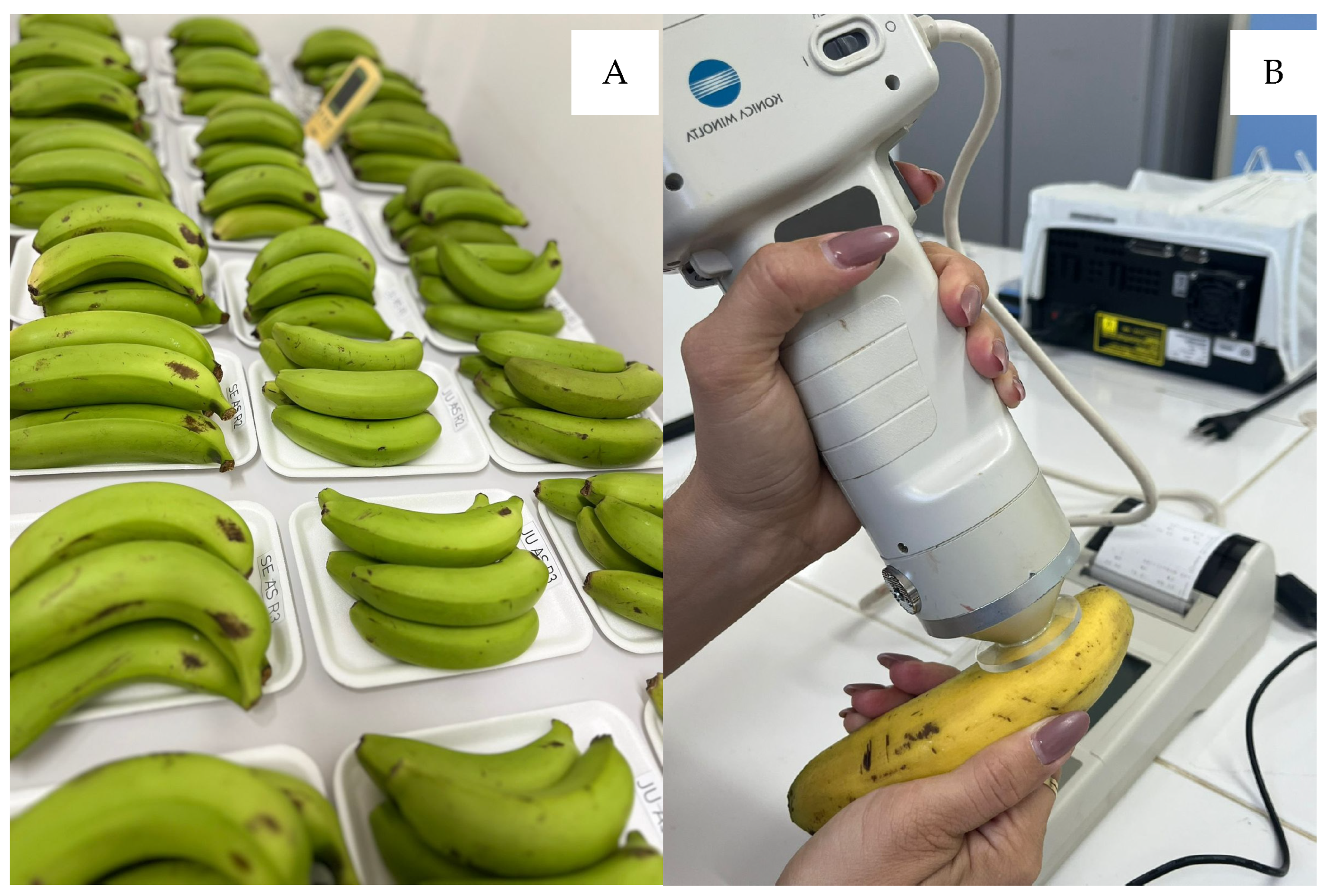
The fruits were weighed and placed on polystyrene trays for a 24-day storage period under controlled conditions (20 ± 2 °C and 70 ± 5% RH). During this period, cumulative mass loss (PDM) was determined gravimetrically using an analytical balance (model SF-400, Sao Caetano do Sul, Brazil) by calculating the difference between the initial and final weight of the experimental units. Upon reaching ripening stage 6 (full yellow peel) (Figure 1B), physical characteristics were evaluated. Colorimetric parameters, including luminosity (L*), chromaticity (C*), hue angle (h°) and browning index were determined using a Konica Minolta CR 300 colorimeter (New York, NY, USA) in the CIELAB system, following the methodologies of [22] and [23]. Pulp (PF) and peel (PeF) firmness were measured at the equatorial region of the fruits after a small incision was made, using a digital penetrometer (Instrutherm® PTR-300, São Paulo, Brazil) equipped with a 5 mm diameter probe, with results expressed in Newtons (N). The total storage time (ST) was recorded as the number of days elapsed from harvest until the fruits reached full ripeness.
Regarding chemical quality, the pH was measured by direct insertion of the electrode into the pulp samples until stabilization [24]. Total soluble solids (TSSs) were determined using an Atago digital pocket refractometer (Atago, Tokyo, Japan), with results expressed in °Brix. Titratable acidity (TA) was determined by diluting 5 g of pulp in 50 mL of distilled water, titrating with 0.1 M NaOH, using phenolphthalein as an indicator, with results expressed as a percentage (%) of malic acid. The maturation index (Ratio) was then calculated as the TSS/TTA quotient. The ascorbic acid (AA) content was determined by homogenizing 5 g of sample in 0.5% oxalic acid, followed by titration with a 2,6-dichlorophenolindophenol solution until a persistent pink color was observed, as described by [25], and expressed in mg 100 g−1 of pulp.
The quantification of sugars and phenolic compounds was performed spectrophotometrically. For total sugars (TSs), a 1:50 dilution was prepared, using 20 µL of the extract of the fruit pulp mixed with 980 µL of distilled water and 2000 µL of Anthrone reagent; the reaction occurred in a water bath at 100 °C for 3 min, with readings taken at 620 nm [26]. Reducing sugars (RSs) were determined using 500 µL of the 1:50 diluted extract of the fruit pulp mixed with 500 µL of DNS reagent, heated at 100 °C for 15 min, followed by the addition of 4000 µL of distilled water and reading at 540 nm [27]. Both sugar concentrations were expressed in g 100 g−1 of glucose equivalents. Finally, total phenolic compounds (TPC) were quantified using the Folin–Ciocalteu method: a 900 µL aliquot of the sample was mixed with 1225 µL of distilled water, 125 µL of Folin–Ciocalteu reagent, and 250 µL of sodium carbonate; the absorbance was measured at 765 nm after the reaction, with results expressed in mg of gallic acid equivalents (GAEs) per gram of pulp (mg GAE g−1).

2.6. Statistical Analysis

Data were subjected to analysis of residual normality using the Shapiro–Wilk test, homogeneity of variances using the Bartlett test, followed by analysis of variance using the F test. Significant effects were further analyzed using Tukey’s test p ≤ 0.05) for irrigation and conservation strategies, utilizing SISVAR statistical software version 5.7 [28]. To understand the joint effect of the treatments, multivariate analysis of variance (MANOVA) was performed on the principal components (PCA) using Hotelling’s T2 test (p ≤ 0.05) on R software (v. 4.3.2) [29].

3. Results

According to the summary of the analysis of variance, significant interaction effects (p ≤ 0.01) were observed between the factors irrigation management strategies (IMSs) and conservation strategies (CSs) for luminosity (L*), hue angle (h°), weight loss (WL), pulp firmness (PF), peel firmness (PeF), storage time (ST), and browning index (BI) of ‘Nanicão’ banana fruits (Table 2). For the chromaticity (C*) variable, isolated effects of both IMSs and CSs were observed (Table 1).
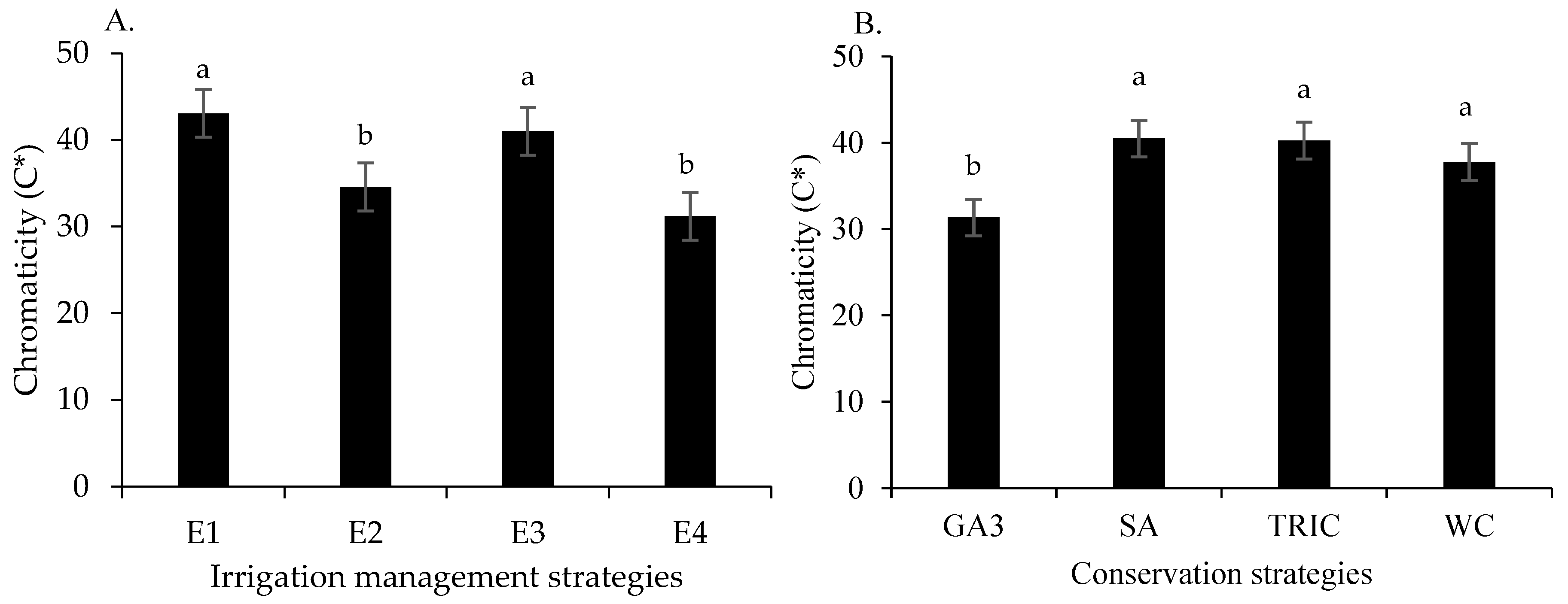
Chromaticity (C*) values were lower in fruits from plants under water restriction E2 and E4, with reductions of 19.78 and 27.57% compared to fruits from E1 and E3 plants (Figure 2A). Similarly, fruits under CSs using GA3 had lower C* values (31.34), representing reductions of 22.57, 22.15, and 17.04% compared to SA, TRIC, and WC strategies, respectively (Figure 2B).
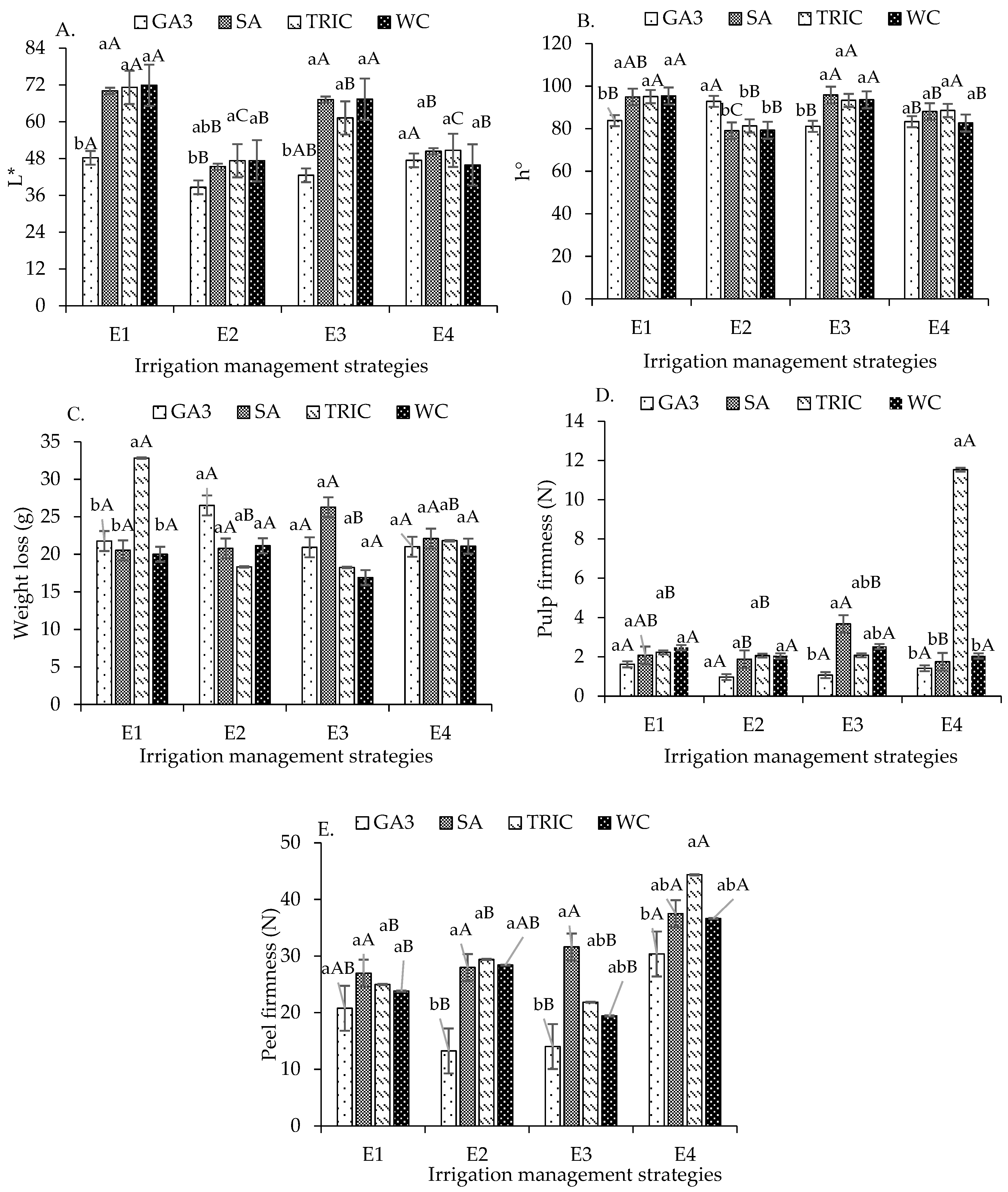
Color analysis results indicated that the luminosity (L*) of GA3-treated fruits reached its lowest value under the E2 water deficit strategy (38.66), a reduction of 19.91, 9.16, and 18.49% compared to E1, E3, and E4 irrigation management strategies, which presented values of 48.27, 42.56, and 47.43, respectively (Figure 3A). For fruits treated with SA, TRIC, and WC, the highest L* values (67.23, 71.12, and 71.83) were obtained under the IMS with deficit during fruiting (SA), no stress (TRIC), and no stress (WC), respectively (Figure 3A).
Regarding the hue angle (h°) (Figure 3B), the highest value (92.86) for GA3-treated fruits was obtained under the E2 deficit stage, representing an increase of 17.44, 14.23, and 17.14% compared to SA, TRIC, and WC strategies; conversely, under E1 and E3 irrigation management, GA3 application reduced the hue angle. Fruits treated with SA achieved higher results under the E3 strategy (95.85), an increase of 21.23% compared to the E2 strategy, which had the lowest mean (79.07). With TRIC, E1, E3, and E4 fruits showed higher values (95.08, 93.31, and 88.56), with increases of 16.96, 14.78, and 8.94% over fruits produced under juvenile-stage deficit (E2). In the control strategy (no coating), fruits produced without water deficit (E1) and with deficit during fruiting (E3) showed increases of 19.19 and 14.25% relative to E2 and E4 strategies, respectively. However, under E4, the post-harvest conservation strategies did not differ significantly regarding the hue angle of ‘Nanicão’ bananas (Figure 3B).
For weight loss (WL), fruits from plants under deficit irrigation showed no significant differences between GA3, SA, and control strategies. However, TRIC application reduced mass loss when plants were irrigated with 50% of crop evapotranspiration (ETc) during juvenile, fruiting, and juvenile/fruiting stages, with reductions of 44.22, 44.47, and 33.59% compared to plants under full irrigation (E1). Without water deficit, WL was high (33.59%) in TRIC-treated fruits compared to other CSs (Figure 3C).
Regarding pulp firmness (PF), no significant differences were found between CSs in fruits treated with GA3 and WC. However, TRIC application favored higher PF in fruits from E4 plants, being 711.98, 558.85, and 462.44% higher than GA3, SA, and WC strategies in the same phase. For SA-treated fruits, PF was 76.92% higher in plants irrigated with 40% ETc during fruiting compared to full irrigation (Figure 3D). SA application did not significantly interfere with peel firmness (PeF). In uncoated fruits, the fruiting deficit stage decreased PeF by 18.39% compared to E1 (Figure 3E). The highest PeF values were observed in TRIC-treated fruits under E4 deficit (44.36 N), which was 82.70% higher than fruits from plants without water deficit.
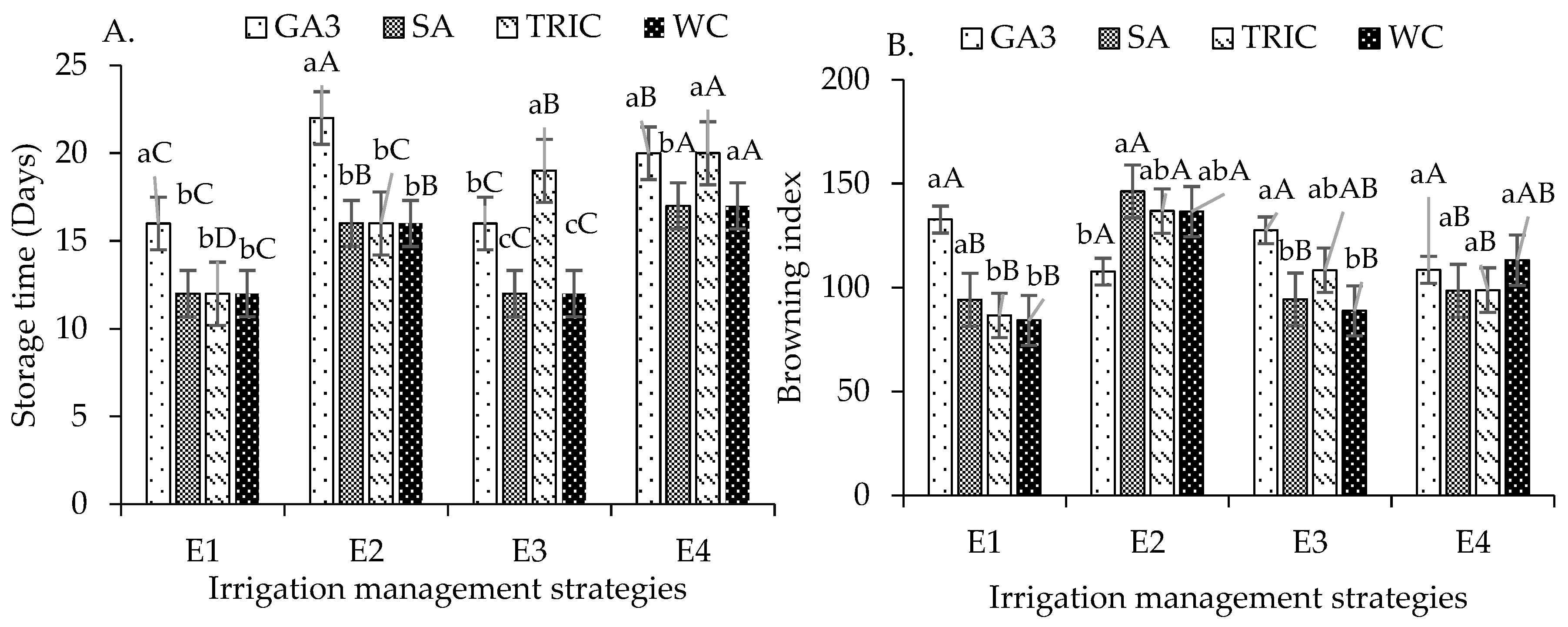
In general, E1 plants produced fruits with the shortest storage time (ST), regardless of the CS (Figure 3A). The highest ST was observed with 200 mg L−1 of GA3 (22 days) in fruits from the juvenile deficit stage (E2). For other CSs, the highest ST occurred in fruits under E4 deficit, corresponding to 17, 20, and 17 days for 4.5 mM SA, 1.5 mL L−1 TRIC, and WC, respectively (Figure 4A).
For the browning index (BI) of GA3-treated fruits, no differences were found between IMSs (mean value 1119.12). However, GA3 showed higher values in E1 and E3 strategies, with increases of 40.90, 53.19, and 57.59% in E1 and 35.16, 17.71, and 43.56% in E3 compared to SA, TRIC, and WC, respectively (Figure 3B). SA application increased browning in fruits under juvenile deficit (E2) by 55.27, 55.01, and 48.57% compared to E1, E3, and E4. TRIC caused more intense browning in E2 and E3 fruits (136.81 and 108.35). In the uncoated strategy, E2 and E4 deficit IMSs resulted in fruits with higher browning, with increments of 57.90 and 25.05% relative to the no-deficit IMS. Under the successive deficit (E4), no differences were found between CSs (Figure 4B).
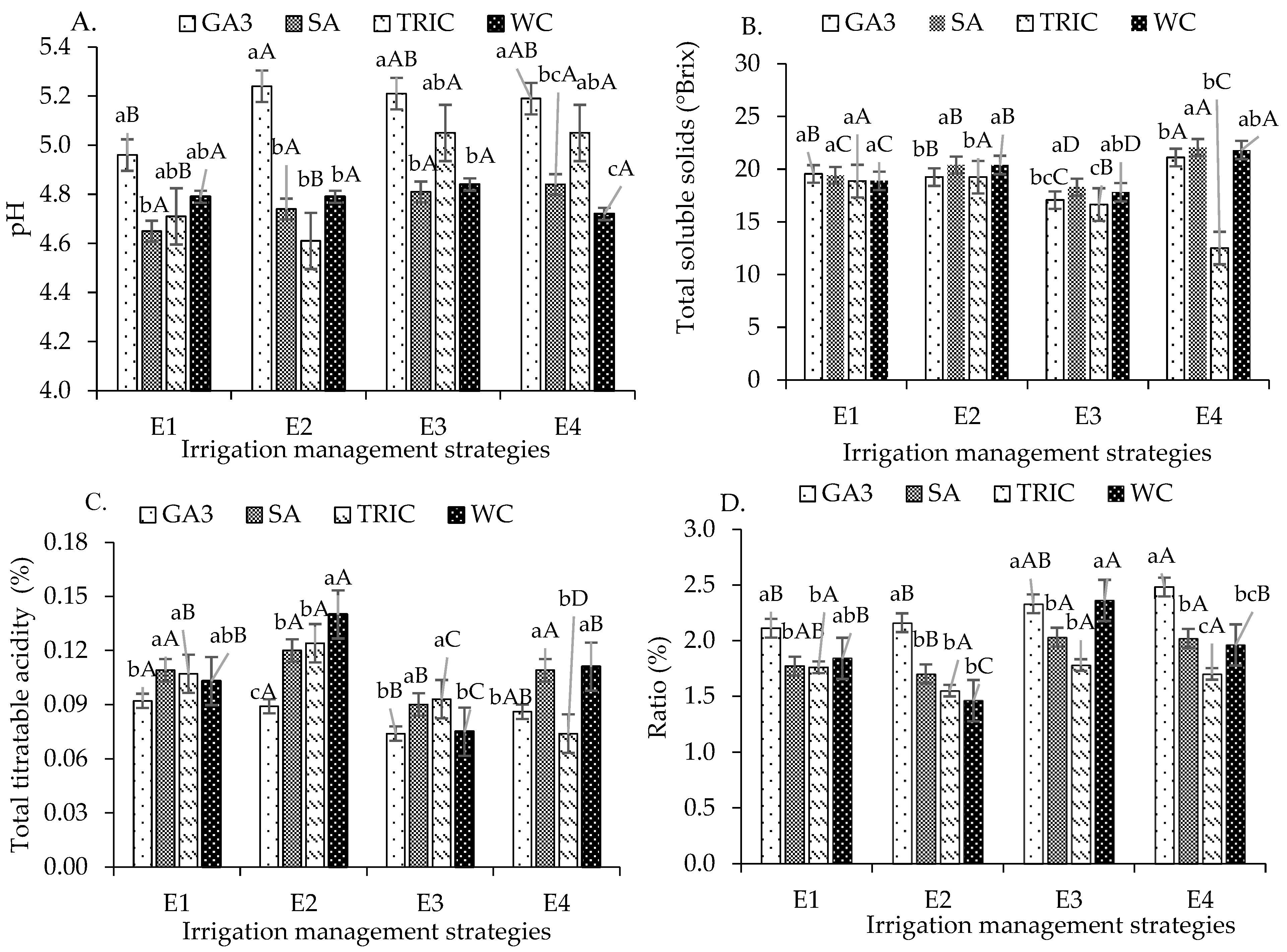
Significant interaction effects between IMSs and CSs were observed for pH, total soluble solids (SSs), total titratable acidity (TA), and the SS/TA ratio (RAT) (Table 3).
GA3 associated with E2, E3, and E4 strategies resulted in the highest pH values (5.24, 5.21, and 5.19), increases of 5.64, 5.04, and 4.63% relative to E1. GA3 was superior to other CSs (SA, TRIC, WC) across all IMSs (Figure 4A). For WC and SA, no differences were observed regarding the IMS, with pH ranging between 4.6 and 4.8. For TRIC, fruits under E3 and E4 deficit had higher pH values (5.05), 7.22 and 9.54% higher than E1 and E3 (Figure 5A).
The highest SS accumulation in GA3, SA, and WC fruits was observed under E4 deficit (21.12, 22.07, and 21.82 °Brix) (Figure 4B). For TRIC, the highest SS occurred under E1 (18.87 °Brix) and E2 (19.25 °Brix). SA provided the highest SS accumulation under E2, E3, and E4 (20.4, 18.3, and 22.07 °Brix), although it did not differ from TRIC under juvenile deficit. No differences were found between CSs under full irrigation (E1) (Figure 5B).
Regarding titratable acidity (TA), GA3 and SA associated with E1, E2, and E4 resulted in higher values (0.07, 0.09, and 0.07%). TRIC provided a 16.66% increase in TA in E2 deficit fruits (Figure 5C). In E1, SA and TRIC application increased TA by 5.82 and 3.88% compared to control; SA also increased TA under E4 but did not differ from the control.
For the SS/TA ratio (RAT), higher values were observed with GA3 across all IMSs, with increases of 14.67, 47.94, 2.0, and 26.53% compared to control in E1, E2, E3, and E4, respectively (Figure 5D). Among IMSs, the highest ratios were obtained in E4 associated with GA3 (2.48%) and SA (2.02%), and in E3 with SA (2.03%).
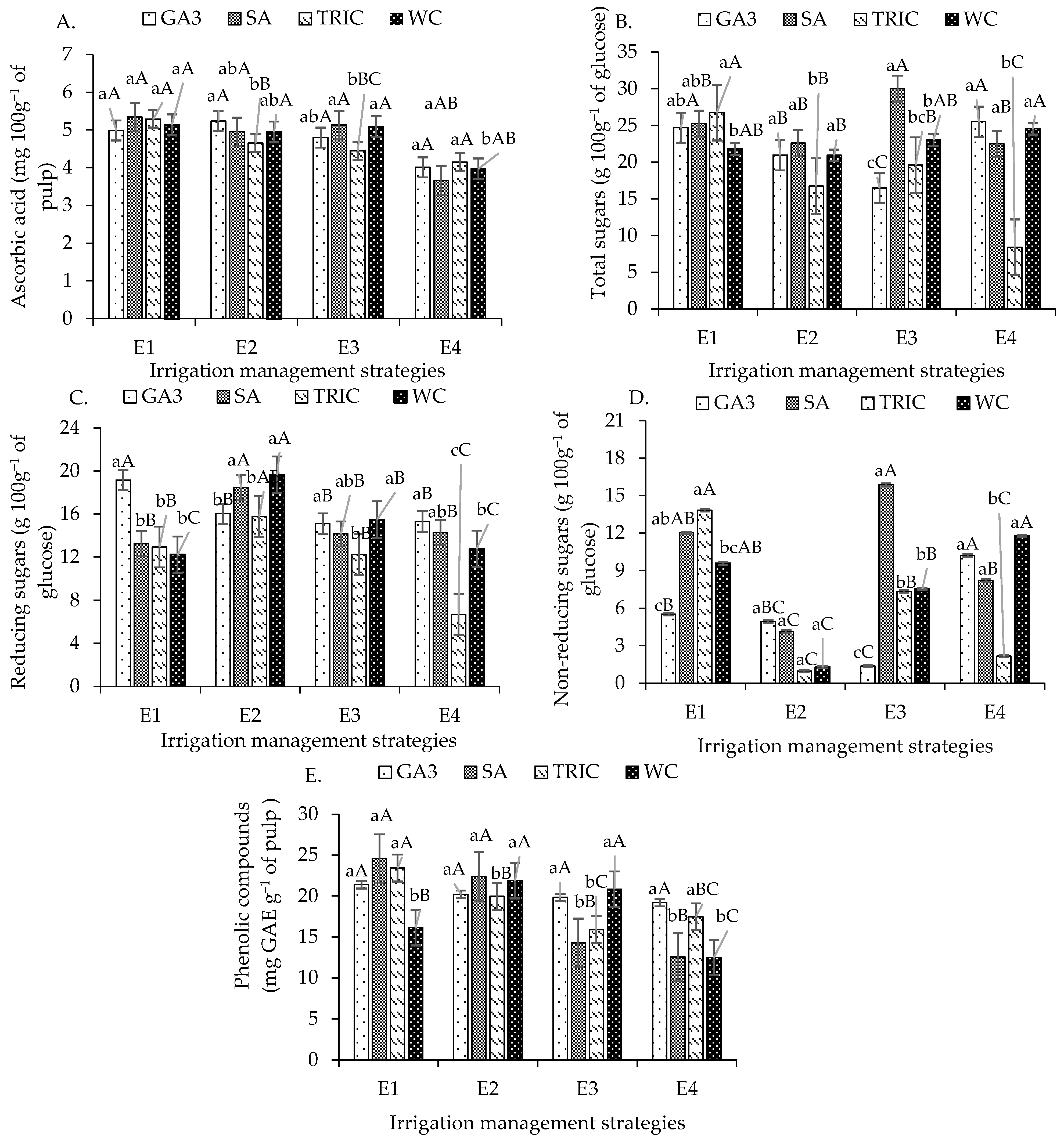
Significant interaction effects were observed for ascorbic acid (AA), total sugars (TSs), reducing sugars (RSs), non-reducing sugars (NRSs), and total phenolic compounds (TPC) (Table 4).
The AA content in GA3, SA, and WC fruits was higher in E1, E2, and E3; however, E4 reduced AA by 19.63, 31.46, and 22.76% compared to E1. TRIC application under deficit reduced AA by 12.09, 15.87, and 21.55% in E2, E3, and E4, respectively (Figure 5A). GA3, SA, and WC promoted higher AA accumulation in E2 and E3, while TRIC reached its highest AA value under E4 deficit (Figure 6A).
For total sugars (TSs) (Figure 6B), GA3 fruits showed the highest values in E1 (24.68 g 100 g−1) and E4 (20.95 g 100 g−1). For SA, the highest accumulation occurred in E3 (18.88% increase over E1). TRIC reduced TSs in E2, E3, and E4 by 37.48, 26.79, and 68.61% compared to E1.
The reducing sugar (RS) content in GA3 fruits was significantly higher in E1, E3, and E4 (19.16, 15.11, and 15.31 g 100 g−1) (Figure 6C). For SA, TRIC, and WC, the highest RS occurred in E2. For E1 and E4, GA3 fruits had the highest RS, with increments of 56.79 and 19.98% relative to control. Under E2, control and SA showed the highest results (19.65 and 18.45 g 100 g−1).
Regarding non-reducing sugars (NRSs), GA3 fruits showed the highest values under E4 deficit (10.2 g 100 g−1), an 84.78% increase over E1 (Figure 6D). SA fruits had the highest values in E1 and E3 (15.88 g 100 g−1 in E3, a 110.61% increase over control). TRIC associated with deficit reduced NRS levels.
For total phenolic compounds (TPC), no differences were found between the IMS for GA3-treated fruits. However, under E3 and E4, GA3 resulted in the highest TPC values (19.83 and 19.2 mg GAE g−1) compared to other CSs (Figure 6E). For SA, the highest values were in E1 (24.58 mg GAE g−1) and E2 (22.42 mg GAE g−1). TRIC reduced TPC under E2, E3, and E4 by 14.73, 32.15, and 25.44% relative to E1 (Figure 6E).
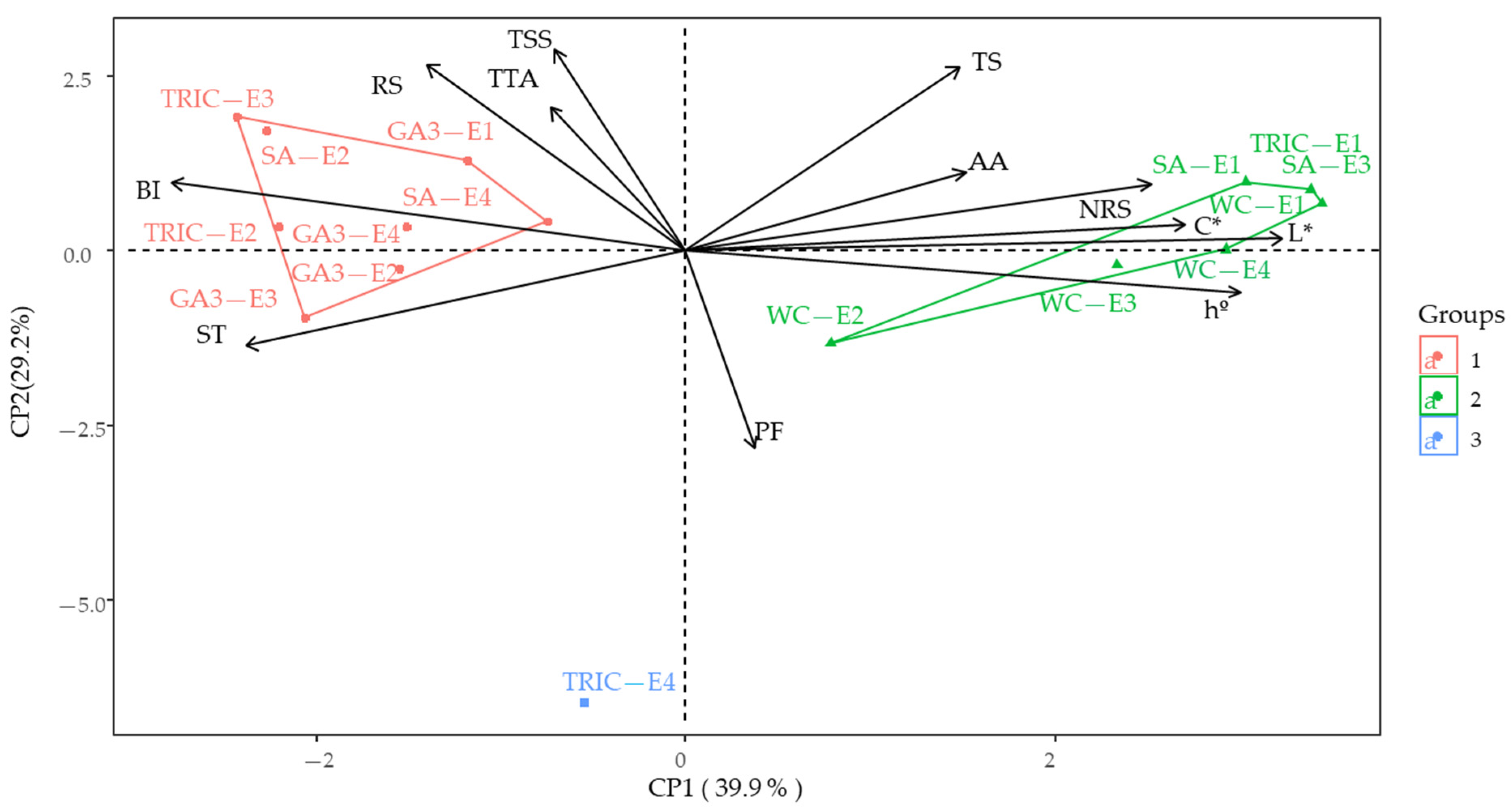
Principal component analysis (Figure 7) showed that the first two components explained 69.1% of the data variability. PC1 represented 39.9% of the variance, with positive correlations for h° (r = 0.89), L* (r = 0.96), storage time (r = 0.70), NRSs (r = 0.74), AA (r = 0.55), and C* (r = 0.80), and a negative correlation with browning (r = −0.82). PC2 explained 29.2% of the variance, with positive correlations for TA (r = 0.60), SSs (r = 0.84), RSs (r = 0.78), and TSs (r = 0.77), and a negative correlation with pulp firmness (r = −0.84).
Cluster analysis revealed three distinct groups of treatment responses, correcting for quality parameters with the shelf life. The first group was characterized by the longest shelf life (ST), and included treatments with GA3 (all irrigation management strategies) and with TRIC (strategies E2 and E3), as well as AS (strategies E2 and E4). These treatments were significantly associated with lower levels of total soluble sugars, non-reducing sugars, and ascorbic acid, indicating an effective inhibition of ripening metabolism and oxidative degradation.
Most of the remaining treatments (except TRIC + E4) clustered in group 2, correlated with higher luminosity (L*) and chromaticity (C*), possibly indicating chlorophyll degradation and/or the accumulation of senescence pigments, and high levels of non-reducing sugars. This profile was associated with a significant reduction in storage time, suggesting an undesirable acceleration of ripening processes.
In contrast, the TRIC treatment combined with the E4 strategy stood out as a unique group, exhibiting the highest pulp firmness value and proving to be the most effective strategy for maintaining the structural and textural integrity of the fruits, but it was not efficient in terms of fruit quality parameters.

4. Discussion

The post-harvest quality of banana is a determining factor for consumer acceptance, influenced by a set of interrelated physical, chemical, and physiological parameters such as peel color, pulp firmness, soluble solid content, titratable acidity, and pH, which are directly associated with sensory perception and product shelf life [30].
In this study, it was observed that plants under full irrigation throughout the cycle (100% of crop evapotranspiration—ETc) produced fruits with a shorter shelf life, regardless of the post-harvest conservation strategy used. Conversely, water deficit during the juvenile stage (E2) associated with the application of gibberellic acid (GA3) prolonged the shelf life of the fruits. These results partially diverge from the findings of [7], who reported a 25% increase in the ripening rate of ‘Williams’ bananas under water deficit, suggesting that the preservative solutions used in this work (especially GA3) were effective in mitigating the negative effects of water deficit in ‘Nanicão’.
GA3 proved to be a promising strategy for extending the shelf life of bananas, corroborating the findings of [31], who observed a 32-day increase in the shelf life with GA3 application (300 ppm). This effect is associated with the capacity of GA3 to reduce respiration and transpiration rates, in addition to promoting greater water retention in the fruits. However, water deficit at different phenological stages did not significantly influence fresh mass loss (FML) when combined with GA3, salicylic acid (SA), or the control (WC). In contrast, the application of Trichoderma harzianum (TRIC) increased FML, especially in plants without water stress, possibly due to its inefficiency in reducing respiration and transpiration processes [32].
Pulp firmness (PF) and peel firmness (PeF) were significantly higher in fruits treated with T. harzianum and produced from plants under water deficit in the juvenile (E2) and fruiting (E3) stages. This result is associated with the delay in the ripening process when water deficit occurred in the juvenile stage, as the average PF (11.53 N) approached values reported for immature bananas (11.32 N) [33]. This phenomenon may be related to the inhibition of starch degradation into soluble sugars, as observed by [17] using T. asperellum. Similarly, salicylic acid (SA) increased PF in fruits under deficit at stage E3, possibly due to the inhibition of pectin and hemicellulose degradation [34], an effect also reported by [35] in ‘BRS Platina’ bananas under 70% ETc deficit during fruiting.
Regarding the L* parameter (luminosity or brightness), values range between 0 and 100, where low values indicate a dull or opaque peel, while values near 100 indicate maximum brightness [35]. High luminosity values were observed in fruits treated with SA and without preservatives from banana plants with and without water restriction in E3. Ref. [8] reported that suppressing irrigation for 16 and 26 days before harvest (fruiting) results in less bright pomegranate fruits compared to fruits from plants irrigated at 120% of reference evapotranspiration (ETo), corroborating this study, especially when water deficit occurred in the E4 stages. In relation to the hue angle, banana fruits coated with GA3 showed lower values, indicating the action of gibberellins in delaying chlorophyll degradation in the fruit peel [36,37].
Water deficit during the juvenile stage resulted in darker banana fruits, especially those treated with SA, TRIC, and WC. According to [38], banana plants subjected to water deficit produce small bunches and fruits with reduced yellow intensity, which may become darkened and have brittle peels. The formation of brown portions on the peel surface may be due to the loss of cellular compartmentalization, leading to phenolic oxidation mediated by enzymes, namely polyphenol oxidase and peroxidase [39]. Although salicylic acid can delay ripening, it can also decrease the activity of enzymatic antioxidants such as catalase and peroxidase, which may contribute to fruit browning [40]. However, GA3 mitigated the water deficit effects in this phase, possibly because GA3 delays peel color change, associated with a delay in the maturation and softening process, maintaining the original color longer and decreasing natural browning [31].
Low C* values represent lower color intensity, characterizing a grayish or impure color [35]. According to [41], Grade A bananas are characterized by a bright yellow color; thus, higher results are expected for this variable. In relation to the irrigation management employed, the highest results were recorded in the E1 and E3 strategies. According to [39] chromaticity values increased from 38.11 to 46.31 from the mature green stage to the fully ripe stage in Cavendish bananas; thus, water deficit in E2 and E4 resulted in a greener coloration.
Possibly, water deficit in these phenological stages reduced ethylene production and respiration rates, delaying ripening and subsequent color change, or chlorophyll degradation was inhibited, maintaining the green color longer and resulting in lower chromaticity values [42]. Likewise, among the strategies, only GA3 maintained lower chromaticity in ‘Nanicão’ fruits. According to [31], a delay in color change occurs in bananas treated with GA3 and kinetin compared to the control, noting that GA3 delays maturation, ripening, and chlorophyll degradation.
The decline in pH in uncoated bananas can be attributed to the production of organic acids and sugars during fruit respiration [43]; however, the lowest values found are within the minimum parameters established by [44]. In contrast, across all irrigation management strategies, fruits coated with GA3 had higher pH values, exceeding the minimum standards established by [44] for banana pulp (4.1). As pH is inversely proportional to acidity, this indicates less acidic fruits [45].
The total soluble solid (TSS) content is used as an indicator of banana quality [46] being mostly composed of sugars [35]. For fruits treated with GA3, SA, and WC, the highest SS accumulation was observed in fruits under E4 deficit, with values exceeding the minimum standard of 18 °Brix [44], similar to the study by [35], where ‘BRS Platina’ bananas showed an increased SS content with a 30% reduction in irrigation during flowering and fruiting. This occurs to balance the osmotic potential of the cells, promoting sugar synthesis to prevent excessive water loss [34].
Furthermore, water deficit increased titratable acidity, especially in fruits without preservatives. Sugar concentration and acidity increase through osmotic regulation when water deficit is applied, enhancing citric flavor palatability [34]. According to [47], acidity is a crucial parameter for the pulp industry in terms of conservation, as increased acidity hinders microbial development.
The TSS/TTA ratio in climacteric fruits generally increases with advanced ripening as SS concentration and metabolic activities (ethylene production and respiration rate) increase, typically resulting in the utilization of organic acids and a reduction in TA [48]. However, our results demonstrate that with the application of SA and GA3, there was a reduction in the ratio of fruits from plants under E2 deficit. Possibly, during this phase, sucrose produced by photosynthesis was primarily used for cell division, differentiation, and organelle construction, reducing sugar synthesis in the fruit and interfering with the ratio [34]. This is advantageous as a lower ratio is beneficial for delaying ripening and deterioration. Conversely, the highest ratio values were found in GA3-treated fruits from plants under successive water deficit in the E4 stages.
The lowest AA and TPC contents were observed in bananas treated with SA, TRIC, and CONT associated with the E4 irrigation strategy. While water deficit usually increases bioactive compound synthesis [12], conflicting results in the literature may be due to differences in cultivars, age, harvest time, and agro-environmental conditions [8]. This lower accumulation may be related to the transformation of hexose sugars, primarily via the L-galactose pathway as a stress defense mechanism, as AA can act as an alternative electron donor and activate ascorbate peroxidase [49].
Water deficit in stages E3 and E4 for fruits treated with GA3 and SA, respectively, increased total sugars. Soluble sugar formation is linked to complex metabolic activities acting as short- and long-distance signals; these sugars are part of the antioxidant system that regulates reactive oxygen species production [50]. This condition justifies maintaining high sugar levels in plants under different water deficit strategies. Similar results were found by [51] in passion fruit, where strategies associated with water deficit during juvenile and fruiting stages increased the reducing sugar content compared to 100% ETc.
In summary, the results demonstrate that the post-harvest quality of ‘Nanicão’ bananas is significantly influenced by water deficit and physiological regulators like GA3 and SA. GA3 stood out as the most effective strategy for extending the shelf life, reducing respiration, and delaying ripening, corroborating previous studies [31]. Pulp firmness was preserved under water deficit when treated with TRIC or SA, indicating a delay in cell wall polysaccharide degradation [34]. Coloration was preserved by GA3, which delayed chlorophyll degradation and enzymatic browning [36]. While water deficit in E4 resulted in greener fruits, it also reduced brightness, which may be commercially undesirable [41]. Chemically, GA3 increased pH and reduced acidity, while water deficit increased SSs and the maturation index, improving sensory quality. However, the reduction in AA and TPC under deficit suggests a metabolic shift toward sugar synthesis as a defense mechanism [49].
This study started from the hypothesis that the post-harvest application of GA3, AS, and TRIC would mitigate the deleterious effects of pre-harvest water deficit, extending the shelf life and delaying the physiological maturation of ‘Nanicão’ bananas. The data obtained, particularly the cluster analysis, corroborate and refine this premise, demonstrating that the effectiveness of these agents is strongly modulated by the phenological stage at which the water deficit is applied. As evidenced, GA3 emerged as the most consistent treatment to extend the shelf life, while TRIC and AS showed superior effectiveness in specific combinations with certain irrigation management.
For, the first group, which mainly aggregated treatments with GA3 and, in specific strategies, TRIC and AS, validates and integrates the main findings discussed. This group synthesizes the ideal profile for extending the shelf life: low respiration and transpiration rates (associated with GA3), delayed chlorophyll and starch degradation (reflected in a low sugar content and maintenance of firmness), and mitigation of oxidative stress (less ascorbic acid degradation) [31]. It confirms that GA3 is the most robust agent to counterbalance the negative effects of water deficit (especially in E2) and extend the shelf life, acting as a central hormonal modulator of delayed senescence.
Group 2 includes treatments that failed to establish effective control over ripening metabolism. The association in this group of high luminosity (L*), high chromaticity (C*) and high non-reducing sugars with a reduced shelf life is crucial. This corroborates the discussion that some strategies (such as AS or TRIC in non-optimized formulations, or the absence of preservatives) may not be sufficient to inhibit ethylene production and enzymatic degradation pathways, leading to accelerated senescence [34] and the loss of desirable characteristics.

5. Conclusions

The use of gibberellic acid (200 mg L−1) stands out as the most effective strategy to extend the shelf life and preserve the physical and sensory attributes of ‘Nanicão’ bananas grown under water restrictions during the juvenile phase.
Water deficit during the juvenile stage in fruits coated with salicylic acid (4.5 mM) or Trichoderma harzianum (1.5 mL L−1), as well as in uncoated fruits, directly influences fruit characteristics by increasing the reducing sugar content while also intensifying peel browning.
The application of T. harzianum on ‘Nanicão’ banana fruits grown under water deficit during both the juvenile and fruiting stages increases fruit firmness; however, it is not effective in reducing fresh mass loss, which suggests limitations for its practical application.
Fruits from plants under water restrictions during the juvenile and fruiting stages treated with salicylic acid, T. harzianum, or left uncoated, exhibited the lowest contents of ascorbic acid and phenolic compounds, indicating that these interventions may compromise nutritional quality attributes.

Author Contributions

Conceptualization, B.d.M.L., L.A.d.A.S. and P.D.F.; methodology, V.F.d.O.S.; validation, J.P.d.L.; formal analysis, P.L.d.N., R.A.F.T. and V.K.N.O.; investigation, B.d.M.L. and E.S.d.A.; resources, L.A.d.A.S. and P.D.F.; writing—original draft preparation, R.T.d.F. and L.d.A.S.; writing—review and editing, G.S.d.L., H.R.G. and F.J.d.S.P.; visualization, M.D.; supervision, L.A.d.A.S. and P.D.F.; funding acquisition, L.A.d.A.S. and P.D.F. All authors have read and agreed to the published version of the manuscript.

Funding

Funding was acquired from the National Council for Scientific and Technological Development—CNPq (Process 406570/2022-1), Coordination for the Improvement of Higher Education Personnel—CAPES (Code 001).

Data Availability Statement

The original contributions presented in this study are included in the article. Further inquiries can be directed to the corresponding author.

Acknowledgments

To the INCT in Sustainable Agriculture in the Tropical Semi-Arid Region—INCT AGriS (CNPq/FUNCAP/Capes), processes 406570/2022-1 (CNPq) and Process INCT-35960-62747.65.95/51 (FUNCAP).

Conflicts of Interest

The authors declare no conflicts of interest.

References

  1. Food and Agriculture Organization. Banana Market Review—Preliminary Results 2023; FAO: Rome, Italy, 2025. [Google Scholar]
  2. Ema, N.R.; Mithu, M.A.H.; Sayem, A. Exploring driving factors in employing waste reduction tools to alleviate the global food security and sustainability. Heliyon 2024, 10, e28192. [Google Scholar] [CrossRef] [PubMed]
  3. Instituto Brasileiro de Geografia e Estatística [IBGE]. Produção Agrícola Nacional 2023; IBGE: Rio de Janeiro, Brazil, 2025. [Google Scholar]
  4. Bantayehu, M. Fruit ripening and postharvest life of banana varieties at different temperatures and packaging. J. Postharvest Technol. 2017, 5, 30–42. [Google Scholar]
  5. Vicente-Serrano, S.M.; Peña-Angulo, D.; Beguería, S.; Domínguez-Castro, F.; Tomás-Burguera, M.; Noguera, I.; Gimeno-Sotelo, L.; El Kenawy, A. Global drought trends and future projections. Phil. Trans. R. Soc. A 2022, 380, 20210285. [Google Scholar] [CrossRef] [PubMed]
  6. Resmi, L.; Nair, A.S. Evaluation of drought stress responses in two different banana genotypes from India. S. Afr. J. Bot. 2024, 165, 282–289. [Google Scholar] [CrossRef]
  7. Srikul, S.; Turner, D.W. High N supply and soil water deficits change the rate of fruit growth of bananas (cv. “Williams”) and promote tendency to ripen. Sci. Hortic. 1995, 62, 165–174. [Google Scholar] [CrossRef]
  8. Volschenk, T. Effect of water deficits on pomegranate tree performance and fruit quality—A review. Agric. Water Manag. 2021, 246, 106499. [Google Scholar] [CrossRef]
  9. Andrade, V.P.M.; Simões, W.L.; Dias, N.S.; Silva, J.S.; Barbosa, K.V.F. Gas exchange and post-harvest quality of ‘Kent’ mango subjected to controlled water deficit in semi-arid region. Rev. Caatinga 2023, 36, 158–166. [Google Scholar] [CrossRef]
  10. Veras, F.H.C.; Carvalho, F.L.C.; Júnior, L.B.B.; Sousa, R.R.; Arouche, R.R.; Abreu, E.C.; Lobo, R.F.S. Post-harvest conservation of “pioneira” banana (Musa spp.) using babaçu coconut oil. Ciênc. Agríc. 2020, 18, 1–9. [Google Scholar] [CrossRef]
  11. Hu, Y.; Zhi, L.; Li, P.; Hancock, J.T.; Hu, X. The Role of Salicylic Acid Signal in Plant Growth, Development and Abiotic Stress. Phyton 2022, 91, 2591. [Google Scholar] [CrossRef]
  12. Acevedo, A.F.G.; Lacerda, V.R.; Avilez, A.M.A.; Silva, J.C.A.; Vieites, R.L. Effects of water deficit stress and salicylic acid preharvest treatments on postharvest biochemical parameters of potato. Food Humanit. 2025, 4, 100463. [Google Scholar] [CrossRef]
  13. Mwelase, S.; Adeyemi, J.O.; Fawole, O.A. Recent Advances in Postharvest Application of Exogenous Phytohormones for Quality Preservation of Fruits and Vegetables. Plants 2024, 13, 3255. [Google Scholar] [CrossRef]
  14. Li, X.; Liao, Q.; Zeng, S.; Wang, Y.; Liu, J. The use of Trichoderma species for the biocontrol of postharvest fungal decay in fruits and vegetables: Challenges and opportunities. Postharvest Biol. Technol. 2025, 219, 113236. [Google Scholar] [CrossRef]
  15. Barbosa, G.G.; Costa, F.A.; Costa, A.C.; Ulhoa, C.J. Avaliação do potencial de isolados de Trichoderma spp. nativos do estado de Mato Grosso do Sul contra o fungo Colletotrichum musae. Braz. J. Dev. 2021, 7, 29484–29502. [Google Scholar] [CrossRef]
  16. Guo, R.; Li, G.; Zhang, Z.; Peng, X. Structures and Biological Activities of Secondary Metabolites from Trichoderma harzianum. Mar. Drugs 2022, 20, 701. [Google Scholar] [CrossRef] [PubMed]
  17. Thangavelu, R.; Kumar, P.S.; Shuprajhaa, T.; Varun, G.; Selvarajan, R. Influence of native biocontrol agents and newer molecules on controlling postharvest diseases, improving quality and extending the shelf-life of banana cv. Grand Nain (AAA). Sci. Hortic. 2024, 334, 113292. [Google Scholar] [CrossRef]
  18. Aquino, C.F.; Salomão, L.C.C.; Azevedo, A.M.; Oliveira, J.A.A. Gibberellic acid in the post-harvest quality of ‘Nanicão’ banana. Commun. Sci. 2020, 11, e3503. [Google Scholar]
  19. Lima, B.M.; Fernandes, P.D.; Soares, L.A.A.; Sousa, V.F.O.; Lima, G.S.; Souza, C.J.P.; Paiva, F.J.S.; Torres, R.A.F. Post-harvest banana conservation strategies with salicylic acid and Trichoderma harzianum. Rev. Caatinga 2025, 38, e14018. [Google Scholar] [CrossRef]
  20. Nascimento, P.L.; Souza, C.J.P.; Paiva, F.J.S.; Soares, L.A.A.; Lima, G.S.; Fatima, R.T.; Torres, R.A.F.; Gheyi, H.R. Deficit irrigation strategies and potassium fertilization in the cultivation of banana cv. Nanicão. Rev. Caatinga 2026, 39, e14276. [Google Scholar] [CrossRef]
  21. Kumalasari, R.; Ningrum, A.; Sarifudin, A.; Marseno, D.W. Kinetic modeling of physiological and quality changes in Cavendish bananas during natural ripening. Braz. J. Agric. Environ. Eng. 2026, 30, e297188. [Google Scholar]
  22. Buera, M.P.; Lozano, R.D.; Petriella, C. Definition of color in the nonenzymatic browning process. Die Farbe 1985, 33, 316–326. [Google Scholar]
  23. Camelo, A.F.L.; Gomes, P.A. Comparison of color indexes for tomato ripening. Hortic. Bras. 2004, 22, 534–537. [Google Scholar] [CrossRef]
  24. IAL—Instituto Adolfo Lutz. Normas analíticas do Instituto Adolfo Lutz. In Physicochemical Methods for Food Analysis, 4th ed.; IAL—Instituto Adolfo Lutz: São Paulo, Brazil, 2008; 1020p. [Google Scholar]
  25. Strohecker, R.R.; Henning, H.M. Analisis de Vitaminas: Métodos Comprobados; Paz Montalvo: Madrid, Spain, 1967; 428p. [Google Scholar]
  26. Yemm, E.W.; Willis, A.J. The estimation of carbohydrates in plant extract by anthrone. Biochem. J. 1954, 57, 508–515. [Google Scholar] [CrossRef]
  27. Vasconcelos, N.M.; Pinto, G.A.S.; Aragão, F.A.S. Determinação de Açúcares Redutores Pelo Ácido 3,5-Dinitrosalicílico: Histórico do Desenvolvimento do Método e Estabelecimento de um Protocolo Para o Laboratório de Bioprocessos; Embrapa Agroindústria Tropical: Fortaleza, Brazil, 2013; 29p. [Google Scholar]
  28. Ferreira, D.F. SISVAR: A computer analysis system to fixed effects split plot type designs. Rev. Bras. Biom. 2019, 37, 529–535. [Google Scholar] [CrossRef]
  29. R Core Team. R: A Language and Environment for Statistical Computing; R Foundation for Statistical Computing: Vienna, Austria, 2022. [Google Scholar]
  30. Kanchana, K.; Senerath, A.; Thiruchchelvan, N.; Kumara, A. Use of maturity traits to identify optimal harvestable maturity of banana Musa AAB cv. “Embul” in dry zone of Sri Lanka. Open Agric. 2021, 6, 143–151. [Google Scholar] [CrossRef]
  31. Ghimire, R.; Yadav, P.K.; Khanal, S.; Shrestha, A.K.; Devkota, A.R.; Shrestha, J. Effect of different levels of gibberellic acid and kinetin on quality and self-life of banana (Musa spp.) fruits. Heliyon 2021, 7, e08019. [Google Scholar] [CrossRef] [PubMed]
  32. Alali, A.A.; Award, M.A.; Al-Qurashi, A.D.; Mohaned, S.A. Postharvest gum Arabic and salicylic acid dipping affect quality and biochemical changes of ‘Grand Nain’ bananas during shelf life. Sci. Hortic. 2018, 237, 51–58. [Google Scholar] [CrossRef]
  33. Xie, C.; Chu, B.; He, Y. Prediction of banana color and firmness using a novel wavelengths selection method of hyperspectral imaging. Food Chem. 2018, 245, 132–140. [Google Scholar] [CrossRef] [PubMed]
  34. Chen, F.; Cui, N.; Jiang, S.; Li, H.; Wang, Y.; Gong, D.; Hu, X.; Zhao, L.; Liu, C.; Qiu, R. Effects of water deficit at different growth stages under drip irrigation on fruit quality of citrus in the humid areas of South China. Agric. Water Manag. 2022, 262, 107407. [Google Scholar] [CrossRef]
  35. Castricini, A.; Coelho, E.F.; Rodrigues, M.G.V.; Coutinho, R.C.C. Caracterização pós-colheita de frutos de bananeira ‘BRS Platina’ de primeiro ciclo, sob regulação do déficit de irrigação. Rev. Bras. Frutic. 2012, 34, 1013–1021. [Google Scholar] [CrossRef]
  36. Yang, X.T.; Zhang, Z.Q.; Joyce, D.; Huang, X.M.; Xu, L.Y.; Pang, X.Q. Characterization of chlorophyll degradation in banana and plaintain during ripening at high temperature. Food Chem. 2009, 114, 383–390. [Google Scholar] [CrossRef]
  37. Taiz, L.; Zeiger, E.; Møller, I.M.; Murphy, A. Fisiologia e Desenvolvimento Vegetal, 6th ed.; Artmed: Porto Alegre, Brazil, 2017; 858p. [Google Scholar]
  38. Robinson, J.C.; Saúco, V.G. Bananas and Plantains; CABI: Wallingford, UK, 2010; 288p. [Google Scholar]
  39. Watharkar, R.B.; Ismail, B.B.; Srivastava, B.; Srivastav, P.P.; Liu, D. Change in physicochemical characteristics and volatile compounds during different stage of banana (Musa nana Lour vs. Dwarf Cavendish) ripening. J. Food Meas. Charact. 2020, 14, 2040–2050. [Google Scholar] [CrossRef]
  40. Srivastava, M.K.; Dwivedi, U.N. Delayed ripening of banana fruit by salicylic acid. Plant Sci. 2000, 158, 87–96. [Google Scholar] [CrossRef]
  41. Kumari, A.; Singh, J. Banana and Guava dataset for machine learning and deep learning-based quality classification. Data Brief 2024, 57, 111025. [Google Scholar] [CrossRef]
  42. Yun, Z.; Gao, H.; Chen, X.; Duan, X.; Jiang, Y. The role of hydrogen water in delaying ripening of banana fruit during postharvest storage. Food Chem. 2022, 373, 131590. [Google Scholar] [CrossRef]
  43. Chen, C.; Sun, C.; Wang, Y.; Gong, H.; Zhang, A.; Yang, Y.; Guo, F.; Cui, K.; Fan, X.; Li, X. The preharvest and postharvest application of salicylic acid and its derivatives on storage of fruit and vegetables: A review. Sci. Hortic. 2023, 312, 111858. [Google Scholar] [CrossRef]
  44. Brasil Ministério da Agricultura e do Abastecimento. Regulamento Técnico Geral Para Fixação dos Padrões de Identidade e Qualidade Para Polpa de Fruta. In Instrução Normativa nº 37; MAPA: Brasília, Brazil, 2018. [Google Scholar]
  45. Silva, A.P.; Silva, A.M.; Bernardes, T.G.; Ferreira, A.F.S.; Mesquita, M.A.M.; Costa, J.R.M. Biofilme a base de fécula de mandioca, gelatina e óleo de soja na conservação pós-colheita de banana prata. Cad. Agroecol. 2024, 19. [Google Scholar]
  46. Sripaurya, T.; Sengchuai, K.; Booranawong, A.; Chetpattananondh, K. Gros Michel banana soluble solids content evaluation and maturity classification using a developed portable 6 channel NIR device measurement. Measurement 2021, 173, 108615. [Google Scholar] [CrossRef]
  47. Lacerda, C.N.; Lima, G.S.; Soares, L.A.A.; Silva, A.A.R.; Gheyi, H.R.; Silva, F.A. Post-harvest fruit quality of grafted guava grown under salt stress and salicylic acid application. Rev. Bras. Eng. Agríc. Ambient 2022, 26, 713–721. [Google Scholar] [CrossRef]
  48. Ali, S.; Ullah, M.A.; Nawaz, A.; Naz, S.; Shah, A.A.; Gohari, G.; Razavi, F.; Khaliq, G.; Razzaq, K. Carboxymethyl cellulose coating regulates cell wall polysaccharides disassembly and delays ripening of harvested banana fruit. Postharvest Biol. Technol. 2018, 191, 111978. [Google Scholar] [CrossRef]
  49. Zheng, X.; Gong, M.; Zhang, Q.; Tan, H.; Li, L.; Tang, Y.; Li, Z.; Peng, M.; Deng, W. Metabolism and regulation of ascorbic acid in fruits. Plants 2022, 11, 1602. [Google Scholar] [CrossRef]
  50. Saddhe, A.A.; Manuka, R.; Penna, S. Plant sugars: Homeostasis and transport under abiotic stress in plants. Physiol. Plant. 2021, 171, 739–755. [Google Scholar] [CrossRef] [PubMed]
  51. Fatima, R.T.; Lima, G.S.; Soares, L.A.A.; Lima, B.M.; Pereira, M.B.; Silva, A.A.R.; Nóbrega, J.S.; Paiva, F.J.S.; Gheyi, H.R.; Souto, A.G.L.; et al. Production and postharvest quality of sour passion fruit under deficit irrigation strategies and foliar application of ascorbic acid. N. Z. J. Crop Hortic. Sci. 2024, 53, 1809–1833. [Google Scholar] [CrossRef]
Figure 1. Banana fruits in initial experimental conditions (A) and determination of fruit colorimetry at stage 6 (B).
Horticulturae 12 00264 g001
Figure 2. Chromaticity of banana fruits ‘Nanicão’ as a function of irrigation management strategies without water deficit (A) and post-harvest conservation strategies (B). Means followed by the same lowercase letter do not differ from each other by Tukey’s test (p ≤ 0.05). E1—100% ETc throughout the crop cycle; E2, E3 and E4 correspond to 50% ETc during juvenile, fruiting and juvenile + fruiting phases, respectively. Conservation strategies with gibberellic acid (GA3), salicylic acid (SA), Trichoderma harzianum (TRIC), without coating (WC). Vertical bars represent the standard error of the mean (n = 4).
Horticulturae 12 00264 g002
Figure 3. Interaction between post-harvest conservation strategies and irrigation management strategies with water deficit for luminosity (A), hue angle (B), mass loss (C), pulp firmness (D) and peel firmness (E) in banana fruits ‘Nanicão’. Identical lowercase and uppercase letters indicate no significant difference between conservation strategies and irrigation management with water deficit (Tukey, p ≤ 0.05), respectively. Conservation strategies with gibberellic acid (GA3), salicylic acid (SA), Trichoderma harzianum (TRIC), without coating (WC). E1—100% ETc throughout the crop cycle; E2, E3 and E4 correspond to 50% ETc during juvenile, fruiting and juvenile + fruiting phases, respectively. Vertical bars represent the standard error of the mean (n = 4).
Horticulturae 12 00264 g003
Figure 4. Interaction between post-harvest conservation strategies and irrigation management strategies with water deficit for storage time (A) and browning (B) in banana fruits ‘Nanicão’. Identical lowercase and uppercase letters indicate no significant difference between conservation strategies with and irrigation management with water deficit (Tukey, p ≤ 0.05), respectively. Conservation strategies with gibberellic acid (GA3), salicylic acid (AS), Trichoderma harzianum (TRIC), without coating (WC). E1—100% ETc throughout the crop cycle; E2, E3 and E4 correspond to 50% ETc during juvenile, fruiting and juvenile + fruiting phases, respectively. Vertical bars represent the standard error of the mean (n = 4).
Horticulturae 12 00264 g004
Figure 5. Interaction between post-harvest conservation strategies and irrigation management strategies with water deficit for pH (A), soluble solids (B), total titratable acidity (C) and ratio (D) in banana fruits ‘Nanicão’. Identical lowercase and uppercase letters indicate no significant difference between conservation strategies with and irrigation management with water deficit (Tukey, p ≤ 0.05), respectively. Conservation strategies with gibberellic acid (GA3), salicylic acid (SA), Trichoderma harzianum (TRIC), without coating (WC). E1—100% ETc throughout the crop cycle; E2, E3 and E4 correspond to 50% ETc during juvenile, fruiting and juvenile + fruiting phases, respectively. Vertical bars represent the standard error of the mean (n = 4).
Horticulturae 12 00264 g005
Figure 6. Interaction between post-harvest conservation strategies and irrigation management strategies with water deficit for ascorbic acid (A), total sugars (B), reducing sugars (C), non-reducing sugars (D) and phenolic compounds (E) in banana fruits ‘Nanicão’. Identical lowercase and uppercase letters indicate no significant difference between conservation strategies with and irrigation management with water deficit (Tukey, p ≤ 0.05), respectively. Conservation strategies with gibberellic acid (GA3), salicylic acid (SA), Trichoderma harzianum (TRIC), without coating (WC). E1—100% ETc throughout the crop cycle; E2, E3 and E4 correspond to 50% ETc during juvenile, fruiting and juvenile + fruiting phases, respectively. Vertical bars represent the standard error of the mean (n = 4).
Horticulturae 12 00264 g006
Figure 7. Two-dimensional projection of principal component scores for the irrigation strategy (E) and conservation strategy factors of the variables analyzed in the two principal components (PC1 and PC2). WC—uncoated (distilled water); GA3—200 mg L−1 gibberellic acid; AS—4.5 mM salicylic acid; TRIC—1.5 mL L−1 Trichoderma harzianum; E1—irrigation with 100% of ETc throughout the growing cycle; E2—irrigation with 50% of ETc in the juvenile phase; E3—fruiting; E4—juvenile/fruiting; L*—luminosity; C*—chromaticity; h°—hue angle (h°); ST—storage time; BI—browning index; PF—pulp firmness (N); TSSs—soluble solids (°Brix); TTA—titratable acidity (% malic acid); AA—ascorbic acid (mg 100 g−1 of pulp); TSs—total sugars (g 100 g−1 of glucose); RSs—reducing sugars (g 100 g−1 of glucose); NRSs—non-reducing sugars (g 100 g−1 of glucose).
Horticulturae 12 00264 g007
Table 1. Average fruit weight, number of fruits, and yield of Nanicão bananas.
ManagementAverage Fruit Weight (g)Number of FruitsYield (kg ha−1)
E1151.9399.172822.47
E2123.4189.221755.74
E3142.3694.882140.30
E4135.9398.332112.30
E1—100% ETc throughout the crop cycle; E2, E3 and E4 correspond to 50% ETc during juvenile, fruiting and juvenile + fruiting phases, respectively.
Table 2. Summary of the analysis of variance for luminosity (L*), chromaticity (*C), hue angle (°h), weight loss (WL), pulp firmness (PF) and peel firmness (PeF), storage time (ST) and browning (BI) of banana fruits ‘Nanicão’ under irrigation management strategies with water deficit (IMSs) and post-harvest conservation strategies (CSs).
Source of VariationMean Squares
DFL*C*°hWLPFPeFSTBI
IMS31470.42 **488.58 **301.32 **29.23 ns19.04 **784.89 **101.58 **3425.50 **
CS3760.45 **290.58 **64.69 **31.97 ns29.07 **423.02 **68.92 **585.82 ns
IMS × CS9133.15 **19.69 ns150.63 **77.88 **24.43 **62.54 *13.80 **1326.81 **
Residual4817.8217.9314.8925.780.8743.870.07270.39
CV (%) 7.7411.304.3823.2035.9124.621.5014.92
DF—degrees of freedom; CV (%)—coefficient of variation; **, * significant at 0.01 and 0.05 probability levels, respectively; ns not significant.
Table 3. Summary of the analysis of variance for pH, total soluble solids (TSSs), total titratable acidity (TTA), and ratio (RAT) of banana fruits ‘Nanicão’ under irrigation management strategies with water deficit (IMSs) and post-harvest conservation strategies (CSs).
Source of VariationMean Squares
DFpHTSSsTTARAT
IMS30.13 **17.20 **0.003 **0.53 **
CS30.52 **34.32 **0.001 **0.92 **
IMS × CS90.58 **18.16 **0.001 **0.09 **
Residual480.020.170.000.02
CV (%) 2.852.207.127.70
DF—degrees of freedom; CV (%)—coefficient of variation; ** significant at 0.01 probability levels, respectively.
Table 4. Summary of the analysis of variance for ascorbic acid (AA), total sugars (TSs), reducing sugars (RSs), non-reducing sugars (NRSs), and phenolic compounds (TPC) of banana fruits ‘Nanicão’ under irrigation management strategies with water deficit (IMSs) and post-harvest conservation strategies (CSs).
Source of VariationMean Squares
DFAATSsRSsNRSsPC
IMS34.75 **66.89 **74.19 **158.75 **131.21 **
CS30.08 ns138.63 **58.01 **66.09 **15.84 **
IMS × CS90.27 **93.57 **21.86 **71.48 **43.92 **
Residual480.073.651.084.672.99
CV (%) 5.458.727.1329.609.15
DF—degrees of freedom; CV (%)—coefficient of variation; ** significant at 0.01 probability levels, respectively; ns not significant.
Disclaimer/Publisher’s Note: The statements, opinions and data contained in all publications are solely those of the individual author(s) and contributor(s) and not of MDPI and/or the editor(s). MDPI and/or the editor(s) disclaim responsibility for any injury to people or property resulting from any ideas, methods, instructions or products referred to in the content.