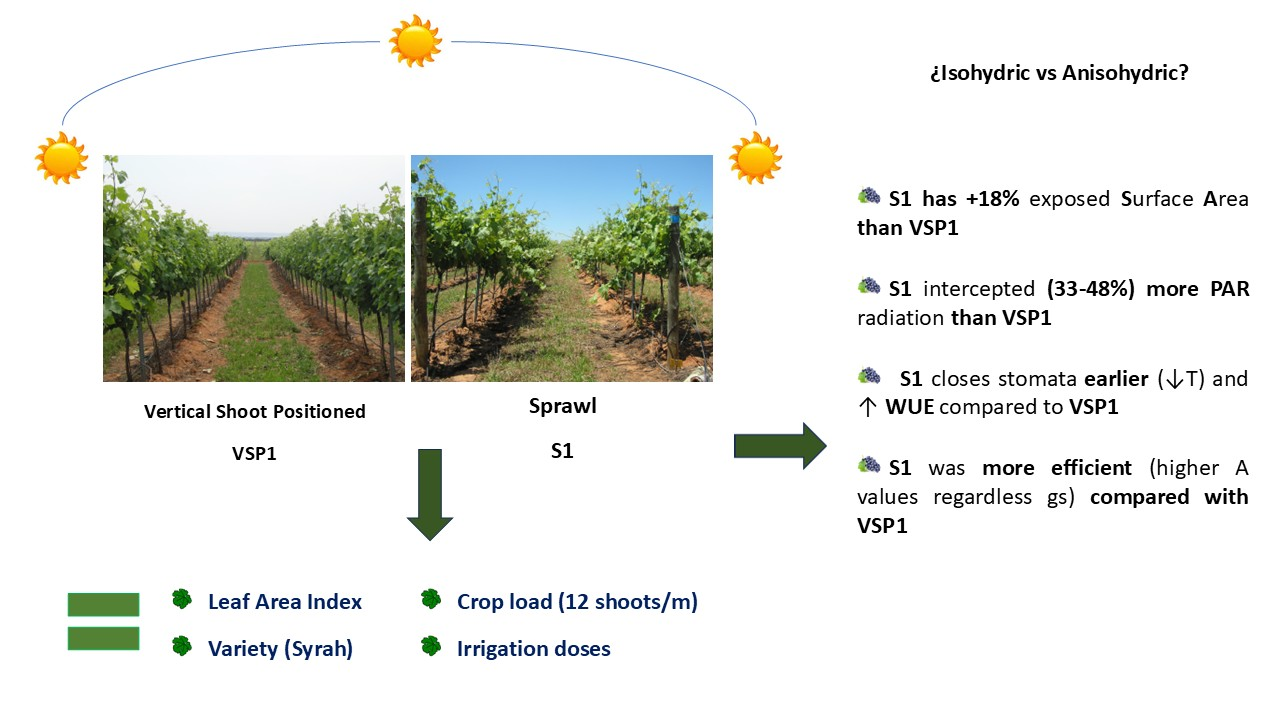
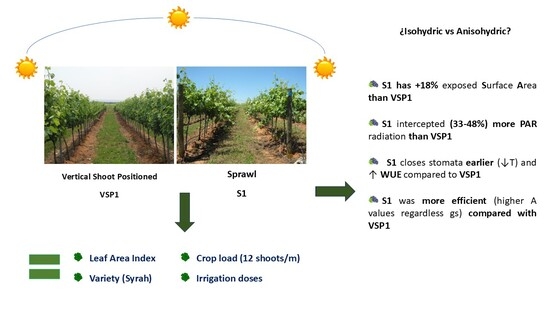
Influence of Canopy Vineyard Management on Physiological Behaviour and Radiation Interception Efficiency in Syrah

 , , and
Abstract
1. Introduction
2. Materials and Methods
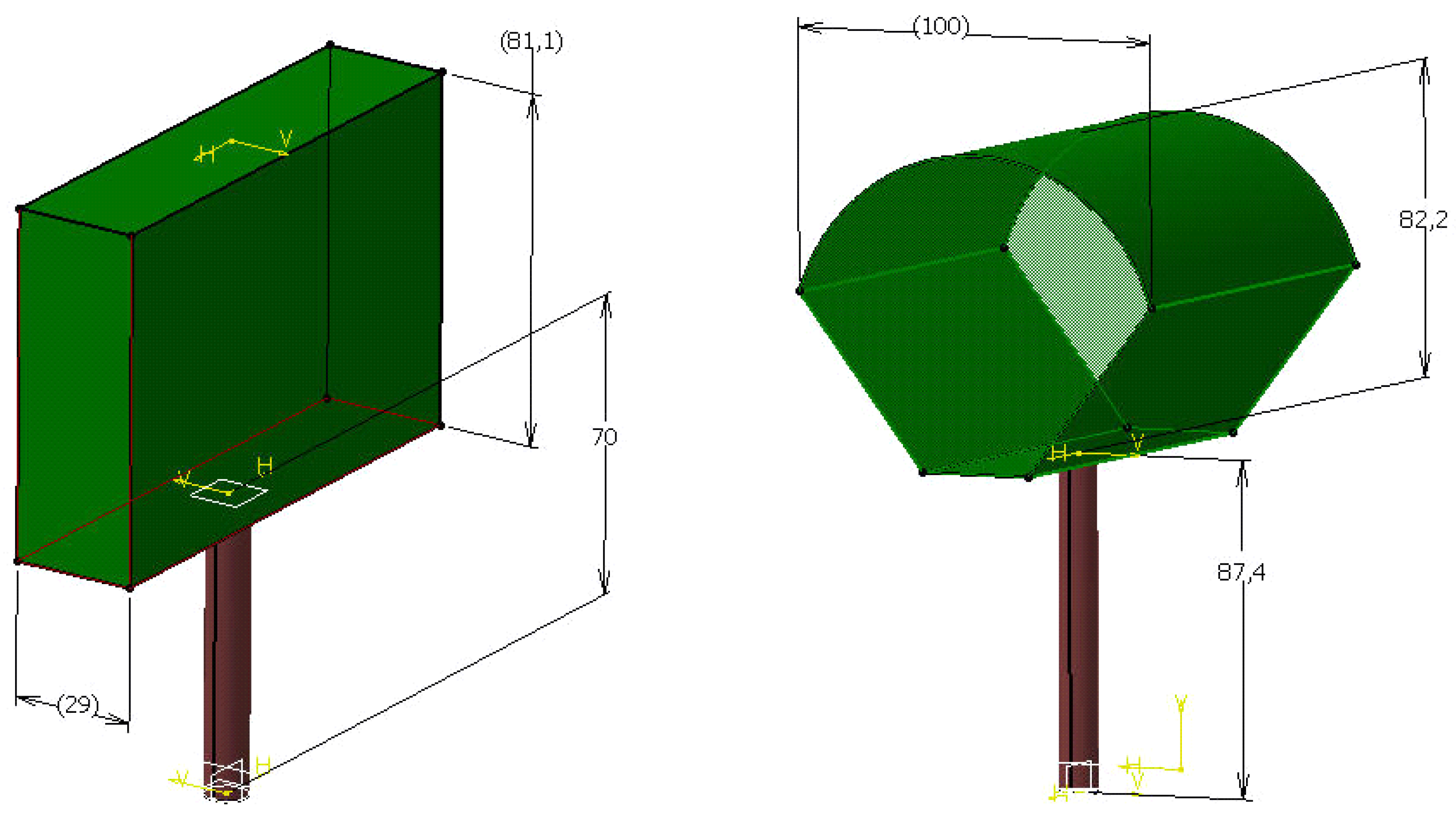
2.1. Field Trial Design
2.2. Surface Leaf Area and Intercepted Radiation Efficiency (εi)
2.3. Plant Physiology
2.4. Statistical Analysis
3. Results
3.1. Surface Leaf Area and Intercepted Radiation Efficiency (εi)
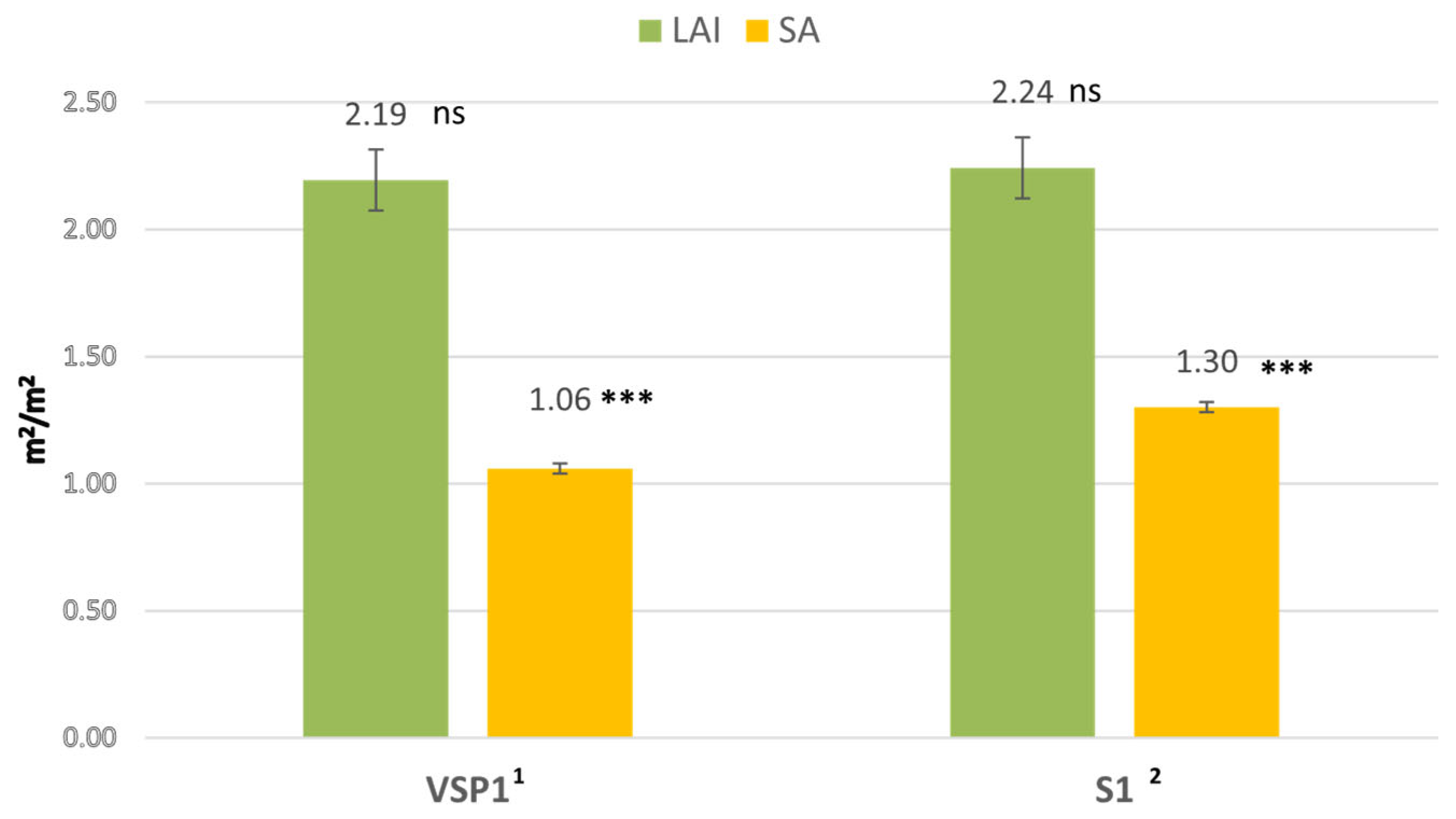
3.1.1. Total Surface Leaf Area (LAI) and Exposed Surface Area (SA)
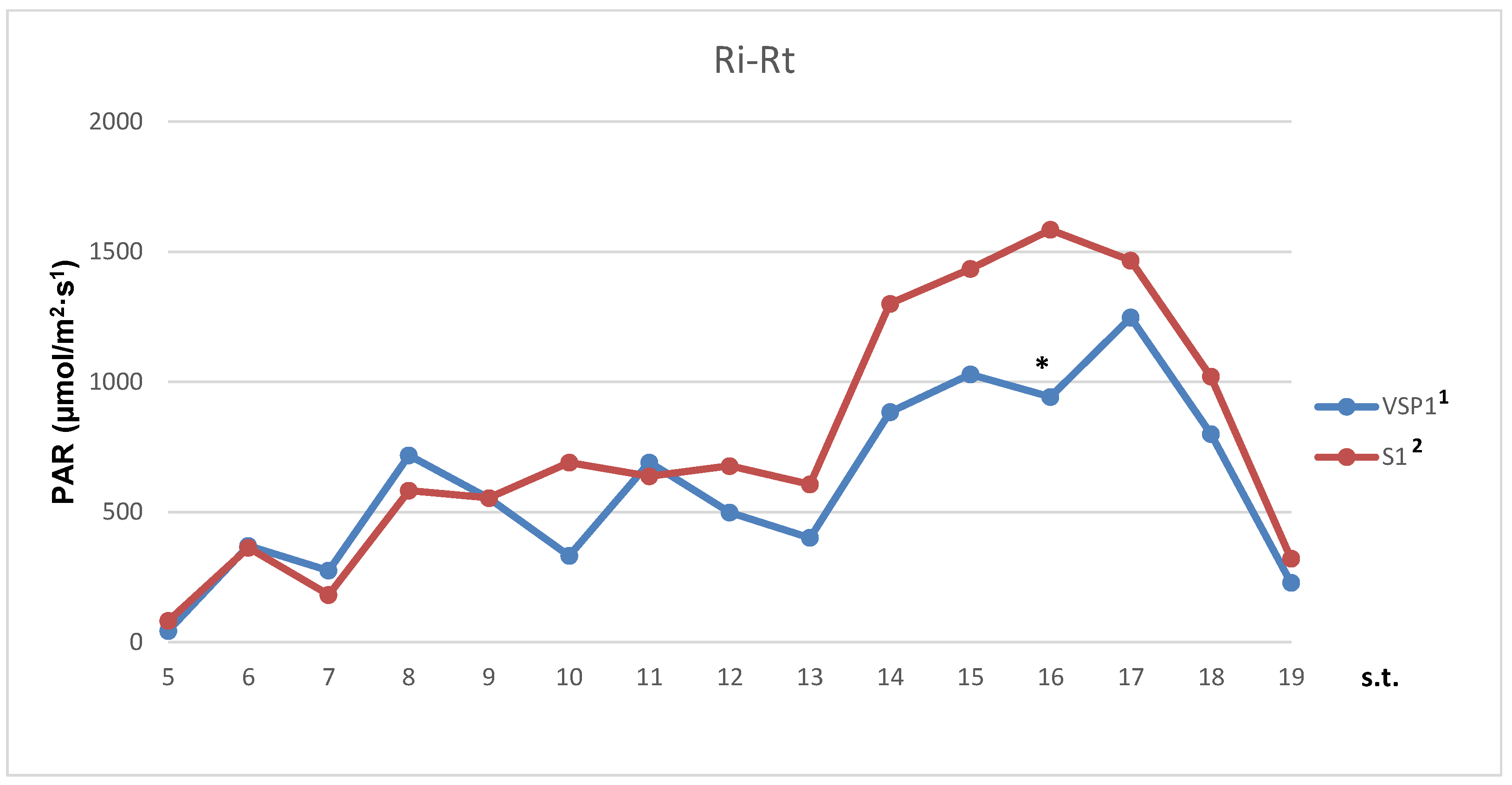
3.1.2. Intercepted Radiation Efficiency (εi)
3.2. Plant Physiology
3.2.1. Leaf and Stem Water Potential
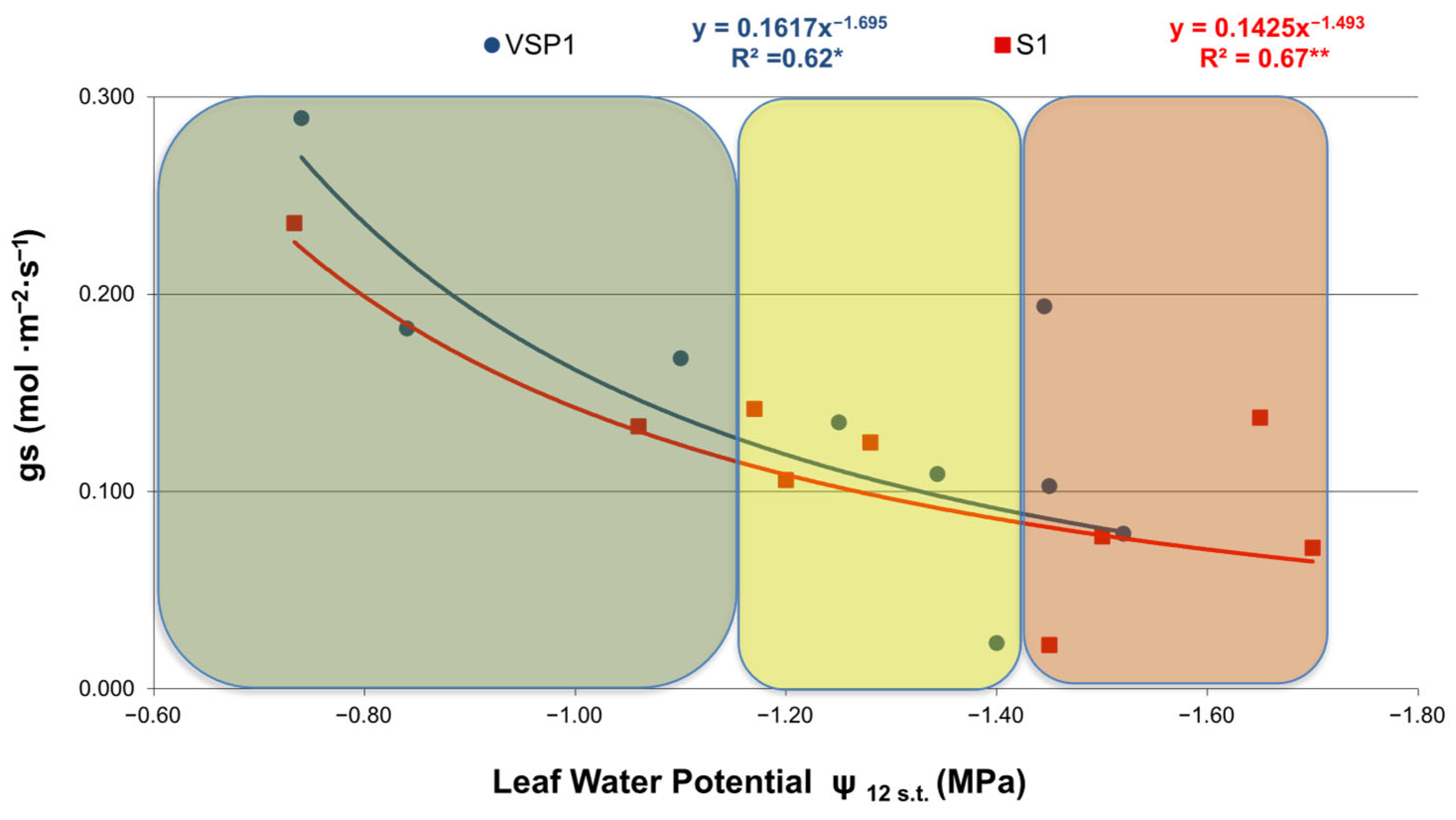
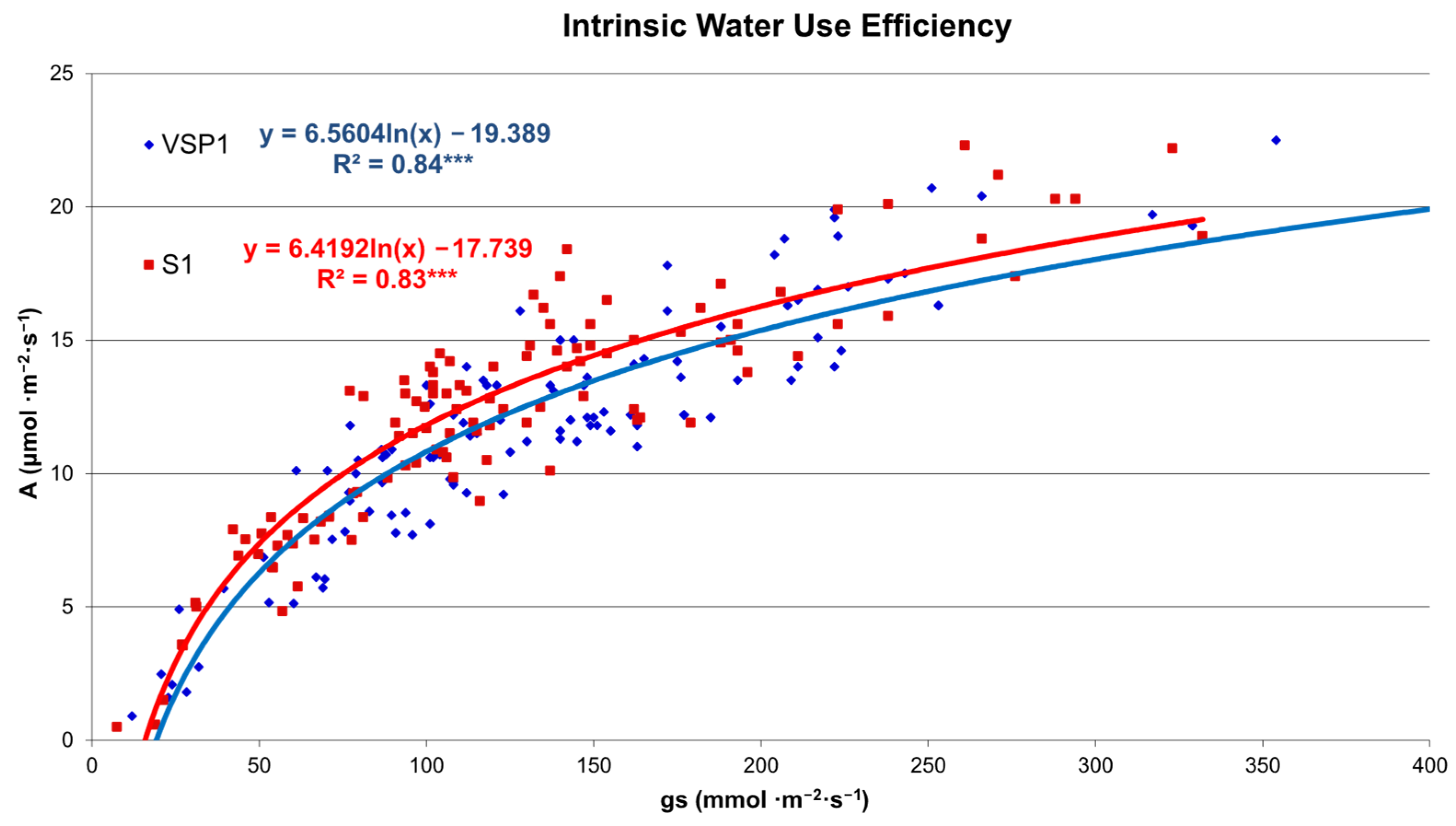
3.2.2. Physiological Responses
4. Discussion
4.1. Surface Leaf Area, Radiation and Intercepted Radiation Efficiency (εi)
4.2. Plant Physiology
5. Conclusions
Author Contributions
Funding
Data Availability Statement
Acknowledgments
Conflicts of Interest
Abbreviations
| VSP | vertical shoot positioned system |
| S | sprawl system |
| gs | stomatal conductance |
| A | photosynthesis or net CO2 assimilation rate |
| E | Transpiration rate |
| VPD | vapor pressure deficit |
| WUE | water use efficiency |
| LWP/ΨL | leaf water potential |
| ABA | Abscisic acid |
| IE | Intrinsic water use efficiency |
| Tm | Mean temperature |
| GDD | Growing degree days |
| Pe | Precipitations |
| ET0 | Mean reference evapotranspiration |
| Ψaa | leaf water potential at pre-dawn |
| Ψmax | Leaf water potential at maximum photosynthesis rate (08:00 solar time) |
| Ψstem | Stem leaf water potential |
| Ψ12h | Leaf water potential at midday (12:00 solar time) |
| L.A.I. | Leaf Area Index |
| PAR | photosynthetically active radiation |
| S.A. | Surface exposed area |
| fIPAR or Ri-Rt | photosynthetically active radiation (PAR) intercepted by the canopy |
| εi | Intercepted radiation efficiency |
References
- IPCC. AR6 Synthesis Report. 2023. Available online: https://www.ipcc.ch/report/ar6/syr/ (accessed on 15 December 2025).
- FAO. Towards a water and food secure future. In Critical Perspectives for Policy-Makers; FAO: Rome, Italy, 2015; p. 69. [Google Scholar]
- de la Fuente, M.; Linares, R.; Lissarrague, J.R. Adapting to climate change: The role of canopy management and water use efficiency in vineyards. Wine Vitic. J. 2016, 43–46. [Google Scholar]
- Mirás-Avalos, J.M.; Araujo, E.S. Optimization of Vineyard Water Management: Challenges, Strategies, and Perspectives. Water 2021, 13, 746. [Google Scholar] [CrossRef]
- Volaire, F. A unified framework of plant adaptive strategies to drought: Crossing scales and disciplines. Glob. Change Biol. 2018, 24, 2929–2938. [Google Scholar] [CrossRef] [PubMed]
- Pellegrino, A.; Lebon, E.; Simonneau, T.; Wery, J. Towards a simple indicator of water stress in grapevine (Vitis vinifera L.) based on the differential sensitivities of vegetative growth components. Aust. J. Grape Wine Res. 2005, 11, 306–315. [Google Scholar] [CrossRef]
- Hochberg, U.; Rockwell, F.E.; Holbrook, N.M.; Cochard, H. Iso/anisohydry: A plant–environment interaction rather than a simple hydraulic trait. Trends Plant Sci. 2018, 23, 112–120. [Google Scholar] [CrossRef]
- Schultz, H.R. Differences in hydraulic architecture account for near-isohydric and anisohydric behaviour of two field-grown Vitis vinifera L. cultivars during drought. Plant Cell Environ. 2003, 26, 1393–1405. [Google Scholar] [CrossRef]
- Wilhelm de Almeida, L.; Pastenes, C.; Ojeda, H.; Torregrosa, L.; Pellegrino, A. Water deficit differentially modulates leaf photosynthesis and transpiration of fungus-tolerant Muscadinia x Vitis hybrids. Front. Plant Sci. 2024, 15, 1405343. [Google Scholar] [CrossRef]
- Soar, C.J.; Speirs, J.; Maffei, S.M.; Penrose, A.B.; McCarthy, M.G.; Loveys, B.R. Grape vine varieties Shiraz and Grenache differ in their stomatal response to VPD: Apparent links with ABA physiology and gene expression in leaf tissue. Aust. J. Grape Wine Res. 2006, 12, 2–12. [Google Scholar] [CrossRef]
- Hugalde, I.P.; Vila, H.F. Comportamiento isohídrico o anisohídrico en vides…:¿ Una controversia sin fin? Rev. Investig. Agropecu. 2014, 40, 75–82. [Google Scholar]
- Collins, M.J.; Fuentes, S.; Barlow, E.W. Partial rootzone drying and deficit irrigation increase stomatal sensitivity to vapour pressure deficit in anisohydric grapevines. Funct. Plant Biol. 2010, 37, 128–138. [Google Scholar] [CrossRef]
- Domec, J.C.; Johnson, D.M. Does homeostasis or disturbance of homeostasis in minimum leaf water potential explain the isohydric versus anisohydric behavior of Vitis vinifera L. cultivars? Tree Physiol. 2012, 32, 245–248. [Google Scholar] [CrossRef] [PubMed]
- Pou, A.; Medrano, H.; Tomàs, M.; Martorell, S.; Ribas-Carbó, M.; Flexas, J. Anisohydric behaviour in grapevines results in better performance under moderate water stress and recovery than isohydric behaviour. Plant Soil 2012, 359, 335–349. [Google Scholar] [CrossRef]
- Serrano, A.S.; Martínez-Gascueña, J.; Chacón-Vozmediano, J.L. Variability in water use behavior during drought of different grapevine varieties: Assessment of their regulation of water status and stomatal control. Agric. Water Manag. 2024, 291, 108642. [Google Scholar] [CrossRef]
- Gerzon, E.; Biton, I.; Yaniv, Y.; Zemach, H.; Netzer, Y.; Schwartz, A.; Fait, A.; Ben-Ari, G. Grapevine anatomy as a possible determinant of isohydric or anisohydric behavior. Am. J. Enol. Vitic. 2015, 66, 340–347. [Google Scholar] [CrossRef]
- Conesa, M.R.; De La Rosa, J.M.; Domingo, R.; Banon, S.; Pérez-Pastor, A. Changes induced by water stress on water relations, stomatal behaviour and morphology of table grapes (cv. Crimson Seedless) grown in pots. Sci. Hortic. 2016, 202, 9–16. [Google Scholar] [CrossRef]
- Martorell, S.; Diaz-Espejo, A.; Tomàs, M.; Pou, A.; El Aou-Ouad, H.; Escalona, J.M.; Vadell, J.; Ribas-Carbó, M.; Flexas, J.; Medrano, H. Differences in water-use-efficiency between two Vitis vinifera cultivars (Grenache and Tempranillo) explained by the combined response of stomata to hydraulic and chemical signals during water stress. Agric. Water Manag. 2015, 156, 1–9. [Google Scholar] [CrossRef]
- Prieto, J.A.; Lebon, É.; Ojeda, H. Stomatal behavior of different grapevine cultivars in response to soil water status and air water vapor pressure deficit. OENO One 2010, 44, 9–20. [Google Scholar] [CrossRef]
- Tramontini, S.; Döring, J.; Vitali, M.; Ferrandino, A.; Stoll, M.; Lovisolo, C. Soil water-holding capacity mediates hydraulic and hormonal signals of near-isohydric and near-anisohydric Vitis cultivars in potted grapevines. Funct. Plant Biol. 2014, 41, 1119–1128. [Google Scholar] [CrossRef]
- Carbonneau, A.; Costanza, P. Response of vine leaf water potential to quick variation in canopy exposure. Example of canopy opening manipulation of Merlot (Vitis vinifera L.). J. Int. Sci. Vigne Vin. 2004, 38, 27–33. [Google Scholar] [CrossRef]
- de la Fuente, M.; Linares, R.; Lissarrague, J.R. Canopy management and water use efficiency in vineyards under Mediterranean semiarid conditions. In BIO Web of Conferences; EDP Sciences: Les Ulis, France, 2015; Volume 5, p. 01005. [Google Scholar]
- Spayd, S.E.; Tarara, J.M.; Mee, D.L.; Ferguson, J.C. Separation of sunlight and temperature effects on the composition of Vitis vinifera cv. Merlot berries. Am. J. Enol. Vitic. 2002, 53, 171–182. [Google Scholar] [CrossRef]
- Allen, R.G.; Pereira, L.S.; Raes, D.; Smith, M. Crop evapotranspiration—Guidelines for computing crop water requirements. In FAO Irrigation and Drainage Paper 56; Food and Agriculture Organization of the United Nations: Rome, Italy, 1998. [Google Scholar]
- Carbonneau, A. La surface foliare exposée potentielle. Progrès Agric. Vitic. 1995, 112, 204–212. [Google Scholar]
- Sánchez de Miguel, P.; Junquera, P.; de la Fuente, M.; Jiménez, L.; Linares, R.; Baeza, P.; Lissarrague, J.R. Estimation of vineyard leaf area by linear regression. Span. J. Agric. Res. 2011, 9, 202–212. [Google Scholar] [CrossRef]
- Mabrouk, H.; Carbonneau, A.; Sinoquet, H. Canopy structure and radiation regime in grapevine I. Spatial and angular distribution of leaf area in two canopy systems. Vitis 1997, 36, 119–123. [Google Scholar]
- Sadras, V.O.; Villalobos, F.J.; López-Bernal, A.; Fereres, E. Chapter 13. Radiation interception, Radiation use efficiency and Crop productivity. In Principles of Agronomy for Sustainable Agriculture; Springer: New York, NY, USA, 2024; pp. 177–198. [Google Scholar]
- van Leeuwen, C.; Tregoat, O.; Chone, X.; Bois, B.; Pernet, D.; Gaudillere, J.P. Vine water status is a key factor in grape ripening and vintage quality for red Bordeaux wine. How can it be assessed for vineyard management purposes? J. Int. Sci. Vigne Vin. 2009, 43, 121–134. [Google Scholar] [CrossRef]
- Levin, A.D.; Williams, L.E.; Matthews, M.A. A continuum of stomatal responses to water deficits among 17 wine grape cultivars (Vitis vinifera). Funct. Plant Biol. 2019, 47, 11–25. [Google Scholar] [CrossRef]
- Williams, L.E.; Araujo, F.J. Correlations among predawn leaf, midday leaf, and midday stem water potential and their correlations with other measures of soil and plant water status in Vitis vinifera. J. Am. Soc. Hortic. Sci. 2002, 127, 448–454. [Google Scholar] [CrossRef]
- Deloire, A.; Carbonneau, A.; Ojeda, H.; Wang, Z. La vigne et l’eau. J. Int. Sci. Vigne Vin. 2004, 38, 1–13. [Google Scholar]
- de la Fuente, M.; Baeza, P.; Sánchez de Miguel, P.; Lissarrague, J.R. Relation between exposed leaf surface, level of intercepted radiation and overall yield of plants. In Proceedings of the 33rd OIV World Congress of Vine, Tbilisi, Georgia, 20–25 June 2010; p. 13. [Google Scholar]
- Williams, L.E.; Baeza, P. Relationships among ambient temperature and vapor pressure deficit and leaf and stem water potentials of fully irrigated field-grown grapevines. Am. J. Enol. Vitic. 2007, 58, 173–181. [Google Scholar] [CrossRef]
- Cuevas, E.; Baeza, P.; Lissarrague, J.R. Variation in stomatal behaviour and gas exchange between mid-morning and mid-afternoon of north-south oriented grapevines (Vitis vinifera L. cv. Tempranillo) at different levels of soil water availability. Sci. Hortic. 2006, 108, 173–180. [Google Scholar] [CrossRef]
- Sadras, V.O.; Villalobos, F.J.; Orgaz, F.; Fereres, E. Chapter 14. Effects of water stress on crop production. In Principles of Agronomy for Sustainable Agriculture; Springer: New York, NY, USA, 2024; pp. 199–214. [Google Scholar]
- Lavoie-Lamoureux, A.; Sacco, D.; Risse, P.A.; Lovisolo, C. Factors influencing stomatal conductance in response to water availability in grapevine: A meta-analysis. Physiol. Plant. 2017, 159, 468–482. [Google Scholar] [CrossRef]
- de la Fuente, M.; Linares, R.; Junquera, P.; Sebastián, B.; Lissarrague, J.R. Cluster microclimate (light and thermal) is a key point of grape maturity in mediterranean semiarid conditions. In Proceedings of the XIXth Internacional Giesco Symposium, Montpellier, France, 31 July–5 August 2015; Volume 2, pp. 546–550. [Google Scholar]
- Zufferey, V. Echanges Gazeux des Feuilles Chez Vitis vinifera L. (cv. Chasselas) en Fonction des Paramètres Climatiques et Physiologiques et des Modes de Conduite de la Vigne. Ph.D. Thesis, Ecole Polytechnique Fédérale de Zürich, Zürich, Switzerland, 2000. [Google Scholar]
- Del Zozzo, F.; Magnanini, E.; Poni, S. Physiological efficiency of grapevine canopies having varying geometries: Seasonal and diurnal whole canopy gas exchange assessment under well-watered and water deficit conditions. Environ. Exp. Bot. 2024, 221, 105716. [Google Scholar] [CrossRef]
- Louarn, G.; Dauzat, J.; Lecoeur, J.; Lebon, E. Influence of trellis system and shoot positioning on light interception and distribution in two grapevine cultivars with different architectures: An original approach based on 3D canopy modelling. Aust. J. Grape Wine Res. 2008, 14, 143–152. [Google Scholar] [CrossRef]
- Buesa, I.; Ballester, C.; Mirás-Avalos, J.M.; Intrigliolo, D.S. Effects of leaning grapevine canopy to the West on water use efficiency and yield under Mediterranean conditions. Agric. For. Meteorol. 2020, 295, 108166. [Google Scholar] [CrossRef]
- Baeza, P.; Ruiz, C.; Cuevas, E.; Sotés, V.; Lissarrague, J.R. Ecophysiological and agronomic response of Tempranillo grapevines to four training systems. Am. J. Enol. Vitic. 2005, 56, 129–138. [Google Scholar] [CrossRef]
- Bartlett, M.K.; Sinclair, G. Temperature and evaporative demand drive variation in stomatal and hydraulic traits across grape cultivars. J. Exp. Bot. 2021, 72, 1995–2009. [Google Scholar] [CrossRef]
- Lovisolo, C.; Perrone, I.; Carra, A.; Ferrandino, A.; Flexas, J.; Medrano, H.; Schubert, A. Drought-induced changes in development and function of grapevine (Vitis spp.) organs and in their hydraulic and non-hydraulic interactions at the whole-plant level: A physiological and molecular update. Funct. Plant Biol. 2010, 37, 98–116. [Google Scholar] [CrossRef]
- Santesteban, L.G.; Miranda, C.; Royo, J.B. Effect of water deficit and rewatering on leaf gas exchange and transpiration decline of excised leaves of four grapevine (Vitis vinifera L.) cultivars. Sci. Hortic. 2009, 121, 434–439. [Google Scholar] [CrossRef]
- Medrano, H.; Tomás, M.; Martorell, S.; Flexas, J.; Hernández, E.; Rosselló, J.; Pou, A.; Escalona, J.M.; Bota, J. From leaf to whole-plant water use efficiency (WUE) in complex canopies: Limitations of leaf WUE as a selection target. Crop J. 2015, 3, 220–228. [Google Scholar] [CrossRef]
- Cogato, A.; Jewan, S.Y.Y.; Wu, L.; Marinello, F.; Meggio, F.; Sivilotti, P.; Sozzi, M.; Pagay, V. Water Stress Impacts on Grapevines (Vitis vinifera L.) in Hot Environments: Physiological and Spectral Responses. Agronomy 2022, 12, 1819. [Google Scholar] [CrossRef]
- Morabito, C.; Orozco, J.; Asteggiano, A.; Medana, C.; Schubert, A.; Zwieniecki, M.A.; Secchi, F. Grapevine adopts different strategies in response to drying regimes. Procrastinator or escaper? J. Plant Physiol. 2025, 314, 154622. [Google Scholar] [CrossRef]
- Tamayo, M.; Sepúlveda, L.; Guequen, E.P.; Saavedra, P.; Pedreschi, R.; Cáceres-Mella, A.; Alvaro, J.E.; Cuneo, I.F. Hydric Behavior: Insights into Primary Metabolites in Leaves and Roots of Cabernet Sauvignon and Grenache Grapevine Varieties under Drought Stress. Horticulturae 2023, 9, 566. [Google Scholar] [CrossRef]



| Year | JAN 2 | FEB | MAR | APR | MAY | JUN | JUL | AUG | SEP | OCT | NOV | DEC | ||
|---|---|---|---|---|---|---|---|---|---|---|---|---|---|---|
| 2005 | Tm 1 (°C) | 15.0 | 4.0 | 5.0 | 9.5 | 14.3 | 19.1 | 25.5 | 26.9 | 25.9 | 20.5 | 15.1 | 8.6 | 5.8 |
| GDD (°C) | 2412.6 | 0.0 | 0.0 | 44.4 | 155.2 | 437.7 | 902.5 | 1426.7 | 1920.6 | 2234.9 | 2393.1 | 2409.8 | 2412.6 | |
| Pe (mm) | 199.3 | 0.0 | 17.1 | 0.0 | 0.0 | 3.6 | 3.6 | 0.0 | 22.0 | 22.0 | 81.1 | 18.5 | 31.4 | |
| ET0 (mm) | 1269.0 | 31.0 | 47.9 | 67.9 | 130.2 | 172.1 | 196.5 | 207.4 | 176.1 | 120.6 | 57.2 | 33.4 | 28.5 | |
| 2006 | Tm (°C) | 15.7 | 4.9 | 6.1 | 10.6 | 14.3 | 19.6 | 23.6 | 27.3 | 25.1 | 21.6 | 16.9 | 12.1 | 5.7 |
| GDD (°C) | 2525.2 | 0.0 | 0.0 | 43.7 | 172.9 | 471.3 | 879.1 | 1416.8 | 1886.1 | 2235.2 | 2449.1 | 2519.5 | 2525.2 | |
| Pe (mm) | 271.5 | 8.6 | 17.5 | 21.2 | 0.0 | 0.0 | 4.9 | 0.0 | 0.0 | 0.0 | 115.8 | 95.4 | 8.1 | |
| ET0 (mm) | 1211.1 | 25.0 | 41.8 | 81.1 | 115.4 | 163.3 | 184.1 | 193.3 | 171.2 | 115.7 | 67.5 | 33.0 | 19.7 | |
| 2007 | Tm (°C) | 14.3 | 5.2 | 9.2 | 10.2 | 12.5 | 16.9 | 20.7 | 24.8 | 23.7 | 21.1 | 14.5 | 8.3 | 5.2 |
| GDD (°C) | 2030.1 | 0.0 | 13.8 | 37.5 | 125.3 | 329.2 | 635.3 | 1084.4 | 1526.3 | 1863.5 | 2016.5 | 2029.4 | 2030.1 | |
| Pe (mm) | 274.3 | 0.0 | 26.0 | 0.0 | 39.5 | 36.2 | 45.0 | 0.0 | 36.9 | 5.6 | 53.2 | 23.8 | 8.1 | |
| ET0 (mm) | 1064.6 | 16.3 | 43.8 | 87.9 | 101.6 | 142.5 | 158.6 | 182.8 | 163.8 | 111.0 | 56.3 | 0.0 | 0.0 |
| Ri-Rt 4 (mol/h) | Ri-Rt ac (mol/h) | εi | |
|---|---|---|---|
| VSP1 1 | 0.66 | 4.46 | 0.27 |
| S1 2 | 0.84 | 5.29 | 0.33 |
| SEM 5 (82) | 0.07 | 0.45 | 0.02 |
| Treatment | * 3 | ns | * |
| 2005 | 0.63 b | 3.61 b | 0.31 a |
| 2006 | 0.77 a | 5.44 a | 0.24 b |
| 2007 | 0.85 a | 5.59 a | 0.35 a |
| SEM (60) | 0.08 | 0.52 | 0.03 |
| Year | * | * | * |
| Treatment * Year | ns | * | ns |
| Year | Treatment | Ri-Rt 4 ac (mol/h) | εi |
|---|---|---|---|
| 2005 | VSP1 1 | 5.91 | 0.50 |
| S1 2 | 7.63 | 0.87 | |
| Sig 3 | ns | ns | |
| 2006 | VSP1 | 3.74 | 0.18 |
| S1 | 7.15 | 0.29 | |
| Sig | ** | * | |
| 2007 | VSP1 | 4.88 | 0.38 |
| S1 | 6.29 | 0.32 | |
| Sig | * | ns |
| LWP | Treatment | Fruitset | Veraison | Harvest | |||||||||
|---|---|---|---|---|---|---|---|---|---|---|---|---|---|
| Ψaa 5 | Ψ8h 5 | Ψ12h 5 | Ψstem 5 | Ψaa | Ψ8h | Ψ12h | Ψstem | Ψaa | Ψ8h | Ψ12h | Ψstem | ||
| Treatment | VSP1 1 | −0.25 | −0.71 | −0.89 | −0.39 | −0.41 | −0.93 | −1.41 | −0.77 | −0.45 | −0.92 | −1.30 | −0.57 |
| S1 2 | −0.27 | −0.65 | −0.93 | −0.40 | −0.39 | −0.90 | −1.47 | −0.77 | −0.41 | −0.90 | −1.33 | −0.49 | |
| SEM 3 (n = 18) | 0.04 | 0.02 | 0.02 | 0.08 | 0.04 | 0.07 | 0.02 | 0.11 | 0.03 | 0.03 | 0.04 | 0.11 | |
| Sig. 4 | ns | * | ns | ns | ns | ns | ns | ns | ns | ns | ns | ns | |
| Year | 2005 | −0.27 | −0.80 c | −1.10 c | −0.49 | −0.31 a | −1.05 b | −1.51 b | −0.67 | −0.45 b | −0.93 b | −1.33 b | −0.50 |
| 2006 | −0.33 | −0.65 b | −0.90 b | −0.42 | −0.56 b | −0.63 a | −1.35 a | −1.02 | −0.59 c | −1.09 c | −1.42 c | −0.60 | |
| 2007 | −0.18 | −0.60 a | −0.74 a | −0.28 | −0.33 a | −1.07 b | −1.46 b | −0.63 | −0.26 a | −0.72 a | −1.19 a | −0.50 | |
| SEM (n = 12) | 0.04 | 0.02 | 0.02 | 0.10 | 0.05 | 0.09 | 0.03 | 0.13 | 0.04 | 0.04 | 0.05 | 0.13 | |
| Sig. | ns | *** | *** | ns | ** | ** | ** | ns | *** | *** | ** | ns | |
| Year * Treatment | Sig. | ns | ns | ns | ns | ns | ns | ns | ns | ns | ns | ns | ns |
| WUE 3 (A/E) | IE (A/gs) | |||
|---|---|---|---|---|
| 8:00 s.t. 4 | 12:00 s.t. | 8:00 s.t. | 12:00 s.t. | |
| VSP1 1 | 4.13 | 2.27 | 0.10 | 0.08 |
| S1 2 | 4.58 | 2.71 | 0.11 | 0.11 |
| Treatment | * 5 | ** | ns | *** |
| 2005 | 4.03 b | 2.00 b | 0.10 b | 0.10 b |
| 2006 | 5.01 a | 2.83 a | 0.13 a | 0.11 a |
| 2007 | 3.98 b | 2.64 b | 0.09 b | 0.09 b |
| Year | *** | *** | *** | ** |
| Year * Treatment | ns | ns | ns | ns |
Disclaimer/Publisher’s Note: The statements, opinions and data contained in all publications are solely those of the individual author(s) and contributor(s) and not of MDPI and/or the editor(s). MDPI and/or the editor(s) disclaim responsibility for any injury to people or property resulting from any ideas, methods, instructions or products referred to in the content. |
© 2026 by the authors. Licensee MDPI, Basel, Switzerland. This article is an open access article distributed under the terms and conditions of the Creative Commons Attribution (CC BY) license.
Share and Cite
de la Fuente, M.; Linares, R.; Lissarrague, J.R.; Sánchez-Élez, S.; Baeza, P. Influence of Canopy Vineyard Management on Physiological Behaviour and Radiation Interception Efficiency in Syrah. Horticulturae 2026, 12, 242. https://doi.org/10.3390/horticulturae12020242
de la Fuente M, Linares R, Lissarrague JR, Sánchez-Élez S, Baeza P. Influence of Canopy Vineyard Management on Physiological Behaviour and Radiation Interception Efficiency in Syrah. Horticulturae. 2026; 12(2):242. https://doi.org/10.3390/horticulturae12020242
Chicago/Turabian Stylede la Fuente, Mario, Rubén Linares, José Ramón Lissarrague, Sara Sánchez-Élez, and Pilar Baeza. 2026. "Influence of Canopy Vineyard Management on Physiological Behaviour and Radiation Interception Efficiency in Syrah" Horticulturae 12, no. 2: 242. https://doi.org/10.3390/horticulturae12020242
APA Stylede la Fuente, M., Linares, R., Lissarrague, J. R., Sánchez-Élez, S., & Baeza, P. (2026). Influence of Canopy Vineyard Management on Physiological Behaviour and Radiation Interception Efficiency in Syrah. Horticulturae, 12(2), 242. https://doi.org/10.3390/horticulturae12020242