Article

Potassium Stress Induces Compensatory Root Adaptive Responses in Trifoliate Orange Through Reconfigured Auxin Signaling

1
Hubei Key Laboratory of Spices & Horticultural Plant Germplasm Innovation & Utilization, College of Horticulture and Gardening, Yangtze University, Jingzhou 434025, China
2
Liyuan State-Owned Forest Farm, Dawu County, Xiaogan 432800, China
3
College of Urban Construction, Yangtze University, Jingzhou 434025, China
*
Author to whom correspondence should be addressed.
These authors contributed equally to this work.
Horticulturae 2026, 12(2), 237; https://doi.org/10.3390/horticulturae12020237
Submission received: 12 January 2026 / Revised: 13 February 2026 / Accepted: 13 February 2026 / Published: 15 February 2026
(This article belongs to the Special Issue Nutrient Absorption and Utilization in Horticultural Crops)

Abstract

Potassium (K+) is essential for plant growth and development, influencing numerous physiological processes and stress responses. While the importance of K+ in overall plant performance is well-established, its specific effects on root system architecture and the underlying molecular mechanisms in woody perennials remain poorly understood. This knowledge gap is particularly significant for citrus rootstocks like trifoliate orange (Poncirus trifoliata L.), where root system optimization directly impacts drought resistance, nutrient acquisition, and overall orchard productivity. Here, we investigated how varying K+ concentrations (K0, K2, K6, and K12) affect trifoliate orange seedling development by comprehensively analyzing root architecture parameters, root hair morphology, endogenous hormone levels, and expression patterns of cell-wall-modifying and auxin-related genes. We found that moderate K+ levels (K6) optimized root architectural development while both deficiency (K0, K2) and excess (K12) inhibited overall growth and root architecture but enhanced root hair development. This morphological dichotomy corresponded to distinct hormonal profiles, showing reduced auxin (IAA), gibberellins (GAs), and zeatin riboside (ZR) levels under K+ stress conditions. Gene expression analysis revealed significant upregulation of expansins (PtEXPA4, PtEXPA5, PtEXPA7) and reconfiguration of auxin biosynthesis (TAA/TAR/YUC) and transport (AUX/LAX/ABCB/PIN) machinery under non-optimal K+ conditions. Our findings suggest that K+ availability modulates trifoliate orange root development through coordinated regulation of hormone homeostasis and gene expression, particularly within the auxin signaling network. These findings elucidate K+-responsive root developmental plasticity as a potential adaptive strategy, providing valuable insights for optimizing fertilization strategies in citrus cultivation and identifying potential molecular targets for enhancing potassium use efficiency in woody perennials.

1. Introduction

The root system is a fundamental organ of plants, playing essential roles in stabilizing the plant, absorbing water and nutrients, and mitigating both biotic and abiotic stresses [1]. It is well-established that the root system exhibits remarkable plasticity, enabling plants to adapt to varying soil conditions and environmental stresses by adjusting its morphology, structure, and function. Through these adaptations, plants optimize resource acquisition and maintain normal growth, ensuring their survival in challenging environments [2]. Consequently, understanding the physiological and molecular mechanisms that enable plants to cope with nutrient deficiencies, particularly those related to potassium (K), is crucial for advancing agricultural productivity.
Potassium is one of the essential macronutrients for plant growth, ranking alongside nitrogen (N) and phosphorus (P). As the primary inorganic cation in plant cells, K+ is involved in numerous vital processes, such as photosynthesis, osmotic adjustment, sugar cotransport, water uptake, and stress acclimation [3,4]. Despite its importance, K has become a limiting factor in agricultural production, as most soil K exists in mineral forms, leaving only a small fraction available for plant uptake [5]. To counteract the effects of K deficiency, plants have evolved multiple strategies to maintain K+ homeostasis, with enhanced K+ uptake being one of the primary mechanisms. This process is closely linked to changes in root architecture, such as promoting lateral root growth, increasing root hair length, and expanding the surface area of the root system, thereby improving the efficiency of K+ uptake under low K+ conditions [5,6]. However, not all K+-deficient conditions stimulate root development, as the response varies depending on factors such as soil K+ levels and plant genotype. For example, Jia et al. [6] reported that low K+ treatment (5 mg/L) reduced root growth in all rice (Oryza sativa L.) genotypes, whereas moderate K+ deficiency (10 mg/L) enhanced root length in efficient genotypes. Furthermore, efficient genotypes developed more fine roots (diameter < 0.2 mm) than inefficient genotypes under both K+ deficiency and moderate K+ conditions. These findings indicate that K+ uptake variations across species are attributed to changes in root architecture [7], influenced by K+ channels, transport proteins, and root exudates that facilitate the release of K+ from soil minerals [4,7]. In addition, K+ deficiency impacts root growth through two primary strategies: maintaining primary root growth while inhibiting lateral root development or inhibiting primary root growth while promoting lateral root development [8].
A variety of phytohormones, particularly auxin (Indole-3-acetic acid, IAA), regulate root development. Other phytohormones, including abscisic acid (ABA), gibberellins (GAs), zeatin riboside (ZR), brassinosteroids (BR), and methyl jasmonate (MeJA), interact with IAA to influence root growth [9,10,11,12]. IAA is primarily synthesized through the indole-3-pyruvate (IPA) pathway: tryptophan (Trp) is converted into IPA by tryptophan aminotransferase (TAA1/TARs), and IPA is subsequently converted into IAA by flavin monooxygenases (YUCCAs) [13]. IAA is transported by influx carriers (AUX/LAX family proteins) and efflux carriers (PIN/ABCB family proteins), which regulate its concentration gradient and influence cellular processes such as division, elongation, and differentiation. These processes are crucial for the formation and growth of primary roots, lateral roots, and root hairs [10,14].
Previous studies have shown that IAA plays a significant role in regulating root growth under low K+ conditions. For example, Song et al. [15] demonstrated that low K+ treatment reduced IAA levels in the root system, impairing the formation and elongation of primary and lateral roots in tobacco cultivar K326. Similarly, in cotton (Gossypium hirsutum L.), low K+ treatment significantly inhibited root development and decreased endogenous IAA content in the roots [16]. These findings suggest that IAA content and distribution are key factors in regulating root growth under K+ deficiency. Furthermore, K+ starvation upregulates the expression of the high-affinity K+ transporter gene AtHAK5 in Arabidopsis (Arabidopsis thaliana) [17], and overexpression of HAK5 promotes root hair elongation in both Arabidopsis and rice (Oryza sativa L. ssp. japonica) under low K+ conditions [18,19]. Moreover, OsHAK5 positively regulates IAA efflux transporters (PIN/ABCB) and enhances the expression of the OsAUX1 gene [19], suggesting a link between K+ metabolism and IAA signaling in regulating root development.
Trifoliate orange (Poncirus trifoliata L.) is an important rootstock in the citrus industry known for its disease resistance, cold tolerance, and good grafting affinity with most citrus cultivars. However, it has limitations, including shallow root distribution, fewer root hairs, and relatively poor water and nutrient uptake capacity. This study aims to explore the effects of K+ on root development in trifoliate orange and determine the optimal K+ concentration by treating seedlings with nutrient solutions containing different K+ levels. Additionally, the molecular mechanisms underlying K+ regulation of root development will be investigated by analyzing the expression patterns of genes related to growth hormone transporter proteins. The findings from this research will provide valuable insights into the rational use of potassium fertilizers in citrus cultivation, contributing to the improvement of citrus production efficiency.

2. Materials and Methods

2.1. Experimental Materials

Fresh trifoliate orange seeds were washed and sterilized by soaking in 70% ethanol for 5 min, followed by several rinses with distilled water. The sterilized seeds were then placed in autoclaved river sand (0.11 MPa, 121 °C, 2 h) and allowed to germinate in an incubator at a day/night temperature of 28 °C/20 °C and a relative humidity of 68%. Two 5-leaf-old seedlings of trifoliate orange exhibiting uniform growth were subsequently transplanted into plastic pots (15.5 cm × 11.0 cm × 13.0 cm). The river sand used for potting (diameter ≤ 4 mm) was autoclaved under the same conditions (0.11 MPa, 121 °C, 2 h).

2.2. Experimental Design

The experiment followed a one-way design with four treatments: no potassium (0 mmol/L, K0), low potassium (2 mmol/L, K2), moderate potassium (6 mmol/L, K6), and high potassium (12 mmol/L, K12). Each treatment was replicated five times, with one replication per pot, resulting in a total of 20 pots arranged randomly. The K6 concentration was based on the study by Cao et al. [20]. Potassium nitrate (KNO3) was used to adjust the K+ concentrations in the nutrient solutions, and ammonium nitrate (NH4NO3) was added to maintain a consistent N concentration across treatments. Following transplantation, the seedlings were allowed to acclimate for 2 w, during which each pot was watered daily with 100 mL of distilled deionized water (ddH2O). Every 2 d, 100 mL of Hoagland’s nutrient solution with varying K+ concentrations was applied. On the second day of each nutrient application, each pot was watered with 100 mL of ddH2O to remove residual K+ from the substrate, thereby preventing K+ accumulation.

2.3. Measurement Method

The experiment was concluded after 10 w of K+ treatment. The plant height, stem thickness, number of leaves, and dry mass of the leaves, stems, and root system of the live trifoliate orange seedlings were measured manually. The root system of trifoliate orange was scanned using an Epson Perfection V700 Photo Dual Lens System (J221A, Seiko Epson Corporation, Jakarta Selatan, Indonesia) and analyzed with WinRHIZO Pro 2007b (Regent Instruments Inc., Quebec, QC, Canada). The analysis included total root length, projected area, surface area, volume, and average diameter. The length of the primary root and the number of lateral roots at each level were determined manually.
Endogenous root hormones (IAA, ABA, GAs, ZR, BR, MeJA) were extracted using the method described by Wen et al. [21], and their specific content was subsequently determined through enzyme-linked immunosorbent assay (ELISA).
Root hair growth was assessed following the method of Guo et al. [14]. Twenty-four 1 cm root segments were cut from the 1st-, 2nd-, and 3rd-order lateral roots of seedlings and fixed in 2.5% glutaraldehyde for more than 24 h. The segments were then dehydrated sequentially using an alcohol gradient (30%, 50%, 70%, 90%, and 100%), dried at the critical point of CO2 (CPD), and gold-coated. Root hairs were observed using a scanning electron microscope under normal mode with parameters of 1 kv voltage and 2 nA beam current (JSM-6390LV, Japan Electronics Co., Ltd., Akishima, Japan). Images of the root hairs were captured at magnifications of 100× and 200×, respectively. The number of root hairs, as well as their length and diameter, were measured using Image J 1.43u software (National Institute of Health, Bethesda, MD, USA, https://svi.nl/ImageJ, accessed on 1 April 2010).
Fresh root samples (approximately 0.2 g) from different treatments were weighed, and total RNA was extracted by grinding in liquid nitrogen using the TaKaRa MiniBEST Universal RNA Extraction Kit. RNA concentration and purity were assessed using an ultramicro spectrophotometer (K5600C, Beijing Kaio Technology Development Co., Ltd., Beijing, China). RNA samples with high purity were selected for reverse transcription using the TaKaRa PrimeScript™ RT reagent Kit with gDNA Eraser (RR047A, Takara Bio Inc., Osaka, Japan). Three tubes of cDNA were reverse transcribed for each RNA sample. The CDS sequences of each gene were obtained from the Citrus Pan-genome2breeding Database (hzau.edu.cn), and primers were designed using Primer 5.0 software (Palo Alto, CA, USA) and synthesized by Shanghai Sangong Bioengineering Co., as shown in Table 1. The qRT-PCR system and reaction program were set according to the instructions of the Vazyme ChamQ Universal SYBR qPCR Master Mix (Q711, Vazyme, Nanjing, China). Each reaction system consisted of 10 µL of SYBR qPCR Master Mix, 0.4 µL of forward primer, 0.4 µL of reverse primer, 7.2 µL of ddH2O, and 2 µL of cDNA, for a total volume of 20 µL. The reaction system was centrifuged at low speed for 15 s on a low-speed bench-top centrifuge (PK-3, Hunan Pingke Scientific Instrument Co., Ltd., Hunan, China) and then run on a CFX96 Real-Time PCR Detection System (BIO-RAD, Hercules, CA, USA). The reaction program included an initial thermostatic section (95 °C for 30 s), a cycling section (10 cycles at 60 °C and 72 °C for 30 s), and a melting section (95 °C for 15 s, 60 °C for 60 s, and 95 °C for 15 s). The experiment was repeated three times (biological replicates) with three technical replicates per gene. The relative expression of the genes under each treatment was calculated using the 2−ΔΔCT method described by Livak and Schmittgen [22].

2.4. Statistical Analysis

The ANOVA procedure in SAS 8.1 software was used to assess inter-treatment variability (p < 0.05). Data visualization was performed using Origin 2024SR1 software. Principal component analysis (PCA) was employed for comprehensive evaluation, and the moderate K+ level was determined with reference to the method outlined by Huang et al. [23].

3. Results

3.1. Response of Trifoliate Orange Seedling Growth to Different K+ Concentrations

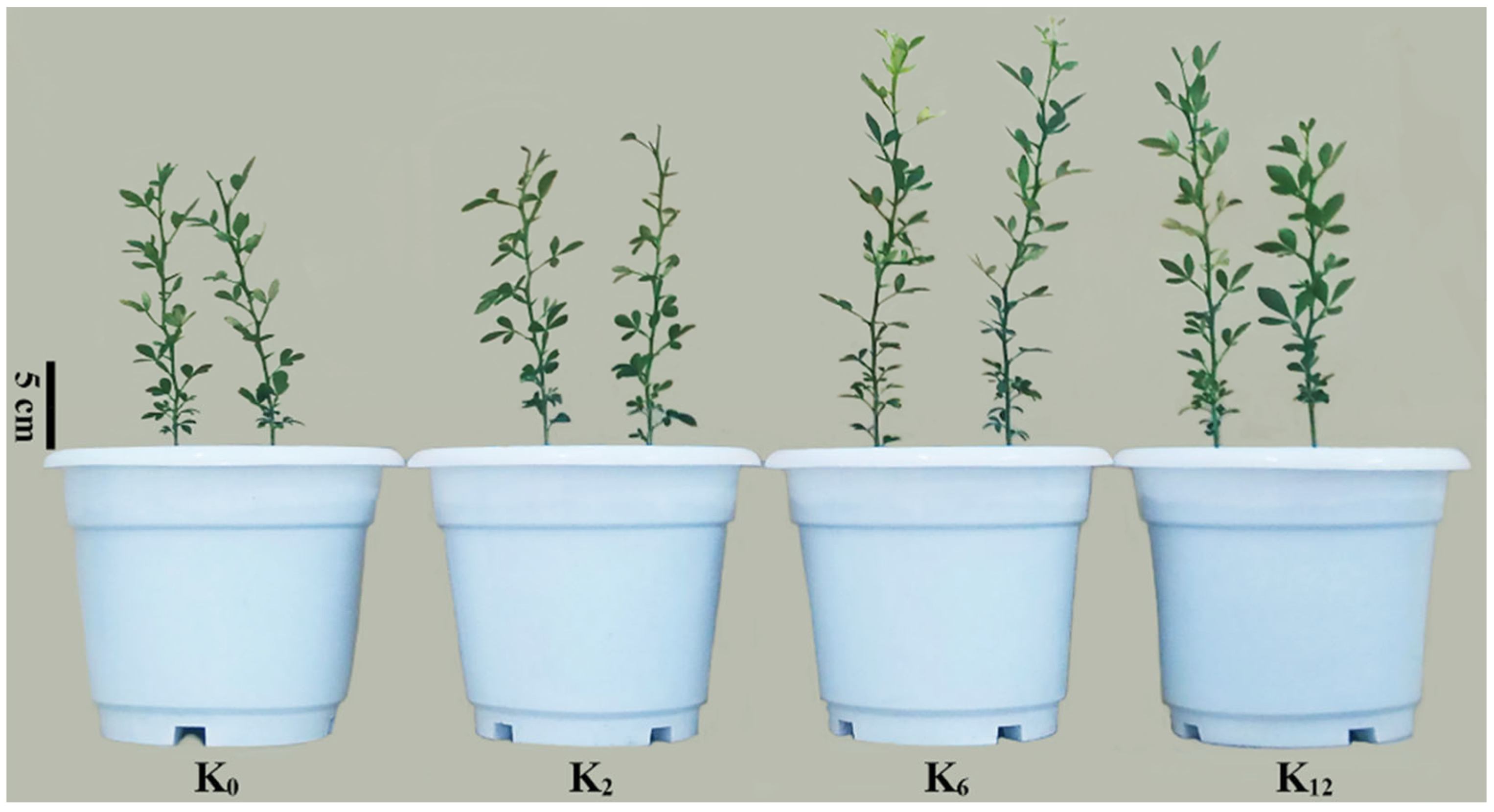
Compared to the K6 treatment, the K0, K2, and K12 treatments all inhibited the growth and development of trifoliate orange seedlings (Figure 1; Table 2). Specifically, under the K0 treatment, significant reductions occurred in plant height (28.07%), stem diameter (23.08%), number of leaves (10.16%), and dry weights of leaves (30.43%), stems (34.92%), and roots (20.00%). The K2 treatment resulted in significant decreases in stem diameter (12.82%) and the dry weights of leaves (17.39%), stems (30.16%), and roots (13.33%). Similarly, the K12 treatment led to significant reductions in stem diameter (12.82%) and the dry weights of leaves (8.70%) and stems (19.05%).

3.2. Response of Root Architecture of Trifoliate Orange Seedlings to Different K+ Concentrations

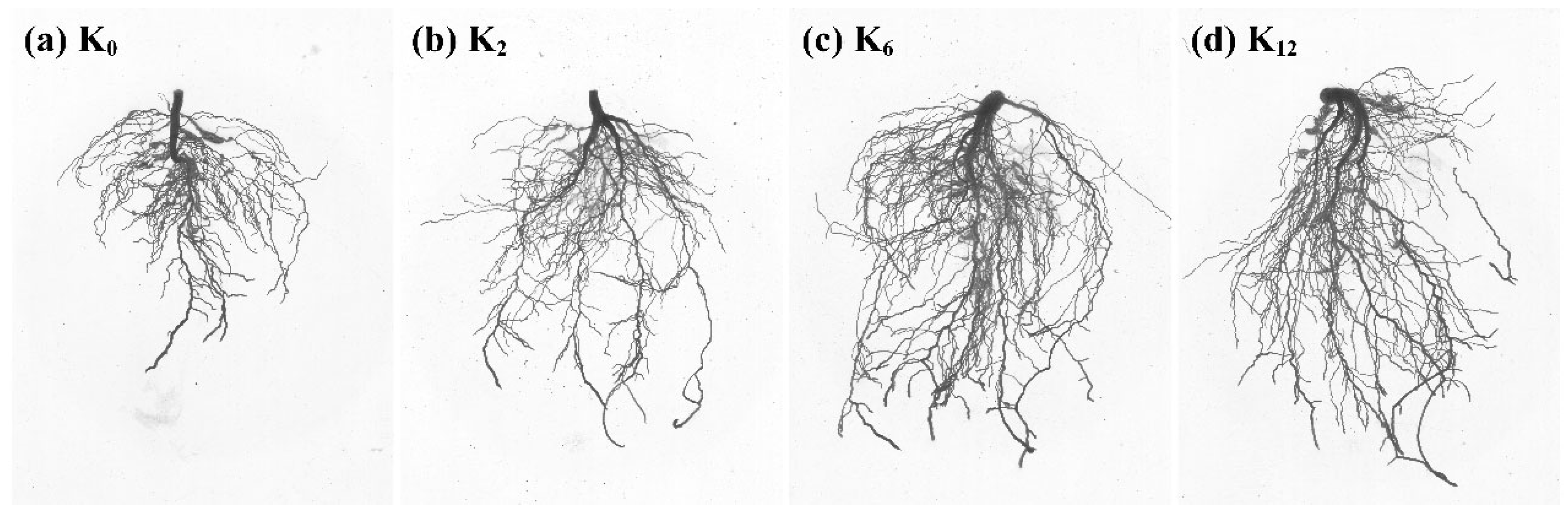
The K+ influenced the development of root system architecture in trifoliate orange seedlings (Figure 2). Compared to the K6 treatment, the K0 treatment significantly reduced total root length (21.36%), surface area (16.50%), volume (30.70%), and the number of second-order (21.28%) and third-order lateral roots (39.31%). Under the K2 treatment, these parameters decreased by 10.56%, 6.60%, 24.56%, 11.35%, and 23.09%, respectively (Table 3), while the number of first-order lateral roots significantly increased by 9.61%. In contrast, the K12 treatment significantly reduced the number of second-order and third-order lateral roots by 10.44% and 45.01%, respectively.

3.3. Response of Root Hair Phenotypes of Trifoliate Orange Seedlings to Different K+ Concentrations

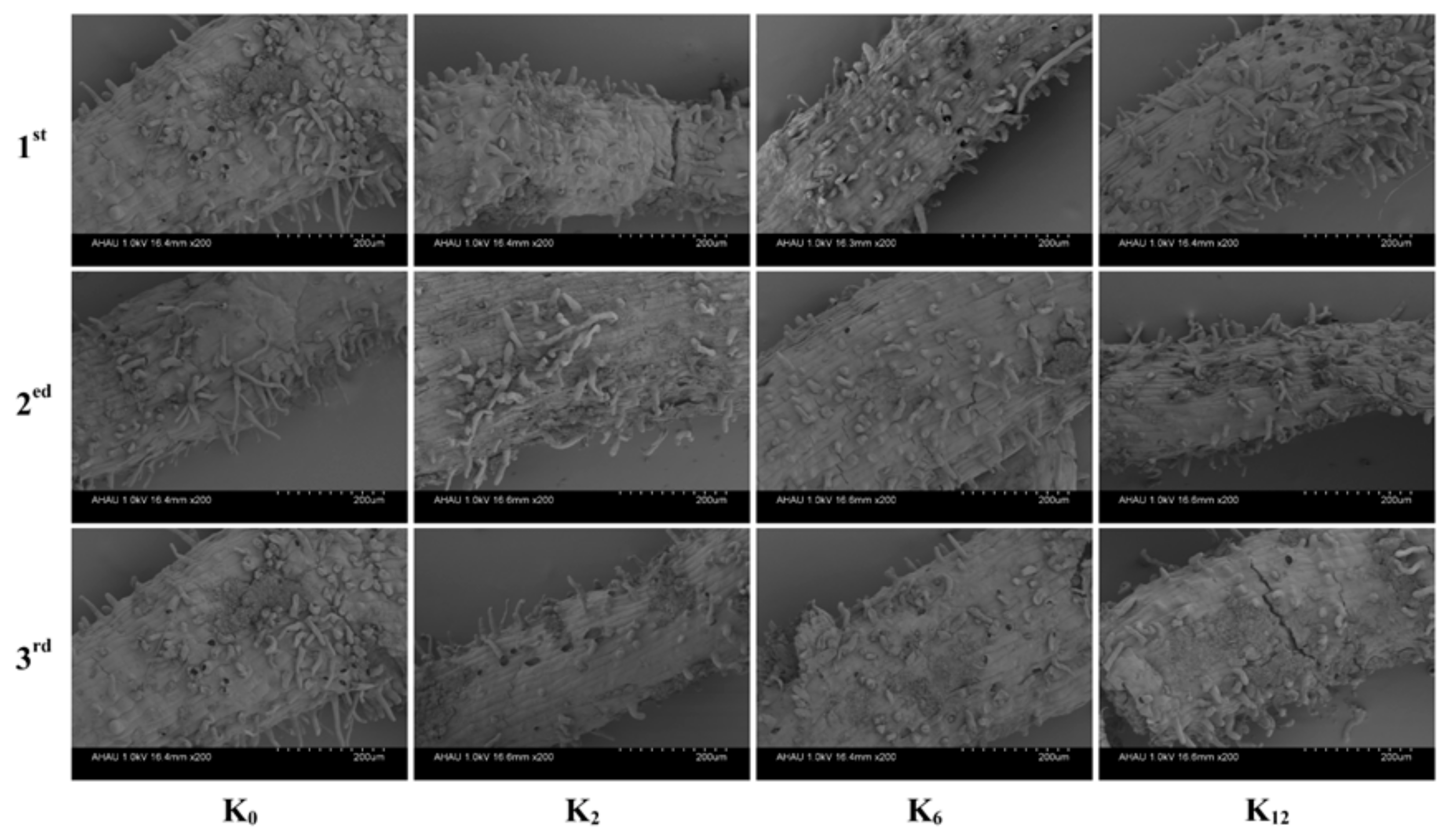
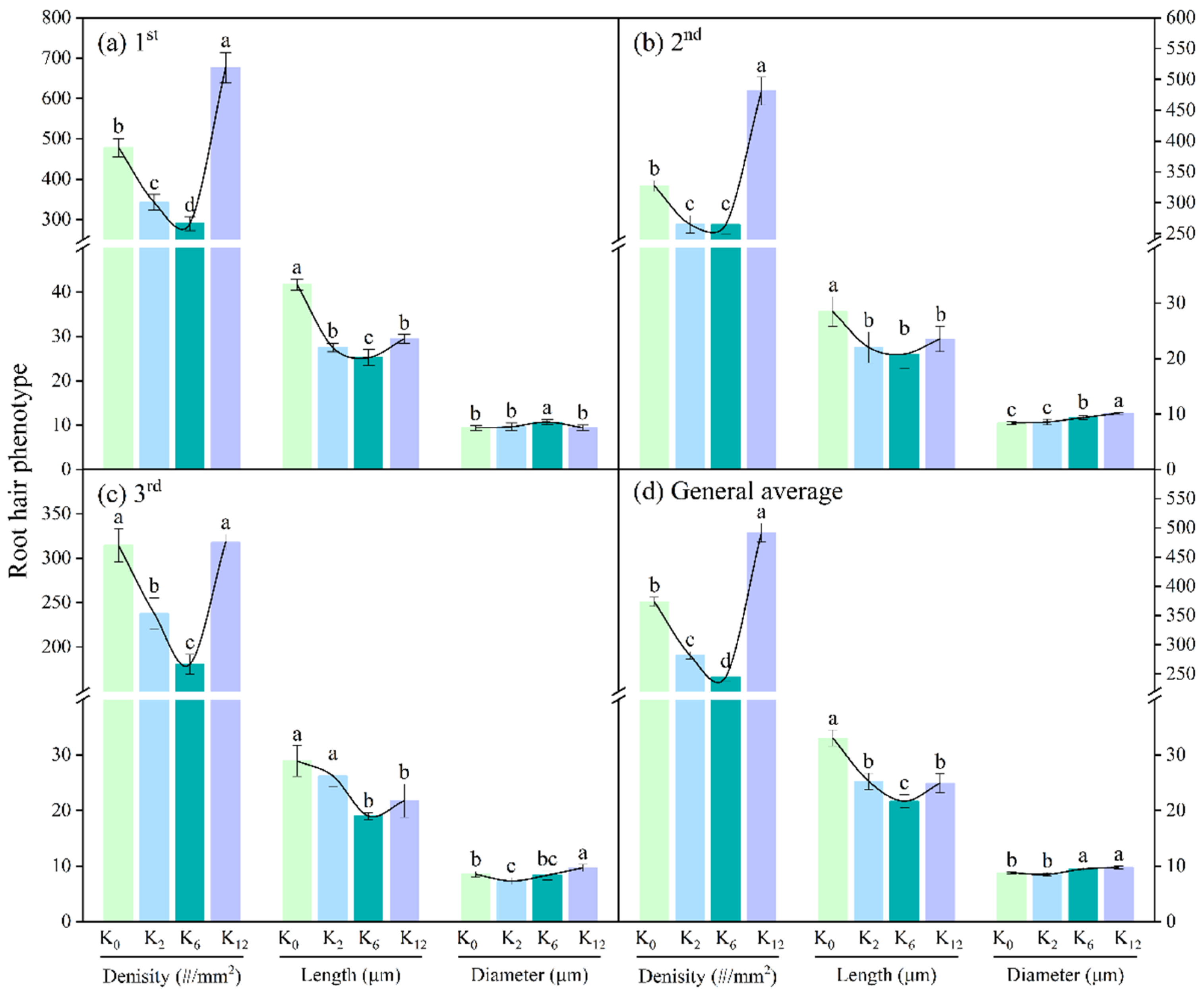
Compared to the K6 treatment, the K0, K2, and K12 treatments generally increased the root hair density and length across different grades of lateral roots and the root system as a whole (Figure 3 and Figure 4). Specifically, under the K0 treatment, the root hair density of first-order, second-order, and third-order lateral roots, as well as the overall average, significantly increased by 64.93%, 23.76%, 74.17%, and 52.39%, respectively. Under the K12 treatment, these increases were 133.06%, 81.88%, 76.08%, and 100.66%, respectively, while under the K2 treatment the increases were 18.09%, 0.20%, 31.65%, and 14.98% (with no significant effect on second-order lateral roots).
Moreover, the K0 treatment significantly increased the length of root hairs on first-order, second-order, and third-order lateral roots, as well as the overall average, by 65.20%, 36.73%, 52.34%, and 52.35%, respectively. The K2 treatment significantly increased the length of root hairs on first-order and third-order lateral roots and the overall average by 9.12%, 38.02%, and 16.47%, respectively. The K12 treatment only significantly increased the length of root hairs on first-order lateral roots and the overall average by 16.73% and 14.94%, respectively.
In contrast, both the K0 and K2 treatments caused significant reductions in root hair diameter for first-order and second-order lateral roots and the overall average, with decreases of 11.91%, 10.45%, and 7.38% for K0 and 9.82%, 8.64%, and 10.23% for K2, respectively. However, the K12 treatment significantly reduced root hair diameter only on first-order lateral roots by 11.69% while significantly increasing the diameter of root hairs on second-order and third-order lateral roots by 8.10% and 15.79%, respectively.

3.4. Response of Endogenous Hormones in the Root of Trifoliate Orange Seedlings to Different K+ Concentrations

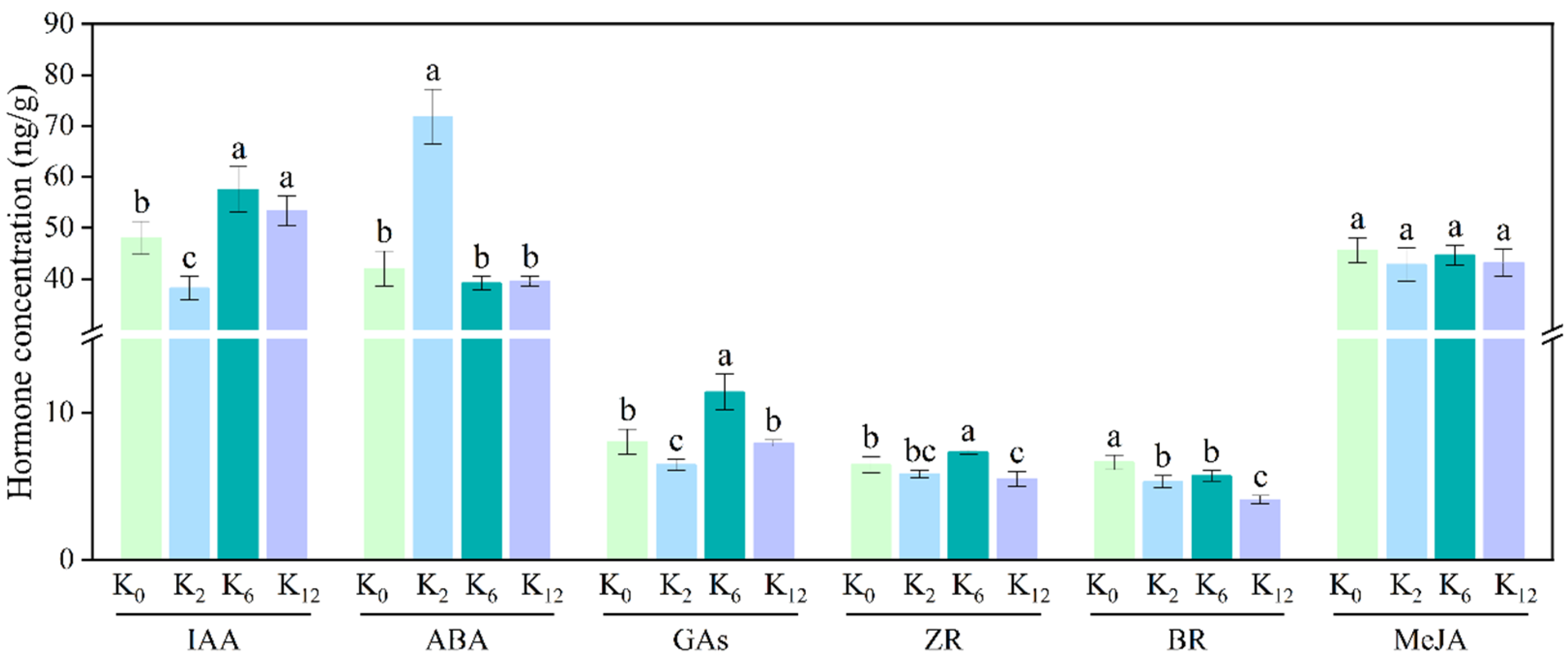
As shown in Figure 5, compared to the K6 treatment, the K0, K2, and K12 treatments all significantly reduced the contents of GAs, IAA, and ZR in the root system of trifoliate orange seedlings, with the exception of the K12 treatment, which did not significantly affect IAA content. Specifically, the K0 treatment reduced the contents of GAs, IAA, and ZR by 29.55%, 16.48%, and 11.67%, respectively; the K2 treatment reduced the contents by 43.34%, 33.59%, and 20.06%, respectively; and the K12 treatment reduced the contents by 30.42%, 7.30%, and 24.75%, respectively. Additionally, the K0 treatment significantly increased the BR content by 16.01%, the K2 treatment significantly increased the ABA content by 83.48%, and the K12 treatment significantly decreased the BR content by 28.35%.

3.5. Response of Expansion Protein Gene Expression Levels in the Root System of Trifoliate Orange Seedlings to Different K+ Concentrations

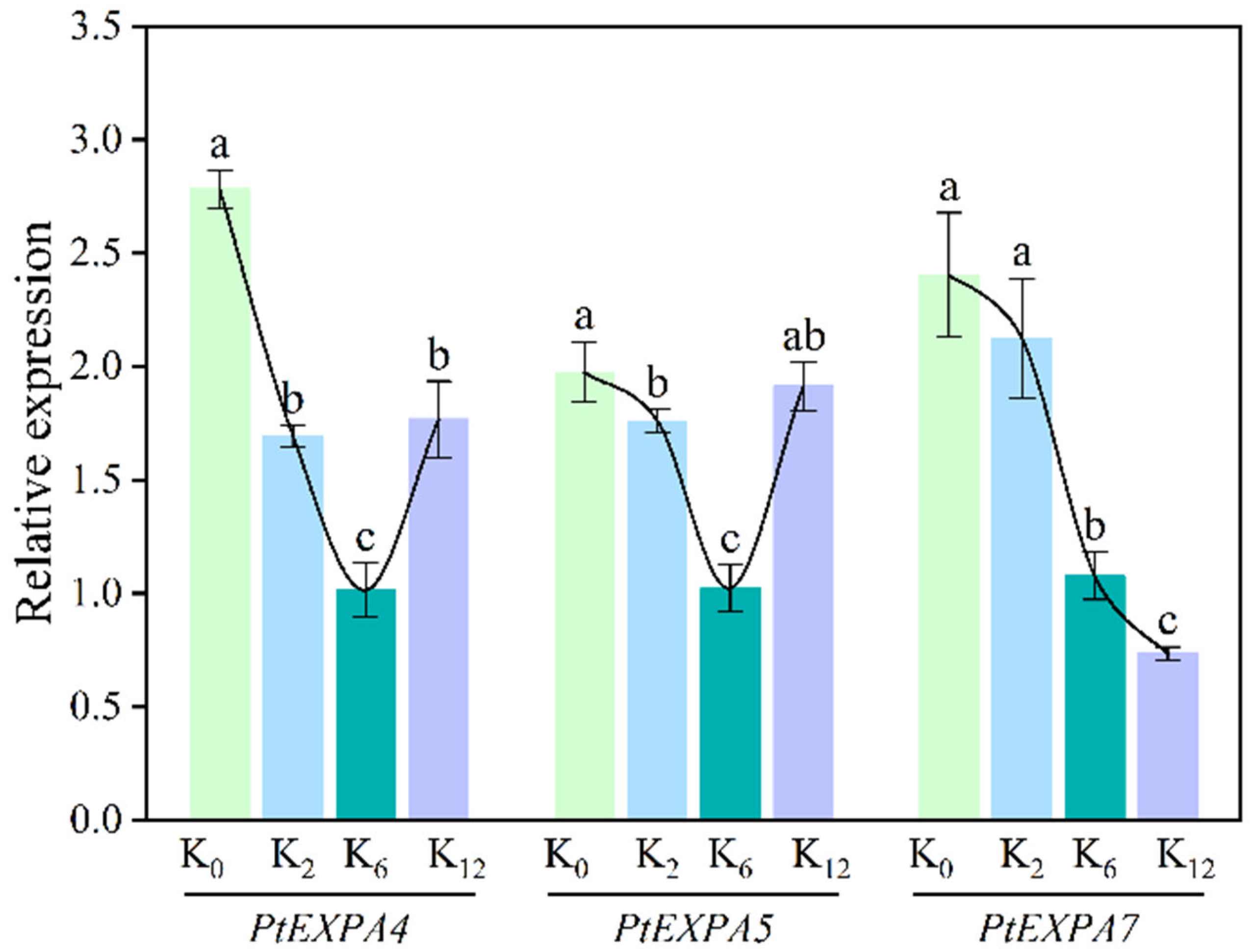
As shown in Figure 6, the expression of PtEXPA4 and PtEXPA5 was significantly upregulated under the K0, K2, and K12 treatments compared to the K6 treatment. Specifically, PtEXPA4 was upregulated by 2.74-fold, 1.67-fold, and 1.74-fold, while PtEXPA5 was upregulated by 1.93-fold, 1.72-fold, and 1.87-fold, respectively. In contrast, PtEXPA7 was upregulated by 2.23-fold and 1.97-fold under the K0 and K2 treatments, respectively, it but was significantly downregulated by 1.47-fold under the K12 treatment. Moreover, the upregulation of expansion protein genes was most pronounced under the K0 treatment.

3.6. Response of IAA Synthesized Gene Expression in the Root System of Trifoliate Orange Seedlings to Different K+ Concentrations

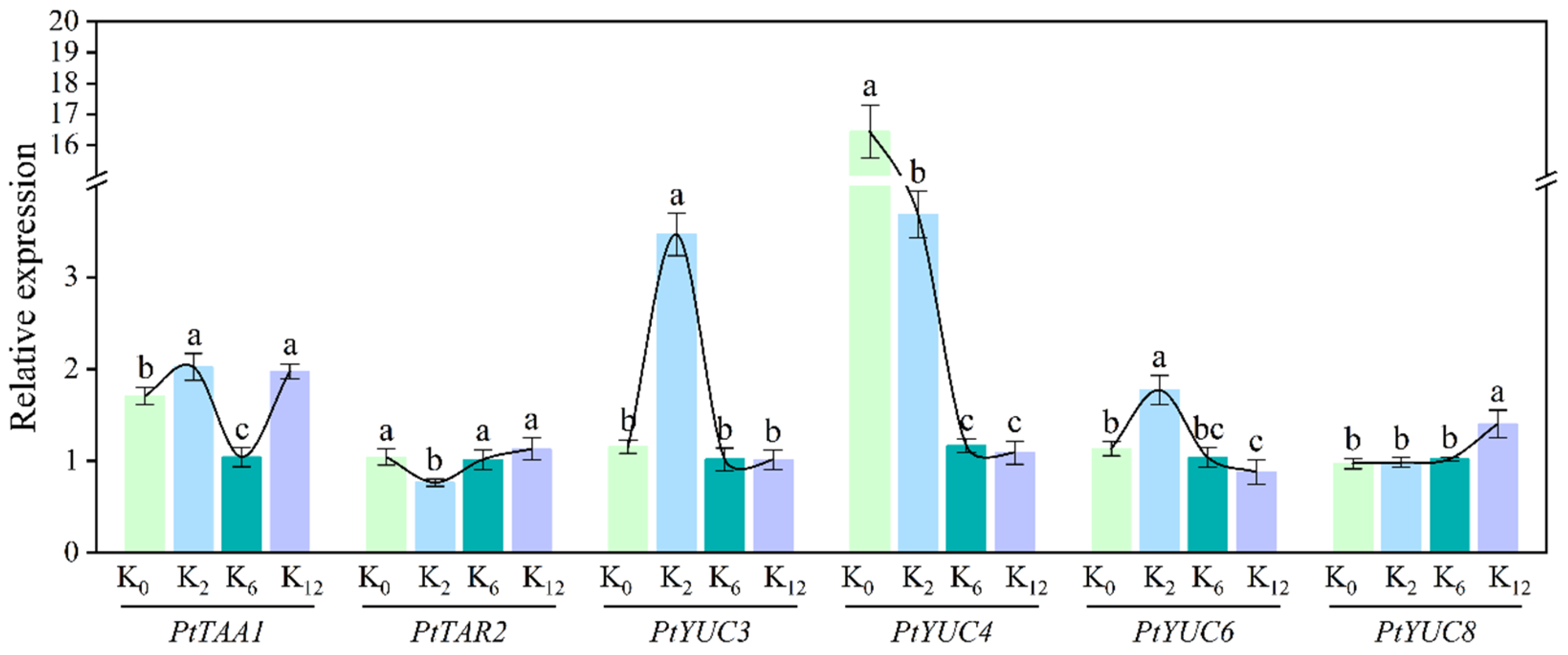
Compared to the K6 treatment, the K0 treatment significantly increased the expression of PtTAA1 and PtYUC4 by 1.64-fold and 14.13-fold, respectively (Figure 7). The K2 treatment resulted in the upregulation of PtTAA1, PtYUC3, PtYUC4, and PtYUC6, with increases of 1.94-fold, 3.40-fold, 3.16-fold, and 1.70-fold, respectively, but it significantly downregulated the expression of PtTAR2 by 1.33-fold. Additionally, the K12 treatment significantly upregulated the expression of PtTAA1 and PtYUC8 by 1.90-fold and 1.38-fold, respectively.

3.7. Response of IAA Transport Carrier Protein Gene Expression in the Root System of Trifoliate Orange Seedlings to Different K+ Concentrations

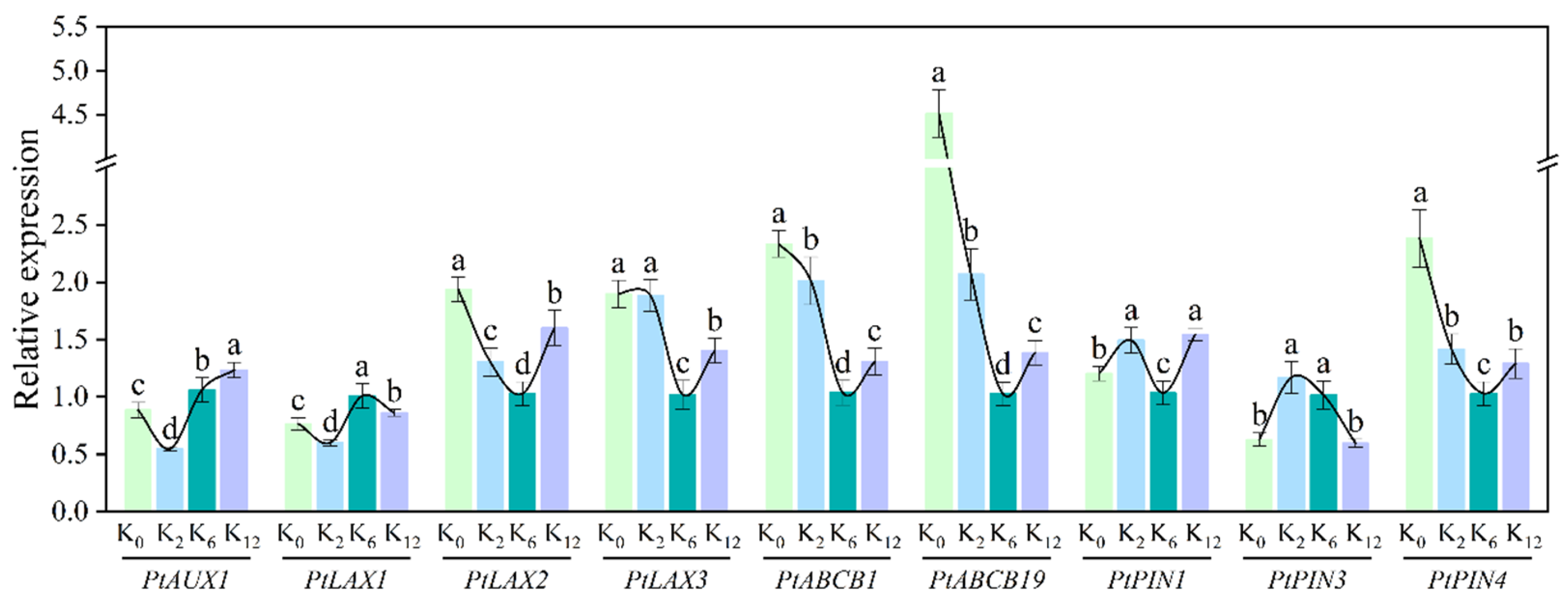
As shown in Figure 8, PtAUX1 expression was significantly downregulated by 1.20-fold and 1.94-fold under the K0 and K2 treatments, respectively, but it was significantly upregulated by 1.16-fold under the K12 treatment. PtLAX1 was significantly downregulated under all three treatments, with decreases of 1.31-fold, 1.68-fold, and 1.17-fold under K0, K2, and K12 treatments, respectively. Additionally, both K0 and K12 treatments significantly downregulated the expression of PtPIN3 by 1.62-fold and 1.71-fold, respectively. In contrast, K0, K2, and K12 treatments significantly upregulated the expression of PtLAX2, PtLAX3, PtABCB1, PtABCB19, PtPIN1, and PtPIN4. Specifically, expression was increased by 1.88-fold, 1.86-fold, 2.25-fold, 4.41-fold, 1.16-fold, and 2.31-fold under the K0 treatment; 1.27-fold, 1.84-fold, 1.94-fold, 2.02-fold, 1.44-fold, and 1.38-fold under the K2 treatment; and 1.56-fold, 1.37-fold, 1.26-fold, 1.35-fold, 1.49-fold, and 1.25-fold under the K12 treatment, respectively.

3.8. Comprehensive Evaluation of Root System Architecture of Trifoliate Orange Seedlings Under Different K+ Concentrations

To determine the most suitable K+ concentration for root development in trifoliate orange seedlings, principal component analysis (PCA) was used to comprehensively evaluate root architecture parameters under different K+ treatments. The raw data for nine root architecture indicators (total length, projected area, surface area, volume, average diameter, primary root length, number of first-order lateral roots, number of second-order lateral roots, and number of third-order lateral roots) were standardized and then subjected to PCA. The raw indicators were classified into nine principal components based on eigenvalues, variance contribution rates, and cumulative variance contribution rates. The cumulative variance contribution rate of the first three principal components reached 81.174%, exceeding the 80% threshold, indicating that these three components reflect the majority of the information from the original indicators (Table 4).
From the principal component loading matrix, the contribution rate of the first principal component (PC1) was 51.398%, which primarily synthesized information on root total length, surface area, volume, average diameter, etc.; the contribution rate of the second principal component (PC2) was 17.647%, which mainly reflected the number of first-order lateral roots; and the contribution rate of the third principal component (PC3) was 12.129%, primarily reflecting the number of third-order lateral roots. The integrated scores of the principal components were then calculated and ranked using the formula (Table 5). The results indicated that the integrated scores for root system architecture under different K+ concentrations were K6 > K12 > K2 > K0, with the K6 treatment being the most effective for enhancing the measured root system architecture traits under these experimental conditions.

3.9. Comprehensive Evaluation of Root Hair Phenotypes of Trifoliate Orange Seedlings Under Different K+ Concentrations

PCA was used to comprehensively evaluate root phenotypic parameters under different K+ treatments to determine the optimal K+ concentration for root hair development in trifoliate orange seedlings. The raw data for three root hair phenotypes (density, length, and diameter) were standardized and subjected to PCA. The raw indices were classified into three principal components based on eigenvalues, variance contribution ratios, and cumulative variance contribution ratios. The cumulative variance contribution ratio of the first two principal components reached 90.176%, exceeding the 80% threshold, indicating that these two components captured the majority of the information from the raw indices (Table 6).
From the principal component loading matrix, it was observed that the contribution rate of PC1 was 46.884%, which primarily reflected the information of root hair density and diameter, while the contribution rate of PC2 was 43.292%, which mainly reflected root hair length. The integrated scores and rankings of the principal components were further calculated (Table 7). The results showed that the integrated scores for root hair phenotypes under different K+ concentrations followed the order K12 > K0 > K2 > K6, with the K12 treatment having the most significant effect on the integrated enhancement of root hair development in trifoliate orange seedlings.

3.10. Correlation Analysis of Root Architecture and Root Hair Phenotypes with Endogenous Hormone Content in the Root of Trifoliate Orange Seedlings

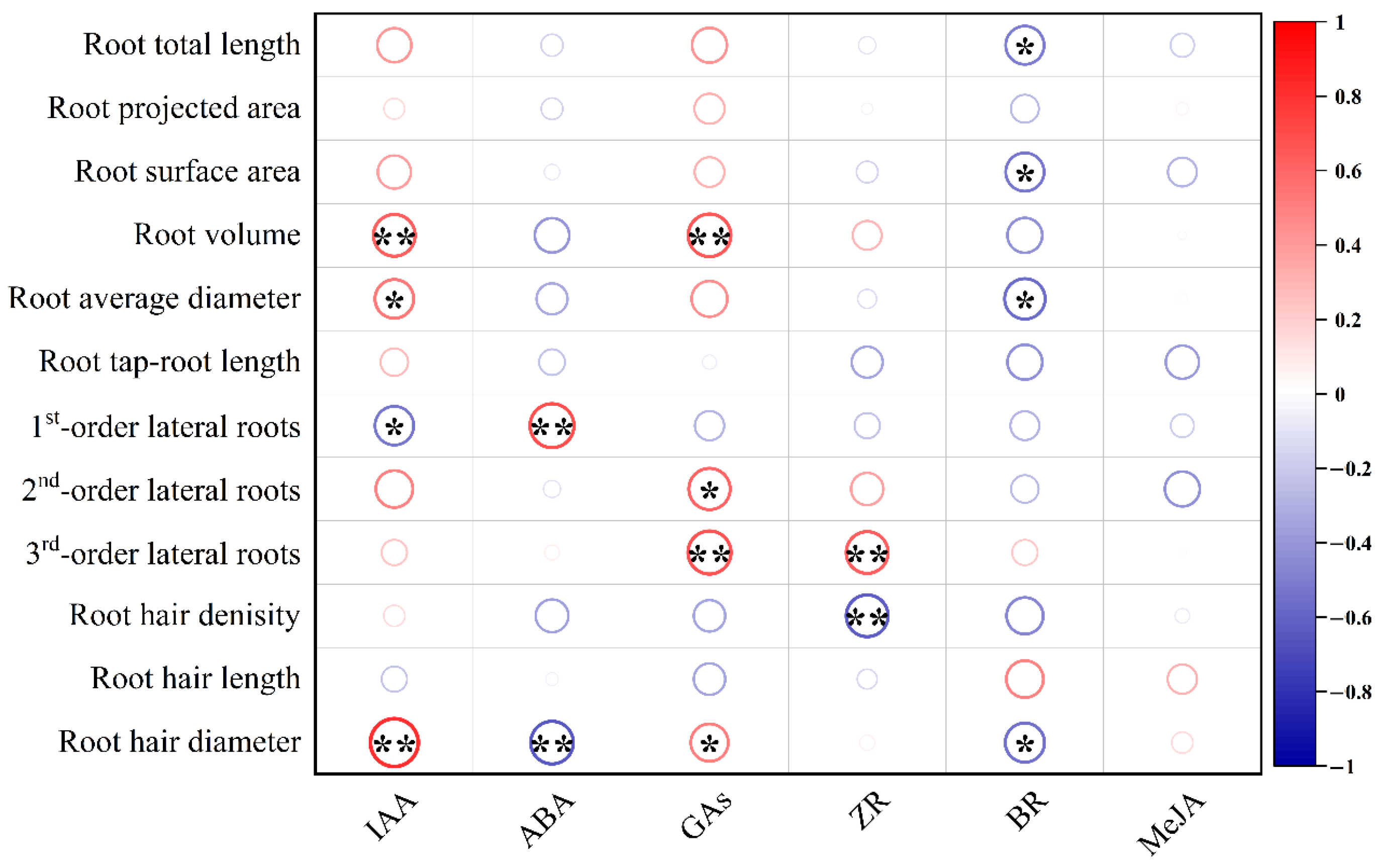
As shown in Figure 9, IAA exhibited a highly significant positive correlation (p ≤ 0.01) with root volume and root hair diameter and a significant positive correlation (p ≤ 0.05) with average root diameter. However, it showed a significant negative correlation (p ≤ 0.05) with the number of first-order lateral roots. ABA was significantly positively correlated (p ≤ 0.01) with the number of first-order lateral roots and significantly negatively correlated (p ≤ 0.01) with root hair diameter. GAs displayed a significant positive correlation (p ≤ 0.01) with root volume and the number of third-order lateral roots and a significant positive correlation (p ≤ 0.05) with the number of second-order lateral roots and root hair diameter. ZR showed a highly significant positive correlation (p ≤ 0.01) with the number of third-order lateral roots and a highly significant negative correlation (p ≤ 0.01) with root hair density. BR was significantly negatively correlated (p ≤ 0.05) with total root length, surface area, average diameter, and root hair diameter. MeJA showed no significant correlation with root architecture or root hair phenotypes.

3.11. Correlation Analysis of IAA Content, Root Architecture, and Root Hair Phenotype with the Expression Levels of Related Genes in the Root of Trifoliate Orange Seedlings

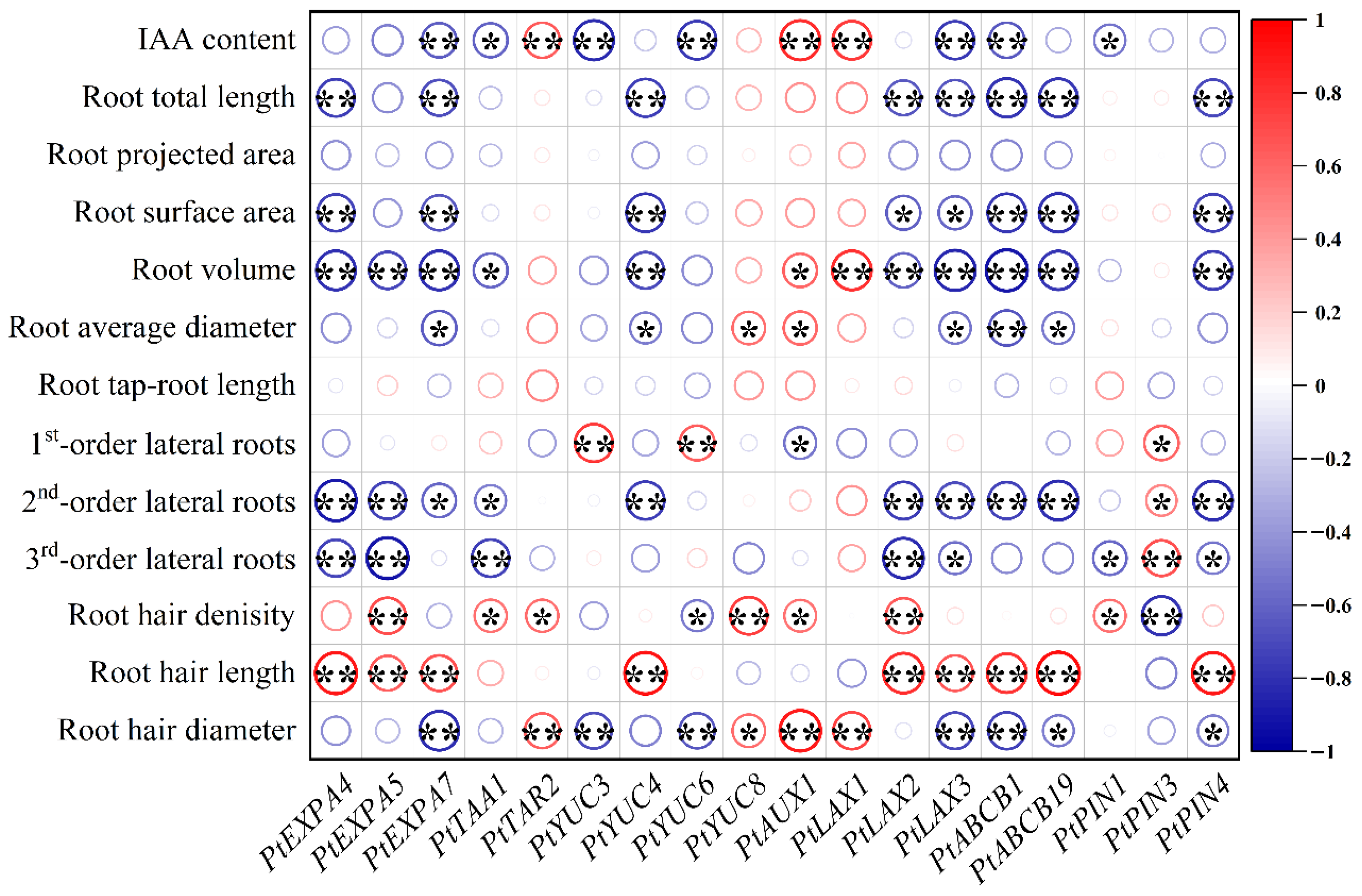
As shown in Figure 10, root total length, surface area, volume, average diameter, number of second-order lateral roots, number of third-order lateral roots, and root hair diameter exhibited mostly negative correlations with related genes, with only a few positive correlations observed. Specifically, root total length showed a highly significant negative correlation (p ≤ 0.01) with PtEXPA4, PtEXPA7, PtYUC4, PtLAX2, PtLAX3, PtABCB1, PtABCB19, and PtPIN4. Root surface area was highly significantly negatively correlated (p ≤ 0.01) with PtEXPA4, PtEXPA7, PtYUC4, PtABCB1, PtABCB19, and PtPIN4 and significantly negatively correlated (p ≤ 0.05) with PtLAX2 and PtLAX3. Root volume was highly significantly negatively correlated (p ≤ 0.01) with PtEXPA4, PtEXPA5, PtEXPA7, PtYUC4, PtLAX2, PtLAX3, PtABCB1, PtABCB19, and PtPIN4, significantly negatively correlated (p ≤ 0.05) with PtTAA1, and significantly and highly positively correlated only with PtAUX1 and PtLAX1 (p ≤ 0.05; p ≤ 0.01), respectively. Root average diameter was significantly negatively correlated (p ≤ 0.05) with PtEXPA7, PtYUC4, PtLAX3, and PtABCB19, highly negatively correlated (p ≤ 0.01) with PtABCB1, and significantly positively correlated only with PtYUC8 and PtAUX1 (p ≤ 0.05).

4. Discussion

4.1. Potassium Homeostasis and Growth Performance of Trifoliate Orange Seedlings

Our results suggest that trifoliate orange seedling growth exhibits an optimal response to moderate potassium levels (K6), with both deficiency (K0, K2) and excess (K12) significantly inhibiting development. This quadratic response curve aligns with the fundamental physiological principle that nutrients exhibit optimality curves rather than linear relationships with plant growth [24,25]. The superior performance of all K+-containing treatments compared to K0 supports potassium’s essential role in trifoliate orange development.
The bidirectional effect of K+ can be explained by its crucial role in stomatal regulation. As a primary osmoticum, K+ controls guard cell turgor through coordinated influx and efflux mechanisms [4]. Under deficient conditions (K0, K2), inadequate K+ induces stomatal closure, restricting CO2 uptake and photosynthetic efficiency. Conversely, excessive K+ (K12) may delay stomatal closure responses, reducing water use efficiency and compromising growth [26]. Beyond stomatal function, K+ deficiency disrupts chloroplast ultrastructure and reduces photosynthetic parameters, including quantum efficiency (Fv/Fm) and electron transport [4,27]. Additionally, as a key osmotic regulator, suboptimal K+ levels impair water absorption and subsequent nutrient uptake [28], creating cascading effects on multiple physiological processes.

4.2. Differential Regulation of Root Architecture and Root Hair Development Under K+ Stress

Our comprehensive analysis reveals an intriguing inverse relationship between root architecture and root hair development across K+ treatments. Root architectural parameters (length, surface area, volume, lateral root numbers) reached optimum values under K6, while root hair development (density, length) was enhanced under both deficient (K0, K2) and excessive (K12) K+ conditions. This dichotomy represents a sophisticated adaptive strategy in response to varying K+ availability.

4.2.1. Root Architectural Responses to K+ Availability

The observed inhibition of root growth parameters under non-optimal K+ conditions contradicts the conventional paradigm that nutrient deficiency typically enhances root exploration [29,30]. This unexpected response can be attributed to K+’s fundamental role in driving cellular expansion through turgor pressure generation [5,7]. As an essential osmoticum, K+ directly mediates water influx into expanding cells, and its deficiency would restrict this primary driver of root growth. The PCA confirmed that K6 provided optimal conditions for root architecture development, suggesting that the energy cost of maintaining root system architecture under K+ stress exceeds the potential benefits of increased exploration.
The species-specific nature of this response is noteworthy, as it differs from previous findings in tobacco, where low K+ inhibited first-order lateral roots while maintaining higher-order branching [31]. These contrasting adaptations highlight the diversity of evolutionary strategies across plant taxa and underscore the importance of species-specific studies for understanding nutrient adaptation mechanisms.

4.2.2. Root Hair Development as an Adaptive Strategy

Enhanced root hair density and length under both deficient and excessive K+ represent a strategic compensatory mechanism. Root hairs significantly increase the absorptive surface area with substantially lower metabolic cost compared to lateral root production [32,33]. This aligns with the ‘steep, cheap, and deep’ ideotype framework proposed by Postma et al. [34], which suggests that plants optimize carbon allocation by reducing the metabolic burden of root cortical tissue while maintaining nutrient acquisition capabilities under stress. Consequently, the observed shift towards root hair proliferation under K+ stress likely reflects strategic resource reallocation: minimizing the energy-intensive construction of root biomass while maximizing the specific absorption surface area to compensate for nutrient limitation. Under K+ stress, when overall root architecture is compromised, increased root hair development provides an efficient alternative for maintaining nutrient acquisition capacity.
The differential optimization of root hair parameters, with density maximized under K12 and length under K0, reveals sophisticated fine-tuning of adaptive responses. Under K12, where root architecture was moderately developed, increased hair density maximizes exploitation of the existing soil domain. In contrast, the severely compromised root system under K0 triggers a more urgent adaptive response through increased root hair length, which provides greater spatial reach and enhances nutrient absorption efficiency more effectively than density alone [32]. This strategic allocation of resources illustrates the plant’s ability to prioritize the most efficient adaptive mechanisms based on stress severity.
Although we hypothesize that this shift towards root hair proliferation acts as a compensatory mechanism to maintain absorptive surface area, it is important to note that our current data are morphological and transcriptomic. Further functional validation, such as quantifying K+ uptake kinetics, is needed to confirm whether this plasticity effectively restores nutrient acquisition efficiency.

4.3. Hormonal Integration of K+ Signaling and Root Development

The parallel perturbations in endogenous hormone levels across K+ treatments provide mechanistic insights into the observed morphological responses. The coordinated reduction in growth-promoting hormones (IAA, GAs, ZR) under K+ stress conditions corresponds inversely with root hair development while positively correlating with root architectural parameters.

4.3.1. Auxin as a Central Mediator of K+ Effects on Root Development

The significant correlations between IAA content and key root parameters (volume, diameter, root hair characteristics) confirm its central role in mediating K+ effects on root development [10]. The limited correlation with other root parameters despite general IAA reduction under K+ stress highlights the complexity of auxin action, which depends more on concentration gradients and localized accumulation than absolute levels [14]. The increased ABA under K2 treatment may further modulate auxin responses by inactivating free IAA and inhibiting its transport to lateral root primordia [10], illustrating the intricate hormonal crosstalk that fine-tunes developmental responses.

4.3.2. Multifaceted Roles of Other Plant Hormones

The positive correlations between GAs and specific root architectural parameters (volume, lateral root numbers) despite their generally inhibitory effect on adventitious root formation [9,12] suggests context-dependent actions potentially mediated through interactions with other hormones. Similarly, ZR’s positive correlation with third-order lateral roots and negative association with root hair density align with its dual role in promoting root maturation while inhibiting initiation processes [12].
The inverse relationship between BR content and K+ concentration, coupled with BR’s negative correlation with most root architectural parameters, contradicts reports of BR’s positive effects on root development in tomato [35]. This discrepancy may reflect species-specific responses or context-dependent hormone interactions, warranting further investigation. The stable MeJA levels across treatments suggest that it may function as a modulator of other hormone actions rather than a primary regulator in K+ responses [11].

4.4. Molecular Architecture of K+-Responsive Root Development

4.4.1. Expansin Gene Expression Underpins Root Hair Development

The significant upregulation of expansin genes (PtEXPA4, PtEXPA5, PtEXPA7) under K+ stress conditions, exhibiting trends opposite to root architecture but parallel with root hair development, suggests their central role in mediating the compensatory root hair response. Expansins facilitate cell wall loosening essential for tip growth in root hairs [36], and their differential expression provides a potential molecular mechanism linking K+ stress perception to enhanced root hair development. The consistent negative correlations between these genes and root architectural parameters further support their specialized function in root hair formation rather than general root growth.

4.4.2. Auxin Biosynthesis Pathway Reconfiguration Under K+ Stress

The upregulation of TAA1/TAR-YUCCA pathway genes under K+ stress reveals substantial reconfiguration of auxin biosynthesis mechanisms. The strong positive correlation between PtTAR2 and IAA content, coupled with its association with root hair parameters rather than architectural indices, suggests specialized roles in localized auxin production for root hair development. Similar patterns for PtTAA1 and PtYUC4 reinforce this conclusion.
The differential responses of YUCCA family members, with PtYUC3 correlating primarily with first-order lateral roots and PtYUC8 showing broader positive associations with both root architecture and root hair parameters, highlight the functional specialization within gene families. This molecular granularity enables fine-tuned responses to K+ availability through precise spatial and temporal control of auxin biosynthesis.

4.4.3. Auxin Transport Dynamics Underline Root Developmental Plasticity

The U-shaped expression pattern of auxin transport genes (PtLAX2, PtLAX3, PtABCB1, PtABCB19, PtPIN4) across K+ treatments, with the lowest expression under K6 and the highest under K0, provides a molecular framework for understanding the observed developmental plasticity. This expression pattern suggests that under K+ stress, trifoliate orange enhances auxin transport to facilitate localized auxin accumulation necessary for root hair development.
The contrasting correlations between transporter genes and root parameters, with PtAUX1 positively associated with both root volume and root hair characteristics while other transporters show more specialized correlations, reveal complex spatial regulation of auxin distribution. The positive correlation between PtPIN1 and root hair density and the negative association with third-order lateral roots exemplify how directional auxin transport can differentially affect distinct developmental processes.
The strong positive correlation between PtPIN3 expression and lateral root numbers is consistent with its established role in lateral root primordia formation [37], providing a mechanistic link between K+ availability, auxin transport, and root branching patterns.

4.5. Integrated Model of K+-Responsive Root Development

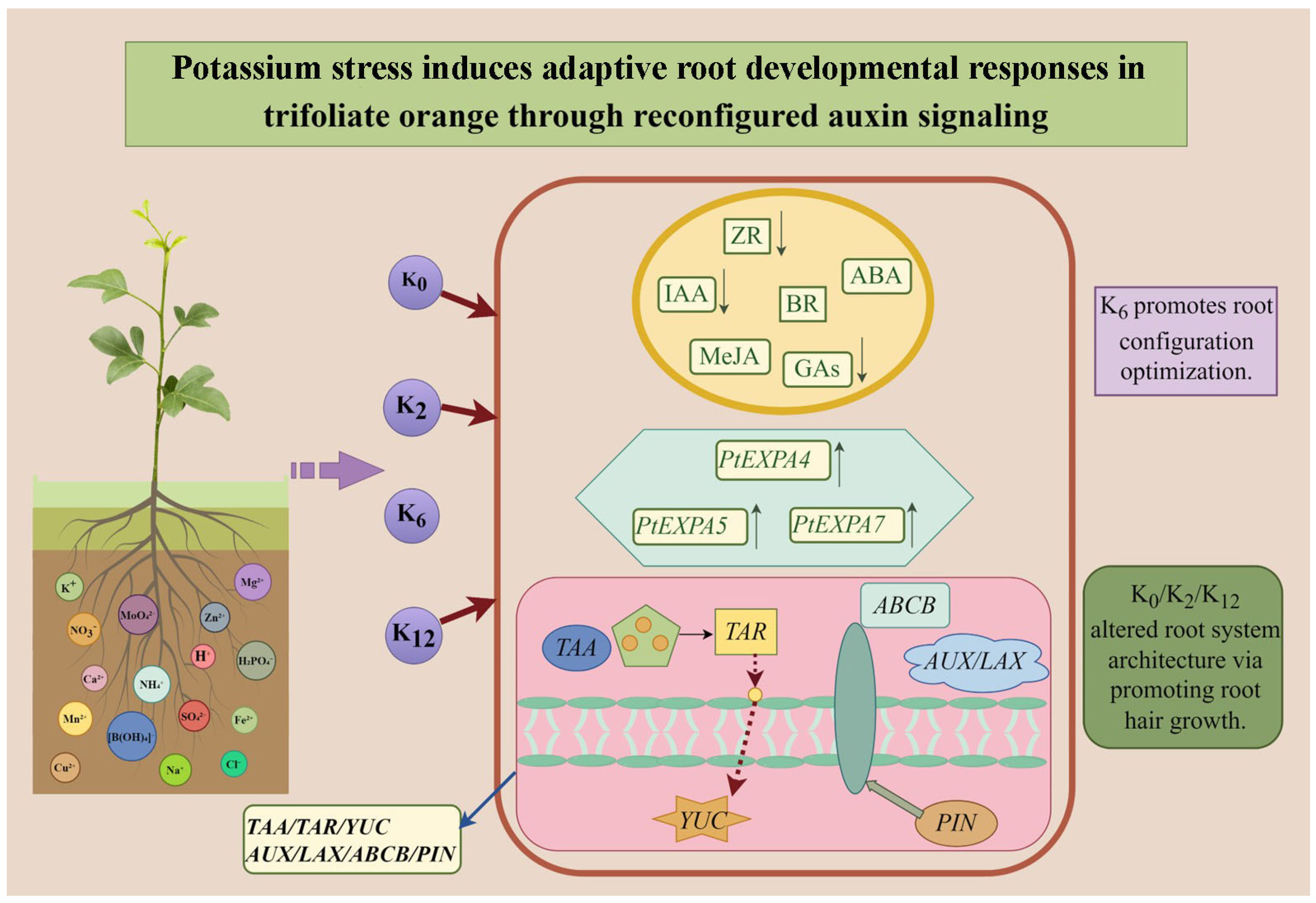
Synthesizing our findings, we propose an integrated model where K+ availability simultaneously affects multiple regulatory layers from cell turgor and hormone levels to gene expression patterns, collectively determining root developmental outcomes. Under optimal K+ conditions (K6), balanced hormone levels and expression of cell-wall-modifying enzymes promote robust root architectural development while maintaining moderate root hair formation. Under K+ stress (both deficiency and excess), compromised turgor pressure restricts overall root expansion, while reconfigured hormone biosynthesis and transport create localized auxin maxima that enhance root hair development as a compensatory mechanism.
This model explains the observed inverse relationship between root architecture and root hair development and provides a molecular framework linking K+ sensing to adaptive developmental responses. The identified molecular components, particularly expansin genes, auxin biosynthesis enzymes, and transport proteins, represent potential targets for genetic manipulation to enhance K+ efficiency in trifoliate orange and related citrus species.

4.6. Agronomic Implications and Future Directions

Our findings have significant implications for citrus cultivation in diverse soil conditions. The optimal K+ concentration (K6) identified for root development provides a benchmark for fertilization practices in trifoliate orange cultivation. The enhanced root hair development under suboptimal K+ conditions suggests that moderate K+ stress might improve nutrient acquisition efficiency in specific contexts, potentially informing precision agriculture approaches.
Finally, regarding the experimental design and methodology, we acknowledge certain limitations. First, our study relied on a single sampling time point. While this captured the long-term adaptive morphological traits relevant to slow-growing woody perennials, it precludes the distinction between early signaling events and steady-state maintenance. Second, endogenous hormones were quantified using ELISA. While this method effectively highlights relative differences between treatments, we acknowledge that it generally lacks the absolute specificity and sensitivity of LC-MS/MS due to potential antibody cross-reactivity. Third, distinct from the strong morphological and physiological responses observed, the molecular mechanisms proposed here are primarily based on transcriptomic correlations. While the consistency of our multi-scale data provides a strong argument for the auxin-mediated model, causal links remain to be experimentally verified. Fourth, our study focused on a single genotype (trifoliate orange) under controlled substrate conditions. While this provided a uniform environment to isolate K+’s effects, it limits immediate generalizability to variable field settings or other citrus rootstocks. To address these limitations and expand on our findings, future research should focus on validating causal links via genetic transformation (e.g., overexpression or CRISPR/Cas9), quantifying K+ uptake efficiency, resolving temporal dynamics through time-course analyses, and verifying hormonal profiles using LC-MS/MS. Moreover, on a broader scale, studies should conduct multi-genotype field trials to validate these adaptive responses in complex soil environments, explore the long-term effects of K+ availability on mature plant performance, and investigate potential interactions with other nutrients.

5. Conclusions

This study indicates that K+ concentration significantly influences trifoliate orange seedling development through a complex regulatory network. Moderate potassium levels (K6) optimized root architectural parameters, while both deficiency (K0, K2) and excess (K12) inhibited overall growth and root architecture but enhanced root hair development. This inverse relationship represents an adaptive strategy in response to K+ availability. Hormone analysis and gene expression profiling revealed that root architectural development correlated positively with IAA, GAs, ZR, PtYUC3, PtYUC8, PtAUX1, and PtPIN4, while enhanced root hair formation under K+ stress was associated with upregulation of expansin genes (PtEXPA4, PtEXPA5, and PtEXPA7) and reconfiguration of auxin-related genes (PtTRV2, PtTAA1, PtYUC4, PtYUC8, PtAUX1, PtLAX2, PtLAX3, PtABCB1, PtABCB19, PtPIN1, and PtPIN4). These findings provide insights into K+-responsive root developmental plasticity in woody perennials and provide benchmarks for optimizing potassium management in citrus cultivation (Figure 11).

Author Contributions

C.-Y.L.: writing—original draft, methodology, investigation, formal analysis, data curation, conceptualization, funding acquisition. Y.-Y.P.: writing—original draft, formal analysis, data curation, conceptualization. X.D.: methodology, supervision, conceptualization, investigation. Y.H.: writing—review and editing, supervision, project administration, conceptualization. All authors have read and agreed to the published version of the manuscript.

Funding

This work was supported by the National Natural Science Foundation of China (32102315).

Data Availability Statement

The data presented in this study are available upon request from the corresponding author. The data are not publicly available due to restrictions on right of use for ongoing research projects.

Conflicts of Interest

The authors declare no conflict of interest.

References

  1. Hodge, A.; Berta, G.; Doussan, C.; Merchan, F.; Crespi, M. Plant root growth, architecture and function. Plant Soil 2009, 321, 153–187. [Google Scholar] [CrossRef]
  2. Yetgin, A. Exploring the dynamic nature of root plasticity and morphology in the face of changing environments. Ecol. Front. 2024, 44, 112–119. [Google Scholar] [CrossRef]
  3. Johnson, R.; Vishwakarma, K.; Hossen, M.S.; Kumar, V.; Shackira, A.M.; Puthur, J.T.; Hasanuzzaman, M. Potassium in plants: Growth regulation, signaling, and environmental stress tolerance. Plant Physiol. Biochem. 2022, 172, 56–69. [Google Scholar] [CrossRef]
  4. Imtiaz, H.; Mir, A.R.; Corpas, F.J.; Hayat, S. Impact of potassium starvation on the uptake, transportation, photosynthesis, and abiotic stress tolerance. Plant Growth Regul. 2019, 99, 429–448. [Google Scholar] [CrossRef]
  5. Sustr, M.; Soukup, A.; Tylova, E. Potassium in root growth and development. Plants 2019, 8, 435. [Google Scholar] [CrossRef]
  6. Jia, Y.B.; Yang, X.E.; Feng, Y.; Jilani, G. Differential response of root morphology to potassium deficient stress among rice genotypes varying in potassium efficiency. J. Zhejiang Univ. Sci. B 2008, 9, 427–434. [Google Scholar] [CrossRef]
  7. Zörb, C.; Senbayram, M.; Peiter, E. Potassium in agriculture–status and perspectives. J. Plant Physiol. 2014, 171, 656–669. [Google Scholar] [CrossRef]
  8. Kellermeier, F.; Chardon, F.; Amtmann, A. Natural variation of arabidopsis root architecture reveals complementing adaptive strategies to potassium starvation. Plant Physiol. 2013, 161, 1421–1432. [Google Scholar] [CrossRef]
  9. Gou, J.; Strauss, S.H.; Tsai, C.J.; Fang, K.; Chen, Y.; Jiang, X.; Busov, V.B. Gibberellins regulate lateral root formation in populus through interactions with auxin and other hormones. Plant Cell 2010, 22, 623–639. [Google Scholar] [CrossRef]
  10. Javed, S.; Chai, X.Z.; Wang, X.M.; Xu, S.B. The phytohormones underlying the plant lateral root development in fluctuated soil environments. Plant Soil 2024, 505, 101–114. [Google Scholar] [CrossRef]
  11. Hewedy, O.A.; Elsheery, N.I.; Karkour, A.M.; Elhamouly, N.; Arafa, R.A.; Mahmoud, G.A.E.; Brestic, M. Jasmonic acid regulates plant development and orchestrates stress response during tough times. Environ. Exp. Bot. 2023, 208, 105260. [Google Scholar] [CrossRef]
  12. Huang, Y.T.; Huang, K.L.; Zhang, M.H.; Bu, W.X.; Yang, X.Y.; Tian, J.N.; Lei, W.Q. Study on adventitious root induction and endogenous hormone dynamics during cutting propagation of Distylium chinense. Plant Sci. 2025, 355, 112430. [Google Scholar] [CrossRef]
  13. Luo, P.; Di, D.W. Precise regulation of the TAA1/TAR-YUCCA auxin biosynthesis pathway in plants. Int. J. Mol. Sci. 2023, 24, 8514. [Google Scholar] [CrossRef]
  14. Guo, X.N.; Lu, W.; Liu, C.Y.; Wu, Q.S. Regulation of arbuscular mycorrhizal fungi in citrus root hairs mediated by auxin efflux carrier protein PtPINs. Sci. Hortic. 2024, 337, 113574. [Google Scholar] [CrossRef]
  15. Song, W.J.; Liu, S.J.; Meng, L.; Xue, R.; Wang, C.D.; Liu, G.L.; Dong, C.X.; Wang, S.S.; Dong, J.X.; Zhang, Y.L. Potassium deficiency inhibits lateral root development in tobacco seedlings by changing auxin distribution. Plant Soil 2015, 396, 163–173. [Google Scholar] [CrossRef]
  16. Zhang, Z.Y.; Wang, Q.L.; Li, Z.H.; Duan, L.S.; Tian, X.L. Effects of potassium deficiency on root growth of cotton seedlings and its physiological mechanisms. Acta Agron. Sin. 2009, 35, 718–723. [Google Scholar] [CrossRef]
  17. Gierth, M.; Mäser, P.; Schroeder, J.I. The potassium transporter AtHAK5 functions in K+ deprivation-induced high-affinity K+ uptake and AKT1 K+ channel contribution to K+ uptake kinetics in arabidopsis roots. Plant Physiol. 2005, 137, 1105–1114. [Google Scholar] [CrossRef]
  18. Zhao, S.; Zhang, M.L.; Ma, T.L.; Wang, Y. Phosphorylation of ARF2 relieves its repression of transcription of the K+ transporter gene HAK5 in response to low potassium stress. Plant Cell 2016, 28, 3005–3019. [Google Scholar] [CrossRef]
  19. Yang, T.Y.; Feng, H.M.; Zhang, S.; Xiao, H.J.; Hu, Q.D.; Chen, G.; Xuan, W.; Moran, N.; Murphy, A.; Yu, L.; et al. The potassium transporter OsHAK5 alters rice architecture via ATP-dependent transmembrane auxin fluxes. Plant Commun. 2020, 1, 100052. [Google Scholar] [CrossRef]
  20. Cao, X.; Xia, R.X.; Yang, H.Y.; Zhan, D.J.; Zhao, Y. Effects of P, K and Ca deficiency on the root morphology and nutrient absorption of Poncirus trifoliata seedlings. J. Plant Nutr. Fert. 2014, 20, 981–988. [Google Scholar] [CrossRef]
  21. Wen, S.S.; Miao, D.P.; Cui, H.Y.; Li, S.H.; Gu, Y.N.; Jia, R.R.; Leng, Y.F. Physiology and transcriptomic analysis of endogenous hormones regulating in vitro adventitious root formation in tree peony. Sci. Hortic. 2023, 318, 112122. [Google Scholar] [CrossRef]
  22. Livak, K.J.; Schmittgen, T.D. Analysis of relative gene expression data using real-time quantitative PCR and the 2−ΔΔCT method. Methods 2001, 25, 402–408. [Google Scholar] [CrossRef] [PubMed]
  23. Huang, Y.X.; Ye, M.; Xiong, J.; Sheng, H.L.; Huang, W.H.; Zhang, L.P.; Wu, F. Effects of AM fungi on growth, root system structure and photosynthetic characteristics of camellia oleifera at different nitrogen levels. Non-Wood For. Res. 2022, 40, 19–28. [Google Scholar] [CrossRef]
  24. Liu, Y.; Gao, J.P.; Zhao, Y.Z.; Fu, Y.C.; Yan, B.C.; Wan, X.; Cheng, G.Q.; Zhang, W.Z. Effects of different phosphorus and potassium supply on the root architecture, phosphorus and potassium uptake, and utilization efficiency of hydroponic rice. Sci. Rep. 2024, 14, 21178. [Google Scholar] [CrossRef] [PubMed]
  25. Gao, Z.Y.; Ye, T.H.; Cui, X.; Lu, J.W.; Ren, T.; Cong, R.H.; Lu, Z.F.; Zhang, Y.Y.; Liao, S.P.; Li, X. Dynamics of potassium concentration in paddy field water, soil and plant affected by potassium fertilizer levels. Nutr. Cycl. Agroecosys. 2025, 130, 313–326. [Google Scholar] [CrossRef]
  26. Wedegaertner, K.; Shekoofa, A.; Purdom, S.; Walters, K.; Duncan, L.; Raper, T.B. Cotton stomatal closure under varying temperature and vapor pressure deficit, correlation with the hydraulic conductance trait. J. Cotton Res. 2022, 5, 20. [Google Scholar] [CrossRef]
  27. Du, Q.; Zhao, X.H.; Xia, L.; Jiang, C.J.; Wang, X.G.; Han, Y.; Wang, J.; Yu, H.Q. Effects of potassium deficiency on photosynthesis, chloroplast ultrastructure, ROS, and antioxidant activities in maize (Zea mays L.). J. Integr. Agric. 2019, 18, 395–406. [Google Scholar] [CrossRef]
  28. Mostofa, M.G.; Rahman, M.M.; Ghosh, T.K.; Kabir, A.H.; Abdelrahman, M.; Khan, M.A.R.; Mochida, K.; Tran, L.P. Potassium in plant physiological adaptation to abiotic stresses. Plant Physiol. Bioch. 2022, 186, 279–289. [Google Scholar] [CrossRef]
  29. Balemi, T.; Negisho, K. Management of soil phosphorus and plant adaptation mechanisms to phosphorus stress for sustainable crop production: A review. J. Soil Sci. Plant Nutr. 2012, 12, 547–562. [Google Scholar] [CrossRef]
  30. Nadeem, M.; Yahya, M.; Tong, J.; Shah, L.; Khan, S.U.; Ali, A.; Waheed, A. Improving nitrogen acquisition and utilization through root architecture remodelling: Insight from legumes. J. Plant Growth Regul. 2023, 42, 5295–5310. [Google Scholar] [CrossRef]
  31. Song, W.J.; Xue, R.; Song, Y.; Bi, Y.; Liang, Z.H.; Meng, L.; Dong, C.X.; Wang, C.D.; Liu, G.L.; Dong, J.X.; et al. Differential response of first-order lateral root elongation to low potassium involves nitric oxide in two tobacco cultivars. J. Plant Growth Regul. 2018, 37, 114–127. [Google Scholar] [CrossRef]
  32. Keyes, S.D.; Daly, K.R.; Gostling, N.J.; Jones, D.L.; Talboys, P.; Pinzer, B.R.; Boardman, R.; Sinclair, I.; Marchant, A.; Roose, T. High resolution synchrotron imaging of wheat root hairs growing in soil and image based modelling of phosphate uptake. New Phytol. 2013, 198, 1023–1029. [Google Scholar] [CrossRef]
  33. Kohli, P.S.; Maurya, K.; Thakur, J.K.; Bhosale, R.; Giri, J. Significance of root hairs in developing stress-resilient plants for sustainable crop production. Plant Cell Environ. 2022, 45, 677–694. [Google Scholar] [CrossRef]
  34. Jonathan, P.L. Steep, cheap and deep: An ideotype to optimize water and N acquisition by maize root systems. Ann. Bot-London. 2013, 112, 347–357. [Google Scholar] [CrossRef]
  35. Nie, S.; Huang, S.H.; Wang, S.F.; Cheng, D.D.; Liu, J.W.; Lv, S.; Wang, X.F. Enhancing brassinosteroid signaling via overexpression of tomato (Solanum lycopersicum) SlBRI1 improves major agronomic traits. Front. Plant Sci. 2017, 8, 1386. [Google Scholar] [CrossRef]
  36. Wang, Z.Z.; Cao, J.B.; Lin, N.; Li, J.M.; Wang, Y.Z.; Liu, W.B.; Yao, W.; Li, Y. Origin, evolution, and diversification of the expansin family in plants. Int. J. Mol. Sci. 2024, 25, 11814. [Google Scholar] [CrossRef]
  37. Lee, H.; Ganguly, A.; Lee, R.D.; Park, M.; Cho, H.T. Intracellularly localized PIN-FORMED8 promotes lateral root emergence in Arabidopsis. Front. Plant Sci. 2020, 10, 1808. [Google Scholar] [CrossRef]
Figure 1. Growth and development of trifoliate orange seedlings under different concentrations of K treatments. K0: 0 mmol/L K treatment; K2: 2 mmol/L K treatment; K6: 6 mmol/L K treatment; K12: 12 mmol/L K treatment.
Horticulturae 12 00237 g001
Figure 2. Root architecture of trifoliate orange seedlings under different concentrations of K treatments (K0, (a); K2, (b); K6, (c); K12, (d)). K0: 0 mmol/L K treatment; K2: 2 mmol/L K treatment; K6: 6 mmol/L K treatment; K12: 12 mmol/L K treatment.
Horticulturae 12 00237 g002
Figure 3. Root hair phenotypes on 1st-, 2nd-, and 3rd-order lateral roots of trifoliate orange seedlings under different concentrations of K treatments. K0: 0 mmol/L K treatment; K2: 2 mmol/L K treatment; K6: 6 mmol/L K treatment; K12: 12 mmol/L K treatment. Images are representative micrographs selected from n = 24 independent biological replicates used for the quantitative analysis presented in Figure 4.
Horticulturae 12 00237 g003
Figure 4. Comparative response of root hair phenotypes of trifoliate orange seedlings to different concentrations of K treatments (First-order lateral roots, (a); Second-order lateral roots, (b); Third-order lateral roots, (c); general average, (d)). K0: 0 mmol/L K treatment; K2: 2 mmol/L K treatment; K6: 6 mmol/L K treatment; K12: 12 mmol/L K treatment. Data (means ± SD, n = 6) are followed by different letters above the bars, which indicate significant differences between treatments based on Tukey’s test.
Horticulturae 12 00237 g004
Figure 5. Response of endogenous hormones in the root of trifoliate orange seedlings to different concentrations of K treatments. K0: 0 mmol/L K treatment; K2: 2 mmol/L K treatment; K6: 6 mmol/L K treatment; K12: 12 mmol/L K treatment. Data (means ± SD, n = 6) are followed by different letters above the bars, which indicate significant differences between treatments based on Tukey’s test.
Horticulturae 12 00237 g005
Figure 6. Response of expansion protein gene expression levels in the root system of trifoliate orange seedlings to different concentrations of K treatments. K0: 0 mmol/L K treatment; K2: 2 mmol/L K treatment; K6: 6 mmol/L K treatment; K12: 12 mmol/L K treatment. Data (means ± SD, n = 6) are followed by different letters above the bars, which indicate significant differences between treatments based on Tukey’s test.
Horticulturae 12 00237 g006
Figure 7. Response of IAA synthesized gene expression levels in the root system of trifoliate orange seedlings to different concentrations of K treatments. K0: 0 mmol/L K treatment; K2: 2 mmol/L K treatment; K6: 6 mmol/L K treatment; K12: 12 mmol/L K treatment. Data (means ± SD, n = 6) are followed by different letters above the bars, which indicate significant differences between treatments based on Tukey’s test.
Horticulturae 12 00237 g007
Figure 8. Response of IAA transport carrier protein gene expression levels in the root system of trifoliate orange seedlings to different concentrations of K treatments. K0: 0 mmol/L K treatment; K2: 2 mmol/L K treatment; K6: 6 mmol/L K treatment; K12: 12 mmol/L K treatment. Data (means ± SD, n = 6) are followed by different letters above the bars, which indicate significant differences between treatments based on Tukey’s test.
Horticulturae 12 00237 g008
Figure 9. Correlation analysis of root architecture, root hair phenotype related indexes, and endogenous hormone content in trifoliate orange seedlings under different concentrations of K treatments. Circle sizes indicate the correlation strength. *, p < 0.05, means significant; **, p < 0.01, means extremely significant.
Horticulturae 12 00237 g009
Figure 10. Correlation analysis of IAA content, root architecture, and root hair phenotype related indexes with the expression levels of related genes in the root of trifoliate orange seedlings under different concentrations of K treatment. Circle sizes indicate the correlation strength. *, p < 0.05, means significant; **, p < 0.01, means extremely significant.
Horticulturae 12 00237 g010
Figure 11. Proposed schematic model linking K+ availability, hormonal signaling, and gene expression to root developmental plasticity in trifoliate orange. Under optimal conditions (K6), balanced hormone levels promote robust root system architecture. Under K+ stress (deficiency of K0/K2 or excess K12), the overall inhibition of root architecture is associated with reduced levels of growth-promoting hormones (IAA, GAs, ZR). This stress triggers a compensatory signaling pathway characterized by the upregulation of auxin biosynthesis (PtTAA1, PtYUCs) and transport genes (PtPINs, PtAUX1), likely creating localized auxin gradients. Concurrently, the upregulation of expansin genes (PtEXPA4, PtEXPA5, PtEXPA7) facilitates cell wall loosening, driving the enhanced root hair density and length observed as an adaptive strategy to maximize the absorptive surface area.
Horticulturae 12 00237 g011
Table 1. Gene-specific primer sequences used in this study.
GeneAccession No.Forward Primer (5′-3′)Reverse Primer (5′-3′)
PtABCB1Ciclev10010916mGAGCCATTCACGCCACTTCTCTTGTAACCGAGCCTTTGAGC
PtABCB19Ciclev10010931mGCATGAGTTTGGGTCAGTCTTTCATCTTCCATTTGTTGGGTCTT
PtAUX1Ciclev10011596mCTTGACTCTGCCCTATTCATTCTCTGGACCCAGTAACCCATCAAGC
PtEXPA4Cs7g32410.1GACCGCCGTACTTCCACTTCTTGGGAAAGTGCTTGAAACTAAACCCTGAA
PtEXPA5Cs8g18640.1AACTAACTACACGGAGCTGTGTCTTCTCGGAGTAATCGCCAGGGAGTCTTG
PtEXPA7Cs5g10000.1AGGGAACAAGAACAGGATGGATTAGCACCAGTTAGCAGGAGCAACATTGTAAGC
PtLAX1Ciclev10031413mTTGGCGGACATGCAGTGACCAGCGGCAGCAGAAGGAAT
PtLAX2Ciclev10028271mTGTGGGAAGATGGGTAGGGACTAGTVATGCTCGCCCACCC
PtLAX3Ciclev10001072mATCACTTTCGCTCCTGCTGCCAAACCCAAATCCCACCACTA
PtPIN1Ciclev10007787mGCTTTGGCAACAGAAGAGGATTATTACACTTGTCGGCGGCATA
PtPIN3Orange1.1g006199mCATGCCTCCAGCGAGTGTTATTGCCACCTGAAAGCGATTAGA
PtPIN4Ciclev10012938mATGGGGTTGAAAACGAAGGGCCTGATAAGTTTCCTCCACACCA
PtTAA1Ciclev10033774mTTTGAGGCGTTTTGGAGGAATTGTTGATTGCTTCAGCGAGTT
PtTAR2Ciclev10020085mCACACACGGCACACCCCTAGCCTCCCACTCCCCAGATC
PtYUC3Ciclev10006828mCCTTCAGGTTTAGCCGTTGCGGAAGTTTGGAAGTTGGCAGA
PtYUC4Ciclev10008466mGACCATCTGGGTTAGCCGTTTGTATTTTGGGAAGTTTTCAGGGA
PtYUC6Ciclev10008473mGTGGTTGCTAAAGTGGCTGCGTTGAAGGGGACCCAAAAGA
PtYUC8Ciclev10020503mGTGATAATGGTAGGGGCAGGAGAATGGCAGGTGAGGGAGC
β-actinCs1g05000CCGACCGTATGAGCAAGGAAATTCCTGTGGACAATGGATGGA
Table 2. Response of trifoliate orange seedling growth to different concentrations of K treatments.
K ConcentrationPlant Height (cm)Stem Diameter (mm)Leaf Numbers (#/plant)Dry Biomass (g FW/Plant)
LeafShootRoot
K019.73 ± 1.88 c0.30 ± 0.01 c25.38 ± 1.92 b0.16 ± 0.01 d0.41 ± 0.03 c0.12 ± 0.01 b
K225.40 ± 2.26 a0.34 ± 0.02 b27.13 ± 2.23 ab0.19 ± 0.02 c0.44 ± 0.04 c0.13 ± 0.01 b
K627.43 ± 0.87 a0.39 ± 0.02 a28.25 ± 2.76 a0.23 ± 0.01 a0.63 ± 0.06 a0.15 ± 0.02 a
K1226.00 ± 2.16 a0.34 ± 0.02 b27.63 ± 2.33 ab0.21 ± 0.02 b0.51 ± 0.05 b0.14 ± 0.01 a
Data (means ± SD, n = 6) are followed by different letters above the bars, which indicate significant differences between treatments at the 0.05 level based on Tukey’s test. K0: 0 mmol/L K treatment; K2: 2 mmol/L K treatment; K6: 6 mmol/L K treatment; K12: 12 mmol/L K treatment.
Table 3. Response of root architecture of trifoliate orange seedling to different concentrations of K treatments.
K Concentration Total
Length (cm)
Projected Area
(cm2)
Surface Rea
(cm2)
Average Diameter (mm) Volume (cm3)Tap-Root Length (cm)Lateral Root Numbers (#/plant)
1st-Order 2nd-Order 3rd-Order
K0165.72 ± 15.03 c12.24 ± 0.99 a13.41 ± 0.76 c0.79 ± 0.03 c0.55 ± 0.03 b13.93 ± 0.80 a39.63 ± 3.74 b97.13 ± 7.81 c26.63 ± 2.56 c
K2188.49 ± 17.97 b12.59 ± 0.89 a15.00 ± 1.25 b0.86 ± 0.02 b0.55 ± 0.03 b13.86 ± 1.15 a45.63 ± 2.32 a109.38 ± 9.36 b33.75 ± 2.82 b
K6210.74 ± 15.72 a13.11 ± 0.57 a16.06 ± 0.60 a1.14 ± 0.11 a0.60 ± 0.04 ab13.89 ± 1.34 a41.63 ± 1.41 b123.38 ± 9.05 a43.88 ± 3.23 a
K12206.47 ± 13.20 a12.80 ± 0.48 a16.12 ± 1.14 a1.01 ± 0.06 a0.61 ± 0.02 a14.84 ± 0.99 a40.88 ± 2.10 b110.50 ± 7.60 b24.13 ± 2.47 c
Data (means ± SD, n = 6) are followed by different letters above the bars, which indicate significant differences between treatments at the 0.05 level based on Tukey’s test. K0: 0 mmol/L K treatment; K2: 2 mmol/L K treatment; K6: 6 mmol/L K treatment; K12: 12 mmol/L K treatment.
Table 4. Results of principal component analysis of root architecture indexes of trifoliate orange seedlings.
IndexLoad of Each Principal ComponentIndexLoad of Each Principal Component
PC1PC2PC3PC1PC2PC3
Total length0.444−0.0740.0321st-order lateral roots0.1160.2460.808
Projected area 0.3250.0220.3992nd-order lateral roots0.3730.256−0.221
Surface area0.418−0.162−0.0533rd-order lateral roots0.2590.607−0.084
Volume 0.3940.093−0.326Eigenvalues 4.6261.5881.092
Average diameter 0.329−0.32−0.036Variance contribution rate (%)51.39817.64712.129
Tap-root length 0.198−0.6020.145Cumulative contribution rate (%)51.39869.04581.174
Table 5. Principal component scores and rankings of root architecture indexes of trifoliate orange seedlings under different concentrations of K treatments.
K LevelPC1PC2PC3Comprehensive ScoreRanking
K0−1.360 −0.061 −0.026 −1.447 4
K2−0.248 0.136 0.142 0.030 3
K61.129 0.206 −0.089 1.246 1
K120.478 −0.281 −0.027 0.170 2
K0: 0 mmol/L K treatment; K2: 2 mmol/L K treatment; K6: 6 mmol/L K treatment; K12: 12 mmol/L K treatment.
Table 6. Results of principal component analysis of root hair phenotype indexes of trifoliate orange seedlings.
IndexLoad of Each Principal
Component
IndexLoad of Each Principal Component
PC1PC2PC1PC2
Density0.6190.527Eigenvalues 1.4071.299
Length−0.1790.817Variance contribution rate (%)46.88443.292
Diameter0.764−0.235Cumulative contribution rate (%)46.88490.176
Table 7. Principal component scores and rankings of root hair phenotypes indexes of trifoliate orange seedlings under different concentrations of K treatments.
K LevelPC1PC2Comprehensive ScoreRanking
K0−0.271 0.655 0.384 2
K20.000 −0.656 −0.656 3
K6−0.564 −0.119 −0.683 4
K120.835 0.119 0.954 1
K0: 0 mmol/L K treatment; K2: 2 mmol/L K treatment; K6: 6 mmol/L K treatment; K12: 12 mmol/L K treatment.
Disclaimer/Publisher’s Note: The statements, opinions and data contained in all publications are solely those of the individual author(s) and contributor(s) and not of MDPI and/or the editor(s). MDPI and/or the editor(s) disclaim responsibility for any injury to people or property resulting from any ideas, methods, instructions or products referred to in the content.