Article

Genome-Wide Identification of R2R3-MYB Family Members and Identification of AaMYB1/AaMYB36 Linked to Peel Coloration in Northern Red-Peel Actinidia arguta
College of Agriculture, Yanbian University, Yanji 133002, China
*
Author to whom correspondence should be addressed.
Horticulturae 2026, 12(2), 234; https://doi.org/10.3390/horticulturae12020234
Submission received: 30 December 2025 / Revised: 2 February 2026 / Accepted: 10 February 2026 / Published: 14 February 2026
(This article belongs to the Special Issue Advances in Cultivation and Breeding of Kiwifruit)

Abstract

Kiwiberry (Actinidia arguta) has been rapidly commercialized. However, fruits produced in northern growing regions predominantly have green peels, and the red/purple peel phenotypes remain relatively rare, which limits the discovery and utilization of red-peel germplasm. Peel reddening is primarily caused by the accumulation of anthocyanins, and R2R3-MYB transcription factors are key regulators of the flavonoid/anthocyanin biosynthetic pathway. However, the MYB transcription factor family in the genus Actinidia has been less studied, with few systematic analyses linked to color phenotypes. Therefore, we performed a genome-wide search for R2R3-MYB family members in A. arguta and characterized their physicochemical properties, phylogeny, chromosomal distribution, gene duplication events, and synteny relationships. Furthermore, RNA-Seq analysis, phylogenetic analysis, and gene expression patterns of the rare northern red-peel cultivar ‘Yanlong 1’ revealed that AaMYB1 and AaMYB36 are key candidate genes closely associated with anthocyanin biosynthesis in the fruit peel. Validation experiments revealed that both genes exhibited significantly higher expression during the coloration stage than during the green fruit stage, as well as significantly higher expression in the red-peel cultivar than in green-peel cultivars. Four key structural genes (UFGT, CHS, DFR, and ANS), especially, CHS, DFR, and ANS, displayed a similar pattern of upregulation. These correlative results suggest that AaMYB1 and AaMYB36 are candidate positive regulators of peel-specific anthocyanin accumulation. These results provide important targets for developing molecular markers and improving the red-peel trait in northern A. arguta through breeding.

1. Introduction

Kiwiberry (Actinidia arguta) is a large deciduous woody vine belonging to the family Actinidiaceae and the genus Actinidia. Because its fruit peel is smooth and nearly glabrous, it is also commonly referred to as ‘hairless kiwifruit’ [1]. A. arguta is one of the Actinidia fruit crops that has achieved rapid commercial cultivation and development in recent years. Owing to its small fruit size, edible peel, and distinctive flavor, it has attracted growing interest in both breeding research and consumer markets [2,3].
A. arguta is mainly distributed in Northeast Asia. Population genetic studies indicate that this species can be divided into two major groups, a northern group and a southern group [4]. In northern regions, the fruit peel is usually green and red/purple phenotypes are relatively rare. Because the external appearance of green-peeled fruit changes only marginally during ripening, maturity is often difficult to determine by visual inspection, potentially complicating harvest-index determination and subsequent postharvest management. By contrast, peel coloration provides a more intuitive visual cue and may serve as an auxiliary indicator of maturity. Previous studies have suggested a positive correlation between peel redness and soluble solid content [5], and indicated that anthocyanin accumulation not only improves coloration but also enhances antioxidant capacity, thereby increasing the fruit’s nutritional and market value [6]. During a germplasm survey, our team discovered a red-peeled A. arguta plant on Changbai Mountain. After several years of domestication, the plant was registered as the new cultivar ‘Yanlong 1’. This cultivar provides valuable material for dissecting peel-color variation in northern germplasm and offers a new genetic resource for breeding red-fruited cultivars adapted to northern environments. Elucidating the regulatory basis of this rare northern red-peel phenotype is important for identifying molecular targets and markers for red-peel breeding and may also inform more reliable harvest-index assessments and quality management under northern growing conditions.
The transition of peel color from green to red involves complex metabolic and regulatory networks, and its core process is typically closely associated with increased anthocyanin accumulation [7]. Anthocyanin biosynthesis relies on the phenylpropanoid–flavonoid/anthocyanin pathway: structural genes encode key enzymes in this pathway and drive anthocyanin production through sequential enzymatic reactions [8,9]. Accordingly, their expression levels largely determine anthocyanin accumulation and final pigment formation. Representative enzymes include chalcone synthase (CHS), which catalyzes an early key step; dihydroflavonol 4-reductase (DFR), an important branch-point enzyme; anthocyanidin synthase (ANS), which contributes to anthocyanidin formation; and UDP-glucose:flavonoid 3-O-glucosyltransferase (UFGT), which enhances anthocyanin stability via glycosylation and supports stable color expression [10,11,12].
In addition to structural genes, regulatory genes—most of which encode transcription factors—affect anthocyanin biosynthesis and accumulation primarily by modulating the transcription of structural genes [13]. Typical regulators include MYB, bHLH, and WD40 repeat (WDR) proteins. These factors can act independently or interact to form the MYB–bHLH–WD40 (MBW) complex [14,15], which recognizes and binds promoters of structural genes to activate or repress gene expression, thereby fine-tuning anthocyanin biosynthesis [16]. Among these regulators, the MYB family is one of the largest transcription factor families in plants [17], and the R2R3-MYB subfamily in particular is considered to play a pivotal role in regulating anthocyanin biosynthesis [18,19,20].
However, despite the identification of several MYB regulators associated with flesh coloration in Actinidia, the molecular regulatory mechanisms underlying peel-specific anthocyanin accumulation, particularly in northern A. arguta germplasm where red-peel phenotypes are rare, remain largely unknown. In Actinidia plants, MYB-mediated regulation of anthocyanin accumulation has also been reported. For example, AcMYB75 [21], AcMYBF110 [22] and AcMYB123 [23] in A. chinensis participates in the regulation of anthocyanin biosynthesis. In A. arguta, AaMYB61-like has been reported to be closely associated with anthocyanin biosynthesis in red-fleshed cultivars [24], whereas AaMYB108 [25] has been identified as a key candidate gene influencing postharvest red pigment formation. These findings suggest that species/cultivar differences may influence the identity and modes of action of MYB regulators involved in anthocyanin accumulation. Unlike the well-established MYB-mediated regulatory framework for anthocyanin biosynthesis in the model plant A. thaliana, fewer studies have focused on identifying the MYB family in Actinidia and making preliminary inferences about its function in anthocyanin synthesis. Additionally, most of this work has focused on A. chinensis [26]. Therefore, comprehensive characterization of the MYB family in Actinidia is increasingly important for elucidating the underlying molecular mechanisms, particularly in other species. Also, a systematic, phenotype-linked analyses of R2R3-MYB to peel-specific pigmentation in northern red-peeled germplasm is needed.
Therefore, this study used the rare northern red-peel A. arguta cultivar ‘Yanlong 1’ to investigate peel-specific anthocyanin regulation, with a particular focus on the AaR2R3-MYB transcription factor family. Specifically, the chromosomal distribution, gene duplication events, phylogenetic relationships, gene structures, and conserved motifs of AaR2R3-MYB members were systematically analyzed, and RNA-seq data were integrated to identify candidate AaR2R3-MYB genes likely to play key roles in peel coloration. Candidate genes were further evaluated by quantitative real-time PCR (qRT-PCR), together with comparative analyses of cultivars lacking anthocyanin accumulation, thereby providing stronger expression-based support for linking candidate genes with the coloration phenotype. Ultimately, this work aims to elucidate the molecular regulatory mechanisms underlying peel-specific anthocyanin accumulation in ‘Yanlong 1’ and to provide candidate genes and molecular resources for future functional validation and molecular breeding toward red-fruited kiwiberry adapted to northern environments.

2. Materials and Methods

2.1. Plant Materials

The study was conducted in the experimental orchard of Yanbian University, Jilin Province, China (42°55′01″ N, 129°28′58″ E). Vines of A. arguta ‘Yanlong 1’ with uniform growth status and grown under identical field management were selected as the study materials. In August–September 2024, three vines (biological replicates) were randomly chosen. Fruits were harvested at three developmental stages: green stage (GS, approximately 45 days after full bloom (DAFB)), color transition stage (CTS, approximately 60 DAFB), and coloration stage (CS, approximately 75 DAFB). At each stage, 20 healthy, similarly sized fruits per vine were collected. Immediately after harvesting, a peel strip with a thickness of approximately 1 mm was excised from the sun-exposed side of each fruit; the residual flesh was carefully removed, and peels from the same vine were pooled to form a composite sample. The samples were immediately immersed in liquid nitrogen to rapidly freeze them and then they were stored at −80 °C until the subsequent RNA sequencing analysis.
To verify the cultivar specificity of the candidate genes in ‘Yanlong 1’, additional sampling was conducted in the same orchard from August to September of 2025. Three cultivars with different peel colors were used: red-peel A. arguta ‘Yanlong 1’ (Y1), green-peel A. arguta ‘Yanlong 2’ (Y2), and green-peel A. arguta ‘Huanyou’ (HY). Two developmental stages were examined: the pre-ripening stage (PRS = GS of Y1) and the ripening stage (RS = CS of Y1). Fruits from Y1, Y2, and HY were collected simultaneously at the corresponding time points, with the PRS serving as the control. Peel sampling, pooling, and liquid nitrogen freezing were performed as described above, and the resulting materials were used for qRT-PCR analysis.

2.2. Identification and Physicochemical Characterization of AaR2R3-MYB Transcription Factors

R2R3-MYB family members were identified at the genome level using the reference genome sequence and annotation for A. arguta. The genome data were obtained from the kiwifruit genome resource at the National Genomics Data Center (NGDC, https://www.cncb.ac.cn; accession GWHFIKU00000000.1; accessed on 1 July 2025). First, bidirectional BLAST searches (https://blast.ncbi.nlm.nih.gov/Blast.cgi, accessed on 1 July 2025)) were performed between the A. arguta proteome and Arabidopsis thaliana R2R3-MYB protein sequences retrieved from the TAIR database (TAIR10, https://www.arabidopsis.org; accessed on 1 July 2025) using TBtools (v2.099). In parallel, the hidden Markov model (HMM) profile of the MYB domain (PF00249) was downloaded from the PFAM database (http://pfam.xfam.org; accessed on 1 July 2025) and used to scan the A. arguta proteome using the HMM Search module in TBtools (E-value < 10−5). The results from the BLAST and HMM searches were combined, and redundant sequences or those lacking an intact R2R3 domain were removed, yielding a stringently curated set of A. arguta R2R3-MYB proteins. They were designated AaMYB1AaMYB133 according to their physical positions on the chromosomes. Finally, the physicochemical properties of all AaR2R3-MYB proteins, including molecular weight and theoretical isoelectric point, were predicted and analyzed using online tools provided by the UniProt database (https://www.uniprot.org; accessed on 1 July 2025).

2.3. Analysis of Conserved Motifs, Gene Structures, and Phylogeny of AaR2R3-MYBs

Gene structures (exon–intron organization) of AaR2R3-MYB genes were determined by comparing their coding sequences (CDSs) with the corresponding genomic sequences and visualized using TBtools. Conserved motifs in AaR2R3-MYB proteins were identified using the MEME Suite (https://meme-suite.org; accessed on 1 July 2025), with the maximum number of motifs set to 10 and motif lengths constrained to 6–50 amino acids. The distribution of conserved motifs was then integrated with phylogenetic clades and gene structures to assess conservation and structural divergence among the different subgroups.
For the phylogenetic analysis, protein sequences of Arabidopsis thaliana AtR2R3-MYB subfamily members were retrieved from the TAIR database (https://www.arabidopsis.org; accessed on 1 July 2025). The conserved R2R3 domains of A. arguta and A. thaliana R2R3-MYB proteins were extracted and aligned using MUSCLE, and a neighbor-joining (NJ) phylogenetic tree was constructed in MEGA 12 with 1000 bootstrap replicates, with all other parameters set to their default values.

2.4. Chromosomal Distribution, Gene Duplication, and Synteny Analysis of AaR2R3-MYB Genes

The chromosomal locations of AaMYB genes were obtained from the GFF3 annotation file of the A. arguta reference genome (National Genomics Data Center, NGDC; https://www.cncb.ac.cn/; accession GWHFIKU00000000.1; accessed on 1 July 2025) and visualized using MapInspect (v1.0.0). Gene duplication events among AaMYB genes were identified across the genome using MCScanX (v1.0.0) with default parameters.
Interspecies synteny analysis and construction of synteny maps for R2R3-MYB genes between A. arguta and A. thaliana (TAIR10, https://www.arabidopsis.org/; accessed on 1 July 2025), Oryza sativa (AGIS1.0, https://www.ncbi.nlm.nih.gov/; accessed on 1 July 2025), A. chinensis (HongyangV3, https://kiwifruitgenome.org/; accessed on 1 July 2025), and A. deliciosa (MeiweiW1, https://kiwifruitgenome.org/; accessed on 1 July 2025) were performed in TBtools, with all genome assemblies downloaded from the corresponding databases on 1 July 2025.

2.5. Transcriptome Expression Profiling

Transcriptome sequencing was performed on fruit peel samples of A. arguta ‘Yanlong 1’ collected at three distinct developmental stages, with three independent biological replicates per stage. Total RNA was extracted using the TaKaRa MiniBEST Plant RNA Extraction Kit. Strand-specific cDNA libraries were constructed and sequenced on an Illumina NovaSeq 6000 platform (PE150) by Yingzi Gene Bio. Co., Ltd. (Wuhan, China) yielding approximately 6 Gb of raw data per sample.
The raw reads were processed through the vendor’s standard pipeline to obtain clean reads, which were then aligned to the A. arguta reference genome (National Genomics Data Center, NGDC; accession GWHBJWW00000000.1) using HISAT2 (v2.2.1.0). Gene expression levels were quantified as FPKM (fragments per kilobase of transcript per million mapped reads) using StringTie (v2.2.3). The FPKM values were specifically used to visualize expression patterns and screen candidate genes. Hierarchical clustering and expression heatmaps were generated based on log2-transformed FPKM values using TBtools.

2.6. qRT-PCR Analysis

Total RNA was extracted from fruit peel using a commercial plant RNA extraction kit (TaKaRa, Takara Bio Inc., Shiga, Japan) according to the manufacturer’s instructions, and residual genomic DNA was removed with gDNA Eraser (TaKaRa). First-strand cDNA was synthesized from 1 µg of DNase-treated RNA using the PrimeScriptTM RT kit (TaKaRa). Quantitative real-time PCR was carried out on a qTOWER3G Real-Time PCR System (analytikjena, Analytik Jena GmbH., Jena, Germany) using TB Green® Premix Ex TaqTM II (TaKaRa).
Gene-specific primers were designed with Primer Premier 6.0 (primer sequences shown in Table S3). AaActin (GenBank accession no. MN982354.1) was used as the internal reference gene, and relative expression levels were calculated using the 2−ΔΔCt method [27] after normalization to AaActin.

2.7. Determination of Anthocyanin Content

The anthocyanin content was determined according to the method of Mamatha et al. [28], with minor modifications. Briefly, approximately 0.2 g of fruit peel was transferred into a 15 mL centrifuge tube and mixed with 5 mL of acidified methanol (methanol containing 1% HCl, v/v). The samples were extracted at 4 °C in darkness for 12 h and then centrifuged at 13,680× g for 10 min. The supernatant was collected, the residue was re-extracted once with the same solvent, and the combined supernatants were adjusted to a final volume of 10 mL with 1% HCl–methanol. The absorbance of the solution was measured at 530 nm and 657 nm using a visible spectrophotometer (Spectrophotometer7230G, Shanghai Percision Instrument and meter Co., Ltd., Shanghai, China) with 1% HCl–methanol serving as the blank reference. The anthocyanin concentration was calculated from the measured absorbance using the molar extinction coefficient of cyanidin-3-O-glucoside and expressed as mg cyanidin-3-O-glucoside equivalents per g fresh sample weight (mg/g·FW). The use of cyanidin-3-O-glucoside as a reference standard is well-established for the spectrophotometric quantification of total anthocyanin content, providing a consistent basis for comparison across studies despite the known diversity of specific anthocyanin glycosides (e.g., galactosides) in the genus Actinidia [29].

2.8. Statistical Analysis

The anthocyanin contents and qRT-PCR relative expression levels were expressed as the mean ± standard deviation (mean ± SD) based on three biological replicates. Statistical analyses were performed in SPSS26 using one-way analysis of variance (ANOVA), followed by Duncan’s multiple range test or Student’s t-test to assess differences between groups with p < 0.05 considered statistically significant.

3. Results

3.1. Genome-Wide Identification and Chromosomal Distribution of R2R3-MYB Transcription Factors in Actinidia arguta

A total of 133 non-redundant R2R3-MYB genes were identified in the newly assembled A. arguta genome. These genes were sequentially designated AaMYB1AaMYB133 according to their physical positions on the chromosomes (Table S1). The predicted AaR2R3-MYB proteins ranged in length from 99 to 586 amino acids, had molecular weights ranging from 11.35 to 65.39 kilodaltons (kDa), and had theoretical isoelectric points (pI) ranging from 4.76 to 10.10. The instability index (II) varied from 37.05 to 73.55, suggesting heterogeneity in protein stability among family members. All proteins exhibited negative GRAVY values (−1.017 to −0.37), indicating an overall hydrophilic nature. The aliphatic index ranged from 52.08 to 92.23, reflecting variation in aliphatic amino acid composition among AaR2R3-MYBs.
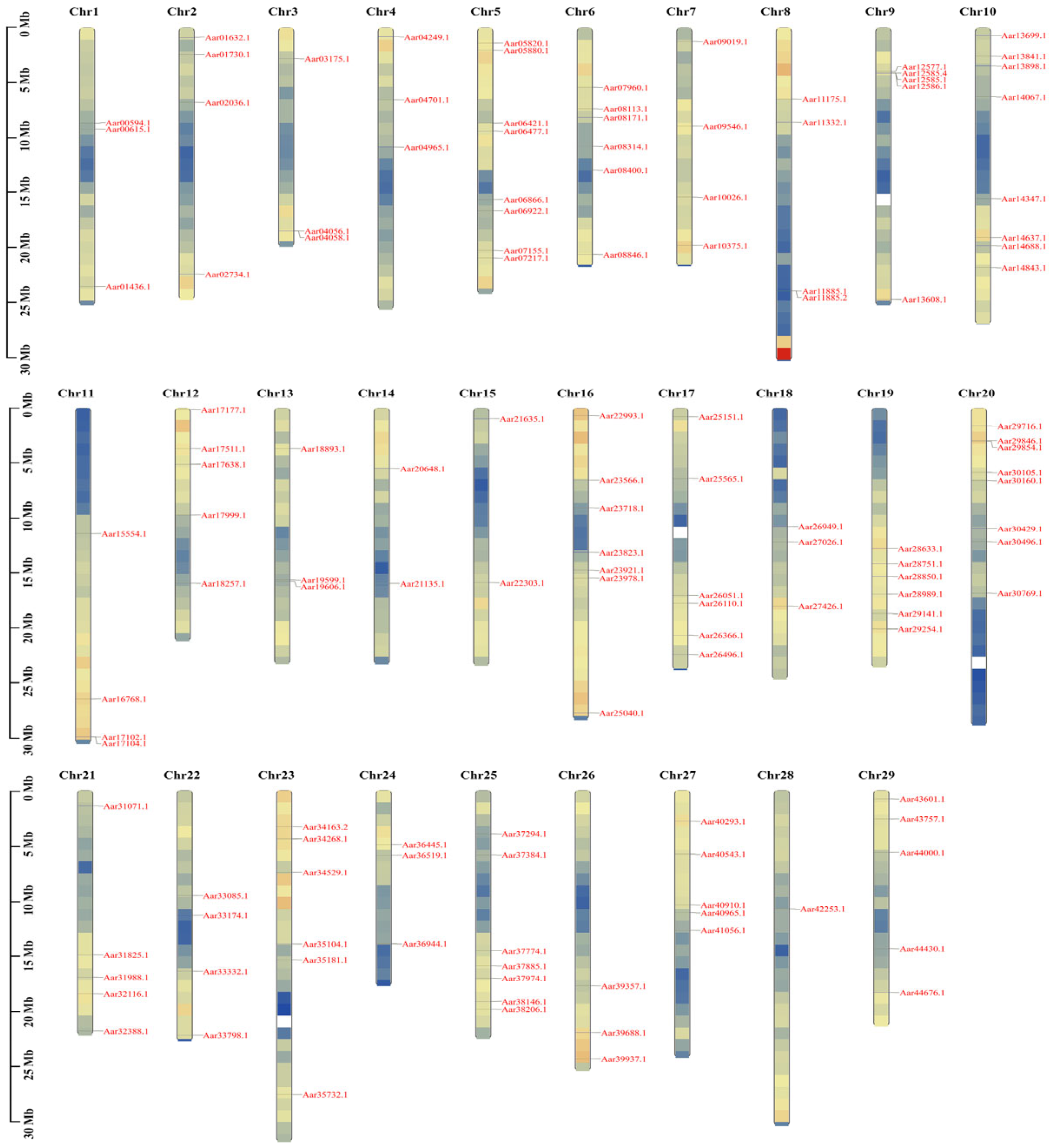
Chromosomal mapping showed that the 133 AaR2R3-MYB genes were distributed across all 29 chromosomes but exhibited a markedly uneven distribution (Figure 1). Several chromosomes harbored relatively large numbers of AaR2R3-MYB genes, while others contained only a few, indicating differences in family expansion on different chromosomes. In addition, clusters of AaR2R3-MYB genes were observed in close proximity on certain chromosomes, suggesting that tandem duplication may have contributed to the expansion of this family. Conversely, members dispersed across different chromosomes or distant regions of the same chromosome imply that segmental duplication and/or syntenic events may also have played roles in AaR2R3-MYB expansion. Collectively, the non-uniform chromosomal distribution and local clustering of AaR2R3-MYBs provide a structural basis for the subsequent analyses of gene duplication and synteny.

3.2. Conserved Motif and Exon–Intron Structure Analysis of the AaR2R3-MYB Family

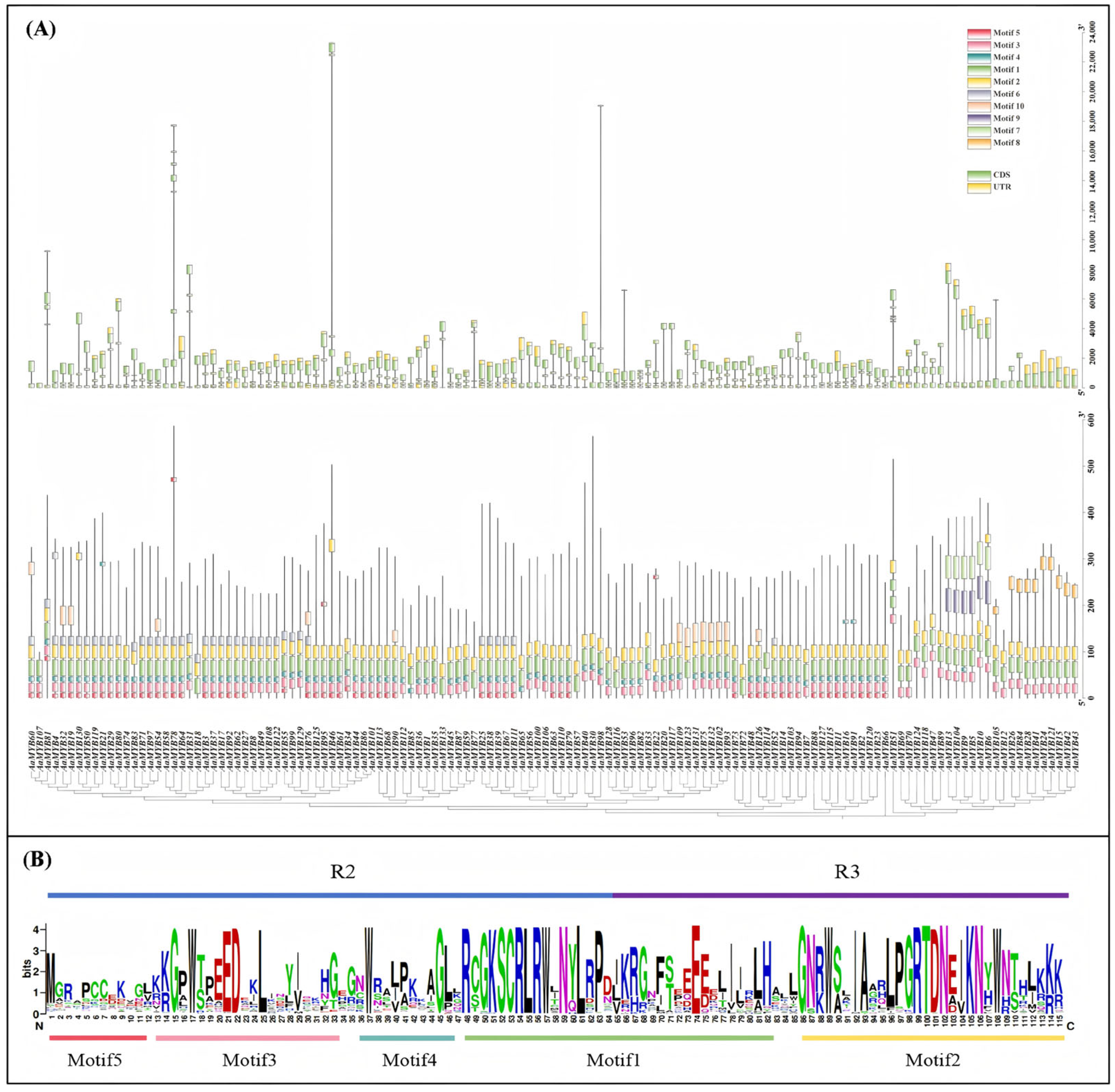
To characterize the structural features of the AaR2R3-MYB family, conserved motifs were identified across 133 AaR2R3-MYB proteins using the Multiple Expectation Maximization for Motif Elicitation (MEME) program. Ten statistically significant motifs (motif 1–motif 10) were detected in total (Figure 2A). Several motifs were highly prevalent across the family: motif 2 was present in all members (number of sites = 133), motif 1 occurred in nearly all proteins (number of sites = 132), and motif 3 was detected in most members (number of sites = 126). This indicates strong conservation of these core motifs. In contrast, motifs 7–10 were only observed in a small subset of proteins (number of sites = 6–11), suggesting that these low-frequency motifs may represent variable regions specific to certain members or subclades. Consistent with the overall architecture of R2R3-MYB proteins, the most conserved motifs were predominantly located toward the N-terminus and showed similar arrangements among AaR2R3-MYB members in the order of motif 5, motif 3, motif 4, motif 1, and motif 2 (Figure 2B). Additional motifs were more variably distributed. Gene structure analysis revealed variation in exon–intron organization among AaR2R3-MYB genes. However, genes within the same phylogenetic clade tended to have similar exon–intron patterns and motif compositions (Figure 2A). These results suggest that AaR2R3-MYB genes have a conserved core architecture but diversity in motif composition and gene structure. This provides a structural basis for the subsequent expression profiling and functional inference.

3.3. Phylogenetic Analysis and Functional Classification

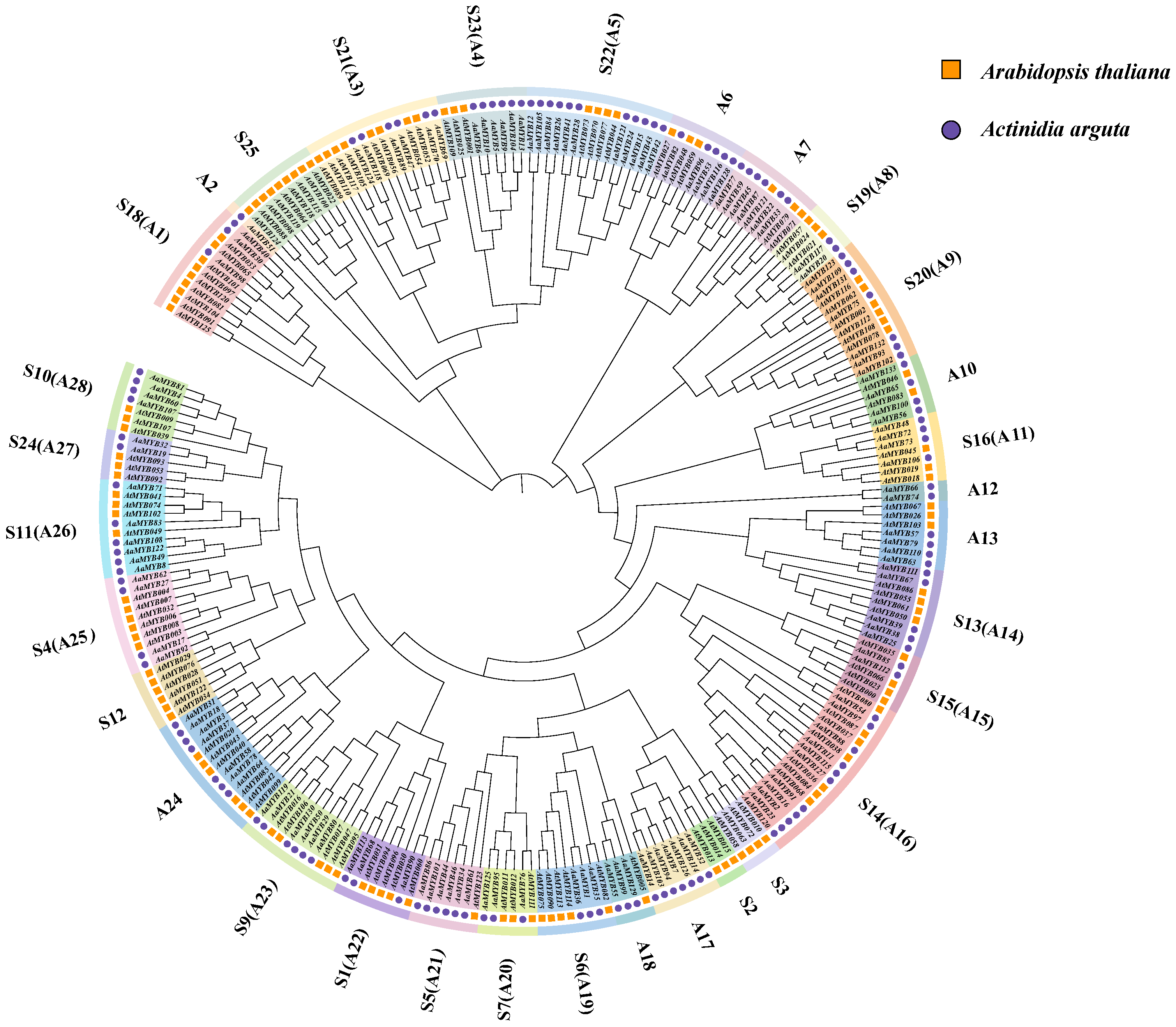
To clarify the evolutionary relationships and potential functions of the AaR2R3-MYB gene repertoire, a phylogenetic tree was constructed using full-length R2R3-MYB protein sequences. This tree includes 133 R2R3-MYB members from A. arguta and 126 well-annotated R2R3-MYB proteins from A. thaliana (Figure 3). According to the established A. thaliana R2R3-MYB subgroup classification scheme [18], the A. arguta sequences were assigned to 28 clades (A1–A28) and grouped into 19 functional subgroups.
Given our focus on anthocyanin biosynthesis, we specifically analyzed the functional subgroups directly involved in this pathway: S5 (proanthocyanidin biosynthesis), S6 (anthocyanin biosynthesis), and S7 (flavonoid regulation). These three subgroups contained 12 A. arguta genes: AaMYB1, AaMYB34, AaMYB35, AaMYB36, AaMYB44, AaMYB46, AaMYB61, AaMYB76, AaMYB86, AaMYB95, AaMYB101, and AaMYB125. These genes clustered closely with A. thaliana MYB regulators that were previously reported to control proanthocyanidin or anthocyanin biosynthesis. This suggests that these genes may play a role in the biosynthesis and coloration of anthocyanins in A. arguta fruit peels. This also provides prioritized candidates for the subsequent functional validation.

3.4. Gene Duplication and Synteny Analysis

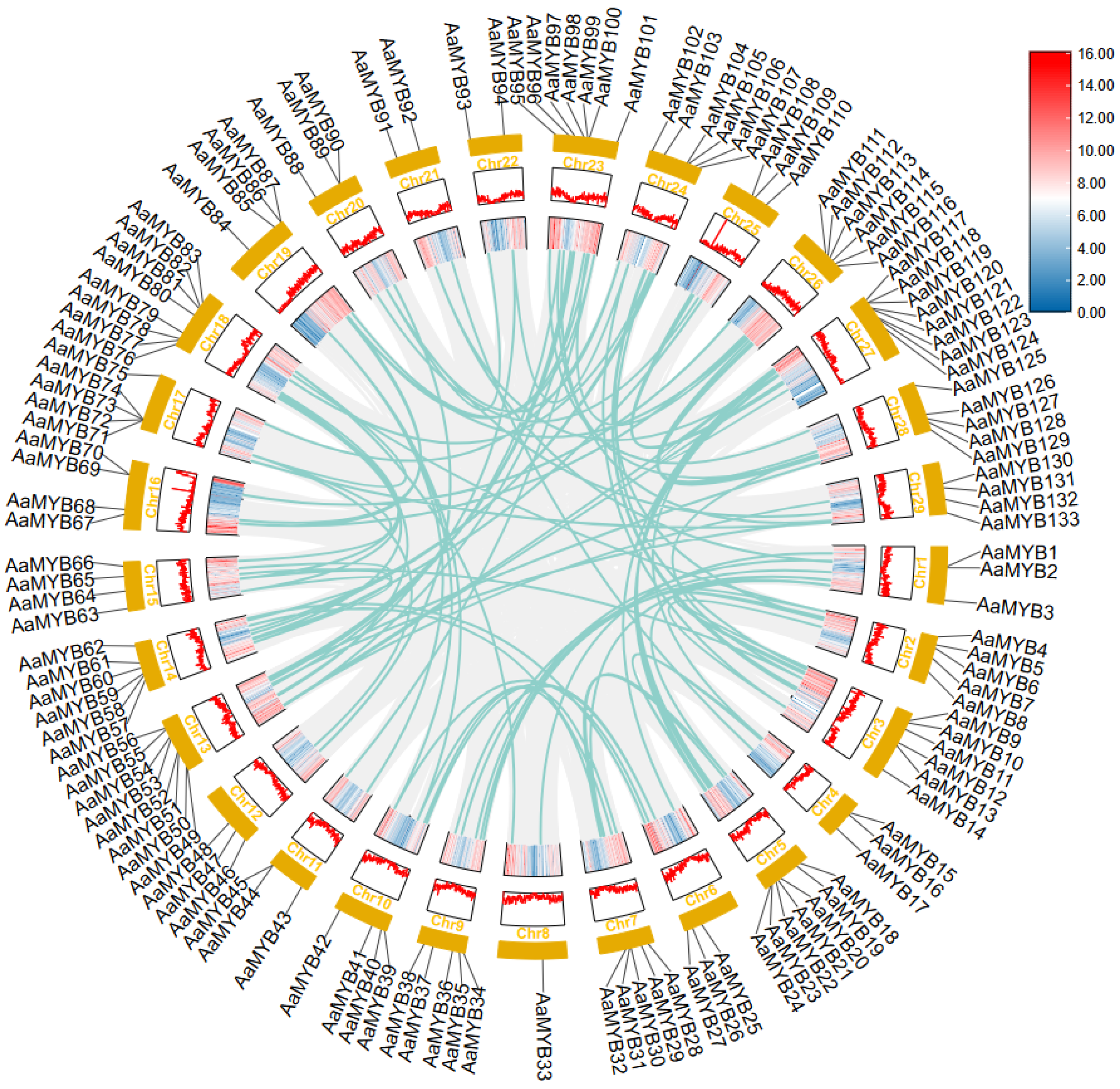
To investigate the expansion history of the AaR2R3-MYB family, an intragenomic synteny scan was performed in A. arguta. A total of 126 AaR2R3-MYB gene pairs associated with segmental duplication were identified (Figure 4). These collinear links were distributed across multiple chromosomes, indicating that segmental duplication substantially contributed to the expansion of this family. Selective pressure analysis showed that all duplicated pairs exhibited Ka/Ks < 1 (Table S2), suggesting that the AaR2R3-MYB family has predominantly been shaped by purifying selection following duplication. This is consistent with functional constraints on retained paralogs.
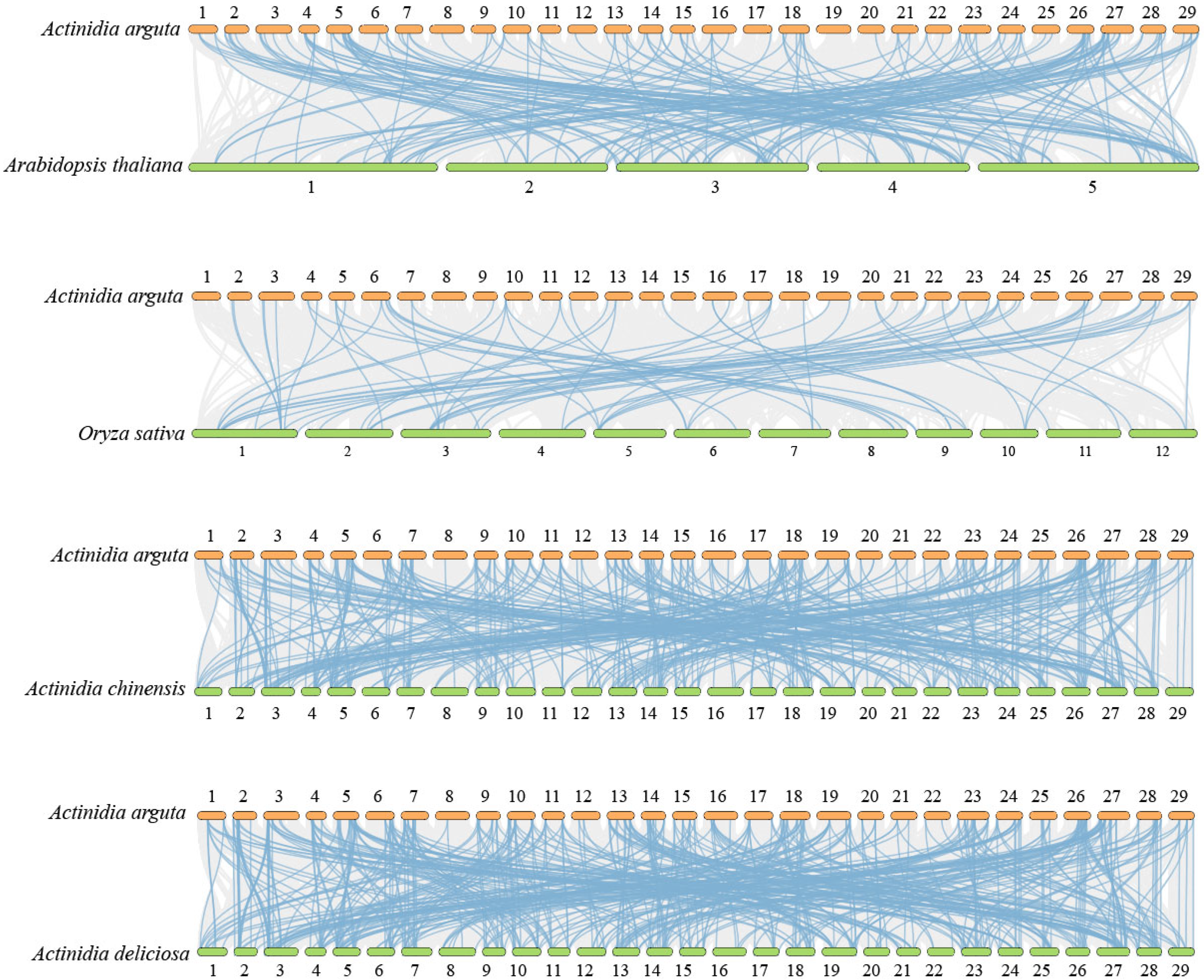
To infer the evolutionary conservation of AaR2R3-MYBs further, interspecies synteny maps were constructed between A. arguta and four representative species: A. thaliana, Oryza sativa, A. chinensis, and A. deliciosa (Figure 5). The largest number of orthologous/collinear pairs was detected between A. arguta and the two congeners: 386 pairs with A. chinensis and 459 pairs with A. deliciosa. In contrast, 177 syntenic pairs were detected between A. arguta and A. thaliana, and only 73 pairs were found between A. arguta and O. sativa. This gradient is consistent with phylogenetic distance and supports a higher level of syntenic conservation of AaR2R3-MYBs within the genus Actinidia than across more distantly related species. Together, these results suggest that the expansion of AaR2R3-MYBs in A. arguta was primarily driven by segmental duplication. Duplicated genes were largely maintained under purifying selection. This provides an evolutionary framework for the subsequent functional inference of candidate regulators of peel pigmentation.

3.5. Expression Profiling of AaR2R3-MYBs During Peel Coloration

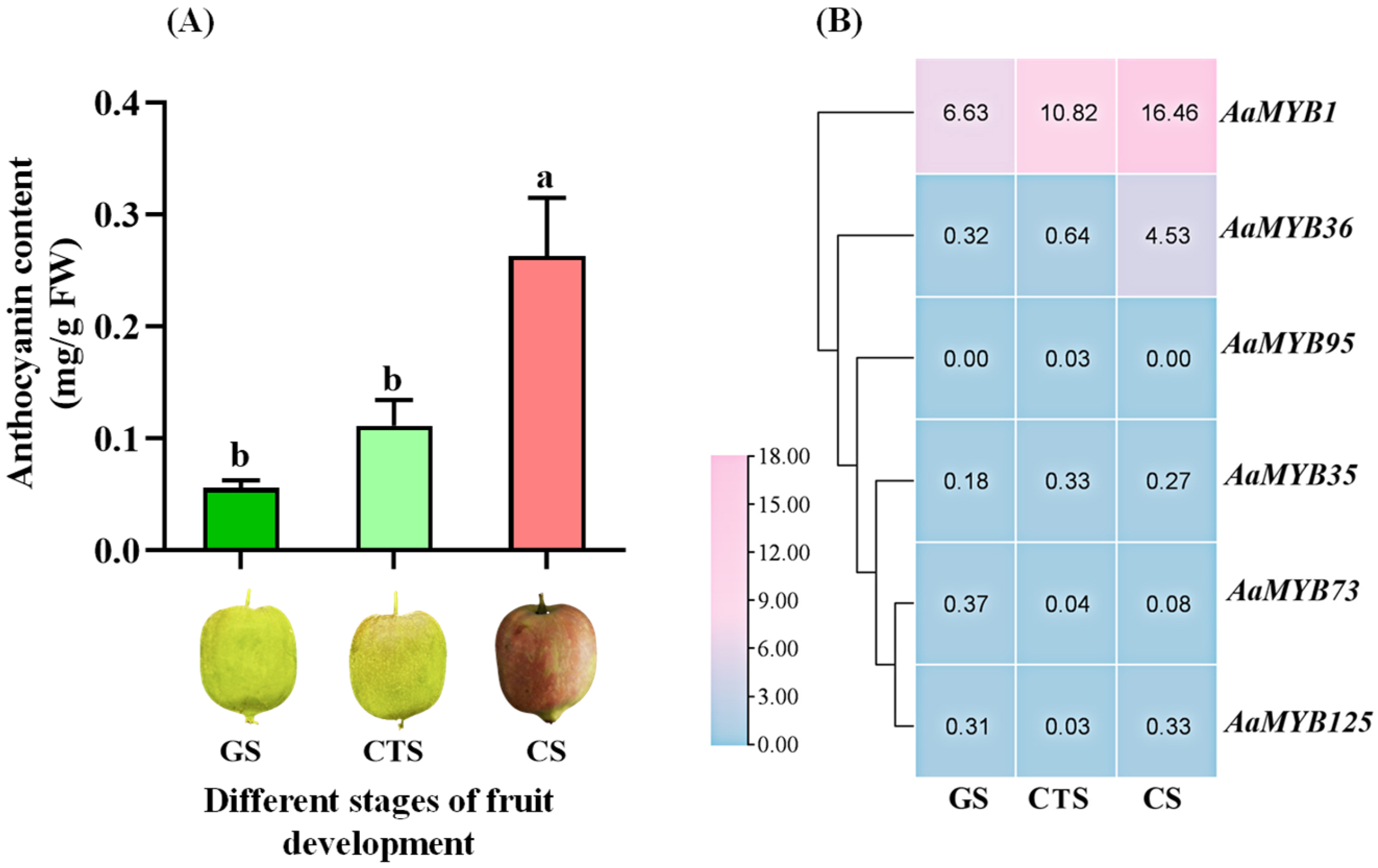
The accumulation of anthocyanin in the peels at three fruit developmental stages (GS, CTS, and CS) was identified. As shown in Figure 6A, the anthocyanin content increased with fruit development, with a significantly (p < 0.05) higher content at the CS than at the GS and CTS, whereas no significant difference was detected between the GS and CTS. These results indicate that anthocyanin accumulation enters a rapid phase at the late developmental stage.
To identify AaR2R3-MYB candidates associated with peel coloration, RNA-Seq was conducted on the same samples. The high reproducibility of our data was evidenced by the strong correlation among biological replicates within each stage and their clear separation across stages in the PCA (Figure S2). An initial expression heatmap of all 133 identified AaR2R3-MYB members revealed that the majority showed low or negligible expression in the fruit peel (Figure S3), providing a genome-wide context for candidate selection. Subsequently, the analysis focused on twelve anthocyanin-related AaR2R3-MYB members inferred from the phylogenetic analysis, which belonged to subgroups S6 and S7. A heatmap was then generated for these candidates (Figure 6B). The S5 lineage showed no detectable expression in the peel. Four S7 members (AaMYB35, AaMYB76, AaMYB95, and AaMYB125) remained at low, consistent levels throughout development. In contrast, two S6 members (AaMYB1 and AaMYB36) displayed sustained upregulation during the color transition/coloration-associated stages. AaMYB1 exhibited high expression at the GS and was further upregulated at the CTS (10.82 vs. 16.46 fragments per kilobase of transcript per million fragments mapped (FPKM)), with elevated expression maintained until the CS. AaMYB36 exhibited low expression at the GS, but markedly increased expression at the CTS (from 0.64 to 4.53 FPKM), which continued to rise during the CS. The remaining candidates generally exhibited low expression or near-background levels. The consistent expression patterns observed across biological replicates provide strong support for the conclusion that the sustained induction of AaMYB1 and AaMYB36 from the beginning of the color transition coincided with increased anthocyanin accumulation. This suggests that these two genes may be positive regulators of peel anthocyanin biosynthesis in A. arguta ‘Yanlong 1’.

3.6. Expression Validation of Candidate R2R3-MYBs and Structural Genes Related to Anthocyanin Synthesis

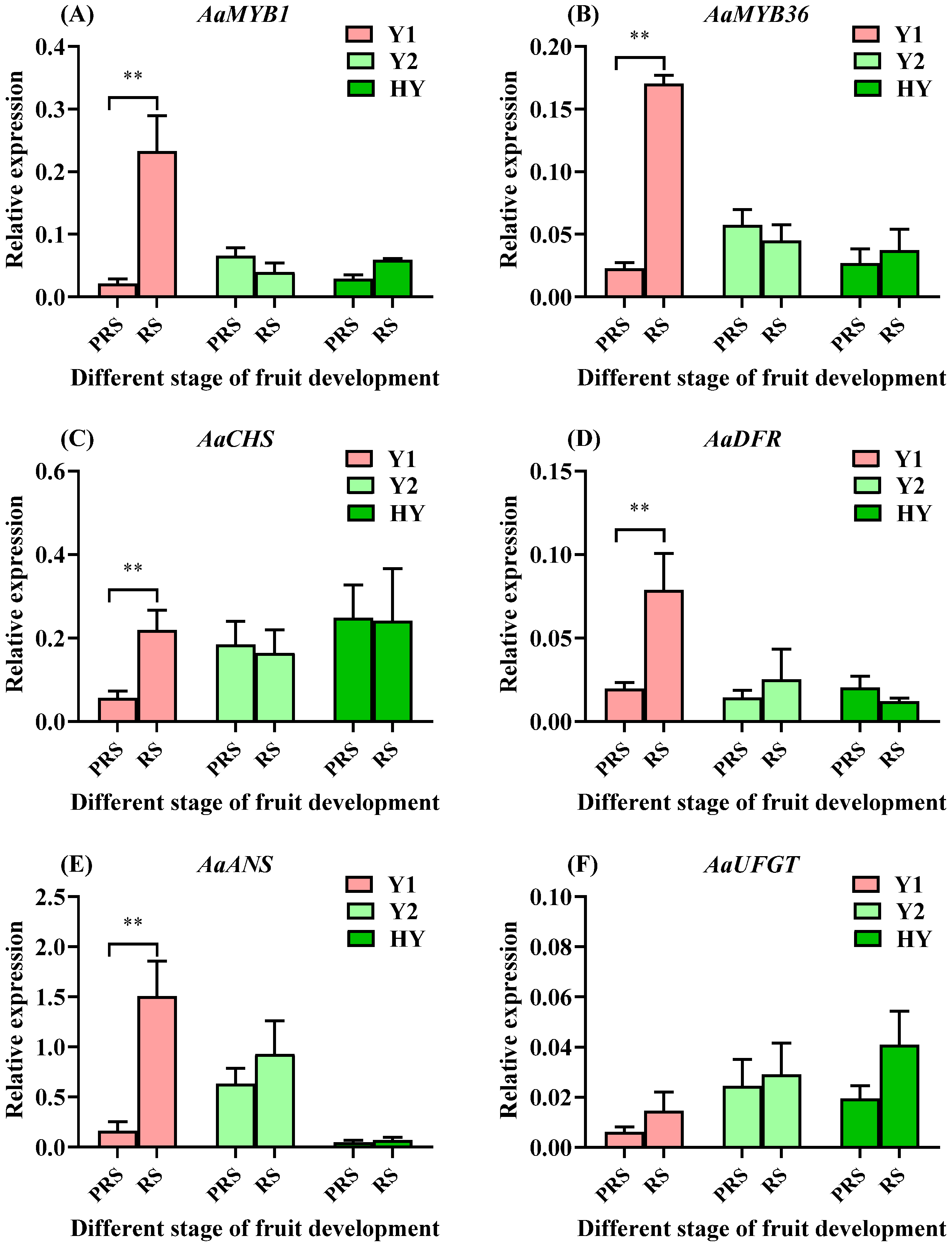
Previous studies have shown that MYB transcription factors are closely linked to the expression of key structural genes in the flavonoid/anthocyanin biosynthetic pathway, including CHS, DFR, ANS, and UFGT [30,31]. Thus, quantitative reverse transcription polymerase chain reaction (qRT-PCR) assays were conducted on two selected candidates, AaMYB1 and AaMYB36, as well as on the four aforementioned structural genes. Expression was examined in the peel of the red-peeled A. arguta ‘Yanlong 1’ (Y1) at the PRS and RS. Two green-peeled A. arguta cultivars, ‘Yanlong 2’ (Y2) and ‘Huanyou’ (HY), were used as controls. As shown in Figure 7, both AaMYB1 and AaMYB36 exhibited significant developmental induction in Y1, with notably higher expression levels during ripening than during the pre-ripening stage (Figure 7A,B). In contrast, AaMYB1 and AaMYB36 remained at low levels in Y2 and HY, showing no obvious stage-dependent changes.
At the structural-gene level, AaANS, AaDFR, and AaCHS were significantly upregulated during ripening in Y1 (Figure 7D–F), consistent with enhanced activation of the anthocyanin pathway during peel coloration in the red-peel cultivar. By comparison, AaUFGT did not show a significant difference between the two stages in Y1, suggesting relatively limited developmental responsiveness of this gene. In Y2 and HY, these structural genes exhibited weak or insignificant induction, consistent with their green-peel phenotype. Together, the Y1-specific elevation of AaMYB1/AaMYB36 expression, accompanied by increased transcript levels of key structural genes, provides additional expression-based evidence supporting their involvement in regulating peel anthocyanin accumulation.

4. Discussion

Accumulation of anthocyanins in the peel and the resulting fruit coloration are key traits for guiding high fruit quality and postharvest management. This process generally depends on the coordinated regulation of structural genes in the flavonoid/anthocyanin pathway and upstream transcription factors [32]. Numerous studies have established the central role of R2R3-MYB transcription factors in this regulatory network, but work in the genus Actinidia has largely focused on family-level identification and preliminary functional inference, primarily in A. chinensis and related species [26,33,34]. Therefore, closing the gap between the ‘family identification–evolutionary context–phenotype association’ in A. arguta and specifically dissecting the peel-specific coloration mechanism in a rare northern red-peel species has clear theoretical and breeding relevance. Through the integration of genome-wide analysis and developmental and cultivar-level expression validation, this study narrowed down the anthocyanin-related regulatory candidates to specific clades and key gene combinations.
This study identified a total of 133 non-redundant R2R3-MYB genes in the A. arguta ‘Yanlong 1’ genome. Compared to the previously reported 91 or 93 R2R3-MYB members in A. chinensis, the R2R3-MYB family in A. arguta is larger and more diverse. An earlier study indicated that A. arguta diverged relatively early within the genus Actinidia [26]; accordingly, the richness of its R2R3-MYB repertoire likely provides a genetic basis for subsequent lineage evolution and phenotypic diversification. Similar expansions of this family have been reported in many angiosperms and are often associated with gene duplication and functional divergence related to secondary metabolism or stress adaptation [35,36]. Furthermore, this study found that AaR2R3-MYB genes are unevenly distributed across 29 chromosomes and show local clustering. This suggests that tandem and segmental duplications both contributed to the expansion of this family. Ka/Ks ratios less than 1 for duplicate pairs indicate that most members have been retained under purifying selection. The N-terminal R2/R3 repeats are structurally highly conserved and conform to the canonical R2R3-MYB configuration, strictly following the −W-(X19)-W-(X19)-W…W/F/I/L-W-(X18)-W– pattern [37]. Conversely, variation in motif composition outside the MYB domain and in exon–intron organization among subgroups suggests that regulatory diversity may have arisen in this conserved DNA-binding scaffold. However, such functional differentiation requires experimental validation.
Phylogeny-based clustering placed the AaR2R3-MYB gene family into the functional subgroup framework established for A. thaliana [18] and identified a subset of genes most closely related to the flavonoid/anthocyanin clades (S5–S7). This expands the scope of Actinidia research from ‘family cataloging’ to ‘phenotype-associated candidate mechanisms’. The peel anthocyanin content progressively increased from the green-fruit stage through color break to the coloration stage, reaching significantly higher levels at the coloration stage (p < 0.05). This indicates a rapid accumulation phase in late fruit development. Consistent with this finding, RNA-seq data revealed that S6 clade genes AaMYB1 and AaMYB36 were continuously upregulated during the color transition/coloration-related phases, coinciding with enhanced anthocyanin accumulation. This finding supports their putative role as positive regulatory candidates.
Previous studies have reported red coloration in multiple Actinidia spp. and cultivars, as well as in different tissues (e.g., peel vs. flesh), suggesting the existence of relatively conserved, MYB-driven regulatory modules throughout the genus. Several MYB transcription factors have been implicated in flesh coloration, including AcMYB75, AcMYBF110, and AcMYB123 in A. chinensis [21,22,23] and AaMYB61-like in A. arguta [24]. Phylogenetic analysis indicates that these genes belong to the R2R3-MYB family, with most clustering within the S6 subgroup (Figure S1). The close relationship between AcMYB75/AcMYBF110 and AaMYB1/AaMYB36 identified in this study suggests that they are homologous genes regulating anthocyanin synthesis. These observations support the existence of a relatively conserved MYB-centered regulatory module in anthocyanin regulation while suggesting that key members and their modes of action may vary depending on genetic background and environmental context. Thus, the coordinated induction of AaMYB1 and AaMYB36 in the rare northern red-peel species is more likely to reflect the division of labor and cooperation of multiple MYB activators acting in a spatiotemporal manner than the action of a single ‘on/off’ switch gene. Consistent with this, R2R3-MYB proteins generally act with other transcription factors, such as bHLH proteins, to regulate downstream structural genes [38,39,40]. Additionally, both AaMYB1 and AaMYB36 harbor the DL(X2)R(X3)L(X6)L(X3)R motif in their R3 repeat, which is a characteristic bHLH-interacting signature [41]. This further suggests that these two factors may participate in anthocyanin regulation through MBW-type complexes. We also analyzed expression patterns of bHLH genes using our RNA-seq data. Interestingly, the expression pattern of gene_Aa17Cg44317—an ortholog of Arabidopsis thaliana bHLH42 [42] (Figure S4)—showed a positive correlation with the key regulators AaMYB1/AaMYB36 and anthocyanin accumulation. This finding aligns with the canonical MBW model, suggesting a potential functional interaction between these proteins. In contrast, the expression of WD40 genes remained largely unchanged, indicating that the WD40 protein is likely not the rate-limiting component in this pathway. It is plausible that the required WD40 protein is constitutively expressed, functioning as a stably expressed scaffolding protein, with the regulatory responsibility primarily undertaken by the MYB–bHLH interaction.
Previous work has demonstrated that MYB transcription factors can modulate the expression of key structural genes in the anthocyanin pathway, including CHS, DFR, ANS, and UFGT, at the functional level [43,44]. Building on this knowledge, this study used these four genes as downstream expression markers to compare red-peel A. arguta ‘Yanlong 1’ (Y1) and green-peel controls (Y2 and HY) at the green-fruit and coloration stages. AaMYB1 and AaMYB36 exhibited significant stage-specific induction during Y1 development, while their transcript levels remained low and relatively consistent in Y2 and HY. Concurrently, the upstream anthocyanin pathway genes CHS, DFR, and ANS were significantly upregulated in Y1 at the coloration stage, while UFGT showed no significant change. This pattern is consistent with the expectation that the anthocyanin pathway is more strongly activated in red-peel genotypes during coloration. However, it also suggests that regulatory control in these genotypes may be primarily exerted on flux enhancement through early and mid-pathway steps (CHS/DFR/ANS co-induction) rather than marked induction of the terminal glycosylation step. The behavior of UFGT may be related to anthocyanin glycoside composition. In Actinidia spp., including A. arguta var. purpurea, galactosides are the major sugar motifs in anthocyanins [29,45]. This distinct sugar moiety may explain the lack of pronounced UFGT induction observed here, as classical UFGTs primarily catalyze glucosylation [46]. Instead, this suggests the involvement of alternative, specialized glycosyltransferases.
It should be emphasized that the current evidence is primarily based on phylogenetic inference and expression correlations and is therefore insufficient to demonstrate causal regulatory relationships. Future work should address whether AaMYB1 and AaMYB36 form MBW complexes with bHLH/WD40 proteins, whether they directly bind to the promoters of structural genes and define a set of direct targets, and whether environmental cues such as light and temperature modulate their expression or activity via cis-regulatory elements or epigenetic mechanisms. Interestingly, the 2 kb promoter scan of the six candidate AaMYBs revealed at least one light-responsive element in every fragment (Figure S5). Furthermore, promoter analysis of the four key structural genes (AaCHS, AaDFR, AaANS, and AaUFGT) identified multiple conserved MYB-binding motifs in their promoter regions (Figure S6). Notably, the type and distribution of these motifs varied among the four genes, with the AaCHS and AaANS promoters containing the highest density of MYB-binding sites. These findings provide bioinformatic evidence supporting the potential direct binding of AaMYB1 and AaMYB36 to these structural gene promoters, and suggest differential regulatory patterns within the anthocyanin pathway. From an application perspective, the Y1-specific regulatory signatures and pathway responses identified here provide high-priority targets for the development of red-peel molecular markers, germplasm evaluation, and marker-assisted selection, thereby offering a molecular foundation for breeding red-peel hardy kiwifruit adapted to northern environments. These differences suggest that northern red-peel hardy kiwifruit may exhibit regulatory specificity at the pathway level. This idea should be tested further by integrating metabolite profiling, enzyme activity assays, and analyses of transport and vacuolar sequestration.
To establish causal relationships, future studies could focus on several key validations: direct promoter binding of AaMYB1/AaMYB36 via yeast one-hybrid or ChIP assays; gain-of-function analysis using stable transformation in Arabidopsis and transient expression in tobacco; and loss-of-function verification via VIGS in kiwiberry fruits. This multi-level approach would provide definitive functional evidence and elucidate the molecular mechanisms underlying peel coloration. Furthermore, sequence polymorphisms in the promoter or coding regions of these genes could be exploited to develop allele-specific markers, such as CAPS (cleaved amplified polymorphic sequence) or dCAPS (derived CAPS) markers. Such markers would enable early selection of red-peel genotypes at the seedling stage, significantly reducing the long juvenile phase and field resources required for phenotypic selection in kiwiberry.

5. Conclusions

This study combined genome-wide identification and physicochemical characterization of the AaR2R3-MYB family with analyses of chromosomal localization, gene duplication, and synteny. The study also assigned AaR2R3-MYB members to the functional subgroups of A. thaliana AaR2R3-MYBs within a phylogenetic framework. This identified the candidate clades associated with flavonoid/anthocyanin metabolism. Integrating peel anthocyanin measurements with RNA-seq expression profiling identified key candidate genes that were synchronously upregulated during the peel coloration stage. Subsequent qRT-PCR validation of developmental stages in the red-peel A. arguta ‘Yanlong 1’ (Y1) and two green-peel control cultivars (Y2 and HY) ultimately identified AaMYB1 and AaMYB36 as the positive regulators most closely associated with peel anthocyanin accumulation. Additionally, CHS, DFR, ANS, and UFGT, which were selected as downstream structural genes based on Arabidopsis studies, showed expression patterns consistent with the upregulation of AaMYB1/AaMYB36 and the coordinated induction of key structural genes, especially CHS, DFR, and ANS. These results provide expression-based evidence supporting the involvement of AaMYB1 and AaMYB36 in regulating peel coloration in A. arguta ‘Yanlong 1’.

Supplementary Materials

The following supporting information can be downloaded at: https://www.mdpi.com/article/10.3390/horticulturae12020234/s1, Table S1: Classification and physicochemical properties of identified AaR2R3-MYB TFs in Actinidia arguta; Table S2: Ka/Ks analysis of AaR2R3-MYB; Table S3: Primers used for RT-qPCR. Figure S1: Phylogenetic analysis showing the relationships between R2R3-MYB transcription factors clustered into three subclasses (S5, S6, and S7) that are associated with anthocyanin biosynthesis; Figure S2: Sample correlation heatmap (A) and principal component analysis (B) of RNA-seq data across three fruit developmental stages; Figure S3: Heatmap of AaR2R3-MYB gene expression in A. arguta ‘Yanlong 1’ fruit peels at different stages of development; Figure S4: FPKM values of the A. thaliana bHLH42 ortholog gene_Aa17Cg44317; Figure S5: Cis-acting elements in the 2-kilobase promoter region upstream of the initiation codon of the associated gene; Figure S6: Cis-acting elements in the 2-kilobase promoter region upstream of the initiation codon of the key structural gene.

Author Contributions

Conceptualization, S.A. and R.Z.; data curation, R.Z.; formal analysis, R.Z., Y.Z. and Y.P.; investigation, R.Z., Y.Z., J.C. and X.Y.; methodology, S.A. and R.Z.; investigation, R.Z., Y.Z., J.C. and Y.P.; resources, R.Z., Y.Z., J.C. and X.Y.; supervision, S.A.; validation, R.Z., Y.Z., J.C. and X.Y.; writing—original draft, R.Z.; writing—review and editing, S.A.; funding acquisition, M.J. All authors have read and agreed to the published version of the manuscript.

Funding

This work was supported by the Scientific and Technological Research Project of the Jilin Provincial Department of Education, China (grant number JJKH20240687KJ).

Data Availability Statement

The original contributions presented in this study are included in the article/Supplementary Materials. Further inquiries can be directed to the corresponding author.

Conflicts of Interest

The authors declare no conflicts of interest.

References

  1. Pinto, D.; Delerue-Matos, C.; Rodrigues, F. Bioactivity, phytochemical profile and pro-healthy properties of Actinidia arguta: A review. Food Res. Int. 2020, 136, 109449. [Google Scholar] [CrossRef]
  2. Wang, Y.; Zhao, C.L.; Li, J.Y.; Liang, Y.J.; Yang, R.Q.; Liu, J.Y.; Ma, Z.; Wu, L. Evaluation of biochemical components and antioxidant capacity of different kiwifruit (Actinidia spp.) genotypes grown in China. Biotechnol. Biotechnol. Equip. 2018, 32, 558–565. [Google Scholar] [CrossRef]
  3. Latocha, P.; Jankowski, P.; Radzanowska, J. Genotypic difference in postharvest characteristics of hardy kiwifruit (Actinidia arguta and its hybrids), as a new commercial crop Part I. Sensory profiling and physicochemical differences. Food Res. Int. 2011, 44, 1936–1945. [Google Scholar] [CrossRef]
  4. Lu, X.M.; Yu, X.F.; Li, G.Q.; Qu, M.H.; Wang, H.; Liu, C.; Man, Y.P.; Jiang, X.H.; Li, M.Z.; Wang, J.; et al. Genome assembly of autotetraploid Actinidia arguta highlights adaptive evolution and enables dissection of important economic traits. Plant Commun. 2024, 5, 100856. [Google Scholar] [CrossRef] [PubMed]
  5. Li, M.J.; Feng, F.J.; Cheng, L.L. Expression patterns of genes involved in sugar metabolism and accumulation during apple fruit development. PLoS ONE 2012, 7, e33055. [Google Scholar] [CrossRef]
  6. Latocha, P. The nutritional and health benefits of kiwiberry (Actinidia arguta)—A review. Plant Food. Hum. Nutr. 2017, 72, 325–334. [Google Scholar] [CrossRef]
  7. Jaakola, L. New insights into the regulation of anthocyanin biosynthesis in fruits. Trends Plant Sci. 2013, 18, 477–483. [Google Scholar] [CrossRef]
  8. Sharma, H.; Sharma, P.; Kumar, A.; Chawla, N.; Dhatt, A.S. Multifaceted regulation of anthocyanin biosynthesis in plants: A comprehensive review. J. Plant Growth Regul. 2024, 43, 3048–3062. [Google Scholar] [CrossRef]
  9. Petroni, K.; Tonelli, C. Recent advances on the regulation of anthocyanin synthesis in reproductive organs. Plant Sci. 2011, 181, 219–229. [Google Scholar] [CrossRef]
  10. Sun, W.; Zhou, N.N.; Feng, C.; Sun, S.Y.; Tang, M.; Tang, X.X.; Ju, Z.G.; Yi, Y. Functional analysis of a dihydroflavonol 4-reductase gene in Ophiorrhiza japonica (OjDFR1) reveals its role in the regulation of anthocyanin. PeerJ 2021, 9, e12323. [Google Scholar] [CrossRef]
  11. Chen, W.H.; Hsu, C.Y.; Cheng, H.Y.; Chang, H.; Chen, H.H.; Ger, M.J. Downregulation of putative UDP-glucose: Flavonoid 3-O-glucosyltransferase gene alters flower coloring in Phalaenopsis. Plant Cell Rep. 2011, 30, 1007–1017. [Google Scholar] [CrossRef]
  12. Liu, Y.; Wang, C.C.; Chen, H.D.; Dai, G.Q.; Cuimu, Q.; Shen, W.J.; Gao, L.W.; Zhu, B.; Gao, C.B.; Chen, L.L.; et al. Comparative transcriptome analysis reveals transcriptional regulation of anthocyanin biosynthesis in purple radish (Raphanus sativus L.). BMC Genomics 2024, 25, 624. [Google Scholar] [CrossRef] [PubMed]
  13. Liu, Y.; Tikunov, Y.; Schouten, R.E.; Marcelis, L.F.M.; Visser, R.G.F.; Bovy, A. Anthocyanin biosynthesis and degradation mechanisms in Solanaceous vegetables: A review. Front. Chem. 2018, 6, 52. [Google Scholar] [CrossRef] [PubMed]
  14. Xu, W.J.; Dubos, C.; Lepiniec, L. Transcriptional control of flavonoid biosynthesis by MYB-bHLH-WDR complexes. Trends Plant Sci. 2015, 20, 176–185. [Google Scholar] [CrossRef] [PubMed]
  15. Chen, L.H.; Hu, B.; Qin, Y.H.; Hu, G.B.; Zhao, J.T. Advance of the negative regulation of anthocyanin biosynthesis by MYB transcription factors. Plant Physiol. Biochem. 2019, 136, 178–187. [Google Scholar] [CrossRef]
  16. Hichri, I.; Barrieu, F.; Bogs, J.; Kappel, C.; Delrot, S.; Lauvergeat, V. Recent advances in the transcriptional regulation of the flavonoid biosynthetic pathway. J. Exp. Bot. 2011, 62, 2465–2483. [Google Scholar] [CrossRef]
  17. Allan, A.C.; Espley, R.V. MYBs drive novel consumer traits in fruits and vegetables. Trends Plant Sci. 2018, 23, 693–705. [Google Scholar] [CrossRef]
  18. Dubos, C.; Stracke, R.; Grotewold, E.; Weisshaar, B.; Martin, C.; Lepiniec, L. MYB transcription factors in Arabidopsis. Trends Plant Sci. 2010, 15, 573–581. [Google Scholar] [CrossRef]
  19. Yang, Y.T.; Yuan, Z.; Ning, C.H.; Zhao, B.L.; Wang, R.R.; Zheng, X.L.; Liu, Y.; Chen, J.H.; He, L.L. The Pea R2R3-MYB gene family and its role in anthocyanin biosynthesis in flowers. Front. Genet. 2022, 13, 936051. [Google Scholar] [CrossRef]
  20. Jiang, L.Y.; Yue, M.L.; Liu, Y.Q.; Zhang, N.T.; Lin, Y.X.; Zhang, Y.T.; Wang, Y.; Li, M.Y.; Luo, Y.; Zhang, Y.; et al. A novel R2R3-MYB transcription factor FaMYB5 positively regulates anthocyanin and proanthocyanidin biosynthesis in cultivated strawberries (Fragaria x ananassa). Plant Biotechnol. J. 2023, 21, 1140–1158. [Google Scholar] [CrossRef]
  21. Li, W.B.; Ding, Z.H.; Ruan, M.B.; Yu, X.L.; Peng, M.; Liu, Y.F. Kiwifruit R2R3-MYB transcription factors and contribution of the novel AcMYB75 to red kiwifruit anthocyanin biosynthesis. Sci. Rep. 2017, 7, 16861. [Google Scholar] [CrossRef]
  22. Liu, Y.F.; Zhou, B.; Qi, Y.W.; Chen, X.; Liu, C.H.; Liu, Z.D.; Ren, X.L. Expression differences of pigment structural genes and transcription factors explain flesh coloration in three contrasting kiwifruit cultivars. Front. Plant Sci. 2017, 8, 1507. [Google Scholar] [CrossRef] [PubMed]
  23. Wang, L.H.; Tang, W.; Hu, Y.W.; Zhang, Y.B.; Sun, J.Q.; Guo, X.H.; Lu, H.; Yang, Y.; Fang, C.B.; Niu, X.L.; et al. A MYB/bHLH complex regulates tissue-specific anthocyanin biosynthesis in the inner pericarp of red-centered kiwifruit Actinidia chinensis cv. Hongyang. Plant J. 2019, 99, 359–378. [Google Scholar] [CrossRef] [PubMed]
  24. Song, Z.; Li, Y.K.; Zhan, X.; Li, X.H.; Ye, L.S.; Lin, M.M.; Wang, R.; Sun, L.M.; Chen, J.Y.; Fang, J.B.; et al. AaMYB61-like and AabHLH137 jointly regulate anthocyanin biosynthesis in Actinidia arguta. BMC Plant Biol. 2025, 25, 89. [Google Scholar] [CrossRef] [PubMed]
  25. Ye, L.X.; Bai, F.X.; Zhang, L.; Luo, M.M.; Gao, L.; Wang, Z.; Peng, J.; Chen, Q.H.; Luo, X. Transcriptome and metabolome analyses of anthocyanin biosynthesis in post-harvest fruits of a full red-type kiwifruit (Actinidia arguta) ‘Jinhongguan’. Front. Plant Sci. 2023, 14, 1280970. [Google Scholar] [CrossRef]
  26. Xia, H.; Liu, X.L.; Lin, Z.Y.; Zhang, X.F.; Wu, M.J.; Wang, T.; Deng, H.H.; Wang, J.; Lin, L.J.; Deng, Q.X.; et al. Genome-Wide identification of MYB transcription factors and screening of members involved in stress response in Actinidia. Int. J. Mol. Sci. 2022, 23, 2323. [Google Scholar] [CrossRef]
  27. Livak, K.J.; Schmittgen, T.D. Analysis of Relative Gene Expression Data Using Real-Time Quantitative PCR and the 2−ΔΔCT Method. Methods 2001, 25, 4. [Google Scholar] [CrossRef]
  28. Singh, M.C.; Price, W.E.; Kelso, C.; Charlton, K.; Probst, Y. Impact of molar absorbance on anthocyanin content of the foods. Food Chem. 2022, 386, 132855. [Google Scholar] [CrossRef]
  29. Comeskey, D.J.; Montefiori, M.; Edwards, P.J.B.; McGhie, T.K. Isolation and structural identification of the anthocyanin components of red kiwifruit. J. Agric. Food Chem. 2009, 27, 2035. [Google Scholar] [CrossRef]
  30. Zhang, Y.; Butelli, E.; Martin, C. Engineering anthocyanin biosynthesis in plants. Curr. Opin. Plant Biol. 2014, 19, 81–90. [Google Scholar] [CrossRef]
  31. Yang, J.F.; Chen, Y.Z.; Xiao, Z.H.; Shen, H.L.; Li, Y.H.; Wang, Y. Multilevel regulation of anthocyanin-promoting R2R3-MYB transcription factors in plants. Front. Plant Sci. 2022, 13, 1008829. [Google Scholar] [CrossRef]
  32. Muhammad, N.; Luo, Z.; Liu, Z.G.; Liu, M.J. The collaborative role of the regulatory (MYB-bHLH-WD40) and structural genes results in fruit coloration in plants some do this under the influence of external stimuli. J. Plant Growth Regul. 2025, 44, 1087–1103. [Google Scholar] [CrossRef]
  33. Yu, M.; Man, Y.P.; Wang, Y.C. Light- and Temperature-Induced expression of an R2R3-MYB gene regulates anthocyanin biosynthesis in red-fleshed kiwifruit. Int. J. Mol. Sci. 2019, 20, 5228. [Google Scholar] [CrossRef] [PubMed]
  34. Fraser, L.G.; Seal, A.G.; Montefiori, M.; McGhie, T.K.; Tsang, G.K.; Datson, P.M.; Hilario, E.; Marsh, H.E.; Dunn, J.K.; Hellens, R.P.; et al. An R2R3-MYB transcription factor determines red petal colour in an Actinidia (kiwifruit) hybrid population. BMC Genom. 2013, 14, 28. [Google Scholar] [CrossRef] [PubMed]
  35. Wu, Y.; Wen, J.; Xia, Y.P.; Zhang, L.S.; Du, H. Evolution and functional diversification of R2R3-MYB transcription factors in plants. Hortic. Res. 2022, 9, uhac058. [Google Scholar] [CrossRef]
  36. Zhao, K.; Cheng, Z.H.; Guo, Q.; Yao, W.J.; Liu, H.J.; Zhou, B.R.; Jiang, T.B. Characterization of the poplar R2R3-MYB gene family and over-expression of PsnMYB108 confers salt tolerance in transgenic Tobacco. Front. Plant Sci. 2020, 11, 571881. [Google Scholar] [CrossRef]
  37. Erfatpour, M.; Pauls, K.P. A R2R3-MYB gene-based marker for the non-darkening seed coat trait in pinto and cranberry beans (Phaseolus vulgaris L.) derived from ‘Wit-rood boontje’. Theor. Appl. Genet. 2020, 133, 1977–1994. [Google Scholar] [CrossRef]
  38. Huang, W.J.; Khaldun, A.B.M.; Lv, H.Y.; Du, L.W.; Zhang, C.J.; Wang, Y. Isolation and functional characterization of a R2R3-MYB regulator of the anthocyanin biosynthetic pathway from. Plant Cell Rep. 2016, 35, 883–894. [Google Scholar] [CrossRef]
  39. Wang, B.H.; Luo, Q.; Li, Y.P.; Du, K.X.; Wu, Z.; Li, T.Y.; Shen, W.H.; Huang, C.H.; Gan, J.H.; Dong, A.W. Structural insights into partner selection for MYB and bHLH transcription factor complexes. Nat. Plants 2021, 8, 1108–1117. [Google Scholar] [CrossRef]
  40. Bulanov, A.N.; Andreeva, E.A.; Tsvetkova, N.V.; Zykin, P.A. Regulation of flavonoid biosynthesis by the MYB-bHLH-WDR (MBW) complex in plants and its specific features in cereals. Int. J. Mol. Sci. 2025, 26, 734. [Google Scholar] [CrossRef]
  41. Dai, X.M.; Zhou, L.M.; Zhang, W.; Cai, L.; Guo, H.Y.; Tian, H.N.; Schiefelbein, J.; Wang, S.C. A single amino acid substitution in the R3 domain of GLABRA1 leads to inhibition of trichome formation in Arabidopsis without affecting its interaction with GLABRA3. Plant Cell Environ. 2016, 39, 897–907. [Google Scholar] [CrossRef]
  42. Zhang, Y.; Zheng, S.; Liu, Z.; Wang, L.; Bi, Y. Both HY5 and HYH are necessary regulators for low temperature-induced anthocyanin accumulation in Arabidopsis seedlings. J. Plant Physiol. 2011, 168, 367–374. [Google Scholar] [CrossRef]
  43. Raziq, A.; Zhang, K.; Sun, W.; Ahmad, N.; Zhao, H.L.; Raza, M.A.; Ahmed, S.; Din, A.M.U.; Zhao, S.Z.; Pan, J.W.; et al. Transcriptome profiling of MYB-overexpressed transgenic lines provides crucial molecular insights into anthocyanin and remodel the biosynthesis regulatory network in Nicotiana tabacum. Ind. Crop. Prod. 2024, 213, 118374. [Google Scholar] [CrossRef]
  44. Keller-Przybylkowicz, S.; Oskiera, M.; Liu, X.Q.; Song, L.Q.; Zhao, L.L.; Du, X.Y.; Kruczynska, D.; Walencik, A.; Kowara, N.; Bartoszewski, G. Transcriptome analysis of white- and red-Fleshed apple fruits uncovered novel genes related to the regulation of anthocyanin biosynthesis. Int. J. Mol. Sci. 2024, 25, 1778. [Google Scholar] [CrossRef]
  45. Montefiori, M.; Comeskey, D.J.; Wohlers, M.; McGhie, T.K. Characterization and quantification of anthocyanins in red kiwifruit (Actinidia spp.). J. Agric. Food Chem. 2009, 57, 6856–6861. [Google Scholar] [CrossRef]
  46. Zhao, Z.C.; Hu, G.B.; Hu, F.C.; Wang, H.C.; Yang, Z.Y.; Lai, B. The UDP glucose: Flavonoid-3-O-glucosyltransferase (UFGT) gene regulates anthocyanin biosynthesis in litchi (Litchi chinesis Sonn.) during fruit coloration. Mol. Biol. Rep. 2012, 39, 6409–6415. [Google Scholar] [CrossRef]
Figure 1. Chromosomal distribution of AaR2R3-MYB transcription factors (TFs) in A. arguta. Different colors on the chromosomes represent chromosomal density, with red marks indicate the physical locations of R2R3-MYB genes on the chromosomes. The scale on the left denotes chromosome length (Mb).
Horticulturae 12 00234 g001
Figure 2. Sequence analysis of the AaR2R3-MYB family. (A) Conserved motifs (below) and exon–intron structures (above) of the genes. (B) R2R3-MYB domain positions and distribution of five conserved motifs (1–5).
Horticulturae 12 00234 g002
Figure 3. Circular phylogenetic tree of the R2R3-MYB proteins from A. thaliana (orange) and A. arguta (blue). The subgroups S1–S25 and A1–A28 represent the well-annotated clades in A. thaliana and the identified clades in A. arguta, respectively.
Horticulturae 12 00234 g003
Figure 4. Collinearity analysis of AaR2R3-MYB TFs in A. arguta. Each node (square labeled with “AaMYB” number) represents a gene and is colored based on its standardized expression level (see color bar: red for high expression, blue for low expression). Green-blue edges between nodes indicate significant co-expression relationships (correlations) between gene pairs.
Horticulturae 12 00234 g004
Figure 5. Synteny relationships between Actinidia arguta and Arabidopsis thaliana, Oryza sativa, Actinidia chinensis, and Actinidia deliciosa. Gray lines indicate genome-wide syntenic homologous gene pairs, and blue lines represent syntenic R2R3-MYB gene pairs.
Horticulturae 12 00234 g005
Figure 6. Anthocyanin content (A) and heatmap of AaMYB gene expression (B) in peels at different stages of A. arguta ‘Yanlong 1’ fruit development. GS = green stage. CTS = color transition stage. CS = coloration stage. Data presented as mean ± standard deviation. Different letters on bars indicate significant differences (p < 0.05) according to Duncan’s multiple range test.
Horticulturae 12 00234 g006
Figure 7. Expression of AaMYBs (A) AaMYB1; (B) AaMYB36 and key structural genes related to anthocyanin synthesis (C) AaCHS; (D) AaDFR; (E) AaANS; (F) AaUFGT in peels at different stages of fruit development in different cultivars of A. arguta. PRS = pre-ripening stage. RS = ripening state. Y1 = A. arguta ‘Yanlong 1’. Y2 = A. arguta ‘Yanlong 2’. Y3 = A. arguta ‘Huanyou’. Data presented as mean ± standard deviation. ** represents a significant difference (p < 0.01) according to Student’s t test.
Horticulturae 12 00234 g007
Disclaimer/Publisher’s Note: The statements, opinions and data contained in all publications are solely those of the individual author(s) and contributor(s) and not of MDPI and/or the editor(s). MDPI and/or the editor(s) disclaim responsibility for any injury to people or property resulting from any ideas, methods, instructions or products referred to in the content.