Article

A Plastidic TPI Mutation Causes Yellowing and Dwarfing in Melon

1
Shandong Key Laboratory of Bulk Open-Field Vegetable Breeding, Ministry of Agriculture and Rural Affairs Key Laboratory of Huang Huai Protected Horticulture Engineering, Institute of Vegetables, Shandong Academy of Agricultural Sciences, Jinan 250100, China
2
College of Horticulture, Qingdao Agricultural University, Qingdao 266109, China
3
College of Horticulture, Xinjiang Agricultural University, Urumqi 830052, China
*
Author to whom correspondence should be addressed.
These authors contributed equally to this work.
Horticulturae 2026, 12(2), 220; https://doi.org/10.3390/horticulturae12020220
Submission received: 30 December 2025 / Revised: 5 February 2026 / Accepted: 10 February 2026 / Published: 11 February 2026
(This article belongs to the Special Issue Germplasm Resources and Genetics Improvement of Watermelon and Melon)

Abstract

Leaf color mutants are key resources for uncovering the molecular mechanisms of chloroplast development and photosynthesis. Here, we identified a novel yellow-green melon mutant, ‘ygp2’, which displays yellow-green leaves and dwarfism throughout development. Genetic analysis indicated that the trait is controlled by a single recessive nuclear gene. Map-based cloning delimited the candidate region to an 805 kb interval on chromosome 11, within which only one missense mutation was identified in MELO13C_11G242690, encoding a triosephosphate isomerase (CmpdTPI). Phylogenetic analysis suggested its plastid localization, which was confirmed by transient expression of CmpdTPI-GFP in tobacco. The ‘ygp2’ mutant exhibited significantly reduced TPI enzyme activity and net photosynthetic rate. Transcriptome analysis revealed downregulation of genes related to light-harvesting complexes, cell division, and the cell cycle. These results demonstrate that the point mutation in CmpdTPI impairs chloroplast function and photosynthesis, leading to the yellow-green phenotype in melon. This study provides insight into the role of plastidial TPI in chlorophyll metabolism and chloroplast development.

1. Introduction

Photosynthesis serves as the central process for energy conversion and carbon assimilation in plants, directly governing their growth, development, and ultimately, agricultural yield. At the heart of this process, chloroplasts function as the essential organelles where light energy is captured and converted into chemical energy. The efficiency of this conversion is fundamentally dependent on proper chloroplast development and structural integrity to sustain optimal carbon fixation. Consequently, leaf yellowing—a visible symptom often stemming from impaired chloroplast biogenesis or function—represents not merely a superficial trait but a clear indicator of a compromised photosynthetic apparatus. Therefore, yellowing or chlorophyll-deficient mutants have long been recognized as indispensable genetic tools. They provide powerful models for dissecting the complex mechanisms that establish and maintain photosynthetic competence. Investigating these mutants helps to directly uncover the functional links between chlorophyll metabolism, chloroplast development, and the photosynthetic carbon reduction cycle, thereby clarifying the molecular networks through which photosynthetic performance regulates overall plant physiology and architecture. In melon, several such mutants have been reported, including the Cmygp mutant defective in a chloroplast protein translocon component, underscoring the diverse genetic causes underlying similar yellow-green phenotypes [1].
Within the photosynthetic carbon reduction cycle, the triose phosphates generated by the Calvin-Benson cycle serve as pivotal metabolic intermediates, linking plastidic metabolism with cytosolic pathways. The enzyme triosephosphate isomerase (TPI) occupies a critical position at this junction, catalyzing the reversible isomerization of dihydroxyacetone phosphate (DHAP) and glyceraldehyde 3-phosphate (G3P) [2]. This seemingly simple reaction is indispensable for partitioning carbon flow, as it participates in several core metabolic processes, including glycolysis, the Calvin–Benson cycle, and glycerol metabolism, thereby playing an essential role in maintaining cellular energy (ATP/NADPH) homeostasis and supplying carbon skeletons for biosynthesis [3]. In flowering plants, functional specialization has led to the evolution of two distinct nuclear-encoded TPI isozymes: a cytosolic form (cTPI), primarily involved in glycolysis to fuel growth and development, and a plastid-localized isoform (pdTPI or pTPI), which is directly integrated into the Calvin cycle to facilitate the conversion of fixed CO2 into sugars [2,4,5,6,7]. Evolutionary analyses suggest that the plastidial TPI likely originated from a gene duplication event of its cytosolic counterpart, subsequently replacing the ancestral cyanobacterial-derived TPI following endosymbiosis [8,9,10].
Studies on TPI mutants across diverse plant species have revealed both conserved and divergent roles for its cytosolic and plastidic isoforms, highlighting their importance in metabolism, development, and stress adaptation. In Arabidopsis, for instance, loss of cTPI function leads to embryo lethality or severe growth retardation, associated with metabolic rerouting, while pdTPI deficiency results in chlorotic cotyledons, impaired chloroplast development, and accumulation of toxic methylglyoxal, underscoring its non-redundant role in the Calvin cycle [2]. Interestingly, species-specific responses have been observed. In rice, antisense suppression of pdTPI significantly reshapes Calvin cycle metabolite pools without severely impairing growth, indicating a degree of metabolic plasticity [11]. Conversely, in cucumber, the yl2.1 mutant deficient in pdTPI exhibits a persistent yellow-leaf phenotype and disrupted thylakoid formation, confirming the enzyme’s critical role in chloroplast biogenesis in cucurbits [12]. Further complexity is illustrated in tomato, where two pdTPI isoforms, SlTPI1 and SlTPI2, exhibit functional redundancy under normal conditions, as only the double mutant shows severe chlorosis; notably, their differential thermotolerance suggests a specialized mechanism for thermal adaptation [13]. Additionally, post-translational regulation mechanisms have been identified, such as a redox-sensitive cysteine residue in Chlamydomonas pdTPI [14]. Collectively, these findings illustrate that TPI mutations disrupt carbon metabolism homeostasis and chloroplast function, with phenotypic outcomes varying significantly depending on the species, the specific isoform affected, and the presence of genetic redundancy.
Despite these advances, the functional characterization of pdTPI in melon (Cucumis melo L.), an economically important fruit crop, remains limited. To address this gap and to identify novel genetic regulators of chloroplast development in cucurbits, we characterized a novel melon yellow-green mutant, designated ‘ygp2’, which exhibits stable yellow-green leaves and dwarfism throughout its lifecycle. Initial genetic analysis confirmed that the trait is controlled by a single recessive nuclear locus. In this study, we employed map-based cloning to delimit the causal gene to an 805 kb region on chromosome 11, where a missense mutation was identified in MELO13C_11G242690, encoding a triosephosphate isomerase. Subsequent phylogenetic and subcellular localization analyses supported its identity as a plastidial isoform (CmTPI). We further demonstrated that the mutant exhibits significantly reduced TPI enzyme activity and photosynthetic rate, and transcriptome profiling revealed consequential downregulation of genes related to light-harvesting complexes and cell cycle progression. Our findings establish the causal role of CmTPI in the ‘ygp2’ phenotype, providing new insights into the molecular mechanisms linking plastidial metabolism, chlorophyll biosynthesis, and chloroplast development in melon.

2. Materials and Methods

2.1. Plant Materials and Growth Conditions

The cultivated agrestis accession ‘13C’ was used to construct an EMS-mutagenized library, and the recessive yellowing and dwarf mutant ‘ygp2’ was identified in the M1 population. The F1 generation was obtained by crossing ‘13C’ and ‘ygp2’, and the F2 segregating population was derived from the self-crossing of F1 individuals. The above materials were used for the phenotype observation, map-based cloning and RNA sequencing. All materials were planted at the Agricultural Hi-tech Industry Zone, Jimo, Shandong (36°56′ N, 120°21′ E) in a plastic greenhouse.

2.2. Chlorophyll and Carotene Content Measurement

The total chlorophyll in the wild-type ‘13C’ and ‘ygp2’ leaves was extracted with 95% ethanol and analyzed using a spectrophotometer (Shimadzu, Kyoto, Japan). The total chlorophyll, chlorophyll a, chlorophyll b and carotenoid contents were estimated with light absorption values at 649, 665 and 470 nm, respectively [15].

2.3. MutMap+ Analysis and Mapping Strategy

The mutant was identified in the F2 generation. DNA pools representing the mutant and wild-type phenotypes were constructed from selected individuals with contrasting extreme traits. Prior to calculating Δ(SNP-index) (defined as the difference in SNP-index between the two pools), SNPs with SNP-index < 0.3 or >0.9 in both pools were excluded [16]. Functional annotation of the candidate SNPs was performed using SnpEff (https://github.com/pcingola/SnpEff, accessed on 20 September 2025).
According to the re-sequencing data, variants with ΔSNP values above 0.5 and read depths over 10 were selected and converted to CAPS/dCAPS marker with dCAPS Finder 2.0 (http://biology4.wustl.edu/dcaps/, accessed on 12 October 2025) and KASP (kompetitive allele specific PCR) marker. All primers were synthesized by Sangon Biological Company (Shanghai, China) (primer information was listed in Supplemental Table S1). The recombinants were screened with polymorphic molecular markers in the F2 population.

2.4. Phylogenetic Analysis

Multiple sequence alignment was performed using the Muscle program with default parameters. The sequence alignments were used for the subsequent phylogenetic analysis. Phylogenetic trees were generated with MEGA12 software [17] using the neighbor-joining algorithm. The percentage of replicate trees in which the associated taxa clustered together in the bootstrap test (1000 replicates) is shown next to the branches. The tree is drawn to scale, with branch lengths in the same units as those of the evolutionary distances used to infer the phylogenetic tree. The evolutionary distances were computed using the Poisson correction method and are in the units of the number of amino acid substitutions per site. The pairwise deletion option was applied to all ambiguous positions for each sequence pair, resulting in a final data set comprising 362 positions.

2.5. Subcellular Localization

To explore the distribution of CmpdTPI in cells, the coding sequence of CmpdTPI (primers are listed in Supplemental Table S1) was cloned into the pCAMBIA1305-GFP vector to generate 35S:GFP-CmpdTPI vector. The recombinant expression vector was mixed with P19 and then injected into tobacco (Nicotiana benthamiana) leaves, with the pCAMBIA1305-GFP vector and P19 injection as a control. The injected tobacco plants were kept in darkness for 12 h and then cultivated under lighting conditions for 2 days, and then leaf samples were observed under a laser scanning confocal microscope (LEICA TCS SP5 II, Leica Microsystems GmbH, Wetzlar, Germany).

2.6. Photosynthetic Rate Measurement

The photosynthetic rate of ‘13C’ and ‘ygp2’ was determined with the Li-6400 photosynthesis system (LI-COR Inc., Lincoln, NE, USA) according to the manufacturer’s instructions.

2.7. Triosephosphate Isomerase Activity Measurement

Leaf samples of ‘13C’ and ygp2 were used for TPI activity measurement using commercial kits (BC2260, Solarbio, Beijing, China) according to the manufacturer’s instructions. Four biological replicates were performed for each group.

2.8. RNA-Seq Analysis

The total RNA of ‘13C’ and ygp2 leaf samples was extracted to construct the cDNA library, which was sequenced on the Illumina NextSeq platform (Illumina Inc., San Diego, CA, USA) to generate 150 bp paired-end reads. Three biological replicates were included for each group. Using Hisat2 (v2.2.1) with the default parameters [18], we mapped the clean reads to the melon reference genome (13C) [19]. For each gene expression, the FPKM value was calculated using StringTie (v2.1.5) to estimate the gene expression level [20]. The DEGs were screened using the R package DEseq. 2 (v1.38.3) by applying the thresholds of log2 (foldchange) > 1 and adjusted p-value < 0.05 [21].

3. Results

3.1. The Phenotype and Inheritance of ‘ygp2’ Mutant

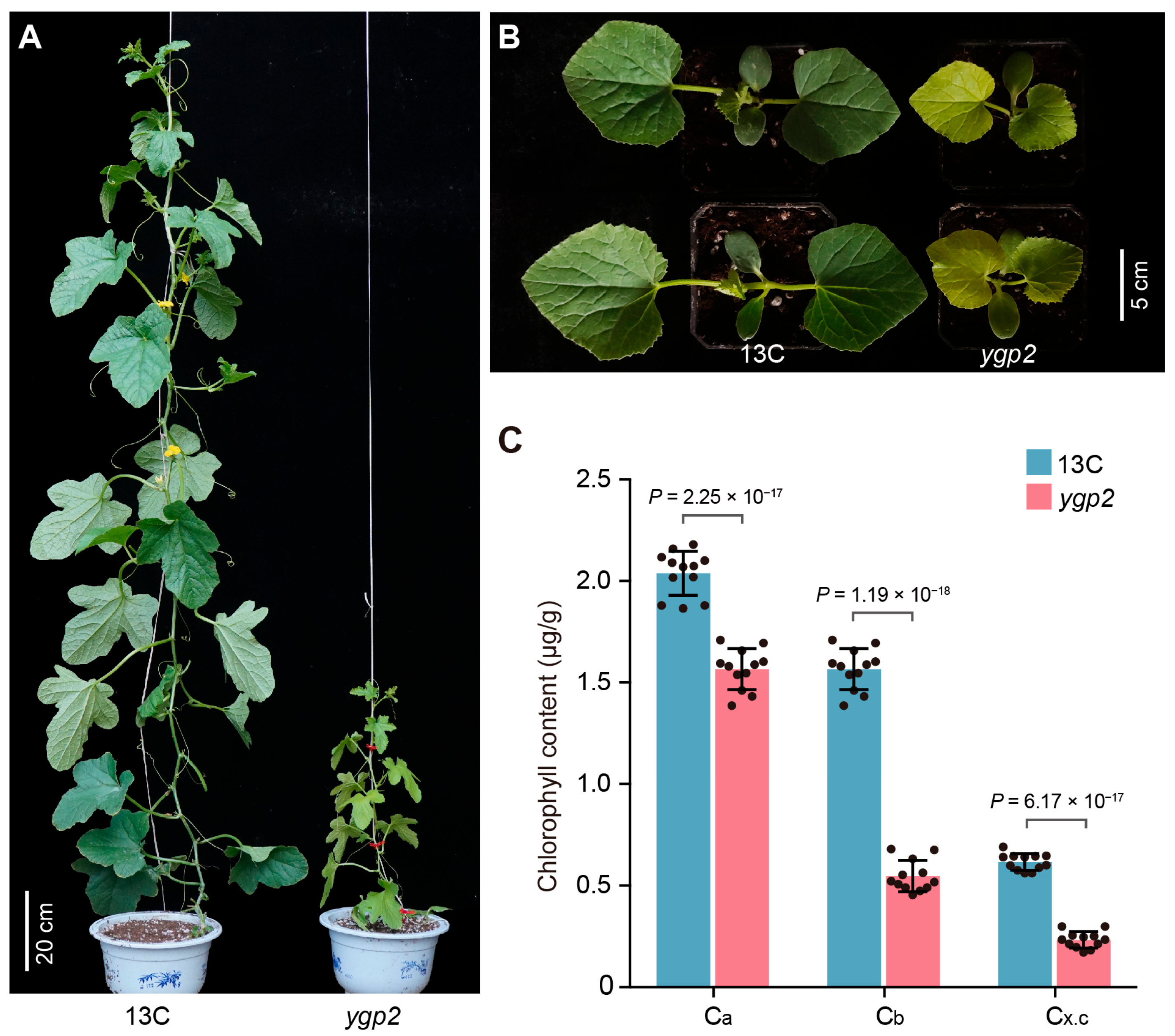
A yellow-green plant mutant, designated ‘ygp2’, was originally discovered from the M2 lines derived from an EMS-mutagenized population of Cucumis melo ssp. agrestis ‘13C’. In comparison with the wild-type ‘13C’, the ‘ygp2’ mutant consistently exhibited yellow-green cotyledons and true leaves throughout all developmental stages (Figure 1A,B). To quantitatively assess the pigment deficiency, chlorophyll and carotenoid contents were measured. As shown in Figure 1C, the mutant displayed a significant reduction in chlorophyll a, chlorophyll b, and total carotenoid content relative to the wild type.
Subsequently, to investigate the genetic inheritance basis of the ‘ygp2’ phenotype, an F2 population was generated by crossing the mutant with the wild-type ‘13C’. Notably, all F1 individuals displayed a normal leaf color identical to ‘13C’, indicating that the wild-type phenotype is dominant over the yellow-green trait. Among the 281 plants in the F2 population, 208 showed normal leaf color while 73 displayed the mutant phenotype, which fits a 3:1 Mendelian segregation ratio (χ2 = 0.144, p > 0.05). This genetic inheritance analysis clearly suggests that the yellow-green leaf phenotype in ‘ygp2’ is controlled by a single recessive nuclear gene (Table 1).

3.2. Map-Based Cloning and Candidate Gene Isolation in ‘ygp2’ Mutant

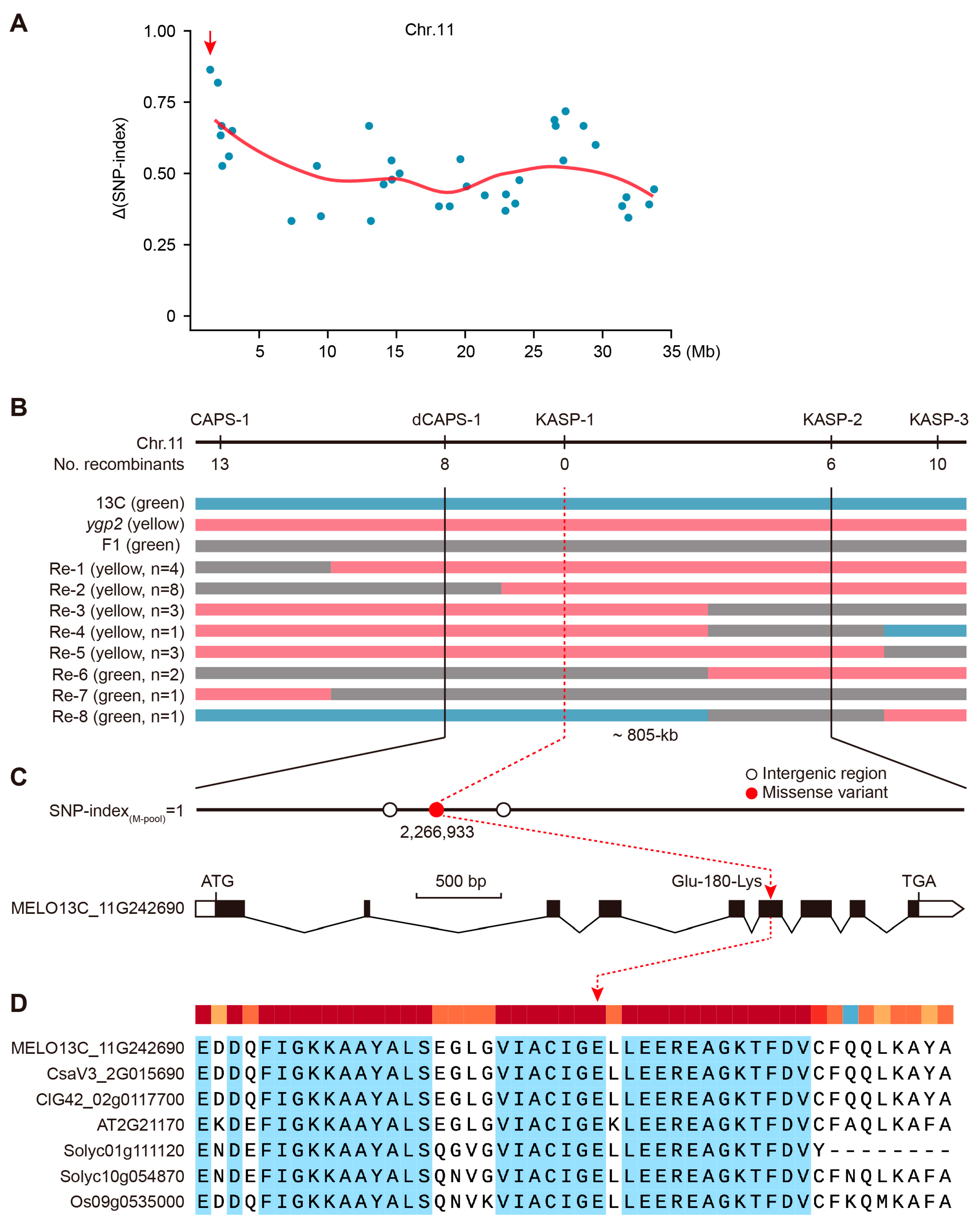
In order to identify the genomic region responsible for the yellow-green phenotype, a MutMap+ approach was employed. Specifically, 20 normal and 20 mutant plants from the F2 population were selected to construct wild-type (W-pool) and mutant (M-pool) bulks, respectively. Whole-genome resequencing of these pools was performed, followed by SNP-index analysis (Supplemental Figure S1). Initially, four loci with an SNP-index of 1 in the M-pool, located on chromosomes 1, 6, 8, and 11, were genotyped in the F2 population to test for linkage with the phenotype. Of these, only the marker at chr11_2266933 showed complete co-segregation with the mutant phenotype. Subsequently, 36 fixed SNPs (SNP-index = 1) from chromosome 11 were used to plot the ΔSNP-index curve, which revealed a clear peak encompassing the candidate region (Figure 2A). To further narrow down the interval, five additional SNPs flanking chr11_2266933 were converted into CAPS/dCAPS or KASP markers and genotyped in the 281 F2 plants. Using these six markers, the ygp2 locus was finally delimited to an 805 kb region between dCAPS-1 and KASP-2 (Figure 2B). Further examination of variants within this interval identified only three SNPs with an SNP-index of 1 in the M-pool. Among these, two were located in intergenic regions, while the third (chr11_2266933) was located within the gene MELO13C_11G242690, which encodes a triosephosphate isomerase (TPI). Importantly, this SNP resulted in a missense mutation (Figure 2C). Additionally, multiple sequence alignment demonstrated that the mutated residue lies within a highly conserved region of the TPI protein across plant species (Figure 2D, Supplemental Figure S2). Taken together, these results strongly indicate that the missense mutation in MELO13C_11G242690 is the causal variant underlying the ‘ygp2’ phenotype.

3.3. Expression Pattern, Phylogenetic Analysis and Subcellular Localization of CmTPI

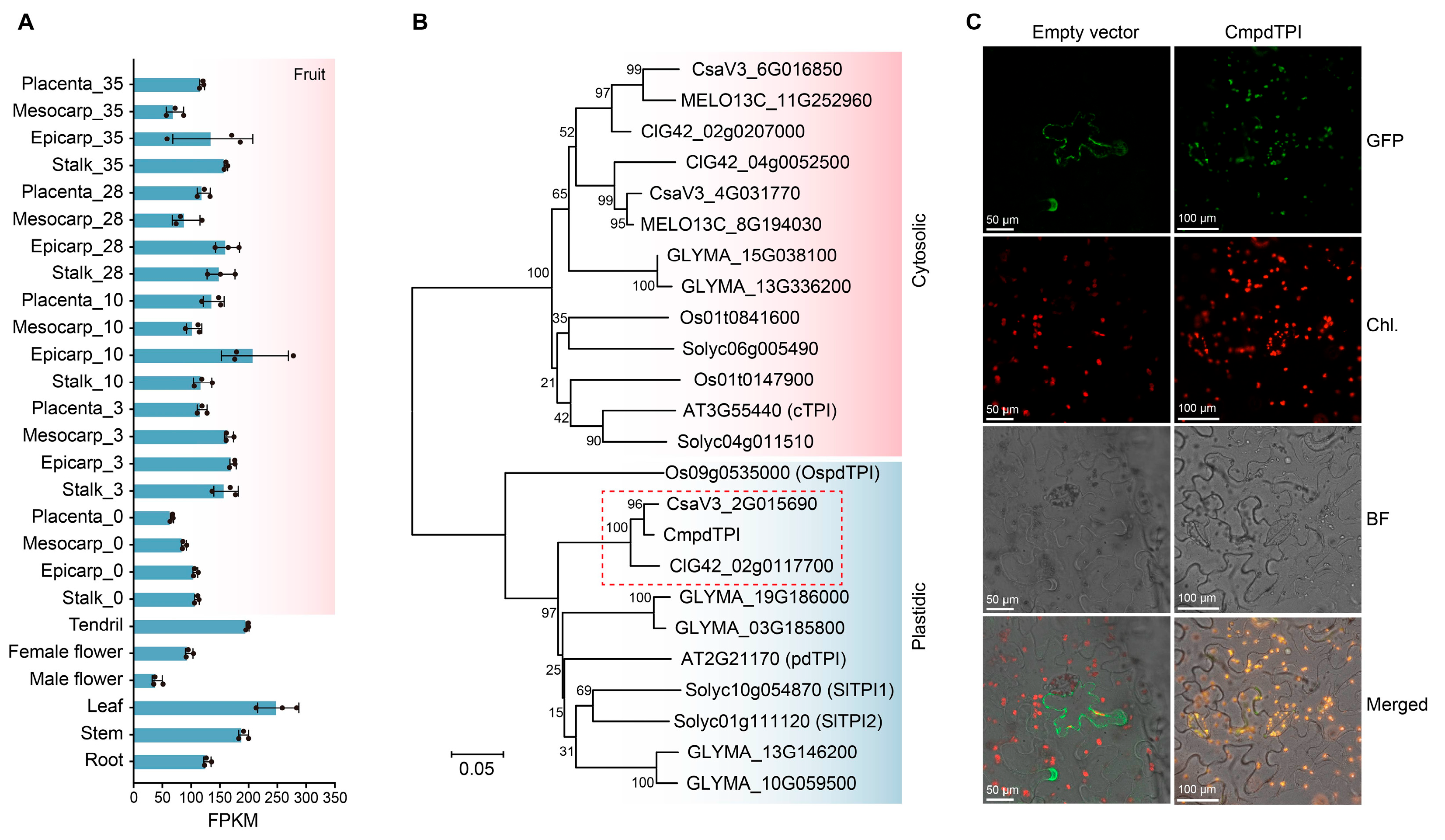
To gain insights into the biological characteristics of the candidate gene, we first analyzed its expression pattern using published transcriptome data [19]. As shown in Figure 3A, MELO13C_11G242690 exhibited no obvious tissue-specific expression, suggesting a constitutive role in plant development. Next, a phylogenetic analysis was conducted to evaluate the evolutionary relationship of CmTPI with TPIs from other species. Interestingly, plant TPIs formed two distinct clades, and CmTPI clustered within the clade containing plastid-localized TPIs from Arabidopsis and tomato, implying a potential plastid localization (Figure 3B). To experimentally verify this prediction, a CmTPI-GFP fusion construct was transiently expressed in tobacco leaves. Consistent with the phylogenetic inference, the GFP signal co-localized precisely with chlorophyll autofluorescence, confirming that CmTPI is localized to plastids (Figure 3C).

3.4. The ‘ygp2’ Mutant Exhibits Reduced TPI Enzyme Activity and Decreased Photosynthetic Rate

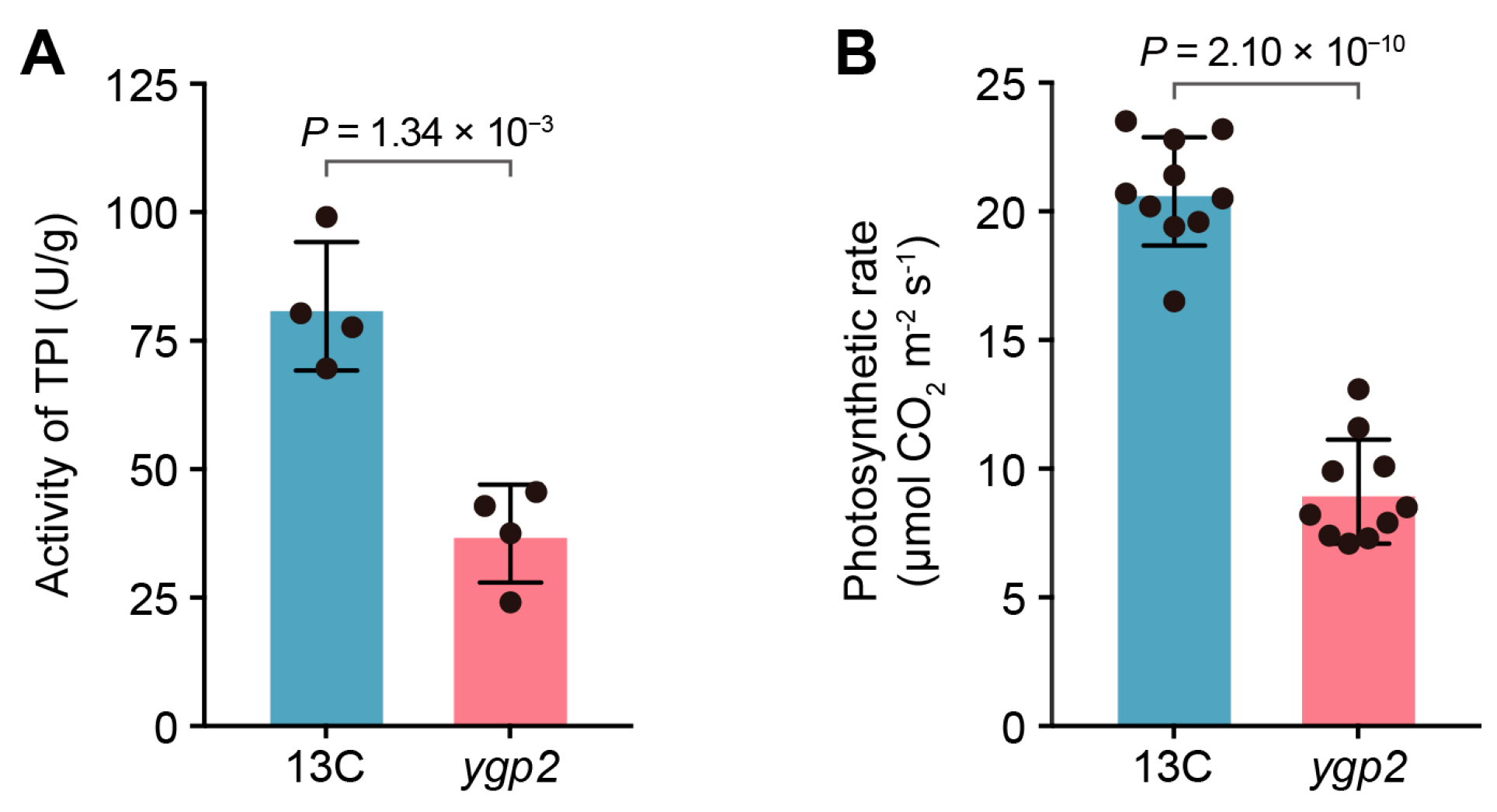
To directly assess the functional consequence of the identified missense mutation, total protein was extracted from leaves of both ‘13C’ and ‘ygp2’ for TPI enzyme activity assays. The results clearly demonstrated that the mutation severely impairs TPI function, leading to a 54% reduction in enzymatic activity in the mutant (Figure 4A). Given that TPI operates at a critical junction connecting glycolysis and the Calvin-Benson cycle, we reasoned that its impairment would have major physiological repercussions. Therefore, we measured the photosynthetic rate in both genotypes. As anticipated, the ‘ygp2’ mutant showed a substantial 56% decrease in the net photosynthetic rate compared to the wild type (Figure 4B), underscoring the central metabolic disruption caused by the TPI defect.

3.5. Transcriptome Analysis Identifies Alterations in Cell Division and Stress Response Pathways in ‘ygp2’

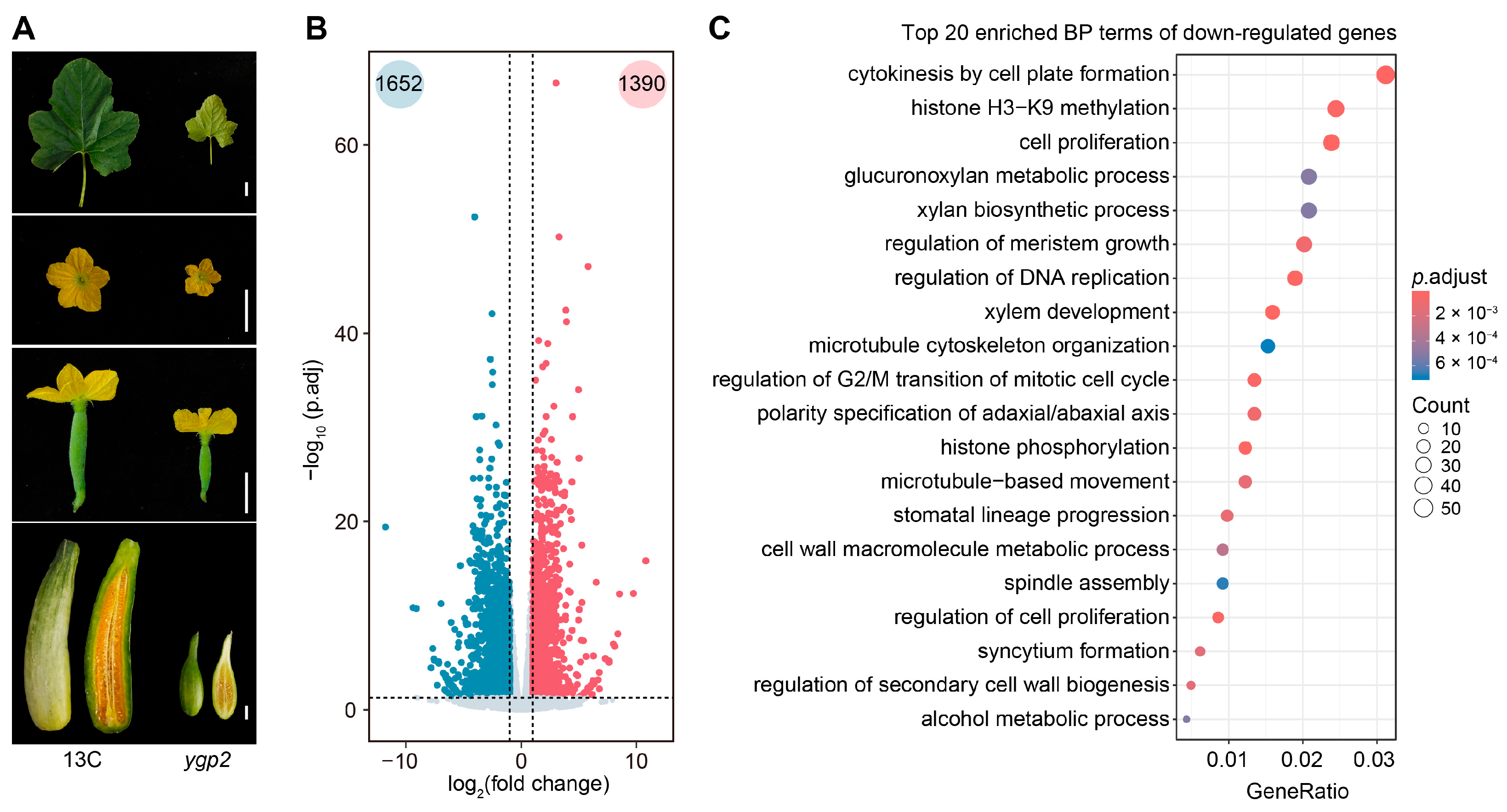
Beyond the visible yellow-green phenotype, the ‘ygp2’ mutant also displayed pleiotropic effects, including significantly reduced leaf size and smaller floral and fruit organs (Figure 5A). To comprehensively characterize the molecular changes associated with the CmTPI mutation, RNA-seq analysis was performed on leaves from ‘13C’ and ‘ygp2’. This analysis identified a total of 3252 differentially expressed genes (DEGs), with 1768 down-regulated and 1484 up-regulated in the mutant (Figure 5B).
Subsequent Gene Ontology (GO) enrichment analysis of the down-regulated DEGs revealed significant alterations in biological processes related to cell division and cytoskeleton organization. Specifically, terms such as cell proliferation (GO:0008283), regulation of the G2/M transition of the mitotic cell cycle (GO:0010389), microtubule-based movement (GO:0007018), and microtubule cytoskeleton organization (GO:0000226) were prominently enriched (Figure 5C, Supplemental Table S3). These transcriptional changes provide a plausible molecular explanation for the overall reduction in organ size observed in the mutant. Although pathways directly involved in photosynthesis or chlorophyll biosynthesis were not among the top-enriched terms, we noted the coordinated down-regulation of five genes encoding light-harvesting chlorophyll a/b-binding proteins (Supplemental Figure S3), which likely contributes to the decreased photosynthetic efficiency.
Conversely, GO analysis of the up-regulated DEGs showed significant enrichment in stress response and hormone signaling pathways. Notably, several jasmonic acid (JA)-associated processes were highly enriched, including response to jasmonic acid (GO:0009753), JA-mediated signaling pathway (GO:0009867), and JA biosynthetic process (GO:0009695) (Supplemental Figure S4A, Supplemental Table S4). Since JA is a key phytohormone involved in both defense and development, we further examined the expression of JA biosynthesis-related genes. A heatmap visualization of 29 JA pathway genes confirmed their widespread up-regulation in the ‘ygp2’ mutant (Supplemental Figure S4B), suggesting an activated JA signature that may link metabolic perturbation to stress and growth responses.

4. Discussion

In this study, we have identified and characterized a novel yellow-green mutant, ‘ygp2’, in melon (Figure 1). Utilizing a combination of forward genetics and next-generation sequencing, the phenotype was mapped to a single locus, and subsequent analysis revealed that it is caused by a missense mutation in the gene encoding a plastid-localized triosephosphate isomerase (CmpdTPI) (Figure 2). This mutation was functionally validated, demonstrating a significant reduction in TPI enzymatic activity, which in turn led to a severe decline in photosynthetic rate and the characteristic yellowing and dwarfism phenotypes. Therefore, our findings collectively establish that a loss-of-function mutation in CmpdTPI constitutes the molecular basis for the pleiotropic physiological and developmental defects observed in the ‘ygp2’ mutant. This conclusion aligns with the conserved, essential function of plastidial TPI (pdTPI) in supporting chloroplast development and photosynthetic carbon metabolism, as previously documented in model species like Arabidopsis [2] and in the related cucurbit, cucumber [11]. However, our results also reveal an important species-specific nuance. Unlike the situation in rice, where suppression of pdTPI induces metabolic plasticity without causing severe growth inhibition, the ‘ygp2’ mutant exhibits significant growth impairment [reference to contrasting species]. This discrepancy suggests that melon may be particularly sensitive to perturbations in the Calvin cycle flux, or alternatively, may lack the robust metabolic compensation mechanisms present in other species. This observation underscores the importance of investigating the function of core metabolic enzymes within specific crop contexts, as their physiological impact can vary considerably. While direct genetic complementation in melon remains technically challenging, the conserved function of TPI in cucumber, supported by our multi-omics data and the mutant phenotype, provides strong evidence for its role. We acknowledge that establishing a robust transformation system is required for definitive validation and is a recognized goal for future research.
Triosephosphate isomerase functions as a critical metabolic nexus, linking the plastidic Calvin cycle with cytosolic glycolysis. Consequently, its severe impairment directly disrupts chloroplast carbon metabolism and the energy (ATP/NADPH) homeostasis essential for photosynthesis [1], providing a straightforward explanation for the observed decline in photosynthetic rate. Yet the biological consequences of this primary metabolic lesion extend far beyond a simple reduction in carbon fixation. Our comprehensive transcriptomic analysis reveals that this localized metabolic perturbation triggers a widespread systemic transcriptional reprogramming. The core signature of this reprogramming is the concurrent and likely coordinated suppression of fundamental growth-related cellular processes and the pronounced activation of stress-adaptive and defense signaling pathways, which collectively shape the complex ‘ygp2’ phenotype (Figure 5, Supplemental Figure S4).
We propose that the growth suppression in ‘ygp2’ operates through two interconnected mechanistic layers. First, the metabolic and energetic scarcity resulting from impaired TPI activity, potentially sensed by cellular surveillance systems such as SnRK1 or sugar-signaling pathways, leads to the direct inhibition of genes governing cell division and cell cycle progression [22,23]. This establishes a primary “metabolic defect → resource signal → cell cycle inhibition” axis that fundamentally underlies the observed dwarfism and reduced organ size. Second, chloroplast dysfunction itself acts as a potent internal stressor. This stress is likely communicated to the nucleus via retrograde signaling molecules (e.g., MEcPP, ROS, or redox signals), which in turn strongly upregulate the jasmonic acid (JA) biosynthesis and signaling pathway [24]. The marked upregulation of JA-related pathways is thus interpreted primarily as a downstream consequence of this internal metabolic and retrograde stress, consistent with JA’s canonical role in stress adaptation. While this sustained JA activation may subsequently contribute to growth suppression by further antagonizing cell division and elongation [25], thereby creating a secondary loop that exacerbates the overall growth restriction, its precise causal necessity requires future validation through interventional studies, such as employing JA inhibitors or mutants in the ygp2 background. Thus, a single enzymatic defect at a central metabolic node effectively propagates dysregulated signals into both developmental and stress-response programs. This disrupts the plant’s critical growth-defense balance, ultimately shifting resource allocation toward defense activation at the expense of developmental growth. Our study thereby illustrates how metabolic homeostasis within the chloroplast serves as a central regulator, interactively governing plant development and environmental adaptation.
Looking forward, the ‘ygp2’ mutant serves as a valuable genetic resource for further dissecting the signaling networks that connect chloroplast metabolism with nuclear gene expression and overall plant architecture in cucurbits. Understanding these connections in melon may inform strategies for optimizing the balance between growth and stress resilience in this economically important crop.

5. Conclusions

In summary, this study identifies the plastid-localized CmpdTPI gene as the causal locus for the yellow-green and dwarf ‘ygp2’ mutant in melon. A missense mutation in CmpdTPI severely compromises its enzymatic activity, leading to a direct inhibition of photosynthetic carbon assimilation. This primary metabolic defect triggers a systemic transcriptional reprogramming, which concurrently suppresses cell cycle progression and activates jasmonic acid-mediated stress responses, thereby explaining the dual characteristics of growth inhibition and defense activation in the mutant. Our findings underscore the critical role of pdTPI in maintaining metabolic homeostasis and integrating growth-defense trade-offs in melon, establishing ‘ygp2’ as a valuable genetic resource for further study of chloroplast-to-nucleus communication in crops.

Supplementary Materials

The following supporting information can be downloaded at: https://www.mdpi.com/article/10.3390/horticulturae12020220/s1, Figure S1: MutMap+ analysis of ‘ygp2’ mutant; Figure S2: TPI proteins alignment among six species (Oryza sativa; Solanum lycopersicum; Arabidopsis thaliana; Cucumis sativus; Cucumis melo; Citrullus_lanatus); Figure S3: Five down-regulated LHCB (light-harvesting chlorophyll a/b-binding) proteins in ‘ygp2’ mutant; Figure S4: JA biosynthetic and signaling pathway was enriched with up-regulated genes in ‘ygp2’ mutant; Table S1: Primers used in this study; Table S2: DEGs between ‘13C’ and ‘ygp2’; Table S3: GO enrichment of down-regulated genes in ‘ygp2’; Table S4: GO enrichment of up-regulated genes in ‘ygp2’.

Author Contributions

Conceptualization, S.L. and S.C.; genetic mapping and functional validation, S.D., H.L. and W.D.; cultivation of melon genetic materials and phenotype collection, P.L., C.G., J.S., Y.D., Z.J., C.W. (Chongqi Wang), Z.Z., F.C. and S.W.; data analysis, S.L., S.C. and Y.L.; writing—original draft preparation, S.L.; writing—review and editing, S.C., X.L. and C.W. (Chaonan Wang); funding acquisition, C.W. (Chaonan Wang), S.L. and X.L. All authors have read and agreed to the published version of the manuscript.

Funding

This research was supported by the Major Science and Technology Special Project of Xinjiang Uygur Autonomous Region (2024A02007-1); the earmarked fund for CARS (CARS-25); the National Natural Science Foundation of China (32202509); the Shandong Academy of Agricultural Sciences Innovation Engineering Project (CXGC2025G04, CXGC2025A01).

Data Availability Statement

The original contributions presented in this study are included in the article/Supplementary Material. Further inquiries can be directed to the corresponding author.

Conflicts of Interest

The authors declare no conflicts of interest.

References

  1. Yang, S.; Wang, X.; Yan, W.; Zhang, Y.; Song, P.; Guo, Y.; Xie, K.; Hu, J.; Hou, J.; Wu, Y.; et al. Melon yellow-green plant (Cmygp) encodes a Golden2-like transcription factor regulating chlorophyll synthesis and chloroplast development. Theor. Appl. Genet. 2023, 136, 66. [Google Scholar] [CrossRef]
  2. Chen, M.; Thelen, J.J. The essential role of plastidial triose phosphate isomerase in the integration of seed reserve mobilization and seedling establishment. Plant Signal. Behav. 2010, 5, 583–585. [Google Scholar] [CrossRef]
  3. Chen, M.; Thelen, J.J. The Plastid Isoform of Triose Phosphate Isomerase Is Required for the Postgerminative Transition from Heterotrophic to Autotrophic Growth in Arabidopsis. Plant Cell 2010, 22, 77–90. [Google Scholar] [CrossRef] [PubMed]
  4. Kurzok, H.-G.; Feierabend, J. Comparison of a cytosolic and a chloroplast triosephosphate isomerase isoenzyme from rye leaves: I. Purification and catalytic properties. Biochim. et Biophys. Acta (BBA)-Protein Struct. Mol. Enzym. 1984, 788, 214–221. [Google Scholar] [CrossRef]
  5. López-Castillo, L.M.; Jiménez-Sandoval, P.; Baruch-Torres, N.; Trasviña-Arenas, C.H.; Díaz-Quezada, C.; Lara-González, S.; Winkler, R.; Brieba, L.G. Structural Basis for Redox Regulation of Cytoplasmic and Chloroplastic Triosephosphate Isomerases from Arabidopsis thaliana. Front. Plant Sci. 2016, 7, 1817. [Google Scholar] [CrossRef]
  6. Tang, G.L.; Wang, Y.F.; Bao, J.S.; Chen, H.-B. Overexpression in Escherichia coli and Characterization of the Chloroplast Fructose-1,6-bisphosphatase from Wheat. Protein Expr. Purif. 2000, 19, 411–418. [Google Scholar] [CrossRef]
  7. Turner, D.H.; Blanch, E.S.; Gibbs, M.; Turner, J.F. Triosephosphate Isomerase of Pea Seeds. Plant Physiol. 1965, 40, 1146–1150. [Google Scholar] [CrossRef] [PubMed]
  8. Henze, K.; Schnarrenberger, C.; Kellermann, J.; Martin, W. Chloroplast and cytosolic triosephosphate isomerases from spinach: Purification, microsequencing and cDNA cloning of the chloroplast enzyme. Plant Mol. Biol. 1994, 26, 1961–1973. [Google Scholar] [CrossRef]
  9. Reyes-Prieto, A.; Bhattacharya, D. Phylogeny of Calvin cycle enzymes supports Plantae monophyly. Mol. Phylogenetics Evol. 2007, 45, 384–391. [Google Scholar] [CrossRef]
  10. Schmidt, M.; Svendsen, I.; Feierabend, J. Analysis of the primary structure of the chloroplast isozyme of triosephosphate isomerase from rye leaves by protein and cDNA sequencing indicates a eukaryotic origin of its gene. Biochim. Biophys. Acta (BBA)-Gene Struct. Expr. 1995, 1261, 257–264. [Google Scholar] [CrossRef]
  11. Suzuki, Y.; Shiina, M.; Takegahara-Tamakawa, Y.; Miyake, C.; Makino, A. Overexpression of Chloroplast Triosephosphate Isomerase Marginally Improves Photosynthesis at Elevated CO2 Levels in Rice. Plant Cell Physiol. 2022, 63, 1500–1509. [Google Scholar] [CrossRef]
  12. Xiong, L.; Du, H.; Zhang, K.; Lv, D.; He, H.; Pan, J.; Cai, R.; Wang, G. A Mutation in CsYL2.1 Encoding a Plastid Isoform of Triose Phosphate Isomerase Leads to Yellow Leaf 2.1 (yl2.1) in Cucumber (Cucumis sativus L.). Int. J. Mol. Sci. 2020, 22, 322. [Google Scholar] [CrossRef]
  13. Chen, C.; Zhang, M.; Ma, X.; Meng, Q.; Zhuang, K. Differential heat-response characteristics of two plastid isoforms of triose phosphate isomerase in tomato. Plant Biotechnol. J. 2024, 22, 650–661. [Google Scholar] [CrossRef] [PubMed]
  14. Zaffagnini, M.; Michelet, L.; Sciabolini, C.; Di Giacinto, N.; Morisse, S.; Marchand, C.H.; Trost, P.; Fermani, S.; Lemaire, S.D. High-Resolution Crystal Structure and Redox Properties of Chloroplastic Triosephosphate Isomerase from Chlamydomonas reinhardtii. Mol. Plant 2014, 7, 101–120. [Google Scholar] [CrossRef] [PubMed]
  15. Sartory, D.P.; Grobbelaar, J.U. Extraction of chlorophyll a from freshwater phytoplankton for spectrophotometric analysis. Hydrobiologia 1984, 114, 177–187. [Google Scholar] [CrossRef]
  16. Fekih, R.; Takagi, H.; Tamiru, M.; Abe, A.; Natsume, S.; Yaegashi, H.; Sharma, S.; Sharma, S.; Kanzaki, H.; Matsumura, H.; et al. MutMap+: Genetic Mapping and Mutant Identification without Crossing in Rice. PLoS ONE 2013, 8, e68529. [Google Scholar] [CrossRef]
  17. Kumar, S.; Stecher, G.; Suleski, M.; Sanderford, M.; Sharma, S.; Tamura, K. MEGA12: Molecular Evolutionary Genetic Analysis Version 12 for Adaptive and Green Computing. Mol. Biol. Evol. 2024, 41, msae263. [Google Scholar] [CrossRef]
  18. Kim, D.; Langmead, B.; Salzberg, S.L. HISAT: A fast spliced aligner with low memory requirements. Nat. Methods 2015, 12, 357–360. [Google Scholar] [CrossRef]
  19. Xu, Y.; Liu, B.; Li, Y.; Chen, X.; Yan, C.; Liu, Y.; Wang, H.; Wang, J.; Dong, W.; Deng, S.; et al. A comprehensive omics resource and genetic tools for genetic research and precision breeding of Cucumis melo ssp. agrestis. Plant Cell 2025, 37, msae263. [Google Scholar] [CrossRef]
  20. Pertea, M.; Pertea, G.M.; Antonescu, C.M.; Chang, T.-C.; Mendell, J.T.; Salzberg, S.L. StringTie enables improved reconstruction of a transcriptome from RNA-seq reads. Nat. Biotechnol. 2015, 33, 290–295. [Google Scholar] [CrossRef]
  21. Love, M.I.; Huber, W.; Anders, S. Moderated estimation of fold change and dispersion for RNA-seq data with DESeq2. Genome Biol. 2014, 15, 550. [Google Scholar] [CrossRef]
  22. Baena-González, E.; Sheen, J. Convergent energy and stress signaling. Trends Plant Sci. 2008, 13, 474–482. [Google Scholar] [CrossRef] [PubMed]
  23. Skylar, A.; Sung, F.; Hong, F.; Chory, J.; Wu, X. Metabolic sugar signal promotes Arabidopsis meristematic proliferation via G2. Dev. Biol. 2011, 351, 82–89. [Google Scholar] [CrossRef] [PubMed]
  24. de Souza, A.; Wang, J.-Z.; Dehesh, K. Retrograde Signals: Integrators of Interorganellar Communication and Orchestrators of Plant Development. Annu. Rev. Plant Biol. 2017, 68, 85–108. [Google Scholar] [CrossRef] [PubMed]
  25. Yang, D.-L.; Yao, J.; Mei, C.-S.; Tong, X.-H.; Zeng, L.-J.; Li, Q.; Xiao, L.-T.; Sun, T.-P.; Li, J.; Deng, X.-W.; et al. Plant hormone jasmonate prioritizes defense over growth by interfering with gibberellin signaling cascade. Proc. Natl. Acad. Sci. USA 2012, 109, E1192–E1200. [Google Scholar] [CrossRef]
Figure 1. Phenotype analysis of ‘ygp2’ mutant. (A) Phenotype of ‘13C’ and ‘ygp2’ plants in the adult stage. Bar, 20 cm. (B) Phenotype of ‘13C’ and ‘ygp2’ plants in the seedling stage. (C) Measurement of pigment concentration in ‘13C’ and ‘ygp2’ leaves (two-tailed Student’s t-test), Ca stands for chlorophyll a, Cb for chlorophyll b, and Cx.c for carotenoids.
Horticulturae 12 00220 g001
Figure 2. Map-based cloning and candidate gene isolation in ‘ygp2’. (A) Localized presentation of MutMap+ results (Chr11). (B) Map-based cloning of ‘ygp2’ mutant. (C) Identification of the key variation within the mapped interval between ‘13C’ and ‘ygp2’ mutant. (D) Alignment of MELO13C_11G242690 with its homologs from diverse species. The arrow indicates the mutation site in the ‘ygp2’ mutant. Blue shading indicates protein similarity >90%.
Horticulturae 12 00220 g002
Figure 3. Expression patterns, phylogenetic analysis and subcellular localization of CmpdTPI. (A) CmpdTPI expression analysis among different tissues. 0, 3, 10, 28, 35 represent days after pollination (DAP). (B) Phylogenetic analysis of TPI proteins among seven species (Oryza sativa; Solanum lycopersicum; Arabidopsis thaliana; Glycine max; Cucumis sativus; Cucumis melo; Citrullus_lanatus). (C) Subcellular localization of CmpdTPI protein.
Horticulturae 12 00220 g003
Figure 4. TPI activity and photosynthetic rate comparison between ‘13C’ and ‘ygp2’ mutants. (A) Measurement of TPI enzyme activity in ‘13C’ and ‘ygp2’ mutant (two-tailed Student’s t-test). (B) Comparison of photosynthetic rate between ‘13C’ and ‘ygp2’ mutant (two-tailed Student’s t-test).
Horticulturae 12 00220 g004
Figure 5. RNA-seq analysis of DEGs between ‘13C’ and ‘ygp2’ mutant. (A) Phenotypic comparison of various organs between ‘13C’ and ‘ygp2’ mutants; bars, 2 cm. (B) Volcano plot of differentially expressed genes from transcriptome data. (C) Top 20 BP terms from GO enrichment analysis of down-regulated genes in ‘ygp2’ mutant.
Horticulturae 12 00220 g005
Table 1. Inheritance analysis of the yellow-green plant phenotype in ‘ygp2’ mutant.
GenerationPlantsNormalYellow-Green PlantExpected Ratioχ2p-Value
F120200---
F2281208733:10.1440.705
Disclaimer/Publisher’s Note: The statements, opinions and data contained in all publications are solely those of the individual author(s) and contributor(s) and not of MDPI and/or the editor(s). MDPI and/or the editor(s) disclaim responsibility for any injury to people or property resulting from any ideas, methods, instructions or products referred to in the content.