Article

Climate Change Effect on Polyphenols of Grignolino Grapes (Vitis vinifera L.) in Hilly Environment


1
CREA Research Centre for Viticulture and Enology, 14100 Asti, Italy
2
Associazione Monferace, 15022 Ponzano Monferrato, Italy
3
Independent Researcher, 14036 Moncalvo, Italy
*
Authors to whom correspondence should be addressed.
Horticulturae 2026, 12(2), 206; https://doi.org/10.3390/horticulturae12020206
Submission received: 24 December 2025 / Revised: 2 February 2026 / Accepted: 3 February 2026 / Published: 6 February 2026

Abstract

Climate change is modifying ecoclimatic conditions, including temperature, solar radiation, and water availability, with significant impacts on grapevine phenology, berry ripening, and the polyphenolic composition of grapes cultivated in temperate regions. The influence of different meteorological conditions during ripening on the polyphenolic composition of Grignolino grapes grown in a hilly environment was investigated. Grapes were collected, over three vintages, from three vineyards differing in their vine age and bunch microclimate due to having different vineyard aspects. We considered a comparable berry weight, moderate rainfall and cool conditions before veraison, followed by a warm and dry pre-harvest stage that enhanced the phenolic and especially the anthocyanin index in the grapes (e.g., 360 mg kg−1 in 2021 versus 260 mg kg−1 in 2020). Intense heat and dry conditions reduced the berry weight, leading to an increase in both flavonols and hydroxycinnamoyl tartaric acids, particularly in the younger, southwest-exposed vineyard. Older vines with a cooler aspect were the most resilient to different meteorological conditions, while young vines showed greater variability over the years. The phenolic composition was strongly influenced by the intensity and the timing of thermal stress, and eventually on limited water availability during ripening; it also depended on the vine age and the vineyard microclimate determined by the hillside aspect. This knowledge may support adaptive strategies to preserve grape quality under climate change.

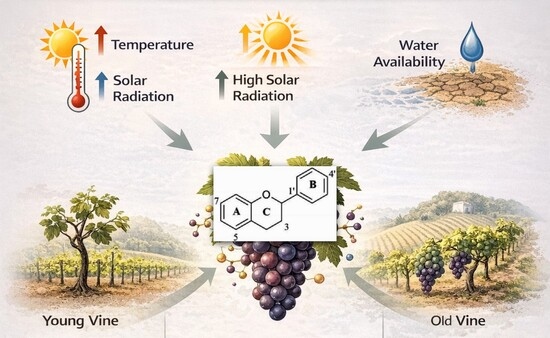
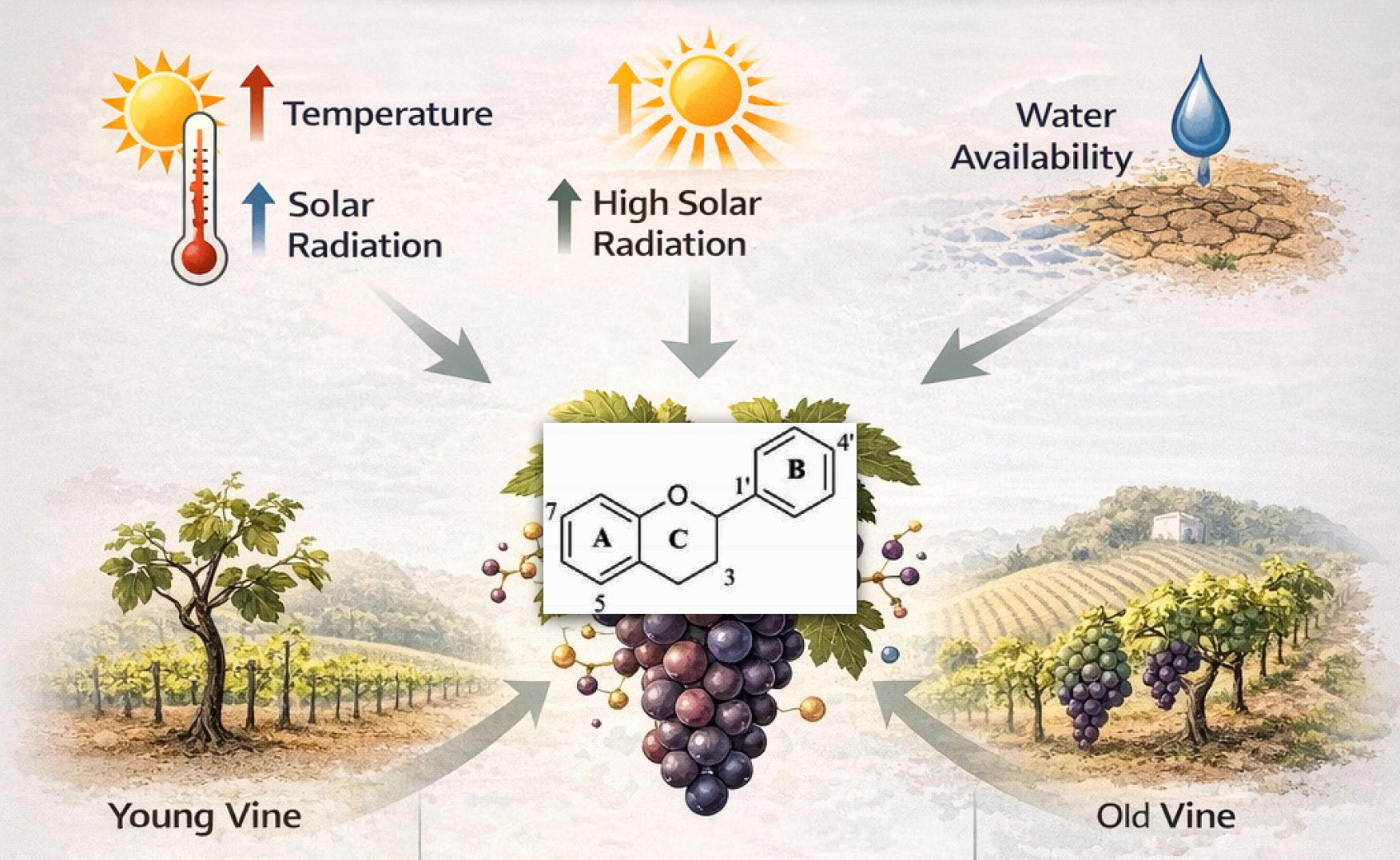
Graphical Abstract

1. Introduction

Grapevine cultivation is highly sensitive to climate variability, which significantly influences both phenology and grape composition. Wine-producing regions worldwide are being increasingly affected by climate change, particularly in temperate zones where rising average seasonal temperatures, a reduced rainfall, and altered precipitation patterns during ripening are evident.
Climate change has intensified the decoupling of technological, phenolic, and aromatic maturity, because these traits rely on distinct biosynthetic pathways and therefore respond differently to environmental conditions. Shifts in abiotic factors, such as the temperature, atmospheric CO2 concentration, solar radiation, and water availability, directly affect vine development and fruit quality [1,2,3]. Among the most pronounced consequences of climate change, an increase in average and extreme summer temperatures, coupled with altered precipitation patterns during the ripening period, is unfolding. These changes lead to accelerated sugar accumulation, modifications in grape acid profiles, and substantial alterations in the composition of secondary metabolites that significantly affect both the wine alcohol content and the final product quality [4,5,6].
Solar radiation, for example, plays a critical role in modulating the berry’s metabolic profile, promoting ripening by stimulating the synthesis and accumulation of key compounds in the skin—such as sugars, organic acids, amino acids, and phenylpropanoids [7]. More specifically, high solar radiation and elevated post-veraison temperatures have been shown to accelerate ripening, occurring during the hottest part of the season [8]. Conversely, milder spring and ripening temperatures, together with late-season rainfall near veraison, can delay ripening and produce grapes with a lower pH, higher total acidity, and enhanced aromatic potential [9]. However, separating the specific effects of solar radiation from those of elevated temperatures remains a challenge. A further critical concern is the shift in rainfall regimes. Significant reductions in precipitation, particularly during ripening, and changes in its temporal distribution further complicate the dynamics of berry development and the final grape composition [3].
As a result, in several viticultural regions, ripening now occurs under suboptimal conditions, potentially compromising berry color and aroma development [10,11], leading to reduced wine typicity and terroir expression [12]. Many of the subtle variations in color, flavor, and mouthfeel among red wines from different terroirs are linked to polyphenols, primarily accumulated in berry skins. While polyphenol profiles are genetically determined, their accumulation and final grape contents are strongly influenced by environmental conditions [13].
High temperatures and frequent thermal extremes may impact the accumulation, particularly of flavonoids such as anthocyanins, flavonols, and proanthocyanidins, which show different responses to heat stress [14].
The anthocyanin profile and concentration in grape skins mainly depend on the variety [15,16], but also on berry temperature, solar exposure [17,18,19,20,21,22] and water availability [23,24,25,26,27]. Heat stress around veraison reduces anthocyanin accumulation [10,28,29], also causing shifts in the anthocyanin profile; it has no significant effect on malvidin levels, but other anthocyanins decrease markedly [10,28,29,30,31].
Among polyphenolic compounds, proanthocyanidins exhibit variable responses depending on the grape cultivar and the intensity of the stress conditions [32]. Despite considerable research, the effects of a high temperature on flavan-3-ol biosynthesis and proanthocyanidin (PA) accumulation remain unclear, and contrasting results have emerged, often showing no or a negative effect [33,34,35,36].
Flavonols are key UV-protective compounds in plant tissues [15,19,25,37,38], accumulating at flowering and again 3–4 weeks after veraison in the grape berry skin. Their synthesis is stimulated by solar and UV radiation [39], whereas shading significantly reduces flavonol accumulation [40,41]. Generally, reductions in photosynthesis at the whole-vine level seem to limit the supply of precursors for flavonol biosynthesis [30,31,42,43]. The effect of elevated temperatures, instead, on the flavonol concentration remains unclear and surely depends on the experimental conditions [44,45].
From an oenological point of view, flavonols contribute to wine quality by stabilizing anthocyanin color through co-pigmentation [46,47] and by enhancing the perceived quality via their bitterness [48]. Nevertheless, high quercetin concentrations present an emerging challenge, as they are linked to precipitation and turbidity in bottled wines, negatively affecting the visual quality and consumer perception [49].
Hydroxycinnamic acids esterified with tartaric acid (HCTAs) are the most abundant non-flavonoid phenolics in grape berries [45]. Although knowledge on their accumulation in berries and the influence of environmental factors remains0 limited, increased light exposure by leaf removal has been shown to enhance HCTA concentrations in the berry skins of Tempranillo and Istrian Malvasia [50,51].
Moreover, the vineyard aspect may strongly affect the bunch microclimate and, consequently, phenolic compound synthesis. Southwest-facing slopes receive higher solar radiation and temperatures, accelerating ripening and enhancing flavonol and anthocyanin accumulation [20], but potentially promoting degradation under heat and water stress [32]. In contrast, southeast-facing vineyards provide a more balanced microclimate, with slower ripening, better acidity preservation, and a more balanced phenolic profile, which is especially advantageous in warm vintages.
Furthermore, vine age can influence plant responses to climate change [52]. Younger vines, with less-developed root systems, are generally more sensitive to water stress and show an altered physiological behavior compared to older vines. They tend to exhibit lower photosynthetic rates, stomatal conductance, and transpiration [53], resulting in slower initial berry development, but more rapid ripening thereafter, and thus, earlier technological maturity than older vines [54].
Grignolino is a late-ripening cultivar; the grapes are rich in proanthocyanidins, particularly in the seeds, while their skins contain low levels of anthocyanin, dominated by di-hydroxylated forms, resulting in wines with a low color intensity. Depending on the cultivation site, the grapes do not always reach adequate technological maturity, as within the same cluster, the berries often mature unevenly, with fully ripe and less-ripened berries coexisting. Lately, the anticipation of the phenological stages caused by climate change, brrought to a better balance between sugar and acidity in hilly vineyards, making winemaking more manageable and enhancing the expressive potential of this grape variety. In particular, the vineyards located in the Monferrato area of Piedmont, on hillsides with optimal sun exposure, are known to produce wines with a pronounced astringency, acidity, and aromatic complexity and remarkable aging potential; the so-called “Monferace” wine is a style of wine specifically intended for long-term aging [55].
The influence exerted by different meteorological conditions on the aromatic potential of Grignolino grapes in the Monferrato region has already been investigated [56]. Therefore, the aim of this three-year study was to complete previous research, by assessing how recent climate-driven meteorological conditions may affect the final polyphenolic profile and composition of Grignolino grapes cultivated in a hilly environment, and which conditions impact mostly on the polyphenolic evolution during maturation.

2. Materials and Methods

2.1. Vineyard Sites, Meteorological Assessment and Grape Technological Composition

The Grignolino grapes used in this study were sourced from vineyards located in a hilly area at approximately 300 m a.s.l. in the Monferrato area of Piedmont (northwestern Italy), between the Po and Tanaro rivers, and cultivated in accordance with the voluntarily established production guidelines of the Monferace Association for “Monferace” wine production. The vineyards were established on calcareous–marly soils typical of the Monferrato viticultural area. This study complements previous research on the aroma profile of Grignolino grapes [56]. Briefly, the study was conducted over three consecutive growing seasons (2020–2022) on Grignolino grapes collected from three commercial vineyards located near Vignale Monferrato (45°00′45″ N, 8°23′51″ E; Piedmont, Italy). Vines were grafted onto 1103 Paulsen rootstock, trained to a Guyot system, and planted on hilly terrain with a density ranging from 4500 to 5000 vines ha−1. One vineyard consisted of 20-year-old vines with southwest exposure (Young-SW), while two vineyards consisted of 50-year-old vines with southeast (Old-SE) and southwest (Old-SW) exposures. All vineyards were rainfed, and no emergency irrigation was applied during the study period.
Each vineyard was divided into three biological replicates. At ripening, approximately 15 clusters per replicate were hand-harvested, and 500 berries were randomly collected from both sun-exposed and shaded sides. The samples were used for phenolic analyses and for measuring the berry weight, total soluble solids (TSS), titratable acidity (TA) and pH following OIV methods [57].
Weather data (2020–2022) were obtained from a nearby Arpa Piemonte station [56]. The parameters included the average Tmax and Tmin, number of days with T > 35 °C, total rainfall, and rainy days (RD ≥ 1 mm) (Table 1). Growing degree days (GDD) were calculated from April 1 to September 30 (base: 10 °C) [58]. To better assess seasonal effects, climatic variables were also analyzed for the pre-veraison (April–August) and post-veraison (August–September) periods.

2.2. Polyphenolic Characterization in Grapes

2.2.1. Polyphenolic Extraction from Skins and Seeds

Three replicates of 50 berries were chosen each time from a pool of 500 berries for each cultivar and then weighed. The seeds and skins were separated from the berry mesocarp, and the intact tissues (i.e., whole seeds or skins) were placed separately in 125 mL of a tartaric buffer (5 g L−1, pH of 3.2, 12% v/v ethanol, 2 g L−1 of Na2S2O5). The extraction was carried out at 25 °C for 4 h; after homogenization and centrifugation (4000 g × 15 min), the extracts were kept at −20 °C.

2.2.2. Spectrophotometric Determinations

Determination of the polyphenolic fraction from the grapes was performed according to previous works [59]. The total polyphenol content (TPI, total polyphenol index) was determined using the Folin–Ciocalteu method, whereas the determination of anthocyanins (TAI, total anthocyanin index), flavonoids (TFI, total flavonoid index), and proanthocyanidins (PAI index) was carried out spectrophotometrically as described by Di Stefano and co-workers, with some revisions [6]. The results were expressed in relation to both the berry weight (mg per kg of berries) and a singular berry (mg per berry) as malvidin 3-O-glucoside in the case of anthocyanins, catechin in the case of the TPI and TFI, and cyanidin chloride in the case of proanthocyanidins.

2.2.3. HPLC Determinations

Flavonols, HCTAs and the profile of anthocyanins in berry skins were detected by a HPLC diode array system (Agilent Technologies 1200 Series liquid chromatography system, Santa Clara, CA, USA) equipped with an ODS Hypersil RP-18 column (100 × 2.1 mm i.d.; Thermo Fisher Scientific, Waltham, MA, USA).
Hydroxycinnamic acids (HCTAs) and flavonols in the skins were determined according to previous research [60]. The skin extract was diluted 1:1 with 1 M phosphoric acid and then filtered with a 0.2 µm polypropylene syringe filter. Phosphoric acid 10-3 M (solvent A) and 100% methanol (solvent B) were used as the mobile phases. A gradient between 5 and 100% of solvent B over 40 min at a flow rate of 0.25 mL min−1 was used.
Flavonols and HCTAs were detected, respectively, at 360 and 320 nm, identified by comparison with the DAD spectrum and the retention time of each chromatographic peak with previously available data and by the injection of the standard compound solutions [61]. The flavonol concentration was calculated with the external standard method by using solutions of the respective aglycone standards (myricetin, quercetin, kaempferol) and by calculating the molecular weight ratio between each flavonol and the corresponding aglycone form. The quantification of HCTAs was carried out as p-coumaric equivalents (in the case of p-coumaroyl acid), as caffeic acid equivalents (in the case of caffeoyl tartaric acids) and as ferulic acid equivalents (in the case of trans-feruloyl tartaric acid), using external standards of p-coumaric acid, caffeic acid and ferulic acid. The obtained results were multiplied by the molecular weight ratio between HCTAs and the corresponding acid. The results for single compounds were expressed in relation to berry weight (kg of berries) and, for total flavonols and HCTAs, both as mg per 50 berries and mg per kg of berries.
The profile of anthocyanins in berry skins was detected by HPLC/DAD; formic acid:water (10:90, v/v) and formic acid:methanol:water (10:50:40, v/v) were used as solvents A and B, respectively, establishing a linear gradient between 28% B and 90% B over 53 min at a flow rate of 1 mL min−1. Anthocyanin detection was carried out at 520 nm with a diode array detector. Individual anthocyanins were identified by comparison with each anthocyanin standard and reported as percentages.

2.3. Statistical Analysis

Statistical analyses were carried out using XLSTAT-Pro (Addinsoft, Paris, France, 2017). The effects of the vintage, vineyard, and their interaction (vineyard × year) on the berry physical, chemical, and polyphenolic compositions were evaluated by a two-way ANOVA. Mean separation was performed using Tukey’s HSD test at a 95% confidence level (p < 0.05). To investigate the relationships among meteorological parameters, vineyard sites, vintages, and polyphenol classes, a multivariate approach was applied by a principal component analysis (PCA) using XLSTAT software.

2.4. Chemicals and Reagents

All chemicals and reagents used were of analytical or HPLC grade. Tartaric acid, ethanol, sodium metabisulfite (Na2S2O5), phosphoric acid, methanol, formic acid, and Folin–Ciocalteu reagent were purchased from Sigma-Aldrich (St. Louis, MO, USA), unless otherwise stated. Ultrapure water was obtained using a Milli-Q purification system (Millipore, Bedford, MA, USA). The standards used for the spectrophotometric analyses included catechin, malvidin-3-O-glucoside, and cyanidin chloride (Sigma-Aldrich, St. Louis, MO, USA).
For the HPLC analyses, quercetin dihydrate, myricetin, and kaempferol aglycone standards were obtained from Sigma-Aldrich (St. Louis, MO, USA). Hydroxycinnamic acid standards, including p-coumaric acid (Sigma-Aldrich, St. Louis, MO, USA), caffeic acid, and ferulic acid (Extrasynthese, Genay, France), were used for compound identification and quantification. Polypropylene syringe filters (0.2 µm) were purchased from Cytiva Whatman (Little Chalfont, Buckinghamshire, UK)

3. Results

3.1. Agrometeorological Analysis

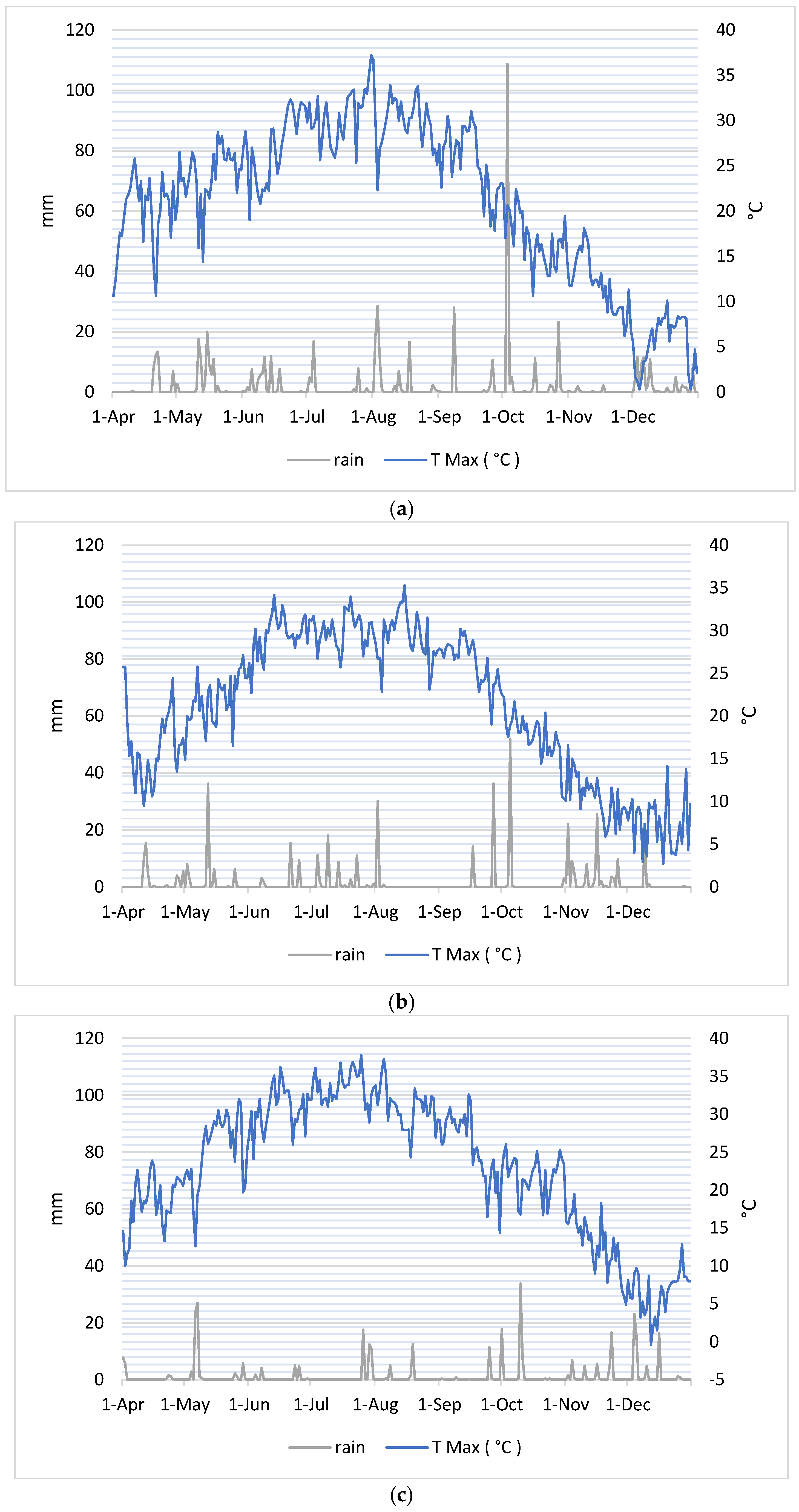
Meteorological conditions have been extensively analyzed in previous work [56]. In this study, we summarize the key distinguishing factors to correlate them with the variations observed in phenolic profiles. Each of the three vintages displayed specific meteorological peculiarities.
The 2020 vintage (Figure 1a) was the coolest among those considered, with the maximum temperatures rarely exceeding 30 °C and consistently below the 2009–2018 average. Although the total annual rainfall was similar to the reference period, precipitation was more concentrated between April and October, particularly during two key stages: pre-veraison and close to harvest.
The 2021 season (Figure 1b) was characterized by lower maximum temperatures from April to October compared to the 2009–2018 average, along with significantly reduced rainfall and fewer rainy days. Rainfall was regularly distributed during the green growth phase and up to veraison, followed by a warm and dry post-veraison period until harvest.
The 2022 vintage (Figure 1c) was marked by extreme meteorological conditions. The monthly Tmax, the GDD, and the number of days above 30 °C (76 days) were all significantly higher than the 2009–2018 average, with temperatures frequently exceeding 35 °C during veraison. Conversely, rainfall and rainy days were notably lower during ripening, indicating scarce water availability, particularly during the green berry growth phase. These conditions led to an advancement of approximately 10 days in both veraison (25–30 July) and ripening (5–10 September).

3.2. Grape Technological Parameters

Grapes harvested over the three vintages showed uniform and satisfactory ripening. The vine age and exposure did not significantly affect the timing of key phenological stages, such as veraison and harvest, within each year. Technological maturity was reached in all vineyards by the third week of September in 2020 and 2021, while in 2022, harvest occurred approximately 10 days earlier.
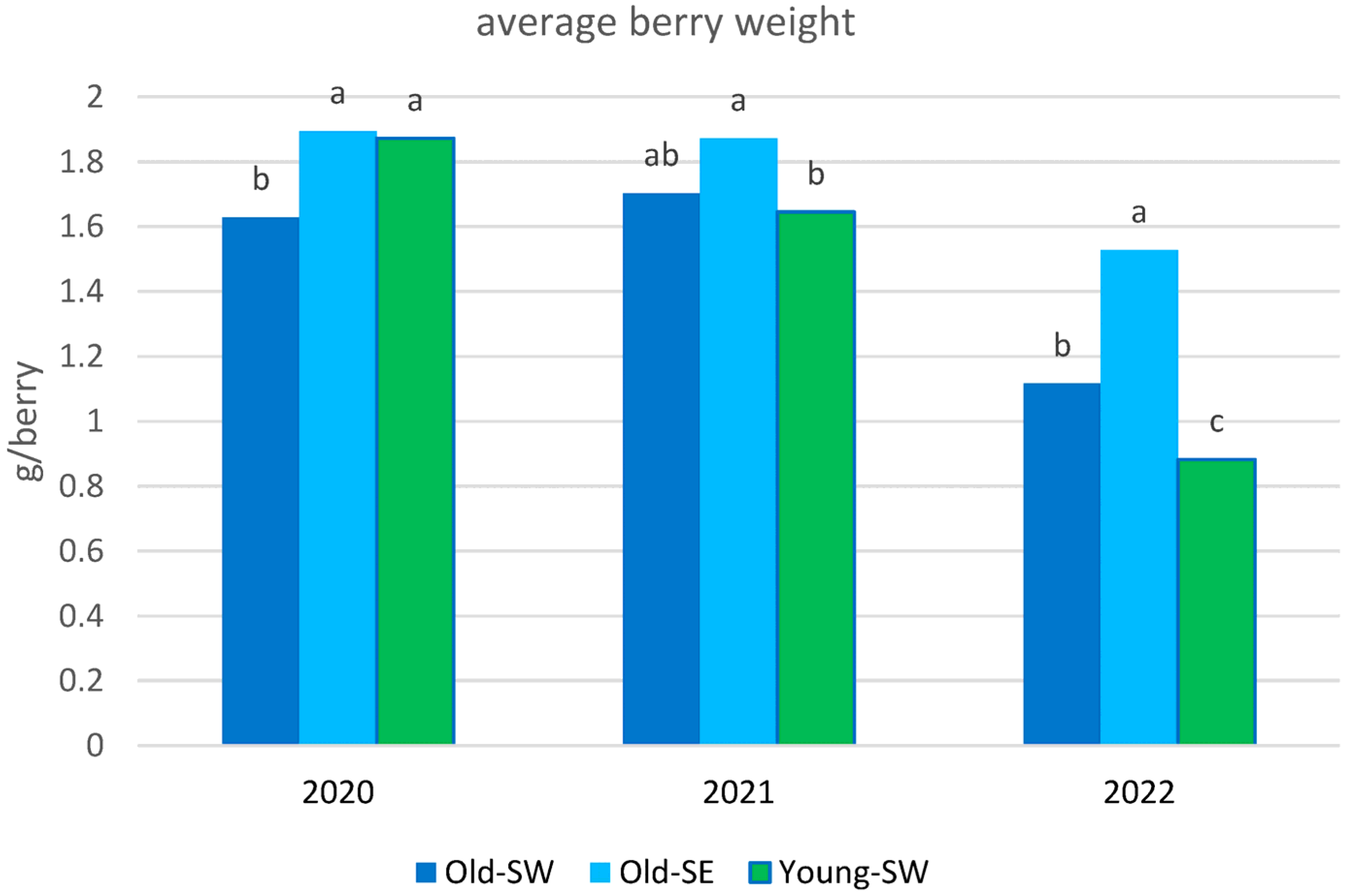
A significant reduction in berry weight was observed in 2022 (Figure 2), indicating a lower skin-to-pulp ratio, likely due to extreme meteorological conditions, as mentioned before. Table 2 reports average values of the chemical and physical analyses on Grignolino berries per vintage and per vineyard. Across vintages, the titratable acidity (TA) and pH remained relatively stable, whereas the °Brix values were higher in 2022, indicating an increased sugar concentration, likely associated with a lower berry weight.
The ANOVA confirmed significant vintage effects (factor Y) for most parameters, with 2022 showing the lowest berry weight and highest total soluble solids (TSS). As for vineyard comparisons (factor V), Old-SE consistently had the highest average berry weight, while Young-SW recorded the lowest values across nearly all parameters.

3.3. Polyphenolic Composition of Berry Skins

3.3.1. Major Polyphenolic Indexes

In 2020 (Table 3), a phenolic analysis of grape skins showed higher concentrations (expressed as mg/kg) of the total phenolic index (TPI) and proanthocyanidin index (PAI) in old vines (Old-SW and Old-SE) compared to young vines (Young-SW), although the differences were not statistically significant. The total flavonoid index (TFI) resulted in statistically higher values in old vines compared to the young one, with comparable levels between Old-SW and Old-SE. Old-SE grapes showed significantly higher anthocyanin (TAI) and flavonoid (TFI) contents when expressed as mg per berry (Table 3).
In contrast, the 2021 climatic conditions caused significant differences among all three vineyards, favoring phenolic contents (expressed as mg/kg) in Young-SW grapes, which clearly showed the highest TPI, PAI and TFI, while Old-SW had the lowest TPI, TAI and PAI. The TAI values were comparable between Young-SW and Old-SE, while Old-SW had a significantly lower anthocyanin content.
In contrast, when the results are expressed as mg per berry, Old-SE becomes the thesis with significantly higher contents for almost all the measured parameters (Table 3).
In 2022, the TPI and PAI levels as mg per kg of berries were similar across all vineyards, with slightly higher values in Old-SW than in Young-SW. Only the TAI levels showed significant differences, with higher concentrations in Young-SW and Old-SE, while Old-SW, exposed to warmer conditions, showed the lowest anthocyanin levels. For the TFI, tendentially the highest content was observed in Old-SE, followed by Old-SW, while Young-SW again showed lower values. Notably, when the results are expressed as mg per berry, significant differences consistently favored the old-vine vineyard with cooler exposure (Old-SE) across all three vintages, particularly in this hottest and driest year.
In summary, in both 2020 and 2022, old vines (Old-SW and Old-SE) showed higher concentrations of total phenolics (TPI), total flavonoids (TFI), and proanthocyanidins (PAI) compared to young vines (Young-SW), whereas under optimal meteorological conditions like those verified in 2021, the grapes of young vines presented an optimal polyphenolic composition. Nevertheless, generally, the Old-SE thesis gave the best results under different meteorological conditions through these three years of study.
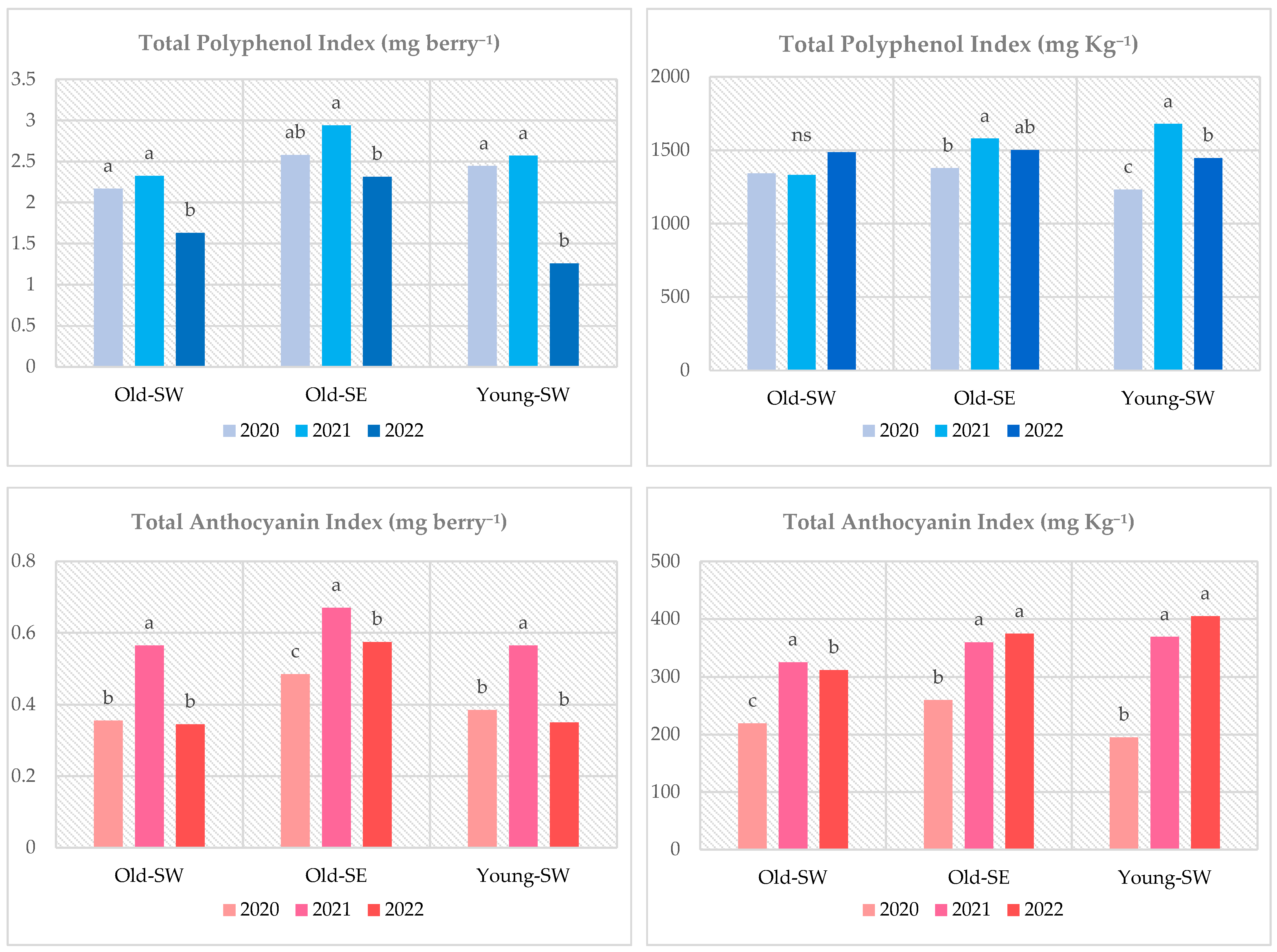
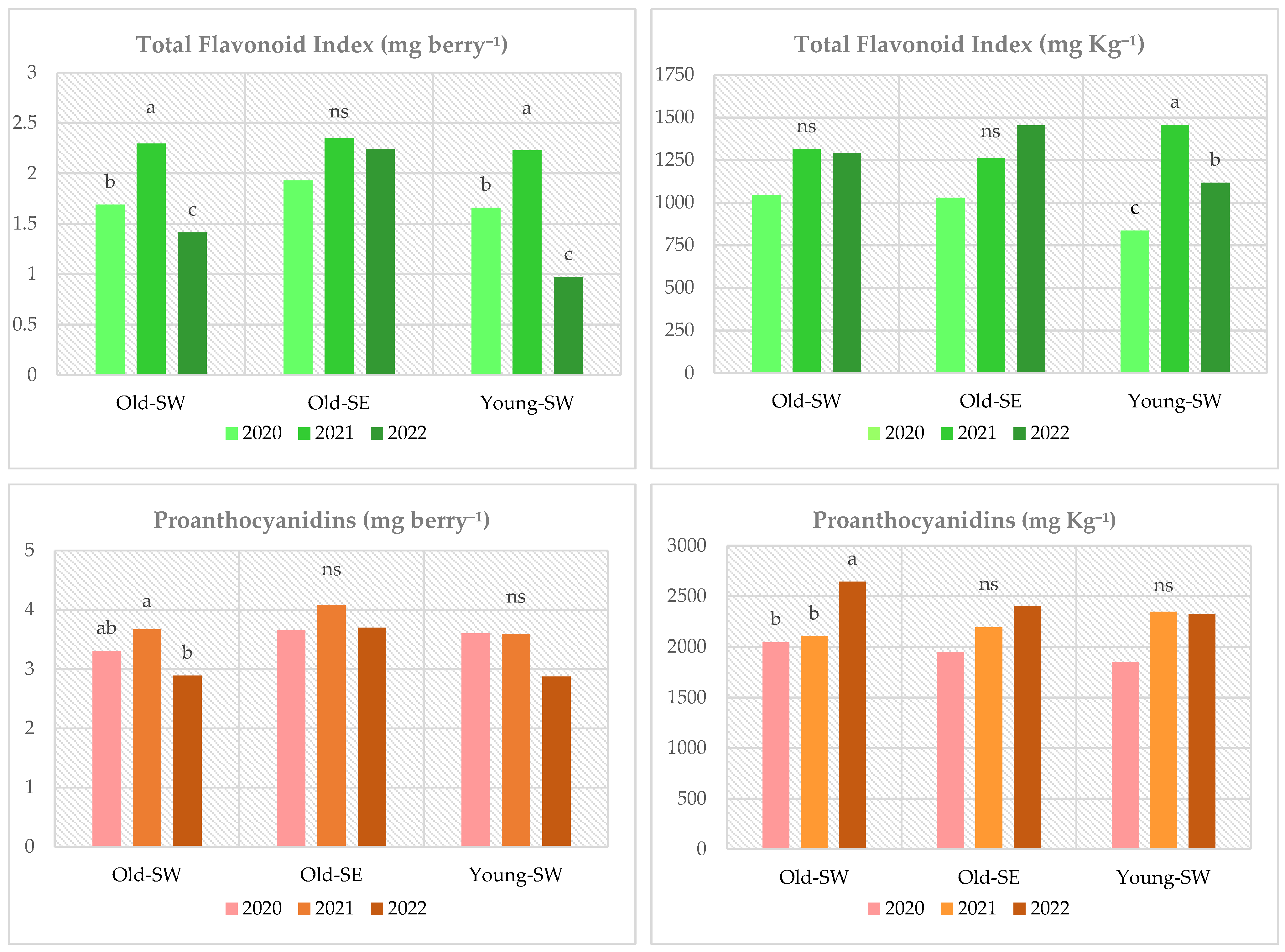
Vintage effect: Figure 3 highlights the mean differences for polyphenolics in berry skins among the vintages, calculated for each vineyard. The meteorological conditions during 2021 favored the accumulation of significant amounts of total polyphenols in Old-SE and Young-SW, especially evidenced when the results are expressed per berry.
Significantly higher contents of anthocyanins were noticed in 2021 and 2022 for all the vineyards when the results are expressed per kg of berries. The 2020 meteorological conditions penalized this index in all vineyard theses. As for anthocyanins, tendentially, the 2021 vintage favored total flavonoids too if expressed per berry, but in a significant way only in SW exposures. Proanthocyanidin accumulation was affected by the vintage effect only in the case of the Old-SW vineyard, and the trend depends on the result expression.

3.3.2. Flavonols and HCTAs

A flavonol analysis in Grignolino grape skins across the 2020, 2021, and 2022 vintages (expressed as mg/kg of grapes and mg/50 berries) revealed a composition strongly influenced by annual climatic conditions, with no significant effect of vine age or aspect (Table 4).
In 2020 and 2021, grapes from Old-SE and Young-SW showed significantly higher total flavonol concentrations, in comparison to Old-SW grapes, which presented significantly the lowest levels. Quercetin glucoside was the predominant compound in all theses, with significantly higher levels in Old-SE compared to Old-SW and Young-SW in the 2020 and 2021 vintage years. The quercetin glucuronide levels were lower, while kaempferol glucoside was present in marginal amounts; both were higher in Old-SE during the first two years of study.
In 2022, the flavonol levels showed a significant decrease in Old-SE, while Young-SW showed the highest concentrations among the three theses. Under typical climate-change conditions, warmer exposed young vineyards showed significantly the highest content of flavonols, especially quercetin glucuronide and glucoside, certainly due also to the significantly minor berry weight verified in 2022 for this thesis. If the results of the total flavonols are expressed as mg/50 berries, Old-SE presents similar values to Young-SW and all the vineyards showed similar results as for 2020.
The HCTA (hydroxycinnamic acid) concentrations in Grignolino grape skins are illustrated in Table 5. In 2020, significant differences were observed (mg/kg), with Old-SE followed by the Old-SW grapes and showing higher HCTA levels than Young-SW. In 2021, the Old-SE grapes showed the lowest HCTA content, though most of the differences were not statistically significant. In 2022, the highest HCTA levels were found in Old-SW and Young-SW, while Old-SE maintained lower concentrations, as observed for flavonols. Considering the results for the berry level (mg/50 berries), no significant differences were noticed among the vineyards.
An analysis of individual HCTA compounds across the three vineyards and vintages (2020–2022) revealed a consistent predominance of trans-caffeoyltartaric acid, followed by trans-p-coumaroyl-tartaric acid. In 2022, significantly higher levels of trans-caffeoyltartaric acid were recorded in the warmer, southwest-exposed vineyards, particularly in Young-SW, followed by Old-SW and Old-SE. These findings suggest that southwest-exposed vineyards have a greater capacity to synthesize HCTAs under more extreme climatic conditions, while the cooler Old-SE site maintained relatively stable levels across vintages.
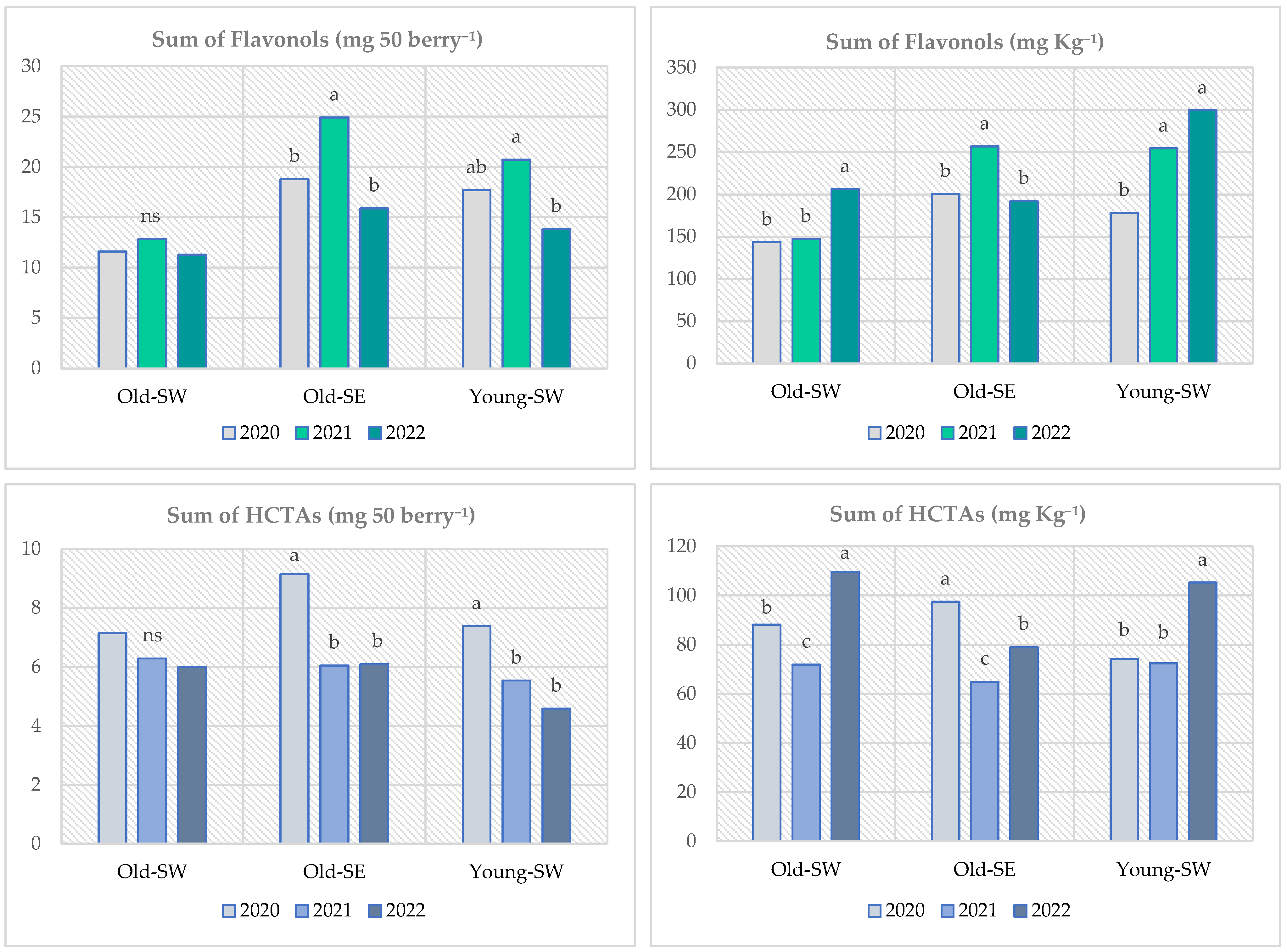
When evaluating the vintage effects on the total flavonol accumulation, 2021 showed the highest levels when the data were expressed per number of berries, likely due to differences in the berry size and concentration factors affecting the final flavonol content. However, the statistical significance was not consistent across all vineyards. The 2021 conditions favored the amounts of flavonols at the single-berry level in the Old-SE grapes; the results varied when expressed per kilogram of grapes, showing statistically important amounts in 2022, especially in the young SW-exposed vineyard.
When expressed per number of berries, the total hydroxycinnamic acid (HCTA) content was significantly higher in the 2020 vintage across all vineyards. However, when expressed per kilogram of grapes, a similar vintage-related trend emerged for Young-SW, as noticed for flavonols. The 2022-year conditions favored the content of these compounds. Cooler seasons favored HCTA accumulation at the single-berry level in Old-SW, whereas in hotter, drier years, concentration effects caused higher amounts as mg per kg, especially in the young, warmer, exposed vines (SW) (Figure 4).

3.3.3. Anthocyanin Profiles

A comparison of anthocyanin profiles across vineyards (Table 6), revealed differences that were occasionally significant, but not consistently interpretable. Peonidin-3-glucoside, the dominant anthocyanin in Grignolino, was significantly more abundant in Old-SW in 2020 and in Young-SW in 2022, suggesting that microclimatic conditions—rather than vine age—play a greater role in determining its relative abundance.
Cyanidin-3-glucoside levels were significantly higher in Old-SW and Young-SW in both 2020 and 2022, while the opposite trend was observed in 2021. Malvidin levels showed significant differences only in the 2021 vintage, with higher values observed in young vines.

3.4. Polyphenolic Composition of Berry Seeds

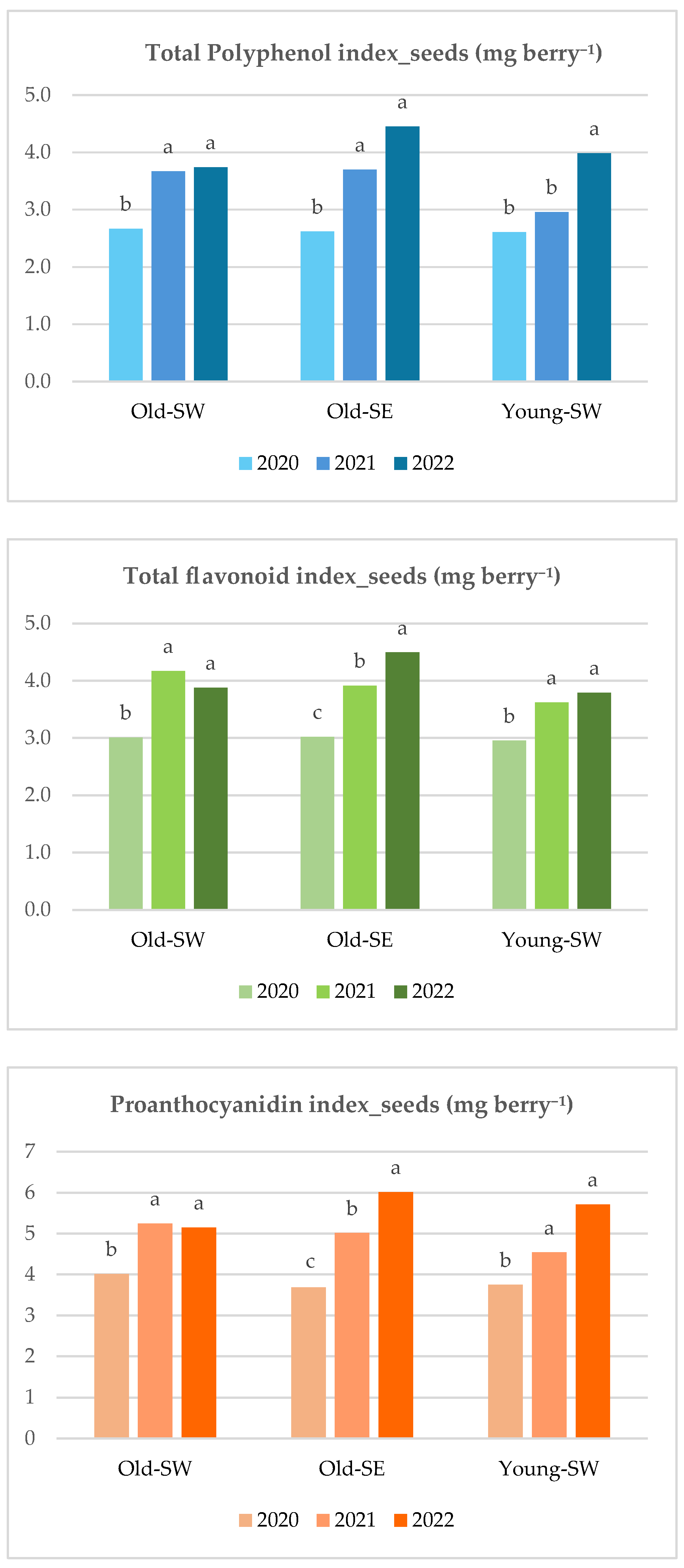
Phenolic compounds extracted from grape seeds (TPI, TFI, PAI) exhibited patterns distinct from those observed in skins, reflecting the combined influence of vintage, vineyard exposure, and vine age and a medium berry weight (Table 7). When the results are expressed as mg per kg of berries, in the cooler, rainy 2020 vintage, the concentrations were generally low across all vineyards, with Old-SW showing significantly higher levels than the other two theses. In 2021, the phenolic concentrations were similar among the vineyards. The 2022 season showed significantly higher phenolic compounds in all vineyards with respect to the previous two years, with the young vineyard exhibiting significantly higher levels, especially for proanthocyanidins (PAI). Obviously, the drastic decrease in berry weight caused by intense heat and drought in 2022, especially in the Young-SW thesis, accentuated the differences. When the results are expressed in mg per berry, the differences were statistically significant for all the measured parameters in 2022, while in 2021, they were statistically significant only for the TPI. In all cases, consistently with observations in the skins, the Old-SE grapes accumulated significantly higher seed phenolic compounds than the Old-SW and Young-SW grapes, whose contents were lower, but similar among them (Figure 5 and Table 7).

3.5. PCA Results

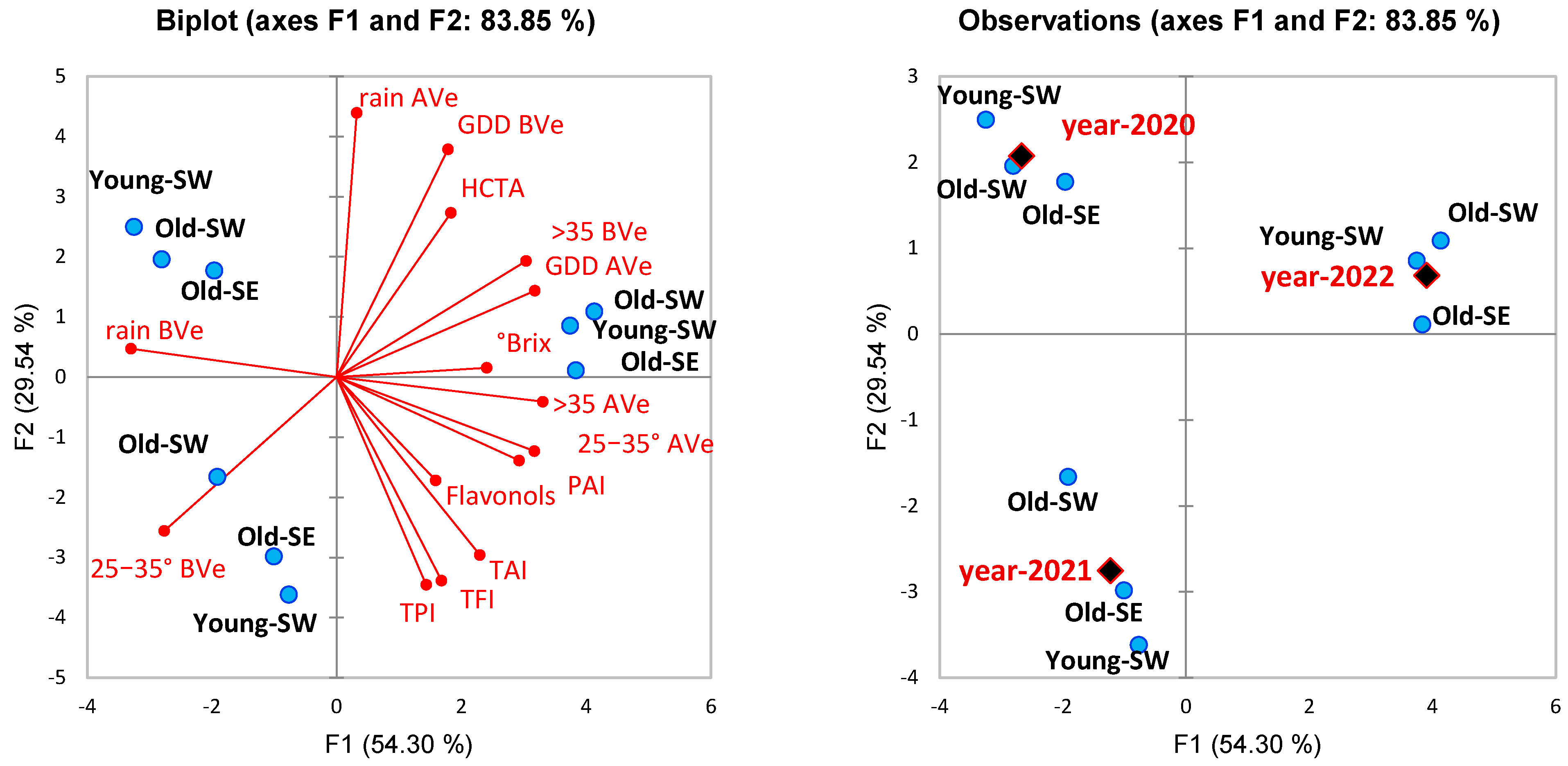
A principal component analysis (PCA) of the phenolic content expressed per kg of grapes revealed a clear separation among the three vintages, explaining 83.85% of the total variance (PC1: 54.30%; PC2: 29.54%) (Figure 6). Samples from the 2022 vintage clustered in the right quadrant, distinctly separated from the others, with all three vineyards (Old-SW, Old-SE, Young-SW) grouped near the 2022 centroid. This pattern suggests greater compositional homogeneity among the vineyards in 2022, characterized by a phenolic profile likely influenced by extreme climatic conditions, including elevated temperatures and low water availability. In contrast, the 2020 and 2021 vintages were positioned in the upper and lower left quadrants, respectively. Notably, the 2021 samples displayed greater dispersion within the lower left quadrant, reflecting varied metabolic responses to environmental conditions across vintages and highlighting the significant impact of climate on phenolic synthesis and accumulation.
The PCA biplot (Figure 6), integrating both observations and active variables, reveals that climatic factors related to heat and water stress, such as the GDD from veraison to maturity (GDD AVe), the GDD from fruit set to veraison (GDD BVe), and pre-harvest rainfall or rainfall after veraison (rain AVe), are projected on the right side of the plot near the vectors for the TAI, TPI, PAI, flavonols and HCTAs. This indicates a positive correlation between these stress-related variables and the accumulation of phenolic compounds. Conversely, the 2020 vintage samples clustered on the left side, associated with higher rainfall from April to August and moderate temperatures 25–35 days before harvest (Ave), suggesting that these conditions primarily influenced the phenolic content that year. The 2022 and, partially, the 2021 vintages correlate more strongly with thermal vectors (e.g., °Brix, HCTA_kg, days > 35 °C, days 25–35 °C), reflecting higher sugar accumulation. Overall, the distribution along the first principal component (F1) represents a climatic and metabolic gradient where phenolic composition is strongly modulated by thermal stress conditions, including elevated temperatures and drought, which affect the phenolic quantity.

4. Discussion and Conclusions

Grapes harvested across the three-year study period from the three vineyards reached comparable physicochemical maturity parameters, apart from higher °Brix values in 2022 due to the dehydration of the berries, especially noticed in young southwest vines.
With respect to vintage effects, the total phenolic content, expressed as mg per berry, was the highest in 2021 and significantly the lowest in 2022, confirming the impact of thermal and water stress on phenolic biosynthesis. Cooler seasons promoted anthocyanin synthesis, regardless of the vineyard age or exposure, as indicated by values expressed per berry.
In vintages with a moderate temperature and water availability during the mid-season followed by a warm and dry pre-harvest period (2021), all Grignolino vines reached their higher expression with regards to phenolic content, especially the young southwest-exposed vines; the accumulation of significant amounts of all indexes was observed, especially evidenced when the results are expressed per berry. In typical climate-change conditions of extreme heat and drought extending through ripening (2022), younger vines with greater sun exposure demonstrate a superior phenolic potential relative to older vines, mainly due to a significantly lower berry weight. Old vines with warmer southwest exposure had the lowest anthocyanin contents.
When the results are expressed as mg per berry, significantly higher contents were noticed consistently for almost all the phenolics for the old-vine vineyard with cooler southeast exposure across all three vintages, and especially during the hottest and driest year, indicating a positive role of the combination of vine age and hillside aspect. The literature also supports that older vines often accumulate a greater total phenolic content [53], while the mild conditions guaranteed by the aspect may protect from degradation. Especially in our case, the combination of older vines in cooler exposures favored higher anthocyanin concentrations. Conversely, low temperature and rainfall concentrated during two key stages—pre-veraison and close to harvest—caused low total anthocyanins in all vineyard theses, especially for young southwest-exposed vines.
Although mixed findings regarding vine age and phenolic accumulation were found, as confirmed by the literature the meteorological conditions verified in the vintage year clearly play a key role. Elevated daytime temperatures and heatwaves, particularly around veraison, may reduce anthocyanin and flavonol synthesis and accelerate their degradation. Heat is usually combined with excessive solar radiation that can disrupt the sugar-to-acidity ratio and degrade the phenolic profile. In contrast, moderate UV-B exposure paired with mild water deficits, which enhance the skin-to-pulp ratio, may promote phenolic biosynthesis, stimulating flavonol, stilbene, and, in some years, proanthocyanidin accumulation [3,32,52].
Elevated anthocyanin concentrations per kilogram of grapes reflected berry dehydration and concentration effects in the grapes of young vines during 2022; stress conditions may also reduce the synthesis or enhance the degradation of these pigments. High temperatures can suppress key genes in the anthocyanin biosynthetic pathway, promote degradation via peroxidase activity, and lower the anthocyanin-to-sugar ratio [13,32]. In contrast, moderate water deficits tend to stimulate phenolic accumulation, not only due to a berry size reduction, but also through the upregulation of enzymes in the phenylpropanoid and flavonoid pathways.
Regarding HCTA accumulation, significantly lower concentrations were observed in less-exposed vineyards during particularly hot and dry seasons, while higher levels were recorded in more sun-exposed sites. The HCTA composition seems to be affected by both the vintage and vineyard exposure, often in a statistically significant manner. This variability may reflect site-specific microclimatic influences, particularly those related to solar exposure and UV radiation [13], which are likely key factors in modulating both HCTA biosynthesis and the isomerization of trans- and cis-cinnamic acid esters, while the effect of temperature is less consistent and strongly dependent on the intensity of thermal stress. Additionally, the differences are primarily driven by microclimate–exposure interactions rather than by plant age.
The analysis of flavonols extracted from Grignolino grape skins revealed a high degree of variability primarily driven by vintage-related conditions, with a lesser influence from vineyard characteristics. The higher amounts observed during hot and dry years in grapes from young vines were mainly due to a decrease in berry size. Generally, the increase in flavonol content under hot conditions may reflect a physiological response to light stress, consistent with their established photoprotective function [38]. Furthermore, the results did not support a clear effect of vine age on flavonol accumulation. Flavonol biosynthesis is strongly influenced by environmental conditions, particularly light exposure. UV-B radiation is a key driver of their synthesis, whereas shading or reduced UV exposure limits their accumulation [37].
Regarding the anthocyanin profile, Grignolino grapes were confirmed to be characterized by a predominance of disubstituted anthocyanins (peonidin, cyanidin), with low proportions of trisubstituted forms (malvidin) and acylated derivatives. Over the three years of study, significant differences in anthocyanin accumulation were observed across vineyards, particularly for cyanidin and acetylated forms. However, the overall varietal profile remained consistent and was not affected by the evaluated parameters.
In general, phenolic accumulation in grape seeds appears to be less affected by climatic stress compared to the skins, likely due to the protective role of the seed coat and internal tissues. However, our data indicate that, under high temperatures and drought during ripening, the differences become more pronounced. Consistently with observations in the skins, when the results are expressed in mg per berry, old southeast grapes highlight significantly higher seed phenolic compounds than old and young warm, exposed grapes. Under milder vintage conditions, the differences were less significant across vineyards. To date, the literature does not provide conclusive evidence for a direct correlation between vine age, exposure, and seed phenolic composition.
The PCA underscores the distinct responses of the vineyards to environmental conditions before and after veraison across the vintages, highlighting the critical role of each phenological phase in phenolic synthesis, accumulation, and final concentration. Under optimal seasonal conditions, vineyard-specific differences become more pronounced, as reflected in the PCA clustering. The younger vineyard exhibited greater compositional variability between vintages, particularly in berry weight, suggesting a higher sensitivity to meteorological conditions compared to older vines. Overall, the distribution along the first principal component reflects a climatic and metabolic gradient, where phenolic composition is strongly modulated by elevated temperatures and drought, which significantly impact the phenolic levels.
This study indicates that, under current climatic conditions, Grignolino grapes cultivated in hill areas may exhibit an enhanced polyphenolic composition, associated with reduced berry ripening variability and increased accumulation of secondary metabolites. The results further demonstrate that the grape phenolic composition is strongly modulated by the intensity and timing of thermal stress and limited water availability during ripening, with additional influences from vine age and the vineyard microclimate shaped by the hillside aspect; older vines on cooler, southeast-facing slopes showed greater resilience and more stable polyphenolic profiles under stress conditions. Conversely, young, southwest-exposed vineyards seem more sensitive to climatic variability, often showing higher phenolic concentrations driven by berry dehydration.
These findings highlight the importance of site-specific strategies and offer additional knowledge for vineyard zoning, canopy and water management, and optimal harvest timing to preserve grape quality and varietal typicity under changing climatic conditions.

Supplementary Materials

The following supporting information can be downloaded at: https://www.mdpi.com/article/10.3390/horticulturae12020206/s1, Table S1: Hydroxycinnamic acids (HCTAs) and flavonols characteristic quantification wavelength (λ) and retention time (rt). Table S2: Anthocyanins characteristic quantification wavelength (λ) and retention time (rt).

Author Contributions

Conceptualization, A.A., M.P. and F.B.; methodology, F.B. and A.A.; validation, A.A. and M.P.; formal analysis, A.A.; investigation, F.B., V.R. and F.M.; resources, M.P. and M.R.; writing—original draft preparation, A.A. and F.P.; writing—review and editing, M.P. and A.A.; supervision, M.P. and A.A.; project administration, M.P.; funding acquisition, M.P. and M.R. All authors have read and agreed to the published version of the manuscript.

Funding

This study is based on the SESAMO project, funded by the Fondazione CRT–Cassa di Risparmio di Torino (grant no. 2019.2337) and conducted at the CREA Research Centre for Viticulture and Enology during the period of 2019–2022.

Data Availability Statement

The original contributions presented in this study are included in the article/Supplementary Material. Further inquiries can be directed to the corresponding authors.

Acknowledgments

The authors express their gratitude to the Monferace association for their unwavering and invaluable support in the implementation of the “SESAMO” project. In particular, they wish to extend their thanks to the producers, who generously provided the grapes for the experiment.

Conflicts of Interest

The authors declare that the research was conducted in the absence of any commercial or financial relationships that could be construed as a potential conflict of interest.

Abbreviations

The following abbreviations are used in this manuscript:
ANOVAAnalysis of variance
CREACouncil for Agricultural Research and Economics
CRTFondazione CRT–Cassa di Risparmio di Torino
DADDiode array detector
GDDGrowing degree days
HCTAHydroxycinnamoyl tartaric acid
HCTAsHydroxycinnamoyl tartaric acids
HPLCHigh-performance liquid chromatography
HSDHonestly significant difference (Tukey’s HSD test)
OIVInternational Organisation of Vine and Wine
PAProanthocyanidin
PAIProanthocyanidin index
PCAPrincipal component analysis
RDRainy days (≥1 mm precipitation)
SESoutheast exposure
SESAMO“SESAMO”—Studio delle peculiarità Enologiche, Storiche, Ambientali
e viticole del Monferrato ‘Aleramico’ per la
valorizzazione del Grignolino affinato in legno—research project on Grignolino grapes
SWSouthwest exposure
TATitratable acidity
TAITotal anthocyanin index
TFITotal flavonoid index
TPITotal polyphenol index
TSSTotal soluble solids
UDPUridine diphosphate
UVUltraviolet radiation
UVBUltraviolet-B radiation
XLSTATXLSTAT statistical software (Addinsoft, Paris, France)

References

  1. Jackson, D.I.; Lombard, P.B. Environmental and Management Practices Affecting Grape Composition and Wine Quality-a Review. Am. J. Enol. Vitic. 1993, 44, 409–430. [Google Scholar] [CrossRef]
  2. Fraga, H.; de Cortázar Atauri, I.G.; Santos, J.A. Viticultural Irrigation Demands under Climate Change Scenarios in Portugal. Agric. Water Manag. 2018, 196, 66–74. [Google Scholar] [CrossRef]
  3. Rienth, M.; Vigneron, N.; Darriet, P.; Sweetman, C.; Burbidge, C.; Bonghi, C.; Walker, R.P.; Famiani, F.; Castellarin, S.D. Grape Berry Secondary Metabolites and Their Modulation by Abiotic Factors in a Climate Change Scenario—A Review. Front. Plant Sci. 2021, 12, 643258. [Google Scholar] [CrossRef] [PubMed]
  4. De Orduna, R.M. Climate Change Associated Effects on Grape and Wine Quality and Production. Food Res. Int. 2010, 43, 1844–1855. [Google Scholar] [CrossRef]
  5. Van Leeuwen, C.; Darriet, P. The Impact of Climate Change on Viticulture and Wine Quality. J. Wine Econ. 2016, 11, 150–167. [Google Scholar] [CrossRef]
  6. Asproudi, A.; Ferrandino, A.; Bonello, F.; Vaudano, E.; Pollon, M.; Petrozziello, M. Key Norisoprenoid Compounds in Wines from Early-Harvested Grapes in View of Climate Change. Food Chem. 2018, 268, 143–152. [Google Scholar] [CrossRef]
  7. Carbonell-Bejerano, P.; Diago, M.-P.; Martínez-Abaigar, J.; Martínez-Zapater, J.M.; Tardáguila, J.; Núñez-Olivera, E. Solar Ultraviolet Radiation Is Necessary to Enhance Grapevine Fruit Ripening Transcriptional and Phenolic Responses. BMC Plant Biol. 2014, 14, 183. [Google Scholar] [CrossRef]
  8. Bergqvist, J.; Dokoozlian, N.; Ebisuda, N. Sunlight Exposure and Temperature Effects on Berry Growth and Composition of Cabernet Sauvignon and Grenache in the Central San Joaquin Valley of California. Am. J. Enol. Vitic. 2001, 52, 1–7. [Google Scholar] [CrossRef]
  9. Webb, L.B.; Whetton, P.H.; Bhend, J.; Darbyshire, R.; Briggs, P.R.; Barlow, E.W.R. Earlier Wine-Grape Ripening Driven by Climatic Warming and Drying and Management Practices. Nat. Clim. Change 2012, 2, 259–264. [Google Scholar] [CrossRef]
  10. Mori, K.; Goto-Yamamoto, N.; Kitayama, M.; Hashizume, K. Loss of Anthocyanins in Red-Wine Grape under High Temperature. J. Exp. Bot. 2007, 58, 1935–1945. [Google Scholar] [CrossRef]
  11. Asproudi, A.; Petrozziello, M.; Cavalletto, S.; Guidoni, S. Grape Aroma Precursors in Cv. Nebbiolo as Affected by Vine Microclimate. Food Chem. 2016, 211, 947–956. [Google Scholar] [CrossRef] [PubMed]
  12. Van Leeuwen, C.; Barbe, J.-C.; Darriet, P.; Geffroy, O.; Gomès, E.; Guillaumie, S.; Helwi, P.; Laboyrie, J.; Lytra, G.; Menn, N.L.; et al. Recent Advancements in Understanding the Terroir Effect on Aromas in Grapes and Wines. OENO One 2020, 54, 985–1006. [Google Scholar] [CrossRef]
  13. Wilson, A.; Ferrandino, A.; Giacosa, S.; Novello, V.; Guidoni, S. The Effect of Temperature and UV Manipulation on Anthocyanins, Flavonols, and Hydroxycinnamoyl-Tartrates in Cv Nebbiolo Grapes (Vitis vinifera L.). Plants 2024, 13, 3158. [Google Scholar] [CrossRef] [PubMed]
  14. Shah, M.H.; Rafique, R.; Rafique, T.; Naseer, M.; Khalil, U.; Rafique, R. Effect of Climate Change on Polyphenols Accumulation in Grapevine. In Phenolic Compounds-Chemistry, Synthesis, Diversity, Non-Conventional Industrial, Pharmaceutical and Therapeutic Applications; IntechOpen: London, UK, 2021. [Google Scholar]
  15. Mattivi, F.; Guzzon, R.; Vrhovsek, U.; Stefanini, M.; Velasco, R. Metabolite Profiling of Grape: Flavonols and Anthocyanins. J. Agric. Food Chem. 2006, 54, 7692–7702. [Google Scholar] [CrossRef]
  16. Ferrandino, A.; Carra, A.; Rolle, L.; Schneider, A.; Schubert, A. Profiling of Hydroxycinnamoyl Tartrates and Acylated Anthocyanins in the Skin of 34 Vitis vinifera Genotypes. J. Agric. Food Chem. 2012, 60, 4931–4945. [Google Scholar] [CrossRef]
  17. Chorti, E.; Guidoni, S.; Ferrandino, A.; Novello, V. Effect of Different Cluster Sunlight Exposure Levels on Ripening and Anthocyanin Accumulation in Nebbiolo Grapes. Am. J. Enol. Vitic. 2010, 61, 23–30. [Google Scholar] [CrossRef]
  18. Arrizabalaga-Arriazu, M.; Gomès, E.; Morales, F.; Irigoyen, J.J.; Pascual, I.; Hilbert, G. High Temperature and Elevated Carbon Dioxide Modify Berry Composition of Different Clones of Grapevine (Vitis vinifera L.) Cv. Tempranillo. Front. Plant Sci. 2020, 11, 603687. [Google Scholar] [CrossRef]
  19. Gouot, J.C.; Smith, J.P.; Holzapfel, B.P.; Barril, C. Grape Berry Flavonoid Responses to High Bunch Temperatures Post Véraison: Effect of Intensity and Duration of Exposure. Molecules 2019, 24, 4341. [Google Scholar] [CrossRef]
  20. Spayd, S.E.; Tarara, J.M.; Mee, D.L.; Ferguson, J.C. Separation of Sunlight and Temperature Effects on the Composition of Vitis vinifera Cv. Merlot Berries. Am. J. Enol. Vitic. 2002, 53, 171–182. [Google Scholar] [CrossRef]
  21. Tarara, J.M.; Lee, J.; Spayd, S.E.; Scagel, C.F. Berry Temperature and Solar Radiation Alter Acylation, Proportion, and Concentration of Anthocyanin in Merlot Grapes. Am. J. Enol. Vitic. 2008, 59, 235–247. [Google Scholar] [CrossRef]
  22. Yamane, T.; Jeong, S.T.; Goto-Yamamoto, N.; Koshita, Y.; Kobayashi, S. Effects of Temperature on Anthocyanin Biosynthesis in Grape Berry Skins. Am. J. Enol. Vitic. 2006, 57, 54–59. [Google Scholar] [CrossRef]
  23. He, F.; Mu, L.; Yan, G.-L.; Liang, N.-N.; Pan, Q.-H.; Wang, J.; Reeves, M.J.; Duan, C.-Q. Biosynthesis of Anthocyanins and Their Regulation in Colored Grapes. Molecules 2010, 15, 9057–9091. [Google Scholar] [CrossRef] [PubMed]
  24. Bogs, J.; Ebadi, A.; McDavid, D.; Robinson, S.P. Identification of the Flavonoid Hydroxylases from Grapevine and Their Regulation during Fruit Development. Plant Physiol. 2006, 140, 279–291. [Google Scholar] [CrossRef] [PubMed]
  25. Downey, M.O.; Dokoozlian, N.K.; Krstic, M.P. Cultural Practice and Environmental Impacts on the Flavonoid Composition of Grapes and Wine: A Review of Recent Research. Am. J. Enol. Vitic. 2006, 57, 257–268. [Google Scholar] [CrossRef]
  26. Castellarin, S.D.; Di Gaspero, G. Transcriptional Control of Anthocyanin Biosynthetic Genes in Extreme Phenotypes for Berry Pigmentation of Naturally Occurring Grapevines. BMC Plant Biol. 2007, 7, 46. [Google Scholar] [CrossRef]
  27. Ju, Y.; Yang, B.; He, S.; Tu, T.; Min, Z.; Fang, Y.; Sun, X. Anthocyanin Accumulation and Biosynthesis Are Modulated by Regulated Deficit Irrigation in Cabernet Sauvignon (Vitis vinifera L.) Grapes and Wines. Plant Physiol. Biochem. 2019, 135, 469–479. [Google Scholar] [CrossRef]
  28. Mori, K.; Goto-Yamamoto, N.; Kitayama, M.; Hashizume, K. Effect of High Temperature on Anthocyanin Composition and Transcription of Flavonoid Hydroxylase Genes in ‘Pinot Noir’ Grapes (Vitis vinifera). J. Hortic. Sci. Biotechnol. 2007, 82, 199–206. [Google Scholar] [CrossRef]
  29. Lecourieux, F.; Kappel, C.; Pieri, P.; Charon, J.; Pillet, J.; Hilbert, G.; Renaud, C.; Gomès, E.; Delrot, S.; Lecourieux, D. Dissecting the Biochemical and Transcriptomic Effects of a Locally Applied Heat Treatment on Developing Cabernet Sauvignon Grape Berries. Front. Plant Sci. 2017, 8, 53. [Google Scholar] [CrossRef]
  30. Cohen, S.D.; Tarara, J.M.; Kennedy, J.A. Assessing the Impact of Temperature on Grape Phenolic Metabolism. Anal. Chim. Acta 2008, 621, 57–67. [Google Scholar] [CrossRef]
  31. Cohen, S.D.; Tarara, J.M.; Gambetta, G.A.; Matthews, M.A.; Kennedy, J.A. Impact of Diurnal Temperature Variation on Grape Berry Development, Proanthocyanidin Accumulation, and the Expression of Flavonoid Pathway Genes. J. Exp. Bot. 2012, 63, 2655–2665. [Google Scholar] [CrossRef]
  32. Gouot, J.C.; Smith, J.P.; Holzapfel, B.P.; Walker, A.R.; Barril, C. Grape Berry Flavonoids: A Review of Their Biochemical Responses to High and Extreme High Temperatures. J. Exp. Bot. 2019, 70, 397–423. [Google Scholar] [CrossRef] [PubMed]
  33. del Rio, J.L.P.; Kennedy, J.A. Development of Proanthocyanidins in Vitis vinifera L. Cv. Pinot Noir Grapes and Extraction into Wine. Am. J. Enol. Vitic. 2006, 57, 125–132. [Google Scholar] [CrossRef]
  34. Chira, K.; Lorrain, B.; Ky, I.; Teissedre, P.-L. Tannin Composition of Cabernet-Sauvignon and Merlot Grapes from the Bordeaux Area for Different Vintages (2006 to 2009) and Comparison to Tannin Profile of Five 2009 Vintage Mediterranean Grapes Varieties. Molecules 2011, 16, 1519–1532. [Google Scholar] [CrossRef] [PubMed]
  35. Pastore, C.; Dal Santo, S.; Zenoni, S.; Movahed, N.; Allegro, G.; Valentini, G.; Filippetti, I.; Tornielli, G.B. Whole Plant Temperature Manipulation Affects Flavonoid Metabolism and the Transcriptome of Grapevine Berries. Front. Plant Sci. 2017, 8, 929. [Google Scholar] [CrossRef]
  36. Bonada, M.; Sadras, V.O. Review: Critical Appraisal of Methods to Investigate the Effect of Temperature on Grapevine Berry Composition: Methods to Investigate Temperature Effects. Aust. J. Grape Wine Res. 2015, 21, 1–17. [Google Scholar] [CrossRef]
  37. Del-Castillo-Alonso, M.-Á.; Diago, M.P.; Tomás-Las-Heras, R.; Monforte, L.; Soriano, G.; Martínez-Abaigar, J.; Núñez-Olivera, E. Effects of Ambient Solar UV Radiation on Grapevine Leaf Physiology and Berry Phenolic Composition along One Entire Season under Mediterranean Field Conditions. Plant Physiol. Biochem. 2016, 109, 374–386. [Google Scholar] [CrossRef]
  38. Martínez-Lüscher, J.; Chen, C.C.L.; Brillante, L.; Kurtural, S.K. Mitigating Heat Wave and Exposure Damage to “Cabernet Sauvignon” Wine Grape with Partial Shading under Two Irrigation Amounts. Front. Plant Sci. 2020, 11, 579192. [Google Scholar] [CrossRef]
  39. Del-Castillo-Alonso, M.-Á.; Monforte, L.; Tomás-Las-Heras, R.; Martínez-Abaigar, J.; Núñez-Olivera, E. To What Extent Are the Effects of UV Radiation on Grapes Conserved in the Resulting Wines? Plants 2021, 10, 1678. [Google Scholar] [CrossRef]
  40. Lemut, M.S.; Trost, K.; Sivilotti, P.; Vrhovsek, U. Pinot Noir Grape Colour Related Phenolics as Affected by Leaf Removal Treatments in the Vipava Valley. J. Food Compos. Anal. 2011, 24, 777–784. [Google Scholar] [CrossRef]
  41. Cortell, J.M.; Kennedy, J.A. Effect of Shading on Accumulation of Flavonoid Compounds in (Vitis vinifera L.) Pinot Noir Fruit and Extraction in a Model System. J. Agric. Food Chem. 2006, 54, 8510–8520. [Google Scholar] [CrossRef]
  42. Mori, K.; Sugaya, S.; Gemma, H. Regulatory Mechanism of Anthocyanin Biosynthesis in ‘Kyoho’Grape Berries Grown under Different Temperature Conditions. Environ. Control Biol. 2004, 42, 21–30. [Google Scholar] [CrossRef]
  43. Mori, K.; Sugaya, S.; Gemma, H. Decreased Anthocyanin Biosynthesis in Grape Berries Grown under Elevated Night Temperature Condition. Sci. Hortic. 2005, 105, 319–330. [Google Scholar] [CrossRef]
  44. Makris, D.P.; Kallithraka, S.; Kefalas, P. Flavonols in Grapes, Grape Products and Wines: Burden, Profile and Influential Parameters. J. Food Compos. Anal. 2006, 19, 396–404. [Google Scholar] [CrossRef]
  45. Gouot, J.C.; Smith, J.P.; Holzapfel, B.P.; Barril, C. Impact of Short Temperature Exposure of Vitis vinifera L. Cv. Shiraz Grapevine Bunches on Berry Development, Primary Metabolism and Tannin Accumulation. Environ. Exp. Bot. 2019, 168, 103866. [Google Scholar] [CrossRef]
  46. Asen, S.; Stewart, R.N.; Norris, K.H. Co-Pigmentation of Anthocyanins in Plant Tissues and Its Effect on Color. Phytochemistry 1972, 11, 1139–1144. [Google Scholar] [CrossRef]
  47. Boulton, R. The Copigmentation of Anthocyanins and Its Role in the Color of Red Wine: A Critical Review. Am. J. Enol. Vitic. 2001, 52, 67–87. [Google Scholar] [CrossRef]
  48. Ferrer-Gallego, R.; Brás, N.F.; García-Estévez, I.; Mateus, N.; Rivas-Gonzalo, J.C.; de Freitas, V.; Escribano-Bailón, M.T. Effect of Flavonols on Wine Astringency and Their Interaction with Human Saliva. Food Chem. 2016, 209, 358–364. [Google Scholar] [CrossRef]
  49. Gambuti, A.; Picariello, L.; Rinaldi, A.; Forino, M.; Blaiotta, G.; Moine, V.; Moio, L. New Insights into the Formation of Precipitates of Quercetin in Sangiovese Wines. J. Food Sci. Technol. 2020, 57, 2602–2611. [Google Scholar] [CrossRef]
  50. Moreno, D.; Intrigliolo, D.S.; Vilanova, M.; Castel, J.R.; Gamero, E.; Valdés, E. Phenolic Profile of Grapevine Cv. Tempranillo Skins Is Affected by Timing and Severity of Early Defoliation. Span. J. Agric. Res. 2021, 19, e0905. [Google Scholar] [CrossRef]
  51. Bubola, M.; Lukić, I.; Radeka, S.; Sivilotti, P.; Grozić, K.; Vanzo, A.; Bavčar, D.; Lisjak, K. Enhancement of Istrian Malvasia Wine Aroma and Hydroxycinnamate Composition by Hand and Mechanical Leaf Removal. J. Sci. Food Agric. 2019, 99, 904–914. [Google Scholar] [CrossRef]
  52. Riffle, V.; Palmer, N.; Casassa, L.F.; Dodson Peterson, J.C. The Effect of Grapevine Age (Vitis vinifera L. Cv. Zinfandel) on Phenology and Gas Exchange Parameters over Consecutive Growing Seasons. Plants 2021, 10, 311. [Google Scholar] [CrossRef]
  53. Zufferey, V.; Maigre, D. Age de la vigne. I. Influence sur le comportement physiologique des souches. Rev. Suisse Vitic. Arboric. Hortic. 2007, 39, 257–261. [Google Scholar]
  54. Bou Nader, K.; Stoll, M.; Rauhut, D.; Patz, C.-D.; Jung, R.; Loehnertz, O.; Schultz, H.R.; Hilbert, G.; Renaud, C.; Roby, J.-P.; et al. Impact of Grapevine Age on Water Status and Productivity of Vitis vinifera L. Cv. Riesling. Eur. J. Agron. 2019, 104, 1–12. [Google Scholar] [CrossRef]
  55. Cravero, M.C.; Bonello, F.; Asproudi, A.; Gianotti, S.; Ronco, M.; Petrozziello, M. Sensory Profile of Monferace Wine: An ‘Old-Style’ Vinification Approach for Grignolino, a Red Indigenous Italian Variety. Beverages 2023, 9, 46. [Google Scholar] [CrossRef]
  56. Asproudi, A.; Bonello, F.; Ragkousi, V.; Gianotti, S.; Petrozziello, M. Aroma Precursors of Grignolino Grapes (Vitis vinifera L.) and Their Modulation by Vintage in a Climate Change Scenario. Front. Plant Sci. 2023, 14, 1179111. [Google Scholar] [CrossRef]
  57. International Organisation of Vine and Wine (OIV). Compendium of International Methods of Analysis of Wines and Musts; International Organisation of Vine and Wine (OIV): Paris, France, 2025. [Google Scholar]
  58. Amerine, M.A.; Winkler, A.J. Composition and Quality of Musts and Wines of California Grapes. Hilgardia 1944, 15, 493–675. [Google Scholar] [CrossRef]
  59. Di Stefano, R.; Cravero, M.C. Metodi per Lo Studio Dei Polifenoli Dell’uva. Riv. Vitic. Enol. 1991, 44, 37–45. [Google Scholar]
  60. Di Stefano, R.; Carla Cravero, M. The Separation of Hydroxycinnamates in Wine. Sci. Aliments 1992, 12, 139–144. [Google Scholar]
  61. Kammerer, D.; Claus, A.; Carle, R.; Schieber, A. Polyphenol Screening of Pomace from Red and White Grape Varieties (Vitis vinifera L.) by HPLC-DAD-MS/MS. J. Agric. Food Chem. 2004, 52, 4360–4367. [Google Scholar] [CrossRef]
Figure 1. (a). Meteorological pattern during 2020. T_max: daily maximum temperature; Rain: daily rainfall. (b). Meteorological pattern during 2021. T_max: daily maximum temperature; Rain: daily rainfall. (c). Meteorological pattern during 2022. T_max: daily maximum temperature; Rain: daily rainfall.
Horticulturae 12 00206 g001
Figure 2. Average berry weight measured during the three-year study in the three vineyards. Different letters indicate statistically significant differences between least-square means (ANOVA, p < 0.05).
Horticulturae 12 00206 g002
Figure 3. Polyphenolic indexes measured in Grignolino berry skins (mg per berry and mg per kg of berries) for each vintage year (2020–2022) in the three vineyards (Old-SW, Old-SE and Young-SE). Total polyphenol index (TPI), total anthocyanin index (TAI), total flavonoid index (TFI), and proanthocyanidin index (PAI). Different letters indicate significantly different content among the years for p < 0.05; ns: not significant.
Horticulturae 12 00206 g003aHorticulturae 12 00206 g003b
Figure 4. Comparison of flavonols and hydroxycinnamic acids (HCTAs) in Grignolino berry skins (mg/50 berries and mg kg of berries) for each vintage year (2020–2022) in the three vineyards (Old-SW, Old-SE and Young-SW). Different letters indicate significantly different contents among the years for p < 0.05; ns: not significant.
Horticulturae 12 00206 g004
Figure 5. Polyphenolic indexes in Grignolino berry seeds (mg/berry) for each vintage year (2020–2022) in the three vineyards (Old-SW, Old-SE and Young-SW). Different letters indicate content significantly different among the years for p < 0.05, ns: not significant.
Horticulturae 12 00206 g005
Figure 6. PCA of °Brix and meteorological conditions (BVe: before veraison and AVe: after veraison) in correlation with the main indexes of polyphenols (TAI, TPI, TFI, PAI), flavonols and HCTAs expressed as mg/kg (left) and the projection of the vintage years (right). Circles indicate the different vineyards and rhombus the vintage years. Circles represent individual vineyards, while rhombuses indicate the centroids of the corresponding vintage years, summarizing the average position of samples belonging to each harvest year.
Horticulturae 12 00206 g006
Table 1. Climatic data summary (2020–2022 vs. 2009–2018 average). Meteorological conditions in 2020–2022 compared with the 2009–2018 average. Data are shown for the annual period (January–December, J/D) and for the growing season (April–October, A/O).
Tmax (°C)Tmin (°C)Tmax-M (°C)Total Rainfall (mm)GDD 10° (°C)Days T > 30 °C (n.)Rainy Days (n.)
J/DA/OJ/DA/OJ/DA/OJ/DA/OJ/DA/OJ/DA/OJ/DA/O
202020.624.811.514.426.529.0629509-204645456845
202120.624.511.014.126.629.9507329-200545455326
202222.225.412.614.728.732.3349216-240776763724
Average
2009–2018
20.925.111.414.427.530.7673388-210253536637
Tmax: maximum temperature; Tmin: minimum temperature; Tmax-M: mean maximum monthly temperature; GDD: growing degree days (base: 10 °C). Bold values denote statistically significant differences against average values calculated between 2009 and 2018 (one-sample z-test/two-tailed test; p < 0.05).
Table 2. Chemical and physical analysis on Gringnolino berries harvested in vintages 2020, 2021, and 2022.
Year (Y)Vineyards (V)ANOVA Results
Parameter202020212022Old-SEOld-SWYoung-SWSig. YSig. VSig. Y × V
Berry weight (g)1.80 a1.74 a1.18 c1.70 a1.43 b1.41 b********
TSS (°Brix)24.0 b24.5 b26.3 a25.8 a24.3 b25.0 ab***ns
TA (g/L)6.56.36.16.76.66.5nsnsns
pH3.303.283.353.263.253.24nsnsns
ANOVA significance: ns (not significant), p-value > 0.05; * 0.01 ≤ p-value < 0.05; ** 0.001 ≤ p-value < 0.01; *** p-value < 0.001. Different letters indicate different least-square means.
Table 3. Polyphenolic composition of Gringnolino berry skins harvested in vintages 2020, 2021, and 2022.
YearVineyardTPITAIPAITFI
mg/Berrymg/kgmg/Berrymg/kgmg/Berrymg/kgmg/Berrymg/kg
2020Old-SW2.1 ± 0.02 b1342 ± 40.35 ± 0.01 b219 ± 6 b3.31 ± 0.152046 ± 351.7 ± 0.1 b1045 ± 65 a
Old-SE2.6 ± 0.001 a1376 ± 170.49 ± 0.02 a260 ± 6 a3.66 ± 0.151950 ± 671.9 ± 0.2 a1029 ± 110 a
Young-SW2.5 ± 0.18 a1231 ± 860.39 ± 0.01 b195 ± 5 b3.60 ± 0.401853 ± 1601.7 ± 0.11 b837 ± 59 b
Sig*ns**nsns**
2021Old-SW2.3 ± 0.01 c1331 ± 10 c0.57 ± 0.01 b326 ± 5 b3.67 ± 0.11 ab2103 ± 69 b2.3 ± 0.011315 ± 7 b
Old-SE2.9 ± 0.02 a1578 ± 15 b0.67 ± 0.03 a360 ± 21 a4.08 ± 0.09 a2192 ± 90 b2.4 ± 0.081264 ± 68 b
Young-SW2.6 ± 0.02 b1678 ± 18 a0.56 ± 0.02 b367 ± 17 a3.59 ± 0.01 b2347 ± 48 a2.2 ± 0.041457 ± 52 a
Sig*********ns*
2022Old-SW1.6 ± 0.12 b1486 ± 1370.34 ± 0.01 b312 ± 10 b2.90 ± 0.06 b2644 ± 40 a1.4 ± 0.1 b1293 ± 119 a
Old-SE2.3 ± 0.01 a1502 ± 290.58 ± 0.01 a374 ± 12 a3.70 ± 0.10 a2401 ± 100 b2.2 ± 0.1 a1454 ± 70 a
Young-SW1.3 ± 0.01 c1446 ± 280.35 ± 0.01 b405 ± 7 a2.88 ± 1.07 b2325 ± 124 b1.0 ± 0.02 c1118 ± 9 b
Sig**ns*******
Total polyphenol index (TPI), total anthocyanin index (TAI), proanthocyanidin index (PAI), and total flavonoid index (TFI) expressed per berry (mg/berry) and per weight (mg/kg) in berries from Old-SW, Old-SE, and Young-SW vineyards across the 2020–2022 vintages. Values are given as the mean of three biological replicates ± standard error. Different letters within the same column and year indicate significant differences among vineyards (Tukey, p < 0.05). Significance levels (Sig): * p < 0.05; ** p < 0.01; *** p < 0.001; ns = not significant. Abbreviations: SW = southwest; SE = southeast; n.d. = not detected.
Table 4. Concentrations of individual flavonols (myricetin glucoside, quercetin glucuronide, quercetin glucoside, kaempferol glucuronide, kaempferol glucoside) and total flavonols (expressed as mg/50 berries and mg/kg) in berries from Old-SW, Old-SE, and Young-SW vineyards across the 2020–2022 vintages.
YearVineyardMiricetin GlucosideQuercetin
Glucuronide
Quercetin GlucosideKaempferol GlucuronideKaempferol GlucosideTotal Flavonols
mg/kgmg/kgmg/kgmg/kgmg/kgmg/50 Berriesmg/kg
2020Old-SWn.d.47 ± 483 ± 5 bn.d14 ± 1 b12 ± 1 b144 ± 15 b
Old-SEn.d.57 ± 1122 ± 1 an.d21 ± 1 a19 ± 1 a201 ± 1 a
Young-SWn.d.46 ± 3113 ± 3 bn.d19 ± 1 a18 ± 1 a178 ± 9 a
Sig ns** ***ns
2021Old-SW10 ± 130 ± 1 c86 ± 1 c5 ± 1 b16 ± 1 b13 ± 1 c147 ± 1 b
Old-SE11 ± 146 ± 1 b160 ± 1 a12 ± 1 a28 ± 1 a25 ± 1 a257 ± 1 a
Young-SW10 ± 164 ± 4 a144 ± 2 b11 ± 1 a26 ± 1 a21 ± 1 a254 ± 7 a
Signs***************
2022Old-SW13 ± 163 ± 5 b108 ± 1 b7 ± 1 b15 ± 1 b11 ± 1 b206 ± 5 b
Old-SE13 ± 147 ± 1 b118 ± 13 b6 ± 1 b17 ± 2 ab16 ± 2 a192 ± 17 b
Young-SW8 ± 192 ± 2 a167 ± 5 a10 ± a23 ± 1 a14 ± 1 a299 ± 3 a
Signs*********
Values are given as mean of three biological replicates ± standard error. Different letters within the same column and year indicate significant differences among vineyards (Tukey, p < 0.05). Significance levels (Sig): * p < 0.05; ** p < 0.01; *** p < 0.001; ns = not significant. Abbreviations: SW = southwest; SE = southeast; n.d. = not detected.
Table 5. Concentrations of hydroxycinnamic acids (HCTAs: trans-caffeoyl TA, cis-p-coumaroyl TA, trans-p-coumaroyl TA, trans-feruloyl TA) and total HCTAs (expressed as mg/50 berries and mg/kg) in berries from Old-SW, Old-SE, and Young-SW vineyards across the 2020–2022 vintages.
YearVineyardt-Caffeoyl TAc-p-Coumaroyl TAt-p-Coumaroyl TAt-Feruloyl TATotal HCTAs
mg/kgmg/kgmg/kgmg/kgmg/50 Berriesmg/kg
2020Old-SW44 ± 111 ± 129 ± 1 b5 ± 17 ± 188 ± 2 b
Old-SE47 ± 313 ± 234 ± 1 a4 ± 19 ± 198 ± 4 a
Young-SW37 ± 55 ± 327 ± 1 b4 ± 17 ± 174 ± 3 c
Signsns*nsns**
2021Old-SW40 ± 18 ± 124 ± 1 an.d.6 ± 172 ± 2
Old-SE37 ± 38 ± 119 ± 1 bn.d.6 ± 165 ± 4
Young-SW41 ± 111 ± 421 ± 2 an.d.6 ± 173 ± 4
Signsns* nsns
2022Old-SW58 ± 1 b13 ± 1 a39 ± 1 an.d.6 ± 1110 ± 2 a
Old-SE41 ± 1 c9 ± 1 b29 ± 1 bn.d.6 ± 179 ± 1 b
Young-SW62 ± 1 a11 ± 1 ab32 ± 1 bn.d.5 ± 1105 ± 2 a
Sig***** ns**
Values are given as mean of three biological replicates ± standard error. Different letters within the same column and year indicate significant differences among vineyards (Tukey, p < 0.05). Significance levels (Sig): * p < 0.05; ** p < 0.01; ns = not significant. Abbreviations: SW = southwest; SE = southeast; n.d. = not detected.
Table 6. Anthocyanin profile in Grignolino berry skins harvested in vintages 2020, 2021, and 2022.
YearVineyardDpCyPtPnMvAcetate Formsp-Coum Forms
2020Old-SW1.0 ± 0.125.2 ± 3.1 ab1.1 ± 0.558.3 ± 0.15 a8.2 ± 1.34.2 ± 0.2 ab3.1 ± 1.7
Old-SE3.2 ± 1.521.1 ± 0.1 b2.1 ± 0.652.3 ± 0.1 b14.2 ± 3.03.1 ± 0.2 b6.2 ± 3.3
Young-SW1.1 ± 0.330.2 ± 1.0 a1.9 ± 0.249.2 ± 2.0 b10.3 ± 1.24.1 ± 0.3 a2.9 ± 0.1
Signs*ns*ns*ns
2021Old-SW1.2 ± 0.412.2 ± 0.4 ab2.1 ± 0.164.2 ± 1.113.9 ± 0.5 b3.1 ± 0.2 a4.0 ± 0.1 a
Old-SE1.6 ± 0.220.1 ± 2.0 a1.9 ± 0.159.4 ± 2.413.3 ± 0.2 b1.7 ± 0.1 b2.9 ± 0.2 b
Young-SW1.3 ± 0.111.1 ± 0.1 b2.0 ± 0.158.4 ± 3.321.3 ± 0.2 a3.1 ± 0.1 a4.1 ± 0.1 a
Signs*nsns*******
2022Old-SW2.3 ± 0.223 ± 0.5 a2.1 ± 0.355.3 ± 1.5 b9.1 ± 1.35.2 ± 0.1 a3.9 ± 0.3 ab
Old-SE2.2 ± 0.215.1 ± 0.1 b2.7 ± 0.358.4 ± 1.1 ab14.6 ± 2.12.4 ± 0.7 b5.0 ± 0.2 a
Young-SW1.7 ± 0.319.1 ± 2.0 ab2.1 ± 0.261.4 ± 0.2 a8.9 ± 1.83.7 ± 0.1 ab3.2 ± 0.4 b
Signs**ns*ns**
Data reported as mean (%) of three biological replicates ± std error. Different letters indicate significantly different means (Tukey, p < 0.05). ANOVA significance: ns (not significant), p-value > 0.05; * 0.01 ≤ p-value < 0.05; ** 0.001 ≤ p-value < 0.01; *** p-value < 0.001. Different letters indicate different least-square means. Dp: delphinidin 3-O-glucoside, Cy: cyanidin 3-O-glucoside, Pt: petunidin 3-O-glucoside, Pn: peonidin 3-O-glucoside, Mv: malvidin 3-O-glucoside, acetate and p-coumaroyl derivative (p-coum) forms.
Table 7. Polyphenolic composition of Gringnolino berry seeds harvested in vintages 2020, 2021, and 2022.
YearVineyardTPIPAITFI
mg/Berrymg/kgmg/Berrymg/kgmg/Berrymg/kg
2020Old-SW2.67 ± 0.011648 ± 9 a4.02 ± 0.082484 ± 29 a3.01 ± 0.151861 ± 61 a
Old-SE2.62 ± 0.121396 ± 34 b3.68 ± 0.241965 ± 110 b3.02 ± 0.471436 ± 191 b
Young-SW2.61 ± 0.071314 ± 29 b3.75 ± 0.241885 ± 81 b2.96 ± 0.191486 ± 64 b
Signs**ns*ns*
2021Old-SW3.67 ± 0.01 a2103 ± 125.25 ± 0.163006 ± 59 a4.17 ± 0.182390 ± 76
Old-SE3.70 ± 0.19 a1988 ± 675.01 ± 0.012694 ± 38 b3.91 ± 0.142102 ± 79
Young-SW2.96 ± 0.23 b1936 ± 1854.54 ± 0.342972 ± 193 a3.62 ± 0.372370 ± 198
Sig**nsnsnsns*
2022Old-SW3.74 ± 0.08 b3413 ± 19 b5.15 ± 0.12 b4699 ± 36 b3.88 ± 0.16 b3540 ± 91 b
Old-SE4.45 ± 0.26 a2888 ± 125 c6.02 ± 0.30 a3900 ± 137 c4.49 ± 0.06 a2885 ± 100 c
Young-SW3.99 ± 0.09 b4582 ± 167 a5.72 ± 0.72 ab6012 ± 137 a3.79 ± 0.12 b4351 ± 80 a
Sig*************
Values are expressed in mg/berry and mg/kg as the mean of three biological replications ± standard deviation. Different letters within the same column and year indicate significant differences among vineyards (p < 0.05). Significance levels (Sig): * p < 0.05; ** p < 0.01; *** p < 0.001; ns = not significant. Abbreviations: TPI = total polyphenol index; PAI = proanthocyanidin index; TFI = total flavonoid index; SW = southwest; SE = southeast.
Disclaimer/Publisher’s Note: The statements, opinions and data contained in all publications are solely those of the individual author(s) and contributor(s) and not of MDPI and/or the editor(s). MDPI and/or the editor(s) disclaim responsibility for any injury to people or property resulting from any ideas, methods, instructions or products referred to in the content.