


Abstract
Induction of callus is an important step to produce high-quality seedlings, to promote the large-scale production of seedings, and to establish stable transgenic methods. To establish an efficient callus-based regeneration system for lily, in this study, we used the scales of Lilium regale as explants and employed plant tissue thin-layer culture to induce callus tissues. To examine the effects of different types and concentrations of plant growth regulators (PGRs) on the induction of lily callus tissues and plant regeneration, we designed orthogonal experiments using three PGRs: 6-BA, NAA, and PIC, with each regulator at three concentration levels. The results indicated that a suitable medium for inducing callus under the experimental conditions was 1.00 mg/L 6-BA + 0.05 mg/L NAA + 2.00 mg/L PIC, pH = 5.8 because in this medium, callus tissue showed a good balance of induction and contamination rate, as well as very low redifferentiation into bulbs. Under the experimental conditions, a suitable medium for callus expansion was 1 mg/L 6-BA + 0.5 mg/L NAA, pH = 5.8. We also showed that the induced callus tissues could develop into seedlings. These findings provide important references for optimizing in vitro culture systems of Lilium regale and offer supports for tissue culture studies of other lily species.
1. Introduction
Lily (Lily spp.) is a perennial bulbous flower of Lilium of the Liliaceae family [1]. Its flowers are large, elegant, fragrant and beautiful, with high ornamental, edible and medicinal values, strong stress resistance and disease resistance, good pollen germination ability, and are used for scientific research and practical application [2]. Lilium regale, also known as regal lily and Chiba lily, is mainly distributed in the arid valley of Minjiang River Basin in Sichuan province, China [3] and is renowned as a species native to China. It grows at altitudes ranging from 760 to 2200 m above sea level, can adapt to climate change, has cold resistance, good adaptability to acid and alkali soil, and normal growth and flowering in soil with pH value as high as 8.5 [4]. As an important breeding parent material, several disease-resistant hybrid lily varieties have been developed. In particular, the excellent hybrid system crossed with L. sargenttiae is the key part of Trumpet hybrids and Aurelian hybrids, and it has extremely high value in the field of saline-alkali tolerance and breeding of lily with virus disease resistance [5].
It was reported that lily accounted for 70.24% of the main bulbous flower imports in China in 2020, with a value of about USD 66.2 million and about 360 million seeds [6]. Traditional lily propagation methods have the disadvantages of low reproductive efficiency and long cycle, and after multiple generations of propagation, it is easy to lead to accumulation of pathogenic substances and degradation of varieties and quality [7]. Lily disease-free virus, lily mottle virus, and cucumber mosaic virus are the three most harmful viruses to lily. They are most likely to infect lily plants [8], and these three viruses often mix infection, resulting in lily mosaic mottle, leaf deformity, plant dwarfing or main stem loss and other complex symptoms, seriously affecting the commodity quality of lily cut flowers and bulbs [9]. In planting production, lily mainly depends on asexual propagation technology [10]. This method will make the virus-infected lily continue to pass on, spread to infect other plants in an open environment, expand the scope of virus transmission, and cause serious economic losses to lily cultivation [11]. During callus formation, plants generate loose cells that may reduce viral accumulation [12]. Establishing an efficient and rapid in vitro propagation system for lilies via the callus pathway facilitates the production of high-quality virus-free plants [13].
During the tissue culture of lilies, besides direct organogenesis, there is also indirect organogenesis; that is, callus formation by dedifferentiation induction [14]. Lily’s scales, leaves, roots and flower organs are often used as explants in this way. Because of the variety of lily, the induction efficiency of the same explant of different lily varieties is different [9]. In some experiments, the filaments of Oriental lily “Sorbon” and “Siberia” were used as explants to induce callus under the same medium setting. The results showed that the induction rate of filaments of “Sorbon” (91.7%) was higher than that of “Siberia” (47.2%) [15]. Using pollen from six lily varieties (Asian, Musk, and Oriental hybrid lines) as explants, callus tissues were successfully induced in five varieties. The induction rate of Asian hybrid lines was significantly higher than that of Musk and Oriental hybrid lines, indicating genotype differences [16,17]. Differences in explant-induced somatic embryo formation capabilities were also observed. Comparative in vitro culture experiments between Lanzhou lily, Yixing lily, and Tiepao lily revealed that scaly tissue demonstrated superior callus induction capacity compared to root and leaf tissues [18]. Different parts of the scaly tissue exhibited distinct differentiation capabilities [19].
In the existing study of in vitro regeneration system of lily, an indirect organogenesis pathway based on PGRs showed significant technical advantages, with high efficiency and large quantity [14]. Plant cells possess totipotency [20]. The formation of callus tissue through dedifferentiation of mature lily organs in specific culture media represents the primary pathway for indirect organ formation in lilies [9]. Embryogenic callus is also an excellent recipient material for genetic transformation in lilies [21]. Therefore, establishing an embryonic callus induction system and maintaining a long-term embryogenic state are of great significance for the asexual propagation and genetic transformation of Lilium regale [22]. However, the polyploid nature of lilies results in a complex genetic background [23]. The sensitivity of explants from different lilies to PGRs is not uniform, leading to significant variations in their responsiveness to callus induction [11]. Current research indicates that Picloram (PIC) is a key factor essential for the induction and maintenance of embryonic callus tissue in lily (Lilium) species during tissue culture [24,25]. Using PIC to induce callus formation in 33 lily genotypes, 30 genotypes were capable of forming callus tissue [17]. Using combinations of Thidiazuron (TDZ), 1-Naphthaleneacetic acid (NAA), or 2,4-Dichlorophenoxyacetic acid (2,4-D) and 6-Benzylaminopurine (6-BA) only induce the formation of bulbs in Lilium longiflorum, whereas 2 mg/L PIC effectively promotes the development of somatic embryos [26]. The first genome assembly of Lilium regale was released recently [4]. This achievement significantly filled a gap in research concerning the assembly and functional analysis of mega-genomes in plants, while also provided crucial references for lily genetic evolution and molecular breeding. However, a complete regeneration system based on callus tissue has yet to be established, which limits the accelerated advancement of lily variety improvement.
Although tissue culture research on the genus Lilium has yielded considerable results, tissue culture techniques for Lilium regale still require improvement. Establishing an efficient embryogenic callus system is an indispensable step for rapid propagation and obtaining genetically sound transformation recipients. As a native species in China, the Lilium regale possesses a cleaner and simpler genetic background compared to hybrids and cultivated varieties [21], potentially making it more amenable to genetic transformation. Therefore, we selected this lily species as the material for callus induction. In this study, the scales of Lilium regale were selected to explore the optimum PGRs formula for callus induction and propagation, respectively. Morphological observation was carried out on the induced callus, embryogenic callus differentiation and seedling transplantation were carried out, and a complete callus regeneration system was established.
2. Materials and Methods
2.1. Test Materials and Reagents
Bulbs of Lilium regale were obtained from Sichuan Yishang Agricultural Tourism Development Co., Ltd., Mianyang, China, in July, 2024. The basal medium was set as follows: 4.43 g/L Murashige and Skoog medium [27] (MS, Basebio, Hangzhou, China) + 30 g/L sucrose (Xilong Science, Shanghai, China) + 5.5 g/L agar (Aladdin Reagent, Shanghai, China), pH = 5.8. To screen for suitable medium for inducing callus in experimental conditions, we added various types and concentrations of PGRs, i.e., 6-BA (Shanghai Yuanye Bio-Technology, Shanghai, China), NAA (Shanghai Yuanye Bio-Technology, Shanghai, China), and PIC (Shanghai Yuanye Bio-Technology, Shanghai, China), to the basal medium and sterilized at 121 °C for 25 min for later use.
2.2. Disinfection of Explants
We removed the scales with mechanical damage or disease spots on the outer layer of Lilium regale, then we selected healthy scales in the middle layer. First, we cleaned the scales with cleanser essence (Liby science and technology, Guangzhou, China), then we rinsed them under running water for 30 min. We cleaned them with detergent 2–3 times, followed by rinsing with sterile water 2–3 times. The were then placed into an ultra-clean workbench, 75% ethanol was added to soak for 1 min, then the materials were transferred into 5% sodium hypochlorite to soak for 15 min. The sterilization container was shaken continuously during the soaking process, then the samples were washed with sterile water 3–5 times after sterilization.
2.3. Callus Induction
Callus was induced via the thin layer culture method with scales of Lilium regale as explants. According to literature reports and the previous work of our research group, three PGRs, i.e., 6-BA, NAA and PIC, were designed and used. Three concentration gradients were set, respectively, and systematic screening tests with three factors and three levels were carried out, which formed nine different media, as listed in Table 1.
Table 1.
Different induction media (IM) for inducing lily callus.
Sterilized scales were taken out with tweezers and were put on sterile kraft paper, then they were cut into thin layers with thickness of about 1 mm. Then, the cut-out pieces were inoculated into lily callus induction culture dishes with different media added. Then, the cultures were maintained at 24 ± 1 °C under a 16 h photoperiod with cool white fluorescent lighting at 40 μmol/m2/s in a growth room with 50–65% relative humidity.
2.4. Callus Induction Rate and Contamination Rate
In the callus induction experiment, 9 dishes were inoculated for each of the different media in Table 2. In each dish, 10 explants were inoculated, three dishes with 30 explants were used as a replicate, and 3 replicates were performed for each of the different media in Table 2. After 21 days of culture, we watched and counted scales on which bulbous growth appeared on their surfaces, which were considered as successfully induced scales. Based on the numbers of scales with successful callus induction, we calculated the callus induction rate (CIR), as defined in Equation (1) below.
where is the number of explants producing callus, and T is the total number of inoculated explants.
Table 2.
Different propagation media (PM) for the propagation of the lily callus.
Twenty-one days after inoculating the scales onto the culture medium, for statistical convenience, we defined any scale exhibiting bacterial or fungal contamination as a contaminated scale, regardless of the extent of the contaminated area. Lilium regale callus contamination rate (CCR) was defined in Equation (2) as below.
where is the number of contaminated explants, and T is the total number of inoculated explants.
2.5. Redifferentiation of Callus
After an additional period of 30 days in the same culture, distinct green bulbs emerged from the scales, and we then counted the number of scales that developed bulbs to determine the redifferentiation rate of callus. The redifferentiation rate (DR) of Lilium regale callus tissue was defined in Equation (3) below:
where is the number of explants producing bulbs and T is the total number of inoculated explants.
2.6. Callus Propagation
The callus obtained by induction was cut into tissue pieces with a diameter of about 1 cm and inoculated into lily callus propagation medium (PM). The propagation medium was provided with 6 treatments, with 6-BA concentration of 0.5 mg/L and 1.0 mg/L, NAA concentration of 0.1 mg/L, 0.5 mg/L and 1.0 mg/L, and 6 PGRs formulas in total (Table 2). In the experiment of callus propagation, 10 explants were duplicate, and 3 replicates were carried out. Then, cultures were maintained at 24 ± 1 °C under a 16 h photoperiod with cool white fluorescent lighting at 40 μmol/m2/s in a growth room with 50–65% relative humidity.
Callus propagation rate (CPR) of Lilium regale was defined in Equation (4) below:
where is the number of successfully grown callus, and is the total number of inoculated callus pieces.
2.7. Software and Statistical Tests
The experimental data were organized using Microsoft Excel 2021 software (Microsoft, Redmond, WA, USA), and Duncan’s multiple range tests were implemented in IBM SPSS Statistics 26 (IBM, Armonk, NY, USA) to examine significant differences between different experimental groups at the levels of . GraphPad Prism 10 (Dotmatics, Boston, MA, USA) was used for linear fits and graphing.
2.8. The Induction–Contamination Line for Identifying the Optimal Induction Medium
Firstly, the callus induction rate and contamination rate values of different media in Table 1 were plotted in a scatter plot [28]. In the scatter plot, the x-axis represents the induction rate of a sample, while the y-axis indicates the contamination rate of the sample. We then performed a linear fit for all data points. We named this line the Induction-Contamination line (IC line) [28]. Theoretically, the intersecting point between the x-axis and the IC line represented the best experimental setting, since the highest Induction rate and the lowest Contamination rate (0) were achieved at this point. Therefore, the IC line offered a simple model for identifying the optimal experimental setting by choosing the tested medium that was closest to the x-intersecting point of the IC line. If the IC line did not intersect with x-axis before , then the intersecting point between the IC line and the line of should be used to choose the suitable medium under the experimental conditions tested. This is because at this point, the highest induction rate of 100% was achieved and the lowest contamination rate was reached in the mean time.
2.9. Callus Redifferentiation, Bulb Enlargement, and Transplanting After Acclimatization
Embryonic callus from scales of Lilium regale was inoculated into differentiation medium (4.43 g/L MS + 30 g/L sucrose + 5.5 g/L agar + 1 mg/L 6-BA + 0.1 mg/L NAA, pH = 5.8). After 30 days of cultivation, the differentiated seedlings were inoculated onto bulb enlargement medium (4.43 g/L MS + 90 g/L sucrose + 5.5 g/L agar, pH = 5.8) for bulb enlargement. After 60 days of culture, when the bulb diameter reached 1 cm, seedlings exhibiting well-developed and uniform root systems were selected. As an acclimatization treatment, we kept the bottle open for five days to cultivate seedlings, then medium adhering to the roots was carefully rinsed off. The roots were then immersed in a mixture of carbendazim and metolachlor for 15 min. The chemical solution on the root surface was rinsed off with clean water. After air-drying, the seedlings were transplanted into a substrate (peat moss: vermiculite: perlite = 5:3:1). Five bulbs were transplanted per pot, totaling 10 pots. Regenerated seedlings emerged approximately 30 days later. All tests were conducted under identical environmental conditions (i.e., temperature: 25 ± 2 °C, humidity: 70–80%, and photoperiod: 12 h light/12 h dark).
3. Results
3.1. Callus Induction of Lilium regale
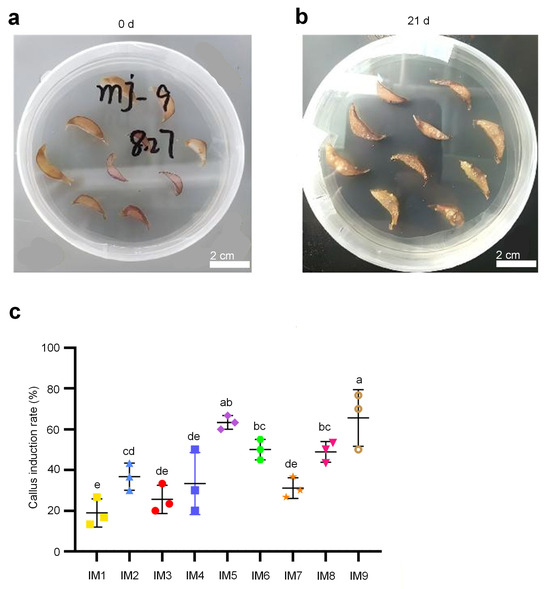
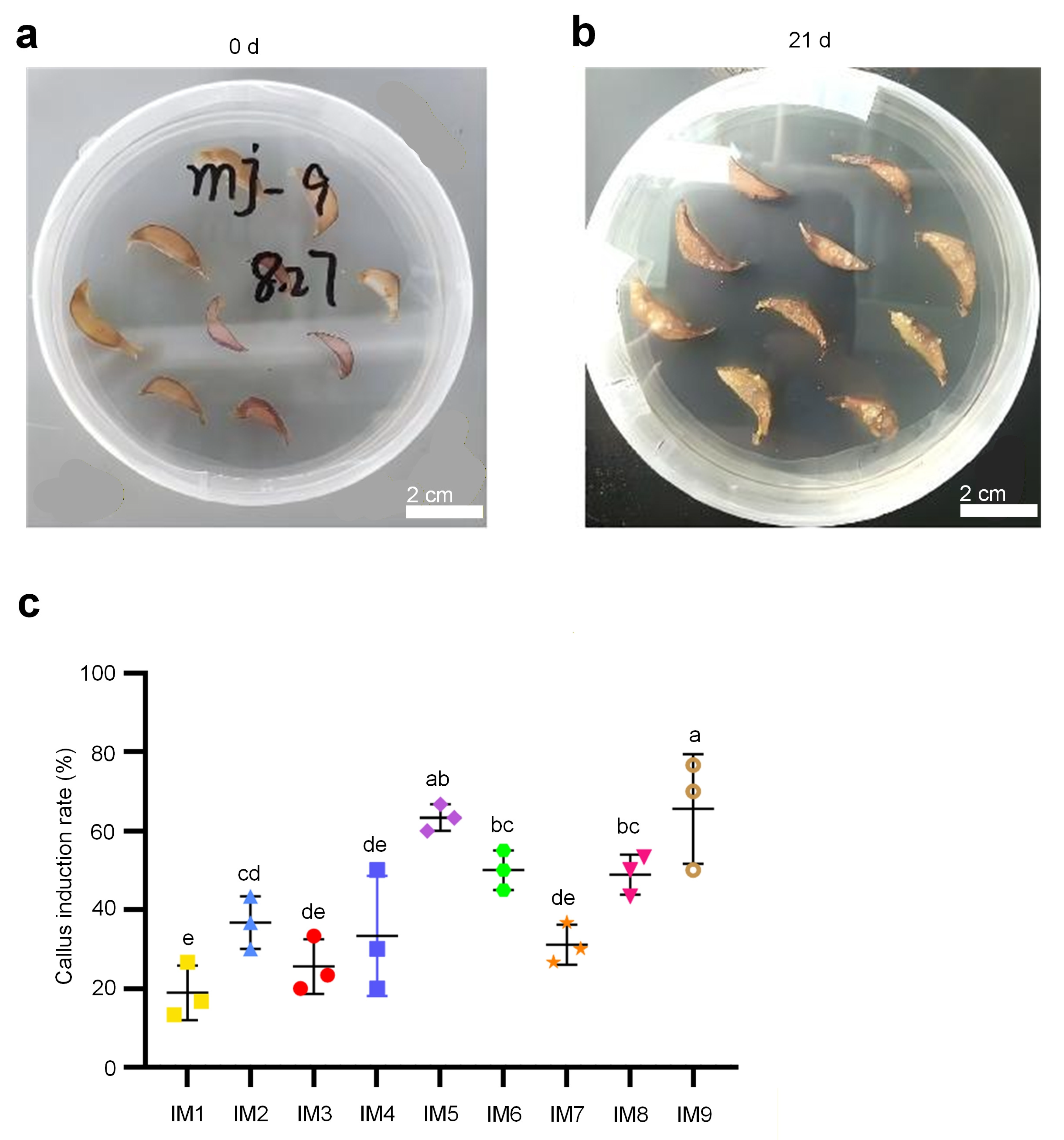
As shown in Figure 1a, ten explants were put into different media, as defined in Table 1. About 21 days after scale inoculation, small protrusions appeared at scale incision and callus was produced (as shown in Figure 1b). After comparing the callus induction rates of scale explants of Lilium regale in different media (Figure 1c), IM9 (4.43 g/L MS + 30 g/L sucrose + 5.5 g/L agar + 2.00 mg/L 6-BA + 0.1 mg/L NAA + 1.00 mg/L PIC, pH = 5.8) was the best medium, with the highest induction rate of 66% among all media. IM5 (4.43 g/L MS + 30 g/L sucrose + 5.5 g/L agar + 1.00 mg/L 6-BA + 0.05 mg/L NAA + 2.00 mg/L PIC, pH = 5.8) was the second best medium with an induction rate of 63.3%. These results suggested that the proper proportion of three PGRs in medium might form a balanced regulatory pathway with endogenous PGRs to improve callus induction rate. In addition, compared with basal medium IM1, exogenous PGRs significantly increased induction efficiency, which verified the necessity of PGRs in embryogenic callus induction.
Figure 1.
Comparison of callus induction rates of Lilium regale scales in different induction media (IM). (a) The newly inoculated scale tissues. (b) Examples of scales after 21 d of culture. White protrusions on the surfaces and callus formation were clearly visible. (c) Induction rate of epidermal callus in different media, as listed in Table 1. In part (c), middle lines represent mean values; error bars represent standard deviations of three biological replicates; lowercase letters indicate statistically significant differences between different groups (p < 0.05, Duncan’s multiple range test). The source data of Part (c) are available in Supplementary Table S1. The different colors and icons represent different media.
3.2. Induction Rate of Scale Tissue Culture Ball of Lilium regale
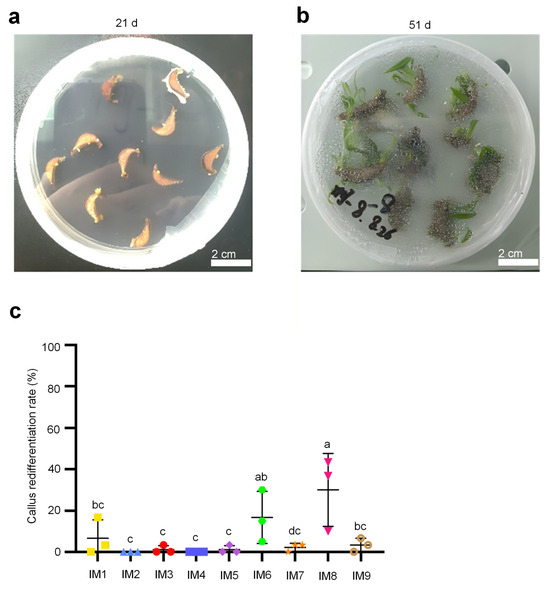
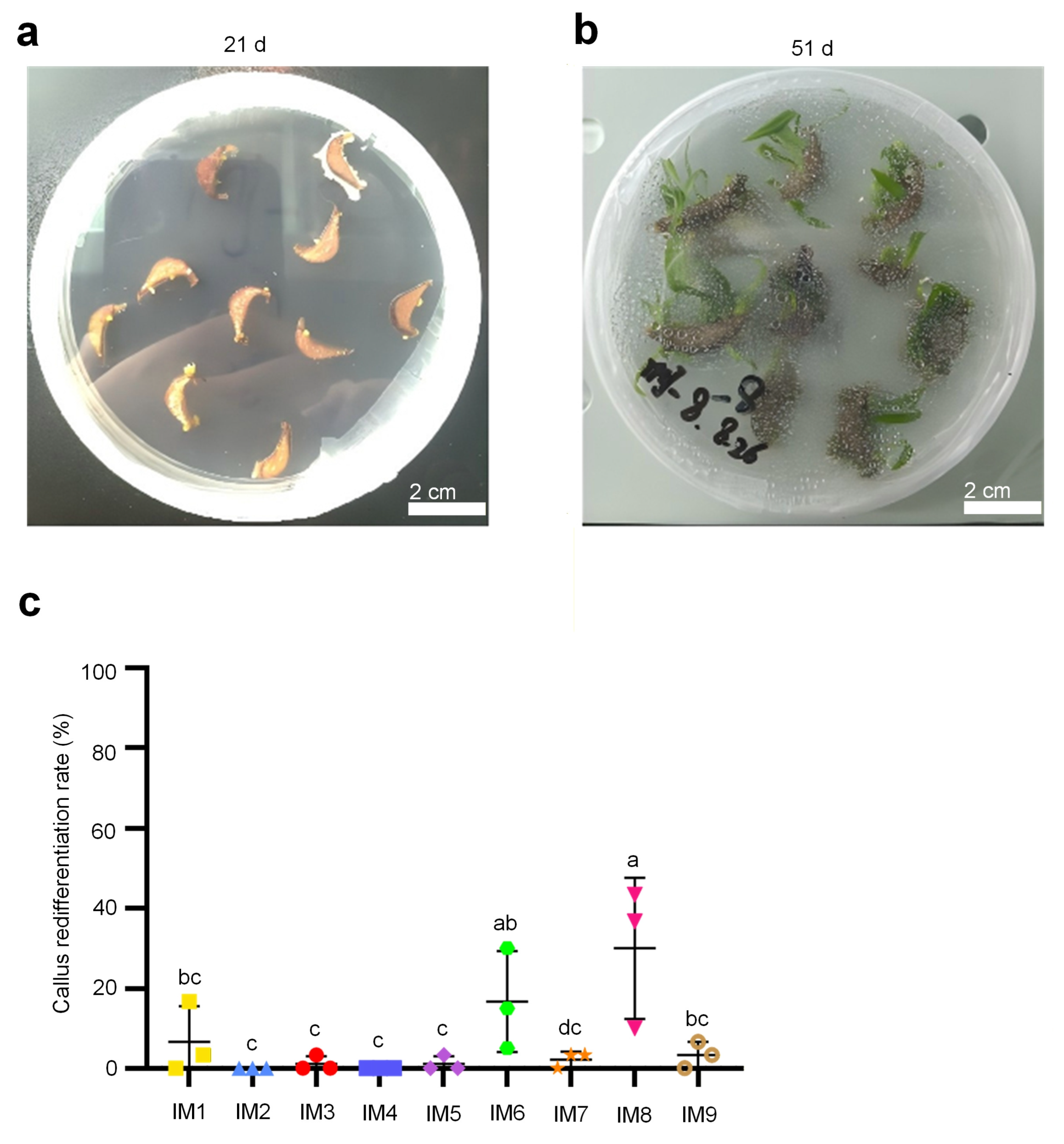
After 21 d of culture in IM5, small yellow callus dots were noticed (Figure 2a). We continued culturing the induced embryonic callus in IM8 for 30 days, during which part of the callus differentiated into small green seedlings (as shown in Figure 2b). As shown in Figure 2c, IM8 (4.43 g/L MS + 30 g/L sucrose + 5.5 g/L agar + 2.00 mg/L 6-BA + 0.05 mg/L NAA, pH = 5.8) exhibited a higher redifferentiation rate than the other treatment groups. Comparative analysis (Figure 2c) revealed that PIC-treated groups generally exhibited induction inhibition. Specifically, the induction rate of in the non-PIC-treated groups (IM1, IM6, and IM8) was significantly higher than in PIC-added groups. Compared to the PIC-free group (IM1, IM6, and IM8), the induction rates in the PIC-supplemented groups (IM3, IM5, and IM7, all with 2.00 mg/L PIC) and IM2, IM4, and IM9 with 1.00 mg/L PIC were relatively low, all below 3%.
Figure 2.
Comparisons of callus redifferentiation rates of Lilium regale in different induction media (IM). (a) Examples of scale tissues after 21 d of culture. (b) Examples of callus induced from scales in Part (a) that were further cultured in induction medium (IM8) for 30 days, during which the callus differentiated into green seedlings. (c) Redifferentiation rates of callus in different media as listed in Table 1. In Part (c), middle lines represent mean values; error bars represent standard deviations of three biological replicates; lowercase letters indicate statistically significant differences between different groups (p < 0.05, Duncan’s multiple range test). The source data of Part (c) are available in Table S2. The different colors and icons represent different media.
3.3. Propagation Rate of Callus
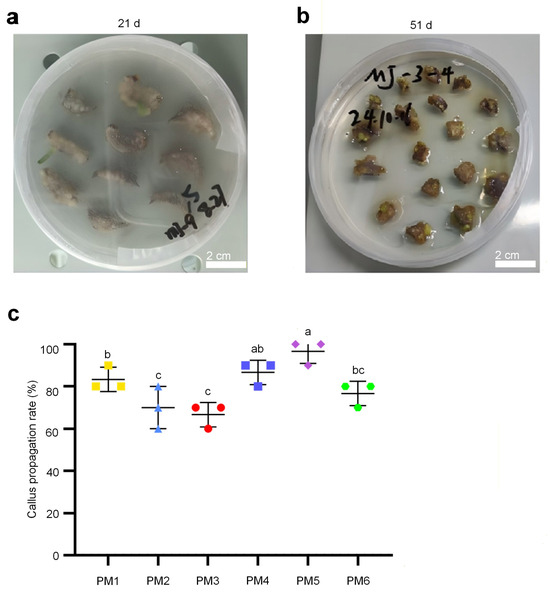
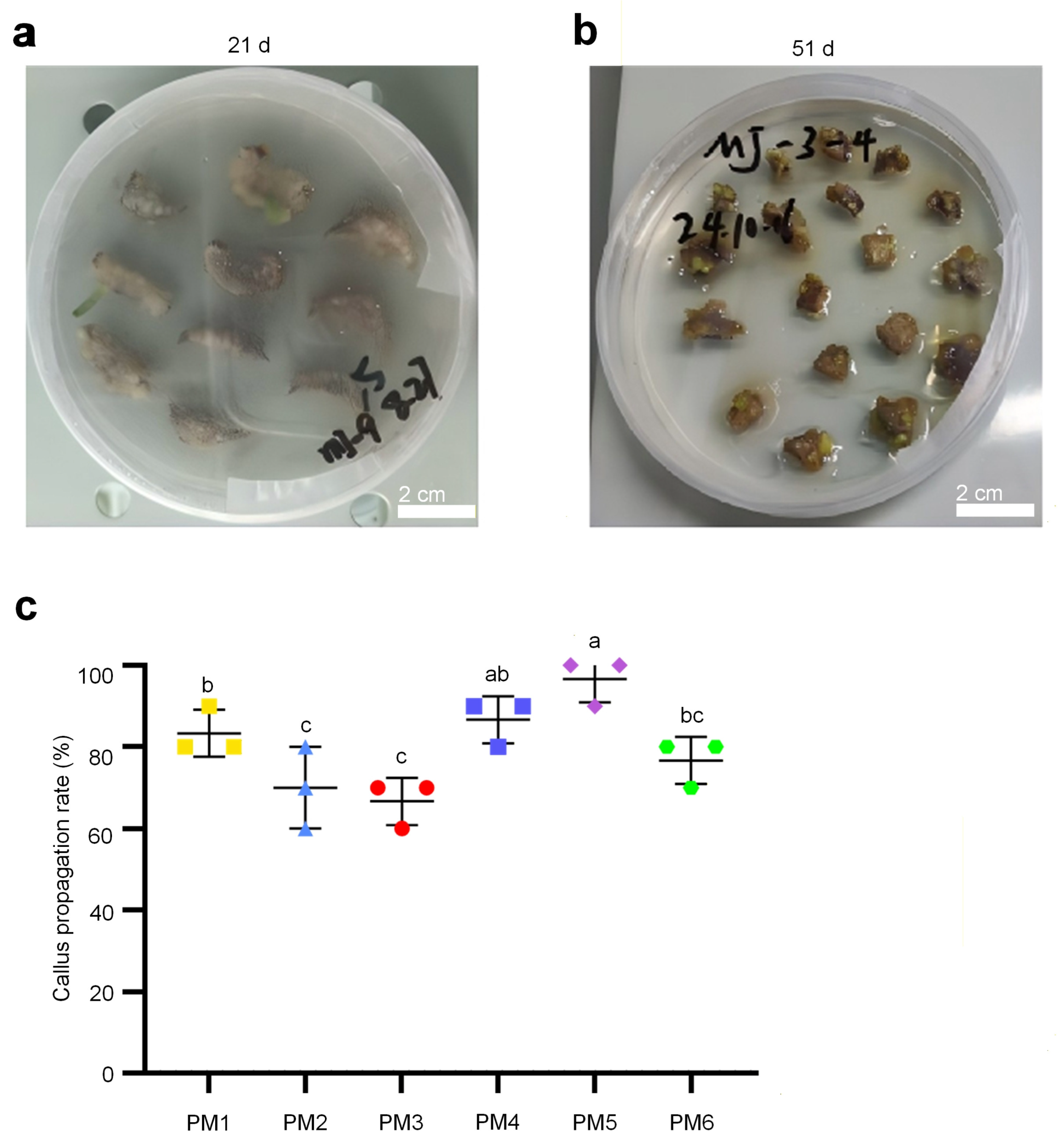
A study of plant growth regulators (PGRs) was performed on the propagation stage of Lilium regale scale callus (Figure 3). After 21 days of culture in the induction medium, the lily scales produced only a small amount of callus tissue (Figure 3a). We then transferred them to expansion culture medium for a further 30 days, resulting in the growth of abundant new deep yellow, compact callus cells in the medium (Figure 3b).
Figure 3.
Comparisons of callus propagation rates for Lilium regale in different propagation media (PM). (a) Examples of callus tissues immediately before being placed into propagation media. (b) Examples of callus tissues when being placed into propagation medium for 30 days. (c) Callus propagation rate in different media. The specific PGR formulations of the media are shown in Table 2. In Part (c), middle lines represent mean values; error bars represent standard deviations of three biological replicates; lowercase letters indicate statistically significant differences between different groups (p < 0.05, Duncan’s multiple range test). The source data of Part (c) are available in Table S3. The different colors and icons represent different media.
As shown in Figure 3c, PM5 (4.43 g/L MS + 30 g/L sucrose + 5.5 g/L agar + 1.00 mg/L 6-BA + 0.5 mg/L NAA, pH = 5.8) was superior to other media, and its propagation coefficient reached 97%. The results showed that 6-BA (0.5–1.0 mg/L) and NAA (0.1–1.0 mg/L) could regulate cytokinin/auxin balance synergistically and form a relatively broad PGR adaptation threshold in MS basal medium (Figure 3).
3.4. Callus Contamination Rate of Lilium regale
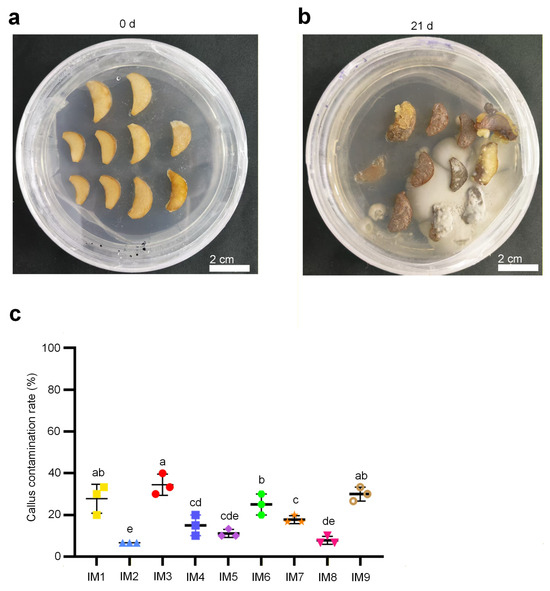
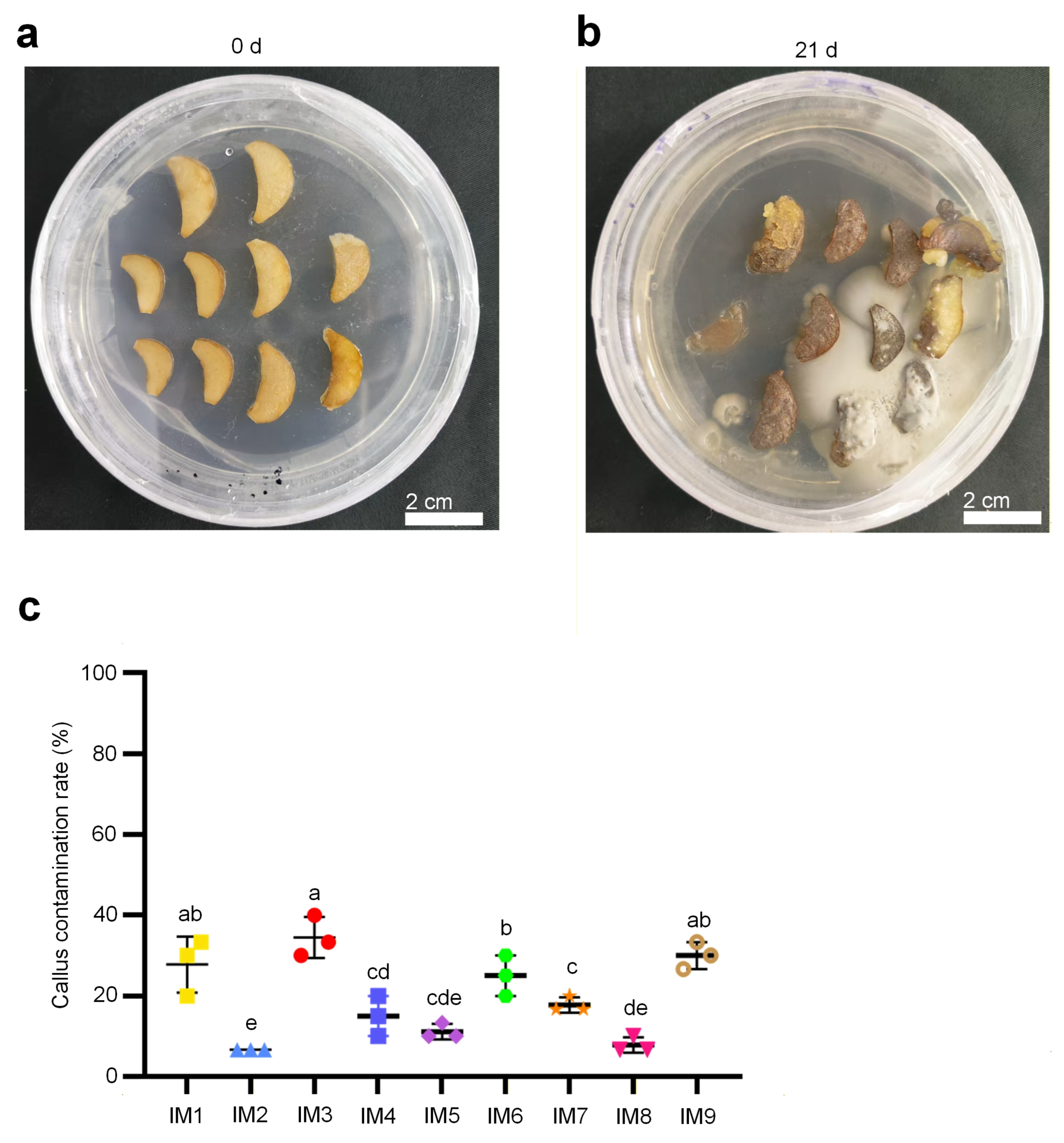
Newly inoculated scales (Figure 4a) were cultured in induction medium for 30 days. Contamination occurred in some culture dishes, with scales enveloped by white bacterial broth. The surfaces of scales and callus tissue darkened and gradually lost vitality (Figure 4b). It can be seen from Figure 4c that all experimental groups have different degrees of explant contamination, and the contamination rates of media, i.e., IM1, IM3, IM6, IM7 and IM9, are higher than those of other groups. Different contamination rates among different media may be related to experimental conditions such as disinfectant type, concentration, and treatment time, which needs further experimental verification and data analysis.
Figure 4.
Comparisons of contamination rates of Lilium regale scales in different induction media (IM). (a) Examples of newly grafted scales. (b) After 21 days, the examples of scales contaminated with bacteria were enveloped in a white bacterial fluid. (c) Scale contamination rate under different media. The PGR formulations of the media are shown in Table 1. In Part (c), middle lines represent mean values; error bars represent standard deviations of three biological replicates; lowercase letters indicate statistically significant differences between different groups (p < 0.05, Duncan’s multiple range test). The source data of Part (c) are available in Table S4. The different colors and icons represent different media.
3.5. Choosing Suitable Medium Under the Experimental Conditions by Simultaneously Considering Both CIR and CCR
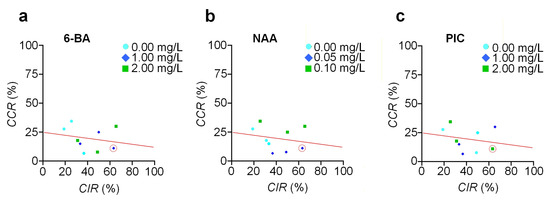
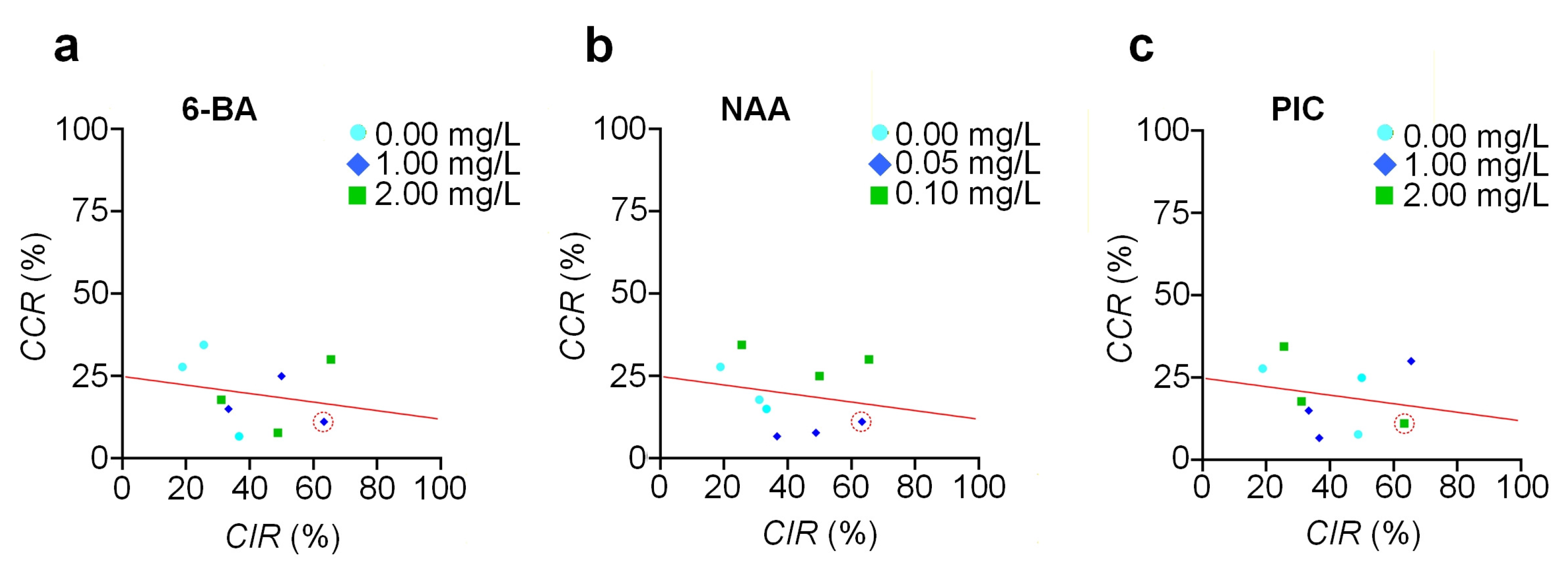
In Figure 5, we prepared scatter plots of induction rate versus contamination rate using culture medium formulations with different PGR types and concentrations to analyze the induction results. As shown in Figure 5a, the addition of 6-BA to the medium resulted in an increased callus induction rate compared to the medium without 6-BA, while the contamination rate decreased slightly. Furthermore, as the concentration of 6-BA increased from 1 mg/L to 2 mg/L, the induction and contamination rate did not show severe change (Figure 5a). In Figure 5b, adding 0.05 mg/L NAA resulted in increased callus induction rates and decreased contamination rates compared to the control medium without PGR addition. However, adding 0.1 mg/L NAA led to higher callus induction rates than the control medium, but the contamination rate decreased significantly (Figure 5b). In Figure 5c, the callus induction rate and contamination rate showed no significant changes when PIC was added compared to the medium without PIC.
Figure 5.
Scatter plot of callus induction rate (CIR) and callus contamination rate (CCR) in different media. (a) Plot of CIR and CCR of Lilium regale under three concentration gradients of 6-BA. (b) Plot of CIR and CCR of Lilium regale under three concentration gradients of NAA. (c) Correlation between CIR and CCR in Lilium regale under three concentration gradients of PIC. In Part (a–c), scatter points of different colors and shapes represent PGR gradients of varying concentrations. The red solid lines represent linear fits of the points and are named as the Induction-Contamination line (the IC line). The linear fitting formula is . The point with a dashed circle represents the suitable medium under the experimental conditions, i.e., IM5, since it is the closest to the optimal point of the IC line (see Materials and Methods). The source data of Part (a–c) are available in Tables S5–S7, respectively.
As introduced in the Materials and Methods, we performed a linear fit for all data points to obtain the Induction–Contamination line. When simultaneously considering the induction rate and contamination rate of lily callus tissue, IM5 was chosen as a suitable medium under the experimental conditions by comparing the distances of different medium’s results to the optimum point in the Induction–Contamination line (see Section 2.8). This medium was selected because it was the closest to the optimal point.
3.6. Seedlings Could Be Developed from the Induced Callus
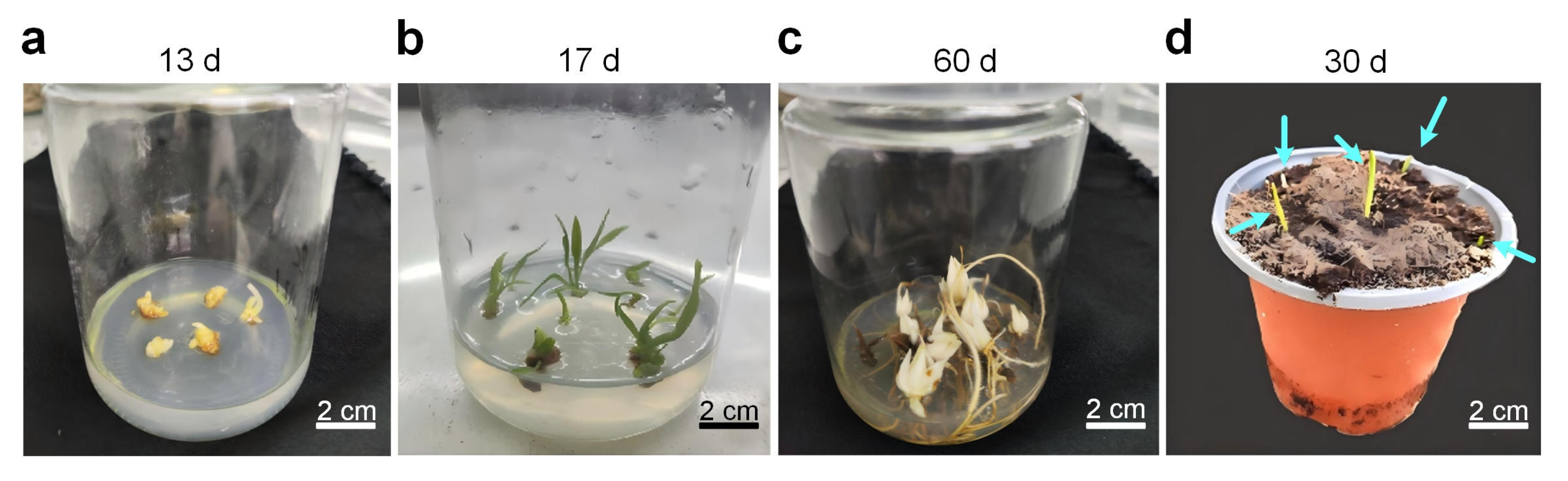
Callus tissue was inoculated onto redifferentiation medium and cultured in the dark for 13 days, during which white primordia developed (Figure 6a). Subsequently, under a 16 h light and 8 h dark photoperiod, the tissue was cultured for an additional 17 days until the primordia matured into dark green seedlings, which were then transferred to bulb-enriching medium (Figure 6b). After 60 days of dark cultivation in bulb-forming medium, white scales emerged from the bulbs (Figure 6c) and enlarged to approximately 1 cm in diameter. Following a 5-day acclimatization period (see Section 2), the bulbs were transplanted into prepared substrate and cultured for 30 days in 12 h dark and 12 h light, during which all bulbs successfully sprouted, producing light green seedlings (Figure 6d). These results indicated that our callus-based propagation system could be used for reproduction of Lilium regale.
Figure 6.
Callus redifferentiation, bulb enlargement, and transplanting after acclimatization. (a) Callus tissue was cultured in dark conditions for 13 days in redifferentiation medium, with some callus tissue developing white sprouts. (b) Transfer to a culture room with a 16 light hour photoperiod and continue cultivation for 17 days until green seedlings develop after the treatment in Part (a). (c) Remove the apical shoot tips and transfer them to bulb-culturing medium for 60 days of dark cultivation after the treatment in Part (b). (d) After acclimatization, transplant seedlings into the growing medium and cultivate for 30 days after the treatment in Part (c). The seedlings pointed by the blue arrows represent those grown from bulbs transplanted from lilies. Five bulbs were transplanted per pot, and all survived.
4. Discussion
The Lilium regale is a precious lily variety native to Sichuan, Gansu, and other regions of China, possessing exceptionally rich ornamental and breeding value [3]. Asexual reproduction is currently a highly efficient and rapid method for propagating ornamental plants, significantly shortening the plant’s development cycle [29]. In particular, the propagation method involving the formation of adventitious buds through the redifferentiation of callus tissue has become the mainstream approach for asexual reproduction in ornamental plants [30]. Currently, most research on the asexual propagation of Lilium regale focuses on directly inducing adventitious buds from bud tissues or scales to develop into new plants, with limited studies exploring the route of plant formation through the redifferentiation of callus tissues [24,31]. This experiment used Lilium regale scales as explants to induce callus tissue through thin-layer culture. Subsequent callus expansion and redifferentiation yielded a large number of adventitious buds, establishing an effective regeneration system for efficient propagation of Lilium regale. In the callus induction experiment, we employed an systematic screening design to analyze the regeneration efficiency of callus tissue across three PGR formulations at three concentration gradients. Our results indicated that the optimal culture medium was IM5 with 1 mg/L 6-BA + 0.05 mg/L NAA + 2 mg/L PIC since a good balance of high induction rate and low contamination rate was achieved when using IM5. The consideration of contamination rate is very important since low contamination rate saves significant resources.
Picloram (PIC) is a synthetic PGR with functional effects similar to auxins such as 2,4-D and NAA. It is a novel cytokinin analog with high biological activity [32]. The appropriate concentration of PIC can significantly enhance the efficiency and quality of callus induction [33]. Kedra and Bach induced callus formation in different parts (hypocotyl, seedling bulbs, roots) of Lilium martagon L. seedlings [34]. The results showed that both 6-BA and PIC-supplemented media could induce yellow, dense, granular embryonic callus tissue [34]. In somatic embryo induction experiments with Lycium barbarum, PIC significantly enhances induction efficiency compared to 2,4-D [35]. The addition of 0.5 mg/L PIC and 1.0 mg/L NAA to MS medium significantly increased the callus induction rate of Lilium rosthornii bulb scales to 78.89% [36]. Lilies are typical polyploid plants in nature, possessing a complex genetic background [23]. Significant differences exist in organ development among various lily species, leading to divergent experimental outcomes when callus induction is performed using scales from different lily varieties [11]. Lilies of different genotypes may exhibit varying degrees of bulb development and possess differing regenerative capacities [37,38]. Mori et al. [17] induced callus formation from scales of 33 lily genotypes. After two months of dark culture in 4.1 μM 4-amino-3,5,6-trichloropicolinic acid (picloram; PIC) medium, only 24 genotypes showed satisfactory callus formation. In our study, when inducing callus, PIC was added to the culture medium and used in combination with either NAA or 6-BA. Among the three PGRs, 6-BA and NAA had clear effects, increasing the induction rate (Figure 5a and Figure 5b, respectively). As shown in Figure 5c, our results demonstrate that PIC was not a key factor for successful callus induction for Lilium regale. This finding differs from previous research results, which may be attributed to variations in lily species.
PIC was also identified as an effective herbicide, primarily functioning by disrupting plant cells and inhibiting plant growth [39,40]. As shown in Figure 2c, in IM2, IM3, IM4, IM5, IM7 and IM9 with the addition of PIC, scales showed reduced redifferentiation capabilities compared to in IM1, IM6, and IM8 without PIC, suggesting that PIC helped to maintain the callus status of scales in Lilium regale. These results are consistent with previous reports of PIC inhibiting organ differentiation in other plant species [41,42].
Callus tissue can redifferentiate under specific conditions to form new plant organs, thereby developing into complete plant individuals [43]. Our results support that the direction of callus redifferentiation is controlled by the concentration ratios of different plant growth regulators [44]. Normasari et al. [45] found that at a 6-BA concentration of 0.5 mg/L, the callus tissue of Pogostemon cablin exhibited increased biomass growth as NAA content rose. We found that the plant growth regulator ratio of 6-BA (1.00 mg/L) to NAA (0.5 mg/L) in PM5 medium effectively promoted callus expansion. The ratio of auxin (NAA) to cytokinin (6-BA) was 1:2, representing a suitable ratio in our experiments.
During plant tissue culture, disinfection of explants is a critical step. Lily bulbs, having grown underground, naturally harbor a significant number of microorganisms and bacteria [46]. The proliferation of foreign microorganisms in the culture medium can severely impair the growth and even survival of the explants [47,48]. During the disinfection process, the concentration of NaClO reagent and the duration of application are critical factors [49,50,51]. Research indicated that when disinfection exceeded 8 min (8–10 min), contamination rates decreased significantly, and so did the survival rate of scales and their ability to produce adventitious buds [25]. This demonstrated that NaClO effectively disinfected lilies within a specific time window [52]. Beyond this duration, NaClO resulted in toxic effects on both scales and adventitious buds [52]. In Vaccinium arctostaphylos tissue culture, the simultaneous addition of thiabendazole and cytokinin (TDZ) to MS medium significantly enhances explants’ tolerance to the fungicide compared to thiabendazole treatment alone [53]. Proper PGR combinations resulted in healthy seedings, which consequently implied a certain degree of resistance to external bacteria and low contamination rate [54]. In our study, disinfection was performed using a combination of ethanol (75%, 1 min) and sodium hypochlorite (5%, 15 min). Under identical disinfection conditions, the medium contamination rate was lower for IM5. To explain this phenomenon, we plotted a scatter diagram to investigate the correlation between callus induction rate and contamination rate under different PGR types and concentrations. We observed that at an NAA concentration of 0.05 mg/L, the overall contamination rate was low. However, when the NAA concentration reached 0.1 mg/L, the contamination rate increased significantly (Figure 5b), suggesting that the concentration ratio of exogenous PGRs may influence explant contamination.
This study successfully established an in vitro regeneration system for Lilium regale based on scale callus tissue. It should be noted, however, that the three-factor, three-level systematic screening design employed primarily served the preliminary objective of rapid screening. This design inherently has limitations in precisely quantifying the independent effects, interactions, and non-linear responses of plant growth regulators tested (i.e., 6-BA, NAA, PIC). Future research may build upon the effective concentration ranges identified herein by employing more sophisticated experimental designs (such as central composite or Box-Behnken designs), combined with response surface analysis and multi-objective fitness function optimization methods. This approach would enable the construction of more predictive mathematical models and elucidate the precise modes of action for each factor during callus induction, proliferation, and redifferentiation processes.
Currently, the primary methods of propagating Lilium regale involve direct formation of new bulblets [24,31]. Research on using embryogenic callus tissue to redifferentiate into complete plants remains limited. Our study focuses on screening the optimal culture media for both callus induction and callus expansion to maximize callus acquisition efficiency. Based on a dual-indicator comprehensive assessment of induction rate and contamination rate, IM5 demonstrated the best equilibrium among the nine media tested in this trial. Due to the limited number of treatments in this screening experiment, no statistically significant relationship between induction rate and contamination rate could be established. The application of the IC line method here primarily supports intuitive comparison and comprehensive decision-making. Future research may employ more comprehensive experimental designs with increased treatment numbers to analyze the complex relationships between factors and contamination rates in greater depth. Subsequently, these callus cultures were transferred to PM5 medium for expansion. After 30 days of dark cultivation, a substantial amount of callus tissue was obtained (see Figure 3b). Subsequently, after 90 days of cultivation in redifferentiation and bulb-forming medium, bulbs with a diameter of around 1 cm were obtained (see Figure 6c for examples). The regeneration system established in this study enriched the propagation methods for Lilium regale and provided new insights for developing regeneration systems for other lily varieties.
5. Conclusions
A callus regeneration system was established using lily bulbs as explants to investigate the effects of different PGR types and concentration ratios on callus induction. When taking both induction and contamination rate into account, our results indicated that a suitable medium for callus induction under the experimental conditions was 1.00 mg/L 6-BA + 0.05 mg/L NAA + 2.00 mg/L PIC, pH = 5.8, yielding an induction rate of 63.33%. A suitable medium for callus expansion under the experimental conditions was 1 mg/L 6-BA + 0.5 mg/L NAA, pH = 5.8. Our results also support that new seedlings could be reproduced using our callus-based regeneration system. These offer new insights into the propagation of Lilium regale and provide potential materials for transgenic studies of lilies in the future.
Supplementary Materials
The following supporting information can be downloaded at: https://www.mdpi.com/article/10.3390/horticulturae12020205/s1, Table S1. The results of callus induction in different induction mediums. Table S2. The results of callus redifferentiation in different induction mediums. Table S3. The results of callus contamination in different induction mediums. Table S4. The results of callus propagation in different propagation mediums. Table S5. The results of callus induction and contamination in the mediums with 6-BA at different concentration gradients. Table S6. The results of callus induction and contamination in the mediums with NAA at different concentration gradients. Table S7. The results of callus induction and contamination in the mediums with PIC at different concentration gradients.
Author Contributions
Conceptualization, Y.Z. and Y.W.; methodology, Y.Z., Y.W., and K.L.; software, Y.Z.; validation, K.L., L.G., S.Y., C.S., M.S., H.Z., Y.X., M.R., and H.H.; formal analysis, K.L., L.G., and S.Y.; investigation, K.L., L.G., S.Y., C.S., M.S., H.Z., Y.X., and M.R.; resources, Y.Z. and Y.W.; data curation, K.L., C.S., L.G., M.S., and S.Y.; writing—original draft preparation, S.Y., L.G., M.S., C.S., and K.L.; writing—review and editing, Y.Z.; visualization, S.Y., C.S., and L.G.; supervision, Y.Z.; project administration, Y.Z.; funding acquisition, Y.Z. All authors have read and agreed to the published version of the manuscript.
Funding
This research was supported in part by three grants (No. 202503AP140022, No. 202501BD070001-005 and No. 202402AN360008) of the Yunnan Province Science and Technology Department, Kunming, Yunnan, China, and a grant (No. 2023001) of Yunnan Agricultural University, Kunming, Yunnan, China to YZ. The funders had no role in study design, data collection and analysis, decision to publish, or preparation of the manuscript.
Data Availability Statement
The original contributions presented in this study are included in the article/Supplementary Materials. Further inquiries can be directed to the corresponding authors.
Conflicts of Interest
The authors declare no conflicts of interest.
Abbreviations
The following abbreviations are used in this manuscript:
| 6-BA | 6-Benzylaminopurine |
| CCR | callus contamination rate |
| CIR | callus induction rate |
| CPR | callus propagation rate |
| DR | callus redifferentiation rate |
| IC line | induction–contamination line |
| IM | induction media |
| MS | Murashige and Skoog medium |
| NAA | 1-Naphthaleneacetic acid |
| PGR | plant growth regulator |
| PIC | Picloram |
| PM | propagation media |
| TDZ | Thidiazuron |
References
- Liang, Y.; Gao, Q.; Li, F.; Du, Y.; Wu, J.; Pan, W.; Wang, S.; Zhang, X.; Zhang, M.; Song, X.; et al. The giant genome of lily provides insights into the hybridization of cultivated lilies. Nat. Commun. 2025, 16, 45. [Google Scholar] [CrossRef]
- Kaushik, N.; Kim, J.H.; Nguyen, L.N.; Kaushik, N.K.; Choi, K.A. Characterization of bioactive compounds having antioxidant and anti-Inflammatory effects of Liliaceae family flower petal extracts. J. Funct. Biomater. 2022, 13, 284. [Google Scholar] [CrossRef]
- Deng, J.; Li, W.; Li, X.; Liu, D.; Liu, G. A fast, efficient, and tissue-culture-independent genetic transformation method for Panax notoginseng and Lilium regale. Plants 2024, 13, 2509. [Google Scholar] [CrossRef] [PubMed]
- Sun, J.; Wang, X.; Wang, K.; Meng, D.; Mu, Y.; Zhang, L.; Wang, J.; Yao, G.; Guo, L. Genomic and epigenomic insight into giga-chromosome architecture and adaptive evolution of royal lily (Lilium regale). Nat. Commun. 2025, 16, 5617. [Google Scholar] [CrossRef] [PubMed]
- Zhu, Z.; Sun, Y.; Liu, S.; Peng, M.; Zhou, S. Comparison of Lilium regale and L. sargentiae for lily breeding. Genet. Resour. Crop Evol. 2025, 72, 6375–6386. [Google Scholar] [CrossRef]
- Devrani, N.; Kakkar, P.; Sahu, A.; Tiwari, C. Global trends in floriculture. In Floriculture and Landscaping Chronicles: A Collaborative Insights; Stella International Publication: Kurukshetra, India, 2024. [Google Scholar]
- Filippova, G.; Darkhanova, V.; Stroeva, N.; Nikolaeva, O.; Androsova, D. In vitro reproduction and ex situ growth and development of the rare species Lilium pensylvanicum Ker.-Gawl. (Liliaceae). Mosc. Univ. Biol. Sci. Bull. 2020, 75, 71–76. [Google Scholar] [CrossRef]
- Gong, H.; Dusengemungu, L.; Lv, P.; Igiraneza, C. Advancements in lily viruses management: Challenges and solutions in elimination and detection. Horticulturae 2023, 9, 790. [Google Scholar] [CrossRef]
- Liu, Y.; Liao, W. Genetic Breeding and Biotechnology Advances in David’s Lily (Lilium davidii Duch. ex Elwes). In Breeding of Ornamental Crops: Bulbous Flowers; Springer: Cham, Switzerland, 2025; pp. 553–578. [Google Scholar]
- Pelkonen, V.P. Biotechnological Approaches in Lily (Lilium) Production; University of Oulu: Oulu, Finland, 2005. [Google Scholar]
- Sun, F.; Wang, Y.; Zhang, T.; Liu, B.; Bao, Z.; Ma, F. Establishment of Lily Bulb Scale Cutting Propagation System Promoted by Exogenous Plant Growth Regulators and Evaluation of Lily Cultivar Quality. J. Plant Growth Regul. 2025, 44, 5380–5399. [Google Scholar] [CrossRef]
- de Almeida, N.V.; Rivas, E.B.; Cardoso, J.C. Somatic embryogenesis from flower tepals of Hippeastrum aiming regeneration of virus-free plants. Plant Sci. 2022, 317, 111191. [Google Scholar] [CrossRef]
- Kaushal, N.; Srivastava, V.; Singh, S.; Gangwar, R.; Singh, P.; Dansena, V.; Wamiq, M.; Paikra, M.K. A comprehensive review on role of plant tissue culture in ornamental crops: Cultivation factors, applications and future aspects. Int. J. Environ. Clim. Change 2023, 13, 1802–1815. [Google Scholar] [CrossRef]
- Li, Y.; Li, Y.; Dong, X.; Cai, Y.; Chen, J.; Liu, R.; Zhu, F. Cultivating Callus from Anthers and Regenerating Haploid Plants in Lilium longiflorum. Horticulturae 2025, 11, 349. [Google Scholar] [CrossRef]
- Chen, Y.; Hou, X.; Zheng, Y.; Lyu, Y. The establishment of a genetic transformation system and the acquisition of transgenic plants of oriental hybrid lily (Lilium L.). Int. J. Mol. Sci. 2023, 24, 782. [Google Scholar] [CrossRef] [PubMed]
- Wang, Y.; van Kronenburg, B.; Menzel, T.; Maliepaard, C.; Shen, X.; Krens, F. Regeneration and Agrobacterium-mediated transformation of multiple lily cultivars. Plant Cell Tissue Organ Cult. (PCTOC) 2012, 111, 113–122. [Google Scholar] [CrossRef][Green Version]
- Mori, S.; Adachi, Y.; Horimoto, S.; Suzuki, S.; Nakano, M. Callus formation and plant regeneration in various Lilium species and cultivars. Vitr. Cell. Dev. Biol. Plant 2005, 41, 783–788. [Google Scholar] [CrossRef]
- Xu, L.; Ma, F.; Liang, D. Plant regeneration from in vitro cultured leaves of Lanzhou lily (Lilium davidii var. unicolor). Sci. Hortic. 2009, 119, 458–461. [Google Scholar] [CrossRef]
- Zhang, K.; Lyu, T.; Lyu, Y. Transcriptional Insights into Lily Stem Bulblet Formation: Hormonal Regulation, Sugar Metabolism, and Transcriptional Networks in LA Lily ‘Aladdin’. Horticulturae 2024, 10, 171. [Google Scholar] [CrossRef]
- Malabadi, R.B.; Chalannavar, R.K.; Kolkar, K.P. Plant cell totipotency: Plant tissue culture applications-An updated review. World J. Adv. Eng. Technol. Sci. 2025, 16, 112–135. [Google Scholar] [CrossRef]
- Fan, X.; Sun, H. Exploring Agrobacterium-mediated genetic transformation methods and its applications in Lilium. Plant Methods 2024, 20, 120. [Google Scholar] [CrossRef]
- Bakhshaie, M.; Khosravi, S.; Azadi, P.; Bagheri, H.; van Tuyl, J.M. Biotechnological advances in Lilium. Plant Cell Rep. 2016, 35, 1799–1826. [Google Scholar] [CrossRef]
- Xu, S.; Chen, R.; Zhang, X.; Wu, Y.; Yang, L.; Sun, Z.; Zhu, Z.; Song, A.; Wu, Z.; Li, T.; et al. The evolutionary tale of lilies: Giant genomes derived from transposon insertions and polyploidization. Innovation 2024, 5, 100726. [Google Scholar] [CrossRef]
- Saifullah, K.; Sheeba, N.; Mariam, R.; Naheed, K.; Asma, N.; Bushra, S. Cultivation of lilies (Lilium regale) for commercialization in Pakistan. Pak. J. Bot 2010, 42, 1103–1113. [Google Scholar]
- Yasemin, S.; Beruto, M. A review on flower bulb micropropagation: Challenges and opportunities. Horticulturae 2024, 10, 284. [Google Scholar] [CrossRef]
- Khosravi, S.; Azghandi, A.V.; Mojtahedi, N.; Haddad, R. In vitro propagation of Lilium longiflorum var. ceb-dazzle through direct somatic embryogenesis. Pak. J. Biol. Sci. (PJBS) 2007, 10, 2517–2521. [Google Scholar] [CrossRef]
- Conner, A.J.; Jacobs, J.M. Defining the use of MS medium in plant science research. Plant Cell Tissue Organ Cult. (PCTOC) 2025, 162, 69. [Google Scholar] [CrossRef]
- Song, C.; Zhang, Y.; Luo, K.; Sajjad, M.; Zhang, H.; Xu, Y.; Ran, M.; Huang, H.; Wang, Y.; Zheng, Y. Identifying Optimal Parts of Oriental Lily Bulbs for Large-Scale Propagation Using Tissue Culture Bulb Induction. Horticulturae 2025, 11, 1203. [Google Scholar] [CrossRef]
- Ruffoni, B.; Mascarello, C.; Savona, M. Strategies for Lilium propagation: Tradition vs. biotech. In Proceedings of the II International Symposium on the Genus Lilium, Pescia, Italy, 30 August–3 September 2010; pp. 347–355. [Google Scholar]
- Estaji, A.; Chamani, E.; Khazaei, Z. Influence of plant growth regulators on callogenesis and the biomass of cell suspensions in lily (Lilium ledebourii and Lilium regal). J. Appl. Biotechnol. Rep. 2021, 8, 63–70. [Google Scholar]
- Lian, T.; Qun-Xian, D.; Yong-Qing, W.; Lu, L.; Shi-Feng, L.; Qing-Chun, Z.; Jian-Xin, L.; Xiu-Lan, L. Studies on the technique of tissue culture and rapid propagation of bulbils from Lilium regale. Plant Sci. Res. 2009, 2, 14–19. [Google Scholar]
- Babu, B.K.; Mathur, R.; Suresh, K.; Ravichandran, G.; Susanthi, B.; Tiwari, S. In Vitro Cultural Studies for Callogenesis and Embryogenesis of Oil Palm (Elaeis guineensis Jacq.) Using Seedling and Spear Leaf Explants. J. Oil Palm Res. 2025, 37, 64–71. [Google Scholar] [CrossRef]
- Arief, N.H.A.Z.; Rahayu, E.S.; Pa’ee, F.; Habibah, N.A. Effect of BAP and Picloram on Shoot Induction (Musa acuminata Colla var. Mulu Bebek). Biosaintifika J. Biol. Biol. Educ. 2025, 17, 107–117. [Google Scholar] [CrossRef]
- Kędra, M.; Bach, A. Morphogenesis of Lilium martagon L. explants in callus culture. Acta Biol. Crac. 2005, 47, 65–73. [Google Scholar]
- Khatri, P.; Joshee, N. Effect of Picloram and Desiccation on the Somatic Embryogenesis of Lycium barbarum L. Plants 2024, 13, 151. [Google Scholar] [CrossRef] [PubMed]
- Fu, Y.; Liang, X.; Zhang, H.; Cheng, S.; Li, A.; Liao, M.; Tan, L.; Yang, L.; Qi, X. Establishment of an efficient regeneration system and in vitro polyploid induction based on the bulblet centre in Lilium rosthornii Diels. In Vitr. Cell. Dev. Biol. Plant 2024, 60, 508–522. [Google Scholar] [CrossRef]
- Ren, Z.M.; Cui, L.; Gao, C.; Wu, Y.; Cui, Q.; Li, D.Z.; Zheng, L.Q.; Xia, Y.P. Effects of Morphological Characteristics, Nutritional Status and Light on the Scale Propagation of Lilium. Agriculture 2023, 13, 1341. [Google Scholar] [CrossRef]
- Bahr, L.R.; Compton, M.E. Competence for in vitro bulblet regeneration among eight Lilium genotypes. HortScience 2004, 39, 127–129. [Google Scholar] [CrossRef]
- Salazar Mercado, S.A.; Salcedo Garcia, P.I. Cytotoxic analysis of the herbicide picloram utilizing Lens culinaris as an environmental biomarker. Environ. Sci. Pollut. Res. 2025, 32, 5457–5463. [Google Scholar] [CrossRef] [PubMed]
- Du, W.; Wu, J.; Liu, S.; Jia, X.; Li, H.; Zhou, Q.; Zou, B.; Li, Q.; Chen, X. Identification and characterization of SmPIC30, an important gene that controls resistance to the auxin herbicide picloram in eggplant. Sci. Hortic. 2024, 336, 113449. [Google Scholar] [CrossRef]
- Abdelgawad, F.A.M.; El-Hawary, S.S.; El-Kader, E.M.A.; Alshehri, S.A.; Rabeh, M.A.; Essa, A.F.; El-Mosallamy, A.E.; El Gedaily, R.A. Eliciting Callus Cultures for the Production of Cytotoxic Polyphenolics from Maesa indica Roxb. Sweet. Plants 2024, 13, 1979. [Google Scholar] [CrossRef]
- De Mello, T.; Silva, T.D.; Zanardo, T.É.C.; De Almeida, F.A.N.; Oliveira, L.B.; Hegedus, C.E.N.; Dos Anjos, B.B.; Schmildt, E.R.; Ferreira, A.; da Silva Ferreira, M.F.; et al. Somatic embryogenesis in Euterpe edulis Martius is improved by wounding, explant orientation, and suspension culture. Plant Cell Tissue Organ Cult. (PCTOC) 2024, 156, 31. [Google Scholar] [CrossRef]
- Anbazhakan, R.; Husain, Z.; Gao, J.Y. High-efficiency callus induction and integrated GC-MS/UPLC-MS/MS metabolomic profiling of Malania oleifera Chun & SK Lee bioactive compound production. Ind. Crops Prod. 2026, 239, 122446. [Google Scholar]
- Asghar, S.; Ghori, N.; Hyat, F.; Li, Y.; Chen, C. Use of auxin and cytokinin for somatic embryogenesis in plant: A story from competence towards completion. Plant Growth Regul. 2023, 99, 413–428. [Google Scholar] [CrossRef]
- Normasari, R.; Arumingtyas, E.L.; Retnowati, R.; Widoretno, W. The combination effect of Auxin and Cytokinin on callus induction of Patchouli (Pogostemon Cablin Benth.) from leaf explants. In Proceedings of the 3rd International Conference on Biology, Science and Education (IcoBioSE 2021), Padang, Indonesia, 27 October 2021; pp. 551–557. [Google Scholar]
- Askari, N.; Visser, R.G.; De Klerk, G.J. Growth of lily bulblets in vitro, a review. J. Hortic. Sci. 2018, 5, 133–143. [Google Scholar]
- Teixeira da Silva, J.A.; Kulus, D.; Zhang, X.; Zeng, S.; Ma, G.; Piqueras, A. Disinfection of explants for saffron (Crocus sativus) tissue culture. Environ. Exp. Biol. 2016, 14, 183–198. [Google Scholar] [CrossRef]
- Tyagi, V.S.A.; Chauhan, P.; Kumari, P.; Kaushal, S. Identification and prevention of bacterial contimination on explant used in plant tissue culture labs. Int. J. Pharm. Pharm. Sci. 2011, 3, 160–163. [Google Scholar]
- Komolafe, O.; Oyinloye, O.H.; Ogbimi, E.R.; Hassan, K.O.; Pelemo, O.S. Optimizing disinfection protocols for yam explant regeneration in plant tissue culture. Int. J. Hortic. Sci. 2025, 31, 66–72. [Google Scholar] [CrossRef]
- Babu, G.A.; Mosa Christas, K.; Kowsalya, E.; Ramesh, M.; Sohn, S.I.; Pandian, S. Improved sterilization techniques for successful in vitro micropropagation. In Commercial Scale Tissue Culture for Horticulture and Plantation Crops; Springer: Singapore, 2022; pp. 1–21. [Google Scholar]
- Kaushik, P.; Sansanwal, R.; Sharma, R. A comparative analysis of the in-vitro effects of various sterilization techniques and different disinfectants on the micropropagation of explants of Asparagus racemosus. Int. J. Health Sci. 2022, 6, 11288–11294. [Google Scholar] [CrossRef]
- Ghoreyshi, B.; Naderi, R.; Ghaem Maghami, S.; Zeyni, S. A decontamination procedure for in vitro culture of Lilium longiflorum cv.’Dozzel’scale explants. In Proceedings of the VI International Symposium on In Vitro Culture and Horticultural Breeding, Brisbane, Australia, 24–28 August 2008; pp. 289–293. [Google Scholar]
- Noruzpuor, M.; Zare, N.; Asghari Zakaria, R.; Sheikhzade, P. Effects of benomyl and cytokinin on in vitro contamination and growth of Vaccinium arctostaphylos L. node explants. Iran. J. Med. Aromat. Plants Res. 2022, 38, 150–165. [Google Scholar]
- Al-Eqabi, F.A.; Al-Amery, L. Micropropagation of Prunus Sp., Factors, Hormones: A Review. In Proceedings of the IOP Conference Series: Earth and Environmental Science, Kufa, Iraq, 18–19 December 2024; Volume 1487, p. 012070. [Google Scholar]

Disclaimer/Publisher’s Note: The statements, opinions and data contained in all publications are solely those of the individual author(s) and contributor(s) and not of MDPI and/or the editor(s). MDPI and/or the editor(s) disclaim responsibility for any injury to people or property resulting from any ideas, methods, instructions or products referred to in the content. |
© 2026 by the authors. Licensee MDPI, Basel, Switzerland. This article is an open access article distributed under the terms and conditions of the Creative Commons Attribution (CC BY) license.