Article

The Complete Chloroplast Genome Sequence of Pseudolysimachion pyrethrinum var. gasanensis
Forest Biological Resources Utilization Center, Korea National Arboretum, Yangpyeong 12519, Republic of Korea
*
Author to whom correspondence should be addressed.
Horticulturae 2026, 12(2), 196; https://doi.org/10.3390/horticulturae12020196
Submission received: 16 January 2026 / Revised: 2 February 2026 / Accepted: 3 February 2026 / Published: 4 February 2026
(This article belongs to the Special Issue Genetic Innovation and Breeding in Ornamental Plants)

Abstract

Pseudolysimachion pyrethrinum var. gasanensis (Gasan spike speedwell) is a valuable Korean endemic variety with significant horticultural potential. Despite its morphological distinctiveness, its taxonomic status and evolutionary position have remained a subject of debate. In this study, we assembled and characterized the first complete chloroplast (cp) genome of P. pyrethrinum var. gasanensis using high-throughput sequencing. The complete plastome is 152,251 bp in length, exhibiting a typical quadripartite structure with a large single-copy (LSC) region (83,191 bp), a small single-copy (SSC) region (17,690 bp), and two inverted repeats (IRs) (25,685 bp each). The genome contains 133 genes, including 88 protein-coding, 37 tRNA, and 8 rRNA genes. Genomic analysis identified 42 simple sequence repeat (SSR) units across 38 distinct loci, predominantly mononucleotide A/T motifs, which serve as potential molecular markers for variety-level identification. Selective pressure analysis revealed that the majority of protein-coding genes are under strong purifying selection (Ka/Ks < 1.0), emphasizing the evolutionary stability of the plastome. Comparative analysis of IR boundaries using IRscope revealed a high degree of structural conservation among Pseudolysimachion species, with minor variations at the junction sites. Phylogenetic analysis based on 18 complete plastomes strongly supported the monophyly of the genus Pseudolysimachion (Bootstrap = 100%) and placed P. pyrethrinum var. gasanensis as a sister to the European P. spicatum. These genomic resources provide a foundational tool for the molecular breeding, systematic conservation, and sustainable utilization of this endemic variety, while offering clarity to its taxonomic classification within the tribe Veroniceae.

1. Introduction

The genus Pseudolysimachion Opiz (Plantaginaceae) is a group of perennial herbs widely recognized for their vibrant floral spikes and significant adaptability, making them a high-value resource in the global horticultural industry. Historically, the generic boundaries of this group have been a subject of long-standing taxonomic debate. For decades, it was often relegated to a subgeneric rank within the genus Veronica L. However, a landmark phylogenetic study by Albach et al. [1] provided a fresh perspective on the evolution of the tribe Veroniceae. By utilizing multi-locus molecular data, they demonstrated the monophyletic nature of Pseudolysimachion, effectively distinguishing it from other related lineages. This evolutionary independence is further corroborated by classic palynological evidence; as noted by Hong [2], Pseudolysimachion displays unique pollen exine structures and aperture types that are distinct from those observed in other Veroniceae members.
The evolutionary radiation of this genus is particularly evident in Northern Asia, which serves as a primary center of diversity. Kosachev et al. [3] recently documented the complex floristic patterns of Veronica subg. Pseudolysimachium in Siberia, emphasizing how environmental factors in continental climates have shaped its high morphological plasticity. In the context of the Korean Peninsula, the genus is represented by a series of endemic taxa that have evolved in isolation across diverse topographical terrains. The conservation of these endemic species is considered a national priority, as Chung et al. [4] highlighted that many Korean Pseudolysimachion species are narrow endemics with restricted distributions, rendering them highly susceptible to habitat fragmentation and climate change.
Among these, Pseudolysimachion pyrethrinum var. gasanensis M.Kim & H.Jo (Gasan spike speedwell) is of particular taxonomic and horticultural interest. It was formally described by Kim and Jo [5] as a distinct endemic variety in Korean Endemic Plants, characterized by its unique dwarf stature and specific ecological requirements in limestone habitats. Although it is recognized for its morphological distinctiveness, its taxonomic status has occasionally been questioned, with some inventories treating it as a synonym of the nominal species. Traditional classification methods, which rely heavily on vegetative characters such as leaf serration and indumentum, often struggle to resolve these variety-level distinctions due to phenotypic variation.
Due to their significant horticultural prospects, Pseudolysimachion species have recently received extensive research attention. Previous studies have investigated critical aspects of their cultivation and stress physiology, including seed germination under various temperature regimes [6], growth and photosynthetic responses to shading levels [7], and protocols for adventitious shoot regeneration [8]. Furthermore, recent molecular physiological research has elucidated their genetic responses to abiotic stresses such as drought and waterlogging [9].
Traditional classification of the Pseudolysimachion genus has historically relied on morphological characters such as leaf shape, pubescence, and bract length. However, these traits often exhibit significant environmental plasticity, leading to taxonomic ambiguities and challenges in species delimitation within the P. longifolium complex [10]. To overcome these challenges, the use of complete chloroplast (cp) genomes has emerged as a powerful tool for plant systematics. As discussed by Daniell et al. [11], comparative plastome analysis offers unparalleled resolution for diversity assessment and evolutionary reconstruction, establishing robust DNA barcodes for indigenous plants [12,13]. The conserved yet informative nature of the cp genome—specifically regarding inverted repeat (IR) boundary shifts and simple sequence repeat (SSR) distributions—provides the necessary data to clarify the identity of rare endemic varieties. For endemic varieties like P. pyrethrinum var. gasanensis, which face increasing threats from habitat fragmentation and climate change, comprehensive genomic characterization is not merely a taxonomic exercise but a fundamental requirement for long-term germplasm management and sustainable utilization [14].
In this study, we report the first complete chloroplast genome of P. pyrethrinum var. gasanensis assembled through high-throughput sequencing technologies to ensure high sequence accuracy. Our objectives were to (1) characterize the detailed structural features and gene content of the plastome, (2) identify unique genomic markers including SSRs for variety-level identification, and (3) elucidate its phylogenetic position within the Veroniceae tribe using phylogenetic analysis. These data will provide a foundational genomic resource for the molecular breeding and systematic conservation of this valuable Korean endemic variety.

2. Materials and Methods

2.1. Plant Material, DNA Extraction, and Sequencing

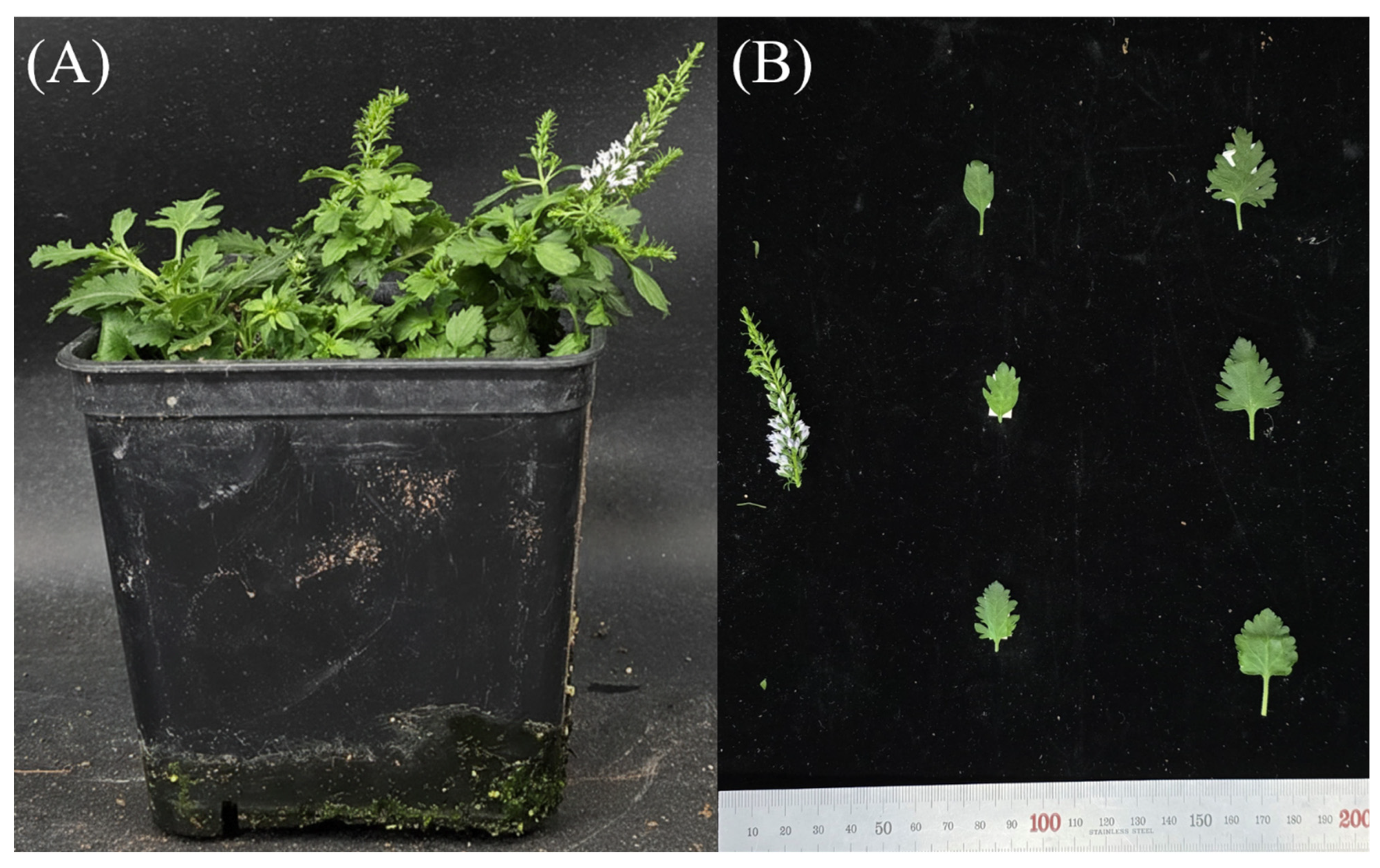
The plant material of P. pyrethrinum var. gasanensis was collected from Mt. Gasan, Hakmyeong-ri, Dongmyeong-myeon, Chilgok-gun, Gyeongsangbuk-do, Korea (36°02′18.8″ N, 128°34′24.3″ E; Figure 1). A voucher specimen was deposited at the Herbarium of the Korea National Arboretum (KH; Collector: J.W. Kim, J.H. Yi, J.Y. Jung, and S.H. Kim, s.n.; Barcode No. KHB1663391). The taxonomic identity was confirmed by referring to the comprehensive keys in the Flora of Korea [15], with further validation using the specific descriptions provided in [5]. Genomic DNA (gDNA) was extracted from leaves using a DNeasy Plant Mini Kit (Qiagen, Valencia, CA, United States) following the manufacturer’s protocols. The purified gDNA was sequenced using the NovaSeq X platform (Illumina, San Diego, CA, USA) at Phyzen (Seoul, Korea). A total of 7.44 gigabases (Gb) of raw sequence data was generated through 151 bp paired-end sequencing, providing sufficient coverage for the complete chloroplast genome assembly. We utilized NOVOPlasty v4.3.5 [16] to perform the de novo assembly of the P. pyrethrinum var. gasanensis chloroplast genome. The rbcL gene sequence from P. nakaianum (NC_031153) served as the seed for the initial assembly. Functional annotation was performed using GeSeq, available at https://chlorobox.mpimp-golm.mpg.de/geseq.html (accessed on 13 January 2026) [17]. To illustrate the genomic features, Chloroplot (available at https://irscope.shinyapps.io/Chloroplot/ accessed on 20 January 2026) was employed [18]. Furthermore, the structural organization of the P. pyrethrinum var. gasanensis chloroplast genome, specifically the detailed features of cis-splicing and trans-splicing genes (Supplementary Figures S2 and S3), were visualized using CPGView (http://www.1kmpg.cn/cpgview/ accessed on 13 January 2026) [19]. This analysis allowed for a rigorous verification of gene boundaries and the spatial arrangement of transcription units within the quadripartite structure.

2.2. Characterization of Simple Sequence Repeats (SSRs)

The simple sequence repeats (SSRs) within the P. pyrethrinum var. gasanensis chloroplast genome, as well as those of three other related Pseudolysimachion species (P. kiusianum var. diamantiacum, P. spicatum, and P. nakaianum), were identified using the MISA (Microsatellite identification tool; http://pgrc.ipk-gatersleben.de/misa/ accessed on 14 January 2026) [20]. The minimum repeat thresholds were set to 10 for mononucleotides, 6 for dinucleotides, and 5 for tri-, tetra-, penta-, and hexanucleotides.
To evaluate genomic diversity and identify variety-specific molecular markers, a comparative analysis of SSR distribution and frequency was performed across the four taxa. The identified SSRs were classified based on their motif types, repeat numbers, and genomic locations (LSC, SSC, and IR). Furthermore, the spatial distribution of SSR loci was mapped to the chloroplast genome to identify hotspot regions with high evolutionary rates.

2.3. Comparative Plastome Analysis Methods

To investigate the structural variations and the degree of contraction or expansion at the inverted repeat (IR) boundaries, we compared the junction sites among P. pyrethrinum var. gasanensis and its close relatives. The four junction regions—JLB (LSC/IRb), JSB (IRb/SSC), JSA (SSC/IRa), and JLA (IRa/LSC)—along with their adjacent genes were visualized using the IRscope (https://irscope.shinyapps.io/irapp/ accessed on 14 January 2026) [21]. Furthermore, a whole-genome sequence alignment was performed using the mVISTA program (https://genome.lbl.gov/vista/mvista/submit.shtml accessed on 15 January 2026) in Shuffle-LAGAN mode [22] to identify genomic divergence, using the complete chloroplast genome of P. pyrethrinum var. gasanensis as a reference.

2.4. Codon Usage Bias and Selection Pressure Analysis

To evaluate the evolutionary constraints and translational efficiency of the plastome, the codon usage bias was analyzed. The relative synonymous codon usage (RSCU) values for all protein-coding genes (CDS) were calculated using MEGA 12 [23] based on a total of 88 identified CDS. This analysis was conducted to identify preferred codons and the influence of natural selection or mutational bias on the chloroplast genome.

2.5. Selective Pressure Analysis

To estimate the selective pressure acting on the protein-coding genes during the divergence of P. pyrethrinum var. gasanensis, the nonsynonymous (Ka) and synonymous (Ks) substitution rates, along with their ratio (Ka/Ks, or ω), were calculated. A pairwise comparison was performed between P. pyrethrinum var. gasanensis and its closest phylogenetic relative, P. spicatum. The 88 protein-coding sequences (CDS) were extracted and aligned using MAFFT based on their codons. The Ka/Ks ratios were then computed using the KaKs_Calculator 2.0 [24] based on the Nei-Gojobori (NG) method [25]. Genes with Ks = 0 were excluded from the final analysis to avoid calculation artifacts.

2.6. Phylogenetic Analysis

To determine the evolutionary position of P. pyrethrinum var. gasanensis, we reconstructed a phylogenetic tree using 18 complete chloroplast genomes. To ensure a robust phylogenetic context, we included various taxa from the family Plantaginaceae as the ingroup while designating Scrophularia takesimensis (family Scrophulariaceae) as an outgroup, representing a closely related lineage within the order Lamiales. This taxon sampling strategy was designed to clarify the monophyly of the genus Pseudolysimachion and its relationship with other genera, while minimizing taxonomic redundancy with previous studies.
Protein-coding sequences (CDS) were extracted and concatenated using PhyloSuite v.1.2.2 [26]. To avoid overrepresentation and biased weighting of the inverted repeat (IR) regions, only one of the two IR copies was included for each taxon in the final alignment matrix. During this process, the ycf15 gene was excluded from the final alignment matrix because it contained internal stop codons in nine taxa, which could indicate potential pseudogenization and compromise the reliability of the phylogenetic inference. Multiple sequence alignment was executed using the MAFFT v7.313 plugin [27] integrated within PhyloSuite. The phylogenetic framework was constructed via Maximum Likelihood (ML) analysis in MEGA 12 [23]. The analysis was conducted under the GTR+I substitution model, which was classified as the best-fit model. Statistical support for the nodes was evaluated using 1000 bootstrap replicates.

3. Results

3.1. Characteristics of the Chloroplast Genome of P. pyrethrinum var. gasanensis

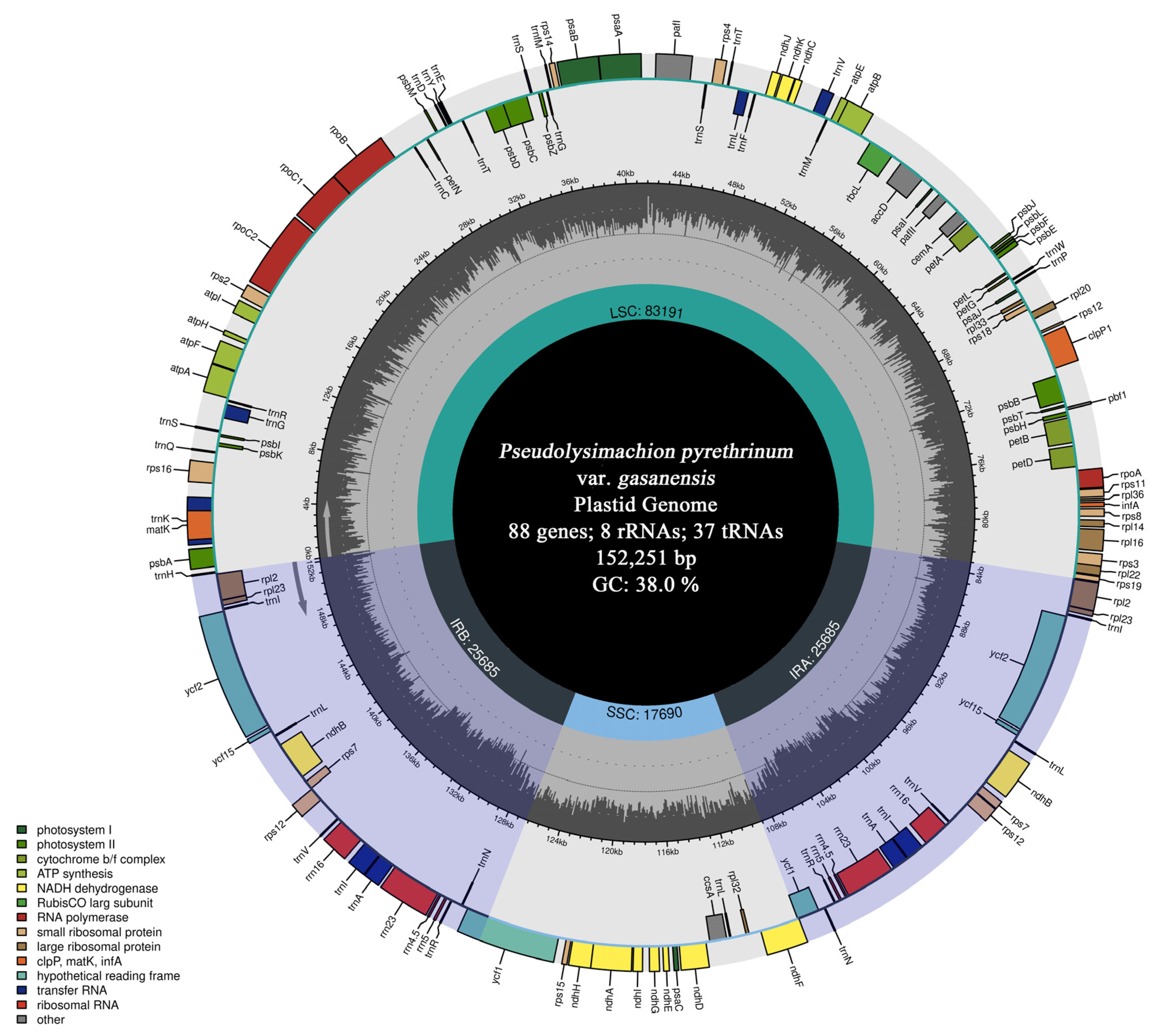
The complete chloroplast genome sequence of P. pyrethrinum var. gasanensis (GenBank accession no. PX593256) was 152,251 bp in length. To ensure high-quality assembly, a total of 49,282,200 raw reads were generated and mapped back to the assembled sequence, resulting in an average sequencing depth of 8204.26× as calculated by samtools (Figure S1). The genome exhibited a quintessential quadripartite structure, comprising a large single-copy (LSC) region of 83,191 bp and a small single-copy (SSC) region of 17,690 bp, separated by a pair of inverted repeats (IRs) each measuring 25,685 bp (Figure 2). The comprehensive guanine-cytosine content (GC content) of the cp genome was 38.02%, which is consistent with those observed in other related species within the genus Pseudolysimachion. The chloroplast genome encompasses a total of 133 genes, consisting of 88 protein-coding genes, eight rRNA, and 37 tRNA genes (Table 1). Among these, 21 genes were duplicated in the IR regions, including 9 protein-coding, 8 rRNA, and 4 tRNA genes. The specific gene structures characterized by cis-splicing are shown in Figure S2. Notably, the rps12 gene was found to be a trans-splicing gene (Figure S3).

3.2. Distribution and Characterization of Simple Sequence Repeats (SSRs)

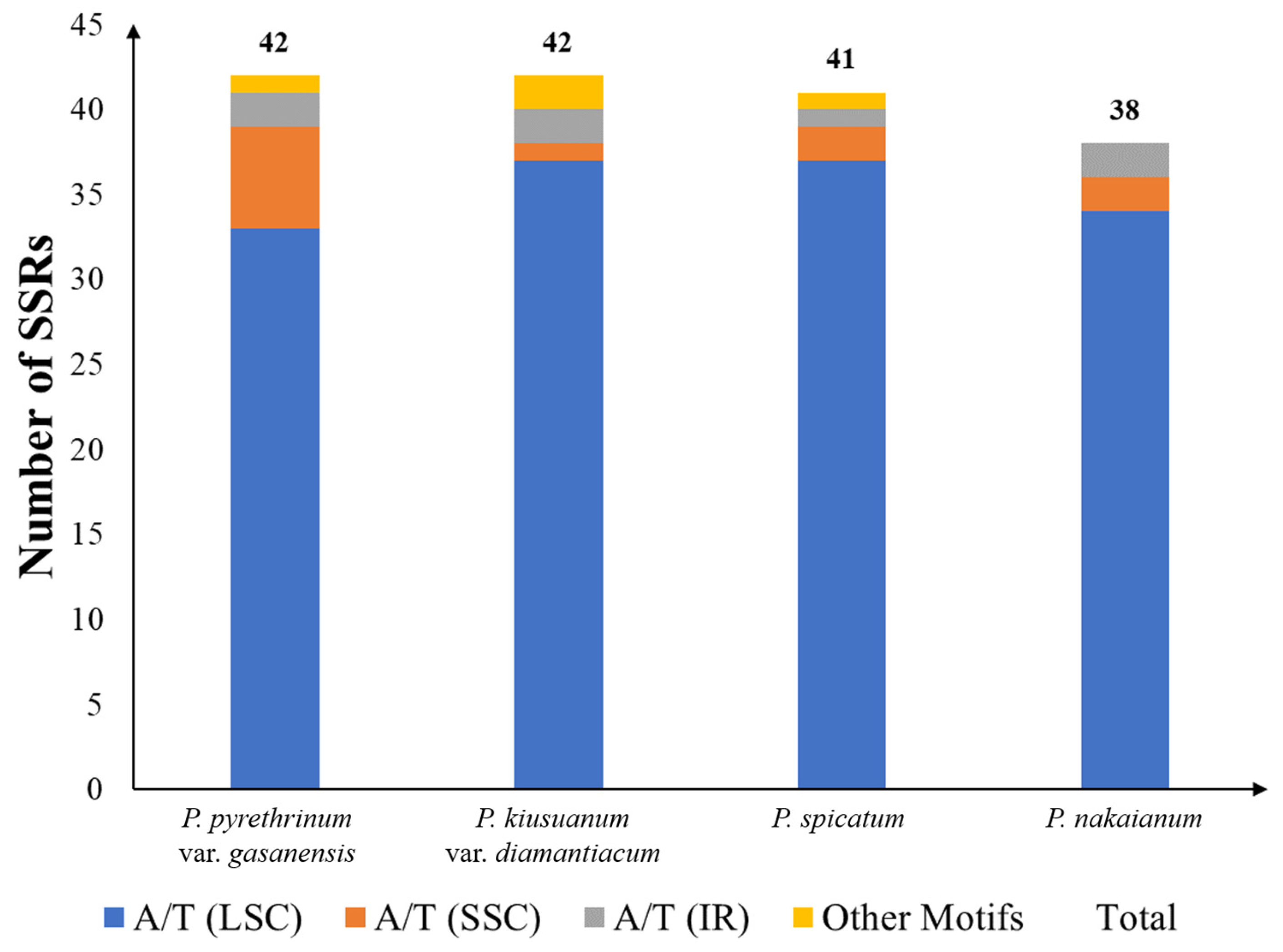
A total of 42 SSR units were identified across 38 distinct loci in the P. pyrethrinum var. gasanensis plastome. Among these, mononucleotides were the most predominant type, accounting for 97.6% (41 out of 42) of the total SSR units, while only one dinucleotide (TA/AT) was detected (2.4%). All mononucleotide SSRs consisted of A/T motifs, reflecting the strong AT-bias of the chloroplast genome (Figure 3). Notably, five loci were identified as compound SSRs (SSR nr. 8, 26, 29, 30, and one additional), where multiple repeat motifs were separated by short non-repetitive sequences. For instance, SSR locus nr. 8 contained both (T)10 and (A)12 motifs within a single genomic region.
Comparative analysis among the four Pseudolysimachion species showed that the overall SSR distribution was highly conserved. However, the spatial distribution of these loci in P. pyrethrinum var. gasanensis was notably concentrated in the Large Single Copy (LSC) region (37 units; 88.1%), followed by the Small Single Copy (SSC) (4 units; 9.5%) and Inverted Repeat (IR) (1 unit; 2.4%) regions (Figure 3). Although the LSC region harbored the majority of SSRs in all compared species, P. pyrethrinum var. gasanensis displayed a distinctively higher SSR count in the SSC region compared to P. spicatum, providing a potential genomic signature for variety-level identification.
In terms of repeat length, 10-unit mononucleotides were the most frequent, appearing at 23 different positions. Most SSRs were located in the intergenic spacer (IGS) regions, such as trnS-trnG and atpI-atpH, which are known for high evolutionary rates. These findings, particularly the identification of unique compound SSRs and the specific distribution pattern in the SSC region, provide a high-resolution molecular toolkit for the genetic identification and conservation of this endemic variety.

3.3. Comparative Genomic Analysis

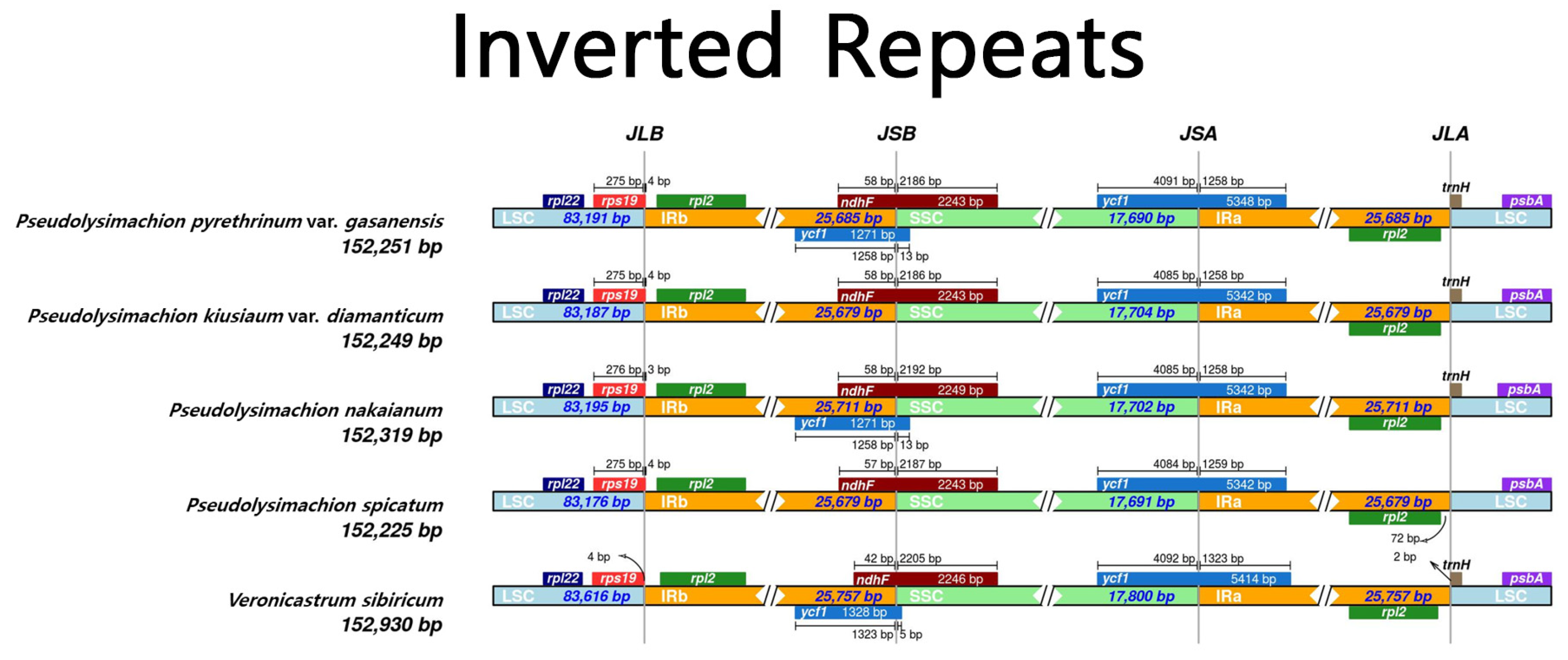
The IR/SC boundary regions were compared among P. pyrethrinum var. gasanensis and related taxa (Figure 4). The genomic structure was highly conserved, with the rps19 gene spanning the JLB (LSC/IRb) junction. The ycf1 fragment was consistently located at the JSB (IRb/SSC) boundary. Minor variations in the expansion or contraction of IR regions were observed, but the overall architecture remained stable across the compared Pseudolysimachion species. To further investigate the genomic divergence, the whole plastome sequence of P. pyrethrinum var. gasanensis was compared with three other Pseudolysimachion species and one related species, Veronicastrum sibiricum (NC_031345), using the mVISTA program (Figure S4). The alignment revealed high sequence synteny and structural conservation among the Pseudolysimachion members, whereas Veronicastrum sibiricum showed relatively higher divergence, particularly in the intergenic spacers of the LSC and SSC regions.

3.4. Codon Usage Bias Analysis

The codon usage frequency and RSCU values were analyzed based on the 88 protein-coding genes of the P. pyrethrinum var. gasanensis chloroplast genome (Table 2). A total of 50,750 codons were identified across the CDS regions. Among the 20 amino acids, Leucine (5174 codons, 10.20%) was the most frequently encoded, followed by Serine (4505 codons, 8.88%) and Isoleucine (4181 codons, 8.24%), while Cysteine (1099 codons, 2.17%) was the least frequent.
The RSCU analysis revealed a clear bias toward specific synonymous codons within the plastome. Excluding the start codon (AUG) and Tryptophan (UGG), which showed no preference (RSCU = 1.0), 30 codons exhibited RSCU values greater than 1.0. Notably, 29 of these preferred codons (96.7%) were A/U-terminated, indicating a strong mutational bias toward AT content at the third codon position. The AGA codon (encoding Arginine) showed the highest RSCU value (1.95), representing a high degree of preference, followed by UCU (Serine, 1.45), GUU (Valine, 1.41), and GGA (Glycine, 1.41). This synonymous codon usage bias, characterized by the high RSCU of AGA and UCU, reflects an evolutionary optimization for high-speed translation of essential photosynthetic proteins under specific environmental conditions.

3.5. Adaptive Evolution Analysis

To understand the evolutionary constraints acting on the protein-coding genes of P. pyrethrinum var. gasanensis, the Ka/Ks ratios (ω) were calculated through a pairwise comparison with its closest relative, P. spicatum. The Ka/Ks ratio is a widely used indicator of selective pressure, where ω > 1, ω < 1, and ω = 1 represent positive selection, purifying (stabilizing) selection, and neutral evolution, respectively.
Among the 88 protein-coding genes analyzed, the majority exhibited Ka/Ks ratios significantly lower than 1.0, indicating that most plastid genes are under strong purifying selection to maintain functional stability. Specifically, core genes involved in photosynthesis, such as psbA, rbcL, and ndhK, showed Ka/Ks values of 0.000, reflecting high evolutionary conservation (Table 3).
Slightly higher Ka/Ks values were observed in certain genes, including matK (0.3333) and atpA (0.2667). However, even these values remained well below the 1.0 threshold, suggesting that no protein-coding genes in the P. pyrethrinum var. gasanensis plastome are undergoing positive selection. The prevalence of low Ka/Ks ratios across the genome indicates that this endemic variety has undergone rigorous selective constraints to preserve its genetic integrity and photosynthetic efficiency during its divergence from related taxa.

3.6. Phylogenetic Linkage Within Plantaginaceae

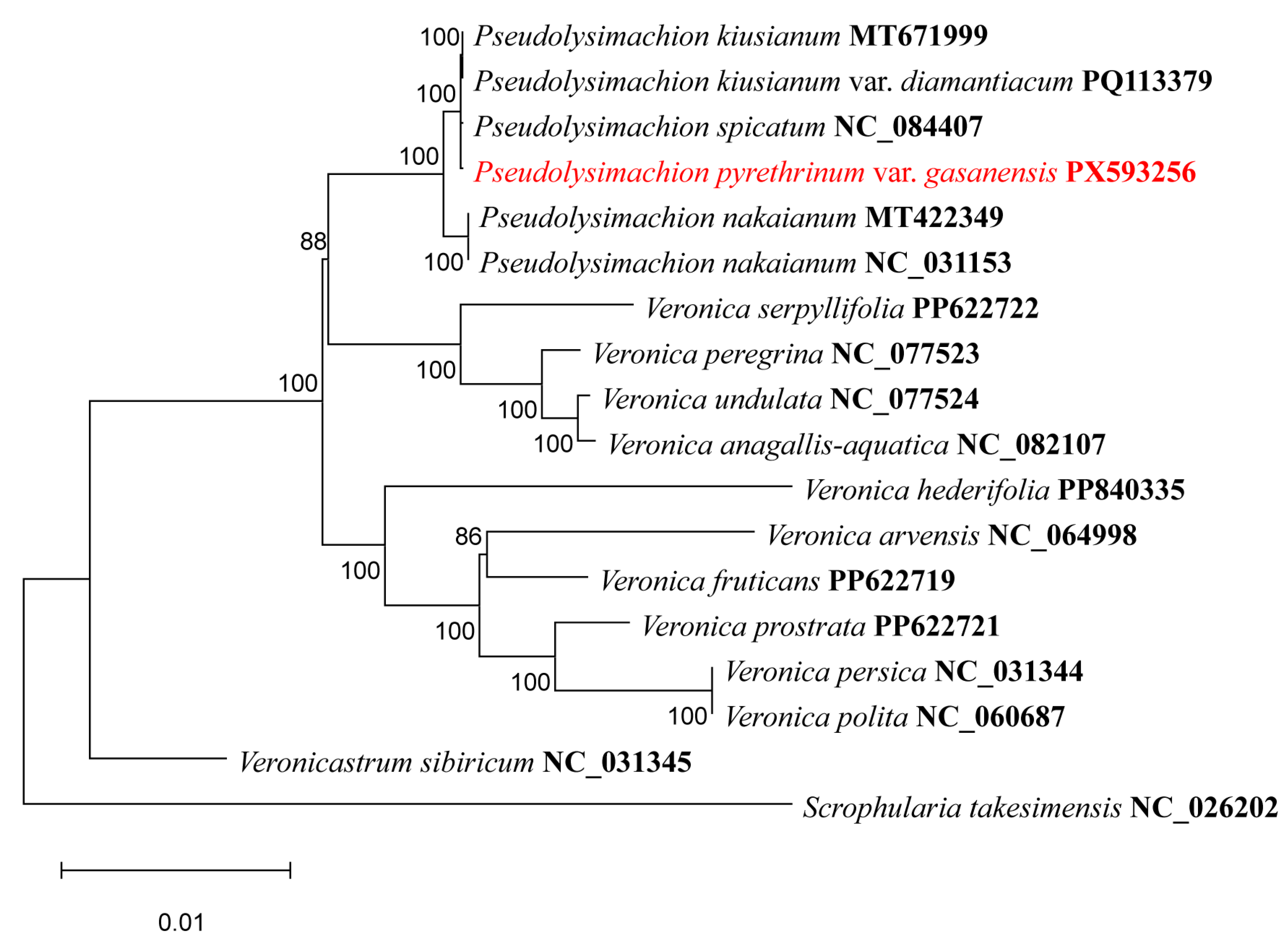
An ML phylogenetic tree was constructed to explicate the evolutionary connections between the genera Pseudolysimachion and Veronica (Figure 5). This analysis utilized 18 complete chloroplast genomes representing the major lineages of the tribe Veroniceae. The resulting ML tree strongly supported the monophyly of the genus Pseudolysimachion (Bootstrap = 100%).
Within the Pseudolysimachion clade, P. pyrethrinum var. gasanensis (PX593256) was recovered as a sister to the clade comprising Europe-originated P. spicatum (NC_084407) and East Asian P. kiusianum (MT671999) with high nodal support (BS = 100%). Interestingly, our results show that P. pyrethrinum var. gasanensis is phylogenetically closer to the P. spicatumP. kiusianum lineage than to P. nakaianum. This placement provides clear genomic evidence to distinguish this endemic variety from other closely related taxa in the Korean Peninsula, resolving previous taxonomic ambiguities based solely on morphological traits.

4. Discussion

The complete chloroplast (cp) genome of Pseudolysimachion pyrethrinum var. gasanensis exhibits a quintessential quadripartite structure. The total genome length (152,251 bp) and gene content reflect high structural conservation within the Veroniceae taxa [12]. This stability in plastome architecture, characterized by the lack of large-scale rearrangements or gene losses, is consistent with the evolutionary patterns observed in other closely related genera within the Plantaginaceae family [13]. In this study, we identified a total of 133 genes, including 88 protein-coding genes. Notably, we confirmed the presence of the ycf15 gene within the IR regions. Although ycf15 is often reported as a pseudogene or lost in certain lineages, its structural integrity in P. pyrethrinum var. gasanensis suggests it may still possess functional relevance or represent a specific evolutionary trait within the genus Pseudolysimachion. This finding aligns with recent high-quality annotations in GenBank and provides a more precise gene count for this variety.
Such stability, particularly in gene order and IR boundary positions (Figure 4), underscores the evolutionary conservatism in this lineage. This is further supported by the mVISTA alignment (Figure S4), which demonstrates remarkably high sequence identity across the Pseudolysimachion genus. The selective pressure analysis further corroborates this structural stability at the molecular level. The Ka/Ks ratios of the 88 protein-coding genes were predominantly below 1.0, with core photosynthetic genes such as psbA and rbcL exhibiting values of 0.000. These results indicate that the P. pyrethrinum var. gasanensis plastome is under strong purifying selection, which may be an evolutionary adaptation to maintain high metabolic efficiency within its specific limestone habitats, where nutrient availability and alkaline soil conditions pose significant environmental stress. Even the relatively higher ratios observed in genes like matK (0.3333) still fall well within the range of purifying selection, suggesting that the functional integrity of the plastome has been rigorously maintained throughout its divergence.
Regarding the IR boundary dynamics (Figure 4), a quantitative comparison with closely related Pseudolysimachion species revealed highly conserved gene positions with only minor variations. In P. pyrethrinum var. gasanensis, the rps19 gene is located at the LSC/IRb junction (JLB), extending 4 bp into the IRb region, similar to most congeners, whereas P. nakaianum shows a slightly shorter extension of 3 bp. The ycf1 gene spans the SSC/IRa junction (JSA), with approximately 1258 bp located within the IRa region. The total IR length (25,685 bp) is comparable to that of other species, including P. spicatum, indicating overall structural conservation rather than substantial IR expansion.
The identification of 42 SSR units across 38 distinct loci, predominantly mononucleotide A/T motifs (Figure 3), is consistent with the AT-rich nature of most angiosperm plastomes. Notably, the presence of five compound SSRs (e.g., SSR nr. 8 and 29) provides a higher level of genomic resolution compared to simple repeats. These complex microsatellites are highly prone to slipped-strand mispairing, making them potent molecular tools for resolving the taxonomic ambiguities surrounding the P. longifolium complex, where morphological plasticity often leads to challenges in species delimitation [10]. Our findings suggest that these SSR markers, particularly those located in the highly variable intergenic spacers (IGS) such as trnS-trnG and atpI-atpH, will be invaluable for future population genetic studies and the development of high-resolution DNA barcodes for distinguishing endemic Korean varieties from their continental relatives.
The synonymous codon usage patterns in P. pyrethrinum var. gasanensis provide critical insights into its evolutionary adaptation. The overwhelming preference for A/U-ending codons, as evidenced by the RSCU values in Table 2, is highly consistent with the patterns observed in other Plantaginaceae plastomes [12,13,29]. This bias is typically a result of a long-term evolutionary balance between mutational pressure and natural selection for translational efficiency. The exceptionally high RSCU value for the AGA (Arg) codon (1.95) suggests that the translational apparatus of this variety is highly optimized for specific metabolic pathways.
Furthermore, these codon usage data have practical implications for the horticultural development of this endemic variety. As noted by Daniell et al. [11], species-specific RSCU information is fundamental for chloroplast genetic engineering. For instance, in the development of transgenic Gasan spike speedwells with enhanced floral traits or environmental stress resistance, using codons with high RSCU values (e.g., AGA, UCU, or GUU) would be essential for maximizing transgene expression. Thus, our characterization of the P. pyrethrinum var. gasanensis codon bias not only clarifies its evolutionary trajectory but also provides a necessary molecular toolkit for future genomic-assisted breeding programs [14]. Notably, this variety holds significant horticultural potential due to its distinct morphological characteristics compared to the typical P. pyrethrinum. While the typical P. pyrethrinum often exhibits a larger and more robust growth habit, P. pyrethrinum var. gasanensis is characterized by its compact size and smaller stature. In modern floriculture, these diminutive traits are highly valued for the development of potted plants and space-efficient urban gardens. Consequently, prioritizing the genomic characterization of P. pyrethrinum var. gasanensis over other larger congeners is essential for establishing a molecular basis for the breeding of compact cultivars with high ornamental value.
Our phylogenetic analysis (Figure 5) provides molecular clarity to previous taxonomic ambiguities, strongly supporting the monophyly of Pseudolysimachion. The sister relationship between P. pyrethrinum var. gasanensis and the Europe-originated P. spicatum, along with its close affinity to P. kiusianum var. diamantiacum [29], suggests that the Eurasian landmass acted as a biological corridor, maintaining genetic continuity through historical migration events. The placement of P. pyrethrinum var. gasanensis within this specific clade, using Scrophularia takesimensis as a reliable outgroup [28], highlights its distinct evolutionary divergence. This biogeographic pattern aligns with the “ancient puzzle” of Veronica evolution [32], where multiple expansion events across Eurasia shaped the current distribution of the tribe.
Furthermore, the high resolution of our plastome-based tree confirms that genomic data can overcome the limitations of morphological plasticity in identifying endemic varieties. The inclusion of recent genomic reports for other Korean endemic species, such as P. nakaianum [12,30] and related Veronica species [31], further reinforces the genetic affinity of P. pyrethrinum var. gasanensis within the broader Eurasian context. The placement within this clade potentially reflects its adaptation to unique limestone soil conditions. In summary, the genomic characterization of P. pyrethrinum var. gasanensis not only elucidates its evolutionary position but also provides a foundational resource for the conservation, DNA barcoding, and sustainable utilization of this endemic Korean genetic resource in a rapidly changing climate.

5. Conclusions

This study characterized the complete chloroplast genome of P. pyrethrinum var. gasanensis, providing critical genomic insights into this rare endemic Korean variety. The plastome exhibited a conserved structure and gene content typical of the Plantaginaceae family. The selective pressure analysis revealed that the majority of protein-coding genes are under strong purifying selection, ensuring the long-term stability of the plastome. The identification of unique SSR motifs and the precise mapping of IR boundaries offer robust molecular tools for accurate DNA barcoding and resolving the taxonomic ambiguities prevalent in the P. longifolium complex.
Our phylogenomic evidence reinforces the distinct evolutionary lineage of Pseudolysimachion and clarifies the genetic affinity of P. pyrethrinum var. gasanensis within a broader Eurasian context. These findings not only enhance our understanding of the adaptive evolution of this variety but also establish a vital genetic resource for future horticultural development, improved breeding, and effective germplasm management strategies. Furthermore, the genomic framework established in this study will serve as a definitive reference for future comparative pangenomic investigations across the genus Pseudolysimachion, ultimately contributing to global efforts in preserving plant biodiversity under the challenges of anthropogenic climate change.

Supplementary Materials

The following supporting information can be downloaded at https://www.mdpi.com/article/10.3390/horticulturae12020196/s1, Figure S1: Map of sequencing depth and coverage for the complete chloroplast genome assembly of Pseudolysimachion pyrethrinum var. gasanensis. The horizontal axis represents the genome position, and the vertical axis indicates the sequencing depth (×). The average sequencing depth was 8204.26×, ensuring high-quality consensus sequence without any gaps or ambiguous regions; Figure S2: Schematic maps of cis-splicing genes identified in the chloroplast genome of Pseudolysimachion pyrethrinum var. gasanensis. The diagram illustrates the exon-intron architecture of protein-coding and tRNA genes. Colored boxes represent exons, while the lines between them denote introns. The arrow indicates the direction of transcription (5′ to 3′). These structural features highlight the genomic complexity and evolutionary conservation of the P. pyrethrinum var. gasanensis plastome; Figure S3: Schematic map of the trans-splicing gene rps12 in the chloroplast genome of P. pyrethrinum var. gasanensis. The rps12 gene is a representative trans-splicing gene consisting of three exons: the 5′ exon (exon 1) is located in the large single-copy (LSC) region, while the remaining exons (exons 2 and 3) are located in the inverted repeat (IR) regions. Dashed lines and arrows illustrate the trans-splicing process where transcripts from separate genomic locations are joined together. The colors in the legend distinguish the exons and their respective positions within the plastome; Figure S4: Visual alignment of chloroplast genomes using mVISTA. P. pyrethrinum var. gasanensis (PX593256) was used as the reference. Other species include: NC_084407 (P. spicatum), PQ113379 (P. ovata ssp. kiusiaum var. diamanticum), NC_031153 (P. nakaianum), and NC_031345 (Veronicastrum sibiricum).

Author Contributions

Conceptualization, S.H.K. and J.Y.J.; methodology, S.H.K. and J.-W.K.; software, S.H.K.; validation, W.C. and J.Y.J.; formal analysis, S.H.K.; investigation, J.H.Y.; resources, J.H.Y. and J.-W.K.; data curation, S.H.K.; writing—original draft preparation, S.H.K.; writing—review and editing, W.C. and J.Y.J.; visualization, S.H.K.; supervision, W.C. and J.Y.J.; project administration, W.C. and J.Y.J.; funding acquisition, W.C. All authors have read and agreed to the published version of the manuscript.

Funding

This work was supported by the Korea National Arboretum of the Korea Forest Service (Development of Breeding Models for Native Garden Plants in the New Climate Regime, KNA 1-5-1-24-1).

Data Availability Statement

All data were uploaded to the National Center for Biotechnology Information (NCBI) with the following BioProject ID: PRJNA1295692.

Acknowledgments

We are grateful to Young-Ho Ha of the National Institute of Forest Science for his technical consultation. We also appreciate Sang-Jun Kim of the Korea National Arboretum for his support. During the preparation of this study, the author(s) used Google Gemini to generate initial Linux shell scripts for data processing and R scripts (v.4.5.1) for statistical and graphical analysis. The authors have reviewed and edited the output and take full responsibility for the content of this publication.

Conflicts of Interest

The authors declare no conflicts of interest.

References

  1. Albach, D.C.; Martínez-Ortega, M.M.; Fischer, M.A.; Chase, M.W. Evolution of Veroniceae: A phylogenetic perspective. Ann. Mo. Bot. Gard. 2004, 91, 275–302. [Google Scholar]
  2. Hong, D.Y. Taxonomy and evolution of the Veroniceae (Scrophulariaceae) with special reference to palynology. Opera Bot. 1984, 75, 5–60. [Google Scholar]
  3. Kosachev, P.A.; Albach, D.; Ebel, A.L. Check-list of Veronica subg. Pseudolysimachium (Plantaginaceae) of Siberia. Turczaninowia 2015, 18, 84–95. [Google Scholar] [CrossRef][Green Version]
  4. Chung, G.Y.; Chang, K.S.; Chung, J.M.; Choi, H.J.; Paik, W.K.; Hyun, J.O. A checklist of endemic plants on the Korean Peninsula. Korean J. Pl. Taxon. 2017, 47, 264–288. [Google Scholar] [CrossRef]
  5. Kim, M.; Jo, H. Korean Endemic Plants; Academy Publishing Co.: Seoul, Republic of Korea, 2017. [Google Scholar]
  6. Lee, M.H.; Lim, J.H.; Park, C.H.; Kim, J.H.; Na, C.S. Effect of different temperature regimes on the germination of Pseudolysimachion pusanensis (Y.N.Lee) Y.N.Lee seeds. Horticulturae 2021, 7, 577. [Google Scholar] [CrossRef]
  7. Park, S.H.; Lee, J.H.; Nam, S.Y. An analysis of the growth and photosynthetic responses of potted Veronica pusanensis Y.N.Lee according to the shading levels. J. People Plants Environ. 2023, 26, 219–231. [Google Scholar] [CrossRef]
  8. Kim, J.M.; Lee, H.M.; Park, B.S.; Lee, H.N.; Nam, J.I.; Ahn, C.H. Adventitious shoot regeneration from petiole and stem explants of Pseudolysimachion longifolium (L.) Opiz. J. For. Environ. Sci. 2024, 40, 413–416. [Google Scholar] [CrossRef]
  9. Kim, S.H.; Yi, J.H.; Kim, J.-W.; Jung, J.Y.; Cho, W. Genetic responses to drought and waterlogging stresses of longleaf speedwell (Pseudolysimachion longifolium). Horticulturae 2025, 11, 1390. [Google Scholar] [CrossRef]
  10. Trávníček, B. Notes on the taxonomy of Pseudolysimachion longifolium complex (Scrophulariaceae). Thaiszia-Košice 2000, 10, 1–26. [Google Scholar]
  11. Daniell, H.; Lin, C.S.; Yu, M.; Chang, W.J. Chloroplast genomes: Diversity, evolution, and applications in genetic engineering. Genome Biol. 2016, 17, 134. [Google Scholar] [CrossRef]
  12. Choi, K.S.; Chung, M.G.; Park, S.J. The complete chloroplast genome sequences of three Veroniceae species (Plantaginaceae): Comparative analysis and highly divergent regions. Front. Plant Sci. 2016, 7, 355. [Google Scholar] [CrossRef]
  13. Maurya, S.; Darshetkar, A.M.; Yi, D.-K.; Kim, J.; Lee, C.; Ali, M.A.; Choi, S.; Choudhary, R.K.; Kim, S.-Y. Plastome comparison and evolution within the tribes of Plantaginaceae: Insights from an Asian gypsyweed. Saudi J. Biol. Sci. 2020, 27, 3489–3498. [Google Scholar] [CrossRef] [PubMed]
  14. Kim, S.H.; Cho, W. An exploration of candidate Korean native Poaceae plants for breeding new varieties as garden materials in the new climate regime based on existing data. Horticulturae 2024, 10, 1158. [Google Scholar] [CrossRef]
  15. Park, C.W. Flora of Korea; National Institute of Biological Resources: Incheon, Republic of Korea, 2018; Volume 5.
  16. Dierckxsens, N.; Mardulyn, P.; Smits, G. NOVOPlasty: De novo assembly of organelle genomes from whole genome data. Nucleic Acids Res. 2017, 45, e18. [Google Scholar] [CrossRef] [PubMed]
  17. Tillich, M.; Lehwark, P.; Pellizzer, T.; Ulbricht-Jones, E.S.; Fischer, A.; Bock, R.; Greiner, S. GeSeq—Versatile and accurate annotation of chloroplast genomes. Nucleic Acids Res. 2017, 45, W6–W11. [Google Scholar] [CrossRef]
  18. Zheng, S.; Poczai, P.; Hyvönen, J.; Tang, J.; Amiryousefi, A. Chloroplot: An Online Program for the Versatile Plotting of Organelle Genomes. Front. Genet. 2020, 11, 576124. [Google Scholar] [CrossRef]
  19. Liu, S.; Ni, Y.; Li, J.; Zhang, X.; Yang, H.; Chen, H.; Liu, C. CPGView: A package for visualizing detailed chloroplast genome structures. Mol. Ecol. Resour. 2023, 23, 694–704. [Google Scholar] [CrossRef] [PubMed]
  20. Beier, S.; Thiel, T.; Münch, T.; Scholz, U.; Mascher, M. MISA-web: A web server for microsatellite prediction. Bioinformatics 2017, 33, 2583–2585. [Google Scholar] [CrossRef]
  21. Amiryousefi, A.; Hyvönen, J.; Poczai, P. IRscope: An interactive tool for visualizing the Inverted Repeat of chloroplast genomes. Bioinformatics 2018, 34, 3030–3031. [Google Scholar] [CrossRef]
  22. Frazer, K.A.; Pachter, L.; Poliakov, A.; Rubin, E.M.; Dubchak, I. VISTA: Computational tools for comparative genomics. Nucleic Acids Res. 2004, 32, W273–W279. [Google Scholar] [CrossRef]
  23. Kumar, S.; Stecher, G.; Li, M.; Knyaz, C.; Tamura, K. MEGA12: Molecular Evolutionary Genetics Analysis version 12. Mol. Biol. Evol. 2024, 41, msae006. [Google Scholar] [CrossRef]
  24. Wang, D.; Zhang, Y.; Zhang, Z.; Zhu, J.; Yu, J. KaKs_Calculator 2.0: A toolkit incorporating gamma-series methods and sliding window strategies. Genom. Proteom. Bioinform. 2010, 8, 77–80. [Google Scholar] [CrossRef]
  25. Nei, M.; Gojobori, T. Simple methods for estimating the numbers of synonymous and nonsynonymous nucleotide substitutions. Mol. Biol. Evol. 1986, 3, 418–426. [Google Scholar] [CrossRef]
  26. Zhang, D.; Gao, F.; Jakovlić, I.; Zou, H.; Zhang, J.; Li, W.X.; Wang, G.T. PhyloSuite: An integrated and scalable desktop platform for streamlined molecular phylogenetic analysis. Mol. Ecol. Resour. 2020, 20, 348–355. [Google Scholar] [CrossRef]
  27. Katoh, K.; Standley, D.M. MAFFT multiple sequence alignment software version 7: Improvements in performance and usability. Mol. Biol. Evol. 2013, 30, 772–780. [Google Scholar] [CrossRef]
  28. Choi, K.S.; Park, S. The complete chloroplast genome sequence of the Korean endemic plant Scrophularia takesimensis. Mitochondrial DNA Part A 2016, 27, 2058–2059. [Google Scholar] [CrossRef] [PubMed]
  29. Ha, Y.-H.; Kim, S.-C.; Kim, T.-H.; Gil, H.-Y. The complete chloroplast genome sequence of Pseudolysimachion kiusianum var. diamantiacum (Plantaginaceae). J. Asia-Pac. Biodivers. 2025, 18, 499–503. [Google Scholar] [CrossRef]
  30. Lee, Y.-E.; Lee, Y.; Kim, S. A report of the second chloroplast genome sequence in Veronica nakaiana (Plantaginaceae), an endemic species in Korea. Korean J. Plant Taxon. 2021, 51, 109–114. [Google Scholar] [CrossRef]
  31. Hai, Y.; Qian, Y.; Yang, M.; Zhang, Y.; Xu, H.; Yang, Y.; Xia, C. The chloroplast genomes of two medicinal species (Veronica anagallis-aquatica L. and Veronica undulata Wall.) and its comparative analysis with related Veronica species. Sci. Rep. 2024, 14, 13945. [Google Scholar] [CrossRef] [PubMed]
  32. Albach, D.C.; Meudt, H.M.; Oxelman, B. Piecing together the “ancient puzzle” of Veronica (Plantaginaceae). Am. J. Bot. 2005, 92, 297–315. [Google Scholar] [CrossRef]
Figure 1. Morphology of Pseudolysimachion pyrethrinum var. gasanensis. (A) Flowering individual cultivated in a pot, showing the upright raceme and pinnately lobed leaves. (B) Representative morphological features: the inflorescence (left) and variations in leaf shape (right) showing distinct serration and lobing patterns. Scale bar (ruler) is shown in millimeters.
Horticulturae 12 00196 g001
Figure 2. Circular gene map of the complete chloroplast genome of Pseudolysimachion pyrethrinum var. gasanensis visualized via ChloroPlot. Genes belonging to different functional groups are color-coded, as indicated by the legend at the bottom. Genes drawn on the outside of the outer circle are transcribed in the counter-clockwise direction, while those on the inside are transcribed clockwise. The inner circle displays dark gray bar plots representing the GC content distribution across the genome, with visible fluctuations corresponding to the Large Single Copy (LSC), Small Single Copy (SSC), and Inverted Repeat (IR) regions. The expanded GC content in the IR regions is primarily attributed to the presence of ribosomal RNA (rRNA) gene clusters.
Horticulturae 12 00196 g002
Figure 3. Comparative analysis of SSRs among four Pseudolysimachion species. The stacked bar chart illustrates the frequency of SSR units distributed across genomic regions (LSC, SSC, and IR) and their motif compositions. Most SSRs were identified as A/T mononucleotides within the LSC region, while P. pyrethrinum var. gasanensis displayed a distinctively higher SSR count in the SSC region.
Horticulturae 12 00196 g003
Figure 4. Comparison of the borders between large single-copy (LSC), small single-copy (SSC), and inverted repeat (IR) regions among five plastomes. Genes are represented by colored boxes above or below the horizontal lines. JLB (LSC/IRb), JSB (IRb/SSC), JSA (SSC/IRa), and JLA (IRa/LSC) denote the four junction types in the chloroplast genome. The numbers above the genes indicate the distance (bp) from the specific junction sites.
Horticulturae 12 00196 g004
Figure 5. Maximum-likelihood (ML) phylogenetic tree of Pseudolysimachion pyrethrinum var. gasanensis and 17 related taxa based on complete chloroplast genome sequences. The tree was constructed using 18 complete chloroplast genomes in MEGA 12 [23] under the GTR+I substitution model. Bootstrap support values (1000 replicates) are indicated at each node. Scrophularia takesimensis (NC_026202) was used as the outgroup based on previous studies [28]. The newly assembled sequence of P. pyrethrinum var. gasanensis is highlighted in red. The scale bar represents 0.01 substitutions per site. The sequences used in this analysis were obtained from the NCBI GenBank database, including data related Pseudolysimachion and Veronica species from previous studies [12,13,28,29,30,31].
Horticulturae 12 00196 g005
Table 1. The list of genes in the chloroplast genome of P. pyrethrinum var. gasanensis.
CategoryGroupName of Genes
PhotosynthesisPhotosystem IpsaA, psaB, psaC, psaI, psaJ
Photosystem IIpsbA, psbB, psbC, psbD, psbE, psbF, psbH, psbI, psbJ, psbK, psbL, psbM, psbN, psbT, psbZ
Cytochrome b6/f complexpetA, petB *, petD *, petG, petL, petN
ATP synthaseatpA, atpB, atpE, atpF *, atpH, atpI
Rubisco large subunitrbcL
NADH dehydrogenasendhA *, ndhB ** (2), ndhC, ndhD, ndhE, ndhF, ndhG, ndhH, ndhI, ndhJ, ndhK
Transcription/TranslationRNA polymeraserpoA, rpoB, rpoC1 *, rpoC2
Ribosomal proteins (SSU)rps2, rps3, rps4, rps7 (2), rps8, rps11, rps12 *** (2), rps14, rps15, rps18, rps19 (2)
Ribosomal proteins (LSU)rpl2 ** (2), rpl14, rpl16 *, rpl20, rpl22, rpl23 (2), rpl32, rpl33, rpl36
Ribosomal RNAsrrn4.5 (2), rrn5 (2), rrn16 (2), rrn23 (2)
Transfer RNAstrnA-UGC ** (2), trnC-GCA, trnD-GUC, trnE-UUC, trnfM-CAU, trnG-GCC *, trnG-UCC, trnH-GUG (2), trnI-GAU ** (2), trnI-CAU (2), trnK-UUU *, trnL-CAA (2), trnL-UAG, trnL-UAA *, trnM-CAU, trnN-GUU (2), trnP-UGG, trnQ-UUG, trnR-ACG (2), trnR-UCU, trnS-GCU, trnS-GGA, trnS-UGA, trnT-GGU, trnT-UGU, trnV-GAC (2), trnV-UAC *, trnW-CCA, trnY-GUA
Other genesConserved hypotheticalsycf1 *, ycf2 (2), ycf3 **, ycf4, ycf15 (2)
OthersaccD, ccsA, cemA, clpP **, matK, infA
* Genes containing a single intron; ** Genes containing two introns; *** Genes divided into two fragments; (2) Number of copies in Inverted Repeat (IR) regions.
Table 2. Codon usage and relative synonymous codon usage (RSCU) in the Pseudolysimachion pyrethrinum var. gasanensis chloroplast genome.
Amino AcidCodonCountRSCUAmino AcidCodonCountRSCU
Phe (F)UUU21561.2Tyr (Y)UAU13401.36
UUC14410.8 UAC6350.64
Leu (L)UUA9521.1His (H)CAU9241.39
UUG10941.27 CAC4010.61
CUU10941.27Gln (Q)CAA10941.35
CUC6920.8 CAG5260.65
CUA8150.95Asn (N)AAU16681.38
CUG5260.61 AAC7500.62
Ile (I)AUU17581.26Lys (K)AAA20701.34
AUC10830.78 AAG10260.66
AUA13400.96Asp (D)GAU9181.35
Met (M)AUG8611 GAC4420.65
Val (V)GUU8221.41Glu (E)GAA12981.38
GUC4360.75 GAG5830.62
GUA6601.14Cys (C)UGU6691.22
GUG4070.7 UGC4300.78
Ser (S)UCU10871.45Trp (W)UGG6731
UCC8351.11Arg (R)AGA10831.95
UCA8861.18 CGA6021.09
UCG5940.79 AGG5711.03
AGU6420.86 CGG4220.76
AGC4610.61 CGU3930.71
Pro (P)CCA7821.25 CGC2550.46
CCU6881.1Gly (G)GGA7881.41
CCC5910.95 GGG5581
CCG4380.7 GGU5390.97
Thr (T)ACU6171.17 GGC3440.62
ACA5901.12Stop (*)UAA11261.11
ACC5471.04 UGA10541.04
ACG3480.66 UAG8560.85
Ala (A)GCU4421.2
GCA4361.19
GCC3540.96
GCG2370.65
* indicates stop codons.
Table 3. Nonsynonymous (Ka) and synonymous (Ks) substitution rates, and Ka/Ks ratios of representative genes in P. pyrethrinum var. gasanensis compared with P. spicatum.
Gene ClassGeneKaKsKa/Ks (ω)Selection Type
PhotosystempsbA0.00000.00000.0000Purifying
NADH dehydrogenasendhK0.00000.00420.0000Purifying
Large subunit of RubiscorbcL0.00000.00310.0000Purifying
ATP synthaseatpA0.00120.00450.2667Purifying
MaturasematK0.00280.00840.3333Purifying
Disclaimer/Publisher’s Note: The statements, opinions and data contained in all publications are solely those of the individual author(s) and contributor(s) and not of MDPI and/or the editor(s). MDPI and/or the editor(s) disclaim responsibility for any injury to people or property resulting from any ideas, methods, instructions or products referred to in the content.