Sustainable Soil Disinfestation Approaches in Crop Production: From Chemical Dependency to Ecological Resilience

 ,
,  ,
,  and
and
Abstract
1. Introduction
2. Soil Disinfestation Methods
2.1. Chemical Methods
2.2. Physical Methods
2.2.1. Soil Steam Disinfection
2.2.2. Microwaves for Soil Disinfestation
2.2.3. Soil Solarization
2.3. Biological Soil Disinfestation Methods
2.3.1. Suppressive Composts for Soilborne Diseases
2.3.2. Biological Control Agents
2.3.3. Biofumigation
2.3.4. Anaerobic Soil Disinfestation
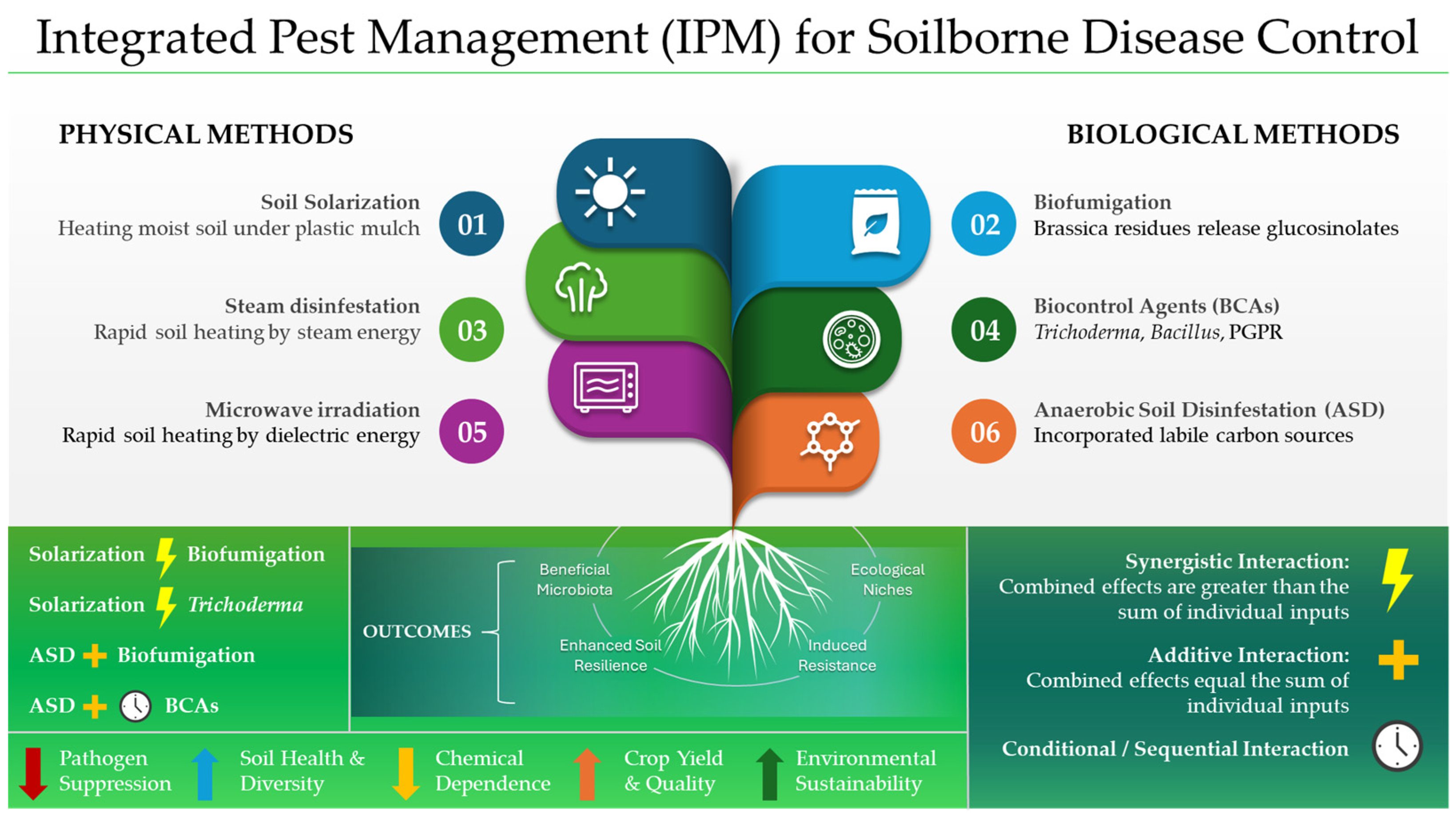
3. Integrated Pest Management for Soilborne Disease Control
4. Novel Approaches in Soilborne Disease Management
5. Effect of Soil Disinfestation Treatments on Crop Yields
6. Effect of Soil Disinfestation Treatments on Crop Quality
7. Conclusions and Future Perspectives
Author Contributions
Funding
Data Availability Statement
Acknowledgments
Conflicts of Interest
Abbreviations
| ASD | Anaerobic Soil Disinfestation |
| BCAs | Biological Control Agents |
| BSD | Biological Soil Disinfestation |
| CSD | Chemical Soil Disinfestation |
| CT | Compost Tea |
| DMDS | Dimethyl Disulfide |
| FAO | Food and Agriculture Organization of the United Nations |
| GSLs | Glucosinolates |
| HSI | Hyperspectral Imaging |
| IPM | Integrated Pest Management |
| ITCs | Isothiocyanates |
| ML | Machine Learning |
| MB | Methyl Bromide |
| NH4+ | Ammonium |
| N2O | Nitrous Oxide |
| PGPR | Plant Growth-Promoting Rhizobacteria |
| RSD | Reductive Soil Disinfestation |
| SSD | Soil Steam Disinfection |
| VOCs | Volatile Organic Compounds |
References
- Panth, M.; Hassler, S.C.; Baysal-Gurel, F. Methods for Management of Soilborne Diseases in Crop Production. Agriculture 2020, 10, 16. [Google Scholar] [CrossRef]
- FAO. Climate Change Fans Spread of Pests and Threatens Plants and Crops; Scientific Research Publishing: Glendale, CA, USA, 2021; Available online: https://www.scirp.org/reference/referencespapers?referenceid=3176104 (accessed on 24 November 2025).
- Gullino, M.L.; Garibaldi, A.; Gamliel, A.; Katan, J. Soil Disinfestation: From Soil Treatment to Soil and Plant Health. Plant Dis. 2022, 106, 1541–1554. [Google Scholar] [CrossRef] [PubMed]
- Nwakoby, I.P.; Iheukwumere, I.H.; Iheukwumere, C.M.; Nwakoby, N.E.; Idigo, M.A.; Ike, V.E. The Impact of Pesticides on Soil Microbes and the Consequent Legal Implications. J. Pollut. Monit. Eval. Stud. Control 2025, 4, 133–138. [Google Scholar] [CrossRef]
- Zhou, X.; Zhang, Q.; Yan, Y.; Qu, J.; Zhou, J.; Zhao, J.; Zhang, J.; Cai, Z.; Dai, C.; Huang, X. Effects of Soil Management Strategies Based on Different Principles on Soil Microbial Communities and the Outcomes for Plant Health. Biol. Control 2025, 201, 105708. [Google Scholar] [CrossRef]
- Meshram, S.; Philbrick, A.N.; Adhikari, T.B. Anaerobic Soil Disinfestation: A Biologically-Based Solution for Sustainable Crop Production. Front. Hortic. 2024, 3, 1436782. [Google Scholar] [CrossRef]
- Rempelos, L.; Baranski, M.; Wang, J.; Adams, T.N.; Adebusuyi, K.; Beckman, J.J.; Brockbank, C.J.; Douglas, B.S.; Feng, T.; Greenway, J.D.; et al. Integrated Soil and Crop Management in Organic Agriculture: A Logical Framework to Ensure Food Quality and Human Health? Agronomy 2021, 11, 2494. [Google Scholar] [CrossRef]
- Tilgam, J.; Verma, S.; Choudhury, S.; Singh, D.; Das, S. Genetic Enhancement of Biocontrol Agent as Effective Management of Soilborne Disease. In Detection, Diagnosis and Management of Soil-Borne Phytopathogens; Singh, U.B., Kumar, R., Singh, H.B., Eds.; Springer Nature: Singapore, 2023; pp. 127–158. [Google Scholar]
- Rippa, M.; Pasqualini, A.; Manganiello, G.; Woo, S.L.; Mormile, P.; Pane, C. Infrared Imaging to Assess the Wild Rocket (Diplotaxis tenuifolia) Response to Fusarium Wilt in the Early Stages of Infection. ACS Agric. Sci. Technol. 2024, 4, 544–553. [Google Scholar] [CrossRef]
- Rippa, M.; Pasqualini, A.; Curcio, R.; Mormile, P.; Pane, C. Active vs. Passive Thermal Imaging for Helping the Early Detection of Soil-Borne Rot Diseases on Wild Rocket [Diplotaxis tenuifolia (L.) D.C.]. Plants 2023, 12, 1615. [Google Scholar] [CrossRef]
- Rippa, M.; Yan, C.; Liu, Q.; Tucci, E.; Mormile, P. Comparison between an Innovative Solarization System and Dazomet-Based Fumigation. Soil Syst. 2023, 7, 20. [Google Scholar] [CrossRef]
- El-Aswad, A.F.; Aly, M.I.; Alsahaty, S.A.; Basyony, A.B.A. Efficacy Evaluation of Some Fumigants against Fusarium oxysporum and Enhancement of Tomato Growth as Elicitor-Induced Defense Responses. Sci. Rep. 2023, 13, 2479. [Google Scholar] [CrossRef]
- Ziedan, E.-S.H.; Farrag, E.S.H. Chemical Fumigants as Alternatives Methyl Bromide for Soil Disinfestation of Plant Integrated Pest Management. J. Agric. Technol. 2016, 12, 321–328. [Google Scholar]
- Castellano-Hinojosa, A.; Boyd, N.S.; Strauss, S.L. Impact of Fumigants on Non-Target Soil Microorganisms: A Review. J. Hazard. Mater. 2022, 427, 128149. [Google Scholar] [CrossRef] [PubMed]
- Huang, X.; Zhao, J.; Zhou, X.; Zhang, J.; Cai, Z. Differential Responses of Soil Bacterial Community and Functional Diversity to Reductive Soil Disinfestation and Chemical Soil Disinfestation. Geoderma 2019, 348, 124–134. [Google Scholar] [CrossRef]
- Zhou, P.; Bai, X.; Xu, W.; Wang, H.; Bao, L.; Deng, X.; Scriber, K.E.; Chen, Z.; Zhou, J. Chemical Soil Disinfestation Decreases Soil Salinisation and the Presence of Potential Pathogens at the Cost of Higher Nitrate Leaching. Agric. Ecosyst. Environ. 2024, 366, 108935. [Google Scholar] [CrossRef]
- Sennett, L.B.; Burton, D.L.; Goyer, C.; Zebarth, B.J. Chemical Fumigation Alters Soil Carbon and Nitrogen Dynamics in Soils Amended with Substrates of Contrasting Carbon Availability. Geoderma 2022, 419, 115878. [Google Scholar] [CrossRef]
- Castellano-Hinojosa, A.; Noling, J.W.; Bui, H.X.; Desaeger, J.A.; Strauss, S.L. Effect of Fumigants and Non-Fumigants on Nematode and Weed Control, Crop Yield, and Soil Microbial Diversity and Predicted Functionality in a Strawberry Production System. Sci. Total Environ. 2022, 852, 158285. [Google Scholar] [CrossRef]
- Zhao, J.; Zhou, X.; Jiang, A.; Fan, J.; Lan, T.; Zhang, J.; Cai, Z. Distinct Impacts of Reductive Soil Disinfestation and Chemical Soil Disinfestation on Soil Fungal Communities and Memberships. Appl. Microbiol. Biotechnol. 2018, 102, 7623–7634. [Google Scholar] [CrossRef]
- Wang, Y.; Jin, Y.; Han, P.; Hao, J.; Pan, H.; Liu, J. Impact of Soil Disinfestation on Fungal and Bacterial Communities in Soil with Cucumber Cultivation. Front. Microbiol. 2021, 12, 685111. [Google Scholar] [CrossRef]
- Larson, E.R.; Crandall, S.G. Recovery of the Soil Fungal Microbiome after Steam Disinfection to Manage the Plant Pathogen Fusarium solani. Front. Plant Sci. 2023, 14, 1128518. [Google Scholar] [CrossRef]
- Rahman, F.U. Effectiveness of Potting Media Steaming in Constraining Growth of Soil Borne Pathogenic Fungi. Pak. J. Agric. Sci. 2023, 60, 547–554. [Google Scholar] [CrossRef]
- Huh, D.-A.; Chae, W.R.; Lim, H.L.; Kim, J.H.; Kim, Y.S.; Kim, Y.-W.; Moon, K.W. Optimizing Operating Parameters of High-Temperature Steam for Disinfecting Total Nematodes and Bacteria in Soil: Application of the Box−Behnken Design. Int. J. Environ. Res. Public Health 2020, 17, 5029. [Google Scholar] [CrossRef] [PubMed]
- Katan, J. Physical and Cultural Methods for the Management of Soil-Borne Pathogens. Crop Prot. 2000, 19, 725–731. [Google Scholar] [CrossRef]
- Fennimore, S.A.; Goodhue, R.E. Soil Disinfestation with Steam: A Review of Economics, Engineering, and Soil Pest Control in California Strawberry. Int. J. Fruit Sci. 2016, 16, 71–83. [Google Scholar] [CrossRef]
- Bitarafan, Z.; Kaczmarek-Derda, W.; Berge, T.W.; Fløistad, I.S.; Andreasen, C. Steaming Soil Is Effective in Eliminating Invasive Alien Plants (IAPs)—Part II: Effect of Soil Type. Pest Manag. Sci. 2025, 81, 5543–5550. [Google Scholar] [CrossRef]
- Yang, Z.; Abbas, A.; Wang, X.; Ameen, M.; Yang, H.; Ahmed Soomro, S. Influence of Soil Particle Size on the Temperature Field and Energy Consumption of Injected Steam Soil Disinfection. Processes 2020, 8, 241. [Google Scholar] [CrossRef]
- Yang, Z.; Wang, D.; Ameen, M.; Chen, J.; Zeng, Z.; Sun, Z.; Wang, D.; Qian, Z.; Zhang, Y. Influence of Pore Structure on Steam Disinfection Heat and Mass Transfer in Yunnan Red Loam. Therm. Sci. Eng. Prog. 2024, 47, 102312. [Google Scholar] [CrossRef]
- Xu, Y.; Goodhue, R.E.; Chalfant, J.A.; Miller, T.; Fennimore, S.A. Economic Viabikhanty of Steam as an Alternative to Preplant Soil Fumigation in California Strawberry Production. HortScience 2017, 52, 401–407. [Google Scholar] [CrossRef]
- Castañeda-Escobar, L.A.; Hernández-Orduña, M.G.; Lara-Capistrán, L.; Pulido-Herrera, V. Analysis of Disinfection in Greenhouse Soils with Medium-Temperature Steam Produced by Solar Energy. Appl. Sci. 2023, 13, 11055. [Google Scholar] [CrossRef]
- Guerra, N.; Fennimore, S.A.; Siemens, M.C.; Goodhue, R.E. Band Steaming for Weed and Disease Control in Leafy Greens and Carrots. HortScience 2022, 57, 1453–1459. [Google Scholar] [CrossRef]
- Zhang, X.; Hu, W.; Zeng, W.; Wang, W.; Zhu, S.; Li, J.; Huang, J. Optimized Design of Fins Shape of Soil Steam Disinfection Devices Based on Enhanced Heat Transfer. Energy Convers. Manag. 2025, 344, 120283. [Google Scholar] [CrossRef]
- Gelsomino, A.; Petrovičová, B.; Zaffina, F.; Peruzzi, A. Chemical and Microbial Properties in a Greenhouse Loamy Soil after Steam Disinfestation Alone or Combined with CaO Addition. Soil Biol. Biochem. 2010, 42, 1091–1100. [Google Scholar] [CrossRef]
- Spanu, M.; Fanti, A.; Bruno Lodi, M.; Casu, S.; Desogus, F.; Bisceglia, B.; Mazzarella, G. Microwaves Disinfection of Farmland. J. Electromagn. Waves Appl. 2016, 30, 2165–2173. [Google Scholar] [CrossRef]
- D’Ambrosio, N.; Di Sio, F.; Esposito, A.; Lodato, F.; Massa, R.; Chirico, G.; Schettino, F. Microwave-Induced Inhibition of Germination in Portulaca oleracea L. Seeds. Agronomy 2025, 15, 2418. [Google Scholar] [CrossRef]
- Brodie, G.I.; McFarlane, D.J.; Khan, M.J.; Phung, V.B.G.; Mattner, S.W. Microwave Soil Heating Promotes Strawberry Runner Production and Progeny Performance. Energies 2022, 15, 3508. [Google Scholar] [CrossRef]
- Mahdi, W.M.; Al-Badri, K.S.L.; Alqaisi, M.R.M. Effect of Microwave Radiation on Bacteria, Fungi and Some Growth Characteristics of Cowpea Vigna unguiculata L. Gesunde Pflanz. 2021, 73, 161–167. [Google Scholar] [CrossRef]
- Sun, X.; Zhai, C.; Yang, S.; Ma, H.; Zhao, C. Simulations and Experiments of the Soil Temperature Distribution after 2.45-GHz Short-Time Term Microwave Treatment. Agriculture 2021, 11, 933. [Google Scholar] [CrossRef]
- Sun, X.; Zhao, C.; Yang, S.; Ma, H.; Zhai, C. Simulations and Experiments of Soil Temperature Distribution after 2.45 GHz Long-Term Microwave Treatment. Agriculture 2022, 12, 909. [Google Scholar] [CrossRef]
- Fornaciari, M.; Orlandi, F.; Ruga, L.; Pezzolla, D.; Cocozza, C.; Ederli, L. Impact of Varied Microwave Exposures on Weed Species. J. Biosyst. Eng. 2025, 50, 489–501. [Google Scholar] [CrossRef]
- Ruggeri, A.; Garau, E. Application of a Non-Linear Heat Transfer Model to the Microwave Heating of Agricultural Soils. In Proceedings of the 2021 29th Telecommunications Forum (TELFOR), Online, 23–24 November 2021; pp. 1–4. [Google Scholar]
- Li, Q.; Sun, X.; Zhao, C.; Yang, S.; Gu, C.; Zhai, C. Effect of Microwave Treatment at 2.45 GHz on Soil Physicochemical Properties and Bacterial Community Characteristics in Phaeozems of Northeast China. Agronomy 2023, 13, 600. [Google Scholar] [CrossRef]
- Khan, M.J.; Jurburg, S.D.; He, J.; Brodie, G.; Gupta, D. Impact of Microwave Disinfestation Treatments on the Bacterial Communities of No-till Agricultural Soils. Eur. J. Soil Sci. 2020, 71, 1006–1017. [Google Scholar] [CrossRef]
- Khan, M.J.; Brodie, G.; Jurburg, S.D.; Chen, Q.; Hu, H.-W.; Gupta, D.; Mattner, S.W.; He, J.-Z. Assessing the Effects of Microwave Heat Disturbance on Soil Microbial Communities in Australian Agricultural Environments: A Microcosm Study. Appl. Soil Ecol. 2024, 198, 105386. [Google Scholar] [CrossRef]
- Jagtap, M.P.; Shinde, Y.A.; Khatri, N. An Investigation on the Effect of Soil Solarization on Soil Temperature and Soil Moisture Conservation. Arab. J. Geosci. 2022, 15, 1778. [Google Scholar] [CrossRef]
- Ibrahim, M.M. Influence of Soil Moisture Content on Soil Solarization Efficiency. Biol. Eng. 2012, 29, 1667–1682. [Google Scholar] [CrossRef]
- Shinde, Y.A.; Jagtap, M.P.; Patil, M.G.; Khatri, N. Experimental Investigation on the Effect of Soil Solarization Incorporating Black, Silver, and Transparent Polythene, and Straw as Mulch, on the Microbial Population and Weed Growth. Chemosphere 2023, 336, 139263. [Google Scholar] [CrossRef] [PubMed]
- Gebreegziher, W.G. Agronomic Use of Solarization Technology on Soil Fertility and Pest Management in Dryland Agriculture. Cogent Food Agric. 2024, 10, 2306692. [Google Scholar] [CrossRef]
- Shea, E.A.; Fernández-Bayo, J.D.; Hodson, A.K.; Parr, A.E.; Lopez, E.; Achmon, Y.; Toniato, J.; Milkereit, J.; Crowley, R.; Stapleton, J.J.; et al. Biosolarization Restructures Soil Bacterial Communities and Decreases Parasitic Nematode Populations. Appl. Soil Ecol. 2022, 172, 104343. [Google Scholar] [CrossRef]
- Rippa, M.; Lahoz, E.; Mormile, P.; Sorrentino, M.C.; Errico, E.; Frattolillo, M.; Petriccione, M.; Maione, F.; Ferrara, E.; Battaglia, V. Effect of an Innovative Solarization Method on Crops, Soil-Borne Pathogens, and Living Fungal Biodiversity. Agronomy 2025, 15, 1391. [Google Scholar] [CrossRef]
- Vatchev, T.D. Soil Solarization and Biosolarization for Controlling Crown and Root Rot Disease Complex of Greenhouse Tomato under Hysteretic Soil Conditions. Bulg. J. Agric. Sci. 2025, 31, 873–886. [Google Scholar]
- Ngakou, A.; Megueni, C.; Makalao, M.M.; Nwaga, D.; Taine, J.; Ndjouenkeu, R. Changes in the Physico-Chemical Properties of Soil and Harvested Soybean Seeds in Response to Soil Solarization and Bradyrhizobial Inoculation. Arch. Agron. Soil Sci. 2008, 54, 189–202. [Google Scholar] [CrossRef]
- Di Mola, I.; Ventorino, V.; Cozzolino, E.; Ottaiano, L.; Romano, I.; Duri, L.G.; Pepe, O.; Mori, M. Biodegradable Mulching vs Traditional Polyethylene Film for Sustainable Solarization: Chemical Properties and Microbial Community Response to Soil Management. Appl. Soil Ecol. 2021, 163, 103921. [Google Scholar] [CrossRef]
- Abed Gatea Al-Shammary, A.; Kouzani, A.; Gyasi-Agyei, Y.; Gates, W.; Rodrigo-Comino, J. Effects of Solarisation on Soil Thermal-Physical Properties under Different Soil Treatments: A Review. Geoderma 2020, 363, 114137. [Google Scholar] [CrossRef]
- Öz, H. A New Approach to Soil Solarization: Addition of Biochar to the Effect of Soil Temperature and Quality and Yield Parameters of Lettuce (Lactuca sativa L. Duna). Sci. Hortic. 2018, 228, 153–161. [Google Scholar] [CrossRef]
- Huang, X.Q.; Wen, T.; Zhang, J.B.; Meng, L.; Zhu, T.B.; Liu, L.L.; Cai, Z.C. Control of Soil-Borne Pathogen Fusarium oxysporum by Biological Soil Disinfestation with Incorporation of Various Organic Matters. Eur. J. Plant Pathol. 2015, 143, 223–235. [Google Scholar] [CrossRef]
- Misiha, P.K.; Aly, A.Z.; Tohamy, M.R.A.; Atia, M.M.M. Eco-friendly management of root-knot nematode and root rot disease infecting pepper plants by application compost and tea compost. Zagazig J. Agric. Res. 2019, 46, 1053–1065. [Google Scholar] [CrossRef]
- Nofal, A.M.; Abd El-Rahman, M.; Alharbi, A.A.; Abdelghany, T.M. Ecofriendly Method for Suppressing Damping-off Disease Caused by Rhizoctonia solani Using Compost Tea. BioResources 2021, 16, 6378–6391. [Google Scholar] [CrossRef]
- Li, X.; Wang, X.; Shi, X.; Wang, Q.; Li, X.; Zhang, S. Compost Tea-Mediated Induction of Resistance in Biocontrol of Strawberry Verticillium Wilt. J. Plant Dis. Prot. 2020, 127, 257–268. [Google Scholar] [CrossRef]
- Palese, A.M.; Pane, C.; Villecco, D.; Zaccardelli, M.; Altieri, G.; Celano, G. Effects of Organic Additives on Chemical, Microbiological and Plant Pathogen Suppressive Properties of Aerated Municipal Waste Compost Teas. Appl. Sci. 2021, 11, 7402. [Google Scholar] [CrossRef]
- Bonanomi, G.; Idbella, A.; Amoroso, G.; Iacomino, G.; Gherardelli, M.; De Sio, A.; Saccocci, F.; Abd-ElGawad, A.M.; Moreno, M.; Idbella, M. Agronomic Impacts of Chemically and Microbiologically Characterized Compost Tea in Mediterranean Volcanic Soils. Front. Plant Sci. 2025, 16, 1524884. [Google Scholar] [CrossRef]
- El-Shaieny, A.-H.; Farrag, H.M.; Bakr, A.; Abdelrasheed, K.G. Combined Use of Compost, Compost Tea, and Vermicompost Tea Improves Soil Properties, and Growth, Yield, and Quality of (Allium cepa L.). Not. Bot. Horti Agrobot. 2022, 50, 12565. [Google Scholar] [CrossRef]
- Logo, A.; Boppré, B.; Fuchs, J.; Maurhofer, M.; Oberhänsli, T.; Thürig, B.; Widmer, F.; Mayerhofer, J.; Flury, P. Analyses of 37 Composts Revealed Microbial Taxa Associated with Disease Suppressiveness. Appl. Environ. Microbiol. 2025, 91, e01100-25. [Google Scholar] [CrossRef]
- St. Martin, C.C.G. Potential of Compost Tea for Suppressing Plant Diseases. CABI Rev. 2015, 9, 1–38. [Google Scholar] [CrossRef]
- Pilla, N.; Tranchida-Lombardo, V.; Gabrielli, P.; Aguzzi, A.; Caputo, M.; Lucarini, M.; Durazzo, A.; Zaccardelli, M. Effect of Compost Tea in Horticulture. Horticulturae 2023, 9, 984. [Google Scholar] [CrossRef]
- El-maghraby, F.M.; Shaker, E.M.; Elbagory, M.; Omara, A.E.-D.; Khalifa, T.H. The Synergistic Impact of Arbuscular Mycorrhizal Fungi and Compost Tea to Enhance Bacterial Community and Improve Crop Productivity under Saline–Sodic Condition. Plants 2024, 13, 629. [Google Scholar] [CrossRef] [PubMed]
- Omara, A.E.; Hadifa, A.; Ali, D.F. The Integration Efficacy between Beneficial Bacteria and Compost Tea on Soil Biological Activities, Growth and Yield of Rice Under Drought Stress Conditions. J. Agric. Chem. Biotechnol. 2022, 13, 39–49. [Google Scholar] [CrossRef]
- Alqahtani, F.S. The Utilization of Microorganisms for Biological Control of Soil-Borne Plant Pathogens: A Sustainable Strategy for Managing Plant Diseases—A Comprehensive Review. J. Plant Pathol. 2025, 107, 1815–1839. [Google Scholar] [CrossRef]
- Sabaté, D.C.; Brandán, C.P. Bacillus amyloliquefaciens Strain Enhances Rhizospheric Microbial Growth and Reduces Root and Stem Rot in a Degraded Agricultural System. Rhizosphere 2022, 22, 100544. [Google Scholar] [CrossRef]
- Zaccardelli, M.; Sorrentino, R.; Caputo, M.; Scotti, R.; De Falco, E.; Pane, C. Stepwise-Selected Bacillus amyloliquefaciens and B. subtilis Strains from Composted Aromatic Plant Waste Able to Control Soil-Borne Diseases. Agriculture 2020, 10, 30. [Google Scholar] [CrossRef]
- Saldaña-Mendoza, S.A.; Pacios-Michelena, S.; Palacios-Ponce, A.S.; Chávez-González, M.L.; Aguilar, C.N. Trichoderma as a Biological Control Agent: Mechanisms of Action, Benefits for Crops and Development of Formulations. World J. Microbiol. Biotechnol. 2023, 39, 269. [Google Scholar] [CrossRef]
- Tyśkiewicz, R.; Nowak, A.; Ozimek, E.; Jaroszuk-Ściseł, J. Trichoderma: The Current Status of Its Application in Agriculture for the Biocontrol of Fungal Phytopathogens and Stimulation of Plant Growth. Int. J. Mol. Sci. 2022, 23, 2329. [Google Scholar] [CrossRef]
- Aljawasim, B.D.; Khaeim, H.M.; Manshood, M.A. Assessment of Arbuscular Mycorrhizal Fungi (Glomus spp.) as Potential Biocontrol Agents against Damping-off Disease Rhizoctonia Solani on Cucumber. J. Crop Prot. 2020, 9, 141–147. [Google Scholar]
- Boutaj, H.; Meddich, A.; Roche, J.; Mouzeyar, S.; El Modafar, C. The Effects of Mycorrhizal Fungi on Vascular Wilt Diseases. Crop Prot. 2022, 155, 105938. [Google Scholar] [CrossRef]
- Taha, M.M.; Hassan, M.A.E.; Abd El-Fatah, B.E.; Mahmoud, A.F.; Abo-Elnaga, H.I.G. Endophytic Fungi as Biological Control Agents Against Soil-Borne Fungal Pathogens in Pepper. Assiut J. Agric. Sci. 2025, 56, 114–130. [Google Scholar] [CrossRef]
- Conrad, A.M.; Telenko, D.E.P. Efficacy of Biocontrol Agents Coniothyrium minitans and Bacillus amyloliquefaciens for Managing Sclerotinia sclerotiorum in Indiana Soybean. PhytoFrontiers 2023, 3, 518–524. [Google Scholar] [CrossRef]
- Zhao, H.; Zhou, T.; Xie, J.; Cheng, J.; Chen, T.; Jiang, D.; Fu, Y. Mycoparasitism Illuminated by Genome and Transcriptome Sequencing of Coniothyrium minitans, an Important Biocontrol Fungus of the Plant Pathogen Sclerotinia sclerotiorum. Microb. Genom. 2020, 6, e000345. [Google Scholar] [CrossRef] [PubMed]
- Han, V.-C.; Michael, P.J.; Swift, B.; Bennett, S.J. Biological Control of Sclerotinia sclerotiorum: Modes of Action of Biocontrol Agents, Soil Organic Amendments, and Soil Microbiome Manipulation. Biol. Control. 2023, 186, 105346. [Google Scholar] [CrossRef]
- Abdelaziz, A.M.; Hashem, A.H.; El-Sayyad, G.S.; El-Wakil, D.A.; Selim, S.; Alkhalifah, D.H.M.; Attia, M.S. Biocontrol of Soil Borne Diseases by Plant Growth Promoting Rhizobacteria. Trop. Plant Pathol. 2023, 48, 105–127. [Google Scholar] [CrossRef]
- Das, K.; Prasanna, R.; Saxena, A.K. Rhizobia: A Potential Biocontrol Agent for Soilborne Fungal Pathogens. Folia Microbiol. 2017, 62, 425–435. [Google Scholar] [CrossRef]
- Liu, H.; Li, J.; Carvalhais, L.C.; Percy, C.D.; Prakash Verma, J.; Schenk, P.M.; Singh, B.K. Evidence for the Plant Recruitment of Beneficial Microbes to Suppress Soil-Borne Pathogens. New Phytol. 2021, 229, 2873–2885. [Google Scholar] [CrossRef]
- Mazzola, M.; Freilich, S. Prospects for Biological Soilborne Disease Control: Application of Indigenous Versus Synthetic Microbiomes. Phytopathology 2017, 107, 256–263. [Google Scholar] [CrossRef]
- Wolfgang, A.; Taffner, J.; Guimarães, R.A.; Coyne, D.; Berg, G. Novel Strategies for Soil-Borne Diseases: Exploiting the Microbiome and Volatile-Based Mechanisms Toward Controlling Meloidogyne-Based Disease Complexes. Front. Microbiol. 2019, 10, 1296. [Google Scholar] [CrossRef]
- Ueki, A.; Kaku, N.; Ueki, K. Role of Anaerobic Bacteria in Biological Soil Disinfestation for Elimination of Soil-Borne Plant Pathogens in Agriculture. Appl. Microbiol. Biotechnol. 2018, 102, 6309–6318. [Google Scholar] [CrossRef]
- Niu, B.; Wang, W.; Yuan, Z.; Sederoff, R.R.; Sederoff, H.; Chiang, V.L.; Borriss, R. Microbial Interactions Within Multiple-Strain Biological Control Agents Impact Soil-Borne Plant Disease. Front. Microbiol. 2020, 11, 585404. [Google Scholar] [CrossRef] [PubMed]
- Tagele, S.B.; Kim, R.-H.; Shin, J.-H. Interactions between Brassica Biofumigants and Soil Microbiota: Causes and Impacts. J. Agric. Food Chem. 2021, 69, 11538–11553. [Google Scholar] [CrossRef] [PubMed]
- Mandal, S.; Ghosh, A.; Laskar, S.H.; Roy, S.D. Beyond Chemicals: The Role of Biofumigation in Controlling Soil-Borne Pathogens, Insects, and Nematodes. Indian Front. 2025, 12, 391–401. [Google Scholar]
- Monaci, E.; Casucci, C.; De Bernardi, A.; Marini, E.; Landi, L.; Toscano, G.; Romanazzi, G.; Vischetti, C. Brassica carinata Seed Meal as Soil Amendment and Potential Biofumigant. Crops 2022, 2, 233–246. [Google Scholar] [CrossRef]
- Duff, J.D.; Firrell, M.C. Biofumigation: A Cover Crop Option 12 Months of the Year to Manage Three Soilborne Pathogens Ailing the Australian Vegetable Industry. Glob. J. Agric. Innov. Res. Dev. 2021, 8, 104–116. [Google Scholar] [CrossRef]
- Meng, L.; Zhang, Y.; Yu, S.; Ogundeji, A.O.; Zhang, S.; Li, S. Temporal Assessment of Biofumigation Using Mustard and Oilseed Rape Tissues on Verticillium dahliae, Soil Microbiome and Yield of Eggplant. Agronomy 2022, 12, 2963. [Google Scholar] [CrossRef]
- Walker, B.A.R.; Powell, S.M.; Tegg, R.S.; Doyle, R.B.; Hunt, I.G.; Wilson, C.R. Soil Microbial Community Dynamics during Ryegrass Green Manuring and Brassica Biofumigation. Appl. Soil Ecol. 2022, 179, 104600. [Google Scholar] [CrossRef]
- Ashiq, S.; Edwards, S.; Watson, A.; Back, M. Biofumigation for the Management of Fusarium graminearum in a Wheat-Maize Rotation. Pathogens 2022, 11, 1427. [Google Scholar] [CrossRef]
- Al-Daghari, D.S.S.; Al-Sadi, A.M.; Al-Mahmooli, I.H.; Janke, R.; Velazhahan, R. Biological Control Efficacy of Indigenous Antagonistic Bacteria Isolated from the Rhizosphere of Cabbage Grown in Biofumigated Soil against Pythium aphanidermatum Damping-Off of Cucumber. Agriculture 2023, 13, 626. [Google Scholar] [CrossRef]
- Li, H.; Man, H.; Han, J.; Jia, X.; Wang, L.; Yang, H.; Shi, G. Soil Microorganism Interactions under Biological Fumigations Compared with Chemical Fumigation. Microorganisms 2024, 12, 2044. [Google Scholar] [CrossRef] [PubMed]
- Dutta, T.K.; Khan, M.R.; Phani, V. Plant-Parasitic Nematode Management via Biofumigation Using Brassica and Non-Brassica Plants: Current Status and Future Prospects. Curr. Plant Biol. 2019, 17, 17–32. [Google Scholar] [CrossRef]
- Fouché, T.; Maboeta, M.; Claassens, S. Effect of Biofumigants on Soil Microbial Communities and Ecotoxicology of Earthworms (Eisenia andrei). Water Air Soil Pollut. 2016, 227, 256. [Google Scholar] [CrossRef]
- Walker, B.A.R.; Powell, S.M.; Tegg, R.S.; Doyle, R.B.; Hunt, I.G.; Wilson, C.R. Ten Years of Green Manuring and Biofumigation Alters Soil Characteristics and Microbiota. Appl. Soil Ecol. 2023, 187, 104836. [Google Scholar] [CrossRef]
- Tagele, S.B.; Kim, R.-H.; Jeong, M.; Jung, D.-R.; Lee, D.; Shin, J.-H. An Optimized Biofumigant Improves Pepper Yield without Exerting Detrimental Effects on Soil Microbial Diversity. Chem. Biol. Technol. Agric. 2022, 9, 99. [Google Scholar] [CrossRef]
- Ghosh, S.K.; Nataraj, T.; Nandini, U.; Asha, A. Biofumigation—An Effective Tool in Enhancing Yield of Capsicum by Suppressing Soil-Borne Pathogens and Augmenting Biopesticide under Protected Cultivation in India. J. Biol. Control. 2020, 34, 59–65. [Google Scholar] [CrossRef]
- Lopes, E.A.; Canedo, E.J.; Gomes, V.A.; Vieira, B.S.; Parreira, D.F.; Neves, W.S. Anaerobic Soil Disinfestation for the Management of Soilborne Pathogens: A Review. Appl. Soil Ecol. 2022, 174, 104408. [Google Scholar] [CrossRef]
- Strauss, S.L.; Kluepfel, D.A. Anaerobic Soil Disinfestation: A Chemical-Independent Approach to Pre-Plant Control of Plant Pathogens. J. Integr. Agric. 2015, 14, 2309–2318. [Google Scholar] [CrossRef]
- Shrestha, U.; Ownley, B.H.; Bruce, A.; Rosskopf, E.N.; Butler, D.M. Anaerobic Soil Disinfestation Efficacy Against Fusarium oxysporum Is Affected by Soil Temperature, Amendment Type, Rate, and C:N Ratio. Phytopathology 2021, 111, 1380–1392. [Google Scholar] [CrossRef]
- Priyashantha, A.K.H.; Attanayake, R.N. Can Anaerobic Soil Disinfestation (ASD) Be a Game Changer in Tropical Agriculture? Pathogens 2021, 10, 133. [Google Scholar] [CrossRef]
- Hernández-Muñiz, P.; Borrero, C.; Ordóñez-Martín, J.; Pastrana, A.M.; Avilés, M. Optimization of the Use of Industrial Wastes in Anaerobic Soil Disinfestation for the Control of Fusarium Wilt in Strawberry. Plants 2023, 12, 3185. [Google Scholar] [CrossRef] [PubMed]
- Henry, P.M.; Haugland, M.; Lopez, L.; Munji, M.; Watson, D.C.; Gordon, T.R. The Potential for Fusarium oxysporum f. Sp. fragariae, Cause of Fusarium Wilt of Strawberry, to Colonize Organic Matter in Soil and Persist through Anaerobic Soil Disinfestation. Plant Pathol. 2020, 69, 1218–1226. [Google Scholar] [CrossRef]
- Liu, D.; Samtani, J.; Johnson, C.; Zhang, X.; Butler, D.M.; Derr, J. Brewer’s Spent Grain with Yeast Amendment Shows Potential for Anaerobic Soil Disinfestation of Weeds and Pythium irregulare. Agronomy 2023, 13, 2081. [Google Scholar] [CrossRef]
- Khadka, R.B.; Cardina, J.; Miller, S.A. Perspectives on Anaerobic Soil Disinfestation for Weed Management. J. Integr. Pest Manag. 2021, 12, 32. [Google Scholar] [CrossRef]
- Khadka, R.B.; Sanabria-Velazquez, A.D.; Cardina, J.; Miller, S.A. Evaluation of Anaerobic Soil Disinfestation for Environmentally Sustainable Weed Management. Agronomy 2022, 12, 3147. [Google Scholar] [CrossRef]
- Wan, L.; Zhao, Y.; Xia, L.; Hu, J.; Xue, T.; Lv, H.; Yao, Z.; Meng, F.; Li, G.; Lin, S.; et al. Assessing the Environmental Sustainability of Different Soil Disinfestation Methods Used in Solar Greenhouse Vegetable Production Systems. Sci. Total Environ. 2023, 885, 163962. [Google Scholar] [CrossRef]
- Qasim, W.; Wan, L.; Lv, H.; Zhao, Y.; Hu, J.; Meng, F.; Lin, S.; Butterbach-Bahl, K. Impact of Anaerobic Soil Disinfestation on Seasonal N2O Emissions and N Leaching in Greenhouse Vegetable Production System Depends on Amount and Quality of Organic Matter Additions. Sci. Total Environ. 2022, 830, 154673. [Google Scholar] [CrossRef]
- Vincent, I.R.; Rosskopf, E.N.; Brecht, J.K.; Dufault, N.S.; Sandoya-Miranda, G.; Zhao, X. Effects of Anaerobic Soil Disinfestation for Soilborne Disease and Weed Management on Baby Leaf Lettuce Performance in a High Tunnel Organic Production System. Agronomy 2024, 14, 764. [Google Scholar] [CrossRef]
- Liu, L.; Huang, X.; Zhao, J.; Zhang, J.; Cai, Z. Characterizing the Key Agents in a Disease-Suppressed Soil Managed by Reductive Soil Disinfestation. Appl. Environ. Microbiol. 2019, 85, e02992-18. [Google Scholar] [CrossRef]
- Li, X.; Chen, J.; Zhang, Q.; Li, X.; Zhou, X.; Tao, Y. Microbial Community Responses to Multiple Soil Disinfestation Change Drivers. Appl. Microbiol. Biotechnol. 2021, 105, 6993–7007. [Google Scholar] [CrossRef]
- Shrestha, U.; Augé, R.M.; Butler, D.M. A Meta-Analysis of the Impact of Anaerobic Soil Disinfestation on Pest Suppression and Yield of Horticultural Crops. Front. Plant Sci. 2016, 7, 1254. [Google Scholar] [CrossRef] [PubMed]
- He, Y.; Gong, B.; Liang, T.; Luo, Z.; Yu, Q.; Li, C.; Peng, H.; Cai, H.; Dai, H.; Zhai, Z.; et al. Effects of Reductive Soil Disinfestation on Microbiological and Physicochemical Properties of Continuous Cropping Soils in Karst Areas of Guizhou Province. Ann. Microbiol. 2025, 75, 6. [Google Scholar] [CrossRef]
- Song, M.; Liu, X.; Li, J.; Xue, Z.; Zhang, Q.; Gao, L.; Tian, Y. Biological Soil Disinfestation Based on in Situ Crop Residue Retention Enhances Ecosystem Multifunctionality and Promotes Soil Health: Evidence from a 4-Year Study. Appl. Soil Ecol. 2025, 216, 106537. [Google Scholar] [CrossRef]
- Devi, D.L.; Sameera, G.V.H.; Devi, B.R.V.; Srm, J.J.; Singh, J.K. Integrated Pest and Disease Management in Vegetable Crops. New Era Agric. Mag. 2025, 3. [Google Scholar]
- Elshahawy, I.; Saied, N.; Abd-El-Kareem, F.; Abd-Elgawad, M. Enhanced Activity of Trichoderma asperellum Introduced in Solarized Soil and Its Implications on the Integrated Control of Strawberry-Black Root Rot. Heliyon 2024, 10, e36795. [Google Scholar] [CrossRef]
- Castello, I.; D’Emilio, A.; Danesh, Y.R.; Vitale, A. Enhancing the Effects of Solarization-Based Approaches to Suppress Verticillium dahliae Inocula Affecting Tomato in Greenhouse. J. Agric. Food Res. 2024, 18, 101355. [Google Scholar] [CrossRef]
- Khadka, R.B.; Miller, S.A. Synergy of Anaerobic Soil Disinfestation and Trichoderma spp. in Rhizoctonia Root Rot Suppression. Front. Sustain. Food Syst. 2021, 5, 645736. [Google Scholar] [CrossRef]
- Shrestha, U.; Dee, M.E.; Piya, S.; Ownley, B.H.; Butler, D.M. Soil Inoculation with Trichoderma asperellum, T. harzianum or Streptomyces griseoviridis Prior to Anaerobic Soil Disinfestation (ASD) Does Not Increase ASD Efficacy against Sclerotium rolfsii Germination. Appl. Soil Ecol. 2020, 147, 103383. [Google Scholar] [CrossRef]
- Ali, A.; Elrys, A.S.; Liu, L.; Xia, Q.; Wang, B.; Li, Y.; Dan, X.; Iqbal, M.; Zhao, J.; Huang, X.; et al. Deciphering the Synergies of Reductive Soil Disinfestation Combined with Biochar and Antagonistic Microbial Inoculation in Cucumber Fusarium Wilt Suppression Through Rhizosphere Microbiota Structure. Microb. Ecol. 2023, 85, 980–997. [Google Scholar] [CrossRef]
- Huang, X.; Cui, H.; Yang, L.; Lan, T.; Zhang, J.; Cai, Z. The Microbial Changes during the Biological Control of Cucumber Damping-off Disease Using Biocontrol Agents and Reductive Soil Disinfestation. BioControl 2017, 62, 97–109. [Google Scholar] [CrossRef]
- Shi, Z.; Zhang, M.; Chen, G.; Cao, A.; Wang, Q.; Yan, D.; Fang, W.; Li, Y. Evaluation of Newly Combination of Trichoderma with Dimethyl Disulfide Fumigant to Control Fusarium oxysporum, Optimize Soil Microbial Diversity and Improve Tomato Yield. Ecotoxicol. Environ. Saf. 2025, 292, 117903. [Google Scholar] [CrossRef]
- Magallanes-Tapia, M.A.; Cid del Prado-Vera, I.; Ferris, H.; Nava-Díaz, C.; González-Camacho, J.M.; Ochoa-Martínez, D.L. Pre-Plant Biofumigation and Integrated Post-Plant Strategies for Management of Nacobbus aberrans and Meloidogyne incognita in Greenhouse Tomato. Agronomy 2025, 15, 2284. [Google Scholar] [CrossRef]
- Kim, D.S.; Hoffmann, M.; Kim, S.; Scholler, B.A.; Fennimore, S.A. Integration of Steam with Allyl-Isothiocyanate for Soil Disinfestation. HortScience 2020, 55, 920–925. [Google Scholar] [CrossRef]
- Wu, J.; Zhu, J.; Zhang, D.; Cheng, H.; Hao, B.; Cao, A.; Yan, D.; Wang, Q.; Li, Y. Beneficial Effect on the Soil Microenvironment of Trichoderma Applied after Fumigation for Cucumber Production. PLoS ONE 2022, 17, e0266347. [Google Scholar] [CrossRef] [PubMed]
- Liu, D.; Samtani, J.B.; Butler, D.M. Effect of Anaerobic Soil Disinfestation with Yeast Amendment on Weed Control and Strawberry Yield. HortScience 2025, 60, 1510–1520. [Google Scholar] [CrossRef]
- Rubin, B.; Cohen, O.; Gamliel, A. Soil Solarization an Environmentally-Friendly Alternative. In Proceedings of the Technical Workshop on Non-Chemical Alternatives to Replace Methyl Bromide as a Soil Fumigant, Budapest, Hungary, 26–28 June 2007. [Google Scholar]
- Oldfield, E.E.; Bradford, M.A.; Wood, S.A. Global Meta-Analysis of the Relationship between Soil Organic Matter and Crop Yields. Soil 2019, 5, 15–32. [Google Scholar] [CrossRef]
- Shi, L.; Wang, J.; Gao, Z.; Zhao, X.; Di Gioia, F.; Guo, H.; Hong, J.; Ozores-Hampton, M.; Rosskopf, E. Economic Analysis of Anaerobic Soil Disinfestation for Open-Field Fresh-Market Tomato Production in Southwest and North Florida. HortTechnology 2019, 29, 777–787. [Google Scholar] [CrossRef]
- Yang, Z.; Wang, X.; Ameen, M. Changes in Soil Temperature and Water Content under Mobile Soil Steam Disinfection. Int. J. Agric. Biol. Eng. 2021, 14, 140–147. [Google Scholar] [CrossRef]
- Spanu, M.; Lodi, M.B.; Fanti, A.; Casu, S.; Desogus, F.; Mazzarella, G. A Feasibility Study for Disinfection of Farmland Using Microwaves. In Proceedings of the 2016 Loughborough Antennas & Propagation Conference (LAPC), Loughborough, UK, 14–15 November 2016; pp. 1–5. [Google Scholar]
- Chang, Z.; Peng, Y.; Shi, R.; Hou, J.; Yang, J.; Su, Y. Performance Investigation on Soil Disinfection with a Compound Parabolic Concentrating Solar Collector System. Energy Convers. Manag. 2023, 287, 117105. [Google Scholar] [CrossRef]
- Dutta, S. Biointensive Approaches: An Eco-Dynamic Strategy for Sustainable Management of Soil Borne Plant Pathogens. J. Mycopathol. Res. 2022, 60, 487–505. [Google Scholar] [CrossRef]
- De Corato, U. Disease-Suppressive Compost Enhances Natural Soil Suppressiveness against Soil-Borne Plant Pathogens: A Critical Review. Rhizosphere 2020, 13, 100192. [Google Scholar] [CrossRef]
- Galieni, A.; Nicastro, N.; Pentangelo, A.; Platani, C.; Cardi, T.; Pane, C. Surveying Soil-Borne Disease Development on Wild Rocket Salad Crop by Proximal Sensing Based on High-Resolution Hyperspectral Features. Sci. Rep. 2022, 12, 5098. [Google Scholar] [CrossRef]
- Manganiello, G.; Nicastro, N.; Ortenzi, L.; Pallottino, F.; Costa, C.; Pane, C. Trichoderma Biocontrol Performances against Baby-Lettuce Fusarium Wilt Surveyed by Hyperspectral Imaging-Based Machine Learning and Infrared Thermography. Agriculture 2024, 14, 307. [Google Scholar] [CrossRef]
- Arroyo, J.M.; Soler, J.; Linares, R.; Parra, L.; Palmero, D. Integrating Biofumigation and Phyto-Spectral Monitoring: Advancing Sustainable Agricultural Practices. Ind. Crops Prod. 2025, 235, 121814. [Google Scholar] [CrossRef]
- Agarwal, A.; De Jesus Colwell, F.; Bello Rodriguez, J.; Sommer, S.; Barman, M.; Correa Galvis, V.A.; Hill, T.R.; Boonham, N.; Prashar, A. Synergistic 3D, Multispectral, and Thermal Image Analysis via Supervised Machine Learning for Improved Detection of Root Rot Symptoms in Hydroponically Grown Flat-Leaf Parsley. Smart Agric. Technol. 2025, 12, 101364. [Google Scholar] [CrossRef]
- Pane, C.; Manganiello, G.; Nicastro, N.; Ortenzi, L.; Pallottino, F.; Cardi, T.; Costa, C. Machine Learning Applied to Canopy Hyperspectral Image Data to Support Biological Control of Soil-Borne Fungal Diseases in Baby Leaf Vegetables. Biol. Control. 2021, 164, 104784. [Google Scholar] [CrossRef]
- Pane, C.; Nicastro, N.; Manganiello, G.; Carotenuto, F.; Pallottino, F.; Costa, C. Hyperspectral Imaging to Oversee the Status of Baby Leaf Vegetable Crops: The Agrofiliere Project Results. In Proceedings of the 2023 IEEE International Workshop on Metrology for Agriculture and Forestry (MetroAgriFor), Pisa, Italy, 6–8 November 2023; pp. 501–505. [Google Scholar]
- Neri, I.; Caponi, S.; Bonacci, F.; Clementi, G.; Cottone, F.; Gammaitoni, L.; Figorilli, S.; Ortenzi, L.; Aisa, S.; Pallottino, F.; et al. Real-Time AI-Assisted Push-Broom Hyperspectral System for Precision Agriculture. Sensors 2024, 24, 344. [Google Scholar] [CrossRef]
- Manganiello, G.; Nicastro, N.; Caputo, M.; Zaccardelli, M.; Cardi, T.; Pane, C. Functional Hyperspectral Imaging by High-Related Vegetation Indices to Track the Wide-Spectrum Trichoderma Biocontrol Activity Against Soil-Borne Diseases of Baby-Leaf Vegetables. Front. Plant Sci. 2021, 12, 630059. [Google Scholar] [CrossRef]
- Reis Pereira, M.; Verrelst, J.; Tosin, R.; Rivera Caicedo, J.P.; Tavares, F.; Neves dos Santos, F.; Cunha, M. Plant Disease Diagnosis Based on Hyperspectral Sensing: Comparative Analysis of Parametric Spectral Vegetation Indices and Nonparametric Gaussian Process Classification Approaches. Agronomy 2024, 14, 493. [Google Scholar] [CrossRef]
- Laveglia, S.; Altieri, G.; Genovese, F.; Matera, A.; Di Renzo, G.C. Advances in Sustainable Crop Management: Integrating Precision Agriculture and Proximal Sensing. AgriEngineering 2024, 6, 3084–3120. [Google Scholar] [CrossRef]
- Gao, X.; Li, S.; He, Y.; Yang, Y.; Tian, Y. Spectrum Imaging for Phenotypic Detection of Greenhouse Vegetables: A Review. Comput. Electron. Agric. 2024, 225, 109346. [Google Scholar] [CrossRef]
- García-Vera, Y.E.; Polochè-Arango, A.; Mendivelso-Fajardo, C.A.; Gutiérrez-Bernal, F.J. Hyperspectral Image Analysis and Machine Learning Techniques for Crop Disease Detection and Identification: A Review. Sustainability 2024, 16, 6064. [Google Scholar] [CrossRef]
- Sabatino, L.; D’Anna, F.; Prinzivalli, C.; Iapichino, G. Soil Solarization and Calcium Cyanamide Affect Plant Vigor, Yield, Nutritional Traits, and Nutraceutical Compounds of Strawberry Grown in a Protected Cultivation System. Agronomy 2019, 9, 513. [Google Scholar] [CrossRef]
- López-Moreno, F.J.; Navarro-León, E.; Ruiz, J.M.; Soriano, T. Biosolarization and Chemical Disinfection as Strategies to Enhance Asparagus Yield and Quality in a Decline-Affected Plantation. Agriculture 2025, 15, 915. [Google Scholar] [CrossRef]
- Guo, H.; Di Gioia, F.; Zhao, X.; Ozores-Hampton, M.; Swisher, M.E.; Hong, J.; Kokalis-Burelle, N.; DeLong, A.N.; Rosskopf, E.N. Optimizing Anaerobic Soil Disinfestation for Fresh Market Tomato Production: Nematode and Weed Control, Yield, and Fruit Quality. Sci. Hortic. 2017, 218, 105–116. [Google Scholar] [CrossRef]
- Waisen, P.; Cheng, Z.; Sipes, B.S.; Wang, K.-H. Biofumigation Effects of Brassicaceous Cover Crops on Soil Health in Cucurbit Agroecosystems in Hawaii, USA. Pedosphere 2022, 32, 521–531. [Google Scholar] [CrossRef]
- Cheng, H.; Zhang, D.; Ren, L.; Song, Z.; Li, Q.; Wu, J.; Fang, W.; Huang, B.; Yan, D.; Li, Y.; et al. Bio-Activation of Soil with Beneficial Microbes after Soil Fumigation Reduces Soil-Borne Pathogens and Increases Tomato Yield. Environ. Pollut. 2021, 283, 117160. [Google Scholar] [CrossRef]
- Meng, T.; Ren, G.; Wang, G.; Ma, Y. Impacts on Soil Microbial Characteristics and Their Restorability with Different Soil Disinfestation Approaches in Intensively Cropped Greenhouse Soils. Appl. Microbiol. Biotechnol. 2019, 103, 6369–6383. [Google Scholar] [CrossRef]
- Zou, Y.; Qiu, B.; Lin, F.; Wu, W.; Guo, R.; Xing, J.; Zhao, Z.; Shpigelman, A.; Achmon, Y. Assessment of the Influence of Using Green Tea Waste and Fish Waste as Soil Amendments for Biosolarization on the Growth of Lettuce (Lactuca sativa L. var. ramosa Hort.). Front. Sustain. Food Syst. 2023, 7, 1174528. [Google Scholar] [CrossRef]
- Abd-El-Kareem, F.; Saied, N.M.; Elshahawy, I.E.; Abd-Elgawad, M. Soil Bio-Solarization and Trichoderma asperellum Suppress Black Root Rot Disease and Increase Strawberry Yield. Res. Sq. 2023; preprint. [Google Scholar] [CrossRef]
- Sánchez-Navarro, A.; Jiménez-Ballesta, R.; Girona-Ruiz, A.; Alarcón-Vera, I.; Delgado-Iniesta, M.J. Rapid Response Indicators for Predicting Changes in Soil Properties Due to Solarization or Biosolarization on an Intensive Horticultural Crop in Semiarid Regions. Land 2022, 11, 64. [Google Scholar] [CrossRef]
- Aljawasim, B.D.G.; Khaeim, H.M.; Manshood, M.A.; Aljawasim, B.D.G.; Khaeim, H.M.; Manshood, M.A. Assessment of Biocontrol Potential of Arbuscular Mycorrhizal (Glomus spp.) against Damping-off Disease (Rhizoctonia solani) on Cucumber. In Mycorrhizal Fungi—Utilization in Agriculture and Forestry; IntechOpen: London, UK, 2020. [Google Scholar]
- Conrad, A.M.; Johnson, W.G.; Cruz, C.D.; Telenko, D.E.P. Integration of Sclerotinia sclerotiorum-Targeted Biofungicides Coniothyrium minitans and Bacillus amyloliquefaciens into Season-Long Soybean Pest Management Practices in Indiana. PhytoFrontiers 2023, 3, 525–534. [Google Scholar] [CrossRef]
- Mauromicale, G.; Monaco, A.L.; Longo, A.M.G. Improved Efficiency of Soil Solarization for Growth and Yield of Greenhouse Tomatoes. Agron. Sustain. Dev. 2010, 30, 753–761. [Google Scholar] [CrossRef]
- Castronuovo, D.; De Feo, V.; De Martino, L.; Cardone, L.; Sica, R.; Caputo, L.; Amato, G.; Candido, V. Yield Response and Antioxidant Activity of Greenhouse Organic Pumpkin (Cucurbita moschata Duch.) as Affected by Soil Solarization and Biofumigation. Horticulturae 2023, 9, 427. [Google Scholar] [CrossRef]
- Solaiman, M.M.; Aish, A.A.; Munir, S.; Wu, Y.; He, Y.; Youssef, S.A. Induction of Multiple Defense Phytohormones Enhances Cucumber Resistance against Damping off Pathogens via Application of Fortified Composts. S. Afr. J. Bot. 2025, 187, 351–361. [Google Scholar] [CrossRef]



| Category | Method | Target Organisms | Main Advantages | Key Limitations | Impact on Soil Health | Sustainability Level |
|---|---|---|---|---|---|---|
| Chemical | Methyl bromide (MB) | Fungi, nematodes, weeds | Broad-spectrum, rapid and reliable control | Ozone depletion, toxicity, regulatory ban | Severe microbial depletion; slow recovery | Very low |
| Dimethyl disulfide (DMDS) | Fungi, nematodes, weeds | Effective MB alternative; high efficacy | Human toxicity risk; strict handling | Temporary microbial disruption | Low | |
| Metam sodium/Dazomet | Fungi, nematodes, weeds | Cost-effective; widely used | Phytotoxicity risk; nutrient losses | Reduced microbial diversity; altered N cycling | Low–moderate | |
| Physical | Steam disinfestation | Fungi, nematodes, weeds | Residue-free; effective and rapid | High energy demand; recontamination risk | Short-term microbial reduction; recoverable | Moderate |
| Microwave heating | Fungi, bacteria, weeds | Precise heating; chemical-free | High energy costs; limited scalability | Temporary disturbance of microbial communities | Moderate | |
| Soil solarization | Fungi, nematodes, weeds | Low chemical input; simple technology | Climate-dependent; plastic use | Enhances nutrient availability; temporary microbial shifts | High (climate-dependent) | |
| Biological | Suppressive composts/compost tea | Fungi, nematodes | Improves soil fertility and microbiome | Variable efficacy; preparation-dependent | Enhances microbial diversity and soil structure | High |
| BCAs (e.g., Trichoderma, Bacillus) | Fungi, bacteria | Targeted control; plant growth promotion | Inconsistent field performance | Strengthens soil resilience and suppressiveness | High | |
| Biofumigation | Fungi, nematodes, weeds | Uses natural biocidal compounds | Biomass and timing constraints | Improves organic matter; transient imbalance | High | |
| Anaerobic soil disinfestation (ASD) | Fungi, nematodes, weeds | Broad suppression; improves fertility | Plastic use; GHG emissions | Promotes beneficial anaerobic microbiota | High–moderate |
| Technique | Energy Use (MJ ha−1) | GHG Emissions (kg CO2-eq ha−1) | Cost (USD ha−1) | Plastic Waste (kg ha−1) | Notes on Data Robustness | Main Drivers of Variability | Key References |
|---|---|---|---|---|---|---|---|
| Chemical fumigation (e.g., MB alternatives, DMDS, metam sodium) | 1000–3000 | 400–1200 | 2000–6000 | 200–500 | Well-documented; includes fuel, product synthesis, and tarp use; strong baseline comparator | Active ingredient type and dose, tarp requirement and thickness, regulatory constraints, fuel use for application, regional labor and product costs | [14,17,18,25] |
| Soil solarization | 100–400 | 30–120 | 300–1200 | 200–500 | Energy low; plastic dominates environmental footprint; climate-dependent | Climate and solar radiation, duration of treatment, soil moisture, plastic film type and thickness, scale of application | [49,53,129] |
| Biosolarization (solarization + organic amendments) | 200–600 | 80–250 | 600–1800 | 200–500 | Slightly higher GHG due to biomass decomposition; better pathogen control | Organic amendment type and rate, decomposition dynamics, sealing efficiency, climate conditions, additional field operations | [49,109,119,130] |
| Anaerobic soil disinfestation (ASD) | 300–900 | 150–600 | 800–3000 | 200–500 | GHG strongly depends on amendment type and rate; good field evidence | Carbon source quality and amount, soil temperature, duration of anaerobic phase, post-treatment emissions (N2O, CH4), plastic sealing requirements | [19,101,109,110,131] |
| Soil steam disinfestation | 8000–20,000 | 600–2000 | 3000–10,000 | 0–50 | Energy-intensive; GHG depends on fuel/electricity source; high cost | Treatment depth, soil texture and moisture, fuel or electricity source, equipment efficiency, scale of operation | [25,27,28,29,132] |
| Microwave soil heating | 5000–15,000 | 400–1500 | 2500–8000 | 0 | Data mostly engineering-based; few full field LCAs | Power intensity and exposure time, soil moisture, treatment depth, electricity source, experimental vs. field-scale deployment | [34,36,43,44,133,134] |
| Biofumigation (Brassicaceae residues, seed meals) | 200–800 | 80–300 | 300–1500 | 0–300 | Energy and GHG often estimated from biomass and tillage; variable effectiveness | Biomass quantity and glucosinolate content, incorporation method, soil conditions, optional plastic sealing, variability in field operations | [86,88,95,109,130,135] |
| Suppressive composts/compost teas | 50–300 | 20–150 | 200–1200 | 0 | Metrics mostly input-based; no direct LCA; low-intensity practice | Compost source and maturity, application rate, preparation method, transport distance, on-farm vs. commercial inputs | [60,62,65,136] |
| BCAs | <50 | <20 | 100–500 | 0 | Field-scale energy and GHG rarely quantified; generally minimal inputs | Strain formulation and dose, application frequency, carrier materials, local soil–microbiome interactions, scale of production | [70,72,82,115] |
| Method Paragraph | Key Study | Crop/System (geo) | Disinfestation/Amendment Strategy | Main Agronomic Outcome | Effect Size (vs. Control/Comparator) | Sample Size/Design |
|---|---|---|---|---|---|---|
| Steam disinfestation | [21] | Controlled greenhouse soil (USA) | Steam disinfestation | Suppression of Fusarium solani | Reduced to below detection immediately after steaming | Replicated microcosms (n not reported) |
| [23] | Soil (S. Korea) | High-temperature steam (optimized) | Nematode control | >95% mortality at optimized conditions | Box–Behnken; 15 runs | |
| [31] | Leafy greens and carrot (USA–CA) | Band steam disinfestation | Weed and disease control | 80–99% weed control in steamed bands | Field trials; replicated plots (n not reported) | |
| Microwave disinfestation | [35] | Portulaca oleracea seeds (Italy) | Microwave irradiation | Seed germination inhibition | Up to 100% inhibition (dose-dependent) | Lab bioassays; replicated (n not reported) |
| [36] | Strawberry mother plants (Australia) | Microwave soil heating | Crop performance | +20–30% runners; improved progeny performance | Field; replicated plots (n not reported) | |
| [38] | Soil (China) | Short-duration microwave heating | Lethal soil heating | Soil >60 °C within minutes | Lab + pilot experiments (n not reported) | |
| Solarization | [45] | Field soil (India) | Plastic-film solarization | Soil heating and moisture conservation | Soil temperature +8–15 °C | Field; replicated plots (n not reported) |
| [49] | Soil (USA–CA) | Solarization/biosolarization | Nematode suppression | >70% reduction in parasitic nematodes | Field; replicated plots (n not reported) | |
| Solarization + inputs | [149] | Strawberry protected system (Italy) | Solarization + CaCN2 | Yield and quality enhancement | Early yield +105%; total yield +53% | Greenhouse; replicated factorial |
| [55] | Lettuce (Turkey) | Solarization + biochar | Yield improvement | ~+38% with biochar-enhanced solarization | Greenhouse; replicated (n not reported) | |
| Biofumigation | [90] | Eggplant (China) | Brassica tissue biofumigation | Disease (Verticillium dahliae) and yield | Disease ↓; yield ↑ (season-dependent) | Field experiment (n not reported) |
| [92] | Wheat–maize rotation (UK) | Brassica green manures | Pathogen (Fusarium graminearum) suppression | Significant inoculum reduction | Field trials (n not reported) | |
| [88] | Soil (Italy) | Brassica carinata seed meal | Disease suppression | Disease pressure significantly reduced | Pot + field (n not reported) | |
| BSD/compost tea | [58] | Seedlings (Egypt) | Compost tea | Damping-off (Rhizoctonia solani) control | ≈50–70% damping-off reduction | Greenhouse trials (n not reported) |
| [94] | Strawberry (China) | Compost tea (ISR induction) | Disease severity (Verticillium dahlia) | Disease severity significantly reduced (ISR-type response) | Greenhouse pot exp. (n not reported) | |
| [62] | Onion (Egypt) | Compost + compost tea | Yield and quality | Yield and bulb quality significantly improved | Field; replicated plots (n not reported) | |
| Microbial BCAs | [158] | Cucumber (Iraq) | AMF (Glomus spp.) | Damping-off (R. solani) suppression | >50% disease reduction | Controlled study (n not reported) |
| [159] | Soybean (USA–IN) | Coniothyrium minitans + Bacillus | White mold (Sclerotinia) control | Disease incidence reduced | Field study (n not reported) | |
| [72] | Multiple crops (global) | Application of Trichoderma spp. as microbial biocontrol agents | Suppression of soil-borne fungal pathogens and stimulation of plant growth | Consistent disease suppression and growth promotion reported across crops and systems | Narrative review of experimental, greenhouse, and field studies | |
| ASD | [114] | Horticultural crops (global) | Anaerobic soil disinfestation | Yield response | Mean yield ~+30% vs. untreated | Meta-analysis; 123 studies |
| [104] | Strawberry (Spain) | ASD (Industrial organic wastes) | Weed and disease control (Fusarium wilt) | Disease reduction and crop protection | Greenhouse/field trials | |
| [111] | Baby leaf lettuce (USA) | ASD | Weed and disease control | Yield maintained or increased | High-tunnel field trials (n not reported) | |
| Integrated approaches | [118] | Strawberry (Egypt) | Solarization + Trichoderma | Black root rot control | Disease severity reduced vs. solarization alone | Field + greenhouse (n not reported) |
| [122] | Cucumber (China) | RSD + biochar + BCAs | Fusarium wilt control | Fusarium wilt suppression; yield ↑ | Significant disease reduction; yield increase |
| Method Paragraph | Key Study | Geographical Area | Disinfestation/Amendment Strategy | Environmental/Soil Endpoint(s) | Effect Size/Magnitude | Sample Size/Design |
|---|---|---|---|---|---|---|
| Steam | [33] | Italy | Steam disinfestation | Soil chemistry + microbiology | Temporary ↑ NH4+ and ↑ microbial biomass C after steaming | Greenhouse soil; replicated (n not reported) |
| [27] | China | Steam disinfestation | Energy demand | Fine soils increased energy use ~20–30% | Lab + modeling | |
| [32] | China | Engineered steam systems | Engineering efficiency | Heat-transfer efficiency +18–25% | Computational + prototype | |
| Microwave | [43] | Australia | Microwave soil heating | Bacterial diversity resilience | Strong initial reduction followed by community reassembly | Field soil cores; replicated (n not reported) |
| [42] | NE China | Microwave disinfestation | Physicochemical + bacteria | Temporary bacterial shifts; partial recovery | Field samples; replicated (n not reported) | |
| [134] | China | Solar-assisted microwave | Sustainability/energy | Solar-assisted system reduced grid energy demand | Pilot-scale testing | |
| Solarization/biosolarization | [53] | Italy | Solarization (biodegradable films) | Mulch sustainability | Biodegradable films: comparable efficacy, improved sustainability | Field experiment |
| [49] | USA–CA | Biosolarization | Bacterial community | Diversity shifted; recovery observed | Field experiment | |
| [50] | Italy | Innovative solarization | Fungal biodiversity | Beneficial biodiversity partially preserved | Field trials | |
| Biofumigation | [97] | Australia | Long-term biofumigation | Long-term soil health | 10 years altered soil characteristics and microbiota | Long-term field study |
| [94] | China | Biofumigation vs. fumigation | Biofumigation vs. chemical fumigation | Greater microbial diversity under biofumigation | Field + lab analyses | |
| [96] | South Africa | Biofumigants | Ecotoxicology | No severe earthworm ecotoxic effects at field rates | Soil ecotox assays | |
| ASD/RSD | [110] | China | ASD (OM-dependent) | N2O + N leaching | 56–91% of seasonal N2O emitted during ASD | Field trials |
| [116] | China | Crop-residue BSD | Multifunctionality | BSD with residue retention improved multifunctionality over 4 years | Long-term field study | |
| [115] | China (Guizhou) | RSD | Karst soils | Improved microbial + physicochemical indicators post-RSD | Field trials | |
| Compost/compost tea | [63] | Switzerland/Europe | Compost diversity | Suppressive taxa discovery | 37 composts linked to suppressiveness signatures | Large compost survey (n = 37) |
| Post-fumigation “bio-activation” | [153] | China | Microbial re-inoculation | Microbiome restoration | Beneficial microbes restored suppressiveness; pathogen abundance reduced | Greenhouse + field |
Disclaimer/Publisher’s Note: The statements, opinions and data contained in all publications are solely those of the individual author(s) and contributor(s) and not of MDPI and/or the editor(s). MDPI and/or the editor(s) disclaim responsibility for any injury to people or property resulting from any ideas, methods, instructions or products referred to in the content. |
© 2026 by the authors. Licensee MDPI, Basel, Switzerland. This article is an open access article distributed under the terms and conditions of the Creative Commons Attribution (CC BY) license.
Share and Cite
Mirabella, A.; Ciriello, M.; Rouphael, Y.; El-Nakhel, C.; Altucci, C. Sustainable Soil Disinfestation Approaches in Crop Production: From Chemical Dependency to Ecological Resilience. Horticulturae 2026, 12, 189. https://doi.org/10.3390/horticulturae12020189
Mirabella A, Ciriello M, Rouphael Y, El-Nakhel C, Altucci C. Sustainable Soil Disinfestation Approaches in Crop Production: From Chemical Dependency to Ecological Resilience. Horticulturae. 2026; 12(2):189. https://doi.org/10.3390/horticulturae12020189
Chicago/Turabian StyleMirabella, Antonietta, Michele Ciriello, Youssef Rouphael, Christophe El-Nakhel, and Carlo Altucci. 2026. "Sustainable Soil Disinfestation Approaches in Crop Production: From Chemical Dependency to Ecological Resilience" Horticulturae 12, no. 2: 189. https://doi.org/10.3390/horticulturae12020189
APA StyleMirabella, A., Ciriello, M., Rouphael, Y., El-Nakhel, C., & Altucci, C. (2026). Sustainable Soil Disinfestation Approaches in Crop Production: From Chemical Dependency to Ecological Resilience. Horticulturae, 12(2), 189. https://doi.org/10.3390/horticulturae12020189