Article

Peach Yield Prediction Models: The Importance of Climate Variables and Different Machine Learning

by
Jean Michel Moura-Bueno
1,2,*,
Débora Leitzke Betemps
3,
Gilmar A. B. Marodin
4,
Moreno Toselli
5,
William Natale
1 and
Gustavo Brunetto
1
1
Soil Science Department, Federal University of Santa Maria (UFSM), Santa Maria 97105-900, Brazil
2
Center for Agricultural Sciences, University of Cruz Alta (UNICRUZ), Cruz Alta 98020-290, Brazil
3
Federal University of Fronteira Sul (UFFS), Cerro Largo 97900-000, Brazil
4
Horticulture and Forestry Department, Federal University of Rio Grande do Sul (UFRGS), Porto Alegre 91540-000, Brazil
5
Department of Horticulture and Forestry, University of Bologna, Via Filippo Re, 6, 40127 Bologna, Italy
*
Author to whom correspondence should be addressed.
Horticulturae 2026, 12(2), 155; https://doi.org/10.3390/horticulturae12020155

Submission received: 6 September 2025 / Revised: 25 January 2026 / Accepted: 26 January 2026 / Published: 29 January 2026

Abstract

Peach yield production prediction models are little known worldwide. This gap can be filled by combining machine learning techniques and well-documented databases. The aims of this study are: (i) to assess the effect of different prediction variable inputs applied to peach yield prediction models adopted to peach trees grown in orchards under different subtropical climate; (ii) to test the prediction accuracy performance of models calibrated through different machine learning methods; and (iii) to quantify the relevance of peach trees’ yield predictor variables. A database (soil and leaf nutrient content, climatic and plant variables) with information from 208 peach trees (Prunus persica) in production, belonging to the cultivars ‘Maciel’ and ‘Chimarrita’ grown in Southern Brazil, was used. The models were developed by using three machine learning methods: Radom Forest, Multiple Linear Regression, and Support Vector Machine. We demonstrate that the calibration of the models was affected by machine learning method as well as by different predictor variable inputs. The model Random Forest showed the greatest potential to predict peach yield. The variable presenting the greatest relevance to explain peach yield variations was ‘hours of chilling’, which was followed by K and N content in leaves and mean temperature, which recorded relevance of >55%.

1. Introduction

Nowadays, Brazil is the third biggest peach producer in Latin America; it produced approximately 183 thousand tons in its 16 thousand hectares planted during the 2019 harvest [1]. More than 70% of this total was produced in Southern Brazil [2]. However, the Brazilian mean yield was half of that observed for countries such as the USA, Chile, Italy, Greece, and France, as well as for other European producers [1]. These results can be partly explained by the fragility of regional recommendations for nutrients in plants, which define fertilizers’ critical levels and maximum efficiency doses.
Overall, fertilization recommendation systems applied to fruit trees on the globe define the need and doses of nutrients based on soil and leaf nutrient content; in some fruit trees, yield expectations are also taken into consideration [3,4,5,6]. However, oftentimes, fruit yield expectation is empirically defined, and can lead to excessive application of nutrients in orchards, a fact that potentiates soil and water contamination [7]. This problem can be solved with the development of yield prediction models, although little is known about peach yield prediction models applicable to Latin America, and to other continents. These gaps in research can be filled by the adoption of machine learning techniques combined with well-documented databases [8,9]. Accordingly, biological relations observed between plants and nutrients, such as yield response, are associated through modeling [10,11,12,13,14,15,16]. The database/machine learning combination, in association with the adoption of regressions, allows users to explore the whole yield universe in propositions for fruit yield prediction models [8,12], as well as fruit quality [17].
Several variables, such as temperature, exposure to chilling hours, and rainfall, can also affect nutritional and yield studies applied to peaches [18,19]. The vegetative and reproductive development (flowering and effective fruiting) of temperate plants is mainly boosted by the accumulation of chilling hours during winter. Thus, when there are favorable climatic conditions, one expects to have a higher demand for nutrients, including N, in order to support plant growth, development, and high yield [20,21]. Furthermore, the availability of nutrients and their impact on yield are also affected by rain events and soil moisture. The appropriate soil moisture, in association with high temperatures, favors organic matter mineralization and, consequently, mineral N availability, improving nutrient absorption by the roots [22,23]. Excessive rainfall, on the other hand, favors N loss through leaching [24], having a negative effect on yield [21]. Furthermore, frequent rain events can potentiate leaf and fruit fungal diseases, as well as reduce yield [25]. Plant age (trunk diameter) can affect the yield of peach trees [26,27,28].
Accordingly, the models can provide different prediction accuracy performances depending on the number and types of predictor variables added for model calibration purposes, as well as on the adopted machine learning method [8,10,12,15,16]. Thus, it is reasonable to associate plant (trunk diameter), climatic conditions, and soil and leaf nutrient contents in yield prediction models. Therefore, the research hypothesis is that the combination of plant, climatic conditions, and soil and leaf nutrient contents leads to increased estimation accuracy in peach yield prediction models in comparison to the separate use of these variables, in the development of models. Based on this, this study aims to innovatively test this hypothesis by pursuing the following objectives: (i) to assess the forecasting accuracy of models calibrated using different machine learning methods; and (ii) to evaluate the effect of different predictor variable sets on peach yield forecasting models applied to peach trees grown in different orchards under a subtropical climate.

2. Materials and Methods

2.1. Data Set

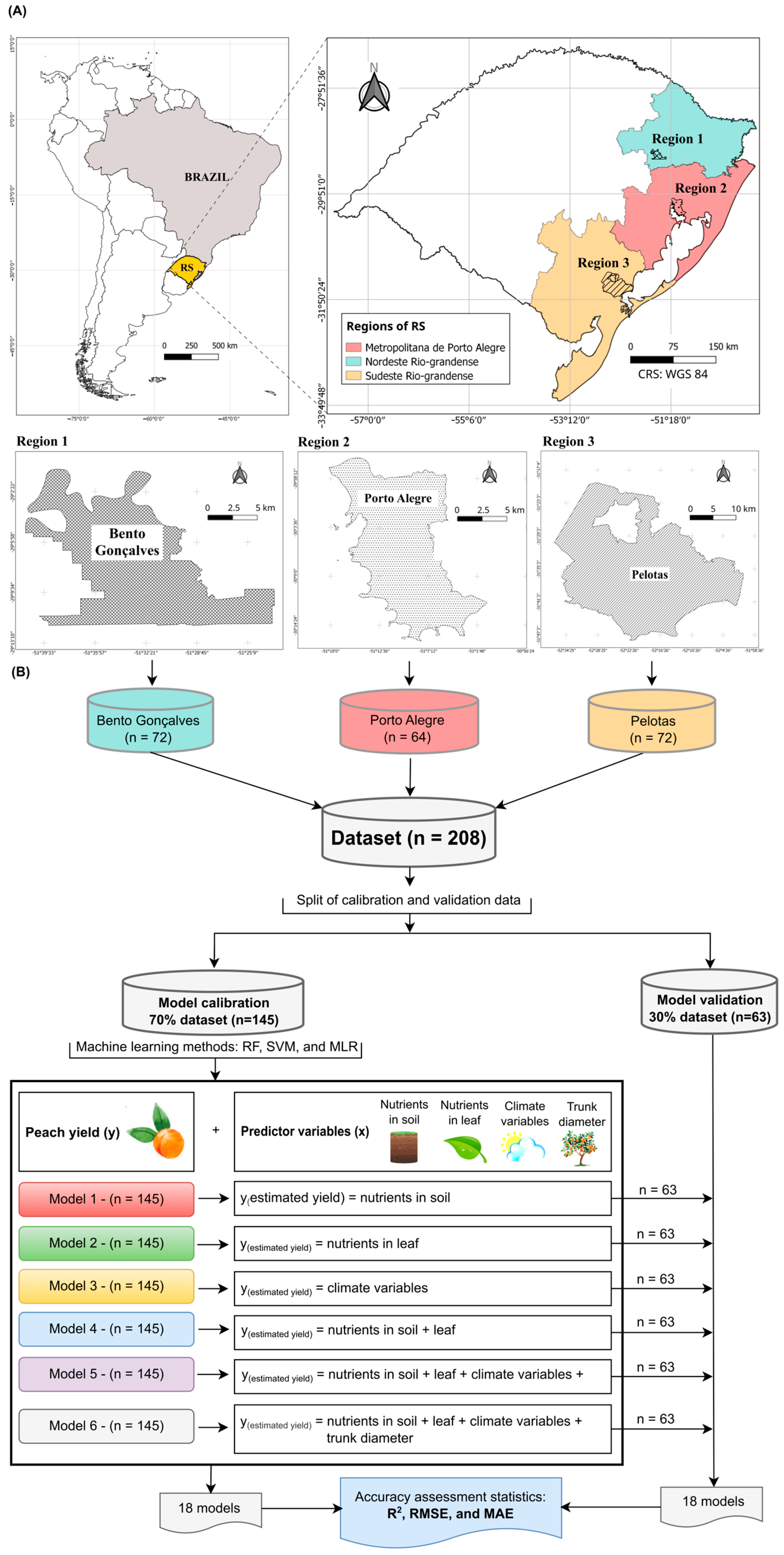
Data were collected during the observation of 208 peach trees (Prunus persica), at the production stage, which were planted in commercial and experimental farms in Rio Grande do Sul (RS) State, Southern Brazil. Information about cultivars Maciel (n = 106) and Chimarrita (n = 102) were collected in three peach producer regions in RS State, in the following municipalities: Bento Gonçalves (n = 72—Northeastern region—Region 1), Porto Alegre (n = 64—Metropolitan region—Region 2) and Pelotas (n = 72—Southeastern region—Region 3) (Figure 1A). The following rootstocks were adopted: ‘Aldrighi’, ‘Capdeboscq’, ‘Flordaguard’, ‘Nemaguard’, and ‘Okinawa’. Open vessel was the tree conduction method of choice. Orchards were managed based on national integrated management standards [29]. Samplings and assessments for database composition were carried out in the 2009 and 2010 harvests. The climate in the three regions is classified as humid subtropical (Cfa) [30]. The soil in the Pelotas and Porto Alegre municipalities was classified as Typic Hapludalf [31] (~200 g kg−1 clay—[32]), and as Udorthent [31] (~400 g kg−1 clay—[32]) in Bento Gonçalves. This information regarding the classification of soils in the evaluated regions was derived from the soil survey of the state of Rio Grande do Sul—at a scale of 1:750,000 [32]. At the time of the field evaluations, the identification of the soils in each region was duly validated with soundings using Dutch augers. Soil between peach tree lines was covered by spontaneous vegetation during the whole assessment time.

2.2. Soil Sampling and Analysis

Samples were collected from the 0–20 cm soil layer, under canopy projection, in the three assessed cultivation locations, at the first observation year (2009). P, K, Cu, Zn, and Mn in soil samples were extracted using the Mehlich-1 method [33]. Ca and Mg were extracted using KCl 1 mol L−1. Fe was extracted by using DTPA. Available P determination was carried out in UV-visible spectrophotometer (Bell Photonics, 1105, São Paulo, Brazil), at 882 nm [33]. Available K determination was performed in Flame Spectrophotometer (Bell Photonics, 1105, São Paulo, Brazil). Ca, Mg, Cu, Zn, Fe, and Mn determination was conducted in atomic absorption spectrophotometer (PerkinElmer—Analyst 2000, Waltham, MA, USA). Soil exchangeable acidity was measured through the Shoemaker—McLean—Pratt method (SMP index) [31]. Soil organic matter content (SOM) was determined through humid oxidation in sulfochromic solution—K2Cr2O7 + H2SO4 [33,34]. Soil pH was measured in water, at a 1:1 ratio. Clay content was determined using the hydrometer method [33]. The average nutrient levels in the soil of each orchard and cultivar are presented in Table 1.

2.3. Leaf Sampling and Mineral Analysis

In total, 100 complete leaves (leaf + petiole) were collected from each rootstock, cultivar, and cultivation place, in both harvests (2009 and 2010). Leaves were collected from plants’ medium third, in October and November (13 weeks after full flowering, on average). Leaves were dried in forced air circulation oven, at ±65 °C, ground in a Willey type mill and sieved in a 1 mm mesh. Fruit yield was expressed in kg per plant and in tons per hectare, in both harvests.
The macro-nutrient content in leaves (N, P, K, Ca and Mg) was determined after sulfuric digestion, whereas the micronutrient content (Zn, Fe, Cu and Mn) was determined after nitro-perchloric digestion [33,35]. Total N was determined in micro-kjeldahl distiller (Tecnal, TE-0363, São Paulo, Brazil), according to [33,35]. Phosphorus (P) was determined in a UV-visible spectrophotometer (Bell Photonics, 1105, São Paulo, Brazil), at 882 nm [36]. K, Ca, Mg, Zn, Fe, Cu, and Mn readings were carried out in an atomic absorption spectrophotometer (PerkinElmer—Analyst 2000, Waltham, MA, USA). The average nutrient levels in the leaves of each orchard and cultivar are presented in Table 1.

2.4. Climatic Variables

Meteorological data recorded for the assessment time and set for the present experiment were collected in regional meteorological stations in Bento Gonçalves, Pelotas, and Porto Alegre counties (Table 2). The following variables were gathered for each assessed station: mean temperature, mean rainfall, and number of accumulated chilling hours below 7.2 °C [37], in winter (from June to September), depending on the number of accumulated hours, according to North Carolina’s modified model [37].

2.5. Determination of Peach Yield and Trunk Diameter

During fruit harvest, all fruits on each plant were counted and weighed to determine production per plant (kg) (Table 3). Trunk diameter was measured just above the graft union, at 10–20 cm above the soil surface. Measurements were taken using a digital caliper, always at the same position on the trunk during the dormancy period (Table 3).

2.6. Statistical Analyses

2.6.1. Statistical Analyses of the Data

Yield response variables were subjected to analysis of variance (ANOVA) by taking into consideration the following factors: cultivar and cultivation place, as well as interaction between these factors (fix effect), besides the blocks’ effects (random effect). Residue normality was tested through Shapiro–Wilk test in order to assess whether any transformation would be necessary. Every time the null hypothesis (equal means) was rejected at alpha equal to 0.05, the means were compared through the Scott–Knott test (p < 0.05) ANOVA was carried out in the ‘ExpDes.pt’ package of R software, version 4.1.1 [38].
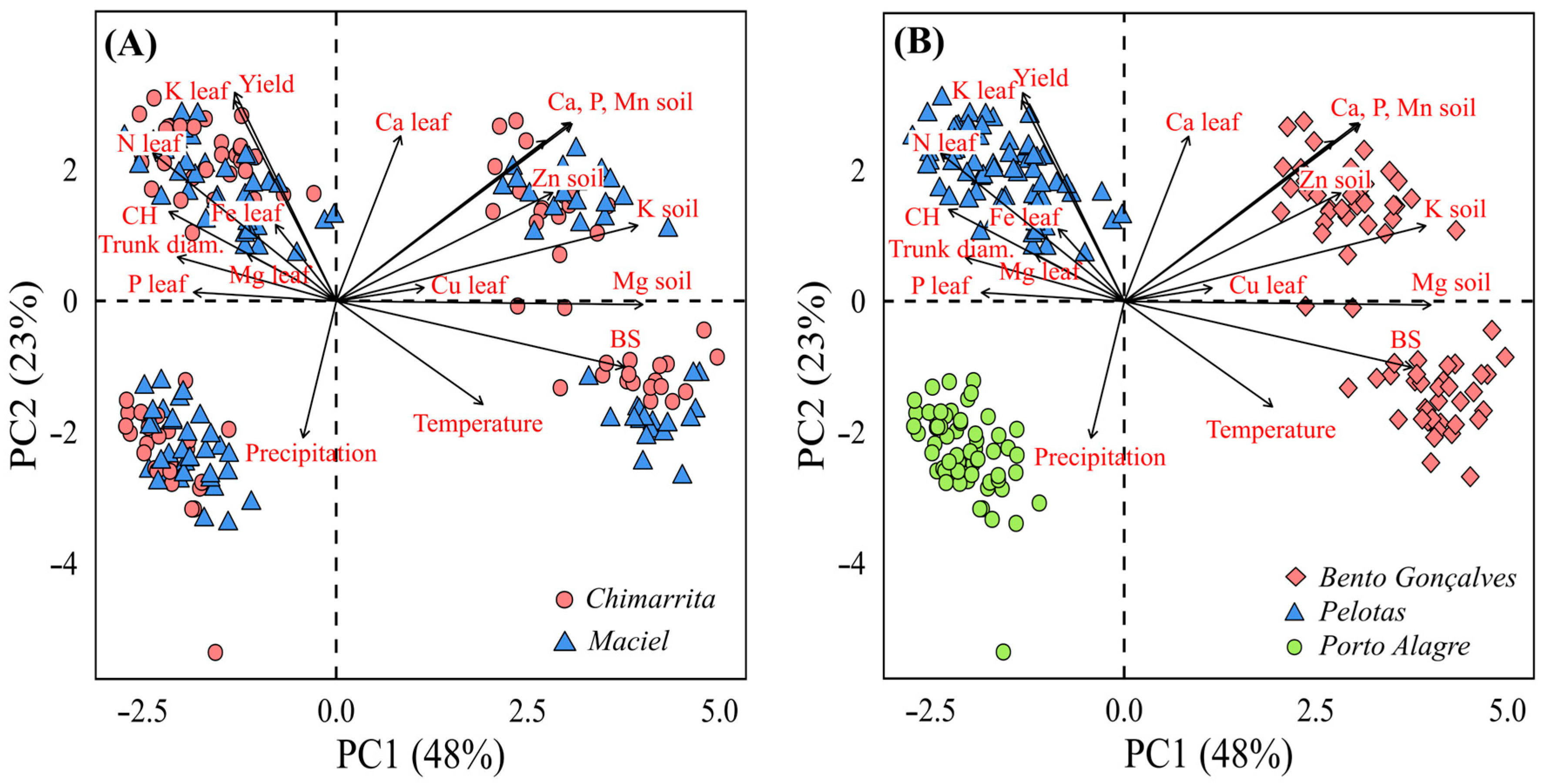
Subsequently, all data (yield, soil nutrient content, leaf nutrient content and climatic variables) were subjected to principal component analysis (PCA) in order to explore data variance, since it makes it possible to identify the most complex interactions among variables, as well as to assess similarities/differences among cultivars, cultivation place, and rootstocks. The contribution of each variable for principal component data variation explanations was also quantified. PCA was carried out in the ‘FactoMineR’ and ‘factoextra’ packages of R software, version 4.1.1 [38].

2.6.2. Development of Prediction Models

Six peach yield prediction models were developed. The models were generated by including the different predictor variables in order to answer to our hypothesis: Model 1—soil nutrient content; Model 2—leaf nutrient content; Model 3—climatic variables; Model 4—soil nutrient content + leaf nutrient content; Model 5—soil nutrient content + leaf nutrient content + climatic variables; and Model 6—soil nutrient content + leaf nutrient content + climatic variables + trunk diameter (Figure 1B). Climatic variables inserted into the model were ‘mean temperature’, ‘mean rainfall’, and ‘number of chilling hours < 7.2 °C.
The models were developed by using three machine learning methods: (i) RF—Random Forest (non-parametric method based on regression tree construction) [39]. First, a tree was built by defining the rules that would separate data into reasonably homogenous groups for the variable of interest (yield), in comparison to the predictor variables. The number of trees (ntrees) and the number of predictor variables (mtry) were the adjustment hyperparameters to be optimized through the RF. The parameters, including mtry and ntrees (500), were adjusted through cross-validation by using the ‘bestTune’ resource [40]; (ii) Multiple Linear Regression (MLR) with stepwise—parametric method that describes the linear relationship between 2, or more, predictor variables, and one response variable, by using a stepwise function to select the variables (the model is adjusted according to the Akaike information criterion method—AIC). This method selects the best predictor for the depended variable; the other predictor variables are included in the model as its exploratory ability increases; and it results in a lower AIC value. Model parameterization involves estimating the regression coefficients (β), where β0 denotes the intercept and β1, β2, …, βp represent the effects of the predictor variables on the response, indicating both the direction and the strength of the linear relationship [41]; (iii) Support Vector Machine (SVM, “e1071” package of R software) [42]—non-parametric technique based on the statistical learning theory, which uses a kernel function to project data on a new hyperplane where non-linear dimensional standards can be easily represented and correlated during modeling. Model parameterization included the kernel function (linear, polynomial, or radial basis function), the regularization parameter (C), and the ε-insensitive loss function for support vector regression [43].
For the development of the six prediction models, the dataset (n = 208) was randomly divided into a calibration set (n = 145) and a validation set (n = 63) (Figure 1B). Model parameterization was based on 10-fold crossed validation through random distribution [44]. All models were implemented in the R software [38] using the caret package [40]. After calibrating the 18 models (Figure 1B), each model was independently validated to assess its applicability under real-world conditions. During this step, the values predicted by each model were compared with productivity values obtained from field evaluations. The evaluation of the models’ accuracy performance was based on the following precision statistics: determination coefficient (R2) (Equation (1)), root mean square error (RMSE) (Equation (2)), and mean absolute error (MAE) (Equation (3)) (Figure 1B):
R 2 = i = 1 N ( y ^ i y - i ) 2 i = 1 N ( y i y - i ) 2
R M S E = 1 N i = 1 N ( y ^ i y i ) 2  
M A E = 1 N i = 1 N ( y ^ i y i )  
wherein: y ^ = predicted value; y - = mean observed value; y = observed values; N = number of samples with i = 1, 2, …
The “variable importance—VARIMP” metrics, which shows the relevance of modeling variables, was calculated to assess the relevance of each explanatory variable in the models. For RF models, variable importance is estimated based on the mean decrease in model accuracy and/or node impurity across the ensemble of trees. The importance values were scaled to allow comparison among predictors, with higher scores indicating a greater contribution to the predictive performance of the model. The “Overall” importance score represents the relative contribution of each predictor to model performance, scaled to facilitate comparison among variables. For SVM models, variable importance is computed based on the contribution of each predictor to the model’s decision function, typically derived from the absolute magnitude of the model coefficients in the transformed feature space. For MLR models, variable importance was calculated based on the absolute values of the standardized regression coefficients, which reflect the relative contribution of each predictor to the response variable. VARIMP was implemented in caret package of R software [45].

3. Results

3.1. Performance of Predictive Models

Six peach yield prediction models were generated by using the following variables: soil and leaf nutrient content, climatic variables, and a plant variable (trunk diameter). The greatest calibration and validation accuracy was observed for the model developed using the RF method, which was followed by SVM and MLR, in comparison involving three machine learning methods (Table 4).
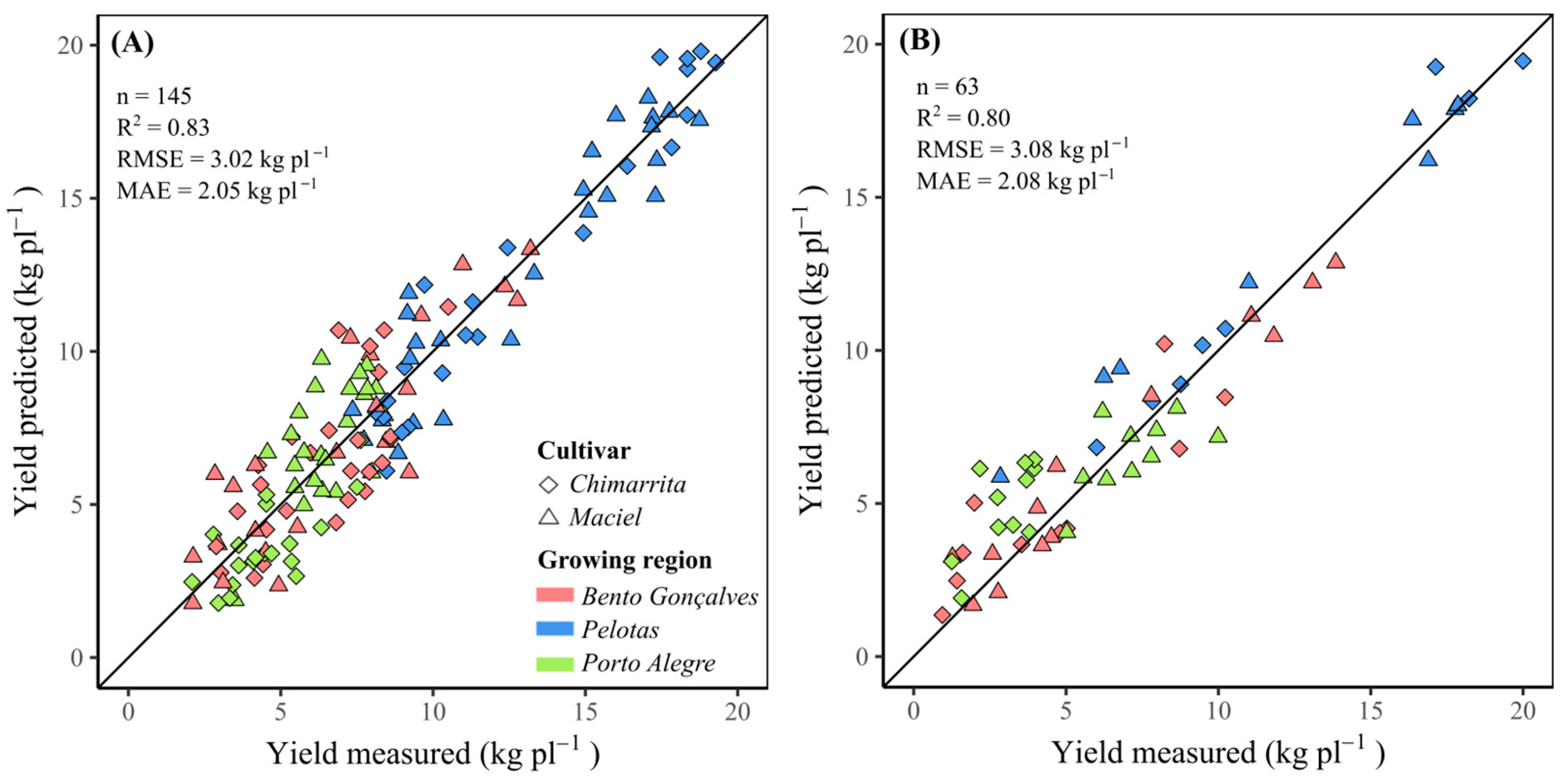
With respect to predictor variable input for model calibration purposes, model 6 (soil nutrients + leaf nutrients + climatic variables + trunk diameter), which was calibrated using the RF machine learning method, presented the greatest accuracy in validation (R2v = 0.80 and MAEv = 2.08 kg pl−1)—this method is based on all variables (Table 1 and Figure 2). Model 1 was the one accounting for the lowest accuracy (R2v = 0.22 and MAEv = 3.00 kg pl−1); it is only based on soil nutrients (Table 4).
Models 2 (leaves) and 3 (climatic) recorded similar accuracy (R2v = 0.35 and 0.45, MAEv = 2.90 and 2.86 kg pl−1, respectively); the same was observed in the comparison of models 4 (soil + leaves) and 5 (soil + leaves + climatic conditions) (R2v = 0.39 and 0.46, MAEv = 2.86 and 2.40 kg pl−1, respectively).
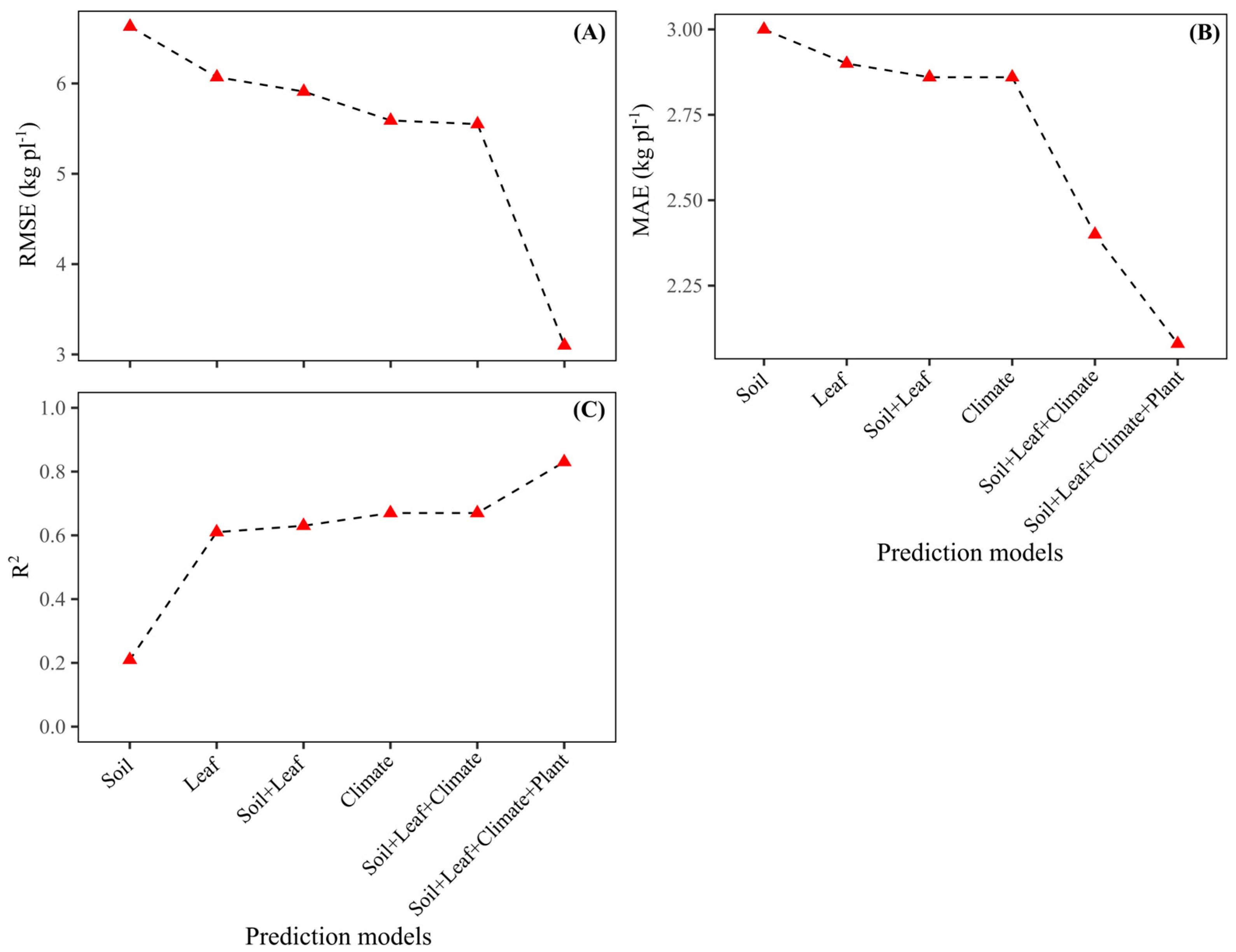
Yield estimate errors (RMSE and MAE) decreased as more variables were added to the prediction model (Figure 2A,B), and the explanation for variance in yield increased (R2) (Figure 2C). The comparison between models 1 and 6 showed a reduction by 14% in RMSE and an increase by 20% in the explanation to variance due to explanatory variables (R2).
The most accurate model (Model 6), which included all variables, effectively captured variations in peach productivity across growing regions and cultivars, with the highest predicted yields observed in the Pelotas region for both cultivars (Figure 3), in agreement with field data (Table 3 and Table 5).

3.2. Contribution of Predictor Variables to Peach Yield

Yield per plant was significantly influenced by the interaction between the factors ‘cultivar’ and ‘growing region’ (Table 5). Mean yield per plant (belonging to Chimarrita and Maciel cultivars) was statistically different between growing regions; the highest yield was observed in Pelotas growing region, where Chimarrita cultivar recorded a yield of 14.5 kg pl−1 and Maciel cultivar recorded 13.5 kg pl−1 (Table 5). The yield between cultivars only differed in the Porto Alegre growing region, where the Maciel cultivar recorded the highest yield (7.3 kg pl−1). This effect of the growing region on peach production, reflecting the variation of nutrients in the soil and leaves (Table 1), but also of climatic variables (Table 2), was effectively captured by the most accurate predictive model—model 6 (Table 4 and Figure 2). This is corroborated by the contribution attributed by the first ten variables in model 6 (Figure 4F).
The quantification of predictor variable relevance during model calibration indicated that the six peach tree yield prediction models assigned different weights to the variables as they were progressively incorporated. Higher importance values indicate predictors with a greater influence on model predictions, whereas lower values suggest limited predictive contribution.
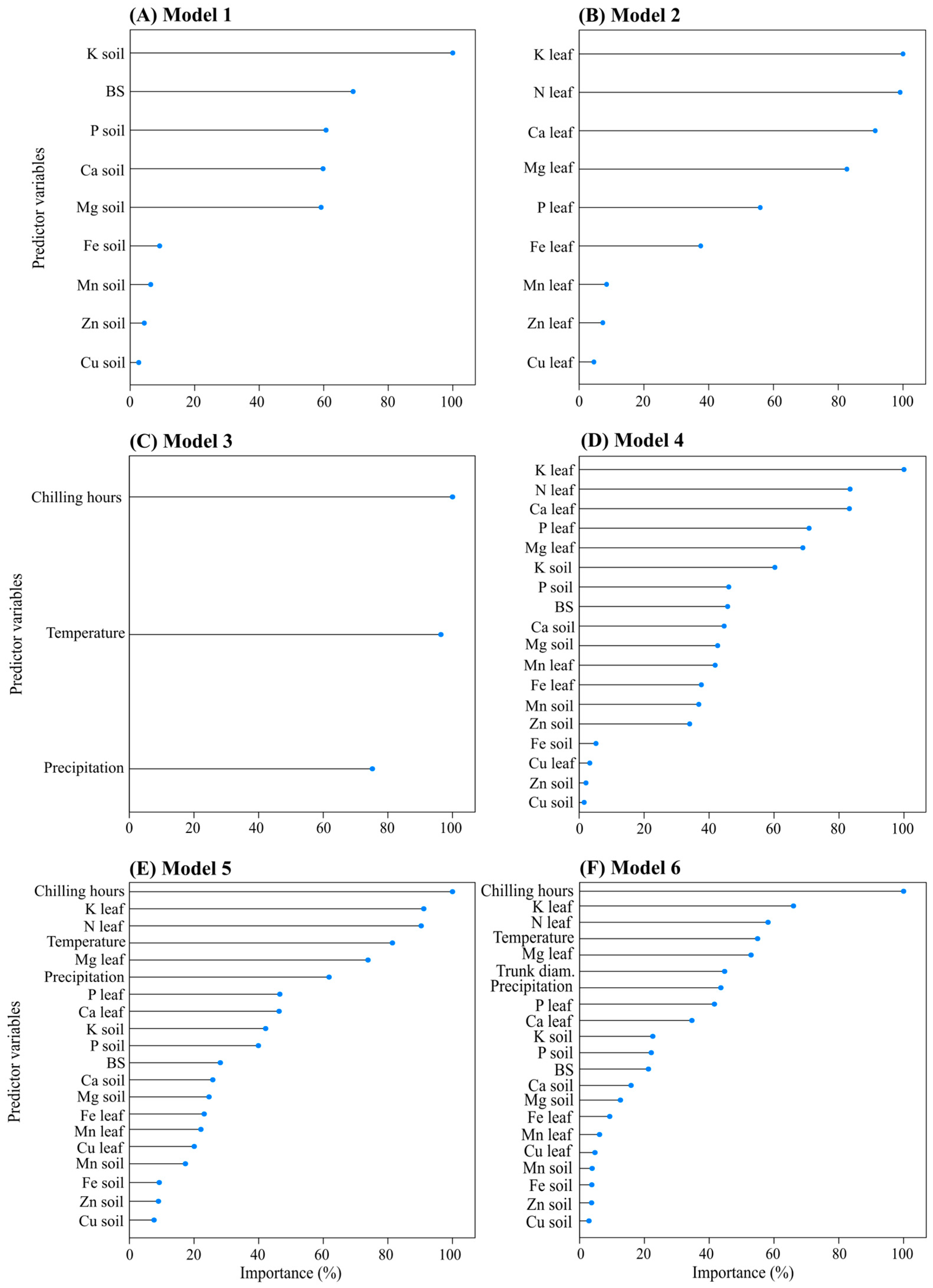
It is important to highlight the relevance of including the following climatic variables in the model presenting the highest accuracy (model 6 with the Random Forest method): hours of chilling (100% importance), temperature (57% importance), and rainfall (50% importance), as well as the plant variable ‘trunk diameter’(45% importance) (Figure 4F). Leaf K (70% importance), N (60% importance), Mg (57% importance), and P (43% importance) contents also had significant relevance in prediction model 6, and it gave more accuracy to models in comparison to soil nutrient contents (Figure 4). Furthermore, variable ‘hours of chilling’, whenever it was added to models 3, 5, and 6, was considered the most important variable for models’ development. Overall, soil K content (100% importance—model 1) and leaf K and N concentration (100% and 81% importance, respectively—model 4) were taken as extremely relevant for the models.
Based on the multivariate principal component analysis, the cultivar effect was subtle in comparison to response variables; there was a homogeneous distribution of the observations of the two cultivars in all quadrants (Figure 5A). Cultivation place, in its turn, had strong impact on data variance—it split the samples from the three locations into different groups (Figure 5B). One group to the right of PC1, which was formed by observations carried out in Bento Gonçalves, was influenced by the soil nutrients, base saturation, and the climatic variable chilling hours (Figure 5B). The other two groups were formed to the upper left of PC1 axis; they resulted from observations carried out in Pelotas; The one in the lower left of the axis resulted from observations carried out in Porto Alegre. Both groups were influenced by leaf nutrient content, by climatic variables, and by the plant variable (Figure 5B). We pointed out that climatic variables ‘temperature’ and ‘chilling hours’ were related to observations performed in Pelotas and Bento Gonçalves, with the climatic variable “precipitation” having the greatest weight for the Porto Alegre growing region, and cold hours for Bento Gonçalves (Figure 5B).

4. Discussion

The difference observed in the accuracy of each yield estimate, among the three machine learning methods, results from different mathematical processing applied to each method [8]. The most robust models, such as Random Forest model, can accurately set the cause-and-effect relationships of predictor variables in yield variation [46,47,48]. Thus, machine learning methods can combine several edaphic, climatic, and culture factors to diagnose nutrients and to manage local-scale actions. Actually, the high yield of cultures depends on positive interactions among these factors, whose data must be integrated to broaden the models for decision-making purposes. It must be done in order to sustainably manage complex systems [49]. Similarly, the effect of the input of different sets of explanatory variables for prediction models’ calibration purposes results in models presenting different estimation accuracies [10,12,15].
The significant interaction between cultivar and growing region observed for production (Table 5) can be attributed to differences in climatic and nutritional conditions among the cultivation regions (Table 1 and Table 2). This finding is consistent with previous studies reporting differences between the Chimarrita and Maciel cultivars [19,50], as well as the strong influence of climate on peach productivity [18,19]. In this study, soil K and P contents and base saturation differed among growing region (Table 1) and were also identified as the most influential soil variables in predicting productivity in the best-performing model (model 6; Figure 4F).
The results presented in Figure 2 demonstrate how the use of isolated and combined predictor variable sets differentially affects the predictive contribution of the models. Models including only soil nutritional variables (Model 1) showed low predictive accuracy (Table 4), indicating a limited contribution of these variables to yield prediction. In contrast, the combination of soil and leaf nutritional variables (Model 3) resulted in higher predictive accuracy, demonstrating the benefit of integrating nutritional information from different sources. A similar improvement was observed when nutritional variables were combined with climatic variables (Model 5), confirming the predictive contribution of climatic factors. Finally, Model 6, which integrates all predictive variables, revealed a significant contribution of trunk diameter to the predictive capacity of peach production (Figure 4F), with an increase of approximately 70% in the accuracy of Model 6 compared to Model 1 (Figure 2). Similar results were reported for the calibration of apple tree productivity prediction models in Southern Brazil [10]. The authors found that model predictive performance varied according to the set of input predictor variables and their combinations, reinforcing the idea that isolated variables in models may not properly explain yield.
The three climatic variables strongly explained the variation in peach productivity (Figure 4F). Chilling hours showed a positive correlation with production (Figure 5B), reflecting their role in dormancy release in peach trees [51]. In contrast, higher rainfall—such as that observed in the Porto Alegre region (Table 2)—may enhance nutrient losses through leaching in orchards, particularly of mineral N forms such as NO3 [52]. This process can reduce plant growth, productivity, and nutrient concentrations [52]. Consistent with this pattern, the lowest productivities in the present dataset were observed in the Bento Gonçalves and Porto Alegre regions (Table 3), which also exhibited the highest rainfall volumes (Table 2). Insufficient nitrogen supply limits the synthesis of nucleic acids, proteins, coenzymes, phytohormones, and secondary metabolites [53], thereby compromising orchard yield and profitability and negatively affecting fruit quality [54]. In addition, frequent rainfall can increase the incidence of foliar and fruit diseases, reducing production and fruit quality and altering leaf nutrient concentrations [55].
Model 6, which included climatic variables (mean temperatures, annual rainfall, and chilling hours), and soil and leaf nutrients, as well as trunk diameter, presented the best performance for this culture’s yield prediction (Table 4). Great relevance was given to climatic variable ‘hours of chilling’ (<95%), and to temperature (>55%) and rainfall (>40%) (Figure 4F), due to their impact on peach trees’ yield components [18,19,51,56]. This result is quite useful to predict peach trees’ yield due to climatic conditions, mainly in subtropical climate regions, where modeling is scarce [12].
Figure 4F (model 6) shows that, after hours of chilling, leaf K and N contents were the predictors mostly influencing peach trees’ yield; both recorded 60% relevance, because they are the nutrients mostly demanded by this culture and the ones that are mostly exported by the fruits [57,58]. Furthermore, N has an effect on fruit quality; it acts in variables ‘organic acids, phytochemical content, and total antioxidant capacity’ [54]. Mg was identified as a strong predictor, right after variable temperature, if one takes into consideration its role in the chlorophyll molecule and its consequent influence over the photosynthetic capacity of fruit trees, in general [59,60]. Variable ‘trunk diameter’ was the sixth variable recording the highest relevance (>40%) (Figure 4F) to explain peach tree yield variance—it was justified by the effect of this variable on fruit tree yield [27,28,29]. Yield prediction models, with an emphasis on Model 6, can be useful at the time to take into account the climatic change scenarios, since they can be felt in Southern Brazil [61,62] and can affect peach tree nutrition and yield [56]. Based on the results, it is worth pointing out that, in case climatic changes get more intense, climatic variables between different seasons of the year can have an impact on crop growth and yield [18,19,56].
Finally, this study has shown that the combined use of well-documented databases and robust machine learning methods seems to have the potential to estimate peach trees’ yield by helping decision-makers to be more assertive about fertilizers’ recommendations and phytosanitary management in orchards. The strategies adopted to develop the prediction models presented in this study can be relevant for application in orchards worldwide and for estimating the yield of fruit trees under specific conditions (culture and cultivation place, among others). In addition, the study showed the significant effect of climatic variables in explaining the variation in peach production estimated by prediction models, indicating the need to include this variable in productivity estimates under climate change scenarios.
It is important to highlight that the database used in this study has spatial and temporal limitations, as it includes only three regions and two crop seasons. Consequently, the applicability of the prediction models is limited at regional and temporal scales when the objective is to forecast commercial crops. To achieve this objective, models need to be calibrated using a database composed of multiple crop seasons—ideally spanning more than 20 years—and covering a broader range of peach-growing regions. However, the modeling strategies tested and evaluated in this study are valid not only for application in the development of peach production prediction models, but also for other fruit species. In addition, these models represent a proof of concept; that is, they provide initial evidence that the methodology and modeling strategies presented here are promising. However, these models are not intended to be universally applicable yield forecasting tools for all regions or cultivars. In addition, given the limited spatial and temporal scope of the dataset, Random Forest models may present a potential risk of overfitting, reinforcing that the results should be interpreted as a proof of concept rather than as fully generalizable predictive tools. Although Random Forest models are generally resistant to overfitting, a potential risk remains when models are trained on limited datasets. This risk can be mitigated through careful hyperparameter tuning and appropriate cross-validation strategies.
As datasets grow in size and diversity, machine learning techniques can promote the identification of complex and subtle interactions among local-scale factors. Thus, it is important to pinpoint the search for prediction models applicable to more refined perennial fruit trees, considering cultivar, growing region, and several production cycles (crops), by keeping in mind three factors: (i) achieving a high yield with economic visibility; (ii) getting fruits with higher visual and bromatological quality; (iii) proper plant nutritional development; (iv) rational use of fertilizers; and (v) fruit yield within a climatic change scenario.

5. Conclusions

Prediction model calibration is affected by the machine learning method and by different predictor variable inputs, since it reflects on peach tree yield prediction accuracy.
Model 6, which took into account soil nutrients, leaf nutrients, and climatic variables, besides the trunk diameter of the peach trees, showed the greatest potential to predict these trees’ yield in orchards planted with cultivars ‘Maciel’ and ‘Chimarrita’ in Southern Brazil.
The variable presenting the highest relevance to explain peach yield variation was hours of chilling; it was followed by leaf K and N contents and mean temperature, which recorded relevance of >55%.
Given the limited spatial and temporal scope of the dataset, the applicability of the prediction models as commercial-scale predictive tools is also limited. Nevertheless, the modeling strategies presented in this study are valid for the development of predictive models for peach production and can also be extended to other fruit species.

Author Contributions

Conceptualization, J.M.M.-B. and G.B.; methodology, J.M.M.-B., D.L.B. and G.B.; software, J.M.M.-B. and G.B.; validation, J.M.M.-B. and G.B.; formal analysis, J.M.M.-B., D.L.B. and G.B.; investigation, D.L.B. and G.A.B.M.; resources, G.A.B.M. and G.B.; data curation, J.M.M.-B., D.L.B., G.A.B.M. and G.B.; writing—original draft preparation, J.M.M.-B., M.T., G.A.B.M., W.N. and G.B. and G.B.; writing—review and editing, J.M.M.-B., M.T., W.N. and G.B.; visualization, J.M.M.-B., W.N., M.T. and G.B.; supervision, G.B.; project administration, G.A.B.M. and G.B.; funding acquisition, G.A.B.M. and G.B. All authors have read and agreed to the published version of the manuscript.

Funding

Brazil was supported by the National Council for Scientific and Technological Development (CNPq—process: 302023/2019-4) and the Foundation for Support of Research Rio Grande do Sul—Brazil (FAPERGS—process: 21/2551-0001920-4), for financial support.

Data Availability Statement

Dataset available on request from the authors.

Acknowledgments

We thank all the staff and students responsible for the maintenance and data collection from this field trial.

Conflicts of Interest

The authors declare no conflicts of interest.

References

  1. FAO. Production Quantities of Peaches and Nectarines by Country; FAO: Rome, Italy, 2019; Available online: http://www.fao.org/faostat/en/#data/QC/visualize (accessed on 10 April 2024).
  2. FNP. Pêssego. FNP Consultoria & Comércio; Agrianual edition; Agribuisiness Intelligence: São Paulo, Brazil, 2018; Available online: http://www.agrianual.com.br/ (accessed on 10 April 2024).
  3. Quaggio, J.A.; Raij, B.V. Frutíferas. In Recomendação de Adubação e Calagem Para o Estado São Paulo—Boletim Técnico 100, 1st ed.; Raij, B.V., Cantarella, H., Quaggio, J.A., Furlani, A.M.C., Eds.; Instituto Agronômico: Campinas, Brazil, 1997; pp. 121–125. [Google Scholar]
  4. Marschner, H. Marschner’s Mineral Nutrition of Higher Plants, 3rd ed.; Elsevier—Academic Press: Cambridge, MA, USA, 2012. [Google Scholar] [CrossRef]
  5. CQFS-RS/SC—Comissão de Química e Fertilidade Do Solo-RS/SC. Manual de Adubação e Calagem para os Estados do Rio Grande do Sul e Santa Catarina, 11th ed.; NRS/SBCS: Porto Alegre, Brazil, 2016. [Google Scholar]
  6. Prado, R.M.; Rozane, D.E. Leaf analysis as diagnostic tool for balanced fertilization in tropical fruits. In Fruit Crops; Elsevier: Amsterdam, The Netherlands, 2020; pp. 131–143. [Google Scholar] [CrossRef]
  7. Schmitt, D.E.; Comin, J.J.; Ceretta, C.A.; Gatiboni, L.C.; Tiecher, T.; Lorensini, F.; Brunetto, G. Accumulation of phosphorus fractions and contamination potential in vineyard soils in the southern region of the state of Santa Catarina, Brazil. Rev. Bras. Ciênc. Solo 2013, 37, 1256–1266. [Google Scholar] [CrossRef]
  8. Liakos, K.G.; Busato, P.; Moshou, D.; Pearson, S.; Bochtis, D. Machine learning in agriculture: A review. Sensors 2018, 18, 2674. [Google Scholar] [CrossRef]
  9. Zhu, N.; Liu, X.; Liu, Z.; Hu, K.; Wang, Y.; Tan, J.; Guo, Y. Deep learning for smart agriculture: Concepts, tools, applications, and opportunities. Int. J. Agric. Biol. Eng. 2018, 11, 32–44. [Google Scholar] [CrossRef]
  10. Hahn, L.; Basso, C.; Moura-Bueno, J.M.; Argenta, L.C.; Toselli, M.; Carranca, C.; Rech, M.; Hahn, I.S.; Brunetto, G. Yield Prediction Models for ‘Royal Gala’ and ‘Fuji Suprema’ Apple Varieties Cultivated under a Subtropical Climate. Agronomy 2023, 13, 514. [Google Scholar] [CrossRef]
  11. Liakos, V.; Tagarakis, A.; Fountas, S.; Nanos, G.D.; Tsiropoulos, Z.; Gemtos, T. Use of NDVI to predict yield variability in a commercial apple orchard. In Precision Agriculture’15; Wageningen Academic Publishers: Wageningen, The Netherlands, 2015; pp. 188–197. [Google Scholar]
  12. Bai, X.; Li, Z.; Li, W.; Zhao, Y.; Li, M.; Chen, H.; Zhu, X. Comparison of Machine-Learning and CASA Models for Predicting Apple Fruit Yields from Time-Series Planet Imageries. Remote Sens. 2021, 13, 3073. [Google Scholar] [CrossRef]
  13. Maheswari, P.; Raja, P.; Apolo-Apolo, O.E.; Pérez-Ruiz, M. Intelligent fruit yield estimation for orchards using deep learning based semantic segmentation techniques—A review. Front. Plant Sci. 2021, 12, 684328. [Google Scholar] [CrossRef]
  14. Jargan, H.; Rohani, A.; Kosari-Moghaddam, A. Application of modeling techniques for energy analysis of fruit production systems. Environ. Dev. Sustain. 2022, 24, 2616–2639. [Google Scholar] [CrossRef]
  15. Zhou, X.X.; Li, Y.Y.; Luo, Y.K.; Sun, Y.W.; Su, Y.J.; Tan, C.W.; Liu, Y.J. Research on remote sensing classification of fruit trees based on Sentinel-2 multi-temporal imageries. Sci. Rep. 2022, 12, 11549. [Google Scholar] [CrossRef]
  16. Gómez-Lagos, J.E.; González-Araya, M..; Ortega Blu, R.; Acosta Espejo, L.G. A new method based on machine learning to forecast fruit yield using spectrometric data: Analysis in a fruit supply chain context. Precis. Agric. 2023, 24, 326–352. [Google Scholar] [CrossRef]
  17. Dhiman, B.; Kumar, Y.; Kumar, M. Fruit quality evaluation using machine learning techniques: Review, motivation and future perspectives. Multim. Tools Appl. 2022, 81, 16255–16277. [Google Scholar] [CrossRef]
  18. Milatović, D.; Nikolić, D.; Đurović, D. Variability, heritability and correlatins of some factors affctig productiity in peach. Hortic. Sci. 2010, 37, 79–87. [Google Scholar] [CrossRef]
  19. Galarça, S.P.; Fachinello, J.C.; Betemps, D.L.; Hoffmann, A.; Marodin, G.A.B.; Pretto, A.; Nunes, F.S.; DIAS, F.P. Crescimento e desenvolvimento de pessegueiros ‘Chimarrita’ e ‘Maciel’ sobre diferentes porta-enxertos e locais de cultivo. Cienc. Rural 2013, 43, 219–224. [Google Scholar] [CrossRef]
  20. Carranca, C.; Brunetto, G.; Tagliavini, M. Nitrogen nutrition of fruit trees to reconcile productivity and environmental concerns. Plants 2018, 7, 4. [Google Scholar] [CrossRef]
  21. Kalcsits, L.; Lotze, E.; Tagliavini, M.; Hannam, K.D.; Mimmo, T.; Neilsen, D.; Neilsen, G.; Atkinson, D.; Biasuz, E.C.; Borruso, L.; et al. Recent achievements and new research opportunities for optimizing macronutrient availability, acquisition, and distribution for perennial fruit crops. Agronomy 2020, 10, 1738. [Google Scholar] [CrossRef]
  22. Guntiñas, M.E.; Leirós, M.C.; Trasar-Cepeda, C.; Gil-Sotres, F. Effects of moisture and temperature on net soil nitrogen mineralization: A laboratory study. Eur. J. Soil Biol. 2012, 48, 73–80. [Google Scholar] [CrossRef]
  23. Benbi, D.K.; Boparai, A.K.; Brar, K. Decomposition of particulate organic matter is more sensitive to temperature than the mineral associated organic matter. Soil Biol. Biochem. 2014, 70, 183–192. [Google Scholar] [CrossRef]
  24. Wang, Z.H.; Li, S.X. Chapter Three—Nitrate N loss by leaching and surface runoff in agricultural land: A global issue (a review). Adv. Agron. 2019, 156, 159–217. [Google Scholar] [CrossRef]
  25. Hamada, N.A.; Moreira, R.R.; Nesi, C.N.; De Mio, L.L.M. Pathogen dispersal and Glomerella leaf spot progress within apple canopy in Brazil. Plant Dis. 2019, 103, 3209–3217. [Google Scholar] [CrossRef] [PubMed]
  26. Lepsis, J.; Blanke, M.M. The trunk cross-section area as a basis for fruit yield modelling in intensive apple orchards. Acta Hortic. 2006, 707, 231–235. [Google Scholar] [CrossRef]
  27. Zhou, Q.; Melgar, J.C. Tree Age Influences Nutrient Partitioning among Annually Removed Aboveground Organs of Peach. Hortscience 2020, 55, 560–564. [Google Scholar] [CrossRef]
  28. Barreto, C.F.; da Kirins, M.B.M.; Silva, P.S.; Schiavon, C.R.; Rombaldi, C.V.; Malgarim, M.B.; Fachinello, J.C. Agronomic performance of the Maciel peach with different rootstocks. Semin. Ciênc. Agrár. 2017, 38, 1217–1227. [Google Scholar] [CrossRef]
  29. BRASIL. Ministério da Agricultura, Pecuária e Abastecimento (MAPA). Instrução Normativa nº 37, de 18 de Junho de 2008. Aprova as Normas Técnicas Específicas Para a Produção Integrada de Pêssego—NTEPI-Pêssego. Available online: https://sistemasweb.agricultura.gov.br/arquivosislegis/anexos/rb/INM37_2008_MAPA.pdf (accessed on 20 September 2025).
  30. Alvares, C.A.; Stape, J.L.; Sentelhas, P.C. Köppen’s climate classification map for Brazil. Meteorol. Z. 2013, 22, 711–728. [Google Scholar] [CrossRef]
  31. Soil Survey Staff. Keys to Soil Taxonomy, 13th ed.; USDA Natural Resources Conservation Service: Washington, DC, USA, 2022. Available online: https://www.nrcs.usda.gov/sites/default/files/2022-09/Keys-to-Soil-Taxonomy.pdf (accessed on 10 April 2024).
  32. BRASIL. Levantamento de Reconhecimento dos Solos do Estado do Rio Grande do Sul; Divisão de Pesquisa Pedológica: Recife, Brazil, 1973; Boletim Técnico n. 30; 431p, Available online: http://www.infoteca.cnptia.embrapa.br/infoteca/handle/doc/331173 (accessed on 10 December 2025).
  33. EMBRAPA—Empresa Brasileira de Pesquisa Agropecuária. Manual de Análises Químicas de Solos, Plantas e Fertilizantes, 2nd ed.; Embrapa Informação Tecnológica: Brasília, Brazil, 2009. [Google Scholar]
  34. Walkley, A.; Black, I.A. An examination of Degtjareff method for determining soil organic matter, and proposed modification of the chromic acid tritation method. Soil Sci. 1934, 37, 29–38. [Google Scholar] [CrossRef]
  35. Tedesco, M.J.; Gianello, C.; Bissani, C.A.; Bohnen, H.; Volkweiss, S.J. Análises de Solo, Plantas e Outros Materiais, 2nd ed.; Universidade Federal do Rio Grande do Sul: Porto Alegre, Brazil, 1995. [Google Scholar]
  36. Bataglia, O.C.; Mascarenhas, H.A.A. Absorção de Nutrientes Pela Soja; IAC: Campinas, Brazil, 1978.
  37. Ebert, A.; Petri, J.L.; Bender, R.J.; Braga, H.J. First experiences with chill units models is southern Brazil. Acta Horticul. 1986, 184, 89–96. [Google Scholar] [CrossRef]
  38. R CORE TEAM. R: A Language and Environment for Statistical Computing; R Foundation for Statistical Computing: Vienna, Austria, 2021; Available online: https://www.R-project.org/ (accessed on 20 September 2025).
  39. Breiman, L. Random Forests. Mach. Learn. 2001, 45, 5–32. [Google Scholar] [CrossRef]
  40. Kuhn, M.; Wing, J.; Weston, S.; Williams, A.; Keefer, C.; Engelhardt, A.; Kenkel, B. Package ‘caret’: Classification and Regression Training. R Package Version 6.0-86. 2020. Available online: https://cran.r-project.org/web/packages/caret/caret.pdf (accessed on 20 September 2025).
  41. Varmuza, K.; Filzmoser, P. Introduction to Multivariate Statistical Analysis in Chemometrics; CRC Press, Taylor & Francis: Boca Raton, FL, USA, 2009. [Google Scholar] [CrossRef]
  42. Meyer, D.; Dimitriadou, E.; Hornik, K.; Weingessel, A.; Leisch, F. e1071: Misc Functions of the Department of Statistics, Probability Theory Group, TU Wien, 2017. R Package Version 1.6-8. Available online: https://CRAN.R-project.org/package=e1071 (accessed on 20 September 2025).
  43. Ivanciuc, O. Applications of support vector machines in chemistry. In Reviews in Computational Chemistry; Lipkowitz, K.B., Cundari, T.R., Eds.; Wiley: Weinheim, Germany, 2007; pp. 291–400. [Google Scholar]
  44. Brus, D.J.; Kempen, B.; Heuvelink, G.B.M. Sampling for validation of digital soil maps. Eur. J. Soil Sci. 2011, 62, 94–407. [Google Scholar] [CrossRef]
  45. Kuhn, M. varImp: Variable Importance Functions for caret. In The Caret Package (Section 15 Variable Importance); Comprehensive R Archive Network: Vienna, Austria, 2020; Available online: https://topepo.github.io/caret/variable-importance.html (accessed on 20 September 2025).
  46. Torkashvand, A.M.; Ahmadi, A.; Nikravesh, N.L. Prediction of kiwifruit firmness using fruit mineral nutrient concentration by artificial neural network (ANN) and multiple linear regressions (MLR). J. Integr. Agric. 2017, 16, 1634–1644. [Google Scholar] [CrossRef]
  47. Khan, T.; Qiu, J.; Qureshi, M.A.A.; Iqbal, M.S.; Mehmood, R.; Hussain, W. Agricultural fruit prediction using deep neural networks. Procedia Comput. Sci. 2020, 174, 72–78. [Google Scholar] [CrossRef]
  48. Moussaid, A.; El Fkihi, S.; Zennayi, Y.; Lahlou, O.; Kassou, I.; Bourzeix, F.; Imani, Y. Machine Learning Applied to Tree Crop Yield Prediction Using Field Data and Satellite Imagery: A Case Study in a Citrus Orchard. Informatics 2022, 9, 80. [Google Scholar] [CrossRef]
  49. Parent, L.E.; Natale, W.; Brunetto, G. Machine learning, compositional and fractal models to diagnose soil quality and plant nutrition. In Soil Science—Emerging Technologies, Global Perspectives and Applications, 1st ed.; InTech Publ.: Londres, NY, USA, 2021; Volume 1, pp. 83–114. [Google Scholar]
  50. Melo, G.W.; Rozane, D.E.; Brunetto, G. Discriminant analysis in the selection of groups of peach cultivars. Acta Hortic. 2018, 1217, 335–342. [Google Scholar] [CrossRef]
  51. Raseira, M.C.B.; Nakasu, B.H. Cultivares: Descrição e Recomendação; Embrapa-CPACT: Pelotas, Bazil, 1998. [Google Scholar]
  52. Sete, P.B.; Melo, G.W.B.; Oliveira, B.S.; Freitas, R.F.; Magro, R.D.; Ambrosini, V.G.; Trapp, T.; Comin, J.J.; Gatiboni, L.C.; Brunetto, G. Perdas de nitrogênio do solo e resposta do pessegueiro à adição de composto orgânico. Cienc. Rural 2015, 45, 651–657. [Google Scholar] [CrossRef]
  53. Taiz, L.; Zeiger, E.; Møller, I.M.; Murphy, A. Plant Physiology and Development, 6th ed.; Sinauer Associates: Sunderland, MA, USA, 2015. [Google Scholar]
  54. Vashisth, T.; Olmstead, M.A.; Olmstead, J.; Colquhoun, T.A. Effects of nitrogen fertilization on subtropical peach fruit quality: Organic acids, phytochemical content, and total antioxidant capacity. J. Am. Soc. Hortic. Sci. 2017, 142, 393–404. [Google Scholar] [CrossRef]
  55. Thomidis, T.; Tsipouridis, C.; Darara, V. Seasonal variation of nutrient elements in peach fruits (cv. May Crest) and its correlation with development of Brown rot (Monilinia laxa). Sci. Hortic. 2007, 111, 300–303. [Google Scholar] [CrossRef]
  56. Zhang, Q.; Zhou, B.; Li, M.; Wei, Q.; Han, Z. Multivariate analysis between meteorological factor and fruit quality. J. Integr. Agric. 2018, 17, 1338–1347. [Google Scholar] [CrossRef]
  57. Rombolà, A.D.; Sorrenti, G.; Morodin, G.A.B.; Pieri, A.Z.; Barca, E. Nutrição e manejo do solo em fruteiras de caroço em regiões de clima temperado. Semin. Cienc. Agrar. 2012, 33, 639–654. [Google Scholar] [CrossRef]
  58. Chatzitheodorou, I.T.; Sotiropoulos, T.E.; Mouhtaridou, G.I.; Almaliotis, D. Effect of nitrogen, phosphorus, potassium fertilizers and manure on growth and productivity of the peach cultivars Springtime and Redhaven. Hortic. Sci. 2004, 31, 88–92. [Google Scholar] [CrossRef]
  59. Gerendás, J.; Führs, H. The significance of magnesium for crop quality. Plant Soil 2013, 368, 101–128. [Google Scholar] [CrossRef]
  60. Tian, G.; Qin, H.; Liu, C.; Xing, Y.; Feng, Z.; Xu, X.; Ge, S. Magnesium Improved Fruit Quality by Regulating Photosynthetic Nitrogen Use Efficiency, Carbon-Nitrogen Metabolism and Anthocyanin Biosynthesis in ‘Red Fuji’ Apple. Front. Plant Sci. 2023, 14, 1136179. [Google Scholar] [CrossRef]
  61. Back, A.J.; Gonçalves, F.N.; Fan, F.M. Spatial, seasonal, and temporal variations in rainfall aggressiveness in the south of Brazil. Eng. Agric. 2019, 39, 466–475. [Google Scholar] [CrossRef]
  62. Denski, A.P.N.; Back, A.J. Tendência climatológica nos elementos meteorológicos e na evapotranspiração de referência de Urussanga-SC. Rev. Bras. Clim. 2015, 17, 262–274. [Google Scholar] [CrossRef]
Figure 1. Location of the three municipalities where the sampling process applied to the 208 peach trees was carried out in Southern Brazil (A) and stages of the calibration and validation process of the peach yield prediction models (B).
Horticulturae 12 00155 g001
Figure 2. Mean values of root mean square error (RMSE) (A), mean absolute error (B) and determination coefficient (R2) (C) recorded for models developed through the three machine learning methods developed for predicting peach productivity applied to the cultivars Chimarrita and Maciel planted in soil presenting different fertility levels.
Horticulturae 12 00155 g002
Figure 3. Association between peach yields (kg pl−1) quantified in the field and estimated by the best model (model 6 with the Random Forest method) for the Chimarrita and Maciel cultivars planted in soils with different fertility levels, where (A) is for the calibration dataset and (B) for validation. R2—determination coefficient; RMSE—root mean square error; MAE—mean absolute error.
Horticulturae 12 00155 g003
Figure 4. Relative relevance of predictor variables in the six peach yield prediction models calibrated with the Random Forest method. BS = base saturation.
Horticulturae 12 00155 g004
Figure 5. Association between principal component 1 (PC1) and principal component 2 (PC2) for yield variables, and soil and leaf nutrient content, climatic variables, and the plant variable, in comparison to (A) cultivar and (B) growing region. BS—base saturation; CH—chilling hours.
Horticulturae 12 00155 g005
Table 1. Descriptive statistics of the soil and leaf nutrient content of peach trees of the cultivars ‘Maciel’ and ‘Chimarrita’ grown in three producing regions in Rio Grande do Sul State, Brazil (2009–2010).
RegionCultivarNutrients in Soil
PKCaMgBSCuFeMnZn
mg kg−1cmolc kg−1%mg kg−1
Bento GonçalvezChimarrita35.5
nsA
330
nsA
8.8
nsA
2.8
nsA
78
nsA
30.1
nsA
50.5
nsA
17.0
nsB
16.7
nsA
Bento GonçalvezMaciel34.23308.82.47829.451.116.516.7
Porto AlegreChimarrita8.3
nsC
81
nsC
2.4
nsB
0.9
nsB
58
nsB
6.3
nsB
25.5
nsB
14.2
nsB
1.8
nsB
Porto AlegreMaciel7.9813.00.8587.024.415.02.0
PelotasChimarrita27.5
nsB
153
nsB
7.5
nsA
0.8
nsB
49
nsC
4.5
nsC
10.5
nsC
48.0
nsA
5.7
nsC
PelotasMaciel26.41537.11.0495.011.247.55.5
LocalCultivarNutrients in Leaf
NPKCaMgCuFeMnZn
g kg−1mg kg−1
Bento GonçalvezChimarrita24.7 nsB1.9
ns
24.8 nsA17.6 nsA3.9
nsA
4.8
nsB
92.8
nsC
193.4
nsA
29.7
nsA
Bento GonçalvezMaciel24.11.825.218.23.84.693.7195.530.2
Porto AlegreChimarrita25.1 nsB2.1
ns
21.4 nsB13.2 nsB4.2
nsA
4.5
nsB
102.1
nsB
55.5
nsC
18.3
nsB
Porto AlegreMaciel24.82.021.814.84.74.5104.3
ns
57.119.5
PelotasChimarrita34.6 nsA2.3
ns
24.3 nsA17.4 nsA1.4
nsB
6.4
nsA
115.9
nsA
144.5
nsB
23.8
nsB
PelotasMaciel33.72.224.917.51.26.5116.4148.424.6
Uppercase letters compare average nutrient levels across growing regions using the Scott–Knott test (p < 0.05). ns: not significant.
Table 2. Climatic variables recorded for the peach orchard regions in Rio Grande do Sul State, Brazil (2009–2010).
UnitMinimumMeanMedianMaximum
Region 1—Bento Gonçalves
Mean annual air temperature°C12.0014.89 b17.7017.70
Average number of chilling hours (CH) < 7.2 °CCH388391 b388394
Mean anual precipitationsmm139139.50 b139.50140
Region 2—Porto Alegre
Mean annual air temperature°C18.1518.28 a18.4118.41
Average number of chilling hours (CH) < 7.2 °CCH282373 b282469
Mean anual precipitationsmm140153.5 a153.5167
Region 3—Pelotas
Mean annual air temperature°C18.0019.52 a19.5221.05
Average number of chilling hours (CH) < 7.2 °CCH248546 a546844
Mean anual precipitationsmm111.1126.63 c126.63142.17
Lowercase letters compare the mean values of climatic variables using the Scott–Knott test (p < 0.05).
Table 3. Average trunk diameter and peach yield evaluated in each orchard and growing region in Rio Grande do Sul State, Brazil (2009–2010).
RegionCultivarTrunk Diameter (mm)Yield Peach (kg Plant−1)
Bento GonçalvezChimarrita65.7 ns6.7 ns
Bento GonçalvezMaciel68.57.5
Porto AlegreChimarrita76.7 ns2.8 a
Porto AlegreMaciel74.57.3 b
PelotasChimarrita72.3 ns14.5 ns
PelotasMaciel73.513.5
Lowercase letters compare average values between growing region using the Scott-Knott test (p < 0.05). ns: not significant.
Table 4. Accuracy in the calibration and validation stage of peach tree yield prediction models (kg pl−1) applied to cultivars Chimarrita and Maciel planted in soil presenting different fertility levels.
Prediction ModelsMachine Learning Methods (4)R2cRMSEcMAEcR2vRMSEvMAEv
kg pl−1kg pl−1
Calibration (n = 145)Validation (n = 63)
Model 1—nutrients in soil (1)RF0.435.105.540.226.633.00
SVM0.355.124.000.226.664.47
MLR0.255.514.820.207.635.54
Model 2—nutrients in leaf (2)RF0.614.143.310.356.072.90
SVM0.434.863.700.147.104.50
MLR0.424.834.830.216.704.12
Model 3—climate variables (3)RF0.673.832.540.455.592.86
SVM0.604.063,010.405.893.10
MLR0.613.993.090.425.732.87
Model 4—nutrients in soil + leafRF0.634.013.040.395.912.86
SVM0.494.553.440.276.483.94
MLR0.504.503.350.346.143.72
Model 5—nutrients in soil + leaf + climate variablesRF0.673.702.760.465.552.40
SVM0.614.042.720.435.702.96
MLR0.633.882.990.425.702.84
Model 6—nutrients in soil + leaf + climate variables + trunk diameterRF *0.833.022.050.803.102.08
SVM0.633.922.690.445.672.86
MLR0.653.782.900.455.593.08
(1) Soil P, K Ca, Mg, Cu, Zn, Fe, Mn content and base saturation. (2) Leaf N, P, K, Ca, Mg, Zn, Fe, Cu, Mn and B content. (3) Mean temperatures, mean rainfall, and chilling hours (below 7.2 °C). (4) RF—Random Forest; MLR—Multiple Linear Regression; SVM—Support Vector Machine; R2—determination coefficient; RMSE—root mean square error; MAE—mean absolute error. * Models presenting the greatest prediction accuracy are highlighted in bold.
Table 5. Analysis of variance of the response variable peach yield influenced by cultivar, growing region, and interaction.
EffectYield Peach (kg Plant−1)
Cultivar0.057 *
Growing region0.000 ***
Growing region × Cultivar 0.003 **
Interaction: Cultivar × growing regionChimarritaMaciel
Bento Gonçalves6.7 (±0.7) bA (1,2)7.5 (±1.4) bA
Pelotas14.5 (±1.1) aA13.5 (±1.2) aA
Porto Alegre2.8 (±0.2) cB7.3 (±0.4) bA
* Statistically significant at alpha ≤ of 0.05; ** Statistically significant at alpha ≤ of 0.01; *** Statistically significant at alpha ≤ of 0.001. (1) Means followed by the same lowercase letter in the columns compare the response variables in each cultivar with the cultivation sites. (2) Means followed by the same uppercase letter in the rows compare the response variables in each cultivation site with the cultivars. Differences were considered significant when the p-value < 0.05 Scott–Knott test.
Disclaimer/Publisher’s Note: The statements, opinions and data contained in all publications are solely those of the individual author(s) and contributor(s) and not of MDPI and/or the editor(s). MDPI and/or the editor(s) disclaim responsibility for any injury to people or property resulting from any ideas, methods, instructions or products referred to in the content.