


Abstract
Creating an optimal light environment for different crops is crucial for achieving high yields under controlled environment agriculture conditions. Currently, there are no optimal technologies, including lighting technologies, for growing root crops (in particular radish) in CEA (Controlled Environment Agriculture). This study examined the effects of HPS (High-pressure sodium vapor lamps) and three original sunlike full-spectrum LED lamps on the morphophysiological characteristics and the diffuse reflectance indices of the leaves of two contrast radish cultivars. It was found that a higher blue light content (24%) in the spectrum of the LED 3 lamp contributed to the formation of radish plants with a more compact leaf rosette and maximum yield of roots (up to 19%) compared to the other two types of LED lamps. When treated with LED 3, photosynthesis efficiency was probably higher compared to LED 1 and LED 2, which led to a significant decrease in reflected radiation, especially in the blue and red ranges (by 5–143% and 32–86%, respectively). It was found that the genotype had a significant effect on all morphophysiological parameters of radish, while lighting treatment only affected the integral parameters (Pr—proportion of root crop, and Ai—attraction index) and leaf thickness. However, lighting treatment exhibited a greater impact on leaf reflection indices compared to the genotype, especially those related to chlorophyll content. The results of the study indicate that LED 3 lamps, simulating natural light at midday, are suitable for the production of radish root crops under CEA conditions.
1. Introduction
Modern crop production technologies that use artificial light in controlled environments, such as CEA (Controlled Environment Agriculture) and CEAL (Controlled Environment Agriculture with Artificial Lighting), are currently being used all over the world and are being intensively developed. Many researchers emphasize the prospects for their application in agricultural production and highlight the high potential of these artificial climate facilities [1,2]. At the same time, several issues related to the stability and sustainability of horticultural production in the CEA remain unresolved. These include the selection and development of crop varieties adapted to artificial light and the fine-tuning of lighting conditions based on the specific needs of each crop or variety. These issues require further research [3,4].
Radish (Raphanus sativus L.) is widespread among agricultural crops and is grown everywhere [5]. Small radish is promising for production under light culture conditions, as it has all the necessary characteristics required for crops in CEA: a short growing season, compact habitus and high nutritional properties, which are characteristic not only of root crops, but also, to a greater extent, of leaves. Despite the high potential for small radish production in CEA, this crop has been relatively understudied, both in terms of its response to lighting conditions and in the context of reflection spectroscopy.
Previously, we created a cultivar of small radish for artificial light culture conditions ‘Peterburgskiy fioletovyy’, with a transgressive shape and weight of the root crop, edible, slightly pubescent leaves and a compact leaf rosette [6]. High-pressure sodium vapor lamps (HPS) were used during radish breeding. However, currently, CEAs are primarily equipped with LEDs, which are characterized by an efficient use of space, good spatial distribution of the photosynthetic active radiation (PAR) flux, high energy efficiency and light output, the ability to dim and create an optimal radiation spectrum for different crops, and a long service life [7,8]. Unlike other types of lamps, LEDs do not have such a long history of use in plant growing systems, and many issues related to creating optimal lighting conditions are still being studied [8].
Recent studies have shown that full-spectrum LEDs have the potential to be used in CEA because, by analogy with sunlight, it contains all the wavelengths in the PAR energy spectrum necessary for plant development [8,9,10,11,12,13]. For example, using full-spectrum LED lighting has led to an increase in plant weight, average photosynthetic rate in strawberries [9], high light-use efficiency, and fruit yield in tomatoes [10,11]. It has also led to an increase in leaf area, biomass, and growth performance in lettuce [11,12]; biomass was especially increased in radish and turnip root crops [13]. However, the role and mechanisms of the influence of the full range of PAR on agricultural crops have not been fully understood. This knowledge would greatly enhance the potential for managing plant productivity and quality. In this regard, it is important to develop LED modules with a full spectrum of radiation and select optimal spectra for growing various types of crops, in particular radish, taking into account the interaction between the genotype and the environment.
Optical methods of non-invasive control, which make it possible to evaluate the growth and health of plants and their response to the applied treatments in the genotype-environment system, can serve as an effective tool for optimizing technologies for growing various crops in CEA. The optical properties of leaves are primarily determined by the photosynthetic pigments in their tissues (chlorophyll a, b, and carotenoids), but also depend on leaf structure, the presence and concentration of non-photosynthetic compounds (anthocyanins, flavonols), and water. These properties are a key characteristic of plants, which make it possible to estimate the amount of photosynthetically active radiation absorbed, the intensity of photosynthesis and, ultimately, the physiological state, as well as to predict crop yield [14,15,16].
Qualitative and quantitative changes in the pigment content of plant leaves inevitably lead to changes in their optical properties [15,16,17]. This is the basis for understanding the mechanisms behind plant physiological reactions, resistance, and adaptation, which are essential for developing effective crop-growing technologies and improving methods for rapid phenotyping. To interpret spectral measurements, several reflectance indices have been developed. These indices, in contrast to simple differences between two reflection values at different wavelengths, are normalized values that more accurately characterize leaf reflectivity [18,19,20,21,22]. The authors who developed the formulas for normalized reflectance indices tested them on various plant species and compared the results with those obtained from biochemical assessments of chlorophyll—ChlRI [18], carotenoids—SIPI [19], and anthocyanins—ARI [21,22]. The relationship between the photochemical reflectance index—PRI and the epoxidation of pigments of the xanthophyll cycle, the efficiency of light use, and the efficiency of photosynthesis were also determined [19]. We have previously used these indices in field and controlled environment studies to phenotype plants and evaluate the dynamics of biomass and pigment composition changes, as well as predict the yield of wheat and lettuce plants deficient in mineral nutrients and water [14,15,16,23].
In response to many factors, the spectral and optical characteristics of radiation reflected from the leaf surface change even before external symptoms appear on the plant [17]. It has been demonstrated that the reflectance indices can be used to evaluate the influence of lighting quality on plant development [24]. However, the relationship between light and the physiological state of plants, productivity, and the spectral characteristics of diffuse leaf reflectance remains poorly understood in many crops, particularly radish. The purpose of this study is: (1) to study the effect of spectral radiation characteristics of HPS lamps and three full-spectrum simulating sunlight LED lamps with different ratios of physiologically active wavelengths in the PAR range on the development and yield of two radish cultivars; (2) to evaluate the relationship between diffuse reflection indices of leaves and morphophysiological parameters of radish plants, in order to identify optical criteria for improving plant growing technologies and selecting economically valuable genotypes.
2. Materials and Method
2.1. Object of Research
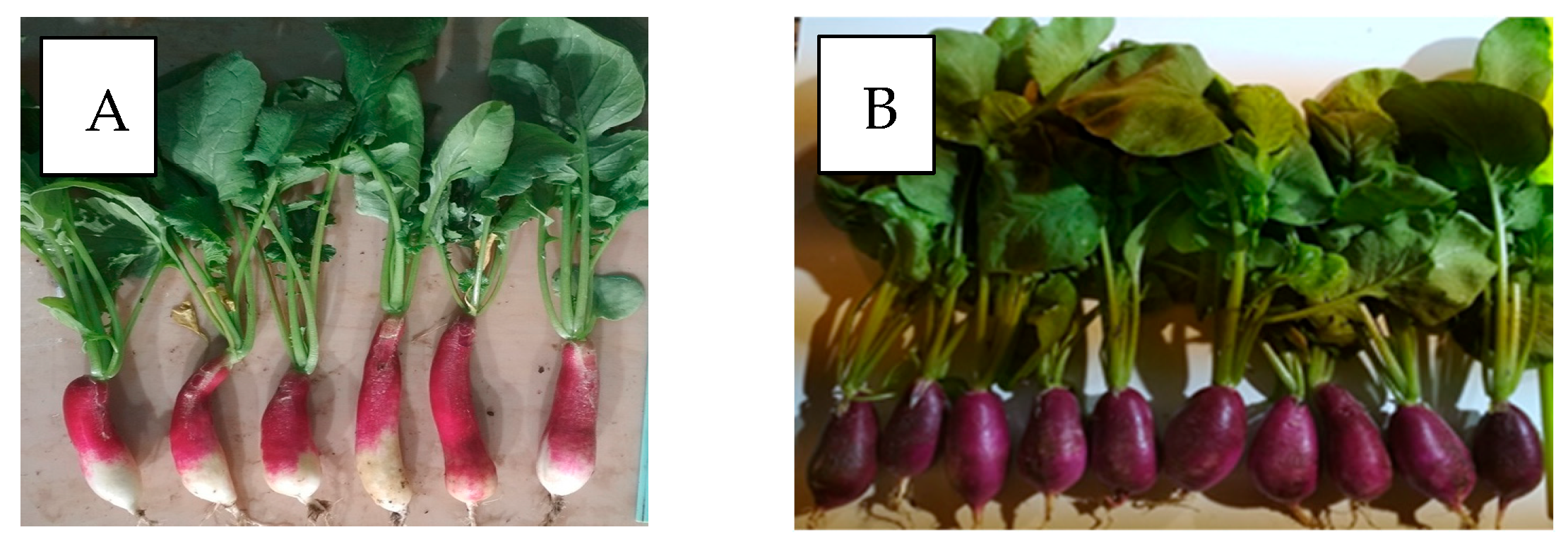
Two contrasting early-maturing small radish (Raphanus sativus L.) cultivars, differing in morphological characteristics and origin, were the objects of the study. The first, cv. Pernot (P) (k-2466) from the collection of the N. I. Vavilov All-Russian Institute of Plant Genetic Resources (VIR), has a long-cylindrical, pink root with a white tip (Figure 1A). It is intended for open-field cultivation but is also capable of producing commercial root crops under artificial light culture conditions. The second, cv. Peterburgskiy fioletovyy (Pf), a radish cultivar developed for CEA, has an elliptical, purple root (Figure 1B). At the same time, cv. Pernot was one of the parents for the cv. Peterburgskiy fioletovyy breeding [6].
Figure 1.
Radish plants used in the experiment. (A)—cv. Pernot, (B)—cv. Peterburgskiy fioletovyy.
The studies were carried out under controlled conditions of the agrobiopolygon of the Agrophysical Research Institute (AFI) (St. Petersburg, Russia). Radish cultivars were sown with dry seeds (two seeds per cell) in industrial plastic seedling trays (53 × 32 × 6 cm; the size of one cell is 5 × 5 × 6 cm, 28 cells in one tray). Industrial peat soil (Agrobalt C, Pindstrup LLC, Moscow region, Russia) based on low-decomposition high-moor peat, pH = 6.2, was used as the rooting substrate. The air temperature was maintained within the range of 20–22 °C during the day and 18–20 °C at night, the relative air humidity was 65–70%. Irradiance was maintained the same for all treatments—75 ± 5 W m−2 in the PAR region. Irradiance was measured at the plant level. The distance from the lamps to the upper leaves of the plants during the experiment was 40–45 cm. The characteristics of light sources and the uniformity of light distribution over the entire irradiated surface with plants was measured using a PG200N Spectral PAR Meter (UPRtek, Miaoli, Taiwan) and did not exceed a deviation of 12% of the total illumination. To offset the effect of the differences in light distribution, the trays with plants were rotated 90° every three days. As the plants grew, the illumination was adjusted by dimming the lights (LED 1–LED 3) or raising the light blocks (HPS). Light and temperature conditions were equalized by air conditioning and the use of mirror screens around the perimeter of each lighting treatment. The photoperiod was 14 h per day. Watering was performed daily, alternating with fertilizing with Knop’s solution (three times a week), soil moisture was maintained at 60–70% of the maximum water capacity. After the first true leaf appeared, excess seedlings were removed, leaving one plant per cell. Plants were harvested on the 25th day after sowing. During the harvest, the main morphophysiological parameters were measured: the fresh mass of the root crop (Rm, g) and leaves (Lm, g), the number of leaves (Nl, pcs.); the number of developed leaves with a leaf blade length of more than 8 cm was considered when we calculated an area of the radish leaves. The thickness of the leaf blade (Lt, microns), the length and width of the mid-layer leaf, the length and diameter of the root crop; the height and diameter of the rosette were also measured. Data on indicators for which no significant differences were found are not provided in this article. The area of radish leaves (LA, cm) was determined according to the method described in [6]. Leaf thickness was measured in the mid-section of the leaf blade of mid- layer leaves, avoiding the central vein, using a GRSI 82404-21 MIK micrometer (Micron, Shanghai, China), which provides a measurement accuracy of 0.01 mm. A total of at least 13 leaves were measured in each experimental treatment to determine the leaf thickness.
Based on the data obtained, the following indices were calculated, characterizing the yield:
- 1.
- Pr—the proportion of root crop:Pr = Mass of the root/Mass of the whole plant
- 2.
- Ai—attraction index:Ai = Mass of root/mass of leaves
The experiment was repeated twice. In each experiment, the number of plants evaluated was 8; since similar average values of the studied parameters were obtained in both experiments, statistical processing was performed for a combined sample of 16 radish plants.
2.2. Lighting Treatments
After sowing, seedling trays with seeds were placed under specific lighting conditions. Four lighting treatments were used in the study (Table 1, Figure 2). HPS (OOO Reflax, Moscow, Russia), which we had previously used for breeding of the cv. Peterburgskiy fioletovyy, were used as a reference. HPS red/green/blue ratio (R:G:B) is 8.5:9:1 (for ease to count and understand, red is taken as 600–700 nm, green is taken as 500–600 nm and blue is taken as 500–600 nm, and the blue light content is taken as 1).
Table 1.
Spectral characteristics of radiation under different lighting treatments and distribution over spectral ranges.
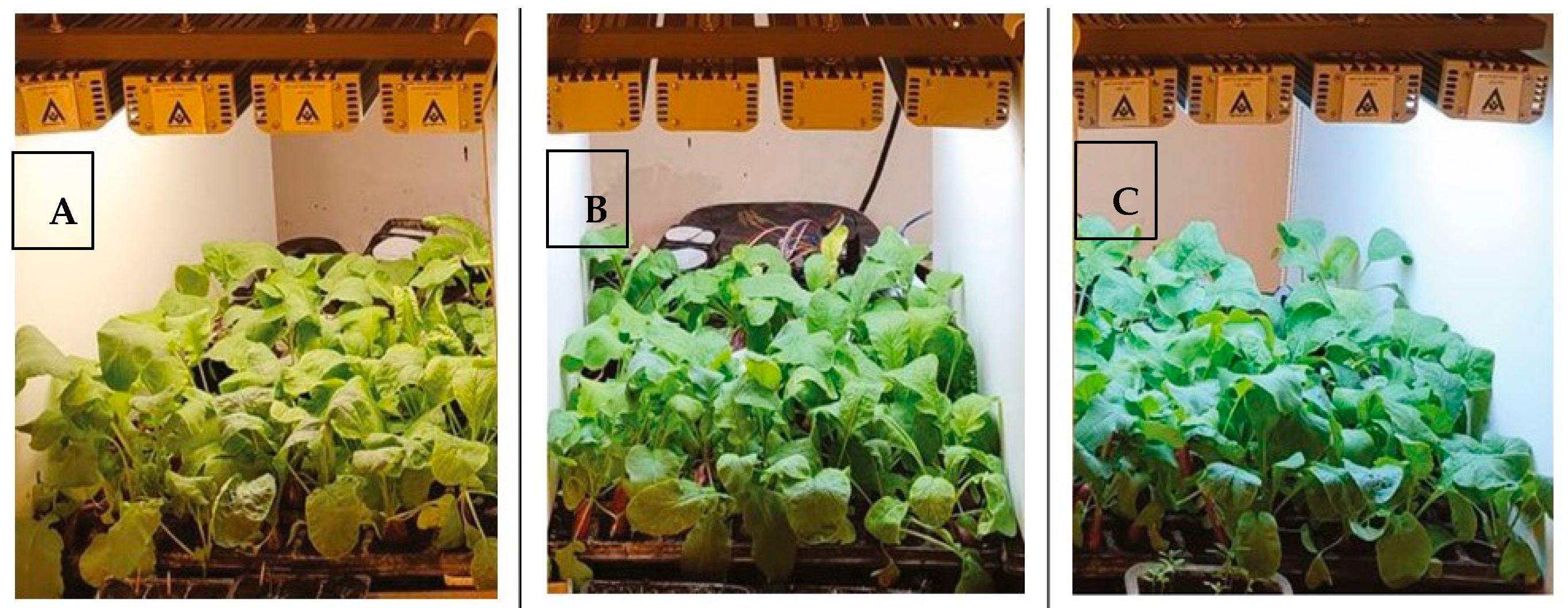
Figure 2.
Radish under different LED lamps. (A)—LED 1, (B)—LED 2, (C)—LED 3.
Three original full-spectrum LED lamps (Figure 2A–C) were developed and manufactured at the Agrophysical research institute (AFI):
- (1)
- LED 1 with a color temperature of 3000 K, R:G:B is 5.2:3.3:1;
- (2)
- LED 2 with a color temperature of 4000 K, R:G:B is 2.3:2:1;
- (3)
- LED 3 with a color temperature of 5000 K, R:G:B is 1.5:1.5:1.
When creating full-spectrum LED lamps, we used a new generation of LEDs that emit purple light and are coated with a three-component phosphor that converts the light into a PAR with full red, green, and blue components. The novelty of the developed LED lamps lies in the formation of full-spectrum radiation simulating solar illumination at different times of the day to identify the most natural, functional conditions to which plants are more evolutionarily adapted. Unlike conventional red–blue and white LED phytolamps, the spectrum of original LED lamps includes all wavelengths. For example, red–blue lamps completely lack the green region and white lamps exhibit characteristic dips in the 480–520 nm and 600–640 nm ranges. Furthermore, the use of diffuse secondary optics with high light transmittance for our LEDs creates the high isotropic light field to create uniform growing conditions.
Emission spectra of lamps were measured by using the PG200N Spectral PAR Meter (UPRtek, Taiwan). Data are presented on Figure S1; general view of LED lamps is presented on Figure S2.
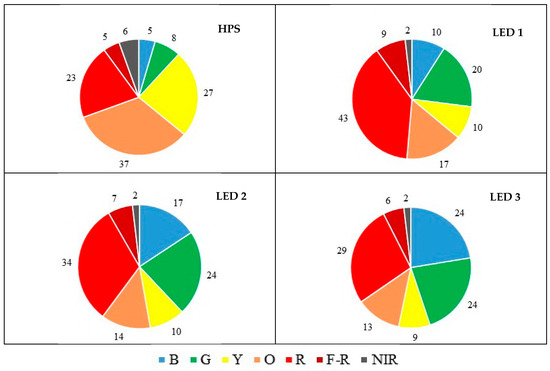
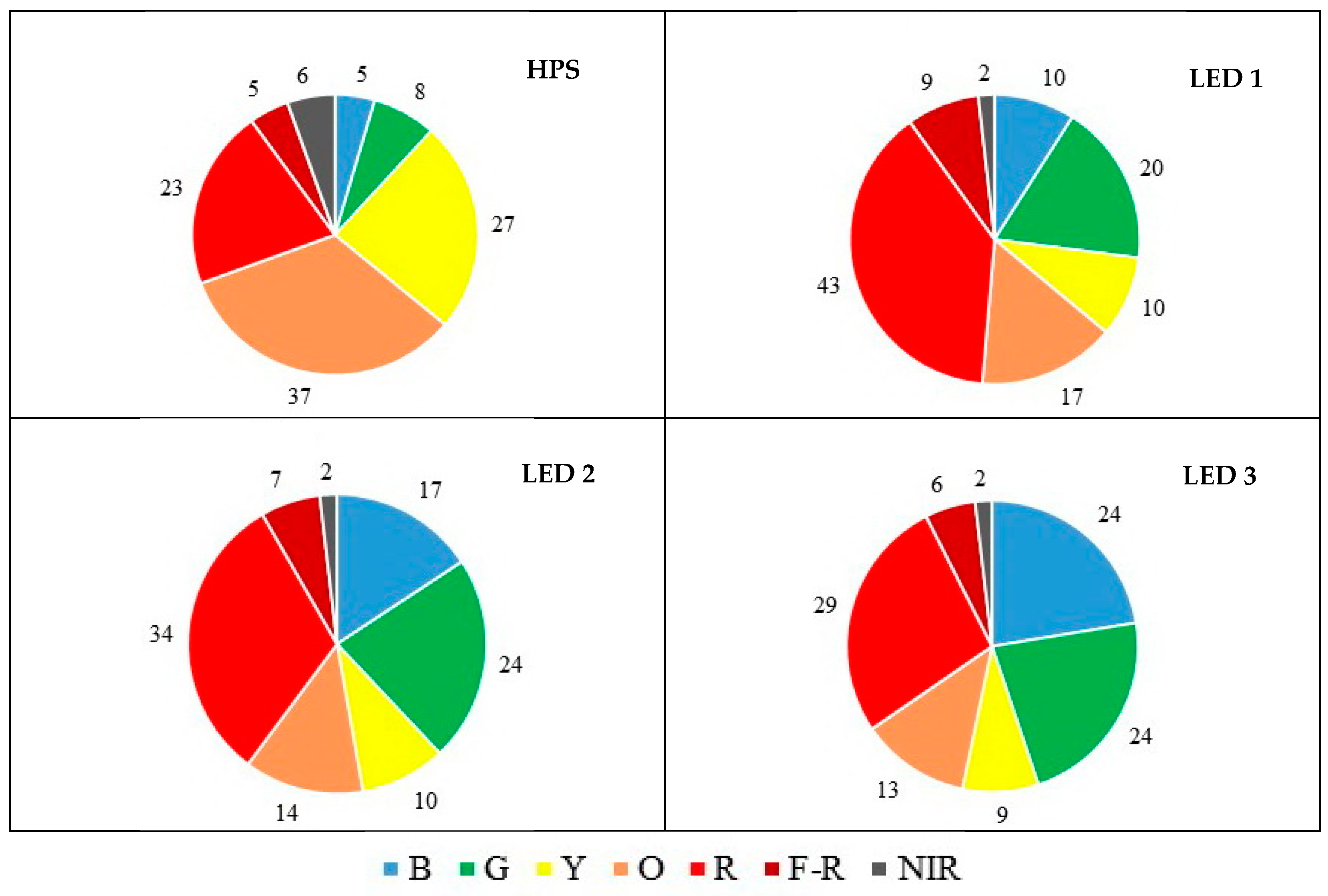
There were no significant differences in the photosynthetic photon flux density (PPFD), which characterizes the amount of radiation emitted by the lamps and reaching the upper layer of radish leaves (Table 1). However, the HPS and LEDs differed significantly in the amount of radiation in various spectral ranges (Table 1, Figure 3). The radiation flux of the three LED lamps contains significantly more radiation in the blue (400–500 nm) and red (621–700 nm) ranges, which are characterized by the highest efficiency of photosynthesis. The spectrum of the LED lamps also contains more radiation in the green range (501–565 nm). In turn, the main part of the PPFD of the HPS (64%) is radiation in the yellow (566–590 nm) and orange (591–620 nm) spectral ranges. For comparison, the PPFD of the LED 1, LED 2, and LED 3 in the yellow-orange range was 27, 24, and 21%, respectively. Furthermore, compared to the HPS, more far-red radiation and less near-infrared radiation reached the plant leaves in LED 1, LED 2 and LED 3.
Figure 3.
The proportion of various spectral ranges under different treatments (% PPFD of the spectral range from PAR emission). The numbers on the graph are the percentage of PPFD of the corresponding range in % of the PPFD of the entire range of PAR.
2.3. Leaf Reflectance Spectroscopy
The spectra of leaf surfaces reflected radiation were recorded non-invasively using a fiber optic system (Ocean Optics, Largo, FL, USA). This system consists of four main components: an HR2000 spectrometer, specialized SpectraSuite software (version 2.0.162), a reference tungsten-halogen light source (LS-1), and a reflection probe (R-200-7). The reflection probe has a tightly packed arrangement of six illumination fibers around a single read fiber. System provides an optical resolution of 0.065 nm in the range from 400 to 1100 nm. Before leaf measurements, the reflectance spectrum of the reference source (WS-1) that is made of “spectralon”—a material that reflects over 99% of incident radiation in the measured wavelength range—was recorded. To record the spectra, the sensor was positioned in the mid-section of mid-layer leaves, avoiding the central vein. On average, at least 15 spectra were recorded for each treatment. The measurements were carried out on the 20th day after sowing, 5 days before harvesting. The diffuse reflectance spectrum of the leaf is displayed on the computer screen as a percentage of the reference source’s reflectance and can be saved as a digital file. The resulting leaf reflectance spectra were used to calculate reflectance indices, which are closely related to the activity of the photosynthetic apparatus and the physiological state of plants [16].
2.3.1. Indices Associated with the Chlorophyll Content, Intensity (Capacity) of the Photosynthetic Apparatus
- 1.
- ChlRI—chlorophyll reflectance index:ChlRI = ((R750 − R705)/(R750 + R705)) − 2R445
The chlorophyll index (ChlRI) [18], which closely correlates with the chlorophyll content in various plant species, has been repeatedly used by us in assessing the physiological status of plants growing in the field and under light culture conditions [14,15,16,23]. According to previously obtained data, the ChlRI value is determined by the chlorophyll content in the leaves and can be used as a criterion for predicting the yield of vegetable [16] and grain [14,15,23] crops.
- 2.
- Chlgreen model (Chlgr):Chlgr = (RNIR/Rgreen) − 1where RNIR = 750–800 nm, Rgreen (Rgr) = 545–565 nm
- 3.
- Chlred-edge model (Chlre):(Chlre = (RNIR/Rred-edge) − 1where RNIR = 750–800 nm, Rred-edge (Rre) = 710–730 nm
The Chlgr and Chlre models were developed and tested to estimate chlorophyll content in two field-growing crops (corn and soybean) with different leaf structure and canopy architecture [20]. The authors demonstrated that using these models explains more than 92% of the variation in chlorophyll content.
When estimating the chlorophyll content of two radish cultivars, we used RNIR = 799.1 nm, Rgr = 551.8 nm, and Rre = 703.4 nm, as using the reflectance coefficients of these wavelengths in the calculation formulas allowed us to obtain chlorophyll index values that most closely correlate with the morphophysiological characteristics of the radish.
2.3.2. Indices Related to the Efficiency of the Photosynthetic Apparatus (Content of Carotenoids, Anthocyanins, Photochemical Activity and Scattering of Light)
- 1.
- SIPI—leaf structure-independent pigment index. This index has maximum sensitivity to the carotenoid/chlorophyll ratio while minimizing the influence of variable leaf structure [19]:SIPI = (R800 − R445)/(R800 − R680)
- 2.
- Anthocyanin indices: ARI-1 [21]:
ARI-1 = [(1/R550) − (1/R700)] × R750
The Rred/Rgreen ratio correlates with the anthocyanin content of leaves containing both anthocyanins and chlorophyll; however, the degree of reliability in determining anthocyanins by the Rred/Rgreen ratio depends on the plant species.
- 3.
- Photochemical reflectance index PRI—characterizes changes in carotenoid pigments, in particular xanthophylls, of leaves. Variations in PRI occur due to changes in xanthophyll cycle pigments, accompanied by thermal dissipation. PRI is closely related to the epoxidation of xanthophyll cycle pigments and the efficiency of photosynthesis [19]. It is a good indicator of the efficiency of photosynthetic light use and is useful for quantitatively assessing plant responses to stress:PRI = (R570 − R531)/(R570 + R531)
- 4.
- R800—light scattering inside leaf tissues in the near-infrared range at 800 nm. The R800 value is related to the characteristics of the leaf structure and does not depend on their chemical composition or water content [25].
2.4. Statistical Analysis
Statistical evaluation of the obtained data included the calculation of descriptive statistics: mean, standard deviation (SD), and standard error of the mean (SEM). To assess the effects of genotype, environmental conditions (light regime), and their interaction on morphological traits and spectral characteristics, a two-way analysis of variance (ANOVA) was performed. For significant main effects or interactions identified by ANOVA, post hoc pairwise comparisons were conducted using Tukey’s Honest Significant Difference (HSD) test. To account for multiple comparisons, the p-values from the ANOVA models were adjusted using the Holm method.
The significance threshold for all statistical tests was set at p < 0.05. Initial data organization and descriptive analyses were performed in Microsoft Office Excel 2019. The primary statistical analysis was conducted using R software version 4.5.1 (R Core Team, 2025) with the agricolae package and Statistica v. 13.3 (StatSoft Inc., Tulsa, OK, USA).
3. Results and Discussion
3.1. Morphophysiological Traits of Radish Plants Under Different Lighting Treatments
The results of the analysis of the radish morphophysiological characteristics under various lighting treatments indicate an influence boss of the genotype and light spectral composition on plant development (Figure 4A–E, Table S1). It should be noted that the objects of the study were radish cultivars with contrasting areas of application and root crop shape and color (Figure 1A,B). The radish cv. P was developed for open ground; however, even under artificial lighting, it exhibited a complex of economically valuable traits related to productivity. The radish cv. Pf is intended for cultivation under light culture conditions and cv. P was implemented as a parent during breeding cv. Pf [6]. HPS lamps were used as a reference, since all previous breeding and genetic studies were carried out using these types of lamps. The original LED lamps were created later.
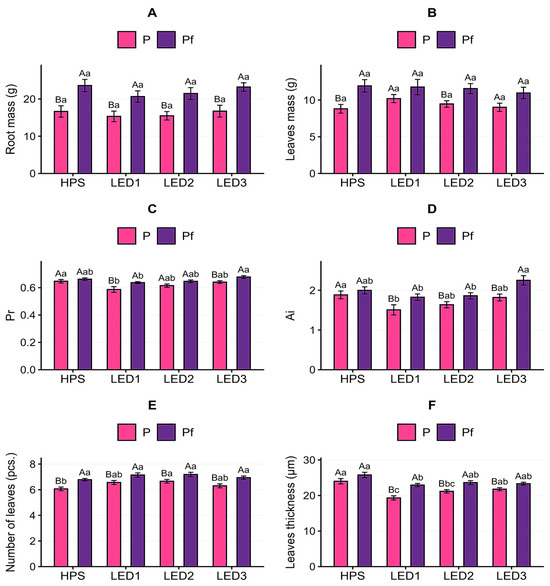
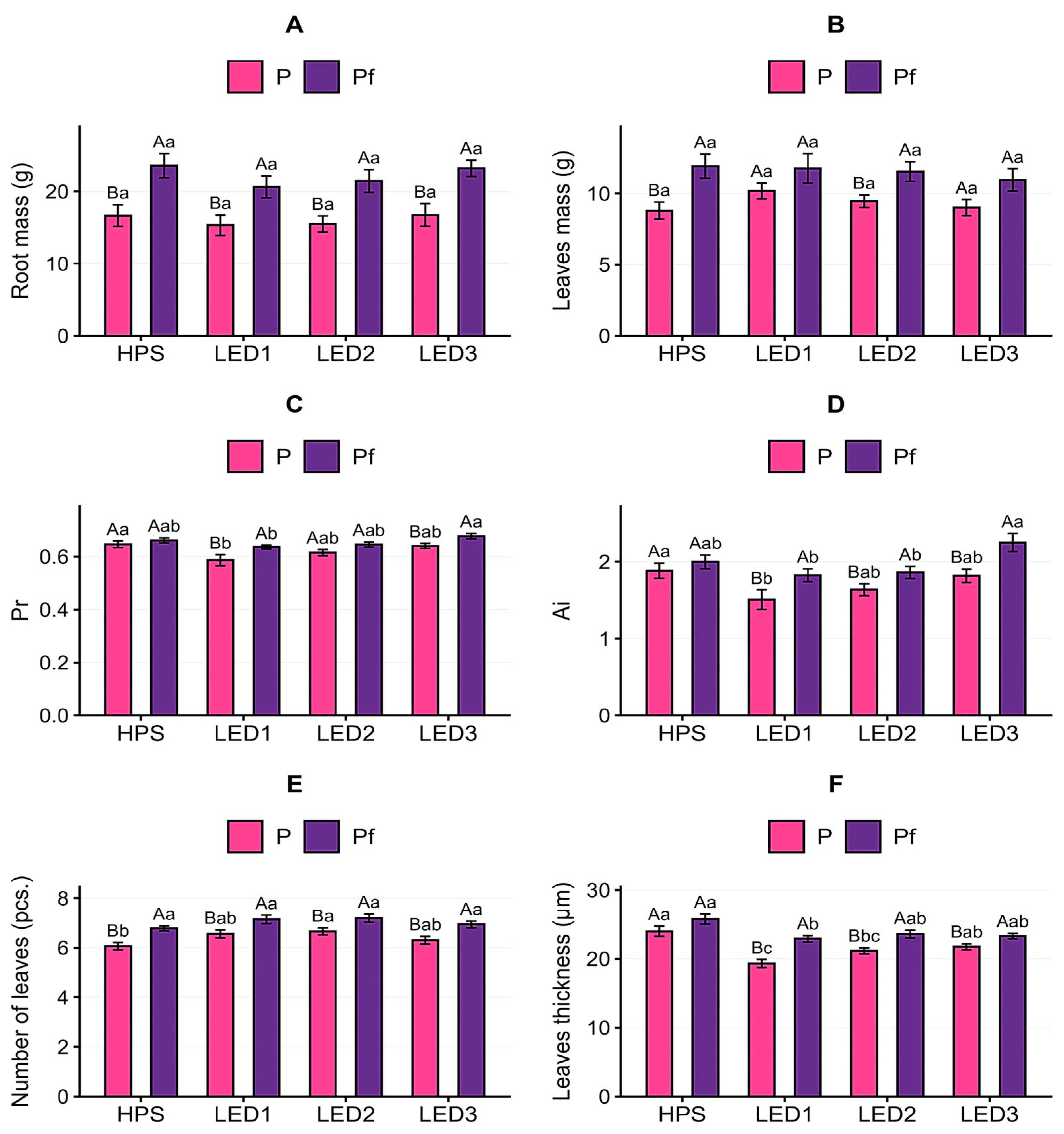
Figure 4.
Effects of crop variety (Pernot (P) and Peterburgskiy fioletovyy (Pf)) and spectral lighting treatment (HPS, LED 1, LED 2, LED 3) on growth and biomass parameters. Data are presented as mean ± standard error. For each subfigure, uppercase letters denote significant differences between cultivars, and lowercase letters denote significant differences among lighting treatments (Tukey’s HSD test, p < 0.05). (A) Root mass (g). (B) Leaf mass (g). (C) Proportion of root crop (Pr). (D) Attraction index (Ai). (E) Number of leaves. (F) Leaf thickness (µm).
Genetically determined differences between the cultivars were generally found in all studied parameters, except for LA (Figure 4A–E, Table S1). Higher root mass in all treatments for cv. Pf can be explained by transgressive breeding [6]. Also, cv. Pf had a higher leaf mass compared to cv. P, the differences were statistically significant under the HPS and LED 2 treatments. Indicators characterizing the proportion of the root crop to plant mass (Pr) and the ratio of Rm to Lm (Ai) (Figure 4C,E) differed significantly between both cultivars under LED 1 and LED 3 (Pr), and under LED 1, LED 2, and LED 3 (Ai) treatments. Also, C. Pf. had a larger number of leaves (Nl) in all studied treatments and its leaves were generally thicker, but for the latter indicator (Lt), the differences between HPS and LEDs were unreliable (Figure 4E,F).
Contrast to the genotype, the influence of the light environment on the mass of the roots and leaves in both cultivars was not statistically significant and had the character of a trend. Nevertheless, for cv. P, significant differences in the Pr indexes were found between HPS and LED 1, and for cv. Pf—between LED 1 and LED 3 (Figure 4C). The Ai indexes were significantly different for cv. P. also between HPS and LED 1, and for cv. Pf—between LED 1 and LED 2, LED 1 and LED 3 (Figure 4D). In addition, significant differences in Nl were found in cv. Pf between HPS and LED 2 (Figure 4E). It should also be noted that the highest Lt values for both cultivars were obtained under NPS treatment, the lowest—under LED 1 treatment. The observed differences were statistically significant (Figure 4F).
Although no significant differences were found in the biomass of the roots and leaves between the treatments, an increase in color temperature from 3000 to 5000 K generally caused changes in plant morphology towards an increase in root mass and its proportion in plant mass, with both radish cultivars responding to the light environment in a similar way (Figure 4A–D). A tendency towards an increase in root crop mass was revealed in the sequence LED 1 < LED 2 < LED 3 (Figure 4A), the Rm mean values were 20.64 ± 3.02, 21.46 ± 3.11, and 23.21 ± 2.22 for the cv. Pf and 15.32 ± 2.78, 15.49 ± 2.23, and 16.73 ± 3.11 for the cv. P, respectively. At the same time, the leaves mass value (Figure 4B) had the opposite tendency: LED 1 > LED 2 > LED 3, the Lm values were 11.77 ± 2.05, 11.56 ± 1.35, 10.96 ± 1.54 for the cv. Pf and 10.19 ± 1.09, 9.46 ± 0.87, 9.01 ± 1.10 for the cv. P, respectively. The values of the Pr and Ai indices, characterizing the proportion of the economically useful part of the yield (root crop), were maximum under the LED 3 among all the studied treatments for the cv. Pf (Figure 4C,D), although the differences were not statistically significant, except between LED 1 and LED 3. For the cv. P, the maximum values of these indices were obtained in the HPS and LED 3, the differences between HPS and LED 1 were significant. The values of both indices, when the plants were irradiated with LED lamps, consistently decreased with decreasing color temperature: LED 3 > LED 2 > LED 1, similarly with Rm, the differences were statistically significant for the cv. Pf between the LED 1 and LED 3 (Pr); LED 1, LED 2 and LED 3 (Ai), as mentioned above. LA also tended to increase in the sequence LED 3 < LED 2 < LED 1, for cv. Pf, LA values (cm) were 362.87 ± 36.34, 402.34 ± 39.44, and 429.26 ± 44.26, respectively, and for cv. P—346.37 ± 31.37, 375.11 ± 47.00, and 393.97 ± 21.43, respectively.
It should be noted that the average mass of the root crop in both radish cultivars in the LED 3 and HPS treatment practically did not differ: for cv. Pf, the Rm values were 23.21 ± 2.22 (LED 3) and 23.59 ± 3.26 (HPS); for cv. P—16.73 ± 3.11 and 16.64 ± 2.99, respectively. On the contrary, Rm was lower in the LED 1 relative to HPS by 14% in the cv. Pf and by 9% in the cv. P. The percentage of commercial root crops of the cv. Pf under the LED 2 and LED 3 treatments corresponded to that under the HPS (95 ± 5%); under the LED 1 treatment it decreased slightly (on average by 10% compared to other treatments). In the cv. P, there was a slight decrease in the proportion of commercial root crops under the LED 1 and LED 2 treatments (up to 75 ± 5% and 80 ± 5%, respectively). As a result, under LED 1 treatment, a decrease in yield was observed compared to HPS: by 21% for the cv. Pf and by 24% for the cv. P (Table 2).
Table 2.
The proportion of commercial root crops and the yield of root crops of two radish cultivars under different lighting treatments.
The results obtained demonstrate the influence of the spectral composition of light on the growth and yield of radish, as well as the existence of varietal specificity (interaction of genotype and environment) in the reaction of plants. Similar conclusions have been reached in numerous studies conducted under CEA conditions. Thus, the article [26] provided data on the importance of each part of the light spectrum for physiological and biochemical processes in plants. The authors concluded that the effect of lighting quality on plants may vary depending on specific crops or species.
We suppose that the high values of Rm and yield of radish under HPS treatment can be explained by the high proportion of orange radiation in the spectrum of high-pressure sodium lamps (Figure 3). This is supported by the results of studies [27,28,29] indicating the stimulating effect of orange (amber) light on the growth and accumulation of biomass for some plants. In addition, the two radish cultivars used in the experiment were adapted to the spectrum of HPS, as mentioned above.
The observed differences between the radish growth and development, as well as the crop yield under LED lamps treatments, are, in our opinion, explained by differences in the ratios of the spectral ranges of the LED 1, LED 2, and LED 3 lamps (Figure 3, Table 1). The average root mass and yield were highest under LED 3 treatment, while the leaf mass and LA were highest under LED 1 treatment. As noted above, the LED 3 lamp had the highest proportion of blue light in the spectrum compared to the other lamps, while the LED 1 lamp, on the contrary, had the highest proportion of red light; the percentage of green and other spectral ranges generally differed insignificantly (Figure 3). Blue and red light play a key role in photosynthesis, although their effects on plants can be different. Many publications have demonstrated the stimulating effect of red light on the height and aboveground biomass of various crops, in particular, lettuce [30,31,32], pak choi [33], and tomato [34]. In our study, the maximum values of the aboveground part (leaf mass) were also found in the LED 1, which is characterized by the maximum (43%) proportion of red light in the spectrum (Figure 3 and Figure 4B). Similarly, the presence of blue light is necessary for normal plant growth, and the addition of blue wavelengths in certain proportions (optimal for a specific crop or variety) increases yield and improves quality for a number of crops in CEA [35,36,37,38]. At the same time, blue light can also reduce plant growth. High proportions of blue light have been shown to reduce the biomass of the above-ground part of lettuce [39,40,41], the height and biomass of cucumber shoots [41], and the dry weight of cucumber, pepper, and tomato shoots [42]. Additionally, blue light can stimulate the development of root systems and increase root biomass in various crops [42,43,44,45]. Our experiments also showed some inhibition of the growth of the leaves and, simultaneously, stimulation of the growth of the root crop in both radish cultivars under LED 3 treatment, which has the highest proportion of blue light in its spectrum (Figure 3 and Figure 4A).
Moreover, it has been shown, that the requirements for the lightning conditions for different crops can vary significantly. In particular, the publication [42] revealed differences in the physiological response of different crops (tomato, cucumber, pepper, soybean, lettuce, radish and rye) to the proportion of blue light, which affects growth and yield. In addition, the existence of varietal specificity in the response to the lightning quality between samples of the same crop (the result of the “genotype-environment” interaction) has also been reported [46,47,48], which is also confirmed by our results.
There are few publications related to the cultivation of radish under artificial light, as optimal technologies for growing radish and other root crops in the CEA have not yet been developed [13]. Bukhov et al. found in 1996 that when illuminated only with red light, radish did not form root crops, but leaves (mainly petioles) were actively growing [49]. The authors explained this phenomenon by the hormonal status of the plants: in the presence of blue light, the level of indole-3-acetate and zeatin in the roots was several times higher than in its absence; these hormones determine the acceptor role of the root in the absorption of metabolites, which promotes development and, accordingly, an increase in size and weight of storage root. This conclusion was confirmed by the results of further research [50]. Zha and Liu have proven that high light intensity (240–300 μmol m−2 s−1), the quality of light 2R:1B, and photoperiod 16 h/8 h are necessary for the production of commercial storage roots in plant factories [51]. Mickens concluded that green light did not affect the formation of radish roots, unlike blue and red light [52]. Recent studies by Chutimanukul et al. [46] partially confirmed this conclusion: in three of the five radish samples studied, the maximum mass of root crops was observed when treated only with red and blue light in a ratio of 3R:1B. The authors showed that most of the studied physiological and biochemical parameters varied more depending on the genotype than on the light spectrum. According to another study [13], the maximum root and leaf mass of radish was obtained in the treatment with full-spectrum LED light, as opposed to the treatment with only red and white light.
Our results also demonstrate the high significance of blue light in the formation of radish root crops under artificial light culture conditions, and the stimulating effect of red light on the growth of the above-ground part of radish plants; in particular, the highest root crop mass and yield were obtained under LED 3 treatment with a color temperature of 5000 K and the highest content of the blue range in the spectrum (24%), while the highest leaf rosette mass was obtained under LED 1 treatment with a color temperature of 3000 K and the highest content of the red range (R:G:B is 5.2:3.3:1).
3.2. Reflectivity of Radish Leaves Depending on the Spectral Characteristics of Radiation During Vegetation
According to the action spectrum of photosynthetic activity, its greatest efficiency is observed in the blue and red PAR spectral range (coinciding with the absorption bands of chlorophyll). As discussed in Section 3.1 (Table 2), the highest yield of both studied radish cultivars was observed in LED 3 compared to LED 2 and LED 1; the lowest leaf reflectance in the 400–700 nm wavelength range, the most efficient for photosynthesis, was also in LED 3, compared to LED 2 and LED 1 (Table 3).
Table 3.
The amount of radiation of different spectral ranges reflected from the leaves of radish cvs. Pf and P under different lighting treatments.
Significant differences were observed in the amount of radiation reflected from the leaf surface across all spectral ranges, both between the lamps and between the studied cultivars. It was found that the leaves of the cv. Pf reflected less PAR and apparently absorbed more, suggesting more intensive growth and biomass accumulation compared to the cv. P. So, under HPS treatment, the amount of PAR reflected from the leaf were 28.8% (cv. Pf) and 40.1% (cv. P); under LED 1—46.1% and 55.2%, respectively; under LED 2—37.3% and 43.3%; and under LED 3—29.9% and 39.7% for the cvs. Pf and P, respectively.
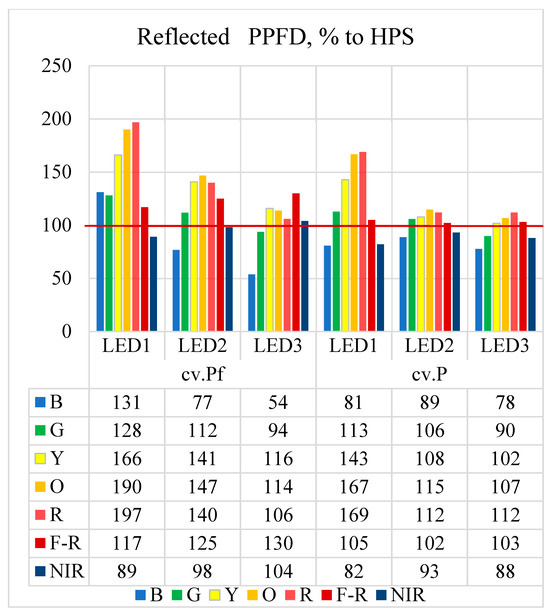
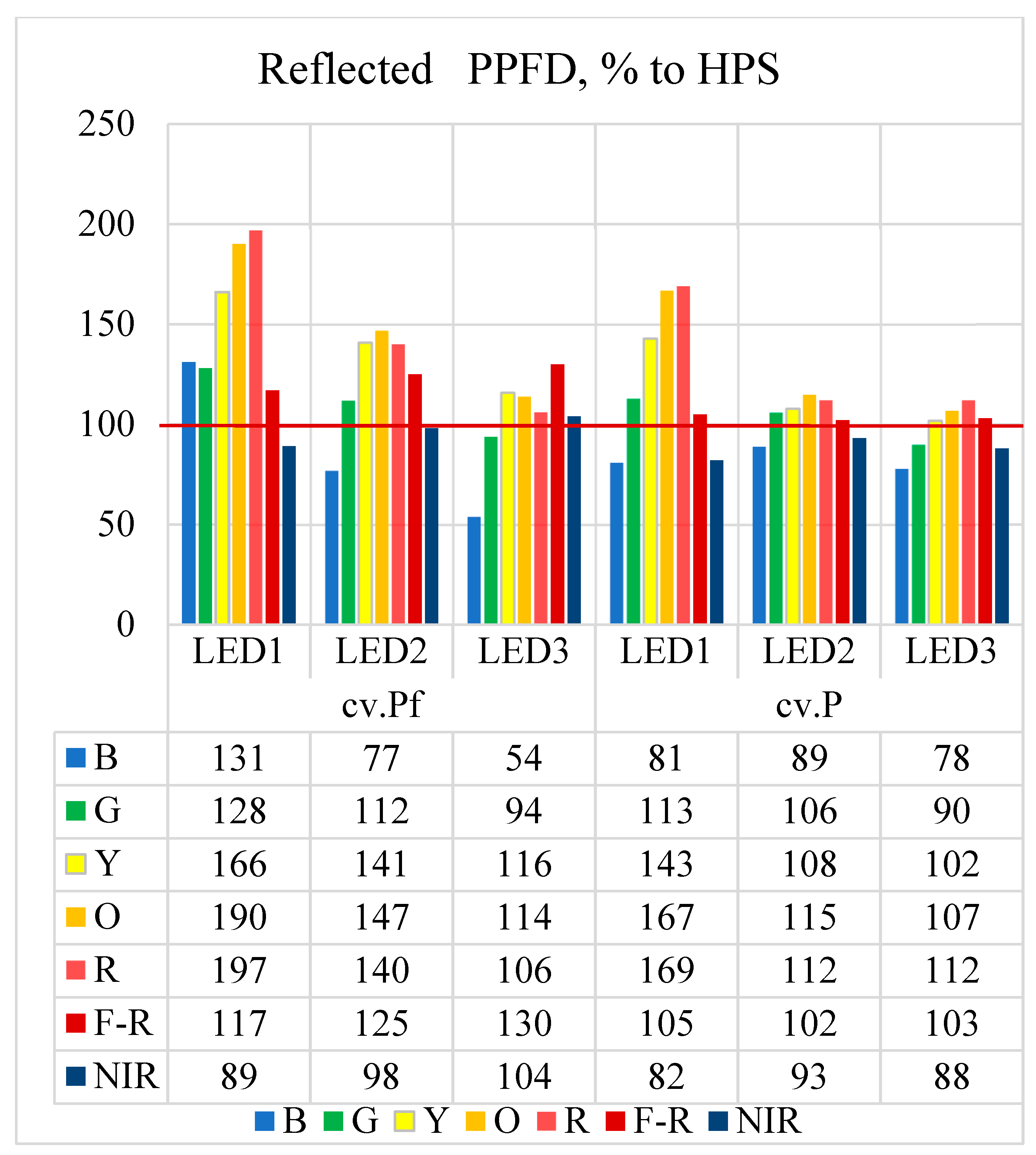
The amount of radish leaves reflected radiation under LED lamps with different PAR spectral compositions, as a percentage of the reference (HPS), are shown in Figure 5.
Figure 5.
The amount of radiation of different spectral ranges reflected by radish leaves, depending on the spectral characteristics of light under different lighting treatments (% of the reflection of the corresponding spectral ranges for “reference” HPS). cv. Pf—cultivar Peterburgskiy fioletovyy, cv. P—cultivar Perno.
Radish leaves in LED 1 demonstrated significantly higher reflectivity. Under these lighting conditions, radish yields were lowest for both cv. Pf and cv. P. Comparison of cv. P plants grown in LED 2 and LED 3 revealed only minor differences in reflectance spectra (Figure 4). The advantage of the LED 3 lamp over LED 2 is significantly lower reflectance in the blue and green PAR regions (by 11% and 16%, respectively). Despite slightly higher reflectance of cv. P leaves in LED 2 than in LED 3 and HPS (Table 3), no significant differences in yield per square meter were observed between these treatments. This result may be due to a slight increase in the assimilation surface area due to the formation of plants with a large number of leaves (Figure 4E).
The leaf reflectance of the cv. Pf for various PAR ranges under LED 3 treatment is closest to that of plants grown under HPS lamps. A significantly lower reflection of blue radiation (46% lower than HPS) and a higher reflection of far-red radiation (30% higher than HPS) is the advantage of LED 3 lamp. We suppose this contributes to reduced radiative heating of leaves during growth and development of radish plants. The lower amount of reflected blue and red radiation observed in Pf and P cultivars under LED 3 treatment suggests that plants under these conditions absorb more light in these ranges, for which photosynthetic efficiency is highest.
3.3. Indices of Capacity and Efficiency of the Photosynthetic Apparatus Depending on the Spectral Composition of PAR During Vegetation
Reflectance indices associated with chlorophyll content
The studies revealed that the chlorophyll index, and consequently the chlorophyll content in leaves per unit leaf area, significantly differed between plants under different lighting treatments (Table 4). All three chlorophyll indices (ChlRI, Chlgr, Chlre) showed similar patterns of change depending on the PAR spectral composition. The smallest differences in this indicator were found between the HPS and LED 3, and the largest between the HPS and LED 1.
Table 4.
Reflectance indices related to chlorophyll content depending on the spectral characteristics of PAR under different lighting treatments.
When both radish cultivars were grown under HPS lamps, chlorophyll content in the leaves was higher than under LED lamps; it also increased in the LED 1 ˂ LED 2 ˂ LED 3 range. Notably, the similar chlorophyll index values for cvs. Pf and P grown under identical lighting conditions indicate a minor influence of genotype on chlorophyll content in the two radish cultivars (only for Chl green under LED 3 and Chl red edge under LED 1, LED 2 treatments). Correlation analysis of the relationship between the chlorophyll index values, plant morphometric characteristics, and yield of two radish genotypes revealed a close relationship (r2 = 0.50–0.62, p < 0.05) between ChlRI (as well as Chlgr) with the leaf assimilating surface area (LA) and leaf thickness (Lt). No significant relationship was found between the third chlorophyll index, Chlre, and morphometric parameters: with a high determination coefficient of this index with the leaf surface area (r2 = 0.46) and leaf thickness (r2 = 0.40), the p-value exceeded 0.05 (it was equal 0.06–0.09).
Reflectance indices related to the efficiency of the photosynthetic apparatus
Carotenoid content estimation based on leaf reflectance is much more difficult than assessing chlorophyll content due to overlapping pigment absorption peaks and the higher chlorophyll concentration in the leaves of most plants. Therefore, the ratio of carotenoids to chlorophyll provides the best results when analyzing plant responses to changing environmental conditions. The SIPI index was used in this study. The results of assessing its changes in radish genotypes under different lighting treatments are presented in Table 5.
Table 5.
Reflectance indices associated with the efficiency of light conversion in photochemical processes of photosynthesis under different lighting treatments.
A statistically significant increase in SIPI was found in both radish cultivars grown under LED treatments compared to those grown under HPS treatment. Comparing the SIPI value (Table 5) with the chlorophyll index values (Table 4) suggests that changes in the total carotenoid to total chlorophyll ratio (SIPI) are primarily due to a decrease in chlorophyll content in radish leaves under LED lamps, especially in LED 1. The ChlRI value of radish leaves under LED 1, LED 2, and LED 3 treatments for the cv. Pf was 42, 27, and 11% lower than under HPS treatment; for the cv. P, the chlorophyll index was 45, 18, and 12% lower, respectively. Such a strong dependence of SIPI on chlorophyll content under the conditions of this experiment does not allow us to assess the degree of influence of the spectral composition of PAR on the content of carotenoids:
SIPI = 1.105 − (0.221 × ChlRI); r = −0.912; p = 0.0016; r2 = 0.832
No statistically significant relationship was found between SIPI, Rm, and Lm of radish plants.
Unlike photosynthetic pigments, anthocyanins are primarily concentrated in vacuoles. Increased anthocyanin production in plant cells occurs when chlorophyll synthesis is inhibited or stopped. Estimating anthocyanin content using diffuse reflectance spectra of leaves yielded different results depending on the calculation formula used to determine these compounds. According to ARI-1 values, anthocyanin content in radish leaves grown under LED 1, LED 2, and LED 3 treatments, compared to HPS, were 2.5, 2.6, and 2.8 times higher in the cv. Pf and 2.6, 1.4, and 2.3 times higher in the cv. P. Similar patterns were observed for the ARI-2 index. However, in this case, the differences between the LED and HPS treatments, as well as the genotypic differences, were significantly lower than for the ARI-1 index (Table 5).
The value of the photochemical activity index PRI depends on the transformation of xanthophyll cycle pigments, which is accompanied by thermal dissipation of the light energy not used in photosynthesis. PRI was developed to assess the photosynthetic activity of plants [53]. The PRI value correlates (r2 ≥ 0.91) with the epoxidation state of xanthophyll cycle pigments and with the efficiency of plant photosynthesis [19]. At high light intensity or under stressful environmental conditions, excess absorption of light energy by chlorophyll of the antenna complex is reduced due to the transformation of xanthophyll cycle carotenoids, which occurs with the release of heat. PRI is considered one of the main reflectance indices, allowing for a quantitative assessment of the efficiency of the photosynthetic apparatus [14,15,23]. It has been shown that changes in PRI make it possible to detect a decrease in the efficiency of PAR use caused by various unfavorable factors, such as nutritional [54] or water [55,56] deficiency. Variations in PRI, in addition to the conversion of xanthophyll cycle pigments, are also closely related to changes in the content of chlorophyll, carotenoids, and the ratio between these pigments [54,55,56].
The results of the study showed that both radish cultivars exhibited a significant increase in PRI when grown under all LED lamps, which had a higher blue-light content in PAR spectrum than HPS (Table 5). No statistically significant relationship was found between PRI and the morphophysiological parameters of radish plants (Rm, Lm, LA, and Lt).
In addition to the parameters discussed above, the reflectivity of leaves also depends on their structural features. One of these parameters characterizing the leaf structure peculiarity is the index of light scattering inside the leaf—R800 (Table 5), the value of which was significantly lower under LED lamps, especially under LED 1. Light scattering inside the leaf is primarily determined by differences in its internal structure, for example, the length of the air–water interface and the size of cells and organelles [57]. In some studies, where the increase in thickness and reflectivity is modeled using a stack of leaves or is considered as a function of individual “layers” of cells separated by an air space, it is assumed that scattering should increase with increasing leaf thickness [58,59,60]. However, the results of studies devoted to the study of the relationship between R800 and Lt are very contradictory. Knapp and Carter [61] found a positive relationship between R800 and leaf thickness for 26 different plant species, but a later study of 48 plant species by Slaton et al. [25] showed that R800 is not related to leaf thickness but rather is a function of the proportion of leaf tissue surrounded by intercellular air space and the ratio of mesophyll surface area to leaf area. According to the results of our study, carried out on two radish cultivars grown under HPS and LED lamps, R800 is negatively linearly related to parameters characterizing the productivity of the photosynthetic apparatus—LA, Nl, and Lm:
LA = 549.64 − (3.213 × R800); r = −0.725; p = 0.042; r2 = 0.525
Nl = 9.189 − (0.047 × R800); r = −0.811; p = 0.015; r2 = 0.658
Lm = 18.69 − (0.155 × R800); r = −0.804; p = 0.016; r2 = 0.647
The results obtained on the relationship of R800 with the morphophysiological parameters of radish cultivars suggest that the photosynthetic apparatus under LED functioned more efficiently than under HPS.
An analysis of the emission and diffuse reflection spectra of radish leaves under different lighting treatments suggests that the efficiency of the photosynthetic apparatus in treatment LED 3 is higher than that of LED 1 and LED 2. Plant growth in the light environment with a color temperature of 5000 K contributed to a significant reduction in the amount of reflected radiation in the blue and red ranges with highest photosynthetic efficiency, suggesting an increase in the absorption capacity of plants. Despite the fact that the average values of Rm, Nl and LA in LED 3 were lower than in LED 1 and LED 2, the average mass and yield of root crops were higher (as a trend). This confirms the assumption about more efficient functioning of the photosynthetic apparatus and redistribution of assimilates between leaves and roots under LED lighting.
The observed changes in the optical characteristics of radish leaves under LED treatments (a decrease in chlorophyll content—ChlRI and interleaf light scattering—R800, as well as the accumulation of anthocyanins—ARI-1 and an increase in thermal dissipation—PRI) compared to HPS lamps are likely a manifestation of the “down-regulation” of photosynthetic processes, but this assumption requires a comprehensive additional study. A reduction in photosynthetic activity at high intensities of blue radiation in the PAR spectrum (photoinhibition) prevents photodamage of photosystem II and is likely responsible for adaptation to intense artificial lighting with a high proportion of blue radiation in the PAR spectrum. This response is most pronounced in the LED 3, whose color temperature matches the solar spectrum at midday, when the midday depression of photosynthesis typically occurs.
Among all the full-spectrum LED lamps studied, the yield of commercial root crops for both radish cultivars was highest in the LED 3 lamp, which allows it to be recommended for radish production under artificial light culture conditions.
4. Conclusions
The conducted studies have shown that sunlike full-spectrum LED lamps are promising for growing radish under CEA conditions. It was revealed that the part of morphophysiological characteristics of both radish cultivars, as well as the reflectivity and diffuse reflectance spectra of the leaves, varied significantly depending on the lighting treatment. It was also found that a higher content of blue radiation in the LED spectrum had a stimulating effect on the development of radish root crops, contributing to an increase in the yield. The highest yield of root crops was obtained under LED 3 treatment with the highest content of blue light in the PAR spectrum. The research suggests that radish plants treated with the LED 3 lamp had lower values of radiation reflected from the leaves compared to plants treated with other full-spectrum LED lamps. They also had the highest values of indices that characterize chlorophyll content. Subsequent research will be aimed at creating light environments that support the development of optimal photosynthetic systems of radish plants, which would increase radiation use efficiency. It is also planned to focus on improving methods for noninvasive monitoring of plant physiological status based on recording their optical characteristics.
Supplementary Materials
The following supporting information can be downloaded at: https://www.mdpi.com/article/10.3390/horticulturae12010074/s1, Table S1: Results of two-factor analysis of variance of morphological characteristics of Raphanus sativus L. productivity under different light conditions; Figure S1: Emission spectra of HPS and LED lamps. (A)—LED 1, (B)—LED 2, (C)—LED 3, and (D)—HPS lamp (measured using the PG200N Spectral PAR Meter (UPRtek, Taiwan); Figure S2: General view of full-spectrum LED lamps. (A)—LED 1, (B)—LED 2, (C)—LED 3.
Author Contributions
Conceptualization, E.V.K. and N.G.S.; methodology, E.V.K., T.E.K. and N.G.S.; software, E.V.K., N.V.K. and A.V.D.; validation, E.V.K., N.V.K., A.V.D. and G.G.P.; formal analysis, A.V.D. and O.A.G.; investigation, E.V.K., T.E.K., E.M.E., D.V.R. and N.G.S.; resources, G.G.P.; data curation, E.M.E., D.V.R. and A.V.D.; writing—original draft preparation, E.V.K., T.E.K. and N.G.S.; writing—review and editing, E.V.K., T.E.K., A.V.D., G.G.P. and N.G.S. All authors have read and agreed to the published version of the manuscript.
Funding
This research was funded by Agrophysical Research Institute, scientific and technical state task № FGEG-2025-0007.
Data Availability Statement
The data presented in this study are available upon request to the corresponding author due to privacy and the amount of data generated.
Conflicts of Interest
The authors declare no conflicts of interest.
References
- Fasciolo, B.; Awouda, A.M.M.; Grasso, N.; Bruno, G.; Chiabert, P.; Lombardi, F. An evaluation of research interests in vertical farming through the analysis of KPIs adopted in the literature. Sustainability 2024, 16, 1371. [Google Scholar] [CrossRef] [Scilit]
- Kabir, M.S.N.; Reza, M.N.; Chowdhury, M.; Ali, M.; Samsuzzaman; Ali, M.R.; Lee, K.Y.; Chung, S.-O. Technological trends and engineering issues on vertical farms: A review. Horticulturae 2023, 9, 1229. [Google Scholar] [CrossRef] [Scilit]
- Kaiser, E.; Kusuma, P.; Vialet-Chabrand, S.; Folta, K.M.; Liu, Y.; Poorter, H.; Woning, N.; Shrestha, S.; Ciarreta, A.; Van Brenk, J.; et al. Vertical farming goes dynamic: Optimizing resource use efficiency, product quality, and energy costs. Front. Sci. 2024, 2, 1411259. [Google Scholar] [CrossRef] [Scilit]
- Nájera, C.; Gallegos-Cedillo, V.M.; Ros, M.; Pascual, J.A. Role of spectrum-light on productivity, and plant quality over vertical farming systems: Bibliometric analysis. Horticulturae 2023, 9, 63. [Google Scholar] [CrossRef] [Scilit]
- Singh, B.K. Radish (Raphanus sativus L.): Breeding for higher yield, better quality and wider adaptability. In Advances in Plant Breeding Strategies: Vegetable Crops: Volume 8: Bulbs, Roots and Tubers; Al-Khayri, J.M., Jain, S.M., Johnson, D.V., Eds.; Springer International Publishing: Cham, Switzerland, 2021; pp. 275–304. ISBN 978-3-030-66965-2. [Google Scholar]
- Sinyavina, N.G.; Kochetov, A.A.; Kocherina, N.V.; Egorova, K.V.; Kurina, A.B.; Panova, G.G.; Chesnokov, Y.V. Breeding approaches for controlled conditions of artificial light culture for small radish and radish (Raphanus sativus L.). Horticulturae 2023, 9, 678. [Google Scholar] [CrossRef] [Scilit]
- Stamford, J.D.; Stevens, J.; Mullineaux, P.M.; Lawson, T. LED Lighting: A grower’s guide to light spectra. HortScience 2023, 58, 180–196. [Google Scholar] [CrossRef] [Scilit]
- Wu, B.-S.; Hitti, Y.; MacPherson, S.; Orsat, V.; Lefsrud, M.G. Comparison and perspective of conventional and led lighting for photobiology and industry applications. Environ. Exp. Bot. 2020, 171, 103953. [Google Scholar] [CrossRef] [Scilit]
- Chen, J.; Ji, F.; Gao, R.; He, D. Reducing red light proportion in full-spectrum LEDs enhances runner plant propagation by promoting the growth and development of mother plants in strawberry. Front. Plant Sci. 2024, 15, 1465004. [Google Scholar] [CrossRef] [Scilit]
- Dannehl, D.; Schwend, T.; Veit, D.; Schmidt, U. Increase of yield, lycopene, and lutein content in tomatoes grown under continuous PAR spectrum LED lighting. Front. Plant Sci. 2021, 12, 611236. [Google Scholar] [CrossRef] [Scilit]
- Kuleshova, T.E.; Udalova, O.R.; Balashova, I.T.; Anikina, L.M.; Kononchuk, P.Y.; Mirskaya, G.V.; Dubovitskaya, V.I.; Vertebny, V.E.; Khomyakov, Y.V.; Panova, G.G. Features of the lighting spectrum influence on the productivity and biochemical composition of test fruit and leaf vegetable crops. Tech. Phys. 2022, 92, 885. [Google Scholar] [CrossRef] [Scilit]
- Zou, J.; Zhou, C.; Xu, H.; Cheng, R.; Yang, Q.; Li, T. The effect of artificial solar spectrum on growth of cucumber and lettuce under controlled environment. J. Integr. Agric. 2020, 19, 2027–2034. [Google Scholar] [CrossRef] [Scilit]
- Shadd, A.; Asgari, N.; Pearce, J.M. Effects of spectral ranges on growth and yield in vertical hydroponic–aeroponic hybrid grow systems for radishes and turnips. Foods 2025, 14, 1872. [Google Scholar] [CrossRef] [Scilit]
- Yakushev, V.; Kanash, E.; Rusakov, D.; Yakushev, V.; Blokhina, S.Y.; Petrushin, A.; Blokhin, Y.I.; Mitrofanova, O.; Mitrofanov, E. Correlation dependences between crop reflection indices, grain yield and optical characteristics of wheat leaves at different nitrogen level and seeding density. Sel’skokhozyaistvennaya Biol. 2022, 57, 98–112. [Google Scholar] [CrossRef] [Scilit]
- Rusakov, D.V.; Kanash, E.V. Spectral characteristics of leaves diffuse reflection in conditions of soil drought: A study of soft spring wheat cultivars of different drought resistance. Plant Soil Environ. 2022, 68, 137–145. [Google Scholar] [CrossRef] [Scilit]
- Kanash, E.V.; Sinyavina, N.G.; Rusakov, D.V.; Egorova, K.V.; Panova, G.G.; Chesnokov, Y.V. Morpho-physiological, chlorophyll fluorescence, and diffuse reflectance spectra characteristics of lettuce under the main macronutrient deficiency. Horticulturae 2023, 9, 1185. [Google Scholar] [CrossRef] [Scilit]
- Kanash, E.V.; Osipov, Y.A. Optical signals of oxidative stress in crops physiological state diagnostics. In Precision Agriculture ’09; Brill: Boston, MA, USA, 2009. [Google Scholar]
- Sims, D.A.; Gamon, J.A. Relationships between leaf pigment content and spectral reflectance across a wide range of species, leaf structures and developmental stages. Remote Sens. Environ. 2002, 81, 337–354. [Google Scholar] [CrossRef] [Scilit]
- Penuelas, J.; Baret, F.; Filella, I. Semi-empirical indices to assess carotenoids/chlorophyll a ratio from leaf spectral reflectance. Photosynthetica 1995, 31, 221–230. [Google Scholar]
- Gitelson, A.A.; Viña, A.; Ciganda, V.; Rundquist, D.C.; Arkebauer, T.J. Remote estimation of canopy chlorophyll content in crops. Geophys. Res. Lett. 2005, 32, 2005GL022688. [Google Scholar] [CrossRef] [Scilit]
- Merzlyak, M.N.; Solovchenko, A.E.; Smagin, A.I.; Gitelson, A.A. Apple flavonols during fruit adaptation to solar radiation: Spectral features and technique for non-destructive assessment. J. Plant Physiol. 2005, 162, 151–160. [Google Scholar] [CrossRef] [Scilit]
- Gamon, J.A.; Surfus, J.S. Assessing leaf pigment content and activity with a reflectometer. New Phytol. 1999, 143, 105–117. [Google Scholar] [CrossRef] [Scilit]
- Chesnokov, Y.V.; Mirskaya, G.V.; Kanash, E.V.; Kocherina, N.V.; Rusakov, D.V.; Lohwasser, U.; Börner, A. QTL identification and mapping in soft spring wheat (Triticum aestivum L.) under controlled agroecological and biological testing area conditions with and without nitrogen fertilizer. Russ. J. Plant Physiol. 2018, 65, 123–135. [Google Scholar] [CrossRef] [Scilit]
- Wang, Z.; Huang, H.; Shi, M.; Xiong, Y.; Wang, J.; Wang, Y.; Zou, J. Optimized spectral and spatial design of high-uniformity and energy-efficient LED lighting for Italian lettuce cultivation in miniature plant factories. Horticulturae 2025, 11, 779. [Google Scholar] [CrossRef] [Scilit]
- Slaton, M.R.; Raymond Hunt, E.; Smith, W.K. Estimating near-infrared leaf reflectance from leaf structural characteristics. Am. J. Bot. 2001, 88, 278–284. [Google Scholar] [CrossRef] [Scilit] [PubMed]
- Olle, M.; Viršile, A. The effects of light-emitting diode lighting on greenhouse plant growth and quality. Agric. Food Sci. 2013, 22, 223–234. [Google Scholar] [CrossRef] [Scilit]
- Wu, B.-S.; MacPherson, S.; Lefsrud, M. Filtering light-emitting diodes to investigate amber and red spectral effects on lettuce growth. Plants 2021, 10, 1075. [Google Scholar] [CrossRef] [Scilit] [PubMed]
- Mansoori, M.; Wu, B.-S.; Addo, P.W.; MacPherson, S.; Lefsrud, M. Growth responses of tomato plants to different wavelength ratios of amber, red, and blue light. Sci. Hortic. 2023, 322, 112459. [Google Scholar] [CrossRef] [Scilit]
- Wu, B.-S.; Mansoori, M.; Schwalb, M.; Islam, S.; Naznin, M.T.; Addo, P.W.; MacPherson, S.; Orsat, V.; Lefsrud, M. Light emitting diode effect of red, blue, and amber light on photosynthesis and plant growth parameters. J. Photochem. Photobiol. B Biol. 2024, 256, 112939. [Google Scholar] [CrossRef] [Scilit]
- Somma, A.; Liu, Y.; Nielen, L.B.A.; Olschowski, S.; Heuvelink, E.; Marcelis, L.F.M. Increasing the red fraction in light-emitting diode supplemental light enhances yield without affecting the quality of greenhouse-grown lettuce (Lactuca sativa L.). HortScience 2025, 60, 163–171. [Google Scholar] [CrossRef] [Scilit]
- Tarakanov, I.G.; Tovstyko, D.A.; Lomakin, M.P.; Shmakov, A.S.; Sleptsov, N.N.; Shmarev, A.N.; Litvinskiy, V.A.; Ivlev, A.A. Effects of light spectral quality on photosynthetic activity, biomass production, and carbon isotope fractionation in lettuce, Lactuca sativa L., plants. Plants 2022, 11, 441. [Google Scholar] [CrossRef] [Scilit]
- Chen, X.; Li, Y.; Wang, L.; Guo, W. Red and blue wavelengths affect the morphology, energy use efficiency and nutritional content of lettuce (Lactuca sativa L.). Sci. Rep. 2021, 11, 8374. [Google Scholar] [CrossRef] [Scilit]
- He, X.; He, R.; Li, Y.; Liu, K.; Tan, J.; Chen, Y.; Liu, X.; Liu, H. Effect of ratios of red and white light on the growth and quality of Pak Choi. Agronomy 2022, 12, 2322. [Google Scholar] [CrossRef] [Scilit]
- Yuan, L.U.O.; Lin, Y.E.; Wen-zhong, G.U.O.; Xin, Z.; Yi-han, L.I.U.; Xiao-li, C. Influence by Supplementary red and blue light on the growth and development of greenhouse tomatoes and fluorescence characteristics. Chin. J. Agrometeorol. 2024, 45, 506. [Google Scholar] [CrossRef]
- Ke, X.; Yoshida, H.; Hikosaka, S.; Goto, E. Effect of red and blue light versus white light on fruit biomass radiation-use efficiency in dwarf tomatoes. Front. Plant Sci. 2024, 15, 1393918. [Google Scholar] [CrossRef] [Scilit]
- Lee, J.H.; Kwon, Y.B.; Roh, Y.H.; Choi, I.-L.; Kim, J.; Kim, Y.; Yoon, H.S.; Kang, H.-M. Effect of various LED light qualities, including wide red spectrum-LED, on the growth and quality of mini red romaine lettuce (cv. Breen). Plants 2023, 12, 2056. [Google Scholar] [CrossRef] [Scilit] [PubMed]
- Hernández-Adasme, C.; Silva, H.; Escalona, V. In-Door germination and seedling growth of green and red lettuce under LED-light spectrum and subsequent effect on baby leaf lettuce. Ital. J. Agron. 2022, 17, 1982. [Google Scholar] [CrossRef] [Scilit]
- Gao, Q.; Liao, Q.; Li, Q.; Yang, Q.; Wang, F.; Li, J. Effects of LED red and blue light component on growth and photosynthetic characteristics of coriander in plant factory. Horticulturae 2022, 8, 1165. [Google Scholar] [CrossRef] [Scilit]
- Luo, S.; Zou, J.; Shi, M.; Lin, S.; Wang, D.; Liu, W.; Shen, Y.; Ding, X.; Jiang, Y. Effects of red-blue light spectrum on growth, yield, and photo-synthetic efficiency of lettuce in a uniformly illumination environment. Plant Soil Environ. 2024, 70, 305–316. [Google Scholar] [CrossRef] [Scilit]
- Meng, Q.; Runkle, E.S. Blue photons from broad-spectrum LEDs control growth, morphology, and coloration of indoor hydroponic red-leaf lettuce. Plants 2023, 12, 1127. [Google Scholar] [CrossRef] [Scilit] [PubMed]
- Kusuma, P.; Swan, B.; Bugbee, B. Does green really mean go? Increasing the fraction of green photons promotes growth of tomato but not lettuce or cucumber. Plants 2021, 10, 637. [Google Scholar] [CrossRef] [Scilit]
- Snowden, M.C.; Cope, K.R.; Bugbee, B. Sensitivity of seven diverse species to blue and green light: Interactions with photon flux. PLoS ONE 2016, 11, e0163121. [Google Scholar] [CrossRef] [Scilit]
- Yan, Z.; Wang, L.; Cheng, J.; Lin, D.; Yang, Y. Morphology, growth, and physiological traits of greenhouse cucumber seedlings as affected by supplementary white and blue LEDs. Int. J. Agric. Biol. Eng. 2022, 15, 60–66. [Google Scholar] [CrossRef] [Scilit]
- Mohamed, S.J.; Rihan, H.Z.; Aljafer, N.; Fuller, M.P. The Impact of light spectrum and intensity on the growth, physiology, and antioxidant activity of lettuce (Lactuca sativa L.). Plants 2021, 10, 2162. [Google Scholar] [CrossRef] [Scilit]
- Yorio, N.C.; Goins, G.D.; Kagie, H.R.; Wheeler, R.M.; Sager, J.C. Improving spinach, radish, and lettuce growth under red light-emitting diodes (LEDs) with blue light supplementation. HortScience 2001, 36, 380–383. [Google Scholar] [CrossRef] [Scilit]
- Chutimanukul, P.; Piew-ondee, P.; Dangsamer, T.; Thongtip, A.; Janta, S.; Wanichananan, P.; Thepsilvisut, O.; Ehara, H.; Chutimanukul, P. Effects of light spectra on growth, physiological responses, and antioxidant capacity in five radish varieties in an indoor vertical farming system. Horticulturae 2024, 10, 1059. [Google Scholar] [CrossRef] [Scilit]
- Alrajhi, A.A.; Alsahli, A.S.; Alhelal, I.M.; Rihan, H.Z.; Fuller, M.P.; Alsadon, A.A.; Ibrahim, A.A. The Effect of LED light spectra on the growth, yield and nutritional value of red and green lettuce (Lactuca sativa). Plants 2023, 12, 463. [Google Scholar] [CrossRef] [Scilit]
- Frąszczak, B.; Kula-Maximenko, M. The preferences of different cultivars of lettuce seedlings (Lactuca sativa L.) for the spectral composition of light. Agronomy 2021, 11, 1211. [Google Scholar] [CrossRef] [Scilit]
- Bukhov, N.; Bondar, V.; Drozdova, I.; Kara, A.; Kotov, A.; Maevskaya, S.; Vasil’ev, A.; Voevudskaya, S.Y.; Voronin, P.Y.; Mokronosov, A. Development of storage roots in radish (Raphanus sativus) plants as affected by light quality. J. Plant Physiol. 1996, 149, 405–412. [Google Scholar] [CrossRef] [Scilit]
- Kara, A.; Kotov, A.; Bukhov, N. Specific distribution of gibberellins, cytokinins, indole-3-acetic acid, and abscisic acid in radish plants closely correlates with photomorphogenetic responses to blue or red light. J. Plant Physiol. 1997, 151, 51–59. [Google Scholar] [CrossRef] [Scilit]
- Zha, L.; Liu, W. Effects of light quality, light intensity, and photoperiod on growth and yield of cherry radish grown under red plus blue LEDs. J. Korean Soc. Hortic. Sci. 2018, 59, 511–518. [Google Scholar] [CrossRef] [Scilit]
- Mickens, M.A. Comparative Study of Lettuce and Radish Grown Under Red and Blue Light-Emitting Diodes (LEDs) and White Fluorescent Lamps (No. KSC-2012-236); Kennedy Space Center: Merritt Island, FL, USA, 2012; 8p. Available online: https://ntrs.nasa.gov/api/citations/20120015737/downloads/20120015737.pdf (accessed on 22 July 2025).
- Gamon, J.A.; Penuelas, J.; Field, C. A Narrow-waveband spectral index that tracks diurnal changes in photosynthetic efficiency. Remote Sens. Environ. 1992, 41, 35–44. [Google Scholar] [CrossRef] [Scilit]
- Filella, I.; Amaro, T.; Araus, J.L.; Peñuelas, J. Relationship between photosynthetic radiation-use efficiency of barley canopies and the photochemical reflectance index (PRI). Physiol. Plant. 1996, 96, 211–216. [Google Scholar] [CrossRef] [Scilit]
- Tambussi, E.A.; Bartoli, C.G.; Beltrano, J.; Guiamet, J.J.; Araus, J.L. Oxidative damage to thylakoid proteins in water-stressed leaves of wheat (Triticum aestivum). Physiol. Plant. 2000, 108, 398–404. [Google Scholar] [CrossRef]
- Tambussi, E.A.; Casadesus, J.; Munné-Bosch, S.; Araus, J.L. Photoprotection in water-stressed plants of durum wheat (Triticum turgidum var. Durum): Changes in chlorophyll fluorescence, spectral signature and photosynthetic pigments. Funct. Plant Biol. 2002, 29, 35–44. [Google Scholar] [CrossRef] [Scilit]
- Knipling, E.B. Physical and physiological basis for the reflectance of visible and near-infrared radiation from vegetation. Remote Sens. Environ. 1970, 1, 155–159. [Google Scholar] [CrossRef] [Scilit]
- Jacquemoud, S.; Ustin, S.L.; Verdebout, J.; Schmuck, G.; Andreoli, G.; Hosgood, B. Estimating leaf biochemistry using the PROSPECT leaf optical properties model. Remote Sens. Environ. 1996, 56, 194–202. [Google Scholar] [CrossRef] [Scilit]
- Dawson, T.P.; Curran, P.J. Technical note a new technique for interpolating the reflectance red edge position. Int. J. Remote Sens. 1998, 19, 2133–2139. [Google Scholar] [CrossRef] [Scilit]
- Blackburn, G.A. Relationships between spectral reflectance and pigment concentrations in stacks of deciduous broadleaves. Remote Sens. Environ. 1999, 70, 224–237. [Google Scholar] [CrossRef] [Scilit]
- Knapp, A.K.; Carter, G.A. Variability in leaf optical properties among 26 species from a broad range of habitats. Am. J. Bot. 1998, 85, 940–946. [Google Scholar] [CrossRef] [Scilit]

Disclaimer/Publisher’s Note: The statements, opinions and data contained in all publications are solely those of the individual author(s) and contributor(s) and not of MDPI and/or the editor(s). MDPI and/or the editor(s) disclaim responsibility for any injury to people or property resulting from any ideas, methods, instructions or products referred to in the content. |
© 2026 by the authors. Licensee MDPI, Basel, Switzerland. This article is an open access article distributed under the terms and conditions of the Creative Commons Attribution (CC BY) license.