
Article

Establishment of an Effective Gene Editing System for ‘Baihuayushizi’ Pomegranate
1
College of Agriculture, Anhui Science and Technology University, Fengyang 233100, China
2
School of Ecology, Sun Yat-sen University, Shenzhen 518000, China
*
Authors to whom correspondence should be addressed.
Horticulturae 2026, 12(1), 64; https://doi.org/10.3390/horticulturae12010064
Submission received: 1 December 2025 / Revised: 29 December 2025 / Accepted: 30 December 2025 / Published: 4 January 2026
(This article belongs to the Section Genetics, Genomics, Breeding, and Biotechnology (G2B2))

Abstract

Pomegranate (Punica granatum L.) is a popular fruit tree with high edible and ornamental values. However, the traditional breeding strategies are lacking in efficiency for the improvement of agronomic traits of pomegranate. Gene editing technologies offer a solution for promoting desired growth or metabolic processes in pomegranate trees. In this study, we established a CRISPR-mediated gene editing system for pomegranate, using Agrobacterium tumefaciens as the delivery vehicle and unlignified stems of the ‘Baihuayushizi’ cultivar as explants. The editing efficiency of our system was inferred to be 38.00%, which is substantially higher than those in some other plant species. The impacts of different culture conditions on the system were further assessed. Pre-culture duration was found to have the largest influence on the success of genetic transformation, followed by A. tumefaciens infection time and concentration. The optimal pre-culture time for this system is 3 days, and the A. tumefaciens concentration, infection time, and co-culture duration are OD600 = 0.8, 10 min, and 2 days, respectively. With the help of our system, we successfully knocked the PgBZR1 gene out from ‘Baihuayushizi’ pomegranate, which encodes a key transcription factor that regulates the growth and development of pomegranate. Given these advantages, we anticipate that our gene editing system is a useful tool for future studies on pomegranate gene functions and genetic improvement.

1. Introduction

Pomegranate (Punica granatum L.), a popular fruit tree from the family Lythraceae, has important edible and ornamental values. In China, pomegranate has a cultivation history of over 2000 years [1]. However, traditional breeding methods, such as crossbreeding and artificial mutagenesis, are not efficient enough to meet the increasing demand of pomegranate productions due to their long breeding cycles, high cost, and high uncertainty [2]. With the development of high-throughput sequencing technologies, researchers have characterized the genomes and transcriptomes of several pomegranate cultivars [3], which largely broaden our understanding of more genetic bases underlying their desired agronomic traits. It also sheds light on the bioengineering-based improvement of pomegranate features, which has a huge potential for the sustainable and high-quality development of the pomegranate industry.
Currently, the Agrobacterium-mediated genetic editing strategy has been widely applied in various fruit trees, such as citrus (Citrus paradisi) [4], kiwifruit (Actinidia chinensis) [5], and grape (Vitis vinifera) [6]. With the help of this system, the disease susceptibility gene CsLOB1 was edited in citrus, which substantially reduced the occurrence of canker symptoms [4]. Using leaf disks as explants, the AcCEN was knocked out in kiwifruit, resulting in early flowering, compact growth, and premature fruit maturation in the edited plants [5]. For another instance, the knockout of VvWRKY52 in grape via Agrobacterium tumefaciens-mediated editing largely enhanced their resistance to the fungal disease caused by Botrytis cinerea (gray mold) [6]. Thus, an efficient gene editing system can overcome the weakness of traditional breeding strategies and enhance the efficiency of improvement of the favorable traits of fruit trees [7].
However, not all plant species can be easily edited. Pomegranate has been long considered a typical recalcitrant tree species with a high susceptibility to browning, difficulty in cell differentiation into plantlets, challenges in rooting, and low survival rates after transplanting, which pose challenges to the establishment of gene editing systems in pomegranate [8]. Chang and Wu et al. [9] presented an A. rhizogenes-mediated editing system using hypocotyls as the explant, which successfully knocked out two genes encoding uridine diphosphate glycosyltransferases (PgUGT84A23 and PgUGT84A24) from pomegranate hairy roots and altered the accumulation of 3-O- and 4-O-glucosides of gallic acid there. However, our previous study showed that the calli induced from hypocotyls were of low vigor, and some became stagnant or even necrose after 37 days of culture [10]. Comparatively, using stem segments as explants performed much better than hypocotyls in terms of a higher induction rate and vitality. Therefore, in this study, we established a gene editing system for pomegranate using A. tumefaciens as the delivery vehicle and our previously developed somatic embryogenesis system with unlignified stems as explants. The factors affecting gene editing efficiency, including number of propagation cycles, antibiotic concentrations, and durations of pre-culture, infection and co-culture, were further assessed. This system would provide a useful tool for future research on pomegranate gene functions and cultivar improvement.

2. Materials and Methods

2.1. Plant Materials

Materials of the ‘Baihuayushizi’ pomegranate were obtained from the germplasm repository of Zhongyi Agricultural Technology Co., Ltd. in Huaiyuan County, Anhui Province, China. Unlignified stem tips of pomegranate were collected as explants, and somatic embryo induction was conducted following the procedure described in Wang [10]. In particular, they were first rinsed in a beaker with clean water for 30 min, washed with 75% ethanol for 30 s, and then rinsed three times with sterile water to remove surface dust and impurities. The rinsed materials were placed in a laminar flow hood, and their surface was sterilized using 0.1% HgCl2 for 8 min. Then, they were rinsed four times with sterile water. Stem tips were peeled with a dissecting needle under a microscope, and leaf growth point (~0.5 mm in diameter) were excised off from the shoot tip and inoculated onto the woody plant medium (WPM) with 0.8 mg/L indole-3-butyric acid (IBA), 6 g/L agar, and 30 g/L sucrose [10]. After 25 days of cultivation, young plants that grew to 1.2 cm in height were selected and cultivated with a controlled temperature of 22 ± 2 °C, LED light intensity of 2000 lx, relative humidity of ~50%, and photoperiod of 12 h of light and 12 h of darkness for downstream experiments.

2.2. Vector Construction and A. tumefaciens Preparation

The sequence of PgBZR1 (Accession number: XM_031549405.1) was retrieved and downloaded from the National Center for Biotechnology Information (NCBI) database (https://www.ncbi.nlm.nih.gov/, (accessed on 20 October 2024)). The homologous recombination method [11] was used to ligate the PgBZR1 with the K5-KRSN vector with a kanamycin resistance gene (Figure 1; see Supplementary Data S1 for the detailed sequence of K5-KRSN-Cas9-BZR). Two sets of gene editing targets were designed according to the sequence of PgBZR1: target 1: ATCGCCGCTAAGATATACACCGG; and target 2: GTTCGCGGAGGAAGCCGTCGTGG. The vector plasmid was introduced into A. tumefaciens strain GV3101 using the freeze–thaw method [12]. PCR verification was performed using vector-specific primers K5-KRSN-F and K5-KRSN-R (Table S1), and the colonies with correct vector sequences were retained for genetic transformation. The solution of A. tumefaciens was prepared following the method of Wang et al. [13]. When the bacterial suspension OD600 reached 0.5–0.8, it was centrifuged at 3000 rpm for 5 min at 28 °C to collect the bacterial pellet. The pellet was resuspended in infection medium (Murashige and Skoog (MS) medium with 0.51 mg/L 6-benzylaminopurine (6-BA), 0.55 mg/L 1-naphthaleneacetic acid (NAA), 25 g/L sucrose, and 200 μmol/L acetosyringone (AS)), and the OD600 was adjusted to 0.6–0.8.

2.3. Evaluation of the Effects of Different Propagation Cycles on Callus Induction

Unlignified plantlets derived from shoot tip culture were vegetatively propagated for 1, 2, and 3 cycles, respectively, and their performance as explants in callus induction was evaluated. For each plantlet, the growth point was removed, and the stem was cut into 0.50 cm segments and horizontally inoculated onto embryogenic callus induction medium (WPM with 0.5 mg/L 6-BA, 1.0 mg/L NAA, 5.5 g/L agar, and 25 g/L sucrose) [10]. For each propagation cycle, 100 explants were inoculated in 10 Petri dishes as 10 biological replicates, with 10 explants per replicate. The cultivation was conducted under a constant temperature of 22 ± 2 °C, LED light intensity of 1600 lx, and a photoperiod of 16/8 h for light/darkness. The induction rate was calculated after 25 days with the following formula:
I n d u c t i o n   r a t e   ( % )   =   ( N u m b e r   o f   c a l l i   i n d u c e d   f r o m   e x p l a n t s / N u m b e r   o f   i n o c u l a t e d   e x p l a n t s )   ×   100 .

2.4. Determination of the Upper Limit of Kanamycin Concentration

Induced embryogenic calli with similar states were inoculated onto a differentiation medium containing six various concentrations of kanamycin (0, 30, 40, 50, 60, and 70 mg/L) to examine the maximum concentration of kanamycin that they can tolerate. For each concentration gradient, the experiment was repeated three times as biological replicates, with each replicate consisting of 30 inoculated explants. The differentiation rate of calli was computed after 35 days of inoculation using the formula below:
D i f f e r e n t i a t e d   r a t e   ( % )   =   ( N u m b e r   o f   d i f f e r e n t i a t e d   c a l l i / N u m b e r   o f   i n o c u l a t e d   c a l l i )   ×   100 .

2.5. Screening of the Optimal Timentin Concentration

Pomegranate embryogenic calli infected with A. tumefaciens were inoculated onto differentiation medium supplemented with 50, 100, 150, 200, 250, and 300 mg/L Timentin. Three biological replicates were employed for each treatment concentration, where each replicate contained 30 inoculated explants. After 35 days, differentiation and contamination rates of explants were then computed to determine the suitable Timentin concentration, following the formula shown below:
C o n t a m i n a t i o n   r a t e   ( % )   =   ( N u m b e r   o f   c o n t a m i n a t e d   e x p l a n t s / N u m b e r   o f   i n o c u l a t e d   e x p l a n t s )   ×   100 .

2.6. Orthogonal Array for Determining the Importance of Four Factors for Transformation System

A Taguchi L16 orthogonal array was utilized to evaluate the main effects of the four main factors on the efficiency of genetic transformation, including pre-culture time (1, 2, 3, and 4 days), A. tumefaciens concentration (OD600: 0.5, 0.6, 0.7, and 0.8), infection time (5, 10, 15, and 20 min), and co-culture time (1, 2, 3, and 4 days). After pre-culture, calli derived from unlignified stems were immersed in A. tumefaciens suspension for infection, blotted dry with sterile filter paper, and placed on co-culture medium. After co-culture, explants were washed in sterile water with 200 mg/L Timentin for 30 min, blotted dry, and transferred to selection medium. For each combination, 30 explants were inoculated. The transformation rate was then estimated after 35 days of inoculation according to the rate of calli that redifferentiated to form adventitious buds as shown below:
T r a n s f o r m a t i o n   r a t e   ( % )   =   ( N u m b e r   o f   a d v e n t i t i o u s   b u d s / N u m b e r   o f   i n o c u l a t e d   c a l l i )   ×   100

2.7. Detection of Gene-Edited Plants

Three gene-edited pomegranate plants with similar growth status were selected and their DNA was extracted using the CTAB method. PCR amplification was performed using the primers designed based on the up- and downstream sequences of PgBZR1 (BZR1-F and BZR1-R; Table S1), and the products were sequenced via Sanger sequencing by Shanghai Bioengineering Co., Ltd. (Shanghai, China) to verify whether these resistant plants were successfully transgenic. Sequencing results were aligned using DNAMAN software (version 6.0, Lynnon Corp., Vaudreuil-Dorion, QC, Canada) [14] to examine the type of DNA variations (insertion, deletion, or heterozygosity) in the target region.

2.8. Data Statistical Analysis

For each of the examined factors (propagation cycles, kanamycin and Timentin concentrations, A. tumefaciens concentration, and the durations of pre-culture, infection, and co-culture), one-way analysis of variance (ANOVA) was employed to assess the statistically significant difference among different levels using IBM SPSS Statistics v. 29.0 (IBM Corp. New York, NY, USA). A post hoc Tukey’s HSD (Honestly Significant Difference) test was then conducted to exactly locate the differences to the specific pairs of comparisons. A range analysis was further performed with the orthogonal array to determine the relative importance of the four factors (A. tumefaciens concentration and the durations of pre-culture, infection, and co-culture) for the A. tumefaciens-mediated transformation in ‘Baihuayushizi’ pomegranate.

3. Results

3.1. Optimal Propagation Cycle and Kanamycin Concentration for Callus Induction

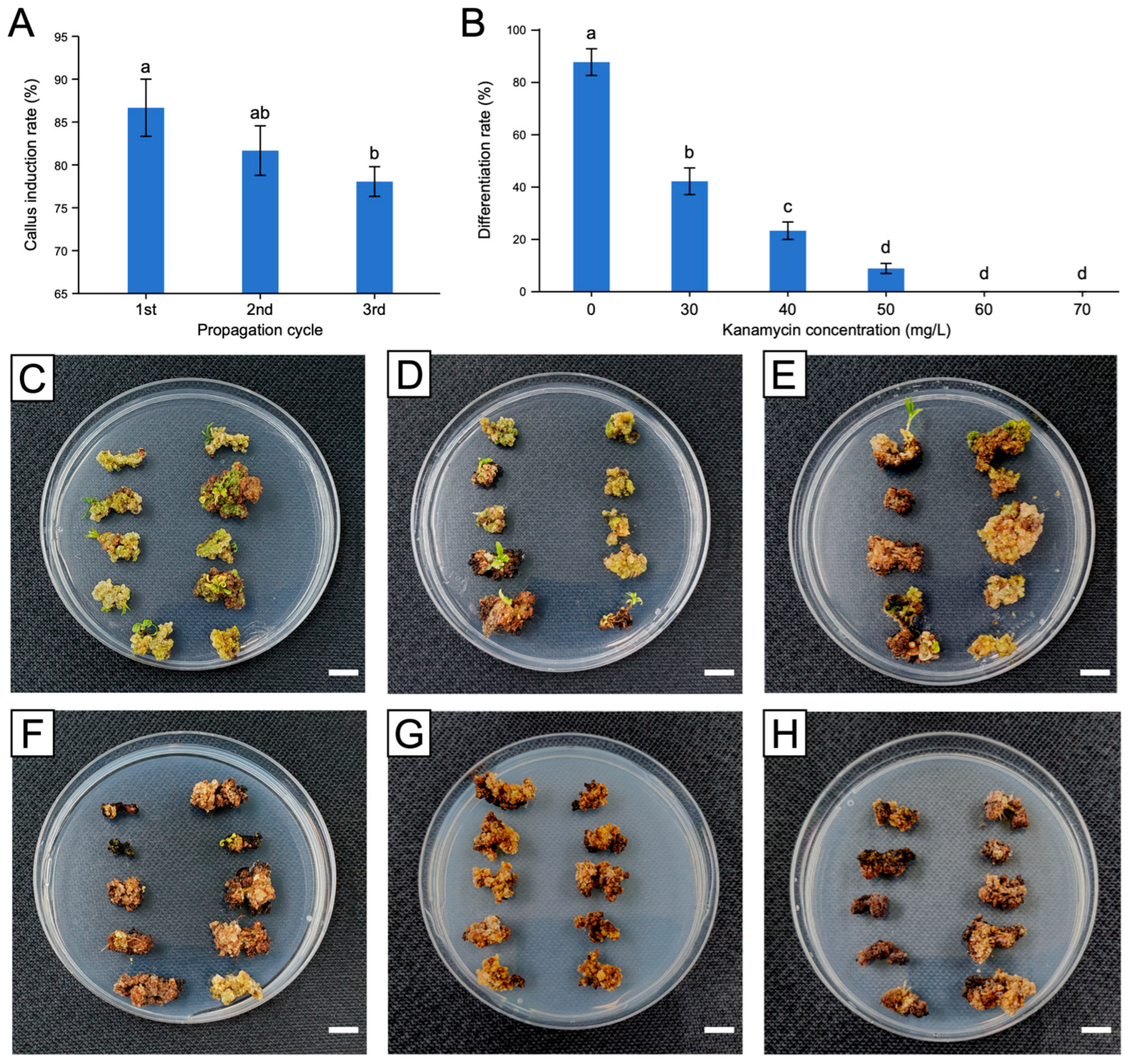
The induction rate of calli was the highest when the explants were derived from the one-time propagation, which was approximately 87% (Figure 2A; Table S2). The induction rate apparently decreased along with the increase of propagation cycles (81.67% and 78.06% for the second and third cycles, respectively). The influence of kanamycin concentration on the vitality of pomegranate embryogenic calli was also identified. Calli were found to grow the best on the medium without kanamycin, which was bright green and has the largest number of differentiated shoots and a significantly higher differentiation rate (87.78%) than other treatments (p < 0.05) (Figure 2B,C; Table S3). As the kanamycin concentration increased, the proportion of calli with adventitious buds decreased sharply, where the differentiation rate was only 8.89% when exposed to a concentration of 50 mg/L (Figure 2B,D–F; Table S3), and these calli were in a bad growth status. When the concentration increased to 60–70 mg/L, all calli turned brown or even died, and no differentiation was observed, indicative of their severely toxic effect (Figure 2B,G,H; Table S3). Therefore, the concentration of 50 mg/L was employed for selecting the pomegranate plantlets that were successfully edited.

3.2. Effects of Different Timentin Concentrations on Adventitious Bud Differentiation

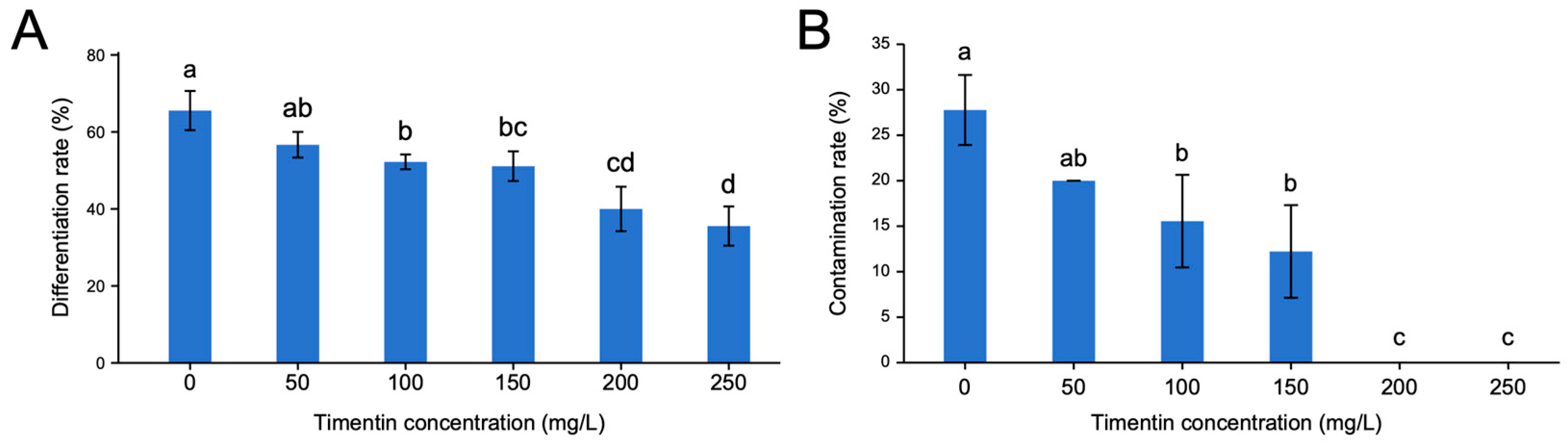
Different concentrations of Timentin were added to the differentiation medium to examine their effects on the activities of pomegranate embryogenic calli, as well as their roles in controlling undesired microbe contamination. When growing on the medium without Timentin, the calli exhibited the highest differentiation rate (Figure 3A; Table S4), but also severe contamination (Figure 3B; Table S4). Contamination was reduced along with the increase in Timentin concentration, and it was completely controlled when treated with Timentin of 200 mg/L or higher (Figure 3B). However, the callus’ differentiation potential to adventitious buds was impaired by the heavy dose of Timentin (Figure 3A). Therefore, 200 mg/L was considered as the optimal concentration of Timentin, which can effectively prevent the contamination and retain a relatively high level of callus activities for downstream genetic transformation.

3.3. Optimal Levels of the Four Factors for Transformation System of ‘Baihuayushizi’ Pomegranate

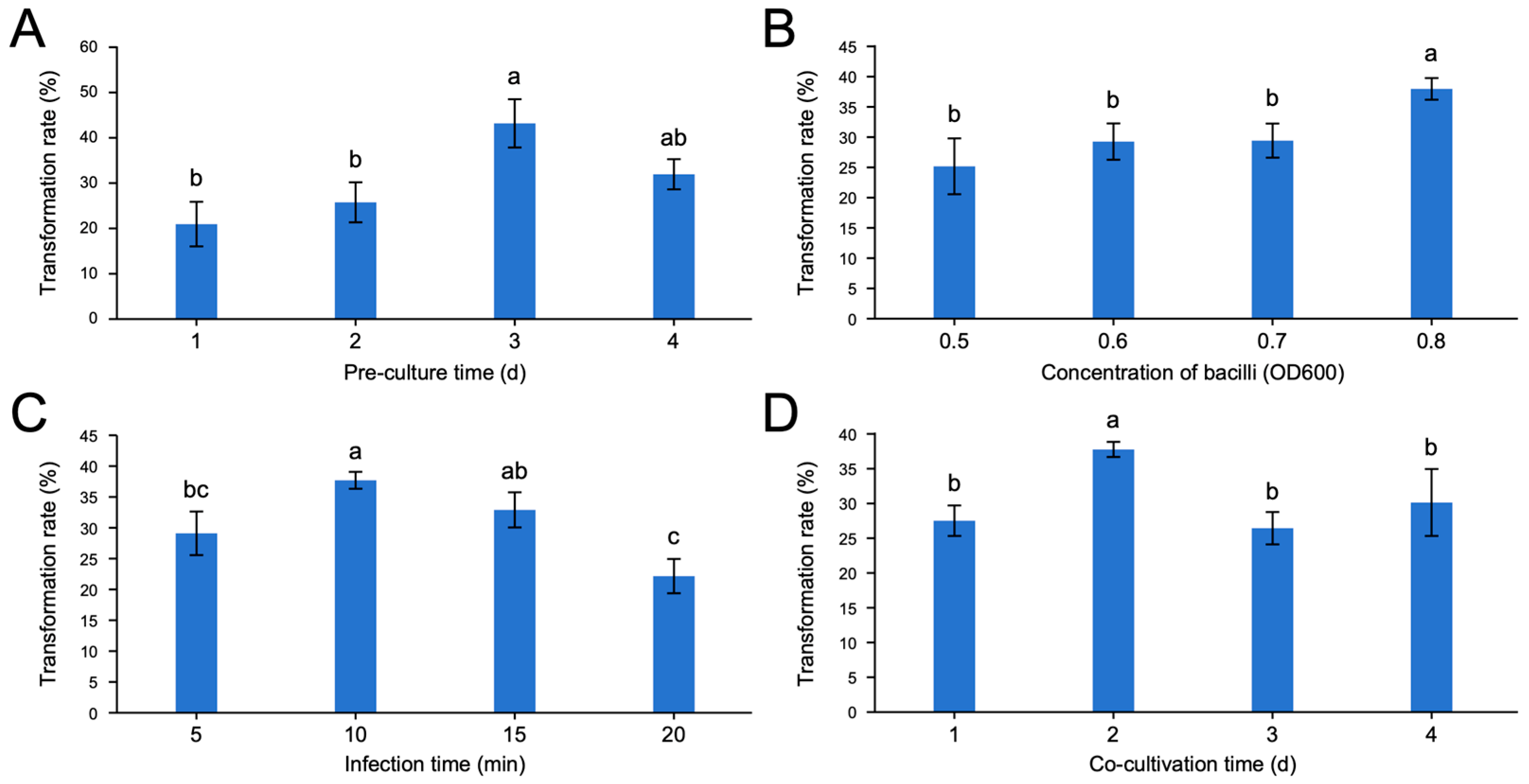
An orthogonal array was then conducted to evaluate the impacts of pre-culture time, bacterial concentration, infection time, and co-culture time on the genetic transformation efficiency of ‘Baihuayushizi’ pomegranate. The average transformation rate of embryogenic calli was highest under the pre-culture time of 3 days (43.19%), while either a too long or too short duration significantly reduced their success of transformation (p < 0.05) (Figure 4A; Table S5). Therefore, 3 days was determined as the optimal pre-culture time. The concentration and infection time of A. tumefaciens were also found to be important influential factors in our system. The A. tumefaciens concentration was positively correlated with the transformation rate of calli, which increased from 25.18% to 37.98% when the OD600 increased from 0.5 to 0.8 (Figure 4B; Table S6). On the other hand, when the infection time extended from 5 to 10 min, the callus’ transformation rate was significantly enhanced (29.10% to 37.70%; Figure 4C; Table S7). However, the further extension of infection time substantially reduced their transformation success. A co-culture of explants and A. tumefaciens for 2 days after the initial inoculation achieved the highest transformation rate (37.77%) compared with those under the durations of 1, 3, and 4 days (p < 0.05) (Figure 4D; Table S8).
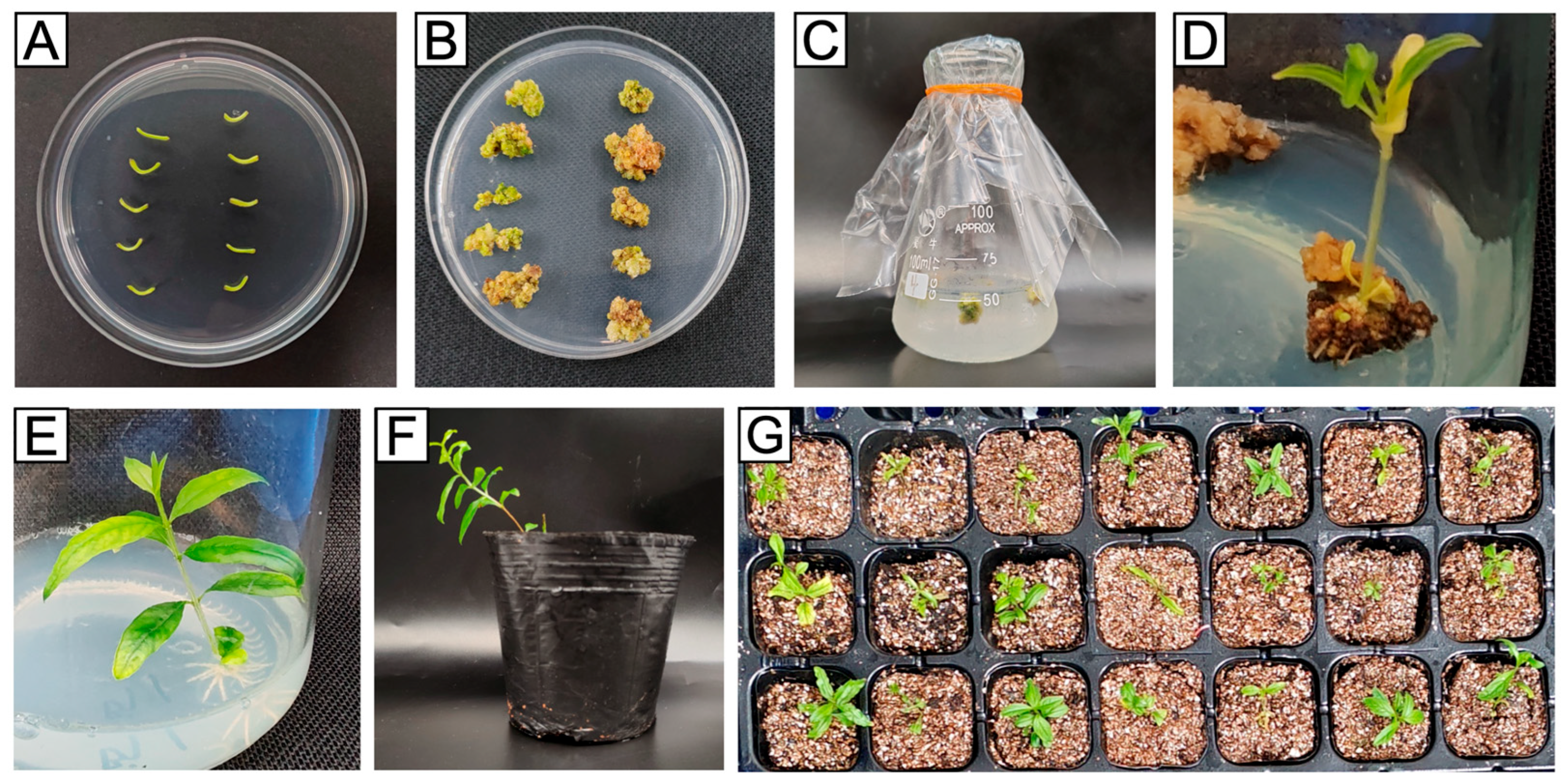
The results of the range analysis showed that the extreme deviation values (R) of the transformation rate for pre-culture time, concentration of A. tumefaciens (OD600), infection time, and co-culture time were 22.23, 12.81, 15.53, and 11.33, respectively (Table 1). This indicated that the pre-culture time had the largest influence on the differentiation capacity of pomegranate embryonic calli, whereas the co-culture time was suggested to be less influential in the efficiency of genetic transformation. In summary, the optimal pre-culture and co-culture durations for the genetic transformation of ‘Baihuayushizi’ pomegranate were 3 and 2 days, respectively, and the A. tumefaciens concentration and infection time were OD600 = 0.8 and 10 min (Table 2). And the ‘Baihuayushizi’ pomegranate status at various stages of genetic transformation is shown in Figure 5.

3.4. Sequencing Validation of Transgenic Pomegranate Plants

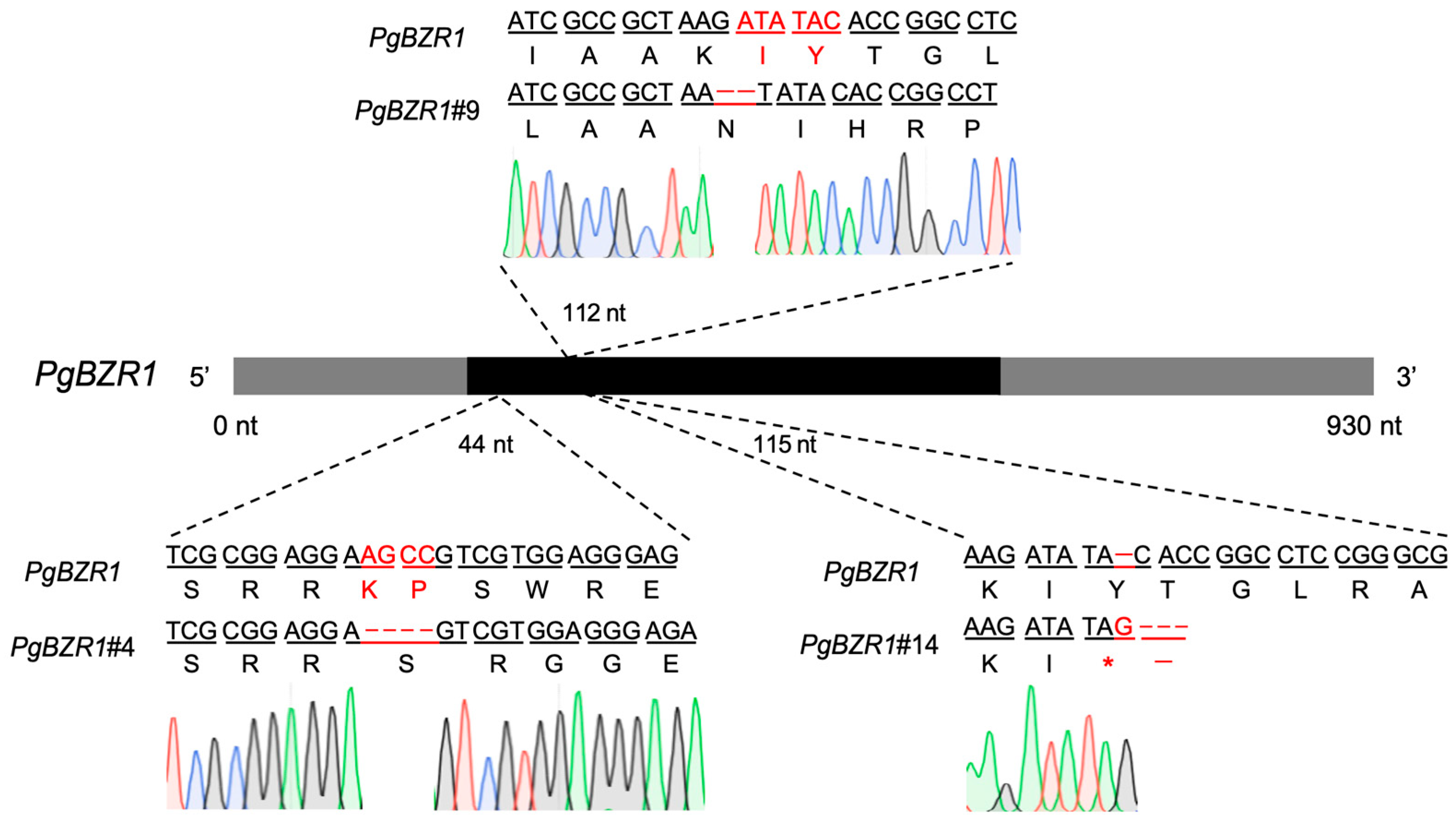
In total, 19 out of the 50 examined calli exhibited a resistance to kanamycin, and all these plantlets were substantially shorter than the wild types. This indicated that their BZR1 genes were successfully edited, with an estimated editing efficiency of 38.00%. Sequencing validation was further conducted for three randomly selected transgenic plants (named as PgBZR1#4, PgBZR1#9, and PgBZR1#14). The mutations in all these three transgenic plants were identified to be homozygous. As shown in Figure 6, 4 and 2 bp deletions (GA and AGCC, respectively) were introduced to PgBZR1 of the transgenic line PgBZR1#4 and PgBZR1#9 at 44–47 and 112–113 nt, respectively, which led to shifts in their open reading frame, as well as changes in the resulting amino acid sequences. In the transgenic line PgBZR1#14, a ‘G’ base was inserted into PgBZR1 at the position of 115 nt and was found to cause a truncated protein compared with the wild type.

4. Discussion

Agrobacterium-mediated transformation is a commonly used method for gene editing in plants, but not all species have a stable genetic transformation system [15,16] due to their long breeding cycles, low callus differentiation rates, difficulty in rooting, low survival rates during acclimatization, and issues like inbreeding depression [17]. One of the key limiting steps is the generation of undifferentiated calli. There are two general pathways for plant somatic embryogenesis; for few species, their somatic embryos can directly develop from the explant tissue (the direct strategy), while, for most plant species, their somatic embryogenesis undergoes an indirect route with a two-stage process: the dedifferentiation of an explant into unorganized calli, followed by the redifferentiation of those callus cells into somatic embryos [18,19,20]. In our previous approach, we developed a protocol for effective somatic embryogenesis in pomegranate via the indirect strategy, which can overcome its recalcitrance in tissue culture and induce calli with high vigor [10]. This calli phase also provides an ideal window for the Agrobacterium-mediated transformation of foreign DNA into pomegranate cells that will eventually form the entire plant with stable genetic changes. In this study, we established a CRISPR-Cas9-based genome editing system for the pomegranate cultivar ‘Baihuayushizi’ with the help of our somatic embryogenesis strategy and A. tumefaciens-mediated delivery platform. The editing rate of our system is estimated to be 38.00%, which is substantially higher than those for citrange (Poncirus trifoliate L. Raf. × C. sinensis L. Osb.) (11.7%) [21], cassava (Manihot esculenta) (4.9–11%) [22], kiwifruit (16.67%) [23], banana (Musa × paradisiaca) [24] (4.6%), and sweet orange (Citrus sinensis cv. Valencia) (3.2–3.9%) [25]. Sequencing validation further showed that, with our system, we can edit DNA sequences of target genes in the pomegranate genome, for example, by introducing insertions or deletions, which finally change the amino acid sequences of the resulting proteins (Figure 6). These results demonstrate the efficiency and reliability of our system and encourage its great application prospect for the agricultural innovation of pomegranate.
We further investigated the influence of several key factors on the editing efficiency of pomegranate. As shown in our results, pre-culturing has a primary impact on genetic transformations. The pre-culturing of plant cells or tissues under specific conditions can restore or enhance their growth activity, enabling them to better accept foreign DNA transformation; thus, an appropriate duration of pre-culturing can optimize the transformation efficiency and accelerate the transformation process in sterile plantlets [26,27]. For ‘Baihuayushizi’ pomegranate, pre-culturing for 3 days before A. tumefaciens infection resulted in the highest number of adventitious buds from explants, while either too short or too long durations were found to reduce the transformation efficiency.
The concentrations of both bacteriostatic and selection agents have critical influences on efficient Agrobacterium-mediated transformation. In our system, kanamycin is used for screening the pomegranate cells that were successfully transformed with the target genes. As shown in Figure 2B, the optimal concentration of kanamycin for pomegranate genetic transformation is 50 mg/L, which is same as the dosage used in sweet pepper (Capsicum annuum) [28]. The treatment at a lower concentration is not able to provide sufficient selection pressure, while a concentration that is too high severely harms the pomegranate tissue. Timentin is applied to protect the explants from contamination and browning caused by A. tumefaciens that is no longer needed, and 200 mg/L was identified as its appropriate concentration (Figure 3), as reported in cucumber (Cucumis sativus L.) [29]. This concentration can effectively sterilize the pomegranate tissue culture without significant phytotoxicity to its embryogenic calli.
A. tumefaciens concentration and infection time are also important factors that can affect the outcomes of genetic transformations. Transformation efficiency would be low if the A. tumefaciens concentration is too low or the infection time is too short, while the contamination caused by the overgrowth of A. tumefaciens is hard to control when treated with an excess concentration of A. tumefaciens. The evaluation in the current study showed that the infection with a bacilli concentration of OD600 = 0.8 for 10 min works the best for ‘Baihuayushizi’ pomegranate, and the optimal duration of the co-culture phase is 2 days.
Co-cultivation provides a window for A. tumefaciens to interact with pomegranate cells and deliver the target DNA. A balance of co-culture duration is required for successful T-DNA transfer against the physiological stress of bacterial overgrowth on pomegranate tissues [30]. In both hybrid sweetgum (Liquidambar styraciflua × L. formosana) and Cinnamomum camphora, 3 days of co-culture achieved the best output for Agrobacterium-mediated transformation [31,32]. For ‘Baihuayushizi’ pomegranate, the optimal co-culture time is 2 day, but unlike other plants, it was found to have less of an impact on the transformation than other factors (Table 1), suggesting a species specificity.

5. Conclusions

In this study, we presented an efficient gene editing system for ‘Baihuayushizi’ pomegranate using young stems of sterile seedlings as explants. The editing efficiency of our system is 38.00%, which is substantially higher than those in some other plant species. The pre-culture duration was found to be the primary factor that influences the editing efficiency, followed by A. tumefaciens infection time and concentration. Using this system, we successfully knocked PgBZR1 out from the genome of ‘Baihuayushizi’ pomegranate. Given these advantages, we anticipate that our gene editing system is a useful tool for future studies on pomegranate gene functions and genetic improvement.

Supplementary Materials

The supporting information can be downloaded at https://www.mdpi.com/article/10.3390/horticulturae12010064/s1. Table S1: Names and sequences of the primers used in this study; Table S2: Effect of different propagation cycles on callus induction efficiency; Table S3: Effect of different kanamycin concentrations on the differentiation capacity of pomegranate calli; Table S4: Effects of different Timentin concentrations on callus contamination and adventitious shoot formation; Table S5: Influence of pre-culture time on the transformation rate of pomegranate calli; Table S6: Influence of A. tumefaciens concentration on the transformation rate of pomegranate calli; Table S7: Influence of infection time on the transformation rate of pomegranate calli; Table S8: Influence of co-culture time on the transformation rate of pomegranate calli; Supplementary Data S1: Sequence of K5-KRSN-Cas9-BZR vector.

Author Contributions

Conceptualization, J.Q. and Y.Y.; validation, C.W. and J.Q.; formal analysis, C.W.; investigation, C.W., Q.X., Q.W., Y.W., and W.D.; writing—original draft preparation, C.W., Q.X., and Y.W.; writing—review and editing, C.W., Q.X., and Y.Y.; visualization, C.W., Y.Y., and J.Q.; supervision, J.Q.; project administration, J.Q.; funding acquisition, J.Q. and Y.Y. All authors have read and agreed to the published version of the manuscript.

Funding

This research was funded by Project of Industry and School and Research Institution, grant number 20250092; Anhui Province Natural Sciences Fund, grant number 2023AH040281; the Key Discipline Construction Fund for Crop Science of Anhui Science and Technology University (XK-XJGF001), the Scientific and Technological Innovation Team of Anhui Science and Technology University (2023KJCXTD001), and Basic Research Funds of Sun Yat-sen University (24qnpy085).

Data Availability Statement

The original contributions presented in this study are included in the article/supplementary material. Further inquiries can be directed to the corresponding authors.

Conflicts of Interest

The authors declare no conflicts of interest.

References

  1. Zhang, J.C.; Qu, H.Z.; Zhang, X.W. Research advances of pomegranate in China. Hebei J. For. Orchard. Res. 2005, 20, 265–267, 272. [Google Scholar]
  2. Hou, L.F.; Luo, H.; Bi, R.X.; Hao, Z.X.; Tan, W.; Zhang, L.H. Review and prospect of pomegranate breeding in China in the past 40 years. North. Hortic. 2022, 24, 139–147. [Google Scholar]
  3. Chen, L.; Wang, H.; Xu, T.; Liu, R.; Zhu, J.; Li, H.; Zhang, H.; Tang, L.; Jing, D.; Yang, X.; et al. A telomere-to-telomere gap-free assembly integrating multi-omics uncovers the genetic mechanism of fruit quality and important agronomic trait associations in pomegranate. Plant Biotechnol. J. 2025, 23, 2852–2870. [Google Scholar] [CrossRef]
  4. Jia, H.G.; Zhang, Y.Z.; Orbović, V.; Xu, J.; White, F.F.; Jones, J.B.; Wang, N. Genome editing of the disease susceptibility gene CsLOB1 in citrus confers resistance to citrus canker. Plant Biotechnol. J. 2017, 15, 817–823. [Google Scholar] [CrossRef] [PubMed]
  5. Varkonyi-Gasic, E.; Wang, T.C.; Voogd, C.; Jeon, S.; Drummond, R.S.M.; Gleave, A.P.; Allan, A.C. Mutagenesis of kiwifruit CENTRORADIALIS-like genes transforms a climbing woody perennial with long juvenility and axillary flowering into a compact plant with rapid terminal flowering. Plant Biotechnol. J. 2019, 17, 869–880. [Google Scholar] [CrossRef]
  6. Wang, X.H.; Tu, M.X.; Wang, D.J.; Liu, J.W.; Li, Y.J.; Li, Z.; Wang, Y.J.; Wang, X.P. CRISPR/Cas9-mediated efficient targeted mutagenesis in grape in the first generation. Plant Biotechnol. J. 2018, 16, 844–855. [Google Scholar] [CrossRef]
  7. Wang, G.X.; Zhang, Y.T.; Dong, J.; Zhang, L.X. Retrospection and Prospect of Strawberry Breeding in China. J. Plant Genet. Resour. 2008, 9, 272–276. [Google Scholar]
  8. Naik, S.K.; Pattnaik, S.; Chand, P.K. High frequency axillary shoot proliferation and plant regeneration from cotyledonary nodes of pomegranate (Punica granatum L.). Sci. Hortic. 2000, 85, 261–270. [Google Scholar] [CrossRef]
  9. Chang, L.J.; Wu, S.; Tian, L. Effective genome editing and identification of a regiospecific gallic acid 4-O-glycosyltransferase in pomegranate (Punica granatum L.). Hortic. Res. 2019, 6, 123. [Google Scholar] [CrossRef] [PubMed]
  10. Wang, J.; Xia, X.; Qin, G.; Tang, J.; Wang, J.; Zhu, W.; Qian, M.; Li, J.; Cui, G.; Yang, Y.; et al. Somatic Embryogenesis and Plant Regeneration from Stem Explants of Pomegranate. Horticulturae 2023, 9, 1038. [Google Scholar] [CrossRef]
  11. Li, X.J.; An, Y.; Huang, L.C.; Zeng, W.; Lu, M.Z. Establishment of A Transient Transformation System for Stem Segments of Poplar 84K. Sci. Silvae Sin. 2021, 57, 82–89. [Google Scholar]
  12. Wang, X.Q.; Shen, X.; He, Y.M.; Ren, T.N.; Wu, W.T.; Xi, T. An optimized freeze-thaw method for transformation of Agrobacterium tumefaciens EHA105 and LBA4404. Pharm. Biotechnol. 2011, 18, 382–386. [Google Scholar]
  13. Wang, M.Y.; Yu, W.X.; Zhao, Y.X.; Chen, Y.C.; Gao, M.; Wu, L.W.; Wu, S.Q.; Wang, Y.D. Establishment of Agrobacterium Mediated Genetic Transformation System of Litsea cubeba. For Res. 2022, 35, 71–80. [Google Scholar]
  14. Crooks, G.E.; Hon, G.; Chandonia, J.M.; Brenner, S.E. WebLogo: A sequence logo generator. Genome Res. 2004, 14, 1188–1190. [Google Scholar] [CrossRef]
  15. Chen, Y.N.; Lu, J. Application of CRISPR/Cas9 mediated gene editing in trees. Hereditas 2020, 42, 657–668. [Google Scholar]
  16. Yuan, X.N.; Yao, F.G.; An, Y.; Jiang, C.; Chen, N.N.; Huang, L.C.; Lu, M.Z.; Zhang, J. Application of CRISPR/Cas genome editing in woody plant trait improvement. Chin. Sci. Bull. 2025, 70, 2509–2525. [Google Scholar] [CrossRef]
  17. Grattapaglia, D.; Silva-Junior, O.B.; Resende, R.T.; Cappa, E.P.; Müller, B.S.F.; Tan, B.; Isik, F.; Ratcliffe, B.; El-Kassaby, Y.A. Quantitative genetics and genomics converge to accelerate forest tree breeding. Front. Plant Sci. 2018, 9, 1693. [Google Scholar] [CrossRef]
  18. Yang, X.; Zhang, X. Regulation of somatic embryogenesis in higher plants. Crit. Rev. Plant Sci. 2010, 29, 36–57. [Google Scholar] [CrossRef]
  19. Taheri-Dehkordi, A.; Naderi, R.; Martinelli, F.; Salami, S.A. A robust workflow for indirect somatic embryogenesis and cormlet production in saffron (Crocus sativus L.) and its wild allies; C. caspius and C. speciosus. Heliyon 2020, 6, e5841. [Google Scholar] [CrossRef] [PubMed]
  20. Amaral-Silva, P.M.; Clarindo, W.R.; Guilhen, J.H.S.; Passos, A.B.R.d.J.; Sanglard, N.A.; Ferreira, A. Global 5-methylcytosine and physiological changes are triggers of indirect somatic embryogenesis in Coffea canephora. Protoplasma 2021, 258, 45–57. [Google Scholar] [CrossRef] [PubMed]
  21. Alquézar, B.; Bennici, S.; Carmona, L.; Gentile, A.; Peña, L. Generation of Transfer-DNA-Free Base-Edited Citrus Plants. Front. Plant Sci. 2022, 13, 835282. [Google Scholar] [CrossRef]
  22. Mehta, D.; Stürchler, A.; Anjanappa, R.B.; Zaidi, S.S.; Hirsch Hoffmann, M.; Gruissem, W.; Vanderschuren, H. Linking CRISPR-Cas9 interference in cassava to the evolution of editing-resistant geminiviruses. Genome Biol. 2019, 20, 80. [Google Scholar] [CrossRef]
  23. Varkonyi-Gasic, E.; Wang, T.; Cooney, J.; Jeon, S.; Voogd, C.; Douglas, M.J.; Pilkington, S.M.; Akagi, T.; Allan, A.C. Shy Girl, a kiwifruit suppressor of feminization, restricts gynoecium development via regulation of cytokinin metabolism and signalling. New Phytol. 2021, 230, 1461–1475. [Google Scholar] [CrossRef]
  24. Shao, X.; Wu, S.; Dou, T.; Zhu, H.; Hu, C.; Huo, H.; He, W.; Deng, G.; Sheng, O.; Bi, F.; et al. Using CRISPR/Cas9 genome editing system to create MaGA20ox2 gene-modified semi-dwarf banana. Plant Biotechnol. J. 2020, 18, 17–19. [Google Scholar] [CrossRef]
  25. Jia, H.G.; Wang, N. Targeted genome editing of sweet orange using Cas9/sgRNA. PLoS ONE 2014, 9, e93806. [Google Scholar] [CrossRef]
  26. Li, J.J.; Li, Y.F.; Wang, A.Q.; Wang, J.Y.; Deng, C.Y.; Lu, M.; Ma, J.Y.; Dai, S.L. Establishment of Regeneration and Genetic Transformation System for Chrysanthemum × morifolium ‘Wandai Fengguang’. Chin. Bull. Bot. 2025, 60, 597–610. [Google Scholar]
  27. Cheng, G.L.; Cai, Z.J.; Jiang, J.; Liu, G.F. Establishment of agrobacterium-mediated transformation System for Populus simonii×P.nigra plants. Guangdong Agric. Sci. 2009, 9, 196–199, 210. [Google Scholar]
  28. Su, Z.H.; Zhang, J.H.; Zhang, Z.X.; Li, M.F.; Guo, S.J.; Cao, X.S.; Ji, L.S. Establishment of Agrobacterium-mediated genetic transformation system of Capsicum annuum. Acta Agric. Jiangxi 2019, 31, 9–15. [Google Scholar]
  29. Zhou, G.; Liu, C.L.; Chen, H.M.; Liu, X.H.; Yang, K.K.; Chen, C. Optimization of the genetic transformation system for the ecotype cucumber ‘CU2’ in South China. J. China Capsicum 2024, 22, 52–59. [Google Scholar]
  30. Zhang, Z.F.; Finer, J.J. Low Agrobacterium tumefaciens inoculum levels and a long co-culture period lead to reduced plant defense responses and increase transgenic shoot production of sunflower (Helianthus annuus L.). Vitr. Cell. Dev. Biol.-Plant 2016, 52, 354–366. [Google Scholar] [CrossRef]
  31. Jiang, S.F.; Cui, Y.; Zhao, R.R.; Qi, S.Z.; Kong, L.S.; Zhao, J.; Li, S.S.; Zhang, J.F. Agrobacterium tumefaciens-mediated transformation of hybrid sweetgum embryogenic callus. J. Beijing For. Univ. 2021, 43, 9–17. [Google Scholar]
  32. Zhang, S.; Hu, R.; Yang, L.; Zuo, Z. Establishment of a Transient Transformation Protocol in Cinnamomum camphora. Forests 2023, 14, 1872. [Google Scholar] [CrossRef]
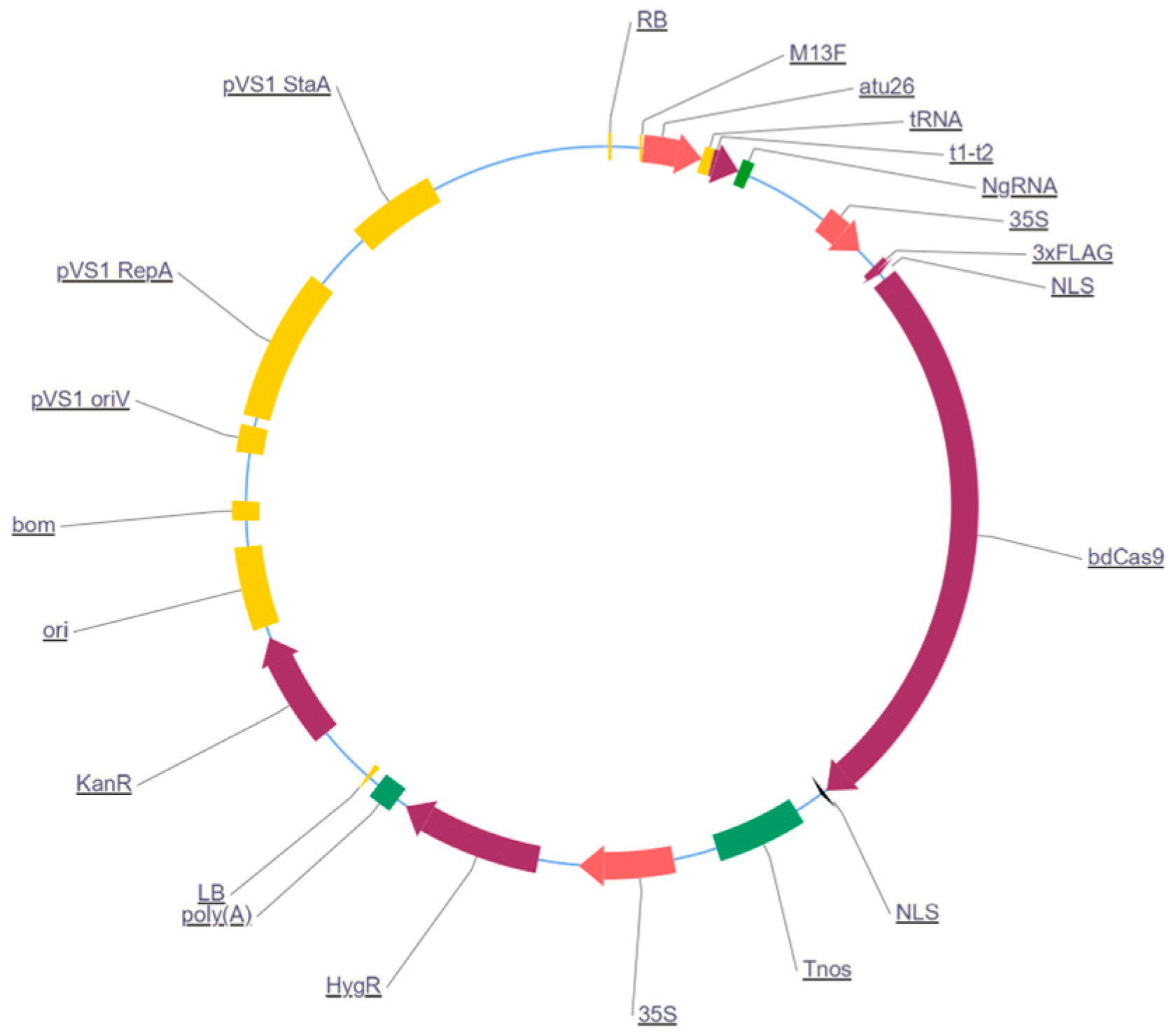
Figure 1. Schematic diagram illustrating the circular map of the K5-KRSN-Cas9-BZR vector used in this study. Different functional elements are shown in different colors. Arrows indicate the transcription direction of the elements.
Horticulturae 12 00064 g001
Figure 2. Growth status of pomegranate embryonic calli after 35 days of cultivation on the media with different concentrations of kanamycin. (A) Induction rate of calli on the media with different kanamycin concentrations. (B) Differentiation rate of calli on the media with different kanamycin concentrations. For panels A and B, the error bars represent the standard error of the mean (SEM) from ten and three biological replicates, respectively, which reflect the reliability of the mean data inferred from our data. Different lowercase letters present significant statistical differences among different groups at the p < 0.05 level of Tukey’s HSD test, while identical letters indicate no significant difference. (CH) Growth status of calli on the media with 0 (C), 30 (D), 40 (E), 50 (F), 60 (G), and 70 mg/L kanamycin (H), respectively. The bar scale is 1 cm.
Horticulturae 12 00064 g002
Figure 3. Growth status of pomegranate embryonic calli on the media with different concentrations of Timentin. (A) Contamination rate of calli on the media with different Timentin concentrations. (B) Differentiation rate of calli on the media with different Timentin concentrations. In each panel, the error bars represent the standard error of the mean (SEM) from three biological replicates. Different lowercase letters present significant statistical differences among different groups at the p < 0.05 level of Tukey’s HSD test, while identical letters indicate no significant difference.
Horticulturae 12 00064 g003
Figure 4. Transformation rates of pomegranate embryonic calli upon different treatment conditions. (A) Transformation rates of calli under the pre-culture time of 1, 2, 3, and 4 days. (B) Transformation rates of calli when infected with Agrobacterium tumefaciens of different concentrations (OD600 = 0.5, 0.6, 0.7, and 0.8). (C) Transformation rates of calli when infected with A. tumefaciens for 5, 10, 15, and 20 min. (D) Transformation rates of calli with co-culture time of 1, 2, 3, and 4 days. In each panel, the error bars represent the standard error of the mean (SEM) from three biological replicates. Different lowercase letters present significant statistical differences among different groups at the p < 0.05 level of Tukey’s HSD test, while identical letters indicate no significant difference.
Horticulturae 12 00064 g004
Figure 5. ‘Baihuayushizi’ pomegranate status at various stages of genetic transformation. (A) Inoculated explants after 3-day pre-cultivate. (B) Calli formed from young stems. (C) Agrobacterium tumefaciens infection of calli. (D) Plantlets developed from adventitious buds. (E) Regenerated plantlets in rooting medium. (F,G) Plantlets hardening and transplanting.
Horticulturae 12 00064 g005
Figure 6. Sequencing validation of three PgBZR1 gene-edited strains, PgBZR1#4, PgBZR1#9, and PgBZR1#14. For each gene-edited line, the deletions or substitutions, as well as the original sequences, at the editing site are highlighted in red, and the introduced termination codon is presented by ‘*’. The Sanger sequencing results are presented in the electropherogram shown below, where ‘A’, ‘T’, ‘C’ and ‘G’ bases are color-coded green, red, blue and black, respectively.
Horticulturae 12 00064 g006
Table 1. Range analysis results showing the relative importance of four factors on the transformation rate of pomegranate embryonic calli.
FactorsPre-Culture
Time (d)
Concentration of Agrobacterium
tumefaciens (OD600)
Infection Time
(min)
Co-Culture Time (d)
Indicators
K183.85100.7116.41110.06
K2103.06117.14150.79151.07
K3172.75117.67131.59105.75
K4127.79151.9488.66120.57
k120.9625.1829.127.52
k225.7729.2837.737.77
k343.1929.4232.926.44
k431.9537.9822.1630.14
R22.2312.8115.5311.33
Note: For each examined infection condition, Ki and ki represent the sum and mean of transformation rates of the three replicates at level i, respectively, where the specific values of each level are presented in Figure 4 and R represents the extreme deviation value, which is the difference between the maximum and minimum average results for all four levels.
Table 2. Orthogonal array for determining the optimal combination of four factors on the transformation rate of the embryonic calli of ‘Baihuayushizi’ pomegranate.
TreatmentsPre-Culture
Time (d)
Concentration of Agrobacterium tumefaciens (OD600)Infection Time (min)Co-Culture Time (d)Transformation Rate (%)
110.55114.18 e
210.610240.55 bc
310.715316.10 de
410.820413.02 e
520.510216.84 de
620.65120.63 de
720.720419.70 de
820.815345.84 ab
930.515346.24 ab
1030.620432.50 c
1130.75141.24 b
1230.810252.77 a
1340.520423.44 d
1440.615323.41 d
1540.710240.63 bc
1640.85140.31 bc
Notes: In the last column, different lowercase letters in superscript present significant statistical differences at p < 0.05 level of Tukey’s HSD test, while identical letters indicate no significant difference.
Disclaimer/Publisher’s Note: The statements, opinions and data contained in all publications are solely those of the individual author(s) and contributor(s) and not of MDPI and/or the editor(s). MDPI and/or the editor(s) disclaim responsibility for any injury to people or property resulting from any ideas, methods, instructions or products referred to in the content.