Article

Short-Term Frost Prediction During Apple Flowering in Luochuan Using a 1D-CNN–BiLSTM Network with Attention Mechanism

1
College of Mechanical and Electronic Engineering, Northwest A&F University, Yangling 712100, China
2
Shaanxi Key Laboratory of Agricultural Information Perception and Intelligent Services, Yangling 712100, China
*
Author to whom correspondence should be addressed.
Horticulturae 2026, 12(1), 47; https://doi.org/10.3390/horticulturae12010047 (registering DOI)
Submission received: 20 November 2025 / Revised: 21 December 2025 / Accepted: 28 December 2025 / Published: 30 December 2025
(This article belongs to the Section Fruit Production Systems)

Abstract

Early spring frost is a major meteorological hazard during the Apple Flowering period. To improve frost event prediction, this study proposes a hybrid 1D-CNN-BiLSTM-Attention model, with its core novelty lying in the integrated dual attention mechanism (Self-attention and Cross-variable Attention) and hybrid architecture. The 1D-CNN extracts extreme points and mutation features from meteorological factors, while BiLSTM captures long-term patterns such as cold wave accumulation. The dual attention mechanisms dynamically weight key frost precursors (low temperature, high humidity, calm wind), aiming to enhance the model’s focus on critical information. Using 1997–2016 data from Luochuan (four variables: Ground Surface Temperature (GST), Air Temperature (TEM), Wind Speed (WS), Relative Humidity (RH)), a segmented interpolation method increased temporal resolution to 4 h, and an adaptive Savitzky–Golay Filter reduced noise. For frost classification, Recall, Precision, and F1-score were higher than those of baseline models, and the model showed good agreement with the actual frost events in Luochuan on 6, 9, and 10 April 2013. The 4 h lead time could provide growers with timely guidance to take mitigation measures, alleviating potential losses. This research may offer modest technical references for frost prediction during the Apple Flowering period in similar regions.

1. Introduction

Luochuan County is one of China’s major high-quality apple-producing regions, where early spring frost frequently threatens apple flowering and fruit set. During the Apple Flowering period, even short-term exposure to sub-zero temperatures can cause irreversible damage to reproductive organs, leading to substantial yield loss. Therefore, accurate short-term frost prediction during this sensitive stage is critical for orchard risk management and timely mitigation [1].
Early frost prediction studies largely relied on statistical or empirical approaches—such as threshold-based rules, regression models, and composite frost indices—which typically used a limited number of variables (e.g., minimum temperature, humidity, wind speed) and offered relatively transparent interpretations [2,3]. However, their performance strongly depended on site-specific calibration and historical stationarity assumptions, making them less effective under increasing climate variability and abrupt temperature fluctuations. Lee et al. [2] applied Logistic Regression and Decision Tree methods to spring frost prediction. The results showed that the average number of selected explanatory variables was 5.7 for Logistic Regression and 2.3 for Decision Trees, both achieving satisfied prediction accuracy. Tárraga et al. [3] evaluated and compared the application of a set of machine learning algorithms in predicting frost events within a 24 h horizon. They resulted in a substantial improvement in model performance. This methodology led to a 13% increase in the Area Under the Curve score and enhanced the recall metric from 55% to 82%. Carl et al. [4] developed a frost prediction model based on a Deep Neural Network (DNN), striking a trade-off between superior accuracy and computational cost-effectiveness. The model performed well in frost and minimum temperature prediction, with 6 h RMSE ranging from 1.53 °C to 1.72 °C. Kim et al. [5] used the Extreme Gradient Boosting (XGBoost) method to reveal regional differences in frost prediction performance. Zhang et al. [6] calculated the annual intensity and frequency of late frost events and conducted Empirical Orthogonal Function Analysis and Morlet Wavelet Analysis on nearly 50 years of late frost data. Their findings showed that the frequency of high-incidence regions for late frost damage to winter wheat exceeded 40%. Wang et al. [7] combined meteorological observation data with Moderate-resolution Imaging Spectroradiometer (MODIS) night-time Land Surface Temperature and compared the correlation between daily minimum air temperature and Land Surface Temperature across six pixel window scales (1 × 1–6 × 6). Process-based and physically driven models have also been explored to describe frost occurrence through surface energy balance, radiative cooling, and temperature lapse rates. For example, physically corrected frost indices and minimum temperature estimation models incorporating elevation and land surface characteristics have been proposed [6,7]. While these approaches improve physical consistency, they often require extensive parameterization and are sensitive to local terrain and surface conditions, which limits their scalability and short-term predictive accuracy at high temporal resolution.
With the advancement of data-driven techniques, machine learning methods have been increasingly applied to frost prediction. Logistic regression, decision trees, support vector machines, random forests, and gradient boosting algorithms have demonstrated improved performance compared with traditional statistical models [2,3,4,5,8]. These models can capture nonlinear relationships among multiple meteorological variables and partially alleviate assumptions of linearity. However, their ability to predict rare frost events remains limited by data imbalance, inadequate modeling of temporal dependencies, and poor representation of phenological dynamics. This study aims to develop a hybrid 1D-CNN-BiLSTM-Attention model to improve short-term frost prediction for apple flowering in Luochuan. We hypothesize that physics-informed piecewise interpolation with Savitzky–Golay filtering, combined with a Cross-variable Attention mechanism, will enable the model to better capture key frost precursors, improving accuracy in both meteorological regression and frost classification within a 4 h window.
In the context of Luochuan’s apple production, the phenological timing of frost risk is precise and critically tied to crop vulnerability. The Apple Flowering period, particularly the BBCH growth stage 65 (full bloom, >50% flowers open) which typically occurs from early to mid-April in this region, represents the most frost-sensitive phase. During full bloom, reproductive tissues are fully exposed and can be severely damaged by temperatures just below freezing (often between 0 °C to −4 °C), leading directly to flower death and fruit set failure. Historical agrometeorological records, such as the frost events on April 6, 9, and 10, 2013, in Luochuan, underscore the recurrent threat during this narrow phenological window. Therefore, effective frost prediction must not only be meteorologically accurate but also temporally aligned with this high-risk BBCH stage. The 4 h forecast horizon was chosen for its dual advantage. First, it ensures generally higher prediction accuracy compared to longer horizons. Second, it grants orchard managers sufficient time to implement protective actions. Among options like wind machines and sprinkler irrigation, we highlight smoke generation as a particularly cost-effective intervention. This study could offer useful technical insights for managing late-spring frost during apple flowering in Luochuan.

2. Materials and Methods

2.1. Data Sources

This research was conducted in 2025 at the College of Mechanical and Electronic Engineering, Northwest A&F University. The meteorological datasets were sourced from the China Surface Climate Daily Data Set (V3.0), compiled according to the Surface Meteorological Observation Regulations issued by the China Meteorological Administration [9]. The dataset was developed by the National Meteorological Information Center based on long-term surface observations and systematic data integration. It provides authoritative data support for research in climate change and related fields. The Luochuan regional dataset used in this study corresponds to observation station No. 53942 (35.767° N, 109.417° E) at an elevation of 1159.8 m. The observational data from this station represent Luochuan’s climatic characteristics and provide reliable meteorological input for this study. No commercial software, instruments, or reagents were used in this study. All analyses were conducted using open-source tools and custom code.
Twenty years of meteorological data (from November to April of the following year, 1997–2016) were used. The dataset includes four key meteorological factors: Ground Surface Temperature (GST), Air Temperature (TEM), Wind Speed (WS), and Relative Humidity (RH). Each factor originally contained 3,564 raw data points, which were interpolated to yield 21,384 valid samples for analysis and model training. The data were split chronologically into a training set (70%) and validation and test sets (15% each). The dataset is limited to a single meteorological station. While the observations from Station No. 53942 accurately represent the regional climatic characteristics of Luochuan, they cannot capture micro-scale variations within individual orchards.
Specifically, the TEM data include Average Air Temperature (TavgTEM), Maximum Air Temperature (TmaxTEM), and Minimum Air Temperature (TminTEM), all measured with a precision of 0.1 °C. The GST data include Average Ground Temperature (TavgGST), Maximum Ground Temperature (TmaxGST), and Minimum Ground Temperature (TminGST), also measured with a precision of 0.1 °C. The WS data include Average Wind Speed (WWSavg), Maximum Wind Speed (WWSmax), and Extreme Wind Speed (WWSext), with a precision of 0.1 m/s. The RH data include Average Relative Humidity (RRHavg) and Minimum Relative Humidity (RRHmin), expressed as percentages (%). These high-resolution and long-term observations provide a solid foundation for developing and validating the proposed frost prediction model for the Apple Flowering period in the Luochuan region.

2.2. Data Preprocessing

In the original dataset used for this study, the temporal resolution of TEM, GST, and WS data is 8 h, while that of RH is 12 h. Such temporal resolution was insufficient for the accuracy and timeliness requirements for agricultural frost prediction. Therefore, a segmented interpolation method was adopted to enhance the temporal resolution of the four meteorological factors to 4 h, with sampling conducted at six time points per day: 00:00, 04:00, 08:00, 12:00, 16:00, and 20:00. Each meteorological factor was interpolated separately according to its physical variation characteristics.

2.2.1. Interpolation of GST and TEM Data

The temporal resolution of the GST dataset is 8 h. To achieve a 4 h temporal resolution, in this study, a piecewise function model based on physical law of diurnal surface temperature variation was employed. The daily average observed ground temperature was used to calibrate the temperature variation curve, as shown in Equation (1). The piecewise cosine curve generated by the theoretical model can reflect the basic pattern of diurnal ground temperature variation. However, due to the simplified assumptions of the model, differences exist between the theoretical and observed ground temperatures. Therefore, correction is needed based on the daily average observed ground temperature. As shown in Equation (2), the arithmetic mean of the 24 h theoretical curve is first calculated. By comparing the average observed ground temperature with the average theoretical ground temperature, the systematic bias is obtained. This bias is then applied as a uniform offset to each time point of the theoretical curve, resulting in the corrected ground temperature curve:
T G S T = T min GST ,   0 t < 6 T min GST + 1 2 T max GST T min GST 1 cos π t - 6 8 , 6 t < 14 T max GST 1 2 T max GST T min GST 1 cos π t - 14 16 , 14 t < 24
A a v g G S T = 1 24 t = 0 23 T G S T Δ T = T avgGST A a v g G S T T c o r r e c t e d G S T = T G S T + Δ T
where TGST represents the theoretical ground temperature at a specific time of day (°C); TmaxGST and TminGST denote the daily maximum and minimum observed ground temperatures (°C); AavgGST, ΔT, TavgGST, and TcorrectedGST represent the average theoretical ground temperature, the systematic bias in ground temperature, the average observed ground temperature, and the corrected theoretical ground temperature, respectively, in units of °C; and t is the time of day (h).
The TEM dataset also has an 8 h temporal resolution and was interpolated using the same piecewise function and correction approach applied to the GST data.

2.2.2. WS Data Interpolation

The WS dataset has a temporal resolution of 8 h. To meet the 4 h precision requirement for frost prediction, a piecewise interpolation model was employed to enhance the temporal resolution, as expressed in Equations (3) and (4):
B W S m i n = max 0.1 , 0.5 W WSavg B W S m a x = min 0.95 W WS max , 1.5 W WSavg
W W S = B W S m i n , 0 t < 6 or 18 t < 24 B W S m i n + 1 2 B W S m a x B W S m i n 1 cos π t - 6 6 , 6 t < 10 B W S m a x , 10 t < 14 B W S m a x 1 2 B W S m a x B W S m i n 1 cos π t - 14 6 , 14 t < 18
where BWSmin and BWSmax represent the theoretical minimum wind speed and theoretical maximum wind speed (m/s); WWS, WWSavg and WWSmax denote the wind speed at a specific time of the day, the average observed wind speed, and the maximum observed wind speed (m/s); and t is the time of day in hours (h).

2.2.3. RH Data Interpolation

The RH data have a temporal resolution of 12 h. To meet the 4 h resolution required for frost prediction, a piecewise interpolation method was applied, and a ±5% random perturbation to better reflect real variability was introduced to prevent the interpolated sequence from becoming overly smooth and losing realistic atmospheric variability, as shown in Equations (5) and (6):
R R H m a x = min 100 , 1.3 R RHavg
R R H = R R H m a x R R H m a x R RHavg t 6 , 0 < t 6 R RHavg + R RH min R RHavg t 6 6 , 6 < t 12 R RH min + R RHavg R RH min t 12 6 , 12 < t 18 R RHavg + R R H m a x R RHavg t 18 6 , 18 < t 24
where RRH is the relative humidity at a certain moment (%); RRHmax, RRHmin, and RRHavg are the theoretical maximum relative humidity, the minimum observed relative humidity, and the average observed relative humidity (%); and t is the time of day in hours (h).

2.3. Outlier Handling and Data Filtering

Due to environmental interference during data measurement, instrument malfunctions, or errors, it is necessary to process outliers in the four types of meteorological factors. The Median Absolute Deviation (MAD) statistical test is an outlier detection method that is insensitive to extreme values, less affected by outliers, and improves robustness [10]. As shown in Table 1, physical thresholds and the MAD method were used to eliminate outliers, which were uniformly marked as missing values (NaN). A post hoc statistical analysis revealed that the combined outlier detection process affected a very small proportion of the total dataset. The percentages of data points flagged as outliers were: 0.3% for GST, 0% for TEM, 0.18% for WS, and 0.37% for RH. This amounts to less than 0.9% of the combined four-variable dataset. The minimal scale of data requiring imputation underscores the overall high quality of the original observations and limits the potential impact of the imputation strategy on the dataset’s statistical properties, particularly regarding extreme values. Missing values were preferentially filled using the average of the indicators from adjacent dates. If data remain missing, they were supplemented using data from the same station and the same month.
The Savitzky–Golay filter is a digital filter that employs local least squares fitting, capable of improving data precision and smoothing the data without altering the signal trend or width [11,12]. As shown in Equation (7), the filter window length was L = 5, and a quadratic polynomial was used for fitting. When the window exceeded the data boundaries, the nearest neighbor value was used for padding to preserve the extreme points of data variation and prevent over-smoothing. The parameters of the Savitzky–Golay filter (window length L = 5 , polynomial order = 2) were selected based on the following rationale. The window length must be sufficiently small to avoid over-smoothing and signal distortion, yet large enough to effectively suppress high-frequency noise. Given the 4 h resolution of the interpolated meteorological data and its distinct diurnal cycle, L = 5 corresponds to a 20 h window, which preserves the daily variation trend while smoothing short-term fluctuations. The quadratic polynomial order was chosen because it provides a good balance between smoothing and curvature preservation in local fitting, avoiding oscillations that higher-order polynomials might introduce. This parameter configuration has been successfully applied in the preprocessing of similar meteorological time series [12], demonstrating its effectiveness in retaining abrupt temperature changes:
y i smoothed = j = 2 2 c j y i + j
where yismoothed represents the filtered value at the i-th time point, with the same unit as the original data; cj denotes the filter coefficient, which is dimensionless; yi+j refers to the original data at the (i + j)-th time point, with the same unit as the original data.

2.4. Comparison of Different Data Preprocessing Methods

Due to the coarse temporal resolution of the original data, preprocessing must balance prediction accuracy with realistic data representation and avoid over-smoothing. As shown in Equation (8), for a discrete sequence of length N, v = [v1, v2, …, vN], the Root Mean Square of the First-order Differences (FRMS) was used as an evaluation metric to assess the smoothness and realism of the four meteorological factors under different preprocessing methods. A lower FRMS value indicates smoother data, whereas a higher value reflects greater fluctuation:
F R M S = 1 N 1 i = 1 N 1 v i + 1 v i 2
where vi represents the value of the sequence at the i-th time point; vi+1vi is the first-order difference, which shares the same unit as vi; FRMS is the root mean square of the first-order differences, also in the same unit as vi; and N is the length of the sequence, which is dimensionless.
As presented in Table 2, to enhance the temporal resolution of the original meteorological data while preserving their realistic fluctuation characteristics, the performance of five data preprocessing methods (Linear Interpolation, Lagrange Interpolation, Median Filtering, Mean Filtering, and the Proposed Piecewise Interpolation-Savitzky–Golay Filtering) was compared using the FRMS metric. The FRMS value of the data processed by the Proposed Piecewise Interpolation-Savitzky–Golay Filtering was higher, particularly for GST and TEM, where the FRMS was significantly greater than that of Linear and Lagrange Interpolation. This indicated that the proposed method better preserved the abrupt change characteristics of temperature data and avoided over-smoothing.
FRMS was used as a relative metric to assess data smoothness across interpolation methods. Given the coarse temporal resolution of the original data (8 h/12 h), no method can perfectly recover true 4 h variability. Therefore, FRMS serves not as an absolute benchmark but as a tool to balance between avoiding over-smoothing and preventing unrealistic noise. The ±5% random noise introduced during RH interpolation (Equation (4)) mimics natural micro-scale variability, enhancing statistical realism. The proposed Piecewise Interpolation-Savitzky–Golay Filtering method produced higher FRMS values for GST and TEM than Linear or Lagrange Interpolation (Table 2), confirming better retention of abrupt changes, while its values aligned with other robust methods (e.g., Median Filtering), indicating a practical trade-off. Future validation with true high-resolution observations would offer a definitive fidelity benchmark.
In addition to the FRMS metric, the smoothness of preprocessed data can be evaluated using the Normalized Residual Absolute Mean (NRAM), which quantifies the average absolute deviation between the original and processed signals relative to the dynamic range of the original data. As shown in Equation (9), this approach is inspired by residual-based smoothness estimation methods in statistical parametric mapping, where standardized residuals are used to assess the spatial smoothness of Gaussian random fields under the null hypothesis [13]:
N R A M = 1 N i = 1 N O i P i R O
where Oi is the original value at the i -th time point, Pi is the processed value at the i -th time point, RO = max (O) − min (O) is the range of the original data, N is the total number of observations.
A lower NRAM value indicates that the processed data closely follow the original signal with minimal systematic deviation, suggesting that the preprocessing preserves the underlying variability without introducing excessive smoothing or distortion. Table 3 presents the NRAM values for four meteorological variables (GST, TEM, WS, RH) under five preprocessing methods. For the key temperature variables (GST, TEM), the proposed Piecewise Interpolation-Savitzky–Golay Filtering yields NRAM values comparable to or slightly higher than methods like Linear or Lagrange Interpolation. This suggests the method retains a degree of natural fluctuation, particularly for temperature. For wind speed (WS), other methods (e.g., Median Filtering) show lower NRAM, indicating that WS may benefit from alternative smoothing.

3. Model Building

3.1. Predictive Model Technical Route

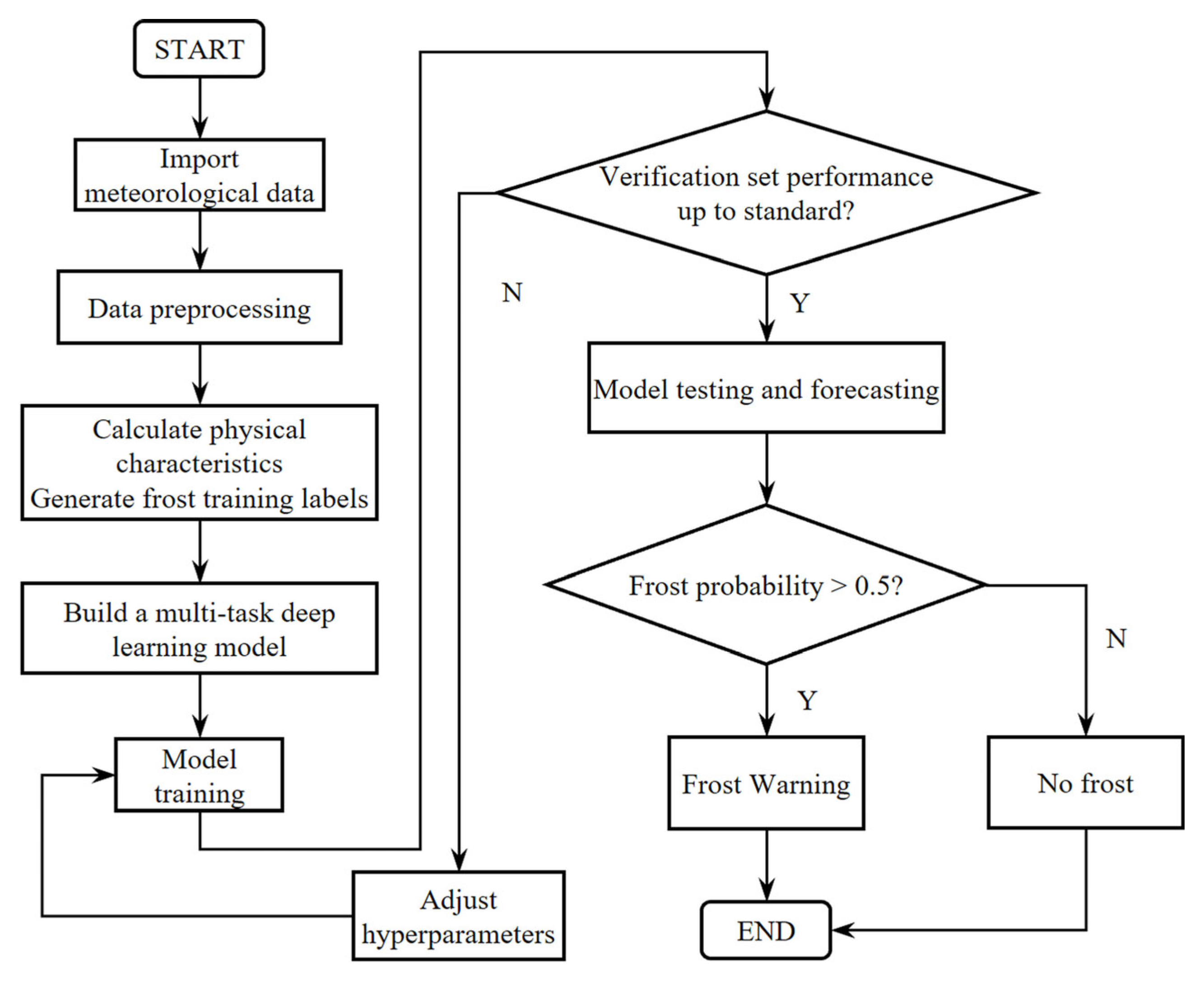
As illustrated in Figure 1, a multi-task deep neural network model was constructed in this research. First, four meteorological factors were processed according to physical principles to derive frost labels. Based on a multi-task prediction model integrating 1D-CNN, BiLSTM, and an attention mechanism, the model output regression predictions for the meteorological factors and classification predictions for frost events were obtained, with the final step involving analysis of the prediction results.

3.2. Frost Prediction Indicators

According to previous studies, ten factors were considered as potential indicators of frost during the Apple Flowering period: Extreme Minimum Air Temperature, TavgTEM, Accumulated Temperature when TminTEM ≤ 0 °C, Extreme Minimum Ground Surface Temperature, WWSavg, Accumulated Precipitation, RH, Accumulated Temperature when TminGST ≤ 0 °C, Maximum Diurnal Temperature Range, and Equilibrium Minimum Ground Surface Temperature [14]. Considering dataset limitations and the characteristics of apple varieties predominantly cultivated in Luochuan, four types of meteorological data, including GST, TEM, WS, and RH, were selected as frost-related meteorological factors. Data from the critical period between November and April of the following year were retained to avoid abrupt noise caused by seasonal transitions. Each independent winter period was normalized separately.
An integrated judgment system based on atmospheric physics principles was employed to generate frost labels. The dew point temperature was defined as the temperature at which air becomes saturated with water vapor under constant pressure and moisture content. As shown in Equations (10)–(12), the classical Magnus Formula was applied to derive an initial value which directly applies an analytical solution to obtain the dew point temperature [15]:
e s = 0.6108 exp ( a T A i r T A i r + b )
e a = R R H 100 e s
T d e w = b ln ( e a 0.6108 ) a ln ( e a 0.6108 )
where es represents the saturation vapor pressure (kPa); ea denotes the actual vapor pressure (kPa); RRH is the current relative humidity (%); TTEM is the current air temperature (°C); Tdew is the dew point temperature (°C); exp refers to the natural exponential function (ex); The parameters a and b are empirical coefficients in the Magnus formula, a reflects the rate of change of vapor pressure with temperature, b captures nonlinear characteristics at low temperatures. Following the classical parameter selection proposed by Murray [16], a = 17.27 and b = 237.3 were selected.
As shown in Equation (13), the Radiative Cooling Potential Formula quantifies the rate at which the surface loses energy through radiation and turbulent exchange. The radiative cooling potential is jointly influenced by Net Radiative Cooling [17] and Turbulent Heat Exchange [18]:
R = ε μ T s 4 - T a 4 - β W WS T s - T a
where R denotes the Radiative Cooling Potential (W/m2); ε is the Surface Emissivity, a dimensionless parameter. Based on the surface albedo of woodland and grassland, in this study, ε = 0.96 was used [19]; μ is the Stefan–Boltzmann Constant, 5.6697 × 10⁻⁸W/(m2·K4); Ts is the surface temperature, calculated as Ts = TGST + 273.15(K); Ta is the air temperature, calculated as Ta = TTEM + 273.15(K); β is the Turbulent Heat Exchange coefficient, a dimensionless parameter. Referencing the flux observations by Choi et al. [20] over various underlying surfaces (including cropland, grassland, and woodland), β = 1.1 was used.
Shi, Y. et al. [21] defined a change as highly significant when alterations in land cover types caused the change in absorbed solar radiation (R) to be >50 W/m2 or <−50 W/m2. So, frost conditions are determined when both the Tdew and TEM are below freezing (Tdew ≤ 0 °C, TTEM ≤ 0 °C; Additionally, when both the GST and Tdew are below freezing, frost is also identified if the radiative cooling potential exceeds a threshold (R ≤ −50 W/m2, TGST ≤ 0 °C, Tdew ≤ 0 °C). Spring frost disasters of Luochuan apples occur approximately once every three years. Restricting frost labels to the limited early spring period would lead to insufficient frost samples. Additionally, winter temperatures in Luochuan vary drastically, which contributes to training a more robust and accurate model and enhances its low-temperature prediction performance. Therefore, our frost labels cover the six-month period from November to April of the following year each year.

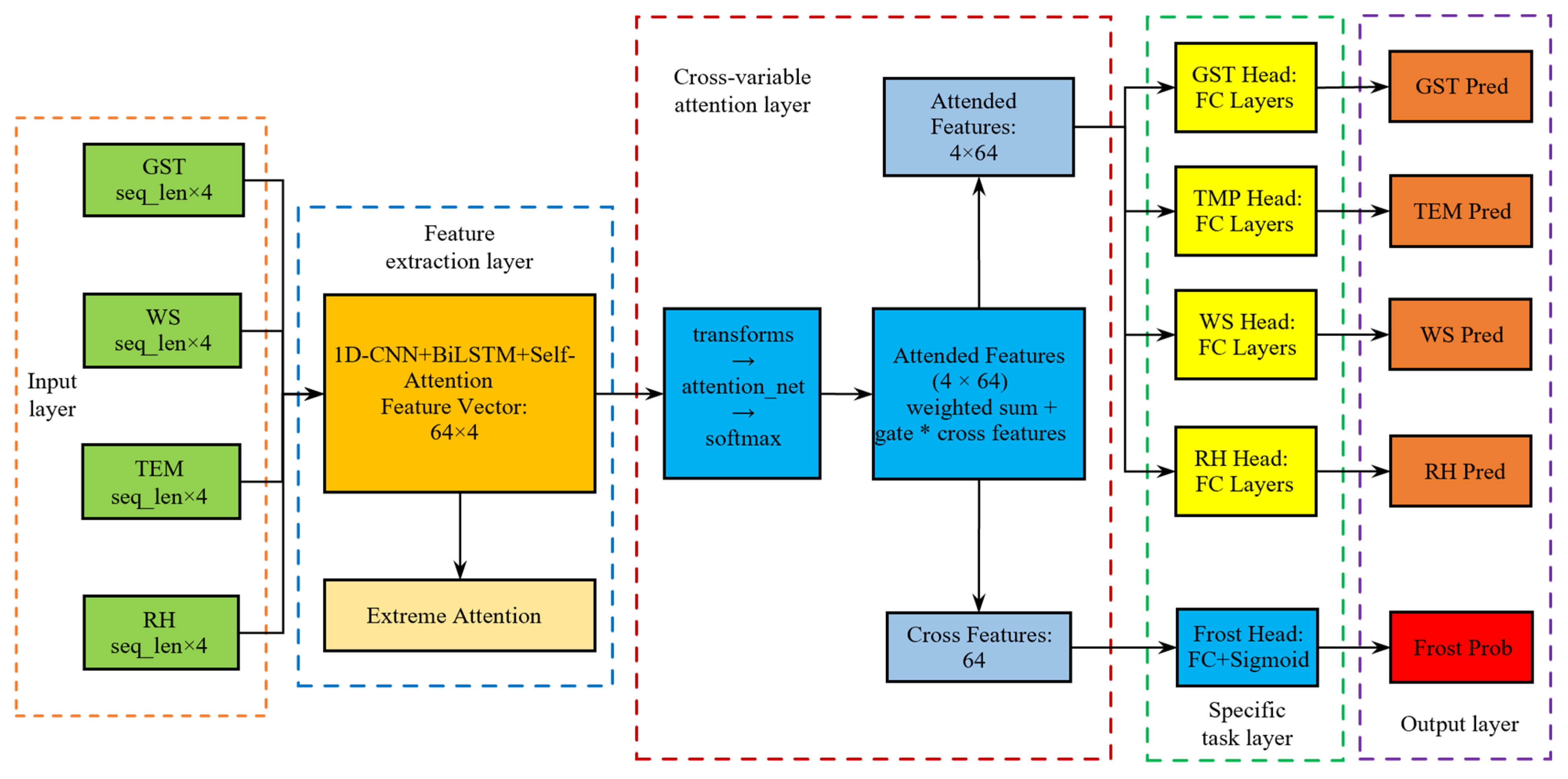
3.3. 1D-CNN-BiLSTM-Attention Frost Prediction Model

The main structure of the deep learning model proposed in this study is shown in Figure 2. The inputs of the model are four time series: GST, TEM, WS, and RH. 1D-CNN is a variant of CNN specifically designed to process 1D sequence data and automatically extract local features and patterns efficiently [22]. The 1D-CNN component was implemented with a two-layer convolutional structure. The first layer employed 16 convolutional kernels of size 5, with zero-padding applied to maintain the dimensionality of the feature maps, thereby capturing the approximately 24 h periodic patterns of meteorological factors. The second layer utilized 32 convolutional kernels of size 3 to extract short-term fluctuation patterns. Each convolutional layer was followed by an Exponential Linear Unit (ELU) as the activation function. The computation of the ELU activation function is shown in Equation (14), which helps avoid the neuron death issue associated with the Rectified Linear Unit (ReLU). A Dropout mechanism was incorporated between the convolutional layers to enhance the model’s generalization capability. A 1 × 1 convolutional layer was used to project the input to the same feature dimension (32 dimensions) as the output of the second layer, enabling element-wise addition and introducing residual connections. This approach strengthens gradient backpropagation and preserves original sequence information:
E L U x = x , x > 0 ξ e x 1 , x 0
where ELU(x) represents the output value of the activation function, where x is the weighted sum plus the bias term from the previous layer. ξ is a constant, for which Clevert et al. [23] proposed a default value. In this study, ξ = 1 was adopted.
The Long Short-Term Memory (LSTM) network is a significant variant of Recurrent Neural Networks (RNN), capable of addressing the vanishing and exploding gradient problems inherent in traditional RNN and effectively learning long-term dependencies [24]. The BiLSTM, an improvement upon LSTM, resolved the issue of unidirectional LSTM’s inability to utilize future context. The input to the BiLSTM was derived from the 32-channel features output by the preceding 1D convolutional layer. The hidden layer employed a single-layer LSTM structure, with both the forward and backward LSTMs utilizing 32 hidden units. The output tensor contained bidirectional hidden states for each time step in the complete sequence, resulting in an output dimension of 64.
In this study, a Self-attention mechanism [25] was incorporated into the BiLSTM output to compute the correlations among Query (Q), Key (K), and Value (V). Specifically, Q = HWQ, K = HWK, V = HWV, where W Q , W K , W V d × d  are learnable linear transformation matrices. Denoting the LSTM output at each time step as H T l × d h (where, Tl is the sequence length and dh is the unidirectional hidden layer dimension; the BiLSTM output dimension is d = 2dh), the Self-attention computation was expressed as Equation (15):
A = soft max   QK T d T l × T l C = A V T l × d C c o n t e x t = C T + H T
where A represents the attention weight matrix, indicating the correlations between time steps; softmax denotes the Softmax normalization function; C is the context representation after weighting; CT and HT are the context representation vector at the final time step, and the BiLSTM output vector at the final time step, respectively; and Ccontext is the final output representation of the Self-attention mechanism.
Attention is a deep learning architecture inspired by human cognitive systems, enabling adaptive focus on key information by dynamically computing the weight distribution of input features [26,27]. In this study, a Cross-variable Attention module was designed for inter-variable information fusion, capturing relationships among different meteorological data sequences [28]. As shown in Equation (16), after feature extraction, the four types of meteorological variables were represented as vectors. Each variable was projected into the same space via linear transformation, and the projected vectors were concatenated. A small convolutional network was used to compute variable weights, and finally, the enhanced representation of each variable was achieved through gated fusion:
f ˜ i = W i f i , i = 1 , 2 , 3 , 4 u = f ˜ 1 ; f ˜ 2 ; f ˜ 3 ; f ˜ 4 4 d z = ReLU W a u + b a , λ = soft max W b z 4 w i = α i f ˜ i , c = Proj   i = 1 4 w i f ^ i = w i + g i c , g i = σ γ i
where fi denotes the feature vector of the i-th meteorological variable; f ˜ i  is the linear projection vector for variable i; Wi is the projection matrix for variable i; u is the concatenated variable feature vector; z is the intermediate representation of the attention network; Wa and ba are the weight and bias of the first layer in the Cross-variable Attention network, respectively; Wb is the weight matrix of the second layer in the Cross-variable Attention network; λ is the attention weight vector for each meteorological variable; wi is the weighted feature vector for variable i; c is the context representation after Cross-variable Aggregation; gi is the gating coefficient for variable i; γi is the gating parameter learned during training; σ is the Sigmoid activation function; ReLU is the ReLU activation function; Proj is the final linear projection layer; and  denotes element-wise multiplication (Hadamard product).
The Extreme Attention module dynamically adjusts the loss weights for meteorological prediction tasks by integrating both statistical flags and learned extreme-event probabilities. In the weighted mean squared error loss function, the weight wi for the i-th sample is determined by Equation (17):
w i = w b a s e 1 + w e x t r e m e 1 e i , m i = 1 w b a s e , m i = 0
where wbase is the base weight, set to 1.0; wextreme is the extreme sample weight amplification factor, set to 5.0; mi ∈ {0,1} is the extreme sample flag (determined by historical window statistics); ei ∈ [0,1] is the extreme prediction weight output by the Extreme Attention module (via Sigmoid activation); wi is used in the weighted mean squared error loss (Equation (16)).
The regression task for predicting each meteorological factor employs a Weighted Mean Squared Error Loss, as shown in Equation (18):
M = 1 n i = 1 n w i y i y ^ i 2
where M represents the Weighted Mean Squared Error Loss value, with the same unit as yi; yi is the actual value; y ^ i  is the predicted value; n is the data length (dimensionless); wi is the weight of the i-th sample (determined jointly by extreme value markers and attention weights).
As shown in Equation (19), the classification task for predicting frost events utilizes the focal loss function:
L = α 1 p t γ ln ( p t )
where L denotes the binary cross-entropy loss value, with the same unit as yi; pt is the predicted probability of sample i belonging to the positive class; Lin et al. [29] found that γ = 2 performs well in practice, and the effective range of α is approximately [0.25, 0.75], α is the class weight, assigning a slightly higher weight to positive samples (frost occurrences). So, in this study, α = 0.75; and γ, the modulating factor, was set to γ = 2.
The loss gradient was backpropagated through the network, from the output layer sequentially through the fully connected, attention, BiLSTM, and convolutional layers. The Adam Optimizer was used to update the weight parameters based on the gradient, and gradient clipping was employed to prevent gradient explosion. The model adopted a multi-task learning framework. Four regression prediction tasks and one binary frost prediction task shared the underlying feature extractor. Each regression task had an independent fully connected prediction head, which consisted of two linear transformation layers, with the ELU activation function and Dropout regularization applied in between. The frost classification branch received the fused features output by the Cross-variable Attention module and calculated the frost probability through a two-layer neural network. The extreme point auxiliary prediction module (Extreme Attention) shared the feature extractor with the frost prediction task and used the same fused features to predict whether each time point was an extreme point. It dynamically adjusted the weight of extreme samples in the regression loss function to improve the model’s ability to predict extreme meteorological events.
All data preprocessing, model training, and evaluation were implemented in Python 3.11 using PyTorch 2.4.1 with CUDA 12.4 support. In this study, the initial learning rate was set to η = 0.01, with 150 epochs and a batch size of 64. The sequence length was 36. Gradient clipping was applied with a maximum norm of 0.8 to prevent gradient explosion. We employed a cosine annealing scheduler to adjust the learning rate, which decays from the initial value to a minimum of 1 × 10⁻⁵ over 150 epochs, following a cosine curve without restarts. The training process did not adopt an explicit early-stopping criterion; instead, the model checkpoint with the lowest validation loss across all epochs was retained as the final model. These hyperparameter values were determined through preliminary experiments and remained fixed across all comparative and ablation studies to ensure fair comparison. To ensure statistical robustness and reliability, the model was run independently three times, each with a different random seed for initialization. The model achieving the minimum loss on the validation dataset was designated as the optimal one.
The dataset used in this study exhibits a moderate class imbalance in frost events (positive class). The proportions of frost events in the training, validation, and test sets are 38.5%, 43.0%, and 40.4%, respectively, yielding an overall positive-class rate of about 39.7% (i.e., a positive-to-negative ratio of approximately 1:1.5). Although the imbalance is not extreme, the cost of missing a frost event (false negative) is considerably higher than that of a false alarm (false positive) in operational frost-warning systems. Therefore, we employed the Focal Loss to increase the focus on the minority class (frost events). By setting the weighting parameter α = 0.75, the model assigns a higher loss weight to frost samples during training, thereby improving the detection of critical meteorological events. The annual positive-class rates presented in Table 2 further illustrate inter-annual variability (range 31.9–50.2%), indicating that the class distribution also varies over time. This temporal variability reinforces the need for an adaptive loss function that can handle shifting class proportions.

3.4. Evaluation Metrics

For the classification task of frost prediction, recall, precision, and the F1 score were selected as evaluation metrics, as shown in Equation (20):
P pre = T P T P + F P R rec = T P T P + F N F 1 = 2 P pre R rec P pre + R rec
where TP (True Positives) refers to the count of truly positive samples that have been accurately classified as positive; FP (False Positives) corresponds to the number of truly negative instances that are yet misclassified as positive; FN (False Negatives) denotes the count of truly positive instances that have been incorrectly categorized as negative; Ppre represents Precision; Rrec denotes Recall; and F1 is the F1 Score.
For the regression prediction of the four meteorological factors, this study employed the Root Mean Squared Error (RMSE) and the Coefficient of Determination (R2) as evaluation metrics, as shown in Equations (21) and (22). A smaller RMSE, and an R2 value closer to 1 indicate more accurate prediction results:
R M S E = 1 n i = 1 n y i y ^ i 2
R 2 = 1 i = 1 n y i y ^ i 2 i = 1 n y i y ¯ i 2
where RMSE represents the RMSE, sharing the same unit as yi; R2 denotes the coefficient of determination, which is dimensionless; and y ¯ i  represents the mean of the actual data, sharing the same unit as yi.

4. Results and Analysis

4.1. Comparison of Different Algorithms and Data Preprocessing Methods

4.1.1. Comparison of Prediction Effects

In this study, 1D-CNN, LSTM, BiLSTM, RNN, DNN, 1D-CNN-LSTM, and 1D-CNN-BiLSTM were selected as baseline models. These were compared with the constructed 1D-CNN-BiLSTM-Attention model under three forecast horizons: 4 h, 8 h, and 12 h. Each configuration was run three times under the same data partitioning, hyperparameters, and random seed, with the average of each metric taken as the final result. Confidence intervals for the key metrics were also computed based on the three independent runs. For the proposed model under the 4 h horizon, the confidence intervals were as follows: GST-RMSE (1.248 °C, 1.472 °C), TEM-RMSE (1.059 °C, 1.245 °C), WS-RMSE (0.538 m/s, 0.629 m/s), RH-RMSE (6.585%, 7.691%), and F1-score (0.969, 0.973). These intervals further confirm the statistical reliability of the reported performance and support a fair comparison across models.
As shown in Table 4, the proposed 1D-CNN-BiLSTM-Attention framework outperformed the baseline models across key evaluation metrics, demonstrating robust predictive performance. Taking the 4 h forecast horizon as example, the 1D-CNN-BiLSTM-Attention model achieved the lowest RMSE (RMSE of 1.3602 °C for GST and 1.1521 °C for TEM) and the maximum coefficient of determination (R2 of 0.9836 for GST and 0.9783 for TEM). Compared to the second-best performing model, 1D-CNN-BiLSTM, the RMSE for GST was reduced by approximately 8.0%, and for TEM by approximately 10.9%, which suggested an advantage of the proposed framework in capturing and modeling the subtle characteristics of temperature fluctuations. For WS and RH predictions, the 1D-CNN-BiLSTM model achieved the lowest RMSE for WS (0.5506 ± 0.0213 m/s), while the 1D-CNN-LSTM model achieved the lowest RMSE for RH (6.7829 ± 0.2651%). The proposed model’s RMSE for these variables (0.5836 ± 0.0227 m/s for WS and 7.1380 ± 0.2798% for RH) is slightly higher than the best-performing models for these variables, indicating that the attention mechanisms provide a more pronounced benefit for temperature-related variables (GST, TEM) than for wind and humidity in this dataset. This may be because WS and RH exhibit more stochastic, high-frequency fluctuations that are less structured by the long-term dependencies captured by BiLSTM and attention. In the frost classification task, the proposed model achieved Recall, Precision, and F1-scores of 0.9727 ± 0.0024, 0.9696 ± 0.0026, and 0.9712 ± 0.0022, respectively. Although the absolute improvements over the second-best BiLSTM model (0.66% in Recall, 0.29% in Precision, and 0.48% in F1) appear modest, they are consistent across three independent runs and reflect a stable enhancement in classification consistency, which is operationally meaningful for frost-warning systems where false negatives carry high economic cost. Therefore, the 1D-CNN-BiLSTM-Attention model exhibited stronger positive sample identification capability and classification consistency, outperforming other baseline models.
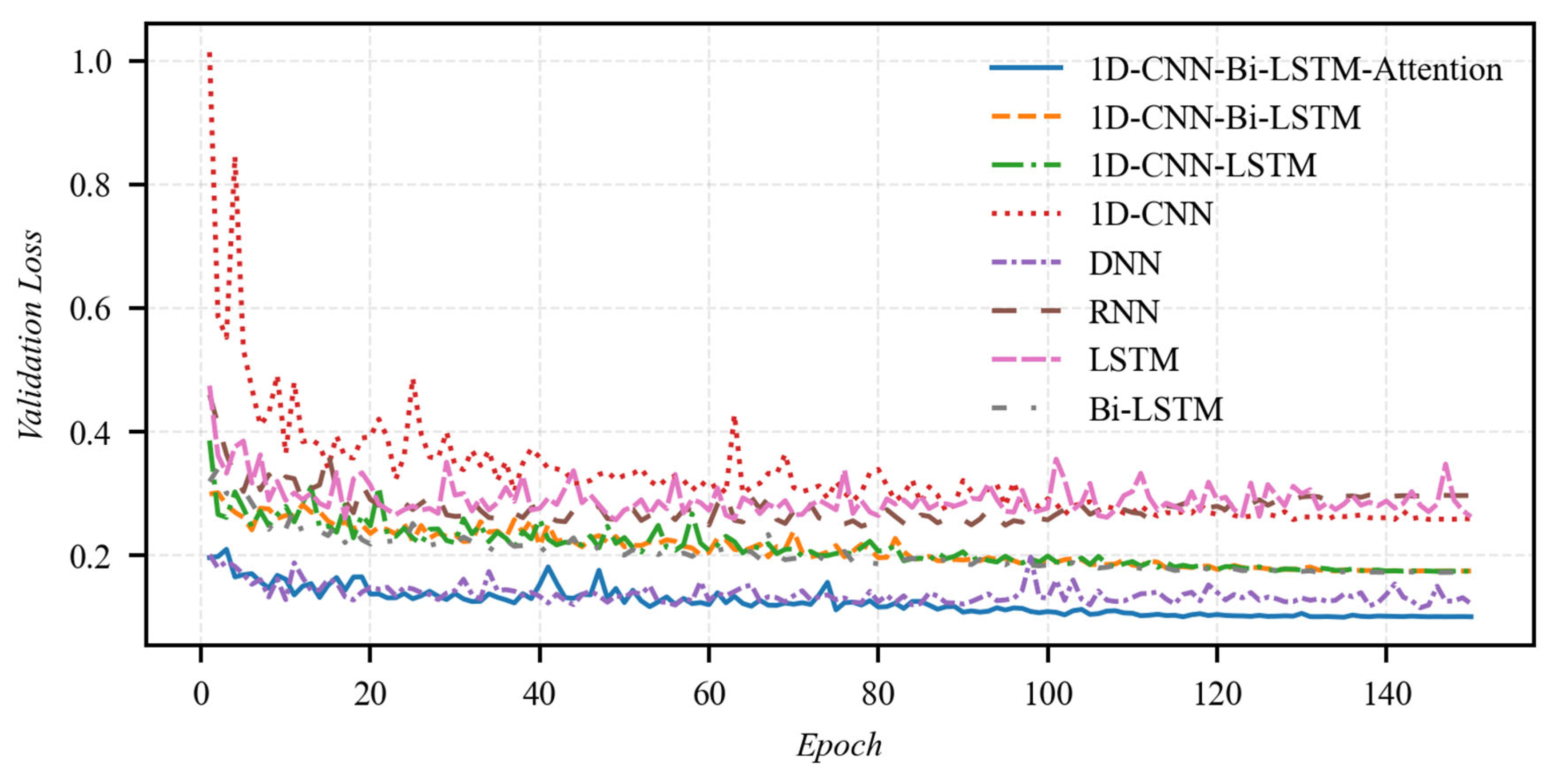
Figure 3 shows the validation loss during training. The loss of the 1D-CNN-BiLSTM-Attention model remained consistently lower than other baselines and converged before 150 epochs, indicating good fitting capability and stability. Baseline models such as 1D-CNN, LSTM, and RNN exhibit higher loss values and slower convergence, with considerable fluctuation especially in the early stages of training, suggesting their limited ability to model complex temporal dependencies in meteorological sequences. While BiLSTM and its hybrid variants combined with CNN (e.g., 1D-CNN-BiLSTM) show some performance improvement, these baseline models fail to attain the same level of performance as the presented framework. This underscores the effectiveness of incorporating the attention mechanism in capturing key meteorological features. The loss curves further demonstrated distinct optimization behaviors: the proposed architecture achieved a smoother descent with fewer oscillations, whereas models like 1D-CNN and RNN displayed persistent instability and slower convergence rates. This contrast emphasized the role of attention in stabilizing training and enhancing generalization, particularly under complex meteorological patterns.

4.1.2. Ablation Experiment

To verify the efficacy of the Self-attention and Cross-variable Attention mechanisms integrated into the proposed framework, four ablation experiments were designed for comparative testing: (1) the complete base model incorporating both attention mechanisms; (2) removal of only the Cross-variable Attention mechanism (no cross); (3) removal of only the Self-attention mechanism (no sel_attn); and (4) removal of both attention mechanisms (no attention). Each configuration was run three times under identical data splits, hyperparameters, and random seeds, with a prediction horizon of 4 h, to ensure result reliability and statistical significance. Mean values and standard deviations of each evaluation metric over the test dataset were presented.
The model without attention mechanisms (no attention) exhibited inferior performance across all tasks (Table 5). For GST and TEM prediction, the base model achieved GST-RMSE and TEM-RMSE values of 1.3641 °C and 1.1626 °C, respectively, significantly outperforming the no cross and no attention variants and performing similarly to no sel_attn. Compared to the no attention model, the base model reduced the prediction error for GST and TEM by approximately 6.5% and 8.6%, respectively. In the frost classification task, the base model achieved an F1-score of 0.9698, superior to all other variants. Compared to no attention, the F1-score improved by approximately 1.6%, and the Recall value matched the highest value achieved by no sel_attn.
To assess the statistical significance of the observed differences, a paired t-test was performed on the F1-scores and the RMSE values for GST and TEM across the three independent runs. A smaller p-value indicates stronger evidence against the null hypothesis. In most scientific research, a threshold of p < 0.05 is conventionally used to declare statistical significance, meaning there is less than a 5% probability that the observed difference is due to random variation [30]. The base model achieved the best overall performance. Compared to the no attention model, it reduced the GST-RMSE by approximately 6.5% (p = 0.018) and the TEM-RMSE by approximately 8.6% (p = 0.011). In the frost classification task, the base model’s F1-score (0.9698) was significantly higher than that of the no attention model (0.9546, p = 0.007). While the absolute performance gains are modest, the statistical significance confirms that the dual attention mechanism provides a consistent and measurable improvement. It should be noted that this enhancement comes with increased computational complexity due to the additional attention layers. Therefore, the model employing both attention mechanisms offers the balance for frost prediction, albeit with a higher computational cost compared to the ablated variants.

4.1.3. Sensitivity Analysis to Interpolation Noise

To assess the model’s robustness to the ±5% random noise introduced during RH data interpolation (Equation (3)), a sensitivity analysis was performed. The trained 1D-CNN-BiLSTM-Attention model was evaluated on test sets where the RH sequence was perturbed with four different noise levels: 0%, ±2.5%, ±5% (standard), and ±7.5%. The key performance metrics are shown in Table 6.
As shown in Table 6, model performance remained stable across all noise levels. The F1-score for frost classification fluctuated by only about 0.04% (ranging from 0.9708 to 0.9712), while RMSE values for all four meteorological factors varied minimally. Even under the heightened ±7.5% noise condition, no significant degradation occurred—the F1-score only decreased marginally from 0.9712 to 0.9708. This demonstrates the model’s strong robustness to random perturbations, attributable to the feature-extraction capability of the 1D-CNN and the noise-filtering effect of the attention mechanisms.

4.1.4. Sensitivity Analysis on Data Imputation

To address the potential concern that our data imputation strategy (using adjacent and monthly means) might overly smooth extreme values and affect frost prediction, we conducted a sensitivity analysis. We reprocessed the dataset by applying two alternative methods to the identified outliers (<0.9% of data): (a) linear temporal interpolation, and (b) forward-filling with the last valid observation. The proposed 1D-CNN-BiLSTM-Attention model was then retrained and evaluated on these alternatively processed datasets.
As shown in Table 7, the model’s performance on frost classification and temperature prediction remained stable across all three imputation methods. The minor variations in key metrics—for instance, the F1-score ranged from 0.9664 to 0.9712 (Table 7)—are negligible and do not alter the study’s conclusions. This demonstrates that the model’s ability to capture frost-precursor patterns is robust in the specific handling of the very few data points requiring imputation, alleviating concerns about systematic bias introduced by our chosen method.

4.2. Frost Prediction Results

4.2.1. Analysis of the Prediction Effect of Each Meteorological Factor

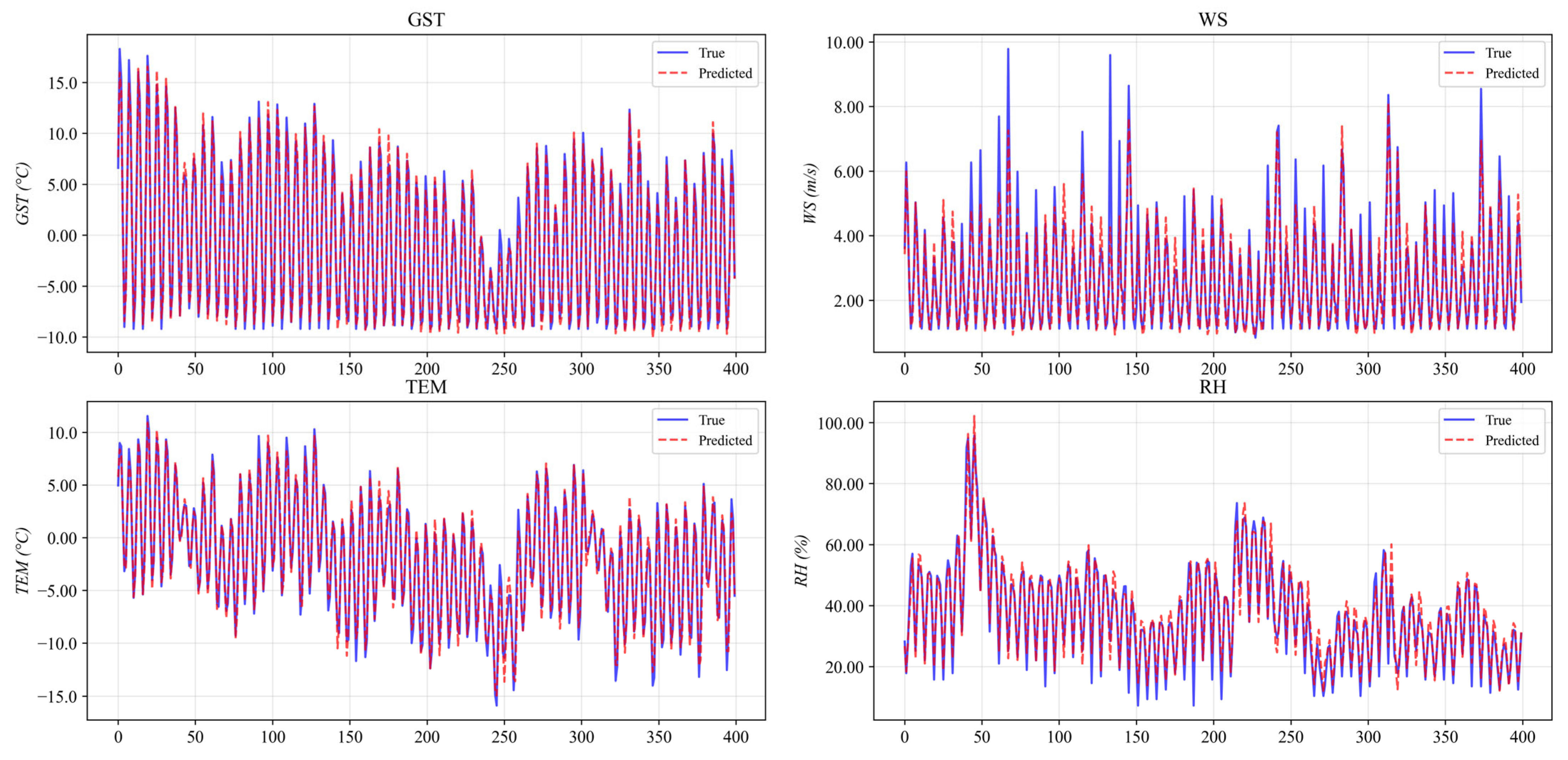
Figure 4 presents the test set prediction results of the proposed model for the four meteorological factors (GST, TEM, WS, and RH) under the 4 h prediction horizon. Overall, the predicted curves for each factor align closely with the ground truth curves. The model performed exceptionally well on temperature variables (GST, TEM), exhibiting minor prediction errors, which indicated a strong capability to capture detailed temperature variations. For WS and RH predictions, the model showed slight deviations at certain abrupt change points but still tracked the overall trends effectively. This demonstrated the model’s adaptability and robustness to non-stationary meteorological sequences. Of particular note is that during frost-susceptible periods marked by low wind speeds and elevated humidity, the prediction accuracy for meteorological data remains high without significant degradation. The model exhibited robust performance in capturing diurnal temperature cycles, with minimal deviations during nocturnal cooling phases. For wind speed and relative humidity, although minor inaccuracies occurred at peaks and troughs, the overall trajectory was faithfully reproduced. This consistency underscored the model’s efficacy in handling real-world meteorological variability, particularly under frost-conducive conditions. The practical utility of this method for operational frost forecasting was confirmed by its reliable predictions under various weather conditions.

4.2.2. Historical Frost Event Prediction and Model Validation

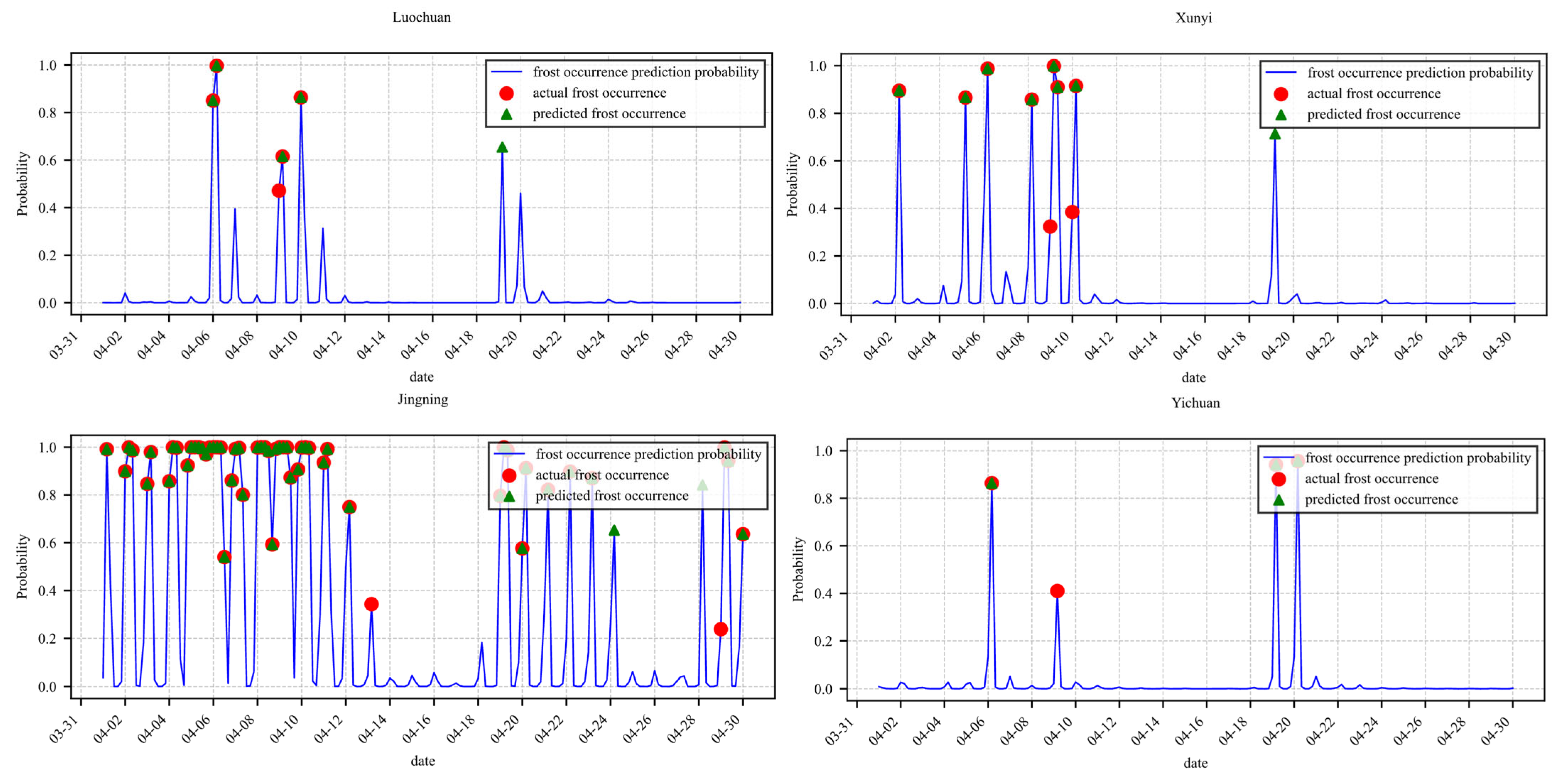
Using historical meteorological data from Luochuan, Shaanxi Province, as the training and validation sets, a frost prediction model was constructed. With a prediction horizon of 4 h and a frost occurrence threshold set at a predicted probability of 0.5, the model’s generalization capability was tested in Jingning (No. 53910), Gansu Province; Xunyi (No. 53738), Shaanxi Province; and Yichuan (No. 53859), Shaanxi Province. (The numbers in parentheses are the respective station identification codes). These regions experienced actual frost damage in April 2013, providing ideal data for validating the model [31]. The selected test regions (Jingning, Xunyi, Yichuan) share fundamental agro-climatic and topographic similarities with Luochuan, supporting the cross-regional validation. All four counties are situated in the core area of the Loess Plateau in Northwest China. This region is characterized by a continental monsoon climate with cold, dry winters and early springs prone to radiative frosts. Topographically, the areas feature similar elevated plateau landscapes (average elevations ranging ~1100–1200 m) dominated by loess hills and gullies. As major apple-producing areas, they have comparable phenological calendars, with the critical flowering stage (BBCH 65) typically occurring in early to mid-April. The frost event definition applied in this study is derived from physical principles and is region-agnostic, ensuring consistency in label generation across all stations. This environmental and methodological consistency provides a reasonable foundation for assessing model transferability.
Across the tested counties, the model achieved an average classification accuracy above 92% for frost-event detection, based on a 4 h forecast horizon for four counties in April 2013. This accuracy represents the ratio of successfully predicted frost events to actual frost occurrences. Luochuan, serving as the baseline for model training, directly reflected the model’s fundamental learning capability. In April 2013, Luochuan experienced eight frost events, concentrated on April 6, 9, and 10, with the model achieving a Recall of 0.938. Xunyi experienced fewer frost events (six in total), and the model achieved a slightly lower Recall of 0.917 compared to Luochuan and Jingning. Jingning achieved a Precision of 0.941 and a Recall of 0.895, indicating the model’s effectiveness in capturing most frost events. The model’s performance in Yichuan was slightly lower, with an F1 Score of 0.885. In summary, the 1D-CNN-BiLSTM-Attention model trained on data from Luochuan could be effectively transferred to major apple-producing regions such as Jingning, Xunyi, and Yichuan, maintaining high prediction accuracy across different regions and demonstrating hopeful generalization capability.

5. Discussion

The hybrid 1D-CNN-BiLSTM-Attention model demonstrated clear advantages for short-term frost prediction during the Apple Flowering period in Luochuan.
To address the low temporal resolution of the original data, physics-informed piecewise interpolation and Savitzky–Golay filtering were applied to obtain a 4 h resolution series. As shown in Table 4, the proposed model achieved the lowest RMSE and highest R2 for temperature variables (GST, TEM) under the 4 h horizon, reflecting its ability to capture thermal dynamics essential for frost formation. Compared with the 1D-CNN-BiLSTM model, the RMSE reductions for GST (~8.0%) and TEM (~10.9%) underscore the contribution of the attention mechanisms to feature refinement. These results compare favorably with prior frost or minimum temperature prediction studies in similar agricultural contexts. For instance, Carl et al. [4] reported 6 h RMSEs ranging from 1.53 °C to 1.72 °C for minimum temperature prediction using a DNN. Our model’s TEM-RMSE of 1.1521 °C at a 4 h horizon suggests an improvement in predictive precision, though direct comparison is nuanced due to differences in location, data resolution, and lead time.
Ablation experiments (Table 4) highlight the contribution of the attention mechanisms. The complete model achieved the best performance across tasks. When both attention modules were removed, the F1-score for frost classification decreased from 0.9698 to 0.9546, while the RMSE for GST and TEM increased from 1.3641 °C and 1.1626 °C to 1.4588 °C and 1.2722 °C, respectively. These results suggest that the attention mechanisms help the model to better focus on relevant time steps and inter-variable relationships, thereby supporting more dynamic feature weighting and improving discrimination of frost-precursor patterns. The model also showed cross-regional generalization capability in historical frost event prediction. As illustrated in Figure 5, the model trained on Luochuan data achieved an average accuracy exceeding 92% in predicting the 2013 flowering period frost events in Jingning, Xunyi, and Yichuan. Specifically, it achieved a Precision of 0.941 and a Recall of 0.895 in Jingning County, and a Recall of 0.917 in Xunyi County. The model’s performance on the 2013 data from Jingning, Xunyi, and Yichuan provides preliminary evidence of its transferability to other regions with similar agro-climatic conditions, suggesting potential for agricultural meteorological early warning.
Operationally, an F1-score of 0.9727 is promising. However, in a scenario with, for example, 100 actual frost events, this still implies approximately three missed events (false negatives) and three false alarms. Given the high economic cost of a single missed frost, continuous model refinement is warranted. Nonetheless, the achieved precision suggests that mitigation actions triggered by the model would be justified most of the time, providing a potentially reliable basis for decision-support. To facilitate an operational interpretation of the classification results in Luochuan, the event-based performance was further examined using the time-stamped test predictions in the flowering period (April), with a frost probability threshold of 0.5. In the representative frost year of 2013, five observed frost events were recorded. The model missed one event and produced one false alarm during the season. In subsequent years with fewer or no frost occurrences, the number of false alarms remained limited (0–1 per season), and missed events did not exceed one per year when frost occurred. These results indicate that at the seasonal scale relevant for orchard management, the model errors translate into a small number of missed frost events and infrequent false warnings, which is more informative for practical decision-making than aggregate accuracy metrics alone.
Despite the relatively complex architecture of the proposed 1D-CNN-BiLSTM-Attention model, several measures were implemented to mitigate overfitting and ensure robust parameterization. The model incorporates Dropout regularization between convolutional layers and employs gradient clipping during training to stabilize optimization. Furthermore, the use of a separate validation set for model selection and the adoption of a cosine annealing learning rate scheduler help prevent overfitting to the training data. Although the dataset originates from a single meteorological station, these regularization techniques, combined with the model’s consistent performance on the independent test set and in cross-regional validation, suggest that overfitting is effectively controlled. Future work involving multi-station or higher-resolution data would further solidify the model’s generalizability.
Despite the model’s strong performance in multiple aspects, the following limitations remain:
(1) For the 4 h horizon, the proposed model’s RMSE for WS and RH is slightly higher than that of some baseline models (Table 4). This suggests the dual-attention mechanism, while highly effective for temperature variables, offers a smaller relative advantage for wind speed and humidity, which may exhibit more irregular, short-term variations. Incorporating additional predictors (e.g., cloud cover, solar radiation) or designing variable-specific attention heads could further improve WS and RH forecasts in future work.
(2) The model’s complexity may raise the question of overfitting, particularly given the effective sample size defined by 20 years of seasonal data. The consistent performance on the independent test set and across ablation studies (Table 4) provides reassurance against severe overfitting. However, the slight performance drop for WS and RH compared to simpler models (Table 4) could hint at the model allocating excessive capacity to temperature-related features. Future work should employ stricter regularization and consider dataset expansion to further solidify generalizability.
(3) The model’s transferability is constrained by several factors. First, it is calibrated on regional-scale station data and cannot account for microclimatic variability within orchards caused by local topography or management practices. Second, predictions are representative of regional conditions rather than specific field sites. Finally, while the frost definition is physically based, it may not fully capture cultivar-specific damage thresholds. Transfer to regions with divergent climates or complex terrain would likely require model adjustment or additional localized features.
(4) The model’s performance is reported using standard statistical metrics. While these indicate predictive accuracy, they do not directly translate into economic impact or operational utility for orchard managers. A formal decision analysis linking prediction probabilities to mitigation actions is lacking. The choice of a 0.5 probability threshold is conventional but not derived from a cost-benefit optimization. Future work should incorporate economic loss functions to calibrate prediction thresholds and evaluate the model’s value in reducing net economic risk.
(5) It should be noted that the predictive model presented in this study was developed and validated using data from a single meteorological station in Luochuan, sourced from the National Meteorological Information Center of China. Consequently, the current framework provides frost forecasts representative of regional-scale climatic conditions rather than site-specific microclimatic variations within individual orchards. Despite this limitation, the proposed methodology may serve as a foundational and transferable framework. The model’s demonstrated capability to capture key precursor signals of frost events suggests its potential for broader application. Future efforts could adapt this approach by incorporating high-density, orchard-level sensor networks to account for microclimatic heterogeneity, thereby enhancing the spatial precision of frost warnings for practical management.

6. Conclusions

A hybrid neural network model based on 1D-CNN-BiLSTM-Attention was constructed for the short-term prediction of frost during the Apple Flowering period in Luochuan, Shaanxi. The multi-task architecture incorporating dual attention mechanisms demonstrated promising performance for 4 h frost forecasting. While the attention modules enhanced dynamic feature weighting at the expense of increased computational cost—a trade-off for resource-aware deployment—the framework shows operational potential by reliably capturing frost-precursor signals. By capturing key precursors like abrupt temperature drops and humidity surges, the model provides a promising decision-support framework for frost risk management. Preliminary cross-regional tests within climatically similar areas showed an average accuracy exceeding 92%, indicating promising transferability under consistent agroclimatic conditions and frost definitions. This potential, however, requires validation over multiple years and across a wider network of locations with diverse microclimates before large-scale operational deployment.
Future work will focus on incorporating higher-temporal-resolution observations (e.g., hourly or sub-hourly) and additional environmental predictors such as Cloud Cover and Solar Radiation to reduce interpolation-induced uncertainty and improve WS and RH forecasts. We will also investigate adversarial training and extreme-value weighting strategies to enhance model sensitivity to rare, rapid-cooling events and evaluate real-time deployment and transferability across multiple apple-growing regions.

Author Contributions

Conceptualization, C.Y. and H.S.; methodology, C.Y.; software, C.Y.; validation, C.Y.; formal analysis, C.Y.; investigation, C.Y.; resources, C.Y.; data curation, C.Y.; writing—original draft preparation, C.Y.; writing—review and editing, C.Y. and H.S.; visualization, C.Y.; supervision, H.S.; project administration, H.S.; funding acquisition, H.S. All authors have read and agreed to the published version of the manuscript.

Funding

This research was funded by the National Natural Science Foundation of China (No. 32472964), the Shaanxi Province Agricultural Key Core Technology Project (No. 2024NYGG005), and the Shaanxi Province Key R&D Program (No. 2024NC-ZDCYL-05-12).

Data Availability Statement

The data presented in this study are available on request from the corresponding author. The data are not publicly available due to restrictions on privacy.

Acknowledgments

The authors appreciate the funding organization for their financial support. The authors are also grateful for the helpful comments and suggestions provided by all the authors cited in this article and the anonymous reviewers.

Conflicts of Interest

The authors declare no conflicts of interest.

References

  1. Wang, R.H.; Ru, X.Y.; Jiang, T.C.; Wang, J.H.; Wang, Z.; Su, B.F.; Zhang, D.; Yu, Q.; Feng, H.; He, J.Q. Based on the phenological model to study the possible changes of apple flowering dates under future climate scenarios in Shaanxi province. Chin. J. Agrometeorol. 2021, 42, 729–745. [Google Scholar] [CrossRef]
  2. Lee, H.; Choi, J.A.; Hee, H.H.; Sung, K. Prediction of frost occurrences using statistical modeling approaches. Adv. Meteorol. 2016, 2016, 2075186. [Google Scholar] [CrossRef]
  3. Tárraga, J.P.; Castillo Cara, M.; Arias Antúnez, E.; Dujovne, D. Frost Forecasting Through Machine Learning Algorithms. Earth Sci. Inform. 2025, 18, 183–199. [Google Scholar] [CrossRef]
  4. Carl, J.T.; Kurt, C.S.; Maruti, K.M.; Crawford, B.; Michelle, R.P. Frost prediction using machine learning and deep neural network models. Front. Artif. Intell. 2023, 5, 963781. [Google Scholar] [CrossRef]
  5. Kim, H.; Kim, M.J.; Kim, S. Frost forecasting considering geographical characteristics. Acta Meteorol. Sin. 2022, 2022, 1127628. [Google Scholar] [CrossRef]
  6. Zhang, X.F.; Zheng, Y.F.; Wang, C.Y.; Chen, H.L.; Ren, Z.H.; Zou, C.H. Spatial-temporal distribution and multiple-temporal scale variation analyses of winter wheat late freezing injury. Acta. Meteorol. Sinica. 2009, 67, 321–330. [Google Scholar] [CrossRef]
  7. Wang, P.J.; Ma, Y.P.; Tan, J.X.; Wang, D.R.; Chen, H.; Jiang, Z.F.; Huo, Z.G. Spring frost damage to tea plants can be identified with daily minimum air temperatures estimated by MODIS land surface temperature products. Remote Sens. 2021, 13, 1177. [Google Scholar] [CrossRef]
  8. Ru, X.; Zhou, J.; Gong, K.; He, Z.; Dai, Z.; Li, M.; Feng, X.; Yu, Q.; Feng, H.; He, J. Climate warming may accelerate apple phenology but lead to divergent dynamics in late-spring frost and poor pollination risks in main apple production regions of China. Eur. J. Agron. 2023, 150, 126945. [Google Scholar] [CrossRef]
  9. GB/T 35221-2017; National Technical Committee 507 on Meteorological Instruments and Methods of Observation of Standardization Administration of China (SAC/TC507). Specifications for Surface Meteorological Observation—General. Standards Press of China: Beijing, China, 2017.
  10. Wan, Y.X.; Wang, W.; Ji, Z.P.; Xie, H.X. Research on pellet image denoising based on local statistics. Dian Zi Zhi Zuo 2025, 33, 22–27. [Google Scholar] [CrossRef]
  11. Zhang, Y.; Huang, Y.H.; Li, Z.H.; Cui, T.S.; Wang, Z.G. Parameter estimation algorithm for time-frequency difference using Savitzky-Golay filtering and cross-ambiguity function. J. Syst. Eng. Electron. 2025, 47, 1395–1403. [Google Scholar] [CrossRef]
  12. Li, H.Y.; Li, K.; Yang, Z. Retrieval of rice phenological stages based on time-series full-polarization synthetic aperture radar data. J. Zhejiang Univ. (Agric. Life Sci. Ed.) 2021, 47, 404–414. [Google Scholar] [CrossRef]
  13. Kiebel, S.J.; Poline, J.-B.; Friston, K.J.; Holmes, A.P.; Worsley, K.J. Robust smoothness estimation in statistical parametric maps using standardized residuals from the general linear model. NeuroImage 1999, 10, 756–766. [Google Scholar] [CrossRef]
  14. Li, S.J. Meteorological indicators and risk assessment of frost damage during the apple flowering period. Seed Sci. Technol. 2018, 36, 108–111. [Google Scholar] [CrossRef]
  15. Sha, Y.Z.; Yang, Z.B.; Ma, S.Q.; Chen, Y.Q.; Wang, J.Y.; Tu, M.H.; Mao, C.Z. QX/T 50-2007; Specifications for Surface Meteorological Observation—Air Temperature and Humidity. Sectoral Standard of the People’s Republic of China: Meteorology; Standards Press of China: Beijing, China, 2007.
  16. Murray, F.W. On the computation of saturation vapor pressure. J. Appl. Meteorol. (1962) 1967, 6, 203–204. [Google Scholar] [CrossRef]
  17. Cheng, Q.W.; Wang, J.J.; Wu, B.S.; Wu, Z.X.; Ye, H.C.; Yang, C.; Wang, Z.X.; Cai, F.Z.; Yang, J. Evapotranspiration from Rubber Plantations in Hainan Based on the SEBS Model. Chin. J. Trop. Crop. 2025, 46, 1774–1784. [Google Scholar] [CrossRef]
  18. Sun, X.; Wu, R. Seasonality and time scale dependence of the relationship between turbulent surface heat flux and SST. Clim. Dyn. 2021, 56, 3173–3186. [Google Scholar] [CrossRef]
  19. Meng, X.C.; Li, H.; Du, Y.M.; Cao, B.; Liu, Q.H.; Sun, L.; Zhu, J.S. Estimating land surface emissivity from ASTER GED products. Nat. Remote Sens. Bull. 2016, 20, 382–396. [Google Scholar] [CrossRef]
  20. Choi, T.J.; Hong, J.K.; Kim, J.; Lee, H.C.; Asanuma, J.; Ishikawa, H.; Tsukamoto, O.; Gao, Z.Q.; Ma, Y.M.; Ueno, K.; et al. Turbulent exchange of heat, water vapor, and momentum over a Tibetan prairie by eddy covariance and flux variance measurements—Art. no. D21106. J. Geophys. Res. Atmos. 2004, 109, 12. [Google Scholar] [CrossRef]
  21. Shi, Y.; Bie, Q.; Su, X.J.; Li, X.Z. Impacts of Changes in Land Cover on Solar Radiation Absorption in Northwestern China. Remote Sens. Nat. Resour. 2024, 36, 260–271. [Google Scholar] [CrossRef]
  22. LeCun, Y.; Boser, B.; Denker, J.S.; Henderson, D.; Howard, R.E.; Hubbard, W.; Jackel, L.D. Backpropagation applied to handwritten zip code recognition. Neural Comput. 1989, 1, 541–551. [Google Scholar] [CrossRef]
  23. Clevert, D.; Unterthiner, T.; Hochreiter, S. Fast and accurate deep network learning by exponential linear units (ELUs). arXiv 2016, arXiv:1511.07289. [Google Scholar] [CrossRef]
  24. Fjellstrom, C. Long Short-Term Memory Neural Network for Financial Time Series. In Proceedings of the 2022 IEEE International Conference on Big Data, Big Data 2022, Osaka, Japan, 17–20 December 2022; Institute of Electrical and Electronics Engineers Inc.: Osaka, Japan, 2022; pp. 3496–3504. [Google Scholar] [CrossRef]
  25. Zeng, Q.X.; Xiong, W.P.; Du, J.Q.; Nie, B.; Guo, R.C. Electronic medical record named entity recognition combined with Self-Attention BiLSTM-CRF. Comput. Appl. Softw. 2021, 38, 159–162, 234. [Google Scholar] [CrossRef]
  26. Tsotsos, J.K.; Culhane, S.M.; Wai, W.Y.K.; Lai, Y.; Davis, N.; Nuflo, F. Modeling visual attention via selective tuning. Artif. Intell. 1995, 78, 507–545. [Google Scholar] [CrossRef]
  27. Huang, L.S.; Luo, Y.W.; Yang, X.D.; Yang, G.J.; Wang, D.Y. Crop disease recognition based on attention mechanism and multi-scale residual network. Trans. Chin. Soc. Agric. 2021, 52, 264–271. [Google Scholar]
  28. Liu, J.W.; Liu, J.W.; Luo, X.L. Research progress in attention mechanism in deep learning. Chin. J. Eng. 2021, 43, 1499–1511. [Google Scholar] [CrossRef]
  29. Lin, T.; Goyal, P.; Girshick, R.; He, K.; Dollar, P. Focal loss for dense object detection. IEEE Trans. Pattern Anal. Mach. Intell. 2020, 42, 318–327. [Google Scholar] [CrossRef] [PubMed]
  30. Rainio, O.; Teuho, J.; Klén, R. Evaluation metrics and statistical tests for machine learning. Sci. Rep. 2024, 14, 6086. [Google Scholar] [CrossRef] [PubMed]
  31. China Apple Industry Technology System. Frost Damage During Apple Bloom: Investigation and Emergency Management in Orchards of Shaanxi and Gansu; China Apple Industry Technology System: Beijing, China, 2013. [Google Scholar]
Figure 1. Overall technology roadmap.
Horticulturae 12 00047 g001
Figure 2. Model structure diagram. (Arrows indicate the forward flow of data and intermediate feature representations between network components. The asterisk (*) denotes element-wise multiplication, used for gated fusion of cross-variable features with attended features. Dashed boxes/lines group modules by functional stage (input layer, feature extraction, cross-variable attention, task-specific heads, and output layer), highlighting the hierarchical organization of the model rather than individual operations).
Horticulturae 12 00047 g002
Figure 3. Comparison of validation set loss values among different models.
Horticulturae 12 00047 g003
Figure 4. Prediction of each meteorological factor test set (4 h prediction duration).
Horticulturae 12 00047 g004
Figure 5. Prediction results of historical frost events in 2013.
Horticulturae 12 00047 g005
Table 1. Scope and method of filtering physical thresholds.
Data TypeEffective RangeUnitApproach
WS[0,50]m·s−1Overrun → NaN
TEM & GST[−50, 50]°COverrun → NaN
RH[0,100]%Overrun → NaN
Table 2. Smoothness of the data in different preprocessing methods.
Pretreatment MethodRoot of Mean Square of the First-Order Difference
GSTTEMWSRH
Linear Interpolation1.63530.80220.33723.6051
Lagrange Interpolation1.45820.75030.22922.9726
Median Filtering1.03620.59450.33983.9100
Mean Filtering0.63630.49230.25853.5809
Piecewise Interpolation-Savitzky–Golay Filtering1.89130.90210.33973.6137
Table 3. NRAM values of meteorological variables under different preprocessing methods.
Pretreatment MethodNRAM
GSTTEMWSRH
Linear Interpolation0.08540.03710.02350.0725
Lagrange Interpolation0.09550.04580.03820.0437
Median Filtering0.08940.02780.06940.0645
Mean Filtering0.03170.01580.25850.0638
Piecewise Interpolation-Savitzky–Golay Filtering0.09750.04580.08170.0831
Table 4. Comparison of prediction results.
Time
/h
ModelsGSTTEMWSRHRecallPrecisionF1
RMSE
/(°C)
R2RMSE
/(°C)
R2RMSE
/(m·s−1)
R2RMSE
/(%)
R2
41D-CNN1.8353
±0.0714
0.9701
±0.0012
1.4994
±0.0582
0.9632
±0.0015
0.6719
±0.0241
0.8367
±0.0035
8.7704
±0.3215
0.8516
±0.0041
0.9372
±0.0038
0.9281
±0.0042
0.9326
±0.0035
LSTM1.6698
±0.0653
0.9753
±0.0010
1.3836
±0.0538
0.9687
±0.0013
0.7192
±0.0265
0.8116
±0.0038
8.8966
±0.3341
0.8474
±0.0043
0.9661
±0.0028
0.9571
±0.0031
0.9615
±0.0025
BiLSTM1.4955
±0.0612
0.9801
±0.0008
1.2948
±0.0519
0.9726
±0.0011
0.5701
±0.0221
0.8824
±0.0030
7.3551
±0.2884
0.8957
±0.0036
0.9663
±0.0025
0.9668
±0.0027
0.9666
±0.0023
RNN1.5719
±0.0630
0.9781
±0.0009
1.3943
±0.0553
0.9682
±0.0012
0.6627
±0.0257
0.8410
±0.0036
8.0467
±0.3152
0.8751
±0.0040
0.9658
±0.0029
0.9584
±0.0032
0.9621
±0.0027
DNN1.7266
±0.0678
0.9735
±0.0011
1.3921
±0.0546
0.9683
±0.0013
0.6778
±0.0260
0.8336
±0.0037
10.0827 ± 0.39520.8037
±0.0045
0.9511
±0.0035
0.9554
±0.0038
0.9531
±0.0032
1D-CNN-LSTM1.4837
±0.0599
0.9804
±0.0008
1.2848
±0.0512
0.9730
±0.0011
0.5536
±0.0215
0.8892
±0.0029
6.7829
±0.2651
0.9113
±0.0034
0.9620
±0.0030
0.9489
±0.0033
0.9554
±0.0028
1D-CNN-BiLSTM1.4784
±0.0605
0.9806
±0.0008
1.2925
±0.0520
0.9727
±0.0011
0.5506
±0.0213
0.8904
±0.0029
6.8238
±0.2675
0.9102
±0.0035
0.9655
±0.0027
0.9448
±0.0030
0.9550
±0.0026
1D-CNN-BiLSTM-Attention1.3602
±0.0558
0.9836
±0.0007
1.1521
±0.0465
0.9783
±0.0009
0.5836
±0.0227
0.8768
±0.0031
7.1380
±0.2798
0.9017
±0.0036
0.9727
±0.0024
0.9696
±0.0026
0.9712
±0.0022
81D-CNN2.5442
±0.0992
0.9426
±0.0019
2.2542
±0.0878
0.9169
±0.0023
0.7583
±0.0295
0.7921
±0.0041
11.2003 ±0.43920.7581
±0.0050
0.8979
±0.0040
0.8970
±0.0044
0.8974
±0.0037
LSTM2.3403
±0.025
0.9513
±0.003
1.9675
±0.022
0.9367
±0.004
0.7913
±0.018
0.7734
±0.007
11.2067 ±0.0360.7576
±0.008
0.9415
±0.013
0.9151
±0.015
0.9281
±0.015
BiLSTM2.2633
±0.0884
0.9545
±0.0016
2.0122
±0.0785
0.9338
±0.0021
0.6409
±0.0249
0.8515
±0.0038
9.4109
±0.3690
0.8292
±0.0046
0.9361
±0.0034
0.9221
±0.0037
0.9290
±0.0032
RNN2.3401
±0.0913
0.9514
±0.0017
2.1073
±0.0822
0.9273
±0.0022
0.7518
±0.0293
0.7957
±0.0042
10.4342 ±0.40910.7893
±0.0049
0.9244
±0.0037
0.9319
±0.0041
0.9281
±0.0035
DNN2.4120
±0.0941
0.9484
±0.0018
2.1149
±0.0825
0.9269
±0.0022
0.7852
±0.0306
0.7769
±0.0043
11.8905 ±0.46610.7274
±0.0052
0.9158
±0.0039
0.9174
±0.0043
0.9165
±0.0037
1D-CNN-LSTM2.2468
±0.0877
0.9552
±0.0016
2.0218
±0.0789
0.9331
±0.0021
0.6313
±0.0245
0.8559
±0.0038
8.1633
±0.3201
0.8715
±0.0045
0.9407
±0.0034
0.9058
±0.0038
0.9229
±0.0032
1D-CNN-BiLSTM2.2673
±0.0885
0.9544
±0.0016
2.0141
±0.0786
0.9336
±0.0021
0.6305
±0.0245
0.8563
±0.0038
8.3587
±0.3277
0.8653
±0.0046
0.9350
±0.0035
0.9056
±0.0039
0.9201
±0.0033
1D-CNN-BiLSTM-Attention1.9386
±0.0758
0.9666
±0.0014
1.7267
±0.0674
0.9512
±0.0019
0.6712
±0.0261
0.8457
±0.0039
8.5421
±0.3349
0.8593
±0.0047
0.9527
±0.0032
0.9338
±0.0036
0.9431
±0.0030
121D-CNN2.9732
±0.1160
0.9215
±0.0023
2.6512
±0.1034
0.8851
±0.0028
0.7947
±0.0309
0.7714
±0.0045
11.7710 ±0.46160.7327
±0.0054
0.8717
±0.0043
0.8974
±0.0047
0.8843
±0.0040
LSTM2.7942
±0.1090
0.9307
±0.0021
2.4498
±0.0956
0.9019
±0.0026
0.9305
±0.0362
0.6849
±0.0051
11.9316 ±0.46780.7250
±0.0055
0.9134
±0.0039
0.8931
±0.0043
0.9030
±0.0037
BiLSTM2.7405
±0.1069
0.9333
±0.0020
2.5193
±0.0983
0.8962
±0.0027
0.7042
±0.0274
0.8205
±0.0043
11.1675 ±0.43780.7594
±0.0053
0.9121
±0.0038
0.8919
±0.0042
0.9018
±0.0036
RNN2.7732
±0.1082
0.9317
±0.0021
2.4956
±0.0973
0.8982
±0.0027
0.8441
±0.0328
0.7414
±0.0048
11.4364 ±0.44850.7477
±0.0054
0.9145
±0.0038
0.8919
±0.0042
0.9028
±0.0036
DNN2.7583
±0.1076
0.9325
±0.0020
2.4456
±0.0954
0.9021
±0.0026
0.8414
±0.0327
0.7437
±0.0048
12.7401 ±0.49950.6858
±0.0057
0.8920
±0.0041
0.9006
±0.0045
0.8958
±0.0039
1D-CNN-LSTM2.7905
±0.1089
0.9308
±0.0021
2.5277
±0.0986
0.8955
±0.0027
0.7031
±0.0273
0.8211
±0.0043
9.8572
±0.3864
0.8125
±0.0050
0.9064
±0.0039
0.8835
±0.0043
0.8948
±0.0037
1D-CNN-BiLSTM2.7802
±0.1085
0.9314
±0.0021
2.4847
±0.0969
0.8991
±0.0026
0.7179
±0.0279
0.8135
±0.0044
10.2901 ±0.40340.7957
±0.0052
0.9046
±0.0039
0.8821
±0.0043
0.8930
±0.0037
1D-CNN-BiLSTM-Attention2.4558
±0.0959
0.9465
±0.0018
2.2205
±0.0866
0.9194
±0.0023
0.7616
±0.0296
0.7900
±0.0046
10.3596 ±0.30620.7929
±0.0042
0.9115
±0.0033
0.9166
±0.0038
0.9140
±0.0035
Table 5. Results of the attention ablation experiment.
DispositionGST-RMSE/(°C)TEM-RMSE/(°C)WS-RMSE/(°C)RH-RMSE/(°C)F1Recall
base1.3602
±0.0558
1.7267
±0.0674
0.5836
±0.0227
7.1380
±0.2798
0.9712
±0.0022
0.9727
±0.0024
no cross1.4455
±0.057
1.2593
±0.067
0.5716
±0.021
7.1059
±0.285
0.9550 ±0.00250.9661 ±0.0022
no sel_attn1.3555
±0.056
1.1525
±0.066
0.5869
±0.023
7.3127
±0.283
0.9680 ±0.00240.9698 ±0.0024
no attention1.4588
±0.056
1.2722
±0.069
0.5825
±0.024
7.0206
±0.281
0.9546 ±0.00250.9610 ±0.0023
Table 6. Model performance under different levels of random noise applied to RH data in the test set.
Noise Level on RHGST-RMSE/(°C)TEM-RMSE/(°C)WS-RMSE (m·s−1)RH-RMSE/(%)F1
0%
(Baseline)
1.3618
±0.530
1.1530
±0.628
0.5839
±0.020
7.1412 ± 0.2500.9710 ± 0.0214
±2.5%1.3605
±0.542
1.7523
±0.656
0.5838
±0.0235
7.1398 ± 0.2700.9711 ± 0.0216
±5%
(Standard)
1.3602
±0.0558
1.1521
±0.0465
0.5836
±0.0227
7.1380
±0.2798
0.9712
±0.0022
±7.5%1.3821
±0.0527
1.1629
±0.0694
0.5841
±0.0245
7.1523 ± 0.2720.9708 ± 0.0231
Table 7. Model performance sensitivity to data imputation methods (4 h forecast horizon).
Imputation MethodRecallPrecisionF1
Adjacent + Monthly Mean (Original)0.9727
±0.0024
0.9696
±0.0026
0.9712
±0.0022
Linear Temporal Interpolation0.9701
±0.0025
0.9663
±0.0024
0.9682
±0.0028
Forward Fill0.9688
±0.0024
0.9640
±0.0025
0.9664
±0.0023
Disclaimer/Publisher’s Note: The statements, opinions and data contained in all publications are solely those of the individual author(s) and contributor(s) and not of MDPI and/or the editor(s). MDPI and/or the editor(s) disclaim responsibility for any injury to people or property resulting from any ideas, methods, instructions or products referred to in the content.