Article

Photosynthetic Performance and Gene Expression in Passiflora edulis Under Heat Stress

1
Fujian Institute of Tropical Crops, Zhangzhou 363001, China
2
Key Laboratory of Ministry of Education for Genetics, Breeding and Multiple Utilization of Crops, College of Horticulture, Fujian Agriculture and Forestry University, Fuzhou 350002, China
3
Institute of Natural Products of Horticultural Plants, Fujian Agriculture and Forestry University, Fuzhou 350002, China
4
College of Ecological Landscape, Zhangzhou City Vocational College, Zhangzhou 363000, China
*
Authors to whom correspondence should be addressed.
Horticulturae 2026, 12(1), 44; https://doi.org/10.3390/horticulturae12010044 (registering DOI)

Submission received: 20 October 2025 / Revised: 1 December 2025 / Accepted: 23 December 2025 / Published: 29 December 2025
(This article belongs to the Section Biotic and Abiotic Stress)

Abstract

Heat stress caused a stagnation in the growth and development of Passiflora edulis Sims. To investigate the effects of high-temperature stress, this study subjected P. edulis to 40 °C treatment for different durations; the changes in chlorophyll content, chlorophyll fluorescence parameters, photosynthetic parameters, transcriptome profiles, and photosynthesis-related genes of P. edulis under high-temperature stress were analyzed. The results showed that after 5 h of heat stress, the chlorophyll content of the leaves decreased by 31%, variable fluorescence/maximum fluorescence (Fv/Fm) decreased by 26.91%, photochemical performance index (PIabs) by 99.28%, comprehensive performance index (PItotal) by 94.20%, light energy absorbed per unit area (ABS/CSm) by 13.56%, light energy captured per unit area (TRo/CSm) by 17.90% and quantum yield of electron transfer per unit area (ETo/CSm) by 92.61%. The net photosynthetic rate (Pn), transpiration rate (Tr) and stomatal conductance (Gs) decreased by 47%, 41% and 38%, respectively, while intercellular CO2 concentration (Ci) increased by 1.34 times. Transcriptome sequencing results of P. edulis under heat stress identified 2336 differentially expressed genes (DEGs), which were significantly enriched in pathways including chloroplast function and plant hormone signal transduction. GO enrichment analysis demonstrated that DEGs were significantly enriched in terms related to catalytic activity and chloroplast components. Concurrently, KEGG pathway analysis revealed that carbon fixation in photosynthetic organisms was among the key pathways showing significant enrichment of these DEGs. The expression levels of photosynthesis-related genes, including PePSAE, PeMADs, PebHLH, PeFAR1, PePSBS, PePnsB4, PebZIP and PeC2H2, exhibited a significant increase after 3 h of high-temperature stress and rapidly declined following 5 h. These findings lay a foundation for further research on the high-temperature stress response mechanism and photosynthetic regulation of heat tolerance in P. edulis.

1. Introduction

Passiflora edulis Sims, commonly known as passion fruit, is a perennial liana belonging to the genus Passiflora in the family Passifloraceae. Native to South America, P. edulis is highly valued for its unique aroma, abundant nutritional value, and broad application potential in fresh consumption, processing, medicine, and ornamentation [1,2,3,4,5]. In China, this species has been widely introduced and cultivated in regions including Fujian, Guangdong, Guangxi, Sichuan, Taiwan, and Guizhou [6,7]. However, P. edulis is highly susceptible to environmental factors and exhibits poor tolerance to adverse weather conditions such as high temperatures, low temperatures, and continuous rainfall [8,9]. Under high-temperature conditions, bud differentiation and floral organ development of P. edulis are inhibited, and the fertilization rate decreases. These effects reduce the flowering rate and fruit set rate, ultimately impairing fruit quality and yield [10]. In Fujian Province, China, frequent alternations of high temperature and rainfall during the summer months (July and August) exert severe adverse impacts on the growth and yield of P. edulis, which seriously restricts the sustainable development of the P. edulis industry.
Throughout their life cycle, plants are constantly exposed to biotic and abiotic stresses from the external environment. For instance, extreme high temperatures severely affect crop growth and development, metabolic activities, and final yield [11,12], thereby exerting substantial adverse impacts on sustainable agricultural production [13]. Photosynthesis is the core of plant metabolic processes: it supplies the energy essential for growth and development, while providing the basic materials required for organismal construction [14]. The response of plant photosynthesis to high-temperature stress depends on the stress duration and intensity. Once the stress duration exceeds the thermal tolerance threshold of plants, high temperatures can cause irreversible damage to the photosynthetic apparatus. Berry and Bjorkman [15] observed that when plants grow at temperatures ranging from 10 °C to 35 °C, the high-temperature-induced photosynthetic inhibition was reversible; however, if the ambient temperature exceeds 45 °C, the plant photosynthetic mechanism suffers permanent damage, leading to irreversible inhibition of photosynthesis. High-temperature stress inhibited photosynthesis primarily by disrupting chloroplastic carbon metabolism, the oxygen-evolving complex (OEC) of photosystem II (PSII), and the electron transport chain [16]. Key contributing factors included chlorophyll degradation [17], photosynthetic enzyme inactivation [18], reduced stomatal conductance [19], and the accumulation of reactive oxygen species (ROS) [20]. These factors impaired plant photosynthetic carbon assimilation, ultimately decreasing photosynthetic efficiency. Additionally, high temperatures interfere with the activity of key enzymes in the photosynthetic carbon assimilation pathway, such as ribulose-1,5-bisphosphate carboxylase/oxygenase (Rubisco), reducing photosynthate accumulation and restricting plant growth. Under high-temperature stress, plants activate a series of gene expression regulatory programs to counteract damage to the photosynthetic apparatus. These genes involved in PSII repair, photosynthetic electron transport chain regulation, Calvin cycle enzymatic reactions, and heat shock protein synthesis [21]. Mishra et al. [22] investigated bread wheat and found that Rubisco activase transcription was significantly up-regulated in early high-temperature stress, but gradually decreased under severe stress. Sharir et al. [23] demonstrated that a small heat shock protein in chloroplasts, HSP21, induced by heat treatment in tomato leaves, protects PSII from temperature-dependent oxidative stress.
P. edulis exhibits sensitivity to high-temperature environments. Previous studies have indicated that when P. edulis was cultivated under elevated temperature conditions, various issues may arise, including but not limited to poor flowering and fruiting, as well as a decline in both fruit yield and quality [24]. However, compared with other crops such as rice [25,26] and tomato [27], research on P. edulis under high-temperature stress has mostly focused on changes in macroscopic growth indicators and physiological characteristics [28,29], while studies on the molecular mechanisms underlying its high-temperature stress resistance are relatively scarce. Wang et al. [30] analyzed the physiological characteristics of P. edulis under high temperatures, and, combined with transcriptome sequencing technology, identified key functional genes and regulatory factors involved in P. edulis’ high-temperature response (e.g., PesCAO1, PesCAO2, PesCAO3, and PesCAO6). Their study also found that P. edulis can enhance heat stress tolerance by regulating the expression of genes related to the glutathione metabolic pathway, thereby reducing intracellular lipid peroxidation. Cai et al. [31] observed that under high-temperature treatment, several PeGRAS family members (including PeGRAS5/19/25/26/28) were significantly up-regulated in the petiole and bract tissues of P. edulis; among these, PeGRAS26 and PeGRAS28 also showed high expression levels in leaves. Zhang et al. [32] explored the resistance mechanism of MYB genes in P. edulis under different environmental stresses. By analyzing transcriptomic data, they characterized the differential expression patterns between resistant and susceptible varieties, and confirmed that the PeMYB87 gene exhibits a significant induced expression response to high temperatures. Nevertheless, studies on the regulation of specific gene expression in the photosynthetic pathway of P. edulis under high-temperature stress remain fragmented and lack systematicity. In particular, more comprehensive research is needed to clarify the precise molecular mechanisms by which high temperatures induce damage to photosynthetic apparatus (including PSII) in P. edulis leaves. In fact, many photosynthesis-related genes involved in the heat stress response of P. edulis have not yet been identified. Therefore, this study examined the effects of high-temperature stress on photosynthesis in P. edulis leaves and explored photosynthesis-related differentially expressed genes using transcriptome sequencing technology. This work aims to elucidate the high-temperature response characteristics of photosynthetic physiology and the expression patterns of photosynthesis-related genes of the P. edulis, thereby laying a theoretical foundation for the subsequent dissection of the photosynthetic adaptation mechanism under heat stress.

2. Materials and Methods

2.1. Plant Materials

The experiment was conducted at the Zhangzhou Meteorological Experiment Station on Tropical Crop (53.5 m, N24°38′, E117°31′) in Xiangcheng District, Zhangzhou City from April 2023 to September 2023. The variety selected for the experiment represented the most heat-resistant P. edulis available at the time. The grafted seedlings with the Taiwanese variety “Jin Yuan Bao” as the rootstock were cultivated in large seedling grafting pots. Eighteen plants with consistent growth of P. edulis were selected and placed into an artificial climate chamber (temperature 40 °C, humidity 75%) for high-temperature stress treatment. The treatment time was set as 1 h, 2 h, 3 h, 4 h, 5 h, and seedlings grown in a 25 °C greenhouse were used as the control group (CK). Leaves of the same part of the plant with different treatments were selected, washed, rubbed and dried. The chlorophyll content, photosynthetic characteristics and fluorescence parameters were determined using fresh leaves. The remaining materials were wrapped in tin foil and labeled, quickly placed in liquid nitrogen, stored at −80 °C in the refrigerator and used for transcriptome sequencing and the study of the expression of photosynthetic genes.

2.2. Determination of Chlorophyll Content in P. edulis Leaves

The total chlorophyll (mg·g−1) of P. edulis leaves was extracted according to the instructions of Solarbio’s plant chlorophyll content detection kit (Beijing Solaibao Biotechnology Co., Ltd., Beijing, China), and the chlorophyll content was determined by spectrophotometry (Hitachi, U-290, Tokyo, Japan).

2.3. Determination of Chlorophyll Fluorescence Parameters

Three functional leaves fully exposed to light from each treatment were selected and labeled. The Hansatech Instruments Limited (King’s Lynn, UK) was used to determine fluorescence kinetic parameters after dark treatment for 30 min, including the maximum photochemical efficiency (variable fluorescence (Fv)/maximum fluorescence (Fm)), photochemical performance index (PIabs), comprehensive performance index (PItotal), light energy absorbed per unit area (ABS/CSm), light energy captured per unit area (TRo/CSm), and quantum yield of electron transfer per unit area (ETo/CSm). Measurements were taken at every hour.

2.4. Determination of Photosynthetic Characteristics

The net photosynthetic rate (Pn, μmol·m−2·s−1), transpiration rate (Tr, mmol·m−2·s−1), stomatal conductance (Gs, mol·m−2·s−1) and intercellular CO2 concentration (Ci, μmol·mol−1) of treated P. edulis leaves were determined by Li-6400 portable photosynthetic system (LI-COR, Lincoln, NE, USA). There were five replicates per leaf.

2.5. RNA Extraction, Library Construction and Sequencing

Three biological replicates were performed for RNA-Seq analysis. Extract total RNA from the leaves of P. edulis with 0 h, 3 h and 5 h heat stress treatment by the Biospin Polysaccharide Polyphenol Plant Total RNA Extraction Kit (Hangzhou Borui Technology Co., Ltd., Hangzhou, China). The concentration and purity of total RNA were detected by ultramicro nucleic acid analyzer (Nano400A, Hangzhou Allsheng Instruments Co., Ltd., Hangzhou, China), the quality of RNA was detected by 1% agarose gel electrophoresis (ChemiDoc XRS+ and PowerPace Basic, Bio-Rad Laboratories, Shanghai, China), and then cDNA was synthesized by reverse transcription using EasyScript One-Step gDNA Removal and cDNA Synthesis SuperMix kit (TransGen Biotech, Beijing, China). After testing, the RNA was stored at −80 °C for future use. Sequencing was carried out by Beijing Tiangen Biochemical Technology Co., Ltd. (Beijing, China, https://www.tiangen.com/, accessed on 18 March 2020) on an Illumina HiSeqTM 2500 system (paired-end reads were generated).

2.6. Bioinformatics Analyses

Further filter the original reads generated by the platform using Trimmomatic 0.39 software to remove low-quality reads and those with adapter sequences. The processed high-quality sequences (clean reads) were used for subsequent bioinformatics analysis which would be aligned with the P. edulis reference genome (https://ngdc.cncb.ac.cn/, accessed on 26 September 2023, PRJCA004251), and the gene expression levels would be analyzed. The FPKM value was utilized to normalize the expression of each gene. The DESeq2 1.30.0 software was used to identify differentially expressed genes (DEGs) from pairwise comparisons between samples, with the screening criteria of false discovery rate (FDR) ≤ 0.05 and log2FC ≥ 2. Compared with heat stress at 0 h (CK), the DEGs responsive to heat stress at 3 h or 5 h were defined as heat-induced DEGs.

2.7. Functional Enrichment Analyses

The DEGs were submitted to AgriGo online tools (http://bioinfo.cau.edu.cn/agrigo/, accessed on 28 September 2023) for GO term analysis. A significance threshold of Q value ≤ 0.05 was set to screen out significantly enriched terms in the differentially expressed gene set. These gene transcripts were then compared and analyzed against the KEGG database (https://www.kegg.jp/kegg/, accessed on 28 September 2023) to identify significantly enriched metabolic pathways and signal transduction pathways, with the same screening criterion of Q value ≤ 0.05 applied.

2.8. Screening of Genes Related to Photosynthesis and qRT-PCR Detection

According to the transcriptome database of P. edulis at different temperatures established in our laboratory and the reference genome of P. edulis retrieved from CNCB (https://ngdc.cncb.ac.cn/, accessed on 26 September 2023, PRJCA004251), eight significantly differentially expressed genes (PePSAE, PeMADs, PebHLH, PeFAR1, PePSBS, PePnsB4, PebZIP and PeC2H2) associated with photosynthesis were screened. To confirm the RNA-Seq results, these differentially expressed genes were selected for validation. Total RNA were extracted from 0 h, 3 h and 5 h stress samples, respectively, using Biospin Polysaccharide Polyphenol Plant Total RNA Extraction Kit. cDNAs synthesis of total RNA were performed according to TransScript miRNA First-Strand cDNA Synthesis SuperMix (TransGen, Beijing, China) Instruction Manual. Two-fold dilutions of cDNAs were used as templates for quantitative real-time PCR (qRT-PCR). qRT-PCR was performed using a Top Green qPCR SuperMix kit (TransGen, Beijing, China) on a Roche LightCycler 96 system (Roche, Basel, Switzerland), according to the manufacturer’s instructions. Quantification results were calculated using the relative quantification method (2−ΔΔCt). The transcript levels of eight differential genes were normalized to that of EF-1α, which has been widely used as an internal reference gene for P. edulis [33]. These genes include PePSAE, PeMADs, PebHLH, PeFAR1, PePSBS, PePnsB4, PebZIP, and PeC2H2. All primers were designed with Primer 5 software and were synthesized commercially (BioSune, Shanghai, China) (details of the primers can be found in Table 1).

2.9. Data Analysis

IBM SPSS Statistics 25 was used to analyze the data of chlorophyll content, fluorescence parameters and photosynthetic parameters, and 2−ΔΔCT was used to analyze the relative expression levels of photosynthetic related genes. GraphPad Prism 8 is used for graphing data. Different letters indicate significant differences (p < 0.05, Tukey’s test) between samples.

3. Results

3.1. Effects of High-Temperature Stress on Chlorophyll Content of P. Edulis

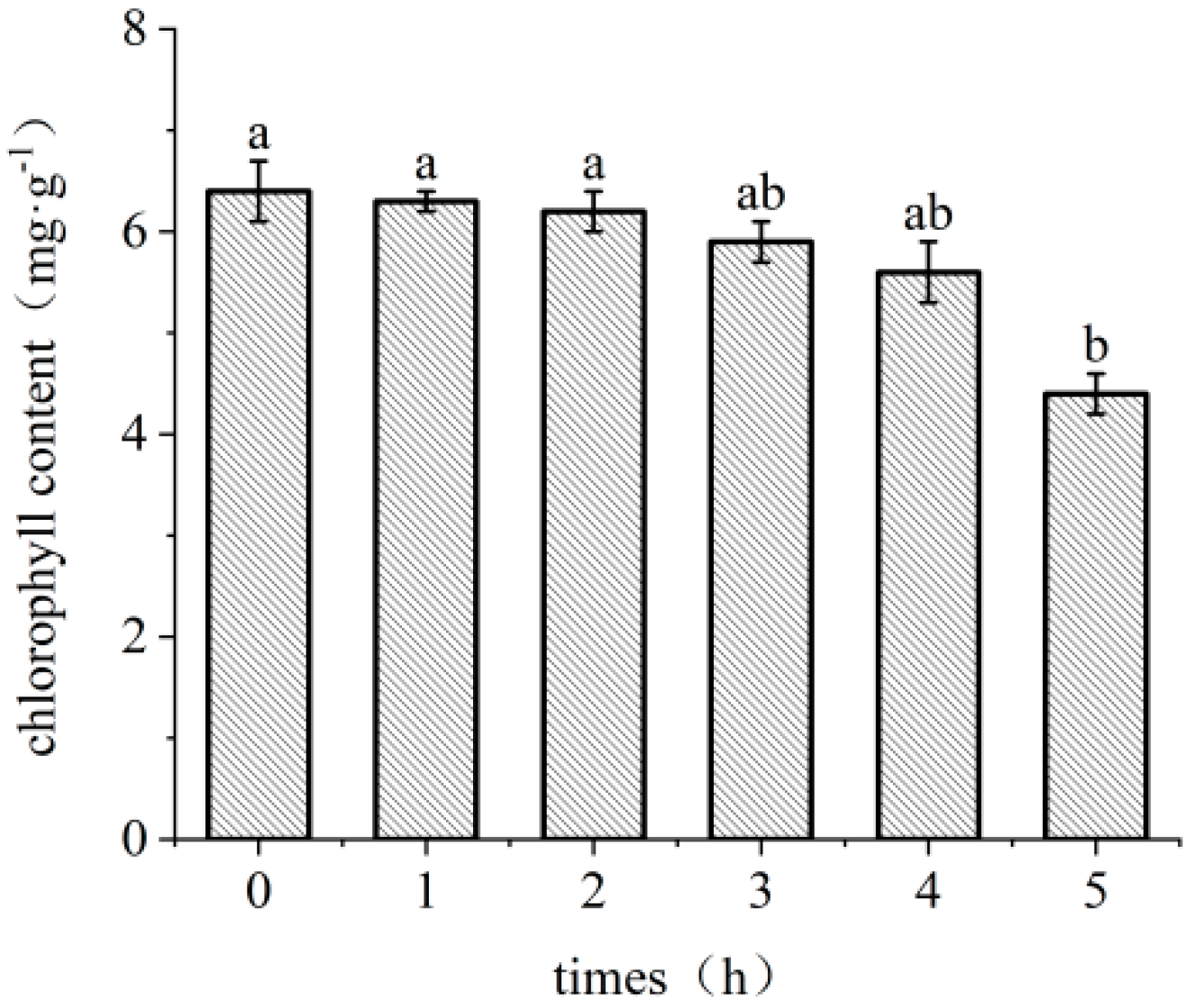
The chlorophyll content continued to decline under high-temperature stress. The test results (Figure 1) showed that the chlorophyll content of P. edulis leaves significantly decreased by 31% after 5 h of high-temperature stress.

3.2. Effects of High-Temperature Stress on Chlorophyll Fluorescence Parameters of P. edulis Leaves

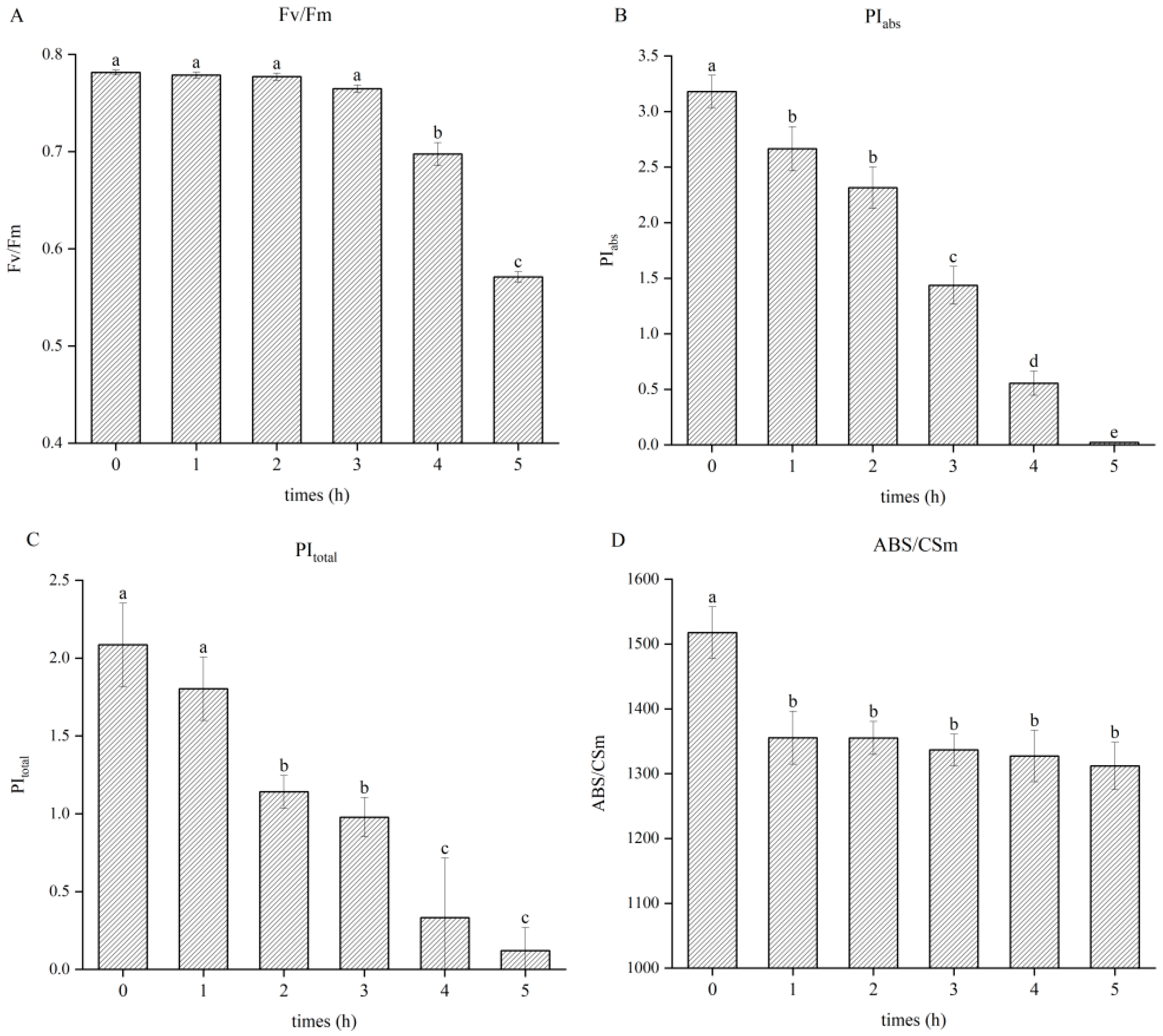
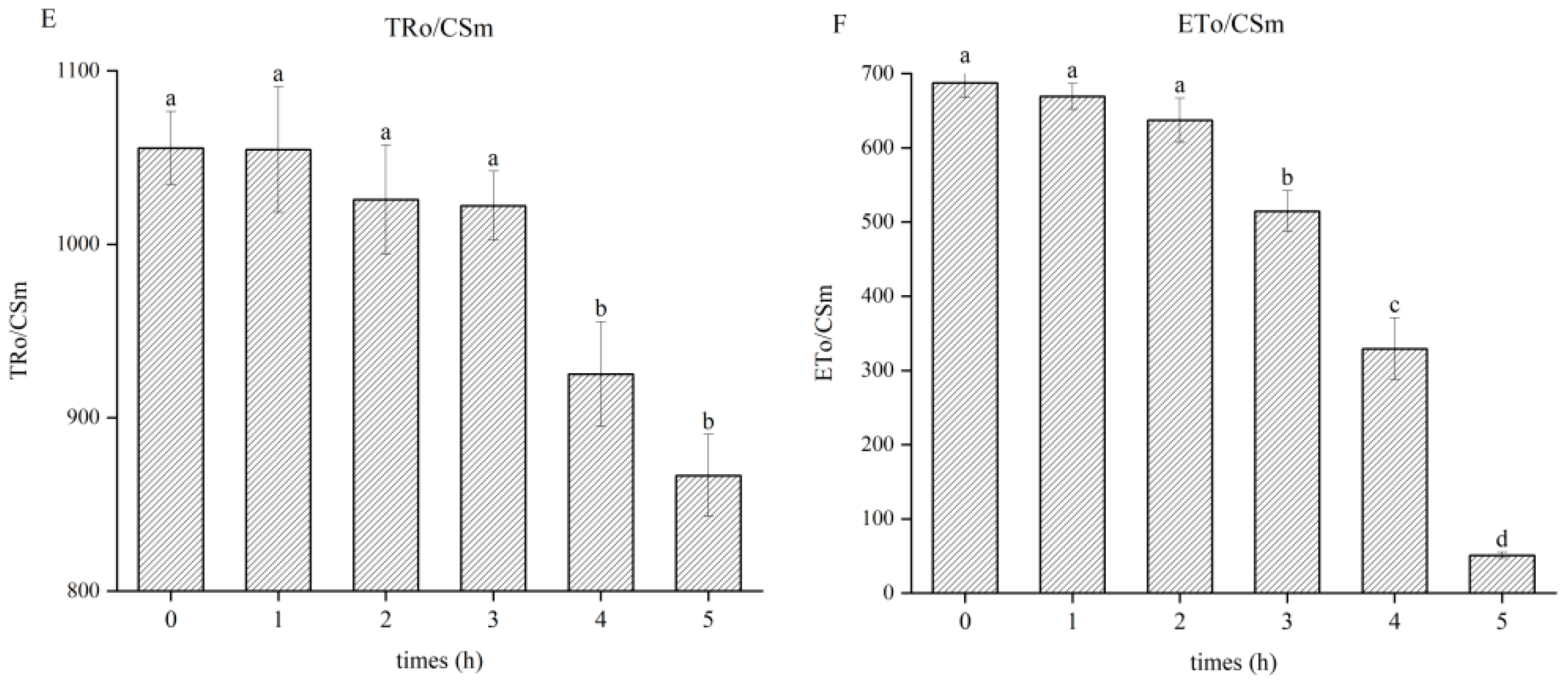
The experiment took the high-temperature stress of 0 h as CK. As shown in Figure 2, the photochemical conversion efficiency of PSII reaction center in P. edulis leaves was inhibited after 5 h of high-temperature stress. The fluorescence parameters, including Fv/Fm, PIabs, PItotal, ABS/CSm, TRo/CSm and ETo/CSm, were significantly lower under 5 h of heat stress than CK. Specifically, Fv/Fm decreased by 26.91%, PIabs by 99.28%, PItotal by 94.20%, ABS/CSm by 13.56%, TRo/CSm by 17.90% and ETo/CSm by 92.61%.

3.3. Effects of High-Temperature Stress on Photosynthetic Characteristics of P. edulis Leaves

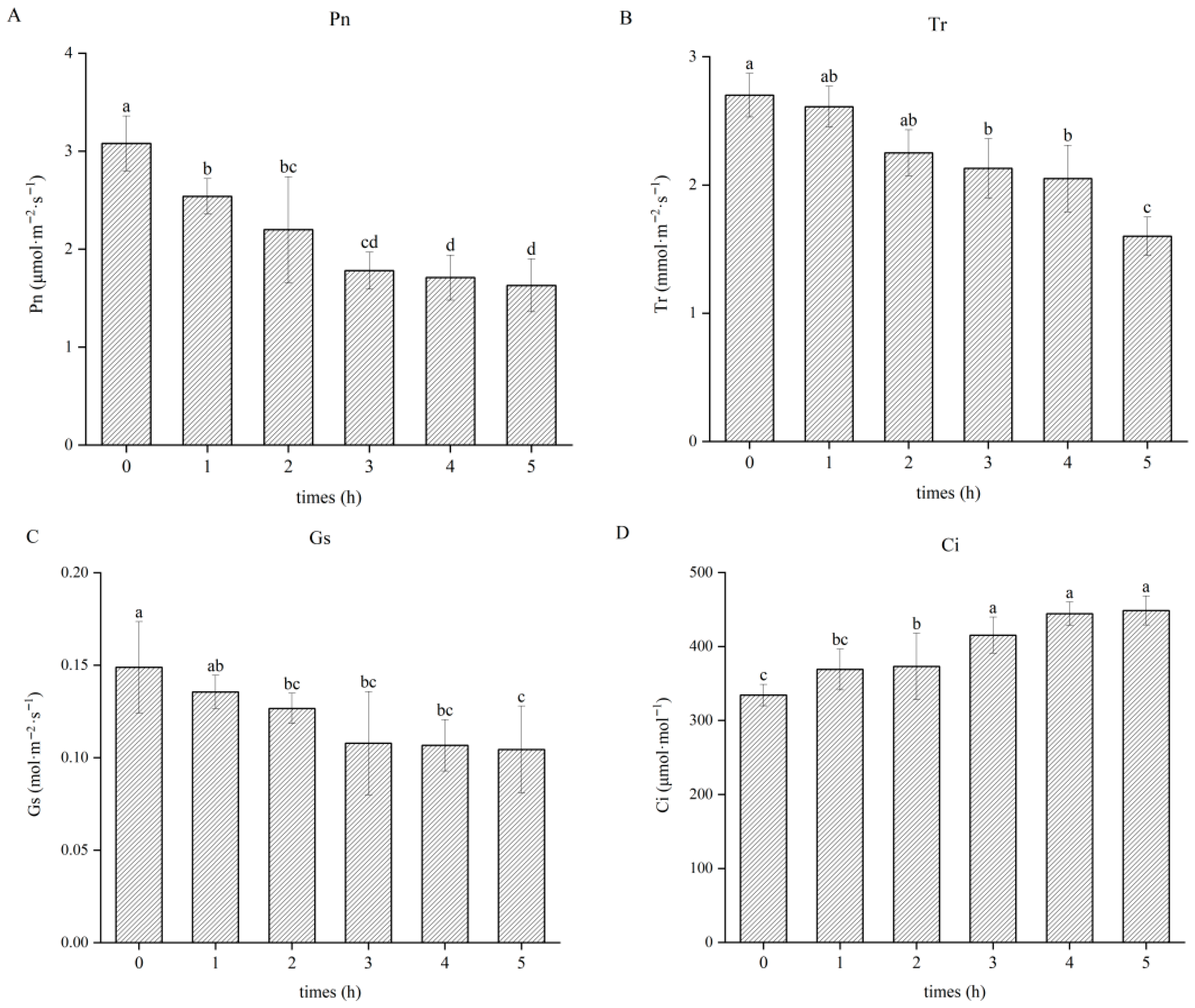
The experiment took the high-temperature stress of 0 h as CK. After high-temperature stress, some remarkable changes (p < 0.05) in photosynthetic characteristics appeared. The photosynthetic characteristics, including Pn, Tr and Gs, were significantly lower under 5 h of heat stress than CK, while Ci showed the opposite change pattern (Figure 3). Specifically, Pn, Tr and Gs decreased by 47%, 41% and 38%, respectively, while Ci was increased by 1.34 times. We assumed that the photosynthetic structure of P. edulis leaves was damaged under high temperature and the non-stomatal factors resulted in the inhibition of photosynthesis.

3.4. Characterization of the Heat-Treated P. edulis Transcriptome

After rigorous quality evaluation and data filtering, 447,779,178 clean reads were kept (Table 2). By removing low-quality sequences and residual rRNA-containing ones, roughly 75.4–81.17% of high-quality clean reads were successfully aligned to the P. edulis genome (Table 2). More transcriptome data can be found in the attachment “Supplementary Data Materials”.
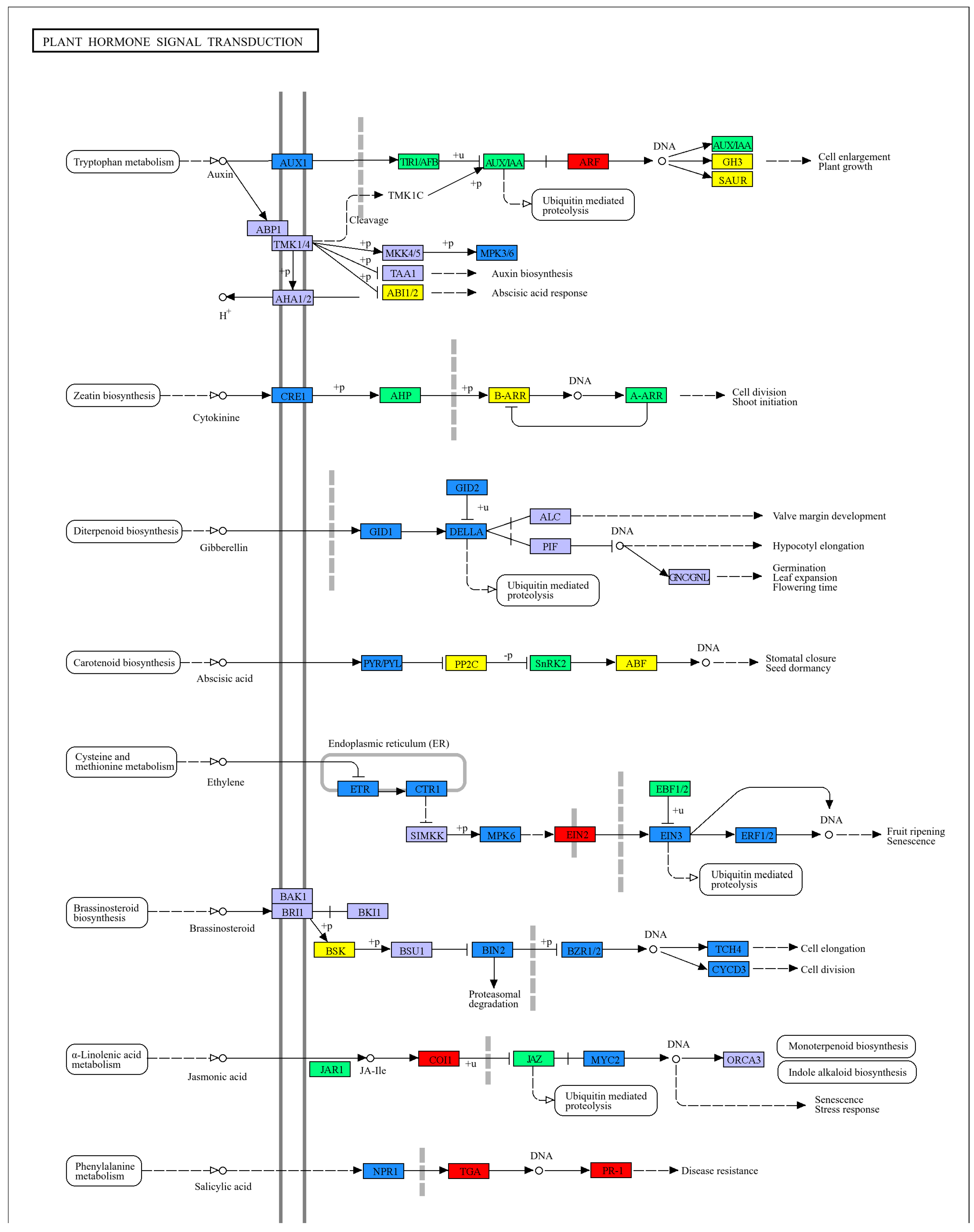
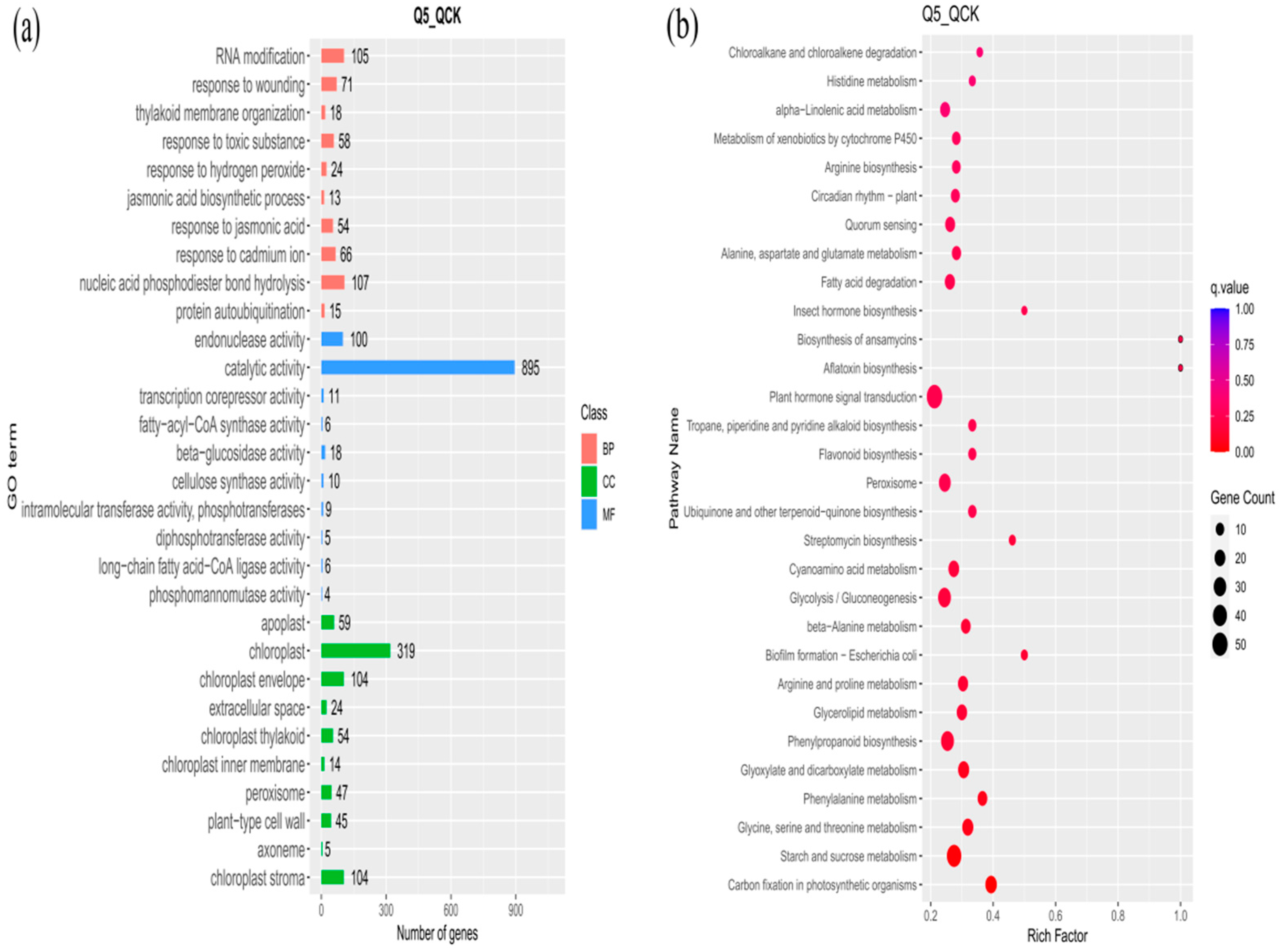
In total, 2336 DEGs were identified. Functional annotation via GO analysis revealed that large numbers of DEGs were enriched in GO nodes associated with catalytic activity and chloroplast (Figure 4a). This study also identified a significant down-regulation of genes enriched in the dark reactions of photosynthesis. In contrast, genes associated with chloroplast RNA processing and modification were markedly up-regulated. Furthermore, a complex mixture of both up- and down-regulated patterns was observed for genes annotated to the following terms: chloroplast, chloroplast envelope, photosynthesis, electron transport in photosystem I, chloroplast thylakoid, chloroplast inner membrane, chloroplast stroma, photosynthesis, chloroplast organization, photosynthetic membrane, chloroplast thylakoid membrane, and photosystem I. These results collectively indicated that the transcriptional regulatory network in response to high temperature in P. edulis is characterized by high complexity and pathway specificity. The KEGG pathway analysis further verified that DEGs were significantly enriched in pathways such as carbon fixation, plant hormone signal transduction and starch and sucrose metabolism, which were consistent with the functional trends observed in GO analysis (Figure 4b). Specifically, KEGG pathway analysis showed that genes including BAK1, EIN2, COI-1 and PR-1 were up-regulated, whereas those such as JAR1, JAZ, TF (transferrin gene), TIR1, IAA (related gene), ARR-A, SnRK2 and EBF1-2 were down-regulated (Figure 5).

3.5. Differential Expression of Photosynthetic Related Genes in P. edulis Under High Temperature

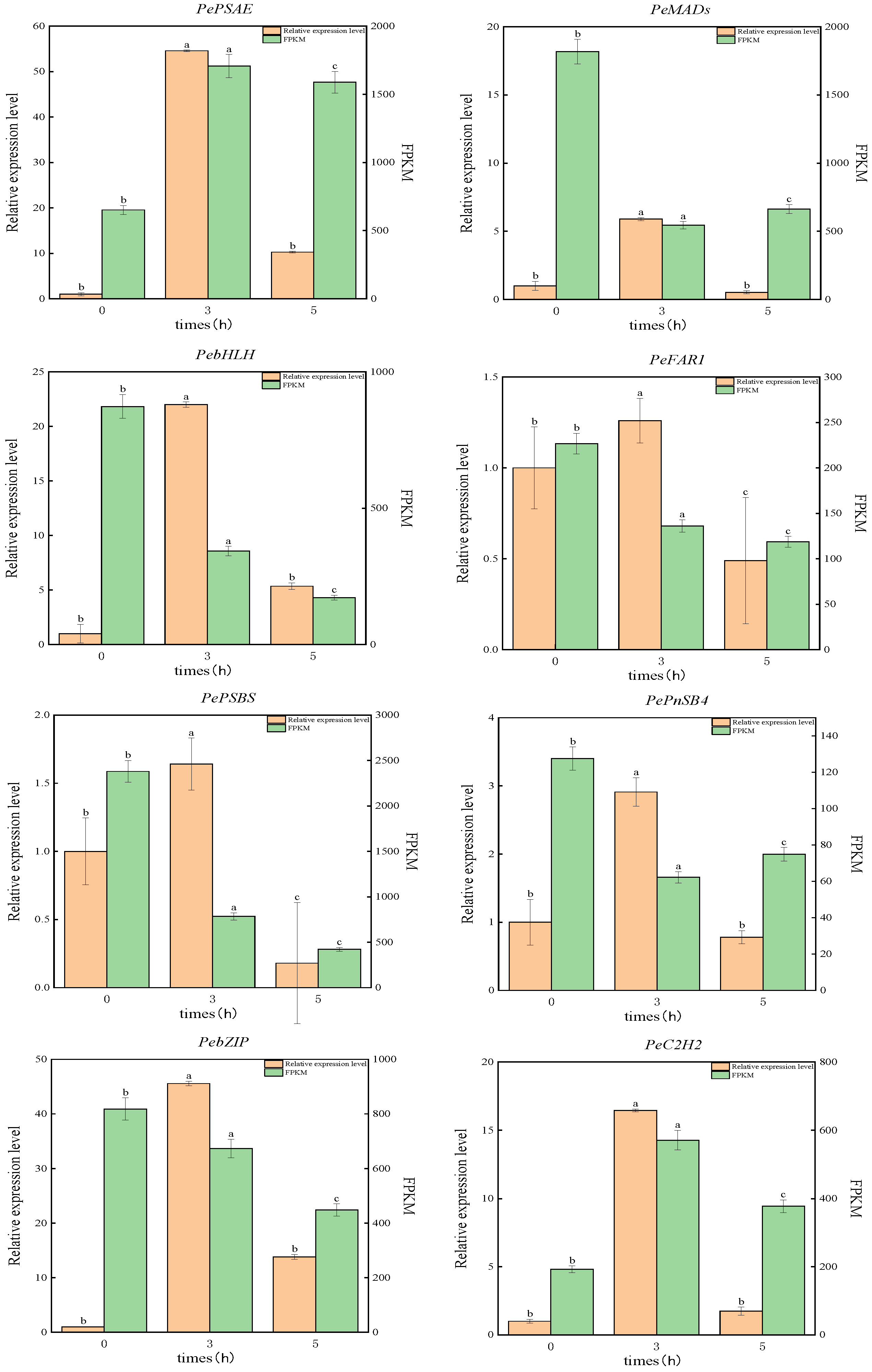
Transcriptome sequencing revealed that after high-temperature stress, significant fluctuations occurred in eight photosynthetic genes, PePSAE, PeMADs, PebHLH, PeFAR1, PePSBS, PePnsB4, PebZIP and PeC2H2. Specifically, the expression levels of PeC2H2 and PePSAE were significantly up-regulated, whereas those of PebZIP, PePnsB4, PePSBS, PeFAR1, PeMADs, and PebHLH exhibited significant down-regulation. Further validation was performed using qRT-PCR. All eight genes showed significant changes, first increasing and then decreasing (Figure 6). In addition, after 5 h of high-temperature treatment, the relative expression levels of PeC2H2 and PePSAE were elevated compared to the control group and the relative expression levels of PePnsB4, PePSBS, PeFAR1, and PeMADs were reduced conversely, which aligns with the findings from transcriptome sequencing; however, the validation results of PebZIP and PebHLH did not match the sequencing results. These results further indicated that the regulation of photosynthesis-related genes under high-temperature conditions was complex and multifaceted.

4. Discussion

Plants require suitable environmental conditions throughout their growth cycle; deviations from these optimal parameters (either excessive increases or decreases) can significantly impair their growth and development [34]. Among various plant physiological processes, photosynthesis exhibits high sensitivity to temperature; for example, exposure to heat stress typically induces a decline in photosynthetic capacity [35]. The effects of high temperature on plant photosynthesis are mediated by both stomatal and non-stomatal limiting factors [23,36]. Under mild heat stress, the decrease in Gs of leaves limits the availability of CO2, thereby reducing Pn. This condition is defined as stomatal limitation. In contrast, when high-temperature stress becomes severe, the activity of key enzymes involved in photosynthetic processes is inhibited, which also leads to a decrease in Pn; this is defined as a non-stomatal limitation [37,38,39]. Pn, Gs, and Tr exhibited a decreasing trend with the extension of heat stress, while Ci showed an opposite trend. This indicated that the inhibition of photosynthetic rate in leaves of P. edulis is caused by non-stomatal factors. Additionally, the decrease in chlorophyll content of P. edulis leaves may be attributed to high-temperature stress damaging the integrity of chloroplasts and impairing the photosynthetic apparatus, thereby severely affecting plant photosynthesis. This may constitute another reason for the decline in Pn. Regarding the increasing trend of Ci, we suggest that the reason is the inactivation of Rubisco activase caused by high-temperature stress [40]. The function of Rubisco activase is to maintain the active state of Rubisco, the key enzyme for CO2 fixation. Once Rubisco activase becomes dysfunctional, a significant portion of Rubisco remains in an inactive state, resulting in a decline in the leaf’s capacity to fix CO2 [41]. Consequently, even under conditions where stomatal closure limits CO2 supply, the rate of CO2 consumption is substantially lower than the rate of supply, causing CO2 to accumulate within the intercellular spaces and ultimately leading to the observed increase in Ci.
Under high-temperature stress, chlorophyll fluorescence parameters associated with photosynthesis can accurately indicate damage to the photosynthetic apparatus, with the underlying damage mechanisms involving multiple levels [42]. Monitoring these fluorescence parameters enables in-depth understanding of the damage mechanisms and physiological state changes in the photosynthetic apparatus in high-temperature environments [43]. Exploring the dynamic changes in fluorescence parameters under different degrees and durations of high temperatures can effectively evaluate and predict the photosynthetic performance and growth status of plants under high-temperature stress, providing a critical basis for research on plant photosynthesis and stress physiology. Consistent with the findings of Monneveux [44] and Qu [45], this study observed that after 5 h of high-temperature stress, the chlorophyll content of P. edulis leaves decreased by 31%. Concurrently, PSII-related fluorescence parameters (e.g., Fv/Fm and PIabs) exhibited significant reductions, with PIabs declining by as much as 99.28%. These results indicated that high temperature not only accelerates chlorophyll degradation but also severely impairs the structural integrity and functional stability of the PSII reaction center.
GO enrichment analysis revealed that after 5 h of high-temperature stress, P. edulis employed a coordinated and complex transcriptional reprogramming network to cope with the impact of heat stress on photosynthesis. This response may involve the active suppression of dark reaction processes and the activation of pathways such as chloroplast RNA processing and modification. Furthermore, the heterogeneous regulation of gene expression in pathways such as chloroplast and photosystem I suggested the potential existence of complex antagonistic or synergistic interactions among different signals under high-temperature conditions, which collectively fine-tune the plant’s photosynthetic performance. This precise regulation at the transcriptional level serves as a critical molecular basis for the thermotolerance of P. edulis.
Substantial expression changes were observed in transcription factors such as bHLH, MYB, NAC, and HSF, indicating their significant roles in the heat stress response of P. edulis. KEGG pathway analysis showed up-regulation of genes including BAK1, EIN2, COI-1, and PR-1, while genes such as JAR1, JAZ, TF, TIR1, IAA-related genes, ARR-A, SnRK2, and EBF1-2 were down-regulated. Additionally, differentially expressed genes were significantly enriched in multiple phytohormone pathways, including auxin, salicylic acid, and abscisic acid. The extensive literature confirmed that these hormones are core regulators of photosynthetic responses under heat stress: abscisic acid (ABA) activates SnRK2.6 kinase to regulate stomatal closure and the synthesis of osmoregulatory substances, while also mitigating oxidative damage to enhance thermotolerance, thereby maintaining the stability of the photosynthetic system [46]. Exogenous salicylic acid (SA) maintains cellular membrane integrity and enhances leaf photosynthetic capacity by promoting lignin biosynthesis and boosting the activities of antioxidant enzymes [47]. Auxin, on the other hand, enhances the defense capacity of plants such as cucumber against high temperature by stabilizing photosystem II and activating DNA repair pathways [48]. This suggests that the coordinated regulation of these hormones may be one of the key mechanisms underlying the photosynthetic response of P. edulis to heat stress.
In the intricate regulatory network of photosynthesis, effective modulation of photodamage is pivotal for sustaining plant photosynthetic efficiency and ensuring normal growth and development [49]. Previous studies have identified an array of photosynthesis-related genes that are involved in regulating photodamage. For instance, the CYN38 gene modulates the repair efficiency of PSII through dimerization and its carboxy-terminal domain not only mediates binding to PSII but also regulates self-dimerization, thereby ensuring efficient PSII repair under high-light conditions and alleviating photodamage [50]. By influencing the plastid lipoprotein LCNP, this interaction balances the absorption of light energy and the dissipation of excess energy, ultimately preventing photodamage [51]. To identify photodamage-responsive candidate genes in P. edulis, transcriptome sequencing was performed, yielding eight target genes, PePSAE, PeMADs, PebHLH, PeFAR1, PePSBS, PePnsB4, PebZIP, and PeC2H2. qPCR was used to validate their expression under high-temperature stress, revealing a consistent pattern of initial up-regulation followed by subsequent down-regulation across all eight genes. Specifically, PePnsB4, PePSBS, PeFAR1, and PeMADs showed significant down-regulation at 5 h of heat treatment. This result indicates that the expression of photosynthetic genes may exhibit a time-dependent pattern, with specific critical time points that might correspond to key physiological responses. Based on existing research on homologous genes in other species, the aforementioned genes are known to govern photodamage regulation through distinct molecular pathways, which provides insights into the potential functions of the eight candidate genes in P. edulis. Jeanjean et al. [52] knocked out PsaE, a gene encoding a component of photosystem I, leading to the loss of its encoded protein, and found that a portion of photosynthetic electron flow was redirected toward oxygen; sustained production of reactive oxygen species (ROS) was induced at the reducing side of photosystem I (PSI), and ultimately the system’s susceptibility to ROS-induced toxicity was significantly increased. Aviv-Sharon et al. [53] proposed that the thylakoid protein encoded by PsbS gene functioned as a key determinant for the initiation of NPQ in plants, facilitating NPQ activation through processes such as light-induced monomerization. They found that under high-light exposure, NPQ dissipates excess light energy as thermal energy, thereby attenuating oxidative damage (photoinhibition) to the photosynthetic apparatus and enhancing the high-light tolerance of plants. Duan et al. [54] validated that the knockout of the OsbZIP18 gene in rice leads to a significant enhancement of the plant’s high-light tolerance and the underlying mechanism involves the regulation of stress-responsive genes and photosynthesis-associated genes by OsbZIP18, which in turn modulates the physiological adaptability of rice. Given that high light frequently co-occurs with high temperature in field environments, the regulatory role of OsbZIP18 in high-light tolerance also provides valuable insights for investigating the protective mechanisms of crop photosynthetic systems under high-temperature conditions. This study also revealed that the expression of key photosynthetic genes, including MADS and FAR1, was significantly altered under heat stress. Although few studies have directly elucidated the role of these photosynthetic genes in regulating photosynthesis under high-temperature conditions, previous research has established their involvement in the core plant response to heat [55,56,57]. Given that elevated temperature is a critical environmental factor limiting photosynthetic efficiency, it is plausible that heat stress indirectly constrains photosynthetic capacity by modulating the expression of these key responsive genes [58]. Our findings thus provide new candidate targets and research directions for elucidating the intrinsic molecular mechanisms by which high temperature inhibits photosynthesis in P. edulis.
In this study, under high-temperature stress conditions, chlorophyll content, chlorophyll fluorescence parameters, and photosynthetic parameters of P. edulis were measured, and the expression changes in eight genes related to photosynthetic organs were screened and examined. The results showed that under high-temperature stress, chlorophyll content, Fv/Fm, PIabs, PItotal, ABS/CSm, TRo/CSm, and ETo/CSm in P. edulis all exhibited a decreasing trend. Additionally, with the exception of Ci, which showed an increasing trend, Pn, Tr, and Gs all demonstrated a decreasing trend. Quantitative real-time PCR results revealed that the eight genes—PePSAE, PeMADs, PebHLH, PeFAR1, PePSBS, PePnsB4, PebZIP, and PeC2H2—consistently exhibited an initial increase followed by a decrease during the stress duration. These results have promoted the understanding of the molecular mechanism of high-temperature induced light damage response in P. edulis and also provided valuable genetic resources for the functional identification of related genes and the breeding of heat-tolerant varieties. Future in-depth research on the protein–protein interaction networks involving these genes, as well as an exploration of their specific regulatory roles in the light damage response pathway of P. edulis under the combined stress of high temperature and intense light, will further elucidate the comprehensive regulatory mechanisms underlying adaptation of P. edulis to unfavorable light and temperature conditions.

Supplementary Materials

The following supporting information can be downloaded at https://www.mdpi.com/article/10.3390/horticulturae12010044/s1, Supplementary Data Materials: 8 DEGs.xls (information on the 8 screened photosynthesis-related differentially expressed genes); diff_all_Q3_QCK.xls (all differentially expressed genes after 3 hours of heat stress); diff_all_Q5_QCK.xls (all differentially expressed genes after 5 hours of heat stress); expression_table.xls (statistical table of both COUNT and FPKM values for all gene expression); and readcount_table.xls (read count statistics table for all genes).

Author Contributions

Conceptualization, X.N. and Y.L.; methodology, X.N., Y.L. and G.Z.; software, Z.Z., J.Z., L.D., Y.Z. and Q.Z.; validation, L.J. and G.Z.; formal analysis, X.N., Y.L. and G.Z.; investigation, L.J. and X.L.; resources, Y.L., X.N., P.W. and Y.X.; data curation, X.N., Y.L. and P.W.; writing—original draft preparation, X.N., P.W. and L.J.; writing—review and editing, X.N., Y.L., Y.X. and P.W.; visualization, P.W., X.N. and Y.L.; supervision, Y.L. and G.Z.; project administration, X.N., L.J. and L.D. All authors have read and agreed to the published version of the manuscript.

Funding

This research was funded by Fujian Province Public Welfare Research Special Project, grant number 2024R1011004, 2022R1011005, and funded by the 2024–2025 Fujian Province Modern Agricultural Industry Technology System Construction Project, grant number Minncai Zhi [2025] No. 593. The APC was funded by the Fujian Institute of Tropical Crops.

Data Availability Statement

The original contributions presented in this study are included in the article/Supplementary Material. Further inquiries can be directed to the corresponding author.

Conflicts of Interest

The authors declare no conflict of interest.

References

  1. Zhang, J.; Tao, S.; Hou, G.; Zhao, F.; Meng, Q.; Tan, S. Phytochemistry, nutritional composition, health benefits and future prospects of Passiflora: A review. Food Chem. 2023, 428, 136825. [Google Scholar] [CrossRef] [PubMed]
  2. Kulkarni, S.G.; Vijayanand, P. Effect of extraction conditions on the quality characteristics of pectin from passion fruit peel (Passiflora edulis f. flavicarpa L.). LWT—Food Sci. Technol. 2010, 43, 1026–1031. [Google Scholar] [CrossRef]
  3. He, X.; Luan, F.; Yang, Y.; Wang, Z.; Zhao, Z.; Fang, J.; Wang, M.; Zuo, M.; Li, Y. Passiflora edulis: An Insight Into Current Researches on Phytochemistry and Pharmacology. Front. Pharmacol. 2020, 11, 617. [Google Scholar] [CrossRef]
  4. Shi, M.; Ali, M.M.; He, Y.; Ma, S.; Rizwan, H.M.; Yang, Q.; Li, B.; Lin, Z.; Chen, F. Flavonoids Accumulation in Fruit Peel and Expression Profiling of Related Genes in Purple (Passiflora edulis f. edulis) and Yellow (Passiflora edulis f. flavicarpa) Passion Fruits. Plants 2021, 10, 2240. [Google Scholar] [CrossRef] [PubMed]
  5. Corrêa, R.C.G.; Peralta, R.M.; Haminiuk, C.W.I.; Maciel, G.M.; Bracht, A.; Ferreira, I.C.F.R. The past decade findings related with nutritional composition, bioactive molecules and biotechnological applications of Passiflora spp. (passion fruit). Trends Food Sci. Technol. 2016, 58, 79–95. [Google Scholar] [CrossRef]
  6. Xu, M.; Li, A.; Teng, Y.; Sun, Z.; Xu, M. Exploring the adaptive mechanism of Passiflora edulis in karst areas via an integrative analysis of nutrient elements and transcriptional profiles. BMC Plant Biol. 2019, 19, 185. [Google Scholar] [CrossRef] [PubMed]
  7. Khan, M.; Hussain, M.D.; Hu, K.; Kamran, A.; Luo, L.; Yang, S.; Xie, X. First report of Gulupa baciliform virus A associated with passion fruit in China. Plant Dis. 2025, 109, 946. [Google Scholar] [CrossRef]
  8. Liang, J.; Fang, Y.; An, C.; Yao, Y.; Wang, X.; Zhang, W.; Liu, R.; Wang, L.; Aslam, M.; Cheng, Y.; et al. Genome-wide identification and expression analysis of the bHLH gene family in passion fruit (Passiflora edulis) and its response to abiotic stress. Int. J. Biol. 2023, 225, 389–403. [Google Scholar] [CrossRef] [PubMed]
  9. Liu, S.; Li, A.; Chen, C.; Cai, G.; Zhang, L.; Guo, C.; Xu, M. De Novo Transcriptome Sequencing in Passiflora edulis Sims to Identify Genes and Signaling Pathways Involved in Cold Tolerance. Forests 2017, 8, 435. [Google Scholar] [CrossRef]
  10. Sobol, S.; Chayut, N.; Nave, N.; Kafle, D.; Hegele, M.; Kaminetsky, R.; Wünsche, J.N.; Samach, A. Genetic variation in yield under hot ambient temperatures spotlights a role for cytokinin in protection of developing floral primordia. Plant Cell Environ. 2013, 37, 643–657. [Google Scholar] [CrossRef] [PubMed]
  11. Zhu, J.K. Abiotic Stress Signaling and Responses in Plants. Cell 2016, 167, 313–324. [Google Scholar] [CrossRef]
  12. Easterling, D.R.; Meehl, G.A.; Parmesan, C.; Changnon, S.A.; Karl, T.R.; Mearns, L.O. Climate Extremes: Observations, Modeling, and Impacts. Science 2020, 289, 2068–2074. [Google Scholar] [CrossRef] [PubMed]
  13. Al-Khatib, K.; Paulsen, G.M. High-Temperature Effects on Photosynthetic Processes in Temperate and Tropical Cereals. Crop Sci. 1999, 39, 119–125. [Google Scholar] [CrossRef]
  14. Walbot, V. How plants cope with temperature stress. BMC Biol. 2011, 9, 79. [Google Scholar] [CrossRef]
  15. Berry, J.; Bjorkman, O. Photosynthetic Response and Adaptation to Temperature in Higher Plants. Annu. Rev. Plant Physiol. 1980, 31, 491–543. [Google Scholar] [CrossRef]
  16. Salvucci, M.E.; Crafts-Brandner, S.J. Inhibition of photosynthesis by heat stress: The activation state of Rubisco as a limiting factor in photosynthesis. Physiol. Plant 2004, 120, 179–186. [Google Scholar] [CrossRef]
  17. Hasanuzzaman, M.; Nahar, K.; Alam, M.; Roychowdhury, R.; Fujita, M. Physiological, Biochemical, and Molecular Mechanisms of Heat Stress Tolerance in Plants. Int. J. Mol. Sci. 2013, 14, 9643–9684. [Google Scholar] [CrossRef] [PubMed]
  18. Slattery, R.A.; Ort, D.R. Carbon assimilation in crops at high temperatures. Plant Cell Environ. 2019, 42, 2750–2758. [Google Scholar] [CrossRef]
  19. Xu, X.; Liu, H.; Praat, M.; Pizzio, G.A.; Jiang, Z.; Driever, S.M.; Wang, R.; Van De Cotte, B.; Villers, S.L.Y.; Gevaert, K.; et al. Stomatal opening under high temperatures is controlled by the OST1-regulated TOT3–AHA1 module. Nat. Plants 2024, 11, 105–117. [Google Scholar] [CrossRef]
  20. Nosaka, Y.; Nosaka, A.Y. Generation and Detection of Reactive Oxygen Species in Photocatalysis. Chem. Rev. 2017, 117, 11302–11336. [Google Scholar] [CrossRef] [PubMed]
  21. Allakhverdiev, S.I.; Kreslavski, V.D.; Klimov, V.V.; Los, D.A.; Carpentier, R.; Mohanty, P. Heat stress: An overview of molecular responses in photosynthesis. Photosynth. Res. 2008, 98, 541–550. [Google Scholar] [CrossRef] [PubMed]
  22. Mishra, D.; Shekhar, S.; Agrawal, L.; Chakraborty, S.; Chakraborty, N. Cultivar-specific high temperature stress responses in bread wheat (Triticum aestivum L.) associated with physicochemical traits and defense pathways. Food Chem. 2017, 221, 1077–1087. [Google Scholar] [CrossRef] [PubMed]
  23. Inbal Neta-Sharir Tal, I.; Susan, L.; David, M. Dual Role for Tomato Heat Shock Protein 21: Protecting Photosystem II from Oxidative Stress and Promoting Color Changes during Fruit Maturation. Plant Cell 2005, 17, 1829–1838. [Google Scholar] [CrossRef]
  24. Nakayama, M.; Matsuda, H. Soilless cultivation of ‘Ruby Star’ passion fruit: Effects of NO3-N application, pH, and temperature on fruit quality. Sci. Hortic. 2022, 306, 111462. [Google Scholar] [CrossRef]
  25. Luo, R.; Jiang, H.; Lv, Y.; Hu, S.; Sheng, Z.; Shao, G.; Tang, S.; Hu, P.; Wei, X. Chlorophyll deficient 3, Encoding a Putative Potassium Efflux Antiporter, Affects Chloroplast Development Under High Temperature Conditions in Rice (Oryza sativa L.). Plant Mol. Biol. Rep. 2018, 36, 675–684. [Google Scholar] [CrossRef]
  26. Gesch, R.W.; Kang, I.H.; Gallo-Meagher, M.; Vu, J.C.V.; Boote, K.J.; Allen, L.H.; Bowes, G. Rubisco expression in rice leaves is related to genotypic variation of photosynthesis under elevated growth CO2 and temperature. Plant Cell Environ. 2003, 26, 1941–1950. [Google Scholar] [CrossRef]
  27. Jahan, M.S.; Shi, Z.; Zhong, M.; Zhang, Y.; Zhou, R.; El-Mogy, M.; Sun, J.; Shu, S.; Guo, S.; Wang, Y. Comparative transcriptome analysis reveals gene network regulation of TGase-induced thermotolerance in tomato. Not. Bot. Horti Agrobot. Cluj-Napoca 2021, 49, 12208. [Google Scholar] [CrossRef]
  28. Matsuda, H.; Takaragawa, H. Leaf Photosynthetic Reduction at High Temperatures in Various Genotypes of Passion Fruit (Passiflora spp.). Hortic. J. 2023, 92, 412–423. [Google Scholar] [CrossRef]
  29. Shimada, A.; Kubo, T.; Tominaga, S.; Masashi, Y. Effect of Temperature on Photosynthesis Characteristics in the Passion Fruits ‘Summer Queen’ and ‘Ruby Star’. Hortic. J. 2017, 86, 194–199. [Google Scholar] [CrossRef]
  30. Wang, H.; Zhao, J.; Lai, M.; Zhang, Y.; Qiu, W.; Li, Y.; Tu, H.; Ling, Q.; Fu, X. Differential gene expression analysis and physiological response characteristics of passion fruit (Passiflora edulis) buds under high-temperature stress. PeerJ 2023, 11, e14839. [Google Scholar] [CrossRef]
  31. Cai, X.; Li, D.; Liu, C.; Chen, J.; Wei, X.; Hu, S.; Lu, L.; Chen, S.; Yao, Q.; Xie, S.; et al. Identification and characterization of GRAS genes in passion fruit (Passiflora edulis Sims) revealed their roles in development regulation and stress response. Plant Cell Rep. 2025, 44, 46. [Google Scholar] [CrossRef]
  32. Zhang, Y.; Xu, Y.; Xing, W.; Wu, B.; Huang, D.; Ma, F.; Zhan, R.; Sun, P.; Xu, Y.; Song, S. Identification of the passion fruit (Passiflora edulis Sims) MYB family in fruit development and abiotic stress, and functional analysis of PeMYB87 in abiotic stresses. Front. Plant Sci. 2023, 14, 1124351. [Google Scholar] [CrossRef] [PubMed]
  33. Wu, Y.; Tian, Q.; Huang, W.; Liu, J.; Xia, X.; Yang, X.; Mou, H. Identification and evaluation of reference genes for quantitative real-time PCR analysis in Passiflora edulis under stem rot condition. Mol. Biol. Rep. 2020, 47, 2951–2962. [Google Scholar] [CrossRef] [PubMed]
  34. Potters, G.; Pasternak, T.P.; Guisez, Y.; Jansen, M.A.K. Different stresses, similar morphogenic responses: Integrating a plethora of pathways. Plant Cell Environ. 2009, 32, 158–169. [Google Scholar] [CrossRef] [PubMed]
  35. Smertenko, A.; Dráber, P.; Viklický, V.; Opatrny, Z. Heat stress affects the organization of microtubules and cell division in Nicotiana tabacum cells. Plant Cell Environ. 1997, 20, 1534–1542. [Google Scholar] [CrossRef]
  36. Bernacchi, C.J.; Long, S.P.; Ort, D.R. Safeguarding crop photosynthesis in a rapidly warming world. Science 2025, 388, 1153–1160. [Google Scholar] [CrossRef]
  37. Didaran, F.; Kordrostami, M.; Ghasemi-Soloklui, A.A.; Pashkovskiy, P.; Kreslavski, V.; Kuznetsov, V.; Allakhverdiev, S.I. The mechanisms of photoinhibition and repair in plants under high light conditions and interplay with abiotic stressors. J. Photochem. Photobiol. B Biol. 2024, 259, 113004. [Google Scholar] [CrossRef]
  38. Hu, S.; Ding, Y.; Zhu, C. Sensitivity and Responses of Chloroplasts to Heat Stress in Plants. Front. Plant Sci. 2020, 11, 375. [Google Scholar] [CrossRef]
  39. Tang, J.; Zhang, Z.; Wang, J.; Kong, F.; Chi, Z. The interplay between Ca2+ and ROS in regulating β-carotene biosynthesis in Dunaliella salina under high temperature stress. Algal Res. 2025, 88, 104023. [Google Scholar] [CrossRef]
  40. Crafts-Brandner, S.J.; Salvucci, M.E. Rubisco activase constrains the photosynthetic potential of leaves at high temperature and CO2. Proc. Natl. Acad. Sci. USA 2000, 97, 13430–13435. [Google Scholar] [CrossRef]
  41. Iñiguez, C.; Capó-Bauçà, S.; Niinemets, Ü.; Stoll, H.; Aguiló-Nicolau, P.; Galmés, J. Evolutionary trends in RuBisCO kinetics and their co-evolution with CO2 concentrating mechanisms. Plant J. 2019, 101, 897–918. [Google Scholar] [CrossRef]
  42. An, W.W.; Wang, G.Z.; Dou, J.H.; Zhang, Y.; Yang, Q.; He, Y.; Tang, Z.; Yu, J. Protective mechanisms of exogenous melatonin on chlorophyll metabolism and photosynthesis in tomato seedlings under heat stress. Front. Plant Sci. 2025, 16, 1519950. [Google Scholar] [CrossRef] [PubMed]
  43. Ji, W.; Hong, E.M.; Chen, X.; Li, Z.; Lin, B.; Xia, X.; Li, T.; Song, X.; Jin, S.; Zhu, X. Photosynthetic and physiological responses of different peony cultivars to high temperature. Front. Plant Sci. 2022, 13, 969718. [Google Scholar] [CrossRef]
  44. Monneveux, P.; Rekika, D.; Acevedo, E.; Merah, O. Effect of drought on leaf gas exchange, carbon isotope discrimination, transpiration efficiency and productivity in field grown durum wheat genotypes. Plant Sci. 2006, 170, 867–872. [Google Scholar] [CrossRef]
  45. Qu, L.; Gu, X.; Li, J.; Guo, J.; Lu, D. Leaf photosynthetic characteristics of waxy maize in response to different degrees of heat stress during grain filling. BMC Plant Biol. 2023, 23, 469. [Google Scholar] [CrossRef]
  46. Iqbal, N.; Sehar, Z.; Fatma, M.; Umar, S.; Sofo, A.; Khan, N.A. Nitric Oxide and Abscisic Acid Mediate Heat Stress Tolerance through Regulation of Osmolytes and Antioxidants to Protect Photosynthesis and Growth in Wheat Plants. Antioxidants 2022, 11, 372. [Google Scholar] [CrossRef]
  47. Wang, Z.; Guo, J.; Luo, W.; Niu, S.; Qu, L.; Li, J.; Chen, Y.; Li, G.; Yang, H.; Lu, D. Salicylic Acid Cooperates With Lignin and Sucrose Signals to Alleviate Waxy Maize Leaf Senescence Under Heat Stress. Plant Cell Environ. 2025, 48, 4341–4355. [Google Scholar] [CrossRef] [PubMed]
  48. Yu, B.; Lin, Y.; Gan, Y.; Yang, C.; Liang, Y.; Qin, Q.; Chen, L.; Liu, R.; Zhao, H.; Qiu, Z.; et al. Auxin promotes cucumber resistance to high ambient temperature by enhancing photosystem and activating DNA repair pathways. Hortic. Plant J. 2025. [Google Scholar] [CrossRef]
  49. Wang, J.; Wang, Y.; Jin, H.; Yu, Y.; Mu, K.; Kang, Y. Research Progress on Responses and Regulatory Mechanisms of Plants Under High Temperature. Curr. Issues Mol. Biol. 2025, 47, 601. [Google Scholar] [CrossRef]
  50. Yao, Q.; Dong, J.; Zhang, T.; Cao, H.; Yu, J.; Wang, X.; Li, B.; Zhu, L.; Wang, Y.; Fu, A.; et al. Dimerization of immunophilin CYN38 regulates Photosystem II repair in Chlamydomonas. Plant Cell Environ. 2025, 48, 5637–5649. [Google Scholar] [CrossRef] [PubMed]
  51. Duan, S.; Dong, B.; Chen, Z.; Hong, L.; Zhang, P.; Yang, Z.; Wang, H.-B.; Jin, H.-L. HHL1 and SOQ1 synergistically regulate non—Photochemical quenching in Arabidopsis. J. Biol. Chem. 2023, 299, 104670. [Google Scholar] [CrossRef]
  52. Jeanjean, R.; Latifi, A.; Matthijs, H.C.P.; Havaux, M. The PsaE subunit of photosystem I prevents light-induced formation of reduced oxygen species in the cyanobacterium Synechocystis sp. PCC 6803. Biochim. Biophys. Acta (BBA)—Bioenerg. 2008, 1777, 308–316. [Google Scholar] [CrossRef]
  53. Aviv-Sharon, E.; Sultan, L.D.; Naveh, L.; Charuvi, D.; Kupervaser, M.; Reich, Z.; Adam, Z. The thylakoid lumen Deg1 protease affects non-photochemical quenching via the levels of violaxanthin de-epoxidase and PsbS. Plant J. 2025, 121, e17263. [Google Scholar] [CrossRef]
  54. Duan, F.; Li, X.; Wei, Z.; Li, J.; Jiang, C.; Jiao, C.; Zhao, S.; Kong, Y.; Yan, M.; Huang, J.; et al. Multi-omics analysis reveals distinct responses to light stress in photosynthesis and primary metabolism between maize and rice. Plant Commun. 2025, 6, 101488. [Google Scholar] [CrossRef] [PubMed]
  55. Li, G.; Kuijer, H.N.J.; Yang, X.; Liu, H.; Shen, C.; Shi, J.; Betts, N.; Tucker, M.R.; Liang, W.; Waugh, R.; et al. MADS1 maintains barley spike morphology at high ambient temperatures. Nat. Plants 2021, 7, 1093–1107. [Google Scholar] [CrossRef]
  56. Lu, H.; Liu, X.; Wang, M.; Zhu, Q.; Lyu, Y.; Xu, J.; Liu, J. The NAT1–bHLH110–CER1/CER1L module regulates heat stress tolerance in rice. Nat. Genet. 2025, 57, 427–440. [Google Scholar] [CrossRef] [PubMed]
  57. Sun, Y.; Zheng, Y.; Wang, W.; Yao, H.; Ali, Z.; Xiao, M.; Ma, Z.; Li, J.; Zhou, W.; Cui, J.; et al. VvFHY3 links auxin and endoplasmic reticulum stress to regulate grape anthocyanin biosynthesis at high temperatures. Plant Cell 2025, 37, koae303. [Google Scholar] [CrossRef]
  58. He, L.; Xu, J.; Li, C.; Shen, C.; He, Q.; Lei, X.; Zhang, H.; Guo, L.; Lin, T.; Guo, Y.; et al. SlHSFB2b-mediated inhibition of jasmonic acid catabolism enhances tomato tolerance to combined high light and heat stress. Plant Physiol. 2025, 199, kiaf547. [Google Scholar] [CrossRef] [PubMed]
Figure 1. Changes in total chlorophyll content in P. edulis leaves under high-temperature stress. Note: Different lowercase letters indicate significant differences among treatments at the p < 0.05 level (one-way ANOVA, Duncan’s multiple range test).
Horticulturae 12 00044 g001
Figure 2. Changes in chlorophyll fluorescence parameters of P. edulis under high-temperature stress. (A) Changes in Fv/Fm under heat stress. (B) Changes in PIabs under heat stress. (C) Changes in PItotal under heat stress. (D) Changes in ABS/CSm under heat stress. (E) Changes in TRo/CSm under heat stress. (F) Changes in ETo/CSm under heat stress. Note: Different lowercase letters indicate significant differences among treatments at the p < 0.05 level (one-way ANOVA, Duncan’s multiple range test).
Horticulturae 12 00044 g002aHorticulturae 12 00044 g002b
Figure 3. Changes in photosynthetic characteristics of P. edulis leaves under high-temperature stress. (A) Changes in Pn under heat stress. (B) Changes in Tr under heat stress. (C) Changes in Gs under heat stress. (D) Changes in Ci under heat stress. Note: Different lowercase letters indicate significant differences among treatments at the p < 0.05 level (one-way ANOVA, Duncan’s multiple range test).
Horticulturae 12 00044 g003
Figure 4. Analysis of DEGs from P. edulis induced by heat treatment. (a) GO analysis of heat responsive DEGs. BP: biological process. CC: cellular component. MF: molecular function. (b) KEGG analysis of heat responsive DEGs.
Horticulturae 12 00044 g004
Figure 5. Schematic diagram of plant hormone signal transduction metabolic pathway. Note: Red represents up-regulated genes or proteins, green represents down-regulated genes or proteins, blue represents mapped genes or proteins, white and purple are the background colors.
Horticulturae 12 00044 g005
Figure 6. Changes in expression of photosynthetic genes of P. edulis leaves under high-temperature stress at different times. Note: Different lowercase letters indicate significant differences among treatments at the p < 0.05 level (one-way ANOVA, Duncan’s multiple range test). Gene expression levels are represented in FPKM (fragments per kilobase per million mapped reads), a unit that normalizes for sequencing depth and gene length.
Horticulturae 12 00044 g006
Table 1. Primers used in qRT-PCR.
Gene NamePrimer SequencePurposeDescription of the Genes
PePSAE F: ATCATATCGGGTCGGAAGGAAT
R: CTGGAGCATTAGGTGTCAATACG
qRT-PCRphotosystem I reaction center subunit IV B, chloroplastic-like
PeMADsF: CCACAGGTCACCAGGTTACTA
R: CTCTTCCAGCTCCTTCAACAC
qRT-PCRribulose bisphosphate carboxylase small chain 1B, chloroplastic
PebHLHF: ATGTCTGCTCTCAATCAAGAAGTG
R: GAACCTGAACCTGAACCTGAAG
qRT-PCRstromal 70 kDa heat shock-related protein, chloroplastic
PeFAR1F: GCTTCAATGTCTCAACTCACTCT
R: CGAGCAGCCTCTCAGTAATATAAC
qRT-PCRPOPTRDRAFT_557296; chloroplast biogenesis family protein
PePSBSF: GCATTGGGTCTGAAAGAAGGA
R: TGAATAGCACAAGTGGCTCGA
qRT-PCRphotosystem II 22 kDa protein, chloroplastic
PePnsB4F: CGACAAGCAAGAGGATATTGAAGA
R: AACAGTTGAGCAAGATACACAGT
qRT-PCRphotosynthetic NDH subunit of subcomplex B 4, chloroplastic-like
PebZIPF: AGATATACGAGATGATGGCAATGG
R: TCTGTCCTCACTTCTGATGGT
qRT-PCRheat shock protein 90-5, chloroplastic
PeC2H2F: GCTATGTCTCCGAAGAAGAATCC
R: GCGAGCCTTGTCTACATCAC
qRT-PCRprotochlorophyllide reductase, chloroplastic
EF-1α F: GGCCCAACTGGTCTGACTAC
R: TTGCGGGATCATCCTTGGAG
qRT-PCRreference genes
Table 2. Details of reads based on the RNA-seq data in heat-treat samples. Note: QCK stands for 0 h of high-temperature stress, and Q3 stands for 3 h of high-temperature stress. Q5 represents 5 h of high-temperature stress.
SampleRaw ReadsClean ReadsQ20 (%) Q30 (%)Mapped on ReferenceUnmappedTotal Reads After Filtered
QCK (1)51,287,78844,193,0900.99670.977340,547,199 (81.17%)9,405,605 (18.83%)49,952,804
QCK (2)62,792,54254,291,9380.99650.976249,530,223 (80.65%)11,882,225 (19.35%)61,412,448
QCK (3)53,266,44645,808,6880.99650.975641,675,714 (80.14%)10,329,000 (19.86%)52,004,714
Q3 (1)49,532,21841,958,0660.99620.973837,168,483 (77.14%)11,014,853 (22.86%)48,183,336
Q3 (2)50,657,45643,267,3520.99630.97538,459,280 (78.0%)10,847,700 (22.0%)49,306,980
Q3 (3)46,420,51239,535,9620.99630.974834,067,068 (75.4%)11,113,232 (24.6%)45,180,300
Q5 (1)47,157,74040,116,4560.99640.976134,746,886 (76.12%)10,899,352 (23.88%)45,646,238
Q3 (2)91,122,98478,229,4720.99640.975867,569,307 (76.05%)21,281,433 (23.95%)88,850,740
Q5 (3)84,360,51660,378,1540.98840.960263,400,223 (78.56%)17,306,145 (21.44%)80,706,368
Disclaimer/Publisher’s Note: The statements, opinions and data contained in all publications are solely those of the individual author(s) and contributor(s) and not of MDPI and/or the editor(s). MDPI and/or the editor(s) disclaim responsibility for any injury to people or property resulting from any ideas, methods, instructions or products referred to in the content.