Optimization of a VIGS System Suitable for the Functional Study of Resistance Genes of Chinese Cabbage Against Clubroot Disease


Abstract
1. Introduction
2. Materials and Methods
2.1. Preparation of Test Materials
2.2. Preparation of Transfection Solutions of pTRV1+pTRV2-00 or pTRV1+pTRV2-BrUFO
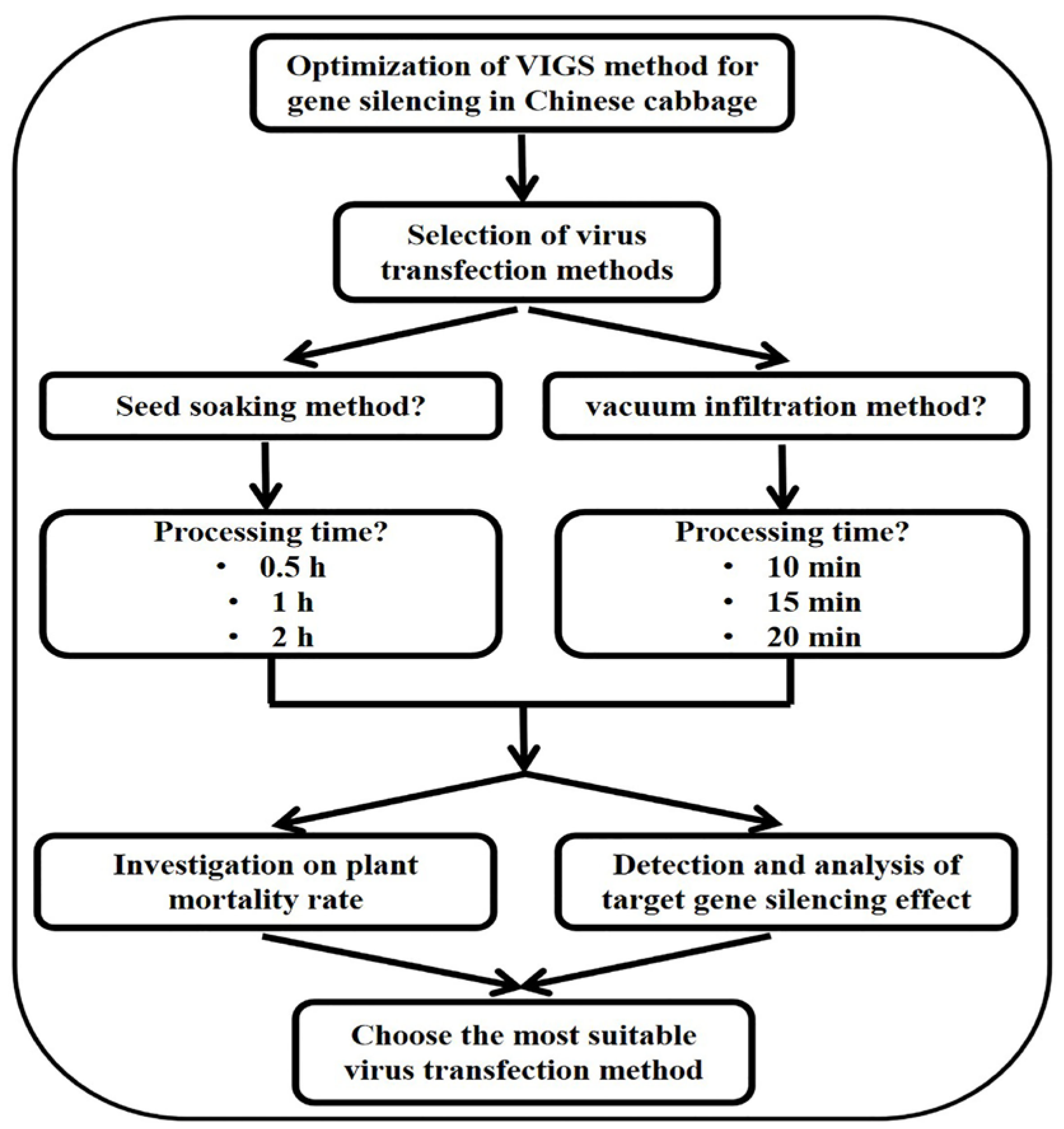
2.3. Optimization of VIGS Method for Gene Silencing in Chinese Cabbage
2.4. Detection of the Silencing Efficiency of Target Gene
2.5. Optimization Inoculation Time of P. brassicae for VIGS-Treated Chinese Cabbage
3. Results
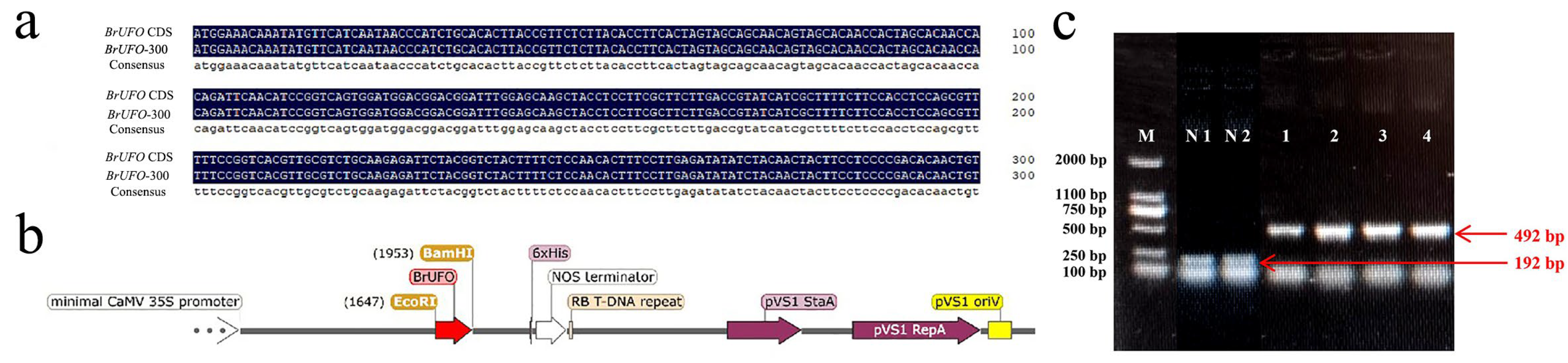
3.1. Construction of pTRV2-BrUFO Recombinant Vector
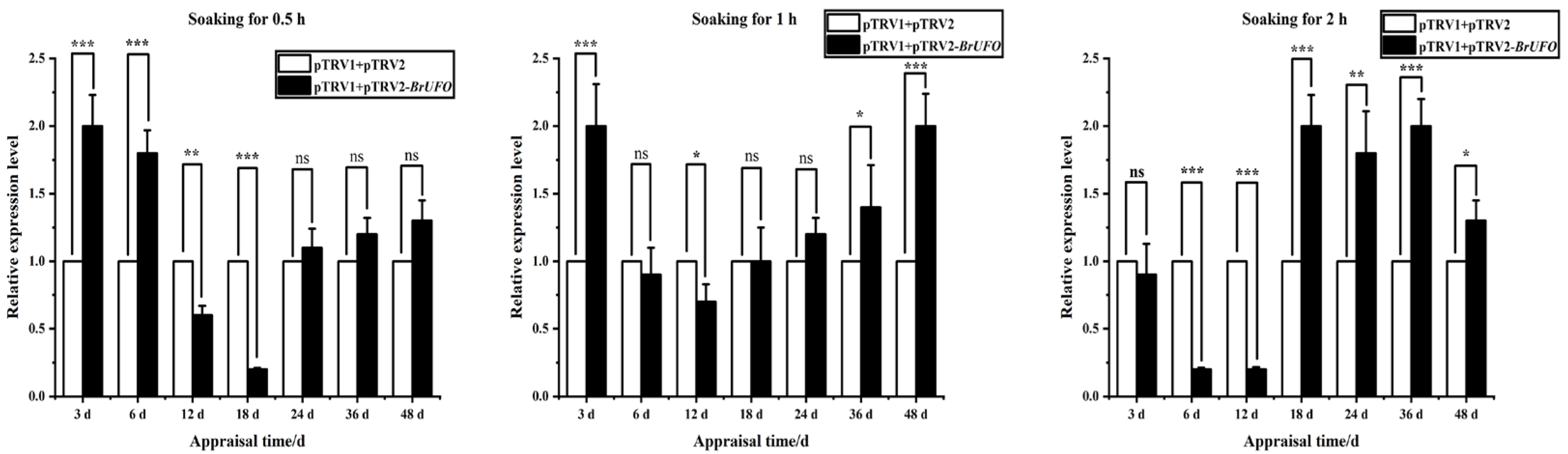
3.2. The Transfection Efficiency of VIGS Treatment Using Seed Soaking Method
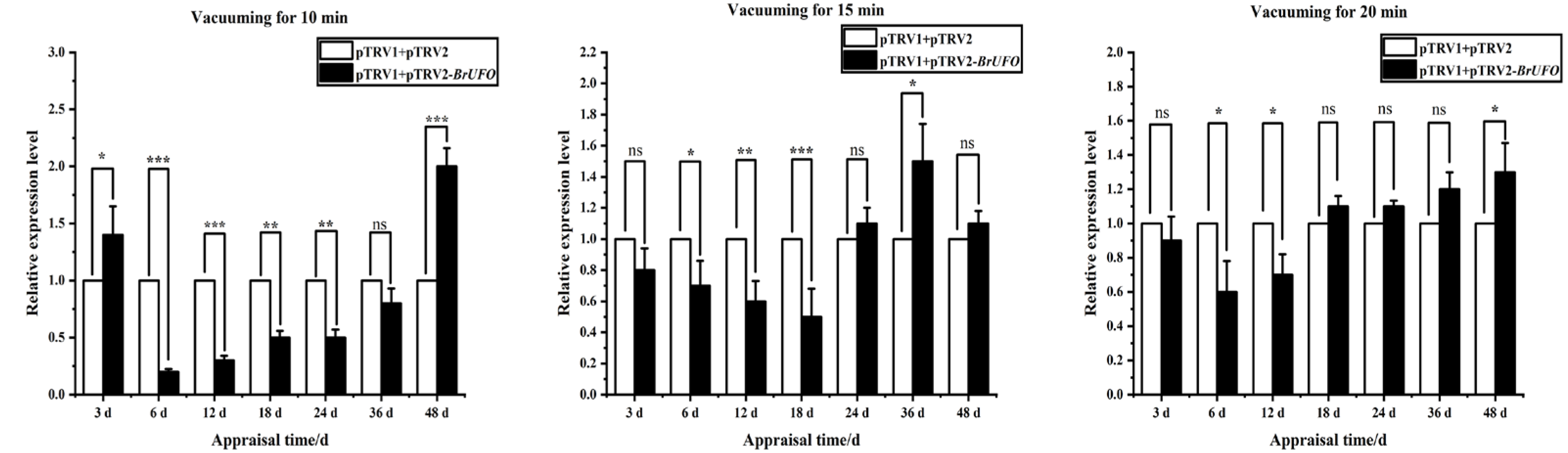
3.3. The Transfection Efficiency of VIGS Treatment Using Vacuum Infiltration Method
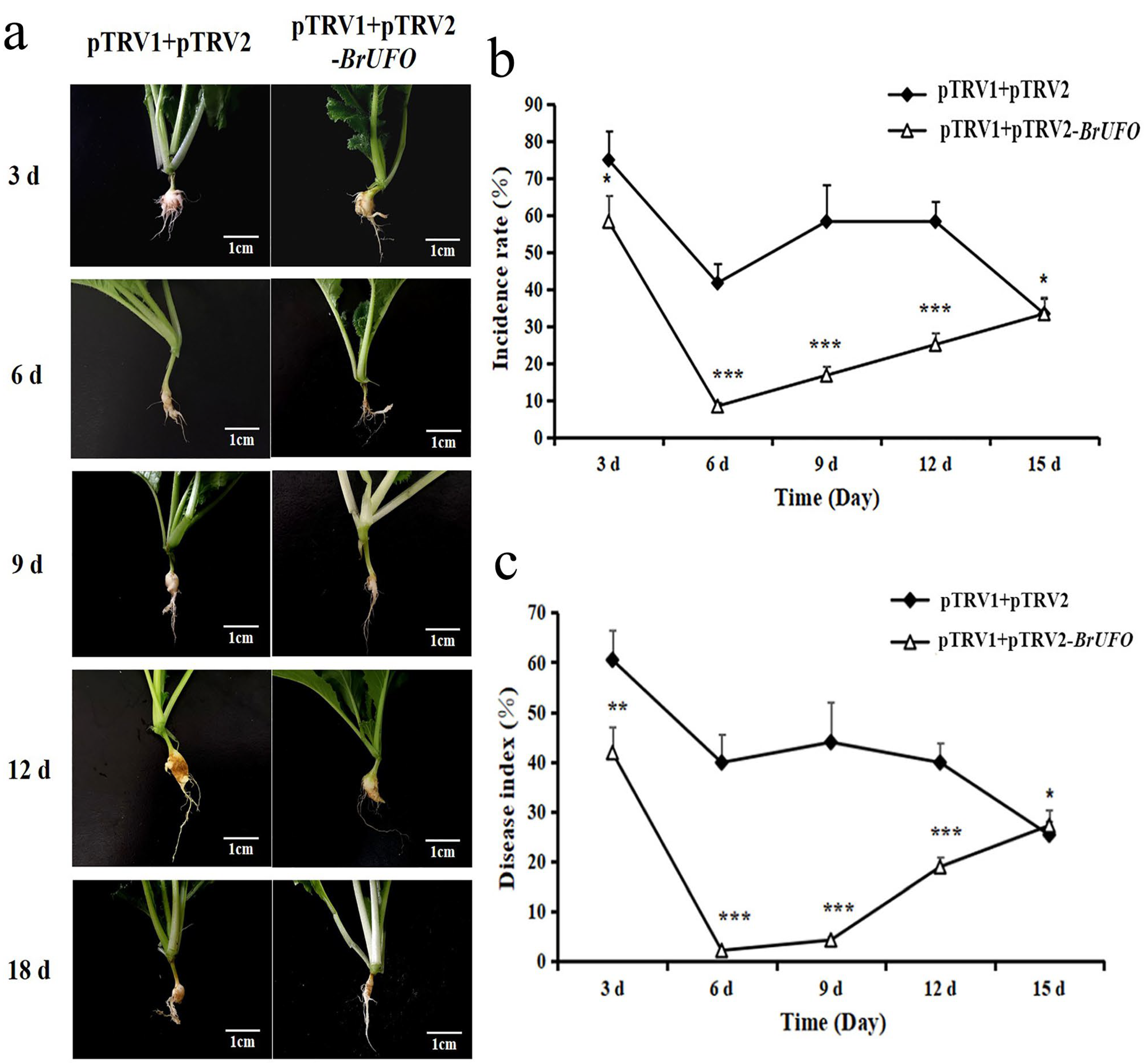
3.4. Optimization of P. brassicae-Inoculation Time and Disease Resistance Investigation for Gene-Silenced Plants
4. Discussion
5. Conclusions
Author Contributions
Funding
Data Availability Statement
Conflicts of Interest
Abbreviations
| VIGS | Virus-induced gene silencing |
| P. brassicae | Plasmodiophora brassicae |
| TRV | Tobacco rattle virus |
| CMV | Cucumber mosaic virus |
References
- Kim, J.; Lim, J.; Jeong, Y.; Yu, H.; Park, Y.; Lim, C.; Chae, W. Only 11 simple sequence repeats needed to identify Chinese Cabbage (Brassica rapa L.) Cultivars. Horticulturae 2023, 9, 1123. [Google Scholar] [CrossRef]
- Kang, H.; Lin, Z.; Yuan, X.; Shi, Y.; Xie, X.; Li, L.; Fan, T.; Li, B.; Chai, A. The occurrence of clubroot in cruciferous crops correlates with the chemical and microbial characteristics of soils. Front. Microbiol. 2024, 14, 1293360. [Google Scholar] [CrossRef] [PubMed]
- Lan, M.; Hu, J.; Yang, H.; Zhang, L.; Xu, X.; He, J. Phytohormonal and metabolism analysis of Brassica rapa L. ssp. pekinensis with different resistance during P. brassicae infection. Inst. Hortic. Crops 2020, 44, 751–767. [Google Scholar] [CrossRef]
- Muhammad, K.; Rahman, S.U.; Sadaf-Ilyas, K.; Abid, A.; Hammed, G.; Nan, H. Plasmodiophora brassicae-The causal agent of clubroot and its biological control/suppression with fungi–review. S. Afr. J. Bot. 2022, 147, 325–331. [Google Scholar] [CrossRef]
- Zhao, Y.; Zhu, X.; Chen, X.; Zhou, J. From plant immunity to crop disease resistance. J. Genet. Genom. 2022, 49, 693–703. [Google Scholar] [CrossRef]
- Zhang, B.; Feng, H.; Ge, W.; Wang, X.; Zhang, J.; Ji, R. BrUFO positively regulates the infection of Chinese cabbage by Plasmodiophora brassicae. Front. Plant Sci. 2023, 14, 1128515. [Google Scholar] [CrossRef]
- Grover, A.; Gowthaman, R. Strategies for development of fungus-resistant transgenic plants. Curr. Sci. 2003, 84, 330–340. [Google Scholar]
- Duraisamy, P.; Andrea, M.; Wayne, T.; Aitken, E.; Chen, A. Fusarium yellows of ginger (Zingiber officinale Roscoe) caused by Fusarium oxysporum f. sp. zingiberi is associated with cultivar-specific expression of defense-responsive genes. Pathogens 2023, 12, 141. [Google Scholar] [CrossRef]
- Senthil-Kumar, M.; Mysore, K. Tobacco rattle virus-based virus-induced gene silencing in Nicotiana benthamiana. Nat. Protoc. 2014, 9, 1549–1562. [Google Scholar] [CrossRef]
- Ellison, E.; Nagalakshmi, U.; Gamo, M.; Huang, P.; Dinesh-kumar, S.P.; Voytas, D.F. Multiplexed heritable gene editing using RNA viruses and mobile single guide RNAs. Nat. Plants 2022, 6, 620–624. [Google Scholar] [CrossRef]
- Nagalakshmi, U.; Meier, N.; Liu, J.; Voytas, D.F.; Dinesh-kumar, S.P. High-efficiency multiplex biallelic heritable editing in Arabidopsis using an RNA virus. Plant Physiol. 2022, 189, 1241–1245. [Google Scholar] [CrossRef] [PubMed]
- Oh, Y.; Kim, S. RPS5A promoter-driven Cas9 produces heritable virus-induced genome editing in Nicotiana attenuata. Mol. Cells 2021, 44, 911–919. [Google Scholar] [CrossRef] [PubMed]
- Tian, Y.; Fang, Y.; Zhang, K.; Zhai, Z.; Yang, Y.; He, M.; Cao, X. Applications of Virus-Induced Gene Silencing in Cotton. Plants 2024, 13, 272. [Google Scholar] [CrossRef] [PubMed]
- Kim, Y.; Kim, H.; Yun, D.; Lee, S.; Kim, J.; Oh, S.; Kim, Y.; Jung, K.; Park, S. Redundant role of OsCNGC4 and OsCNGC5 encoding cyclic nucleotide-gated channels in rice pollen germination and tube growth. Plant Physiol. Biochem. 2024, 208, 108522. [Google Scholar] [CrossRef]
- Zhang, Y.; Niu, N.; Li, S.; Liu, Y.; Xue, C.; Wang, H.; Liu, M.; Zhao, J. Virus-induced gene silencing (VIGS) in Chinese Jujube. Plants 2023, 12, 2115. [Google Scholar] [CrossRef]
- Yue, L.; Kang, Y.; Zhong, M.; Kang, D.; Zhao, P.; Chai, X.; Yang, X. Melatonin delays postharvest senescence through suppressing the inhibition of BrERF2/BrERF109 on flavonoid biosynthesis in flowering Chinese Cabbage. Int. J. Mol. Sci. 2023, 24, 2933. [Google Scholar] [CrossRef]
- Maqbool, R.; Nagarajan, R.; Mutti, S.; Gill, K. Wheat Tiller-1 (WT-1), a GRAS domain encoding gene, controls both tillering and spikelet number per spike in wheat. Plant Mol. Biol. 2025, 115, 128. [Google Scholar] [CrossRef]
- Abro, A.; Abbas, M.; Liu, Q.; Jie, Z.; Xu, Y.; Hou, Y.; Zhou, Z.; Iqbal, R.; Liu, F.; Cai, X. Genetic insights into cold tolerance in cotton: GWAS identified GhPRL gene responsible for cold tolerance in cotton at seedling stage. Ind. Crop. Prod. 2025, 237, 122164. [Google Scholar] [CrossRef]
- Jiang, J.; Ma, H.; Zhou, Z.; Tian, S.; Li, K. Study on the genetic breeding effects of introducing exogenous DNA into soybeans using improved soaking method. Hunan Agric. Sci. 2004, 10–13. [Google Scholar] [CrossRef]
- Chen, G.; Song, J.; Zhang, Y.; Guo, X.; Shen, X. Development and application of virus-induced gene silencing (VIGS) for studying ApTT8 gene function in Agapanthus praecox ssp. orientalis. Sci. Hort. 2024, 324, 112595. [Google Scholar] [CrossRef]
- Ren, H.; Li, D.; Yu, Y.; Lv, W.; Hao, X.; Wang, X.; Wang, Y. Research and application progress on the construction strategy of plant VIGS vector. J. Hort. 2024, 51, 1455–1473. [Google Scholar] [CrossRef]
- Zhang, Y.; Adrian, J. Calter research on the transformation of plants by vacuum infiltration method. Biotechnology 1999, 37–38. [Google Scholar] [CrossRef]
- Manickavasagam, M.; Subramanyam, K.; Ishwarya, R.; Elayaraja, D.; Ganapathi, A. Assessment of factors influencing the tissue culture-independent Agrobacterium-mediated in planta genetic transformation of okra. Plant Cell Tissue Organ 2015, 123, 309–320. [Google Scholar] [CrossRef]
- Mardini, M.; Kazancev, M.; Ivoilova, E.; Utkina, V.; Vlasova, A.; Demurin, Y.; Soloviev, A.; Kirov, I. Advancing virus-induced gene silencing in sunflower: Key factors of VIGS spreading and a novel simple protocol. Plant Methods 2024, 20, 122. [Google Scholar] [CrossRef] [PubMed]
- Feng, S.; Chen, J.; Bao, A. Establishment and optimization of a tobacco rattle virus -based virus-induced gene Silencing in Atriplex canescens. Plant Methods 2025, 21, 107. [Google Scholar] [CrossRef] [PubMed]
- Fan, L.; Zhou, W.; Shang, S.; Zhou, S.; Gao, S.; Shaaban, M.; Wang, Z.; Shi, G. Deciphering the auxin-ethylene crosstalk in petal abscission through auxin influx carrier IpAUX1 of Itoh peony ‘Bartzella’. Postharvest Biol. Tec. 2024, 216, 113060. [Google Scholar] [CrossRef]
- Zhou, P.; Peng, J.; Zeng, M.; Wu, L.; Fan, Y.; Zeng, L. Virus-induced gene silencing (VIGS) in Chinese narcissus and its use in functional analysis of NtMYB3. Hort. Plant J. 2021, 7, 565–572. [Google Scholar] [CrossRef]
- Zhang, F.; Wang, C.; Zhang, J.; Zhang, J.; Chen, Y.; Liu, G.; Zhao, Y.; Hao, F.; Zhang, J. A novel VIGS method by agroinoculation of cotton seeds and application for elucidating functions of GhBI-1 in salt-stress response. Plant Cell Rep. 2018, 37, 1091–1100. [Google Scholar] [CrossRef]
- Horiuchi, S.; Hori, M. A simple greenhouse technique for obtaining high levels of clubroot incidence. Bull. Chugoku Natl. Agric. Exp. Stn. Ser. E 1980, 17, 33–55. Available online: https://api.semanticscholar.org/CorpusID:130296039 (accessed on 23 December 2025).
- Lv, M.; Liu, Y.; Wu, Y.; Zhang, J.; Liu, X.; Ji, R.; Feng, H. An improved technique for isolation and characterization of single-spore isolates of Plasmodiophora brassicae. Plant Dis. 2021, 105, 3932–3938. [Google Scholar] [CrossRef] [PubMed]
- Zhang, M.; Rao, Y.; Chen, X.; Shi, Y.; Wei, C.; Wang, X.; Wang, L.; Xie, C.; Pan, C.; Chen, J. Function verification of a chlorophyll a/b binding protein gene through a newly established tobacco rattle virus-induced gene silencing system in Kandelia obovata. Front. Plant Sci. 2023, 14, 1245555. [Google Scholar] [CrossRef] [PubMed]
- Bian, Y.; Zhang, X.; Chen, C.; Wang, G.; Zhang, P.; Liu, G.; Ma, F.; Bao, Z. Establish an efficient inoculation system of tomato yellow leaf curl virus to assist tomato resistance breeding. Sci. Hort. 2024, 324, 112567. [Google Scholar] [CrossRef]
- Abbas, M.; Umer, J.; Abro, A.; Zhang, M.; Lu, C.; Liu, Q.; Wang, H.; Yang, M.; Liu, Y.; Huang, W.; et al. A short-chain dehydrogenase/reductase gene confers resistance to Verticillium wilt in cotton and reveals adaptive selection during domestication. Plant Stress 2025, 17, 100971. [Google Scholar] [CrossRef]
- Lakshmi, A.; Kulshreshtha, A.; Mondal, K.; Dasgupta, I.; Tyagi, A.; Kumar, S.; Kalaivanan, N.S.; Mrutyunjaya, S.; Sreenayana, B.; Rashmi, E.R.; et al. Functional validation of OsRPM1 as a positive regulator of bacterial blight resistance in rice via virus-induced gene silencing. Folia Microbiol. 2025, 1–11. [Google Scholar] [CrossRef]
- Wang, H.; Zheng, Y.; Zhou, Q.; Li, Y.; Liu, T.; Hou, X. Fast, simple, efficient agrobacterium rhizogenes-mediated transformation system to non-heading Chinese cabbage with transgenic roots. Hortic. Plant J. 2024, 10, 450–460. [Google Scholar] [CrossRef]
- Wan, L.; Wang, Z.; Tang, M.; Zhang, X.; Ren, J.; Zeng, H.; Zhang, N.; Wei, J.; Xiong, J. Optimization of CGMMV-VIGS system for melon crops. Chin. J. Agric. 2024, 40, 40–47. [Google Scholar]
- Pan, C.; Ye, L.; Qin, L.; Liu, X.; He, Y.; Wang, J.; Chen, L.; Lu, G. CRISPR/Cas9-mediated efficient and heritable targeted mutagenesis in tomato plants in the first and later generations. Sci. Rep. 2016, 6, 24765. [Google Scholar] [CrossRef]
- Peng, K.; Xue, C.; Huang, X. Enhancing virus-induced gene silencing efficiency in tea plants (Camellia sinensis L.) and the functional analysis of CsPDS. Sci. Hort. 2024, 337, 113585. [Google Scholar] [CrossRef]
- Li, C.; An, X.; Zhang, Z.; Liu, K.; Sun, J. Optimization of maize TRV-VIGS and identification of top rot disease resistant genes. J. Nucl. Agric. 2019, 33, 2111–2118. [Google Scholar] [CrossRef]
- Guo, Y.; Liu, Z.; Kang, L.; Bao, T.; Yang, X.; Zhao, J.; Zhang, Z. Optimization of efficient silencing system for tomato VIGS based on PDS gene. Crops 2023, 39, 46–50. [Google Scholar] [CrossRef]
- Li, L.; Wang, C.; Li, C.; Luo, K.; Wang, H.; Chen, Y.; Zhang, X.; Geng, M. Cloning of MeHsfB3a gene in cassava and identification of its anti bacterial wilt function. J. Trop. Crops 2023, 44, 9–16. [Google Scholar] [CrossRef]



| Primer Names | Sequence (5′→3′) |
|---|---|
| BrActin | F: ATCTACGAGGGTTATGCT R: CCACTGAGGACGATGTTT |
| qRT-BrUFO | F: TGAAATCAGATGGTATCGTC R: AGCCTTCCTCTGCTCTCTAA |
| Soaking Time | Plant Materials | Mortality (%) | ||||||
|---|---|---|---|---|---|---|---|---|
| 3 d | 7 d | 14 d | 21 d | 28 d | 35 d | 42 d | ||
| 0.5 h | pTRV1+pTRV2 | 0 | 0 | 0 | 0 | 0 | 0 | 0 |
| pTRV1+pTRV2-BrUFO | 0 | 0 | 0 | 0 | 0 | 0 | 0 | |
| 1 h | pTRV1+pTRV2 | 0 | 0 | 0 | 0 | 0 | 0 | 0 |
| pTRV1+pTRV2-BrUFO | 0 | 0 | 0 | 0 | 0 | 0 | 0 | |
| 2 h | pTRV1+pTRV2 | 0 | 1.9 ± 0.96 * | 6.67 ± 1.91 *** | 6.67 ± 1.91 *** | 9.05 ± 0.96 *** | 9.05 ± 0.96 *** | 10.48 ± 0.96 *** |
| pTRV1+pTRV2-BrUFO | 0 | 0.47 ± 0.96 * | 4.29 ± 1.43 *** | 5.71 ± 1.43 *** | 6.67 ± 0.96 *** | 8.57 ± 2.86 *** | 12.38 ± 3.34 *** | |
| Vacuuming Time | Plant Materials | Mortality Rate (%) | ||||||
|---|---|---|---|---|---|---|---|---|
| 3 d | 7 d | 14 d | 21 d | 28 d | 35 d | 42 d | ||
| 10 min | pTRV1+pTRV2 | 0 | 0 | 0 | 0 | 0 | 0 | 0 |
| pTRV1+pTRV2-BrUFO | 0 | 0 | 0 | 0 | 0 | 0 | 0 | |
| 15 min | pTRV1+pTRV2 | 0 | 0 | 0 | 0 | 0 | 0 | 0.95 ± 0.96 * |
| pTRV1+pTRV2-BrUFO | 0 | 0 | 0 | 1.90 ± 0.96 * | 2.38 ± 0.96 ** | 4.29 ± 1.43 ** | 5.71 ± 2.86 *** | |
| 20 min | pTRV1+pTRV2 | 0 | 0 | 0 | 2.38 ± 0.96 ** | 4.29 ± 1.43 ** | 4.76 ± 0.96 *** | 6.19 ± 1.43 *** |
| pTRV1+pTRV2-BrUFO | 0 | 0 | 2.38 ± 0.96 ** | 4.29 ± 1.43 ** | 4.76 ± 0.96 *** | 6.19 ± 4.29 *** | 6.19 ± 4.29 *** | |
Disclaimer/Publisher’s Note: The statements, opinions and data contained in all publications are solely those of the individual author(s) and contributor(s) and not of MDPI and/or the editor(s). MDPI and/or the editor(s) disclaim responsibility for any injury to people or property resulting from any ideas, methods, instructions or products referred to in the content. |
© 2025 by the authors. Licensee MDPI, Basel, Switzerland. This article is an open access article distributed under the terms and conditions of the Creative Commons Attribution (CC BY) license.
Share and Cite
Zhang, B.; Zhang, P.; Li, X.-M.; Zhang, S.-M.; Ma, X.-M.; Yu, R.; Wang, N.; Ji, R.-Q. Optimization of a VIGS System Suitable for the Functional Study of Resistance Genes of Chinese Cabbage Against Clubroot Disease. Horticulturae 2026, 12, 31. https://doi.org/10.3390/horticulturae12010031
Zhang B, Zhang P, Li X-M, Zhang S-M, Ma X-M, Yu R, Wang N, Ji R-Q. Optimization of a VIGS System Suitable for the Functional Study of Resistance Genes of Chinese Cabbage Against Clubroot Disease. Horticulturae. 2026; 12(1):31. https://doi.org/10.3390/horticulturae12010031
Chicago/Turabian StyleZhang, Bo, Ping Zhang, Xin-Ming Li, Su-Meng Zhang, Xue-Mei Ma, Ran Yu, Nan Wang, and Rui-Qin Ji. 2026. "Optimization of a VIGS System Suitable for the Functional Study of Resistance Genes of Chinese Cabbage Against Clubroot Disease" Horticulturae 12, no. 1: 31. https://doi.org/10.3390/horticulturae12010031
APA StyleZhang, B., Zhang, P., Li, X.-M., Zhang, S.-M., Ma, X.-M., Yu, R., Wang, N., & Ji, R.-Q. (2026). Optimization of a VIGS System Suitable for the Functional Study of Resistance Genes of Chinese Cabbage Against Clubroot Disease. Horticulturae, 12(1), 31. https://doi.org/10.3390/horticulturae12010031