Article

Effects of Biochar on Soil Nutrients and Microorganisms in Litchi Seedling Cultivation

Guangdong Provincial Key Laboratory of Science and Technology Research on Fruit Tree, Key Laboratory of South Subtropical Fruit Biology and Genetic Resource Utilization, Ministry of Agriculture and Rural Affairs, Institute of Fruit Tree Research, Guangdong Academy of Agricultural Sciences, Guangzhou 510640, China
*
Author to whom correspondence should be addressed.
Horticulturae 2026, 12(1), 119; https://doi.org/10.3390/horticulturae12010119
Submission received: 17 December 2025 / Revised: 18 January 2026 / Accepted: 20 January 2026 / Published: 21 January 2026
(This article belongs to the Section Plant Nutrition)

Abstract

Biochar, a highly effective amendment, is widely used for soil improvement and environmental remediation. However, research on its application in litchi (Litchi chinensis) cultivation is relatively scarce, particularly regarding its potential to enhance the rhizospheric soil ecological environment. In this study, a pot experiment was conducted to investigate the effects of biochar derived from maize (Zea mays) and rice (Oryza sativa), applied at different rates (3%, 6%, 10%), on the physical and chemical properties, enzyme activities, and microbial community structure and diversity in the rhizospheric soil of litchi seedlings. The results showed that biochar application significantly (p < 0.05) improved soil nutrient conditions, including total nitrogen (TN), total phosphorus (TP), available phosphorus (AP), available potassium (AK), pH, and soil sucrase (SC) enzyme activity. Notably, treatment with 10% maize biochar exhibited the most pronounced improvement across all parameters, barring AP. Furthermore, biochar application stimulated the proliferation of specific bacterial taxa (Acidobacteriota, Bacteroidota, and Chloroflexota) and fungal phyla (Ascomycota and Mortierellomycota), increasing bacterial diversity while decreasing fungal diversity and richness. Correlation analysis further revealed the close relationships between soil microbial communities and fertility factors. This study provides substantial evidence regarding the efficacy and feasibility of biochar in improving the rhizospheric soil ecological environment of litchi. It offers a theoretical foundation for the scientific application of biochar in orchard soil management.

1. Introduction

Biochar, an emerging soil amendment, has garnered significant attention amid growing global concerns on soil health and environmental sustainability [1]. This carbonaceous, porous solid is produced through the pyrolysis of biomass under oxygen-limited or anaerobic conditions [2,3,4]. Owing to its distinctive physicochemical characteristics, biochar shows immense potential for soil enhancement and environmental restoration [5,6]. It improves soil structure, aeration, water infiltration, and nutrient retention [5,7]. Functioning as a ‘sponge,’ biochar effectively adsorbs heavy metals and organic pollutants in soil, playing a pivotal role in combating soil contamination and augmenting soil fertility [8]. Its high chemical stability ensures long-term efficacy in the soil, offering a stable foundation for the progressive restoration of soil ecosystems [9,10]. These attributes make biochar a valuable tool for promoting sustainable agricultural development and safeguarding the ecological environment.
The mechanisms by which biochar improves soil physicochemical properties, boosts enzyme activity, and regulates microbial communities are central to its soil-enhancing effects [11,12]. Specifically, regarding soil physicochemical properties, the porous structure of biochar effectively increases the specific surface area of the soil [13]. This, in turn, promotes soil particle aggregation and significantly improves aeration and water retention [14,15]. Moreover, pot experiments have shown that biochar lowers soil pH and electrical conductivity while increasing organic matter and available nutrient content, thereby improving soil quality [16]. These improvements confirm its crucial role in regulating soil acidity, increasing cation exchange capacity, and enhancing nutrient adsorption and retention [17,18,19]. In terms of enzyme activity, biochar application creates a favorable microenvironment for soil enzymes, thereby activating key enzymes, such as sucrase (SC), urease (UE), phosphatase, and peroxidase [20,21]. These enzymes are essential for decomposing soil organic matter (SOM) and driving nutrient cycling [22]. Enhanced enzyme activity promotes material circulation and energy flow in soil ecosystems [23,24]. More critically, the unique porous structure of biochar provides an ideal site for enzymatic reactions, allowing enzymatic substrates to adhere to its surface [25]. This accelerates reaction rates and enhances the overall biochemical activity of the soil ecosystem [26]. Regarding microbial communities, the porous structure of biochar offers abundant habitats for microbes [27]. These pores serve as refuges that protect microbes against environmental stress and support their growth, reproduction, and metabolic activities [28]. Additionally, various functional groups on biochar surfaces, such as phenolic and carboxyl groups, can interact with microbial cell surfaces [29]. This significantly enhances microbial adhesion and provides a more stable living environment [12]. Following biochar application, the community structures of bacteria and fungi in the soil undergo significant changes, with a notable increase in microbial diversity [30]. Ahmad et al. [14] reported a significant increase in fungal diversity and abundance in pot experiments involving biochar. This not only optimized the soil structure but also enhanced fertility. Other studies have similarly reported that biochar restructures microbial communities primarily by elevating soil comprehensive fertility and organic carbon content [31,32]. Thus, microbial diversity strengthens the stability and functionality of soil ecosystems and improves nutrient cycling efficiency and plant nutrient uptake, thereby promoting plant growth and development [10]. Other studies have found that biochar enhances soil microbial metabolic activity, supports the decomposition of organic matter, and improves nutrient transformation efficiency [11]. It also provides additional carbon sources for soil microbes, further promoting their growth and reproduction. In summary, by improving the living and functional environment for microbes, biochar positively impacts soil microbial communities and plays an important role in enhancing soil fertility while maintaining the health and stability of soil ecosystems [33].
Litchi (Litchi chinensis), an evergreen tree of the Sapindaceae family, is a globally important economic fruit crop valued for its distinctive flavor and rich nutritional content [34,35]. However, prolonged orchard management and cultivation practices have led to critical issues, such as reduced soil fertility, imbalanced soil microbial communities, and decreased soil enzyme activity [36]. These factors severely restrict litchi yield and quality [37]. Moreover, soils in litchi-cultivation areas may be enriched with heavy metals and organic pollutants that can be assimilated by root systems through active or passive uptake pathways [38], posing potential risks to the safe production of litchi [39]. Although research on biochar application in litchi-cultivation is limited, studies have highlighted its potential role in improving soil quality and fertility. This offers new pathways for sustainable development in the litchi industry [10,40,41]. In this study, a pot experiment was conducted using maize and rice biochars (derived from abundant and cost-effective feedstocks [42,43] at varying application rates to comprehensively investigate their effects on the physicochemical properties, enzyme activity, and microbial community structure and diversity in the rhizosphere soil of litchi seedlings. The study aims to clarify the mechanisms of biochar in improving the rhizosphere soil environment and to reveal the intrinsic relationships between soil fertility factors and microbial communities. Additionally, it seeks to provide theoretical and technical guidance for the scientific application of biochar in orchard soil management, promoting the green and efficient development of the litchi industry.

2. Materials and Methods

2.1. Soil and Biochar Description

The experimental soil (red soil, pH 6.8, SOM 75.5 g kg−1, total nitrogen (TN) 3.51 g kg−1, total phosphorus (TP) 0.95 g kg−1, and total potassium (TK) 11.5 g kg−1) was collected from the Institute of Fruit Tree Research, Guangdong Academy of Agricultural Sciences, Guangzhou, China (113.22° E, 23.9° N). The region has a subtropical monsoon marine climate (mean annual temperature 21.6 °C, precipitation 1782.9 mm). Biochar (pyrolyzed from maize and rice straw at 500 °C) was supplied by Henan Lizhe Environmental Protection Technology Co., Ltd. (Zhengzhou, China). Soil and biochar properties are detailed in Table 1.

2.2. Experimental Design

The experimental material used was two-year-old seedlings of the late-maturing litchi variety ‘Guiwei,’ selected for its wide cultivation in China, high yield, and excellent storage and transport durability [44]. Seedlings were obtained from the Institute of Fruit Tree Research, Guangdong Academy of Agricultural Sciences. The pot experiment was conducted in a greenhouse (night temperature 22 °C, day temperature 26 °C, and relative humidity 60–80%) from June to December 2024, following a design adapted from the methods of Ahmad et al. [14] and He et al. [41]. Flower pots with a top diameter of 30.8 cm, base diameter of 20 cm, and height of 23.5 cm were used. Before planting, 5 kg of soil was added to each pot. To explore the effects of biochar at lower concentrations for feasible and economical agricultural application, biochar was mixed thoroughly with the soil at six different application rates, resulting in seven treatment groups: CK (control, no biochar), T1 (3% maize biochar), T2 (6% maize biochar), T3 (10% maize biochar), T4 (3% rice biochar), T5 (6% rice biochar), and T6 (10% rice biochar). Each treatment was arranged in three blocks, with six replicates per block, totaling 18 replicates per treatment. Seedlings (50 leaves per plant) were planted into the pots and watered every 2–3 days to maintain soil moisture, ensuring uniform management across all treatments throughout the 6-month growth period.

2.3. Soil Sampling and Physicochemical Analysis

In January 2025, soil samples were collected from the rhizosphere of the potted plants that had undergone treatment. For each treatment, five plants were randomly selected from the three blocks. The above-ground parts were removed, and the seedlings were extracted destructively. Large soil clumps surrounding the roots were carefully removed, and the soil adhering to the root surfaces was gently shaken off. The collected soil samples were mixed thoroughly and passed through a 2 mm sieve. The samples were then divided into two portions. One portion was air-dried for the determination of pH, SOM, TN, TP, TK, available phosphorus (AP), available potassium (AK), and enzyme activities—specifically UE, SC, catalase (CAT), and neutral phosphatase (NPH). The other portion was stored in sterile test tubes at −80 °C for microbial analysis. This entire sampling procedure was performed in triplicate (three biological replicates per treatment).

2.4. Determination of Soil Chemical Properties and Enzyme Activities

Soil nutrient analysis was conducted following the method proposed by Wang et al. [45]. Specifically, soil pH was measured using a soil-to-water ratio of 1:5. The SOM content was determined using the potassium dichromate heating method [46]. TN was measured using the Kjeldahl method, TP using the NaOH liquefaction/molybdenum-antimony colorimetric method, TK using the sodium hydroxide fusion/flame photometric method [47]. AP was determined using the NaHCO3 extraction—molybdenum-antimony colorimetric, and AK using NH4OAc extraction-flame photometry. Soil enzyme activities (UE, SC, CAT, and NPH) were analyzed using commercial kits (Beijing Boxbio Science & Technology Co., Ltd., Beijing, China), with results expressed as mg d−1 g−1. Concretely, UE was measured by phenol-sodium hypochlorite colorimetry, SC by 3,5-dinitrosalicylic acid colorimetry, CAT by the UV absorbance method, and NPH by sodium phenylphosphate colorimetry.

2.5. DNA Extraction and Polymerase Chain Reaction (PCR) Amplification

Soil microbial DNA was extracted using the HiPure Soil DNA Kit (D3142, Magen, Guangdong, China). DNA yield and concentration were measured using a NanoDrop micro-spectrophotometer (NanoDrop 2000, ThermoFischer Scientific, Waltham, MA, USA) and verified by agarose gel electrophoresis (DYY-6C, Beijing Liuyi Biotechnology Co., Ltd., Beijing, China). The V3–V4 hypervariable region of the bacterial 16S rRNA gene was amplified using the primers 341F (5′-CCTAYGGGRBGCASCAG-3′) and 806R (5′-GGACTACNNGGGTATCTAAT-3′) [48]. The ITS1 region of the fungal ITS gene was amplified using the primers ITS3_KYO2F (5′-GATGAAGAACGYAGYRAA-3′) and ITS4R (5′-TCCTCCGCTTATTGATATGC-3′) [49]. The PCR amplification system used is listed in Supplementary Table S1. The thermal cycling protocol was as follows: initial denaturation at 95 °C for 5 min, followed by 30 cycles of denaturation at 95 °C for 1 min, annealing at 60 °C for 1 min, and extension at 72 °C for 1 min, with a final extension at 72 °C for 7 min. After evaluation, purification, and quantification, the amplicons were sequenced using the Illumina NovaSeq 6000 PE250 platform (Genedenovo Biotechnology Co., Ltd., Guangzhou, China).

2.6. Statistical and Bioinformatics Analysis

Raw 16S rRNA and ITS sequence data were filtered using FASTP (v0.18.0) [50] to remove reads with ≥50% of bases having a Phred quality score ≤20. Sequences were then merged using FLASH (v1.2.11) [51] at a similarity threshold of 98%. High-quality tags were clustered into operational taxonomic units (OTUs) at 97% sequence similarity using USEARCH (v9.2.6), following the approach of Bokulich et al. [52]. After chimera removal, OTU abundance statistics and other subsequent analyses were conducted. Simpson, Chao1, and Shannon were calculated using QIIME (v1.9.1) [53]. Rarefaction and rank abundance curves were plotted in R, based on observed species richness. Differences in Simpson, Chao1, and Shannon among multiple groups were compared using Tukey’s Honestly Significant Difference test and Kruskal–Wallis H test. Venn diagrams intuitively displayed unique and shared OTUs among the different treatments. Principal coordinate analysis (PCoA) and weighted UniFrac hierarchical clustering were performed to assess differences in the fungal community structure. Redundancy analysis (RDA) was employed to investigate the linear relationships between fungal community composition and soil environmental factors under biochar treatment. Permutation tests (n = 999) supported constrained correspondence analysis. NMDS and UPGMA cluster analyses were conducted based on the unweighted UniFrac distance matrix. Heatmap correlation analysis linked soil chemical parameters, enzyme activities, and fungal abundance at the phylum level. Data were analyzed in Excel 2007, with variance analysis in SPSS 19.0. Significance was determined using Duncan’s multiple range test at α = 0.05, and p-values were corrected with the FDR method. Results are expressed as mean ± SEM.

3. Results

3.1. Biochar Impact on Soil Properties and Enzyme Activities in the Rhizosphere of Litchi Seedlings

3.1.1. Effects of Biochar on Soil Characteristics

The applications of maize and rice biochar at varying rates significantly enhanced the soil physicochemical properties (Table 2). Compared to the CK, biochar treatments led to a significant increase in soil TN, TP, AP, AK, and pH (p < 0.05). For the maize biochar treatments (T1–T3), soil TN, TP, and pH increased with increasing application rates. Specifically, the TN levels of T2 and T3 were 42.86% and 120.69% higher than that of CK, TP levels were 113.79% and 120.69% higher, and pH was 17.54% and 21.93% higher, respectively. All differences were statistically significant (p < 0.05). T1 also showed significantly higher TN, TP, and pH than CK, by 3.64%, 34.48%, and 5.26%, respectively, with significant differences between T1 and T3 for these parameters (p < 0.05). Additionally, maize biochar significantly (p < 0.05) increased soil AP and AK. Compared with CK, AP levels in T1–T3 increased by 182.19%, 241.99%, and 205.01%, while AK levels increased by 49.32%, 117.81%, and 112.33%, respectively. For the rice biochar treatments (T4–T6), the soil TP, AP, AK, and pH also increased with higher application rates. In T4 and T5, AP levels increased by 50.32% and 140.84%, AK levels by 54.79% and 200.00%, and pH values by 9.52% and 17.54%, respectively, all of which were significantly (p < 0.05) different from the corresponding values in CK. Notably, rice biochar increased soil AK more effectively than maize biochar. Except for T6, which saw a 21.90% increase in SOM compared to CK (p < 0.05), the other treatments showed no significant changes in SOM (p < 0.05). Notably, there was no obvious uniform correlation among these physicochemical properties across different treatments (Supplementary Figure S1).

3.1.2. Effects of Biochar on Soil Enzyme Activities

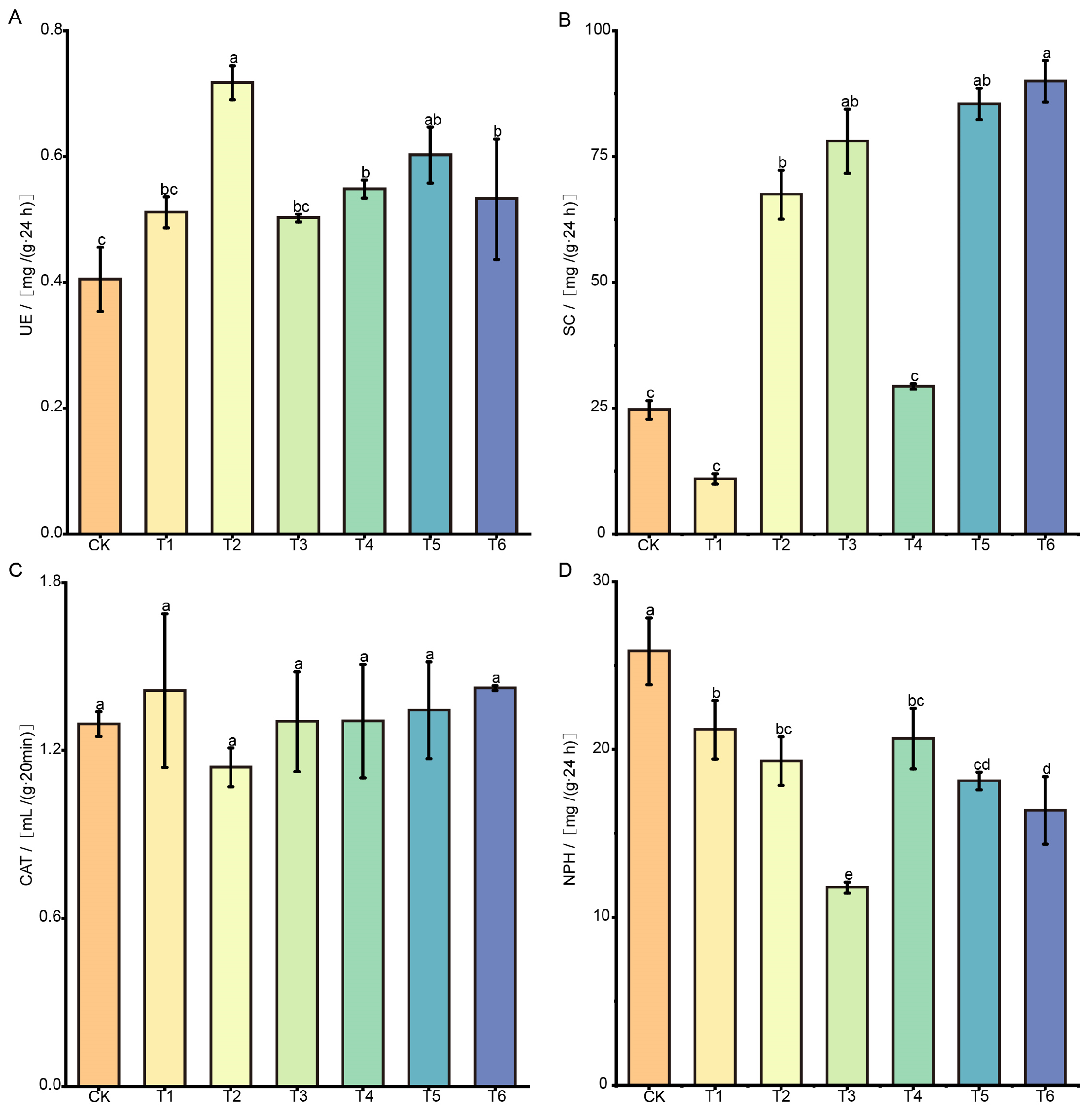
As shown in Figure 1, soil enzyme responses varied with different biochar types and applications. For the same biochar type, increasing the application rate boosted soil SC activity but lowered NPH activity. At the same application rate, rice biochar treatments (T4–T6) had higher SC activity than maize biochar treatments (T1–T3). SC activity in T2–T6 was significantly (p < 0.05) higher than that in CK, with increases of 173.33%, 216.34%, 18.89%, 246.41%, and 264.65%, respectively. Conversely, soil NPH activity showed the opposite trend. At equal application rates, T1 and T2 (maize biochar) had higher NPH activity than T4 and T5 (rice biochar), while T3 and T6 showed no clear advantage. However, all treatments showed significantly (p < 0.05) lower NPH activity than CK, decreasing by 4.68%, 25.34%, 54.47%, 20.12%, 29.90%, and 36.67%, respectively. Soil UE activity initially increased and then declined with biochar application, but remained higher in all treatments compared to that in CK. Notably, UE activity peaked in T2 (p < 0.05). Although biochar had a relatively minor impact on soil CAT activity, a measurable influence was still detected.

3.2. Effects of Biochar on Soil Microbial Abundance and Diversity

3.2.1. Bacterial Abundance and Diversity

Rarefaction and rank abundance curves were used to evaluate the richness of microbial communities across different treatment combinations. From Supplementary Figure S2A, it is evident that the rarefaction curves of the bacterial OTUs gradually flattened with increasing sequencing depth. Although the curves did not fully plateau, the sequencing effort adequately reflected most of the species present. A small proportion of the low-abundance taxa remained undetectable. In replicate analyses of different samples, rarefaction curves demonstrated greater sequencing depth and diversity. For the rank abundance curves (Supplementary Figure S2B), a broader span along the x-axis indicated higher species richness within the community, whereas a more gradual decline suggested a more even distribution of species. Notably, the curve for T4 was the broadest and smoothest.
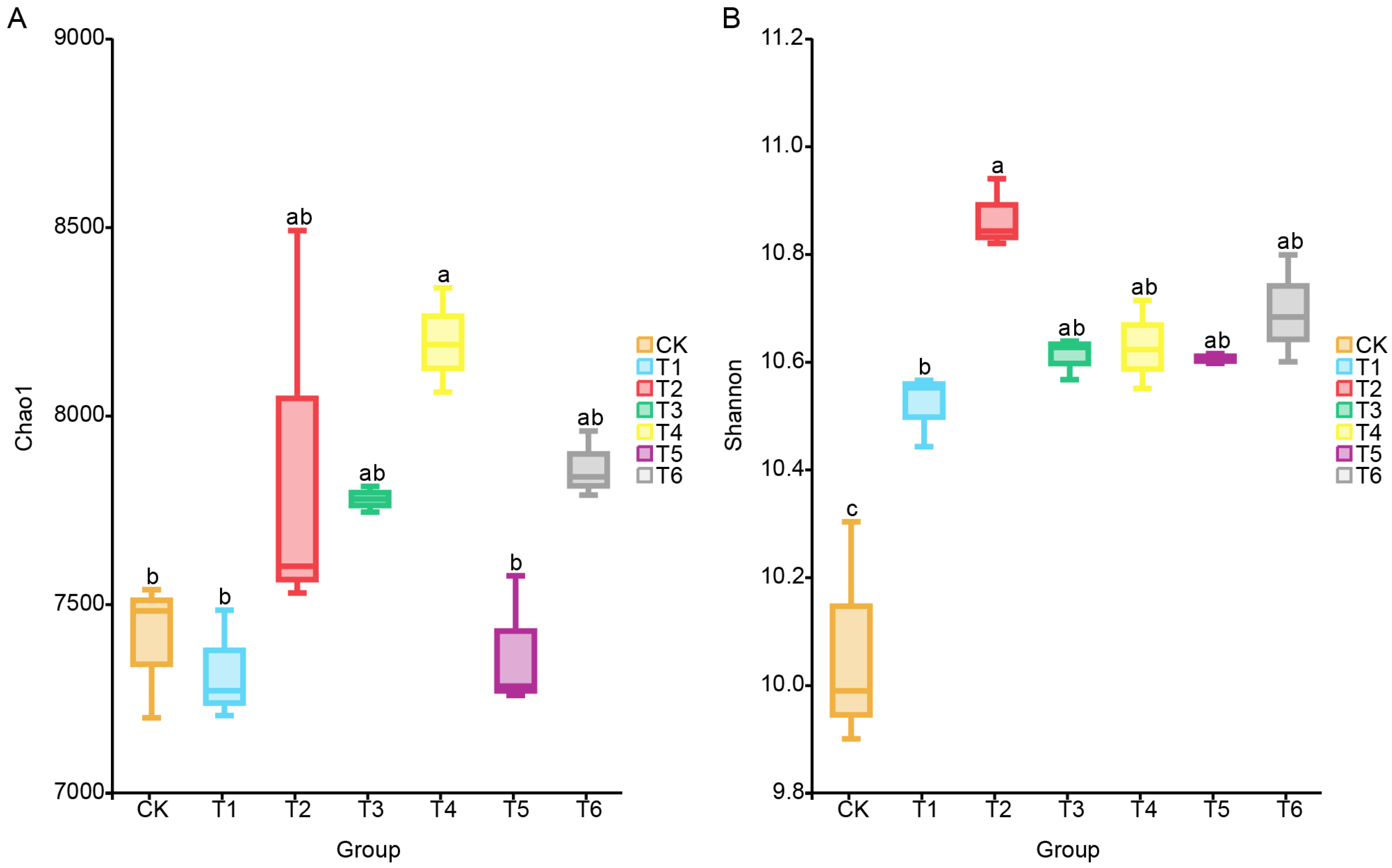
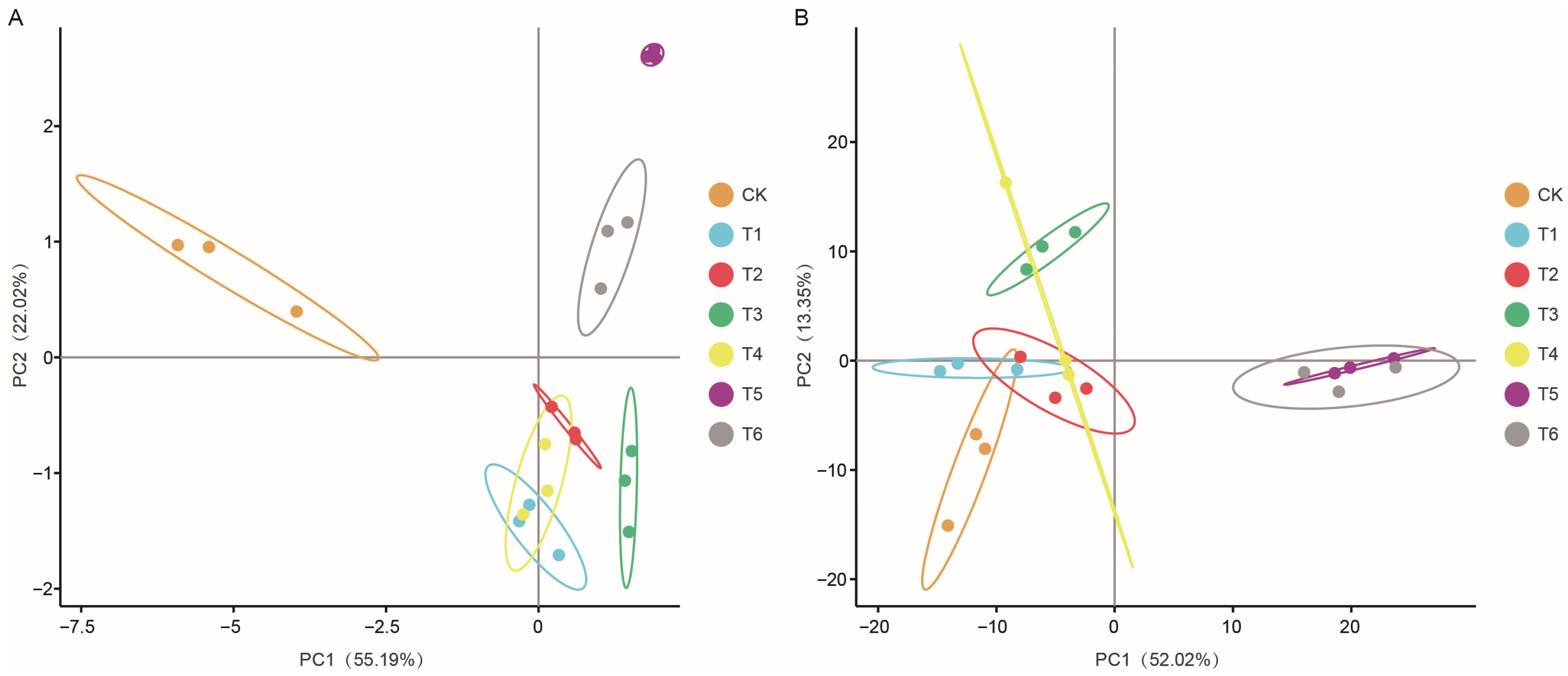
Additionally, microbial diversity was assessed using Simpson and Shannon indices, which reflect species distribution and diversity, whereas the Chao1 index was used to determine species richness. Coverage index measured the proportion of detected species relative to the actual species in the community, assessing sample representativeness. As shown in Figure 2 and Supplementary Table S2A, both Simpson and Shannon indices were higher for biochar treatments compared to those for CK, peaking for T2. The Chao1 index also showed significant differences between the biochar treatment groups and CK, with the most pronounced increase in T4 (10.67%). All samples achieved a sequencing coverage of >97%, ensuring sufficient sequencing depth for subsequent analyses. PCoA results (Figure 3A) revealed that biochar significantly altered the structure of the soil bacterial community. CK, T5, and T6 formed distinct clusters from other treatments. The first and second axes of the PCoA explained 55.19% and 22.02% of the variation, respectively. These results were further validated by Analysis of Similarities (ANOSIM) (Supplementary Table S3).

3.2.2. Fungal Abundance and Diversity

Unlike the bacterial results, fungal rarefaction curves (Supplementary Figure S3A) exhibited the highest richness in CK and the lowest in T5. Rank abundance curves (Supplementary Figure S3B) further illustrated this trend, with CK showing the widest and smoothest curve.
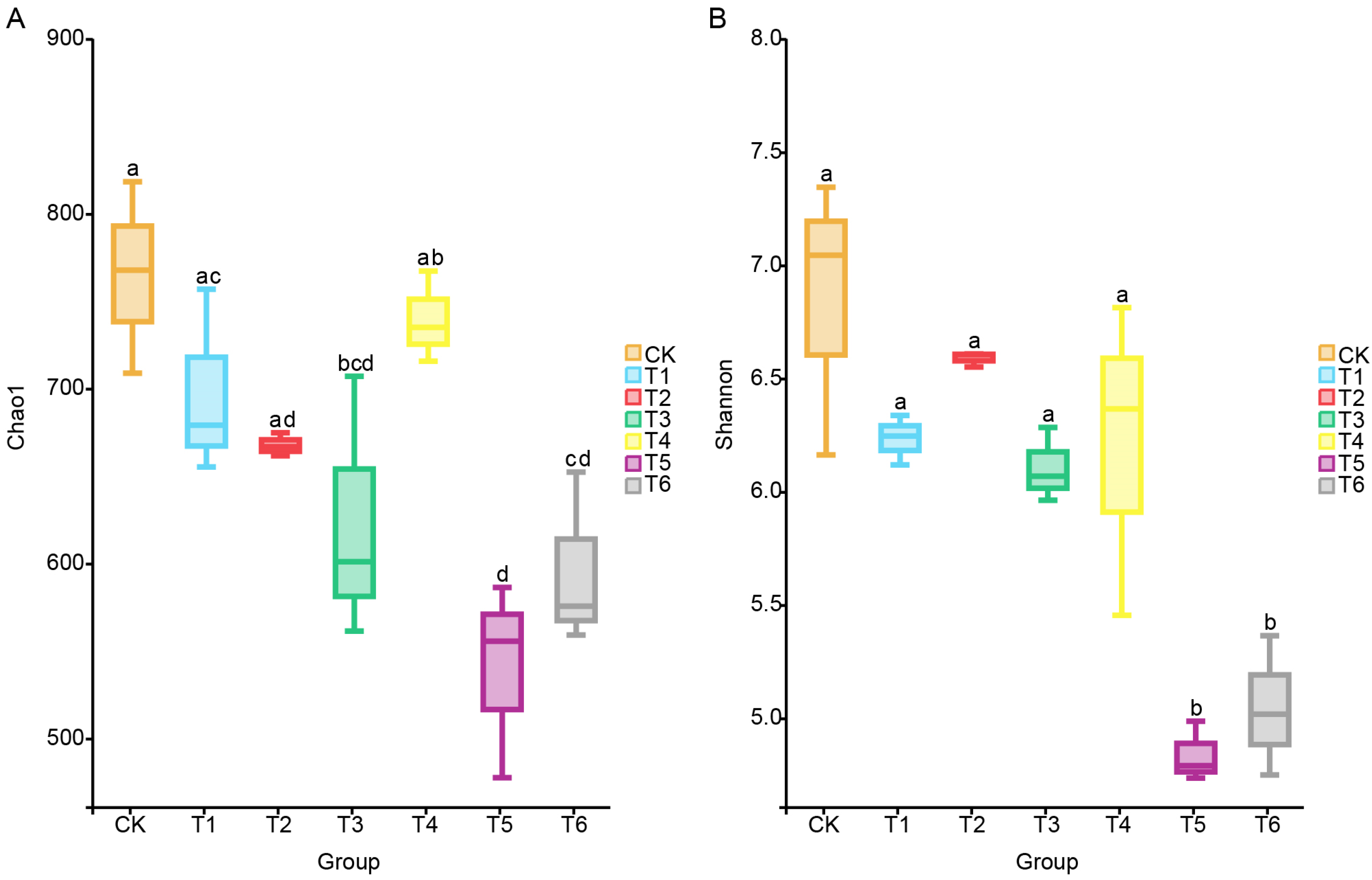
PCoA (Figure 3B) revealed that T5 and T6 significantly (p < 0.05) altered the fungal community structure. In the biochar-treated groups, the first and second axes of the PCoA explained approximately 22.0–55.2% and 13.4–52.0% of the total variation, respectively. These results were also validated by ANOSIM (Supplementary Table S3). The fungal diversity indices differed significantly from the bacterial indices (Figure 4 and Supplementary Table S2B). Fungal Shannon and Chao1 indices were lower in biochar-treated samples, reaching their minimum values in T5, with reductions of 29.38% and 29.43%, respectively, compared to the CK indices. At the same application rate, T1–T3 showed higher Simpson and Shannon indices than T4–T6. The Simpson index also reached its minimum in T5, which was 9.72% lower than that of CK (p < 0.05). All test samples achieved a sequencing coverage of >99%, ensuring an adequate sequencing depth and reliable assessment.

3.3. Effects of Biochar on Soil Microbial Community Composition and Functional Characteristics

3.3.1. Bacterial Community Composition

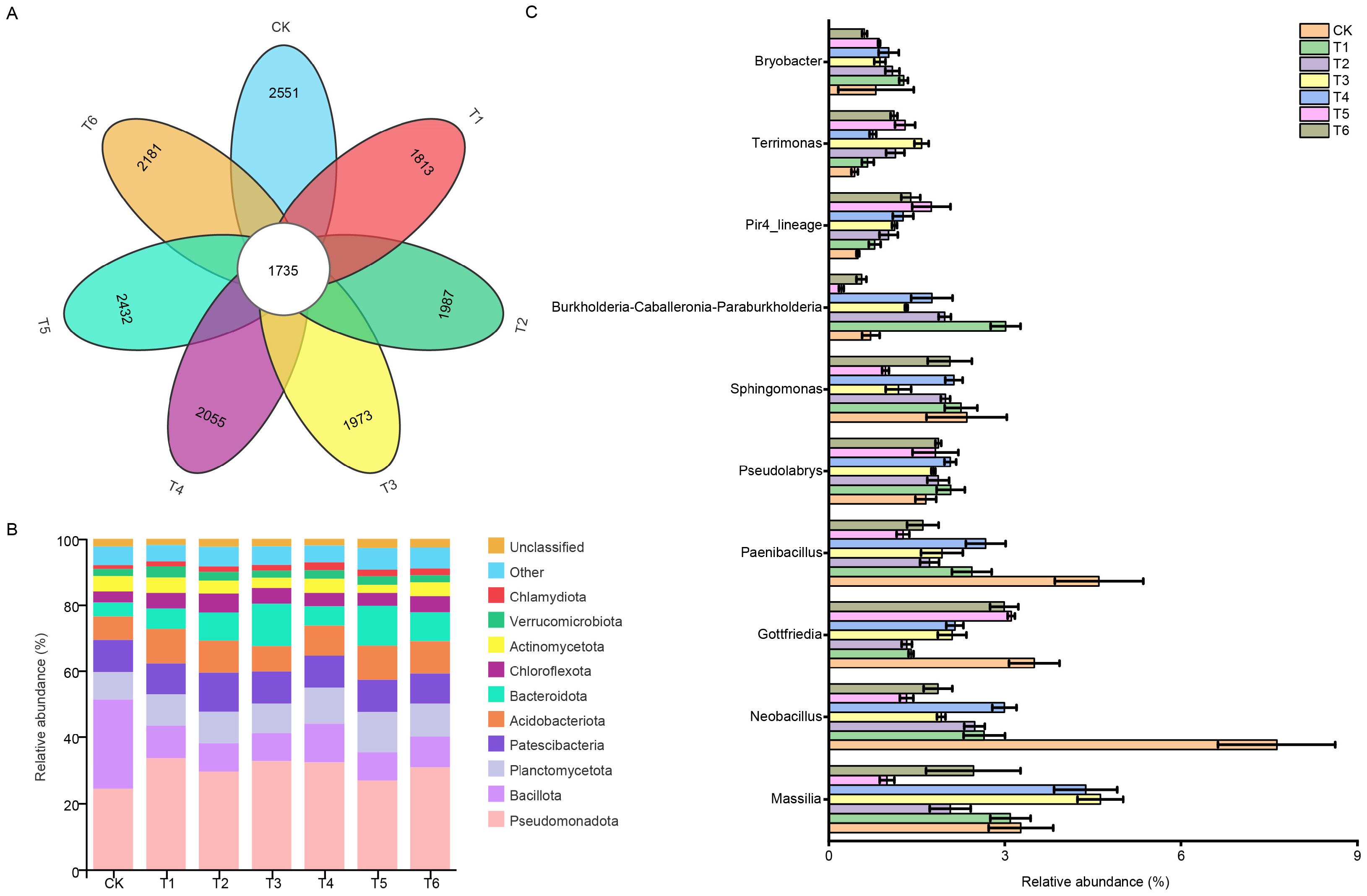
After quality control and chimera removal, 2,106,640 high-quality bacterial 16S rRNA gene reads were obtained. Each sample averaged 100, 316 valid reads, ranging from 84,976 (T1) to 110,089 (T5) (Supplementary Figure S4A). Based on 88% sequence similarity, these reads were clustered into 27,137 bacterial OTUs (Figure 5A). Among these, 1735 core OTUs were shared across all treatments, with biochar treatments resulting in fewer OTUs than CK, ranging from 1813 (T1) to 2432 (T5).
The dominant bacterial phyla were Pseudomonadota (24.2–33.5%), Bacillota (8.5–27.0%), Planctomycetota (8.3–12.3%), Patescibacteria (9.1–11.8%), Acidobacteriota (7.1–10.4%), Bacteroidota (4.2–12.8%), and Chloroflexota (3.5–5.8%), accounting for 82.7–85.2% of sequences (Figure 5B). At the phylum level, compared to CK, biochar treatments increased the relative abundance of Pseudomonadota, Planctomycetota, Acidobacteriota, Bacteroidota, Chloroflexota, Verrucomicrobiota, and Chlamydiota, while decreasing that of Bacillota and Actinomycetota. T3 showed the highest Bacteroidota abundance. At the genus level, biochar treatments enhanced the relative abundance of Pseudolabrys, Pir4_lineage, and Terrimonas, and decreased Neobacillus, Gottfriedia, Paenibacillus, and Sphingomonas (Figure 5C). Notably, Pseudolabrys and Pir4_lineage belong to the phylum Pseudomonadota, whereas Neobacillus, Gottfriedia, and Paenibacillus belong to Bacillota.

3.3.2. Fungal Community Composition

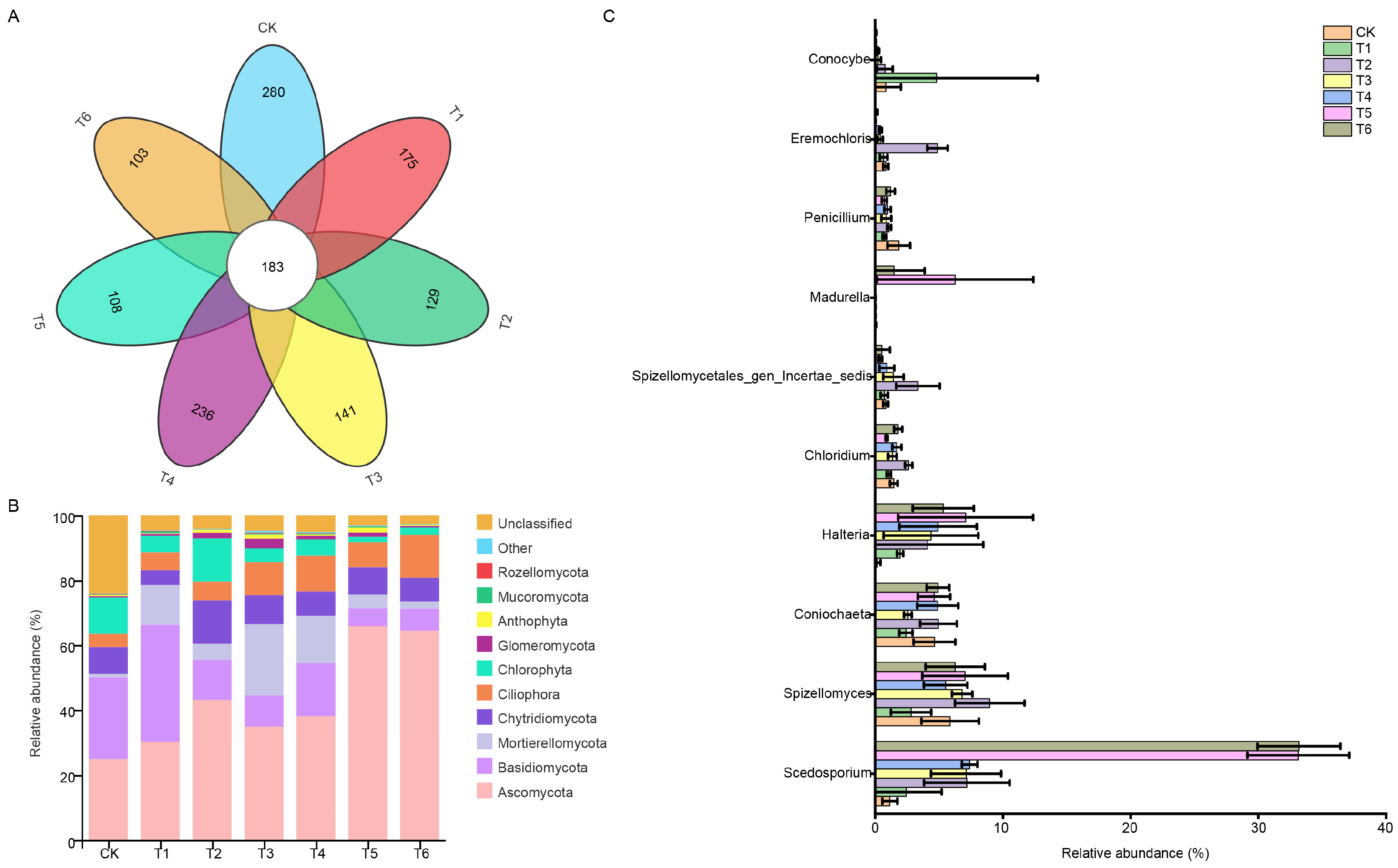
ITS1 region sequencing generated 1,840,090 high-quality fungal reads, averaging 87,623 valid reads per sample, with a range of 76,129 (CK) to 95,622 (T1) (Supplementary Figure S4B). Based on 90% sequence similarity, 2453 fungal OTUs were identified (Figure 6A). Among these, 183 were core OTUs shared across all treatments. Similar to the bacteria, the biochar treatments generally showed fewer OTUs than CK, ranging from 108 (T5) to 236 (T4). The dominant fungal phyla were Ascomycota (30.1–65.8%), Basidiomycota (5.6–36.2%), Mortierellomycota (2.2–22.0%), Chytridiomycota (4.7–13.5%), Ciliophora (5.5–13.2%), and Chlorophyta (2.3–13.3%), accounting for over 88.7% of the fungal reads (Figure 6B). Ascomycota was the most dominant phylum in T2–T5, especially T5 (65.80%), whereas Basidiomycota was dominant in CK and T1 (25.24% and 36.19%, respectively).
Biochar treatment increased the relative abundances of Ascomycota, Mortierellomycota, Ciliophora, Glomeromycota, and Mucoromycota. In T1–T3, the relative abundance of Ciliophora, Glomeromycota, and Anthophyta increased with increasing biochar application rates. In contrast, Mortierellomycota and Rozellomycota decreased with higher biochar levels in T4–T6. Compared with other treatments, chlorophyta showed a significantly high abundance only in T2 (13.28%) (Figure 6B). At the genus level, biochar treatments increased Scedosporium and Halteria abundance, while decreasing Penicillium abundance, compared to CK (Figure 6C). T5 exhibited the highest overall dominance of major genera (60.2%), with Scedosporium peaking in T6. Other dominant genera in T6 were Spizellomyces (6.26%), Halteria (6.33%), Coniochaeta (4.92%), and Chloridium (1.79%). Additionally, Madurella (6.26%), Eremochloris (4.88%), and Conocybe (4.79%) were more abundant in T5, T2, and T1, respectively (Figure 6C).

3.3.3. Functional Characteristics of Bacterial and Fungal Communities

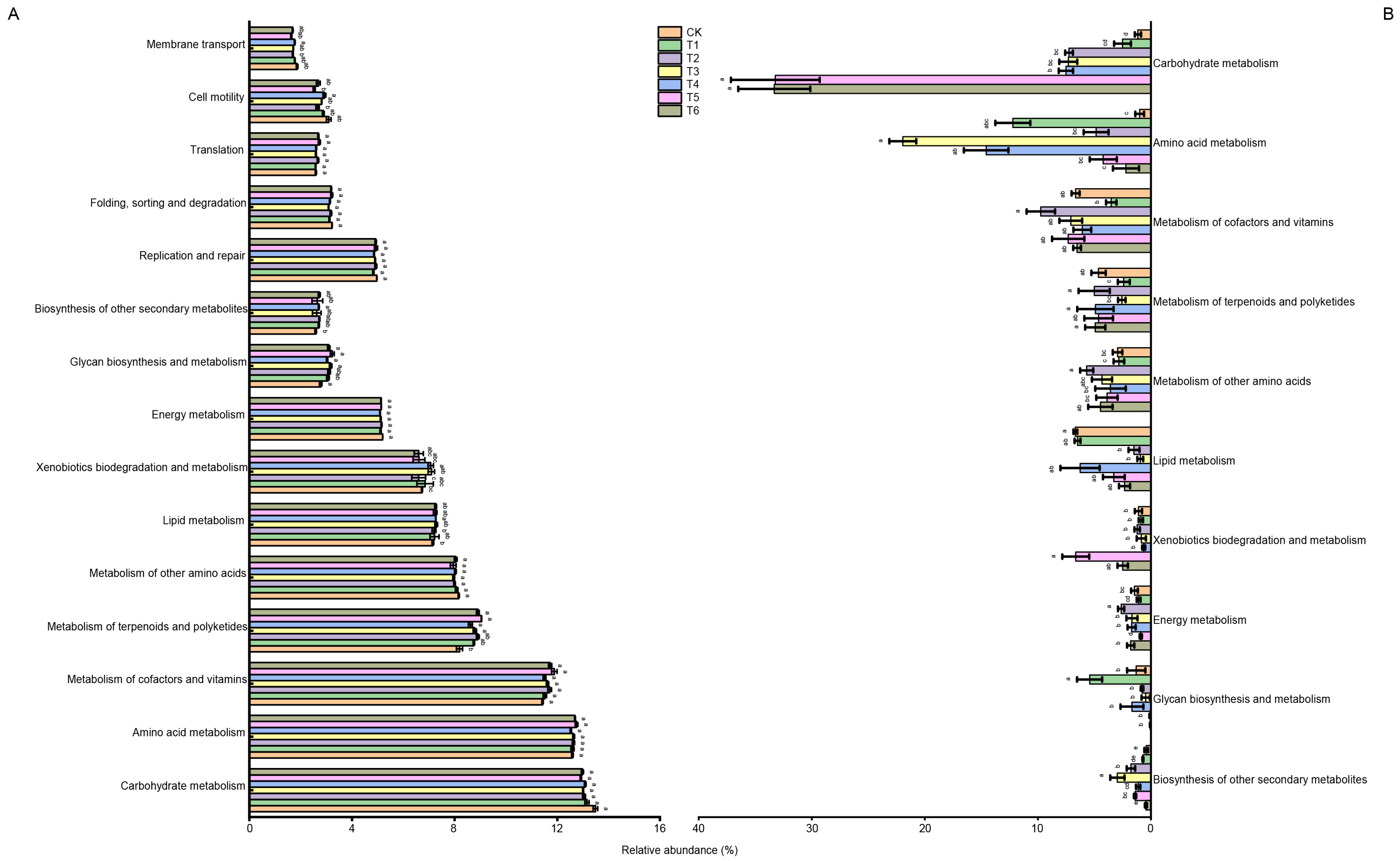
Biochar treatments increased the functional abundance of bacterial categories related to amino acids, cofactors and vitamins, terpenoids and polyketides, lipids, glycan biosynthesis and metabolism, and biosynthesis of other secondary metabolites, with the exception of amino acids in T4 and translation in T1. Conversely, functions related to carbohydrate metabolism, other amino acids, energy metabolism, replication and repair, folding, sorting and degradation, cell motility, and membrane transport were reduced. T5 had the highest values for amino acid metabolism, cofactors and vitamins, terpenoids and polyketides, glycan biosynthesis and metabolism, and translation. T3 had the highest values for lipid and xenobiotic biodegradation and metabolism, while T2 peaked for the biosynthesis of other secondary metabolites (Figure 7A). With the exception of plant pathogens and undefined saprotrophs in T1, biochar treatments increased the relative abundance of major fungal functional categories, including animal pathogen-endophyte, endophyte, plant pathogen, undefined saprotroph, and arbuscular mycorrhizal, while decreasing the abundance of bryophyte parasites. Notably, T2 showed a significantly higher enrichment of plant pathogens, animal pathogen-dung saprotrophs, undefined saprotrophs, and plant saprotroph functions than the other treatments (p < 0.05). The relative abundance of animal pathogen-endophytes increased with increasing biochar application rates (Figure 7B).

3.4. Relationships Between Soil Environmental Factors and Microbial Phyla

3.4.1. Bacterial Communities

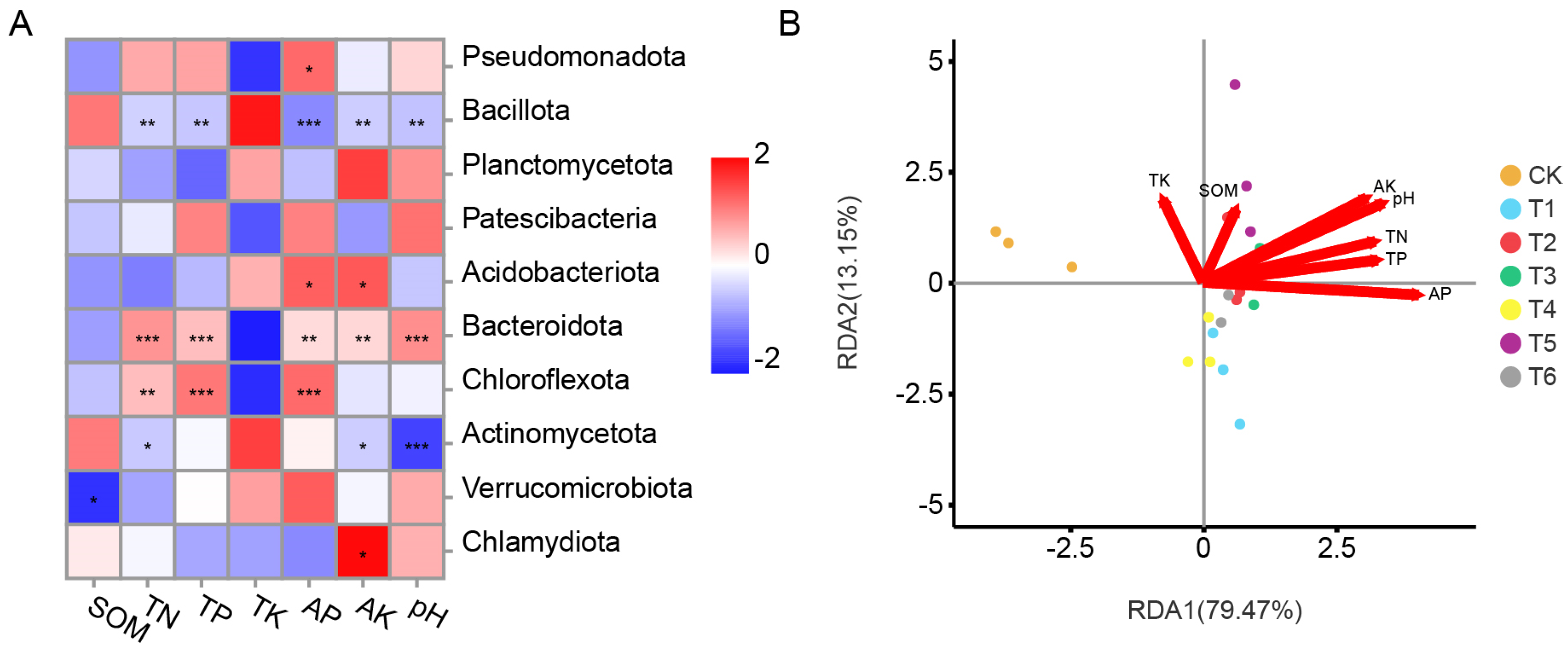
Pearson correlation coefficient heatmaps were used to analyze the relationships between microbial diversity and soil properties (Figure 8 and Figure 9). Bacteroidota showed significant positive correlations with TN, TP, AP, AK, and pH, whereas Bacillota showed significant negative correlations. Chloroflexota was significantly positively correlated with TN, TP, and AP, whereas Actinomycetota showed a significantly negative correlation with TN, AK, and pH. Acidobacteriota was significantly positively correlated with AP and AK, while SOM showed a significantly negative correlation with Verrucomicrobiota. Furthermore, AP and AK were significantly positively correlated with Pseudomonadota and Chlamydiota. Other bacterial phyla exhibited weak or insignificant correlations with environmental factors (Figure 8A). RDA revealed that the first two axes explained 79.47% (RDA1) and 13.15% (RDA2) of the total variation in the dataset (Figure 8B). Soil AK, pH, TN, TP, and AP had correlations with T3 and were located in the positive quadrants of the RDA axes, whereas TK showed no clear correlation with any treatment.

3.4.2. Fungal Communities

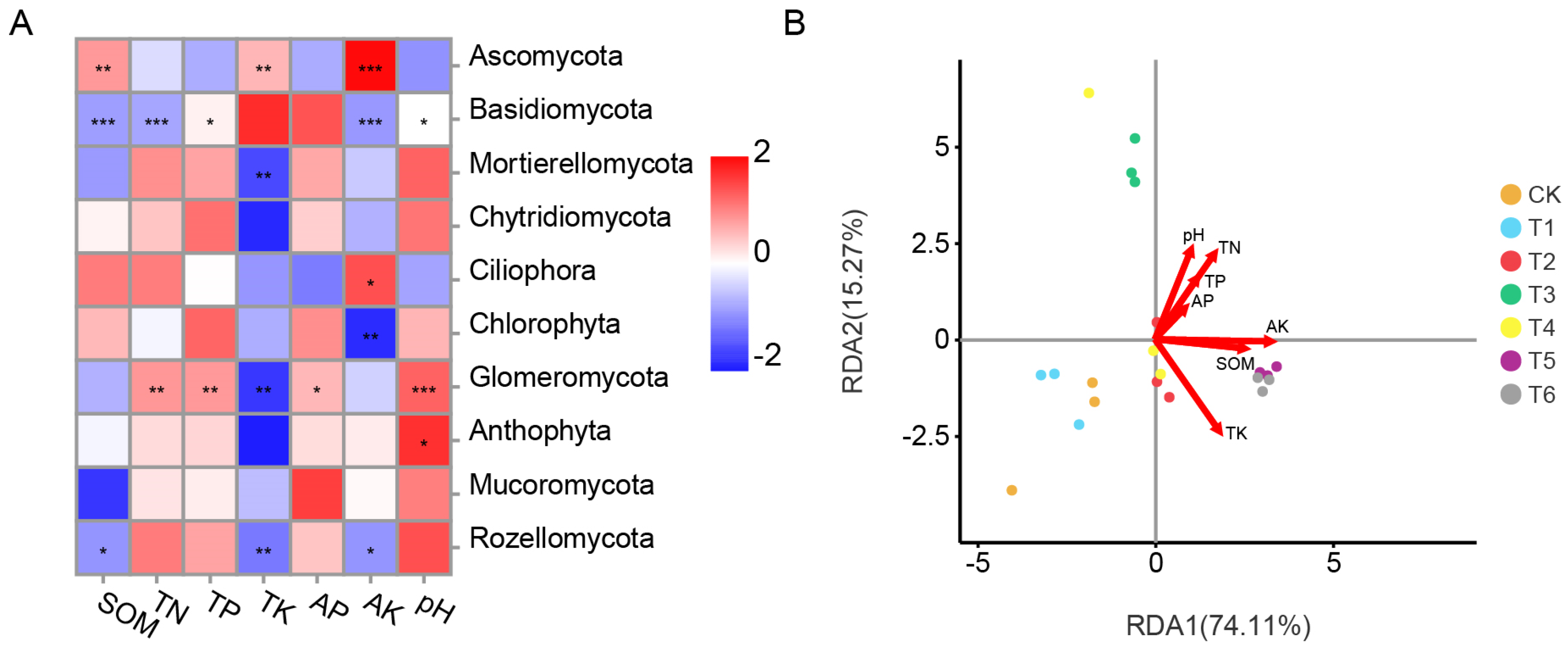
For fungal communities, the heatmap displayed the key relationships between dominant fungal phyla and soil fertility (Figure 9A). Basidiomycota showed extremely significant negative correlations with SOM, TN, and AK, and significant negative correlations with TP and pH. Glomeromycota had significant positive correlations with TN, TP, AP, and pH, and a significant negative correlation with TK. Ascomycota exhibited significant positive correlations with SOM, TK, and AK, whereas Rozellomycota showed significant negative correlations. Mortierellomycota was negatively correlated with TK, whereas Ciliophora and Chlorophyta showed positive and negative correlations with AK, respectively. Anthophyta was positively correlated with pH. Other fungal phyla did not show significant correlations with environmental factors. RDA explained 74.11% (RDA1) and 15.27% (RDA2) of the total variation in the dominant fungal phyla (Figure 9B). SOM, AK, and TK were located in the positive quadrants and were strongly correlated with T5 and T6, but not with CK, T1, or T3.

4. Discussion

4.1. Integrated Effects of Biochar on Soil Fertility and Enzyme Activity

Biochar application can significantly improve soil quality and fertility, thereby influencing the structure and function of soil microbial communities. While previous studies have mainly focused on single biochar types [54,55], this study demonstrated that both maize and rice biochar significantly (p < 0.05) increased soil pH. This is attributed to the presence of organic anions, such as -COO and -O, in biochar [56,57]. Biochar also enhanced soil phosphorus availability by reducing exchangeable acidity and promoting phosphorus release from Fe/Al (hydr) oxides [58], thereby increasing total and AP. Additionally, biochar serves as a reservoir that can store and release nutrients such as P and K [59,60].
Soil enzyme activity, a crucial indicator of ecosystem functionality, plays a vital role in the myriad biochemical processes essential for maintaining soil health [61]. Biochar can adsorb root substrates to enhance activity or adsorb enzyme molecules to protect binding sites, thereby inhibiting activity. The variation in enzyme responses to biochar are likely because of differences in biochar adsorption and structure [62]. This study confirmed that biochar boosts soil UE activity, increasing available nitrogen by promoting nitrogen-containing organic compound hydrolysis [59]. Similarly, cellulase activity increased post-biochar application, probably owing to the additional organic carbon provided by biochar, which aids organic carbon decomposition [63]. In contrast, CAT activity remained largely unchanged between the biochar and CK treatment groups, consistent with the findings of Lyu et al. [64]. NPH activity, however, showed a dose-dependent response—low biochar doses had no significant effect, whereas high doses inhibited activity [55], with maize biochar showing stronger inhibition than rice biochar. This inhibition likely stemmed from strong substrate adsorption by biochar, which reduced fungal diversity, weakened the soil capacity to decompose complex organic compounds, and lowered the secretion of hydrolytic enzymes such as NPH [65,66]. Overall, these findings indicate that changes in soil enzymes following biochar application are directly or indirectly related to the soil environment [14]. Enhanced enzyme activities are likely facilitated by microbial community structure remodeling and optimized biogeochemical cycles [64].

4.2. Regulatory Effects of Biochar on Soil Bacterial Community Structure and Function

Biochar addition altered soil microbial abundance and community composition, influencing nutrient cycling and organic matter decomposition [67]. At the bacterial phylum level, Pseudomonadota became the most abundant following biochar application. This shift is linked to its role in lignocellulose degradation, nitrogen cycling, and decomposition of large organic molecules [68]. Biochar also significantly (p < 0.05) increased the relative abundance of Acidobacteriota, Bacteroidota, and Chloroflexota compared to the CK. Similarly, Wang et al. [16] demonstrated that biochar addition significantly promoted the growth and metabolism of key microbial phyla, including Proteobacteria, Bacteroidota, Acidobacteriota, and Actinomycetota during cotton cultivation in saline-alkali soil repair. This highlights the universal regulatory effect of biochar on microbial communities, creating favorable conditions for bacterial composition. Additional studies by Hou [69], Sui [70] and Wang [71] further showed that biochar treatment enhances soil nitrogen cycling by promoting the dominance of acidophilic bacteria and fostering nutrient-rich microbial colonization. The observed increase in Bacteroidota and Chloroflexota may aid TN and AP accumulation. Soil pH is a key factor controlling microbial communities [72]. Our findings further supported this view, showing that the relative abundances of Bacteroidota and Actinomycetota were primarily affected by pH. Bacillota and Actinomycetota, both Gram-positive bacteria, decreased in abundance. This decline reflected dual mechanisms. Initially, these Gram-positive bacteria proliferated by utilizing biochar-derived low-molecular-weight dissolved organic carbon (LMW DOC), which was progressively depleted through microbial mineralization. As these substrates diminished, Gram-negative bacteria and fungi outcompeted them due to superior substrate versatility [73]. Concurrently, the biochar-induced pH increase suppressed these predominantly acid-tolerant phyla while enhancing nutrient availability (AK, TN), thereby favoring fast-growing, alkali-tolerant phyla taxa [74,75].
Based on 16S rRNA gene sequencing, biochar significantly (p < 0.05) increased the relative abundance of Pseudolabrys compared to the CK. This genus may be involved in denitrification and organic pollutant degradation [76,77]. Other dominant bacterial genera after biochar application included Massilia, Neobacillus, Gottfriedia, Paenibacillus, and Sphingomonas. Among these, Paenibacillus is known for its role in nitrate reduction and denitrification [78], whereas Sphingomonas promotes plant growth, enhances salt tolerance, and participates in soil nutrient and nitrogen cycling [79,80]. However, biochar reduced the relative abundance of these genera, possibly because the depletion of biochar-derived LMW DOC and easily degradable carbon fractions eroded the competitive advantage of Paenibacillus, which dominantly fixes labile carbon and nitrogen [81,82], and suppressed carbon-degrading Sphingomonas as biochar-induced decreases in TN inhibited carbon-mineralizing functions while enhancing ammonia assimilation through DOC dynamics [83].
PICRUSt2 analysis revealed that biochar increased the relative abundance of genes related to amino acids, cofactors and vitamins, terpenoids and polyketides, glycan biosynthesis and metabolism, translation, lipids, and other secondary metabolites. This was consistent with the increased TN, TP, and bacterial/fungal abundance observed post-biochar application. These results indicate that biochar enhances microbial activity and promotes plant residue decomposition [72,84]. Root exudates play a key role in soil metabolism [85], particularly amino acid metabolism, which generates vital secondary metabolites for plant growth and stress resistance. Biochar treatment has been shown to regulate the biosynthesis of key plant signaling metabolites, such as terpenoids and polyketides, which are crucial for disease resistance [86]. Terpenoids represent the largest class of specialized plant metabolites, while polyketides enhance rhizosphere microbial diversity [87]. Biochar also modulates the biosynthesis of coenzymes and vitamins, which mediate plant interactions with beneficial rhizobacteria [88]. Plants are known to shape rhizosphere microbial communities via vitamin secretion, thereby boosting disease resistance [88]. Additionally, biochar increased Acidobacteriota abundance but reduced Bacillota and Actinomycetota abundance compared to the CK. This aligned with the PICRUSt2-predicted decline in xenobiotic degradation and metabolism, as well as membrane transport-related genes. This pattern may be related to the initial bacterial degradation of biochar and subsequent fungal degradation [10]. Furthermore, higher Simpson, Shannon, and Chao1 indices, commonly used to assess microbial community richness and diversity [68], indicate a richer nutritional environment for microbial growth. Luan et al. [89] demonstrated that biochar application enhances these indices by activating soil bacteria and promoting their growth. The porous structure of biochar offers an ideal habitat for bacteria, and its addition further enhanced bacterial species richness and diversity.

4.3. Regulatory Mechanisms of Biochar on Soil Fungal Community Structure and Function

This study found that Ascomycota, Basidiomycota, Mortierellomycota, and Chytridiomycota are the dominant fungal phyla in litchi soil, consistent with previous studies [90]. Compared to the CK, biochar significantly (p < 0.05) increased the relative abundances of Ascomycota and Mortierellomycota, while decreasing that of Basidiomycota, indicating that high-quality soil microflora is more sensitive to improved biochar application [91]. The reduction in Basidiomycota may arise from ecological competition with Zygomycota [92]. Fungal community growth is pH-dependent [93], and our data further supported this by showing a correlation between Basidiomycota and pH. Ascomycota, a dominant fungal degrader of organic substrates [94], showed a significant correlation with SOM in this study. However, unlike bacteria, fungal diversity significantly decreased with increasing biochar application. This can be explained by multiple factors: biochar may disrupt soil network structures, intensifying bacterial-fungal antagonism [95], while altering soil carbon sources reduces fungal assimilates [96]. Specifically, Basidiomycota and Glomeromycota were highly sensitive to N and P availability and contribute significantly to soil N/P transformation [97,98]. Although arbuscular mycorrhizal fungi (AMF) within Glomeromycota could form mutualistic associations with most fruit trees, extracting nutrients from biochar via hyphal networks [99,100] and promoting rhizosphere remediation [71,101], their functional capacity may not offset the overall loss of fungal diversity. Additionally, biochar raises soil pH, which disproportionately affects fungal competitiveness compared to bacteria [95,102]. Despite reduced diversity, biochar promoted key fungal phyla such as Ascomycota and Mortierellomycota, which inhibit pathogens, consistent with prior findings in tobacco [103]. While biochar exerts negative effects on fungal diversity, its enhancement of functionally important fungal groups may benefit soil health and disease suppression. Overall, biochar significantly impacts lychee soil fungal communities through chemical properties, pH changes, and microbial interactions, necessitating a balanced consideration of its positive and negative effects in practical applications.
At the genus level, the fungal community mainly comprised Scedosporium, Spizellomyces, Coniochaeta, Halteria, Chloridium, Spizellomycetales_gen_Incertae_sedis, Madurella, Penicillium, Eremochloris, and Conocybe. Biochar significantly (p < 0.05) increased the relative abundance of Scedosporium, the main predictor of NO3-N transformation when maize straw biochar is used [104]. Conversely, biochar significantly (p < 0.05) reduced the phytopathogenic mold Penicillium (Ascomycota). This is consistent with previous studies reporting its capacity to degrade plant cell walls, trigger necrosis, and participate in cellulase production and humification [10,105,106]. However, the precise mechanism behind biochar-induced changes in the fungal community warrants further study.
Few studies have examined the impact of biochar addition on litchi soil fungal categories and functions. Functional predictions showed that biochar application significantly increases the abundance of animal pathogen-endophyte, endophyte, and arbuscular mycorrhiza. Endophytes participate in osmotic regulation, enhance root antioxidant systems, and promote nutrient absorption [107], which may explain their increased abundance. However, the increase in animal pathogens contradicts the findings of Guo et al. [108], possibly because of differences in experimental design and corrections leading to varying fungal function demands. Notably, soil properties are significantly correlated with animal pathogens [103], indicating that biochar-induced soil changes may drive pathogen adaptation and evolution, thereby influencing ecosystems. This warrants further exploration in future research. Biochar also reduced the relative abundance of plant pathogens, bryophyte parasites, wood saprotrophs, and animal pathogen-dung saprotrophs, likely owing to soil bacteria assisting plants in controlling pathogens, enhancing resistance, and competing with saprotrophs [109,110]. Unlike bacteria, fungi showed a decline in community diversity and richness following biochar application. This may be attributed to the easily mineralized carbon components in biochar increasing the humic acid content, thereby reducing fungal diversity and potentially inhibiting other fungal groups [109].

5. Conclusions

This study demonstrates that biochar exerts multifaceted effects on the rhizosphere soil of litchi seedlings. It enhanced key soil physicochemical properties, including TN, TP, AP, AK, and pH, and modulated soil enzyme activities, notably increasing SC activity and showing a dose-dependent influence on NPH activity. At the microbial level, biochar promoted beneficial bacteria, such as Acidobacteriota, Bacteroidota, and Chloroflexota, but reduced fungal diversity and richness, potentially affecting soil ecosystem stability. Moreover, TN, TP, AP, AK, and pH were extremely positively correlated with Bacteroidota and extremely negatively correlated with Bacillota, underscoring the link between soil microbial communities and fertility factors. These findings highlight the potential of biochar as a soil amendment for enhancing the rhizosphere environment in litchi-cultivation. Understanding its effects on soil microbes boosts soil fertility and crop yield, aiding sustainable agriculture. However, this study has limitations: pot trials cannot fully replicate field conditions, biochar’s impact on fungal functions remains unclear, and long-term ecosystem effects are undocumented. Future research should combine field experiments with multi-omics analyses to address these gaps.

Supplementary Materials

The following supporting information can be downloaded at: https://www.mdpi.com/article/10.3390/horticulturae12010119/s1, Figure S1: Correlations among soil physicochemical properties after biochar treatment; Figure S2: Rarefaction (A) and rank abundance curves (B) of bacterial OTUs across all samples; Figure S3: Rarefaction (A) and rank abundance curves (B) of fungal OTUs across all samples; Figure S4: Effects of different biochar application rates on library sizes of bacterial (A) and fungal (B) samples; Table S1: PCR reaction system and amplifcation program for fungi and bacteria; Table S2: Effect of different biochar on the Alpha diversity index of soil bacteria (A) and fungal (B); Table S3: Analysis of similarity (ANOSIM) results (R values) of bacterial (16S) and fungal (ITS) community structures between the biochar treatments and control.

Author Contributions

Conceptualization, R.C. and C.F.; methodology, R.C. and W.L.; investigation, R.C., J.Y. and W.L.; resources, C.F.; data curation, R.C. and J.Y.; writing—original draft preparation, R.C.; writing—review and editing, J.Y. and C.F.; visualization, R.C. and J.Y.; supervision, C.F.; funding acquisition, C.F. All authors have read and agreed to the published version of the manuscript.

Funding

This work was supported by the Special Fund of Rural Revitalization Strategy (Grant No. 2025TS-2-3); the Provincial Key Research and Development Program, Guangdong (Grant No. 2023B0202090001); the National Key-Area Research Program, China (Grant No. 2023YFD2300805-4); and the Special Program of Provincial Science and Technological Innovation Strategy, Shanwei (Grant No. 2022A003).

Data Availability Statement

The original contributions presented in this study are included in the article. Further inquiries can be directed to the corresponding author.

Conflicts of Interest

The authors declare no conflicts of interest.

References

  1. Xia, F.; Zhang, Z.; Zhang, Q.; Huang, H.; Zhao, X. Life cycle assessment of greenhouse gas emissions for various feedstocks-based biochars as soil amendment. Sci. Total Environ. 2024, 911, 168734. [Google Scholar] [CrossRef] [Scilit] [PubMed]
  2. Hossain, M.Z.; Bahar, M.M.; Sarkar, B.; Donne, S.W.; Ok, Y.S.; Palansooriya, K.N.; Kirkham, M.B.; Chowdhury, S.; Bolan, N. Biochar and its importance on nutrient dynamics in soil and plant. Biochar 2020, 2, 379–420. [Google Scholar] [CrossRef] [Scilit]
  3. Zhang, M.; Zhang, L.; Riaz, M.; Xia, H.; Jiang, C. Biochar amendment improved fruit quality and soil properties and microbial communities at different depths in citrus production. J. Clean. Prod. 2021, 292, 126062. [Google Scholar] [CrossRef] [Scilit]
  4. Hou, J.; Yi, G.; Hao, Y.; Li, L.; Shen, L.; Zhang, Q. The effect of combined application of biochar and phosphate fertilizers on phosphorus transformation in saline-alkali soil and its microbiological mechanism. Sci. Total Environ. 2024, 951, 175610. [Google Scholar] [CrossRef] [Scilit]
  5. Joseph, S.; Cowie, A.L.; Van Zwieten, L.; Bolan, N.; Budai, A.; Buss, W.; Cayuela, M.L.; Graber, E.R.; Ippolito, J.A.; Kuzyakov, Y.; et al. How biochar works, and when it doesn’t: A review of mechanisms controlling soil and plant responses to biochar. GCB Bioenergy 2021, 13, 1731–1764. [Google Scholar] [CrossRef] [Scilit]
  6. Huang, M.; Hu, T.; Wang, J.; Ding, Y.; Köster, K.; Sun, L. Effects of biochar on soil carbon pool stability in the dahurian larch (Larix gmelinii) forest are regulated by the dominant soil microbial ecological strategy. Sci. Total Environ. 2024, 951, 175725. [Google Scholar] [CrossRef] [Scilit]
  7. Zhang, Q.; Song, Y.; Wu, Z.; Yan, X.; Gunina, A.; Kuzyakov, Y.; Xiong, Z. Effects of six-year biochar amendment on soil aggregation, crop growth, and nitrogen and phosphorus use efficiencies in a rice-wheat rotation. J. Clean. Prod. 2020, 242, 118435. [Google Scholar] [CrossRef] [Scilit]
  8. Qiu, X.; Feng, M.; Chen, R.; Chen, J.; Zheng, X.; Mao, X.; Song, W.; Zhou, G. Phosphoric acid modified biochar enhanced heavy metals passivation via accelerating humification and bioremediation in sewage sludge composting. Environ. Technol. Innov. 2025, 39, 104275. [Google Scholar] [CrossRef] [Scilit]
  9. Gul, S.; Whalen, J.K.; Thomas, B.W.; Sachdeva, V.; Deng, H. Physico-chemical properties and microbial responses in biochar-amended soils: Mechanisms and future directions. Agric. Ecosyst. Environ. 2015, 206, 46–59. [Google Scholar] [CrossRef] [Scilit]
  10. Wang, C.; Chen, D.; Shen, J.; Yuan, Q.; Fan, F.; Wei, W.; Li, Y.; Wu, J. Biochar alters soil microbial communities and potential functions 3–4 years after amendment in a double rice cropping system. Agric. Ecosyst. Environ. 2021, 311, 107291. [Google Scholar] [CrossRef] [Scilit]
  11. Awad, Y.M.; Blagodatskaya, E.; Ok, Y.S.; Kuzyakov, Y. Effects of polyacrylamide, biopolymer, and biochar on decomposition of soil organic matter and plant residues as determined by 14C and enzyme activities. Eur. J. Soil Biol. 2012, 48, 1–10. [Google Scholar] [CrossRef] [Scilit]
  12. Ameloot, N.; Graber, E.R.; Verheijen, F.G.A.; De Neve, S. Interactions between biochar stability and soil organisms: Review and research needs. Eur. J. Soil Biol. 2013, 64, 379–390. [Google Scholar] [CrossRef] [Scilit]
  13. Fei, Y.; Liu, Z.; Yi, J.; She, D.; Qiu, W.; Jiang, L.; Liu, M.; Li, S.; Nie, H.; Li, Q.; et al. Biochar application enhances soil water storage in wet periods but intensifies drought conditions during dry periods in red soils. Soil Tillage Res. 2026, 256, 106902. [Google Scholar] [CrossRef] [Scilit]
  14. Ahmad, R.; Gao, J.; Li, W.; Zhang, Y.; Gao, Z.; Khan, A.; Ali, I.; Ullah, S.; Fahad, S. Response of soil nutrients, enzyme activities, and fungal communities to biochar availability in the rhizosphere of mountainous apple trees. Plant Soil 2023, 489, 277–293. [Google Scholar] [CrossRef] [Scilit]
  15. Liu, W.F.; Wang, X.G.; Liu, J.L.; Wu, N.; Wan, M.H.; Ma, F.L.; Liu, H. Effects of carbon-based fertilizer on soil physical and chemical properties, enzyme activities and microbial communities in maize fields in arid regions. Environ. Sci. 2024, 46, 1905–1914. (In Chinese) [Google Scholar]
  16. Wang, X.; Riaz, M.; Babar, S.; Eldesouki, Z.; Liu, B.; Xia, H.; Li, Y.; Wang, J.; Xia, X.; Jiang, C. Alterations in the composition and metabolite profiles of the saline-alkali soil microbial community through biochar application. J. Environ. Manag. 2024, 352, 120033. [Google Scholar] [CrossRef] [Scilit] [PubMed]
  17. Wang, X.; Song, D.; Liang, G.; Zhang, Q.; Ai, C.; Zhou, W. Maize biochar addition rate influences soil enzyme activity and microbial community composition in a fluvo-aquic soil. Appl. Soil Ecol. 2015, 96, 265–272. [Google Scholar] [CrossRef] [Scilit]
  18. Abdillah, A.N.; Shivanand, P.; Cheok, Q.; Bakar, S.A.; Taha, H.; Metali, F. Impact of rice husk biochar on soil properties and microbial diversity for paddy cultivation. J. Soil Sci. Plant Nutr. 2024, 24, 7507–7524. [Google Scholar] [CrossRef] [Scilit]
  19. Zhang, P.; Wang, D.; Zhang, Z.; Liu, X.; Guo, Q. How biochar curbs the negative impacts of plastic mulching on soil enzymes and microorganisms while elevating crop yields in ridge-furrow systems. Environ. Res. 2024, 263, 120155. [Google Scholar] [CrossRef] [Scilit]
  20. Lehmann, J.; Rillig, M.C.; Thies, J.; Masiello, C.A.; Hockaday, W.C.; Crowley, D. Biochar effects on soil biota—A review. Soil Biol. Biochem. 2011, 43, 1812–1836. [Google Scholar] [CrossRef] [Scilit]
  21. Pokharel, P.; Ma, Z.; Chang, S.X. Biochar increases soil microbial biomass with changes in extra- and intracellular enzyme activities: A global meta-analysis. Biochar 2020, 2, 65–79. [Google Scholar] [CrossRef] [Scilit]
  22. Zuccarini, P.; Sardans, J.; Asensio, L.; Peñuelas, J. Altered activities of extracellular soil enzymes by the interacting global environmental changes. Glob. Change Biol. 2023, 29, 2067–2091. [Google Scholar] [CrossRef] [Scilit] [PubMed]
  23. Burns, R.G.; DeForest, J.L.; Marxsen, J.; Sinsabaugh, R.L.; Stromberger, M.E.; Wallenstein, M.D.; Weintraub, M.N.; Zoppini, A. Soil enzymes in a changing environment: Current knowledge and future directions. Soil Biol. Biochem. 2013, 58, 216–234. [Google Scholar] [CrossRef] [Scilit]
  24. Qi, R.; Li, J.; Lin, Z.; Li, Z.; Li, Y.; Yang, X.; Zhang, J.; Zhao, B. Temperature effects on soil organic carbon, soil labile organic carbon fractions, and soil enzyme activities under long-term fertilization regimes. Appl. Soil Ecol. 2016, 102, 36–45. [Google Scholar] [CrossRef] [Scilit]
  25. Zhao, Y.; Wang, X.; Yao, G.; Lin, Z.; Xu, L.; Jiang, Y.; Jin, Z.; Shan, S.; Ping, L. Advances in the effects of biochar on microbial ecological function in soil and crop quality. Sustainability 2022, 14, 10411. [Google Scholar] [CrossRef] [Scilit]
  26. Gautam, K.; Singh, P.; Singh, R.P.; Singh, A. Impact of rice-husk biochar on soil attributes, microbiome interaction and functional traits of radish plants: A smart candidate for soil engineering. Plant Stress 2024, 14, 100564. [Google Scholar] [CrossRef] [Scilit]
  27. Ren, T.; Feng, H.; Wan Mahari, W.A.; Yun, F.; Li, M.; Ma, N.L.; Cai, X.; Liu, G.; Liew, R.K.; Lam, S.S. Biochar and microbial synergy: Enhancing tobacco plant resistance and soil remediation under cadmium stress. Biochar 2025, 7, 119. [Google Scholar] [CrossRef] [Scilit]
  28. Soothar, M.K.; Hamani, A.K.M.; Sardar, M.F.; Sootahar, M.K.; Fu, Y.; Rahim, R.; Soothar, J.K.; Bhatti, S.M.; Abubakar, S.A.; Gao, Y.; et al. Maize (Zea mays L.) seedlings rhizosphere microbial community as responded to acidic biochar amendment under saline conditions. Front. Microbiol. 2021, 12, 789235. [Google Scholar] [CrossRef] [Scilit]
  29. Qi, W.-Y.; Chen, H.; Wang, Z.; Xing, S.-F.; Song, C.; Yan, Z.; Wang, S.-G. Biochar-immobilized Bacillus megaterium enhances Cd immobilization in soil and promotes Brassica chinensis growth. J. Hazard. Mater. 2023, 458, 131921. [Google Scholar] [CrossRef] [Scilit]
  30. He, C.; Harindintwali, J.D.; Cui, H.; Zheng, W.; Zhu, Q.; Chang, S.X.; Wang, F.; Yang, J. Decoupled fungal and bacterial functional responses to biochar amendment drive rhizosphere priming effect on soil organic carbon mineralization. Biochar 2024, 6, 84. [Google Scholar] [CrossRef] [Scilit]
  31. Ruan, Y.; Xiang, Z.; Yang, Z.; Yang, Z.; Zhang, M.; Wong, M.H.; Shan, S.; Liu, W. Linking bacterial community shifts to biochar-induced improvements in soil fertility and multifunctionality. Agric. Ecosyst. Environ. 2026, 399, 110142. [Google Scholar] [CrossRef] [Scilit]
  32. Iturbe-Espinoza, P.; Elsgaard, L.; Sapkota, R.; Ellegaard-Jensen, L.; Winding, A. Eight-year effect of biochar amendment on soil properties, extracellular enzyme activity, N-cycling genes and microbiome structure in two Danish fallow soils. Microbiol. Res. 2026, 303, 128398. [Google Scholar] [CrossRef] [Scilit] [PubMed]
  33. Cao, X.; Liu, J.; Zhang, L.; Mao, W.; Li, M.; Wang, H.; Sun, W. Response of soil microbial ecological functions and biological characteristics to organic fertilizer combined with biochar in dry direct-seeded paddy fields. Sci. Total Environ. 2024, 948, 174844. [Google Scholar] [CrossRef] [Scilit] [PubMed]
  34. Hu, G.; Feng, J.; Xiang, X.; Wang, J.; Salojärvi, J.; Liu, C.; Wu, Z.; Zhang, J.; Liang, X.; Jiang, Z.; et al. Two divergent haplotypes from a highly heterozygous lychee genome suggest independent domestication events for early and late-maturing cultivars. Nat. Genet. 2022, 54, 73–83. [Google Scholar] [CrossRef] [Scilit]
  35. Yang, Y.; Li, Y.; Hao, K.; Zhao, Y.; Li, M.; Fan, Y. Microbial community composition and co-occurrence network analysis of the rhizosphere soil of the main constructive tree species in Helan Mountain of Northwest China. Sci. Rep. 2024, 14, 24557. [Google Scholar] [CrossRef] [Scilit]
  36. Guo, L.; Liu, S.; Zhang, P.; Hakeem, A.; Song, H.; Yu, M.; Wang, F. Effects of Different Mulching Practices on Soil Environment and Fruit Quality in Peach Orchards. Plants 2024, 13, 827. [Google Scholar] [CrossRef] [Scilit]
  37. Yin, J.; Li, Y.; Liu, H.; Duan, Y.; Jiao, Y.; Zhu, Z.; Luo, J.; Xie, C.; Zhang, H.; Zhang, X.; et al. Using slow-release fertilizers ensures the maintenance of litchi (Litchi chinensis Sonn.) production by enhancing soil nutrient supply and optimizing microbial communities. Appl. Soil Ecol. 2024, 195, 105265. [Google Scholar] [CrossRef] [Scilit]
  38. Yang, Z.; Li, B.; Ma, S.; Zhang, X.; Zhang, X.; Wang, Y.; Xu, L.; Zhang, K.; Wang, J.; Zhang, M.; et al. The WRKY transcription factor RsWRKY28 mediates cadmium extrusion via activating RsPDR8 expression in radish (Raphanus sativus L.). J. Hazard. Mater. 2025, 497, 139561. [Google Scholar] [CrossRef] [Scilit]
  39. Wang, X.; Gong, Y.; Xu, Y.; Cui, G. Pollution characteristics and source apportionment of heavy metals in farmland soil in Yujiang River Basin: A case of guiping in Guangxi. Environ. Chem. 2025, 44, 1–16. (In Chinese) [Google Scholar]
  40. Jones, D.L.; Murphy, D.V.; Khalid, M.; Ahmad, W.; Edwards-Jones, G.; DeLuca, T.H. Short-term biochar-induced increase in soil CO2 release is both biotically and abiotically mediated. Soil Biol. Biochem. 2011, 43, 1723–1731. [Google Scholar] [CrossRef] [Scilit]
  41. He, X.; Zhao, F.; Yu, K.; Yang, X.; Wang, J.; Yu, S. Effect of biochar on nutrient, enzyme activities and microbial diversity of rhizosphere soil of grape seedlings. Soil Fertil. Sci. China 2020, 6, 19–26. (In Chinese) [Google Scholar]
  42. Li, B.; Zhang, J.; Chang, T.; Wu, Q.; Zheng, H.; Zhang, D. Corn Stover Biochar amendment enhances nitrogen and phosphorus transformations, microbial community diversity, and enzyme activities in agricultural soil. Plants 2025, 14, 2787. [Google Scholar] [CrossRef] [Scilit] [PubMed]
  43. Fang, K.; Rao, S.; He, Y.; Wang, J.; Xu, J.; Shi, J. Rice straw-derived biochar amendment enabling a synergy for mercury alkylation and carbon sequestration in mercury-contaminated paddy soil. Chem. Eng. J. 2024, 498, 155507. [Google Scholar] [CrossRef] [Scilit]
  44. Liu, H.; Huang, Y.; Zhang, J.; Liu, S.; Su, X.; Bai, C.; Yao, L. Intracellular Mn mobility and differential response to H2O2 accumulation explain the susceptibility of litchi cultivars to dark pericarp disease. Plant Physiol. Biochem. 2025, 223, 109872. [Google Scholar]
  45. Wang, C.; Liu, J.; Shen, J.; Chen, D.; Li, Y.; Jiang, B.; Wu, J. Effects of biochar amendment on net greenhouse gas emissions and soil fertility in a double rice cropping system: A 4-year field experiment. Agric. Ecosyst. Environ. 2018, 262, 83–96. [Google Scholar] [CrossRef] [Scilit]
  46. Chen, L.-F.; He, Z.-B.; Wu, X.-R.; Du, J.; Zhu, X.; Lin, P.-F.; Tian, Q.-Y.; Kong, J.-Q. Linkages between soil respiration and microbial communities following afforestation of alpine grasslands in the northeastern Tibetan Plateau. Appl. Soil Ecol. 2021, 161, 103882. [Google Scholar] [CrossRef] [Scilit]
  47. Hua, L.; Gao, J.; Zhou, M.; Bai, S. Impacts of relative elevation on soil nutrients and apple quality in the hilly-gully region of the loess plateau, China. Sustainability 2021, 13, 1293. [Google Scholar] [CrossRef] [Scilit]
  48. Su, L.; Zeng, Y.; Li, G.; Chen, J.; Chen, X. Quercetin improves high-fat diet-induced obesity by modulating gut microbiota and metabolites in C57BL/6J mice. Phytother. Res. 2022, 36, 4558–4572. [Google Scholar] [CrossRef] [Scilit]
  49. Toju, H.; Tanabe, A.S.; Yamamoto, S.; Sato, H. High-coverage ITS primers for the DNA-based identification of ascomycetes and basidiomycetes in environmental samples. PLoS ONE 2012, 7, e40863. [Google Scholar] [CrossRef] [Scilit]
  50. Chen, S.; Zhou, Y.; Chen, Y.; Gu, J. Fastp: An ultra-fast all-in-one FASTQ preprocessor. Bioinformatics 2018, 34, i884–i890. [Google Scholar] [CrossRef] [Scilit]
  51. Magoč, T.; Salzberg, S.L. FLASH: Fast length adjustment of short reads to improve genome Assemblies. Bioinformatics 2011, 27, 2957–2963. [Google Scholar] [CrossRef] [Scilit]
  52. Bokulich, N.A.; Subramanian, S.; Faith, J.J.; Gevers, D.; Gordon, J.I.; Knight, R.; Mills, D.A.; Caporaso, J.G. Quality-filtering vastly improves diversity estimates from illumina amplicon sequencing. Nat. Methods 2013, 10, 57–59. [Google Scholar] [CrossRef] [Scilit] [PubMed]
  53. Edgar, R.C.; Haas, B.J.; Clemente, J.C.; Quince, C.; Knight, R. UCHIME improves sensitivity and speed of chimera detection. Bioinformatics 2011, 27, 2194–2200. [Google Scholar] [CrossRef] [Scilit] [PubMed]
  54. Wei, Z.; Han, X.; Wang, Y.; Zhang, L.; Gong, P.; Shi, Y. Effects of biochar, dual inhibitor, and straw return on maize yield, soil physicochemical properties, and microbial system under fertilization conditions. Front. Microbiol. 2025, 16, 1570237. [Google Scholar] [CrossRef] [Scilit] [PubMed]
  55. Wu, J.; Li, Z.; Li, Y.; Liu, J.; Liu, C.; Chai, Y.; Ai, C.; Hussain, Q.; Drosos, M.; Shan, S. Effects of rice straw biochar application rates on soil aggregate biogeochemistry and linkages to microbial community structure and enzyme activities. Soil Tillage Res. 2025, 252, 106589. [Google Scholar] [CrossRef] [Scilit]
  56. Wang, X.; Xia, X.; Riaz, M.; Babar, S.; El-Desouki, Z.; Qasim, M.; Wang, J.; Jiang, C. Biochar amendment modulate microbial community assembly to mitigate saline-alkaline stress across soil depths. J. Environ. Manag. 2025, 385, 125574. [Google Scholar] [CrossRef] [Scilit]
  57. Wu, W.; Zhen, Z.; Yang, G.; Yang, C.; Song, M.; Li, X.; Li, Q.; Zhong, X.; Yin, J.; Lin, Z.; et al. Straw biochar improves rice yield by regulating ammonia-oxidizing microorganisms and physicochemical properties of subtropical saline soils by a pot study. Environ. Technol. Innov. 2025, 38, 104204. [Google Scholar] [CrossRef] [Scilit]
  58. Jiang, J.; Yuan, M.; Xu, R.; Bish, D.L. Mobilization of phosphate in variable-charge soils amended with biochars derived from crop straws. Soil Tillage Res. 2015, 146, 139–147. [Google Scholar] [CrossRef] [Scilit]
  59. Zhang, P.; Bing, X.; Jiao, L.; Xiao, H.; Li, B.; Sun, H. Amelioration effects of coastal saline-alkali soil by ball-milled red phosphorus-loaded biochar. Chem. Eng. J. 2022, 431, 133904. [Google Scholar] [CrossRef] [Scilit]
  60. Bilias, F.; Kalderis, D.; Richardson, C.; Barbayiannis, N.; Gasparatos, D. Biochar application as a soil potassium management strategy: A review. Sci. Total Environ. 2023, 858, 159782. [Google Scholar] [CrossRef] [Scilit]
  61. Wang, J.; Xie, J.; Li, L.; Luo, Z.; Zhang, R.; Wang, L.; Jiang, Y. The impact of fertilizer amendments on soil autotrophic bacteria and carbon emissions in maize field on the semiarid loess plateau. Front. Microbiol. 2021, 12, 664120. [Google Scholar] [CrossRef] [Scilit]
  62. Elzobair, K.A.; Stromberger, M.E.; Ippolito, J.A.; Lentz, R.D. Contrasting effects of biochar versus manure on soil microbial communities and enzyme activities in an aridisol. Chemosphere 2016, 142, 145–152. [Google Scholar] [CrossRef] [Scilit]
  63. Feng, Q.; Wang, B.; Chen, M.; Zhang, J.; Zhang, X.; Wu, P. Calcium alginate−biochar composite promotes nutrient retention, enzyme activity, and plant growth in lime soil. Environ. Technol. Innov. 2024, 35, 103670. [Google Scholar] [CrossRef] [Scilit]
  64. Lyu, H.-H.; Cheng, K.; He, L.-L.; Yang, S.-M.; Liu, Y.-X.; You, L.-C.; Wang, Y.-Y. Efficiency of talcum-biochars in immobilization of heavy metals and promotion of the growth of Brassica chinensis in contaminated agricultural soil. Plant Stress 2025, 16, 100836. [Google Scholar] [CrossRef] [Scilit]
  65. Tian, J.; Wang, J.; Dippold, M.; Gao, Y.; Blagodatskaya, E.; Kuzyakov, Y. Biochar affects soil organic matter cycling and microbial functions but does not alter microbial community structure in a paddy soil. Sci. Total Environ. 2016, 556, 89–97. [Google Scholar] [CrossRef] [Scilit] [PubMed]
  66. Das, P.; Barker, C.; Park, Y.; Perreault, F.; Westerhoff, P.; Penton, C.R. Impact of graphite nano amendments on soil enzyme activities, functional genes and microbiome composition in a soil-plant system. Soil Biol. Biochem. 2025, 203, 109714. [Google Scholar] [CrossRef] [Scilit]
  67. Hu, Y.; Li, Y.; Liu, K.; Shi, C.; Wang, W.; Yang, Z.; Xu, K.; Li, S.; Wang, Y.; Jin, L.; et al. Improving the stability of black soil microbial communities through long-term application of biochar to optimize the characteristics of DOM components. Biochar 2025, 7, 84. [Google Scholar] [CrossRef] [Scilit]
  68. Qin, W.; Shahab, A.; Sun, X.; Li, J.; Li, K.; Xiao, H. Enhancing municipal sludge composting efficiency: The synergistic impacts of montmorillonite and coconut shell biochar additives on heavy metal passivation and microbial community succession. J. Environ. Chem. Eng. 2025, 13, 117155. [Google Scholar] [CrossRef] [Scilit]
  69. Hou, J.; Tang, J.; Zhang, X.; Zhang, S.; Zhang, Q. Combined improvement of coastal saline-alkali soils by biochar and Azotobacter chroococcum: Effects and mechanisms. Appl. Soil Ecol. 2025, 212, 106214. [Google Scholar] [CrossRef] [Scilit]
  70. Sui, M.; Yu, J.; Dong, Y.; Wu, J.; Jiang, Y.; Wang, X.; Gu, Z.; Dion, T.H.; Gao, Y.; Wu, M. Sediment-based biochar enhances growth, physiological and phytochemical properties of submerged plant Vallisneria spiralis via improving rhizosphere micro-ecological environment. J. Environ. Manag. 2025, 387, 125811. [Google Scholar] [CrossRef] [Scilit]
  71. Wang, Y.; Lu, Q.; Zhang, F.; Wang, W.; Wu, C. Effects of biochar on the yield of melon and the diversity of rhizosphere soil microbial communities under saline–alkali Stress. Plants 2025, 14, 1423. [Google Scholar] [CrossRef] [Scilit] [PubMed]
  72. Zhu, X.; Mao, L.; Chen, B. Driving forces linking microbial community structure and functions to enhanced carbon stability in biochar-amended soil. Environ. Int. 2019, 133, 105211. [Google Scholar] [CrossRef] [Scilit] [PubMed]
  73. Liu, Q.; Zhu, Z.; Wei, L.; Zhang, W.; Wang, S.; Yuan, H.; Chen, J.; Ge, T.; Xu, M.; Kuzyakov, Y. Bacterial necromass decomposition and priming effects in paddy soils depend on long-term fertilization. Soil Biol. Biochem. 2025, 211, 109992. [Google Scholar] [CrossRef] [Scilit]
  74. Lee, K.K.; Liu, S.; Crocker, K.; Wang, J.; Huggins, D.R.; Tikhonov, M.; Mani, M.; Kuehn, S. Functional regimes define soil microbiome response to environmental change. Nature 2025, 644, 1028–1038. [Google Scholar] [CrossRef] [Scilit]
  75. Ren, Y.; Xu, S.; Yan, Y.; Chen, Z.; Liu, L.; Zhou, X.; Cai, Z.; Huang, X. Defining pH-associated ecological clusters and their responses to agricultural intensification. Geoderma 2025, 460, 117445. [Google Scholar] [CrossRef] [Scilit]
  76. Jia, W.; Yang, Y.; Yang, L.; Gao, Y. High-efficient nitrogen removal and its microbiological mechanism of a novel carbon self-sufficient constructed wetland. Sci. Total Environ. 2021, 775, 145901. [Google Scholar] [CrossRef] [Scilit]
  77. Geng, R.; Zhang, B.; Wang, S.; Li, J. Pyrolysis or not: Comparison between biomass and biochar for vanadium stabilization in soil. J. Clean. Prod. 2025, 500, 45246. [Google Scholar] [CrossRef] [Scilit]
  78. Luo, D.; Meng, X.; Zheng, N.; Li, Y.; Yao, H.; Chapman, S.J. The anaerobic oxidation of methane in paddy soil by ferric iron and nitrate, and the microbial communities involved. Sci. Total Environ. 2021, 788, 147773. [Google Scholar] [CrossRef] [Scilit]
  79. Yang, W.; Li, C.; Wang, S.; Zhou, B.; Mao, Y.; Rensing, C.; Xing, S. Influence of biochar and biochar-based fertilizer on yield, quality of tea and microbial community in an acid tea orchard soil. Appl. Soil Ecol. 2021, 166, 104005. [Google Scholar] [CrossRef] [Scilit]
  80. Sun, R.; Zheng, H.; Yin, S.; Zhang, X.; You, X.; Wu, H.; Suo, F.; Han, K.; Cheng, Y.; Zhang, C.; et al. Comparative study of pyrochar and hydrochar on peanut seedling growth in a coastal salt-affected soil of Yellow River Delta, China. Sci. Total Environ. 2022, 833, 155183. [Google Scholar] [CrossRef] [Scilit]
  81. Zhao, Q.; Wang, J.; He, Q.; Yin, H. Carbon type and quantity regulate soil free-living nitrogen fixation through restructuring diazotrophic community. Appl. Soil Ecol. 2024, 202, 105586. [Google Scholar] [CrossRef] [Scilit]
  82. Li, Q.; Liu, S.; Li, Y.; Hao, T.; Chen, S. Nitrogen fixation by Paenibacillus polymyxa WLY78 is responsible for cucumber growth promotion. Plant Soil 2022, 473, 507–516. [Google Scholar] [CrossRef] [Scilit]
  83. Yang, X.; Xie, Z.; Hu, Z.; Wen, G.; Li, S.; Ke, X.; Sun, X.; Tao, M.; Jiang, X. Effects of 3-year biochar application on carbon sequestration, nitrogen retention and nitrate leaching of fluvo-aquic soil profiles in vegetable rotation fields. Agric. Ecosyst. Environ. 2024, 367, 108989. [Google Scholar] [CrossRef] [Scilit]
  84. Ma, Y.; Zhang, K.; Li, D.; Guo, M.; Zhou, Y.; Li, X.; Miao, R. Effects of wheat straw biochar with different proportions on phytoremediation efficiency and microbial communities of PAH-contaminated soils. J. Environ. Chem. Eng. 2025, 13, 117140. [Google Scholar] [CrossRef] [Scilit]
  85. Zhang, H.; Huang, M.; Zhang, W.; Gardea-Torresdey, J.L.; White, J.C.; Ji, R.; Zhao, L. Silver nanoparticles alter soil microbial community compositions and metabolite profiles in unplanted and cucumber-planted soils. Environ. Sci. Technol. 2020, 54, 3334–3342. [Google Scholar] [CrossRef] [Scilit]
  86. Cui, X.; Yuan, J.; Yang, X.; Wei, C.; Bi, Y.; Sun, Q.; Meng, J.; Han, X. Biochar application alters soil metabolites and nitrogen cycle-related microorganisms in a soybean continuous cropping system. Sci. Total Environ. 2024, 917, 170522. [Google Scholar] [CrossRef] [Scilit]
  87. Palacios, O.A.; Bashan, Y.; de-Bashan, L.E. Proven and potential involvement of vitamins in interactions of plants with plant growth-promoting bacteria—An overview. Biol. Fertil. Soils 2014, 50, 415–432. [Google Scholar] [CrossRef] [Scilit]
  88. Yang, H.; Kerner, P.; Liang, X.; Struhs, E.; Mirkouei, A.; You, Y. Biochar amendment modulates root metabolome and rhizosphere microbiome of wheat. Biochar 2025, 7, 46. [Google Scholar] [CrossRef] [Scilit]
  89. Luan, T.; Yan, J.; Zhao, X.; Tuoheti, T.; Xu, Y.; Gan, T.; Zhao, X.; He, L.; Gustave, W.; Zhang, X.; et al. Combined effects of biochar and silkworm excrement compost applications on soil properties and vegetable growth. Appl. Soil Ecol. 2025, 210, 106067. [Google Scholar] [CrossRef] [Scilit]
  90. Azeem, M.; Wang, J.; Kubwimana, J.J.; Kazmi, S.S.H.; Khan, Z.H.; He, K.; Han, R. Biochar-derived dissolved organic matter (BDOM) shifts fungal community composition: BDOM-soil DOM interaction. Appl. Soil Ecol. 2025, 207, 105916. [Google Scholar] [CrossRef] [Scilit]
  91. Ren, T.; Gao, W.; Xu, C.; Li, M.; Feng, H.; Zhang, L.; Wei, Y.; Cai, X.; Liu, G. Novel approaches of regulating soil micro-ecological environment based on modified biochar in plastic greenhouse. Environ. Technol. Innov. 2021, 23, 101740. [Google Scholar] [CrossRef] [Scilit]
  92. Ntana, F.; Bhat, W.W.; Johnson, S.R.; Jørgensen, H.J.L.; Collinge, D.B.; Jensen, B.; Hamberger, B. A sesquiterpene synthase from the endophytic fungus Serendipita indica catalyzes formation of viridiflorol. Biomolecules 2021, 11, 898. [Google Scholar] [CrossRef] [Scilit] [PubMed]
  93. Duan, Y.; Awasthi, S.K.; Chen, H.; Liu, T.; Zhang, Z.; Zhang, L.; Awasthi, M.K.; Taherzadeh, M.J. Evaluating the impact of bamboo biochar on the fungal community succession during chicken manure composting. Bioresour. Technol. 2018, 272, 308–314. [Google Scholar] [CrossRef] [Scilit]
  94. Guo, J.; Liu, W.; Zhu, C.; Luo, G.; Kong, Y.; Ling, N.; Wang, M.; Dai, J.; Shen, Q.; Guo, S. Bacterial rather than fungal community composition is associated with microbial activities and nutrient-use efficiencies in a paddy soil with short-term organic amendments. Plant Soil 2018, 424, 335–349. [Google Scholar] [CrossRef] [Scilit]
  95. Chen, Z.; Kumar, A.; Fu, Y.; Singh, B.P.; Ge, T.; Tu, H.; Luo, Y.; Xu, J. Biochar decreased rhizodeposits stabilization via opposite effects on bacteria and fungi: Diminished fungi-promoted aggregation and enhanced bacterial mineralization. Biol. Fertil. Soils 2021, 57, 533–546. [Google Scholar] [CrossRef] [Scilit]
  96. Mason, A.R.G.; Lowe, A.J.; Brien, C.; Jewell, N.; Cavagnaro, T.R.; Salomon, M.J. Response of wheat to arbuscular mycorrhizal fungi inoculation and biochar application: Implications for soil carbon sequestration. Soil Biol. Biochem. 2024, 199, 109611. [Google Scholar] [CrossRef] [Scilit]
  97. Guo, Q.; Yan, L.; Korpelainen, H.; Niinemets, Ü.; Li, C. Plant-plant interactions and N fertilization shape soil bacterial and fungal communities. Soil Biol. Biochem. 2019, 128, 127–138. [Google Scholar] [CrossRef] [Scilit]
  98. Cheng, H.; Yuan, M.; Tang, L.; Shen, Y.; Yu, Q.; Li, S. Integrated microbiology and metabolomics analysis reveal responses of soil microorganisms and metabolic functions to phosphorus fertilizer on semiarid farm. Sci. Total Environ. 2022, 817, 152878. [Google Scholar] [CrossRef] [Scilit]
  99. Wen, Y.; Wu, R.; Qi, D.; Xu, T.; Chang, W.; Li, K.; Fang, X.; Song, F. The effect of AMF combined with biochar on plant growth and soil quality under saline-alkali stress: Insights from microbial community analysis. Ecotoxicol. Environ. Saf. 2024, 281, 116592. [Google Scholar] [CrossRef] [Scilit]
  100. Li, Z.; Li, Y.; Zhang, Q.; Zhang, Z.; Jiang, J.; Huang, T.; Mei, C.; Wu, F.; Cheng, B.; Li, X.; et al. Synergistic mechanisms of AMF and biochar driving rhizosphere fungal community in shallot in barren soil. Hortic. Plant J. 2024, 10, 1252–1256. [Google Scholar] [CrossRef] [Scilit]
  101. Li, Z.; Lin, K.; Wang, Y.; Zhai, Y.; Wang, B.; Ping, M.; Meng, Y.; Luo, W.; Chen, J.; Li, X. Synergistic superiority of AMF and biochar in enhancing rhizosphere microbiomes to support plant growth under Cd stress. Biochar 2025, 7, 105. [Google Scholar] [CrossRef] [Scilit]
  102. Dai, Z.; Xiong, X.; Zhu, H.; Xu, H.; Leng, P.; Li, J.; Tang, C.; Xu, J. Association of biochar properties with changes in soil bacterial, fungal and fauna communities and nutrient cycling processes. Biochar 2021, 3, 239–254. [Google Scholar] [CrossRef] [Scilit]
  103. Ge, S.; Gao, J.; Chang, D.; He, T.; Cai, H.; Wang, M.; Li, C.; Luo, Z.; E, Y.; Meng, J.; et al. Biochar contributes to resistance against root rot disease by stimulating soil polyphenol oxidase. Biochar 2023, 5, 55. [Google Scholar] [CrossRef] [Scilit]
  104. Bello, A.; Ogundeji, A.; Yu, S.; Jiang, X.; Deng, L.; Zhao, L.; Jong, C.; Xu, X. Dynamics of fungal species related to nitrogen transformation and their network patterns during cattle manure-corn straw with biochar composting. Arch. Microbiol. 2022, 204, 236. [Google Scholar] [CrossRef] [Scilit] [PubMed]
  105. Jiang, J.; Wang, Y.; Yu, D.; Hou, R.; Ma, X.; Liu, J.; Cao, Z.; Cheng, K.; Yan, G.; Zhang, C.; et al. Combined addition of biochar and garbage enzyme improving the humification and succession of fungal community during sewage sludge composting. Bioresour. Technol. 2022, 346, 126344. [Google Scholar] [CrossRef] [Scilit]
  106. Yin, Y.; Li, M.; Tao, X.; Yang, C.; Zhang, W.; Li, H.; Zheng, Y.; Wang, X.; Chen, R. Biochar enhanced organic matter transformation during pig manure composting: Roles of the cellulase activity and fungal community. J. Environ. Manag. 2023, 333, 117464. [Google Scholar] [CrossRef] [Scilit]
  107. Wang, J.; Riaz, M.; Babar, S.; El-Desouki, Z.; Li, Y.; Wang, X.; Xia, X.; Jiang, C. Iron-modified biochar enhances cotton growth and iron uptake in saline-alkali soil by reducing salinity and facilitating root colonization of beneficial bacteria. Plant Soil 2025, 19, 87. [Google Scholar] [CrossRef] [Scilit]
  108. Guo, X.; Liu, J.; Xu, L.; Sun, F.; Ma, Y.; Yin, D.; Gao, Q.; Zheng, G.; Lv, Y. Combined organic and inorganic fertilization can enhance dry direct-seeded rice yield by improving soil fungal community and structure. Agronomy 2022, 12, 1213. [Google Scholar] [CrossRef] [Scilit]
  109. Dai, Z.; Enders, A.; Rodrigues, J.L.M.; Hanley, K.L.; Brookes, P.C.; Xu, J.; Lehmann, J. Soil fungal taxonomic and functional community composition as affected by biochar properties. Soil Biol. Biochem. 2018, 126, 159–167. [Google Scholar] [CrossRef] [Scilit]
  110. Munir, N.; Hanif, M.; Abideen, Z.; Sohail, M.; El-Keblawy, A.; Radicetti, E.; Mancinelli, R.; Haider, G. Mechanisms and strategies of plant microbiome interactions to mitigate abiotic stresses. Agronomy 2022, 12, 2069. [Google Scholar] [CrossRef] [Scilit]
Figure 1. Alterations in soil enzyme activities ((A), UE, urease; (B), SC, sucrase; (C), CAT, catalase; (D), NPH, neutral phosphatase) following biochar application. CK, untreated control; T1, 3% maize biochar; T2, 6% maize biochar; T3, 10% maize biochar; T4, 3% rice biochar; T5, 6% rice biochar; and T6, 10% rice biochar (the same below). Different letters represent significant differences across the treatments (p < 0.05) according to the Duncan test. The vertical bars indicate standard errors (n = 3).
Horticulturae 12 00119 g001
Figure 2. Bacterial Alpha Diversity Analysis: (A) Chao1 Index for Richness and (B) Shannon index for diversity across treatments, calculated using the α-rarefaction command in QIIME software. Different letters represent significant differences across the treatments (p < 0.05) according to the Duncan test.
Horticulturae 12 00119 g002
Figure 3. Principal coordinates analysis (PCoA) of bacterial (A) and Fungal (B) communities based on Bray–Curtis similarity and weighted UniFrac distance. Ellipses indicate 95% confidence regions.
Horticulturae 12 00119 g003
Figure 4. Fungal alpha diversity analysis: (A) Chao1 Index for Richness and (B) Shannon index for diversity across treatments, calculated using the α-rarefaction command in QIIME software. Different letters represent significant differences across the treatments (p < 0.05) according to the Duncan test.
Horticulturae 12 00119 g004
Figure 5. Venn diagrams of bacterial OTUs (A), relative abundance of Top 10 bacterial phyla (B), and genera (C) under six treatments. Ellipses Indicate 95% Confidence Intervals.
Horticulturae 12 00119 g005
Figure 6. Venn diagrams of fungal OTUs (A), relative abundance of top 10 fungal phyla (B), and genera (C) under six treatments. Ellipses indicate 95% confidence intervals.
Horticulturae 12 00119 g006
Figure 7. Relative abundance of top 15 bacterial functional categories (A) and top 10 fungal functional groups (B) under six Treatments. Different letters indicate significant differences (p < 0.05) according to the Duncan test.
Horticulturae 12 00119 g007
Figure 8. Spearman’s heatmap correlation analysis of major bacterial (A) phyla with environmental factors. Red/blue Marks Indicate Positive/Negative Correlations, and Stars denote significance levels. Redundancy analysis (RDA) of soil fertility properties and dominant bacterial (B) genera. * (p < 0.05), ** (p < 0.01), and *** (p < 0.001).
Horticulturae 12 00119 g008
Figure 9. Spearman’s heatmap correlation analysis of major fungal (A) phyla with environmental factors. Redundancy analysis (RDA) of soil fertility properties and dominant fungal genera (B). * (p < 0.05), ** (p < 0.01), and *** (p < 0.001).
Horticulturae 12 00119 g009
Table 1. Basic properties of soil and biochar in the field before experiment.
PropertiesUnitsSoilBiochar (Maize)Biochar (Rice)
SOMg kg−175.5 ± 1.52300.0 ± 5.5293.3 ± 4.3
TNg kg−13.51 ± 0.244.19 ± 0.154.26 ± 0.21
TPg kg−10.95 ± 0.021.73 ± 0.011.70 ± 0.01
TKg kg−111.5 ± 0.9214.1 ± 0.0214.6 ± 0.01
pH-6.8 ± 0.229.6 ± 0.209.7 ± 0.18
Bulk densityg cm−31.11 ± 0.020.18 ± 0.000.20 ± 0.00
Sand%41.4 ± 2.39--
Silt%28.3 ± 1.65--
Clay%30.3 ± 0.88--
Values are means ± standard deviations (n = 3). SOM, soil organic matter; TN, total nitrogen; TP, total phosphorus; and TK, total potassium.
Table 2. Effect of different biochar dosages on soil nutrients.
TreatmentSOM (%)TN (g·kg−1)TP (g·kg−1)TK (g·kg−1)AP (mg·kg−1)AK (g·kg−1)pH
CK22.97 ± 0.40 bc3.85 ± 0.22 d0.58 ± 0.02 e13.33 ± 0.31 b23.53 ± 2.51 f0.73 ± 0.02 e5.70 ± 0.01 f
T119.50 ± 0.82 d3.99 ± 0.08 d0.78 ± 0.03 c12.93 ± 0.12 bc66.40 ± 5.21 bc1.09 ± 0.07 d6.00 ± 0.00 d
T224.30 ± 1.08 b4.80 ± 0.08 b1.24 ± 0.02 a12.10 ± 0.40 cd80.47 ± 0.91 a1.59 ± 0.06 c6.70 ± 0.03 b
T323.10 ± 0.66 bc5.50 ± 0.11 a1.28 ± 0.01 a11.37 ± 0.06 d71.77 ± 2.81 ab1.55 ± 0.06 c6.95 ± 0.04 a
T421.87 ± 0.32 c4.09 ± 0.13 d0.66 ± 0.01 d12.07 ± 0.21 cd35.37 ± 0.47 e1.13 ± 0.01 d6.30 ± 0.02 c
T523.33 ± 0.59 bc4.42 ± 0.05 c0.82 ± 0.02 c13.97 ± 0.15 ab56.67 ± 2.89 d2.19 ± 0.03 b6.70 ± 0.00 b
T628.00 ± 0.10 a5.01 ± 0.03 b1.08 ± 0.02 b14.57 ± 0.90 ab58.97 ± 5.30 cd2.73 ± 0.06 a5.85 ± 0.08 e
Values are means ± standard deviations (n = 3). Different lowercase letters indicate significant differences among treatments at p < 0.05 according to the Duncan test. CK, untreated control; T1, 3% maize biochar; T2, 6% maize biochar; T3, 10% maize biochar; T4, 3% rice biochar; T5, 6% rice biochar; T6, 10% rice biochar; TN, total nitrogen; TP, total phosphorus; TK, total potassium; AP, available phosphorus; and AK, available potassium.
Disclaimer/Publisher’s Note: The statements, opinions and data contained in all publications are solely those of the individual author(s) and contributor(s) and not of MDPI and/or the editor(s). MDPI and/or the editor(s) disclaim responsibility for any injury to people or property resulting from any ideas, methods, instructions or products referred to in the content.