Article

Phenotypic Diversity and Ornamental Evaluation Between Introduced and Domestically Bred Crabapple Germplasm


1
College of Horticulture, Jinling Institute of Technology, Nanjing 210038, China
2
College of Forestry, Nanjing Forestry University, Nanjing 210037, China
3
Department of Forest and Conservation Sciences, Faculty of Forestry, University of British Columbia, Vancouver, BC V6T IZ4, Canada
4
Jiangsu Key Laboratory for the Research and Utilization of Plant Resources, Institute of Botany, Jiangsu Province and Chinese Academy of Sciences (Nanjing Botanical Garden Mem. Sun Yat-Sen), Nanjing 210014, China
*
Author to whom correspondence should be addressed.
Horticulturae 2025, 11(12), 1527; https://doi.org/10.3390/horticulturae11121527
Submission received: 8 November 2025 / Revised: 12 December 2025 / Accepted: 15 December 2025 / Published: 17 December 2025
(This article belongs to the Section Genetics, Genomics, Breeding, and Biotechnology (G2B2))

Abstract

Crabapples (Malus spp.) are important ornamental trees in northern temperate regions. However, their phenotypic diversity and ornamental values remain poorly characterized, due to a lack of systematic comparison between introduced and domestically bred cultivars/lines. This knowledge gap limits the effective utilization of their germplasm. In this study, 111 floral, foliar, fruit, and tree architectural traits were measured across 93 introduced (North American) and 118 domestically bred (Chinese) cultivars/lines. Comparative analyses using Shannon–Wiener (H′) and Pielou’s evenness (J) indices revealed that floral traits exhibited the highest phenotypic diversity, followed by fruits, leaves, and tree architecture. Among these, 51 key traits (e.g., budlet color, leaf area, and fruit shape) showed above-average diversity, while others (e.g., flower type, leaf cracking, and exocarp color) were less uniform, indicating rare phenotypes. Domestically bred cultivars showed significant improvements in flower color and type, mature leaf shape and size, and fruit characteristics, including novel budlet, bud and petal colors, increased stamen numbers, semi-double or double flowers, and diverse fruit colors. A multi-dimensional ornamental evaluation (Analytic Hierarchy Process) identified 26 superior genotypes and several organ-specific selections for flower- (26), fruit- (25), foliage- (21), and tree architecture-viewing (14) purposes. These findings provide a theoretical basis for updating Malus distinctness, uniformity, and stability (DUS) guidelines, targeted breeding, and strategic landscape applications, highlighting the potential of both introduced and domestic germplasm for ornamental improvement.

1. Introduction

Crabapples (Malus spp.), deciduous trees or shrubs in the Rosaceae family, are characterized for their charming flowers, colorful small fruits (typically ≤5 cm), and diverse architectural forms [1]. They are widely distributed across the Northern Hemisphere, ranging from Eurasia to North America [2]. Over time, natural selection and artificial breeding have significantly increased the number of infraspecific varieties and cultivars of Malus [3,4,5]. Although Fiala’s Flowering Crabapple book documented over 1200 crabapples varieties, only about 200 are commercially available in nurseries [6]. These diverse germplasm exhibit various phenotypic traits, vigorous growth potential, and strong environmental adaptability, which contribute to their widespread use as focal points in gardens and landscapes.
Phenotypes—the observable traits of organisms resulting from interaction between genotype, environment, and management—offer an intuitive approach for studying genetic diversity in plants [7,8,9,10]. Therefore, a comprehensive understanding of these phenotypic characteristics is crucial for the effective use of plant germplasm [11,12,13,14]. Given that phenotypes are highly sensitive to environmental and management factors, employing statistical methods to convert complex morphological data into quantitative indices enable a more efficient analysis of genetic variation across different varieties [15]. For instance, Shen et al. utilized the coefficient of variation and diversity indices to highlight the floral and foliar traits among open-pollinated progeny of M. ‘Royalty’ [16]. Similarly, Zhang et al. applied the Shannon–Wiener index (H′) and Pielou’s evenness index (J) to assess phenotypic variation in half-sib families of M. ‘Purple Prince’, demonstrating the significance of open pollination inbreeding strategies [17]. Recent studies by Xu et al. [18] and Zhou et al. [19,20] further confirmed the high phenotypic diversity in crabapples fruits and flowers, based on a systematic framework for taxonomic traits screening. As crabapple breeding in China expands, hundreds of new cultivars have been developed, exhibiting distinct traits, such as flower color, fruit color, and fruiting period, compared to North American varieties [21]. A comprehensive comparative survey of phenotypic diversity between introduced and domestically bred crabapple cultivars/lines is still lacking, and whether greater diversity occurs in domestic cultivars/lines remains unclear, limiting the efficient utilization of germplasm.
The selection of an appropriate evaluation system is critical for identifying elite germplasm, which is a vital prerequisite for advancing ornamental plant breeding [22]. In general, common methods include the Analytic Hierarchy Process (AHP), fuzzy comprehensive evaluation, rank-sum ratio method, comprehensive index method, and the TOPSIS method. AHP, which combines quantitative and qualitative analysis, is particularly effective in constructing weighted evaluation systems, thereby enhancing the reliability of results [23,24,25]. Since Wang et al. first applied AHP to evaluate the landscape value of crabapples [26], it has become widely used to screen superior cultivars and progeny in various plants [17,27,28,29]. Despite its versatility, AHP’s accuracy is highly dependent on the careful selection of indicators and proper weight assignment, which requires comprehensive and systematic information.
This study involved a field investigation of 211 crabapple germplasm from the National Crabapple Germplasm Repository, assessing 111 phenotypic traits and establishing a comprehensive phenotypic database and digital image library. By integrating diversity indices, evenness indices, and AHP, the research aims to: (1) Reveal the overall phenotypic diversity and homogeneity of floral, foliar, fruit, and tree architectural traits; (2) Compare trait diversity between introduced (North American) and domestically bred cultivars/lines; (3) identify germplasm with high ornamental value and organ-specific attributes. The findings will provide a theoretical foundation for targeted breeding and industrial application of crabapple resources.

2. Materials and Methods

2.1. Site Description

This study was conducted at the National Crabapple Germplasm Repository in Xiannv Town, Jiangdu District, Jiangsu Province, China (E: 119°55′, N: 32°42′). The site experiences a northern subtropical monsoon climate with four distinct seasons, a mean annual temperature of 14.9 °C, mean annual precipitation of 1000 mm, and a frost-free period of approximately 320 days. The experimental field features deep, fertile sandy loam soil with a pH of 7.5–8.0. The site is equipped with irrigation facilities and receives uniform, scheduled annual fertilization and pest management.

2.2. Plant Materials

The plant materials comprised 93 introduced (North American) and 118 domestically bred (China) cultivars/lines. Among the 118 domestically bred cultivars/lines, 36 were officially released cultivars and 82 were pre-selected lines, chosen for their distinct flowers, fruits, leaves, or tree architecture (Table S1). For each cultivar/line, 30 fully grafted plants at full maturity were utilized, each established on clonally propagated M. hupehensis rootstocks of uniform genotype and exceeding ten years of age. All plants were spaced at 2 m × 3 m, with no canopy closure within or between rows, ensuring sufficient sunlight and uniform microclimatic conditions.

2.3. Methods

2.3.1. Trait Selection and Measurement

A total of 111 phenotypic traits related to flowers (Table S2, grading criteria and visual guideline listed in Tables S3 and S4), leaves (Table S5, grading criteria and visual guideline listed in Tables S6 and S7), fruits (Table S8, grading criteria and visual guideline listed in Tables S9 and S10), and tree architecture (Table S11, grading criteria and visual guideline listed in Table S12) were used. Trait selection and the observer training referenced the UPOV “Guidelines for the Conduct of Tests for Distinctness, Uniformity and Stability of Ornamental Crabapple (Malus spp.)” [30,31], and the “Descriptors and Data Standard for Apple (Malus spp.) Germplasm Resources” [32], as well as relevant botanical terminology standards. Traits with specific ornamental or classification value were additionally included.
A standard plant survey method was employed. For each cultivar, ten healthy, uniform plants from thirty fully mature plants were selected. Phenotypic traits for the 211 crabapple cultivars/lines were comprehensively observed, recorded, and photographed over three consecutive years (2022–2024). Observations were made on the sun-exposed and middle part of the canopy, with 30 (10 plants × 3) replicates per measurement. Qualitative traits were assessed visually, while quantitative traits were measured, and the mean of 30 replicates was calculated. Qualitative data were compiled following three consecutive years of observation and standardization. Quantitative data are reported as mean values across the three-year period. Measurements of floral and fruit traits were obtained using a digital Vernier caliper (Delixi Electric Co., Ltd., Leqing, China), whereas leaf traits were quantified with ImageJ software (version 1.4.0).
Floral traits were measured during spring (March–April) at the budlet stage and the full-bloom stage (>60% flowers-opened). Foliar traits were measured in summer (May–June) at the tender and mature leaf stage (using the 4th to 6th leaves from the shoot apex). Fruit traits were measured during autumn and winter (September–December) at maturity. Tree architectural traits were measured in winter (December) on unpruned plants to assess their natural performance.

2.3.2. Phenotypic Diversity and Homogeneity Analyses

Phenotypic diversity was assessed using the Shannon–Wiener diversity index (H′):
H = i = 1 S ( P i × L n P i )
where Pi is the proportion of individuals in the i-th class of a trait, and S is the number of classes, and L n denotes the natural logarithm.
Phenotypic homogeneity was assessed using Pielou’s evenness index (J):
J = H / L n S
where S is the number of classes, and H′ is the Shannon–Wiener diversity index for the trait, and L n denotes the natural logarithm.

2.3.3. Comprehensive Ornamental Value Evaluation

The Analytic Hierarchy Process (AHP) was used for comprehensive evaluation. Here are the four steps involved:
(1)
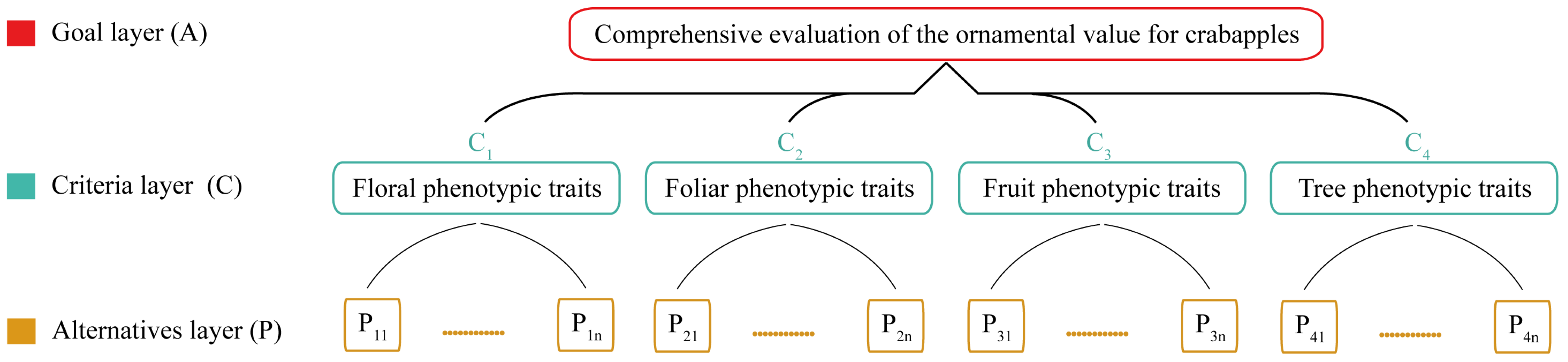
Hierarchical model construction: A three-level model was constructed, including goal layer (A, superior germplasm evaluation and selection), criteria layer (C, flower, foliar, fruit, and tree architectural traits), and alternatives layer (P, 15 specific traits, e.g., flower type, petal color outside, flower diameter, and exocarp color) (Figure 1).
(2)
Establishment of evaluation criteria: The assessment criteria were formulated based on pooled responses from expert consultations and structured questionnaires involving 20 breeders and 10 taxonomists. According to the ornamental value and scarcity [17], the related assessment traits were selected, and then graded on a five-point scale. A simple majority rule was applied to converge individual evaluations (Table S13).
(3)
Construction of judgment matrices: Five judgment matrices (A-C, C1-P, C2-P, C3-P, and C4-P) were constructed. The pairwise comparison judgment matrices were constructed using the 1–9 scale proposed by Saaty. The maximum eigenvalue (λmax) and weight coefficients (Wi) were calculated, followed by a consistency check (C.R. < 0.1).
(4)
Calculation of comprehensive score: The comprehensive score (Y) was calculated as:
Y = ∑(YiWi)
where Y is the score of the i-th indicator and Wi is the corresponding weight. The larger the Y value, the higher the ornamental value.

2.4. Data Processing

Data processing was performed using Microsoft Office Excel 2022 (Microsoft Corporation, Redmond, WA, USA) for entry, organization, and computation of raw data. Graphs and figures were generated and finalized using Origin software (version 9.0) (OriginLab, Northampton, MA, USA) and Adobe Illustrator CS5 (Adobe Systems Inc., San Jose, CA, USA). For quantitative analysis of leaf traits, leaves were scanned using a 4800 dpi high-resolution flatbed scanner (Epson Perfection V39II, Epson (China) Co., Ltd. Beijing, China). The acquired images were then analyzed with ImageJ software (version 1.4.0) (ImageJ, NIH, Bethesda, MD, USA) to measure geometric parameters including leaf length, leaf width, leaf area, and petiole length.

3. Results

3.1. Phenotypic Diversity and Homogeneity in 211 Crabapple Cultivars/Lines

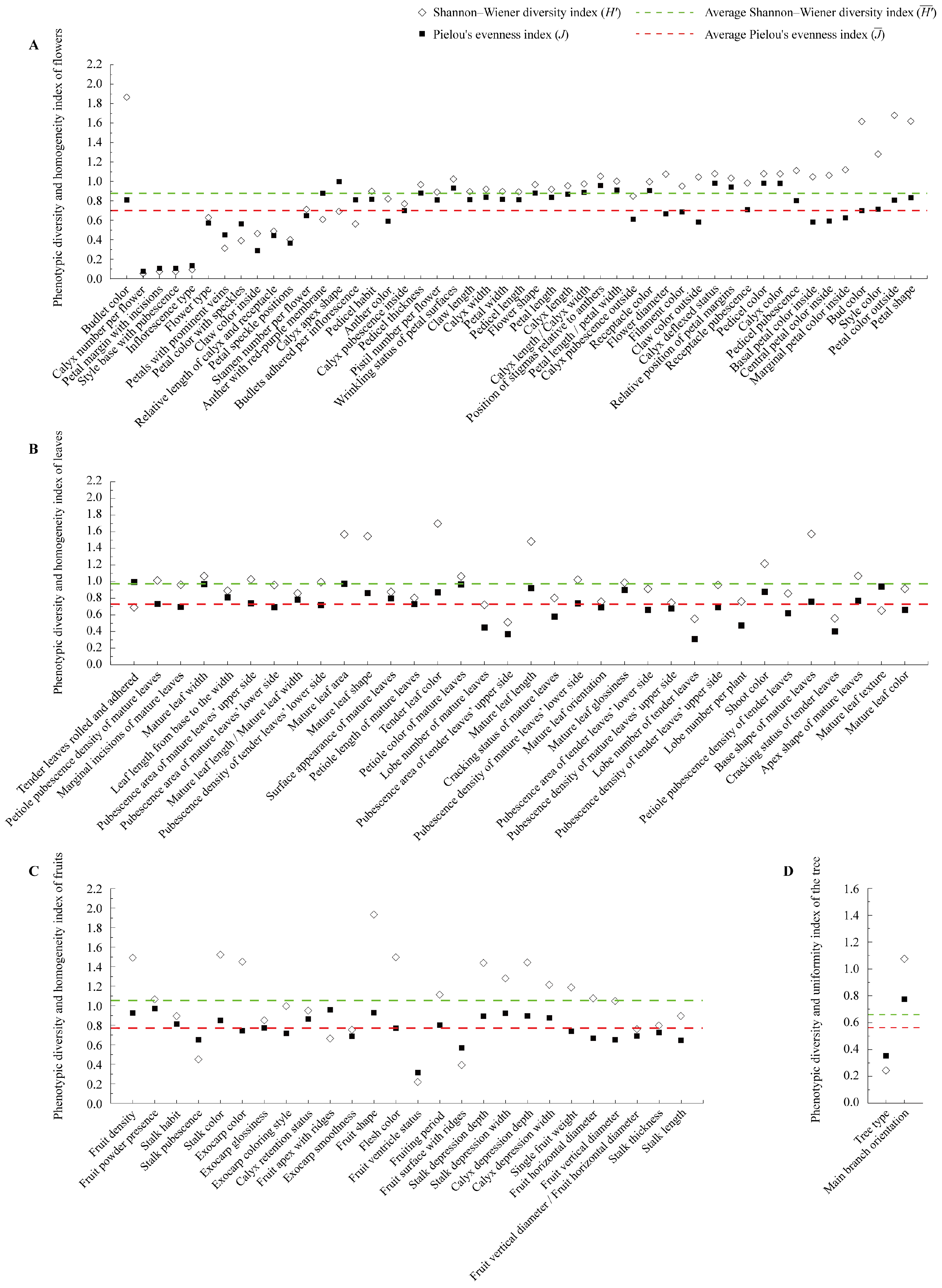
The Shannon–Wiener diversity index (H′) and Pielou’s evenness index (J) of 111 phenotypic traits varied among 211 crabapple cultivars/lines (Figure 2). For floral traits (Figure 2A), H′ ranged from 0.059 to 1.868, with an average of 0.878. Thirty-one traits, including style color, petal color outside, and petal shape, exceeded the average. The trait with the highest diversity was budlet color (H′ = 1.868), followed by petal color outside (H′ = 1.680) and petal shape (H′ = 1.621), indicating that flower color and shape were the most variable traits among the cultivars/lines. Conversely, four traits—calyx number per flower, petal margin with incisions, style base with pubescence, and inflorescence type—had H′ below 0.1, suggesting extremely high consistency. The range of J values for floral traits was 0.007 to 0.999, with an average of 0.701. Thirty traits, including calyx apex shape (J = 0.999), pedicel color (J = 0.984), and calyx deflexed status (J = 0.983), had higher values than the average, indicating relatively even distribution. In contrast, traits such as flower type (J = 0.573), petals with prominent veins (J = 0.452), petal color with speckles (J = 0.565) and its distribution (J = 0.367), as well as relative length of calyx and receptacle (J = 0.446), and calyx number per flower (J = 0.077) showed lower evenness, suggesting distinctness within a subset of the cultivars/lines.
For foliar traits (Figure 2B), H′ ranged from 0.512 to 1.699, with an average of 0.974. Fourteen traits, including mature leaf shape, base shape of mature leaves, and mature leaf area, exceeded the average. Tender leaf color exhibited the highest diversity (H′ = 1.699), followed by base shape of mature leaves (H′ = 1.574) and mature leaf area (H′ = 1.570), suggesting that leaf color, shape, and size were the most variable attributes. J values for foliar traits ranged from 0.309 to 0.997, with an average of 0.730. Nineteen traits, such as tender leaves rolled and adhered (J = 0.997), mature leaf area (J = 0.976), petiole color of mature leaves (J = 0.969), and mature leaf texture (J = 0.943), had higher J values than the average, indicating relatively even distribution. Traits such as cracking status of mature leaves (J = 0.580), lobe number per plant (J = 0.473), lobe number of mature leaves (J = 0.448), cracking status of tender leaves (J = 0.403), and lobe number of tender leaves (J = 0.310) showed lower evenness, suggesting the scarcity of deeply lobed phenotypes in current crabapple germplasm.
For fruit traits (Figure 2C): H′ ranged from 0.219 to 1.934, with an average of 1.081. Thirteen traits, including fruit density, fruit shape, and fruiting period, had diversity indices above the average. Fruit shape exhibited the highest diversity (H′ = 1.932), followed by stalk color (H′ = 1.523) and flesh color (H′ = 1.497), indicating that fruit shape and color were the most variable characteristics. Two traits—fruit ventricle status and fruit surface with ridges—had H′ values below 0.4, reflecting high consistency. J values for fruit traits ranged from 0.317 to 0.970, with average of 0.789. Twelve traits, including fruit powder presence (J = 0.971), fruit apex with ridges (J = 0.960), and fruit shape (J = 0.930), exceeded the average, indicating more even trait distribution. Traits such as exocarp color (J = 0.746), exocarp coloring style (J = 0.719), fruit vertical diameter (J = 0.652), fruit horizontal diameter (J = 0.669), and exocarp smoothness (J = 0.687) had J values below the average, indicating notable variation in fruit color, size, and glossiness across cultivars/lines.
For tree architectural traits (Figure 2D), H′ ranged from 0.244 to 1.075, with an average of 0.659. The highest diversity was observed in main branch orientation (H′ = 1.075). J values for tree architectural traits ranged from 0.352 to 0.775, with an average of 0.563. Notably, tree type showed a low J value (J = 0.352), underscoring the rarity of weeping form among cultivars/lines.
In total, fifty-one traits (45.94%) had both H′ and J values above their organ-specific averages, including 27 (55.10%) floral, 13 (37.10%) foliar, 10 (38.50%) fruit, and one (50.00%) tree architectural traits. This demonstrates that floral traits exhibited greater phenotypic diversity than other organs, highlighting their important contribution to the ornamental value of crabapples.

3.2. Phenotypic Diversity Comparison Between Different Crabapple Groups

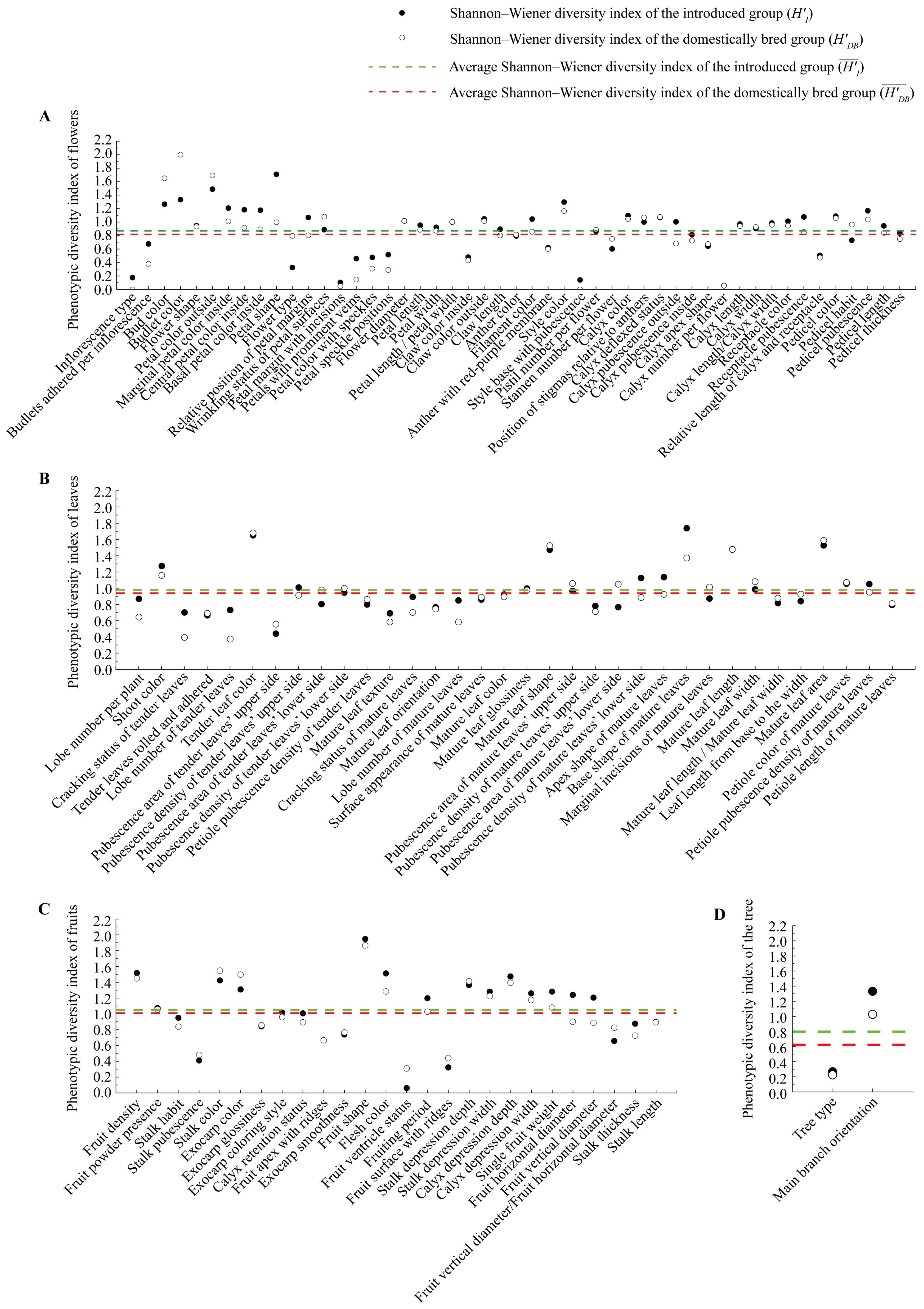
To further evaluate breeding effectiveness, the 211 crabapple cultivars/lines were classified into two groups: introduced cultivars/lines (primarily from North American) and domestically bred cultivars/lines (from China). Although the overall average diversity indices (H’) for all organs were slightly lower in domestically bred cultivars than in introduced ones, higher diversity was observed in specific traits of flowers (e.g., flower color, flower type and stamen number per flower), leaves (e.g., mature leaf shape and size), and fruits (e.g., fruit shape and exocarp color), indicating continuous progress in Malus germplasm improvement in China.
Fourteen floral traits (Figure 3A), including budlet color (HDB—domestically bred cultivars/lines = 2.000, HI—introduced cultivars = 1.333), bud color (HDB = 1.650, HI = 1.265), petal color outside (HDB = 1.693, HI = 1.488), flower type (HDB = 0.795, HI = 0.326), wrinkling status of petal surfaces (HDB = 1.079, HI = 0.888), stamen number per flower (HDB = 0.753, HI = 0.602), position of stigmas relative to anthers (HDB = 1.068, HI = 1.000), and pedicel habit (HDB = 0.963, HI = 0.730), showed higher diversity in the domestically cultivars. Notable advances included of the emergence of light red-purple budlet color, dark red bud color, and deep pink petal color. Exceptional floral forms were also observed, M. ‘Fen Balei exhibited an extremely dense stamen number and large flower diameter, while M. ‘Ziwei Xing’ displayed a distinctive narrow-elliptic petal shape. Additionally, the proportion of semi-double or double cultivars increased by 21.91%, and those with wrinkled petals increased by 17.90%, enhancing overall floral ornamental appeal.
Seventeen leaf traits (Figure 3B), showed higher diversity in domestically bred cultivars, including pubescence area on the lower side of tender leaves (HDB = 0.979, HI = 0.805), lower side of mature leaves (HDB = 1.049, HI = 0.766), upper side of tender leaves (HDB = 0.557, HI = 0.441), and upper side of mature leaves (HDB = 1.058, HI = 0.966). Other traits such as pubescence density of the lower side of tender leaves (HDB = 0.999, HI = 0.947), marginal incisions of mature leaves (HDB = 1.014, HI = 0.873), mature leaf width (HDB = 1.081, HI = 0.985), leaf length-to-width ratio (HDB = 0.927, HI = 0.841), petiole pubescence density of tender leaves (HDB = 0.862, HI = 0.801), mature leaf area (HDB = 1.588, HI = 1.528), and mature leaf length/mature leaf width (HDB = 0.877, HI = 0.817), and mature leaf shape (HDB = 1.526, HI = 1.474) also showed higher H′ in the domestically bred group than the introduced. Notably, a unique domestically bred cultivar, M. ‘Duo Jiao’, with bright yellow foliage, represents a new breakthrough in colored-leaf crabapple breeding. Moreover, the proportion of highly glossy mature leaves increased by 9.66%, further enhancing the ornamental value of crabapple leaves to a certain extent.
Nine fruit traits (Figure 3C) exhibited higher diversity in domestically bred cultivars, including fruit ventricle status (HDB = 0.310, HI = 0.060), exocarp color (HDB = 1.498, HI = 1.309), fruit vertical-to-horizontal diameter ratio (HDB = 0.825, HI = 0.657), stalk color (HDB = 1.548, HI = 1.423), fruit surface with ridges (HDB = 0.441, HI = 0.323), and stalk pubescence (HDB = 0.481, HI = 0.410). The proportions of cultivars bearing yellow, orange-yellow, and purplish-red fruits increased by 7.66, 1.79, and 5.68%, respectively, while those exhibiting a patchy exocarp coloring style increased by 8.25%. These results underscore the diversification of fruit coloration and morphology in domestically bred crabapples.

3.3. Comprehensive Evaluation of Ornamental Characteristics for Crabapples

3.3.1. Consistency Check for Judgment Matrices

As shown in Table 1, all the five judgment matrices have passed the consistency check (C.R. < 0.10).

3.3.2. Weight Assignment Analysis for Indicators

Among the secondary indicators, floral and fruit traits were equally important (Wi = 0.3529), followed by foliar traits (Wi = 0.1764) and tree architecture (Wi = 0.1176). Among the tertiary evaluation indicators, specific weights for 15 phenotypic traits were listed in descending order [tree type (Wi = 0.1176), flower density (Wi = 0.1081), petal color outside (Wi = 0.1031), fruit density (Wi = 0.0944), exocarp color (Wi = 0.0944), fruiting period (Wi = 0.0944), flower type (Wi = 0.0813), flower diameter (Wi = 0.0602), tender leaf color (Wi = 0.0581), exocarp glossiness and smoothness (Wi = 0.0482), lobe number per plant (Wi = 0.0470), mature leaf glossiness (Wi = 0.0312), mature leaf color (Wi = 0.0279), single fruit weight (Wi = 0.0214), and mature leaf area (Wi = 0.0121)] (Table 2).

3.3.3. Comprehensive Evaluation for Ornamental Crabapples

Based on comprehensive ornamental scores (Y), the 211 crabapple germplasm were classified into four grades: Grade I (Y ≥ 4.00), Grade II (3.75 ≤ Y < 4.00), Grade III (3.40 ≤ Y < 3.75), and Grade IV (Y < 3.40) (Table 3). This classification integrated the normal distribution of cultivar/line counts with key phenotypic traits. A total of 26 germplasm were classified into the Grade I, with introduced cultivars comprising 46% and domestic cultivars/lines 54%. The Grade II contained 75 germplasm, representing 45% introduced and 55% domestic cultivars/lines. Among the 83 germplasm in the Grade III, 35% were introduced and 65% were domestic. The Grade IV included 27 germplasm, where introduced cultivars accounted for 67% and domestic cultivars/lines for 33%. In terms of key ornamental traits, 26 germplasm (12%) were selected for flowers, 25 (12%) for fruits, 21 (10%) for leaves, and 14 (7%) for tree architecture.
Grade I included 26 cultivars/lines (e.g., M. ‘Indian Summer’, M. ‘Mary Potter’, M. ‘Rainbow’), consisted of 12 introduced and 14 domestically bred cultivars/lines. These cultivars/lines exhibited exceptionally high ornamental values (Yavg-average GI = 4.08), characterized by dense flowering and fruiting (Yavg P2 = 0.54, Yavg P12 = 0.42), mostly pure white or deep red-purple petal (Yavg P1 = 0.50), a prolonged fruiting period (Yavg P11 = 0.45), and smooth, glossy exocarps ranging from yellow to red (Yavg P10 = 0.46, Yavg P14 = 0.23). Their mature leaves were highly glossy (Yavg P9 = 0.14), with a generally low frequency of lobed forms (Yavg P7 = 0.09).
Grade II comprised 75 cultivars/lines, including 34 introduced and 41 domestically bred cultivars/lines, such as M. ‘Winter Red’, M. ‘Beiguo Zhichun’, and M. ‘Molten Lava’. These cultivars exhibited strong advantages in floral (e.g., flower density, petal color outside, flower type) and fruit traits (fruit density, exocarp color, fruiting period), maintaining a high overall ornamental values (Yavg GII = 3.85).
Grade III included 83 cultivars/lines, comprising 29 introduced and 54 domestically bred cultivars/lines, like M. ‘Gouqi Hong’, M. ‘Yanzhi Zui’, and M. ‘Chang Hui’. While in Grade IV, 27 cultivars/lines were composed of 18 introduced and 9 domestically bred cultivars/lines; for instance, M. ‘John Downie’, M. ‘Bai Lian’, and M. ‘Lankou’. The flower and fruit colors of germplasm in these two grades tended to be intermediate (Grade III: Yavg P1 = 0.44, Yavg P10 = 0.42; Grade IV: Yavg P1 = 0.40, Yavg P10 = 0.36). The flower and fruit density were reduced (Grade III: Yavg P2 = 0.48, Yavg P12 = 0.28; Grade IV: Yavg P2 = 0.41, Yavg P12 = 0.20), and the fruiting period was shorter (Grade III: Yavg P11 = 0.37; Grade IV: Yavg P11 = 0.29), leading to the apparent decrease in their comprehensive ornamental value (Yavg GIII = 3.60, Yavg GIV = 3.25).
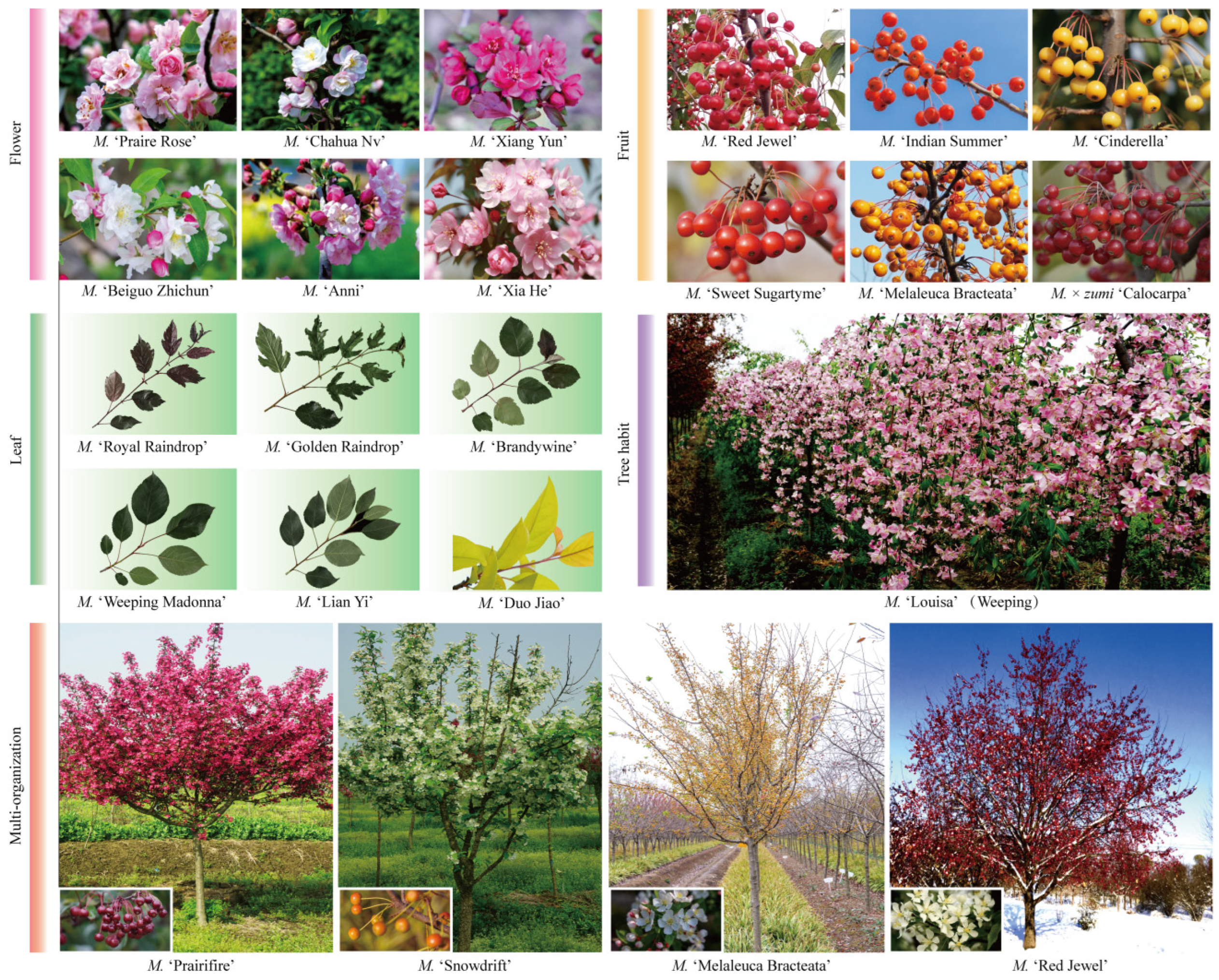
To facilitate targeted germplasm utilization, the 211 cultivars/lines were further classified into flower-viewing, fruit-viewing, foliage-viewing, and tree architecture-viewing categories (Figure 4). Twenty six cultivars/lines were identified as flower-viewing (Y ≥ 1.50), 25 as fruit-viewing (Y ≥ 1.62), 21 as foliage-viewing (Y ≥ 0.60), and 14 as tree architecture-viewing cultivars/lines (Y ≥ 0.58).
Flower-viewing cultivars/lines included five introduced (e.g., M. ‘Praire Rose’, M. ‘Spring Snow’, M. ‘Sparkler’, and M. ‘Kelsey’) and 21 domestically bred (e.g., M. ‘Xiang Yun’, M. ‘Chahua Nv’, and M. ‘Luokeke Nvshi’). These germplasm were characterized by abundant flower setting, vibrant petal colors outside, double or semi-double flower type, and large to extremely large flower diameters.
For fruit-viewing germplasm, included 16 introduced (e.g., M. ‘Indian Summer’, M. ‘Mary Potter’, M. ‘Snowdrift’, etc.) and 9 domestically bred cultivars/lines (e.g., M. ‘Rainbow’, M. ‘Hong Ting’, M. ‘Hong Denglong’). These cultivars/lines were featured by dense fruiting, bright red or red-purple exocarp color, and an extremely long fruiting period.
The foliage-viewing germplasm contained 16 introduced (e.g., M. ‘Indian Summer’, M. ‘Mary Potter’, M. ‘KlehM’s IMproved Bechtel’) and five domestically bred cultivars/lines (e.g., M. ‘Lian Yi’, M. ‘Duo Jiao’, M. ‘Ruo Lian’). Their primary properties were bright green or red-purple tender leaf color, medium green mature leaf color with strong glossiness, and 100% or 50% cracked mature leaves for some cultivars/lines.
Tree architecture-viewing cultivars/lines comprised seven introduced (e.g., M. ‘Black Jade’, M. ‘Royal Beauty’, M. ‘Red Jade’) and seven domestically bred cultivars/lines (e.g., M. ‘Zi Lian’, M. ‘Yuhua Shi’, M. ‘Qingyu An’). All 14 germplasm exhibited a weeping tree type, which was considered to have higher ornamental landscape value compared to the upright forms.

4. Discussion

4.1. Implications of Phenotypic Investigations for Revising Crabapple DUS Test Guideline

Standardized DUS (Distinctness, Uniformity, and Stability) test guidelines are essential for the innovation and protection of ornamental plants. The first DUS test guideline for ornamental crabapple was issued by the International Union for the Protection of New Varieties of Plants (UPOV) in 2003 [30], which included 38 phenotypic traits primarily derived from field investigation of limited North American resources. This regional bias failed to adequately represent the full spectrum of phenotypic diversity present in global crabapple germplasm. Moreover, the absence of unified specifications and standard reference varieties for certain traits posing challenges in determining trait grades. To address these issues, Liu et al. established the descriptive standards for assessing specific grades based on 55 cultivars, thereby laying a morphological foundation for revising the crabapple DUS test guidelines [33]. Subsequently, the guideline was refined by adding 12 phenotypic traits (e.g., plant canopy shape, apex shape of mature leaves, and petal color with speckles), modifying 16 traits (e.g., fruit size and shape), and eliminating six traits, such as tree vigor, inflorescence type, and fruit dehiscence [31]. The explanatory information and representative images were also incorporated, substantially enhancing the practicality and applicability of the guideline. However, due to the limited range of resources and traits examined, further supplementation remains necessary to improve the completeness and precision of trait definitions and grades.
In this study, phenotypic data and representative images for 111 floral, foliar, fruit, and tree architectural traits were collected over three consecutive years from 211 crabapple accessions. Our observations revealed significant variation in budlet/bud color across different developmental stages: small buds (budlet) generally appeared darker than large buds (bud). For instance, when budlets exhibited a consistent dark pink hue, they often transitioned to light pink or pinkish white as buds enlarged. Based on this observation, we recommend subdividing the “bud color” trait in the DUS guideline into two separate traits “budlet color” and “bud color”. Furthermore, the marginal incisions of mature leaves can be more precisely described by introducing two additional grades, “sharp incision” and “obtuse incision.” The stalk habit posture displayed substantial diversity and high homogeneity among cultivars, along with appreciable ornamental value, warranting its inclusion as a new trait in the guideline. Additionally, the identification of a cylindrical fruit shape in M. ‘Zuijin Xiang’, supports the addition of this new fruit grade to the standardized DUS test guideline.

4.2. Exploration of Multiple Breeding Directions

China serves as a major center for the distribution of ornamental crabapple germplasm [34]. Recent advances in breeding techniques, coupled with sustained research efforts, have driven phased progress in crabapple breeding in China, with emerging cultivars granted national certification. In this study, a comparative analysis of 93 introduced (North American) and 118 domestically bred cultivars/lines demonstrated that the phenotypic diversity of the domestic germplasm require further enhancement.
From the perspective of phenotypic diversity, domestically bred cultivars exhibited notable deficiencies in color-related traits. For example, there was a scarcity of cultivars/lines with pink and dark red-purple petal or flesh colors, which should be prioritized as key breeding targets for future Malus improvement. Research on floral color has primarily focused on petals, often neglecting filaments and styles, despite their considerable contribution to overall floral ornamentation. Compared with the introduced cultivars, domestically bred ones lacked germplasm exhibiting dark red-purple filaments and styles, representing a promising direction for esthetic enhancement. Morphologically, cracked-leaf cultivars remain extremely rare in both introduced and domestically bred groups. Furthermore, domestically bred cultivars typically possess fewer than three lobes, with few deeply cracked-leaf forms observed. Thus, breeding efforts targeting cracked-leaf types, particularly those with deeply incised leaves, hold significant potential for market innovation and differentiation.
In terms of ornamental value, 15 phenotypic traits, including tree type, flower type, petal color (outer side), exocarp color, fruiting period, and mature leaf color, serve as the key evaluation indicators/metrics. Previous studies have indicated that cultivars with bright red or red-purple flowers [35,36,37] and those exhibiting late flowering periods generally receive higher esthetic evaluations. Double-flowered cultivars also tend to be rated higher than single or semi-double types [38,39]. Therefore, for flower-viewing objective, priority should be given to breeding cultivars with red or red-purple petals, double flower types, and late flowering periods. For fruit-viewing cultivars, fruit density, exocarp color, exocarp glossiness, and smoothness are the principle ornamental traits [40]. Breeding efforts should emphasize genotypes with dense fruit set, vivid exocarp coloration (e.g., red, yellow), and smooth, glossy epidermis. Although the ornamental value of foliage is generally secondary, leaf-related traits such as color and lobe morphology remain significant, particularly in developing cultivars with yellow or red-purple leaves and cracked mature foliage [41,42,43]. The tree architecture also plays a critical role in influencing ornamental appeal, with weeping types generally rated higher than upright or spreading forms. However, currently, weeping cultivars/lines account only for 10% of all resources, highlighting a key area for future breeding enhancement. Additionally, most domestically bred cultivars exhibit ornamental values in a single dimension (e.g., solely for flower- or fruit-viewing). There is a pressing need to develop multi-functional cultivars with year-round ornamental appeal, thereby aligning with market demand for versatile landscape-adapted crabapple varieties. While potential breeding directions have been proposed, achieving them through conventional breeding alone remains challenging due to the protracted breeding cycles involved. Future work should prioritize targeted trait enhancement by integrating modern breeding technologies. Further application of genomic sequencing to identify key genes underlying desirable traits will facilitate precise genetic improvement. This integrated approach offers a viable pathway for accelerating the development of elite germplasm with defined ornamental characteristics.

5. Conclusions

This study conducted a comprehensive phenotypic analysis of 211 crabapple cultivars/lines, including 93 introduced and 118 domestically bred cultivars/lines. Floral traits exhibited greater phenotypic diversity than fruits, leaves, and tree architectural traits. Among the 51 traits with above-average diversity and homogeneity indices were several key ornamental characteristics, collectively reflecting the phenotypic richness of the germplasm. In contrast, traits such as flower type, petal color with speckles, cracking status of mature leaves, exocarp color, exocarp coloring style, and fruit dimensions (vertical and horizontal diameters), showed lower homogeneity, highlighting rare phenotypes with potential breeding value. Comparative analysis demonstrated that domestically bred cultivars/lines have achieved significant advancements in several aspects. Specifically, new floral variation such as light red-purple budlet color, dark red bud color, and deep pink petal color (outer side) have emerged. Based on a comprehensive ornamental evaluation, 26 outstanding genotypes were selected, typically characterized by dense flower or fruit setting, pure white or deep red-purple petal color, and strong mature leaf glossiness. To facilitate germplasm utilization, the collection was further categorized into 26 flower-, 25 fruit-, 21 foliage-, and 14 tree architecture-viewing cultivars/lines. Overall, this study enriches the understanding of Malus phenotypic diversity, provides a theoretical basis for revising the DUS test guidelines, and offers practical guidance for targeted breeding and landscape utilization of ornamental crabapple resources.

Supplementary Materials

The following supporting information can be downloaded at: https://www.mdpi.com/article/10.3390/horticulturae11121527/s1, Table S1: The 211 ornamental crabapple germplasm used in this study; Table S2: Characterization and coding of floral phenotypes; Table S3: Grading criteria for floral qualitative traits: A visual guideline; Table S4: Grading criteria for floral quantitative traits: A visual guideline; Table S5: Characterization and coding of leaf phenotypes; Table S6: Grading criteria for leaf qualitative traits: A visual guideline; Table S7: Grading criteria for leaf quantitative traits: A visual guideline; Table S8: Characterization and coding of fruit phenotypes; Table S9: Grading criteria for fruit qualitative traits: A visual guideline; Table S10: Grading criteria for fruit quantitative traits: A visual guideline; Table S11: Characterization and coding of tree architecture phenotypes; Table S12: Grading criteria for tree architecture traits: A visual guideline; Table S13: Ornamental crabapple trait assignment criteria.

Author Contributions

K.N. formal analysis, visualization, writing—original draft. B.L. and H.N. formal analysis, and software. S.L. and X.C. formal analysis. X.Y. formal analysis, visualization and software. W.Z. resources, review and editing. Y.A.E.-K. conceptualization, review and editing. T.Z. conceptualization, methodology, and funding acquisition. All authors have read and agreed to the published version of the manuscript.

Funding

This work was funded by the National Natural Science Foundation of China (32201618), the Natural Science Foundation of Jiangsu Province (BK20220751), and the High-level Talents Scientific Research Startup Program of Jinling Institute of Technology [No. jit-b-202008].

Data Availability Statement

The original contributions presented in this study are included in the article/Supplementary Material. Further inquiries can be directed to the corresponding authors.

Acknowledgments

We thank anonymous reviewers for their critical reading, stimulating discussions, and helpful comments and suggestions, which allowed us to improve the quality of this manuscript.

Conflicts of Interest

The authors declare that they have no competing interests.

References

  1. Howard, E. Trees for American Gardens. Donald Wyman. Q. Rev. Biol. 1953, 28, 72. [Google Scholar] [CrossRef]
  2. Mratinić, E.; Akšić, M.F. Phenotypic diversity of apple (Malus sp.) germplasm in South Serbia. Braz. Arch. Biol. Technol. 2012, 55, 349–358. [Google Scholar] [CrossRef]
  3. Muzher, B.M.; Younis, R.A.A.; El-Halabi, O.; Ismail, O.M. Genetic identification of some Syrian local apple (Malus sp.) cultivars using molecular markers. Res. J. Agric. Biol. Sci. 2007, 3, 704–713. [Google Scholar]
  4. Ulukan, H. The evolution of cultivated plant species: Classical plant breeding versus genetic engineering. Plant Syst. Evol. 2009, 280, 133–142. [Google Scholar] [CrossRef]
  5. Brown, S.K. Apple (Malus × Domestica); Springer: New York, NY, USA, 2012. [Google Scholar] [CrossRef]
  6. Fiala, J.L. Flowering Crabapples: The Genus Malus; Timber Press: Portland, OR, USA, 1994. [Google Scholar]
  7. Lobos, G.A.; Camargo, A.V.; Del Pozo, A.; Araus, J.L.; Ortiz, R.; Doonan, J.H. Editorial: Plant phenotyping and phenomics for plant breeding. Front. Plant Sci. 2017, 8, 2181. [Google Scholar] [CrossRef]
  8. Denaeghel, H.E.; Van Laere, K.; Leus, L.; Lootens, P.; Van Huylenbroeck, J.; Van Labeke, M.C. The variable effect of polyploidization on the phenotype in Escallonia. Front. Plant Sci. 2018, 9, 354. [Google Scholar] [CrossRef]
  9. Walter, A.; Liebisch, F.; Hund, A. Plant phenotyping: From bean weighing to image analysis. Plant Methods 2015, 11, 14. [Google Scholar] [CrossRef]
  10. Dhondt, S.; Wuyts, N.; Inzé, D. Cell to whole-plant phenotyping: The best is yet to come. Trends Plant Sci. 2013, 18, 428–439. [Google Scholar] [CrossRef]
  11. Shimoyama, N.; Johnson, M.; Beaumont, A.; Schlappi, M. Multiple cold tolerance trait phenotyping reveals shared quantitative trait loci in Oryza sativa. Rice 2020, 13, 57. [Google Scholar] [CrossRef] [PubMed]
  12. Billot, C.; Ramu, P.; Bouchet, S.; Chantereau, J.; Deu, M.; Gardes, L.; Noyer, J.L.; Rami, J.F.; Rivallan, R.; Li, Y.; et al. Massive Sorghum collection genotyped with SSR markers to enhance use of global genetic resources. PLoS ONE 2013, 8, e59714. [Google Scholar] [CrossRef] [PubMed]
  13. Ding, F.; Li, H.R.; Wang, J.Y.; Peng, H.X.; Chen, H.B.; Hu, F.C.; Lai, B.; Wei, Y.Z.; Ma, W.Q.; Li, H.L.; et al. Development of molecular markers based on the promoter difference of LcFT1 to discriminate easy- and difficult-flowering litchi germplasm resources and its application in crossbreeding. BMC Plant Biol. 2021, 21, 539. [Google Scholar] [CrossRef]
  14. Deng, Q.; Zhao, S.; Guan, C.; Fu, G.; Yu, S.; Lin, S.; Wang, Z.; Fu, H.; Lu, X.; Cheng, S. Construction and evaluation of pepper core collection based on phenotypic traits and SSR markers. Appl. Sci. 2024, 14, 7473. [Google Scholar] [CrossRef]
  15. Höfer, M.; Eldin Ali, M.A.M.S.; Sellmann, J.; Peil, A. Phenotypic evaluation and characterization of a collection of Malus species. Genet. Resour. Crop Evol. 2014, 61, 943–964. [Google Scholar] [CrossRef]
  16. Shen, H.X.; Zhao, T.T.; Song, T.T.; Yao, Y.C.; Gao, J.P. Genetic diversity analysis in natural hybrid progeny of ornamental crabapple, Malus ‘Royalty’. Acta Hortic. Sin. 2011, 38, 2157–2168. [Google Scholar]
  17. Zhang, W.X.; Fan, J.J.; Yang, P.; Zhou, T.; Pu, J.; Cao, F.L. Analysis of phenotypic characteristics of the Malus ‘Purple Prince’ half-sib progenies at the seedling stage. J. Nanjing For. Univ. Nat. Sci. Ed. 2017, 41, 33–40. [Google Scholar]
  18. Xu, J.F.; Zhang, W.X.; Zhu, L.L.; Jiang, H.; Sun, T.T.; Yu, W.W. Phenotypic diversity analysis of fruit traits of 78 north American crabapple cultivars. J. Nanjing For. Univ. Nat. Sci. Ed. 2025, 49, 165–173. [Google Scholar]
  19. Zhou, T.; Fan, J.J.; Zhao, M.M.; Zhang, D.L.; Li, Q.H.; Wang, G.B.; Cao, F.L. Phenotypic variation of floral organs in Malus using frequency distribution functions. BMC Plant Biol. 2019, 19, 574. [Google Scholar] [CrossRef] [PubMed]
  20. Zhou, T.; Ning, K.; Zhang, W.X.; Chen, H.; Lu, X.Q.; Zhang, D.L.; Yousry, A.E.K.; Bian, J. Phenotypic variation of floral organs in flowering crabapples and its taxonomic significance. BMC Plant Biol. 2021, 21, 503. [Google Scholar] [CrossRef]
  21. Smith, E.M. The flowering crabapple—A tree for all seasons. J. Arboric. 1981, 7, 89–95. [Google Scholar] [CrossRef]
  22. Liu, S.N.; Peng, J.; Wang, R.B.; Wang, H.W.; Li, Y.H.; Zhang, K.M. Phenotypic diversity analysis and comprehensive appreciation evaluation of 30 north American crabapples. Mol. Plant Breed. 2025, 23, 4440–4449. [Google Scholar]
  23. Azadeh, A.; Ghaderi, S.F.; Mirjalili, M.; Moghaddam, M. Integration of analytic hierarchy process and data envelopment analysis for assessment and optimization of personnel productivity in a large industrial bank. Expert Syst. Appl. 2011, 38, 5212–5225. [Google Scholar] [CrossRef]
  24. Semsri, A.; Suksukont, A. Sustainable energy conservation of reflow oven process on PCB manufacturing using AHP techniques. Int. J. Sustain. Energy 2024, 43, 2372567. [Google Scholar] [CrossRef]
  25. Seniv, M.M.; Kovtoniuk, A.M.; Yakovyna, V.S. Tools for selecting a software development methodology taking into account project characteristics. Radio Electron. Comput. 2022, 2, 175. [Google Scholar] [CrossRef]
  26. Wang, M.R. The Breeding and Cultivating of 33 Europe Malus Species or Cultivars and Their Ornamental Appraisal. Master’s Thesis, Nanjing Forestry University, Nanjing, China, 2005. [Google Scholar]
  27. Cheng, X.; Feng, Y.; Chen, D.L.; Luo, C.; Yu, X.F.; Huang, C.L. Evaluation of Rosa germplasm resources and analysis of floral fragrance components in R. rugosa. Front. Plant Sci. 2022, 13, 1026763. [Google Scholar] [CrossRef]
  28. Zhao, J.L.; Wang, Y.W. The sustainable development research of wild plant tourism resources based on the entropy-AHP evaluation method. Adv. J. Food Sci. Technol. 2016, 10, 81–89. [Google Scholar] [CrossRef]
  29. Sheng, L.X.; Ni, Y.A.; Wang, J.W.; Chen, Y.; Gao, H.S. Characteristic-aroma-component-based evaluation and classification of strawberry varieties by aroma type. Molecules 2021, 26, 6219. [Google Scholar] [CrossRef] [PubMed]
  30. TG/192/1; Guidelines for the Conduct of Tests for Distinctness, Uniformity and Stability [Ornamental Apple (Malus Mill.)]. UPOV: Geneva, Switzerland, 2003.
  31. LY/T 3393-2024; Guidelines for the Conduct of Tests for Distinctness, Uniformity and Stability—Ornamental Apple (Malus Mill. except Malus domestica Borkh.). Code of China: Beijing, China, 2024.
  32. GB/T 19557.26-2022; Testing of New Varieties of Plants. Guidelines for the Conduct of Tests for Distinctness, Uniformity and Stability—Apple (Malus domestica Borkh.). Code of China: Beijing, China, 2022.
  33. Liu, Y.N. Studies of Standard Description and Database Construction of Malus Cultivars. Master’s Thesis, Beijing Forestry University, Beijing, China, 2018. [Google Scholar]
  34. Wang, D.J.; Wang, K.; Gao, Y.; Zhao, J.R.; Liu, L.J.; Gong, X.; Li, L.W. Preliminary investigation of modern distribution of Malus resources in China. J. Plant Genet. Resour. 2017, 18, 1116–1124. [Google Scholar]
  35. Fenster, C.B.; Cheely, G.; Dudash, M.R.; Reynolds, R.J. Nectar reward and advertisement in hummingbird-pollinated Silene virginica (Caryophyllaceae). Am. J. Bot. 2006, 93, 1800–1807. [Google Scholar] [CrossRef]
  36. Nattero, J.; Cocucci, A.A.; Medel, R. Pollinator-mediated selection in a specialized pollination system: Matches and mismatches across populations. J. Evolution. Biol. 2010, 23, 1957–1968. [Google Scholar] [CrossRef]
  37. Zhao, D.Q.; Tao, J. Recent advances on the development and regulation of flower color in ornamental plants. Front. Plant Sci. 2015, 6, 261. [Google Scholar] [CrossRef] [PubMed]
  38. Liu, Z.X.; Zhang, D.D.; Liu, D.; Li, F.L.; Lu, H. Exon skipping of AGAMOUS homolog PrseAG in developing double flowers of Prunus lannesiana (Rosaceae). Plant Cell Rep. 2013, 32, 227–237. [Google Scholar] [CrossRef] [PubMed]
  39. Noor, S.H.; Ushijima, K.; Murata, A.; Yoshida, K.; Tanabe, M.; Tanigawa, T.; Kubo, Y.; Nakano, R. Double flower formation induced by silencing of C-class MADS-box genes and its variation among petunia cultivars. Sci. Hortic. 2014, 178, 1–7. [Google Scholar] [CrossRef]
  40. Alkio, M.; Jonas, U.; Declercq, M.; Nocker, S.V.; Knoche, M. Transcriptional dynamics of the developing sweet cherry (Prunus avium L.) fruit: Sequencing, annotation and expression profiling of exocarp-associated genes. Hortic. Res. 2014, 1, 11. [Google Scholar] [CrossRef]
  41. Majdi, C.; Pereira, C.; Dias, M.I.; Calhelha, R.C.; Alves, M.J.; Rhourri-Frih, B.; Charrouf, Z.; Barros, L.; Amaral, J.S.; Ferreira, I.C.F.R. Phytochemical characterization and bioactive properties of cinnamon basil (Ocimum basilicum cv. ‘Cinnamon’) and lemon basil (Ocimum × citriodorum). Antioxidants 2020, 9, 369. [Google Scholar] [CrossRef]
  42. Spitzer-Rimon, B.; Duchin, S.; Bernstein, N.; Kamenetsky, R. Architecture and florogenesis in female Cannabis sativa plants. Front. Plant Sci. 2019, 10, 350. [Google Scholar] [CrossRef]
  43. Yang, F.X.; Gao, J.; Wei, Y.L.; Ren, R.; Zhang, G.Q.; Lu, C.Q.; Jin, J.P.; Ai, Y.; Wang, Y.Q.; Chen, L.J.; et al. The genome of Cymbidium sinense revealed the evolution of orchid traits. Plant Biotechnol. J. 2021, 19, 2501–2516. [Google Scholar] [CrossRef] [PubMed]
Figure 1. Evaluation model for ornamental value of crabapples.
Horticulturae 11 01527 g001
Figure 2. Phenotypic diversity and homogeneity of crabapple in 211 cultivars/lines. (A) Phenotypic diversity and homogeneity index of flowers. (B) Phenotypic diversity and homogeneity index of leaves. (C) Phenotypic diversity and homogeneity index of fruits. (D) Phenotypic diversity and homogeneity index of tree.
Horticulturae 11 01527 g002
Figure 3. Phenotypic diversity in North American groups and new cultivars/lines groups. (A) Phenotypic diversity index of flowers. (B) Phenotypic diversity index of leaves. (C) Phenotypic diversity index of fruits. (D) Phenotypic diversity index of tree.
Horticulturae 11 01527 g003
Figure 4. Images of representative excellent ornamental crabapples.
Horticulturae 11 01527 g004
Table 1. AHP judgment matrices, trait weights, and consistency ratios.
Hierarchical ModelJudgment MatrixWeightConsistency Check
A-CAC1C2C3C4 λmax = 4.000
C.I. = 0.000
C.R. = 0.000
C11123 0.3529
C21123 0.3529
C31/21/213/2 0.1764
C41/31/32/31 0.1176
C1-P1–4C1P1P2P3P4 λmax = 4.006
C.I. = 0.002
C.R. = 0.002
P1115/45/3 0.2923
P2115/42 0.3064
P34/54/515/4 0.2303
P43/51/24/51 0.1707
C2-P5–9C2P5P6P7P8P9 λmax = 5.151
C.I. = 0.038
C.R. = 0.034
P511165/30.2674
P611165/30.2674
P711165/30.2674
P81/61/61/616/50.0608
P93/53/53/56/510.1367
C3-P10–14C3P10P11P12P13P14 λmax = 5.094
C.I. = 0.024
C.R. = 0.021
P10125/4520.3293
P111/215/8210.1584
P124/58/51410.2666
P131/51/21/611/20.0686
P141/211210.1769
C4-P15C4P15
P151 0.1176
Table 2. Weight values for the ornamental traits of crabapples.
Goal Layer
(A)
Criteria Layer (C)(A-Ci) Weight (Wi)Alternatives Layer (P)(C-Pi) Weight
(Wi)
Selection of excellent cultivars/linesFloral traits
C1
0.3529Petal color outside P10.1031
Flower density P20.1081
Flower type P30.0813
Flower diameter P40.0602
Foliar traits
C2
0.1764Tender leaf color P50.0581
Mature leaf color P60.0279
Lobe number per plant P70.0470
Mature leaf area P80.0121
Mature leaf glossiness P90.0312
Fruit traits
C3
0.3529Exocarp color P100.0944
Fruiting period P110.0944
Fruit density P120.0944
Single fruit weight P130.0214
Exocarp glossiness and smoothness P140.0482
Tree architectural traits
C4
0.1176Tree type P150.1176
Table 3. Comprehensive evaluation scores and grades for the 211 crabapple germplasm.
GradeNo.Germplasm NameScoreFlowerFruitLeafTree Architecture
I1* M. ‘Indian Summer’4.3031.4391.7000.6940.471
I2* M. ‘Mary Potter’4.1681.4001.6790.6190.471
I3  M. ‘Rainbow’4.1661.4001.7000.5950.471
I4* M. ‘Snowdrift’4.1331.4001.6790.5840.471
I5  M. ‘Hong Ting’4.1211.4001.7000.5500.471
I6  M. ‘Hong Baili’4.1181.4821.6520.5140.471
I7* M. ‘Royal Raindrop’4.1031.2971.6790.6570.471
I8* M. ‘Sweet SugartyMe’4.0911.4001.6790.5410.471
I9* M. ‘Red Jewel’4.0911.4001.6790.5410.471
I10  M. ‘Zi Lian’4.0871.6441.2280.6270.588
I11  M. ‘Xiang Yun’4.0851.7041.3230.5870.471
I12  M. ‘Gou Huo’4.0741.4211.5840.5980.471
I13  M. ‘Yuhua Shi’4.0731.4601.5110.5140.588
I14  M. ‘Xia Wa’4.0691.4821.5580.5600.471
I15* M. ×zumi ‘Calocarpa’4.0621.3401.6790.5730.471
I16  M. ‘Zise Xuanlv’4.0611.4211.6520.5170.471
I17* M. ‘Donald WyMan’4.0411.4001.6060.5650.471
I18  M. ‘Luokeke Nvshi’4.0411.6621.3690.5400.471
I19  M. ‘Melaleuca Bracteata’4.0311.3401.6790.5420.471
I20  M. ‘Rui Qin’4.0301.5411.4900.5280.471
I21* M. ‘Tina’4.0281.2801.6790.5990.471
I22* M. ‘Golden Raindrop’4.0191.2591.6790.6110.471
I23* M. ‘Prairifire’4.0181.3401.6790.5280.471
I24  M. ‘Hong Denglong’ 4.0061.2591.7000.5770.471
I25*M. ‘Fairytail Gold’4.0041.2591.6790.5960.471
I26  M. ‘Chahua Nv’4.0021.7041.3690.4580.471
II1* M. ‘Winter Red’3.9931.4001.6270.4940.471
II2  M. ‘Beiguo Zhichun’3.9881.5411.4630.5140.471
II3* M. ‘Molten Lava’3.9871.3191.6790.5190.471
II4  M. ‘Er Qiao’3.9691.5411.4170.5400.471
II5* M. ‘Adirondack’3.9691.4001.5580.5400.471
II6* M. ‘Harvest Gold’3.9681.3401.5580.6000.471
II7* M. ‘Lancelot’3.9531.3401.6790.4630.471
II8* M. ‘King Arthur’3.9471.2591.6520.5660.471
II9* M. ‘Indian Magic’3.9371.4821.3960.5900.471
II10  M. ‘Yangzhi Yu’3.9251.6011.3690.4850.471
II11* M. ‘Black Jade’3.9231.5421.2010.5920.588
II12  M. ‘Chu Dong’3.9161.4601.4900.4940.471
II13* M. ‘Strawberry Jelly’3.9151.2161.6060.6230.471
II14  M. ‘Hongse Yilian’3.9131.4001.4900.5530.471
II15  M. ‘Hong Beile’3.9131.2921.5840.5660.471
II16  M. ‘Red Coral’3.9121.2111.6790.5520.471
II17  M. ‘Shanhu Hua’3.9071.4821.3960.5600.471
II18  M. ‘Ying Hongxiu’3.9041.5631.3690.5010.471
II19* M. ‘Red Splendor’3.9031.3781.5110.5430.471
II20* M. ‘Cardinal’3.9011.2971.6060.5280.471
II21* M. ‘Cinderella’3.9011.2591.6310.5420.471
II22* M. ‘Red Baron’3.8891.3521.5110.5550.471
II23* M. ‘AdaM’3.8871.4001.4630.5530.471
II24* M. ‘Lisa’3.8851.4821.4170.5160.471
II25  M. ‘Zi Dieer’3.8831.6441.2280.5400.471
II26* M. ‘Sugar TyMe’3.8731.3191.5580.5260.471
II27  M. ‘Xingchen’3.8731.4001.4170.5850.471
II28  M. ‘Lian Yi’3.8701.2541.4630.6820.471
II29* M. ‘Winter Gold’3.8691.3191.5360.5440.471
II30  M. ‘Duo Jiao’3.8691.4331.2960.6700.471
II31  M. ‘Feicui’3.8601.1841.7000.5050.471
II32  M. ‘Hong Qingting’3.8551.1841.6040.5970.471
II33* M. ‘Rudolph’3.8531.2971.5110.5740.471
II34  M. ‘Xiao Lian’3.8511.3401.5360.5050.471
II35  M. ‘Jinxiang Yu’3.8501.3401.5580.4820.471
II36* M. ‘David’3.8491.4001.5110.4670.471
II37* M. ‘Professor Sprenger’3.8481.4001.4630.5140.471
II38  M. ‘Zi Ju’3.8451.6441.1550.5750.471
II39  M. ‘Hong Yunxuan’3.8411.3401.4420.5890.471
II40  M. ‘Anni’3.8401.6011.2740.4940.471
II41  M. ‘Fenhong Nichang’3.8381.5411.3230.5040.471
II42* M. ‘Show TiMe’3.8341.3571.4900.5160.471
II43  M. ‘Chang Hong’3.8311.5961.2240.5400.471
II44*M. ‘Liset’3.8301.2921.4630.6040.471
II45  M. ‘Xia He’3.8291.5411.2740.5430.471
II46  M. ‘Hua Mulan’3.8271.3401.4420.5750.471
II47  M. ‘Xiao Jiumei’3.8261.3181.5110.5260.471
II48  M. ‘Qingyu An’3.8231.2921.4170.5260.588
II49* M. ‘Centurion’3.8211.3301.5110.5090.471
II50  M. ‘Yellow Jade’3.8211.3191.4900.5420.471
II51  M. ‘Haojue’3.8191.4601.3670.5210.471
II52  M. ‘Yi Ren’3.8111.3131.5330.4940.471
II53* M. ‘Ballet’3.8101.4931.2740.5720.471
II54  M. ‘Caoyuan Guniang’3.8101.2971.4630.5790.471
II55* M. ‘Robinson’3.8091.4001.4420.4970.471
II56  M. ‘Leng Jing’3.8081.2971.5580.4820.471
II57  M. ‘Zimei Hua’3.8051.3401.4420.5530.471
II58* M. ‘Van Eseltine’3.8021.4931.3690.4700.471
II59  M. ‘Xiang Shanhu’3.8011.0811.6520.5980.471
II60* M. ‘Profusion’3.7991.3731.3690.5860.471
II61  M. ‘Hong Zhuge’3.7971.2921.5360.4980.471
II62* M. ‘Gorgeous’3.7931.3191.4850.5190.471
II63* M. ‘Sparkler’3.7921.5411.2280.5530.471
II64* M. ‘Purple Prince’3.7791.3401.3230.6460.471
II65  M. ‘Xin Tianyou’3.7721.4001.3010.4820.588
II66  M. ‘Yun Xiangrong’3.7691.4381.2740.5860.471
II67  M. ‘Hong Yun’3.7671.2971.4900.5090.471
II68* M. ‘Royal Beauty’3.7671.4341.1800.5650.588
II69* M. ‘Red Sentinel’3.7651.2921.5330.4700.471
II70  M. ‘Zhu Rong’3.7641.5631.1990.5320.471
II71* M. ‘Sentinel’3.7641.1941.6060.4940.471
II72  M. ‘Yanzhi Yu’3.7571.4601.3690.4580.471
II73  M. ‘Dishui Guanyin’3.7571.2271.5330.5260.471
II74  M. ‘Hu Po’3.7561.3791.5110.3950.471
II75* M. ‘Lollipop’3.7551.2591.3960.6300.471
III1  M. ‘Gouqi Hong’3.7481.3731.3470.5560.471
III2  M. ‘Yanzhi Zui’3.7441.3401.4610.4720.471
III3  M. ‘Chang Hui’3.7441.5361.2280.5090.471
III4  M. ‘Jinxiu Jiangnan’3.7441.4391.3010.5330.471
III5  M. ‘Ruo Lian’3.7401.4331.2010.6350.471
III6  M. ‘Xiaocun Zhilian’3.7401.3781.4170.4740.471
III7  M. ‘Fen Balei’3.7391.5531.2010.5140.471
III8* M. ‘Radiant’3.7351.2971.3690.5990.471
III9  M. ‘Hong Jun’3.7321.3521.3690.5400.471
III10  M. ‘Yu Xiuqiu’3.7271.5751.1290.5520.471
III11  M. ‘Orange DreaM’3.7231.2921.3960.5650.471
III12  M. ‘Shu Hongzhuang’3.7221.3401.3960.5160.471
III13* M. ‘Roger’s Selection’3.7211.2801.3010.6700.471
III14* M. ‘Kelsey’3.7171.5411.1070.5990.471
III15  M. ‘Ruo Ju’3.7141.3251.2960.6230.471
III16  M. ‘Lvse Fengbao’3.7091.3571.3900.4910.471
III17*M. ‘Weeping Madonna’3.7081.4341.1800.6240.471
III18  M. ‘Zi Lu’3.7051.1081.5110.4980.588
III19  M. ‘Dafen Kongque’3.7051.2161.5360.4820.471
III20* M. ‘Golden Hornet’3.7001.1131.5790.5380.471
III21* M. ‘CandyMint’3.6901.2371.3960.5870.471
III22  M. ‘Zi Ning’3.6891.2921.4170.5090.471
III23* M. ‘May’s Delight’3.6841.1551.4900.5680.471
III24  M. ‘Pink Pillar’3.6781.3781.3010.5280.471
III25  M. ‘Ziwei Xing’3.6761.2371.4630.5060.471
III26* M. ‘Red Jade’3.6761.2111.4170.4600.588
III27  M. ‘Jin Sheng’3.6631.3731.3230.4970.471
III28  M. ‘Zi Tang’3.6621.2111.4130.5680.471
III29  M. ‘Meiren Xiao’3.6601.1941.5110.4850.471
III30  M. ‘Lizi Haitang’3.6601.3191.2740.5960.471
III31  M. ‘Fen Baihe’3.6571.4001.2670.5190.471
III32  M. ‘Zuijin Xiang’3.6561.0471.6010.5380.471
III33* M. ‘Dolgo’3.6561.3521.3390.4940.471
III34  M. ‘Yong Shi’3.6481.2971.4170.4630.471
III35* M. ‘Firebird’3.6421.2591.3960.5170.471
III36* M. ‘AlMey’3.6341.2491.3230.5920.471
III37  M. ‘Jiu Er’3.6291.1681.4390.5520.471
III38  M. ‘Chushui Furong’3.6291.1671.4630.5280.471
III39  M. ‘Doukou Nianhua’3.6261.2971.2740.5840.471
III40  M. ‘Haixing’3.6251.1501.4630.5400.471
III41  M. ‘Zi Ting’3.6251.6440.9910.5190.471
III42  M. ‘Xingxing Suo’3.6241.3991.2530.5010.471
III43* M. ‘Spring Glory’3.6241.2491.2500.6540.471
III44  M. ‘Hong Ri’3.6201.2111.4170.5210.471
III45  M. ‘Hudie Quan’3.6121.2371.2740.5130.588
III46  M. ‘Da Hongying’3.6081.3521.3230.4630.471
III47  M. ‘Lingbo Xianzi’3.6061.1341.4420.5600.471
III48  M. ‘Li Hui’3.6041.3731.2670.4930.471
III49* M. ‘Brandywine’3.6021.4331.1000.5990.471
III50* M. ‘Everest’3.5951.4001.1510.5730.471
III51* M. ‘Guard’3.5891.4001.2240.4940.471
III52  M. ‘Hong Chen’3.5821.2971.2740.5400.471
III53  M. ‘Li Zan’3.5681.2321.3960.4700.471
III54* M. ‘Selkirk’3.5681.2491.2500.5980.471
III55  M. ‘Yue Guang’3.5671.5631.0640.4690.471
III56  M. ‘Wunv’3.5651.2971.2530.5440.471
III57  M. ‘Tingshang Jiangyue’3.5591.3901.1800.5190.471
III58* M. ‘Spring Sensation’3.5581.2591.3010.5280.471
III59* M. ‘White Cascade’3.5571.3401.1590.4700.588
III60  M. ‘Shen Ziwei’3.5531.2921.2740.5160.471
III61  M. ‘Xiao Wei’3.5381.2371.3690.4610.471
III62  M. ‘Xiao Qingxin’3.5311.2481.2280.5840.471
III63  M. ‘Xiangfei’3.5281.1941.3690.4940.471
III64* M. ‘Abundance’3.5151.2161.3440.4850.471
III65  M. ‘Mo Yu’3.5091.4001.1800.4580.471
III66  M. ‘Kang Qiao’3.4990.9991.5110.5190.471
III67  M. ‘Lianhua Xiu’3.4941.2641.2960.4630.471
III68  M. ‘Zi Linglong’3.4771.3181.1590.5290.471
III69* M. ‘Shelley’3.4731.3191.2010.4820.471
III70* M. ‘Irene’3.4571.1631.3170.5070.471
III71* M. ‘Hopa’3.4571.2761.2010.5090.471
III72* M. ‘Pink Princess’3.4521.1551.1800.6460.471
III73* M. ‘Velvet Pillar’3.4501.1841.3230.4720.471
III74  M. ‘Lei Xiu’3.4491.2371.1300.4940.588
III75* M. ‘Neville CopeMan’3.4461.2371.2420.4970.471
III76* M. ‘Butterball’3.4431.0521.4850.4350.471
III77* M. ‘KlehM’s IMproved Bechtel’3.4371.4330.7950.7380.471
III78  M. ‘Dongfang Hong’3.4361.3781.0830.5040.471
III79  M. ‘Bride’3.4111.0041.4900.4460.471
III80* M. ‘Eleyi’3.4091.1891.2960.4530.471
III81  M. ‘Hong Yuhei’3.4051.4001.0180.5160.471
III82  M. ‘Qianban Lian’3.4031.3301.1300.4740.471
III83* M. ‘MakaMik’3.4021.2491.1050.5770.471
IV1* M. ‘John Downie’3.3951.2161.1800.5280.471
IV2  M. ‘Bai Lian’3.3921.3301.0860.5070.471
IV3  M. ‘Lankou’3.3910.9991.3690.5530.471
IV4* M. ‘Louisa Contort’3.3861.0041.2530.5400.588
IV5* M. ‘Louisa’3.3841.1131.1590.5250.588
IV6* M. ×purpurea ‘LeMoinei’3.3761.2441.1300.5320.471
IV7  M. ‘Lan Ting’3.3711.1081.3230.4700.471
IV8  M. ‘Niu Dun’3.3511.2431.1040.5330.471
IV9  M. ‘Xiao Chunfeng’3.3471.1401.2740.4610.471
IV10* M. ‘Regal’3.3461.1461.2230.5070.471
IV11* M. ‘Darwin’3.3461.1891.2010.4850.471
IV12* M. ‘Coralburst’3.3451.2961.1080.4700.471
IV13* M. ‘Ai Ruike ’3.3411.0811.2960.4930.471
IV14* M. ‘Pink Spires’3.3401.1631.2070.4990.471
IV15* M. ‘Perfect Purple’3.3331.1891.1340.5400.471
IV16* M. ‘Hillier’3.3311.2371.0640.4420.588
IV17  M. ‘Jin Yu’3.3231.0651.2500.5380.471
IV18* M. ‘Show Girl’3.3171.1241.2280.4940.471
IV19  M. ‘Mulan Xiu’3.3171.1841.1120.5500.471
IV20* M. ‘Red Great’3.2791.1681.1070.5330.471
IV21* M. ‘Royal GeM’3.2781.1841.0130.6110.471
IV22  M. ‘Hong Manao’3.2571.0421.2740.4700.471
IV23* M. ‘Coccinella’3.1801.1081.0860.5160.471
IV24  M. ‘Xiao Pingguo’3.1190.9781.1500.5210.471
IV25* M. ‘Royalty’2.8080.9820.8020.5520.471
IV26* M. ‘Praire Rose’2.7741.6010.0000.7020.471
IV27* M. ‘Spring Snow’2.4481.5420.0000.4350.471
Note: The asterisk (*) denotes North American crabapple cultivars; all other entries represent new crabapple cultivars/lines. Cells highlighted in rose pink indicate the top 26 cultivars with high floral trait scores; those in orange-yellow represent the top 25 cultivars with high fruit trait scores; light green shading identifies the top 21 cultivars with high leaf trait scores; and sky blue shading corresponds to the top 14 cultivars with high tree architecture scores.
Disclaimer/Publisher’s Note: The statements, opinions and data contained in all publications are solely those of the individual author(s) and contributor(s) and not of MDPI and/or the editor(s). MDPI and/or the editor(s) disclaim responsibility for any injury to people or property resulting from any ideas, methods, instructions or products referred to in the content.