Article

Decoupling Microbial Activity from Metabolite Action: A Comparative Assessment of EM Technology and Its Cell-Free Extract as Nature-Based Solutions for Plant Biostimulation

by
Katarina Stojkov
1,
Angela Conti
1,
Debora Casagrande Pierantoni
1,
Roberto Scarponi
1,
Laura Corte
1,2,* and
Gianluigi Cardinali
1,2
1
Department of Pharmaceutical Sciences, University of Perugia, Via Borgo 20 Giugno 74, 06121 Perugia, Italy
2
CEMIN, Centre of Excellence on Nanostructured Innovative Materials, Department of Chemistry, Biology and Biotechnology, University of Perugia, Via Elce di Sotto 8, 06123 Perugia, Italy
*
Author to whom correspondence should be addressed.
Horticulturae 2025, 11(12), 1528; https://doi.org/10.3390/horticulturae11121528
Submission received: 27 November 2025 / Revised: 10 December 2025 / Accepted: 15 December 2025 / Published: 17 December 2025

Abstract

Soil degradation and climate-driven stress increasingly compromise crop performance by disrupting microbial communities and weakening soil biological functions. Microbial consortia such as Effective Microorganisms (EM) are widely adopted as nature-based solutions to enhance soil health and plant productivity, yet it remains unclear whether their biostimulant effects arise primarily from microbial activity or from the metabolites they release. This study aimed to disentangle these contributions by comparing the effects of EM and its cell-free extract (EM Extract) on zucchini (Cucurbita pepo L.), grown under controlled conditions. Growth parameters and pigment composition were quantified through morphological and spectrophotometric analyses, while soil microbial communities and metabolic profiles were characterized using metabarcoding and high-resolution FTIR-based soil metabolomics. Both EM and EM-derived cell-free extracts significantly enhanced zucchini growth, increasing plant height, biomass, chlorophyll content and root development. Cultural-based microbial analyses showed complementary shifts in rhizosphere communities, yet no major taxonomic differences were detected. Consistently, both treatments induced similar metabolomic changes in bulk and rhizosphere soils, resulting in a shared functional state shaped by plant inputs. These results suggest EM extract as a stable and effective alternative to live microbial inoculants for sustainable crop bio stimulation.

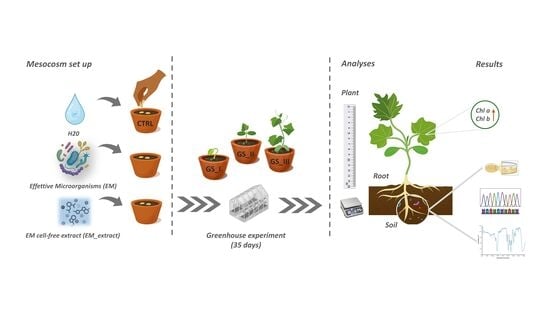
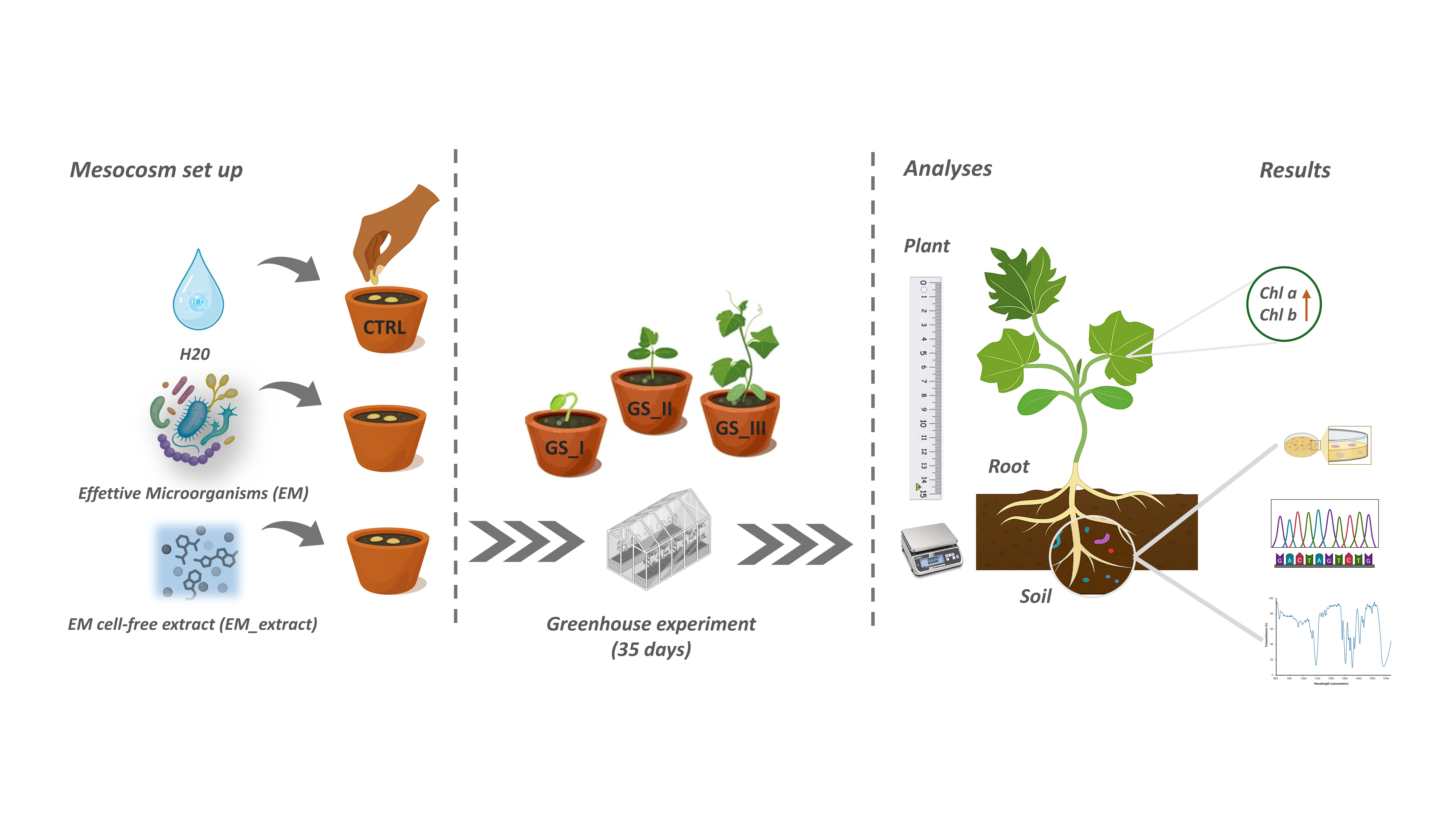
Graphical Abstract

1. Introduction

Soil health is a key determinant of agricultural productivity and ecosystem sustainability, encompassing the biological, chemical and physical properties that enable soils to function effectively as living systems [1,2]. Among the biological components, soil microorganisms are essential drivers of nutrient cycling, organic matter turnover and soil structure stabilization [3]. They decompose plant residues, mineralize nitrogen and phosphorus and establish symbiotic relationships with plants that enhance nutrient and water uptake, influencing growth, stress tolerance and the overall crop performance [4,5].
Within these communities, beneficial microbes play a central role in sustaining plant productivity [6]. They include plant growth-promoting rhizobacteria (PGPR), mycorrhizal fungi and certain rhizosphere yeasts [7,8,9]. These organisms synthesize and release a wide spectrum of bioactive molecules, such as phytohormones (auxins, cytokinins, gibberellins), vitamins, siderophores and volatile organic compounds, that stimulate root branching, enhance nutrient acquisition and modulate plant physiological responses [10]. In addition, many beneficial microbes contribute to plant protection by inducing systemic resistance and suppressing soil-borne pathogens through antibiotic production or competitive exclusion mechanisms [11]. Collectively, these activities create a metabolically dynamic and protective rhizosphere environment that supports plant vigor and resilience under both biotic and abiotic stress conditions [12,13].
As global agriculture faces growing challenges associated with climate change, including rising temperatures, erratic rainfall, progressive soil salinization and increased frequency of extreme weather events, the resilience and productivity of agroecosystems are being progressively compromised. These changes extend beyond the direct effects on crop physiology, exerting profound influences on soil physicochemical equilibria and biological functioning. Elevated temperatures and altered moisture regimes accelerate the decomposition of soil organic matter and deplete carbon reserves, while simultaneously disrupting microbial community structure and activity. Such alterations impair nutrient cycling efficiency and weaken the soil’s intrinsic capacity to sustain beneficial plant–microbe interactions. The resulting decline in soil fertility ultimately constrains both yield and product quality, emphasizing the necessity of implementing strategies aimed at restoring and preserving soil health within a changing environmental framework [14,15,16].
In this context, the use of microbial consortia and biofertilizers has emerged as a promising, ecologically sound approach to counteract the negative impacts of soil degradation. Microbial consortia, complex formulations combining multiple species of beneficial bacteria, fungi and yeasts, act synergistically to restore soil functionality through nutrient solubilization, organic matter mineralization and stimulation of plant growth-promoting mechanisms [17]. By improving soil structure, enhancing nutrient use efficiency and fostering resilient microbial networks, these biotechnological solutions contribute to both the mitigation and adaptation components of climate-smart agriculture. Unlike single-strain inoculants, microbial consortia can establish more stable and functionally diverse rhizosphere communities, thereby exerting prolonged beneficial effects on plant nutrition, stress tolerance and overall productivity [7,18,19].
Among the various microbial consortia developed for agricultural purposes, Effective Microorganisms (EM) represent one of the most widely studied and applied systems in sustainable crop management. Originally formulated by Higa in the 1980s, EM technology consists of a mixed culture of naturally occurring beneficial microorganisms, primarily lactic acid bacteria (LAB), photosynthetic bacteria, yeasts, actinomycetes and fermentative fungi, maintained in a mutualistic balance that promotes soil and plant health [20,21]. This complex community operates through a combination of direct and indirect mechanisms, including the production of organic acids, enzymes, phytohormones and antimicrobial compounds, as well as the stimulation of beneficial rhizosphere microbiota [22]. Their application has been shown to enhance soil fertility, nutrient availability, and plant productivity while suppressing soil-borne pathogens through competitive interactions [23,24,25].
Within the rapidly expanding field of microbial biostimulants, particular attention has been directed toward understanding the mechanisms through which microbial products exert their beneficial effects on plants. While living microbial consortia enhance plant growth primarily through rhizosphere colonization, nutrient solubilization and competitive interactions, it is increasingly recognized that many of their effects may also derive from their bioactive metabolites. These compounds, including organic acids, amino acids, phytohormones and secondary metabolites, can act directly on plant physiology, stimulating root development, chlorophyll synthesis, and stress tolerance even in the absence of viable cells [1,26].
Consequently, distinguishing between the effects of the living microbial community and those of its metabolic derivatives is essential to clarify the functional basis of microbial bio stimulation. Such differentiation has both theoretical relevance, in elucidating plant–microbe signaling mechanisms, and practical implications, as metabolite-based preparations may offer more stable, easily applicable formulations compared with live inoculants. In this context, the present study focuses on Effective Microorganisms (EM) as a model microbial consortium and on its cell-free extract (EM Extract), comparing their respective impacts on plant growth, pigment composition and soil microbial and metabolic profiles. This dual approach aims to disentangle the relative contribution of microbial activity and microbial metabolites to the overall bio stimulant effect in zucchini (Cucurbita pepo L.). Zucchini was selected as a model species due to its rapid growth cycle, high sensitivity to soil and nutrient conditions and well-characterized physiological responses, which make it an ideal system for evaluating short-term effects of bio-stimulant treatments [27,28]. Moreover, as an economically important horticultural crop cultivated globally, zucchini provides a relevant framework for assessing the agronomic applicability of EM-based technologies under sustainable production practices.

2. Materials and Methods

2.1. Mesocosm Set-Up

The experiment was conducted in a mesocosm to evaluate the effects of activated Effective Microorganisms (EM) and their extract (EM Extract) on the growth of zucchini plant. Zucchini seeds (Cucurbita pepo, cv. “Nano verde di Milano”) used during experiment were provided by Bavicchi S.p.A., Perugia, Italy. The mesocosm test was conducted in a greenhouse equipped with automatic control of temperature set at 25 °C, at the Bavicchi S.p.A. company (43.090217° N–12.454082° W). The experimental design included three groups, EM, EM Extract (EM_ext) and a control (CTRL), each tested in nine replicate pots. For each group, 1 L pots (12 cm diameter) filled with 1 kg of VULCAMIX (EUROPOMICE, Milan, Italy) commercial soil mixed with the same volume of organic and natural soil (1:1 v/v). Three zucchini seeds were sown per pot, and each pot received 2 mL of corresponding inoculum EM, EM Extract or water for the control group. The pots were positioned on a cart and irrigated every 3 days.

2.2. Microbial and Extract Inoculum

Effective Microorganisms (EM Vita Suolo) was supplied by Emita Srl (https://www.emita.it, accesses on 20 November 2025). To ensure comparable EM-derived input between the two treatments, 500 mL of the original formulation was used to assess the activity of the consortium (EM), while an additional 500 mL was processed to obtain the cell-free extract (EM Extract). The extract was prepared using a combined thermal and mechanical lysis protocol. Briefly, the suspension was centrifuged at 4500× g for 10 min. The supernatant was removed and the pellet was resuspended in an equal volume of sterile distilled water. The suspension then underwent four thermal-shock cycles, consisting of freezing at −80 °C for 1 h followed by heating at +80 °C for 10 min, to weaken the microbial cell walls. Mechanical disruption was performed by adding 2 mm and 0.1 mm glass beads and processing the suspension in a FastPrep homogenizer (four cycles at 6.5 m s−1 for 60 s each). The lysate was filtered through a 0.22 µm membrane to obtain the EM Extract. The presence of viable cells was verified by plating 100 µL of each formulation (EM and EM Extract) onto three agar media: BHI (proteose peptone 10 g L−1, dextrose 2 g L−1, sodium chloride 5 g L−1, disodium hydrogen phosphate 2.50 g L−1, agar 17 g L−1); YPD supplemented with chloramphenicol (dextrose 20 g L−1, peptone 10 g L−1, yeast extract 10 g L−1, agar 17 g L−1, chloramphenicol 0.5 g L−1) and MRS supplemented with cycloheximide (dipotassium hydrogen phosphate 2 g L−1, glucose 20 g L−1, magnesium sulfate heptahydrate 0.2 g L−1, manganous sulfate tetrahydrate 0.05 g L−1, meat extract 8 g L−1, peptone 10 g L−1, sodium acetate trihydrate 5 g L−1, triammonium citrate 2 g L−1, yeast extract 4 g L−1, agar 17 g L−1, tween 80 1 mL L−1, cycloheximide 0.1 g L−1). Plates were incubated for 48 h at 25 °C (BHI and YPD) and for 72 h at 30 °C under anaerobic conditions (MRS). As expected, microbial growth was observed for EM (Figure S1a), whereas no colonies were detected for the EM Extract (Figure S1b). Both inoculants were applied to zucchini seeds by adding 2 mL of the respective preparation directly into each pot.

2.3. Plant Growth Parameters

The same pots were sampled at each of the three growth stages. For every sampling event, pots were pooled in groups of three, yielding three biological replicates per treatment, each in three technical replicates. At each stage, plant height was recorded (Table S1). During the final sampling (35 days after planting), plants were eradicated and the root system was separated from the stem to measure the root length. After eradication, fresh and dry weights of plants and roots were measured (Table S1). Dry weights were obtained after drying the plant material at 70 °C for 48 h, following the method of Thuran et al. [29]. Leaves were collected and stored at −80 °C for subsequent analyses.
Pigment content, including chlorophyll a, b and carotenoids was assessed following the extraction protocol and equations proposed by Siebeneichler [30]. For each sample, 250 mg of fresh or frozen leaves were weighed and mixed with 5 mL of 99% ethanol and glass beads. Cell disruption was achieved using FastPrep device set to 6 m s−1 for 30 s. Samples were then incubated in the dark at room temperature for 24 h and then centrifuged at 4500× g for 5 min. The absorbance of the supernatant was measured at 664, 648 and 470 nm using 1 mL quartz cuvettes. Pigment concentrations were expressed in mg g−1 of fresh weight (Table S1).

2.4. Soil Samplings and Analyses

Soil samples were collected at three plant growth stages: seedling emergence, half growth (development of the first true leaf pair) and advanced growth (three leaf sets), corresponding to 13, 25 and 35 days after planting, respectively. At the final stage (35 days), the plants were eradicated, and the rhizosphere soil was collected. All soil and rhizosphere samples were transferred to the laboratory in 15 mL falcon tubes and stored at −80 °C until analyses. Soil from the nine pots per treatment was pooled to obtain a single composite sample, an approach intentionally adopted to minimize microscale soil heterogeneity and provide a representative profile of each treatment. FTIR, metabarcoding and culture-based replicates therefore represent technical replication, capturing within-sample analytical reproducibility rather than biological variance across pots.

2.4.1. Culture-Based Analysis

Soil suspensions were prepared by adding 5 mL of sterile physiological solution (0.9% NaCl) to 1 g of fresh bulk soil (1:5, w/v).
The suspensions were serially diluted and 100 µL of each dilution was plated in triplicate on the same agar media used for viable cells count: BHI, YPD supplemented with chloramphenicol and MRS supplemented with cycloheximide. Plates were incubated for 48 h at 25 °C (BHI and YPD) and for 72 h at 30 °C under anaerobic conditions (MRS). Microbial cell density was quantified as colony-forming units per gram of soil (CFU g−1) (Table S2).

2.4.2. Metabolomic Analyses

Fourier Transform Infrared (FTIR) spectroscopy was performed following the protocol described by Ruspi et al. [29]. Each bulk sample was air-dried, and 2 g of dry soil were mixed with 10 mL of HPLC-grade water (1:5 w/v), vortexed for 10 min, and allowed to settle for an additional 10 min. From each suspension, 175 μL of the supernatant were collected for five independent FT-IR readings of 35 μL each (technical replicates) [31].
FTIR spectra were acquired using a TENSOR 27 spectrometer equipped with an HTS-XT screening module (Bruker Optics GmbH, Ettlingen, Germany) in transmission mode. Spectra were recorded across the 4000–400 cm−1 range at the instrument’s standard resolution settings (Table S3).

2.4.3. Metabarcoding Analyses

DNA extraction was performed following to the manufacturer’s instructions DNeasy PowerSoil Pro Kit, QIAGEN, Hilden, Germany.
Metagenomic DNA was used as a template for 16S rRNA amplification of microbial barcode regions: 16S for prokaryotes, and ITS together with D1/D2 for eukaryotes. The whole gene was amplified using primers 8F and 1492R. Eukaryotic markers (ITS1, 5.8 S, ITS2, and D1/D2 domains of 26 S subunit) were amplified using primers ITS1/NL4. Polymerase chain reaction (PCR) was carried out using Platinum SuperFi II PCR Master Mix (Invitrogen) under the following cycling conditions: initial denaturation at 98 °C for 30 s, 30 amplification cycles (98 °C for 30 s, 60 °C for 1 min and 72 °C for 45 s), and final extension at 72 °C for 5 min. Amplicons were verified on a 1% agarose gel. A tagging step with modified primers followed the Oxford Nanopore protocol (SQK-LSK114) (https://nanoporetech.com/document/genomic-dna-by-ligation-sqk-lsk114, accessed on 29 October 2025), with additional amplification, purification with Ampure XP, and barcoding. Sequencing libraries were prepared using a NEBNext Ultra DNA library preparation kit and loaded onto an R10.4.1 flow cell.
Reads were base-called on-instrument using the Guppy v.4.2.2 GPU base caller (Oxford Nanopore Technologies, Oxford, UK), with the option -min_qscore 20 to filter out reads with a quality score below 20. The sequence analysis pipeline was executed in a Conda environment on Ubuntu. Raw reads were filtered using seqtk to remove sequences shorter than 300 bp and longer than 1800 bp. Filtered reads were merged into a single file, which served as input for the alignment program minimap2 (version 2.24). Metabarcoding analysis for Prokaryotic identification was performed by mapping filtered raw reads against SILVA 16S database (SILVA_138.1_SSURef_tax_silva.fasta.gz) (https://www.arb-silva.de, accessed on 29 October 2025). Fungal identification was conducted by aligning sequences against the UNITE General Release reference database from (version sh_general_release_04.04.2024.tgz) (https://unite.ut.ee/, accessed on 29 October 2025). The report of key sequencing metrics per sample was presented as Table S5.

2.5. Statistical Analyses

2.5.1. Plant and Soil Parameters

Statistical analyses were performed in R (https://cran.r-project.org, accessed on 20 November 2025). Normality and homogeneity of variance were assessed using the Shapiro–Wilk test (stats package) and Breusch–Pagan test (lmtest package), respectively. One-way ANOVA was used to evaluate differences in plant and root growth parameters and pigment content. Post hoc pairwise comparisons were conducted using Tukey’s HSD test (Table S1).
Microbial cell densities across growth stages and microbial communities were compared using paired t-tests. Bonferroni correction was applied to adjust for multiple comparisons. Significance thresholds were set at p < 0.05 (*) and p < 0.001 (**). Effect sizes and 95% confidence intervals were calculated for all analyses and are reported in Supplementary Tables S1 and S22 for ANOVA; Cohen’s d for paired t-tests).

2.5.2. Metagenomic Soil Analysis

Statistical analyses were performed in the R environment using the microeco package. Microbial alpha diversity was assessed with two indexes: Chao and Shannon, through the trans_alpha function. Microbial relative abundance was calculated using trans_abund function, and the statistical significance of differences among groups was evaluated using Dunn’s Kruskal–Wallis multiple comparisons non-parametric test.

2.5.3. FTIR Spectral Data

Multivariate statistical analyses were performed in R (version 4.4.3) to explore differences in soil metabolic profiles across treatments based on FTIR spectra. Normalized spectral data were imported from Excel files and organized by sample identity and biological replicate.
Principal Component Analysis (PCA) was conducted using the prcomp function with centering and scaling enabled. The analysis was performed on the full spectral matrix to reduce dimensionality and identify major sources of variance associated with treatment effects. PCA score plots were generated with ggplot2, where samples were colored according to treatment group and technical/biological replicates were retained to preserve within-group variability. Ninety-five percent confidence ellipses were computed using a multivariate normal model to visualize group dispersion.
Normality and variance homogeneity of FTIR spectra were assessed using Shapiro–Wilk and Levene’s tests. Depending on the results, either a two-sample t-test or Mann–Whitney U test was applied. p-values were adjusted for multiple comparisons using FDR and only intervals with FDR-adjusted p < 0.05 were considered significant. Significant peaks were defined as the wavenumber with maximum intensity within each interval and assigned to the bond vibrations listed in Supplementary Table S5 [32,33,34,35,36,37,38,39,40]. Mean spectra were plotted with significant peaks highlighted.

3. Results

3.1. Impact of EM and EM Extract on Vegetative and Root Development of Zucchini Plants

The impact of inoculation with the EM consortium and its extract (EM Extract) was evaluated on the evolution of plant growth parameters and pigment content across three distinct growth stages: seedling emergence (GS_I), half growth (GS_II) and advanced growth (GS_III) (Figure 1). At each stage, plant height, fresh and dry weight and pigment content were measured and compared with the untreated controls. At the seedling emergence (stage GS_I), only EM treatment significantly increased plant heights compared to the control (p < 0.001) (Figure 1a), indicating a specific effect of the full consortium on early vegetative growth. By the advanced growth stage (GS_III), both EM and EM Extract treatments promoted significant increases in plant height relative to the control (p < 0.05), with the extract showing the most pronounced effect (63.4%) in supporting growth during later developmental stages.
Consistent with these trends, biomass parameters were also positively affected by both treatments (Figure 1b,c). EM Extract was associated with an increase in fresh weight (Figure 1b), likely reflecting improved water and nutrient uptake, while both EM and EM Extract treatments promoted increases in dry weight compared to untreated plants (Figure 1c), demonstrating that the observed height gains translated into greater overall plant biomass.
Leaf pigment analysis further highlighted treatment effects on plant physiology. Leaf pigment content (mg g−1 fresh weight) was measured for chlorophyll a, chlorophyll b and carotenoids (Figure 1d). Chlorophyll a content was higher only in EM-treated plants (0.85 vs. 0.42 mg g−1, p < 0.05), whereas both EM and EM Extract induced a substantial increase in chlorophyll b (p < 0.001), from 0.2 mg g−1 in the control to 0.45 mg g−1 and 0.5 mg g−1 in EM Extract and EM treatments, respectively (Figure 1d). In contrast, carotenoid content remained unchanged, suggesting that the treatments specifically stimulate chlorophyll biosynthesis, which may enhance photosynthetic efficiency and support growth.
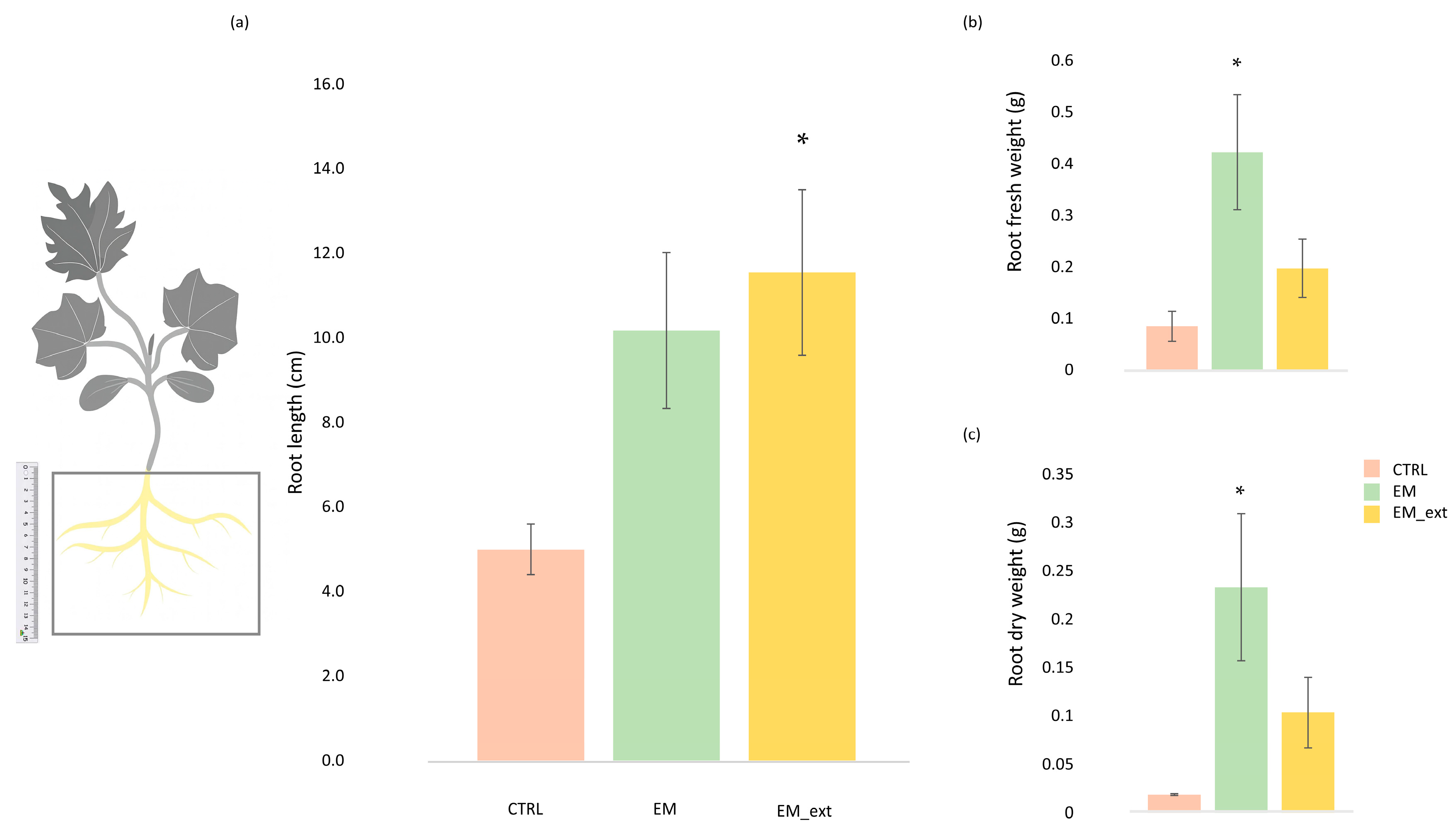
Root development, assessed at GS_III following plant eradication, showed differential responses to the two treatments (Figure 2). EM Extract primarily stimulated root elongation (Figure 2a), increasing root length from 5.0 to 11.5 cm, whereas the full EM consortium significantly enhanced both root fresh and dry weight (Figure 2b,c). These findings suggest complementary modes of action, collectively contributing to improved nutrient and water uptake and overall plant performance.

3.2. Dynamic of Microbial Cell Density in Soil and Rhizosphere Samples over Time

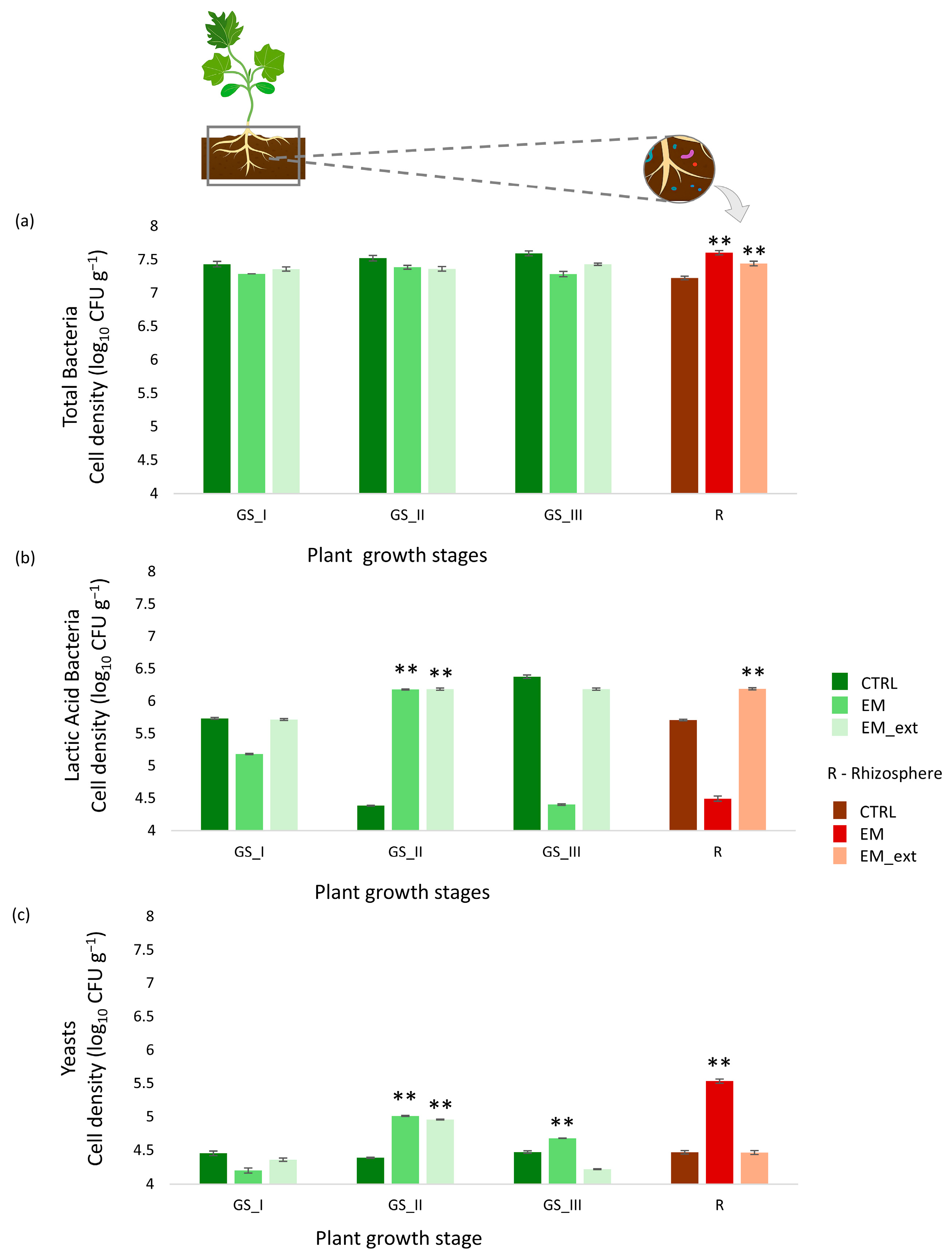
The evolution of microbial cell density during the early stages of zucchini growth was evaluated in both bulk soil and rhizosphere soil samples, focusing on total bacteria, lactic acid bacteria and yeasts (Figure 3). Although neither treatment significantly affected the total bacterial cell density (Figure 3a), both EM and EM Extract increased the abundance of lactic acid bacteria in bulk soil samples at the post-emergence stage (GS_II), with cell densities ranging from approximately 4.38 to over 6 log CFU g−1 (Figure 3b). A similar trend was observed for yeasts (Figure 3c), which reached densities of around 5 log CFU g−1, i.e., one order of magnitude higher than the control.
The rhizosphere soil could be sampled only at the end of the test, i.e., 35 days after the inoculation, when plants were eradicated. At this stage (GS_III), EM treatment was associated with higher total bacteria and yeasts counts compared with the control, while EM Extract mainly enhanced total bacterial counts as a consequence of the higher abundance of lactic acid bacteria (Figure 3b).
These findings suggest that both treatments promote the proliferation of beneficial microbes in the rhizosphere, which may improve nutrient availability and contribute to the enhanced physiological performance observed in zucchini plants. Notably, while the EM consortium exerted a stronger effect on yeast proliferation, the inoculation of EM-derived metabolites preferentially promoted the growth of lactic acid bacteria. This complementary action may represent a key mechanism underlying a differential but complementary growth-promoting potential of these bio-inoculants.

3.3. Metataxonomic Composition of Soil

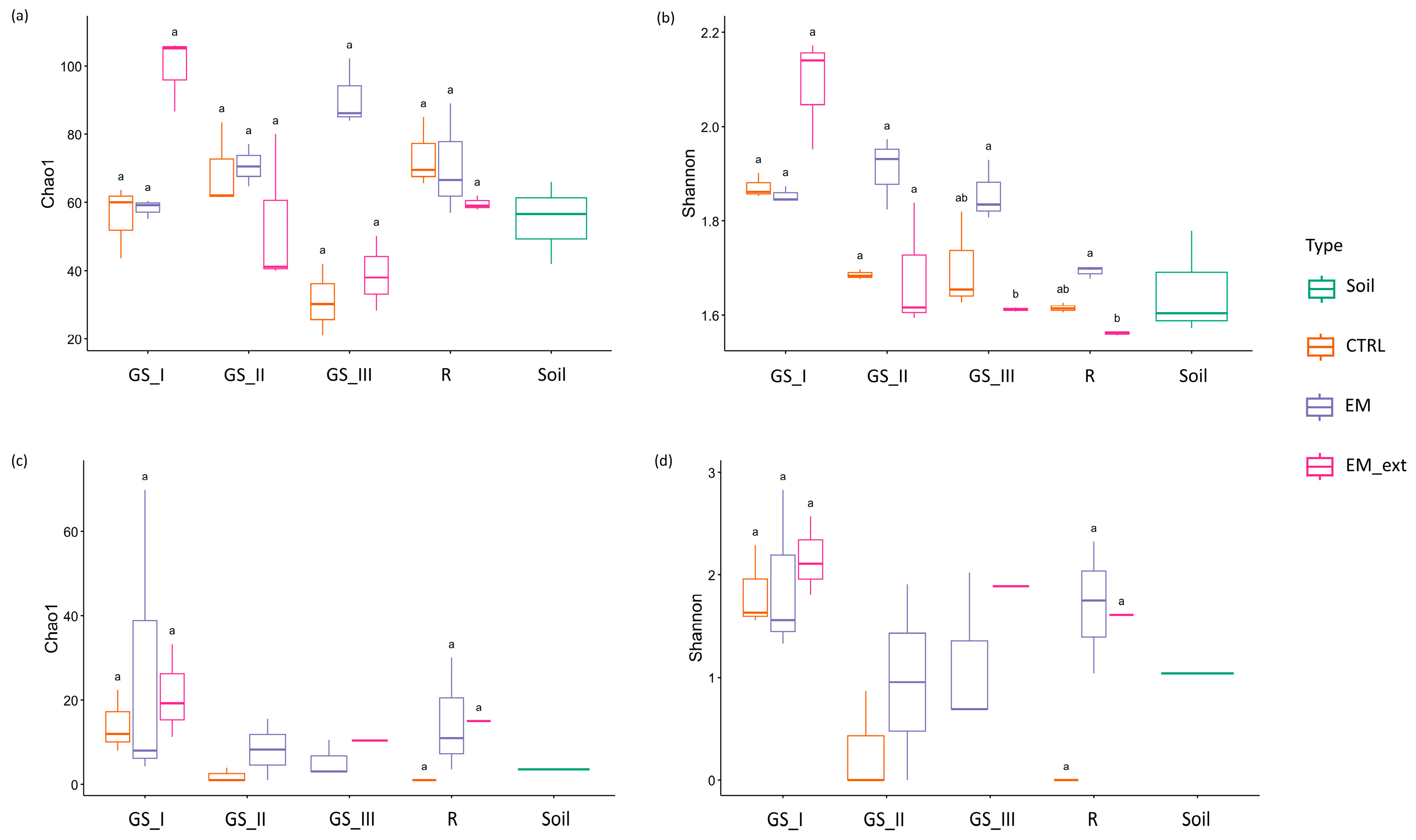
Metataxonomic composition of untreated control and soils treated with EM and EM Extract did not show any significant difference regarding to the alpha-diversity defined after the Chao index (Figure 4a). Shannon index, used to calculate the evenness among samples, showed only significant differences in the rhizosphere samples between EM and EM Extract treated plants, with the untreated control showing intermediate behavior between these two treatments (Figure 4b). While all rhizosphere samples showed decreases evenness in comparison to the initial soil, the alpha diversity of rhizosphere and bare soil at the beginning of the experiment were quite similar, indicating that the plant growth and the root exudates have homogenized the relative abundance of taxa present in the rhizosphere, without any change in their extent. A closer look at the composition of the soil communities showed that Bacilli predominated throughout all samples, accounting for ca. 50% of the total number of taxa found in the experiment. Among the other prominent taxa, Blastocatellia, alpha and gamma Proteobacteria and Acidobacteria accounted for a further 30% of the total (Figure S2a). Taken together, Gram-positive bacteria predominate, thanks to the large extent of Bacilli, although Gram-negative bacteria showed more variability. Aerobic taxa (Bacilli and Acidobacteria) predominated over anaerobic of facultative anerobic taxa, possibly due to the gross granulometry of the substrate composed largely of volcanic materials.
Fungal taxonomic composition at the level of families showed variations in Shannon index over time, with a general increase in alpha diversity at GS_I and a decrease at GS_II (Figure 4d), although these variations are not statistically significative due to the large variability among samples and the scarce amount of reads obtained from the samples (Figure 4c). The fungal composition (Figure S2b) indicated the increase in Aspergillaceae and Cucurbitaceae in all samples with plants, in comparison to the initial bare soil, where these taxa were absent. Cryptococcaceae, accounting for the basidiomycetous yeasts, increased in EM and EM Extract samples, whereas they were absent in the bare soil and present at negligible amounts in untreated samples with plants.

3.4. Soil Meta-Metabolomic FTIR Profiling

FTIR-based meta-metabolomic profiling of bulk and rhizospheric soils revealed that both EM and EM Extract treatments induced measurable alterations in soil metabolomic profiles throughout the zucchini growth cycle.
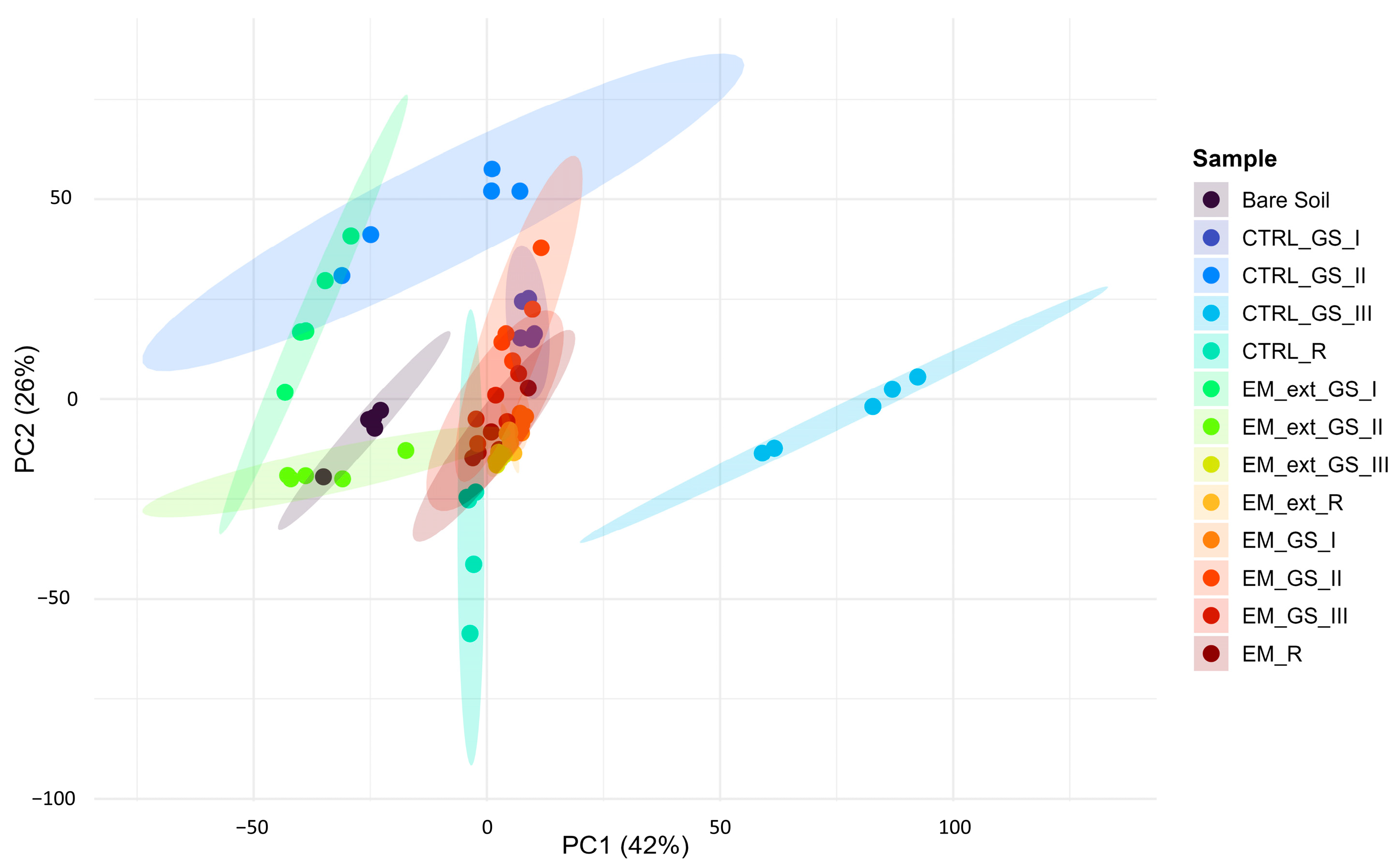
Principal component analysis (PCA) showed a clear separation among experimental groups, with the first two components accounting for 68% of the total variance (PC1 = 42%; PC2 = 26%), providing the main sources of chemical variation (Figure 5).
Bare soil and early control samples clustered at the negative end of PC1, reflecting the baseline soil profile before plant-driven or treatment-induced changes. In bulk soil, control samples from GS_I to GS_III followed a clear temporal trajectory along PC1 and PC2, highlighting progressive shifts in soil chemical composition during plant growth. In contrast, EM-treated soils formed more compact and partially overlapping clusters, suggesting that the full consortium promoted a relative homogenization of the soil chemical features over time.
Soils treated with the EM extract formed clusters that progressively diverged from the control trajectory with plant development, indicating more variable and stage-dependent responses.
Within the rhizosphere samples, EM-treated groups (EM_R and EM_ext_R) clustered closer to EM-treated bulk soils than to their respective controls (CTRL_R), suggesting that the inoculum of the EM consortium shaped the rhizosphere metabolome in a manner consistent with the changes observed in bulk soil. Overall, PCA results highlighted that both treatments induced a shift in the chemical fingerprint of bulk and rhizosphere soils relative to untreated controls.
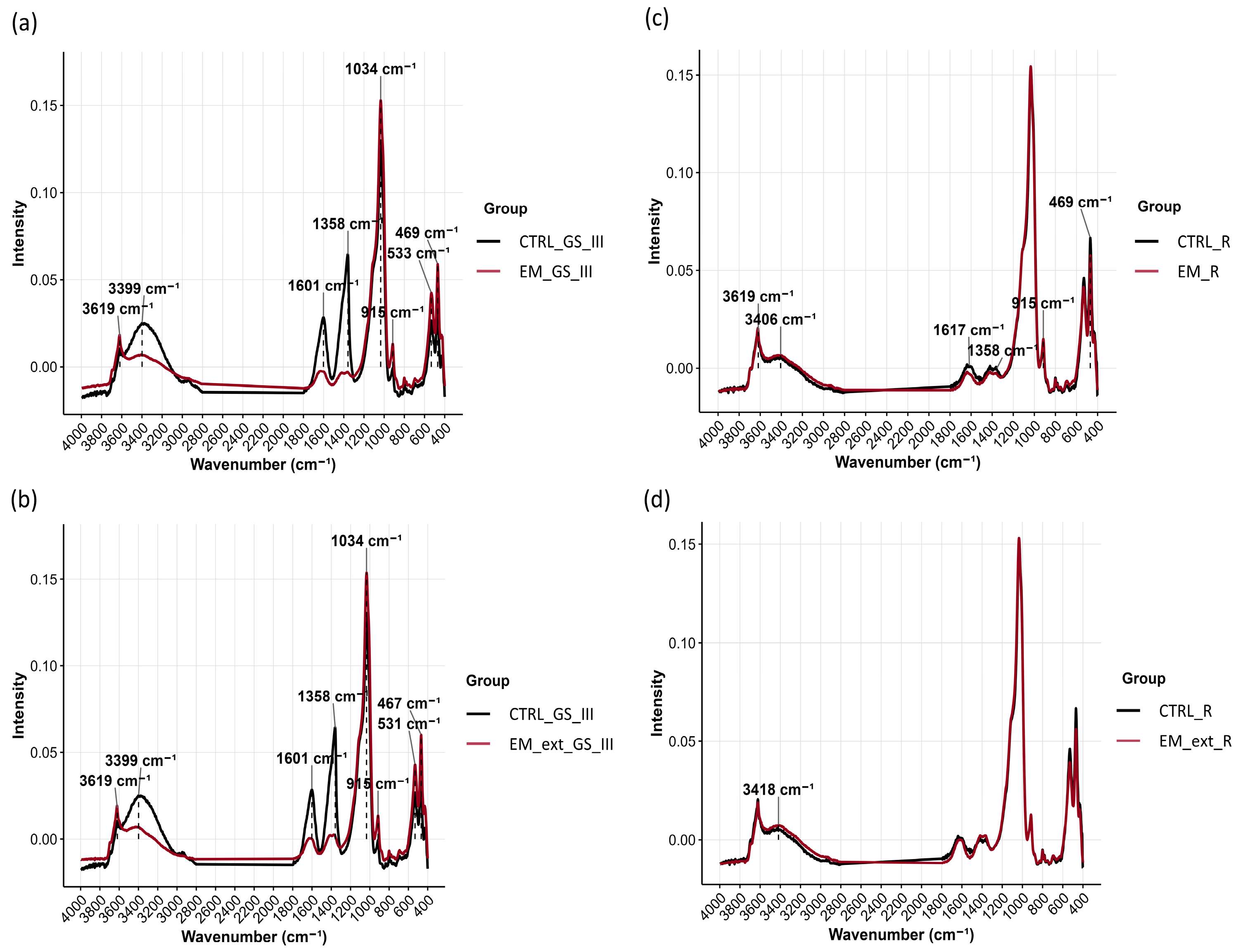
Based on this evidence, we then focused on the soil samples collected at GS_III, to characterize treatment-specific metabolic alterations at the end of the 35-day experiment. Given the complexity of the spectra, the analysis was restricted to the wavenumbers that significantly diverged among spectra. Student t-test was applied for statistical comparisons among spectra of the experimental groups, marking on the spectra only the peaks that were significantly different between samples (p < 0.05) (Figure 6).
In bulk soil, both EM and its cell-free extract induced similar FTIR profiles (Figure 6a,b), with increased bands at 3619 cm−1 (O–H stretching in hydroxyl-rich structures), 1034 cm−1 (C–O stretching in polysaccharides) and 915 cm−1 (O-H bending in clay minerals) [33,35,36,40,41]. Significant peaks were also detected at 531–533 cm−1 and 467–469 cm−1, typically associated with skeletal folding modes of silicate minerals [36]. Conversely, bands at 3399, 1601 and 1358 cm−1 were significantly reduced relative to the control. These bands correspond to O–H stretching in polysaccharides and proteins [35], C–O and C–C stretching in amide I and II [38,40], and N–O/C–N stretching associated with nitrates and amide III [38,39].
A similar pattern was also observed in the rhizosphere samples following the EM treatment, with increases in bands at 3619, 3406, and 915 cm−1 and decreases in those at 1617, 1358, and 469 cm−1. On the contrary, the metabolome of samples treated with the cell-free extract (EM_ext_R) showed no major spectral differences compared with the control, except for an increase at 3418 cm−1, indicating enhanced O–H/N–H stretching associated with hydrogen-bonded functional groups (Figure 6c,d).

4. Discussion

4.1. Growth and Physiological Responses to EM Treatments

The main aim of this study was to evaluate whether the beneficial effects of EM technology are attributable exclusively to the activity of the living microbial consortium or also to the bioactive metabolites contained in its extract. The analysis of plant parameters detected on zucchini revealed that both EM and EM Extract promoted vegetative growth, pigment accumulation and biomass production, although with distinct temporal dynamics (Figure 1). In the early growth stage (GS_I), a marked increase in plant height was observed only in EM-treated plants, suggesting that the presence of a metabolically active microbial community in the rhizosphere plays a crucial role during seedling establishment. In the later stage (GS_III), both treatments enhanced growth performance, but EM extract produced the more pronounced effect, indicating that soluble bioactive metabolites can sustain or amplify the physiological functions as the plant development progresses. These observations, consistent with previous studies reporting improved plant performance following the EM inoculation in various horticultural crops [41,42,43,44,45], highlight that live microbial interactions and soluble metabolites can act synergistically over time [46].
Leaf pigment analysis revealed a selective modulation of chlorophyll composition: chlorophyll b increased significantly under both treatments, while chlorophyll a responded mainly to the full EM consortium. Carotenoid content, by contrast, remained unchanged. This pattern suggests that EM-based treatments may preferentially stimulate light-harvesting and chlorophyll biosynthetic pathways rather than broad plastid pigment metabolism. Similar trends have been reported in beans and other vegetables treated with microbial biostimulants, where chlorophyll enhancement was associated with improved photosystem II stability and nitrogen assimilation [47,48]. The parallel increases in fresh and dry biomass confirm that these physiological improvements translated into tangible gains in vegetative productivity. Improved root architecture, improved nutrient uptake and more efficient water use likely contributed to these results, as previously documented in EM-treated lettuce and nursery seedlings [49,50].
The observation that the metabolite-induced effects can correspond to those of the live microbial consortium highlights the potential of EM Extract as a biostimulant. Such formulations may offer practical advantages in terms of safety, product stability, standardization and ease of application under field conditions. However, the documented variability in the efficacy of EM-based technologies as a function of soil characteristics, crop species, application and native microbiome composition [51], highlights the importance of validating these results in different environments and management systems [52,53].

4.2. Microbial Dynamic of Viable Cells in Soil Samples over Time

Microbiological data revealed distinct yet complementary effects of the two treatments on soil microbial communities. The enrichment of LAB under EM Extract treatment is consistent with their recognized role as plant growth-promoting rhizobacteria (PGPR) [54,55,56]. In contrast, the increase in yeast populations observed under EM treatment points to additional benefits, since several rhizosphere yeasts contribute to phytohormone production, phosphate solubilization and improved tolerance to abiotic stress [57,58]. Taken together, these patterns suggest that both EM and EM Extract promote beneficial shifts in the microbial structure of rhizosphere, either through the introduction of active microbial populations (EM) or through the stimulation of endogenous beneficial groups (EM Extract). Such microbial modulation likely underpins the improved pigment composition and biomass accumulation observed in zucchini, supporting the view that EM-based treatments enhance plant performance via targeted microbiome reconfiguration.

4.3. Impact of EM Treatments on Soil Microbiota Structure

Metataxonomic analysis suggested that both EM and EM Extract did not exert any significant effect on the resident soil community [59,60]. Even the large presence of Bacilli, within which one could expect the presence of the Lactobacillus bacteria of the EM consortium, could not be accounted to the treatments, due to their large presence in the bare soil analyzed before the cultivation of the plants. Fungal composition showed interesting variations, although not supported statistically due to the large variability among replicates and the small number of reads obtained. It is likely that these problems account more for an intrinsic limit of the whole procedure, fitting more to the description of bacteria rather than of fungi. Further efforts are necessary to overcome these technical issues to understand if EM influences more the fungal rather than the bacterial composition of the soils. In general, it will be important to show consistently the increase in fungal families due to the presence of plants and of the combination of plants and EM or EM Extract.
The results showed cover a small time period but are suggestive that the bacterial fraction of EM does not change significantly the soil microbiota composition, suggesting that they do not represent a problem in the maintenance of the autochthonous bacterial diversity [61,62]. The situation for fungi is not yet clarified, but it seems reasonable that the EM and EM Extract enhance some of the effects exerted by the plants alone.
More generally, the data presented do not show significant taxonomic differences between EM and EM Extract, suggesting that the effects observed in the plant growth are due to the internal metabolites rather than to the actual viability of the EM cells.

4.4. EM Inoculation and Cell-Free Extract Alter Bulk and Rhizosphere Soil Metabolomic Profiles

FTIR-based meta-metabolomic profiling revealed that both the full EM consortium and its cell-free extract modified the soil chemical composition during the zucchini growth cycle. PCA revealed a clear separation among groups, with control bulk soils following temporal trajectories reflecting plant-driven changes [63,64,65]. EM-treated soils clustered compactly, suggesting that the full consortium promoted a relative homogenization of the soil chemical features over time, in both bulk and rhizosphere soils. On the contrary, the inoculum of the extracted metabolites (EM_ext) induced more variable, stage-dependent effects [66,67].
Overall, the analysis of GS_III samples showed that the two treatments produced similar alterations in the soil metabolomic profile in both bulk and rhizosphere compartments, suggesting that inoculation with EM or EM Extract ultimately drives the soil toward a comparable functional state. This convergence may reflect the dominant influence of plant-derived inputs during the later growth stages, a process well documented in the literature [65,68,69,70].
In both cases, the treatments induced consistent spectral shifts, characterized by increased intensities at 3619, 1034, 915 and around 531 and 467 cm−1, corresponding, respectively, to hydroxyl-rich structures, polysaccharides, C–N/P–O vibrations and silicate-associated bands. These changes align with recent evidence showing that microbial inoculants, can accelerate soil organic matter (SOM) turnover by enhancing enzyme-mediated degradation, depolymerizing polysaccharides and proteins and promoting mineral–organic associations detectable through FTIR [63,71,72,73]. Conversely, both treatments resulted in reduced intensities at 3399, 1601, and 1358 cm−1, which are typically associated with polysaccharide-, protein-, and nitrate-related functional groups. This reduction may reflect enhanced microbial turnover of labile organic compounds, consistent with increased microbial utilization or transformation of easily degradable substrates, leading to depletion of polysaccharide- and protein-derived structures and assimilation or modification of nitrate-containing groups [74,75].
EM Extract-treated rhizosphere soils showed minimal spectral changes, with the main exception of enhanced O–H/N–H stretching, suggesting that the cell-free extract primarily affects hydrogen-bonded functional groups. This observation highlights the crucial role of active microbial consortia in driving broader soil metabolomic modifications, in line with previous reports on the functional influence of the plant microbiome [76].

5. Conclusions

The present study evaluated the effects of Effective Microorganisms (EM) and its cell-free extract on zucchini grown in pots under controlled conditions over a 35-day period.
Both treatments enhanced plant height and biomass, promoted chlorophyll biosynthesis, and differentially stimulated root development, collectively improving nutrient and water uptake. Although culturable microbial analyses revealed complementary shifts in rhizosphere communities, no major taxonomic differences emerged between treatments. Consistently, both inputs induced similar metabolomic alterations in bulk and rhizosphere soils, leading to convergence toward a shared functional state largely shaped by plant-derived inputs. Despite being exploratory, these results highlight consistent patterns, showing that EM-derived extract can enhance zucchini growth and rhizosphere activity, matching or even surpassing the effects of live microbial inoculants. Overall, these findings provide a framework for crop biostimulation. Further analyses, including targeted metabolomics and extract fractionation, are required to identify the key EM-derived components responsible for the observed effects, guiding the development of effective and eco-friendly biostimulant products.

Supplementary Materials

The following supporting information can be downloaded at: https://www.mdpi.com/article/10.3390/horticulturae11121528/s1, Figure S1: Microbial viability assessment of the EM and EM Extract prior to application.; Figure S2: Relative abundance of bacterial (16S) and fungal (ITS) communities across treatments; Table S1: Plant parameters at different growth stages, and root parameters and pigment contents after plant eradication including values obtained from one-way ANOVA followed by Tukey’s HSD multiple-comparisons correction. Reported values include group means with 95% confidence intervals, adjusted p-values, and effect size estimates; Table S2: Cell density for Total bacteria, Lactic acid bacteria and Yeasts, reported as CFU g−1. Standard deviation and paired t-test parameters, including values obtained from paired t-test analyses with Bonferroni correction, effect size and 95% confidence intervals; Table S3: FTIR normalized spectra (five replicas for each group); Table S4: Sequencing statistics and Good’s coverage estimates for 16S and ITS datasets. Table S5: FTIR spectra analysis. Wavelength assignment for significant peaks (p < 0.05).

Author Contributions

Conceptualization, L.C. and G.C.; methodology, D.C.P. and K.S.; validation, L.C. and G.C.; formal analysis, K.S., A.C. and R.S.; investigation, K.S. and A.C.; resources, L.C. and G.C.; data curation, K.S., A.C. and L.C.; writing—original draft preparation, K.S., L.C. and G.C.; writing—review and editing, L.C., D.C.P. and G.C.; visualization, K.S., A.C. and L.C.; supervision, L.C. and G.C. All authors have read and agreed to the published version of the manuscript.

Funding

This research was funded partially by the Italian Ministry for Universities and Research (MUR), through the PNRR Project: CUP J63C23000350003 and partially funded by Emita Srl Italy.

Data Availability Statement

The original contributions presented in this study are included in the article/Supplementary Material. Further inquiries can be directed to the corresponding author(s).

Acknowledgments

The authors gratefully acknowledge Bavicchi S.p.A. for providing the facilities, and Emita Srl for funding the research.

Conflicts of Interest

The authors declare no conflicts of interest.

Abbreviations

The following abbreviations are used in this manuscript:
EMEffective Microorganism
EM Extract/EM_extCell-free Effective Microorganisms extract
PGPRPlant growth-promoting rhizobacteria
LABLactic Acid Bacteria
BHIBrain heart infusion medium
YPDYeast extract peptone dextrose medium
MRSDe Man–Rogosa–Sharpe medium
CFUColony-forming units
FTIRFourier Transform Infrared Spectroscopy
PCAPrincipal Component Analysis
ANOVAAnalysis of Variance
CTRLControl
GS_IPlant Growth stage I—seedling emergence
GS_IIPlant Growth stage II—half growth
GS_IIIPlant Growth stage III—advanced growth
RRhizosphere
SOMSoil organic matter

References

  1. Cárceles Rodríguez, B.; Durán-Zuazo, V.H.; Soriano Rodríguez, M.; García-Tejero, I.F.; Gálvez Ruiz, B.; Cuadros Tavira, S. Conservation agriculture as a sustainable system for soil health: A review. Soil Syst. 2022, 6, 87. [Google Scholar] [CrossRef]
  2. Krasilnikov, P.; Taboada, M.A.; Amanullah. Fertilizer use, soil health and agricultural sustainability. Agriculture 2022, 12, 462. [Google Scholar] [CrossRef]
  3. Alori, E.T.; Osemwegie, O.O.; Ibaba, A.L.; Daramola, F.Y.; Olaniyan, F.T.; Lewu, F.B.; Babalola, O.O. The importance of soil microorganisms in regulating soil health. Commun. Soil Sci. Plant Anal. 2024, 55, 2636–2650. [Google Scholar] [CrossRef]
  4. Lei, Y.; Kuai, Y.; Guo, M.; Zhang, H.; Yuan, Y.; Hong, H. Phosphate-solubilizing microorganisms for soil health and ecosystem sustainability: A forty-year scientometric analysis (1984–2024). Front. Microbiol. 2025, 16, 1546852. [Google Scholar] [CrossRef]
  5. Wu, D.; Wang, W.; Yao, Y.; Li, H.; Wang, Q.; Niu, B. Microbial interactions within beneficial consortia promote soil health. Sci. Total Environ. 2023, 900, 165801. [Google Scholar] [CrossRef] [PubMed]
  6. Ortiz, A.; Sansinenea, E. The role of beneficial microorganisms in soil quality and plant health. Sustainability 2022, 14, 5358. [Google Scholar] [CrossRef]
  7. Finkel, O.M.; Castrillo, G.; Paredes, S.H.; González, I.S.; Dangl, J.L. Understanding and exploiting plant beneficial microbes. Curr. Opin. Plant Biol. 2017, 38, 155–163. [Google Scholar] [CrossRef]
  8. Nimsi, K.A.; Manjusha, K.; Kathiresan, K.; Arya, H. Plant growth-promoting yeasts (PGPY), the latest entrant for use in sustainable agriculture: A review. J. Appl. Microbiol. 2023, 134, lxac088. [Google Scholar] [CrossRef]
  9. Adedayo, A.A.; Babalola, O.O. Fungi that promote plant growth in the rhizosphere boost crop growth. J. Fungi 2023, 9, 239. [Google Scholar] [CrossRef]
  10. Khoso, M.A.; Wagan, S.; Alam, I.; Hussain, A.; Ali, Q.; Saha, S.; Poudel, T.R.; Manghwar, H.; Liu, F. Impact of plant growth-promoting rhizobacteria (PGPR) on plant nutrition and root characteristics: Current perspective. Plant Stress 2024, 11, 100341. [Google Scholar] [CrossRef]
  11. Sharma, P.; Kaushal, G.; Borker, S.S.; Lepcha, A.; Kumar, A.; Kumar, R. Physiological and genomic elucidation of cold-resilient rhizobacteria reveals plant growth promotion by siderophore optimization and enhanced biocontrol potential against fungal pathogens. J. Plant Growth Regul. 2024, 44, 6953–6966. [Google Scholar] [CrossRef]
  12. Asad, S.A. Mechanisms of action and biocontrol potential of Trichoderma against fungal plant diseases: A review. Ecol. Complex. 2022, 49, 100978. [Google Scholar] [CrossRef]
  13. Ruspi, C.; Pierantoni, D.C.; Conti, A.; Scarponi, R.; Corte, L.; Cardinali, G. Plant Growth-Promoting Yeasts (PGPYs) as a sustainable solution to mitigate salt-induced stress on zucchini plant growth. Biol. Fertil. Soils 2025, 61, 293–309. [Google Scholar] [CrossRef]
  14. Rosenzweig, C.; Hillel, D. Soils and global climate change: Challenges and opportunities. Soil Sci. 2000, 165, 47–56. [Google Scholar] [CrossRef]
  15. Corwin, D.L. Climate change impacts on soil salinity in agricultural areas. Eur. J. Soil Sci. 2021, 72, 842–862. [Google Scholar] [CrossRef]
  16. Oertel, C.; Matschullat, J.; Zurba, K.; Zimmermann, F.; Erasmi, S. Greenhouse gas emissions from soils—A review. Geochemistry 2016, 76, 327–352. [Google Scholar] [CrossRef]
  17. Das, P.P.; Singh, K.R.; Nagpure, G.; Mansoori, A.; Singh, R.P.; Ghazi, I.A.; Kumar, A.; Singh, J. Plant–soil–microbe: A tripartite interaction for nutrient acquisition and plant growth. Environ. Res. 2022, 214, 113821. [Google Scholar] [CrossRef]
  18. Ray, P.; Lakshmanan, V.; Labbé, J.L.; Craven, K.D. Microbe to microbiome: A paradigm shift in the application of microorganisms for sustainable agriculture. Front. Microbiol. 2020, 11, 622926. [Google Scholar] [CrossRef]
  19. Bakhshandeh, E.; Gholamhosseini, M.; Yaghoubian, Y.; Pirdashti, H. Plant growth promoting microorganisms can improve germination, seedling growth and potassium uptake of soybean under drought and salt stress. Plant Growth Regul. 2019, 90, 123–136. [Google Scholar] [CrossRef]
  20. Nayak, N.; Sar, K.; Kumar Sahoo, B.; Mahapatra, P. Beneficial effect of effective microorganism on crop and soil: A review. J. Pharmacogn. Phytochem. 2020, 9, 3070–3074. [Google Scholar]
  21. Prisa, D.; Jamal, A. Comprehensive analysis of effective microorganisms: Impacts on soil, plants, and the environment. Multidiscip. Rev. 2025, 8, 2025318. [Google Scholar] [CrossRef]
  22. Ezeagu, G.; Omotosho, A.; Suleiman, K. Effective microorganisms: A review of their products and uses. Nile J. Eng. Appl. Sci. 2023, 1, 42–53. [Google Scholar] [CrossRef]
  23. Joshi, H.; Duttand, S.; Choudhary, P.; Mundra, S. Role of effective microorganisms (EM) in sustainable agriculture. Int. J. Curr. Microbiol. Appl. Sci. 2019, 8, 172–181. [Google Scholar] [CrossRef]
  24. Kumar Acharya Narendar Deva, G.; Mahtab Rashid, M.; Nanda, S.; Kumar, G.; Rashid, M. Beneficial microorganisms for stable and sustainable agriculture. Biopestic. Int. 2021, 17, 17–27. [Google Scholar]
  25. Aguilar-Paredes, A.; Valdés, G.; Nuti, M. Ecosystem functions of microbial consortia in sustainable agriculture. Agronomy 2020, 10, 1902. [Google Scholar] [CrossRef]
  26. O’Callaghan, M.; Ballard, R.A.; Wright, D. Soil microbial inoculants for sustainable agriculture: Limitations and opportunities. Soil Use Manag. 2022, 38, 1340–1369. [Google Scholar] [CrossRef]
  27. Ruspi, C.; Pierantoni, D.C.; Conti, A.; Favaro, L.; Antinori, M.E.; Puglisi, E.; Corte, L.; Cardinali, G. Beneficial effects of plant growth-promoting yeasts (PGPYs) on the early stage of growth of zucchini plants. Curr. Plant Biol. 2024, 39, 100357. [Google Scholar] [CrossRef]
  28. Savvas, D.; Magkana, P.; Yfantopoulos, D.; Kalozoumis, P.; Ntatsi, G. Growth and nutritional responses of zucchini squash to a novel consortium of six Bacillus sp. strains used as a biostimulant. Agronomy 2024, 14, 362. [Google Scholar] [CrossRef]
  29. Turhan, E.; Eris, A. Changes of micronutrients, dry weight, and chlorophyll contents in strawberry plants under salt stress conditions. Commun. Soil Sci. Plant Anal. 2005, 36, 1021–1028. [Google Scholar] [CrossRef]
  30. Siebeneichler, S.C.; Barbosa, J.S.; Cruz, A.M.M.; Ramos, M.A.D.; Fernandes, H.E.; Nascimento, V.L. Comparison between extraction methods of photosynthetic pigments in Acacia mangium. Commun. Plant Sci. 2019, 9, 1–5. [Google Scholar] [CrossRef]
  31. Roscini, L.; Corte, L.; Antonielli, L.; Rellini, P.; Fatichenti, F.; Cardinali, G. Influence of cell geometry and number of replicas in the reproducibility of whole cell FTIR analysis. Analyst 2010, 135, 2099–2105. [Google Scholar] [CrossRef]
  32. Bartos, A.; Szymański, W.; Klimek, M. Impact of conventional agriculture on concentration and quality of water-extractable organic matter (WEOM) in surface horizons of Retisols. Soil Tillage Res. 2020, 204, 104750. [Google Scholar] [CrossRef]
  33. Feng, Q.; Luo, Y.; Liang, M.; Cao, Y.; Wang, L.; Liu, C.; Zhang, X.; Ren, L.; Wang, Y.; Wang, D.; et al. Rhizobacteria protective hydrogel to promote plant growth and adaption to acidic soil. Nat. Commun. 2025, 16, 1684. [Google Scholar] [CrossRef] [PubMed]
  34. Artz, R.R.E.; Chapman, S.J.; Campbell, C.D. Substrate utilisation profiles of microbial communities in peat are depth dependent and correlate with whole soil FTIR profiles. Soil Biol. Biochem. 2006, 38, 2958–2962. [Google Scholar] [CrossRef]
  35. Demyan, M.S.; Rasche, F.; Schulz, E.; Breulmann, M.; Müller, T.; Cadisch, G. Use of specific peaks obtained by DRIFTS to study organic matter composition in a Haplic Chernozem. Eur. J. Soil Sci. 2012, 63, 189–199. [Google Scholar] [CrossRef]
  36. Teng, Q.; Feng, Y.; Li, H. Effects of silicate-bacteria pretreatment on desiliconization of magnesite by reverse flotation. Colloids Surf. A Physicochem. Eng. Asp. 2018, 544, 60–67. [Google Scholar] [CrossRef]
  37. Linker, R.; Shmulevich, I.; Kenny, A.; Shaviv, A. Soil identification and chemometrics for direct determination of nitrate in soils using FTIR-ATR mid-infrared spectroscopy. Chemosphere 2005, 61, 652–658. [Google Scholar] [CrossRef]
  38. Peltre, C.; Gregorich, E.G.; Bruun, S.; Jensen, L.S.; Magid, J. Repeated application of organic waste affects soil organic matter composition: Evidence from thermal analysis, FTIR-PAS, amino sugars and lignin biomarkers. Soil Biol. Biochem. 2017, 104, 117–127. [Google Scholar] [CrossRef]
  39. Xu, X.; Du, C.; Ma, F.; Shen, Y.; Zhou, J. Forensic soil analysis using LIBS and FTIR-ATR: Principles and case studies. Forensic Sci. Int. 2020, 310, 110222. [Google Scholar] [CrossRef]
  40. Meng, T.; Wang, Q.; Abbasi, P.; Ma, Y. Deciphering chemical and microbial differences of healthy and Fusarium wilt-infected watermelon rhizosphere soils. Appl. Microbiol. Biotechnol. 2019, 103, 1497–1509. [Google Scholar] [CrossRef] [PubMed]
  41. Hu, C.; Qi, Y. Long-term effective microorganisms application promote growth and increase yields and nutrition of wheat in China. Eur. J. Agron. 2013, 46, 63–67. [Google Scholar] [CrossRef]
  42. Barbara, F.; Tomasz, K.; Justyna, K. Impact of effective microorganisms on yields and nutrition of sweet basil (Ocimum basilicum L.) and microbiological properties of the substrate. Afr. J. Agric. Res. 2012, 7, 5756–5765. [Google Scholar] [CrossRef]
  43. Olle, M. The effect of effective microorganisms on the performance of tomato transplants. Biol. Life Sci. Forum 2022, 11, 68. [Google Scholar]
  44. Megali, L.; Schlau, B.; Rasmann, S. Soil microbial inoculation increases corn yield and insect attack. Agron. Sustain. Dev. 2015, 35, 1511–1519. [Google Scholar] [CrossRef]
  45. Tommonaro, G.; Abbamondi, G.R.; Nicolaus, B.; Poli, A.; D’angelo, C.; Iodice, C.; De Prisco, R. Productivity and Nutritional Trait Improvements of Different Tomatoes Cultivated with Effective Microorganisms Technology. Agriculture 2021, 11, 112. [Google Scholar] [CrossRef]
  46. Bano, A.; Qadri, T.A.; Khan, N. Bioactive metabolites of plants and microbes and their role in agricultural sustainability and mitigation of plant stress. S. Afr. J. Bot. 2023, 159, 98–109. [Google Scholar] [CrossRef]
  47. Iriti, M.; Scarafoni, A.; Pierce, S.; Castorina, G.; Vitalini, S. Soil application of effective microorganisms maintains leaf photosynthetic efficiency and improves seed yield and quality traits of bean (Phaseolus vulgaris L.). Int. J. Mol. Sci. 2019, 20, 2327. [Google Scholar] [CrossRef] [PubMed]
  48. Rouphael, Y.; Formisano, L.; Ciriello, M.; Cardarelli, M.T.; Luziatelli, F.; Ruzzi, M.; Ficca, A.G.; Bonini, P.; Colla, G. Natural biostimulants as upscale substitutes to synthetic hormones for boosting tomato yield and fruits quality. Italus Hortus 2021, 28, 88–99. [Google Scholar] [CrossRef]
  49. Demir, H.; Saka, A.K.; Uçan, U.; Akgün, İ.H.; Yalçı, H.K. Impact of effective micro-organisms (EM) on the yield, growth and bio-chemical properties of lettuce when applied to soil and leaves. BMC Plant Biol. 2024, 24, 1189. [Google Scholar] [CrossRef] [PubMed]
  50. Montesdeoca-Flores, D.; Alfayate-Casañas, C.; Hernández-Bolaños, E.; Hernández-González, M.; Estupiñan-Afonso, Z.; Abreu-Acosta, N. Effect of biofertilizers and rhizospheric bacteria on growth and root ultrastucture of lettuce. Hortic. Environ. Biotechnol. 2024, 65, 15–28. [Google Scholar] [CrossRef]
  51. Chen, Q.; Song, Y.; An, Y.; Lu, Y.; Zhong, G. Soil microorganisms: Their role in enhancing crop nutrition and health. Diversity 2024, 16, 734. [Google Scholar] [CrossRef]
  52. Safwat, S.M.; Matta, M.E. Environmental applications of effective microorganisms: A review of current knowledge and recommendations. J. Eng. Appl. Sci. 2021, 68, 48. [Google Scholar] [CrossRef]
  53. Tomczyk, P.; Wierzchowski, P.S.; Dobrzyński, J.; Kulkova, I.; Wróbel, B.; Wiatkowski, M.; Kuriqi, A.; Skorulski, W.; Kabat, T.; Prycik, M.; et al. Effective microorganism water treatment method for rapid eutrophic reservoir restoration. Environ. Sci. Pollut. Res. 2023, 31, 2377–2393. [Google Scholar] [CrossRef]
  54. Jaffar, N.S.; Jawan, R.; Chong, K.P. The potential of lactic acid bacteria in controlling plant diseases and stimulating plant growth: A mini review. Front. Plant Sci. 2023, 13, 1047945. [Google Scholar] [CrossRef]
  55. Yaghoubi Khanghahi, M.; Strafella, S.; Filannino, P.; Minervini, F.; Crecchio, C.; Strafella, S. Importance of lactic acid bacteria as an emerging group of plant growth-promoting rhizobacteria in sustainable agroecosystems. Appl. Sci. 2024, 14, 1798. [Google Scholar] [CrossRef]
  56. Rzhevskaya, V.S.; Omelchenko, A.V.; Bugara, I.A.; Gusev, A.N.; Kryzhko, A.V.; Pashtetskiy, V.S. Influence of a microbial consortium of lactic acid bacteria and yeast on grain yield and quality of major crops. Agricult. Bull. Urals 2025, 25, 191–205. [Google Scholar]
  57. Devi, R.P.; Yamunasri, P.; Balachandar, D.; Murugananthi, D. Potentials of soil yeasts for plant growth and soil health in agriculture: A review. J. Pure Appl. Microbiol. 2025, 19, 1–18. [Google Scholar] [CrossRef]
  58. Dmytruk, O.; Yemets, A.; Dmytruk, K. Yeasts as biofertilizers and biocontrol agents: Mechanisms and applications. Biotechnol. Appl. Biochem. 2025. [Google Scholar] [CrossRef] [PubMed]
  59. Li, J.; Wei, J.; Shao, X.; Yan, X.; Liu, K. Effective microorganisms improve vegetation and microbial community of degraded alpine grassland. Front. Microbiol. 2023, 14. [Google Scholar] [CrossRef]
  60. Franagal, J.; Ligęza, S.; Smal, H. Impact of effective microorganisms application on the physical condition of Haplic Luvisol. Agronomy 2020, 10, 1049. [Google Scholar] [CrossRef]
  61. Casagrande Pierantoni, D.; Conti, A.; Corte, L.; Tosti, G.; Benincasa, P.; Cardinali, G.; Guiducci, M. Microbial community dynamics in rotational cropping: Seasonality vs. crop-specific effects. Front. Microbiol. 2025, 16, 1675394. [Google Scholar] [CrossRef] [PubMed]
  62. Rasool, S.; Groos, M.; Hannula, S.E.; Biere, A. Bioinoculant-induced plant resistance is modulated by resident soil microbial interactions. Environ. Microbiome 2025, 20, 7. [Google Scholar] [CrossRef]
  63. Tiquia-Arashiro, S.; Li, X.; Pokhrel, K.; Kassem, A.; Abbas, L.; Coutinho, O.; Kasperek, D.; Najaf, H.; Opara, S. Applications of Fourier Transform-Infrared spectroscopy in microbial cell biology and environmental microbiology: Advances, challenges, and future perspectives. Front. Microbiol. 2023, 14, 1304081. [Google Scholar] [CrossRef] [PubMed]
  64. Kuzyakov, Y.; Razavi, B.S. Rhizosphere size and shape: Temporal dynamics and spatial stationarity. Soil Biol. Biochem. 2019, 135, 343–360. [Google Scholar] [CrossRef]
  65. Philippot, L.; Raaijmakers, J.M.; Lemanceau, P.; van der Putten, W.H. Going back to the roots: The microbial ecology of the rhizosphere. Nat. Rev. Microbiol. 2013, 11, 789–799. [Google Scholar] [CrossRef]
  66. Alori, E.T.; Onaolapo, A.O.; Ibaba, A.L. Cell free supernatant for sustainable crop production. Front. Sustain. Food Syst. 2025, 9, 1549048. [Google Scholar] [CrossRef]
  67. Morcillo, R.J.L.; Baroja-Fernández, E.; López-Serrano, L.; Leal-López, J.; Muñoz, F.J.; Bahaji, A.; Férez-Gómez, A.; Pozueta-Romero, J. Cell-free microbial culture filtrates as biostimulants to enhance plant growth and activate beneficial microbiota. Front. Plant Sci. 2022, 13, 1040515. [Google Scholar] [CrossRef]
  68. Wu, L.; Umer, M.J.; Hong, Y.; Jin, W.; Sun, Z.; Li, S.; Chen, X.; Lu, Q.; Xiao, Y.; Liu, H. Soil derived metabolic profiling and their impact on the root growth in peanuts (Arachis hypogaea L.). Chem. Biol. Technol. Agric. 2025, 12, 147. [Google Scholar] [CrossRef]
  69. Pärnpuu, S.; Astover, A.; Tõnutare, T.; Penu, P.; Kauer, K. Soil organic matter qualification with FTIR spectroscopy under different soil types in Estonia. Geoderma Reg. 2022, 28, e00483. [Google Scholar] [CrossRef]
  70. Tkacz, A.; Poole, P. Role of root microbiota in plant productivity. J. Exp. Bot. 2015, 66, 2167–2175. [Google Scholar] [CrossRef] [PubMed]
  71. Szymański, W.; Bartos, A.; Klimek, M. Impact of agriculture on soil organic matter quantity and quality in Retisols: A case study from the Carpathian Foothills in Poland. Arch. Agron. Soil Sci. 2021, 67, 1151–1163. [Google Scholar] [CrossRef]
  72. Margenot, A.J.; Parikh, S.J.; Calderón, F.J. Fourier-transform infrared spectroscopy for soil organic matter analysis. Soil Sci. Soc. Am. J. 2023, 87, 1503–1528. [Google Scholar] [CrossRef]
  73. Lei, W.; Pan, Q.; Teng, P.; Yu, J.; Li, N. Soil organic matter stabilization along a black soil belt in Northeast China: An explanation using FTIR data. Catena 2023, 228, 107152. [Google Scholar] [CrossRef]
  74. Liu, X.; Kong, L.; Zhu, R.; Li, Z.; Lv, Y. Spectral characteristics changes as affected by inoculating microbial agents during composting. Soil Res. 2025, 63, SR24189. [Google Scholar] [CrossRef]
  75. Cabugao, K.G.M.; Gushgari-Doyle, S.; Chacon, S.S.; Wu, X.; Bhattacharyya, A.; Bouskill, N.; Chakraborty, R. Natural organic matter transformations by microbial communities in subsurface ecosystems: Analytical techniques and challenges. Front. Microbiol. 2022, 13, 864895. [Google Scholar] [CrossRef]
  76. Compant, S.; Samad, A.; Faist, H.; Sessitsch, A. The plant microbiome: Ecology, functions, and emerging trends in microbial application. J. Adv. Res. 2019, 19, 29–37. [Google Scholar] [CrossRef] [PubMed]
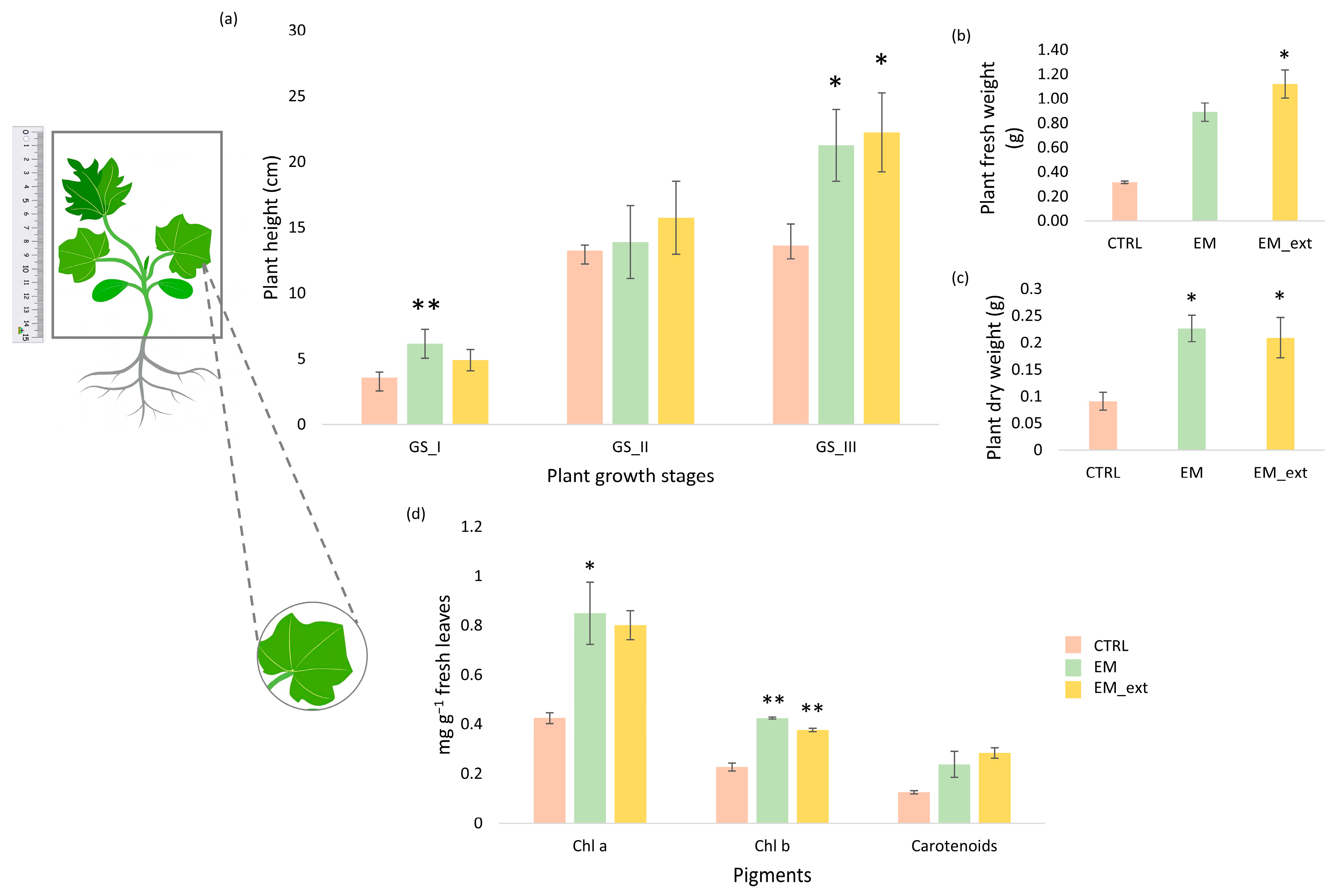
Figure 1. Evolution of the plant parameters in the early stages of zucchini growth. (a) Evolution of the plant height in three different plant-growth stages (GS_I, GS_II, GS_III): seedling emergence, half growth (with one set of leaves) and advanced growth (three sets of leaves). After plant eradication, (b) plant fresh weight and (c) plant dry weight were measured and reported in grams. (d) Pigment content reported as mg g−1 of fresh leaves. Data for each treatment and parameters were compared using ANOVA, and Tukey’s HSD was applied for post hoc comparisons. Statistical significance was reported accordingly as * (p < 0.05) and ** (p < 0.001).
Horticulturae 11 01528 g001
Figure 2. Root parameters measured after plant eradication: (a) root length reported in centimeters, (b) root fresh weight and (c) root dry weight reported in grams. For each group and all plant parameters data were compared using ANOVA and statistical significance was reported accordingly as * (p < 0.05).
Horticulturae 11 01528 g002
Figure 3. Evolution of cell density in the early stages of zucchini growth in soil and in rhizosphere samples (post plant eradication). The evolution of (a) total bacteria, (b) lactic acid bacteria and (c) yeasts at three different plant-growth stages: seedling emergence (GS_I), half growth (GS_II), advanced growth (GS_III) and rhizosphere (R) was reported as log10 CFU g−1. Rhizosphere soil samples were collected after plant eradication, after 35 days from the inoculum. Data were compared in pairs with the t-test analyses and statistical significance was reported accordingly as ** (p < 0.001). p-values refer to comparisons among technical replicates of a single pooled sample and are intended to illustrate reproducibility and treatment-associated trends.
Horticulturae 11 01528 g003
Figure 4. Alpha diversity indices of microbial communities across sampling stages and treatments. Panels (a,b) show Chao1 richness and Shannon diversity indices, respectively, for bacterial communities based on 16S rRNA metabarcoding (bacterial community, taxonomic resolution at the Class level), while panels (c,d) display the same indices for fungal communities based on ITS metabarcoding (fungal community, taxonomic resolution at the Family level). Samples were collected at three growth stages (GS_I, GS_II, GS_III) and from the rhizosphere (R) at the end of the experiment, with bare soil (Soil) included as a reference (soil without zucchini plants). Boxplots represent different treatments: control (CTRL), EM inoculation (EM) and inoculation with its cell-free extract (EM_ext).
Horticulturae 11 01528 g004
Figure 5. Principal Component Analysis (PCA) of FTIR spectra of bulk soil collected at three zucchini growth stages (GS_I, GS_II and GS_III) and rhizosphere soil sampled at GS_III, comparing untreated controls (CTRL) with soils treated with Effective Microorganisms (EM) or EM extract (EM_ext). PC1 and PC2 explain 42% and 26% of the total variance, respectively.
Horticulturae 11 01528 g005
Figure 6. FTIR spectra of control (black) and treated (purple) samples. Panels (a,b) correspond to bulk soil while panels (c,d) to rhizosphere soil samples. Highlighted peaks indicate statistically significant bands in the comparison between control and treated samples. Spectra were normalized and compared in pairs by FDR-corrected t-tests, with statistical significance reported at p < 0.05. p-values refer to comparisons among technical replicates of a single pooled sample and are in-tended to illustrate reproducibility and treatment-associated trends.
Horticulturae 11 01528 g006
Disclaimer/Publisher’s Note: The statements, opinions and data contained in all publications are solely those of the individual author(s) and contributor(s) and not of MDPI and/or the editor(s). MDPI and/or the editor(s) disclaim responsibility for any injury to people or property resulting from any ideas, methods, instructions or products referred to in the content.