

Emergence of Autotoxicity in Closed Hydroponic Cultivation of Basil and Its Recovery by Compost Tea Application
 , ,
, ,  ,
,  and
and 
Abstract
1. Introduction
2. Materials and Methods
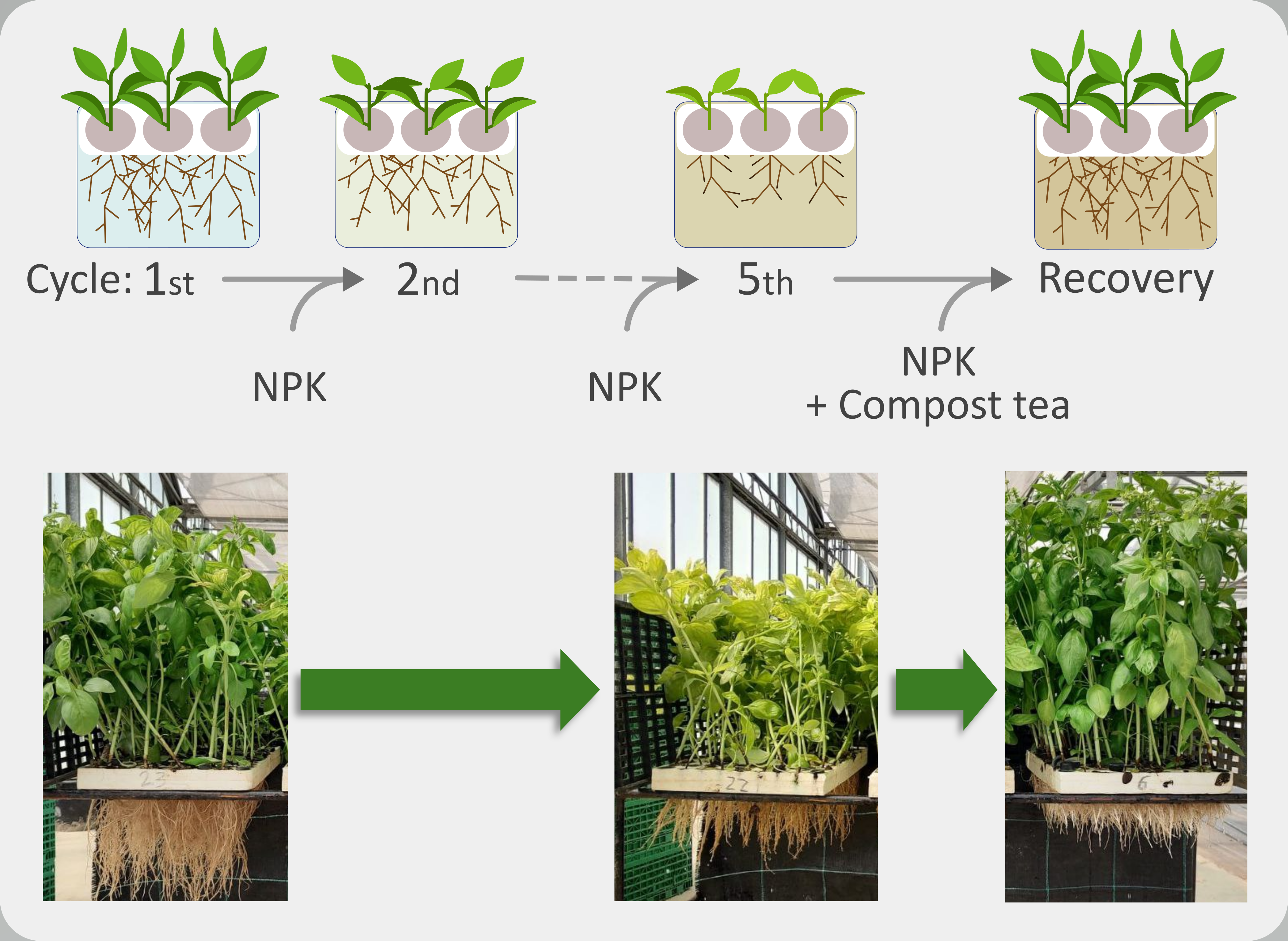
2.1. Conditioning and Recovery Phases
2.2. Experimental Site
2.3. Nutrient Solution
2.4. Plant Yield and Measurements
2.5. Gas Exchange and Chl a Fluorescence Emission
2.6. Statistical Analysis
3. Results
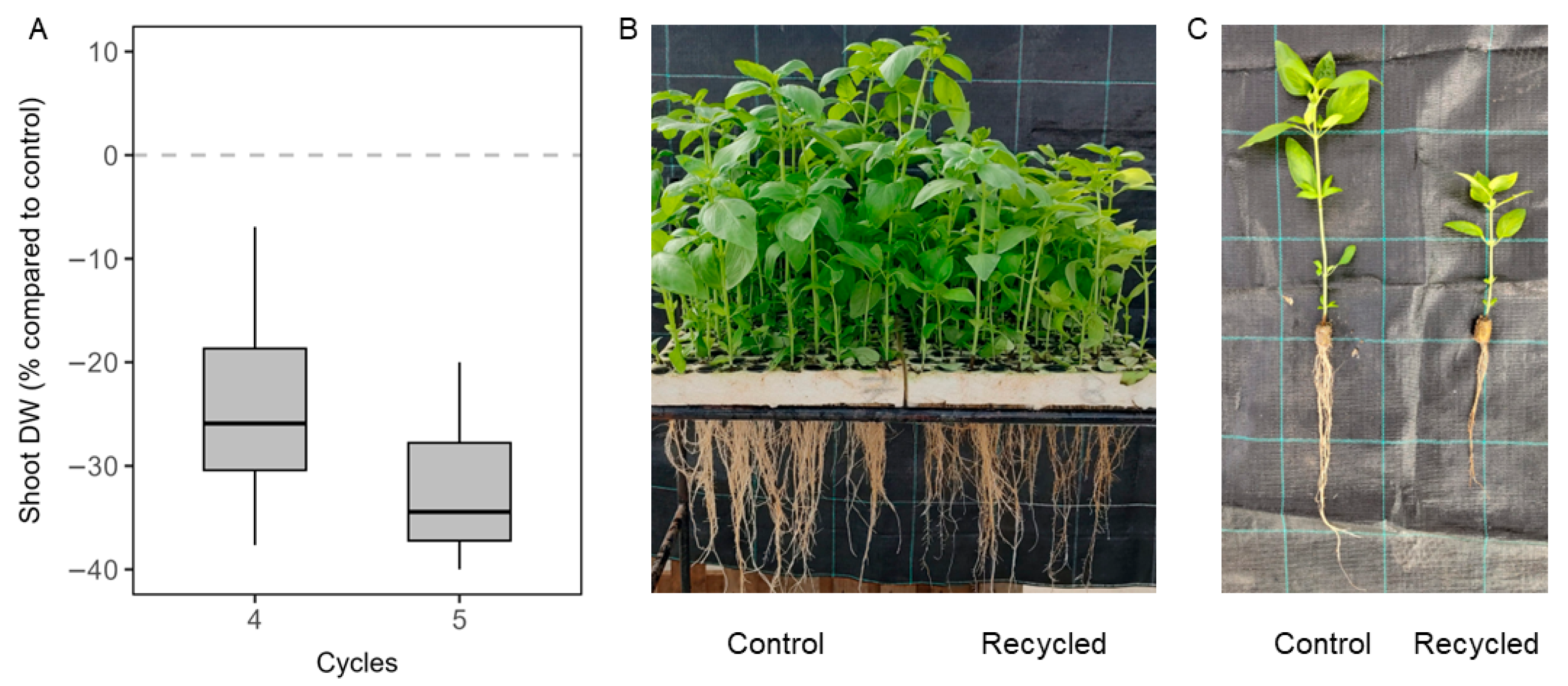
3.1. Conditioning Phase
3.2. Recovery Phase
3.2.1. Plant Growth
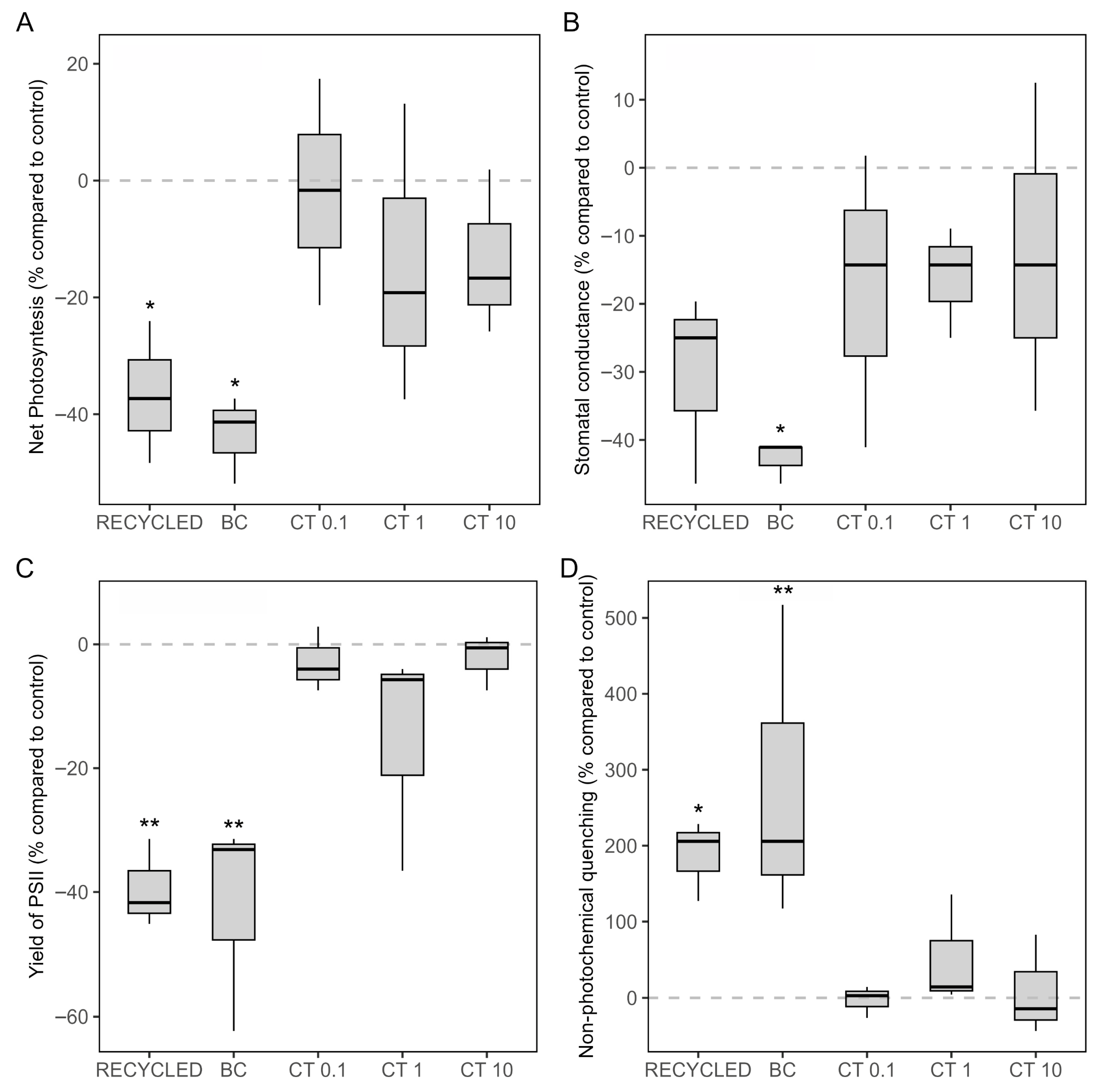
3.2.2. Gas Exchanges and Chl Fluorescence Emission
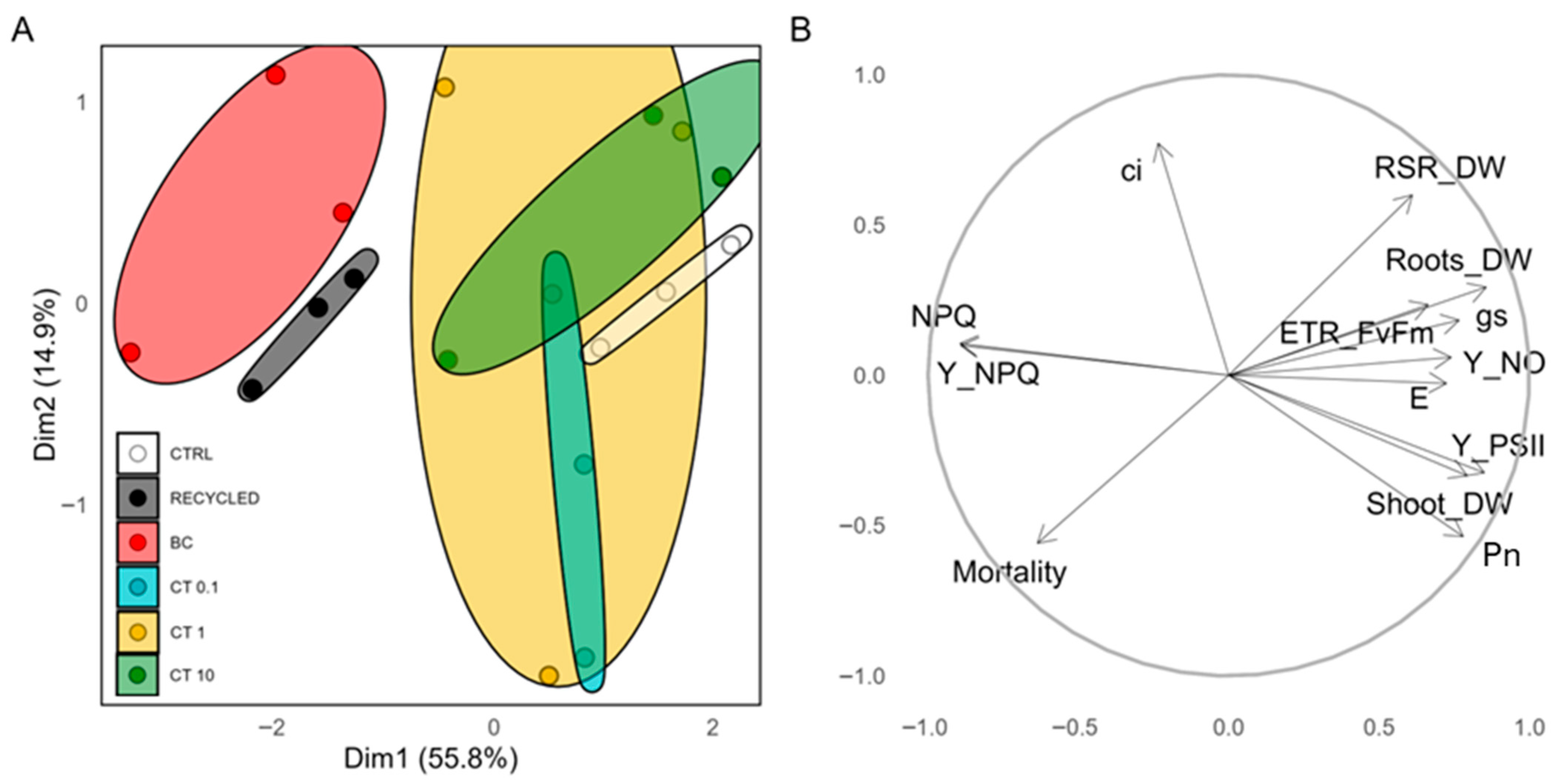
3.2.3. Principal Components Analysis (PCA)
4. Discussion
5. Conclusions
Supplementary Materials
Author Contributions
Funding
Data Availability Statement
Conflicts of Interest
References
- da Silva Júnior, F.J.; Santos Júnior, J.A.; da Silva, M.M.; Silva, Ê.F.D.F.; de Souza, E.R. Water Relations of Chives in Function of Salinity and Circulation Frequency of Nutrient Solutions. Rev. Bras. Eng. Agrícola Ambient. 2019, 23, 359–365. [Google Scholar] [CrossRef]
- Ćavar Zeljković, S.; Komzáková, K.; Šišková, J.; Karalija, E.; Smékalová, K.; Tarkowski, P. Phytochemical Variability of Selected Basil Genotypes. Ind. Crops Prod. 2020, 157, 112910. [Google Scholar] [CrossRef]
- Modarelli, G.C.; Vanacore, L.; Rouphael, Y.; Langellotti, A.L.; Masi, P.; De Pascale, S.; Cirillo, C. Hydroponic and Aquaponic Floating Raft Systems Elicit Differential Growth and Quality Responses to Consecutive Cuts of Basil Crop. Plants 2023, 12, 1355. [Google Scholar] [CrossRef]
- Khatri, L.; Kunwar, A.; Bist, D.R. Hydroponics: Advantages And Challenges in Soilless Farming. Big Data Agric. 2024, 6, 98–105. [Google Scholar] [CrossRef]
- Saha, S.; Monroe, A.; Day, M.R. Growth, Yield, Plant Quality and Nutrition of Basil (Ocimum basilicum L.) under Soilless Agricultural Systems. Ann. Agric. Sci. 2016, 61, 181–186. [Google Scholar] [CrossRef]
- Asaduzzaman, M.; Niu, G.; Asao, T. Editorial: Nutrients Recycling in Hydroponics: Opportunities and Challenges Toward Sustainable Crop Production Under Controlled Environment Agriculture. Front. Plant Sci. 2022, 13, 845472. [Google Scholar] [CrossRef] [PubMed]
- Moreno-Pérez, E.C.; Sánchez-Del Castillo, F.; Gutiérrez-Tlahque, J.; González-Molina, L.; Pineda-Pineda, J. Greenhouse lettuce production with and without nutrient solution recyclingProducción de Lechuga En Invernadero Con y Sin Recirculación de La Solución Nutritiva. Rev. Chapingo Ser. Hortic. 2015, 21, 43–55. [Google Scholar] [CrossRef]
- Miller, A.; Adhikari, R.; Nemali, K. Recycling Nutrient Solution Can Reduce Growth Due to Nutrient Deficiencies in Hydroponic Production. Front. Plant Sci. 2020, 11, 607643. [Google Scholar] [CrossRef] [PubMed]
- Petrazzini, L.L.; Souza, G.A.; Rodas, C.L.; Emrich, E.B.; Carvalho, J.G.; Souza, R.J. Deficiências de Nutrientes Em Alface Americana Cultivada Em Hidroponia. Hortic. Bras. 2014, 32, 310–313. [Google Scholar] [CrossRef]
- Neocleous, D.; Savvas, D. Validating a Smart Nutrient Solution Replenishment Strategy to Save Water and Nutrients in Hydroponic Crops. Front. Environ. Sci. 2022, 10, 965964. [Google Scholar] [CrossRef]
- Prenafeta-Boldú, F.X.; Trillas, I.; Viñas, M.; Guivernau, M.; Cáceres, R.; Marfà, O. Effectiveness of a Full-Scale Horizontal Slow Sand Filter for Controlling Phytopathogens in Recirculating Hydroponics: From Microbial Isolation to Full Microbiome Assessment. Sci. Total Environ. 2017, 599–600, 780–788. [Google Scholar] [CrossRef]
- Ehret, D.; Alsanius, B.; Wohanka, W.; Menzies, J.; Utkhede, R.; Ehret, D.; Alsanius, B.; Wohanka, W.; Menzies, J.; Utkhede, R. Disinfestation of Recirculating Nutrient Solutions in Greenhouse Horticulture. Agronomie 2001, 21, 323–339. [Google Scholar] [CrossRef]
- Raudales, R.E.; Parke, J.L.; Guy, C.L.; Fisher, P.R. Control of Waterborne Microbes in Irrigation: A Review. Agric. Water Manag. 2014, 143, 9–28. [Google Scholar] [CrossRef]
- Yu, J.Q.; Matsui, Y. Extraction and Identification of Phytotoxic Substances Accumulated in Nutrient Solution for the Hydroponic Culture of Tomato. Soil Sci. Plant Nutr. 1993, 39, 691–700. [Google Scholar] [CrossRef]
- Lee, J.G.; Lee, B.Y.; Lee, H.J. Accumulation of Phytotoxic Organic Acids in Reused Nutrient Solution during Hydroponic Cultivation of Lettuce (Lactuca sativa L.). Sci. Hortic. 2006, 110, 119–128. [Google Scholar] [CrossRef]
- Corrado, G.; Chiaiese, P.; Lucini, L.; Miras-Moreno, B.; Colla, G.; Rouphael, Y. Successive Harvests Affect Yield, Quality and Metabolic Profile of Sweet Basil (Ocimum basilicum L.). Agronomy 2020, 10, 830. [Google Scholar] [CrossRef]
- Yu, J.Q.; Matsui, Y. Phytotoxic Substances in Root Exudates of Cucumber (Cucumis sativus L.). J. Chem. Ecol. 1994, 20, 21–31. [Google Scholar] [CrossRef] [PubMed]
- Asaduzzaman, M.; Asao, T. Autotoxicity in Strawberry under Recycled Hydroponics and Its Mitigation Methods. Hortic. J. 2020, 89, 124–137. [Google Scholar] [CrossRef]
- Mazzoleni, S.; Bonanomi, G.; Incerti, G.; Chiusano, M.L.; Termolino, P.; Mingo, A.; Senatore, M.; Giannino, F.; Cartenì, F.; Rietkerk, M.; et al. Inhibitory and Toxic Effects of Extracellular Self-DNA in Litter: A Mechanism for Negative Plant-Soil Feedbacks? New Phytol. 2015, 205, 1195–1210. [Google Scholar] [CrossRef]
- Kitazawa, H.; Asao, T.; Ban, T.; Pramanik, M.H.R.; Hosoki, T. Autotoxicity of Root Exudates from Strawberry in Hydroponic Culture. J. Hortic. Sci. Biotechnol. 2005, 80, 677–680. [Google Scholar] [CrossRef]
- Asao, T.; Hasegawa, K.; Sueda, Y.; Tomita, K.; Taniguchi, K.; Hosoki, T.; Pramanik, M.H.R.; Matsui, Y. Autotoxicity of Root Exudates from Taro. Sci. Hortic. 2003, 97, 389–396. [Google Scholar] [CrossRef]
- Asaduzzaman, M.; Asao, T. Autotoxicity in Beans and Their Allelochemicals. Sci. Hortic. 2012, 134, 26–31. [Google Scholar] [CrossRef]
- Asao, T.; Asaduzzaman, M.; Mondal, F.M. Horticultural Research in Japan. Production of Vegetables and Ornamentals in Hydroponics, Constraints and Control Measures. Adv. Hortic. Sci. 2014, 28, 167–178. [Google Scholar] [CrossRef]
- Han, U.; Lee, Y.-G.; Byeon, J.; Chon, K.; Cho, S.-K. Mitigation of Benzoic Acid-Driven Autotoxicity in Waste Nutrient Solution Using O3 and O3/H2O2 Treatments: Seed Germination and Root Growth of Lactuca sativa L. Environ. Pollut. 2023, 331, 121930. [Google Scholar] [CrossRef]
- Chiusano, M.L.; Incerti, G.; Colantuono, C.; Termolino, P.; Palomba, E.; Monticolo, F.; Benvenuto, G.; Foscari, A.; Esposito, A.; Marti, L.; et al. Arabidopsis Thaliana Response to Extracellular Dna: Self versus Nonself Exposure. Plants 2021, 10, 1744. [Google Scholar] [CrossRef]
- Bonanomi, G.; Giannino, F.; Mazzoleni, S. Negative Plant-Soil Feedback and Species Coexistence. Oikos 2005, 111, 311–321. [Google Scholar] [CrossRef]
- Winkelmann, T.; Smalla, K.; Amelung, W.; Baab, G.; Grunewaldt-Stöcker, G.; Kanfra, X.; Meyhöfer, R.; Reim, S.; Schmitz, M.; Vetterlein, D.; et al. Apple Replant Disease: Causes and Mitigation Strategies. Curr. Issues Mol. Biol. 2019, 30, 89–106. [Google Scholar] [CrossRef]
- De Long, J.R.; Heinen, R.; Heinze, J.; Morriën, E.; Png, G.K.; Sapsford, S.J.; Teste, F.P.; Fry, E.L. Plant-Soil Feedback: Incorporating Untested Influential Drivers and Reconciling Terminology. Plant Soil 2023, 485, 7–43. [Google Scholar] [CrossRef]
- Huang, L.F.; Song, L.X.; Xia, X.J.; Mao, W.H.; Shi, K.; Zhou, Y.H.; Yu, J.Q. Plant-Soil Feedbacks and Soil Sickness: From Mechanisms to Application in Agriculture. J. Chem. Ecol. 2013, 39, 232–242. [Google Scholar] [CrossRef]
- Bonanomi, G.; Zotti, M.; Idbella, M.; Termolino, P.; De Micco, V.; Mazzoleni, S. Field Evidence for Litter and Self-DNA Inhibitory Effects on Alnus glutinosa Roots. New Phytol. 2022, 236, 399–412. [Google Scholar] [CrossRef] [PubMed]
- Zucconi, F. Allelopathies and Biological Degradation in Agricultural Soils: An Introduction to the Problem of Soil Sickness and Other Soil-Born Diseases. In Symposium on Soil Sickness and Replant Diseases in Fruit Trees; ISHS: Korbeek-Lo, Belgium, 1993; pp. 11–21. [Google Scholar]
- Cesarano, G.; Zotti, M.; Antignani, V.; Marra, R.; Scala, F.; Bonanomi, G. Soil Sickness and Negative Plant-Soil Feedback: A Reappraisal of Hypotheses. J. Plant Pathol. 2017, 99, 545–570. [Google Scholar]
- Park, Y.; Williams, K.A. Organic Hydroponics: A Review. Sci. Hortic. 2024, 324, 112604. [Google Scholar] [CrossRef]
- Vernieri, P.; Borghesi, E.; Tognoni, F.; Serra, G.; Ferrante, A.; Piaggesi, A. Use of Biostimulants for Reducing Nutrient Solution Concentration in Floating System. Acta Hortic. 2006, 718, 477–484. [Google Scholar] [CrossRef]
- Fang, W.; Chung, H. Bioponics for Lettuce Production in a Plant Factory with Artificial Lighting. Acta Hortic. 2018, 1227, 593–598. [Google Scholar] [CrossRef]
- Blum, U. Effects of Microbial Utilization of Phenolic Acids and Their Phenolic Acid Breakdown Products on Allelopathic Interactions. J. Chem. Ecol. 1998, 24, 685–708. [Google Scholar] [CrossRef]
- Ma, L.; Ma, S.; Chen, G.; Lu, X.; Chai, Q.; Li, S. Mechanisms and Mitigation Strategies for the Occurrence of Continuous Cropping Obstacles of Legumes in China. Agronomy 2024, 14, 104. [Google Scholar] [CrossRef]
- Yang, Y.; Chen, T.; Xiao, R.; Chen, X.; Zhang, T. A Quantitative Evaluation of the Biochar’s Influence on Plant Disease Suppress: A Global Meta-Analysis. Biochar 2022, 4, 43. [Google Scholar] [CrossRef]
- Zhu, X.; Chen, B.; Zhu, L.; Xing, B. Effects and Mechanisms of Biochar-Microbe Interactions in Soil Improvement and Pollution Remediation: A Review. Environ. Pollut. 2017, 227, 98–115. [Google Scholar] [CrossRef] [PubMed]
- Beesley, L.; Moreno-Jiménez, E.; Gomez-Eyles, J.L.; Harris, E.; Robinson, B.; Sizmur, T. A Review of Biochars’ Potential Role in the Remediation, Revegetation and Restoration of Contaminated Soils. Environ. Pollut. 2011, 159, 3269–3282. [Google Scholar] [CrossRef]
- Asao, T. Autotoxicity in Vegetables and Ornamentals and Its Control; Asao, T., Ed.; IntechOpen: London, UK, 2012. [Google Scholar]
- Bonanomi, G.; Idbella, A.; Amoroso, G.; Iacomino, G.; Gherardelli, M.; De Sio, A.; Saccocci, F.; Abd-elgawad, A.M.; Moreno, M. Agronomic Impacts of Chemically and Microbiologically Characterized Compost Tea in Mediterranean Volcanic Soils. Front. Plant Sci. 2025, 16, 1524884. [Google Scholar] [CrossRef]
- Jones, J.B., Jr. Hydroponics: A Practical Guide for the Soilless Grower, 2nd ed.; CRC Press: Boca Raton, FL, USA, 2004; Volume 33, ISBN 0849331676. [Google Scholar]
- Pannico, A.; El-Nakhel, C.; Kyriacou, M.C.; Giordano, M.; Stazi, S.R.; De Pascale, S.; Rouphael, Y. Combating Micronutrient Deficiency and Enhancing Food Functional Quality Through Selenium Fortification of Select Lettuce Genotypes Grown in a Closed Soilless System. Front. Plant Sci. 2019, 10, 01495. [Google Scholar] [CrossRef] [PubMed]
- Formisano, L.; Ciriello, M.; El-Nakhel, C.; De Pascale, S.; Rouphael, Y. Dataset on the Effects of Anti-Insect Nets of Different Porosity on Mineral and Organic Acids Profile of Cucurbita pepo L. Fruits and Leaves. Data 2021, 6, 50. [Google Scholar] [CrossRef]
- Genty, B.; Briantais, J.M.; Baker, N.R. The Relationship between the Quantum Yield of Photosynthetic Electron Transport and Quenching of Chlorophyll Fluorescence. Biochim. Biophys. Acta (BBA)-Gen. Subj. 1989, 990, 87–92. [Google Scholar] [CrossRef]
- Shipley, B.; Meziane, D. The Balanced-Growth Hypothesis and the Allometry of Leaf and Root Biomass Allocation. Funct. Ecol. 2002, 16, 326–331. [Google Scholar] [CrossRef]
- Salvatori, N.; Carteni, F.; Giannino, F.; Alberti, G.; Mazzoleni, S.; Peressotti, A. A System Dynamics Approach to Model Photosynthesis at Leaf Level Under Fluctuating Light. Front. Plant Sci. 2022, 12, 787877. [Google Scholar] [CrossRef]
- Bonanomi, G.; Ippolito, F.; Cesarano, G.; Nanni, B.; Lombardi, N.; Rita, A.; Saracino, A.; Scala, F. Biochar as Plant Growth Promoter: Better off Alone or Mixed with Organic Amendments? Front. Plant Sci. 2017, 8, 01570. [Google Scholar] [CrossRef]
- Pilla, N.; Tranchida-Lombardo, V.; Gabrielli, P.; Aguzzi, A.; Caputo, M.; Lucarini, M.; Durazzo, A.; Zaccardelli, M. Effect of Compost Tea in Horticulture. Horticulturae 2023, 9, 984. [Google Scholar] [CrossRef]
- Spaccini, R.; Baiano, S.; Gigliotti, G.; Piccolo, A. Molecular Characterization of a Compost and Its Water-Soluble Fractions. J. Agric. Food Chem. 2008, 56, 1017–1024. [Google Scholar] [CrossRef]
- Arancon, N.Q.; Pant, A.; Radovich, T.; Hue, N.V.; Potter, J.K.; Converse, C.E. Seed Germination and Seedling Growth of Tomato and Lettuce as Affected by Vermicompost Water Extracts (Teas). HortScience 2012, 47, 1722–1728. [Google Scholar] [CrossRef]
- Arancon, N.Q.; Owens, J.D.; Converse, C. The Effects of Vermicompost Tea on the Growth and Yield of Lettuce and Tomato in a Non-Circulating Hydroponics System. J. Plant Nutr. 2019, 42, 2447–2458. [Google Scholar] [CrossRef]
- Canellas, L.P.; Olivares, F.L.; Okorokova-Façanha, A.L.; Façanha, A.R. Humic Acids Isolated from Earthworm Compost Enhance Root Elongation, Lateral Root Emergence, and Plasma Membrane H+-ATPase Activity in Maize Roots. Plant Physiol. 2002, 130, 1951–1957. [Google Scholar] [CrossRef] [PubMed]
- Nilsson, M.C. Separation of Allelopathy and Resource Competition by the Boreal Dwarf Shrub Empetrum hermaphroditum Hagerup. Oecologia 1994, 98, 1–7. [Google Scholar] [CrossRef]
- Hille, M.; Ouden, J. Charcoal and Activated Carbon as Adsorbate of Phytotoxic Compounds—A Comparative Study. Oikos 2005, 108, 202–207. [Google Scholar] [CrossRef]
- Juang, R.-S.; Wu, F.-C.; Tseng, R.-L. Adsorption Isotherms of Phenolic Compounds from Aqueous Solutions onto Activated Carbon Fibers. J. Chem. Eng. Data 1996, 41, 487–492. [Google Scholar] [CrossRef]
- Ahmed, M.J.; Hameed, B.H. Adsorption Behavior of Salicylic Acid on Biochar as Derived from the Thermal Pyrolysis of Barley Straws. J. Clean. Prod. 2018, 195, 1162–1169. [Google Scholar] [CrossRef]
- Teweldebrihan, M.D.; Gnaro, M.A.; Dinka, M.O. Adsorption of Phenol from Aqueous Solution Utilizing Activated Carbon Prepared from Catha Edulis Stem. Environments 2025, 12, 314. [Google Scholar] [CrossRef]
- Komnitsas, K.A.; Zaharaki, D. Morphology of Modified Biochar and Its Potential for Phenol Removal from Aqueous Solutions. Front. Environ. Sci. 2016, 4, 26. [Google Scholar] [CrossRef]
- Blair, A.C.; Nissen, S.J.; Brunk, G.R.; Hufbauer, R.A. A Lack of Evidence for an Ecological Role of the Putative Allelochemical (±)-Catechin in Spotted Knapweed Invasion Success. J. Chem. Ecol. 2006, 32, 2327–2331. [Google Scholar] [CrossRef]
- Rice, E.L. Allelopathy—An Overview. In Chemically Mediated Interactions between Plants and Other Organisms; Recent Advances in Phytochemistry; Cooper-Driver, G.A., Swain, T., Conn, E.E., Eds.; Springer: Boston, MA, USA, 1985; Volume 19. [Google Scholar] [CrossRef]
- Fuad Mondal, M.; Asaduzzaman, M.; Kobayashi, Y.; Ban, T.; Asao, T. Recovery from Autotoxicity in Strawberry by Supplementation of Amino Acids. Sci. Hortic. 2013, 164, 137–144. [Google Scholar] [CrossRef]
- Islam, A.K.M.M.; Suttiyut, T.; Anwar, M.P.; Juraimi, A.S.; Kato-Noguchi, H. Allelopathic Properties of Lamiaceae Species: Prospects and Challenges to Use in Agriculture. Plants 2022, 11, 1478. [Google Scholar] [CrossRef]
- Bonanomi, G.; Iacomino, G.; Idbella, A.; Amoroso, G.; Staropoli, A.; De Sio, A.; Saccocci, F.; Abd-elgawad, A.M.; Moreno, M.; Idbella, M. Compost Tea Combined with Fungicides Modulates Grapevine Bacteriome and Metabolome to Suppress Downy Mildew. J. Fungi 2025, 11, 527. [Google Scholar] [CrossRef] [PubMed]
- Pane, C.; Palese, A.M.; Celano, G.; Zaccardelli, M. Effects of Compost Tea Treatments on Productivity of Lettuce and Kohlrabi Systems under Organic Cropping Management. Ital. J. Agron. 2014, 9, 153–156. [Google Scholar] [CrossRef]
- Ingham, E.R. The Compost Tea Brewing Manual; Soil Foodweb Incorporated: Corvallis, OR, USA, 2005. [Google Scholar]
- González-Hernández, A.I.; Pérez-Sánchez, R.; Gómez-Sánchez, M.Á.; Morales-Corts, M.R. Compost Tea as Biostimulant: Promoting Tomato Root Development. Chem. Proc. 2022, 10, 57. [Google Scholar] [CrossRef]
- Zaccardelli, M.; Pane, C.; Scotti, R.; Palese, M.A.; Celano, G. Impiego Di Compost-Tea Come Bioagrofarmaci e Biostimolanti in Ortofrutticoltura. Italus Hortus 2012, 19, 17–28. [Google Scholar]
- Hargreaves, J.; Adl, S.; Warman, P. The Effects of Municipal Solid Waste CompostAnd Compost Tea on Mineral Element UptakeAnd Fruit Quality of Strawberries. Compost Sci. Util. 2009, 17, 85. [Google Scholar] [CrossRef]
- Giménez, A.; Fernández, J.A.; Pascual, J.A.; Ros, M.; Egea-Gilabert, C. Application of Directly Brewed Compost Extract Improves Yield and Quality in Baby Leaf Lettuce Grown Hydroponically. Agronomy 2020, 10, 370. [Google Scholar] [CrossRef]
- Ferrarezi, R.S.; Bailey, D.S. Basil Performance Evaluation in Aquaponics. Horttechnology 2019, 29, 85–93. [Google Scholar] [CrossRef]
- Garg, J.; Rakshit, A. Compost Tea: An Emerging Nature-Based Supplement Strengthening Options for Durable Agriculture. J. Soil Sci. Plant Nutr. 2024, 24, 8075–8098. [Google Scholar] [CrossRef]
- Mu, D.; Zhu, H.; Limon Nocelo, C.; Melendez, D.; Cruz, B. Advancing Sustainable Production in Hydroponic Systems through the Integration of Compost-Based Liquid Extracts as a Sustainable Nutrient Source. J. Clean. Prod. 2025, 525, 146464. [Google Scholar] [CrossRef]
- Allahyari, S.; Honarmand, S.J.; Khoramivafa, M. Effect of Vermicompost Extracts (Compost Tea and Vermiwash) on the Vegetative Growth of Tomato (Lycopersicon Esculentum Mill) Under Hydroponic Conditions. Int. J. Biosci. 2014, 6655, 171–181. [Google Scholar] [CrossRef]
- Hartadiyati, E.; Wiyanto; Rusilowati, A. The Compost Tea on Hydroponics System Used to Increase Understanding of Sustainable Development for High School Student in Adiwiyata Program. J. Phys. Conf. Ser. 2020, 1567, 022060. [Google Scholar] [CrossRef]
- Zucconi, F. Declino del Suolo e Stanchezza del Terreno; Pitagora Editrice: Bologna, Italy, 2003. [Google Scholar]
- Bilalis, D.; Kanatas, P.; Patsiali, S.; Konstantas, A.; Akoumianakis, K. Comparison between Conventional and Organic Floating Systems for Lettuce and Tomato (Lactuca sativa and Lycopersicon esculentum) Seedling Production. J. Food Agric. Environ. 2009, 7, 623–628. [Google Scholar]

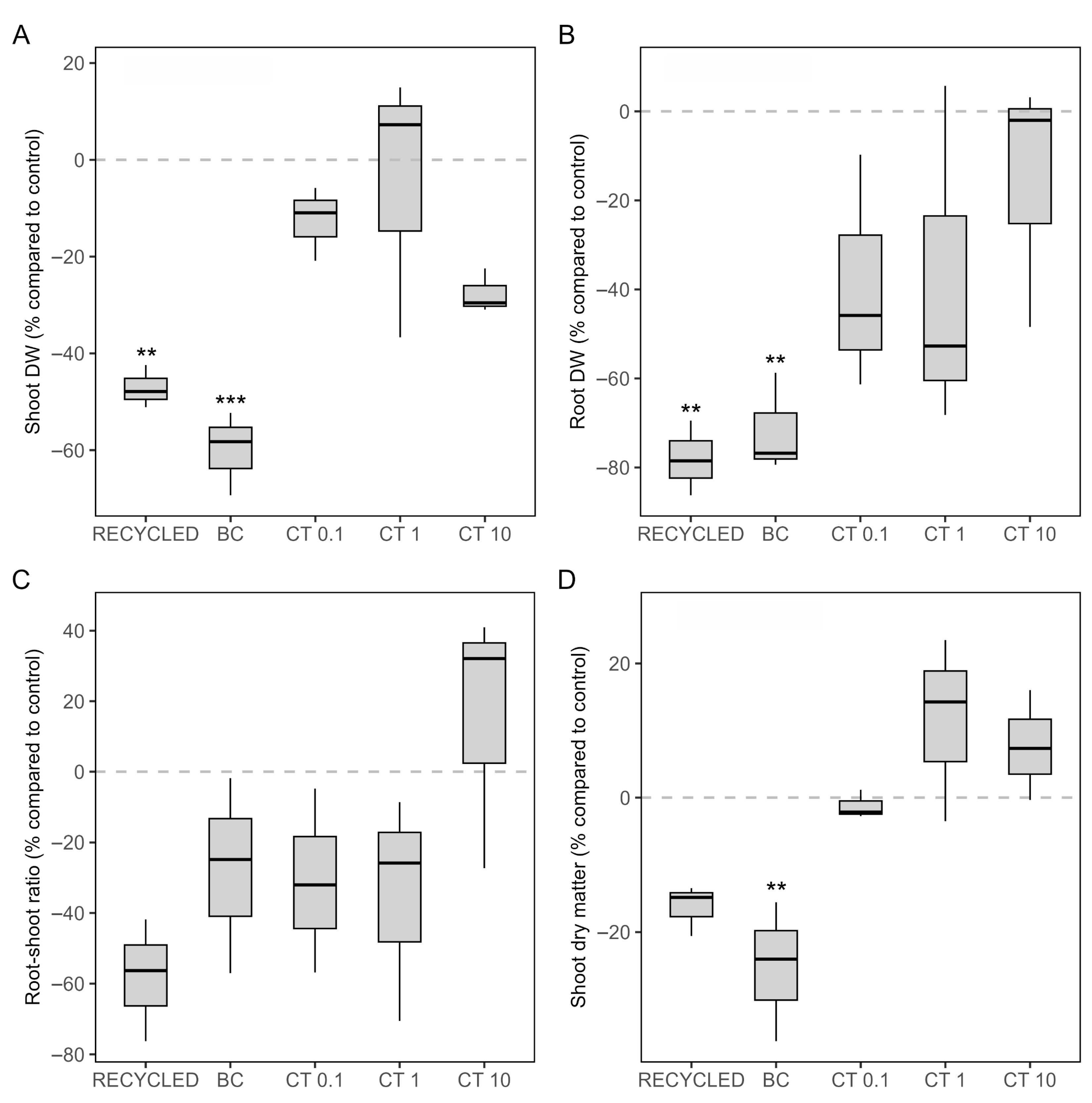



| Treatment | Shoot DW | Root DW | RSR DW | Shoot DM | Mortality |
|---|---|---|---|---|---|
| g | g | – | % | % | |
| CTRL | 50.53 ± 3.95 a | 11.63 ± 0.54 a | 0.23 ± 0.01 ab | 7.71 ± 0.28 a | 20.11 ± 5.75 |
| RECYCLED | 26.71 ± 1.28 cd | 2.55 ± 0.56 b | 0.10 ± 0.02 c | 6.46 ± 0.17 b | 37.93 ± 1.72 |
| BC | 20.23 ± 2.52 d | 3.30 ± 0.75 b | 0.17 ± 0.04 abc | 5.77 ± 0.46 b | 28.74 ± 6.40 |
| CT 0.1 | 44.20 ± 2.23 ab | 7.10 ± 1.78 ab | 0.16 ± 0.03 abc | 7.62 ± 0.09 a | 28.74 ± 5.48 |
| CT 1 | 48.10 ± 8.13 ab | 7.17 ± 2.62 ab | 0.15 ± 0.04 bc | 8.59 ± 0.61 a | 17.24 ± 6.97 |
| CT 10 | 36.57 ± 1.33 bc | 9.80 ± 1.91 a | 0.27 ± 0.05 a | 8.30 ± 0.36 a | 19.54 ± 2.51 |
| Significance | p = 0.001 *** | p = 0.010 ** | p = 0.057 ns | p = 0.001 ** | p = 0.112 ns |
| Treatment | Pn | gs | ci | E | SPAD |
|---|---|---|---|---|---|
| µmol CO2 m−2 s−1 | mol m−2 s−1 | µmol CO2 m−2 s−1 | – | – | |
| CTRL | 8.44 ± 0.53 a | 0.19 ± 0.02 | 311.67 ± 5.36 | 3.11 ± 0.25 | 30.70 ± 1.46 a |
| RECYCLED | 5.35 ± 0.59 bc | 0.13 ± 0.02 | 323.67 ± 11.40 | 2.43 ± 0.21 | 19.97 ± 2.42 bc |
| BC | 4.77 ± 0.37 c | 0.11 ± 0.00 | 323.33 ± 5.59 | 2.22 ± 0.14 | 17.63 ± 1.57 c |
| CT 0.1 | 8.28 ± 0.94 a | 0.15 ± 0.02 | 291.67 ± 21.90 | 2.77 ± 0.38 | 27.43 ± 0.90 a |
| CT 1 | 7.22 ± 1.25 ab | 0.16 ± 0.01 | 315.17 ± 18.97 | 2.85 ± 0.09 | 26.17 ± 4.77 ab |
| CT 10 | 7.30 ± 0.69 ab | 0.16 ± 0.03 | 313.00 ± 5.27 | 2.88 ± 0.21 | 28.20 ± 0.60 a |
| Significance | p = 0.029 * | p = 0.125 ns | p = 0.587 ns | p = 0.165 ns | p = 0.015 * |
| Treatment | Y(PSII) | ETR | NPQ | Y(NPQ) | Y(NO) |
|---|---|---|---|---|---|
| — | µmol m−2 s−1 | — | — | — | |
| CTRL | 0.58 ± 0.02 a | 80.97 ± 11.19 | 0.70 ± 0.16 c | 1.46 ± 0.18 c | 0.25 ± 0.01 |
| RECYCLED | 0.35 ± 0.02 b | 57.63 ± 15.41 | 2.01 ± 0.22 ab | 2.79 ± 0.22 ab | 0.22 ± 0.01 |
| BC | 0.34 ± 0.06 b | 33.47 ± 5.72 | 2.66 ± 0.85 a | 3.46 ± 0.89 a | 0.20 ± 0.05 |
| CT 0.1 | 0.57 ± 0.02 a | 66.37 ± 3.59 | 0.68 ± 0.08 c | 1.42 ± 0.09 c | 0.26 ± 0.01 |
| CT 1 | 0.49 ± 0.06 a | 86.50 ± 23.10 | 1.06 ± 0.30 bc | 1.82 ± 0.30 bc | 0.25 ± 0.00 |
| CT 10 | 0.57 ± 0.02 a | 83.20 ± 17.16 | 0.76 ± 0.27 c | 1.51 ± 0.29 bc | 0.25 ± 0.03 |
| Significance | p = 0.001 ** | p = 0.153 ns | p = 0.018 * | p = 0.021 * | p = 0.415 ns |
Disclaimer/Publisher’s Note: The statements, opinions and data contained in all publications are solely those of the individual author(s) and contributor(s) and not of MDPI and/or the editor(s). MDPI and/or the editor(s) disclaim responsibility for any injury to people or property resulting from any ideas, methods, instructions or products referred to in the content. |
© 2025 by the authors. Licensee MDPI, Basel, Switzerland. This article is an open access article distributed under the terms and conditions of the Creative Commons Attribution (CC BY) license (https://creativecommons.org/licenses/by/4.0/).
Share and Cite
De Sio, A.; Moreno, M.; Mazzoleni, S.; Cozzolino, S.; Caggiano, P.; Ceriello, G.; Bonanomi, G.; Cirillo, C.; Carteni, F. Emergence of Autotoxicity in Closed Hydroponic Cultivation of Basil and Its Recovery by Compost Tea Application. Horticulturae 2025, 11, 1493. https://doi.org/10.3390/horticulturae11121493
De Sio A, Moreno M, Mazzoleni S, Cozzolino S, Caggiano P, Ceriello G, Bonanomi G, Cirillo C, Carteni F. Emergence of Autotoxicity in Closed Hydroponic Cultivation of Basil and Its Recovery by Compost Tea Application. Horticulturae. 2025; 11(12):1493. https://doi.org/10.3390/horticulturae11121493
Chicago/Turabian StyleDe Sio, Andrea, Mauro Moreno, Stefano Mazzoleni, Stefania Cozzolino, Pietro Caggiano, Giovanna Ceriello, Giuliano Bonanomi, Chiara Cirillo, and Fabrizio Carteni. 2025. "Emergence of Autotoxicity in Closed Hydroponic Cultivation of Basil and Its Recovery by Compost Tea Application" Horticulturae 11, no. 12: 1493. https://doi.org/10.3390/horticulturae11121493
APA StyleDe Sio, A., Moreno, M., Mazzoleni, S., Cozzolino, S., Caggiano, P., Ceriello, G., Bonanomi, G., Cirillo, C., & Carteni, F. (2025). Emergence of Autotoxicity in Closed Hydroponic Cultivation of Basil and Its Recovery by Compost Tea Application. Horticulturae, 11(12), 1493. https://doi.org/10.3390/horticulturae11121493