Article

A Photosynthetic Rate Prediction Model for Cucumber Based on a Machine Learning Algorithm and Multi-Factor Environmental Analysis


College of Horticulture, Shanxi Agricultural University, Jinzhong 030801, China
*
Author to whom correspondence should be addressed.
These authors contributed equally to this work.
Horticulturae 2025, 11(12), 1475; https://doi.org/10.3390/horticulturae11121475 (registering DOI)
Submission received: 4 November 2025 / Revised: 2 December 2025 / Accepted: 3 December 2025 / Published: 6 December 2025
(This article belongs to the Section Vegetable Production Systems)

Abstract

Plant photosynthetic rate prediction models have the potential to enhance production efficiency and advance intelligent control in protected agriculture. However, due to the complexity of and variability in multiple environmental factors, conventional prediction models often fail to accurately predict photosynthetic rates. We hypothesize that the prediction accuracy of a photosynthetic rate model for cucumber could be significantly improved through the application of machine learning algorithms, including support vector regression (SVR), backpropagation (BP), neural network, random forest (RF), and radial basis function (RBF) neural network. To test this hypothesis, we designed experimental treatments with varying combinations of temperature, light intensity, and CO2 concentration and measured the photosynthetic rate (Pn) during the peak fruiting period to construct a comprehensive dataset; we then determined optimal hyperparameters for each algorithm and established and verified four prediction models, thereby identifying the optimal model. The results showed that the maximum Pn value occurred at 28 °C, 1500 µmol m−2 s−1, and 1200 µmol mol−1. Among all models, the SVR model exhibited superior performance on the test set, with an R2 of 0.9941 and an RMSE of 0.7802 µmol m−2 s−1. This was further demonstrated by its performance on the validation set, where it achieved the highest R2 (0.96443) and the lowest errors. In conclusion, the SVR model accurately predicted the cucumber photosynthetic rate, providing a solid theoretical foundation for intelligent environmental control in protected cucumber production.

1. Introduction

Cucumber (Cucumis sativus L.) is an economically important vegetable worldwide. In protected production, the plant exhibits a prolonged fruiting period that can span several months [1,2]. To maximize both yield and economic value, precise regulation of key environmental factors, including temperature, light intensity and CO2 concentration, is essential throughout this critical period. Compared to the large-scale greenhouses with intelligent environmental control in developed countries, most Chinese greenhouses still rely heavily on manual management and lack precise control over multiple environmental factors, which severely restricts protected crop development. Therefore, it is imperative to develop a cucumber prediction model to improve its intelligent control and management level in protected production [3].
Crop photosynthesis is a fundamental process for dry matter accumulation, growth, and yield [4]. The photosynthetic process is strongly influenced by multiple environmental factors, especially temperature, light, and carbon dioxide (CO2). Temperature significantly affects the photosynthetic rate by regulating the activity of key photosynthetic enzymes, such as Rubisco activase. Within the optimal temperature range (i.e., 22–28 °C for cucumber), the photosynthetic rate increases rapidly with rising temperature but declines sharply when the temperature exceeds this range [5]. Light provides the energy source for plant photosynthesis and regulates the photosynthetic rate by affecting the photosynthetic electron transport rate and carbon fixation efficiency [6,7]. CO2 serves as the primary substrate for photosynthesis, and its concentration affects leaf chlorophyll content, Rubisco content, and activity, thereby influencing the photosynthetic rate [8]. Moreover, these three environmental factors interact synergistically to regulate the leaf photosynthetic rate. In protected agricultural production, the leaf photosynthetic rate directly determines crop yield [9]. Therefore, it is essential to accurately predict crop yield by exploring the relationship between the photosynthetic rate and multiple environmental factors and establishing a photosynthetic model under dynamic multi-factor conditions.
In previous studies, some photosynthetic rate models have been established using traditional models such as the modified rectangular hyperbola model and modified right-angle hyperbola model [10,11]. However, these models often lack the capacity to accurately represent complex or difficult-to-quantify physiological processes, making it challenging to apply them directly to greenhouse environmental control optimization [12]. Currently, machine learning algorithms, including support vector regression (SVR), artificial neural networks, and random forest (RF) algorithms, have been widely applied across numerous fields [13,14,15]. The SVR model is effective in solving classification and regression problems involving high-dimensional features [16,17]. By using kernel functions, SVR can easily map linearly inseparable low-dimensional data into a high-dimensional feature space, which enhances its ability to capture very complex and nonlinear data patterns. SVR exhibits excellent robustness and strong generalization ability, and it can effectively avoid overfitting, but its performance is highly dependent on the selection of hyperparameters [18]. Artificial neural networks, such as backpropagation (BP) and radial basis function (RBF) neural networks, not only improve the fitting accuracy of nonlinear regression models but also largely reduce the modeling difficulty in greenhouse prediction model [19]. The BP neural network, one of the most widely used recognition methods at present, can fit complex nonlinear relationships through multiple layers of nonlinear transformations and offer strong nonlinear modeling capabilities. However, it is sensitive to hyperparameter settings and the training speed is slow [20]. The RBF neural network also exhibits strong nonlinear mapping capabilities, high fault tolerance, and robustness, making it highly suitable for solving nonlinear problems [21]. Moreover, the RBF neural network is structurally simpler and exhibits more stable training compared to the BP neural network. However, determining the number of neurons in the hidden layer remains challenging. The RF algorithm is capable of effectively handling nonlinear problems, particularly those involving large numbers of samples and features [22]. It has high accuracy, excellent anti-overfitting ability, and good robustness, but its prediction speed is relatively slow. Compared with traditional models, these machine learning algorithms can integrate massive environmental and plant physiological datasets, use environmental parameters as input and plant physiological values as output, and thereby enhance the prediction accuracy and generalization ability of prediction models [23,24]. Furthermore, to achieve better performance, hyperparameters are commonly optimized using methods such as grid search, five-fold cross-validation, and Bayesian optimization [25]. Nevertheless, hyperparameter optimization in photosynthesis modeling remains largely explored. More importantly, the prediction accuracy and generalization ability of these four algorithms in cucumber photosynthesis modeling have not yet been fully investigated simultaneously.
This study aims to enhance the intelligent control level of protected cucumber production by developing a precise cucumber photosynthetic rate prediction model during the critical fruiting period. The objectives are as follows: (1) to construct a comprehensive dataset by collecting multiple environmental factors and the corresponding photosynthetic rate data using the LI-6400XT portable photosynthesis system (Li-COR Biosciences, Lincoln, NE, USA); (2) to determine the optimal hyperparameters, train four distinct photosynthetic rate prediction models using an SVR algorithm, BP neural network, RBF neural network, and RF algorithm, and evaluate model performance with standard metrics (R2, MAE, MAPE, RMSE); and (3) to validate and compare the four models based on the different algorithms using standard metrics, thereby verifying the hypothesis and identifying the optimal model. The established photosynthetic model provides a theoretical foundation for intelligent greenhouse control and optimized cucumber production.

2. Materials and Methods

2.1. Experimental Materials

This experiment was conducted at Shanxi Agricultural University (112°34′51″ E, 37°25′42″ N) in Jinzhong, China, from September 2024 to June 2025. Seeds of cucumber (Cucumis sativus L. cv. Jinchun No.4, Tianjin Kerun agricultural Co. Ltd., Tianjin, China) were sown in 50-cell trays filled with seedling substrate (peat/vermiculite/perlite = 2:1:1) and cultivated in a growth chamber. The temperature, photosynthetic photon flux density (PPFD), and photoperiod were 26 °C/18 °C, 260 μmol m−2 s−1, and 12 h d−1, respectively. At the two-leaf stage, the seedlings were transplanted into the soil in the solar greenhouse. Based on the water and fertilizer requirements of cucumber, plants were fully irrigated using integrated water and fertilizer drip irrigation, employing Jiaguojia water-soluble fertilizer (Cangzhou Nongan fertilizer limited company, Cangzhou, China) [26]. The fertilization regime consisted of 18 applications, totaling 2700 kg ha−1 of fertilizer and 480 mm of irrigation water (determined by water meter). The initial soil properties of the cultivated layer were as follows: bulk density of 1.19 g cm−3, pH of 6.80, base saturation of 62.04%, and nitrogen (N), phosphorus (P), and potassium (K) contents of 1.40 g kg−1, 0.74 g kg−1, and 8.25 g kg−1, respectively. All plants were cultivated using standard agricultural practices, and no plant hormones or growth regulators were applied during the experiment.

2.2. Data Collection

The net photosynthetic rate (Pn) was measured using a LI-6400XT portable photosynthesis system (Li-COR Biosciences, Lincoln, NE, USA) during the peak fruiting period (40–55 days after transplanting). Leaf Pn data was measured daily on the sixth leaf (from top to bottom) of six cucumber plants during 09:00–11:30 and 14:30–17:00 to avoid the midday photosynthetic depression [27]. The sample leaves met the following criteria: they were grown in a fully sunny, unshaded environment; received sufficient water and fertilizer; and exhibited uniform growth without pests or diseases. To ensure data accuracy, Pn was recorded only after the leaves had been fully light-adapted in the leaf chamber for 20–30 min following the stabilization of environmental parameters. The system was equipped with thermal, PPFD, and CO2 control modules, enabling independent control of temperature, PPFD, and CO2 concentration in the leaf chamber. Pn values were collected under three types of environmental gradients: temperature (16, 19, 22, 25, 28, 32, and 35 °C; 7 levels), PPFD (0, 50, 100, 200, 400, 600, 800, 1000, 1200, and 1500 µmol m−2 s−1; 10 levels), and CO2 concentration (300, 600, 900, and 1200 µmol mol−1; 4 levels). The red-to-blue light ratio of the light source was 9:1, the flow rate was 500 µmol s−1, and the relative humidity was maintained at 45–65%. Using a nested experimental design combing temperature (16–35 °C), PPFD (0–1500 µmol m−2 s−1) and CO2 concentration (300–1200 µmol mol−1), a total of 1680 (4 × 7 × 10 × 6) experimental points were collected, resulting in 280 (4 × 7 × 10) experimental datasets.

2.3. Data Preprocessing

The environmental variables, namely temperature, PPFD, and CO2 concentration, were set as the input, and Pn was set as the output. Due to the different dimensions of each variable [28], the data were normalized to enhance model performance using a linear normalization method as follows:
Y   =   ( b a ) ( X X m i n ) X m a x X m i n
where Xmax and Xmin represent the maximum and minimum values of the sample set before normalization, respectively. a and b represent the lower and upper bounds of the normalization interval, respectively. X and Y represent the sample data before and after normalization, respectively.
Subsequently, the normalized sample data were randomly partitioned into a training set and a test set at a ratio of 7:3. The training parameters and datasets are shown in Supplementary Table S1 and Supplementary Table S2, respectively.

2.4. Model Construction

2.4.1. SVR Model

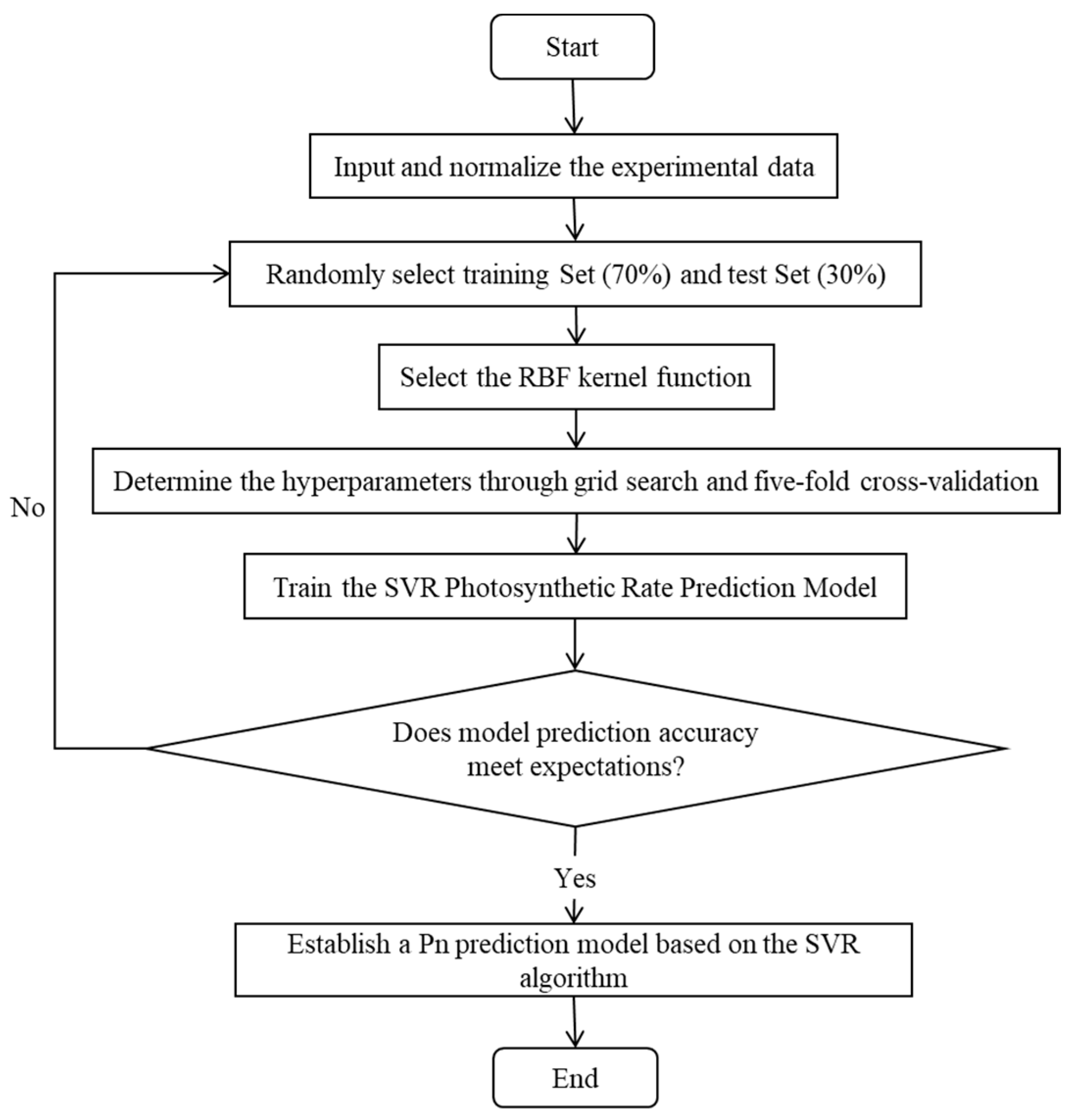
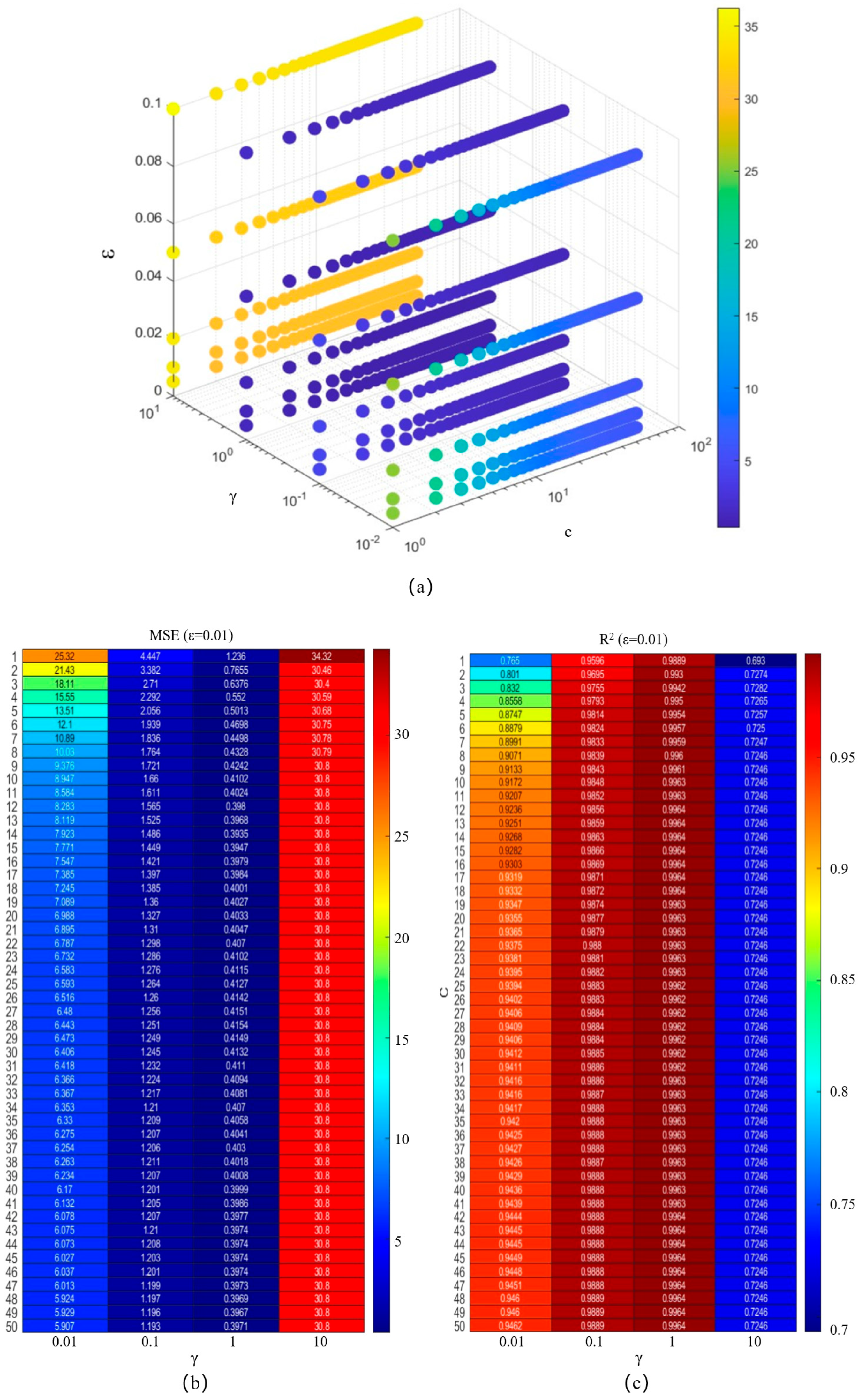
The RBF kernel function was selected for the SVR modeling to achieve optimal fitting performance [29]. To improve the model’s fitting accuracy, the hyperparameters, including penalty factor (c), kernel width parameter (γ), and epsilon (ε), were optimized using a combination of grid search and five-fold cross-validation, with the mean square error (MSE) and the coefficient of determination (R2) serving as the evaluation indexes. The search ranges were set as follows: c from 1 to 50, a step size of 1; γ values of 0.01, 0.1, 1, 10; and ε values of 0.01, 0.1, 0.5. A flowchart of the SVR modeling process is shown in Figure 1, and the specific steps are described below.
Step 1: The temperature, PPFD and CO2 concentration were set as the input variables, and Pn values were set as output. The dataset samples were defined as [(x1,y1), (x2,y2)…(xn,yn)], where xi ∈ RD denotes the input vector, xi = (xi1, xi2, xi3), with D = 280, and yi ∈ R is the corresponding output value. The linear regression function in the high-dimensional feature space was formulated as Equation (2).
f ( x ) = w T ϕ ( x )   +   b
where w is the weight vector, ϕ(x) denotes the mapping function, and b is the bias term.
Step 2: The regression performance of SVR was mainly influenced by the kernel function type and model parameters. This study selected RBF as the kernel function, as shown in Equation (3).
K(xi,xj) = exp(−γ||xixj||2)
where γ is a parameter that determines the width of the Gaussian function.
Step 3: By introducing slack variables, the extent of penalty for prediction errors exceeding the tolerance margin was quantified. If the deviation between the predicted value and the true value yi was within the ε range (i.e., |yi − f(xi)| ε), the prediction was accurate. Conversely, a loss was calculated only when this threshold was exceeded.
Step 4: The SVR model was constructed by implementing the structural risk minimization principle, as shown in Equations (4) and (5).
m i n = 1 2 w 2 + C i = 1 n ( ξ i + ξ i * )
s . t .     y i ( w T ϕ ( x i )   +   b )     ε   +   ξ i ( w T ϕ ( x i )   +   b )     y i       ε + ξ i * ξ i , ξ i *     0
where C is the penalty factor, and ξ i and ξ i * are a pair of slack variables.
Step 5: The optimization problem was transformed into its dual form by applying the Lagrange function, as presented in Equation (6).
f ( x ) = i = 1 n ( α i α i * ) K ( x i , x ) + b
where α i and α i * are Lagrange multipliers.
Different combinations of c and γ were evaluated using the five-fold cross-validation method. The modeling process were repeated iteratively until prediction accuracy met the predefined requirements (Figure 1).

2.4.2. BP, RBF, and RF Algorithm

The architecture of the BP neural network comprised three input neurons (PPFD, temperature, and CO2 concentration), one hidden layer, and one output layer (Pn). The transfer functions in the hidden and output layers critically influenced the model’s prediction accuracy and convergence speed. The logsig, tansig, and purelin functions were employed as transfer functions for these layers, respectively. The optimal combination was selected based on R2, the adjusted R2 (AdjR2), and the root mean square error (RMSE). To optimize the prediction model, key hyperparameters, including the number of hidden layer neurons (4–20), learning rate (0.001, 0.01, 0.1), and iteration number (100–1000, step size 100), were determined using Bayesian optimization and five-fold cross-validation. Then, the hyperparameters were selected for the BP model training.
In the RBF algorithm, the optimal value for the spread hyperparameter was obtained by evaluating the RMSE and employing a combination of grid search and five-fold cross-validation. The model was trained using hyperparameters including the spread (10–100) and maximum number of neurons (10–50).
In the RF algorithm, the optimal hyperparameters were determined using a combination of Bayesian optimization and five-fold cross-validation, with the MSE serving as the evaluation index. The hyperparameters selected to train the RF model were the number of decision trees (50–500) and the minimum leaf size (1–20).

2.5. Model Validation

To identify the optimal model with high accuracy and strong generalization ability, this study utilized an independent validation set. Pn was measured under different environmental gradients of temperature (19, 23, 26, 29, 31, and 34 °C), PPFD (0, 50, 100, 200, 400, 600, 800, 1000, 1200, and 1500 µmol m−2 s−1), and CO2 concentration (300, 600, 900, and 1200 µmol mol−1). The environmental conditions in the validation set differed from those used in the training set, which was essential for verifying the model’s performance. All other environmental parameters and data collection methods remain consistent with earlier procedures.

2.6. Model Evaluation

To evaluate the predictive performance of the photosynthetic rate models, four evaluation metrics were employed in this study: R2, MAE, RMSE, and the mean absolute percentage error (MAPE). The formulas are as follows.
R 2 = 1 i = 1 n ( y i y ^ i ) 2 i = 1 n ( y i y ¯ i ) 2
MSE = 1 n i = 1 n ( y i y ^ i ) 2
MAPE = 1 n i = 1 n ( y i y ^ i y i ) × 100 %
RMSE = 1 n i = 1 n ( y i y ^ i ) 2
where y i , y ^ , and n are the true value, predicted value, and sample size, respectively.

2.7. Software Implementation and Data Visualization

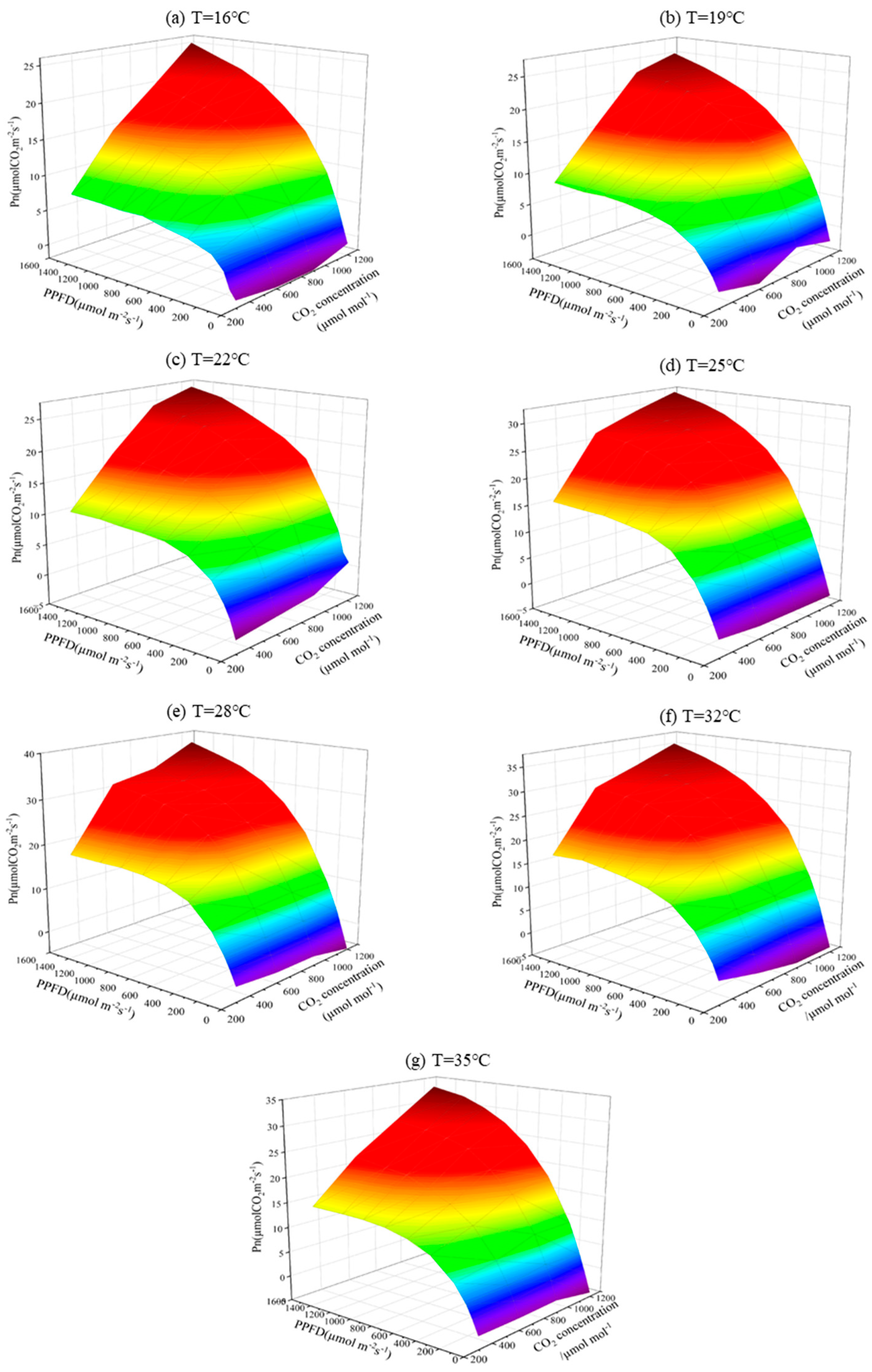
All machine learning models (SVR, the BP and RBF neural networks, and RF), hyperparameter optimization, evaluation metrics (R2, MAE, MAPE, RMSE), and correlation graphs were conducted were carried out using MATLAB R2024a (MathWorks, Natick, MA, USA). Data visualization was performed using Origin 2024 (OriginLab Corporation, Northampton, MA, USA). The three-dimensional (3D) response surface plots were generated to visualize the relationships between input variables (temperature, PPFD, and CO2 concentration) and the output (photosynthetic rate).

3. Results

3.1. Net Photosynthetic Rate Responds to Multiple Environmental Factors

As shown in Figure 2, the net photosynthetic rate (Pn) varied significantly in response to different levels of PPFD, temperature, and CO2 concentration. At lower PPFD (0–400 µmol m−2 s−1), Pn increased more rapidly with increasing photosynthetic photon flux density (PPFD) compared to the higher PPFD range (400–1500 µmol m−2 s−1). Simultaneously, temperature exerted a substantial influence on Pn. Within a lower temperature range of 16–28 °C, Pn rose continuously, as optimal temperature promotes photosynthetic enzyme activity and accelerates the photosynthetic process [30]. Conversely, when temperatures exceeded 28 °C, a significant decline in Pn was observed, likely due to the inhibition of the photosynthetic process under non-optimal temperatures. Furthermore, Pn remarkably increased with rising CO2 concentration, especially under high PPFD (400–1500 µmol m−2 s−1). This was also accompanied by a gradual increase in the light saturation point, suggesting that abundant light energy and photosynthetic substrates jointly accelerated photosynthesis. Under a temperature of 28 °C, a PPFD of 1500 µmol m−2 s−1, and a CO2 concentration of 1200 µmol mol−1, the cucumber Pn reached its peak value of 37.93 µmol m−2 s−1.

3.2. Model Optimization Results

3.2.1. SVR Model Optimization Results

The optimal hyperparameter values were obtained through grid search and five-fold cross-validation. As shown in Figure 3a, the lowest MSE value was achieved in the region where γ was 1 and ε was 0.01. To determine the optimal penalty factor (c), heat maps of MSE and R2 were generated with ε fixed at 0.01. As evidenced in Figure 3b,c, both MSE (0.3935) and R2 (0.9964) reached their optimal values when c was 14 and γ was 1. Consequently, the hyperparameters, including a c of 14, a γ of 1, and an ε of 0.01, were selected for training the SVR model.

3.2.2. BP Neural Network Optimization Results

In the BP algorithm, various transfer functions were evaluated to identify the optimal combinations for the hidden and output layer. The configuration employing tansig in the hidden layer and purelin in the output layer yield the best performance, achieving an R2 of 0.9940, an AdjR2 of 0.9939, and an RMSE of 0.8190 on the training set, along with an R2 of 0.9918, an AdjR2 of 0.9915, and an RMSE of 0.9264 on the test set (Table 1). Therefore, tansig and purelin were selected as the transfer functions for the hidden and output layer, respectively.
The optimal hyperparameter values was selected using Bayesian optimization method. This demonstrated that the lowest MSE value (0.0051) was achieved with a learning rate of 0.001, 18 neurons in the hidden layer and 900 iterations. Accordingly, this combination of hyperparameters was selected for the BP model training.

3.2.3. RBF Neural Network Optimization Results

In the RBF algorithm, the optimal hyperparameters was determined using a combination of grid search and five-fold cross-validation optimization methods. The lowest MSE value (1.3149) was when the spread was 10 and the maximum neuron number was 50. Consequently, the hyperparameters, including a spread of 10 and a maximum neuron number of 50, were utilized to train the RBF model.

3.2.4. RF Model Optimization Results

In the RF algorithm, the optimal hyperparameter values were determined through a combination of Bayesian optimization and five-fold cross-validation. The lowest MSE value (5.6696) was achieved when the number of decision trees and minimum leaf size were set to 292 and 1, respectively. Accordingly, hyperparameters such as a decision tree number of 292 and a minimum leaf size of 1 were selected for training the RF model.

3.3. Comparative Analysis of Four Photosynthetic Rate Prediction Models

We performed model predictions using the optimized hyperparameters in the SVR, BP, RBF, and RF algorithms. Among all the models, the photosynthetic rate prediction model constructed based on the SVR algorithm demonstrated the best performance, with an R2 of 0.9949, an MAE of 0.5747 µmol m−2 s−1, an RMSE of 0.7664 µmol m−2 s−1, and an MAPE of 0.3097 on the training set, and an R2 of 0.9941, an MAE of 0.5954 µmol m−2 s−1, an RMSE of 0.7802 µmol m−2 s−1 and an MAPE of 0.1690 on the test set (Table 2). These results indicated that the SVR model exhibited high predictive capability for estimating the photosynthetic rate in cucumber.
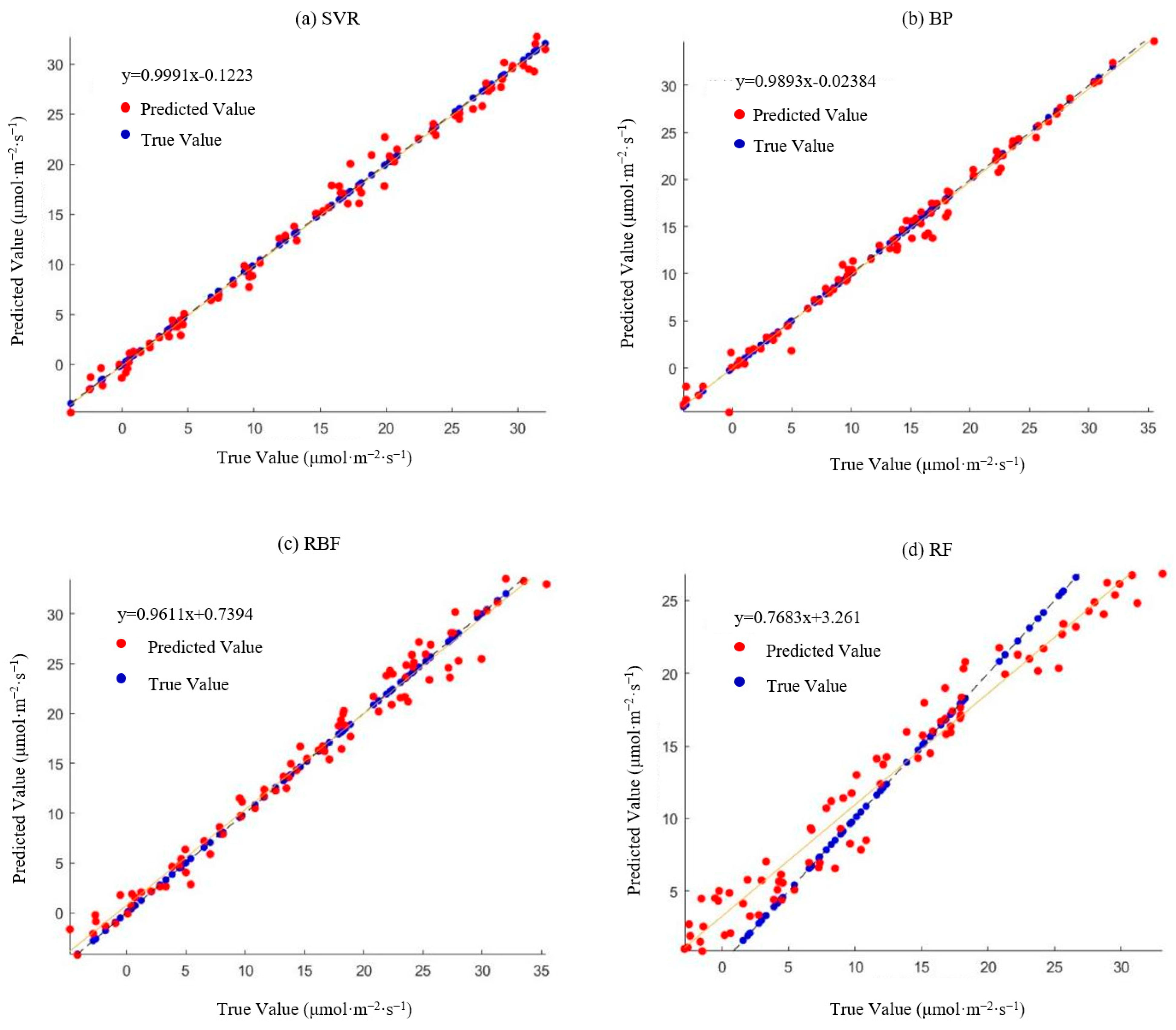
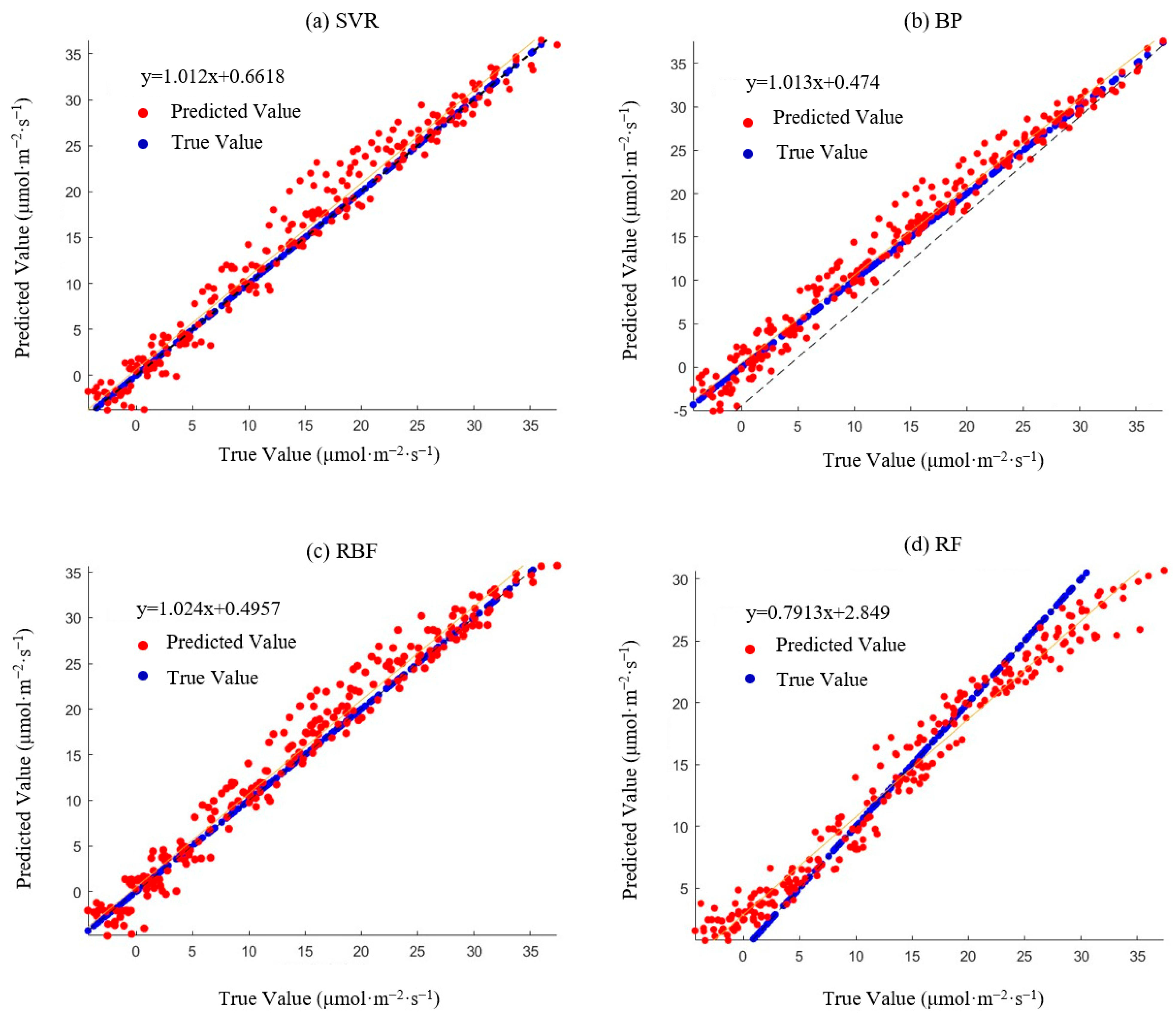
The correlation between predicted and true values on the test set was analyzed for all four photosynthetic rate prediction models (Figure 4). Among these models, the SVR model exhibited a fitted slope of 0.9991, which was the closest to 1, and an intercept of −0.1223, which was the closest to 0. These results indicated that the photosynthetic rate prediction model constructed using the SVR algorithm demonstrated the best performance.

3.4. Model Validation Results

On the validation set, the SVR model exhibited superior performance, achieving the highest R2 (0.9644) along with a relatively low MAE (1.5715 µmol m−2 s−1), RMSE (2.0574 µmol m−2 s−1) and MAPE (1.2634) (Table 3). These results indicated high prediction accuracy and stability. The BP and RBF models performed similarly and demonstrated good fitting ability, with high R2 values (above 0.96) and higher errors. In contrast, all metrics in the RF model were substantially worse than those of the other three models, suggesting limited generalization ability.
Scatter plots provide a visual confirmation of the correlation between the model’s predicted values and the actual values on the validation set (Figure 5). For the SVR, BP, and RBF models, the scatter plots are all closely distributed around the y = x baseline, the slopes of their fitted lines (black dashed lines) are close to 1, and the intercepts are small, confirming their high prediction performance. However, the RF model’s scatter plots significantly deviate from the baseline, with a fitted slope of 0.7913 and a clear trend of systematic underestimation. These findings indicate that the SVR model is the most robust and reliable choice for predicting the photosynthetic rate of cucumbers.

4. Discussion

A photosynthetic rate model can provide guidance for accurate environmental control, thereby facilitating optimal crop production [31]. Although machine learning algorithms (SVR, BP, RBF, and RF) have proven effective in handling complex nonlinear problem in agriculture, their specific application for modeling cucumber photosynthetic rates by integrating multiple environmental factors has not been thoroughly investigated [32,33,34]. Therefore, in this study, we analyzed the nested effects of multiple environmental factors on the photosynthetic rate and developed photosynthetic rate prediction models using four machine learning algorithms.
In protected agriculture, multiple environmental factors significantly influence the plant photosynthetic rate, thereby affecting plant growth and yield [35,36]. In the present study, the effects of different environmental factors (temperature, PPFD, and CO2 concentration) on cucumber Pn were analyzed. Our results demonstrated that Pn exhibited a significant nonlinear relationship with these environmental factors (Figure 3). As PPFD increased, Pn initially rose rapidly; it then increased at a slow rate and eventually stabilized, indicating the presence of a light saturation point in cucumber. Notably, the light saturation point increased significantly under high CO2 concentration, suggesting a synergistic interaction between CO2 and PPFD. The Pn value was highest at 28 °C and declined at temperatures either above or below this optimum. High temperature stress reduces the activity of photosynthetic enzymes, inhibits the PSII reaction center, and diminishes light energy conversion efficiency, collectively leading to suppressed photosynthesis [37]. Conversely, elevated CO2 concentrations promote CO2 fixation and enhance crop photosynthetic capacity, thereby increasing Pn [38]. These findings suggest that CO2 fertilization in greenhouse production can effectively improve photosynthetic efficiency and provide an important basis for defining temperature thresholds in controlled agricultural environments.
In model construction, this study systematically compared the performance of four machine learning algorithms (SVR, BP, RBF, and RF) in predicting the photosynthetic rate during the cucumber fruit stage. The hyperparameters for each prediction model were carefully selected (Figure 4). In the SVR model, the chosen hyperparameters (ε = 0.01, c = 14, and γ = 1) effectively balanced model complexity and enhanced generalization ability. As a result, the SVR model demonstrated the best predictive performance on both training and test sets among all models (Table 2). The SVR model mapped the original space into a high-dimensional feature space by employing the RBF kernel [39]. Moreover, due to the principle of structural risk minimization, SVR mitigated overfitting and pursued a global optimum rather than setting for local optima. Consequently, the SVR model achieved the best overall performance, attributed to its accuracy and effectiveness in handling various nonlinear classification and regression problems [40]. In the BP model, the combination of transfer function in the hidden layer (tansig) and in the output layer (purelin) led to a relatively high prediction accuracy (R2 = 0.9887), contributing to improved convergence and model prediction accuracy. However, the BP model is prone to becoming trapped in local minima and is sensitive to the initial weight setting [41]. Although Bayesian optimization helped alleviate these issues to some extent, the model’s final performance remained slightly inferior to that of the SVR algorithm. Both the RBF and the RF models exhibited relatively lower prediction accuracy after optimization. The performance of the RBF algorithm is strongly influenced by the choice of center and spread parameters. Its self-organizing learning strategy may fail to identify the optimal configuration for complex problems, potentially leading to larger prediction errors [42]. On the other hand, the RF algorithm is more suited to capturing discrete, piecewise-constant relationships rather than the continuous, complex nonlinear interactions between the photosynthetic rate and environmental factors [43].
The prediction performance of prediction models was most intuitively reflected by the scatter plots of measured and predicted values on the test set, along with the slopes and intercepts of the fitted regression lines [44]. For the SVR model, the slope was close to 1 (0.9991) and the intercept was small (−0.1223), with data points closely distributed around the reference line (y = x). This pattern indicated highly consistent prediction accuracy across both low and high Pn ranges (Figure 4). In the BP model, the slope was also close to 1 (0.9893). However, predictions were slightly overestimated in the low-value region and slightly underestimated in the high-value region, suggesting the presence of a minor systematic bias. As for the RBF and RF models, the slopes deviated substantially from 1 (0.9611 and 0.7683, respectively), and the intercepts were relatively large. These results revealed a compression in the range of predicted values and an insufficient predictive capability for photosynthetic rates, which severely limits their applicability in greenhouse environmental optimization [45]. On the validation set, the SVR model performed best in key metrics such as the highest R2 value (0.9644) and the lowest errors (Table 3). This observation was consistent with scatter plots in Figure 5. These results comprehensively indicated that, compared with BP, RBF, and RF, the SVR model had the most accurate and stable prediction of photosynthetic rate.
In this study, the dataset was collected during the fruiting stage by measuring cucumber photosynthetic rates under multigradient nested conditions with an LI-6400XT portable photosynthesis system, a methodology well-established in many previous studies [46,47,48]. This dataset has been widely used for plant modeling, including in the development of RF, BP, decision tree (DT), and XGBoost (XGB) models [34,49]. Moreover, the dataset has also been extensively applied in the training, testing, and validation sets [33,41]. Furthermore, a validation experiment conducted on tomato seedlings under six different cultivation temperatures demonstrated the high predictive accuracy of a model based on data acquired using this method [23]. However, the parameters obtained with the 6400XT were somewhat limited due to the same cultivation period and external environmental conditions. In subsequent experiments, different environmental conditions will be established for cultivation to collect more accurate data for model construction. Due to the complexity of greenhouse environmental factors and limited environmental control, we included six replicate plants for each environmental combination to alleviate the potential impacts of uncontrolled variables (e.g., relative humidity). It is noteworthy that humidity dose affects photosynthesis [50]. Since this study mainly focused on temperature, light intensity, and CO2 concentration, subsequent research will focus on developing a model integrating air humidity and soil moisture.
In all, the SVR-based prediction model demonstrated high accuracy, good interpretability, and strong practical applicability, thereby providing core algorithmic support for intelligent greenhouse control systems. This model can be used to formulate dynamic adjustment strategies for supplemental lighting, CO2 fertilization concentration and temperature setpoints, thereby maximizing photosynthetic efficiency in crop production. Furthermore, the model can be integrated into IoT platforms to establish closed-loop feedback control systems that incorporate real-time environmental sensor data, ultimately enabling adaptive and optimal greenhouse environment management.

5. Conclusions

The SVR model achieved R2 values exceeding 0.99 on both the training and test sets and achieved 0.9644 on the validation set, outperforming the BP, RBF, and RF models in terms of both prediction accuracy and generalization capability. The SVR model accurately predicted the cucumber photosynthetic rate during the fruiting stage, offering a reliable theoretical foundation and technical support for optimal greenhouse environment regulation.

Supplementary Materials

The following supporting information can be downloaded at https://www.mdpi.com/article/10.3390/horticulturae11121475/s1, Table S1: model training parameters; Table S2: datasets.

Author Contributions

Conception and design of the research, Y.M. and L.L.; methodology, L.L.; formal analysis, M.W. and Z.Z.; investigation, J.Z.; resources, Y.M.; data curation, B.L. and Y.C.; writing—original draft preparation, L.L.; writing—review and editing, Y.M.; project administration, Y.M. and L.L. All authors have read and agreed to the published version of the manuscript.

Funding

Shanxi Province Key R&D Plan: 202302010101003, Shanxi Provincial Overseas Students Management Committee Funding: HZXM-20230065; Shanxi Scholarship Council of China; Shanxi Key Laboratory of Germplasm Resources Innovation and Utilization of Vegetable and Flower: SCHHZDSYS2024-2; The Project for Enhancing Scientific Innovation and Technological Development of Shanxi Agricultural University: CXGC2025079.

Data Availability Statement

The data presented in this study are available on request from the corresponding author due to privacy and other issues.

Conflicts of Interest

The authors declare that they have no conflicts of interest.

References

  1. Liu, J.; Meng, Y.; Lv, F.; Chen, J.; Ma, Y.; Wang, Y.; Chen, B.; Zhang, L.; Zhou, Z. Photosynthetic characteristics of the subtending leaf of cotton boll at different fruiting branch nodes and their relationships with lint yield and fiber quality. Front. Plant Sci. 2015, 6, 747. [Google Scholar] [CrossRef]
  2. Zhang, X.; Leng, Z.; Wang, X.; Tian, S.; Zhang, Y.; Han, X.; Li, Z. Analysis of the current situation and trends of optical sensing technology application for facility vegetable life information detection. Agronomy 2025, 15, 2229. [Google Scholar] [CrossRef]
  3. Jamil, F.; Ibrahim, M.; Ullah, I.; Kim, S.; Kahng, H.K.; Kim, D.-H. Optimal smart contract for autonomous greenhouse environment based on IoT blockchain network in agriculture. Comput. Electron. Agric. 2022, 192, 106573. [Google Scholar] [CrossRef]
  4. Arnon, D.I.J.E. The photosynthetic energy conversion process in isolated chloroplasts. Experientia 1966, 22, 273–287. [Google Scholar] [CrossRef] [PubMed]
  5. Yang, C.; Du, S.; Shi, Y.; Zhang, D.; Yue, J.; Li, X.; Jin, H.; Fang, B.; Wei, F.; Zhang, Z.J.B.P.B. Differential sensitivity of photosynthetic electron transport to dark-induced senescence in wheat flag leaves. BMC Plant Biol. 2025, 25, 650. [Google Scholar] [CrossRef] [PubMed]
  6. Sattari Vayghan, H.; Tavalaei, S.; Grillon, A.; Meyer, L.; Ballabani, G.; Glauser, G.; Longoni, P. Growth temperature influence on lipids and photosynthesis in Lepidium sativum. Front. Plant Sci. 2020, 11, 2020. [Google Scholar] [CrossRef]
  7. Wu, P.; Ma, Y.; Ahammed, G.J.; Hao, B.; Chen, J.; Wan, W.; Zhao, Y.; Cui, H.; Xu, W.; Cui, J.J.F.i.P.S. Insights into melatonin-induced photosynthetic electron transport under low-temperature stress in cucumber. Front. Plant Sci. 2022, 13, 1029854. [Google Scholar] [CrossRef]
  8. Campbell, W.J.; Allen, L., Jr.; Bowes, G. Effects of CO2 concentration on rubisco activity, amount, and photosynthesis in soybean leaves. Plant Physiol. 1988, 88, 1310–1316. [Google Scholar] [CrossRef] [PubMed]
  9. He, L.; Yu, L.; Li, B.; Du, N.; Guo, S. The effect of exogenous calcium on cucumber fruit quality, photosynthesis, chlorophyll fluorescence, and fast chlorophyll fluorescence during the fruiting period under hypoxic stress. BMC Plant Biol. 2018, 18, 180. [Google Scholar] [CrossRef]
  10. Ma, X.; Liu, Q.; Zhang, Z.; Zhang, Z.; Zhou, Z.; Jiang, Y.; Huang, X.J.P.O. Effects of photosynthetic models on the calculation results of photosynthetic response parameters in young Larix principis-rupprechtii Mayr. plantation. PLoS ONE 2021, 16, e0261683. [Google Scholar] [CrossRef]
  11. Yi, G.; Quanjiu, W.; Kang, W.; Jihong, Z.; Kai, W.; Yang, L. Spring irrigation with magnetized water affects soil water-salt distribution, emergence, growth, and photosynthetic characteristics of cotton seedlings in Southern Xinjiang, China. BMC Plant Biol. 2023, 23, 174. [Google Scholar] [CrossRef]
  12. Acock, B.; Charles-Edwards, D.A.; Fitter, D.J.; Hand, D.W.; Wilson, J.W. Modelling canopy net photosynthesis by isolated blocks and rows of chrysanthemum plants. Ann. Appl. Biol. 1978, 90, 255–263. [Google Scholar] [CrossRef]
  13. Liu, B.; Gao, L.; Li, B.; Marcos-Martinez, R.; Bryan, B.A. Nonparametric machine learning for mapping forest cover and exploring influential factors. Landsc. Ecol. 2020, 35, 1683–1699. [Google Scholar] [CrossRef]
  14. Sideratos, G.; Hatziargyriou, N.D. A distributed memory RBF-based model for variable generation forecasting. Int. J. Electr. Power Energy Syst. 2020, 120, 106041. [Google Scholar] [CrossRef]
  15. Du, B.; Lund, P.D.; Wang, J.; Kolhe, M.; Hu, E. Comparative study of modelling the thermal efficiency of a novel straight through evacuated tube collector with MLR, SVR, BP and RBF methods. Sustain. Energy Technol. Assess. 2021, 44, 101029. [Google Scholar] [CrossRef]
  16. Sari, P.A.; Suhatril, M.; Osman, N.; Mu’azu, M.A.; Dehghani, H.; Sedghi, Y.; Safa, M.; Hasanipanah, M.; Wakil, K.; Khorami, M.; et al. An intelligent based-model role to simulate the factor of safe slope by support vector regression. Eng. Comput. 2019, 35, 1521–1531. [Google Scholar] [CrossRef]
  17. Dong, C.; Xie, K.; Sun, X.; Lyu, M.; Yue, H. Roadway traffic crash prediction using a state-space model based support vector regression approach. PLoS ONE 2019, 14, e0214866. [Google Scholar] [CrossRef]
  18. Zhang, Z. Application of deep reinforcement learning in parameter optimization and refinement of turbulence models. Sci. Rep. 2025, 15, 25236. [Google Scholar] [CrossRef]
  19. Chen, S.; Liu, A.; Tang, F.; Hou, P.; Lu, Y.; Yuan, P. A Review of environmental control strategies and models for modern agricultural greenhouses. Sensors 2025, 25, 1388. [Google Scholar] [CrossRef] [PubMed]
  20. Aberra, A.S.; Lopez, A.; Grill, W.M.; Peterchev, A.V. Rapid estimation of cortical neuron activation thresholds by transcranial magnetic stimulation using convolutional neural networks. NeuroImage 2023, 275, 120184. [Google Scholar] [CrossRef] [PubMed]
  21. Wong, H.-T.; Mai, J.; Wang, Z.; Leung, C.-S. Generalized M-sparse algorithms for constructing fault tolerant RBF networks. Neural Netw. 2024, 180, 106633. [Google Scholar] [CrossRef]
  22. Cutler, D.R.; Edwards, T.C., Jr.; Beard, K.H.; Cutler, A.; Hess, K.T.; Gibson, J.; Lawler, J.J. Random forests for classification in ecology. Ecology 2007, 88, 2783–2792. [Google Scholar] [CrossRef]
  23. Gao, P.; Tian, Z.; Lu, Y.; Lu, M.; Zhang, H.; Wu, H.; Hu, J. A decision-making model for light environment control of tomato seedlings aiming at the knee point of light-response curves. Comput. Electron. Agric. 2022, 198, 107103. [Google Scholar] [CrossRef]
  24. Filippi, P.; Jones, E.J.; Wimalathunge, N.S.; Somarathna, P.D.S.N.; Pozza, L.E.; Ugbaje, S.U.; Jephcott, T.G.; Paterson, S.E.; Whelan, B.M.; Bishop, T.F.A. An approach to forecast grain crop yield using multi-layered, multi-farm data sets and machine learning. Precis. Agric. 2019, 20, 1015–1029. [Google Scholar] [CrossRef]
  25. Li, B.; Qiao, B.; Zhao, Q.; Yang, D.; Zhu, R.; Wang, Z.; Yang, Y. A Predictive model of the photosynthetic rate of chili peppers using support vector regression and environmental multi-factor analysis. Horticulturae 2025, 11, 502. [Google Scholar] [CrossRef]
  26. Zhang, J.-S.; Liang, X.; Gao, Y.; Zhang, X.; Tian, Y.; Zhang, Z.; Gao, L. Effect of optimal daily fertigation on migration of water and salt in soil, root growth and fruit yield of cucumber (Cucumis sativus L.) in solar-greenhouse. PLoS ONE 2014, 9, 6975. [Google Scholar] [CrossRef]
  27. Niu, Y.; Lyu, H.; Liu, X.; Zhang, M.; Li, H. Effects of supplemental lighting duration and matrix moisture on net photosynthetic rate of tomato plants under solar greenhouse in winter. Comput. Electron. Agric. 2022, 198, 107102. [Google Scholar] [CrossRef]
  28. Xin, P.; Zhang, H.; Hu, J.; Wang, Z.; Zhang, Z. An improved photosynthesis prediction model based on artificial neural networks intended for cucumber growth control. Appl. Eng. Agric. 2018, 34, 769–787. [Google Scholar] [CrossRef]
  29. Wei, Z.; Wan, X.; Lei, W.; Yuan, K.; Lu, M.; Li, B.; Gao, P.; Wu, H.; Hu, J. A cucumber photosynthetic rate prediction model in whole growth period with time parameters. Agriculture 2023, 13, 204. [Google Scholar] [CrossRef]
  30. Galmés, J.; Capó-Bauçà, S.; Niinemets, Ü.; Iñiguez, C. Potential improvement of photosynthetic CO2 assimilation in crops by exploiting the natural variation in the temperature response of Rubisco catalytic traits. Curr. Opin. Plant Biol. 2019, 49, 60–67. [Google Scholar] [CrossRef]
  31. Wang, Y.; Chan, K.X.; Long, S.P. Towards a dynamic photosynthesis model to guide yield improvement in C4 crops. Plant J. 2021, 107, 343–359. [Google Scholar] [CrossRef] [PubMed]
  32. Gao, P.; Lu, M.; Yang, Y.; Li, H.; Tian, S.; Hu, J. A predictive model of photosynthetic rates for eggplants: Integrating physiological and environmental parameters. Comput. Electron. Agric. 2025, 234, 110241. [Google Scholar] [CrossRef]
  33. Pu, L.; Li, Y.; Gao, P.; Zhang, H.; Hu, J. A photosynthetic rate prediction model using improved RBF neural network. Sci. Rep. 2022, 12, 2932. [Google Scholar] [CrossRef]
  34. Cheng, Y.; Li, N.; Li, Z.; Zhou, A.; Li, B.; Miao, Y. Analysis of multi-environment-driven variations in net photosynthetic rate and predictive model development for tomatoes during early flowering and fruit development stages in winter solar greenhouses. Horticulturae 2025, 11, 1367. [Google Scholar] [CrossRef]
  35. Teng, J.; Hou, R.; Dungait, J.A.J.; Zhou, G.; Kuzyakov, Y.; Zhang, J.; Tian, J.; Cui, Z.; Zhang, F.; Delgado-Baquerizo, M. Conservation agriculture improves soil health and sustains crop yields after long-term warming. Nat. Commun. 2024, 15, 8785. [Google Scholar] [CrossRef]
  36. Bernacchi, C.J.; Long, S.P.; Ort, D.R. Safeguarding crop photosynthesis in a rapidly warming world. Science 2025, 388, 1153–1160. [Google Scholar] [CrossRef] [PubMed]
  37. Chen, L.-S.; Li, P.; Cheng, L. Effects of high temperature coupled with high light on the balance between photooxidation and photoprotection in the sun-exposed peel of apple. Planta 2008, 228, 745–756. [Google Scholar] [CrossRef] [PubMed]
  38. Koo, J.K.; Hwang, H.S.; Hwang, J.H.; Park, E.W.; Yu, J.; Yun, J.H.; Hwang, S.Y.; Choi, H.E.; Hwang, S.J. Supplemental lighting and CO2 enrichment on the growth, fruit quality, and yield of cucumber. Hortic. Environ. Biotechnol. 2025, 66, 77–85. [Google Scholar] [CrossRef]
  39. Santos, C.E.d.S.; Sampaio, R.C.; Coelho, L.d.S.; Bestard, G.A.; Llanos, C.H. Multi-objective adaptive differential evolution for SVM/SVR hyperparameters selection. Pattern Recognit. 2021, 110, 107649. [Google Scholar] [CrossRef]
  40. da Silva Santos, C.E.; dos Santos Coelho, L.; Llanos, C.H.J.M. Nature inspired optimization tools for SVMs-NIOTS. MethodsX 2021, 8, 101574. [Google Scholar] [CrossRef]
  41. Zhang, P.; Zhang, Z.; Li, B.; Zhang, H.; Hu, J.; Zhao, J. Photosynthetic rate prediction model of newborn leaves verified by core fluorescence parameters. Sci. Rep. 2020, 10, 3013. [Google Scholar] [CrossRef]
  42. Jia, W.; Zhao, D.; Ding, L. An optimized RBF neural network algorithm based on partial least squares and genetic algorithm for classification of small sample. Appl. Soft Comput. 2016, 48, 373–384. [Google Scholar] [CrossRef]
  43. Bourel, M.; Segura, A.M. Multiclass classification methods in ecology. Ecol. Indic. 2018, 85, 1012–1021. [Google Scholar] [CrossRef]
  44. Shamshirband, S.; Hashemi, S.; Salimi, H.; Samadianfard, S.; Asadi, E.; Shadkani, S.; Kargar, K.; Mosavi, A.; Nabipour, N.; Chau, K.-W. Predicting Standardized Streamflow index for hydrological drought using machine learning models. Eng. Appl. Comput. Fluid Mech. 2020, 14, 339–350. [Google Scholar] [CrossRef]
  45. Kaneko, T.; Nomura, K.; Yasutake, D.; Iwao, T.; Okayasu, T.; Ozaki, Y.; Mori, M.; Hirota, T.; Kitano, M. A canopy photosynthesis model based on a highly generalizable artificial neural network incorporated with a mechanistic understanding of single-leaf photosynthesis. Agric. For. Meteorol. 2022, 323, 109036. [Google Scholar] [CrossRef]
  46. Lawrence, E.H.; Stinziano, J.R.; Hanson, D.T. Using the rapid A-Ci response (RACiR) in the Li-Cor 6400 to measure developmental gradients of photosynthetic capacity in poplar. Plant Cell Environ. 2019, 42, 740–750. [Google Scholar] [CrossRef] [PubMed]
  47. He, X.-h.; Si, J.-h.; Zhou, D.-m.; Wang, C.-l.; Zhao, C.-y.; Jia, B.; Qin, J.; Zhu, X.-l. Leaf chlorophyll parameters and photosynthetic characteristic variations with stand age in a typical desert species (Haloxylon ammodendron). Front. Plant Sci. 2022, 13, 2022. [Google Scholar] [CrossRef] [PubMed]
  48. Xin, P.; Li, B.; Zhang, H.; Hu, J. Optimization and control of the light environment for greenhouse crop production. Sci. Rep. 2019, 9, 8650. [Google Scholar] [CrossRef] [PubMed]
  49. Li, Y.; Gao, X.; Li, T.; Jin, H.; Zhu, H.; Wu, Q.; Lu, B.; Xiong, Q. Estimation of the net photosynthetic rate for waterlogged winter wheat based on digital image technology. Agron. J. 2023, 115, 230–241. [Google Scholar] [CrossRef]
  50. Grossiord, C.; Buckley, T.N.; Cernusak, L.A.; Novick, K.A.; Poulter, B.; Siegwolf, R.T.W.; Sperry, J.S.; McDowell, N.G. Plant responses to rising vapor pressure deficit. New Phytol. 2020, 226, 1550–1566. [Google Scholar] [CrossRef]
Figure 1. Flowchart of photosynthetic rate prediction model construction using SVR algorithm.
Horticulturae 11 01475 g001
Figure 2. Effects of temperature, PPFD, and CO2 concentration on Pn in cucumber. The color gradient from blue to red represents a progression from low to high values.
Horticulturae 11 01475 g002
Figure 3. The optimization process of the SVR model. (a) The search space based on MSE values corresponding to hyperparameters. (b) Heat map of MSE values corresponding to c when ε was 0.01. (c) Heat map of R2 corresponding to c when ε was 0.01.
Horticulturae 11 01475 g003
Figure 4. Comparison of correlation between predicted and true values of four models on the test set: (a) SVR model, (b) BP model, (c) RBF model, and (d) RF model. The yellow line represents y = x, and the black dashed line represents the actual linear correlation result.
Horticulturae 11 01475 g004
Figure 5. Comparison of correlation between predicted and true values of four models on the validation set: (a) SVR model, (b) BP model, (c) RBF model, and (d) RF model. The yellow line represents y = x, and the black dashed line represents the actual linear correlation result.
Horticulturae 11 01475 g005
Table 1. Comparison of training and test sets for transfer functions in the hidden and output layers.
Hidden Layer FunctionOutput Layer FunctionTraining SetTest Set
R2AdjR2RMSER2AdjR2RMSE
logsigpurelin0.98480.98461.31870.97690.97561.5091
tansigpurelin0.99400.99390.81900.99180.99150.9264
purelinpurelin0.75010.74625.31080.74090.73125.0259
logsigtansig0.99390.99380.79780.98590.98541.3142
tansigtansig0.99050.99030.99300.98590.98541.3346
purelintansig0.75090.74705.25270.73390.72395.4033
logsiglogsig0.35550.34548.37220.21440.18499.3782
tansiglogsig0.21460.20239.37420.08740.05239.8730
purelinlogsig0.17300.16009.44860.19460.16449.6815
Table 2. Comparative analysis of four photosynthetic rate prediction models.
DatasetPredictive ModelR2MAE
(µmol m−2 s−1)
RMSE
(µmol m−2 s−1)
MAPE
Training setSVR0.99490.57470.76640.3097
BP0.98870.81061.13900.4002
RBF0.98651.00011.26690.7270
RF0.94441.96492.45301.3968
Test setSVR0.99410.59540.78020.1690
BP0.98470.94061.23420.2155
RBF0.96371.33581.79450.2062
RF0.92252.4652.98371.1501
Table 3. Comparative analysis of four photosynthetic rate prediction models on the validation set.
DatasetPredictive ModelR2MAE
(µmol m−2 s−1)
RMSE
(µmol m−2 s−1)
MAPE
Validation setSVR0.96441.57152.05741.2634
BP0.96061.62782.16520.6638
RBF0.96061.65882.16624.2439
RF0.91332.54993.212816.9413
Disclaimer/Publisher’s Note: The statements, opinions and data contained in all publications are solely those of the individual author(s) and contributor(s) and not of MDPI and/or the editor(s). MDPI and/or the editor(s) disclaim responsibility for any injury to people or property resulting from any ideas, methods, instructions or products referred to in the content.