Article

Cultivar-Specific Responses of Camelina (Camelina sativa (L.) Crantz) Sprouts and Microgreens to UV-B Radiation: Effects on Germination, Growth, Biochemical Traits, and Stress-Related Parameters

by
Marco Santin
1,
Clarissa Clemente
1,
Giampiero Vinci
1,
Incoronata Galasso
2,
Ida Melania Brambilla
2,
Luciana Gabriella Angelini
1,3,
Annamaria Ranieri
1,
Antonella Castagna
1,3,* and
Silvia Tavarini
1,3
1
Department of Agriculture, Food and Environment, University of Pisa, Via del Borghetto 80, 56124 Pisa, Italy
2
Istituto di Biologia e Biotecnologia Agraria—CNR, 20133 Milan, Italy
3
Interdepartmental Research Center “Nutraceuticals and Food for Health”, University of Pisa, Via del Borghetto 80, 56124 Pisa, Italy
*
Author to whom correspondence should be addressed.
Horticulturae 2025, 11(12), 1464; https://doi.org/10.3390/horticulturae11121464
Submission received: 12 November 2025 / Revised: 27 November 2025 / Accepted: 28 November 2025 / Published: 3 December 2025
(This article belongs to the Special Issue Production and Cultivation of Microgreens)

Abstract

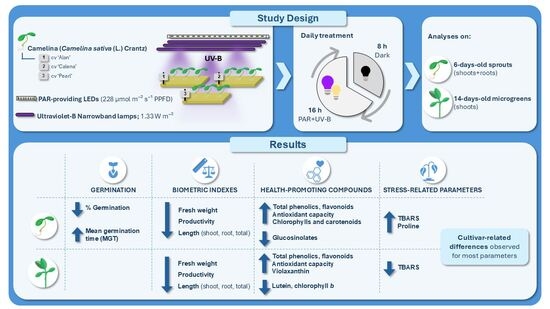
In recent years, sprouts and microgreens from Brassicaceae species have been increasingly recognized for their nutritional value and bioactive compounds. Camelina sativa (L.) Crantz has emerged as a promising candidate for functional food production due to its exceptional chemical composition. This study evaluated the effects of pre-harvest UV-B radiation on the growth, biochemical traits, and stress-related responses in sprouts and microgreens from three camelina cultivars (‘Alan’, ‘Calena’, and ‘Pearl’). UV-B exposure moderately reduced germination, growth and productivity, but it strongly enhanced the phenolics, flavonoids and antioxidant capacity in sprouts. These increases in protective secondary metabolites reflect metabolic reprogramming triggered by such treatment. UV-B exposure in fact determined a reallocation of metabolic resources from primary growth toward accumulation of defensive compounds, including increased proline accumulation and enhanced non-enzymatic antioxidant systems. This adaptive response was effective in managing UV-B-induced oxidative stress in the next growth stage, as demonstrated by the reduced lipid peroxidation markers in microgreens. In microgreens, UV-B similarly stimulated secondary metabolite accumulation while reducing biomass productivity, with antioxidant systems effectively managing oxidative stress over the extended 14-day growth period. The cultivar-specific responses revealed genetic variation in stress responsiveness, with ‘Pearl’ showing slight superior secondary metabolite accumulation. Overall, controlled UV-B irradiation enhances health-promoting compounds through metabolic reallocation toward protective compound accumulation, demonstrating its potential as an eco-friendly strategy to improve the functional quality of camelina sprouts and microgreens.

1. Introduction

In recent years, camelina (Camelina sativa (L.) Crantz) has attracted growing attention as a multipurpose and climate-resilient crop, thanks to its several agronomic and environmental advantages [1,2,3]. Expanding our knowledge of this alternative oilseed crop is therefore of great importance, as it holds significant potential to both address climate change challenges and support the sustainable development of the bioeconomy. Camelina can provide valuable raw materials suitable for various industrial applications, particularly in the pharmaceutical, nutraceutical, and cosmetic sectors [4,5]. In addition to its agronomic benefits, camelina seeds exhibit a distinctive chemical composition that is high in polyunsaturated fatty acids and antioxidant compounds [5], which could be successfully exploited to obtain functional foods such as sprouts and microgreens. These early developmental stages of plants are known for their rapid growth, high nutritional quality, and rich content of bioactive compounds, such as polyphenols, glucosinolates, carotenoids, and flavonoids, which contribute to their health-promoting properties [6,7,8,9]. The rising awareness among consumers of nutrient-rich foods and their correlation with health benefits has increased interest in sprouts and microgreens. Bravi et al. [6] indicated that camelina can be successfully used as a sprouting crop, since sprouting markedly enhanced its nutritional profile and the concentration of secondary metabolites. Sprouting, in fact, induced oxidative stress in the seedlings, which in turn stimulated the synthesis of antioxidant compounds, leading to an increase in phenolic compounds and glucosinolates (GLSs).
Sprouts and microgreens of camelina are notable not only for their high nutritional value but also for their adaptability to various abiotic stress conditions, which can be harnessed to further enhance their content of several bioactive compounds [6,9]. It is well known that altering the environmental conditions under controlled conditions, such as light quality and quantity, during plant growth can induce a rearrangement of the plant metabolism, leading to the synthesis of secondary metabolites with potential antioxidant, anti-inflammatory, and cardioprotective effects [10]. Given the constantly increasing evidence linking plant bioactive compounds with improved human health outcomes, there is significant interest in developing strategies to enhance the nutraceutical quality of sprouts and microgreens through eco-friendly approaches, such as the use of ultraviolet-B (UV-B) irradiation.
UV-B radiation (280–320 nm) is a natural component of sunlight and an important environmental factor influencing plant growth, development and secondary metabolism. Although a large fraction of solar UV-B is filtered by the stratospheric ozone layer, a non-negligible portion still reaches the Earth’s surface, and plants have therefore evolved complex mechanisms to perceive and respond to UV-B radiation [11]. Plants perceive UV-B primarily through a dedicated photoreceptor, UVR8, which in the absence of UV-B exists as a homodimer. When hit by UV-B photons, UVR8 monomerizes and initiates a signaling cascade that alters gene expression, including genes involved in photomorphogenesis and secondary metabolism (e.g., genes belonging to the phenylpropanoid pathway) [12,13,14]. Indeed, downstream regulators, such as HY5, modulate developmental responses (e.g., inhibition of hypocotyl elongation, cotyledon expansion) and activate biosynthetic pathways for UV-absorbing and antioxidant compounds [15]. This perception–response system enables plants to ‘sense’ ambient UV-B conditions and adjust their physiology and biochemistry to enhance tolerance and minimize damage under future exposures. Therefore, while excessive and prolonged UV-B exposure can damage plant tissues (e.g., by inducing oxidative stress, causing DNA damage or impairing photosynthesis), moderate and controlled doses of UV-B have been shown to stimulate the biosynthesis and accumulation of protective compounds such as phenolic compounds, flavonoids, and glucosinolates in various plant species [16,17,18,19].
These compounds, which play crucial roles in plant defense mechanisms against potentially UV-B-induced oxidative stress, have been associated with enhanced nutritional and nutraceutical properties in functional foods [20,21,22,23]. Indeed, many UV-B-induced secondary metabolites, such as phenolics, flavonoids, terpenoids, and glucosinolates, have important benefits for human health. They act as antioxidants by reducing oxidative stress, exhibit anti-inflammatory effects, and in some cases, contribute to cancer prevention and overall protection against chronic diseases, thereby enhancing the nutraceutical and functional value of edible plants [24,25,26,27,28]. Moreover, UV-B-induced enhancement of protective secondary metabolites, such as phenolic compounds, could offer additional benefits, such as improved shelf life, resistance toward pests and pathogens, and sensory attributes, which are important aspects for consumer acceptance and marketability [10,22,27,29].
Numerous studies have reported the positive effects of modulating visible and UV spectra on the nutraceutical profiles of vegetables belonging to the Brassicaceae family, such as broccoli, kale, and mustard, even in the early growth stages [30,31,32,33,34,35]. However, limited research has explored the potential of UV-B radiation to enhance the bioactive properties of camelina sprouts and microgreens.
In the light of the above, this study aimed to investigate the impact of pre-harvest UV-B radiation on the germination and productivity of three camelina cultivars, ‘Alan’, ‘Calena’ and ‘Pearl’, as sprouts and microgreens. In addition, some biochemical parameters have been examined to evaluate both the potential onset of UV-B-triggered oxidative stress and changes in the concentration of several health-promoting phytochemicals, e.g., phenolics, flavonoids, glucosinolates, and photosynthetic pigments, and the consequent antioxidant capacity.

2. Materials and Methods

2.1. Plant Material and UV-B Treatment

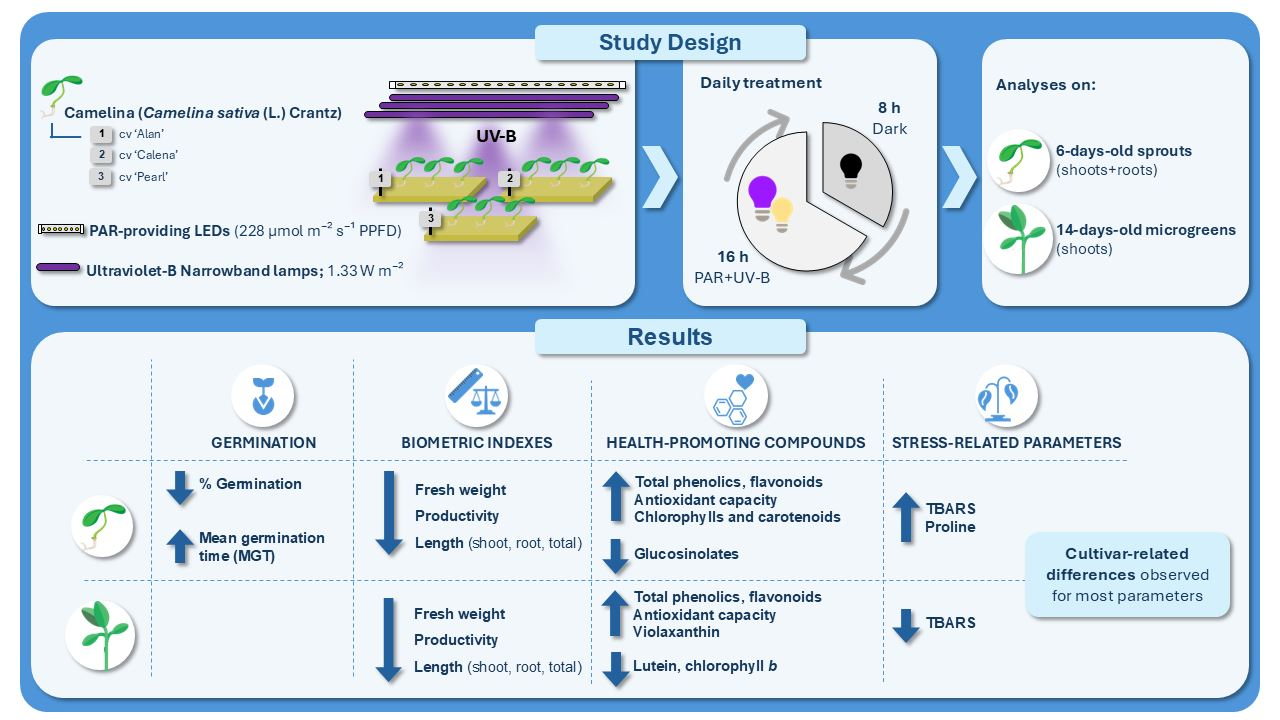
In the present study, the commercial variety ‘Calena’ (supplied by Saatbau Linz eGen (Leonding, Austria) and two improved camelina lines, ‘Alan’ (supplied by the National Research Council—CNR, Institute of Agricultural Biology and Biotechnology—IBBA, Milan, Italy) and ‘Pearl’ (supplied by Smart Earth Camelina, Saskatoon, SK, Canada), characterized by low glucosinolates and low linoleic acid content in their seeds, respectively, were used. The experiment was conducted at the Department of Agriculture, Food, and Environment, University of Pisa, Italy. Initially, the seeds were soaked in distilled water for 2 h in darkness at room temperature (20 °C). The seeds from each cultivar were then sown in six plastic trays (25 cm × 40 cm; 2 seeds per cm2) on moistened filter paper placed over cotton wool for sprout production, or directly on cotton wool for microgreen production. Since sprouts are harvested along with the roots, the filter paper served to prevent root penetration into the cotton wool. The trays were placed in climatic chambers and kept in the dark at 20 °C for 72 h. Subsequently, the germinated seeds were exposed to photosynthetically active radiation (PAR) supplied by blue LEDs (emission peak 448 nm), red LEDs (emission peaks 639 and 669 nm) in a 1:2 ratio, and 10% green LEDs (545 nm), with a photosynthetic photon flux density (PPFD) of 228 µmol m−2 s−1 (C-LED, Imola, Italy) and a 16 h light/8 h dark photoperiod. While three trays of each camelina cultivar were placed under PAR alone, the remaining three trays were supplemented with UV-B radiation (Philips Ultraviolet-B Narrowband lamps, TL 20W/01–RS, Koninklijke Philips Electronics, Eindhoven, The Netherlands; 311 nm emission peak; 1.33 W m−2) during the 16 h that coincided with the light phase of the photoperiod. Irradiance was measured using a spectrometer (FLAME-T-XR1-ES S/N: FLMT07829, Ocean Optics, Ostfildern, Germany) with fiber optics (QP400-1-UV-BX; Ocean Optics) and a cosine corrector (CC-3-UV-S; Ocean Optics), and the absolute irradiance spectrum of both the PAR LED lighting system and the UV-B lamps is reported in Supplementary Figure S1. For fertigation, half-strength Hoagland’s solution was applied, containing the following concentrations: N-NO3 7.5 mM, P-H2PO4 0.5 mM, K 3.0 mM, Ca 2.5 mM, Mg 1.0 mM, Fe 25.0 µM, B 23.1 µM, Mn 4.6 µM, Zn 0.39 µM, Cu 0.16 µM, Mo 0.06 µM; pH ~5.56; and electrical conductivity (EC) of 1.15 mS cm−1. Harvesting of the sprouts and microgreens took place 6 and 14 days after sowing, respectively. Sprouts were harvested with both shoots and rootlets, while for microgreens, only the shoots were collected, excluding roots.

2.2. Germination Test and Measurements of Germination Parameters

The germination test was carried out according to the International Seed Testing Association (ISTA) rules for Brassicaceae [36], where the completion of germination coincides with the development of a normal seedling. This corresponds to the emergence of the cotyledons and the clear development of the primary shoot [9]. Germinated seeds were counted every day, and the germination counts were stopped when the final germination percentages were reached.
The germination percentage (G %) and mean of the germination time (MGT) were calculated according to following equations:
- G (%) = SNG/SNO × 100, where SNG is the number of germinated seeds and SNO is the number of experimental seeds with viability, respectively.
- MGT = Σ (n × d)/N, where n = number of germinated seeds per day; d = number of days needed for germination, and N = total number of germinated seeds.

2.3. Biomass and Biometric Measurements

After harvesting, the total fresh weight (FW) of the collected sprouts and microgreens was immediately recorded. Considering the surface area of the growing trays, the fresh weight per square meter (FW m−2) was also calculated. Subsequently, the collected samples were placed in an oven and dried at 60 °C until constant weight, ensuring complete removal of moisture. The dry weight (DW) of each sample was then measured, and the dry biomass per square meter (DW m−2) was calculated. To assess the water content and biomass composition, the percentage ratio of dry weight to fresh weight (DW/FW) was also determined. Additionally, the length of both roots and stems for sprouts, and stem length alone for microgreens, was measured from a representative pool of 100 seedlings per tray using a digital caliber.

2.4. Extraction and Quantification of Total Phenolics, Flavonoids, and Antioxidant Activity

All the biochemical analyses described below were performed on lyophilized samples, which were immediately frozen and transferred to the freeze-dryer directly after harvesting.
Fifty milligrams of freeze-dried sprout and microgreen samples, finely ground into powder, was extracted using 80% aqueous methanol (v/v) [37]. The resulting extracts were utilized to assess the total phenolic and flavonoid concentrations, as well as the antioxidant activity.
The total phenolic concentration was measured using the Folin–Ciocalteu method [38], with absorbance recorded at 750 nm on an Ultrospec 2100 pro UV–Vis spectrophotometer (Amersham Biosciences, Amersham, UK). The phenolic content was expressed as milligrams of gallic acid equivalents (GAE) per gram of dry weight (DW).
For the determination of the total flavonoid concentration, the method of Kim et al. [39] was applied, with absorbance measured at 510 nm. The flavonoid concentration was reported as milligrams of catechin equivalents (CAE) per gram of dry weight (DW).
Antioxidant activity was evaluated using the ABTS (2,2′-azinobis-(3-ethylbenzothiazoline-6-sulphonic acid)), the Ferric Reducing Antioxidant Power (FRAP), and the 2,2-diphenyl-1-picrylhydrazyl (DPPH) assays, following the procedures outlined by Re et al. [40], Benzie et al. [41], and Gulcin et al. [42], respectively. For the ABTS, FRAP and DPPH assays, absorbance was recorded at 734, 593, and 517 nm, respectively. The antioxidant capacity was expressed as μmol of Trolox equivalent antioxidant capacity (TEAC) per gram of fresh weight (FW) for both the ABTS and DPPH assays, and as μmol of Fe(II) per gram of dry weight (DW) for the FRAP assay.
Standard curves for all the determinations were calibrated using commercial standards obtained from Sigma-Aldrich Chemical Co. (St. Louis, MO, USA).

2.5. Extraction and Quantification of Chlorophylls and Carotenoids

The extraction and quantification of chlorophylls (a and b) and carotenoids, including neoxanthin, lutein, violaxanthin, antheraxanthin, and β-carotene, were carried out following the method described by Santin et al. [43]. In brief, plant samples were first extracted and then filtered using 0.2 μm filters (Sartorius Stedim Biotech, Goettingen, Germany). The filtered extracts were subsequently analyzed by HPLC (Vanquish Core, Thermo Fisher Scientific, Waltham, MA, USA) using a Zorbax ODS column (SA, 5 μm particle size, 250 × 4.6 mm; Phenomenex, Castel Maggiore, Italy). The separation of pigments was achieved by gradient elution using two solvent systems: solvent A (acetonitrile/methanol, 75/25, v/v) and solvent B (methanol/ethyl acetate, 68/32, v/v), with a flow rate of 1 mL min−1. The gradient program used for the elution is detailed in Table 1. The pigment concentrations were obtained by measuring absorbance at 445 nm. Commercial standards of neoxanthin, violaxanthin, chlorophyll a, chlorophyll b, lutein, and β-carotene (Sigma-Aldrich, Milan, Italy) were used to construct standard curves, and the results were expressed as micrograms per gram of dry weight (µg g−1 DW).

2.6. Extraction and Determination of Glucosinolates

The total glucosinolate (GLS) content was determined as reported by Pozzo et al. [44] with same modifications. Briefly, GLSs were extracted from about 20 mg of fine powder, obtained from the lyophilized material, by addition of 600 µL of 70% hot methanol (w:v 1:30). Taking care of the myrosinase deactivation, the samples were incubated for 10 min at 75 °C, with vortexing every 2 min. After cooling down for 2 min, the extract was centrifuged at 15,000× g for 15 min. The resulting supernatant was transferred to a new tube, and the residue was re-extracted with 400 µL of 75% hot methanol. The combined extracts (about 1 mL) were added on the top of a DEAE Sephadex A-25 column (Merck Life Science S.r.l., Milan, Italy). Substances not retained by the resin were washed twice with 1 mL of 20 mM Na acetate at pH 4.0. Bound GLSs were desulfated by the addition of 30 μL (10 U) of sulfatase Type H1 (Merck Life Science S.r.l., Milan, Italy) at 37 °C overnight. Desulfoglucosinolates were eluted from the DEAE column with 1 mL of 100% ethanol and the samples were dried at 55 °C. The pellets were resuspended in 200 µL of 20% ethanol and filtered with 0.22 μm Costar Spin-X Centrifuge Tube Filter (Corning Incorporated, Corning, NY, USA) before conducting HPLC analysis. Desulfoglucosinolates were separated by HPLC according to Russo et al. [45]. A calibration curve with desulfosinigrin was generated. Sinigrin hydrate from horseradish was purchased from Merck Life Science S.r.l. (Milan, Italy). The content of GLSs was expressed in μmol g−1 dry weight (DW).

2.7. Evaluation of Lipid Peroxidation by MDA Assay

Lipid peroxidation was assessed using the thiobarbituric acid reactive substances (TBARS) assay to quantify the malondialdehyde (MDA) content. Approximately 50 mg of lyophilized sample was extracted with 1.5 mL of 5% trichloroacetic acid (TCA), vortexed for 30 s, and centrifuged at 10,000× g for 15 min. The supernatant was recovered for analysis. MDA quantification was performed spectrophotometrically according to Draper [46] using a modified protocol where sample extracts (200 μL) were incubated with either solution A (15% TCA + 0.375% TBA) or solution B (15% TCA only) at 100 °C for 15 min, followed by immediate cooling on ice. Absorbance was measured at 440, 532, and 600 nm for solution A samples, and at 532 and 600 nm for solution B samples. The MDA concentration was calculated using a molar extinction coefficient of 155 mM−1 cm−1 and expressed as malondialdehyde equivalents [47].

2.8. Extraction and Quantification of Proline

The proline content was determined following the colorimetric method described by Bates et al. [48]. Lyophilized samples (40 mg) were extracted with 1 mL of 3% (w/v) sulfosalicylic acid and centrifuged at 13,000× g for 10 min at 4 °C. The pellet was re-extracted with an additional 1 mL of 3% sulfosalicylic acid, vortexed three times at 3 min intervals, and centrifuged under the same conditions. The combined supernatants (2 mL final volume) were used for proline quantification. Acid ninhydrin reagent was prepared by dissolving 1.25 g of ninhydrin in 30 mL of glacial acetic acid and 20 mL of 6 M orthophosphoric acid under gentle heating. For each assay, 600 μL of sample extract was mixed with 600 μL of glacial acetic acid and 600 μL of acid ninhydrin reagent. The reaction mixture was incubated at 96 °C for 1 h, then immediately cooled in an ice bath. The chromophore was extracted with 1.2 mL of toluene, and after phase separation, absorbance was measured at 520 nm. The proline concentration was calculated using a standard calibration curve and expressed as μmol g−1 dry weight.

2.9. Statistical Analysis

The effects of UV-B irradiation on the three camelina cultivars (‘Alan’, ‘Pearl’, and ‘Calena’) were evaluated separately for sprouts and microgreens using a two-way analysis of variance (ANOVA) with the cultivar and UV-B treatment as single factors. Significant differences were determined at p < 0.05, and means were separated using the Tukey–Kramer post hoc test when the ANOVA indicated significant effects. All the data are presented as the mean ± standard error (SE) of three biological replicates. In addition, a Canonical Discriminant Analysis (CDA) was performed to determine whether and how the variables measured in this study differentially affected the various treatment groups and cultivars, and thus, if they could effectively discriminate between predetermined groups based on the analyzed parameters (morphological and biochemical traits). An unsupervised Hierarchical Clustering Analysis (HCA) using the Euclidean distance and Ward’s linkage method was performed to visualize the relationships among the experimental groups (cultivar × UV-B treatment combinations) based on all the measured morphological parameters (hypocotyl length, FW, DW/FW ratio) and biochemical traits (total phenolics, flavonoids, carotenoids, chlorophylls, antioxidant capacity, proline). The HCA was performed separately for sprouts and microgreens. All the statistical analyses were conducted using JMP software (JMP®, Version 16, SAS Institute, Inc., Cary, NC, USA).

3. Results

3.1. Germination Test and Measurements of Germination Parameters

UV-B supplementation significantly affected both the germination percentage and mean germination time (MGT) parameters across the three camelina cultivars, with differential responses observed among the varieties (Table 2). The germination percentage showed cultivar-specific responses to UV-B treatment, with ‘Alan’ exhibiting a significant decrease by 25.8%, while ‘Calena’ and ‘Pearl’ showed no significant changes under UV-B exposure. MGT, when considering the ‘cultivar’ × ‘treatment’ interaction, did not induce any significant difference. However, considering the mean effects, ‘Calena’ showed the longest, statistically significant MGT (4.6 days) compared to ‘Alan’ (4.3 days) and ‘Pearl’ (3.8 days). Moreover, UV-B treatment determined a general increase in MGT by 12.8%.

3.2. Biometric Parameters and Biomass Productivity

3.2.1. Sprouts

UV-B supplementation significantly affected the biometric parameters in camelina sprouts (Table 3), with cultivar-specific responses observed for most traits. The general morphology and appearance of sprouts at the time of sampling are presented in Supplementary Figure S2A. The fresh weight (FW) showed variable responses to UV-B treatment depending on the cultivar: in ‘Alan’ and ‘Calena’, a significant UV-B-induced decrease in comparison to the control was detected (by 25.0% and 23.1%, respectively), while in ‘Pearl’, a significant increase in FW was observed in UV-B-treated sprouts (+57.1%). The fresh weight to dry weight ratio (FW/DW) showed no statistically significant differences when considering the ‘cultivar’ × ‘treatment’ interaction. However, considering the mean effects, ‘Alan’ and ‘Pearl’ showed similar FW/DW ratios, which were 5% higher compared to ‘Calena’. The UV-B exposure, regardless of the cultivar, induced a decrease in the FW/DW ratio by 5.0%. Regarding the productivity, significant reductions, following UV exposure, were observed in ‘Alan’ (31.1%) and ‘Calena’ (35.3%), while ‘Pearl’ showed no significant changes. The hypocotyl length was unaffected by the treatment in all the cultivars, although UV-B treatment induced an overall decrease by 43.1%. Concerning the root length, ‘Calena’ was the only cultivar to show a significant decrease under UV-B by 63.4%. In ‘Alan’ and ‘Calena’, UV-B treatment induced a significant reduction in the sprout total length (the sum of the hypocotyl and root lengths) by 30.8% and 58.7%, respectively, while in ‘Pearl’, no significant changes were observed between treated and untreated sprouts.

3.2.2. Microgreens

UV-B supplementation significantly affected the biometric parameters in camelina microgreens (Table 4). The general morphology and appearance of microgreens at the time of sampling are presented in Supplementary Figure S2B,C. Considering the fresh weight, ‘Calena’ was the only cultivar to exhibit significant UV-B-induced variation, with a 43.3% reduction in UV-B-treated microgreens. The FW/DW ratio, as well as the productivity and hypocotyl length, showed no significant changes within any cultivar under UV-B treatment. However, considering the main effects, significant cultivar-related differences were observed for productivity, with ‘Alan’ and ‘Pearl’ performing similarly and better than ‘Calena’ (39.6% and 31.2%, respectively). Moreover, UV-B was able to determine a general, significant increase in the FW/DW ratio (by 25%) and decreases in the productivity and hypocotyl length (by 27 and 47%, respectively).

3.3. Total Phenolics, Flavonoids, and Antioxidant Activity

3.3.1. Sprouts

UV-B supplementation significantly affected the biochemical parameters in camelina sprouts, with cultivar-specific responses observed for most traits. The total phenolics (Figure 1A) showed significant increases in all the cultivars under UV-B treatment: treated sprouts of ‘Pearl’ exhibited the highest increase compared to the control (+151.2%), followed by ‘Alan (+121.1%) and ‘Calena’ (+76.4%). Similarly, the flavonoid content increased significantly across all the cultivars (Figure 1C), with ‘Pearl’ showing the greatest enhancement due to UV-B exposure (+238.1%), followed by ‘Alan’ (+149.4%) and ‘Calena’ (+78.5%).
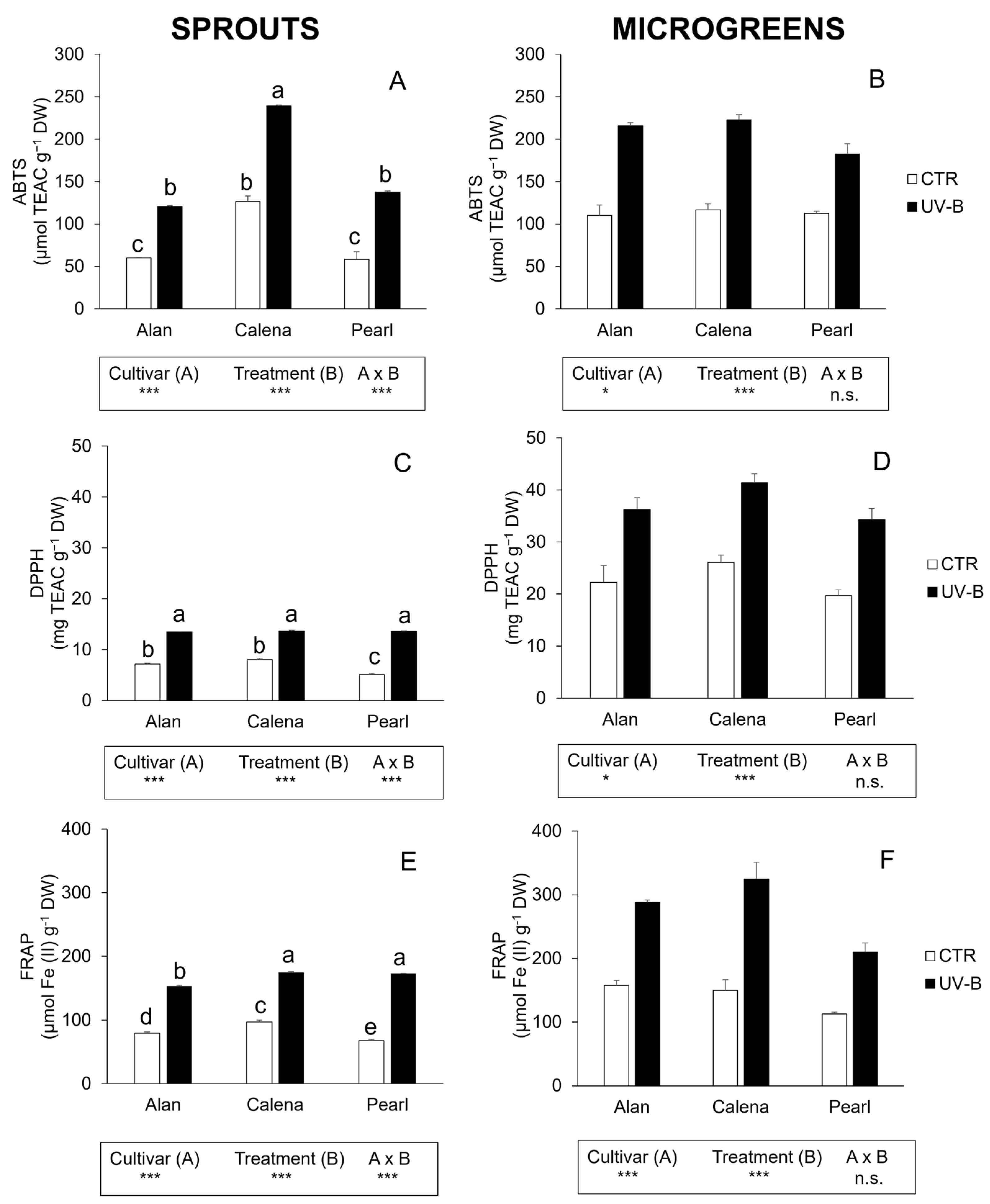
As expected, a positive effect of UV-B supplementation was observed for the antioxidant capacities (Figure 2). Specifically, the antioxidant capacity, measured by ABTS assay (Figure 2A), increased significantly in all the cultivars, with the highest increase in UV-B-treated-sprouts of ‘Pearl’ (+134.5%), followed by ‘Alan’ (+100.4%) and ‘Calena’ (+88.8%). DPPH and FRAP assays confirmed this trend (Figure 2C,E), with the highest increases recorded in treated-sprouts of ‘Pearl’ (+167.3% and +155.8% for DPPH and FRAP, respectively), followed by ‘Alan’ (+86.9% and +93.1% for DPPH and FRAP, respectively) and ‘Calena’ (+70.5% and +80.2%, for DPPH and FRAP, respectively).

3.3.2. Microgreens

A clear effect of UV-B supplementation was also observed in terms of the biochemical parameters of microgreens. The ‘cultivar’ × ‘treatment’ interaction was not statistically significant for either the total phenolics, flavonoids (Figure 1B,D) or antioxidant tests (Figure 2B,D,F), whereas a significant effect of the two factors individually was observed. Indeed, considering the mean effects (Table 5), the cultivars showed significant differences for all the biochemical parameters considered. ‘Alan’ and ‘Calena’ performed similarly concerning the total phenolics and were significantly higher than ‘Pearl’ by 35.1% and 23.0%, respectively. ‘Calena’ showed the highest flavonoid content, followed by ‘Alan’ and ‘Pearl’, with ‘Calena’ being 30.6% higher than ‘Pearl’. For the antioxidant capacity, ‘Calena’ demonstrated the highest ABTS and DPPH values, while ‘Alan’ showed the highest FRAP activity. Overall, UV-B treatment significantly increased the total phenolics by 82.4%, enhanced the flavonoid content by 105.1%, and improved the antioxidant capacity through ABTS, DPPH and FRAP by 83.2%, 64.3%, and 95.5%, respectively.

3.4. Lipid Peroxidation (TBARS) and Proline

3.4.1. Sprouts

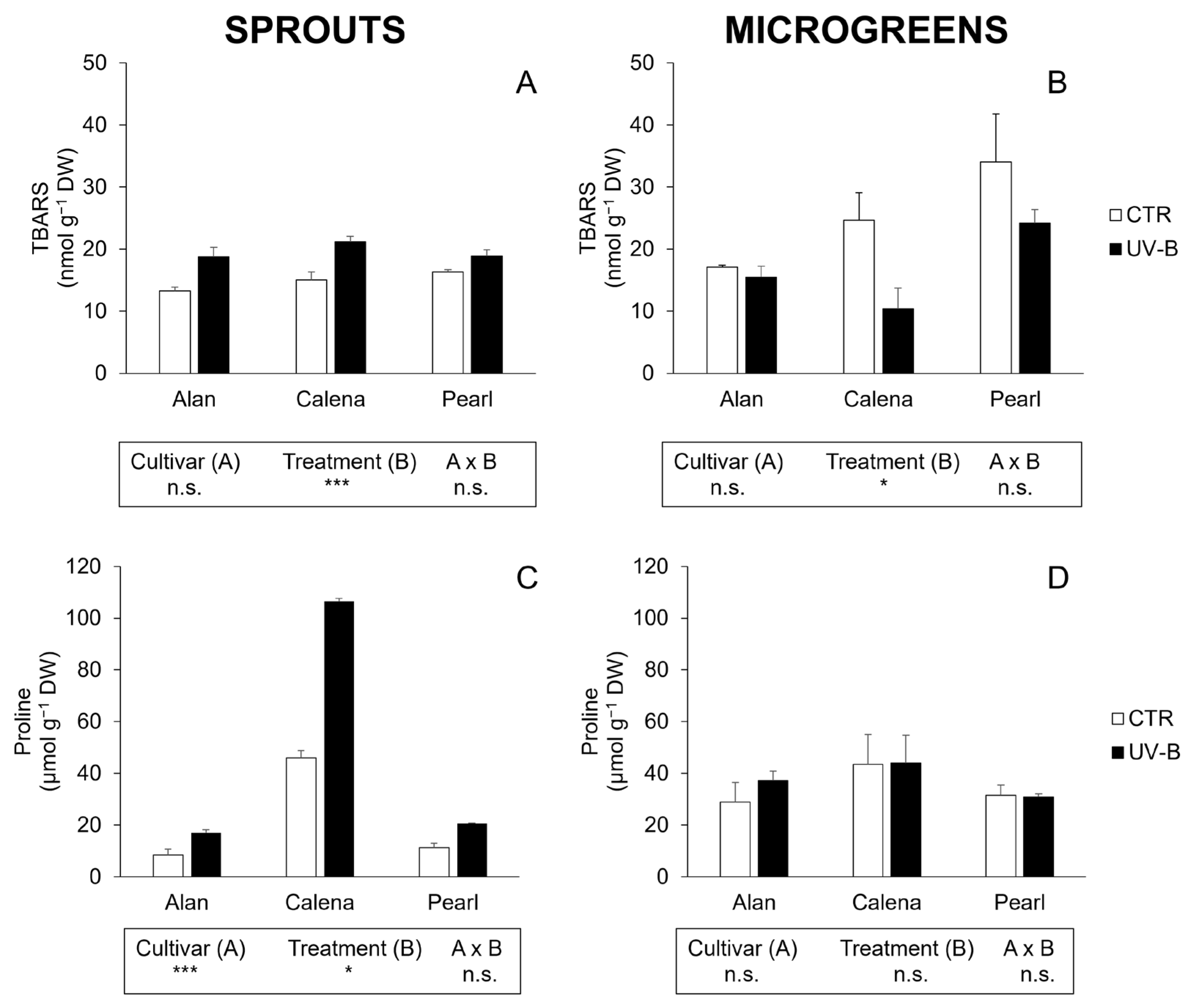
The ‘cultivar’ × ‘treatment’ interaction did not affect either the lipid peroxidation or proline content (Figure 3A). Considering the mean effects, although no differences were detected among the cultivars, lipid peroxidation was affected by UV-B exposure, with a significant 31.8% increase in UV-B-treated sprouts (Table 5). Concerning the proline concentration, it varied significantly depending on both ‘cultivar’ and ‘treatment’ factors. Specifically, ‘Calena’ sprouts showed significantly higher levels of proline compared to ‘Alan’ and ‘Pearl’ (+496.4% and +377.3%, respectively). Overall, UV-B treatment significantly increased the proline content by 119.3% regardless of the cultivar.

3.4.2. Microgreens

Similarly to sprouts, UV-B supplementation did not affect the lipid peroxidation and proline content in camelina microgreens (Figure 3B). Regarding the mean effects (Table 5), the cultivars showed significant differences in the TBARS levels, with ‘Pearl’ exhibiting significantly higher levels compared to ‘Alan’ (78.8%) and ‘Calena’ (66.1%). Overall, UV-B treatment significantly decreased the TBARS levels by 33.9%. Contrarily, the proline content did not differ significantly when considering both factors, ‘cultivar’ and ‘treatment’, singularly.

3.5. Chlorophylls and Carotenoids

3.5.1. Sprouts

UV-B supplementation significantly affected pigment accumulation in camelina sprouts (Table 6), with the ‘cultivar’ × ‘treatment’ interaction being significant only for lutein and β-carotene. For lutein, UV-B exposure resulted in the highest relative increase in ‘Pearl’ (+58.1%), followed by ‘Alan’ (+29.6%) and ‘Calena’ (+3.7%). For β-carotene, UV-B significantly increased the content in all the cultivars, with ‘Pearl’ showing the highest increase (+140.2%), followed by ‘Calena’ (+55.2%) and ‘Alan’ (+40.7%). Regarding the mean effects, among the remaining pigments, the ‘cultivar’ factor significantly influenced only the chlorophyll b content. Specifically, ‘Calena’ showed the highest chlorophyll b levels, which were significantly greater than ‘Pearl’ by 23.4%. Regarding UV-B alone, it significantly increased neoxanthin (30.6%), lutein (14.8%), chlorophyll b (45.2%), chlorophyll a (54.7%), and β-carotene (38.6%).

3.5.2. Microgreens

In camelina microgreens, the pigment profile was also influenced by UV-B exposure, with a significant treatment × cultivar interaction only for violaxanthin (Table 7). Specifically, UV-B significantly increased the violaxanthin concentration in ‘Alan’, ‘Pearl’ and ‘Calena’ by 86.9%, 50.3% and 370.8%, respectively. Regarding the mean effects, besides violaxanthin, the cultivar had a significant impact only on lutein, where ‘Alan’ showed a significantly higher lutein concentration only when compared with ‘Pearl’ (by 18.4%). Considering the UV-B effects regardless of the cultivar, it significantly decreased neoxanthin (20.1%), lutein (16.7%) and chlorophyll b (12.7%).

3.6. Individual and Total Glucosinolates

UV-B supplementation significantly affected the glucosinolate content in camelina sprouts, with cultivar-specific responses observed for the individual compounds (Table 8). In agreement with Bravi et al. [6], three types of aliphatic GLSs were also identified in our 6-day-old sprouts: glucoarabin (9-(methylsulfinyl)nonylglucosinolate, GLS9), glucocamelinin (10-(methylsulfinyl)decylglucosinolate, GLS10) and 11-(methylsulfinyl)undecylglucosinolate, GLS11 (Table 8).
  • The GLS9 content showed significant decreases in the ‘Alan’ and ‘Calena’ cultivars under UV-B treatment, with reductions of 15.1% and 18.4%, respectively.
  • The GLS10 concentration displayed variable responses: ‘Alan’ and ‘Pearl’ were not affected by the UV-B treatment, whereas ‘Calena’ showed a significant 13.9% decrease when sprouts were irradiated with UV-B.
  • The GLS11 content showed no significant changes after the UV-B exposure in any of the cultivars studied, although the lowest GLS11 levels were detected in ‘Pearl’ compared to both ‘Alan’ and ‘Calena’.

When considering the total GLSs, ‘Calena’ was the only cultivar to exhibit a significant change, with a 14.3% decrease in UV-B-treated microgreens. Overall, UV-B treatment significantly decreased the GLS9 and GLS10 concentrations by 7.3% and 5.3%, respectively, while GLS11 remained unchanged. Although the total glucosinolate content was significantly reduced by 5.3% following exposure to UV-B rays, GLS10 remains the most abundant among the three GLSs, as reported in the mature seeds [44].
Table 8. Effects of UV-B irradiation on aliphatic glucosinolate content (µmol g−1 DW) of three camelina cultivars (‘Alan’, ‘Calena’, ‘Pearl’) grown as sprouts for 6 days under controlled conditions. Data are presented as mean ± SE (n = 3). Mean effects represent the average values of each factor (cultivar or UV-B treatment) independently. Different letters within the same column indicate significant differences according to the Tukey–Kramer post hoc test (p < 0.05); data not followed by letters indicate non-significant ANOVA results. Two-way ANOVA results: * p ≤ 0.05; ** p ≤ 0.01; *** p ≤ 0.001; n.s., not significant. GLS9, glucoarabin (9-(methylsulfinyl)nonylglucosinolate); GLS10, glucocamelinin (10-(methylsulfinyl)decylglucosinolate); GLS11, homoglucocamelinin (11-(methylsulfinyl)undecylglucosinolate); Total GLSs, sum of GLS9, GLS10 and GLS11; CTR, control; UV-B, ultraviolet-B treatment; DW, dry weight.
CultivarTreatmentGLS9GLS10GLS11Total GLSs
AlanCTR2.12 ± 0.06 b5.38 ± 0.12 a0.97 ± 0.01 ab8.47 ± 0.19 a
UV-B1.80 ± 0.02 c5.03 ± 0.12 a1.03 ± 0.01 a7.86 ± 0.15 a
CalenaCTR1.74 ± 0.02 c5.03 ± 0.11 a0.99 ± 0.02 ab7.76 ± 0.15 a
UV-B1.42 ± 0.08 d4.33 ± 0.22 b0.90 ± 0.05 b6.65 ± 0.34 b
PearlCTR2.31 ± 0.04 ab4.98 ± 0.14 ab0.70 ± 0.02 c7.99 ± 0.19 a
UV-B2.47 ± 0.06 a5.23 ± 0.08 a0.71 ± 0.01 c8.41 ± 0.13 a
Mean effect
Alan 1.96 ± 0.08 b5.20 ± 0.11 a1.00 ± 0.01 a8.16 ± 0.17 a
Calena 1.58 ± 0.08 c4.68 ± 0.19 b0.95 ± 0.03 a7.20 ± 0.30 b
Pearl 2.39 ± 0.05 a5.11 ± 0.09 a0.71 ± 0.01 b8.20 ± 0.14 a
CTR2.05 ± 0.09 a5.13 ± 0.09 a0.89 ± 0.058.07 ± 0.14 a
UV-B1.90 ± 0.16 b4.86 ± 0.16 b0.88 ± 0.057.64 ± 0.28 b
ANOVA
Cultivar (A) ***********
Treatment (B) ***n.s.*
A × B *******

3.7. Canonical Discriminant Analysis (CDA) and Pearson’s Correlation

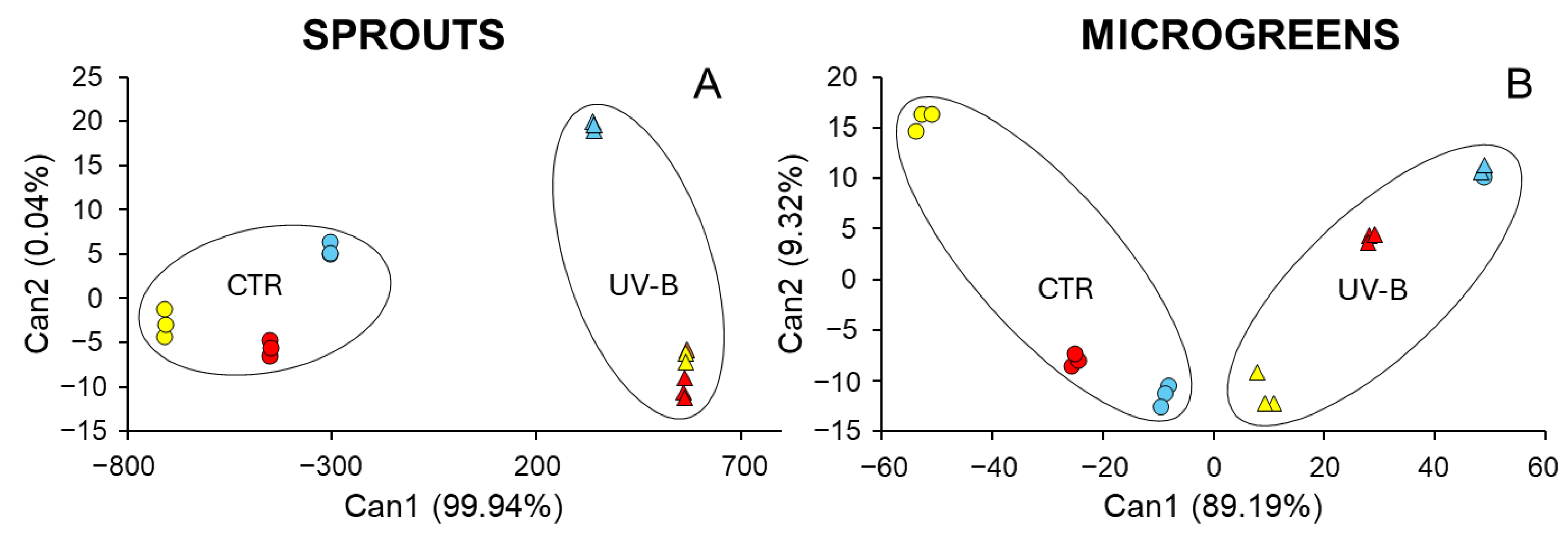
CDA was employed to determine whether the measured variables could discriminate the UV-B responses across cultivars. This analysis helped identify the parameters most responsible for treatment differentiation and revealed cultivar-specific metabolic adjustment patterns.
For sprouts (Figure 4A), the CDA effectively determined a visible segregation of all six groups (Alan–CTR, Alan–UV-B, Calena–CTR, Calena–UV-B, Pearl–CTR, Pearl–UV-B), indicating that both cultivar and UV-B treatment significantly influenced the variables investigated. The canonical function 1 (Can1) explained 99.94% of the variation among the groups, representing the primary axis of differentiation. The canonical function 2 (Can2) accounted for only 0.04% of the variation. For microgreens (Figure 4B), the CDA also showed a clear group separation, with Can1 explaining 89.10% and Can2 explaining 9.32% of the total variation. The CDA-based Pearson’s correlation analysis between the canonical scores and measured variables revealed distinct patterns for sprouts and microgreens (Table 9). In sprouts, the strongest correlations with Can1 were observed for the total phenolics, flavonoids, DPPH, and FRAP, indicating that antioxidant-related parameters were the primary drivers of the group discrimination. Conversely, the hypocotyl length showed a strong negative correlation, reflecting the inverse relationship between UV-B exposure and stem elongation. In microgreens, the correlation pattern was very similar, with the flavonoids, FRAP, DPPH, and ABTS showing the strongest positive correlations with Can1, while the hypocotyl length maintained a strong negative correlation.

3.8. Hierarchical Clustering Analysis

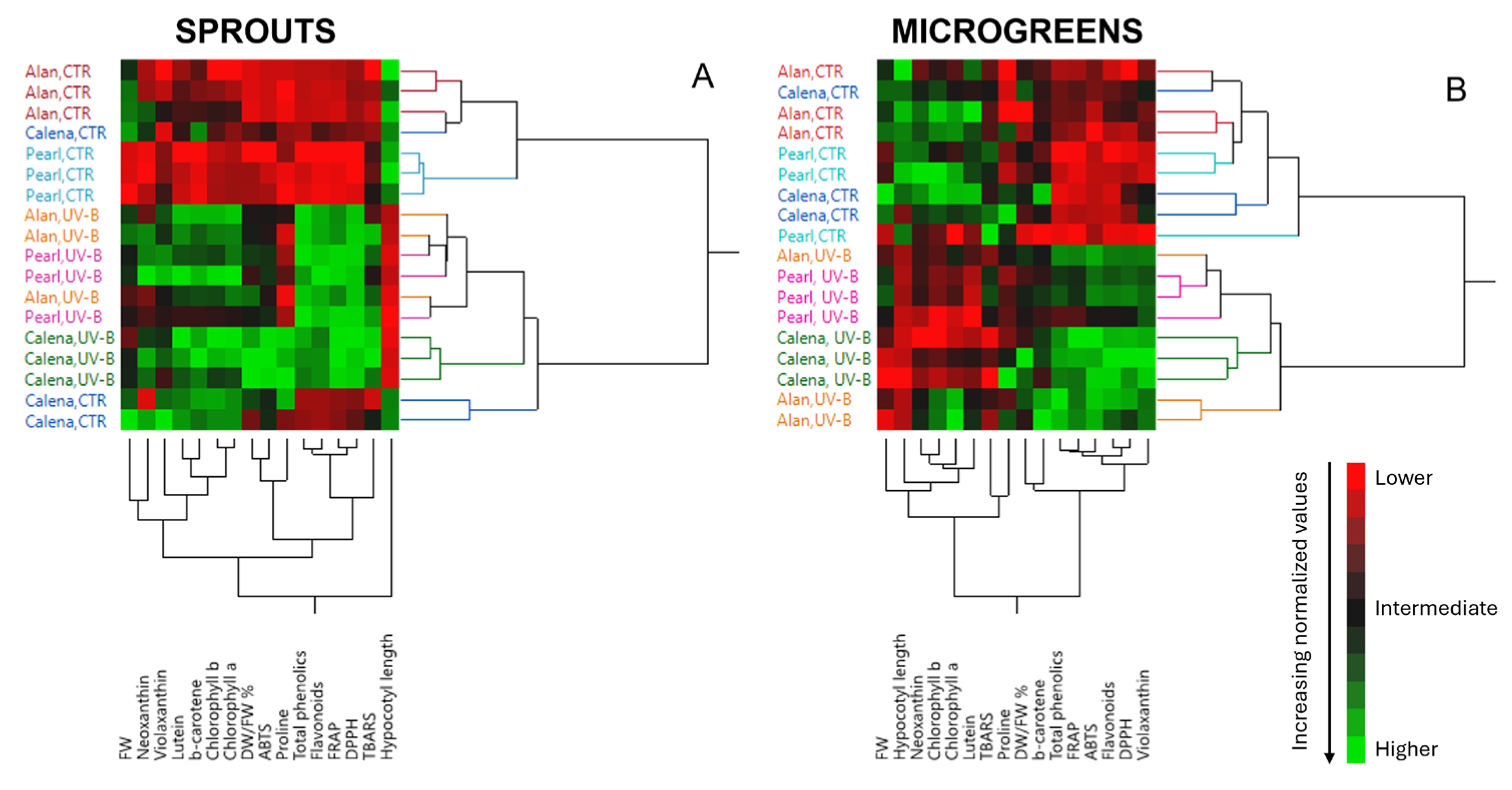
In Figure 5, the hierarchical clustering analysis (HCA) is reported for both sprouts (Figure 5A) and microgreens (Figure 5B). Hierarchical clustering analysis (HCA) using the Euclidean distance and Ward’s linkage method was employed as an unsupervised multivariate approach to visualize the relationships among the experimental groups (cultivar × treatment combinations) based on the morphological and biochemical variables measured. Unlike supervised methods, HCA does not require a priori specification of group membership, allowing emergent patterns in the data to be revealed. For sprouts, the analysis revealed distinct clustering patterns based primarily on UV-B treatment effects. The dendrogram showed that the UV-B-treated samples (Alan–UV-B, Pearl–UV-B, Calena-UV-B) clustered separately from the control groups, with two replicates of Calena–CTR as outliers, grouping among the UV-B-exposed groups. The parameter clustering analysis revealed an initial, major separation between the hypocotyl length and all the other variables, highlighting its distinct and contrasting behavior compared to the others. Within the remaining parameters, two main subclusters were identified: one comprising antioxidant- and stress-related compounds (total phenolics, flavonoids, ABTS, DPPH, FRAP, and proline), and the other including photosynthetic pigments and biomass-related traits (chlorophylls, carotenoids, FW, DW/FW). Similarly to sprouts, the dendrogram of microgreens revealed that the primary clustering was driven by UV-B-related effects. Beyond this main separation, the clustering pattern appeared more complex. In the CTR groups, samples from different cultivars did not cluster together, reflecting similarities in their morphological and biochemical traits. In contrast, within the UV-B group, samples from the same cultivar tended to subcluster, suggesting cultivar-specific responses to UV-B treatment. The parameter clustering in microgreens reflected the one observed for sprouts, with two main clusters emerging: antioxidant-related parameters (with the violaxanthin as outlier) on one side, and photosynthetic pigments, growth parameters and stress markers on the other, reflecting contrasting behaviors. This more complex clustering pattern suggests that the extended growth period allows for more sophisticated metabolic adjustments and cultivar-specific adaptation strategies to UV-B stress.

4. Discussion

The present study showed that UV-B supplementation significantly affected the germination and growth parameters of camelina sprouts and microgreens, with the responses varying among cultivars. The observed reductions in the germination percentage and increases in MGT across all the cultivars align with previous findings on UV-B’s effects in other Brassicaceae species. These results are consistent with Sugimoto [49], who reported delayed growth rates in Brassica rapa L. var. ‘Komatsuna’ subjected to 2 W m−2 UV-B irradiation, and with Begum et al. [50], who observed reduced germination percentages in turnip and rocket sprouts exposed to UV-B for various durations. In contrast, Kim et al. [51] demonstrated that UV-B treatment reduced the relative water content and leaf area in Achyranthes japonica microgreens, although without significant effects on the biomass parameters. The observed delays in germination and growth are consistent with UV-B-induced activation of protective and repair mechanisms, which temporarily reallocate resources away from growth processes in early developmental stages.
The cultivar-specific responses observed in our study highlighted the genetic variability in UV-B tolerance among camelina cultivars. This variability likely reflected differential evolutionary adaptations to UV-B radiation, as suggested by Sullivan et al. [52], who demonstrated that plants develop acclimation strategies based on their natural UV-B exposure environments. Indeed, Skowron et al. [53] demonstrated significant differences between green-leaf and purple-leaf basil cultivars in their response to UV-B, with green cultivars showing greater responsiveness to UV-induced secondary metabolite synthesis due to the lower physiological levels of UV-screening pigments. This finding is in line with our observations in camelina, where cultivar-specific responses were attributed to genetic variations in antioxidant systems and secondary metabolite profiles.
In the literature, it has been observed that the incorporation of specific radiation wavelengths during pre-harvest can improve both growth parameters and bioactive compound profiles in various Brassicaceae cultivars [35,54]. The reduction in sprouts’ and microgreens’ productivity following UV-B treatment is in line with the findings in flax (Linum usitatissimum L.) sprouts and microgreens, where UV-B exposure resulted in decreasing productivity [43]. Similar biomass reductions have also been reported in other crops, including mulberry, lettuce, and radish [55,56,57], suggesting that moderate UV-B supplementation might affect primary metabolic processes involved in growth and development. However, recent studies have shown that controlled UV-B applications can be optimized to minimize growth inhibition while maximizing bioactive compound accumulation [50]. Barańska et al. [58] further emphasized that the conditions of UV application should be carefully considered, as obtaining benefits in bioactive compounds may reduce other parameters.
The significant reductions in the hypocotyl and root lengths observed under UV-B are consistent with previous evidence of UV-B-induced growth inhibition, which has been linked to DNA damage and alterations in cell cycle processes [43,59]. Nonetheless, more recent studies have highlighted that UV-induced morphological adjustments, such as reduced stem elongation and compact phenotypes, can occur in the absence of stress indicators [60,61]. Indeed, in cucumber, UV-B treatment decreased the stem and petiole lengths, although the photosynthetic activity, chlorophyll contents, and DNA integrity remained unaffected [60]. Similarly, in basil, UV supplementation induced shorter and more compact plants, with UV-B producing stronger reductions in stem length than UV-A, particularly in younger tissues [61]. This suggests different sensitivity to UV-B related to plant age, with younger tissues showing greater growth inhibition.
The morphological adjustments may reflect photoreceptor-mediated responses commonly reported under UV-B exposure, although further molecular studies would be required to confirm the involvement of specific signaling pathways. Interestingly, the cultivar ‘Pearl’ showed a significant UV-B-related increase in total fresh weight, while ‘Alan’ and ‘Calena’ exhibited decreases. This differential response suggests that ‘Pearl’ may possess superior UV-B tolerance mechanisms, possibly through enhanced DNA repair systems or more efficient secondary metabolite production pathways that provide better protection against UV-B-induced oxidative stress. Similar cultivar-specific responses have been reported in other Brassicaceae species, where genetic diversity in UV-B tolerance has been linked to differences in antioxidant enzyme activities and secondary metabolite profiles [33].
Concerning the total phenolics and flavonoids concentrations, a strong and significant increase was observed following UV-B treatment. These increases are mediated by the UV-B photoreceptor UVR8 (UV RESISTANCE LOCUS 8), which triggers the phenylpropanoid pathway upon UV-B perception [13,20]. The UVR8 photoreceptor is specifically responsible for detecting UV-B radiation and initiating downstream signaling cascades that, through the activation of specific transcription factors, lead to the enhanced biosynthesis of several protective secondary metabolites, such as phenolic compounds, as demonstrated in Arabidopsis thaliana ((L.) Heynh.) [62,63] and in other different plant species of food interest [10,23,55,64,65,66]. Our results are consistent with Martínez-Zamora et al. [67], who reported substantial increases in the total phenolic content in red cabbage sprouts treated with UV-B (5–15 kJ m−2), and with Castillejo et al. [68], who observed increases in the total phenolic content in kale sprouts under similar UV-B conditions. The higher response magnitude in camelina, compared to other studies conducted in different Brassicaceae species, may be attributed to species-specific differences in UVR8 sensitivity, phenylpropanoid pathway efficiency, or different UV-B treatment conditions. The periodic application of low UV-B doses during growth has been shown to optimize the bioactive content while minimizing the negative effects on plant growth.
The parallel increases in antioxidant capacity measured by the ABTS, DPPH, and FRAP assays directly correlate with the enhanced phenolic and flavonoid accumulation. These improvements in antioxidant capacity are particularly relevant for functional food applications, as they suggest enhanced potential health benefits for consumers. The stronger UV-B-induced phenolic accumulation, and the consequently higher antioxidant capacity observed in our study, reflects the plant’s defensive response to UV-B-induced oxidative stress, where enhanced secondary metabolite production serves both protective and signaling functions [13,69,70,71]. Similar increases in the antioxidant capacity have been reported in various Brassicaceae microgreens under UV-B supplementation [31]. Similarly, Kim et al. [51] reported that UV-B treatment significantly increased the total phenol and flavonoid contents as well as the antioxidant capacity in Achyranthes japonica microgreens, with the antioxidant capacity being directly related to increases in phenolic compounds. The authors emphasized that even short-term UV-B treatment (12 h) before harvest was sufficient to induce significant bioactive compound accumulation, supporting the feasibility of pre-harvest UV treatments in commercial applications.
The differential responses in lipid peroxidation (TBARS) between sprouts and microgreens suggest that the duration of UV-B exposure affects the balance between oxidative stress and antioxidant defense mechanisms. The initial UV-B-related increase in TBARS in sprouts indicates acute oxidative stress, while the decrease in microgreens suggests successful acclimation and enhanced antioxidant protection over the extended exposure period. This temporal pattern of the stress response is consistent with the concept of hormesis, where moderate stress initially induces damage but subsequently triggers adaptive responses that enhance plant resilience [68,72,73,74,75,76]. Skowron et al. [53] observed similar patterns in basil, where cultivars with higher UV responsiveness for secondary metabolite synthesis also presented higher levels of lipid peroxidation, indicating a correlation between oxidative stress and defensive compound accumulation.
The reduction in lipid peroxidation in microgreens despite continued UV-B exposure indicates that the enhanced antioxidant systems effectively counteracted the oxidative damage over time. The significant increase in the proline content in sprouts, particularly pronounced in ‘Calena’, represents a typical plant stress response. Proline accumulation serves multiple protective functions, including osmotic adjustment, ROS scavenging, and membrane stabilization [77]. The cultivar-specific differences in proline accumulation may contribute to the observed variations in UV-B tolerance and could serve as a biochemical marker for selecting UV-B-tolerant genotypes.
The differential effects of UV-B on photosynthetic pigments between sprouts and microgreens reveal complex developmental stage-specific responses. In sprouts, the increases in chlorophyll a, chlorophyll b, and carotenoids suggest enhanced photosynthetic capacity and photoprotection. These responses are consistent with previous findings showing that UV-B radiation can stimulate chlorophyll and carotenoid biosynthesis as part of the plant’s adaptive response to light stress [78]. However, conflicting results have been reported regarding UV’s effects on photosynthetic pigments. Skowron et al. [53] found that UV-B treatment significantly decreased the chlorophyll and carotenoid levels in basil cultivars, although this did not impair the photosynthetic activity as measured by chlorophyll fluorescence parameters. Similarly, Brazaitytė et al. [31], albeit under UV-A supplementation, reported no significant effects on the chlorophyll content in mustard microgreens, noting that UV-absorbing compounds can provide photoprotection for the photosynthetic apparatus. Conversely, the decreases in some pigments in microgreens may reflect reallocation of resources toward secondary metabolite production. This resource reallocation is a common plant strategy under stress conditions, where primary metabolic processes are adjusted to support enhanced defense mechanisms [78,79,80].
Glucosinolate analysis was conducted only in 6-day-old sprouts, as the organs most enriched in aliphatic GLSs are the seeds of mature plants and their roots, whereas only very low GLS levels are found in the leaves [81]. The total GLS content result was similar to that reported in Galasso et al. [82], who analyzed camelina sprouts in the same developmental stages. The UV-B-induced changes in the glucosinolate profiles observed in this study on camelina contrast with the general increase reported in other Brassicaceae species. Unlike the significant enhancement in the glucosinolate concentration reported in broccoli, radish, and kale sprouts [58,83,84,85], camelina sprouts showed no changes or negative responses, with total glucosinolate content decreasing significantly by 5.3%. This divergent response highlights the importance of species-specific glucosinolate regulation and suggests that camelina might employ different adaptive strategies compared to other Brassicaceae family members. In addition, the cultivar-specific UV-B responses observed in camelina, with ‘Calena’ being the most negatively UV-B-affected cultivar, reflect genetic diversity in glucosinolate biosynthetic pathway regulation. A possible explanation for the UV-B-induced decrease in the glucosinolate content might be a redirection of the carbon flux away from glucosinolate biosynthesis toward phenylpropanoid pathway products, resulting in the observed significant increases in phenolic compounds and flavonoids under UV-B treatment. Additionally, the 6-day growth period for camelina sprouts may have allowed for metabolic rebalancing that favored other secondary metabolite pathways. Lu et al. [86] demonstrated that UV-B treatment affects both glucosinolate biosynthesis genes and myrosinase expression, suggesting complex regulatory networks that may vary among species.
While the present findings provide valuable insights into camelina’s responses to UV-B, further research is needed to optimize treatment protocols. This may involve combining UV-B with other wavelengths, such as blue or red light, to maximize the accumulation of health-promoting compounds while minimizing growth inhibition. In addition, studies on the stability of enhanced bioactive compounds during storage and processing are required to assess the commercial potential. Finally, validation of these results using UV-B LEDs, rather than traditional lamps, is recommended, considering the rapid advances in LED-based lighting systems for agriculture [87,88]. Finally, elucidating the molecular mechanisms underlying cultivar-specific responses could inform breeding programs aimed at developing UV-B-tolerant genotypes with improved nutraceutical properties. The integration of UV-B with additional elicitation strategies, including controlled drought, temperature shifts, or chemical elicitors, offers further potential to synergistically boost bioactive compound accumulation and maximize the benefits of controlled environment agriculture.

5. Conclusions

This study demonstrated that controlled UV-B radiation can effectively enhance the nutritional quality of camelina sprouts and microgreens through a series of physiological and metabolic responses. Specifically, reallocation of metabolic resources from vegetative growth toward plant protection resulted in the accumulation of secondary metabolites, increased antioxidant capacity, and activation of defense mechanisms. Despite the cultivar-dependent responses suggesting genetic differences in UV-B sensitivity, pre-harvest UV-B treatment might have great potential as a sustainable and eco-friendly tool for the production of functional foods with enhanced health benefits.

Supplementary Materials

The following supporting information can be downloaded at https://www.mdpi.com/article/10.3390/horticulturae11121464/s1. Figure S1. Absolute irradiance spectrum of the lighting systems used in the experiment, including both the UV-B lamps and the PAR LED array. Figure S2. Representative images of camelina sprouts (A) and microgreens (B) at the time of sampling (6 and 14 days after sowing, respectively). (C) Microgreens at the end of the UV-B treatment, showing the three cultivars exposed to UV-B (1 = ‘Alan’, 2 = ‘Pearl’, 3 = ‘Calena’) and their respective controls (4 = ‘Alan’, 5 = ‘Pearl’, 6 = ‘Calena’). The images illustrate the general morphology and canopy appearance at harvest for both developmental stages and treatments.

Author Contributions

Conceptualization, M.S., C.C., A.C. and S.T.; methodology, M.S., S.T. and A.C.; formal analysis, M.S., C.C., G.V., I.M.B., S.T., I.G. and A.C.; investigation, M.S., C.C., G.V. and I.M.B.; resources, A.C., A.R., I.G., L.G.A. and S.T.; data curation, M.S., C.C., I.G., L.G.A., A.C. and S.T.; writing—original draft preparation, M.S., C.C., S.T. and A.C.; writing—review and editing, M.S., C.C., A.C., G.V., I.M.B., I.G., A.R., L.G.A. and S.T.; supervision, A.C. and S.T.; project administration, M.S. and C.C.; funding acquisition, L.G.A., A.C. and S.T. All authors have read and agreed to the published version of the manuscript.

Funding

This research received no external funding.

Data Availability Statement

The original contributions presented in this study are included in the article/Supplementary Material. Further inquiries can be directed to the corresponding author.

Conflicts of Interest

The authors declare no conflicts of interest.

Abbreviations

The following abbreviations are used in this manuscript:
ABTS2,2′-azinobis-(3-ethylbenzothiazoline-6-sulphonic acid) (antioxidant assay)
ANOVAAnalysis of variance
CAECatechin equivalents (for total flavonoids)
CDACanonical Discriminant Analysis
CTRControl (untreated condition)
DPPH2,2-diphenyl-1-picrylhydrazyl (free radical; antioxidant assay
DWDry weight
DW/FWDry weight to fresh weight ratio
ECElectrical conductivity
FWFresh weight
FW/DWFresh weight to dry weight ratio
FRAPFerric Reducing Antioxidant Power (antioxidant assay)
GAEGallic acid equivalents (for total phenolics
GLSGlucosinolates
GLS9Glucoarabin (9-(methylsulfinyl)nonylglucosinolate)
GLS10Glucocamelinin (10-(methylsulfinyl)decylglucosinolate)
GLS11Homoglucocamelinin (11-(methylsulfinyl)undecylglucosinolate)
HCAHierarchical clustering analysis
HPLCHigh-performance liquid chromatography
LED/LEDsLight-emitting diode(s)
MDAMalondialdehyde (lipid peroxidation marker)
MGTMean germination time
ODSOctadecylsilane (C18) stationary phase
PARPhotosynthetically active radiation
PPFDPhotosynthetic photon flux density
SEStandard error
TBARSThiobarbituric acid reactive substances (lipid peroxidation assay)
TBA Thiobarbituric acid
TCATrichloroacetic acid
TEACTrolox equivalent antioxidant capacity
UV-AUltraviolet-A (315–400 nm)
UV-BUltraviolet-B (280–320 nm)
UVR8UV RESISTANCE LOCUS 8 (UV-B photoreceptor)

References

  1. Mondor, M.; Hernández-Álvarez, A.J. Camelina Sativa Composition, Attributes, and Applications: A Review. Euro J. Lipid Sci. Tech. 2022, 124, 2100035. [Google Scholar] [CrossRef]
  2. Sydor, M.; Kurasiak-Popowska, D.; Stuper-Szablewska, K.; Rogoziński, T. Camelina Sativa. Status Quo and Future Perspectives. Ind. Crops Prod. 2022, 187, 115531. [Google Scholar] [CrossRef]
  3. Angelini, L.G.; Abou Chehade, L.; Foschi, L.; Tavarini, S. Performance and Potentiality of Camelina (Camelina Sativa L. Crantz) Genotypes in Response to Sowing Date under Mediterranean Environment. Agronomy 2020, 10, 1929. [Google Scholar] [CrossRef]
  4. Zanetti, F.; Alberghini, B.; Marjanović Jeromela, A.; Grahovac, N.; Rajković, D.; Kiprovski, B.; Monti, A. Camelina, an Ancient Oilseed Crop Actively Contributing to the Rural Renaissance in Europe. A Review. Agron. Sustain. Dev. 2021, 41, 2. [Google Scholar] [CrossRef]
  5. Clemente, C.; Rossi, A.; Angelini, L.G.; Villalba, R.G.; Moreno, D.A.; Tomás-Barberán, F.A.; Tavarini, S. Effect of Environmental Conditions on Seed Yield and Metabolomic Profile of Camelina (Camelina Sativa (L.) Crantz) through on Farm Multilocation Trials. J. Agric. Food Res. 2025, 21, 101814. [Google Scholar] [CrossRef]
  6. Bravi, E.; Falcinelli, B.; Mallia, G.; Marconi, O.; Royo-Esnal, A.; Benincasa, P. Effect of Sprouting on the Phenolic Compounds, Glucosinolates, and Antioxidant Activity of Five Camelina Sativa (L.) Crantz Cultivars. Antioxidants 2023, 12, 1495. [Google Scholar] [CrossRef]
  7. Ebert, A.W.; Wu, T.H.; Yang, R.Y. Amaranth Sprouts and Microgreens–a Homestead Vegetable Production Option to Enhance Food and Nutrition Security in the Rural-Urban Continuum. In Proceedings of the Regional Symposium on Sustaining Small-Scale Vegetable Production and Marketing Systems for Food and Nutrition Security (SEAVEG2014), Bangkok, Thailand, 25–27 February 2015. [Google Scholar] [CrossRef]
  8. Galieni, A.; Falcinelli, B.; Stagnari, F.; Datti, A.; Benincasa, P. Sprouts and Microgreens: Trends, Opportunities, and Horizons for Novel Research. Agronomy 2020, 10, 1424. [Google Scholar] [CrossRef]
  9. Kapusta-Duch, J.; Smoleń, S.; Jędrszczyk, E.; Leszczyńska, T.; Borczak, B. Basic Composition, Antioxidative Properties, and Selected Mineral Content of the Young Shoots of Nigella (Nigella Sativa L.), Safflower (Carthamus Tinctorius L.), and Camelina (Camelina Sativa L.) at Different Stages of Vegetation. Appl. Sci. 2024, 14, 1065. [Google Scholar] [CrossRef]
  10. Santin, M.; Ranieri, A.; Castagna, A. Anything New under the Sun? An Update on Modulation of Bioactive Compounds by Different Wavelengths in Agricultural Plants. Plants 2021, 10, 1485. [Google Scholar] [CrossRef]
  11. Chen, Z.; Dong, Y.; Huang, X. Plant Responses to UV-B Radiation: Signaling, Acclimation and Stress Tolerance. Stress Biol. 2022, 2, 51. [Google Scholar] [CrossRef]
  12. Jenkins, G.I. The UV-B Photoreceptor UVR8: From Structure to Physiology. Plant Cell 2014, 26, 21–37. [Google Scholar] [CrossRef] [PubMed]
  13. Rizzini, L.; Favory, J.-J.; Cloix, C.; Faggionato, D.; O’Hara, A.; Kaiserli, E.; Baumeister, R.; Schäfer, E.; Nagy, F.; Jenkins, G.I.; et al. Perception of UV-B by the Arabidopsis UVR8 Protein. Science 2011, 332, 103–106. [Google Scholar] [CrossRef] [PubMed]
  14. Wu, D.; Hu, Q.; Yan, Z.; Chen, W.; Yan, C.; Huang, X.; Zhang, J.; Yang, P.; Deng, H.; Wang, J.; et al. Structural Basis of Ultraviolet-B Perception by UVR8. Nature 2012, 484, 214–219. [Google Scholar] [CrossRef] [PubMed]
  15. Shi, C.; Liu, H. How Plants Protect Themselves from Ultraviolet-B Radiation Stress. Plant Physiol. 2021, 187, 1096–1103. [Google Scholar] [CrossRef]
  16. Jaiswal, D.; Agrawal, M.; Agrawal, S.B. Dose Differentiation in Elevated UV-B Manifests Variable Response of Carbon–Nitrogen Content with Changes in Secondary Metabolites of Curcuma Caesia Roxb. Environ. Sci. Pollut. Res. 2022, 29, 72871–72885. [Google Scholar] [CrossRef]
  17. Pandey, A.; Agrawal, M.; Agrawal, S.B. Ultraviolet-B Induced Modifications in Growth, Physiology, Essential Oil Content and Composition of a Medicinal Herbal Plant Psoralea Corylifolia. Hortic. Environ. Biotechnol. 2022, 63, 917–934. [Google Scholar] [CrossRef]
  18. Rai, K.; Agrawal, S.B. Effects of Elevated Ultraviolet-B on the Floral and Leaf Characteristics of a Medicinal Plant Wedelia Chinensis (Osbeck) Merr. along with Essential Oil Contents. Trop. Ecol. 2023, 64, 307–323. [Google Scholar] [CrossRef]
  19. Rai, K.; Agrawal, S.B. An Assessment of Dose-Dependent UV-B Sensitivity in Eclipta Alba: Biochemical Traits, Antioxidative Properties, and Wedelolactone Yield. Environ. Sci. Pollut. Res. 2021, 28, 45434–45449. [Google Scholar] [CrossRef]
  20. Brown, B.A.; Cloix, C.; Jiang, G.H.; Kaiserli, E.; Herzyk, P.; Kliebenstein, D.J.; Jenkins, G.I. A UV-B-Specific Signaling Component Orchestrates Plant UV Protection. Proc. Natl. Acad. Sci. USA 2005, 102, 18225–18230. [Google Scholar] [CrossRef]
  21. Favory, J.-J.; Stec, A.; Gruber, H.; Rizzini, L.; Oravecz, A.; Funk, M.; Albert, A.; Cloix, C.; Jenkins, G.I.; Oakeley, E.J.; et al. Interaction of COP1 and UVR8 Regulates UV-B-Induced Photomorphogenesis and Stress Acclimation in Arabidopsis. EMBO J. 2009, 28, 591–601. [Google Scholar] [CrossRef]
  22. Takshak, S.; Agrawal, S.B. Defense Potential of Secondary Metabolites in Medicinal Plants under UV-B Stress. J. Photochem. Photobiol. B Biol. 2019, 193, 51–88. [Google Scholar] [CrossRef]
  23. Santin, M.; Lucini, L.; Castagna, A.; Rocchetti, G.; Hauser, M.-T.; Ranieri, A. Comparative “Phenol-Omics” and Gene Expression Analyses in Peach (Prunus Persica) Skin in Response to Different Postharvest UV-B Treatments. Plant Physiol. Biochem. 2019, 135, 511–519. [Google Scholar] [CrossRef]
  24. Graßmann, J. Terpenoids as Plant Antioxidants. In Vitamins & Hormones; Elsevier: Amsterdam, The Netherlands, 2005; Volume 72, pp. 505–535. ISBN 978-0-12-709872-2. [Google Scholar]
  25. Dincheva, I.; Badjakov, I.; Galunska, B. New Insights into the Research of Bioactive Compounds from Plant Origins with Nutraceutical and Pharmaceutical Potential. Plants 2023, 12, 258. [Google Scholar] [CrossRef] [PubMed]
  26. Caleja, C.; Ribeiro, A.; Barreiro, M.F.; Ferreira, I.C.F.R. Phenolic Compounds as Nutraceuticals or Functional Food Ingredients. CPD 2017, 23, 2787–2806. [Google Scholar] [CrossRef] [PubMed]
  27. Schreiner, M.; Mewis, I.; Huyskens-Keil, S.; Jansen, M.A.K.; Zrenner, R.; Winkler, J.B.; O’Brien, N.; Krumbein, A. UV-B-Induced Secondary Plant Metabolites-Potential Benefits for Plant and Human Health. Crit. Rev. Plant Sci. 2012, 31, 229–240. [Google Scholar] [CrossRef]
  28. Traka, M.H. Health Benefits of Glucosinolates. In Advances in Botanical Research; Elsevier: Amsterdam, The Netherlands, 2016; Volume 80, pp. 247–279. ISBN 978-0-08-100327-5. [Google Scholar]
  29. Ulm, R.; Jenkins, G.I. Q&A: How Do Plants Sense and Respond to UV-B Radiation? BMC Biol. 2015, 13, 45. [Google Scholar] [CrossRef]
  30. Brazaitytė, A.; Sakalauskienė, S.; Samuolienė, G.; Jankauskienė, J.; Viršilė, A.; Novičkovas, A.; Sirtautas, R.; Miliauskienė, J.; Vaštakaitė, V.; Dabašinskas, L.; et al. The Effects of LED Illumination Spectra and Intensity on Carotenoid Content in Brassicaceae Microgreens. Food Chem. 2015, 173, 600–606. [Google Scholar] [CrossRef]
  31. Brazaitytė, A.; Miliauskienė, J.; Vaštakaitė-Kairienė, V.; Sutulienė, R.; Laužikė, K.; Duchovskis, P.; Małek, S. Effect of Different Ratios of Blue and Red LED Light on Brassicaceae Microgreens under a Controlled Environment. Plants 2021, 10, 801. [Google Scholar] [CrossRef]
  32. Nasibi, F.; M-Kalantari, K. The Effects Of Uv-A, Uv-B And Uv-C On Protein And Ascorbate Content, Lipid Peroxidation and Biosynthesis of Screening Compounds in Brassica napus. Trans. A Sci. 2005, 29, 39–48. [Google Scholar] [CrossRef]
  33. Neugart, S.; Majer, P.; Schreiner, M.; Hideg, É. Blue Light Treatment but Not Green Light Treatment After Pre-Exposure to UV-B Stabilizes Flavonoid Glycoside Changes and Corresponding Biological Effects in Three Different Brassicaceae Sprouts. Front. Plant Sci. 2021, 11, 611247. [Google Scholar] [CrossRef]
  34. Olsson, L.C.; Veit, M.; Weissenböck, G.; Bornman, J.F. Differential Flavonoid Response to Enhanced UV-B Radiation in Brassica Napus. Phytochemistry 1998, 49, 1021–1028. [Google Scholar] [CrossRef]
  35. Samuolienė, G.; Brazaitytė, A.; Viršilė, A.; Miliauskienė, J.; Vaštakaitė-Kairienė, V.; Duchovskis, P. Nutrient Levels in Brassicaceae Microgreens Increase Under Tailored Light-Emitting Diode Spectra. Front. Plant Sci. 2019, 10, 1475. [Google Scholar] [CrossRef]
  36. ISTA. Germination Test, 2015th ed.; ISTA: Bassersdorf, Switzerland, 2015. [Google Scholar]
  37. Santin, M.; Parichanon, P.; Sciampagna, M.C.; Ranieri, A.; Castagna, A. Enhancing Tomato Productivity and Quality in Moderately Saline Soils through Salicornia-Assisted Cultivation Methods: A Comparative Study. Horticulturae 2024, 10, 655. [Google Scholar] [CrossRef]
  38. Alonso Borbalán, Á.M.; Zorro, L.; Guillén, D.A.; García Barroso, C. Study of the Polyphenol Content of Red and White Grape Varieties by Liquid Chromatography–Mass Spectrometry and Its Relationship to Antioxidant Power. J. Chromatogr. A 2003, 1012, 31–38. [Google Scholar] [CrossRef]
  39. Kim, D.-O.; Chun, O.K.; Kim, Y.J.; Moon, H.-Y.; Lee, C.Y. Quantification of Polyphenolics and Their Antioxidant Capacity in Fresh Plums. J. Agric. Food Chem. 2003, 51, 6509–6515. [Google Scholar] [CrossRef]
  40. Re, R.; Pellegrini, N.; Proteggente, A.; Pannala, A.; Yang, M.; Rice-Evans, C. Antioxidant Activity Applying an Improved ABTS Radical Cation Decolorization Assay. Free. Radic. Biol. Med. 1999, 26, 1231–1237. [Google Scholar] [CrossRef]
  41. Benzie, I.F.F.; Strain, J.J. The Ferric Reducing Ability of Plasma (FRAP) as a Measure of “Antioxidant Power”: The FRAP Assay. Anal. Biochem. 1996, 239, 70–76. [Google Scholar] [CrossRef]
  42. Gulcin, İ.; Alwasel, S.H. DPPH Radical Scavenging Assay. Processes 2023, 11, 2248. [Google Scholar] [CrossRef]
  43. Santin, M.; Sciampagna, M.C.; Mannucci, A.; Puccinelli, M.; Angelini, L.G.; Tavarini, S.; Accorsi, M.; Incrocci, L.; Ranieri, A.; Castagna, A. Supplemental UV-B Exposure Influences the Biomass and the Content of Bioactive Compounds in Linum Usitatissimum L. Sprouts and Microgreens. Horticulturae 2022, 8, 213. [Google Scholar] [CrossRef]
  44. Pozzo, S.; Piergiovanni, A.R.; Ponzoni, E.; Brambilla, I.M.; Galasso, I. Evaluation of Nutritional and Antinutritional Compounds in a Collection of Camelina Sativa Varieties. J. Crop Improv. 2023, 37, 934–952. [Google Scholar] [CrossRef]
  45. Russo, R.; Galasso, I.; Reggiani, R. Variability in Glucosinolate Content among Camelina Species. AJPS 2014, 05, 294–298. [Google Scholar] [CrossRef]
  46. Draper, H.H.; Hadley, M. [43] Malondialdehyde Determination as Index of Lipid Peroxidation. In Methods in Enzymology; Elsevier: Amsterdam, The Netherlands, 1990; Volume 186, pp. 421–431. ISBN 978-0-12-182087-9. [Google Scholar]
  47. Kosugi, H.; Kikugawa, K. Thiobarbituric Acid Reaction of Aldehydes and Oxidized Lipids in Glacial Acetic Acid. Lipids 1985, 20, 915–921. [Google Scholar] [CrossRef]
  48. Bates, L.S.; Waldren, R.P.; Teare, I.D. Rapid Determination of Free Proline for Water-Stress Studies. Plant Soil. 1973, 39, 205–207. [Google Scholar] [CrossRef]
  49. Sugimoto, K. Seed Germination Under UV-B Irradiation; Minami Kyushu University: Miyazaki, Japan, 2013; Volume 43. [Google Scholar]
  50. Begum, H.A.; Hamayun, M.; Shad, N.; Khan, W.; Ahmad, J.; Khan, M.E.H.; Jones, D.A.; Ali, K. Effects of UV Radiation on Germination, Growth, Chlorophyll Content, and Fresh and Dry Weights of Brassica Rapa L. and Eruca Sativa L. Sarhad J. Agric. 2021, 37, 1016–1024. [Google Scholar] [CrossRef]
  51. Kim, Y.L.; Yeom, M.-S.; Sim, H.-S.; Lee, G.O.; Kang, I.-J.; Yang, G.-S.; Yun, J.G.; Son, K.-H. Effect of Pre-Harvest Intermittent UV-B Exposure on Growth and Secondary Metabolites in Achyranthes Japonica Nakai Microgreens in a Vertical Farm. Horticulturae 2024, 10, 1040. [Google Scholar] [CrossRef]
  52. Sullivan, J.H.; Teramura, A.H.; Ziska, L.H. Variation in UV-B Sensitivity in Plants from a 3,000-m Elevational Gradient in Hawaii. Am. J. Bot. 1992, 79, 737. [Google Scholar] [CrossRef]
  53. Skowron, E.; Trojak, M.; Pacak, I.; Węzigowska, P.; Szymkiewicz, J. Enhancing the Quality of Indoor-Grown Basil Microgreens with Low-Dose UV-B or UV-C Light Supplementation. IJMS 2025, 26, 2352. [Google Scholar] [CrossRef]
  54. Vaštakaitė, V.; Viršilė, A.; Brazaitytė, A.; Samuolienė, G.; Jankauskienė, J.; Novičkovas, A.; Duchovskis, P. Pulsed Light-Emitting Diodes for a Higher Phytochemical Level in Microgreens. J. Agric. Food Chem. 2017, 65, 6529–6534. [Google Scholar] [CrossRef]
  55. Chen, M.; Huang, Y.; Liu, G.; Qin, F.; Yang, S.; Xu, X. Effects of Enhanced UV-B Radiation on Morphology, Physiology, Biomass, Leaf Anatomy and Ultrastructure in Male and Female Mulberry (Morus Alba) Saplings. Environ. Exp. Bot. 2016, 129, 85–93. [Google Scholar] [CrossRef]
  56. Rajabbeigi, E.; Eichholz, I.; Beesk, N.; Ulrichs, C.; Kroh, L.W.; Rohn, S.; Huyskens-Keil, S. Interaction of Drought Stress and UV-B Radiation-Impact on Biomass Production and Flavonoid Metabolism in Lettuce (Lactuca Sativa L.). J. Appl. Bot. Food Qual. 2013, 86, 190–197. [Google Scholar] [CrossRef]
  57. Singh, S.; Kumari, R.; Agrawal, M.; Agrawal, S.B. Modification in Growth, Biomass and Yield of Radish under Supplemental UV-B at Different NPK Levels. Ecotoxicol. Environ. Saf. 2011, 74, 897–903. [Google Scholar] [CrossRef]
  58. Barańska, D.; Panek, J.; Różalska, S.; Turnau, K.; Frąc, M. Microgreens as the Future of Urban Horticulture and Superfoods, Supported by Post-Harvest Innovations for Shelf-Life Increase: A Review. Sci. Hortic. 2025, 350, 114303. [Google Scholar] [CrossRef]
  59. Biever, J.J.; Brinkman, D.; Gardner, G. UV-B Inhibition of Hypocotyl Growth in Etiolated Arabidopsis Thaliana Seedlings Is a Consequence of Cell Cycle Arrest Initiated by Photodimer Accumulation. J. Exp. Bot. 2014, 65, 2949–2961. [Google Scholar] [CrossRef]
  60. Qian, M.; Rosenqvist, E.; Prinsen, E.; Pescheck, F.; Flygare, A.-M.; Kalbina, I.; Jansen, M.A.K.; Strid, Å. Downsizing in Plants—UV Light Induces Pronounced Morphological Changes in the Absence of Stress. Plant Physiol. 2021, 187, 378–395. [Google Scholar] [CrossRef]
  61. Qian, M.; Kalbina, I.; Rosenqvist, E.; Jansen, M.A.K.; Strid, Å. Supplementary UV-A and UV-B Radiation Differentially Regulate Morphology in Ocimum Basilicum. Photochem. Photobiol. Sci. 2023, 22, 2219–2230. [Google Scholar] [CrossRef]
  62. Heijde, M.; Ulm, R. UV-B Photoreceptor-Mediated Signalling in Plants. Trends Plant Sci. 2012, 17, 230–237. [Google Scholar] [CrossRef]
  63. Stracke, R.; Favory, J.-J.; Gruber, H.; Bartelniewoehner, L.; Bartels, S.; Binkert, M.; Funk, M.; Weisshaar, B.; Ulm, R. The Arabidopsis bZIP Transcription Factor HY5 Regulates Expression of the PFG1/MYB12 Gene in Response to Light and Ultraviolet-B Radiation. Plant Cell Environ. 2010, 33, 88–103. [Google Scholar] [CrossRef]
  64. Giuntini, D.; Lazzeri, V.; Calvenzani, V.; Dall’Asta, C.; Galaverna, G.; Tonelli, C.; Petroni, K.; Ranieri, A. Flavonoid Profiling and Biosynthetic Gene Expression in Flesh and Peel of Two Tomato Genotypes Grown under UV-B-Depleted Conditions during Ripening. J. Agric. Food Chem. 2008, 56, 5905–5915. [Google Scholar] [CrossRef]
  65. Sheng, K.; Shui, S.; Yan, L.; Liu, C.; Zheng, L. Effect of Postharvest UV-B or UV-C Irradiation on Phenolic Compounds and Their Transcription of Phenolic Biosynthetic Genes of Table Grapes. J. Food Sci. Technol. 2018, 55, 3292–3302. [Google Scholar] [CrossRef]
  66. Ubi, B.E.; Honda, C.; Bessho, H.; Kondo, S.; Wada, M.; Kobayashi, S.; Moriguchi, T. Expression Analysis of Anthocyanin Biosynthetic Genes in Apple Skin: Effect of UV-B and Temperature. Plant Sci. 2006, 170, 571–578. [Google Scholar] [CrossRef]
  67. Martínez-Zamora, L.; Castillejo, N.; Artés-Hernández, F. Postharvest UV-B and Photoperiod with Blue + Red LEDs as Strategies to Stimulate Carotenogenesis in Bell Peppers. Appl. Sci. 2021, 11, 3736. [Google Scholar] [CrossRef]
  68. Castillejo, N.; Martínez-Zamora, L.; Artés-Hernández, F. Periodical UV-B Radiation Hormesis in Biosynthesis of Kale Sprouts Nutraceuticals. Plant Physiol. Biochem. 2021, 165, 274–285. [Google Scholar] [CrossRef]
  69. Cloix, C.; Kaiserli, E.; Heilmann, M.; Baxter, K.J.; Brown, B.A.; O’Hara, A.; Smith, B.O.; Christie, J.M.; Jenkins, G.I. C-Terminal Region of the UV-B Photoreceptor UVR8 Initiates Signaling through Interaction with the COP1 Protein. Proc. Natl. Acad. Sci. USA 2012, 109, 16366–16370. [Google Scholar] [CrossRef]
  70. Czégény, G.; Mátai, A.; Hideg, É. UV-B Effects on Leaves—Oxidative Stress and Acclimation in Controlled Environments. Plant Sci. 2016, 248, 57–63. [Google Scholar] [CrossRef] [PubMed]
  71. Hideg, É.; Jansen, M.A.K.; Strid, Å. UV-B Exposure, ROS, and Stress: Inseparable Companions or Loosely Linked Associates? Trends Plant Sci. 2013, 18, 107–115. [Google Scholar] [CrossRef]
  72. Agathokleous, E.; Calabrese, E.J.; Barceló, D. Environmental Hormesis: New Developments. Sci. Total Environ. 2024, 906, 167450. [Google Scholar] [CrossRef] [PubMed]
  73. Erofeeva, E.A. Environmental Hormesis of Non-Specific and Specific Adaptive Mechanisms in Plants. Sci. Total Environ. 2022, 804, 150059. [Google Scholar] [CrossRef]
  74. Klem, K.; Holub, P.; Štroch, M.; Nezval, J.; Špunda, V.; Tříska, J.; Jansen, M.A.K.; Robson, T.M.; Urban, O. Ultraviolet and Photosynthetically Active Radiation Can Both Induce Photoprotective Capacity Allowing Barley to Overcome High Radiation Stress. Plant Physiol. Biochem. 2015, 93, 74–83. [Google Scholar] [CrossRef]
  75. Moustakas, M.; Moustaka, J.; Sperdouli, I. Hormesis in Photosystem II: A Mechanistic Understanding. Curr. Opin. Toxicol. 2022, 29, 57–64. [Google Scholar] [CrossRef]
  76. Volkova, P.Y.; Bondarenko, E.V.; Kazakova, E.A. Radiation Hormesis in Plants. Curr. Opin. Toxicol. 2022, 30, 100334. [Google Scholar] [CrossRef]
  77. Salama, H.M.H.; Al Watban, A.A.; Al-Fughom, A.T. Effect of Ultraviolet Radiation on Chlorophyll, Carotenoid, Protein and Proline Contents of Some Annual Desert Plants. Saudi J. Biol. Sci. 2011, 18, 79–86. [Google Scholar] [CrossRef]
  78. Han, X.; Huang, X.; Deng, X.W. The Photomorphogenic Central Repressor COP1: Conservation and Functional Diversification during Evolution. Plant Commun. 2020, 1, 100044. [Google Scholar] [CrossRef]
  79. Schultz, J.C.; Appel, H.M.; Ferrieri, A.P.; Arnold, T.M. Flexible Resource Allocation during Plant Defense Responses. Front. Plant Sci. 2013, 4, 324. [Google Scholar] [CrossRef]
  80. Suchar, V.A.; Robberecht, R. Integration and Scaling of UV-B Radiation Effects on Plants: From Molecular Interactions to Whole Plant Responses. Ecol. Evol. 2016, 6, 4866–4884. [Google Scholar] [CrossRef] [PubMed]
  81. Czerniawski, P.; Piasecka, A.; Bednarek, P. Evolutionary Changes in the Glucosinolate Biosynthetic Capacity in Species Representing Capsella, Camelina and Neslia Genera. Phytochemistry 2021, 181, 112571. [Google Scholar] [CrossRef]
  82. Galasso, I.; Piergiovanni, A.R.; Ponzoni, E.; Brambilla, I.M. Spectrophotometric Determination of Total Glucosinolate Content in Different Tissues of Camelina Sativa (L.) Crantz. Food Anal. Methods 2025, 18, 376–384. [Google Scholar] [CrossRef]
  83. Duarte-Sierra, A.; Munzoor Hasan, S.M.; Angers, P.; Arul, J. UV-B Radiation Hormesis in Broccoli Florets: Glucosinolates and Hydroxy-Cinnamates Are Enhanced by UV-B in Florets during Storage. Postharvest Biol. Technol. 2020, 168, 111278. [Google Scholar] [CrossRef]
  84. Moreira-Rodríguez, M.; Nair, V.; Benavides, J.; Cisneros-Zevallos, L.; Jacobo-Velázquez, D. UVA, UVB Light Doses and Harvesting Time Differentially Tailor Glucosinolate and Phenolic Profiles in Broccoli Sprouts. Molecules 2017, 22, 1065. [Google Scholar] [CrossRef]
  85. Wang, M.; Wang, J.; Yang, Y.; Li, Z.; Mustafa, G.; Li, Y.; Liu, L.; Zhang, Z.; Wang, Q. UV-B Irradiation Enhances the Accumulation of Beneficial Glucosinolates Induced by Melatonin in Chinese Kale Sprout. Hortic. Plant J. 2024, 10, 995–1006. [Google Scholar] [CrossRef]
  86. Lu, Y.; Dong, W.; Yang, T.; Luo, Y.; Chen, P. Preharvest UVB application increases glucosinolate contents and enhances postharvest quality of broccoli microgreens. Molecules 2021, 26, 3247. [Google Scholar] [CrossRef]
  87. Al Murad, M.; Razi, K.; Jeong, B.R.; Samy, P.M.A.; Muneer, S. Light Emitting Diodes (LEDs) as Agricultural Lighting: Impact and Its Potential on Improving Physiology, Flowering, and Secondary Metabolites of Crops. Sustainability 2021, 13, 1985. [Google Scholar] [CrossRef]
  88. Arcel, M.M.; Lin, X.; Huang, J.; Wu, J.; Zheng, S. The Application of LED Illumination and Intelligent Control in Plant Factory, a New Direction for Modern Agriculture: A Review. J. Phys. Conf. Ser. 2021, 1732, 012178. [Google Scholar] [CrossRef]
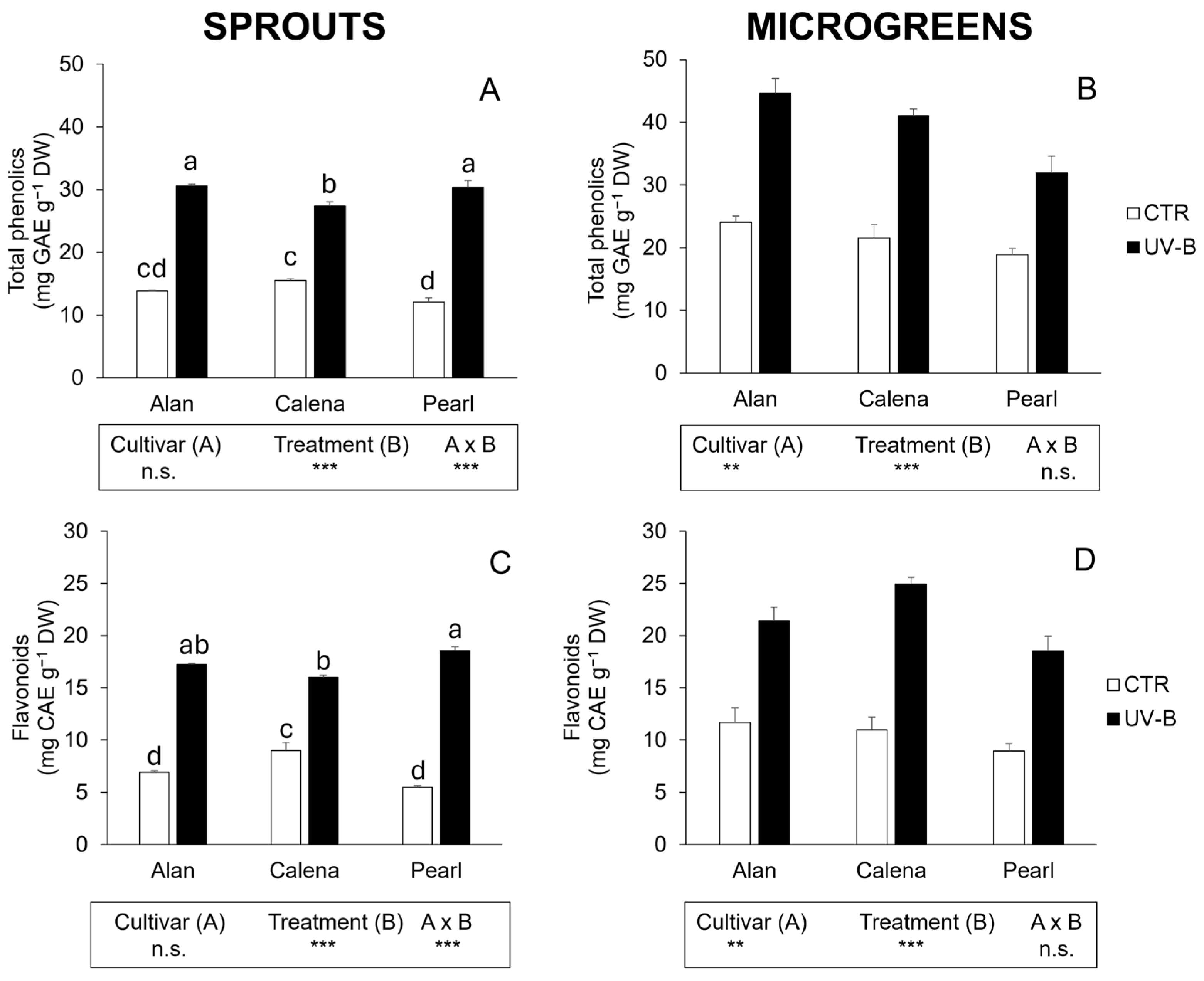
Figure 1. Effects of UV-B irradiation on total phenolic (A,B) and flavonoid (C,D) content of three camelina cultivars (‘Alan’, ‘Calena’, ‘Pearl’) grown as sprouts for 6 days (A,C) and microgreens for 14 days (B,D) under controlled conditions. Data are presented as mean ± SE (n = 3). Different letters above bars indicate significant differences according to the Tukey–Kramer post hoc test (p < 0.05), while the absence of letters indicates no significant differences considering the cultivar × treatment interaction. Two-way ANOVA results: ** p ≤ 0.01; *** p ≤ 0.001; n.s., not significant. CTR, control; UV-B, ultraviolet-B treatment; GAE, gallic acid equivalent; CAE, catechin equivalent; DW, dry weight.
Horticulturae 11 01464 g001
Figure 2. Effects of UV-B irradiation on antioxidant capacity measured by ABTS (A,B), DPPH (C,D), and FRAP (E,F) assays of three camelina cultivars (‘Alan’, ‘Calena’, ‘Pearl’) grown as sprouts for 6 days (A,C,E) and microgreens for 14 days (B,D,F) under controlled conditions. Data are presented as mean ± SE (n = 3). Different letters above bars indicate significant differences according to the Tukey–Kramer post hoc test (p < 0.05), while the absence of letters indicates no significant differences considering the cultivar × treatment interaction. Two-way ANOVA results: * p ≤ 0.05; *** p ≤ 0.001; n.s., not significant. CTR, control; UV-B, ultraviolet-B treatment; TEAC, Trolox equivalent antioxidant capacity; DW, dry weight.
Horticulturae 11 01464 g002
Figure 3. Effects of UV-B irradiation on lipid peroxidation (TBARS) (A,B) and proline content (C,D) of three camelina cultivars (‘Alan’, ‘Calena’, ‘Pearl’) grown as sprouts for 6 days (A,C) and microgreens for 14 days (B,D) under controlled conditions. Data are presented as mean ± SE (n = 3). Two-way ANOVA results: * p ≤ 0.05; *** p ≤ 0.001; n.s., not significant. CTR, control; UV-B, ultraviolet-B treatment; TBARS, thiobarbituric acid reactive substances; DW, dry weight.
Horticulturae 11 01464 g003
Figure 4. Two-dimensional scatterplot related to the Canonical Discriminant Analysis (CDA) performed on individual replicates of three camelina cultivars (‘Alan’, ‘Calena’, ‘Pearl’) under control (CTR) and UV-B treatment, showing the separation of experimental groups for sprouts (A) and microgreens (B) based on morphological and biochemical parameters. Can1 and Can2 refer to canonical functions 1 and 2, which consider all the variables to maximize the separation among the groups. Circles (CTR) and triangles (UV-B) represent different treatments; blue indicates ‘Calena’, yellow indicates ‘Pearl’, and red indicates ‘Alan’ cultivar.
Horticulturae 11 01464 g004
Figure 5. Unsupervised hierarchical cluster analysis (HCA) of the investigated variables grouped by camelina cultivar (‘Alan’, ‘Calena’, ‘Pearl’) and UV-B treatment (UV-B and CTR). Panel (A) shows the HCA for sprouts, while Panel (B) shows the HCA for microgreens. Clustering and dendrograms were generated using the Euclidean distance and Ward’s linkage method. The heatmaps display normalized values of the measured traits, where the color gradient from red to green represents increasing relative levels of each variable (red = lower values, black = intermediate values, green = higher values).
Horticulturae 11 01464 g005
Table 1. HPLC elution gradient used for chlorophyll and carotenoid analysis.
Time (min)Solvent A 1 (%)Solvent B 1 (%)
01000
81000
100100
260100
281000
321000
1 Solvent A (acetonitrile/methanol, 85/15, v/v); solvent B (methanol/ethyl acetate, 68/32, v/v). Flow rate 1 mL min−1.
Table 2. Effects of UV-B irradiation on germination percentage and mean germination time of three camelina cultivars (‘Alan’, ‘Calena’, ‘Pearl’) under controlled conditions. Data are presented as mean ± SE (n = 3). Mean effects represent the average values of each factor (cultivar or UV-B treatment) independently. Different letters within the same column indicate significant differences according to the Tukey–Kramer post hoc test (p < 0.05); data not followed by letters indicate non-significant ANOVA results. Two-way ANOVA results: ** p ≤ 0.01; *** p ≤ 0.001; n.s., not significant. CTR, control; UV-B, ultraviolet-B treatment; MGT, mean germination time.
CultivarTreatmentGermination (%)MGT (Day)
AlanCTR88.0 ± 2.3 a4.1 ± 0.1
UV-B65.3 ± 3.4 b4.5 ± 0.3
CalenaCTR67.3 ± 3.2 b4.4 ± 0.3
UV-B69.3 ± 2.0 b4.8 ± 0.3
PearlCTR95.0 ± 2.0 a3.4 ± 0.1
UV-B86.7 ± 4.1 a4.1 ± 0.2
Mean effect
Alan 76.7 ± 5.4 b4.3 ± 0.2 b
Calena 68.3 ± 2.4 b4.6 ± 0.2 a
Pearl 90.8 ± 2.8 a3.8 ± 0.2 c
CTR83.4 ± 4.3 a3.9 ± 0.2 b
UV-B73.8 ± 3.8 b4.4 ± 0.2 a
ANOVA
Cultivar (A) ******
Treatment (B) *****
A × B **n.s.
Table 3. Effects of UV-B irradiation on morphological and productive parameters of three camelina cultivars (‘Alan’, ‘Calena’, ‘Pearl’) grown as sprouts for 6 days under controlled conditions. Data are presented as mean ± SE (n = 3). Mean effects represent the average values of each factor (cultivar or UV-B treatment) independently. Different letters within the same column indicate significant differences according to the Tukey–Kramer post hoc test (p < 0.05); data not followed by letters indicate non-significant ANOVA results. Two-way ANOVA results: * p ≤ 0.05; ** p ≤ 0.01; *** p ≤ 0.001; n.s., not significant. CTR, control; UV-B, ultraviolet-B treatment; FW, fresh weight; DW, dry weight.
CultivarTreatmentFW (g)FW/DW (%)Productivity (Kg/m2)Length (cm)
Hypocotyl RootTotal
AlanCTR0.012 ± 0.001 b92.06 ± 0.060.0045 ± 0.0001 a1.11 ± 0.032.79 ± 0.23 ab3.89 ± 0.23 a
UV-B0.009 ± 0.002 d87.60 ± 0.880.0031 ± 0.0001 bc0.65 ± 0.022.04 ± 0.27 bc2.69 ± 0.10 bc
CalenaCTR0.013 ± 0.001 a88.95 ± 0.960.0034 ± 0.0003 b1.18 ± 0.033.47 ± 0.26 a4.65 ± 0.26 a
UV-B0.010 ± 0.001 c82.62 ± 0.710.0022 ± 0.0001 c0.65 ± 0.031.27 ± 0.09 c1.92 ± 0.10 c
PearlCTR0.007 ± 0.001 e91.43 ± 0.560.0036 ± 0.0002 ab1.19 ± 0.031.84 ± 0.15 c3.03 ± 0.16 b
UV-B0.011± 0.001 bc88.56 ± 0.260.0035 ± 0.0001 b0.68 ± 0.021.86 ± 0.09 c2.54 ± 0.09 bc
Mean effect
Alan 0.010 ± 0.001 b89.83 ± 1.07 a0.0038 ± 0.0003 a0.88 ± 0.102.42 ± 0.21 a3.29 ± 0.29 a
Calena 0.012 ± 0.001 a85.79 ± 1.51 b0.0028 ± 0.0003 b0.91 ± 0.112.38 ± 0.50 a3.29 ± 0.61 a
Pearl 0.009 ± 0.001 c89.99 ± 0.70 a0.0036 ± 0.0001 a0.93 ± 0.121.85 ± 0.10 b2.78 ± 0.15 b
CTR0.011 ± 0.001 a90.81 ± 0.99 a0.0039 ± 0.0003 a1.16 ± 0.03 a2.70 ± 0.26 a3.86 ± 0.25 a
UV-B0.010 ± 0.010 b86.26 ± 1.70 b0.0029 ± 0.0003 b0.66 ± 0.01 b1.72 ± 0.14 b2.38 ± 0.14 b
ANOVA
Cultivar (A) *********n.s.***
Treatment (B) *****************
A × B ***n.s.**n.s.******
Table 4. Effects of UV-B irradiation on morphological and productive parameters of three camelina cultivars (‘Alan’, ‘Calena’, ‘Pearl’) grown as microgreens for 14 days under controlled conditions. Data are presented as mean ± SE (n = 3). Mean effects represent the average values of each factor (cultivar or UV-B treatment) independently. Different letters within the same column indicate significant differences according to the Tukey–Kramer post hoc test (p < 0.05); data not followed by letters indicate non-significant ANOVA results. Two-way ANOVA results: * p ≤ 0.05; ** p ≤ 0.01; *** p ≤ 0.001; n.s., not significant. CTR, control; UV-B, ultraviolet-B treatment; FW, fresh weight; DW, dry weight.
CultivarTreatmentFW (g)FW/DW (%)Productivity (Kg/m2)Hypocotyl Length (cm)
AlanCTR0.025 ± 0.001 ab6.51 ± 0.871.49 ± 0.0621.23 ± 0.07
UV-B0.019 ± 0.002 bc9.07 ± 0.521.18 ± 0.0160.60 ± 0.09
CalenaCTR0.030 ± 0.002 a8.79 ± 0.741.19 ± 0.0660.91 ± 0.12
UV-B0.017 ± 0.002 c10.76 ± 1.750.72 ± 0.0370.53 ± 0.03
PearlCTR0.020 ± 0.001 bc7.09 ± 0.861.43 ± 0.0561.14 ± 0.07
UV-B0.024 ± 0.001 abc8.22 ± 0.271.09 ± 0.0250.60 ± 0.02
Mean effect
Alan 0.022 ± 0.0027.79 ± 0.731.34 ± 0.075 a0.92 ± 0.14 a
Calena 0.024 ± 0.0039.77 ± 0.960.96 ± 0.111 b0.72 ± 0.10 b
Pearl 0.022 ± 0.0017.65 ± 0.481.26 ± 0.082 a0.87 ± 0.12 ab
CTR0.025 ± 0.003 a7.46 ± 0.93 b1.37 ± 0.095 a1.10 ± 0.06 a
UV-B0.020 ± 0.002 b9.35 ± 1.13 a1.00 ± 0.124 b0.58 ± 0.02 b
ANOVA
Cultivar (A) n.s.n.s. ****
Treatment (B) *********
A × B ***n.s. n.s. n.s.
Table 5. Mean effects of cultivar and UV-B treatment on phenolic compound and flavonoid content, antioxidant capacity, lipid peroxidation (TBARS) and proline content of three camelina cultivars (‘Alan’, ‘Calena’, ‘Pearl’) grown as sprouts (6 days) and microgreens (14 days) under controlled conditions. Data are presented as mean ± SE (n = 3). Different letters within the same column indicate significant differences according to the Tukey–Kramer post hoc test (p < 0.05); data not followed by letters indicate non-significant ANOVA results. Uppercase letters indicate statistical significance for sprouts and lowercase letters for microgreens. CTR, control; UV-B, ultraviolet-B treatment; GAE, gallic acid equivalent; CAE, catechin equivalent; TEAC, Trolox equivalent antioxidant capacity; DW, dry weight.
Stage Cultivar TreatmentTotal Phenolics
(mg GAE g−1 DW)
Flavonoids
(mg CAE g−1 DW)
Antioxidant CapacityTBARS
(nmol g−1 DW)
Proline
(µmol g−1 DW)
ABTS
(µmol TEAC g−1 DW)
DPPH
(mg TEAC g−1 DW)
FRAP
(µmol Fe (II) g−1 DW)
SproutsAlan 22.21 ± 3.7512.11 ± 2.3190.53 ± 13.55 B10.35 ± 1.40 B116.12 ± 16.54 B16.01 ± 1.4412.79 ± 4.15 B
Calena 21.45 ± 2.6712.50 ± 1.62182.69 ± 25.31 A10.85 ± 1.27 A135.89 ± 17.45 A18.13 ± 1.5376.28 ± 17.82 A
Pearl 21.23 ± 4.1312.03 ± 2.9397.98 ± 18.06 B9.35 ± 1.91 C120.37 ± 23.58 B17.60 ± 0.7615.98 ± 3.22 B
CTR13.82 ± 1.61 B7.13 ± 1.68 B81.78 ± 34.86 B6.77 ± 1.35 B81.29 ± 13.25 B14.88 ± 1.84 B21.93 ± 9.58 B
UV-B29.44 ± 1.94 A17.29 ± 1.16 A165.69 ± 55.42 A13.59 ± 0.18 A166.96 ± 10.57 A19.61 ± 2.14 A48.10 ± 14.92 A
MicrogreensAlan 34.32 ± 4.75 a16.56 ± 2.34 ab162.96 ± 24.37 ab29.24 ± 3.60 ab222.84 ± 29.37 a16.30 ± 0.88 b33.10 ± 4.17
Calena 31.25 ± 4.48 a17.94 ± 3.19 a169.92 ± 24.05 a33.75 ± 3.54 a237.21 ± 41.45 a17.54 ± 4.03 b43.73 ± 7.05
Pearl 25.40 ± 3.17 b13.74 ± 2.26 b147.42 ± 16.67 b26.99 ± 3.44 b161.54 ± 22.63 b29.14 ± 4.21 a31.21 ± 1.89
CTR21.48 ± 3.12 b10.54 ± 2.12 b113.09 ± 12.90 b22.69 ± 4.26 b140.23 ± 26.10 b25.27 ± 10.66 a34.65 ± 4.70
UV-B39.17 ± 6.51 a21.62 ± 3.29 a207.11 ± 22.33 a37.29 ± 4.42 a274.17 ± 56.99 a16.71 ± 7.12 b37.37 ± 3.80
Table 6. Effects of UV-B irradiation on pigment content (µg g−1 DW) of three camelina cultivars (‘Alan’, ‘Calena’, ‘Pearl’) grown as sprouts for 6 days under controlled conditions. Data are presented as mean ± SE (n = 3). Mean effects represent the average values of each factor (cultivar or UV-B treatment) independently. Different letters within the same column indicate significant differences according to the Tukey–Kramer post hoc test (p < 0.05); data not followed by letters indicate non-significant ANOVA results. Two-way ANOVA results: * p ≤ 0.05; ** p ≤ 0.01; *** p ≤ 0.001; n.s., not significant. CTR, control; UV-B, ultraviolet-B treatment; DW, dry weight.
CultivarTreatmentNeoxanthin Violaxanthin LuteinChlorophyll b Chlorophyll a β-carotene
AlanCTR1.02 ± 0.140.67 ± 0.587.47 ± 0.35 bc8.92 ± 1.1713.60 ± 2.902.11 ± 0.11 b
UV-B1.12 ± 0.151.29 ± 0.079.68 ± 0.38 ab12.88 ± 0.4825.46 ± 0.922.97 ± 0.15 a
CalenaCTR1.16 ± 0.211.35 ± 0.499.23 ± 0.51 ab8.92 ± 1.0321.72 ± 3.393.06 ± 0.06 a
UV-B1.36 ± 0.081.26 ± 0.139.92 ± 0.42 a12.88 ± 0.7525.95 ± 1.763.22 ± 0.14 a
PearlCTR0.76 ± 0.040.86 ± 0.085.90 ± 0.28 c8.33 ± 0.1713.54 ± 0.321.17 ± 0.04 c
UV-B1.36 ± 0.181.57 ± 0.249.33 ± 0.72 ab12.41 ± 1.0024.24 ± 2.412.81 ± 0.26 a
Mean effect
Alan 1.07 ± 0.090.98 ± 0.188.58 ± 0.55 ab10.90 ± 1.05 ab19.53 ± 2.982.54 ± 0.21 b
Calena 1.26 ± 0.111.30 ± 0.239.57 ± 0.34 a12.80 ± 0.62 a23.83 ± 1.953.14 ± 0.07 a
Pearl 1.06 ± 0.161.21 ± 0.207.61 ± 0.84 b10.37 ± 1.02 b18.89 ± 2.631.99 ± 0.38 c
CTR0.98 ± 0.09 b0.96 ± 0.197.53 ± 0.52 b8.86 ± 0.76 b16.29 ± 1.87 b2.11 ± 1.17 b
UV-B1.28 ± 0.08 a1.37 ± 0.109.64 ± 0.28 a12.87 ± 0.41 a25.21 ± 0.94 a3.00 ± 0.11 a
ANOVA
Cultivar (A) n.s.n.s.***n.s.***
Treatment (B) *n.s.************
A × B n.s.n.s.*n.s.n.s.***
Table 7. Effects of UV-B irradiation on pigment content (µg g−1 DW) of three camelina cultivars (‘Alan’, ‘Calena’, ‘Pearl’) grown as microgreens for 14 days under controlled conditions. Data are presented as mean ± SE (n = 3). Mean effects represent the average values of each factor (cultivar or UV-B treatment) independently. Different letters within the same column indicate significant differences according to the Tukey–Kramer post hoc test (p < 0.05); data not followed by letters indicate non-significant ANOVA results. Two-way ANOVA results: * p ≤ 0.05; ** p ≤ 0.01; *** p ≤ 0.001; n.s., not significant. CTR, control; UV-B, ultraviolet-B treatment; DW, dry weight.
CultivarTreatmentNeoxanthin Violaxanthin Lutein Chlorophyll b Chlorophyll a β-carotene
AlanCTR2.17 ± 0.193.51 ± 0.14 d29.52 ± 1.7839.28 ± 1.8995.99 ± 4.625.19 ± 0.10
U-VB2.04 ± 0.066.56 ± 0.06 b25.14 ± 0.6337.72 ± 1.61100.57 ± 4.276.07 ± 0.34
CalenaCTR2.30 ± 0.145.25 ± 0.11 c27.89 ± 1.9839.51 ± 1.4895.83 ± 3.775.67 ± 0.36
UV-B1.61 ± 0.187.89 ± 0.26 a23.15 ± 0.9531.86 ±1.3583.29 ± 3.135.47 ± 0.16
PearlCTR2.44 ± 0.291.30 ± 0.30 e25.43 ± 1.3537.80 ± 2.6788.24 ± 8.074.73 ± 0.42
UV-B1.82 ± 0.136.12 ± 0.10 bc20.76 ± 0.6032.24 ± 1.2783.48 ± 3.045.34 ± 0.12
Mean effect
Alan 2.10 ± 0.095.03 ± 0.69 b27.33 ± 1.29 a38.50 ± 1.6698.28 ± 2.995.63 ± 0.25
Calena 1. 95 ± 0.196.57 ± 0.60 a25.52 ± 1.45 ab35.69 ± 1.9389.56 ± 3.565.57 ± 0.18
Pearl 2.13 ± 0.203.71 ± 1.09 c23.09 ± 1.24 b35.02 ± 1.8285.86 ± 4.005.03 ± 0.24
CTR2.30 ± 0.20 a3.35 ± 1.00 b27.61 ± 1.82 a38.87 ± 1.85 a93.35 ± 5.485.20 ± 0.37
UV-B1.82 ± 0.16 b6.86 ± 0.48 a23.01 ± 1.27 b33.94 ± 2.05 b89.11 ± 5.825.62 ± 0.28
ANOVA
Cultivar (A) n.s.****n.s.n.s.n.s.
Treatment (B) ********n.s.n.s.
A × B n.s.***n.s.n.s.n.s.n.s.
Table 9. Pearson’s correlation coefficients (r) between individual variables (morphological and biochemical parameters) and the first canonical function (Can1) scores from the Canonical Discriminant Analysis (CDA) for sprouts and microgreens. Variables are ranked by absolute correlation values. FW, fresh weight; DW/FW, dry weight to fresh weight ratio; TBARS, thiobarbituric acid reactive substances; ABTS, DPPH, FRAP, antioxidant capacity assays. * 0.8 > |r| > 1: strong correlation.
Morphological and
Biochemical Parameters
Pearson’s Coefficient (r)
SproutsMicrogreens
Hypocotyl length−0.94722 *−0.86079 *
FW0.246662−0.31593
Proline0.2736270.295374
Violaxanthin0.500319−0.47329
Neoxanthin0.568232−0.64709
ABTS0.6455210.89464 *
DW/FW %0.6570590.6323
TBARS0.676616−0.65688
b-carotene0.7223910.519325
Chlorophyll b0.725287−0.49009
Lutein0.767235−0.41462
Chlorophyll a0.772426−0.10377
FRAP0.960047 *0.928229 *
DPPH0.984618 *0.915949 *
Total phenolics0.987404 *0.877433 *
Flavonoids0.989792 *0.921436 *
Disclaimer/Publisher’s Note: The statements, opinions and data contained in all publications are solely those of the individual author(s) and contributor(s) and not of MDPI and/or the editor(s). MDPI and/or the editor(s) disclaim responsibility for any injury to people or property resulting from any ideas, methods, instructions or products referred to in the content.