1. Introduction
The province of Almeria has the highest concentration of greenhouses in Europe, with a total area of 33,634 hectares [
1]. This intensive greenhouse horticultural system uses modern high-frequency drip irrigation methods, and soilless culture is increasingly emerging as a viable alternative to traditional soil-based cultivation [
2]. Agriculture is one of the most important economic activities in this region, but it requires a continuous and reliable water supply to guarantee long-term sustainability.
Desalinated seawater (DSW) is becoming an increasingly competitive option for supplying high-quality irrigation water in arid or semi-arid regions, such as the Spanish Mediterranean basin. DSW offers several advantages: it is a high-quality, climate-independent, and secure water source [
3]. Its use can not only increase crop yields but also makes it possible to diversify crops, including species that are more sensitive to salinity [
4]. Moreover, the use of DSW can contribute to the recovery of the overexploited and salinized aquifers in the region [
5].
These benefits have contributed to the growing acceptance of DSW among farmers [
6,
7]. Advances in membrane and desalination technologies have made seawater desalination a reliable and viable drought-proof alternative for the world’s coastal communities in the near future [
8].
However, despite its advantages, the use of DSW also presents certain challenges. It can lead to issues such as loss of soil structure, reduced water infiltration, and nutritional imbalances in plants. Another major drawback of DSW is the absence of minerals needed by the plant, such as Ca
2+, Mg
2+, and SO
42− [
9]. These nutrients must be supplemented to the nutrient solution either by fertigation or by blending DSW with conventional groundwater sources [
9,
10]. The conjunctive use of DSW and conventional water is a practical strategy to reduce both fertigation costs and the environmental impact of irrigation.
Given these considerations, further research is necessary in typical intensive greenhouse horticultural systems (both soil and soilless) to determine the most appropriate water-mixing ratio to maximize yield at the lowest economic and environmental cost. Some authors suggest that brackish water should constitute at least 25% of the total irrigation volume [
11], while others report that using 30% brackish water can provide yields comparable to those obtained with 100% DSW [
12]. Optimization models have also been proposed to identify the ideal theoretical water blends that maximize economic revenue and minimize environmental impact [
13,
14]. These models must be calibrated and validated with data obtained from experimental research.
Soilless cultivation is intensively used in Spain and many other countries in the world [
15]. The reasons for their use are the improved control over the growing environment and to avoid uncertainties in the water and nutrient status of the soil [
16] and to prevent the incidence of soil pests and diseases. Closed-loop soilless systems are preferred because they make it possible for us to collect and reuse lixiviates, thus reducing water and nutrient consumption and improving the environmental sustainability [
17]. However, open-loop systems with free drainage are widely the most used in commercial greenhouses because their management is considerably simpler [
18]. It seems to be interesting to analyze the effect of the use of DSW in open-loop soilless systems in comparison with the most common soil systems.
Most greenhouse commercial tomato varieties are indeterminate varieties whose ripening is spread over a large period, and several harvests must be performed. Some studies have pointed out that the ripening of tomato fruits highly depends on the environmental conditions [
19], including temperature and humidity. Some researchers have developed models to decide the harvest time depending on the cumulative temperature [
20]. In this research, we have analyzed the effect of the date of harvest on the quality of the tomato crops for any water blend and growing media.
The effects of the water blends and growing media on crop yield, productivity, and water footprint were analyzed in a previous study by our research team [
21]. The present paper focuses exclusively on the effects of these factors on the fruit quality of a tomato crop grown under Mediterranean greenhouse conditions. This research analyzes the effects of three blends of DSW and conventional water, with different salinity levels, and two growing media (soil and soilless substrate). In addition, the effect of the harvest timing on tomato fruit quality was also examined.
2. Materials and Methods
2.1. Experimental Facility and Design
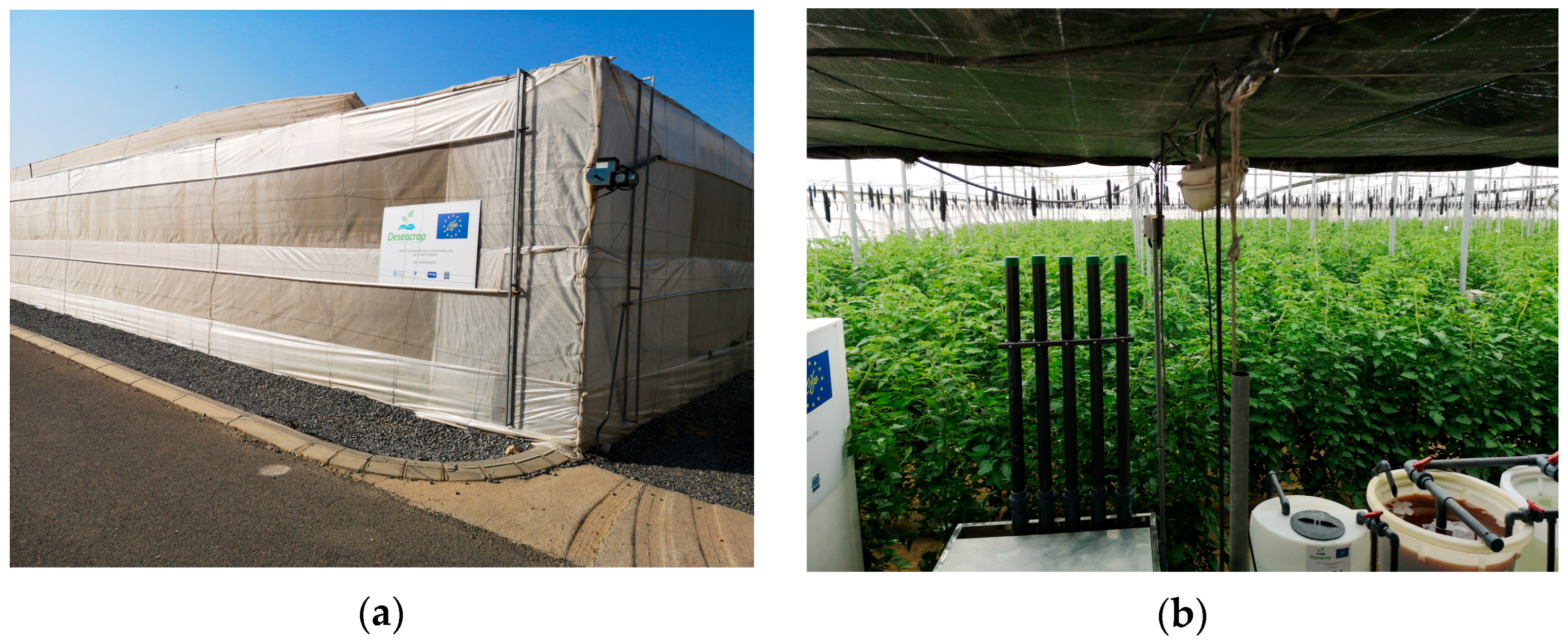
The experiment was performed in a greenhouse of the Experimental Farm of the University of Almería (UAL-ANECOOP Foundation), located in the municipality of Almería (2°17′ L.O. and 36°51′ L.N.), at 90 m above sea level (
Figure 1). The facility is a light plastic-covered, Almería-type greenhouse. A detailed description of this experimental greenhouse can be found in a previous publication [
21].
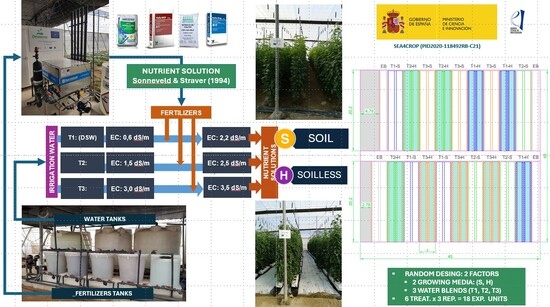
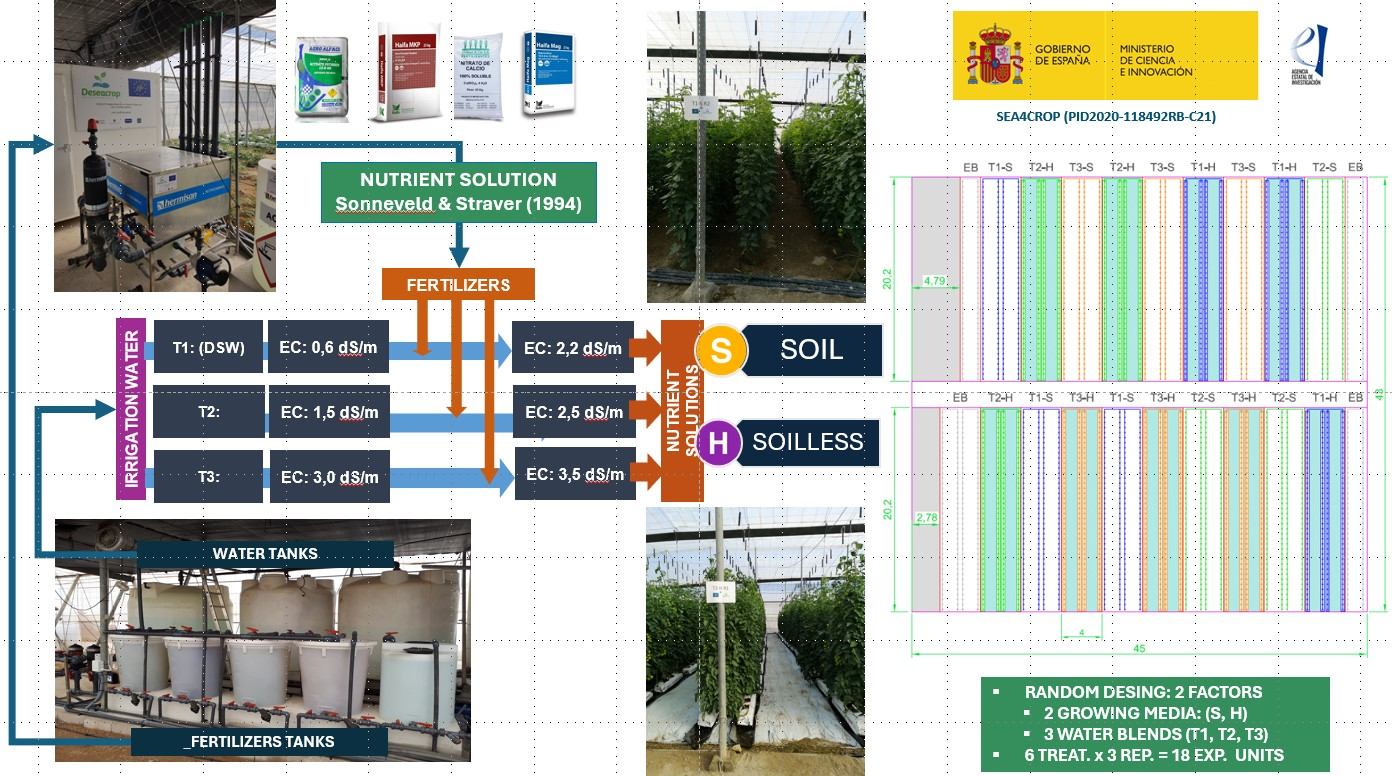
The experimental design was based on a randomized complete block layout with two factors: the salinity of the water blends and the type of growing medium. Three salinity levels were evaluated. Treatment T1, serving as the control treatment, was irrigated with 100% desalinated seawater (DSW), sourced from the Carboneras desalination plant, with an electrical conductivity (EC) of 0.6 dS m
−1. Treatments T2 and T3 consisted of water blends with EC levels of 1.5 and 3 dS m
−1, respectively. The chemical composition of the irrigation water for the three treatments is given in
Table 1.
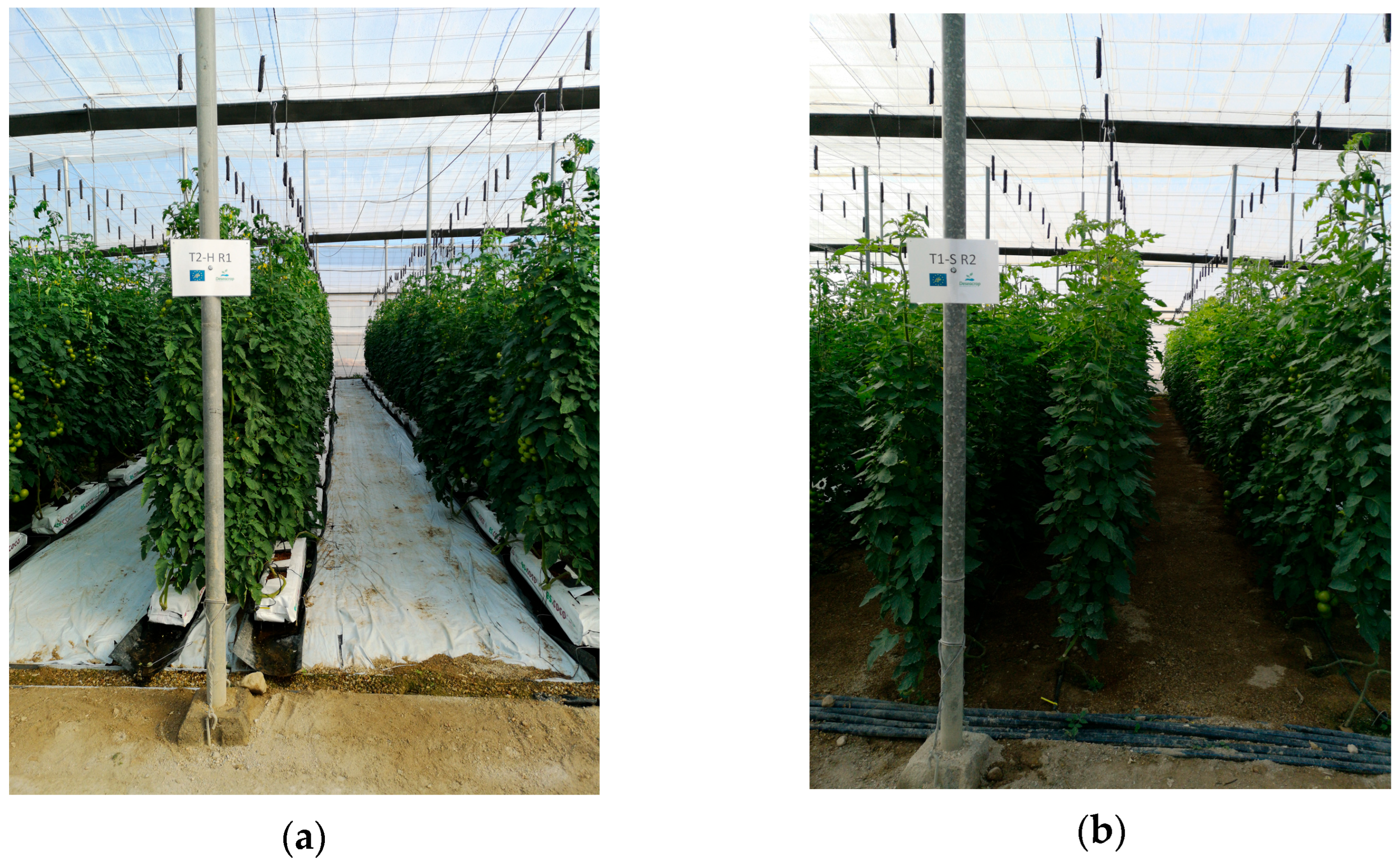
The second factor was the growing medium, composed of two different treatments representative of the predominant cropping systems in Almería: soil (S) and soilless substrate culture (H) (
Figure 2). The experimental protocol resulted in a total of six treatments, each replicated three times, for a total of 18 experimental units randomly distributed throughout the greenhouse [
21].
The actual cropping area of the greenhouse was 1454.4 m2. Each experimental unit covered 78 m2, and each treatment occupied 234 m2. The layout consisted of paired crop rows separated by 0.5 m, with 1.5 m wide lanes between paired rows. Plants were spaced 0.5 m apart within rows, resulting in a crop density of 2 plants/m2. Consequently, each row contained 39 plants, and each experimental unit contained 156 plants. Irrigation was provided through a drip system equipped with one pressure-compensating, anti-drain emitter per plant, delivering 3 Lh−1.
The soil used was an artificial layered sandy soil typical of greenhouse systems in Almería, consisting of a 10 cm surface layer of sand, a 10 mm layer of manure, and a 50 cm medium-textured layer (medium loam) placed over the natural bed. The soilless crop was grown in coconut fiber bags composed of 70% fiber and 30% chip. Each 1 m long bag contained three plants, providing a substrate volume of 20 L.
The crop used in this experiment was a short autumn-cycle tomato, grown from September to March over three consecutive years. The plant material consisted of Ramyle RZ F1 (74-207) tomatoes, developed by Rijk Zwaan Ibérica S.A (Almería, Spain). This variety is a round, canary-type tomato with red coloration, suitable for harvesting either in bunches or as loose fruits.
All treatments were fertigated with the balanced nutrient solution proposed by Sonneveld and Straver [
22]. Fertilizer proportions were calculated using precision fertigation equipment, tailored to the specific nutrient concentrations of the irrigation water in each quality treatment. The calculation procedure followed Urrestarazu, M. [
23], and the final nutrient solution can be found in Reca et al. [
21]
The experiment was conducted over the course of three growing cycles (C1, C2, and C3).
Table 2 shows the basic information of these three crop cycles.
Environmental conditions during the three growing cycles were stable and appropriate for the crop development, with average temperatures during the growing cycle.
Table 2 shows average values of daily temperature (T), maximum and minimum daily temperatures (T
max, T
min), daily relative humidity (RH), and maximum and minimum daily relative humidity (RH
max, RH
min). Average daily temperatures ranged from 15.8 °C (in the second season) to 17.2 °C in the first one (
Table 3). Average maximum daily temperatures were always below 30 °C and minimum ones above 9 °C (except in the third season that was 7.9 °C). Average daily relative humidities ranged from 72.9 to 80.6%, with maximum RH close to saturation and minimum values close to 40%.
The greenhouse has passive ventilation composed of roof windows with a total ventilation area of 4% and side windows along the perimeter with a total ventilation area of 12.9%. This arrangement ensures proper ventilation and sufficient CO2 concentration inside the greenhouse.
Irrigation management was based on fixed water volumes and variable time intervals. In the soil cropping system, irrigation timing was determined using a tensiometer, with irrigation applied when water potential reached 20–30 kPa. Each irrigation lasted 30 min, corresponding to a water application rate of 3 L m−2/irrigation. In the substrate culture, due to the low water-holding capacity of the substrate, shorter (5 min) but more frequent irrigations were applied. The leaching fraction was set to 25%, and the electrical conductivity of the leachates was monitored to prevent it from exceeding 1 dS m−1 in the input nutrient solution.
Table 4 presents the water applied to each treatment and cycle. Water consumption was higher in substrate culture treatments compared to the soil system, due to the greater leaching fraction required to maintain optimal salinity levels in the substrate solution.
2.2. Experimental Measurements and Procedure
For each crop cycle, four harvests were carried out on similar dates and at comparable stages of fruit maturity. The fruit yield from each experimental unit was weighed separately for each harvest. Total and commercial yields were calculated as the sum of the four harvests. An EKS Premium electronic scale (E.K.S. Spain, Barcelona, Spain) was used for weighing, with an accuracy of 10 g and a maximum capacity of 40 kg. Non-commercial yield was determined by weighing fruits that did not meet the required commercial quality standards.
In addition, fruit quality was assessed using a random sample of 18 fruits per treatment and harvest. The following quality parameters were measured:
Fruit weight (g fruit
−1),
Dry weight (g fruit
−1),
Fruit diameter (mm),
Total Dissolved Solids (°Bx), and
Firmness (kg cm
−2). The specifications of the instruments used are shown in
Table 5.
2.3. Statistical Analysis
To identify the main factors affecting fruit quality, a multifactor analysis of variance was performed using Statgraphics 19 Centurion© software (Version 19.7.01) [
24]. This procedure determines the significance of factors through F-tests on the ANOVA table. Fisher’s least significant difference (LSD) test was used for mean separation, using a 5.0% risk of labeling each pair of means as significantly different when the actual difference is zero.
The first two factors considered were the water blend, with three levels: T1 (DSW), T2 (1.5 dS m−1), and T3 (3 dS m−1), and the growing medium, with two levels: soil (S) and soilless (H). A third factor, the harvest date, was also considered to analyze its influence on fruit quality. This factor had four levels: H1, H2, H3, and H4, corresponding to the first, second, third, and fourth tomato harvests, respectively.
3. Results
3.1. Fruit Fresh Weight
The results of the statistical analysis of fruit fresh weight are shown in
Table 6. The salinity level factor significantly affected fresh weight across all three crop cycles, with
p-values of 0.0012, 0.0000, and 0.0362, for C1, C2, and C3, respectively.
Overall, fruit fresh weight tended to decrease as irrigation water salinity increased. Nevertheless, an exception to this rule was observed in the second crop cycle, in which Treatment T2 produced heavier fruits than T1.
The growing medium factor significantly affected fresh weight only during the third crop cycle (p-values: 0.1981, 0.8531, and 0.0000). The fresh weight of tomatoes grown in soil was slightly higher than that of fruit grown in substrate.
The harvest date also had a significant effect on fruit fresh weight in all three years. Fresh weight decreased progressively with later harvests, indicating that early harvesting provided heavier fruits than later ones.
3.2. Diameter
Both the salinity level and the type of growing system had a significant effect on fruit diameter in the three experimental years. The results seem to indicate that lower salinity levels produce larger fruits, consistent with the trend observed for fresh weight (
Table 7). However, high variability was observed between years.
Regarding the type of system, a significant effect on fruit size was found in two of the three years (p-values of 0.0003, 05272, and 0.0000, respectively). However, no consistent conclusion can be drawn due to the high variability among years. For example, in the first two years, the soilless system produced larger fruits, whereas in the third year, the opposite trend was observed.
The harvest date had a significant effect on fruit diameter in the three experimental years. Fruit size decreased significantly with later harvests, consistent with the reduction in fresh weight observed previously.
3.3. Fruit Dry Weight
Salinity level also had a significant effect on dry weight during the second and third crop cycles (p-values of 0.2864, 0.0001, and 0.0170 for C1, C2, and C3, respectively).
The behavior of dry weight was opposite to that observed for fresh weight, i.e., higher salinity treatments tended to produce fruits with greater dry weight (
Table 8).
The growing medium significantly affected dry weight during the first and second crop cycles (p-values of 0.0000, 0.0139, and 0.3464, respectively). Unlike fresh weight, in general, the soilless system increased fruit dry weight.
Fruit dry weight also showed a significant decreasing trend with later harvests during the first two experimental years.
3.4. Total Dissolved Solids (TDS)
Degrees Brix (°Bx) is a measure of the total dissolved solids (TDS) content in the fruit including sugars, salts, and other soluble compounds—and is related to its flavor and organoleptic quality.
The three experimental factors—namely, salinity level, type of growing system, and harvest date—had a statistically significant effect on °Bx during the first and third years of the experiment. In the second year, there were no significant differences, likely due to the high variability recorded that specific year, although the general trend remained like that of the other years. As shown in
Table 9, °Bx values increased with the salinity level of the irrigation water.
The soilless culture consistently showed higher °Bx values than the soil system. This may be due to the greater control of salinity in the soilless system. In the soil culture, salts tend to accumulate on the edge of the wet bulb, leaving a central zone of lower salinity. As a result, plants uptake water from this low-salinity region, yielding slightly larger fruits but with lower TDS.
The harvest date also had a significant effect on °Bx. This variable exhibited an opposite trend to fruit weight, with later harvests yielding higher °Bx values than earlier ones. This likely reflects the lower fruit weight and water content observed in late-harvested fruits.
3.5. Firmness
The harvest date (p-values: 0.0397, 0.0000, and 0.0117) and type of growing medium (p-values: 0.0000, 0.0048, and 0.0062) significantly affected fruit firmness in the three years of experiment. Salinity also had a significant effect in two of the three years (p-values: 0.0000, 0.0000, and 0.5404)
Tomatoes irrigated with the highest salinity level (T3) exhibited greater firmness compared to those irrigated with the lowest salinity (T1), while Treatment T2 varied depending on the year of study (
Table 10).
The type of growing system had quite a significant influence: fruits from the soilless culture consistently showed greater firmness levels than those grown in soil.
Fruit firmness decreased progressively with later harvest dates, suggesting that fruits harvested later were likely at more advanced stages of maturity compared to those of earlier ones.
4. Discussion
This study presents a comprehensive analysis of the combined effects of the water blend and growing medium on the quality of tomato crops grown under Mediterranean greenhouse conditions. It analyzes the most relevant variables influencing commercial tomato quality, including fruit size (fresh weight and diameter), taste, and organoleptic properties (dry weight, total dissolved solids (TDS), and firmness).
No two-factor interactions were detected in any of the multifactor ANOVA analyses.
Regarding fruit quality, numerous studies have reported that elevated salinity levels tend to reduce yield while increasing certain quality parameters in tomatoes, such as °Bx, whereas others, such as firmness, do not [
25,
26,
27,
28,
29].
Both the water blend and irrigation water salinity significantly influenced fruit size—expressed both in terms of fresh weight and average diameter—across the three experimental years. In general, both variables decreased as the water salinity increased. This trend is expected, as higher salinity generally reduces plant water absorption and consequently the water content of the fruit [
29]. Nevertheless, these differences among treatments were not always significant. This result may be attributed to the variability among repetitions and to the fact that the saline differences among treatments were reduced after the addition of the fertigation to the original irrigation water.
Irrigation water salinity also affected key quality parameters associated with fruit taste, namely, dry weight and TDS, in most experimental years. High salinity levels increased both dry weight and TDS (°Bx), thus improving the organoleptic quality of the fruit. This demonstrates that the higher fresh weight observed under lower salinity conditions was mainly due to increased water accumulation rather than a higher accumulation of assimilates. This finding aligns with previous studies that found a correlation between salinity and assimilate accumulation. In fact, it is common practice in the area to irrigate tomato crops with water with a high salt concentration to improve the organoleptic quality of tomato fruits.
Finally, salinity also affected fruit firmness, though this effect was not significant in all experimental years. The trend indicated a slight increase in firmness as salinity increased. It can be concluded that lower irrigation water salinity increased fruit size but, conversely, reduced fruit quality. These findings mostly agree with previous research. For example, Cuartero and Fernández-Muñoz [
25] reported that salinity improves tomato flavor by increasing both sugar and acid content, although fruit shelf life and firmness remain unchanged or even slightly decrease [
25]. The authors also found a reduction in fruit fresh weight with increased salinity. Similarly, Malash et al. [
26] observed a reduction in total and commercial yield, number of fruits, and average fruit weight, alongside an increase in total soluble solids, vitamin C, and dry matter for increasing levels of salinity in a tomato crop.
In another study involving two tomato varieties, the yields of both were significantly reduced by salinity, resulting in fewer and smaller fruits. As in the previous case, fruits from plants treated with higher salinity water contained higher concentrations of reducing sugars and organic acids compared with those from the control treatment [
27].
Other studies have evaluated the effects of different salinity levels on fruit weight and the main chemical components determining fruit quality. The results showed that moderate salinity reduced fresh and dry fruit weights by only 10% and 13%, respectively, whereas high salinity decreased them by 40% and 33% compared to control fruits [
28]. Similarly, a study performed on 20 tomato cultivars reported that salinity considerably reduced commercial yield, mainly due to a decrease in fruit fresh weight [
29].
Although most studies indicate that the water blend and improved water quality affect fruit quality in annual horticultural crops, some researchers did not observe such short-term effects in perennial crops, such as mandarin or grapefruit [
30,
31].
The type of growing system did not significantly affect fruit size in most experimental years. In general, tomatoes grown in soil exhibited slightly higher fresh weight and diameter, although one exception was observed, preventing a definitive conclusion. Nevertheless, the effect of the growing system on quality parameters was much clearer. The soilless system produced fruits with higher dry weight, an effect that was statistically significant in two of the three experimental years. A similar trend was observed for TDS (°Bx), which was also significantly higher in the soilless system in two of the three years. Moreover, regarding fruit firmness, tomatoes grown in the soilless system had significantly higher values than those grown in soil. These results indicate that tomatoes grown in soilless systems accumulated less water but more assimilates, which is advantageous in terms of fruit quality. These results agree with those found by other researchers [
32]. This study states that soilless cultivation can improve yield and quality, with cultivar selection playing an important role when utilizing this production system. The improved quality in soilless systems may be explained by a higher control of nutrient solution distribution in the growing media compared with soil.
This demonstrates that soilless cultivation can produce higher quality fruits in terms of their firmness. Previous studies have also demonstrated that tomato crops are significantly more productive under soilless culture conditions [
21]. Other researchers have suggested that soilless cultivation represents a viable alternative to traditional soil-based cropping systems, offering benefits in both yield and quality, although the higher energy demands of these systems must be considered [
2]. Similarly, a study on a strawberry crop grown under greenhouse conditions reported that a soilless substrate composed of Bio Plus compost supplemented with synthetic nutrients improved plant development and yield [
33], while other research showed that strawberry yield and fruit quality were enhanced by a coir fiber substrate [
34].
Finally, this research analyzed the effect of harvest date on tomato fruit quality. Since tomato ripening occurs over the course of a long period, multiple successive harvests must be conducted. However, few previous studies have investigated the evolution of tomato fruit quality throughout the crop’s maturation stages. The results found show that harvest date had a significant influence on both fruit size and quality.
Specifically, harvest timing had a significant effect on the fresh weight and diameter of the fruit across all experimental years. In later harvests, the size and weight of the fruit significantly decreased. This trend may be due to reduced water accumulation in later harvests. Some authors [
20] have reported that the fresh weight of tomato is correlated with cumulative temperature (CT). This may explain the reduction in the fresh weight in later harvest since it was a winter growing cycle. There was also a significant effect on the TDS (°Bx), which increased in these later harvests. This indicates that as the fruit matured, its size and weight decreased, but its assimilate content increased, thus improving its quality and reducing total yield.
5. Conclusions
A three-year experimental study was conducted to analyze the effects of three desalinated seawater (DSW) blends with different salinity levels and two common growing media (soil and soilless) on tomato fruit quality under Mediterranean greenhouse conditions. The results showed that both factors significantly affected fruit quality.
Generally, increasing salinity reduced fruit size and fresh weight but enhanced the quality of the fruit (dry weight, °Bx and firmness).
The type of growing system did not significantly affect fruit size (diameter and fresh weight) in most cases. Nevertheless, tomatoes grown in soilless systems exhibited superior quality compared to those grown in soil. Dry weight, TDS (°Bx), and firmness were significantly higher in soilless crops than in soil crops.
The study also confirmed that harvest date has a significant influence on fruit size and quality. Later harvests reduced fruit size and weight but increased assimilate content (°Bx), thus reducing yield but improving taste and quality.
This paper focused on one specific substrate. More research should be performed with other types of substrates to draw more general conclusions on this topic.
The results obtained in this research can be useful to calibrate DSW water blend optimization models, helping farmers make informed decisions that maximize economic profitability and minimize environmental impact.
In this study, only open-loop soilless systems have been analyzed, as they are the most extended system in commercial greenhouses. Nevertheless, this research should be expanded to include close-loop systems that are more efficient in the use of resources and have lower environmental impact.




 ,
,