Article

Genome-Wide Identification of the ACE Gene Family in Melon (Cucumis melo L.) and Its Response to Autotoxicity and Saline-Alkali Stress

1
College of Horticulture, Fujian Agriculture and Forestry University, Fuzhou 350002, China
2
Key Laboratory of Ministry of Education for Genetics, Breeding and Comprehensive Utilization of Crops, Fuzhou 350002, China
*
Author to whom correspondence should be addressed.
Horticulturae 2025, 11(11), 1344; https://doi.org/10.3390/horticulturae11111344
Submission received: 30 September 2025 / Revised: 27 October 2025 / Accepted: 3 November 2025 / Published: 8 November 2025

Abstract

Soil salinization and autotoxicity are major abiotic stresses constraining melon production. The ACE gene family (also known as HOTHEAD, HTH) encodes flavin-containing oxidoreductases involved in stress responses and RNA cache-mediated non-Mendelian inheritance. This study presents a comprehensive genome-wide analysis of the ACE/HTH gene family in melon through integrated bioinformatic and experimental approaches. We identified 14 CmACE genes encoding proteins of 457–595 amino acids. This gene family underwent significant expansion through tandem duplication events, particularly on chromosome 5. Phylogenetic analysis grouped these genes into three distinct clades with conserved gene structures and motif compositions. Promoter analysis identified abundant stress- and hormone-responsive cis-elements, with ABRE elements being predominant. Expression analyses revealed that multiple CmACE genes, including CmACE3, CmACE5, CmACE6 and CmACE14, were significantly upregulated under salt-alkali and autotoxicity stresses, showing distinct tissue-specific and time-dependent expression patterns. Notably, CmACE3 and CmACE6 were strongly induced under both stresses, while the tandemly duplicated pair CmACE6 and CmACE7 exhibited divergent expression patterns, suggesting functional specialization. Our findings provide the first comprehensive characterization of the CmACE gene family in melon, revealing its evolutionary history and stress-responsive regulation. These results not only offer valuable genetic resources for breeding stress-resistant melons but also lay a foundation for future research into the potential role of this conserved gene family in integrating stress adaptation with epigenetic regulatory pathways in crops.

1. Introduction

Melon (Cucumis melo L.) is an economically important horticultural crop of the Cucurbitaceae family, cultivated worldwide. In China alone, the cultivation area reached 380.76 thousand hectares in 2022. The increasing fixation of melon cultivation bases and the widespread adoption of facility-based farming have led to prevalent continuous cropping, resulting in significant obstacles primarily characterized by soil secondary salinization and autotoxicity stress. As a crop highly sensitive to continuous cropping, melon exhibits compromised root system development, leading to stunted growth, weakened vigor, increased susceptibility to pests and diseases, and ultimately severe reductions in fruit quality and yield [1]. Under continuous cropping conditions, the accumulation of autotoxic compounds (e.g., phenolic acids) secreted by roots induces oxidative damage through multiple pathways, including triggering reactive oxygen species (ROS) bursts, disrupting mitochondrial function, and suppressing antioxidant enzyme systems [2]. In protected cultivation environments, autotoxicity stress often interacts with soil secondary salinization, forming a combined stress that significantly exacerbates physiological inhibition [3,4].
The Adhesion of Calyx End (ACE) gene family, belonging to the Glucose-Methanol-Choline (GMC) oxidoreductase superfamily, encodes flavin adenine dinucleotide (FAD)-binding oxidoreductases that play critical roles in plant cuticle development, lipid metabolism, and stress responses [5]. Studies in Arabidopsis have confirmed that the ACE gene is identical to the HOTHEAD (HTH) gene, often denoted as ACE/HTH [6]. Notably, HTH has garnered significant attention for its involvement in an RNA cache-based, non-Mendelian inheritance mechanism [7]. Members of this family are extensively involved in the biosynthesis of long-chain fatty acid derivatives in the cuticle and suberin, contributing to vital physiological processes such as cellular barrier formation, water retention, and stress signal perception [8]. Functional characterization in model plants has demonstrated that Arabidopsis AtACE/HTH regulates epidermal lipid composition, influencing organ fusion and abiotic stress tolerance [9], while rice OsACE5 is involved in anther cuticular monomer biosynthesis, whose mutation leads to pollen abortion and salt-sensitive phenotypes [10]. These findings suggest that ACE genes may possess previously unrecognized regulatory functions in plant responses to complex continuous cropping obstacles.
Advances in plant genomics and bioinformatics have made genome-wide identification and functional analysis of gene families a crucial approach for elucidating plant environmental adaptation mechanisms [11]. The ACE gene family has been identified in several plant species, including rice [12], and some members have been cloned and functionally characterized [8]. Integrated strategies combining Hidden Markov Model (HMM)-based domain searches, multi-species collinearity analysis, and multidimensional comparisons of phylogeny, gene structure, and conserved motifs enable efficient exploration of the origin, expansion mechanisms, and functional divergence of gene families [13,14]. These methodologies have been successfully applied to gene family studies in plants, providing powerful support for deciphering the molecular evolutionary basis of plant stress resistance.
While the ACE/HTH gene family has recently been characterized in rice, revealing its crucial role in anther development and lipid metabolism [12,15], and transcriptomic studies in species like pearl millet have noted the involvement of individual ACE/HTH members in abiotic stress responses [16], a systematic, genome-wide analysis of this family in melon is entirely lacking. Furthermore, although fatty acids and lipids are increasingly recognized as central mediators in plant stress signaling and defense [17], the specific contribution of the ACE/HTH-mediated lipid oxidative pathway remains underexplored in the context of combined abiotic stresses. Here, we present the first comprehensive genome-wide identification and bioinformatic analysis of the ACE gene family in melon based on the melon genome (v3.6.1). Our analysis includes phylogeny, gene structure, conserved motifs, chromosomal distribution, collinearity, and promoter cis-acting element analysis. Furthermore, we analyzed the expression dynamics of key CmACE genes using multi-time-point transcriptome data under autotoxicity stress and combined saline-alkali stress, and validated the stress response patterns of candidate genes in root and leaf tissues via qRT-PCR. This study aims to bridge the gap between gene family evolution and its potential role in lipid-mediated stress adaptation, ultimately providing novel candidate genes and a theoretical foundation for molecular breeding of stress-resistant melon varieties.

2. Materials and Methods

2.1. Plant Materials and Stress Treatments

Seeds of melon (Cucumis melo L. cv. ‘Xinyinhui’, Nongjia Seeds Co., Ltd., Fuzhou, China) were selected for uniformity and fullness. Surface sterilization was performed by soaking seeds in 10% (v/v) H2O2 solution (Biosharp Biotechnology Co., Ltd., Hefei, China) for 10 min, followed by rinsing five times with sterile distilled water. The seeds were then placed on moist filter paper in 90 mm Petri dishes (Nest Biotechnology, Wuxi, China) with 10 mL of sterile distilled water. The dishes were transferred to a light incubator set at 28 °C under a 16/8 h (light/dark) photoperiod with a light intensity of 150 μmol·m−2·s−1. After the seedlings reached 3 cm in height, they were transplanted into pots. The growth substrate was prepared as a mixture of perlite: vermiculite: peat soil (Sinopharm Chemical Reagent Co., Ltd., Shanghai, China) = 1:1:3 (v/v/v). The pot specifications were: upper diameter 6 cm, bottom diameter 2.8 cm, height 5.3 cm. During the seedling stage, plants were regularly observed and irrigated with distilled water to ensure normal growth. When seedlings reached the three-true-leaf stage, uniformly grown individuals were selected for experimental treatments.
The following treatments were applied: (1) Salt-alkali stress: The control group was irrigated with 150 mL of distilled water, while the treatment group was irrigated with 150 mL of a solution containing NaCl (MedChemExpress, Monmouth Junction, NJ, USA) (50 mmol·L−1) and NaHCO3 (MedChemExpress, Monmouth Junction, NJ, USA) (25 mmol·L−1) (pH of the solution was measured and adjusted to 8.3 using NaOH or HCl (Macklin Biochemical Co., Ltd., Shanghai, China)); sampling was conducted at 0, 6, 12, 24, 36, 48, and 60 h after treatment. (2) Autotoxicity stress: The control group was irrigated with 150 mL of distilled water, while the treatment group was irrigated with 150 mL of 0.04 g·mL−1 melon plant extract, which was prepared according to the method described by Zhang, 2020 [18]; sampling was conducted at 0, 6, 12, 24, 36, and 48 h after treatment.
Each treatment was performed with three biological replicates (each replicate consisted of a pool of 5 seedlings). Sampling was performed on the second true leaf from the apex and an equivalent amount of root tissue. Samples were wrapped in aluminum foil, immediately frozen in liquid nitrogen, and stored at −80 °C for subsequent RNA extraction.

2.2. Identification and Analysis of the Melon ACE Gene Family

The melon genome assembly and annotation (Melon (DHL92) v3.6.1) were retrieved from the CuGenDB database (http://cucurbitgenomics.org/ (accessed on 5 July 2025)). The whole-genome protein sequences were then extracted from the assembly for subsequent analysis. To identify candidate ACE genes, we first performed a BLASTP (https://blast.ncbi.nlm.nih.gov/Blast.cgi/ (accessed on 5 July 2025)) search against the melon protein database using known Arabidopsis thaliana ACE protein sequences as queries. This initial screening was conducted using the BLAST module in TBtools-II v2.343, with an E-value cutoff of ≤1 × 10⁻⁵, and redundant sequences were removed [13]. To reduce false positives and confirm the presence of the essential ACE domain, the hidden Markov model (HMM) profile for the ACE gene (PF00732) was downloaded from the Pfam database (http://pfam.xfam.org/ (accessed on 25 July 2025)). These candidate sequences were subsequently subjected to a domain verification search using the Simple HMM Search module in TBtools. Only the genes identified by both strategies were ultimately defined as members of the melon ACE gene family.
The ExPASy online tool (https://web.expasy.org/protparam/ (accessed on 3 August 2025)) was used to predict the molecular weight, theoretical pI, number of amino acids, instability index, aliphatic index, and grand average of hydropathicity (GRAVY) of the melon ACE gene family members. The WoLF PSORT online software (https://wolfpsort.hgc.jp/ (accessed on 3 August 2025)) was used to predict subcellular localization.

2.3. Chromosomal Localization and Collinearity Analysis of the Melon ACE Gene Family

The physical chromosomal locations of melon ACE family members were extracted from the genome annotation file. TBtools was used with the “Visualize Gene Location on Chromosome” function for visualization and to generate chromosomal location maps. Whole-genome sequences and annotation files for melon, Arabidopsis thaliana, pumpkin (Cucurbita moschata), watermelon (Citrullus lanatus), wax gourd (Benincasa hispida), bottle gourd (Lagenaria siceraria), and cucumber (Cucumis sativus) were downloaded from the CuGenDB and TAIR databases (https://www.arabidopsis.org/ (accessed on 5 August 2025)). The “Advanced Circos” and “Multiple Synteny Plot” functions in TBtools were used to analyze intra-genomic and inter-genomic collinearity relationships of ACE genes between melon and the aforementioned species, and the results were visualized. The MCScanX algorithm [19] was used as the default method for collinearity analysis, with other parameters set to software defaults.

2.4. Construction of the ACE Gene Family Phylogenetic Tree

Whole-genome sequences of melon (Cucumis melo) and cucumber (Cucumis sativus) were obtained from the CuGenDB database, while the protein sequences of Solanum lycopersicum, Nicotiana tabacum, Solanum tuberosum, and Gossypium raimondii were retrieved from EnsemblPlants (https://plants.ensembl.org/ (accessed on 6 August 2025)). The protein sequences of the ACE gene family from these species were aligned using TBtools. A phylogenetic tree was subsequently constructed from the aligned protein sequences using the Neighbor-Joining (NJ) method in MEGA7.0 software. The analysis was performed with the following parameters: Bootstrap replications = 1000, Substitution Model = Poisson, and other parameters set to their default values. The resulting tree was finally visualized and annotated using the iTOL online tool (https://itol.embl.de/ (accessed on 10 August 2025)).

2.5. Analysis of Cis-Acting Elements in the Promoter Regions of the CmACE Gene Family

Genomic annotation files downloaded from CuGenDB were used to extract sequences 2000 bp upstream of the transcription start site (TSS) of the 14 CmACE genes. These sequences were submitted to the PlantCARE database (http://bioinformatics.psb.ugent.be/webtools/plantcare/html/ (accessed on 13 August 2025)) for prediction of cis-acting elements. The results were categorized and visualized using the “Cis-Element Bar Plot” function in TBtools.

2.6. Gene Structure and Conserved Motif Analysis of the CmACE Gene Family

The online tool MEME Suite (v5.5.5; http://meme-suite.org/tools/meme (accessed on 20 August 2025)) was used to identify conserved motifs (Motif) in the CmACE protein sequences. Parameters were set as follows: maximum number of motifs = 12, motif width between 6 and 50 amino acids, and other parameters set to default values. Gene structure information (exons, introns, UTR regions) was extracted from the melon genome annotation file. Visualization of gene structure was performed using the “Gene Structure View” function in TBtools; and a combined diagram of CmACE family members, gene structures, and conserved domains was generated using the “Visualize Domain Pattern” function.

2.7. Expression Analysis of the CmACE Gene Family

2.7.1. Expression Analysis Based on RNA-Seq Data

RNA-seq data previously obtained by our laboratory are publicly available in the NCBI Sequence Read Archive (SRA) database under the accession number SRP242941, and were used to analyze the expression of melon ACE family genes under salt-alkali and autotoxicity stresses. Based on the CmACE gene family member IDs, FPKM (Fragments Per Kilobase of exon model per Million mapped fragments) values were extracted for melon leaf samples at 0, 6, and 48 h under salt-alkali stress, and for melon leaf and root samples at 0, 24, and 48 h under autotoxicity stress. The “Heatmap” function in TBtools was used to draw expression heatmaps after log2 (FPKM+1) transformation and Z-score normalization.

2.7.2. qRT-PCR Validation

Total RNA was extracted from liquid nitrogen-ground melon leaf and root samples using the Vanzyme RNA Extraction Kit (Vanzyme Biotech Co., Ltd., Nanjing, China). RNA concentration and purity were measured using a NanoDrop spectrophotometer (Thermo Fisher Scientific, Wilmington, MA, USA); an OD260/280 ratio between 1.8 and 2.1 was considered acceptable. RNA integrity was confirmed by 1% agarose gel electrophoresis. First-strand cDNA was synthesized from 1 μg of total RNA using the Evo M-MLV Reverse Transcription Kit (Accurate Biology, Changsha, China) in a 20 μL reaction volume. The cDNA was stored at −20 °C for later use.
The qPCR reaction mixture (20 μL) consisted of 10 μL of 2× SYBR Green Master Mix (Low Rox Premixed, Cat# AG11718) (Accurate Biology, Changsha, China), <100 ng of cDNA template, 0.8 μL of forward primer (10 μmol·L−1), 0.8 μL of reverse primer (10 μmol·L−1), and RNase-free water added to a final volume of 20 μL. qPCR was performed on a QuantStudio 5 Real-Time PCR System (Applied Biosystems, Foster City, CA, USA) using the following program: 95 °C for 5 min; 40 cycles of 95 °C for 10 s and 60 °C for 30 s; followed by a melt curve stage: 95 °C for 15 s, 60 °C for 1 min, and 95 °C for 15 s to verify amplification specificity. The melon EF1α gene was used as the internal reference gene, which was identified and validated as a stable reference in our previous study [20]. Relative gene expression levels were calculated using the 2−ΔΔCt method [21]. Each sample was analyzed with three technical replicates.
Experimental data are presented as mean ± standard deviation (SD). One-way analysis of variance (ANOVA) was performed using SPSS software (IBM SPSS Statistics, v26.0), and differences between treatments were assessed for significance using Duncan’s multiple range test (p < 0.05).

3. Results

3.1. Identification and Analysis of the ACE Gene Family in Melon

A total of 14 ACE gene family members were identified from the melon (Cucumis melo L.) whole-genome database. According to their physical locations on the chromosomes, they were sequentially named CmACE1 to CmACE14. The basic physicochemical properties of these members are shown in Table 1. The length of the protein sequences encoded by this family ranged from 457 to 595 amino acids (aa). The predicted molecular weights (MW) of the proteins ranged from 49,914.4 Da (CmACE9) to 65,478.87 Da (CmACE3). Isoelectric point (pI) analysis showed a wide distribution range of pI values, from 5.28 (CmACE5) to 9.49 (CmACE3). Eleven genes had pI values greater than 7 and were classified as alkaline proteins, while the remaining three genes (CmACE5, CmACE7, CmACE13) had pI values less than 7 and were acidic proteins. Protein stability analysis revealed that the instability index (II) of the CmACE family members ranged from 29.76 (CmACE2) to 44.78 (CmACE11). Based on the instability index, the majority of CmACE proteins (12 members) were predicted to be stable (II < 40), while only two members, CmACE11 (II = 44.78) and CmACE14 (II = 40.67), were predicted to be unstable (II > 40). The Grand Average of Hydropathicity (GRAVY) values for all members were negative (range: −0.171 to −0.036), indicating that they are all hydrophilic proteins. Furthermore, the aliphatic index (AI) of the members showed relatively small differences, ranging from 81.82 (CmACE14) to 95.20 (CmACE11), suggesting their thermal stability was relatively similar. Subcellular localization prediction indicated that 50% of the members (7) were localized to the chloroplast, 35.71% (5) to the vacuole, and 14.29% (2) to the endoplasmic reticulum. Prediction of transmembrane helices indicated that 12 members possess no transmembrane domains, while CmACE6 and CmACE14 were predicted to have one and two transmembrane helices, respectively. Additionally, signal peptide prediction showed that 12 members contain an N-terminal signal peptide, and the remaining two (CmACE6 and CmACE8) do not.

3.2. Uneven Chromosomal Distribution and Tandem Duplication of CmACE Genes

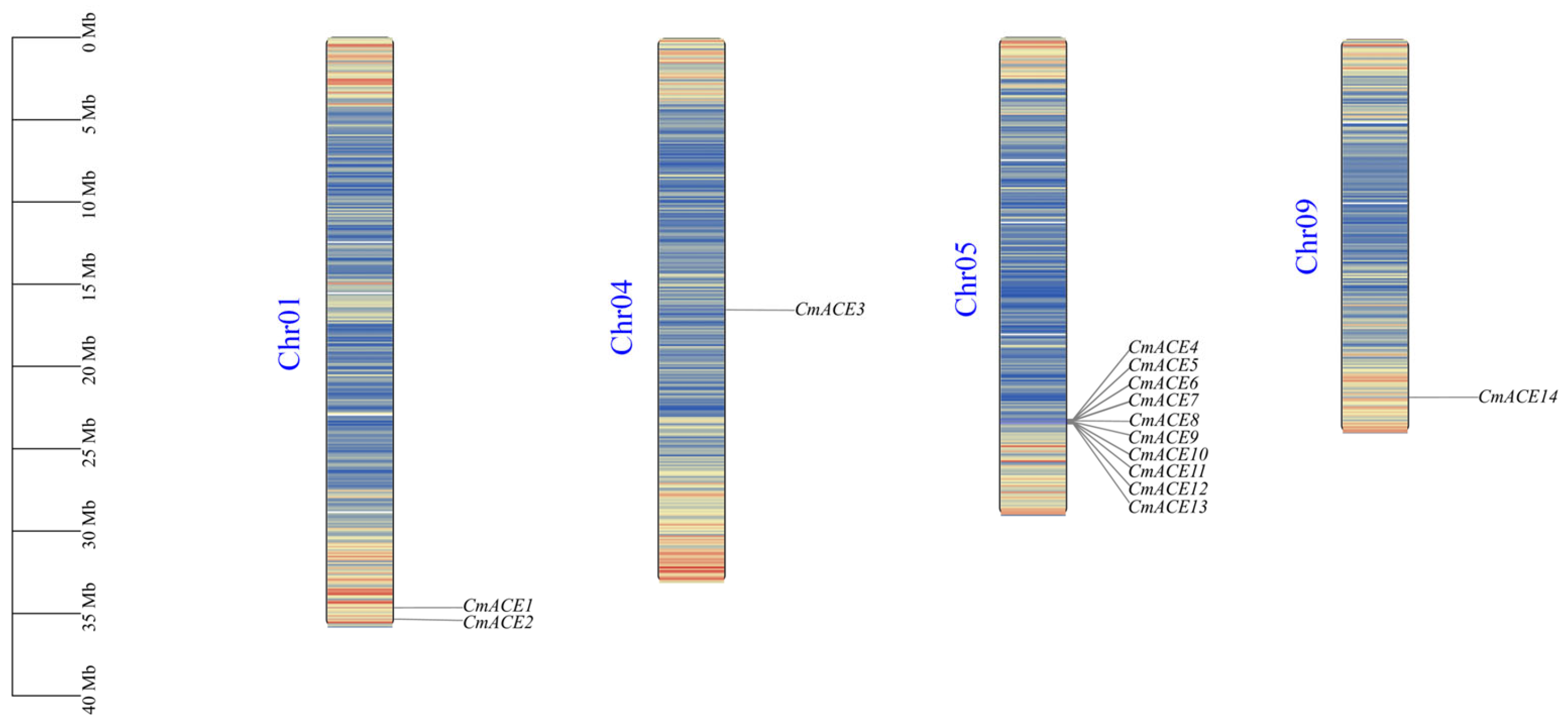
The distribution of the ACE gene family on melon chromosomes is shown in Figure 1. The 14 gene family members were unevenly distributed across 4 melon chromosomes (Chr1, Chr4, Chr5, and Chr9). Chromosome 5 harbored the highest number of ACE genes, with 10 genes (CmACE4-CmACE13) located on it, showing an apparent gene cluster distribution pattern. Chromosomes 4 and 9 contained the fewest genes, with only one gene each (CmACE3 and CmACE14, respectively). Chromosome 1 contained two genes (CmACE1 and CmACE2).
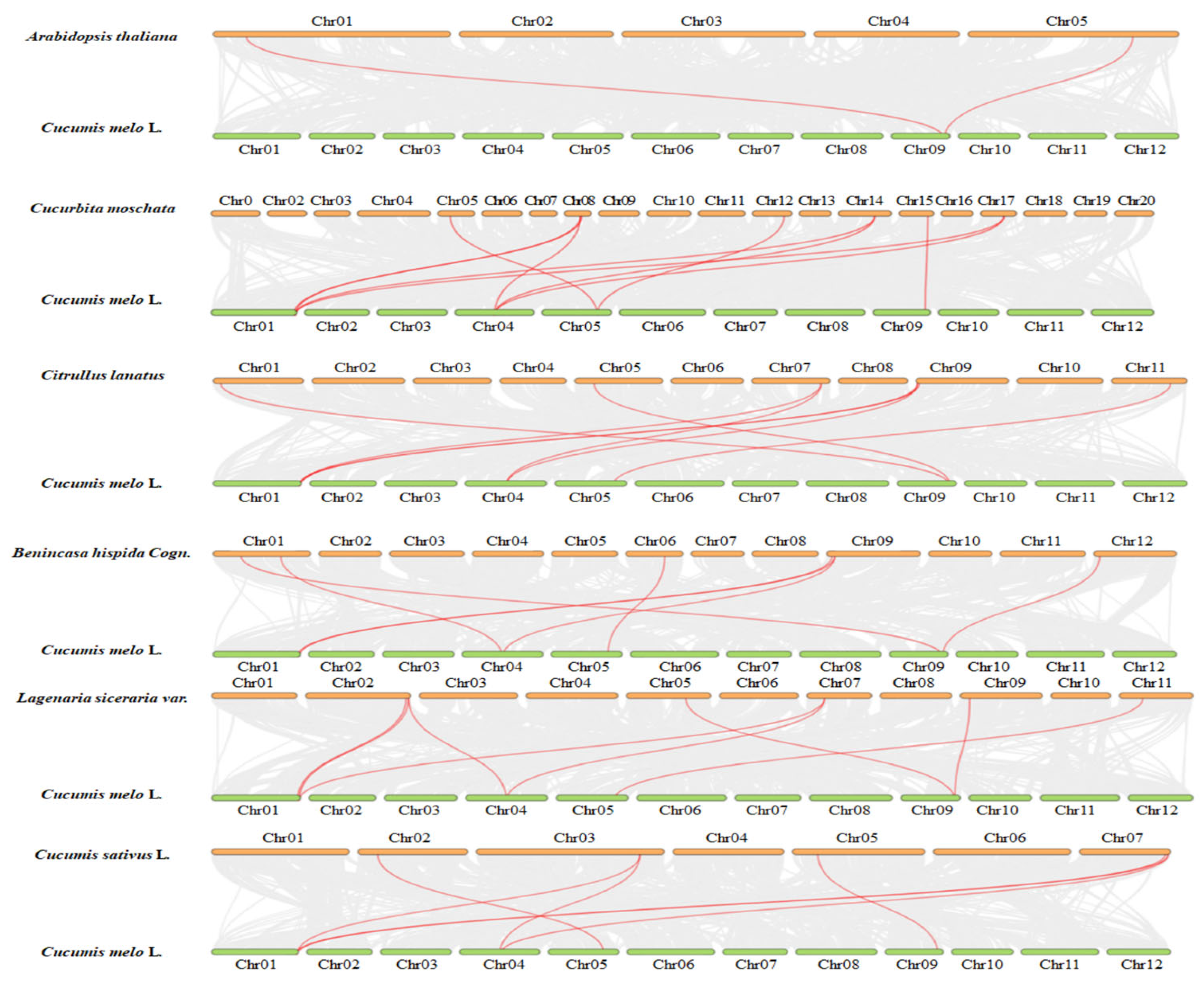
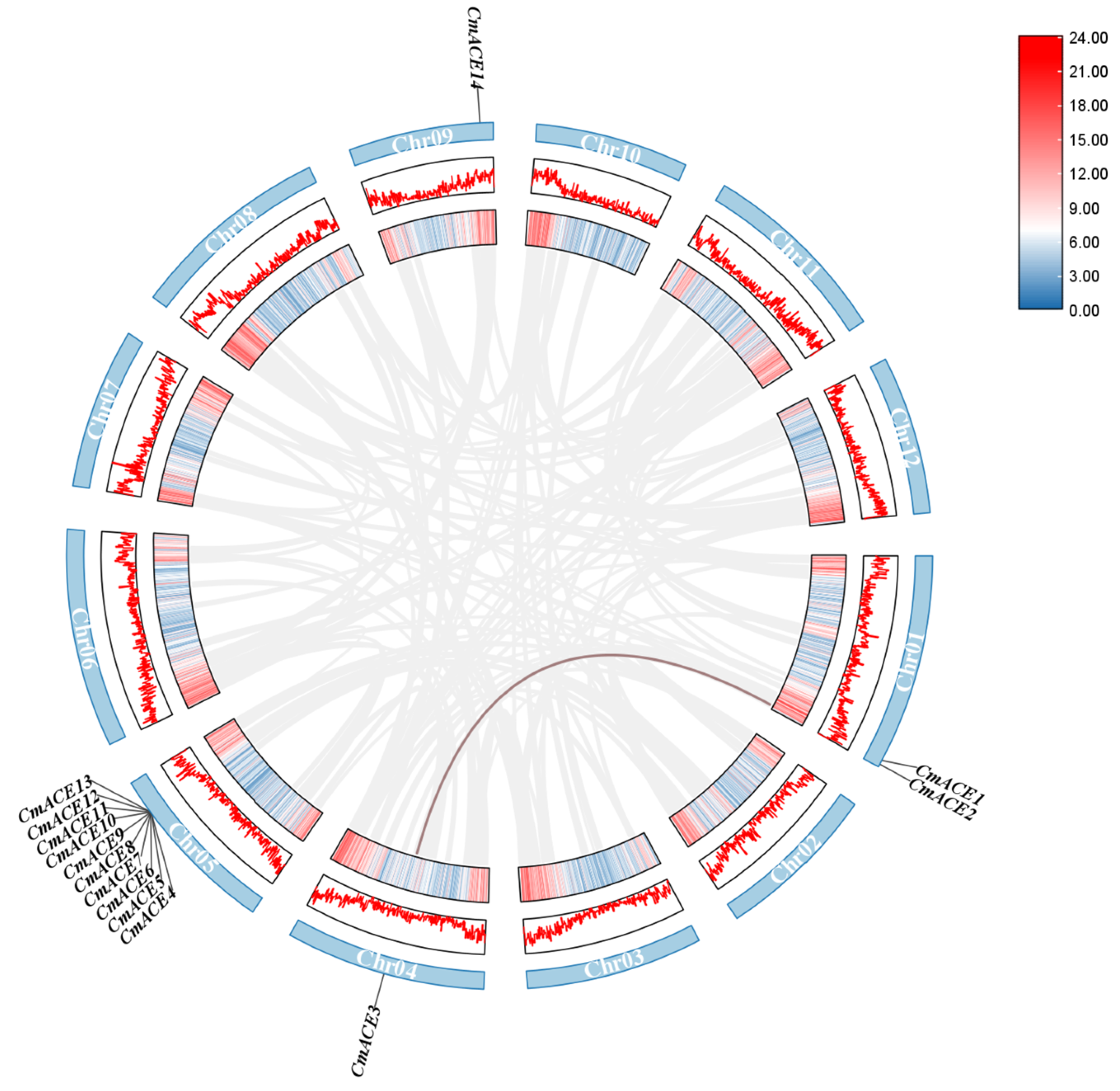
To further investigate the evolutionary relationships of ACE genes, a collinearity analysis was conducted among the whole genomes of seven species (Figure 2). The analysis revealed that in the Brassicaceae model plant Arabidopsis thaliana, there were 2 collinear pairs between 1 CmACE gene and 2 Arabidopsis thaliana ACE (AtACE) genes. More extensive collinear relationships were observed among Cucurbitaceae crops: 9 collinear pairs were identified between 4 CmACE genes and 6 pumpkin ACE genes; 7 collinear pairs were found between 4 CmACE genes and 5 watermelon ACE genes; 6 collinear pairs were found between 4 CmACE genes and 4 wax gourd ACE genes; 8 collinear pairs were found between 4 CmACE genes and 5 bottle gourd ACE genes; 6 collinear pairs were found between 4 CmACE genes and 4 cucumber ACE genes. This quantitative summary (9, 7, 7, 8, and 6 orthologous pairs with pumpkin, watermelon, wax gourd, bottle gourd, and cucumber, respectively) underscores the widespread synteny conservation of ACE genes across the Cucurbitaceae family. It is particularly noteworthy that CmACE14 showed collinear relationships with the genomes of all the analyzed species mentioned above. Additionally, CmACE3 had at least 2 collinear pairs with the genomes of the Cucurbitaceae crops. Intra-species collinearity analysis of the CmACE gene family was performed, and the results are shown in Figure 3. Our MCScanX analysis identified two tandem duplicate gene pairs based on their adjacent genomic positioning and absence of intervening genes: CmACE4/CmACE5 and CmACE6/CmACE7. The coding sequences of CmACE4 and CmACE5 share 80.1% identity, while CmACE6 and CmACE7 share 83.1% identity, supporting their origin from recent tandem duplication events.

3.3. Phylogenetic Analysis of the ACE Gene Family

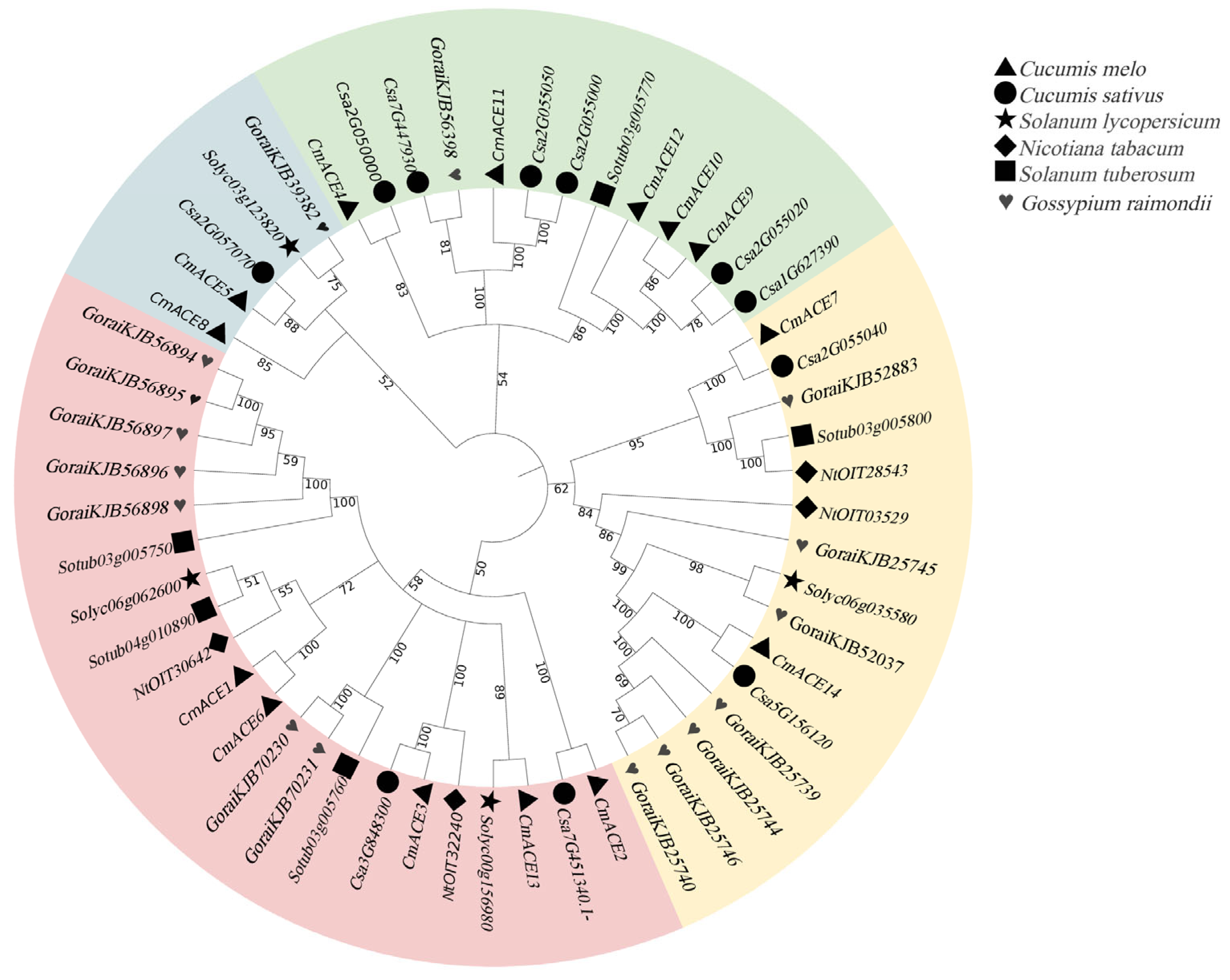
To investigate the evolutionary relationships within the melon ACE family, a phylogenetic tree was constructed using ACE proteins from melon, cucumber, tomato, tobacco, potato, and cotton (Figure 4). The results revealed that CmACEs from melon and CsACEs from cucumber, both members of the Cucurbitaceae family, consistently clustered within the same subclades. This suggests that the ACE genes in melon and cucumber are most closely related, likely sharing a recent common ancestor and exhibiting high evolutionary conservation. In contrast, ACE genes from cotton, tomato, potato, and tobacco were dispersed across other clusters, indicating that they may have undergone complex gene expansion and functional diversification.

3.4. Analysis of Cis-Acting Elements in the Promoters of the CmACE Family

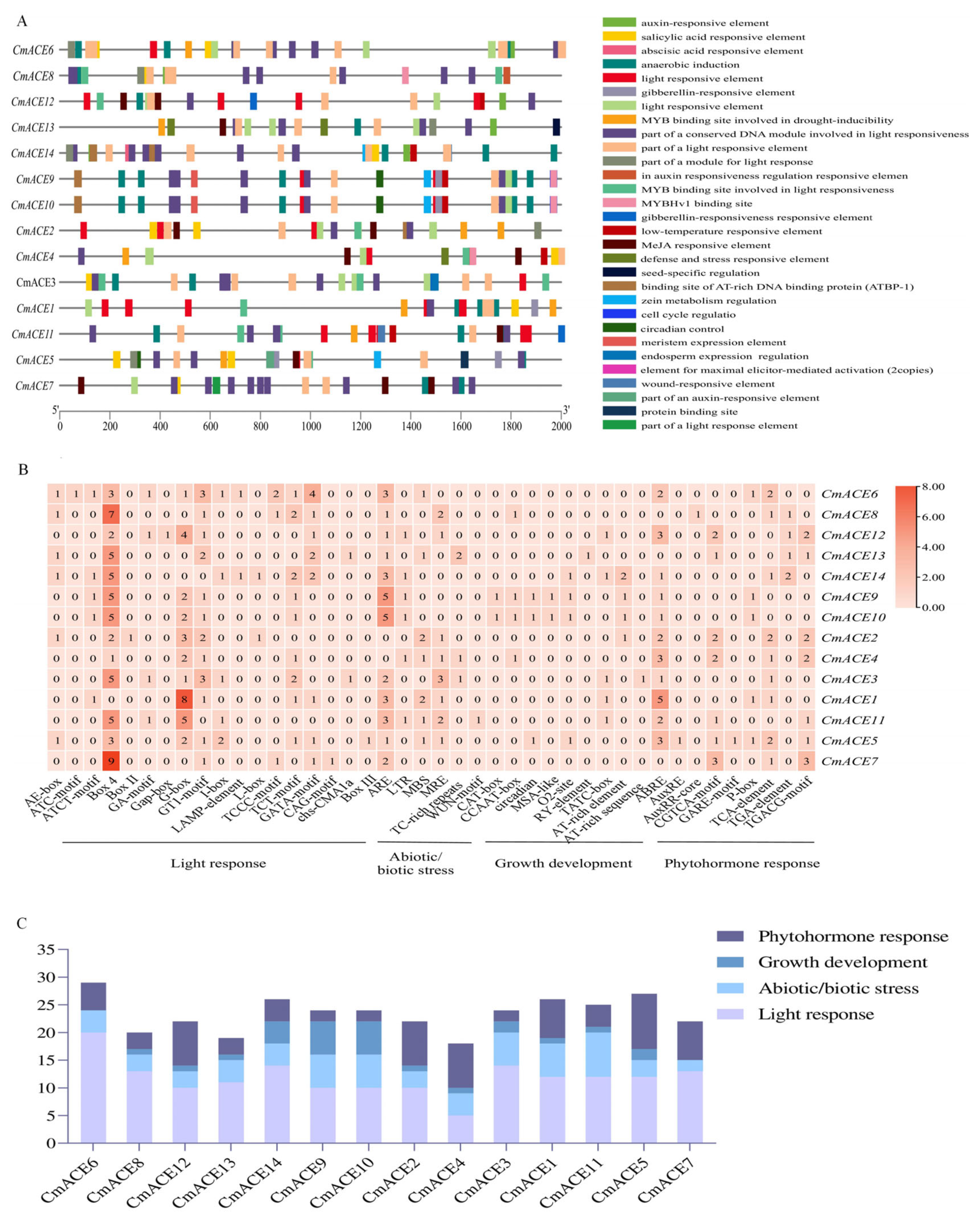
The 2000 bp sequences upstream of the transcription start sites (TSS) of the 14 CmACE genes were subjected to prediction analysis for cis-acting elements (Figure 5). After screening out and excluding core promoter elements such as CAAT-box and TATA-box, a total of 42 types of non-redundant cis-acting elements were detected. Based on their functions, these elements were classified into four major categories: light responsiveness, stress responsiveness, plant growth and development, and phytohormone responsiveness. The types and numbers of cis-acting elements contained in the promoter regions varied considerably among different family members. Light-responsive elements were the most diverse (18 types), followed by phytohormone-responsive elements (9 types) and elements related to growth development (9 types); stress-responsive elements were the least diverse (6 types). Among the phytohormone-responsive elements, those involved in response to abscisic acid (ABA), methyl jasmonate (MeJA), and salicylic acid (SA) were predominant. The number of ABA-responsive elements (ABRE) was the highest (24). The promoter regions of CmACE2, CmACE4, CmACE5, CmACE7, and CmACE11 contained response elements for all three aforementioned hormones (ABA, MeJA, SA), while the types and numbers of hormone response elements differed significantly among the other members. Among the stress-responsive elements, 6 types were identified, including the antioxidant response element (ARE), low-temperature responsiveness element (LTR), and drought-inducibility element (MBS). The ARE element was the most numerous (30), and it was present in the promoters of all 12 genes except CmACE2 and CmACE4. Notably, CmACE9 and CmACE10 were found to share an identical profile of cis-acting elements.

3.5. Gene Structure and Conserved Motif Analysis of the CmACE Family

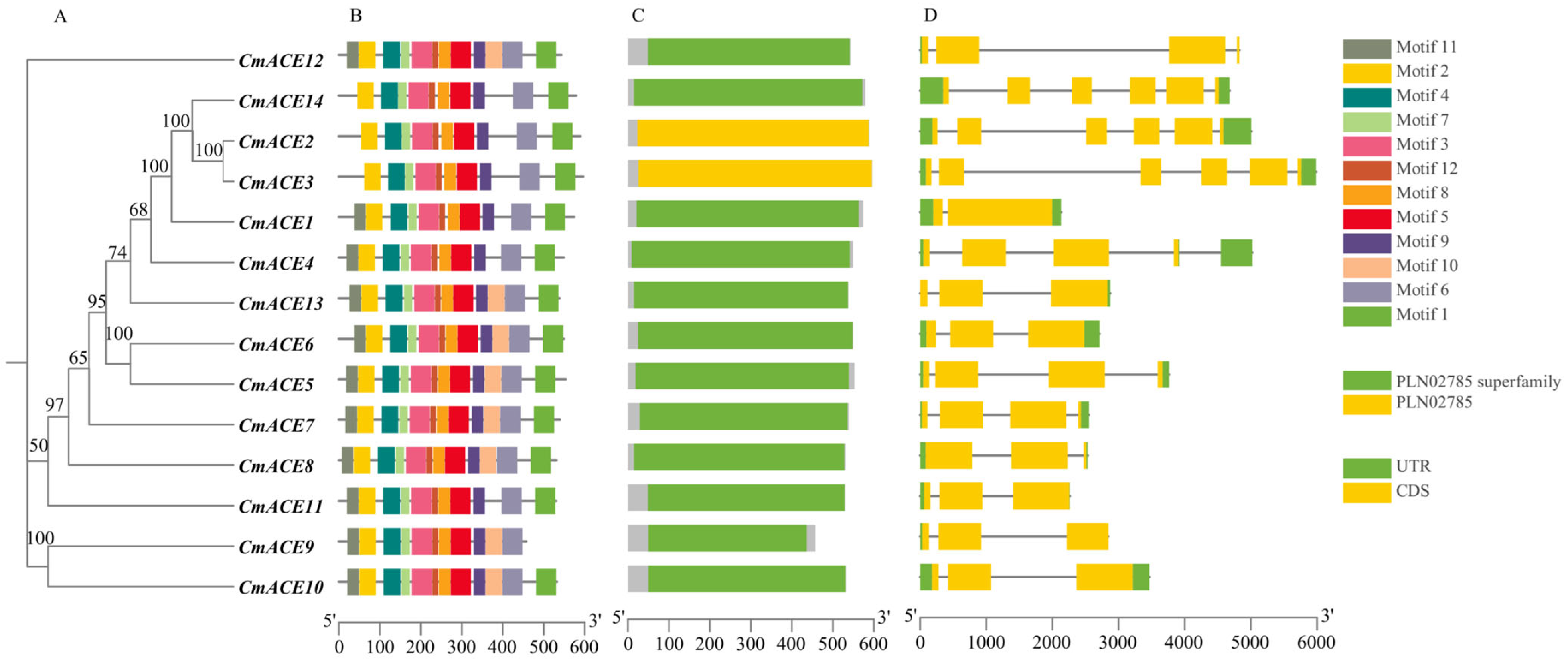
The phylogenetic analysis revealed that the CmACE proteins segregate into distinct clades, suggesting potential functional diversification within the gene family (Figure 6A). Analysis of conserved motifs identified twelve motifs across the CmACE family. Specific absences were noted: the CmACE9 protein sequence lacked Motif 1, while CmACE1, CmACE2, CmACE3, CmACE4, CmACE11, and CmACE14 all lacked Motif 10 (Figure 6B). Gene structure analysis uncovered substantial diversity in exon-intron organization. The number of introns varied from 1 to 5, and exons from 2 to 6. Specifically, one gene contained 1 intron, six genes contained 2, three genes contained 3, one gene contained 4, and three genes contained 5 (Figure 6C). Notably, while members within the same phylogenetic clade often shared identical gene structures (e.g., CmACE9 and CmACE10, Figure 6D), distinct differences were also observed between other members (e.g., CmACE1 and CmACE2). In summary, the distribution patterns of conserved motifs and the diversity in gene architecture suggest that the structural evolution of the CmACE family has been shaped by multiple independent events during functional diversification, rather than being strictly congruent with the broad phylogenetic groupings.

3.6. Stress-Responsive and Tissue-Specific Expression of CmACE Genes

To comprehensively investigate the expression patterns of CmACE genes under stress conditions, we analyzed their transcript levels using both RNA sequencing and qRT-PCR.

3.6.1. Transcriptomic Profiling of CmACE Genes Under Saline-Alkali and Autotoxicity Stresses

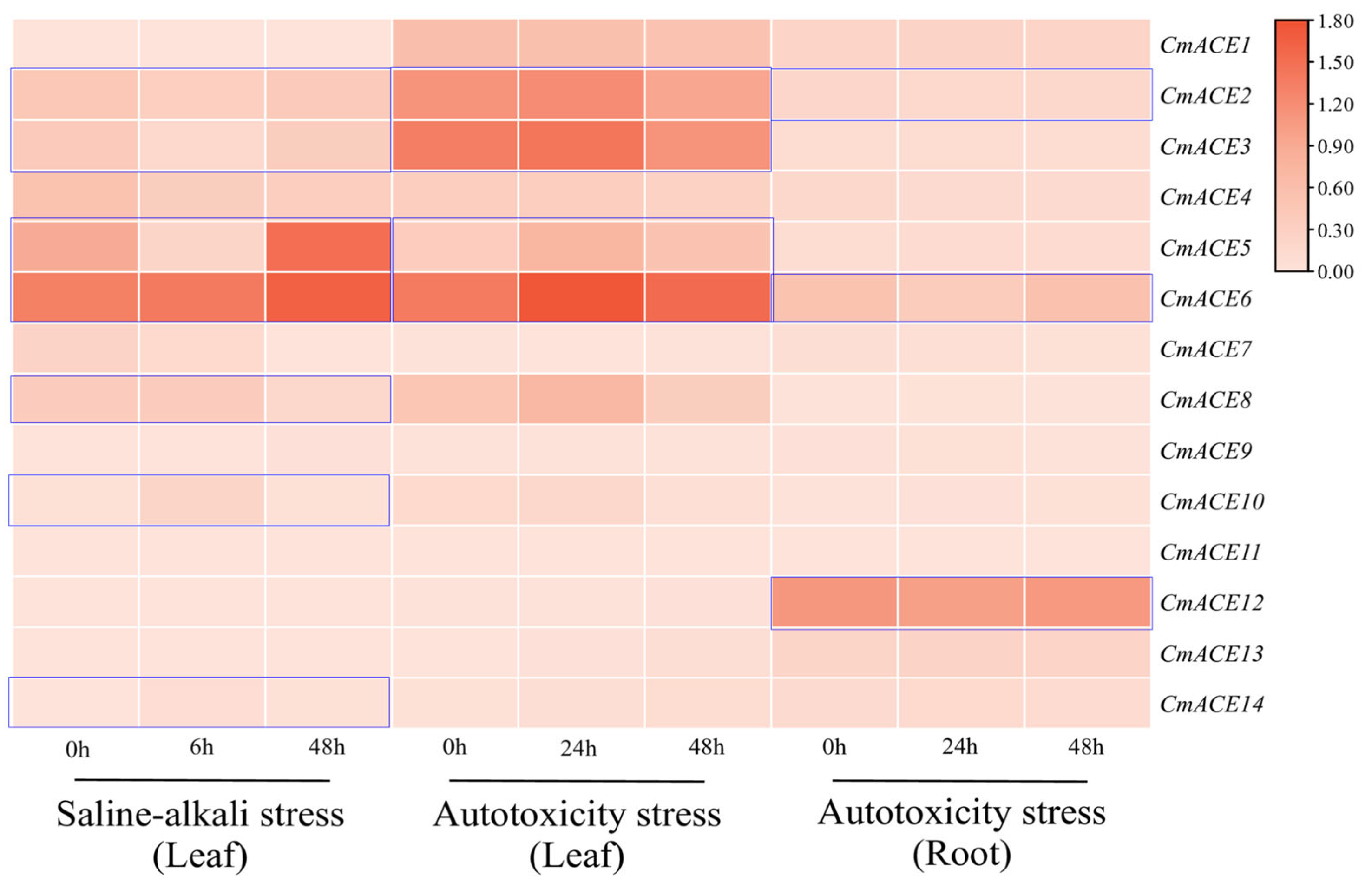
Based on transcriptome sequencing data obtained in our laboratory, the expression levels of CmACE genes under saline-alkali stress and autotoxicity stress were analyzed (Figure 7). The analysis focused on genes exhibiting clear temporal expression changes. Under saline-alkali stress in leaves, dynamic expression changes were observed for several genes. The expression of CmACE2 and CmACE3 decreased at 6 h post-treatment (hpt) and subsequently increased by 48 hpt. CmACE5 displayed a similar but more pronounced trend, with a sharp reduction at 6 hpt followed by a strong increase at 48 hpt. Conversely, the expression of CmACE8, CmACE10, and CmACE14 was elevated at 6 hpt and then declined by 48 hpt. Notably, CmACE6 maintained a constitutively high expression level throughout the treatment. Under autotoxicity stress, tissue-specific patterns emerged. In leaves, the expression of CmACE2, CmACE3, and CmACE5 was sharply induced at 24 hpt and then decreased at 48 hpt. CmACE6 also showed sustained high expression in leaves. In roots, CmACE12 exhibited a unique and sustained high expression. Additionally, the expression of CmACE2 and CmACE6 in roots was suppressed at 24 hpt but increased at 48 hpt.

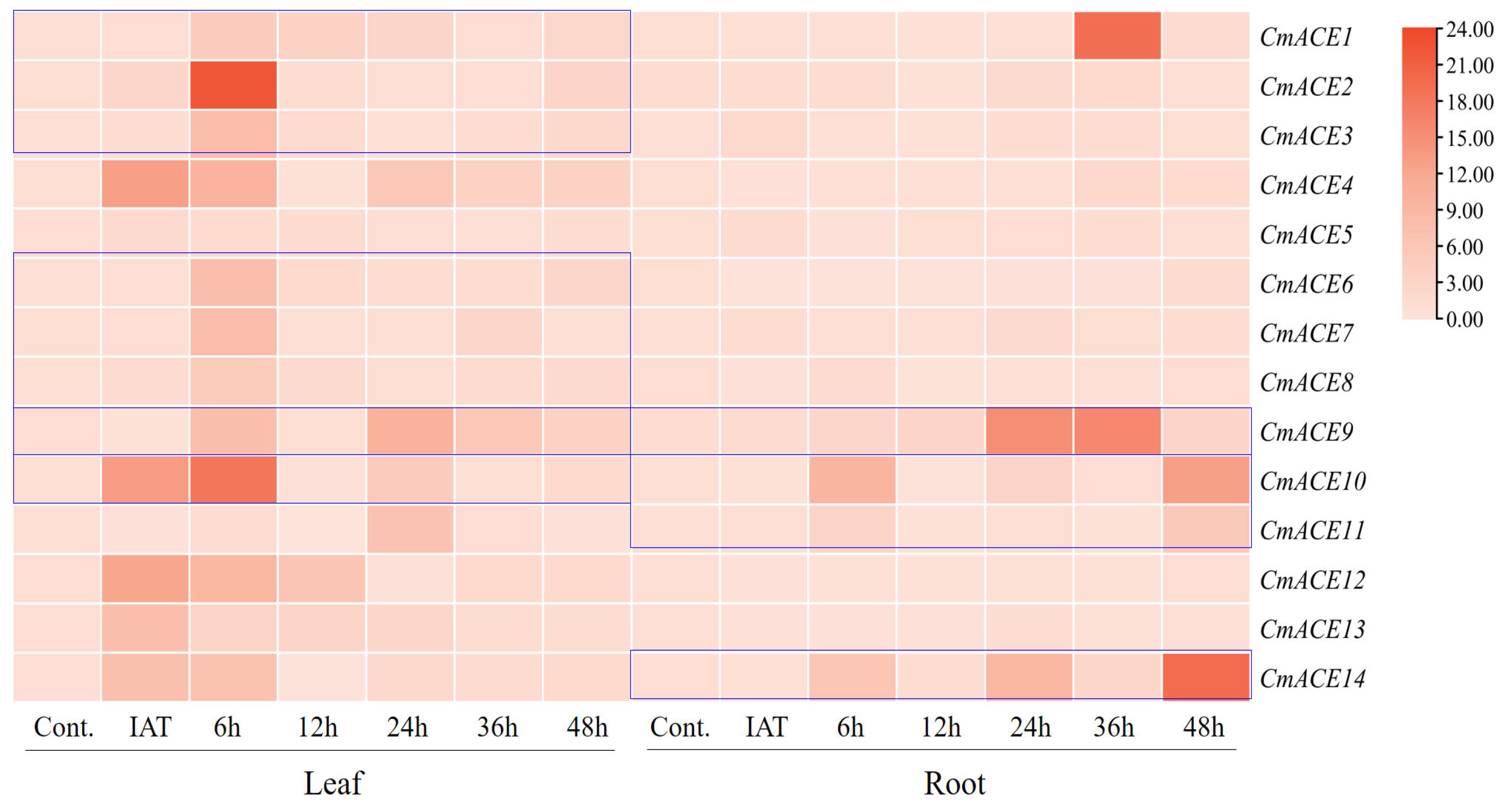
3.6.2. qRT-PCR Expression Analysis Under Saline-Alkali Stress and Melon Plant Extract Treatment

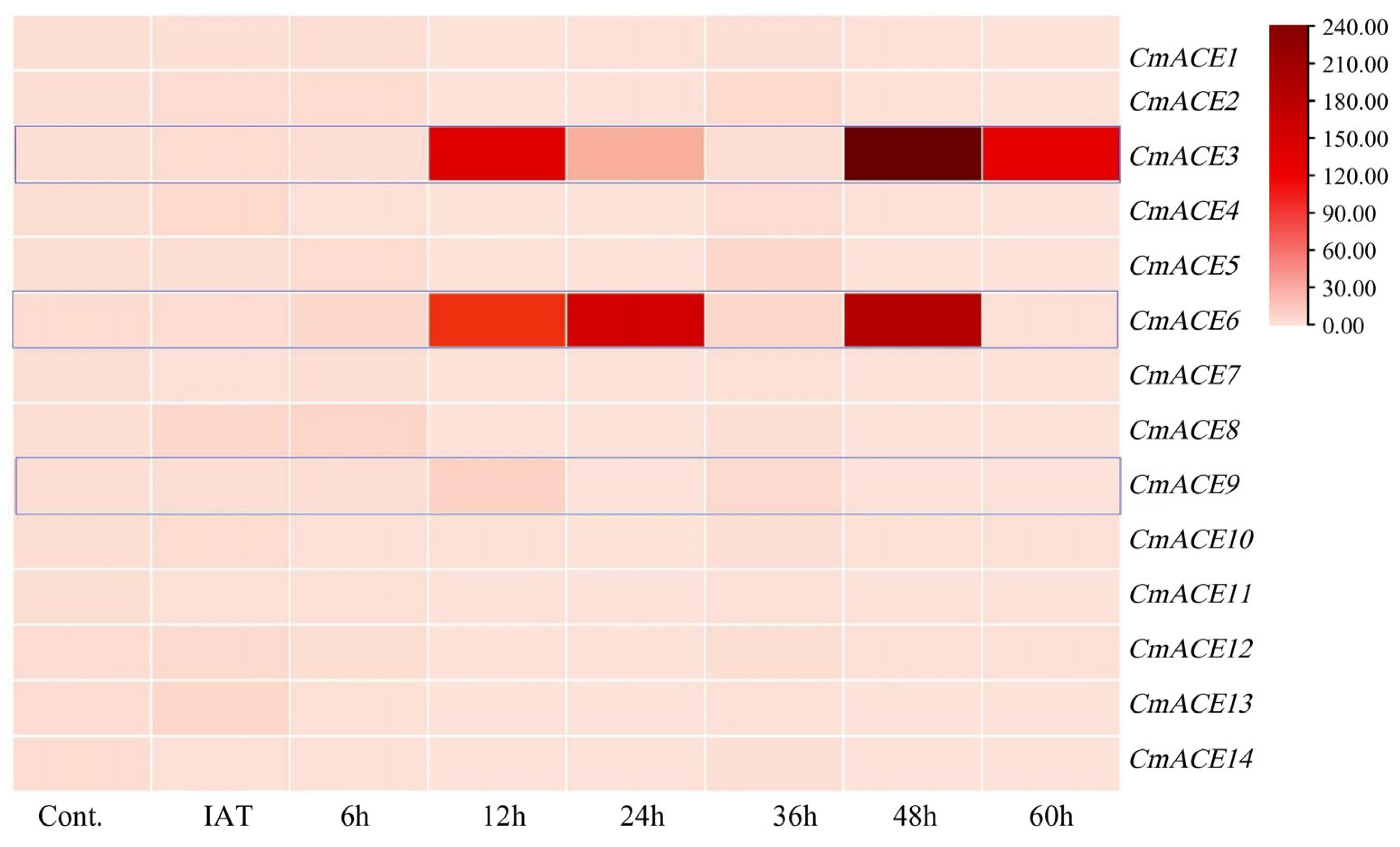
To validate and elaborate on the transcriptome profiles, qRT-PCR analysis was performed on all 14 CmACE genes, with a particular focus on key responsive candidates to precisely quantify their spatiotemporal expression patterns under different stresses (Figure 8 and Figure 9). The results showed that both saline-alkali and autotoxicity stress could induce the expression of some CmACE genes, but the expression levels and change timing differed. Under saline-alkali treatment, the genes CmACE3, CmACE6, and CmACE9 in melon leaves were all upregulated after treatment. The upregulation of CmACE3 and CmACE6 expression was more substantial at a later time point compared to CmACE9. Under autotoxicity, the relative expression levels differed across tissue parts. At an early time point, the genes CmACE1, CmACE2, CmACE3, CmACE6, CmACE7, CmACE8, CmACE9, and CmACE10 in leaves were upregulated; concurrently, the genes CmACE10, CmACE11, and CmACE14 in roots were also upregulated. At a subsequent time point, CmACE9 showed notable upregulation in both melon leaves and roots.

4. Discussion

Soil degradation caused by continuous cropping poses a critical bottleneck for the facility-based and large-scale cultivation of melon (Cucumis melo L.), threatening the sustainable development of its industry. Soil salinization and autotoxicity are identified as the primary abiotic stressors driving this issue. Deciphering the molecular mechanisms underlying melon’s response to these stresses is therefore crucial for enhancing cultivar resistance through genetic improvement. The ACE (FAD-binding oxidoreductase) family represents a pivotal class of enzymes ubiquitously present in living organisms, playing significant roles in plant development and environmental responses. Notably, in Arabidopsis thaliana, the organ fusion gene HOTHEAD (HTH), which is central to a novel non-Mendelian inheritance phenomenon involving RNA-cache-mediated genome restoration, encodes an ACE family protein [7]. This intriguing connection suggests that the ACE family’s function may extend beyond conventional oxidoreductase activity to potentially encompass roles in epigenetic regulation.
Although the ACE gene family has been characterized in various plant species, such as Arabidopsis and rice, related research in melon remained absent. This study presents the first genome-wide identification of 14 CmACE family members in melon, alongside a systematic analysis of their physicochemical properties, evolutionary relationships, expression patterns, and promoter cis-elements. Our findings provide a fundamental theoretical basis for understanding the potential functions and regulatory mechanisms of this gene family in melon’s stress responses, while also opening a new perspective to interpret its function in light of the revolutionary mechanism associated with its Arabidopsis ortholog, HTH.

4.1. Specific Expansion and Functional Divergence of the Melon ACE Gene Family Underlie Its Biological Functional Diversity

We identified 14 CmACE members in the melon genome, a number higher than that in Arabidopsis. The encoded proteins exhibited a wide range of isoelectric points (pI 5.28–9.49), indicating diverse physicochemical characteristics within the family. Subcellular localization predictions suggested that 50% of members are targeted to the chloroplast, 35.71% to the vacuole, and the remainder to the endoplasmic reticulum, implying potential roles for CmACE proteins in redox regulation across various organelles.
The ACE family likely underwent significant expansion in melon and other Cucurbitaceae crops. This expansion appears primarily driven by tandem duplication events, evidenced by the clustering of 10 members (CmACE4CmACE13) on chromosome 5, which includes two clear tandem duplicate gene pairs (CmACE4/CmACE5 and CmACE6/CmACE7). This uneven clustering is a hallmark of gene family expansion via tandem duplication and provides the genetic substrate for the evolution of novel functions [22]. Genes duplicated by such events may evolve through paths including functional redundancy, subfunctionalization, or neofunctionalization [23].
Our expression data strongly support functional divergence. For instance, the tandem duplicate pair CmACE6 and CmACE7 exhibited starkly contrasting expression patterns. CmACE6 was strongly induced under various stresses, whereas CmACE7 showed minimal expression levels and weak responsiveness. This clearly indicates that post-duplication, CmACE6 likely acquired specialization (neofunctionalization) through variation in its coding or regulatory sequences, becoming a key executor in stress response pathways, while CmACE7 may retain other ancestral functions or has undergone subfunctionalization.
Interspecies collinearity analysis further elucidated the evolutionary history of the melon ACE family. CmACE14 exhibited collinearity with all analyzed species, including distantly related Arabidopsis, suggesting it is an ancient ortholog whose function is likely highly conserved across core eudicots and may perform an indispensable fundamental cellular role [24]. Conversely, CmACE3 showed extensive collinearity with all Cucurbitaceae relatives, indicating it is a core, functionally important, and conserved member within this clade. Such evolutionarily conserved genes are often functionally critical and non-redundant [25]. Combined with its expression pattern—significant induction under both saline-alkali and autotoxicity stresses—we speculate that CmACE3 is likely a core regulator in melon’s response to abiotic stresses and represents the highest-priority candidate for subsequent functional validation studies.
Intriguingly, given the identity between ACE and HTH, the strong, sustained induction of core members like CmACE3 and CmACE6 under stress may not only facilitate immediate redox homeostasis but could also be linked to the production of RNA transcripts that serve as potential templates for a conserved, RNA-cache-based mechanism to ensure heritable genomic stability of these critical stress-response genes under environmental challenges.

4.2. Diversity in Gene Structure and Cis-Elements Provides the Molecular Basis for CmACE Functional Specificity

Phylogenetic analysis grouped the CmACE proteins into three clades. Members within the same clade generally shared similar gene structures (exon-intron patterns), with a clear correspondence between the 6 exon-5 intron pattern and one of the three major phylogenetic clades. This indicates strong structural conservation during evolution. In contrast, the distribution of conserved motifs was more complex and did not strictly adhere to the phylogenetic clades, suggesting that motif composition may be influenced by additional evolutionary pressures or functional constraints independent of the major lineage divergence.
However, functional diversity is more profoundly reflected at the transcriptional regulatory level. Promoter cis-element analysis revealed the significant potential of CmACE genes to respond to complex environments. All members harbored abundant cis-elements related to abiotic stress responses (e.g., ARE, MBS, LTR) and phytohormone signaling (e.g., ABRE, MeJA-, SA-responsive elements) in their promoter regions. This theoretically predicts the broad involvement of the CmACE family in stress adaptation processes mediated by multiple hormone signals. The analysis highlighted several key features: (1) Central role of ABA signaling: The ABRE element was the most numerous (24 instances), consistent with the central role of ABA as a key hormone regulating abiotic stress responses, strongly implying the ABA signaling pathway plays a dominant role in regulating CmACE gene expression. (2) Potential for coordinated defense: The promoters of multiple genes (e.g., CmACE2, 4, 5, 7, 11) contained response elements for ABA, MeJA, and SA simultaneously. This suggests the expression of these genes might be co- or antagonistically regulated by multiple hormone signals, potentially integrating different stress signals into a refined transcriptional regulatory network to cope with complex field stress conditions (e.g., combined saline-alkali and autotoxicity stress) [26]. (3) Clues to functional differentiation: The significant variation in the type and number of elements carried by different members directly explains their divergent spatiotemporal expression patterns under stress and provides a molecular rationale for their functional specificity.

4.3. Spatiotemporally Specific Expression Patterns of CmACE Genes Under Saline-Alkali and Autotoxicity Stresses Suggest Complex Regulatory Logic

Expression analyses via RNA-seq and qRT-PCR confirmed our predictions and precisely delineated the dynamic response landscapes of different CmACE members under saline-alkali and autotoxicity stresses. These expression patterns were not random but exhibited a high degree of regularity and functional implication. CmACE3 and CmACE6 were strongly and persistently induced under two distinct stress treatments, reaching very high levels especially at later stages (48 hpt). This suggests their role may not be limited to sensing specific stresses but likely operates in common downstream pathways convergent from multiple stress signals. Given their evolutionary conservation (CmACE3) and potential neofunctionalization (CmACE6), we propose that these two genes, encoding oxidoreductases, may play core roles in shared physiological processes such as reactive oxygen species (ROS) scavenging or maintaining cellular redox homeostasis, making them highly valuable candidate genes for breeding melon with broad-spectrum stress resistance.
The persistent and strong induction of CmACE3 and CmACE6 across distinct stresses highlights their potential as core regulators in a convergent adaptation pathway. As GMC oxidoreductases, their predicted role in oxidizing long-chain fatty acids [5,8] supports a dual functional model: direct participation in ROS detoxification to maintain redox homeostasis, and critical involvement in the biosynthesis of cuticular and suberin polymers [9]. The reinforcement of these apoplastic barriers would provide a critical physiological line of defense by reducing the uptake of sodium ions and hydrophobic autotoxic compounds, directly addressing the primary challenges of saline-alkali and autotoxicity stress [10].
The expression patterns of the CmACE genes under stress conditions were assessed using two independent methodologies: RNA-seq and qRT-PCR. While both techniques consistently identified CmACE3 and CmACE6 as the most prominent stress responders, detailed comparison revealed differences in their precise temporal expression patterns and induction magnitudes. For instance, under saline-alkali stress, the peak induction of CmACE6 was detected at 48 hpt by both methods, yet responses at intermediate time points showed variations. Similarly, for CmACE3 under autotoxicity stress in leaves, the qRT-PCR data showed a distinct early peak at 6 hpt that was less pronounced in RNA-seq data. These observed differences likely reflect the distinct technical characteristics of each platform, including their dynamic range, sensitivity to low-abundance transcripts, and normalization methods, as well as the biological variation between independently harvested samples [27]. Rather than indicating methodological inconsistency, these complementary datasets provide a more comprehensive view of transcriptional dynamics. The convergent identification of CmACE3 and CmACE6 as core stress responders by both approaches provides robust validation of their central role in melon’s stress response network.
Furthermore, the persistent and high-level accumulation of transcripts from these core stress-responsive CmACE genes, analogous to their ortholog HTH in Arabidopsis, raises a compelling possibility: these transcripts could be selectively archived as part of an ‘RNA cache’ [7]. This cache might serve a dual purpose—not only for immediate protein production but also as a template for potential genome surveillance or epigenetic regulation, thereby contributing to enhanced stress resilience across generations, a hypothesis worthy of future investigation.
The expression of different genes showed distinct temporal and tissue specificity, reflecting an integrated and division-of-labor response to stress signals. Notably, the response to saline-alkali stress exhibited clear temporal specificity: CmACE8, CmACE10, and CmACE14 peaked sharply at 6 hpt before declining rapidly, suggesting potential roles in early stress response or signal perception. Conversely, CmACE5 and CmACE6 reached maximum expression at 48 hpt, indicating likely roles in longer-term adaptation mechanisms, such as cellular osmotic adjustment or homeostasis recovery. This sequential ‘early-late’ response pattern is consistent with observations for ACE homologs in rice and maize under abiotic stress [28,29], suggesting it may be a conserved functional diversification strategy within the ACE family. Under autotoxicity stress, the expression of most genes in leaves (e.g., CmACE2, 3, 5, 6, 8, 10) peaked at 24 hpt before declining, coinciding with the onset of growth inhibition phenotypes induced by autotoxic substances [30]. In roots, different members displayed contrasting expression dynamics: one group (CmACE1, 8, 9, 13, 14) showed an initial induction followed by suppression, while another (CmACE2, 6, 12) exhibited initial suppression followed by induction, revealing a multi-layered and complex transcriptional regulatory mechanism in roots responding to autotoxicity stress.
Not all genes participated in the stress response, illustrating the balance between functional redundancy and specificity. For instance, CmACE7, CmACE9, and CmACE11 maintained very low expression levels across all treatments, suggesting they may not be directly involved in these particular adversity responses. Their functions might be prominent during normal growth and development or under other untested specific conditions (e.g., biotic stress, specific developmental stages).
In summary, this study constructs an integrative framework spanning from “genome evolution” to “gene regulation” and finally to “expression function”. The melon ACE gene family expanded through tandem duplication, achieving functional innovation and diversity via divergence in coding and regulatory sequences. The abundance of stress and hormone response elements in their promoters provides the molecular switches for their integration into complex stress resistance networks. Ultimately, through spatiotemporally specific expression patterns, different members perform dedicated yet collaborative roles, with CmACE3 and CmACE6 acting as core responders playing crucial roles in melon’s response to saline-alkali and autotoxicity stresses.
Furthermore, our findings invite consideration within a broader evolutionary context. The established identity between the ACE gene family and the Arabidopsis HOTHEAD (HTH) gene, which is associated with a unique RNA-cache-mediated inheritance phenomenon, raises intriguing questions about the functional spectrum of these genes beyond immediate stress responses [7]. The strong and persistent induction of core CmACE genes observed here provides a phenotypic foundation for future investigations into whether such mechanisms might contribute to long-term adaptation in perennial crops or across generations. In conclusion, this work provides a solid theoretical basis and multi-validated key candidate gene resources for molecular breeding of stress-resistant melon. Our findings on the role of apoplastic barrier formation are complementary to other key salt-tolerance mechanisms, such as the activation of antioxidant systems and osmolyte accumulation that have been documented in species like Argania spinosa [31]. The connection to HTH also highlights the potential of the CmACE family as a subject for future research aimed at understanding the evolution and functional diversity of this intriguing gene family across plant species.

5. Conclusions

In conclusion, this study provides the first genome-wide analysis of the ACE gene family in melon, identifying 14 CmACE genes. Key findings reveal that the family expanded mainly through tandem duplication on chromosome 5, enabling functional diversification. While gene structures are phylogenetically conserved, promoter cis-elements are highly diverse, fine-tuning transcriptional responses to complex stresses. Critically, expression profiling identified core regulators: the tandem duplicates CmACE6 and CmACE7 show divergent expression indicative of neofunctionalization, while the conserved CmACE3 and neofunctionalized CmACE6 are strongly induced under both salt-alkali and autotoxicity stresses, highlighting their central role in broad-spectrum stress adaptation. Furthermore, the established identity between the ACE family and the Arabidopsis HOTHEAD (HTH) gene, which is associated with an RNA cache-based non-Mendelian inheritance mechanism, provides an intriguing evolutionary context for our findings. The persistent accumulation of transcripts from core CmACE genes suggests that, in addition to their immediate role in stress mitigation, they could potentially serve as a starting point for exploring whether HTH-like functions contribute to long-term adaptation in melon. This possibility, however, requires direct experimental validation in future studies. This work deepens our understanding of the CmACE family’s evolution and function and provides a foundation for their functional validation (e.g., via gene editing). It also delivers precise candidate genes for breeding stress-resistant melon varieties. Future research should aim to confirm the molecular functions of CmACE3 and CmACE6 in stress tolerance and, building on the connection to HTH, investigate the potential for RNA-level regulatory mechanisms in crop environmental adaptation.

Author Contributions

H.Y.: Conceptualization, Methodology, Formal analysis, Investigation, Writing—original draft. S.X.: Validation, Investigation, Data curation. S.L.: Software, Validation, Visualization. W.C.: Resources. Y.Z.: Formal analysis, Data curation. X.C.: Data curation, Formal analysis. Z.Z.: Supervision, Writing—review, Funding acquisition. J.W.: Conceptualization, Supervision, Writing—review & editing. All authors have read and agreed to the published version of the manuscript.

Funding

The project was supported by Fujian Provincial Natural Science Foundation of China (No. 2023J01275).

Data Availability Statement

The data presented in this study are available on request from the corresponding author due to authorization rules of the corresponding author’s institution.

Conflicts of Interest

The authors declare no conflicts of interest.

References

  1. Huang, Y.; Li, W.; Zhao, L.; Shen, T.; Sun, J.; Chen, H.; Kong, Q.; Nawaz, M.A.; Bie, Z. Melon fruit sugar and amino acid contents are affected by fruit setting method under protected cultivation. Sci. Hortic. 2017, 214, 288–294. [Google Scholar] [CrossRef]
  2. Kawa, D.; Meyer, A.J.; Dekker, H.L.; Abd-El-Haliem, A.M.; Gevaert, K.; Van De Slijke, E.; Maszkowska, J.; Bucholc, M.; Dobrowolska, G.; De Jaeger, G.; et al. SnRK2 protein kinases and mRNA decapping machinery control root development and response to salt. Plant Physiol. 2020, 182, 361–377. [Google Scholar] [CrossRef] [PubMed]
  3. van Zelm, E.; Zhang, Y.; Testerink, C. Salt tolerance mechanisms of plants. Annu. Rev. Plant Biol. 2020, 71, 403–433. [Google Scholar] [CrossRef] [PubMed]
  4. Wang, Y.; Zhang, W.; Zhang, Z.; Wang, W.; Xu, S.; He, X. Isolation, identification and characterization of phenolic acid-degrading bacteria from soil. J. Appl. Microbiol. 2021, 131, 208–220. [Google Scholar] [CrossRef]
  5. Yue, Q.K.; Kass, I.J.; Sampson, N.S.; Vrielink, A. Crystal structure determination of cholesterol oxidase from Streptomyces and structural characterization of key active site mutants. Biochemistry 1999, 38, 4277–4286. [Google Scholar] [CrossRef]
  6. Krishnamurthy, P.; Ranathunge, K.; Franke, R.; Prakash, H.S.; Schreiber, L.; Mathew, M.K. The role of root apoplastic transport barriers in salt tolerance of rice (Oryza sativa L.). Planta 2009, 230, 119–134. [Google Scholar] [CrossRef]
  7. Lolle, S.; Victor, J.; Young, J.; Pruitt, R. Genome-wide non-mendelian inheritance of extra-genomic information in Arabidopsis. Nature 2005, 434, 505–509. [Google Scholar] [CrossRef]
  8. Krolikowski, K.A.; Victor, J.L.; Wagler, T.N.; Lolle, S.J.; Pruitt, R.E. Isolation and characterization of the Arabidopsis organ fusion gene HOTHEAD. Plant J. 2003, 35, 501–511. [Google Scholar] [CrossRef]
  9. Kurdyukov, S.; Faust, A.; Trenkamp, S.; Bär, S.; Franke, R.; Efremova, N.; Tietjen, K.; Schreiber, L.; Saedler, H.; Yephremov, A. Genetic and biochemical evidence for involvement of HOTHEAD in the biosynthesis of long-chain α-, ω-dicarboxylic fatty acids and formation of extracellular matrix. Planta 2006, 224, 315–329. [Google Scholar] [CrossRef]
  10. Xu, Y.; Liu, S.; Liu, Y.; Ling, S.; Chen, C.; Yao, J. HOTHEAD-like HTH1 is involved in anther cutin biosynthesis and is required for pollen fertility in rice. Plant Cell Physiol. 2017, 58, 1238–1248. [Google Scholar] [CrossRef]
  11. Sützl, L.; Foley, G.; Gillam, E.M.J.; Bodén, M.; Haltrich, D. The GMC superfamily of oxidoreductases revisited: Analysis and evolution of fungal GMC oxidoreductases. Biotechnol. Biofuels 2019, 12, 118. [Google Scholar] [CrossRef]
  12. Liu, J.; Ye, Q.; Shen, Y.; Wu, Z.; Jiang, W.; Guo, D.; Hu, X.; Wang, X.; Zhang, Z.; Hu, L. Functional divergence and characterization of the HOTHEAD gene family in rice. BMC Genom. 2025, 26, 703. [Google Scholar] [CrossRef]
  13. Finn, R.D.; Clements, J.; Eddy, S.R. HMMER web server: Interactive sequence similarity searching. Nucleic Acids Res. 2011, 39 (Suppl. S2), W29–W37. [Google Scholar] [CrossRef] [PubMed]
  14. Chen, C.; Chen, H.; Zhang, Y.; Thomas, H.R.; Frank, M.H.; He, Y.; Xia, R. TBtools: An integrative toolkit developed for interactive analyses of big biological data. Mol. Plant 2020, 13, 1194–1202. [Google Scholar] [CrossRef] [PubMed]
  15. Gu, X.; Gao, S.; Li, J.; Song, P.; Zhang, Q.; Guo, J.; Zhu, Z. The bHLH transcription factor regulated gene OsWIH2 is a positive regulator of drought tolerance in rice. Plant Physiol. Biochem. 2021, 169, 269–279. [Google Scholar] [CrossRef] [PubMed]
  16. Sun, M.; Yan, H.; Zhang, A.; Jin, Y.; Lin, C.; Luo, J.; Zhou, P.; Wang, X.; Zhang, X.; Huang, L. The transcriptional dynamic landscape map of pearl millet in response to abiotic stress provides new insights into the responses of plants to stress. Trop. Plants 2025, 4, e024. [Google Scholar] [CrossRef]
  17. Lim, G.; Singhal, R.; Kachroo, A.; Kachroo, P. Fatty acid– and lipid-mediated signaling in plant defense. Annu. Rev. Phytopathol. 2017, 55, 505–536. [Google Scholar] [CrossRef]
  18. Zhang, Z.; Fan, J.; Wu, J.; Zhang, L.; Wang, J.; Zhang, B.; Wang-Pruski, G. Alleviating effect of silicon on melon seed germination under autotoxicity stress. Ecotoxicol. Environ. Saf. 2020, 188, 109901. [Google Scholar] [CrossRef]
  19. Wang, Y.; Tang, H.; DeBarry, J.D.; Tan, X.; Li, J.; Wang, X.; Lee, T.; Jin, H.; Marler, B.; Guo, H.; et al. MCScanX: A toolkit for detection and evolutionary analysis of gene synteny and collinearity. Nucleic Acids Res. 2012, 40, e49. [Google Scholar] [CrossRef]
  20. Zhang, L.Z.; Han, X.Y.; Wu, J.H.; Wang-Pruski, G.; Zhang, Z.Z. Screening of reference genes for quantitative real-time PCR in melon. Fujian J. Agric. Sci. 2020, 35, 1179–1187. [Google Scholar] [CrossRef]
  21. Schmittgen, T.D.; Livak, K.J. Analyzing real-time PCR data by the comparative CT method. Nat. Protoc. 2008, 3, 1101–1108. [Google Scholar] [CrossRef]
  22. Oren, M.; Barela Hudgell, M.A.; D’Allura, B.; Agronin, J.; Gross, A.; Podini, D.; Smith, L.C. Short tandem repeats, segmental duplications, gene deletion, and genomic instability in a rapidly diversified immune gene family. BMC Genom. 2016, 17, 900. [Google Scholar] [CrossRef]
  23. Birchler, J.A.; Yang, H. The multiple fates of gene duplications: Deletion, hypofunctionalization, subfunctionalization, neofunctionalization, dosage balance constraints, and neutral variation. Plant Cell 2022, 34, 2466–2474. [Google Scholar] [CrossRef] [PubMed]
  24. Simakov, O.; Bredeson, J.; Berkoff, K.; Marletaz, F.; Mitros, T.; Schultz, D.T.; O’Connell, B.L.; Dear, P.; Martinez, D.E.; Steele, R.E.; et al. Deeply conserved synteny and the evolution of metazoan chromosomes. Sci. Adv. 2022, 8, eabi5884. [Google Scholar] [CrossRef] [PubMed]
  25. Tiruveedula, G.S.S.; Wangikar, P.P. Gene essentiality, conservation index and co-evolution of genes in cyanobacteria. PLoS ONE 2017, 12, e0178565. [Google Scholar] [CrossRef] [PubMed]
  26. Ma, S.; Bohnert, H.J. Integration of Arabidopsis thaliana stress-related transcript profiles, promoter structures, and cell-specific expression. Genome Biol. 2007, 8, R49. [Google Scholar] [CrossRef]
  27. Everaert, C.; Luypaert, M.; Maag, J.L.V.; Cheng, Q.X.; Dinger, M.E.; Hellemans, J.; Mestdagh, P. Benchmarking of RNA-sequencing analysis workflows using whole-transcriptome RT-qPCR expression data. Sci. Rep. 2017, 7, 1559. [Google Scholar] [CrossRef]
  28. Lu, X.; Li, Y.; Akhtar, M.; Liu, C.; Ma, T.; Min, W.; Bai, X.; She, Y.; Chen, L.; Tian, L.; et al. A DUF966 gene family member OsDSR3 positively regulates alkali stress tolerance in rice. Plant Sci. 2024, 343, 112072. [Google Scholar] [CrossRef]
  29. Fang, H.; Shan, T.; Gu, H.; Chen, J.; Qi, Y.; Li, Y.; Saeed, M.; Yuan, J.; Li, P.; Wang, B. Identification and characterization of ACR gene family in maize for salt stress tolerance. Front. Plant Sci. 2024, 15, 1381056. [Google Scholar] [CrossRef]
  30. Liu, X.; Zhou, J.; Haq, M.Z.U.; Fu, Z.; Gu, G.; Yu, J.; Liu, Y.; Yang, D.; Yang, H.; Wu, Y. Functional analysis of the PcCDPK5 gene in response to allelopathic substances on p-hydroxybenzoic acid (p-HBA) stress in patchouli. Ecotoxicol. Environ. Saf. 2025, 291, 117807. [Google Scholar] [CrossRef]
  31. Ait Hammou, R.; Ben El Caid, M.; Harrouni, C.; Daoud, S. Germination enhancement, antioxidant enzyme activity, and metabolite changes in late Argania spinosa kernels under salinity. J. Arid Environ. 2023, 219, 105095. [Google Scholar] [CrossRef]
Figure 1. Chromosomal distribution and gene cluster analysis of the CmACE gene family in melon.
Horticulturae 11 01344 g001
Figure 2. Comparative genomics synteny analysis of ACE genes across seven species.
Horticulturae 11 01344 g002
Figure 3. Intra-species synteny analysis of the CmACE gene family. The colored curves connecting chromosomes represent syntenic blocks. The color gradient represents the gene density within the corresponding genomic regions, with darker colors indicating higher density.
Horticulturae 11 01344 g003
Figure 4. Phylogenetic tree of melon ACE proteins and ACE members from other plant species.
Horticulturae 11 01344 g004
Figure 5. Analysis of cis-acting elements in the promoters of CmACE genes. (A) Distribution sites of the 30 most representative and abundant cis-elements. Element abbreviations are standardized according to the PlantCARE database. The same color represents repeated occurrences of the same element. (B) Number of all identified cis-acting elements. A total of 42 specific element types are summarized. (C) Relative abundance of cis-acting element categories.
Horticulturae 11 01344 g005
Figure 6. Genomic structure and conserved motifs of the CmACE gene family. (A) Phylogenetic tree of CmACE proteins. (B) Distribution of ten conserved motifs. (C) Multiple sequence alignment highlighting conserved catalytic residues and variable regions. Grey shading indicates regions without conserved domains. (D) Exon-intron structure of CmACE genes.
Horticulturae 11 01344 g006
Figure 7. Transcriptional profiling of CmACE genes in response to saline-alkali and autotoxicity stresses. Key or representative genes discussed in the text are highlighted with blue boxes.
Horticulturae 11 01344 g007
Figure 8. qRT-PCR analysis of CmACE gene expression under saline-alkali stress. Gene expression levels are presented as fold change relative to the untreated control plants (Cont.). The IAT (Immediately After Treatment) time point represents sampling conducted immediately following stress application. Subsequent time points are labeled as hours post-treatment (hpt). The heatmap depicts prominent expression trends, with key or representative genes discussed in the text highlighted by blue boxes.
Horticulturae 11 01344 g008
Figure 9. qRT-PCR analysis of CmACE gene expression under autotoxicity. Gene expression levels are presented as fold change relative to the untreated control plants (Cont.). The IAT (Immediately After Treatment) time point represents sampling conducted immediately following stress application. Subsequent time points are labeled as hours post-treatment (hpt). The heatmap depicts prominent expression trends, with key or representative genes discussed in the text highlighted by blue boxes.
Horticulturae 11 01344 g009
Table 1. Characteristics of the ACE gene family in melon.
Gene NameGene IDChr. Location (Strand)AAMW (kDa)pIIIAIGRAVYSubcell. Loc.TMHsSigP
CmACE1MELO3C024300Chr1: 34652263–34654395 (−)57363.069.2238.8687.1−0.041Chloro.0+
CmACE2MELO3C024391Chr1: 35345255–35350262 (−)58864.89.2629.7688.01−0.143Chloro.0+
CmACE3MELO3C013057Chr4: 16494900–16500886 (+)59565.489.4938.0187.16−0.152Vac.0+
CmACE4MELO3C004053Chr5: 23203449–23208470 (+)54859.659.2439.0392.45−0.05ER0+
CmACE5MELO3C004054Chr5: 23224121–23227885 (+)55260.665.2837.7689.09−0.125Chloro.0+
CmACE6MELO3C004059Chr5: 23274353–23277066 (+)54860.587.7334.2590.09−0.119ER1
CmACE7MELO3C004060Chr5: 23289569–23292119 (+)53858.745.9438.3191.08−0.104Vac.0+
CmACE8MELO3C004061Chr5: 23298760–23301293 (+)53058.887.2639.7290.74−0.128Vac.0
CmACE9MELO3C004062Chr5: 23373685–23376530 (+)45749.919.0636.9593.79−0.077Chloro.0+
CmACE10MELO3C004065Chr5: 23373540–23377006 (+)53158.048.8237.8792.81−0.073Chloro.0+
CmACE11MELO3C031288Chr5: 23420383–23422645 (+)52957.868.7644.7895.2−0.036Vac.0+
CmACE12MELO3C004071Chr5: 23448986–23453811 (+)54259.158.3736.7894.54−0.052Vac.0+
CmACE13MELO3C004073Chr5: 23483999–23486872 (+)53759.46.1137.4787.8−0.072Chloro.0+
CmACE14MELO3C005623Chr9: 21747136–21751815 (−)57863.178.9340.6781.82−0.171Chloro.2+
Note: AA, number of amino acids; MW, molecular weight (in kiloDaltons); pI, isoelectric point; II, instability index; AI, aliphatic index; GRAVY, grand average of hydropathicity; Subcell. Loc., subcellular localization; Chloro., chloroplast; Vac., vacuole; ER, endoplasmic reticulum; TMHs, number of predicted transmembrane helices; SigP, signal peptide (+, present; −, absent).
Disclaimer/Publisher’s Note: The statements, opinions and data contained in all publications are solely those of the individual author(s) and contributor(s) and not of MDPI and/or the editor(s). MDPI and/or the editor(s) disclaim responsibility for any injury to people or property resulting from any ideas, methods, instructions or products referred to in the content.