1. Introduction
Wine quality emerges from the interaction between grape composition, microbial metabolism, and process control during vinification. Among all measurable quality traits, color and aroma are especially decisive because they strongly influence first sensory perception, varietal recognition, and market acceptance. In red wines, these dimensions are built during fermentation through the coupled evolution of phenolic compounds and volatile molecules, rather than through ethanol production alone. For that reason, modern enology increasingly treats alcoholic fermentation as a critical design stage in which oxygen management can reshape the final sensory identity of the wine [
1,
2]. The chromatic behavior of red wine is governed primarily by anthocyanins extracted from grape skins, but the final visual outcome depends on a wider network of reactions involving tannins, acetaldehyde, sulfite, pH, and oxidation–reduction chemistry. Thus, color in red wine is not a static analytical trait but the visible consequence of an evolving chemical architecture. Oxidation of wine phenolics can generate quinones and secondary reaction cascades, while acetaldehyde-mediated condensation can favor the formation of more stable pigment structures and modify mouthfeel. This explains why oxygen exposure during fermentation can be simultaneously beneficial or detrimental depending on intensity and timing [
3,
4].
Oxygen is therefore one of the most influential and most ambivalent process variables in winemaking. Excessive oxygen exposure may flatten fruit expression, favor undesirable aldehydic notes, accelerate sensory deterioration, and disrupt color evolution. Conversely, a complete lack of oxygen may impair yeast physiology and increase the risk of reductive deviations. Reviews of oxygen use during vinification consistently converge on the same principle: oxygen cannot be judged in absolute positive or negative terms, because its technological value depends on dose, matrix composition, metal content, sulfur dioxide, temperature, and especially the stage of the process at which it is introduced. In practical terms, this means that the challenge is not simply to avoid oxygen or to add oxygen, but to define a narrow and controlled oxygenation window [
1,
5,
6].
This point is especially important during alcoholic fermentation because oxygen also affects yeast metabolism.
Saccharomyces cerevisiae requires limited amounts of oxygen for the synthesis of sterols and unsaturated fatty acids, both of which are essential for membrane integrity, ethanol tolerance, and fermentative performance. Small changes in oxygen availability may therefore influence cell viability and, downstream, the production of secondary metabolites with aromatic significance. Previous studies have shown that oxygen supplementation can alter the balance among higher alcohols, acetate esters, ethyl esters, and related aroma compounds, meaning that oxygen management is not only a redox issue but also a metabolic lever capable of shifting the sensory profile of the resulting wine [
7,
8,
9]. Controlled micro-oxygenation was developed precisely to exploit that technological window. In conventional enological practice, micro-oxygenation provides low and gradual oxygen inputs intended to moderate tannin harshness, promote color stabilization, and influence the development of aroma and mouthfeel. A substantial body of literature supports its usefulness, particularly in red wines with relevant phenolic potential. Cano-López et al. [
10] demonstrated that micro-oxygenation modifies anthocyanin-related chemistry and color expression according to the phenolic composition of the wine. Cejudo-Bastante et al. [
11] further showed effects on color-related phenolics, volatile composition, and sensory properties, whereas González-Sanjosé et al. [
12] reported perceptible sensory modifications in young red wines subjected to micro-oxygenation. More broadly, recent reviews position micro-oxygenation alongside barrel maturation and oak alternatives as an established instrument for shaping red wine style and aging trajectory [
10,
11,
12,
13].
Even so, the effects of micro-oxygenation are far from uniform. The literature makes clear that results depend on the phenolic composition of the matrix, the oxygen dose, the moment of application, and the interaction between fermentation chemistry and subsequent aging behavior [
14,
15,
16]. Studies on fermentative and post-fermentative oxygenation have shown that oxygen can increase the formation of stable pigments while simultaneously decreasing some fruity esters, thereby improving one sensory dimension while compromising another. Likewise, research on oxygen consumption kinetics and oxygenation treatments applied during maceration indicates that chromatic, phenolic, and volatile responses do not evolve in parallel and should not be interpreted through simplistic “more oxygen equals better wine” assumptions. These findings are particularly relevant for any new oxygen-delivery strategy tested during active fermentation [
14,
15,
16]. One possible reason for that variability lies in the physical limitations of oxygen transfer under atmospheric conditions. In a vigorously fermenting system, gas–liquid transfer is conditioned by carbon dioxide release, cap dynamics, headspace composition, and matrix heterogeneity. This opens the door to an alternative technological approach: instead of modifying only the amount of oxygen supplied, the physical environment governing oxygen dissolution can also be engineered. Within the broader field of non-thermal and pressure-assisted innovation in wine processing, mild hyperbaric environments are especially interesting because they may enhance oxygen solubility and transfer without resorting to the very high pressures associated with classical high-pressure processing. However, despite the conceptual appeal of this strategy, real fermentation studies under mild hyperbaric oxygen-management conditions remain scarce [
17,
18,
19].
The use of Monastrell grapes as the experimental matrix adds further relevance to this approach. Monastrell is a cultivar of major importance in southeastern Spain and is well adapted to semi-arid Mediterranean environments. Under those conditions, grapes can accumulate substantial levels of anthocyanins, flavonols, flavanols, and other phenolics, giving the resulting wines strong structural and chromatic potential. At the same time, such matrices are highly sensitive to extraction management and oxygen history, because the same phenolic richness that offers technological opportunity can also produce imbalance if fermentation conditions are not properly controlled. Recent work on Monastrell grapes under semiarid conditions confirms the importance of phenolic composition in defining the biochemical potential of this cultivar, reinforcing its suitability as a model for targeted oxygen-management strategies [
18]. A further reason why this question matters is that most published oxygenation studies have focused on post-fermentative wines, bottle aging, oak environments, or atmospheric-pressure vinification. Far fewer have examined the consequences of applying controlled oxygen supply in a mild hyperbaric chamber during active alcoholic fermentation, precisely when anthocyanin extraction, acetaldehyde generation, tannin reactivity, yeast metabolism, and carbon dioxide stripping are all changing at the same time. In that sense, the early fermentative stage may be the point at which oxygen exerts the highest leverage on both phenolic evolution and aroma formation, but it is also the point at which the system is chemically least predictable [
1,
5,
14,
15,
16,
17]. Against this background, the present study addresses how do the phenolic, chromatic, volatile, and sensory profiles of Monastrell must respond to an intensified hyperbaric oxygen-pressure dose compared to the previously described mild regimen, and is this response maintained when the treatment is extended to more advanced stages of fermentation? This approach is supported by literature on dose–response relationships in conventional micro-oxygenation, which has demonstrated that increasing oxygen doses do not produce linearly proportional effects on pigment stabilization and sensory evolution [
10], thereby justifying the relevance of exploring a second pressure level in the hyperbaric system. In addition, the relevance of this hypothesis is both mechanistic and applied. Mechanistically, it tests whether fermentation chemistry can be redirected through a simultaneous control of oxygen supply and oxygen-transfer conditions. A previous study by our group already demonstrated that hyperbaric micro-oxygenation can be applied as a non-thermal, controllable, and potentially scalable intervention in Monastrell must. However, that earlier work characterized the treatment primarily at the end of fermentation, without resolving how the chromatic, phenolic, and volatile responses evolve across the initial, mid-, and final fermentation stages [
17,
19]. The specific novelty tested in the present study is therefore not the feasibility of the hyperbaric technology itself, which has already been established, but the stage-dependent trajectory of its effects during active fermentation, an aspect that remains unexplored and that is essential to define the optimal timing and dose for practical winery implementation.
2. Materials and Methods
2.1. Samples
Grapes of
Vitis vinifera L. cv. Monastrell were manually harvested at optimal ripeness, defined as the stage at which a balanced combination of technological maturity, phenolic maturity, and aromatic development is achieved according to enological criteria specific to the Monastrell cultivar. The grapes were obtained from Casa Rojo Winery and Vineyards in Jumilla, Murcia, Spain (
https://www.casarojo.com/ (accessed on 1 July 2026)).
Harvesting was performed under dry conditions, selecting only healthy and homogeneous clusters. After collection, the grapes were transported to the winery in 15 kg boxes to minimize berry damage and prevent crushing. The fruit was then stored in refrigerated chambers located at Casa Rojo Winery and Vineyards (Jumilla, Murcia, Spain) at 2 °C for 48 h to limit premature oxidation and to promote an initial cold maceration step.
For must preparation, grape clusters were destemmed and gently crushed after the refrigerated storage period described above. Crushing was conducted to break the berries and rupture the skins without damaging the seeds, thereby enabling a controlled extraction of phenolic and aromatic compounds while limiting the release of bitter or undesirable constituents. The resulting must, together with the solid fraction consisting of skins and seeds, was transferred to temperature-controlled stainless-steel tanks located at Casa Rojo Winery and Vineyards (Jumilla, Murcia, Spain). No enological adjustments were applied before fermentation, since the must obtained from selected fruit and gentle processing already showed appropriate technological parameters. A pre-fermentative maceration was performed at 10 °C for 24 h to enhance the initial extraction of phenolic and aroma-related compounds.
Approximately 7.0 kg of fresh Monastrell grapes were allocated to each experimental unit, providing 4.5 to 5.0 L of fermentable must after manual destemming and gentle pressing. Two fermentation regimes were evaluated, hyperbaric micro-oxygenation and conventional winemaking. Each regime was conducted with five independent biological replicates, resulting in ten microscale fermentations. Samples were taken at three stages of fermentation, at the start of fermentation (Day 0), at mid-fermentation (Day 9), and at the end of fermentation (Day 18). All determinations were performed in technical triplicate for physicochemical variables, chromatic attributes expressed in CIELAB terms, and volatile composition.
The must volume per vessel was set at 4–5 L, consistent with commonly used micro-vinification scales that employ 4 L of must in 5 L glass tanks or 4 L glass demijohns, providing adequate headspace for carbon dioxide release and supporting stable fermentations with repeated sampling and comparable analytical performance [
20,
21]. This working scale is also in agreement with hyperbaric micro-oxygenation fermentations carried out in Monastrell must using 4.5 to 5.0 L per experimental unit inside a stainless-steel hyperbaric chamber [
19]. Based on this approach, approximately 70 kg of grapes were required to complete the experimental design, and an additional 10 to 15% was included to account for expected losses during sorting, destemming, and transfer.
Alcoholic fermentation was started by inoculating the must with an active dry commercial yeast of Saccharomyces cerevisiae (Lalvin CLOS™, Lallemand Inc., Montreal, QC, Canada). The inoculation rate was set at 20 g hL−1. Fermentations were carried out in temperature controlled stainless-steel tanks located at Casa Rojo Winery and Vineyards (Jumilla, Murcia, Spain), maintaining 24–26 °C. Pump-overs were performed once per day during the first five days of fermentation to enhance the extraction of anthocyanins.
Must samples were collected and key physicochemical parameters were determined at three stages of the process, at the beginning of fermentation, at mid fermentation, and at the end of fermentation, as summarized in
Table 1. Density, pH, alcohol content, residual sugars, probable alcohol, and total acidity were measured at 20 °C. Prior to analysis, samples were filtered through Minisart® units with a 1.2 µm pore size (Sartorius Stedim Biotech GmbH, Göttingen, Germany). Measurements were obtained using an infrared analyzer (OenoFoss™, FOSS Analytical A/S, Hillerød, Denmark; serial number 91791632).
2.2. Experimental Treatments
Two fermentation treatments were established to assess the impact of micro-oxygenation applied under hyperbaric conditions on the chromatic properties, volatile profile, and sensory attributes of Vitis vinifera L. cv. Monastrell grape must. The experimental design compared must subjected to the hyperbaric oxygenation regime as a whole (total pressure + O2 partial pressure), with a non-oxygenated control, and evaluations were performed at two fermentation stages corresponding to mid-fermentation on Day 9 and the end of fermentation on Day 18. All fermentations were conducted using the same vessels and temperature settings, and the oxygenation protocol was the only experimental factor that differed between treatments.
MOX. Must subjected to hyperbaric micro-oxygenation.
CON. Control must produced without micro-oxygenation.
To implement micro-oxygenation under hyperbaric conditions, open stainless steel fermentation vessels containing the grape must were positioned inside a custom-built cylindrical hyperbaric chamber manufactured in stainless steel, with an internal volume of 1750 L (Oxybarica S.L., Illescas, Toledo, Spain;
https://oxybarica.com/ (accessed on 1 July 2026)). The chamber was initially closed at 1.0 ATA, so the starting headspace composition corresponded to ambient air with an oxygen fraction close to 21%. Medicinal grade oxygen with 99.9% purity also supplied by Oxybarica S.L. (Illescas, Toledo, Spain), was then introduced into the chamber until an overpressure of 0.4 ATA was achieved, giving a final absolute pressure of 1.4 ATA.
Oxygen was supplied directly to the chamber atmosphere, and no internal mechanical stirring was applied. The oxygen initially present in the confined air was estimated at about 367.5 L, corresponding to an oxygen fraction of 21% in a 1750 L chamber at 1.0 ATA. The additional pure oxygen delivered was calculated as approximately 159 L, equivalent to 10% of the chamber volume referenced to 1.0 ATA. Consequently, the total oxygen available inside the chamber under these mild hyperbaric conditions was approximately 526.5 L, resulting from 367.5 L contributed by the initial air plus 159 L introduced as pure oxygen.
Dissolved oxygen (DO2) was not continuously monitored via optical or electrochemical probes during the current trials; we acknowledge this as a limitation, and it has been explicitly noted in the limitations section. The total duration of exposure to hyperbaric pressure was continuous, spanning from the start of fermentation until day 18. The pressure maintenance method involved a regulating valve with automatic replenishment in the event of micro-leaks, verified by a digital manometer with readings recorded every 30 min.
Oxygen transfer conditions involved gas phase diffusion at elevated pressure, avoiding direct bubbling. The conditions were intended to mimic a mild micro-oxygenation regime by promoting oxygen solubility and mass transfer without mechanical agitation or additional thermal load. The absolute pressure of 1.4 ATA and the chamber oxygen atmosphere were kept constant during the exposure period to ensure comparable conditions across biological replicates. In the MOX treatment, oxygen delivery was applied from the start of fermentation and maintained throughout the experiment under fixed pressure and flow settings.
Sampling and analyses were carried out at three stages. The initial must was collected on Day 0 (M0) as the pre-fermentation baseline. The second sampling was performed on Day 9, defined as MOX9 and CON9, corresponding to an early- to mid-fermentation stage during which anthocyanin extraction is actively progressing. The final sampling was performed on Day 18, defined as MOX18 and CON18, corresponding to the end of alcoholic fermentation and representing advanced phenolic evolution and aroma development.
2.3. Color Measurement and Total Phenolic Content
Colorimetric determinations and reflectance spectra were obtained at 25 ± 1 °C using a HunterLab ColorFlex spectrophotometer (Hunter Associates Laboratory, Inc., Reston, VA, USA). Measurements were performed using illuminant D65 and the 10° standard observer, following established colorimetric procedures [
22]. Reflectance was recorded with a dedicated sample holder for this purpose, with an internal diameter of 5.9 cm and a height of 3.8 cm, which ensured a fixed optical path length of 10 mm. Blank readings were collected by filling the sample cup with distilled water and measuring reflectance against a calibrated white reference background [
23].
Color attributes were reported in the CIELAB system, which represents color as a point defined by three coordinates in a three-dimensional space. Lightness is described by
L*, ranging from 0 for black to 100 for white along the achromatic axis. The chromatic coordinates
a* and
b* describe the red to green axis and the yellow to blue axis, respectively. Positive
a* values indicate a shift toward red and negative values indicate a shift toward green, while positive
b* values correspond to yellow tones, and negative values correspond to blue tones. Chroma was calculated as
C* equal to the square root of the sum of
a* squared and
b* squared, and it was used as an index of color saturation, with higher
C* values indicating more vivid color. The hue angle was calculated as hab equal to the arctangent of
b* divided by
a* and expressed in degrees, measured counterclockwise from the positive
a* axis, where 0 degrees corresponds to red, 90 degrees to yellow, 180 degrees to green, and 270 degrees to blue [
22].
Overall color differences between two measurements were expressed as , defined as the Euclidean distance between the two points in CIELAB space.
Accordingly, Δ
Eab was calculated as the square root of the sum of the squared differences in
L*,
a*, and
b* values, according to Equation (1):
The total phenolic content (TPC) of grape must (during fermentation) samples was determined using the Folin–Ciocalteu colorimetric assay by measuring absorbance at 765 nm. Prior to analysis, must samples were diluted 2- and 4-fold (
v/
v) with distilled water to ensure measurements fell within the linear range of the calibration. Briefly, 40 µL of the diluted sample was mixed with 500 μL of Folin–Ciocalteu reagent, followed by the addition of 2000 μL of 20% (
w/
v) Na
2CO
3 and 7460 μL of distilled water. The mixture was incubated for 1 h in the dark, and absorbance was measured against an appropriate blank using a UV–Vis spectrophotometer (Shimadzu UV-1603, Shimadzu Corporation, Kyoto, Japan). Quantification was performed using an external calibration with gallic acid (0–400 μg mL
−1), with the regression equation y = 0.1124x (R
2 = 0.998). Results were expressed as mg gallic acid equivalents (mg GAE L
−1), after applying the corresponding dilution factor [
24,
25].
2.4. Volatile Organic Compounds
A 10 g aliquot of must was placed in a sealed vial fitted with a polypropylene cap and a PTFE/silicone septum, together with 1 g of NaCl. Volatile compounds were extracted using headspace solid-phase microextraction (HS-SPME) with a Shimadzu AOC-6000 Plus autosampler (Shimadzu Scientific Instruments, Columbia, MD, USA). Samples were equilibrated at 40 °C under continuous orbital agitation for 10 min to allow headspace stabilization. Subsequently, a 1 cm DVB/CAR/PDMS fiber was exposed to the headspace and maintained for 30 min to enable adsorption of volatiles. Following extraction, the fiber was thermally desorbed in a Shimadzu GC-2030 gas chromatograph (Shimadzu Corporation, Kyoto, Japan) equipped with an SLB-5 ms column (30 m × 0.25 mm × 0.25 μm). Helium served as the carrier gas. The system was operated with a split ratio of 1:10, an injector purge flow of 6 mL/min, a total column flow of 0.6 mL/min, and an injector temperature set at 230 °C.
The oven temperature program was as follows: initial temperature at 50 °C (held for 1 min), increased at 2 °C/min to 100 °C, then at 3 °C/min to 180 °C, and finally at 20 °C/min to 230 °C, with a final hold of 5 min. This analytical approach has been previously applied to wine samples [
19].
2.5. Descriptive Sensory Analysis
Sensory evaluation was conducted by a panel of twelve trained assessors (7 men and 5 women) belonging to the Food Quality and Safety Group (CIAGRO-UMH). Panelists were selected, trained, and validated following ISO 8586-1:1993 [
26]. The sensory vocabulary was previously used with must and wine samples [
19,
27]. The panel evaluated odor, flavor and mouthfeel descriptors.
For the sensory evaluation, a structured intensity scale ranging from 0 to 10 was used, where 10 corresponded to extremely high intensity and 0 indicated absence or imperceptibility of the attribute. For each treatment and fermentation stage, the five biological replicates were pooled into a single composite sample immediately prior to sensory evaluation, ensuring a representative volume for panel testing. Each composite sample (35 mL) was presented in black tasting cups, coded with random three-digit numbers, and served at 14–16 °C. All analyses were carried out in a standardized sensory laboratory equipped with 24 individual booths, maintained at a constant temperature of 22 °C. To minimize carry-over effects, panelists were provided with water and breadsticks for palate cleansing between samples.
2.6. Statistical Analysis
Statistical analyses were performed using IBM SPSS Statistics for Windows, version 27.0 (IBM Corp., Armonk, NY, USA). The dataset comprised physicochemical variables, CIELAB color coordinates, total phenolic content, visible reflectance spectra, volatile compound concentrations, and sensory descriptors. Each treatment was carried out with five independent biological replicates, and each replicate was measured in technical triplicate. Technical replicates were averaged before statistical analysis so that each biological replicate, rather than each technical measurement, constituted the experimental unit. Results are reported as mean values with the corresponding standard deviations.
For each response variable, experimental condition was analyzed as a single fixed factor with five levels: M0, MOX9, CON9, MOX18, and CON18. A one-way analysis of variance (ANOVA) was selected because M0 represented a common pre-treatment baseline collected before the application of hyperbaric micro-oxygenation and therefore could not be assigned separately to the MOX and CON treatments. Consequently, the complete dataset did not constitute a balanced treatment × fermentation-stage factorial design. The purpose of the analysis was to compare the five predefined experimental conditions, including comparisons with the initial must and direct comparisons between MOX and CON at equivalent fermentation stages, rather than to estimate separate main effects of treatment and fermentation stage or their interaction. When significant differences were detected at p < 0.05, post hoc comparisons were performed using Tukey’s HSD test. Before ANOVA, model assumptions were checked. Residual normality was evaluated using the Shapiro–Wilk test together with inspection of normal Q-Q plots, and variance homogeneity was examined using Levene’s test. The independence of the biological replicates within each fermentation regime was ensured by conducting the experiment in separate fermentation units.
For volatile organic compounds, the same statistical strategy was applied to each individual compound and to aggregated chemical families, including alcohols, acids, esters, and terpenes. This approach enabled the identification of differences among the five experimental conditions at the level of individual aroma compounds, as well as changes in the broader volatile profiles relevant to wine quality.
For descriptive sensory data, each odor, flavor, and mouthfeel descriptor was analyzed separately using one-way ANOVA, with sample condition as the fixed factor. When a significant overall effect was detected, Tukey’s HSD test was used to identify differences among sample-condition means. This procedure allowed the sensory profiles of the five experimental conditions to be compared and the attributes showing the greatest variation during fermentation to be identified.
3. Results and Discussions
All physicochemical variables listed in
Table 1, colorimetric parameters and total phenolic content shown in
Table 2, volatile composition data reported in
Table 3, and sensory outcomes summarized in
Table 4 were determined at each sampling stage. This structured sampling scheme made it possible to evaluate both early responses and cumulative changes associated with micro-oxygenation under hyperbaric conditions across the main quality related attributes of the resulting product.
3.1. Evolution of Physicochemical Parameters During Alcoholic Fermentation
The evolution of the basic physicochemical parameters confirmed the normal progression of alcoholic fermentation in
Vitis vinifera L. cv. Monastrell must under both control and hyperbaric micro-oxygenation conditions. The initial must (M0) showed a density of 1.112 g/mL, a potential alcohol of 15.3%
v/
v, and a residual sugar concentration of 245 g/L, which are consistent with a must of high technological maturity (
Table 1). During fermentation, density and residual sugars decreased sharply, reaching final values of 0.991 g/mL and 2.2 g/L in both MOX18 and CON18, while actual alcohol increased to 15.2–15.4%
v/
v. These changes indicate that alcoholic fermentation proceeded correctly and reached completion in both treatments (
Table 1), without evidence that the hyperbaric micro-oxygenation regime impaired sugar consumption or ethanol production [
19,
28].
The pH remained relatively stable during the process, with values ranging from 3.55 to 3.68, and no relevant differences were observed between MOX and CON samples at equivalent fermentation stages. Total acidity also showed only minor variations, decreasing slightly from 6.12 g/L in the initial must to 5.97 g/L in MOX18 and 5.91 g/L in CON18. Therefore, the hyperbaric micro-oxygenation treatment did not substantially affect the basic acid–alcohol balance of the fermenting must (
Table 1). This is an important technological observation because non-thermal interventions intended to improve extraction, oxygen management, or phenolic evolution should ideally preserve the basic physicochemical stability of the must–wine matrix [
29,
30].
The absence of major changes in the routine physicochemical parameters suggests that the effect of the hyperbaric treatment was mainly associated with color development and phenolic evolution rather than with the general fermentation kinetics. This agrees with the current understanding of non-thermal technologies in winemaking, which indicates that high hydrostatic pressure (HHP), also referred to as high-pressure processing (HPP), pulsed electric fields (PEF), ultrasound, pulsed light, and ultra-high-pressure homogenization (UHPH) may modify extraction, microbial stability, oxidative reactions, and phenolic transformations without necessarily causing large changes in pH, alcohol content, or total acidity [
31,
32]. In the present study, the most relevant technological response of the treatment was therefore expected in the chromatic and phenolic parameters rather than in the basic fermentation profile.
It should also be emphasized that the hyperbaric treatment used in this study is not equivalent to conventional HHP/HPP, which usually involves pressures in the range of hundreds of MPa. Instead, it should be considered a mild hyperbaric, non-thermal oxygenation strategy designed to increase oxygen availability and gas-phase diffusion under controlled pressure without direct bubbling or thermal stress. Nevertheless, it shares with pressure-based non-thermal technologies the objective of modulating mass transfer and biochemical reactions through physical processing conditions rather than heat. This conceptual proximity justifies the comparison with recent literature on HHP/HPP and other non-thermal technologies, while maintaining the distinction between mild hyperbaric micro-oxygenation and classical high-pressure processing [
31,
32,
33].
3.2. CIELAB Color Evolution During Fermentation
The CIELAB results,
Table 2, showed a marked evolution of the chromatic profile during fermentation in all samples, with clear differences between control and hyperbaric micro-oxygenated musts. Lightness (L*) decreased from 21.99 in the initial must to 12.37 in MOX9 and 10.18 in MOX18, indicating a progressive darkening of the samples during fermentation. This decrease in L* is consistent with the extraction of skin-derived pigments and the formation of more intensely colored phenolic structures as maceration and fermentation progressed. A similar decrease was observed in the control samples, although final L* was higher in CON18 (13.16) than in MOX18 (10.18), suggesting that the hyperbaric treatment produced a darker final chromatic profile [
19,
34].
The red coordinate a* increased from 18.90 in M0 to 21.29 in MOX9 and 25.32 in MOX18. This confirms that hyperbaric micro-oxygenation enhanced the development of red color during fermentation. However, CON samples also showed a strong increase in a*, reaching 23.77 in CON9 and 27.67 in CON18. Therefore, although the MOX treatment improved redness compared with the initial must, the highest final a* value was observed in the control wine. This indicates that the treatment did not simply increase all red-color parameters but rather modified the trajectory of color development during fermentation. Such a result is plausible because oxygen availability can promote both anthocyanin stabilization and anthocyanin transformation, and the final color depends on the balance between extraction, copigmentation, oxidation, polymerization, and pigment precipitation [
10,
35].
Chroma (C*) followed a similar pattern to a*, increasing from 18.96 in M0 to 21.43 in MOX9 and 25.66 in MOX18. This indicates that fermentation increased color saturation and that the hyperbaric treatment contributed to the development of a more vivid chromatic profile than the initial must. However, CON18 reached the highest C* value (27.98), which again suggests that conventional fermentation produced a stronger final color saturation under the specific conditions tested. These results indicate that hyperbaric micro-oxygenation favored chromatic evolution, but its effect was not uniformly superior to that of the control at all fermentation stages. This reinforces the need to interpret oxygen-based treatments as matrix- and stage-dependent interventions rather than as universally positive color-enhancing techniques [
10,
36].
The hue angle (h_ab) increased from 4.43 in M0 to 9.23 in MOX18 and 8.46 in CON18, indicating a moderate shift in hue during fermentation. The values remained close to the red region of the CIELAB space, but the increase suggests that pigment extraction and transformation were accompanied by changes in the relative contribution of red, yellow, and blue components. In red wines, such changes are expected during fermentation because free anthocyanins, copigmented anthocyanins, pyranoanthocyanins, and polymeric pigments evolve simultaneously. Micro-oxygenation can favor the formation of anthocyanin-derived pigments, especially through acetaldehyde-mediated reactions between anthocyanins and flavanols, but excessive or poorly timed oxygen exposure can also accelerate the loss of monomeric anthocyanins [
35,
37].
The overall color difference (Δ
Eab) confirmed that fermentation caused a visually relevant chromatic transformation with respect to the initial must. MOX9 and CON9 showed Δ
Eab values of 10.74 and 11.05, respectively, while MOX18 and CON18 reached 13.71 and 12.72. Therefore, the final hyperbaric-treated sample showed the greatest overall color difference from the initial must. This suggests that hyperbaric micro-oxygenation intensified the global chromatic transformation during the full fermentation period, even though the control reached higher final a* and C* values. From a technological perspective, this finding is relevant because it indicates that mild hyperbaric oxygenation can accelerate the color evolution of Monastrell must during fermentation, but the resulting profile may reflect greater pigment transformation rather than a simple increase in youthful redness [
19,
31,
35].
These results are consistent with recent studies and reviews showing that non-thermal technologies may have different effects depending on whether they are applied to grapes, musts during fermentation, or finished wines. HHP applied to grapes or crushed grapes can enhance phenolic extraction by modifying plant cell structures, while PEF can improve anthocyanin and phenolic release by electroporation of grape skin cells. In both cases, the strongest effects are generally obtained when the treatment is applied before or during maceration, when grape solids are still present and extraction is active. The present hyperbaric treatment was also applied during fermentation, which may explain its ability to modify color evolution through a combination of oxygen availability, pigment extraction, and phenolic reactions [
31,
32,
38,
39].
The total phenolic content,
Table 2, increased throughout fermentation in all samples, confirming the progressive extraction and accumulation of phenolic compounds from grape skins and seeds. The initial must showed a TPC of 1188.4 mg GAE L
−1, which increased to 1249.1 mg GAE L
−1 in MOX9 and 1212.6 mg GAE L
−1 in CON9. At the end of fermentation, TPC reached 1900.9 mg GAE L
−1 in MOX18 and 1593.2 mg GAE L
−1 in CON18. These results indicate that hyperbaric micro-oxygenation produced the highest final concentration of Folin-reactive compounds, suggesting a greater extraction and/or preservation of phenolic material during fermentation [
19,
24].
The higher TPC observed in MOX18 compared with CON18 is one of the most relevant findings of the study. Since the treatment was applied during fermentation, when skins and seeds remained in contact with the liquid phase, the increase in TPC may be associated with enhanced mass transfer and a more favorable environment for phenolic extraction. Although the pressure level used here was much lower than that applied in classical HHP processing, the mild hyperbaric atmosphere may have promoted oxygen dissolution and phenolic reactivity without thermal degradation. This interpretation agrees with reports showing that pressure-assisted or non-thermal technologies can improve the recovery of phenolic compounds when applied to grape matrices during extraction or vinification [
31,
38,
40].
The present results are also in agreement with studies on PEF-assisted winemaking, where the application of electric pulses to grapes or grape mash before fermentation has been shown to increase the extraction of anthocyanins and phenolic compounds and, in some cases, reduce maceration time. The common mechanistic principle is not the same—PEF acts mainly through electroporation, while hyperbaric micro-oxygenation acts through oxygen availability and pressure-enhanced gas transfer—but both technologies illustrate how non-thermal physical treatments can modulate the extraction and evolution of phenolic compounds during vinification [
39,
41,
42].
However, the increase in TPC should be interpreted with caution. The Folin–Ciocalteu assay measures the overall reducing capacity of the sample and does not distinguish among anthocyanins, flavanols, tannins, polymeric pigments, oxidized phenols, or other reducing substances. Therefore, the higher TPC in MOX18 does not necessarily mean that all phenolic fractions increased equally or that the color was more stable in the long term. To confirm the specific mechanisms involved, future studies should quantify individual anthocyanins, flavan-3-ols, tannins, polymeric pigments, and acetaldehyde-derived pigments using targeted chromatographic methods [
24,
25].
The comparison with HHP-treated wines also supports a cautious interpretation. Recent studies have shown that high-pressure treatments can either preserve, increase, or reduce phenolic compounds depending on the pressure level, treatment time, matrix composition, oxygen availability, and storage period. For example, HHP has been proposed as a tool to accelerate wine aging and promote phenolic transformation, but severe treatments may also induce oxidation, condensation, or decreases in some phenolic families during storage. Therefore, the increase in TPC observed in the present study should be understood as a positive indicator of phenolic enrichment during fermentation, but not as definitive proof of long-term color stabilization [
31,
43,
44].
3.3. Visible Reflectance Spectra
The visible reflectance spectra,
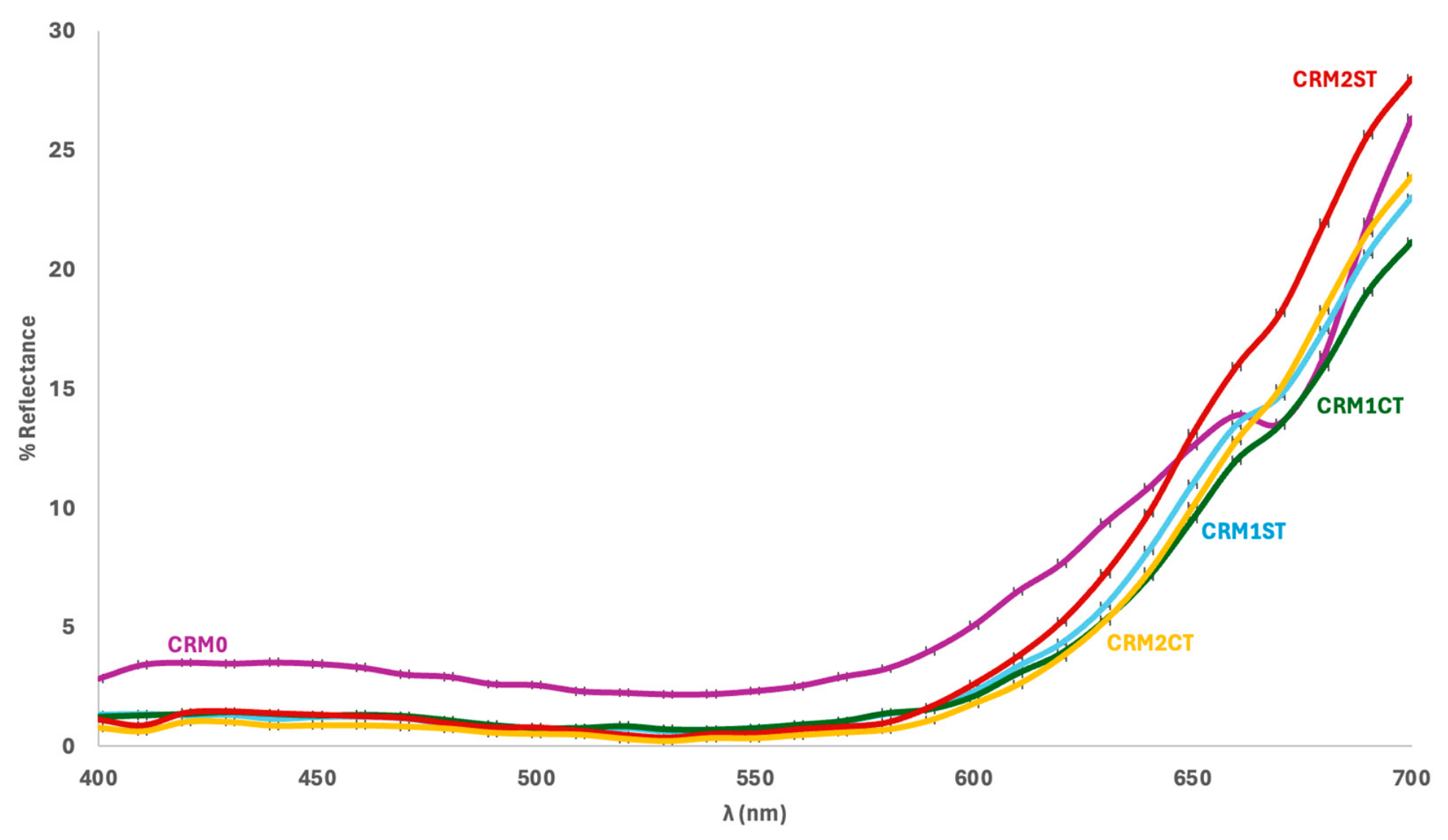
Figure 1, provided complementary information to the CIELAB data and helped to clarify the effect of hyperbaric micro-oxygenation on color development. The spectrum between 400 and 700 nm is especially relevant for red wine evaluation because the regions around 420 nm, 520 nm, and 620 nm are associated with yellow-brown, red, and blue-violet color components, respectively. These regions are related to the contribution of free anthocyanins, copigmented anthocyanins, polymeric pigments, and oxidized phenolic structures to the final visual appearance of the wine [
34,
45].
The spectral profile showed important differences among the initial must, control samples, and hyperbaric micro-oxygenated samples. The initial must showed the lowest spectral development, as expected for a sample collected before fermentation and before the full extraction of phenolic pigments. During fermentation, both MOX and CON samples showed higher reflectance values in the visible region, indicating progressive pigment extraction and color development. The increase in the 520–620 nm region is particularly relevant because this zone is closely linked to the expression of red and violet tones associated with anthocyanins and anthocyanin-derived pigments [
34,
35].
The hyperbaric-treated samples showed a spectral behavior compatible with accelerated phenolic and pigment evolution during fermentation. In particular, the final MOX18 sample combined the lowest
L* value, high
a* and
C* values, the highest ΔE
ab, and the highest TPC. This indicates that the treatment promoted a darker and more phenolically enriched matrix. Although CON18 showed higher a and
C*, the greater total color difference and TPC observed in MOX18 suggest that hyperbaric micro-oxygenation intensified the overall transformation of the chromatic system. This reinforces the idea that the treatment did not merely increase redness, but modulated the global balance between extraction, oxygen-mediated reactions, and pigment evolution [
10,
19,
31].
This behavior is consistent with the known role of oxygen in red wine phenolic chemistry. Controlled oxygen exposure can favor the formation of more stable pigment structures through reactions involving anthocyanins, flavanols, and acetaldehyde-derived bridges. However, these reactions are highly dependent on the stage of vinification. During fermentation, oxygen can interact with active extraction processes, yeast metabolism, and the availability of reactive anthocyanins and tannins. This may explain why hyperbaric micro-oxygenation during fermentation can produce a clear phenolic and chromatic response, whereas treatments applied after fermentation may behave more like aging accelerators than extraction enhancers [
10,
35,
37].
The results also support the broader technological relevance of non-thermal treatments in winemaking. HHP, PEF, ultrasound, UHPH, and pulsed light have been investigated as tools to improve extraction, control microorganisms, reduce sulfite dependence, shorten processing times, and modulate wine quality. Nevertheless, the literature consistently indicates that their effects are strongly dependent on the matrix and processing stage. Treatments applied to grapes or fermenting must can enhance extraction because grape solids are still present, whereas treatments applied to finished wine mainly affect microbial stability, oxidation, colloidal interactions, and aging-related reactions [
31,
32,
38,
39,
43].
Therefore, the present reflectance results support the hypothesis that mild hyperbaric micro-oxygenation is a promising non-thermal approach for modulating the chromatic evolution of red musts during fermentation. Its main contribution appears to be the acceleration of phenolic and pigment transformations under controlled oxygen availability, without disrupting alcoholic fermentation or altering the basic physicochemical profile. However, the fact that CON18 showed higher final a* and C* values indicates that treatment intensity, timing, oxygen dose, pressure level, and exposure duration must be optimized before concluding that this approach consistently improves final red color intensity [
19,
31,
35].
3.4. Volatile Organic Compounds
Of the 17 volatile compounds identified and quantified (
Table 3), statistically significant differences were observed for 14 compounds. Some compounds did not vary in concentration throughout the fermentation process, indicating that they were already present in the must and were not modified during fermentation. These compounds were (R)-3-hexen-1-ol, hexanoic acid, and β-ionone.
When the results were analyzed at each sampling point, the effect of hyperbaric micro-oxygenation was compound- and stage-dependent rather than generalized. At mid-fermentation, significant differences were found only for 2-phenylethanol, ethyl octanoate, geraniol, ethyl decanoate and ethyl dodecanoate. In all cases, hyperbaric treatment led to lower concentrations compared to the control treatment.
At the end of fermentation (MOX18), the number of differences was reduced to only three compounds. 2-Methylpropan-1-ol and ethyl decanoate were found at higher concentrations (approximately 300% and 14%, respectively) in the hyperbarically treated sample, whereas 2-phenylethanol showed a reduction (approximately 14%) compared to the control sample.
2-Methylpropan-1-ol is a higher alcohol associated with yeast amino acid metabolism, particularly the catabolism of branched-chain amino acids such as valine. Its higher concentration in MOX18 may indicate that mild hyperbaric oxygen availability influenced specific yeast metabolic routes during fermentation. The increase in this compound in the hyperbarically treated sample may suggest that the treatment influenced yeast secondary metabolism.
Ethyl decanoate and 2-phenylethanol are both yeast-derived volatile metabolites, although they arise from different biochemical pathways. It is formed through enzymatic esterification between ethanol and decanoic acid, mainly catalyzed by alcohol acyltransferases [
46]. It contributes intense fruity aromas (apple, pear, tropical fruit) and has a low sensory threshold, thus significantly influencing wine aroma. Moreover, it is a key compound in fermentative aroma and is often associated with young, aromatic wines [
47].
2-Phenylethanol is an aromatic higher alcohol widely present in wines and is considered one of the most important compounds contributing to fermentative aroma. It is characterized by an intense floral, rose-like aroma and is one of the main contributors to floral notes in wine [
48].
Ethyl decanoate and 2-phenylethanol share a common origin in yeast secondary metabolism during fermentation. Although they arise from different biochemical pathways, these pathways are metabolically interconnected, as they respond to similar external stimuli such as temperature and oxygen availability. The predominance of the ester in hyperbarically treated wines may indicate the production of wines with a younger aromatic profile, whereas a higher contribution of alcohols such as 2-phenylethanol may be associated with a more mature fermentative profile.
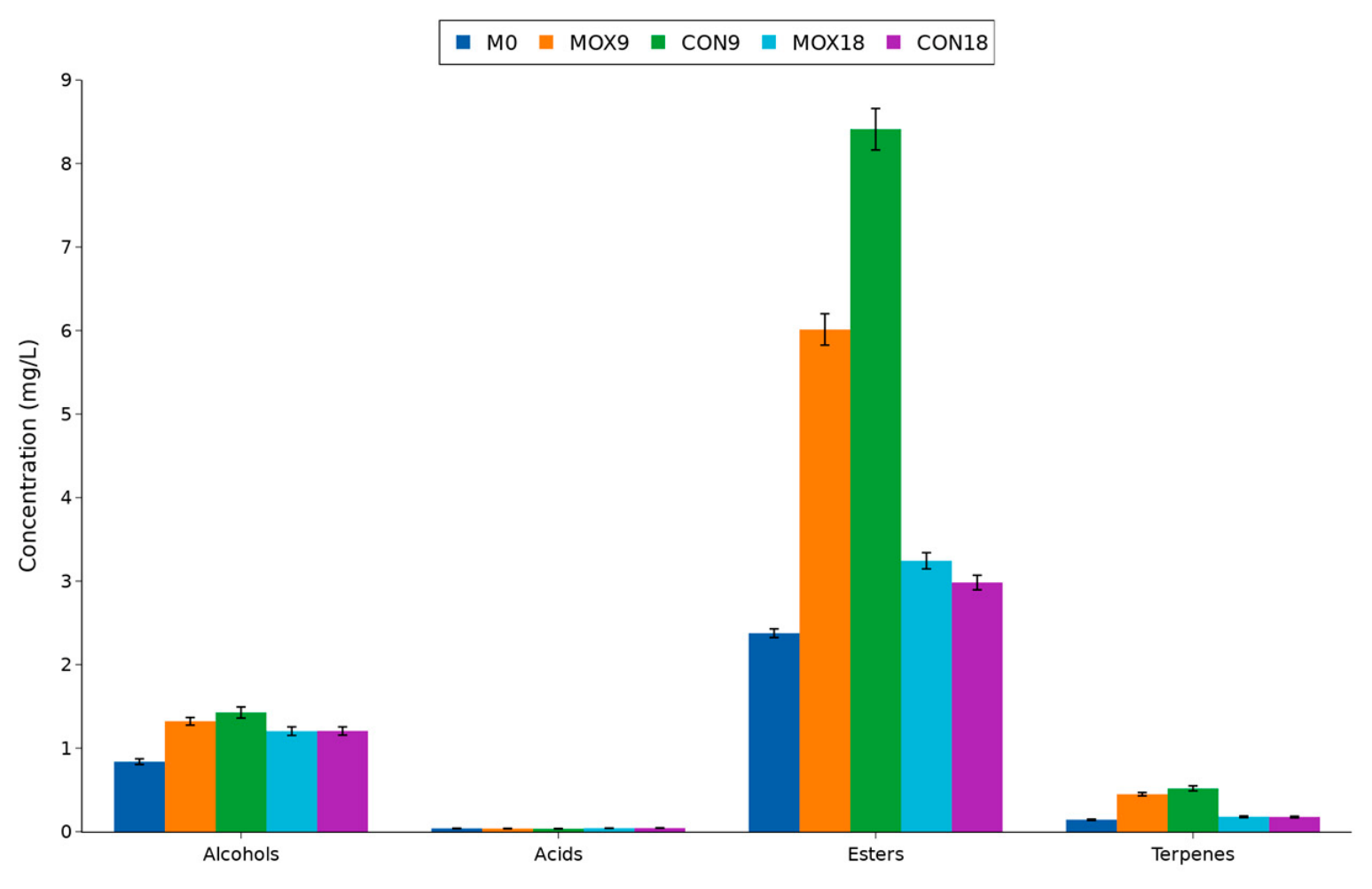
When considering the results from the perspective of chemical families, the hyperbaric treatment did not induce significant changes in the concentration of alcohols, acids, or terpenes at either sampling point (
Figure 2). However, a reduction in ester concentration was observed at mid-fermentation. The hyperbarically treated sample accumulated a lower concentration of esters than the control, mainly due to decreases in ethyl octanoate (~37%), ethyl decanoate (~45%), and ethyl dodecanoate (~45%).
This trend did not persist over time. By the end of fermentation, no significant differences in total ester content were observed. These results suggest that hyperbaric micro-oxygenation may have transiently delayed or modified ester accumulation during active fermentation. Consequently, significant differences were detected at mid-fermentation, but the concentrations became similar once the fermentation process was completed.
3.5. Descriptive Sensory Analysis
Sensory evaluation revealed clear differences between the initial must and the fermented samples, as well as between the micro-oxygenated and control treatments, across most of the odor, flavor, and mouthfeel descriptors assessed, as summarized in
Table 4.
Statistically significant differences were observed in 18 of the 25 sensory attributes evaluated. In line with expectations, the initial must showed greater intensity for sweet, fruity, floral, herbal, and red fruit characteristics in both aroma and flavor compared to the corresponding wines.
Hyperbarically treated samples more effectively retained the fruity character of the must, both in aroma and flavor, at mid- and end-fermentation. This observation is consistent with the volatile compound analysis, which showed higher levels of compounds such as ethyl decanoate.
Moreover, at the end of fermentation, these samples exhibited greater intensity in key aromatic descriptors for these wines, including floral, herbal, and red fruit notes, in both aroma and taste. It is also noteworthy that the hyperbarically treated sample was not only perceived as sweeter but also as higher sourness. Acidity (potential) acts as a preservative, a structural element, and a driver of controlled aging, which is why it is essential for wines intended to evolve over time.
These findings, indicating an improved integration of typical varietal aromas, are consistent with those previously reported by the same authors in a study involving micro-oxygenation [
19], and, also by [
49], although in that case the treatment was applied after the completion of alcoholic fermentation and prior to malolactic fermentation.
3.6. Mechanistic Considerations
At the physical level, the higher total system pressure increases oxygen solubility in the must according to Henry’s Law, thereby enhancing the gas–liquid diffusion gradient without the need for mechanical sparging.
At the chemical-phenolic level, this increased dissolved oxygen supply promotes flavan-3-ol oxidation and acetaldehyde-mediated condensation reactions, generating more stable polymeric pigments, which would explain the observed increase in TPC and Eab.
At the metabolic-microbial level, the oxygen available during the early stages of fermentation is utilized by
Saccharomyces cerevisiae for the synthesis of sterols and unsaturated membrane fatty acids, a process that may indirectly modulate the production of higher alcohols and esters shown in
Table 3.
At the comparative level, unlike conventional micro-oxygenation, which operates at atmospheric pressure with gaseous oxygen dosing via fine-bubble diffusers, the tested hyperbaric system replaces dosing rate control with total pressure control, theoretically allowing for more homogeneous diffusion that is less dependent on tank agitation. Furthermore, the comparison with other non-thermal technologies (PEF, HHP, ultrasound) has been expanded, explicitly distinguishing their mechanisms of action, cell membrane electroporation in PEF versus redox modulation and gas solubility in the hyperbaric system, in line with recent reviews on non-thermal technologies in winemaking.
4. Conclusions
The application of mild hyperbaric micro-oxygenation during alcoholic fermentation of Vitis vinifera L. cv. Monastrell must did not alter the normal evolution of the main physicochemical parameters. Fermentation proceeded correctly in both treated and control samples, as shown by the reduction in density and residual sugars and the increase in actual alcohol. The treatment therefore appears compatible with normal fermentation kinetics under the experimental conditions tested.
The most relevant effects of the treatment were observed in the chromatic and phenolic parameters. Hyperbaric micro-oxygenation promoted a darker final matrix, produced the highest overall color difference from the initial must, and led to the highest total phenolic content at the end of fermentation. These results suggest that the treatment acted as a non-thermal strategy capable of intensifying phenolic extraction and accelerating pigment evolution during fermentation. However, because the control sample showed the highest final a* and C* values, the treatment should be interpreted as a modulator of color evolution rather than as a simple enhancer of final redness or chroma.
The findings support the potential of hyperbaric micro-oxygenation as an innovative non-thermal technology related conceptually to pressure-assisted winemaking strategies such as HHP/HPP, although operating at much milder pressure levels. Its main interest lies in combining controlled oxygen availability with fermentation-stage phenolic extraction, which may help modulate color development and phenolic composition without applying heat. Future work should quantify individual anthocyanins, flavanols, tannins, polymeric pigments, acetaldehyde, dissolved oxygen, volatile compounds, and sensory attributes in order to determine whether the observed increase in total phenolic content translates into improved long-term color stability and sensory quality.
The volatile profile confirmed that mild hyperbaric micro-oxygenation influenced aroma evolution during Monastrell must fermentation, although its effect was compound- and stage-dependent. At mid-fermentation, the treatment reduced the accumulation of several ethyl esters compared with the control, particularly ethyl octanoate, ethyl decanoate, and ethyl dodecanoate, suggesting a transient delay or modulation of ester-forming reactions under hyperbaric oxygen availability. However, this effect did not persist until the end of fermentation, when total ester concentration was no longer clearly differentiated between treatments. At the compound level, the final hyperbaric sample was characterized by higher 2-methylpropan-1-ol and ethyl decanoate, together with lower 2-phenylethanol, compared with the final control. This pattern suggests that the treatment did not cause a generalized increase or depletion of volatile compounds, but rather redirected specific yeast-derived metabolic routes related to higher alcohol and ester formation. This interpretation is consistent with current knowledge that wine secondary aroma is strongly governed by yeast metabolism, oxygen availability, amino acid catabolism, and esterification reactions during fermentation.
The sensory results were coherent with the volatile response and confirmed that the chemical differences detected in the aroma fraction were sensorially relevant. Hyperbarically treated samples retained a more intense fruity character than the corresponding controls at both mid- and final fermentation stages, and the final treated wine also showed higher perceived intensity of floral, herbal, and red-fruit notes in both odor and flavor. These attributes are technologically relevant because they are directly linked to varietal and fermentative aromatic quality in young red wines. In addition, the absence of perceived defects, together with greater persistence and a more balanced reduction in bitterness compared with the final control, indicates that the treatment did not generate negative sensory deviations under the experimental conditions tested. These findings agree with previous evidence showing that controlled oxygen management and micro-oxygenation can modify the volatile and sensory profile of red wines, although the final outcome depends on the timing of application, wine matrix, and interaction between volatile compounds and phenolic structure.
Overall, the results support the potential of mild hyperbaric micro-oxygenation as an innovative non-thermal strategy for modulating the technological, phenolic, chromatic, volatile, and sensory evolution of Monastrell must during alcoholic fermentation. Unlike conventional high hydrostatic pressure processing, this treatment operates at much milder pressure levels, but it shares with other non-thermal approaches the objective of modifying mass transfer, oxygen availability, and biochemical evolution without applying heat. Taken together, the physicochemical stability, enhanced phenolic response, altered volatile profile, and improved retention of key fruity and varietal sensory descriptors suggest that hyperbaric micro-oxygenation can be considered a promising tool for producing differentiated red wines. Nevertheless, the current design does not allow for distinguishing the net effects of mechanical pressure per se from the effects specifically attributable to increased oxygen availability, and that future studies using a high-pressure control without added O2 would be necessary to decouple these two effects. In addition, future studies should quantify odor activity values, dissolved oxygen kinetics, individual anthocyanins, polymeric pigments, and long-term sensory stability in order to determine whether the observed aromatic and sensory advantages are maintained after storage or bottle aging.





 ,
,