Article

Integrated Transcriptomics, UPLC-Based Metabolomics and HS-SPME-GC-MS Analyses Reveal Metabolic Changes in Taiwanofungus camphoratus Induced by Cinnamomum camphora Extract in Liquid Fermentation


1
College of Biotechnology and Pharmaceutical Engineering, National Engineering Technique Research Center for Biotechnology, Nanjing Tech University, Nanjing 211816, China
2
National Engineering Research Center of Solid-State Brewing, Luzhou Pinchuang Technology Co., Ltd., Luzhou 646000, China
3
Nanjing Hi-Tech Biological Technology Research Institute Co., Ltd., Nanjing 211800, China
*
Author to whom correspondence should be addressed.
Fermentation 2026, 12(8), 344; https://doi.org/10.3390/fermentation12080344
Submission received: 17 June 2026 / Revised: 20 July 2026 / Accepted: 22 July 2026 / Published: 24 July 2026
(This article belongs to the Section Fermentation for Food and Beverages)

Abstract

Taiwanofungus camphoratus, an edible and medicinal fungus endemic to Taiwan, produces a distinctive and complex fragrance during mycelial growth, indicating its potential as a source of natural flavor compounds for food and cosmetic applications. However, few research efforts have focused on changes in its flavor-related metabolites and the related underlying molecular mechanisms remain largely unexplored. In this study, we found that the water extract of Cinnamomum camphora leaves (CC water extract) markedly stimulated T. camphoratus mycelial growth, increasing biomass by 29.7% in liquid fermentation. Integrated transcriptomics, UPLC-based metabolomics and HS-SPME-GC-MS analyses revealed that CC water extract could enhance metabolic fluxes through glycolysis, the pentose phosphate pathway, and galactose metabolism, thereby supporting mycelial growth and the accumulation of flavor-related metabolites. Specifically, CC water extract promoted the abundance of metabolites associated with mushroom-like, floral, and fruity aroma profiles, together with sweet taste-related metabolites. These findings provide new insights into optimizing the liquid fermentation processes and flavor profiles of T. camphoratus mycelia, providing a reference for better utilizing this valuable fungal resource.

1. Introduction

Taiwanofungus camphoratus is a unique edible and medicinal fungus widely distributed in Taiwan, where it has long been used by local people as a treatment for many disorders [1,2]. It has attracted considerable attention in both scientific research and commercial applications due to its diverse bioactive compounds and high value [3]. T. camphoratus and its derivatives have been applied in foods, health-care products, feed, cosmetics, and other fields [4]. For example, the freeze-dried mycelia of T. camphoratus have been demonstrated to be safe for consumption by individuals aged 14 years and older at the recommended intake level, and has been approved as a new type of food [5]. The main cultivation methods for T. camphoratus include basswood cultivation, solid-state cultivation, and liquid fermentation [6]. Among these approaches, liquid fermentation offers several advantages, including a short production cycle, high growth rate, and rapid maturation. In addition, it allows efficient production of large quantities of mycelial biomass within a short time, rendering it more suitable for large-scale industrial applications [7,8].
Liquid fermentation of T. camphoratus still faces several challenges, a key one being the substantially lower yield of bioactive compounds from mycelial cultures compared with wild substrates [9,10]. Researchers have employed exogenous additives and physical processing technologies to improve the liquid fermentation performance of T. camphoratus. Meng et al. found that the addition of corn oil to the fermentation broth of T. camphoratus improved the biomass and triterpenoid content [11]. Tang et al. reported that linolenic acid promoted mycelial growth and triterpenoid synthesis in liquid-state fermentation of T. camphoratus [12]. Wen et al. demonstrated that supplementation with lemongrass water extract and methyl jasmonate increased the growth rate of T. camphoratus mycelia, and transcriptomic analyses suggested that this effect was associated with the up-regulation of genes involved in fatty acid metabolism and biosynthesis [13]. In addition, Liu et al. applied low-frequency alternating magnetic field-assisted submerged fermentation of T. camphoratus and observed enhanced mycelial biomass as well as increased yields of polysaccharides and triterpenoids [14]. However, these studies have primarily focused on improving mycelial growth and the production of bioactive compounds with medicinal potential.
During mycelial growth, T. camphoratus emits a pronounced and complex fragrance characterized by sweet, floral, and fruity profiles, suggesting its potential as a valuable source of natural flavor and fragrance compounds for the food and cosmetic industries [15,16]. Few research efforts have focused on the characteristic changes in flavor-related metabolites of T. camphoratus to date. Ma et al. comprehensively evaluated the flavor components of T. camphoratus under different cultivation methods, and results showed liquid-cultured mycelia tended to accumulate pyrazines and alcohols, but the resulting aroma was not as rich as that from solid-state culture [15]. Liu et al. detected the volatile compounds in aroma extracts obtained from T. camphoratus culture fluids using different organic solvents, and the results showed that ethyl acetate, γ-undecalactone, linalool, and 3-hydroxy-2-butanone were identified as the major contributors to the characteristic aroma of the culture fluids [16]. These studies indicate that liquid fermentation of T. camphoratus holds considerable potential for the industrial production of natural flavor compounds, and that culture conditions can significantly influence the formation and accumulation of these compounds. However, the underlying molecular mechanisms remain largely unexplored.
In this study, we first observed that the water extract of Cinnamomum camphora leaves (CC water extract) markedly stimulated the mycelial growth of T. camphoratus. Subsequently, transcriptomics, UPLC-based metabolomics and headspace solid-phase microextraction coupled with gas chromatography–mass spectrometry (HS-SPME-GC-MS) analyses were performed to elucidate the effects of CC water extract on the metabolic pathways of T. camphoratus and its influence on the accumulation of flavor-related metabolites. The findings of this study offer new insights into optimizing the growth cycle and flavor profiles of T. camphoratus mycelia, providing a reference for better utilizing this valuable fungal resource in the fields of functional foods and natural fragrances.

2. Materials and Methods

2.1. Strains and Culture Conditions

The T. camphoratus strain GDMCC No. 67882 was obtained from the Nanjing Hi-Tech Biological Technology Research Institute Co., Ltd. (Nanjing, China).
Solid PDA Medium (g/L): potato 200 (potatoes were washed, peeled, diced, boiled in 1 L distilled water for 30 min and filtered through cheesecloth, with the liquid collected and saved as potato infusion), glucose 20, KH2PO4 3, MgSO4 1.5, vitamin B1 (VB1) 0.1, agar 20. Seed Medium (g/L): soybean flour 30 (soybean flour was boiled in distilled water and filtered through cheesecloth, with the liquid collected and saved as soybean flour infusion), glucose 30, yeast extract 3, KH2PO4 0.5, anhydrous MgSO4 0.5, FeSO4·7H2O 0.18, VB1 0.01; initial pH 5.0. Fermentation Media—control (g/L): glucose 30, potato 200, soluble starch 20, yeast extract 10, KH2PO4 1, MgSO4·7H2O 0.4, VB1 0.1; initial pH 5.0. Medium volume: 150 mL per 500 mL flask. These mediums were sterilized by autoclaving for 20 min at 121 °C before inoculation.
The strain was activated on solid PDA plates at 26 °C for 28 days. Subsequently, five mycelial plugs (0.5 cm in diameter) from the plate were inoculated into the seed medium and cultured at 26 °C and 150 rpm for 15 days. Thereafter, the seed culture was inoculated into the fermentation medium at a 10% (v/v) ratio and incubated at 26 °C and 150 rpm for 14 days.

2.2. Preparation of C. camphora Leaf Water Extracts

Fallen leaves from C. camphora were purchased from Bozhou Jiexin Biotechnology Co., Ltd. (Bozhou, China). CC water extract was provided by the Nanjing Hi-Tech Biological Technology Research Institute Co., Ltd. A 20 g portion of material was weighed and mixed with 100 mL of distilled water, boiled for 20 min, cooled, and filtered. The filtrate was collected and adjusted to a final volume of 100 mL, resulting in a final concentration of 200 g/L. This solution was used as a 10× stock solution, and other formulations were prepared by adding proportional volumes according to the system. To investigate the optimal concentration of CC water extract, the final concentrations were set to 10, 15, 20, 25, and 30 g/L.

2.3. Analytical Methods

The harvested mycelia were rinsed three times with deionized water and subsequently dried at 65 °C until a constant weight was achieved. Biomass production was quantified based on the dry weight of mycelia (g/L). After 16 days of incubation, colony diameters of strains grown on different agar plates were measured to assess growth performance. Data visualization was performed using GraphPad Prism 5 (GraphPad Software Inc., San Diego, CA, USA). All experimental results were expressed as mean ± standard deviation. Statistical differences were evaluated by one-way analysis of variance (ANOVA) using IBM SPSS Statistics version 26.0, with p < 0.05 considered statistically significant.

2.4. RNA Sequencing and qRT-PCR Analysis

Mycelial samples cultivated in the presence or absence of CC water extract were harvested after 14 days of liquid fermentation and subjected to RNA-seq and qRT-PCR analyses. Three independent biological replicates were prepared. Total RNA was isolated using TRIzol reagent (Thermo Fisher Scientific, Waltham, MA, USA, 15596018) according to the manufacturer’s instructions. RNA concentration and quality were evaluated using a Qubit 3.0 Fluorometer (Thermo Fisher Scientific, Q33216) and an Agilent 5300 Fragment Analyzer (Agilent Technologies, Santa Clara, CA, USA, M5311AA). RNA samples with RNA integrity numbers greater than 7.0 were selected for library preparation. Following extraction, 2 μg of total RNA was subjected to mRNA enrichment using mRNA Capture Beads 2.0 (Yeasen, Shanghai, China, Cat. No. 12629ES, CHN) through two rounds of purification. The purified mRNA was subsequently fragmented into short sequences using magnesium ions at 94 °C (Yeasen, Cat. No. 12340ES97, CHN). The fragmented RNA was reverse-transcribed into first-strand cDNA using reverse transcriptase, followed by synthesis of second-strand cDNA using E. coli DNA polymerase I, RNase H, and dUTP solution (Yeasen, Cat. No. 12340ES97, CHN). An additional A nucleotide was added to the 3′ ends of the blunt-ended cDNA fragments to facilitate adapter ligation. Indexed adapters containing T-overhangs were then ligated to the A-tailed fragments. The resulting libraries were amplified by PCR under the following conditions: initial denaturation at 98 °C for 1 min; 14 cycles of denaturation at 98 °C for 10 s, annealing at 60 °C for 30 s, and extension at 72 °C for 30 s; followed by a final extension at 72 °C for 5 min. The final cDNA libraries exhibited an average insert size of 400 ± 50 bp. Strand-specific library construction was achieved during PCR amplification by exploiting the ability of high-fidelity DNA polymerase to selectively amplify cDNA strands lacking uracil residues. PCR products were purified using Hieff NGS DNA Selection Beads (Yeasen, Cat. No. 12601ES75, CHN). RNA sequencing was subsequently performed on an Illumina NovaSeq™ X Plus platform (LC-Bio Technology Co., Ltd., Hangzhou, China) according to the manufacturer’s recommended protocol. Bioinformatic analyses were conducted using the OmicStudio platform (https://www.omicstudio.cn, accessed on 1 May 2026). Genes differential expression analysis was performed by DESeq2 software between two different groups. Genes with ∣log2(fold change)∣ > 0.585 and q value < 0.05 were considered as significantly differentially expressed.
Four selected genes (AcV5_005803, AcV5_007300, EG5A, and AcV5_003285) were further validated by qRT-PCR. The qRT-PCR was performed using the SYBR GREEN dye method by LC-Bio Technology Co., Ltd. (Hangzhou, China). The 18S rRNA was considered as an endogenous reference. The results were analyzed by the comparative CT method. The used primers were listed in Table S1.

2.5. UPLC-Based Untargeted Metabolomics Analysis Methods

Mycelial samples cultivated in the presence or absence of CC water extract were harvested after 14 days of liquid fermentation and subjected to UPLC-based untargeted metabolomics analysis. Five biological replicates were prepared. Approximately 50 mg of sample was extracted with 500 μL of 80% ice-cold methanol, followed by sonication and vortex mixing. The extracts were incubated at −20 °C for 30 min to facilitate protein precipitation and then centrifuged at 20,000× g for 10 min at 4 °C. The collected supernatants were subjected to an additional centrifugation step for 5 min. Subsequently, the final supernatants were transferred into fresh vials for UPLC-HRMS analysis. Quality control (QC) samples were generated by pooling equal volumes of supernatants from all individual samples.
Metabolite separation was achieved using an ACQUITY UPLC HSS T3 column (100 mm × 2.1 mm, 1.8 μm; Waters, Milford, MA, USA). The mobile phase was composed of solvent A (water containing 5 mmol/L ammonium acetate and 5 mmol/L acetic acid) and solvent B (acetonitrile). Gradient elution was performed under the following conditions: 0–0.8 min, 2% B; 0.8–2.8 min, 2–70% B; 2.8–5.0 min, 70–90% B; 5.0–5.5 min, 90–100% B; 5.5–7.5 min, 100% B; 7.5–7.6 min, 100–2% B; and 7.6–10.0 min, 2% B. The flow rate was maintained at 0.35 mL/min, with an injection volume of 4 μL for each sample, and the column temperature was set at 40 °C. The metabolites eluting from the UPLC system were detected using an Orbitrap Exploris 120 high-resolution tandem mass spectrometer (Thermo Fisher Scientific). Data acquisition was performed in both positive and negative electrospray ionization (ESI) modes. The ESI source temperature was maintained at 350 °C, with spray voltages of +3800 V and −3400 V in positive and negative ion modes, respectively. The ion source sweep gas pressure was set to 1 Arb, while the auxiliary gas (Gas 1) and sheath gas (Gas 2) pressures were maintained at 15 Arb and 50 Arb, respectively. Mass spectrometric data acquisition was performed using full-scan and data-dependent acquisition (DDA) modes. During each acquisition cycle, full-scan spectra were collected over an m/z range of 70–1050 Da with a resolution of 60,000. The AGC target was set to Standard, and the maximum injection time (IT) was set to Auto. Subsequently, the four most intense ions with signal accumulation intensities exceeding 5000 were automatically selected from the full-scan spectrum for DDA analysis. The DDA spectra were acquired at a resolution of 15,000, with the AGC target and maximum IT parameters set to Custom. The dynamic exclusion duration was set to 4 s.
Following bioinformatic analysis was performed using OmicStudio platform (https://www.omicstudio.cn, accessed on 23 April 2026). Statistical analyses were mainly performed in R software (version 4.0). The metabolomic dataset was processed through three sequential procedures: (1) data filtering, in which samples with more than 80% missing values and QC samples with more than 50% missing values were excluded; (2) missing value imputation using the K-nearest neighbor algorithm; and (3) data normalization using probabilistic quotient normalization. Partial least squares discriminant analysis (PLS-DA) was conducted using the R package ropls, and the variable importance in projection (VIP) scores were calculated to evaluate the contribution of individual metabolites. Metabolites with ∣log2(fold change)∣ > 0.585, q value < 0.05, and VIP values ≥ 1 from PLS-DA were considered as significantly differentially expressed. Kyoto Encyclopedia of Genes and Genomes (KEGG) pathway enrichment analysis was performed based on the hypergeometric test, and pathways with a p-value < 0.05 were considered significantly enriched.

2.6. HS-SPME-GC-MS Analysis Methods

Volatile compounds were analyzed using HS-SPME-GC-MS [17]. 1 g of mycelium powder in 5 mL of sodium chloride saturated solution, and 10 μL of internal standard (2-Octanol, 1.64 g/L) were placed in a 20 mL vial capped with a PTFE–silicon septum. The vial was heated at 50 °C with stirring at 500 rpm for 5 min. A 50/30 μm DVB/CAR/PDMS fiber (Supelco, Bellefonte, PA, USA) was then exposed to extract volatiles for 45 min with continuous heating at 50 °C and agitation as mentioned above and thermally desorbed at 250 °C in the GC injector for 8 min. A Shimadzu QP2020NX GC-MS (Shimadzu Corporation, Kyoto, Japan) combined with a DB-FFAP column (60 m × 0.25 mm × 0.25 μm, Agilent J&W, Santa Clara, CA, USA) was used for volatile analysis. The volatiles were injected in splitless inlet mode and carried by helium (99.999%) at a constant flow rate of 1 mL/min. The initial temperature of GC oven was set at 40 °C for 2 min, then increased to 230 °C at 6 °C/min and held for 10 min. The temperatures of both the MSD and the ODP transfer line heater were set at 250 °C. The mass detector was operated in electron ionization (EI) mode (70 eV) at full scan (m/z 35–500) with a scan interval of 0.2 s.
Based on the NIST20 database, substances with a similarity score above 80% were selected as qualitative results. Quantification was calculated by normalizing peak areas based on relative percentage content. Principal component analysis (PCA) was performed using Origin 2018 software (Origin Lab Corporation, Northampton, MA, USA).

3. Result and Discussion

3.1. Impacts of C. camphora Extract on Growth of T. camphoratus

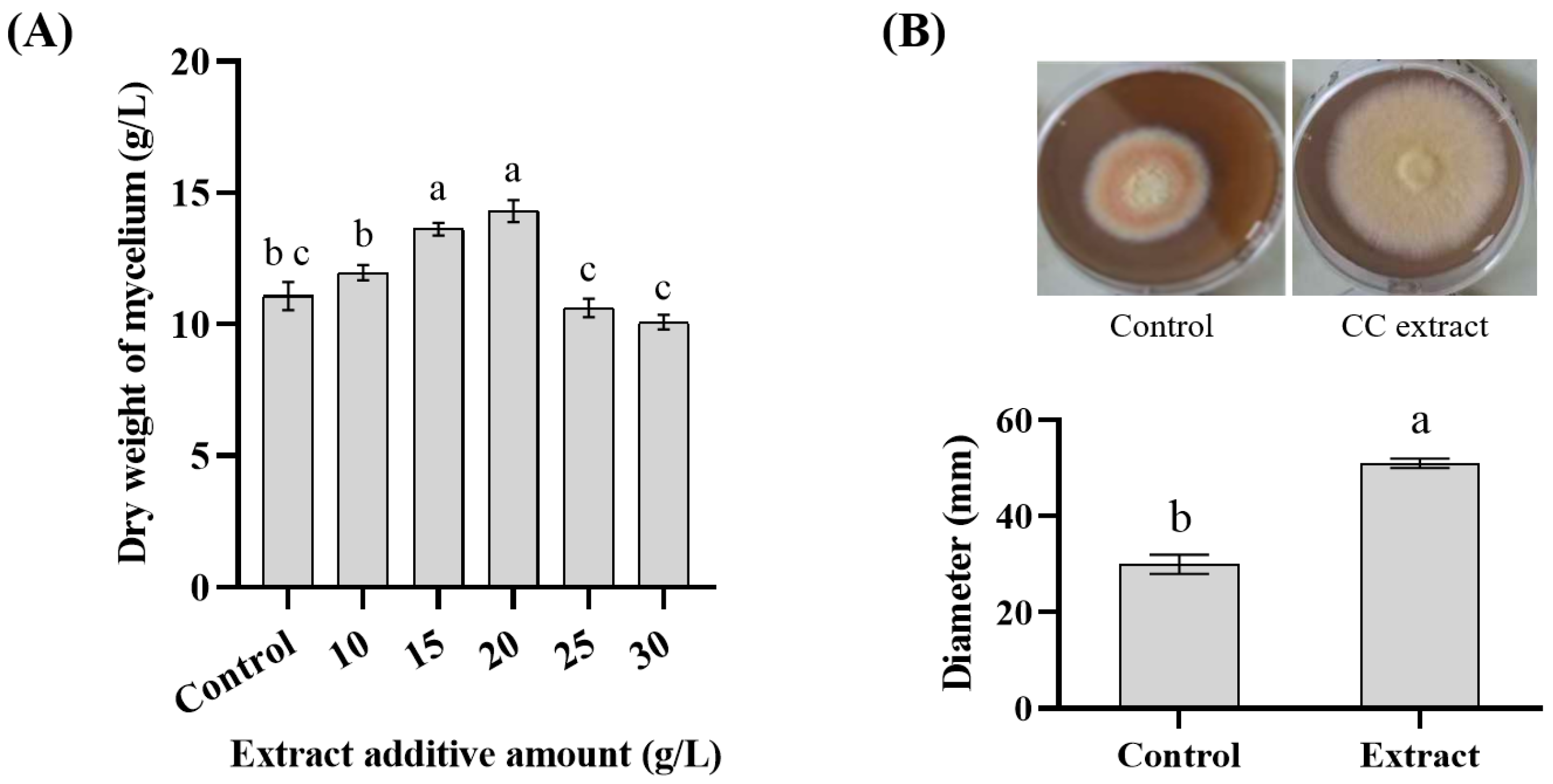
First, we found that the addition of CC water extract effectively promoted the accumulation of T. camphoratus mycelial biomass during liquid fermentation (Figure 1A). Mycelial biomass gradually increased with increasing concentration of CC water extract, reaching a maximum of 14.69 g/L at 20 g/L, which was 29.7% higher than that of the control. Further increasing the concentration of CC water extract led to a significant decrease in mycelial biomass. Similarly, during plate culture, the addition of CC water extract markedly promoted mycelial growth, with the colony diameter increasing by 70.0% compared to the control at 16 days (Figure 1B). These results indicate that moderate levels of CC water extract promote the mycelial growth of T. camphoratus, whereas excessive levels are detrimental. Subsequently, RNA-seq analysis was performed to gain insights into the molecular basis of impacts of C. camphora extract on the growth and metabolism of T. camphoratus.

3.2. General Changes on Transcriptional Level in T. camphoratus Mycelia Under C. camphora Extract Treatment

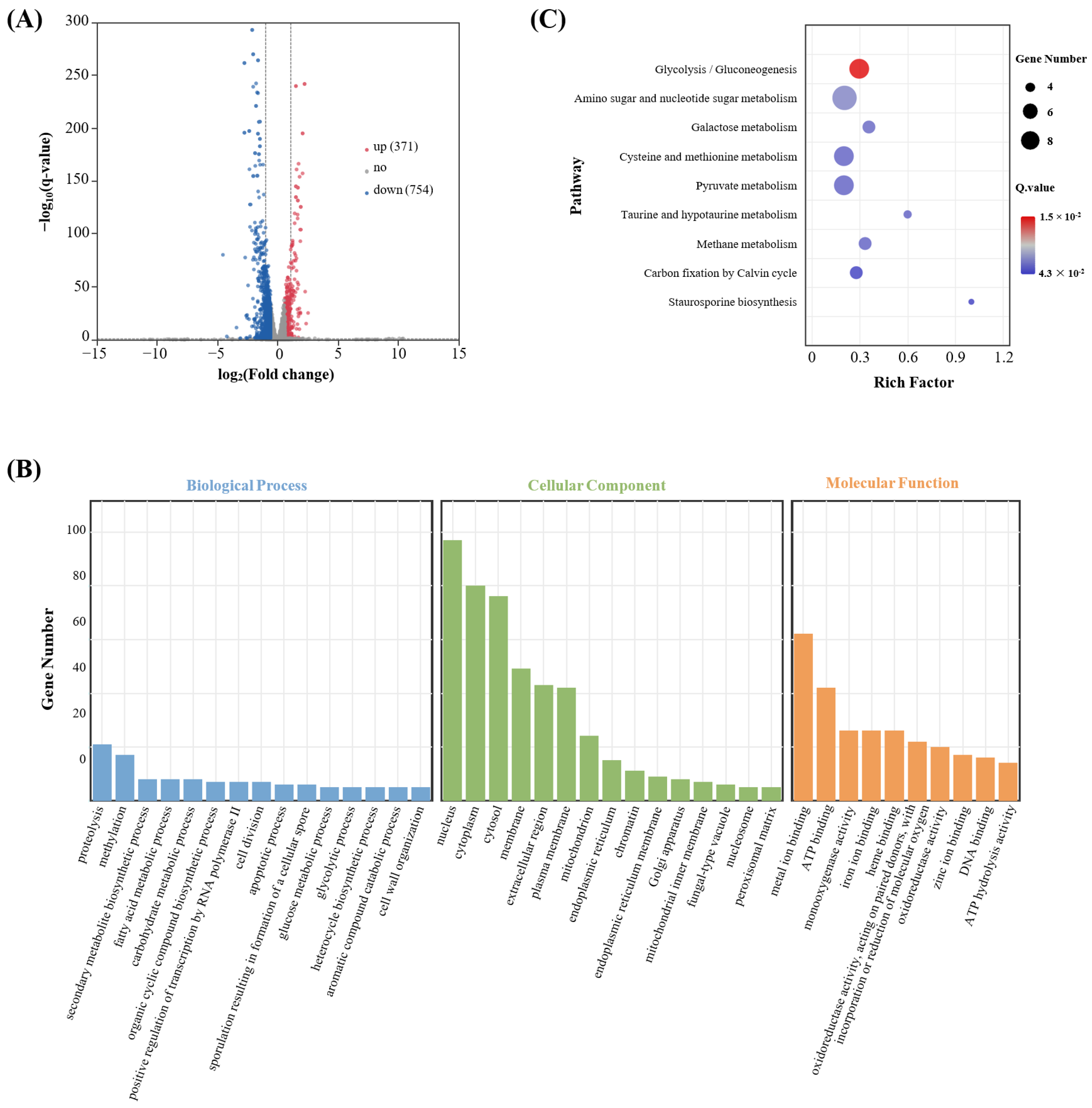
The RNA-seq data revealed that 1125 genes were significantly differentially expressed in response to CC water extract, including 371 up-regulated and 754 down-regulated genes (Figure 2A and Table S2). In addition, four genes were randomly selected for qRT-PCR validation across all samples. The mRNA expression ratios obtained by qRT-PCR were mostly in good agreement with the fold changes observed in RNA-seq data (Table S3).
Gene Ontology (GO) is divided into three ontologies, which described the biological processes, molecular function, and cellular component of genes. As shown in Figure 2B, GO classification analysis of differentially expressed genes (DEGs) indicated that the top three groups in the biological process were proteolysis, methylation, and secondary metabolite biosynthetic process. In the cellular component category, DEGs were predominantly associated with nucleus, cytoplasm, and cytosol. The top three enriched molecular functions were metal ion binding, ATP binding, and monooxygenase activity.
As shown in Figure 2C, KEGG enrichment analysis of DEGs identified nine significantly enriched pathways. Among these, glycolysis/gluconeogenesis showed the highest enrichment significance, representing the core pathway most impacted by CC water extract. Meanwhile, amino sugar and nucleotide sugar metabolism contained the highest number of DEGs. Significant transcriptional changes were also observed in pathways including galactose metabolism, pyruvate metabolism, cysteine and methionine metabolism, and carbon fixation by Calvin cycle. Collectively, these findings indicate that CC water extract influences both primary and secondary metabolic pathways in T. camphoratus, with the most prominent effect on transcriptional regulation associated with carbohydrate and energy metabolism.

3.3. UPLC-Based Untargeted Metabolomics Analysis of T. camphoratus Mycelia Under C. camphora Extract Treatment

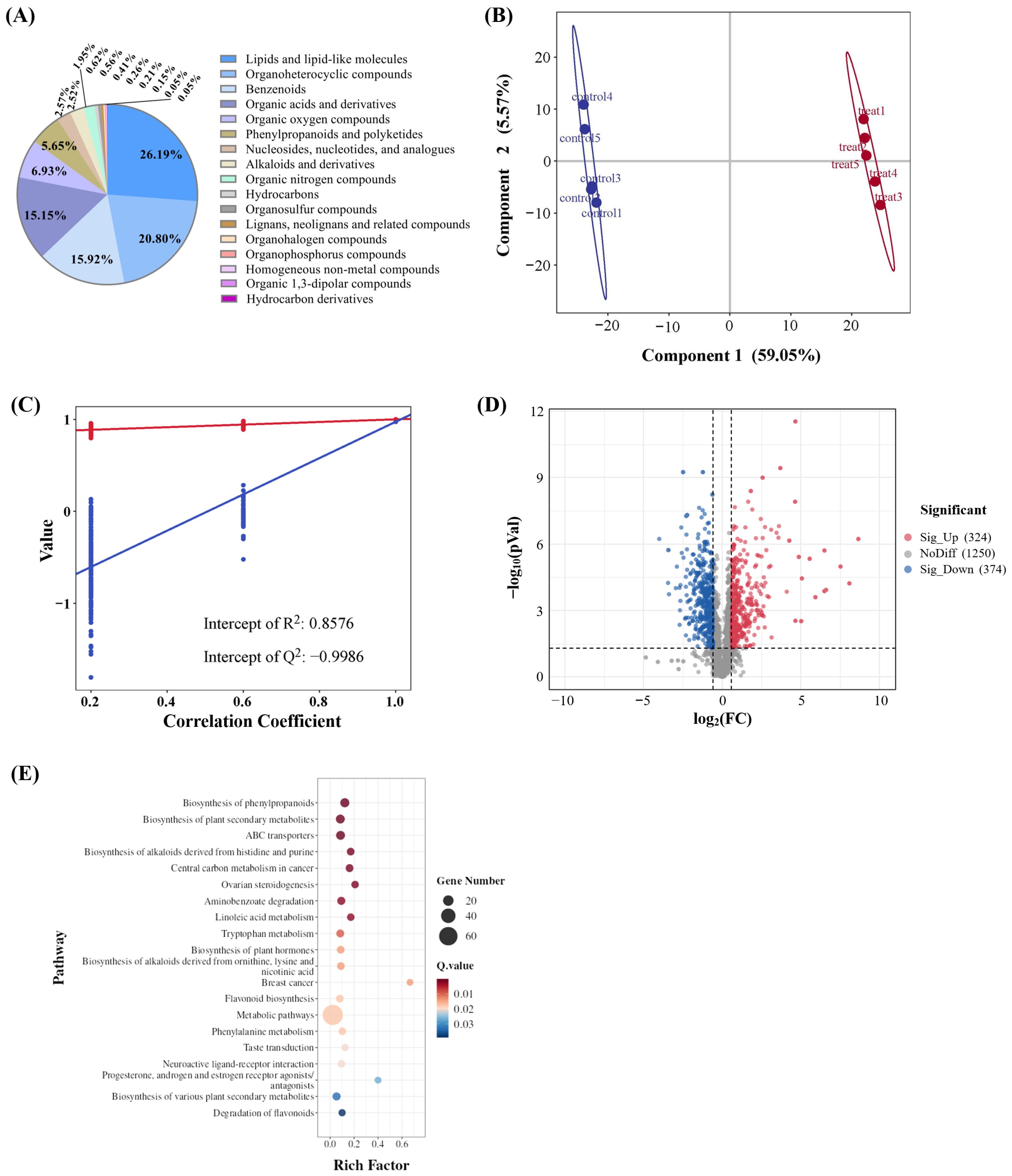
UPLC-based untargeted metabolomics was employed to comprehensively characterize the metabolic changes in T. camphoratus mycelia before and after treatment with CC water extract, with the aim of further elucidating its effects on submerged fermentation. As shown in Figure 3A, a total of 1947 metabolites belonging to 17 superclasses were identified across the two groups. The predominant superclasses were lipids and lipid-like molecules, organoheterocyclic compounds, and benzenoids, accounting for 26.2%, 20.8%, and 15.9% of the detected metabolites, respectively. Lipids and lipid-like molecules represented the largest superclass, whereas organic 1,3-dipolar compounds and hydrocarbon derivatives were the least abundant. PLS-DA, a supervised discriminant analysis method that can maximize the reflection of differences between different groups, was subsequently performed. As shown in Figure 3B, the treated and control groups were clearly separated, indicating substantial differences in their metabolic profiles. The robustness of the PLS-DA model was further validated by a permutation test. As shown in Figure 3C, the R2 regression line (red) remained above the Q2 regression line (blue) within the interval of x = 0–1, and the y-intercepts were 0.8576 and −0.9986 for R2 and Q2, demonstrating that the model was well fitted and provided reliable results. Volcano plot analysis revealed that 708 metabolites exhibited significant abundance changes in response to CC water extract treatment, including 324 metabolites with increased accumulation and 374 metabolites with decreased accumulation (Figure 3D and Table S4). These significantly different UPLC-based metabolites (LSDMs) were subsequently used to query the KEGG compound database to identify the relevant metabolic pathways. The results showed that there were 42 distinct pathways in total, among which biosynthesis of phenylpropanoids, ABC transporters, and biosynthesis of plant secondary metabolites were the three most significantly different pathways. Furthermore, the “metabolic pathways” pathway harbored the highest number of differential metabolites (Figure 3E).
Subsequently, we focused on flavor-related metabolites among the LSDMs. As shown in Table 1, a total of 48 metabolites belonging to eight superclasses exhibited significant changes. These included 14 benzenoids (6 showing increased abundance and 8 exhibiting decreased abundance), 10 organic oxygen compounds (7 showing increased abundance and 3 exhibiting decreased abundance), 9 lipids and lipid-like molecules (6 showing increased abundance and 3 exhibiting decreased abundance), 5 organophosphorus compounds (3 showing increased abundance and 2 exhibiting decreased abundance), 4 phenylpropanoids and polyketides (3 showing increased abundance and 1 exhibiting decreased abundance), 4 organic acids and derivatives (2 showing increased abundance and 2 exhibiting decreased abundance), 1 hydrocarbon (showing increased abundance), and 1 each of nucleosides, nucleotides, and analogues (showing increased abundance).
In the present study, cinnamaldehyde and cinnamyl alcohol exhibited 1.19- and 2.17-fold higher concentrations, respectively, whereas cinnamic acid showed 1.00-fold lower concentrations relative to the untreated mycelia. Cinnamaldehyde and cinnamyl alcohol are the principal flavor constituents of cinnamon, providing the characteristic spicy–sweet flavor [18]. Furthermore, the other three metabolites with a spicy odor, namely (trans)-3-methyloctanoic acid-γ-lactone, myrtenal, and 4-methyl-1-phenyl-2-pentanone, exhibited 1.84-, 1.53-, and 0.59-fold higher concentrations, respectively, following CC water extract treatment.
In the treated mycelia, ethyl vanillin and vanillin 3-(L-menthoxy)propane-1,2-diol acetal exhibited 0.64- and 0.74-fold higher concentrations, while vanillic acid and vanillin 1,2-butylene glycol acetal showed 1.55- and 0.90-fold lower concentrations, respectively. Vanillin and ethyl vanillin are two structurally related substances of similar flavor quality (sweet, creamy, vanilla), which are widely used in the food industry. Ethyl vanillin has a more intense flavor, and its flavoring power is two to four times that of vanillin [19]. Ethyl vanillin, vanillin 3-(L-menthoxy)propane-1,2-diol acetal and vanillin 1,2-butylene glycol acetal are derivatives of vanillin, whereas vanillic acid is produced from vanillin through oxidation by vanillin dehydrogenase. Meanwhile, among other LSDMs possessing the floral flavor, ethylene brassylate, methylgeranate, and alpha-bisabolol exhibited 0.86-, 0.91-, and 1.08-fold higher concentrations, while methyl benzoate, benzyl alcohol, 4′-methoxyacetophenone, rhodinyl phenylacetate alpha-terpinyl anthranilate, and 2-methoxybenzaldehyde showed 0.68-, 0.75-, 0.81-, 0.97-, 1.10-, and 1.11-fold lower concentrations, respectively, in the treated mycelia. These results suggest that CC water extract treatment substantially altered the abundance of metabolites contributing to floral flavor characteristics.
In addition, three metabolites possessing fruity flavor exhibited higher concentrations in the treated mycelia, including cis-3-hexenyl 2-aminobenzoate (1.57-fold), 1-(4-methoxyphenyl)-1-penten-3-one (0.63-fold), and benzaldehyde (0.60-fold). Notably, two metabolites associated with unpleasant odors, namely 2-aminopyridine and 1-naphthylamine, showed 0.65- and 2.2-fold lower concentrations, respectively, following CC water extract treatment.
In this study, four soluble sugars (trehalose, raffinose, sucrose and lactulose) and two soluble sugar alcohols (mannitol and maltitol) exhibited 1.00-, 0.83-, 0.75-, 0.63-, 0.78-, and 8.65-fold higher concentrations, respectively, in the treated mycelia. As reported, T. camphoratus mycelia contained high concentrations of soluble sugars which contribute a sweet taste [20]. Mannitol could be regarded as a taste-active compound contributing to the sweet perception of mushrooms [21], and maltitol is listed as an alternative sweetener to sugar because, except for rumination, it has similar properties to sugar. In terms of sweetening power, mannitol and maltitol have about 50% and 75–90% of the sweetening power of sucrose, respectively [22]. The high levels of sugars and polyols may enhance the moderate sweet taste of mushrooms [23]. Regarding sourness-related metabolites, citric acid exhibited 0.96-fold higher concentrations, whereas succinic acid showed 1.32-fold lower concentrations. The sourness of mushroom could be linked to succinic, citric, malic, and fumaric acids [24]. The umami taste is conferred by aspartic acid, glutamate, and 5′-ribonucleotides, including inosinate and guanylate [25]. In the treated mycelia, glutamate and inosinic acid exhibited 0.70- and 1.66-fold higher concentrations, respectively, whereas aspartic acid showed 1.41-fold lower concentrations. Furthermore, [8]-shogaol and [10]-shogaol, which may provide the taste of ginger spicy or bitterness, exhibited 1.21- and 0.82-fold higher concentrations, respectively.
In summary, these results suggest that the addition of CC water extract may promote the accumulation of metabolites possessing the flavor of spicy, fruity and sweetness while diminishing off-flavor compounds in T. camphoratus mycelia.

3.4. Volatile Compounds of T. camphoratus Mycelia Analyzed by HS-SPME-GC-MS

To further investigate the effect of CC water extract on the aroma of T. camphoratus mycelia and to address the limitation that UPLC-based metabolomics cannot capture volatile compounds, HS-SPME-GC-MS was employed to profile the volatile fraction of control and treated mycelia (Table 2). A total of 39 volatile compounds were identified and semi-quantified, belonging to six chemical classes: aldehydes (1), alcohols (15), esters (8), ketones (3), terpenes (6), and miscellaneous compounds (6). Notably, the extract-treated group exhibited a substantially richer volatile profile, with 36 detected compounds versus 29 in the control group.
Alcohols represented the most abundant class of volatiles, with 15 compounds identified. Among them, 1-octen-3-ol, 3-octanol, 1-octanol, and 2-octen-1-ol, which were well-characterized mushroom-derived C8 oxylipins that impart characteristic mushroom-like, earthy, and green notes [26,27], exhibited 1.65-, 1.35-, 2.83-, and 1.90-fold higher concentrations, respectively. Additionally, the levels of several terpenoid alcohols with floral attributes were increased, including linalool (floral, lily of the valley; 1.45-fold), alpha-terpineol (lilac-like; 1.62-fold), geraniol (rose-like; 1.25-fold), and nerol (rose–citrus; 1.34-fold). In particular, phytol, an acyclic diterpene alcohol with floral odor, was exclusively detected in the treated group (73.56 ± 6.19)%, whereas it remained undetectable (ND) in the control. These findings collectively demonstrate that CC water extract profoundly boosts the formation of floral and mushroom-like volatile alcohols.
Esters constitute another important class of aroma compounds, typically conferring fruity and sweet sensory properties. Among the eight esters identified, the levels of ethyl hexanoate (fruity; 1.61-fold), methyl benzoate (floral–cherry; newly detected), methyl phenylacetate (honey-musk; 2.32-fold), and ethyl phenylacetate (honey-fruity; 1.93-fold) were increased in the treated mycelia. Moreover, γ-decalactone, a lactone compound delivering peach, cream, and coconut nuances, was only present in the extract group, further enriching the fruity and creamy aroma dimensions. Regarding ketones, 3-octanone, which possesses mushroom and fruity notes, exhibited 1.39-fold higher concentrations, consistent with the trend observed for C8 alcohols and reinforcing the mushroom-like aroma profile. Terpenes represent a particularly interesting group because they are characteristic constituents of Cinnamomum plants and contribute citrus, pine, and woody notes. Strikingly, beta-myrcene (vanilla-fruity), D-limonene (citrus), and p-cymene (pine-like) were exclusively detected in the treated group, whereas they were absent from the control.
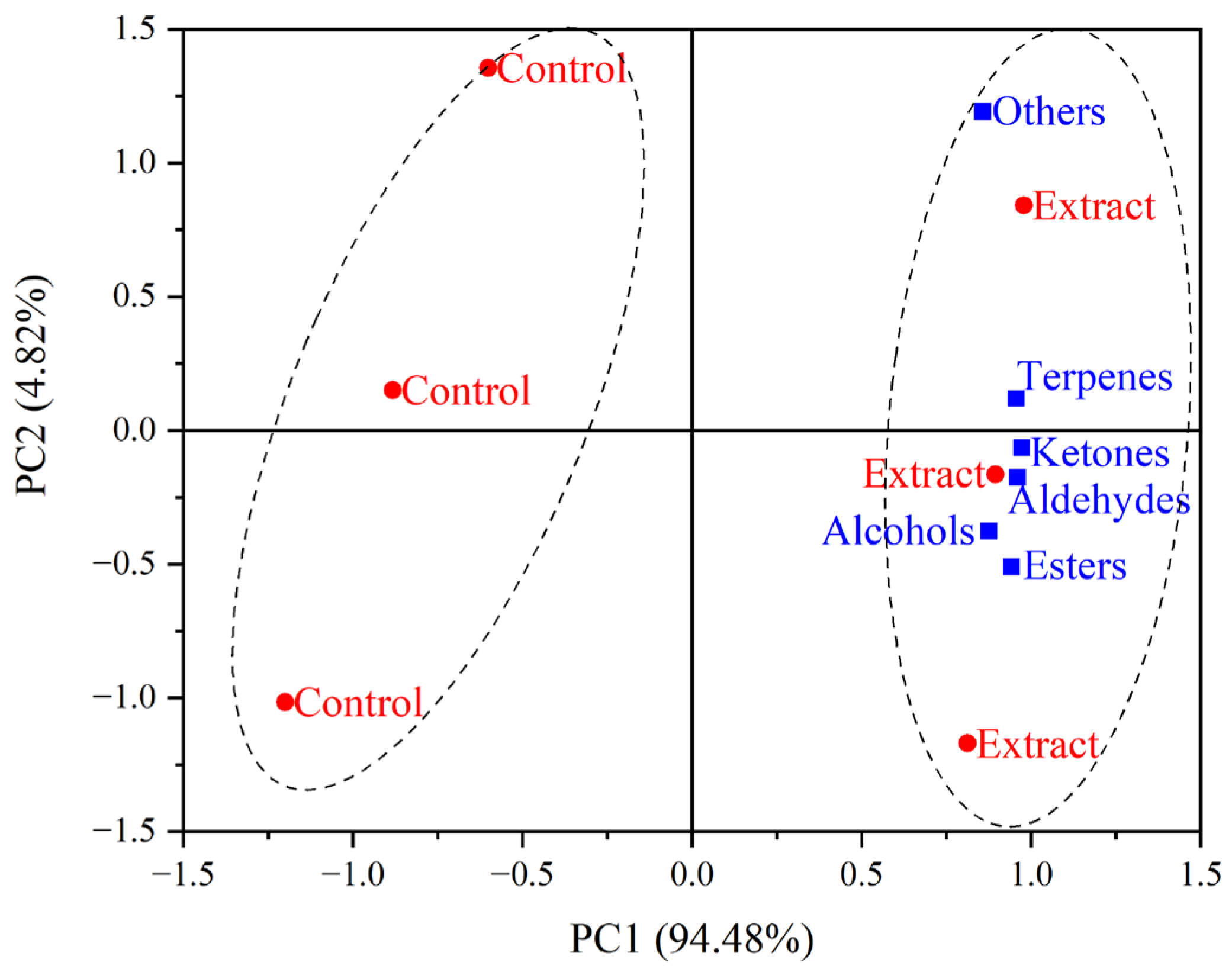
To intuitively visualize the overall divergence of volatile profiles between control and CC extract-treated mycelia, PCA was performed on the relative peak areas of all 39 detected volatile compounds (Figure 4). The first two principal components together explained over 70% of total variance, sufficiently representing the core aroma variation in samples. The score plot with 95% confidence ellipses displayed complete spatial separation between the two groups without overlapping regions, verifying that CC water extract induced dramatic shifts in volatile composition. Loading results revealed mushroom-like C8 alcohols, floral terpenoid alcohols, and fruity esters (1-octen-3-ol, linalool and ethyl hexanoate, etc.) strongly positively correlated with the treatment group, while several woody and phenolic volatiles clustered closely to the control. This unsupervised multivariate analysis further confirmed that CC extract prominently enriches floral, fruity and mushroom aroma volatiles, consistent with the quantitative comparison of HS-SPME-GC-MS data.
The HS-SPME-GC-MS data complement and cross-validate the UPLC-based untargeted metabolomics findings, providing a more holistic picture of flavor enhancement. The UPLC approach captured non-volatile and semi-volatile flavor-related metabolites—including phenylpropanoids (cinnamaldehyde, cinnamyl alcohol), vanillin derivatives, soluble sugars, sugar alcohols, and organic acids—whereas GC-MS revealed the volatile aroma-active fraction that UPLC cannot adequately detect. Despite targeting different chemical spaces, both analytical platforms consistently demonstrate that CC water extract improves the flavor profile of T. camphoratus mycelia.

3.5. Integrated Analysis of Significantly Regulated Genes and Metabolites

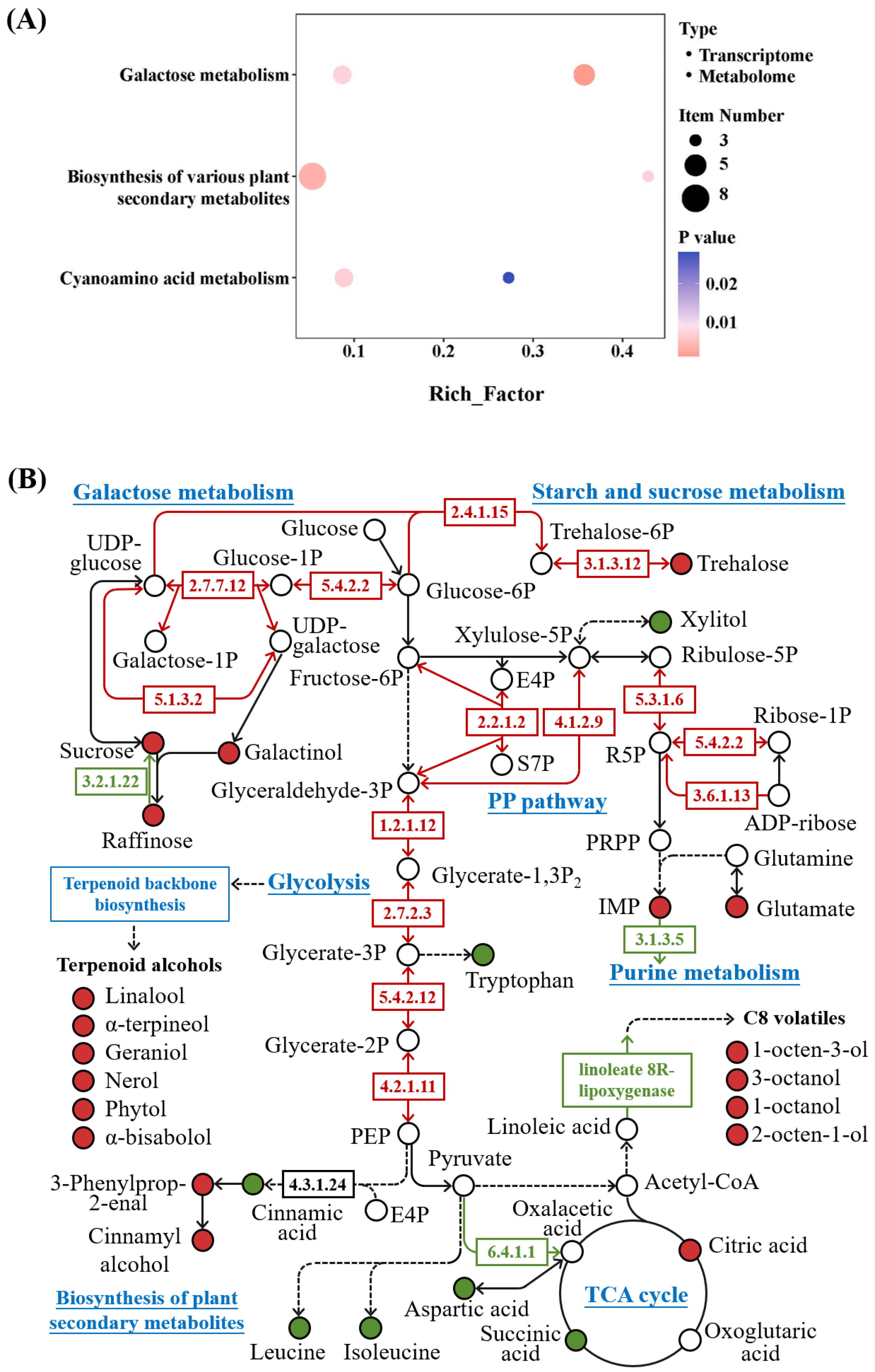
KEGG co-enrichment analysis of DEGs and LSDMs showed that nine genes and fifteen metabolites were significantly enriched in three metabolic pathways, including galactose metabolism, biosynthesis of various plant secondary metabolites, and cyanoamino acid metabolism (Figure 5A and Table S5). Two genes involved in galactose metabolism, encoding UDP-glucose-hexose-1-phosphate uridylyltransferase (EC: 2.7.7.12) and UDP-galactose 4-epimerase (EC 5.1.3.2), were up-regulated by 0.79- and 1.74-fold, respectively, in the treated mycelia (Table S2). UDP-glucose-hexose-1-phosphate uridylyltransferase mediates the conversion of UDP-galactose to alpha-D-galactose 1-phosphate during the second step of galactose catabolism and serves as a major regulatory checkpoint for galactose-glucose interconversion. UDP-galactose-4-epimerase catalyzes a key step in galactose metabolism by interconverting UDP-glucose and UDP-galactose, with UDP-galactose serving as an upstream metabolite in the raffinose synthesis pathway. Moreover, a functional UDP-galactose-4-epimerase is required not only for galactose metabolism but also for normal hyphal morphogenesis, colony morphology, maintenance of cell-wall integrity, and resistance to oxidative stress [28]. For example, El-Ganiny et al. reported that deletion of UDP-glucose-4-epimerase severely disrupts colony growth and hyphal morphogenesis in Aspergillus nidulans [29]. Additionally, the gene related to trehalose biosynthesis, encoding both trehalose-6-phosphate synthase (EC: 2.4.1.15) and trehalose-6-phosphate phosphatase (EC: 3.1.3.12), was up-regulated by 0.66-fold in the treated mycelia (Table S2). Trehalose-6-phosphate synthase catalyzes the formation of trehalose-6-phosphate from UDP-glucose and glucose-6-phosphate, which is subsequently dephosphorylated to trehalose by trehalose-6-phosphate phosphatase. These results suggest that enhanced galactose metabolism may be beneficial to mycelial growth of T. camphoratus and the accumulation of raffinose and trehalose.
The central carbon metabolism, including glycolysis, the tricarboxylic acid (TCA) cycle, and the pentose phosphate (PP) pathway, plays a vital role in cellular energy generation and precursor supply. These primary metabolites serve as precursor molecules for essential cellular components, as well as a source for the production of secondary metabolites. In edible fungi, glucose is catabolized into raw materials and energy through glycometabolism for mycelia growth and development [30]. The main changes in the carbon metabolic network of T. camphoratus were depicted in Figure 5B. In this study, genes involved in glycolysis, including those encoding phosphoglucomutase (EC: 5.4.2.2), glyceraldehyde-3-phosphate dehydrogenase (EC: 1.2.1.12), phosphoglycerate kinase (EC: 2.7.2.3), 2,3-bisphosphoglycerate-independent phosphoglycerate mutase (EC: 5.4.2.12), and phosphopyruvate hydratase (EC: 4.2.1.11), were up-regulated by 0.97-, 0.82-, 1.34-, 0.61-, and 1.07-fold, respectively, in the treated mycelia (Table S2). The up-regulation of multiple glycolytic genes suggests that CC water extract may stimulate glycolytic activity in T. camphoratus. No significant transcriptional changes were detected in genes encoding key enzymes of the TCA cycle; however, metabolomic analysis showed that the level of citric acid, the first intermediate of the TCA cycle, increased, whereas the accumulation of succinic acid, another key TCA cycle intermediate, decreased. Based on these results, the flux of the TCA cycle appears to have remained essentially unchanged in the treated T. camphoratus. Pyruvate, a central metabolic node connecting glycolysis and the TCA cycle, is converted to oxaloacetate by pyruvate carboxylase (EC 6.4.1.1), whose expression was down-regulated by 0.60-fold in the treated mycelia (Table S2). Concurrently, valine and isoleucine levels—whose biosynthesis directly utilizes pyruvate—decreased.
The PP pathway consists of an oxidative phase and a non-oxidative phase with the latter generating carbon skeletons required for the biosynthesis of nucleotides, aromatic amino acids, phenylpropanoids, and their derivatives, thereby supporting cellular growth and development [31]. In the present study, genes encoding ribose-5-phosphate isomerase (EC 5.3.1.6) and transaldolase (EC 2.2.1.2), two key enzymes involved in the non-oxidative branch of the PP pathway, were up-regulated by 0.66- and 0.97-fold, respectively, in the treated mycelia (Table S2). Previous studies indicate that reduced ribose-5-phosphate isomerase expression in Magnaporthe grisea might be associated with abnormal hyphal growth following Eucalyptus oil treatment [32]. Meanwhile, Anasontzis et al. demonstrated that overexpression of transaldolase and phosphoglucomutase in the filamentous fungus Fusarium oxysporum enhanced biomass accumulation [33]. The elevated activity of the PP pathway in treated T. camphoratus likely contributes to improved mycelial growth and increased accumulation of inosinic acid, a key intermediate in purine metabolism.
Phenylalanine ammonia-lyase (PAL, EC 4.3.1.24), which converts L-phenylalanine into trans-cinnamic acid, represents the entry point into the phenylpropanoid pathway. Cinnamic acid subsequently serves as a precursor for the biosynthesis of cinnamaldehyde and cinnamyl alcohol. Although the accumulation of cinnamaldehyde and cinnamyl alcohol was significantly increased in this study, the expression level of the gene encoding PAL remained unchanged in the treated mycelia (Table S2). Considering that cinnamaldehyde and cinnamyl alcohol are predominant chemical constituents of C. camphora, the enhanced levels of these compounds are likely due to their uptake and subsequent accumulation by the mycelia from the fermentation broth. Similarly, although increased levels of terpenoid alcohols, including linalool, alpha-terpineol, geraniol, nerol, phytol, and alpha-bisabolol, were observed in this study, no significant alterations were detected in the expression of genes involved in terpenoid backbone biosynthesis. In addition, C8 volatiles, which are recognized as important contributors to the characteristic fungal aroma, are primarily generated through the lipoxygenase-mediated oxidation of linoleic acid [34]. In the present study, the expression level of a gene encoding linoleate 8R-lipoxygenase was down-regulated in the treated mycelia (Table S2), despite the higher accumulation of four C8 volatile compounds, including 1-octen-3-ol, 3-octanol, 1-octanol, and 2-octen-1-ol. These discrepancies indicate that the regulatory mechanisms underlying the accumulation of volatile compounds are complex and may involve both exogenous compound uptake and endogenous metabolic regulation.
Further investigations are required to elucidate the mechanisms underlying the enhanced accumulation of flavor-related compounds induced by CC water extract. First, comprehensive chemical profiling of the water extract should be conducted to identify and quantify the major volatile and non-volatile flavor compounds and their potential precursors that may contribute to their accumulation in fungal mycelia. Moreover, functional characterization of key genes involved in volatile compound biosynthesis pathways will be essential for determining their specific contributions to aroma formation. In addition, isotope-labeling approaches could provide further insights into whether the increased abundance of flavor compounds primarily results from extracellular uptake, metabolic transformation, or de novo biosynthesis by T. camphoratus.
Overall, the integrated transcriptomics, UPLC-based untargeted metabolomics, and HS-SPME-GC-MS analyses demonstrated that CC water extract enhanced glycolysis, the PP pathway, and galactose metabolism, while increasing total aroma output and sweetness-active carbohydrate content in T. camphoratus mycelia.

4. Conclusions

The present study demonstrates that CC water extract effectively promotes T. camphoratus mycelial growth and modulates its metabolic profile. Transcriptome, UPLC-based metabolomics and HS-SPME-GC-MS analyses revealed that CC water extract could enhance metabolic fluxes through glycolysis, the PP pathway, and galactose metabolism, enrich mushroom-like, floral, and fruity aroma profiles, and increase sweet taste components in mycelia. These findings indicate that CC water extract not only stimulates fungal growth but also improves the flavor quality of T. camphoratus, providing a mechanistic basis for optimizing fermentation processes and enhancing the commercial and sensory value of this mushroom.

Supplementary Materials

The following supporting information can be downloaded at https://www.mdpi.com/article/10.3390/fermentation12080344/s1. Table S1: Primers used in this study; Table S2: Significantly differentially expressed genes in response to CC water extract; Table S3: Correlation between RNA-seq and qRT-PCR results; Table S4: Significantly different UPLC-based metabolites in response to CC water extract; Table S5: KEGG co-enrichment analysis of DEGs and LSDMs.

Author Contributions

Conceptualization, H.N. and T.T.; methodology, D.Z., T.T. and Y.T.; investigation, D.Z. and S.X.; data curation, Y.T. and S.X.; formal analysis, D.Z. and H.N.; resources, Q.L., Y.C. and H.Y.; project administration, T.T.; writing—original draft, D.Z. and H.N.; writing—review and editing, H.N.; funding acquisition, H.N. and Q.L. All authors have read and agreed to the published version of the manuscript.

Funding

This study was supported by National Engineering Research Center of Solid-State Brewing [2025NB12] and the Jiangsu Frontier Technology R&D Program (Modern Agriculture) Project [BF2025318].

Institutional Review Board Statement

Not applicable.

Informed Consent Statement

Not applicable.

Data Availability Statement

All RNA-seq reads have been submitted to the BioProject database of the National Center for Biotechnology Information (NCBI) under the accession numbers PRJNA1478712 and PRJNA1478724. Other data generated or analyzed during this study are included in this published article and its Supplementary Material.

Conflicts of Interest

Tingyao Tu and Yuqin Tong were employed by Luzhou Pinchuang Technology Co., Ltd. Qingguo Liu and Shijin Xue were employed by Nanjing Hi-Tech Biological Technology Research Institute Co., Ltd. The remaining authors declare that the research was conducted in the absence of any commercial or financial relationships that could be construed as a potential conflict of interest.

References

  1. Ming, Y.; Li, Y.; Chu, J.; Zhou, X.; Huang, Y.; Yang, S.; Mu, Y.; Wang, L.; Zhang, R.; Cheng, X. Comparative Analysis of Metabolites and in Vitro Hypoglycemic Activity of Taiwanofungus camphoratus Cultured Using Various Methods. Appl. Biol. Chem. 2024, 67, 40. [Google Scholar] [CrossRef]
  2. Tee, P.Y.E.; Krishnan, T.; Cheong, X.T.; Maniam, S.A.P.; Looi, C.Y.; Ooi, Y.Y.; Chua, C.L.L.; Fung, S.; Chia, A.Y.Y. A Review on the Cultivation, Bioactive Compounds, Health-Promoting Factors and Clinical Trials of Medicinal Mushrooms Taiwanofungus camphoratus, Inonotus obliquus and Tropicoporus linteus. Fungal Biol. Biotechnol. 2024, 11, 7. [Google Scholar] [CrossRef] [PubMed]
  3. Luo, Z.; Lu, Z.; Hu, M.; Li, X.; Xu, G.; Gong, J.; Shi, J.; Xu, Z. Characterization of Cinnamomum Kanehirae Extract-Stimulated Triterpenoids Synthesis in Submerged Fermentation of Antrodia camphorata via Untargeted Metabolomics. J. Agric. Food Chem. 2023, 71, 9175–9186. [Google Scholar] [CrossRef] [PubMed]
  4. Ganesan, N.; Baskaran, R.; Velmurugan, B.K.; Thanh, N. Antrodia cinnamomea—An Updated Minireview of Its Bioactive Components and Biological Activity. J. Food Biochem. 2019, 43, e12936. [Google Scholar] [CrossRef] [PubMed]
  5. Wu, Z.; Wang, Y.; Yang, Q.; Li, H.; Chen, L. Phytochemistry and Health Functions of Antrodia camphorata as Pharma-Foods: A Systematic Review. Phytochem. Rev. 2026, 25, 1149–1173. [Google Scholar]
  6. Li, H.; Lu, Z.; Geng, Y.; Gong, J.; Zhang, X.; Shi, J.; Xu, Z.; Ma, Y. Efficient Production of Bioactive Metabolites from Antrodia camphorata ATCC 200183 by Asexual Reproduction-Based Repeated Batch Fermentation. Bioresour. Technol. 2015, 194, 334–343. [Google Scholar] [CrossRef] [PubMed]
  7. Liu, X.; Wang, Q.; Zhang, Y.; Feng, Z.; Guan, R. Biological Functions and Synthesis of the Active Components in Antrodia camphorata. ACS Omega 2025, 10, 15908. [Google Scholar] [CrossRef] [PubMed]
  8. Dudekula, U.T.; Doriya, K.; Devarai, S.K. A Critical Review on Submerged Production of Mushroom and Their Bioactive Metabolites. 3 Biotech 2020, 10, 337. [Google Scholar] [CrossRef] [PubMed]
  9. Zhang, B.; Guan, Y.; Hu, P.; Chen, L.; Xu, G.; Liu, L.; Cheung, P.C.K. Production of Bioactive Metabolites by Submerged Fermentation of the Medicinal Mushroom Antrodia cinnamomea: Recent Advances and Future Development. Crit. Rev. Biotechnol. 2019, 39, 541–554. [Google Scholar] [CrossRef] [PubMed]
  10. Wang, H.; Cui, C.; Gong, X.; Wang, S.; Li, C.; Guo, H.; Wang, Y.; Huang, Y.; Jiang, J.; Luo, X.; et al. Improvement of Triterpenoid Production in Mycelia of Antrodia camphorata through Mutagenesis Breeding and Amelioration of CCl4-Induced Liver Injury in Mice. Heliyon 2023, 9, e19621. [Google Scholar] [CrossRef] [PubMed]
  11. Meng, L.; Luo, B.; Yang, Y.; Faruque, M.O.; Zhang, J.; Li, X.; Hu, X. Addition of Vegetable Oil to Improve Triterpenoids Production in Liquid Fermentation of Medicinal Fungus Antrodia cinnamomea. J. Fungi 2021, 7, 926. [Google Scholar] [CrossRef]
  12. Tang, W.; Ye, L.; Guan, M.; He, J.; Liu, J.; Zhao, P. Effect of Linolenic Acid on Triterpenoids Production by the Liquid Fermentation of Antrodia cinnamomea. J. Food Sci. 2024, 89, 4856–4870. [Google Scholar] [CrossRef] [PubMed]
  13. Wen, Y.; Lin, Z.; Lin, D.; Lin, B.; Chen, G.; Lin, Z.; Li, J. Cymbopogon Citratus Water Extract and Methyl Jasmonate Improve Polyunsaturated Fatty Acid Metabolism in Taiwanofungus camphoratus Mycelia. Separations 2024, 11, 127. [Google Scholar] [CrossRef]
  14. Liu, D.; Zhu, L.; Guo, Y.; Zhao, Y.; Betchem, G.; Yolandani, Y.; Ma, H. Enhancing Submerged Fermentation of Antrodia camphorata by Low-Frequency Alternating Magnetic Field. Innov. Food Sci. Emerg. Technol. 2023, 86, 103382. [Google Scholar] [CrossRef]
  15. Ma, X.; Zhang, N.; Yu, S.; Shi, T.; Yang, S.; Cheng, X.; Ming, Y.; Zhang, R. Cultivation Method-Driven Aroma Diversification in Antrodia cinnamomea: GC-IMS and Bioelectronic Sensors Reveal Distinctive Volatile Fingerprints. Foods 2025, 14, 2790. [Google Scholar] [CrossRef] [PubMed]
  16. Liu, H.; Jia, W.; Zhang, J.; Pan, Y. GC-MS and GC-Olfactometry Analysis of Aroma Compounds Extracted from Culture Fluids of Antrodia camphorata. World J. Microbiol. Biotechnol. 2008, 24, 1599–1602. [Google Scholar]
  17. Wang, K.; Yang, C.; Dai, Z.; Wen, Z.; Liu, Y.; Feng, X.; Liu, Y.; Huang, W. The Flavor Profiles of Highland Barley Fermented with Different Mushroom Mycelium. Foods 2022, 11, 3949. [Google Scholar] [CrossRef] [PubMed]
  18. Nehal, R.S.; El-Akad, R.H.; Rasheed, D.M. Cinnamon Aroma Compounds. In Cinnamon; Academic Press: Cambridge, MA, USA, 2025; pp. 111–124. [Google Scholar]
  19. Haag, F.; Hoffmann, S.; Krautwurst, D. Key Food Furanones Furaneol and Sotolone Specifically Activate Distinct Odorant Receptors. J. Agric. Food Chem. 2021, 69, 10999–11005. [Google Scholar] [CrossRef] [PubMed]
  20. Chang, H.; Chao, G.; Chen, C.; Mau, J. Non-Volatile Taste Components of Agaricus blazei, Antrodia camphorata and Cordyceps militaris Mycelia. Food Chem. 2001, 74, 203–207. [Google Scholar] [CrossRef]
  21. Prabsangob, N.; Sittiketgorn, S. Profile of Taste-Related Compounds and Bioactivity of Split Gill Mushroom (Schizophyllum Commune) as Affected by Blanching and Drying. Int. J. Food Prop. 2023, 26, 2078–2090. [Google Scholar] [CrossRef]
  22. Dragomir, N.; Grigore, D.-M.; Pogurschi, E.N. Beyond Sugar: A Holistic Review of Sweeteners and Their Role in Modern Nutrition. Foods 2025, 14, 3182. [Google Scholar] [CrossRef] [PubMed]
  23. Sławińska, A.; Jabłońska-Ryś, E.; Stachniuk, A. High-Performance Liquid Chromatography Determination of Free Sugars and Mannitol in Mushrooms Using Corona Charged Aerosol Detection. Food Anal. Methods 2021, 14, 209–216. [Google Scholar]
  24. Laplamool, T.; Suwonsichon, S.; Sittiketgorn, S.; Soontrunnarudrungsri, A. Sensory Flavor Profile of Split Gill Mushroom (Schizophyllum Commune) Extract and Its Enhancement Effect on Taste Perception in Salt Solution and Seasoned Clear Soup. Foods 2023, 12, 3745. [Google Scholar] [CrossRef] [PubMed]
  25. Ninomiya, K. Science of Umami Taste: Adaptation to Gastronomic Culture. Flavour 2015, 4, 13. [Google Scholar] [CrossRef]
  26. Combet, E.; Eastwood, D.C.; Burton, K.S.; Henderson, J. Eight-Carbon Volatiles in Mushrooms and Fungi: Properties, Analysis, and Biosynthesis. Mycoscience 2006, 47, 317–326. [Google Scholar] [CrossRef]
  27. Lu, Z.; Tao, W.; Xu, H.; Lim, J.; Zhang, X.; Wang, L.; Chen, J.; Xu, Z. Analysis of Volatile Compounds of Antrodia camphorata in Submerged Culture Using Headspace Solid-Phase Microextraction. Food Chem. 2011, 127, 662–668. [Google Scholar] [CrossRef] [PubMed]
  28. Singh, V.; Satheesh, S.V.; Raghavendra, M.L.; Sadhale, P.P. The Key Enzyme in Galactose Metabolism, UDP-Galactose-4-Epimerase, Affects Cell-Wall Integrity and Morphology in Candida albicans Even in the Absence of Galactose. Fungal Genet. Biol. 2007, 44, 563–574. [Google Scholar] [CrossRef] [PubMed]
  29. El-Ganiny, A.; Sheoran, I.; Sanders, D.; Kaminskyj, S. Aspergillus nidulans UDP-Glucose-4-Epimerase UgeA Has Multiple Roles in Wall Architecture, Hyphal Morphogenesis, and Asexual Development. Fungal Genet. Biol. 2010, 47, 629–635. [Google Scholar] [CrossRef] [PubMed]
  30. Lin, H.; Li, P.; Ma, L.; Lai, S.; Sun, S.; Hu, K.; Zhang, L. Analysis and Modification of Central Carbon Metabolism in Hypsizygus marmoreus for Improving Mycelial Growth Performance and Fruiting Body Yield. Front. Microbiol. 2023, 14, 1233512. [Google Scholar] [CrossRef] [PubMed]
  31. Xiong, Y.; DeFraia, C.; Williams, D.; Zhang, X.; Mou, Z. Deficiency in a Cytosolic Ribose-5-Phosphate Isomerase Causes Chloroplast Dysfunction, Late Flowering and Premature Cell Death in Arabidopsis. Physiol. Plant. 2009, 137, 249–263. [Google Scholar] [CrossRef] [PubMed]
  32. Zhou, L.; Li, F.; Huang, L.; Yang, Z.; Yuan, S.; Bai, L. Antifungal Activity of Eucalyptus Oil against Rice Blast Fungi and the Possible Mechanism of Gene Expression Pattern. Molecules 2016, 21, 621. [Google Scholar] [CrossRef] [PubMed]
  33. Anasontzis, G.E.; Kourtoglou, E.; Mamma, D.; Villas-Boâs, S.G.; Hatzinikolaou, D.G.; Christakopoulos, P. Constitutive Homologous Expression of Phosphoglucomutase and Transaldolase Increases the Metabolic Flux of Fusarium oxysporum. Microb. Cell Factories 2014, 13, 43. [Google Scholar] [CrossRef] [PubMed]
  34. Karrer, D.; Weigel, V.; Hoberg, N.; Atamasov, A.; Rühl, M. Biotransformation of [U-13C]Linoleic Acid Suggests Two Independent Ketonic- and Aldehydic Cycles within C8-Oxylipin Biosynthesis in Cyclocybe aegerita (V. Brig.) Vizzini. Mycol. Prog. 2021, 20, 929–940. [Google Scholar] [CrossRef]
Figure 1. The impact of CC water extract on mycelial growth and biomass accumulation of Taiwanofungus camphoratus (the mean difference being significant at the 0.05 level, p  <  0.05). (A) Concentration optimization of CC water extract. (B) Colony morphology and diameter.
Fermentation 12 00344 g001
Figure 2. Transcriptomic profiling reveals altered gene transcription patterns by treatment of CC water extract. (A) Volcano plot of DEGs. (B) GO classification bar plot of DEGs. (C) KEGG pathway enrichment scatter plot of DEGs.
Fermentation 12 00344 g002
Figure 3. UPLC-based untargeted metabolomics analysis of T. camphoratus with or without the treatment of CC water extract. (A) Superclass classification of total metabolites. (B) PLS-DA score plot. (C) Permutation test plot of PLS-DA model. (D) Volcano plot of LSDMs. (E) KEGG enrichment scatter plot of the first 20 KEGG pathways of LSDMs.
Fermentation 12 00344 g003
Figure 4. PCA score plot based on relative contents of volatile compounds from control and extract-treated samples.
Fermentation 12 00344 g004
Figure 5. Integrated analysis of significantly regulated genes and metabolites. (A) KEGG co-enrichment analysis of DEGs and LSDMs. (B) Changes in the carbon metabolic network in T. camphoratus. Glucose-1P, D-Glucose 1-phosphate; Galactose-1P, D-Galactose 1-phosphate; Glucose-6P, D-Glucose 6-phosphate; Fructose-6P, D-Fructose 6-phosphate; Trehalose-6P, Trehalose 6-phosphate; Glycerate-1,3P2, 3-Phospho-D-glyceroyl phosphate; Glyceraldehyde-3P, D-Glyceraldehyde 3-phosphate; Glycerate-2P, 2-Phospho-D-glycerate; Glycerate-3P, 3-Phospho-D-glycerate; Ribose-1P, D-Ribose 1-phosphate; Ribulose-5P, D-Ribulose 5-phosphate; Xylulose-5P, D-Xylulose 5-phosphate; PRPP: 5-Phospho-alpha-D-ribose 1-diphosphate; IMP, Inosinic acid; PEP, Phosphoenolpyruvate; E4P, Erythrose-4P; S7P, Sedoheptulose-7P; R5P, Ribose-5P. Red and green indicate up- and down-regulation, respectively.
Fermentation 12 00344 g005
Table 1. The flavor-related compounds in significantly different UPLC-based metabolites.
SuperclassesCompoundslog2(FC)FlavorOdor
Phenylpropanoids and polyketidestrans-Cinnamyl alcohol2.17green, floral, spicy and honey with a fermented yeasty nuancesweet balsam hyacinth spicy green powdery cinnamic
3-Phenylprop-2-enal1.19spicy sweet aromatic aldehydic honey cinnamyl resinoussweet spicy aldehydic aromatic balsamic cinnamyl resinous honey powdery
Ethylene brassylate0.86musky, sweet, powdery, floral, vanilla and perfumeypowdery sweet floral ambrette musk woody
trans-Cinnamic acid−1.00 balsam sweet storax
Organoheterocyclic compounds(trans)-3-Methyloctanoic acid-γ-lactone1.84 spicy coconut, clove and celery aroma
Trimethylpyrazine0.88raw nut skin vegetable cocoa toasted earthy chocolate coffeenutty nut skin earthy powdery cocoa baked potato roasted peanut hazelnut musty
2-Propionyl-2-thiazoline0.73popcorn roasted bread baked bread crustmeaty nutty cooked roasted
2-Aminopyridine−0.65 characteristic—similar to pyridine
Vinylpyrazine−1.13 nutty
Organic oxygen compoundsChlorogenic acid1.11bitterness, astringency
Trehalose1.00mild sweetness
Raffinose0.83sweetener
Mannitol0.78sweetener
Sucrose0.75sweetener
Ethyl vanillin0.64sweet, creamy, vanilla, smooth and caramellicsweet creamy vanilla caramel
Lactulose0.63mild sweetness
4-Hydroxybenzaldehyde−0.60imparts a creamy mouth feel, slightly musty nutty with vanilla and honey nuancessweet nutty almond balsam woody
D-Xylitol−0.80sweetener
4′-Methoxyacetophenone−0.81sweet, anisic, fruity cherry, with powdery vanilla nuancessweet hawthorn anisic powdery balsamic acacia
Organic acids and derivativesCitric acid0.96strong acidic
DL-Glutamate0.70umami
Succinic acid−1.32sour acidic
L-Aspartic acid−1.41umami
Nucleosides, nucleotides, and analoguesInosinic acid1.66umami enhancer
Lipids and lipid-like moleculesMaltitol8.65sweetener
Myrtenal1.53minty, green and cooling with powdery spicysweet cinnamon tonka spicy terpene camphor jam
cis-3-Hexenyl tiglate1.33green vegetative mushroom with herbaceous and fatty nuancesgreen vegetable green banana earthy cortex herbal
alpha-Bisabolol1.08 mild floral peppery balsamic clean
Methylgeranate0.91 floral, herbal, citrus
Vanillin 3-(L-menthoxy)propane-1,2-diol acetal0.74 minty vanilla
Dehydrocostus lactone−0.94 nutty
Rhodinyl phenylacetate−0.97waxy and floral with powdery nuancesfloral red rose honey waxy powdery geranium
alpha-Terpinyl anthranilate−1.10 lily orangeblossom fruity neroli
HydrocarbonsAzulene1.36 Coal tar odor, camphoraceous odor
Benzenoidscis-3-Hexenyl 2-aminobenzoate1.57floral lilac and jasmine with a fruity berry and anthranilate grape nuance, it leaves an interesting woody and jammy mouth feelsweet green fruity concord grape jasmine orangeflower
[8]-Shogaol1.21ginger spicy
[10]-Shogaol0.82unique aroma and bitterness
1-(4-Methoxyphenyl)-1-penten-3-one0.63sweet, powdery, vanilla, fruity, creamydry sweet powdery cherry fruity heliotrope almond anisic vanilla
Benzaldehyde0.60fruity cherry maraschino cherry oily nutty woody tropical fruitstrong sharp sweet bitter almond cherry
4-Methyl-1-phenyl-2-pentanone0.59sweet fruity spicysweet woody fruity spice burnt sugar
2,6-Dimethoxyphenol−0.64sweet, medicinal, creamy, meaty, vanilla, spicesmoky phenolic balsamic bacon powdery woody
Methyl benzoate−0.68phenolic and cherry pit with a camphoraceous nuancephenolic wintergreen almond floral cananga
Benzyl alcohol−0.75chemical fruity cherry almond balsamic bitterfloral rose phenolic balsamic
Vanillin 1,2-butylene glycol acetal−0.90vanilla chocolate cocoa creamy caramellic powdery custard dairyvanilla creamy chocolate powdery caramellic dairy custard gourmand balsamic malty
2-Methoxybenzaldehyde−1.11sweet powdery guaiacol musty vanilla floral almondsweet powdery hawthorn guaiacol vanilla acetophenone almond
Phenol−1.25 phenolic plastic rubber
Vanillic acid−1.55creamy milky custard vanilla powderydairy milky custard creamy powdery vanilla bean
1-Naphthylamine−2.22 unpleasant odor
Table 2. Content of volatile compounds in control and treated mycelia.
CompoundsRTAroma CharacteristicsCAS#Relative Peak Area (%)log2(FC)
ControlExtract
Aldehydes (1)
Benzaldehyde, 2,4-dimethyl-43.149Almond15764-16-644.55 ± 7.9570.33 ± 3.850.66
Alcohols (15)
1-Propanol, 2-methyl-11.927Alcohol78-83-124.88 ± 0.4431.68 ± 1.310.35
1-Butanol, 3-methyl-16.286Apple Brandy, Spicy123-51-345.27 ± 0.4560.21 ± 2.520.41
Prenol21.224Fruit556-82-12.03 ± 0.091.95 ± 0.42
1-Hexanol22.515Grass Fragrance111-27-33.24 ± 0.287.96 ± 0.401.30
3-Octanol24.392Soil, Mushroom20296-29-174.78 ± 8.85190.89 ± 8.561.35
1-Octen-3-ol26.777Mushroom, Green3391-86-442.75 ± 9.67133.77 ± 12.091.65
Linalool30.994Floral, Lily of the Valley78-70-660.89 ± 6.73166.66 ± 15.641.45
1-Octanol31.441Grease, Citrus111-87-59.73 ± 2.2869.12 ± 5.142.83
2-Octen-1-ol, (E)-34.251Green, Citrus18409-17-13.22 ± 0.4812.00 ± 0.561.90
alpha-Terpineol38.006Lilacs98-55-59.72 ± 2.7629.87 ± 3.481.62
Nerol42.347Rose, Neroli, Citrus106-25-20.93 ± 0.272.36 ± 0.221.34
Geraniol44.019Rose, Apple106-24-113.29 ± 2.5131.17 ± 0.601.23
Phenylethyl Alcohol46.102Rose, Honey1960/12/857.01 ± 1.5070.03 ± 1.990.30
Bergamotol, Z-alpha-trans-51.82Wood, Green, Citrus88034-74-6ND12.00 ± 0.51
Phytol53.672Floral150-86-7ND73.56 ± 6.19
Esters (8)
Hexanoic acid, ethyl ester17.351Fruit123-66-02.51 ± 0.757.66 ± 1.611.61
Methyl 2-furoate32.747Fruit, Winey611-13-210.88 ± 3.339.18 ± 0.86
Benzoic acid, methyl ester34.823Floral, Cherry93-58-3ND9.13 ± 0.50
Benzoic acid, ethyl ester36.808Fruit93-89-02.98 ± 0.707.70 ± 0.131.37
Benzeneacetic acid, methyl ester40.885Honey, Musk101-41-72.95 ± 1.2214.76 ± 0.252.32
Benzeneacetic acid, ethyl ester41.915Honey, Fruit101-97-33.66 ± 1.2913.90 ± 0.721.93
gamma-Decalactone51.641Peach, Cream, Coconut, Almond706-14-9ND12.08 ± 0.86
gamma-Dodecalactone55.699Peach, Cream, Pear2305/5/713.21 ± 2.1312.25 ± 1.58
Ketones (3)
3-Octanone18.369Fruit, Mushroom106-68-338.65 ± 9.89101.10 ± 1.591.39
2-Octanone19.651Fruit, Earthy, Weedy111-13-71.27 ± 0.011.22 ± 0.20
Oplopenone43.442Aroma1911-78-08.91 ± 1.5910.20 ± 0.33
Terpenes (6)
beta-Myrcene14.241Vanilla Flavor, Fruit123-35-3ND1.56 ± 0.01
D-Limonene15.627Citrus5989-27-5ND4.02 ± 0.27
p-Cymene18.875Pine99-87-6ND1.91 ± 0.08
(+)-4-Carene19.344Turpentine, Sweet29050-33-72.00 ± 0.263.17 ± 0.500.66
(+)-Orancene43.326Spicy, Woody489-39-48.12 ± 0.76ND
δ-Du Songene49.803Spicy, Woody, Green483-76-1 2.95 ± 0.66ND
Others (6)
trans-Linalool oxide (furanoid)26.371Woody, Camphor34995-77-20.72 ± 0.046.08 ± 0.303.08
3,5-Dimethoxytoluene44.266Moss, Sweet4179-19-511.74 ± 1.244.14 ± 0.05−1.50
Eugenol52.003Lilac97-53-0ND5.70 ± 0.26
1,2,4-Trimethoxybenzene53.961Floral, Fennel135-77-335.14 ± 1.374.19 ± 1.07−3.07
4,7-Dimethoxy-5-methyl-1,3-benzodioxole54.576Camphorwood, Fennel165816-66-0118.01 ± 0.57169.44 ± 2.710.52
3,5-Dimethoxy-4-hydroxytoluene55.244Lilac, Fennel93-15-216.70 ± 2.76ND
Note: “RT”: retention time; “ND”: volatile compounds not detected. Volatile compounds were identified by comparing the RI and MS fragmentation patterns with mass spectra from the NIST20 library. CAS# is an alias of CAS number, which indicates the unique numerical identification number of a substance.
Disclaimer/Publisher’s Note: The statements, opinions and data contained in all publications are solely those of the individual author(s) and contributor(s) and not of MDPI and/or the editor(s). MDPI and/or the editor(s) disclaim responsibility for any injury to people or property resulting from any ideas, methods, instructions or products referred to in the content.