Article

Deciphering Northeast–Northwest Differences in Steamed Bread Microbiota and Flavor via Metagenomics and Untargeted Metabolomics


1
College of Tourism Management, Ningxia Polytechnic University of Business and Technology, Yinchuan 750021, China
2
College of Life Sciences, Ningxia Vocational and Technical University, Yinchuan 750021, China
3
College of Food Science and Engineering, Ningxia University, Yinchuan 750021, China
*
Author to whom correspondence should be addressed.
Fermentation 2026, 12(3), 153; https://doi.org/10.3390/fermentation12030153
Submission received: 30 January 2026 / Revised: 28 February 2026 / Accepted: 12 March 2026 / Published: 14 March 2026
(This article belongs to the Section Fermentation for Food and Beverages)

Abstract

The current understanding of microbiota–flavor correlations in Chinese sourdough steamed bread is predominantly derived from the central provinces, with comparatively limited investigation in northeastern and northwestern regions. This study bridges this gap by analyzing traditional starters from Heilongjiang (HLJ) and Ningxia (TX) versus an industrial starter (JM) through integrated metagenomics and untargeted metabolomics. HLJ was dominated by Limosilactobacillus fermentum (14.75%), while TX featured a synergistic Lactiplantibacillus plantarumFructilactobacillus sanfranciscensis consortium. Metabolic pathway analysis revealed enhanced glycolysis, amino acid metabolism, and glycerophospholipid transformation driving flavor biosynthesis and dough rheology improvement, supported by nitrogen-metabolizing Bradyrhizobium spp. (6.00–6.61%). Core pathway enrichment established molecular foundations for region-specific flavors: HLJ generated sulfury/pungent notes via the enzymatic conversion of pentyl glucosinolate to isothiocyanates, whereas TX developed caramel–roasted aromas through stachyose/xylose-derived Maillard reactions forming 2-(methylthiomethyl)furan. Both consortia exhibited higher bitterness and lower umami than JM, with HLJ showing marginally higher umami and lower bitterness than TX. These findings elucidate the microbial mechanisms underlying regional flavor differentiation.

1. Introduction

Steamed bread (mantou) serves as a staple food in traditional Chinese diets, particularly dominating dietary patterns in northern China [1]. While industrial production predominantly utilizes commercial yeast for its efficiency and consistency, this approach frequently yields products with limited flavor diversity, suboptimal textural properties, and nutritional compromises [2]. To address the consumer demand for premium quality staples, regionally distinct traditional sourdough starters have emerged as promising flavor-enhancing agents. These complex microbial consortia—comprising yeasts, lactic acid bacteria, and minor fungal populations—are maintained through repeated propagation practices across China and historically used to produce regional specialty breads (e.g., Shaanxi’s baijimo and Xinjiang’s nang) [3]. During fermentation, microbial metabolism, enzymatic transformations, and thermal reactions collectively generate key flavor compounds (alcohols, organic acids, esters), thereby imparting distinct textural attributes and robust aromas. Notably, significant differences exist in the core microbial community structures between starters derived from diverse geographical regions, ingredient formulations, and processing techniques [4]. These variations in microbiota composition directly govern metabolite profiles and enzymatic activities, consequently exerting decisive influences on the characteristic flavor profiles of the final bakery products [5].
Food flavor perception arises from the synergistic interaction between volatile aromas and non-volatile taste compounds. The formation of these sensory attributes primarily occurs through four core pathways: inherent constituents (e.g., flour components), microbial metabolism coupled with enzymatic transformations, lipid oxidation, and thermal reactions, among which microbiologically driven biotransformation processes dominate [6]. Within the microbial consortia, lactic acid bacteria (LAB) generate lactate, acetate, and CO2 via glycolysis (EMP) and phosphoketolase pathways (6-PG/PK), concurrently liberating flavor-active amino acids and dipeptides through proteolysis—serving as the primary sources of taste-enhancing substances in sourdough systems [7,8]. Their lipid reduction and phenolic conversions further contribute characteristic aldehydes and ketones (e.g., propanal, 2,3-butanedione) [9,10]. Yeasts convert valine, phenylalanine, and related precursors into key aroma compounds (2-methyl-1-propanol, benzaldehyde) via the Ehrlich pathway, while primary metabolites (ethanol, CO2) impart characteristic porous textures [8,11]. The metabolic complementarity between these microorganisms—LAB primarily generating acids/taste compounds versus yeasts synthesizing alcohol/ester aromatics—collectively shapes the sensory complexity and geographical distinctiveness of traditional sourdough steamed bread [12]. Therefore, systematic investigation of the links between microbial community succession, flavor metabolite accumulation, and final sensory characteristics is essential to clarify flavor formation mechanisms and support the industrial application of traditional sourdough starters.
Advances in biotechnology have enabled comprehensive flavor analysis in fermented foods through traditional culture-dependent techniques, PCR-DGGE, high-throughput sequencing, metagenomics, and untargeted metabolomics [13]. Although over 540 volatile compounds have been identified in traditional sourdough starter systems, current research on microbiota–flavor correlations remains predominantly focused on Henan, Shandong, and Hebei provinces. Significant knowledge gaps persist regarding the taste compounds and their microbial regulatory drivers in traditional steamed bread from northeastern and northwestern China, which restricts the rational industrial application of local traditional sourdough starters. To fill this gap, we employed metagenomics and untargeted metabolomics (consistent with the core scope of Fermentation) to systematically clarify the microbial consortia and flavor regulatory mechanisms in regional sourdough steamed bread [11]. To address this deficiency, our study employs steamed bread samples prepared using traditional starters from Heilongjiang Province (northeast) and Tongxin City, Ningxia (northwest), as experimental groups, with commercial yeast-fermented steamed bread serving as the control. We integrate metagenomic profiling and untargeted metabolomics to delineate the differences in microbial community structures, metabolite profiles, and flavor-active compounds between these groups. This work aims to elucidate region-specific flavor formation mechanisms in Chinese sourdough steamed bread, supplement current knowledge on regional sourdough characteristics, and establish theoretical foundations for developing flavor-oriented fermented products.

2. Materials and Methods

2.1. Sourdough Materials and Experimental Grouping

Sourdough starters were collected from Tongxin, Ningxia (TX, designated as Group T), and Heilongjiang Province (HLJ, designated as Group H). For each region, three independent biological replicates of sourdough starters were collected to ensure the reliability of experimental results. Commercial wheat flour, sucrose (commercially available), sodium carbonate (food-grade), and instant dry yeast (Saccharomyces cerevisiae, Angel Yeast Co., Ltd., Yichang, China, designated as Group J) were procured from standard suppliers. Group J also included three biological replicates for consistency with the experimental groups.

2.2. Fermented Dough Preparation

Steamed bread (Groups T and H): A mixture of 50 g sourdough starter and 105 g deionized water was hydrated at ambient temperature (25–28 °C) for 10 min. Subsequently, 200 g wheat flour was incorporated, and the mixture was kneaded in a UKOEO automatic dough mixer (UKOEO, Foshan, China) (intelligent mode) for 15 min until it achieved a homogeneous smooth appearance. The dough was covered and subjected to spontaneous fermentation for 16 h under ambient conditions (25–28 °C). Following primary fermentation, 250 g of the expanded sourdough was blended with 2 g sucrose and 2 g sodium carbonate. After thorough kneading, the dough was shaped, proofed (37 °C, 85% relative humidity) for 40 min, steam-cooked for 20 min, and cooled to room temperature prior to analysis [14].
Control group (yeast-leavened steamed bread, Group J): A mixture of 250 g wheat flour, 2.5 g instant dry yeast, 2.5 g sucrose, and 135 g deionized water was kneaded in a UKOEO automatic dough mixer (intelligent mode) for 15 min to attain a smooth consistency. The dough was then proofed (37 °C, 85% RH, 40 min), steam-cooked (20 min), and cooled, as described for the sourdough samples.

2.3. Physicochemical Analysis

Cooled steamed bread samples were sectioned perpendicular to the longitudinal axis into uniform 15 mm thick slices. Three central slices per replicate were selected for the texture profile analysis (TPA) [15]. The TPA measurements were performed using a texture analyzer (Stable Micro Systems, Godalming, UK) equipped with a P/36R aluminum cylindrical probe (diameter: 36 mm). The parameters were set as follows: pre-test speed: 1.0 mm/s, test speed: 1.0 mm/s, post-test speed: 1.0 mm/s [16]; compression strain: 50%; trigger force: 5 g; and inter-compression interval: 5 s. The hardness, adhesiveness, springiness, cohesiveness, and chewiness were quantified to evaluate the textural properties of the steamed bread samples. Measurements were conducted in triplicate per slice [17], and the average value of four biological replicates was used for statistical analysis.

2.4. Metagenomics Analysis

2.4.1. Experimental Procedures

Genomic DNA was extracted from the fermented dough samples using the E.Z.N.A.® Soil DNA Kit (Omega Bio-tek, Norcross, GA, USA), with the integrity verified via 1% agarose gel electrophoresis. Extracted DNA was fragmented to approximately 400 bp fragments using a Covaris M220 sonicator (Covaris, Inc., Woburn, MA, USA) for paired-end (PE) library construction. Libraries were prepared using the NEXTFLEX® Rapid DNA-Seq Kit (Bioo Scientific Corporation, Austin, TX, USA) following the manufacturer’s protocol, encompassing (1) adapter ligation, (2) size selection and removal of self-ligated adapter fragments using magnetic beads, (3) PCR amplification for library enrichment, and (4) magnetic bead-based purification of PCR amplicons to yield final libraries. Library quality was assessed using an Agilent 2100 Bioanalyzer (Agilent Technologies, Santa Clara, CA, USA) to ensure insert size and concentration met sequencing requirements. Bridge amplification and sequencing were performed on the Illumina NovaSeq/Hiseq Xten sequencing platform (Majorbio Bio-Pharm Technology Co., Ltd., Shanghai, China). This involved immobilizing library molecules onto a flow cell via primers, followed by PCR cluster generation. Sequencing-by-synthesis was conducted using fluorescently labeled dNTPs with laser scanning for base identification.

2.4.2. Bioinformatic Processing

The quality control of raw sequencing reads was performed using fastp (v0.20.0), involving adapter trimming and removal of reads with length < 50 bp, average Phred quality score < 20, or containing ambiguous bases (N) [18]. Since the samples were derived from fermented dough (non-host-associated), host genome sequence removal was not required. Where samples originated from organisms with available reference genomes (e.g., animal feces), reads exhibiting high similarity to host genomic sequences were identified and removed using BWA (v0.7.9a) alignment [19]. Filtered reads were then assembled de novo into contigs using MEGAHIT (v1.1.2), retaining contigs ≥ 300 bp [20]. Open reading frames (ORFs) within contigs were predicted using Prodigal (MetaGene mode) [21]. ORFs with nucleotide lengths ≥ 100 bp were translated to amino acid sequences. CD-HIT (v4.6.1) was employed to cluster all predicted gene sequences into a non-redundant gene catalog using a 90% sequence identity and 90% alignment coverage threshold [22]; the longest sequence within each cluster was selected. Gene abundance quantification was performed by mapping quality-filtered reads from each sample to the non-redundant gene catalog using SOAPaligner (v2.21) with 95% identity [23]. Taxonomic annotation was conducted by comparing the predicted amino acid sequences against the NCBI non-redundant (NR) protein database using Diamond (v0.8.35) (BLASTP mode, e-value ≤ 1 × 10⁻⁵) [24]; taxonomic abundances were derived from the best NR match classifications. Functional annotation for KEGG pathways was similarly performed using Diamond against the KEGG database (e-value ≤ 1 × 10⁻⁵); pathway abundances were calculated based on the summed abundances of annotated genes mapping to each functional category. All bioinformatic analyses were performed with three biological replicates per group to ensure statistical robustness.

2.5. Sample Preparation for Untargeted Metabolomics Analysis

2.5.1. Experimental Methods

Fermented dough samples (50 mg) were precisely weighed into 2 mL grinding tubes containing pre-chilled grinding beads. A methanol–water solution (CH3OH:H2O = 4:1, v/v; 500 µL) supplemented with 0.02 mg/mL ribitol (internal standard) and 200 µL chloroform was added. The samples were homogenized using a multi-sample cryogenic grinder ((Wonbio-96c, Wonbio (Shanghai) Scientific Instrument Co., Ltd., Shanghai, China), at −20 °C and 50 Hz for two cycles (3 min each), followed by ultrasound-assisted extraction for 30 min (SBL-10DT, Ningbo, China). After incubation at −20 °C for 30 min, the mixture was centrifuged (13,000 g, 15 min, 4 °C; Centrifuge 5424 R, Eppendorf, Hamburg, Germany). The supernatant was transferred into glass derivatization vials and dried under a gentle stream of nitrogen (JXDC-20, Shanghai, China). Derivatization involved a sequential two-step process: (1) oximation, adding 80 µL methoxyamine hydrochloride solution (15 mg/mL in pyridine, Damas-beta, Dubai, United Arab Emirates), with vortexing for 2 min and incubation at 37 °C for 90 min; (2) silylation, adding 80 µL N,O-bis(trimethylsilyl)trifluoroacetamide (BSTFA) containing 1% trimethylchlorosilane (TMCS, Regis, Minneapolis, MN, USA), with vortexing for 2 min and incubation at 70 °C for 60 min. The derivatized samples were equilibrated at room temperature for 30 min prior to GC-MS analysis.
The derivatized extracts (1 µL) were injected in split mode (10:1 split ratio) into a TRACE 1610 GC coupled to an Orbitrap Exploris mass spectrometer (Thermo Fisher Scientific, Waltham, MA, USA). Chromatographic separation was performed on a TG-5SILMS fused-silica capillary column (30 m × 0.25 mm × 0.25 μm film thickness; Thermo Scientific 26096-1420, Waltham, MA, USA) using high-purity helium carrier gas at a constant flow rate of 1.0 mL/min. The injector temperature was set at 300 °C with a septum purge flow of 3 mL/min. The oven temperature program was initially at 80 °C (held for 0 min) and ramped at 20 °C/min to 310 °C (held for 8 min). The total run time was 20 min, with a solvent delay of 2 min. Mass spectrometry detection utilized electron ionization (EI, 280 °C) at 70 eV. Full-scan mass spectra were acquired from m/z 35 to 500 at a resolution of 30,000 (FWHM at m/z 200). A pooled quality control (QC) sample, generated by mixing equal aliquots from all samples, was analyzed within each analytical batch to monitor the system stability. Each experimental group included three biological replicates, and each replicate was analyzed in technical duplicate to ensure data reproducibility.

2.5.2. Data Processing

Raw mass spectral data were processed using Compound Discoverer software (version 3.3 SP3, Thermo Fisher Scientific) for peak deconvolution, extraction, alignment, and feature filtering to generate a metabolite response intensity matrix [25]. Artifact peaks (e.g., solvent impurities, derivatization by-products) were manually excluded. Metabolite identification was achieved by matching the experimental retention indices (RIs) and high-resolution mass spectra against the NIST 2023 MS library [26], Thermo Scientific GC-Orbitrap Metabolomics Library v1.0, and an in-house database developed by Majorbio [27]. The identification criteria were a high-resolution filtering (HRF) score ≥ 80, a mass spectral match score ≥ 600, and a retention index difference (ΔRI) < 50 compared with the reference databases.
The processed metabolite intensity matrix was subjected to subsequent analysis via the Majorbio Cloud Platform (cloud.majorbio.com) [28]. Missing values were addressed using the 80% rule (retaining metabolites detected in ≥80% of samples within a group), and remaining missing values were imputed with the minimum detected value. Response intensities were normalized using the sum normalization method. Metabolites exhibiting a relative standard deviation (RSD) > 30% across QC sample injections were excluded. The remaining metabolite intensities were log10-transformed. Statistical analysis was performed using the R software environment (ropls package, v1.6.2 [29]). Principal component analysis (PCA) was initially conducted to assess the overall data variance. Orthogonal partial least squares-discriminant analysis (OPLS-DA) models were then constructed and validated using a 7-fold cross-validation approach. Differential metabolites were selected based on a variable importance in projection (VIP) score > 1.0 derived from the OPLS-DA model and a Student’s t-test (p < 0.05). Functional annotation of differential metabolites was conducted via the Kyoto Encyclopedia of Genes and Genomes (KEGG) database (https://www.kegg.jp). Pathway enrichment analysis utilized Fisher’s exact test (Python3.9.12, Python Software Foundation, https://www.python.org/, accessed on 15 December 2023; scipy.stats 1.9.3 package, https://scipy.org/, accessed on 15 December 2023)) to identify significantly overrepresented pathways. p-values were adjusted using the Benjamini–Hochberg method to control for false discovery rate (FDR), and pathways with adjusted p < 0.05 were considered significantly enriched.

3. Results and Discussion

3.1. Physical and Chemical Testing

This study systematically measured the textural properties of samples from the Tongxin group (TX, N = 4), Heilongjiang group (HLJ, N = 4), and control group (JM, N = 4), totaling 12 samples. The key parameters assessed included the hardness, springiness, cohesiveness, gumminess, chewiness, and resilience (Table 1).
Texture profile analysis revealed significant disparities in sourdough physicochemical properties across the Tongxin (TX), Heilongjiang (HLJ), and Control (JM) groups. HLJ dough exhibited markedly higher hardness (9685.97 ± 1433.13 g) than both TX (8369.65 ± 1300.18 g; p < 0.05) and JM (6523.82 ± 1406.14 g; p < 0.05), establishing a gradient of HLJ > TX > JM. This elevated hardness reflects a denser internal structure in HLJ dough, which is likely associated with the metabolic activities of microbial exopolysaccharide (EPS) producers in its distinct microbiota, a known factor that reinforces gluten network integrity [30].
The elasticity was marginally higher in JM (0.69 ± 0.08) compared with TX (0.62 ± 0.10) and HLJ (0.59 ± 0.05), though no significant statistical difference was observed among the three groups. This suggests superior deformation recovery in the industrial JM starter, a property that is potentially compromised in traditional HLJ/TX starters by LAB-derived organic acids (e.g., lactic acid, acetic acid) that induce localized proteolysis within the gluten matrix and alter its elastic properties. Conversely, HLJ demonstrated significantly higher cohesiveness (0.62 ± 0.02 vs. TX: 0.53 ± 0.06, JM: 0.52 ± 0.03; p < 0.05), indicative of stronger intermolecular bonding. This characteristic is potentially facilitated by microbial enzymatic activity that promotes cross-linking of gluten polypeptides.
The gumminess (5989.08 ± 771.53 g) and chewiness (3517.26 ± 330.94 mJ) values mirrored the hardness trend (HLJ > TX > JM). This synergy confirms the mechanically robust nature of the HLJ dough, which requires higher masticatory force due to its compact structure. This structural feature is presumably influenced by microbial metabolism, such as starch or protein hydrolysis catalyzed by microbial enzymes to generate texture-modifying oligomers. Furthermore, HLJ displayed significantly enhanced resilience (0.27 ± 0.01 vs. TX: 0.19 ± 0.04, JM: 0.20 ± 0.02; p < 0.05), signifying superior rapid-recovery capacity after compression. This property is attributable to the formation of an elastic, resilient, and structurally stable gluten network during fermentation, which is modulated by the indigenous microbial consortia of HLJ sourdough [31].
Collectively, geographically distinct microbiotas impart discernible textural signatures in sourdough. The superior hardness, cohesiveness, gumminess, chewiness, and resilience of the HLJ dough are strongly associated with the metabolic activities of its indigenous microbes (e.g., specific LAB and yeasts). These microorganisms modulate the texture through EPS biosynthesis, enzymatic generation of low-molecular-weight compounds, and gluten network reorganization [32]. Similarly, the textural divergences between TX and JM are derived from compositional and functional differences in their respective microbial consortia. These findings lay a foundation for subsequent multi-omics analysis to further elucidate the core microbial taxa and metabolic pathways regulating sourdough texture properties.

3.2. Metagenomic Analysis

The microbial community composition during dough fermentation was characterized using metagenomic sequencing. The alpha diversity assessment based on Chao1 and Shannon indices revealed that JM exhibited the lowest community richness, followed by HLJ, while TX showed the highest richness (Figure 1A). In contrast, the Shannon index displayed an inverse trend (Figure 1B), indicating significant ecological differentiation between microbial communities across fermentation systems. Principal coordinates analysis (PCoA) using Euclidean distances further confirmed these findings, with the first two axes cumulatively explaining 90.58% of the total variance (PC1: 84.04%, PC2: 6.54%). Three-dimensional spatial clustering demonstrated that the traditional sourdough starters (HLJ/TX groups) and the industrial yeast-fermented group (JM) formed distinctly separated clusters (p < 0.01), thereby substantiating that geographical origin exerts a decisive influence on the microbial community structure (Figure 1C).
Comparative analysis at the genus level revealed the pronounced stratification of functional microbiota across sourdough groups (Figure 1D). The traditional starters HLJ and TX exhibited superior specialization in lactic acid bacteria (LAB) consortia, with HLJ demonstrating a marked dominance of Limosilactobacillus (15.08%), a primary fermentative genus negligibly present in JM (0%) and TX (0.36%). TX uniquely harbored a diversified LAB profile, featuring significant proportions of Lactiplantibacillus (6.13%), Fructilactobacillus (3.26%), and Companilactobacillus (3.71%), collectively accounting for 13.1% of the core microbiota. Notably, both artisanal groups maintained substantial Bradyrhizobium populations (HLJ: 6.00%; TX: 6.61%), which may contribute to nitrogen metabolism synergies that are less prominent in JM (4.01%). While the industrial starter JM displayed elevated Saccharomyces (7.68%), HLJ achieved balanced yeast–LAB coexistence (Saccharomyces: 6.36%; total LAB > 20%). Crucially, non-functional genera (Salmonella, Staphylococcus) remained at background levels (<1.52%) across all groups. These results underscore the ecological refinement inherent to traditional fermentation, wherein HLJ exemplifies lactobacilli specialization, and TX showcases functional diversification, contrasting with JM’s depauperate functional consortia dominated by non-target taxa.
Species-resolved analysis substantiated profound functional partitioning within sourdough microbiomes, with the traditional starters demonstrating superior enrichment of core fermentative taxa (Figure 1E). HLJ exhibited an exceptional dominance of Limosilactobacillus fermentum (14.75%), a primary acidifier undetected in JM and minimal in TX (0.25%). TX uniquely assembled a complementary lactic acid bacterial (LAB) consortium featuring both acidification specialists (Lactiplantibacillus plantarum, 4.47%) and flavor-modulating species (Fructilactobacillus sanfranciscensis, 3.03%; Companilactobacillus mindensis, 3.14%), collectively constituting > 10.6% of functional taxa versus JM’s absence of all key LAB species. Both artisanal groups sustained substantial nitrogen-metabolizing Bradyrhizobium sp. MOS002 (HLJ: 5.99%; TX: 6.6%), potentially facilitating micronutrient enrichment. HLJ further demonstrated balanced yeast–bacterial synergy with functional Saccharomyces cerevisiae (6.18%) coexisting with dominant lactobacilli. Crucially, pathogenic species (Escherichia coli, Salmonella spp.) remained below quantifiable thresholds (<1.52%) across groups, while non-functional eukaryotes (Apolygus lucorum, Trichinella patagoniensis) were relegated to trace levels in traditional starters. These findings confirm traditional fermentation’s selective cultivation of synergistic microbial guilds, where HLJ specializes in acidification mastery, and TX excels in metabolic diversification.
HLJ demonstrated specialization in Limosilactobacillus fermentum (14.75%), a homolactic fermenter that generates lactic and acetic acids to establish foundational sour notes, while lowering the pH to inhibit spoilage microorganisms [33]; concomitant exopolysaccharide production further modulates the dough rheology to influence the final product texture. In contrast, TX assembled a multifunctional LAB consortium: Lactiplantibacillus plantarum (4.47%) produces diacetyl through heterolactic fermentation [34], imparting buttery aromas; Fructilactobacillus sanfranciscensis (3.03%) metabolizes fructose into mannitol to balance acidity with mild sweetness [35]; while Companilactobacillus mindensis (3.14%) synthesizes fruity ethyl esters via esterase activity [36]. Both groups sustained significant Bradyrhizobium populations (HLJ 5.99%/TX 6.6%), potentially enriching free amino acids through nitrogen fixation [37]. These amino acids serve as precursors for Maillard reaction-derived volatiles, thereby collectively enhancing the complexity of the baked flavor profiles.
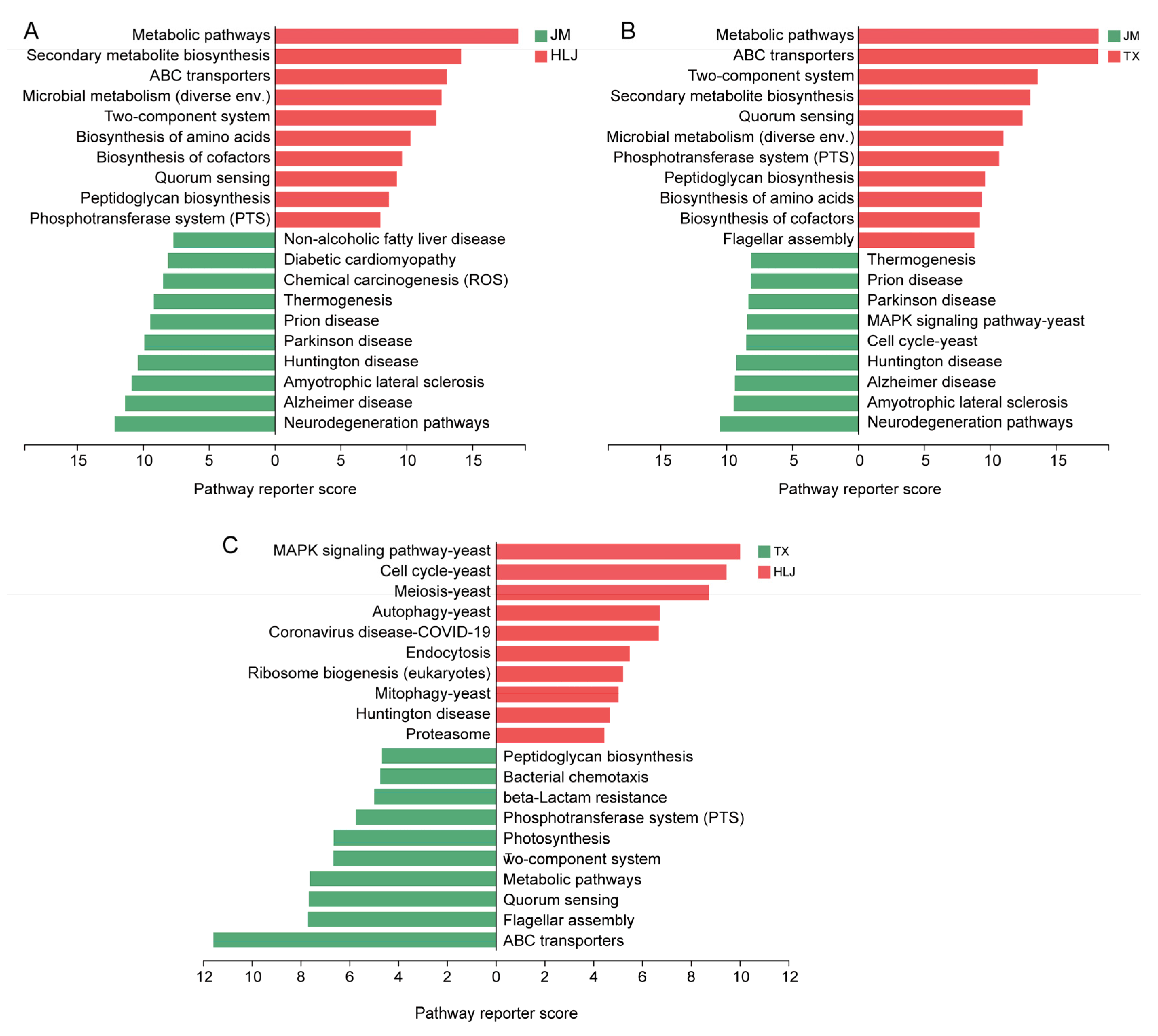
Enrichment analysis of KEGG pathways between the HLJ and JM groups revealed that the HLJ samples were significantly enriched in core microbial metabolic functions (Figure 2A). The pronounced enrichment of metabolic pathways, biosynthesis of amino acids, and biosynthesis of secondary metabolites indicates enhanced carbon–nitrogen metabolic flux in the HLJ microbiota [38]. This activity promotes the accumulation of free amino acids (e.g., glutamate, alanine) and key flavor precursors (e.g., esters, ketones), thereby augmenting the umami complexity and aromatic profiles in the fermented dough.
Concurrent enrichment of ABC transporters [39] and the phosphotransferase system (PTS) underscores efficient substrate uptake (e.g., sugars, peptides), accelerating rate-limiting steps in flavor precursor synthesis. Furthermore, quorum sensing enrichment suggests microbial coordination via signaling molecules to optimize the production of organic acids (e.g., lactate, acetate) and volatile aromatics, while biosynthesis of cofactors (e.g., NAD+, B vitamins) supports metabolic robustness through coenzyme provision [40]. Human disease pathways (e.g., neurodegenerative disorders) enriched in the JM group are probably derived from homologous protein annotations between yeast and humans, lacking biological relevance to the fermentation dynamics. In summary, the HLJ microbiota enhances the synthesis of amino acids and flavor precursors (e.g., glutamate, esters), elevates the substrate transport efficiency (via ABC/PTSs), and coordinates metabolism through quorum sensing, directly driving umami compound accumulation and complex aroma formation, thereby establishing the molecular mechanistic basis for fermented food flavor enhancement.
Comparative KEGG pathway enrichment analysis between the TX and JM groups demonstrated that the TX samples were prominently enriched in functional pathways related to microbial metabolism and regulation (Figure 2B). Coordinated upregulation of metabolic pathways, biosynthesis of amino acids, and biosynthesis of secondary metabolites drove the synthesis of free amino acids (e.g., glutamate, aspartate) and key flavor compounds (e.g., esters, aldehydes), directly contributing to umami intensity and multi-layered aromatic characteristics in the fermented products. Enrichment of ABC transporters and the phosphotransferase system (PTS) further enhanced the transmembrane transport efficiency of substrates (e.g., sugars, peptides), providing foundational precursors for flavor synthesis. Notably, the specific enrichment of flagellar assembly suggests potential enhancement in motility-mediated resource competition within microenvironments [41], indirectly improving colonization and metabolic efficacy. Quorum sensing and the two-component system coordinated microbial metabolism through signal transduction, optimizing the production ratio of organic acids (e.g., lactate, acetate) and volatiles. Human neurodegenerative pathways enriched in JM samples resulted from yeast–human protein homology annotation artifacts with no biological relevance to fermentation. Collectively, the TX microbiota establishes a unique molecular framework for superior flavor quality through integrated functions in metabolic synthesis, substrate transport, motile colonization, and signaling regulation.
Comparative KEGG pathway analysis between the HLJ and TX groups revealed distinct functional specialization (Figure 2C). The HLJ samples showed significant enrichment in yeast-specific pathways (e.g., MAPK signaling, cell cycle), indicating enhanced proliferative capacity and stress adaptation of yeast strains [42]. This supports high viable biomass during the fermentation initiation phase, indirectly sustaining flavor metabolism. Conversely, the TX group exhibited prominent enrichment in bacteria-centric metabolic networks: core metabolic pathways and the phosphotransferase system (PTS) synergistically improved carbohydrate uptake and conversion efficiency, accelerating the synthesis of organic acid precursors (e.g., lactate) [43]. Co-enrichment of ABC transporters and quorum sensing further optimized substrate utilization and metabolic coordination, directly promoting the accumulation of flavor-active compounds (e.g., esters, pyrazines) linked to aroma intensity enhancement. Notably, TX-specific enrichment of peptidoglycan biosynthesis [44] suggests the higher abundance of Gram-positive bacteria (e.g., Lactiplantibacillus), which release intracellular proteases via autolysis to hydrolyze dough proteins into umami-enhancing peptides. Disease-associated pathways in HLJ (e.g., proteasome, Huntington’s disease) stem from yeast–mammalian homologous annotation artifacts. Collectively, while HLJ relies on the yeast vitality for fermentation efficiency, TX establishes superior flavor compound synthesis through integrated bacterial metabolism and cooperative mechanisms.

3.3. Untargeted Metabolomics Analysis

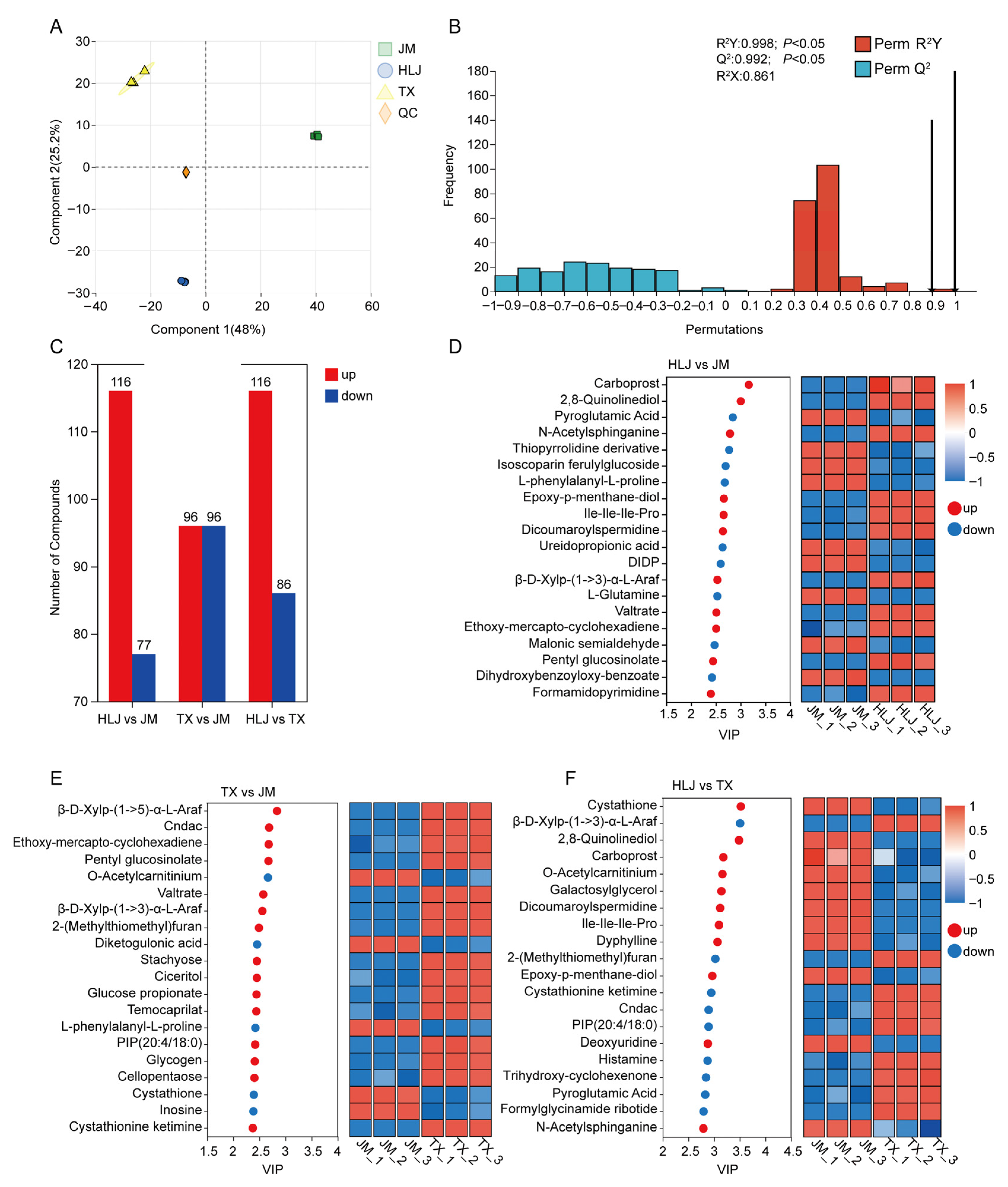
Untargeted metabolomics uncovered systematic metabolic divergence between the sourdough groups. As illustrated in Figure 3A, the PLS-DA score plot achieved 73.4% cumulative explained variance (PC1 = 48%, PC2 = 25.2%). Pronounced spatial separation was observed: the HLJ (triangles) and JM (circles) groups formed distinct clusters, while the TX group diamonds occupied an intermediate zone with tight intra-group clustering (>95% confidence ellipses), confirming highly reproducible metabolic profiles driven by fermentation sources. The model robustness was rigorously validated by permutation testing (Figure 3B): the original parameters R2Y = 0.998 (p < 0.05) and Q2 = 0.992 (p < 0.05) significantly surpassed the permuted R2X distributions (mean = 0.861 after 200 permutations), demonstrating superior predictive power. The quantitative analysis of differential metabolites (Figure 3C) further delineated inter-group disparities: HLJ vs. JM exhibited 193 metabolites (116 up/77 down), TX vs. JM showed 192 (96 up/96 down), whereas HLJ vs. TX revealed the highest divergence (202 metabolites, 116 up/86 down), suggesting geographical microbiota specificity may trigger more intricate metabolic network reprogramming.
As illustrated in Figure 3D, untargeted metabolomics revealed distinct metabolic reprogramming in HLJ cohorts versus JM (VIP > 2.0, p < 0.001). Notably, HLJ exhibited a 2.4-fold accumulation of pentyl glucosinolate (mean +0.91 vs. JM −0.91). This glucosinolate derivative is likely hydrolyzed by microbial myrosinase (predominantly from the dominant Limosilactobacillus fermentum in HLJ) to generate isothiocyanates, which are key precursors for the characteristic pungent and sulfurous notes in HLJ sourdough [45]. Concurrently, methionine sulfoxide was specifically enriched in HLJ (+0.91), serving as a substrate for Strecker degradation to form volatile sulfur compounds such as dimethyl trisulfide, a potent aroma compound with a characteristic onion-like odor, with reported sensory thresholds below 1 ppb [46]. Crucially, HLJ demonstrated the systematic depletion of umami-associated precursors, evidenced by a 91% reduction in L-glutamine (−0.91) and concomitant suppression of pyroglutamic acid (−0.90) [47]. These coordinated alterations impede glutamate biosynthesis, thereby compromising the activation efficiency of umami receptors T1R1/T1R3. In contrast, glycoside hydrolysis products such as galactosylglycerol showed marked elevation in HLJ (+0.90), wherein liberated galactose acts as a Maillard reaction substrate, facilitating the formation of furans and pyrazines that impart baked-nutty aromas [48]. Collectively, this metabolic rewiring establishes a characteristic flavor profile in HLJ dominated by roasted-sweet notes, sulfurous undertones, and subdued umami perception.
As illustrated in Figure 3E, untargeted metabolomics revealed a systematic metabolic divergence in TX cohorts versus JM (VIP > 2.3, p < 0.001). TX exhibited a marked accumulation of stachyose (mean +0.91 vs. JM −0.91); this functional oligosaccharide modulates osmotic pressure to enhance microbial exopolysaccharide synthesis, thereby contributing to viscous texture [49]. Crucially, pentyl glucosinolate showed elevation in TX (+0.91), with its myrosinase-derived metabolite 5-(methylthio)pentanenitrile [50] documented as a pungent allyl isothiocyanate precursor possessing a sensory threshold of 0.05 mg/kg. Concurrently, TX demonstrated a 31% enrichment of 2-(methylthiomethyl)furan (+0.91; 0.001 ppm sensory threshold), a key thioether aroma compound putatively generated via Maillard reactions of stachyose/xylose (accumulated in TX, Section 3.3) and sulfur-containing amino acids—with its synthesis potentially facilitated by TX’s diversified LAB consortium (Lactiplantibacillus plantarum/Fructilactobacillus sanfranciscensis) [51]. In contrast, the depletion of umami-enhancing precursors was observed, evidenced by an 89% reduction in L-phenylalanyl-L-proline (−0.91), a dipeptide whose degradation compromises umami receptor ligand diversity. This was paralleled by a 92% suppression of gluconic acid (−0.91), diminishing the organic acid-mediated synergy in sweet–umami perception. Collectively, this metabolic rewiring establishes a sensory signature in TX dominated by glucosinolate-derived volatiles, characterized by roasted furans and attenuated umami modulation.
As shown in Figure 3F, untargeted metabolomics revealed significant remodeling of flavor-related metabolites in HLJ cohorts relative to TX (VIP > 2.6, p < 0.001). HLJ exhibited the characteristic accumulation of cystathione (+0.91 vs. TX −0.91), a key intermediate in the microbial methionine–cysteine transsulfuration pathway, suggesting enhanced microbial sulfur-cycling activity [52]. Among key flavor compounds, 2-(methylthiomethyl)furan decreased in HLJ (−0.91 vs. TX +0.91), directly impairing the roasted-nut aromas. Concurrently, pyroglutamic acid declined by 86% in HLJ (−0.91) [53], diminishing the caramel-like flavor complexity due to reduced Maillard reaction products. Conversely, N1,N10-dicoumaroylspermidine increased in HLJ (+0.93), with this polyphenol–amide conjugate enhancing astringency through salivary protein binding [54]. Tripeptide profiling further showed the upregulation of Ile-Ile-Ile-Pro in HLJ (+0.91), whose hydrophobic side chains prolong a bitter aftertaste via calcium-sensing receptor (CaSR) activation [55]. Collectively, HLJ’s metabolomic signature, defined by sulfur metabolite remodeling, enrichment of bitterness-intensifying peptides, and attenuation of characteristic roasted furans, establishes a distinct hierarchical sensory profile characterized by “elevated sulfur notes, intensified bitterness, and diminished roasted attributes” compared with TX.
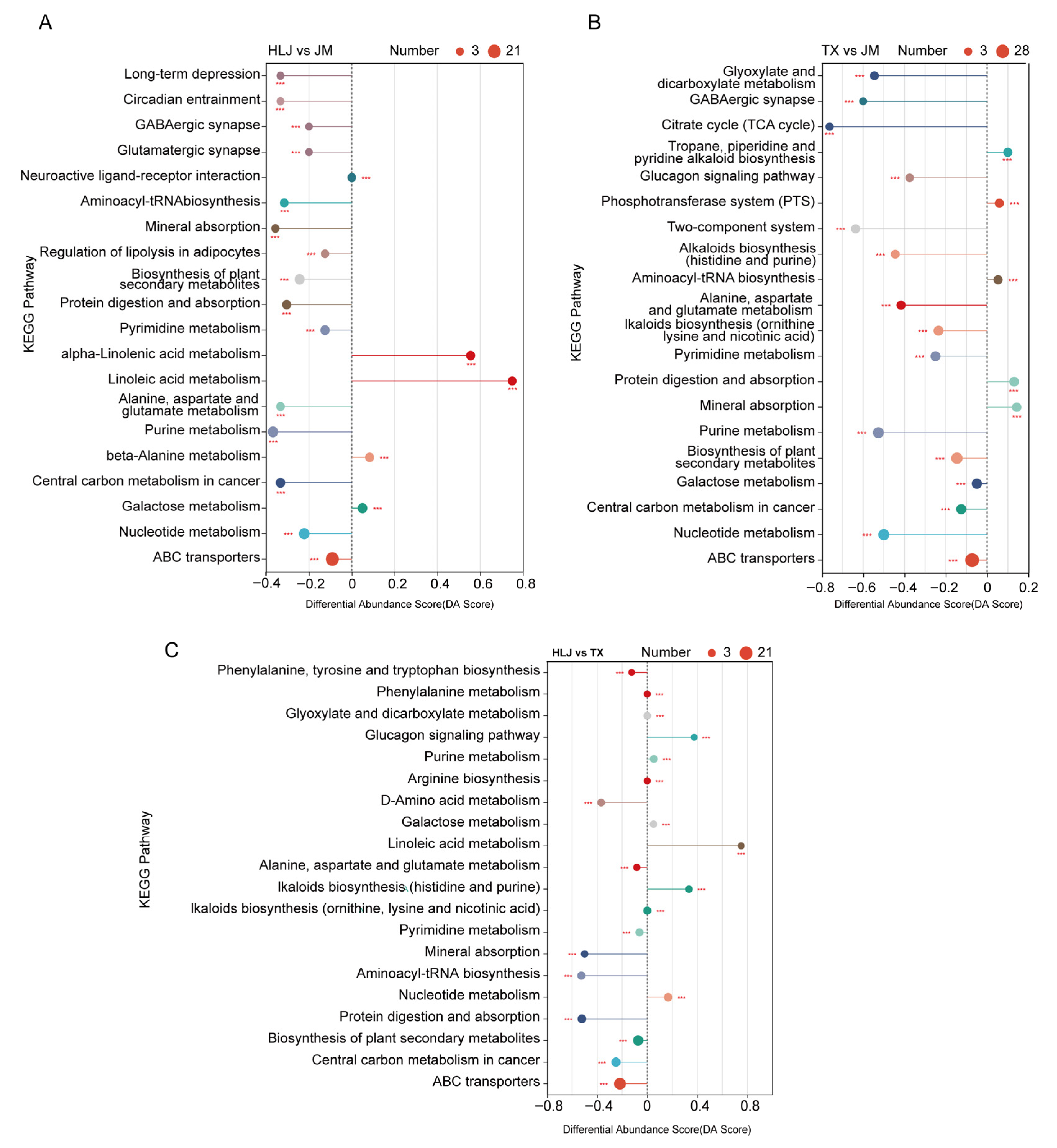
Untargeted metabolomics coupled with the KEGG pathway analysis of fermented dough revealed systemic metabolic reprogramming in HLJ samples relative to the JM group. Specifically, alpha-linolenic acid [56] metabolism and linoleic acid metabolism pathways in Figure 4A were significantly upregulated in the HLJ cohort, with activation of these unsaturated fatty acid metabolic pathways correlating with lipid oxidation derivative accumulation. Prior VIP analysis confirmed the enrichment of methionine sulfoxide [46], where terminal alpha-linolenic acid oxidation products such as hexanal and nonanal were found to synergistically interact with sulfur volatiles through olfactory receptor binding, collectively intensifying the sulfury sensory perception.
Concurrently, the downregulation of purine and pyrimidine metabolism pathways indicated attenuated nucleotide turnover. This suppression formed a complementary mechanism with the VIP-identified accumulation of the bitter-taste-enhancing peptide Ile-Ile-Ile-Pro: the peptide extends bitter aftertaste through calcium-sensing receptor (CaSR) activation [55], while reduced nucleotide degradation products potentially diminished umami perception thresholds, jointly exacerbating the bitter-dominated flavor imbalance. Collectively, HLJ’s metabolic signature demonstrates the following: (1) lipid oxidation-driven sulfur enhancement, (2) attenuated nucleotide metabolism combined with bitter peptide accumulation, and (3) umami signaling pathway suppression, establishing a sensory phenotype characterized by elevated sulfurous and bitter attributes with diminished umami and roasted aromas.
Figure 4B revealed coordinated metabolic shifts in TX versus JM cohorts, characterized by enhanced carbohydrate flux and specialized alkaloid biosynthesis. Significant upregulation of the phosphotransferase system (PTS) directly correlated with the oligosaccharide accumulation, including Beta-D-xylopyranosyl-arabinose (VIP = 2.84) and stachyose (VIP = 2.45), both exhibiting > 0.9 increases in TX. These shifts provided substrates for Maillard reactions, evidenced by elevated 2-(methylthiomethyl)furan, which contributes to caramelized notes [51]. The concurrent activation of tropane and piperidine alkaloid biosynthesis aligned with valtrate enrichment suggests these compounds may impart subtle bitterness via taste receptor modulation [57]. Crucially, enhanced protein digestion/absorption mechanistically corresponded to reduced L-phenylalanyl-L-proline (VIP = 2.42), mitigating persistent bitter off-flavors. In contrast, the conjoint suppression of TCA cycle and GABAergic synapse pathways depleted umami precursors such as inosine (VIP = 2.39), further constraining the glutamate-derived flavor complexity. This integrated metabolic rewiring ultimately established a flavor profile dominated by caramelized sweetness with nuanced bitter undertones and streamlined umami expression.
As shown in Figure 4C, the HLJ specimens exhibited reinforced amino acid derivative metabolism and coordinated lipid oxidation relative to the TX group. The significant upregulation of purine metabolism directly correlated with inosine precursor accumulation (Deoxyuridine, VIP = 2.88), which synergized with the enhanced nucleotide metabolism to potentiate the umami intensity. Conversely, suppressed phenylalanine metabolism and protein digestion pathways markedly reduced the bitter compounds: depletion of pyroglutamic acid (VIP = 2.83) in HLJ minimized the persistent bitterness. Specific induction of linoleic acid metabolism was manifested through oxidized lipid derivatives such as N-acetylsphinganine (VIP = 2.79), providing precursors for green aromatic notes. In summary, while both the HLJ and TX groups exhibited higher bitterness and lower umami intensity compared with the JM reference group, the HLJ had significantly higher umami precursor accumulation (e.g., inosine) and marginally lower bitter peptide levels (e.g., Ile-Ile-Ile-Pro) than TX, leading to its relatively higher umami and lower bitter sensory profile. This sensory profile, when combined with lipid oxidation-derived aromatic notes, establishes a flavor signature distinct from the pronounced bittersweet caramel notes characteristic of the TX group.

3.4. Analysis of Microbial Abundance and Metabolite Correlation

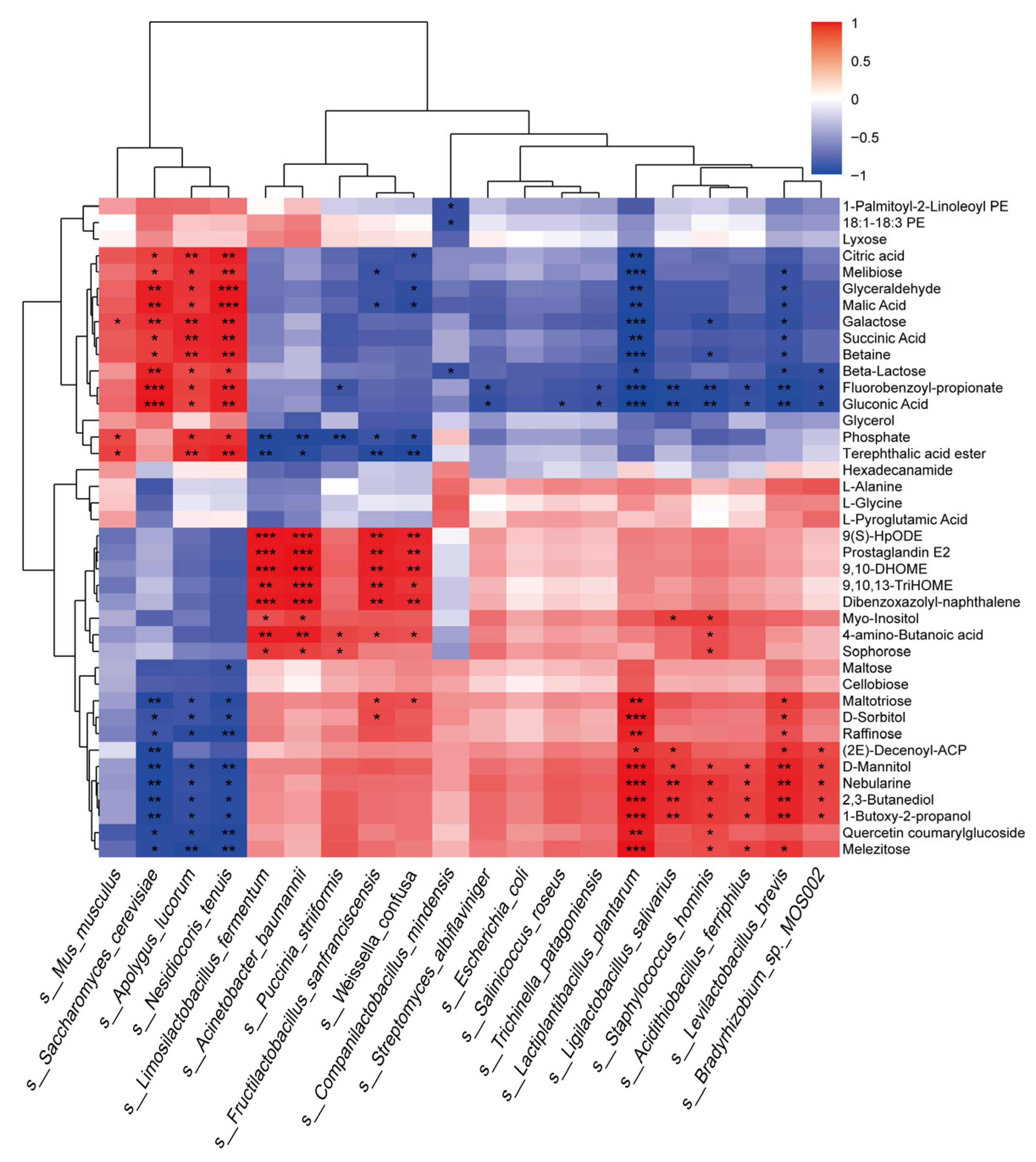
Figure 5 reveals significant Spearman’s rank correlations (|r| > 0.8, p < 0.05) between specific microbial taxa and key metabolite abundances, which potentially modulate the flavor development in fermented foods. Core yeast species (Saccharomyces cerevisiae) exhibited strong negative correlations with complex carbohydrates (e.g., maltotriose r = −0.80; melezitose r = −0.75) and polyols (e.g., D-sorbitol r = −0.68), indicating their preferential utilization of these substrates for ethanol and ester precursor synthesis. Lactobacillales taxa (notably, Lactiplantibacillus plantarum and Levilactobacillus brevis) demonstrated high synergy with organic acid metabolism: strong negative correlations with citrate (r = −0.87) and malate (r = −0.87) accumulation, collectively contributing to the regulation of sourdough acidity and flavor balance. The unclassified Lactiplantibacillus sp. showed a positive correlation with cellobiose (r = 0.62), suggesting unique β-glucosidase activity [58] that may liberate flavor precursors from cellulosic materials. Among Actinobacteria, Streptomyces albiflaviniger exhibited a strong negative correlation with betaine (r = −0.8662), implying its potential role in betaine metabolism that may contribute to flavor formation in fermented foods [59]. Limosilactobacillus fermentum showed exceptional positive correlations (r > 0.90) with hydroxylated fatty acid derivatives (e.g., 9,10-DHOME r = 0.93), precursors of floral/fruity aldehydes and ketones via enzymatic oxidation [60]. Phosphate presented a strong negative correlation with Limosilactobacillus fermentum and Acinetobacter baumannii (r = −0.85 for both, p < 0.05), with such microbial–metabolic interactions exerting a subtle regulatory effect on final product flavor. Collectively, these correlations confirm the core functional linkages between the dominant microbial taxa of each sourdough group (e.g., Limosilactobacillus fermentum in HLJ, Lactiplantibacillus plantarum/Fructilactobacillus sanfranciscensis in TX, Saccharomyces cerevisiae in JM) and their characteristic flavor-related metabolites—establishing the microbial–metabolic basis for the distinct sensory profiles of traditional and industrial sourdough starters.

4. Conclusions

This study demonstrates that the traditional starters (HLJ, TX) harbor distinct functional microbiota compared with an industrial starter (JM), with Limosilactobacillus fermentum (14.75%) dominating HLJ and synergistic Lactiplantibacillus plantarum (4.47%)–Fructilactobacillus sanfranciscensis (3.03%) consortia characterizing TX. Metagenomic pathway analysis revealed these taxa drive metabolic flux through glycolysis, amino acid metabolism, and glycerophospholipid transformation, directly enhancing the dough rheology (e.g., elevated hardness in HLJ) and volatile compound biosynthesis. The co-occurrence of Bradyrhizobium spp. (HLJ: 6.00%; TX: 6.61%) likely supported nitrogen metabolism. The systemic enrichment of core metabolic pathways (e.g., amino acid biosynthesis, secondary metabolite generation, and ABC transporters/PTSs) in HLJ and TX consortia versus JM establishes the molecular foundation for the flavor enhancement. The HLJ consortium developed distinct sulfury notes with pungent undertones, which may be linked to the accumulation of pentyl glucosinolate and its putative enzymatic conversion to isothiocyanates. In contrast, the TX consortium generated prominent caramel–roasted aromas putatively via Maillard reactions driven by stachyose/xylose accumulation, yielding key flavor compounds such as 2-(methylthiomethyl)furan. Metabolically, HLJ elevated sulfurous/bitter notes with diminished umami and roasted attributes. TX displayed a parallel reduction in umami perception alongside heightened bitterness but was distinguished by dominant caramelized sweetness. Critically, while both consortia showed higher bitterness and lower umami intensity than JM, HLJ demonstrated a marginally higher umami perception and slightly lower bitterness than TX.

Author Contributions

Q.W. (Qing Wu): Writing—original draft, Methodology, Investigation, Formal analysis, and Data curation. H.Z.: Data curation. S.X.: Data curation. J.G.: Supervision and Project administration. X.Y.: Validation, Supervision, and Project administration. Q.W. (Qi Wang): Methodology, Resources, and Investigation. H.F.: Writing—review and editing, Validation, Supervision, Project administration, Funding acquisition, and Conceptualization. All authors have read and agreed to the published version of the manuscript.

Funding

This study was supported by the 2023 Applied Technology Research Project of Ningxia Polytechnic University of Business and Technology.

Institutional Review Board Statement

Not applicable.

Informed Consent Statement

Not applicable.

Data Availability Statement

The raw data supporting the conclusions of this article will be made available by the authors on request.

Conflicts of Interest

The authors declare no conflicts of interest.

References

  1. Yang, Y.; Wang, X. Effects of coarse cereals on dough and Chinese steamed bread—A review. Front. Nutr. 2023, 10, 1186860. [Google Scholar] [CrossRef] [PubMed]
  2. Zhu, F. Influence of ingredients and chemical components on the quality of Chinese steamed bread. Food Chem. 2014, 163, 154–162. [Google Scholar] [CrossRef] [PubMed]
  3. Wei, G.; Zhang, Z.; Zhao, F.; Sang, Y.; Regenstein, J.M.; Zhou, P. Characteristic aroma compounds during the fermentation of Chinese steamed bread fermented with different starters. Food Chem. 2024, 457, 140151. [Google Scholar] [CrossRef]
  4. Fu, L.; Nowak, A.; Zhao, H.; Zhang, B. Relationship Between Microbial Composition of Sourdough and Texture, Volatile Compounds of Chinese Steamed Bread. Foods 2022, 11, 1908. [Google Scholar] [CrossRef] [PubMed]
  5. Ashaolu, T.J.; Reale, A. A Holistic Review on Euro-Asian Lactic Acid Bacteria Fermented Cereals and Vegetables. Microorganisms 2020, 8, 1176. [Google Scholar] [CrossRef]
  6. Yan, B.; Sadiq, F.A.; Cai, Y.; Fan, D.; Chen, W.; Zhang, H.; Zhao, J. Microbial diversity in traditional type I sourdough and jiaozi and its influence on volatiles in Chinese steamed bread. LWT 2019, 101, 764–773. [Google Scholar] [CrossRef]
  7. Gereková, P.; Petruláková, Z.; Šturdík, E. Importance of lactobacilli for bread-making industry. Acta Chim. Slovaca 2011, 4, 118–135. [Google Scholar]
  8. Hillmann, H.; Hofmann, T. Quantitation of Key Tastants and Re-engineering the Taste of Parmesan Cheese. J. Agric. Food Chem. 2016, 64, 1794–1805. [Google Scholar] [CrossRef]
  9. Pico, J.; Bernal, J.; Gómez, M. Wheat bread aroma compounds in crumb and crust: A review. Food Res. Int. 2015, 75, 200–215. [Google Scholar] [CrossRef]
  10. Ripari, V.; Cecchi, T.; Berardi, E. Microbiological characterisation and volatiles profile of model, ex-novo, and traditional Italian white wheat sourdoughs. Food Chem. 2016, 205, 297–307. [Google Scholar] [CrossRef]
  11. Pétel, C.; Onno, B.; Prost, C. Sourdough volatile compounds and their contribution to bread: A review. Trends Food Sci. Technol. 2017, 59, 105–123. [Google Scholar] [CrossRef]
  12. Tang, N.; Xing, X.; Li, H.; Suo, B.; Wang, Y.; Ai, Z.; Yang, Y. Co-culture fermentation by Saccharomycopsis fibuligera and lactic acid bacteria improves bioactivity and aroma profile of wheat bran and the bran-containing Chinese steamed bread. Food Res. Int. 2024, 182, 114179. [Google Scholar] [CrossRef] [PubMed]
  13. Wen, L.; Yang, L.; Chen, C.; Li, J.; Fu, J.; Liu, G.; Kan, Q.; Ho, C.-T.; Huang, Q.; Lan, Y.; et al. Applications of multi-omics techniques to unravel the fermentation process and the flavor formation mechanism in fermented foods. Crit. Rev. Food Sci. Nutr. 2024, 64, 8367–8383. [Google Scholar] [CrossRef] [PubMed]
  14. Sun, X.; Ye, Z.; Xiao, M.; Zhang, C.; Guo, M.; Zhao, J.; Chen, W.; Tian, F.; Yu, L.; Zhai, Q. The formation mechanism of volatile and nonvolatile flavor substances in sourdough based on genomics and metabolomics. Food Chem. 2025, 476, 143283. [Google Scholar] [CrossRef] [PubMed]
  15. Jiang, Z.J.; Sun, X.; Guo, X.-N.; Zhu, K.-X. Components and physicochemical properties of mill streams: Effects on freeze-thaw stability and quality of frozen steamed bread dough. Food Chem. 2025, 478, 143738. [Google Scholar] [CrossRef]
  16. Wang, H.; Wei, X.; Li, D.; Yan, J.; Wu, Y.; Zhou, Z. Impact of surfactin on the physicochemical properties of dough and quality of corresponding steamed bread. J. Sci. Food Agric. 2025, 105, 3122–3132. [Google Scholar] [CrossRef]
  17. Liu, J.; Zhao, W.; Zhang, A.; Li, P.; Liu, J. Effects of cereal flour types and sourdough on dough physicochemical properties and steamed bread quality. J. Food Sci. 2024, 89, 5434–5448. [Google Scholar] [CrossRef]
  18. Chen, S.; Zhou, Y.; Chen, Y.; Gu, J. fastp: An ultra-fast all-in-one FASTQ preprocessor. Bioinformatics 2018, 34, i884–i890. [Google Scholar] [CrossRef]
  19. Li, H.; Durbin, R. Fast and accurate short read alignment with Burrows-Wheeler transform. Bioinformatics 2009, 25, 1754–1760. [Google Scholar] [CrossRef]
  20. Li, D.; Liu, C.-M.; Luo, R.; Sadakane, K.; Lam, T.-W. MEGAHIT: An ultra-fast single-node solution for large and complex metagenomics assembly via succinct de Bruijn graph. Bioinformatics 2015, 31, 1674–1676. [Google Scholar] [CrossRef]
  21. Noguchi, H.; Park, J.; Takagi, T. MetaGene: Prokaryotic gene finding from environmental genome shotgun sequences. Nucleic Acids Res. 2006, 34, 5623–5630. [Google Scholar] [CrossRef]
  22. Fu, L.; Niu, B.; Zhu, Z.; Wu, S.; Li, W. CD-HIT: Accelerated for clustering the next-generation sequencing data. Bioinformatics 2012, 28, 3150–3152. [Google Scholar] [CrossRef]
  23. Li, R.; Li, Y.; Kristiansen, K.; Wang, J. SOAP: Short oligonucleotide alignment program. Bioinformatics 2008, 24, 713–714. [Google Scholar] [CrossRef]
  24. Buchfink, B.; Xie, C.; Huson, D.H. Fast and sensitive protein alignment using DIAMOND. Nat. Methods 2015, 12, 59–60. [Google Scholar] [CrossRef]
  25. Cooper, B.; Yang, R. An assessment of AcquireX and Compound Discoverer software 3.3 for non-targeted metabolomics. Sci. Rep. 2024, 14, 4841. [Google Scholar] [CrossRef]
  26. Wallace, W.E.; Moorthy, A.S. NIST Mass Spectrometry Data Center standard reference libraries and software tools: Application to seized drug analysis. J. Forensic Sci. 2023, 68, 1484–1493. [Google Scholar] [CrossRef] [PubMed]
  27. Misra, B.B.; Bassey, E.; Bishop, A.C.; Kusel, D.T.; Cox, L.A.; Olivier, M. High-resolution gas chromatography/mass spectrometry metabolomics of non-human primate serum. Rapid Commun. Mass. Spectrom. 2018, 32, 1497–1506. [Google Scholar] [CrossRef]
  28. Ren, Y.; Yu, G.; Shi, C.; Liu, L.; Guo, Q.; Han, C.; Zhang, D.; Zhang, L.; Liu, B.; Gao, H.; et al. Majorbio Cloud: A one-stop, comprehensive bioinformatic platform for multiomics analyses. Imeta 2022, 1, e12. [Google Scholar] [CrossRef] [PubMed]
  29. Parsell, G.; Bligh, J. The development of a questionnaire to assess the readiness of health care students for interprofessional learning (RIPLS). Med. Educ. 1999, 33, 95–100. [Google Scholar] [CrossRef] [PubMed]
  30. Hargreaves, J.; Popineau, Y.; Le Meste, M.; Hemminga, M.A. Molecular flexibility in wheat gluten proteins submitted to heating. FEBS Lett. 1995, 372, 103–107. [Google Scholar] [CrossRef]
  31. Patching, J.W.; Rose, A.H. Cold osmotic shock in Saccharomyces cerevisiae. J. Bacteriol. 1971, 108, 451–458. [Google Scholar] [CrossRef]
  32. Xu, D.; Hu, Y.; Wu, F.; Jin, Y.; Xu, X.; Gänzle, M.G. Comparison of the Functionality of Exopolysaccharides Produced by Sourdough Lactic Acid Bacteria in Bread and Steamed Bread. J. Agric. Food Chem. 2020, 68, 8907–8914. [Google Scholar] [CrossRef]
  33. Xie, J.; Zhao, Z.; Gänzle, M.G. Contribution of γ-Glutamyl-Cysteine Ligases of Limosilactobacillus reuteri to the Formation of Kokumi-Active γ-Glutamyl Dipeptides in Sourdough Bread. J. Agric. Food Chem. 2024, 72, 5935–5943. [Google Scholar] [CrossRef]
  34. Martínez-Anaya, M.A.; Benedito de Barber, C.; Collar Esteve, C. Effect of processing conditions on acidification properties of wheat sour doughs. Int. J. Food Microbiol. 1994, 22, 249–255. [Google Scholar] [CrossRef]
  35. Korakli, M.; Rossmann, A.; Gänzle, M.G.; Vogel, R.F. Sucrose metabolism and exopolysaccharide production in wheat and rye sourdoughs by Lactobacillus sanfranciscensis. J. Agric. Food Chem. 2001, 49, 5194–5200. [Google Scholar] [CrossRef]
  36. Menezes, L.A.A.; De Marco, I.; dos Santos, N.N.O.; Nunes, C.C.; Cartabiano, C.E.L.; Molognoni, L.; Pereira, G.V.d.M.; Daguer, H.; Lindner, J.D.D. Reducing FODMAPs and improving bread quality using type II sourdough with selected starter cultures. Int. J. Food Sci. Nutr. 2021, 72, 912–922. [Google Scholar] [CrossRef]
  37. Promdonkoy, P.; Watcharawipas, A.; Bubphasawan, S.; Sansatchanon, K.; Suwanakitti, N.; Kocharin, K.; Runguphan, W. Metabolic Engineering of Saccharomyces cerevisiae for Production of Canthaxanthin, Zeaxanthin, and Astaxanthin. J. Fungi 2024, 10, 433. [Google Scholar] [CrossRef]
  38. Martínez-Anaya, M.A.; Llin, M.L.; Macías, M.P.; Collar, C. Regulation of acetic acid production by homo- and heterofermentative lactobacilli in whole-wheat sour-doughs. Z. Lebensm. Unters. Forsch 1994, 199, 186–190. [Google Scholar] [CrossRef] [PubMed]
  39. Piper, P.; Mahé, Y.; Thompson, S.; Pandjaitan, R.; Holyoak, C.; Egner, R.; Mühlbauer, M.; Coote, P.; Kuchler, K. The pdr12 ABC transporter is required for the development of weak organic acid resistance in yeast. Embo J. 1998, 17, 4257–4265. [Google Scholar] [CrossRef] [PubMed]
  40. Fuqua, C.; Winans, S.C.; Greenberg, E.P. Census and consensus in bacterial ecosystems: The LuxR-LuxI family of quorum-sensing transcriptional regulators. Annu. Rev. Microbiol. 1996, 50, 727–751. [Google Scholar] [CrossRef] [PubMed]
  41. Halte, M.; Popp, P.F.; Hathcock, D.; Severn, J.; Fischer, S.; Goosmann, C.; Ducret, A.; Charpentier, E.; Tu, Y.; Lauga, E.; et al. Bacterial motility depends on a critical flagellum length and energy-optimized assembly. Proc. Natl. Acad. Sci. USA 2025, 122, e2413488122. [Google Scholar] [CrossRef]
  42. Luo, S.; Zhu, M.; Fu, C. The Obg-like ATPase Ola1 prevents excessive mitochondrial reactive oxygen species by inhibiting MAPK/Pmk1 signaling in fission yeast. Microbiol. Res. 2025, 299, 128259. [Google Scholar] [CrossRef]
  43. Yin, M.Q.; Xu, K.; Luan, T.; Kang, X.-L.; Yang, X.-Y.; Li, H.-X.; Hou, Y.-H.; Zhao, J.-Z.; Bao, X.-M. Metabolic engineering for compartmentalized biosynthesis of the valuable compounds in Saccharomyces cerevisiae. Microbiol. Res. 2024, 286, 127815. [Google Scholar] [CrossRef]
  44. Wu, J.; Wang, Z.; Hu, J.; Liu, J.; Han, X.; Chen, H.; Zhu, S.; Deng, J. Bacillus subtilis-Derived Postbiotics as a Multifunctional Bio-Catalyst for Enhancing Lactic Acid Bacteria Viability and Yogurt Quality. Foods 2025, 14, 1806. [Google Scholar] [CrossRef]
  45. Zheng, C.; Yang, Y.; Wei, F.; Lv, X.; Xia, Z.; Qi, M.; Zhou, Q. Widely targeted metabolomics reveal the glucosinolate profile and odor-active compounds in flowering Chinese cabbage powder. Food Res. Int. 2023, 172, 113121. [Google Scholar] [CrossRef]
  46. Elattar, M.M.; Hammoda, H.M.; Ghareeb, D.A.; Abdulmalek, S.A.; Abdelrahim, F.A.; Seif, I.A.K.; Dawood, H.M.; Darwish, R.S. Insights into bioactive constituents of onion (Allium cepa L.) waste: A comparative metabolomics study enhanced by chemometric tools. BMC Complement. Med. Ther. 2024, 24, 271. [Google Scholar] [CrossRef]
  47. Huang, Y.; He, X.; Han, Y.; Chen, L.; Yu, X.; Li, J.; Yun, X.; Sha, R.; Borjigin, G. Age-Related Meat Flavor Precursors of Naturally Grazed Sunit Sheep: Metabolomics and Transcriptomics Approaches. Foods 2025, 14, 1616. [Google Scholar] [CrossRef] [PubMed]
  48. Shulami, S.; Zehavi, A.; Belakhov, V.; Salama, R.; Lansky, S.; Baasov, T.; Shoham, G.; Shoham, Y. Cross-utilization of β-galactosides and cellobiose in Geobacillus stearothermophilus. J. Biol. Chem. 2020, 295, 10766–10780. [Google Scholar] [CrossRef] [PubMed]
  49. Xiao, M.; Bi, J.; Yi, J.; Zhao, Y.; Peng, J.; Zhou, L.; Chen, Q. Osmotic pretreatment for instant controlled pressure drop dried apple chips: Impact of the type of saccharides and treatment conditions. Dry. Technol. 2019, 37, 896–905. [Google Scholar] [CrossRef]
  50. Zhang, L.; Chen, J.; Guo, X.; Cao, Y.; Qu, G.; Li, Q.; Gao, Y.; Yu, X. Microwave pretreatment effects on the aroma precursors, sensory characteristics and flavor profiles of fragrant rapeseed oil. Food Chem. X 2024, 22, 101381. [Google Scholar] [CrossRef]
  51. Weerawatanakorn, M.; Wu, J.-C.; Pan, M.-H.; Ho, C.-T. Reactivity and stability of selected flavor compounds. J. Food Drug Anal. 2015, 23, 176–190. [Google Scholar] [CrossRef]
  52. Thomas, D.; Surdin-Kerjan, Y. Metabolism of sulfur amino acids in Saccharomyces cerevisiae. Microbiol. Mol. Biol. Rev. 1997, 61, 503–532. [Google Scholar]
  53. Zhu, Q.; Zhang, L.; Sun, X.; Sun, B.; Zhang, Y. Analyzing the Effect of Dried Shrimp on the Flavor of Sheep Bone Soup Through Sensory Evaluation Combined with Untargeted Approaches. Foods 2025, 14, 1425. [Google Scholar] [CrossRef]
  54. Gaquerel, E.; Kotkar, H.; Onkokesung, N.; Galis, I.; Baldwin, I.T. Silencing an N-acyltransferase-like involved in lignin biosynthesis in Nicotiana attenuata dramatically alters herbivory-induced phenolamide metabolism. PLoS ONE 2013, 8, e62336. [Google Scholar] [CrossRef]
  55. Wu, J.; Lin, X.; Cui, C.; Li, J. Comparative analysis of kokumi effects in Ile-Leu, Ile-Ile, Leu-Leu, and Leu-Ile: Sensory, simulation, and structural insights. Food Chem. 2025, 474, 143004. [Google Scholar] [CrossRef]
  56. Zhang, X.; Li, H.; Nie, J.; Wu, D.; Huang, Q. Unveiling flavor formation and variation in fermented vinasse grass carp based on the dynamic correlation of microbiota with metabolites by multi-omics and bioinformatics approaches. Food Chem. 2025, 487, 144730. [Google Scholar] [CrossRef]
  57. Eguchi, K.; Ohtubo, Y.; Yoshii, K. Functional expression of M3, a muscarinic acetylcholine receptor subtype, in taste bud cells of mouse fungiform papillae. Chem. Senses 2008, 33, 47–55. [Google Scholar] [CrossRef] [PubMed][Green Version]
  58. Nimker, V.; Patel, A.K.; Chen, C.-W.; Giri, B.S.; Dong, C.-D.; Singhania, R.R. Molecular engineering and biotechnological advancements in β-glucosidase for industrial impact: A review. Int. J. Biol. Macromol. 2025, 318, 145133. [Google Scholar] [CrossRef]
  59. Lin, P.; Shi, M.; Wang, F.; Lin, Y.; Zheng, Y. The α-Glucosidase Inhibition Activities of Phaeochromycins D and E Isolated from Marine Streptomyces sp. FJ0218. Molecules 2025, 30, 1993. [Google Scholar] [CrossRef] [PubMed]
  60. Mosharov, E.; Cranford, M.R.; Banerjee, R. The quantitatively important relationship between homocysteine metabolism and glutathione synthesis by the transsulfuration pathway and its regulation by redox changes. Biochemistry 2000, 39, 13005–13011. [Google Scholar] [CrossRef]
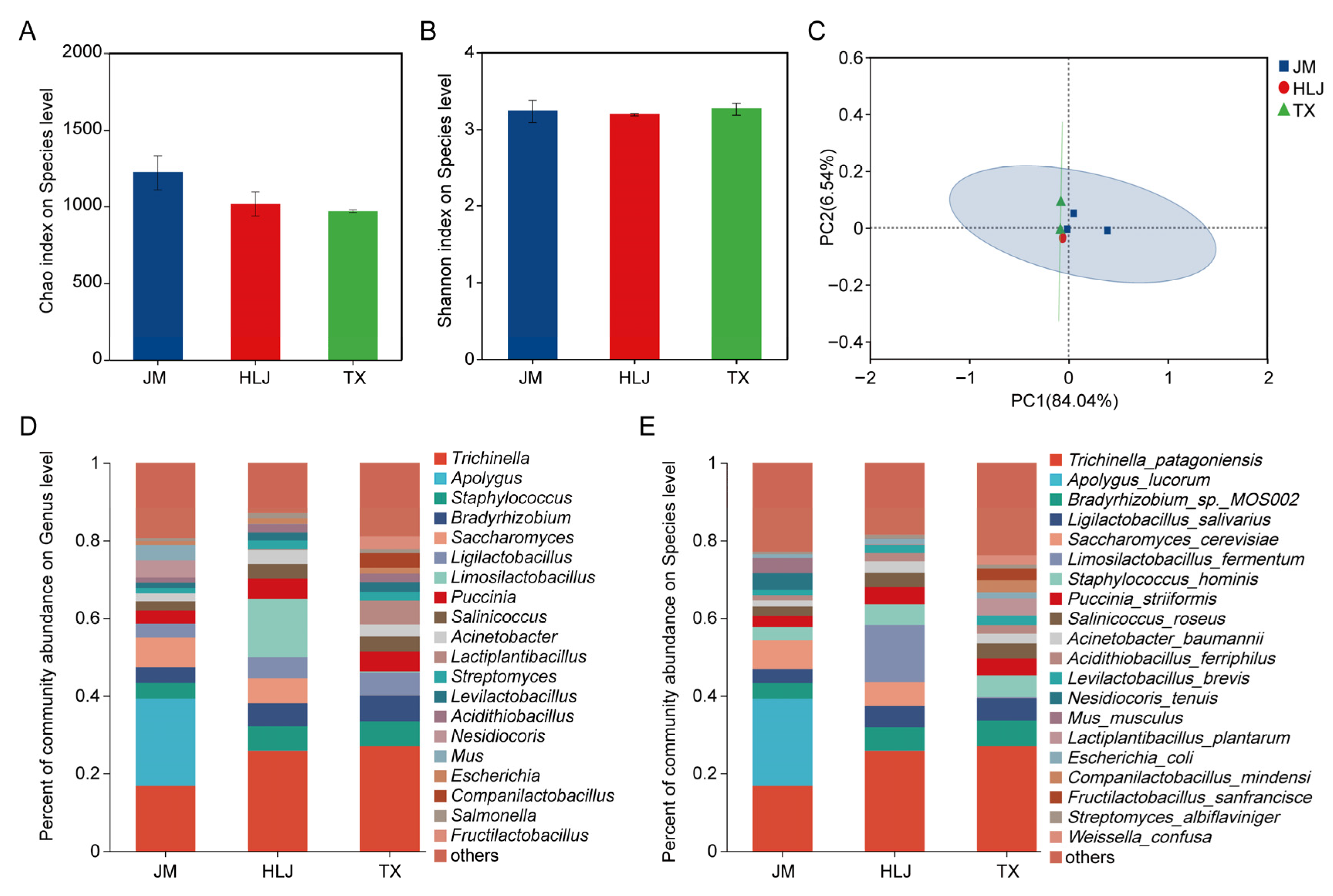
Figure 1. Microbial community analysis of sourdough samples from Heilongjiang (HLJ), Tongxin (TX), and industrial yeast (JM) groups. (A,B): Bar charts contrasting (A) Chao1 index reflecting microbial community richness and (B) Shannon index reflecting microbial diversity among different groups; (C): principal coordinates analysis (PCoA) based on Euclidean distance showing the separation of microbial community structures; (D,E): stacked bar charts displaying the relative abundance of microbial communities at the genus level (D) and species level (E).
Fermentation 12 00153 g001
Figure 2. KEGG pathway enrichment analysis of sourdough microbiomes from Heilongjiang (HLJ), Tongxin (TX), and industrial yeast (JM) groups. (A) HLJ vs. JM, (B) TX vs. JM, and (C) HLJ vs. TX. Bar plots show the top enriched level 3 KEGG pathways (y-axis) and their corresponding pathway reporter scores (x-axis). The green line indicates the mean center of the data distribution, and the blue shaded area represents the 95% confidence ellipse. Abbreviations used in pathway names are as follows: env. = environments, ROS = reactive oxygen species.
Fermentation 12 00153 g002
Figure 3. Untargeted metabolomics analysis of sourdough samples using PLS-DA and VIP analysis. (A) PLS-DA score plot showing inter-group separation (HLJ, TX, JM) and intra-group clustering based on model components; distances reflect metabolic profile differences; (B) permutation validation plot: higher actual R2Y/Q2 values versus permuted distributions confirm model confirm the model robustness and predictive power; (C) bar chart quantifying differential metabolites (VIP > 1, p < 0.05). Red/blue bars indicate up/downregulated metabolites; (DF) integrated VIP scatter plots and heatmaps: (D) HLJ vs. JM, (E) TX vs. JM, (F) HLJ vs. TX; left panels show VIP scores reflecting discriminatory power; right panels show relative metabolite expression with red/blue indicating up/downregulation, respectively. Metabolite names are abbreviated for clarity; full names are available upon request.
Fermentation 12 00153 g003
Figure 4. KEGG pathway enrichment analysis of sourdough untargeted metabolomics, presenting differential metabolic pathways between the HLJ, TX, and JM groups. (A) HLJ vs. JM, (B) TX vs. JM, and (C) HLJ vs. TX. Bubble plots display the differential abundance score (x-axis) of KEGG pathways (y-axis), with colors representing the second-level pathway category and bubble size indicating the number of enriched metabolites. The absolute score, bubble size, and color facilitate the identification of differential pathways and the interpretation of metabolic differences. *** indicates a statistically significant difference at p < 0.001.
Fermentation 12 00153 g004
Figure 5. Correlation heatmap between microbial OTUs and metabolites. This figure presents the correlation analysis results between the metagenome (OTU_S) and untargeted metabolome of sourdough samples. The x-axis represents microbial operational taxonomic units (OTU_S), and the y-axis represents metabolites. The color gradient (red to blue) corresponds to correlation coefficients ranging from 1 to −1; red indicates a positive correlation, blue indicates a negative correlation, and the color intensity reflects the correlation strength, facilitating the interpretation of interaction patterns between microbial communities and metabolites. *, **, and *** indicate statistically significant differences at p < 0.05, p < 0.01, and p < 0.001, respectively. Metabolite names are abbreviated for clarity; full names are available upon request.
Fermentation 12 00153 g005
Table 1. Textural Properties of Fermented Dough from Different Groups (Mean ± SD, N = 12).
GroupTX (N = 4)HLJ (N = 4)JM (N = 4)Total (N = 12)
Hardness    
Mean ± SD8369.65 ± 1300.189685.97 ± 1433.136523.82 ± 1406.148193.15 ± 1842.67
Median
[min–max]
8120.23
[7155.98, 10,082.16]
9832.19
[7912.17, 11,167.32]
7098.89
[4441.36, 7456.14]
7756.09
[4441.36, 11,167.32]
Springiness    
Mean ± SD0.62 ± 0.100.59 ± 0.050.69 ± 0.080.63 ± 0.08
Median
[min–max]
0.62 [0.53, 0.72]0.60 [0.52, 0.64]0.69 [0.60, 0.77]0.62 [0.52, 0.77]
Cohesiveness    
Mean ± SD0.53 ± 0.060.62 ± 0.020.52 ± 0.030.56 ± 0.06
Median
[min–max]
0.54 [0.45, 0.58]0.63 [0.59, 0.64]0.52 [0.50, 0.56]0.56 [0.45, 0.64]
Gumminess    
Mean ± SD4363.10 ± 490.535989.08 ± 771.533396.43 ± 620.814582.87 ± 1257.61
Median
[min–max]
4331.43
[3830.61, 4958.93]
6017.58
[5030.37, 6890.80]
3702.94
[2465.28, 3714.55]
4331.43
[2465.28, 6890.80]
Chewiness    
Mean ± SD2685.98 ± 323.743517.26 ± 330.942339.58 ± 562.292847.60 ± 641.17
Median
[min–max]
2690.10
[2294.56, 3069.16]
3644.23
[3029.38, 3751.21]
2458.84
[1594.48, 2846.14]
2810.49
[1594.48, 3751.21]
Resilience    
Mean ± SD0.19 ± 0.040.27 ± 0.010.20 ± 0.020.22 ± 0.04
Median
[min–max]
0.20 [0.15, 0.23]0.27 [0.26, 0.28]0.20 [0.18, 0.22]0.22 [0.15, 0.28]
Disclaimer/Publisher’s Note: The statements, opinions and data contained in all publications are solely those of the individual author(s) and contributor(s) and not of MDPI and/or the editor(s). MDPI and/or the editor(s) disclaim responsibility for any injury to people or property resulting from any ideas, methods, instructions or products referred to in the content.