Article

Fungal Solid-State and Submerged Fermentation of Blueberry Bagasse: Extraction Strategies, Phenolic Profiling, and Cellular Immunomodulation


by
Alejandra Hurtado-Romero
1,
Ivan Luzardo-Ocampo
1,2,
Marilena Antunes-Ricardo
2,3,
Felipe López-Pacheco
3,
Luis Eduardo Garcia-Amezquita
3,
Danay Carrillo-Nieves
1 and
Tomás García-Cayuela
1,*
1
Tecnologico de Monterrey, School of Engineering and Sciences, Ave. General Ramón Corona 2514, Zapopan 45138, Mexico
2
Tecnologico de Monterrey, Institute for Obesity Research, Ave. Eugenio Garza Sada 2501 Sur, Monterrey 64849, Mexico
3
Tecnologico de Monterrey, School of Engineering and Sciences, Ave. Eugenio Garza Sada 2501 Sur, Monterrey 64849, Mexico
*
Author to whom correspondence should be addressed.
Fermentation 2026, 12(3), 128; https://doi.org/10.3390/fermentation12030128
Submission received: 24 January 2026 / Revised: 20 February 2026 / Accepted: 25 February 2026 / Published: 2 March 2026

Abstract

Solid-state and submerged fermentation (SSF and SmF) were evaluated as bioprocessing strategies to enhance the recovery and bioactivity of phenolic compounds from blueberry bagasse. Fermentation was performed using Aspergillus niger ATCC 6275 and Rhizopus oryzae BIOTEC018, alongside non-inoculated controls. Extracts (SmF filtrate, buffer, methanol, and buffer-methanol) were obtained and analyzed for total phenolic content (TPC), total anthocyanins, and antioxidant capacity over 0–60 h. Methanolic extracts obtained after 24 h of SSF were further selected for profiling of individual phenolics and for intracellular reactive oxygen species (ROS), nitric oxide (NO), and cytokine responses. Compared with SmF and non-inoculated controls, SSF—particularly when combined with methanolic extraction—was associated with modified phenolic recovery patterns at 24 h, including increases in TPC and differences in anthocyanin preservation. SSF promoted the accumulation of phenolic acids and flavan-3-ols, together with improved preservation of major anthocyanins. These compositional changes translated into higher antioxidant capacity and a marked reduction in ROS and NO levels (≈40–60% of oxidant or LPS controls). Cytokine responses were strain-dependent, indicating regulated immune modulation rather than generalized inflammation. Overall, fungal SSF combined with methanolic extraction modulated the phenolic profile and associated biological responses of blueberry bagasse under laboratory conditions.

1. Introduction

Berries are highly perishable fruits, prone to mechanical damage, fungal decay, and water loss, which limits their shelf life and leads to substantial postharvest losses despite the use of washing and cold storage practices [1,2]. Blueberries are commonly processed into juice, purées, and canned products. Juice production generates a by-product known as bagasse or pomace, which accounts for approximately 20% of the original fruit mass and consists mainly of skins, seeds, stems, and residual pulp. This by-product is currently underutilized in the food chain, even though it retains a large fraction of the fruit’s bioactive compounds. Because many phenolic compounds and pigments remain in the bagasse after juice extraction, blueberry bagasse represents a promising substrate for the development of higher-value functional ingredients.
Blueberry bagasse contains a wide range of bioactive compounds, including phenolic acids, flavonoids, lignans, polymeric tannins, and anthocyanins, which can be recovered and used as natural colorants, fermentable substrates, nutraceuticals, and functional food ingredients due to their antioxidant and antimicrobial properties [3,4,5]. However, the efficiency and selectivity of phenolic recovery strongly depend on the extraction solvent, since different solvents preferentially solubilize different classes of compounds, leading to marked variations in extraction yields and antioxidant activity [6]. Compared with many other agro-industrial by-products, such as papaya, apple, pineapple, olive, and other berry by-products, blueberry bagasse is particularly rich in phenolic acids, flavonoids, and anthocyanins, and exhibits higher antioxidant activity, making it an especially attractive matrix for further bioprocessing and valorization [7,8].
Beyond conventional solvent extraction, microbial fermentation has emerged as an effective, low-toxicity, and environmentally friendly strategy to enhance the recovery of phenolic compounds from fruit by-products. Microorganisms such as fungi and lactic acid bacteria (LAB) produce hydrolytic enzymes capable of degrading cell wall polysaccharides and cleaving glycosidic bonds, thereby releasing phenolics that are otherwise bound to the plant matrix. As a result, fermentation of diverse types of bagasse increases total phenolic content and antioxidant capacity [9,10]. Two main fermentation strategies are commonly applied for this purpose: submerged fermentation (SmF) and solid-state fermentation (SSF), both of which have been used to convert agro-industrial by-products into phenolic-rich extracts [11,12].
In SmF, microorganisms are cultivated in liquid media under controlled conditions of temperature, pH, aeration, and agitation, allowing efficient biomass growth and relatively simple downstream processing of extracellular metabolites [13]. In contrast, SSF involves microbial growth on moist solid substrates without free-flowing water, a configuration that typically requires less energy and water while often providing higher volumetric productivity for enzymes and bioactive compounds [11,13,14]. Both approaches have been successfully applied to agro-industrial by-products. For example, apple bagasse fermented with Rhizopus delemar F2 has been used to produce thermostable multi-carbohydrase enzymes, while grape bagasse fermented with Rhizopus oryzae showed marked changes in phenolic profiles and chemical composition [15,16]. SSF has also enhanced phenolic release and bioactivity in pineapple by-products fermented with Lactiplantibacillus plantarum, Lacticaseibacillus rhamnosus, and Aspergillus oryzae [17].
Despite these advances, studies specifically focused on blueberry bagasse remain limited. Previous work has shown that LAB, such as L. rhamnosus GG and L. plantarum, can increase total phenolics, flavonoids, anthocyanins, and antioxidant capacity in fermented blueberry bagasse [18]. However, the application of filamentous fungi under solid-state conditions, as well as direct comparisons between SmF and SSF for blueberry bagasse bioprocessing, remain largely unexplored. Moreover, most available studies are restricted to bulk antioxidant measurements and do not address how fermentation-driven changes in phenolic profiles translate into cellular antioxidant or immunomodulatory responses. This represents a critical knowledge gap, particularly because blueberry residues are exceptionally rich in anthocyanins and other phenolics whose bioactivity can be significantly altered by fermentation [19].
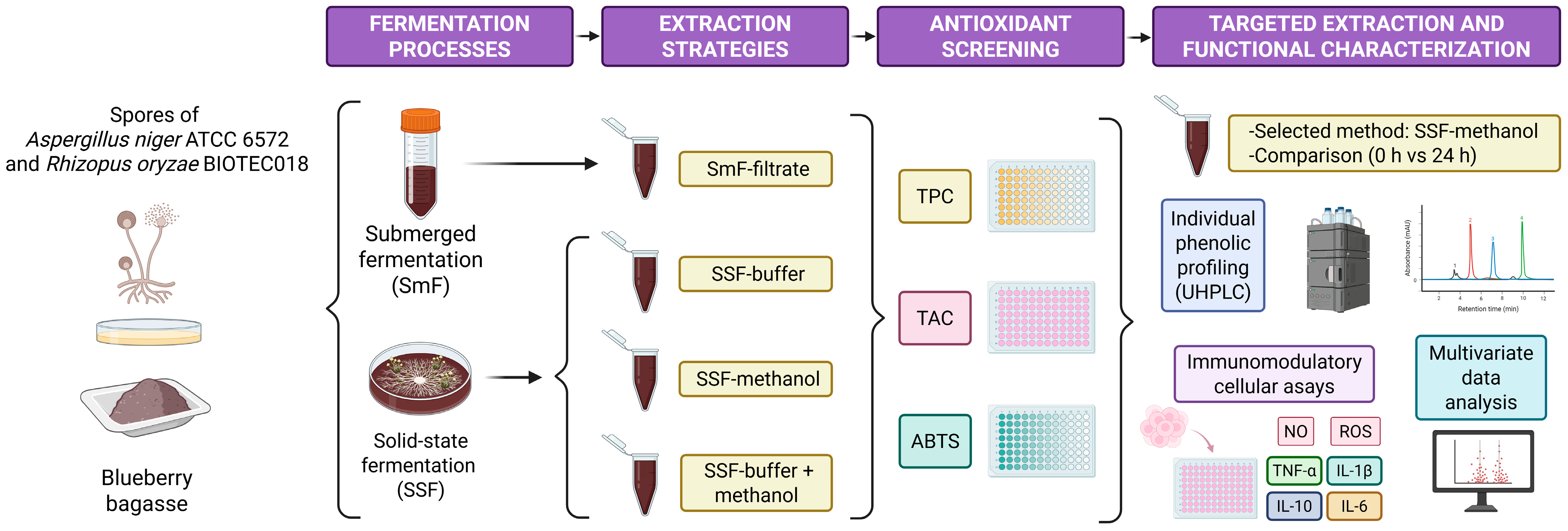
Therefore, the aim of this study was to compare SmF and SSF to enhance the release and functional potential of phenolic compounds from blueberry bagasse. Different extraction approaches were evaluated to determine how the extraction strategy influences the recovery of total phenolic content, total anthocyanin content, and antioxidant activity. Based on these results, selected extracts were further characterized for their phenolic profiles and evaluated in cellular models to assess their antioxidant and immunomodulatory effects, providing an integrated understanding of how fermentation mode, extraction strategy, and phenolic composition collectively determine biological activity. The experimental workflow is summarized in Figure 1.

2. Materials and Methods

2.1. Chemicals and Reagents

All analytical-grade chemicals and solvents were purchased from Sigma-Aldrich (St. Louis, MO, USA). Dulbecco Modified Eagle’s Medium (DMEM), heat-inactivated fetal bovine serum (FBS), phosphate-buffered saline (PBS, pH 7.4), and penicillin-streptomycin antibiotic (Pen-Strep) 100X were obtained from Gibco (Thermo Fisher Scientific, Waltham, MA, USA). The Griess Reagent System for nitric oxide determination and the CellTiter 96 AQueous One Solution Cell Proliferation Assay were purchased from Promega (Madison, WI, USA). Lipopolysaccharide (LPS) from Escherichia coli O127:B8 was obtained from Sigma-Aldrich. Cytokine levels were quantified using commercial enzyme-linked immunosorbent assay (ELISA) kits: Mouse interleukin-1β (IL-1β) ELISA Kit (ab197742, Abcam, Cambridge, UK), Mouse interleukin-6 (IL-6) ELISA Kit (KMC0061, Invitrogen, Thermo Fisher Scientific, Waltham, MA, USA), Mouse tumor necrosis factor-α (TNF-α) ELISA Kit (RAB0477, Sigma-Aldrich), and Mouse interleukin-10 (IL-10) Quantikine ELISA Kit (M1000B, R&D Systems, Minneapolis, MN, USA).

2.2. Preparation of Blueberry Bagasse Powder

Discarded or second-grade blueberries (Vaccinium myrtillus L., cv. ‘Kirra’) were obtained from Bloom Farms® (Amatitán, Mexico). Blueberry bagasse was prepared to simulate the by-product generated during juice processing, as previously described [5,20]. Briefly, blueberries were washed, blended, and centrifuged (3000× g, 15 min, 4 °C) to separate the juice from the residual pulp, peels, and seeds (bagasse). The recovered bagasse was freeze-dried (FreeZone 4.5 unit, Labconco, Kansas City, MO, USA) at −83 °C and 0.035 mbar and subsequently milled using an analytical grinder (IKA A10 basic, IKA-Werke, Staufen im Breisgau, Germany). The resulting powder was sieved through a 105 µm mesh to standardize particle size and stored at −20 °C until use.

2.3. Preparation of Fungal Inoculum

For SmF and SSF experiments, the filamentous fungi Aspergillus niger ATCC 6275 and Rhizopus oryzae BIOTEC018 were used. The strains were maintained in potato dextrose agar plates and incubated at 30 °C for 7 days to allow sporulation. Spores were harvested by gently flooding the plates with 10 mL of 0.1% (v/v) Tween 80 in sterile distilled water, then dislodging the spores with a sterile L-shaped spreader. The resulting spore suspensions were quantified using a hemocytometer under a light microscope (Leica DM 5000, Leica Microsystems, Wetzlar, Germany). Spore concentrations were adjusted as required for inoculation.

2.4. Submerged Fermentation (SmF)

SmF was performed in 50 mL conical tubes containing 20 mL of culture medium. The medium consisted of 1 g of blueberry bagasse powder suspended in 20 mL of minimal medium [21], which served as the sole carbon source. Each tube was inoculated with spores of A. niger ATCC 6275 or R. oryzae BIOTEC018 at a final concentration of 1 × 10⁶ spores/mL. Cultures were incubated at 30 °C and 150 rpm in a shaking incubator (Ecotron, Infors, Annapolis Junction, MD, USA), and individual tubes were harvested after 12, 24, 36, 48, and 60 h. At the end of fermentation, liquid extracts were recovered by filtration through 0.45 μm syringe filters (Merck Millipore, Billerica, MA, USA) to remove fungal biomass and residual solids. Non-inoculated controls were prepared under the same conditions.

2.5. Solid State Fermentation (SSF)

SSF was performed in Petri plates containing 1 g of blueberry bagasse powder, which was adjusted to 70% moisture content with sterile distilled water and inoculated with spores of A. niger ATCC 6275 or R. oryzae BIOTEC018 at a final concentration of 1 × 10⁶ spores/mL. The plates were incubated at 30 °C, and samples were collected after 12, 24, 36, 48, and 60 h. Non-inoculated controls were prepared and processed under the same conditions.

2.6. Extraction Procedures

Four different types of extracts were prepared: (i) a crude filtered extract obtained from SmF cultures (SmF-F); (ii) a buffer extract from SSF samples obtained by washing the fermented material with 15 mL of 50 mM sodium citrate buffer (pH 4.8), followed by centrifugation (3000× g, 5 min) and collection of the supernatant (SSF-B); (iii) a methanolic extract of SSF samples obtained without prior buffer washing (SSF-M); and (iv) a buffer–methanol extract from SSF (SSF-B+M), corresponding to a sequential extraction procedure in which the solid residue remaining after buffer extraction was subsequently extracted with methanol. Sequential extraction values should not be interpreted as additive, as the methanolic fraction in SSF-B+M reflects only the compounds remaining in the matrix after the initial aqueous extraction step. Thus, SSF-B+M represents the extraction of a previously depleted matrix rather than the sum of SSF-B and SSF-M fractions.
For the methanolic extraction steps (SSF-M and SSF-B+M), fermented blueberry bagasse was transferred to 50 mL tubes and extracted with 5 mL of methanol-water (50:50, v/v). The suspension was homogenized and centrifuged (3000× g, 15 min), and the supernatant was collected. The extraction was repeated twice using 3 mL of methanol-water (50:50, v/v) each time. A final extraction step was performed with 3 mL of absolute methanol. All supernatants were pooled and adjusted to a final volume of 15 mL for each extract.

2.7. Determination of Total Phenolic Content, Total Anthocyanin Content and Antioxidant Capacity

Total phenolic content (TPC) and total anthocyanin content (TAC) were determined using 96-well microplate-adapted spectrophotometric assays, as previously described [20,22]. TPC was measured using the Folin–Ciocalteu method by recording absorbance at 765 nm and quantifying results against a gallic acid calibration curve. TAC was determined using the pH differential method, measuring absorbance at 510 and 700 nm and quantified using cyanidin-3-glucoside as the reference standard. Results were expressed as milligrams of gallic acid equivalents (GAE) per 100 g of dry weight (d.w.) for TPC and mg of cyanidin-3-glucoside equivalents (C3G) per 100 g of d.w. for TAC.
Antioxidant capacity was assessed using the 2,2’-azino-bis (3-ethylbenzothiazoline-6-sulfonic acid) (ABTS) radical scavenging assay [23]. Absorbance was measured at 734 nm, and antioxidant capacity was expressed as mg of Trolox equivalents per 100 g of d.w. All measurements were performed using a microplate reader (Varioskan Lux, Thermo Fisher Scientific, Waltham, MA, USA).

2.8. UHPLC Analysis of Individual Phenolic Compounds

Individual phenolic compounds in selected samples (SSF-M extracts) were analyzed by ultra-high-performance liquid chromatography (UHPLC) with an Acquity Arc UHPLC system equipped with a photodiode array (PDA) detector (Waters, Milford, MA, USA) and a reverse-phase C18 column (4.6 mm × 150 mm, 2.7 μm of granule size; Cortects, Waters, Milford, MA, USA) maintained at 40 °C. Chromatographic separation was performed as previously described [20,24] with modifications. Elution solvent A consisted of 1% formic acid (v/v) in water, and solvent B consisted of 1% formic acid (v/v) in methanol. The flow rate was 0.6 mL/min, and the injection volume was 7 μL. Separation was achieved using the following gradient program (B, %): 13.5% for 8 min; 13.5% to 18% over 4 min; 18% to 30% over 8 min; 30% to 35% over 3 min; 35% to 65% over 7 min; then returned to 22.5% over 3 min and finally to 13.5% for re-equilibration.
The PDA detector was operated by monitoring multiple wavelengths to detect different phenolic classes. Compound identification was based on comparisons with authentic reference standards and previously published data [20]. Quantification was performed using external calibration curves with representative authentic standards for phenolic acids, flavan-3-ols, flavonols, and anthocyanins; compounds lacking specific standards were quantified using structurally related compounds from the same phenolic class. Results were expressed as mg/100 g d.w.

2.9. In Vitro Cellular Bioactivity of Fermented Blueberry Bagasse Extracts

2.9.1. Cell Cultures, Extract Preparation, and Viability

Human colon adenocarcinoma cells (Caco-2; ATCC HTB-37) and murine macrophages (RAW 264.7; ATCC TIB-71) were acquired from American Type Culture Collection (ATCC) (Manassas, VA, USA). Cells were routinely cultured in DMEM supplemented with 5% or 10% FBS and 1% Pen-Strep and incubated at 37 °C in a humidified atmosphere with 5% CO2.
Prior to cellular assays, methanolic extracts (SSF-M) were evaporated to dryness and reconstituted in Milli-Q water under light-protected conditions. Cell viability was assessed using the CellTiter 96 AQueous One Solution Cell Proliferation assay, following the manufacturer’s instructions. Cells were exposed to extract concentrations ranging from 25 to 100 µg/mL, and absorbance was measured at 490 nm using a Synergy HT microplate reader (BioTek Instruments, Winooski, VT, USA). Viability was expressed as a percentage relative to untreated control cells.

2.9.2. Intracellular Antioxidant Activity Assay

Cellular antioxidant activity was evaluated in Caco-2 cells by measuring the extracts’ ability to modulate intracellular reactive oxygen species (ROS) production, as previously described [17]. Cells were seeded in 96-well plates (5 × 10⁴ cells/well) and incubated for 24 h. After washing with PBS (pH 7.4), cells were treated with extracts (25 µg/mL) in the presence of 60 µM dichloro-dihydro-fluorescein diacetate (DCFH-DA) and incubated for either 20 min or 24 h to allow intracellular probe deacetylation. Cells were then washed twice with PBS and exposed to 500 µM 2,2′-azobis(2-amidinopropane) dihydrochloride (AAPH) to induce oxidative stress. Fluorescence was recorded every 2 min for up to 90 min using a Synergy HT microplate reader (excitation/emission: 485/538 nm). ROS production was calculated from the area under the fluorescence–time curve and expressed as a percentage relative to the oxidant untreated control.

2.9.3. Cellular Anti-Inflammatory Activity

The anti-inflammatory activity of the extracts was assessed in RAW 264.7 murine macrophages by measuring their ability to modulate nitric oxide (NO) production (nitrites), as described previously [17]. Cells were seeded into 96-well plates (5 × 10⁴ cells/well) and incubated for 24 h. Cells were then treated with extracts (25 and 50 µg/mL) for 4 h, after which half of the wells were stimulated with lipopolysaccharide (LPS, 1 µg/mL), while the remaining wells received medium only as sample-specific controls. After a 24 h incubation, culture supernatants were collected, and NO production was quantified by measuring nitrite levels using the Griess Reagent System. Absorbance was read at 550 nm using a Synergy HT microplate reader, and nitrite concentrations were calculated based on a NaNO2 standard curve.

2.9.4. Cytokine Production

The effect of extracts on cytokine production was assessed in the culture supernatants of RAW 264.7 cells previously treated with the extracts at 50 µg/mL. The levels of pro-inflammatory cytokines IL-1 β, IL-6, and TNF-α, as well as the anti-inflammatory cytokine IL-10, were quantified by ELISA following the manufacturer’s instructions. Results were expressed as pg/mL.

2.10. Statistical Analysis

All experiments, except for cell-based assays, were conducted using at least three independent biological replicates, each including technical triplicates. Cell-based assays were performed in two independent biological experiments, each analyzed in technical triplicate. Independent runs showed consistent trends and effect directions across treatments, supporting the reproducibility of the observed responses. The data are presented as mean values ± standard deviation. Differences among treatments were evaluated using a one-way analysis of variance (ANOVA) followed by either Student’s t-test or Tukey’s post hoc test, with p < 0.05 considered significant. All univariate statistical analyses were carried out using Minitab Software 21.4 (Minitab LLC, State College, PA, USA).
Multivariate analysis was performed by principal component analysis (PCA) to explore relationships among samples and to identify the variables contributing most to their differentiation. Prior to PCA, all chemical and biological variables were mean-centered and autoscored to account for differences in magnitude and units. PCA was performed using the covariance matrix, and principal components explaining most of the total variance were retained for interpretation. Score plots were used to visualize sample grouping, while loading plots were examined to assess the contribution of spectrophotometric parameters, individual phenolic compounds, and cellular response variables.
Relationships between chemical composition and biological activity were further evaluated using Spearman’s rank correlation analysis. Correlation matrices were generated to assess positive and negative associations between individual phenolic compounds and cellular endpoints. Heatmaps were used to facilitate the visualization and interpretation of these associations.

3. Results

3.1. Effect of Fermentation and Extraction Strategy on Phenolic Content and Antioxidant Capacity

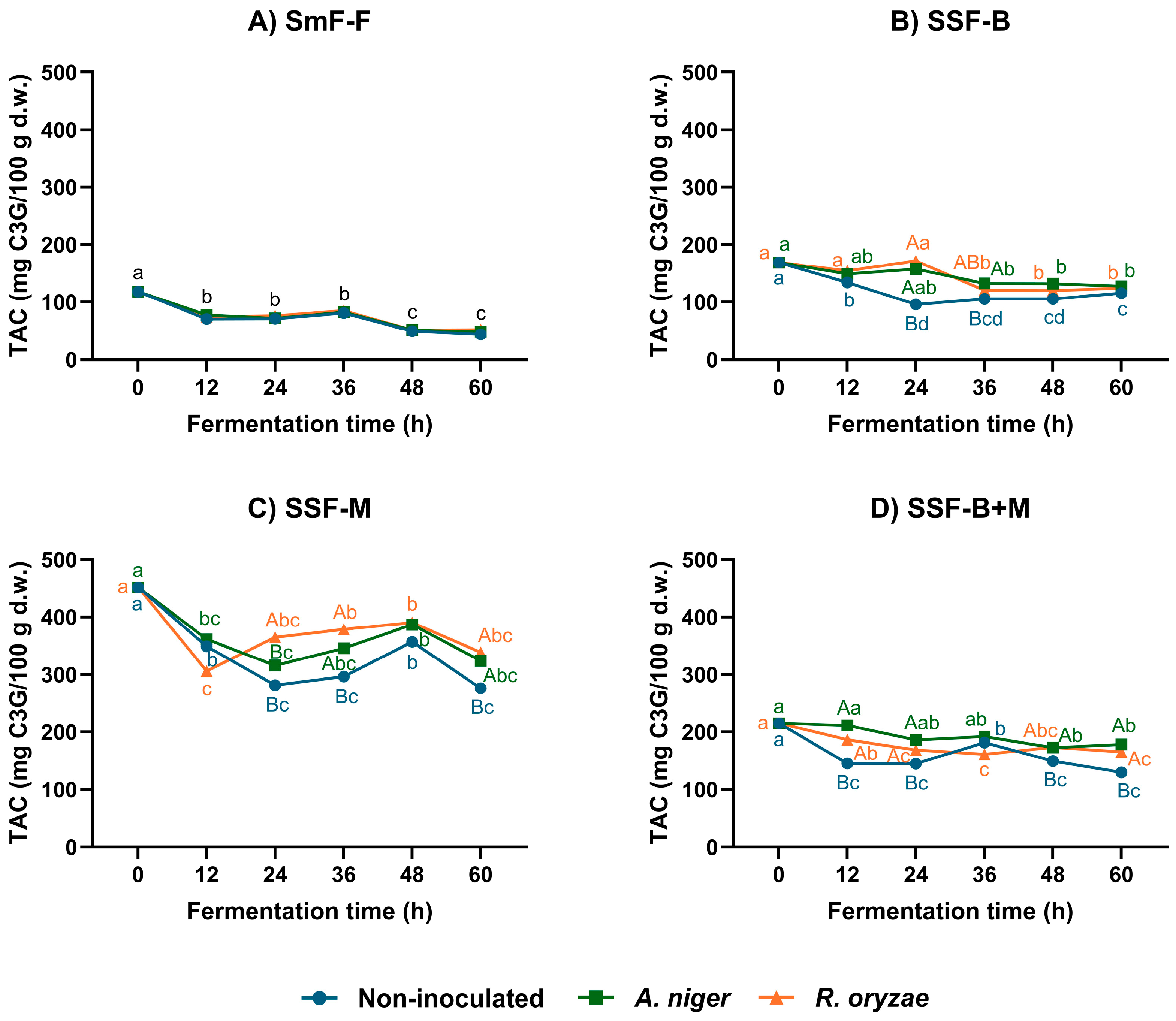
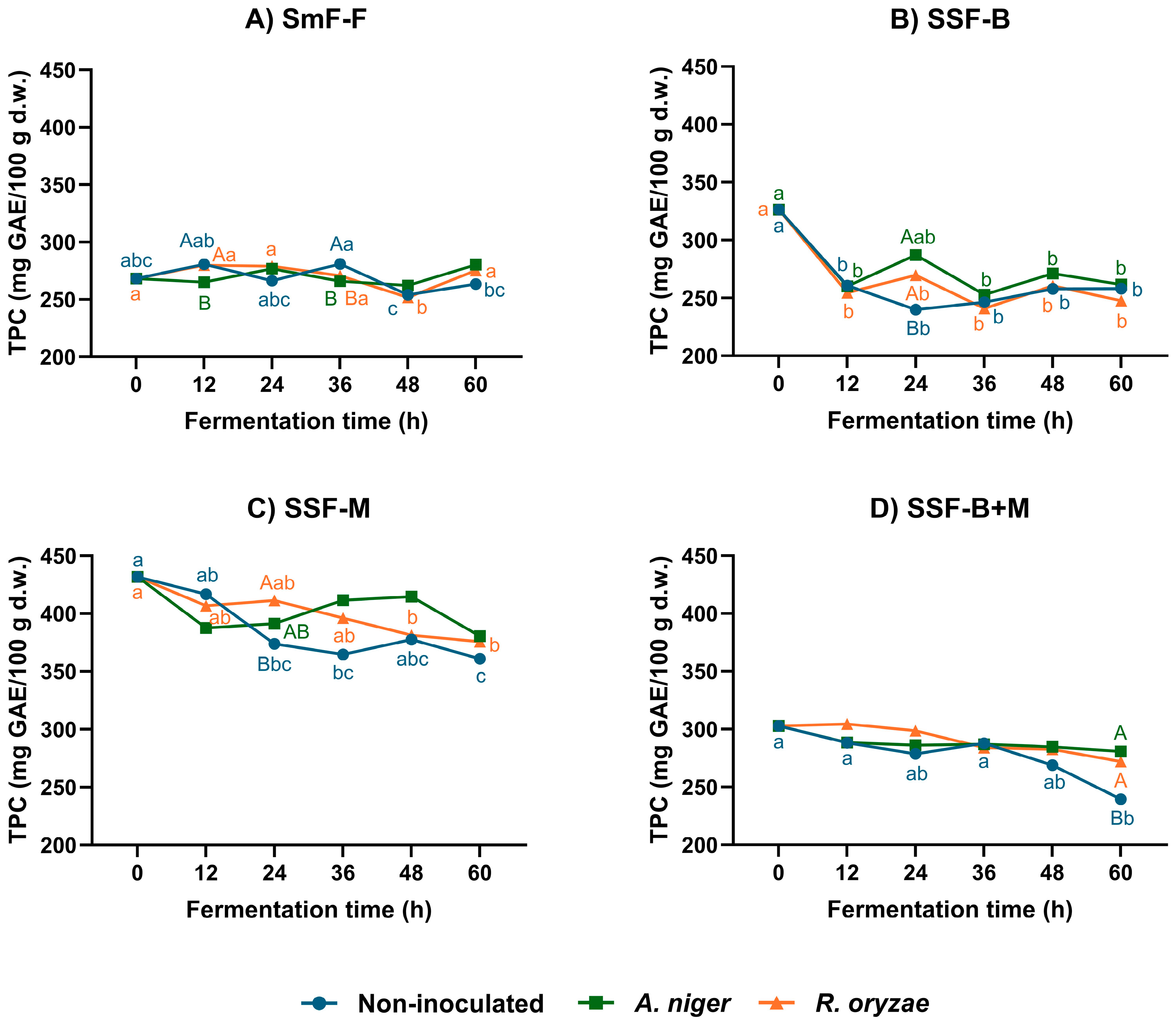
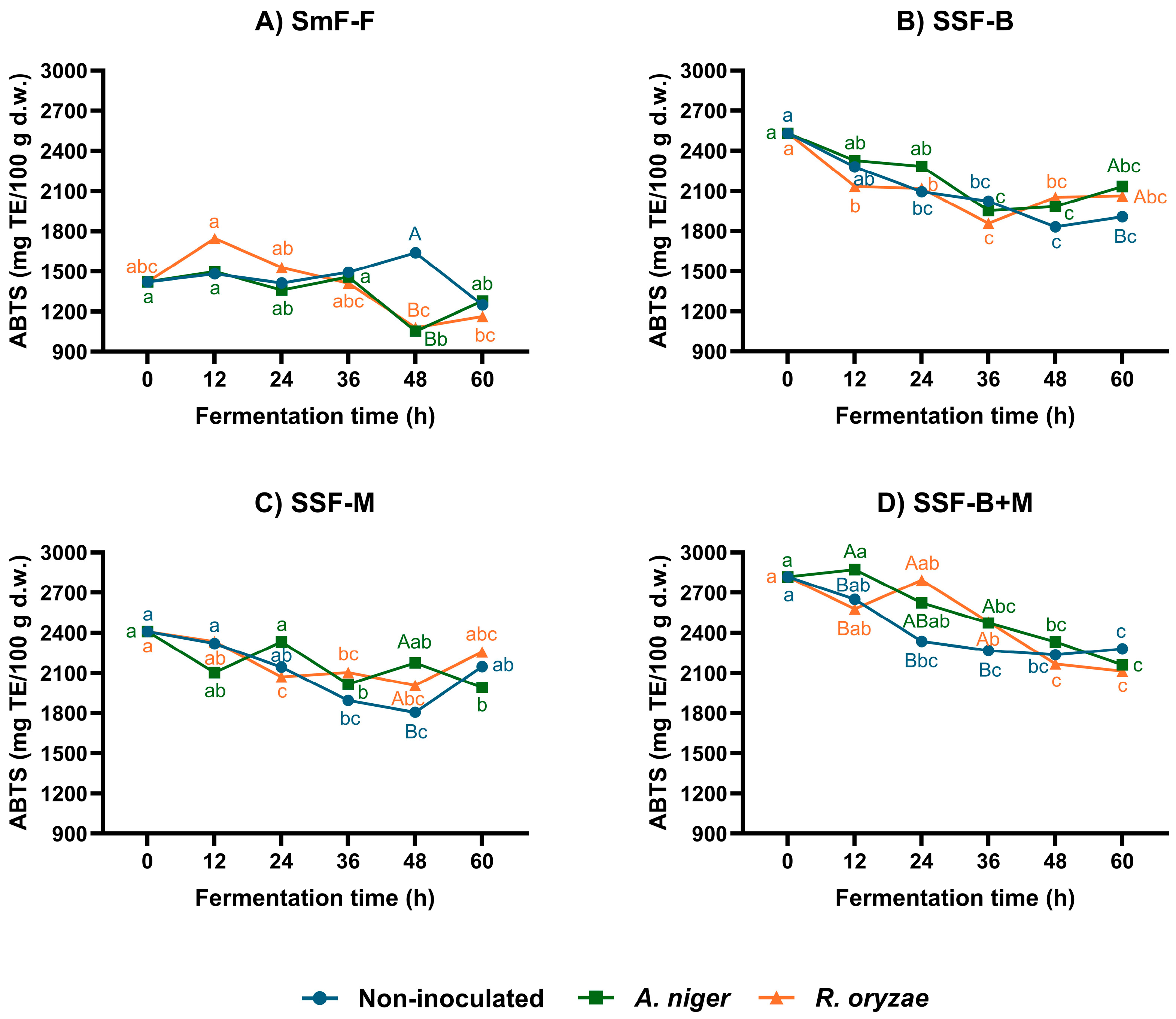
The effects of fungal fermentation and extraction strategy on the recovery of phenolic compounds and antioxidant activity from blueberry bagasse are shown in Figure 2, Figure 3 and Figure 4 and detailed in Tables S1–S3. Across all treatments, the non-inoculated controls revealed that the extraction method alone imposed substantial differences in recoverable phenolics; fungal fermentation was associated with additional modulation of the magnitude and temporal behavior of TPC, TAC, and ABTS.
Methanol-based solid-state fermentation extracts (SSF-M) tended to exhibit higher levels of bioactive compounds, followed by buffer–methanol extracts (SSF-B+M), buffer extracts (SSF-B), and finally submerged fermentation filtrates (SmF-F). This trend was already observable in the non-inoculated controls—for example, at 24 h the control SSF-M contained 373.8 mg GAE/100 g d.w., whereas SmF-F contained only 266.3 mg GAE/100 g d.w.—and fungal fermentation further influenced these differences by selectively preserving or increasing phenolic and anthocyanin levels in SSF-M and SSF-B+M, while SmF-F showed comparatively limited retention.
In SmF-F extracts, TPC remained relatively stable in both non-inoculated and fungus-treated samples, fluctuating between approximately 252 and 281 mg GAE/100 g d.w. throughout the 60 h incubation (Figure 2A, Table S1). In contrast, TAC decreased substantially over time following the same temporal pattern for non-inoculated and fungus-treated samples (Figure 3A, Table S2), indicating pronounced anthocyanin degradation under submerged conditions. From an initial value of approximately 118 mg C3G/100 g d.w. at 0 h, TAC declined by about 40% after 24 h and by approximately 63% after 60 h, with no significant differences between the non-inoculated control and the fungal treatments. Consistent with these trends, SmF-F displayed the lowest ABTS values among the evaluated extraction strategies (Figure 4A, Table S3).
In contrast, buffer-based solid-state extracts showed a higher recovery of phenolic compounds compared with SmF. At 24 h, TPC was significantly higher in the fermented samples than in the non-inoculated control, increasing +19.8% and +12.4% in the A. niger and R. oryzae treatments, respectively (Figure 2B). Despite this fermentation-driven enhancement, all three SSF-B samples followed a similar temporal pattern: TPC decreased after 12 h and remained relatively stable up to 60 h. Fungal fermentation also contributed to improved anthocyanin retention relative to the non-inoculated control. At 24 h, TAC increased from 96.1 mg C3G/100 g d.w. in the control to 157.6 and 171.8 mg C3G/100 g d.w. in the A. niger and R. oryzae treatments, respectively (Figure 3B, Table S2). These improvements were accompanied by a higher ABTS antioxidant capacity, which remained above 2000 mg TE/100 g d.w. at 24–60 h, although a gradual decline over time was observed, paralleling the decrease in anthocyanin levels (Figure 4B, Table S3).
Among methanolic SSF extracts, both non-inoculated and fungus-treated samples exhibited the highest measured concentrations of phenolics and anthocyanins across the entire experimental window (Figure 2C and Figure 3C), with fungal fermentation influencing their temporal stability and recovery at specific incubation times. At 24 h, TPC in SSF-M increased significantly from 373.8 mg GAE/100 g d.w. in the non-inoculated control to 391.4 and 411.4 mg GAE/100 g d.w. in the A. niger and R. oryzae treatments, respectively (Figure 2C, Table S1). In parallel, TAC rose significantly from 281.3 mg C3G/100 g d.w. in the control to 364.8 mg C3G/100 g d.w. in the R. oryzae treatment, corresponding to an increase of approximately 30% (Figure 3C, Table S2), suggesting enhanced preservation or release of anthocyanins relative to the non-inoculated material. Over longer incubation times, the non-inoculated SSF-M control showed a progressive decline in both TPC and TAC, whereas fermented samples maintained higher and more stable values, particularly up to 36–48 h (Tables S1 and S2). This improved chemical stability translated into sustained antioxidant activity, with ABTS values remaining above ~2000 mg TE/100 g d.w. for most fermented SSF-M samples (Figure 4C), whereas the non-inoculated control showed a more pronounced decline after 36 h.
A similar but slightly attenuated pattern was observed for SSF-B+M extracts. In the non-inoculated control, TPC decreased from 302.8 to 239.4 mg GAE/100 g d.w. over 60 h (Figure 2D, Table S1), while TAC decreased rapidly from 215.3 to ~145.0 mg C3G/100 g d.w. at 12–24 h (Figure 3D, Table S2). In contrast, fungal fermentation preserved TPC near its initial level (≈280–305 mg GAE/100 g d.w.) and significantly mitigated TAC losses at early time points, reaching 211.3 and 186.4 mg C3G/100 g d.w. for A. niger and R. oryzae, respectively, at 12–24 h. These effects were reflected in the ABTS assay, as SSF-B+M extracts reached 2872 mg TE/100 g d.w. in the A. niger treatment at 12 h and remained above 2500 mg TE/100 g d.w. in both fungal treatments at 24 h (Figure 4D, Table S3), exceeding the corresponding non-inoculated controls.
Overall, SSF combined with methanol extraction was associated with higher concentrations and improved temporal stability of bioactive compounds, while fungal fermentation modulated their magnitude and persistence over time. Based on these observations, methanolic SSF extracts at 24 h were selected for further compositional and biological evaluation, as this condition combined high phenolic and anthocyanin levels with differences between non-inoculated and fungus-fermented samples. Accordingly, four SSF-M samples were chosen for UHPLC profiling and cellular assays: non-inoculated blueberry bagasse at 0 h (baseline reference), non-inoculated blueberry bagasse at 24 h (time control), and blueberry bagasse fermented for 24 h with A. niger or R. oryzae.

3.2. UHPLC Profiling of Individual Phenolic Compounds in SSF-M Extracts

The four selected solid-state fermentation methanolic extracts were designated as non-inoculated blueberry bagasse at 0 h (NI-0h), non-inoculated blueberry bagasse after 24 h (NI-24h), blueberry bagasse fermented with A. niger ATCC 6275 for 24 h (AN-24h), and blueberry bagasse fermented with R. oryzae BIOTEC018 for 24 h (RO-24h). These samples were analyzed by UHPLC to determine their individual phenolic profiles. A total of nineteen phenolic compounds were detected, including hydroxybenzoic acids, hydroxycinnamic acids, flavan-3-ols, flavonols, and anthocyanins. Representative chromatograms are provided in Figure S1, and quantitative data are summarized in Table 1.
In the non-inoculated material, several phenolic acids (gallic, protocatechuic, caffeic, chlorogenic, and p-coumaric acids) decreased significantly after 24 h by approximately 15–40% relative to the initial material (Table 1), indicating substantial degradation or transformation in the absence of microbial activity. In contrast, fungal fermentation largely counteracted this loss. Gallic acid increased by ~45–55% in both fermented samples compared with the 24 h non-inoculated control, exceeding even the initial NI-0h level. A similar stabilization or recovery trend was observed for protocatechuic and chlorogenic acids, whose concentrations in fermented samples were restored to values comparable to or higher than those of the original bagasse. Ferulic acid was detected only in NI-0h, suggesting rapid conversion or incorporation into other phenolic forms during incubation and fermentation.
Flavan-3-ols were among the phenolic classes most responsive to fermentation. In the 24 h non-inoculated control, both (+)-catechin and epicatechin decreased by approximately 60–65% relative to the initial material, whereas fungal fermentation largely reversed this loss (Table 1). In fermented samples, epicatechin was restored to about 70–90% of its initial level, with R. oryzae showing the strongest recovery (117.98 mg/100 g d.w.). (+)-Catechin followed the same trend, reaching levels comparable to or exceeding those of the non-incubated bagasse in the R. oryzae treatment (45.86 mg/100 g d.w.). In NI-24h, quercetin, myricetin, and kaempferol were not detectable, whereas fungal fermentation partially restored these flavonols. Syringetin remained stable across all samples. These results indicate that SSF preserved or regenerated specific flavonols that would otherwise have been lost during non-inoculated incubation.
Anthocyanins were the phenolic class most affected by incubation in the absence of fermentation. In NI-24h, cyanidin-3-galactoside, petunidin-3-galactoside, peonidin-3-glucoside, and malvidin-3-glucoside were reduced by approximately 45-55% relative to NI-0h (Table 1), reflecting substantial anthocyanin degradation during incubation. Fungal fermentation significantly mitigated this loss, resulting in higher anthocyanin concentrations than in the non-inoculated control at 24 h. Malvidin-3-glucoside, the predominant anthocyanin, reached 111.15 mg/100 g d.w. in AN-24h and 136.10 mg/100 g d.w. in RO-24h, compared with only 68.19 mg/100 g d.w. in NI-24h, with R. oryzae restoring malvidin-3-glucoside to a level statistically comparable to the initial material.
Overall, fungal SSF remodeled the blueberry bagasse phenolic profile by preserving and, in several cases, enhancing key phenolic compounds relative to the non-inoculated control at the same incubation time. Both A. niger and R. oryzae mitigated the losses observed in the non-inoculated material, with strain-specific differences limited mainly to individual anthocyanins.

3.3. Cellular Antioxidant Activity

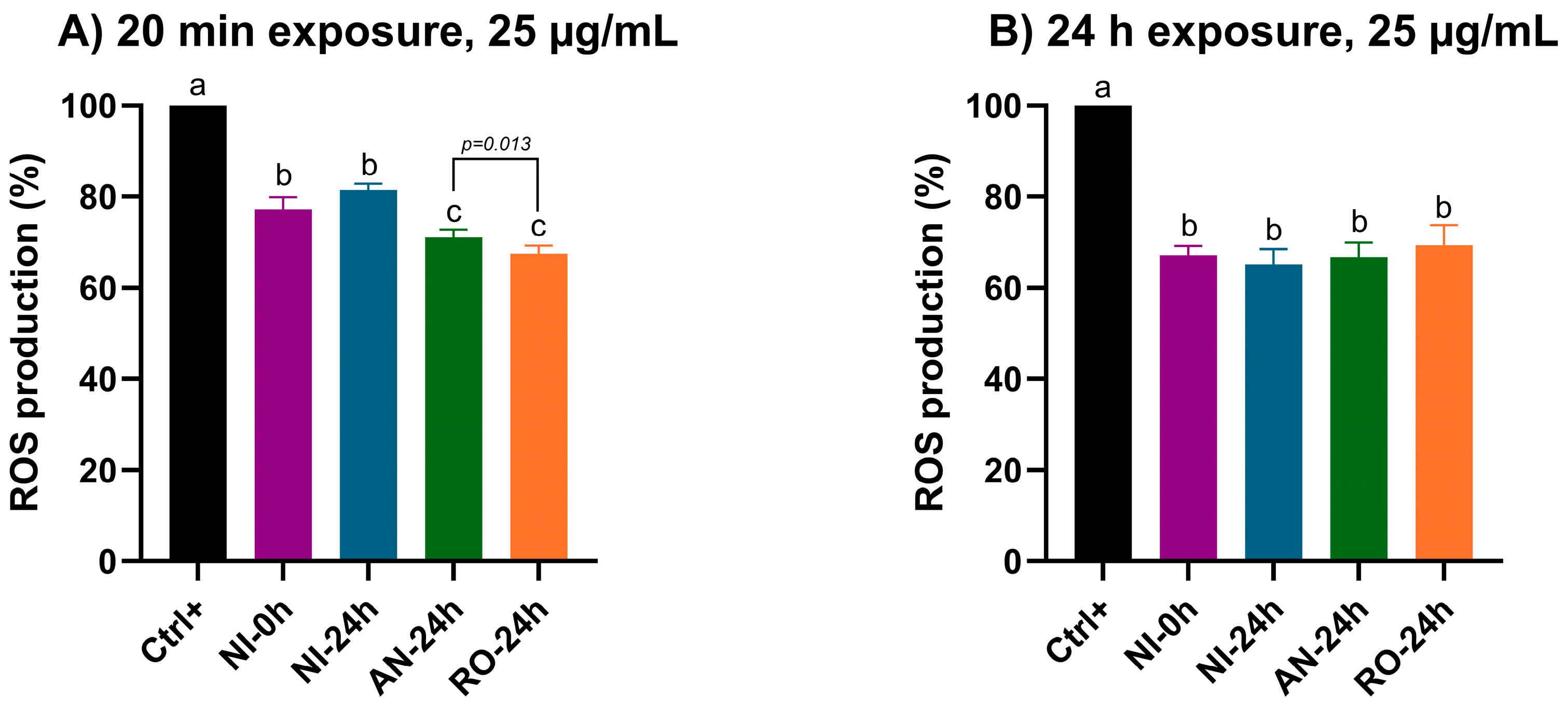
The cellular antioxidant activity of SSF-M extracts was evaluated in Caco-2 cells using an AAPH-induced ROS model (Figure 5). Based on the cell viability assay (Figure S2), 25 µg/mL was selected for the ROS experiments, as this concentration maintained the cell viability above 80% for all samples at both 20 min and 24 h.
After 20 min of exposure (Figure 5A), all extracts significantly reduced intracellular ROS compared with the oxidant untreated control (Ctrl+, 100%). The non-inoculated samples reduced ROS to 77.23% (NI-0h) and 81.47% (NI-24h), whereas the fermented extracts showed a significantly stronger effect, reducing ROS to 71.07% (AN-24h) and 67.47% (RO-24h) (p ≤ 0.05). A pairwise t-test showed that RO-24h reduced ROS significantly more than AN-24h (p = 0.013).
After 24 h of exposure (Figure 5B), all extracts suppressed ROS to a similar extent, with values ranging between 65.10% and 69.31% of Ctrl+, and no significant differences were observed among treatments. Pairwise comparisons between 20 min and 24 h showed that ROS levels decreased significantly over time for NI-0h, NI-24h, and AN-24h, whereas RO-24h remained statistically unchanged, indicating a sustained antioxidant effect for this fermented extract.

3.4. Cellular Immunomodulatory Activity: NO Production and Cytokine Profiling

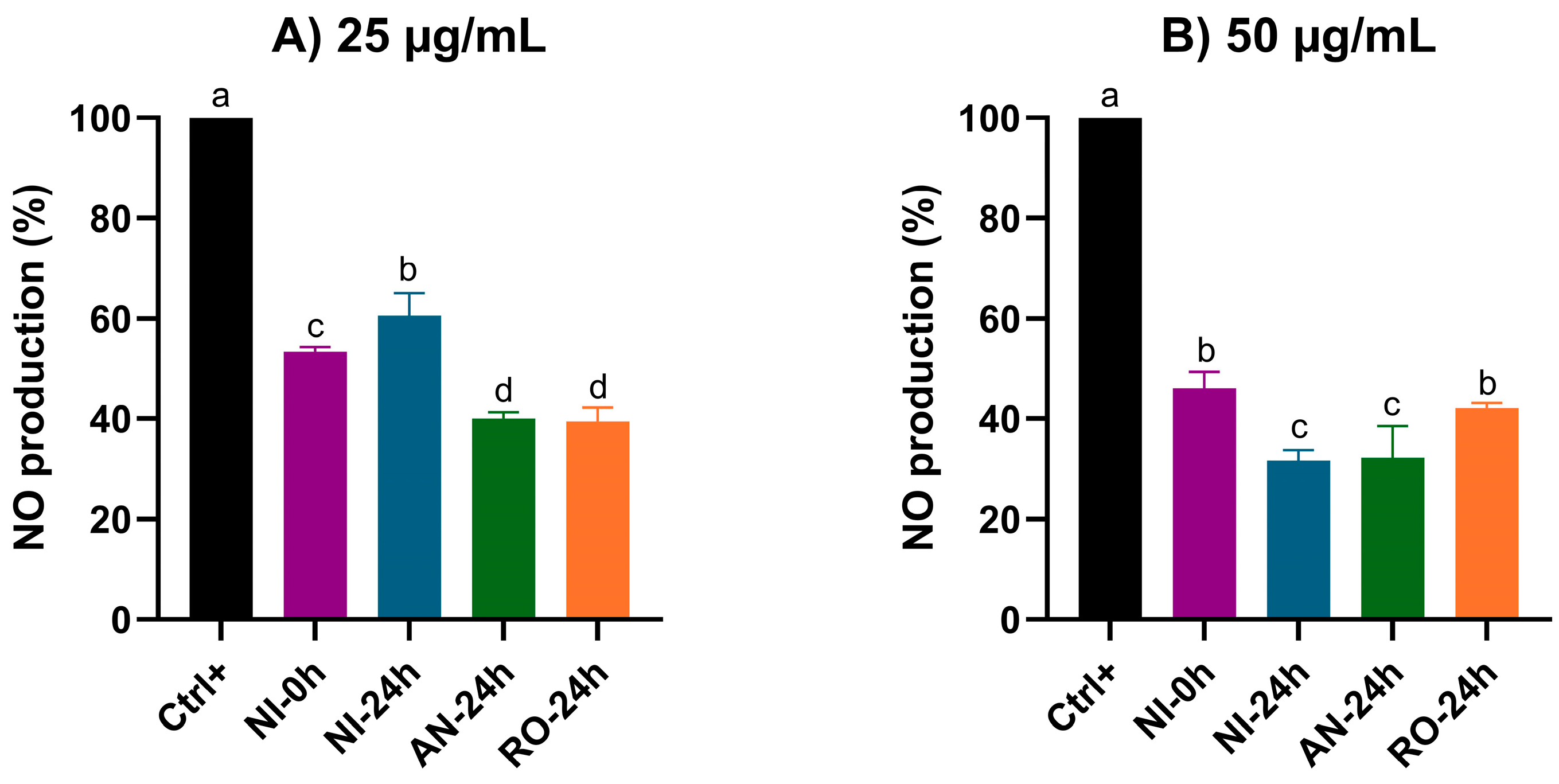
The effect of SSF-M extracts on NO production was evaluated in LPS-stimulated RAW 264.7 macrophages at 25 and 50 µg/mL (Figure 6). At 25 µg/mL (Figure 6A), all samples significantly reduced NO production compared with Ctrl+ (100%). The non-inoculated samples decreased NO to 53.35% (NI-0h) and 60.64% (NI-24h), whereas the fermented extracts produced a significantly greater reduction, reaching 40.03% (AN-24h) and 39.45% (RO-24h) (p ≤ 0.05). At this concentration, the separation between fermented and non-inoculated samples was most pronounced, consistently distinguishing the two groups.
At 50 µg/mL (Figure 6B), NO production was further reduced in all treatments with values of 46.09% (NI-0h), 31.73% (NI-24h), 32.33% (AN-24h), and 42.15% (RO-24h). At this concentration, NI-24h and AN-24h showed significantly lower NO levels than NI-0h (p ≤ 0.05), whereas RO-24h showed an intermediate response. Because 50 µg/mL produced robust NO suppression while still allowing discrimination among treatments, this concentration was selected for subsequent cytokine analysis.
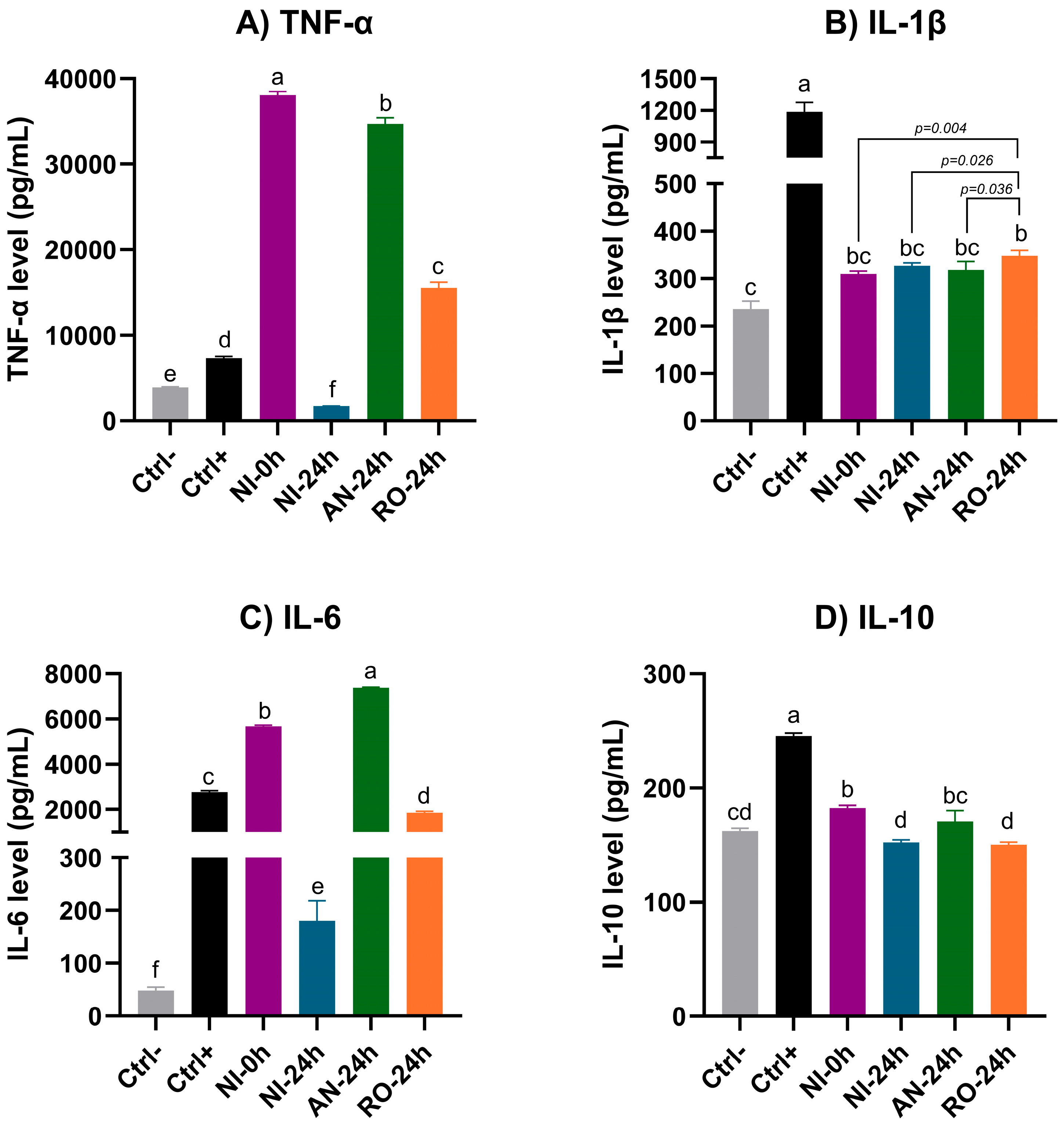
Figure 7 summarizes the effect of SSF-M blueberry bagasse extracts (50 µg/mL) on the production of key pro- and anti-inflammatory cytokines (TNF-α, IL-1β, IL-6, and IL-10) in LPS-stimulated RAW 264.7 macrophages. TNF-α production was strongly modulated by the SSF-M extracts in LPS-stimulated RAW 264.7 macrophages (Figure 7A). Marked differences were observed among treatments: the non-inoculated 0 h extract and the A. niger–fermented extract induced very high TNF-α levels (38,050 and 34,700 pg/mL, respectively), which greatly exceeded those of the LPS control. In contrast, the non-inoculated 24 h extract strongly suppressed TNF-α production, whereas the R. oryzae–fermented extract showed an intermediate effect.
LPS strongly induced IL-1β production in Ctrl+, with all blueberry bagasse extracts suppressing this response and reducing IL-1β to values between 310 and 348 pg/mL (p ≤ 0.05 vs. Ctrl+) (Figure 7B). The non-inoculated extracts and the A. niger–fermented sample showed similar IL-1β levels (≈310–326 pg/mL), whereas the R. oryzae–fermented extract resulted in slightly higher IL-1β (347.5 pg/mL), yet still far below the LPS control, indicating strain-dependent modulation of IL-1β release.
A response pattern highly similar to that observed for TNF-α was detected for IL-6 among the blueberry bagasse extracts (Figure 7C). NI-0h enhanced IL-6 release, exceeding the LPS control, while the A. niger–fermented extract produced the highest IL-6 levels (7389.1 pg/mL). In contrast, both NI-24h and the R. oryzae–fermented extract significantly suppressed IL-6 production, reducing levels to 180 and 1848.2 pg/mL, respectively (p ≤ 0.05).
All blueberry bagasse extracts showed IL-10 levels significantly lower than the LPS control (Figure 7D). NI-0h induced a moderate IL-10 response (182.3 pg/mL), whereas NI-24h further reduced IL-10. Both fermented extracts also exhibited low IL-10 levels, with AN-24h at 170.7 pg/mL and RO-24h at 150.4 pg/mL. These data indicate that none of the extracts promoted an IL-10–mediated anti-inflammatory response under the tested conditions; instead, both 24 h incubation and fungal fermentation resulted in IL-10 levels that were comparable to those in the basal (Ctrl−) condition.

3.5. Multivariate and Correlation Analysis

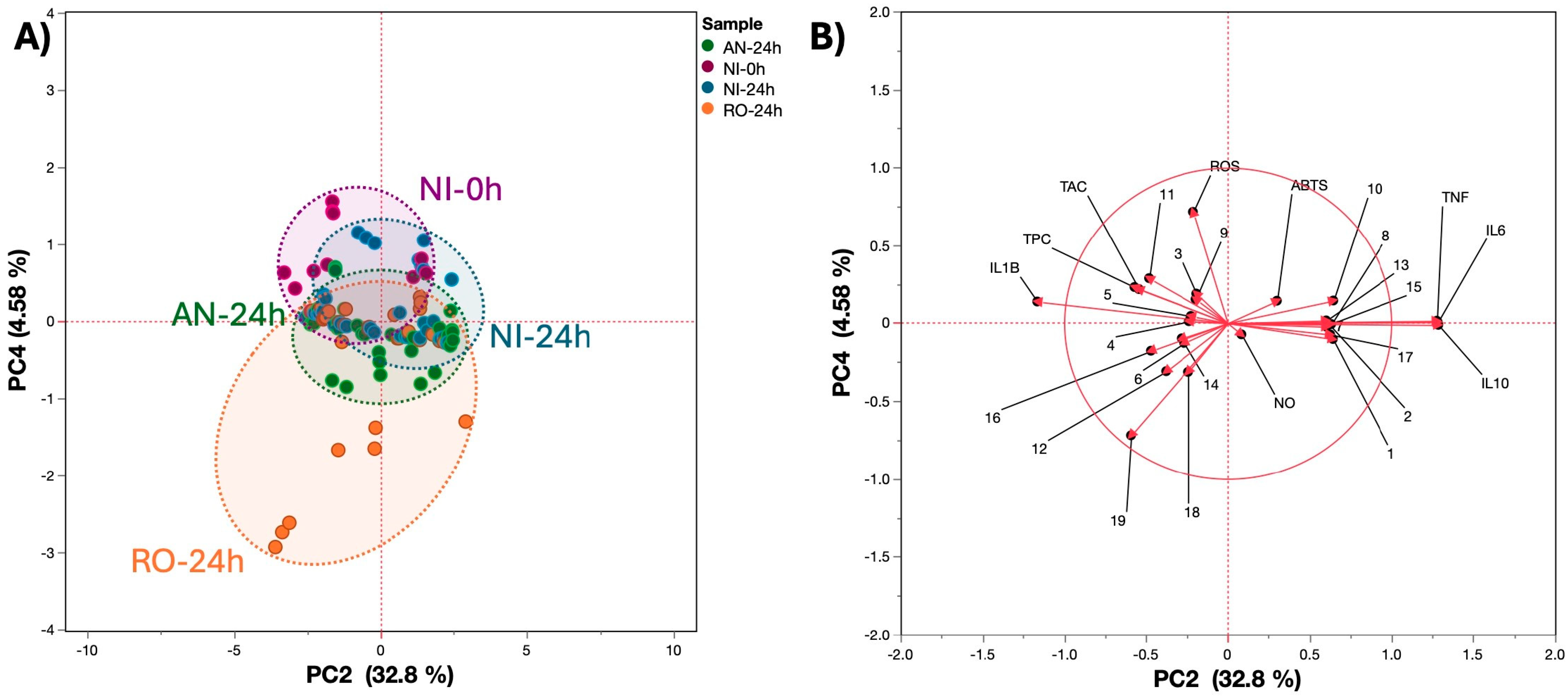
Dimensionality reduction was performed using PCA to integrate phenolic composition with biological responses across the selected samples. The first four components explained 92.93% of the total variance (Table S4). To evaluate sample discrimination, several component combinations were explored, with the PC2-PC4 plane providing the clearest visual separation among treatments.
Figure 8 shows the PCA results for the four selected samples (NI-0h, NI-24h, AN-24h, and RO-24h). The score plot (Figure 8A) shows that the RO-24h sample is clearly displaced toward negative PC4 values, whereas the NI-0h and NI-24h samples cluster closer to positive PC4 values, indicating differences in biological response patterns. Sample fermented with A. niger (AN-24h) occupied an intermediate position, partially overlapping with NI-24h, indicating a transitional phenolic–biological profile. The loading plot (Figure 8B), together with the detailed loading values reported in Table S5, indicates that PC2 is mainly driven by cytokine-related responses, with TNF-α, IL-6, and IL-10 showing strong positive loadings together with selected phenolic compounds (e.g., gallic acid, protocatechuic acid, chlorogenic acid, syringetin, and malvidin-3-glucoside). In contrast, phenolic indicators (TPC and TAC), IL-1β, and ROS were negative loadings on PC2, suggesting an inverse relationship between overall phenolic abundance, oxidative stress markers, and cytokine-associated responses. PC4 was mainly defined by ROS (positive loading) and NO (negative loading), capturing variability related to oxidative and nitrosative stress modulation rather than phenolic concentration. PCA therefore confirms that SSF generates distinct phenolic–biological profiles, with non-inoculated samples associated with higher ROS and IL-1β contributions, and fermented samples linked to NO modulation and cytokine-related responses.
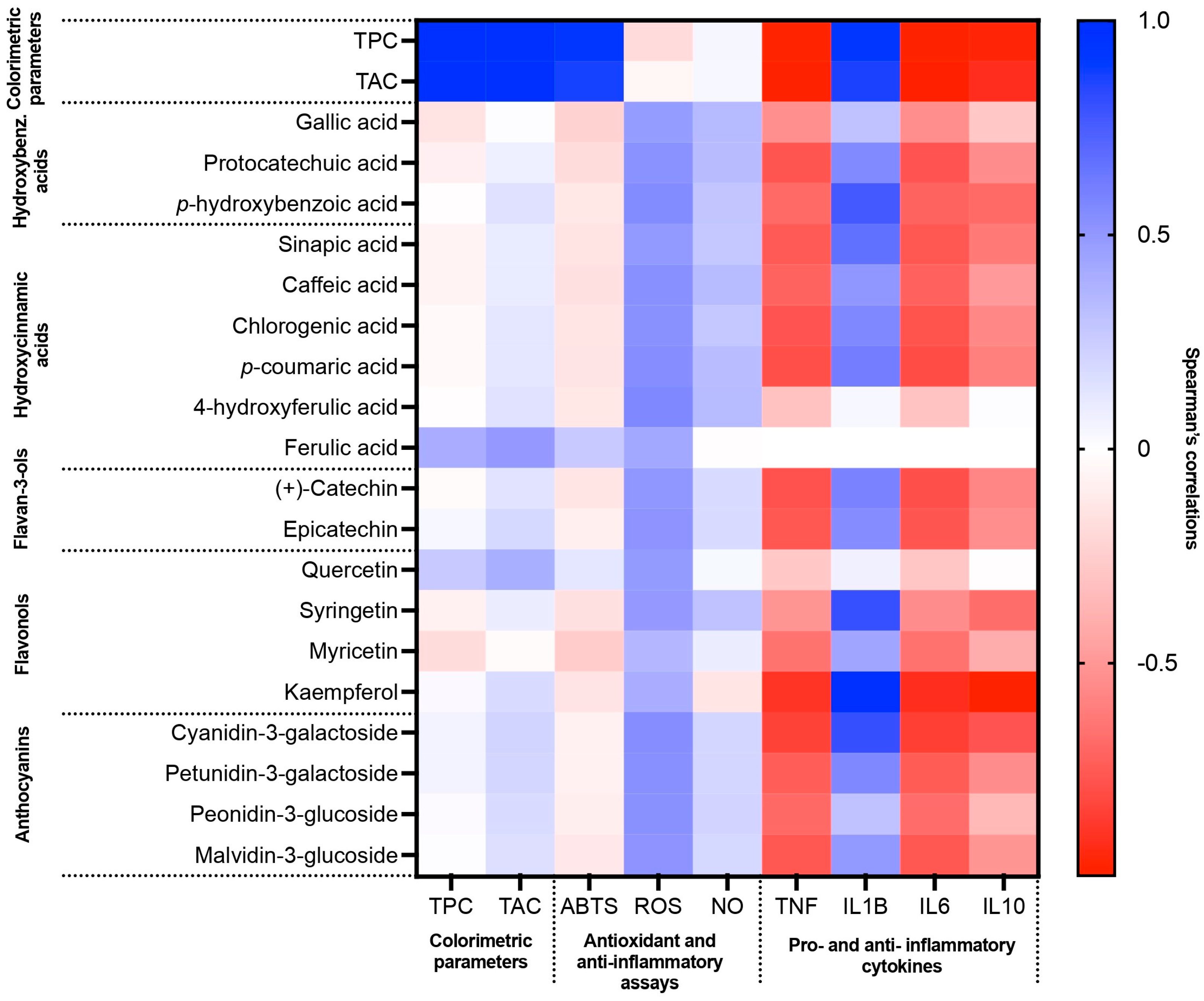
To further examine these relationships, Spearman’s correlation analysis was performed between phenolic composition and biological responses (Figure 9). TPC and TAC showed strong positive correlations with ABTS, whereas most individual phenolic compounds exhibited weak or negative correlations with ABTS, indicating that global antioxidant activity is more closely associated with the overall phenolic pool than with single compounds. In contrast, most individual phenolics displayed positive correlations with ROS and, to a lesser extent, with NO, suggesting that specific phenolic subclasses are associated with cellular redox responses.
Cytokine-related correlations were more heterogeneous. TNF-α and IL-6 were generally inversely correlated with TPC, TAC, and most individual phenolics, indicating that higher phenolic content is associated with reduced pro-inflammatory cytokine responses. In contrast, anthocyanins (except for the cyanidin-derived glycoside) and selected phenolics such as gallic acid and (+)-catechin showed weaker or variable associations with IL-10, suggesting compound-specific immunomodulatory effects rather than a uniform anti-inflammatory pattern. Taken together, the correlation analysis supports multivariate findings, highlighting that SSF-derived phenolic profiles are strongly linked to antioxidant activity and oxidative stress modulation, while cytokine responses depend more on specific phenolic subclasses than on total phenolic content alone.

4. Discussion

Fruit by-products such as bagasse, peels, and seeds are increasingly recognized as concentrated sources of bioactive compounds, particularly polyphenols, pigments, and antioxidant molecules [25]. Consequently, most valorization strategies aim not only to recover these compounds but also to improve their extractability, stability, and bioactivity through bioprocessing and tailored extraction technologies. In this context, fermentation has emerged as a relevant strategy to enhance the release of bound phenolics and modulate the bioactive potential of agro-industrial residues.
While SmF remains a widely used method for bioprocessing of food by-products, SSF is gaining relevance because it more closely mimics the natural growth conditions of filamentous fungi and promotes intense extracellular enzyme production directly on solid substrates [26]. At the same time, the extraction method is a critical determinant of phenolic recovery, as solvent polarity, matrix disruption, and enzymatic pretreatment all strongly influence the accessibility of phenolic compounds [27]. The present work, therefore, integrated SSF and SmF with complementary extraction strategies to dissect how biological and chemical factors interact to control the recovery, composition, and bioactivity of phenolics from blueberry bagasse.

4.1. Fermentation–Extraction Interactions Affecting Phenolic Recovery and Antioxidant Capacity

The results indicate that the extraction strategy was a major factor influencing phenolic recovery, while fungal SSF acted as a modulating process that influenced the release and degradation kinetics of phenolic compounds. Consistent with previous reports, SmF was associated with limited preservation of phenolic compounds and antioxidant capacity. Although TPC in SmF-F extracts remained relatively stable over time, TAC declined sharply in both non-inoculated and fermented samples, with losses exceeding 60% after 60 h. Similar trends have been reported for SmF of grape and berry by-products, where continuous aqueous exposure accelerates phenolic hydrolysis and oxidative degradation [28,29]. This behavior is consistent with the lower TAC and ABTS antioxidant capacity measured in SmF-F extracts in the present study, despite fungal growth.
In contrast, SSF was associated with differences in the release and retention of phenolic compounds. In SSF-B and SSF-M extracts, fungal fermentation resulted in significantly higher TPC and TAC at early time points (12–24 h) compared with non-inoculated controls. These effects are in line with the enzymatic repertoire of A. niger and R. oryzae, which includes cellulases, endoglucanases, and hemicellulases that break down plant cell walls, as well as esterases and feruloyl esterases that liberate phenolics from polysaccharide and lignin complexes [30,31]. Beyond increasing phenolic release, SSF appeared to influence the temporal balance between liberation and degradation, resulting in a comparatively more sustained bioactive pool during incubation. The increases in TPC and TAC observed in methanolic extracts at 24 h are consistent with fermentation-associated modifications of the phenolic matrix, combined with the higher solubilization efficiency of methanol for free and possibly released aglycone forms. This behavior is well aligned with previous SSF studies using wheat bran fermented with A. niger KK2, where β-glucosidase, xylanase, and related enzymes were shown to hydrolyze glycosylated and cell wall-bound phenolics, generating low-molecular-weight compounds that are more extractable in organic solvents [32]. Although methanolic extraction yielded higher TPC and TAC values, the development of solvent-free or food-grade extraction strategies remains highly relevant for functional food applications. In this context, SSF-B extracts represent a more sustainable and industry-compatible alternative. Improving aqueous phenolic recovery may be achieved through optimization of SSF parameters such as pH, temperature, and incubation time, which influence fungal enzymatic activity and matrix biotransformation [33]. Furthermore, beyond conventional aqueous extraction, emerging green solvent systems such as deep eutectic solvents have been proposed as sustainable alternatives for phenolic recovery due to their low toxicity and biodegradability [34]. Such approaches could be explored in future studies to enhance phenolic recovery while maintaining environmentally friendly processing conditions.
Anthocyanin concentrations declined at extended fermentation times under both inoculated and non-inoculated conditions; however, these losses were less pronounced in fermented samples, suggesting that enzymatic release partially compensated for pigment degradation during SSF. The structured, low-moisture environment characteristic of SSF may also limit oxygen transfer and reduce phenolic–enzyme interactions, contributing to comparatively greater anthocyanin retention. By contrast, the marked reduction in TAC observed during SmF can be attributed to physicochemical and enzymatic factors inherent to liquid fermentation systems. In submerged conditions, anthocyanins may undergo β-glucosidase-mediated hydrolysis, generating unstable anthocyanidins that are more susceptible to further degradation. Additionally, increased molecular mobility, continuous oxygen exposure, and agitation-enhanced oxidative processes in liquid media can promote structural instability and accelerate anthocyanin loss [35]. A contrasting pattern was observed for SSF-B+M extracts, where fungal fermentation contributed to the preservation of TPC and significantly mitigated early TAC losses. This effect is likely associated with the progressive enzymatic deconstruction of the solid matrix during SSF, which enhances the accessibility of bound phenolic compounds and facilitates their subsequent recovery during methanolic extraction [36].
These compositional changes were closely reflected in antioxidant capacity measured by the ABTS assay. In all SSF systems, fermented extracts showed a rapid increase in ABTS activity during the first 12–24 h, followed by a gradual decline, yet remaining higher than the corresponding non-inoculated controls within the same extraction system. This dynamic profile is characteristic of SSF processes, where intense early enzymatic activity releases antioxidant compounds, which are subsequently partially transformed during prolonged incubation [37,38]. In buffer-based extracts, where solvent extraction is intrinsically limited, the enhancement of ABTS activity in fermented samples was particularly evident, indicating that SSF generates more water-soluble antioxidant fractions, likely derived from enzymatic hydrolysis of anthocyanin- and cell wall-bound phenolics [36]. In methanol-containing extracts, the increased ABTS response at 12–24 h is consistent with enhanced solubilization of phenolic compounds whose antioxidant capacity may have been influenced by fermentation-related transformations. Notably, ABTS activity remained elevated in fermented samples even when bulk phenolic indicators declined, suggesting that SSF may shift the antioxidant pool toward smaller, highly redox-active molecules, such as simple phenolic acids and anthocyanin-derived products, which contribute disproportionately to radical scavenging capacity [37].
This interpretation was reinforced by multivariate and correlation analyses, which showed that SSF-treated samples clustered separately from non-inoculated controls along axes dominated by antioxidant activity and oxidative stress modulation rather than by bulk phenolic indices. In agreement, Spearman’s correlation analysis indicated that overall phenolic richness and anthocyanin content primarily underpin the chemical antioxidant response, whereas the influence of individual phenolic compounds was more evident at the level of cellular redox modulation. Together, these observations indicate that SSF reshapes the phenolic pool toward functionally relevant antioxidant species rather than simply increasing total phenolic content. In line with this interpretation, SSF appears to influence both the extractability and redox functionality of blueberry bagasse phenolics, an effect that is further enhanced by methanol-based extraction and that justifies the selection of SSF-M extracts for subsequent UHPLC profiling and cellular bioactivity assays.

4.2. Effects of Fungal Fermentation on the Phenolic Profile of Blueberry Bagasse

The UHPLC results provided molecular-level evidence supporting the extraction–fermentation interactions discussed in Section 4.1. Fermentation of blueberry bagasse with A. niger ATCC 6275 and R. oryzae BIOTEC018 produced clear and compound-specific modifications in the phenolic profile, confirming that filamentous fungi do not simply increase bulk phenolic content, but actively reshape the chemical composition of the extractable fraction. As shown in Table 1, flavan-3-ols such as (+)-catechin and epicatechin, which declined sharply in the 24 h non-inoculated control, were partially or almost fully restored after fungal fermentation, while hydroxybenzoic acids such as gallic and protocatechuic acids increased significantly compared with non-fermented samples. These trends are consistent with the well-established capacity of Aspergillus and Rhizopus species to secrete esterases, β-glucosidases, cellulases, and tannases, which hydrolyze glycosides, cleave ester linkages, and disrupt polysaccharide–polyphenol complexes, thereby releasing phenolics that are otherwise inaccessible in the plant matrix [30,31]. In this context, the detection of flavonols such as quercetin and myricetin in fermented samples, despite being undetectable in the 24 h non-inoculated control, is more plausibly explained by enhanced liberation of aglycones from matrix-bound or conjugated precursors and/or improved compound stability under fermentation conditions, rather than de novo “regeneration”. Together, these mechanisms likely increased the detectable pool of specific flavonols at 24 h in fermented samples compared with the incubated non-inoculated control.
These mechanisms closely match previous reports showing that fermentation of avocado seed promotes the depolymerization of condensed tannins, particularly procyanidin B2 dimers, leading to the accumulation of free (+)-catechin and epicatechin, as detected by HPLC [39]. The partial recovery of both (+)-catechin and epicatechin observed in the present study, therefore, likely reflects a similar depolymerization and deconjugation process operating on blueberry proanthocyanidins during SSF. Considering that blueberry bagasse is particularly rich in proanthocyanidins, the increase in monomeric flavan-3-ols detected by UHPLC supports the hypothesis that SSF promotes partial depolymerization of condensed tannins within the plant matrix. Such depolymerization may be mediated by fungal enzymes commonly produced during SSF, including tannases, esterases, and other hydrolytic enzymes capable of cleaving interflavan bonds or disrupting tannin–polysaccharide complexes [40]. Although enzymatic activities were not directly measured in the present study, the observed reappearance of (+)-catechin and epicatechin, together with increased hydroxybenzoic acids, is consistent with fermentation-driven bioconversion of higher-molecular-weight polyphenols. Beyond depolymerization, fermentation also drives broader metabolic transformations of polyphenols. Microbial fermentation of cranberry (Vaccinium macrocarpon) has been shown to generate low-molecular-weight phenolic metabolites such as catechol, benzoic acid, and phenylacetic acids from complex polyphenols, indicating that phenolics can act as biosynthetic precursors for smaller, more bioactive molecules [41]. Likewise, fermentation-mediated bioconversion of cranberry proanthocyanidins yields pharmacologically active metabolites, such as hydroxycinnamic acids, catechols, and pyrogallols, thereby enhancing biological activity through structural simplification [42]. The increased levels of gallic and protocatechuic acids observed in both fungal treatments in the present work are consistent with this type of bioconversion, in which complex polyphenols are transformed into simpler hydroxybenzoic acids with high redox and biological activity.
Strain-dependent effects were also evident. While both fungi counteracted the losses observed in the non-inoculated control, A. niger ATCC 6275 showed a more uniform stabilization of phenolic acids and flavanols, whereas R. oryzae BIOTEC018 displayed a stronger effect on the preservation of anthocyanins, particularly cyanidin- and malvidin-based glycosides. These differences are likely linked to variations in enzymatic spectra, which determine how efficiently glycosides are hydrolyzed and how phenolics are released or transformed [18,19]. This dual behavior—simultaneous liberation of simple phenols and partial stabilization of anthocyanins—has been reported in other fungal and microbial fermentations. Microbial enzymes can both release bound phenolics and generate new metabolites through deglycosylation, ring cleavage, and glycosylation, while also influencing anthocyanin stability through interactions with extracellular proteins, polysaccharides, and pH-dependent binding phenomena [1,43]. Although many fruit fermentations lead to anthocyanin degradation due to their intrinsic instability, solid-state systems can favor protective interactions between pigments and microbial or plant-derived macromolecules, thereby attenuating anthocyanin losses. This was evident in the fungal treatments compared with the non-inoculated control.
Importantly, the compounds enriched or preserved by SSF—such as gallic acid, protocatechuic acid, catechin, and anthocyanin derivatives—are well recognized for their antioxidant and anti-inflammatory properties. Fermented blueberry phenolics have been shown to inhibit the formation of tumor-initiating cells in vitro and in vivo and reduce the spread of metastatic cells through epigenetic modulation [44]. In addition, fermentation-derived phenolic metabolites, such as protocatechuic acid and catechol, exhibit strong anticancer effects [45], and microbial fermentation has been shown to increase bioavailability and generate metabolites that mitigate inflammation and oxidative stress [46].
Taken together, the UHPLC profiling confirms that SSF does not merely preserve phenolics but actively reconfigures the phenolic pool of blueberry bagasse into a composition enriched in low-molecular-weight and bioactive compounds, in direct agreement with the extraction–antioxidant trends discussed in Section 4.1.

4.3. Cellular Antioxidant and Immunomodulation Properties of Fermented Blueberry Bagasse Extracts

In the present study, methanolic SSF extracts were evaluated for their ability to modulate intracellular oxidative stress in Caco-2 cells at 25 µg/mL under both short (20 min) and prolonged (24 h) exposure conditions. The magnitude of ROS suppression observed in our system is consistent with previous reports for fermented blueberry products. Fermented blueberry preparations at 2 mg/mL have been shown to significantly reduce intracellular ROS in hepatocellular carcinoma (HepG2) cells, with fermentation enhancing antioxidant potential relative to non-fermented material [45]. Although those studies were performed in different cell types and at higher extract concentrations, they support the notion that microbial processing of blueberries increases the availability of compounds that counteract oxidative stress. Anthocyanin-rich blueberry fractions have also been reported to decrease intracellular ROS in umbilical vein endothelial cells (HUVECs), with individual compounds such as malvidin, malvidin-3-glucoside, and malvidin-3-galactoside contributing to antioxidant activity [47]. However, mixtures of anthocyanins may exhibit lower activity than purified molecules, likely due to antagonistic interactions or competition for cellular targets. This phenomenon is consistent with the moderate but still significant ROS reductions observed in our complex SSF-M extracts, where multiple phenolic classes coexist and interact. In addition to anthocyanins, other blueberry-derived polyphenols can contribute to ROS modulation. Compounds such as pterostilbene have been shown to suppress intracellular ROS in a dose-dependent manner [48], suggesting that the combined action of phenolic acids, flavan-3-ols, and anthocyanin derivatives present in SSF-M extracts may underlie the antioxidant effects observed here.
Importantly, the temporal behavior observed in our results—where fermented extracts showed a stronger antioxidant effect at 20 min, whereas all treatments converged after 24 h—suggests that fungal fermentation enhances the availability of rapidly acting antioxidant compounds. This is in line with the UHPLC data showing increased levels of low-molecular-weight phenolics and preserved anthocyanins in fermented samples, which are known to penetrate cells and scavenge radicals more efficiently than polymeric phenolics.
NO is a key signaling and effector molecule produced by macrophages through inducible nitric oxide synthase (iNOS) during inflammatory activation. Upon stimulation with LPS, macrophages strongly upregulate iNOS, leading to an increased NO production that contributes to oxidative stress and inflammatory damage [45]. Blueberry polyphenols and fermented blueberry products have repeatedly been shown to modulate this response by inhibiting iNOS expression and limiting NO accumulation in activated immune cells [46,49].
In this study, both non-inoculated and fermented SSF-M blueberry extracts markedly suppressed NO production in LPS-stimulated RAW 264.7 macrophages at both 25 and 50 µg/mL, with fermented samples showing the strongest effect, particularly at 25 µg/mL, where the separation between fermented and non-fermented materials was most evident. This magnitude of NO inhibition (≈40–60% of Ctrl+) is consistent with previous reports on fermented berry systems, where fermented blueberry–based matrices reduced NO production in macrophages to 20–40% of the LPS control following gastrointestinal digestion or microbial fermentation [19]. Likewise, fermentation of blueberry juice with a berry-associated bacterium (Serratia vaccinii) was shown to reverse the pro-inflammatory stimulation of NO observed for unfermented juice, yielding up to 50% inhibition of NO release in activated macrophages [50]. These observations align with broader evidence that blueberry polyphenols suppress iNOS gene expression and NO production in both macrophages and microglial cells, concomitant with reductions in pro-inflammatory mediators such as IL-1β and TNF-α [51].
In the present work, NO suppression co-occurred with highly divergent cytokine profiles, particularly for TNF-α and IL-6. This apparent dissociation is not contradictory, as NO and cytokine production are regulated through partially independent inflammatory pathways. While NO synthesis is primarily governed by iNOS, cytokine release is controlled by transcriptional cascades such as nuclear factor kappa B (NF-κB) and mitogen-activated protein kinase (MAPK), meaning that iNOS inhibition can occur without parallel suppression of cytokines [21]. In this context, the elevated TNF-α and IL-6 observed in some treatments likely reflect an early phase of immune activation rather than overt inflammation, whereas NO and ROS suppression indicate that downstream oxidative damage was effectively controlled. Moreover, macrophage responses to polyphenols and fermented foods are dose- and time-dependent: low doses or early exposure can transiently activate inflammatory signaling, whereas prolonged exposure or higher concentrations typically suppress NO and cytokine pathways. In addition, TNF-α is released early after LPS stimulation, whereas iNOS expression and NO accumulation peak after 12–24 h, so asynchronous kinetics can produce divergent patterns between NO and cytokine readouts [52,53].
These mechanistic features help explain the contrasting behavior observed between the two fungal fermentations. The A. niger SSF extract strongly reduced NO production, likely due to enrichment in phenolic acids such as gallic and protocatechuic acids, which are known to inhibit iNOS activity and reduce nitrosative stress [54]. However, the same extract induced high TNF-α and IL-6 levels, which may reflect the presence of fungal-derived β-glucans, chitin fragments, or other Pathogen-Associated Molecular Pattern (PAMP)-like molecules capable of activating pro-inflammatory signaling despite reduced NO. This pattern is consistent with a state of controlled immunostimulation, where innate immune pathways are triggered without progression to oxidative or inflammasome-driven damage. In contrast, the R. oryzae SSF extract did not show the strongest NO inhibition but did markedly suppress TNF-α and IL-6, suggesting preferential modulation of cytokine-related pathways, such as NF-κB or MAPK, rather than direct inhibition of iNOS [55]. Taken together, the dissociation between reduced NO production and increased TNF-α and IL-6 levels indicates that the extract does not exert a uniformly suppressive anti-inflammatory effect. Instead, the data support a regulated immunomodulatory profile in which attenuation of oxidative and nitrosative stress coexists with selective cytokine activation. Such responses are likely context- and dose-dependent, underscoring that SSF-derived extracts may simultaneously control redox imbalance while promoting controlled immune activation.
The behavior of IL-1β further supports this decoupling of inflammatory axes. All extracts, including non-inoculated and fermented samples, strongly suppressed IL-1β relative to the LPS control, indicating that blueberry-derived metabolites broadly inhibit inflammasome-related pathways regardless of fermentation status. Because IL-1β maturation requires not only NF-κB priming but also oxidative stress–driven inflammasome activation, the marked suppression of ROS and NO likely limited full inflammasome engagement, thereby maintaining IL-1β near basal levels even in treatments that showed elevated TNF-α. Similar inhibition of IL-1β and IL-6 by blueberry polyphenols has been widely reported in macrophage and animal models, with reductions of 80–87% and ~15–20%, respectively, linked to blockade of NF-κB and MAPK signaling [56,57]. In addition, blueberry polyphenolic fractions have been shown to attenuate LPS-induced cytokine production, inhibiting NF-κB activation in RAW 264.7 macrophages [58], further supporting the mechanism proposed here. IL-10, in contrast, was not stimulated by any of the extracts and remained close to basal (Ctrl−) levels, particularly after 24 h incubation and fungal fermentation. This indicates that the macrophage response did not progress to a late anti-inflammatory resolution phase, but rather remained in an early, regulated immune activation state, as described for many polyphenol-rich interventions that suppress pro-inflammatory mediators without inducing IL-10–dependent resolution pathways [59,60].
The integration of chemical and biological variables through multivariate and correlation analyses provides additional insight into the pathway-specific immunomodulatory effects. PCA clearly separated fermented samples from non-inoculated controls along axes dominated by ROS and NO modulation, whereas cytokine-related responses loaded on orthogonal components, underscoring their partial regulatory independence. Consistently, Spearman’s correlation analysis revealed positive associations between most phenolic compounds and ROS/NO production, while relationships with cytokines were more heterogeneous and compound-dependent. In summary, SSF and SmF present distinct operational characteristics, with SSF providing a low-moisture environment that favors enzyme–substrate interactions within solid plant matrices. In the present study, fermentation resulted in compositional remodeling when comparing fermented and non-fermented materials, particularly under SSF conditions, and with corresponding differences in biological responses. Although direct methanolic extraction yielded comparable or higher bulk phenolic and anthocyanin levels under certain conditions, SSF contributed to a strain-dependent reconfiguration of the phenolic profile and to differentiated redox and cytokine responses. Together, these findings indicate that the potential value of SSF lies not in uniformly maximizing phenolic content, but in modulating the qualitative composition of the extract and its associated biological effects.

5. Conclusions

This study suggests that fungal SSF, particularly when combined with methanolic extraction, is associated with higher phenolic recovery from blueberry bagasse compared with the evaluated SmF conditions. Under the selected SSF–methanol conditions (24 h), strain-dependent effects were observed in individual phenolic profiles and associated cellular responses. A. niger ATCC 6275 favored the accumulation of phenolic acids and flavan-3-ols linked to stronger modulation of nitrosative stress, whereas R. oryzae BIOTEC018 generated extracts associated with distinct cytokine-related responses, highlighting complementary strain-specific behaviors rather than a single optimal microorganism. These trends were consistently supported by multivariate and correlation analyses, which linked biological outcomes primarily to oxidative and nitrosative stress modulation and to specific phenolic subclasses rather than to total phenolic content alone. Importantly, the observed cytokine patterns indicate context-dependent immunomodulatory effects rather than a uniformly anti-inflammatory response, warranting careful consideration in future functional applications.
Overall, the findings highlight SSF as a laboratory-scale bioprocess capable of reshaping phenolic composition and biological responses in blueberry bagasse, beyond simple increases in total compound recovery. Further studies employing expanded experimental designs are warranted to confirm these effects and to address process optimization and scalability.

Supplementary Materials

The following supporting information can be downloaded at https://www.mdpi.com/article/10.3390/fermentation12030128/s1: Figure S1: Representative ultra-high-performance liquid chromatography chromatograms; Figure S2: Viability of Caco-2 cells treated with methanolic extracts; Table S1: Total phenolic content in blueberry bagasse samples; Table S2: Total anthocyanin content in blueberry bagasse samples; Table S3: Antioxidant capacity determined by the ABTS assay in blueberry bagasse samples; Table S4: Eigenvalues from the PCA; Table S5: Participation of each variable analyzed in the Principal Component Analysis on each component.

Author Contributions

Conceptualization, A.H.-R. and T.G.-C.; methodology, A.H.-R. and F.L.-P.; formal analysis, A.H.-R., I.L.-O., M.A.-R. and T.G.-C.; investigation, A.H.-R., I.L.-O. and T.G.-C.; writing—original draft preparation, A.H.-R., I.L.-O. and T.G.-C.; writing—review and editing, M.A.-R., L.E.G.-A., D.C.-N. and T.G.-C.; visualization, A.H.-R. and T.G.-C.; project administration, T.G.-C.; funding acquisition, T.G.-C. All authors have read and agreed to the published version of the manuscript.

Funding

This research was funded by Challenge-Based Research Funding Program 2024 (Project CI__EIC_HLT_D_182) from Tecnológico de Monterrey; and Secretaría de Innovación, Ciencia y Tecnología de Jalisco, Consejo Estatal de Ciencia y Tecnología de Jalisco (COECYTJAL), and Tecnológico de Monterrey through the Fondo de Desarrollo Científico de Jalisco para Atender Retos Sociales (FODECIJAL; Project 11841-2025).

Institutional Review Board Statement

Not applicable.

Informed Consent Statement

Not applicable.

Data Availability Statement

The original contributions presented in this study are included in the article/Supplementary Materials. Further inquiries can be directed to the corresponding author.

Acknowledgments

The authors acknowledge the institutional support provided by Tecnológico de Monterrey. This research was conducted at the Biotech Space research facilities (Guadalajara campus) and at the Centro de Biotecnología FEMSA (Monterrey campus). Alejandra Hurtado-Romero acknowledges SECIHTI (México) for scholarship funding (CVU: 1007229). The authors also thank Biotechnology Engineering students from Tecnológico de Monterrey, Gerardo Rafael Dueñas Saucedo and María José Gómez Carrillo, for their invaluable support and dedication in the laboratory, particularly in experimentation and data analysis that contributed to this work. We also thank Bloom Farms® for generously providing the blueberries used in this study.

Conflicts of Interest

The authors declare no conflicts of interest. The funders had no role in the design of the study, in the collection, analysis, or interpretation of data, in the writing of the manuscript, or in the decision to publish the results.

Abbreviations

The following abbreviations are used in this manuscript:
AAPH2,2′-azobis(2-amidinopropane) dihydrochloride
ABTS2,2′-azino-bis(3-ethylbenzothiazoline-6-sulfonic acid)
AN-24hBlueberry bagasse fermented with Aspergillus niger ATCC 6275 for 24 h
ATCCAmerican Type Culture Collection
C3GCyanidin-3-glucoside equivalents
Ctrl+LPS-treated control
Ctrl−Unstimulated control
DCFH-DADichloro-dihydro-fluorescein diacetate
DMEMDulbecco Modified Eagle’s Medium
d.w.Dry weight
ELISAEnzyme-linked immunosorbent assay
FBSFetal bovine serum
GAEGallic acid equivalents
IL-1βInterleukin-1 beta
IL-6Interleukin-6
IL-10Interleukin-10
LPSLipopolysaccharide
NI-0hNon-inoculated blueberry bagasse at 0 h
NI-24hNon-inoculated blueberry bagasse after 24 h
NONitric oxide
PBSPhosphate-buffered saline
PCPrincipal component
PCAPrincipal component analysis
Pen-StrepPenicillin–streptomycin
RO-24hBlueberry bagasse fermented with Rhizopus oryzae BIOTEC018 for 24 h
ROSReactive oxygen species
SmFSubmerged fermentation
SmF-FFiltered extract from submerged fermentation
SSFSolid-state fermentation
SSF-BBuffer extract from SSF
SSF-B+MBuffer–methanol extract from SSF
SSF-MMethanol extract from SSF
TACTotal anthocyanin content
TETrolox equivalents
TNF-αTumor necrosis factor alpha
TPCTotal phenolic content
UHPLCUltra-high-performance liquid chromatography

References

  1. Huynh, N.K.; Wilson, M.D.; Eyles, A.; Stanley, R.A. Recent Advances in Postharvest Technologies to Extend the Shelf Life of Blueberries (Vaccinium sp.), Raspberries (Rubus idaeus L.) and Blackberries (Rubus sp.). J. Berry Res. 2019, 9, 687–707. [Google Scholar] [CrossRef]
  2. Horvitz, S. Postharvest Handling of Berries. In Postharvest Handling; Kahramanoglu, I., Ed.; InTech: Rijeka, Croatia, 2017; pp. 107–120. [Google Scholar]
  3. Stanca, L.; Bilteanu, L.; Bujor, O.C.; Ion, V.A.; Petre, A.C.; Bădulescu, L.; Geicu, O.I.; Pisoschi, A.M.; Serban, A.I.; Ghimpeteanu, O.-M. Development of Functional Foods: A Comparative Study on the Polyphenols and Anthocyanins Content in Chokeberry and Blueberry Pomace Extracts and Their Antitumor Properties. Foods 2024, 13, 2552. [Google Scholar] [CrossRef]
  4. Diez-Sánchez, E.; Quiles, A.; Hernando, I. Use of Berry Pomace to Design Functional Foods. Food Rev. Int. 2023, 39, 3204–3224. [Google Scholar] [CrossRef]
  5. Hurtado-Romero, A.; Garcia-Amezquita, L.E.; Carrillo-Nieves, D.; Montilla, A.; Villamiel, M.; Requena, T.; García-Cayuela, T. Characterization of Berry By-Products as Fermentable Substrates: Proximate and Phenolic Composition, Antimicrobial Activity, and Probiotic Growth Dynamics. LWT 2024, 204, 116468. [Google Scholar] [CrossRef]
  6. Fogarasi, M.; Socaciu, M.-I.; Sălăgean, C.-D.; Ranga, F.; Fărcaș, A.C.; Socaci, S.A.; Socaciu, C.; Țibulcă, D.; Fogarasi, S.; Semeniuc, C.A. Comparison of Different Extraction Solvents for Characterization of Antioxidant Potential and Polyphenolic Composition in Boletus edulis and Cantharellus cibarius Mushrooms from Romania. Molecules 2021, 26, 7508. [Google Scholar] [CrossRef] [PubMed]
  7. De Moraes Crizel, T.; Hermes, V.S.; De Oliveira Rios, A.; Flôres, S.H. Evaluation of Bioactive Compounds, Chemical and Technological Properties of Fruits Byproducts Powder. J. Food Sci. Technol. 2016, 53, 4067–4075. [Google Scholar] [CrossRef]
  8. Jiang, Y.; Subbiah, V.; Wu, H.; Bk, A.; Sharifi-Rad, J.; Suleria, H.A.R. Phenolic Profiling of Berries Waste and Determination of Their Antioxidant Potential. J. Food Qual. 2022, 2022, 5605739. [Google Scholar] [CrossRef]
  9. Tian, Z.-X.; Li, Y.-F.; Long, M.-X.; Liang, Q.; Chen, X.; Huang, D.-M.; Ran, Y.-Q. Effects of Six Different Microbial Strains on Polyphenol Profiles, Antioxidant Activity, and Bioaccessibility of Blueberry Pomace with Solid-State Fermentation. Front. Nutr. 2023, 10, 1282438. [Google Scholar] [CrossRef] [PubMed]
  10. Sarıtaş, S.; Portocarrero, A.C.M.; Miranda López, J.M.; Lombardo, M.; Koch, W.; Raposo, A.; El-Seedi, H.R.; De Brito Alves, J.L.; Esatbeyoglu, T.; Karav, S.; et al. The Impact of Fermentation on the Antioxidant Activity of Food Products. Molecules 2024, 29, 3941. [Google Scholar] [CrossRef] [PubMed]
  11. Cano y Postigo, L.O.; Jacobo-Velázquez, D.A.; Guajardo-Flores, D.; Garcia Amezquita, L.E.; García-Cayuela, T. Solid-State Fermentation for Enhancing the Nutraceutical Content of Agrifood by-Products: Recent Advances and Its Industrial Feasibility. Food Biosci. 2021, 41, 100926. [Google Scholar] [CrossRef]
  12. Bhanja Dey, T.; Chakraborty, S.; Jain, K.K.; Sharma, A.; Kuhad, R.C. Antioxidant Phenolics and Their Microbial Production by Submerged and Solid State Fermentation Process: A Review. Trends Food Sci. Technol. 2016, 53, 60–74. [Google Scholar] [CrossRef]
  13. Prado Barragán, L.A.; Figueroa, J.J.B.; Rodríguez Durán, L.V.; Aguilar González, C.N.; Hennigs, C. Fermentative Production Methods. In Biotransformation of Agricultural Waste and By-Products; Poltronieri, P., D’Urso, O.F., Eds.; Elsevier: Amsterdam, The Netherlands, 2016; pp. 189–217. [Google Scholar]
  14. Ge, X.; Vasco-Correa, J.; Li, Y. Solid-State Fermentation Bioreactors and Fundamentals. In Current Developments in Biotechnology and Bioengineering; Larroche, C., Sanromán, M.A., Du, G., Pandey, A., Eds.; Elsevier: Amsterdam, The Netherlands, 2017; pp. 381–402. [Google Scholar]
  15. Pathania, S.; Sharma, N.; Handa, S. Utilization of Horticultural Waste (Apple Pomace) for Multiple Carbohydrase Production from Rhizopus delemar F2 under Solid State Fermentation. J. Genet. Eng. Biotechnol. 2018, 16, 181–189. [Google Scholar] [CrossRef]
  16. Šelo, G.; Planinić, M.; Tišma, M.; Martinović, J.; Perković, G.; Bucić-Kojić, A. Bioconversion of Grape Pomace with Rhizopus oryzae under Solid-State Conditions: Changes in the Chemical Composition and Profile of Phenolic Compounds. Microorganisms 2023, 11, 956. [Google Scholar] [CrossRef]
  17. Ortega-Hernández, E.; Martinez-Alvarado, L.; Acosta-Estrada, B.A.; Antunes-Ricardo, M. Solid-State Fermented Pineapple Peel: A Novel Food Ingredient with Antioxidant and Anti-Inflammatory Properties. Foods 2023, 12, 4162. [Google Scholar] [CrossRef] [PubMed]
  18. Yan, Y.; Zhang, F.; Chai, Z.; Liu, M.; Battino, M.; Meng, X. Mixed Fermentation of Blueberry Pomace with L. rhamnosus GG and L. plantarum-1: Enhance the Active Ingredient, Antioxidant Activity and Health-Promoting Benefits. Food Chem. Toxicol. 2019, 131, 110541. [Google Scholar] [CrossRef]
  19. Méndez-Galarraga, M.P.; Hurtado-Romero, A.; Antunes-Ricardo, M.; Garcia-Amezquita, L.E.; Pirovani, M.É.; Vinderola, G.; Van De Velde, F.; García-Cayuela, T. Enhancing Safety and Bioactivity of Blueberry-Watermelon Smoothies through Combined Ultrasound and Lactic Acid Fermentation with Potential Probiotics. Food Biosci. 2025, 69, 106991. [Google Scholar] [CrossRef]
  20. Hurtado-Romero, A.; Zepeda-Hernández, A.; Uribe-Velázquez, T.; Rosales-De La Cruz, M.F.; Raygoza-Murguía, L.V.; Garcia-Amezquita, L.E.; García-Cayuela, T. Utilization of Blueberry-Based Ingredients for Formulating a Synbiotic Petit Suisse Cheese: Physicochemical, Microbiological, Sensory, and Functional Characterization during Cold Storage. LWT 2023, 183, 114955. [Google Scholar] [CrossRef]
  21. Kaminskyj, S.G.W. Fundamentals of Growth, Storage, Genetics and Microscopy of Aspergillus Nidulans. Fungal Genet. Rep. 2001, 48, 25–31. [Google Scholar] [CrossRef]
  22. Sánchez-Rangel, J.C.; Benavides, J.; Heredia, J.B.; Cisneros-Zevallos, L.; Jacobo-Velázquez, D.A. The Folin–Ciocalteu Assay Revisited: Improvement of Its Specificity for Total Phenolic Content Determination. Anal. Methods 2013, 5, 5990. [Google Scholar] [CrossRef]
  23. Martín-Gómez, J.; Varo, M.Á.; Mérida, J.; Serratosa, M.P. Influence of Drying Processes on Anthocyanin Profiles, Total Phenolic Compounds and Antioxidant Activities of Blueberry (Vaccinium corymbosum). LWT 2020, 120, 108931. [Google Scholar] [CrossRef]
  24. García-Cayuela, T.; Gómez-Maqueo, A.; Guajardo-Flores, D.; Welti-Chanes, J.; Cano, M.P. Characterization and Quantification of Individual Betalain and Phenolic Compounds in Mexican and Spanish Prickly Pear (Opuntia ficus-indica L. Mill) Tissues: A Comparative Study. J. Food Compos. Anal. 2019, 76, 1–13. [Google Scholar] [CrossRef]
  25. Ibarruri, J.; Cebrián, M.; Hernández, I. Valorisation of Fruit and Vegetable Discards by Fungal Submerged and Solid-State Fermentation for Alternative Feed Ingredients Production. J. Food Compos. Anal. 2021, 281, 111901. [Google Scholar] [CrossRef]
  26. Erskine, E.; Ozkan, G.; Lu, B.; Capanoglu, E. Effects of Fermentation Process on the Antioxidant Capacity of Fruit Byproducts. ACS Omega 2023, 8, 4543–4553. [Google Scholar] [CrossRef]
  27. Vijayalaxmi, S.; Jayalakshmi, S.K.; Sreeramulu, K. Polyphenols from Different Agricultural Residues: Extraction, Identification and Their Antioxidant Properties. J. Food Sci. Technol. 2015, 52, 2761–2769. [Google Scholar] [CrossRef]
  28. Amaya-Chantaca, D.; Flores-Gallegos, A.C.; Iliná, A.; Aguilar, C.N.; Sepúlveda-Torre, L.; Ascacio-Vadlés, J.A.; Chávez-González, M.L. Comparative Extraction Study of Grape Pomace Bioactive Compounds by Submerged and Solid-state Fermentation. J. Chem. Technol. Biotechnol. 2022, 97, 1494–1505. [Google Scholar] [CrossRef]
  29. Troncoso Mesa, S.; Flórez-Méndez, J.; López, J.; Bustos, R. Optimization of Conventional Solid-Liquid Extraction and Microwave-Assisted Extraction of Polyphenols and Antioxidant Compounds of Blueberry (Vaccinium corymbosum) Pomace through Response Surface Methodology. J. Berry Res. 2021, 11, 649–668. [Google Scholar] [CrossRef]
  30. Benoit, I.; Navarro, D.; Marnet, N.; Rakotomanomana, N.; Lesage-Meessen, L.; Sigoillot, J.-C.; Asther, M.; Asther, M. Feruloyl Esterases as a Tool for the Release of Phenolic Compounds from Agro-Industrial by-Products. Carbohydr. Res. 2006, 341, 1820–1827. [Google Scholar] [CrossRef]
  31. Denardi De Souza, T.; Leal, C.A.; Massarolo, K.C.; Badiale-Fulong, E. Profile of Phenolic Compounds Released from Rice Bran by Rhizopus oryzae and Trichoderma reesei: Their Relation with Hydrolases Activity. J. Food Sci. 2019, 84, 1382–1389. [Google Scholar] [CrossRef]
  32. Kang, S. Production of Cellulases and Hemicellulases by Aspergillus niger KK2 from Lignocellulosic Biomass. Bioresour. Technol. 2004, 91, 153–156. [Google Scholar] [CrossRef]
  33. Rezaei, F.; Joh, L.D.; Kashima, H.; Reddy, A.P.; VanderGheynst, J.S. Selection of conditions for cellulase and xylanase extraction from switchgrass colonized by Acidothermus cellulolyticus. Appl. Biochem. Biotechnol. 2011, 164, 793–803. [Google Scholar] [CrossRef] [PubMed]
  34. Sharma, N.; Thakur, C.; Ahlawat, Y.K.; Mehta, H.; Chauhan, V.; Sharma, S.; Bisht, K. Maximizing enzyme production by standardizing process parameters through one factor at a time approach (OFAT) subjected to a statistical technique: Response surface methodology (RSM). Plant Sci. Today 2025, 12, 4. [Google Scholar] [CrossRef]
  35. Yuan, K.; Wu, G.; Li, X.; Zeng, Y.; Wen, X.; Liu, R.; Bai, W. Anthocyanins degradation mediated by β-glycosidase contributes to the color loss during alcoholic fermentation in a structure-dependent manner. Food Res. Int. 2024, 175, 113732. [Google Scholar] [CrossRef]
  36. Zhao, Y.; Liu, D.; Zhang, J.; Shen, J.; Cao, J.; Gu, H.; Cui, M.; He, L.; Chen, G.; Liu, S.; et al. Improving Soluble Phenolic Profile and Antioxidant Activity of Grape Pomace Seeds through Fungal Solid-State Fermentation. Foods 2024, 13, 1158. [Google Scholar] [CrossRef] [PubMed]
  37. López-Cárdenas, F.; Ochoa-Reyes, E.; Baeza-Jiménez, R.; Tafolla-Arellano, J.C.; Ascacio-Valdés, J.A.; Buenrostro-Figueroa, J.J. Solid-State Fermentation as a Sustainable Tool for Extracting Phenolic Compounds from Cascalote Pods. Fermentation 2023, 9, 823. [Google Scholar] [CrossRef]
  38. Da Costa Maia, I.; Thomaz Dos Santos D’Almeida, C.; Guimarães Freire, D.M.; d’Avila Costa Cavalcanti, E.; Cameron, L.C.; Furtado Dias, J.; Simões Larraz Ferreira, M. Effect of Solid-State Fermentation over the Release of Phenolic Compounds from Brewer’s Spent Grain Revealed by UPLC-MSE. LWT 2020, 133, 110136. [Google Scholar] [CrossRef]
  39. Yepes-Betancur, D.P.; Márquez-Cardozo, C.J.; Cadena-Chamorro, E.M.; Martinez-Saldarriaga, J.; Torres-León, C.; Ascacio-Valdes, A.; Aguilar, C.N. Solid-State Fermentation—Assisted Extraction of Bioactive Compounds from Hass Avocado Seeds. Food Bioprod. Process. 2021, 126, 155–163. [Google Scholar] [CrossRef]
  40. Valencia-Hernández, L.J.; Wong-Paz, J.E.; Ascacio-Valdés, J.A.; Prado-Barragan, A.; Chávez-González, M.L.; Aguilar, C.N. Fungal Biodegradation of Procyanidin in Submerged Fermentation. Fermentation 2025, 11, 75. [Google Scholar] [CrossRef]
  41. Leonard, W.; Zhang, P.; Ying, D.; Adhikari, B.; Fang, Z. Fermentation Transforms the Phenolic Profiles and Bioactivities of Plant-Based Foods. Biotechnol. Adv. 2021, 49, 107763. [Google Scholar] [CrossRef]
  42. Rupasinghe, H.P.V.; Parmar, I.; Neir, S.V. Biotransformation of Cranberry Proanthocyanidins to Probiotic Metabolites by Lactobacillus rhamnosus Enhances Their Anticancer Activity in HepG2 Cells In Vitro. Oxid. Med. Cell. Longev. 2019, 2019, 4750795. [Google Scholar] [CrossRef] [PubMed]
  43. Zang, Z.; Tang, S.; Li, Z.; Chou, S.; Shu, C.; Chen, Y.; Chen, W.; Yang, S.; Yang, Y.; Tian, J.; et al. An Updated Review on the Stability of Anthocyanins Regarding the Interaction with Food Proteins and Polysaccharides. Compr. Rev. Food Sci. Food Saf. 2022, 21, 4378–4401. [Google Scholar] [CrossRef]
  44. Mallet, J.-F.; Shahbazi, R.; Alsadi, N.; Saleem, A.; Sobiesiak, A.; Arnason, J.T.; Matar, C. Role of a Mixture of Polyphenol Compounds Released after Blueberry Fermentation in Chemoprevention of Mammary Carcinoma: In Vivo Involvement of miR-145. Int. J. Mol. Sci. 2023, 24, 3677. [Google Scholar] [CrossRef]
  45. Ryu, J.; Kang, H.R.; Cho, S.K. Changes Over the Fermentation Period in Phenolic Compounds and Antioxidant and Anticancer Activities of Blueberries Fermented by Lactobacillus plantarum. J. Food Sci. 2019, 84, 2347–2356. [Google Scholar] [CrossRef]
  46. Sivapragasam, N.; Neelakandan, N.; Rupasinghe, H.P.V. Potential Health Benefits of Fermented Blueberry: A Review of Current Scientific Evidence. Trends Food Sci. Technol. 2023, 132, 103–120. [Google Scholar] [CrossRef]
  47. Huang, W.; Zhu, Y.; Li, C.; Sui, Z.; Min, W. Effect of Blueberry Anthocyanins Malvidin and Glycosides on the Antioxidant Properties in Endothelial Cells. Oxidative Med. Cell. Longev. 2016, 2016, 1591803. [Google Scholar] [CrossRef] [PubMed]
  48. Li, J.; Deng, R.; Hua, X.; Zhang, L.; Lu, F.; Coursey, T.G.; Pflugfelder, S.C.; Li, D.-Q. Blueberry Component Pterostilbene Protects Corneal Epithelial Cells from Inflammation via Anti-Oxidative Pathway. Sci. Rep. 2016, 6, 19408. [Google Scholar] [CrossRef] [PubMed]
  49. Lau, F.C.; Bielinski, D.F.; Joseph, J.A. Inhibitory Effects of Blueberry Extract on the Production of Inflammatory Mediators in Lipopolysaccharide-activated BV2 Microglia. J. Neurosci. Res. 2007, 85, 1010–1017. [Google Scholar] [CrossRef]
  50. Vuong, T.; Martin, L.; Matar, C. Antioxidant Activity of Fermented Berry Juices and Their Effects on Nitric Oxide and Tumor Necrosis Factor-Alpha Production in Macrophages 264.7 Gamma NO(−) Cell Line. J. Food Biochem. 2006, 30, 249–268. [Google Scholar] [CrossRef]
  51. Felgus-Lavefve, L.; Howard, L.; Adams, S.H.; Baum, J.I. The Effects of Blueberry Phytochemicals on Cell Models of Inflammation and Oxidative Stress. Adv. Nutr. 2022, 13, 1279–1309. [Google Scholar] [CrossRef]
  52. Son, T.G.; Camandola, S.; Mattson, M.P. Hormetic Dietary Phytochemicals. Neuromol. Med. 2008, 10, 236–246. [Google Scholar] [CrossRef]
  53. Youdim, K.A.; McDonald, J.; Kalt, W.; Joseph, J.A. Potential Role of Dietary Flavonoids in Reducing Microvascular Endothelium Vulnerability to Oxidative and Inflammatory Insults. J. Nutr. Biochem. 2002, 13, 282–288. [Google Scholar] [CrossRef]
  54. Sahakyan, N. Plant-Derived Phenolics as Regulators of Nitric Oxide Production in Microglia: Mechanisms and Therapeutic Potential. Med. Gas Res. 2026, 16, 169–175. [Google Scholar] [CrossRef]
  55. Roy, S.; Dickerson, R.; Khanna, S.; Collard, E.; Gnyawali, U.; Gordillo, G.M.; Sen, C.K. Particulate β-glucan Induces TNF-α Production in Wound Macrophages via a Redox-sensitive NF-κβ-dependent Pathway. Wound Repair Regen. 2011, 19, 411–419. [Google Scholar] [CrossRef]
  56. Ben Lagha, A.; Dudonné, S.; Desjardins, Y.; Grenier, D. Wild Blueberry (Vaccinium angustifolium Ait.) Polyphenols Target Fusobacterium Nucleatum and the Host Inflammatory Response: Potential Innovative Molecules for Treating Periodontal Diseases. J. Agric. Food Chem. 2015, 63, 6999–7008. [Google Scholar] [CrossRef]
  57. Vendrame, S.; Daugherty, A.; Kristo, A.S.; Riso, P.; Klimis-Zacas, D. Wild Blueberry (Vaccinium angustifolium) Consumption Improves Inflammatory Status in the Obese Zucker Rat Model of the Metabolic Syndrome. J. Nutr. Biochem. 2013, 24, 1508–1512. [Google Scholar] [CrossRef] [PubMed]
  58. Gu, I.; Brownmiller, C.; Stebbins, N.B.; Mauromoustakos, A.; Howard, L.; Lee, S.O. Berry Phenolic and Volatile Extracts Inhibit Pro-Inflammatory Cytokine Secretion in LPS-Stimulated RAW264.7 Cells through Suppression of NF-κB Signaling Pathway. Antioxidants 2020, 9, 871. [Google Scholar] [CrossRef] [PubMed]
  59. Jeelani, M.; Fouotsa, H.; Mohammed, O.A.; Alfaifi, J.; Adebayo, S.; Ahmed, M.M.; Isa, A.I. Naturally Occurring Benzophenones and Xanthones from Garcinia smeathmannii (Planch. & Triana) Oliv. Displayed Anti-Inflammatory Effects by Modulating the Activities of Inflammatory Mediators in LPS-Stimulated RAW 264.7 Macrophages. Front. Pharmacol. 2024, 15, 1370073. [Google Scholar] [CrossRef]
  60. Yoon, S.B.; Lee, Y.J.; Park, S.K.; Kim, H.C.; Bae, H.; Kim, H.M.; Park, W. Anti-Inflammatory Effects of Scutellaria baicalensis Water Extract on LPS-Activated RAW 264.7 Macrophages. J. Ethnopharmacol. 2009, 125, 286–290. [Google Scholar] [CrossRef]
Figure 1. Overview of the experimental design for fungal submerged and solid-state fermentation of blueberry bagasse, extraction strategies, and subsequent chemical and cellular analyses. Abbreviations: ABTS, 2,2′-azinobis(3-ethylbenzothiazoline-6-sulfonic acid); IL-10, interleukin 10; IL-1β, interleukin 1β; IL-6, interleukin 6; NO, nitric oxide; ROS, reactive oxygen species; TAC, total anthocyanin content; TNF-α, tumor necrosis factor-α; TPC, total phenolic content; UHPLC, ultra-high-performance liquid chromatography.
Fermentation 12 00128 g001
Figure 2. Total phenolic content (TPC) in non-inoculated blueberry bagasse controls and samples fermented with Aspergillus niger ATCC 6275 or Rhizopus oryzae BIOTEC018. The data are shown for four extraction strategies: (A) filtered crude extract from submerged fermentation (SmF-F); (B) buffer extract from solid-state fermentation (SSF-B); (C) methanol extract from solid-state fermentation (SSF-M); and (D) buffer–methanol extract from solid-state fermentation (SSF-B+M). Different letters indicate statistically significant differences (p < 0.05), where applicable, with letters displayed in the same color as the corresponding sample group. Capital letters denote significant differences between samples at the same time point, whereas lowercase letters indicate significant differences across time points within the same sample. Complete numerical data (mean ± standard deviation) are provided in Table S1. GAE, gallic acid equivalents; d.w., dry weight.
Fermentation 12 00128 g002
Figure 3. Total anthocyanin content (TAC) in non-inoculated blueberry bagasse controls and samples fermented with Aspergillus niger ATCC 6275 or Rhizopus oryzae BIOTEC018. The data are shown for four extraction strategies: (A) filtered crude extract from submerged fermentation (SmF-F); (B) buffer extract from solid-state fermentation (SSF-B); (C) methanol extract from solid-state fermentation (SSF-M); and (D) buffer–methanol extract from solid-state fermentation (SSF-B+M). Different letters indicate statistically significant differences (p < 0.05), where applicable, with letters displayed in the same color as the corresponding sample group. Capital letters denote significant differences between samples at the same time point, whereas lowercase letters indicate significant differences across time points within the same sample; in panel A, lowercase letters are shown in black because the same sequence of lowercase letters was observed for all sample groups. Complete numerical data (mean ± standard deviation) are provided in Table S2. C3G, cyanidin-3-glucoside equivalents; d.w., dry weight.
Fermentation 12 00128 g003
Figure 4. Antioxidant capacity determined by the ABTS assay in non-inoculated blueberry bagasse controls and samples fermented with Aspergillus niger ATCC 6275 or Rhizopus oryzae BIOTEC018. The data are shown for four extraction strategies: (A) filtered crude extract from submerged fermentation (SmF-F); (B) buffer extract from solid-state fermentation (SSF-B); (C) methanol extract from solid-state fermentation (SSF-M); and (D) buffer–methanol extract from solid-state fermentation (SSF-B+M). Different letters indicate statistically significant differences (p < 0.05), where applicable, with letters displayed in the same color as the corresponding sample group. Capital letters denote significant differences between samples at the same time point, whereas lowercase letters indicate significant differences across time points within the same sample. Complete numerical data (mean ± standard deviation) are provided in Table S3. ABTS, 2,2’-azino-bis(3-ethylbenzothiazoline-6-sulfonic acid); TE, Trolox equivalents; d.w., dry weight.
Fermentation 12 00128 g004
Figure 5. Cellular antioxidant activity of methanolic extracts (25 µg/mL) from non-inoculated and fungus-fermented blueberry bagasse, evaluated through intracellular reactive oxygen species (ROS) production in Caco-2 cells stimulated with 500 μM of 2,2′-azobis-(2-methylpropionamidine) dihydrochloride (AAPH). The data are shown for (A) 20 min and (B) 24 h of extract. ROS levels were normalized to the AAPH-treated control (Ctrl+), which was set to 100%, and all treatments are expressed relative to this value. Bars represent mean ± standard deviation. Different lower-case letters indicate statistically significant differences (p ≤ 0.05) between samples. NI-0h, non-inoculated blueberry bagasse at 0 h; NI-24h, non-inoculated blueberry bagasse after 24 h; AN-24h, blueberry bagasse fermented with Aspergillus niger ATCC 6275 for 24 h; and RO-24h, blueberry bagasse fermented with Rhizopus oryzae BIOTEC018 for 24 h.
Fermentation 12 00128 g005
Figure 6. Anti-inflammatory activity of methanolic extracts from non-inoculated and fungus-fermented blueberry bagasse, evaluated through nitric oxide (NO) production in RAW 264.7 macrophages stimulated with lipopolysaccharide (LPS). The data are shown for (A) 25 µg/mL and (B) 50 µg/mL of extract. NO levels were normalized to the LPS-treated control (Ctrl+), which was set to 100%, and all treatments are expressed relative to this value. Bars represent mean ± standard deviation. Different lower-case letters indicate statistically significant differences (p ≤ 0.05) between samples. NI-0h, non-inoculated blueberry bagasse at 0 h; NI-24h, non-inoculated blueberry bagasse after 24 h; AN-24h, blueberry bagasse fermented with Aspergillus niger ATCC 6275 for 24 h; and RO-24h, blueberry bagasse fermented with Rhizopus oryzae BIOTEC018 for 24 h.
Fermentation 12 00128 g006
Figure 7. Modulation of cytokine production by methanolic extracts from non-inoculated and fungus-fermented blueberry bagasse in RAW 264.7 macrophages stimulated with lipopolysaccharide (LPS). Cells were treated with methanolic extracts (50 µg/mL), and cytokine levels were measured in culture supernatants for (A) tumor necrosis factor-α (TNF-α); (B) interleukin-1β (IL-1β); (C) interleukin-6 (IL-6); and (D) interleukin-10 (IL-10). Both an LPS-treated control (Ctrl+) and an unstimulated control (Ctrl−) were included. Bars represent mean ± standard deviation. Different lowercase letters indicate statistically significant differences (p ≤ 0.05) among treatments. NI-0h, non-inoculated blueberry bagasse at 0 h; NI-24h, non-inoculated blueberry bagasse after 24 h; AN-24h, blueberry bagasse fermented with Aspergillus niger ATCC 6275 for 24 h; RO-24h, blueberry bagasse fermented with Rhizopus oryzae BIOTEC018 for 24 h.
Fermentation 12 00128 g007
Figure 8. Principal components analysis integrating individual phenolic compounds and biological responses of selected blueberry bagasse extracts. (A) Score plot showing sample distribution; (B) Loading plot indicating the contribution of phenolic compounds (1–19), antioxidant parameters, and inflammatory markers. Detailed loading values for each variable and principal component are provided in Table S5. 1, gallic acid; 2, protocatechuic acid; 3, p-hydroxybenzoic acid; 4, sinapic acid; 5, caffeic acid; 6, (+)-catechin; 7, epicatechin; 8, chlorogenic acid; 9, p-coumaric acid; 10, 4-hydroxyferulic acid; 11, ferulic acid; 12, cyanidin-3-galactoside; 13, petunidin-3-galactoside; 14, peonidin-3-O-glucoside; 15, malvidin 3-glucoside; 16, quercetin; 17, syringetin; 18, myricetin; 19, kaempferol.; ABTS, 2,2’-azino-bis(3-ethylbenzothiazoline-6-sulfonic acid); PC, Principal component; TAC, total anthocyanins; TPC, total phenolic compounds. Samples: NI-0h, non-inoculated blueberry bagasse at 0 h; NI-24h, non-inoculated blueberry bagasse after 24 h; AN-24h, blueberry bagasse fermented with Aspergillus niger ATCC 6275 for 24 h; RO-24h, blueberry bagasse fermented with Rhizopus oryzae BIOTEC018 for 24 h.
Fermentation 12 00128 g008
Figure 9. Spearman’s correlation heatmap showing associations between phenolic composition, antioxidant parameters, and inflammatory markers across all blueberry bagasse samples. ABTS, 2,2’-azino-bis(3-ethylbenzothiazoline-6-sulfonic acid); IL1B, interleukin 1β; IL6, interleukin 6; IL10, interleukin 10; NO, nitric oxide; ROS, Reactive oxygen species; TAC, total anthocyanin content; TNF, tumor necrosis factor-α; TPC, total phenolic content.
Fermentation 12 00128 g009
Table 1. Individual phenolic composition of methanolic extracts from non-inoculated and fungus-fermented blueberry bagasse.
CompoundNI-0hNI-24hAN-24hRO-24h
Hydroxybenzoic acids    
Gallic acid23.26 ± 0.22 B19.40 ± 0.03 C28.38 ± 2.13 A29.72 ± 1.62 A
Protocatechuic acid20.68 ± 0.08 A17.75 ± 0.17 B21.06 ± 1.02 A22.32 ± 0.83 A
p-Hydroxybenzoic acid18.46 ± 0.20 A15.99 ± 1.51 A15.65 ± 0.18 A16.95 ± 1.58 A
Hydroxycinnamic acids    
Sinapic acid16.28 ± 0.04 A15.35 ± 0.10 A16.29 ± 0.32 A16.90 ± 0.57 A
Caffeic acid18.78 ± 0.12 A16.67 ± 0.06 B18.28 ± 0.67 A18.99 ± 0.54 A
Chlorogenic acid29.39 ± 0.28 A19.89 ± 0.36 B26.33 ± 1.88 A28.73 ± 1.58 A
p-Coumaric acid18.47 ± 0.05 A15.51 ± 0.02 C16.96 ± 0.38 B17.52 ± 0.38 AB
4-hydroxyferulic acid21.22 ± 0.14 A20.40 ± 0.22 AB18.55 ± 0.72 C18.76 ± 0.42 BC
Ferulic acid5.48 ± 0.11NDNDND
Flavan-3-ols    
(+)-Catechin43.90 ± 1.47 A16.95 ± 0.64 B36.47 ± 6.93 A45.86 ± 6.17 A
Epicatechin133.41 ± 2.36 A49.96 ± 1.67 B97.34 ± 17.10 A117.98 ± 13.52 A
Flavonols    
Quercetin3.71 ± 0.12 AND1.11 ± 1.05 B1.41 ± 0.70 B
Syringetin16.06 ± 0.22 A15.34 ± 0.00 A16.48 ± 0.41 A17.16 ± 1.25 A
Myricetin1.74 ± 0.13 AND2.09 ± 0.16 A3.11 ± 0.92 A
Kaempferol3.91 ± 0.22 AND1.61 ± 0.56 A5.09 ± 1.04 A
Anthocyanins    
Cyanidin-3-galactoside10.08 ± 0.09 A5.86 ± 0.65 D7.07 ± 0.24 C8.20 ± 0.84 B
Petunidin-3-galactoside80.98 ± 2.37 A39.54 ± 2.27 C58.29 ± 6.56 B66.59 ± 6.70 B
Peonidin-3-glucoside42.26 ± 1.14 A20.75 ± 0.90 B35.99 ± 3.56 B37.95 ± 1.17 B
Malvidin-3-glucoside140.97 ± 4.19 A68.19 ± 1.86 C111.15 ± 13.11 B136.10 ± 13.10 A
Individual phenolic compounds quantified in methanolic extracts of non-inoculated blueberry bagasse at 0 h (NI-0h), non-inoculated blueberry bagasse after 24 h (NI-24h), blueberry bagasse fermented with Aspergillus niger ATCC 6275 for 24 h (AN-24h), and blueberry bagasse fermented with Rhizopus oryzae BIOTEC018 for 24 h (RO-24h). The data are expressed as mg per 100 g dry weight and reported as mean ± standard deviation. Capital letters within the same row indicate statistically significant differences (p < 0.05) among samples. ND indicates that the compound was not detected or was below the limit of quantification. Representative chromatograms for these samples are provided in Figure S1.
Disclaimer/Publisher’s Note: The statements, opinions and data contained in all publications are solely those of the individual author(s) and contributor(s) and not of MDPI and/or the editor(s). MDPI and/or the editor(s) disclaim responsibility for any injury to people or property resulting from any ideas, methods, instructions or products referred to in the content.