
Article

Outgrowth Inhibition of Clostridium sporogenes Spores by a Bacteriocin-Producing Streptococcus thermophilus Strain, Under Conditions Simulating Graviera Cheese Manufacture

by
Anastasios Aktypis
1,*,
Stellina Baklagi
2,
Marina Georgalaki
1,
Georgia Misyrli
1 and
Aikaterini Georgala
1
1
Department of Food Science and Human Nutrition, Agricultural University of Athens, 11855 Athens, Greece
2
Department of Quality Control, METRO AEBE, 14452 Athens, Greece
*
Author to whom correspondence should be addressed.
Fermentation 2026, 12(3), 125; https://doi.org/10.3390/fermentation12030125
Submission received: 3 January 2026 / Revised: 17 February 2026 / Accepted: 20 February 2026 / Published: 27 February 2026
(This article belongs to the Special Issue Traditional and Innovative Fermented Dairy Products)

Abstract

Two fermentations in skim milk were used to evaluate the effectiveness of the bacteriocin Thermophilin-T produced “in situ” by Streptococcus thermophilus ACA-DC 0040 in inhibiting spore outgrowth of Clostridium sporogenes ACA-DC 3888 under conditions simulating Graviera cheese manufacture and ripening. In the experimental fermentation, S. thermophilus ACA-DC 0040 and Clostridium spores were used. In the control fermentation, a non-bacteriocin-producing S. thermophilus ACA-DC 004 strain and Clostridium spores were used. The temperature program used and the pH changes were similar to those observed in Graviera cheese production and ripening. Clostridium spore counts and organic acids were measured during both fermentations. In the experimental trial, bacteriocin production by S. thermophilus ACA-DC 0040 reduced Clostridium spores by 1.79 log units during the ripening phase. Conversely, the Clostridium spore count significantly increased in the control trial from the 15th day onward by about 2.9 log units and showed elevated levels of acetic, propionic, and butyric acids, along with decreased lactic acid, which is clearly linked to the “Late Blow Defect” profile. The results of our study on the inhibition of C. sporogenes spore outgrowth provide useful information for establishing an effective biological control system, in addition to other barriers used during Graviera cheese manufacturing.

1. Introduction

“Graviera” cheese is a hard cheese with a protected designation of origin (PDO) status, produced in Greece and aged for at least two months. Made in several regions of Greece, Graviera cheese is sold under the names of the regions where it is produced (Graviera Kritis, Naxos, Mytilini, and others). The type of milk used and the region from which it is derived affect its quality and organoleptic characteristics. Graviera, as a hard cheese, is prone to defects that may develop during extended storage ripening. Gas-producing clostridia, Gram-positive endospore-forming, anaerobic bacteria, are responsible for the late blowing defect (LBD) [1,2]. Clostridial spores, often present in raw milk and usually originating from silage or poor hygiene, can survive pasteurization. During ripening, their germination and growth may cause butyric acid fermentation (BAF), which results in LBD in hard and semi-hard cheeses [3,4]. LBD is characterized by protein catabolism, holes, fissures, and an unpleasant flavor brought on by the formation of butyric acid. Clostridium sporogenes, Clostridium tyrobutyricum, Clostridium butyricum, and Clostridium beijerinckii are frequently able to ferment lactic acid, generating butyric acid, acetic acid, carbon dioxide, and hydrogen [5], which can cause the LBD in semi-hard and hard cheeses. Spoilage by these organisms typically produces blown or burst cheeses with a strong putrefactive odor. Moreover, a process fault that allowed C. sporogenes to survive and proliferate may also have been severe enough to allow spores of C. botulinum to survive, germinate, and produce toxins. Therefore, its physiological and genetic similarity to C. botulinum Group I is often used as a surrogate for this organism in demonstrating the effectiveness of food processes [6,7,8]. Late gas blowing can be prevented by reducing spore numbers in milk through good hygiene and avoiding silage feeding [9]. The germination of spores and the growth of vegetative cells may be suppressed by using lysozyme, nitrate salts, or biological control methods (e.g., Carminati et al. [10]), who employed co-inocula of Streptococcus thermophilus to inhibit C. sporogenes in Mescarpone cheese. Furthermore, growth inhibition of C. tyrobutyricum in processed cheese spreads was achieved using long-chain polyphosphates [11]. Additionally, the use of several antimicrobial compounds, such as nitrates (E251 and E252) and lysozyme (E1105), which are authorized by European Regulation 1333/08 [12], is not permitted under Greek legislation [13]. Currently, artificial chemical preservatives used to control the number of microorganisms in foods have increased consumer awareness of potential health risks associated with some of them and have led researchers to examine the possibility of using bacteriocins produced by lactic acid bacteria (LAB) as biopreservatives. Bacteriocins are a heterogeneous group of anti-bacterial proteins that vary in the spectrum of activity, mode of action, molecular weight, genetic origin, and biochemical properties [14]. Nisin has been found to be an alternative to nitrate for preventing the outgrowth of Clostridium spores [14,15]. In addition to nisin-producing strains, other bacteriocin-producing LAB have been proposed as alternatives to prevent Clostridium-associated late blowing in cheeses, which is commonly linked to the widespread presence of Clostridium spores in the dairy environment [2]. Another lantibiotic, lacticin 481, was also suggested as an alternative for controlling C. tyrobutyricum and Listeria monocytogenes [16]. Enterocin AS-48, a cyclic bacteriocin produced by Enterococcus faecalis, is active against several Bacillus and Clostridium strains [17]. Plantaricin produced by Lactobacillus plantarum TF711 was active against C. sporogenes when used as an adjunct culture in cheese manufacture [18]. Thermophilin-T, a bacteriocin produced by S. thermophilus ACA-DC 0040, exhibits anti-listeria and anti-clostridial properties [19]. S. thermophilus is a common starter for Graviera cheese production because the curd cooking process at 52 °C for 10–20 min does not affect its viability.
This work aimed to evaluate the effectiveness of the bacteriocinogenic strain, S. thermophilus ACA-DC 0040, in inhibiting C. sporogenes ACA-DC 3888 spore outgrowth under conditions typical of Graviera cheese production and ripening. To achieve this, fermentations in milk contaminated with C. sporogenes spores were conducted using a temperature program and conditions similar to those used during Graviera cheese manufacturing and ripening. This study’s originality lies in its focus on the Thermophilin-T-producing S. thermophilus ACA-DC 0040 strain, combined with C. sporogenes spores. While research on bacteriocin-producing LAB and Clostridium spores, as well as on controlling the late blowing defect (LBD), is well-represented in the literature, bacteriocins produced by S. thermophilus have been relatively little examined for their anticlostridial activity. Furthermore, using Graviera cheese as a specific model system, rather than the more commonly studied Gouda or Emmental cheeses [1,20] enhances this study’s originality.

2. Materials and Methods

2.1. Bacterial Strains and Growth Conditions

S. thermophilus ACA-DC 0040, a bacteriocin-producing strain (BP), isolated from naturally fermented traditional Greek yogurt [19], and the non-bacteriocin-producing strain (NBP) S. thermophilus ACA-DC 0004 belong to the ACA-DC Culture Collection of the Laboratory of Dairy Research (Agricultural University of Athens, Athens, Greece). The strains were preserved on glass beads at −80 °C using the “Protect Bacterial Preservation system” (STC, TS/70-A, Accrington, Lancashire, UK). The strains were subcultured twice in 10% (w/v) skim milk (Oxoid, Basingstoke, Hampshire, UK) containing 0.3% w/v yeast extract (Oxoid, Basingstoke, Hampshire, UK) at 37 °C for 18 h. The concentration of cells in the skim milk was estimated by pour plating in M17 agar at 37 °C for 24 h, and at the same time, the inoculum was stored at 4 °C. S. thermophilus was freshly prepared in skim milk for each inoculation, and the amount used was adjusted each time to achieve an inoculum at approximately 6 log CFU mL−1. Lactococcus lactis CNRZ 117, stored at −80 °C, was used as the indicator strain for bacteriocin titer analysis. Before use, the strain was activated twice in M17 broth (Biokar, Beauvais, France) at 30 °C for 18 h. C. sporogenes ACA-DC 3888 was subcultured in Reinforced Clostridial Medium (RCM broth, Biokar, Beauvais, France) at 37 °C for 48 h under anaerobic conditions in anaerobic Jars with a CO2-generating kit (BBL GasPak Anaerobic System, Becton, Dickinson, NJ, USA).

2.2. Spore Preparation

Spores of C. sporogenes ACA-DC 3888 were obtained after incubation at 37 °C for 5 days under anaerobic conditions in RCM broth. After centrifugation (5000× g, 15 min), the pellet was washed twice with sterile distilled water and resuspended in sterile water. The spore concentration in the suspension was determined, after the heat treatment (80 °C, 20 min), in RCM agar after anaerobic incubation at 37 °C for 48 h [2,21]. The concentration of spore suspension was estimated to be 5.1 × 10⁶ spores mL−1. The spore suspension was maintained at −40 °C until its use in the trials.

2.3. Fermentation

Fermentations were carried out in a 2.5 L glass vessel fermenter (BioFlo 3000C, New Brunswick Scientific Co., New Brunswick, NJ, USA). A volume of 1.5 L of skim milk (10%, w/v, Oxoid), supplemented with yeast extract (0.3%, w/v, Oxoid), was used. The milk was sterilized in an autoclave at 121 °C for 10 min, along with the glass vessel and its pH and O2 probes. A sodium chloride solution (20%) was sterilized separately and added aseptically to the fermenter during the process. The temperature and pH were continuously measured and recorded. The pH was regulated in the experiments by automatically adding 5 N NaOH via the pH controller. Temperature, pH, and NaCl concentration profiles mimicked the different stages of cheese manufacturing replicated in the fermenter. Anaerobic conditions were maintained by continuous nitrogen sparging, while slow agitation at 100 rpm ensured the homogeneity of the fermentation medium.
Each fermentation lasted 24 h. The milk was heated to 37 °C, and after inoculation with the starter culture S. thermophilus (~106 CFU mL−1) and C. sporogenes spores at about 4 log CFU mL−1, which is considered a high-risk contamination for LBD of hard cheeses [10,21,22]. The temperature was maintained at 37 °C for 1 h, and a sample was taken from the inoculated milk (F1). The temperature was then decreased to 32 °C and remained steady for 1 h, corresponding to conditions under which rennet coagulation occurs. The temperature was then gradually increased to 52 °C at a rate of 1 °C per 2.5 min, mimicking the “curd scalding” stage. The incubation at this temperature continued for an additional 20 min, during which a sample was taken 3 h after the start of fermentation, corresponding to the scalded curd (F3). Then, the temperature gradually decreased to 16 °C after 2 h of cooling and remained constant until the pH dropped to 5.2, the typical pH of Graviera cheese. A sample (F6) was taken approximately 6 h after the preparation started, corresponding to the drained curd. After that, a sterilized NaCl solution of 20% (w/v) was added aseptically to the fermented milk in a final concentration of 1.5%, and the fermentation continued at 16 °C for 24 h under constant pH at 5.2, corresponding to the cheese salting phase, where a sample (F24) was taken, corresponding to the fresh un-ripened cheese of 0 days.
Thereafter, the fermenter contents were aseptically transferred to sterile tubes under an oxygen-free nitrogen atmosphere using gas-impermeable rubber septum stoppers. Nitrogen was flushed into them to maintain anaerobic conditions, and the tubes were kept at 16 °C for up to 60 days, corresponding to the ripening phase. Tubes were sampled at 5, 15, 30, and 60 days of the ripening phase, labeled C5, C15, C30, and C60, respectively, and analyzed.
Two sets of fermentations were conducted, each repeated three times. In fermentation A (experimental trial), the bacteriocin-producing strain (BP) S. thermophilus ACA-DC 0040 (106 CFU mL−1) and C. sporogenes (104 spores mL−1) were used for inoculation. In contrast, in fermentation B (Control trial), the no-bacteriocin-producing strain (NBP) S. thermophilus ACA-DC 004 (106 CFU mL−1) and C. sporogenes ACA-DC 3888 (104 spores mL−1) were used. The (NBP) strain S. thermophilus ACA-DC 004 was chosen based on its growth rate and acidification activity to that of the (BP) S. thermophilus ACA-DC 0040 strain, to ensure a comparable pH decrease rate. The sampling scheme for analysis is presented in Table 1.

2.4. Estimation of Thermophilin-T Activity

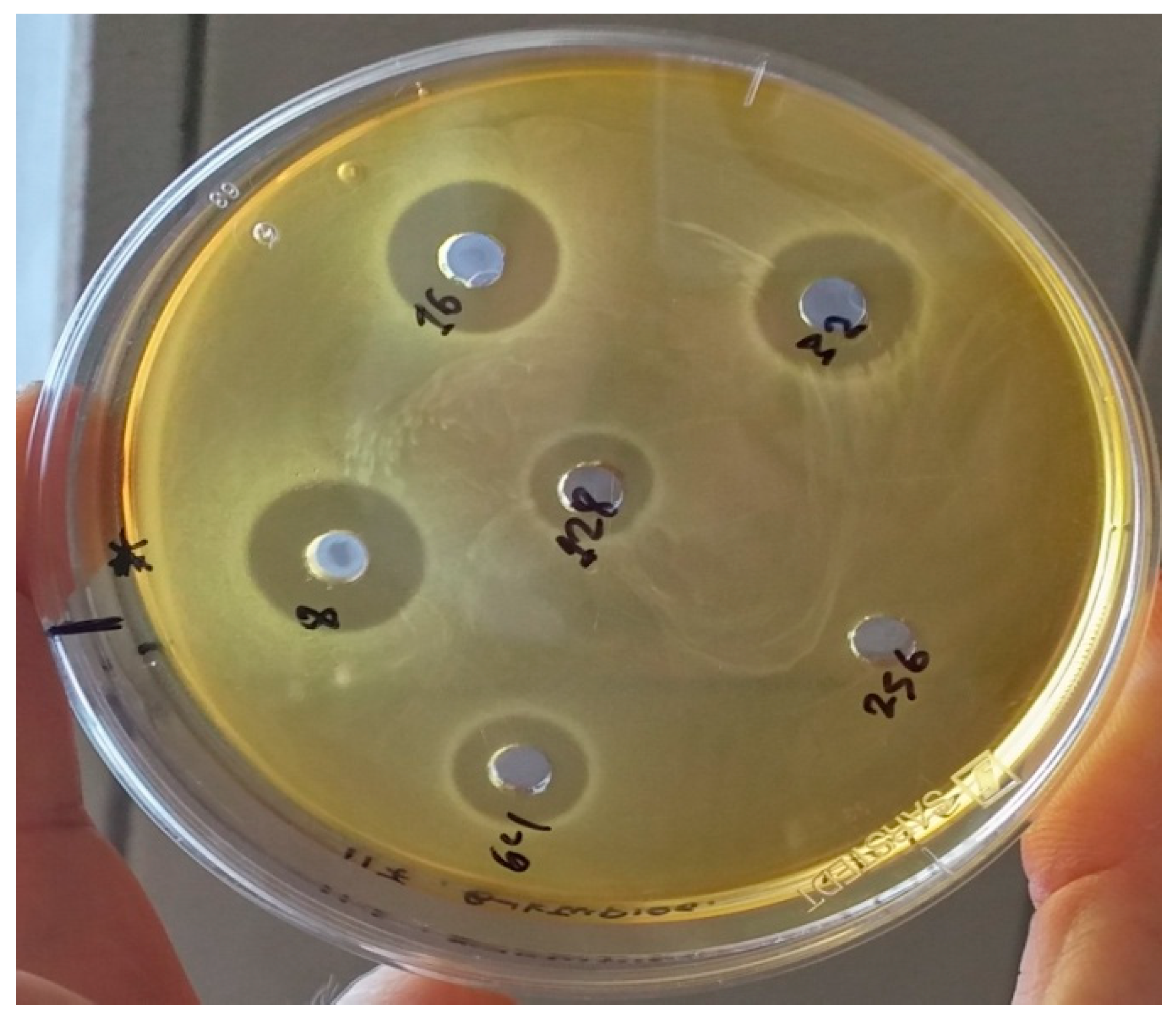
The Thermophilin-T inhibitory activity of the fermentation samples was estimated using a critical dilution method followed by an agar diffusion assay [23], with L. Lactis CNRZ 117 as the indicator strain. Briefly, 50 μL of serial twofold dilutions of neutralized cell-free culture supernatants (CFS) in 50 mM sodium phosphate buffer, pH 6.2, were placed into wells of 6 mm diameter opened onto solidified fresh indicator lawns. The lawns were made by adding 0.1% (v/v) of a fresh culture of the sensitive strain L. lactis CNRZ 117 into 15 mL of M17 agar (Biokar Diagnostics, Beauvais, France). The resulting plates were incubated overnight at 30 °C, and activity was expressed as arbitrary units (AU) per mL, corresponding to the highest dilution that produced a clear zone of inhibition of the indicator microorganism (Figure 1).

2.5. Enumeration of Microbial Populations

The enumeration of S. thermophilus counts was performed on M17 agar (Biocar Diagnostics, Beauvais, France) (surface spread) at 37 °C for 18 h under aerobic conditions. Similarly, the enumeration of the C. sporogenes population was carefully estimated in Reinforced Clostridium Medium agar (RCM) (Biocar Diagnostics, Beauvais, France) supplemented with 2 μg mL−1 cefoxitin (Vianex S.A., Athens, Greece) at 37 °C for 48 h under anaerobic conditions (BBL GasPak Anaerobic System, Becton Dickinson, NJ, USA). The use of cefoxitin for the enumeration of C. sporogenes was necessary to inhibit S. thermophilus growth under anaerobic conditions. Clostridium spores were counted in RCM agar at 37 °C for 72 h under anaerobic conditions after the samples were heated at 80 °C for 10 min.

2.6. HPLC Analysis

The organic acid content of cell-free culture supernatants of samples C5, C15, C30, and C60, corresponding to the Graviera cheese samples during the ripening days 5 to 60, was determined by HPLC (LC 1150 HPLC Pump, Varian Associates Inc., Walnut Creek, CA, USA) according to Anastasiou et al. [24]. Samples of 1 mL were mixed with 2.5 mL of distilled water at 40 °C using a Stomacher 400 Circulator (Seward, London, UK) for 5 min. After blending, the pH of the sample mixtures was adjusted to 4.5–4.6, and the mixtures were incubated at 40 °C for one hour. After centrifugation at 12,000× g for 30 min at 4 °C, 1 mL of the supernatant was precipitated with HClO4 (final concentration 6.4%) overnight. The supernatants were centrifuged (12,000× g for 1 h, 4 °C) and then filtered. A 20-μL sample of the filtrate was injected into an Aminex HPX-87H column (300 mm × 7.8 mm; Bio-Rad, Hercules, CA, USA), which was connected to a refractive index detector (model LC-1240; GBC Scientific Equipment, Melbourne, Victoria, Australia). The column elution was performed with 5 mΜ H2SO4 at a flow rate of 0.5 mL min−1 at 35 °C. The WinChrom Chromatography Data Acquisition Software, version 1.32 (GBC Scientific Equipment), was used for data acquisition and processing. Quantification of organic acids was performed using standard curves obtained from solutions of predetermined concentrations. Each analysis was done in triplicate. Calibration curves were obtained from 6-point measurements between 0.5 and 50 mM. All acids showed acceptable linearity with R2 > 0.98. The limits of detection (LOD) and quantification (LOQ) for the measured organic acids were determined using a signal-to-noise approach with refractive index detection. Under the applied chromatographic conditions (Aminex HPX-87H column, 35 °C, 0.5 mL/min, 20 µL injection), the LOD values for lactic, acetic, propionic, and butyric acids were 0.199, 0.297, 0.264, and 0.216 mM, respectively. Accordingly, the LOQ values for the above organic acids were 0.665, 0.884, 0.545, and 0.685 mM, respectively. Precision at the LOQ level was confirmed by six replicate injections, yielding %RSD values below 15%.

2.7. Statistical Analysis

All data represent the mean of three independent experiments and are expressed as mean ± standard deviation (SD). All statistical analyses were performed using SPSS software (version 20; IBM Corp., Armonk, NY, USA). Data were considered statistically significant when p < 0.05 (Tuckey’s test).

3. Results

3.1. Evolution of Microbiological Parameters

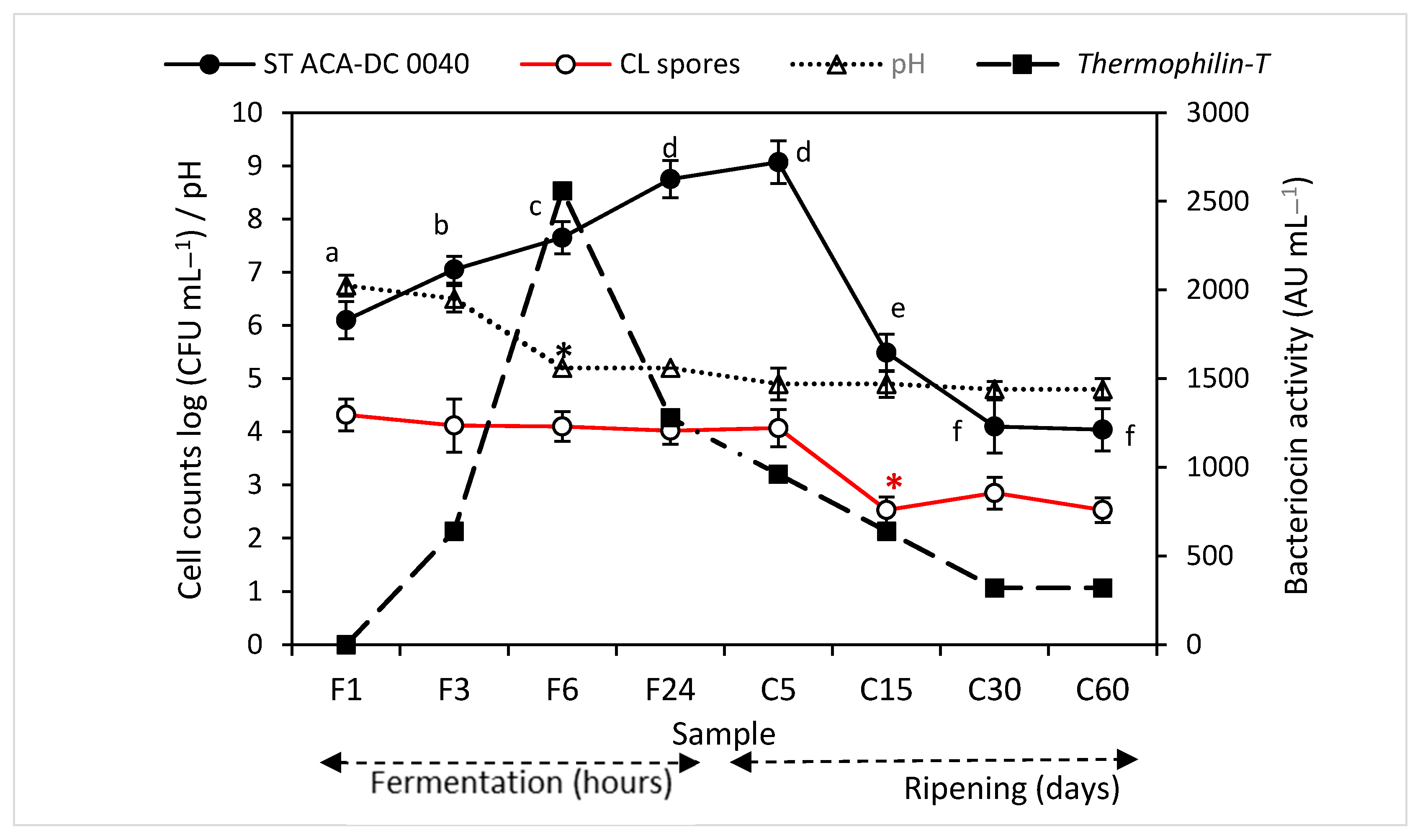
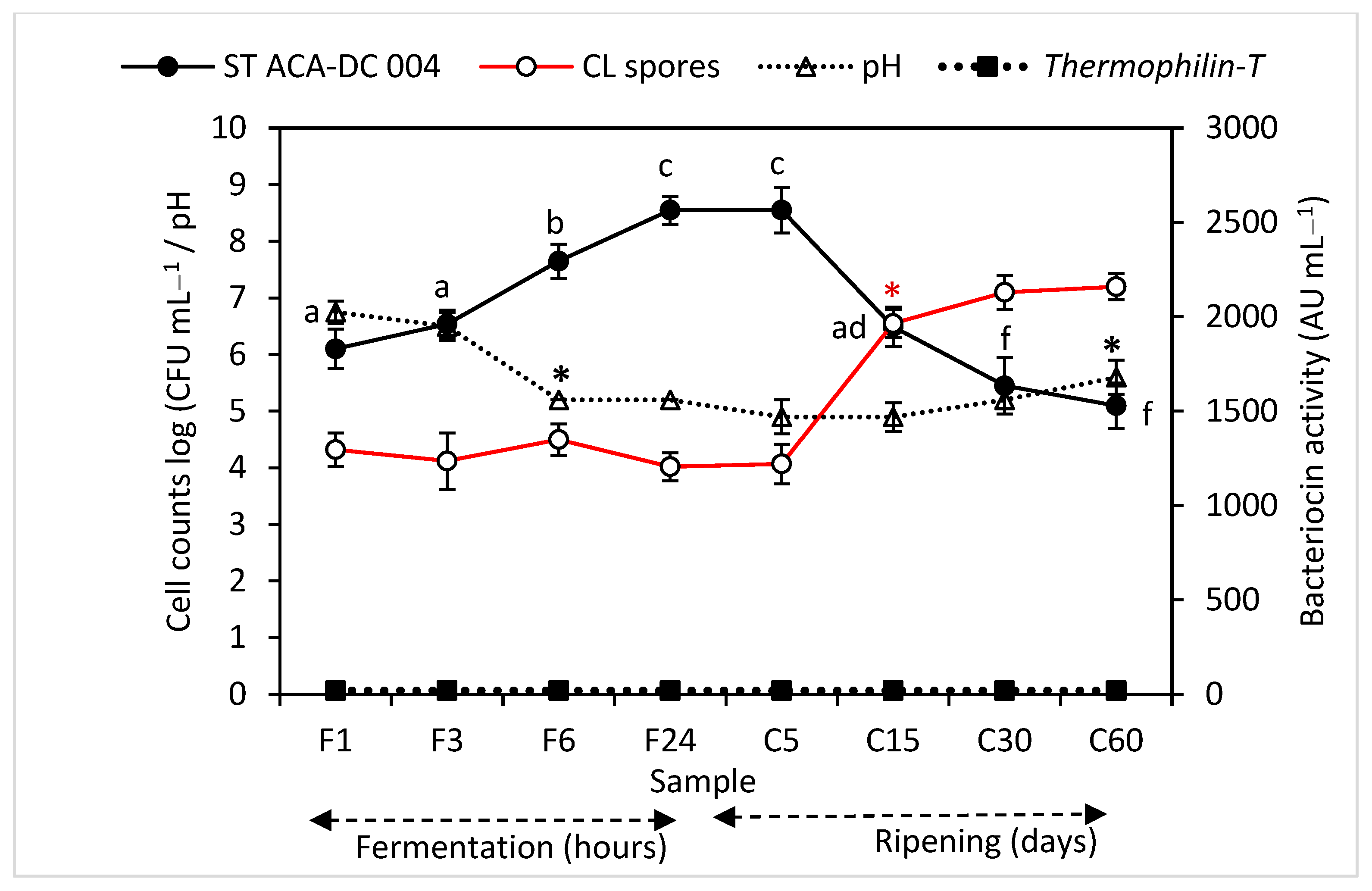
Figure 2 and Figure 3 illustrate the evolution of microbiological parameters during the preparation and ripening simulation of Graviera cheese contaminated with C. sporogenes spores, utilizing the (BP) strain S. thermophilus ACA-DC 0040 (Figure 2, Experimental trial) and the (NBP) strain S. thermophilus ACA-DC 004 (Figure 3, Control trial).
The evolution of S. thermophilus count was similar in the control and experimental trials throughout the fermentation and ripening phases. Values reached 8.75 ± 0.35 log CFU mL−1 and 8.55 ± 0.25 log CFU mL−1 for the (BP) and (NBP) strains, respectively, after 24 h in the fermentation vessel. On the fifth day of ripening, a slight increase in (BP) S. thermophilus ACA-DC 0040 was observed, reaching 9.07 ± 0.25 CFU mL−1 log during the experimental trial. In contrast, the control trial showed that the count of the (NBP) S. thermophilus ACA-DC 004 remained at the initial level of 8.55 ± 0.35 log CFU mL−1. However, throughout the rest of the ripening period, both strains showed a significant decrease, reaching approximately 4 and 5 log CFU mL−1 after 60 days in the experimental and control trials, respectively (Figure 2 and Figure 3).
The spore counts of C. sporogenes ACA-DC 3888 during ripening remained stable in both control and experimental trials until day five (average 4.07 ± 0.45 log spores mL−1). However, the control trial’s count increased to 6.55 ± 0.15 log by day 15 and reached an average of 7.2 ± 0.35 log spores mL−1 by day 60. In contrast, spore counts in the experimental trial dropped significantly to 2.65 ± 0.45 log spores per mL on day 15 and decreased further to 2.53 ± 0.35 log spores per mL by day 60. Statistical analysis showed that spore counts in the experimental trials were significantly lower (p < 0.05) than those in the control from day 15 onward, with a maximum reduction of 1.79 log units by the end of ripening.

3.2. Evolution of pH

The evolution of pH during fermentation and ripening is shown in Figure 2 and Figure 3. The pH decline in both trials was nearly identical until it reached 5.20, at which point it stabilized under the control of the fermentation regulator until the process ended at 24 h. After 15 days of ripening in the tubes, the pH dropped to 4.90 in both trials. Despite this, the pH of the experimental trial remained steady until the end of the ripening phase, as the starter’s acidification capacity was obviously limited by its metabolic death phase, unlike the control trial, which showed a significant increase in pH to 5.60.

3.3. Evolution of Bacteriocin Activity

During the fermentation and ripening phases of the trials, no inhibition of the indicator strain L. lactis CNRZ 117 was observed on any control sample plates (Figure 3). In contrast, wells containing preparations from all sampling times in the experimental trials showed clear inhibition zones, except for the first sample (F1), which corresponded to the activation time of the bacteriocinogenic strain. As shown in Figure 2, from the third hour of fermentation, the bacteriocin activity was estimated at 640 AU mL−1, reaching a peak of 2560 AU mL−1 after nearly 6 h in the F6 sample, corresponding to the end of the “draining curd” phase. After this, a significant reduction in Thermophilin-T activity to 1280 AU mL−1 was observed in sample F24, which aligns with the end of the “cheese salting” phase after 24 h. Furthermore, during the ripening phase, a notable decrease in Thermophilin-T activity was also recorded, dropping to 640 AU mL−1 on day 15, coinciding with a marked reduction in Clostridium spore counts in the experimental trial. Additionally, activity further declined to a minimum of 320 AU mL−1 by the end of ripening after 60 days.

3.4. Organic Acid Production

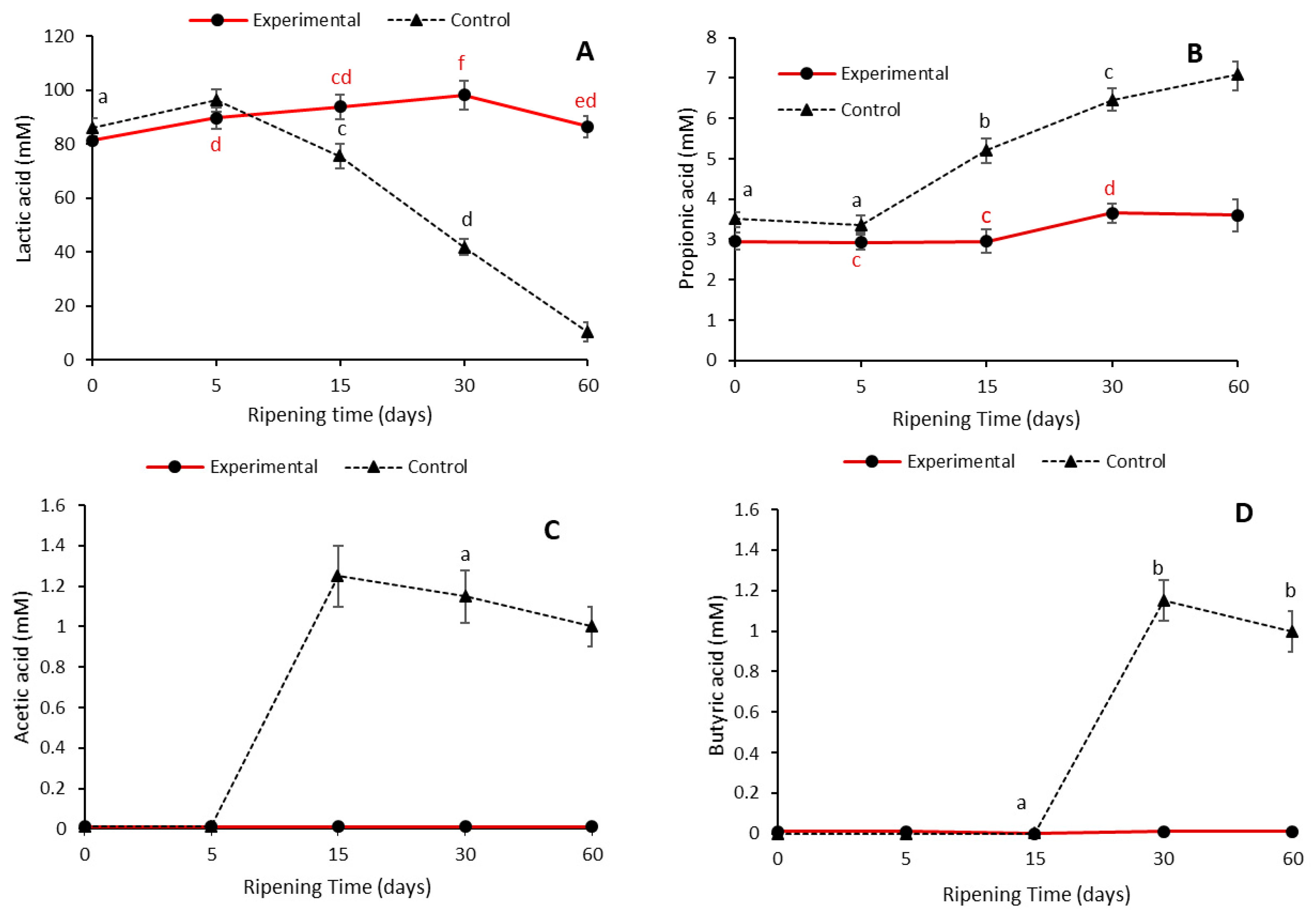
The organic acids detected during the ripening phase of both simulated cheese preparation trials in this study included lactic, acetic, propionic, and butyric acids. Figure 4 illustrates the evolution of primary organic acids throughout ripening.
Lactic acid production showed similar trends in both Experimental and Control trials until the fifth day of ripening, when levels increased to 89.69 ± 4.15 and 96.20 ± 4.45 mM, respectively (Figure 4A). However, in the Control trial with the (NBP) strain, lactate levels significantly decreased to 75.48 ± 4.25 mM (p < 0.05) at 15 days of ripening. It then dropped sharply to 10.45 ± 3.55 mM by the end of ripening, coinciding with increases in Clostridium spore count (7.2 log) and pH (5.60). Conversely, in the experimental trial, the lactate concentration continued to rise to 93.90 ± 3.50 mM at 15 days, then declined slightly but not significantly (p > 0.05) to 86.52 ± 4.35 mM at the end of ripening, coinciding with a decrease in Clostridium spore count. Acetic acid was not detected during the experimental trial, indicating that its concentration was below the HPLC LOD of 0.297 mM. In contrast, the control trial showed acetate detection after day 15 of ripening, with a concentration of 2.91 ± 0.65 mM (0.17 mg mL−1), which then slightly declined to 2.34 ± 0.35 mM by the end of ripening, as shown in Figure 4C. Regarding propionate, both trials exhibited similar trends during the first 15 days of ripening. Propionate was present in both trials from day 0, with a range of 2.35 ± 0.15 mM to 3.35 ± 0.65 mM. A significant increase to 5.2 mM (p < 0.05) at 15 days was observed in the control trial, followed by a further rise to 7.1 ± 1.25 mM at the end of ripening, as shown in Figure 4B. However, in the experimental trial with the (BP) strain, the propionate level remained nearly constant throughout ripening. In the control trial, butyrate was detected at a low concentration of 1.25 ± 0.35 mM on day 15, accompanied by a slight increase in pH to 5.20. However, as shown in Figure 4D, butyrate levels remained fairly stable for the rest of ripening. In contrast, butyrate was not detected during the experimental trial.

4. Discussion

This study aimed to evaluate the effectiveness of the bacteriocinogenic strain S. thermophilus ACA-DC 0040 in controlling the growth of C. sporogenes ACA-DC 3888 in a fermentation model that simulates Graviera cheese production and ripening. To achieve this, two fermentation setups were conducted in a vessel containing milk under conditions that mimicked cheese manufacturing. The control fermentation was inoculated with the (NBP) strain S. thermophilus ACA-DC 004 and C. sporogenes ACA-DC 3888 spores, while the experimental fermentation used the BP strain S. thermophilus ACA-DC 0040. The counts of C. sporogenes ACA-DC 3888 spores and S. thermophilus, along with pH changes, remained similar in both the control and experimental trials during the initial 24 h of fermentation and the first 5 days of ripening in the tubes. This indicates that neither S. thermophilus growth and its acidification ability, nor bacteriocin production affected Clostridium spore levels. Conversely, the Clostridium spore count significantly decreased in the experimental trial from the 15th day onward. This reduction in spore numbers between the experimental and control trials was mainly due to bacteriocin activity rather than acid production, as pH values in the experimental trial did not differ significantly (p > 0.05) from those in the control until the 15th day. Additionally, bacteriocin activity was detected in the experimental trial at all sampling times, reaching its highest value after 6 h. After that, a significant decrease in Thermophilin-T activity was observed, reaching a minimum of 320 AU mL−1 after 60 days. The decline in Thermophilin-T activity during the manufacturing and ripening phases was consistent with a previous study on Thermophilin-T characterization in milk by S. thermophilus ACA-DC 0040 [19] and with other studies [25,26] on cheese ripening. However, several studies have reported in situ bacteriocin production that remained stable during ripening [24,27,28]. Despite the high bacteriocin activity of S. thermophilus ACA-DC 0040 during the initial 24 h fermentation phase, the spore count in the experimental trial remained stable until the first 5 days of ripening, during which the Clostridium appears to be in a dormant metabolic phase. Then, despite the gradual decrease in Thermophilin-T activity, the clostridial spores decreased by 1.79 log units until day 15, where dormant spores became active. In most cases, bacteriocins are sporicidal only against spores in the outgrowth phase and therefore have no effect on those in the dormant phase. At the beginning of the outgrowth phase, bacteriocins that are inactive against dormant spores become active, inhibit outgrowth, and reduce viable counts in the germinated spore population [29,30]. Obviously, this model of bacteriocin use in foods suggests that germination is a prerequisite for its activity. Cheese ripening conditions that are prerequisites for spore outgrowth include relatively high ripening temperatures (typically >10–15 °C), a high pH (>5.0–5.30), and high moisture content [30]. These conditions, which allow dormant spores to germinate, also occurred during the ripening phase of Graviera cheese in our experiment trials (16 °C, pH 5.20–4.90), enabling Clostridium spores to be more effectively targeted by Thermophilin-T, despite its lower activity titer. Similarly, the bacteriocin production by Streptococcus thermophilus 580 was capable of inhibiting C. tyrobutyricum gas production in a ripening curd model for up to 20 days, when compared to controls, which produced gas after 8 days [22]. Top of Form The inability of Clostridial spores to germinate during ripening and the sporicidal effect should be attributed to the synergistic effect of low pH and Thermophilin-T activity, considering that, in the control trial, spore counts increased by about 2.9 logs during ripening. Similar findings have been reported in related studies on cheeses made from milk inoculated with bacteriocin-producing lactic acid bacteria (LAB) and Clostridial spores, where spore counts decreased by more than 3 log units during ripening [31,32]. The low pH inhibits early germination and growth, while the bacteriocin acts as a secondary hurdle, destroying any cells that manage to germinate despite the acidity. Bacteriocins do not typically kill dormant spores directly, but they are highly effective at inhibiting the “outgrowth” phase—the transition from a germinated spore to a multiplying vegetative cell. Once the spore germinates, the bacteriocin (e.g., nisin) binds to the cell membrane, creating pores that cause leakage of essential cellular components [30,33]. Conversely, other studies observed that Clostridial spore numbers remained relatively constant [34] or even increased by approximately 2.5 log units [35] by the end of ripening compared to the initial counts. An increase in Clostridial spores in cheese indicates spore germination, vegetative cell growth, and subsequent sporulation [34,35]. However, conflicting results from similar studies suggest that preventing LBD in cheese depends on several factors, including bacteriocin stability, its antimicrobial mode of action, pH, salt concentration, and various technological interventions during cheese making. In our study, the pH in the experimental trial remained stable until the ripening phase, whereas the control trial increased to 5.60. This pH increase could be attributed to the proteolytic activity of Clostridium spores during outgrowth on cheese curd casein, which produces peptides and free amino acids, which are subsequently deaminated. This releases ammonia, a basic (alkaline) compound that neutralizes the lactic acid in the cheese matrix, thereby raising the pH. Likewise, Ávila et al. [4], who used a nisin-producing Lactococcal starter in cheese production to prevent LBDs, observed that the pH stayed stable during storage in control cheeses [2]. However, the pH increased from the 14th day in a cheese containing C. tyrobutyricum. This phenomenon has been linked to deacidification caused by Clostridium metabolism [1,2,35].
The organic acids identified during the ripening phase of both simulated cheese preparation trials included lactic, acetic, propionic, and butyric acids. In our study, the control trial with the BNP strain showed higher levels of propionic, acetic, and butyric acids, along with lower lactate levels, than the experimental trial. This increase indicates the late-blowing defect (LBD) condition, a major cause of spoilage in semi-hard and hard cheeses [5]. Acetic acid is linked to vinegar and pungent odors, propionic acid to gas, burnt, and pungent odors, and butyric acid to rancid, fecal, and sweaty odors [36].
According to Garde et al. [37], cheese spoiled by LBD showed higher levels of acetic and butyric acids, along with lower lactic acid and increased propionic acid levels. Additionally, the LBD condition in the control trial was linked to a significant increase (p < 0.05) of about 3.5 log units in the C. sporogenes spore count. Elevated levels of butyric and propionic acids have also been found in spoiled cheese made from milk artificially contaminated with spores of C. sporogenes INIA 71 and C. butyricum CECT 361 [2]. A connection between propionic and butyric acid fermentation in late-blowing Emmental cheese artificially contaminated with a C. tyrobutyricum strain was also observed by Le Bourhis et al. [1]. Conversely, S. thermophilus generally does not produce propionate or butyrate. It is primarily a homofermentative lactic acid bacterium, meaning its main metabolic product is lactic acid during carbohydrate fermentation. This is supported by the high lactic acid levels in both fermentation trials, ranging from 66.21 ± 0.5 to 89.69 ± 0.75 mM. The initially low propionate concentration at the start of both fermentations mainly originates from natural fermentation processes in the dairy cow’s rumen and possibly from calcium propionate supplementation of dairy cows’ diets to increase milk yield [38]. A significant increase (p < 0.05) in propionate was observed after 15 days in the control trial, reaching 7.1 mM by the end of ripening, coinciding with a marked increase in Clostridium spore counts. In contrast, propionate levels in the experimental trial remained. relatively stable throughout ripening, while Clostridium spores decreased. However, as Le Bourhis et al. [1] reported, different Clostridium strains produce markedly different patterns of propionic acid in Emmental cheese, with C. tyrobutyricum increasing propionic acid content and C. beijernickii and C. sporogenes decreasing it in cheeses inoculated with these strains. Acetic acid remained undetectable during the experimental trial; however, the control trial showed acetate production after the 15th day of ripening, reaching 2.91 mM. In a related study on C. sporogenes physiology in a fermenter, ref. [39] reported that the C. sporogenes strain 3121 produced acetic acid in quantities exceeding 10 mM in trypticase soy broth. Acetic acid acts as an intermediate in the pathway converting lactic acid to butyric acid, and can be transformed into acetyl-CoA, thereby increasing butyric acid yield [40,41]. Similarly, Garde et al. [34] reported acetic acid production in milk inoculated with C. tyrobutyricum spores. As a result of butyric acid fermentation, spoiled cheese showed higher concentrations of acetic and butyric acids, with lower lactic acid and higher propionic acid [34]. Additionally, Manchego cheeses with LBD had higher acetic acid levels than those without LBD, suggesting a role for Clostridium in acetic acid production [37]. Likewise, in our study, butyrate was detected in the control trial at 1.25 mM on day 30, coinciding with a slight rise in pH to 5.2 and a decrease in lactate concentration. Furthermore, the lactate level decreased significantly to 15.45 mM (p < 0.05), while the pH increased to 5.6 by day 60. The relatively low butyrate level (1.25 mM) aligns with Montville’s [39] report, which indicated that butyrate produced by C. sporogenes 3121 in Trypticase soy broth was also low (1.9 mM) at pH 5. According to Klijn et al. [20], a butyric acid concentration above 1.13 mM (100 mg Kg−1) in cheese indicates butyric acid fermentation; therefore, the detected butyrate suggests potential LBD conditions. In contrast, no butyrate was detected during the experimental trial with the BP strain, and lactate levels remained constant. According to Tao et al. [41], the butyrate-producing Clostridium strain BP5 can ferment lactate into butyrate as its main product, with lactate concentrations ranging from 66 to 104 mM and pH from 5.5 to 7.0. However, this conversion by strain BP5 was limited by low pH and was prevented when the pH fell below 4.8. Despite inhibition of growth, C. sporogenes can remain metabolically active (e.g., in terms of fermentation, albeit with shifts in product ratios) at pH values as low as 4.5. Some studies on C. sporogenes MD1 [42] showed that metabolic activity, such as ammonia production, did not decrease until the pH was below 4.5. At pH 5.0, butyrate production was markedly lower compared to higher pH levels. Similarly, in our study, lactate conversion was observed in the control trial, starting at 75.48 mM and pH 4.9, which was almost at the threshold for lactate fermentation, yet it still produced a relatively low amount of butyric acid (1.25 mM) after 30 days of ripening. Clearly, the low butyrate production (1.25 mM) was due to the low pH, consistent with Montville et al. [39] report that butyrate production by C. sporogenes 3121 in Trypticase soy broth was also low (1.9 mM) at pH 5.

5. Conclusions

The findings of this study highlight the sporicidal effect of Thermophilin-T produced ‘in situ’ by S. thermophilus ACA-DC 0040, used as a starter culture in a cheese model simulating the manufacture and ripening of Graviera cheese. A reduction in Clostridium spores was observed from day 15 onward, reaching a maximum of 1.79 log units on day 60, compared with the control trial using an NBP S. thermophilus starter, where spore counts increased. Moreover, the control trial showed higher levels of propionic, acetic, and butyric acids, along with lower lactate levels than the experimental trial, indicating a late blow defect. However, further research in real Graviera production is needed to confirm these findings throughout the ripening process. Commercial effectiveness remains unproven because factors like milk fat, rennet, and natural microflora can impair Thermophilin-T’s anticlostridial activity.

Author Contributions

Conceptualization A.A. and S.B.; methodology A.A., S.B. and M.G.; investigation A.A., S.B., M.G., A.G. and G.M.; resources A.G., S.B. and G.M.; writing—original draft A.A.; writing—review and editing G.M., A.G. and S.B.; supervision A.A. All authors have read and agreed to the published version of the manuscript.

Funding

This research received no external funding.

Institutional Review Board Statement

Not applicable.

Informed Consent Statement

Not applicable.

Data Availability Statement

The original contributions presented in this study are included in this article. Further inquiries can be directed to the corresponding author.

Acknowledgments

We acknowledge the ACA-DC Culture Collection Curator, Eugenia Manolopoulou, for her kind supply of bacterial strains used in this research.

Conflicts of Interest

Author Stellina Baklagi was employed by the company METRO AEBE. The remaining authors declare that the research was conducted in the absence of any commercial or financial relationships that could be construed as a potential conflict of interest.

Abbreviations

The following abbreviations are used in this manuscript:
ACA-DCAgricultural College of Athens-Dairy Collection
LBDLate Blowing Defect
BAFButyric Acid Fermentation
AUArbitrary Units
BPBacteriocin Producing
NBPNon Bacteriocin Producing

References

  1. Le Bourhis, A.-G.; Doré, J.; Carlier, J.-P.; Chamba, J.-F.; Popoff, M.-R.; Tholozan, J.-L. Contribution of C. beijerinckii and C. sporogenes in Association with C. tyrobutyricum to the Butyric Fermentation in Emmental Type Cheese. Int. J. Food Microbiol. 2007, 113, 154–163. [Google Scholar] [CrossRef] [PubMed]
  2. Gómez-Torres, N.; Garde, S.; Peirotén, Á.; Ávila, M. Impact of Clostridium spp. on Cheese Characteristics: Microbiology, Color, Formation of Volatile Compounds and off-Flavors. Food Control 2015, 56, 186–194. [Google Scholar] [CrossRef]
  3. Podrzaj, L.; Burtscher, J.; Küller, F.; Domig, K.J. Strain-Dependent Cheese Spoilage Potential of Clostridium tyrobutyricum. Microorganisms 2020, 8, 1836. [Google Scholar] [CrossRef]
  4. Ávila, M.; Gómez-Torres, N.; Gaya, P.; Garde, S. Effect of a Nisin-Producing Lactococcal Starter on the Late Blowing Defect of Cheese Caused by Clostridium tyrobutyricum. Int. J. Food Sci. Technol. 2020, 55, 3343–3349. [Google Scholar] [CrossRef]
  5. Cocolin, L.; Innocente, N.; Biasutti, M.; Comi, G. The Late Blowing in Cheese: A New Molecular Approach Based on PCR and DGGE to Study the Microbial Ecology of the Alteration Process. Int. J. Food Microbiol. 2004, 90, 83–91. [Google Scholar] [CrossRef] [PubMed]
  6. Brown, J.L.; Tran-dinh, N.; Chapman, B. Clostridium sporogenes PA 3679 and Its Uses in the Derivation of Thermal Processing Schedules for Low-Acid Shelf-Stable Foods and as a Research Model for Proteolytic Clostridium botulinum. J. Food Prot. 2012, 75, 779–792. [Google Scholar] [CrossRef] [PubMed]
  7. Diao, M.M.; André, S.; Membré, J.-M. Meta-Analysis of D-Values of Proteolytic Clostridium botulinum and Its Surrogate Strain Clostridium sporogenes PA 3679. Int. J. Food Microbiol. 2014, 174, 23–30. [Google Scholar] [CrossRef]
  8. Taylor, R.H.; Dunn, M.L.; Ogden, L.V.; Jefferies, L.K.; Eggett, D.L.; Steele, F.M. Conditions Associated with Clostridium sporogenes Growth as a Surrogate for Clostridium botulinum in Nonthermally Processed Canned Butter. J. Dairy Sci. 2013, 96, 2754–2764. [Google Scholar] [CrossRef] [PubMed]
  9. Driehuis, F.; Elferink, S.J.W.H.O. The Impact of the Quality of Silage on Animal Health and Food Safety: A Review. Vet. Q. 2000, 22, 212–216. [Google Scholar] [CrossRef] [PubMed]
  10. Carminati, D.; Perrone, A.; Neviani, E. Inhibition of Clostridium sporogenes Growth in Mascarpone Cheese by Co-Inoculation with Streptococcus thermophilus under Conditions of Temperature Abuse. Food Microbiol. 2001, 18, 571–579. [Google Scholar] [CrossRef]
  11. Loessner, M.J.; Maier, S.K.; Schiwek, P.; Scherer, S. Long-Chain Polyphosphates Inhibit Growth of Clostridium tyrobutyricum in Processed Cheese Spreads. J. Food Prot. 1997, 60, 493–498. [Google Scholar] [CrossRef]
  12. Regulation—1333/2008—EN—Additives—EUR-Lex. Available online: https://eur-lex.europa.eu/eli/reg/2008/1333/oj/eng (accessed on 17 September 2025).
  13. Current Publications of the Articles of the Food and Drinks Code. 2009. Available online: https://www.aade.gr/en/chemical-laboratories/businesses/food-materials-contact-food/current-publications-articles-food-and-drinks-code (accessed on 7 January 2025).
  14. Abee, T.; Krockel, L.; Hill, C. Bacteriocins: Modes of Action and Potentials in Food Preservation and Control of Food Poisoning. Int. J. Food Microbiol. 1995, 28, 169–185. [Google Scholar] [CrossRef]
  15. Silva, C.C.G.; Silva, S.P.M.; Ribeiro, S.C. Application of Bacteriocins and Protective Cultures in Dairy Food Preservation. Front. Microbiol. 2018, 9, 594. [Google Scholar] [CrossRef]
  16. Ribeiro, S.C.; O’Connor, P.M.; Ross, R.P.; Stanton, C.; Silva, C.C.G. An Anti-Listerial Lactococcus lactis Strain Isolated from Azorean Pico Cheese Produces Lacticin 481. Int. Dairy J. 2016, 63, 18–28. [Google Scholar] [CrossRef]
  17. Burgos, M.J.G.; Pulido, R.P.; Aguayo, M.C.L.; Gálvez, A.; Lucas, R. The Cyclic Antibacterial Peptide Enterocin AS-48: Isolation, Mode of Action, and Possible Food Applications. Int. J. Mol. Sci. 2014, 15, 22706–22767. [Google Scholar] [CrossRef]
  18. González, L.; Zárate, V. Inhibitory activity of Lactobacillus plantarum TF711 against Clostridium sporogenes when used as adjunct culture in cheese manufacture. J. Dairy Res. 2015, 82, 236–241. [Google Scholar] [CrossRef]
  19. Aktypis, A.; Kalantzopoulos, G.; Huis in’t Veld, J.H.J.; Ten Brink, B. Purification and Characterization of Thermophilin-T, a Novel Bacteriocin Produced by Streptococcus thermophilus ACA-DC 0040. J. Appl. Microbiol. 1998, 84, 568–576. [Google Scholar] [CrossRef]
  20. Klijn, N.; Nieuwenhof, F.F.; Hoolwerf, J.D.; van der Waals, C.B.; Weerkamp, A.H. Identification of Clostridium Tyrobutyricum as the Causative Agent of Late Blowing in Cheese by Species-Specific PCR Amplification. Appl. Environ. Microbiol. 1995, 61, 2919–2924. [Google Scholar] [CrossRef] [PubMed]
  21. Akbal1, S.; Öner, Z. Investigation of Some Properties and Late Blowing Defect of Model White Cheeses Contaminated with Clostridium sporogenes Strains. Turk. J. Agric. Food Sci. Technol. 2025, 13, 958–963. [Google Scholar] [CrossRef]
  22. Mathot, A.G.; Beliard, E.; Thuault, D. Streptococcus thermophilus 580 Produces a Bacteriocin Potentially Suitable for Inhibition of Clostridium tyrobutyricum in Hard Cheese. J. Dairy Sci. 2003, 86, 3068–3074. [Google Scholar] [CrossRef] [PubMed]
  23. Tagg, J.R.; McGiven, A.R. Assay System for Bacteriocins. Appl. Microbiol. 1971, 21, 943. [Google Scholar] [CrossRef] [PubMed]
  24. Anastasiou, R.; Aktypis, A.; Georgalaki, M.; Papadelli, M.; De Vuyst, L.; Tsakalidou, E. Inhibition of Clostridium tyrobutyricum by Streptococcus macedonicus ACA-DC 198 under Conditions Mimicking Kasseri Cheese Production and Ripening. Int. Dairy J. 2009, 19, 330–335. [Google Scholar] [CrossRef]
  25. Benech, R.-O.; Kheadr, E.E.; Laridi, R.; Lacroix, C.; Fliss, I. Inhibition of Listeria innocua in Cheddar Cheese by Addition of Nisin Z in Liposomes or by In Situ Production in Mixed Culture. Appl. Environ. Microbiol. 2002, 68, 3683–3690. [Google Scholar] [CrossRef]
  26. Garde, S.; Gómez-Torres, N.; Hernández, M.; Ávila, M. Susceptibility of Clostridium perfringens to Antimicrobials Produced by Lactic Acid Bacteria: Reuterin and Nisin. Food Control 2014, 44, 22–25. [Google Scholar] [CrossRef]
  27. Foulquié Moreno, M.R.; Callewaert, R.; Devreese, B.; Van Beeumen, J.; De Vuyst, L. Isolation and Biochemical Characterisation of Enterocins Produced by Enterococci from Different Sources. J. Appl. Microbiol. 2003, 94, 214–229. [Google Scholar] [CrossRef]
  28. Rodríguez, E.; Calzada, J.; Arqués, J.L.; Rodríguez, J.M.; Nuñez, M.; Medina, M. Antimicrobial Activity of Pediocin-Producing Lactococcus lactis on Listeria monocytogenes, Staphylococcus aureus and Escherichia coli O157:H7 in Cheese. Int. Dairy J. 2005, 15, 51–57. [Google Scholar] [CrossRef]
  29. Egan, K.; Field, D.; Rea, M.C.; Ross, R.P.; Hill, C.; Cotter, P.D. Bacteriocins: Novel Solutions to Age-Old Spore-Related Problems? Front. Microbiol. 2016, 7, 461. [Google Scholar] [CrossRef] [PubMed]
  30. Gut, I.M.; Prouty, A.M.; Ballard, J.D.; van der Donk, W.A.; Blanke, S.R. Inhibition of Bacillus anthracis spore outgrowth by nisin. Antimicrob. Agents Chemother. 2008, 52, 4281–4288. [Google Scholar] [CrossRef]
  31. Rilla, N.; Martínez, B.; Delgado, T.; Rodríguez, A. Inhibition of Clostridium tyrobutyricum in Vidiago Cheese by Lactococcus lactis Ssp. Lactis IPLA 729, a Nisin Z Producer. Int. J. Food Microbiol. 2003, 85, 23–33. [Google Scholar] [CrossRef]
  32. Carmen Martínez-Cuesta, M.; Bengoechea, J.; Bustos, I.; Rodríguez, B.; Requena, T.; Peláez, C. Control of Late Blowing in Cheese by Adding Lacticin 3147-Producing Lactococcus lactis IFPL 3593 to the Starter. Int. Dairy J. 2010, 20, 18–24. [Google Scholar] [CrossRef]
  33. Abhyankar, W.; de Koning, L.J.; Brul, S.; de Koster, C.G. Spore proteomics: The past, present and the future. FEMS Microbiol. Lett. 2014, 358, 137–144. [Google Scholar] [CrossRef][Green Version]
  34. Garde, S.; Arias, R.; Gaya, P.; Nuñez, M. Occurrence of Clostridium spp. in Ovine Milk and Manchego Cheese with Late Blowing Defect: Identification and Characterization of Isolates. Int. Dairy J. 2011, 21, 272–278. [Google Scholar] [CrossRef]
  35. Bogovič Matijašić, B.; Koman Rajšp, M.; Perko, B.; Rogelj, I. Inhibition of Clostridium tyrobutyricum in Cheese by Lactobacillus gasseri. Int. Dairy J. 2007, 17, 157–166. [Google Scholar] [CrossRef]
  36. Curioni, P.M.G.; Bosset, J.O. Key Odorants in Various Cheese Types as Determined by Gas Chromatography-Olfactometry. Int. Dairy J. 2002, 12, 959–984. [Google Scholar] [CrossRef]
  37. Garde, S.; Ávila, M.; Gaya, P.; Arias, R.; Nuñez, M. Sugars and Organic Acids in Raw and Pasteurized Milk Manchego Cheeses with Different Degrees of Late Blowing Defect. Int. Dairy J. 2012, 25, 87–91. [Google Scholar] [CrossRef]
  38. Zhang, F.; Tang, X.; Xiong, B. Optimal Calcium Propionate Supplementation in Early-Lactation Dairy Cows Improves Milk Yield and Alters Milk Composition. Animals 2025, 15, 2995. [Google Scholar] [CrossRef]
  39. Montville, T.J.; Parris, N.; Conway, L.K. Influence of pH on Organic Acid Production by Clostridium sporogenes in Test Tube and Fermentor Cultures. Appl. Environ. Microbiol. 1985, 49, 733–736. [Google Scholar] [CrossRef] [PubMed]
  40. Canganella, F.; Kuk, S.-U.; Morgan, H.; Wiegel, J. Clostridium thermobutyricum: Growth Studies and Stimulation of Butyrate Formation by Acetate Supplementation. Microbiol. Res. 2002, 157, 149–156. [Google Scholar] [CrossRef]
  41. Tao, Y.; Hu, X.; Zhu, X.; Jin, H.; Xu, Z.; Tang, Q.; Li, X. Production of Butyrate from Lactate by a Newly Isolated Clostridium sp. BPY5. Appl. Biochem. Biotechnol. 2016, 179, 361–374. [Google Scholar] [CrossRef]
  42. Flythe, M.D.; Russell, J.B. Fermentation acids inhibit amino acid deamination by Clostridium sporogenes MD1 via a mechanism involving a decline in intracellular glutamate rather than protonmotive force. Microbiology 2006, 152, 2619–2624. [Google Scholar] [CrossRef][Green Version]
Figure 1. Thermophilin-T activity estimation by agar diffusion test [23], expressed as arbitrary units (AU mL−1). The numbers (8–256) correspond to the serial dilutions of cell-free culture supernatants of (BP) S. thermophilus ACA-DC 0040. The clear zones indicate the inhibition of the indicator strain.
Fermentation 12 00125 g001
Figure 2. Changes in S. thermophilus ACA-DC 0040 (●), and C. sporogenes ACA-DC 3888 spore (○) counts, pH (Δ), and bacteriocin activity (▪), in the Experimental trial. Data reported are means (±) standard deviations of three repetitions. Different letters of the same indicator and asterisk (*) indicate a significant difference (p < 0.05, based on the Tukey HSD test). The asterisk’s color matches the color of each line.
Fermentation 12 00125 g002
Figure 3. Changes in S. thermophilus ACA-DC 004 (●), C. sporogenes ACA-DC 3888 spore (○) counts, pH (Δ), and bacteriocin activity (▪) in the Control trial. Data are means (±) standard deviations of three repetitions. Different letters next to the same indicator and an asterisk (*) indicate significant differences (p < 0.05, based on the Tukey HSD test). The asterisk’s color matches the color of each line.
Fermentation 12 00125 g003
Figure 4. Evolution of organic acids during Graviera cheese ripening. (A) Lactic acid; (B) propionic acid; (C) acetic acid; (D) Butyric acid. Symbols: () Experimental trial; (▲) Control trial. Data reported are means (±) standard deviations of three repetitions. Different letters of the same indicator indicate significant difference (p < 0.05, based on the Tukey HSD test).
Fermentation 12 00125 g004
Table 1. Samples collected at various stages, simulating preparation and ripening of Graviera cheese.
SampleSampling
Time
Graviera Cheese Manufacturing Phase
F11 hStarter culture activation at 37 °C, 1 h
F33 hCurd scalding at 52 °C, 20 min
F66 hCurd drainage at 16 °C
F2424 hSalting at 16 °C
C55th dRipening at 16 °C
C1515th dRipening at 16 °C
C3030th dRipening at 16 °C
C6060th dRipening at 16 °C
Disclaimer/Publisher’s Note: The statements, opinions and data contained in all publications are solely those of the individual author(s) and contributor(s) and not of MDPI and/or the editor(s). MDPI and/or the editor(s) disclaim responsibility for any injury to people or property resulting from any ideas, methods, instructions or products referred to in the content.