1. Introduction
Mulberry, an oval-shaped, nutritionally dense fruit of the Morus genus within the Moraceae family, exhibits considerable diversity with 24 recognized species, one subspecies, and over 100 identified varieties [
1]. Paleobotanical, morphological, anatomical, and molecular evidence suggests that mulberry originated in the Himalayan foothills before dispersing across Asia, Europe, and the Americas. Historical cultivation records indicate Chinese domestication as early as 2200 BC, with contemporary global production concentrated in China (626,000 hectares) and India (280,000 hectares), predominantly featuring black mulberry (
Morus nigra L.), white mulberry (
Morus alba L.), and red mulberry (
Morus rubra L.) [
2].
The nutritional composition of mulberry components is influenced by cultivar, environmental conditions, and processing methods. Fresh mulberry fruits contain dry matter (9.45–28.50%), crude protein (0.51–2.98%), crude fat (0.34–7.21%), and ash (0.46–4.79%). Fresh mulberry leaves exhibit broader compositional ranges: dry matter (19.8–30.4%), crude protein (4.7–22.3%), crude fat (0.6–4.4%), ash (4.1–14.5%), carbohydrates (8.1–13.4%), and neutral detergent fiber (8.1–43.4%). Dried mulberry leaves demonstrate enhanced nutrient density, with crude protein (11.75–37.36%), neutral detergent fiber (19.38–36.66%), and acid detergent fiber (10.2–29.7%). Additionally, mulberry leaves provide essential micronutrients, including calcium (380–786 mg/100 g), ascorbic acid (200–280 mg/100 g), β-carotene (10,000–14,688 μg), iron (4.7–10.36 mg/100 g), and zinc (0.22–1.12 mg/100 g) [
3,
4].
Industrial processing generates mulberry pomace, comprising approximately 8% of fresh fruit weight and consisting primarily of peels and stems, which currently presents environmental disposal challenges despite its potential as ruminant feed [
5]. Recent studies have established mulberry derivatives as effective protein sources across livestock species. Dietary inclusion of 3.5% mulberry leaf powder enhanced the growth performance of broiler chickens [
6], while 4% supplementation modulated intestinal microbiota by promoting beneficial bacterial populations, including
Bacteroides,
Prevotella, and
Megamonas [
7]. Fermented mulberry leaf powder at 3% inclusion optimized daily weight gain and feed conversion efficiency in broiler chickens [
8].
Ruminant studies have shown that mulberry leaf flavonoids ameliorate pathogenic
Escherichia coli K99 infections through growth promotion, diarrhea reduction, and intestinal microbiota regulation [
9]. Mulberry supplementation facilitates rumen papilla regeneration and enhances basal layer integrity in sheep [
10], while 600 g/d mulberry leaf pellets improve dry matter intake, ruminal ammonia concentrations, and cellulolytic bacterial populations in cattle [
11]. Furthermore, inclusion of 5–10% mulberry leaf in silage promotes rumen microflora development, enhances fermentation efficiency, and supports fiber digestion while maintaining milk fat-associated microbial communities [
12].
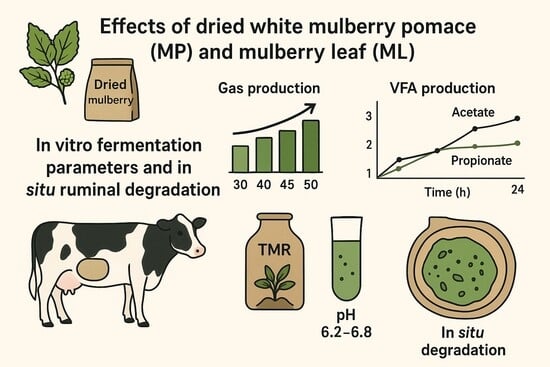
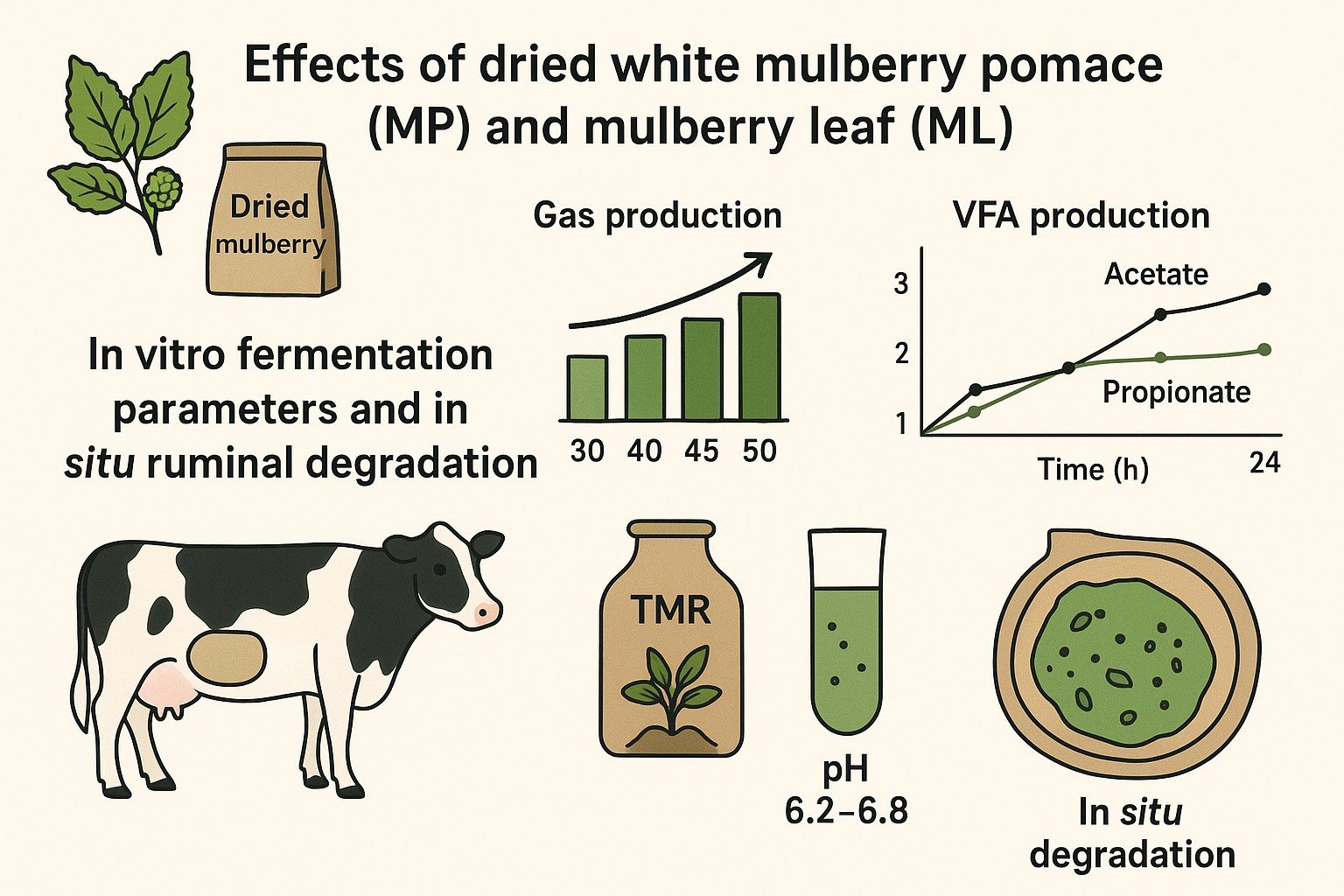
Although extensive studies have documented the nutritional value and antioxidant properties of mulberry, a comprehensive understanding of mulberry pomace and leaf in ruminant nutrition remains limited. Therefore, this study was designed to evaluate the in vitro fermentation characteristics (total gas production, ammonia concentration, volatile fatty acid profiles, methane emissions, and CO2 production) and in situ degradation kinetics of mulberry pomace and mulberry leaves to establish their potential as sustainable non-conventional ruminant feed resources.
3. Results
The chemical composition of both basal TMRs (designated as 30N, 35N, 40N, 45N, and 50N) and experimental TMRs (identified as MP and ML and their combinations with basal TMRs) was determined through comprehensive proximate and fiber analyses, with complete compositional data presented in
Table 2.
Significant differences (
p < 0.001) were seen between the groups in terms of gas production at different incubation hours (
Table 3). In the mulberry pomace supplemented groups, the highest gas production was observed in the 45NP group, while the lowest gas production was noted in the MP group. In the mulberry leaf-supplemented groups, the highest gas production was observed in the 50NL group, while the lowest gas production was observed in the ML group.
No difference was observed between the ratios of acetic acid to propionic acid (acetate/propionate, A/P). The acetic acid ratio was greater in groups with mulberry leaf (
Table 4), whereas the propionic acid ratio was greater in groups with mulberry pomace compared to other groups. The butyric acid ratio was greater in groups where mulberry leaf was added. As the fermentation time extended (from 24 h to 48 h), significant increases were noted in VFA production (
p < 0.05).
It is shown in
Table 5 that the time factor has a significant effect on pH (
p < 0.001). In groups with added mulberry pomace, the lowest mean ammonia was seen in the 30NP group (11.34), while the highest was noted in the 50NP group (12.29).
The mulberry pomace (MP) group exhibited a progressive increase in IVNDFDM from the 2nd hour to the 240th hour (
Table 6). The mulberry leaf (ML) group showed significantly higher IVNDFDM values compared to the MP group at all time points. Within each group, all time points were significantly different from one another (
p < 0.05) and showed a distinct temporal progression in fiber digestion. In the early period of incubation (2–8 h), mulberry leaf showed markedly higher digestibility than mulberry pomace. Although the amount of indigestible NDF was detected at similar levels in both groups, physically effective NDF (pdNDF) was found to be 62.2% higher in mulberry leaf compared to mulberry pomace.
The degrees of degradation of mulberry leaf and mulberry pomace in the in situ environment over time are indicated in
Table 7. Degradation rates of mulberry pomace and leaf increased after the 8th hour. Degradation of mulberry pomace was almost complete at the 48th hour, and that of mulberry leaf at the 24th hour (
p < 0.05).
4. Discussion
Chemical composition of mulberry leaves and pomace demonstrates a nutritional profile consistent with leguminous forages, exhibiting greater crude protein and reduced fiber concentrations relative to gramineous species. Variations in the nutritional composition of mulberry-derived by-products reflect the influence of cultivar selection, environmental conditions, and harvest timing, with the analyzed samples conforming to established nutritional ranges documented in previous studies.
Fiber fraction analysis revealed NDF values within the globally reported range of 26.6–46.0% and ADF concentrations spanning 18.7–35% [
33,
34]. While crude fiber content aligned with the established range of 9.1–15.3% reported in previous studies [
33,
35,
36]. The current study exhibited lower NDF concentrations compared to certain studies [
37,
38] yet was consistent with Vu et al. [
39]. Ash content exceeded the ranges documented by some studies [
40,
41,
42], while similar to others (2009) [
43,
44,
45]. According to research findings, the higher ash content of MP (21.7% vs. 19%) affects fermentation dynamics in various ways. When evaluated in terms of mineral–microbial interactions, although certain minerals are necessary for cellulolytic bacteria, it is considered that excessive mineral presence may exhibit inhibitory effects and negatively affect microbial protein synthesis.
A previous study has established mulberry leaves as viable protein supplements for ruminants, with ensiled preparations demonstrating equivalent growth performance to conventional protein sources without adverse effects on dry matter intake [
46]. Our findings support these notions since enhanced fermentation characteristics were noted in mulberry-supplemented treatments.
Gas production kinetics revealed distinct patterns between mulberry pomace and leaf. Mulberry pomace exhibited optimal fermentation when combined with 45% NDF substrates, while pomace alone had limited fermentation potential. In contrast, mulberry leaves achieved maximum gas production in high-NDF combinations (50NL group), with superior kinetics compared to those reported by Yao et al. for
M. alba at 24 h [
47]. The synergistic effect of mulberry by-products and the basal TMR is particularly noteworthy. This suggests that the combination of different fiber sources and carbohydrate types enhances overall fermentability, likely by supporting a more diverse and active microbial community. These variations reflect the influence of chemical composition and harvest-related factors on fermentation dynamics. According to the research results, methane production differences between the MP and ML groups are significant both statistically and biologically. The higher methane values measured in ML groups (20.61–25.78 mL) indicate greater energy loss in ruminal fermentation, which could potentially reduce feed efficiency in animals. From an environmental perspective, the lower methane production observed in MP groups provides advantages in terms of sustainability. The methane production differences identified in the study are directly related to VFA profiles; the high acetic acid/propionic acid ratio in ML groups increases hydrogen utilization and consequently methane synthesis.
The VFA profiles demonstrated time-dependent increases across all treatments, with acetic acid as predominant among the VFA (65–83% of total VFA in pomace groups, 64–96% in leaf groups). The 40NP treatment yielded maximum total VFA and acetic acid concentrations, while the 45NL combination produced optimal fermentation in leaf-supplemented groups. The elevated A:P ratios observed indicate predominant cellulolytic bacterial activity, consistent with Bach et al.’s findings linking fiber intake to increased acetate production [
48]. The high acetate proportions in the mulberry-supplemented treatments (65–96%) indicate that both MP and ML support cellulolytic bacterial activity. This is further supported by the relatively high A:P ratios, which are typical of high-fiber diets. These patterns suggest that mulberry pomace incorporation at 50% in 40–45% NDF rations may optimize rumen fermentation efficiency. The VFA profile differences observed between MP and ML groups in the study originate from substrate structure and ruminal microbial ecosystem changes. The high acetic acid ratios detected in ML groups (84–96% versus 65–74%) can be associated with the structural characteristics of ML’s cellulose content. The data suggest that ML promotes the development of cellulolytic bacteria, while MP supports the proliferation of more amylolytic and succinate-producing bacteria. Additionally, flavonoids and other secondary metabolites present in ML likely cause changes in the VFA profile by affecting the metabolic activity of specific microbial populations. The rapid fermentation characteristic of ML may also contribute to increased acetic acid production, which is characteristic in early stages.
Maintaining a stable ruminal pH is critical for optimal microbial function and animal health. The pH values observed in this study (6.2–6.8) are within the optimal range for fiber digestion and microbial protein synthesis [
49]. The NH
3-N concentrations observed in this study (9–13 mmol/L) are within the range considered optimal for microbial growth and protein synthesis [
11]. Ammonia is a key nitrogen source for ruminal bacteria, and maintaining adequate levels is essential for efficient microbial fermentation. The similarity in NH
3-N concentrations between MP and ML treatments suggests that both by-products provide similar levels of rumen-degradable protein. This is consistent with their similar crude protein contents, further indicating that both by-products can contribute to meeting the nitrogen requirements of the rumen microbiota.
Digestibility data revealed temporal patterns characteristic of fibrous materials, with mulberry leaves exhibiting rapid initial degradation (first 12 h) followed by slower progression, while pomace degradation accelerated after 12 h. The observed IVDMD of 72.26% for mulberry leaves exceeded values reported by Doran et al. [
37] but remained consistent with ranges documented by Sanchez [
50] and Shayo [
33]. NDF digestibility values (44.32% for leaves, 32.22% for pomace) were favorably comparable with alfalfa standards, supporting the potential of mulberry materials as quality roughage alternatives.
The in vitro dry matter digestibility of mulberry leaf observed in this study was greater than the value (61.3%) reported by Doran et al. [
37]; however, it should be noted that the mulberry leaf used included both leaves and stems and was obtained from a digestion trial conducted on sheep [
37]. In the same study, the CP content of dried mulberry leaf was found to be 16.2%, which may have caused a decrease in DM digestibility. Additionally, it has been reported that there are differences in the digestibility of roughages in different animal species [
51]. In the current study, the IVDMD of mulberry leaf was determined as 72.26% (240 h). The in vitro true dry matter digestibility of mulberry leaf in this study is consistent with the data reported by Sanchez [
50], who found the in vivo digestibility of mulberry leaf to be 78.4–80.8% and in vitro digestibility to be 80.2–95.0% [
50]. Additionally, Shayo [
33] reported the in vitro dry matter digestibility of mulberry leaves as 82.1% [
33].
In the alfalfa hay, the 24 h IVDNDF (%NDF) and uNDF240 (%DM) were 31.2–40.2% and 15.5–18.5%, respectively [
52]. The 24 h in vitro NDF digestibility (IVDNFD, %NDF) of mulberry pomace and mulberry leaf were 32.22% and 44.32%, respectively; the uNDF240 (%DM) values were 11.62% and 12.11%, respectively. An increase in the gap illustrates that ML was not only fermented faster in the beginning, but there was a larger pool of forage fiber that could potentially be fermented. These findings indicate that mulberry leaf has particularly higher early-stage digestibility, but both materials reach similar results in long-term incubation. Low digestibility can impair the dry matter intake because the cellulose particles remain in the rumen for a long time. The increment of acetic acid proportion was ascribed to the enhanced digestion of structural carbohydrate; this was also supported by increased NDF digestibility [
53]. According to the presented data, it is observed that mulberry leaf exhibits superior performance compared to mulberry pomace in the early stages of fermentation. The basis of this superiority lies in ML’s lower NDF content (27.4% vs. 35.8%), higher crude protein ratio (19% vs. 14.9%), and higher physically effective NDF value. These characteristics facilitate easier access of ruminal microorganisms to the substrate, accelerating the colonization process. The temporal increase in IVNDFD values observed in the study (rising from 2.97% at 2 h to 16.44% at 240 h) reveals that ML maintains its advantage not only in the early period but also in long-term fermentation.
Saddul et al. (2004) found the DM degradation of whole mulberry leaf, leaf only, and stem only after a 72 h incubation period to be 66.7%, 77.9% and 55%, respectively [
54]. In the study conducted by Liu et al. (2001), DM degradation of mulberry leaves was determined as 53.9% after 48 h incubation, whereas Singh and Makkar (2000) found this rate as 76% in the same hourly incubation [
34,
46]. It is noteworthy that the differences observed between the MP and ML groups at some incubation hours until the 72nd hour disappeared from the 72nd hour onwards. This situation indicates that the in situ degradation data of mulberry pomace and leaf groups can reach a similar level over time. In another study, they determined that DM digestibilities of white mulberry leaves added to sorghum at 2.5% and 5% rates after 12 h were 61.35% and 54.64%, respectively, and showed similar results to the present study [
55].
In a previously conducted study, dry matter degradation of alfalfa hay after 48 and 72 h of incubation was reported as 65.72% and 70.89% [
56], while in another study it was reported as 68.3% and 71.1% at 48 and 72 h, respectively [
57]. In a study conducted by Yüksel and Kaya (2022), dry matter degradation of straw was determined as 49.64% and 62.41% at 48 and 72 h, respectively [
58]. Dry matter degradation of corn silage after 48 h of incubation was found to be 63.6% [
59]. The similarity of degradation rates of mulberry pomace and mulberry leaves at 48 and 72 h to alfalfa and corn silage indicates that they could be alternatives to quality roughages in rations.
However, it is important to note that the present study was conducted in vitro, and the results may not fully reflect in vivo performance. In vitro systems lack the complexity of the intact rumen, including the presence of rumen walls, the stratification of digesta, and the continuous absorption of VFAs. Therefore, in vivo feeding trials are necessary to validate these findings and to assess the effects of mulberry by-products on milk production, feed efficiency, and animal health under commercial conditions. Short-term laboratory studies cannot predict the potential effects of long-term use of mulberry by-products (adaptation, tolerance, or toxic effect accumulation). The translation of laboratory-scale results to field applications involves challenges such as storage stability, processing technologies, and cost factors. Furthermore, the possible effects of mulberry by-products on animal health and welfare cannot be comprehensively evaluated through in vitro methodologies. Considering all these limitations, despite the observed promising results, comprehensive field studies are needed to determine the optimal use of mulberry pomace and leaves in ruminant feeding.
The use of mulberry by-products as ruminant feeds offers significant environmental and economic benefits. Mulberry pomace is currently an underutilized waste product from the juice and molasses industry, and its disposal can pose environmental challenges. By converting this waste into a valuable feed resource, the livestock industry can contribute to a circular economy and reduce its environmental footprint. Similarly, mulberry leaves, which are abundantly available in many regions, can provide a low-cost alternative to conventional protein supplements. From an economic perspective, the use of locally available by-products can reduce feed costs, which account for the largest proportion of production expenses in dairy farming. This is particularly important in developing countries, where access to high-quality forages and protein supplements may be limited. By demonstrating the nutritional value and optimal inclusion strategies for mulberry by-products, this study provides a foundation for their adoption in practical feeding systems.