
Article

Metabolic and Safety Characterization of Lactiplantibacillus plantarum Strains Isolated from Traditional Rye Sourdough

Chair of Food Science and Technology, Institute of Veterinary Medicine and Animal Sciences, Estonian University of Life Science, Kreutzwaldi 56/5, 51006 Tartu, Estonia
*
Author to whom correspondence should be addressed.
Fermentation 2025, 11(12), 677; https://doi.org/10.3390/fermentation11120677 (registering DOI)
Submission received: 29 October 2025 / Revised: 29 November 2025 / Accepted: 2 December 2025 / Published: 3 December 2025
(This article belongs to the Special Issue Lactic Acid Bacteria Metabolism)

Abstract

Lactiplantibacillus plantarum is a versatile lactic acid bacterium (LAB) with broad ecological and metabolic adaptability, contributing to both technological and probiotic functions. The prevalence and functional diversity of locally adapted L. plantarum strains in traditional sourdough fermentations remain poorly understood. This study aimed to characterize ten L. plantarum strains isolated from traditional Estonian rye sourdoughs, focusing on safety, enzymatic and carbohydrate metabolism, fermentation performance, exopolysaccharide (EPS) production, and genotype-associated functional diversity, including interaction with aflatoxin B1 (AFB1). Strains were γ-hemolytic and susceptible to major antibiotics. Strong aminopeptidase and β-glucosidase activities were observed, whereas α-glucosidase and α-galactosidase activities varied among strains and genotypes. Strains efficiently utilized mono- and disaccharides, with genotype-specific patterns for complex carbohydrates. During sourdough fermentation, all strains acidified the dough (pH < 4.5) and produced lactic and acetic acids in optimal ratios, while fermentation kinetics differed in a genotype-dependent manner. EPS yields (131–225 mg/L) were stable across genotypes. All strains retained fermentative activity in the presence of AFB1 and exhibited high binding capacity (~100%). These findings demonstrate the safety, metabolic versatility, and genotype-structured functional diversity of L. plantarum from traditional Estonian rye sourdoughs, supporting their application as robust, multifunctional starter cultures for sustainable food fermentations.

1. Introduction

Lactiplantibacillus plantarum (formerly Lactobacillus plantarum) is a Gram-positive lactic acid bacterium (LAB) renowned for its exceptional ecological and metabolic versatility [1]. It exhibits a nomadic lifestyle, acting as a dominant member of microbial communities in spontaneous plant-based fermentations and frequently occurring in fermented dairy and meat products [2,3]. Its ecological flexibility also enables colonization of the gastrointestinal tract in both humans and animals [4].
L. plantarum is facultatively heterofermentative, employing both the Embden–Meyerhof–Parnas and phosphoketolase pathways for carbohydrate metabolism. This metabolic adaptability allows the bacterium to shift between homolactic and heterolactic fermentation depending on substrate availability and environmental conditions [5]. Beyond lactic acid and ethanol, L. plantarum synthesizes a diverse array of secondary metabolites whose qualitative and quantitative profiles are strain-dependent and modulated by growth conditions, including oxygen availability [6]. Compared with many other LAB, L. plantarum can utilize a remarkably broad spectrum of carbohydrates, including fructo- and galactooligosaccharides, thereby enhancing its probiotic functionality and technological versatility [4]. This extensive metabolic capacity is supported by a relatively large genome of approximately 3.3 million base pairs, reflecting substantial intraspecific diversity [3,7]. Carbohydrate utilization patterns differ among strains owing to variations in transport systems, metabolic pathways, and strain-specific genes [8]. Even isolates originating from the same ecological niche may exhibit pronounced genotypic and phenotypic heterogeneity, metabolizing distinct substrate spectra under comparable environmental conditions [9].
Among sourdough-associated LAB, L. plantarum is one of the most frequently detected species, together with Fructilactobacillus sanfranciscensis and Levilactobacillus brevis [10], underscoring its pivotal role in traditional fermentations and sustainable food systems. However, the increasing industrial application of standardized, non-local starter cultures, coupled with the global decline in microbial diversity, has reduced the prevalence of locally adapted strains [11,12,13]. This trend threatens the authenticity, sensory integrity, and microbial safety of heritage fermented foods. Locally adapted LAB populations, shaped by long-term coevolution with specific raw materials and fermentation environments, often harbor unique metabolic and functional traits that are essential for preserving the distinctive characteristics and microbial resilience of traditional foods.
Despite the extensive characterization of L. plantarum across diverse food ecosystems, limited attention has been paid to how environmental contaminants, particularly mycotoxins, influence its metabolic activity. Beyond its fermentative performance, the functional potential of L. plantarum strains depends on their ability to withstand environmental stressors and to synthesize metabolites that contribute to product quality and technological functionality. For instance, exopolysaccharide (EPS) production enhances the texture, stability, and overall technological performance of sourdoughs [14], whereas interactions with mycotoxins such as aflatoxins are critical for ensuring food safety and maintaining the ecological resilience of fermentative microbiota. Although the detoxification capacity of LAB toward aflatoxins has been described [15], little is known about how these toxins affect the metabolic activity of the bacteria themselves.
Therefore, this study aims to characterize the safety, enzymatic, fermentative, EPS-producing, and mycotoxin-binding properties of L. plantarum strains isolated from traditional Estonian rye sourdoughs, providing insights into their functional diversity and potential for application as robust starter cultures and biotechnological agents in sustainable food systems.

2. Materials and Methods

2.1. Bacterial Strains

Ten Lactiplantibacillus plantarum strains (Table 1) used in this study were previously isolated from industrial rye bread sourdoughs and genotypically characterized by ITS-PCR and ITS-PCR/TaqI restriction analysis as described by Lutter et al. [16]. Based on the size and combination of ITS-PCR fragments and their TaqI restriction patterns, the strains were assigned to five genotypes (G1, G5, G6, G9, and G12), each representing a well-resolved and reproducible molecular profile. The cultures were maintained in de Man–Rogosa–Sharpe (MRS) broth (Biolife Italiana, Monza, Italy) containing 50% (v/v) sterile glycerol and stored at −80 °C until analysis.

2.2. Safety Assessment

2.2.1. Hemolytic Activity

The hemolytic activity of L. plantarum strains was assessed by streaking the cultures onto 5% defibrinated horse blood agar (Oxoid Ltd., Thermo Fisher Scientific, Basingstoke, UK) and incubating the plates at 35 °C for 48 h under microaerophilic conditions (10% CO2). Colonies were classified as β-hemolytic (clear zone), α-hemolytic (greenish zone), or γ-hemolytic (no zone). All assays were performed in triplicate.

2.2.2. Antibiotic Susceptibility

The antibiotic susceptibility of each L. plantarum strain was determined on Mueller-Hinton agar (Biolife Italiana, Monza, Italy) using Etest® Strips (bioMérieux SA, Marcy-l’Étoile, France) according to the manufacturer’s protocol. Bacterial suspensions were adjusted to McFarland standard 2.0 (≈6.0 × 10⁸ cfu/mL), and 10 µL aliquots were inoculated in triplicate onto agar surfaces. Plates with Etest® strips were incubated at 35 °C for 24 h under microaerobic conditions (10% CO2). Susceptibility to ampicillin, chloramphenicol, clindamycin, tetracycline, erythromycin, vancomycin, gentamicin, kanamycin, and streptomycin was evaluated within a range of 0.002 to 32 µg/mL. Minimum inhibitory concentrations (MICs) were read directly from the Etest® scale and interpreted using the cut-off values established by the European Food Safety Authority [17].

2.3. Enzymatic, Biochemical, and Fermentative Properties of L. plantarum Strains

2.3.1. Enzymatic Activity

Enzymatic activities of L. plantarum strains were determined using the semi-quantitative API ZYM system (bioMérieux SA, Marcy-l’Étoile, France) according to the manufacturer’s instructions. The test strips were incubated at 37 °C for 4 h under aerobic conditions, and enzymatic activities were scored on a colorimetric scale from 0 to 5, where 0 indicated no activity, 1–2 weak activity (5–20 nmol of substrate hydrolyzed), and 3–5 strong activity (>20 nmol of substrate hydrolyzed).

2.3.2. Carbohydrate Utilization

The carbohydrate fermentation profiles of L. plantarum strains were determined using the API 50 CHL system (bioMérieux SA, Montalieu-Vercieu, France) according to the manufacturer’s instructions. The inoculated strips were incubated at 30 °C for 48 h, and fermentation reactions were recorded as positive (yellow) or negative (no color change).

2.3.3. Rye Sourdough Fermentation and Analyses

For fermentation assays, rye dough medium was prepared by mixing 400 g of rye flour (KALEW, Tartu Mill AS, Tartu, Estonia) with 800 mL of distilled water. One milliliter of each bacterial suspension (3.0 × 10⁸ cfu/mL) was added to 1200 mL of medium, resulting in an initial bacterial density of approximately 2.5 × 10⁵ cfu/mL. Fermentations were carried out in an Applikon my-Control fermenter (Applikon Biotechnology, Delft, The Netherlands) at 30 °C for 48 h with continuous stirring (10 rpm). Enumeration of lactic acid bacteria in the fermented sourdoughs was performed using the pour plate technique. One milliliter of sample was transferred into 9 mL of sterile 0.9% (w/v) NaCl solution to obtain a tenfold dilution. The suspension was homogenized using a vortex mixer (Vortex Genie 2 Mixer, Scientific Industries Inc., Bohemia, NY, USA), and serial tenfold dilutions were subsequently prepared. One milliliter of each dilution was plated in duplicate into sterile Petri dishes and overlaid with MRS agar at 50 °C (Biolife Italiana, Monza, Italy). Plates were incubated for 48 h at 35 °C, after which colonies were enumerated and expressed as log cfu/mL of sample. pH, temperature, and CO2 levels were automatically monitored, and all fermentations were performed in triplicate. Physicochemical parameters of fermented and unfermented doughs were analyzed in triplicate, including soluble solids (°Brix) and titratable acidity (TTA). TTA was determined by titrating 5 g of sample diluted in 40 mL of distilled water and expressed in Thörner degrees (°Th), where 1 mL of 0.1 M NaOH required to neutralize 100 mL of sample corresponds to 1 °Th [18]. Soluble solids were measured using a refractometer (DR-A1, Atago Co. Ltd., Tokyo, Japan) according to ISO 2173:2003 [19]. Concentrations of lactic acid, acetic acid, and ethanol were determined by gas chromatography (Agilent 7890A, Agilent Technologies, Santa Clara, CA, USA) with a packed glass column (1.83 m × 2 mm ID) containing 4% Carbowax 20 M on 80/120 Carbopack B-DA (Supelco Inc., Bellefonte, PA, USA) and a flame ionization detector. For analysis, 50 g of each homogenized sourdough sample was mixed with 100 g of distilled water, incubated at room temperature for 1 h, and filtered. One milliliter of filtrate was combined with 100 µL 1% pivalic acid (internal standard) and 100 µL 0.36 M oxalic acid (to denature proteins), centrifuged at 5000 rpm for 10 min, and 1.5 mL of supernatant was transferred to vials. Metabolite concentrations were quantified based on peak areas at the corresponding retention times.

2.4. Quantification of Exopolysaccharides

EPS extraction was performed according to a modified method described by Kavitake et al. [20]. Cell suspensions of L. plantarum strains were adjusted to McFarland standard 2.0. An aliquot of 5 mL from each suspension was inoculated into 45 mL of MRS broth supplemented with 2% (w/v) sucrose and incubated for 48 h at 35 °C under 10% CO2. After incubation, samples were heated for 10 min at 100 °C, cooled in cold water for 5 min, and centrifuged (4000× g, 15 min, 4 °C; Sigma 3-18KS, Germany). Supernatants were collected and trichloroacetic acid (TCA) was added to 2% (w/v) final concentration, incubated for 24 h at 4 °C, and centrifuged again (4000× g, 30 min, 4 °C). Three volumes of cold ethanol (−20 °C) were added to the supernatants to precipitate exopolysaccharides (EPS), followed by 24 h incubation at 4 °C and centrifugation (4000× g, 20 min, 4 °C). The resulting EPS pellets were dissolved in distilled water and dialyzed using 12–14 kDa cut-off membrane (SpectraPor® Regenerated Cellulose Dialysis Membrane, Repligen, Waltham, MA, USA) for 48 h at room temperature with three water changes. Dialyzed samples were frozen (−20 °C), lyophilized (CHRIST alpha 3-4LSCbasic, Osterode am Harz, Germany; −108 °C, 0.3 bar, 48 h), and weighed to determine dry EPS mass.
The sugar content of EPS was quantified spectrophotometrically using the phenol–sulfuric acid method [21] and expressed as µg of glucose equivalents per mg of EPS. Lyophilized EPS (5 mg) was dissolved in 5 mL of distilled water to prepare a 1 mg/mL stock solution. For the assay, 250 µL of this solution was diluted to 250 µg/mL, mixed with 1 mL of concentrated sulfuric acid, and incubated at 95 °C for 15 min. After cooling, 250 µL of 5% (w/v) phenol was added, and the mixture was left to stand for 30 min. Absorbance was measured at 490 nm in triplicate using a 96-well microplate reader (Bio Tek Epoch 2 Microplate Spectrophotometer, Agilent Technologies, CA, USA).

2.5. Effect of Aflatoxin B1 on Fermentative Properties of L. plantarum Strains

The effect of aflatoxin B1 (AFB1) on the fermentative activity of L. plantarum strains was evaluated according to the method of Sutic and Banina [22]. Culture media were prepared using BBL™ Phenol Red Broth Base (Becton, Dickinson, France) supplemented with 1% of the respective carbohydrate (glucose, galactose, lactose, or sucrose). Media containing glucose or galactose were autoclaved at 121 °C for 15 min, and those with lactose or sucrose for 3 min. Each tube containing 5 mL of medium and an inverted Durham tube was inoculated with 100 µL of bacterial suspension adjusted to McFarland standard 2.0. AFB1 (Aflatoxin B1 crystalline, Acros Organics, Geel, Israel) was added at final concentrations of 1, 10, or 20 µg/mL. A control without AFB1 was included, and all treatments were performed in triplicate. Escherichia coli WDCM 0020 was used in duplicate as a reference strain to verify fermentation performance in media without AFB1. All samples were incubated at 30 °C for 12 days. Acid and gas production were monitored after 24, 48, and 72 h, and on days 5 and 12; acid production was indicated by a color change of the phenol red indicator (red to yellow), and gas formation by bubble accumulation in the inverted Durham tube.

2.6. Aflatoxin B1 Binding Ability

The AFB1 binding capacity of L. plantarum strains was evaluated after two subcultures in MRS broth. Each strain was cultivated individually in triplicate. Following the second subculture, cells were harvested by centrifugation (2000× g, 10 min, 4 °C), washed three times with phosphate-buffered saline (PBS; pH 7.2; Sodium Chloride, Honeywell, Seelze, Germany), and adjusted to 108 cells/mL in PBS. A portion of the cells was heat-killed by autoclaving at 121 °C for 30 min, while the rest remained viable.
For binding assays, 990 µL of either viable or heat-killed cell suspension was mixed with 10 µL of AFB1 (100 µg/mL; Aflatoxin B1 crystalline, Acros Organics, Geel, Israel) in 1.5 mL tubes. The mixtures were incubated at 37 °C for 30 min with shaking (200 rpm), centrifuged, and the supernatants were collected for ELISA analysis. AFB1 concentrations were quantified using an Aflatoxin B1 ELISA Test Kit (EuroProxima, Arnhem, The Netherlands) according to the manufacturer’s instructions. Each strain was analyzed in six replicates, and absorbance was measured at 450 nm using a spectrophotometer (BioTek Epoch 2, Agilent Technologies, Santa Clara, CA, USA).
The percentage of AFB1 bound by viable and heat-killed cells was calculated using the following equation:
A F B 1   b i n d i n g   ( % ) = 1 A 1 A 0 × 100
where A1 represents the concentration of AFB1 in the supernatant after incubation, and A0 represents the initial AFB1 concentration in the control sample (1 µg/mL).

2.7. Statistical Analysis

Experimental results were expressed as arithmetic means ± standard deviations of three replicates. Hemolytic activity, enzymatic activity, and carbohydrate utilization profiles were analyzed descriptively. Exopolysaccharide (EPS) quantification data were analyzed using one-way analysis of variance (ANOVA, single factor), followed by pairwise comparisons with Student’s t-tests. Differences in aflatoxin B1 binding between viable and non-viable cells were assessed using Student’s t-test. Statistical significance was accepted at p < 0.05. For multiple comparisons of fermentative parameters of L. plantarum strains, a Bonferroni correction was applied (p/n, where n = 45) following Student’s t-tests, resulting in an adjusted significance threshold of p < 0.0011. All statistical analyses were performed using Microsoft Excel 2021 (Microsoft Corporation, Redmond, WA, USA).

3. Results and Discussion

3.1. Hemolytic Activity and Antibiotic Susceptibility

Hemolytic activity is recognized as a microbial virulence factor [23]. According to EFSA guidelines, this property must be assessed in all bacterial strains intended for food applications, regardless of their GRAS (Generally Recognized as Safe) or QPS (Qualified Presumption of Safety) status [24]. None of the ten L. plantarum strains tested showed discoloration or clearing on blood agar, indicating γ-hemolysis (no hemolytic activity) and confirming their safety. These findings are consistent with previous reports describing L. plantarum as non-hemolytic [25,26,27,28,29], although rare exceptions have been reported [30,31].
LAB may harbor antibiotic resistance (AMR) genes that are either intrinsic or acquired through horizontal gene transfer [32]. EFSA [17] and FAO/WHO [24] recommend that food-grade strains should not carry acquired or transferable AMR determinants due to the potential risk of gene transfer to pathogens. All L. plantarum strains in this study were susceptible to ampicillin, chloramphenicol, clindamycin, kanamycin, and gentamicin (Table 2), consistent with previous findings showing sensitivity of L. plantarum to β-lactams and protein synthesis inhibitors [33,34], suggesting the absence of transferable AMR genes.
Some LAB genera possess intrinsic resistance to bacitracin, vancomycin, kanamycin, teicoplanin, and quinolones [35]. In this study, kanamycin MICs among L. plantarum strains varied notably, with some isolates (A45, A57) exceeding 32 µg/mL. Variation also occurred within genotypes: for G1 (A38, A57) values were 28 and >32 µg/mL, while for G5 (A45, A52) kanamycin and streptomycin MICs ranged from 7 to >32 µg/mL and 14–24 µg/mL, respectively. These differences indicate strain-specific phenotypic variation despite shared genotypes, likely due to minor genomic or regulatory differences. In contrast, G6 (A44, A51) showed uniform MICs (29–32 µg/mL), suggesting stable intrinsic resistance.
Kanamycin, gentamicin, and streptomycin belong to the aminoglycoside class of antibiotics that bind to the bacterial ribosome and inhibit protein synthesis [36]. Although L. plantarum susceptibility to aminoglycosides varies among strains [37,38], all isolates in the present study were resistant to vancomycin (MIC > 32 µg/mL), in agreement with previous reports describing the high intrinsic resistance of this species [37,39]. This resistance is attributed to the specific structure of the L. plantarum peptidoglycan layer, which terminates with D-alanyl-D-lactate (D-Ala-D-Lac) or, less frequently, D-alanyl-D-alanine, thereby preventing vancomycin binding [40].
Streptomycin MICs for L. plantarum strains ranged from 10 to 24 µg/mL, indicating low-level intrinsic resistance. Previous studies have confirmed that L. plantarum inherently resists streptomycin [41,42,43,44], whereas MICs in other Lactobacillus species may exceed 64 µg/mL. The observed variability likely reflects strain-specific phenotypic differences rather than the absence of intrinsic resistance. Since this resistance is chromosomally encoded and non-transferable [17], it is regarded as safe with respect to horizontal gene transfer.
One strain (A37) showed an erythromycin MIC of 1.36 ± 1.10 µg/mL, slightly above the EFSA cut-off value of 1 µg/mL. The high replicate variability suggests that this deviation was due to experimental fluctuation rather than genuine resistance.

3.2. Enzymatic Activity Profiles

The proteolytic system of LAB includes a cell-envelope proteinase, peptide transport mechanisms, and a range of intracellular peptidases that break down (poly)peptide chains into smaller molecules such as di- and tripeptides and free amino acids [45,46,47]. In this study, all L. plantarum strains exhibited strong aminopeptidase activities, particularly leucine and valine arylamidase, which were consistent across all five genotypes (Table 3). Moderate cystine arylamidase activity was detected in strains A44, A51 (G6) and A10, A71 (G12), suggesting some intra-genotypic variability. In contrast, trypsin and α-chymotrypsin were inactive in all strains, in agreement with earlier reports indicating the absence of these endopeptidases in L. plantarum [48,49]. High aminopeptidase activity across all L. plantarum strains underscores the functional importance of intracellular peptide hydrolysis, efficient nitrogen utilization, and the release of bioactive peptides that enhance both sensory and health-promoting properties of fermented foods [50,51,52]. These peptides may exert antioxidant, anti-inflammatory, and gut-protective effects [53], consistent with the presence of multiple genes encoding intracellular peptidases in the L. plantarum genome [5].
In addition to proteolytic activity, glycolytic enzyme profiles were assessed to evaluate carbohydrate metabolism. All L. plantarum strains exhibited strong β-glucosidase activity, consistent with reports for LAB from the Lactobacillaceae and Bifidobacteriaceae families [54,55,56]. β-glucosidases hydrolyze β-1,4-glycosidic bonds in plant-derived glucosides, oligosaccharides, and phenolic compounds, releasing β-D-glucose and bioactive aglycones [55,56,57,58]. This activity enhances the flavor, aroma, and nutritional quality of fermented foods and supports the bioconversion of ginsenosides, isoflavones, and phenolics during fermentation [57,58,59].
α-glucosidase activity varied between strains, being strong in A38 (G1) and A37 (G9), moderate in A45 (G5), and absent in other isolates, indicating both inter- and intra-genotypic variation. A similar pattern was observed for α-galactosidase, which was highest in A37 and moderate in A38, while α-mannosidase and α-fucosidase were inactive in all strains.
β-galactosidase and N-acetyl-β-glucosaminidase were consistently active across nearly all strains, indicating efficient carbohydrate utilization and hydrolysis of plant-derived glycosidic bonds. In contrast, β-glucuronidase activity was absent, which is desirable given its potential carcinogenicity [60]. β-Galactosidase catalyzes the breakdown of lactose into glucose and galactose, potentially alleviating symptoms of lactose intolerance [49].
Overall, the carbohydrate utilization profiles revealed both inter- and intra-genotypic diversity. While β-glucosidase and β-galactosidase activities were uniform, α-glucosidase and α-galactosidase varied substantially between genotypes and strains, suggesting strain-specific metabolic contributions during food fermentation and possible differences in health-promoting properties [61,62]. Several L. plantarum strains have been reported to inhibit α-glucosidase and α-amylase, thereby reducing carbohydrate digestion and improving glycemic control through mechanisms involving exopolysaccharide and short-chain fatty acid production [63,64,65,66,67,68,69].
Enzymes related to phosphatase activity, including acid phosphatase and naphthol-AS-BI phosphohydrolase, showed moderate to high activity across most strains, suggesting adaptability to phosphate-limited environments. Esterase and esterase-lipase activities were variable but generally moderate, whereas lipase was weak or absent. Strong N-acetyl-β-glucosaminidase activity, as also noted by Gökmen et al. [70] and Lee et al. [49], indicates an active role in polysaccharide degradation and may contribute to antifungal properties through the hydrolysis of chitin-like structures present in the cell wall of Aspergillus niger [71].
Together, these findings highlight the broad enzymatic capacity of L. plantarum strains, reflecting their adaptability to nutrient-limited environments and their potential antifungal activity mediated through diverse hydrolytic mechanisms.

3.3. Carbohydrate Metabolism Profiles

All L. plantarum strains efficiently utilized major monosaccharides, including D-glucose, D-galactose, and D-fructose, as well as several disaccharides such as D-maltose, D-lactose, D-melibiose, and D-sucrose (Table 4). This broad utilization pattern reflects the species’ metabolic versatility and aligns with previous findings [3,4,8,72]. Of the 49 tested carbon sources, most were metabolized by over 80% of strains, whereas some substrates—such as L-arabinose and D-xylose—showed genotype-specific utilization, indicative of ecological adaptation to plant-associated environments rich in complex polysaccharides.
L-arabinose metabolism was observed in genotype G1 (A38, A57) and selected G9 and G12 strains (A26, A37, A10), while genotypes G5 and G6 lacked this ability. D-xylose utilization followed a similar pattern, occurring in genotypes G1 and G9 but not G5 or G6. Additional variation in the fermentation of inulin, D-melezitose, and D-arabitol further demonstrates strain-specific metabolic diversity. Such variability is consistent with the presence of genomic “lifestyle islands” containing carbohydrate utilization cassettes [3], which enable niche-specific metabolic flexibility and support targeted prebiotic or synbiotic applications [7].
While genotypic grouping reflected certain similarities, substantial strain-to-strain variability was evident—particularly within G5, G6, and G9. Strains of G1 (A38, A57) displayed nearly identical fermentation profiles, suggesting a strong genotype-phenotype relationship, whereas considerable intra-genotypic diversity appeared in G9 and G12. Moreover, strains from distinct genotypes occasionally exhibited similar carbohydrate profiles, indicating that metabolic traits do not always align strictly with genotype.
Comparison of carbohydrate fermentation and enzymatic activity (Table 3 and Table 4) revealed both concordance and divergence. High β-galactosidase and β-glucosidase activities correlated with the ability to metabolize lactose, cellobiose, and other β-linked carbohydrates, confirming the conserved functional role of these enzymes in L. plantarum. This enzymatic repertoire likely underpins the species’ capacity to exploit diverse dietary substrates. However, exceptions were noted: strain A26, despite strong β-glucosidase activity, failed to utilize amygdalin, arbutin, salicin, and D-cellobiose, indicating that substrate utilization may depend on enzyme specificity, expression level, or transport efficiency rather than enzyme presence alone.
α-glucosidase activity was detected only in strains A38, A45, and A37, corresponding to their ability to ferment maltose and trehalose. Although α-fucosidase and α-mannosidase activities were absent in all strains, discrepancies emerged between enzyme profiles and substrate use. Strain A10 metabolized both D- and L-fucose despite lacking α-fucosidase activity, while all strains except A26 fermented D-mannose, and A26 together with A71 failed to utilize methyl-α-D-mannopyranoside. These results suggest that alternative transport or metabolic pathways may compensate for the absence of the canonical enzymes.
These results underscore that enzymatic potential does not always correspond to actual metabolic activity, as enzyme expression may be substrate-induced, strain-specific, and dependent on physiological state. The findings emphasize the metabolic plasticity of L. plantarum and its ability to adapt to diverse carbohydrate environments, reflecting its genomic diversity and ecological versatility.

3.4. Fermentative Properties of L. plantarum Strains

During all sourdough fermentation experiments, the initial abundance of lactic acid bacteria (LAB) in the rye dough medium was 5.40 log cfu/mL. The final abundance of the studied L. plantarum strains was similar for most isolates (9/10; p > 0.05), ranging from 8.50 to 10.84 log cfu/mL. Intra-genotypic variation was observed within genotype G9: strain A26 exhibited markedly higher cell counts than strain A37 (p < 0.05) and also exceeded the abundance of strains belonging to genotype G1. In contrast, strain A37 (G9) showed the lowest final abundance among all tested strains. Inter-genotypic comparisons revealed statistically significant differences in LAB abundance (p < 0.05), with pairwise differences detected between G1 (A38, A57) and G6 (A44, A51), as well as between G1 and G5 (A45, A52).
The LAB counts observed in the sourdough samples fall within the range reported in previous studies. Žugić-Petrović et al. [73] reported cell densities of 7–8 log cfu/g after 24 h of fermentation, while Müller et al. [74] observed values around 9.8 log cfu/mL under comparable conditions. Variability among studies can be attributed to differences in fermentation time, temperature, inoculum type (mother starter versus defined inoculation), and refreshment practices [75,76]. Such intra- and inter-genotypic differences may stem from variations in carbohydrate utilization pathways, acid tolerance, and growth capacity under the acidic and osmotically stressful conditions characteristic of sourdough fermentation.
The fermentative performance of ten L. plantarum strains was evaluated in a rye flour-water medium over 48 h. The pH of all sourdoughs decreased below 4.5 by the 16th hour, reaching final values between 3.56 and 3.77. Strains A52, A45, A37, and A26 acidified most rapidly (pH ≤ 4.5 within 13 h), whereas A38, A57, and A44 reached this threshold at 16 h. The rapid decrease in pH reflects organic acid production typical of L. plantarum-based sourdoughs [77], which inhibits flour amylases below pH 4.5 while supporting optimal proteolytic activity (pH 3.5–4.5) [78]. Although no significant differences in pH were detected among individual strains or within genotypes, inter-genotypic analysis revealed statistically significant variation in LAB abundance (p < 0.05), with significant pairwise differences primarily involving genotype G5, particularly in comparisons with G1, G6, and G12, as well as a notable difference between G1 and G9.
Total titratable acidity (TTA) after 48 h ranged from 152.3 to 190.2 °Th (Figure 1). Genotype-based comparisons of TTA revealed no consistent genotype-associated pattern; however, significant intra-genotypic variation was observed within genotype G6 (A51 and A44). The highest TTA (190.2 °Th) was observed for A51 (G6), which was significantly higher than strains belonging to genotypes G1 (A38, A57), G9 (A37), and also the other G6 strain, A44 (p < 0.05). The lowest TTA (152.3 °Th) was observed for A38, which differed significantly only from A51. These values correspond well with those previously reported for rye sourdoughs (145–216 °Th) [79]. Overall, both inter-genotypic and intra-genotypic comparisons indicate that TTA variation is primarily strain-specific rather than genotype-driven.
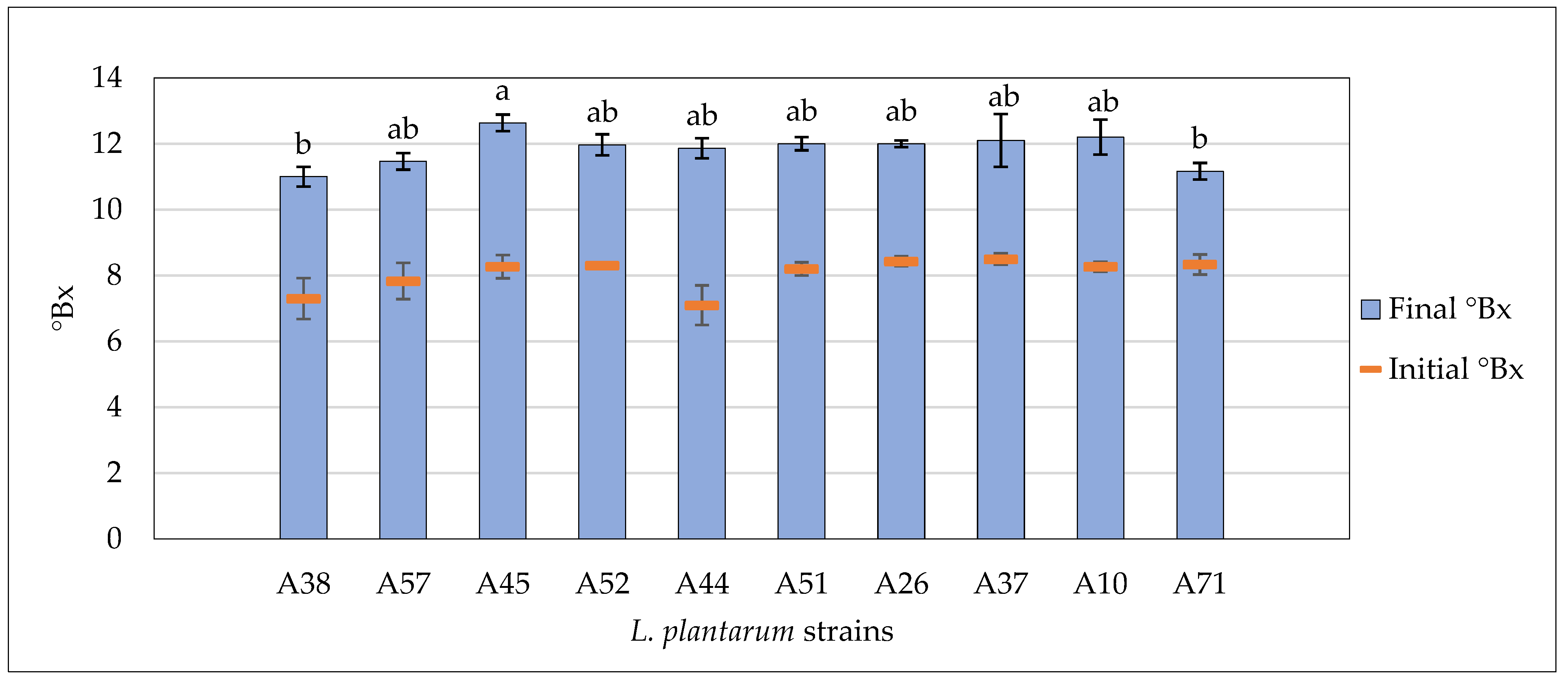
Brix measurements increased significantly (p < 0.05) in all sourdoughs relative to the initial slurry (7.3–8.5 °Bx; Figure 2), indicating carbohydrate hydrolysis and solute release [77,80,81]. Inter-genotypic comparisons revealed statistically significant differences (p < 0.05) in final Brix values between G1 (A38, A57) and G6 (A44, A51), G1 and G9 (A26, A37), G1 and G5 (A45, A52), and between G12 (A10, A71) and G5. Significant intra-genotypic variation was also observed within G5 and G12. The highest final Brix value was observed for with A45 (12.63 °Bx), which differed significantly from A38 and A71. The lowest value was recoded for A38 (11 °Bx). Following Bonferroni correction, only the pairwise differences between A45 and A38, and between A45 and A71, remained statistically significant. Intra-genotypic variation may reflect minor genetic differences, strain-specific enzyme expression, or prior adaptation to environmental conditions, highlighting the contributions of both genotype and individual strain characteristics to sourdough fermentation performance.
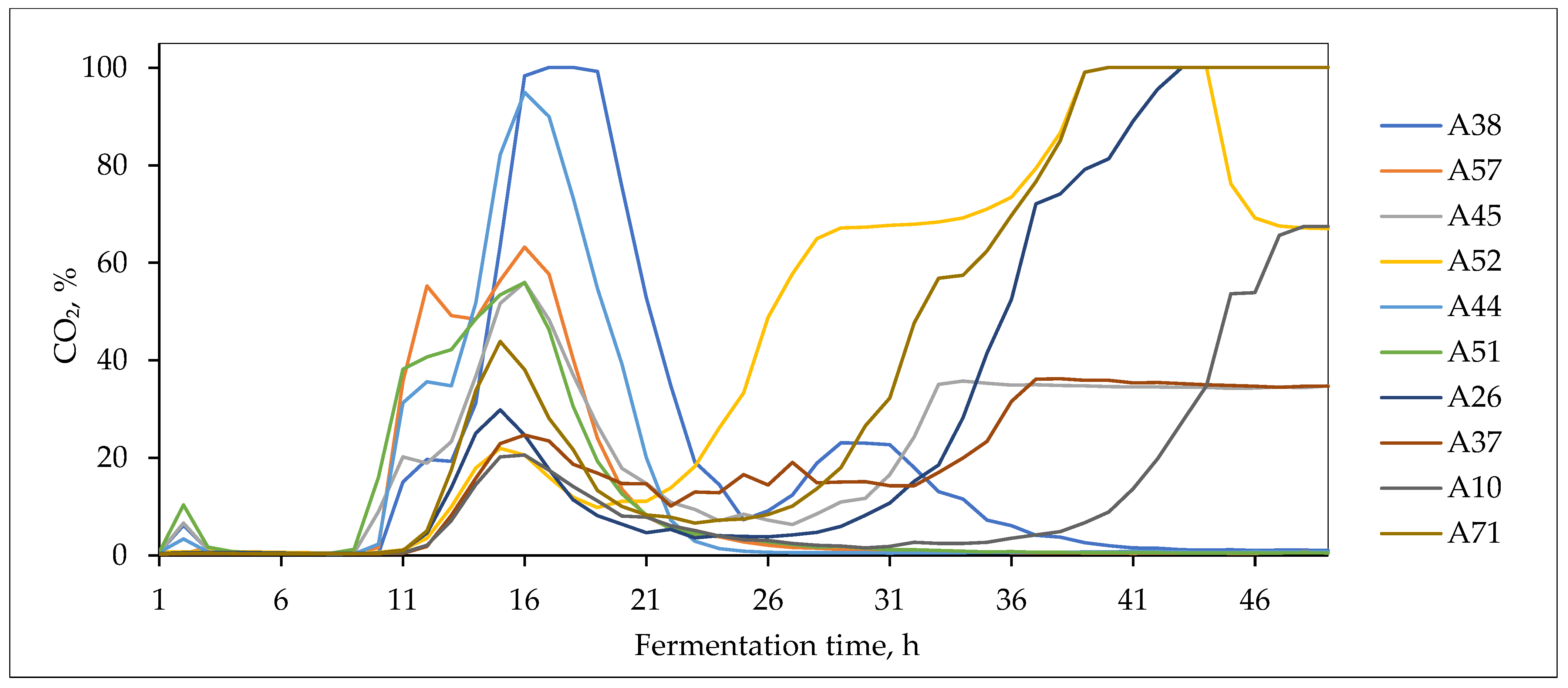
CO2 evolution during fermentation paralleled the pH decrease (Figure 3). All L. plantarum strains initiated gas production after 8–10 h, reaching maximum levels between 14 and 16 h (22–100%) before declining. Strains A38 and A45 peaked at 15–17 h (100% and 56%, respectively), decreased to 6–7% by 24–26 h, and later partially recovered (23–36%). During the first 24 h, A38 and A44 were the most active CO2 producers, whereas A26, A52, and A71 exhibited higher activity in the later stages. These late-stage increases likely reflect secondary metabolic activity, while early-phase differences may arise from strain-specific variation in carbohydrate metabolism and adaptation to the sourdough environment. This biphasic pattern aligns with observations by Wehrle and Arendt [82], who reported earlier CO2 production in inoculated sourdoughs (~10 h) compared with spontaneous fermentations (~20 h).
Significant (p < 0.05) inter-genotypic differences in CO2 production were detected for all genotype comparisons, except between G1 (A38, A57) and G6 (A44, A51), and between G9 (A26, A37) and G12 (A10, A71). Intra-genotypic analyses revealed significant variation (p < 0.05) within genotypes G5 (A45, A52) and G12, demonstrating that strains belonging to the same genotype can differ markedly in their CO2 production profiles.
Lactic acid concentrations in sourdoughs fermented with L. plantarum strains ranged from 11.4 to 21.6 g/kg (Table 5). The highest level was produced by strain A52 (p < 0.05), exceeding most other strains except A37, A10, and A71. The lowest value occurred in A51 (11.4 g/kg), which differed significantly from A57, A71, A52, and A37. After Bonferroni correction, only the difference between A51 and A37 remained significant. Comparable studies reported 9.1 g/kg lactic acid in rye sourdoughs fermented for 18 h [83], while wheat sourdoughs typically contain 1–7 g/kg depending on strain and conditions [84,85,86]. These data confirm the higher lactic acid accumulation in rye sourdough, reflecting both substrate composition and microbial metabolism. Within individual genotypes, no significant differences (p > 0.05) were observed among strains; however, inter-genotypic comparisons revealed statistically significant differences (p < 0.05), specifically between G6 and G12 as well as between G9 and G12.
L. plantarum is capable of synthesizing acetic acid from pyruvate, which, together with lactic acid, represents a major end-product of heterofermentative metabolism [6]. Acetic acid concentrations ranged from 1.7 to 2.8 g/kg (Table 5). Strain A38 produced the highest amount (2.8 g/kg, p < 0.05), significantly exceeding A45 and A26, while A45 showed the lowest level (1.7 g/kg). After Bonferroni correction, A38 differed significantly from both A45 and A26. These values are comparable to those in wheat sourdoughs (1.8–3.3 g/kg) [84] and exceed those reported for short fermentations (0.67 g/kg) [86], confirming strain- and condition-dependent variability in acetic acid formation. Within genotype G1, significant intra-genotypic variation was observed, whereas inter-genotypic comparisons revealed statistically significant differences (p < 0.05) between G1 and G9, G1 and G5, and between G5 and G12.
Comparison of total acid content showed that L. plantarum strain A52 produced the highest combined lactic and acetic acid levels (23.5 g/kg), significantly exceeding most other strains except A10, A71, A37, and A26 (p < 0.05). The lowest total acid concentration was found in A51 (13.6 g/kg), differing significantly only from A71 and A52. After Bonferroni correction, no significant differences remained. The lactic-to-acetic acid ratio, a key indicator of sourdough quality, ranged from 87.2:12.8 in this study, well within the optimal 90:10 to 70:30 range [87]. Comparable results have been reported for rye sourdoughs (77.7:22.2) [88], with higher acetic acid levels linked to pentose utilization by heterofermentative LAB [89,90,91]. Within genotype G5, statistically significant intra-genotypic variation was detected, while inter-genotypic comparisons revealed significant differences involving G6, specifically in comparisons with G12 and with G5.
L. plantarum produces several secondary metabolites during heterofermentative metabolism, including ethanol [6], with additional contributions from flour-derived yeasts [92]. After 48 h fermentation, ethanol concentrations averaged 6.4 g/kg (Table 5). The highest levels were observed in sourdoughs fermented with strains A71 (13.8 g/kg) and A52 (11.8 g/kg) (p < 0.05), while the lowest occurred in A51 (3.7 g/kg) and A44 (3.9 g/kg). After Bonferroni correction, A52 differed significantly from A51, A38, A57, and A44, whereas A71 differed only from A44. These ethanol values are lower than those reported by Buksa [88] (18.6 g/kg in 24 h rye sourdough), likely due to yeast supplementation in that study. Within genotypes, significant intra-genotypic variation in ethanol content was observed for strains belonging to G5 and G12. Inter-genotypic comparisons revealed statistically significant differences involving G6 (in comparisons with G12, G1, G9, and G5) as well as between G1 and G12 and between G1 and G5, suggesting that both genotype- and strain-specific traits influence ethanol production.
Collectively, these results demonstrate that L. plantarum exhibits considerable biochemical versatility, with both inter-genotypic and intra-genotypic variation significantly influencing acidification kinetics, CO2 production, and the synthesis of key metabolites such as lactic acid, acetic acid, and ethanol. Such variability highlights the importance of strain- and genotype-specific characteristics in shaping sourdough fermentation dynamics. These findings emphasize that careful selection and combination of particular strains or genotypes can be strategically employed to design tailored starter cultures, thereby optimizing the technological performance, metabolic outputs, and sensory attributes of sourdough products.

3.5. Exopolysaccharide Yield and Quantitative Sugar Content

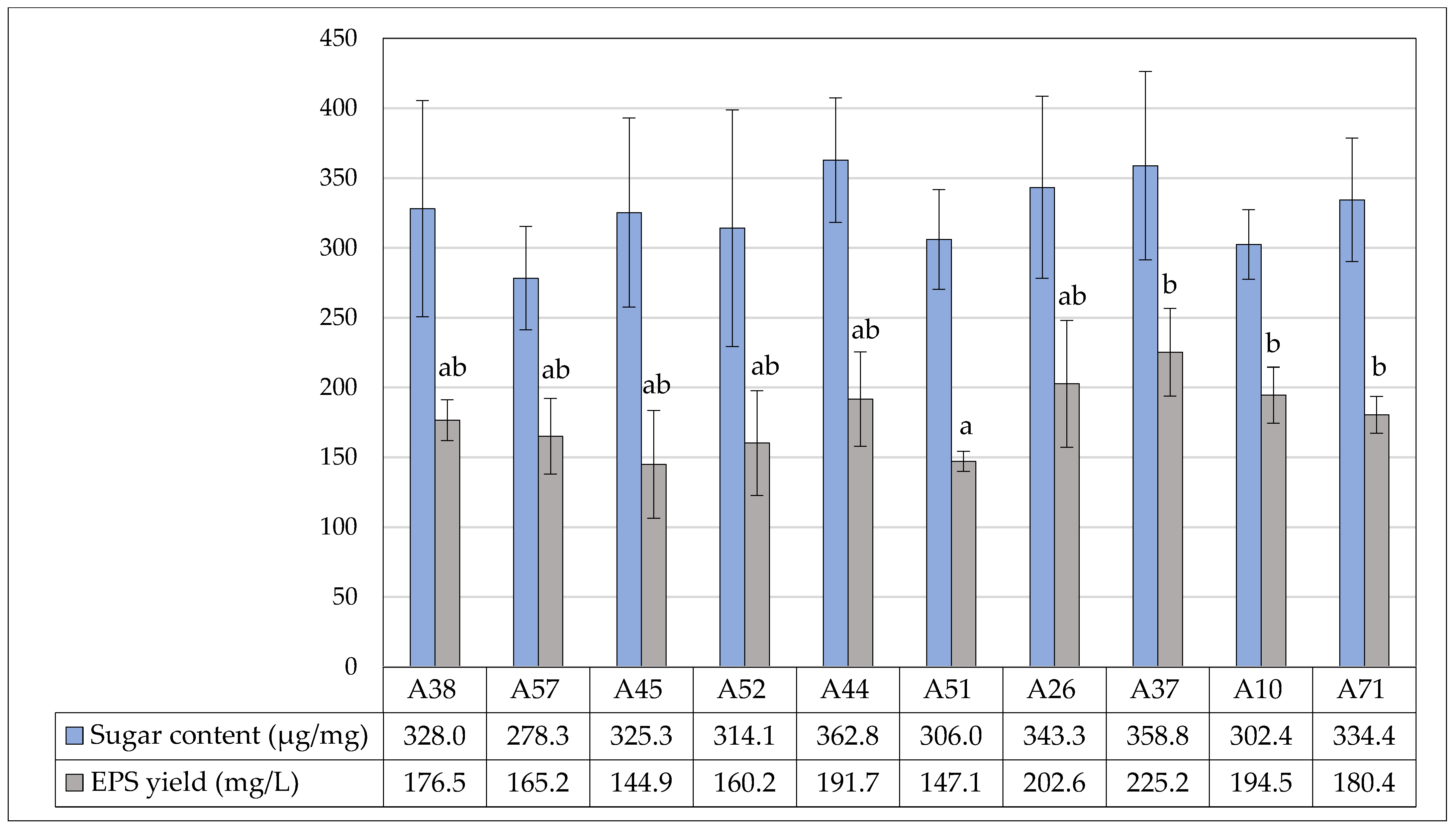
The glucose-equivalent sugar content of exopolysaccharides (EPS) extracted from L. plantarum strains ranged from 278.3 to 362.8 µg/mg (Figure 4), with no statistically significant differences between strains or genotypes. The dry mass of lyophilized EPS, ranged from 22.1 ± 4.9 mg to 32.2 ± 3.2 mg, also without significant differences. Within genotype G5 (A52 and A45), EPS dry mass was significantly lower (p < 0.05) compared with most other genotypes, except G6 (A51 and A44).
EPS yields based on dry mass ranged from 131.4 to 225.2 mg/L, consistent with previously reported [93] values for L. plantarum (71–279 mg/L). No consistent strain- or genotype-dependent trends were observed, although minor pairwise differences were statistically significant (p < 0.05; significant differences were detected only for EPS yield in some pairwise comparisons, e.g., A51 vs. A10, A71, A37). EPS production depends on multiple factors, including strain genetics, medium composition, and nutrient availability [94,95]. Several studies report markedly higher yields under optimized conditions [96,97,98,99]. In the present study, MRS medium supplemented with 2% sucrose was used; however, previous research has shown that EPS production can be enhanced by optimizing the carbon source. Elmansy et al. [96] identified sucrose, lactose, and fructose as the most effective substrates, whereas Zhang et al. [93] reported glucose as the preferred carbon source for most L. plantarum strains, with some exceptions (e.g., L. plantarum 70810), which exhibited enhanced EPS production with sucrose. Similarly, Wang et al. [98] and Afreen et al. [100] observed increased yields with lactose. These findings likely reflect strain-specific metabolic preferences and emphasize the need to optimize carbon sources individually to maximize EPS biosynthesis.
Notably, the optimal conditions for EPS synthesis do not always coincide with those for microbial growth. In some cases, microorganisms produce EPS only under stress conditions [101]. For instance, Imran et al. [97] reported exceptionally high EPS concentrations (956 mg/L), likely resulting from optimized culture conditions and differences in purification procedures, as trichloroacetic acid (TCA) was not used during EPS recovery. Consistently, Rimada et al. [102] demonstrated that TCA treatment can reduce EPS yield by up to 50%. Nitrogen source selection also influences EPS production: yeast extract supports maximal synthesis due to its amino acid and peptide content, while ammonium sulfate is the most suitable inorganic source. However, some nitrogen-containing compounds may interfere with the phenol–sulfuric acid assay, leading to overestimation of sugar content [103].
The relationship between EPS sugar content and dry mass was evaluated. The low coefficient of determination (R2 = 0.0177) indicated no linear correlation, suggesting compositional variability among strains. For example, strain A37 exhibited both high sugar content and dry mass, whereas A57 had high dry mass but the lowest sugar content. Conversely, A45 showed relatively low dry mass but above-average sugar content.
Carbohydrates constitute the predominant component of L. plantarum EPS, accounting for approximately 90–96% of total mass [97,104]. Minor fractions include sulfated groups, proteins, nucleic acids, and uronic acids [104,105]. For example, Xiao et al. [106] found that purified EPS contained 88.3% carbohydrates, 3.9% proteins, 3.0% uronic acids, and 1.5% sulfates, while Tsuda et al. [107] reported 81% carbohydrates and 3.1% proteins. These data confirm that although EPS are mainly carbohydrate polymers, total dry mass does not necessarily correlate with sugar content, as non-carbohydrate components can substantially contribute to the total EPS mass.

3.6. Influence of Aflatoxin B1 on the Carbohydrate Fermentation Profiles of L. plantarum

All L. plantarum strains fermented all four sugars tested (glucose, galactose, lactose, and sucrose), and this ability was unaffected by AFB1, except in strain A71. Fermentation profiles remained stable throughout incubation (48 h–12 days), with minor variations during the first 24 h. No gas production was observed during the 12-day incubation. Among the five genotypes, only G1 (A38, A57) and G5 (A52, A45) showed identical fermentation profiles, whereas intra-genotypic variation occurred in others, indicating six distinct phenotypes. Fermentation was most efficient with glucose and weakest with lactose. These results align with reports describing L. plantarum as a metabolically versatile species capable of utilizing diverse carbohydrates through its extensive repertoire of sugar transport and metabolic genes [5,9]. The observed strain-specific differences likely reflect functional variation in transport systems and intracellular metabolic pathways [8].
During the first 24 h in lactose-containing media, isolates A38 and A57 (G1) and A37 (G9) produced little acid, whereas strain A26 (same genotype as A37) actively fermented all sugars throughout incubation. Similarly, within genotype G6, strain A44 showed limited lactose fermentation and weak galactose utilization, in contrast to the more active profile of A51. Strain A10 fermented glucose and galactose rapidly, but required 48 h for lactose and sucrose. In the same genotype, A71 exhibited similarly reduced activity, producing minimal acid from lactose and galactose during the first 24 h. Interestingly, for galactose, acid formation was absent in toxin-free and low-AFB1 media (1 µg/mL) but slightly increased at 10–20 µg/mL, suggesting that higher toxin levels may transiently stimulate acid production—an effect not previously described.
Research on the influence of AFB1 on L. plantarum fermentation is limited. Sutic and Banina [22] reported that L. plantarum retained its carbohydrate fermentation capacity in the presence of AFB1 and, notably, produced gas only under toxin exposure. These results suggest that AFB1 does not inhibit sugar utilization but may affect fermentation kinetics in a strain- and substrate-specific manner, highlighting the metabolic adaptability of L. plantarum and its potential role in stabilizing and detoxifying mycotoxin-contaminated cereal matrices.

3.7. Aflatoxin B1 Binding Capacity

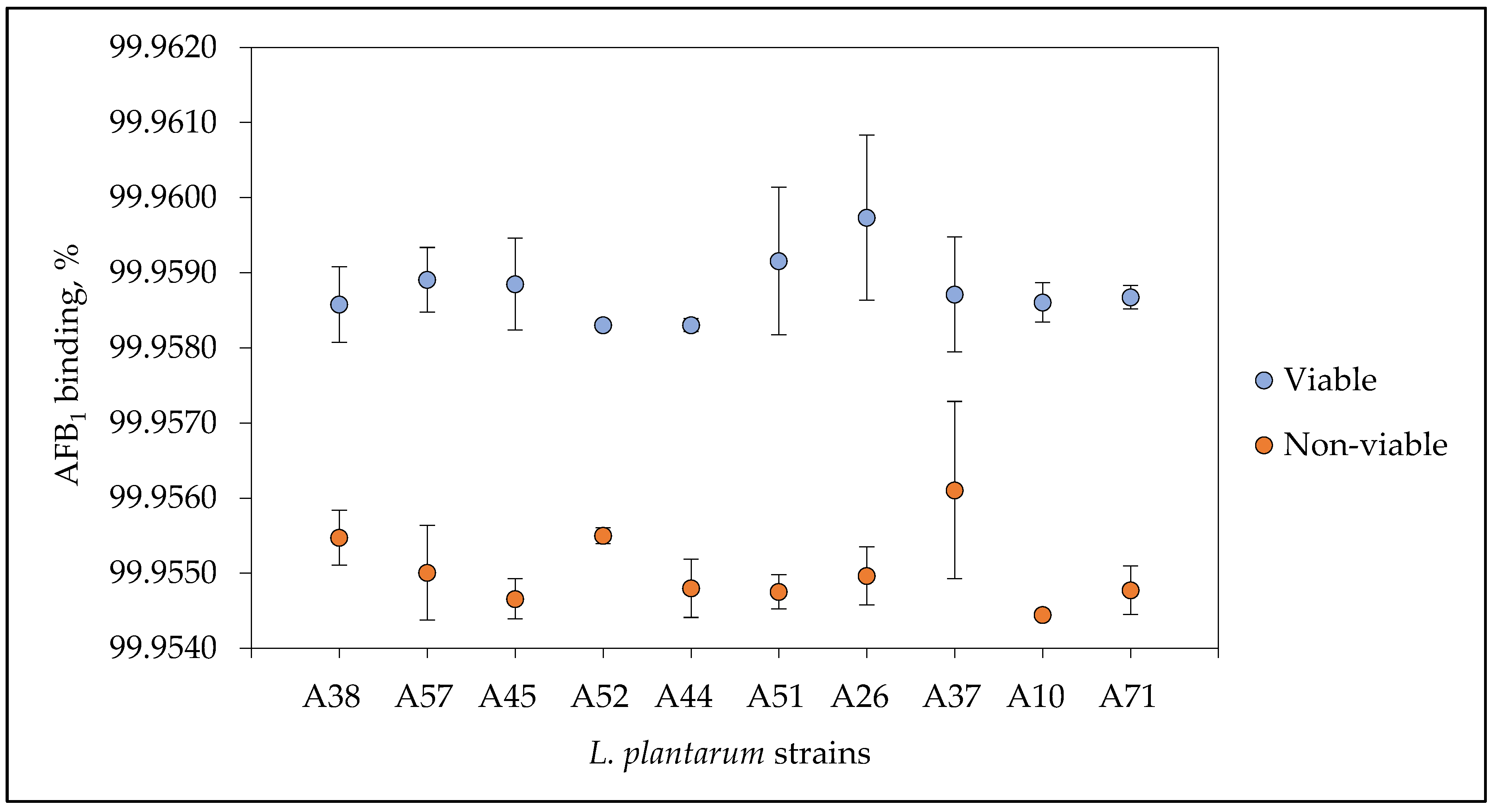
All L. plantarum strains, regardless of viability, exhibited strong AFB1-binding capacity, with efficiencies approaching 100%. The highest binding was observed for viable cells of L. plantarum A26, whereas the lowest occurred in non-viable cells of A10 (Figure 5). Previous studies have reported highly variable AFB1-binding efficiencies among LAB, ranging from 0.6% to 100% [108,109,110,111,112]. Several LAB species, including L. plantarum, Levilactobacillus brevis, Limosilactobacillus fermentum, Lacticaseibacillus rhamnosus, Lactobacillus acidophilus, and Lactococcus lactis, have shown high efficacy in AFB1 removal, sometimes achieving complete degradation [113]. Co-cultivation of probiotic strains may further enhance aflatoxin removal [114]. Factors such as incubation temperature, exposure time, microbial load, toxin concentration, and pH significantly influence AFB1 reduction [113,115].
Despite extensive studies on L. plantarum, strain-level differences in AFB1 binding remain less characterized. Møller et al. [116] reported wide variability among L. plantarum isolates: at pH 6.5, binding ranged from <20% to >70%. Similarly, Park et al. [117] observed strain-dependent adsorption efficiencies (3.3–48.9%) among three L. plantarum isolates, confirming strong intra-species variability.
Viable L. plantarum cells generally bound more AFB1 than heat-inactivated ones, consistent with Khanafari et al. [112] and Asurmendi et al. [118], who observed toxin desorption from heat-killed cells during incubation. Conversely, several reports indicate higher AFB1 binding by non-viable cells [119,120,121,122]. Enhanced adsorption by inactivated cells is attributed to heat-induced protein denaturation and structural modifications in peptidoglycan, which increase surface hydrophobicity and expose new binding sites [123,124,125].
Although numerical differences between viable and non-viable cells were small, statistical analysis revealed a significant overall effect of heat treatment (p < 0.001). Within-genotype comparisons showed no significant differences in most cases (p > 0.05), except for genotype G5, where non-viable strains A52 and A45 differed significantly (p < 0.05). Across genotypes, binding efficiency was comparable, though minor differences were noted between G1 (A38, A57) and G12 (A10, A71) non-viable cells, with G1 slightly outperforming G12 (99.9552% vs. 99.9546%).
Heat-killed cells exhibited more intra-strain variability (8 strains with significant differences) than viable cells (2 strains), suggesting differential structural responses to inactivation. Strains A71 and A44 showed significant viability-dependent differences (p < 0.05), confirming genotypic distinctness. In contrast, strains within G12, G6, and G9, despite differing in carbohydrate profiles, exhibited similar adsorption patterns, indicating that AFB1 binding is less influenced by these metabolic traits.
Differences between studies likely reflect not only inter-strain variability (e.g., cell wall composition) but also methodological factors such as the cell-to-toxin ratio, incubation conditions, pH, and analytical methods used for quantification [109,126,127,128,129]. Moreover, the method of cell inactivation—heat, acid, or irradiation—can markedly alter adsorption efficiency [119,122]. Despite such variability, numerous studies consistently confirm LAB as effective AFB1 binders, underscoring their potential in improving food safety and mitigating mycotoxin risks.

4. Conclusions

All examined Lactiplantibacillus plantarum strains isolated from traditional rye sourdough were non-hemolytic and exhibited antibiotic susceptibility profiles consistent with food-grade safety standards. The isolates displayed broad enzymatic and metabolic diversity, with pronounced aminopeptidase and β-glucosidase activities, indicating strong proteolytic and glycolytic potential. Carbohydrate utilization profiles revealed extensive substrate adaptability, while inter- and intra-genotypic differences confirmed notable metabolic plasticity.
During rye sourdough fermentation, all strains rapidly acidified the dough and produced lactic-to-acetic acid ratios consistent with optimal sourdough quality, confirming their technological suitability. Exposure to aflatoxin B1 did not impair fermentation performance, and all strains showed exceptionally high toxin-binding efficiency, indicating potential for biological detoxification of contaminated cereals.
Exopolysaccharide yields and sugar contents were stable across genotypes, suggesting consistent biosynthetic capacity under standardized conditions. When the genotype- and strain-level data were integrated, clear functional patterns emerged: although strain-specific traits accounted for most of the observed variation, reproducible genotype-associated tendencies were evident. Genotype G6 demonstrated the strongest overall fermentative performance, G5 exhibited enhanced sugar utilization and ethanol formation, and G1 showed consistently weaker metabolic activity, whereas G9 and G12 displayed more strain-dependent behavior. Within these genotype backgrounds, marked strain-level differences persisted, with A52 expressing the most versatile and robust phenotype, A26 and A71 exhibiting strong but more specialized metabolic profiles, and A38 and A51 consistently demonstrating weak fermentative performance.
Collectively, the studied L. plantarum strains exhibited functional robustness, combining efficient fermentation, stress tolerance, and mycotoxin-binding ability. Their genotype-specific tendencies and complementary strain-level capabilities underscore their promise as multifunctional starter cultures for safe, high-quality, and nutritionally enhanced fermented foods.

Author Contributions

Conceptualization, L.L. (Liis Lutter), L.L. (Lisbeth Luik), N.P., P.S., A.S., S.B.O. and H.A.; methodology, L.L. (Liis Lutter), L.L. (Lisbeth Luik), N.P., P.S., A.S., S.B.O. and H.A.; validation, S.B.O. and H.A.; formal analysis, L.L. (Liis Lutter), L.L. (Lisbeth Luik), N.P., P.S., A.S., S.B.O. and H.A.; investigation, L.L. (Liis Lutter), L.L. (Lisbeth Luik), N.P., P.S., A.S., S.B.O. and H.A.; resources, H.A.; data curation, H.A.; writing—original draft, L.L. (Liis Lutter); writing—review and editing, H.A.; visualization, L.L. (Liis Lutter) and H.A.; supervision, S.B.O. and H.A.; project administration, H.A.; funding acquisition, H.A. All authors have read and agreed to the published version of the manuscript.

Funding

This research was supported by ERDF and Estonian Research Council via project RESTA28 “Valorization of cereal and oilseed crops”; and by the Estonian Ministry of Education and Research through the research and development project P170063VLTD “Development of competence in bakery and confectionery technology and applied food microbiology”.

Institutional Review Board Statement

Not applicable.

Informed Consent Statement

Not applicable.

Data Availability Statement

The original contributions presented in the study are included in the article, further inquiries can be directed to the corresponding author.

Acknowledgments

We thank Ivi Jõudu for her contribution to resources and funding for this research.

Conflicts of Interest

The authors declare no conflicts of interest.

References

  1. Filannino, P.; Di Cagno, R.; Gobbetti, M. Metabolic and functional paths of lactic acid bacteria in plant foods: Get out of the labyrinth. Curr. Opin. Biotechnol. 2018, 49, 64–72. [Google Scholar] [CrossRef] [PubMed]
  2. Gänzle, M.G.; Zheng, J. Lifestyles of sourdough lactobacilli–Do they matter for microbial ecology and bread quality? Int. J. Food Microbiol. 2019, 302, 15–23. [Google Scholar] [CrossRef] [PubMed]
  3. Siezen, R.J.; Tzeneva, V.A.; Castioni, A.; Wels, M.; Phan, H.T.K.; Rademaker, J.L.W.; Starrenburg, M.J.C.; Kleerebezem, M.; Van Hylckama Vlieg, J.E.T. Phenotypic and genomic diversity of Lactobacillus plantarum strains isolated from various environmental niches. Environ. Microbiol. 2010, 12, 758–773. [Google Scholar] [CrossRef]
  4. Mao, B.; Yin, R.; Li, X.; Cui, S.; Zhang, H.; Zhao, J.; Chen, W. Comparative Genomic Analysis of Lactiplantibacillus plantarum Isolated from Different Niches. Genes 2021, 12, 241. [Google Scholar] [CrossRef]
  5. Kleerebezem, M.; Boekhorst, J.; van Kranenburg, R.; Molenaar, D.; Kuipers, O.P.; Leer, R.; Tarchini, R.; Peters, S.A.; Sandbrink, H.M.; Fiers, M.W.E.J.; et al. Complete genome sequence of Lactobacillus plantarum WCFS1. Proc. Natl. Acad. Sci. USA 2003, 100, 1990–1995. [Google Scholar] [CrossRef] [PubMed]
  6. Corsetti, A.; Valmorri, S. Lactic Acid Bacteria. Lactobacillus spp.: Lactobacillus plantarum. In Encyclopedia of Dairy Sciences (Second Edition); Fuquay, J.W., Ed.; Academic Press: Cambridge, MA, USA, 2011; pp. 111–118. [Google Scholar] [CrossRef]
  7. Martino, M.E.; Bayjanov, J.R.; Caffrey, B.E.; Wels, M.; Joncour, P.; Hughes, S.; Gillet, B.; Kleerebezem, M.; van Hijum, S.A.F.T.; Leulier, F. Nomadic lifestyle of Lactobacillus plantarum revealed by comparative genomics of 54 strains isolated from different habitats. Environ. Microbiol. 2016, 18, 4974–49889. [Google Scholar] [CrossRef]
  8. Buntin, N.; Hongpattarakere, T.; Ritari, J.; Douillard, F.P.; Paulin, L.; Boeren, S.; Shetty, S.A.; de Vos, W.M. An Inducible Operon Is Involved in Inulin Utilization in Lactobacillus plantarum Strains, as Revealed by Comparative Proteogenomics and Metabolic Profiling. Appl. Environ. Microbiol. 2017, 83, e02402-16. [Google Scholar] [CrossRef]
  9. Cui, Y.; Wang, M.; Zheng, Y.; Miao, K.; Qu, X. The Carbohydrate Metabolism of Lactiplantibacillus plantarum. Int. J. Mol. Sci. 2021, 22, 13452. [Google Scholar] [CrossRef]
  10. Arora, K.; Ameur, H.; Polo, A.; Di Cagno, R.; Rizzello, C.G.; Gobbetti, M. Thirty years of knowledge on sourdough fermentation: A systematic review. Trends Food Sci. Technol. 2021, 108, 71–83. [Google Scholar] [CrossRef]
  11. Abarquero, D.; Bodelón, R.; Manso, C.; Rivero, P.; Fresno, J.M.; Tornadijo, M.E. Effect of autochthonous starter and non-starter cultures on the physicochemical, microbiological and sensorial characteristics of Castellano cheese. Int. J. Dairy Technol. 2023, 77, 234–245. [Google Scholar] [CrossRef]
  12. Capozzi, V.; Spano, G. Food microbial biodiversity and “microbes of protected origin”. Front. Microbiol. 2011, 2, 237. [Google Scholar] [CrossRef]
  13. Chessa, L.; Paba, A.; Daga, E.; Dupré, I.; Piga, C.; Di Salvo, R.; Mura, M.; Addis, M.; Comunian, R. Autochthonous Natural Starter Cultures: A Chance to Preserve Biodiversity and Quality of Pecorino Romano PDO Cheese. Sustainability 2021, 13, 8214. [Google Scholar] [CrossRef]
  14. Ripari, V. Techno-Functional Role of Exopolysaccharides in Cereal-Based, Yogurt-Like Beverages. Beverages 2019, 5, 16. [Google Scholar] [CrossRef]
  15. Bangar, S.P.; Sharma, N.; Kumar, M.; Ozogul, F.; Purewal, S.S.; Trif, M. Recent developments in applications of lactic acid bacteria against mycotoxin production and fungal contamination. Food Biosci. 2021, 44, 101444. [Google Scholar] [CrossRef]
  16. Lutter, L.; Kuzina, A.; Andreson, H. Genotypic Stability of Lactic Acid Bacteria in Industrial Rye Bread Sourdoughs Assessed by ITS-PCR Analysis. Microorganisms 2024, 12, 1872. [Google Scholar] [CrossRef] [PubMed]
  17. EFSA Panel on Additives and Products or Substances used in Animal Feed (FEEDAP); Rychen, G.; Aquilina, G.; Azimonti, G.; Bampidis, V.; de Lourdes Bastos, M.; Bories, G.; Chesson, A.; Cocconcelli, P.S.; Flachowsky, G.; et al. Guidance on the characterization of microorganisms used as feed additives or as production organisms. EFSA J. 2018, 16, 5206. [Google Scholar] [CrossRef]
  18. Collar, C.; Armero, E. Millet-Wheat Mixed Breads: Impact of Sour Dough Addition on the Enhancement of the Physical Profile of Heat-Moisture Treated Matrices. Int. J. Food Eng. 2019, 5, 36–42. [Google Scholar] [CrossRef]
  19. ISO 2173:2003; Fruit and Vegetable Products—Determination of Soluble Solids—Refractometric Method. ISO: Geneva, Switzerland, 2003. Available online: http://www.iso.org/iso/catalogue_detail.htm?csnumber=35851 (accessed on 20 November 2025).
  20. Kavitake, D.; Devi, P.B.; Singh, S.P.; Shetty, P.H. Characterization of a novel galactan produced by Weissella confusa KR780676 from an acidic fermented food. Int. J. Biol. Macromol. 2016, 86, 681–689. [Google Scholar] [CrossRef]
  21. Ogura, I.; Sugiyama, M.; Tai, R.; Mano, H.; Matsuzawa, T. Optimization of microplate-based phenol-sulfuric acid method and application to the multi-sample measurements of cellulose nanofibers. Anal. Biochem. 2023, 681, 115329. [Google Scholar] [CrossRef]
  22. Sutic, M.; Banina, A. Influence of aflatoxin B1 on gas production by lactic acid bacteria. J. Environ. Pathol. Toxicol. Oncol. 1990, 10, 149–153. [Google Scholar]
  23. Casarotti, S.N.; Carneiro, B.M.; Todorov, S.D.; Nero, L.A.; Rahal, P.; Penna, A.L.B. In vitro assessment of safety and probiotic potential characteristics of Lactobacillus strains isolated from water buffalo mozzarella cheese. Ann. Microbiol. 2017, 67, 289–301. [Google Scholar] [CrossRef]
  24. FAO/WHO. Food Safety Risk Analysis: A Guide for National Food Safety Authorities. 2006. Available online: http://apps.who.int/iris/bitstream/handle/10665/43718/9789251056042_eng.pdf;jsessionid=689C4D54F8646357776C37326910DD2A?sequence=1 (accessed on 23 October 2025).
  25. Abdel Tawab, F.I.; Abd Elkadr, M.H.; Sultan, A.M.; Hamed, E.O.; El-Zayat, A.S.; Ahmed, M.N. Probiotic potentials of lactic acid bacteria isolated from Egyptian fermented food. Sci. Rep. 2023, 13, 16601. [Google Scholar] [CrossRef]
  26. Hsu, H.-Y.; Liao, Y.-C.; Lin, S.-H.; Lin, J.-S.; Lee, C.-C.; Watanabe, K. Safety Assessment of Lactiplantibacillus plantarum TWK10 Based on Whole-Genome Sequencing, Phenotypic, and Oral Toxicity Analysis. Microorganisms 2022, 10, 784. [Google Scholar] [CrossRef] [PubMed]
  27. Nami, Y.; Panahi, B.; Jalaly, H.M.; Rostampour, M.; Hejazi, M.A. Probiotic Characterization of LAB isolated from Sourdough and Different Traditional Dairy Products Using Biochemical, Molecular and Computational Approaches. Probiotics Antimicrob. Proteins 2025, 17, 1014–1037. [Google Scholar] [CrossRef] [PubMed]
  28. Ou, D.; Ling, N.; Wang, X.; Zou, Y.; Dong, J.; Zhang, D.; Shen, Y.; Ye, Y. Safety Assessment of One Lactiplantibacillus plantarum Isolated from the Traditional Chinese Fermented Vegetables—Jiangshui. Foods 2022, 11, 2177. [Google Scholar] [CrossRef] [PubMed]
  29. Vasundaradevi, R.; Sarvajith, M.; Divyashree, S.; Deepa, N.; Achar, P.N.; Sreenivasa, M.Y. Tropical fruit-derived Lactiplantibacillus as potential probiotic and antifungal agents against Fusarium oxysporum. Sci. Rep. 2025, 15, 2144. [Google Scholar] [CrossRef]
  30. Feng, S.; Wang, H.; Lin, X.; Liang, H.; Zhang, S.; Chen, Y.; Ji, C. Probiotic properties of Lactobacillus plantarum and application in prebiotic gummies. LWT 2023, 174, 114357. [Google Scholar] [CrossRef]
  31. Iosca, G.; Fugaban, J.I.I.; Özmerih, S.; Wätjen, A.P.; Kaas, R.S.; Hà, Q.; Shetty, R.; Pulvirenti, A.; De Vero, L.; Bang-Berthelsen, C.H. Exploring the Inhibitory Activity of Selected Lactic Acid Bacteria against Bread Rope Spoilage Agents. Fermentation 2023, 9, 290. [Google Scholar] [CrossRef]
  32. Álvarez-Cisneros, Y.M.; Ponce-Alquicira, E. Antibiotic Resistance in Lactic Acid Bacteria. In Antimicrobial Resistance—A Global Threat; IntechOpen: London, UK, 2018. [Google Scholar] [CrossRef]
  33. Anisimova, E.; Gorokhova, I.; Karimullina, G.; Yarullina, D. Alarming antibiotic resistance of lactobacilli isolated from probiotic preparations and dietary supplements. Antibiotics 2022, 11, 1557. [Google Scholar] [CrossRef]
  34. Vannuffel, P.; Cocito, C. Mechanism of Action of Streptogramins and Macrolides. Drugs 1996, 51, 20–30. [Google Scholar] [CrossRef]
  35. Imperial, I.C.V.J.; Ibana, J.A. Addressing the Antibiotic Resistance Problem with Probiotics: Reducing the Risk of Its Double-Edged Sword Effect. Front. Microbiol. 2016, 7, 1983. [Google Scholar] [CrossRef] [PubMed]
  36. Mingeot-Leclercq, M.P.; Glupczynski, Y.; Tulkens, P.M. Aminoglycosides: Activity and Resistance. Antimicrob. Agents Chemother. 1999, 43, 727–737. [Google Scholar] [CrossRef] [PubMed]
  37. Nikodinoska, I.; Heikkinen, J.; Moran, C.A. Antimicrobial Susceptibility Data for Six Lactic Acid Bacteria Tested against Fifteen Antimicrobials. Data 2022, 8, 10. [Google Scholar] [CrossRef]
  38. Stefańska, I.; Kwiecień, E.; Jóźwiak-Piasecka, K.; Garbowska, M.; Binek, M.; Rzewuska, M. Antimicrobial Susceptibility of Lactic Acid Bacteria Strains of Potential Use as Feed Additives-The Basic Safety and Usefulness Criterion. Front. Vet. Sci. 2021, 8, 687071. [Google Scholar] [CrossRef]
  39. Swenson, J.M.; Facklam, R.R.; Thornsberry, C. Antimicrobial susceptibility of vancomycin-resistant Leuconostoc, Pediococcus, and Lactobacillus species. Antimicrob. Agents Chemother. 1990, 34, 543–549. [Google Scholar] [CrossRef]
  40. Song, X.; Li, F.; Zhang, M.; Xia, Y.; Ai, L.; Wang, G. Effect of D-Ala-Ended Peptidoglycan Precursors on the Immune Regulation of Lactobacillus plantarum Strains. Front. Immunol. 2022, 12, 825825. [Google Scholar] [CrossRef]
  41. Chokesajjawatee, N.; Santiyanont, P.; Chantarasakha, K.; Kocharin, K.; Thammarongtham, C.; Lertampaiporn, S.; Vorapreeda, T.; Srisuk, T.; Wongsurawat, T.; Jenjaroenpun, P.; et al. Safety Assessment of a Nham Starter Culture Lactobacillus plantarum BCC9546 via Whole-genome Analysis. Sci. Rep. 2020, 10, 10241. [Google Scholar] [CrossRef]
  42. Flórez, A.B.; Egervärn, M.; Danielsen, M.; Tosi, L.; Morelli, L.; Lindgren, S.; Mayo, B. Susceptibility of Lactobacillus plantarum Strains to Six Antibiotics and Definition of New Susceptibility–Resistance Cutoff Values. Microb. Drug Resist. 2006, 12, 252–256. [Google Scholar] [CrossRef]
  43. Gueimonde, M.; Sánchez, B.; de los Reyes-Gavilán, C.G.; Margolles, A. Antibiotic resistance in probiotic bacteria. Front. Microbiol. 2013, 4, 202. [Google Scholar] [CrossRef]
  44. Zhang, F.; Gao, J.; Wang, B.; Huo, D.; Wang, Z.; Zhang, J.; Shao, Y. Whole-genome sequencing reveals the mechanisms for evolution of streptomycin resistance in Lactobacillus plantarum. J. Dairy Sci. 2018, 101, 2867–2874. [Google Scholar] [CrossRef]
  45. Kieliszek, M.; Pobiega, K.; Piwowarek, K.; Kot, A.M. Characteristics of the Proteolytic Enzymes Produced by Lactic Acid Bacteria. Molecules 2021, 26, 1858. [Google Scholar] [CrossRef]
  46. Kunji, E.R.S.; Mierau, I.; Hagting, A.; Poolman, B.; Konings, W.N. The proteolytic systems of lactic acid bacteria. Antonie Van Leeuwenhoek 1996, 70, 187–221. [Google Scholar] [CrossRef]
  47. Maske, B.L.; de Melo Pereira, G.V.; Vale, A.d.S.; de Carvalho Neto, D.P.; Karp, S.G.; Viesser, J.A.; Lindner, J.D.D.; Pagnoncelli, M.G.; Soccol, V.T.; Soccol, C.R. A review on enzyme-producing lactobacilli associated with the human digestive process: From metabolism to application. Enzym. Microb. Technol. 2021, 149, 109836. [Google Scholar] [CrossRef] [PubMed]
  48. Flórez, A.B.; Vázquez, L.; Rodríguez, J.; Mayo, B. Phenotypic and Safety Assessment of the Cheese Strain Lactiplantibacillus plantarum LL441, and Sequence Analysis of its Complete Genome and Plasmidome. Int. J. Mol. Sci. 2022, 24, 605. [Google Scholar] [CrossRef] [PubMed]
  49. Lee, Y.; So, Y.J.; Jung, W.H.; Kim, T.-R.; Sohn, M.; Jeong, Y.-J.; Imm, J.-Y. Lactiplantibacillus plantarum LM1001 Improves Digestibility of Branched-Chain Amino Acids in Whey Proteins and Promotes Myogenesis in C2C12 Myotubes. Food Sci. Anim. Resour. 2024, 44, 951–965. [Google Scholar] [CrossRef] [PubMed]
  50. Broadbent, J.R.; Cai, H.; Larsen, R.L.; Hughes, J.E.; Welker, D.L.; De Carvalho, V.G.; Tompkins, T.A.; Ardö, Y.; Vogensen, F.; De Lorentiis, A.; et al. Genetic diversity in proteolytic enzymes and amino acid metabolism among Lactobacillus helveticus strains. J. Dairy Sci. 2011, 94, 4313–4328. [Google Scholar] [CrossRef]
  51. Gobbetti, M.; Rizzello, C.G.; Di Cagno, R.; De Angelis, M. How the sourdough may affect the functional features of leavened baked goods. Food Microbiol. 2014, 37, 30–40. [Google Scholar] [CrossRef]
  52. Gänzle, M.G.; Loponen, J.; Gobbetti, M. Proteolysis in sourdough fermentations: Mechanisms and potential for improved bread quality. Trends Food Sci. Technol. 2008, 19, 513–521. [Google Scholar] [CrossRef]
  53. Cicchi, C.; Leri, M.; Bucciantini, M.; Galli, V.; Guerrini, S.; Jiménez-Ortas, Á.; Ceacero-Heras, D.; Martínez-Augustín, O.; Pazzagli, L.; Luti, S. Sourdough Breads Made with Selected Lactobacillus Strains and Spelt Flour Contain Peptides That Positively Impact Intestinal Barrier. Foods 2025, 14, 3184. [Google Scholar] [CrossRef]
  54. Paventi, G.; Di Martino, C.; Crawford, T.W., Jr.; Iorizzo, M. Enzymatic activities of Lactiplantibacillus plantarum: Technological and functional role in food processing and human nutrition. Food Biosci. 2024, 61, 104944. [Google Scholar] [CrossRef]
  55. Sengupta, S.; Datta, M.; Datta, S. Chapter 5-β-Glucosidase: Structure, function and industrial applications. In Glycoside Hydrolases; Academic Press: Cambridge, MA, USA, 2023; pp. 97–120. [Google Scholar] [CrossRef]
  56. Rokni, Y.; Abouloifa, H.; Bellaouchi, R.; Hasnaoui, I.; Gaamouche, S.; Lamzira, Z.; Salah, R.B.E.N.; Saalaoui, E.; Ghabbour, N.; Asehraou, A. Characterization of β-glucosidase of Lactobacillus plantarum FSO1 and Candida pelliculosa L18 isolated from traditional fermented green olive. J. Genet. Eng. Biotechnol. 2021, 19, 117. [Google Scholar] [CrossRef]
  57. Michlmayr, H.; Kneifel, W. β-Glucosidase activities of lactic acid bacteria: Mechanisms, impact on fermented food and human health. FEMS Microbiol. Lett. 2014, 352, 1–10. [Google Scholar] [CrossRef]
  58. Pérez-Martín, F.; Seseña, S.; Izquierdo, P.M.; Martín, R.; Palop, M.L. Screening for glycosidase activities of lactic acid bacteria as a biotechnological tool in oenology. World J. Microbiol. Biotechnol. 2012, 28, 1423–1432. [Google Scholar] [CrossRef]
  59. Son, S.-H.; Jeon, H.-L.; Yang, S.-J.; Sim, M.-H.; Kim, Y.-J.; Lee, N.-K.; Paik, H.-D. Probiotic lactic acid bacteria isolated from traditional Korean fermented foods based on β-glucosidase activity. Food Sci. Biotechnol. 2018, 27, 123–129. [Google Scholar] [CrossRef] [PubMed]
  60. Jeon, H.-L.; Lee, N.-K.; Yang, S.-J.; Kim, W.-S.; Paik, H.-D. Probiotic characterization of Bacillus subtilis P223 isolated from kimchi. Food Sci. Biotechnol. 2017, 26, 1641–1648. [Google Scholar] [CrossRef] [PubMed]
  61. Zhai, X.; Wu, K.; Ji, R.; Zhao, Y.; Lu, J.; Yu, Z.; Huang, J. Structure and Function Insight of the α-Glucosidase QsGH13 From Qipengyuania seohaensis sp. SW-135. Front. Microbiol. 2022, 13, 849585. [Google Scholar] [CrossRef] [PubMed]
  62. Okuyama, M.; Saburi, W.; Mori, H.; Kimura, A. α-Glucosidases and α-1,4-glucan lyases: Structures, functions, and physiological actions. Cell. Mol. Life Sci. 2016, 73, 2727–2751. [Google Scholar] [CrossRef]
  63. Cai, G.; Cao, Y.; Xiao, J.; Sheng, G.; Lu, J. The Mechanisms of Lactiplantibacillus plantarum J6-6 against Iso-α-Acid Stress and Its Application in Sour Beer Production. Syst. Microbiol. Biomanufacturing 2024, 4, 1018–1027. [Google Scholar] [CrossRef]
  64. Kim, Y.; Ryu, B.H.; Kim, J.; Yoo, W.; An, D.R.; Kim, B.-Y.; Kwon, S.; Lee, S.; Wang, Y.; Kim, K.K.; et al. Characterization of a novel SGNH-type esterase from Lactobacillus plantarum. Int. J. Biol. Macromol. 2017, 96, 560–568. [Google Scholar] [CrossRef]
  65. Lee, E.; Jung, S.-R.; Lee, S.-Y.; Lee, N.-K.; Paik, H.-D.; Lim, S.-I. Lactobacillus plantarum Strain Ln4 Attenuates Diet-Induced Obesity, Insulin Resistance, and Changes in Hepatic mRNA Levels Associated with Glucose and Lipid Metabolism. Nutrients 2018, 10, 643. [Google Scholar] [CrossRef]
  66. Li, X.; Wang, N.; Yin, B.; Fang, D.; Jiang, T.; Fang, S.; Zhao, J.; Zhang, H.; Wang, G.; Chen, W. Effects of Lactobacillus plantarum CCFM0236 on hyperglycaemia and insulin resistance in high-fat and streptozotocin-induced type 2 diabetic mice. J. Appl. Microbiol. 2016, 121, 1727–1736. [Google Scholar] [CrossRef] [PubMed]
  67. Muganga, L.; Liu, X.; Tian, F.; Zhao, J.; Zhang, H.; Chen, W. Screening for lactic acid bacteria based on antihyperglycaemic and probiotic potential and application in synbiotic set yoghurt. J. Funct. Foods 2015, 16, 125–136. [Google Scholar] [CrossRef]
  68. Zeng, Z.; Luo, J.; Zuo, F.; Zhang, Y.; Ma, H.; Chen, S. Screening for potential novel probiotic Lactobacillus strains based on high dipeptidyl peptidase IV and α-glucosidase inhibitory activity. J. Funct. Foods 2016, 20, 486–495. [Google Scholar] [CrossRef]
  69. Zhong, H.; Abdullah; Zhang, Y.; Zhao, M.; Zhang, J.; Zhang, H.; Xi, Y.; Cai, H.; Feng, F. Screening of novel potential antidiabetic Lactobacillus plantarum strains based on in vitro and in vivo investigations. LWT 2021, 139, 110526. [Google Scholar] [CrossRef]
  70. Gökmen, G.G.; Sarıyıldız, S.; Cholakov, R.; Nalbantsoy, A.; Baler, B.; Aslan, E.; Düzel, A.; Sargın, S.; Göksungur, Y.; Kışla, D. A novel Lactiplantibacillus plantarum strain: Probiotic properties and optimization of the growth conditions by response surface methodology. World J. Microbiol. Biotechnol. 2024, 40, 66. [Google Scholar] [CrossRef]
  71. Hassan, A.A.; Ismail, S.A. Production of antifungal N-acetyl-β-glucosaminidase chitinolytic enzyme using shrimp byproducts. Biocatal. Agric. Biotechnol. 2021, 34, 102027. [Google Scholar] [CrossRef]
  72. Fuhren, J.; Rösch, C.; Napel, M.T.; Schols, H.A.; Kleerebezem, M. Synbiotic matchmaking in Lactobacillus plantarum: Substrate Screening and Gene-Trait Matching to Characterize Strain-Specific Carbohydrate Utilization. Appl. Environ. Microbiol. 2020, 86, e01081-20. [Google Scholar] [CrossRef]
  73. Žugić-Petrović, T.D.; Joković, N.; Savić, D.S. The evolution of lactic acid bacteria community during the development of mature sourdough. Acta Period. Technol. 2009, 40, 111–122. [Google Scholar] [CrossRef]
  74. Müller, M.R.A.; Wolfrum, G.; Stolz, P.; Ehrmann, M.A.; Vogel, R.F. Monitoring the growth of Lactobacillus species during a rye flour fermentation. Food Microbiol. 2001, 18, 217–227. [Google Scholar] [CrossRef]
  75. Siepmann, F.B.; de Almeida, B.S.; Waszczynskyj, N.; Spier, M.R. Influence of temperature and of starter culture on biochemical characteristics and the aromatic compounds evolution on type II sourdough and wheat bread. LWT 2019, 108, 199–206. [Google Scholar] [CrossRef]
  76. Vrancken, G.; Rimaux, T.; Weckx, S.; Leroy, F.; De Vuyst, L. Influence of Temperature and Backslopping Time on the Microbiota of a Type I Propagated Laboratory Wheat Sourdough Fermentation. Appl. Environ. Microbiol. 2011, 77, 2716–2726. [Google Scholar] [CrossRef]
  77. Corsetti, A.; Gobbetti, M.; De Marco, B.; Balestrieri, F.; Paoletti, F.; Russi, L.; Rossi, J. Combined Effect of Sourdough Lactic Acid Bacteria and Additives on Bread Firmness and Staling. J. Agric. Food Chem. 2000, 48, 3044–3051. [Google Scholar] [CrossRef]
  78. Thiele, C.; Gänzle, M.G.; Vogel, R.F. Contribution of Sourdough Lactobacilli, Yeast, and Cereal Enzymes to the Generation of Amino Acids in Dough Relevant for Bread Flavor. Cereal Chem. 2002, 79, 45–51. [Google Scholar] [CrossRef]
  79. Banu, I.; Vasilean, I.; Aprodu, I. Effect of Select Parameters of the Sourdough Rye Fermentation on the Activity of Some Mixed Starter Cultures. Food Biotechnol. 2011, 25, 275–291. [Google Scholar] [CrossRef]
  80. Jurtshuk, P.J. Medical Microbiology, 4th ed.; Baron, S., Ed.; University of Texas Medical Branch at Galveston: Galveston, TX, USA, 1996; Chapter 4. Available online: http://www.ncbi.nlm.nih.gov/books/NBK7919/ (accessed on 28 October 2025).
  81. Wang, Y.; Wu, J.; Lv, M.; Shao, Z.; Hungwe, M.; Wang, J.; Bai, X.; Xie, J.; Wang, Y.; Geng, W. Metabolism Characteristics of Lactic Acid Bacteria and the Expanding Applications in Food Industry. Front. Bioeng. Biotechnol. 2021, 9, 612285. [Google Scholar] [CrossRef] [PubMed]
  82. Wehrle, K.; Arendt, E.K. Rheological Changes in Wheat Sourdough During Controlled and Spontaneous Fermentation. Cereal Chem. 1998, 75, 882–886. [Google Scholar] [CrossRef]
  83. Spicher, G.; Rabe, E.; Sommer, R.; Stephan, H. Die Mikroflora des Sauerteiges. Z. Für Lebensm.-Unters. Und Forsch. 1981, 173, 21–25. [Google Scholar] [CrossRef]
  84. Coda, R.; Xu, Y.; Moreno, D.S.; Mojzita, D.; Nionelli, L.; Rizzello, C.; Katina, K. Performance of Leuconostoc citreum FDR241 during wheat flour sourdough type I propagation and transcriptional analysis of exopolysaccharides biosynthesis genes. Food Microbiol. 2018, 76, 164–172. [Google Scholar] [CrossRef]
  85. Lefebvre, D.; Gabriel, V.; Vayssier, Y.; Fontagné-Faucher, C. Simultaneous HPLC Determination of Sugars, Organic Acids and Ethanol in Sourdough Process. LWT 2002, 35, 407–414. [Google Scholar] [CrossRef]
  86. Settanni, L.; Ventimiglia, G.; Alfonzo, A.; Corona, O.; Miceli, A.; Moschetti, G. An integrated technological approach to the selection of lactic acid bacteria of flour origin for sourdough production. Food Res. Int. 2013, 54, 1569–1578. [Google Scholar] [CrossRef]
  87. Stehlik-Tomas, V.; Grba, S. Application of Starter-cultures for Baked Goods. FTB-Food Technol. Biotechnol. 1995, 33, 161–165. Available online: https://www.ftb.com.hr/archives/124-volume-33-issue-no-4/945-application-ofstarter-cultures-for-baked-goods (accessed on 28 October 2025).
  88. Buksa, K. Effect of pentoses, hexoses, and hydrolyzed arabinoxylan on the most abundant sugar, organic acid, and alcohol contents during rye sourdough bread production. Cereal Chem. 2020, 97, 642–652. [Google Scholar] [CrossRef]
  89. Corsetti, A.; Settanni, L. Lactobacilli in sourdough fermentation. Food Res. Int. 2007, 40, 539–558. [Google Scholar] [CrossRef]
  90. Gobbetti, M.; De Angelis, M.; Arnaut, P.; Tossut, P.; Corsetti, A.; Lavermicocca, P. Added pentosans in breadmaking: Fermentations of derived pentoses by sourdough lactic acid bacteria. Food Microbiol. 1999, 16, 409–418. [Google Scholar] [CrossRef]
  91. Gobbetti, M.; Lavermicocca, P.; Minervini, F.; De Angelis, M.; Corsetti, A. Arabinose fermentation by Lactobacillus plantarum in sourdough with added pentosans and αα-L-arabinofuranosidase: A tool to increase the production of acetic acid. J. Appl. Microbiol. 2000, 88, 317–324. [Google Scholar] [CrossRef] [PubMed]
  92. Cauvain, S.P.; Young, L.S. Bakery Food Manufacture and Quality: Water Control and Effects, 2nd ed.; Wiley-Blackwell: Chichester, UK, 2008; ISBN 9781444301083. [Google Scholar]
  93. Zhang, L.; Zhao, B.; Liu, C.-J.; Yang, E. Optimization of Biosynthesis Conditions for the Production of Exopolysaccharides by Lactobacillus plantarum SP8 and the Exopolysaccharides Antioxidant Activity Test. Indian J. Microbiol. 2020, 60, 334–345. [Google Scholar] [CrossRef]
  94. Cao, C.; Liu, Y.; Li, Y.; Zhang, Y.; Zhao, Y.; Wu, R.; Wu, J. Structural characterization and antioxidant potential of a novel exopolysaccharide produced by Bacillus velezensis SN-1 from spontaneously fermented Da-Jiang. Glycoconj. J. 2020, 37, 307–317. [Google Scholar] [CrossRef]
  95. Cheng, X.; Huang, L.; Li, K. Antioxidant activity changes of exopolysaccharides with different carbon sources from Lactobacillus plantarum LPC-1 and its metabolomic analysis. World J. Microbiol. Biotechnol. 2019, 35, 13. [Google Scholar] [CrossRef]
  96. Elmansy, E.A.; Elkady, E.M.; Asker, M.S.; Abdallah, N.A.; Khalil, B.E.; Amer, S.K. Improved production of Lactiplantibacillus plantarum RO30 exopolysaccharide (REPS) by optimization of process parameters through statistical experimental designs. BMC Microbiol. 2023, 23, 361. [Google Scholar] [CrossRef]
  97. Imran, M.Y.M.; Reehana, N.; Jayaraj, K.A.; Ahamed, A.A.P.; Dhanasekaran, D.; Thajuddin, N.; Alharbi, N.S.; Muralitharan, G. Statistical optimization of exopolysaccharide production by Lactobacillus plantarum NTMI05 and NTMI20. Int. J. Biol. Macromol. 2016, 93, 731–745. [Google Scholar] [CrossRef]
  98. Wang, X.; Shao, C.; Liu, L.; Guo, X.; Xu, Y.; Lü, X. Optimization, partial characterization and antioxidant activity of an exopolysaccharide from Lactobacillus plantarum KX041. Int. J. Biol. Macromol. 2017, 103, 1173–1184. [Google Scholar] [CrossRef] [PubMed]
  99. Zhang, J.; Xiao, Y.; Wang, H.; Zhang, H.; Chen, W.; Lu, W. Lactic acid bacteria-derived exopolysaccharide: Formation, immunomodulatory ability, health effects, and structure-function relationship. Microbiol. Res. 2023, 274, 127432. [Google Scholar] [CrossRef]
  100. Afreen, A.; Ahmed, Z.; Khalid, N.; Ferheen, I.; Ahmed, I. Optimization and cholesterol-lowering activity of exopolysaccharide from Lactiplantibacillus paraplantarum NCCP 962. Appl. Microbiol. Biotechnol. 2023, 107, 1189–1204. [Google Scholar] [CrossRef] [PubMed]
  101. Oleksy-Sobczak, M.; Klewicka, E.; Piekarska-Radzik, L. Exopolysaccharides production by Lactobacillus rhamnosus strains–Optimization of synthesis and extraction conditions. LWT 2020, 122, 109055. [Google Scholar] [CrossRef]
  102. Rimada, P.S.; Abraham, A.G. Comparative study of different methodologies to determine the exopolysaccharide produced by kefir grains in milk and whey. Lait 2003, 83, 79–87. [Google Scholar] [CrossRef]
  103. Wang, J.; Zhang, J.; Guo, H.; Cheng, Q.; Abbas, Z.; Tong, Y.; Yang, T.; Zhou, Y.; Zhang, H.; Wei, X.; et al. Optimization of Exopolysaccharide Produced by Lactobacillus plantarum R301 and Its Antioxidant and Anti-Inflammatory Activities. Foods 2023, 12, 2481. [Google Scholar] [CrossRef]
  104. Wang, K.; Li, W.; Rui, X.; Chen, X.; Jiang, M.; Dong, M. Structural characterization and bioactivity of released exopolysaccharides from Lactobacillus plantarum 70810. Int. J. Biol. Macromol. 2014, 67, 71–78. [Google Scholar] [CrossRef]
  105. Zhang, Z.; Liu, Z.; Tao, X.; Wei, H. Characterization and sulfated modification of an exopolysaccharide from Lactobacillus plantarum ZDY2013 and its biological activities. Carbohydr. Polym. 2016, 153, 25–33. [Google Scholar] [CrossRef]
  106. Xiao, L.; Li, Y.; Tian, J.; Zhou, J.; Xu, Q.; Feng, L.; Rui, X.; Fan, X.; Zhang, Q.; Chen, X.; et al. Influences of drying methods on the structural, physicochemical and antioxidant properties of exopolysaccharide from Lactobacillus helveticus MB2-1. Int. J. Biol. Macromol. 2020, 157, 220–231. [Google Scholar] [CrossRef]
  107. Tsuda, H.; Hara, K.; Miyamoto, T. Binding of mutagens to exopolysaccharide produced by Lactobacillus plantarum mutant strain 301102S. J. Dairy Sci. 2008, 91, 2960–2966. [Google Scholar] [CrossRef]
  108. Bata-Vidács, I.; Kosztik, J.; Mörtl, M.; Székács, A.; Kukolya, J. Aflatoxin B1 and Sterigmatocystin Binding Potential of Non-Lactobacillus LAB Strains. Toxins 2020, 12, 799. [Google Scholar] [CrossRef]
  109. Haskard, C.A.; El-Nezami, H.S.; Kankaanpää, P.E.; Salminen, S.; Ahokas, J.T. Surface Binding of Aflatoxin B1 by Lactic Acid Bacteria. Appl. Environ. Microbiol. 2001, 67, 3086–3091. [Google Scholar] [CrossRef]
  110. Rafai, S.; Moreno, A.; Cimbalo, A.; Vila-Donat, P.; Manyes, L.; Meca, G. In Vitro Evaluation of Aflatoxin B1 Detoxification by Lactobacillus, Pediococcus, and Bacillus Strains. Toxins 2025, 17, 403. [Google Scholar] [CrossRef] [PubMed]
  111. Fouad, M.; El-Shenawy, M.; Hussein, A.; El-desouky, T. Impact of Lactic Acid Bacteria Cells on the Aflatoxin B1 in Wheat Flour During Manufacture Fino Bread. J. Chem. Health Risks 2023, 13, 187–194. [Google Scholar] [CrossRef]
  112. Khanafari, A.; Soudi, H.; Miraboulfathi, M.; Osboo, R.K. An in vitro Investigation of Aflatoxin B1 Biological Control by Lactobacillus plantarum. Pak. J. Biol. Sci. 2007, 10, 2553–2556. [Google Scholar] [CrossRef] [PubMed]
  113. Emadi, A.; Eslami, M.; Yousefi, B.; Abdolshahi, A. In vitro strain specific reducing of aflatoxin B1 by probiotic bacteria: A systematic review and meta-analysis. Toxin Rev. 2022, 41, 995–1006. [Google Scholar] [CrossRef]
  114. Sezer, C.; Güven, A.; Bilge Oral, N.; Vatansever, L. Detoxification of aflatoxin B1 by bacteriocins and bacteriocinogenic lactic acid bacteria. Turk. J. Vet. Anim. Sci. 2013, 37, 594–601. [Google Scholar] [CrossRef]
  115. Balsini, M.S.; Dovom, M.R.E.; Kadkhodaee, R.; Najafi, M.B.H.; Yavarmanesh, M. Effect of digestion and thermal processing on the stability of microbial cell-aflatoxin B1 complex. LWT 2021, 142, 110994. [Google Scholar] [CrossRef]
  116. Møller, C.O.A.; Freire, L.; Rosim, R.E.; Margalho, L.P.; Balthazar, C.F.; Franco, L.T.; Sant’Ana, A.S.; Corassin, C.H.; Rattray, F.P.; Oliveira, C.A.F. Effect of Lactic Acid Bacteria Strains on the Growth and Aflatoxin Production Potential of Aspergillus parasiticus, and Their Ability to Bind Aflatoxin B1, Ochratoxin A, and Zearalenone in vitro. Front. Microbiol. 2021, 12, 655386. [Google Scholar] [CrossRef]
  117. Park, S.-H.; Jung, J.; Cho, W.; Lee, M. Lactic Acid Bacteria Probiotics Inhibit Interaction Between Aflatoxin B1 and HT29 Colorectal Cells by Directly Binding the Toxin. Food Suppl. Biomater. Health 2023, 3, 4. [Google Scholar] [CrossRef]
  118. Asurmendi, P.; Gerbaldo, G.; Pascual, L.; Barberis, L. Lactic acid bacteria with promising AFB1 binding properties as an alternative strategy to mitigate contamination on brewers’ grains. J. Environ. Sci. Health 2020, 55, 1002–1008. [Google Scholar] [CrossRef]
  119. Abedi, E.; Pourmohammadi, K.; Mousavifard, M.; Sayadi, M. Comparison between surface hydrophobicity of heated and thermosonicated cells to detoxify aflatoxin B1 by coculture Lactobacillus plantarum and Lactobacillus rhamnosus in sourdough: Modeling studies. LWT 2022, 154, 112616. [Google Scholar] [CrossRef]
  120. Damayanti, E.; Istiqomah, L.; Saragih, J.E.; Purwoko, T.; Sardjono. Characterization of Lactic Acid Bacteria as Poultry Probiotic Candidates with Aflatoxin B1 Binding Activities. Earth Environ. Sci. 2017, 101, 012030. [Google Scholar] [CrossRef]
  121. El-Nezami, H.; Kankaanpaa, P.; Salminen, S.; Ahokas, J. Ability of dairy strains of lactic acid bacteria to bind a common food carcinogen, aflatoxin B1. Food Chem. Toxicol. 1998, 36, 321–326. [Google Scholar] [CrossRef] [PubMed]
  122. Tian, M.; Zhang, G.; Ding, S.; Jiang, Y.; Jiang, B.; Ren, D.; Chen, P. Lactobacillus plantarum T3 as an adsorbent of aflatoxin B1 effectively mitigates the toxic effects on mice. Food Biosci. 2022, 49, 101984. [Google Scholar] [CrossRef]
  123. Bovo, F.; Corassin, C.H.; Rosim, R.E.; de Oliveira, C.A.F. Efficiency of Lactic Acid Bacteria Strains for Decontamination of Aflatoxin M1 in Phosphate Buffer Saline Solution and in Skimmed Milk. Food Bioprocess Technol. 2013, 6, 2230–2234. [Google Scholar] [CrossRef]
  124. Corassin, C.H.; Bovo, F.; Rosim, R.E.; Oliveira, C.A.F. Efficiency of Saccharomyces cerevisiae and lactic acid bacteria strains to bind aflatoxin M1 in UHT skim milk. Food Control 2013, 31, 80–83. [Google Scholar] [CrossRef]
  125. Sarlak, Z.; Rouhi, M.; Mohammadi, R.; Khaksar, R.; Mortazavian, A.M.; Sohrabvandi, S.; Garavand, F. Probiotic biological strategies to decontaminate aflatoxin M1 in a traditional Iranian fermented milk drink (Doogh). Food Control 2017, 71, 152–159. [Google Scholar] [CrossRef]
  126. Haskard, C.; Binnion, C.; Ahokas, J. Factors affecting the sequestration of aflatoxin by Lactobacillus rhamnosus strain GG. Chem.-Biol. Interact. 2000, 128, 39–49. [Google Scholar] [CrossRef]
  127. Ismail, A.; Levin, R.E.; Riaz, M.; Akhtar, S.; Gong, Y.Y.; de Oliveira, C.A.F. Effect of different microbial concentrations on binding of aflatoxin M1 and stability testing. Food Control 2017, 73, 492–496. [Google Scholar] [CrossRef]
  128. Kosztik, J.; Mörti, M.; Székács, A.; Kukolya, J.; Bata-Vidács, I. Aflatoxin B1 and Sterigmatocystin Binding Potential of Lactobacilli. Toxins 2020, 12, 756. [Google Scholar] [CrossRef]
  129. Luo, Y.; Liu, X.; Yuan, L.; Li, J. Complicated interactions between bio-adsorbents and mycotoxins during mycotoxin adsorption: Current research and future prospects. Trends Food Sci. Technol. 2020, 96, 127–134. [Google Scholar] [CrossRef]
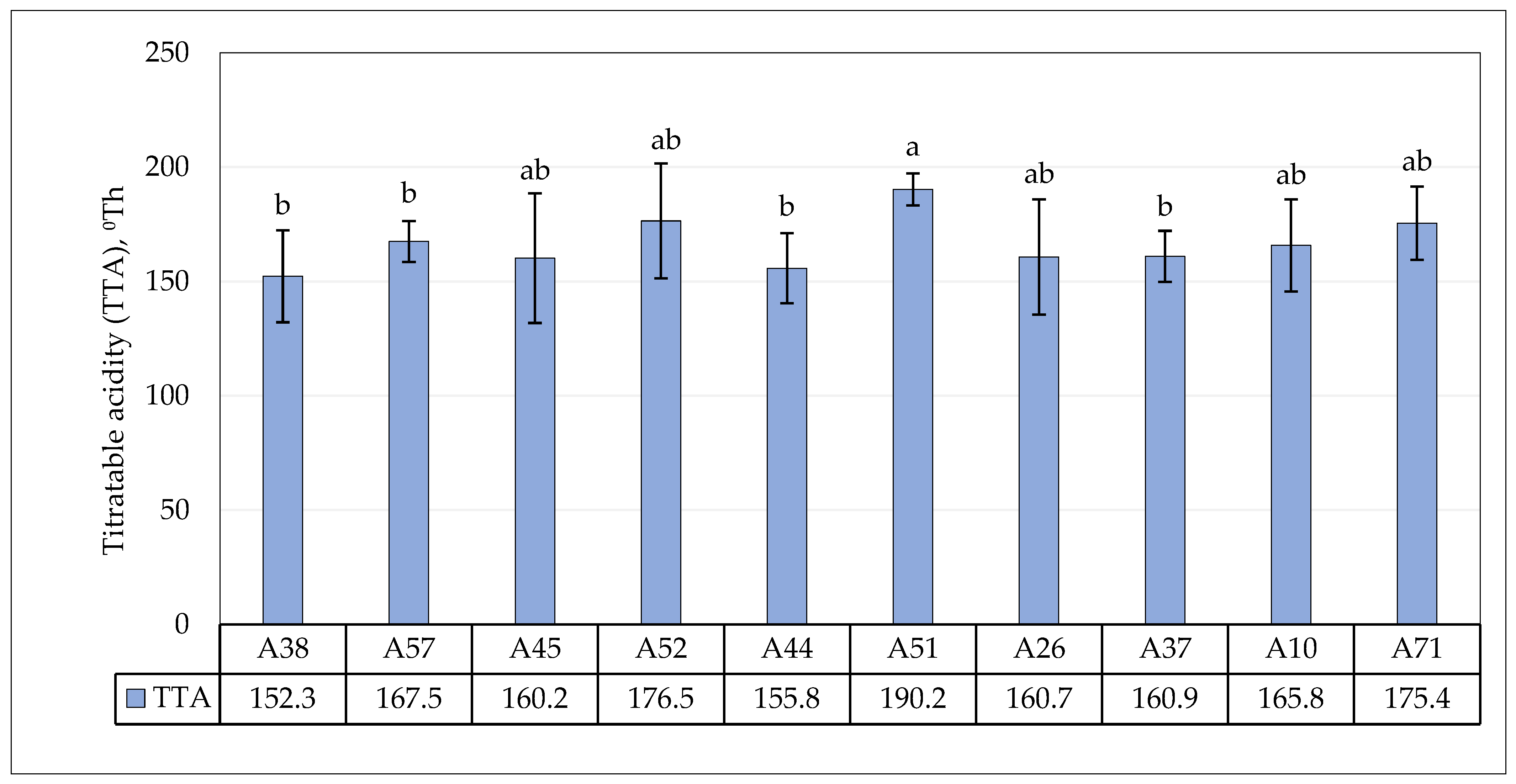
Figure 1. Total titratable acidity (TTA) in rye sourdoughs fermented with Lactiplantibacillus plantarum strains after 48 h. Different lowercase letters above the bars indicate statistically significant differences (p < 0.05) between strains, whereas bars sharing the same letter do not differ significantly.
Fermentation 11 00677 g001
Figure 2. Changes in °Brix values in rye sourdoughs fermented with different Lactiplantibacillus plantarum strains. The orange bars indicate the °Brix values of the rye flour–water mixture prior to fermentation, whereas the blue bars represent the °Brix values after 48 h of fermentation. Different lowercase letters above the bars indicate statistically significant differences (p < 0.05) between strains, whereas bars sharing the same letter do not differ significantly.
Fermentation 11 00677 g002
Figure 3. CO2 evolution during rye sourdough fermentation with different Lactiplantibacillus plantarum strains over a 48 h period.
Fermentation 11 00677 g003
Figure 4. Glucose-equivalent sugar content (µg/mg) and exopolysaccharide (EPS) yield (mg/L) of Lactiplantibacillus plantarum strains. Error bars represent standard deviations. Different lowercase letters above the bars indicate statistically significant differences (p < 0.05) between strains, whereas bars sharing the same letter do not differ significantly.
Fermentation 11 00677 g004
Figure 5. Aflatoxin B1 (AFB1) binding capacity of viable and non-viable Lactiplantibacillus plantarum strains. Error bars represent standard deviations. Viable cells showed significantly higher AFB1 binding than non-viable cells (p < 0.001).
Fermentation 11 00677 g005
Table 1. Lactiplantibacillus plantarum strains used in this study and their corresponding genotypes.
GenotypeIsolate
G1L. plantarum A38
L. plantarum A57
G5L. plantarum A45
L. plantarum A52
G6L. plantarum A44
L. plantarum A51
G9L. plantarum A26
L. plantarum A37
G12L. plantarum A10
L. plantarum A71
Table 2. Minimum inhibitory concentrations (µg/mL) of antibiotics for Lactiplantibacillus plantarum strains.
GenotypeStrainAntibiotic Class
β-LactamAmphenicolLincos-amideMacrolideAminoglycosideTetracyclineGlycopeptide
AMPCHLCLIERYGENKANSTRTETVAN
G1A380.50 ± 0.002.00 ± 0.000.02 ± 0.000.12 ± 0.071.06 ± 1.6828.00 ± 5.6610.00 ± 8.492.00 ± 0.00>32.00
A570.67 ± 0.291.67 ± 0.580.02 ± 0.000.14 ± 0.103.00 ± 0.00>32.0016.00 ± 0.0010.00 ± 2.83>32.00
G5A450.07 ± 0.021.83 ± 0.291.75 ± 0.350.35 ± 0.001.29 ± 1.48>32.0024.00 ± 0.006.00 ± 2.00>32.00
A520.11 ± 0.072.17 ± 0.760.02 ± 0.000.04 ± 0.020.75 ± 0.257.00 ± 1.4114.00 ± 2.831.50 ± 0.50>32.00
G6A440.27 ± 0.101.83 ± 0.290.02 ± 0.000.10 ± 0.021.83 ± 0.2929.33 ± 4.6221.33 ± 4.622.50 ± 0.87>32.00
A510.32 ± 0.110.92 ± 0.140.02 ± 0.000.19 ± 0.062.50 ± 1.3232.00 ± 0.0013.33 ± 4.621.08 ± 0.38>32.00
G9A260.13 ± 0.061.17 ± 0.760.02 ± 0.000.10 ± 0.020.92 ± 0.1432.00 ± 0.0012.00 ± 4.002.33 ± 1.53>32.00
A370.27 ± 0.201.33 ± 0.580.02 ± 0.001.36 ± 1.100.83 ± 0.1410.00 ± 2.8311.33 ± 5.031.58 ± 0.72>32.00
G12A100.42 ± 0.142.50 ± 1.320.02 ± 0.000.17 ± 0.041.83 ± 0.2928.00 ± 5.6620.00 ± 5.663.67 ± 0.58>32.00
A710.34 ± 0.283.00 ± 0.000.02 ± 0.000.13 ± 0.000.83 ± 0.1432.00 ± 0.0024.00 ± 0.002.67 ± 1.15>32.00
Cut-off values 1≤2≤8≤4≤1≤16≤64n.r.≤32n.r.
Abbreviations: AMP ampicillin, CHL chloramphenicol, CLI clindamycin, ERY erythromycin, GEN gentamicin, KAN kanamycin, STR streptomycin, TET tetracycline, VAN vancomycin, n.r. not required. 1 Antibiotic cut-off values by EFSA [17].
Table 3. Enzymatic activity of Lactiplantibacillus plantarum strains.
EnzymeGenotypes and Strains
G1G5G6G9G12
A38A57A45A52A44A51A26A37A10A71
Alkaline phosphatase1001010000
Esterase 3001011311
Esterase lipase3111111311
Lipase0100000000
Leucine arylamidase5555555555
Valine arylamidase4434545355
Cystine arylamidase2222332233
Trypsin0100000000
α-chymotrypsin0000000000
Acid phosphatase1312333233
Naphthol-AS-BI phosphohydrolase2333333322
α-galactosidase3000000500
β-galactosidase5434444544
β-glucuronidase1000000000
α-glucosidase5030000500
β-glucosidase4555555555
N-Acetyl-β-glucosaminidase3335555355
α-mannosidase0000000000
α-fucosidase0000000000
Value 0 indicated a negative reaction, 1–2 represented weak activity (5 to <20 nmol of substrate hydrolyzed), and 3–5 denoted strong activity (>20 nmol of substrate hydrolyzed). Background colour indicates the intensity of the values, with darker colours representing higher activity levels.
Table 4. Utilization of carbohydrates by Lactiplantibacillus plantarum strains.
Carbon SourceGenotypes and Strains
G1G5G6G9G12
A38A57A45A52A44A51A26A37A10A71
L-Arabinose++----+++-
D-Ribose++++++++++
D-Xylose+-----++--
D-Galactose++++++++++
D-Glucose++++++++++
D-Fructose++++++++++
D-Mannose++++++-+++
D-Mannitol++++++-+++
D-Sorbitol++++++-+++
Methyl-α-D-mannopyranoside++++++-++-
N-Acetylglucosamine+++-++-+++
Amygdalin++++++-+++
Arbutin++++++-+++
Esculin++-+-+++++
Salicin++++++-+++
D-Cellobiose++++++-+++
D-Maltose++++++++++
D-Lactose++++++++++
D-Melibiose++++++++++
D-Saccharose++++++++++
D-Trehalose++++++-+++
Inulin+-+-+--++-
D-Melezitose+++++--+++
D-Raffinose+++++-++++
Starch-----+----
Gentiobiose+++++--+++
D-Turanose--------++
D-Lyxose--------+-
D-Tagatose--------+-
D-Fucose--------+-
L-Fucose--------+-
D-Arbitol--+-+---+-
L-Arbitol--------+-
Potassium gluconate+++++++-++
Potassium 5-ketogluconate------+---
Symbols: “+” indicates utilized; “-“ indicates not utilized.
Table 5. Content of lactic acid, acetic acid, and ethanol (g/kg) in rye sourdoughs prepared with L. plantarum strains.
Parameter Strains and Genotypes
G1G5G6G9G12
A38A57A45A52A44A51A26A37A10A71
Lactic acid12.7 ± 3.1 ab14.0 ± 1.6 ab13.3 ± 2.8 ab21.6 ± 4.1 ab13.3 ± 1.8 ab11.4 ± 0.9 a12.7 ± 3.2 ab15.4 ± 0.4 b15.1 ± 4.8 ab16.3 ± 2.6 ab
Acetic acid2.8 ± 0.3 a2.0 ± 0.6 ab1.7 ± 0.2 b1.9 ± 0.8 ab2.2 ± 0.7 ab2.2 ± 0.7 ab1.8 ± 0.2 b2.3 ± 0.2 ab2.3 ± 0.9 ab2.5 ± 0.5 ab
Total acids15.5 ± 3.116.0 ± 1.715.0 ± 2.823.5 ± 4.215.5 ± 1.913.6 ± 1.114.5 ± 3.217.7 ± 0.517.4 ± 4.918.8 ± 2.6
Ethanol5.2 ± 1.2 b4.1 ± 0.8 b4.2 ± 4.2 a11.8 ± 1.5 a3.9 ± 0.5 c3.7 ± 1.5 b6.7 ± 2.2 a5.7 ± 1.2 a4.6 ± 1.9 a13.8 ± 2.7 a
Notes: Different lowercase letters following the mean values within the same row indicate statistically significant differences among strains (p < 0.05). Values sharing the same letter do not differ significantly.
Disclaimer/Publisher’s Note: The statements, opinions and data contained in all publications are solely those of the individual author(s) and contributor(s) and not of MDPI and/or the editor(s). MDPI and/or the editor(s) disclaim responsibility for any injury to people or property resulting from any ideas, methods, instructions or products referred to in the content.