
Article

2G Ethanol Production from a Cellulose Derivative
by
Elton C. Grossi
1,
Romulo D. A. Andrade
1,2,*,
Paulo A. Z. Suarez
1 and
Sarah S. Brum
1
1
Materials and Fuels Laboratory, Chemistry Institute-IQ, University of Brasilia (UnB), Brasilia 70904-970, DF, Brazil
2
Institute of Superior Education of Basilia, Campus Sul—IESB, SGAS Q.613/614, Via L2 Sul—Asa Sul, Brasilia 70200-730, DF, Brazil
*
Author to whom correspondence should be addressed.
Fermentation 2025, 11(12), 676; https://doi.org/10.3390/fermentation11120676 (registering DOI)
Submission received: 10 October 2025 / Revised: 1 December 2025 / Accepted: 1 December 2025 / Published: 3 December 2025

Abstract

The conversion of cellulose into glucose has been a major challenge in improving the competitiveness of 2G ethanol production due to the inefficiency of pre-treatment and the high degree of crystallinity of the cellulose. This study examined the effect of replacing cellulose hydroxyl groups with acetyl groups on the hydrolysis yield. Cellulose compounds and cellulose acetate were characterized using FTIR, and the degree of substitution of the cellulose acetate was determined chemically. The crystallinity of the materials was analyzed using X-ray diffraction. The results of the hydrolysis reaction analysis showed that the substitution of hydroxyl groups in cellulose with acetyl groups favored acid hydrolysis, yielding high glucose yields. For the fermentation test of the hydrolysate, yeast (Saccharomyces cerevisiae) was used. Fermentation reached values close to maximum efficiency. These results open up new avenues for acid hydrolysis based on the chemical modification of cellulose.:

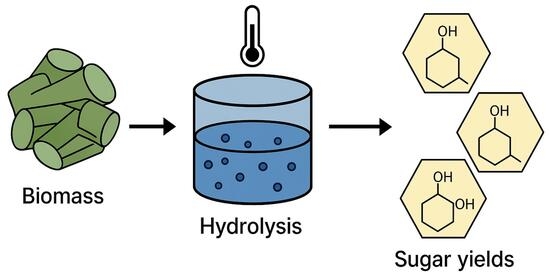
Graphical Abstract

1. Introduction

Concerns about energy security and the depletion of fossil fuel sources, coupled with environmental issues and the ecological requirements of materials, have driven the search for renewable energy sources [1,2]. Ethanol production from lignocellulosic biomass (2G ethanol) is currently considered the most promising alternative for increasing global ethanol production without compromising food security [3,4]. The importance of producing ethanol from lignocellulosic materials lies in the possibility of using low-cost feedstock such as urban and industrial residues, which makes it possible to increase ethanol production without expanding the area used for cultivation [5].
Around 60% of the total weight of solid waste in the world is made up of materials of vegetable origin, such as paper, cardboard, cigarette butts and wood [6]. These wastes can be used to produce 2G ethanol, which has significant advantages. As well as adding value to the waste, this process would reduce its environmental impact [7,8]. The synthesis of cellulose acetate is promoted by the acetylation reaction of cellulose, using acetic acid as a solvent, sulfuric acid as a catalyst, and acetic anhydride as an acetylating agent [9,10]. When the hydroxyl groups in the cellulose units are replaced by acetyl groups, cellulose acetate is formed [11,12,13,14,15,16,17,18,19,20,21,22,23,24,25,26,27,28,29,30,31,32].
However, for 2G ethanol to become competitive, it is necessary to develop a pretreatment technology for lignocellulosic biomass to improve the efficiency of hydrolysis [8]. The goals of pretreatment are to increase the accessible surface area of the material, promote total or partial delignification, and decrease the degree of cellulose polymerisation and crystallinity [9]. Currently, two pretreatment processes are in use: steam explosion and acid prehydrolysis using either dilute [10] or concentrated [11] acids. Although steam explosion shows promise, this type of pretreatment has limitations for industrial application in sugarcane plants that use sugarcane bagasse, since the stages of the steam explosion process are compromised by the lack of industrial-scale equipment capable of performing operations at a viable rate [12]. The disadvantages of acid pretreatment include the possibility of sugar degradation, formation of fermentation inhibitors such as organic acids, phenols and furans [13], and the high cost of highly corrosion-resistant reactors, which are also ineffective at depolymerising cellulose [14]. Although cellulose can be isolated using the above processes, its crystallinity poses challenges in terms of the fiber’s accessibility and reactivity to acid hydrolytic agents or biological agents [15]. However, reducing the crystallinity of cellulose is possible through the chemical modification of cellulose by replacing hydroxyl groups with less hydrophilic ones. In this context, the aim of this study was to investigate the effect of replacing the hydroxyl groups in cellulose with acetyl groups in acid hydrolysis reactions. Cellulose acetate, the main constituent of cigarette filters, was used to compare the efficiency of cellulose and cellulose derivative hydrolysis in terms of glucose yield.

2. Materials and Methods

2.1. Materials

Microcrystalline cellulose (MCC), which was purchased from Merck (Burlington, MA, USA), was used for the hydrolysis reactions. Cellulose acetate, which is used in the production of cigarette filters, was provided by Souza Cruz (Cachoeirinha, Rio Grande do Sul, Brazil). Sulfuric acid (98%) was purchased from Vetec (Speyer, Germany). The enzymatic colorimetric test was used to determine glucose levels, with mono-reagent glucose from Bioclin (Delft, The Netherlands) being used for this test.
The fermentation was used the yeast Saccharomyces cerevisiae-CAT-1 (yeast for ethanol production). YNB—yeast nitrogen base-was purchased from Sigma-Aldrich (St. Louis, MO, USA).

2.2. Methods

2.2.1. Determination of the Substitution Degree (DS) of the Cellulose Acetate

The degree of substitution was determined using a saponification reaction according to the procedure described in the literature. 5.00 mL of 0.25 mol/L sodium hydroxide and 5.00 mL of ethanol were added to 0.100 g of cellulose acetate, after which the mixture was left to rest. After 24 h, 10.00 mL of 0.25 M hydrochloric acid was added to the mixture and it was left to stand for 30 min. Then, the solution was titrated with standardized sodium hydroxide and potassium biphthalate, using the phenolphthalein indicator. This procedure was performed in triplicate.
The substitution degree de substitution was calculated according to Equation (1).
% AG = Vbi + Vbt Mb Va × Ma MM × 100 mac
where %AG = percentage of acetyl groups; Vbi = volume of sodium hydroxide added; Vbt = volume of sodium hydroxide obtained in titration; Mb = molarity of sodium hydroxide; Va = volume of hydrochloric acid added; Ma = molarity of hydrochloric acid; MM = molar mass of acetyl groups; mac = mass of cellulose acetate used.

2.2.2. FT-IR Spectroscopy

FTIR spectra were obtained using a Shimadzu IR Prestige-21 machine (Shimadzu, Kyoto, Japan) equipped with a DLATGS detector (InfraTec GmbH, Dresden, Germany). KBr pellets were prepared by mixing 2 mg of sample with 200 mg of spectroscopic-grade KBr. For each spectrum, 32 scans were accumulated with a resolution of 4 cm−1 in the 4000–400 cm−1 region.

2.2.3. X-Ray Diffraction (XRD)/Crystallinity

The X-ray diffractograms of cellulose and cellulose acetate were made using an X-ray diffractometer XRD-7000 Shimadzu (Shimadzu, Kyoto, Japan). The configuration adopted for the analysis was the monochromator with slots (1, 1, 0, 3 nm) operated at 40 kV with a current of 20 mA. The adopted speed was 1°/min, with 2θ angle ranging from 5 to 60°, using a Cu-Kα radiation with a wavelength of 0.15418 nm.
The cellulose crystallinity was found by Equation (2), according to an empirical method described in the literature [16,17].
% CI = 1 h am h cr × 100
where CI is the Crystal index, (hcr) represents the crystalline scatter of the (200) reflection at 2θ of 22.5° for cellulose I, and the amorphous height (ham) indicates the height of the amorphous reflection at 2θ of 18° for cellulose I.

2.2.4. Hydrolysis Reactions of the Material and Quantification of Glucose

The hydrolysis reaction tests were conducted in a closed system. In a glass containers 50 mL, 0.5 g of the material to be hydrolyzed (cellulose or cellulose acetate) and 40 mL of sulfuric acid solution were placed. The glass containers were then capped and sealed before being placed in an autoclave at system vapor pressure (15 psi). The reactions were conducted at 120 °C, with the concentration of sulfuric acid (2.5%, 5%, 10%, 15% and 20% v/v) and reaction time (30, 60, 90, 120, 150, 180 and 210 min) varied. After the reaction stage, the vials were removed from the autoclave and cooled in an ice bath (−5 °C).
The solid residues were then separated from the liquid fraction by centrifugation (10 min/1500 rpm). The liquid fraction containing the hydrolyzed material was stored in glass jars in the refrigerator for later glucose quantification. All reactions were performed in triplicate.
The glucose content of the hydrolysates was determined using a Cary 60 UV-Vis spectrophotometer (Agilent Technologies, Santa Clara, CA, USA) with a specific enzymatic colorimetric test for glucose quantification. Absorbance readings of the samples and standard were taken at λ = 505 nm. The hydrolysis yield was calculated as glucose% [32] based on Equation (3).
% glucose   yield = glucose   obtained   mol moles   of   glucose   per   anhydroglucose   unit × 100

2.2.5. HPLC Analysis

Samples of hydrolysates and fermentation samples were analyzed using high-performance liquid chromatography (HPLC) on a Shimadzu instrument (Shimadzu, Kyoto, Japan). The samples were diluted fivefold in Milli-Q water to a final volume of 1 mL. A Shim-pack SCR-101H column (Shimadzu, Kyoto, Japan) was used at a temperature of 50 °C, coupled to a refractive index detector (RID) and an ultraviolet detector using a wavelength of 210 nm. The mobile phase used was 5 × 10⁻³ mol/L sulfuric acid, with a flow rate of 0.6 mL/min. The chromatograms were analyzed using Shimadzu Labsolution CS software.

2.2.6. Fermentation

For the tests, fermentation was prepared with a higher concentration of glucose hydrolysate, at around 50 g·L−1. Therefore, we used 14 capped 50 mL glass containers, each containing 3.5 g of cellulose acetate and a 5.0% (v/v) solution of H2SO4. The reaction was conducted in an autoclave, the vapor pressure of the system, temperature of 120 °C for 180 min, and the hydrolyzate was identified with the acronym A5-180 Hydrolysis of cellulose acetate in 5% H2SO4 solution for 180 min. The same procedure was used to prepare a second hydrolysate in H2SO4 solution at 10.0% (v/v) for 120 min.
This hydrolysate was identified as A10-120. After the reactions, the hydrolysates were filtered. They were then transferred to sterile glass containers. The containers were stored in a frozen state (−18 °C). This was for the subsequent fermentation.
The strain CAT-1 of the yeast Saccharomyces cerevisiae was used to produce ethanol. The cells were grown in YNB medium (6.7 g·L−1 Yeast Nitrogen Base containing 5 g·L−1 ammonium sulfate-Invitrogen, Waltham, MA, USA) and 20 g·L−1 glucose, added with 20 g·L−1 agar for solid medium for growing in Petri plates. The YNB medium was used for fermentation and hydrolyzed at a ratio of 1:1.
S. cerevisiae cells stored at −80 °C was plated on medium YNB solid and grown for 72 h in an oven at 28 °C. An isolated colony was selected for the pre-inoculum and inoculated into a 1-L Erlenmeyer flask containing 100 mL of YNB liquid medium. The flask was then placed in a shaker at 28 °C and agitated at 200 rpm for 20 h. Cell density (OD600) was analyzed and calculated for a proportional volume to an initial OD600 of 0.1 for bioreactor fermentation. Fermentation was carried out in an INFORS HT Multifors Cell 2 bioreactor (INFORS HT, Bottmingen, Switzerland) with a 1-L capacity. The bioreactor contained YNB medium and was hydrolyzed at a ratio of 1:1, giving a final volume of 700 mL. The initial pH of the medium was adjusted to 5.5 with 10 M KOH sterile solution resulting in a final volume of 800 mL. The fermentation took place for 25 h with stirring at 200 rpm at 30 °C without aeration. Samples were taken every 2 h to OD600 analysis and HPLC analysis. The fermentation was performed in duplicate.

3. Results and Discussion

3.1. Degree of Substitution of Cellulose Acetate

The degree of substitution, defined as the average number of hydroxyl groups replaced by acetyl groups (AG), was determined by a saponification reaction. Saponification is a hydrolysis reaction promoted by a base. In this reaction, the hydroxide ion facilitates a nucleophilic attack on the carbonyl carbon atom of the cellulose acetate. A tetrahedral intermediate then expels an alkoxide ion in a proton transfer reaction, leading to the product [18]. The volume of base used in titration is proportional to the degree of substitution of hydroxyl groups by acetyl groups.
Triacetate contains 43.5% acetyl groups, corresponding to a degree of substitution (DS) of 2.88 [19]. The average %AG value calculated for cellulose acetate was 32.28%. Given the linear relationship between %AG and GS, it was concluded through a simple rule of three that the degree of substitution was 2.13 ± 0.03, which characterizes a material as diacetate.

3.2. FT-IR Spectra

When the spectra of microcrystalline cellulose and cellulose acetate were compared (see Figure 1), a band around 3400 cm−1 was observed. This is characteristic of the stretching vibration of the OH groups in cellulose. This band is less pronounced in the acetate cellulose spectrum due to hydroxyl groups being substituted for acetyl groups. The cellulose acetate spectrum shows three bands associated with ester bonds: one at approximately 1743 cm−1 due to stretching of the carbonyl group (C=O); one at 1372 cm−1 due to stretching of the C–H bonds of the CH3; and one at 1237 cm−1 due to stretching of the C–O bond of –O–(C=O)–CH3. The other two bands are at 1372 cm−1 and 1237 cm−1, which are related to the C–H and C–O bonds of –O–(C=O)–CH3, respectively.
In both spectra, a band appears at 2890 cm−1, related to the stretching of C–H bonds of the CH2 groups, as well as at 899 cm−1, concerning the stretching C1–C4 of glycosidic bond. In the spectrum of cellulose acetate at 2946 cm−1, there occurs a feature band of the asymmetric stretching of C–H bonds of CH3 groups.

3.3. Analysis of the X-Ray Diffraction (XRD)

The X-ray diffraction study was conducted to assess the degree of crystallinity of the material to be hydrolyzed. This result is important for comparing with the results of hydrolysis and correlating the influence of cellulose crystallinity with glucose yield.
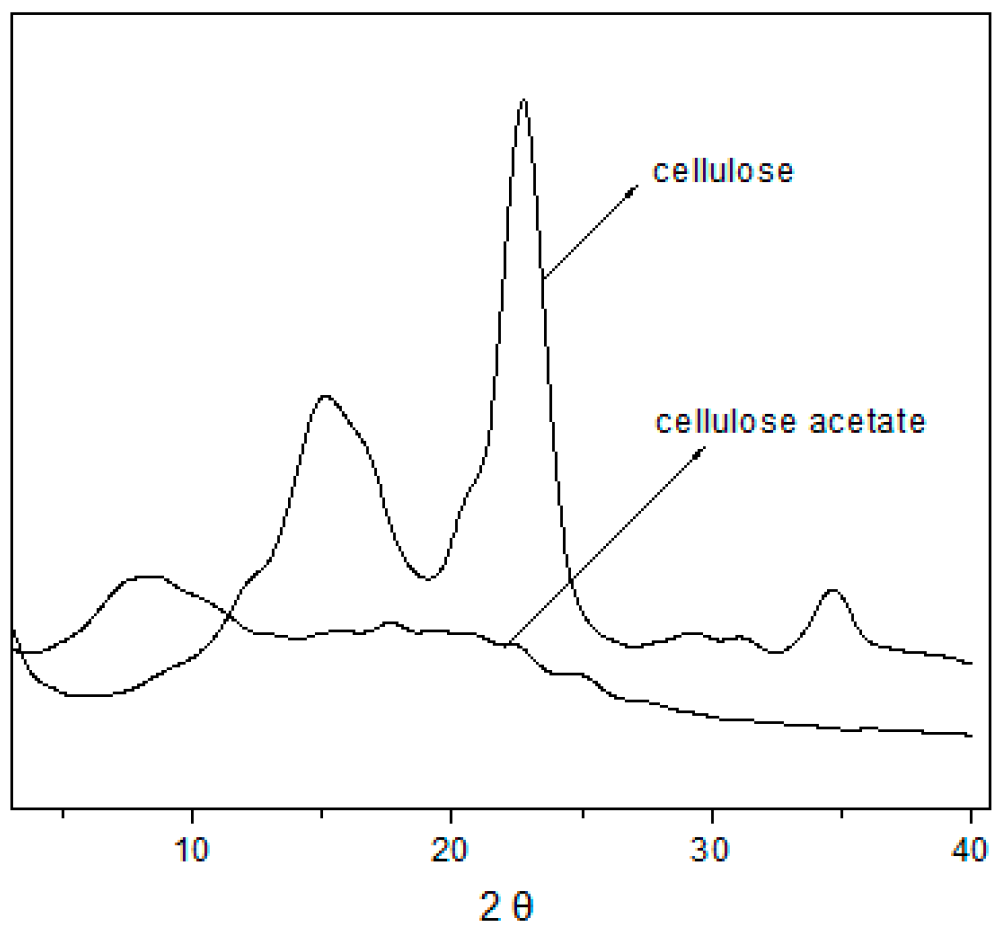
Figure 2 depicts the X-ray diffractograms of microcrystalline cellulose and cellulose acetate. Microcrystalline cellulose exhibits the characteristic XRD pattern of cellulose I, with the primary diffraction signals occurring at approximately 15.0, 22.5, and 34.5 2θ, which are attributed to the 101, 002, and 040 diffraction planes, respectively [18]. Generally speaking, compared to the diffraction of microcrystalline cellulose, the X-ray diffractogram of cellulose acetate shows signals attributable to the 101, 002 and 040 planes almost entirely disappearing.
The main diffraction peak is located at approximately 8° and is cited as the main indicator of the semicrystallinity of the acetylated cellulose derivative.
The crystallinity index of the cellulose, as calculated using Equation (2), is 80.25%. Analysis of the diffractograms shows that the crystallinity index (CI) of ethyl cellulose is significantly lower than that of cellulose. This reduction occurs due to the replacement of hydroxyl groups by larger-volume acetyl groups.
The crystalline regions of cellulose are resistant to solvation and less accessible to chemicals due to the strong hydrogen bonds between microfibrils. This feature hinders the hydrolysis of cellulose and therefore pretreatment capable of breaking down this highly ordered crystalline structure is necessary.
Some pre-treatments aimed at reducing crystallinity are described in the literature. For example, a paper on eucalyptus pulp cellulose with a CI of 79.22% evaluated the reduction in crystallinity after different types of pre-treatments: controlled acid hydrolysis, alkaline treatment, microprocessing and milling in a ball mill. It was concluded that the best treatment for producing ethanol from cellulose would be milling in a ball mill because, in addition to reducing the particle size and increasing the surface area, it does not produce by-products [20]. However, obtaining a sample with a crystallinity index of 32.49% required grinding for 13 days in a ceramic mill and 18 days in a zirconia mill. This is not economically feasible as it involves a high energy demand for grinding the raw materials.
In light of this, chemical modification of cellulose is a response to the difficulties of hydrolysis. Therefore, cellulose acetate was chosen as it is a cellulose derivative with lower crystallinity.

3.4. Hydrolysis of Materials

Visual observation of the flasks containing cellulose and cellulose acetate hydrolysates revealed that the reaction with cellulose was ineffective, as much more solid waste remained at the bottom of the flasks containing cellulose than cellulose acetate hydrolysate.
Glucose quantification was carried out using a spectrophotometer as it is a quick and simple technique that had previously been used to estimate the amount of sugar produced in hydrolysis reactions. This assisted in selecting the most suitable reactions for studying the fermentative process for producing ethanol 2G.
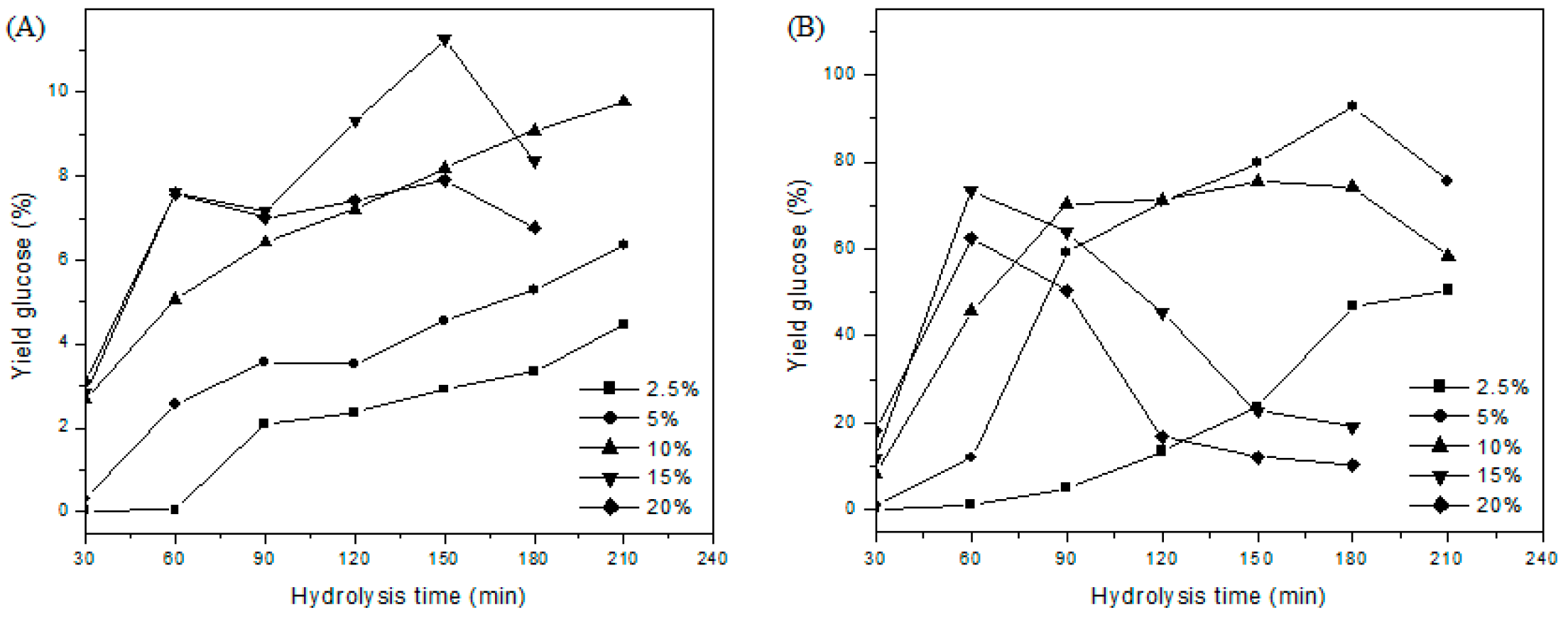
The results and yield comparisons obtained from the hydrolysis of cellulose and cellulose acetate are shown in the glucose yield versus reaction time graphs (Figure 3).
Figure 3A shows that lower glucose yields were found, almost all below 10%. The best yield, of around 11%, was achieved with the acid-treated sample after 150 min. It can be seen that when the reaction was performed under the same conditions for 180 min, the yield decreased to 8%, indicating that the glucose produced up to 150 min began to degrade shortly thereafter.
The reason for this may be that the glucose yield obtained from cellulose is only related to the depolymerization of its amorphous area, rather than its crystalline area [21].
The results of the cellulose acetate hydrolysis (Figure 3B) show that, at the beginning of the reaction, yields of glucose are between 62% and 70% for H2SO4 solution concentrations of 20% and 15%, respectively. After 60 min, at these acid solution concentrations, the glucose produced begins to degrade. For acid hydrolysis, the yield increased proportionally to the reaction time up to 90 min; from this point onwards, the yield remained constant between 70% and 74% up to 180 min. After 180 min, the glucose concentration decreased due to sugar degradation.
The best result was obtained with 5% acid hydrolysis of cellulose acetate, where an increase in glucose production was observed over the course of the reaction up to 180 min, at which point the maximum glucose yield value of around 92% was reached. When comparing the hydrolysis efficiency of the two materials, it is clear that the sugar content obtained from the hydrolysis of cellulose is much lower than the values obtained from cellulose acetate, regardless of the reaction time (Figure 3B). The lower rate of cellulose hydrolysis is related to the high crystallinity of microcrystalline cellulose.
The crystalline regions are resistant to solvation and chemical attack due to strong inter- and intramolecular hydrogen bonding, which generates strong cohesion between the molecules. Substituting the cellulose hydroxyls with acetyl groups decreases the number of hydrogen bonds, making the formerly crystalline structure more amorphous and facilitating solvation and interaction with reactants. Consequently, the hydrolysis rate increases.
In this context, the importance of studying the chemical modification of cellulose as a pretreatment stage for producing ethanol 2G is clear. High yields of 92% were obtained at mild temperature conditions (120 °C), pressure (15 psi) and acid concentration (5%). A comparative study of the three cellulose hydrolysis processes—dilute acid (H2SO4 concentration < 1%), concentrated acid (H2SO4 concentration 30–70%) and enzymes (cellulase)—showed a glucose yield of 90% in concentrated acid hydrolysis [22]. However, such high concentrations of sulfuric acid (70%) impede the process due to economic issues associated with acid recovery and the high cost of corrosion-resistant equipment.

3.5. Composition of the Hydrolyzate

During acidic hydrolysis, some byproducts may form that can interfere with the fermentation process. These include aldehydes such as furfural and hydroxymethylfurfural (HMF), which are formed by the degradation of pentoses and hexoses, respectively [13,14,15,16,17,18,19,20,21,22,23]. Furfural decreases the specific growth rate of yeast, and although HMF is less toxic, it also damages the yeast cell membrane, as various studies have confirmed [24,25,26,27].
In this context, it is not only important to obtain a high yield of glucose, but also to obtain a hydrolysate with low levels of inhibitory compounds, as this is fundamental to the success of the fermentation stage and consequently to obtaining high ethanol yields. Thus, the presence of these inhibitors was also assessed in cellulose acetate hydrolyzates, and the results are show in Table 1.
The analyses show the presence of HMF and furfural compounds at concentrations below the toxic level, i.e., below 1 mg·L−1. These values represent less than 1% of the glucose concentrations obtained. Some studies in the literature show that furfural levels increase with increasing hydrolysis temperature. For example, the acidic hydrolysis of castor bean cake using H2SO4 at 120 °C yielded 32.2% glucose and 3.8% furfural relative to the glucose content [28]. The hydrolysis of cellulose using sulfuric acid at 190 °C yielded 58.2% glucose conversion and 7.3% HMF. Under the same conditions, lowering the temperature to 150 °C resulted in no HMF formation; however, cellulose conversion to glucose was only 1.7%. A decrease in temperature inhibits the formation of furfural, but conversely, the hydrolysis rate decreases considerably.
In the fermentation of acid hydrolyzate to produce ethanol, inhibitors such as furans, aldehydes, aliphatic acids and phenols can, as has been reported, cause a considerable decrease in fermentation. Treating the hydrolysate with Ca(OH)2 before fermentation (overliming) is a well-established method of improving fermentability. However, a disadvantage of overliming is the formation of a calcium sulphate precipitate [30]. Another drawback is that, if the treatment is carried out under severe conditions (high temperature and pH), there is considerable degradation of fermentable sugars [31]. Chemical analysis combined with fermentation experiments suggests that it is difficult to find conditions capable of preventing the degradation of fermentable sugars while also degrading inhibitor furans aldehydes. Therefore, the solution would be to prevent the formation of inhibitors during the glucose production process. Therefore, it is important to note that chemical modification of cellulose enables its use.
Confronted with this predicament, the solution proffered would serve to forestall the genesis of inhibitors during the process of glucose extraction. It is therefore important to note that the chemical modification of cellulose enables the use of low temperatures (120 °C) in the hydrolysis process, which consequently prevents the formation of inhibitors. As this study shows, this is extremely important since high glucose yields and low inhibitor levels in the hydrolysates were obtained. In the fermentation process, the absence of these inhibitors simplifies the production of 2G ethanol, as the detoxification stage is eliminated.

3.6. Fermentation-Ethanol 2G Production

Two hydrolysates, A5-180 and A10-120, with initial glucose concentrations of 47.36 g·L−1 and 58.24 g·L−1, respectively, were selected for fermentation. These concentrations decreased to 13.0 and 18.0 g·L−1, respectively, following the addition of KOH solution and YNB. Due to the high acidity of the medium containing hydrolysate A10-120 (H2SO4 10%) and the need for a larger volume of base to adjust the pH, there was no yeast growth and therefore no ethanol production.
During fermentation, samples of the medium were taken from the fermentation vats every two hours for the first 15 h to quantify glucose consumption and ethanol production and to verify the absence of toxic substances such as furfural and HMF. The results are shown in Table 2.
Cell growth also was analyzed during the fermentation process and compared with the glucose consumption and ethanol production.
After this time, cells grow exponentially, converting glucose to ethanol. In glucose fermentation, it appears that stoichiometrically, 180.0 g of substrate produces 92.0 g of ethanol. In other words, the conversion factor of substrate to product (YP/S) is 0.51 w/w. Analysis of the results from hydrolyzate fermentation revealed that the substrate-to-product conversion factor (YP/S) was 0.494 w/w, representing an ethanol conversion of approximately 97%. As shown in Table 2, there was a correlation between glucose consumption and conversion into ethanol. After 25 h, glucose was completely consumed and ethanol production reached values close to the maximum fermentation efficiency. The absence of inhibitors and the high glucose concentration in the hydrolysate were key to successful fermentation.
These results suggest that the chemical modification of cellulose could be an interesting approach for producing 2G ethanol. Although additional expenses are incurred with this treatment, these may be offset by process efficiency and energy cost savings (since higher temperatures are required to hydrolyze cellulose) and the elimination of the detoxification step.

4. Conclusions

During the chemical modification of cellulose, the acetylation of hydroxyl groups decreases its crystallinity index, facilitating access to the acid in its structure and consequently increasing the hydrolysis rate. Acid hydrolysis using H2SO4 produced a hydrolyzate with a high glucose content (90%) that was virtually devoid of fermentation inhibitors. This is mainly due to the mild temperature and pressure conditions and low acid concentrations used in the reactions. This made the production of ethanol possible, with fermentation process yields reaching almost maximum efficiency.

Author Contributions

Conceptualization, P.A.Z.S. and S.S.B.; methodology, P.A.Z.S. and S.S.B.; software, E.C.G., P.A.Z.S. and S.S.B.; validation, P.A.Z.S., S.S.B. and R.D.A.A.; formal analysis, E.C.G., P.A.Z.S. and S.S.B.; investigation, E.C.G., P.A.Z.S. and S.S.B.; resources, E.C.G., P.A.Z.S. and S.S.B.; data curation, P.A.Z.S. and S.S.B.; writing—original draft preparation, P.A.Z.S. and S.S.B.; writing—review and editing, R.D.A.A. and P.A.Z.S.; visualization, R.D.A.A. and P.A.Z.S.; supervision, P.A.Z.S. and S.S.B.; project administration, P.A.Z.S.; funding acquisition, P.A.Z.S. and S.S.B. All authors have read and agreed to the published version of the manuscript.

Funding

The authors would like to thank CAPES, CNPq and FAPDF for their financial support.

Institutional Review Board Statement

Not applicable.

Informed Consent Statement

Not applicable.

Data Availability Statement

The original contributions presented in this study are included in the article. Further inquiries can be directed to the corresponding author.

Conflicts of Interest

The authors declare that they have no known competing financial interests or personal relationships that could have appeared to influence the work reported in this paper. If there are other authors, they declare that they have no known competing financial interests or personal relationships that could have appeared to influence the work reported in this paper.

Abbreviations

2GSecond generation
FTIRFourier transform infrared
MCCmicrocrystalline cellulose
S.A.Standard analytical
DSsubstitution degree
%AGpercentage of acetyl groups
Vbvolume of base
Vbtbase volume spends in the titration
Mbmolarity of the acid
MMmolar mass acetyl groups
macmass of cellulose acetate
KOHpotassium hydroxide
KBrPotassium bromide
HMFhydroxymethylfurfural
H2SO4sulfuric acid
CICrystal index
hcrcrystalline scatter
GAacetyl groups
hamamorphous height
UVUltraviolet
UV-visVisible Ultraviolet
HPLCHigh-performance liquid chromatography
pHhydrogenionic potential
cmCentimetre
mLMillilitre
°CDegree Celsius
minMinutes
nmNanometre
molmol
w/wWeight by weight
v/vvolume by volume
CAT-1Saccharomyces cerevisiae
gGrams
rpmrotations per minute
LLiter
mgMilligram

References

  1. Reddy, N.; Yang, Y. Biocomposites using lignocellulosic agricultural residues as reinforcement. In Innovative Biofibers from Renewable Resources; Springer: Berlin/Heidelberg, Germany, 2015; pp. 391–417. [Google Scholar]
  2. Rashid, B.; Leman, Z.; Jawaid, M.; Ghazali, M.J.; Ishak, M.R. Physicochemical and thermal properties of lignocellulosic fiber from sugar palm fibers: Effect of treatment. Cellulose 2016, 23, 2905–2916. [Google Scholar] [CrossRef]
  3. Araújo, L.G.S.; Rodrigues, T.H.S.; Rates, E.R.D.; Alencar, L.M.R.; Rosa, M.F.; Rocha, M.V.P. Production of cellulose nanoparticles from cashew apple bagasse by sequential enzymatic hydrolysis with an ultrasonic process and its application in biofilm packaging. ACS Omega 2024, 9, 50671–50684. [Google Scholar] [CrossRef]
  4. Hu, L.; Linc, L.; Wu, Z.; Zhou, S.; Liu, S. Chemocatalytic hydrolysis of cellulose into glucose over solid acid catalysts. Appl. Catal. B Environ. Energy 2015, 174–175, 225–243. [Google Scholar] [CrossRef]
  5. Brum, S.S. Sulfated Zirconia Catalysts and Activated Carbon/Sulfated Zirconia Composites for Biodiesel and Ethanol Production. Ph.D. Thesis, University Federal of Lavras (UFLA), Lavras, Brazil, 2010. [Google Scholar]
  6. Evangelista, I.; Arruda, A.; Menezes, L.; Fischer, J.; Guidini, C.Z. Physicochemical characterization of agro-industrial residues for second-generation ethanol production. Res. Soc. Dev. 2021, 10, e33110817151. [Google Scholar] [CrossRef]
  7. Osman, A.I.; Mehta, N.; Elgarahy, A.M.; Al-Hinai, A.; Al-Muhtaseb, A.A.H.; Rooney, D.W. Conversion of biomass to biofuels and life cycle assessment: A review. Environ. Chem. Lett. 2021, 19, 4075–4118. [Google Scholar] [CrossRef]
  8. Gupta, A.; Verma, J.P. Sustainable bio-ethanol production from agro-residues: A review. Renew. Sustain. Energy Rev. 2015, 41, 550–567. [Google Scholar] [CrossRef]
  9. Cortez, L.A.B.; Lora, E.E.S.; Gómez, E.O. Biomass for Energy, 1st ed.; Unicamp: Campinas, Brazil, 2008. [Google Scholar]
  10. Chimentao, R.J.; Lorente, E.; Gispert-Guirado, F.; Medina, F.; Lopez, F. Hydrolysis of dilute acid-pretreated cellulose under mild hydrothermal conditions. Carbohydr. Polym. 2014, 111, 116–124. [Google Scholar] [CrossRef] [PubMed]
  11. Wang, D.; Kao, M.-R.; Li, J.; Sun, P.; Meng, Q.; Vyas, A.; Liang, P.-H.; Wang, Y.-S.; Hsieh, Y.S.Y. Characterization of cellulose-derived oligosaccharides and their application in intestinal barrier modulation. J. Agric. Food Chem. 2022, 70, 9941–9947. [Google Scholar] [CrossRef] [PubMed]
  12. Rabelo, S.C. Evaluation and Optimization of Pretreatment and Enzymatic Hydrolysis of Sugarcane Bagasse for Second Generation Ethanol Production. Ph.D. Thesis, University of Campinas, Campinas, Brazil, 2010. [Google Scholar]
  13. Jönsson, L.J.; Martín, C. Pretreatment of lignocellulose: Formation of inhibitory by-products and strategies for minimizing their effects. Bioresour. Technol. 2016, 199, 103–112. [Google Scholar] [CrossRef]
  14. Zhang, L.; Wang, J.; Ming, H.; Hu, H.; Dou, X.; Xiao, Y.; Cheng, L.; Hu, Z. Investigation of Cotton Stalk-Derived Hydrothermal Bio-Oil: Effects of Mineral Acid/Base and Oxide Additions. Energies 2024, 17, 4854. [Google Scholar] [CrossRef]
  15. Shen, S.; Wang, S.; Han, Y.; Cai, B.; Li, H. Influence of reaction conditions on heterogeneous hydrolysis of cellulose over phenolic residue-derived solid acid. Fuel 2014, 134, 573–578. [Google Scholar] [CrossRef]
  16. Medicines, T.M.; Ampa, R.; Nguimbi, E.; Bissombolo, P.M.; Ngo-Itsouhou; Mabika, F.A.S.; Ngoulou, T.B.; Nzaou, S.A.E. Optimization of cellulase production conditions in bacteria isolated from soils in Brazzaville. J. Biosci. Med. 2022, 10, 14–28. [Google Scholar] [CrossRef]
  17. Parajuli, P.; Acharya, S.; Hu, Y.; Abidi, N. Cellulose-based monoliths with enhanced surface area and porosity. J. Appl. Polym. Sci. 2020, 137, 48975. [Google Scholar] [CrossRef]
  18. Liyanage, S.; Acharya, S.; Parajuli, P.; Shamshina, J.L.; Abidi, N. Production and Surface Modification of Cellulose Bioproducts. Polymers 2021, 13, 3433. [Google Scholar] [CrossRef]
  19. Puelo, A.C.; Paul, D.R.; Kelley, S.S. The effect of acetylation on gas sorption and transport behavior in cellulose acetate. J. Membr. Sci. 1989, 47, 301–332. [Google Scholar] [CrossRef]
  20. Lengowski, E.C.; Muniz, G.I.B.; Nisgoski, S.; Magalhães, W.L.E. Evaluation of methods for obtaining cellulose with different degrees of crystallinity. Sci. For. 2013, 41, 185–194. [Google Scholar]
  21. Sun, B.; Duan, L.; Peng, G.; Li, X.; Xu, A. Efficient production of glucose by microwave-assisted acid hydrolysis of cellulose hydrogel. Bioresour. Technol. 2015, 192, 253–256. [Google Scholar] [CrossRef]
  22. Desmet, T.; Morent, R.; De Geyter, N.; Leys, C.; Schacht, E.; Dubruel, P. Nonthermal plasma technology as a versatile strategy for polymeric biomaterials surface modification: A review. Biomacromolecules 2009, 10, 2351–2378. [Google Scholar] [CrossRef] [PubMed]
  23. Martín, C.; Alriksson, B.; Sjöde, A.; Nilvebrant, N.; Jönsson, L.J. Dilute sulfuric acid pretreatment of agricultural and agro-industrial residues for ethanol production. Appl. Biochem. Biotechnol. 2007, 137, 339–352. [Google Scholar] [CrossRef] [PubMed]
  24. Ask, M.; Bettiga, M.; Duraiswamy, V.; Olsson, L. Pulsed addition of HMF and furfural to batch-grown xylose-utilizing Saccharomyces cerevisiae results in different physiological responses in glucose and xylose consumption phase. Biotechnol. Biofuels 2013, 6, 181. [Google Scholar] [CrossRef] [PubMed]
  25. Allen, S.; Clark, W.; McCaffery, J.M.; Cai, Z.; Lanctot, A.; Slininger, P.; Liu, Z.L.; Gorsich, S.W. Furfural induces reactive oxygen species accumulation and cellular damage in Saccharomyces cerevisiae. Biotechnol. Biofuels 2010, 3, 2. [Google Scholar] [CrossRef]
  26. Almeida, J.R.M.; Modig, T.; Petersson, A.; Hähn-Hägerdal, B.; Lidén, G.; Gorwa-Grauslund, M.F. Increased tolerance and conversion of inhibitors in lignocellulosic hydrolysates by Saccharomyces cerevisiae. J. Chem. Technol. Biotechnol. 2007, 82, 340–349. [Google Scholar] [CrossRef]
  27. Zhan, Y.; Hao, X.; Wang, L.; Jiang, X.; Cheng, Y.; Wang, C.; Meng, Y.; Xia, H.; Chen, Z. Superhydrophobic and flexible silver nanowire-coated cellulose filter papers with sputter-deposited nickel nanoparticles for ultrahigh electromagnetic interference shielding. ACS Appl. Mater. Interfaces 2021, 13, 14623–14633. [Google Scholar] [CrossRef]
  28. Melo, W.C.; Silva, D.B.; Pereira, N., Jr. Ethanol production from castor bean cake (Ricinus communis L.) and evaluation of the lethality of the cake for mice. Quim. Nova 2008, 31, 1104–1106. [Google Scholar] [CrossRef]
  29. Santos, J.B. Process of Solubilization, Hydrolysis and Degradation of Cellulose and Derivatives in the Presence of Sn (IV)-Based Metal Catalysts. Master’s Thesis, University Federal of Maceio, Maceió, Brazil, 2010. [Google Scholar]
  30. Alriksson, B.; Sjöde, A.; Nilvebrant, N.O.; Jönsson, L.J. Optimal conditions for alkaline detoxification of dilute-acid lignocellulose hydrolysates. Appl. Biochem. Biotechnol. 2006, 129, 599–611. [Google Scholar] [CrossRef] [PubMed]
  31. Worku, N. Optimization of hydrolysis in ethanol production from sugarcane bagasse. Res. Sq. 2022; Preprint. [Google Scholar]
  32. Zhu, Y.; Malten, M.; Torry-Smith, M.; McMillan, J.D.; Stickel, J.J. Calculating sugar yields in high solids hydrolysis of biomass. Bioresour. Technol. 2011, 102, 2897–2903. [Google Scholar] [CrossRef] [PubMed]
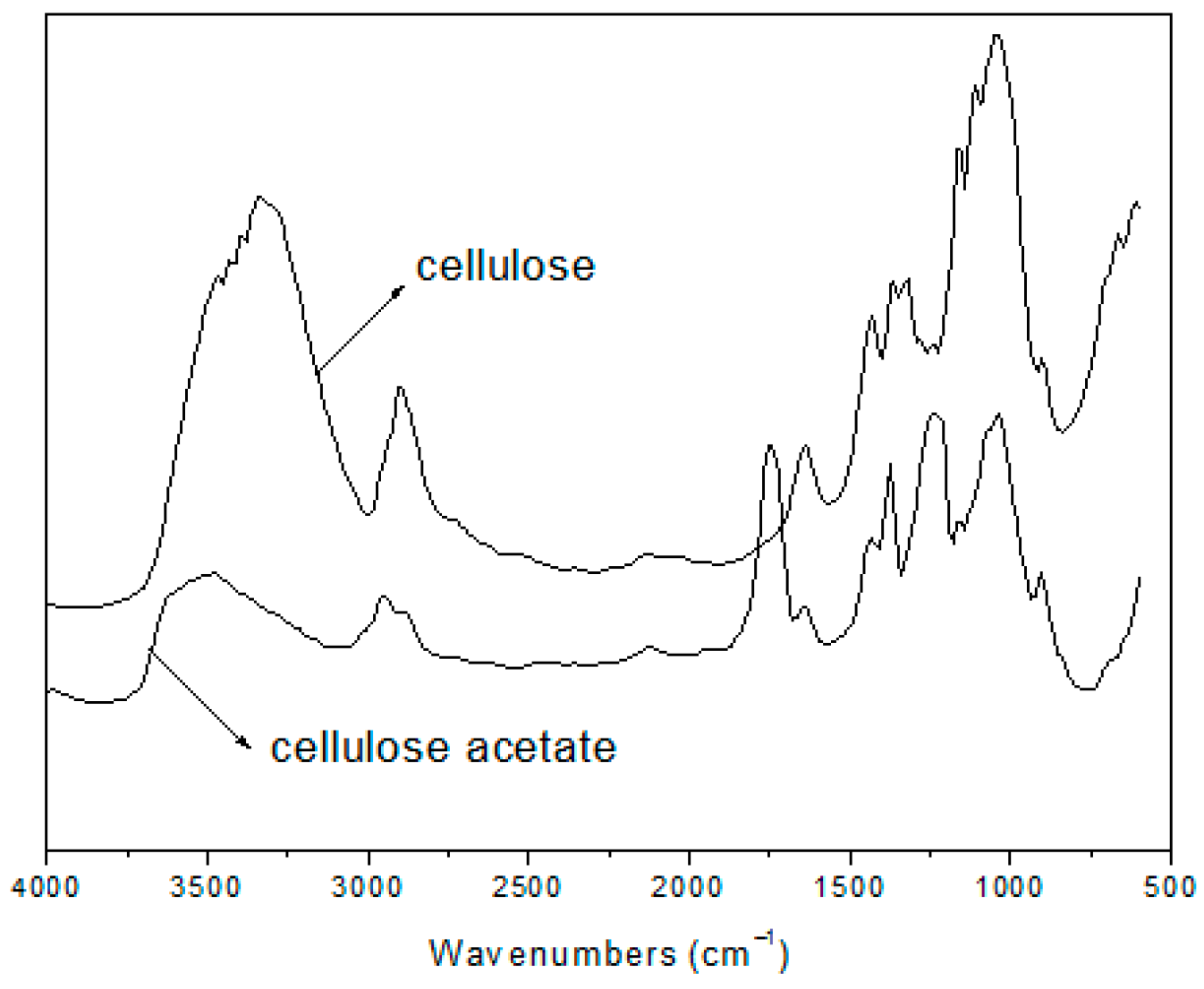
Figure 1. FTIR spectrum (microcrystalline cellulose and cellulose acetate).
Fermentation 11 00676 g001
Figure 2. X-ray diffraction (cellulose and cellulose acetate).
Fermentation 11 00676 g002
Figure 3. Yield glucose versus the cellulose hydrolysis reaction time (A) and cellulose acetate (B) solutions 2.5%, 5.0%, 10%, 15% and 20% H2SO4.
Fermentation 11 00676 g003
Table 1. Quantification of glucose, furfural and acetate in the hydrolyzed cellulose acetate.
Sample *Glucose (g·L−1)HMF (mg·L−1)Furfural (mg·L−1)Acetate (g·L−1)
A5-600.92013.24
A10-603.990494.98
A15-606.907535.00
A20-605.9317454.99
A5-904.578174.40
A10-906.712554.95
A15-906.1814484.81
A20-905.7623415.03
A2.5-1200.782902.87
A5-1206.610374.92
A10-1206.985575.19
A2.5-1501.642843.36
A5-1506.760474.82
A10-1506.816565.14
A2.5-1803.092794.09
A5-1808.171535.52
A10-1806.420545.01
A2.5-2103.940212.81
A5-2106.860324.81
A10-2105.180474.66
* The samples were identified according to the H2SO4 concentration of the solution used in hydrolysis and reaction time (e.g., A5-60-hydrolysis of cellulose acetate in H2SO4 solution, 5% v/v for 60 min).
Table 2. Quantification of compounds during fermentation.
Time (h)Glucose (g·L−1)Ethanol (g·L−1)HMF (g·L−1)Furfural (g·L−1)
017.950.000.0230.000
1512.882.840.0150.000
179.104.340.0030.000
194.306.710.0000.000
210.858.290.0000.000
230.008.660.0000.000
250.008.870.0000.000
Disclaimer/Publisher’s Note: The statements, opinions and data contained in all publications are solely those of the individual author(s) and contributor(s) and not of MDPI and/or the editor(s). MDPI and/or the editor(s) disclaim responsibility for any injury to people or property resulting from any ideas, methods, instructions or products referred to in the content.