
Article

Combined Effects of Cold Pre-Fermentative Maceration and the Use of Non-Saccharomyces Yeasts (L. thermotolerans and T. delbrueckii) on the Composition of Cayetana Blanca Wines Produced in a Semi-Arid Climate

by
Fernando Sánchez-Suárez
and
Rafael A. Peinado
*
Agricultural Chemistry, Soil Science and Microbiology Department, University of Córdoba, Campus of Rabanales, N-IV Road, Km 396, 14071 Córdoba, Spain
*
Author to whom correspondence should be addressed.
Fermentation 2025, 11(11), 639; https://doi.org/10.3390/fermentation11110639
Submission received: 20 September 2025 / Revised: 29 October 2025 / Accepted: 6 November 2025 / Published: 11 November 2025
(This article belongs to the Special Issue The Role of Non-Saccharomyces Yeasts in Crafting Alcoholic Drinks)

Abstract

Climate change poses a major challenge for wine production in semi-arid regions, where grape ripening frequently leads to excessive sugar accumulation and reduced acidity. This study evaluated the combined effect of cold pre-fermentative maceration (PM) and the use of non-Saccharomyces yeasts (Lachancea thermotolerans and Torulaspora delbrueckii) on the composition and sensory properties of Cayetana Blanca wines. Pre-fermentative maceration increased titratable acidity by 0.5 g/L and yeast-assimilable nitrogen by 28 mg/L, creating more favorable conditions for the metabolic activity of non-Saccharomyces species. Wines fermented with L. thermotolerans—especially in sequential inoculation with S. cerevisiae after PM—showed the highest acidity and lactic acid content (2 g/L), together with 1% v/v lower ethanol and 1 g/L higher glycerol than the control. These wines were perceived as fresher and better balanced, despite a moderate decrease in fruity esters such as ethyl hexanoate, ethyl octanoate, and isoamyl acetate. Cluster analysis confirmed that non-Saccharomyces fermentations developed distinct compositional profiles only when combined with PM. Overall, the PM + L. thermotolerans + S. cerevisiae treatment achieved the most favorable balance between acidity, ethanol, and sensory freshness. This approach provides a sustainable and readily applicable method to enhance acidity and freshness in white wines from warm-climate regions.

1. Introduction

Climate change poses a major challenge to viticulture, especially in the Mediterranean region, where rising temperatures, reduced rainfall, lower humidity, and increased solar radiation are placing severe stress on vineyard [1,2,3]. Scientists caution that as much as 90% of traditional wine-growing regions in countries such as Spain, Italy, and Greece could face serious challenges by the end of the century, potentially reshaping how and where wine is produced—and even influencing its unique character [1].
A 1 °C rise in global temperature may expose grapes to environments about 2 °C warmer, accelerating ripening and shifting the phenological cycle to hotter periods [4]. This imbalance between sugar accumulation and phenolic or aromatic maturity results in grapes with higher sugar levels, lower acidity, and even berry shriveling [1,2,3,5,6,7]. The problem is especially evident in low-acid, neutral varieties with high sugar potential, such as Cayetana Blanca (also known as Jaén Blanco), widely grown in southwestern Spain [8,9,10].
Traditional solutions used in wineries to improve the acidity of wines, such as acidification with tartaric acid or cation exchange resins, have significant limitations. The addition of tartaric acid is regulated by European legislation (EU No. 1308/2013), and it can cause potassium bitartrate precipitation, as well as harsh and bitter sensations in wine [11]. Cation exchange resins have several disadvantages, including high water consumption, high equipment costs, and an adverse effect on the wine itself [12].
In this context, the use of non-Saccharomyces yeasts, particularly Lachancea thermotolerans, is emerging as a natural and sustainable alternative that is attracting increasing interest. This yeast can transform sugars into lactic acid, reducing the pH and increasing the acidity of wine. This has positive effects on the wine’s freshness, microbiological stability and sensory perception, and reduces the ethanol content [13,14,15,16,17].
However, using L. thermotolerans can increase acetic acid production and hinder malolactic fermentation due to an increase in lactic acid [18,19,20]. Furthermore, even the best strains have a limited fermentative capacity of 10% v/v ethanol, requiring mixed or sequential fermentations with S. cerevisiae to exhaust the sugars present in the must [14]. Finally, some studies have found a decrease in the concentration of certain volatile compounds, particularly minor esters which are responsible for the fruity aromas in wine [19,20,21].
Studies with T. delbrueckii have reported improvements in sensory characteristics, such as aroma and mouthfeel, with increased glycerol content and reduced ethanol levels. However, some studies report losses in wine acidity [22,23].
Cold pre-fermentation maceration improves the aromatic characteristics of white wines by enhancing the content of aromatic compounds, particularly terpenes and varietal thiols [24]. In addition, it can improve the acidity of wines by releasing more must from areas near or between the seeds of the berry, where there is a higher concentration of acids and lower concentration of sugars [25,26].
Therefore, the main objectives of this study were to evaluate the combined effects of cold pre-fermentative maceration and sequential inoculation with the non-Saccharomyces yeasts Lachancea thermotolerans and Torulaspora delbrueckii on the chemical composition, volatile profile, and sensory characteristics of wines made from Cayetana Blanca grapes grown in a semi-arid region. Specifically, the research aimed to determine whether these combined techniques could enhance acidity, modulate ethanol concentration, and improve aromatic complexity, thereby offering a sustainable oenological strategy to mitigate the adverse effects of climate change on wine quality.

2. Materials and Methods

2.1. Experimental Design

Cayetana Blanca grapes were harvested in 2023 from a 14-year-old vineyard located in a semi-arid area of southern Spain (Extremadura; 38°36′48″ N, 6°15′53″ W), grown under rainfed conditions on Vertisol Xerert Chromoxerert soil. The area has a dry climate with summer aridity and receives less than 450 mm of rainfall per year. Heat waves exceeding 42 °C are common in the two months prior to harvest.
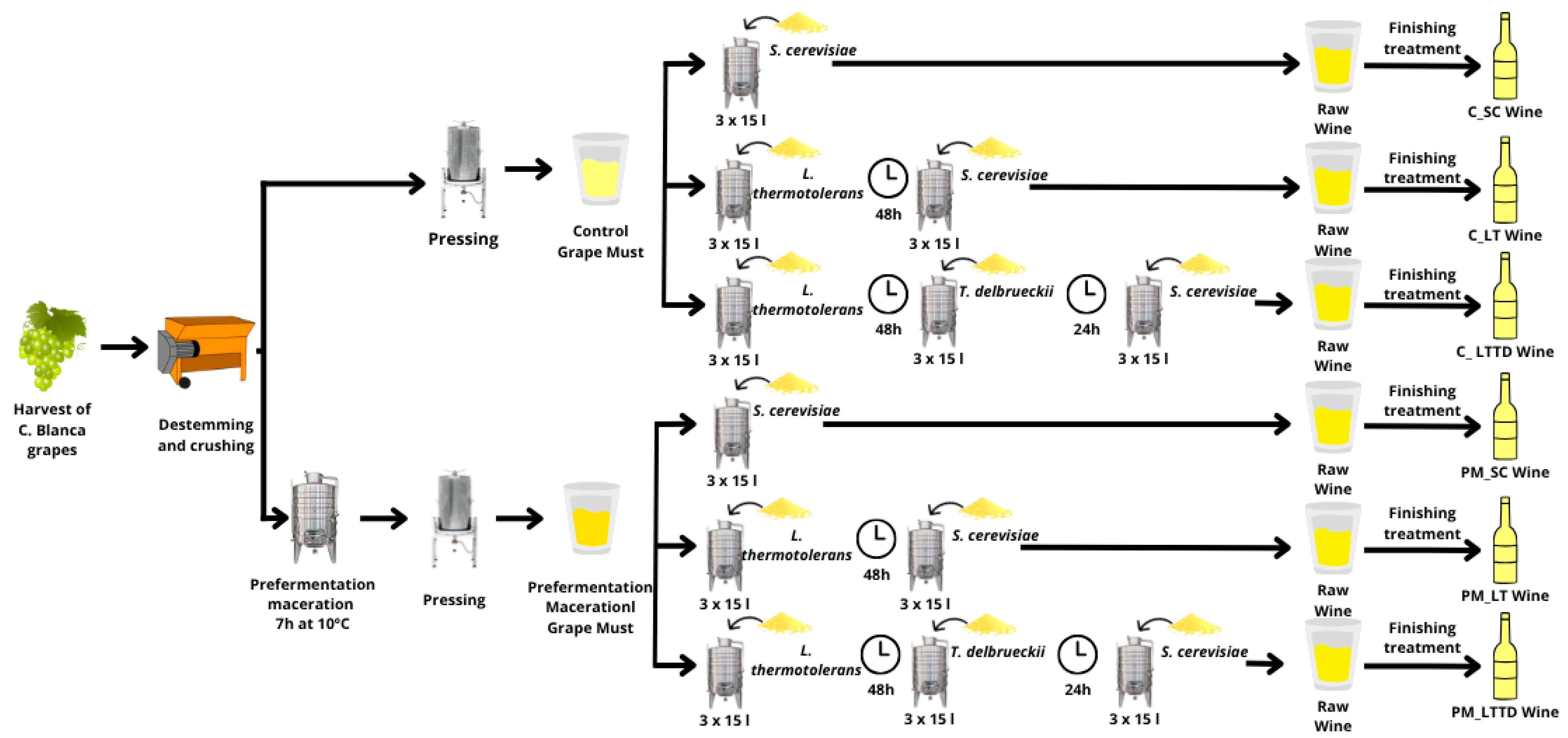
The grapes were harvested at technological maturity, that is, when no further sugar accumulation was observed, indicating the optimal time for harvest (on 15 September 2023), in 20 kg boxes, then destemmed and separated into two batches of approximately 200 kg each. One of these was subjected to pre-fermentation maceration at 10 °C for 7 h, after which it was pressed; the other was pressed directly.
Afterward, each batch was divided into nine fermenters (18 in total) to carry out six fermentations in triplicate (biological replicates) at a controlled temperature of 18 ± 1 °C. For this purpose, 15 L stainless-steel tanks were used. Half of the fermenters contained must obtained by direct pressing of the grapes, while the other half contained must that had been previously macerated with the skins.
The inoculations performed were (Figure 1) inoculation with S. cerevisiae (1); (2) sequential inoculation of L. thermotolerans and S. cerevisiae after 48 h; (3) sequential inoculation of L. thermotolerans and T. delbrueckii after 48 h, followed by S. cerevisiae after 72 h. All yeast strains used were commercial: ICV Okay® (S. cerevisiae), Level 2 Laktia® (L. thermotolerans) and Level 2 Biodiva® (T. delbrueckii), all from Lallemand Inc. (151 Skyway Avenue, Toronto, ON, Canada). All inoculations were carried out at a dose of 20 g/hL. According to the manufacturer’s technical specifications, all yeast strains show a viability greater than 1010 CFU/g. Rehydration should be carried out in 10 times the yeast weight in water (at a temperature between 35 °C and 40 °C for S. cerevisiae, and 30 °C for non-Saccharomyces strains). The rehydrated yeast is then mixed with a small amount of must, gradually adjusting the temperature of the yeast suspension to within 5–10 °C of the must temperature. Finally, the yeast is inoculated into the must. Malolactic fermentation was inhibited by sulphiting with potassium metabisulphite at 50 mg/L of SO2 at the end of fermentation.
Once fermentation was complete (density above 995 g/L), the wines were clarified using a cold treatment with 25 g/hL of bentonite (Bengel®, Agrovin S.A., Alcázar de San Juan-Ciudad Real, Spain) and filtered through 0.45 µm cellulose plate filters.

2.2. Must General Analysis and Fermentation Kinetics

Before starting fermentation, the characterisation of the musts obtained was carried out. The pH and titratable acidity of these musts were determined using official methods [27] and the yeast assimilable nitrogen (YAN) was determined using the method of Shively et al. [28] with formaldehyde titration.
The fermentation kinetics of all fermentations were monitored by measuring the density every 24 h using 0.900–1.000 and 1.000–1.100 g/L (Proton®, GABSystems, Barcelona, Spain) densimeters.

2.3. Wine General Parameters

The wines obtained were analysed in accordance with official methods of analysis [27], with the ethanol content, titratable acidity, volatile acidity and pH being determined. Additionally, the lactic and malic acid content was determined by reflectometry using the Reflectoquant system (Merck®, Darmstadt, Germany).

2.4. Volatile Compounds Determination

2.4.1. Major Volatile Compounds and Polyols

Quantification of the major compounds, including polyols, was performed using an Agilent Technologies (Palo Alto, CA, USA) HP 6890 Series II gas chromatograph (GC) equipped with a CP-WAX 57 CB capillary column (50 m × 0.25 mm i.d., 0.4 µm film thickness) and a flame ionisation detector (FID), following the procedure described by Peinado et al. [29].
For the analysis, 0.5 µL of wine was injected. Samples were prepared by adding 1 mL of 4-methyl-2-pentanol (1024 mg/L) as an internal standard to 10 mL of wine. Prior to injection, tartaric acid was removed by precipitation with 0.2 g of calcium carbonate, followed by centrifugation at 300 g.
The chromatographic conditions were as follows: split ratio 30:1; initial oven temperature 50 °C held for 15 min, increased at 4 °C min−1 to 190 °C, and held for 35 min. The injector and detector (FID) temperatures were 270 °C and 300 °C, respectively. Helium was used as the carrier gas with an initial flow rate of 0.7 mL/min for 16 min, gradually increasing to 1.1 mL/min for the remaining 52 min. Identification and quantification of compounds were performed by injecting authentic standards under the same chromatographic conditions as the samples (Table S1).

2.4.2. Minor Volatile Compounds

Determination of these compounds was performed in two stages, as described by López de Lerma et al. [30].
In the first stage, liquid-phase extraction was performed using Twisters (PDMS, 0.5 mm thick, 10 mm long; Gerstel GmbH, Mülheim an der Ruhr, Germany). The Twisters were placed in vials containing 10 mL of the diluted wine sample (1:10, v/v) together with 0.1 mL of ethyl nonanoate (0.4464 mg/L), which served as the internal standard. The vials were shaken at 1500 rpm for 100 min, after which the Twisters were removed and transferred to thermal desorption tubes for further analysis.
In the second stage, volatile compounds were quantified using a Gerstel TDS 2 thermal desorption system coupled to a gas chromatograph and a mass spectrometry detector (GC–MS). The Twisters were heated to 280 °C to release the volatile compounds into a CIS 4 PTV cryogenic injection system, initially set at 25 °C and equipped with a Tenax adsorption tube. The CIS was subsequently heated to 50 °C for 2 min and then increased at 4 °C/min to reach 190 °C after 10 min. The GC was fitted with an Agilent 19091S capillary column (30 m × 0.25 mm i.d., 0.25 µm film thickness). The mass spectrometer operated in scan mode at 1850 V over a mass range of m/z 39–300.
Compound identification was based on both retention indices and mass spectral matches (≥85%) with the NIST/Wiley libraries. Quantification was performed using calibration curves prepared under the same analytical conditions. (Table S1).

2.4.3. Odour Activity Value and Aromatic Series

The odour activity values (OAVs) of the volatile compounds were obtained by dividing their concentrations by their corresponding olfactory perception thresholds. Aromatic series are defined as sets of volatile compounds with similar olfactory descriptors, and the total OAV of a series is the sum of the OAV of its constituent compounds. Nine series were identified: chemical, green, citrus, creamy, floral, fruity, green fruit, waxy and honey. It should be noted that a given volatile compound may belong to one or more of these series depending on its odor descriptors (see Table S2, [29,30,31,32,33,34,35,36,37,38,39,40,41,42,43,44,45,46,47,48]). This strategy has been used by several authors to reduce the number of variables and facilitate clearer, more intuitive interpretation of the results [19,20,30,49,50,51].

2.5. Sensory Analysis

The Andalusian legislation (BOJA 34, 16 February 2024) establishes ethical review procedures exclusively for biomedical or otherwise invasive research involving human subjects. This study, which was voluntary, anonymous, and did not require wine ingestion, involved only sensory preference assessments—color, odor, and taste—through anonymous questionnaires. The judges were instructed to spit the wine after tasting. No personal data was collected, and there was no physical or psychological intervention. Therefore, the study does not fall under the scope of these regulatory requirements.
The blind sensory analysis was carried out by a panel of six judges (three men and three women), with professional experience in wine production and sensory evaluation, as their research activities are directly related to oenology and wine tasting. The tasting sheet was used to evaluate the following attributes: olfactory impression, taste, acidity and overall assessment in a hedonic scale (0–10).
All samples were stored at 10 °C for 24 h prior to analysis. Each judge was offered 30 mL of wine per sample, served at 10 °C in standardised tasting glasses, in accordance with the AENOR (1997) NF V09-110 standard [52] and ISO 3591 [53] specifications. The wines were presented in a random order and identified by three-digit codes. A one-minute interval was allowed between the evaluation of each sample, during which tasters rinsed their mouths with water.

2.6. Statistical Analysis

An ANOVA was performed on the general parameters of the musts to assess the effect of pre-fermentative maceration on their characteristics. When significant differences were identified, a Tukey post hoc test (p < 0.05) was conducted to determine homogeneous groups.
For the wines, a two-way ANOVA analysis was performed to determine the effects of pre-fermentation maceration (PM), yeast strain (YS), and their interaction (PM × YS) on the general and volatile parameters of the wines after confirm normality and variance homogeneity of the data. These analyses were performed using IBM SPSS Statistics 25 software (Armonk, NY, USA).
Additionally, a cluster analysis (Ward’s method, Euclidean distance) with a heatmap was performed using the open-source programming language Python 3.9.7 in the Anaconda Jupyter Project environment (Anaconda Inc., Austin, TX, USA) to determine the overall similarities and differences between the obtained wines, considering the general parameters and the determined aromatic series.

3. Results and Discussion

3.1. Must Parameters

Table 1 shows the general parameters analyzed in the initial musts. The pre-fermentative macerated musts exhibited higher yeast-assimilable nitrogen (YAN) and titratable acidity than the non-macerated musts, while the total sugar content was higher in the control must. This can be explained by the fact that, during maceration, more juice is released from areas near the seeds, which are richer in acids and nitrogenous substances than the central part of the berry. In contrast, the must originating from the middle region of the berry contains higher sugar concentrations [25,26].
Based on the higher YAN values observed in the pre-fermentative macerated musts, it is plausible that these conditions could later influence yeast dynamics during fermentation. A richer nitrogen environment may support more active early growth of non-Saccharomyces yeasts, potentially extending their metabolic activity before Saccharomyces cerevisiae becomes dominant [54].

3.2. Fermentation Kinetics

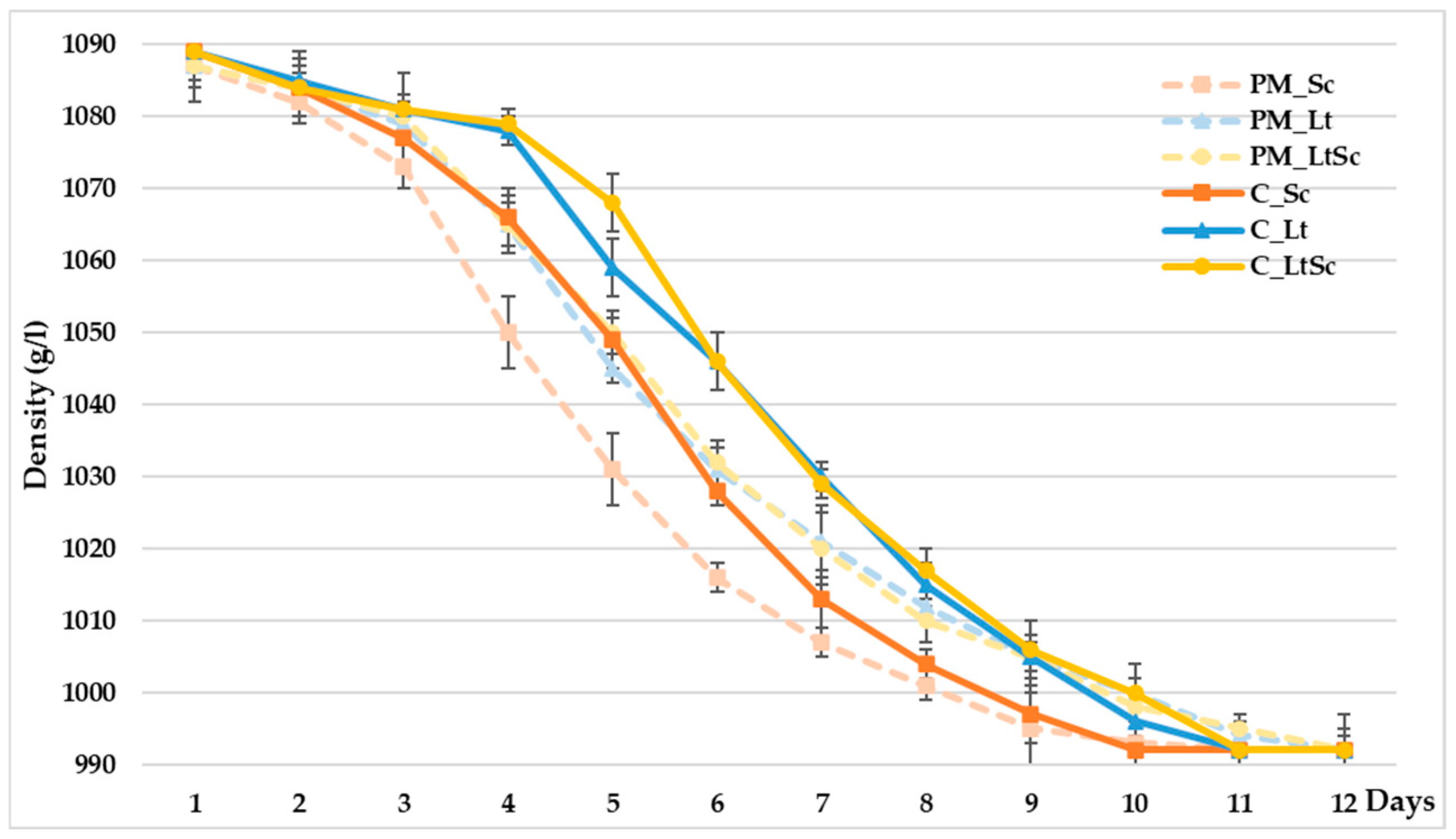
Figure 2 shows the fermentation kinetics, which were monitored every 24 h. The influence of the type of must and yeast used is clear. Fermentation kinetics are faster in the case of macerated musts, which may be due to a higher nutrient content resulting in faster yeast multiplication and metabolism [55].
Conversely, musts initially inoculated with non-Saccharomyces yeasts exhibit slower initial kinetics, consistent with findings from other studies [49,56]. Muñoz-Redondo et al. [56] conducted a study on red and rosé wine fermentations with sequential inoculations of T. delbrueckii or M. pulcherrima and S. cerevisiae. They found that wines fermented with two yeasts took two to three days longer to complete fermentation. The faster fermentation kinetics observed can be directly linked to the higher yeast-assimilable nitrogen (YAN) levels measured in the macerated musts.

3.3. Wine General Parameters

The general parameters of the wines are shown in Table 2. The wines obtained after sequential inoculation have a lower pH and higher titratable acidity, which is more pronounced in those obtained after pre-fermentation maceration. This is due to the production of lactic acid by L. thermotolerans. This acid is produced from the sugars in the must by converting pyruvic acid into lactic acid using the enzyme lactate dehydrogenase [57]. However, it is noteworthy that control wines inoculated with L. thermotolerans have lower levels of this acid than wines obtained after skin maceration. This difference may be due to the control musts containing lower levels of YAN, which directly influences yeast metabolism. In this regard, some authors have found a direct proportional relationship between the YAN of the must and the lactic acid produced by L. thermotolerans [58].
A higher lactic acid content was observed in musts inoculated with T. delbrueckii after L. thermotolerans and then S. cerevisiae (Lt_Td_Sc), compared to inoculation with S. cerevisiae alone after L. thermotolerans (Lt_Sc). This could be explained by the longer latency period of non-Saccharomyces yeasts [59]. Therefore, L. thermotolerans would have had more time to predominate in the must before the addition of S. cerevisiae, which usually displaces other yeasts quickly.
The wines in which L. thermotolerans was used had a lower alcohol content because lactic acid is synthesised from sugars, meaning they are not converted into ethanol [13]. As mentioned above, the lower metabolism of L. thermotolerans in the control wines means that the alcohol content of wines produced with this yeast is similar to that of control wines. In wines obtained after macerating the skins and with the intervention of the two non-Saccharomyces yeast species, the decrease in alcohol content was greater, with a reduction of up to 1% v/v in macerated wines. Some authors [49,56] have also found a reduction in ethanol content of between 0.4 and 0.5% in wines containing T. delbrueckii.
The lower alcohol content has the positive effect of minimising the increase in sugar content in musts resulting from climate change, making wines with a lower ethanol content more attractive to consumers [60].
Glycerol production increases in fermentations involving non-Saccharomyces yeasts, particularly T. delbrueckii, which is consistent with the findings of other studies [23,49,56]. Puertas et al. [23] found increases in between 0.3 and 1.3 g/L of glycerol in wines inoculated sequentially with T. delbrueckii and S. cerevisiae, compared to the control wine. This is consistent with the present study.
Cold pre-fermentation maceration results in wines with a lower pH, lower ethanol content and higher titratable acidity, similar to the initial musts. Furthermore, considering the aforementioned effect on L. thermotolerans in lactic acid production and the higher acidity of macerated musts, it can be concluded that this practice improves the acidity of musts synergistically when non-Saccharomyces yeasts are used in fermentation.

3.4. Volatile Compounds

3.4.1. Major Volatile Compounds

The major volatile compounds analysed are shown in Table 3. Wines produced with pre-fermentative maceration and non-Saccharomyces yeasts showed the highest concentrations of acetaldehyde and higher alcohols, particularly 3-methyl-1-butanol, compared to those fermented only with Saccharomyces cerevisiae. The increase in acetaldehyde can be explained by a rebalancing of the cell’s redox potential during lactic acid production. This occurs because the enzyme lactate dehydrogenase uses NADH for the conversion of pyruvic acid to lactic acid, rather than aldehyde dehydrogenase using NADH for the conversion of acetaldehyde to ethanol [19]. As a result, acetaldehyde accumulates, and ethanol levels slightly decrease. In parallel, the production of higher alcohols such as 2-methylbutanol, 3-methylbutanol, propanol, and isobutanol is also enhanced in wines involving non-Saccharomyces yeasts [23], particularly in those made from pre-fermentation macerated musts. As these compounds are formed through yeast nitrogen metabolism, the higher amount of yeast-assimilable nitrogen (YAN) in macerated musts may be responsible for these differences [54]. Elevated YAN stimulates both amino acid catabolism, leading to increased formation of 3-methyl-1-butanol from leucine, and lactic acid synthesis by L. thermotolerans. The combined effect of enhanced nitrogen availability and altered redox balance thus explains the simultaneous rise in acetaldehyde, lactic acid, and higher alcohols in wines produced with non-Saccharomyces yeasts under maceration conditions.
Ethyl acetate is produced through the esterification of ethanol in wines with a higher acetic acid content, as is the case with ethyl lactate and lactic acid [11,25]. In the case of 2-phenylethanol, this may be due to yeast metabolism. Some authors found that the 2-phenylethanol content of wine produced by the sequential inoculation of T. delbrueckii and S. cerevisiae was double that of the control wine, which is consistent with the findings of this study [49,61].
Methanol, however, comes from the degradation of pectins, which are more abundant in the skins [25,62]. This explains why wines from pre-fermentation maceration a significantly higher concentration of this compound has, although it is still below the legal limit of 250 mg/L for white wines [63].

3.4.2. Minor Volatile Compounds

A higher content of higher alcohols is observed in wines made from macerated musts. Hexanol is formed in large quantities during pre-fermentation processes such as maceration, crushing and pressing, as a result of the enzymatic oxidation of linoleic and linolenic acids from the plasma membrane [25]. Prolonged contact with the skins may therefore have facilitated the passage of these acids into the must, where they were subsequently oxidised. This compound contributes aromas reminiscent of freshly cut grass to wine and is one of the compounds that contributes most to its aroma [11].
Among the esters, ethyl hexanoate and octanoate, as well as isoamyl and 2-phenylethanol acetates, are particularly notable. Their concentration is clearly influenced by the initial must and the yeasts used for fermentation. Several studies have observed lower ester production by L. thermotolerans, probably due to lower fatty acid production by this yeast and lower esterase and acetyltransferase activities [19,20,21,64,65,66]. In macerated musts where there was no nutrient deficiency, the metabolism of this yeast was quite active, as indicated by the lactic acid content of the resulting wines. As discussed previously, it can be expected that the ester content of wines produced through skin maceration with L. thermotolerans intervention will be lower, as shown in Table 4. Additionally, the lower pH values typical of wines produced with L. thermotolerans may favour ester hydrolysis [11]. Finally, the ester content of wines produced using only S. cerevisiae is significantly higher.
Conversely, in wines obtained from control musts where the nutrient content was lower, L. thermotolerans metabolism was less active (see lactic acid values), and differences in ester content were less pronounced.
Regarding carbonyl compounds, lower levels are observed when non-Saccharomyces yeasts are present, with octanal being particularly notable. This compound is mainly formed by the oxidation of octanol [11], so greater production of this alcohol by S. cerevisiae may have led to higher levels of it.
Finally, a notable increase in the concentration of terpenoids was observed in macerated wines, although no clear trend emerged for the different yeasts used. The main compound identified was limonene, which is consistent with the findings of other studies, such as that of Lukić et al. [67], who found that prolonged skin maceration increased limonene levels from 13 to 26 µg/L in Istrian Malvasia wines.

3.4.3. Aromatic Series and Multivariate Analysis

Wine aroma is determined not only by the presence of volatile compounds but also by the interactions established among them, which may involve both synergistic and antagonistic effects [68]. The odour activity value (OAV) is a useful parameter for assessing the relative contribution of individual compounds to the overall aroma profile [69]. Volatile compounds with OAV greater than one are generally considered potential contributors to wine aroma.
Of all the volatile compounds analysed, 12 have odour activity values greater than one. These are: isoamyl acetate; ethyl octanoate; ethyl hexanoate; octanal; ethyl butanoate; 2-phenylethanol acetate; limonene; ethyl propanoate; decanal; ethyl decanoate; hexanal; and ethyl isobutanoate. Several of these volatile compounds have been identified as key contributors to wine aroma, in line with the findings of other researchers [19,70]. These compounds mainly contribute fruity, waxy and citrus notes.
Conversely, a volatilome fingerprint can be generated by constructing aroma series, with values calculated according to the procedure described in Section 2. This methodology, previously applied by several authors [19,20,30,49,50,51], substantially reduces the number of variables that need to be considered when evaluating differences among oenological treatments. In the present study, the following aroma series were identified: fruity, green fruit, green, creamy, citrus, chemical, honey, waxy and floral (Table 5).
In the fruit and green fruit series, which is mainly composed of esters, the following stand out: ethyl hexanoate, ethyl octanoate and isoamyl acetate. The presence of these compounds varies depending on the yeast used and the starting must. Wines fermented with S. cerevisiae show a clear increase in the fruit series with pre-fermentation maceration, whereas wines fermented with non-Saccharomyces yeasts show a sharp decrease in this series. This may be due to the higher metabolism of non-Saccharomyces yeasts resulting from their higher yeast assimilable nitrogen content (Table 1), as mentioned above. This may result in a decrease in ester synthesis, as described by various authors [21,64,66].
No significant differences were found in the green series, except for a slight increase in wines fermented by non-Saccharomyces yeasts without skin maceration, which is due to a higher hexanal content.
A clear decrease in the citrus series was observed in wines fermented with non-Saccharomyces yeasts, driven by a lower concentration of octanal aldehyde and limonene terpene.
Significantly higher values are found in terms of chemical series in macerated wines and in those produced using non-Saccharomyces yeasts. This increase is driven by limonene and the higher alcohols propanol, isobutanol, and isoamyl alcohol, all of which are more prevalent in macerated wines.
In the Waxy series, which depends on esters derived from long-chain fatty acids, such as ethyl octanoate, the trend and explanation are similar to those of the fruity and green fruit series.
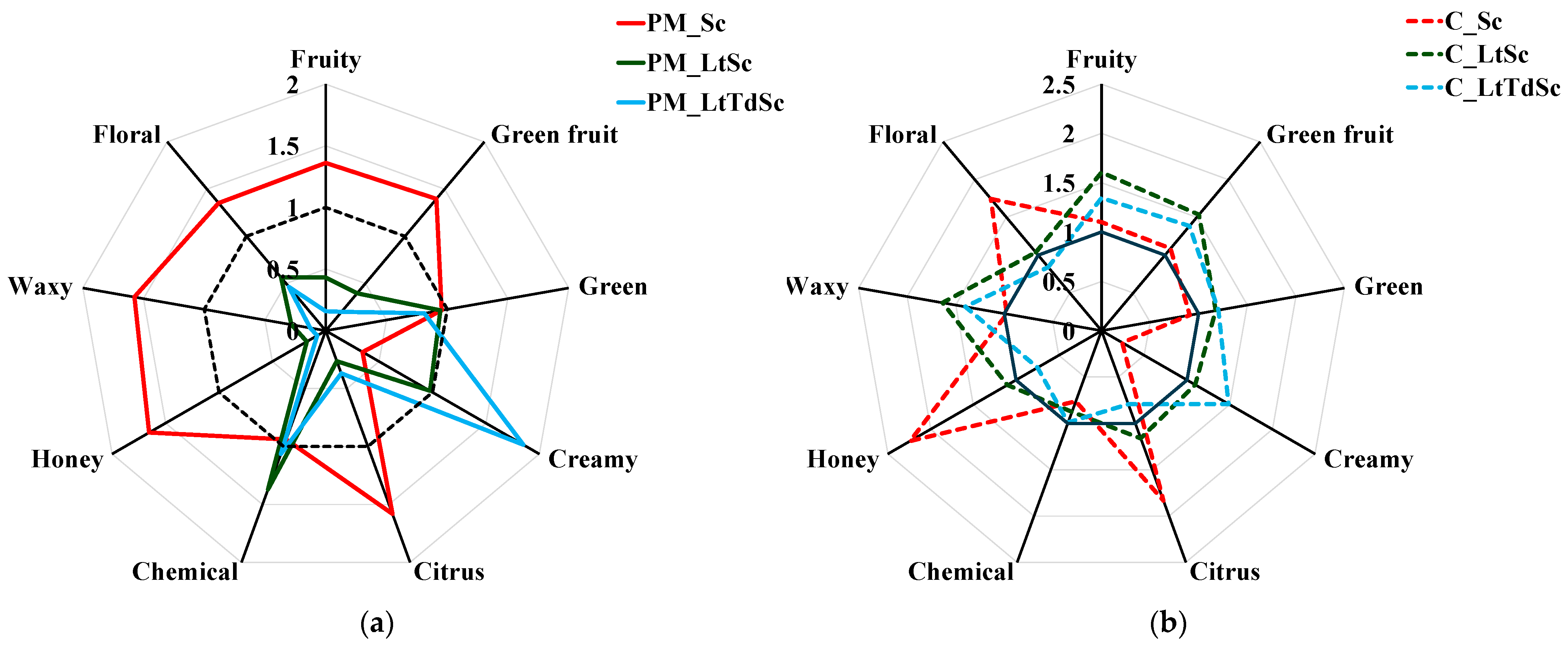
A multivariate approach was employed to construct a star plot comprising nine axes, each representing a specific aroma series (see Figure 3). Prior to plotting, the data were standardised to equalise axis length, with unit values corresponding to the mean of each series. This normalisation allows direct comparisons to be made between aroma series. The resulting graphical representation facilitates the identification of dominant aroma attributes within samples while revealing similarities among observations and enabling potential clusters to be delineated [71].
Figure 3a shows the aromatic profiles of wines produced following skin maceration (the dashed line shows the standardised mean value). Wines fermented exclusively with S. cerevisiae exhibited values above the median in most series, except for the green series and, more notably, the creamy series. The latter was primarily affected by ethyl lactate, which was present in the highest concentrations in wines produced with L. thermotolerans involvement. By contrast, the use of non-Saccharomyces strains generally resulted in wines with lower values across the aromatic series, likely due to the reduced ester production of these yeasts, as previously reported.
A similar pattern was observed in wines produced without skin maceration (Figure 3b) and fermented with non-Saccharomyces strains. This is likely due to the limited availability of nitrogen, which resulted in a reduced metabolic rate for these yeasts and had a marked impact on aroma production. Most of the aromatic series showed values above the median, particularly the green, green fruit, fruity and waxy series. In contrast, wines produced exclusively with S. cerevisiae were characterised by higher values in the floral, citrus and waxy series.
Therefore, both winemaking strategies showed that choosing the right yeast and using skin maceration are important in shaping the aroma of wine. S. cerevisiae increases the overall intensity, while non-Saccharomyces strains produce specific aromas under different fermentation conditions.

3.5. Cluster Heatmap Analysis

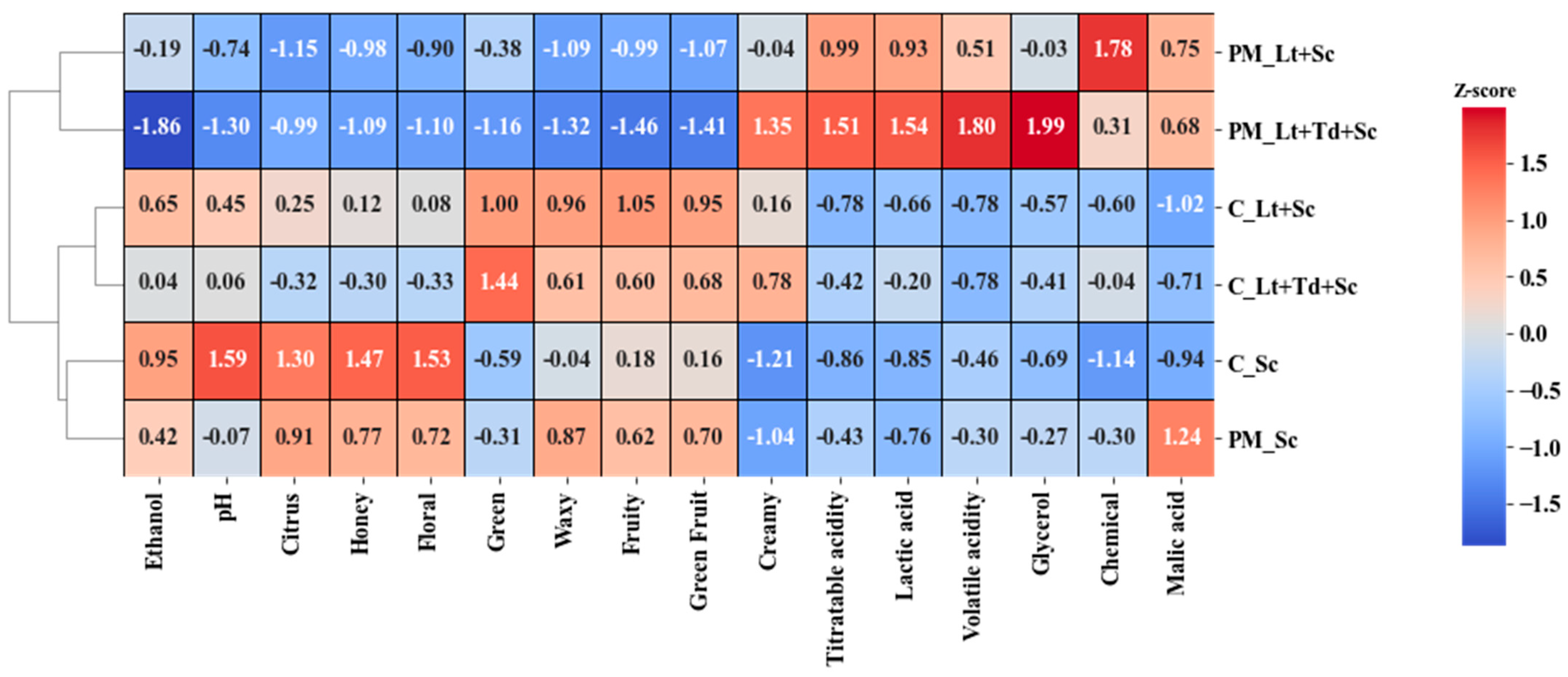
Cluster analysis is an exploratory method that groups objects or cases into categories, or ‘clusters’, according to their degree of similarity. To perform this analysis, a set of variables is defined to act as the basis for classification. The proximity between two clusters indicates that the samples comprising them are more similar [72]. In this study, the technique was combined with a heatmap of normalised scores to allow a clearer understanding of the results and the influence of each variable. The general parameters determined, and the aromatic series were considered as classification variables.
Figure 4 shows the results of the cluster analysis: initially, two large groups can be seen. Broadly speaking, group 1 includes a combination of non-Saccharomyces yeasts and pre-fermentation maceration (The main differences were increased in titratable acidity, lactic acid and in the creamy series, and a decrease in the ethanol content), while group 2 encompasses all other types of fermentation (The main differences were higher values in ethanol and in the fruity series).
In detail, the first group comprises wines fermented with non-Saccharomyces yeasts and pre-fermentation maceration. Due to the higher metabolism of these yeasts under these conditions, these wines differ significantly from the rest. These differences are evident in the heatmap, which shows lower pH and ethanol content, as well as lower values for the fruit, floral and green fruit series. Conversely, higher lactic acid content, titratable acidity, and the Chemical and creamy aromatic series stand out positively.
Secondly, there is a difference between control wines with and without pre-fermentation maceration and wines made with non-Saccharomyces yeasts without maceration. Non-Saccharomyces yeasts have a much greater influence on the differentiation of wines than pre-fermentation maceration. However, the latter is still important as it significantly affects the metabolism and implantation of yeasts. Wines made with S. cerevisiae stand out for their higher ethanol content, as well as lower values in lactic acid and titratable acidity content, and for their presence in the fruity, citrus and floral aromatic series.
Finally, wines made with non-Saccharomyces yeasts without pre-fermentation maceration of the must obtain intermediate results: on the one hand, they stand out in the green or fruity aromatic series, and on the other, they have a higher lactic acid content.

3.6. Organolpetic Characterization

The organoleptic analysis (Table 6) revealed a slight overall preference for wines fermented with L. thermotolerans compared to the others, although no statistically significant differences were observed except for acidity, which was significantly higher in some treatments. Among the wines with pre-fermentative maceration, the preferred sample was that fermented with L. thermotolerans and S. cerevisiae. This wine exhibited a higher acidity than the control but not to an excessive degree, unlike the wine that also included T. delbrueckii, which was perceived as less pleasant by the tasters. The greater acidity of the L. thermotoleransS. cerevisiae wine may have contributed to a fresher and more balanced sensory perception, enhancing positive fruity and vibrant notes even though these differences were not statistically significant. Among the wines without maceration, the preferred sample was that fermented with the three yeasts, likely due to the milder metabolic activity of L. thermotolerans (lower lactic acid production; see Section 3.3), resulting in a more rounded wine without excessive acidity, as reflected in its lactic acid and titratable acidity values. In any case, the tasting panel was too small to draw firm conclusions, so, further studies with a larger number of tasters are needed to confirm whether the observed tendencies between acidity and perceived aromatic quality are statistically significant.

4. Conclusions

This study evidence that cold pre-fermentative maceration significantly improves the general and aromatic composition of Cayetana Blanca musts by increasing titratable acidity and yeast-assimilable nitrogen, thereby influencing the metabolism of non-Saccharomyces yeasts, which have higher nutrient demands. A key finding is the marked rise in acidity and lactic acid produced by Lachancea thermotolerans, especially after maceration, enhancing freshness and microbial stability while slightly reducing the synthesis of volatile esters such as ethyl hexanoate, ethyl octanoate, and isoamyl acetate.
Cluster and heatmap analyses confirmed that non-Saccharomyces fermentations produce distinctive profiles only when combined with maceration, clearly separating these wines from the controls. The combined use of L. thermotolerans (and to a lesser extent T. delbrueckii) with maceration exerts a synergistic effect, lowering ethanol while increasing acidity and glycerol, which helps to counterbalance the high sugar and low acidity typical of warm-climate wines.
These results highlight a practical, sustainable strategy to improve balance and differentiation in neutral grape varieties such as Cayetana Blanca, supporting adaptation to climate change without added economic or technological cost. Further studies with different grape varieties and fermentation conditions are encouraged to refine these findings and establish robust oenological guidelines.

Supplementary Materials

The following supporting information can be downloaded at: https://www.mdpi.com/article/10.3390/fermentation11110639/s1, Table S1: Calibration curves of the volatile aroma compounds determined. Table S2: Odor descriptor, odor threshold and aroma series assigned to the volatile compounds identified in the analyzed wines.

Author Contributions

Conceptualization, R.A.P. and F.S.-S.; methodology, R.A.P. and F.S.-S.; formal analysis, R.A.P. and F.S.-S.; writing—original draft preparation, R.A.P. and F.S.-S.; writing—review and editing, R.A.P. and F.S.-S.; supervision, R.A.P.; project management, R.A.P.; funding acquisition, R.A.P. All authors have read and agreed to the published version of the manuscript.

Funding

This research and the APC were funded by European Union Next Generation, grant number TED2021-129208B-100 by MICIU/AEI/10, 13039/501100011033.

Institutional Review Board Statement

The national laws do not require ethical approval for sensory evaluation. There are no human ethics committees’ formal documentation procedures available for sensory evaluation. The experimental protocol involving sensory evaluation was in accordance with the relevant operation specifications in Andalusian.

Informed Consent Statement

All tasters were informed that the aim of the anonymous survey was to identify wines with the best sensory attributes, and that participation implied consent to data processing in accordance with data protection regulations.

Data Availability Statement

The original contributions presented in this study are included in the article/Supplementary Materials. Further inquiries can be directed to the corresponding author.

Acknowledgments

We are grateful for the help and availability of the vineyard of José María Sánchez for this study, as well as Juan Manuel Castro Jurado and Julian Peinado Castillejo for their help during the harvest and the winemaking process.

Conflicts of Interest

The authors declare no conflicts of interest.

Abbreviations

The following abbreviations are used in this manuscript:
GC-FIDGas chromatography flame ionisation detector
GC-MSGas chromatography mass spectrum detector
OAVOdor activity value
PMPrefermentative maceration

References

  1. van Leeuwen, C.; Sgubin, G.; Bois, B.; Ollat, N.; Swingedouw, D.; Zito, S.; Gambetta, G.A. Climate Change Impacts and Adaptations of Wine Production. Nat. Rev. Earth Environ. 2024, 5, 258–275. [Google Scholar] [CrossRef]
  2. Dinis, L.-T.; Bernardo, S.; Yang, C.; Fraga Helder and Malheiro, A.C.; Moutinho-Pereira, J.; Santos, J.A. Mediterranean Viticulture in the Context of Climate Change. Cienc. Tec. Vitivinic. 2022, 37, 139–158. [Google Scholar] [CrossRef]
  3. Fraga, H. Viticulture and Winemaking under Climate Change. Agronomy 2019, 9, 783. [Google Scholar] [CrossRef]
  4. Molitor, D.; Junk, J. Climate Change Is Implicating a Two-Fold Impact on Air Temperature Increase in the Ripening Period under the Conditions of the Luxembourgish Grapegrowing Region. OENO One 2019, 53, 409–422. [Google Scholar] [CrossRef]
  5. Deloire, A.; Rogiers, S.; Šuklje, K.; Antalick, G.; Zeyu, X.; Pellegrino, A. Grapevine Berry Shrivelling, Water Loss and Cell Death: An Increasing Challenge for Growers in the Context of Climate Change. IVES Tech. Rev. Vine Wine 2021. [Google Scholar] [CrossRef]
  6. Droulia, F.; Charalampopoulos, I. Future Climate Change Impacts on European Viticulture: A Review on Recent Scientific Advances. Atmosphere 2021, 12, 495. [Google Scholar] [CrossRef]
  7. van Leeuwen, C.; Darriet, P. The Impact of Climate Change on Viticulture and Wine Quality. J. Wine Econ. 2016, 11, 150–167. [Google Scholar] [CrossRef]
  8. Vitis International Variety Catalogue. Available online: http://www.vivc.de/ (accessed on 18 September 2025).
  9. Díaz-Fernández, Á.; Cortés-Diéguez, S.; Muñoz-Organero, G.; Cabello, F.; Puertas, B.; Puig-Pujol, A.; Domingo, C.; Valdés-Sánchez, M.E.; Moreno Cardona, D.; Cibriain, J.F.; et al. The Valorization of Spanish Minority Grapevine Varieties—The Volatile Profile of Their Wines as a Characterization Feature. Agronomy 2024, 14, 1033. [Google Scholar] [CrossRef]
  10. Asensio, M.L.; Valdés, E.; Cabello, F. Characterisation of Some Spanish White Grapevine Cultivars by Morphology and Amino Acid Analysis. Sci. Hortic. 2002, 93, 289–299. [Google Scholar] [CrossRef]
  11. Waterhouse, A.L.; Sacks, G.L.; Jeffery, D.W. Understanding Wine Chemistry; Wiley: Chichester, UK, 2016; ISBN 9781118627808. [Google Scholar]
  12. Payan, C.; Gancel, A.-L.; Jourdes, M.; Christmann, M.; Teissedre, P.-L. Wine Acidification Methods: A Review. OENO One 2023, 57, 113–126. [Google Scholar] [CrossRef]
  13. Hranilovic, A.; Gambetta, J.M.; Schmidtke, L.; Boss, P.K.; Grbin, P.R.; Masneuf-Pomarede, I.; Bely, M.; Albertin, W.; Jiranek, V. Oenological Traits of Lachancea thermotolerans Show Signs of Domestication and Allopatric Differentiation. Sci. Rep. 2018, 8, 14812. [Google Scholar] [CrossRef]
  14. Benito, S. The Impacts of Lachancea thermotolerans Yeast Strains on Winemaking. Appl. Microbiol. Biotechnol. 2018, 102, 6775–6790. [Google Scholar] [CrossRef]
  15. Vaquero, C.; Escott, C.; Heras, J.M.; Carrau, F.; Morata, A. Co-Inoculations of Lachancea thermotolerans with Different Hanseniaspora spp.: Acidification, Aroma, Biocompatibility, and Effects of Nutrients in Wine. Food Res. Int. 2022, 161, 111891. [Google Scholar] [CrossRef]
  16. Vaquero, C.; Loira, I.; Bañuelos, M.A.; Heras, J.M.; Cuerda, R.; Morata, A. Industrial Performance of Several Lachancea thermotolerans Strains for PH Control in White Wines from Warm Areas. Microorganisms 2020, 8, 830. [Google Scholar] [CrossRef]
  17. Morata, A.; Loira, I.; Tesfaye, W.; Bañuelos, M.A.; González, C.; Suárez Lepe, J.A. Lachancea thermotolerans Applications in Wine Technology. Fermentation 2018, 4, 53. [Google Scholar] [CrossRef]
  18. Snyder, E.C.; Jiranek, V.; Hranilovic, A. Impact of Lachancea thermotolerans Strain and Lactic Acid Concentration on Oenococcus Oeni and Malolactic Fermentation in Wine. OENO One 2021, 55, 365–380. [Google Scholar] [CrossRef]
  19. Sánchez-Suárez, F.; Martínez-García, R.; Peinado, R.A. Climate Change Adaptation in Winemaking: Combined Use of Non-Saccharomyces Yeasts to Improve the Quality of Pedro Ximénez Wines. Microorganisms 2025, 13, 1908. [Google Scholar] [CrossRef]
  20. Sánchez-Suárez, F.; Palenzuela, M.d.V.; Rosal, A.; Peinado, R.A. Innovative Fermentation Approach Employing Lachancea thermotolerans for the Selective Production of High-Acidity Wines, Designed for Blending with Low-Acidity Counterparts to Achieve Chemically and Organoleptically Balanced Final Compositions. Foods 2025, 14, 2773. [Google Scholar] [CrossRef]
  21. Vicente, J.; Vladic, L.; Navascués, E.; Brezina, S.; Santos, A.; Calderón, F.; Tesfaye, W.; Marquina, D.; Rauhut, D.; Benito, S. A Comparative Study of Lachancea thermotolerans Fermentative Performance under Standardized Wine Production Conditions. Food Chem. X 2024, 21, 101214. [Google Scholar] [CrossRef]
  22. Benito, S. The Impact of Torulaspora delbrueckii Yeast in Winemaking. Appl. Microbiol. Biotechnol. 2018, 102, 3081–3094. [Google Scholar] [CrossRef]
  23. Puertas, B.; Jiménez, M.J.; Cantos-Villar, E.; Cantoral, J.M.; Rodríguez, M.E. Use of Torulaspora delbrueckii and Saccharomyces cerevisiae in Semi-Industrial Sequential Inoculation to Improve Quality of Palomino and Chardonnay Wines in Warm Climates. J. Appl. Microbiol. 2017, 122, 733–746. [Google Scholar] [CrossRef]
  24. Tomašević, M.; Gracin, L.; Ćurko, N.; Ganić, K.K. Impact of Pre-Fermentative Maceration and Yeast Strain along with Glutathione and SO2 Additions on the Aroma of Vitis vinifera L. Pošip Wine and Its Evaluation during Bottle Aging. LWT-Food Sci. Technol. 2017, 81, 67–76. [Google Scholar] [CrossRef]
  25. Moreno, J.J.; Peinado, R.A. Enological Chemistry; Academic Press: Boston, MA, USA, 2012. [Google Scholar]
  26. Hidalgo Fernández-Cano, L.; Hidalgo Togores, J. Tratado de Viticultura. Volumen I y II; Mundi Prensa: Madrid, Spain, 2019. [Google Scholar]
  27. OIV. Compendium of International Methods of Wine and Must Analysys; International Organisation of Vine and Wine: Dijon, France, 2023; ISBN 9782850380686. [Google Scholar]
  28. Shively, C.E.; Henick-Kling, T. Comparison of Two Procedures for Assay of Free Amino Nitrogen. Am. J. Enol. Vitic. 2001, 52, 400–401. [Google Scholar] [CrossRef]
  29. Peinado, R.A.; Moreno, J.A.; Muñoz, D.; Medina, M.; Moreno, J. Gas Chromatographic Quantification of Major Volatile Compounds and Polyols in Wine by Direct Injection. J. Agric. Food Chem. 2004, 52, 6389–6393. [Google Scholar] [CrossRef]
  30. López de Lerma, N.; Peinado, R.A.; Puig-Pujol, A.; Mauricio, J.C.; Moreno, J.; García-Martínez, T. Influence of Two Yeast Strains in Free, Bioimmobilized or Immobilized with Alginate Forms on the Aromatic Profile of Long Aged Sparkling Wines. Food Chem. 2018, 250, 22–29. [Google Scholar] [CrossRef]
  31. Ogawa, M.; Vararu, F.; Moreno-Garcia, J.; Mauricio, J.C.; Moreno, J.; Garcia-Martinez, T. Analyzing the Minor Volatilome of Torulaspora delbrueckii in an Alcoholic Fermentation. Eur. Food Res. Technol. 2022, 248, 613–624. [Google Scholar] [CrossRef]
  32. Zhang, Y.-S.; Du, G.; Gao, Y.-T.; Wang, L.-W.; Meng, D.; Li, B.-J.; Brennan, C.; Wang, M.-Y.; Zhao, H.; Wang, S.-Y.; et al. The Effect of Carbonic Maceration during Winemaking on the Color, Aroma and Sensory Properties of ‘Muscat Hamburg’ Wine. Molecules 2019, 24, 3120. [Google Scholar] [CrossRef]
  33. Li, H.; Tao, Y.-S.; Wang, H.; Zhang, L. Impact Odorants of Chardonnay Dry White Wine from Changli County (China). Eur. Food Res. Technol. 2008, 227, 287–292. [Google Scholar] [CrossRef]
  34. Muñoz-Castells, R.; Moreno, J.; García-Martínez, T.; Mauricio, J.C.; Moreno-García, J. Assessing the Impact of Commercial Lachancea thermotolerans Immobilized in Biocapsules on Wine Quality: Odor Active Compounds and Organoleptic Properties. Fermentation 2024, 10, 303. [Google Scholar] [CrossRef]
  35. Guth, H. Quantitation and Sensory Studies of Character Impact Odorants of Different White Wine Varieties. J. Agric. Food Chem. 1997, 45, 3027–3032. [Google Scholar] [CrossRef]
  36. Leffingwell; Associates. Odor Properties & Molecular Visualization. Available online: http://www.leffingwell.com/esters.htm (accessed on 1 February 2025).
  37. Takeoka, G.; Buttery, R.G.; Ling, L. Odour Thresholds of Various Branched and Straight Chain Acetates. LWT-Food Sci. Technol. 1996, 29, 677–680. [Google Scholar] [CrossRef]
  38. Ferreira, V.; López, R.; Cacho, J.F. Quantitative Determination of the Odorants of Young Red Wines from Different Grape Varieties. J. Sci. Food Agric. 2000, 80, 1659–1667. [Google Scholar] [CrossRef]
  39. Swiegers, J.H.; Bartowsky, E.J.; Henschke, P.A.; Pretorius, I.S. Yeast and Bacterial Modulation of Wine Aroma and Flavour. Aust. J. Grape Wine Res. 2005, 11, 139–173. [Google Scholar] [CrossRef]
  40. Gómez-Míguez, M.J.; Cacho, J.F.; Ferreira, V.; Vicario, I.M.; Heredia, F.J. Volatile Components of Zalema White Wines. Food Chem. 2007, 100, 1464–1473. [Google Scholar] [CrossRef]
  41. Moreno, J.A. Influencia Del Tipo de Envejecimiento Sobre El Perfil Aromático de Vinos Generosos Andaluces. Ph.D. Thesis, University of Córdoba, Córdoba, Spain, 2005. [Google Scholar]
  42. Buttery, R.G.; Turnbaugh, J.G.; Ling, L.C. Contribution of Volatiles to Rice Aroma. J. Agric. Food Chem. 1988, 36, 1006–1009. [Google Scholar] [CrossRef]
  43. Zhang, S.; Petersen, M.; Liu, J.; Toldam-Andersen, T. Influence of Pre-Fermentation Treatments on Wine Volatile and Sensory Profile of the New Disease Tolerant Cultivar Solaris. Molecules 2015, 20, 21609–21625. [Google Scholar] [CrossRef] [PubMed]
  44. Burdock, G.A.; Fenaroli, G. Fenaroli’s Handbook of Flavor Ingredients, 6th ed.; Taylor & Francis: Boca Raton, FL, USA, 2010. [Google Scholar]
  45. Gottmann, J.; Vestner, J.; Fischer, U. Sensory Relevance of Seven Aroma Compounds Involved in Unintended but Potentially Fraudulent Aromatization of Wine Due to Aroma Carryover. Food Chem. 2023, 402, 134160. [Google Scholar] [CrossRef]
  46. Zhu, L.-X.; Zhang, M.-M.; Shi, Y.; Duan, C.-Q. Evolution of the Aromatic Profile of Traditional Msalais Wine during Industrial Production. Int. J. Food Prop. 2019, 22, 911–924. [Google Scholar] [CrossRef]
  47. Acree, T.E.; Nishida, R.; Fukami, H. Odor Thresholds of the Stereoisomers of Methyl Jasmonate. J. Agric. Food Chem. 1985, 33, 425–427. [Google Scholar] [CrossRef]
  48. Peinado, R.A.; Moreno, J.; Bueno, J.E.; Moreno, J.A.; Mauricio, J.C. Comparative Study of Aromatic Compounds in Two Young White Wines Subjected to Pre-Fermentative Cryomaceration. Food Chem. 2004, 84, 585–590. [Google Scholar] [CrossRef]
  49. Sánchez-Suárez, F.; Peinado, R.A. Use of Non-Saccharomyces Yeast to Enhance the Acidity of Wines Produced in a Warm Climate Region: Effect on Wine Composition. Fermentation 2023, 10, 17. [Google Scholar] [CrossRef]
  50. García-Martínez, T.; Moreno, J.; Mauricio, J.C.; Peinado, R. Natural Sweet Wine Production by Repeated Use of Yeast Cells Immobilized on Penicillium chrysogenum. LWT-Food Sci. Technol. 2015, 61, 503–509. [Google Scholar] [CrossRef]
  51. Pérez, D.; Denat, M.; Heras, J.M.; Guillamón, J.M.; Ferreira, V.; Querol, A. Effect of Non-Wine Saccharomyces Yeasts and Bottle Aging on the Release and Generation of Aromas in Semi-Synthetic Tempranillo Wines. Int. J. Food Microbiol. 2022, 365, 109554. [Google Scholar] [CrossRef]
  52. AENOR. Análisis Sensorial. Tomo I. Alimentación; AENOR: Madrid, Spain, 1997. [Google Scholar]
  53. ISO 3591:1977; Sensory Analysis—Apparatus—Wine-Tasting Glass. ISO: Geneva, Switzerland, 1977.
  54. Li, J.; Yuan, M.; Meng, N.; Li, H.; Sun, J.; Sun, B. Influence of Nitrogen Status on Fermentation Performances of Non-Saccharomyces Yeasts: A Review. Food Sci. Hum. Wellness 2024, 13, 556–567. [Google Scholar] [CrossRef]
  55. Seguinot, P.; Rollero, S.; Sanchez, I.; Sablayrolles, J.-M.; Ortiz-Julien, A.; Camarasa, C.; Mouret, J.-R. Impact of the Timing and the Nature of Nitrogen Additions on the Production Kinetics of Fermentative Aromas by Saccharomyces cerevisiae during Winemaking Fermentation in Synthetic Media. Food Microbiol. 2018, 76, 29–39. [Google Scholar] [CrossRef] [PubMed]
  56. Muñoz-Redondo, J.M.; Puertas, B.; Cantos-Villar, E.; Jiménez-Hierro, M.J.; Carbú, M.; Garrido, C.; Ruiz-Moreno, M.J.; Moreno-Rojas, J.M. Impact of Sequential Inoculation with the Non-Saccharomyces T. delbrueckii and M. pulcherrima Combined with Saccharomyces cerevisiae Strains on Chemicals and Sensory Profile of Rosé Wines. J. Agric. Food Chem. 2021, 69, 1598–1609. [Google Scholar] [CrossRef] [PubMed]
  57. Vicente, J.; Navascués, E.; Calderón, F.; Santos, A.; Marquina, D.; Benito, S. An Integrative View of the Role of Lachancea thermotolerans in Wine Technology. Foods 2021, 10, 2878. [Google Scholar] [CrossRef]
  58. Sainz, F.; Pardo, J.; Ruiz, A.; Expósito, D.; Armero, R.; Querol, A.; Guillamón, J.M. Use of Non-Conventional Yeasts to Increase Total Acidity in the Cava Base Wines. LWT 2022, 158, 113183. [Google Scholar] [CrossRef]
  59. du Plessis, H.W.; du Toit, M.; Hoff, J.W.; Hart, R.S.; Ndimba, B.K.; Jolly, N.P. Characterisation of Non-Saccharomyces Yeasts Using Different Methodologies and Evaluation of Their Compatibility with Malolactic Fermentation. S. Afr. J. Enol. Vitic. 2017, 38, 46–63. [Google Scholar] [CrossRef]
  60. Bucher, T.; Deroover, K.; Stockley, C. Low-Alcohol Wine: A Narrative Review on Consumer Perception and Behaviour. Beverages 2018, 4, 82. [Google Scholar] [CrossRef]
  61. Azzolini, M.; Tosi, E.; Lorenzini, M.; Finato, F.; Zapparoli, G. Contribution to the Aroma of White Wines by Controlled Torulaspora delbrueckii Cultures in Association with Saccharomyces cerevisiae. World J. Microbiol. Biotechnol. 2015, 31, 277–293. [Google Scholar] [CrossRef] [PubMed]
  62. Hodson, G.; Wilkes, E.; Azevedo, S.; Battaglene, T. Methanol in Wine. BIO Web Conf. 2017, 9, 02028. [Google Scholar] [CrossRef]
  63. OIV. International Code of Oenologycal Practices; International Organisation of Vine and Wine: Dijon, France, 2025. [Google Scholar]
  64. Zhang, B.; Hu, J.; Cheng, C.; Xu, Y.; Duan, C.; Yan, G. Effects of Native Lachancea thermotolerans Combined with Saccharomyces cerevisiae on Wine Volatile and Phenolic Profiles in Pilot and Industrial Scale. Food Chem. Adv. 2023, 2, 100258. [Google Scholar] [CrossRef]
  65. Hranilovic, A.; Albertin, W.; Capone, D.L.; Gallo, A.; Grbin, P.R.; Danner, L.; Bastian, S.E.P.; Masneuf-Pomarede, I.; Coulon, J.; Bely, M.; et al. Impact of Lachancea thermotolerans on Chemical Composition and Sensory Profiles of Viognier Wines. J. Fungi 2022, 8, 474. [Google Scholar] [CrossRef]
  66. van Wyk, N.; Kroukamp, H.; Espinosa, M.I.; von Wallbrunn, C.; Wendland, J.; Pretorius, I.S. Blending Wine Yeast Phenotypes with the Aid of CRISPR DNA Editing Technologies. Int. J. Food Microbiol. 2020, 324, 108615. [Google Scholar] [CrossRef]
  67. Lukić, I.; Jedrejčić, N.; Kovačević Ganić, K.; Staver, M.; Peršurić, Đ. Phenol and Aroma Composition of White Wines Produced by Prolonged Fermentative Maceration and Maturation in Wooden Barrels. Food Technol. Biotechnol. 2015, 53, 407–418. [Google Scholar] [CrossRef] [PubMed]
  68. Hein, K.; Ebeler, S.E.; Heimann, H. Perception of Fruity and Vegetative Aromas in Red Wine. J. Sens. Stud. 2009, 24, 441–455. [Google Scholar] [CrossRef]
  69. Francis, I.L.; Newton, J.L. Determining Wine Aroma from Compositional Data. Aust J. Grape Wine Res. 2005, 11, 114–126. [Google Scholar] [CrossRef]
  70. Dumitriu (Gabur), G.-D.; Peinado, R.A.; Cotea, V.V.; López de Lerma, N. Volatilome Fingerprint of Red Wines Aged with Chips or Staves: Influence of the Aging Time and Toasting Degree. Food Chem. 2020, 310, 125801. [Google Scholar] [CrossRef]
  71. Chambers, J. Graphical Methods for Data Analysis; Wadsworth & Brooks: Belmont, CA, USA, 1983. [Google Scholar]
  72. Gutiérrez, R.; Gonzlez, A.; Torres, F.; Gallardo, J.A. Técnicas de Anélisis de Datos Multivariable. Tratamiento Computacional; Universidad de Granada: Granada, Spain, 1994. [Google Scholar]
Figure 1. Experimental design.
Fermentation 11 00639 g001
Figure 2. Fermentation kinetics of different wines. The data show the mean value for three fermenters, with error bars.
Fermentation 11 00639 g002
Figure 3. Star plot, obtained by multivariate data analysis of aroma compounds grouped in aroma series. (a) Wines obtained after prefermentative maceration (PM); (b) wines obtained without prefermentative maceration (C). Sc: inoculation with S. cerevisiae; Lt_Sc: sequential inoculation involving L. thermotolerans and S. cerevisiae after 48 h; Lt_Td_Sc: sequential inoculation involving L. thermotolerans, T. delbrueckii after 48 h and S. cerevisiae after 72 h.
Fermentation 11 00639 g003
Figure 4. Cluster heatmap analysis obtained for the different wines. PM: Pre-fermentative maceration; C: Wines obtained without prefermentative maceration. Sc: inoculation with S. cerevisiae; Lt_Sc: sequential inoculation involving L. thermotolerans and S. cerevisiae after 48 h; Lt_Td_Sc: sequential inoculation involving L. thermotolerans, T. delbrueckii after 48 h and S. cerevisiae after 72 h.
Fermentation 11 00639 g004
Table 1. General parameters of the musts.
Total SugarspHTitratable AcidityMalic AcidYAN
g/Lg/L TH2g/Lmg/L
Control must210 ± 4 a3.95 ± 0.03 a3.97 ± 0.09 b1.71 ± 0.09 a142 ± 3 b
PM must202 ± 2 b3.94 ± 0.02 a4.5 ± 0.1 a1.42 ± 0.08 b170 ± 4 a
Change PM/Control−4%-+13%−20%+20%
TH2: Tartaric acid; YAN: Yeast assimilable nitrogen; PM: Pre-fermentative maceration. Data are presented as the mean ± standard deviation of three independent replicates. Different letters indicate significant differences at 95% confidence level.
Table 2. General oenological parameters of the produced wines.
pHTitratable AcidityEthanolVolatile
Acidity
Lactic AcidMalic AcidGlycerol
(g/L TH2)(% v/v)(g/L AcH)(g/L)(g/L) (g/L)
PMSc3.64 ± 0.024.00 ± 0.0212.3 ± 0.10.47 ± 0.020.15 ± 0.051.63 ± 0.064.6 ± 0.3
Lt_Sc3.52 ± 0.035.82 ± 0.0612.0 ± 0.10.52 ± 0.051.77 ± 0.031.56 ± 0.024.8 ± 0.3
Lt_Td_Sc3.42 ± 0.026.49 ± 0.0411.27 ± 0.060.6 ± 0.062.36 ± 0.031.55 ± 0.035.1 ± 0.5
ControlSc3.93 ± 0.023.45 ± 0.0412.5 ± 0.10.46 ± 0.020.07 ± 0.061.34 ± 0.055.3 ± 0.3
Lt_Sc3.73 ± 0.023.55 ± 0.0412.4 ± 0.10.44 ± 0.020.25 ± 0.061.33 ± 0.055.7 ± 0.5
Lt_Td_Sc3.66 ± 0.024.01 ± 0.0412.1 ± 0.10.44 ± 0.020.69 ± 0.051.37 ± 0.059.3 ± 0.8
Two-Way ANOVAPM*********************
Yeast*************ns***
PM × Yeast************ns***
TH2: Tartaric acid; AcH: Acetic acid; PM: Pre-fermentative maceration; Sc: inoculation with S. cerevisiae; Lt_Sc: sequential inoculation involving L. thermotolerans and S. cerevisiae after 48 h; Lt_Td_Sc: sequential inoculation involving L. thermotolerans, T. delbrueckii after 48 h and S. cerevisiae after 72 h. Data are presented as the mean ± standard deviation of three independent replicates. * p < 0.05; ** p < 0.01; *** p < 0.001. ns: not significant.
Table 3. Concentrations of major volatile compounds (mg/L) in wines.
ControlPrefermentative MacerationTwo-Way ANOVA
ScLt_ScLt_Td_ScScLt_ScLt_Td_ScPMYeastPM × Yeast
Acetaldehyde68 ± 484 ± 356 ± 344 ± 3155 ± 5168 ± 16*********
Ethyl acetate47.2 ± 0.471 ± 274 ± 146 ± 193.6 ± 0.854.1 ± 0.2ns******
Methanol24.2 ± 0.625 ± 326 ± 289 ± 490 ± 578 ± 5*******
Propanol35 ± 146.3 ± 0.942 ± 238 ± 256 ± 363 ± 3*********
Isobutanol36 ± 0.232.5 ± 0.741.8 ± 0.831 ± 171.2 ± 0.771 ± 2*********
2-methylbutanol35.1 ± 0.333.1 ± 0.937.5 ± 0.637 ± 144 ± 0.536 ± 2********
3-methylbutanol194 ± 2217 ± 5234 ± 5198 ± 6297 ± 3257 ± 10*********
Acetoin19 ± 210 ± 116 ± 232 ± 238 ± 467 ± 8*********
Ethyl lactate15.2 ± 0.515.1 ± 0.221.4 ± 0.215.2 ± 0.342 ± 161 ± 6*********
2,3-butanodiol (levo)265 ± 15212 ± 4210 ± 12236 ± 19161 ± 20182 ± 18******ns
2,3-butanodiol (meso)30 ± 19.8 ± 0.812 ± 258 ± 65 ± 15 ± 1ns******
Diethyl succinate9.3 ± 0.98.7 ± 0.49 ± 0.711 ± 19 ± 19 ± 1nsnsns
2-phenylethanol14.6 ± 0.416 ± 117 ± 214 ± 122 ± 119.7 ± 0.2*******
PM: Pre-fermentative maceration; Sc: inoculation with S. cerevisiae; Lt_Sc: sequential inoculation involving L. thermotolerans and S. cerevisiae after 48 h; Lt_Td_Sc: sequential inoculation involving L. thermotolerans, T. delbrueckii after 48 h and S. cerevisiae after 72 h. Data are presented as the mean ± standard deviation of three independent replicates. * p < 0.05; ** p < 0.01; *** p < 0.001. ns: not significant.
Table 4. Concentrations of minor volatile compounds (µg/L) in wines.
ControlPrefermentative MacerationTwo-Way ANOVA
ScLt_ScLt_Td_ScScLt_ScLt_Td_ScPMYeastPM × Yeast
Minor alcohols84 ± 291 ± 288 ± 7607 ± 25677 ± 57656 ± 64***ns***
Hexanol60 ± 265 ± 156 ± 5589 ± 25651 ± 56621 ± 63***ns***
2-ethyl-1-hexanol20.1 ± 0.923 ± 229 ± 215 ± 121 ± 131 ± 2******
Dodecanol2.4 ± 0.11.27 ± 0.092.2 ± 0.12.5 ± 0.22.4 ± 0.22.1 ± 0.2********
Farnesol0.93 ± 0.081.3 ± 0.081.6 ± 0.20.86 ± 0.072.4 ± 0.12.5 ± 0.2*********
Minor esters8465 ± 3559874 ± 1747942 ± 1018574 ± 4312797 ± 119974 ± 67*********
Ethyl propanoate30 ± 138.9 ± 0.254 ± 236 ± 2116 ± 3N.D.*********
Ethyl isobutanoate15.6 ± 0.622 ± 126.7 ± 0.918 ± 151 ± 269 ± 8*********
Ethyl butanoate178 ± 10202 ± 4198 ± 4262 ± 15134 ± 549 ± 4*********
Butyl acetate1.3 ± 0.090.75 ± 0.070.45 ± 0.060.9 ± 0.10.86 ± 0.060.52 ± 0.04ns*****
Ethyl 2-methylbutanoate0.97 ± 0.090.7 ± 0.40.6 ± 0.10.8 ± 0.11.7 ± 0.11.9 ± 0.2*******
Ethyl 3-methylbutanoate0.91 ± 0.090.8 ± 0.11.05 ± 0.081.14 ± 0.061.42 ± 0.091.16 ± 0.07***ns**
Isoamyl acetate5101 ± 2446873 ± 1145484 ± 845047 ± 2861797 ± 81563 ± 42*********
Ethyl hexanoate495 ± 28705 ± 30636 ± 16637 ± 34175 ± 885 ± 3*********
Hexyl acetate156 ± 696 ± 545.7 ± 0.2114 ± 75.3 ± 0.31.28 ± 0.08*********
Ethyl heptanoate0.3 ± 0.010.22 ± 0.010.1 ± 0.010.31 ± 0.020.18 ± 0.020.02 ± 0.01*********
Ethyl octanoate466 ± 26793 ± 25674 ± 12764 ± 31124 ± 446.2 ± 0.7*********
2-Phenylethanol acetate1908 ± 62939 ± 42637 ± 301408 ± 63150 ± 1168 ± 6*********
Ethyl decanoate93 ± 3179 ± 5155 ± 1268 ± 6230 ± 2179 ± 6*********
Ethyl undecanoate0.43 ± 0.020.43 ± 0.040.45 ± 0.040.46 ± 0.050.44 ± 0.020.4 ± 0.01nsnsns
Ethyl tetradecanoate8.1 ± 0.58.8 ± 0.610 ± 15.9 ± 0.24.4 ± 0.43.9 ± 0.2***ns***
Phenethyl benzoate0.72 ± 0.050.78 ± 0.030.81 ± 0.040.66 ± 0.030.66 ± 0.051.29 ± 0.06*********
Ethyl hexadecanoate11 ± 115 ± 119.1 ± 0.99.1 ± 0.76 ± 0.64.3 ± 0.3*******
Minor aldehydes90 ± 362 ± 239.6 ± 0.174 ± 310.3 ± 0.315.6 ± 0.8*********
Benzaldehyde1.5 ± 0.12 ± 0.22.8 ± 0.22.6 ± 0.32.1 ± 0.32.7 ± 0.1*******
Hexanal4.6 ± 0.16.7 ± 0.47 ± 0.36.4 ± 0.44.9 ± 0.35.2 ± 0.4******
Octanal79 ± 348 ± 222.7 ± 0.260 ± 30.65 ± 0.091.5 ± 0.1*********
Nonanal1.3 ± 0.21.48 ± 0.032.1 ± 0.31.25 ± 0.070.15 ± 0.052.1 ± 0.2*********
Decanal4.1 ± 0.14.1 ± 0.35.1 ± 0.23.3 ± 0.32.6 ± 0.24 ± 0.4******ns
Minor Ketones2.8 ± 0.32.74 ± 0.092.7 ± 0.20.32 ± 0.032.4 ± 0.20.58 ± 0.03*********
Benzophenone0.23 ± 0.030.37 ± 0.010.39 ± 0.050.32 ± 0.030.3 ± 0.010.38 ± 0.03ns*****
3-Heptanone2.6 ± 0.22.37 ± 0.082.3 ± 0.2N.D.2.1 ± 0.20.2 ± 0.01*********
Lactones1.3 ± 0.141 ± 254 ± 32.2 ± 0.321 ± 245 ± 5*********
γ-decalactone1.3 ± 0.141 ± 254 ± 32.2 ± 0.321 ± 245 ± 5*********
Terpenoids21 ± 18.2 ± 0.226 ± 252 ± 533 ± 333 ± 2*********
Limonene17 ± 13.6 ± 0.220 ± 248 ± 529 ± 328 ± 2********
E-geranylacetone0.38 ± 0.030.63 ± 0.060.57 ± 0.060.79 ± 0.060.45 ± 0.030.38 ± 0.02ns*****
Z-geranyl acetate1.63 ± 0.061.63 ± 0.041.8 ± 0.11.56 ± 0.071.56 ± 0.021.59 ± 0.04***ns
E-Methyldihydrojasmonate2.2 ± 0.32.3 ± 0.22.7 ± 0.22 ± 0.21.9 ± 0.23.0 ± 0.2ns***ns
PM: Pre-fermentative maceration; Sc: inoculation with S. cerevisiae; Lt_Sc: sequential inoculation involving L. thermotolerans and S. cerevisiae after 48 h; Lt_Td_Sc: sequential inoculation involving L. thermotolerans, T. delbrueckii after 48 h and S. cerevisiae after 72 h. N.D. not detected. Data are presented as the mean ± standard deviation of three independent replicates. * p < 0.05; ** p < 0.01; *** p < 0.001; ns: not significant.
Table 5. Values of the aromatic series.
FruityGreen FruitGreenCreamyCitrusChemicalHoneyWaxyFloral
PMSc387 ± 1946 ± 21.35 ± 0.090.37 ± 0.0232 ± 222 ± 15.6 ± 0.3157 ± 67.1 ± 0.4
Lt_Sc123 ± 413.1 ± 0.61.34 ± 0.091.04 ± 0.025.3 ± 0.431.8 ± 0.10.6 ± 0.0428.1 ± 0.93 ± 0.1
Lt_Td_Sc45 ± 26.6 ± 0.21.15 ± 0.081.96 ± 0.167.4 ± 0.124.7 ± 0.80.27 ± 0.0212.8 ± 0.42.4 ± 0.1
ControlSc313 ± 1636 ± 21.29 ± 0.060.26 ± 0.0137 ± 117.7 ± 0.27.6 ± 0.297 ± 59.2 ± 0.3
Lt_Sc457 ± 1151 ± 21.7 ± 0.11.16 ± 0.0623 ± 120.3 ± 0.43.8 ± 0.2163 ± 55.5 ± 0.2
Lt_Td_Sc383 ± 646 ± 11.77 ± 0.041.58 ± 0.0716.0 ± 0.223 ± 0.32.5 ± 0140 ± 24.4 ± 0.1
Two-Way ANOVAPM**************************
Yeast**************************
PM × Yeast************************ns
PM: Pre-fermentative maceration; Sc: inoculation with S. cerevisiae; Lt_Sc: sequential inoculation involving L. thermotolerans and S. cerevisiae after 48 h; Lt_Td_Sc: sequential inoculation involving L. thermotolerans, T. delbrueckii after 48 h and S. cerevisiae after 72 h. Data are presented as the mean ± standard deviation of three independent replicates. ** p < 0.01; *** p < 0.001; ns: not significant.
Table 6. Sensory evaluation scores (0–10) of the wines. Data shows mean ± SD of tasters scores.
AromaTasteAcidityGlobal
Score
PMSc8.0 ± 1.57.0 ± 1.67.2 ± 1.37.4 ± 1.6
Lt_Sc7.5 ± 0.97.0 ± 1.48.5 ± 1.37.7 ± 2.0
Lt_Td_Sc6.4 ± 2.57.0 ± 1.48.8 ± 1.17.3 ± 2.1
ControlSc7.5 ± 1.37.4 ± 1.26.8 ± 1.57.2 ± 1.1
Lt_Sc6.7 ± 2.07.3 ± 1.67.5 ± 1.77.3 ± 1.5
Lt_Td_Sc6.9 ± 1.27.4 ± 1.48.1 ± 1.57.8 ± 1.1
Two-Way ANOVAPMnsnsnsns
Yeastnsns*ns
PM × Yeastnsnsnsns
PM: Pre-fermentative maceration; Sc: inoculation with S. cerevisiae; Lt_Sc: sequential inoculation involving L. thermotolerans and S. cerevisiae after 48 h; Lt_Td_Sc: sequential inoculation involving L. thermotolerans, T. delbrueckii after 48 h and S. cerevisiae after 72 h. * p < 0.05; ns: not significant.
Disclaimer/Publisher’s Note: The statements, opinions and data contained in all publications are solely those of the individual author(s) and contributor(s) and not of MDPI and/or the editor(s). MDPI and/or the editor(s) disclaim responsibility for any injury to people or property resulting from any ideas, methods, instructions or products referred to in the content.