

Article

Valorization of Artichoke Wastes via Ozonation Pretreatment and Enzyme Fibrolytic Supplementation: Effect on Nutritional Composition, Ruminal Fermentation and Degradability


1
Department of Agricultural, Forest and Food Sciences, University of Turin, Largo P. Braccini 2, 10095 Grugliasco, Italy
2
Animal Nutrition Laboratory, National School of Veterinary Medicine Sidi Thabet, University of Manouba, Sidi Thabet 2020, Tunisia
Fermentation 2025, 11(11), 626; https://doi.org/10.3390/fermentation11110626
Submission received: 11 October 2025 / Revised: 29 October 2025 / Accepted: 31 October 2025 / Published: 2 November 2025

Abstract

The increasing demand for sustainable ruminant feeds has driven interest in the valorization of agro-industrial wastes. Artichoke wastes are attractive in the Mediterranean region due to their availability and richness in protein (CP) and fiber (NDF), but their high lignin (ADL) and tannin contents limit their nutritional value. This experiment was conducted using a completely randomized design with four treatments—control, ozone (O3), exogenous fibrolytic enzyme (EFE), and O3 + EFE—tested over six runs, each including three replicates per treatment. The study evaluated the effects of ozone (O3) and exogenous fibrolytic enzyme (EFE) treatments, applied alone or in combination, on artichoke waste chemical composition, ruminal fermentation, microbial populations, enzyme activity, and degradability. Ozone pretreatment significantly reduced fiber fractions (NDF −10%, ADF −7%), ADL (−16%), and condensed tannins (−64%), while increasing CP (+13%) and non-fibrous carbohydrates (NFC +38%). These modifications enhanced ruminal bacterial populations (+29%) and fibrolytic enzyme activities (xylanase +21%, endoglucanase +19%, exoglucanase +10%), resulting in higher dry matter degradability (DMD +11%), fiber degradability (NDFD +14%), total volatile fatty acids (VFAs +13%), and a lower acetate-to-propionate ratio. EFEs alone showed negligible effects; however, when applied after ozone, further improvements were observed in NFCs (+21%), bacterial populations (+21%), enzyme activities (xylanase +11%, endoglucanase +10%), DMD (+8%), NDFD (+7%), and VFAs (+6%) compared to ozone alone. These findings demonstrate that O3 pretreatment facilitates the enzymatic hydrolysis of lignocellulosic structures and enhances the effectiveness of EFEs, offering a sustainable and eco-efficient strategy for the bioconversion of artichoke wastes into high-value feed for ruminants, contributing to resource efficiency and circular bioeconomy development in livestock systems.

1. Introduction

The increasing demand for sustainable and cost-effective feed resources has stimulated interest in the valorization of agricultural wastes for ruminant nutrition. Using these residues as animal feed reduces industrial waste and disposal costs, generates additional revenue for food processors, and decreases the land and resources required for conventional feed production, thereby supporting a circular economy [1,2].
Artichoke (Cynara cardunculus var. scolymus L.) is one of the most widely cultivated crops in the Mediterranean, accounting for over 60% of global production [2]. Approximately 60% of artichokes are destined for industrial processing [3], yet only the edible inflorescence is consumed, representing merely 20–25% of the fresh weight [2,4]. Consequently, industrial processing generates huge quantities of bracts and stems, estimated at 1.2 million tonnes annually [2]. These wastes are rich in protein (12–18% of dry matter), fiber (59–68% of dry matter), and metabolizable energy (7.4–8.2 MJ/kg of dry matter), and can be fed fresh, as hay, or as silage [5]. Inclusion in ruminant diets has improved growth, milk yield, carcass quality, milk quality, and meat quality, while reducing feed costs without affecting animal health [6,7,8,9,10,11,12]. However, their high lignin (8–11% of dry matter) and tannin contents (8.1 equivalent g of tannic acid/kg of dry matter), which exceed levels found in conventional roughages, limit dry matter degradability (DMD, 38–43%) [5,7].
Recent biotechnological advances have demonstrated that exogenous fibrolytic enzymes (EFEs) are safe and effective feed additives [13]. They enhance ruminal nutrient degradation [14,15,16,17] and nitrogen utilization [18]. EFEs also improve feed intake [15,16,19], growth performance [14,20], milk yield and quality [16,19], and meat quality [21], without adverse effects on animal health [14,19,20].
However, the efficacy of EFEs strongly influenced by feed composition [22,23]. To overcome these limitations, several pretreatment strategies have been explored. These include microwave irradiation [24], gamma irradiation [25], and alkaline treatment [26]. These approaches improve ruminal fermentation, feed degradability, and metabolizable energy of various lignocellulosic feeds. Previous studies also have demonstrated that strong oxidation pretreatment with ozone gas of lignocellulosic biomass, such as newsprint and magazine paper, reduces lignin content, breaks down lignocellulosic structures, and increases surface area and porosity, thereby facilitating more efficient enzymatic hydrolysis of the substrate [27].
The impact of combining ozone pretreatment with EFEs on ruminal fermentation and nutritional value of feed has not yet been investigated. We hypothesize that ozone pretreatment of artichoke wastes can enhance the efficacy of EFEs in improving waste ruminal fermentation and overall nutritive value. The objective of this study was to investigate the individual and combined effects of ozone and EFE treatments on ruminal fermentation kinetics and the nutritional quality of artichoke wastes, providing insights into potential strategies for improving the utilization of lignocellulosic by-products in ruminant nutrition.

2. Materials and Methods

2.1. Sample Preparation

Fresh artichoke wastes from the Blanc d’Oran variety, planted in Manouba, Tunisia, in July–August and harvested in November–December, primarily consisting of non-edible outer bracts and stems discarded during the trimming and cleaning operations preceding the industrial canning of artichoke hearts, were collected at the initial stage of processing, corresponding to the manual removal of non-edible tissues before cutting and blanching. Samples were collected from five vegetable canning operations in Tunis, Tunisia, over six weekly visits. Immediately after collection, the by-products were transported to the Animal Nutrition Laboratory, National School of Veterinary Medicine Sidi Thabet, University of Manouba, Tunisia. For each weekly sampling, material from the five plants was pooled in equal amounts (3 kg of fresh matter from each plant, totaling 15 kg of fresh matter per visit) and homogenized. The pooled samples were then dried at a low temperature of 40 °C in a forced-air oven for 48 h, following the procedure described by Abid [25] in order to reduce moisture while facilitating the grinding process and minimizing thermal degradation of heat-sensitive compounds. The dried samples were subsequently ground to pass through a 1 mm sieve using a Retsch mill, and the homogenized material was then divided into four subsamples. The first subsample was treated with ozone gas (O3) following the method of Asadnezhad et al. [28]. Ozonation was performed in a double-walled stainless-steel reactor (1 kg capacity) equipped with an O3 generator producing 10 g h−1 and an air pump to supply oxygen and maintain pressure. These artichoke wastes were exposed to O3 under continuous stirring for 12 h at 1.5 bar. The second subsample was treated with EFEs at 4 µL per g of dry matter for 24 h, following Abid et al. [29]. The EFE preparation applied in this study, derived from Trichoderma longibrachiatum (Dyadic International Inc., Jupiter, FL, USA), exhibited enzymatic activities of 2267 UI/mL of xylanase, 1161 UI/mL of endoglucanase, and 113 UI/mL of exoglucanase. The third subsample was pretreated first by ozonation as in the first group, and then treated with EFEs as in the second group. The fourth subsample was untreated and served as a control. For each visit, all processes were repeated in the same manner.

2.2. Chemical Composition

The chemical composition of both untreated and treated artichoke wastes was determined for each weekly collection in triplicate in the Animal Nutrition Laboratory, National School of Veterinary Medicine Sidi Thabet, University of Manouba, Tunisia. Dry matter content was determined according to the AOAC method 934.01 by drying samples at 105 °C for 3 h, crude protein (CP) content was measured by the Kjeldahl method (AOAC 978.04) with nitrogen content multiplied by 6.25 to estimate CP, ether extract (EE) was extracted using the Soxhlet method (AOAC 920.39) with petroleum ether as the solvent, and ash content was determined by incineration at 550 °C (AOAC 942.05) in a muffle furnace for 6 h [30]. The structural carbohydrate composition was determined by analyzing neutral detergent fiber (NDF), acid detergent fiber (ADF), and acid detergent lignin (ADL) using an ANKOM fiber analyzer (ANKOM Technology, Macedon, NY, USA), following Van Soest et al. [31].
Total polyphenols (TP) and total tannins (TT) were quantified spectrophotometrically using the Folin–Ciocalteu assay [32,33]. Condensed tannins were assessed according to Makkar et al. [34], whose method employs the vanillin–sulfuric acid colorimetric reaction. Non-fiber carbohydrates (NFCs) were estimated by difference according to Equation (1) [35]:
N F C = 1000 ( N D F + C P + E E + a s h )
where NFC, NDF, CP, EE, and ash are reported in mg/g of dry matter.

2.3. Ruminal Fermentation

Rumen fluid samples were obtained over six consecutive weeks (six experimental runs) from three healthy, non-lactating Holstein dairy cows (5 years old; mean body weight 700 ± 8.8 kg) in each run. The animals were housed individually and maintained under controlled environmental and nutritional conditions to ensure consistency of rumen microbial activity across runs. Each cow received a standardized diet formulated to meet maintenance energy and protein requirements, consisting of 7 kg/day of oat hay and 3 kg/day of a commercial concentrate. The diet was offered in two equal portions at 08:00 and 16:00 h, and fresh water was provided ad libitum. All animals originated from the same farm and were sampled at the same commercial slaughterhouse in Tunis, Tunisia. All procedures were approved by the Animal Welfare and Use Committee of the Ethics Committee—National School of Veterinary Medicine (CEEA number—ENMV 35/21; 9 December 2021). Rumen fluid was individually collected from each cow immediately post-slaughter using pre-warmed (39 °C) thermos flasks that had been thoroughly flushed with carbon dioxide to establish and maintain strict anaerobic conditions. Immediately after collection, the thermos flasks were hermetically sealed and transported in an insulated container to the Animal Nutrition Laboratory, National School of Veterinary Medicine Sidi Thabet, University of Manouba, Tunisia, within 10 min to minimize temperature fluctuations and ensure the preservation of rumen microbial viability. Upon arrival, rumen fluid from each animal was filtered through four layers of cheesecloth at 39 °C under continuous carbon dioxide at 50 mL/min, using a sterile gas dispersion tube connected to a CO2 cylinder with a flow regulator to maintain anaerobic conditions. The filtered rumen fluids from all animals were then pooled in equal portions. On the same day, artificial buffer solution was prepared following the protocol of Menke and Steingass [36]. The filtered rumen fluid was mixed with the artificial buffer solution (1:2, v/v) under the same continuous CO2 flow at 39 °C, using the same apparatus, to maintain anaerobiosis and preserve microbial viability [36].
The in vitro rumen fermentation assay was conducted using the semi-automated gas production technique originally described by Theodorou et al. [37]. In each experimental run, triplicate samples (200 mg dry matter) from each treatment group were accurately weighed in 120 mL amber serum bottles. Subsequently, 30 mL of freshly prepared buffered rumen inoculum was added to each bottle under a continuous flow of carbon dioxide at 50 mL/min to maintain strict anaerobic conditions throughout the preparation phase. Three bottles containing only the buffered inoculum were incubated in parallel as blanks. All bottles were immediately sealed with butyl rubber stoppers and aluminum crimps to prevent gas leakage and then placed in a thermostatically controlled shaking water bath set at 39 °C and 120 rpm to simulate rumen temperature and motility, ensuring homogenous microbial contact with the substrate.
Headspace pressure was recorded at 2, 4, 6, 8, 12, 24, 48, 72, and 96 h of incubation using a precision pressure transducer (PX4200-0100GI, Omega Engineering, Inc. Laval, QC, Canada) connected to a data acquisition system (Data Tracker 200, Data Track Process Instruments Ltd., Christchurch, New Zealand). After each pressure measurement, accumulated gas was carefully released to atmospheric pressure through a sterile 23 G hypodermic needle to prevent overpressurization and maintain steady-state fermentation dynamics.
Gas volumes were calculated using Equation (2):
G V ( t ) = G P t × ( V f V i ) P a t m
where Gv: gas volume produced at incubation time t (mL); GP: gas pressure recorded at incubation time t (bar); Vf: volume of the bottle (mL); Vi: volume of inoculum added at the start of incubation (mL); Patm: atmospheric pressure (bar).
The net gas production values were used to model fermentation kinetics according to the nonlinear exponential model proposed by France et al. [38], as shown in Equation (3):
Y t = P G P × ( 1 e C × t L a g )
where Y: cumulative gas volume produced at incubation time t (mL/g dry matter); PGP: potential gas production (mL/g dry matter); C: fractional rate of gas production (%/h); Lag: time at which gas production starts (h); t: time of gas measurement (h).
At the end of the incubation, fermentation was immediately terminated by immersing the serum bottles in an ice bath. The pH of the fermentation medium was measured immediately using a calibrated portable pH meter (Orion Star A221, Thermo Scientific, Montreal, QC, Canada). Enumeration of rumen microorganisms was subsequently performed to quantify the protozoal and bacterial populations, following the procedure described by Galyean [39].
The fermentation residues were filtered using Whatman 541 filter paper (Whatman Scientific Ltd., Maidstone, Kent, UK). A 5 mL aliquot of the supernatant was acidified with 2 mL of 1 N H2SO4 and stored at −20 °C for ammonia nitrogen (NH3-N) concentration by the Micro-Kjeldahl method [30]. Another 1.6 mL aliquot of the supernatant was centrifuged at 11,000× g for 40 min at 4 °C. Subsequently, 800 μL of the resulting supernatant was injected into a Shimadzu gas chromatograph (Model 2014, Tokyo, Japan) for VFA analysis [40]. Another aliquot of 6 mL of the supernatant was used for the assessment of rumen enzyme activity according to Patra et al. [41]. Briefly, 6 mL of the supernatant was mixed with 1 mL of carbon tetrachloride and 1 mL of lysozyme. The mixture was incubated at 40 °C for 3 h and then sonicated at 4 °C. The homogenate was subsequently centrifuged at 24,000× g for 20 min at 4 °C, and the resulting supernatant was used for enzyme activity assays. Endoglucanase and exoglucanase activities were determined according to the protocols of Wood and Bhat [42], while xylanase activity was determined following Bailey and Poutanen [43].
The solid residues collected after filtration were analyzed for residual dry matter (DM) and NDF contents in accordance with the AOAC [30] and Van Soest et al. [31], respectively. Dry matter degradability (DMD) and NDF degradability (NDFD) were calculated as the proportions of DM or NDF degraded relative to their initial amounts before incubation.

2.4. Statical Analysis

All statistical analyses were performed using SAS software (version 9.1; SAS Institute Inc., Cary, NC, USA). The kinetic parameters of fermentation were determined using nonlinear models. The other data were analyzed using the General Linear Model procedure according to the following model presented in Equation (4):
Y i j = μ + T r e a t m e n t i + ε i j
where Yij: the observed value of the dependent variable; μ: the overall mean; Treatmenti: the fixed effect of the treatment, ithe; εij: the residual experimental error.
Data were tested for normality of distribution using the Shapiro–Wilk test and for homogeneity of variances using Levene’s test. Differences between treatments were compared using Tukey’s multiple range test. Differences were considered significant if the p value  ≤  0.05.

3. Results

3.1. Chemical Composition

The effect of ozone treatment and EFE supplementation on the chemical composition of artichoke wastes is presented in Table 1. Ozone treatment of artichoke wastes significantly reduced the fiber fractions (NDF, ADF, and ADL), total phenolics, total tannins, and condensed tannins, and increased CP and NFC compounds. EFEs alone had no significant effect on the chemical composition. Supplementing artichoke wastes pretreated with ozone with EFEs significantly reduced NDF and ADF content and increased NFCs compared to artichoke wastes treated with ozone alone.

3.2. In Vitro Gas Production

Cumulative gas production curves (Figure 1) and kinetic parameters of gas release during the in vitro ruminal fermentation of artichoke wastes (Table 2) indicated that ozone pretreatment significantly enhanced the potential gas production, accelerated the fractional rate of gas production, and shortened the lag time before fermentation started. In contrast, EFE supplementation alone had no significant effect on gas production kinetics. However, the combination of ozone pretreatment with EFE supplementation further increased the potential gas production compared to ozone treatment alone.

3.3. Ruminal Fermentation Parameters and Degradability

Ruminal fermentation parameters and degradability are shown in Table 3. Ozone pretreatment significantly increased NH3-N and total VFA concentrations, and altered the VFA profile. Specifically, the proportions of propionate, isobutyrate, isovalerate, and valerate increased, while acetate decreased, resulting in a lower acetate-to-propionate ratio. Additionally, ozone pretreatment improved both DMD and NDFD. In contrast, EFE supplementation alone did not affect ruminal fermentation parameters or degradability. However, when combined with ozone pretreatment, EFE further increased total VFA production and improved DMD and NDFD compared with ozone treatment alone, while also reducing ruminal pH compared with the untreated control.

3.4. Ruminal Microbiota Population and Enzyme Activity

Table 4 shows ruminal microbial populations and enzymatic activities at the end of fermentation of artichoke wastes. Ozone treatment significantly increased xylanase, endoglucanase, and exoglucanase activities, as well as ruminal bacterial populations. EFE supplementation alone had no significant effect on microbial populations or enzyme activities. The combination of ozone and EFE further enhanced xylanase and endoglucanase activities and bacterial counts compared with ozone treatment alone. Protozoal populations were not affected by any treatment.

4. Discussion

Ozone treatment significantly improved the nutritional and fermentative properties of artichoke wastes. Structural carbohydrate fractions were reduced (NDF −10%, ADF −7%, ADL −16%), reflecting the oxidative action of ozone in degrading lignin and disrupting cellulose–lignin and hemicellulose–lignin linkages [44,45]. These effects have been consistently observed in other lignocellulosic substrates, including wheat straw [45], grape pomace [46], and lucerne hay [47], confirming the reproducibility of this treatment strategy across diverse feed resources.
Concurrently, ozone treatment increased CP (+13%) due to the oxidation of organic compounds but not protein [48]. Comparable increases have been reported in grape pomace [46] and wheat straw [45]. NFCs increased by 38%, consistent with earlier studies in wheat straw [45]. In addition, ozone treatment reduced TP, TT, and CT by 20%, 35%, and 64%, respectively. These results are consistent with previous work on ozonated grape pomace [46].
These compositional modifications resulted in enhanced microbial activity, with ruminal bacterial populations increasing by 29% and fibrolytic enzyme activities (xylanase, endoglucanase, exoglucanase) increasing by 10–21%. Similar microbial stimulation has been observed in lucerne hay, where ozone treatment increased bacterial growth by 30% [47].
These modifications also led to more efficient ruminal fermentation of the treated artichoke wastes, with a 65% reduction in lag time before ruminal fermentation began, a 9% acceleration in ruminal fermentation rate, and a 16% increase in potential gas production. Similar enhancements in gas production have been demonstrated in wheat straw [45], grape pomace [46], and feather meal protein [28], as well as acceleration in the ruminal fermentation rate of grape pomace [46] and reduction in lag time for the start of ruminal fermentation of feather meal protein [28].
Moreover, ozone treatment increased DMD and NDFD of artichoke wastes by 11% and 14%, respectively. These findings are consistent with studies in grape pomace [46], wheat straw [45], lucerne hay [47], and feather meal protein [28]. This improvement in NDFD of artichoke wastes can enhance dairy cow performance when fed with artichoke wastes, as a one-unit increase in NDFD is associated with an increase of 0.17 kg in daily dry matter intake and 0.25 kg in milk yield [49].
Ozone treatment also increased total VFA production from artichoke wastes by 13%. In addition, it shifted VFA composition by increasing propionate and decreasing acetate, resulting in a lower acetate-to-propionate ratio. This shift is advantageous, as propionate is the major gluconeogenic precursor in ruminants, and a lower acetate-to-propionate ratio is linked to improved energy efficiency and reduced methane emissions [50]. Similar shifts in VFA composition were observed in VFAs produced from ozonated wood [44] and feather meal protein [28].
Ozone treatment also increased ammonia–N concentrations by 14% and production of branched-chain VFAs, indicating enhanced protein degradation and amino acid deamination, processes that provide growth factors essential for cellulolytic bacteria [51,52]. Despite these changes, ruminal pH remained stable and within the optimal physiological range for rumen function (6.0 to 7.0) [53], indicating that ozone treatment enhanced rumen fermentability of artichoke wastes without compromising ruminal stability.
By contrast, treatment of artichoke wastes with EFEs alone had no effect on chemical composition or ruminal fermentation. This limited efficacy is consistent with previous studies on lignin-rich substrates such as extracted olive cake, where high lignin content hinders EFE efficiency [23]. However, when EFEs were applied after ozone pretreatment, NDF content of artichoke wastes was further reduced (−7%) and ADF (−5%), while their NFC content increased by 21% compared to artichoke wastes treated only by ozone. Consistent with our findings, previous studies proved that ozone pretreatment has been shown to enhance enzymatic saccharification of bagasse and straw [54] and to increase hydrolysis yields in wheat and rye straws [55] due to the ability of ozone pretreatment to disrupt lignin and increase substrate porosity, creating new hydrolysis sites that accelerate and improve the ability of EFE to hydrolyze polysaccharides [54]. These improvements stimulated ruminal microbial activity beyond that achieved with ozone treatment alone, increasing bacterial counts by 21% and enhancing fibrolytic enzyme activity (xylanase by 11%, endoglucanase by 10%), and led to higher ruminal fermentation and degradation efficiency of artichoke wastes, with potential gas production increasing by 13%, DMD by 8%, NDFD by 7%, and VFA production by 6%. Notably, the VFA profile remained stable, indicating that the synergistic treatment enhanced ruminal fermentability and degradability of artichoke wastes without disrupting ruminal fermentation balance. Although this dual process caused a modest reduction in ruminal pH compared to untreated controls, values remained within the normal physiological range [53], confirming that ruminal health was not compromised.

5. Conclusions

Ozone pretreatment improved the nutritional and fermentative value of artichoke wastes, enhancing microbial activity, enzyme function, and fiber degradability. EFEs alone were ineffective, but their application following ozone pretreatment further boosted ruminal fermentation. This combined approach provides a practical strategy to valorize artichoke wastes as a cost-effective feed resource, contributing to waste reduction and circular bioeconomy goals. Future in vivo studies are warranted to confirm these findings and evaluate their impact on animal performance and health.

Funding

This research received no external funding.

Institutional Review Board Statement

All procedures was approved by the Animal Welfare and Use Committee of the Ethics Committee—National School of Veterinary Medicine (CEEA number—ENMV 35/21; 9 December 2021).

Informed Consent Statement

Not applicable.

Data Availability Statement

The data presented in this study are available on request from the corresponding author.

Conflicts of Interest

The author declares no conflicts of interest.

Abbreviations

The following abbreviations are used in this manuscript:
ADLAcid detergent lignin
CFractional rate of gas production
CPCrude protein
DMDDry matter degradability
EEEther extract
EFEExogenous fibrolytic enzyme
GPGas pressure
GvGas volume
LagTime at which gas production starts
MEMetabolizable energy
NDFNeutral detergent fiber
NDFDNeutral detergent fiber degradability
NFCNon-fiber carbohydrate
PatmAtmospheric pressure
PGPPotential gas production
SEMStandard error of means
CTCondensed tannins
TPTotal polyphenols
TTTotal tannins
VfVolume of the bottle
VFAVolatile fatty acid
ViVolume of inoculum added at the start of incubation
O3Ozone

References

  1. Meneses, M.; Megías, M.D.; Madrid, J.; Martínez-Teruel, A.; Hernández, F.; Oliva, J. Evaluation of the Phytosanitary, Fermentative and Nutritive Characteristics of the Silage Made from Crude Artichoke (Cynara scolymus L.) by-Product Feeding for Ruminants. Small Rumin. Res. 2007, 70, 292–296. [Google Scholar] [CrossRef]
  2. Monllor, P.; Romero, G.; Sendra, E.; Atzori, A.S.; Díaz, J.R. Short-Term Effect of the Inclusion of Silage Artichoke By-Products in Diets of Dairy Goats on Milk Quality. Animals 2020, 10, 339. [Google Scholar] [CrossRef]
  3. Muelas, R.; Monllor, P.; Romero, G.; Sayas-Barberá, E.; Navarro, C.; Díaz, J.; Sendra, E. Milk Technological Properties as Affected by Including Artichoke By-Products Silages in the Diet of Dairy Goats. Foods 2017, 6, 112. [Google Scholar] [CrossRef] [PubMed]
  4. Megías, M.D.; Hernández, F.; Madrid, J.; Martínez-Teruel, A. Feeding Value, in Vitro Digestibility and in Vitro Gas Production of Different By-products for Ruminant Nutrition. J. Sci. Food Agric. 2002, 82, 567–572. [Google Scholar] [CrossRef]
  5. García-Rodríguez, J.; Ranilla, M.J.; France, J.; Alaiz-Moretón, H.; Carro, M.D.; López, S. Chemical Composition, In Vitro Digestibility and Rumen Fermentation Kinetics of Agro-Industrial By-Products. Animals 2019, 9, 861. [Google Scholar] [CrossRef]
  6. Marsico, G.; Ragni, M.; Vicenti, A.; Caputi Jambrenghi, A.; Tateo, A.; Giannico, F.; Vonghia, G. The quality of meat from lambs and kids reared on feeds based on artichoke (Cynara scolymus L.) BRACTS. Acta Hortic. 2005, 681, 489–494. [Google Scholar] [CrossRef]
  7. Salman, F.M.M.; El-Nomeary, Y.A.A.; Abedo, A.A.; Abd El-Rahman, H.H.; Mohamed, M.I.; Ahmed, S.M. Utilization of Artichoke (Cynara scolymus) By-Products in Sheep Feeding. Am. Eurasian J. Agric. Environ. Sci. 2014, 14, 624–630. [Google Scholar]
  8. Pizarro, D.M.; Trujillo, G.M.; Gómez, C.A. Effect of Feeding Artichoke Bracts Silage on Production of Confined Dairy Cattle. Livest. Res. Rural Dev. 2019, 31, 34. [Google Scholar]
  9. Monllor, P.; Muelas, R.; Roca, A.; Atzori, A.; Díaz, J.; Sendra, E.; Romero, G. Long-Term Feeding of Dairy Goats with Broccoli By-Product and Artichoke Plant Silages: Milk Yield, Quality and Composition. Animals 2020, 10, 1670. [Google Scholar] [CrossRef]
  10. Monllor, P.; Muelas, R.; Roca, A.; Bueso-Ródenas, J.; Atzori, A.S.; Sendra, E.; Romero, G.; Díaz, J.R. Effect of the Short-Term Incorporation of Different Proportions of Ensiled Artichoke By-Product on Milk Parameters and Health Status of Dairy Goats. Agronomy 2021, 11, 1649. [Google Scholar] [CrossRef]
  11. Monllor, P.; Zemzmi, J.; Muelas, R.; Roca, A.; Sendra, E.; Romero, G.; Díaz, J.R. Long-Term Feeding of Dairy Goats with 40% Artichoke by-Product Silage Preserves Milk Yield, Nutritional Composition and Animal Health Status. Animals 2023, 13, 3585. [Google Scholar] [CrossRef]
  12. Forte, L.; Natrella, G.; Seccia, A.; De Palo, P.; Tomasevic, I.; De Angelis, D.; Ceci, E.; Hopkins, D.L.; Maggiolino, A. Artichoke Bracts Silage in the Finishing Diet of Beef Steers: Meat Quality during Dry Aging. Meat Sci. 2025, 228, 109900. [Google Scholar] [CrossRef]
  13. Sewalt, V.; Shanahan, D.; Gregg, L.; La Marta, J.; Carrillo, R. The Generally Recognized as Safe (GRAS) Process for Industrial Microbial Enzymes. Ind. Biotechnol. 2016, 12, 295–302. [Google Scholar] [CrossRef]
  14. Kumar, M.; Chatterjee, A.; Dutta, T.K.; Reena, Y.; Mohammad, A.; Bhakat, C.; Rai, S.; Mandal, D.K.; Karunakaran, M. Effect of Exogenous Fibrolytic Enzymes Supplementation on Voluntary Intake, Availability of Nutrients and Growth Performance in Black Bengal Kids (Capra hircus). Small Rumin. Res. 2023, 220, 106912. [Google Scholar] [CrossRef]
  15. Bureenok, S.; Pitiwittayakul, N.; Saenmahayak, B.; Saithi, S.; Yuangklang, C.; Cai, Y.; Schonewille, J.T. Effects of Fibrolytic Enzyme Supplementation on Feed Intake, Digestibility and Rumen Fermentation Characteristics in Goats Fed with Leucaena Silage. Small Rumin. Res. 2024, 231, 107200. [Google Scholar] [CrossRef]
  16. Yang, J.; Zhao, S.; Lin, B. Effect of Commercial Fibrolytic Enzymes Application to Normal- and Slightly Lower Energy Diets on Lactational Performance, Digestibility and Plasma Nutrients in High-Producing Dairy Cows. Front. Vet. Sci. 2024, 11, 1302034. [Google Scholar] [CrossRef]
  17. Ferreira, I.M.; Mantovani, H.C.; Vedovatto, M.; Cardoso, A.S.; Rodrigues, A.A.; Homem, B.G.C.; De Abreu, M.J.I.; Rodrigues, A.N.; Cursino Batista, L.H.; De Oliveira, J.S.; et al. Impact of Dietary Exogenous Feed Enzymes on Performance, Nutrient Digestibility, and Ruminal Fermentation Parameters in Beef Cattle: A Meta-Analysis. animal 2025, 19, 101481. [Google Scholar] [CrossRef] [PubMed]
  18. Ferreira, I.M.; Mantovani, H.C.; Viquez-Umana, F.; Granja-Salcedo, Y.T.; E Silva, L.F.C.; Koontz, A.; Holder, V.; Pettigrew, J.E.; Rodrigues, A.A.; Rodrigues, A.N.; et al. Feeding Amylolytic and Fibrolytic Exogenous Enzymes in Feedlot Diets: Effects on Ruminal Parameters, Nitrogen Balance and Microbial Diversity of Nellore Cattle. J. Anim. Sci. Biotechnol. 2025, 16, 96. [Google Scholar] [CrossRef]
  19. Liu, Z.; Li, W.; Zhao, C.; Zhang, Y.; Li, Y.; Wang, L.; Li, X.; Yao, J.; Pellikaan, W.F.; Cao, Y. Effects of Fibrolytic and Amylolytic Compound Enzyme Preparation on Rumen Fermentation, Serum Parameters and Production Performance in Primiparous Early-Lactation Dairy Cows. J. Dairy Res. 2024, 91, 167–170. [Google Scholar] [CrossRef]
  20. Sakita, G.Z.; Lima, P.D.M.T.; Abdalla Filho, A.L.; Bompadre, T.F.V.; Ovani, V.S.; Chaves, C.D.M.E.S.; Bizzuti, B.E.; Costa, W.D.S.D.; Paim, T.D.P.; Campioni, T.S.; et al. Treating Tropical Grass with Fibrolytic Enzymes from the Fungus Trichoderma Reesei: Effects on Animal Performance, Digestibility and Enteric Methane Emissions of Growing Lambs. Anim. Feed Sci. Technol. 2022, 286, 115253. [Google Scholar] [CrossRef]
  21. Lago, R.V.P.; Da Cruz, J.M.; Wolschick, G.J.; Signor, M.H.; Breancini, M.; Klein, B.; Silva, L.E.L.; Wagner, R.; Hamerski, M.E.P.; Kozloski, G.V.; et al. Addition of Exogenous Fibrolytic Enzymes to the Feed of Confined Steers Modulates Fat Profile in Meat. Ruminants 2025, 5, 23. [Google Scholar] [CrossRef]
  22. Abid, K.; Jabri, J.; Beckers, Y.; Yaich, H.; Malek, A.; Rekhis, J.; Kamoun, M. Effects of Exogenous Fibrolytic Enzymes on the Ruminal Fermentation of Agro-Industrial by-Products. S. Afr. J. Anim. Sci. 2019, 49, 612. [Google Scholar] [CrossRef]
  23. Abid, K.; Jabri, J.; Yaich, H.; Malek, A.; Rekhis, J.; Kamoun, M. In Vitro Study on the Effects of Exogenic Fibrolytic Enzymes Produced from Trichoderma longibrachiatum; on Ruminal Degradation of Olive Mill Waste. Arch. Anim. Breed. 2022, 65, 79–88. [Google Scholar] [CrossRef]
  24. Abid, K.; Jabri, J.; Yaich, H.; Malek, A.; Rekhis, J.; Kamoun, M. Conversion of Posidonia oceanica Wastes into Alternative Feed for Ruminants by Treatment with Microwaves and Exogenous Fibrolytic Enzymes Produced by Fermentation of Trichoderma Longibrachiatum. Biomass Convers. Biorefin. 2023, 13, 16529–16536. [Google Scholar] [CrossRef]
  25. Abid, K. Effects of Gamma Irradiation Pretreatment and Exogenous Fibrolytic Enzyme Supplementation on the Ruminal Fermentation and Nutritional Value of Typha latifolia. Fermentation 2025, 11, 301. [Google Scholar] [CrossRef]
  26. Jabri, J.; Ammar, H.; Abid, K.; Beckers, Y.; Yaich, H.; Malek, A.; Rekhis, J.; Morsy, A.S.; Soltan, Y.A.; Soufan, W.; et al. Effect of Exogenous Fibrolytic Enzymes Supplementation or Functional Feed Additives on In Vitro Ruminal Fermentation of Chemically Pre-Treated Sunflower Heads. Agriculture 2022, 12, 696. [Google Scholar] [CrossRef]
  27. Kojima, Y.; Yoon, S.-L. Improved Enzymatic Hydrolysis of Waste Paper by Ozone Pretreatment. J. Mater. Cycles Waste Manag. 2008, 10, 134–139. [Google Scholar] [CrossRef]
  28. Asadnezhad, B.; Pirmohammadi, R.; Khalilvandi Behroozyar, H. Effect of Processing with Ozone on in Vitro and in Situ Ruminal Degradability and Intestinal Digestibility of Feather Meal Protein. Small Rumin. Res. 2023, 226, 107024. [Google Scholar] [CrossRef]
  29. Abid, K.; Jabri, J.; Yaich, H.; Malek, A.; Rekhis, J.; Kamoun, M. Nutritional Value Assessments of Peanut Hulls and Valorization with Exogenous Fibrolytic Enzymes Extracted from a Mixture Culture of Aspergillus Strains and Neurospora intermedia. Biomass Convers. Biorefin. 2024, 14, 11977–11985. [Google Scholar] [CrossRef]
  30. AOAC. Official Methods of Analysis; Association of Official Analytical Chemists: Arlington, VA, USA, 2000. [Google Scholar]
  31. Van Soest, P.J.; Robertson, J.B.; Lewis, B.A. Methods for Dietary Fiber, Neutral Detergent Fiber, and Nonstarch Polysaccharides in Relation to Animal Nutrition. J. Dairy Sci. 1991, 74, 3583–3597. [Google Scholar] [CrossRef] [PubMed]
  32. Singleton, V.L.; Orthofer, R.; Lamuela-Raventós, R.M. Analysis of Total Phenols and Other Oxidation Substrates and Antioxidants by Means of Folin-Ciocalteu Reagent. In Methods in Enzymology; Elsevier: Amsterdam, The Netherlands, 1999; Volume 299, pp. 152–178. ISBN 978-0-12-182200-2. [Google Scholar]
  33. Petchidurai, G.; Nagoth, J.A.; John, M.S.; Sahayaraj, K.; Murugesan, N.; Pucciarelli, S. Standardization and Quantification of Total Tannins, Condensed Tannin and Soluble Phlorotannins Extracted from Thirty-Two Drifted Coastal Macroalgae Using High Performance Liquid Chromatography. Bioresour. Technol. Rep. 2019, 7, 100273. [Google Scholar] [CrossRef]
  34. Makkar, H.P.S.; Francis, G.; Becker, K. Bioactivity of Phytochemicals in Some Lesser-Known Plants and Their Effects and Potential Applications in Livestock and Aquaculture Production Systems. Animal 2007, 1, 1371–1391. [Google Scholar] [CrossRef] [PubMed]
  35. National Research Council (Ed.) Nutrient Requirements of Dairy Cattle, 7th ed.; Nutrient Requirements of Domestic Animals; National Academy Press: Washington, DC, USA, 2001; ISBN 978-0-309-06997-7. [Google Scholar]
  36. Menke, K.H.; Steingass, H. Estimation of the Energetic Feed Value Obtained from Chemical Analysis and in Vitro Gas Production Using Rumen Fluid. Anim. Res. Dev. 1988, 28, 7–55. [Google Scholar]
  37. Theodorou, M.K.; Williams, B.A.; Dhanoa, M.S.; McAllan, A.B.; France, J. A Simple Gas Production Method Using a Pressure Transducer to Determine the Fermentation Kinetics of Ruminant Feeds. Anim. Feed Sci. Technol. 1994, 48, 185–197. [Google Scholar] [CrossRef]
  38. France, J.; Dijkstra, J.; Dhanoa, M.S.; Lopez, S.; Bannink, A. Estimating the Extent of Degradation of Ruminant Feeds from a Description of Their Gas Production Profiles Observed in Vitro: Derivation of Models and Other Mathematical Considerations. Br. J. Nutr. 2000, 83, 143–150. [Google Scholar] [CrossRef]
  39. Galyean, M.L. Laboratory Procedures in Animal Nutrition Research; Department of Animal and Food Sciences Texas Tech University: Lubbock, TX, USA, 2010; Available online: https://www.depts.ttu.edu/afs/home/mgalyean/lab_man.pdf (accessed on 11 October 2025).
  40. Lima, P.M.T.; Moreira, G.D.; Sakita, G.Z.; Natel, A.S.; Mattos, W.T.; Gimenes, F.M.A.; Gerdes, L.; McManus, C.; Abdalla, A.L.; Louvandini, H. Nutritional Evaluation of the Legume Macrotyloma axillare Using in Vitro and in Vivo Bioassays in Sheep. J. Anim. Physiol. Anim. Nutr. 2018, 102, e669–e676. [Google Scholar] [CrossRef]
  41. Patra, A.K.; Kamra, D.N.; Agarwal, N. Effect of Plant Extracts on in Vitro Methanogenesis, Enzyme Activities and Fermentation of Feed in Rumen Liquor of Buffalo. Anim. Feed Sci. Technol. 2006, 128, 276–291. [Google Scholar] [CrossRef]
  42. Wood, T.M.; Bhat, K.M. Methods for Measuring Cellulase Activities. In Methods in Enzymology; Elsevier: Amsterdam, The Netherlands, 1988; Volume 160, pp. 87–112. ISBN 978-0-12-182061-9. [Google Scholar]
  43. Bailey, M.J.; Biely, P.; Poutanen, K. Interlaboratory Testing of Methods for Assay of Xylanase Activity. J. Biotechnol. 1992, 23, 257–270. [Google Scholar] [CrossRef]
  44. Hamano, Y.; Takahashi, T.; Agematu, H. Effects of Micronised Wood Powder Irradiated with Ultraviolet Light and Exposed to Ozone Gas on in Vitro Ruminal Fermentation in Beef Cattle. Anim. Husb. Dairy Vet. Sci. 2017, 1, 1–7. [Google Scholar] [CrossRef]
  45. Maheri-Sis, N.; Esmaeili-Marchubeh, M.K.; Aghajanzadeh-Golshani, A.; Safaei, A.R.; Tavakkoly-Moghaddam, B. Evaluating the Effects of Ozonation Pretreatment on Ruminal Fermentation Kinetics and Nutritive Value of Wheat Straw Using in Vitro Techniques. Indian J. Anim. Sci. 2025, 95, 251–256. [Google Scholar] [CrossRef]
  46. Asadnezhad, B.; Pirmohammadi, R.; Alijoo, Y.; Khalilvandi-Behroozyar, H.; Abdi-Benmar, H.; Tirado-González, D.N.; Hernández Ruiz, P.E.; Ordoñez, V.V.; Lackner, M.; Salem, A.Z.M. The Effects of Dietary Supplementation with Red Grape Pomace Treated with Ozone Gas on Ruminal Fermentation Activities, Nutrient Digestibility, Lactational Performance, and Blood Metabolites in Dairy Ewes. J. Agric. Food Res. 2024, 18, 101452. [Google Scholar] [CrossRef]
  47. Miron, J.; Yokoyama, M.T. Ozone-Treated Lucerne Hay as a Model to Study Lucerne Degradation and Utilization by Rumen Bacteria. Anim. Feed Sci. Technol. 1990, 27, 269–280. [Google Scholar] [CrossRef]
  48. Ben-Ghedalia, D.; Miron, J. The Effect of Combined Chemical and Enzyme Treatments on the Saccharification and in Vitro Digestion Rate of Wheat Straw. Biotechnol. Bioeng. 1981, 23, 823–831. [Google Scholar] [CrossRef]
  49. Oba, M.; Allen, M.S. Evaluation of the Importance of the Digestibility of Neutral Detergent Fiber from Forage: Effects on Dry Matter Intake and Milk Yield of Dairy Cows. J. Dairy Sci. 1999, 82, 589–596. [Google Scholar] [CrossRef]
  50. Wang, K.; Xiong, B.; Zhao, X. Could Propionate Formation Be Used to Reduce Enteric Methane Emission in Ruminants? Sci. Total Environ. 2023, 855, 158867. [Google Scholar] [CrossRef]
  51. Apajalahti, J.; Vienola, K.; Raatikainen, K.; Holder, V.; Moran, C.A. Conversion of Branched-Chain Amino Acids to Corresponding Isoacids—An in Vitro Tool for Estimating Ruminal Protein Degradability. Front. Vet. Sci. 2019, 6, 311. [Google Scholar] [CrossRef] [PubMed]
  52. Xin, H.; Khan, N.A.; Liu, X.; Jiang, X.; Sun, F.; Zhang, S.; Sun, Y.; Zhang, Y.; Li, X. Profiles of Odd- and Branched-Chain Fatty Acids and Their Correlations with Rumen Fermentation Parameters, Microbial Protein Synthesis, and Bacterial Populations Based on Pure Carbohydrate Incubation in Vitro. Front. Nutr. 2021, 8, 733352. [Google Scholar] [CrossRef] [PubMed]
  53. Reddy, P.R.K.; Hyder, I. Ruminant Digestion. In Textbook of Veterinary Physiology; Das, P.K., Sejian, V., Mukherjee, J., Banerjee, D., Eds.; Springer Nature: Singapore, 2023; pp. 353–366. ISBN 978-981-19940-9-8. [Google Scholar]
  54. Barros, R.D.R.O.D.; Paredes, R.D.S.; Endo, T.; Bon, E.P.D.S.; Lee, S.-H. Association of Wet Disk Milling and Ozonolysis as Pretreatment for Enzymatic Saccharification of Sugarcane Bagasse and Straw. Bioresour. Technol. 2013, 136, 288–294. [Google Scholar] [CrossRef] [PubMed]
  55. García-Cubero, M.T.; González-Benito, G.; Indacoechea, I.; Coca, M.; Bolado, S. Effect of Ozonolysis Pretreatment on Enzymatic Digestibility of Wheat and Rye Straw. Bioresour. Technol. 2009, 100, 1608–1613. [Google Scholar] [CrossRef]
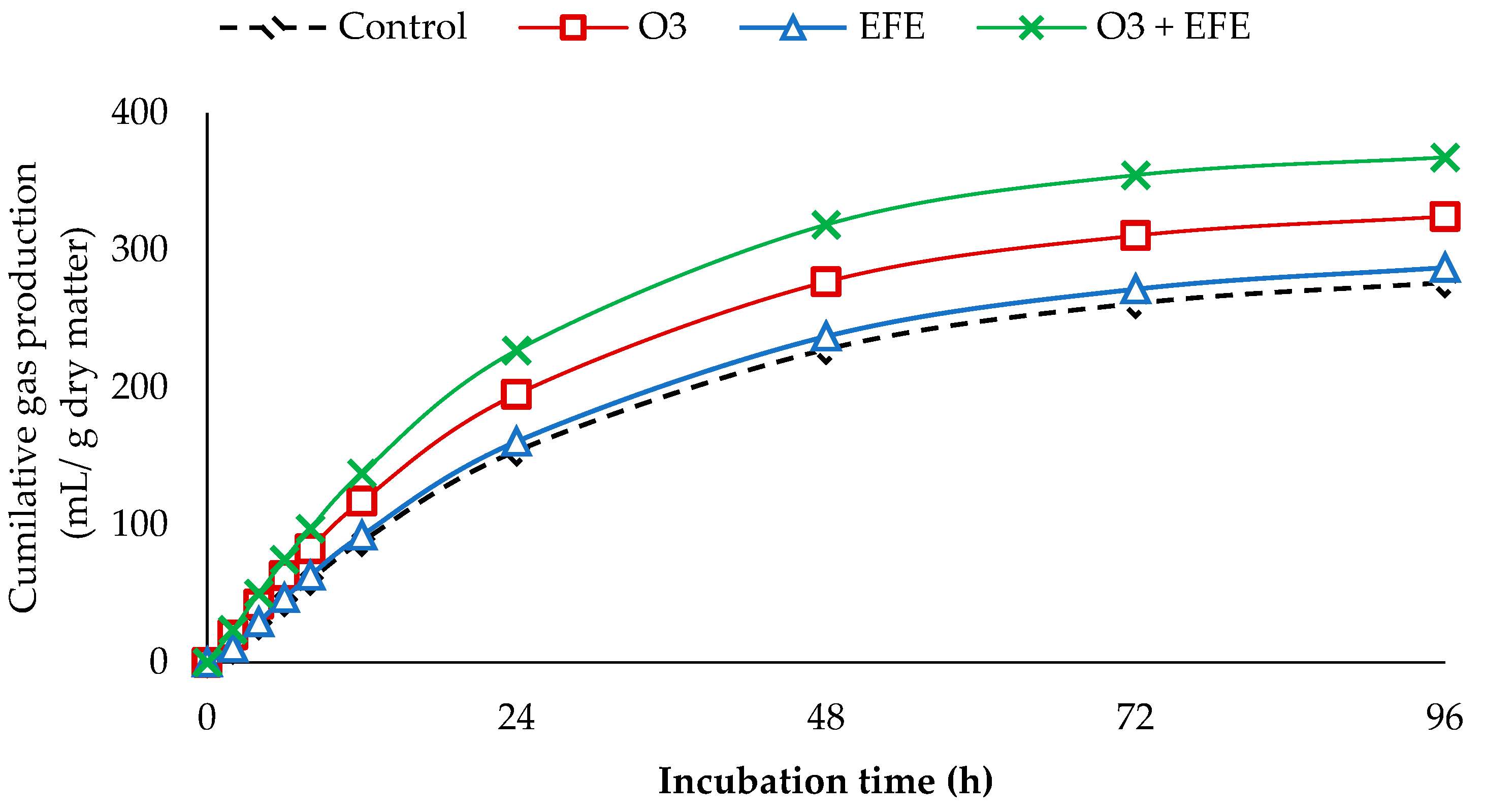
Figure 1. Effects of ozone (O3) treatment and exogenous fibrolytic enzyme (EFE) supplementation on cumulative gas production curves during the ruminal fermentation of artichoke wastes.
Fermentation 11 00626 g001
Table 1. Effects of ozone pretreatment and exogenous fibrolytic enzyme supplementation on chemical composition of artichoke wastes (g/kg dry matter, unless otherwise stated).
ParameterTreatmentsSEMp Value
ControlO3EFEO3 + EFE
CP188 b212 a190 b211 a4.3**
EE383537371.1NS
NDF594 a536 b588 a500 c14.1**
ADF442 a411 b442 a390 c6.2**
ADL106 a89 b101 a88 b4.1*
Ash716770683.4NS
NFC109 c150 b115 c184 a9.3***
TP15.2 a12.1 b15.0 a12.1 b1.22**
TT10.1 a6.5 b9.9 a6.3 b0.81***
CT3.3 a1.6 b3.3 a1.5 b0.41***
a, b, c Means within the same row with different superscripts differ significantly (p value < 0.05); *** p value < 0.001; ** p value < 0.01; * p value < 0.05; NS: not significant (p value ≥ 0.05); CP: crude protein; EE: ether extract; NDF: neutral detergent fiber; ADF: acid detergent fiber; ADL: acid detergent lignin; NFC: non-fibrous carbohydrate; TP: total phenolics (g gallic acid equivalents/kg dry matter); TT: total tannins (g tannic acid equivalents/kg dry matter); CT: condensed tannins (g leucocyanidin equivalents/kg dry matter); SEM: standard error of mean; O3: ozone treatment; EFE: exogenous fibrolytic enzyme supplementation.
Table 2. Effects of ozone treatment and exogenous fibrolytic enzyme supplementation on gas production kinetics during the ruminal fermentation of artichoke wastes.
ParameterTreatmentsSEMp Value
ControlO3EFEO3 + EFE
PGP289 c334 b300 c378 a10.2***
C3.31 b3.61 a3.32 b3.77 a0.181**
Lag0.98 a0.34 b0.93 a0.31 b0.107**
a, b, c Means within the same row with different superscripts differ significantly (p value < 0.05); *** p value < 0.001; ** p value < 0.01; PGP: potential gas production (mL/g dry matter); C: fractional rate of gas production (%/h); lag: time at which gas production starts (h); SEM: standard error of mean; O3: ozone treatment; EFE: exogenous fibrolytic enzyme supplementation.
Table 3. Effects of ozone treatment and exogenous fibrolytic enzyme supplementation on ruminal fermentation parameters and degradability of artichoke wastes.
ParameterTreatmentsSEMp Value
ControlO3EFEO3 + EFE
Fermentation parameterspH6.69 a6.65 a6.68 a6.57 b0.032*
NH3-N221 b251 a225 b249 a8.4**
Total VFA104.3 c118.2 b105.1 c125.2 a2.22***
VFA profile (% of total VFA)Acetate68.7 b63.5 b68.6 a62.5 b2.12*
Propionate20.4 b24.1 a20.6 b24.3 a0.93***
Butyrate6.86.66.66.30.51NS
Isobutyrate1.7 b2.3 a1.7 b2.4 a0.18*
Isovalerate1.5 b1.9 a1.6 b2.0 a0.13*
Valerate0.9 b1.4 a0.9 b1.5 a0.11*
Acetate/Propionate Ratio3.4 a2.6 b3.3 a2.5 b0.09*
Degradability (g/kg)DMD571 c636 b586 c684 a13.1**
NDFD447 c509 b453 c544 a9.4**
a, b, c Means within the same row with different superscripts differ significantly (p value < 0.05); *** p value < 0.001; ** p value < 0.01; * p value < 0.05; NS: not significant (p value ≥ 0.05); NH3-N: ammonia nitrogen; VFA: volatile fatty acid; DMD: dry matter degradability; NDFD: neutral detergent fiber degradability; SEM: standard error of mean; O3: ozone treatment; EFE: exogenous fibrolytic enzyme supplementation.
Table 4. Effects of ozone treatment and exogenous fibrolytic enzyme supplementation on ruminal microbiota population and enzyme activity at the end of rumen fermentation of artichoke wastes.
ParameterTreatmentsSEMp Value
ControlO3EFEO3 + EFE
Microbiota populationBacteria (×108 cells/mL)12.3 c15.9 b12.2 c18.2 a1.07**
Protozoa (×105 cells/mL)3.413.483.443.500.51NS
Enzyme activityXylanase (U/mL)1.44 c1.74 b1.51 c1.94 a0.11**
Endoglucanase (U/mL)5.33 c6.34 b5.32 c6.98 a0.36*
Exoglucanase (U/mL)27.44 b30.20 a27.49 b31.44 a1.33*
a, b, c Means within the same row with different superscripts differ significantly (p value < 0.05); ** p value < 0.01; * p value < 0.05; NS: not significant (p value ≥ 0.05); SEM: standard error of mean; O3: ozone treatment; EFE: exogenous fibrolytic enzyme supplementation.
Disclaimer/Publisher’s Note: The statements, opinions and data contained in all publications are solely those of the individual author(s) and contributor(s) and not of MDPI and/or the editor(s). MDPI and/or the editor(s) disclaim responsibility for any injury to people or property resulting from any ideas, methods, instructions or products referred to in the content.


