Article

Impact of Activated Carbon Modification on the Ion Removal Efficiency in Flow Capacitive Deionization


Department of Chemical Engineering and Environment, Karamay Campus, School of Engineering, China University of Petroleum (Beijing), Karamay 834000, China
*
Author to whom correspondence should be addressed.
C 2025, 11(4), 90; https://doi.org/10.3390/c11040090 (registering DOI)
Submission received: 24 August 2025 / Revised: 18 November 2025 / Accepted: 27 November 2025 / Published: 2 December 2025
(This article belongs to the Section Carbon Materials and Carbon Allotropes)

Abstract

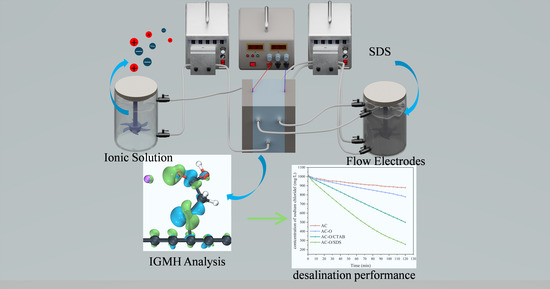
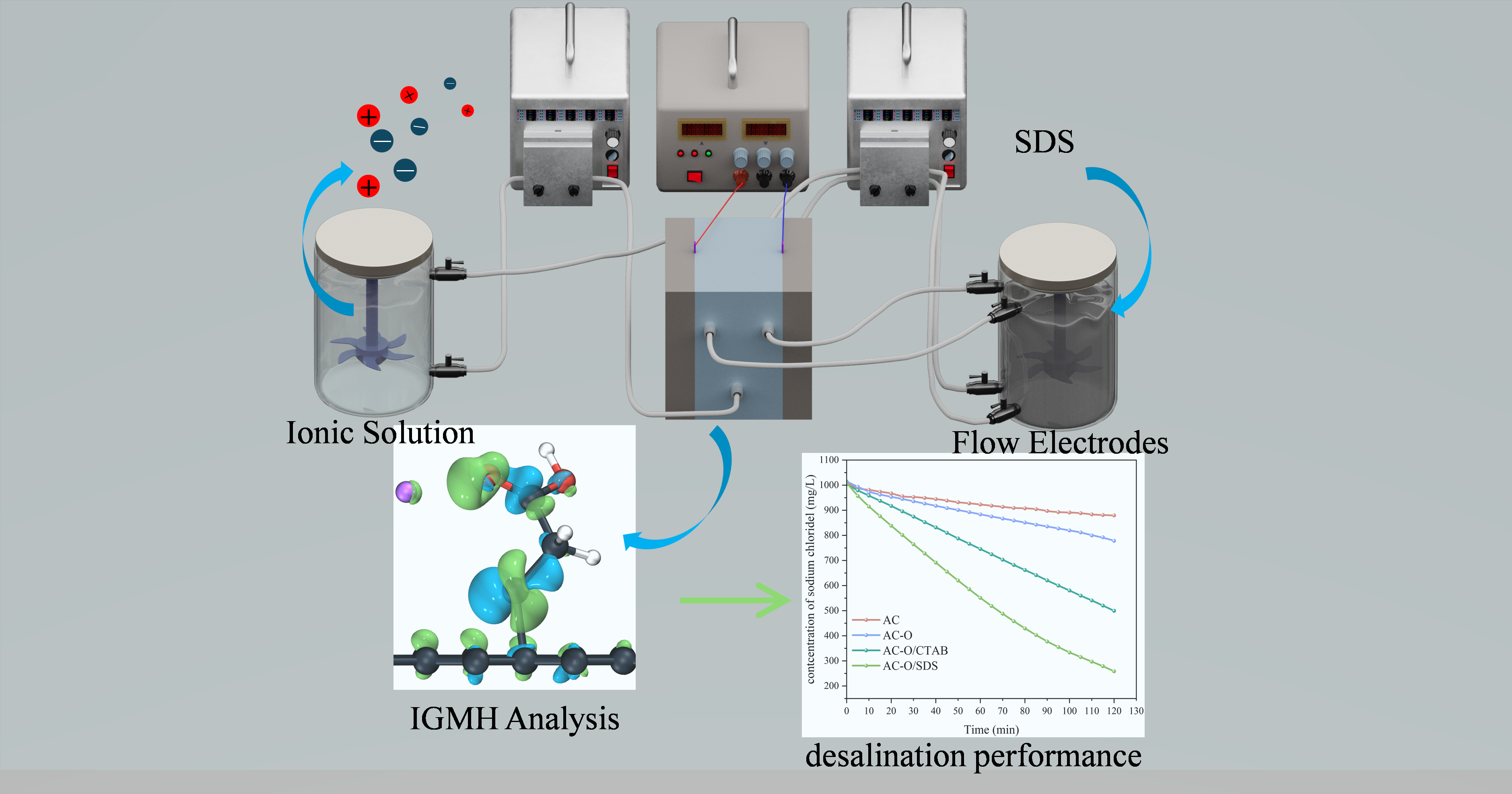
Flow capacitive deionization (FCDI) technology holds significant promise for cost-effective and energy-efficient desalination; however, its practical application is hindered by limited electrode stability and desalination performance. In this study, we propose a novel composite strategy that combines chemical surface modification with surfactant-assisted dispersion to enhance electrode performance in FCDI systems. We observed that the dispersion stability and capacitance of the flow electrodes were significantly improved after oxidation (AC-O) or amination (AC-N) of activated carbon (AC). To further investigate the underlying ion adsorption mechanisms, we performed Density Functional Theory (DFT) simulations. The simulations revealed that oxidative modification (AC-O) enhances chloride ion adsorption through stronger electrostatic and van der Waals interactions, while amination (AC-N) is more effective for sodium ion adsorption. Subsequently, surfactants (sodium dodecyl sulfate, SDS; cetyltrimethylammonium bromide, CTAB) were used to prepare stable and high-performance flow electrodes. Electrochemical characterization and desalination tests in a 1000 mg·L−1 saline solution demonstrated that the AC-O/SDS composite exhibited excellent dispersion stability (>7 d) and significantly enhanced conductivity and specific capacitance, increasing by factors of 2.48 and 2.50, respectively, compared to unmodified AC. This optimized electrode achieved a desalination efficiency of 74.37% and a desalination rate of 6.2542 mg·L−1·min−1, outperforming the unmodified electrode by a factor of 5.72. Our findings provide a robust, sustainable approach for fabricating advanced flow electrodes and offer valuable insights into electrode structure optimization, opening new possibilities for the application of FCDI technology in water treatment and material sciences.

Graphical Abstract

1. Introduction

The global demand for deionization technologies continues to grow, especially in the field of drinking water production. Among the various deionization methods, capacitive deionization (CDI) has received extensive attention from both academia and industry due to its potential for significantly reducing costs and energy consumption [1,2,3]. However, a pressing issue remains: how to effectively increase the production capacity of deionization technologies and ultimately achieve continuous production of higher-purity separated solutions [4]. Addressing these challenges is crucial for the practical application and further development of deionization technology.
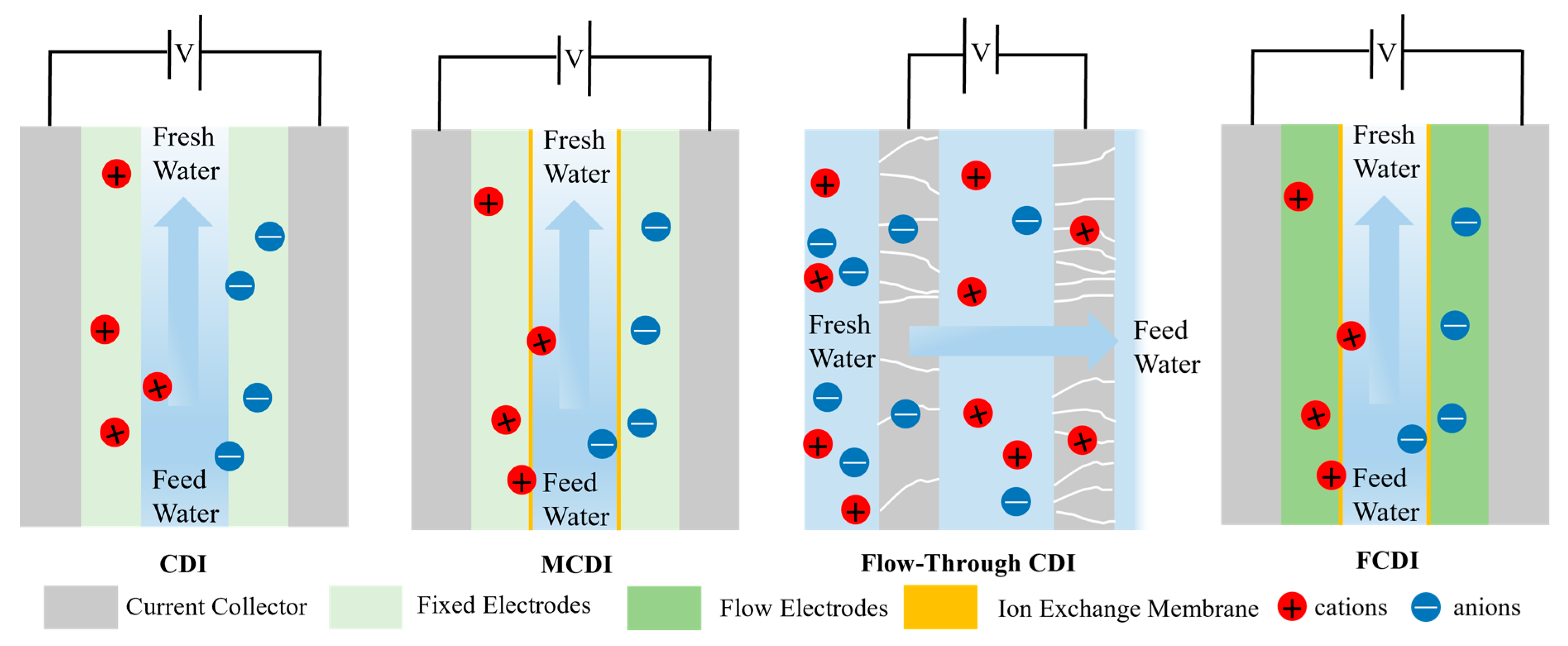
Since its emergence in the 1960s, capacitive deionization (CDI) technology has brought new development opportunities in the field of desalination, leading to widespread study and application. There are three main electrode structures for CDI [5,6], as shown in Figure 1. (1) Flow-by type: Used in both conventional capacitive deionization (CDI) and membrane capacitive deionization (MCDI) systems, the solution is transported into a channel where anions and cations are adsorbed onto two porous carbon electrodes under applied potentials, gradually forming an electric double layer on the electrode surfaces. As the adsorption process continues, the adsorption capacity of the carbon electrodes approaches its upper limit. Additionally, the accumulation of co-ions due to the co-ion effect decreases current efficiency, necessitating the initiation of a desorption operation to regenerate the electrodes. (2) Flow-through type [7]: In this structure, the feed solution flows directly through the pores of porous electrodes that have low hydraulic resistance and high surface area. These micrometer- and nanometer-sized pores allow fluids to flow and ions to be adsorbed over a larger surface area. While electrodes of this structure significantly improve deionization efficiency, they exhibit poor stability and degrade notably after multiple uses. (3) Flowable electrodes type: The flow electrode consists of particles suspended in the electrolyte and is capable of continuous ion removal. Flow electrodes were first reported by Kastening [8], who developed electrolytes with resistances ranging from 2 to 5 Ω. In 2013, Jeon et al. [9] made a significant breakthrough by introducing slurry electrodes into a CDI device, enabling a successful continuous adsorption process. This innovation led to the development of flow electrode capacitive deionization (FCDI) technology, which can be applied to the desalination of high-concentration brines and supports continuous desalination.
Flow electrodes are key components in FCDI technology. Generally, flow electrodes are selected from carbon-based materials with large specific surface areas and good conductivity, such as activated carbon, carbon aerogel, mesoporous carbon, carbon nanotubes, graphene, and carbon nanofibers [10,11,12,13]. Higher loading of active materials results in more efficient desalination and enhanced charge transport; however, the limitation of high loading is reduced electrode mobility. Modified active materials have been reported to enhance ion storage and suspension stability of mobile electrodes. For instance, Kelsey et al. [14] investigated the oxidative modification of granular activated carbon (AC), achieving a 25% increase in capacitance and a 60% reduction in energy consumption without sacrificing mobility. This demonstrates that the morphology, compositional loading, electrolyte, and flow behavior of the active material in suspension determine the electron and ion transport properties of the electrode.
In parallel, several recent FCDI studies have improved performance from different angles. Zhang et al. [15] designed a symmetric anion-exchange membrane configuration that mitigates conductivity losses in the desalination chamber and significantly enhances arsenic removal, emphasizing cell architecture and ion-migration pathways rather than changes in carbon chemistry. Bi et al. [16] have constructed semi-anchored percolation networks by grafting polymeric ionic liquids onto ultra-microporous carbon nanospheres, thereby lowering the percolation threshold, strengthening electron transport, and achieving Na+-selective desalination in flow electrodes. Xiong et al. [17] have focused on alkali-modified activated carbon for fluoride removal, where optimization of the alkali-to-carbon ratio improves surface area and pore structure and thus enhances FCDI defluorination performance. In addition to material and configuration innovations, operational optimization of FCDI systems has also been reported. Ding et al. systematically investigated a carbon-black-based flow electrode FCDI device and showed that desalination performance is highly sensitive to the applied voltage, carbon content, flow rate, and supporting electrolyte composition [18]. They identified an optimal operating window around 1.2 V and about 0.75 wt% carbon, where salt removal and charge efficiency are improved while avoiding the excessive viscosity, pumping losses, and increased energy consumption observed at higher solids loadings. This line of work underscores the crucial role of hydrodynamics and operating conditions in practical FCDI systems and is complementary to our materials-centered strategy, which focuses on tailoring the surface chemistry and dispersion stability of activated-carbon-based flow electrodes rather than optimizing the operating parameters alone. These studies clearly demonstrate the effectiveness of configuration optimization, percolation-network design, and alkaline activation of carbon; however, they often involve relatively complex membrane layouts, polymer-grafting chemistries, or strongly alkaline activation conditions, and the long-term dispersion stability and electrochemical behavior of simple carbon-based flow electrodes in neutral saline solutions are still not fully clarified.
Against this background, the present work adopts a materials-centric yet experimentally simple strategy. Coconut-shell activated carbon is first oxidized and aminated to introduce oxygen- and nitrogen-containing functional groups, and is then combined with ionic surfactants to form four carbon-only flow electrodes. In contrast to polymer-grafted or metal/metal-oxide composites, the resulting AC-O/SDS and AC-N/CTAB suspensions are prepared by straightforward wet-chemistry steps, show week-scale dispersion stability, and exhibit up to 2.48-fold higher conductivity and 2.50-fold higher specific capacitance than the unmodified activated carbon, leading to a 5.72-fold improvement in desalination performance under a 1000 mg L−1 NaCl feed. Furthermore, density functional theory simulations performed on oxidized and aminated activated carbon prior to surfactant addition reveal ion-specific adsorption behavior of Na+ and Cl, providing a microscopic rationale for the observed desalination selectivity that is generally absent from configuration- or activation-focused studies. By systematically correlating surface functional groups, pore structure, dispersion stability, and electrochemical behavior, this study proposes a practical and scalable route to improving the stability and ion-removal efficiency of carbon-based flow electrodes for continuous desalination in neutral saline media. In this work, we construct an FCDI system using modified flow electrodes based on oxidized and aminated coconut-shell activated carbon combined with ionic surfactants, and investigate how changes in surface chemistry and slurry composition influence ion adsorption and desalination performance. By tuning the type of chemical modification and the surfactant formulation, we significantly enhance ion adsorption and desalination capacity compared with the unmodified activated-carbon flow electrode, providing a simple materials-centered strategy for optimizing FCDI in brackish water and seawater treatment.

2. Experimental Section

2.1. Materials

Coconut shell activated carbon (AC, 99%) was purchased from Suzhou Charcoal Cyclone Activated Carbon Co., Ltd. (Suzhou, China). The AC had a particle size of 50−100 mesh, moisture content less than 5%, and a bulk density of 0.50 g/cm3. The following reagents were purchased from Shanghai Maclin Biochemical Technology Co., Ltd. (Shanghai, China). Sodium dodecyl sulfate (SDS, 99.7%), hexadecyl trimethyl ammonium bromide (CTAB, 99.7%), sodium chloride (NaCl, 99.7%), nitric acid (HNO3, 99.7%), acetone (CH3COCH3, 99.7%), ethanol (C2H5OH, 99%), and 3-aminopropyltriethoxysilane (APTES, 99%). All reagents were used as received without further purification.

2.2. Apparatus

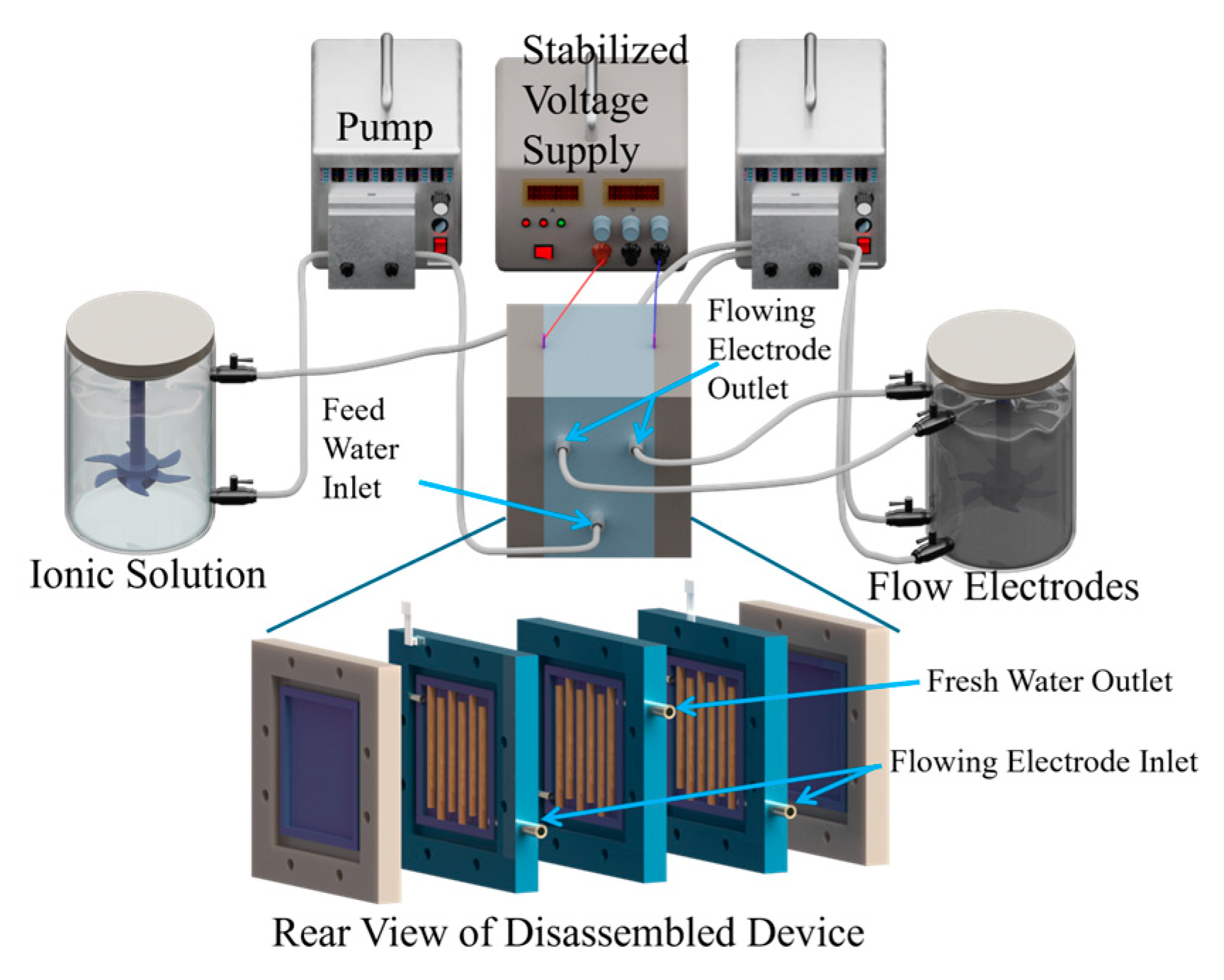
The main apparatus of the desalination system is illustrated in Figure 2. The flow electrodes and the salt solution are stored in a specialized beaker and are continuously transported into the FCDI unit using a pump. The supply electrodes within the FCDI unit are connected to a regulated power supply that provides a constant voltage, ensuring stable electrode operation and uniformity of the electric field. Under the influence of the electric field, ions in the salt solution migrate within the FCDI device: positive and negative ions move toward their respective electrodes and are adsorbed by the electrode materials, thereby reducing the ion concentration in the solution. The treated flow electrodes and salt solution are returned from the upper part of the specialized beaker into the circulation system, enabling continuous treatment of the solution. This process is continuously repeated to ensure stable operation of the device and to achieve efficient removal of ions from the salt solution.

2.3. Modification of Active Materials and Preparation of Flow Electrodes

Preparation of AC-O: In total, 10 g of coconut shell activated carbon and 30 mL of nitric acid solution (10 mol/L) were placed in a 250 mL round-bottom flask. The mixture was maintained in a constant-temperature water bath at 80 °C for 4 h with thorough stirring. After the reaction, the sample was removed and filtered using qualitative filter paper. The sample was washed repeatedly with deionized water until the pH of the filtrate reached 7. The filtered sample was then dried in a blast drying oven at 60 °C for 24 h to obtain sample AC-O. Preparation of AC-N: The 10 g of coconut shell activated carbon and 50 mL of acetone were placed into a 250 mL round-bottom flask and sonicated for 30 min to uniformly disperse the activated carbon. Then, 50 mL of APTES solution was added to the flask, and the mixture was maintained in a constant-temperature water bath at 85 °C for 4 h with sufficient stirring. After the reaction, the sample was removed, filtered using qualitative filter paper, washed five times with anhydrous ethanol, and further washed with 10 mL of acetone. The washed sample was then dried in a blast drying oven at 60 °C for 3 h to obtain sample AC-N. Preparation of the Flow Electrode Sample: In a beaker, 100 mL of deionized water and the specified amount of surfactant were added and stirred for 1 h until homogeneous. Then, 15 g of the modified coconut shell activated carbon was added, and stirring was continued for 12 h to obtain the flow electrode sample.

2.4. Characterizations

2.4.1. Scanning Electron Microscope Analysis

The surface morphology of the AC samples was characterized by a Hitachi 3400N (Hitachi High-Technologies Corporation, Tokyo, Japan) field emission scanning electron microscope (SEM). Prior to testing, the AC samples were immersed in liquid nitrogen for 90 min, then freeze quenched and sprayed with gold. Electron micrographs of the activated carbon material before and after modification were obtained by microscopic observation. SEM-EDS (OXFORD Xplore 30, Oxford Instruments, Oxford, United Kingdom) is employed to determine elemental composition and further confirm the presence of functional groups in modified activated carbon.

2.4.2. Fourier Transform Infrared Spectroscopy Analysis

FTIR spectra were recorded on an INVENIO-R spectrometer (Bruker Optics, Ettlingen, Germany). Approximately 1 mg of sample and 100 mg of KBr were thoroughly mixed homogeneously and then dried, transferred to an onyx mortar, and ground thoroughly for 5 min, after which they were pressed, with a pressing pressure of 12 MPa for 20 s. The samples were taken out and placed in the FTIR spectrometer for analysis, using MONIC software (version 9.2), on a 0.5 mm thick film to record. The scanning results were recorded on a 0.5 mm thick film using MONIC software with 32 scans, a resolution of 2 cm−1, and a wave number of 400−4000 cm−1.

2.4.3. Specific Surface Area and Pore Volume Analysis

At 77 K, the adsorption and desorption of N2 on the surface of activated carbon was used to detect BET characteristics. Using an ASAP2460 specific surface area and pore size distribution tester (Micromeritics Instrument Corporation, Norcross, GA, USA), important parameters reflecting pore structure on the surface of activated carbon, such as total specific surface area (SBET), total pore volume (V), microporous pore volume (Vmic), and average pore size can be quantitatively measured.

2.4.4. Surface Functional Group Determination

Surface functional groups were determined using Boehm titration method, basic solutions were titrated using 0.1 M HCl, while acidic solutions were titrated using 0.1 M NaOH. Carboxylic groups were determined using NaHCO3 as the neutralizing agent [19]. Each titration was performed three times, and the average value was taken for data analysis.

2.4.5. Dispersion Stability Testing

A total of 1.5 g of active material was weighed, and the surfactant SDS or CTAB was added in the required proportion and mixed in a glass vial along with 10 mL of deionized water. Subsequently, the glass vials were sonicated for 30 min to ensure uniform dispersion of the mobile electrodes. Finally, the samples were left to stand for a specified period of time (3 h and 24 h) before being photographed and recorded.

2.4.6. Conductivity Testing

Ten g of sample was added to a beaker containing 40 mL of deionized water and stirred for 20 min at 25 °C in a thermostatic water bath and 300 r/min magnetic stirring, after which conductivity was obtained using an Orion Star™ A221 portable water quality meter (Thermo Fisher Scientific, Waltham, MA, USA).

2.4.7. Cyclic Voltammetry

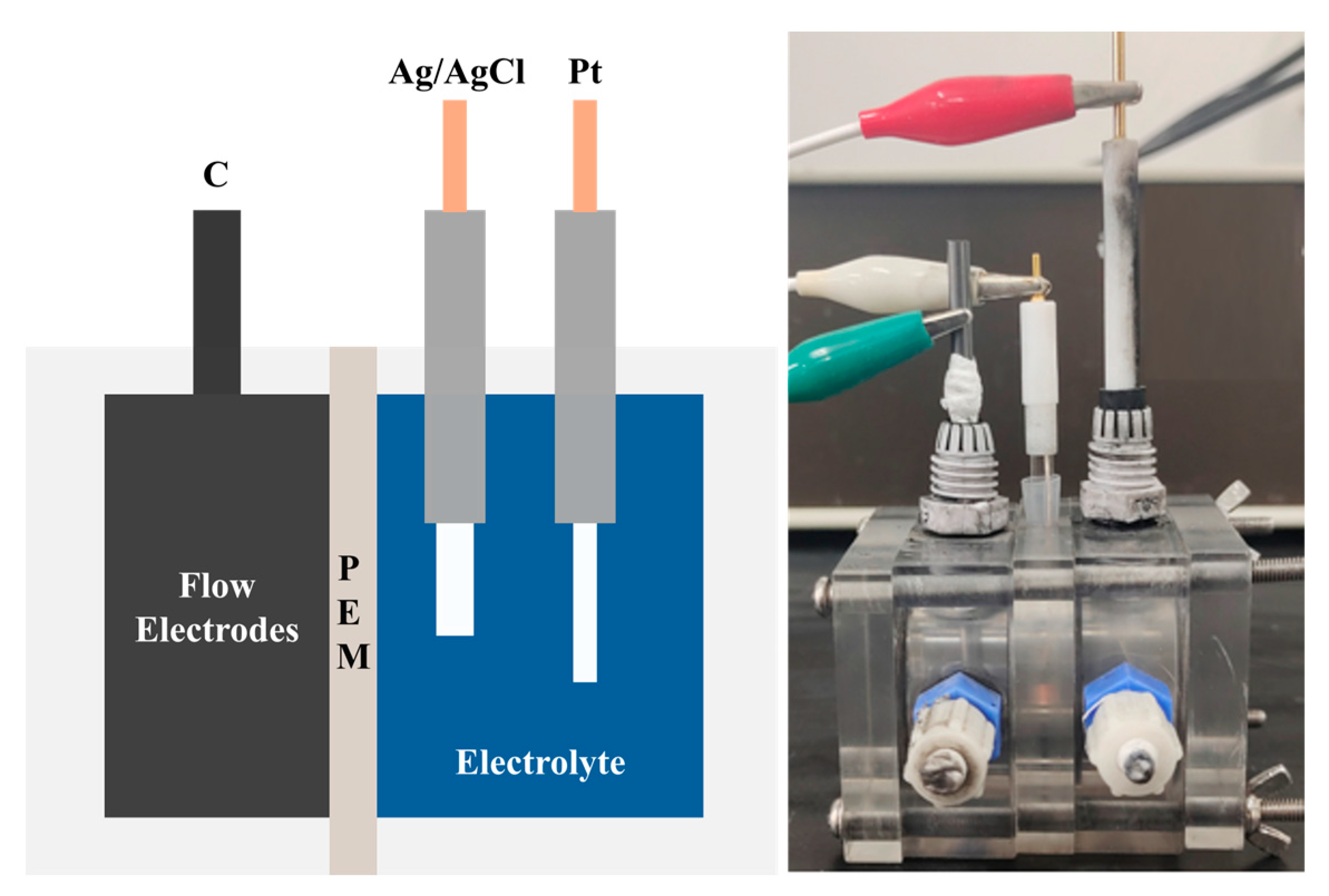
In this study, we designed and fabricated a test device combining a battery and a three-electrode system, as illustrated in Figure 3. The test system is constructed from Plexiglas, with a housing made of acrylic plates measuring 50 mm in length, 50 mm in width, and 60 mm in height. The interior features a cylindrical cavity with a radius of 15 mm. The left end was filled with a flow electrode made conductive using a graphite rod, while the right end was filled with a 0.5 mol/L Na2SO4 solution serving as the electrolyte. The flow electrode and electrolyte solution were separated by a proton exchange membrane (PEM). An Ag/AgCl electrode was used as the reference electrode, and a 10 × 10 mm platinum (Pt) electrode served as the counter electrode.
Prior to formal testing, the experimental setup was pre-tested using the configured flow electrodes to ensure its feasibility. The flow electrodes were tested at three different scan rates—5 mV/s, 10 mV/s, and 15 mV/s—within a voltage range of 0−0.5 V. At these scan rates, the cyclic voltammetry (CV) curves of the electrodes all exhibited rectangular shapes without obvious redox peaks, and the current response was close to a parallelogram with good symmetry. This result indicated that the flow electrodes followed a double-layer ion storage mechanism with good reversibility in this device. For the formal tests, a scanning rate of 5 mV/s was used, and a voltage window of 0−0.5 V was set to calculate the specific capacitance value C (F/g) of the flow electrode using Equation (1) [20],
C = E 2 E 1 i d E 2 m υ ( E 2 E 1 )
i is the current, A; m is the mass of active substance in the flow electrode, g; v is the scanning speed, V/s; E2E1 is the potential voltage, V.

2.4.8. Deionization Performance Analysis

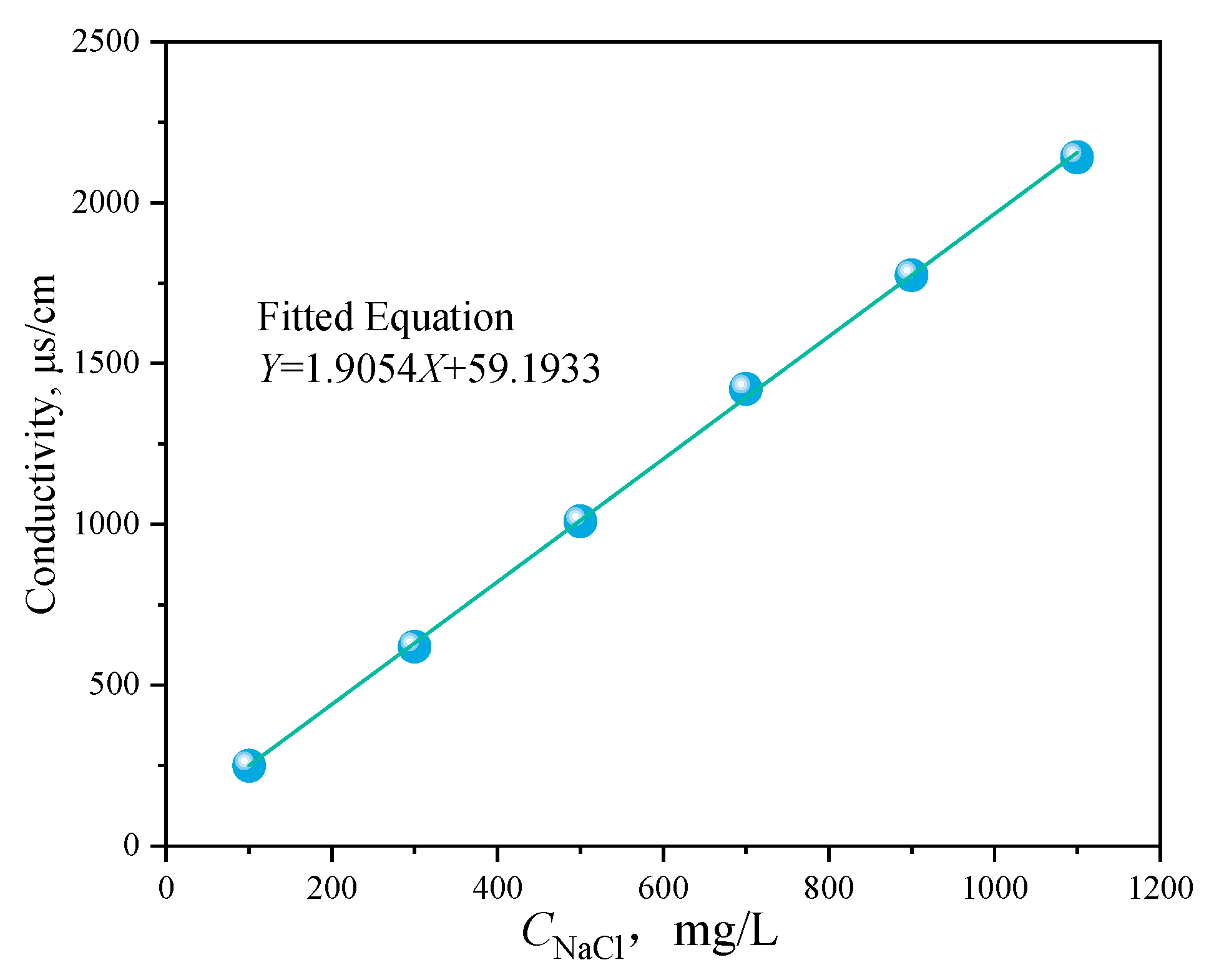
The desalination test was conducted using a self-developed device (CN202110608111.0) in our laboratory with 1000 mg·L−1 NaCl solution. The mineralization of the solution was analyzed by measuring the conductivity of the brine, and the desalination effect of the flow electrode was accordingly evaluated. The regression curve fitting between the standard NaCl concentration and conductivity is shown in Figure 4.
The relationship between the concentration of sodium chloride solution and conductivity was obtained as in Equation (2)
Y = 1.9054 X + 59.1933
Y is the conductivity, μS/cm; X is the concentration of sodium chloride in solution, mg·L−1.
The desalination rate is calculated as in Equation (3) [21]
ϕ t = α 0 α t α 0 × 100 %
ϕt represents the desalination rate at time t (%); α0 is the initial sodium chloride concentration of the brine (mg·L−1); and αt is the sodium chloride concentration at time t (mg·L−1). The desalination rate of the ionic solution was determined by recording the conductivity of the brine every 5 min using a water quality analyzer and applying Equations (2) and (3).

2.4.9. Simulation Calculation

To investigate the interaction between different monomer units of the active material and salt ions, the adsorption behavior of sodium and chloride ions on the surface of the active material was simulated using the Density Functional Theory (DFT) framework in the CP2K program package. The Perdew, Burke, and Ernzerhof (PBE) [22] exchange-correlation functional was used to solve the Kohn-Sham equations within the generalized gradient approximation (GGA), and the DFT-D3 [23,24] (Grimme) empirical correction was used for long-range London dispersion (van der Waals attraction). All elements were described using the Goedecker-Teter-Hutter pseudopotential and double-ζMOLOPT basis sets (DZVP-MOLOPTSR-GTH). The electronic energy optimization accuracy was set to 10−6 eV, the force accuracy on each atom was less than 0.03 eV/Å, and the energy cutoff was set to 450 eV. In this section, a cyclic activated carbon model is constructed, and a monomer unit, both before and after modification, is modeled on its surface to study the adsorption of sodium and chloride ions onto the surface of the activated material. The model size was 19.65 Å × 17.02 Å × 14.00 Å, and the first Brillouin zone was sampled using a (3 × 3 × 1) Monkhorst-Pack k-point grid [25,26].

3. Results and Discussion

3.1. Structural Properties and Surface Morphology of Modified Activated Carbon

3.1.1. Alterations in the Functional Groups of Active Material

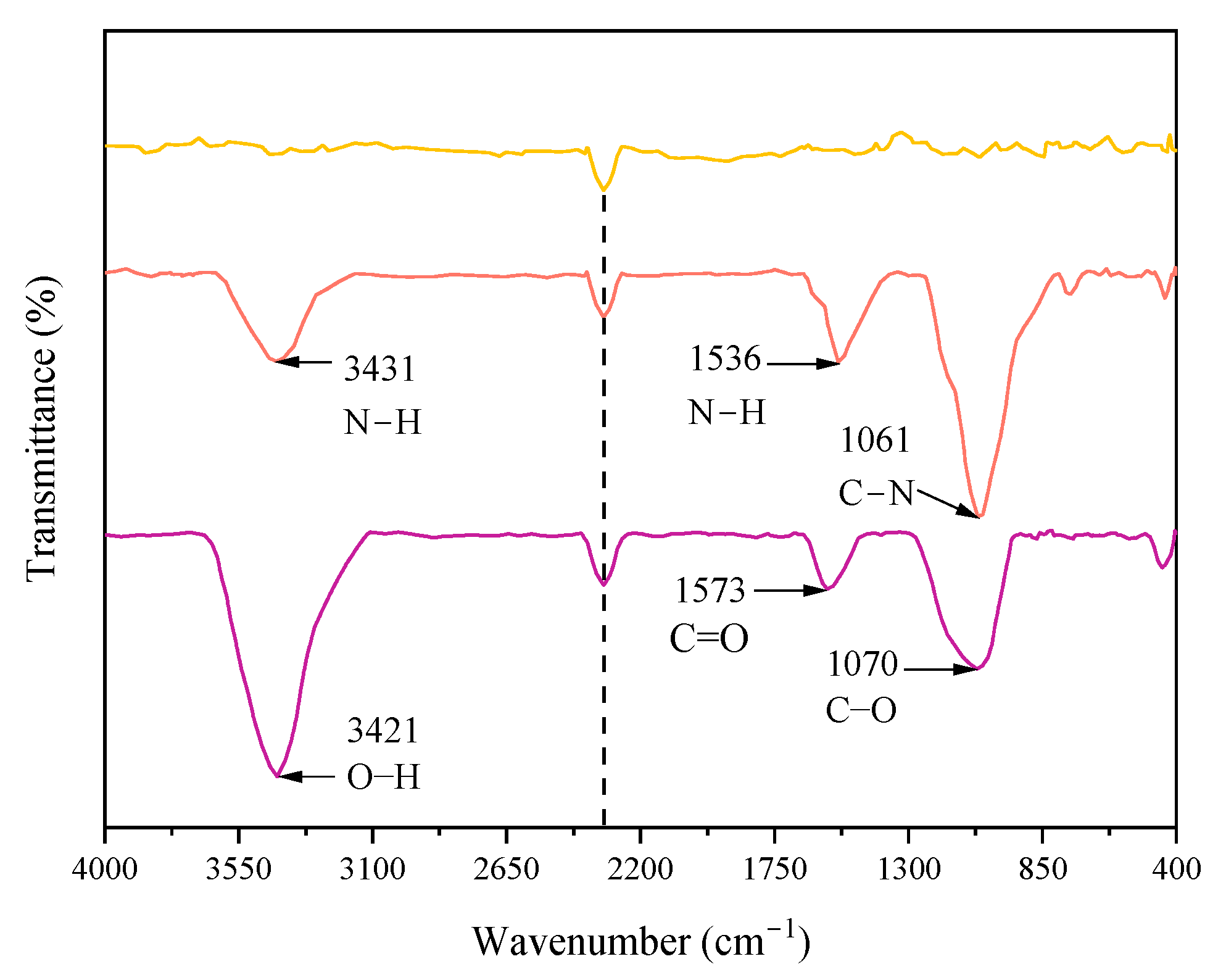
FTIR spectra of AC, AC-O, and AC-N are shown in Figure 5. For AC-O, the peak at 1070 cm−1 corresponds to the C−O stretching vibration, and the presence of two antisymmetric stretching vibrational peaks of C=O in carboxylate salts at 1573 cm−1 indicates successful oxidation. Additionally, the peak at 3421 cm−1 corresponds to the O−−H stretching vibration. For AC-N, the peak at 1061 cm−1 represents the C−N stretching vibration, the peak at 1536 cm−1 corresponds to the N−H bending vibration, and the peak at 3431 cm−1 is attributed to the N−H stretching vibration associated with the −NH2 group [27]. The introduction of oxygen-containing functional groups by nitric acid treatment, followed by amination to form amine groups, is evident from these spectral features. The appearance of these IR absorption peaks conclusively demonstrates the successful grafting of carboxyl and amine groups onto the surface of the AC substrate. These modifications may enhance chemisorption sites, thereby improving the electrochemical capacitance and hydrophilicity of the material.
To further validate the introduction of oxygen- and nitrogen-containing functional groups suggested by the FTIR spectra, Boehm titration was carried out to quantify the acidic and basic surface groups. The results confirm that AC-O contains a significantly higher amount of acidic oxygen-containing groups, particularly carboxylic functionalities, consistent with the strengthened C−O and carboxylate C=O bands observed at 1070 and 1573 cm−1 in the FTIR spectra. In contrast, AC-N shows an increased amount of basic surface groups, reflecting the presence of amine functionalities indicated by the C−N, N−H bending, and N−H stretching vibrations at 1061, 1536, and 3431 cm−1. The titration results therefore corroborate the FTIR findings, confirming successful incorporation of carboxyl groups through oxidation and amine groups through the subsequent amination treatment.
The combined FTIR and Boehm titration evidence (Table 1) establishes that the surface chemistry of the activated carbon was effectively tailored, enhancing the density of hydrophilic and ion-interacting functional groups. These modifications provide additional chemisorption sites and contribute to improved wettability, which align with the enhanced electrochemical capacitance and desalination performance observed in AC-O and AC-N.

3.1.2. Micromorphological Analysis of Active Materials

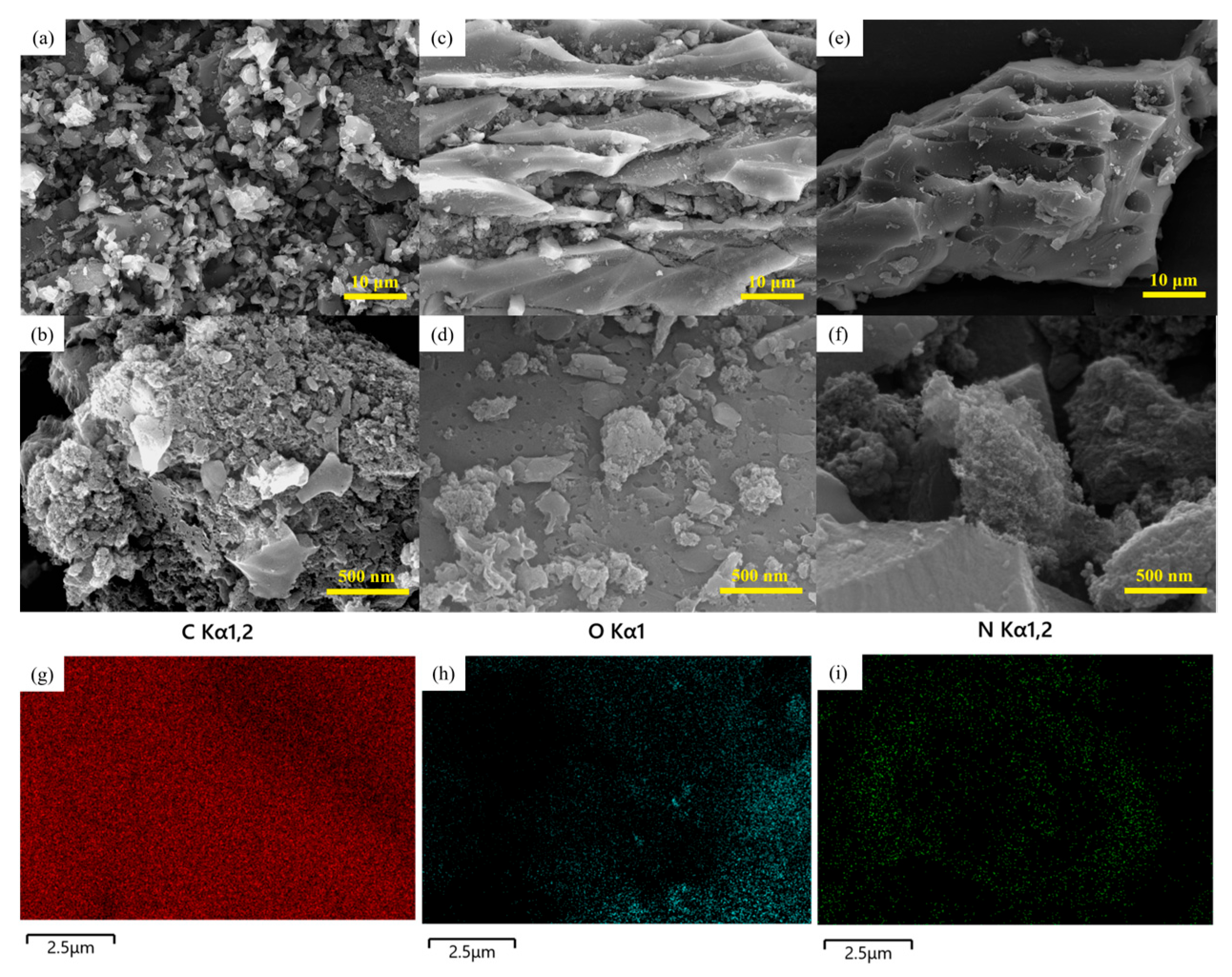
Scanning electron micrographs of AC, AC-O, and AC-N are shown in Figure 6. Figure 6a,b reveal that the unmodified AC surface has a rough, irregular structure with uneven pore distribution. In contrast, the micrographs of the functionalized materials AC-O and AC-N, presented in Figure 6c,d and Figure 6e,f respectively, display significantly smoother and more uniform morphologies. Additionally, the modification process not only increases the porosity of these two functionalized materials but also facilitates the formation of oppositely charged functional groups on their surfaces. This may effectively address issues related to the co-ion effect [28].
Figure 6e presents a SEM image of AC-O at a scale of 10 μm, revealing a considerable number of pores with sizes ranging from 3 to 5 μm. This observation indicates that the porous structure is maintained despite the modification of the material. These results suggest that chemical oxidation and amination of activated carbon alter its morphological structure, resulting in a smoother and more hydrophilic surface while retaining its inherent porosity.
Elemental composition and distribution of the three samples were further examined by SEM−EDS mapping. As summarized in Table 2, AC is dominated by carbon with 98.12 wt% C and only 1.88 wt% O, and no detectable nitrogen, which is consistent with a slightly oxidized commercial activated carbon. After nitric acid oxidation, the AC-O sample shows a clear increase in oxygen content to 7.65 wt% (with 92.35 wt% C and 0 wt% N), confirming the successful introduction of oxygen-containing surface functionalities. The EDS mapping images (Figure 6h) also show a more intense and homogeneous oxygen signal over the AC-O particles compared with the parent AC, in good agreement with the FTIR and Boehm titration results indicating the formation of carboxylic and related oxygenated groups.
For the AC-N, the EDS results reveal 91.86 wt% C, 5.54 wt% O, and 2.60 wt% N. The appearance of nitrogen at the few-weight-percent level verifies that the APTES treatment effectively introduces nitrogen-containing groups onto the carbon surface. The accompanying oxygen content in AC-N can be attributed to the combined contribution of the original oxygenated functionalities of the precursor carbon and the oxygen atoms present in the APTES-derived layer, as well as minor adsorbed species. Overall, the EDS mapping analysis corroborates that AC-O is enriched in oxygen-containing groups, while AC-N contains both nitrogen- and oxygen-bearing functionalities, which is consistent with the designed oxidation and amination steps.
According to Table 3, the pristine activated carbon shows a specific surface area of about 1056.8 m2/g, a total pore volume of 0.51 cm3/g, a micropore volume of 0.32 cm3/g, and an average pore diameter of 1.93 nm. After oxidation treatment, the AC-O sample exhibits a slight increase in surface area and total pore volume, together with a marked rise in micropore volume and a smaller average pore diameter of 1.82 nm. This indicates that the oxidation process slightly cleans and opens blocked micropores, generating more oxygen-containing groups and improving surface wettability and ion accessibility. In contrast, the AC-N sample shows a drastic reduction in specific surface area to 122.75 m2/g, a total pore volume of 0.11 cm3/g, a micropore volume of 0.04 cm3/g, and an increased average pore diameter of 3.15 nm. This suggests that some micropores are blocked or partially filled by nitrogen-containing species or residual organics, leading to fewer ion-accessible sites even though the pore channels become wider. Overall, the larger micropore volume and higher accessible surface area of AC-O contribute to its superior capacitance and desalination efficiency, whereas the severe loss of microporosity in AC-N limits charge storage despite its larger pore diameter.

3.1.3. Dispersion Stability of Active Materials

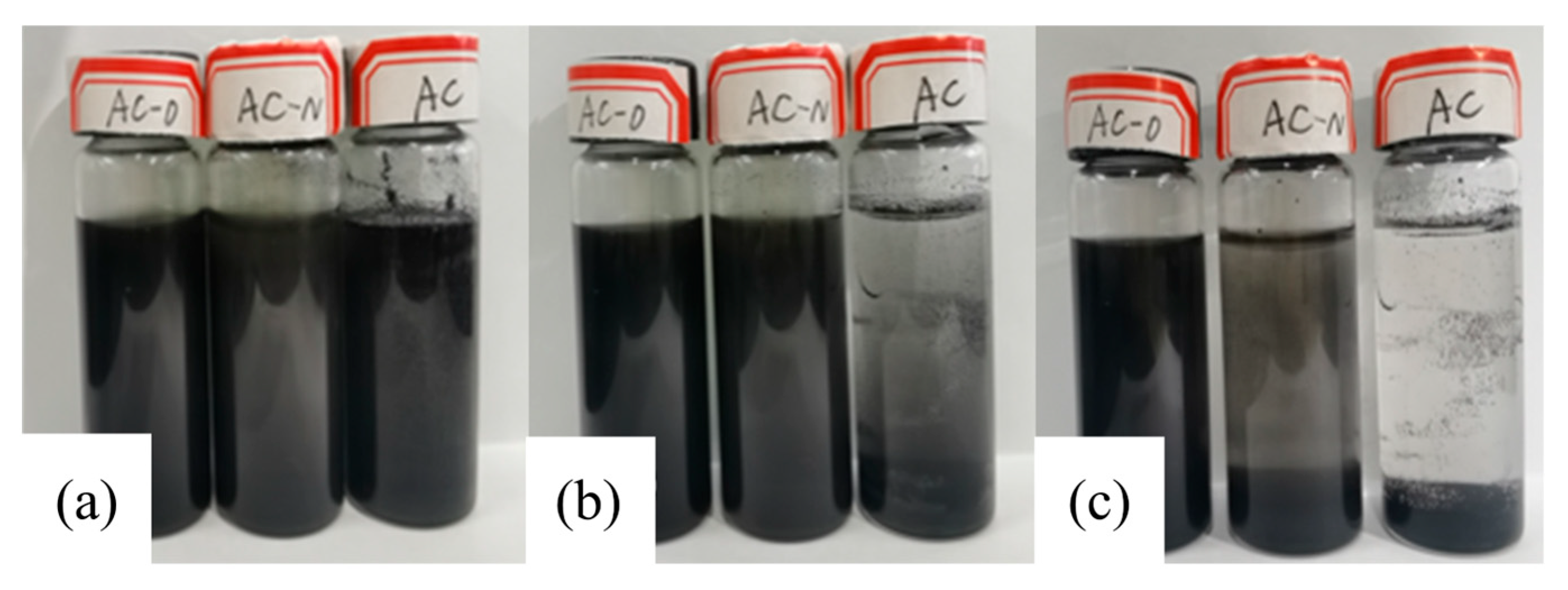
The dispersion stability of AC, AC-O, and AC-N was evaluated by allowing their suspensions to stand for 3 h and 24 h. Photographs of the solutions of the three materials were obtained, as shown in Figure 7. After 3 h of standing, unmodified AC exhibited significant phase separation from water (Figure 7a,b), indicating poor stability and dispersion in deionized water. In contrast, the modified AC-O and AC-N samples showed no phase separation, demonstrating improved stability and dispersion. Furthermore, after 24 h (Figure 7c), the unmodified AC developed more pronounced phase interfaces, and AC-N also showed significant phase separation. However, the AC-O dispersion remained stable without noticeable phase separation.
Compared with AC and AC-N, AC-O exhibits superior dispersibility and stability. The functional groups introduced through modification significantly enhance the hydrophilicity of the active material. The carboxyl groups present in the side chains of surface molecules are polar functional groups that can easily form hydrogen bonds with water molecules, thereby enhancing interaction with water. The increase in surface energy also improves the ability of water molecules to adhere to the surface of the material [29]. This modification causes a gradual transition of AC from a hydrophobic substrate to a hydrophilic one (AC-O), remarkably improving surface hydrophilicity.
Under the influence of osmotic pressure, water molecules on the surface accumulate and diffuse into the interior of the polymer matrix. Additionally, the carboxyl groups in the AC-O samples cover more surface area and are in fuller contact with water molecules when a solution is formed, making aggregation between AC-O particles less likely [30]. From the SEM images, it can be observed that the modification treatment changes the particle size and pore structure of the active material. AC-O contains a considerable number of pores between 3 and 5 μm, and the well-developed pore structure improves solubility in water. Therefore, its dispersibility is superior compared to AC-N.

3.1.4. Electrochemical Analysis of Active Materials

The type of surface functional groups has a direct effect on the conductivity of flow electrodes [31], and the conductivity changed significantly with the addition of active materials and deionized water. The conductivity of AC-O was 364 μS/cm; AC-N was 302 μS/cm; and unmodified AC was 231 μS/cm. This represents an increase in conductivity of nearly 58% for AC-O and 31% for AC-N compared to AC, indicating that the electronic conductivity improved after modification. Combined with the BET and EDS results, these trends can be attributed to both the evolution of pore structure and the introduction of heteroatom-containing surface groups: oxidation generates a higher micropore volume and more oxygenated sites on AC-O, which enhances ion-accessible surface area and improves wettability, whereas amination introduces nitrogen-containing functionalities on AC-N but also causes a significant loss of microporosity, leading to a more modest increase in conductivity. The functional groups on the surfaces of AC-O and AC-N enhance the hydrophilicity of the active materials. The conductivity enhancement of AC-O was higher than that of AC-N because AC-O releases more H+ ions in aqueous solution due to the introduction of ionizable carboxyl groups on its surface. In contrast, the amine groups on aminated coconut shell activated carbon ionize to a lesser extent under neutral conditions, providing limited enhancement to the conductivity [32].
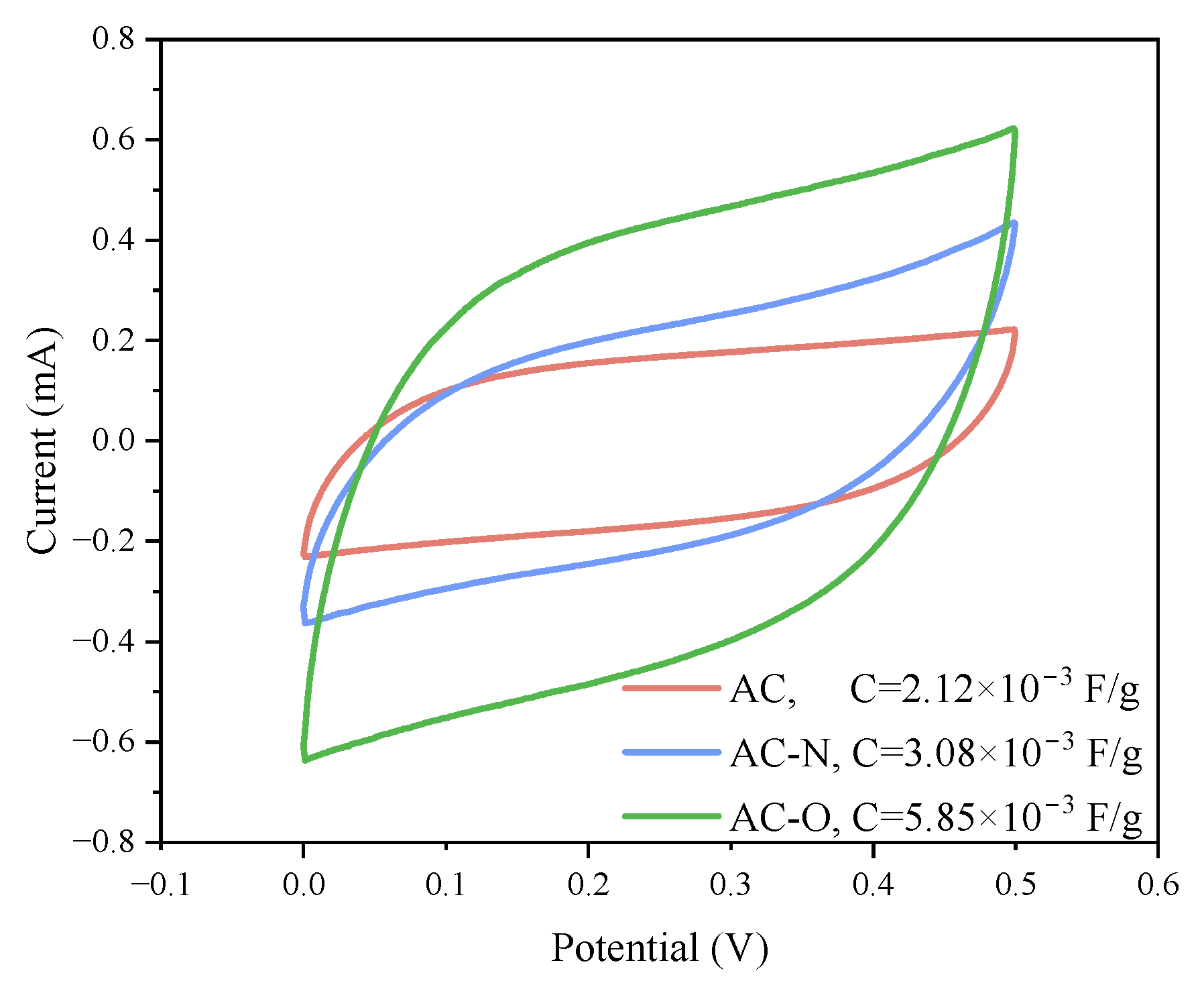
Figure 8 presents the cyclic voltammetry (CV) curves of AC, AC-O, and AC-N. At a scan rate of 5 mV/s, all three materials exhibit rectangular CV curves without any obvious redox peaks. This observation indicates that the modification processes did not disrupt the carbon skeleton structure of AC, and the electrochemical behavior of the materials primarily follows the electrochemical double-layer capacitance (EDLC) mechanism. Furthermore, the areas enclosed by the CV curves of both AC-O and AC-N are significantly larger than that of unmodified AC, suggesting that the modified materials possess higher capacitance properties. This enhancement is consistent with the structural and morphological observations: AC-O, which combines a slightly higher specific surface area with a markedly increased micropore volume and abundant oxygen-containing groups, shows the largest CV area, whereas AC-N, with reduced microporosity but additional nitrogen functionalities, exhibits an intermediate CV area between AC and AC-O. Similar structure−property correlations have been reported for metal- or metal-oxide-modified activated carbons. For example, Jain et al. [33] showed that decorating activated carbon with an optimal loading of silver nanoparticles (3 wt% Ag) produced the highest specific surface area and a favorable micro/mesopore distribution, which in turn yielded the maximum specific capacitance, while excessive Ag loading blocked pores and led to a deterioration in capacitance.
These findings highlight that both in their composite system and in our heteroatom-modified carbons, accessible nanoscale porosity and well-developed surface chemistry are crucial for achieving superior electrochemical performance.
The specific capacitance values of AC, AC-N, and AC-O were calculated using Equation (1). The specific capacitances were found to be 2.12 × 10⁻³ F/g for AC, 3.08 × 10⁻³ F/g for AC-N, and 5.85 × 10⁻³ F/g for AC-O. The difference in capacitance between AC-N and AC-O may originate from variations in active sites and functional groups. Oxidative modification introduces carboxyl groups onto the surface of AC, which increases the number of active sites, facilitates charge accumulation and transport, and promotes the adsorption of electrolyte ions on the electrode surface [34]. A similar effect can occur with the amine groups introduced by amination; however, their electronegativity and polarity may be slightly lower than those of oxygen-containing functional groups, resulting in relatively weaker promotion of charge transport. Taken together with the BET, SEM−EDS, and Boehm titration results, the electrochemical data demonstrate a clear correlation between structure/morphology and performance: samples that combine higher micropore volume with a dense coverage of polar surface groups (AC-O) exhibit the best conductivity and capacitance, whereas samples with partially blocked micropores but additional nitrogen sites (AC-N) show moderate improvements. Compared with silver- or metal-oxide-decorated activated carbon composites that rely on pseudocapacitive contributions and enlarged surface area to achieve high capacitance [35], our system reaches a significant enhancement in EDLC behavior through purely carbon-based surface functionalization and pore-structure optimization, which is particularly attractive for FCDI applications where stable, metal-free flow electrodes are desired.
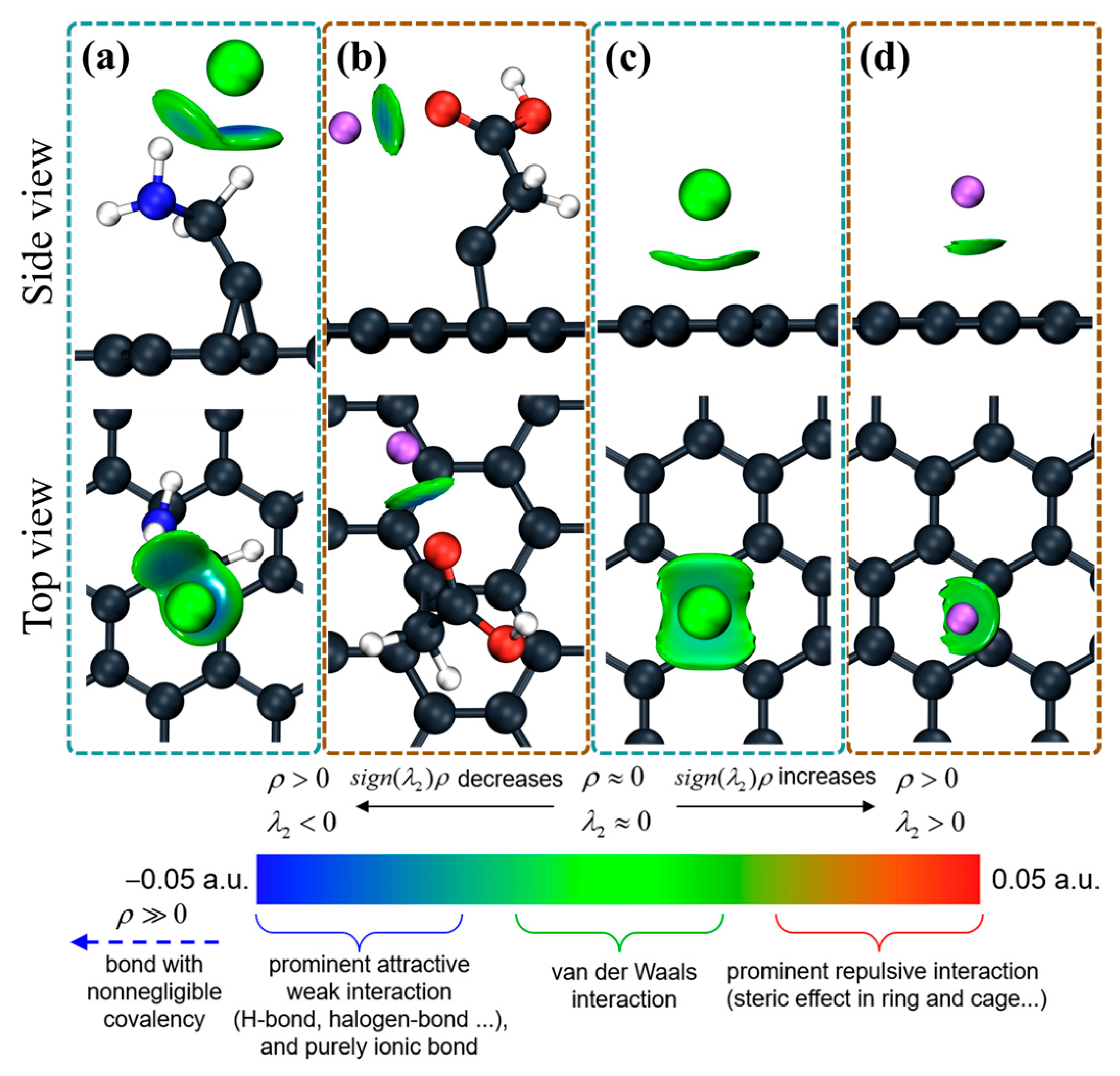
Using simulations, we employed the qualitative method of Interaction Region Indicator (IGMH) and the quantitative method of electron density difference to describe the adsorption behavior of the active material on ions in the salt solution before and after modification. In these simulations, the green regions represent van der Waals interactions between the saturated bonds and the surface of the ions to be adsorbed, while the blue regions indicate electrostatic interactions from ionic bonding formed at adsorption equilibrium.
As shown in Figure 9, the unmodified active material displays only a small green region, indicating much weaker interactions with Cl ions. In contrast, the modified active material exhibits not only more prominent green regions but also blue regions. This suggests that electrostatic interactions due to ionic bonding play a significant role in the adsorption process, substantially enhancing the adsorption capacity for ions in solution.
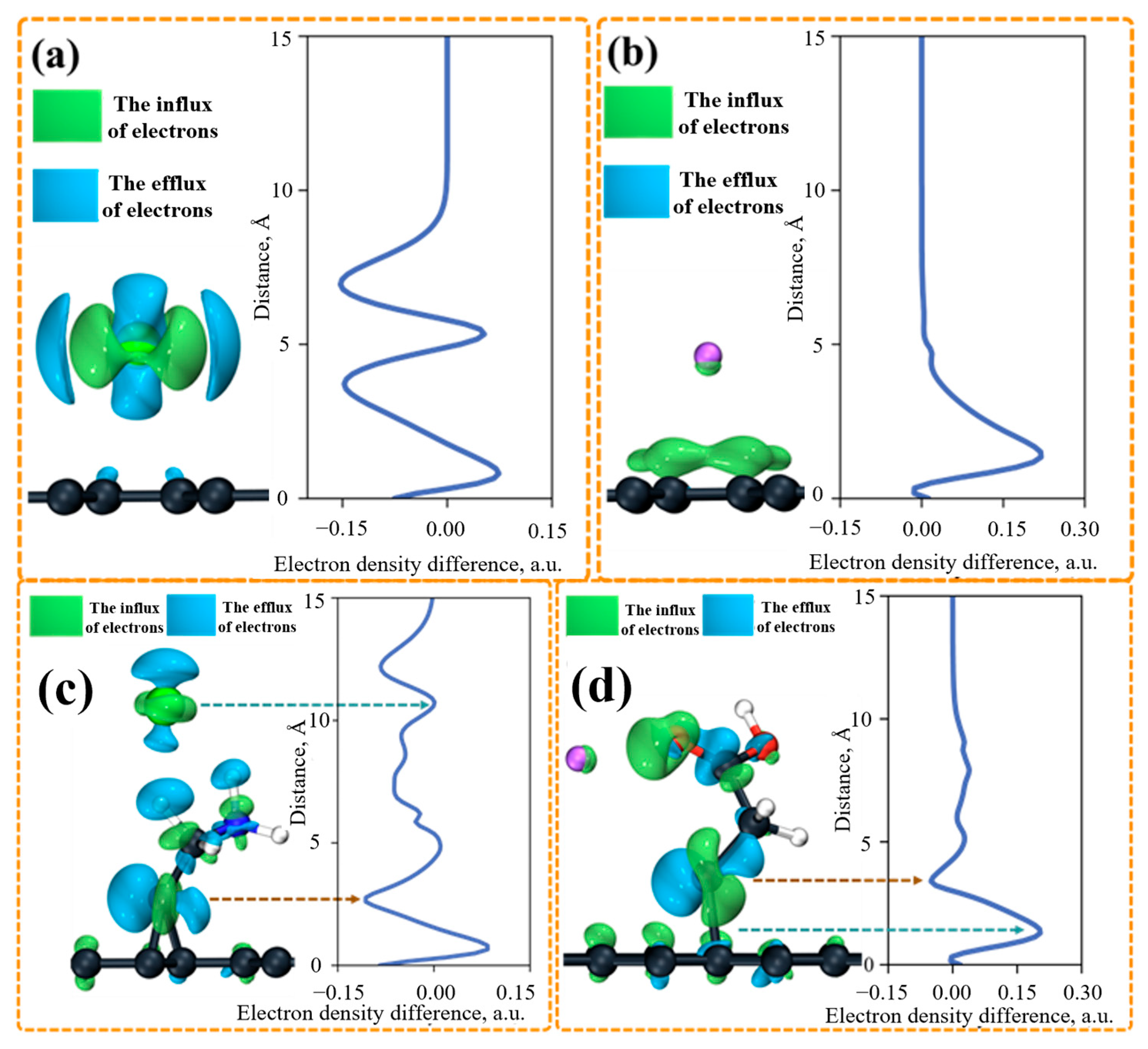
Analyzing the adsorption mechanism from a microscopic perspective, we found that it primarily involves electron transfer processes at the interfacial region. As shown in Figure 10a,c, electron shifts can be observed at the solid−liquid interface when the ions to be adsorbed come into contact with the active material. In the solution, the electron density difference near the ions to be adsorbed is positive, and the electron density around the active material increases, indicating an inflow of electrons. Conversely, the electron density difference near the hydrogen atoms is negative, and the electron density decreases, indicating an outflow of electrons.
The local integration curves of the electron density difference, as shown in Figure 10b,d, quantitatively depict the increase and decrease in electron density in each cross-section along the z-axis direction. The results show that at the interface between the modified active material and the ions, the electron density decreases significantly due to these interactions. The adsorption area of the modified active material is considerably increased, and interactions with the ions are present in multiple directions.
For the oxidatively modified active materials, the electron density difference is positive, indicating the flow of electrons from Cl ions to oxygen atoms. In contrast, for the amine-modified active materials, the electron density difference is negative, indicating the flow of electrons from hydrogen atoms to Na+ ions. This demonstrates that oxidative modification enhances the adsorption of Cl ions by the active material, while amination modification enhances the adsorption of Na+ ions. The overall degree of change in electron number indicates that oxidative modification is more effective.

3.2. Effect of SDS and CTAB Content on the Performance of Flow Electrodes

3.2.1. Dispersion Stability Analysis of Flow Electrodes

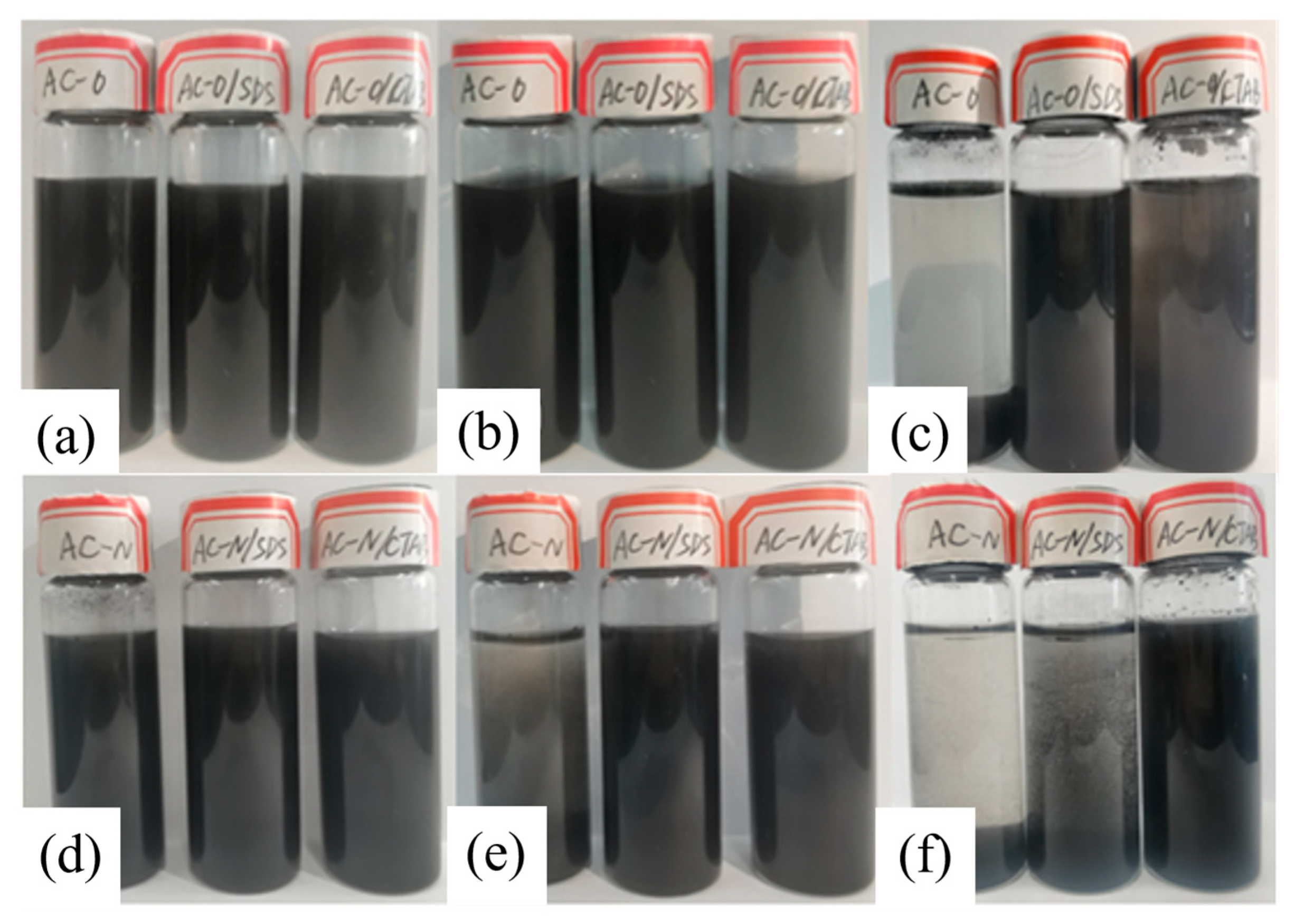
SDS and CTAB were mixed with AC-O at a mass ratio of 1:6 according to the flow electrode preparation process to produce AC-O/SDS and AC-O/CTAB, respectively. Equal amounts of well-mixed AC-O, AC-O/SDS, and AC-O/CTAB flow electrodes were placed into sample bottles and allowed to rest for 1 d and 7 d, as shown in Figure 11a–c. Similarly, SDS and CTAB were mixed with AC-N at a mass ratio of 1:6 to prepare AC-N/SDS and AC-N/CTAB, following the same procedure. Equal amounts of well-mixed AC-N, AC-N/SDS, and AC-N/CTAB flow electrodes were placed into sample bottles and allowed to rest for 1 d and 7 d, as shown in Figure 11d–f.
From Figure 11b, it can be seen that after 1 d of standing, the AC-O, AC-O/SDS, and AC-O/CTAB flow electrode samples exhibited good suspension stability, with no significant clarification or precipitation in any of the samples. This indicates that the modification of AC-O significantly improved its dispersion stability. After 7 d of standing, as shown in Figure 11c, AC-O displayed a clear phase interface, and AC-O/CTAB showed obvious phase separation, whereas AC-O/SDS had not yet undergone delamination. This phenomenon suggests that AC-O/SDS has superior dispersion and better stability than AC-O/CTAB.
From Figure 11e, it can be seen that after 1 d of standing, AC-N exhibited precipitation, while the samples with added surfactants did not show significant clarification or precipitation. This indicates that the addition of surfactants improved the stability of AC-N suspensions. After 7 d of standing, as shown in Figure 11f, AC-N showed more pronounced delamination, and AC-N/SDS also exhibited delamination, with only a small portion of AC-N remaining suspended in the solution. In contrast, AC-N/CTAB had not yet undergone delamination, indicating that AC-N/CTAB has better dispersion and greater stability than AC-N/SDS.
It can be observed that although the dispersion stability varies among different modified activated carbon materials with different surfactants, the addition of surfactants generally improves dispersion stability. This improvement is attributed to surfactants facilitating the dispersion of particles in water by lowering the interfacial tension between water and activated carbon particles.
In the case of AC-O, the presence of carboxyl groups (−COOH), which are electron-withdrawing groups, reduces the electron density on the surface of the activated carbon. As a result, the activated carbon surface exhibits a partial positive charge. SDS is a typical anionic surfactant with a negatively charged head group. Due to the reduced electron density on the activated carbon surface [36], ion-π interactions or hydrogen bonds may form between SDS and the activated carbon. These interactions promote the adsorption of the anionic surfactant onto the activated carbon surface. SDS forms a stable interfacial layer on the surface of AC-O, which increases electrostatic repulsion and steric hindrance between particles, prevents particle aggregation, and enhances dispersion stability.
For AC-N, the amine groups (−NH2) are electron-donating groups that increase the electron density on the surface of the activated carbon, causing it to exhibit a partial negative charge. Therefore, CTAB can further enhance the dispersion stability of AC-N through electrostatic attraction between the positively charged head group of CTAB and the negatively charged activated carbon surface.

3.2.2. Electrochemical Analysis of Active Materials Incorporating Surfactants

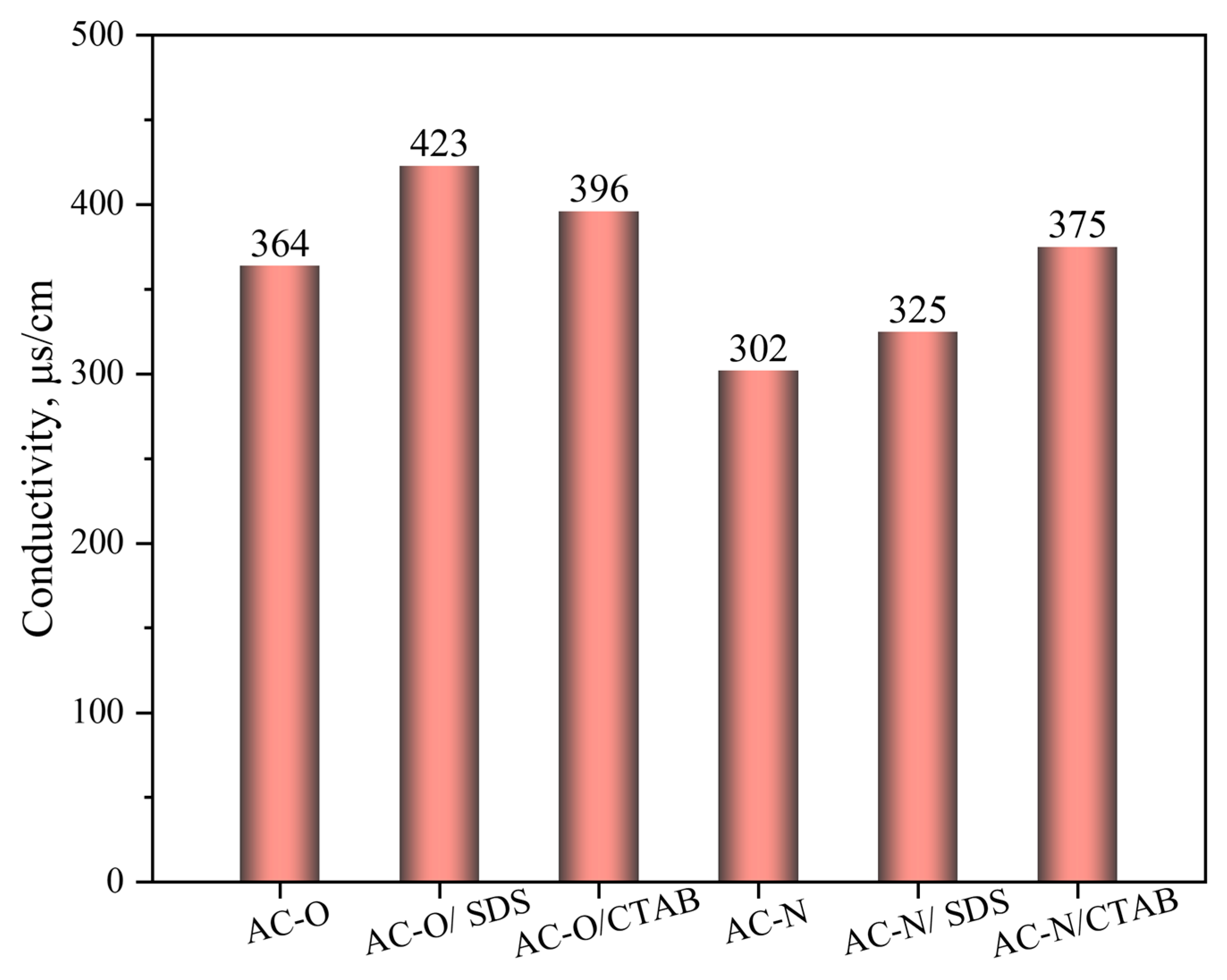
Electrical conductivity of AC-O was measured to be 364 μS/cm, while that of AC-O/SDS was 423 μS/cm and AC-O/CTAB was 396 μS/cm. Both AC-O/SDS and AC-O/CTAB exhibited higher electrical conductivities than AC-O alone, indicating that the addition of surfactants improves electrical conductivity. Moreover, the conductivity of AC-O/SDS was higher than that of AC-O/CTAB when equal amounts of SDS and CTAB were added, suggesting that SDS enhances the electronic conductivity of AC-O more effectively than CTAB.
Similarly, the conductivity of AC-N was 302 μS/cm; AC-N/SDS had a conductivity of 325 μS/cm, and AC-N/CTAB measured at 375 μS/cm. Both AC-N/SDS and AC-N/CTAB showed improved conductivity compared to AC-N, demonstrating that surfactant addition enhances conductivity in both cases. Notably, conductivity of AC-N/CTAB was higher than that of AC-N/SDS when equal amounts of SDS and CTAB were used, indicating that CTAB enhances the electronic conductivity of AC-N more effectively than SDS.
As shown in Figure 12, the addition of both anionic (SDS) and cationic (CTAB) surfactants enhances the electrical conductivity of the modified activated carbon solutions. From the magnitude of the enhancement, it can be inferred that the anionic surfactant SDS more effectively enhances the electron-withdrawing −COOH groups, while the cationic surfactant CTAB more effectively enhances the electron-donating −NH2 groups. SDS and CTAB adsorb onto the surface of activated carbon particles to form a stable adsorbent layer, thereby increasing the hydrophilicity of the originally hydrophobic AC material [37]. Matching the type of surfactant with the modified functional groups further elevates conductivity.
The critical micelle concentration (CMC) of SDS at 25 °C is 8.60 × 10⁻³ mol/L, and the micelle-forming interfacial region is highly polar [38]. Considering the distribution between the ions to be removed and the surfactant micelles in the aqueous phase, it is expected that due to the negatively charged surface of the SDS micellar region, the ions to be removed preferentially remain at the interface between SDS and the active material. In the presence of micellar aggregates, the ability of the micelles to adsorb ions onto the adsorbent layer of the activated carbon particles is enhanced as the concentration of surfactant increases [39]. The cationic surfactant CTAB serves a similar function, but the enhancement upon binding with amine groups is not as pronounced as that observed with −COOH/SDS.
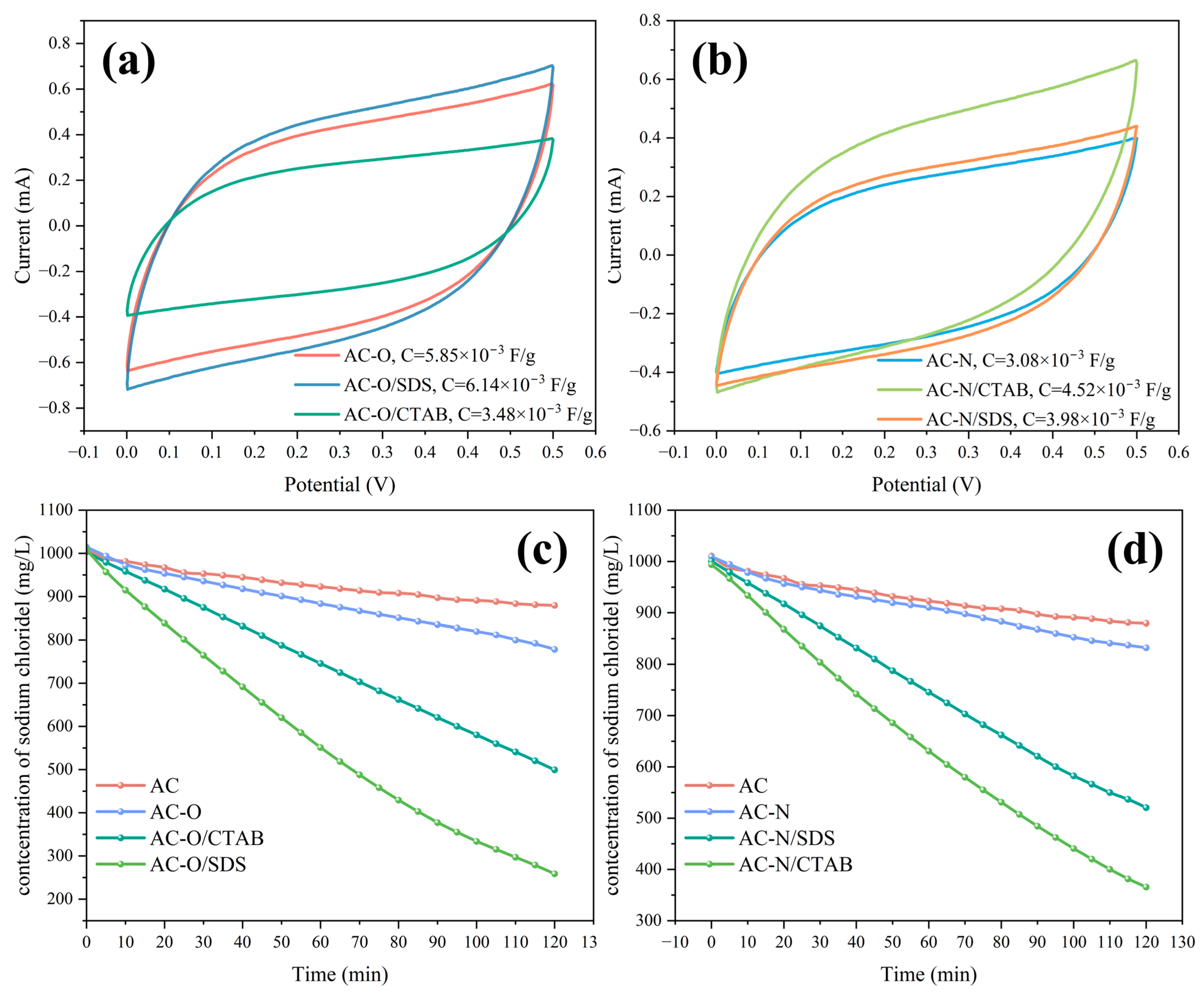
The CV curves of AC-O, AC-O/SDS, and AC-O/CTAB, as shown in Figure 13a, reveal the effects of surfactants on the charge/discharge characteristics of the flow electrode liquid. The specific capacitances of AC-O, AC-O/SDS, and AC-O/CTAB were calculated to be 5.85 × 10⁻³ F/g, 6.14 × 10⁻³ F/g, and 3.48 × 10⁻³ F/g, respectively. The results show that SDS enhanced the charge transfer capability, leading to superior kinetic performance with faster charge/discharge processes. The presence of CTAB, however, increased charge transport resistance, limiting the kinetic performance of the electrodes and making the charge/discharge process slower.
The differences in performance are primarily attributed to the interaction modes between SDS, CTAB, and the carboxyl groups on the surface of AC-O, which affect the exposure of active sites and the patency of ion transport channels within the electrode materials. SDS improved the hydrophilicity, specific capacitance, and electrical conductivity of AC-O, resulting in enhanced performance, whereas CTAB had a negative effect on the charge transport, reducing the electrode’s efficiency. The desalination performance of the different flow electrode configurations (AC-O, AC-O/SDS, and AC-O/CTAB) was evaluated and the desalination curves, shown in Figure 13c, clearly indicate that chemical oxidation significantly enhanced the desalination effect. The improved hydrophilicity, specific capacitance, and electrical conductivity of AC-O after oxidation resulted in a notable improvement in desalination performance. When surfactants were added, both AC-O/SDS and AC-O/CTAB exhibited higher desalination rates than pure AC-O, with AC-O/SDS showing superior performance. This can be attributed to the enhanced suspension stability and increased electrical conductivity caused by the surfactant addition, which improved the adsorption capacity and desalination efficiency of the mobile electrode. The specific desalination rates in Table 4 confirm that AC-O/SDS provided better desalination performance compared to AC-O/CTAB.
For AC-N, the situation is the opposite of that observed with AC-O. As shown in Figure 13b, after adding the same amounts of SDS and CTAB, the charging and discharging rates of AC-N flow electrode suspensions increased. The specific capacitances of AC-N, AC-N/SDS, and AC-N/CTAB were measured to be 3.08 × 10⁻³ F/g, 3.98 × 10⁻³ F/g, and 4.52 × 10⁻³ F/g, respectively. This corresponds to specific capacitance increases of 29% and 47% with the addition of SDS and CTAB. These results reconfirm that electron-donating amine groups are more suitable for cationic surfactant systems, while electron-withdrawing carboxyl groups are more suitable for anionic surfactant systems.
The three amination combination samples and the AC were formulated into flow electrodes and tested for their desalination effects, with the desalination curves presented in Figure 13d.
The results showed that the desalination performance of the aminated samples was significantly enhanced due to improved hydrophilicity, specific capacitance, and electrical conductivity of the activated carbon. For the systems with added surfactants, namely AC-N/SDS and AC-N/CTAB, both the desalination rate and desalination efficiency were higher than those of pure AC-N. The high suspension stability and increased electrical conductivity resulting from the addition of surfactants further enhanced the adsorption capacity and desalination effectiveness of the flow electrodes.
The desalination rates and efficiencies of the flow electrodes under different configurations were calculated using Equations (2) and (3) and are presented in Table 4. Comparing all the desalination rates in Table 4, it can be seen that the desalination performance of the flow electrode configuration of AC-O/SDS is better than that of AC-N/CTAB. Therefore, we selected the optimal AC-O/SDS for further optimization analysis.

3.3. Effect of SDS Content on the Performance of Flow Electrodes

3.3.1. Dispersion Stability Analysis of SDS/AC-O

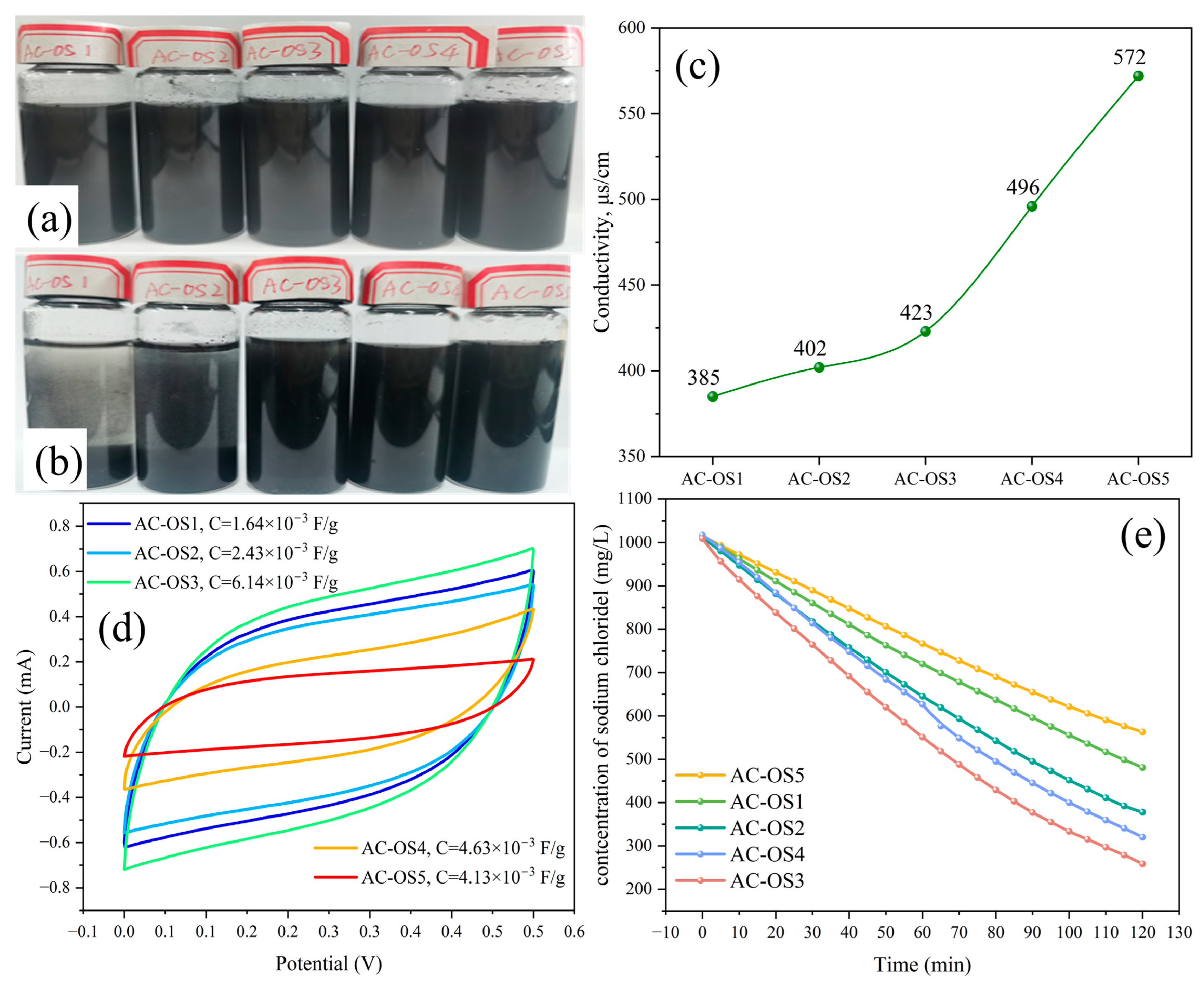
Static tests were performed on mobile electrodes with different mass ratios of SDS to AC-O (1:8, 1:7, 1:6, 1:5, and 1:4), designated as AC-OS1, AC-OS2, AC-OS3, AC-OS4, and AC-OS5, respectively. To assess the effect of SDS content on the suspension stability of AC-O, equal amounts of the prepared AC-OS1 through AC-OS5 samples were placed into sample bottles (Figure 14a). After standing for 7 d, the morphologies of the samples were observed, as shown in Figure 14b. It can be seen that phase separation occurred in samples AC-OS1 and AC-OS2 after 7 d, with the delamination phenomenon being more pronounced in AC-OS1. In contrast, AC-OS3, AC-OS4, and AC-OS5 did not exhibit obvious phase separation, indicating that a mass ratio of 1:6 or higher results in satisfactory dispersion stability. These observations suggest that adopting a mass ratio of 1:6 for SDS and AC-O achieves optimal suspension stability.

3.3.2. Electrochemical Analysis of SDS/AC-O

The conductivities of the samples were measured as Figure 14c: AC-OS1 had a conductivity of 385 μS/cm; AC-OS2, 402 μS/cm; AC-OS3, 423 μS/cm; AC-OS4, 496 μS/cm; and AC-OS5, 572 μS/cm. As the surfactant content increased, the conductivity gradually rose; however, the rate of enhancement varied across different stages.
Stage from AC-OS1 to AC-OS3: At low SDS content, the conductivity increased slowly. This is because SDS molecules tend to adsorb onto the surface of the oxidized activated carbon (AC-O). The surface of AC-O contains functional groups such as carboxyl groups, which form electrostatic interactions and hydrogen bonds with the anionic head groups of SDS. Consequently, SDS is primarily adsorbed onto the AC-O surface, limiting the number of free-moving ions in the solution, which contributes little to the overall conductivity. Stage from AC-OS3 to AC-OS5: A significant increase in conductivity was observed. As the SDS content further increased, the adsorption sites on the AC-O surface became progressively occupied and eventually reached saturation. The excess free SDS ions in the solution significantly increased the ionic strength and enhanced charge conductivity.
The CV curves of AC-OS are shown in Figure 14d. The specific capacitances of AC-OS1, AC-OS2, AC-OS3, AC-OS4, and AC-OS5 are 1.64 × 10⁻³ F/g, 2.43 × 10⁻³ F/g, 6.14 × 10⁻³ F/g, 4.63 × 10⁻³ F/g, 4.13 × 10⁻³ F/g, respectively. Analysis revealed that a moderate amount of SDS enhances the dispersion and charge transfer ability of the electrodes, but excessive SDS can lead to pore blockage and ion transfer limitations, ultimately resulting in a decrease in specific capacitance.
At the initial stage of increasing SDS content, SDS improves the effective specific surface area available for the adsorption process by exposing more active sites, which favors the adsorption of electrolyte ions. The presence of SDS also enhances the wettability of the electrode/electrolyte interface and reduces ion transport impedance. However, as the SDS concentration continues to increase, excessive SDS may over-adsorb onto the AC-O surface and within the pore channels, forming a multimolecular layer. This layer blocks micropores and mesopores, hindering the access of electrolyte ions and reducing the number of effective active sites. Consequently, the overall transport efficiency decreases.
Therefore, we determined that there is an optimal equilibrium point for SDS addition, specifically at a mass ratio of 1:6 (SDS:AC-O). To validate this, we tested flow electrodes with five different SDS ratios, and the results, shown in Figure 14e, confirmed the existence of this optimal point. Additionally, we observed that when the SDS addition ratio exceeded 1:7, the flow electrodes generated a large number of small bubbles during operation, which may also contribute to the decrease in desalination efficiency. Overall, AC-OS3 demonstrated the best performance in terms of desalination efficiency.

4. Conclusions

In this study, we implemented a new compositional strategy for flow electrodes. It was found that the modified AC maintained a smooth, flat surface and porous structure. Infrared spectroscopy analysis showed that chemical modification was effectively achieved by introducing carboxyl or amine groups into the AC under oxidizing or aminating conditions. The properties of the modified active materials changed significantly, with both chemical oxidation and amination improving the dispersion stability, electrical conductivity, and desalination properties of AC. Specifically, compared with unmodified AC, the conductivity of AC-O increased by nearly 58%, AC-N by 31%, while the specific capacitance improved by 176% for AC-O and 45% for AC-N, demonstrating substantial performance improvements.
In exploring the effect of surfactant type on the performance of modified flow electrodes, we observed differences between the effects of the same surfactants on AC-O and AC-N. For AC-O, the best performance was achieved after compounding with SDS, whereas for AC-N, the best performance was obtained after compounding with CTAB. A comparison of the test data for AC-O/SDS and AC-N/CTAB revealed that AC-O/SDS outperformed AC-N/CTAB in terms of conductivity (423 μS/cm), specific capacitance (6.14 × 10⁻³ F/g), desalination rate (74.37%), and desalination capacity (6.2542 mg/(L·min)). Finally, we investigated the effect of surfactant content on the performance of the modified flow electrode. The results showed that the suspension stability and electrical conductivity of the AC-O/SDS flow electrode gradually increased with increasing SDS content. However, the specific capacitance and desalination performance exhibited a trend of increasing and then decreasing. The flow electrode performance was optimized when the mass ratio of AC-O to SDS was 1:6.
In summary, the desalination performance of the FCDI flow electrode can be significantly enhanced by oxidative modification of activated carbon and optimization of the type and content of surfactant, particularly when the mass ratio of AC-O to SDS is 1:6. This approach provides a new pathway for the efficient desalination of saline water and offers valuable insights for the practical application of FCDI technology.

Author Contributions

Conceptualization, W.-H.Q. and J.-W.H.; methodology, W.-H.Q. and J.-W.H.; data curation, W.-H.Q. and Y.-N.L.; writing—original draft preparation, W.-H.Q.; writing—review and editing, W.-H.Q. and J.-W.H.; visualization, W.-H.Q., Y.L. and Y.X.; supervision, H.-Y.Y. and J.-W.H.; project administration, H.-Y.Y. and J.-W.H.; funding acquisition, J.-W.H. All authors have read and agreed to the published version of the manuscript.

Funding

This research was funded by National Natural Science Foundation of China (No. 52360003), Tianshan Talent Fund of the Xinjiang (No. 2023TSYCJC0065), 2025 Karamay City Innovation Environment Construction Plan Innovative Talent (No. 2025DB0112), Xinjiang Tianshan Innovation Team (No. 2022TSYCTD0002).

Data Availability Statement

The original contributions presented in this study are included in the article. Further inquiries can be directed to the corresponding author(s).

Acknowledgments

We acknowledge the funding agencies that supported this research. National Natural Science Foundation of China (No. 52360003), Tianshan Talent Fund of the Xinjiang (No. 2023TSYCJC0065), 2025 Karamay City Innovation Environment Construction Plan Innovative Talent (No. 2025DB0112), Xinjiang Tianshan Innovation Team (No. 2022TSYCTD0002). We extend our gratitude to Shao-Kang Qian of East China University of Science and Technology for his guidance on the computational simulations for this research project.

Conflicts of Interest

The authors declare that they have no known competing financial interests or personal relationships that could have appeared to influence the work reported in this paper.

References

  1. Ha, Y.; Lee, H.; Yoon, H.; Shin, D.; Ahn, W.; Cho, N.; Han, U.; Hong, J.; Tran, N.A.T.; Yoo, C.-Y.; et al. Enhanced salt removal performance of flow electrode capacitive deionization with high cell operational potential. Sep. Purif. Technol. 2021, 254, 117500. [Google Scholar] [CrossRef]
  2. Biesheuvel, P.M.; van der Wal, A. Membrane capacitive deionization. J. Membr. Sci. 2010, 346, 256–262. [Google Scholar] [CrossRef]
  3. Shin, Y.-U.; Lim, J.; Boo, C.; Hong, S. Improving the feasibility and applicability of flow-electrode capacitive deionization (FCDI): Review of process optimization and energy efficiency. Desalination 2021, 502, 114930. [Google Scholar] [CrossRef]
  4. Zhang, C.; Ma, J.; Wu, L.; Sun, J.; Wang, L.; Li, T.; Waite, T.D. Flow Electrode Capacitive Deionization (FCDI): Recent Developments, Environmental Applications, and Future Perspectives. Environ. Sci. Technol. 2021, 55, 4243–4267. [Google Scholar] [CrossRef] [PubMed]
  5. Ma, J.; Zhai, C.; Yu, F. Review of flow electrode capacitive deionization technology: Research progress and future challenges. Desalination 2023, 564, 116701. [Google Scholar] [CrossRef]
  6. Song, X.; Fang, D.; Huo, S.; Song, X.; He, M.; Zhang, W.; Li, K. Exceptional capacitive deionization desalination performance of hollow bowl-like carbon derived from MOFs in brackish water. Sep. Purif. Technol. 2021, 278, 119550. [Google Scholar] [CrossRef]
  7. Suss, M.E.; Baumann, T.F.; Bourcier, W.L.; Spadaccini, C.M.; Rose, K.A.; Santiago, J.G.; Stadermann, M. Capacitive desalination with flow-through electrodes. Energy Environ. Sci. 2012, 5, 9511–9519. [Google Scholar] [CrossRef]
  8. Kastening, B. Properties of Slurry Electrodes from Activated Carbon Powder. Berichte Der Bunsenges. Für Phys. Chem. 1988, 92, 1399–1402. [Google Scholar] [CrossRef]
  9. Jeon, S.-i.; Park, H.-r.; Yeo, J.-g.; Yang, S.; Cho, C.H.; Han, M.H.; Kim, D.K. Desalination via a new membrane capacitive deionization process utilizing flow-electrodes. Energy Environ. Sci. 2013, 6, 1471–1475. [Google Scholar] [CrossRef]
  10. Chand, H.; Liu, Z.; Wei, Q.; Gaballah, M.S.; Li, W.; Osmolovskaya, O.; Podurets, A.; Voznesenskiy, M.; Pismenskaya, N.; Padhye, L.P.; et al. Performance and mechanism of chromium removal using flow electrode capacitive deionization (FCDI): Validation and optimization. Sep. Purif. Technol. 2024, 340, 126696. [Google Scholar] [CrossRef]
  11. Guo, Z.; Hu, X.; Zhang, X.; Chang, Q.; Wang, Y. Reduced graphene oxide modified porous alumina substrate as an electrode material for efficient capacitive deionization. J. Porous Mater. 2023, 30, 259–266. [Google Scholar] [CrossRef]
  12. Xu, L.; Mao, Y.; Zong, Y.; Wu, D. Scale-up desalination: Membrane-current collector assembly in flow-electrode capacitive deionization system. Water Res. 2021, 190, 116782. [Google Scholar] [CrossRef]
  13. Xu, L.; Yu, C.; Tian, S.; Mao, Y.; Zong, Y.; Zhang, X.; Zhang, B.; Zhang, C.; Wu, D. Selective Recovery of Phosphorus from Synthetic Urine Using Flow-Electrode Capacitive Deionization (FCDI)-Based Technology. ACS EST Water 2021, 1, 175–184. [Google Scholar] [CrossRef]
  14. Hatzell, K.B.; Hatzell, M.C.; Cook, K.M.; Boota, M.; Housel, G.M.; McBride, A.; Kumbur, E.C.; Gogotsi, Y. Effect of Oxidation of Carbon Material on Suspension Electrodes for Flow Electrode Capacitive Deionization. Environ. Sci. Technol. 2015, 49, 3040–3047. [Google Scholar] [CrossRef]
  15. Zhang, S.; Wang, P.; Xue, W.; Zhang, W.; Liu, F.; Yang, C.; Liu, H.; Zhang, Y.; Zhang, Z.; Zhang, C. Symmetric anion exchange membranes enhance arsenic removal and overcome conductivity limitations in FCDI systems. NPJ Clean Water 2025, 8, 70. [Google Scholar] [CrossRef]
  16. Bi, L.; Sui, X.; Tian, S.; Liu, X.; Ma, S.; Liu, Z.; Liu, Y.; Ying, A. Semi-anchored percolation networks for low-threshold and selective desalination in FCDI. Desalination 2025, 616, 119417. [Google Scholar] [CrossRef]
  17. Xiong, Y.; Sun, J.; Jiao, Y.; Tan, T.; Zhang, Y.; Diao, H.; Xia, S. Enhanced Fluoride Removal in Wastewater Using Modified Activated Carbon in FCDI Systems. Water Air Soil Pollut. 2024, 235, 530. [Google Scholar] [CrossRef]
  18. Ding, X.; Qin, F.; Lai, L.; Qin, C.; Wang, R. Performance of fluorine removal using flow electrode capacitive deionization (FCDI): Validation and optimization. Environ. Technol. 2025, 46, 4407–4416. [Google Scholar] [CrossRef]
  19. Goertzen, S.L.; Thériault, K.D.; Oickle, A.M.; Tarasuk, A.C.; Andreas, H.A. Standardization of the Boehm titration. Part I. CO2 expulsion and endpoint determination. Carbon 2010, 48, 1252–1261. [Google Scholar] [CrossRef]
  20. Zhao, T.; Zhao, S.; Zhou, S.; Xu, Z. How the Thermal Effect Regulates Cyclic Voltammetry of Supercapacitors. ACS Energy Lett. 2023, 8, 3365–3372. [Google Scholar] [CrossRef]
  21. Shi, J.; Zhou, C.; Xu, S.; Yang, K.; Liu, G.; Li, X. Ultrasound-improved removal of chloride ions from coking circulating water by Friedel’s salt precipitation: Efficiency enhancement and mechanisms. Process Saf. Environ. Prot. 2024, 189, 47–60. [Google Scholar] [CrossRef]
  22. Perdew, J.P.; Burke, K.; Ernzerhof, M. Generalized Gradient Approximation Made Simple. Phys. Rev. Lett. 1996, 77, 3865–3868. [Google Scholar] [CrossRef] [PubMed]
  23. Hutter, J.; Iannuzzi, M.; Schiffmann, F.; VandeVondele, J. cp2k: Atomistic simulations of condensed matter systems. WIREs Comput. Mol. Sci. 2014, 4, 15–25. [Google Scholar] [CrossRef]
  24. Lu, T.; Chen, F. Multiwfn: A multifunctional wavefunction analyzer. J. Comput. Chem. 2012, 33, 580–592. [Google Scholar] [CrossRef]
  25. Lim, G.; Lee, K.B.; Ham, H.C. Effect of N-Containing Functional Groups on CO2 Adsorption of Carbonaceous Materials: A Density Functional Theory Approach. J. Phys. Chem. C 2016, 120, 8087–8095. [Google Scholar] [CrossRef]
  26. Dai, Y.; Liu, G.; Zhang, G. Effect of strain on the photoelectric properties of molybdenum ditelluride under vacancy defects: A DFT investigation. J. Mol. Model. 2024, 30, 259. [Google Scholar] [CrossRef] [PubMed]
  27. Deng, Z.; Zhang, Q.; Deng, Q.; Guo, Z.; Seok, I. Modification of coconut shell activated carbon and purification of volatile organic waste gas acetone. Adv. Compos. Hybrid Mater. 2022, 5, 491–503. [Google Scholar] [CrossRef]
  28. Gao, J.; Wu, H.; Liu, L.-B.; Pan, H.-C.; Liu, H. Effects of 2-ethylbutyric acid, 2-ethyl-1-butanol, and 3-methylpentane on the micellization thermodynamics and physicochemical properties of HS 15 and TW 80 micelles based on differences in functional groups. J. Mol. Liq. 2024, 413, 126003. [Google Scholar] [CrossRef]
  29. Wang, Z.; An, M.; Chen, D.; Yuan, Y.; Xu, X.; Sharshir, S.W.; Yuliarto, B.; Zhu, F.; Sun, X.; Gao, S.; et al. Molecular insights into enhanced water evaporation from a hybrid nanostructured surface with hydrophilic and hydrophobic domains. Chem. Eng. J. 2023, 465, 142838. [Google Scholar] [CrossRef]
  30. Bansal, P.; Panwar, A.S.; Bahadur, D. Molecular-Level Insights into the Stability of Aqueous Graphene Oxide Dispersions. J. Phys. Chem. C 2017, 121, 9847–9859. [Google Scholar] [CrossRef]
  31. Seredych, M.; Hulicova-Jurcakova, D.; Lu, G.Q.; Bandosz, T.J. Surface functional groups of carbons and the effects of their chemical character, density and accessibility to ions on electrochemical performance. Carbon 2008, 46, 1475–1488. [Google Scholar] [CrossRef]
  32. Su, Y.; Chen, N.; Ren, H.-L.; Li, C.-W.; Guo, L.-L.; Li, Z.; Wang, X.-M. Application of modified graphite felt as electrode material: A review. Carbon Lett. 2023, 33, 1–16. [Google Scholar] [CrossRef]
  33. Jain, A.; Michalska, M.; Zaszczyńska, A.; Denis, P. Surface modification of activated carbon with silver nanoparticles for electrochemical double layer capacitors. J. Energy Storage 2022, 54, 105367. [Google Scholar] [CrossRef]
  34. Islam, M.T.; Gollas, B.; Abbas, Q. Differentiating ion transport of water-in-salt electrolytes within micro- and meso-pores of a multiporous carbon electrode. J. Mater. Chem. A 2024, 12, 25504–25518. [Google Scholar] [CrossRef]
  35. Yumak, T.; Bragg, D.; Sabolsky, E.M. Effect of synthesis methods on the surface and electrochemical characteristics of metal oxide/activated carbon composites for supercapacitor applications. Appl. Surf. Sci. 2019, 469, 983–993. [Google Scholar] [CrossRef]
  36. Patterson, R.L.; Little, R.C. Interaction of sodium dodecyl sulphate and polyethylene oxide. Nature 1975, 253, 36–37. [Google Scholar] [CrossRef]
  37. Xing, Y.; Xu, M.; Li, M.; Jin, W.; Cao, Y.; Gui, X. Role of DTAB and SDS in Bubble-Particle Attachment: AFM Force Measurement, Attachment Behaviour Visualization, and Contact Angle Study. Minerals 2018, 8, 349. [Google Scholar] [CrossRef]
  38. Santos, G.P.; Martins, C.; Fortuny, M.; Santos, A.F.; Turmine, M.; Graillat, C.; McKenna, T.F.L. In-Line and In Situ Monitoring of Ionic Surfactant Dynamics in Latex Reactors Using Conductivity Measurements and Ion-Selective Electrodes. Ind. Eng. Chem. Res. 2007, 46, 1465–1474. [Google Scholar] [CrossRef]
  39. Guo, Q.; Singh, V.; Behrens, S.H. Electric Charging in Nonpolar Liquids Because of Nonionizable Surfactants. Langmuir 2010, 26, 3203–3207. [Google Scholar] [CrossRef]
Figure 1. Electrode structures for different types of CDI.
Carbon 11 00090 g001
Figure 2. Model of desalination system unit.
Carbon 11 00090 g002
Figure 3. Cyclic voltammetry test setup diagram.
Carbon 11 00090 g003
Figure 4. Connection between sodium chloride concentration and conductivity.
Carbon 11 00090 g004
Figure 5. FTIR spectra of AC, AC-O and AC-N.
Carbon 11 00090 g005
Figure 6. Electron micrographs of AC, AC-N and AC-O, (a,b) AC, (c,d) AC-N, (e,f) AC-O; EDS elemental mapping images for AC Carbon Element (g), AC-O Oxygen Element (h), and AC-N Nitrogen Element (i).
Carbon 11 00090 g006
Figure 7. Comparison photos of AC, AC-N and AC-O with different resting times, (a) 0 h, (b) 3 h, (c) 24 h.
Carbon 11 00090 g007
Figure 8. Cyclic voltammetry curves for AC, AC-O and AC-N.
Carbon 11 00090 g008
Figure 9. IGMH side and top views of the active material surface, (a) AC-N and Na+, (b) AC-O and Cl, (c) AC and Na+, (d) AC and Cl.
Carbon 11 00090 g009
Figure 10. Electron density difference and local integral of electron density difference, (a) AC and Na+, (b) AC and Cl, (c) AC-N and Na+, (d) AC-O and Cl.
Carbon 11 00090 g010
Figure 11. Comparison photos of AC-O, AC-O/SDS, AC-O/CTAB, AC-N, AC-N/SDS and AC-N/CTAB with different standing times, (a) 0 d, (b) 1 d, (c) 7 d, (d) 0 d, (e) 1 d, (f) 7 d.
Carbon 11 00090 g011
Figure 12. Electrical Conductivity of Flow Electrodes Across Various Condition Combinations.
Carbon 11 00090 g012
Figure 13. Cyclic voltammetry curves: (a) AC-O, AC-O/SDS and AC-O/CTAB, (b) AC-N, AC-N/SDS and AC-N/CTAB; Desalination curves for four flow electrodes: (c) AC-O, (d) AC-N.
Carbon 11 00090 g013
Figure 14. Comparison photos of different ratios of AC-O/SDS with different standing times: (a) 0 d, (b) 7 d. Different types of AC-OS: (c) conductivity, (d) Cyclic voltammetry curves, (e) Desalination curves.
Carbon 11 00090 g014
Table 1. Surface Functional Group Content of Modified and Raw Activated Carbon.
SamplesCarboxylic Acid (mmol/g)Surface Basicity (mmol/g)
AC0.110.73
AC-O0.260.55
AC-N0.091.31
Table 2. Elemental composition of activated carbon.
SamplesCarbon (wt%)Oxygen (wt%)Nitrogen (wt%)
AC98.121.880.00
AC-O92.357.650.00
AC-N91.865.542.60
Table 3. Comparison of BET results between original carbon (AC) and modified carbon (AC-O and AC-N).
SamplesSBET (m2/g)V (cm3/g)Vmic (cm3/g)Pore Size (nm)
AC1056.820.510.321.93
AC-O1071.900.520.411.82
AC-N122.750.110.043.15
Table 4. Desalination ratio and desalination rate of different flow electrodes.
SamplesDesalination Ratio (%)Desalination Rate (mg·L−1·min−1)
AC12.981.0934
AC-O23.281.9681
AC-O/CTAB50.244.2030
AC-O/SDS74.376.2542
AC-N17.531.4739
AC-N/SDS47.994.0018
AC-N/CTAB63.215.2351
Disclaimer/Publisher’s Note: The statements, opinions and data contained in all publications are solely those of the individual author(s) and contributor(s) and not of MDPI and/or the editor(s). MDPI and/or the editor(s) disclaim responsibility for any injury to people or property resulting from any ideas, methods, instructions or products referred to in the content.