Review

Circular and Long Non-Coding RNAs in Cancer Metabolism: Dual Perspective of Biomarkers and Therapeutic Targets

by
Francesca Pia Carbone
1,
Stefania Hanau
2,† and
Nicoletta Bianchi
1,*,†
1
Department of Translational Medicine, University of Ferrara, 44121 Ferrara, Italy
2
Department of Neuroscience and Rehabilitation, University of Ferrara, 44121 Ferrara, Italy
*
Author to whom correspondence should be addressed.
These authors contributed equally to this work.
Non-Coding RNA 2026, 12(2), 11; https://doi.org/10.3390/ncrna12020011
Submission received: 23 December 2025 / Revised: 13 March 2026 / Accepted: 17 March 2026 / Published: 19 March 2026
(This article belongs to the Special Issue Non-coding RNA as Biomarker in Cancer)

Abstract

Background/Objectives: Metabolic reprogramming is a hallmark of cancer, enabling tumor cells to sustain proliferation, survive under metabolic stress, and develop therapeutic resistance. While oncogenic signaling pathways regulating cancer metabolism have been extensively studied, increasing evidence indicates that non-coding RNAs (ncRNAs) play essential roles in coordinating metabolic adaptation. This review aims to synthesize current knowledge on long non-coding RNAs (lncRNAs) and circular RNAs (circRNAs) as important but relatively less characterized regulators of cancer metabolic adaptation and discuss their potential as biomarkers and therapeutic targets. Methods: We analyzed their roles across multiple types of cancer, prioritizing studies that integrate ncRNA profiling with metabolomics and mechanistic investigations, with particular attention to their diagnostic, prognostic, and predictive value. Results: LncRNAs and circRNAs regulate major metabolic pathways, including glycolysis, mitochondrial function, glutaminolysis, lipid metabolism, and redox balance. They act through transcriptional and epigenetic mechanisms, protein scaffolding, peptide encoding, and miRNA sponging, frequently converging on key regulators such as HIF-1α, c-Myc, p53, AMPK, and mTOR. However, many reported associations remain largely correlative, with limited integration of quantitative metabolic flux analyses and insufficient validation in physiologically relevant models. Conclusions: Although lncRNAs and circRNAs constitute an important context-dependent regulatory layer linking oncogenic signaling to metabolic reprogramming, future studies should combine ncRNA perturbation with stable isotope tracing, fluxomics, spatial metabolomics, long-read sequencing, and single-cell approaches to define causal and spatially resolved metabolic functions. Such integrative strategies may improve biomarker development and support ncRNA-informed, metabolism-oriented therapeutic interventions.

1. Introduction

In biology and medicine, the non-protein-coding genome is gaining increasing attention for its translational potential, particularly in the field of biomarker discovery [1]. Large-scale transcriptomic analyses indicate that a substantial portion of the human genome is transcribed, whereas only approximately 1–2% encodes protein-coding genes; the remaining transcripts are generally referred to as non-coding RNAs (ncRNAs) [2]. Non-coding RNAs (ncRNAs) are classified according to their length and structure. They include small ncRNAs (<200 nucleotides), such as miRNAs, piRNAs, and snRNAs/snoRNAs, and long non-coding RNAs (lncRNAs), defined as transcripts longer than 200 nucleotides without protein-coding potential. Circular RNAs (circRNAs) constitute a distinct class of covalently closed RNA molecules generated by back-splicing and lacking 5′ caps and 3′ poly(A) tails. In this review, we focus specifically on lncRNAs and circRNAs [1].
NcRNAs regulate gene expression and cellular pathways through diverse molecular mechanisms [3], acting as key modulators of transcriptional and post-transcriptional processes [4]. Their high tissue specificity, dynamic expression patterns, and remarkable stability, particularly in biofluids, make ncRNAs attractive candidates as cancer biomarkers. These molecules are involved in various biological processes, including development, differentiation, and disease, with a prominent role in cancer initiation and progression [1]. A growing body of evidence links ncRNA dysregulation to tumorigenesis, metastatic spread, and therapeutic resistance, highlighting their potential as diagnostic, prognostic, and predictive biomarkers.
The clinical utility of ncRNAs is further supported by their suitability in both liquid biopsy and tissue-based diagnostic platforms [5]. NcRNAs can function either as oncogenes or tumor suppressors, thereby reflecting tumor biology and disease aggressiveness. For example, specific lncRNAs promote cancer progression by regulating key oncogenic signaling pathways, while others exert tumor-suppressive effects by inhibiting tumor growth and metastasis [6]. Overall, these characteristics make ncRNAs promising candidates for improving cancer detection, patient stratification, and clinical decision-making.
This review focuses on the role of lncRNAs and circRNAs in metabolic pathways that are frequently dysregulated in cancer. MiRNAs, although representing a major class of ncRNAs, are excluded to maintain a defined scope, as their involvement in cancer metabolism has been extensively reviewed elsewhere. MiRNAs are discussed only when functionally relevant to the regulatory interplay with lncRNAs or circRNAs. With this aim, we surveyed the recent literature using the following search strategy and Query: ((“Non coding RNA” OR ncRNA[MeSH Terms]) AND metabolomic AND (Cancer[MeSH Terms])) NOT (miRNA OR MicroRNA) NOT (Review[pt]) NOT (Meta-analysis[pt]) NOT (“Systematic Review”[pt]). This search yielded 93 research articles. However, after a careful analysis of the manuscripts, not all were relevant to the scope of this review. Articles were included if they reported experimental evidence supporting the involvement of lncRNAs or circRNAs in cancer cell metabolism or metabolic adaptation, as well as studies identifying them as potential therapeutic targets. To ensure comprehensive coverage, the initial database search was supplemented by manually screening recent publications (within the last five years) and relevant references cited in selected articles.

1.1. Focusing on lncRNAs in Cancer

LncRNAs regulate gene expression at epigenetic, transcriptional, and post-transcriptional levels [1], and growing evidence supports their therapeutic potential in oncology [7]. At the molecular level, they interact with chromatin-modifying complexes and genomic DNA to shape chromatin states and the activity of regulatory elements [8,9,10,11,12]. Recent systematic analyses have further identified cancer-dysregulated lncRNAs with G-quadruplex (G4)-forming potential, highlighting structure-dependent regulatory mechanisms. Their altered expression and structural features may promote malignancy [13]. In the CanLncG4 dataset, several G4-bearing lncRNAs, including GSEC, REG1CP, LU-CAT1, NEAT1, and HOTAIR, are recurrently altered across multiple cancer types [13]. These transcripts may engage in G4-mediated interactions with RNA-binding proteins and epigenetic regulators, thereby influencing chromatin dynamics and transcriptional programs. Indeed, oncogenic lncRNAs such as HOTAIR, MALAT1, LINC00152, and SNHG1 promote tumor initiation, progression, and drug resistance by recruiting histone-modifying complexes, including Polycomb Repressive Complex 2, and reshaping epigenetic landscapes [4,14,15]. Prototypical examples, including XIST and NEAT1, further illustrate the central role of lncRNAs in chromatin-based regulation of cancer-associated gene expression [16].
Reflecting their context-dependent expression patterns and regulatory versatility [17,18,19], lncRNAs extend their activity beyond chromatin-level control by modulating mRNA stability, splicing, localization, and translation. They achieve this through interactions with target transcripts by acting as miRNA decoys and sponges, thereby attenuating miRNA-mediated repression [20,21,22,23,24,25,26]. For example, LINC00511 enhances gastric cancer cell proliferation and migration by targeting the tumor suppressor miR-765 [27], while UCA1 promotes bladder cancer invasion and metastasis through miR-145 sponging and activation of the PI3K/AKT pathway [28]. Several lncRNAs also display marked cancer specificity [29]. Lnc-SLC2A12-10:1, detected in plasma-derived exosomes from patients with gastric cancer, reduces malignant features via miR-105-5p and miR-150-3p modulation. In hepatic cancer, lncRNA PCNAP1 promotes tumor progression through miR-154/PCNA/HBV and miR-340-5p-dependent mechanisms and has also been implicated in breast cancer as a competitive endogenous RNA (ceRNA). Similarly, lncRNA CDC6 functions as a ceRNA, regulating the expression of Cell Division Cycle 6 in breast cancer and participating in the regulatory LINC01088/microRNA-22/CDC6 network in prostate cancer, under the control of PI3K/AKT signaling cascade.
LncRNA BCRT1 further exemplifies oncogenic activity across tumor types. It modulates cell cycle progression in cervical cancer via miR-432-5p and C-C Motif Chemokine Receptor 7, promotes metastasis in breast cancer under hypoxic conditions through Hypoxia-inducible factor 1α (HIF-1α)-associated mechanisms involving miR-1303 and Polypyrimidine Tract Binding Protein 3, and stimulates epithelial-to-mesenchymal transition (EMT) in osteosarcoma by regulating Fibroblast Growth Factor 7 expression. Likewise, lncRNA IGFBP4-1 correlates with metastatic progression in lung cancer by modulating ATP production and the Warburg effect, and its oncogenic role in bladder urothelial carcinoma is abrogated by inhibition of the JAK/STAT pathway [29]. More broadly, lncRNAs operating within STAT signaling represent critical regulatory nodes, as their activity can directly undermine anti-tumor immune responses [30].
In addition, many lncRNAs contribute to cancer progression not only by modulating signaling pathways but also by directly reshaping cellular metabolism. The nuclear lncRNA LETS1 amplifies TGFβ–SMAD signaling, promoting metastatic behavior in lung and breast cancer [31]. Because TGFβ-driven EMT requires coordinated shifts in glycolysis, glutamine utilization, and lipid metabolism, LETS1 reinforces the metabolic adaptations that sustain migratory and invasive phenotypes, thereby linking lncRNA activity to metabolism-driven cellular plasticity.
KB-1460A1.5 can be cited as a prime example of tumor-suppressive lncRNA. It is downregulated in gliomas and its overexpression triggers ferroptosis, an iron- and lipid peroxidation-dependent form of cell death, by inhibiting the mTOR/SREBP-1/SCD1 axis. This reduces the production of monounsaturated fatty acids, which normally protect cells from oxidative lipid damage, highlighting how lncRNAs can modulate lipid metabolism to sensitize tumor cells to oxidative stress.
LncRNAs further regulate redox metabolism, impacting therapy resistance. Glutathione (GSH) degradation-inhibiting lncRNA (GDIL), upregulated in platinum-resistant colorectal and ovarian cancers (OCs), enhances intracellular GSH levels by inhibiting its degradation via CHAC1 suppression [32]. This maintains redox balance under chemotherapy-induced oxidative stress, allowing cancer cells to survive platinum treatment. GDIL thus exemplifies how lncRNAs can modulate metabolic pathways that buffer Reactive Oxygen Species (ROS), directly contributing to chemoresistance.
In the study by Liu et al. [33], seven Mitochondrial Permeability Transition-Driven Necrosis-Related lncRNAs (MPTDNR lncRNAs) were identified in hepatocellular carcinoma (HCC) through a comparative analysis of tumor and adjacent non-tumor tissues. Mitochondrial permeability transition (MPT) involves the loss of inner mitochondrial membrane barrier function and, when dysregulated, may induce a form of programmed cell death implicated in tumor progression, therapeutic response, and prognosis. In this context, the authors identified a signature of seven lncRNAs (PICSAR, AC025176.1, AC016405.3, LINC02313, AP002387.1, AC004687.1, and AL451069.3) whose expression levels were significantly altered in HCC tissues and also correlated with patient prognosis. Among these, LINC02313 emerged as a key prognostic and functional lncRNA, as its expression was markedly elevated in patients with the poorest outcomes and reduced in those with more favorable prognoses. High LINC02313 expression was also associated with immune suppression, treatment resistance, and an immunologically “cold” tumor phenotype, characterized by reduced PD-L1 expression and a limited response to immune checkpoint inhibitors. Notably, the oncogenic role of LINC02313 was further validated using a liver cancer organoid model, strengthening the translational relevance of these findings and supporting the potential of LINC02313 as both a prognostic biomarker and a therapeutic target in HCC [33].
These examples indicate that lncRNAs act as key metabolic regulators in cancer, controlling fatty acid desaturation, nutrient utilization, and redox homeostasis, thereby shaping ferroptotic vulnerability, EMT-associated metabolic adaptation, and therapy resistance.

1.2. Focusing on circRNAs in Cancer

CircRNAs exert regulatory functions including miRNA sponging, protein interactions, and, in some cases, peptide encoding [1]. They are covalently closed single-stranded ncRNAs generated by back-splicing, in which the 3′ end of a pre-mRNA ligates to its 5′ end, producing exon- and/or intron-containing circular transcripts distinct from their linear counterparts (linRNAs) [34,35,36]. Two major categories have been described: intronic circRNAs, mainly nuclear (including some derived from tRNA), and exon–intron circRNAs [37,38,39,40]. Their circular structure confers resistance to exonuclease-mediated degradation and enhances the stability of these molecules [41,42].
Functionally, circRNAs regulate gene expression through transcriptional control, binding DNA or RNA, sequestration of miRNAs, and protein interactions [35,43,44,45]. Although they predominantly accumulate in the cytoplasm [46], nuclear circRNAs can interact with DNA, U1 small nuclear ribonucleoproteins, small nuclear RNAs, and RNA polymerase II, or form circR-loops, thereby modulating transcription and splicing [47]. The formation of RNA–DNA hybrids has been more extensively documented for lncRNAs than for circRNAs. Some circRNAs can recruit transcriptional activators to promote or enhance their nuclear import, whereas others interfere with transcription factor activity, affecting epigenetic and splicing mechanisms [48,49,50].
In the cytoplasm, circRNAs frequently act as miRNA sponges or competitive endogenous RNAs (ceRNAs), sequestering miRNAs and preventing their binding to target mRNAs, thereby increasing mRNA stability and expression, in some cases in an Argonaute-dependent manner [51,52]. Given the complexity of circRNA–miRNA networks in cancer, computational graph-based models have facilitated the identification of biologically relevant interactions by integrating higher-order network relationships and propagation strategies [53]. For instance, circSLC26A4 and circEPSTI1 contribute to cervical cancer progression through ceRNA-mediated mechanisms [54,55]. Beyond miRNA regulation, circRNAs interact with RNA-binding proteins (RBPs) and other regulatory factors, modulating protein stability, localization, ubiquitination, phosphorylation, and activity [56,57,58,59,60]. By acting as scaffolds, decoys, or stabilizing elements, circRNA–protein complexes influence transcriptional regulation, signal transduction, metabolic adaptation, stress responses, and oncogenic signaling [61,62,63,64]. CircRNAs may also facilitate the formation of ternary protein complexes [62], alter subcellular localization of binding partners [63,64], or associate with stress granules and participate in phase separation processes [40,65].
A subset of circRNAs is translated through cap-independent mechanisms, including internal ribosome entry sites, CU-rich elements, or m6A-modified start codons, and may undergo rolling circle translation [66]. CircRNA-derived peptides, frequently identified in tumors [39,67,68], modulate oncogenic pathways. For example, the E-cadherin-derived protein variant C-E-Cad, encoded by circ-E-Cad in glioblastoma, associates with the CR2 domain of EGFR and activates downstream signaling even in the absence of canonical ligands [69]. In gastric cancer, C-E-Cad activates the PI3K/AKT pathway and promotes oncogenic phenotypes, although supporting data are still limited [70].
CircRNAs display tissue- and development stage-specific expression patterns and are detectable in peripheral blood, supporting their diagnostic and prognostic relevance [40,71,72,73,74,75]. CircRNAs functioning as oncogenes or tumor suppressors are frequently deregulated in cancer, thereby reinforcing their relevance as diagnostic and prognostic biomarkers, as well as potential therapeutic targets [7,76,77]. For example, circPVT1 is upregulated in various cancers and promotes tumor growth and metastasis by regulating the expression of target genes [78], whereas circHIPK3 is downregulated in several tumor types and exerts tumor-suppressive effects by inhibiting cell proliferation and inducing apoptosis [79]. Additionally, circ_0067934 drives pancreatic cancer progression via miR-1324 sponging and activation of the Wnt/β-catenin pathway [80], while circ_0008450 promotes gastric cancer invasion and metastasis by sequestering miR-422a and upregulating the oncogene SOX4 [81]. Another example in gastric cancer is circPGD, which is markedly upregulated in tumor tissues. Mechanistically, circPGD promotes tumor progression by acting as a sponge for miR-16-5p, thereby derepressing ABL2 expression, and by encoding a novel peptide (PGD-219aa) derived from the phosphogluconate dehydrogenase locus. Through these dual functions, circPGD links oncogenic signaling with pentose phosphate pathway-associated metabolic regulation, supporting NADPH production, redox homeostasis, and anabolic metabolism during gastric carcinogenesis [35,82].
CircRNAs may serve as drug targets when they play a pathogenetic role or contribute to immunotherapy resistance [73,83], or as therapeutic agents when they exert disease-suppressive or immunostimulatory effects [84]. In addition to their intracellular roles, exosomal circRNAs are increasingly recognized as mediators of drug resistance. Packaged within tumor-derived extracellular vesicles (EVs), they can be transferred to recipient cancer cells or stromal components of the tumor microenvironment, where they modulate therapy response through miRNA sponging, regulation of signaling pathways, and control of apoptosis, autophagy, and EMT, thereby promoting metabolic adaptation, redox homeostasis, and cell survival [85]. Their high stability within EVs and detectability in body fluids underscore their dual relevance as drivers of therapeutic resistance and as non-invasive biomarkers for monitoring treatment response and disease progression. In colorectal cancer, lncRNAs and circRNAs operate within ceRNA networks that regulate drug transport, DNA damage response, apoptosis, and metabolic adaptation, thereby influencing chemosensitivity through PI3K/AKT, Wnt/β-catenin, p53, and mTOR signaling pathways [86]. These principles are exemplified in studies of oxaliplatin sensitivity: circLRCH3 promotes resistance by sequestering miR-383-5p and activating FGF7; circ0032821 enhances chemoresistance via the miR-515-5p/SOX9 axis; circPDIA3 limits pyroptosis through interaction with the GSDME-C domain; hsa_circ0071589 promotes cancer stemness through miR-133b/SOX13; conversely, circPDE4D acts as a tumor suppressor, and its downregulation facilitates resistant phenotypes [87]. These examples illustrate how circRNAs integrate oncogenic signaling with metabolic rewiring, ROS management, and stress-adaptive pathways, supporting their potential value as predictive biomarkers and therapeutic targets to overcome oxaliplatin resistance.
CircRNAs are also important regulators of tumor immunity and immunotherapy response: they modulate immune checkpoint expression, cytokine signaling, antigen presentation, and immune cell differentiation through miRNA sponging, interaction with RNA-binding proteins (RBPs), or peptide encoding, and their dysregulation has been linked to resistance or sensitivity to immune checkpoint inhibitors [88].
Recent advances have also highlighted the potential of circRNAs as a novel platform for cancer vaccine development [89]. Owing to their covalently closed structure, circRNAs exhibit enhanced stability, prolonged antigen expression, and reduced susceptibility to exonuclease degradation compared with linRNAs, making them attractive candidates for vaccine applications. CircRNA-based cancer vaccines can be engineered to encode tumor antigens or neoantigens and have been shown to efficiently activate antigen-presenting cells, promote cytotoxic T cell responses, and stimulate durable anti-tumor immunity. Interestingly, circRNA vaccines can be designed to integrate immunostimulatory elements, thereby enhancing innate immune activation while minimizing excessive inflammatory responses. These features position circRNA-based vaccines as a promising and flexible immunotherapeutic strategy, with potential applications in personalized cancer vaccination and combination therapies aimed at overcoming immune evasion.
With respect to the immune system, these molecules exert a dual function. In normal conditions, the cell-specific expression of circRNAs is reported in human hematopoietic progenitors and in M1 and M2 macrophage polarization. Chiefly, lymphocytes had the highest abundance of circRNAs derived from immunoglobulin genes [90,91,92]. CircRNAs have been shown to exert a wide range of functions in the immune system, including the regulation of innate immune signaling pathways such as the double-stranded RNA (dsRNA)-activated protein kinase in peripheral blood mononuclear cells, the modulation of pro-inflammatory cytokine expression (e.g., IL-6) in macrophages, and the control of immune cell fate by promoting macrophage senescence or apoptosis [93,94]. In this way, they participate in immune responses against tumors [95,96] and in immune inhibition mediated by cancerous cells themselves.

2. lncRNAs and circRNAs as Players in Cancer Metabolism and Metabolic Regulation

Metabolic reprogramming is a recognized hallmark of cancer. In this context, our work aims to provide an integrated overview of the role of lncRNAs and circRNAs in metabolic pathways. We will critically examine how these molecules contribute to the regulation of metabolic processes.
LncRNAs have recently emerged as important modulators of metabolic reprogramming in tumors, influencing mitochondrial function, glucose and lipid metabolism, and expression of engaged enzymes. CircRNAs, which have recently emerged as a distinct class of ncRNAs, are increasingly implicated in metabolic control, acting via miRNA sponging, protein interactions, and regulation of enzyme activity.
Overall, the diverse and increasingly recognized roles of these ncRNAs could represent a dual strategy to control the metabolic adaptation of cancer cells.

2.1. Integration of ncRNA Profiling and Metabolomics for Early Cancer Detection

The integration of ncRNA profiling with metabolomic analyses is increasingly recognized as a powerful strategy for early cancer detection and patient stratification. Different classes of ncRNAs contribute to cancer diagnosis through their tumor-specific expression patterns, functional involvement in metabolic reprogramming, and high stability in tissues and biofluids. Several ncRNAs discussed in this review, such as MALAT1, PVT1, H19, and NEAT1, have been identified as circulating or tissue-based biomarkers whose expression correlates with alterations in glucose, lipid, and amino acid metabolism. Large-scale ncRNA screening approaches, enabled by next-generation sequencing and transcriptomic profiling, have led to the identification of ncRNA signatures capable of distinguishing cancerous from non-cancerous tissues and predicting disease progression [97]. Recent advances include machine learning-assisted, renewable, and polarity-switchable photoelectrochemical biosensors that enable intelligent and highly sensitive circRNA detection, highlighting the potential of integrated AI-based platforms for circRNA-driven cancer diagnosis [98]. When combined with metabolomic readouts, ncRNA-based screening provides complementary molecular information that enhances diagnostic sensitivity and specificity, supporting the development of integrated, non-invasive strategies for early cancer detection. Firstly, accurate detection of ncRNA expression in pathogenic tissues requires optimized methods of isolation and sequencing [99]. Secondly, a variety of technologies enable their detection and quantification across different tissue types and preservation, including fresh-frozen and fixed samples, and applied technologies encompassing next-generation sequencing, hybridization-based approaches, and PCR-based assays. Furthermore, their detectability in extracellular and cellular compartments, such as extracellular vesicles and body fluids, including urine, saliva, cerebrospinal fluid, synovial fluid, placenta, and breast milk, highlights their suitability for liquid biopsy applications [7,100,101,102,103]. This paves the way for their integration with metabolomics studies.
For example, Hao et al. [104] integrated serum metabolomics with lncRNA profiling in endometrial cancer (EC) to identify non-invasive diagnostic biomarkers. Their analysis revealed pronounced deregulation of lipid and amino acid metabolism, likely reflecting membrane remodeling and alterations in pathways associated with tumor growth and progression. During the transition from endometrial atypical hyperplasia to stage I and stage III EC, metabolites exhibited dynamic changes; notably, linoleic acid levels increased continuously, whereas 4-chlorophenol (environmental exposure metabolite), glycyl-L-proline, and mannitol steadily decreased. These alterations suggest that these metabolites may serve as markers of disease progression, from precancerous lesions to malignant transformation. In parallel, lncRNAs mirrored these metabolic changes and are proposed as regulators of cancer metabolism, implicating them in EC pathogenesis. LINC00511, PVT1, and IQCH-AS1 displayed the most significant differences between hyperplasia lesions and progressive disease, whereas in the dysplasia group, MALAT1 and CARMN were downregulated, and LINC00648, BISPR, LINC01534, and LINC00930 were upregulated [105]. Pathway analysis indicated enrichment of both differentially accumulated metabolites and expressed lncRNAs in lipid metabolism, underscoring their critical role in EC development. Notably, PVT1 is a well-characterized oncogene regulated by the tumor suppressor p53, influencing c-Myc expression and promoting tumorigenesis [106]. Likewise, MALAT1 is associated with EMT, emphasizing its relevance to EC progression [106].
The integration of metabolomics and lncRNA profiling offers a promising approach for the early detection of endometrial precancerous lesions and EC, potentially enhancing both the sensitivity and specificity of diagnosis.

2.2. lncRNAs in Cancer Metabolic Reprogramming: Linking Metabolites to Tumor Progression and Therapeutic Response

Cancer cells undergo extensive metabolic reprogramming to support rapid proliferation, survival, and adaptation to stress. Recent studies suggest that lncRNAs play a crucial role as key modulators of these metabolic pathways, linking specific metabolite alterations to tumor progression and treatment response. For instance, Shekher et al. [107] analyzed serum metabolomics profiles of breast cancer patients and matched healthy controls, identifying over 25 metabolites with altered levels, including elevated lactate, glycerol, and lactate/pyruvate ratio, along with decreased glucose, succinate, and isobutyrate. These changes reflect enhanced glycolysis and an altered lipid metabolism, hallmark features of cancer cells, and correlate with disease severity. These metabolic alterations are associated with the expression of several lncRNAs, including H19, MEG3, and GAS5. H19 expression is upregulated in tumors compared to normal tissue, particularly in advanced-stage patients with lymph node involvement and after chemotherapy, suggesting its role in promoting tumor growth, modulating glucose metabolism, and contributing to chemoresistance. MEG3, although traditionally considered a tumor suppressor, is paradoxically elevated in certain advanced tumors, indicating condition-specific roles in disease progression. GAS5 acts as a tumor suppressor with antiproliferative effects; its expression is increased in tumors, especially in advanced stages, and decreases after chemotherapy, making it a potential biomarker for tumor stage and therapeutic response.
In particular, H19 and MEG3 regulate metabolic pathways in gastric cancer. H19 is associated with glucose metabolism and proliferation, while MEG3 inhibits tumor growth and metastasis via the p53 signaling pathway. LncRNA-mediated metabolic regulation can even define tumor subtypes. Li and Ma [108] identified two gastric cancer subtypes, C1 and C2, with distinct metabolic and immune profiles, p53 mutation status, and chemotherapy sensitivities, demonstrating that lncRNAs integrate metabolic, genomic, and therapeutic features for patient stratification.
Finally, pathway analysis indicates that lncRNAs broadly regulate metabolism, with retinol, pyrimidine, purine, fatty acid, and arginine/proline metabolism being the most frequently affected [109]. These findings highlight the role of lncRNAs in regulating cancer metabolism and in linking metabolic alterations to tumor behavior, aggressiveness, and therapeutic response.

2.3. lncRNA and circRNA-Mediated Control of Cancer Energy Metabolism

Metabolic reprogramming is characterized by coordinated changes in carbohydrate, lipid, and amino acid metabolism that predominantly impact glycolysis, glutaminolysis, lipid metabolic pathways, and mitochondrial function [110,111]. LncRNAs have been identified as important regulators of these processes [112,113,114,115,116,117] and, in cancer, aberrant lncRNAs acting as oncogenes or tumor suppressors correlate with metabolic alterations [118,119].
A key feature of tumor metabolism is the Warburg effect, whereby cancer cells rely on glycolysis even in the presence of oxygen [120]. This adaptation promotes survival under conditions of nutrient and oxygen deprivation within the tumor microenvironment and supports rapid proliferation by supplying biosynthetic precursors and preserving redox homeostasis [110,121,122,123,124]. While most studies focus on protein-coding genes, ncRNAs play critical regulatory roles in these metabolic changes [125], modulating them through multiple mechanisms. In this context, their relationship with HIF-1α and c-Myc emerges as pivotal, and independently or cooperatively, they enhance glycolysis, promoting the Warburg effect [126,127,128,129,130,131,132]. An illustrative example is lncRNA IDH1-AS1, an antisense transcript of the IDH1 gene transcribed from the opposite strand of the same genomic locus. Isocitrate dehydrogenase 1 (IDH1) and IDH2 are key enzymes in the Krebs cycle that regulate α-ketoglutarate levels and, indirectly, HIF-1α stability. Loss- or gain-of-function mutations in these enzymes alter TCA cycle activity, thereby promoting a metabolic reprogramming characterized by increased glycolytic dependence [133,134]. Although lncRNA IDH1-AS1 does not directly regulate IDH1 mRNA or protein levels, it enhances IDH1 enzymatic activity by promoting its homodimerization, thereby increasing α-KG production, reducing ROS, and subsequently promoting the proteasomal degradation of HIF-1α (via α-KG and prolyl hydroxylase), and suppressing the Warburg effect [135,136].
Regarding its interaction with c-Myc, lncRNA-MIF (c-Myc inhibitory factor) regulates cancer metabolism through a multilayered mechanism [137]. LncRNA-MIF is transcriptionally induced by c-Myc, establishing a negative feedback loop that restrains c-Myc activity. Mechanistically, lncRNA-MIF exerts its function as a ceRNA by sponging miR-586, which alleviates miRNA-mediated suppression of FBXW7 and promotes its expression. Elevated FBXW7 promotes SCF–FBXW7-mediated ubiquitin–proteasome degradation of c-Myc, reducing its stability and transcriptional output. Through this coordinated control, lncRNA-MIF fine-tunes glycolytic signaling in cancer cells. Functionally, lncRNA-MIF overexpression reduces glucose uptake, lactate production, and the expression of key glycolytic genes, including GLUT1, whereas lncRNA-MIF silencing leads to c-Myc stabilization and enhanced aerobic glycolysis. Consistent with this role, lncRNA-MIF exhibits tumor-suppressive activity in multiple types of cancers by modulating the miR-586–FBXW7–c-Myc axis. In addition, in colorectal cancer, circ-FBXW7 similarly displays anti-tumor effects by acting on the same pathway [138]. Given that aberrant c-Myc activation is a hallmark of many human cancers, the lncRNA-MIF–c-Myc feedback loop may represent a broader mechanism through which lncRNAs contribute to metabolic adaptation and tumor progression.
LncRNA-MIF exemplifies how a single lncRNA can integrate transcriptional regulation, miRNA interaction, and protein turnover to fine-tune cancer energy metabolism and support metabolic adaptation under oncogenic stress [137,139,140].

2.4. Involvement of lncRNAs and circRNAs in Glucose Metabolism

2.4.1. lncRNAs in Glucose Metabolism

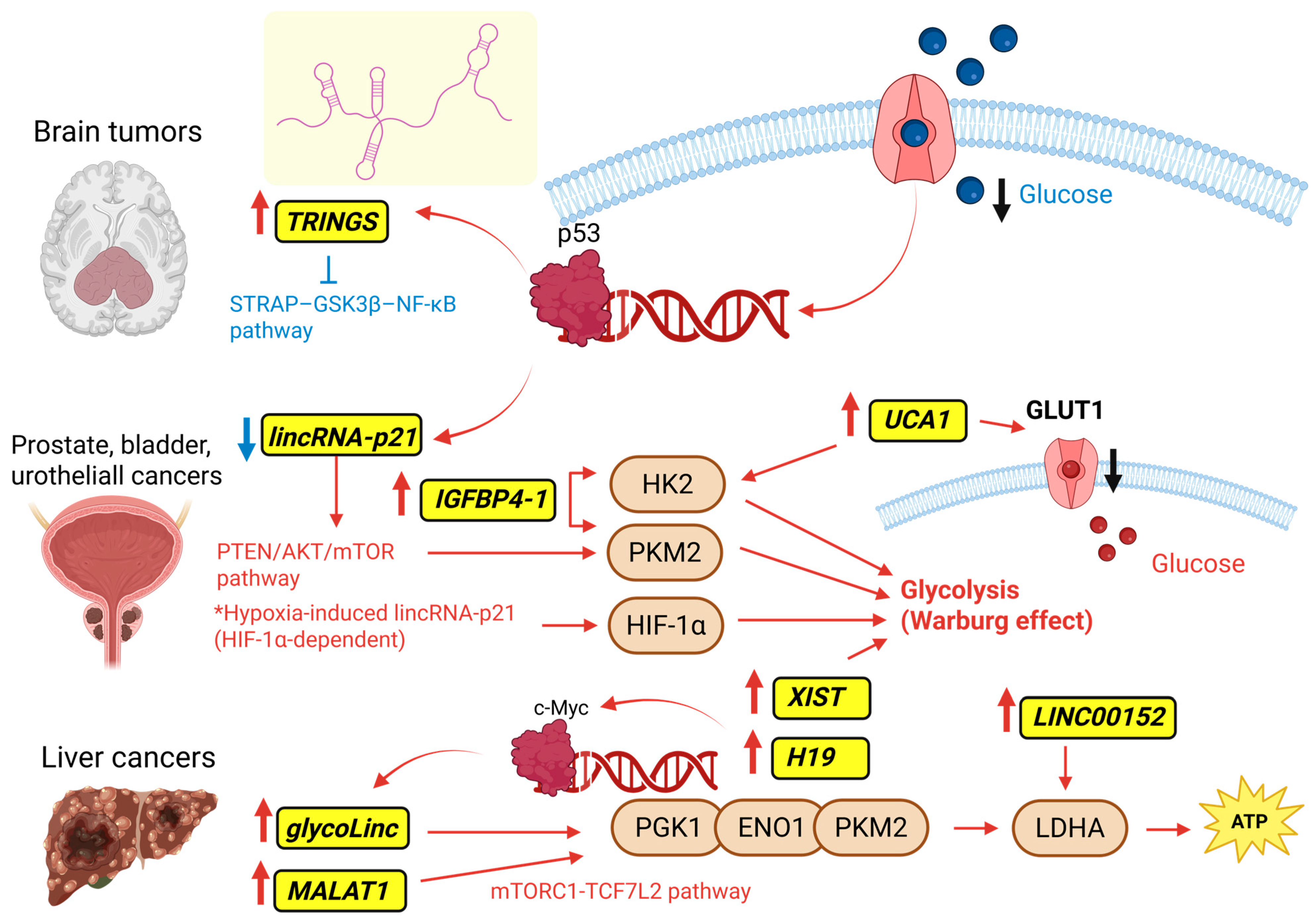
Altered glucose metabolism is a hallmark of cancer, as glucose serves as the primary carbon source for both cellular biosynthesis and energy production [120]. In colorectal cancer, ncRNAs are increasingly recognized as key regulators of glucose metabolism, with lncRNAs representing the most extensively investigated subclass. Available evidence suggests that lncRNAs influence key steps of glycolysis by modulating glucose transporters, glycolytic enzymes, and oncogenic signaling pathways, for example, in colorectal cancer [141]. Through these regulatory mechanisms, lncRNAs contribute to metabolic adaptation under conditions of nutrient fluctuation and hypoxia, supporting tumor cell survival and progression. In this context, lncRNAs frequently act as molecular scaffolds or transcriptional regulators that link metabolic cues to oncogenic programs, thereby contributing to metabolic reprogramming. Transcription factors dynamically modulate lncRNA expression in response to nutrient availability, thereby shaping metabolic adaptation. Under glucose restriction, the tumor suppressor p53, frequently mutated or deleted in many cancers, plays a central role in metabolic regulation by influencing glycolysis, oxidative phosphorylation, and the pentose phosphate pathway [142]. In this context, p53 transcriptionally activates specific lncRNAs that participate in the cellular response to metabolic stress. One example is TRINGS (Tp53-regulated inhibitor of necrosis), which inhibits the STRAP–GSK3β–NF-κB necrotic pathway and supports tumor cell survival under low-glucose conditions, with functional validation in vitro and in vivo [143]. Another p53-responsive lncRNA, lincRNA-p21, contributes to metabolic regulation by modulation of the PTEN/AKT/mTOR axis and HIF-1α signaling. In prostate cancer, downregulation of lincRNA-p21 is associated with activation of the PTEN/AKT/mTOR pathway and upregulation of glycolytic enzymes, favoring tumor progression. Conversely, under hypoxic conditions, lincRNA-p21 can be transiently induced by HIF-1α and bind to it, preventing its degradation by disrupting the HIF-1α–VHL interaction and sustaining glycolytic flux [144]. In parallel with stress-responsive pathways, oncogenic drivers, such as c-Myc, directly regulate glycolytic genes, reinforcing metabolic reprogramming [4]. Nutrient availability, particularly serine, further modulates glycolytic control through pyruvate kinase, the enzyme catalyzing the final and rate-limiting step of glycolysis. The PKM gene generates two alternatively spliced isoforms, PKM1 (Pyruvate Kinase, Muscle type, isoform 1) and PKM2. Whereas PKM1 is constitutively active and supports efficient ATP production in differentiated tissues, PKM2 predominates in proliferating and cancer cells and can exist in a highly active tetrameric form or a less active dimeric form. The dimeric configuration slows pyruvate generation, allowing upstream glycolytic intermediates to be diverted toward anabolic pathways that sustain tumor growth. PKM2 activity is also regulated allosterically. Indeed, serine binding promotes tetramer formation and enhances enzymatic activity, whereas low levels of serine decrease PKM2 activity, limiting pyruvate and ATP production. Under these conditions, cancer cells can compensate by activating de novo serine biosynthesis from the glycolytic intermediate 3-phosphoglycerate [145], illustrating the tight coupling between nutrient sensing and glycolytic flux. In this context, the c-Myc-responsive lncRNA glycoLINC (gLINC) acts as a scaffold that promotes assembly of a multi-enzyme complex comprising LDHA, PGK1, PGAM1, ENO1, and PKM2, thereby sustaining glycolytic flux and ATP production and supporting cancer cell survival under serine deprivation [146]. Consistently, gLINC silencing reduces tumor growth in xenograft models under serine-free conditions, highlighting its role in metabolic adaptation [146]. Complementary regulation of PKM2 can also occur at the level of splicing. For example, the hypoxia-induced circRNA hsa_circ_0065394 encodes the peptide cPFKFB4 in pancreatic cancer, which promotes the alternative splicing switch from PKM1 to PKM2 by interacting with hnRNP G and interfering with its association with the splicing factor hnRNP A1, thereby reinforcing PKM2-dependent glycolytic reprogramming and sustaining the Warburg phenotype [68].
In summary, the interaction among transcription factors, lncRNAs, and glycolytic enzymes forms a regulatory network that enables cancer cells to adapt glucose metabolism to environmental and nutrient stress, supporting tumor growth. The schema in Figure 1 describes how distinct lncRNAs, acting in a tumor- and context-dependent manner, modulate key regulators of glycolysis through transcriptional control, signaling pathway modulation, and direct interaction with glycolytic enzymes. By integrating upstream transcription factors, such as p53 and c-Myc, with downstream metabolic targets including glucose transporters and glycolytic enzymes, the figure provides a mechanistic framework illustrating how lncRNAs contribute to metabolic adaptation, tumor progression, and survival under nutrient and hypoxic stress.

2.4.2. circRNAs in Glucose Metabolism

In addition to lncRNAs, circRNAs have emerged as important regulators of the Warburg effect; however, mechanistic studies remain relatively limited, as seen in colorectal cancer [141]. Available evidence suggests that circRNAs contribute to glycolytic control primarily through miRNA sponging or interaction with metabolic regulators, thereby influencing glucose uptake and the activity of glycolytic enzymes. Rather than acting through isolated targets, most described circRNAs converge on key metabolic transcriptional hubs, such as HIF-1α and c-Myc, reinforcing glycolytic reprogramming under stress conditions.
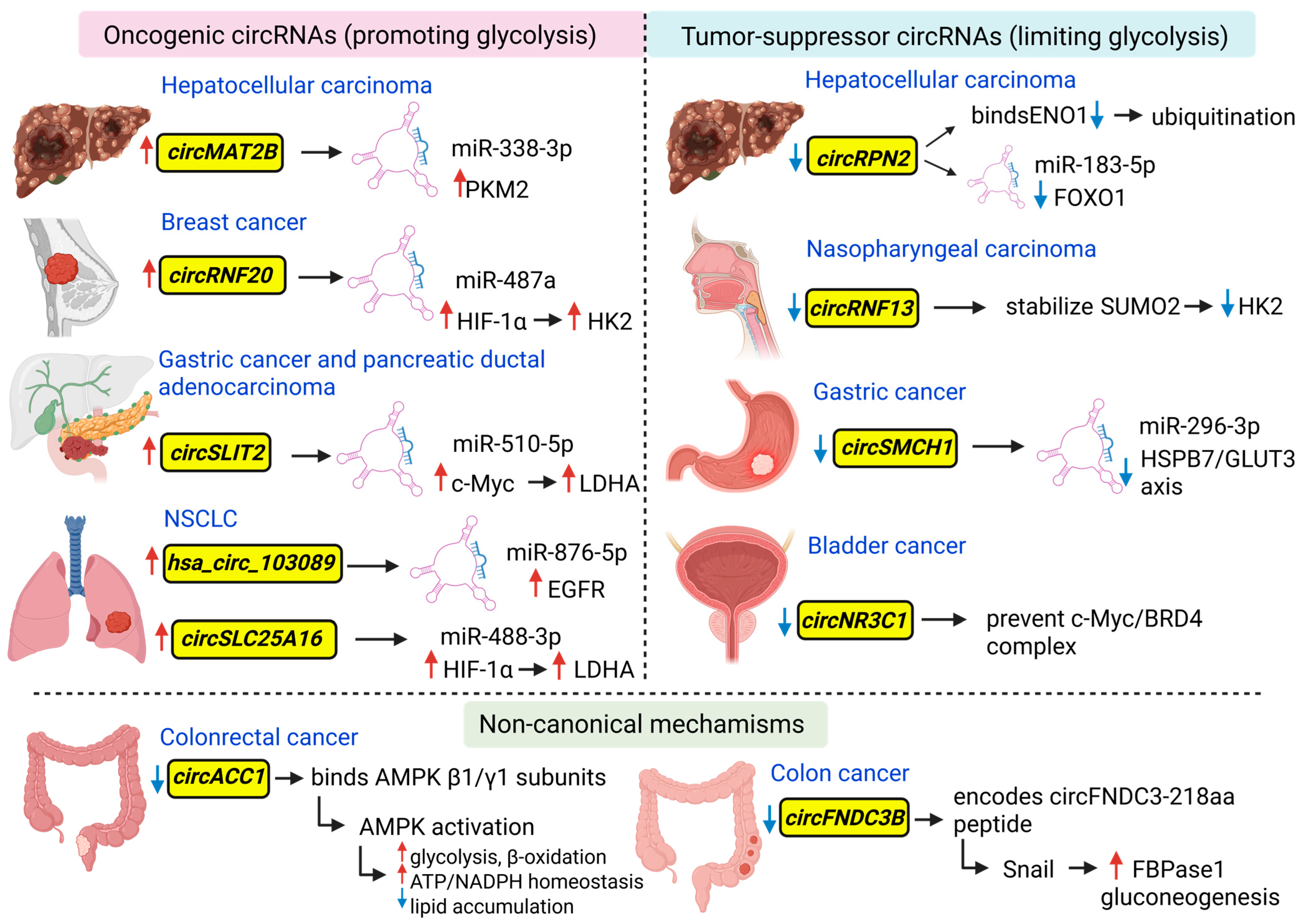
CircRNAs can modulate glycolysis by interacting with miRNAs or proteins, often in response to hypoxic or metabolic stress. For example, in liver cancer cells, hypoxia-induced circMAT2B acts as a sponge for miR-338-3p, relieving its repression of PKM2 and thereby promoting glycolytic flux [147]. Similarly, in breast cancer cells, circRNF20 sequesters miR-487a, which derepresses HIF-1α, leading to the upregulation of Hexokinase 2 (HK2) and enhanced glycolysis under hypoxic conditions [148]. These examples illustrate a recurring regulatory logic in which circRNAs amplify hypoxia-responsive glycolytic programs by relieving repression of central metabolic drivers rather than directly targeting single glycolytic enzymes. In line with these observations, growing evidence in breast cancer indicates that circRNAs play a pivotal role in glucose metabolic reprogramming, thereby influencing tumor behaviors. These findings highlight circRNAs as key contributors to metabolic plasticity, especially in breast cancer, suggesting their potential value as therapeutic targets [149].
Related to aerobic glycolysis, circSLIT2 has been identified as upregulated and of prognostic relevance in gastric cancer. In pancreatic ductal adenocarcinoma (PDAC), circSLIT2 was shown to act as a cytoplasmic miRNA sponge for miR-510-5p, targeting the 3′-UTR of c-Myc. In this manner, circSLIT2 derepresses c-Myc [150], which in turn drives LDHA transcription and promotes glucose uptake and lactate production (Warburg phenotype). As these observations derive from different tumor types, we note that the miR-510-5p/c-Myc/LDHA axis has been mechanistically validated in PDAC but not yet in gastric cancer [151]. This distinction highlights the tumor context dependency of circRNA-mediated metabolic axes, even when similar regulatory architectures are observed. CircRNAs can enhance c-Myc functions through various mechanisms, including protein interactions that stabilize its protein, facilitate nuclear localization, or increase its transcriptional activity [40]. Similarly, circSLC25A16 sponges miR-488-3p, thereby relieving HIF-1α repression in non-small cell lung cancer (NSCLC). The increased HIF-1α levels enhance LDHA transcription, further promoting glycolysis. In the same tumor context, hsa_circ_103089 has been shown to enhance aerobic glycolysis and malignant progression by acting as a sponge for miR-876-5p, thereby upregulating EGFR expression [152]. Activation of the miR-876-5p/EGFR axis increases glycolytic activity, supports NSCLC cell migration and invasion, and reduces sensitivity to cisplatin treatment. These findings reinforce the concept that circRNAs integrate oncogenic signaling with metabolic reprogramming rather than acting as redundant regulators of individual glycolytic enzymes.
Conversely, tumor-suppressive circRNAs limit glycolysis by inhibiting key metabolic regulators. CircNR3C1, for instance, prevents c-Myc from forming a transcriptional complex with BRD4, reducing c-Myc target gene expression in bladder cancer [58]. Similarly, in gastric cancer, circSCMH1 acts as a tumor-suppressive circRNA that inhibits aerobic glycolysis and metastatic potential by sponging miR-296–3p [153]. Through the miR-296–3p/HSPB7–GLUT3 axis, circSCMH1 reduces glucose uptake and glycolytic flux, thereby limiting energy availability required for tumor cell migration and invasion. CircRNF13, which is downregulated in nasopharyngeal carcinoma (NPC), stabilizes SUMO2 mRNA, leading to GLUT1 degradation and subsequent inhibition of glycolysis [154]. CircRPN2 in HCC exerts dual tumor-suppressive functions by binding ENO1 to promote ubiquitin-mediated degradation and by sponging miR-183-5p, which normally represses FOXO1, thereby suppressing glycolysis and tumor progression [155]. These suppressive mechanisms underscore the ability of circRNAs to counteract metabolic activation, either by promoting the degradation of glycolytic enzymes or by reinstating tumor-suppressive transcriptional programs.
Beyond mRNA-based mechanisms, circRNAs can also exert effects through peptide expression or protein stabilization. CircFNDC3B, for instance, encodes a 218-amino-acid peptide (circFNDC3B-218aa) that inhibits the EMT regulator Snail, indirectly promoting the expression of Fructose-1,6-bisphosphatase 1, a key enzyme in glucose metabolism, thereby modulating the balance between glycolysis and gluconeogenesis in colon cancer cells [156]. This example expands the regulatory spectrum of circRNAs beyond ceRNA activity, emphasizing their potential coding capacity in metabolic control.
Another prominent example is circACC1, derived from exons 2–4 of the pre-mRNA of Acetyl-CoA Carboxylase 1 (ACC1), which functions as a metabolic stress sensor in colorectal cancer. Under conditions of serum deprivation, circACC1 is upregulated through activation of the JNK/c-Jun pathway, which promotes its circularization at the expense of linear ACC1 mRNA production. CircACC1 binds specifically to the β1 and γ1 subunits of AMPK, stabilizing the complex, preventing ubiquitination and degradation, and enhancing kinase activity. This RNA-mediated stabilization mimics allosteric activation of AMPK, promoting glycolysis, β-oxidation, and ATP/NADPH homeostasis, while reducing lipid accumulation [157]. Consequently, circACC1 supports cancer cell survival under nutrient-limited conditions, and its overexpression enhances tumor growth, whereas knockdown reduces aggressive behavior in colorectal cancer cells [158,159].
Together, these examples (reported in Figure 2) demonstrate that circRNAs contribute to cancer metabolic reprogramming through diverse mechanisms, including miRNA sponging, peptide production, and direct protein interaction, highlighting their multifaceted roles in promoting glycolysis and supporting tumor progression. Overall, circRNAs emerge not merely as passive correlates of metabolic rewiring but as dynamic integrators of hypoxic signaling, oncogenic transcriptional programs, and nutrient stress adaptation.

2.5. mTOR–ncRNA Crosstalk in Cancer Cell Growth and Metabolism

The mammalian target of rapamycin (mTOR) is a central regulator of cell growth and metabolism [160]. In particular, mTOR complex 1 (mTORC1) is the molecular target of rapamycin and its analogs, which are employed in therapy for various carcinomas. The rapid proliferation and invasive potential of cancer cells are largely driven by activation of the mTORC1 pathway, which promotes the Warburg effect and shifts cellular metabolism toward aerobic glycolysis. mTORC1 also stimulates glycolysis indirectly through HIF-1α-dependent transcription of glycolytic enzymes under hypoxic conditions. Clinically, HCC frequently exhibits oncogenic activation of the mTOR signaling pathway. Experimental models, including genetically engineered mice and hydrodynamic transfection systems, have demonstrated that increased mTORC1 activity contributes to the initiation of hepatocarcinogenesis [161]. Despite this strong mechanistic rationale, recent clinical trials evaluating rapamycin analogs, including everolimus and temsirolimus, in patients with advanced HCC have not met significant therapeutic endpoints [162]. This underscores the need to explore combinatorial or alternative strategies to improve the clinical efficacy of mTOR-targeted therapies.
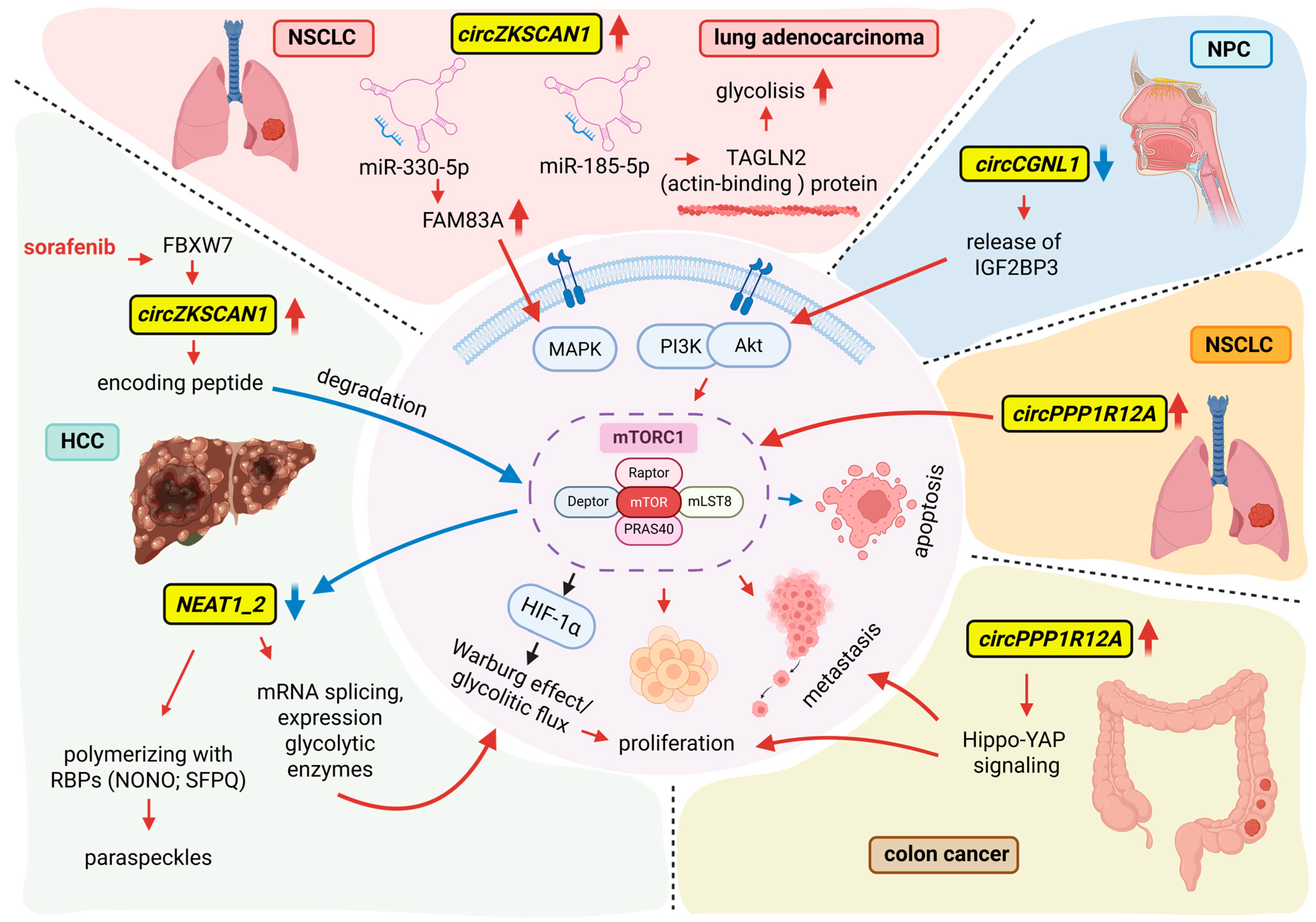
mTORC1 also regulates the lncRNA transcriptome. Notably, NEAT1, a key organizer of nuclear paraspeckles, is a downstream target of mTORC1. NEAT1 forms paraspeckles by polymerizing with RBPs, such as NONO and SFPQ [163]. Interestingly, HCC tumors exhibit marked downregulation of NEAT1, particularly the NEAT1_2 isoform, correlating with poor overall survival. Suppression of NEAT1_2 by mTORC1 promotes mRNA splicing, the expression of glycolytic enzymes, and the Warburg effect, thereby linking nuclear architecture to cancer metabolism. Overall, mTORC1-driven modulation of NEAT1_2 and paraspeckle biogenesis influences liver tumor development, metabolic reprogramming, and responsiveness to mTORC1-targeted therapies [164].
On the other hand, several circRNAs control the AKT/mTOR signaling pathway, which also regulates metabolism. For instance, circPPP1R12A is upregulated in NSCLC by activating this pathway, which promotes cell proliferation while reducing apoptosis [165]. Conversely, circCGNL1 in NPC is downregulated because it exerts tumor-suppressive activity by sequestering Insulin-like growth factor 2 mRNA-binding protein 3 (IGF2BP3), which, when released, leads to AKT and mTOR phosphorylation, promoting proliferation while suppressing apoptosis [166]. In colon cancer, it was found that the peptide encoded by circPPP1R12A promoted the growth and metastasis by activating the Hippo-YAP signaling pathway [167].
Additional examples include circRNAs involved in the MAPK signaling/mTOR pathway. CircZKSCAN1 drives lung adenocarcinoma progression and chemoresistance by sponging miR-185-5p, which targets TAGLN2, an actin-binding protein, indirectly enhancing glycolytic flux [168]. In NSCLC, this oncogenic circRNA has been shown to sponge miR-330-5p, thereby relieving its inhibitory effect on the expression of FAM83A, a protein involved in activation of the MAPK signaling pathway [169]. In HCC, circZKSCAN1 is downregulated at baseline but re-induced by sorafenib via FBXW7 [170]. In this setting, its miRNA-sponging activity appears limited; instead, it encodes a tumor-suppressive peptide that promotes FBXW7-mediated mTOR degradation and inhibits oncogenic signaling.
Figure 3 summarizes representative mechanisms by which lncRNAs and circRNAs modulate mTOR signaling and cancer-associated metabolic and survival pathways in distinct tumor contexts.

2.6. lncRNAs and circRNAs in Glutamine Metabolism

To sustain the high biosynthetic and energetic demands of proliferation, cancer cells must significantly increase nutrient uptake from the extracellular environment. In addition to glucose, glutamine is particularly critical, as its catabolism provides carbon intermediates for macromolecule synthesis and reducing equivalents (NADH, FADH2) necessary for ATP production, redox homeostasis, and biosynthetic processes (NADPH) [171,172]. While glucose fuels glycolysis and the Warburg effect, glutamine serves as both a carbon and nitrogen donor, supporting the synthesis of nucleotides, glucosamine-6-phosphate, and non-essential amino acids. Intracellular glutamine also promotes the uptake of essential amino acids through LAT-mediated exchange mechanisms [173].
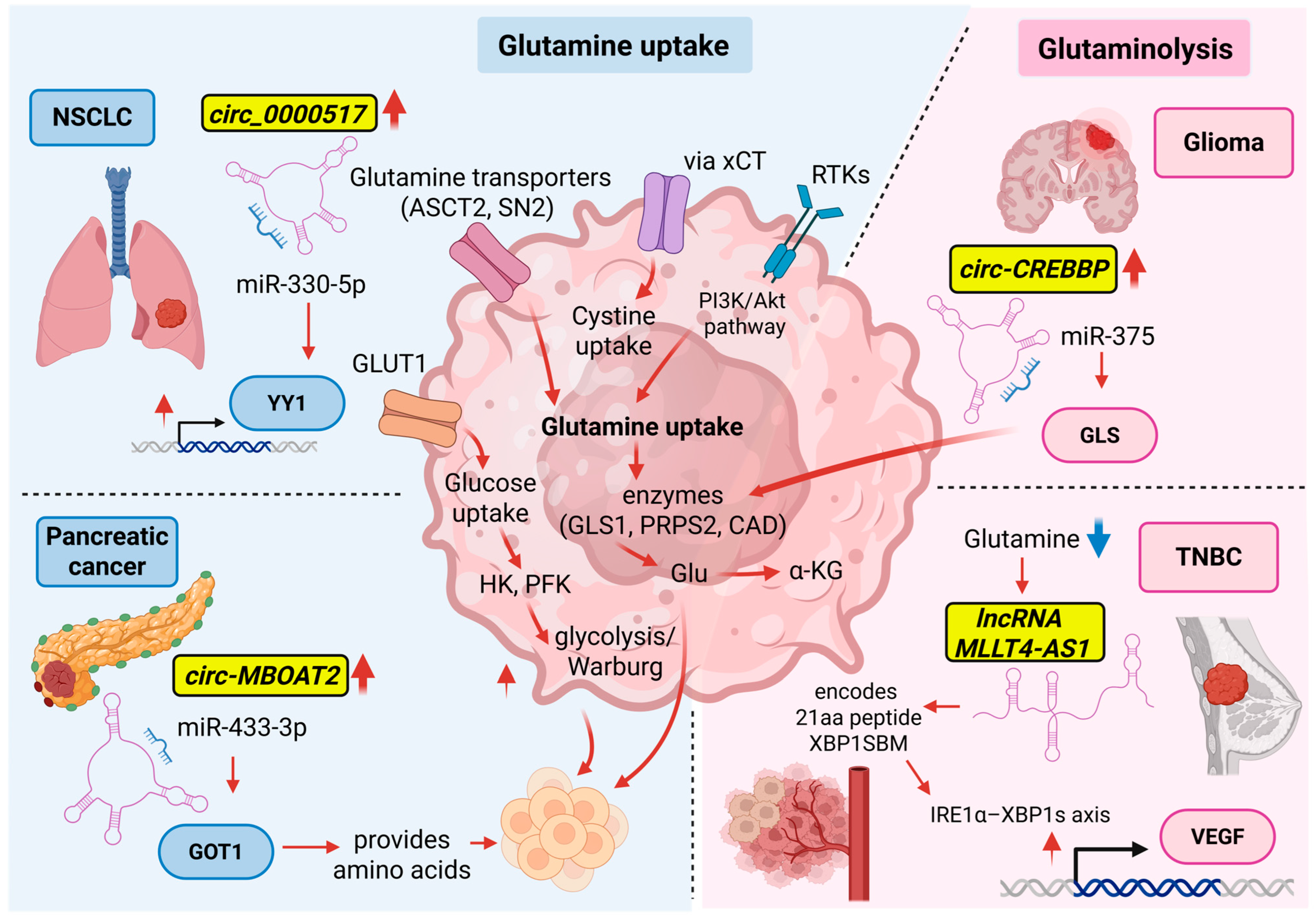
Glutamine metabolism is tightly regulated by oncogenic signaling pathways. For instance, c-Myc overexpression in proliferative and cancer cells enhances glutamine uptake by inducing the expression of glutamine transporters (ASCT2, SN2) and key metabolizing enzymes (GLS1, PRPS2, CAD) [174]. This increases the production of glutamate, linking glutamine catabolism to the Krebs cycle anaplerosis, redox regulation, and cystine uptake via xCT, thereby maintaining cellular homeostasis under proliferative stress [175]. Additionally, the PI3K/Akt pathway, activated downstream of receptor tyrosine kinases and extracellular matrix signals, cooperates with glutamine metabolism by promoting glycolysis through upregulation of hexokinase, phosphofructokinase, and GLUT1 [176].
Circ_0000517, overexpressed in NSCLC, represents an example. It targets miR-330-5p, a negative regulator of the transcription factor YY1, resulting in increased glucose uptake, lactate production, ATP generation, glutamine consumption, glutamate content, α-ketoglutarate levels, and cell proliferation [177]. In general, multiple circRNAs across different types of cancer sponge miRNAs regulating SLC family transporters responsible for glutamine uptake, highlighting their role in coordinating both glucose and amino acid metabolism [178]. In addition, circular Membrane Bound O-Acyltransferase Domain Containing 2 (circ-MBOAT2) upregulated in pancreatic cancer sponges miR-433-3p, which associates with the 3′UTR of glutamic-oxaloacetic transaminase 1 mRNA, an enzyme necessary for cancer to provide amino acids [179]. Similarly, circular RNA CREB-binding protein (circ-CREBBP) is highly expressed in glioma and upregulates glutaminase expression by sponging miR-375 [180].
Several types of cancers exhibit a pronounced dependence on glutamine. For example, triple-negative breast cancer (TNBC) shows reduced glutamine levels, elevated glutamate concentrations, and increased reliance on glutamine compared with non-TNBC tumors, reflecting this metabolic rewiring [181]. When glutamine becomes limiting, adaptive stress responses are triggered. A notable example involves the lncRNA MLLT4-AS1, which encodes the 21-amino-acid micropeptide XBP1SBM. Under glutamine starvation conditions, activation of the IRE1α–XBP1s axis induces MLLT4-AS1/XBP1SBM, which binds to XBP1s, retains it in the nucleus, and enhances its occupancy at the VEGF promoter. This mechanism promotes angiogenesis and tumor aggressiveness, as validated in vivo. Indeed, suppression of XBP1SBM translation or deletion of its coding sequence reduces both angiogenesis and tumor growth [182].
These findings, summarized in Figure 4, emphasize the crucial role of glutamine in cancer metabolism and demonstrate how these ncRNAs, through mechanisms such as peptide encoding, transcriptional regulation, or protein interaction, act as key modulators of nutrient utilization, metabolic adaptation, and tumor progression.

2.7. Lipid Metabolism and lncRNA Regulation in Cancer

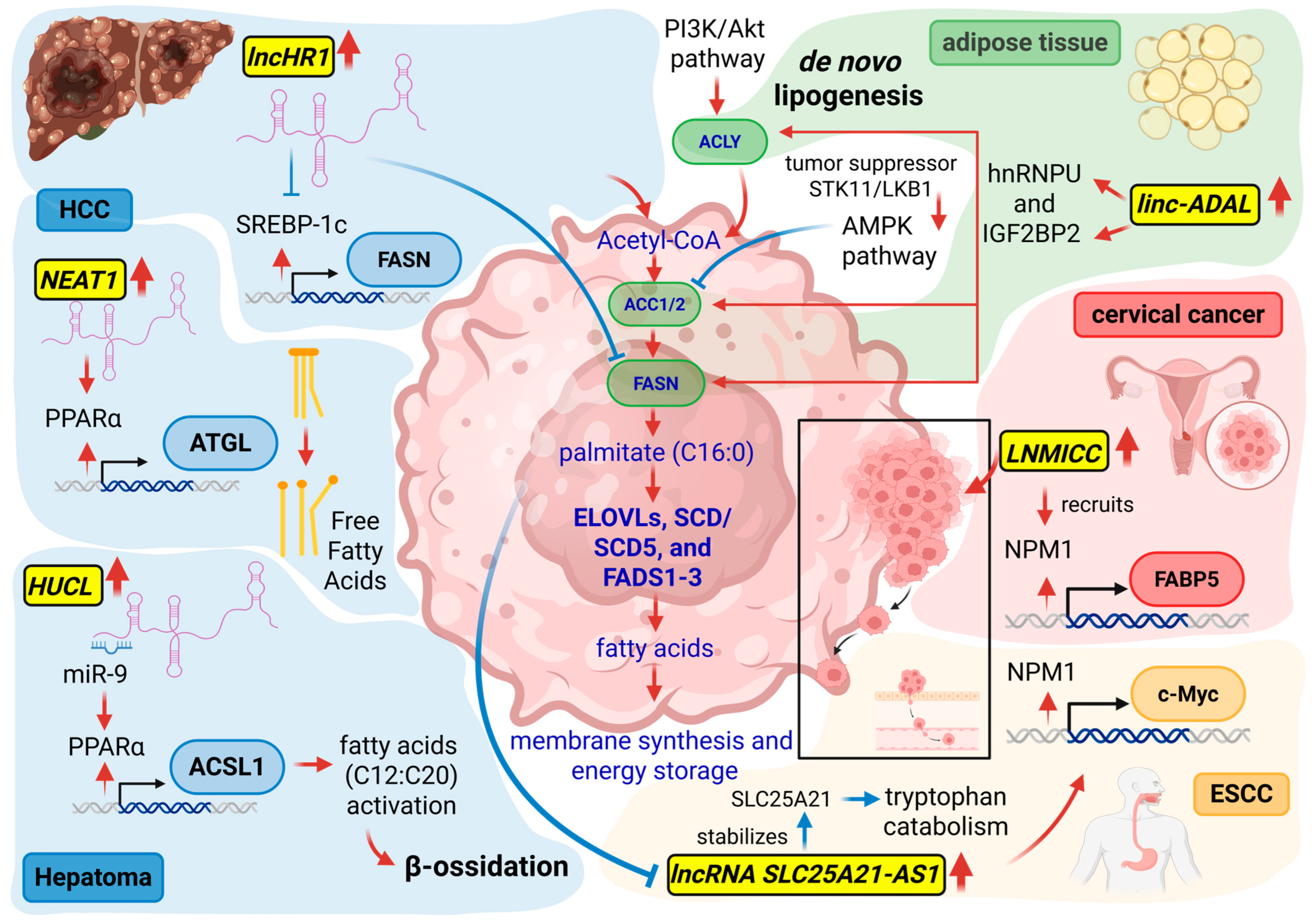
In many cancers, lipid metabolism is reprogrammed to enhance de novo lipogenesis while dynamically integrating exogenous lipid uptake, enabling metabolic flexibility under diverse microenvironmental conditions. Acetyl-CoA is first carboxylated to malonyl-CoA by ACC1/2 and then condensed by FASN to generate palmitate (C16:0). Palmitate can be further elongated or desaturated by enzymes such as ELOVLs, SCD/SCD5, and FADS1-3, producing longer or unsaturated fatty acids necessary for membrane synthesis and energy storage. Lipogenic reprogramming is tightly controlled by oncogenic signaling pathways. The AMPK pathway, downstream of the tumor suppressor STK11/LKB1, phosphorylates ACC to inhibit fatty acid synthesis, acting as a metabolic checkpoint. Conversely, the PI3K/Akt axis stimulates lipid synthesis by upregulating lipogenic enzymes and activating ATP-citrate lyase (ACLY), thereby enhancing acetyl-CoA availability. As a consequence, cancer cells exhibit a lipid composition enriched in saturated and monounsaturated fatty acids. This adaptation decreases lipid peroxidation, shielding cells from oxidative damage and supporting tumor growth, metastasis, and survival under nutrient stress.
Within this framework, lncRNAs emerge as critical modulators, linking oncogenic signaling to metabolic outcomes. Linc-ADAL coordinates the expression of key lipogenic genes, including ACLY, ACC, and FASN, by interacting with hnRNPU to promote transcriptional activation and with IGF2BP2 to enhance mRNA stability and translation [183]. In this way, linc-ADAL influences fatty acid production and adipocyte differentiation. Other lncRNAs function as bona fide oncogenic, such as NEAT1, which promotes PPARα-dependent fatty acid oxidation and sustains ATGL-mediated lipolysis [184], facilitating HCC growth and forming a feedback loop with TP53 in a context-dependent manner, while Highly Upregulated in Liver cancer (HUCL) increases ACSL1 and genes involved in fatty acid activation/oxidation by relieving miR-9-mediated repression of PPARα [185]. In cervical cancer, a lncRNA associated with lymph node metastasis in cervical cancer (LNMICC) recruits Nucleophosmin 1 (NPM1) to the promoter of Fatty Acid Binding Protein 5 [186], enhancing fatty acid metabolism and promoting metastasis. Interestingly, not all lncRNAs support uniformly tumor progression leading to β-oxidation. For example, lncHR1 represents a tumor-suppressive lncRNA that suppresses SREBP-1c and FASN [187], reducing triglyceride accumulation in HCC.
In esophageal squamous cell carcinoma (ESCC), palmitic acid and high-fat diets inhibit tumor growth, at least in part, by downregulating the oncogenic lncRNA SLC25A21-AS1, which is otherwise upregulated in ESCC. When expressed, SLC25A21-AS1 stabilizes SLC25A21 mRNA in the cytoplasm, modulating tryptophan catabolism, energy metabolism, and NAD+ biosynthesis, and interacts with NPM1 in the nucleus to promote c-Myc transcription [188]. Through these cytoplasmic and nuclear mechanisms, SLC25A21-AS1 enhances tumor cell proliferation, migration, metastasis, and cisplatin resistance, whereas its downregulation abrogates these oncogenic effects, highlighting its potential as a prognostic biomarker and therapeutic target in ESCC.
These lncRNAs were depicted in Figure 5, as well as their mechanisms of action and cancer specificity.

3. An Attractive Prospect: OTX2-AS1, Indirect Metabolic Influence and Predictive Biomarker in Medulloblastoma

Orthodenticle Homeobox 2 Antisense RNA 1 (OTX2-AS1) is a lncRNA transcribed from the proximal promoter of the transcription factor OTX2 in the opposite direction. Promoter hypermethylation in the Sonic Hedgehog subgroup reduces its expression, mirroring the pattern of OTX2 itself. OTX2-AS1 has not been directly linked to canonical metabolic enzymes or pathways. Proteomic analysis following its knockout revealed upregulation of mitochondrial oxidative phosphorylation proteins, including succinate dehydrogenase subunit B, suggesting an indirect role in modulating the balance between glycolytic and oxidative metabolism in tumor cells. These observations imply that OTX2-AS1 may contribute to the metabolic plasticity of medulloblastoma, favoring proliferation and survival in glycolysis-dependent states.
In medulloblastoma, OTX2-AS1 is highly expressed in the WNT signaling pathway, Group 3, and Group 4 molecular subtypes, and its elevated levels correlate with increased sensitivity to BCL-2 inhibitors, as demonstrated by drug screening assays. These findings suggest that patients with high OTX2-AS1 expression may benefit from combination therapy involving conventional treatments and BCL-2-targeted agents. Accordingly, OTX2-AS1 may serve both as an indicator of tumor subtype and a predictor of therapeutic response, highlighting its dual potential in clinical stratification and treatment optimization [189].

4. ncRNA-Based Therapies

NcRNAs play a central role in cancer, and their tissue specificity, dynamic expression, and stability further support their value as biomarkers. Clinical translation is already underway. Ongoing trials, including the EOC-EXOSOME study (NCT03738319), are evaluating exosomal miRNA and lncRNA signatures as diagnostic and prognostic tools [190].
On the other hand, they may serve as candidates for therapeutic targeting. Moreover, their dysregulation may provide opportunities for innovative therapeutic strategies, including exosome-based delivery systems and CRISPR-mediated interventions [191].
Currently, in gastric cancer, lncRNAs have emerged as major regulators of disease progression and treatment response through diverse mechanisms affecting proliferation, EMT, and metabolic adaptation [192]. Many lncRNAs exert their oncogenic or tumor-suppressive functions through miRNA-mediated post-transcriptional regulation. For example, XIST functions as a sponge for miR-149-3p, influencing tumor growth and metastasis; its downregulation in OC correlates with shorter progression-free survival, BRCA1 mutations, enhanced proliferation and invasion, and resistance to cisplatin and paclitaxel [193]. Similarly, PVT1 promotes disease progression by recruiting EZH2 to repress miR-214 transcription, and its amplification in advanced OC is associated with poor prognosis and patient risk stratification [194]. Other lncRNAs, including HOTAIR, ANRIL, and SNHG16, contribute to metastasis and therapy resistance across many types of cancers, highlighting the importance of ncRNA-mediated transcriptional and post-transcriptional regulation in tumor evolution [195,196,197].
Also, circRNAs contribute to the pathogenesis of gastric and ovarian cancers through mechanisms including miRNA sponging, protein interactions, and, in some cases, peptide encoding. By modulating oncogenic signaling and stress-adaptive responses, aberrant expression of circRNAs promotes tumor progression and therapeutic resistance. Their high stability and detectability in tissues and biofluids make them attractive non-invasive biomarkers and potential therapeutic targets. For instance, circHIPK3 exerts tumor-suppressive effects in OC [198], whereas other circRNAs have been linked to chemotherapy resistance and aggressive phenotypes.
A pathway-oriented reorganization of the lncRNAs and circRNAs identified in this study is presented in Table 1, highlighting the enrichment of specific tumor types in ncRNAs implicated in metabolic reprogramming. In particular, HCC, colorectal cancer, and gastric cancer show the greatest enrichment of metabolism-related lncRNAs and circRNAs, encompassing pathways involved in glycolysis, glutaminolysis, lipid metabolism, redox homeostasis, and nutrient sensing. This recurrent identification of multiple panels of regulators within the same tumor context suggests that metabolic plasticity in these malignancies is sustained by multilayered non-coding regulatory networks rather than by isolated molecular events. From a translational perspective, such enrichment indicates that these tumor types may already harbor a repertoire of ncRNA candidates with therapeutic potential, either as direct metabolic targets or as modulators of key oncogenic hubs such as c-Myc, HIF-1α, AMPK, and mTOR. Conversely, other tumor entities remain comparatively underrepresented, highlighting potential gaps in current research rather than a true absence of ncRNA-mediated metabolic control.
Overall, these observations support the concept that tumor-specific ncRNA landscapes may help prioritize metabolism-oriented therapeutic strategies and guide the development of ncRNA-informed precision oncology approaches.

5. Limitations of the Current Evidence and Future Research Directions in Linking ncRNAs to Cancer Metabolism

Despite the rapidly expanding literature implicating lncRNAs and circRNAs in cancer metabolic reprogramming, several conceptual, experimental, and technical limitations currently constrain the strength, reproducibility, and translational relevance of these findings. A central issue that permeates much of the field is the frequent lack of distinction between correlation and causality in reported ncRNA–metabolism relationships. In many studies, metabolic regulation is inferred from concordant changes in ncRNA expression and metabolic gene signatures, pathway enrichment analyses, or steady-state metabolite levels. However, given that cellular metabolism is governed by multiple regulatory layers (including enzyme kinetics, substrate availability, compartmentalization, and allosteric control), such associations are insufficient to demonstrate direct functional regulation of metabolic pathways [199]. This limitation applies to both lncRNAs and circRNAs, particularly when functional validation relies primarily on proliferation assays, survival phenotypes, or transcriptional changes rather than on direct measurements of metabolic activity.
This difficulty in establishing causality is closely linked to another major limitation of the current literature, namely, the limited integration of ncRNA studies with quantitative and dynamic measurements of metabolism. Most investigations still rely on indirect readouts, such as glucose uptake, lactate secretion, or expression of metabolic enzymes, which do not capture pathway flux or metabolic plasticity. Stable isotope tracing combined with mass spectrometry or NMR spectroscopy represents the gold standard for quantifying metabolic fluxes yet remains underutilized in lncRNA- and circRNA-focused studies [200]. Emerging approaches (including high-resolution fluxomics, genetically encoded biosensors for ATP, NADH/NAD+, and redox state, as well as dynamic nuclear polarization-enhanced MRI) offer new opportunities to directly assess metabolic activity downstream of ncRNA perturbation. In parallel, spatial metabolomics and mass spectrometry imaging (MSI) technologies have emerged as powerful tools for region-specific metabolic profiling directly in tissue sections, preserving spatial information that is lost in bulk metabolomic analyses. Techniques such as matrix-assisted laser desorption/ionization (MALDI)–MSI and desorption electrospray ionization (DESI)–MSI enable the visualization of metabolites, lipids, and small molecules across histological contexts, thereby revealing intratumoral metabolic heterogeneity and metabolic gradients associated with tumor architecture and microenvironmental niches [201]. These approaches are increasingly being applied in cancer research to map spatially resolved metabolic states associated with hypoxia, necrosis, invasive fronts, and therapeutic response.
Recent advances in spatial metabolomics, integrating MSI with advanced computational and analytical frameworks, have enhanced sensitivity, expanded molecular coverage, and improved spatial resolution, thereby reinforcing the potential of these technologies for integrative multi-omics applications [202,203]. Notably, while direct integration of spatial metabolomics with spatial transcriptomics remains an emerging frontier, several recent studies have begun to combine spatial metabolic profiling with transcriptomic data to reveal regionally heterogeneous metabolism in intact tissues. For example, combining spatial metabolomics with transcriptome profiling has uncovered metabolic heterogeneity and differential gene–metabolite associations in disease models [204]. Comprehensive reviews of spatial multi-omics also highlight ongoing efforts to align diverse spatial measurements, laying a methodological foundation for future ncRNA-centric analyses [205]. Nevertheless, formal integration of spatially resolved ncRNA expression, including lncRNAs and circRNAs, with spatial metabolite profiles remains largely unexplored, representing a key opportunity for future research.
Beyond measurement-related limitations, biological context represents an additional and often underappreciated source of variability. Metabolic programs differ markedly according to tissue lineage, oncogenic driver mutations, oxygen and nutrient availability, immune interactions, and therapeutic pressure. Nevertheless, many ncRNA–metabolism links have been reported in a narrow range of experimental models, often restricted to one or two tumor types or even single cell lines. This limitation is further exacerbated by the extensive use of long-established cancer cell lines, which frequently harbor profoundly abnormal genomes characterized by aneuploidy, large chromosomal deletions or amplifications, and extensive karyotypic rearrangements. Such genomic distortions can profoundly reshape both transcriptional regulation and metabolic wiring, potentially generating ncRNA–metabolism relationships that are not representative of primary tumors in vivo [206].
The constraints imposed by experimental context are further amplified by the culture conditions under which most studies are performed. The majority of ncRNA metabolism investigations are conducted under normoxic, high-glucose, two-dimensional culture conditions, which poorly recapitulate the metabolic constraints of the tumor microenvironment. Oxygen gradients, nutrient deprivation, acidosis, stromal interactions, and therapy-induced stress are central determinants of tumor metabolism yet are rarely incorporated into mechanistic studies of lncRNAs or circRNAs. Hypoxia profoundly alters both ncRNA expression and metabolic flux, as HIFs coordinate extensive transcriptional and post-transcriptional programs under oxygen deprivation. Comprehensive analyses indicate that HIF activation not only promotes metabolic reprogramming but also modulates a broad spectrum of ncRNAs, which in turn contribute to hypoxic responses and metabolic adaptation [207]. Although more physiologically relevant systems (including organoids, spheroids, patient-derived cultures, and microfluidic platforms) offer improved modeling of metabolic stress, their adoption in ncRNA-focused metabolic studies remains limited.
In parallel with these biological and experimental challenges, intrinsic technical limitations complicate the study of ncRNA expression itself. LncRNAs are often expressed at low abundance, exhibit pronounced cell-type and cell-state specificity, and display complex subcellular localization patterns, complicating accurate quantification. CircRNAs introduce additional complexity due to their covalently closed structure, resistance to exonuclease degradation, and frequent overlap with linear host transcripts. Standard RNA sequencing approaches optimized for polyadenylated transcripts may therefore underrepresent or misclassify circRNAs, as these lack poly(A) tails and are frequently identified solely through back-splice junction reads, which are sensitive to library preparation and mapping artifacts, leading to incomplete or biased datasets [40,208,209]. Although methodological advances, including total RNA (rRNA-depleted) library preparation, RNase R-based enrichment, and the development of dedicated computational pipelines, have improved circRNA detection, considerable heterogeneity in experimental protocols and bioinformatic workflows persists, thereby limiting cross-study comparability and reproducibility [210,211].
Recent technological advances, particularly long-read sequencing approaches, are helping to overcome these limitations by enabling accurate reconstruction of full-length lncRNA and circRNA isoforms, while also resolving transcript structural complexity and back-splicing events that are difficult to capture with short-read sequencing [211,212]. Improved computational frameworks and curated resources now allow systematic analysis of ncRNA expression at single-cell resolution. For example, single-cell RNA sequencing studies have revealed that lncRNAs display pronounced cell-type- and cell-state-specific expression patterns, which are often masked in bulk transcriptomic analyses, leading to an underestimation of their biological relevance in heterogeneous tissues [213,214]. Dedicated resources such as LnCeCell 2.0 integrate single-cell and spatial transcriptomics data to map lncRNA-associated ceRNA networks and provide tools for exploring cell-specific regulatory relationships, although these platforms currently lack direct metabolic readouts [215].
CircRNAs have also begun to be explored at single-cell resolution, primarily through full-length single-cell RNA-seq approaches, which have revealed cell-type-specific and condition-dependent circRNA expression landscapes in both normal and tumor tissues [216]. While these studies establish the technical feasibility of detecting circRNAs at single-cell resolution, they remain largely disconnected from functional measurements of metabolism.
As a result, direct coupling of ncRNA expression with metabolic states at single-cell or spatial resolution remains limited. Although emerging single-cell metabolic inference methods and spatial transcriptomics platforms enable the indirect estimation of metabolic pathway activity, their integration with lncRNA or circRNA profiling in tumors remains limited. This gap is significant because ncRNAs are often cell-state-specific, while metabolic phenotypes vary across tumor regions in response to microenvironmental gradients.
Finally, these technical and experimental constraints converge on a broader conceptual challenge: reconciling the dynamic, spatially heterogeneous nature of tumor metabolism with the conditional and context-specific expression of ncRNAs. LncRNAs and circRNAs often function within narrowly defined transcriptional or stress-induced states, while metabolic programs evolve spatially and temporally during tumor progression and therapy. This mismatch suggests that many ncRNA–metabolism relationships may be transient, indirect, or condition-specific rather than stable regulatory axes.
These limitations underscore the need to move beyond predominantly correlative frameworks toward causal and quantitative strategies to study ncRNA-mediated metabolic regulation. Integrating advanced ncRNA detection with flux-based analyses, physiologically relevant models, and spatial or single-cell approaches will be essential to define their functional contribution to cancer metabolic plasticity and clinical translation. Taken together, these conceptual, technical, and contextual limitations provide an essential framework for interpreting the current literature and reinforce the need for a cautious and nuanced evaluation of ncRNA–metabolism relationships; in this context, the following discussion aims to integrate existing evidence, highlight biologically meaningful patterns, and delineate realistic opportunities for future investigation.

6. Discussion

Recent advances in cancer research underscore the pivotal role of lncRNAs and circRNAs in tumor metabolism and progression. At the same time, the evidence summarized in this review highlights that ncRNA-mediated metabolic regulation is highly context-specific and often inferred from correlative datasets, thereby emphasizing the importance of cautious interpretation. Both lncRNAs and circRNAs act as key modulators of glucose, lipid, and amino acid metabolism, frequently integrating oncogenic signaling pathways such as c-Myc, HIF-1α, and mTOR to sustain the metabolic demands of proliferating cancer cells.
Although lncRNAs such as H19, MEG3, and HOTAIR have been extensively studied in cancer biology, recent evidence indicates that their functions extend beyond canonical roles in signaling, epigenetic regulation, and EMT. In this study, these lncRNAs are specifically re-examined within a metabolic framework, highlighting their ability to modulate key metabolic pathways that support tumor progression, therapy resistance, and phenotypic plasticity. H19 has been characterized as a regulator of aerobic glycolysis and glucose utilization, contributing to metabolic flexibility and chemoresistance in breast and gastric cancers by shaping glycolytic flux and lactate production, as supported by recent studies combining lncRNA profiling with metabolomic analysis. MEG3, traditionally regarded as a tumor suppressor, exhibits condition-specific metabolic functions and participates in p53-associated metabolic control, influencing glucose metabolism and mitochondrial activity, particularly in advanced disease settings. Similarly, HOTAIR links epigenetic remodeling to metabolic adaptation by coordinating chromatin-based regulation of genes involved in lipid metabolism and energy homeostasis. By integrating metabolic readouts, pathway-level analysis, and clinical correlations, this review demonstrates how these well-known lncRNAs act as dynamic regulators of cancer metabolism in a context- and stage-dependent manner, underscoring their relevance as biomarkers of metabolic vulnerability and potential targets for metabolism-oriented therapeutic strategies.
Similarly, PVT1 is re-examined within a metabolic framework, and is positioned as a key lncRNA that links oncogenic signaling to metabolic reprogramming in cancer. Rather than being considered solely as a generic oncogenic transcript, PVT1 is highlighted for its involvement in c-Myc-driven metabolic control, particularly affecting lipid metabolism in endometrial and other cancers, where its dysregulation correlates with tumor progression and aggressive metabolic phenotypes. Through its interaction with c-Myc and downstream transcriptional networks, PVT1 contributes to the rewiring of lipid biosynthesis and energy metabolism. Evidence from studies integrating lncRNA expression with metabolomic profiling further indicates that PVT1 expression is associated with coordinated alterations in lipid and amino acid metabolism. This integrated perspective positions PVT1 as a dynamic metabolic hub that connects oncogenic cues, metabolite availability, and tumor progression, reinforcing its relevance as a biomarker of metabolic vulnerability and a potential target for metabolism-oriented therapeutic strategies.
Concerning circRNAs, circACC1 and circMAT2B describe how circRNAs can regulate glycolysis, AMPK signaling, and metabolic stress adaptation through distinct molecular mechanisms, including miRNA-mediated derepression and direct stabilization of protein complexes. These observations support the view that ncRNAs contribute to metabolic rewiring rather than merely reflecting it.
To provide a clearer integrative overview and to reduce functional heterogeneity across examples, lncRNAs and circRNAs discussed in this review have been reorganized according to the major metabolic pathways they regulate (Table 2).
This pathway-oriented framework highlights common mechanistic themes across ncRNA classes. In the context of glycolysis and the Warburg effect, lncRNAs such as H19, gLINC, MIF, and lincRNA-p21 promote glycolytic flux through miRNA sponging, enzyme scaffolding, or modulation of c-Myc and HIF-1α activity, whereas circRNAs, including circMAT2B, circACC1, circSLIT2, circSLC25A16, and circRNF20, enhance glucose uptake and ATP production through derepression of PKM2, stabilization of AMPK complexes, or activation of c-Myc-dependent transcriptional programs. Similarly, in glutaminolysis and amino acid metabolism, lncRNAs such as MLLT4-AS1 and LINC02313 regulate mitochondrial stress adaptation and angiogenesis, while circRNAs, including circ_0000517, circ-MBOAT2, and circ-CREBBP, promote glutamine uptake and α-ketoglutarate production via miRNA-mediated derepression of key metabolic enzymes. In lipid metabolism, lncRNAs such as PVT1, linc-ADAL, lncHR1, and SLC25A21-AS1 modulate c-Myc activation, SREBP-1c/FASN signaling, and transcriptional scaffolding mechanisms that drive de novo lipogenesis and lipid remodeling; while circRNAs, including circPPP1R12A and circZKSCAN1, influence AKT/mTOR and MAPK pathways to sustain anabolic growth. Redox metabolism and nutrient sensing represent additional layers of regulation. LncRNAs such as GDIL and IDH1-AS1 control GSH levels, α-ketoglutarate production, and HIF1α stability, thereby modulating ROS homeostasis and metabolic adaptation, while circACC1 functions as a metabolic stress sensor through AMPK complex stabilization, promoting ATP and NADPH homeostasis. Finally, ncRNAs interacting with mTOR and nutrient-sensing pathways, including NEAT1, SLC25A21-AS1, circCGNL1, and circZKSCAN1, further illustrate how lncRNAs and circRNAs converge on central signaling nodes that coordinate metabolic plasticity and tumor growth.
These examples illustrate that ncRNAs rarely act as isolated metabolic switches. Instead, they operate within broader regulatory networks shaped by oncogenic signaling, nutrient availability, oxygen tension, and cellular state. Consequently, the metabolic effects attributed to a given lncRNA or circRNA may vary substantially across tumor types, experimental models, and microenvironmental conditions. Many ncRNA–metabolism relationships have been characterized in limited experimental systems, often relying on long-established cancer cell lines and simplified culture conditions. Given the genomic instability and metabolic rewiring typical of these models, their ability to faithfully recapitulate tumor metabolism in vivo requires careful evaluation.
From a translational perspective, one of the most compelling aspects emerging from this review is the integration of ncRNA profiling with metabolomics for early cancer detection and disease stratification. The combined analysis of lncRNA and circRNA signatures has the potential to improve the specificity and sensitivity of cancer diagnostics. Profiling circulating lncRNAs and circRNAs in liquid biopsies may enable early detection of tumor-specific metabolic signatures. Simultaneous monitoring of multiple ncRNA classes allows the capture of complementary layers of metabolic and transcriptional regulation that would be overlooked when focusing on a single ncRNA category.
From a therapeutic standpoint, targeting ncRNAs-driven metabolic axes represents a promising strategy to sensitize tumors to conventional or metabolism-oriented therapies. LncRNA- or circRNA-directed approaches may be combined with inhibitors of glycolysis, glutaminolysis, lipid metabolism, or key signaling nodes such as mTOR and c-Myc to achieve synergistic effects. For instance, inhibition of circACC1 or NEAT1 in combination with mTOR-targeted drugs may disrupt both metabolic adaptation and proliferative signaling. On the other hand, lncRNAs such as PVT1 or OTX2-AS1 could serve as biomarkers to guide patient stratification and the selection of rational combination therapies. Such combinatorial strategies offer the potential for tumor-specific interventions that maximize therapeutic efficacy while limiting systemic toxicity.
NcRNA-based therapeutic strategies [217], including direct targeting, modulation of ncRNA–protein interactions, and exosome-mediated delivery, represent promising but still evolving approaches. The limited clinical success of therapies targeting single metabolic pathways, such as mTOR inhibition [218,219], further underscores the need for multilayered strategies that incorporate ncRNA-driven regulatory axes [220]. However, clinical translation remains challenging because of the pleiotropic and context-dependent functions of ncRNAs, as well as the need for efficient and selective delivery systems, including nanoparticle-based platforms for siRNA- or shRNA-mediated targeting [221]. Moreover, many studies still rely on correlative analysis, and functional validation in physiologically relevant models is required to establish causal relationships between ncRNAs and metabolic phenotypes [222,223,224].
The increasing recognition of cellular and spatial heterogeneity further complicates interpretation. While lncRNAs often display cell-type- and cell-state-specific expression patterns, metabolic phenotypes vary across tumor regions in response to microenvironmental gradients. This mismatch suggests that ncRNA–metabolism interactions may be spatially restricted, transient, or confined to specific cellular subpopulations, rather than representing uniform regulatory mechanisms across the tumor mass.
Future progress will require integration of ncRNA profiling with quantitative flux-based metabolic analyses and physiologically relevant experimental models, including three-dimensional cultures, patient-derived systems, and single-cell or spatial approaches. Such strategies are essential to move beyond predominantly correlative associations and to define the contexts in which lncRNAs and circRNAs exert functionally meaningful control over cancer metabolism.
Overall, current evidence supports a context-dependent involvement of lncRNAs and circRNAs in cancer metabolic regulation, although their precise functional contribution requires further successful clinical exploitation, which will depend on integrative, pathway-oriented, and quantitatively validated approaches.

7. Conclusions

In conclusion, this review provides a pathway-oriented perspective on how lncRNAs and circRNAs converge to regulate cancer metabolic reprogramming. By organizing both ncRNA classes according to major metabolic pathways (glycolysis, glutaminolysis, lipid metabolism, redox control, and nutrient-sensing signaling), we emphasize their coordinated roles within shared oncogenic networks rather than viewing them as isolated regulators. This unified view strengthens the rationale for combining ncRNA profiling with metabolic analyses to improve patient stratification and to design metabolism-oriented combination therapies.
NcRNAs are increasingly recognized as potential contributors to metabolic regulation rather than merely passive correlates of metabolic rewiring. However, defining their spatial and temporal functions will require quantitative and causally oriented approaches, including flux-based metabolic analyses, physiologically relevant models, and single-cell or spatially resolved profiling.
Further functional validation and quantitative metabolic studies will be essential to translate ncRNA-mediated metabolic regulation into clinically actionable precision oncology strategies.

Author Contributions

Conceptualization, F.P.C. and N.B.; methodology, F.P.C. and S.H.; investigation, F.P.C.; resources, N.B.; data curation, F.P.C., N.B. and S.H.; writing—original draft preparation, N.B.; F.P.C. and S.H.; funding acquisition, N.B. All authors have read and agreed to the published version of the manuscript.

Funding

This research was funded by FONDO DI ATENEO PER LA RICERCA SCIENTIFICA (FAR)—2025: code 2100430, assigned to N.B.

Institutional Review Board Statement

Not applicable.

Informed Consent Statement

Not applicable.

Data Availability Statement

No new data were created or analyzed in this study.

Acknowledgments

The authors gratefully acknowledge Carlo Bergamini for his careful revision of the English language and constructive suggestions that improved the clarity of the manuscript.

Conflicts of Interest

The authors declare no conflicts of interest.

Abbreviations

The following abbreviations are used in this manuscript:
ACC1Acetyl-CoA carboxylase 1
ACLYATP-citrate lyase
ceRNAsCompetitive endogenous RNAs
circRNACircular RNA
dsRNADouble-stranded RNA
ECEndometrial cancer
EMTEpithelial-to-mesenchymal transition
ENO1α-Enolase
ESCCEsophageal squamous cell carcinoma
EVsExtracellular vesicles
FBP1Fructose-1,6-bisphosphatase 1
GDILGSH degradation-inhibiting lncRNA
gLINCGlycoLINC
GSHGlutathione
HCCHepatocellular carcinoma
HIF1αHypoxia-inducible factor 1α
HK2Hexokinase 2
HUCLHighly upregulated in liver cancer
IDH1Isocitrate dehydrogenase
IGF2BP3Insulin-like growth factor 2 mRNA-binding protein 3
linRNAsLinear mRNAs
lncRNALong non-coding RNA
LNMICCLymph node metastasis in cervical cancer
MIFc-Myc inhibitory factor
miRNAsMicroRNAs
MPTMitochondrial permeability transition
mRNAsMessenger RNAs
MSIMass spectrometry imaging
mTORMammalian target of rapamycin
mTORC1mTOR complex 1
ncRNANon-coding RNA
NPCNasopharyngeal carcinoma
NPM1Nucleophosmin 1
NSCLCNon-small cell lung cancer
OCOvarian cancer
OTX2-AS1Orthodenticle homeobox 2 antisense RNA
PDACPancreatic ductal adenocarcinoma
PKMPyruvate kinase, muscle type
RBPsRNA-binding proteins
ROSReactive oxygen species
siRNAsSmall interfering RNAs
snRNAsSmall nuclear RNAs
TNBCTriple-negative breast cancer
TRINGSTp53-regulated inhibitor of necrosis

References

  1. Esteller, M. Non-coding RNAs in human disease. Nat. Rev. Genet. 2011, 12, 861–874. [Google Scholar] [CrossRef]
  2. Hu, Q.; Huang, T. Regulation of the cell cycle by ncRNAs affects the efficiency of CDK4/6 inhibition. Int. J. Mol. Sci. 2023, 24, 8939. [Google Scholar] [CrossRef]
  3. Alamoudi, A.A. The role of non-coding RNAs in MYC-mediated metabolic regulation: Feedback loops and interactions. Non-Coding RNA 2025, 11, 27. [Google Scholar] [CrossRef]
  4. Lin, W.; Zhou, Q.; Wang, C.Q.; Zhu, L.; Bi, C.; Zhang, S.; Wang, X.; Jin, H. LncRNAs regulate metabolism in cancer. Int. J. Biol. Sci. 2020, 16, 1194–1206. [Google Scholar] [CrossRef] [PubMed]
  5. Uppaluri, K.R.; Challa, H.J.; Gaur, A.; Jain, R.; Krishna Vardhani, K.; Geddam, A.; Natya, K.; Aswini, K.; Palasamudram, K.K.S.M. Unlocking the potential of non-coding RNAs in cancer research and therapy. Transl. Oncol. 2023, 35, 101730. [Google Scholar] [CrossRef] [PubMed]
  6. Hafner, M.; Katsantoni, M.; Köster, T.; Marks, J.; Mukherjee, J.; Staiger, D.; Ule, J.; Zavolan, M. CLIP and complementary methods. Nat. Rev. Methods Primers 2021, 1, 20. [Google Scholar] [CrossRef]
  7. Nemeth, K.; Bayraktar, R.; Ferracin, M.; Calin, G.A. Non-coding RNAs in disease: From mechanisms to therapeutics. Nat. Rev. Genet. 2024, 25, 211–232. [Google Scholar] [CrossRef]
  8. Statello, L.; Guo, C.J.; Chen, L.L.; Huarte, M. Gene regulation by long non-coding RNAs and its biological functions. Nat. Rev. Mol. Cell. Biol. 2021, 22, 96–118. [Google Scholar] [CrossRef] [PubMed]
  9. Wang, C.; Wang, L.; Ding, Y.; Lu, X.; Zhang, G.; Yang, J.; Zheng, H.; Wang, H.; Jiang, Y.; Xu, L. LncRNA structural characteristics in epigenetic regulation. Int. J. Mol. Sci. 2017, 18, 2659. [Google Scholar] [CrossRef]
  10. Tan, J.Y.; Marques, A.C. The activity of human enhancers is modulated by the splicing of their associated lncRNAs. PLoS Comput. Biol. 2022, 18, e1009722. [Google Scholar] [CrossRef]
  11. Arab, K.; Park, Y.J.; Lindroth, A.M.; Schäfer, A.; Oakes, C.; Weichenhan, D.; Lukanova, A.; Lundin, E.; Risch, A.; Meister, M.; et al. Noncoding RNA TARID directs demethylation and activation of the tumor suppressor TCF21 via GADD45A. Mol. Cell 2014, 55, 604–614. [Google Scholar] [CrossRef]
  12. Grossi, E.; Raimondi, I.; Goñi, E.; González, J.; Marchese, F.P.; Chapaprieta, V.; Martín-Subero, J.I.; Guo, S.; Huarte, M. A lncRNA-SWI/SNF complex crosstalk controls transcriptional activation at specific promoter regions. Nat. Commun. 2020, 11, 936. [Google Scholar] [CrossRef]
  13. Sharma, S.; Hassan, M.Y.; Barbhuiya, N.H.; Mansukhbhai, R.H.; Shukla, C.; Singh, D.; Datta, B. A Dataset Curated for the Assessment of G4s in the LncRNAs Dysregulated in Various Human Cancers. Sci. Data 2025, 12, 849. [Google Scholar] [CrossRef]
  14. Jasim, S.A.; Pallathadka, H.; Hjazi, A.; Sanghvi, G.M.M.R.; Agarwal, M.; Arya, R.; Alasheqi, M.Q.; Kadhim, A.J.; Kariem, M. LncRNA-Histone Modification Crosstalk: Orchestrating Cancer Pathobiology. Naunyn-Schmiedeberg’s Arch. Pharmacol. 2025, 398, 16641–16660. [Google Scholar] [CrossRef]
  15. Kumar, S.; Kundu, S.; Sharawat, S.K.; Sharma, A. Rewiring cancer epigenome: LncRNA as modulator of chromatin architecture and neoplastic transformation. Mamm. Genome 2025, 37, 3. [Google Scholar] [CrossRef] [PubMed]
  16. Lv, N.; Shen, S.; Chen, Q.; Tong, J. Long noncoding RNAs: Glycolysis regulators in gynaecologic cancers. Cancer Cell Int. 2023, 23, 4. [Google Scholar] [CrossRef]
  17. Yin, Y.; Lu, J.Y.; Zhang, X.; Shao, W.; Xu, Y.; Li, P.; Hong, Y.; Cui, L.; Shan, G.; Tian, B.; et al. U1 snRNP regulates chromatin retention of noncoding RNAs. Nature 2020, 580, 147–150. [Google Scholar] [CrossRef]
  18. Guo, C.J.; Ma, X.K.; Xing, Y.H.; Zheng, C.C.; Xu, Y.F.; Shan, L.; Zhang, J.; Wang, S.; Wang, Y.; Carmichael, G.G.; et al. Distinct processing of lncRNAs contributes to non-conserved functions in stem cells. Cell 2020, 181, 621–636.e22. [Google Scholar] [CrossRef] [PubMed]
  19. Cabili, M.N.; Trapnell, C.; Goff, L.; Koziol, M.; Tazon-Vega, B.; Regev, A.; Rinn, J.L. Integrative annotation of human large intergenic noncoding RNAs reveals global properties and specific subclasses. Genes Dev. 2011, 25, 1915–1927. [Google Scholar] [CrossRef] [PubMed]
  20. Gao, N.; Li, Y.; Li, J.; Gao, Z.; Yang, Z.; Li, Y.; Liu, H.; Fan, T. Long Non-Coding RNAs: The regulatory mechanisms, research strategies, and future directions in cancers. Front. Oncol. 2020, 10, 598817. [Google Scholar] [CrossRef]
  21. Fabbri, M.; Girnita, L.; Varani, G.; Calin, G.A. Decrypting noncoding RNA interactions, structures, and functional networks. Genome Res. 2019, 29, 1377–1388. [Google Scholar] [CrossRef]
  22. Dragomir, M.P.; Kopetz, S.; Ajani, J.A.; Calin, G.A. Non-coding RNAs in GI cancers: From cancer hallmarks to clinical utility. Gut 2020, 69, 748–763. [Google Scholar] [CrossRef]
  23. Yang, X.; Yang, J.; Lei, P.; Wen, T. LncRNA MALAT1 shuttled by bone marrow-derived mesenchymal stem cells-secreted exosomes alleviates osteoporosis through mediating microRNA-34c/SATB2 axis. Aging 2019, 11, 8777–8791. [Google Scholar] [CrossRef] [PubMed]
  24. Fan, L.; Lei, H.; Lin, Y.; Zhou, Z.; Li, J.; Wu, A.; Shu, G.; Roger, S.; Yin, G. Hotair promotes the migration and proliferation in ovarian cancer by miR-222-3p/CDK19 axis. Cell. Mol. Life Sci. 2022, 79, 254. [Google Scholar] [CrossRef]
  25. Sharma, S.; Findlay, G.M.; Bandukwala, H.S.; Oberdoerffe, S.; Baust, B.; Li, Z.; Schmidt, V.; Hogan, P.G.; Sacks, D.B.; Rao, A. Dephosphorylation of the nuclear factor of activated T cells (NFAT) transcription factor is regulated by an RNA-protein scaffold complex. Proc. Natl. Acad. Sci. USA 2011, 108, 11381–11386. [Google Scholar] [CrossRef] [PubMed]
  26. Li, S.; Xiong, Q.; Chen, M.; Wang, B.; Yang, X.; Yang, M.; Wang, Q.; Cui, Z.; Ge, F. Long noncoding RNA HOTAIR interacts with Y-Box Protein-1 (YBX1) to regulate cell proliferation. Life Sci. Alliance 2021, 4, e202101139. [Google Scholar] [CrossRef] [PubMed]
  27. Sun, C.B.; Wang, H.Y.; Han, X.Q.; Liu, Y.N.; Wang, M.C.; Zhang, H.X.; Gu, Y.F.; Leng, X.G. LINC00511 promotes gastric cancer cell growth by acting as a ceRNA. World J. Gastrointest. Oncol. 2020, 12, 394–404. [Google Scholar] [CrossRef]
  28. Yang, A.; Liu, X.; Liu, P.; Feng, Y.; Liu, H.; Gao, S.; Huo, L.; Han, X.; Wang, J.; Kong, W. LncRNA UCA1 promotes development of gastric cancer via the miR-145/MYO6 Axis. Cell. Mol. Biol. Lett. 2021, 26, 33. [Google Scholar] [CrossRef]
  29. Li, Z.; Wang, D.; Zhu, X. Unveiling the functions of five recently characterized lncRNAs in cancer progression. Clin. Transl. Oncol. 2025, 27, 458–465. [Google Scholar] [CrossRef]
  30. Ma, L.; Liu, X.; Roopashree, R.; Kazmi, S.W.; Jasim, S.A.; Phaninder Vinay, K.; Fateh, A.; Yang, F.; Rajabivahid, M.; Dehghani-Ghorbi, M.; et al. Long non-coding RNAs (lncRNAs) in cancer development: New insight from STAT3 signaling pathway to immune evasion. Clin. Exp. Med. 2025, 25, 53. [Google Scholar] [CrossRef]
  31. Fan, C.; González-Prieto, R.; Kuipers, T.B.; Vertegaal, A.C.O.; van Veelen, P.A.; Mei, H.; Ten Dijke, P. The lncRNA LETS1 promotes TGF-β-induced EMT and cancer cell migration by transcriptionally activating a TβR1-stabilizing mechanism. Sci. Signal 2023, 16, eadf1947. [Google Scholar] [CrossRef]
  32. Deng, X.; Chang, L.; Tang, L.; Jiang, H.; Xu, X.; Zhang, X.; Chen, J.; Dong, L.; Xu, Q.; Cao, R.; et al. Long noncoding RNA GDIL acts as a scaffold for CHAC1 and XRN2 to promote platinum resistance of colorectal cancer through inhibition of glutathione degradation. Cell Death Dis. 2025, 16, 62. [Google Scholar] [CrossRef]
  33. Liu, Y.; Tao, L.; Shen, Z.; Zheng, J.; Wang, Y.; Chen, M.; Xie, Y.; Chen, H.; Cai, J.; Pan, H.; et al. A Novel MPT-Driven Necrosis-Related lncRNA Signature for Prognostic Prediction in Hepatocellular Carcinoma: Validation Using Organoids. Cancer Med. 2026, 15, e71445. [Google Scholar] [CrossRef]
  34. Meng, S.; Zhou, H.; Feng, Z.; Xu, Z.; Tang, Y.; Li, P.; Wu, M. CircRNA: Functions and properties of a novel potential biomarker for cancer. Mol. Cancer 2017, 16, 94. [Google Scholar] [CrossRef]
  35. Zhou, W.Y.; Cai, Z.R.; Liu, J.; Wang, D.S.; Ju, H.Q.; Xu, R.H. Circular RNA: Metabolism, functions and interactions with proteins. Mol. Cancer 2020, 19, 172. [Google Scholar] [CrossRef]
  36. Verduci, L.; Strano, S.; Yarden, Y.; Blandino, G. The circRNA-microRNA code: Emerging implications for cancer diagnosis and treatment. Mol. Oncol. 2019, 13, 669–680. [Google Scholar] [CrossRef]
  37. Rossi, J.J. A novel nuclear miRNA mediated modulation of a non-coding antisense RNA and its cognate sense coding mRNA. EMBO J. 2011, 30, 4340–4341. [Google Scholar] [CrossRef]
  38. Hansen, T.B.; Wiklund, E.D.; Bramsen, J.B.; Villadsen, S.B.; Statham, A.L.; Clark, S.J.; Kjems, J. miRNA-dependent gene silencing involving Ago2-mediated cleavage of a circular antisense RNA. EMBO J. 2011, 30, 4414–4422. [Google Scholar] [CrossRef] [PubMed]
  39. Yu, C.Y.; Kuo, H.C. The emerging roles and functions of circular RNAs and their generation. J. Biomed. Sci. 2019, 26, 29. [Google Scholar] [CrossRef] [PubMed]
  40. Conn, V.M.; Chinnaiyan, A.M.; Conn, S.J. Circular RNA in cancer. Nat. Rev. Cancer 2024, 24, 597–613. [Google Scholar] [CrossRef] [PubMed]
  41. Ma, S.; Kong, S.; Wang, F.; Ju, S. CircRNAs: Biogenesis, functions, and role in drug-resistant tumors. Mol. Cancer 2020, 19, 119. [Google Scholar] [CrossRef] [PubMed]
  42. Suzuki, H.; Zuo, Y.; Wang, J.; Zhang, M.Q.; Malhotra, A.; Mayeda, A. Characterization of RNase R-digested cellular RNA source that consists of lariat and circular RNAs from pre-mRNA splicing. Nucleic Acids Res. 2006, 34, e63. [Google Scholar] [CrossRef]
  43. Xu, X.; Zhang, J.; Tian, Y.; Gao, Y.; Dong, X.; Chen, W.; Yuan, X.; Yin, W.; Xu, J.; Chen, K.; et al. CircRNA inhibits DNA damage repair by interacting with host gene. Mol. Cancer 2020, 19, 128. [Google Scholar] [CrossRef]
  44. Conn, V.M.; Hugouvieux, V.; Nayak, A.; Conos, S.A.; Capovilla, G.; Cildir, G.; Jourdain, A.; Tergaonkar, V.; Schmid, M.; Zubieta, C.; et al. A circRNA from SEPALLATA3 regulates splicing of its cognate mRNA through R-loop formation. Nat. Plants 2017, 3, 17053. [Google Scholar] [CrossRef]
  45. Ren, S.; Lin, P.; Wang, J.; Yu, H.; Lv, T.; Sun, L.; Du, G. Circular RNAs: Promising molecular biomarkers of human aging-related diseases via functioning as an miRNA sponge. Mol. Ther. Methods Clin. Dev. 2020, 18, 215–229. [Google Scholar] [CrossRef] [PubMed]
  46. Guo, J.U.; Agarwal, V.; Guo, H.; Bartel, D.P. Expanded identification and characterization of mammalian circular RNAs. Genome Biol. 2014, 15, 409. [Google Scholar] [CrossRef]
  47. Conn, V.M.; Gabryelska, M.; Toubia, J.; Kirk, K.; Gantley, L.; Powell, J.A.; Cildir, G.; Marri, S.; Liu, R.; Stringer, B.W.; et al. Circular RNAs drive oncogenic chromosomal translocations within the MLL recombinome in leukemia. Cancer Cell 2023, 41, 1309–1326.e10. [Google Scholar] [CrossRef]
  48. Zhang, S.B.; Lin, S.Y.; Liu, M.; Liu, C.C.; Ding, H.H.; Sun, Y.; Ma, C.; Guo, R.X.; Lv, Y.Y.; Wu, S.L.; et al. CircAnks1a in the spinal cord regulates hypersensitivity in a rodent model of neuropathic pain. Nat. Commun. 2019, 10, 4119. [Google Scholar] [CrossRef]
  49. Jie, M.; Wu, Y.; Gao, M.; Li, X.; Liu, C.; Ouyang, Q.; Tang, Q.; Shan, C.; Lv, Y.; Zhang, K. CircMRPS35 suppresses gastric cancer progression via recruiting KAT7 to govern histone modification. Mol. Cancer 2020, 19, 56. [Google Scholar] [CrossRef]
  50. Barbagallo, D.; Caponnetto, A.; Brex, D.; Mirabella, F.; Barbagallo, C.; Lauretta, G.; Morrone, A.; Certo, F.; Broggi, G.; Caltabiano, R.; et al. CircSMARCA5 regulates VEGFA mRNA splicing and angiogenesis in glioblastoma multiforme through the binding of SRSF1. Cancers 2019, 11, 194. [Google Scholar] [CrossRef]
  51. Ebert, M.S.; Sharp, P.A. MicroRNA sponges: Progress and possibilities. RNA 2010, 16, 2043–2050. [Google Scholar] [CrossRef]
  52. Hansen, T.B.; Jensen, T.I.; Clausen, B.H.; Bramsen, J.B.; Finsen, B.; Damgaard, C.K.; Kjems, J. Natural RNA circles function as efficient microRNA sponges. Nature 2013, 495, 384–388. [Google Scholar] [CrossRef]
  53. Wei, M.; Wang, L.; Su, X.; Zhao, B.; You, Z. Multi-hop graph structural modeling for cancer-related circRNA-miRNA interaction prediction. Pattern Recognit. 2026, 170, 112078. [Google Scholar] [CrossRef]
  54. Ji, F.; Du, R.; Chen, T.; Zhang, M.; Zhu, Y.; Luo, X.; Ding, Y. Circular RNA circSLC26A4 accelerates cervical cancer progression via miR-1287-5p/HOXA7 axis. Mol. Ther. Nucleic. Acids 2020, 19, 413–420. [Google Scholar] [CrossRef]
  55. Wu, P.; Li, C.; Ye, D.M.; Yu, K.; Li, Y.; Tang, H.; Xu, G.; Yi, S.; Zhang, Z. Circular RNA circEPSTI1 accelerates cervical cancer progression via miR-375/409-3P/515-5p-SLC7A11 axis. Aging 2021, 13, 4663–4673. [Google Scholar] [CrossRef] [PubMed]
  56. Huang, A.; Zheng, H.; Wu, Z.; Chen, M.; Huang, Y. Circular RNA-protein interactions: Functions, mechanisms, and identification. Theranostics 2020, 10, 3503–3517. [Google Scholar] [CrossRef] [PubMed]
  57. Xu, A.; Li, X.; Cai, Q.; Yang, C.; Yang, M.; Gao, H.; Cheng, M.; Chen, X.; Ji, F.; Tang, H.; et al. CircXPO6 promotes breast cancer progression through competitively inhibiting the ubiquitination degradation of c-Myc. Mol. Cell. Biochem. 2025, 480, 1731–1745. [Google Scholar] [CrossRef] [PubMed]
  58. Xie, M.; Yu, T.; Jing, X.; Ma, L.; Fan, Y.; Yang, F.; Ma, P.; Jiang, H.; Wu, X.; Shu, Y.; et al. Exosomal circSHKBP1 promotes gastric cancer progression via regulating the miR-582-3p/HUR/VEGF axis and suppressing HSP90 degradation. Mol. Cancer 2020, 19, 112. [Google Scholar] [CrossRef]
  59. Lou, J.; Hao, Y.; Lin, K.; Lyu, Y.; Chen, M.; Wang, H.; Zou, D.; Jiang, X.; Wang, R.; Jin, D. Circular RNA CDR1as disrupts the p53/MDM2 complex to inhibit Gliomagenesis. Mol. Cancer 2020, 19, 138. [Google Scholar] [CrossRef]
  60. Hu, X.; Wu, D.; He, X.; Zhao, H.; He, Z.; Lin, J.; Wang, K.; Wang, W.; Pan, Z.; Lin, H.; et al. circGSK3β promotes metastasis in esophageal squamous cell carcinoma by augmenting β-catenin signaling. Mol. Cancer 2019, 18, 160. [Google Scholar] [CrossRef]
  61. Zhang, N.; Wang, X.; Li, Y.; Lu, Y.; Sheng, C.; Sun, Y.; Ma, N.; Jiao, Y. Mechanisms and therapeutic implications of gene expression regulation by circRNA-protein interactions in cancer. Commun. Biol. 2025, 8, 77. [Google Scholar] [CrossRef] [PubMed]
  62. Du, W.W.; Yang, W.; Liu, E.; Yang, Z.; Dhaliwal, P.; Yang, B.B. Foxo3 circular RNA retards cell cycle progression via forming ternary complexes with p21 and CDK2. Nucleic Acids Res. 2016, 44, 2846–2858. [Google Scholar] [CrossRef]
  63. Huang, X.; He, M.; Huang, S.; Lin, R.; Zhan, M.; Yang, D.; Shen, H.; Xu, S.; Cheng, W.; Yu, J. Circular RNA circERBB2 promotes gallbladder cancer progression by regulating PA2G4-dependent rDNA transcription. Mol. Cancer 2019, 18, 166. [Google Scholar] [CrossRef]
  64. Du, W.W.; Yang, W.; Li, X.; Fang, L.; Wu, N.; Li, F.; Chen, Y.; He, Q.; Liu, E.; Yang, Z. The circular RNA circSKA3 binds integrin β1 to induce invadopodium formation enhancing breast cancer invasion. Mol. Ther. 2020, 28, 1287–1298. [Google Scholar] [CrossRef]
  65. Chen, S.; Cao, X.; Zhang, J.; Wu, W.; Zhang, B.; Zhao, F. circVAMP3 drives CAPRIN1 phase separation and inhibits hepatocellular carcinoma by suppressing c-Myc translation. Adv. Sci. 2022, 9, e2103817. [Google Scholar] [CrossRef]
  66. Uzoechina, J.; Zhang, Z. Circular RNA-encoded proteins in disease pathogenesis. Int. J. Biol. Sci. 2025, 21, 6179–6196. [Google Scholar] [CrossRef]
  67. Lei, M.; Zheng, G.; Ning, Q.; Zheng, J.; Dong, D. Translation and functional roles of circular RNAs in human cancer. Mol. Cancer 2020, 19, 30. [Google Scholar] [CrossRef]
  68. Chen, H.; Li, M.; Xie, F.; Liu, S.; Yang, A.; Yin, J.; Wang, X.; Long, Y.; Wu, S.; Cai, L. A novel protein cPFKFB4 encoded by hsa_circ_0065394 strengthens PKM2-mediated glucose metabolic reprogramming to facilitate pancreatic cancer progression under hypoxia. Mol. Cancer 2025, 24, 285. [Google Scholar] [CrossRef]
  69. Gao, X.; Xia, X.; Li, F.; Zhang, M.; Zhou, H.; Wu, X.; Zhong, J.; Zhao, Z.; Zhao, K.; Liu, D. Circular RNA-encoded oncogenic E-cadherin variant promotes glioblastoma tumorigenicity through activation of EGFR-STAT3 signaling. Nat. Cell Biol. 2021, 23, 278–291. [Google Scholar] [CrossRef] [PubMed]
  70. Li, F.; Tang, H.; Zhao, S.; Gao, X.; Yang, L.; Xu, J. Circ-E-Cad encodes a protein that promotes the proliferation and migration of gastric cancer via the TGF-β/Smad/C-E-Cad/PI3K/AKT pathway. Mol. Carcinog. 2023, 62, 360–368. [Google Scholar] [CrossRef] [PubMed]
  71. Xu, T.; Wu, J.; Han, P.; Zhao, Z.; Song, X. Circular RNA expression profiles and features in human tissues: A study using RNA-seq data. BMC Genom. 2017, 18, 680. [Google Scholar] [CrossRef]
  72. Santos-Rodriguez, G.; Voineagu, I.; Weatheritt, R.J. Evolutionary dynamics of circular RNAs in primates. eLife 2021, 10, e69148. [Google Scholar] [CrossRef] [PubMed]
  73. Misir, S.; Wu, N.; Yang, B.B. Specific expression and functions of circular RNAs. Cell Death Differ. 2022, 29, 481–491. [Google Scholar] [CrossRef] [PubMed]
  74. Yuan, S.; Li, L.; Bai, X.; Gu, W. BloodCircR: A comprehensive database for human peripheral blood circular RNAs. iScience 2025, 28, 113742. [Google Scholar] [CrossRef] [PubMed]
  75. Cui, X.; Wang, J.; Guo, Z.; Li, M.; Li, M.; Liu, S.; Liu, H.; Li, W.; Yin, X.; Tao, J.; et al. Emerging function and potential diagnostic value of circular RNAs in cancer. Mol. Cancer 2018, 17, 123. [Google Scholar] [CrossRef]
  76. Zhou, S.Y.; Chen, W.; Yang, S.J.; Xu, Z.H.; Hu, J.H.; Zhang, H.D.; Zhong, S.L.; Tang, J.H. The emerging role of circular RNAs in breast cancer. Biosci. Rep. 2019, 39, BSR20190621. [Google Scholar] [CrossRef]
  77. Terrazzan, A.; Crudele, F.; Corrà, F.; Ancona, P.; Palatini, J.; Bianchi, N.; Volinia, S. Inverse impact of cancer drugs on circular and linear RNAs in breast cancer cell lines. Noncoding RNA 2023, 9, 32. [Google Scholar] [CrossRef]
  78. Zheng, Z.; Chen, Z.; Zhong, Q.; Zhu, D.; Xie, Y.; Shangguan, W.; Xie, W. CircPVT1 promotes progression in clear cell renal cell carcinoma by sponging miR-145-5p and regulating TBX15 expression. Cancer Sci. 2021, 112, 1443–1456. [Google Scholar] [CrossRef]
  79. Chen, X.; Mao, R.; Su, W.; Yang, X.; Geng, Q.; Guo, C.; Wang, Z.; Wang, J.; Kresty, L.A.; Beer, D.G. Circular RNA circHIPK3 modulates autophagy via MIR124-3p-STAT3-PRKAA/AMPKα signaling in STK11 mutant lung cancer. Autophagy 2020, 16, 659–671. [Google Scholar] [CrossRef]
  80. Zhu, Q.; Lu, G.; Luo, Z.; Gui, F.; Wu, J.; Zhang, D.; Ni, Y. CircRNA circ_0067934 promotes tumor growth and metastasis in hepatocellular carcinoma through regulation of miR-1324/FZD5/Wnt/β-catenin axis. Biochem. Biophys. Res. Commun. 2018, 497, 626–632. [Google Scholar] [CrossRef]
  81. Peng, Z.; Fang, S.; Jiang, M.; Zhao, X.; Zhou, C.; Gong, Z. Circular RNAs: Regulatory functions in respiratory tract cancers. Clin. Chim. Acta 2020, 510, 264–271. [Google Scholar] [CrossRef] [PubMed]
  82. Liu, Y.; Cao, J.; Zhu, L.; Zhao, W.; Zhou, Y.; Shao, C.; Shao, S. Circular RNA circPGD contributes to gastric cancer progression via the sponging miR-16-5p/ABL2 axis and encodes a novel PGD-219aa protein. Cell Death Discov. 2022, 8, 384. [Google Scholar] [CrossRef]
  83. Liang, Z.; Zhao, Y.; Wang, X.; Li, Y. The role and targeting strategies of non-coding RNAs in immunotherapy resistance in oral squamous cell carcinoma. Front. Cell Dev. Biol. 2025, 13, 1642417. [Google Scholar] [CrossRef]
  84. Zhao, Y.Y.; Zhu, F.M.; Zhang, Y.J.; Wei, H.Y. Harnessing the loop: The perspective of circular RNA in modern therapeutics. Vaccines 2025, 13, 821. [Google Scholar] [CrossRef]
  85. Li, X.; Liu, H.; Xing, P.; Li, T.; Fang, Y.; Chen, S.; Dong, S. Exosomal circRNAs: Deciphering the novel drug resistance roles in cancer therapy. J. Pharm. Anal. 2025, 15, 101067. [Google Scholar] [CrossRef]
  86. Shams, E.; Abkenar, E.D.; Sina, N.; Ebrahimi, S.; Moghani, M.M.; Sadeghi, A.; Nobili, S.; Mojarad, E.N.; Fatemi, N. Non-Coding RNAs and cernas: Emerging modulators of drug response in colorectal cancer. Mol. Biol. Rep. 2025, 53, 174. [Google Scholar] [CrossRef]
  87. Tajik, Z.; Ghafouri-Fard, S. Circular RNAs: Emerging regulators of oxaliplatin response and resistance in cancer therapy. Med. Oncol. 2025, 43, 38. [Google Scholar] [CrossRef]
  88. Wang, Y.; Cui, Y.; Li, X.; Jin, S.H.; Wang, H.; Gaipl, U.S.; Ma, H.; Wang, S.; Zhou, J.G. CircRNAs: Functions and emerging roles in cancer and immunotherapy. BMC Med. 2025, 23, 477. [Google Scholar] [CrossRef] [PubMed]
  89. Gong, Z.; Hu, W.; Zhou, C.; Guo, J.; Yang, L.; Wang, B. Recent advances and perspectives on the development of circular RNA cancer vaccines. NPJ Vaccines 2025, 10, 41. [Google Scholar] [CrossRef] [PubMed]
  90. Nicolet, B.P.; Engels, S.; Aglialoro, F.; van den Akker, E.; von Lindern, M.; Wolkers, M.C. Circular RNA expression in human hematopoietic cells is widespread and cell-type specific. Nucleic Acids Res. 2018, 46, 8168–8180. [Google Scholar] [CrossRef]
  91. Zhang, Y.; Zhang, Y.; Li, X.; Zhang, M.; Lv, K. Microarray analysis of circular RNA expression patterns in polarized macrophages. Int. J. Mol. Med. 2017, 39, 373–379. [Google Scholar] [CrossRef]
  92. Zhou, Z.; Sun, B.; Huang, S.; Zhao, L. Roles of circular RNAs in immune regulation and autoimmune diseases. Cell Death Dis. 2019, 10, 503. [Google Scholar] [CrossRef] [PubMed]
  93. Liu, C.X.; Li, X.; Nan, F.; Jiang, S.; Gao, X.; Guo, S.K.; Xue, W.; Cui, Y.; Dong, K.; Ding, H.; et al. Structure and degradation of circular RNAs regulate PKR activation in innate immunity. Cell 2019, 177, 865–880.e21. [Google Scholar] [CrossRef]
  94. Deng, T.; Yang, L.; Zheng, Z.; Li, Y.; Ren, W.; Wu, C.; Guo, L. Calcitonin gene-related peptide induces IL-6 expression in RAW264.7 macrophages mediated by mmu_circRNA_007893. Mol. Med. Rep. 2017, 16, 9367–9374. [Google Scholar] [CrossRef]
  95. Chen, X.; Yang, T.; Wang, W.; Xi, W.; Zhang, T.; Li, Q.; Yang, A.; Wang, T. Circular RNAs in immune responses and immune diseases. Theranostics 2019, 9, 588–607. [Google Scholar] [CrossRef]
  96. Huang, Y.; Yu, P.; Li, W.; Ren, G.; Roberts, A.I.; Cao, W.; Zhang, X.; Su, J.; Chen, X. p53 regulates mesenchymal stem cell-mediated tumor suppression in a tumor microenvironment through immune modulation. Oncogene 2014, 33, 3830–3838. [Google Scholar] [CrossRef] [PubMed]
  97. Tong, Q.Y.; Tay, Y. Chapter 4. Noncoding RNAs in cancer diagnostics. In Cancer Theranostics, 2nd ed.; Elsevier: Amsterdam, The Netherlands, 2026; pp. 33–44. [Google Scholar]
  98. Geng, W.; Yuan, X.; Wei, J.; Yan, Z.; Mei, M.; Chen, S.; Yang, R. Machine learning-assisted renewable and polarity-switchable photoelectrochemical biosensor for circRNA intelligent diagnosis. Biosens. Bioelectron. 2026, 294, 118197. [Google Scholar] [CrossRef]
  99. Srinivasan, S.; Yeri, A.; Cheah, P.S.; Chung, A.; Danielson, K.; De Hoff, P.; Filant, J.; Laurent, C.D.; Laurent, L.D.; Magee, R.; et al. Small RNA sequencing across diverse biofluids identifies optimal methods for exRNA isolation. Cell 2019, 177, 446–462.e16. [Google Scholar] [CrossRef] [PubMed]
  100. Weber, J.A.; Baxter, D.H.; Zhang, S.; Huang, D.Y.; Huang, K.H.; Lee, M.J.; Galas, D.J.; Wang, K. The microRNA spectrum in 12 body fluids. Clin. Chem. 2010, 56, 1733–1741. [Google Scholar] [CrossRef]
  101. Anfossi, S.; Babayan, A.; Pantel, K.; Calin, G.A. Clinical utility of circulating non-coding RNAs—An update. Nat. Rev. Clin. Oncol. 2018, 15, 541–563. [Google Scholar] [CrossRef]
  102. Schwarzenbach, H.; Hoon, D.S.B.; Pantel, K. Cell-free nucleic acids as biomarkers in cancer patients. Nat. Rev. Cancer 2011, 11, 426–437. [Google Scholar] [CrossRef]
  103. Lempriere, S. Exosomal microRNA is promising biomarker in PD. Nat. Rev. Neurol. 2022, 18, 65. [Google Scholar] [CrossRef]
  104. Hao, C.; Lin, S.; Liu, P.; Liang, W.; Li, Z.; Li, Y. Potential serum metabolites and long-chain noncoding RNA biomarkers for endometrial cancer tissue. J. Obstet. Gynaecol. Res. 2023, 49, 725–743. [Google Scholar] [CrossRef]
  105. Jin, K.; Wang, S.; Zhang, Y.; Xia, M.; Mo, Y.; Li, X.; Li, G.; Zeng, Z.; Xiong, W.; He, Y. Long non-coding RNA PVT1 interacts with MYC and its downstream molecules to synergistically promote tumorigenesis. Cell. Mol. Life Sci. 2019, 76, 4275–4289. [Google Scholar] [CrossRef] [PubMed]
  106. Li, Q.; Zhang, C.; Chen, R.; Xiong, H.; Qiu, F.; Liu, S.; Zhang, M.; Wang, F.; Wang, Y.; Zhou, X. Disrupting MALAT1/miR-200c sponge decreases invasion and migration in endometrioid endometrial carcinoma. Cancer Lett. 2016, 383, 28–40. [Google Scholar] [CrossRef] [PubMed]
  107. Shekher, A.; Puneet; Awasthee, N.; Kumar, U.; Raj, R.; Kumar, D.; Gupta, S.C. Association of altered metabolic profiles and long non-coding RNAs expression with disease severity in breast cancer patients: Analysis by 1H NMR spectroscopy and RT-q-PCR. Metabolomics 2023, 19, 8. [Google Scholar] [CrossRef] [PubMed]
  108. Li, L.; Ma, J. Molecular characterization of metabolic subtypes of gastric cancer based on metabolism-related lncRNA. Sci. Rep. 2021, 11, 21491. [Google Scholar] [CrossRef]
  109. Tan, Y.T.; Lin, J.F.; Li, T.; Li, J.J.; Xu, R.H.; Ju, H.Q. LncRNA-mediated posttranslational modifications and reprogramming of energy metabolism in cancer. Cancer Commun. 2021, 41, 109–120. [Google Scholar] [CrossRef]
  110. Hanahan, D.; Weinberg, R.A. Hallmarks of cancer: The next generation. Cell 2011, 144, 646–674. [Google Scholar] [CrossRef]
  111. Xiao, Z.D.; Zhuang, L.; Gan, B. Long non-coding RNAs in cancer metabolism. Bioessays 2016, 38, 991–996. [Google Scholar] [CrossRef]
  112. Sun, M.; Kraus, W.L. From discovery to function: The expanding roles of long noncoding RNAs in physiology and disease. Endocr. Rev. 2015, 36, 25–64. [Google Scholar] [CrossRef]
  113. Rinn, J.L.; Chang, H.Y. Genome regulation by long noncoding RNAs. Annu. Rev. Biochem. 2012, 81, 145–166. [Google Scholar] [CrossRef]
  114. Fatica, A.; Bozzoni, I. Long non-coding RNAs: New players in cell differentiation and development. Nat. Rev. Genet. 2014, 15, 7–21. [Google Scholar] [CrossRef]
  115. Thomson, D.W.; Dinger, M.E. Endogenous microRNA sponges: Evidence and controversy. Nat. Rev. Genet. 2016, 17, 272–283. [Google Scholar] [CrossRef]
  116. Struhl, K. Transcriptional noise and the fidelity of initiation by RNA polymerase II. Nat. Struct. Mol. Biol. 2007, 14, 103–105. [Google Scholar] [CrossRef]
  117. Zhang, K.; Shi, Z.M.; Chang, Y.N.; Hu, Z.M.; Qi, H.X.; Hong, W. The ways of action of long non-coding RNAs in cytoplasm and nucleus. Gene 2014, 547, 1–9. [Google Scholar] [CrossRef] [PubMed]
  118. Esposito, R.; Bosch, N.; Lanzós, A.; Polidori, T.; Pulido-Quetglas, C.; Johnson, R. Hacking the cancer genome: Profiling therapeutically actionable long non-coding RNAs using CRISPR-Cas9 screening. Cancer Cell 2019, 35, 545–557. [Google Scholar] [CrossRef] [PubMed]
  119. Liu, H.; Luo, J.; Luan, S.; He, C.; Li, Z. Long non-coding RNAs involved in cancer metabolic reprogramming. Cell. Mol. Life Sci. 2019, 76, 495–504. [Google Scholar] [CrossRef]
  120. Warburg, O. On the origin of cancer cells. Science 1956, 123, 309–314. [Google Scholar] [CrossRef]
  121. Liu, X.; Feng, S.; Zhang, X.D.; Li, J.; Zhang, K.; Wu, M.; Thorne, R.F. Non-coding RNAs, metabolic stress and adaptive mechanisms in cancer. Cancer Lett. 2020, 491, 60–69. [Google Scholar] [CrossRef] [PubMed]
  122. Yang, M.; Vousden, K.H. Serine and one-carbon metabolism in cancer. Nat. Rev. Cancer 2016, 16, 650–662. [Google Scholar] [CrossRef]
  123. Faubert, B.; Solmonson, A.; DeBerardinis, R.J. Metabolic reprogramming and cancer progression. Science 2020, 368, eaaw5473. [Google Scholar] [CrossRef]
  124. Dang, C.V. Links between metabolism and cancer. Genes Dev. 2012, 26, 877–890. [Google Scholar] [CrossRef]
  125. Slack, F.J.; Chinnaiyan, A.M. The role of non-coding RNAs in oncology. Cell 2019, 179, 1033–1055. [Google Scholar] [CrossRef]
  126. Miller, D.M.; Thomas, S.D.; Islam, A.; Muench, D.; Sedoris, K. C-Myc and cancer metabolism. Clin. Cancer Res. 2012, 18, 5546–5553. [Google Scholar] [CrossRef] [PubMed]
  127. Shou, Y.; Martelli, M.L.; Gabrea, A.; Qi, Y.; Brents, L.A.; Roschke, A.; Dewald, G.; Kirsch, I.R.; Bergsagel, P.L.; Kuehl, W.M. Diverse karyotypic abnormalities of the C-Myc locus aAssociated with c-Myc dysregulation and tumor progression in multiple myeloma. Proc. Natl. Acad. Sci. USA 2000, 97, 228–233. [Google Scholar] [CrossRef] [PubMed]
  128. Beroukhim, R.; Mermel, C.H.; Porter, D.; Wei, G.; Raychaudhuri, S.; Donovan, J.; Barretina, J.; Boehm, J.S.; Dobson, J.; Urashima, M.; et al. The landscape of somatic copy-number alteration across human cancers. Nature 2010, 463, 899–905. [Google Scholar] [CrossRef]
  129. Dang, C.V. MYC on the path to cancer. Cell 2012, 149, 22–35. [Google Scholar] [CrossRef] [PubMed]
  130. Semenza, G.L. HIF-1: Upstream and downstream of cancer metabolism. Curr. Opin. Genet. Dev. 2010, 20, 51–56. [Google Scholar] [CrossRef]
  131. Cairns, R.A.; Harris, I.S.; Mak, T.W. Regulation of Cancer Cell Metabolism. Nat. Rev. Cancer 2011, 11, 85–95. [Google Scholar] [CrossRef]
  132. Dang, C.V.; Kim, J.; Gao, P.; Yustein, J. The interplay between MYC and HIF in cancer. Nat. Rev. Cancer 2008, 8, 51–56. [Google Scholar] [CrossRef] [PubMed]
  133. Corpas, F.J.; Barroso, J.B.; Sandalio, L.M.; Palma, J.M.; Lupiáñez, J.A.; del Río, L.A. Peroxisomal NADP-dependent isocitrate dehydrogenase. Characterization and activity regulation during natural senescence. Plant Physiol. 1999, 121, 921–928. [Google Scholar] [CrossRef] [PubMed]
  134. MacKenzie, E.D.; Selak, M.A.; Tennant, D.A.; Payne, L.J.; Crosby, S.; Frederiksen, C.M.; Watson, D.G.; Gottlieb, E. Cell-permeating alpha-ketoglutarate derivatives alleviate pseudohypoxia in succinate dehydrogenase-deficient cells. Mol. Cell. Biol. 2007, 27, 3282–3289. [Google Scholar] [CrossRef] [PubMed]
  135. Jiang, L.; Shestov, A.A.; Swain, P.; Yang, C.; Parker, S.J.; Wang, Q.A.; Terada, L.S.; Adams, N.D.; McCabe, M.T.; Pietrak, B.; et al. Reductive carboxylation supports redox homeostasis during anchorage-independent growth. Nature 2016, 532, 255–258. [Google Scholar] [CrossRef]
  136. Xiang, S.; Gu, H.; Jin, L.; Thorne, R.F.; Zhang, X.D.; Wu, M. LncRNA IDH1-AS1 links the functions of c-Myc and HIF1α via IDH1 to regulate the Warburg effect. Proc. Natl. Acad. Sci. USA 2018, 115, E1465–E1474. [Google Scholar] [CrossRef]
  137. Zhang, P.; Cao, L.; Fan, P.; Mei, Y.; Wu, M. LncRNA-MIF, a c-Myc-activated long non-coding RNA, suppresses glycolysis by promoting Fbxw7-mediated c-Myc degradation. EMBO Rep. 2016, 17, 1204–1220. [Google Scholar] [CrossRef]
  138. Lu, H.; Yao, B.; Wen, X.; Jia, B. FBXW7 circular RNA regulates proliferation, migration and invasion of colorectal carcinoma through NEK2, mTOR, and PTEN signaling pathways in vitro and in vivo. BMC Cancer 2019, 19, 918. [Google Scholar] [CrossRef]
  139. Farrell, A.S.; Sears, R.C. MYC degradation. Cold Spring Harb. Perspect. Med. 2014, 4, a014365. [Google Scholar] [CrossRef]
  140. Hart, J.R.; Roberts, T.C.; Weinberg, M.S.; Morris, K.V.; Vogt, P.K. MYC regulates the non-coding transcriptome. Oncotarget 2014, 5, 12543–12554. [Google Scholar] [CrossRef]
  141. Xu, L.; Shen, Y.; Zhang, C.; Shi, T.; Sheng, X. Exploring the Link Between Noncoding RNAs and Glycolysis in Colorectal Cancer. J. Cell. Mol. Med. 2025, 29, e70443. [Google Scholar] [CrossRef]
  142. Ros, S.; Flöter, J.; Kaymak, I.; Da Costa, C.; Houddane, A.; Dubuis, S.; Griffiths, B.; Mitter, R.; Walz, S.; Blake, S.; et al. 6-Phosphofructo-2-kinase/fructose-2,6-biphosphatase 4 is essential for P53-null cancer cells. Oncogene 2017, 36, 3287–3299. [Google Scholar] [CrossRef]
  143. Khan, M.R.; Xiang, S.; Song, Z.; Wu, M. The P53-inducible long noncoding RNA TRINGS protects cancer cells from necrosis under glucose starvation. EMBO J. 2017, 36, 3483–3500. [Google Scholar] [CrossRef] [PubMed]
  144. Yang, F.; Zhang, H.; Mei, Y.; Wu, M. Reciprocal regulation of HIF-1α and lincRNA-P21 modulates the Warburg effect. Mol. Cell 2014, 53, 88–100. [Google Scholar] [CrossRef] [PubMed]
  145. Chaneton, B.; Hillmann, P.; Zheng, L.; Martin, A.C.L.; Maddocks, O.D.K.; Chokkathukalam, A.; Coyle, J.E.; Jankevics, A.; Holding, F.P.; Vousden, K.H.; et al. Serine is a natural ligand and allosteric activator of pyruvate kinase M2. Nature 2012, 491, 458–462. [Google Scholar] [CrossRef]
  146. Zhu, Y.; Jin, L.; Shi, R.; Li, J.; Wang, Y.; Zhang, L.; Liang, C.-Z.; Narayana, V.K.; De Souza, D.P.; Thorne, R.F.; et al. The long noncoding RNA glycoLINC assembles a lower glycolytic metabolon to promote glycolysis. Mol. Cell 2022, 82, 542–554.e6. [Google Scholar] [CrossRef] [PubMed]
  147. Li, Q.; Pan, X.; Zhu, D.; Deng, Z.; Jiang, R.; Wang, X. Circular RNA MAT2B promotes glycolysis and malignancy of hepatocellular carcinoma through the miR-338-3p/PKM2 axis under hypoxic stress. Hepatology 2019, 70, 1298–1316. [Google Scholar] [CrossRef]
  148. Cao, L.; Wang, M.; Dong, Y.; Xu, B.; Chen, J.; Ding, Y.; Qiu, S.; Li, L.; Karamfilova Zaharieva, E.; Zhou, X.; et al. Circular RNA circRNF20 promotes breast cancer tumorigenesis and Warburg effect through miR-487a/HIF-1α/HK2. Cell Death Dis. 2020, 11, 145. [Google Scholar] [CrossRef]
  149. Liang, Y.; Yang, Q. The role of circular RNAs in glucose metabolic reprogramming: Impact on cancer progression and therapeutic implications in breast cancer. Cancer Metastasis Treat. 2025, 11, 3. [Google Scholar] [CrossRef]
  150. Wang, L.; Xiao, S.; Zheng, Y.; Gao, Z. CircRNA circSLIT2 is a novel diagnostic and prognostic biomarker for gastric cancer. Wien Klin. Wochenschr. 2023, 135, 472–477. [Google Scholar] [CrossRef]
  151. Guan, H.; Luo, W.; Liu, Y.; Li, M. Novel circular RNA circSLIT2 facilitates the aerobic glycolysis of pancreatic ductal adenocarcinoma via miR-510-5p/c-Myc/LDHA axis. Cell Death Dis. 2021, 12, 645. [Google Scholar] [CrossRef]
  152. Zhou, Y.; Zhu, X.; Tong, Z.; Wang, C.; Liang, X.; Li, Z.; He, L.; Wu, C.; Dong, Z. Circular RNA hsa_circ_103089 modulates metabolic glycolysis and influences migration, invasion, and cisplatin sensitivity in non-small cell lung cancer cells via the miR-876-5p/EGFR axis. Am. J. Cancer Res. 2025, 15, 2353–2374. [Google Scholar] [CrossRef]
  153. Yang, Y.; Wang, Q.; Gong, Z.; Chen, J.; Yang, Y.; Zhao, L.; Zhai, Y.; Zhao, T.; Du, W.; Zhang, J.; et al. Circular RNA circSCMH1 regulates glycolysis to inhibit gastric cancer metastasis via miR-296-3p/HSPB7-GLUT3 axis. Transl. Oncol. 2026, 64, 102644. [Google Scholar] [CrossRef] [PubMed]
  154. Mo, Y.; Wang, Y.; Zhang, S.; Xiong, F.; Yan, Q.; Jiang, X.; Deng, X.; Wang, Y.; Fan, C.; Tang, L.; et al. Circular RNA circRNF13 inhibits proliferation and metastasis of nasopharyngeal carcinoma via SUMO2. Mol. Cancer 2021, 20, 112. [Google Scholar] [CrossRef] [PubMed]
  155. Li, J.; Hu, Z.Q.; Yu, S.Y.; Mao, L.; Zhou, Z.J.; Wang, P.C.; Gong, Y.; Su, S.; Zhou, J.; Fan, J.; et al. CircRPN2 inhibits aerobic glycolysis and metastasis in hepatocellular carcinoma. Cancer Res. 2022, 82, 1055–1069. [Google Scholar] [CrossRef]
  156. Pan, Z.; Cai, J.; Lin, J.; Zhou, H.; Peng, J.; Liang, J.; Xia, L.; Yin, Q.; Zou, B.; Zheng, J.; et al. A novel protein encoded by circFNDC3B inhibits tumor progression and EMT through regulating Snail in colon cancer. Mol. Cancer 2020, 19, 71. [Google Scholar] [CrossRef]
  157. Hardie, D.G.; Ross, F.A.; Hawley, S.A. AMPK: A nutrient and energy sensor that maintains energy homeostasis. Nat. Rev. Mol. Cell. Biol. 2012, 13, 251–262. [Google Scholar] [CrossRef] [PubMed]
  158. Li, Q.; Wang, Y.; Wu, S.; Zhou, Z.; Ding, X.; Shi, R.; Thorne, R.F.; Zhang, X.D.; Hu, W.; Wu, M. CircACC1 regulates assembly and activation of AMPK complex under metabolic stress. Cell Metab. 2019, 30, 157–173.e7. [Google Scholar] [CrossRef]
  159. Hardie, D.G. AMP-activated protein kinase: An energy sensor that regulates all aspects of cell function. Genes Dev. 2011, 25, 1895–1908. [Google Scholar] [CrossRef]
  160. Polak, P.; Hall, M.N. mTOR and the control of whole body metabolism. Curr. Opin. Cell Biol. 2009, 21, 209–218. [Google Scholar] [CrossRef]
  161. Ho, C.; Wang, C.; Mattu, S.; Destefanis, G.; Ladu, S.; Delogu, S.; Armbruster, J.; Fan, L.; Lee, S.A.; Jiang, L.; et al. AKT (v-akt murine thymoma viral oncogene homolog 1) and N-Ras (neuroblastoma ras viral oncogene homolog) coactivation in the mouse liver promotes rapid carcinogenesis by way of mTOR (mammalian target of rapamycin complex 1), FOXM1 (forkhead box M1)/SKP2, and c-Myc pathways. Hepatology 2012, 55, 833–845. [Google Scholar] [CrossRef]
  162. Buitrago-Molina, L.E.; Pothiraju, D.; Lamlé, J.; Marhenke, S.; Kossatz, U.; Breuhahn, K.; Manns, M.P.; Malek, N.; Vogel, A. Rapamycin delays tumor development in murine livers by inhibiting proliferation of hepatocytes with DNA damage. Hepatology 2009, 50, 500–509. [Google Scholar] [CrossRef]
  163. Fox, A.H.; Nakagawa, S.; Hirose, T.; Bond, C.S. Paraspeckles: Where long noncoding RNA meets phase separation. Trends Biochem. Sci. 2018, 43, 124–135. [Google Scholar] [CrossRef]
  164. Zhang, H.; Su, X.; Burley, S.K.; Zheng, X.F.S. mTOR regulates aerobic glycolysis through NEAT1 and nuclear paraspeckle-mediated mechanism in hepatocellular carcinoma. Theranostics 2022, 12, 3518–3533. [Google Scholar] [CrossRef]
  165. Zhao, W.; Xue, Y.; Zhang, Y.; Zhu, Y.; Chen, Z.; Zhao, X. A peptide translated from circPPP1R12A promotes the malignancy of non-small cell lung cancer cells through AKT signaling pathway. J. Clin. Lab. Anal. 2022, 36, e24644. [Google Scholar] [CrossRef]
  166. Li, T.; Yuan, H.; Wang, Y. CircCGNL1 Suppresses nasopharyngeal carcinoma progression by targeting IGF2BP3 and inhibiting AKT/mTOR signaling. J. Biochem. Mol. Toxicol. 2025, 39, e70573. [Google Scholar] [CrossRef]
  167. Zheng, X.; Chen, L.; Zhou, Y.; Wang, Q.; Zheng, Z.; Xu, B.; Wu, C.; Zhou, Q.; Hu, W.; Wu, C.; et al. Correction to: A novel protein encoded by a circular RNA circPPP1R12A promotes tumor pathogenesis and metastasis of colon cancer via Hippo-YAP signaling. Mol. Cancer 2021, 20, 42. [Google Scholar] [CrossRef]
  168. Yu, N.; Gong, H.; Chen, W.; Peng, W. CircRNA ZKSCAN1 promotes lung adenocarcinoma progression by miR-185-5p/TAGLN2 axis. Thorac. Cancer 2023, 14, 1467–1476. [Google Scholar] [CrossRef]
  169. Wang, Y.; Xu, R.; Zhang, D.; Lu, T.; Yu, W.; Wo, Y.; Liu, A.; Sui, T.; Cui, J.; Qin, Y.; et al. Circ-ZKSCAN1 regulates FAM83A expression and inactivates MAPK signaling by targeting miR-330-5p to promote non-small cell lung cancer progression. Transl. Lung Cancer Res. 2019, 8, 862–875. [Google Scholar] [CrossRef] [PubMed]
  170. Song, R.; Ma, S.; Xu, J.; Ren, X.; Guo, P.; Liu, H.; Li, P.; Yin, F.; Liu, M.; Wang, Q.; et al. A novel polypeptide encoded by the circular RNA ZKSCAN1 suppresses HCC via degradation of mTOR. Mol. Cancer 2023, 22, 16. [Google Scholar] [CrossRef] [PubMed]
  171. Hosios, A.M.; Hecht, V.C.; Danai, L.V.; Johnson, M.O.; Rathmell, J.C.; Steinhauser, M.L.; Manalis, S.R.; Vander Heiden, M.G. Amino acids rather than glucose account for the majority of cell mass in proliferating mammalian cells. Dev. Cell 2016, 36, 540–549. [Google Scholar] [CrossRef] [PubMed]
  172. Pavlova, N.N.; Thompson, C.B. The emerging hallmarks of cancer metabolism. Cell Metab. 2016, 23, 27–47. [Google Scholar] [CrossRef]
  173. Nicklin, P.; Bergman, P.; Zhang, B.; Triantafellow, E.; Wang, H.; Nyfeler, B.; Yang, H.; Hild, M.; Kung, C.; Wilson, C.; et al. Bidirectional transport of amino acids regulates mTOR and autophagy. Cell 2009, 136, 521–534. [Google Scholar] [CrossRef] [PubMed]
  174. Wise, D.R.; Ward, P.S.; Shay, J.E.S.; Cross, J.R.; Gruber, J.J.; Sachdeva, U.M.; Platt, J.M.; DeMatteo, R.G.; Simon, M.C.; Thompson, C.B. Hypoxia promotes isocitrate dehydrogenase-dependent carboxylation of α-ketoglutarate to citrate to support cell growth and viability. Proc. Natl. Acad. Sci. USA 2011, 108, 19611–19616. [Google Scholar] [CrossRef]
  175. Conrad, M.; Sato, H. The oxidative stress-inducible cystine/glutamate antiporter, system x−c: Cystine supplier and beyond. Amino Acids 2012, 42, 231–246. [Google Scholar] [CrossRef]
  176. Deprez, J.; Vertommen, D.; Alessi, D.R.; Hue, L.; Rider, M.H. Phosphorylation and activation of heart 6-Phosphofructo-2-kinase by protein kinase B and other protein kinases of the insulin signaling cascades. J. Biol. Chem. 1997, 272, 17269–17275. [Google Scholar] [CrossRef]
  177. Bing, Z.X.; Zhang, J.Q.; Wang, G.G.; Wang, Y.Q.; Wang, T.G.; Li, D.Q. Silencing of circ_0000517 suppresses proliferation, glycolysis, and glutamine decomposition of non-small cell lung cancer by modulating miR-330-5p/YY1 signal pathway. Kaohsiung J. Med. Sci. 2021, 37, 1027–1037. [Google Scholar] [CrossRef]
  178. Geng, Y.; Wang, M.; Wu, Z.; Jia, J.; Yang, T.; Yu, L. Research progress of circRNA in malignant tumor metabolic reprogramming. RNA Biol. 2023, 20, 641–651. [Google Scholar] [CrossRef]
  179. Zhou, X.; Liu, K.; Cui, J.; Xiong, J.; Wu, H.; Peng, T.; Guo, Y. Circ-MBOAT2 knockdown represses tumor progression and glutamine catabolism by miR-433-3p/GOT1 axis in pancreatic cancer. J. Exp. Clin. Cancer. Res. 2021, 40, 124. [Google Scholar] [CrossRef]
  180. Zhang, L.; Ye, L.; Xu, Z.; Jin, Y.; Song, D. Circ-CREBBP promotes cell tumorigenesis and glutamine catabolism in glioma by regulating miR-375/glutaminase axis. Brain Res. 2022, 1775, 147730. [Google Scholar] [CrossRef] [PubMed]
  181. Liu, Q.; Ge, W.; Wang, T.; Lan, J.; Martínez-Jarquín, S.; Wolfrum, C.; Stoffel, M.; Zenobi, R. High-throughput single-cell mass spectrometry reveals abnormal lipid metabolism in pancreatic ductal adenocarcinoma. Angew. Chem. Int. Ed. Engl. 2021, 60, 24534–24542. [Google Scholar] [CrossRef] [PubMed]
  182. Wu, S.; Guo, B.; Zhang, L.; Zhu, X.; Zhao, P.; Deng, J.; Zheng, J.; Li, F.; Wang, Y.; Zhang, S.; et al. A Micropeptide XBP1SBM encoded by lncRNA promotes angiogenesis and metastasis of TNBC via XBP1s pathway. Oncogene 2022, 41, 2163–2172. [Google Scholar] [CrossRef]
  183. Zhang, X.; Xue, C.; Lin, J.; Ferguson, J.F.; Weiner, A.; Liu, W.; Han, Y.; Hinkle, C.; Li, W.; Jiang, H.; et al. Interrogation of nonconserved human adipose lincRNAs identifies a regulatory role of linc-ADAL in adipocyte metabolism. Sci. Transl. Med. 2018, 10, eaar5987. [Google Scholar] [CrossRef]
  184. Liu, X.; Liang, Y.; Song, R.; Yang, G.; Han, J.; Lan, Y.; Pan, S.; Zhu, M.; Liu, Y.; Wang, Y.; et al. Long non-coding RNA NEAT1-modulated abnormal lipolysis via ATGL drives hepatocellular carcinoma proliferation. Mol. Cancer 2018, 17, 90. [Google Scholar] [CrossRef]
  185. Cui, M.; Xiao, Z.; Wang, Y.; Zheng, M.; Song, T.; Cai, X.; Sun, B.; Ye, L.; Zhang, X. Long noncoding RNA HULC modulates abnormal lipid metabolism in hepatoma cells through an miR-9-mediated RXRA signaling pathway. Cancer Res. 2015, 75, 846–857. [Google Scholar] [CrossRef]
  186. Shang, C.; Wang, W.; Liao, Y.; Chen, Y.; Liu, T.; Du, Q.; Huang, J.; Liang, Y.; Liu, J.; Zhao, Y.; et al. LNMICC promotes nodal metastasis of cervical cancer by reprogramming fatty acid metabolism. Cancer Res. 2018, 78, 877–890. [Google Scholar] [CrossRef] [PubMed]
  187. Li, D.; Cheng, M.; Niu, Y.; Chi, X.; Liu, X.; Fan, J.; Fan, H.; Chang, Y.; Yang, W. Identification of a novel human long non-coding RNA that regulates hepatic lipid metabolism by inhibiting SREBP-1c. Int. J. Biol. Sci. 2017, 13, 349–357. [Google Scholar] [CrossRef] [PubMed]
  188. Liu, Y.; Li, C.; Fang, L.; Wang, L.; Liu, H.; Tian, H.; Zheng, Y.; Fan, T.; He, J. Lipid metabolism-related lncRNA SLC25A21-AS1 promotes the progression of oesophageal squamous cell carcinoma by regulating the NPM1/c-Myc axis and SLC25A21 expression. Clin. Transl. Med. 2022, 12, e944. [Google Scholar] [CrossRef]
  189. Qin, N.; Paisana, E.; Picard, D.; Leprivier, G.; Langini, M.; Custódia, C.; Cascão, R.; Conrad, C.; Peitzsch, M.; Stefanski, A.; et al. The long non-coding RNA OTX2-AS1 promotes tumor growth and predicts response to BCL-2 inhibition in medulloblastoma. J. Neurooncol. 2023, 165, 329–342. [Google Scholar] [CrossRef]
  190. Li, L. Non-Coding RNA in the Exosome of the Epithelia Ovarian Cancer; Clinical Trial Registration NCT03738319; Clinicaltrials.Gov: Bethesda, MD, USA, 2018. Available online: https://clinicaltrials.gov/study/NCT03738319 (accessed on 13 December 2025).
  191. Gosia, M.; Doshi, G.; Parab, S.; Godad, A. Long non-coding, micro, and circular RNAs in ovarian cancer metastasis: Pathways and treatment approaches. Reprod. Sci. 2025, 32, 2842–2863. [Google Scholar] [CrossRef]
  192. Han, Z.; Liu, W.; Zhu, Y.; Sun, Y.; Sun, D.; Jia, R.; Yang, Y.; Qi, H.; Zhang, L.; Huo, Y.; et al. Non-coding RNAs in gastric cancer: Mechanisms and therapeutic prospects. Mol. Cancer 2025, 24, 244. [Google Scholar] [CrossRef] [PubMed]
  193. Meryet-Figuière, M.; Lambert, B.; Gauduchon, P.; Vigneron, N.; Brotin, E.; Poulain, L.; Denoyelle, C. An overview of long non-coding RNAs in ovarian cancers. Oncotarget 2016, 7, 44719–44734. [Google Scholar] [CrossRef] [PubMed]
  194. Chen, Y.; Du, H.; Bao, L.; Liu, W. LncRNA PVT1 promotes ovarian cancer progression by silencing miR-214. Cancer Biol. Med. 2018, 15, 238–250. [Google Scholar] [CrossRef]
  195. Tang, Q.; Hann, S.S. HOTAIR: An oncogenic long non-coding RNA in human cancer. Cell. Physiol. Biochem. 2018, 47, 893–913. [Google Scholar] [CrossRef]
  196. Qiu, J.J.; Wang, Y.; Liu, Y.-L.; Zhang, Y.; Ding, J.X.; Hua, K.Q. The long non-coding RNA ANRIL promotes proliferation and cell cycle progression and inhibits apoptosis and senescence in epithelial ovarian cancer. Oncotarget 2016, 7, 32478–32492. [Google Scholar] [CrossRef]
  197. Xiao, Y.; Xiao, T.; Ou, W.; Wu, Z.; Wu, J.; Tang, J.; Tian, B.; Zhou, Y.; Su, M.; Wang, W. LncRNA SNHG16 as a potential biomarker and therapeutic target in human cancers. Biomark. Res. 2020, 8, 41. [Google Scholar] [CrossRef]
  198. Teng, F.; Xu, J.; Zhang, M.; Liu, S.; Gu, Y.; Zhang, M.; Wang, X.; Ni, J.; Qian, B.; Shen, R.; et al. Comprehensive circular RNA expression profiles and the tumor-suppressive function of circHIPK3 in ovarian cancer. Int. J. Biochem. Cell Biol. 2019, 112, 8–17. [Google Scholar] [CrossRef]
  199. Vander Heiden, M.G.; DeBerardinis, R.J. Understanding the Intersections between Metabolism and Cancer Biology. Cell 2017, 168, 657–669. [Google Scholar] [CrossRef] [PubMed]
  200. Jang, C.; Chen, L.; Rabinowitz, J.D. Metabolomics and Isotope Tracing. Cell 2018, 173, 822–837. [Google Scholar] [CrossRef] [PubMed]
  201. Norris, J.L.; Caprioli, R.M. Analysis of tissue specimens by matrix-assisted laser desorption/ionization imaging mass spectrometry in biological and clinical research. Chem. Rev. 2013, 113, 2309–2342. [Google Scholar] [CrossRef]
  202. Alexandrov, T. Spatial metabolomics: From a niche field towards a driver of innovation. Nat. Metab. 2023, 5, 1443–1445. [Google Scholar] [CrossRef]
  203. Min, X.; Zhao, Y.; Yu, M.; Zhang, W.; Jiang, X.; Guo, K.; Wang, X.; Huang, J.; Li, T.; Sun, L.; et al. Spatially resolved metabolomics: From metabolite mapping to function visualising. Clin. Transl. Med. 2024, 14, e70031. [Google Scholar] [CrossRef]
  204. Xu, Y.; Wang, L.; Yang, L.; Xue, R.; Zhu, H.; Liu, Q.; Lv, X.; Zhang, R.; Tu, J.; Zang, Q.; et al. Spatial metabolomics combined with transcriptomics to reveal heterogeneous metabolism and drug response in the heart of rats with heart failure. Chin. Chem. Lett. 2025, 36, 110958. [Google Scholar] [CrossRef]
  205. Liu, X.; Peng, T.; Xu, M.; Lin, S.; Hu, B.; Chu, T.; Liu, B.; Xu, Y.; Ding, W.; Li, L.; et al. Spatial multi-omics: Deciphering technological landscape of integration of multi-omics and its applications. J. Hematol. Oncol. 2024, 17, 72. [Google Scholar] [CrossRef]
  206. Ben-David, U.; Siranosian, B.; Ha, G.; Tang, H.; Oren, Y.; Hinohara, K.; Strathdee, C.A.; Dempster, J.; Lyons, N.J.; Burns, R.; et al. Genetic and transcriptional evolution alters cancer cell line drug response. Nature 2018, 560, 325–330. [Google Scholar] [CrossRef] [PubMed]
  207. Choudhry, H.; Harris, A.L. Advances in Hypoxia-Inducible Factor Biology. Cell Metab. 2018, 27, 281–298. [Google Scholar] [CrossRef] [PubMed]
  208. Memczak, S.; Jens, M.; Elefsinioti, A.; Torti, F.; Krueger, J.; Rybak, A.; Maier, L.; Mackowiak, S.D.; Gregersen, L.H.; Munschauer, M.; et al. Circular RNAs are a large class of animal RNAs with regulatory potency. Nature 2013, 495, 333–338. [Google Scholar] [CrossRef] [PubMed]
  209. Jeck, W.R.; Sharpless, N.E. Detecting and characterizing circular RNAs. Nat. Biotechnol. 2014, 32, 453–461. [Google Scholar] [CrossRef]
  210. Zeng, X.; Lin, W.; Guo, M.; Zou, Q. A comprehensive overview and evaluation of circular RNA detection tools. PLoS Comput. Biol. 2017, 13, e1005420. [Google Scholar] [CrossRef]
  211. Zhang, J.; Hou, L.; Zuo, Z.; Ji, P.; Zhang, X.; Xue, Y.; Zhao, F. Comprehensive profiling of circular RNAs with nanopore sequencing and CIRI-long. Nat. Biotechnol. 2021, 39, 836–845, Erratum in Nat. Biotechnol. 2021, 39, 893. https://doi.org/10.1038/s41587-021-00934-3. [Google Scholar] [CrossRef]
  212. Liu, Z.; Tao, C.; Li, S.; Du, M.; Bai, Y.; Hu, X.; Li, Y.; Chen, J.; Yang, E. circFL-seq reveals full-length circular RNAs with rolling circular reverse transcription and nanopore sequencing. eLife 2021, 10, e69457. [Google Scholar] [CrossRef]
  213. Hon, C.C.; Ramilowski, J.A.; Harshbarger, J.; Bertin, N.; Rackham, O.J.; Gough, J.; Denisenko, E.; Schmeier, S.; Poulsen, T.M.; Severin, J.; et al. An atlas of human long non-coding RNAs with accurate 5’ ends. Nature 2017, 543, 199–204. [Google Scholar] [CrossRef]
  214. The Tabula Muris Consortium; Overall Coordination; Logistical Coordination; Organ Collection and Processing; Library Preparation and Sequencing; Computational Data Analysis; Cell Type Annotation; Writing Group; Supplemental Text Writing Group; Principal Investigators. Single-cell transcriptomics of 20 mouse organs creates a Tabula Muris. Nature 2018, 562, 367–372. [Google Scholar] [CrossRef]
  215. Guo, Q.; Liu, Q.; He, D.; Xin, M.; Dai, Y.; Sun, R.; Li, H.; Zhang, Y.; Li, J.; Kong, C.; et al. LnCeCell 2.0: An updated resource for lncRNA-associated ceRNA networks and web tools based on single-cell and spatial transcriptomics sequencing data. Nucleic Acids Res. 2025, 53, D107–D115. [Google Scholar] [CrossRef]
  216. Wu, W.; Zhang, J.; Cao, X.; Cai, Z.; Zhao, F. Exploring the cellular landscape of circular RNAs using full-length single-cell RNA sequencing. Nat. Commun. 2022, 13, 3242. [Google Scholar] [CrossRef]
  217. Grillone, K.; Caridà, G.; Luciano, F.; Cordua, A.; Di Martino, M.T.; Tagliaferri, P.; Tassone, P. A systematic review of non-coding RNA therapeutics in early clinical trials: A new perspective against cancer. J. Transl. Med. 2024, 22, 731. [Google Scholar] [CrossRef]
  218. Ohtsu, A.; Ajani, J.A.; Bai, Y.X.; Bang, Y.J.; Chung, H.C.; Pan, H.M.; Sahmoud, T.; Shen, L.; Yeh, K.H.; Chin, K.; et al. Everolimus for previously treated advanced gastric cancer: Results of the randomized, double-blind, phase III GRANITE-1 study. J. Clin. Oncol. 2013, 31, 3935–3943. [Google Scholar] [CrossRef] [PubMed]
  219. Faes, S.; Demartines, N.; Dormond, O. Resistance to mTORC1 inhibitors in cancer therapy: From kinase mutations to intratumoral heterogeneity of kinase activity. Oxid. Med. Cell. Longev. 2017, 2017, 1726078. [Google Scholar] [CrossRef]
  220. Nappi, F. Non-coding RNA-targeted therapy: A state-of-the-art review. Int. J. Mol. Sci. 2024, 25, 3630. [Google Scholar] [CrossRef]
  221. Hattab, D.; Gazzali, A.M.; Bakhtiar, A. Clinical advances of siRNA-based nanotherapeutics for cancer treatment. Pharmaceutics 2021, 13, 1009. [Google Scholar] [CrossRef] [PubMed]
  222. Zhao, R.; Fu, J.; Zhu, L.; Chen, Y.; Liu, B. Designing strategies of small-molecule compounds for modulating non-coding RNAs in cancer therapy. J. Hematol. Oncol. 2022, 15, 14. [Google Scholar] [CrossRef] [PubMed] [PubMed Central]
  223. Kovachka, S.; Panosetti, M.; Grimaldi, B.; Azoulay, S.; Di Giorgio, A.; Duca, M. Small molecule approaches to targeting RNA. Nat. Rev. Chem. 2024, 8, 120–135. [Google Scholar] [CrossRef] [PubMed]
  224. Zhang, J.; Luo, Z.; Zheng, Y.; Duan, M.; Qiu, Z.; Huang, C. CircRNA as an Achilles heel of cancer: Characterization, biomarker and therapeutic modalities. J. Transl. Med. 2024, 22, 752. [Google Scholar] [CrossRef] [PubMed]
Figure 1. LncRNA-mediated regulation of cancer glucose metabolism. The schematic diagram shows representative mechanisms by which lncRNAs regulate metabolic pathways in different tumor settings. Here are reported the lncRNAs which have been shown to be most directly related to glycolysis/Warburg effects. Red arrows indicate an increase, whereas Blue (or Black) arrows indicate a decrease. LncRNAs are highlighted in yellow. Created with BioRender.com.
Ncrna 12 00011 g001
Figure 2. CircRNA-mediated regulation of glucose metabolism in cancer. This schema summarizes representative oncogenic and tumor-suppressive roles of circRNAs in the regulation of glucose metabolism across different cancer types. Here, we illustrate the circRNAs for which a well-defined molecular axis has been described, and a clear functional mechanism has been experimentally validated. Oncogenic circRNAs (left panel) promote glycolysis primarily through miRNA sponging mechanisms. In contrast, tumor-suppressive circRNAs (right panel) limit glycolysis by inhibiting key metabolic regulators. Red arrows indicate an increase, whereas blue arrows indicate a decrease. CircRNAs are highlighted in yellow. Figure created with BioRender.com.
Ncrna 12 00011 g002
Figure 3. Crosstalk between mTORC1 signaling and non-coding RNAs in cancer growth and metabolism. This cartoon represents the main lncRNAs and circRNAs whose mechanisms of action have been experimentally validated that regulate, or are regulated by, the PI3K–Akt–mTOR and MAPK signaling pathways across different tumor types. Red arrows indicate activation or upregulation of signaling pathways, molecular interactions, or biological processes, whereas Blue arrows denote inhibitory effects, downregulation, or degradation events. Yellow boxes highlight circRNAs whose expression is altered in specific cancers, with upward or downward arrows indicating increased or decreased expression, respectively. Figure created with BioRender.com.
Ncrna 12 00011 g003
Figure 4. NcRNA-mediated regulation of glutamine uptake and glutaminolysis in cancer. This schematic summarizes representative mechanisms by which circRNAs and lncRNAs modulate glutamine uptake and glutaminolysis across different cancer types, including NSCLC, pancreatic cancer, glioma, and TNBC. Red arrows indicate activation or upregulation of molecular pathways, metabolic processes, or gene expression, whereas Blue arrows denote inhibition or downregulation. Black arrow indicates gene expression. Alterations in ncRNA expression affect glutamine transporters, key metabolic enzymes, and downstream signaling pathways, ultimately supporting metabolic reprogramming, proliferation, and tumor progression. NcRNAs are highlighted in yellow. Figure created with BioRender.com.
Ncrna 12 00011 g004
Figure 5. LncRNA-mediated regulation of lipid metabolism in cancer. Red arrows indicate activation or upregulation of metabolic pathways, enzymes, or gene expression, whereas blue bar-headed line denote inhibition or suppression of the indicated processes. Black arrow indicates gene expression. Central carbon flux through de novo lipogenesis is illustrated, highlighting the conversion of citrate-derived acetyl-CoA by ACLY and ACC1/2, followed by fatty acid synthesis mediated by FASN and subsequent elongation and desaturation via ELOVLs, SCD/SCD5, and FADS1–3, thereby supporting membrane biosynthesis and energy storage. LncRNAs highlighted in yellow modulate lipid metabolism in a cancer-type-specific manner. Figure created with BioRender.com.
Ncrna 12 00011 g005
Table 1. Distribution of metabolism-associated lncRNAs and circRNAs across major cancer types revealed by this study.
Cancer TypeLncRNAs IdentifiedCircRNAs IdentifiedTotal ncRNAs
HCCXIST, LINC00152, SNHG1, OTX2-AS1, lncRNA-MIF, NEAT1, MEG3, HUCL, PVT1, IDH1-AS1circRPN2, circZKSCAN112+
Colorectal cancerXIST, lncRNA-MIF, MEG3, GAS5circACC1, circ0032821, circLRCH3, circPDIA3, circPDE4D, circHIPK3, circFBXW711+
Gastric cancerLINC00152, SNHG1, H19, Lnc-SLC2A12-10:1, MALAT1, LINC00511, LINC01534circ_0008450, circPGD, circSCMH110+
NSCLCXIST, IGFBP4-1, LETS1circSLC25A16, circ_0000517, circZKSCAN1, circPPP1R12A7
Breast cancerH19, LETS1, LINC00511, GAS5, MLLT4-AS1circRNF20, circFNDC3B7
Bladder cancerUCA1, CARMNcircNR3C1, circCGNL14
Pancreatic cancer/PDACcirc_0067934, circ-MBOAT2, circSLIT2, hsa_circ_00653944
ECPVT1, LINC00511, MALAT1, IQCH-AS1, CARMN, LINC006486
GliomaXIST, IDH1-AS1circ-CREBBP3
NPCcircRNF13, circCGNL12
ESCCSLC25A21-AS11
Table 2. LncRNAs and circRNAs involved in cancer metabolic reprogramming: pathways, mechanisms, and clinical relevance. LncRNAs and circRNAs implicated in more than one metabolic pathway are highlighted in bold, as well as the main pathways. The arrows indicate increase (↑) or decrease (↓).
Metabolic PathwayRepresentative ncRNAsMain Molecular MechanismMetabolic EffectsCancerClinical Relevance
Glycolysis/
Warburg effect
XISTceRNA activity; activation of PI3K/AKT signaling; upregulation of glycolytic enzymes (e.g., HK2, PKM2, GLUT1); modulation of HIF-1α-dependent transcription↑ Glucose uptake
↑ glycolytic flux
↑ Lactate production
↑ Warburg effect
Colorectal cancer; HCC; glioma; NSCLC; breast cancerOncogenic lncRNA. Associated with metabolic reprogramming, tumor progression, and chemoresistance. Potential prognostic biomarker and therapeutic target.
LINC00152ceRNA activity; activation of PI3K/AKT/mTOR signaling; upregulation of glycolytic regulators (e.g., GLUT1, HK2); modulation of HIF-1α/c-Myc-dependent transcriptionIt supports metabolic adaptation and tumor growth:
↑ Warburg effect
↑ glycolytic flux
↑ Lactate production
HCC; gastric cancerOncogenic lncRNA. Associated with tumor progression and poor clinical outcomes. Proposed biomarker and therapeutic target in gastrointestinal cancers.
SNHG1ceRNA activity; derepression of HK2 via miRNA sponging; activation of PI3K/AKT/mTOR and c-Myc signaling; promotion of glycolytic gene expression↑ HK2-driven glycolysis:
↑ Glucose consumption/uptake
↑ Lactate production
HCC; gastric cancer (including paclitaxel-resistant context); Oncogenic lncRNA; linked to aggressive behavior and therapy resistance (notably paclitaxel resistance in GC via glycolysis). Potential prognostic biomarker and target to counter metabolic/chemoresistance.
OTX2-AS1Transcribed antisense to OTX2; modulates OTX2-associated transcriptional programs; it may sponge tumor-suppressive miRNAs (context-dependent); associated with transcriptional control of metabolic genesIndirect regulation of oxidative metabolism; potential shift between glycolytic and oxidative metabolic states; enhanced proliferative capacity in glycolysis-dependent tumorsMedulloblastoma (WNT, Group 3, Group 4 subtypes)High expression correlates with increased sensitivity to BCL-2 inhibitors. Potential predictive biomarker for therapeutic stratification.
TRINGSTranscriptionally activated by p53 under glucose deprivation; interacts with components of the STRAP–GSK3β–NF-κB pathway↑ survival under glucose starvation; it maintains metabolic adaptation during nutrient limitation
Prevents necrosis in low-glucose conditions
Colorectal cancer; other solid tumorsStress-adaptive lncRNA. Promotes tumor survival under metabolic stress and may contribute to resistance to nutrient deprivation therapies.
UCA1miR-145 sponging with upregulation of HK2 and GLUT1 via PI3K/AKT pathway↑ Glucose uptake
↑ glycolytic flux
↑ Lactate production; metabolic adaptation
Bladder cancer; gastric cancer; breast cancerPrognostic biomarker; chemoresistance; tumor growth.
H19miRNA sponging; modulation of c-Myc and HIF-1α signaling↑ glycolytic flux
↑ Lactate production; metabolic flexibility
Breast cancer; gastric cancerChemoresistance-associated lncRNA; prognostic biomarker.
Lnc-SLC2A12-10:1miRNA sponging (miR-105-5p; miR-150-3p); regulation of SLC2A family glucose transporter expressionModulation of glucose uptake; regulation of glycolytic fluxGastric cancerCirculating exosomal biomarker; potential regulator of metabolic aggressiveness.
LncRNA BCRT1HIF-1α-dependent transcriptional activation under hypoxia; ceRNA activity via miR-432-5p/CCR7 axis; regulation of miR-1303/PTBP3; modulation of FGF7 expressionHypoxia-associated metabolic adaptation; support of glycolytic reprogramming and metastatic potentialBreast cancer; cervical cancer; osteosarcomaMetastasis-associated lncRNA; hypoxia-responsive biomarker; promotion of EMT and metastatic phenotype; potential therapeutic target.
lncRNA IGFBP4-1Regulation of glycolytic metabolism and ATP production; interaction with JAK/STAT signaling pathways↑ ATP production; enhancement of Warburg effectLung cancer; bladder urothelial carcinomaMetastasis-associated lncRNA; signaling-dependent oncogenic lncRNA.
lncRNA LETS1Amplification of TGFβ–SMAD signalingIt promotes metabolic plasticity; enhancement of glycolytic, glutamine, and lipid metabolic shifts during EMT.Lung cancer; breast cancerMetastasis-associated lncRNA; reinforcement of EMT-associated transcriptional programs.
MALAT1Regulation of HIF-1α and c-Myc-dependent transcriptional programs; modulation of glycolytic gene expression (e.g., GLUT1, HK2, LDHA); ceRNA activity affecting metabolic regulators↑ glycolytic flux
↑ Lactate production; metabolic adaptation during tumor progression
EC; gastric cancer; multiple types of cancersEMT- and metabolism-associated lncRNA; prognostic biomarker.
IQCH-AS1ceRNA by sponging tumor-suppressive miRNAs regulating glycolytic enzymes and pro-glycolytic signaling pathways (e.g., HK2, PKM2, LDHA, PI3K/AKT/mTOR axis, depending on tumor context). It promotes oncogenic metabolic signaling: ↑ Warburg effect
↑ Glucose uptake
↑ Lactate production
↑ cell proliferation and tumor growth
Several solid tumorsHigh expression correlates with poor prognosis, enhanced tumor aggressiveness, and may serve as a prognostic biomarker and potential therapeutic target.
CARMNIt regulates transcriptional programs and miRNA networks controlling cell cycle and metabolic genesDownregulation may favor ↑ glycolysis and proliferative metabolismColorectal cancer; bladder cancer; others↓ expression associated with tumor progression and poor prognosis; potential tumor suppressor biomarker.
LINC00648ceRNA sponging tumor-suppressive miRNAs; may regulate PI3K/AKT-related pathwaysMetabolic reprogramming:
↑ glycolytic flux
↑ proliferation
↑ tumor growth
Lung cancer; gastric cancer (context-dependent reports)High expression associated with poor survival; potential prognostic biomarker.
gLINCHypoxia-induced lncRNA; transcriptionally activated by HIF-1α; enhances glycolytic gene expression; may stabilize glycolytic mRNAs and/or reinforce HIF-1α-dependent transcriptional programs↑ expression of glycolytic enzymes (e.g., HK2, PFK, LDHA context-dependent)
↑ Glucose uptake
↑ Lactate production
↑ Warburg effect
↑ tumor growth under hypoxia
Breast cancer; other hypoxia-driven tumorsIt promotes metabolic reprogramming and tumor aggressiveness; potential biomarker of hypoxic metabolic adaptation; candidate target for anti-glycolytic therapies.
lncRNA-MIFNegatively regulates c-Myc signaling: transcriptionally activated by c-Myc, forming a negative feedback loop; it acts as a ceRNA by sequestering miR-586, thereby relieving miR-586-mediated repression of FBXW7; increased FBXW7 promotes SCF–FBXW7-mediated ubiquitin–proteasome degradation of c-Myc, reducing c-Myc stability and transcriptional activity↓ glycolytic enzyme expression (e.g., HK2, LDHA, PKM2)
↓ Glucose uptake
↓ Lactate production
↓ c-Myc-driven anabolic metabolism
HCC; colorectal cancer; other solid tumorsTumor-suppressive lncRNA; ↓ expression associated with tumor progression and poor prognosis; potential regulator of c-Myc-dependent metabolic reprogramming.
lincRNA-p21Transcriptionally induced by p53; interacts with transcriptional regulators (e.g., hnRNP-K) to repress target genes; inhibits HIF-1α translation and activity; may suppress β-catenin and AKT/mTOR signaling↓ HIF-1α-mediated glycolytic gene expression (e.g., GLUT1, LDHA)
↓ Glucose uptake
↓ Lactate production
↓ Warburg effect
↑ apoptosis under hypoxia
Colorectal cancer; breast cancer; HCC; lung cancer; othersTumor-suppressive lncRNA; low expression correlates with poor prognosis; regulates hypoxia-driven metabolic reprogramming; potential biomarker of p53 functional status.
circ_0067934miR-1324 sponging; activation of Wnt/β-catenin signalingIt promotes glycolytic and proliferative metabolic programs.Pancreatic cancerOncogenic circRNA; tumor progression biomarker.
circACC1Derived from exons 2–4 of ACC1 pre-mRNA; under serum deprivation, upregulated via the JNK/c-Jun pathway, favoring circularization; it binds directly to AMPK β1 and γ1 subunits, stabilizing the AMPK complex, preventing ubiquitination/degradation, and enhancing kinase activity; mimics allosteric AMPK activation↑ AMPK activity
↑ glycolysis
↑ fatty acid β-oxidation
↓ lipid accumulation
↑ ATP and NADPH homeostasis
enhanced survival under nutrient limitation
Colorectal cancerMetabolic stress-responsive circRNA. Supports tumor survival under nutrient deprivation. Overexpression promotes tumor growth, whereas knockdown reduces aggressiveness.
hsa_circ_0065394Peptide encoding (cPFKFB4); modulation of PKM1/PKM2 alternative splicing via interaction with splicing factorsIt promotes PKM2-driven glycolysis; enhancement of Warburg effect under hypoxia.Pancreatic cancerhypoxia-associated oncogenic circRNA; metabolic reprogramming driver
circMAT2BmiRNA sponge (notably for miR-338-3p); it relieves repression of PKM2; enhances HIF-1α signaling, forming a positive regulatory loop that promotes glycolytic gene expression↑ PKM2 expression
↑ Glucose uptake
↑ Lactate production
↑ Warburg effect
↑ tumor growth
HCC; other solid tumorsHigh expression correlates with poor prognosis; promotes hypoxia-driven metabolic reprogramming; potential target for anti-glycolytic therapy.
circSLC25A16miRNA sponge (notably for miR-488-3p); derepresses HIF-1α, enhancing its transcriptional activity; promotes expression of glycolytic enzymes↑ HIF-1α signaling
↑ HK2 and other glycolytic enzymes
↑ Glucose uptake
↑ Lactate production
↑ Warburg effect
NSCLCHigh expression correlates with tumor progression and poor prognosis; contributes to hypoxia-driven metabolic reprogramming; potential therapeutic target.
circRNF20miRNA sponge (notably for miR-487a); it relieves repression of HIF-1α; promotes HIF-1α stabilization and transcriptional activity; enhances glycolytic gene expression↑ HIF-1α activity
↑ HK2 and other glycolytic enzymes
↑ Glucose uptake
↑ Lactate production
↑ Warburg effect
Breast cancerHigh expression associated with poor prognosis; promotes hypoxia-driven metabolic reprogramming; potential target for anti-glycolytic strategies.
circ_0008450miR-422a sponging; upregulation of SOX4It promotes glycolytic reprogrammingGastric cancerMetastasis-associated circRNA; promotion of EMT-associated metabolic plasticity.
circ0032821miR-515-5p sponging; activation of SOX9-dependent transcriptional programsIt promotes metabolic plasticity and stress adaptation.Colorectal cancerChemoresistance-associated circRNA; predictive biomarker candidate.
hsa_circ_103089miRNA sponge for miR-876-5p, thereby relieving repression of EGFR. Activation of the miR-876-5p/EGFR axis enhances downstream oncogenic signaling (e.g., PI3K/AKT/mTOR), promoting glycolytic gene expression↑ EGFR signaling
↑ glycolytic activity
↑ Glucose uptake
↑ Lactate production
↑ Warburg effect
↑ migration and invasion
NSCLCHigh expression associated with malignant progression and cisplatin resistance; potential biomarker of aggressive phenotype and therapeutic response.
circNR3C1It binds to c-Myc and prevents its interaction with BRD4, impairing formation of the c-Myc/BRD4 transcriptional complex; it reduces transcription of c-Myc target genes involved in metabolic reprogramming↓ c-Myc-dependent glycolytic gene expression
↓ Glucose uptake
↓ Lactate production
↓ Warburg effect
↓ proliferation and tumor growth
Bladder cancerTumor-suppressive circRNA; low expression associated with enhanced metabolic reprogramming and tumor progression; potential biomarker and therapeutic candidate targeting c-Myc-driven tumors.
circSCMH1miRNA sponge for miR-296-3p, thereby relieving repression of HSPB7. Through activation of the miR-296-3p/HSPB7–GLUT3 axis, circSCMH1 downregulates GLUT3, reducing glucose transport into tumor cells↓ GLUT3 expression
↓ Glucose uptake
↓ glycolytic flux
↓ Lactate production
↓ Warburg effect
↓ migration and invasion
Malignant tumors (context-dependent; solid cancers).Tumor-suppressive circRNA; reduced expression associated with enhanced glycolysis and metastatic potential; potential biomarker of aggressive phenotype.
circRNF13It stabilizes SUMO2 mRNA, increasing SUMO2 expression. Enhanced SUMO2 promotes GLUT1 degradation, thereby reducing glucose transport into tumor cells↓ GLUT1 protein levels
↓ Glucose uptake
↓ glycolytic flux
↓ Lactate production
↓ Warburg effect
NPCTumor-suppressive circRNA; reduced expression associated with enhanced glycolysis and tumor progression; potential biomarker of metabolic aggressiveness.
circRPN2Dual tumor-suppressive functions: it binds ENO1, promoting its ubiquitin-mediated degradation, thereby directly reducing glycolytic enzyme levels; it functions as a miRNA sponge for miR-183-5p, relieving repression of FOXO1, a metabolic tumor suppressor that antagonizes glycolytic signaling↓ ENO1 protein levels
↓ glycolytic flux
↓ Glucose consumption
↓ Lactate production
↓ Warburg effect
↓ tumor growth and progression
HCCTumor-suppressive circRNA; reduced expression associated with enhanced glycolysis and aggressive phenotype; potential metabolic therapeutic target.
circFNDC3BEncoding a 218-amino-acid peptide (circFNDC3B-218aa). The peptide inhibits the EMT regulator Snail, leading to increased expression of Fructose-1,6-bisphosphatase 1 (FBP1), a key gluconeogenic enzyme that counteracts glycolysis↑ FBP1 expression
↓ glycolytic flux
↓ Warburg effect
restoration of glycolysis–gluconeogenesis balance
↓ EMT and tumor progression
Colon cancerTumor-suppressive circRNA; reduced expression associated with enhanced glycolysis and EMT; highlights coding potential of circRNAs as metabolic regulators.
circSLIT2miRNA sponge (notably for miR-510-5p); it relieves repression of c-Myc negative regulators; suppresses c-Myc signaling and downstream glycolytic transcriptional programs↓ c-Myc activity
↓ glycolytic enzyme expression (e.g., HK2, PKM2, LDHA)
↓ Glucose uptake
↓ Lactate production
↓ Warburg effect
Colorectal cancer; gastric cancer; PDACTumor-suppressive circRNA; low expression associated with enhanced tumor progression and metabolic reprogramming.
Glutaminolysis/amino acid metabolismMLLT4-AS1It encodes 21-aa micropeptide XBP1SBM; Glutamine scarcity promotes activation of IRE1α–XBP1s axis; ↑ MLLT4-AS1/XBP1SBM, XBP1SBM binds XBP1s, retains it in the nucleus leading ↑ XBP1s occupancy at VEGF promoterRedox/ER stress signaling
mTOR/nutrient adaptation (indirect);
↑ VEGF transcription
Validated in vivo models (solid tumors under metabolic stress).↓ XBP1SBM translation reduces angiogenesis and tumor growth; highlights therapeutic potential targeting stress-adaptive micropeptides.
circ_0000517It sponges miR-330-5p; ↑ YY1 (transcription factor); activation of metabolic gene programsIt promotes dual metabolic rewiring (glycolysis + glutaminolysis):
↑ Glucose uptake
↑ Lactate production
↑ ATP generation
↑ Glutamine consumption
↑ Glutamate & α-KG levels
↑ proliferation
NSCLCOncogenic circRNA; potential therapeutic target.
circ-MBOAT2It sponges miR-433-3p ⟶ affecting ↑ glutamic-oxaloacetic transaminase 1↑ Aspartate production
↑ amino acid availability
↑ TCA cycle intermediates (anaplerosis)
↑ proliferation
Pancreatic cancerOncogenic circRNA; potential metabolic vulnerability target.
circ-CREBBPIt sponges miR-375, ↑ glutaminase expression↑ Glutamine-to-glutamate conversion
↑ α-ketoglutarate production
↑ TCA cycle fueling
↑ tumor growth
GliomaOncogenic circRNA; enhances glutamine dependency; potential target in glutamine-addicted tumors.
Lipid
metabolism
PVT1Interaction with c-Myc; regulation of lipogenic transcriptional networksEnhancement of de novo lipogenesis and anabolic metabolismEC; HCC; other cancersOncogenic lncRNA; metabolic vulnerability biomarker; therapeutic target.
HUCLIt sponges miR-9, ↑ PPARα, ↑ ACSL1 activationIt promotes lipid metabolic reprogramming: ↑ fatty acid activation (ACSL1)
↑ lipid accumulation
↑ tumor growth
HCCOncogenic lncRNA.
LINC00511ceRNA activity via sponging miR-765; activation of PI3K/AKT/mTOR and c-Myc signaling; upregulation of SREBP1-driven lipogenic genes (e.g., FASN, ACC); promotion of lipid biosynthesis; interaction with metabolic transcriptional networksIt promotes a lipid biosynthesis-associated metabolic phenotype.EC; gastric cancerOncogenic lncRNA; potential diagnostic and prognostic biomarker associated with tumor progression.
LNMICCIt recruits NPM1 to FABP5 promoter, ↑ FABP5 transcription↑ fatty acid transport/utilization
↑ metastatic potential
Cervical cancerPromoting metastasis.
linc-ADALIt interacts with hnRNPU, ↑ transcription of lipogenic genes (ACLY, ACC, FASN); it binds IGF2BP2, ↑ mRNA stability & translationIt coordinates transcriptional and post-transcriptional control of lipogenesis: ↑ fatty acid synthesis
↑ lipid accumulation
↑ adipogenic differentiation
Metabolic tissuesPrimarily regulates adipogenesis; lncRNA metabolic tissue-specific, not tumor-specific.
SLC25A21-AS1It stabilizes SLC25A21 mRNA modulating tryptophan metabolism & NAD+ production; in nucleus: interacts with NPM1, ↑ c-Myc transcription↑ Tryptophan catabolism
↑ NAD+ biosynthesis
↑ energy metabolism
↑ proliferation, migration, metastasis
↑ cisplatin resistance;
redox metabolism/NAD+ biosynthesis
mTOR/c-Myc signaling (indirect)
ESCCOncogenic lncRNA; downregulated by palmitic acid/high-fat diet; potential prognostic biomarker and therapeutic target.
lncHR1↓ SREBP-1c (lipogenic transcription factor); ↓ FASN expression↓ fatty acid synthesis
↓ triglyceride accumulation
↓ lipid droplet formation
↓ tumor growth
HCCTumor-suppressive lncRNA; loss promotes lipogenic reprogramming; potential metabolic therapeutic target.
Redox metabolism/ROS controlPICSAR AC025176.1
AC016405.3
LINC02313
AP002387.1
AC004687.1
AL451069.3
Regulation of MPT-driven necrosis pathways; transcriptional adaptation under metabolic and oxidative stress; ↓ PD-L1 expression Altered mitochondrial homeostasis; metabolic plasticity; immune–metabolic crosstalk.HCC; liver cancer organoidsPrognostic signature; association with immune suppression and therapy resistance.
GDILScaffold function; inhibition of CHAC1-mediated GSH degradation; maintenance of intracellular GSH levels↑ GSH accumulation
↓ ROS levels; enhanced redox buffering capacity
Colorectal cancer; OCBiomarker; platinum resistance; chemoresistance; potential therapeutic target.
BISPRInduced by interferon signaling; positively regulates BST2 expression; modulates type I interferon pathways linking inflammation and metabolic adaptation↑ adaptation to oxidative stress; ↑ ROS tolerance
immune-associated metabolic rewiring
Breast cancer; HCC; othersAssociated with tumor aggressiveness and immune infiltration patterns; potential immunometabolic biomarker.
lnc IDH1-AS1Antisense lncRNA regulating IDH1 expression and activity; modulates NADPH production and TCA cycle flux; influences mitochondrial oxidative metabolism↓ IDH1 activity (when downregulated)
↓ NADPH production
↑ oxidative stress (ROS accumulation);
altered TCA cycle metabolism; impaired redox homeostasis
Prostate cancer; glioma; othersReduced expression associated with tumor progression; may influence redox balance and metabolic vulnerability; potential metabolic biomarker.
circPGDmiRNA sponging (miR-16-5p/ABL2 axis); peptide encoding (PGD-219aa; PGD/PPP-linked)Support of NADPH-related redox buffering and anabolic metabolism (PPP-associated).Gastric cancerOncogenic circRNA; promoting tumor growth; potential biomarker/therapeutic target.
hsa_circ0071589miR-133b sponging; activation of SOX13-dependent transcriptional programsIt promotes metabolic flexibility and redox homeostasis.Colorectal cancerStemness-associated circRNA; chemoresistance biomarker.
circPDE4DRegulation of signaling pathways linked to stress adaptation and cell survival.Maintenance of metabolic balance under therapeutic stress.Colorectal cancerTumor-suppressive circRNA; predictor of therapeutic response.
circPDIA3Interaction with GSDME-C domain; inhibition of pyroptosisReduced ROS-mediated cell death; enhanced oxidative stress tolerance.Colorectal cancerOxaliplatin resistance-associated circRNA.
mTOR/
nutrient-sensing pathways
KB-1460A1.5Activation of PI3K/AKT/mTOR signaling; modulation of growth-associated transcriptional programs; support of anabolic metabolism↑ mTOR-driven anabolic metabolism
↑ biosynthetic activity
↑ proliferation and tumor growth
Context-dependent solid tumorsPutative oncogenic lncRNA; associated with tumor progression; potential biomarker of proliferative/metabolic activation.
lnc PCNAP1ceRNA activity via miR-154/PCNA/HBV axis and miR-340-5p/ATF7 signaling; derepression of SOX4 in breast cancer; promotion of HBV-associated oncogenic signalingIt supports growth-associated metabolic adaptation.HCC (HBV-related); breast cancerOncogenic lncRNA; tumor progression marker; viral-associated tumorigenesis.
lncRNA CDC6ceRNA activity via miR-215/CDC6 axis; modulation of DNA replication licensing; interaction with PI3K/AKT signaling networksIncreased biosynthetic demand associated with cell cycle progression.Breast cancer; prostate cancerOncogenic lncRNA; tumor progression marker; potential therapeutic target.
LINC01088ceRNA activity via miR-22/CDC6 axis; regulation of PI3K/AKT signalingActivation of growth-associated anabolic pathways.Prostate cancerOncogenic lncRNA; proliferation-associated biomarker.
NEAT1Paraspeckle regulation downstream of mTORC1; modulation of glycolytic gene expressionMetabolic plasticity;
it activates PPARα signaling, ↑ transcription of FAO genes; it sustains ATGL-mediated lipolysis; forms a context-dependent feedback loop with TP53
HCC; gastric cancerOncogenic lncRNA; regulator of mTOR-associated metabolic adaptation; prognostic biomarker;
it supports lipid-fueled tumor growth; interacts with TP53 signaling; potential metabolic therapeutic target.
LINC01534ceRNA sponging tumor-suppressive miRNAs, activating oncogenic pathways such as PI3K/AKT, converging on mTOR signaling↑ Glucose uptake
↑ Lactate production
↑ glycolytic enzyme expression
Esophageal cancer; gastric cancer; othersOverexpression correlates with advanced stage and poor prognosis; potential metabolic therapeutic target.
LINC00930It interacts with chromatin-modifying complexes; epigenetically upregulates metabolic genes; enhances glycolytic transcriptional programs, possibly intersecting with mTOR-driven anabolic signaling↑ glycolytic flux
↑ tumor growth
↑ metabolic reprogramming
Breast cancer; othersStrong association with poor prognosis; candidate biomarker and potential target for metabolic therapy.
MEG3It activates p53 signaling; inhibits PI3K/AKT/mTOR pathway; may function as ceRNA for oncogenic miRNAs; regulates transcription of metabolic genes via p53-dependent mechanisms↓ glycolytic enzyme expression
↓ Glucose uptake
↓ Lactate production
↓ mTOR-driven anabolic metabolism
↑ apoptosis and ROS-mediated stress response
HCC; colorectal cancer; lung cancer; glioma; breast cancer; othersTumor-suppressive lncRNA; frequently downregulated; low expression associated with poor prognosis; potential therapeutic target.
GAS5ceRNA for multiple oncogenic miRNAs; inhibits PI3K/AKT/mTOR signaling; modulates glucocorticoid receptor (GR) activity; regulates metabolic gene expression↓ Glucose uptake
↓ glycolytic enzyme expression (e.g., HK2, PKM2 in certain cancers)
↓ mTOR-mediated anabolic metabolism
↑ apoptosis
↑ sensitivity to oxidative stress
Breast cancer; colorectal cancer; gastric cancer; lung cancer; HCC; othersTumor-suppressive lncRNA; low expression associated with poor prognosis; may enhance chemosensitivity and therapeutic response.
circ-E-CadPeptide encoding (C-E-Cad); EGFR activation via CR2 domain binding; PI3K/AKT pathway stimulationActivation of growth-associated anabolic metabolism.Glioblastoma; gastric canceroncogenic circRNA; enhancement of proliferative signaling.
circPPP1R12AIt activates oncogenic signaling pathways promoting proliferation and inhibiting apoptosis;↑ AKT/mTOR pathway activation (context-dependent)
↑ proliferation
↓ apoptosis
↑ tumor growth and metastasis
NSCLC; colon cancerOncogenic circRNA; overexpression associated with aggressive phenotype and enhanced tumor progression.
circPTV1miRNA sponging; activation of growth-associated signaling pathways (e.g., PI3K/AKT)It promotes proliferative and anabolic metabolism.Multiple types of cancersOncogenic circRNA; tumor progression and metastasis biomarker.
circLRCH3miR-383-5p sponging; activation of FGF7 signaling and downstream survival pathwaysSupport of growth-associated metabolic adaptation.Colorectal cancerChemoresistance-associated circRNA under metabolic stress; potential predictive biomarker.
circZKSCAN1It sponges miR-185-5p, relieving repression of TAGLN2, indirectly enhancing glycolytic flux;
it sponges miR-330-5p, upregulating FAM83A, activating MAPK signaling; it encodes a peptide that promotes FBXW7-mediated degradation of mTOR, suppressing oncogenic signaling
↑ MAPK activation
↑ glycolytic flux
↑ proliferation and chemoresistance;
↓ mTOR signaling
↓ anabolic metabolism
↑ sensitivity to sorafenib
Lung adenocarcinoma; NSCLC; HCCDual, context-dependent function; chemoresistance in lung cancer and responsiveness to sorafenib in HCC.
circCGNL1It sequesters IGF2BP3, preventing it from stabilizing oncogenic mRNAs; when it is downregulated, IGF2BP3 is released, leading to AKT and mTOR phosphorylation, promoting proliferation and suppressing apoptosisReduced anabolic signaling:
↓ AKT/mTOR
↓ proliferation
↑ apoptosis
NPCTumor-suppressive circRNA; low expression associated with enhanced AKT/mTOR signaling and aggressive tumor behavior.
circHIPK3miRNA sponging; modulation of AMPK and growth-related signaling pathwaysInhibition of proliferative metabolism.Multiple types of cancersTumor-suppressive circRNA; induction of apoptosis; potential therapeutic target.
Disclaimer/Publisher’s Note: The statements, opinions and data contained in all publications are solely those of the individual author(s) and contributor(s) and not of MDPI and/or the editor(s). MDPI and/or the editor(s) disclaim responsibility for any injury to people or property resulting from any ideas, methods, instructions or products referred to in the content.