Article

Semi-Analytical Modelling of Evaporating Power-Law Thin Films in Inclined Micro-Channels

by
Husain Mustafa Nakara
and
Nilanjan Chakraborty
*
School of Engineering, Newcastle University, Newcastle-Upon-Tyne NE1 7RU, UK
*
Author to whom correspondence should be addressed.
Fluids 2026, 11(3), 61; https://doi.org/10.3390/fluids11030061
Submission received: 27 January 2026 / Revised: 13 February 2026 / Accepted: 24 February 2026 / Published: 26 February 2026
(This article belongs to the Topic Heat and Mass Transfer in Engineering)

Abstract

The evaporation of a thin liquid film representative of power-law rheology flowing along an inclined channel wall under the combined influence of gravity and surface tension is investigated using a semi-analytical modelling framework. The evolution of film thickness, heat transfer characteristics, and dry-out behaviour are examined as functions of the power-law exponent, Weber number, and inlet film thickness. The results show that a decrease in the power-law exponent leads to a slower reduction in film thickness, resulting in a significant increase in the dry-out length for a fixed value of consistency. This behaviour is attributed to the large effective viscosity developing near the free surface for shear-thinning fluids, in contrast to the negligible surface viscosity observed for shear-thickening fluids. The local Nusselt number increases gradually along the flow direction, followed by a sharp terminal rise marking the onset of dry-out. The mean Nusselt number decreases with increasing power-law exponent, which is consistent with the dry-out length variation with the power-law exponent. The dry-out length is found to be largely insensitive to surface tension for a fixed normalised inlet film thickness, while exhibiting an approximately linear dependence on the inlet film thickness that is nearly independent of the power-law index. Overall, the study establishes a hierarchy of controlling parameters for evaporating power-law films in inclined micro-channels, demonstrating that inlet film thickness primarily governs the dry-out location, while rheology and surface tension exert secondary influences within the parameter ranges considered.

1. Introduction

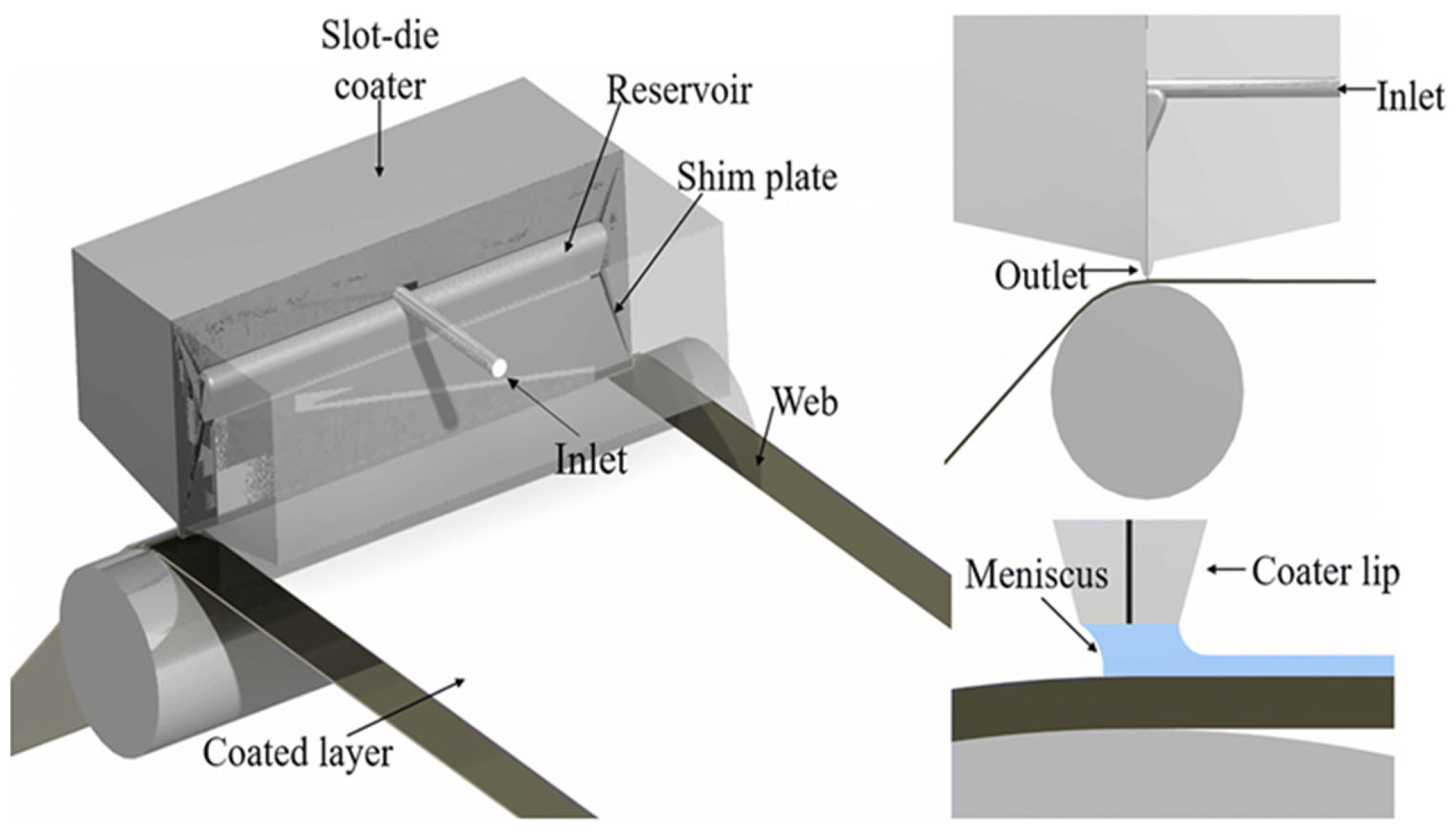
The evaporation of thin films in micro-channels is central to coating, electronic cooling, heat pumps and micro-manufacturing applications where capillarity, gravity, and phase change act over comparable length scales. In this setting, the local heat flux is governed primarily by the instantaneous film thickness, while the overall heat removed depends on how far the film persists before dry-out; both are set by the coupled momentum, heat, and mass transfer across the liquid–vapour interface. A representative industrial system exhibiting similar thin film transport characteristics is the slot-die coating process, in which paint-like non-Newtonian fluids are conveyed through narrow distributor passages and micro-scale inlet channels before forming a free surface and depositing onto a moving substrate. A schematic illustration of a slot-die coater is shown in Figure 1.
Several previous studies [2,3,4,5,6,7,8,9,10,11,12,13,14] analysed the coupled heat and mass transfer associated with evaporation characteristics of thin films in micro-channels using both experimental and numerical means, and interested readers are referred to the review by Park and Lee [14] for an extensive review of the existing body of work. Early investigations by Derjaguin et al. [2] established that evaporation from capillaries is inherently governed by thin film transport, intermolecular forces, and capillary-driven flow, providing the conceptual foundation for lubrication-based models. Subsequent studies progressively incorporated additional physics, showing that evaporation modifies momentum transfer and interfacial shear [3], while thin film heat transfer in microchannels is dominated by conduction across the liquid film and capillary pressure effects [4]. Detailed analyses of extended menisci further demonstrated that disjoining pressure, curvature, and interfacial resistances jointly control evaporation and flow near the contact line [5].
Building on these foundations, a number of studies formulated governing-equation-based models derived from coupled conservation of mass, momentum, and energy, leading to nonlinear differential equations solved numerically for film thickness, pressure, and velocity fields [6,7,8]. These approaches were extended to micro- and pore-scale geometries, revealing the critical roles of vapour shear, axial pressure gradients, and thin film microregions in determining evaporation rates and heat transport limits [9,10]. Later models further quantified how heat flux, capillary dimensions, and interfacial forces govern film evolution and dry-out behaviour in microchannels and capillaries [11,12,13]. Park and Lee [14] addressed the discontinuity of pressure through a dispersion constant and considered the gaseous phase to be saturated in thermodynamic equilibrium with the liquid film. This implies that the phase change at the interface occurs through boiling in order to maintain saturated temperature at the interface with a superheated wall temperature, which is fundamentally different from the standard evaporation transport. In contrast, Chakraborty and Som [15] dealt with the evaporation of a thin film below the saturation temperature corresponding to the prevailing thermodynamic pressure, and the rate of evaporation was coupled with the vapour phase mass diffusion at the interface. While these studies [2,3,4,5,6,7,8,9,10,11,12,13,14,15] collectively establish a robust framework for thin-film evaporation modelling, they are predominantly restricted to Newtonian fluids, motivating the present work’s extension of this coupled transport formulation to non-Newtonian (power-law) liquid films. Most synthetic and biological fluids are non-Newtonian in nature (i.e., the viscosity is dependent on the shear rate). Building on prior analytical work by Chakraborty and Som [15] on the evaporation of Newtonian fluid films in an inclined micro-channel configuration (inclined wall, isothermal boundary, quiescent gas, and evaporation at the interface), the present analysis focuses on evaporation of thin films of non-Newtonian power-law fluids, representative of paint-like solutions in a channel flow configuration. In this investigation, a gravity-assisted thin film flowing along one wall of an inclined micro-channel with a gas layer (air + solvent vapour) above the liquid interface is studied. The wall is maintained at T w , and the far field temperature in the gaseous phase is T α , and interfacial properties are linked through standard relations. The material properties for the present investigation are chosen from ranges typical of waterborne paints and ambient air, and the liquid follows the Ostwald–de Waele law with consistency K and power-law index n . These choices ground the model in realistic property windows and allow for a controlled sweep of rheology n ∈ {0.4, 0.6, 0.8, 1.0, 1.1, 1.2} while holding the rest of the operating parameters unaltered.

2. Mathematical Background

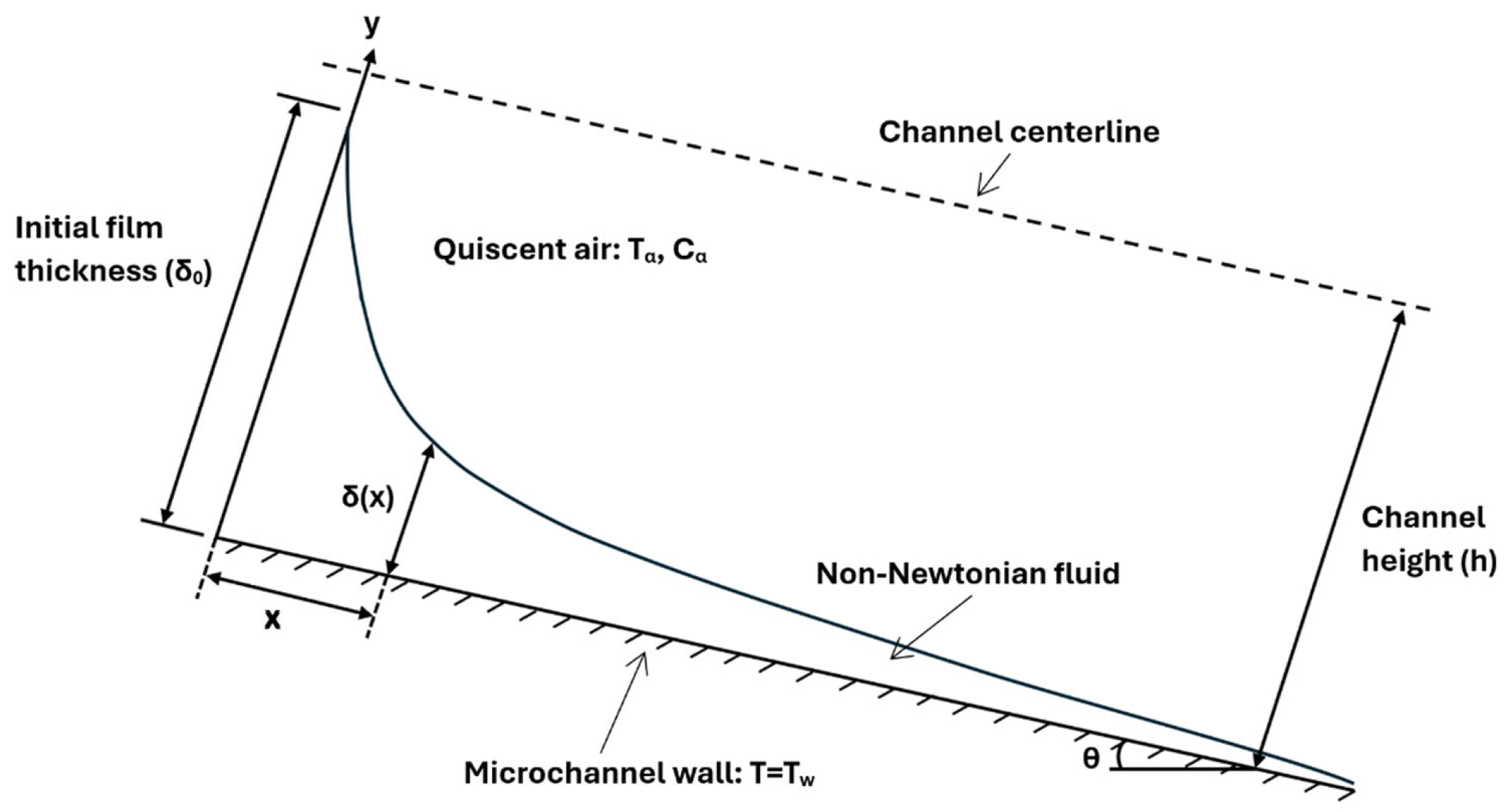
The phase-change heat transfer from a thin gravity-assisted non-Newtonian liquid film flowing along the wall of an inclined microchannel is schematically shown in Figure 2. Only the lower half of the channel is considered for the present analysis. A quiescent gas mixture (air + solvent vapour) occupies the region above the film at temperature T α and the film material concentration of C α (set to zero in this study). The channel wall is taken to be kept at constant temperature T w (baseline value below), and gravity acts at an angle θ relative to the negative y-direction. Transport in both liquid and gaseous phases is coupled through interfacial heat/mass balances and capillarity/disjoining pressure effects. It is worth noting that the problem of microchannel film evaporation is fundamentally different from steam cooling on a flat plate. Microchannel film evaporation is a capillarity- and shear-dominated two-phase flow with strong flow–heat transfer coupling, whereas steam cooling on a flat plate is a largely gravity- or forced-flow-driven film evaporation over an unconfined surface, typically described by classical falling film heat transfer theory.

2.1. Fluid Rheology and Parameter Values

The liquid film acts as a power-law fluid, which yields the following expression for the shear stress according to the Ostwald–de Waele model [16]:
τ y x = K u y n 1 u y
where K is the consistency and n is the power-law index, which assumes a value smaller than unity (i.e., n < 1 ) for shear-thinning fluids, whereas the power-law index n assumes values greater than unity (i.e., n > 1 ) for shear-thickening fluids. The value of n is unity for Newtonian fluids (i.e., n = 1.0 ). For the purpose of this analysis, the baseline values of thermophysical variables representative of a water-borne, paint-like fluid and ambient air are considered and the corresponding values are listed in Table 1 along with key problem parameters. The sources of the chosen baseline values are also indicated in Table 1 for the sake of completeness.
For the present analysis, T w = T α = 298 K is considered, but the model remains valid for T w > T α . The selected baseline value of consistency K = 0.5   P a . s n is representative of a moderately viscous, water-based, paint-like fluid, which allows for isolating the effects of power-law index n [17]. This value is supported by interpreting the classic rheological data from Fischer [17]. Fischer’s review [17] indicates that while low-viscosity lacquers for spraying operate at a viscosity limit of 0.02–0.12 Pa.s (0.2–1.2 poises), fluids causing a “drag” on a brush operate near 0.3–0.4 Pa.s (3–4 poises) at brushing shear rates (~100–200 s−1). Since the consistency index, K , is defined as the apparent viscosity at a unit shear rate of 1 s−1, a rate much lower than brushing, the actual K value must be higher than 0.3–0.4 Pa.s due to shear-thinning behaviour ( n < 1 ). By adopting K = 0.5   P a . s n , it is possible to simulate a less stabilised fluid whose viscosity is slightly above the moderate brushing range, thus avoiding the high K values required for anti-sagging paints and ensuring n is the dominant variable governing the model.
Table 1. List of baseline values of key thermophysical and problem parameters.
Physical ParametersValuesReferences
Surface tension σ = 0.04 N/m[18]
Dispersion constant a = 2.87 × 10⁻²¹[14]
Liquid density ρ l = 1200 kg/m3[19]
Gravity g = 9.81 m/s2-
Inclination θ = π/12-
Power-law consistency K = 0.5 Pa.sn-
Power-law index n ∈ {0.4, 0.6, 0.8, 1.0, 1.1, 1.2}-
Vapour density ρ v   = 0.6 kg/m3[20]
Vapour–air diffusivity D v = 2.5 × 10⁻⁵ m2/s[21]
Liquid thermal conductivity k l = 0.18 W/mK[22]
Vapour thermal conductivity k v = 0.026 W/mK[23]
Vapour thermal diffusivity α v = 2.0 × 10⁻⁵ m2/s[24]
Wall and ambient temperatures  T w = 298 K, Tα = 298 K-
Reference latent-heat parameter H s a = 2.3 × 10⁶ J/kg[25]
Critical and saturation temperatures T c   =   647   K ,   T s a = 373 K[20]
Molecular weight for air M a i r = 0.029 kg/mol[26]
Molecular weight for liquid M l = 0.018 kg/mol[20]
Universal gas constant R g = 8.314 J/mol K[27]
Thermodynamic pressure p t = 101,325 Pa[21]
Channel height h = 10−4 m-
Initial film thickness  δ 0   = 10−5 m-

2.2. Simplifying Assumptions

The following assumptions are made to simplify the analytical model:
Transport is effectively two-dimensional;
Axial ( x -direction) diffusion terms are negligible relative to transverse ( y -direction) diffusion terms because of length-scale separation following the order of magnitude analysis characteristic of boundary layer theory;
The film is thin, δ < h ;
The axial pressure gradient depends only on the x -direction;
Axial gradients of temperature and concentration are weak compared to their relative transverse gradients, which is consistent with boundary layer theory;
Thermophysical properties are uniform within each phase (though different across phases);
The temperature across the y -direction in the liquid is assumed to be linear since low flow speeds make convection negligible and the pure conduction yields a linear temperature variation.
It is worth noting that the same assumptions were made in the previous analysis by Chakraborty and Som [15].

2.3. Governing Equations and Interfacial Matching

  • Liquid-phase (power-law fluid) momentum conservation:
    d d y K u y n 1 u y = p x ρ l g sin θ = F x
    where u is the velocity, p is the pressure, and F x is a function of x. In Equation (2), the subscript ‘l’ denotes the liquid phase. The above equation is subjected to the following boundary conditions:
    At   y = 0 ,   u = 0   due   to   no-slip   condition ,
    At   y = δ ,   u y = 0
    Equation (2), subjected to the above boundary conditions, yields
    u y = n n + 1 F x K 1 n δ n + 1 n δ y n + 1 n
    This equation is the liquid-phase velocity profile.
  • Vapour-phase energy conservation:
    V s T y = α v 2 T y 2
    where V s represents the Stefan flow velocity caused by evaporation at the interface, and α denotes the thermal diffusivity. The subscript ‘v’ refers to vapor-phase properties. Under the following boundary conditions,
    At   y = δ ,   T = T s
    At   y = h ,   T = T α
    Equation (5) provides
    T T s T s T α = e x p V s y α v e x p V s δ α v e x p V s δ α v e x p V s h α v
  • Vapour-phase mass conservation:
    V s C y = D v 2 C y 2
    Here, C denotes the vapour concentration in the gas layer, and D v is the binary mass diffusivity of vapour in air. Because Equation (8) has the same steady, one-dimensional convection diffusion form as that of Equation (5), with C in place of T and D v in place of α v , it can be solved by the same procedure to obtain the concentration profile:
    C C s C s C α = e x p V s y D v     e x p V s δ D v e x p V s δ D v     e x p V s h D v
To further solve the model, the liquid- and vapour-phase governing equations are linked by interfacial matching conditions at the liquid–vapour boundary, as follows:
  • At any axial location x, the mass flow rate m x ˙ is connected to the evaporation rate per unit length m e ˙   through the relation
    d m x ˙ d x = m e ˙
    Substituting the liquid-phase velocity profile given by Equation (4) into the mass balance expression above, and performing the required algebraic simplifications and rearrangement of terms, one can obtain the following governing equation in terms of driving function F ( x ) and film thickness δ :
    ρ l K 1 / n 1 2 n + 1 F x 1 n 1   F x   δ 2 + 1 n + F x 1 n δ 1 + 1 n   d δ d x = m e ˙
    where   m e ˙ = ρ v V s
  • At the liquid–vapour boundary, only liquid vapour crosses the interface; air cannot. Hence, the net normal flux of air at y = δ must be zero. In the vapour layer, air’s flux has two parts: (a) a diffusive flux (from composition gradients) and (b) a convective (Stefan) flux carried by the bulk gas motion V s generated by evaporation.
    D v   C y y = δ 1 ( 1 C s ) = V s
    This expresses the Stefan velocity VS directly in terms of the interfacial concentration gradient of the liquid vapour and the local air fraction. Using Equations (9) and (13), it is possible to obtain
    V s = D v h δ l n   1 C α 1 C s
    In this study, the ambient gas over the film is taken as dry air in the far field C α = 0 . With C α = 0 , Equation (14) reduces to
    V s = D v h δ l n 1 1 C s
  • At the interface y = δ , the net heat conducted into the interface from both sides must equal the latent heat required to evaporate the liquid leaving at the Stefan velocity V s . Heat comes from (a) the vapour side by conduction through the gas layer and (b) the liquid side by conduction through the film. That incoming heat is consumed as latent heat ‘ ρ v h f g V s associated with the phase change. This gives the interfacial energy balance:
    k v T v y y = δ + k l T l y y = δ = ρ v h f g V s
    where k v and k l are the thermal conductivities of the vapour and liquid, respectively, and h f g is the latent heat of evaporation at local conditions. The first term is the conductive heat from the vapor to the interface (with a negative sign because y is measured away from the wall), the second term is the conductive heat from the liquid to the interface, and the right-hand side is the latent heat sink due to evaporation.
By substituting the temperature distribution from Equation (7) into Equation (16), the expression for the interfacial temperature T s is obtained:
T s = ρ v h f g V s + k l / δ T w f T α   k l / δ f
where f is
f = k v V s α v   e x p V s δ / α v e x p   V s δ / α v e x p V s h / α v
Equations (11), (13) and (17) together specify the equation governing film thickness, the Stefan velocity from species transport in the vapour, and the interfacial temperature from the heat balance. However, the system is only well-posed once the driving term F ( x ) in Equation (11) is explicitly defined. To determine F ( x ) , the interfacial dynamics need to be considered.
4.
The pressure difference across the interface is given by
p p α = σ R x + a σ 3
where p α is the vapour-phase pressure just outside the interface, σ is surface tension, R ( x ) is the local radius of curvature of the interface, and a is the dispersion constant modelling disjoining-pressure effects. Next, combining this relation with the liquid-phase momentum equation, Equation (2), yields an explicit expression for the driving function F ( x ) that appears in the film flow solution:
F x = σ R x 2 d R d x + 3 a δ 4 d δ d x + ρ l g sin θ
The radius of curvature R ( x ) is related to the film thickness δ by the standard small-slope geometry:
R x = 1   +   d δ d x 2 1.5 d 2 δ d x 2
In the subsequent analysis, the small-slope approximation, i.e., d δ / d x 1 , will be adopted, which simplifies the curvature relation.
At this stage it is important to recognise that the interfacial quantities T s (interface temperature), C s (interface vapour concentration), and the latent heat h f g are not independent parameters. They are thermodynamically coupled, so specifying one constrains the others. In the present study, the above thermodynamic constraints are assumed to obey the following relations:
C s = 1 1   +   M a i r M l   p t p v 1
where M denotes molecular weight, and the pressure ratio p t / p v is obtained from
p v p t o t a l = e x p   Δ H s a R T s T s a T s T s a 0.38 T c l n T s T s a 0.118 T c 2 T s T s a
In Equation (23), the subscript “sa” refers to standard atmospheric conditions and “c” for the critical state; all temperatures are in Kelvin. Further, the variation of h f g is expressed as
h f g = Δ H s a T c T s T c T s a 0.38
By substituting the thermodynamic relations Equations (22)–(24) into Equations (13) and (17) and then inserting the results into the governing film thickness, Equation (11), it is possible to obtain a single fourth-order, highly nonlinear ODE for the film thickness δ ( x ) .
In this study, the boundary conditions are δ 0 = δ 0 and δ 0 , d δ / d x 0 , d 2 δ / d x 2 0 as x to recast the fourth-order ODE as a first-order system and integrate it with MATLAB’s ode15s (stiff, variable-order BDF/NDF) using tight tolerances. The march starts from x = 0 with δ 0 = δ 0 and small initial derivatives for δ , δ , δ , and integration proceeds until dry-out (when δ drops to a small threshold), which for this study is defined at 50 nm [13].
Lastly, the local Nusselt number can be defined as
N u x = h x x k l
For a linear liquid temperature profile (which leads to h x = k l / δ ), the expression reduces to
N u x = x δ
Accordingly, the expression for the mean Nusselt number is defined as
N u ¯ x = 1 x d   0 x d N u x d x = 1 x d   0 x d   x δ d x
where x d denotes the dry-out length, i.e., the distance from the inlet to the point where the non-Newtonian liquid ceases to exist.

3. Results and Discussion

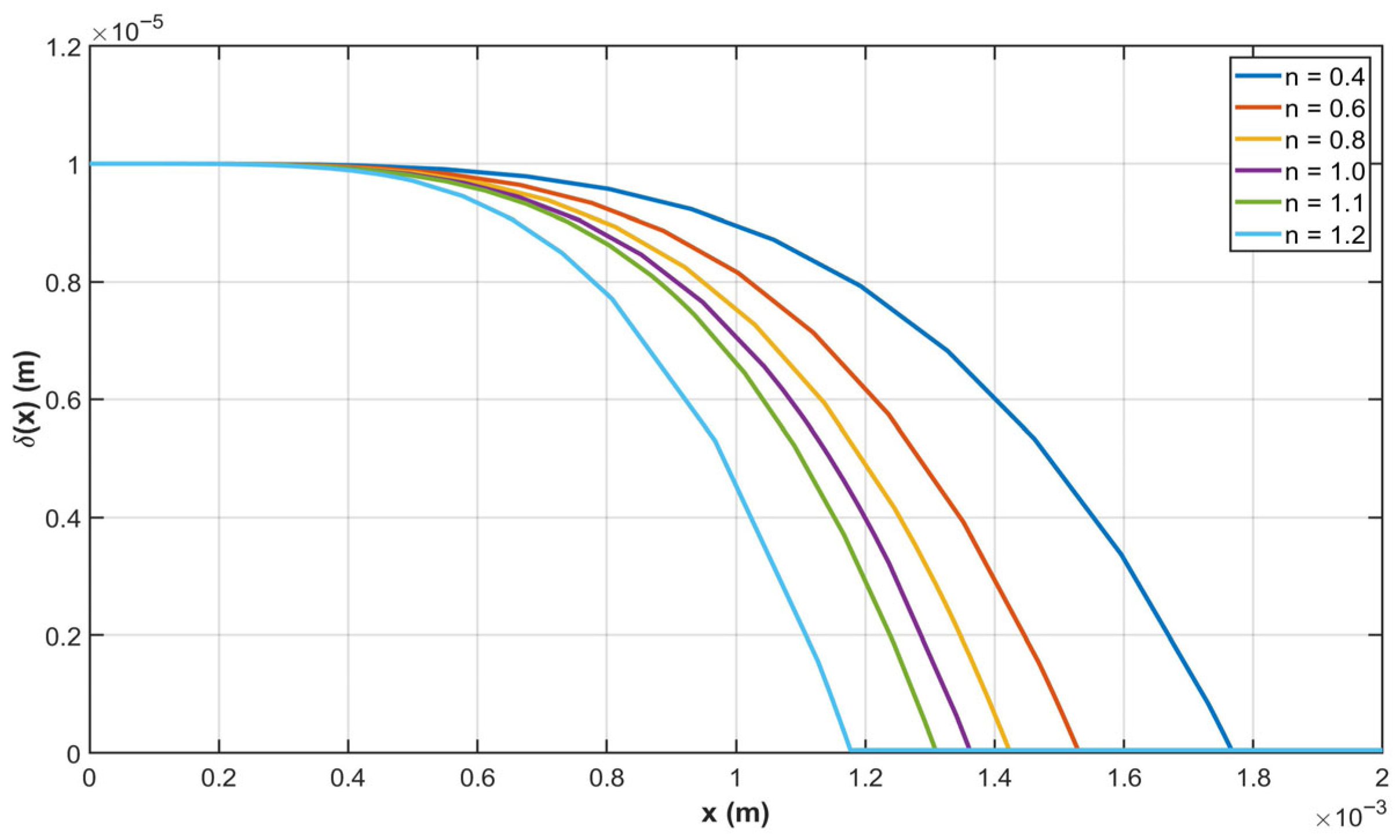
Figure 3 shows the axial variation in the liquid-film thickness for power-law rheology at fixed inlet thickness and operating conditions, with the power-law index varied over n = {0.4, 0.6, 0.8, 1.0, 1.1, 1.2}. The film thins monotonically along the wall because of interfacial evaporation and approaches an “almost dry-out” state where δ becomes exceedingly small. The influence of rheology is modest near the inlet, where the capillary–gravity forcing and the initial condition effects dominate, but the effect of power-law index becomes evident downstream: liquid films with n < 1 exhibit a larger value δ for a given value than the Newtonian fluid case (i.e., n = 1 ), and accordingly, the dry-out point is pushed farther downstream in comparison to that in the case of n = 1 . The exact opposite trend is obtained for the liquid films with n > 1 (see Figure 3).
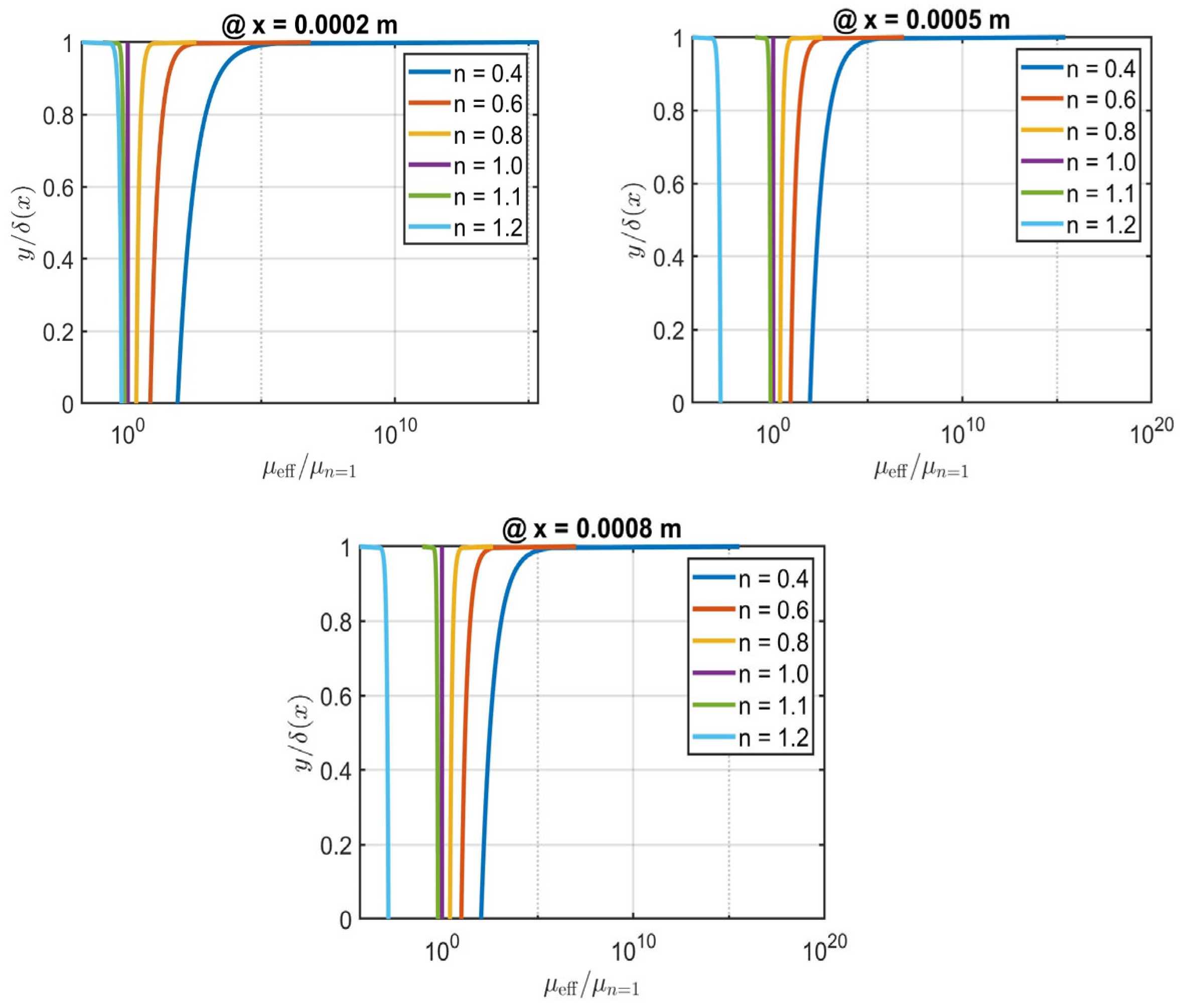
In order to explain the behaviour shown in Figure 3, the variation in normalised effective viscosity, μ e f f / μ n = 1 , as a function of the normalised wall normal coordinate y / δ ( x ) is shown in Figure 4 for different power-law indices n at three downstream locations. The effective viscosity is evaluated from the power-law relation, μ e f f = K γ ˙ n 1 , with the shear rate γ ˙ = u / y obtained from the analytical velocity profile (see Equation (4)). Differentiation of the velocity profile given by Equation (4) yields γ ˙ ( δ y ) 1 / n , leading to a viscosity distribution given by μ e f f ( δ y ) ( n 1 ) / n . Consequently, the cross-film viscosity behaviour is entirely governed by the exponent ( n 1 ) / n , which determines both the magnitude and the limiting behaviour of the viscosity near the free surface. For the Newtonian case (i.e., n = 1 ), the exponent vanishes, and the effective viscosity remains constant across the film, appearing as a straight vertical line in Figure 4. For n > 1 , the exponent is positive, and the viscosity decreases monotonically with increasing y / δ , tending toward zero as the shear rate vanishes near the free surface. By contrast, for n < 1 , the exponent is negative, causing the viscosity to increase sharply as y / δ ( x ) 1 and to grow without bound as the shear rate approaches zero. In the numerical implementation, the viscosity is therefore evaluated up to y = 1 10 9 δ ( x ) , which allows these asymptotic trends to be captured consistently without artificially prescribing endpoint values, as y never reaches the exact value of δ(x).
As evaporation proceeds downstream, the local film thickness decreases and the characteristic shear rate within the film increases, amplifying differences μ e f f in response to the variations of n . This effect is most evident at the furthest downstream location, x = 0.0008 m, where fluids with n < 1 exhibit extreme viscosity amplification near the free surface, while fluids with n > 1 exhibit decaying viscosity from the wall to the free surface.
It can be seen from Figure 4 that the viscosity within the film for n < 1 ( n > 1 ) remains greater (smaller) than the Newtonian fluid (i.e., n = 1 ) and thus the flow velocity at a given value of y / δ ( x ) decreases with n . This leads to a reduction in decay of δ ( x ) and an increase in the dry-out length with a decrease in n . The results shown in Figure 3 and Figure 4 indicate a clear mechanistic link between rheology, film thinning, and dry-out trends, which has implications for the heat transfer rate within the film.
It is important to recognise that the power-law is an approximation of rheology. However, real fluids show asymptotic values of viscosity for very large and small values of shear rate, but these values are dependent on the choice of the specific fluid. Thus, in real shear-thinning fluids, the effective viscosity will not reach infinity for low shear rates, but the asymptotic value of viscosity for low shear rate typically remains several orders of magnitude higher than the asymptotic value for large shear rates. Thus, power-law rheology is a simplification that is used for the current analysis, but the qualitative nature of the effective viscosity variation is unlikely to change for real shear-thinning fluids.
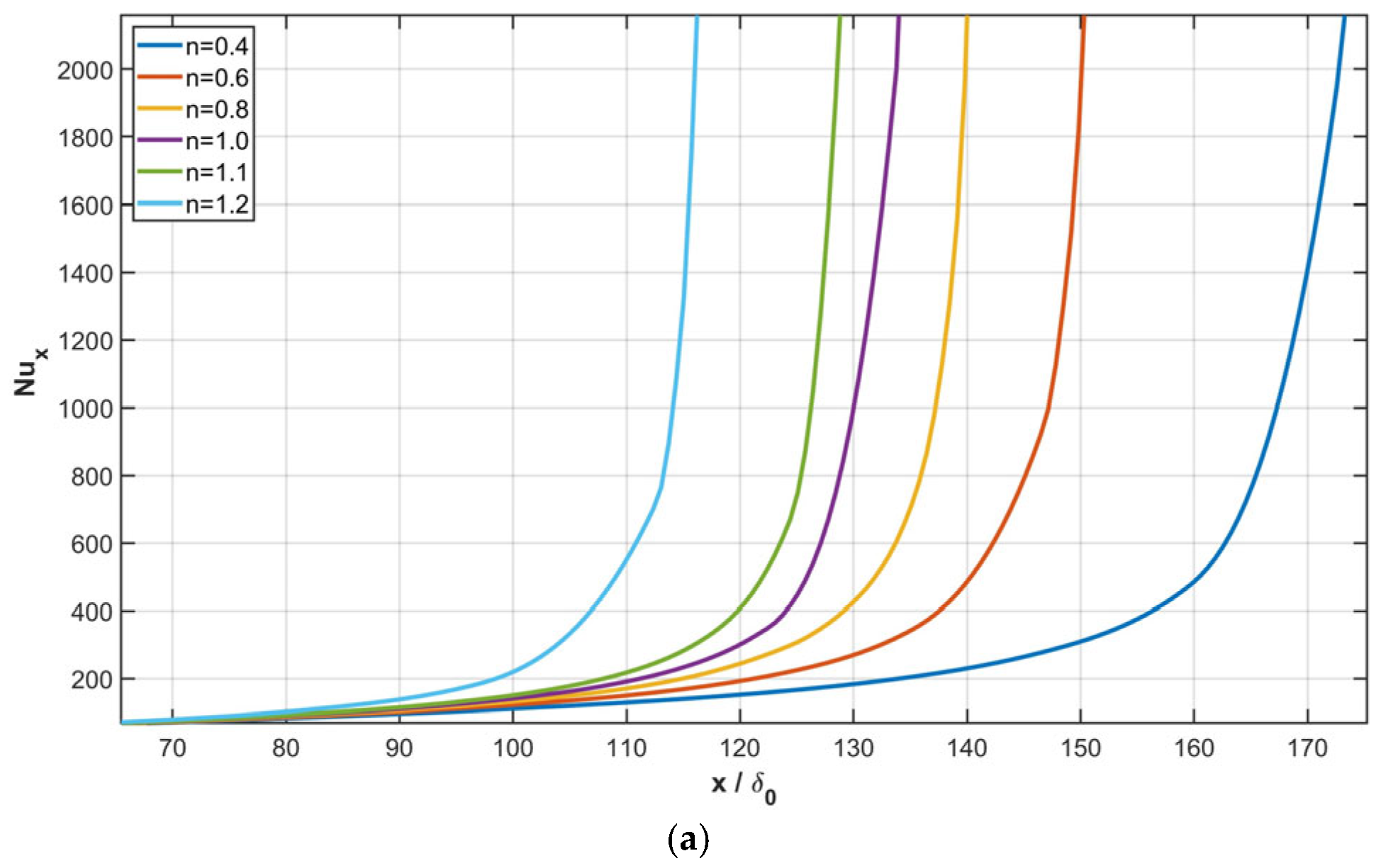
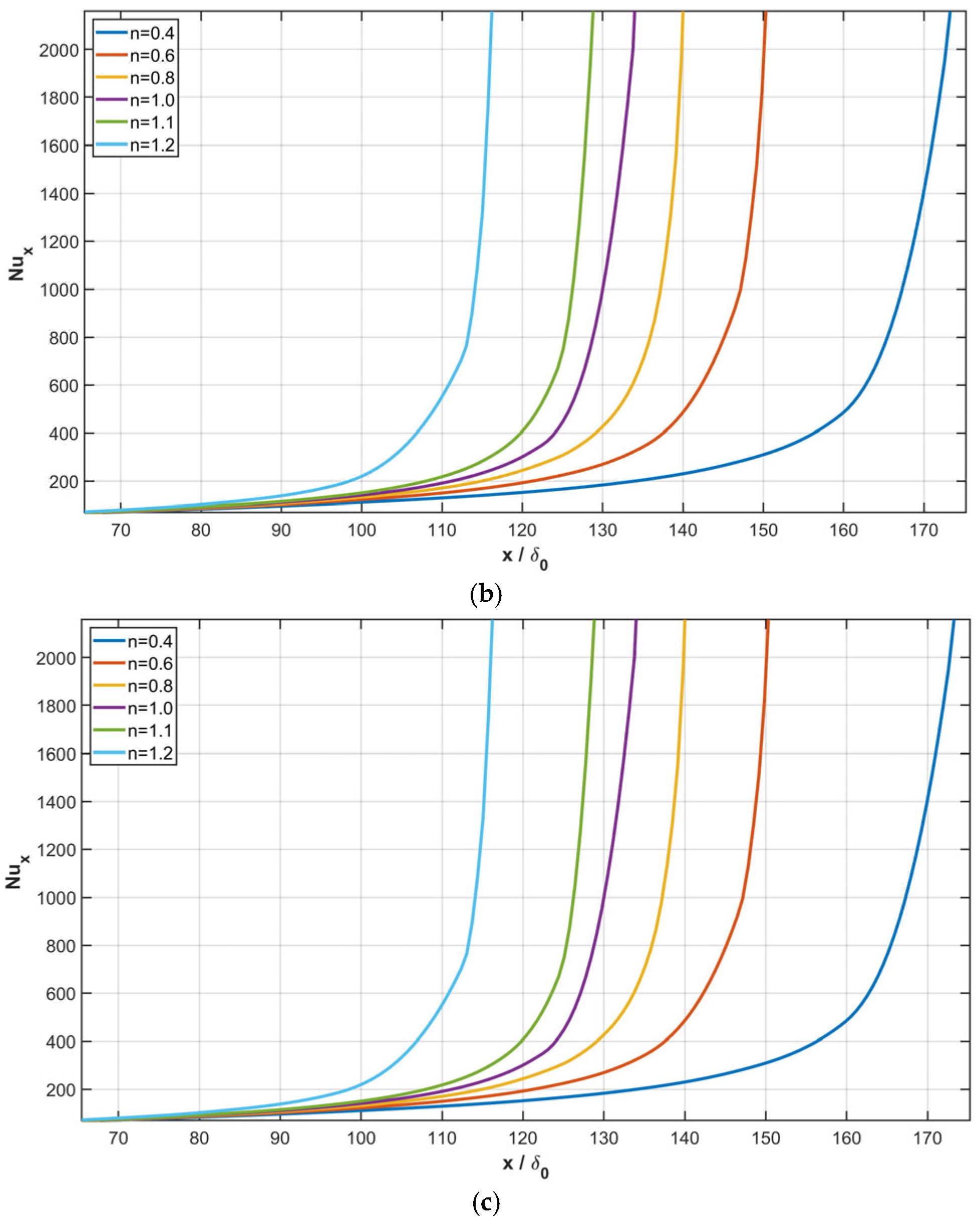
Figure 5 shows the variation in local Nusselt number (i.e., N u x = x / δ ( x ) ) for n = {0.4, 0.6, 0.8, 1.0, 1.1, 1.2} under otherwise identical operating conditions. The profiles of N u x initially collapse because the film remains nearly uniform over the entrance region (i.e., δ δ 0 ). Downstream, evaporation progressively reduces δ ( x ) ; the shrinking denominator in Equation (25) accelerates the growth of Nux, and the apparent “blow-up” observed near the terminal region arises from the geometric effect of small δ rather than a change in wall physics. In this study, dry-out is not taken as δ = 0 , but is defined at a finite cutoff (e.g., δ = 50   n m ), which avoids the singularity and sets the endpoint of each N u x profile. The ordering of N u x with the variation of n is consistent with the film thickness trends shown in Figure 3. The film in cases with n   = 1.1 and 1.2 thins more rapidly, reaches the dry-out threshold earlier, and therefore exhibits an earlier blow-up of N u x . By contrast, the cases with n < 1 maintain larger film thicknesses over a longer distance; as a result, their N u x profiles blow-up further away from the inlet.
To assess the sensitivity of the results to the dry-out criterion, additional simulations were performed by varying the dry-out cutoff from 5 × 10⁻⁹ m to 5 × 10⁻⁷ m. These variations produced no discernible change in the qualitative nature of the local Nusselt number profiles shown in Figure 5, nor in their ordering or trends with respect to the power-law index. This indicates that the apparent blow-up of the local Nusselt number is governed by geometric film thinning upstream of dry-out rather than by the specific numerical threshold used to define dry-out.
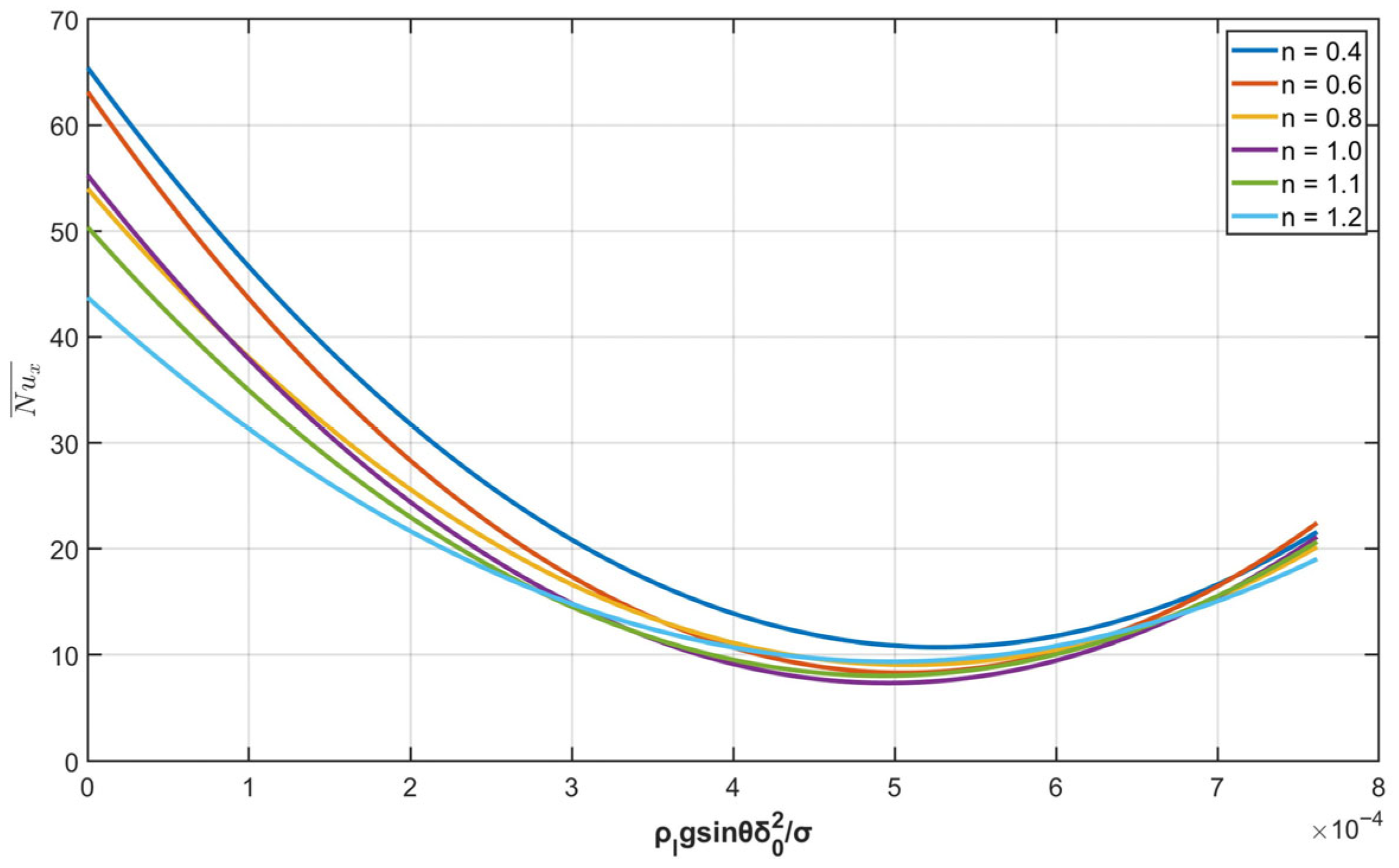
The overall rate of heat transfer in this configuration is set mainly by the liquid film thickness, which itself evolves under the combined action of the flow and interfacial evaporation. The flow speed reflects a balance between gravity and surface tension, so it is convenient to compare cases using a non-dimensional group, ρ l g s i n θ δ 0 2 / σ , which can be considered to be a Weber number for this configuration. Figure 6 shows the variation in the mean Nusselt number N u ¯ x with ρ l g s i n θ δ 0 2 / σ for different values of n . The Weber number is varied by sweeping the inlet film thickness (10−4 to 10−6 m), while keeping all other parameters unalterd. The mean Nusselt number is defined as N u ¯ x = ( 1 / x d )   0 x d   x / δ d x . This indicates that an increase in the initial film thickness δ 0 increases the dry-out length x d , which acts to increase N u ¯ x . By contrast, δ decreases less rapidly for an increased value of δ 0 , which acts to reduce N u ¯ x . These two competing effects are simultaneously at play in the variation in the mean Nusselt number N u ¯ x with ρ l g s i n θ δ 0 2 / σ shown in Figure 6, where δ 0 was changed to bring about the variation in ρ l g s i n θ δ 0 2 / σ . The non-monotonic variation of N u ¯ x with ρ l g s i n θ δ 0 2 / σ in Figure 6 is a consequence of the aforementioned competing mechanisms. As dry-out length is smaller for n > 1 than for n < 1 , the minimum value of N u ¯ x is obtained for a smaller value of ρ l g s i n θ δ 0 2 / σ in the case of n > 1 fluids than for n < 1 fluids. It can also be seen from Figure 6 that, in general, higher values of N u ¯ x are obtained for smaller values of n for small values of ρ l g s i n θ δ 0 2 / σ .
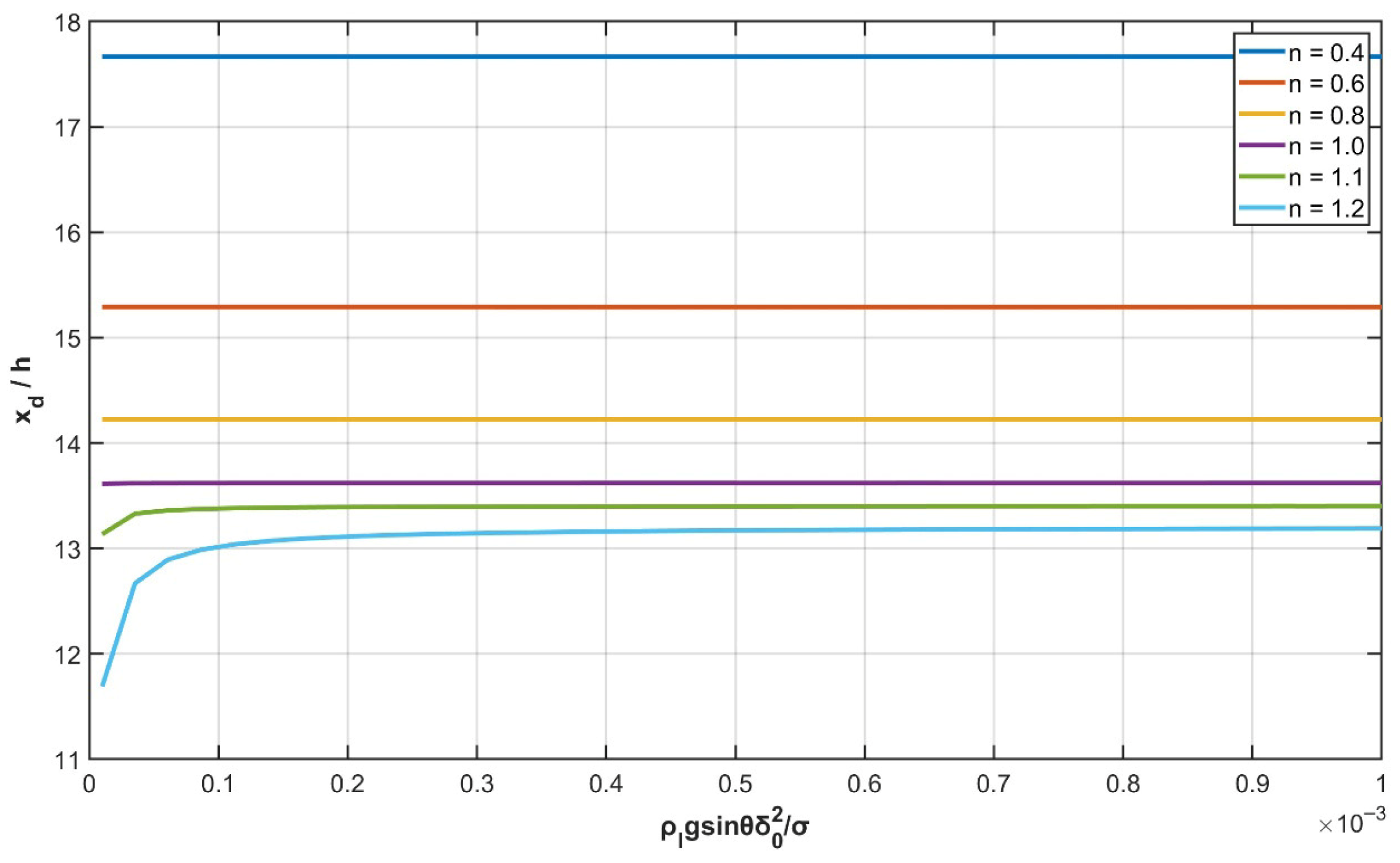
While the local heat flux is governed by the local film thickness, the total heat removed from the surface depends on the wetted length, i.e., the streamwise distance to dry-out as the film decays by evaporation. Figure 7 shows the variation in x d / h with ρ l g s i n θ δ 0 2 / σ (obtained here by sweeping σ at fixed δ 0 / h = 0.1 ), which shows a weak ρ l g s i n θ δ 0 2 / σ dependence of x d / h , indicating that the dry-out location is practically insensitive to surface tension over the range tested. In Figure 7, the dry-out condition is characterised by finite cutoff δ 50   n m , but the trend does not change if the dry-out cutoff is changed from 5 × 10⁻⁹ m to 5 × 10⁻⁷ m. The cases with n > 1 in Figure 7 exhibit a shorter x d / h at small values of ρ l g s i n θ δ 0 2 / σ , consistent with its faster thinning of the film and earlier local blow-up of N u x , but approaches the same plateau-like curve as the Weber number ρ l g s i n θ δ 0 2 / σ increases.
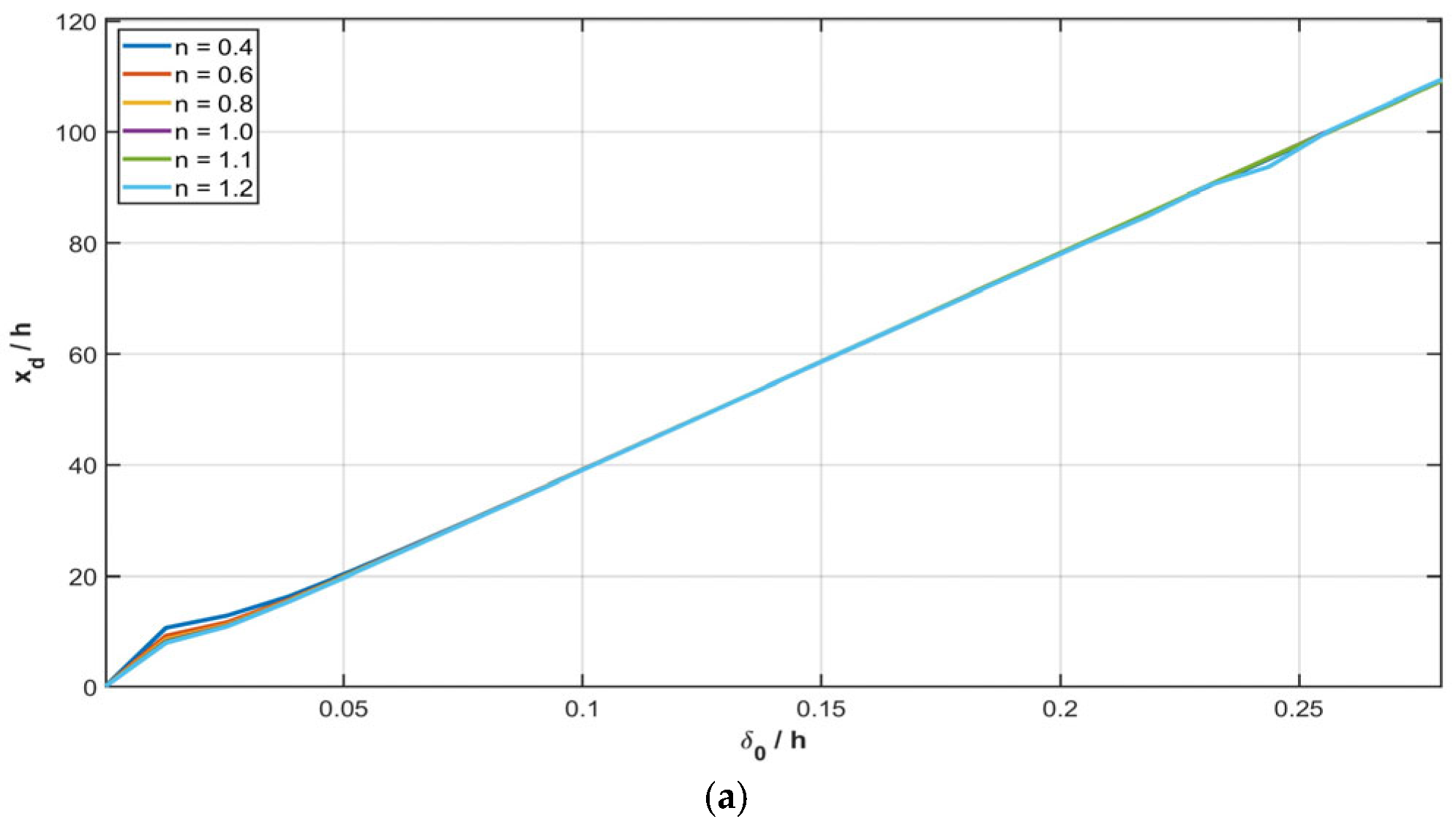
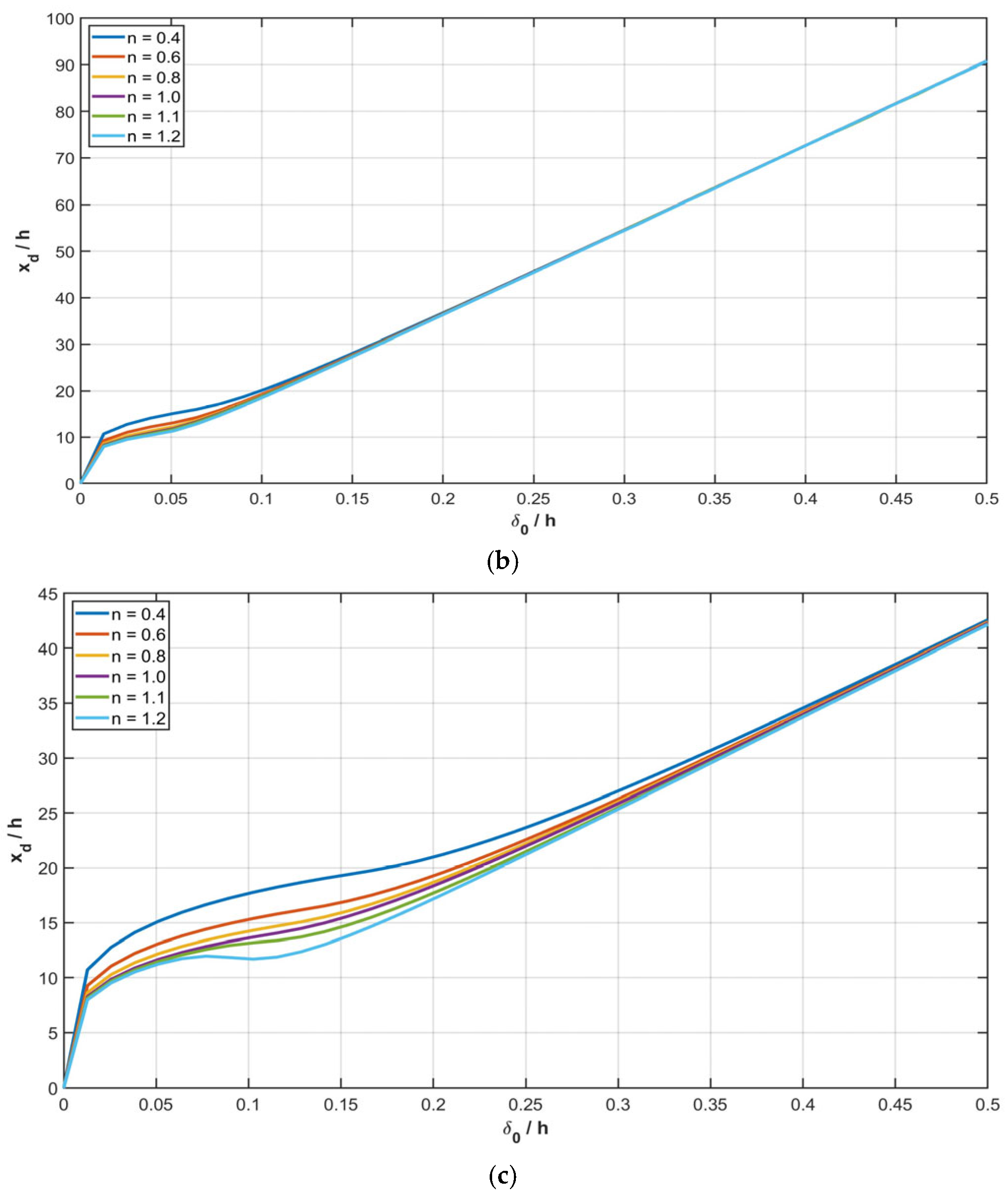
Finally, the variation in x d / h with the inlet film ratio δ 0 / h for Weber numbers ρ l g s i n θ δ 0 2 / σ = 1 0 5 10 7 is shown in Figure 8 for different values of n . An almost linear variation of x d / h with δ 0 / h is observed for a large range of δ 0 / h , and the power-law exponent does not appreciably influence this behaviour (i.e., profiles for different n values are virtually indistinguishable). At ρ l g s i n θ δ 0 2 / σ = 1 0 5 , the axial extent of a capillarity-dominated entrance region increases, leading to a brief deviation from linearity at small inlet thicknesses, while a near-linear scaling is recovered downstream. At an even lower Weber number ( ρ l g s i n θ δ 0 2 / σ = 1 0 7 ), surface-tension effects dominate throughout the channel, and the dry-out length exhibits an almost linear dependence on inlet film thickness over the entire range considered, with minimal sensitivity to the power-law index. These results indicate that the linear scaling is robust and becomes more pronounced as capillarity dominates gravity.
The findings from Figure 7 and Figure 8 indicate that the dry-out position scales with the starting thickness and is largely unaffected by surface tension when the Weber number x d / h with the inlet film ratio δ 0 / h is held constant. Physically, a thicker inlet film simply provides more liquid to sustain evaporation over a longer distance, and, once the global forcing is fixed, the modest rheological differences do not materially alter the near-linear relation between x d / h and δ 0 / h . Moreover, the above findings also indicate that an increasing trend of N u ¯ x with a decrease in n for a given value of ρ l g s i n θ δ 0 2 / σ (see Figure 6) is a consequence of increasing dry-out length x d with a decrease in power-law exponent n , which can be discerned from Equation (27).

4. Conclusions

The evaporation of a liquid thin film following a power-law rheology along a thin inclined micro-channel wall under the combined action of gravity and surface tension has been modelled using semi-analytical means. The main findings of the present analysis are summarised below:
It has been found that the film thickness δ reduces more slowly for smaller values of power-law exponent n for a given value of consistency (i.e., K = 0.5 Pa.sn), and accordingly, dry-out (which is characterised at the point δ becomes smaller than 50 nm) length increases with decreasing power-law exponent n . However, it is worth noting that the results remain qualitatively and mostly quantitatively unaltered for the dry-out threshold choice ranging from 5 × 10⁻⁹ m to 5 × 10⁻⁷ m.
It has been found that the local Nusselt number N u x increases gradually before the sharp terminal rise that is indicative of dry-out. The effective viscosity is found to assume a large value at the free surface for n < 1 , whereas negligible value of viscosity is obtained at the free surface for n > 1 , which explains the decreasing rate of reduction in the film thickness for a decrease in power-law exponent.
The mean Nusselt number N u ¯ x decreases with increasing n and N u ¯ x shows a non-monotonic trend with the variation in Weber number ρ l g s i n θ δ 0 2 / σ . This is a consequence of the competing effects of increased film thickness and dry-out length with an increase in the initial flame thickness δ 0 . It has been found that the dry-out length is mostly insensitive to the variation in surface tension σ for a given value of normalised initial flame thickness δ 0 / h .
The small dry-out lengths for n > 1 lead to an increase in x d / h at small values of ρ l g s i n θ δ 0 2 / σ but x d / h approaches a plateau as the Weber number ρ l g s i n θ δ 0 2 / σ increases. Moreover, it has been found that the normalised dry-out length x d / h is roughly linearly related to the normalised initial film thickness δ 0 / h for a given Weber number ρ l g s i n θ δ 0 2 / σ , and this behaviour is almost independent of the choice of power-law exponent n . These findings also indicate that an increasing trend of N u ¯ x with a decrease in n for a given value of ρ l g s i n θ δ 0 2 / σ is a consequence of increasing dry-out length x d with a decrease in power-law exponent n .
Overall, the results establish a clear hierarchy of controls for the evaporation of power-law films over thin inclined channels: the local heat transfer is influenced by the local thickness; and the dry-out position in a given channel height is governed primarily by the inlet film thickness, with only modest sensitivity to rheology and almost no dependence of surface tension within the ranges examined.
Film evaporation of non-Newtonian fluids in microchannels is increasingly significant across various technological domains, particularly where precise thermal management and fluid control are essential. In microfluidic systems, such as lab-on-a-chip devices, the evaporation of shear-thinning polymer solutions (e.g., poly(vinyl alcohol)) within open rectangular microchannels has been shown to influence solute deposition patterns due to surface tension driven flows and viscosity variations during solvent evaporation [28]. In thermal management, non-Newtonian fluids, including polymer-enhanced coolants, are utilised in microchannel heat sinks for electronics cooling. Their shear-thinning properties can lead to reduced pressure drops and enhanced heat transfer efficiency [29]. Additionally, in biomedical applications, the controlled evaporation of non-Newtonian fluids within microchannels is employed for sample concentration and analyte detection, leveraging the unique flow characteristics of these fluids [30]. These examples underscore the versatility and importance of understanding non-Newtonian film evaporation in micro-scale systems and the proposed mathematical formulation has the potential to play a key role in the aforementioned applications. However, future analyses will be needed for more realistic rheology than the power-law model, which will enable a broader range of parameters to be explored without any singularities in viscosity values. Furthermore, computational fluid dynamics analysis will be needed to assess the validity of the assumptions made for the semi-analytical model. These analyses will form the foundation for future studies.

Author Contributions

Conceptualization, N.C.; Methodology, H.M.N. and N.C.; Software, H.M.N.; Validation, H.M.N.; Formal analysis, H.M.N. and N.C.; Investigation, H.M.N. and N.C.; Resources, N.C.; Data curation, H.M.N.; Writing—original draft, H.M.N. and N.C.; Writing—review & editing, H.M.N. and N.C.; Visualization, H.M.N.; Supervision, N.C.; Project administration, N.C. All authors have read and agreed to the published version of the manuscript.

Funding

This research received no external funding.

Institutional Review Board Statement

Not applicable.

Informed Consent Statement

Not applicable.

Data Availability Statement

Dataset available on request from the authors.

Conflicts of Interest

The authors declare no conflict of interest.

References

  1. Kim, S.; Lee, J.; Lee, C. Computational fluid dynamics model for thickness and uniformity prediction of coating layer in slot-die process. Int. J. Adv. Manuf. Technol. 2019, 104, 2991–2997. [Google Scholar] [CrossRef]
  2. Derjaguin, B.V.; Nerpin, S.V.; Churaev, N.V. Effect of film transfer upon evaporating liquids from capillaries. RILEM Bull. 1965, 29, 93–98. [Google Scholar]
  3. Blangetti, F.; Naushahi, M.K. Influence of mass transfer on the momentum transfer in condensation and evaporation phenomena. Int. J. Heat Mass Transfer 1980, 23, 1694–1695. [Google Scholar] [CrossRef]
  4. Xu, X.; Carey, V.P. Film evaporation from a microgrooved surface—An approximate heat transfer model and its comparison with experimental data. AIAA J. Thermo-Phys. Heat Transfer 1990, 4, 512–520. [Google Scholar] [CrossRef]
  5. DasGupta, S.; Schonberg, J.A.; Wayner, P.C., Jr. Investigation of an evaporating extended meniscus based on the augmented Young–Laplace equation. ASME J. Heat Transfer 1993, 115, 201–210. [Google Scholar] [CrossRef]
  6. Longtin, J.P.; Badran, B.; Gerner, F.M. A one-dimensional model of a microheat pipe during steady-state operation. ASME J. Heat Transfer 1994, 116, 709–715. [Google Scholar] [CrossRef]
  7. Lay, J.H.; Dhir, V.K. Shape of a vapor stem during nucleate boiling of saturated liquids. ASME J. Heat Transfer 1995, 117, 394–401. [Google Scholar] [CrossRef]
  8. Ha, J.M.; Peterson, G.P. The interline heat transfer of evaporating thin film along a microgrooved surface. ASME J. Heat Transfer 1996, 118, 747–755. [Google Scholar] [CrossRef]
  9. Khrustalev, D.; Faghri, A. Thick-film phenomenon in high heat-flux evaporation from cylindrical pores. ASME J. Heat Transfer 1997, 119, 272–278. [Google Scholar] [CrossRef]
  10. Sartre, V.; Zaghdoudi, M.; Lallemand, M. Effect of interfacial phenomena on evaporative heat transfer in microheat pipes. Int. J. Therm. Sci. 2000, 39, 498–504. [Google Scholar] [CrossRef]
  11. Peles, Y.P.; Haber, S. A steady state, one dimensional model for boiling two phase flow in triangular microchannel. Int. J. Multiph. Flow 2000, 26, 1095–1115. [Google Scholar] [CrossRef]
  12. Park, K.; Noh, K.J.; Lee, K.S. Transport phenomena in the thin film region of a micro-channel. Int. J. Heat Mass Transfer 2003, 46, 2381–2388. [Google Scholar] [CrossRef]
  13. Qu, W.; Ma, T.; Miao, J.; Wang, J. Effects of radius and heat transfer on the profile of evaporating thin liquid film and meniscus in capillary tubes. Int. J. Heat Mass Transfer 2002, 45, 1879–1887. [Google Scholar] [CrossRef]
  14. Park, K.; Lee, K.S. Flow and heat transfer characteristics of the evaporating extended meniscus in a micro-capillary channel. Int. J. Heat Mass Transfer 2003, 46, 4587–4594. [Google Scholar] [CrossRef]
  15. Chakraborty, S.; Som, S.K. Heat transfer in an evaporating thin liquid film moving slowly along the walls of an inclined microchannel. Int. J. Heat Mass Transfer 2005, 48, 2801–2805. [Google Scholar] [CrossRef]
  16. Bird, R.B.; Armstrong, R.C.; Hassager, O. Dynamics of Polymeric Liquids, Volume 1: Fluid Mechanics, 2nd ed.; Wiley: New York, NY, USA, 1987. [Google Scholar]
  17. Fischer, E.K. Rheological properties of commercial paints. J. Colloid. Sci. 1950, 5, 271–281. [Google Scholar] [CrossRef]
  18. Osterhold, M.; Armbruster, K. Importance of surface tension for physical paint properties. Macromol. Symp. 1998, 126, 295–306. [Google Scholar] [CrossRef]
  19. EB-143 ENVIROBASE High Performance Waterborne Basecoat 2 18.Pub. Available online: https://www.tascoautocolor.com/uploads/3/8/4/0/3840498/eb-143_envirobase_high_performance_waterborne_basecoat_2_18.pdf (accessed on 7 September 2025).
  20. Wagner, W.; Pruß, A. The IAPWS formulation 1995 for the thermodynamic properties of ordinary water substance for general and scientific use. J. Phys. Chem. Ref. Data 2002, 31, 387–535. [Google Scholar] [CrossRef]
  21. Montgomery, R.B. Viscosity and thermal conductivity of air and diffusivity of water vapor in air. J. Meteorol. 1947, 4, 193–196. [Google Scholar] [CrossRef]
  22. Kabakci, A.; Kesik, H. The effects of water-based insulation paint applied to laminate flooring panels on the thermal conductivity coefficient and adhesion resistance. BioResources 2020, 15, 6110–6122. [Google Scholar] [CrossRef]
  23. Thermal Conductivity of Water: Temperature and Pressure Data. Available online: https://www.engineeringtoolbox.com/water-liquid-gas-thermal-conductivity-temperature-pressure-d_2012.html (accessed on 7 September 2025).
  24. Water—Thermal Diffusivity vs. Temperature and Pressure. Available online: https://www.engineeringtoolbox.com/water-steam-thermal-diffusivity-d_2058.html (accessed on 7 September 2025).
  25. Properties of Saturated Steam—SI Units. Available online: https://www.engineeringtoolbox.com/saturated-steam-properties-d_101.html (accessed on 7 September 2025).
  26. Air—Molecular Weight and Composition. Available online: https://www.engineeringtoolbox.com/molecular-mass-air-d_679.html (accessed on 7 September 2025).
  27. Moldover, M.R.; Trusler, J.M.; Edwards, T.J.; Mehl, J.B.; Davis, R.S. Measurement of the universal gas constant R using a spherical acoustic resonator. Phys. Rev. Lett. 1988, 60, 249. [Google Scholar] [CrossRef] [PubMed]
  28. Kolliopoulos, P.; Jochem, K.S.; Francis, L.F.; Kumar, S. Capillary flow of evaporating liquid solutions in open rectangular microchannels. J. Fluid Mech. 2022, 938, A22. [Google Scholar] [CrossRef]
  29. Lu, Y.B.; Tang, G.H.; Tao, W.Q. Experimental study of microchannel flow for non-Newtonian fluid in the presence of salt. Exp. Therm. Fluid Sci. 2016, 74, 91–99. [Google Scholar] [CrossRef]
  30. Yagodnitsyna, A.; Kovalev, A.; Bilsky, A. Liquid–Liquid Flows with Non-Newtonian Dispersed Phase in a T-Junction Microchannel. Micromachines 2021, 12, 335. [Google Scholar] [CrossRef]
Figure 1. Schematic diagram of slot-die coater (adapted from [1]).
Fluids 11 00061 g001
Figure 2. Schematic diagram of physical situation.
Fluids 11 00061 g002
Figure 3. Evolution of the liquid film thickness δ x with axial distance x for different values of n .
Fluids 11 00061 g003
Figure 4. Variation in the effective viscosity normalised by the Newtonian fluid viscosity, μ e f f / μ n = 1 , as a function of the normalised wall normal coordinate y / δ x for different power-law indices n at three axial locations, x = 0.0002 , 0.0005, and 0.0008 m.
Fluids 11 00061 g004
Figure 5. The variation in the local Nusselt number (i.e., N u x = x / δ ( x ) ) for n = {0.4, 0.6, 0.8, 1.0, 1.1, 1.2} at different normalised axial locations for dry-out cutoff of (a) 5 × 10⁻⁹ m, (b) 5 × 10⁻⁸ m, and (c) 5 × 10⁻⁷ m.
Fluids 11 00061 g005aFluids 11 00061 g005b
Figure 6. Variation in the mean Nusselt number N u ¯ x with ρ l g s i n θ δ 0 2 / σ for different values of power-law exponent n .
Fluids 11 00061 g006
Figure 7. Variation in x d / d with ρ l g s i n θ δ 0 2 / σ for different values of power-law exponent n .
Fluids 11 00061 g007
Figure 8. Variation in x d / h with the inlet film ratio δ 0 / h for ρ l g s i n θ δ 0 2 / σ = (a) 10 7 , (b) 10 6 and (c) 10 5 .
Fluids 11 00061 g008aFluids 11 00061 g008b
Disclaimer/Publisher’s Note: The statements, opinions and data contained in all publications are solely those of the individual author(s) and contributor(s) and not of MDPI and/or the editor(s). MDPI and/or the editor(s) disclaim responsibility for any injury to people or property resulting from any ideas, methods, instructions or products referred to in the content.