Abstract
To address the thermal management requirements of unmanned underwater vehicles (UUVs), this study designs a small high-speed water tunnel test section. Combining numerical simulations and experimental methods, we systematically investigate how outlet gauge pressure regulates flow structure and cooling performance from perspectives of vortex dynamics and turbulent energy scaling. Results demonstrate that increasing outlet pressure from 1.0 to 2.0 atm reduces system pressure loss by 26.60%, drag coefficient by 26.56%, and power consumption by 27.30%. The test section maintains flow uniformity below 1.0% with over 75% high-speed zone coverage, satisfying the ≥25 m/s design requirement. Mechanism analysis reveals that elevated pressure suppresses cavitation and boundary layer separation, attenuates large-scale vortex generation, and promotes turbulence transition to smaller scales, thereby optimizing energy transport and thermal uniformity. Experimental validation confirms the numerical model’s reliability in predicting flow characteristics, providing theoretical and technical support for advanced water tunnel design and battery thermal management optimization.
1. Introduction
Seawater-activated batteries (SABs), which utilize seawater as the electrolyte, are a type of chemical power source widely employed in marine environments [1]. In the design of unmanned underwater vehicles (UUVs), SABs are regarded as an innovative power solution and are typically configured in a bipolar stacked structure [2,3,4]. The battery stack consists of multiple cells connected in series via bipolar plates, while the liquid-phase circuits operate in parallel [5]. Due to their open structure, SABs eliminate the need for additional electrolyte circulation systems [6,7], offering advantages such as high energy density, high power output, easy maintenance, no self-discharge in the dry state, long standby time, and high reliability [8]. However, as mission durations and power demands of UUVs increase, heat generation during battery operation intensifies, making thermal management an increasingly critical issue. During high-power discharge, if accumulated heat cannot be dissipated promptly, it can adversely affect electrochemical reaction rates, efficiency, and discharge performance, and may even trigger thermal runaway, severely limiting the reliable application of SABs in marine environments. Therefore, heat dissipation has become a core challenge in the engineering of such batteries. To address this challenge, developing and validating efficient thermal management solutions is particularly important. While real-sea testing is costly, time-consuming, and offers limited controllability, and numerical simulations involve uncertainties in multi-physics coupling modeling, experimental approaches that balance environmental realism, controllability, and cost-effectiveness are essential. Recirculating water tunnel experimental platforms offer unique advantages in this context, as they can accurately reproduce the flow fields, pressure conditions, and spatial constraints encountered during UUVs navigation, thereby providing high-confidence laboratory validation and optimization for battery thermal management solutions.
In practical applications of seawater-activated batteries, conventional water tunnel test sections fail to meet the thermal dissipation requirements, thereby limiting the development of relevant experimental studies. To address this challenge, this paper presents the design of a small high-speed water tunnel test section aimed at simulating the scouring and cooling effects of seawater on the battery compartment housing, thereby enhancing the discharge performance of the battery. The small high-speed water tunnel primarily consists of an axial flow pump, corners, a settling chamber, a contraction section, a test section, and a diffuser [9,10,11,12,13]. Among these components, the flow characteristics in the test section and the performance of the power pump are crucial for heat dissipation efficiency. In recent years, researchers have extensively employed numerical simulations to investigate water tunnel flow characteristics. For instance, Chen et al. [14] utilized numerical methods to study the effects of the number, distribution, and thickness of guide vanes on the flow uniformity and energy loss at the outlet of the fourth corner in a water tunnel. Zhou et al. [15] conducted numerical simulations using Fluent software (v2022 R1) to examine the number of guide vanes at the water tunnel corner outlet, demonstrating that 9 to 12 guide vanes improve flow uniformity, reduce turbulent kinetic energy, and suppress secondary flows. Zhou et al. [16] further employed Fluent software (v2022 R1) with a two-dimensional axisymmetric model to investigate the influence of contraction section length on the flow field in the water tunnel test section, comparing the flow characteristics of different contraction curve profiles. Ren et al. [17] performed numerical simulations on a cavitation water tunnel model without honeycombs and guide vanes, revealing the critical role of these components in enhancing flow velocity and uniformity in the working section. Zhang et al. [18] numerically studied the impact of test section shape on the flow field in a small high-speed water tunnel, indicating that a square cross-section promotes more stable flow, while adding a transition section upstream of the test section inlet and increasing its distance from the inlet help reduce flow turbulence. JU Improta [19] designed a medium-speed, large-scale water tunnel with an interchangeable fully enclosed/free-surface test section, achieving a flow velocity of 3~4 m/s in a 1 × 1 m test section. The design was optimized using CFX numerical simulations, providing a solution for optical investigations of multiphase fluid–structure interaction.
Therefore, thermal dissipation performance constitutes a key bottleneck limiting the engineering application of seawater-activated batteries. Departing from conventional research approaches focused on geometric optimization, this paper adopts the perspective of active flow field control, aiming to systematically elucidate the mechanism by which outlet gauge pressure influences the evolution of vortex structures and the pathways of energy dissipation within the water tunnel test section, thereby enhancing battery cooling efficiency. Based on computational fluid dynamics simulations, this study analyzes the effects of five outlet gauge pressures within the range of 1.0 to 2.0 atm on the flow field characteristics in the test section. By focusing on the analysis of pressure loss, velocity distribution, and energy dissipation behavior in key regions, the physical mechanism is revealed whereby increased outlet gauge pressure improves flow field quality by suppressing flow separation and optimizing turbulent energy structures. Experimental data further validate the reliability of the numerical results, confirming that the established model can effectively predict the flow characteristics and performance evolution within the water tunnel.
2. Design of the Test Section
2.1. Design Specifications and Basis
The technical specifications for the small high-speed water tunnel test section are as follows:
- (1)
- The test section shall have a measurable diameter of ≥120 mm and a measurement length of ≥200 mm to ensure the accuracy and reliability of flow field data during experiments. This dimensional design not only meets experimental requirements but also accommodates various flow conditions, ensuring the representativeness of experimental data.
- (2)
- In the experimental system simulating discharge conditions of seawater-activated batteries, the maximum flow velocity at the test section surface shall reach ≥25 m/s. This velocity requirement is designed to adequately simulate the high-speed flow environment encountered during battery operation, enabling realistic evaluation of the flow’s impact on battery thermal performance.
- (3)
- To ensure stable operation of the experimental system, the power pump shall have a maximum flow rate of ≥400 m3/h and a maximum head of ≥40 m. These pump parameters are designed to provide sufficient fluid dynamic capacity, ensuring the test section achieves desired flow conditions while maintaining excellent flow stability and uniformity across various experimental scenarios.
2.2. Overall Configuration of the Water Tunnel
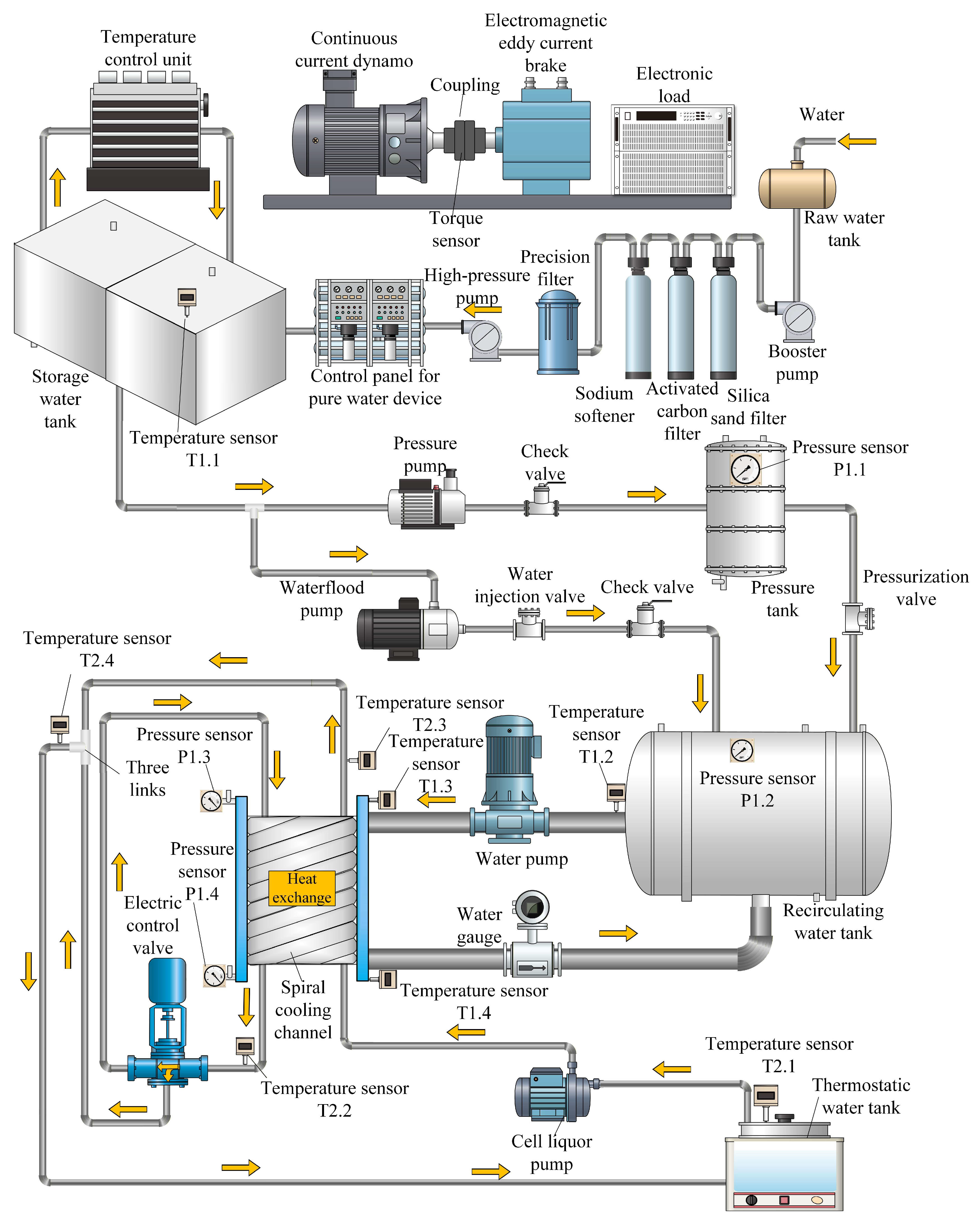
The small high-speed water tunnel serves as the primary platform for simulating discharge conditions of seawater-activated batteries [20,21]. The battery discharge simulation system mainly comprises an external cooling water circulation system and an internal electrolyte circulation system. The internal electrolyte circulation system simulates the discharge process of seawater-activated batteries, while the external cooling water circulation system replicates the scouring and heat dissipation effects of seawater on the battery compartment. Through the external cooling water circulation system, effective heat dissipation from the battery casing is achieved, thereby preventing performance degradation due to excessive temperatures [22]. The schematic diagram of the constructed small high-speed water tunnel is shown in Figure 1. The operational principle involves a constant-temperature water tank heating and circulating the electrolyte, which flows through a centrifugal pump, flow meter, and battery assembly to complete its circulation. As the electrolyte passes through the battery assembly, it enters the seawater-activated battery and initiates the discharge process. Simultaneously, the temperature control unit regulates the cooling water temperature, forming a closed cooling water loop through a water pump, flow meter, and test section to maintain system temperature stability.
Figure 1.
Schematic diagram of a small high-speed water tunnel.
2.3. Structural Design of the Water Tunnel Test Section
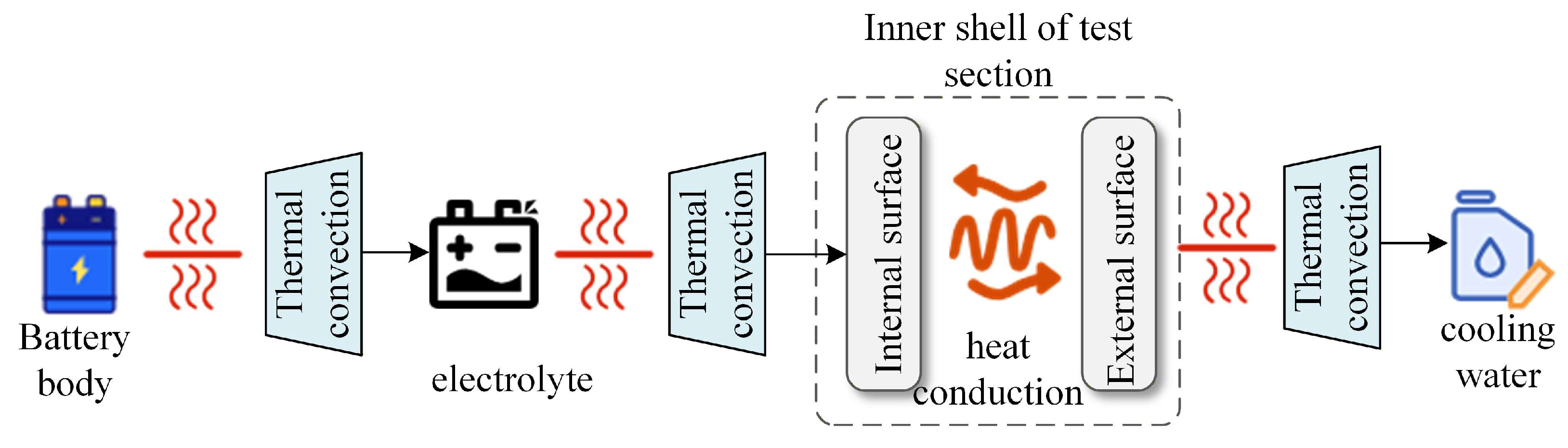
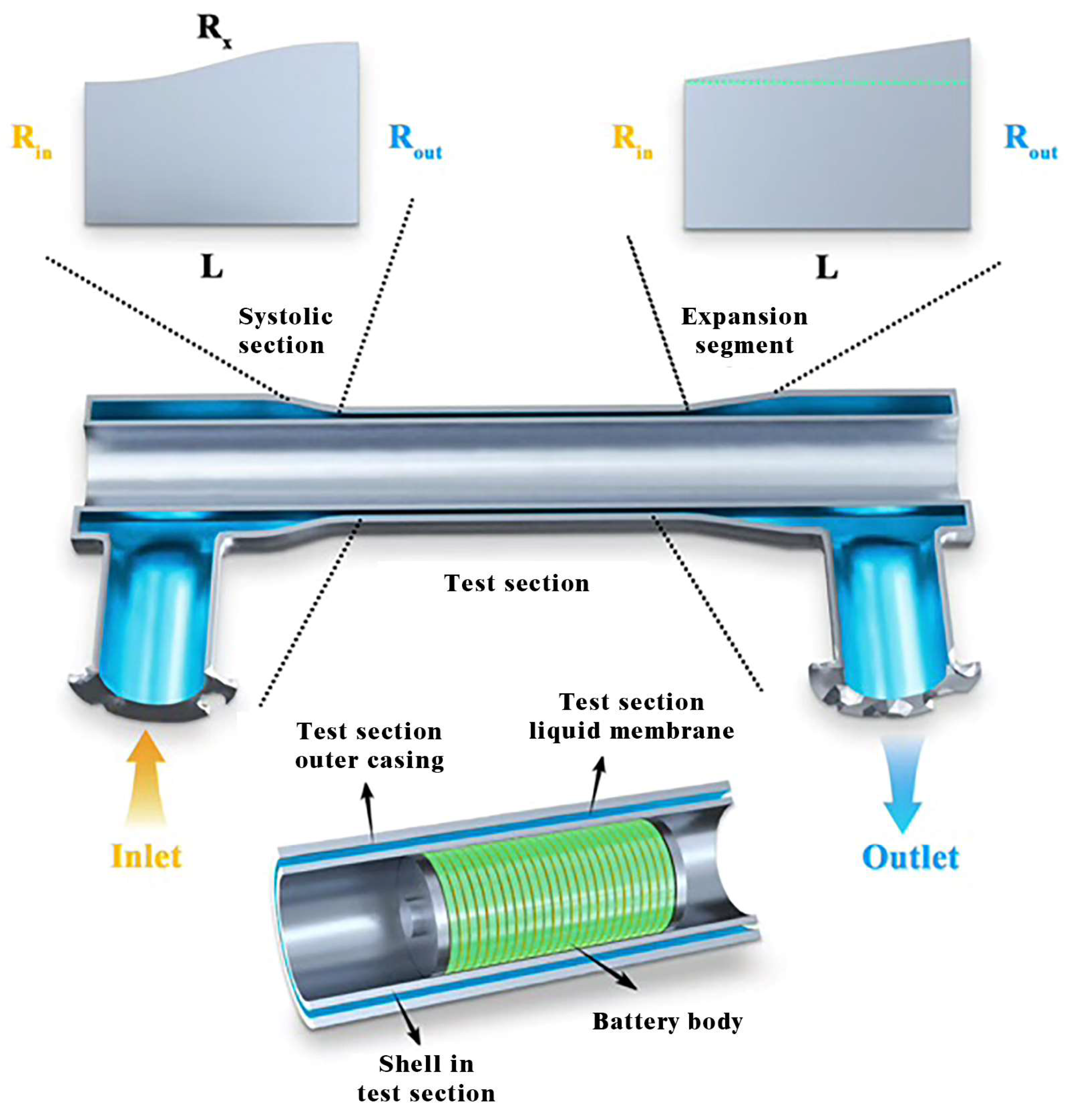
Seawater-activated batteries generate substantial heat during discharge, while the battery assembly is primarily constructed from insulating epoxy material with low thermal conductivity, as shown in Figure 2. During experiments, the heat generated by the battery is transferred to the electrolyte through convective heat transfer. Subsequently, this thermal energy is conveyed through spiral flow channels to the inner surface of the test section’s inner wall, then conducted to the outer surface of the inner wall, and ultimately dissipated to the cooling water via convective heat transfer. The cooling water is further cooled by a temperature control unit. Consequently, the flow characteristics of the cooling water in the water tunnel test section directly determine the battery’s cooling efficiency.
Figure 2.
Heat transfer pathway.
Based on the aforementioned technical specifications, a small high-speed water tunnel test section was designed. The test section model comprises three primary components: a contraction section, a test section, and a diffuser, as illustrated in Figure 3. Stainless steel was employed for the piping material to prevent corrosion-induced water contamination, while 10-mm-thick steel plates were utilized to enhance structural rigidity and mitigate vibration. In the vicinity of the inlets of the Witozinsky and Batchelor–Shaw curves, relatively large low-velocity zones emerge alongside steep pressure gradients, which tend to trigger flow separation. Although the Pennsylvania curve with a quantile point Xm = 0.4 exhibits a relatively small head loss, its flow field quality remains moderate. For the quintic curve, the flow accelerates more gradually near the inlet and more rapidly toward the outlet, resulting in only moderate flow uniformity at the outlet cross-section. However, the pressure gradient near the inlet is relatively mild, and the area of the low-velocity region is limited. Moreover, in terms of flow dissipation, the quintic curve yields the smallest head loss. Therefore, the contraction section in this study adopts a quintic-profile contraction curve with a quantile point Xm = 0.5 [16]. The specific parameters are as follows: length L = 150 mm, inlet radius Rin = 100 mm, outlet radius Rout = 78 mm, contraction ratio C = 1.64, contraction angle θ1 = 16.69°. The longitudinal and transverse components of turbulence intensity variation across the contraction are εm1/εm2 = 0.61 and εv1/εv2 = 0.78, respectively. The specific profile is given by Equation (1). The diffuser adopts a straight-line expansion profile with an inlet radius R’in = 78 mm, outlet radius R’out = 100 mm, length L’ = 150 mm, area ratio of 1:1.64, and a total expansion angle θ2 = 8.34°.
Figure 3.
Calculation model of water tunnel test section.
3. Numerical Simulation Methodology
3.1. Mesh Generation
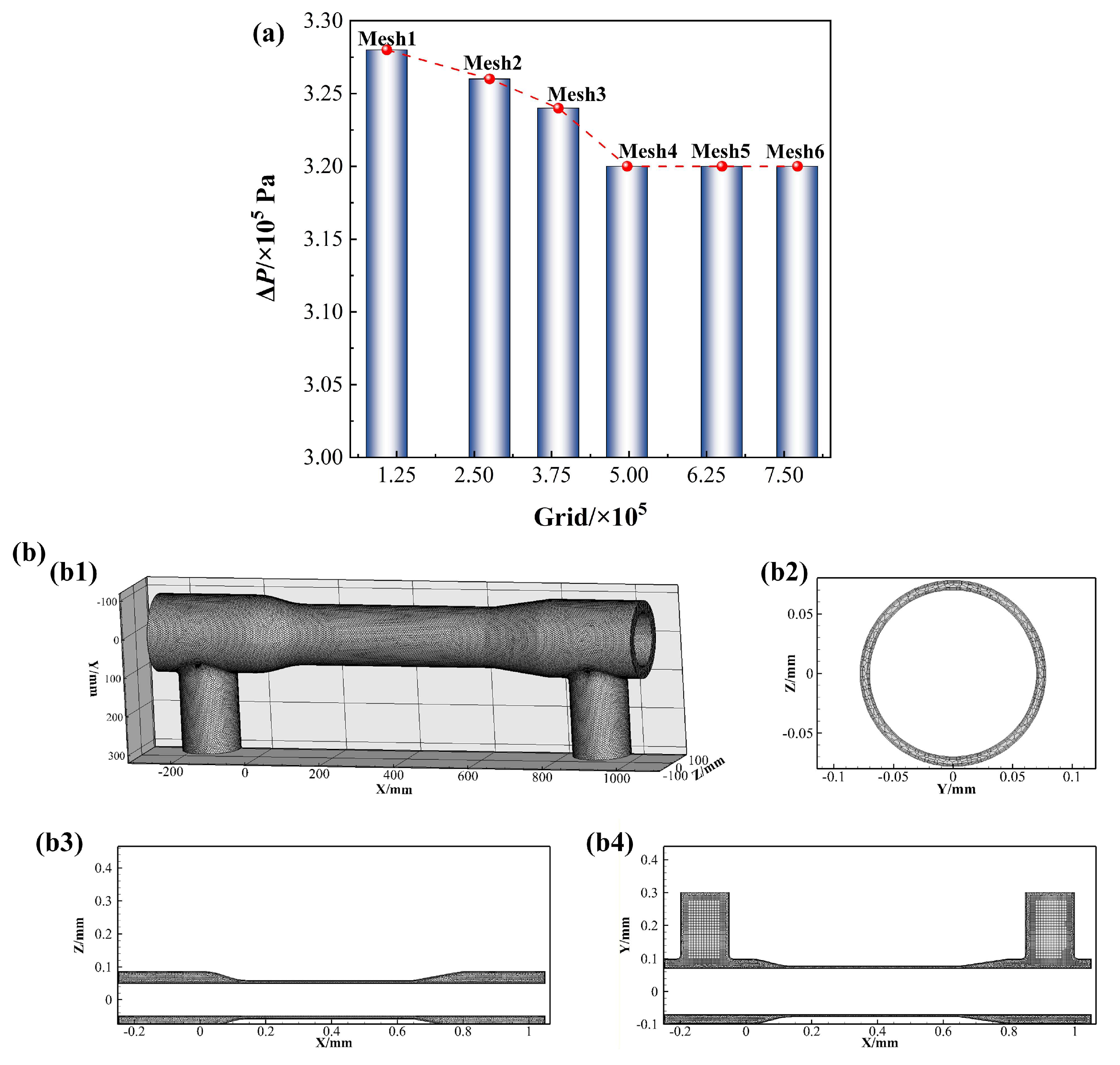
The three-dimensional model was initially developed using SolidWorks software (v2023) and subsequently imported into Ansys Geometry for further processing. During this stage, the fluid domain of the water tunnel test section was extracted to maintain consistency between the computational domain and the actual physical model. Following fluid domain extraction, the meshing phase was conducted. An unstructured mesh scheme was employed for the three-dimensional model to accurately capture flow characteristics within complex geometric regions. Specifically, the surface mesh size was set from 1 mm to 7 mm, and the boundary-layer region was locally refined. A three-layer boundary-layer mesh was configured with a transition ratio of 0.272 and a growth rate of 1.2 to accurately resolve the fluid boundary-layer development. Such boundary-layer meshing is essential for capturing key physical quantities such as shear stress and velocity gradients, especially in regions with high velocity gradients and significant turbulence effects. As shown in Figure 4a, a grid-independence study was carried out for the operating condition with a target flow velocity of 26 m/s and an outlet gauge pressure of 1.0 atm in the test section. As the total mesh count increased progressively from 1.09 × 10⁵ to 7.72 × 10⁵, the pressure drop across the water-tunnel test section first decreased and then stabilized. Beyond Mesh4 (mesh count 4.97 × 10⁵), the computed pressure drop remained essentially constant. Comprehensive analysis indicates that when the mesh count reached 4.97 × 10⁵ (i.e., the Mesh4 configuration), the results satisfied the requirement of grid independence, demonstrating good convergence and reliability of the numerical simulation. To balance computational accuracy and efficiency, Mesh4 was ultimately selected as the grid scheme for all subsequent numerical simulations in this study.
Figure 4.
Grid division status: (a) Grid independence verification. (b) Model Mesh Division Status: (b1) Overall grid; (b2) Cross section at X = 0 mm; (b3) Longitudinal section at Y = 0 mm; (b4) Longitudinal section at Z = 0 mm.
For the volume mesh within the computational domain, the element size ranges from 1 mm to 16 mm, with a polyhedral mesh scheme adopted for the overall discretization. This meshing approach effectively balances mesh quality and computational efficiency, particularly in regions adjacent to complex flow boundaries. Such discretization strategy preserves essential flow field characteristics while maintaining controlled computational resource consumption. The total mesh count in the entire computational domain reaches 4.98 × 10⁵, ensuring both accuracy and stability in the numerical simulations. The mesh generation of the model is presented in Figure 4b.
3.2. Numerical Model
The Reynolds number (Re) of the water tunnel test section is calculated based on the hydraulic diameter using the following formula:
In the formula, Re represents the Reynolds number, is the flow velocity (m/s), is the hydraulic diameter (m), and μ is the dynamic viscosity (Pa·s).
The Reynolds number (Re) was calculated using Equation (2). In engineering applications, the critical Reynolds number (Re) is typically taken as 2300. Since the calculated Re > Rec, the k-ε—turbulence model was selected for numerical simulation. A corresponding numerical model was established based on the CFD software ANSYS FLUENT (v2022 R1), employing the standard k-ε model and the Volume of Fluid (VOF) method for multiphase flow simulation and analysis. A corresponding numerical model was established based on the CFD software ANSYS FLUENT (v2022 R1), utilizing the Volume of Fluid (VOF) method, the Schnerr–Sauer cavitation model, and the standard k-ε turbulence model for multiphase flow simulation and analysis.
The Volume of Fluid (VOF) method was employed to track the gas–liquid interface. In this model, water is treated as the primary fluid phase, while water vapor is treated as the secondary fluid phase. The continuity equations are given as follows:
In the formula, represents the volume fraction of the -th phase, denotes the density, and is the velocity vector.
The volume fractions of all phases must satisfy the following relationship:
The momentum conservation equation, considering interphase interaction, is given by [23]:
In the equation, represents the density, is the velocity vector, denotes pressure, is the viscous stress tensor, and is the volume force.
The Schnerr–Sauer cavitation model establishes a physical relationship between the vapor volume fraction and the bubble radius by defining the bubble number density per unit liquid volume.
The source terms for mass transfer rates during evaporation () and condensation () are respectively expressed as:
In the equations, denotes the mass transfer rate for evaporation, represents the mass transfer rate for condensation, is the vapor density, is the liquid density, stands for the mixture density, indicates the liquid volume fraction, refers to the saturation vapor pressure, corresponds to the local static pressure, and is the pressure difference term. The phase change rate in this model is derived directly from the bubble dynamics equation without relying on empirical phase change coefficients, which significantly reduces parametric uncertainty. In the present study, the bubble number density is set to m−3 based on typical calibration data for pure water. Furthermore, the model assumes a uniform and constant cavitation nucleus density and does not account for bubble coalescence, breakup, or thermodynamic effects. These assumptions are considered reasonable for the isothermal hydrodynamic cavitation conditions investigated in this work.
In the standard k-ε turbulence model, the turbulent kinetic energy (k) and turbulent dissipation rate (ε) are governed by the following transport equations [24]:
In the formula, represents the turbulent viscosity, and , , , and are the constants of the standard k-ε turbulence model. The specific values of these constants are as follows: , , , , and . The selection of this model is based on its demonstrated computational robustness, convergence efficiency, and extensive validation in engineering turbulence simulations, particularly for predicting high-Reynolds-number fully developed turbulent flows and macroscopic cavitation structures, which are the focus of the present study. It should be noted, however, that this model relies on the isotropic eddy viscosity assumption, which introduces inherent limitations when simulating strongly sheared, highly curved, and anisotropic flows induced by cavitation collapse. Nevertheless, its capability to capture key macroscopic cavitation characteristics has been widely confirmed in numerous studies.
3.3. Boundary Conditions
Based on the aforementioned model, the following boundary conditions were applied in the simulation:
- (1)
- Multiphase flow settings: the implicit discretization scheme was selected. Phase-1 was defined as the coolant (water), while Phase-2 was defined as water vapor. Mass transfer between the two phases was modeled using a cavitation model. The physical parameters of each phase are listed in Table 1.
Table 1. Material parameters.
- (2)
- Inlet and outlet boundary conditions: to accurately investigate the flow characteristics and pressure loss in the water tunnel test section, the inlet boundary condition for the cooling water was set as velocity-inlet with a flow velocity of 5.47 m/s, while the outlet boundary condition was set as pressure-outlet.
- (3)
- Turbulence model settings: considering the strong turbulent characteristics and complex velocity gradients in high-speed water tunnel flows, the SIMPLE scheme was selected for pressure-velocity coupling to ensure accuracy in pressure loss calculations. Second-order upwind discretization schemes were applied for pressure, momentum, and energy equations, as well as for turbulent kinetic energy and turbulent dissipation rate. All relaxation factors were maintained at the default values in Fluent.
- (4)
- Convergence criteria: to ensure simulation accuracy given the energy losses arising from fluid friction, turbulent dissipation, and local flow acceleration in high-speed conditions, the residual convergence criterion was set to 10−3.
3.4. Performance Metrics
To evaluate the effects of different outlet gauge pressures on the flow characteristics in the water tunnel test section and the resultant battery cooling performance, this study defines the following key performance metrics, with detailed explanations provided for pressure loss, flow velocity non-uniformity, energy loss, and power pump performance estimation. Through quantitative analysis of these metrics, a comprehensive understanding of the specific impacts of outlet pressure variations on test section performance and cooling effectiveness can be achieved.
- (1)
- Pressure Loss
Pressure loss, , refers to the pressure drop in a fluid flow resulting from energy dissipation. In fluid dynamics research, pressure loss serves as a key parameter for evaluating system flow resistance and is commonly used to assess the impact of flow resistance on energy dissipation. The calculation formula is given as follows [25]:
In the equation, and represent the total pressure (Pa) at the inlet and outlet, respectively.
- (2)
- Cavitation Number
The cavitation number is a key dimensionless parameter used to predict and evaluate the onset of cavitation phenomena in fluid flows. The general expression for its calculation is given by:
In the equation, denotes the cavitation number, represents the local static pressure of the fluid (Pa), corresponds to the saturated vapor pressure of the fluid at 25 °C (Pa), is the fluid density (kg/m3), indicates the freestream velocity (m/s).
- (3)
- Adverse Pressure Gradient
An adverse pressure gradient refers to a condition where the fluid pressure increases along the flow direction. It is characterized by the following mathematical expression:
In the equation, is the static pressure (Pa), is the coordinate along the flow direction, is the derivative of the pressure with respect to the streamwise direction.
- (4)
- Flow Non-Uniformity
To assess the cross-sectional velocity uniformity and its impact on battery thermal management, two velocity non-uniformity parameters, and , are introduced. is sensitive to velocity extremes, enabling the identification of localized strong disturbances, while , defined based on statistical standard deviation, characterizes the overall uniformity of the velocity distribution across the entire cross-section. The corresponding formulas are provided as follows [26]:
In the equation, and represent the maximum and minimum velocities within the flow core region, respectively; is the local velocity at each sampling point; is the average velocity across the cross-section; and denotes the total number of sampling points.
- (5)
- Resistance Coefficient
To investigate the influence of the flow state in the test section under different outlet gauge pressures on the resistance coefficient, this study introduces the resistance coefficient () as an evaluation metric. The resistance coefficient is derived from the Bernoulli equation and flow resistance theory, quantifying the relationship between pressure drop and flow velocity to assess the resistance level under varying operating conditions. The calculation formula is as follows:
In the equation, represents the pressure difference (Pa), denotes the fluid density (kg/m3), indicates the freestream velocity (m/s).
- (6)
- Energy Loss
To investigate the energy loss of fluids within the test section of the water tunnel and its impact on the cooling performance of the seawater-activated battery body, this study uses the water head loss () as an evaluation index. Water head loss is defined as the average energy loss of a unit of gravitational fluid, and its calculation is based on the Bernoulli equation [27]:
In the formula, represents the pressure difference (Pa), denotes the fluid density (kg/m3), and is the gravitational acceleration (m/s2).
The corresponding formula for calculating power loss is as follows:
In the formula, represents the volumetric flow rate per unit time (m3/s).
- (7)
- Flow Cross-Sectional Area
To provide the key geometric parameter for subsequent flow velocity calculations, the flow cross-sectional area in the test section is calculated according to the following formula:
In the formula, is the outer diameter of the test section (mm), is the inner diameter of the test section (mm).
- (8)
- Volumetric Flow Rate in the Test Section
To subsequently calculate the core mean flow velocity in the test section, the relevant volumetric flow rate formula is given as follows:
In the equation, denotes the flow velocity (m/s), and represents the cross-sectional flow area (mm2).
- (9)
- Heat Dissipation Power
To calculate the corresponding heat dissipation power under different operating conditions, the relevant formula is expressed as follows:
In the equation, is the specific heat capacity of the electrolyte in J/(kg·°C), represents the mass flow rate of the electrolyte in kg/s, and denotes the temperature difference between the inlet and outlet in °C. The specific heat capacity of the electrolyte is taken as J/(kg·°C) and its density is 1250.0 kg/m3.
4. Results and Discussion
4.1. Effect of Outlet Gauge Pressure
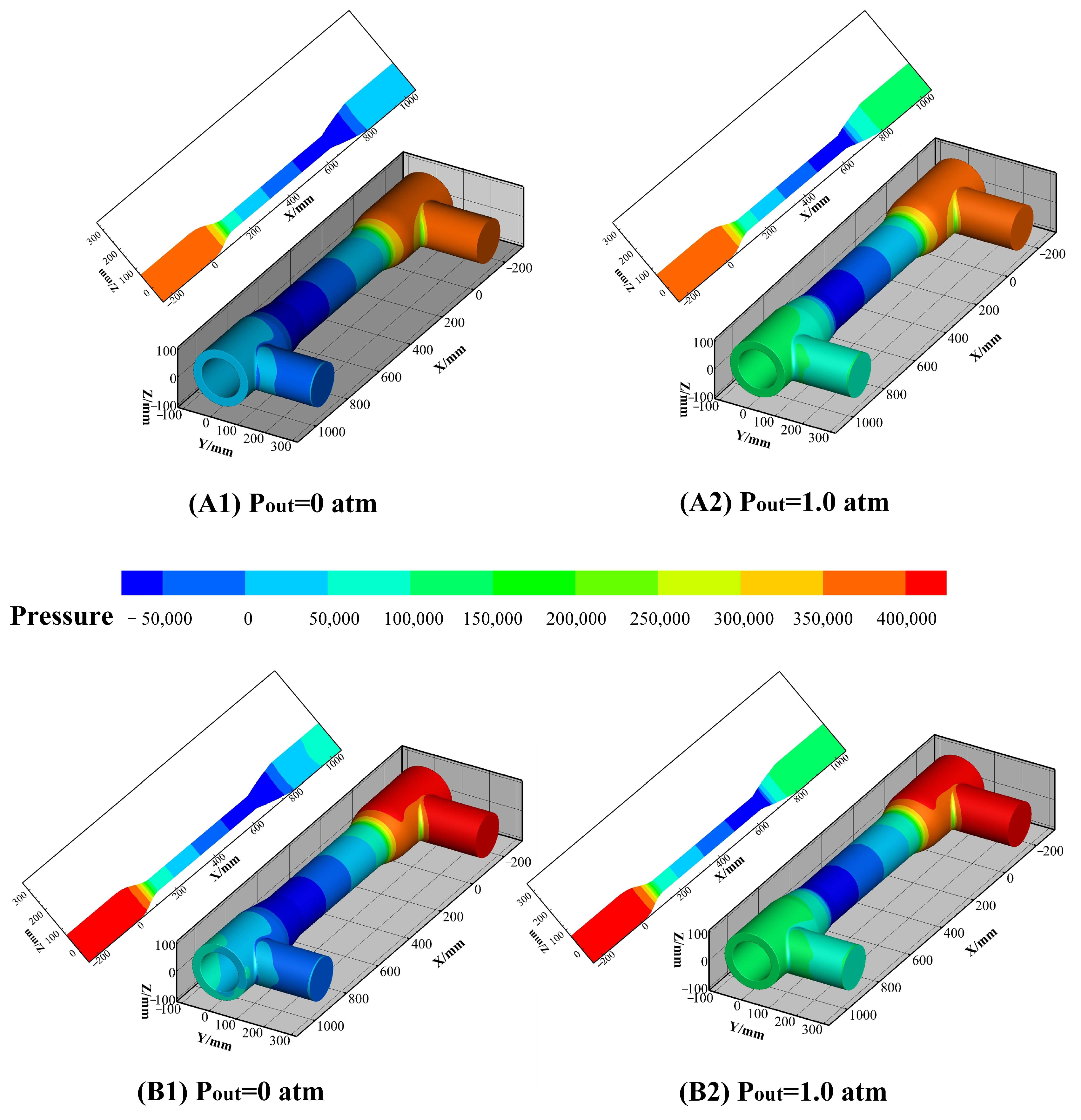
To further investigate the effect of outlet gauge pressure on improving the flow-field quality within the water tunnel test section, a systematic numerical simulation analysis was conducted for operating conditions with target flow velocities of 25 m/s and 26 m/s in the test section, and outlet gauge pressures of 0 atm and 1.0 atm, respectively. The results show that the flow-field characteristics in the test section are significantly enhanced as both flow velocity and outlet gauge pressure increase. Figure 5 visually presents the pressure distributions under the four aforementioned operating conditions. Figure 5(A1,A2) correspond to pressure contour plots at a target flow velocity of 25 m/s with outlet gauge pressures of 0 atm and 1.0 atm, respectively, while Figure 5(B1,B2) correspond to pressure contour plots at a target flow velocity of 26 m/s with outlet gauge pressures of 0 atm and 1.0 atm, respectively.
Figure 5.
Pressure distributions under different flow velocities at outlet gauge pressures of 0 atm and 1.0 atm. (A1,A2) are pressure contour plots for a target flow velocity of 25 m/s in the test section at outlet gauge pressures of 0 atm and 1.0 atm, respectively; (B1,B2) are pressure contour plots for a target flow velocity of 26 m/s in the test section at outlet gauge pressures of 0 atm and 1.0 atm, respectively.
Figure 5 clearly illustrates the regulatory mechanism of outlet gauge pressure on the flow structure. When the outlet gauge pressure is 0 atm, a persistent low-pressure region appears in the central section of the test segment (Figure 5(A1)), indicating that the local static pressure has fallen below the saturation vapor pressure of water, thereby initiating cavitation. The high-frequency pressure pulsations generated by cavitation bubble collapse not only disrupt flow stability but also intensify energy dissipation through vigorous phase-change energy exchange. The steep pressure gradient observed in the Y-section confirms the occurrence of boundary layer separation induced by a strong adverse pressure gradient, which triggers intense three-dimensional secondary flows and vortex structures, significantly increasing turbulence intensity and energy loss. In contrast, under the condition of an outlet gauge pressure of 1.0 atm (Figure 5(A2)), the elevation of system pressure effectively suppresses cavitation inception. The more uniform pressure distribution in the Y-section demonstrates that the increased static pressure potential inhibits boundary layer separation, attenuates the generation of transverse secondary flows and vortex structures, promotes a more two-dimensional flow pattern, and enhances momentum transport efficiency in the primary flow direction. At a target flow velocity of 26 m/s, the pressure distribution exhibits a similar trend: under an outlet gauge pressure of 0 atm, the low-pressure zone expands, intensifying cavitation (Figure 5(B1)), whereas under an outlet gauge pressure of 1.0 atm, the pressure distribution becomes more uniform, cavitation is suppressed, and the flow becomes more stable (Figure 5(B2)). The comparison indicates that lower flow velocities (25 m/s) exacerbate cavitation development under low-pressure conditions. Consequently, a target flow velocity of 26 m/s is adopted for all subsequent studies in the test segment.
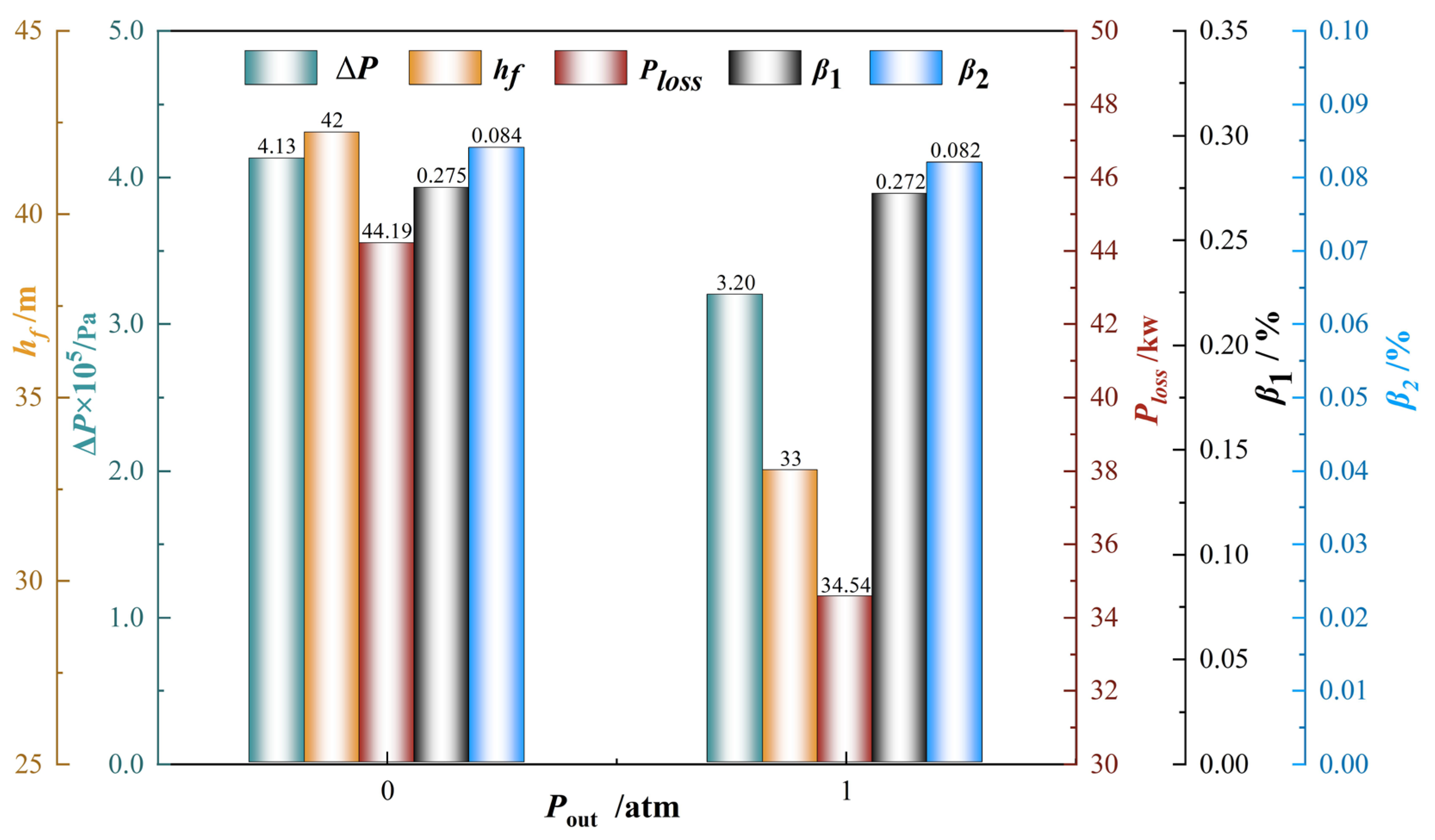
Figure 6 quantitatively demonstrates the crucial regulatory effect of outlet gauge pressure on the flow quality in the water tunnel test section. When the outlet gauge pressure increases from 0 atm to 1.0 atm, the pressure loss, head loss, and power loss are all reduced by approximately 24.20%. This improvement stems from the dual suppression of cavitation and turbulence structures by the outlet gauge pressure. Under zero outlet pressure conditions, localized low pressure induces cavitation, where bubble collapse generates intense pressure fluctuations and energy dissipation. Simultaneously, strong adverse pressure gradients cause boundary layer separation, forming large-scale turbulent structures that further exacerbate energy losses. With applied outlet pressure, the elevated system static pressure moves the flow field away from cavitation inception conditions and effectively suppresses flow separation, promoting a shift of the turbulent energy spectrum toward smaller scales, thereby reducing turbulent dissipation. The reduction in flow non-uniformity parameters and further confirms enhanced flow stability. By attenuating transverse pressure gradients, the outlet pressure effectively suppresses momentum transport dominated by secondary flows and unsteady vortex structures, promoting a more two-dimensional flow pattern. Although the absolute decreases in and are relatively small, their systematic reduction signifies a transition of the flow field from a high-dissipation, three-dimensional, unsteady structure to an ordered state with lower dissipation, reflecting the profound regulatory role of outlet pressure in turbulent kinetic energy redistribution and flow structure optimization.
Figure 6.
Comparative evaluation indicators for water tunnel experimental sections with outlet gauge pressures of 0, 1.0 atm.
In summary, elevating the outlet gauge pressure from 0 atm to 1.0 atm not only significantly improves the pressure distribution within the test section and effectively suppresses cavitation occurrence, but also fundamentally maintains the flow field above the cavitation inception threshold by raising the system’s static pressure level, thereby mitigating energy dissipation caused by bubble collapse. Thus, appropriately increasing the outlet gauge pressure represents an effective strategy for optimizing flow quality and controlling energy loss in water tunnel test sections.
4.2. Pressure Loss in the Test Section
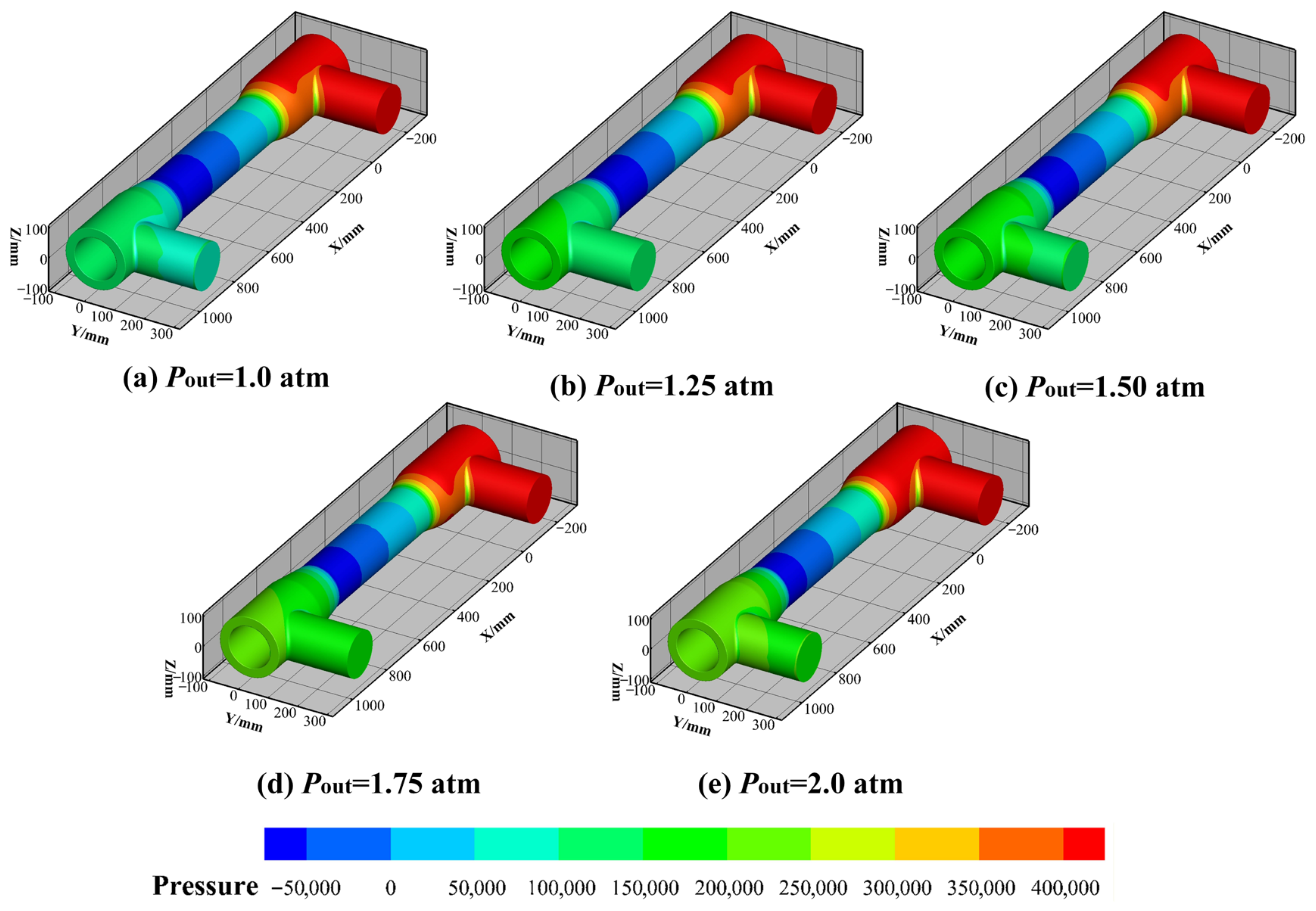
To investigate the relationship between outlet gauge pressure and pressure loss, Figure 7 illustrates how outlet pressure systematically modulates the flow structure in the water tunnel test section, with pressure elevation directly altering the system’s pressure energy distribution. At 1.0 atm (Figure 7a), the extensive negative pressure zone in the central test section indicates local static pressure has fallen below the saturated vapor pressure of water, satisfying cavitation inception conditions. Under this scenario, intense cavitation leads to vapor bubbles being transported with the flow and collapsing in high-pressure regions, generating high-frequency pressure pulsations and shock waves that not only cause significant energy dissipation but also markedly reduce flow stability by exciting large-scale turbulent structures. As the pressure increases to 1.25~1.50 atm (Figure 7b,c), the elevation of the system’s overall static pressure moves the minimum pressure further from the saturation vapor pressure, substantially reducing both the extent and intensity of cavitation zones. This demonstrates that increased outlet pressure enhances the fluid’s potential energy reserve, strengthening its resistance to pressure drops induced by local flow acceleration. At a gauge pressure of 1.75 atm (Figure 7d), the negative pressure zone is further reduced with a more uniform pressure distribution, demonstrating that the elevated outlet pressure effectively suppresses boundary layer separation induced by adverse pressure gradients while attenuating the generation of secondary flows and unsteady vortex structures. Under the 2.0 atm condition (Figure 7e), the test section maintains a fully positive pressure distribution. The gentle pressure gradient ensures stable boundary layer attachment, achieving optimal stability in the flow configuration.
Figure 7.
Pressure contour map under different outlet gauge pressure conditions: (a–e) represent pressure distribution contour maps for outlet gauge pressures ranging from 1.0 to 2.0 atm.
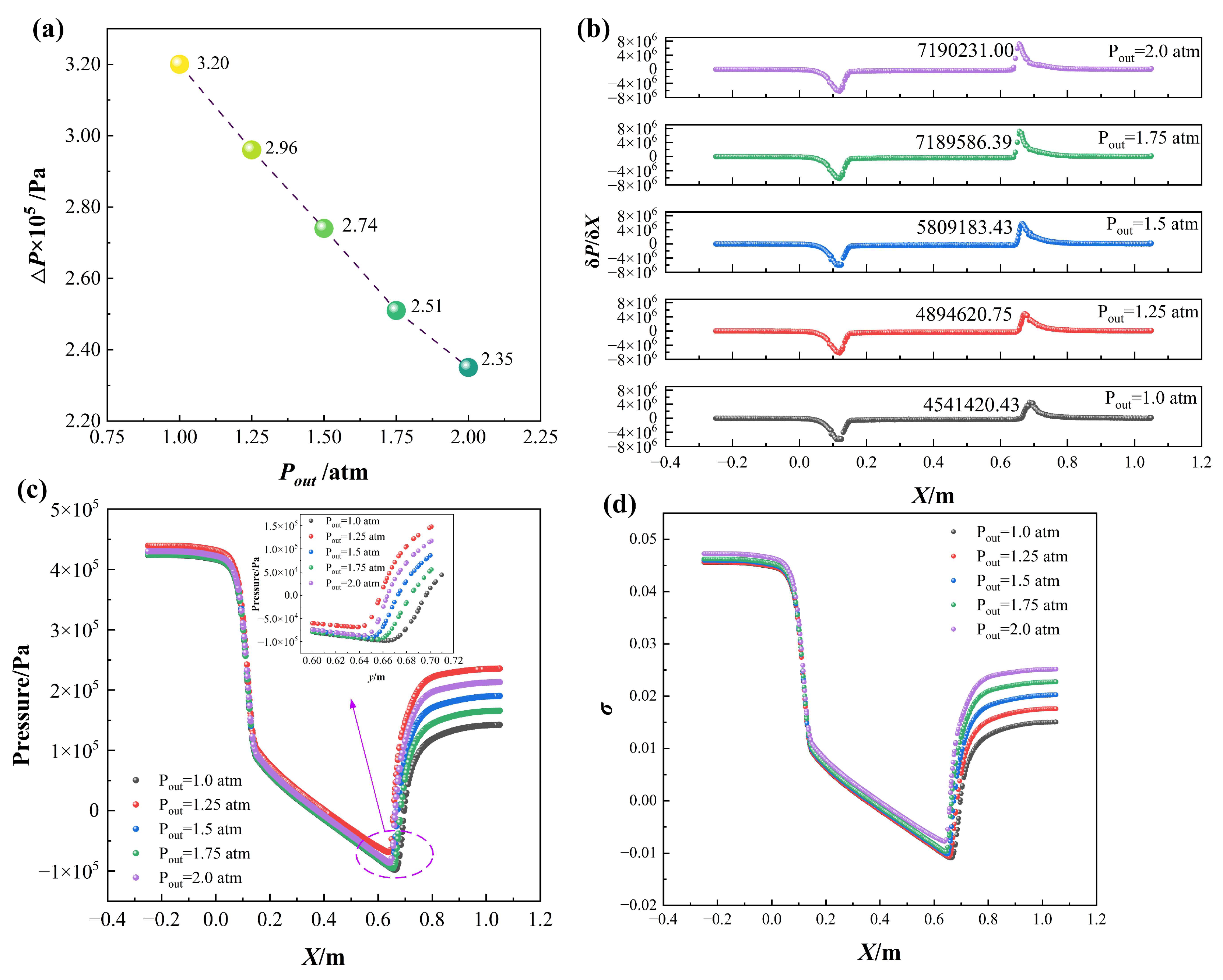
Figure 8 further elucidates the regulatory mechanism of outlet gauge pressure on flow field characteristics through multi-parameter correlation analysis. As shown in the pressure loss curve in Figure 8a, as the outlet gauge pressure increases from 1.0 atm to 2.0 atm, the total pressure loss decreases from 3.20 × 10⁵ Pa to 2.35 × 10⁵ Pa. A distinct inflection point occurs at 1.75 atm, which corresponds to the effective suppression of cavitation, with the time-averaged cavitation zone in the flow field essentially disappearing. At this stage, the flow medium reverts to a homogeneous single-phase liquid, and the dominant source of flow resistance shifts from “liquid-phase turbulent dissipation plus additional two-phase dissipation due to cavitation” to pure “single-phase turbulent dissipation.” This fundamental transition in flow regime manifests macroscopically as an abrupt change in the slope of the pressure drop curve. In the 1.0~1.75 atm range, the pressure loss decreases rapidly at a rate of 9.20 × 10⁴ Pa/atm, primarily attributed to the effective suppression of cavitation by elevated outlet pressure. When the pressure exceeds 1.75 atm, the reduction rate declines to 6.40 × 10⁴ Pa/atm, indicating that cavitation is essentially eliminated. The adverse pressure gradient distribution in Figure 8b reveals the complex influence of outlet pressure on flow separation: while the adverse pressure gradient remains stable in the test section, its peak value in the diffuser outlet region increases by approximately 58% with rising pressure, reflecting an enhanced pressure recovery process to meet higher pressure boundary conditions. The static pressure distribution in Figure 8c demonstrates that elevated outlet pressure systematically increases the static pressure level throughout the entire flow field while significantly reducing the inlet-outlet pressure differential, fundamentally improving flow stability. The cavitation number distribution in Figure 8d provides direct evidence for this phenomenon, showing a marked increase in cavitation number within the test section as outlet pressure rises. This indicates enhanced fluid resistance to cavitation, enabling transition from a complex two-phase flow regime to a stable single-phase flow state and substantially reducing energy losses associated with phase change.
Figure 8.
Pressure Loss under Different Outlet Gauge Pressures: (a) Pressure drop; (b) Adverse pressure gradient; (c) Static pressure distribution along the X-axis; (d) Cavitation number along the X-axis.
These results indicate that with continuous increase in outlet gauge pressure, the improvement in pressure loss demonstrates notable nonlinear attenuation characteristics. When the system pressure level rises sufficiently to effectively suppress cavitation (approximately above 1.75 atm), the energy dissipation mechanism transitions from being cavitation-dominated to viscous dissipation-dominated, consequently causing the marginal benefit of further pressure increase to diminish progressively.
4.3. Velocity Distribution in the Test Section
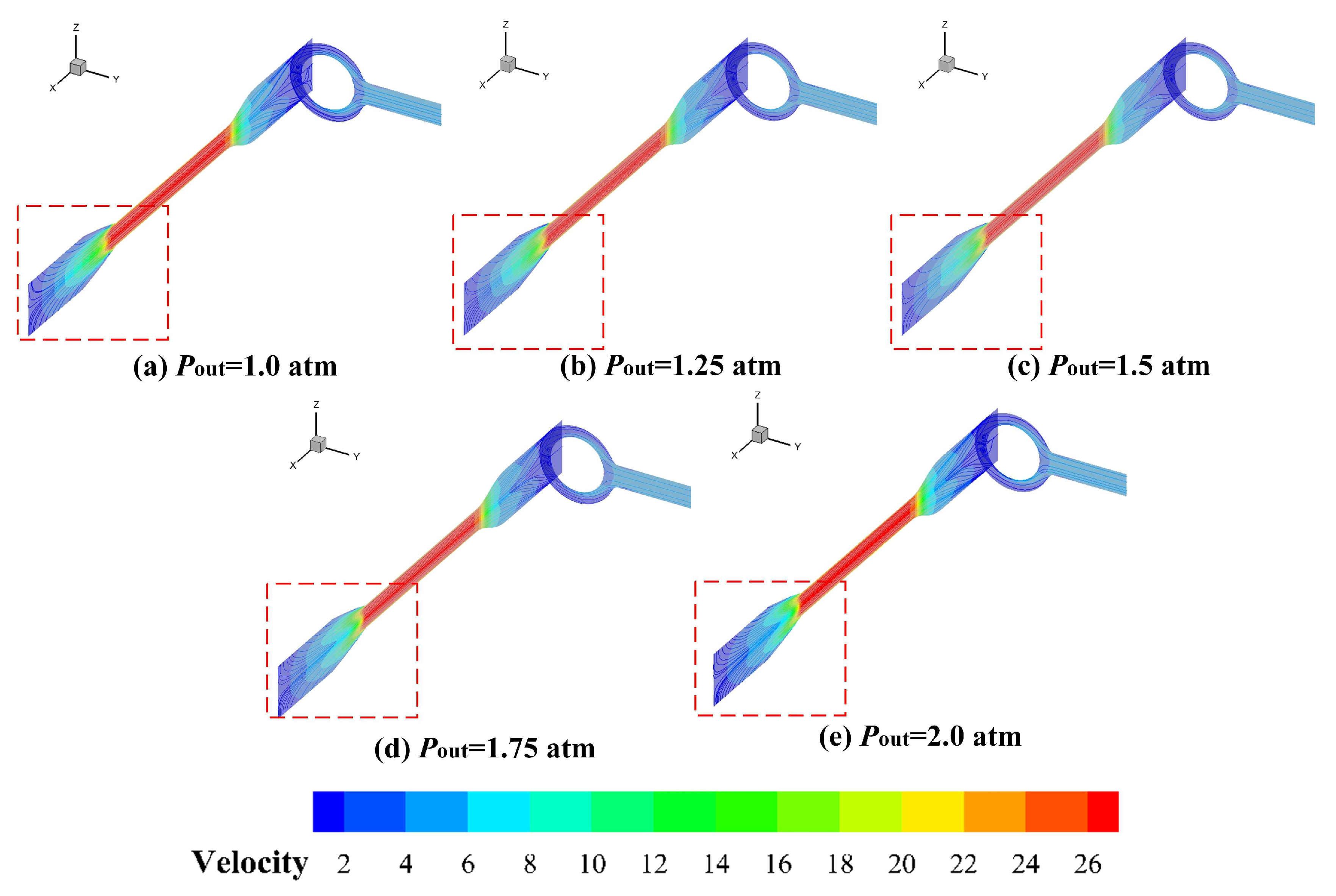
To evaluate the velocity distribution in the test section, Figure 9 presents velocity contours under different outlet gauge pressure conditions, where Figure 9a–e display the velocity distribution on Y-direction cross-sections at outlet pressures ranging from 1.0 to 2.0 atm. Analysis reveals that the flow velocity distribution progressively becomes more uniform with increasing outlet pressure, satisfying the design requirements. At 1.0 atm outlet pressure, the velocity contour demonstrates significant flow stratification in the test section, with a strong contrast between the high-velocity core region (22~26 m/s) and the low-velocity zones near the inlet and outlet. This non-uniform distribution originates from cavitation induced by local low-pressure conditions, where bubble collapse disrupts boundary layer stability and enhances turbulent mixing. Particularly in the diffuser section, the observed low-velocity zones indicate typical flow separation phenomena resulting from the combined effects of inherent adverse pressure gradients and cavitation-induced disturbances. When the pressure increases to 1.25~1.50 atm, the elevated static pressure potential effectively suppresses cavitation development and significantly improves boundary layer stability. The flow separation region in the diffuser section substantially reduces, and the velocity distribution becomes more uniform, demonstrating that enhanced outlet pressure attenuates transverse pressure gradients and suppresses secondary flow intensity. Under 1.75~2.0 atm conditions, the velocity distribution in the diffuser section shows further optimization, indicating that the outlet pressure becomes sufficient to overcome adverse pressure gradient effects and maintain stable boundary layer attachment. The improved velocity distribution in the diffuser section under enhanced outlet pressure conditions promotes energy recovery efficiency, while the stable high-velocity region (21.68~28.20 m/s) in the central test section significantly enhances cooling performance by increasing the convective heat transfer coefficient.
Figure 9.
Velocity contour plots under different outlet gauge pressure conditions: (a–e) represent velocity distribution contour plots for the Y-direction cross-section at an outlet gauge pressure of 1.0 to 2.0 atm.
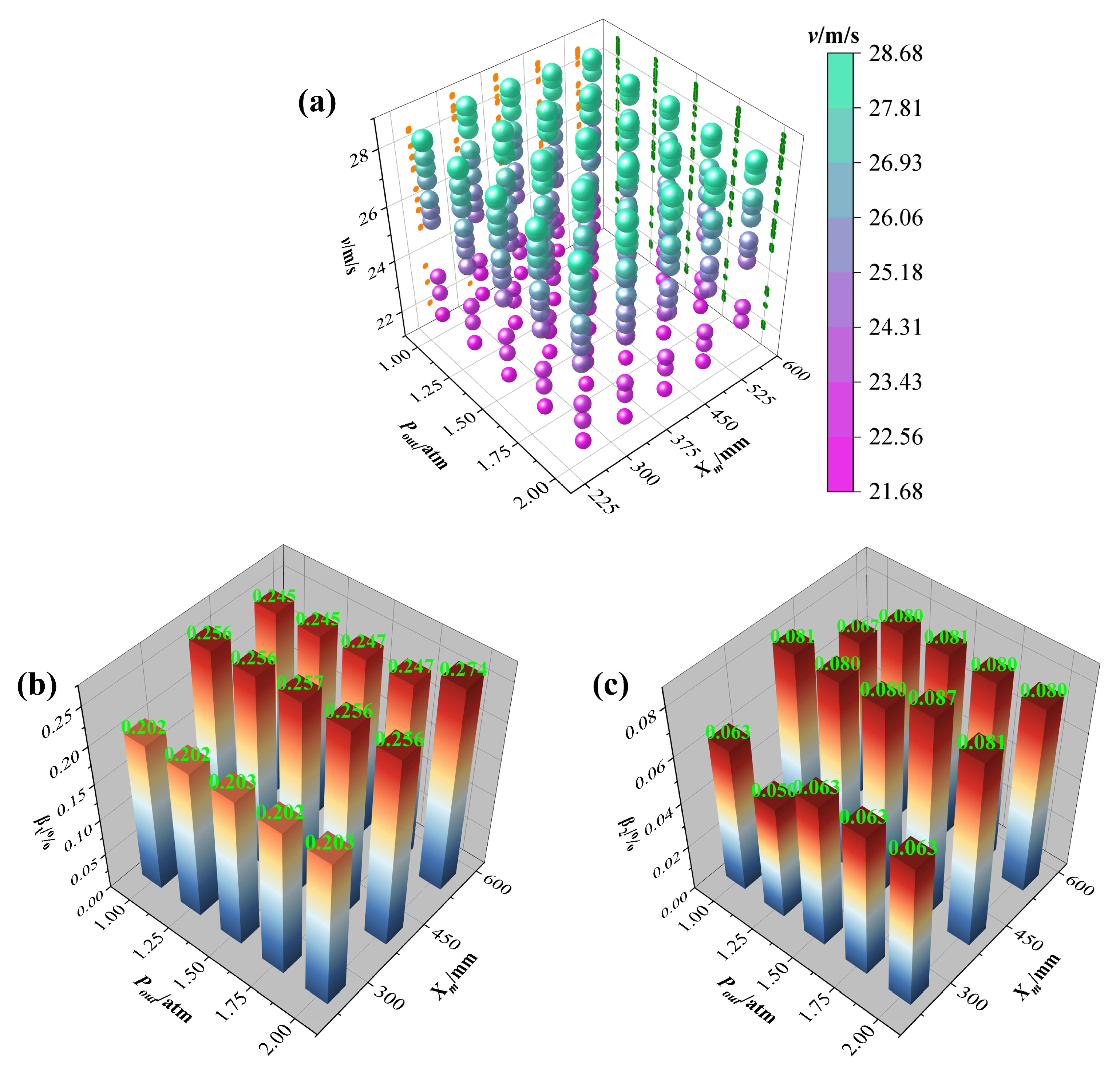
Figure 10 presents the flow velocity distribution under different outlet gauge pressures. The velocity distribution in Figure 10a demonstrates that all cross-sections of the test section satisfy the design requirement of ≥25 m/s, with high-speed zones accounting for over 75% of the area and reaching a peak at X = 400 mm. This spatial pattern is directly related to the development mechanism of the turbulent boundary layer: as the flow progresses downstream, the boundary layer undergoes a transition from laminar to turbulent flow, reaching a fully developed turbulent state in the central portion of the test section. At this stage, the boundary layer thickness is minimized, velocity gradients are reduced to their lowest levels, and the flow structure achieves optimal conditions, significantly enhancing heat transfer efficiency through increased wall shear stress. Figure 10b,c show the flow non-uniformity parameters and in the test section, calculated using Equation (14) for cross-sections at X = 250 mm, 400 mm, and 550 mm under different outlet gauge pressures. As seen in Figure 10b, the values of primarily range between 0.202 and 0.256 across various operating conditions, remaining relatively high overall. In contrast, the values of in Figure 10c range from 0.060 to 0.081, significantly lower than . is sensitive to velocity extremes and primarily reflects localized flow separation and cavitation disturbances, while defined based on the root mean square, provides a more comprehensive characterization of the overall uniformity across the cross-section. A systematic reduction in both parameters with increasing outlet gauge pressure indicates that elevated pressure effectively suppresses cavitation and restrains the development of secondary flows by mitigating transverse pressure gradients. In the test section, both and remain below 1%, demonstrating favorable flow uniformity that contributes to improved battery cooling performance. From the perspective of comprehensive engineering benefits, the flow homogenization approach proposed in this study achieves significant thermal management enhancements at the expense of a certain level of energy consumption. Under an outlet static pressure of 2.0 atm, the flow-guiding structure introduces an additional pressure drop of approximately 2.35 × 10⁵ Pa, corresponding to an extra fluid power requirement of about 141 kW at a flow rate of 0.6 m3/s. This energy expenditure yields two key advantages: first, it improves temperature uniformity within the battery module and reduces the maximum temperature. According to Arrhenius kinetics, each 10 °C decrease in operating temperature can delay the aging rate by approximately 50%, thereby extending battery lifespan. Second, the more uniform temperature distribution suppresses local hot spots, enhances the system’s thermal safety margin, and mitigates the risk of thermal runaway.
Figure 10.
Flow velocity distribution under different outlet gauge pressures: (a) Flow velocity distribution across cross-sections at different outlet gauge pressures; (b) Flow velocity non-uniformity β1 in the test section; (c) Flow velocity non-uniformity β2 in the test section.
4.4. Turbulence Characteristics and Energy Loss
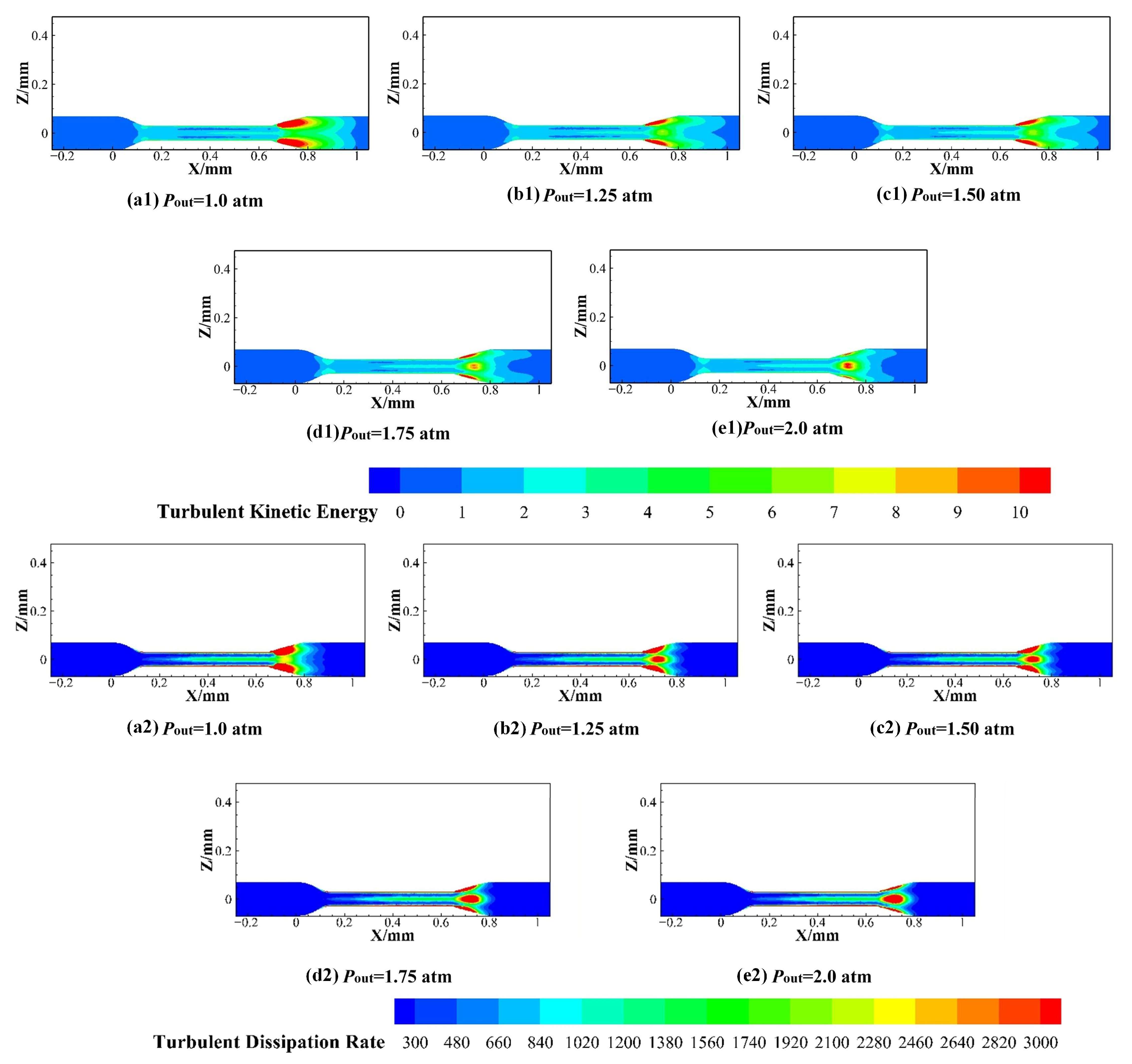
To evaluate the turbulence characteristics within the test section under different outlet gauge pressures, Figure 11 presents the distribution of turbulence parameters, where Figure 11(a1–e1) show the turbulent kinetic energy distribution and Figure 11(a2–e2) display the turbulence intensity distribution. At an outlet pressure of 1.0 atm, the high turbulent kinetic energy region observed in the diffuser section is directly associated with intense cavitation. The high-frequency pressure fluctuations generated during bubble collapse significantly enhance turbulence production, while the shear layer formed by flow separation provides the necessary conditions for the development of large-scale turbulent structures. The corresponding turbulent dissipation rate distribution indicates concentrated energy dissipation primarily in the diffuser section, reflecting cavitation-dominated turbulence characteristics. When the outlet pressure increases to 1.25~1.50 atm, the elevated pressure suppresses cavitation, thereby reducing the excitation of turbulence by pressure fluctuations. Simultaneously, the enhanced pressure conditions promote boundary layer stabilization and weaken shear layer instability, effectively inhibiting the formation of large-scale turbulent structures. Under outlet pressures of 1.75~2.0 atm, both turbulent kinetic energy and dissipation rate decrease to their minimum levels, indicating the achievement of a highly ordered flow state. The elevated static pressure environment promotes a shift of the turbulent energy spectrum toward smaller scales while enhancing the dominance of viscous dissipation. The uniform distribution of turbulent dissipation rate further confirms the optimization of energy dissipation processes, demonstrating a transition from intermittent bursting to a sustained equilibrium dissipation state. This systematic improvement in turbulence characteristics not only reduces energy losses but also significantly enhances heat transfer efficiency by stabilizing the thermal boundary layer.
Figure 11.
Distribution of Turbulent Characteristics under Different Outlet Gauge Pressures: (a1–e1) Turbulent kinetic energy distribution; (a2–e2) Turbulent dissipation rate distribution.
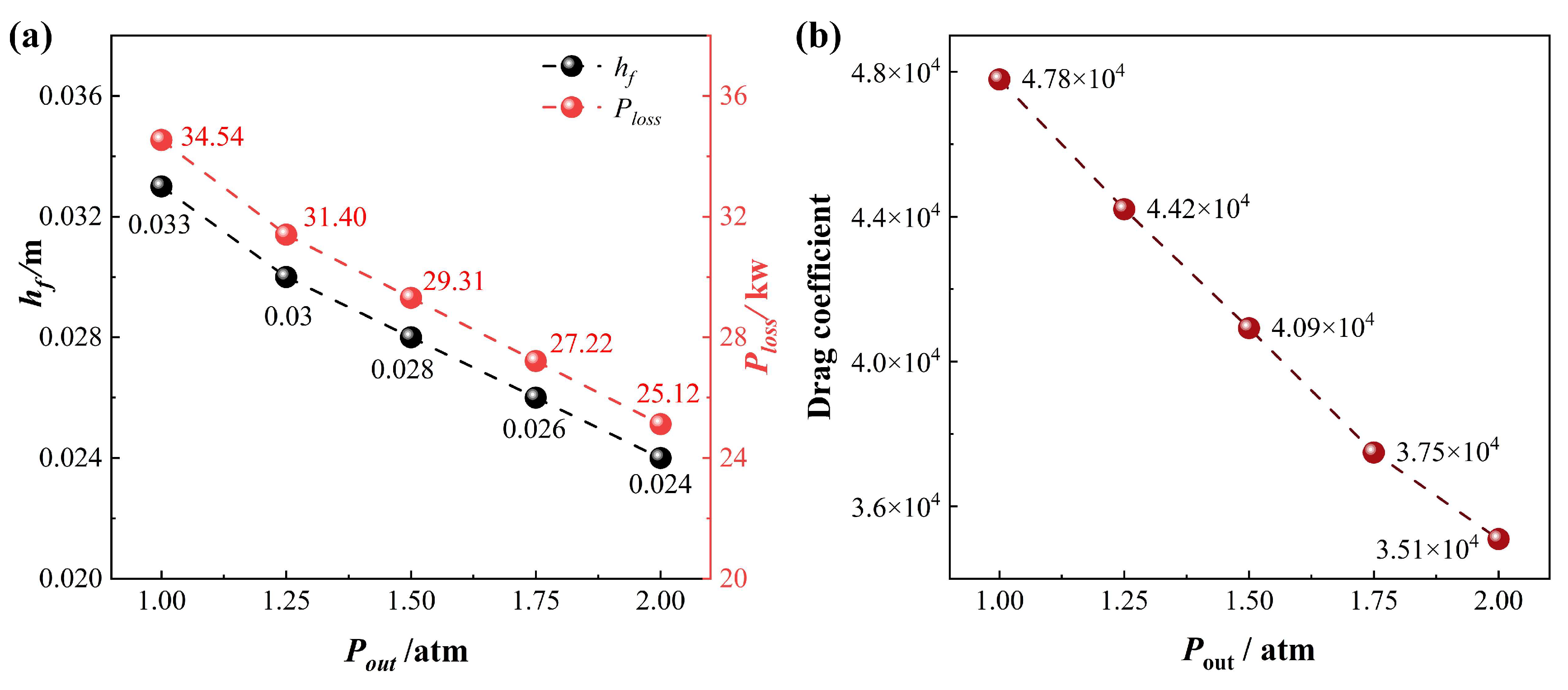
To evaluate the energy consumption in the test section under different outlet gauge pressures, the drag coefficient, energy loss , and corresponding power loss of the water tunnel test section were calculated using Equations (15)–(17), respectively. As shown in Figure 12, when the outlet gauge pressure increases from 1.0 atm to 2.0 atm, the drag coefficient decreases significantly from 4.78 × 10⁴ to 3.51 × 10⁴, while the head loss and power loss both drop by 27.30%. The continuous reduction in the drag coefficient primarily stems from the dual inhibitory effects of outlet pressure on both cavitation and turbulence characteristics. At an outlet pressure of 1.0 atm, intense cavitation not only exacerbates flow separation but also significantly enhances turbulence intensity through high-frequency pressure fluctuations generated by bubble collapse, while the formation of large-scale vortex structures increases pressure drag. When the outlet pressure rises to 1.25~1.50 atm, the elevated static pressure level moves the flow field away from the cavitation inception threshold, effectively suppressing bubble formation and thereby reducing the additional drag component induced by cavitation. This promotes a stably attached boundary layer. The nonlinear reduction pattern in energy loss reveals the optimization mechanism of outlet pressure. In the pressure range of 1.0~1.25 atm, the head loss decreases rapidly at a rate of 12 m/atm. When the outlet pressure exceeds 1.25 atm, the reduction rate slows to 8 m/atm, indicating a diminishing influence of cavitation. The increase in outlet pressure reconstructs the turbulence energy spectrum, shifting it toward smaller scales with lower dissipation, thereby systematically reducing the turbulent dissipation rate. This ensures that energy is more efficiently utilized for maintaining the primary flow motion, enhancing the overall energy utilization efficiency of the system.
Figure 12.
Energy consumption at different outlet gauge pressures: (a) Energy loss curve diagram; (b) Resistance coefficient curve diagram.
4.5. Vortex Evolution and Flow Field Topology Analysis
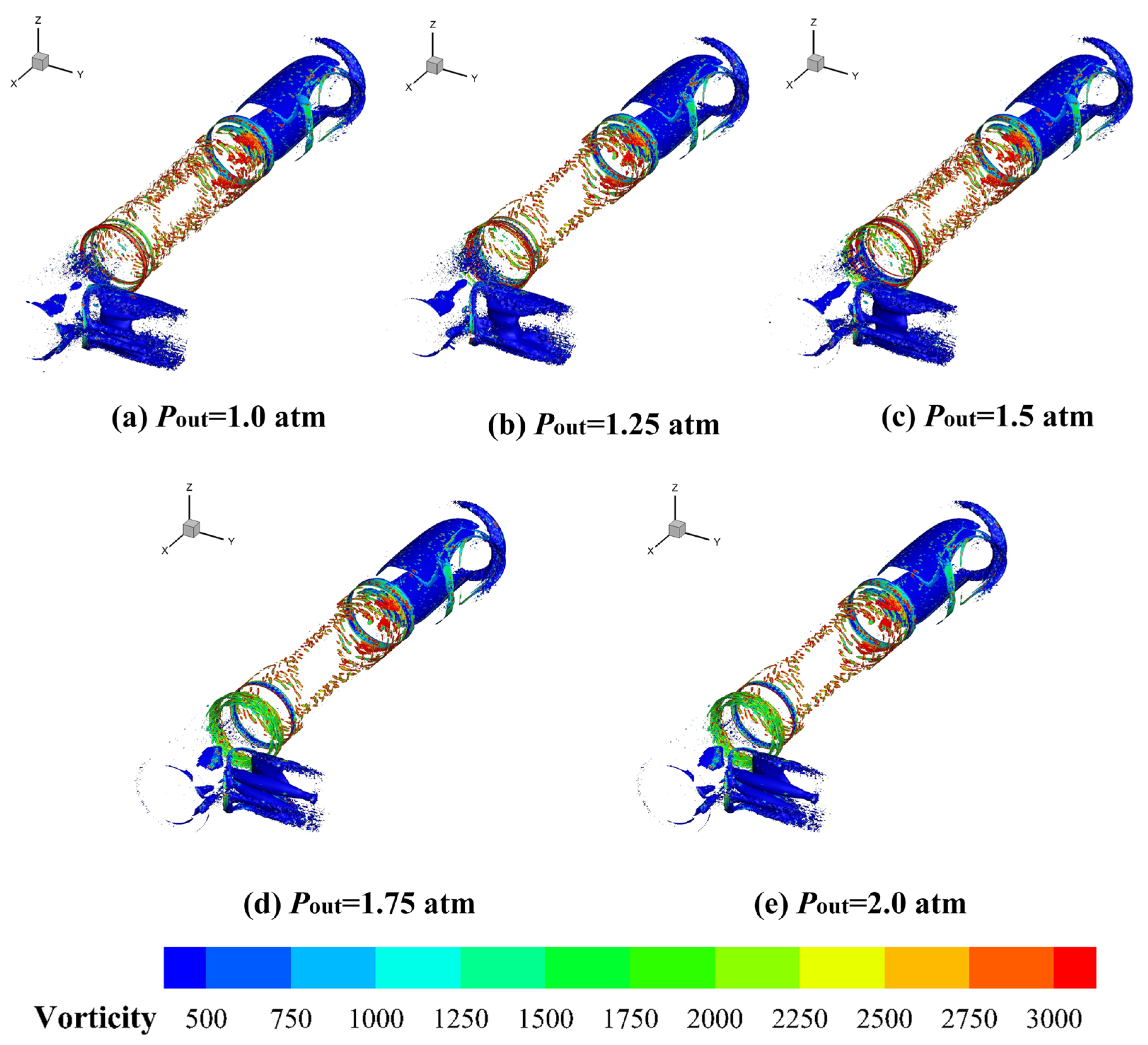
Figure 13 reveals the underlying mechanism of outlet gauge pressure on vortex structure evolution in the water tunnel test section through Q-criterion based vorticity distribution. Under 1.0 atm outlet pressure, the vorticity contour shows high-intensity vortex structures (2500~3000 s−1) in the test section, with spatial distribution highly consistent with cavitation zones. This is primarily due to pressure fluctuations from bubble collapse significantly enhancing the baroclinic torque term in the vorticity transport equation, while strong velocity gradients provide conditions for vortex stretching term , leading to substantial vorticity amplification. The flow exhibits typical vortex-cavitation coupling characteristics, with large-scale vortex structures continuously extracting energy from the mean flow through vortex stretching. As outlet pressure increases to 1.25~1.50 atm, vorticity intensity decreases markedly (1750~2500 s−1) with more uniform distribution. This transition reflects systematic suppression of vorticity generation mechanisms by elevated pressure: the enhanced static pressure environment reduces cavitation intensity and baroclinic torque contribution, while stabilized pressure gradients restrain spatial inhomogeneity of velocity gradients, limiting vortex stretching. At 1.75~2.0 atm outlet pressure, the vorticity field approaches a highly ordered state (1000~2500 s−1), demonstrating profound optimization of turbulence structure by outlet pressure. Here, enhanced viscous effects dominate vorticity transport through viscous diffusion term that effectively smoothes vorticity distribution, while suppressed vortex stretching reduces energy acquisition by large-scale vortices. This transition promotes turbulence energy spectrum development toward equilibrium state, achieving transformation from intermittent vortex bursting to stable dissipation. Attenuated vorticity fluctuations reduce turbulent kinetic energy production rate, while uniform vorticity distribution ensures more efficient energy cascade process, thereby enhancing thermal transport efficiency in the water tunnel test section.
Figure 13.
Vortex Structures Based on the Q-criterion: (a–e) Vorticity contour maps for outlet gauge pressures from 1.0 to 2.0 atm.
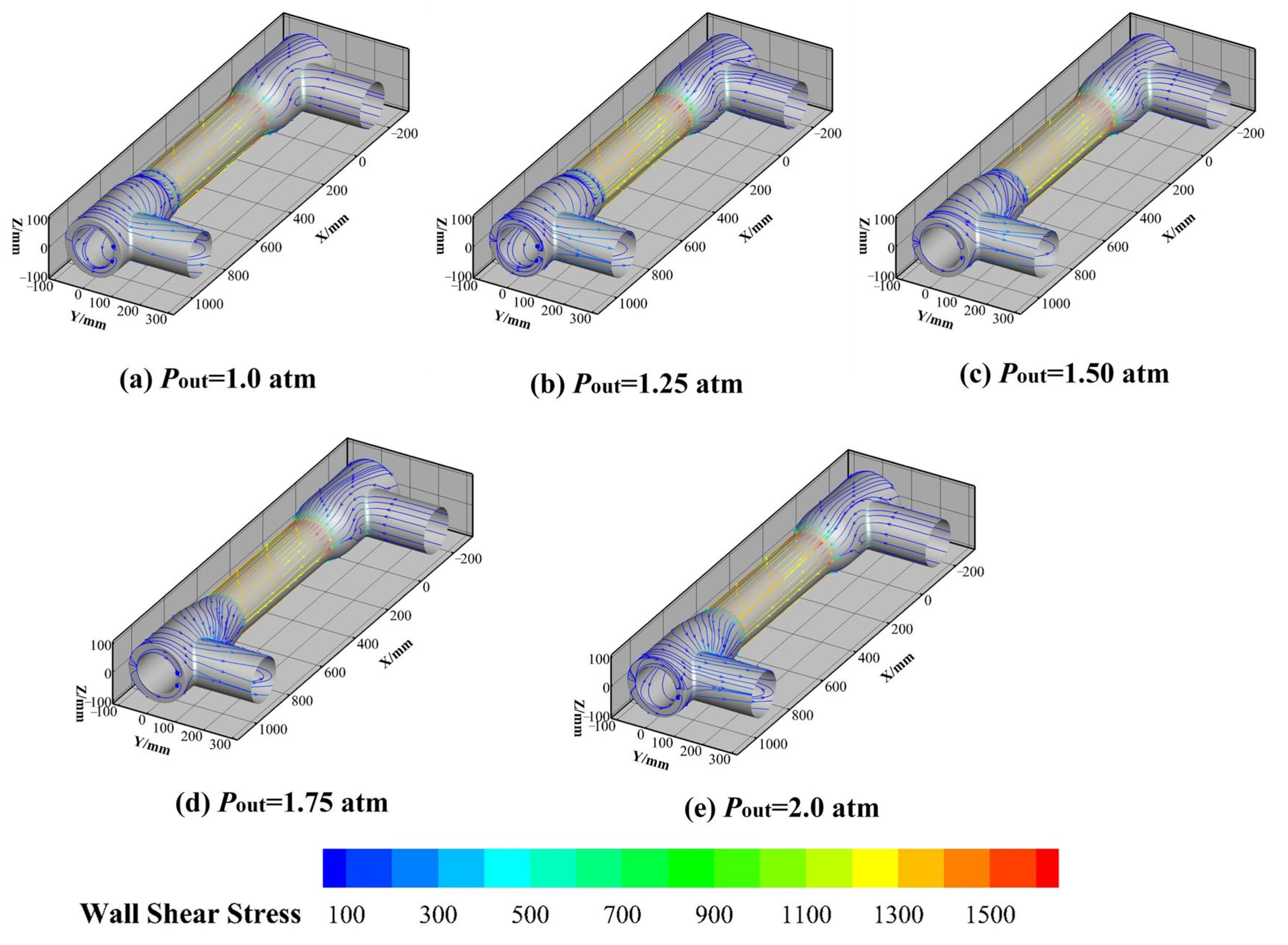
Figure 14 presents the wall shear stress distribution under different outlet gauge pressures. At 1.0 atm outlet pressure, the test section exhibits non-uniform wall shear stress distribution with distinct low-value regions (1000~1300 Pa), originating from periodic boundary layer disturbances induced by cavitation. The counter-jets generated during bubble collapse disrupt the stability of the viscous sublayer, leading to localized flow separation. In the diffuser section under low outlet pressure conditions, extensive low wall shear stress regions (100~200 Pa) emerge, providing direct evidence of flow separation triggered by adverse pressure gradients. The corresponding streamline patterns reveal significant flow detachment from the wall surface, forming large-scale recirculation vortex structures that substantially enhance energy dissipation through intensified turbulent mixing. As the outlet pressure increases to 1.25~1.50 atm, the low wall shear stress regions in the diffuser section contract considerably. The corresponding streamlines demonstrate reduced separation vortex scales and upstream movement of reattachment points, indicating improved boundary layer stability. When the pressure reaches 1.75~2.0 atm, both the test section and diffuser section display highly uniform wall shear stress distributions (1300~1500 Pa), confirming complete suppression of flow separation and maintained stable boundary layer attachment. Streamline observations show well-aligned parallel distributions in the test section and smooth diffusion characteristics in the diffuser section without apparent flow separation. The elevated outlet pressure promotes boundary layer stabilization, ensuring more efficient momentum transport and consequently enhancing energy utilization efficiency, which directly improves the heat transfer performance of the water tunnel test section.
Figure 14.
Wall Shear Stress Distribution under Different Outlet Gauge Pressures: (a–e) Wall shear stress contour maps for outlet gauge pressures from 1.0 to 2.0 atm.
5. Experimental Validation
5.1. Experimental Methodology
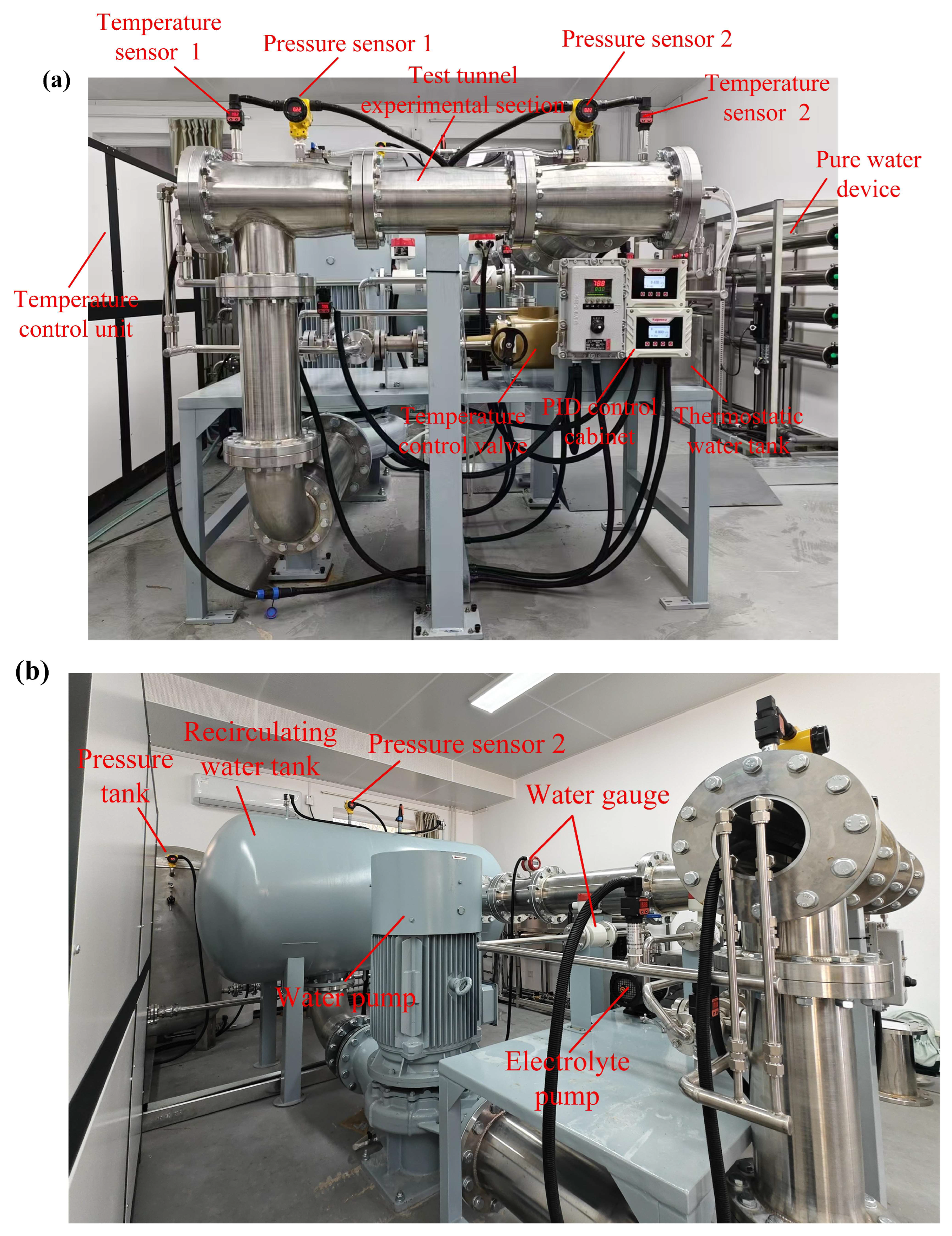
Figure 15a,b display photographs of the actual seawater-activated battery water tunnel test facility. The experimental procedure in this study follows a structured three-stage protocol: preparation, system execution with data acquisition, and post-processing. During the preparation stage, the annular test section was first geometrically calibrated. The inner () and outer () diameters of the test section were measured multiple times using a high-precision steel ruler, and the average values were taken. The corresponding flow cross-sectional area () was then calculated according to Equation (18), providing the key geometrical parameter for subsequent flow velocity calculations. After calibration, the industrial computer and all measurement and control devices were powered on sequentially to perform system warm-up and verification. This included triple zero-point and span calibrations of the pressure and temperature sensors, repeated flow-through tests of the water flow meter to verify its response consistency, as well as pressure-debugging and leak-tightness inspection of the storage tank. All equipment was verified to operate within their specified accuracy ranges. Finally, a dedicated data-acquisition and control program was launched to ensure full system initialization and standby readiness.
Figure 15.
Physical image of the seawater-activated battery water tunnel device: (a) Front view; (b) Side view.
After confirming successful system initialization, the procedures for loop filling and system pressurization were sequentially executed. First, the circulating water tank and connected pipelines were thoroughly vented and filled with high-purity water as the working fluid to ensure complete filling of the circuit. Subsequently, the enclosed water-circulation system was pressurized to a specified outlet gauge pressure to suppress dissolved-gas release and enhance flow stability. Upon completion of these preparatory steps, the circulating water pump and its associated variable-frequency drive were activated to investigate the effect of pressure difference on the system’s thermal-dissipation characteristics. The pump frequency was adjusted stepwise to precisely control the circulating flow rate, while dynamic pressurization was applied to the outlet region of the test section. Simultaneously, the electrolyte pump and auxiliary water pump were started. Flow control was achieved by fine-tuning the frequency of the circulating pump. During the experiments, pressure sensors installed at the inlet (P1) and outlet (P2) of the test section continuously monitored the static pressure distribution, from which the pressure drop along the flow path was derived. A water flow meter was used to record the instantaneous flow rate inside the test section. Moreover, the electrolyte temperature and the opening of the temperature-control valve were monitored and logged in real time. Each operating condition was tested in three independent repetitions, and the final results were taken as the average of the three measurements. All relevant data were recorded synchronously throughout the entire experiment. After data acquisition at the target flow rate was completed, the pump frequency was gradually reduced to zero and the pump was shut down, followed by system depressurization and drainage. Based on Equation (19), the core-averaged flow velocity v in the test section can be calculated, while Equation (20) is used to determine the corresponding heat dissipation power under different operating conditions.
The experimental methodology established in this study demonstrates clear generality. The precise measurement of flow and heat transfer parameters in microchannels can be directly applied to evaluate the cooling effectiveness of different liquid cooling channel topologies for lithium-ion batteries. The established flow-pressure stability criteria provide a basis for the design of pumps and piping in flow battery and supercapacitor circulation systems. In terms of marine environmental adaptability, the experiments simulate hydrostatic pressures ranging from 0.1 to 2.0 MPa through an outlet gauge pressure control system, covering typical marine depths to quantify the influence of pressure on fluid behavior. The high-frequency synchronous measurement system (pressure response ≥1 kHz) provides a foundation for studying transient flows under dynamic marine loads. The resulting multi-parameter coupled dataset (temperature-pressure-flow rate) serves as a benchmark for validating marine multiphysics models, supporting the indirect assessment of long-term effects such as biofouling.
5.2. Experimental Apparatus
The experimental setup primarily consists of an industrial computer, a pressure vessel, a circulating water tank, a circulating water pump with its associated variable-frequency drive, pressure sensors, temperature sensors, and other auxiliary devices. Key equipment parameters are listed in Table 2.
Table 2.
Key Equipment Parameters.
5.3. Experimental Results
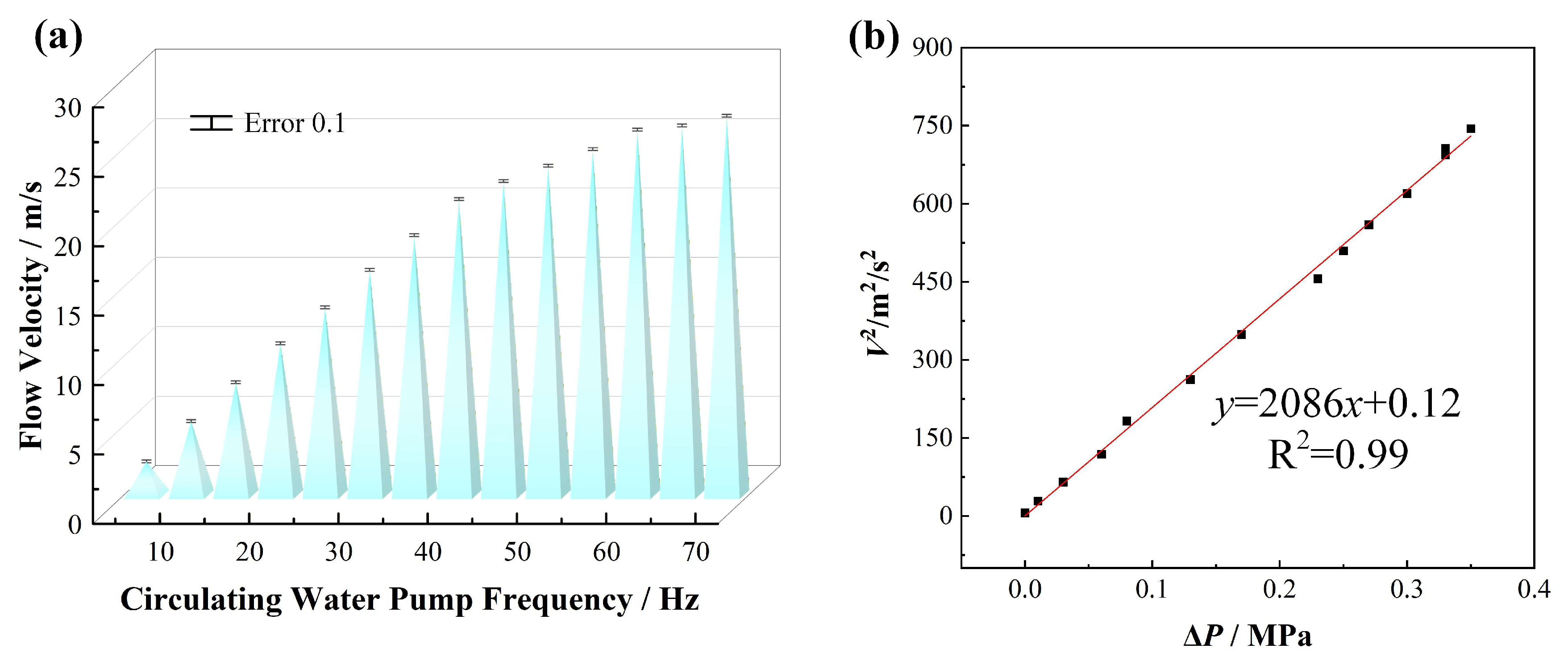
Table 3 summarizes the experimental results under different circulating water pump frequencies, including key parameters such as flow rate, tank pressure, test section inlet/outlet pressures, calculated flow velocity, and pressure differential. The experimental data demonstrate that as the pump frequency progressively increases from 5 Hz to 70 Hz, both the circulating water flow rate and the average flow velocity in the test section rise significantly. The flow velocity increases from 2.4 m/s to 27.3 m/s, while the corresponding pressure differential rises from 0 MPa to approximately 0.35 MPa. Throughout this process, the system operated stably overall with responsive performance.
Table 3.
Experimental data under different circulating water pump frequencies.
As shown in Figure 16a, the average flow velocity in the test section increases approximately linearly with the frequency of the circulating pump. In the low-frequency region (<20 Hz), the velocity rise is relatively moderate, primarily due to fluid viscous resistance and insufficient initial inertia. When the frequency exceeds 40 Hz, the growth rate of velocity stabilizes, indicating that the flow in the system has become fully developed and entered a steady regime. This behavior demonstrates the well-controlled characteristics of the circulating water system, with frequency-based speed regulation enabling precise flow adjustment, thereby verifying the controllability of the water-tunnel system and the reliability of the experimental data. To further elucidate the system’s flow behavior, the measured pressure difference was correlated with the square of the velocity, as presented in Figure 16b. The results show a high degree of linear correlation between the pressure difference and the square of the velocity, with small and stably distributed errors. This relationship aligns with the features described by the Bernoulli equation and the dynamic pressure law-namely, that the fluid dynamic pressure term (1/2ρv2) is proportional to the pressure difference . This confirms that the flow in the test section is continuous and steady, with good energy conservation in the system. The experimental results presented above indicate stable operation and precise control of the circulating water system, along with a well-defined relationship between pressure difference and velocity squared that conforms to dynamic pressure theory. As the outlet gauge pressure increases, the system pressure drop gradually rises, further improving the uniformity of heat dissipation and optimizing system performance. These findings are consistent with the conclusions drawn from the earlier numerical simulations.
Figure 16.
Relationship curves for various parameters in the experimental section of the water tunnel: (a) Circulating water pump frequency vs. flow velocity; (b) Pressure difference vs. square of flow velocity.
As shown in Table 4, when the coolant flow velocity is increased from 2.0 m/s to 10.0 m/s (Tests 1, 2 and 3), the inlet-outlet temperature difference of the electrolyte decreases from 0.4 °C to 0.1 °C, and the corresponding cooling power drops from 1.40 kW to 0.35 kW. This trend demonstrates that higher coolant flow velocities significantly enhance convective heat transfer, allowing the electrolyte to dissipate heat with a smaller temperature rise and consequently achieving a lower outlet temperature under a fixed thermal load. At the same flow velocity (10.0 m/s), when the coolant temperature is reduced from 35.0 °C to 5.0 °C (Tests 4 and 5), the electrolyte temperature difference decreases from 1.3 °C to 0.2 °C, and the cooling power decreases from 4.51 kW to 0.70 kW. This variation directly confirms that lowering the coolant temperature effectively increases the driving temperature difference (thermal driving force), thereby improving the overall heat dissipation capacity of the system. It also provides experimental support for the efficient operation of battery thermal management systems in low-temperature environments. When the electrolyte flow rate is reduced from 2.4 m3/h to 0.5 m3/h (Tests 3 to 8), the inlet-outlet temperature difference increases from 0.1 °C to 0.8 °C, and the cooling power rises from 0.35 kW to 2.79 kW-an increase of 697%. This result quantitatively verifies the classic heat-transfer principle that, under a constant thermal load, reducing the flow rate of the heat-carrying fluid leads to a significant increase in its temperature rise. It also indicates that the electrolyte flow rate is a key operational variable for regulating the system’s cooling power and the operating temperature of the electrolyte, which is of considerable engineering importance for maintaining the battery within an appropriate temperature range.
Table 4.
Experimental data for heat transfer measurements.
6. Conclusions
To enhance the thermal performance of the battery, a compact high-speed water tunnel experimental system was designed in this study. A combined approach of numerical simulation and experimental testing was employed to systematically investigate the internal flow field characteristics. The results demonstrate that adjusting the outlet gauge pressure can effectively suppress cavitation within the test section, which aligns with the classical theory that “increasing local static pressure is a fundamental approach to inhibiting cavitation generation and development” [28]. However, the primary contribution of this work is not merely to reiterate this basic physical mechanism, but rather to place the passive control strategy of outlet gauge pressure regulation within the specific engineering context of a closed-loop battery liquid cooling thermal management system, conducting systematic and quantitative investigations. This study focuses on elucidating the coupled influence mechanism of outlet gauge pressure variation on the system’s macroscopic flow and heat transfer performance, aiming to provide a basis for flow optimization and thermal management efficiency improvement in seawater-activated battery cooling processes. The main conclusions are as follows:
- (1)
- This study designed a small high-speed water tunnel test section. Stainless steel was employed to enhance pipeline rigidity, while a fifth-power polynomial contraction curve and a straight-line diffuser profile were adopted to optimize the velocity distribution, thereby mitigating cavitation and excessive pressure losses. The test section features a straight-line design with extended flow transition zones at both ends to further improve flow stability and uniformity. This configuration ensures favorable flow field distribution even at the maximum design velocity of 25 m/s, enabling efficient heat transfer and dissipation. The design not only strictly complies with technical specifications but also provides a stable and reliable experimental platform for investigating battery thermal performance.
- (2)
- An in-depth analysis of pressure distribution and energy loss indicators in the water tunnel test section was conducted through numerical simulations under two operating conditions: outlet gauge pressures of 0 atm and 1.0 atm. The results demonstrate that the performance improvement achieved by increasing the outlet pressure is realized through two fundamental mechanisms: on the one hand, the elevated system static pressure effectively suppresses cavitation inception and eliminates the pressure pulsations and phase-change energy dissipation induced by bubble collapse. On the other hand, the enhanced pressure potential stabilizes the boundary layer structure, suppresses flow separation and secondary flows, and shifts the turbulent energy spectrum toward smaller scales, thereby reducing turbulent dissipation. Through these combined mechanisms, the pressure loss, head loss, and power loss are all reduced by approximately 24.20%, while flow velocity uniformity is significantly improved. Thus, appropriate regulation of the outlet gauge pressure represents an effective strategy for enhancing both energy efficiency and flow stability in water tunnel test sections.
- (3)
- As the outlet gauge pressure increases from 1.0 atm to 2.0 atm, the flow characteristics are significantly optimized: the pressure loss is reduced by 26.6%, the power loss decreases by 27.3%, and the drag coefficient drops by 26.6%. Meanwhile, the flow non-uniformity is controlled within 1%, and the proportion of high-speed flow regions increases to 75%, fully meeting the design requirement of a flow velocity ≥25 m/s. These improvements stem from the systematic regulation of flow mechanisms by the outlet gauge pressure: the elevated static pressure level effectively suppresses cavitation, eliminating the energy dissipation caused by bubble collapse; the stabilized pressure field inhibits boundary layer separation and secondary flows, promoting the migration of turbulence structures toward smaller scales; and the optimized vorticity distribution and wall shear stress field ensure efficient momentum transport. Notably, when the outlet gauge pressure exceeds 1.75 atm, the flow transitions completely from cavitation-dominated to viscous dissipation-dominated, achieving an optimal stable state.
- (4)
- The experimental results demonstrate stable operation and precise control of the circulating water system, with the flow velocity showing an approximately linear increase with the pump frequency, confirming favorable controllability of the setup and reliability of the experimental data. A strong linear correlation between the pressure differential and the square of the flow velocity aligns with the dynamic pressure principle described by the Bernoulli equation, indicating stable flow and effective energy conservation within the test section. As the outlet gauge pressure increases, the system pressure drop gradually rises, contributing to enhanced flow stability and improved heat dissipation uniformity, thereby further optimizing the overall system performance. These experimental findings are in mutual agreement with the numerical simulation results presented earlier, validating the reliability and accuracy of the model predictions.
Based on the experimental platform and key findings of this work, future research can be deepened along the following cutting-edge directions to expand its value in both fundamental fluid mechanics and engineering applications: First, by utilizing the high-resolution flow field data of the entire cavitation evolution process obtained in this study, Large Eddy Simulation (LES) can be conducted to develop and validate improved cavitation-turbulence coupled models, thereby providing high-confidence predictive tools for complex engineering flows. Second, extending the experimental medium to battery electrolytes or functionalized coolants with non-Newtonian characteristics, the modulation effects of shear thinning, viscoelasticity, and other properties on cavitation dynamics and flow stability can be explored, contributing to the advanced thermal management design of next-generation energy storage systems. Finally, by integrating cross-scale measurement techniques (such as system-level PIV and microscopic high-speed imaging), the multi-scale energy transfer and correlation mechanisms from cavitation nucleus activation to system response can be revealed, laying an experimental foundation for the mechanistic analysis and control of multi-physics issues such as cavitation noise and material erosion.
Author Contributions
Conceptualization, Z.D. (Zhaoliang Dou) and F.L.; Methodology, Y.D.; Investigation, Z.D. (Zhuangzhuang Du); Data curation, Z.D. (Zhuangzhuang Du); Writing—original draft, Y.D.; Writing—review & editing, Z.D. (Zhaoliang Dou) and F.L. All authors have read and agreed to the published version of the manuscript.
Funding
Organized Scientific Research at North China University of Technology (Project Number: 110051360024XN148-38).
Data Availability Statement
The original contributions presented in this study are included in the article. Further inquiries can be directed to the corresponding author.
Conflicts of Interest
The authors declare no conflicts of interest.
Abbreviations
The following abbreviations are used in this manuscript:
| Re | Reynolds Number |
| VOF | Volume of Fluid |
| UUVs | Unmanned Underwater Vehicles |
| SABs | Seawater-activated batteries |
| LES | Large Eddy Simulation |
References
- Wang, Y.J.; Jiang, H.T.; Zhang, Y.; Wang, P.P.; Yu, B.W.; Xu, Z. Research Progress on the Electrochemical Performance of Anode Materials for Magnesium Alloy Seawater Batteries. J. Mater. Rep. 2021, 35, 9041–9076. [Google Scholar] [CrossRef]
- Chen, J.M.; Wang, X.D.; Xiong, C.H.; Yang, S.S.; Xu, W.L. Research and Progress Power Battery for Underwater Unmanned Vehicles. In Proceedings of the 5th Summit Forum on Underwater Unmanned System Technology—Conquer the Deep Sea, Lead the Development with Intelligence, Xi’an, China, 15 November 2022; p. 8. [Google Scholar]
- Lin, X.C.; Li, W.K. Numerical Simulation of Portable AUV Hydrodynamic Coefficient. J. Ship Sci. Technol. 2023, 45, 61–65. [Google Scholar] [CrossRef]
- Zhang, H.T.; Wang, S.G.; He, X.H.; Wang, Y.H.; Xu, W.L.; Song, J.M.; Li, Z.; Yang, G.Z.; Wang, X.Y.; Zhang, Q.; et al. Electrochemical Synthesis and Performance of AgCl/Ag/Sliver Mesh Collector Composite Electrode for SeaWater Batteries. J. Electrochem. Soc. 2024, 171, 050549. [Google Scholar] [CrossRef]
- Kim, Y.; Lee, W. Primary Seawater Batteries; Seawater Resources Technology Center, Ulsan National Institute of Science and Technology: Ulsan, Republic of Korea, 2022. [Google Scholar]
- Lu, Y.H.; Yang, L.L.; Zhang, Y.; Zhao, Q. Influence of Simulating Deep-sea Environmental Factors on Cathodic Performance of Seawater Battery. J. Oceanol. Limnol. 2020, 38, 334–341. [Google Scholar] [CrossRef]
- Yang, C.; Bai, R.F.; Wang, W. Study on Electrode Performance Improvement of AgO Seawater Battery. J. Ship Electr. Technol. 2024, 44, 84–86+91. [Google Scholar] [CrossRef]
- Maria, J.G.-G.; Frank, A.G. Miniaturized Al/AgO Coin Shape and Self-powered Battery Featuring Painted Paper Electrodes for Portable Applications. J. Sens. Actuators B Chem. 2018, 273, 101–107. [Google Scholar] [CrossRef]
- Fredy, S.; Dipta, A.; Adi, R.S. Laboratory-Scale Low-Speed Water Tunnel: Comparison of Experimental Flow Visualization and Computer-Aided Simulation. J. Adv. Res. Fluid Mech. Therm. Sci. 2023, 107, 142–164. [Google Scholar] [CrossRef]
- Zhou, J.; Yu, K.; Min, J.; Hu, Z.Q.; Wang, C.; Wang, Z. The Comparative Study of Ventilated Super Cavity Shape in Water Tunnel and Infinite Flow Field. J. Hydrodyn. 2010, 22, 689–696. [Google Scholar] [CrossRef]
- Zhao, P.L.; Chen, Y.H.; Dong, G.; Wang, Z.Y.; Huang, B. Experimental Study on Flow Control of the Turbulent Boundary Layer with Micro-bubbles. J. Acta Mech. Sin. 2018, 34, 830–838. [Google Scholar] [CrossRef]
- Meng, L.; Liu, Y.; Huang, B.; Gao, Y.; Wu, Q. Investigation of Flow-Induced Vibration Characteristics of Flexible Hydrofoil in Unsteady Cavitation. J. Eng. Mech. 2017, 34, 232–240. [Google Scholar] [CrossRef]
- Hou, D.B.; Wang, C.; Xia, W.X.; Li, Y.G.; Zhao, J. Experimental Investigation into the Cavity Shape and Pressure Characteristics of Supercavitating Vehicle with Elastic Trailing Edge. J. Acta Armamentarii 2020, 41, 534–541. [Google Scholar] [CrossRef]
- Chen, T.; Sun, J.; Sun, K.F.; Chen, W.Y. Numerical Study on Effect of Guide Vanes on Flow Field of the Elbow Bend with Uniform Section in Water Tunnel. J. Hydrodyn. 2019, 34, 395–400. [Google Scholar] [CrossRef]
- Zhou, G.; Wang, J.D.; Chen, D.R. Numerical Design of Guide Vanes in Elbow Bends of a Minitype High-speed Water-tunnel. J. Chin. J. Comput. Mech. 2010, 27, 102–109. [Google Scholar] [CrossRef]
- Zhou, G.; Wang, J.D.; Chen, H.S.; Chen, D.R. Optimized Design of the Contraction in a Minitype High-speed Water-tunnel. J. Ship Mech. 2009, 13, 513–521. [Google Scholar] [CrossRef]
- Ren, H.K.; Liu, H.; Du, Y.L.; Dong, G.X. Study on Effect of Honeycomb and Guide Vanes on Flow Field in Test Section of Cavitation Tunnel Based on Numerical Simulation. J. Shanghai Ship Shipp. Res. Inst. 2023, 46, 8–15. [Google Scholar] [CrossRef]
- Zhang, Y.; Wang, J.D.; Chen, D.R. Numerical Simulation of the Effect of the Test Section Shape on the Flow Field in a Minitype High-speed Water-tunnel. J. Lubr. Eng. 2012, 37, 9–14. [Google Scholar] [CrossRef]
- Improta, J.U. The Development of a High-speed Water Tunnel. Ph.D. Thesis, The University of Iowa, Iowa City, IA, USA, December 2024. [Google Scholar]
- Wang, W.; Wang, C.; Du, Y.F.; Li, C.H. Simulation Study of Ventilated Supercavity in a Periodic Gust Flow. J. Acta Armamentarii 2018, 39, 1772–1779. [Google Scholar] [CrossRef]
- Song, W.C.; Wang, C.; Wei, Y.J.; Xu, H.; Lu, J.X. Experimental Research on Drag Reduction Characteristics of Underwater Vehicle during Pitching. J. Acta Armamentarii 2019, 40, 1902–1910. [Google Scholar] [CrossRef]
- Chen, J.M.; Xu, W.L.; Wang, X.D.; Yang, S.S.; Xiong, C.H. Progress and Applications of Seawater-activated Batteries. Sustainability 2023, 15, 1635. [Google Scholar] [CrossRef]
- Wang, Z.H. Experiment and Numerical Simulation Research on the Double Pipe Gas Jet of Underwater Vehicle. Master’s Thesis, Harbin Institute of Technology, Harbin, China, 2021. [Google Scholar]
- Zhou, J.J. Optimization of Hydrodynamic Characteristics of S Hydrofoil and Its Application Research. Master’s Thesis, Jiangsu University, Zhenjiang, China, 2022. [Google Scholar]
- Chen, W.S.; Xiang, Q.J.; Li, Y.J.; Liu, Z. On the Mechanisms of Pressure Drop and Viscous Losses in Hydrofoil Tip-Clearance Flows. Energy 2023, 269, 126712. [Google Scholar] [CrossRef]
- Zhou, G. Design of a Minitype High-Speed Water Tunnel and Research on the Drag Reduction of Traveling Wave. Ph.D. Thesis, Tsinghua University, Beijing, China, 2008. [Google Scholar]
- Geng, Z.H.; Cai, J.S.; Jiang, Y.B.; Chen, C. Hydrodynamic Design and Flow Field Calibration of Low Turbulence Intensity Water Tunnel. J. Hydrodyn. 2019, 34, 682–690. [Google Scholar] [CrossRef]
- Prabhakar, K.; Nidhi, S.; Sudip, K.P.; Ashish, G. Computational comparison of passive control for cavitation suppression on cambered hydrofoils in sheet, cloud, and supercavitation regimes. J. Phys. Fluids. 2024, 36, 104113. [Google Scholar] [CrossRef]
Disclaimer/Publisher’s Note: The statements, opinions and data contained in all publications are solely those of the individual author(s) and contributor(s) and not of MDPI and/or the editor(s). MDPI and/or the editor(s) disclaim responsibility for any injury to people or property resulting from any ideas, methods, instructions or products referred to in the content. |
© 2025 by the authors. Licensee MDPI, Basel, Switzerland. This article is an open access article distributed under the terms and conditions of the Creative Commons Attribution (CC BY) license.