For 2D, assuming an incompressible quasi-steady state, ignoring the gravitational contribution due to the small volume, and by incorporating the continuity equation and applying divergence on the Navier–Stokes equation, the pressure can be expressed via the Poisson equation:
where
u is the streamwise (i.e., horizontal) velocity,
v is the normal (i.e., vertical) velocity,
x is the horizontal coordinate, and
y is the vertical coordinate of a Cartesian system. The validity of the assumption of steady flow depends on the specific flow phenomena. To solve Equation (2) for the pressure, boundary conditions need to be determined. Commonly, two types of boundary conditions are applied: namely, Dirichlet (pressure) or Newman (pressure derivative) conditions that typically assume a solid body at the boundary. These boundary conditions are needed for both pressure field estimation approaches: Navier–Stokes or Poisson. When the body is in motion, the pressure and its derivatives are not constant. Assuming constant pressure can potentially generate a relatively large error. When estimating the pressure field during fluid–organism interaction, involving motion commonly associated with flexible bodies, we cannot use boundary conditions suitable for solid surfaces. Alternatively, we define the boundary conditions of an arbitrary control volume within the flow phenomenon. We choose the PIV field of view as the control volume domain. Because the PIV field of view is rectangular, we need to define the boundary conditions on its four sides. While this control volume (CV) is somewhat arbitrary, it is well defined by the 2D-PIV data. In order to account for the motion of the organism and its impact on the flow, we suggest calculating the pressure at the boundaries (i.e., boundary conditions) based on the integral momentum equation. This choice allows us to determine the pressure at every time step and at every point in the domain as a function of the surrounding fluid velocities, thus bypassing the need to define an ad hoc value for the pressure. The drawback lies within the measurement error of the specific PIV system [
3]. The integral momentum equation for a non-inertial CV is as follows:
where
is the rate of change in momentum within the control volume,
is the momentum flux,
is the pressure,
is the body force, and
is the viscous force. This equation enables calculation of the pressure on the boundaries of the CV from the measured velocity field. Assuming Newtonian, incompressible, steady-state conditions with gravity in the vertical direction, the pressure in the
x- and
y-directions on the CV boundaries, for the
x-direction, is calculated with the following equation:
and for the
y-direction, the following equation is used:
where
is volume. The points of intersection at the corners of the boundaries provide cross-validation of the pressure calculation by comparing their values from the horizontal (
x) and vertical (
y) components, which should be the same; in all cases (see
Section 2.1 and
Section 3), the values at the corners matched when computed independently from
x and
y components, which provides a partial validation on the boundary condition methodology. The pressure is computed over all four boundaries of the PIV field of view in both the horizontal and vertical directions. Once the boundary conditions are determined, the Poisson equation is solved using an iterative method (see Gurka et al. [
4] for further details on the numerical method).
2.1. Case Study
We exemplify the technique by applying it to observations of suction-feeding, which is a complex phenomenon that can demonstrate the robustness of this method. There are three basic techniques for fish to capture prey: manipulation, ramming, and suction [
5]. Suction-feeding is the most common technique for prey capture and is used by the majority of bony fish (Osteichthyes) [
6]. It is a versatile technique that enables the capture of a wide range of prey, from hard-shelled organisms to mobile, evasive prey [
7]. This feeding mechanism involves quickly expanding the mouth cavity, which reduces the pressure inside the mouth compared to the surrounding water pressure. This lower pressure inside the mouth causes water to flow inward, drawing prey into the buccal cavity with fast-moving water [
8,
9]. This pressure difference yields forward acceleration of the water towards the fish’s mouth. Once the mouth closes again, the gills open to allow water to flow out, ensuring the capture of the prey [
10]. Free-swimming prey are generally pushed away by the flow generated by the approaching predator. During suction, the fish attempts to eliminate the stagnation point at the snout tip through the suction phase, often combined with swimming or protrusion [
11].
There are three dominant hydrodynamic forces acting on prey during suction-feeding: drag, pressure, and inertia [
12]. The hydrodynamic forces are associated with the spatial and temporal gradients in flow velocities; these forces depend on the magnitude of flow variations and the volume of prey, regardless of its shape [
13]. The success of suction-feeding was noted to rely directly on the rate of expansion and closure of the buccal cavity to form suction and enable the capture of prey [
5,
13,
14,
15,
16]. Peak water velocities associated with suction-feeding have been found to occur shortly after the buccal cavity begins opening, and the mouth gradually decelerates the flow during closing [
17,
18,
19]. Rapid opening of the mouth generates a rapid water flow in the direction of the fish, which coincides with a low-pressure zone within the mouth that draws the prey into the fish’s mouth [
13,
14,
18]. Increased fluid speeds during suction-feeding relate to a drop in pressure inside the buccal cavity, which suggests that the force exerted on surrounding water is directly related to the magnitude of the buccal pressure [
20]. In addition to these fluid–fish interactions, results from other studies have shown that parameters such as swimming speed, muscle function, and jaw morphology also contribute to prey capture efficiency [
5,
7,
16,
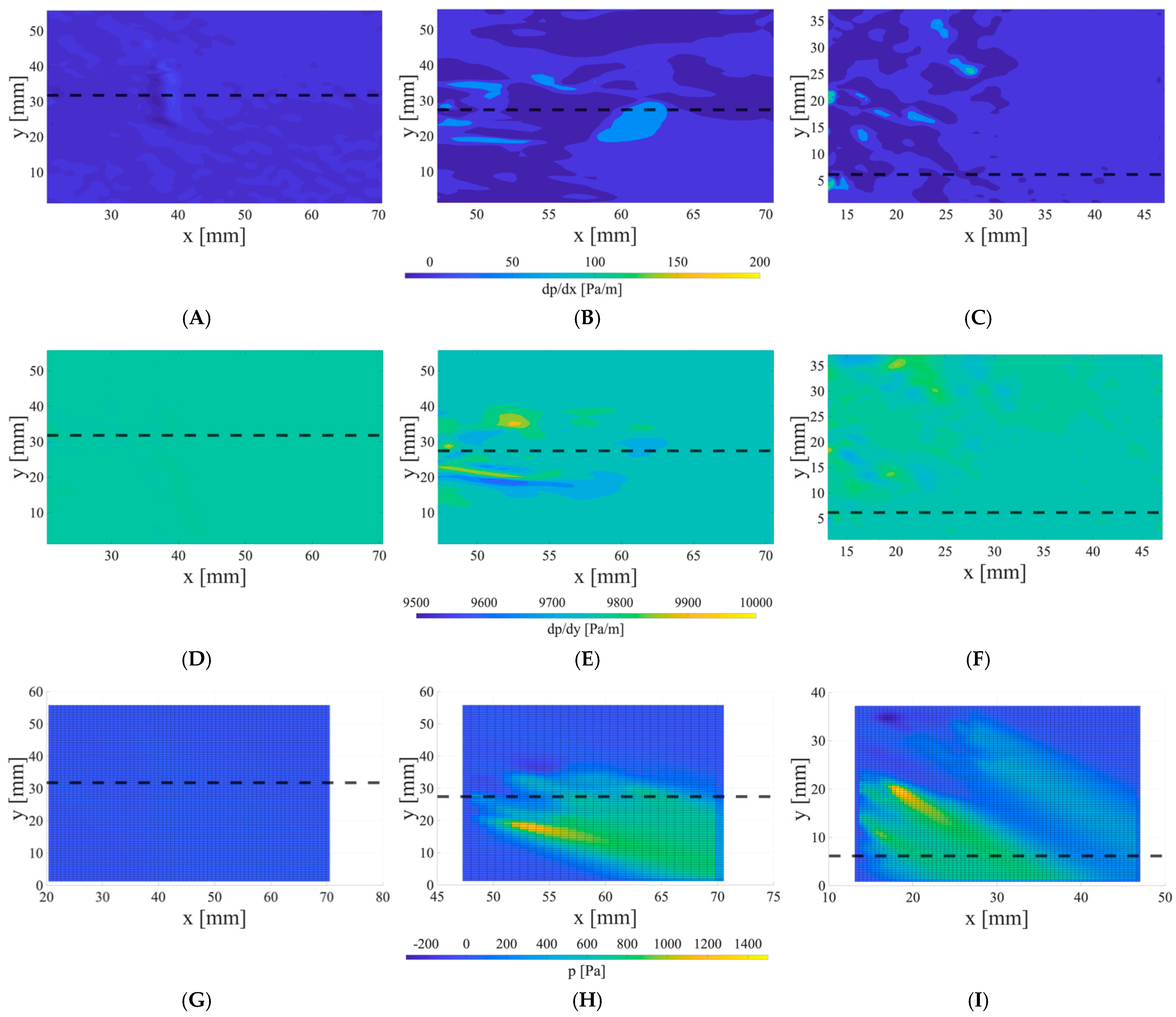
21]. The spatial distribution of pressure is important to understand how pressure variations evolve through the suction-feeding process, as they govern some of the hydrodynamic forces exerted during this action and may contribute to the success of the predator in capturing the prey and vice versa. Flow measurements were performed surrounding the exterior of the head during in vivo suction-feeding. We quantify the pressure field in the vicinity of the buccal cavity through analysis of velocity field measurements made using PIV.
Suction-feeding in fish can be considered as a dynamic system, with moving flexible solid boundaries at a relatively low Reynolds number. We use Bluegill sunfish (
Lepomis macrochirus) to measure the pressure during suction-feeding. The Reynolds number is 1420 defined as
, where
u is the ram speed (the fish speed in respect to the flow, which was estimated to be on the order of 10 mm/s), and
L1 is the characteristic length, defined as the distance from the snout to the base of the tail fin, respectively, of the swimming fish, and ν is the kinematic viscosity of the fluid. The Womersley number is 10.8, defined as
, where
ω is the angular frequency of the pulse, and
L2 a characteristic length associated with ω. Following Krishnan et al. [
22], we consider suction as a single-pulse event, in which the angular frequency is the time it takes for the fish to fully open its mouth (time to peak gape, TTPG),
, and the characteristic length is the peak gape diameter (PG) [
7].
2.1.1. Test Species
Five Bluegills were used in this study with lengths ranging from 15.2 to 17.8 cm. Bluegills were chosen for their history of positive results with similar experimental practices and ease of training [
17]. Due to their abundance in the region, the fish were collected at Hackler Pond on the Coastal Carolina University campus. They were housed in a 1135 L aquaculture tank kept at a constant temperature of ~22 °C [
19,
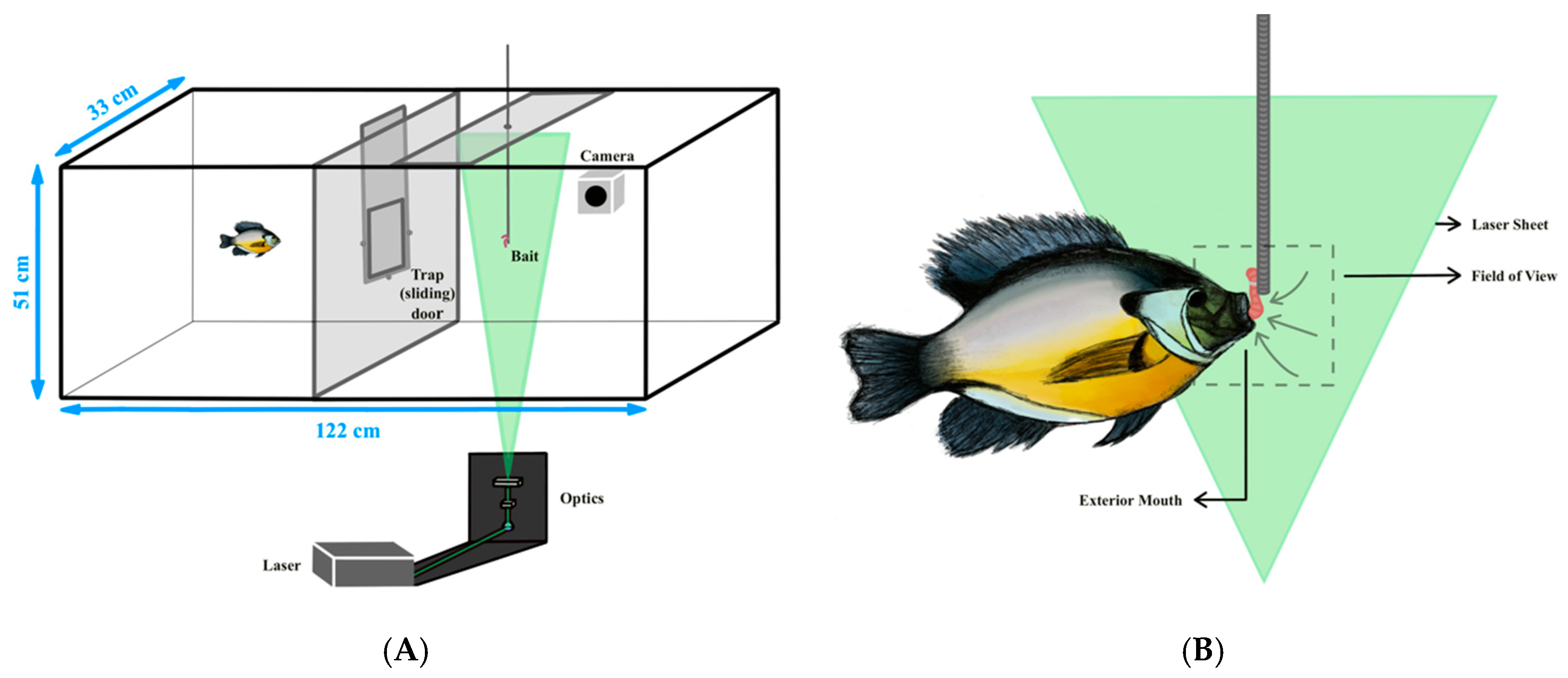
20]. All fish maintenance and experimental procedures used in this research followed a protocol (#2022.02) approved by the IACUC (Institutional Animal Care and Use Committee) at Coastal Carolina University. During experimentation, each Bluegill was transferred to an experimental tank (208 L glass aquarium) for the flow experiments (see
Section 2.1.3). It was equipped with a divider that sectioned the experimental tank into a holding section and experimental section, ensuring a repeatable position for the Bluegill to be reset while the bait, Canadian Nightcrawlers, were attached to a threaded rod in the experimental section (see
Figure 1). This divider or trap door to the experimental section also required the fish to align its body perpendicular to the light sheet as it swam through the door towards the prey, which helped ensure the fish’s mouth was properly oriented with respect to the light sheet when suction feeding.
2.1.2. Kinematic Measurements
The suction-feeding mechanism is partially governed by the rate of capture (i.e., time between opening and closing); therefore, both the flow field characteristics and buccal cavity kinematics of the specimen were measured. High-speed imaging enables the measurement of the speed, acceleration, and duration of the exterior of the fish’s head during suction-feeding. A Photron SA3 high-speed camera (Photron Limited, Tokyo, Japan) was used with a 50 mm Nikon lens that operated at 1000 frames per second (fps) at a resolution of 1024 × 1024 pixels. As the Bluegill swam through the opening in the experimental tank, as shown in
Figure 1, a high-speed video was recorded. The process was repeated for all five fish multiple times. The video images were processed using Kinovea software (2025.1.1) [
23] to calculate the average peak gape, velocity of gape opening, and duration of the suction-feeding process for all individual subjects. These parameters were computed by tracking the motion of six points placed on the mouth (three on the upper jaw and three on the lower jaw) (see
Figure S1 in Supplementary Materials). The average peak gape (
h) was found to be 15.7 mm. Using the distance traveled over the time period, the average speed of gape opening was 778 mm/s, and the average duration of the suction-feeding cycle was 0.065 s.
2.1.3. Flow Measurements
PIV is a non-intrusive optical flow measurement technique [
3]. PIV experiments were performed in the experimental tank with a CCD camera, laser, synchronizer, data acquisition system, and optics. The CCD camera (TSI Inc., Shoreview, MN, USA) was an 8 Megapixel double-exposure camera equipped with an 80 mm Nikon lens (Nikon, Tokyo, Japan) and was positioned approximately 1.6 cm away from the tank perpendicular to the tank walls, as shown in
Figure 1. The CCD was oriented at either 80° or 90° relative to the light sheet to better visualize the suction-feeding process. At 80°, this angular view required a cos(10°) correction to the projected velocity components, which was performed during the post-analysis. Hollow glass spheres, ~10 microns in diameter and with a specific gravity of 1.05, were used as tracer particles. The laser was a dual-head Nd:YAG Quantell Evergreen (Lumibird Photonics, Bozeman, MT, USA) with 200 mJ/pulse, and the optics included a 45° mirror, a spherical lens, and a cylindrical lens that were used to form a ~1 mm light sheet through the center of the experimental section of the tank that intersected with the threaded rod holding the bait ([
24];
Figure 1). This rod setup ensured that when the fish approached the bait and performed suction-feeding, the light sheet was aligned with the fish’s mouth. The synchronizer allowed the laser and camera to illuminate and capture images simultaneously in quick succession to provide image pairs taken with a 10 ms time gap. Data acquisition at 8 Hz began when the divider in the experimental tank was removed, allowing the fish to swim through an opening between the holding and the experimental sections of the tank. Data acquisition continued until the suction feeding process was complete. Because the feeding cycle is 0.065 s (~15 Hz) on average and the acquisition of image pairs occurs at a much slower frequency of 8 Hz, multiple repetitions of the experiments were needed to obtain a small set of quality image pairs to cover the feeding cycle. The experiments resulted in 36 image pairs during the feeding cycle that could be used for further analysis. The images were analyzed using interrogation windows of 64 × 64 pixel
2 with a magnification ranging from 44 to 65 pixels per mm. On average, the analyzed maps each contained ~6000 flow velocity vectors. The magnitude of the average pixel displacement was 2.30 pixels in the
x-direction and 1.25 pixels in the
y-direction. The pixel displacements were filtered using a 3-standard-deviation global validation filter and a local 5 × 5 median validation filter [
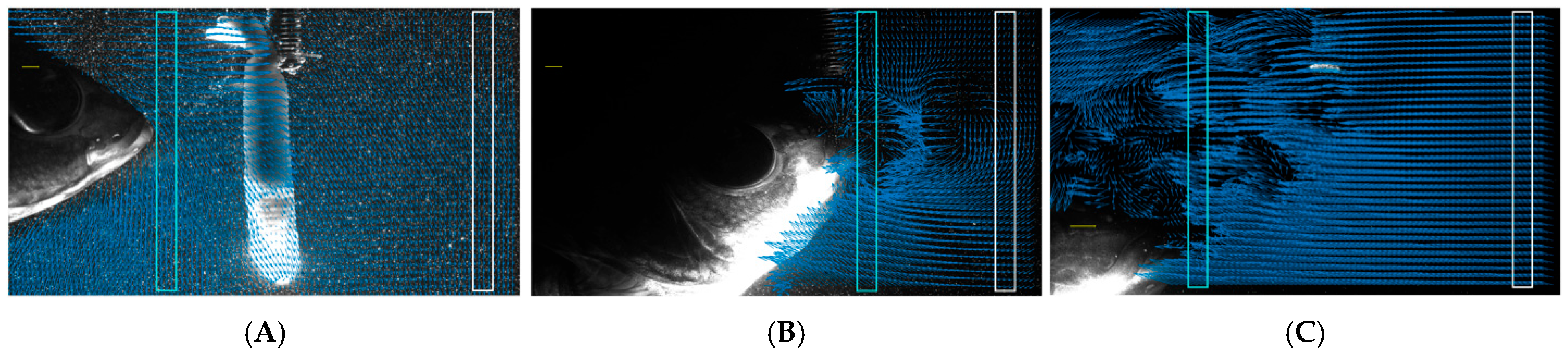
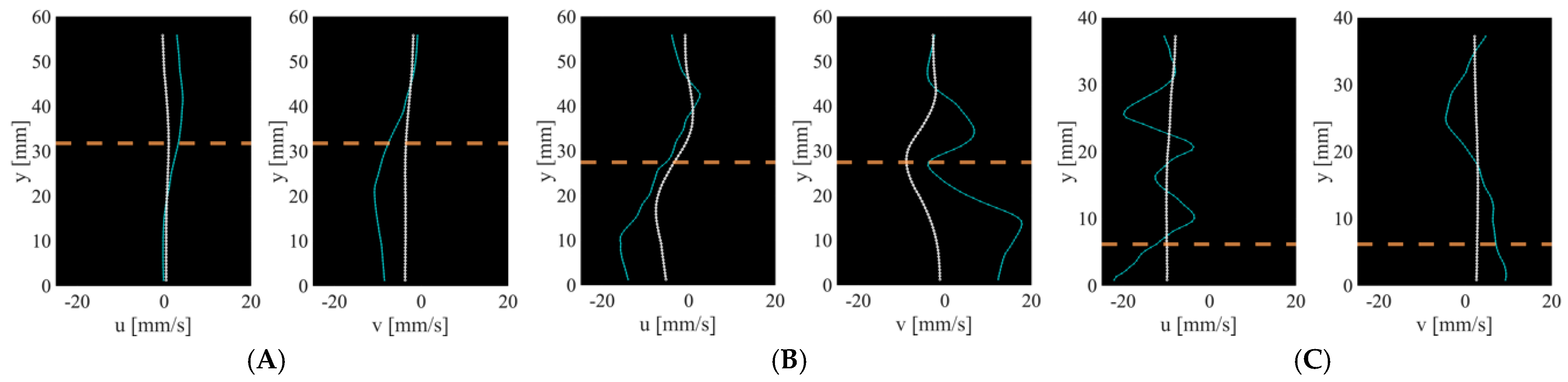
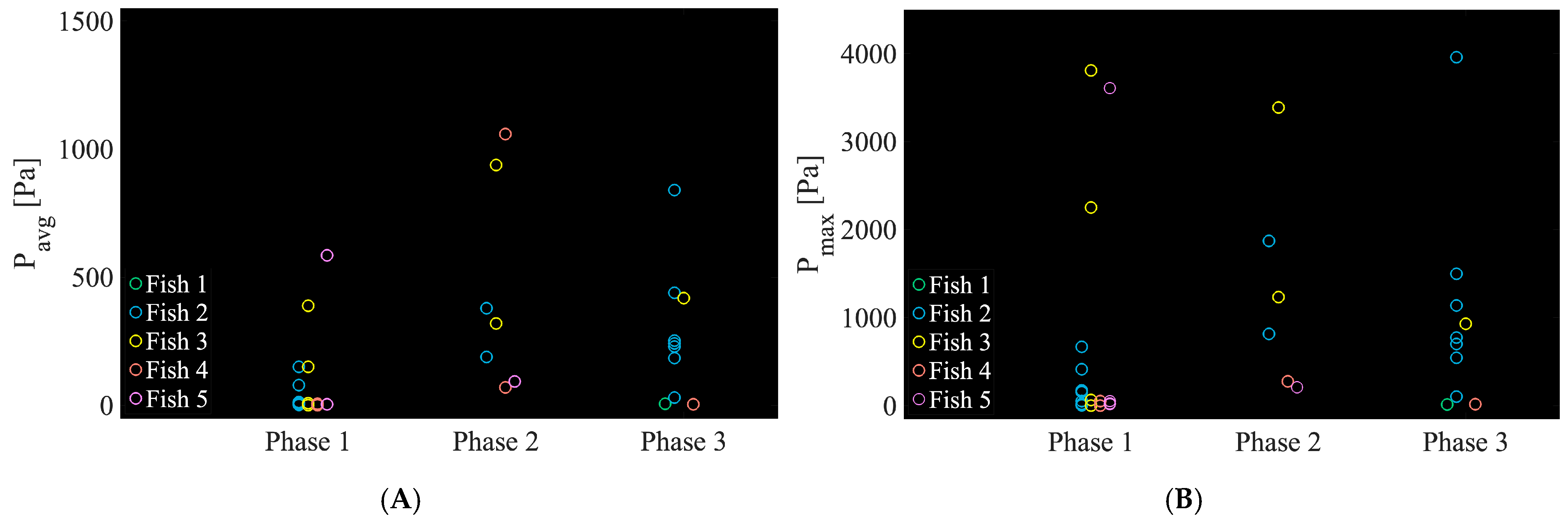
25]. The result of this post-analysis was ensembles of 2D velocity vector maps of two components of the velocity field (horizontal and vertical). Subsequently, the velocity maps were sorted based on the acquired images into the following phases: (1) the fish’s mouth is closed, prior to prey capture; (2) the fish’s mouth is open, during prey capture; (3) the fish’s mouth has closed and is retreating.
There are several sources of uncertainty when estimating pressure from PIV data. The accuracy depends on the numerical scheme, the quality of the PIV images, the PIV correlation analysis, and the experimental uncertainties. The estimated error for the PIV velocity measurements is about 2% [
3]. The error associated with the numerical scheme used to compute the pressure field was estimated by Gurka et al. [
4] to be about 2%, assuming a sufficient sample size, which is not fully achieved here due to the limitation of working with live organisms. The error resulting from the fish motion, and associated misalignments, is challenging to quantify. However, because the fish motion manifests itself in the PIV measurements, these experimental uncertainties are largely accounted for in the error associated with the PIV velocity measurements, which accounts for the correlation analysis, outliers, sub-pixel interpolation, large gradients, and 3D effects [
26].