Article

Numerical Analysis of Influence of Different Anti-Vortex Devices on Submerged Vortices and on Overall Performance of Vertical Mixed-Flow Pump


1
Centre of Hydraulic Research, Jana Sigmunda 313, 78349 Lutín, Czech Republic
2
SIGMA Research and Development Institute, Jana Sigmunda 313, 78349 Lutín, Czech Republic
*
Author to whom correspondence should be addressed.
Fluids 2025, 10(12), 325; https://doi.org/10.3390/fluids10120325
Submission received: 14 November 2025 / Revised: 29 November 2025 / Accepted: 2 December 2025 / Published: 6 December 2025

Abstract

The aim of this study is to compare submerged vortical structures for a pump mounted in a pump intake without any anti-vortex devices (AVDs), with a trident-like AVD or with a cone AVD. Another aim is to compare the pump characteristics (head, efficiency, power input and radial forces) of these pump arrangements via CFD simulation along with experimental measurements in a closed circuit. The numerical simulation of unsteady multiphase flow is established by means of computational fluid dynamics (CFD) and the volume of fluid (VOF) method. To predict vortical structures in the vicinity of the pump suction bell, the unsteady Reynolds-averaged Navier–Stokes equations (URANS) are solved together with the scale-adaptive simulation (SAS) turbulence model. For each AVD configuration, integral characteristics like the head, power input, efficiency and forces acting on the pump rotor are also evaluated. The numerical results show that the configuration with the cone AVD exhibits the best performance (from the point of view of both hydraulic efficiency and vorticity strength), but it requires a larger distance between the intake bottom wall and the pump bellmouth. The submerged vortices are quite stable when using an AVD, but rather unsteady without any anti-vortex tool.

1. Introduction

Water pump stations with vertically mounted axial-flow or mixed-flow pumps are complex hydraulic systems that usually consist of one or several pumps, connecting pipings and the intake and discharge objects. They are widely used in applications like irrigation, water supply, flood control or cooling. They can be very large structures with a high capacity and energy consumption. To maintain the high efficiency, long lifetime, sustainability and reliability of a station, not only the pump design but also the design of the intake and discharge objects should be optimised. For vertical high-specific-speed pumps, the optimal design of the intake objects plays a crucial role.
The most important phenomena, which should be addressed during the design and optimisation of the pump intake, are the free-surface and submerged vortices, non-uniform velocity and high pre-swirl in the pump suction, and the velocity and pressure fluctuations over time. Many recommendations have been proposed to guarantee an optimal intake design, and some of these recommendations have been included in the standard ANSI/HI 9.8 ([1], the Standard in the following text), the latest version of which was issued by the Hydraulic Institute in 2024. These recommendations are valid for a wide range of pump intake installations; moreover, they are accepted worldwide. Still, there are a number of exceptions to the Standard, which require verification with physical model testing. This study focuses on rectangular intakes for clear water, so only exceptions that are valid for this category will be considered. The most important and general exception arises from the size of the installation. If the installed pumps have flow rates greater than 2520 L/s or if the total pump station flow is greater than 6310 L/s, a properly conducted physical model study is required to comply with the Standard.
Unfortunately, physical model testing is time-consuming and can be very costly, and it is usually not possible to conduct such testing during the design stages; practically, it is (if required by a customer) carried out after the optimisation and final design are completed. Though the application of CFD simulations is not considered to be fully equal to a physical model study (or for demonstrating compliance with the Standard), CFD is now used as a powerful tool during the pump station design stages as well as during the examination of critical flow phenomena.
One of the most important phenomena occurring in the pump intake objects is the occurrence of unwanted vortices. To suppress the free-surface vortices, which are the most dangerous because they can bring air from the water level to the pump suction, the Standard introduces a strict requirement according to the submergence S:
S/Dbell = 1 + 2.3 FD, FD = V/(gDbell)0.5,
where FD is the Froude number, Dbell is the outside diameter of the inlet bell and V is the mean velocity at the bell inlet. This requirement surpasses the criterion developed by Reddy and Pickford [2,3], where the required submergence is limited by
S / D b e l l = 1 + F D .
Furthermore, when physical model testing is required, special measurement conditions are requisite according to the free-surface vortices. In particular, at least ten minutes of observation is required to indicate the persistence of varying vortices. This requirement reflects the fact that free-surface vortices are very unsteady and change (appear and disappear) on timescales of tens of seconds to minutes, not on a timescale of seconds. To assess only the design of the intake object (independently of the pump used), the impeller is not included in the physical model, and a straight pipe equal to the throat diameter or the pump suction diameter should be used with a length extending at least five diameters downstream from the throat or pump suction. A swirl-meter should be used to measure the intensity of the flow rotation.
Numerous experimental and numerical studies of vortical structures in the vertical pump sump have been conducted in respect to the ANSI/HI 9.8 standard, based on a straight pipe instead of a real pump. Some of the studies consider a simple rectangular sump with a straight pipe. Okamura et al. [4] presented a comparative study of results obtained from six different CFD simulations and validated these results with particle image velocimetry (PIV) measurements and laser light sheet visualisations. Both the submerged and free-surface vortices were considered. Long et al. [5,6] used a similar configuration to numerically study the effects of the flow rate and water level on free-water surface vortices, using the volume of fluid multiphase model. The improved S-CLSVOF (simple coupled level-set and volume of fluid) method was used by Xianbei et al. [7] to model both the air-entrained and subsurface vortices in the pump intake with a vertical pipe (the same configuration used by Okamura et al.). The continuous wavelet transformation (CWT) was applied to study the time-frequency characteristics of vortices. Tokay and Constantinescu [8] and, more recently, Yamade et al. [9,10] used large eddy simulations (LESs) to model in detail the submerged vortices in a pump sump. The free-water level was not considered in these simulations. While Yamade et al. used a simple straight pipe, Tokay and Constantinescu used an outlet pipe, which represents the outer shape of a real vertical pump. An approach similar to the one used in [8] can be found in the work of Amin et al. [11], where a pump-shaped pipe (without any inner rotating and stationary parts) was used to experimentally and numerically model the free-water surface vortices. Kim et al. [12] used a pump-shaped pipe to study the subsurface vortices by means of PIV along with single-phase CFD simulation and the SST (shear stress transport) and LES turbulence models. The effects of submerged vortices on the hydraulic forces and the vortex cavitation were studied experimentally as well as numerically by Nagahara et al. [13], who used a model pump with an impeller and applied particle tracking velocimetry (PTV) to monitor the strength of the vortices. Their numerical simulations did not consider the free-water level. Uruba et al. [14] used the full geometry of an axial-flow pump and an unsteady multiphase CFD simulation with scale-adaptive simulation to numerically model the free-surface and submerged vortices and their dynamics in the pump sump. They used the time-resolved PIV method to validate the numerical simulations. An experimental study by Zhang et al. [15] investigated the development of the roof-attached vortex and compared the results of the visualisations with those of the numerical simulations employing a single-phase model and the full geometry of the pump. The bottom and sidewall-attached vortices in a rectangular pump intake were simulated by Yu et al. [16] using a single-phase CFD model and scale-adaptive simulation. The full axial-flow pump geometry was considered, and the results were analysed via CWT. The formation mechanism and dynamic characteristics of the floor-attached vortex (FAV) in the pump sump was studied in detail by Song et al. [17] through both experimental research and CFD simulation. The full geometry of an axial-flow pump was applied in the multiphase numerical simulation, which was verified by experimental visualisations and the volume 3D velocity field measurement system (V3V).
Free-water surface vortices represent a highly unacceptable phenomenon, as they can cause many problems such as unsteady rotational flow, cavitation effects and even air entrainment from the free surface up to the pump impeller. Their existence is proportionally dependent on the pump submergence and the swirl generated by the pump, and optimising the flow rate and the submergence value is a typical measure to prevent these vortices. On the other hand, the occurrence of submerged vortices is not directly related to the submergence value; still, submergence can influence the cavitation state in the submerged vortex core. In a simple pump sump, submerged vortices can be very strong and quite unsteady. This is why anti-vortex devices have been recommended as tools to disrupt the angular momentum of the flow and thus suppress the submerged (as well as the free water-level) vortices. One of the pioneering works related to this problem comes from Kim et al. [18,19], who experimentally and numerically investigated the submerged vortical structures around a pump intake without and with an AVD (with the shape of a simple floor splitter or a trident); both a pump-shaped pipe and the full geometry of a mixed-flow pump were employed. The full pump geometry and a trident-shaped AVD were also used by Zhao et al. [20]. A numerical simulation of the flow in a pump intake equipped with a floor splitter was conducted by Norizan et al. [21], who applied only a straight pipe without any suction bell in a rectangular channel, along with simple floor splitters with different cross-sectional shapes (triangular, rectangular, trapezoidal and trapezoidal with round upper edges). A numerical simulation based on the rectangular pump intake employed by Okamura et al. and a straight pipe with a suction bell was conducted by Kim et al. [22]. They added a trident-shaped AVD into the computational domain and analysed the resulting changes in vortical structures. In all these works, the free-water level as well as the free-surface vortices were not considered. A multiphase flow simulation employing the VOF model was performed by Arocena et al. [23], who used a simple pump-shaped pipe and two types of AVDs (a trapezoidal-shaped cross floor baffle with a vertical backwall splitter and a trident-shaped floor splitter) to investigate the free-water surface vortices as well as the submerged vortices.
As one of the key points of this study focuses on the influence of the cone AVD, a brief mention regarding the application of this type of AVD is warranted. An early study employing a cone-shaped AVD was conducted by Kim et al. [24], following the work described in [22]. They used the rectangular pump intake employed by Okamura et al. and a straight pipe with a suction bell and compared the submerged vortical structures for the floor cone and the trident-shaped AVD with different heights. The cone heights varied from 10% to 50% of the pipe diameter, but the numerical simulations revealed a highly nonlinear dependence of the vortical intensity on this ratio, with the best result for the ratio of the cone height to the pipe diameter being 0.1. Zhao et al. [25] used a simple diversion cone, consisting of a circular plate with four vertical triangular baffles, to experimentally investigate the free-water surface and submerged vortices in a simple rectangular pump intake with a vertical axial-flow pump. Very recently, a comprehensive study has been published by Zhang et al. [26], who used the hybrid RANS-LES turbulence model together with the VOF multiphase flow to numerically model both the roof-attached vortices (RAVs) and floor-attached vortices (FAVs). The computational domain included the geometry of an axial-flow pump with a bellmouth and three AVDs (anti-vortex grid bars, an anti-vortex cross baffle and an anti-vortex cone). The anti-vortex cone had an elliptical shape with a flat apex (with a diameter that was 15% of the cone base diameter), and it superior suppression of FAVs was evident in comparison with the other AVDs. The numerical results were verified with experimental visualisations in their study. Sedlář et al. [27] applied anti-vortex cones of an elliptical shape with a spherical apex in combination with a system of mixed-flow pumps located in a complete intake object of the pump station. Their numerical study covered a wide range of flow regimes to predict the pump performance during a power cut event. The anti-vortex cones had one baffle oriented to the rear wall of the sump. For the pump mode, a vortex between the cone apex and the impeller nut was detected. For both the pump and turbine modes, a system of sidewall vortices was formed. The simulation employed the VOF multiphase flow model, but no free-water surface vortices were detected.
As mentioned at the beginning of this paper, the design of the intake objects should be optimised to maintain a water pump station’s high efficiency, long lifetime, sustainability and reliability. However, physical model testing is very time-demanding and can be very costly, and it is usually not possible to conduct such testing during the design stages. For vertical high-specific-speed pumps, the vortical structures and secondary flows in the intake objects play a very important role; aside from their verification, another task is also important. Axial-flow and mixed-flow pumps are usually equipped with a complete dataset of the measured pump integral characteristics obtained in a closed test circuit (which allows for measuring not only in the pump mode but also in the brake and turbine modes). A question arises regarding what performance parameters can be expected when the pump (equipped with a suction bell) is operated in a pump sump with or without any AVDs. The aim of this paper is to compare the submerged vortical structures of a pump mounted in a pump intake without any AVD that has a trident-like AVD or a cone AVD; another aim is to compare the pump characteristics (head, efficiency, power input and radial forces) of these pump arrangements using CFD simulations and experimental measurements in a closed circuit. In this study, the full geometry of a mixed-flow pump is modelled, including the impeller blade-tip clearances and the unsteady rotor–stator interaction, and the geometry of a new cone AVD is also introduced.

2. Materials and Methods

2.1. Test Case Setup

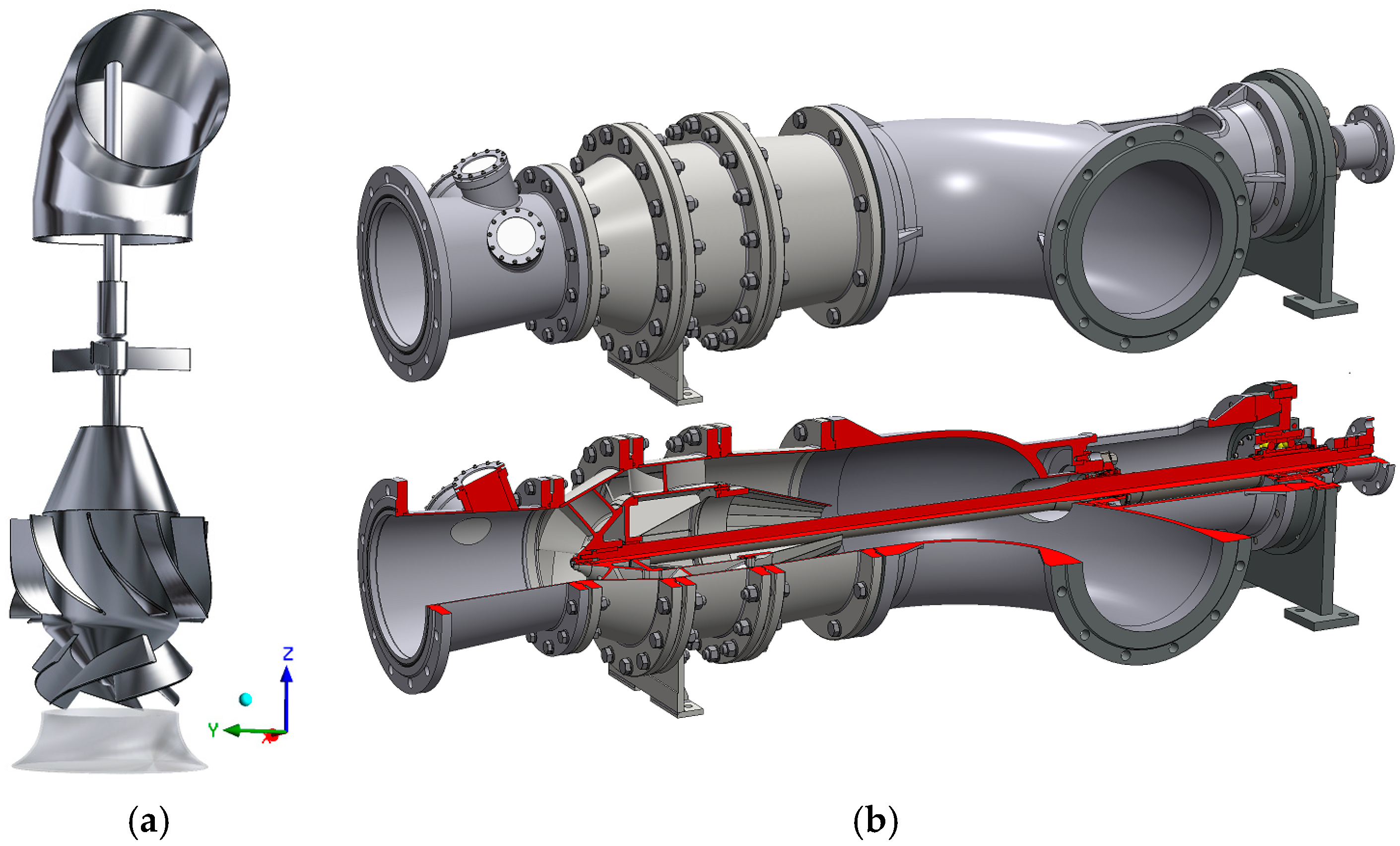
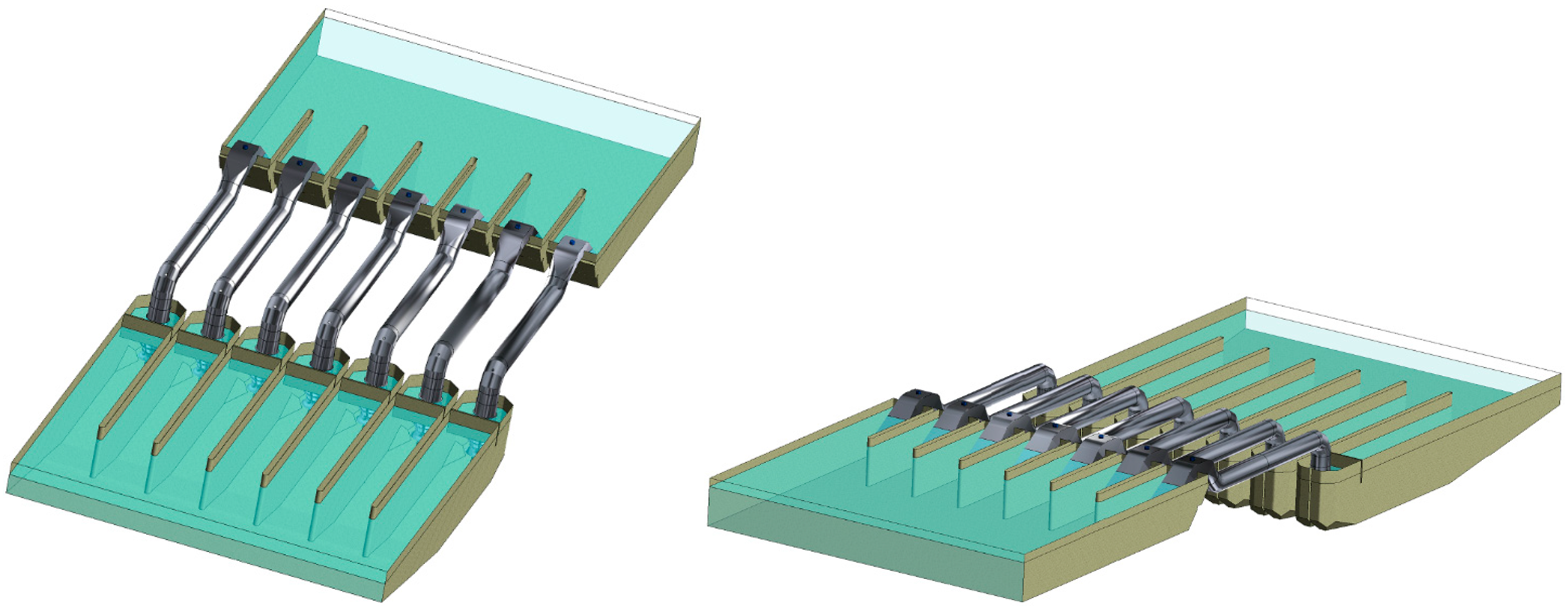
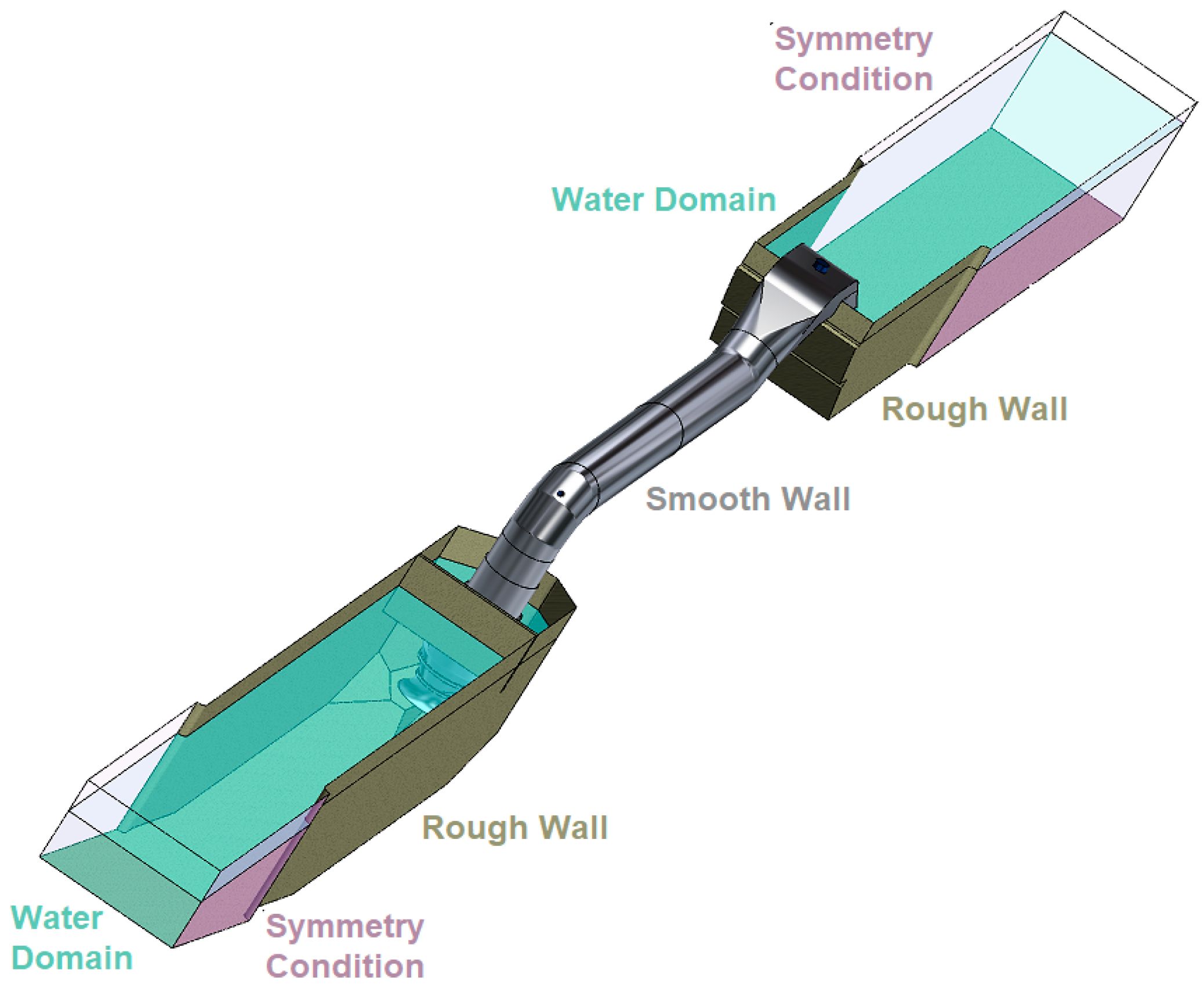
This study is based on a virtual pump station, in which seven vertical mixed-flow pumps (with a specific speed nq = 116) are installed. Each of the pumps (Figure 1) is installed in the suction basin between concrete pillars (Figure 2); for the study purposes, only the middle pump with its suction and discharge corridors are modelled based on the symmetry boundary conditions applied on the water-section surfaces connected with the pillar edges (Figure 3). The width of the basin between the pillars is 4.9 m, and the diameter of the pump inlet bell (Dbell) is 2.44 m. The low water level (LWL) is 5.4 m above the floor at the position of the pump, and the pump submergence (S) is 4.4 m. The nominal pump flow rate (Qopt) is 8 m3/s, the impeller diameter is 2.09 m, and the rotational speed is npump = 159 rpm (which gives a pump shaft frequency fshaft = 2.65 Hz). The vertical pump is connected with a discharge pipe ending by a siphon in the upper/discharge basin. The low water level in the discharge basin is 10.25 m above the floor at the position of the pump.
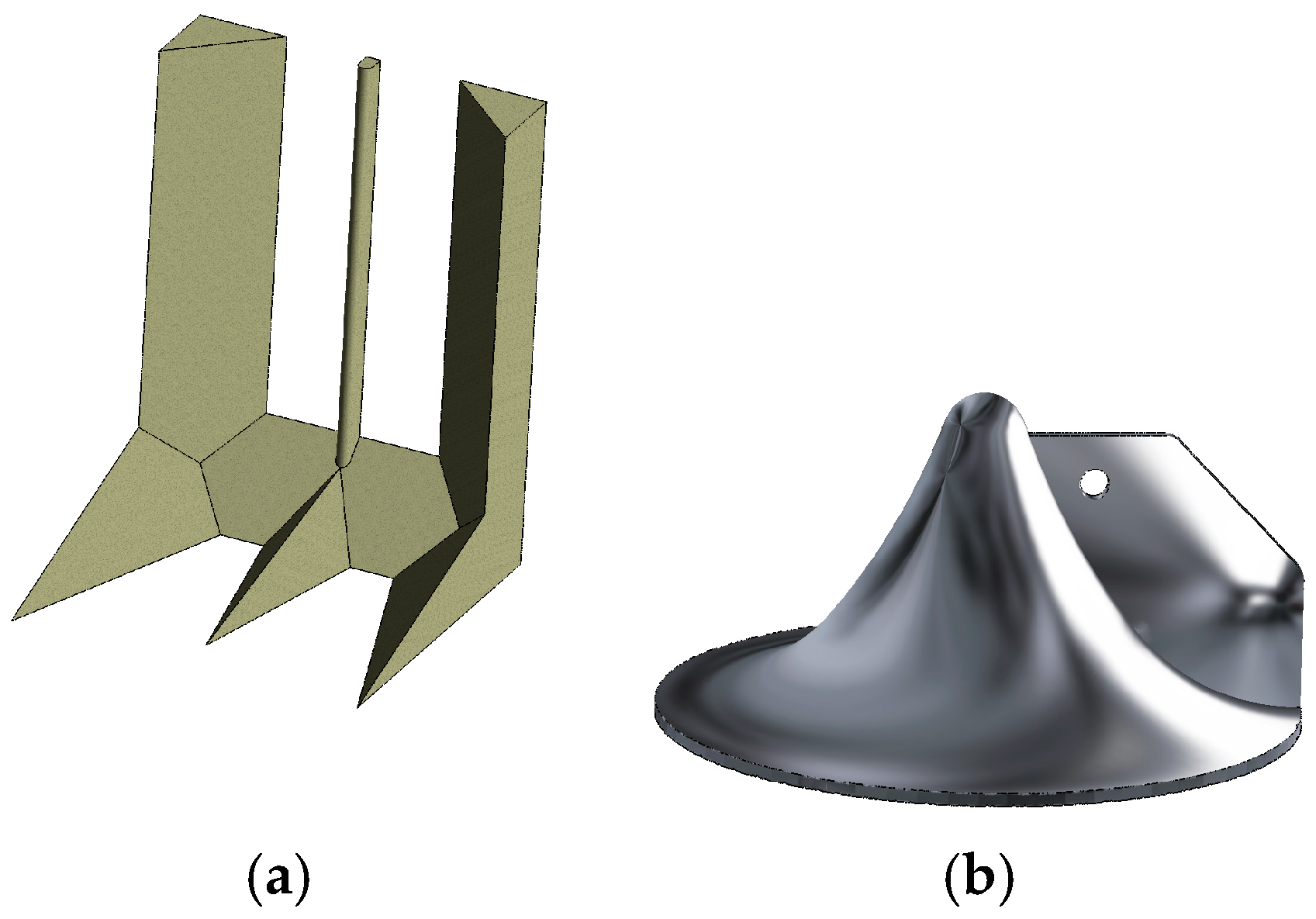
The intake object is designed to prevent free-surface vortices as much as possible. The submergence S under LWL conditions corresponds exactly to the requirement described by Equation (1). There is a vertical curtain wall at a distance of 1.6 Dbell ahead of the pump axis, with a submergence of 0.5 Dbell, which is also in agreement with the standard ANSI/HI 9.8. Three pump intake configurations are taken into account: the first configuration does not have an AVD but employs typical vertical corner fillets; the second configuration is equipped with a trident-like AVD; and the last configuration employs a cone AVD. Figure 4a shows the first AVD, which consists of a centre splitter, a backwall, sidewall and corner fillets, and a backwall splitter plate. The dimensions of these parts align with the requirements of the Standard. The distance between the intake bottom wall at the pump position and the pump bellmouth is 0.4 Dbell. The second AVD (Figure 4b) is an anti-vortex cone of an elliptical shape with a spherical apex. It has one baffle oriented to the rear wall of the sump. In this case, the bottom wall at the pump position has been lowered by 0.22 m, so the distance between the bottom wall and the pump bellmouth is 0.5 Dbell.

2.2. Numerical Methods

The numerical simulation is based on the URANS equations, solved using the CFD software package ANSYS CFX (ANSYS 2024 R2, [28]), as follows:
U i x i = 0
ρ U i t + ( ρ U i U j ) x j = P x i + x j τ j i + S M , i
where
τ i j = μ + μ t U i x j + U j x i 2 3 U k x k δ i j
is the viscous stress tensor, Ui are the Reynolds-averaged velocity components in the 3D Cartesian coordinate system, ρ is the fluid density, P is the Reynolds-averaged static pressure, μ is the dynamic viscosity, μt is the turbulent viscosity obtained from the turbulence model, and SM is the general momentum source term. In this paper, the source term represents the gravity forces evaluated based on the gravity acceleration and the density differences. To correctly model a complex system of vortices in the computational domain, a scale-adaptive simulation (SAS) turbulence model (Menter and Egorov [29]) is used for the scale-resolving simulation of vortical structures. The SST-SAS turbulence model is based on a widely used SST turbulence model that blends the standard k-ε and k-ω models using two blending functions (F1 and F2), which are dependent on the dimensionless wall distance. The SST-SAS turbulence model can be described by the following governing equations:
ρ k t + ( ρ U j k ) x j = x j μ + μ t σ k 3 k x j + P k   β * ρ k ω
ρ ω t + ( ρ U j ω ) x j = x j μ + μ t σ ω 3 ω x j + γ ρ μ t P k β 3 ρ ω 2 + 1 F 1 2 ρ σ ω 2 ω   k x j   ω x j + Q S A S
where
P k = μ t U i x j + U j x i U i x j 2 3 U k x k 3 μ t U k x k + ρ k
is the turbulence production term, k is the turbulent kinetic energy and ω is the turbulent frequency. The turbulent viscosity is described with the following formula:
μ t = ρ a 1 k m a x ( a 1 ω , S F 2 )
where S is the strain rate, calculated as follows:
S = 2 S i j S i j ,             S i j = 1 2 U i x j + U j x i .
The source term QSAS on the right-hand side of Equation (7) represents an additional term comparing to the SST turbulence model and can be expressed as
Q S A S = m a x ρ ς 2 κ S 2 L L ν k 2 C 2 ϱ k σ Φ G ω k , 0 ,             G ω k = m a x 1 ω 2 ω x j ω x j , 1 k 2 k x j k x j
where L is the turbulence length scale, and Lνk is the von Karman length scale given by
L ν k = m a x κ S U " , C S κ ζ 2 ( β c μ α )   . Δ c e l l ,     L = k c μ 0.25   ω ,     U " = i 2 U i x j x j 2
where κ is the von Karman constant. The limiter of the von Karman length scale is proportional to the mesh cell size, which is calculated as the cubic root of the control volume ΩCV. With this definition of the limiter, the SST-SAS model provides nearly the same energy spectrum as the basic LES model. More details of the Menter’s SST and SAS models, including the definitions and a discussion of the blending functions and all used constants (a, C, β, σ, γ, ζ), can be found in [29,30].
The homogeneous multiphase flow simulation employs the VOF method, solving the transport equation for the void volume fraction (Hirt and Nichols [31]):
( ρ v α v ) t + ρ v α v u i x i = s + s
where s+ and s are the source and sink terms, respectively. The free-surface model is based on the continuum method for modelling surface tension proposed by Brackbill et al. [32]. Though cavitation can appear inside submerged vortical structures, the cavitation phenomenon is not taken into account in the present study.
The boundary conditions for the intake object are based on the velocity, turbulent kinetic energy and its dissipation rate set for the inlet (according to the flow rate and the estimated turbulence intensity and eddy length scale). The boundary conditions for the discharge object are specified based on the pressure outlet boundary conditions at the basin outlet with respect to the buoyancy and gravity forces. The symmetry boundary conditions are applied on the symmetry planes of both the intake and discharge objects.
A high-resolution scheme ([28]) is used for the momentum equations, while the turbulence numerics are based on a first-order scheme. The time discretisation is of the second order and uses the backward Euler scheme. The multiple frames of reference (MFR) capability, in which different domains are rotating relative to one another, and the fully unsteady model of flow (typically known as the transient rotor–stator or sliding mesh model) are used to capture the interactions between the stationary and rotating parts of the computational domain. The time step of 1.0482 × 10⁻³ s corresponds to a rotor revolution by 1°.

2.3. Simulation Setup and Verification

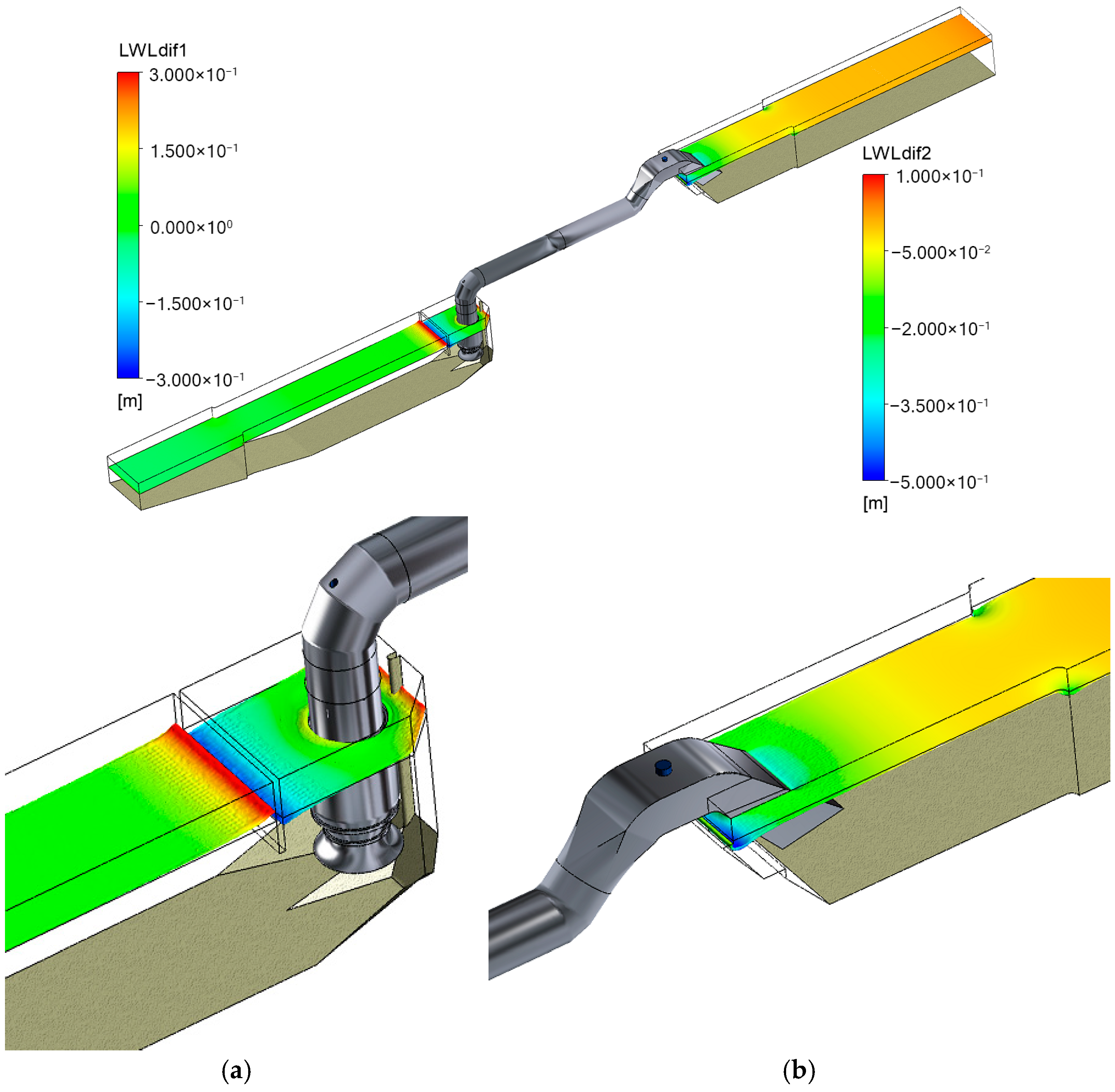
The simulation started with a preparatory phase, in which the flow in the computational domain (described in Figure 3) was simulated with a medium-density computational grid containing a total of 14 mil. grid points. The grids of the rotating and stationary parts of the pump were created as structured hexahedral grids. As modelling of the vortical structures in the intake and discharge objects requires sufficiently isotropic grids, tetra/prism elements were used for these construction parts. In this phase, the SST turbulence model was applied. The aim was to verify whether the submergence of the pump and the curtain wall would prevent the flow in the intake object from free-surface vortices, which could interact with submerged vortices. In addition, the total pressure losses in the intake and discharge objects were carefully calculated so that the hydraulic performance and efficiency of the pump itself could be evaluated. Figure 5 shows the free-water surface as the difference from the nominal low water level in the intake object with the vertical pump as well as in the discharge object with the welded siphon.
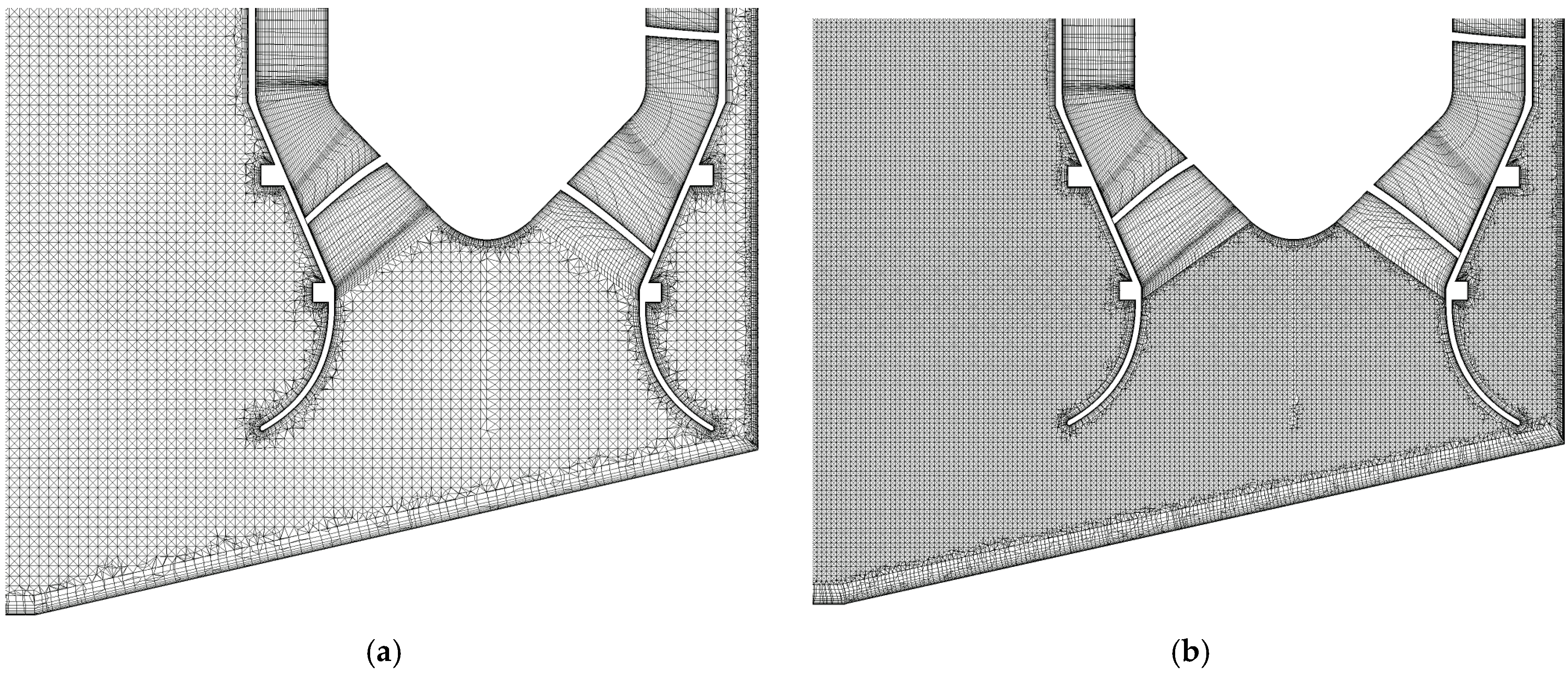
Based on the obtained results, the main vortical structures were identified, and then local refinement of the computational grid was performed by increasing the computational grid size by about 3–4 mil. nodes, depending on the pump intake configuration. In Figure 6, the local refinement of the computational grid can be seen in the vicinity of the pump suction bell. During the mesh optimisation, the distance between grid points decreased two times. Compared with the global mesh size in the intake object, the distance between grid points in Figure 6b is four times smaller. The parameters of the resulting optimised mesh in the vicinity of the pump suction (which are important for the sub-grid scales) are listed in Table 1.
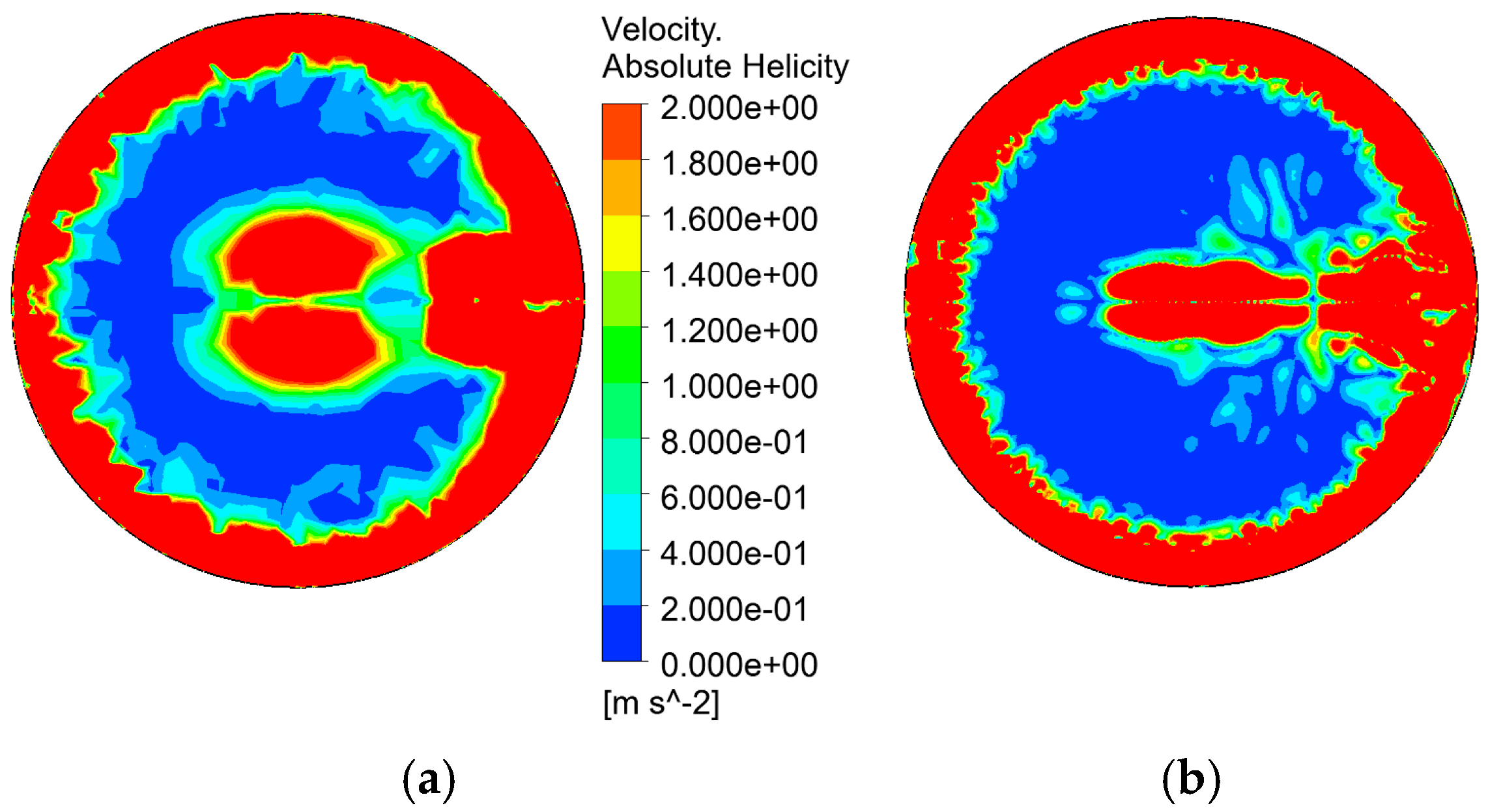
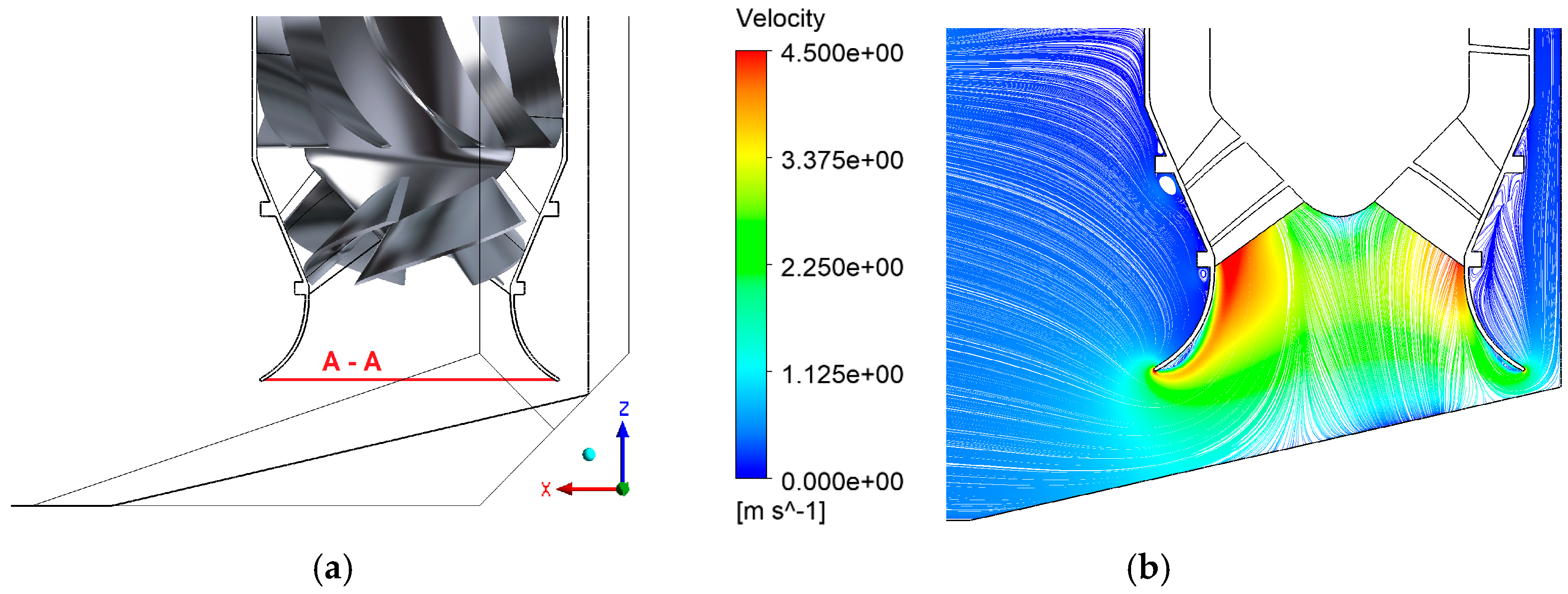
Figure 7 shows the influence of the mesh size optimisation on the resolution of vortical structures in the vicinity of the pump suction bell at the bellmouth cross-section A–A indicated in Figure 8a. Figure 8b presents a typical pattern of water velocity streamlines in the vertical symmetry plane of the intake object with the trident-like AVD. Well-resolved annular vortices at the pump impeller flanges can be clearly seen in the simulation with the optimised mesh.
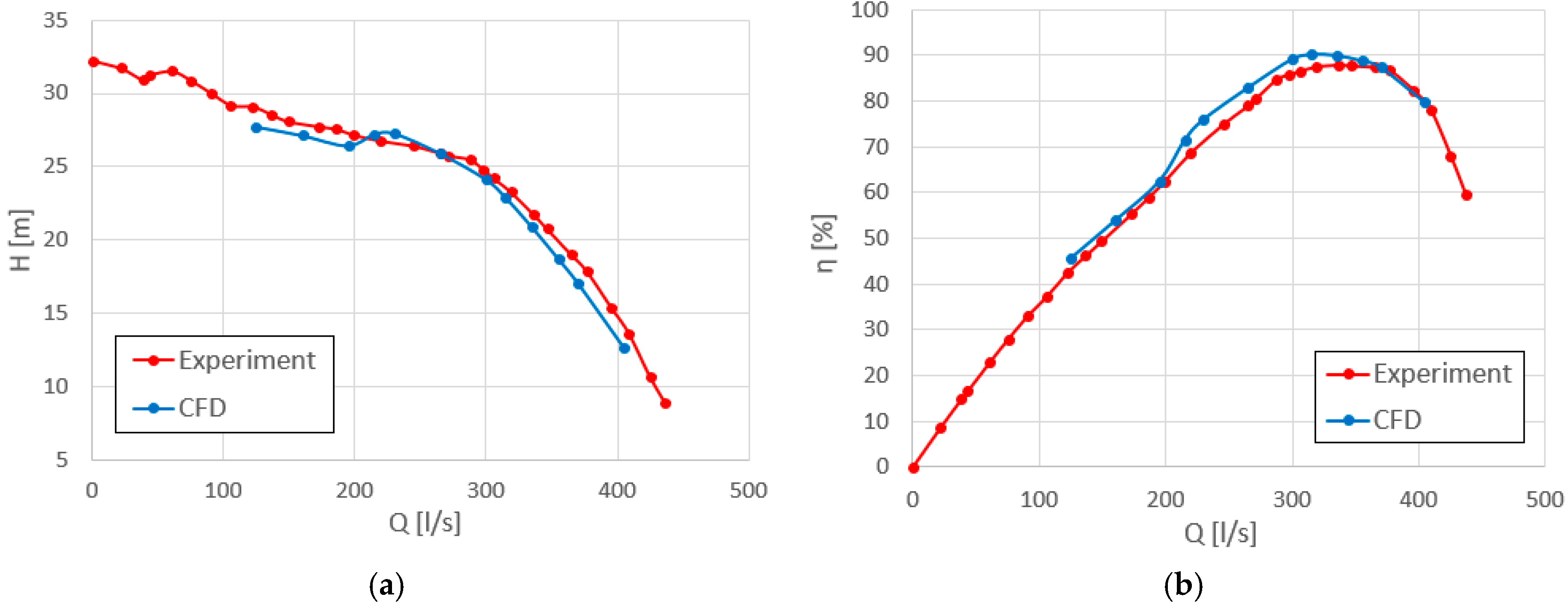
To verify the correctness of the numerical model of the pump itself, a simulation of the flow in the pump without a bell (which was replaced by a simple circular pipe) was conducted for a wide range of flow rates. The results were recalculated for the model pump with an impeller diameter of 0.3154 m and a rotational speed of 1900 rpm and then compared with the measurements performed in a closed test circuit at the SIGMA Research and Development Institute. Figure 9 shows the measured and calculated values of the delivery head and the efficiency of the pump. It should be noted that the measured efficiency of the pump represents the overall efficiency including the mechanical losses; the calculated efficiency at the best efficiency point is about 2% higher, which corresponds well with the theoretically estimated mechanical losses. The details of the model measurements in the closed test circuit are not the main subject of this study, but we provide a basic description of the methodology in this paragraph. A magnetic-inductive flowmeter with an accuracy within 0.2% was used to measure the volume flow rate. For all measurements of pressure differences, transducers with an accuracy within 0.04% were used. The temperature of the water was measured with a platinum thermometer with an accuracy within 0.5%, and the torque/power input was measured with a torque sensor with an accuracy within 0.1%.

3. Results

3.1. Intake Object Without AVD

To evaluate the influence of AVDs on the flow fields and pump performance, the first described case represents an intake object without any AVD. When the bottom of the intake object under the pump is formed by a horizontal plane only, one or two bottom vortices are usually formed between the bottom wall and the impeller. These vortices are not fixed by any solid structure and so they could be very unsteady. In a previous study [14] examining an axial-flow pump, one bottom vortex was identified at the design flow rate, both experimentally (by means of PIV) and numerically, moving in the range of up to 0.3 Dbell from the pump axis of revolution with a speed of several centimetres per second. Kim et al. [18] visualised (also by means of PIV) one bottom vortex when operating a mixed-flow pump without any AVD at the design flow rate. However, their graphs of the vertical vorticity obtained from CFD simulation indicate more than one bottom vortex. Yu et al. [16] numerically identified a pair of counter-rotating bottom vortices, a pair of backwall vortices and several pairs of sidewall vortices in an intake object with an axial-flow pump operating at 120% of the design flow rate. Yamade et al. [9,10] numerically discovered one or two bottom vortices formed under a straight pipe located asymmetrically in a simple pump sump, based on the type of boundary layer. The development of bottom vortices was studied in detail by Song et al. [17], both numerically and experimentally, in a simple pump sump with an axial-flow pump. They found that in the first stage, a pair of counter-rotating bottom vortices were formed, but over time, the vortex rotating in the direction of the impeller became stronger, and at the end, the vortices developed into only one main vortex. All of these findings indicate that the number of bottom vortices depends strongly on the boundary layer, flow (a) symmetry and rotation intensity generated by the pump.
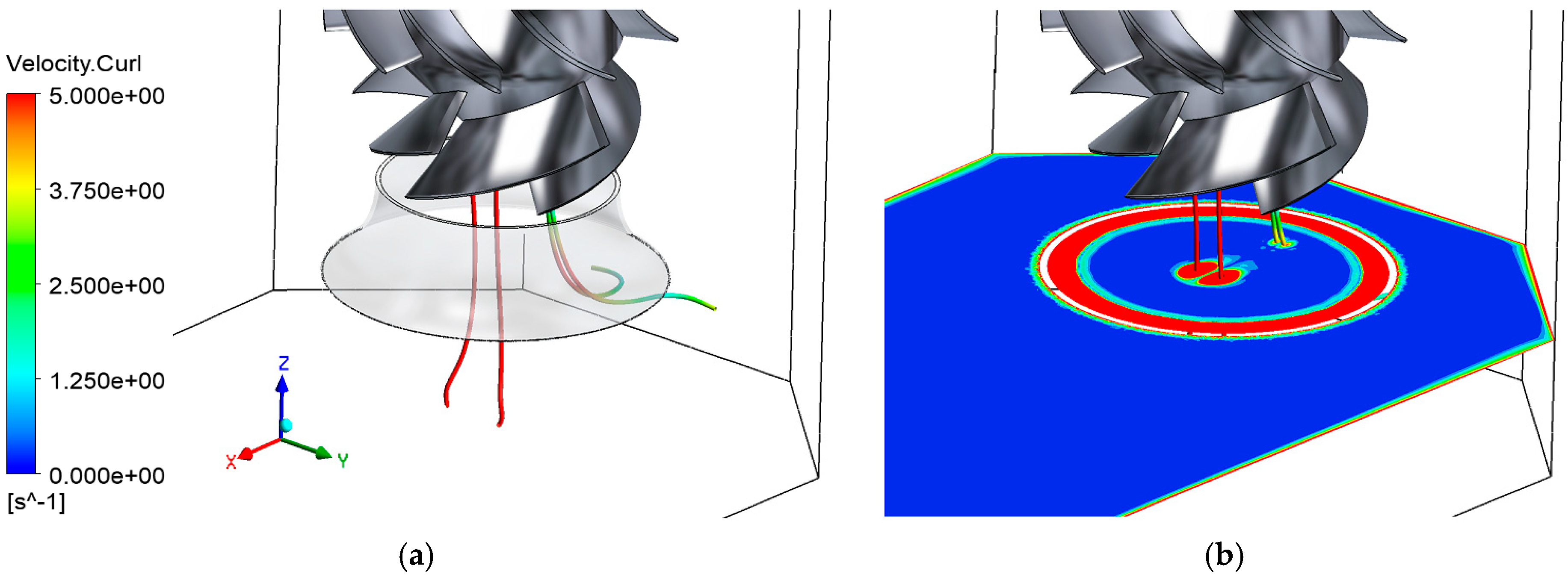
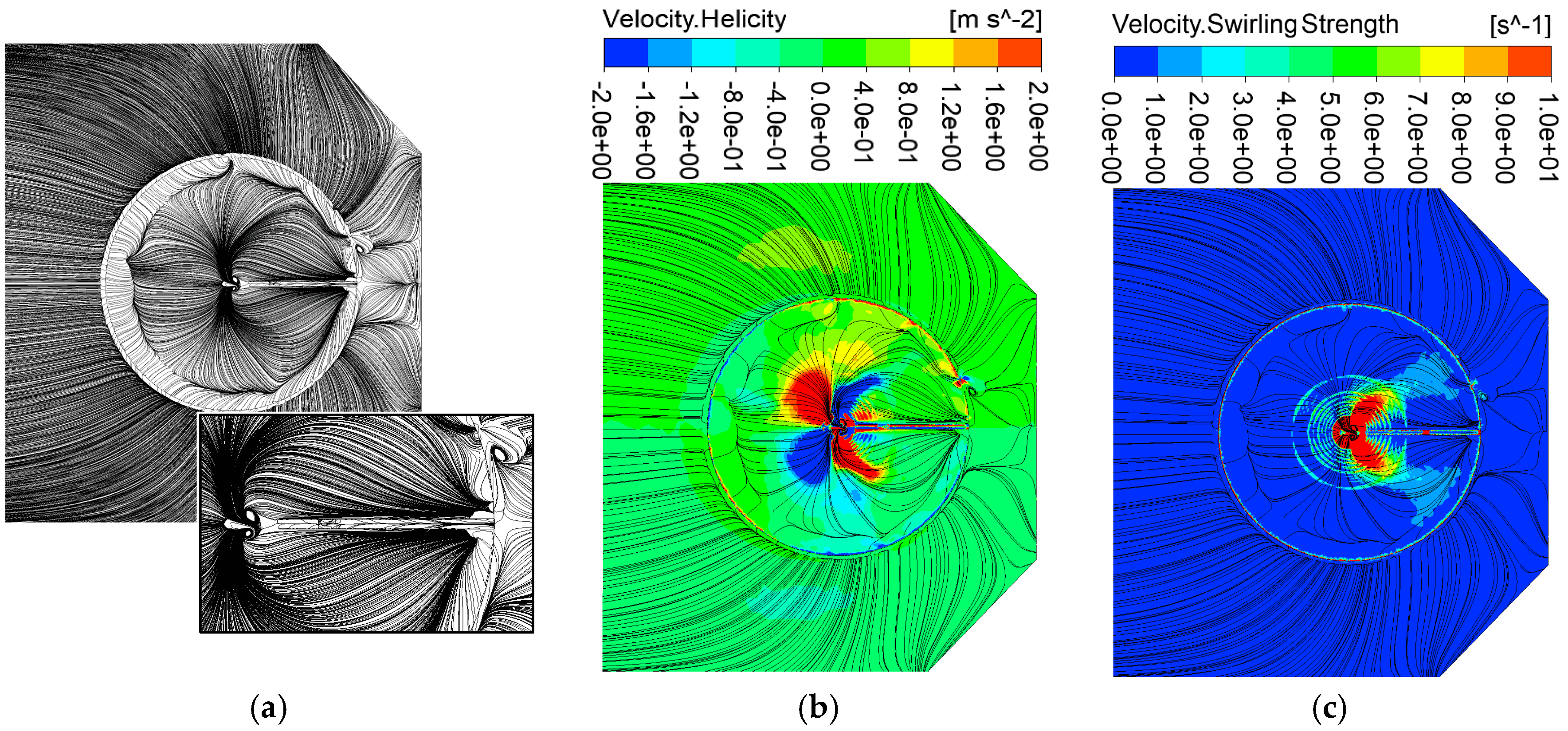
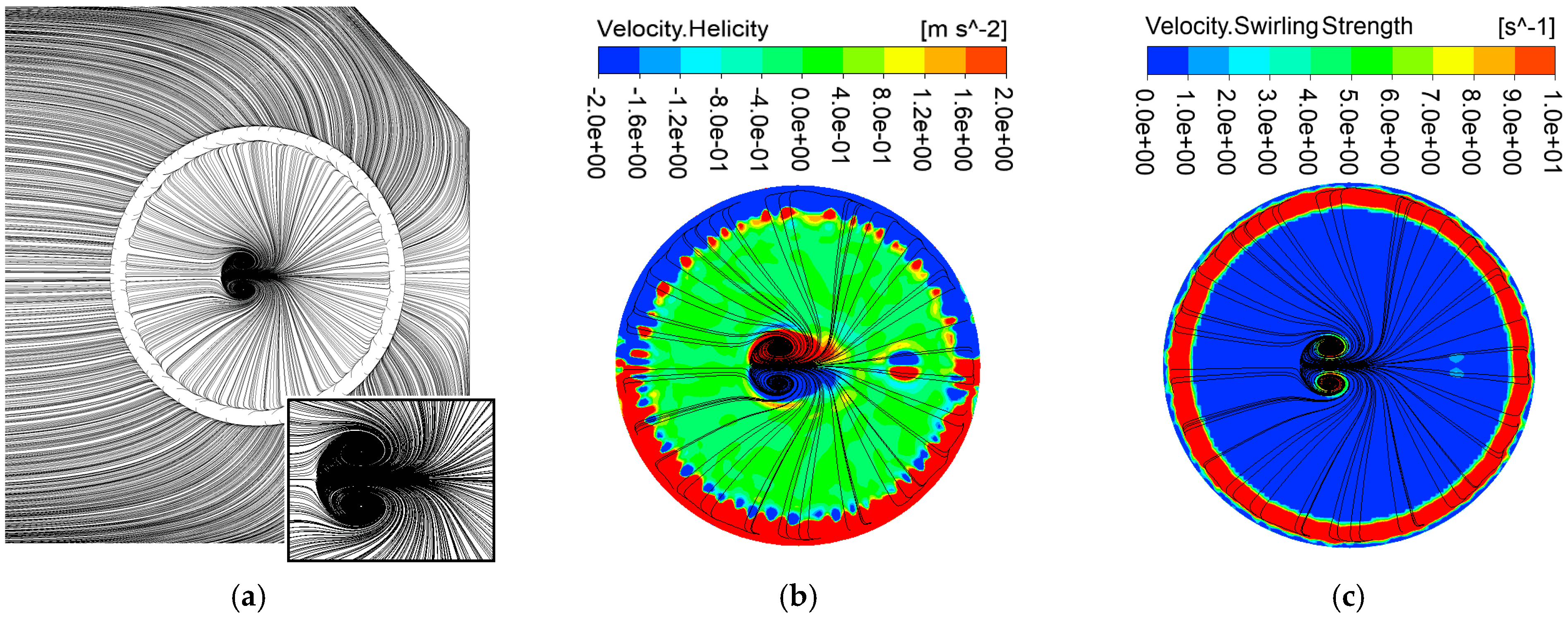
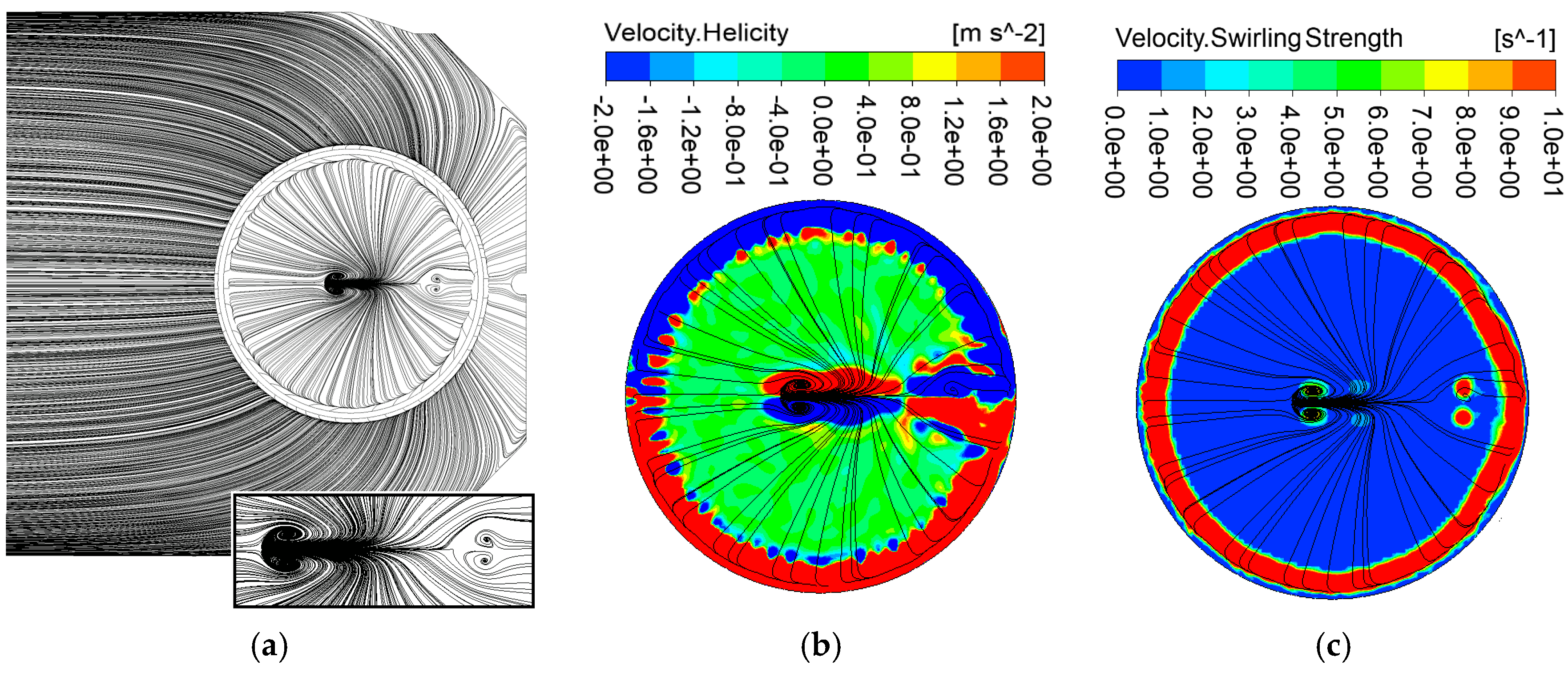
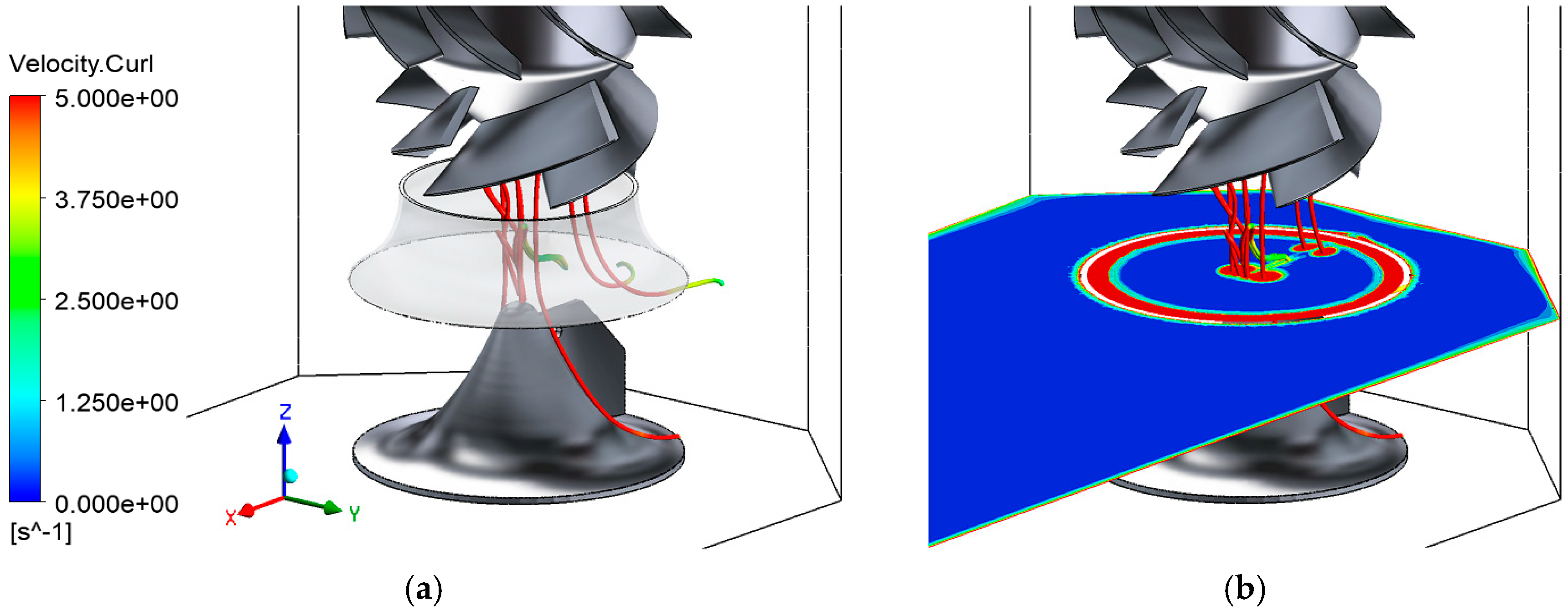
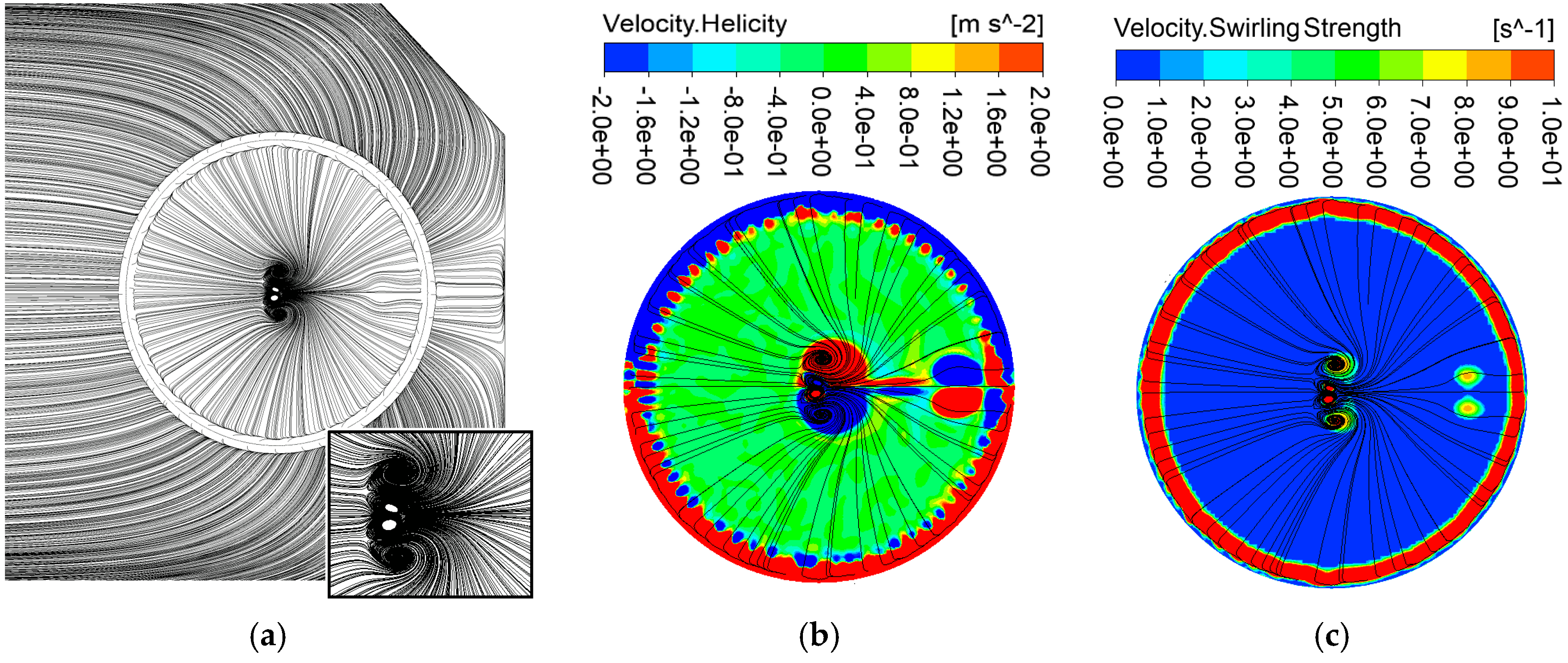
For the design flow rate Qopt of 8 m3/s in this study, the intensity of rotation generated by the pump is negligible. A pair of counter-rotating backwall vortices is formed in the vicinity of the pump suction, as can be seen in Figure 10a, which shows the vortex cores coloured with the velocity curl. There is also a pair of bottom vortices with the highest vorticity. The strong magnitude of the vortices can be seen at the bellmouth cross-section A–A (Figure 10b). Detailed view of the magnitude and shape of the vortical structures at the bellmouth cross-section A–A can be found in Figure 11, where the instantaneous surface streamlines are compared with the distribution of velocity helicity and swirling strength.
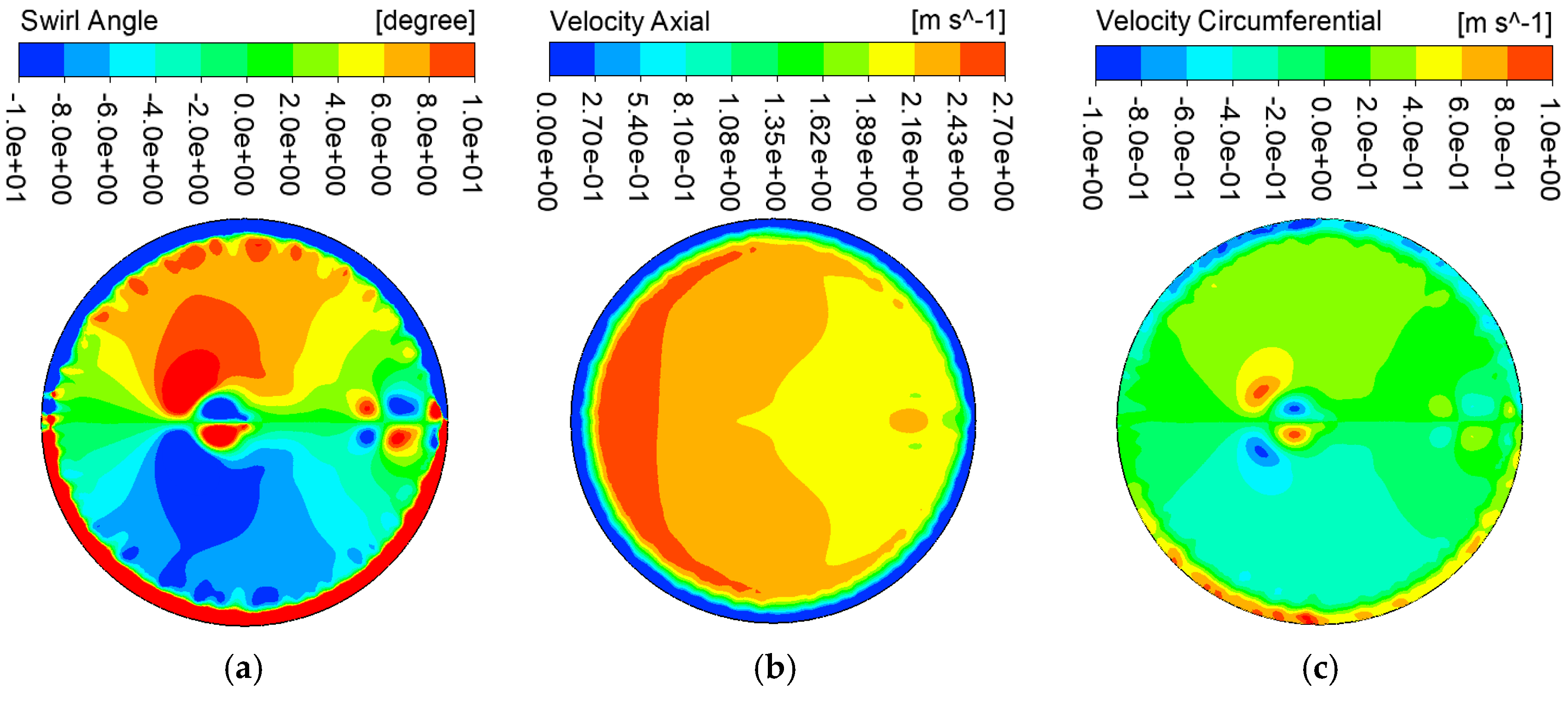
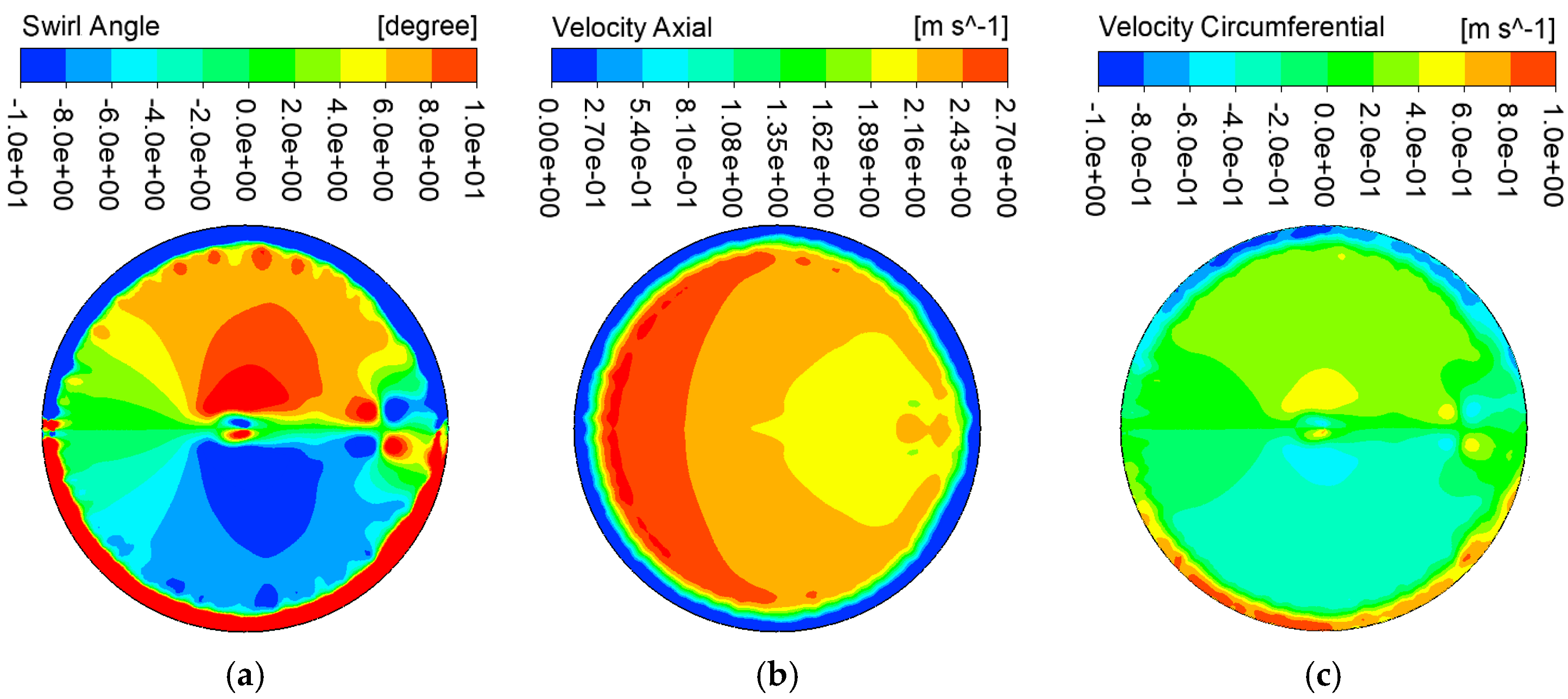
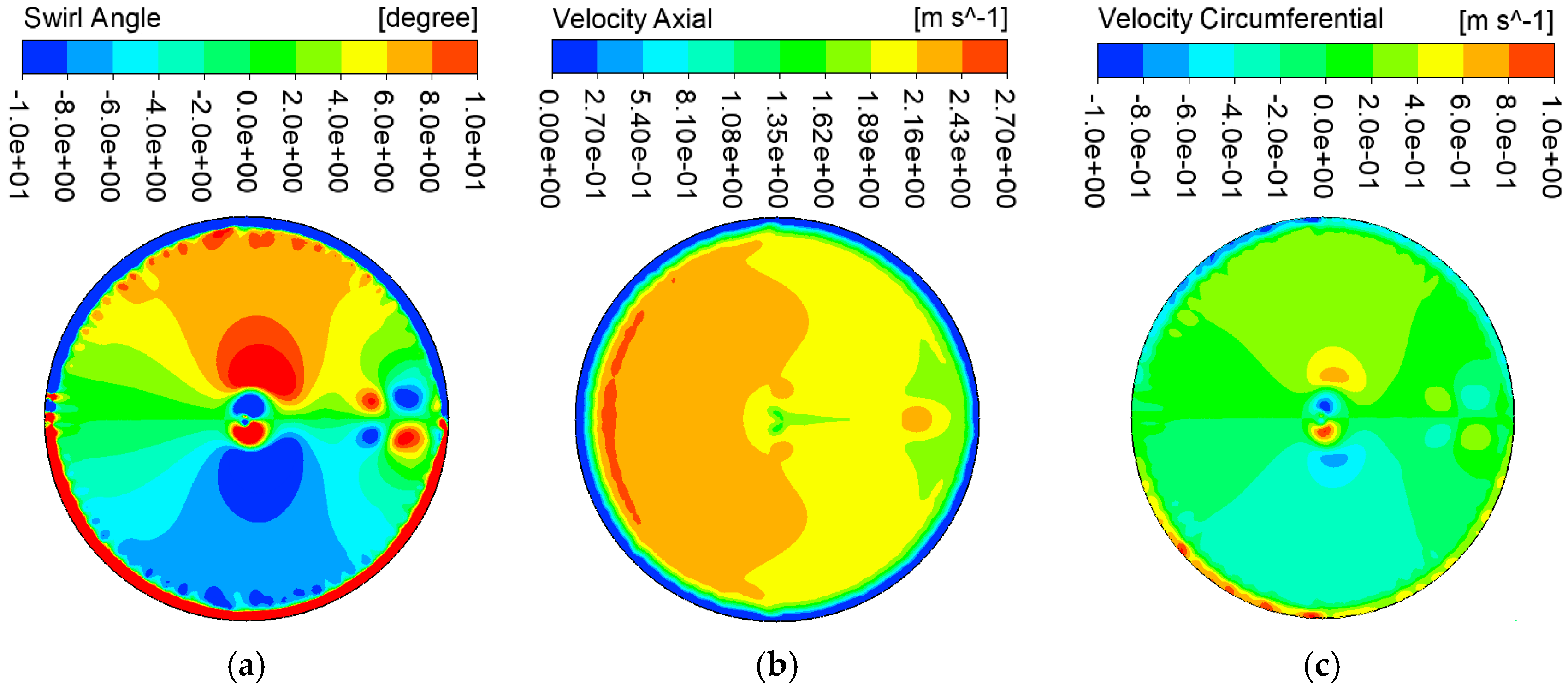
The distribution of the swirl angle at the bellmouth cross-section A–A is shown in Figure 12. The mass-averaged value MASWA of the swirl angle SWA at the bellmouth is 5.3°. The definition of the swirl angle follows Equation (14):
S W A = a t a n V e l o c i t y   C i r c u m f e r e n t i a l a b s V e l o c i t y   A x i a l + 0.001 ,             M A S W A = i a b s ( S W A i ) m i i m i
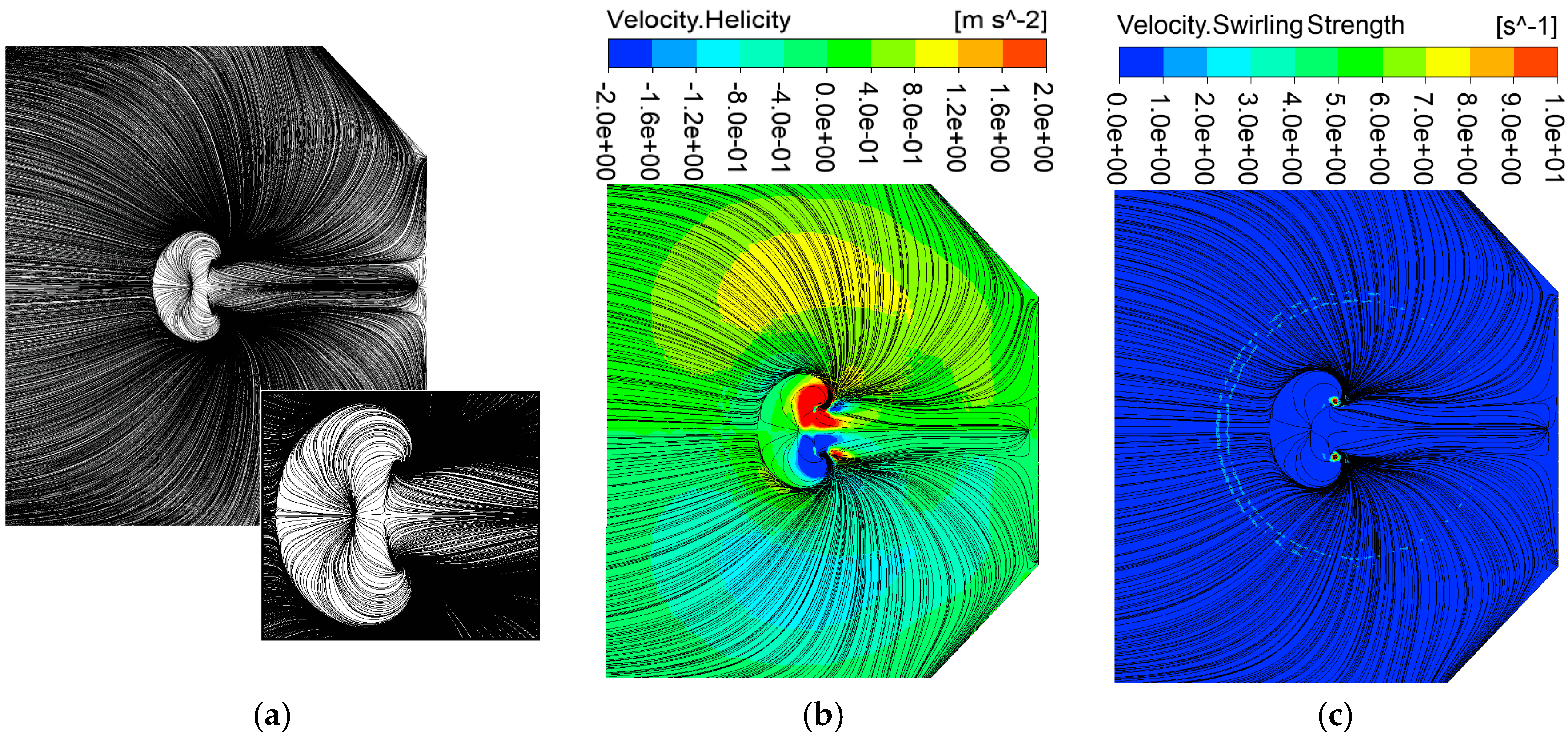
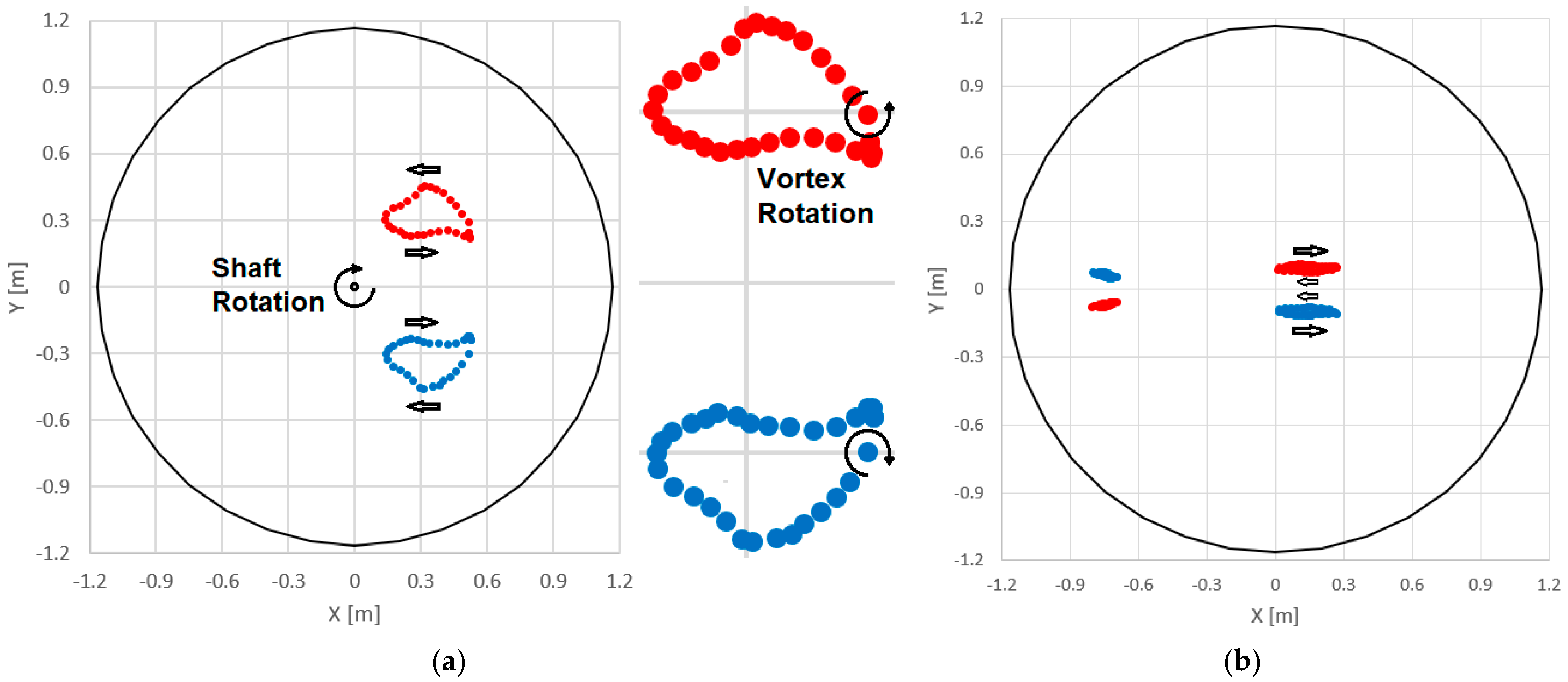
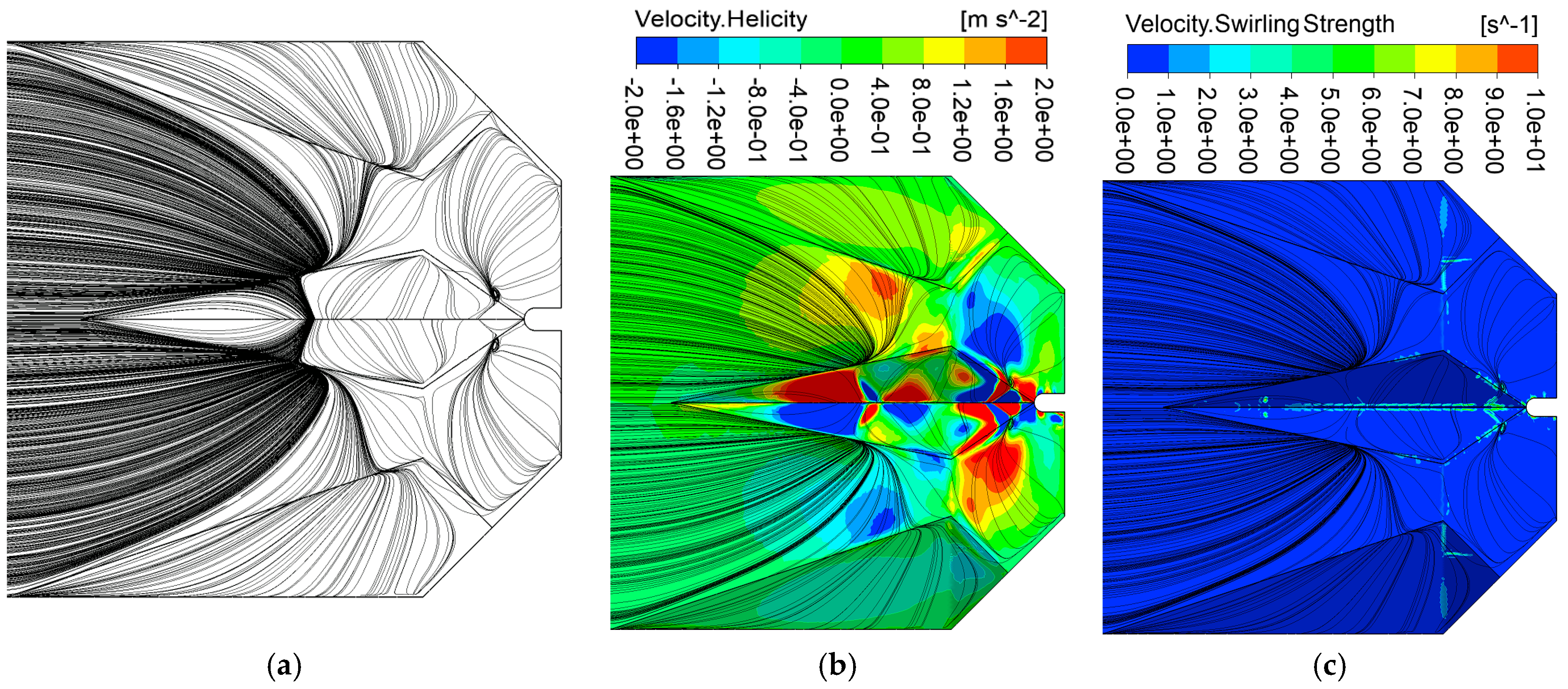
Detailed view of the magnitude and shape of the vortical structures on the bottom wall can be found in Figure 13, where the instantaneous surface streamlines are compared with the distribution of velocity helicity and swirling strength. It is important to restate that in the case of the intake object without any AVD, the vortical structures below the pump bell are not fixed by any solid structure on the bottom wall and so they could be very unsteady. Figure 14a shows the movement of the singular points (representing the end of the bottom vortices) on the bottom wall during 15 shaft revolutions, which represent about 5.66 s with a frequency of 0.067 fshaft. The movement of the centres of the vortices at the bellmouth cross-section A–A is shown in Figure 14b.

3.2. Intake Object with Trident-like AVD

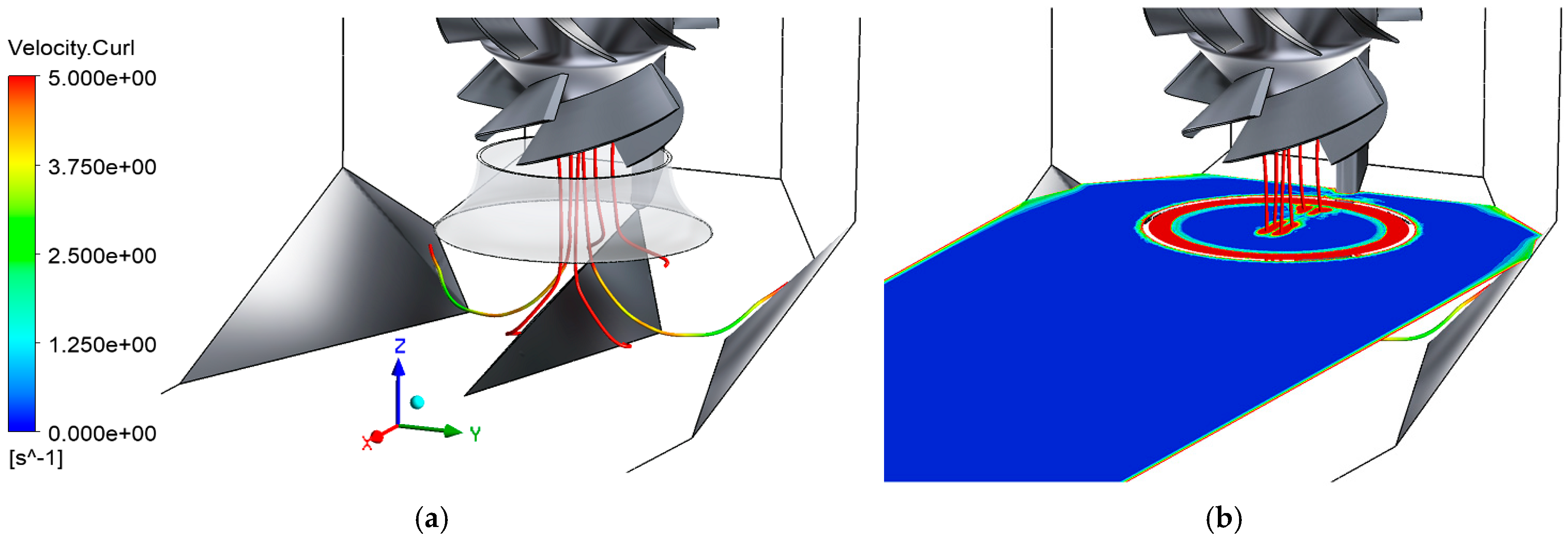
The first AVD consists of a centre splitter, a backwall, sidewall and corner fillets, and a backwall splitter plate. In this case, it is difficult to accurately classify the dominant vortices. There is a pair of bottom vortices with the highest vorticity, which are connected with the edges dividing the floor and the centre splitter. A pair of counter-rotating vortices is formed between the pump suction and the backwall fillet, as can be seen in Figure 15 and Figure 16 showing, respectively, the vortex cores coloured with the velocity curl and the instantaneous surface streamlines compared with the distribution of velocity helicity and swirling strength. The last pair of vortices (with the lowest vorticity) are connected with the corner fillets. The distribution of the swirl angle at the bellmouth cross-section A–A is shown in Figure 17. The mass-averaged value MASWA of the swirl angle SWA at the bellmouth is 5.2°.
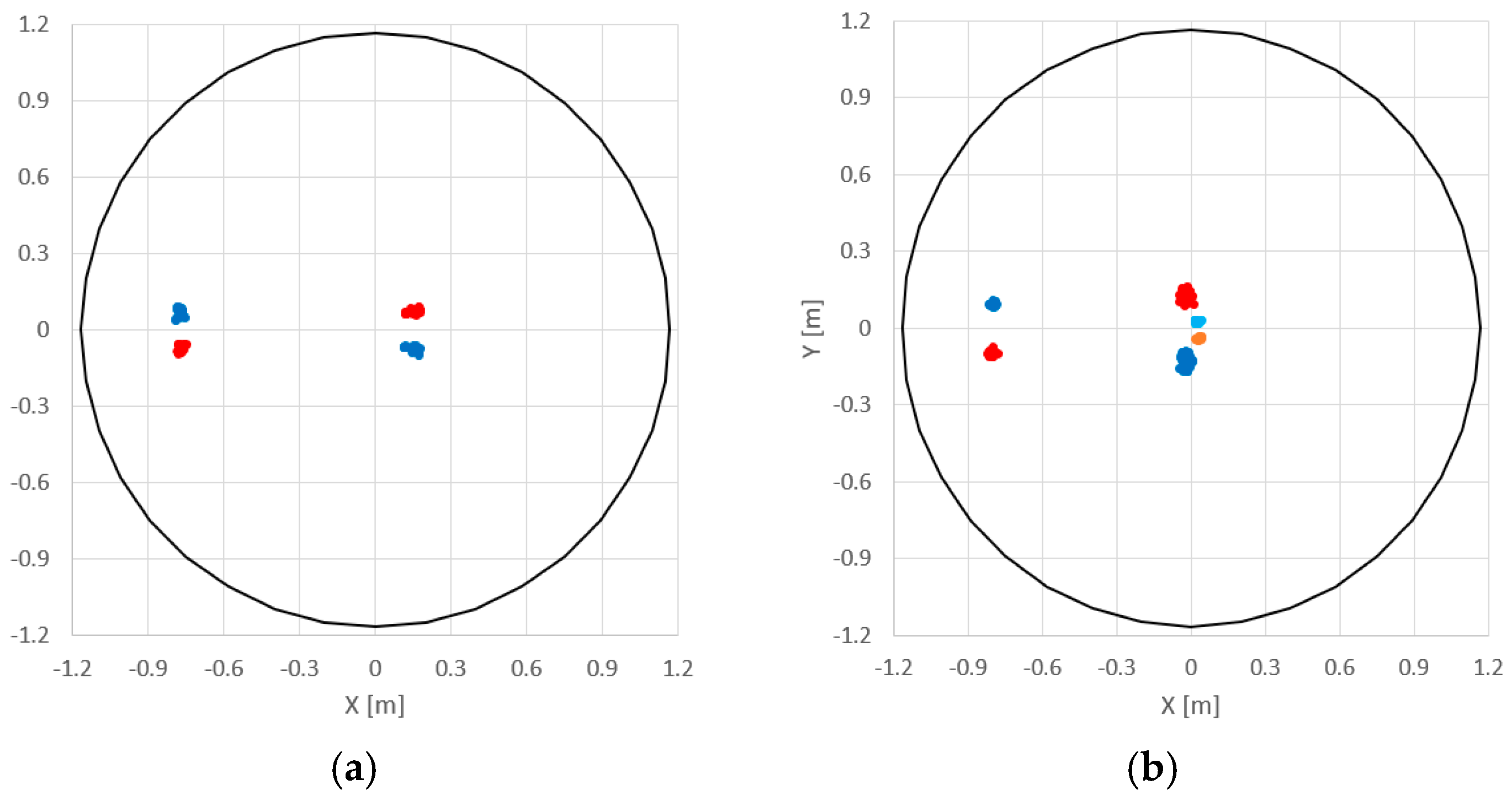
Detailed view of the magnitude and shape of the vortical structures on the bottom wall can be found in Figure 18, where the instantaneous surface streamlines are compared with the distribution of velocity helicity and swirling strength. In this case, the positions of the vortical structures are very stable and do not change over time, as can be seen in Figure 19a showing the positions of the singular points at the bellmouth cross-section A–A during the last 10 shaft revolutions.

3.3. Intake Object with Cone AVD

The second AVD consists of a cone of an elliptical shape with a spherical apex and one baffle oriented towards the rear wall of the sump. Similarly to the case with a trident-like AVD, it is difficult to accurately classify the dominant vortices. There is a pair of bottom vortices with the highest vorticity, which are connected with the edges dividing the floor and the cone. A pair of counter-rotating vortices is formed between the pump suction and the backwall, as can be seen in Figure 20 and Figure 21 showing, respectively, the vortex cores coloured with the velocity curl and the instantaneous surface streamlines compared with the distribution of velocity helicity and swirling strength. The last vortical structure (with a very complex pattern) connects the pump suction and the cone apex.
The distribution of the swirl angle at the bellmouth cross-section A–A is shown in Figure 22. The mass-averaged value MASWA of the swirl angle SWA at the bellmouth is 4.9°.
Detailed view of the magnitude and shape of the vortical structures on the bottom wall can be found in Figure 23, where the instantaneous surface streamlines are compared with the distribution of velocity helicity and swirling strength. In this case, the positions of the vortical structures are also very stable and do not change over time, as can be seen in Figure 19b, which shows the positions of the singular points at the bellmouth cross-section A–A during the last 10 shaft revolutions.

4. Discussion

The results for all three pump intake configurations can be compared with one another, as well as indirectly with the model pump without a bell (which was replaced by a simple circular piping). The comparison of basic hydraulic parameters can be found in Table 2, which shows the values of the delivery head and hydraulic efficiency for all configurations. It should be noted that all values have been recalculated for the size and speed of the model pump mentioned in Section 2.3 and in the graphs shown in Figure 9. Two other important parameters (the radial forces and the mass-averaged value of the swirl angle) are compared in Table 3. Additionally, it is important to mention that the swirl angle (as defined using Equation (14)) cannot be definitely compared with the intensity of the flow rotation measured with the swirl meter according to the ANSI/HI 9.8 standard. All the values shown in Table 2 and Table 3 are derived by averaging the values obtained from the last 10 shaft revolutions.
At the optimal flow rate, the delivery head and hydraulic efficiency of the pump in a closed circuit are superior to those of the suction-bell-based pumps. The second-best efficiency comes from the pump with the cone AVD, although the differences are not very large. It is interesting that at the suboptimal flow rate (0.75 Qopt), the efficiency of the closed-circuit pump drops below the efficiency of the suction-bell-based pump configurations. As far as the mass-averaged value of the swirl angle is concerned, the values of the two flow rates do not differ significantly, and it can be seen that the configuration with the cone AVD gives the best values for both flow rates. Figure 10, Figure 11, Figure 15, Figure 16, Figure 20 and Figure 21 also indicate that the case with the cone AVD has a thinner boundary layer at the bellmouth cross-section A–A compared with the other two cases.
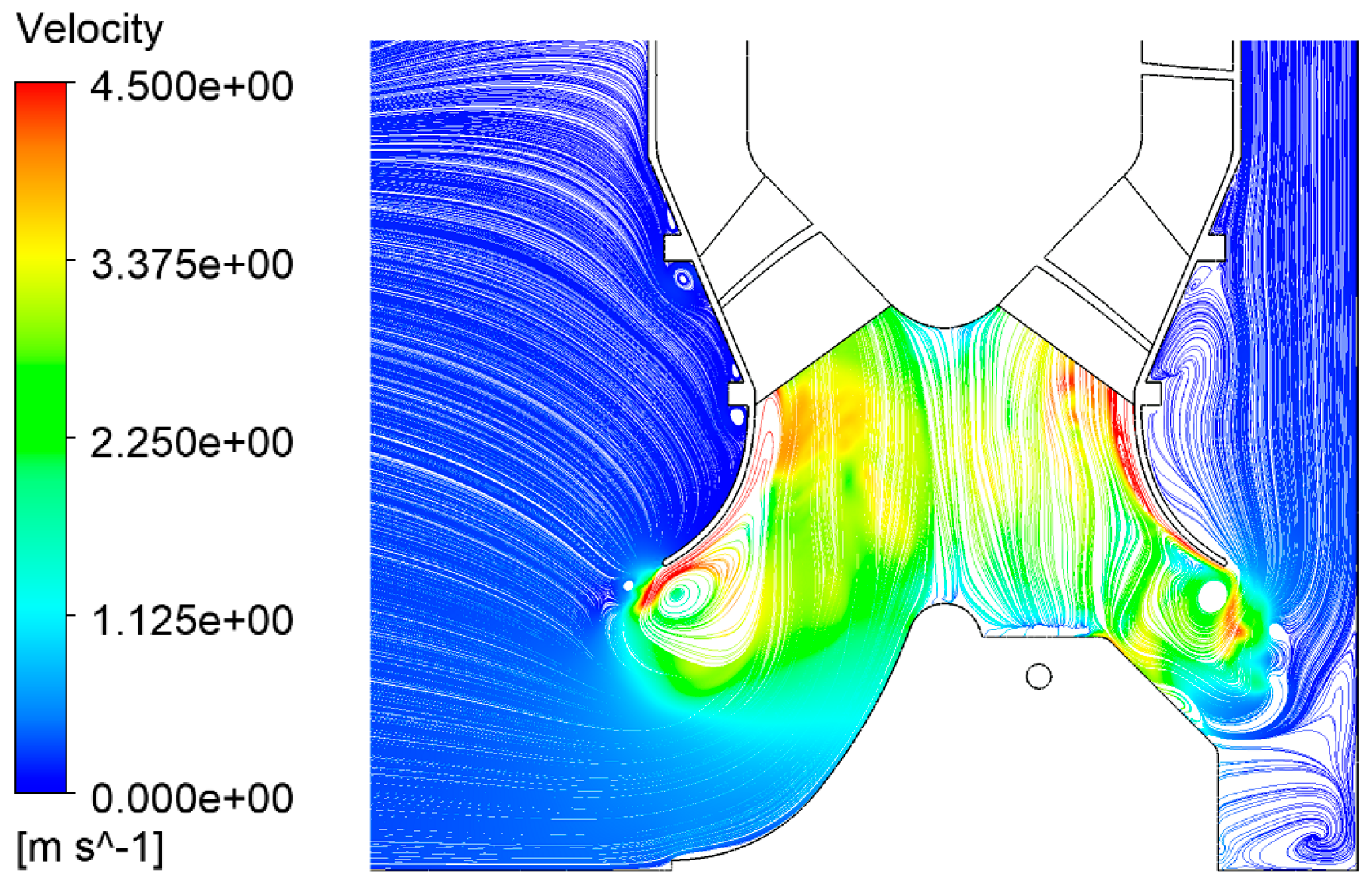
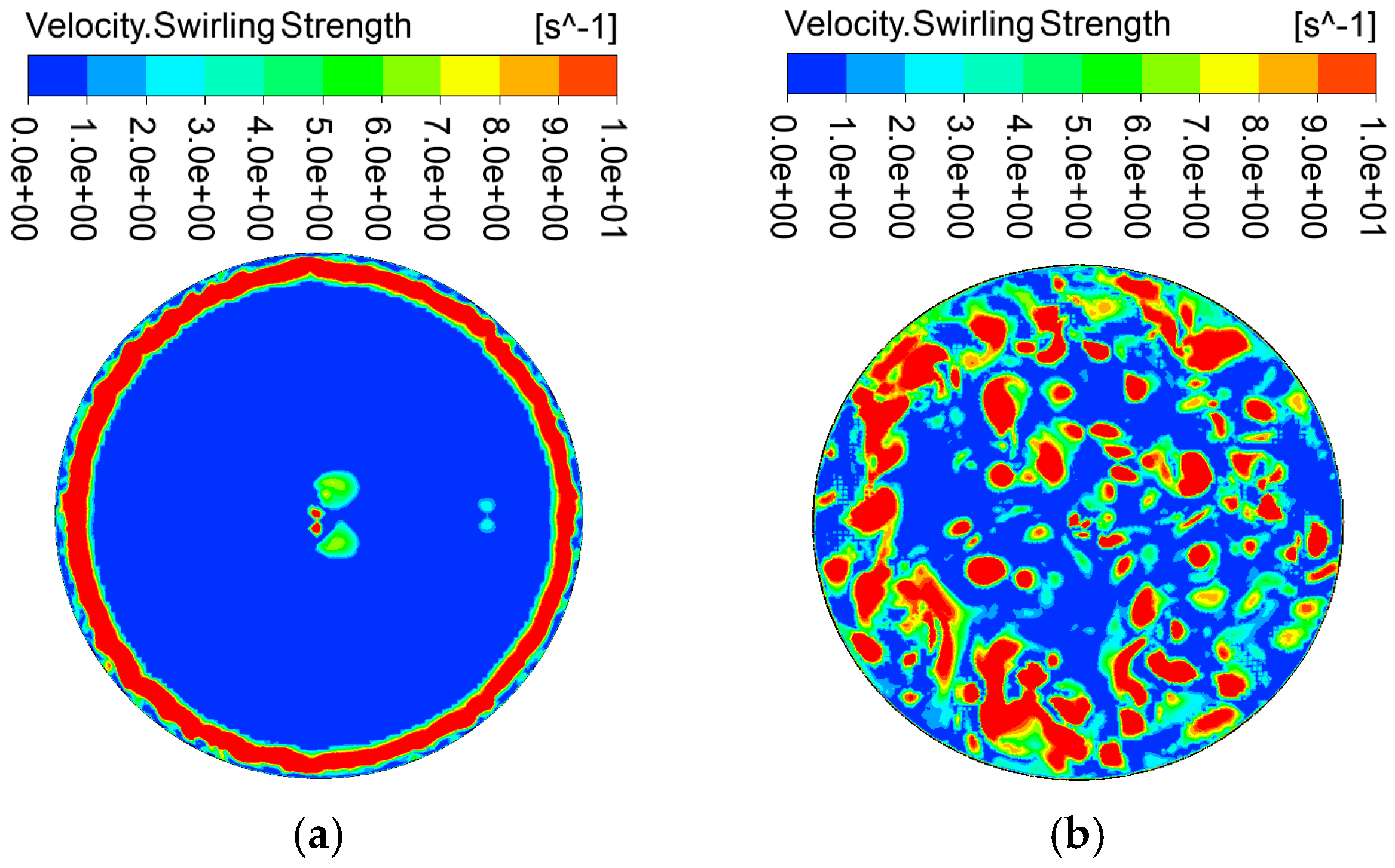
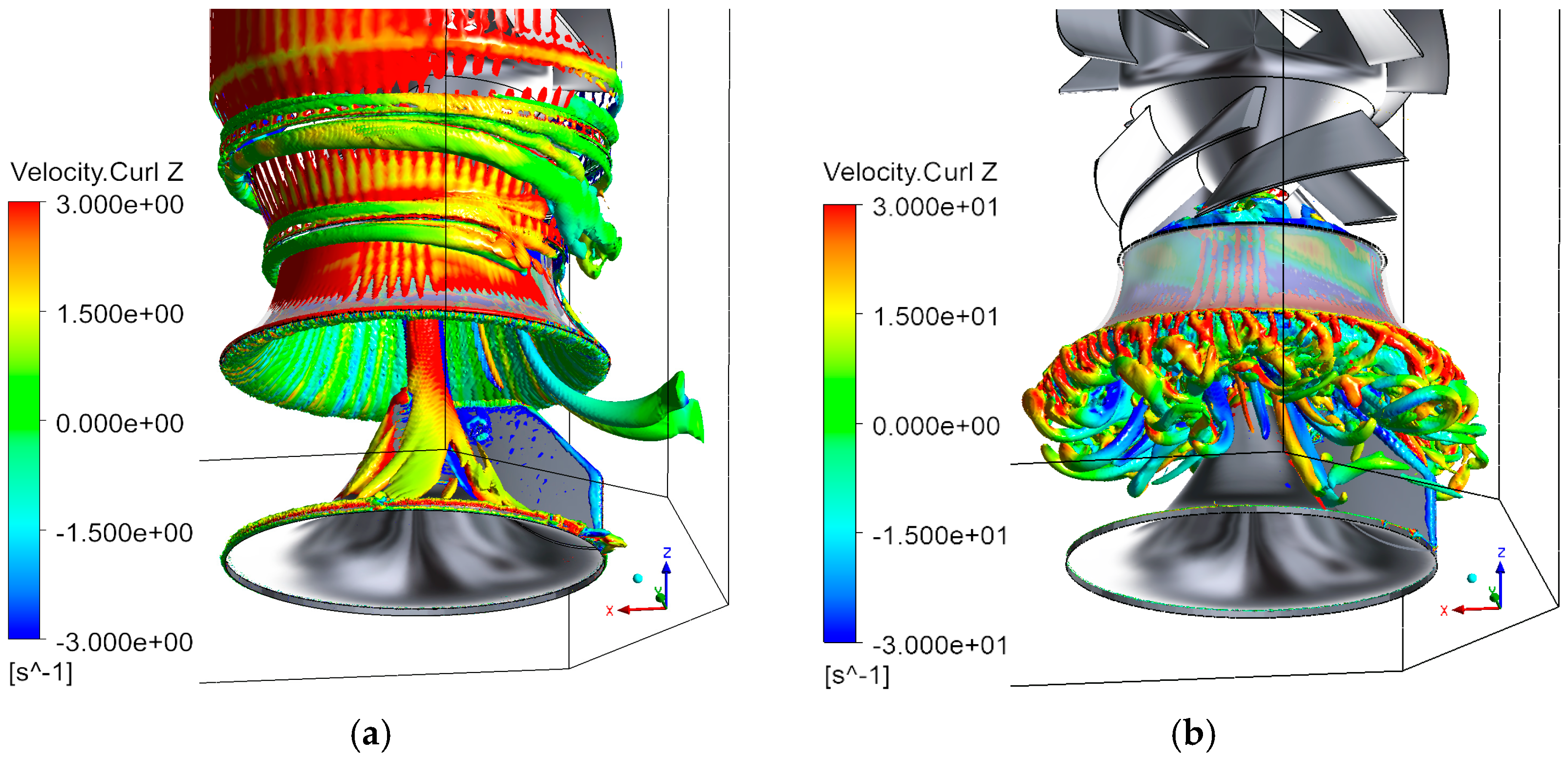
Regarding the radial force, at a flow rate close to the design flow, the contribution of the impeller and diffuser parts is negligible, and the radial force is mainly generated by the change in flow direction at the ninety-degree bend at the pump exit and by the forces acting on the shaft. With the flow rate being decreased to 0.75 Qopt, the impact of these forces also decreases and the radial force takes its local minimum. However, with additional decrease in the flow rate, the radial force increases significantly, as the unsteady forces acting on the impeller become dominant. At the flow rate of 0.58 Qopt (the flow rate where local instability appears, as can be seen in Figure 9), the radial force becomes higher than that at the design flow rate and its amplitude is nearly doubled. Moreover, the mass-averaged value of the swirl angle increases to about 16° for all the pump intake configurations (Table 4). The reason is that at this flow rate, a strong recirculation appears at the pump inlet (Figure 24), resulting in a very chaotic pattern of vortices at the pump suction (Figure 25 and Figure 26).

5. Conclusions

An analysis of flow phenomena was conducted for different pump intake configurations, employing a mixed-flow pump with a suction bell and two different types of AVDs. The range of flow rates between 0.75 Qopt and Qopt was considered, as it was supposed that the required delivery head could become higher than the projected one due to climate changes. On the other hand, mixed-flow pumps with a specific speed nq = 116 are not expected to be operated below a flow rate of 0.75 Qopt because of the instability of the pump performance curve and the strong recirculation in the pump sump, as indicated in Figure 25 and Figure 26.
It is very important that the characteristics of vortical structures do not change significantly with a drop in the flow rate to 0.75 Qopt. In the case of the intake object without any AVD, the vortical structures below the pump bell are not fixed by any solid structure on the bottom wall and so they are very unsteady, with a frequency of about 0.067 fshaft at the optimum flow rate and about 0.055 fshaft at the flow rate of 0.75 Qopt. In the case of the intake object with a trident-like AVD or a cone AVD, the positions of the vortical structures are very stable and do not change over time. This means that the most effective impact arisen from the installation of an AVD is the suppression of the dynamic effects of vortical structures at the pump suction. Concerning the hydraulic parameters, the configuration with the cone AVD presents the best values. Still, the differences between both types of AVDs are not very significant, and in reality, the selection of AVDs would depend on other parameters as well, such as the building costs, installation conditions or possible pump submergence.
To reveal the influence of a broader range of flow regimes, the flow rate of 0.58 Qopt where local instability appears is briefly discussed and shown in the last figures, indicating that the pump curve instability at this low flow rate is linked with a dramatic change in the flow phenomena at the pump suction. This is why extensive experimental research is being planned in future work, with observations of the flow phenomena at low flow rates, based on the transparent windows in the inlet cone of the experimental model pump (Figure 1b) and a transparent inlet pipe. This experimental research will be accompanied by numerical simulations of different suction configurations, taking into account the interaction of cavitation with the inlet recirculation and the very complex pattern of vortices in the pump suction.

Author Contributions

Conceptualisation, M.S. and V.D.; methodology, M.S. and V.D.; CFD simulations, M.S. and P.M.; validation, M.S., V.D. and M.K.; experiment, M.K.; investigation, M.S., P.M. and M.K.; resources, M.S., P.M. and M.K.; data curation, M.S. and M.K.; writing—original draft preparation, M.S.; writing—review and editing, M.S. and P.M.; visualisation, M.S. and P.M.; supervision, V.D.; project administration, P.M.; funding acquisition, P.M. All authors have read and agreed to the published version of the manuscript.

Funding

This research was funded by the Ministry of Education, Youth and Sports of the Czech Republic (MEYS CR) under the project CZ.02.01.01/00/23_021/0008954 “Hydrodynamic Machines for Smart Energy”.

Data Availability Statement

The data presented in this study are available from the corresponding author upon request. The data are not publicly available due to the huge size of the datasets.

Acknowledgments

This research follows the results obtained in the project MEYS CR: CZ.02.1.01/0.0/0.0/17_049/0008408 “Hydrodynamic Design of Pumps”.

Conflicts of Interest

The authors declare no conflicts of interest.

Abbreviations

The following abbreviations are used in this manuscript:
AVDAnti-vortex device
CFDComputational fluid dynamics
CWTContinuous wavelet transformation
FAVFloor-attached vortex
LESLarge eddy simulation
LWLLow water level
PIVParticle image velocimetry
PTVParticle tracking velocimetry
RAVRoof-attached vortex
SASScale-adaptive simulation
S-CLSVOFSimple coupled level-set and volume of fluid
SSTShear stress transport
URANSUnsteady Reynolds-averaged Navier–Stokes equations
V3VThree-dimensional velocity field measurement
VOFVolume of fluid

References

  1. ANSI/HI 9.8-2024; American National Standard for Pump Intake Design. Hydraulic Institute: Parsippany, NJ, USA, 2024.
  2. Reddy, Y.R.; Pickford, J.A. Vortices at intakes in conventional sump. Water Power 1972, 24, 108–109. [Google Scholar]
  3. Domfeh, M.K.; Gyamfi, S.; Amo-Boateng, M.; Andoh, R.; Ofosu, E.A.; Tabor, G. Free surface vortices at hydropower intakes: A state-of-the-art review. Sci. Afr. 2020, 8, e00355. [Google Scholar] [CrossRef]
  4. Okamura, T.; Kamemoto, K.; Matsui, J. CFD prediction and model experiment on suction vortices in pump sump. In Proceedings of the 9th Asian International Conference on Fluid Machinery, Jeju, Republic of Korea, 16–19 October 2007. [Google Scholar]
  5. Long, N.I.; Shin, B.R.; Doh, D.-H. Study on Surface Vortices in Pump Sump. J. Fluid Mach. 2012, 74, 60–66. [Google Scholar] [CrossRef]
  6. Shin, B. Numerical Study of Effect of Flow Rate on Free Surface Vortex in Suction Sump. Trans. JSCES 2018, 2018, 20180010. [Google Scholar] [CrossRef]
  7. Huang, X.; Fang, T.; Pang, K.; Guo, Q.; Qiu, B.; Lu, J. Air-entrained vortex in open intake: Time-frequency analysis and the interaction with subsurface vortices. Phys. Fluids 2022, 34, 113313. [Google Scholar] [CrossRef]
  8. Tokyay, T.; Constantinescu, G. Coherent structures in pump-intake flows: A large eddy simulation (LES) study. In Proceedings of the Korea Water Resources Association Conference, Seoul, Republic of Korea, 11–16 September 2005; pp. 231–232. [Google Scholar]
  9. Yamade, Y.; Kato, C.; Nagahara, T.; Matsui, J. Numerical investigations of submerged vortices in a model pump sump by using Large Eddy Simulation. IOP Conf. Ser. Earth Environ. Sci. 2016, 49, 032003. [Google Scholar] [CrossRef]
  10. Yamade, Y.; Kato, C.; Nagahara, T.; Matsui, J. Origin and formation process of a submerged vortex in a pump sump. IOP Conf. Ser. Earth Environ. Sci. 2019, 240, 032028. [Google Scholar] [CrossRef]
  11. Amin, A.; Kim, C.G.; Lee, Y.H. Numerical analysis of free surface vortices behavior in a pump sump. IOP Conf. Ser. Earth Environ. Sci. 2018, 163, 012103. [Google Scholar] [CrossRef]
  12. Kim, S.; Kim, C.; Kim, B.; Jang, H.; Kim, I.; Lee, Y.-H. A Study Comparing the Subsurface Vortex Characteristics in Pump Sumps. Energies 2022, 15, 5049. [Google Scholar] [CrossRef]
  13. Nagahara, T.; Sato, T.; Okamura, T. Effect of the Submerged Vortex Cavitation Occurred in Pump Suction Intake on Hydraulic Forces of Mixed Flow Pump Impeller. In Proceedings of the Fourth International Symposium on Cavitation, Pasedena, CA, USA, 20–23 June 2001. [Google Scholar] [CrossRef]
  14. Uruba, V.; Procházka, P.; Sedlář, M.; Komárek, M.; Duda, D. Experimental and Numerical Study on Vortical Structures and their Dynamics in a Pump Sump. Water 2022, 14, 2039. [Google Scholar] [CrossRef]
  15. Zhang, B.; Cheng, L.; Zhu, M.; Jiao, W.; Zhang, D. Numerical Simulation and Analysis of the Flow Characteristics of the Roof-Attached Vortex (RAV) in a Closed Pump Sump. Machines 2022, 10, 209. [Google Scholar] [CrossRef]
  16. Yu, K.; Huang, X.; Guo, Q.; Jin, G. Identification and monitoring of wall-attached vortices in open pump intake based on continuous wavelet transform. J. Phys. Conf. Ser. 2024, 2854, 012081. [Google Scholar] [CrossRef]
  17. Song, X.; Yao, R.; Chao, L.; Wang, Z. Study of the formation and dynamic characteristics of the vortex in the pump sump by CFD and experiment. J. Hydrodyn. 2021, 33, 1202–1215. [Google Scholar] [CrossRef]
  18. Kim, C.G.; Choi, Y.D.; Choi, J.W.; Lee, Y.H. A study on the effectiveness of an anti vortex device in the sump model by experiment and CFD. IOP Conf. Ser. Earth Environ. Sci. 2012, 15, 072004. [Google Scholar] [CrossRef]
  19. Kim, C.G.; Kim, B.H.; Bang, B.H.; Lee, Y.H. Experimental and CFD analysis for prediction of vortex and swirl angle in the pump sump station model. IOP Conf. Ser. Mater. Sci. Eng. 2015, 72, 042044. [Google Scholar] [CrossRef]
  20. Zhao, Y.X.; Kim, C.G.; Lee, Y.H. CFD study on flow characteristics of pump sump and performance analysis of the mixed flow pump. IOP Conf. Ser. Mater. Sci. Eng. 2013, 52, 072006. [Google Scholar] [CrossRef]
  21. Norizan, T.A.; Reda, E.; Harun, Z. Enhancement of vorticity reduction by floor splitter in pump sump to improve pump efficiency. Sustain. Energy Technol. Assess 2018, 26, 28–36. [Google Scholar] [CrossRef]
  22. Kim, H.J.; Park, S.W.; Rhee, D.S. Effective Height of a Floor Splitter Anti-Vortex Device under Varying Flow Conditions. Sustainability 2017, 9, 285. [Google Scholar] [CrossRef]
  23. Arocena, V.M.; Abuan, B.E.; Reyes, J.G.; Rodgers, P.L.; Danao, A.M. Reduction of Entrained Vortices in Submersible Pump Suction Lines Using Numerical Simulations. Energies 2020, 13, 6136. [Google Scholar] [CrossRef]
  24. Kim, J.H.; Park, S.W.; Rhee, D.S. Numerical Analysis of the Effects of Anti-Vortex Device Height on Hydraulic Performance of Pump Sump. KSCE J. Civ. Eng. 2017, 21, 1484–1492. [Google Scholar] [CrossRef]
  25. Zhao, Z.; Qian, Z.; Guo, Z.; Wu, P. Experimental study of subsurface vortices in pump intake with an improved diversion-cone. IOP Conf. Ser. Earth Environ. Sci. 2019, 240, 032032. [Google Scholar] [CrossRef]
  26. Zhang, B.; Cheng, L.; Zhu, B.; Jiao, W.; Luo, C.; Yang, A. Suppressing submerged vortices in a closed pump sump: A novel approach using joint anti-vortex devices. Appl. Ocean Res. 2024, 153, 104226. [Google Scholar] [CrossRef]
  27. Sedlář, M.; Abrahámek, P.A. Numerical Study on the Performance of a Pumping Station with Bell-Mouth-Based Vertical Pumps during an Accidental Shutdown. Processes 2024, 12, 630. [Google Scholar] [CrossRef]
  28. ANSYS, Inc. ANSYS CFX-Solver Theory Guide Release 2024 R2; ANSYS, Inc.: Canonsburg, PA, USA, 2024. [Google Scholar]
  29. Menter, F.R.; Egorov, Y. A scale-adaptive simulation model using two-equation models. In Proceedings of the 43rd AIAA Aerospace Sciences Meeting and Exhibition, Reno, NV, USA, 10–13 January 2005; p. 1095. [Google Scholar] [CrossRef]
  30. Menter, F.R. Two-equation eddy-viscosity turbulence models for engineering applications. AIAA J. 1994, 32, 1598–1605. [Google Scholar] [CrossRef]
  31. Hirt, C.W.; Nichols, B.D. Volume of fluid (VOF) method for the dynamics of free boundaries. J. Comput. Phys. 1981, 39, 201–225. [Google Scholar] [CrossRef]
  32. Brackbill, J.U.; Kothe, D.B.; Zemach, C. A Continuum Method for Modeling Surface Tension. J. Comput. Phys. 1992, 100, 335354. [Google Scholar] [CrossRef]
Figure 1. (a) Three-dimensional view of a real vertical mixed-flow pump with a suction bell; (b) construction of the experimental model pump with transparent windows in the inlet cone.
Fluids 10 00325 g001
Figure 2. Virtual pump station, in which seven vertical mixed-flow pumps are installed.
Fluids 10 00325 g002
Figure 3. Computational domain and boundary conditions.
Fluids 10 00325 g003
Figure 4. AVD types: (a) the AVD used in the first configuration, consisting of a centre splitter, a backwall, sidewall and corner fillets, and a backwall splitter plate; (b) a cone AVD with one baffle.
Fluids 10 00325 g004
Figure 5. Free-water surface. Real pump, Q = Qopt. Difference from nominal low water level: (a) Intake object with vertical pump and trident-like AVD; (b) Discharge object with siphon.
Fluids 10 00325 g005
Figure 6. Mesh refinement in vicinity of the pump suction bell and centre splitter. Longitudinal symmetry plane of the intake object with the trident-like AVD: (a) initial mesh; (b) final mesh.
Fluids 10 00325 g006
Figure 7. Vortical structures at the pump bellmouth of a real pump with a trident-like AVD; Q = Qopt. Absolute helicity: (a) initial mesh; (b) final mesh.
Fluids 10 00325 g007
Figure 8. Real pump with an intake object with a trident-like AVD; Q = Qopt: (a) Location of bellmouth cross-section A–A; (b) water velocity streamlines in the longitudinal symmetry plane.
Fluids 10 00325 g008
Figure 9. Comparison of measured and calculated integral characteristics of the pump itself. Recalculation for the model pump: (a) delivery head; (b) efficiency.
Fluids 10 00325 g009
Figure 10. Vortex cores coloured with the velocity curl in a real pump with an intake object without an AVD; Q = Qopt. (a) Three-dimensional view of vorticity lines; (b) positions of vortex cores against the vorticity distribution at the bellmouth cross-section A–A.
Fluids 10 00325 g010
Figure 11. Flow pattern at the bellmouth cross-section A–A in a real pump with an intake object without an AVD; Q = Qopt. (a) Surface streamlines with detail of the central part; (b) distribution of instantaneous velocity helicity; (c) distribution of instantaneous velocity swirling strength.
Fluids 10 00325 g011
Figure 12. Secondary flow at the bellmouth cross-section A–A in a real pump with an intake object without an AVD; Q = Qopt. (a) Swirl angle; (b) distribution of instantaneous axial velocity; (c) distribution of instantaneous circumferential velocity.
Fluids 10 00325 g012
Figure 13. Flow pattern on the floor below the pump in a real pump with an intake object without an AVD; Q = Qopt. (a) Surface streamlines with detail of the central part; (b) distribution of instantaneous velocity helicity; (c) distribution of instantaneous velocity swirling strength.
Fluids 10 00325 g013
Figure 14. Movement of vortices during 15 shaft revolutions (5.66 s) in a real pump with an intake object without an AVD; Q = Qopt. Black circle represents the contour of the bellmouth. (a) Singular points on the bottom wall; (b) centres of vortices at the bellmouth cross-section A–A.
Fluids 10 00325 g014
Figure 15. Vortex cores coloured with the velocity curl in a real pump with an intake object with a trident-like AVD; Q = Qopt. (a) Three-dimensional view of vorticity lines; (b) positions of vortex cores against the vorticity distribution at the bellmouth cross-section A–A.
Fluids 10 00325 g015
Figure 16. Flow pattern at the bellmouth cross-section A–A in a real pump with an intake object with ta rident-like AVD; Q = Qopt. (a) Surface streamlines with detail of the central part; (b) distribution of instantaneous velocity helicity; (c) distribution of instantaneous velocity swirling strength.
Fluids 10 00325 g016
Figure 17. Secondary flow at the bellmouth cross-section A–A in a real pump with an intake object with a trident-like AVD; Q = Qopt. (a) Swirl angle; (b) instantaneous axial velocity; (c) instantaneous circumferential velocity.
Fluids 10 00325 g017
Figure 18. Flow pattern on the floor below the pump in a real pump with an intake object with a trident-like AVD; Q = Qopt. (a) Surface streamlines; (b) instantaneous velocity helicity; (c) instantaneous velocity swirling strength.
Fluids 10 00325 g018
Figure 19. Positions of singular points at the bellmouth cross-section A–A during last 10 shaft revolutions (3.77 s) in a real pump with (a) a trident-like AVD or (b) a cone AVD with one baffle. Q = Qopt.
Fluids 10 00325 g019
Figure 20. Vortex cores coloured with the velocity curl in a real pump with an intake object with a cone AVD; Q = Qopt. (a) Three-dimensional view of vorticity lines; (b) positions of vortex cores against vorticity distribution at the bellmouth cross-section A–A.
Fluids 10 00325 g020
Figure 21. Flow pattern at the bellmouth cross-section A–A in a real pump with an intake object with a cone AVD; Q = Qopt. (a) Surface streamlines with detail of the central part; (b) distribution of instantaneous velocity helicity; (c) distribution of instantaneous velocity swirling strength.
Fluids 10 00325 g021
Figure 22. Secondary flow at the bellmouth cross-section A–A in a real pump with an intake object with a cone AVD; Q = Qopt. (a) Swirl angle; (b) distribution of instantaneous axial velocity; (c) distribution of instantaneous circumferential velocity.
Fluids 10 00325 g022
Figure 23. Flow pattern on the floor below the pump in a real pump with an intake object with a cone AVD; Q = Qopt. (a) Surface streamlines with detail of the central part; (b) distribution of instantaneous velocity helicity; (c) distribution of instantaneous velocity swirling strength.
Fluids 10 00325 g023
Figure 24. Water velocity streamlines in the vertical symmetry plane in a real pump with an intake object with a cone AVD; Q = 0.58 Qopt.
Fluids 10 00325 g024
Figure 25. Distribution of instantaneous velocity swirling strength at the bellmouth cross-section A–A in a real pump with an intake object with a cone AVD: (a) flow rate Q = 0.75 Qopt; (b) flow rate Q = 0.58 Qopt.
Fluids 10 00325 g025
Figure 26. Vortices coloured with the velocity curl_z in a real pump with an intake object with a cone AVD: (a) iso-surfaces with a swirling strength value of 1 s−1 and a flow rate Q = 0.75 Qopt; (b) iso-surfaces with a swirling strength value of 10 s−1 and a flow rate Q = 0.58 Qopt.
Fluids 10 00325 g026
Table 1. Parameters of the optimised computational mesh.
LocationMaximum Grid Size [mm]Maximum Grid Size Related to Dbell [%]Values of y+ on Majority of Surface [-]
Space below CFD/Closed pipe circuit301.2-
Floor and AVD301.2<2
Bell301.2<3
Impeller hub200.82<2
Impeller blades281.15<5
Table 2. Basic hydraulic parameters of different AVD configurations.
Flow RateConfigurationHead [m]Hydraulic Efficiency [%]
QoptCFD/Closed pipe circuit21.590.3
CFD/No AVD20.5688.9
CFD/Trident AVD20.789.1
CFD/Cone AVD20.789.2
0.75 QoptCFD/Closed pipe circuit26.7579.5
CFD/No AVD26.8380.9
CFD/Trident AVD26.8281.1
CFD/Cone AVD27.081.3
Table 3. Other hydraulic parameters of different AVD configurations.
Flow RateConfigurationRadial Force [N]Swirl Angle [°]
QoptCFD/Closed pipe circuit162.10.05
CFD/No AVD169.75.3
CFD/Trident AVD169.35.2
CFD/Cone AVD166.94.9
0.75 QoptCFD/Closed pipe circuit114.50.08
CFD/No AVD118.85.6
CFD/Trident AVD117.85.7
CFD/Cone AVD117.14.2
Table 4. Hydraulic parameters of different AVD configurations at a low flow rate.
Flow RateConfigurationRadial Force [N]Swirl Angle [°]
0.58 QoptCFD/Closed pipe circuit170.10.6
CFD/No AVD174.316
CFD/Trident AVD174.115.7
CFD/Cone AVD172.915.6
Disclaimer/Publisher’s Note: The statements, opinions and data contained in all publications are solely those of the individual author(s) and contributor(s) and not of MDPI and/or the editor(s). MDPI and/or the editor(s) disclaim responsibility for any injury to people or property resulting from any ideas, methods, instructions or products referred to in the content.