Article

Development of Sodium Alginate/Cellulose Nanofiber (SA/CNF)-Based Hydrogels for Enhancing Probiotic Stability


1
School of Food Science and Biotechnology, Food and Bio-Industry Institute, Kyungpook National University, Daegu 41566, Republic of Korea
2
Department of Agricultural Biotechnology, Research Institute of Agriculture and Life Science, Seoul National University, Seoul 08826, Republic of Korea
3
Department of Microbiology, College of Medicine, Dongguk University, Gyeongju 38066, Republic of Korea
4
Department of Food Science and Biotechnology, Universitas Brawijaya, Malang 65145, Indonesia
*
Authors to whom correspondence should be addressed.
Gels 2026, 12(6), 491; https://doi.org/10.3390/gels12060491
Submission received: 22 April 2026 / Revised: 16 May 2026 / Accepted: 20 May 2026 / Published: 2 June 2026
(This article belongs to the Special Issue Advanced Gels in the Food System (2nd Edition))

Abstract

Probiotics can promote gut health, but their efficacy is often limited by low viability and metabolic activity in the gastrointestinal (GI) tract. This study aimed to develop protective hydrogels for encapsulating Lactiplantibacillus plantarum CJLP 133 using a composite matrix of sodium alginate (SA) and cellulose nanofibers (CNFs). L. plantarum CJLP 133-loaded hydrogel beads were fabricated via the ionic gelation technique using an optimized formulation of SA and CNF. Scanning electron microscopy revealed that CNF integration improved spherical morphology with reduced surface cracking. Fourier transform infrared spectroscopy confirmed the formation of intermolecular hydrogen bonds between SA and CNF. CNF integration also reduced gumminess and chewiness, resulting in a softer texture. The survival rate of L. plantarum CJLP 133 remained high following thermal exposure and freeze-drying. The in vitro GI delivery system demonstrated a protective swelling profile in stimulated gastric fluid and a targeted, highly efficient release profile in stimulated intestinal fluid. Finally, the 3% SA + 0.5% CNF hydrogel with L. plantarum CJLP 133 exhibited significant synbiotic effects, enhancing probiotic growth, intestinal adhesion, and butyrate and succinate production. These results suggest that the SA/CNF-based hydrogel is an effective delivery system that ensures the targeted release of probiotics within the GI tract.

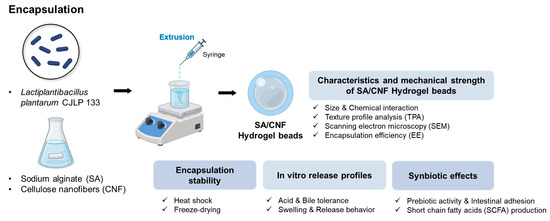
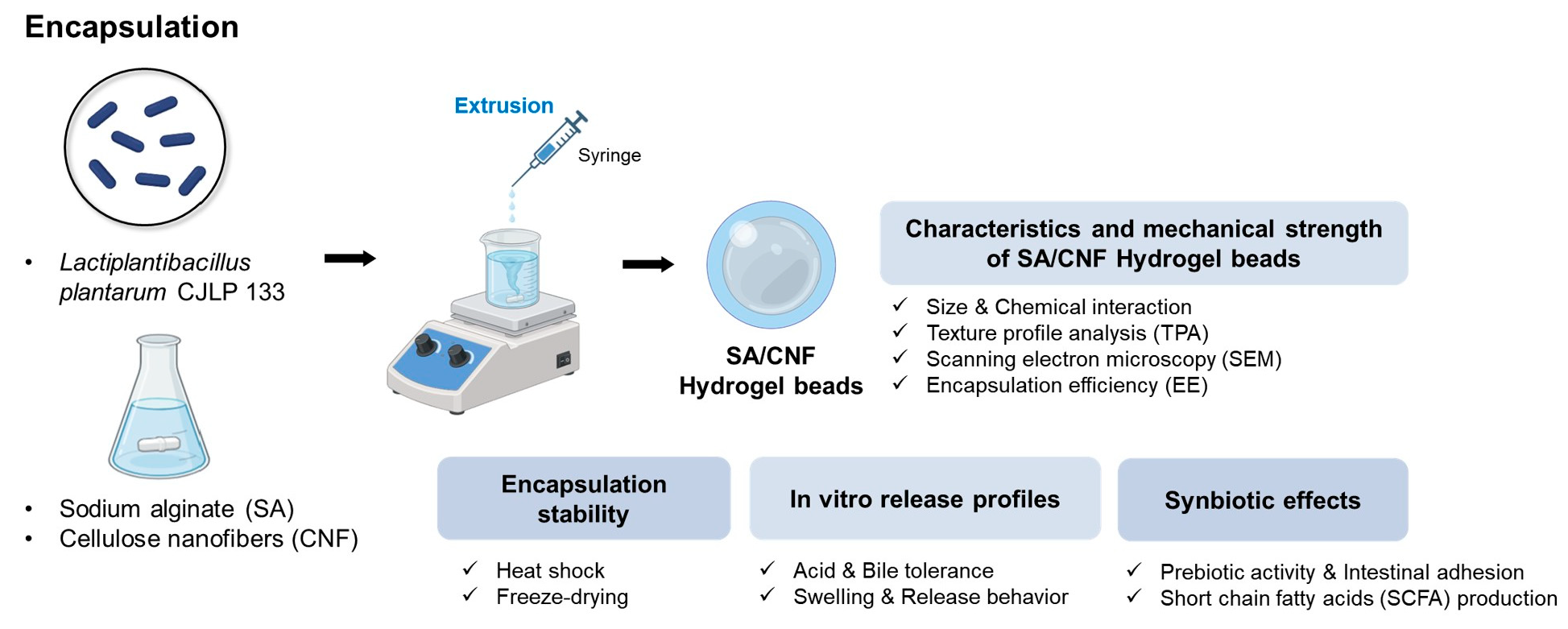
Graphical Abstract

1. Introduction

Probiotics are living microorganisms that provide health benefits to the host when consumed in adequate amounts [1]. Probiotic products must maintain a minimum viable cell count and retain their activity throughout storage, transportation, and digestion [2]. Many studies have examined the encapsulation of probiotics to improve their viability and stability [3,4,5], particularly through their incorporation into hydrogel matrices [6,7]. Hydrogels are three-dimensional (3D) structures consisting of cross-linked hydrophilic polymers [8]. Given their inherent physicochemical properties, they have been extensively used as promising matrices for probiotic encapsulation [9,10]. In particular, their high water retention capacity effectively mimics the physiological conditions necessary for microbial growth, thereby improving survival [11]. Moreover, the biocompatible polymeric matrix acts as a protective buffer that shields probiotics from osmotic stress and mechanical shear during storage [12,13].
Sodium alginate (SA)-based hydrogels are among the most widely used biopolymers for probiotic encapsulation because of their biocompatibility, nontoxicity, and mild gelation process [14]. SA can easily form hydrogels through ionic crosslinking with divalent cations, particularly calcium ions (Ca2+), resulting in a characteristic “egg-box” structure within the polymer network [15,16]. This egg-box configuration creates a stable, dense gel matrix that effectively entraps bacterial cells, further enhancing their viability during manufacturing and storage [17]. Furthermore, given the pH-responsive behavior of SA, these hydrogels can protect the cargo from harsh gastrointestinal (GI) conditions while facilitating site-specific release within the intestinal environment [18,19,20]. However, despite these functional advantages, SA-based hydrogels possess inherent structural vulnerabilities that limit their efficacy as a standalone encapsulation matrix [21,22,23]. The intrinsic porosity of these hydrogels makes them susceptible to excessive swelling or structural erosion, resulting in the unintended leakage of encapsulated probiotics [24]. Such premature release of probiotics can diminish probiotic viability when exposed to external stressors. To overcome these limitations, the incorporation of nanocellulose into SA-based hydrogels has been proposed as an effective strategy for enhancing structural stability and protective performance.
Cellulose nanofibers (CNFs) are a type of nanocellulose from lignocellulosic biomass with a carbon content of more than 50%. They are extracted from plant-based biomass through fibrillation processes and consist of highly ordered, lengthy crystalline and amorphous regions [25]. Given their high degree of crystallinity, surface area, and strength [26], cellulose-based hydrogels have been widely employed as physical patches for wound healing and drug delivery systems and have also been explored as ionogels or metagels for use in device-oriented technologies [27,28,29,30,31]. CNF-based hydrogels primarily formed physical interactions rather than ionic crosslinking; they often exhibit limited responsiveness to environmental conditions [32,33,34]. Additionally, CNF-based hydrogels exhibit a more open fibrillar structure [35]; thus, the combination of SA and CNF can enhance mechanical properties, allowing the composite to serve as an excellent filtration or film matrix [36,37]. Prior studies have reported high stability of SA-based hydrogels incorporated with CNF, resulting from interactions with the hydroxyl and carboxyl groups present on the hydrogel surface [38,39]. In addition, several studies have explored the use of SA/cellulose composite hydrogels for probiotic encapsulation, demonstrating their potential for improving bacterial survival within the gastrointestinal (GI) tract [40,41]. However, the potential as a synbiotic delivery system remains largely underexplored, particularly in terms of integrating both protective and functional roles under GI conditions.
In this study, an SA/CNF composite formed hydrogel beads to improve the viability and activity of the probiotic Lactiplantibacillus plantarum CJLP 133 under environmental conditions. In particular, the structural and physicochemical characteristics of the SA/CNF hydrogel beads, including their morphology, chemical interactions, and textural properties, were comprehensively analyzed to confirm successful bead formation. After determining the encapsulation efficiency, the functional properties and controlled release potential of the encapsulated probiotic strain were evaluated under simulated GI conditions. Finally, the prebiotic effects were assessed to determine the feasibility of these SA/CNF hydrogels as a synbiotic encapsulation system for enhanced probiotic delivery. Consequently, this study demonstrates that the SA/CNF encapsulation strategy can significantly improve the GI survival and colonization of probiotics, thereby contributing to more effective probiotic delivery systems.

2. Results and Discussion

2.1. Physicochemical and Structural Characteristics of SA/CNF Hydrogel Beads

2.1.1. Morphological Analysis of SA/CNF Hydrogel Beads

As the size, shape, and surface morphology of hydrogel beads are crucial for ensuring stable probiotic delivery and consumer acceptance [17], the physicochemical properties of the SA/CNF hydrogel beads were evaluated in this study.
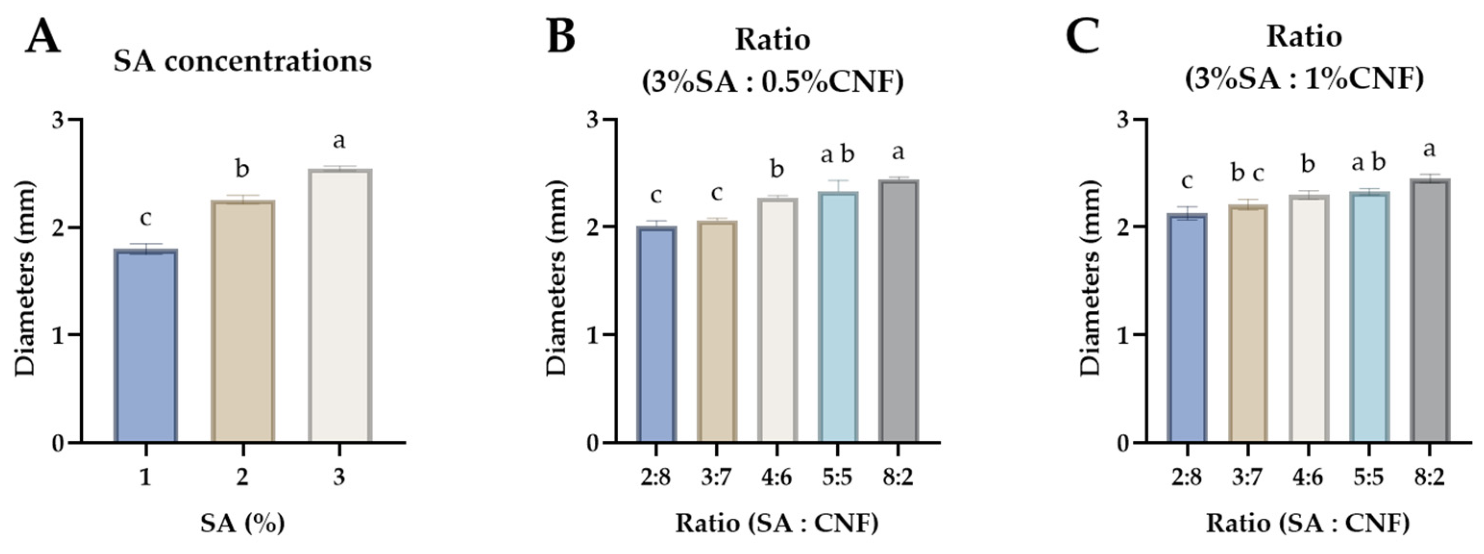
The diameters of hydrogel beads under different formulation conditions are presented in Table 1. In particular, the synergistic effects of varying concentrations of SA (1%, 2%, and 3%), CNFs (0.5% and 1%), and the cross-linking agent calcium chloride anhydride (CaCl2; 0.1 M and 0.5 M) on the formation of stable hydrogel beads were investigated. The use of a dash (-) means the SA/CNF mixture failed to form the hydrogel beads. The diameters of all prepared hydrogel beads were consistently below 3 mm. This size is considered acceptable for oral consumption and does not cause ingestion discomfort [10]. The diameters of the hydrogel beads ranged from 1.24 ± 0.08 to 2.55 ± 0.02 mm, depending on the concentration and ratio of SA and CNF. SA concentration had a substantial effect, with higher concentrations resulting in significantly larger beads. Furthermore, the incorporation of CNF resulted in a synergistic increase in size; however, this effect was modulated by the SA content. Although the CNF concentration did not exhibit a distinct trend at 1% SA, it significantly increased bead size in formulations containing 2% and 3% SA. Higher SA concentrations enhanced the viscosity of the feed solution, facilitating intensive molecular entanglement within the alginate network and subsequently resulting in the formation of SA-based hydrogel beads with a larger particle size [42]. Although hydrogel beads formed in 0.1 M CaCl2 were slightly larger than those formed in 0.5 M CaCl2, no significant difference was noted between the two concentrations. SA can form a gel upon contact with a CaCl2 solution. This occurs due to the interaction of divalent calcium ions with the carboxylate groups of SA, leading to ionic crosslinking between polymer strands. This “egg-box” model forms a three-dimensional network structure of gels [15,43]. Therefore, a lower concentration of CaCl2 (0.1 M) was selected for subsequent experiments to improve economic efficiency.
After the diameters of the hydrogel beads were visually compared based on the concentrations or ratios of SA and CNF, the formulation with the largest diameter was selected for subsequent analyses to maximize the loading number of probiotics per capsule while maintaining the diameter within 3 mm—a size safe for ingestion (Figure 1). The 3% SA-based hydrogel beads sized 2.55 ± 0.02 mm were selected because they produced the largest bead size. Therefore, while other parameters, such as CNF concentrations and the ratio of SA to CNF, varied, the SA concentration was held constant at 3%. The diameter of the hydrogel beads was dependent on the mixing ratio, with an increase in diameter noted as the proportion of SA relative to CNF increased. As all prepared beads met the size requirement for oral ingestion, three formulations exhibiting the maximal diameters (3% SA, 8:2 mixture of 3% SA with 0.5% CNF, and 8:2 mixture of 3% SA with 1% CNF) were chosen for further analyses to ensure an efficient payload of the encapsulated strain.
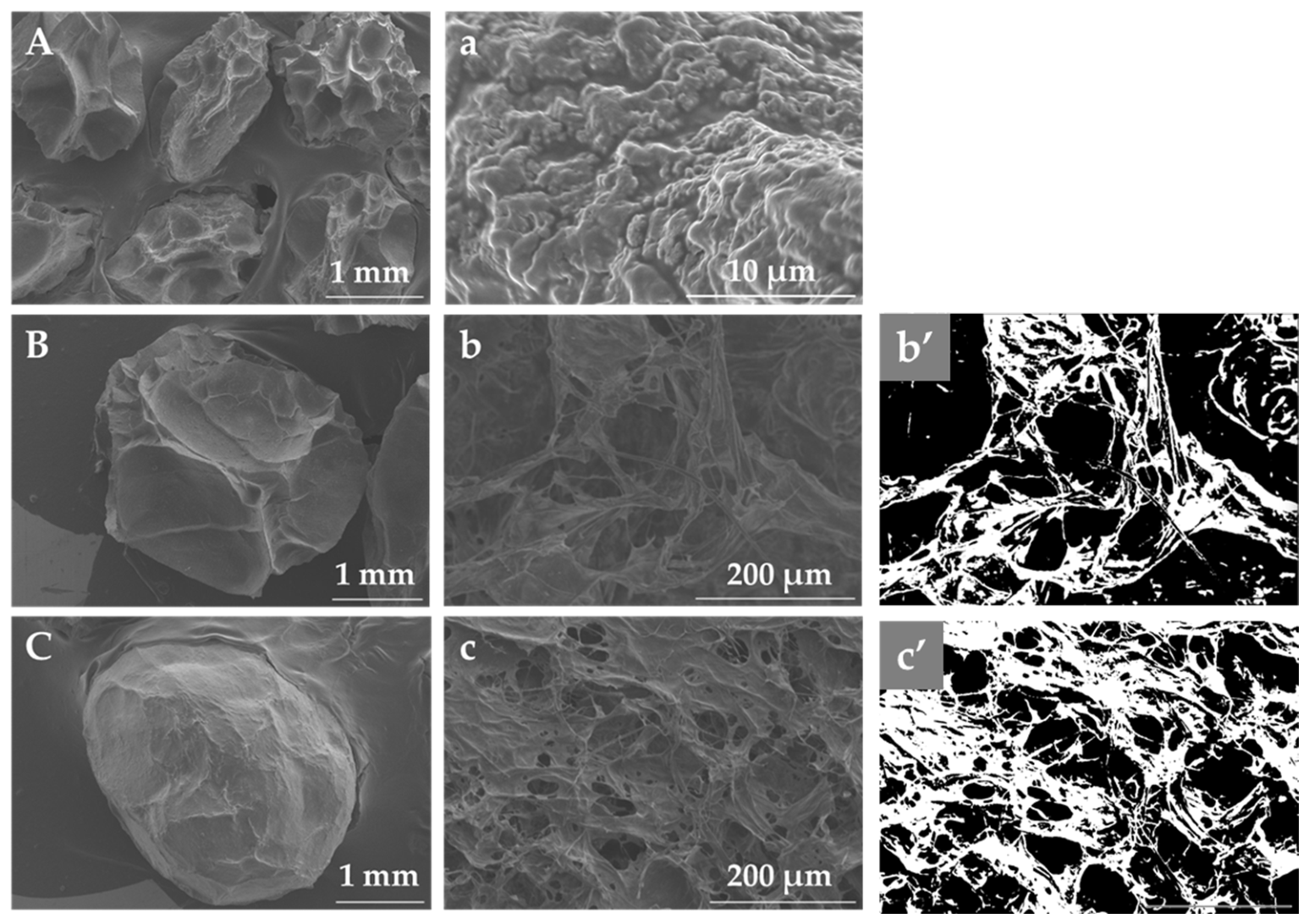
The surface morphology of SA/CNF hydrogel beads was observed using scanning electron microscopy (SEM), with low-magnification images (30×) showing the overall spherical shape and high-magnification images (3000×) showing microstructural features (Figure 2). While the 3% SA hydrogel produced wrinkled and less porous beads, the incorporation of CNF (0.5% and 1%) resulted in a more spherical and plump morphology. Moreover, 1% CNF resulted in more well-defined spherical shapes than 0.5% CNF, likely due to the reinforced structural integrity of higher concentrations of the CNF network [44]. In the low-magnification images, pores resulting from the incorporation of CNF were observed; hydrogels with higher CNF concentrations exhibited a finer porous structure. Specifically, the average pore diameters were measured from SEM images using ImageJ software by analyzing over 400 pores per sample, excluding the maximum and minimum values. The pore size decreased from 28.98 ± 43.86 um for 3% SA + 0.5% CNF hydrogels to 11.04 ± 14.65 um for 3% SA + 1% CNF hydrogels, indicating the formation of smaller pores at the higher CNF concentrations. The formation of a refined porous structure has been frequently reported in CNF-based hydrogels [45,46], and the decrease in pore size at higher CNF concentrations may be attributed to the formation of a more compact internal network structure during hydrogel formation.

2.1.2. Textural Properties of SA/CNF Hydrogel Beads

Texture profile analysis (TPA) was performed to assess the mechanical integrity of the SA/CNF hydrogel beads (Table 2), as the structural properties of a hydrogel are crucial for protecting the encapsulated probiotics from processing stress and GI transit and for meeting consumer preferences [47,48]. The 3% SA + 0.5% CNF hydrogel showed the lowest value across all TPA parameters, including hardness, springiness, gumminess, chewiness, and cohesiveness. In particular, the hardness, gumminess, and chewiness of 3% SA + 0.5% CNF hydrogels were significantly lower (1.23-, 1.27-, and 1.31- fold, respectively) than those of 3% SA hydrogels with p < 0.001. These results indicate that 3% SA + 0.5% CNF hydrogels have high potential for food applications, as they exhibit minimal tolerance to mechanical deformation because of favorable textural properties, such as hardness, gumminess, and chewiness. Low levels of gumminess and chewiness can offer a smooth texture and improve mouth feel during oral consumption [49]. However, no significant differences were noted in the levels of adhesiveness, springiness, or cohesiveness when CNF was added. This suggests that CNF did not significantly alter the inherent textural properties of the SA matrix, indicating the potential for the efficient release of encapsulated probiotics due to the high flexibility of SA.

2.1.3. Chemical Interactions in SA/CNF Hydrogel Beads

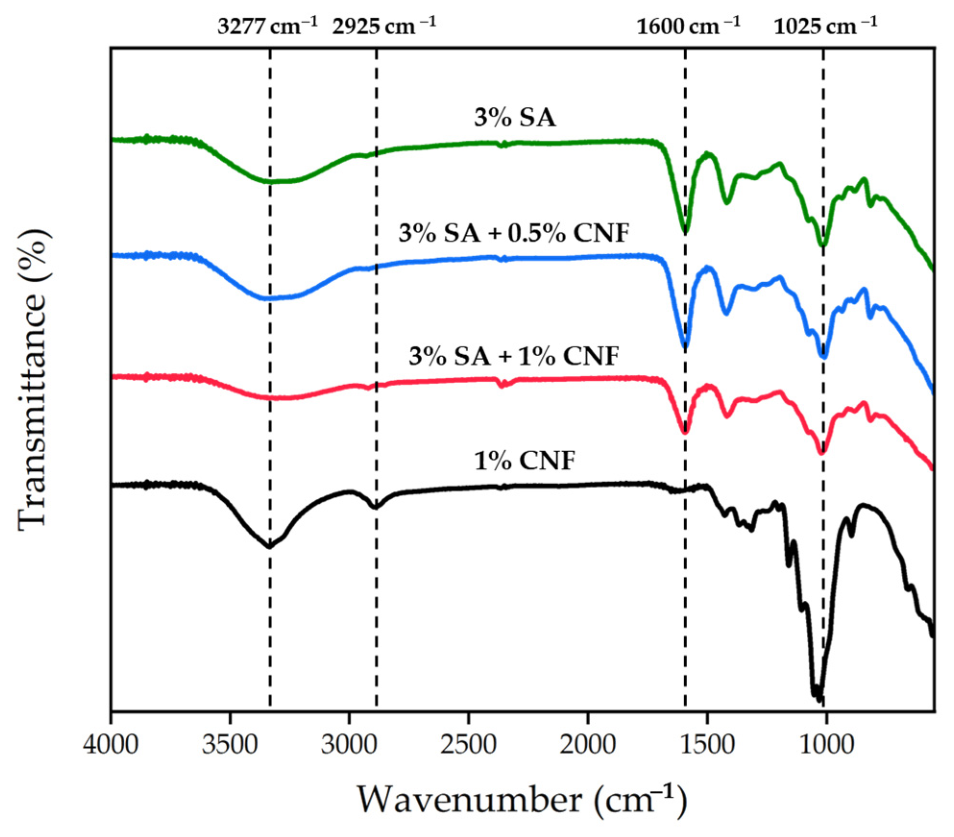
The chemical interactions in SA/CNF hydrogel beads were analyzed by Fourier transform infrared (FT-IR) spectroscopy (Figure 3). The incorporation of SA and CNF induced minor variations in the specific peaks of the hydrogels to varying degrees. In particular, the characteristic carboxyl group (-COO) peaks of SA were observed at 1410–1600 cm−1 in all SA-based hydrogel samples [50]. The 1% CNF sample exhibited a distinct peak at 2925 cm−1, corresponding to the C–H stretching vibrations of the cellulose backbone [51]. This peak was also observed in the SA/CNF hydrogel beads, although with reduced intensity. Moreover, the characteristic peak at 1025 cm−1 observed in the 1% CNF sample was detected in the SA/CNF hydrogels, indicating the presence of CNF in the SA network [52]. The absorption band at around 3277 cm−1 is attributed to O-H stretching vibrations in the SA/CNF composite gels, and no significant peak shift was observed among the samples, suggesting limited changes in the hydrogen-bonding [53].
Notably, no new peaks resulting from the formation of new chemical interactions were detected during the formation of the SA/CNF complex. This phenomenon indicated that the bonding between SA and CNF did not involve the formation of new covalent bonds. Instead, it can be explained by physical interactions such as hydrogen bonding and physical entanglement [54]. Therefore, SA/CNF hydrogels can exhibit combined properties of both components without substantial chemical modification.

2.2. Stability of L. plantarum CJLP 133 Encapsulated in SA/CNF Hydrogel Beads

Based on the textural profiles and chemical interactions of the SA/CNF composite, L. plantarum CJLP 133-loaded beads were fabricated to assess the feasibility of SA/CNF hydrogels as a probiotic delivery system. L. plantarum CJLP 133 exhibits probiotic properties and several health benefits, such as the alleviation of atopic dermatitis and allergic rhinitis [55,56,57,58]. Therefore, stable encapsulation within SA/CNF hydrogel beads is essential for targeted delivery and utilization of its therapeutic effects.
The encapsulation efficiency of L. plantarum CJLP 133 was evaluated to confirm its potential for probiotic stabilization (Table 3). All SA/CNF hydrogels had a high encapsulation efficiency of over 95%. Compared with previous reports of alginate-based encapsulation efficiencies ranging from 80% to 90% [59,60], the SA/CNF hydrogel beads exhibited a stable probiotic loading capacity. The consistently high efficiency with both 0.5% and 1% CNF concentrations suggests that CNF did not compromise the stable encapsulation efficiency of the SA-based hydrogels.
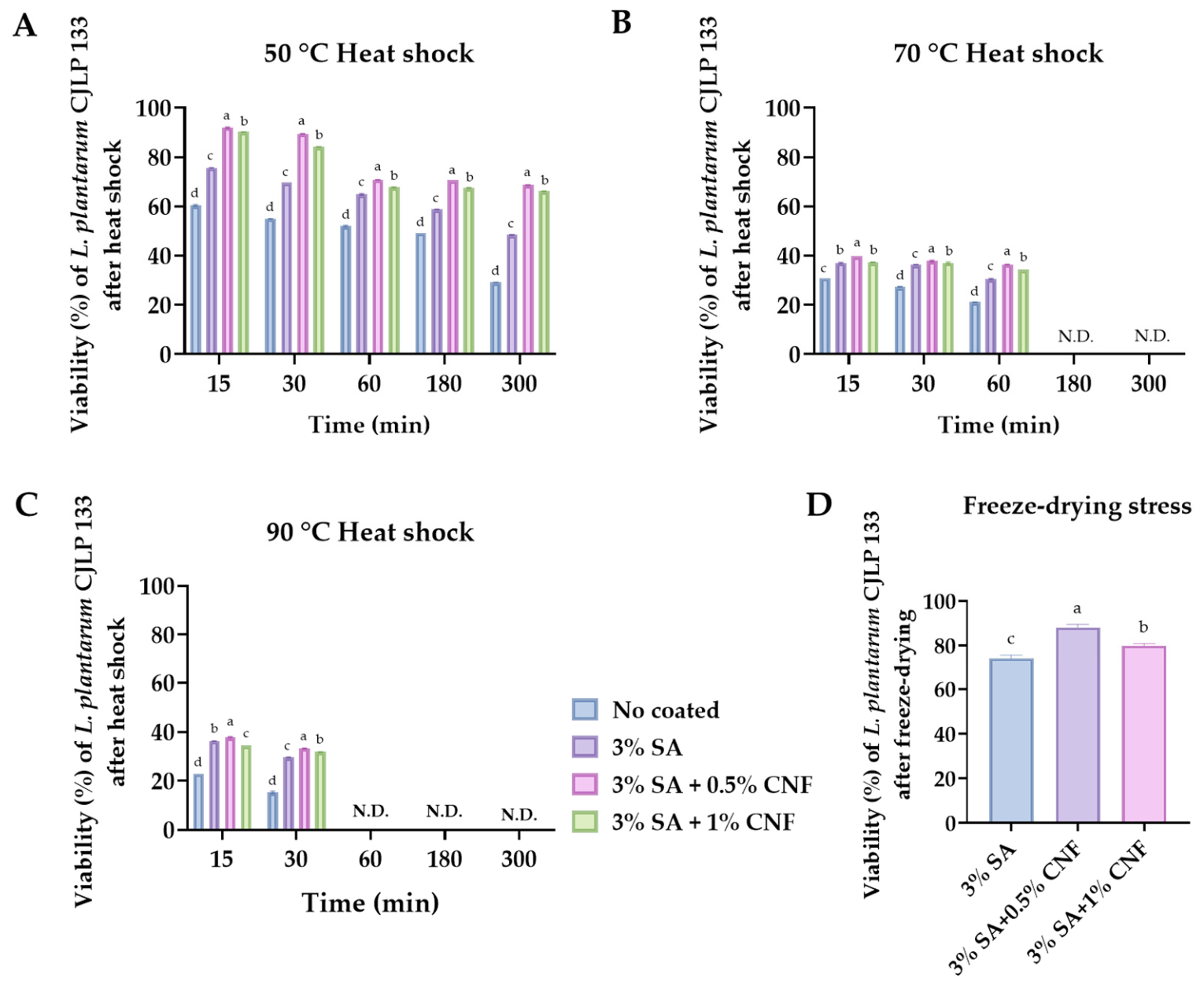
Next, the viability of L. plantarum CJLP 133 encapsulated in SA/CNF hydrogel beads was assessed after heat shock and freeze-drying to determine whether the hydrogel protects the entrapped probiotics during manufacturing (Figure 4). The 3% SA + 0.5% CNF hydrogel exhibited the highest probiotic survival under thermal stress at 50 °C, 60 °C, and 90 °C (Figure 4A–C). Compared with the initial 15 min exposure, the survival rate of uncoated cells decreased by 51.83% after 300 min at 50 °C. In contrast, the viability of the cells encapsulated in 3% SA + 0.5% CNF hydrogels decreased by only 25.30%. Furthermore, heat shock at 60 °C reduced the viability of uncoated cells by 31.80% within 15–60 min of exposure. However, the 3% SA + 0.5% CNF hydrogel protected the cells, limiting the reduction to only 8.66%. While heat shock at 90 °C killed all probiotic cells after over 60 min, the viability of uncoated cells decreased by 32.53% during 15–30 min of exposure at 90 °C; however, the 3% SA + 0.5% CNF hydrogel-coated cells exhibited only a 12.06% reduction.
Freeze-drying is a widely used process for manufacturing probiotic products [61]. The highest viability (88.18 ± 1.32%) was noted in 3% SA + 0.5% CNF hydrogel beads (Figure 4D). The survival rate of L. plantarum CJLP 133 was 74.05 ± 1.56% and 79.96 ± 0.88% in 3% SA and 3% SA + 1% CNF hydrogels, respectively. This is because hydrogen bonding within CNF can protect the entrapped cells by inducing pore shrinkage after freeze-drying due to the high surface tension of water [62]. Probiotic viability beyond 85% suggests that SA/CNF hydrogels are suitable for freeze-dried formulations, making their storage and transportation convenient [63].
These results suggest that SA/CNF hydrogels can effectively preserve entrapped probiotic viability under high-temperature and freeze-drying processes, with the 3% SA + 0.5% CNF formulation providing the most stable protection. Nevertheless, further studies are needed to determine long-term storage stability despite the demonstration of protectability against acute heat shock and freeze-drying. These aspects will be addressed in subsequent investigations to enhance the industrial application.

2.3. Characteristics of SA/CNF Hydrogels for Targeted Delivery

2.3.1. Acid and Bile Tolerance of SA/CNF Hydrogels

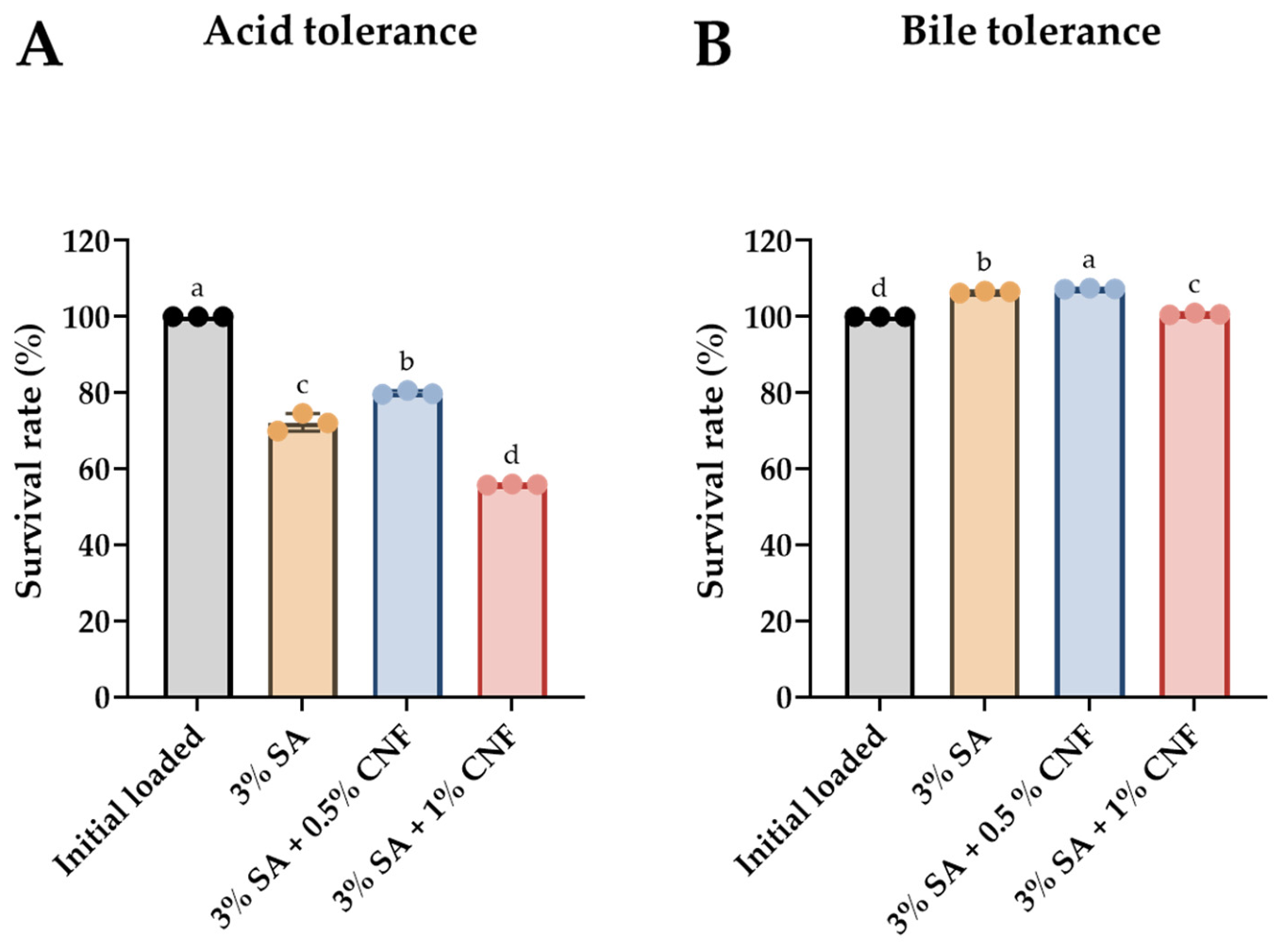
Probiotic encapsulation must maintain bacterial viability during exposure to low pH and bile salts, ensuring controlled release within the GI tract [64]. In this study, L. plantarum CJLP 133 encapsulated in 3% SA + 0.5% CNF hydrogels exhibited the highest viability, reaching 80.00 ± 0.46% and 107.37 ± 0.12% under acidic (pH 2.5) and bile salt conditions, respectively (Figure 5). However, the acid and bile tolerance capacities of the 3% SA + 1% CNF hydrogels were lower than those of the pure 3% SA hydrogels. In particular, the viability in the 3%SA + 1% CNF was only 55.92 ± 0.11% under acidic conditions and 100.75 ± 0.23% under bile salt conditions. On the other hand, 3% SA hydrogels maintained higher viability of 72.20 ± 1.88% and 106.51 ± 0.21% under acidic and bile salt conditions, respectively.
As CNF exhibits aggregative properties at pH levels below 3, excessive CNF under acidic conditions could induce self-aggregation, resulting in the formation of low-strength hydrogels [65,66]. Therefore, the decrease in protective efficacy at a higher CNF concentration (1%) may be related to a concentration-dependent threshold for strengthening the gels. Thus, 0.5% CNF seems optimal for protecting cells against low pH by producing physically stable hydrogels with SA. The bile tolerance of the encapsulated probiotics did not change significantly depending on the CNF concentration. These results indicate that the observed effects are related to acid tolerance rather than bile tolerance. These findings are consistent with those of previous studies on the use of CNF to protect probiotics [67].

2.3.2. Controlled Release of SA/CNF Hydrogels in Simulated GI Conditions

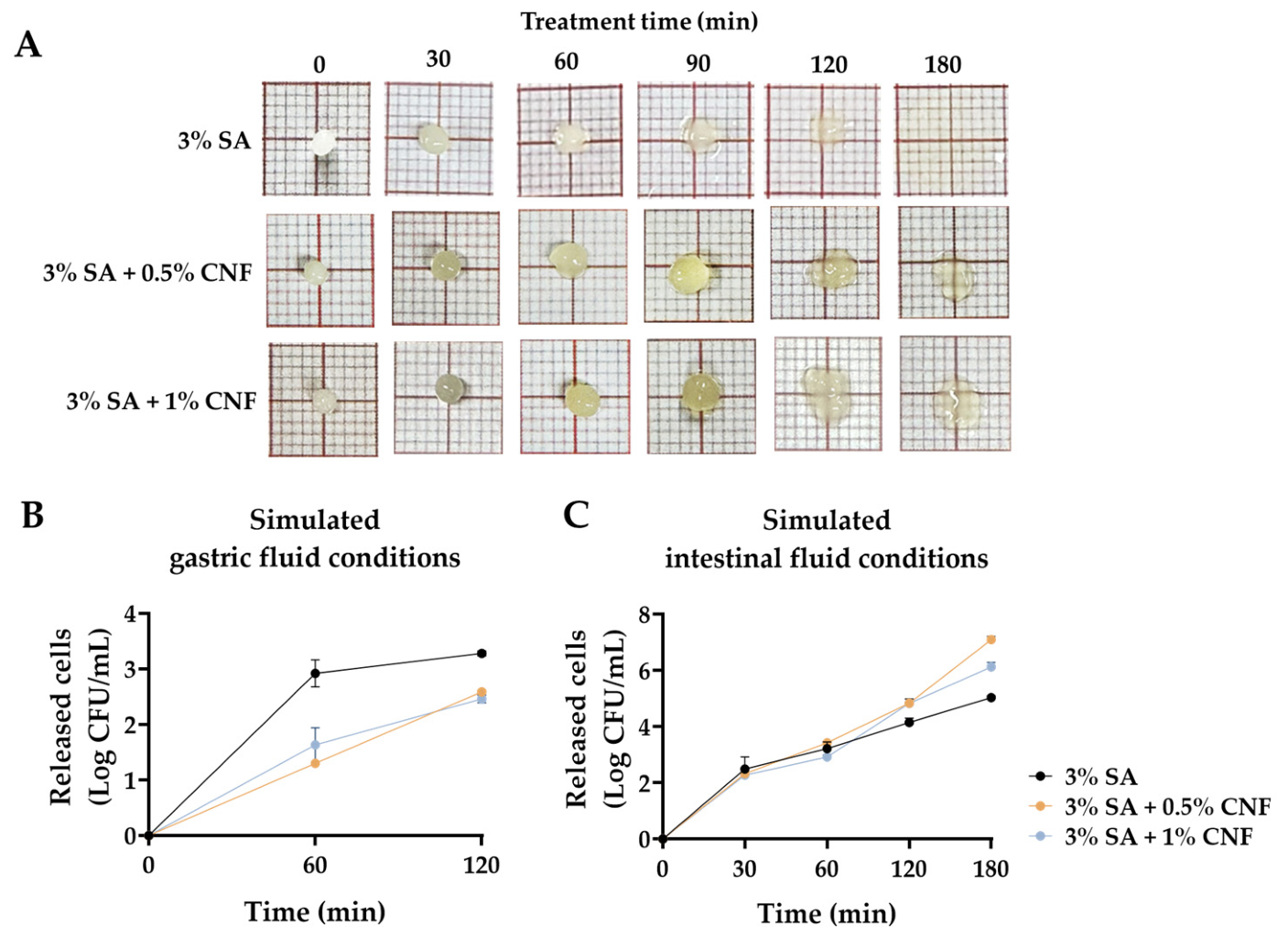
Controlled release is one of the most important properties of probiotic encapsulation for targeted delivery in the host [68]. For controlled release, the encapsulation system should retain probiotic cells in encapsulation agents and not release them under simulated gastric fluid (SGF) conditions; however, it should release probiotic cells for colonization under stimulated intestinal fluid (SIF) conditions [69]. Hence, the swelling behavior of hydrogels and the released cell count were measured in SGF for 120 min and SIF for 180 min (Figure 6) [10]. The swelling behavior of the SA/CNF hydrogels in SIF was initially monitored visually to observe morphological transition over 180 min (Figure 6A). As shown in the figure, the 3% SA hydrogel beads exhibited swelling for up to 60 min and completely disintegrated after 180 min. The two CNF-containing hydrogel beads remained swollen for a longer period (up to 90 min) and then disintegrated after 180 min. However, they retained their spherical capsule shape better than the 3% SA hydrogel beads at the final time. It was difficult to distinguish the swelling behavior of the 0.5% CNF and 1% CNF samples by visual inspection.
Next, released cell counts were performed to accurately assess controlled release (Figure 6B,C). Compared with the pure SA hydrogel, the incorporation of CNF into the SA matrix improved controlled release by effectively inhibiting the premature leakage of probiotics in SGF while facilitating a more efficient release in SIF. In particular, after 120 min of exposure to SGF, the 3% SA + 0.5% CNF hydrogel and 3% SA + 1% CNF hydrogel exhibited 4.9- (p = 0.0003) and 6.61- fold (p = 0.0011) lower L. plantarum CJLP 133 release levels, respectively, than the 3% SA hydrogel. During the initial phase of SIF exposure (until 60 min), the number of released cells was similar across all formulations. However, a significant difference was noted at the final 180 min of SIF exposure. While the 3% SA + 1% CNF hydrogel exhibited a 13-fold (p < 0.0001) higher cell release than the 3% SA hydrogel, the 3% SA + 0.5% hydrogel exhibited a remarkably higher released cell count (114.82-fold) (p < 0.0001) than the pure 3% SA hydrogel. In addition, in SGF, the number of released cells from the 3% SA + 0.5% CNF and 3% SA + 1% CNF hydrogels showed no significant difference (p = 0.2467). However, in SIF, the 0.5% CNF formulation exhibited significantly higher cell release compared to the 1% CNF hydrogel (p = 0.0486).
The swelling behavior of a hydrogel is highly pH-dependent and related to the characteristics of each matrix [18]. The improved controlled release performance of the SA/CNF hydrogel beads can be primarily attributed to the unique structural properties of CNF, including its high surface area and fibrous morphology. These characteristics may provide a robust physical barrier against gastric enzymes and acidity. As shown in Figure 3, the incorporation of CNF into the SA hydrogel matrix promoted intermolecular hydrogen bonding. This interaction of CNF and SA reduced the space occupied by free water within the network, facilitating the formation of a dense and compact network [70]. In contrast, at high pH levels, the carboxyl residues of alginate were ionized, resulting in electrostatic repulsion between the polymer chains. This process, coupled with the exchange of Ca2+ for Na+, induced swelling and subsequent matrix disintegration, improving the controlled release of L. plantarum [71].
Although the SA/CNF formulation demonstrated controlled release and stability in the simulated GI tract, the current static model provides initial evidence of GI survival potential but does not replicate the dynamic nature of human digestion. Thus, the efficacy of the delivery system under dynamic conditions remains to be further established.
Interestingly, 0.5% CNF was consistently found to be the optimal concentration across all experimental parameters, providing the most effective balance of protection and release of L. plantarum CJLP 133. Based on these results, the 3% SA + 0.5% CNF formulation was compared with each matrix for subsequent evaluation of synbiotic efficacy.

2.4. Synbiotic Effects of L. plantarum CJLP 133 in SA/CNF Hydrogels

2.4.1. Prebiotic Effects of L. plantarum CJLP 133 in SA/CNF Hydrogels

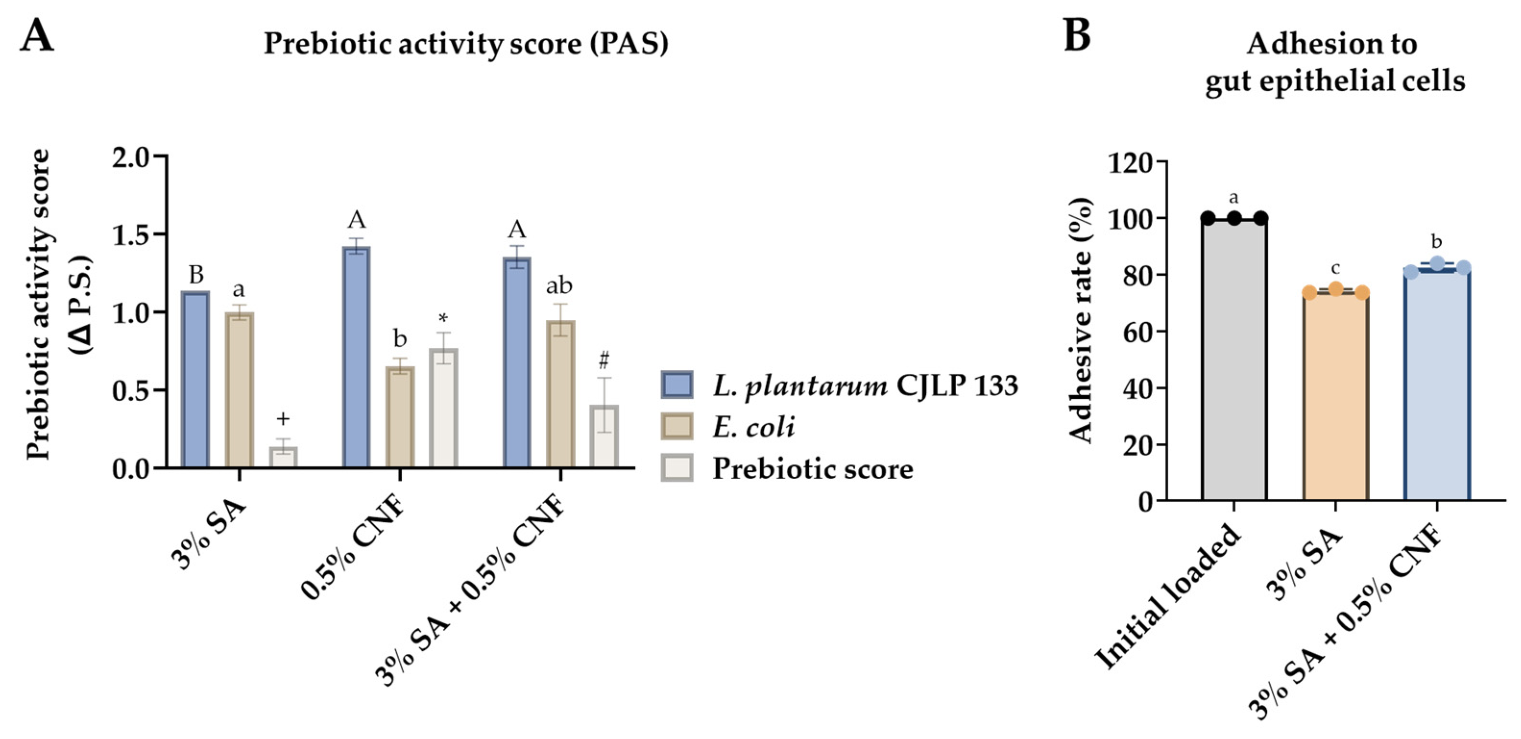
To evaluate the potential of SA/CNF hydrogel beads as novel synbiotic products, their prebiotic activity score (PAS) and in vitro gut adhesion were determined (Figure 7). The PAS was calculated based on the differential growth of L. plantarum CJLP 133 relative to the representative gut bacterium Escherichia coli when cultured in medium supplemented with SA, CNF, or SA/CNF composites (Figure 7A). The CNF samples achieved the highest PAS of 0.77 ± 0.07, followed by the 3% SA + 0.5% CNF composite (0.40 ± 0.12). In contrast, the pure SA samples exhibited the lowest score of 0.14 ± 0.03. Although the PAS of the SA/CNF composite was lower than that of the pure CNF, it represented an approximately 2.8-fold increase relative to the pure SA hydrogel. In particular, CNF not only enhanced the growth of probiotic L. plantarum CJLP 133 but also inhibited the growth of E. coli, indicating prebiotic effects.
Adhesion to gut epithelial cells (HT-29 cell lines) was also measured to determine whether SA/CNF hydrogel beads could facilitate the intestinal colonization of L. plantarum CJLP 133 (Figure 7B). The 3% SA + 0.5% CNF hydrogel exhibited an adhesion rate of 82.49% ± 1.27%, which was higher than the 74.10 ± 0.63% adhesion rate of the 3% SA hydrogel.
Nanocellulose has been widely studied as a novel prebiotic material because it is not degraded and absorbed in the human gut [72]. As only bacteria can use nanocellulose as a growth substrate, comparing the competitive inhibition of bacterial growth and intestinal adhesion is important for synbiotic applications [73]. The 3% SA + 0.5% CNF hydrogel promoted probiotic growth, inhibited pathogen growth, and enhanced the intestinal adhesion of probiotics, thereby confirming the synergistic effect of SA and CNF as prebiotic materials.

2.4.2. Short-Chain Fatty Acid (SCFA) Production by L. plantarum CJLP 133 in SA/CNF Hydrogels

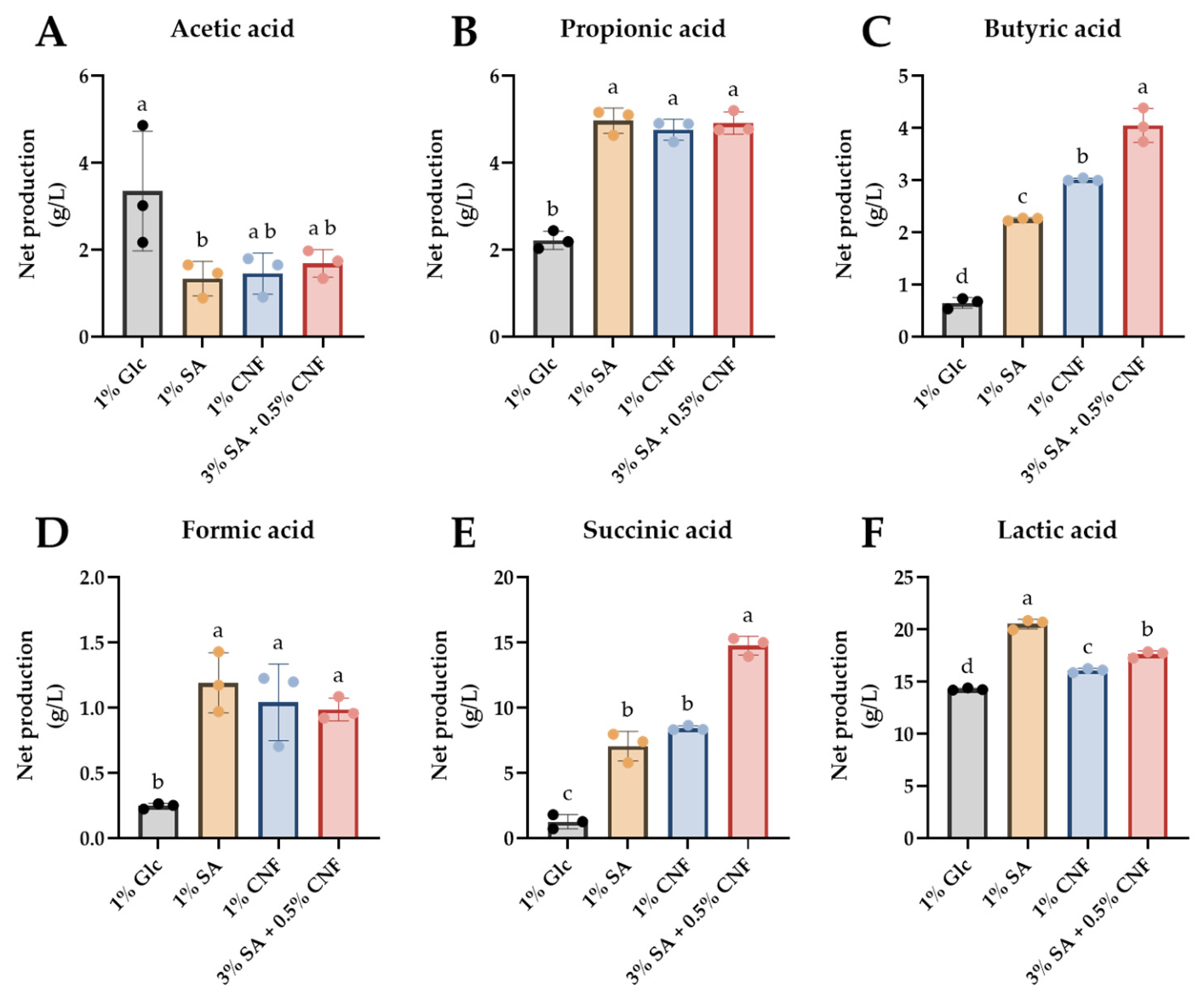
A prebiotic matrix should serve as an effective carbon source that stimulates the production of SCFAs [74]. The production of representative SCFAs (e.g., acetic, propionic, and butyric acids) and their organic acid precursors (e.g., formic, succinic, and lactic acids) was examined in L. plantarum CJLP 133 cultured in each medium containing glucose, SA, CNF, or SA + CNF as the carbon source (Figure 8). Net production of SCFAs was calculated by subtracting the initial concentration at 0 h from the concentration after 24 h of cultivation. Although no significant correlation was noted between the precursors and SCFAs, a synergistic prebiotic effect of SA + CNF was observed in some SCFAs. Butyric acid production was most effectively increased using 3% SA + 0.5% CNF as the carbon source, reaching 4.05 ± 0.26 g/L. Acetic acid and propionic acid production showed no significant differences across the SA, CNF, and SA + CNF samples, ranging from 1.34 to 1.69 g/L and 4.76 to 4.97 g/L, respectively. In contrast, the levels of organic acid precursors varied distinctly depending on the carbon source. In particular, succinic acid, a precursor of propionic acid, reached the highest concentration (14.77 ± 0.58 g/L) in the SA + CNF composite. Although the production of formic acid (a precursor of acetic acid) and lactic acid (a precursor of propionic and butyric acids) was more effectively stimulated by SA or CNF alone than by the SA + CNF composite, the levels in the 3% SA + 0.5% CNF samples were 3.96- and 1.23-fold higher, respectively, than those in the 1% glucose control. These findings indicate that the SA/CNF composite produced SCFAs more efficiently than the standard 1% glucose control. Thus, L. plantarum CJLP 133 with the 3% SA + 0.5% CNF hydrogel exhibits potential as a novel synbiotic encapsulation product.
L. plantarum is known to ferment non-digestible polysaccharides through its endogenous cellulolytic enzymes, contributing to improved GI health [75,76]. The observed increase in both intestinal adhesion and SCFA production (e.g., butyrate and succinate) in the SA/CNF-hydrogel probably resulted from the enzymatic utilization of the matrix by L. plantarum. However, further research is required to fully elucidate the complex metabolism through which the SA/CNF composite is used by probiotics as a synergistic prebiotic source.

3. Conclusions

This study developed a novel synbiotic delivery system by incorporating CNF into an SA-based hydrogel matrix. The 3% SA + 0.5% CNF formulation demonstrated the greatest strategic advantage for probiotic encapsulation, thereby protecting viability under various processing conditions, such as heat shock, freeze-drying, low pH, and bile salts. This function is attributed to the intermolecular hydrogen bonding between SA and CNF, resulting in the formation of a denser network. Moreover, this hydrogel bead facilitated targeted and controlled release in the simulated GI system and provided prebiotic support to L. plantarum CJLP 133. These results suggest that the SA/CNF composite can be used as a promising platform for the stable and functional delivery of probiotics.
Although this study successfully confirms the in vitro efficacy of SA/CNF hydrogel beads, further mechanistic studies are required to understand their function within the complex human GI tract as a precision nutrition system. Also, the long-term storage stability of the encapsulated probiotics was not evaluated in this study. Further research focusing on the shelf-life and viability of SA/CNF hydrogel beads under various storage conditions is warranted to ensure their industrial feasibility.

4. Materials and Methods

4.1. Materials

CNFs (CNNT, Suwon, Republic of Korea), SA (Junsei, Tokyo, Japan), CaCl2 (Daejung, Siheung-si, Republic of Korea), and Lactobacilli De Man, Rogosa and Sharpe (MRS) broth (BD Difco, Franklin Lakes, NJ, USA) were used in this study. All media and reagents were sterilized at 121 °C for 15 min before use.

4.2. Preparation and Storage of Bacterial Culture

L. plantarum CJLP 133 was cultured in MRS broth at 37 °C for 24 h. The culture was centrifuged at 4 °C at 1971× g for 15 min, and the supernatant was then removed. The pellet was washed twice with 1× PBS (pH 7.4; Gibco, New York, NY, USA). For long-term storage, the bacterial suspension was mixed with 50% (v/v) glycerol at a 1:1 (v/v) ratio in sterile MRS broth and maintained as a stock at −80 °C.

4.3. Preparation of SA/CNF Hydrogel Beads

The encapsulation of L. plantarum CJLP 133 within the SA/CNF matrix was performed using an extrusion-based ionic gelation technique under sterile conditions. The encapsulation matrix was initially composed of various concentrations of SA stock solution (1%, 2%, and 3%, w/v) and CNF stock solution (0.5% and 1%, w/v). The bacterial pellet was thoroughly mixed with the SA/CNF solution at a 1:9 ratio (v/v). The resulting mixture was then extruded through a 21-gauge needle into 100 mL of sterile 0.1 M CaCl2 solution and allowed to harden for 30 min under continuous stirring [77]. To optimize the formulation, various SA:CNF mixing ratios (100:0, 80:20, 50:50, 40:60, 30:70, and 20:80) were evaluated. Based on the preliminary screening, the fixed volume ratio of 80:20 was selected for all subsequent experiments. The final concentrations of L. plantarum CJLP 133-loaded 3% SA + 0.5% CNF or 1% CNF (8:2) in the formulation were 2.16% and 0.18% or 0.09%, respectively. However, for convenience in sample labeling, the concentrations were expressed based on the stock solution concentrations (e.g., 3% SA, 3% SA + 0.5% CNF, and 3% SA + 1% CNF). The formed beads were collected, washed twice with sterile distilled water, and stored at 4 °C for further analysis. For each formulation condition, six independent L. plantarum CJLP 133-loaded beads were prepared, and the data were expressed as the mean ± standard deviation (n = 6).

4.4. Size Measurement and Texture Profile Analysis (TPA)

For size measurement, 10 capsules were randomly selected from each batch, and their diameters were measured using a digital caliper (Mitutoyo, Kawasaki, Japan). TPA was performed at room temperature (25 ± 2 °C) using a universal testing machine (ProLine Z010; Zwick Roell, Ulm, Germany), according to the protocol described in a previous research [78]. The beads were subjected to two compression cycles using a 35 mm diameter acrylic cylindrical probe with a 60 s relaxation time between compressions. Textural properties were determined using six independent replicates to ensure statistical reliability.

4.5. Morphological Characterization of SA/CNF Capsules

The surface and cross-sectional morphologies of the hydrogel beads were examined using field emission SEM (FE-SEM; SU8030, Hitachi, Tokyo, Japan). Before observation, the samples were sputter-coated with platinum (Pt) at 20 mA for 90 s to enhance electrical conductivity. The coated specimens were then analyzed using FE-SEM at a working distance of 11.8 mm and an accelerating voltage of 5 kV [79]. The pore sizes of SA/CNF hydrogel beads were quantitatively analyzed from SEM images using ImageJ 1.54g software (NIH, Bethesda, MD, USA). SEM images were converted to grayscale, and a threshold was set to distinguish pores from the hydrogel matrix. The pore diameters were measured using the particle analysis function, and more than 400 pores were analyzed for each sample after excluding the maximum and minimum values.

4.6. FT-IR Spectroscopic Analysis

The chemical structure and molecular interactions of the SA/CNF hydrogel beads were evaluated using FT-IR spectroscopy. Before analysis, the samples were freeze-dried for 48 h. Spectra were recorded using a Nicolet iS5 FT-IR spectrophotometer (Thermo Scientific, Waltham, MA, USA) equipped with an attenuated total reflectance (ATR) accessory (iD7; Thermo Scientific) featuring a zinc selenide (ZnSe) crystal. The spectra were acquired in ATR mode over a range of 550–4000 cm−1 at a resolution of 4 cm−1 with 16 scans per sample. Data processing and background correction were performed using OMNIC 9 software (Thermo Scientific) to eliminate atmospheric interference.

4.7. Encapsulation Efficiency of SA/CNF Capsules

To determine encapsulation efficiency, 1 g of the SA/CNF hydrogel bead sample was disintegrated in 9 mL of sterile 0.1 M sodium citrate buffer (Duksan, Ansan, Gyunggi-do, Republic of Korea) and vortexed for 10 min at room temperature to ensure the complete release of entrapped L. plantarum CJLP 133. The resulting suspension was serially diluted with sterile distilled water and plated on MRS agar. The plates were incubated at 37 °C for 48 h under anaerobic conditions. Encapsulation efficiency was calculated as follows, according to Equation (1):
Encapsulation Efficiency (%) = (log N/log N0) × 100
Here, N is the number of viable cells after encapsulation and N0 is the number before encapsulation.

4.8. Stability Assessment of SA/CNF Capsules

4.8.1. Thermal Tolerance

To evaluate thermal stability, 1 g of each bead was placed in a test tube containing 10 mL of sterile distilled water. The tubes were exposed to various temperatures (50 °C, 70 °C, and 90 °C) for specific durations (15, 30, 0, 180, and 300 min) in a water bath. The temperature of the water bath was maintained at the setting temperature with a variance of ± 2 °C. Following heat treatment, the optical density (OD) was measured using UV–vis spectrophotometry (EPOCH; BioTek, Winooski, VT, USA). The survival rate (%) of both free and encapsulated probiotics was calculated using Equation (2), according to a previous study [70]:
Survival (%) = (ODA/ODB) × 100
Here, ODA represents the value after heat treatment, while ODB represents the value before heat treatment.

4.8.2. Freeze-Drying Tolerance

Hydrogel beads were prefrozen at −50 °C for 24 h. Subsequently, the samples were lyophilized using a freeze-dryer (FreeZone 2.5 L Benchtop; Labconco, Kansas City, MO, USA) at −80 °C under a pressure of 0.007 mbar for 48 h. To assess viability, 1 g of the freeze-dried bead sample was disintegrated in 10 mL of sterile 0.1 M sodium citrate buffer by vortexing for 10 min [80]. The suspension was serially diluted in PBS, and 100 μL of each dilution was spread-plated onto MRS agar. The plates were incubated at 37 °C for 48 h, and the colony-forming units per gram (CFU/g) were then calculated using Equation (3):
Survival rate (%) = (log N/log N0) × 100
Here, N is the number of viable cells after freeze-drying (CFU/mL), while N0 is the number of initial viable cells (CFU/mL).

4.9. Acid and Bile Tolerance

The acid and bile tolerance capacities of encapsulated L. plantarum CJLP 133 were evaluated using a previously reported method [70], with slight modifications. In brief, 1 g of the SA/CNF hydrogel bead sample was suspended in 10 mL of PBS solution. To determine acid tolerance, the bacterial suspensions were inoculated into 10 mL of MRS broth, which had been adjusted to pH 2.5 using 6 N hydrochloric acid (HCl), and incubated at 37 °C for 2 h. To determine bile tolerance, the samples were inoculated into MRS broth containing 0.3% (w/v) of bile salt (ox gall/ox bile) and incubated at 37 °C for 3 h. After each incubation period, the beads were disintegrated in 0.1 M sodium citrate buffer to release the entrapped cells. The survival rate (%) against acid and bile salts was calculated using Equation (4):
Survival rate (%) = (log N/log N0) × 100
Here, N is the number of viable cells against acid or bile salts (CFU/mL), while N0 is the number of initial viable cells (CFU/mL).

4.10. In Vitro Release Profiles

4.10.1. Preparation of SGF and SIF

Simulated gastric fluid (SGF) was prepared by dissolving 9 g of sodium chloride (NaCl; Duksan) in 1000 mL of sterile water, adjusting the pH to 2.0 with 1 M HCl solution (Duksan), and then dissolving 0.3% pepsin (Pepsin 1:10,000; Wako, Osaka, Japan) in it. Simulated intestinal fluid (SIF) was prepared using KH2PO4 (Duksan) containing 1% bile salt (ox gall/ox bile) and 1% pancreatin (Kanto, Tokyo, Japan), with the pH adjusted to 7.4. The compositions of SGC and SIF were prepared based on previously reported simulated GI conditions [81,82].

4.10.2. Release Behavior

SGF and SIF were used to assess the release behavior of L. plantarum CJLP 133 from SA/CNF hydrogel beads. The release experiment was conducted with reference to the reported method [83]. In brief, 1 g of the wet bead sample was immersed in 9 mL of SGF and incubated at 37 °C for 2 h. After the gastric phase, the beads were recovered via filtration, washed twice with sterile distilled water, and then transferred into 9 mL of SIF for further incubation at 37 °C. Samples were collected at 0, 60, and 120 min during the SGF phase and at 0, 30, 60, 90, 120, and 180 min during the SIF phase. At each sampling interval, the viable cell counts were determined as described in Section 4.7. For viable cell count, the hydrogel beads were dissolved using a sodium citrate buffer to release encapsulated cells prior to plating [80]. To maintain a constant volume throughout the experiment, 1 mL of the supernatant was withdrawn for analysis and immediately replaced with 1 mL of fresh, sterile SIF.

4.11. Prebiotic Activity Assay

To determine the ability of the SA/CNF matrix to selectively stimulate the growth of probiotics in comparison with enteric bacteria, the PAS was measured according to a previously described method [84]. L. plantarum CJLP 133 was used as the probiotic strain, and E. coli KCTC 2571 was used as the enteric strain. The basal medium used was MRS broth without glucose (MB Cell, Seoul, Republic of Korea), which was supplemented with a prebiotic candidate, such as SA, CNF, or SA + CNF. Each strain was inoculated into the prepared media and incubated at 37 °C for 24 h. The viable cell counts of the probiotic strain were determined by plating on MRS agar, while those of the enteric strain were determined by plating on LB agar (BD Difco). The prebiotic score (P.S.) was calculated using Equation (5):
P.S. = (A − B)/(C − D)
Here, A represents the bacterial population (log CFU/mL) grown on the prebiotic at 24 h, B represents the bacterial population (log CFU/mL) grown on the prebiotic at 0 h, C represents the bacterial population (log CFU/mL) grown on glucose at 24 h, and D represents the bacterial population (log CFU/mL) grown on glucose at 0 h.

4.12. Assessment of Adhesion to Gut Epithelial Cells

The gut adhesion ability of L. plantarum CJLP 133 was evaluated using the HT-29 human colorectal adenocarcinoma cell line, as described previously [70]. HT-29 cells were purchased from the Korean Cell Line Bank (KCTC; Seoul, Republic of Korea) and cultured in DMEM supplemented with 10% FBS and 1% penicillin/streptomycin at 37 °C in a 5% CO2 incubator and seeded in six-well plates at a density of 1 × 10⁶ cells/mL for 24 h. Before the assay, the SA/CNF hydrogel beads were sequentially exposed to SGF for 2 h and SIF for 3 h. The released bacteria were then harvested and resuspended in antibiotic-free DMEM at a concentration of 1 × 10⁵ CFU/mL. Subsequently, the bacterial suspension was added to the HT-29 cells and incubated for 45 min at 37 °C. After incubation, nonadherent bacteria were removed by washing with sterile PBS, and the cells with adherent bacteria were detached using a trypsin–EDTA solution. The concentration of attached bacteria was quantified by serial dilution and plating on MRS agar, and the adhesion rate (%) was calculated as the ratio of attached bacteria to the initial bacterial population based on three independent replicates.

4.13. SCFA Analysis

To evaluate the production of SCFAs, L. plantarum CJLP 133 was cultured in glucose-free MRS broth (MB Cell) supplemented with either 1% (w/v) glucose (as a control) or 1% (w/v) of various prebiotic candidates (SA and CNF). This approach, involving the substitution of glucose with alternative carbon sources to assess microbial metabolism, was adopted based on previously reported methods [85]. The strain was inoculated at a 1% (v/v) ratio and incubated at 37 °C for 24 h. Subsequently, the culture broth was centrifuged at 1971× g for 15 min at 4 °C to obtain the supernatant. The supernatant was filtered through a 0.22-μm hydrophobic PTFE membrane filter (Futecs, Daejeon, Republic of Korea). SCFA analysis was performed using a high-performance liquid chromatography (HPLC) system (LC-6000; Futecs) equipped with an Aminex HPX-87H organic column (Bio-Rad, Hercules, CA, USA). The mobile phase consisted of 0.005 M H2SO4 at a flow rate of 0.5 mL/min. The concentration of individual SCFAs was quantified based on standard curves. The HPLC-based analysis of SCFAs was conducted following the previous methods [86].

4.14. Data Analysis

All experiments were conducted at least in triplicate. The results are expressed as the mean ± standard deviation (SD). Statistical analysis was performed using SPSS software (version 21.0; IBM Corp., Armonk, NY, USA) and GraphPad Prism (version 11.0; GraphPad Software Inc., San Diego, CA, USA). Statistical significance of the differences between groups was determined using one-way analysis of variance (ANOVA), followed by Tukey’s multiple range tests. A p-value of <0.05 was considered to indicate a statistically significant difference.

Author Contributions

Conceptualization, Y.H.J., J.Y., Y.K. and J.-H.L.; methodology, H.J.J., B.Y.P., J.H.M., G.R.S. and H.M.J.; investigation, B.Y.P., J.H.M. and G.R.S.; data curation, H.J.J. and J.H.M.; writing—original draft preparation, H.J.J. and B.Y.P.; writing—review and editing, Y.H.J. and J.Y.; visualization, H.J.J., H.M.J. and K.Y.S.; supervision, Y.H.J., J.Y., Y.K. and J.-H.L.; project administration, Y.H.J. and J.Y.; funding acquisition, Y.H.J., Y.K. and J.-H.L. All authors have read and agreed to the published version of the manuscript.

Funding

This work was supported by the Korea Institute of Planning and Evaluation for Technology in Food, Agriculture and Forestry (IPET) through Agriculture and Food Convergence Technologies Program for Research Manpower development, funded by Ministry of Agriculture, Food and Rural Affairs (MAFRA) (RS-2024-00402136) and Basic Science Research Program through the National Research Foundation of Korea (NRF) funded by the Ministry of Education (2022M3A9I5018286).

Informed Consent Statement

Informed consent was obtained from all subjects involved in the study.

Data Availability Statement

Data will be made available on request.

Acknowledgments

We thank for the support by BK21 FOUR (Fostering Outstanding Universities for Research, No. 2120240615414) through the National Research Foundation of Korea (NRF) under the Ministry of Education, Healthcare Convergence Educational Group for Infectious Disease Management. We also thank Jin Seok Moon (Ildong Bioscience) and Nur istianah (Universitas Brawijaya) for their contributions in development of methods and visualization of data. The authors used AI tools (Gemini 3 Flash) exclusively for language editing and grammatical corrections. The authors declare that no AI was used for data collection, analysis, or the formulation of scientific conclusions.

Conflicts of Interest

The authors declare no conflicts of interest.

Abbreviations

The following abbreviations are used in this manuscript:
SASodium alginate
CNFCellulose nanofiber
SDStandard deviation
SEMScanning electron microscopy
TPATexture profile analysis
FT-IRFourier transform infrared spectroscopy
GIGastrointestinal
SGFSimulated gastric fluid
SIFSimulated intestinal fluid
3DThree-dimensional
Ca2+Calcium ion
CaCl2Calcium chloride anhydride
COOCarboxyl group
EEEncapsulation efficiency
CFUColony-forming units
PASPrebiotic activity score
SCFAsShort-chain fatty acids
e.g.,Exempli gratia
MRSLactobacilli De Man, Rogosa and Sharpe
PBSPhosphate-buffered saline
FE-SEMField emission-scanning electron microscopy
ATRAttenuated total reflectance
ZnSeZinc selenide
ODOptical density
UVUltraviolet
HPLCHigh-performance liquid chromatography
PTFEPolytetrafluoroethylene
ANOVAAnalysis of variance

References

  1. Hill, C.; Guarner, F.; Reid, G.; Gibson, G.R.; Merenstein, D.J.; Pot, B.; Morelli, L.; Canani, R.B.; Flint, H.J.; Salminen, S.; et al. The International Scientific Association for Probiotics and Prebiotics Consensus Statement on the Scope and Appropriate Use of the Term Probiotic. Nat. Rev. Gastroenterol. Hepatol. 2014, 11, 506–514. [Google Scholar] [CrossRef] [PubMed]
  2. Wang, A.; Zhong, Q. Drying of Probiotics to Enhance the Viability during Preparation, Storage, Food Application, and Digestion: A Review. Compr. Rev. Food Sci. Food Saf. 2024, 23, e13287. [Google Scholar] [CrossRef]
  3. Rajam, R.; Subramanian, P. Encapsulation of Probiotics: Past, Present and Future. Beni-Suef Univ. J. Basic Appl. Sci. 2022, 11, 46. [Google Scholar] [CrossRef]
  4. Reque, P.M.; Brandelli, A. Encapsulation of Probiotics and Nutraceuticals: Applications in Functional Food Industry. Trends Food Sci. Technol. 2021, 114, 1–10. [Google Scholar] [CrossRef]
  5. Picot, A.; Lacroix, C. Encapsulation of Bifidobacteria in Whey Protein-Based Microcapsules and Survival in Simulated Gastrointestinal Conditions and in Yoghurt. Int. Dairy J. 2004, 14, 505–515. [Google Scholar] [CrossRef]
  6. Zhang, F.; Wang, R.; Zhang, L.; Yan, L.; Jia, Y.; Yang, J.; Wang, X.; Lü, X. Enhanced Viability of Probiotics in Composite Hydrogel Beads. J. Food Eng. 2023, 357, 111621. [Google Scholar] [CrossRef]
  7. Zheng, B.-D.; Gan, L.; Tian, L.-Y.; Chen, G.-H. Protein/Polysaccharide-Based Hydrogels Loaded Probiotic-Mediated Therapeutic Systems: A Review. Int. J. Biol. Macromol. 2023, 253, 126841. [Google Scholar] [CrossRef]
  8. Yang, J.; Chen, Y.; Zhao, L.; Zhang, J.; Luo, H. Constructions and Properties of Physically Cross-Linked Hydrogels Based on Natural Polymers. Polym. Rev. 2023, 63, 574–612. [Google Scholar] [CrossRef]
  9. Kwiecień, I.; Kwiecień, M. Application of Polysaccharide-Based Hydrogels as Probiotic Delivery Systems. Gels 2018, 4, 47. [Google Scholar] [CrossRef]
  10. Qi, X.; Simsek, S.; Chen, B.; Rao, J. Alginate-Based Double-Network Hydrogel Improves the Viability of Encapsulated Probiotics during Simulated Sequential Gastrointestinal Digestion: Effect of Biopolymer Type and Concentrations. Int. J. Biol. Macromol. 2020, 165, 1675–1685. [Google Scholar] [CrossRef] [PubMed]
  11. Savić Gajić, I.M.; Savić, I.M.; Svirčev, Z. Preparation and Characterization of Alginate Hydrogels with High Water-Retaining Capacity. Polymers 2023, 15, 2592. [Google Scholar] [CrossRef]
  12. Wang, H.; Wilksch, J.J.; Lithgow, T.; Strugnell, R.A.; Gee, M.L. Nanomechanics Measurements of Live Bacteria Reveal a Mechanism for Bacterial Cell Protection: The Polysaccharide Capsule in Klebsiella is a Responsive Polymer Hydrogel That Adapts to Osmotic Stress. Soft Matter 2013, 9, 7560–7567. [Google Scholar] [CrossRef]
  13. Hungria, R.; Hassan, M.M.; Mousa, M. Effects of Hydrogel-Encapsulated Bacteria on the Healing Efficiency and Compressive Strength of Concrete. J. Road Eng. 2023, 3, 156–170. [Google Scholar] [CrossRef]
  14. Wang, H.; Yang, L.; Yang, Y. A Review of Sodium Alginate-Based Hydrogels: Structure, Mechanisms, Applications, and Perspectives. Int. J. Biol. Macromol. 2025, 292, 139151. [Google Scholar] [CrossRef] [PubMed]
  15. Makarova, A.O.; Derkach, S.R.; Khair, T.; Kazantseva, M.A.; Zuev, Y.F.; Zueva, O.S. Ion-Induced Polysaccharide Gelation: Peculiarities of Alginate Egg-Box Association with Different Divalent Cations. Polymers 2023, 15, 1243. [Google Scholar] [CrossRef]
  16. Cao, J.; Wu, B.; Yuan, P.; Liu, Y.; Hu, C. Research Progress of Sodium Alginate-Based Hydrogels in Biomedical Engineering. Gels 2025, 11, 758. [Google Scholar] [CrossRef]
  17. Jing, Y.-Y.; Li, Y.-C.; Luo, Y.-Q.; Zou, L.-H.; Tang, Y.-M.; Lin, Y.-X.; Meng, F.-B. Effects of Gum Incorporation on the Properties of Sodium Alginate-Based Composite Hydrogel Beads for Encapsulating Lactic Acid Bacteria. Carbohydr. Polym. 2025, 369, 124298. [Google Scholar] [CrossRef]
  18. Li, Y.; Wang, C.; Luan, Y.; Liu, W.; Chen, T.; Liu, P.; Liu, Z. Preparation of pH-Responsive Cellulose Nanofibril/Sodium Alginate Based Hydrogels for Drug Release. J. Appl. Polym. Sci. 2022, 139, 51647. [Google Scholar] [CrossRef]
  19. Lima, D.S.; Tenório-Neto, E.T.; Lima-Tenório, M.K.; Guilherme, M.R.; Scariot, D.B.; Nakamura, C.V.; Muniz, E.C.; Rubira, A.F. pH-Responsive Alginate-Based Hydrogels for Protein Delivery. J. Mol. Liq. 2018, 262, 29–36. [Google Scholar] [CrossRef]
  20. Ilgin, P.; Ozay, H.; Ozay, O. Synthesis and Characterization of pH Responsive Alginate Based-Hydrogels as Oral Drug Delivery Carrier. J. Polym. Res. 2020, 27, 251. [Google Scholar] [CrossRef]
  21. Wu, L.; Schroën, K.; Corstens, M. Structural Stability and Release Properties of Emulsion-Alginate Beads under Gastrointestinal Conditions. Food Hydrocoll. 2024, 150, 109702. [Google Scholar] [CrossRef]
  22. Ji, R.; Wu, J.; Zhang, J.; Wang, T.; Zhang, X.; Shao, L.; Chen, D.; Wang, J. Extending Viability of Bifidobacterium Longum in Chitosan-Coated Alginate Microcapsules Using Emulsification and Internal Gelation Encapsulation Technology. Front. Microbiol. 2019, 10, 1389. [Google Scholar] [CrossRef] [PubMed]
  23. El Sayed, H.S.; Mabrouk, A.M. Encapsulation of Probiotics Using Mixed Sodium Alginate and Rice Flour to Enhance Their Survivability in Simulated Gastric Conditions and in UF-Kariesh Cheese. Biocatal. Agric. Biotechnol. 2023, 50, 102738. [Google Scholar] [CrossRef]
  24. Wang, K.; Zhou, W.; Zhai, J.; Du, P.; Liu, L.; Li, S.; Li, A. Diversified Modification Strategies for Sodium Alginate-Based Probiotic-Embedded Gels and Their Potential for Food Applications. Food Sci. Anim. Prod. 2024, 2, 9240090. [Google Scholar] [CrossRef]
  25. Phanthong, P.; Reubroycharoen, P.; Hao, X.; Xu, G.; Abudula, A.; Guan, G. Nanocellulose: Extraction and Application. Carbon Resour. Convers. 2018, 1, 32–43. [Google Scholar] [CrossRef]
  26. Deng, W.; Tang, Y.; Mao, J.; Zhou, Y.; Chen, T.; Zhu, X. Cellulose Nanofibril as a Crosslinker to Reinforce the Sodium Alginate/Chitosan Hydrogels. Int. J. Biol. Macromol. 2021, 189, 890–899. [Google Scholar] [CrossRef]
  27. Shi, X.; Chen, Z.; He, Y.; Lu, Q.; Chen, R.; Zhao, C.; Dong, D.; Sun, Y.; He, H. Dual Light-Responsive Cellulose Nanofibril-Based in Situ Hydrogel for Drug-Resistant Bacteria Infected Wound Healing. Carbohydr. Polym. 2022, 297, 120042. [Google Scholar] [CrossRef]
  28. Cheng, G.; Wang, S.; Li, W.; Zhou, X.; Jiang, Y.; Liu, X.; Huang, Q. Mechanically Strong, Self-healing and pH-responsive Lignocellulose Nanofibril-based Hydrogels towards Drug Delivery Applications. Res. Sq. 2023. [Google Scholar] [CrossRef]
  29. Baş, Y.; Berglund, L.; Niittylä, T.; Zattarin, E.; Aili, D.; Sotra, Z.; Rinklake, I.; Junker, J.; Rakar, J.; Oksman, K. Preparation and Characterization of Softwood and Hardwood Nanofibril Hydrogels: Toward Wound Dressing Applications. Biomacromolecules 2023, 24, 5605–5619. [Google Scholar] [CrossRef] [PubMed]
  30. Zhao, Y.; Jiang, G.; Zeng, S.; Sun, L.; Yu, H.; Zhao, D. Ultrathin Cellulose Ionogel Devices Through Solvent-Induced Peeling. Adv. Funct. Mater. 2025, 36, e16610. [Google Scholar] [CrossRef]
  31. Quan, Z.; Chen, Z.; Li, H.; Sun, S.; Xu, Y. A Hydrogel Sensor Based on Cellulose Nanofiber/Polyvinyl Alcohol with Colorimetric-Fluorescent Bimodality for Non-Invasive Detection of Urea in Sweat. Int. J. Biol. Macromol. 2024, 276, 133760. [Google Scholar] [CrossRef]
  32. Persano, F.; Malitesta, C.; Mazzotta, E. Cellulose-Based Hydrogels for Wastewater Treatment: A Focus on Metal Ions Removal. Polymers 2024, 16, 1292. [Google Scholar] [CrossRef]
  33. Gong, J.; Hou, L.; Ching, Y.C.; Ching, K.Y.; Hai, N.D.; Chuah, C.H. A Review of Recent Advances of Cellulose-Based Intelligent-Responsive Hydrogels as Vehicles for Controllable Drug Delivery System. Int. J. Biol. Macromol. 2024, 264, 130525. [Google Scholar] [CrossRef]
  34. Kabir, S.M.F.; Sikdar, P.P.; Haque, B.; Bhuiyan, M.A.R.; Ali, A.; Islam, M.N. Cellulose-Based Hydrogel Materials: Chemistry, Properties and Their Prospective Applications. Prog. Biomater. 2018, 7, 153–174. [Google Scholar] [CrossRef]
  35. Borges, A.C.; Eyholzer, C.; Duc, F.; Bourban, P.-E.; Tingaut, P.; Zimmermann, T.; Pioletti, D.P.; Månson, J.-A.E. Nanofibrillated Cellulose Composite Hydrogel for the Replacement of the Nucleus Pulposus. Acta Biomater. 2011, 7, 3412–3421. [Google Scholar] [CrossRef]
  36. Cai, R.; Zhou, Y.; Hu, J.; Lu, J.; Fan, X.; Chen, Y.; Ding, M.; Rong, J.; Liu, W.; Chen, Y. A Novel Sodium Alginate/Cellulose Nanofiber Self-Supported Hydrogel Membrane and Its Filtration Performance. J. Water Process Eng. 2022, 50, 103303. [Google Scholar] [CrossRef]
  37. Zhang, L.; Wang, C.; Huang, Y.; Wu, M. A Green, Facile, and Scalable Method for Fabricating High-Strength, Water-Resistant CNF/SA Composite Films. ACS Sustain. Chem. Eng. 2025, 13, 3622–3632. [Google Scholar] [CrossRef]
  38. Zhang, F.; Lian, M.; Alhadhrami, A.; Huang, M.; Li, B.; Mersal, G.A.M.; Ibrahim, M.M.; Xu, M. Laccase Immobilized on Functionalized Cellulose Nanofiber/Alginate Composite Hydrogel for Efficient Bisphenol A Degradation from Polluted Water. Adv. Compos. Hybrid Mater. 2022, 5, 1852–1864. [Google Scholar] [CrossRef]
  39. Deepa, B.; Abraham, E.; Pothan, L.A.; Cordeiro, N.; Faria, M.; Thomas, S. Biodegradable Nanocomposite Films Based on Sodium Alginate and Cellulose Nanofibrils. Materials 2016, 9, 50. [Google Scholar] [CrossRef]
  40. Huq, T.; Fraschini, C.; Khan, A.; Riedl, B.; Bouchard, J.; Lacroix, M. Alginate Based Nanocomposite for Microencapsulation of Probiotic: Effect of Cellulose Nanocrystal (CNC) and Lecithin. Carbohydr. Polym. 2017, 168, 61–69. [Google Scholar] [CrossRef] [PubMed]
  41. Mettu, S.; Hathi, Z.; Athukoralalage, S.; Priya, A.; Lam, T.N.; Ong, K.L.; Choudhury, N.R.; Dutta, N.K.; Curvello, R.; Garnier, G.; et al. Perspective on Constructing Cellulose-Hydrogel-Based Gut-Like Bioreactors for Growth and Delivery of Multiple-Strain Probiotic Bacteria. J. Agric. Food Chem. 2021, 69, 4946–4959. [Google Scholar] [CrossRef]
  42. Huang, Y.; Zhang, L.; Hu, J.; Liu, H. Improved Loading Capacity and Viability of Probiotics Encapsulated in Alginate Hydrogel Beads by In Situ Cultivation Method. Foods 2023, 12, 2256. [Google Scholar] [CrossRef]
  43. Sikorski, P.; Mo, F.; Skjåk-Bræk, G.; Stokke, B.T. Evidence for Egg-Box-Compatible Interactions in Calcium−Alginate Gels from Fiber X-Ray Diffraction. Biomacromolecules 2007, 8, 2098–2103. [Google Scholar] [CrossRef]
  44. Yang, H.-B.; Yue, X.; Liu, Z.-X.; Guan, Q.-F.; Yu, S.-H. Emerging Sustainable Structural Materials by Assembling Cellulose Nanofibers. Adv. Mater. 2025, 37, 2413564. [Google Scholar] [CrossRef]
  45. Georgouvelas, D.; Abdelhamid, H.N.; Edlund, U.; Mathew, A.P. In Situ Modified Nanocellulose/Alginate Hydrogel Composite Beads for Purifying Mining Effluents. Nanoscale Adv. 2023, 5, 5892–5899. [Google Scholar] [CrossRef]
  46. Choi, M.; Jo, M.; Hahn, J.; Choi, Y.J. Cellulose Nanofibers Enable the Thermoelastic Structuring of Agar-Based Gels Mimicking Beef Intramuscular Fat. Int. J. Biol. Macromol. 2026, 344, 150434. [Google Scholar] [CrossRef]
  47. Kuo, C.-C.; Clark, S.; Qin, H.; Shi, X. Development of a Shelf-Stable, Gel-Based Delivery System for Probiotics by Encapsulation, 3D Printing, and Freeze-Drying. LWT 2022, 157, 113075. [Google Scholar] [CrossRef]
  48. Adamiak, K.; Sionkowska, A. State of Innovation in Alginate-Based Materials. Mar. Drugs 2023, 21, 353. [Google Scholar] [CrossRef]
  49. Delgado, P.; Bañón, S. Determining the Minimum Drying Time of Gummy Confections Based on Their Mechanical Properties. CyTA-J. Food 2015, 13, 329–335. [Google Scholar] [CrossRef]
  50. Xie, C.-X.; Tian, T.-C.; Yu, S.-T.; Li, L. pH-Sensitive Hydrogel Based on Carboxymethyl Chitosan/Sodium Alginate and Its Application for Drug Delivery. J. Appl. Polym. Sci. 2019, 136, 46911. [Google Scholar] [CrossRef]
  51. Choo, K.; Ching, Y.C.; Chuah, C.H.; Julai, S.; Liou, N.-S. Preparation and Characterization of Polyvinyl Alcohol-Chitosan Composite Films Reinforced with Cellulose Nanofiber. Materials 2016, 9, 644. [Google Scholar] [CrossRef]
  52. Tuan Mohamood, N.F.A.Z.; Abdul Halim, A.H.; Zainuddin, N. Carboxymethyl Cellulose Hydrogel from Biomass Waste of Oil Palm Empty Fruit Bunch Using Calcium Chloride as Crosslinking Agent. Polymers 2021, 13, 4056. [Google Scholar] [CrossRef]
  53. Liu, X.; Wang, R.; He, M.; Li, H.; Li, X.; Wang, K.; Xu, X.; Li, J. Synergistic Enhancement and Functionalization of Soybean Meal Adhesives through In Situ Regenerated Cellulose Nanofiber-Anchored Kenaf Fibers and Supramolecular Self-Assembled Melamine-Phytate Nanosheets. ACS Appl. Eng. Mater. 2026, 4, 2687–2698. [Google Scholar] [CrossRef]
  54. Shen, Y.; Lin, D.; Qiu, Z.; Zhou, G.; Sun, K. Effect of Polymer Chain Entanglement on the Mechanical Properties of Interpenetrating Polymer Network Hydrogels. Eur. Polym. J. 2026, 249, 114631. [Google Scholar] [CrossRef]
  55. Han, Y.; Kim, B.; Ban, J.; Lee, J.; Kim, B.J.; Choi, B.S.; Hwang, S.; Ahn, K.; Kim, J. A Randomized Trial of Lactobacillus Plantarum CJLP133 for the Treatment of Atopic Dermatitis. Pediatr. Allergy Immunol. 2012, 23, 667–673. [Google Scholar] [CrossRef]
  56. Choi, S.-P.; Oh, H.-N.; Choi, C.-Y.; Ahn, H.; Yun, H.S.; Chung, Y.M.; Kim, B.; Lee, S.J.; Chun, T. Oral Administration of Lactobacillus Plantarum CJLP133 and CJLP243 Alleviates Birch Pollen-induced Allergic Rhinitis in Mice. J. Appl. Microbiol. 2018, 124, 821–828. [Google Scholar] [CrossRef] [PubMed]
  57. Kim, J.; Lee, B.S.; Kim, B.; Na, I.; Lee, J.; Lee, J.Y.; Park, M.R.; Kim, H.; Sohn, I.; Ahn, K. Identification of Atopic Dermatitis Phenotypes with Good Responses to Probiotics (Lactobacillus Plantarum CJLP133) in Children. Benef. Microbes 2017, 8, 755–762. [Google Scholar] [CrossRef]
  58. Won, T.J.; Kim, B.; Oh, E.S.; Bang, J.S.; Lee, Y.J.; Yoo, J.-S.; Yu, H.; Yoon, J.; Hyung, K.E.; Park, S.-Y.; et al. Immunomodulatory Activity of Lactobacillus Strains Isolated from Fermented Vegetables and Infant Stool. Can. J. Physiol. Pharmacol. 2011, 89, 429–434. [Google Scholar] [CrossRef]
  59. You, S.; Zhao, X.; Cui, W.; Liu, H.; Hu, J. The Incorporation of Plant-Derived Polysaccharides into Alginate-Based Capsules Improve Probiotic Viabilities During Storage, Gastrointestinal Digestion, and Their Application in Yogurt. Foods 2026, 15, 163. [Google Scholar] [CrossRef] [PubMed]
  60. Zhou, R.; Ni, F.; Wu, S.; Wang, X.; Ming, J.; Zhang, L.; Dong, L.; Song, Z.; Ren, G.; Huang, M.; et al. Preparation and Mechanism of Lactobacillus Plantarum and Curcumin Co-Encapsulated in Alginate-Gelatin Hydrogel Beads. Food Chem. 2025, 493, 145995. [Google Scholar] [CrossRef]
  61. Ge, S.; Han, J.; Sun, Q.; Zhou, Q.; Ye, Z.; Li, P.; Gu, Q. Research Progress on Improving the Freeze-Drying Resistance of Probiotics: A Review. Trends Food Sci. Technol. 2024, 147, 104425. [Google Scholar] [CrossRef]
  62. Wu, N.; Hubbe, M.; Rojas, O.; Park, S. Permeation of Polyelectrolytes and Other Solutes into the Pore Spaces of Water-Swollen Cellulose: A Review. BioResources 2009, 4, 1222–1262. [Google Scholar] [CrossRef]
  63. Sun, H.; Zhang, M.; Liu, Y.; Wang, Y.; Chen, Y.; Guan, W.; Li, X.; Wang, Y. Improved Viability of Lactobacillus Plantarum Embedded in Whey Protein Concentrate/Pullulan/Trehalose Hydrogel during Freeze Drying. Carbohydr. Polym. 2021, 260, 117843. [Google Scholar] [CrossRef]
  64. Tee, W.; Nazaruddin, R.; Tan, Y.; Ayob, M. Effects of Encapsulation on the Viability of Potential Probiotic Lactobacillus Plantarum Exposed to High Acidity Condition and Presence of Bile Salts. Food Sci. Technol. Int. 2014, 20, 399–404. [Google Scholar] [CrossRef]
  65. Sato, Y.; Kusaka, Y.; Kobayashi, M. Charging and Aggregation Behavior of Cellulose Nanofibers in Aqueous Solution. Langmuir 2017, 33, 12660–12669. [Google Scholar] [CrossRef]
  66. Hu, F.; Zeng, J.; Li, J.; Wang, B.; Cheng, Z.; Wang, T.; Chen, K. Mechanically Strong Electrically Insulated Nanopapers with High UV Resistance Derived from Aramid Nanofibers and Cellulose Nanofibrils. ACS Appl. Mater. Interfaces 2022, 14, 14640–14653. [Google Scholar] [CrossRef]
  67. Jeon, H.J.; Park, B.Y.; Shin, G.R.; Lee, J.W.; Shin, M.; Lee, J.-H.; Kim, Y.; Kim, B.E.; Yang, J.; Jung, Y.H. Feasibility of Using Cellulose Nanofibers as a Cryoprotectant for Freeze-Drying Bifidobacterium animalis Subsp. Lactis IDCC 4301. Food Biosci. 2025, 68, 106481. [Google Scholar] [CrossRef]
  68. Liao, N.; Pang, B.; Jin, H.; Xu, X.; Yan, L.; Li, H.; Shao, D.; Shi, J. Potential of Lactic Acid Bacteria Derived Polysaccharides for the Delivery and Controlled Release of Oral Probiotics. J. Control. Release 2020, 323, 110–124. [Google Scholar] [CrossRef]
  69. Davis, S.S. The Design and Evaluation of Controlled Release Systems for the Gastrointestinal Tract. J. Control. Release 1985, 2, 27–38. [Google Scholar] [CrossRef]
  70. Chang, C.; He, M.; Zhou, J.; Zhang, L. Swelling Behaviors of pH- and Salt-Responsive Cellulose-Based Hydrogels. Macromolecules 2011, 44, 1642–1648. [Google Scholar] [CrossRef]
  71. Chuang, J.-J.; Huang, Y.-Y.; Lo, S.-H.; Hsu, T.-F.; Huang, W.-Y.; Huang, S.-L.; Lin, Y.-S. Effects of pH on the Shape of Alginate Particles and Its Release Behavior. Int. J. Polym. Sci. 2017, 2017, 3902704. [Google Scholar] [CrossRef]
  72. Nsor-Atindana, J.; Zhou, Y.X.; Saqib, M.N.; Chen, M.; Douglas Goff, H.; Ma, J.; Zhong, F. Enhancing the Prebiotic Effect of Cellulose Biopolymer in the Gut by Physical Structuring via Particle Size Manipulation. Food Res. Int. 2020, 131, 108935. [Google Scholar] [CrossRef]
  73. Palframan, R.; Gibson, G.R.; Rastall, R.A. Development of a Quantitative Tool for the Comparison of the Prebiotic Effect of Dietary Oligosaccharides. Lett. Appl. Microbiol. 2003, 37, 281–284. [Google Scholar] [CrossRef]
  74. Ashaolu, T.J.; Ashaolu, J.O.; Adeyeye, S.A. Fermentation of prebiotics by human colonic microbiota in vitro and short-chain fatty acids production: A critical review. J. Appl. Microbiol. 2021, 130, 677–687. [Google Scholar] [CrossRef]
  75. Ju, J.; Zhang, G.; Xiao, M.; Dong, C.; Zhang, R.; Du, L.; Zheng, Y.; Wei, M.; Wei, M.; Wu, B. Effects of Cellulase and Lactiplantibacillus Plantarum on the Fermentation Quality, Microbial Diversity, Gene Function Prediction, and in Vitro Rumen Fermentation Parameters of Caragana Korshinskii Silage. Front. Food Sci. Technol. 2023, 2, 1108043. [Google Scholar] [CrossRef]
  76. Linninge, C.; Xu, J.; Bahl, M.I.; Ahrné, S.; Molin, G. Lactobacillus fermentum and Lactobacillus Plantarum Increased Gut Microbiota Diversity and Functionality, and Mitigated Enterobacteriaceae, in a Mouse Model. Benef. Microbes 2019, 10, 413–424. [Google Scholar] [CrossRef]
  77. Abbaszadeh, S.; Gandomi, H.; Misaghi, A.; Bokaei, S.; Noori, N. The Effect of Alginate and Chitosan Concentrations on Some Properties of Chitosan-Coated Alginate Beads and Survivability of Encapsulated Lactobacillus rhamnosus in Simulated Gastrointestinal Conditions and during Heat Processing. J. Sci. Food Agric. 2014, 94, 2210–2216. [Google Scholar] [CrossRef]
  78. Istianah, N.; Min, J.H.; Estiasih, T.; Rukmi Putri, W.D.; Suhartini, S.; Jung, Y.H. Microfibrillated Cellulose Derived from Gelidium amansii Controls the Thermo-Physical Properties of Emulsion Gel Composite as the Base for Cheese Alternative. Food Hydrocoll. 2025, 166, 111376. [Google Scholar] [CrossRef]
  79. Istianah, N.; Kang, H.J.; Lee, Y.J.; Choe, D.; Jung, S.K.; Hong, S.-C.; Jung, Y.H. Enhancing the Dispersibility of Gelidium amansii-Derived Microfibrillated Cellulose through Centrifugal Fractionation. Int. J. Biol. Macromol. 2024, 262, 129909. [Google Scholar] [CrossRef]
  80. Djaenudin; Budianto, E.; Saepudin, E.; Nasir, M. The Encapsulation of Lactobacillus Casei Probiotic Bacteria Based on Sodium Alginate and Chitosan. In IOP Conference Series: Earth and Environmental Science; IOP Publishing: Bristol, UK, 2020; Volume 483, p. 012043. [Google Scholar] [CrossRef]
  81. Atraki, R.; Azizkhani, M. Survival of Probiotic Bacteria Nanoencapsulated within Biopolymers in a Simulated Gastrointestinal Model. Innov. Food Sci. Emerg. Technol. 2021, 72, 102750. [Google Scholar] [CrossRef]
  82. Shu, G.; Shi, X.; Chen, L.; Kou, J.; Meng, J.; Chen, H. Antioxidant Peptides from Goat Milk Fermented by Lactobacillus Casei L61: Preparation, Optimization, and Stability Evaluation in Simulated Gastrointestinal Fluid. Nutrients 2018, 10, 797. [Google Scholar] [CrossRef]
  83. Sin Jin, H.; Siew Fei, Y.; Kar Yan, C.; Hor Kuan, C.; Yoke Wei, S.W. Effect of Gums Coating Materials on the Survival of Microencapsulated Probiotics under Simulated Gastrointestinal Conditions. Mater. Today Proc. 2020, 29, 16–19. [Google Scholar] [CrossRef]
  84. Peerkhan, N.; Pandey, M.; Bhandari, Y. Formulation of Prebiotic, Low Glycemic Index Millet Soups Using Foxtail, Barnyard and Kodo Millet. Discov. Food 2024, 4, 62. [Google Scholar] [CrossRef]
  85. Jeon, H.J.; You, S.-H.; Nam, E.H.; Truong, V.-L.; Bang, J.-H.; Bae, Y.-J.; Rarison, R.H.G.; Kim, S.-K.; Jeong, W.-S.; Jung, Y.H.; et al. Red Ginseng Dietary Fiber Promotes Probiotic Properties of Lactiplantibacillus Plantarum and Alters Bacterial Metabolism. Front. Microbiol. 2023, 14, 1139386. [Google Scholar] [CrossRef]
  86. De Baere, S.; Eeckhaut, V.; Steppe, M.; De Maesschalck, C.; De Backer, P.; Van Immerseel, F.; Croubels, S. Development of a HPLC–UV Method for the Quantitative Determination of Four Short-Chain Fatty Acids and Lactic Acid Produced by Intestinal Bacteria during in Vitro Fermentation. J. Pharm. Biomed. Anal. 2013, 80, 107–115. [Google Scholar] [CrossRef]
Figure 1. Diameter (mm) of (A) Sodium alginate (SA)-based hydrogel beads in formulations containing 1%, 2%, and 3% SA. (B) SA/Cellulose nanofiber (CNF) hydrogel beads with a 3% SA to 0.5% CNF ratio. (C) SA/CNF hydrogel beads with a 3% SA to 1% CNF ratio. Data are presented as the mean ± SD (n = 6). Different lowercase letters indicate significant differences (p < 0.05).
Gels 12 00491 g001
Figure 2. Surface images of SA/CNF hydrogel beads. (A,a) 3% SA, (B,b,b′) 3% SA + 0.5% CNF, and (C,c,c′) 3% SA + 1% CNF. (AC) present the structure of the whole beads (30×), while (ac) present the enlarged surface structure of the beads (3000×). Images (b′,c′) were used for quantitative pore size analysis using ImageJ software.
Gels 12 00491 g002
Figure 3. Fourier transform infrared (FT-IR) spectra of pure 3% SA and 1% CNF hydrogels and SA/CNF composite hydrogels with varying CNF concentrations (0.5% and 1%).
Gels 12 00491 g003
Figure 4. Survival rate and stability of L. plantarum CJLP 133 under thermal stress and freeze-drying. Survival rate (%) of L. plantarum CJLP 133 after heat treatment at (A) 50 °C, (B) 70 °C, and (C) 90 °C. (D) Viability after freeze-drying. Data are presented as the mean ± SD (n = 3). Different lowercase letters indicate significant differences (p < 0.05).
Gels 12 00491 g004
Figure 5. The survival rate (%) of L. plantarum CJLP 133 in SA/CNF hydrogel beads under (A) 2.5 pH and (B) 0.3% bile salt medium. Data are presented as the mean ± SD (n = 3). Different lowercase letters indicate significant differences (p < 0.05).
Gels 12 00491 g005
Figure 6. Swelling behavior and in vitro GI release profiles of SA/CNF hydrogel beads. (A) Photographic observation of the swelling and disintegration behaviors of SA/CNF hydrogel beads in SIF. Release profiles of encapsulated L. plantarum CJLP 133 under (B) SGF and (C) SIF conditions. Data are presented as the mean ± SD (n = 3).
Gels 12 00491 g006
Figure 7. (A) Prebiotic activity score of SA/CNF hydrogels compared with SA or CNF alone. (B) Adhesion ability of SA/CNF hydrogels to gut epithelial cells. Data are presented as the mean ± SD (n = 3). Different letters indicate significant differences (p < 0.05) within the same category (uppercase letters, lowercase letters, and special characters [*, #, +], respectively).
Gels 12 00491 g007
Figure 8. Net production of (AC) short-chain fatty acids and (DF) their precursor organic acids in L. plantarum CJLP 133 encapsulated with SA/CNF. Net production was calculated by subtracting the initial concentration (0 h) from the concentration measured after 24 h of fermentation. Data are presented as the mean ± SD (n = 3). Different lowercase letters indicate significant differences (p < 0.05).
Gels 12 00491 g008
Table 1. Diameter (mm) of SA/CNF hydrogel beads prepared with different concentrations and ratios of SA and CNF. Data are presented as the mean ± SD (n = 6). Different uppercase letters indicates statistically significant differences among all columns, and different lowercase letters indicates statistically significant differences among all rows (p < 0.05).
Size (mm)
Ratio
SA:CNF
CaCl20.1 M0.5 M0.1 M0.5 M0.1 M0.5 M
* SA1%2%3%
** CNF
100:01%1.80 ± 0.05 aC1.76 ± 0.05 aD2.26 ± 0.04 bF2.25 ± 0.02 bF2.55 ± 0.02 dG2.47 ± 0.02 cF
80:201.78 ± 0.06 bC1.57 ± 0.05 aC2.25 ± 0.02 cEF2.23 ± 0.06 cEF2.45 ± 0.04 eF2.36 ± 0.08 dE
50:501.62 ± 0.03 bB1.24 ± 0.08 aB2.23 ± 0.03 cE2.19 ± 0.07 cDE2.33 ± 0.03 dE2.24 ± 0.03 cD
40:60*** --2.17 ± 0.02 bcD2.15 ± 0.04 bD2.30 ± 0.04 dDE2.20 ± 0.04 cD
30:70----2.21 ± 0.05 cC2.15 ± 0.03 bC
20:80----2.13 ± 0.06 bB2.10 ± 0.07 bC
80:200.5%1.85 ± 0.02 bD1.79 ± 0.07 aD2.25 ± 0.03 Def2.19 ± 0.04 cDE2.44 ± 0.02 eF2.45 ± 0.03 eF
50:50--2.10 ± 0.05 cC1.94 ± 0.05 bC2.33 ± 0.10 eE2.21 ± 0.05 dD
40:60--1.96 ± 0.02 cB1.89 ± 0.03 bB2.27 ± 0.02 eCD2.12 ± 0.05 dC
30:70----2.06 ± 0.02 cA1.87 ± 0.04 bB
20:80----2.01 ± 0.05 bA1.60 ± 0.02 bA
* SA: Sodium alginate; ** CNF: Cellulose nanofibers; *** -: No discrete beads were formed; the formation resulted in a spread-out mass.
Table 2. Texture profile analysis (TPA) of SA/CNF hydrogel beads. Data are presented as the mean ± SD (n = 6). Different lowercase letters indicate significant differences (p < 0.05).
SampleParameter
Hardness
(N)
Adhesiveness (mJ)SpringinessGumminess
(N)
Chewiness
(N)
Cohesiveness
3% SA8.80 ± 0.29 a0.01 ± 0.01 a0.79 ± 0.02 a4.70 ± 0.29 a3.73 ± 0.31 a0.53 ± 0.02 a
3% SA + 0.5% CNF7.15 ± 0.23 b0.01 ± 0.00 a0.77 ± 0.02 ab3.69 ± 0.16 b2.85 ± 0.16 b0.52 ± 0.01 ab
3% SA + 1% CNF7.18 ± 0.15 b0.01 ± 0.00 a0.79 ± 0.00 a3.80 ± 0.07 b3.00 ± 0.06 b0.53 ± 0.01 a
Table 3. Encapsulation efficiency (%) of L. plantarum CJLP 133 with SA/CNF hydrogel beads. Data are presented as the mean ± SD (n = 3). Different lowercase letters indicate significant differences (p < 0.05).
L. plantarum CJLP 133Log (CFU/mL)Encapsulation Efficiency (%)
Non coated8.72 ± 0.17 a-
3% SA8.38 ± 0.05 b96.12 ± 0.57 b
3% SA + 0.5% CNF8.46 ± 0.04 b97.01 ± 0.45 b
3% SA + 1% CNF8.35 ± 0.01 b95.73 ± 0.17 b
Disclaimer/Publisher’s Note: The statements, opinions and data contained in all publications are solely those of the individual author(s) and contributor(s) and not of MDPI and/or the editor(s). MDPI and/or the editor(s) disclaim responsibility for any injury to people or property resulting from any ideas, methods, instructions or products referred to in the content.