Harnessing Lessons from Gel-Based and Advanced Biomaterial Therapeutics to Enable Direct Cellular Reprogramming
 , , , and
Abstract
1. Introduction
2. Rethinking Stem Cell-Based Therapies: Conceptual Limits and the Shift Toward Direct Reprogramming
2.1. Limited Regenerative Efficacy of Stem Cells in Non-Hematopoietic Tissues
2.2. Challenges in Cell Mobilization and Homing
2.3. Paracrine Signaling vs. True Regeneration
2.4. Reparative-to-Regenerative Transformation: Inducing Functional Competence in Non-Specialized Cells
Unresolved Bottlenecks in Direct Cellular Reprogramming
3. Biomaterial Applications: Classification and Relevant Properties
3.1. Stiffness
3.2. Topography
3.3. Porosity
3.4. Degradability
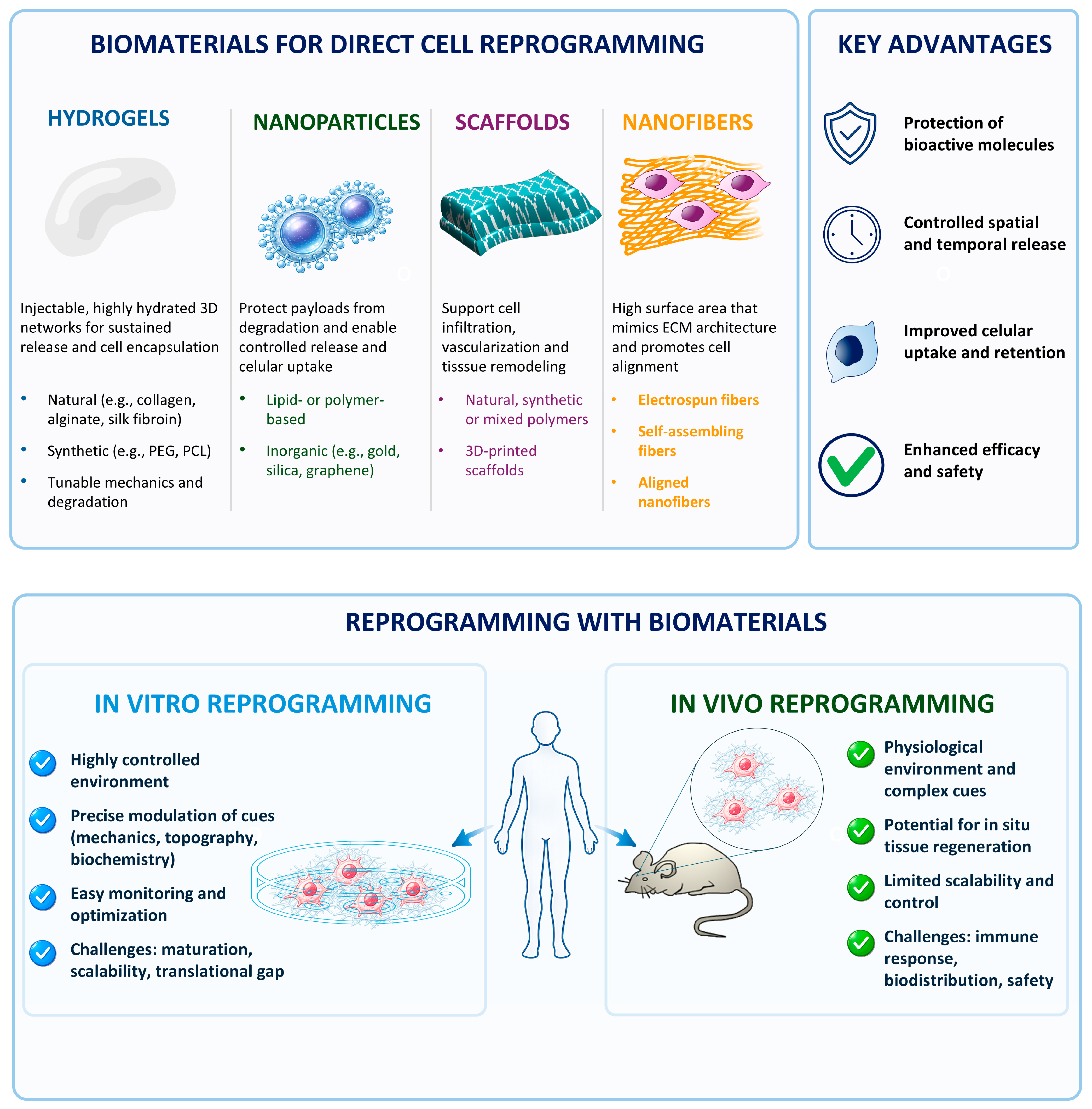
4. Biomaterials for Direct Cell Reprogramming
4.1. Where Can Biomaterials Be Useful? What Challenges Can They Address in DCR?
4.2. Biomaterials: Current Approaches in the Field of DCR
4.2.1. Enhancing Reprogramming Efficiency Through Biomaterial-Driven Adhesion and Gene Delivery
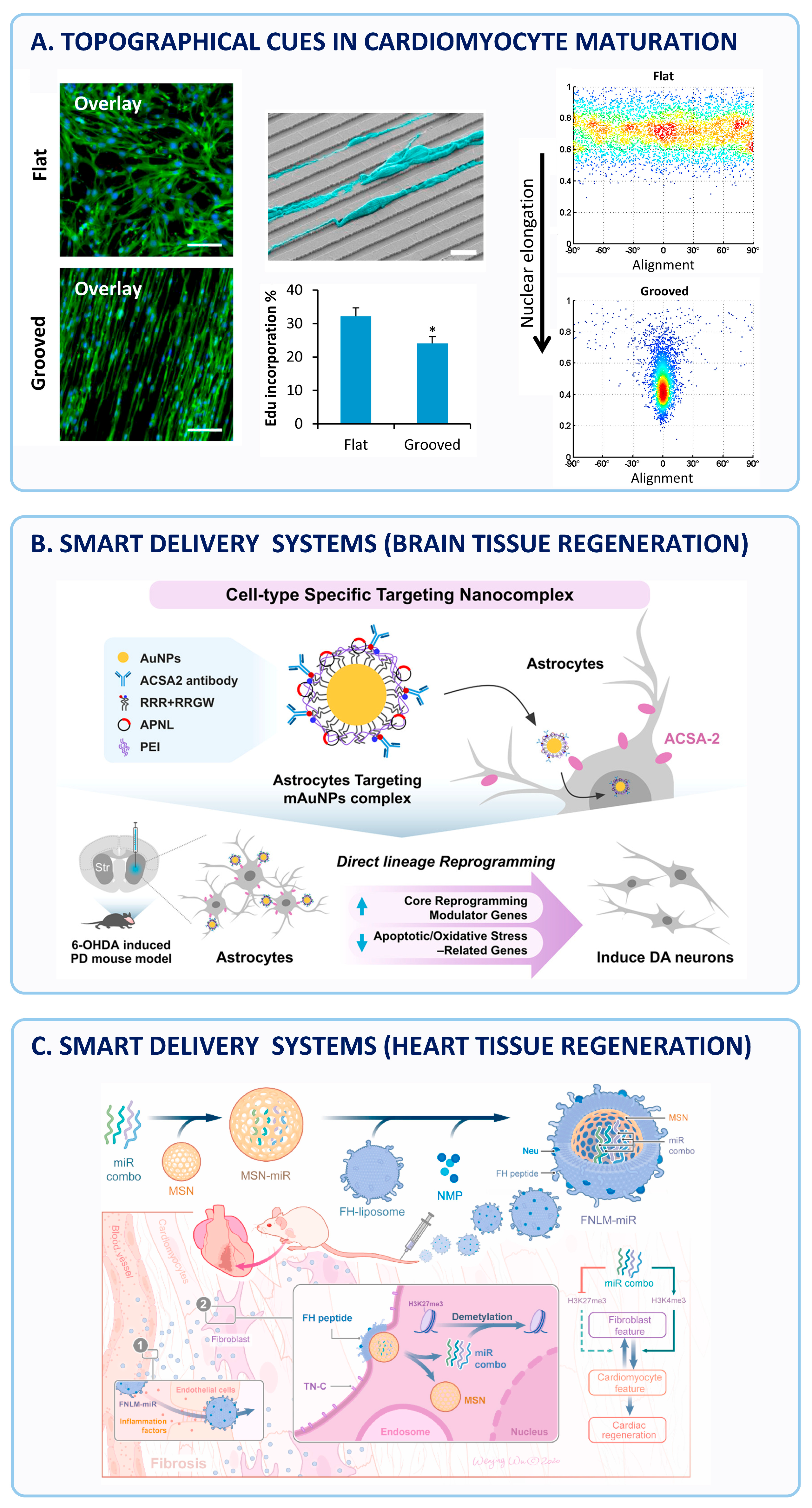
4.2.2. Engineering Substrate Topography and Stiffness to Enhance Direct Cellular Reprogramming
4.2.3. Biomaterial-Based Microenvironments for Improving Stability and Function of Reprogrammed Cells
4.2.4. From Passive Scaffolds to Smart Delivery Systems
5. Outlooks
Author Contributions
Funding
Institutional Review Board Statement
Informed Consent Statement
Data Availability Statement
Acknowledgments
Conflicts of Interest
References
- Carlson, B.M. Some principles of regeneration in mammalian systems. Anat. Rec. B New Anat. 2005, 287, 4–13. [Google Scholar] [CrossRef]
- Davis, R.L.; Weintraub, H.; Lassar, A.B. Expression of a single transfected cDNA converts fibroblasts to myoblasts. Cell 1987, 51, 987–1000. [Google Scholar] [CrossRef] [PubMed]
- Wang, H.; Yang, Y.; Liu, J.; Qian, L. Direct cell reprogramming: Approaches, mechanisms and progress. Nat. Rev. Mol. Cell Biol. 2021, 22, 410–424. [Google Scholar] [CrossRef] [PubMed]
- Chakrapani, G.; Vijay Kumar, V.; Zare, M. Next-Generation Biomaterials: Design Strategies, Clinical Translation, and the Rise of Intelligent Therapeutic Platforms. ACS Omega 2025, 10, 46272–46293. [Google Scholar] [CrossRef]
- Khan, M.U.A.; Aslam, M.A.; Bin Abdullah, M.F.; Hasan, A.; Shah, S.A.; Stojanović, G.M. Recent perspective of polymeric biomaterial in tissue engineering—A review. Mater. Today Chem. 2023, 34, 101818. [Google Scholar] [CrossRef]
- Liu, A.P.; Appel, E.A.; Ashby, P.D.; Baker, B.M.; Franco, E.; Gu, L.; Haynes, K.; Joshi, N.S.; Kloxin, A.M.; Kouwer, P.H.J.; et al. The living interface between synthetic biology and biomaterial design. Nat. Mater. 2022, 21, 390–397. [Google Scholar] [CrossRef]
- Rangel, R.; Swanson, W.B.; Wu, D.T. The future of cell-instructive biomaterials for tissue regeneration-a perspective from early career clinician-scientists. Front. Mater. 2024, 10, 1328904. [Google Scholar] [CrossRef]
- Kim, E.; Tae, G. Direct reprogramming and biomaterials for controlling cell fate. Biomater. Res. 2016, 20, 39. [Google Scholar] [CrossRef]
- Paoletti, C.; Divieto, C.; Chiono, V. Impact of Biomaterials on Differentiation and Reprogramming Approaches for the Generation of Functional Cardiomyocytes. Cells 2018, 7, 114. [Google Scholar] [CrossRef]
- Thomas, E.D.; Lochte, H.L., Jr.; Cannon, J.H.; Sahler, O.D.; Ferrebee, J.W. Supralethal whole body irradiation and isologous marrow transplantation in man. J. Clin. Investig. 1959, 38, 1709–1716. [Google Scholar] [CrossRef]
- Notta, F.; Doulatov, S.; Laurenti, E.; Poeppl, A.; Jurisica, I.; Dick, J.E. Isolation of single human hematopoietic stem cells capable of long-term multilineage engraftment. Science 2011, 333, 218–221. [Google Scholar] [CrossRef]
- Osawa, M.; Hanada, K.; Hamada, H.; Nakauchi, H. Long-term lymphohematopoietic reconstitution by a single CD34-low/negative hematopoietic stem cell. Science 1996, 273, 242–245. [Google Scholar] [CrossRef]
- Cavazza, A.; Santilli, G. The future of ex vivo hematopoietic stem cell gene editing: What’s next. Regen. Med. 2025, 20, 73–76. [Google Scholar] [CrossRef] [PubMed]
- Duncan, C.N.; Bledsoe, J.R.; Grzywacz, B.; Beckman, A.; Bonner, M.; Eichler, F.S.; Kuhl, J.S.; Harris, M.H.; Slauson, S.; Colvin, R.A.; et al. Hematologic Cancer after Gene Therapy for Cerebral Adrenoleukodystrophy. N. Engl. J. Med. 2024, 391, 1287–1301. [Google Scholar] [CrossRef]
- Fisher, S.A.; Doree, C.; Mathur, A.; Taggart, D.P.; Martin-Rendon, E. Stem cell therapy for chronic ischaemic heart disease and congestive heart failure. Cochrane Database Syst. Rev. 2016, 12, CD007888. [Google Scholar] [CrossRef]
- Jeyaraman, M.M.; Rabbani, R.; Copstein, L.; Sulaiman, W.; Farshidfar, F.; Kashani, H.H.; Qadar, S.M.Z.; Guan, Q.; Skidmore, B.; Kardami, E.; et al. Autologous Bone Marrow Stem Cell Therapy in Patients with ST-Elevation Myocardial Infarction: A Systematic Review and Meta-analysis. Can. J. Cardiol. 2017, 33, 1611–1623. [Google Scholar] [CrossRef] [PubMed]
- Osanai, T.; Takamiya, S.; Morii, Y.; Ogasawara, K.; Houkin, K.; Fujimura, M. Efficacy and safety of stem cell therapy for acute and subacute ischemic stroke: A systematic review and meta-analysis. Sci. Rep. 2025, 15, 21214. [Google Scholar] [CrossRef]
- Ripa, R.S.; Jorgensen, E.; Wang, Y.; Thune, J.J.; Nilsson, J.C.; Sondergaard, L.; Johnsen, H.E.; Kober, L.; Grande, P.; Kastrup, J. Stem cell mobilization induced by subcutaneous granulocyte-colony stimulating factor to improve cardiac regeneration after acute ST-elevation myocardial infarction: Result of the double-blind, randomized, placebo-controlled stem cells in myocardial infarction (STEMMI) trial. Circulation 2006, 113, 1983–1992. [Google Scholar] [CrossRef]
- Shen, Z.; Tang, X.; Zhang, Y.; Jia, Y.; Guo, X.; Bao, J.; Xie, X.; Xing, Y.; Xing, J.; Tian, S. Efficacy and safety of mesenchymal stem cell therapies for ischemic stroke: A systematic review and meta-analysis. Stem Cells Transl. Med. 2024, 13, 886–897. [Google Scholar] [CrossRef] [PubMed]
- Tran, T.T.; Tran, T.L.; Nguyen, H.T.; Luong, T.H.; Dang, T.M.; Pham, T.A.; Nguyen, T.N. A comprehensive review of clinical trials and Progress in stem cell therapies for advanced heart failure. Regen. Ther. 2025, 30, 812–837. [Google Scholar] [CrossRef]
- Weinhaus, B.; Homan, S.; Kincaid, M.; Tadwalkar, A.; Gu, X.; Kumar, S.; Slaughter, A.; Zhang, J.; Wu, Q.; Kofron, J.M.; et al. Differential regulation of fetal bone marrow and liver hematopoiesis by yolk-sac-derived myeloid cells. Nat. Commun. 2025, 16, 4427. [Google Scholar] [CrossRef]
- Kretzschmar, K.; Post, Y.; Bannier-Helaouet, M.; Mattiotti, A.; Drost, J.; Basak, O.; Li, V.S.W.; van den Born, M.; Gunst, Q.D.; Versteeg, D.; et al. Profiling proliferative cells and their progeny in damaged murine hearts. Proc. Natl. Acad. Sci. USA 2018, 115, E12245–E12254. [Google Scholar] [CrossRef] [PubMed]
- Barrero, M.J.; Izpisua Belmonte, J.C. Regenerating the epigenome. EMBO Rep. 2011, 12, 208–215. [Google Scholar] [CrossRef]
- Chen, Y.; Luttmann, F.F.; Schoger, E.; Scholer, H.R.; Zelarayan, L.C.; Kim, K.P.; Haigh, J.J.; Kim, J.; Braun, T. Reversible reprogramming of cardiomyocytes to a fetal state drives heart regeneration in mice. Science 2021, 373, 1537–1540. [Google Scholar] [CrossRef]
- Jopling, C.; Sleep, E.; Raya, M.; Marti, M.; Raya, A.; Izpisua Belmonte, J.C. Zebrafish heart regeneration occurs by cardiomyocyte dedifferentiation and proliferation. Nature 2010, 464, 606–609. [Google Scholar] [CrossRef]
- Bongiovanni, C.; Bueno-Levy, H.; Posadas Pena, D.; Del Bono, I.; Miano, C.; Boriati, S.; Da Pra, S.; Sacchi, F.; Redaelli, S.; Bergen, M.; et al. BMP7 promotes cardiomyocyte regeneration in zebrafish and adult mice. Cell Rep. 2024, 43, 114162. [Google Scholar] [CrossRef] [PubMed]
- Bouwman, M.; de Bakker, D.E.M.; Honkoop, H.; Giovou, A.E.; Versteeg, D.; Boender, A.R.; Nguyen, P.D.; Slotboom, M.; Colquhoun, D.; Vigil-Garcia, M.; et al. Cross-species comparison reveals that Hmga1 reduces H3K27me3 levels to promote cardiomyocyte proliferation and cardiac regeneration. Nat. Cardiovasc. Res. 2025, 4, 64–82. [Google Scholar] [CrossRef]
- Zhou, Y.; Su, Y.; Yang, Q.; Li, J.; Hong, Y.; Gao, T.; Zhong, Y.; Ma, X.; Jin, M.; Liu, X.; et al. Cross-species analysis of adult hippocampal neurogenesis reveals human-specific features. Nat. Neurosci. 2025, 28, 1816–1817. [Google Scholar] [CrossRef]
- Dumitru, I.; Paterlini, M.; Zamboni, M.; Ziegenhain, C.; Giatrellis, S.; Saghaleyni, R.; Bjorklund, A.; Alkass, K.; Tata, M.; Druid, H.; et al. Identification of proliferating neural progenitors in the adult human hippocampus. Science 2025, 389, 58–63. [Google Scholar] [CrossRef] [PubMed]
- Liu, H.K. Human adult hippocampal neurogenesis is back, again? Cell Res. 2022, 32, 793–794. [Google Scholar] [CrossRef]
- Paredes, M.F.; Sorrells, S.F.; Cebrian-Silla, A.; Sandoval, K.; Qi, D.; Kelley, K.W.; James, D.; Mayer, S.; Chang, J.; Auguste, K.I.; et al. Does Adult Neurogenesis Persist in the Human Hippocampus? Cell Stem Cell 2018, 23, 780–781. [Google Scholar] [CrossRef]
- Lucas, D.; Scheiermann, C.; Chow, A.; Kunisaki, Y.; Bruns, I.; Barrick, C.; Tessarollo, L.; Frenette, P.S. Chemotherapy-induced bone marrow nerve injury impairs hematopoietic regeneration. Nat. Med. 2013, 19, 695–703. [Google Scholar] [CrossRef]
- Murphy, T.H.; Corbett, D. Plasticity during stroke recovery: From synapse to behaviour. Nat. Rev. Neurosci. 2009, 10, 861–872. [Google Scholar] [CrossRef] [PubMed]
- Bois, A.; Grandela, C.; Gallant, J.; Mummery, C.; Menasche, P. Revitalizing the heart: Strategies and tools for cardiomyocyte regeneration post-myocardial infarction. npj Regen. Med. 2025, 10, 6. [Google Scholar] [CrossRef] [PubMed]
- Gordon, J.; Borlongan, C.V. An update on stem cell therapy for stroke patients: Where are we now? J. Cereb. Blood Flow Metab. 2024, 44, 1469–1479. [Google Scholar] [CrossRef]
- Hare, J.M.; Traverse, J.H.; Henry, T.D.; Dib, N.; Strumpf, R.K.; Schulman, S.P.; Gerstenblith, G.; DeMaria, A.N.; Denktas, A.E.; Gammon, R.S.; et al. A randomized, double-blind, placebo-controlled, dose-escalation study of intravenous adult human mesenchymal stem cells (prochymal) after acute myocardial infarction. J. Am. Coll. Cardiol. 2009, 54, 2277–2286. [Google Scholar] [CrossRef] [PubMed]
- Wright, D.E.; Wagers, A.J.; Gulati, A.P.; Johnson, F.L.; Weissman, I.L. Physiological migration of hematopoietic stem and progenitor cells. Science 2001, 294, 1933–1936. [Google Scholar] [CrossRef]
- Girousse, A.; Mathieu, M.; Sastourne-Arrey, Q.; Monferran, S.; Casteilla, L.; Sengenes, C. Endogenous Mobilization of Mesenchymal Stromal Cells: A Pathway for Interorgan Communication? Front. Cell Dev. Biol. 2020, 8, 598520. [Google Scholar] [CrossRef]
- Lekouaghet, A.; Sanchez-Diez, M.; Perez-Rigueiro, J.; Rojo, F.J.; Ramirez-Castillejo, C.; Ruiz-Leon, Y.; Panetsos, F.; Guinea, G.V.; Gonzalez-Nieto, D. Stabilization of CXCL12 (SDF-1alpha) via silk fibroin films enhances stem cell migration/retention and functional recovery after stroke. Regen. Biomater. 2026, 13, rbaf129. [Google Scholar] [CrossRef]
- Pesaresi, M.; Bonilla-Pons, S.A.; Simonte, G.; Sanges, D.; Di Vicino, U.; Cosma, M.P. Endogenous Mobilization of Bone-Marrow Cells Into the Murine Retina Induces Fusion-Mediated Reprogramming of Muller Glia Cells. EBioMedicine 2018, 30, 38–51. [Google Scholar] [CrossRef]
- De Becker, A.; Van Hummelen, P.; Bakkus, M.; Vande Broek, I.; De Wever, J.; De Waele, M.; Van Riet, I. Migration of culture-expanded human mesenchymal stem cells through bone marrow endothelium is regulated by matrix metalloproteinase-2 and tissue inhibitor of metalloproteinase-3. Haematologica 2007, 92, 440–449. [Google Scholar] [CrossRef]
- Han, D.; Xu, W.; Jeong, H.W.; Park, H.; Weyer, K.; Tsytsyura, Y.; Stehling, M.; Wu, G.; Lan, G.; Kim, K.P.; et al. Multipotent neural stem cells originating from neuroepithelium exist outside the mouse central nervous system. Nat. Cell Biol. 2025, 27, 605–618. [Google Scholar] [CrossRef]
- Ripa, R.S.; Haack-Sorensen, M.; Wang, Y.; Jorgensen, E.; Mortensen, S.; Bindslev, L.; Friis, T.; Kastrup, J. Bone marrow derived mesenchymal cell mobilization by granulocyte-colony stimulating factor after acute myocardial infarction: Results from the Stem Cells in Myocardial Infarction (STEMMI) trial. Circulation 2007, 116, I24–I30. [Google Scholar] [CrossRef]
- Zhang, R.; Yu, J.; Zhang, N.; Li, W.; Wang, J.; Cai, G.; Chen, Y.; Yang, Y.; Liu, Z. Bone marrow mesenchymal stem cells transfer in patients with ST-segment elevation myocardial infarction: Single-blind, multicenter, randomized controlled trial. Stem Cell Res. Ther. 2021, 12, 33. [Google Scholar] [CrossRef] [PubMed]
- Todorova, V.B.; Baxan, N.; Delahaye, M.; Harding, S.E.; Rankin, S.M. Drug-based mobilisation of mesenchymal stem/stromal cells improves cardiac function post myocardial infarction. Dis. Models Mech. 2023, 16, dmm049630. [Google Scholar] [CrossRef] [PubMed]
- Forest, V.F.; Tirouvanziam, A.M.; Perigaud, C.; Fernandes, S.; Fusellier, M.S.; Desfontis, J.C.; Toquet, C.S.; Heymann, M.F.; Crochet, D.P.; Lemarchand, P.F. Cell distribution after intracoronary bone marrow stem cell delivery in damaged and undamaged myocardium: Implications for clinical trials. Stem Cell Res. Ther. 2010, 1, 4. [Google Scholar] [CrossRef] [PubMed]
- Jebran, A.F.; Seidler, T.; Tiburcy, M.; Daskalaki, M.; Kutschka, I.; Fujita, B.; Ensminger, S.; Bremmer, F.; Moussavi, A.; Yang, H.; et al. Engineered heart muscle allografts for heart repair in primates and humans. Nature 2025, 639, 503–511. [Google Scholar] [CrossRef]
- Wang, Y.; Zhao, Z.; Rege, S.V.; Wang, M.; Si, G.; Zhou, Y.; Wang, S.; Griffin, J.H.; Goldman, S.A.; Zlokovic, B.V. 3K3A-activated protein C stimulates postischemic neuronal repair by human neural stem cells in mice. Nat. Med. 2016, 22, 1050–1055. [Google Scholar] [CrossRef]
- Trigo, C.M.; Rodrigues, J.S.; Camoes, S.P.; Sola, S.; Miranda, J.P. Mesenchymal stem cell secretome for regenerative medicine: Where do we stand? J. Adv. Res. 2025, 70, 103–124. [Google Scholar] [CrossRef]
- Yeghiazarians, Y.; Gaur, M.; Zhang, Y.; Sievers, R.E.; Ritner, C.; Prasad, M.; Boyle, A.; Bernstein, H.S. Myocardial improvement with human embryonic stem cell-derived cardiomyocytes enriched by p38MAPK inhibition. Cytotherapy 2012, 14, 223–231. [Google Scholar] [CrossRef]
- Gurdon, J.B. The developmental capacity of nuclei taken from intestinal epithelium cells of feeding tadpoles. J. Embryol. Exp. Morphol. 1962, 10, 622–640. [Google Scholar] [CrossRef]
- Takahashi, K.; Yamanaka, S. Induction of pluripotent stem cells from mouse embryonic and adult fibroblast cultures by defined factors. Cell 2006, 126, 663–676. [Google Scholar] [CrossRef]
- Srivastava, D.; DeWitt, N. In Vivo Cellular Reprogramming: The Next Generation. Cell 2016, 166, 1386–1396. [Google Scholar] [CrossRef]
- Takahashi, K.; Yamanaka, S. A decade of transcription factor-mediated reprogramming to pluripotency. Nat. Rev. Mol. Cell Biol. 2016, 17, 183–193. [Google Scholar] [CrossRef]
- Hou, P.; Li, Y.; Zhang, X.; Liu, C.; Guan, J.; Li, H.; Zhao, T.; Ye, J.; Yang, W.; Liu, K.; et al. Pluripotent stem cells induced from mouse somatic cells by small-molecule compounds. Science 2013, 341, 651–654. [Google Scholar] [CrossRef]
- Melendez, E.; Chondronasiou, D.; Mosteiro, L.; Martinez de Villarreal, J.; Fernandez-Alfara, M.; Lynch, C.J.; Grimm, D.; Real, F.X.; Alcami, J.; Climent, N.; et al. Natural killer cells act as an extrinsic barrier for in vivo reprogramming. Development 2022, 149, dev200361. [Google Scholar] [CrossRef]
- Parras, A.; Vilchez-Acosta, A.; Desdin-Mico, G.; Pico, S.; Mrabti, C.; Montenegro-Borbolla, E.; Maroun, C.Y.; Haghani, A.; Brooke, R.; Del Carmen Maza, M.; et al. In vivo reprogramming leads to premature death linked to hepatic and intestinal failure. Nat. Aging 2023, 3, 1509–1520. [Google Scholar] [CrossRef]
- Tian, C.; Li, Y.; Huang, Y.; Wang, Y.; Chen, D.; Liu, J.; Deng, X.; Sun, L.; Anderson, K.; Qi, X.; et al. Selective Generation of Dopaminergic Precursors from Mouse Fibroblasts by Direct Lineage Conversion. Sci. Rep. 2015, 5, 12622. [Google Scholar] [CrossRef]
- Vierbuchen, T.; Ostermeier, A.; Pang, Z.P.; Kokubu, Y.; Sudhof, T.C.; Wernig, M. Direct conversion of fibroblasts to functional neurons by defined factors. Nature 2010, 463, 1035–1041. [Google Scholar] [CrossRef]
- Ieda, M.; Fu, J.D.; Delgado-Olguin, P.; Vedantham, V.; Hayashi, Y.; Bruneau, B.G.; Srivastava, D. Direct reprogramming of fibroblasts into functional cardiomyocytes by defined factors. Cell 2010, 142, 375–386. [Google Scholar] [CrossRef]
- Jayawardena, T.M.; Egemnazarov, B.; Finch, E.A.; Zhang, L.; Payne, J.A.; Pandya, K.; Zhang, Z.; Rosenberg, P.; Mirotsou, M.; Dzau, V.J. MicroRNA-mediated in vitro and in vivo direct reprogramming of cardiac fibroblasts to cardiomyocytes. Circ. Res. 2012, 110, 1465–1473. [Google Scholar] [CrossRef]
- Qian, L.; Huang, Y.; Spencer, C.I.; Foley, A.; Vedantham, V.; Liu, L.; Conway, S.J.; Fu, J.D.; Srivastava, D. In vivo reprogramming of murine cardiac fibroblasts into induced cardiomyocytes. Nature 2012, 485, 593–598. [Google Scholar] [CrossRef]
- Ebina, W.; Rossi, D.J. Transcription factor-mediated reprogramming toward hematopoietic stem cells. EMBO J. 2015, 34, 694–709. [Google Scholar] [CrossRef]
- Zhang, Y.; Li, B.; Cananzi, S.; Han, C.; Wang, L.L.; Zou, Y.; Fu, Y.X.; Hon, G.C.; Zhang, C.L. A single factor elicits multilineage reprogramming of astrocytes in the adult mouse striatum. Proc. Natl. Acad. Sci. USA 2022, 119, e2107339119. [Google Scholar] [CrossRef]
- Mullard, A. First-of-a-kind stem-cell therapies set for approval in Japan. Nature 2026, 651, 13–14. [Google Scholar] [CrossRef]
- Guo, Z.; Zhang, L.; Wu, Z.; Chen, Y.; Wang, F.; Chen, G. In vivo direct reprogramming of reactive glial cells into functional neurons after brain injury and in an Alzheimer’s disease model. Cell Stem Cell 2014, 14, 188–202. [Google Scholar] [CrossRef]
- Song, K.; Nam, Y.J.; Luo, X.; Qi, X.; Tan, W.; Huang, G.N.; Acharya, A.; Smith, C.L.; Tallquist, M.D.; Neilson, E.G.; et al. Heart repair by reprogramming non-myocytes with cardiac transcription factors. Nature 2012, 485, 599–604. [Google Scholar] [CrossRef]
- Mattiassi, S.; Rizwan, M.; Grigsby, C.L.; Zaw, A.M.; Leong, K.W.; Yim, E.K.F. Enhanced efficiency of nonviral direct neuronal reprogramming on topographical patterns. Biomater. Sci. 2021, 9, 5175–5191. [Google Scholar] [CrossRef]
- Miyamoto, K.; Akiyama, M.; Tamura, F.; Isomi, M.; Yamakawa, H.; Sadahiro, T.; Muraoka, N.; Kojima, H.; Haginiwa, S.; Kurotsu, S.; et al. Direct In Vivo Reprogramming with Sendai Virus Vectors Improves Cardiac Function after Myocardial Infarction. Cell Stem Cell 2018, 22, 91–103.e5. [Google Scholar] [CrossRef]
- Liu, Y.; Yu, C.; Daley, T.P.; Wang, F.; Cao, W.S.; Bhate, S.; Lin, X.; Still, C., 2nd; Liu, H.; Zhao, D.; et al. CRISPR Activation Screens Systematically Identify Factors that Drive Neuronal Fate and Reprogramming. Cell Stem Cell 2018, 23, 758–771.e8. [Google Scholar] [CrossRef]
- Broxmeyer, H.E.; O’Leary, H.A.; Huang, X.; Mantel, C. The importance of hypoxia and extra physiologic oxygen shock/stress for collection and processing of stem and progenitor cells to understand true physiology/pathology of these cells ex vivo. Curr. Opin. Hematol. 2015, 22, 273–278. [Google Scholar] [CrossRef]
- Yoshida, Y.; Takahashi, K.; Okita, K.; Ichisaka, T.; Yamanaka, S. Hypoxia enhances the generation of induced pluripotent stem cells. Cell Stem Cell 2009, 5, 237–241. [Google Scholar] [CrossRef]
- Wang, Y.; Shi, S.; Liu, H.; Meng, L. Hypoxia Enhances Direct Reprogramming of Mouse Fibroblasts to Cardiomyocyte-Like Cells. Cell Reprogram. 2016, 18, 1–7. [Google Scholar] [CrossRef]
- Gascon, S.; Murenu, E.; Masserdotti, G.; Ortega, F.; Russo, G.L.; Petrik, D.; Deshpande, A.; Heinrich, C.; Karow, M.; Robertson, S.P.; et al. Identification and Successful Negotiation of a Metabolic Checkpoint in Direct Neuronal Reprogramming. Cell Stem Cell 2016, 18, 396–409. [Google Scholar] [CrossRef]
- Kim, S.M.; Lim, K.T.; Kwak, T.H.; Lee, S.C.; Im, J.H.; Hali, S.; In Hwang, S.; Kim, D.; Hwang, J.; Kim, K.P.; et al. Induced neural stem cells from distinct genetic backgrounds exhibit different reprogramming status. Stem Cell Res. 2016, 16, 460–468. [Google Scholar] [CrossRef] [PubMed]
- Palazzolo, G.; Quattrocelli, M.; Toelen, J.; Dominici, R.; Anastasia, L.; Tettamenti, G.; Barthelemy, I.; Blot, S.; Gijsbers, R.; Cassano, M.; et al. Cardiac Niche Influences the Direct Reprogramming of Canine Fibroblasts into Cardiomyocyte-Like Cells. Stem Cells Int. 2016, 2016, 4969430. [Google Scholar] [CrossRef]
- Wada, R.; Muraoka, N.; Inagawa, K.; Yamakawa, H.; Miyamoto, K.; Sadahiro, T.; Umei, T.; Kaneda, R.; Suzuki, T.; Kamiya, K.; et al. Induction of human cardiomyocyte-like cells from fibroblasts by defined factors. Proc. Natl. Acad. Sci. USA 2013, 110, 12667–12672. [Google Scholar] [CrossRef] [PubMed]
- Fu, K.; Chronis, C.; Soufi, A.; Bonora, G.; Edwards, M.; Smale, S.T.; Zaret, K.S.; Plath, K.; Pellegrini, M. Comparison of reprogramming factor targets reveals both species-specific and conserved mechanisms in early iPSC reprogramming. BMC Genom. 2018, 19, 956. [Google Scholar] [CrossRef] [PubMed]
- Glahs, A.; Zinzen, R.P. Putting chromatin in its place: The pioneer factor NeuroD1 modulates chromatin state to drive cell fate decisions. EMBO J. 2016, 35, 1–3. [Google Scholar] [CrossRef]
- Garry, G.A.; Bezprozvannaya, S.; Chen, K.; Zhou, H.; Hashimoto, H.; Morales, M.G.; Liu, N.; Bassel-Duby, R.; Olson, E.N. The histone reader PHF7 cooperates with the SWI/SNF complex at cardiac super enhancers to promote direct reprogramming. Nat. Cell Biol. 2021, 23, 467–475. [Google Scholar] [CrossRef]
- Keshri, R.; Detraux, D.; Phal, A.; McCurdy, C.; Jhajharia, S.; Chan, T.C.; Mathieu, J.; Ruohola-Baker, H. Next-generation direct reprogramming. Front. Cell Dev. Biol. 2024, 12, 1343106. [Google Scholar] [CrossRef]
- Huangfu, D.; Maehr, R.; Guo, W.; Eijkelenboom, A.; Snitow, M.; Chen, A.E.; Melton, D.A. Induction of pluripotent stem cells by defined factors is greatly improved by small-molecule compounds. Nat. Biotechnol. 2008, 26, 795–797. [Google Scholar] [CrossRef]
- Hu, W.; Qiu, B.; Guan, W.; Wang, Q.; Wang, M.; Li, W.; Gao, L.; Shen, L.; Huang, Y.; Xie, G.; et al. Direct Conversion of Normal and Alzheimer’s Disease Human Fibroblasts into Neuronal Cells by Small Molecules. Cell Stem Cell 2015, 17, 204–212. [Google Scholar] [CrossRef]
- Zhou, Q.; Brown, J.; Kanarek, A.; Rajagopal, J.; Melton, D.A. In vivo reprogramming of adult pancreatic exocrine cells to beta-cells. Nature 2008, 455, 627–632. [Google Scholar] [CrossRef] [PubMed]
- Kim, K.; Doi, A.; Wen, B.; Ng, K.; Zhao, R.; Cahan, P.; Kim, J.; Aryee, M.J.; Ji, H.; Ehrlich, L.I.; et al. Epigenetic memory in induced pluripotent stem cells. Nature 2010, 467, 285–290. [Google Scholar] [CrossRef]
- Polo, J.M.; Liu, S.; Figueroa, M.E.; Kulalert, W.; Eminli, S.; Tan, K.Y.; Apostolou, E.; Stadtfeld, M.; Li, Y.; Shioda, T.; et al. Cell type of origin influences the molecular and functional properties of mouse induced pluripotent stem cells. Nat. Biotechnol. 2010, 28, 848–855. [Google Scholar] [CrossRef] [PubMed]
- Treutlein, B.; Lee, Q.Y.; Camp, J.G.; Mall, M.; Koh, W.; Shariati, S.A.; Sim, S.; Neff, N.F.; Skotheim, J.M.; Wernig, M.; et al. Dissecting direct reprogramming from fibroblast to neuron using single-cell RNA-seq. Nature 2016, 534, 391–395. [Google Scholar] [CrossRef] [PubMed]
- Masserdotti, G.; Gascon, S.; Gotz, M. Direct neuronal reprogramming: Learning from and for development. Development 2016, 143, 2494–2510. [Google Scholar] [CrossRef] [PubMed]
- Kaelin, W.G., Jr.; McKnight, S.L. Influence of metabolism on epigenetics and disease. Cell 2013, 153, 56–69. [Google Scholar] [CrossRef] [PubMed]
- Zhou, Y.; Wang, L.; Liu, Z.; Alimohamadi, S.; Yin, C.; Liu, J.; Qian, L. Comparative Gene Expression Analyses Reveal Distinct Molecular Signatures between Differentially Reprogrammed Cardiomyocytes. Cell Rep. 2017, 20, 3014–3024. [Google Scholar] [CrossRef]
- Novais, L.B.; Rodrigues, B.R.I.; Pereira, F.O.B.; Amaral, A.G.; Lapa, S.C.; Maldonado, L.L.; Victor-Carvalho, P.; Moretto, I.A.; Zamora-Obando, H.R.; da Silva, M.C.; et al. Metabolic reprogramming enhances oxidative stress resistance in differentiating cardiomyocytes. Sci. Rep. 2026, 16, 5534. [Google Scholar] [CrossRef]
- Zheng, X.; Boyer, L.; Jin, M.; Mertens, J.; Kim, Y.; Ma, L.; Hamm, M.; Gage, F.H.; Hunter, T. Metabolic reprogramming during neuronal differentiation from aerobic glycolysis to neuronal oxidative phosphorylation. eLife 2016, 5, e13374. [Google Scholar] [CrossRef] [PubMed]
- Kim, Y.; Zheng, X.; Ansari, Z.; Bunnell, M.C.; Herdy, J.R.; Traxler, L.; Lee, H.; Paquola, A.C.M.; Blithikioti, C.; Ku, M.; et al. Mitochondrial Aging Defects Emerge in Directly Reprogrammed Human Neurons due to Their Metabolic Profile. Cell Rep. 2018, 23, 2550–2558. [Google Scholar] [CrossRef]
- Winship, I.R.; Murphy, T.H. Remapping the somatosensory cortex after stroke: Insight from imaging the synapse to network. Neuroscientist 2009, 15, 507–524. [Google Scholar] [CrossRef]
- Dancause, N. Vicarious function of remote cortex following stroke: Recent evidence from human and animal studies. Neuroscientist 2006, 12, 489–499. [Google Scholar] [CrossRef] [PubMed]
- Dancause, N.; Barbay, S.; Frost, S.B.; Zoubina, E.V.; Plautz, E.J.; Mahnken, J.D.; Nudo, R.J. Effects of small ischemic lesions in the primary motor cortex on neurophysiological organization in ventral premotor cortex. J. Neurophysiol. 2006, 96, 3506–3511. [Google Scholar] [CrossRef]
- Brown, C.E.; Aminoltejari, K.; Erb, H.; Winship, I.R.; Murphy, T.H. In vivo voltage-sensitive dye imaging in adult mice reveals that somatosensory maps lost to stroke are replaced over weeks by new structural and functional circuits with prolonged modes of activation within both the peri-infarct zone and distant sites. J. Neurosci. 2009, 29, 1719–1734. [Google Scholar] [CrossRef]
- Nudo, R.J.; Milliken, G.W. Reorganization of movement representations in primary motor cortex following focal ischemic infarcts in adult squirrel monkeys. J. Neurophysiol. 1996, 75, 2144–2149. [Google Scholar] [CrossRef] [PubMed]
- Nudo, R.J.; Wise, B.M.; SiFuentes, F.; Milliken, G.W. Neural substrates for the effects of rehabilitative training on motor recovery after ischemic infarct. Science 1996, 272, 1791–1794. [Google Scholar] [CrossRef]
- Fernandez-Garcia, L.; Perez-Rigueiro, J.; Martinez-Murillo, R.; Panetsos, F.; Ramos, M.; Guinea, G.V.; Gonzalez-Nieto, D. Cortical Reshaping and Functional Recovery Induced by Silk Fibroin Hydrogels-Encapsulated Stem Cells Implanted in Stroke Animals. Front. Cell Neurosci. 2018, 12, 296. [Google Scholar] [CrossRef]
- He, X.; Chen, J.; Zhong, Y.; Cen, P.; Shen, L.; Huang, F.; Wang, J.; Jin, C.; Zhou, R.; Zhang, X.; et al. Forebrain neural progenitors effectively integrate into host brain circuits and improve neural function after ischemic stroke. Nat. Commun. 2025, 16, 5132. [Google Scholar] [CrossRef] [PubMed]
- Pereira, M.; Birtele, M.; Shrigley, S.; Benitez, J.A.; Hedlund, E.; Parmar, M.; Ottosson, D.R. Direct Reprogramming of Resident NG2 Glia into Neurons with Properties of Fast-Spiking Parvalbumin-Containing Interneurons. Stem Cell Rep. 2017, 9, 742–751. [Google Scholar] [CrossRef]
- Mathison, M.; Gersch, R.P.; Nasser, A.; Lilo, S.; Korman, M.; Fourman, M.; Hackett, N.; Shroyer, K.; Yang, J.; Ma, Y.; et al. In vivo cardiac cellular reprogramming efficacy is enhanced by angiogenic preconditioning of the infarcted myocardium with vascular endothelial growth factor. J. Am. Heart Assoc. 2012, 1, e005652. [Google Scholar] [CrossRef] [PubMed]
- Pollini, M.; Paladini, F. Bioinspired Materials for Wound Healing Application: The Potential of Silk Fibroin. Materials 2020, 13, 3361. [Google Scholar] [CrossRef]
- Kurtz, S.M.; Devine, J.N. PEEK biomaterials in trauma, orthopedic, and spinal implants. Biomaterials 2007, 28, 4845–4869. [Google Scholar] [CrossRef]
- Fenton, O.S.; Olafson, K.N.; Pillai, P.S.; Mitchell, M.J.; Langer, R. Advances in Biomaterials for Drug Delivery. Adv. Mater. 2018, 30, e1705328. [Google Scholar] [CrossRef] [PubMed]
- Macaya-Ten, F.; Gonzalo, N.; Escaned, J.; Macaya, C. Inception of the coronary stent: A story of successful collaboration between innovative scientists and the biotechnology industry. REC. Interv. Cardiol. 2024, 6, 321–331. [Google Scholar] [CrossRef]
- Goldstone, A.B.; Chiu, P.; Baiocchi, M.; Lingala, B.; Patrick, W.L.; Fischbein, M.P.; Woo, Y.J. Mechanical or Biologic Prostheses for Aortic-Valve and Mitral-Valve Replacement. N. Engl. J. Med. 2017, 377, 1847–1857. [Google Scholar] [CrossRef]
- Mack, M.J.; Leon, M.B.; Thourani, V.H.; Pibarot, P.; Hahn, R.T.; Genereux, P.; Kodali, S.K.; Kapadia, S.R.; Cohen, D.J.; Pocock, S.J.; et al. Transcatheter Aortic-Valve Replacement in Low-Risk Patients at Five Years. N. Engl. J. Med. 2023, 389, 1949–1960. [Google Scholar] [CrossRef]
- Rao, S.V.; Zeymer, U.; Douglas, P.S.; Al-Khalidi, H.; White, J.A.; Liu, J.; Levy, H.; Guetta, V.; Gibson, C.M.; Tanguay, J.F.; et al. Bioabsorbable Intracoronary Matrix for Prevention of Ventricular Remodeling After Myocardial Infarction. J. Am. Coll. Cardiol. 2016, 68, 715–723. [Google Scholar] [CrossRef]
- Clark, J.R.; Al Maruf, D.S.A.; Tomaskovic-Crook, E.; Cheng, K.; Lewin, W.T.; Xin, H.; Wan, B.; Ren, J.; Wu, C.; Kruse, H.V.; et al. Mechanobiologically-optimized non-resorbable artificial bone for patient-matched scaffold-guided bone regeneration. Nat. Commun. 2025, 16, 9422. [Google Scholar] [CrossRef] [PubMed]
- Liu, G.; Kong, Z.; Jia, Z.; Wang, J. Osseointegration Effects of 3D-Printed Porous Titanium-Tantalum Scaffolds with Different Tantalum Contents. ACS Omega 2025, 10, 52838–52849. [Google Scholar] [CrossRef] [PubMed]
- Westphal, M.; Hilt, D.C.; Bortey, E.; Delavault, P.; Olivares, R.; Warnke, P.C.; Whittle, I.R.; Jaaskelainen, J.; Ram, Z. A phase 3 trial of local chemotherapy with biodegradable carmustine (BCNU) wafers (Gliadel wafers) in patients with primary malignant glioma. Neuro Oncol. 2003, 5, 79–88. [Google Scholar] [CrossRef]
- Geckil, H.; Xu, F.; Zhang, X.; Moon, S.; Demirci, U. Engineering hydrogels as extracellular matrix mimics. Nanomedicine 2010, 5, 469–484. [Google Scholar] [CrossRef] [PubMed]
- Hosseinkhani, M.; Mehrabani, D.; Karimfar, M.H.; Bakhtiyari, S.; Manafi, A.; Shirazi, R. Tissue engineered scaffolds in regenerative medicine. World J. Plast. Surg. 2014, 3, 3–7. [Google Scholar]
- Saraiva, M.M.; Campelo, M.D.S.; Camara Neto, J.F.; Lima, A.B.N.; Silva, G.A.; Dias, A.; Ricardo, N.; Kaplan, D.L.; Ribeiro, M. Alginate/polyvinyl alcohol films for wound healing: Advantages and challenges. J. Biomed. Mater. Res. B Appl. Biomater. 2023, 111, 220–233. [Google Scholar] [CrossRef]
- Gonzalez-Nieto, D.; Fernandez-Garcia, L.; Perez-Rigueiro, J.; Guinea, G.V.; Panetsos, F. Hydrogels-Assisted Cell Engraftment for Repairing the Stroke-Damaged Brain: Chimera or Reality. Polymers 2018, 10, 184. [Google Scholar] [CrossRef]
- Berry, M.F.; Engler, A.J.; Woo, Y.J.; Pirolli, T.J.; Bish, L.T.; Jayasankar, V.; Morine, K.J.; Gardner, T.J.; Discher, D.E.; Sweeney, H.L. Mesenchymal stem cell injection after myocardial infarction improves myocardial compliance. Am. J. Physiol. Heart Circ. Physiol. 2006, 290, H2196–H2203. [Google Scholar] [CrossRef]
- Rho, J.Y.; Kuhn-Spearing, L.; Zioupos, P. Mechanical properties and the hierarchical structure of bone. Med. Eng. Phys. 1998, 20, 92–102. [Google Scholar] [CrossRef]
- Martin-Martin, Y.; Fernandez-Garcia, L.; Sanchez-Rebato, M.H.; Mari-Buye, N.; Rojo, F.J.; Perez-Rigueiro, J.; Ramos, M.; Guinea, G.V.; Panetsos, F.; Gonzalez-Nieto, D. Evaluation of Neurosecretome from Mesenchymal Stem Cells Encapsulated in Silk Fibroin Hydrogels. Sci. Rep. 2019, 9, 8801. [Google Scholar] [CrossRef]
- Jiang, C.; Centonze, A.; Song, Y.; Chrisnandy, A.; Tika, E.; Rezakhani, S.; Zahedi, Z.; Bouvencourt, G.; Dubois, C.; Van Keymeulen, A.; et al. Collagen signaling and matrix stiffness regulate multipotency in glandular epithelial stem cells in mice. Nat. Commun. 2024, 15, 10482. [Google Scholar] [CrossRef]
- Chun, C.; Lee, D.Y.; Kim, J.T.; Kwon, M.K.; Kim, Y.Z.; Kim, S.S. Effect of molecular weight of hyaluronic acid (HA) on viscoelasticity and particle texturing feel of HA dermal biphasic fillers. Biomater. Res. 2016, 20, 24. [Google Scholar] [CrossRef]
- Yang, Y.A.; Ni, Y.F.; Chakravarthy, R.D.; Wu, K.; Yeh, M.Y.; Lin, H.C. Engineering Hydrogels with Enhanced Adhesive Strength Through Optimization of Poly(Ethylene Glycol) Molecular Weight. Polymers 2025, 17, 589. [Google Scholar] [CrossRef]
- Avendano, A.; Chang, J.J.; Cortes-Medina, M.G.; Seibel, A.J.; Admasu, B.R.; Boutelle, C.M.; Bushman, A.R.; Garg, A.A.; DeShetler, C.M.; Cole, S.L.; et al. Integrated Biophysical Characterization of Fibrillar Collagen-Based Hydrogels. ACS Biomater. Sci. Eng. 2020, 6, 1408–1417. [Google Scholar] [CrossRef]
- Yue, K.; Trujillo-de Santiago, G.; Alvarez, M.M.; Tamayol, A.; Annabi, N.; Khademhosseini, A. Synthesis, properties, and biomedical applications of gelatin methacryloyl (GelMA) hydrogels. Biomaterials 2015, 73, 254–271. [Google Scholar] [CrossRef]
- DeForest, C.A.; Anseth, K.S. Cytocompatible click-based hydrogels with dynamically tunable properties through orthogonal photoconjugation and photocleavage reactions. Nat. Chem. 2011, 3, 925–931. [Google Scholar] [CrossRef]
- Sundararaghavan, H.G.; Monteiro, G.A.; Lapin, N.A.; Chabal, Y.J.; Miksan, J.R.; Shreiber, D.I. Genipin-induced changes in collagen gels: Correlation of mechanical properties to fluorescence. J. Biomed. Mater. Res. Part A 2008, 87A, 308–320. [Google Scholar] [CrossRef]
- Ghodbane, S.A.; Dunn, M.G. Physical and mechanical properties of cross-linked type I collagen scaffolds derived from bovine, porcine, and ovine tendons. J. Biomed. Mater. Res. Part A 2016, 104, 2685–2692. [Google Scholar] [CrossRef]
- Olde Damink, L.H.H.; Dijkstra, P.J.; van Luyn, M.J.A.; van Wachem, P.B.; Nieuwenhuis, P.; Feijen, J. Cross-linking of dermal sheep collagen using a water-soluble carbodiimide. Biomaterials 1996, 17, 765–773. [Google Scholar] [CrossRef]
- Besiri, I.N.; Goudoulas, T.B.; Germann, N. Custom-made rheological setup for in situ real-time fast alginate-Ca2+ gelation. Carbohydr. Polym. 2020, 246, 116615. [Google Scholar] [CrossRef]
- Lee, K.Y.; Mooney, D.J. Alginate: Properties and biomedical applications. Prog. Polym. Sci. 2012, 37, 106–126. [Google Scholar] [CrossRef]
- Khetan, S.; Guvendiren, M.; Legant, W.R.; Cohen, D.M.; Chen, C.S.; Burdick, J.A. Degradation-mediated cellular traction directs stem cell fate in covalently crosslinked three-dimensional hydrogels. Nat. Mater. 2013, 12, 458–465. [Google Scholar] [CrossRef]
- Park, S.N.; Park, J.C.; Kim, H.O.; Song, M.J.; Suh, H. Characterization of porous collagen/hyaluronic acid scaffold modified by 1-ethyl-3-(3-dimethylaminopropyl)carbodiimide cross-linking. Biomaterials 2002, 23, 1205–1212. [Google Scholar] [CrossRef]
- Sakai, S.; Hirose, K.; Taguchi, K.; Ogushi, Y.; Kawakami, K. An injectable, in situ enzymatically gellable, gelatin derivative for drug delivery and tissue engineering. Biomaterials 2009, 30, 3371–3377. [Google Scholar] [CrossRef]
- Liu, L.; Liu, M.; Xie, D.; Liu, X.; Yan, H. Role of the extracellular matrix and YAP/TAZ in cell reprogramming. Differentiation 2021, 122, 1–6. [Google Scholar] [CrossRef]
- Yim, E.K.; Pang, S.W.; Leong, K.W. Synthetic nanostructures inducing differentiation of human mesenchymal stem cells into neuronal lineage. Exp. Cell Res. 2007, 313, 1820–1829. [Google Scholar] [CrossRef]
- Kim, D.H.; Lipke, E.A.; Kim, P.; Cheong, R.; Thompson, S.; Delannoy, M.; Suh, K.Y.; Tung, L.; Levchenko, A. Nanoscale cues regulate the structure and function of macroscopic cardiac tissue constructs. Proc. Natl. Acad. Sci. USA 2010, 107, 565–570. [Google Scholar] [CrossRef]
- Xie, J.; Willerth, S.M.; Li, X.; Macewan, M.R.; Rader, A.; Sakiyama-Elbert, S.E.; Xia, Y. The differentiation of embryonic stem cells seeded on electrospun nanofibers into neural lineages. Biomaterials 2009, 30, 354–362. [Google Scholar] [CrossRef]
- Mercado, J.; Perez-Rigueiro, J.; Gonzalez-Nieto, D.; Lozano-Picazo, P.; Lopez, P.; Panetsos, F.; Elices, M.; Ganan-Calvo, A.M.; Guinea, G.V.; Ramos-Gomez, M. Regenerated Silk Fibers Obtained by Straining Flow Spinning for Guiding Axonal Elongation in Primary Cortical Neurons. ACS Biomater. Sci. Eng. 2020, 6, 6842–6852. [Google Scholar] [CrossRef]
- Feng, L.; Liang, S.; Zhou, Y.; Luo, Y.; Chen, R.; Huang, Y.; Chen, Y.; Xu, M.; Yao, R. Three-Dimensional Printing of Hydrogel Scaffolds with Hierarchical Structure for Scalable Stem Cell Culture. ACS Biomater. Sci. Eng. 2020, 6, 2995–3004. [Google Scholar] [CrossRef]
- Pecci, R.; Baiguera, S.; Ioppolo, P.; Bedini, R.; Del Gaudio, C. 3D printed scaffolds with random microarchitecture for bone tissue engineering applications: Manufacturing and characterization. J. Mech. Behav. Biomed. Mater. 2020, 103, 103583. [Google Scholar] [CrossRef]
- Pisani, S.; Marconi, S.; Mauri, V.; Rossetti, B.; Evangelista, A.; Bruni, G.; Benazzo, M.; Auricchio, F.; Conti, B. Hybrid 3D-printed/electrospun scaffolds drive myogenic differentiation of mesenchymal stem cells (MSCs). Sci. Rep. 2025, 16, 1867. [Google Scholar] [CrossRef]
- Jing, X.; Fu, H.; Yu, B.; Sun, M.; Wang, L. Two-photon polymerization for 3D biomedical scaffolds: Overview and updates. Front. Bioeng. Biotechnol. 2022, 10, 994355. [Google Scholar] [CrossRef]
- Yuan, Y.; Chen, L.; Shi, Z.; Chen, J. Micro/Nanoarchitectonics of 3D Printed Scaffolds with Excellent Biocompatibility Prepared Using Femtosecond Laser Two-Photon Polymerization for Tissue Engineering Applications. Nanomaterials 2022, 12, 391. [Google Scholar] [CrossRef]
- Fu, Y.; Huang, C.; Xu, X.; Gu, H.; Ye, Y.; Jiang, C.; Qiu, Z.; Xie, X. Direct reprogramming of mouse fibroblasts into cardiomyocytes with chemical cocktails. Cell Res. 2015, 25, 1013–1024. [Google Scholar] [CrossRef]
- Zhang, L.; Chen, M.; Chen, Z.; Chen, S.; Duan, S.; Lou, S.; Wang, H. A green-electrospun nanofibrous scaffold incorporating polyethylenimine-modified liposomes for sustained BMP2 gene delivery and enhanced osteogenic differentiation. Front. Bioeng. Biotechnol. 2026, 14, 1748649. [Google Scholar] [CrossRef]
- Kaniuk, E.; Lechowska-Liszka, A.; Gajek, M.; Nikodem, A.; Scislowska-Czarnecka, A.; Rapacz-Kmita, A.; Stodolak-Zych, E. Correlation between porosity and physicochemical and biological properties of electrospinning PLA/PVA membranes for skin regeneration. Biomater. Adv. 2023, 152, 213506. [Google Scholar] [CrossRef]
- Harris, L.D.; Kim, B.S.; Mooney, D.J. Open pore biodegradable matrices formed with gas foaming. J. Biomed. Mater. Res. 1998, 42, 396–402. [Google Scholar] [CrossRef]
- Hou, J.; Jiang, J.; Guo, H.; Guo, X.; Wang, X.; Shen, Y.; Li, Q. Fabrication of fibrillated and interconnected porous poly(ε-caprolactone) vascular tissue engineering scaffolds by microcellular foaming and polymer leaching. RSC Adv. 2020, 10, 10055–10066. [Google Scholar] [CrossRef]
- Grenier, J.; Duval, H.; Barou, F.; Lv, P.; David, B.; Letourneur, D. Mechanisms of pore formation in hydrogel scaffolds textured by freeze-drying. Acta Biomater. 2019, 94, 195–203. [Google Scholar] [CrossRef]
- Lee, S.; Tong, X.; Yang, F. The effects of varying poly(ethylene glycol) hydrogel crosslinking density and the crosslinking mechanism on protein accumulation in three-dimensional hydrogels. Acta Biomater. 2014, 10, 4167–4174. [Google Scholar] [CrossRef]
- Mndlovu, H.; Kumar, P.; du Toit, L.C.; Choonara, Y.E. A review of biomaterial degradation assessment approaches employed in the biomedical field. npj Mater. Degrad. 2024, 8, 66. [Google Scholar] [CrossRef]
- Yonesi, M.; Ramos, M.; Ramirez-Castillejo, C.; Fernandez-Serra, R.; Panetsos, F.; Belarra, A.; Chevalier, M.; Rojo, F.J.; Perez-Rigueiro, J.; Guinea, G.V.; et al. Resistance to Degradation of Silk Fibroin Hydrogels Exposed to Neuroinflammatory Environments. Polymers 2023, 15, 2491. [Google Scholar] [CrossRef]
- Woodruff, M.A.; Hutmacher, D.W. The return of a forgotten polymer—Polycaprolactone in the 21st century. Prog. Polym. Sci. 2010, 35, 1217–1256. [Google Scholar] [CrossRef]
- Bazgir, M.; Zhang, W.; Zhang, X.; Elies, J.; Saeinasab, M.; Coates, P.; Youseffi, M.; Sefat, F. Degradation and Characterisation of Electrospun Polycaprolactone (PCL) and Poly(lactic-co-glycolic acid) (PLGA) Scaffolds for Vascular Tissue Engineering. Materials 2021, 14, 4773. [Google Scholar] [CrossRef]
- Huang, J.J.; Yang, S.R.; Chu, I.M.; Brey, E.M.; Hsiao, H.Y.; Cheng, M.H. A comparative study of the chondrogenic potential between synthetic and natural scaffolds in an in vivo bioreactor. Sci. Technol. Adv. Mater. 2013, 14, 054403. [Google Scholar] [CrossRef]
- Zhao, Z.; Qin, Z.; Zhao, T.; Li, Y.; Hou, Z.; Hu, H.; Su, X.; Gao, Y. Crosslinked Biodegradable Hybrid Hydrogels Based on Poly(ethylene glycol) and Gelatin for Drug Controlled Release. Molecules 2024, 29, 4952. [Google Scholar] [CrossRef]
- Oosterbeek, R.N.; Kwon, K.-A.; Duffy, P.; McMahon, S.; Zhang, X.C.; Best, S.M.; Cameron, R.E. Tuning structural relaxations, mechanical properties, and degradation timescale of PLLA during hydrolytic degradation by blending with PLCL-PEG. Polym. Degrad. Stab. 2019, 170, 109015. [Google Scholar] [CrossRef]
- Guindani, C.; Candiotto, G.; Araújo, P.H.H.; Ferreira, S.R.S.; de Oliveira, D.; Wurm, F.R.; Landfester, K. Controlling the biodegradation rates of poly(globalide-co-ε-caprolactone) copolymers by post polymerization modification. Polym. Degrad. Stab. 2020, 179, 109287. [Google Scholar] [CrossRef]
- Liu, Q.; Xie, J.; Zhou, R.; Deng, J.; Nie, W.; Sun, S.; Wang, H.; Shi, C. A matrix metalloproteinase-responsive hydrogel system controls angiogenic peptide release for repair of cerebral ischemia/reperfusion injury. Neural. Regen. Res. 2025, 20, 503–517. [Google Scholar] [CrossRef]
- Fan, C.; Shi, J.; Zhuang, Y.; Zhang, L.; Huang, L.; Yang, W.; Chen, B.; Chen, Y.; Xiao, Z.; Shen, H.; et al. Myocardial-Infarction-Responsive Smart Hydrogels Targeting Matrix Metalloproteinase for On-Demand Growth Factor Delivery. Adv. Mater. 2019, 31, 1902900. [Google Scholar] [CrossRef]
- Remy, M.T.; Upara, C.; Ding, Q.J.; Miszuk, J.M.; Sun, H.; Hong, L. MicroRNA-200c Release from Gelatin-Coated 3D-Printed PCL Scaffolds Enhances Bone Regeneration. ACS Biomater. Sci. Eng. 2024, 10, 2337–2350. [Google Scholar] [CrossRef]
- Mukasheva, F.; Adilova, L.; Dyussenbinov, A.; Yernaimanova, B.; Abilev, M.; Akilbekova, D. Optimizing scaffold pore size for tissue engineering: Insights across various tissue types. Front. Bioeng. Biotechnol. 2024, 12, 1444986. [Google Scholar] [CrossRef]
- Motchon, Y.D.; Sack, K.L.; Sirry, M.S.; Kruger, M.; Pauwels, E.; Van Loo, D.; De Muynck, A.; Van Hoorebeke, L.; Davies, N.H.; Franz, T. Effect of biomaterial stiffness on cardiac mechanics in a biventricular infarcted rat heart model with microstructural representation of in situ intramyocardial injectate. Int. J. Numer. Methods Biomed. Eng. 2023, 39, e3693. [Google Scholar] [CrossRef] [PubMed]
- Zheng, Y.; Nutzl, M.; Schackel, T.; Chen, J.; Weidner, N.; Muller, R.; Puttagunta, R. Biomaterial scaffold stiffness influences the foreign body reaction, tissue stiffness, angiogenesis and neuroregeneration in spinal cord injury. Bioact. Mater. 2025, 46, 134–149. [Google Scholar] [CrossRef] [PubMed]
- Kisby, T.; de Lázaro, I.; Fisch, S.; Cartwright, E.J.; Cossu, G.; Kostarelos, K. Adenoviral Mediated Delivery of OSKM Factors Induces Partial Reprogramming of Mouse Cardiac Cells In Vivo. Adv. Ther. 2020, 4, 2000141. [Google Scholar] [CrossRef]
- Mingozzi, F.; High, K.A. Immune responses to AAV vectors: Overcoming barriers to successful gene therapy. Blood 2013, 122, 23–36. [Google Scholar] [CrossRef] [PubMed]
- Naso, M.F.; Tomkowicz, B.; Perry, W.L., 3rd; Strohl, W.R. Adeno-Associated Virus (AAV) as a Vector for Gene Therapy. BioDrugs 2017, 31, 317–334. [Google Scholar] [CrossRef]
- Rogers, G.L.; Martino, A.T.; Aslanidi, G.V.; Jayandharan, G.R.; Srivastava, A.; Herzog, R.W. Innate Immune Responses to AAV Vectors. Front. Microbiol. 2011, 2, 194. [Google Scholar] [CrossRef]
- Lee, J.; Sayed, N.; Hunter, A.; Au, K.F.; Wong, W.H.; Mocarski, E.S.; Pera, R.R.; Yakubov, E.; Cooke, J.P. Activation of innate immunity is required for efficient nuclear reprogramming. Cell 2012, 151, 547–558. [Google Scholar] [CrossRef]
- Wang, L.; Calcedo, R.; Bell, P.; Lin, J.; Grant, R.L.; Siegel, D.L.; Wilson, J.M. Impact of pre-existing immunity on gene transfer to nonhuman primate liver with adeno-associated virus 8 vectors. Hum. Gene Ther. 2011, 22, 1389–1401. [Google Scholar] [CrossRef]
- Vegas, A.J.; Veiseh, O.; Gurtler, M.; Millman, J.R.; Pagliuca, F.W.; Bader, A.R.; Doloff, J.C.; Li, J.; Chen, M.; Olejnik, K.; et al. Long-term glycemic control using polymer-encapsulated human stem cell-derived beta cells in immune-competent mice. Nat. Med. 2016, 22, 306–311. [Google Scholar] [CrossRef]
- Coronel, M.M.; Martin, K.E.; Hunckler, M.D.; Barber, G.; O’Neill, E.B.; Medina, J.D.; Opri, E.; McClain, C.A.; Batra, L.; Weaver, J.D.; et al. Immunotherapy via PD-L1-presenting biomaterials leads to long-term islet graft survival. Sci. Adv. 2020, 6, eaba5573. [Google Scholar] [CrossRef] [PubMed]
- Xu, Y.; Shi, Y.; Ding, S. A chemical approach to stem-cell biology and regenerative medicine. Nature 2008, 453, 338–344. [Google Scholar] [CrossRef] [PubMed]
- Cho, J.; Kim, S.; Lee, H.; Rah, W.; Cho, H.C.; Kim, N.K.; Bae, S.; Shin, D.H.; Lee, M.G.; Park, I.H.; et al. Regeneration of infarcted mouse hearts by cardiovascular tissue formed via the direct reprogramming of mouse fibroblasts. Nat. Biomed. Eng. 2021, 5, 880–896. [Google Scholar] [CrossRef]
- Zaman, R.; Islam, R.A.; Ibnat, N.; Othman, I.; Zaini, A.; Lee, C.Y.; Chowdhury, E.H. Current strategies in extending half-lives of therapeutic proteins. J. Control Release 2019, 301, 176–189. [Google Scholar] [CrossRef]
- Koberle, V.; Pleli, T.; Schmithals, C.; Augusto Alonso, E.; Haupenthal, J.; Bonig, H.; Peveling-Oberhag, J.; Biondi, R.M.; Zeuzem, S.; Kronenberger, B.; et al. Differential stability of cell-free circulating microRNAs: Implications for their utilization as biomarkers. PLoS ONE 2013, 8, e75184. [Google Scholar] [CrossRef]
- Smith, A.W.; Hoyne, J.D.; Nguyen, P.K.; McCreedy, D.A.; Aly, H.; Efimov, I.R.; Rentschler, S.; Elbert, D.L. Direct reprogramming of mouse fibroblasts to cardiomyocyte-like cells using Yamanaka factors on engineered poly(ethylene glycol) (PEG) hydrogels. Biomaterials 2013, 34, 6559–6571. [Google Scholar] [CrossRef]
- Kulangara, K.; Adler, A.F.; Wang, H.; Chellappan, M.; Hammett, E.; Yasuda, R.; Leong, K.W. The effect of substrate topography on direct reprogramming of fibroblasts to induced neurons. Biomaterials 2014, 35, 5327–5336. [Google Scholar] [CrossRef] [PubMed]
- Yoo, J.; Noh, M.; Kim, H.; Jeon, N.L.; Kim, B.S.; Kim, J. Nanogrooved substrate promotes direct lineage reprogramming of fibroblasts to functional induced dopaminergic neurons. Biomaterials 2015, 45, 36–45. [Google Scholar] [CrossRef]
- Morez, C.; Noseda, M.; Paiva, M.A.; Belian, E.; Schneider, M.D.; Stevens, M.M. Enhanced efficiency of genetic programming toward cardiomyocyte creation through topographical cues. Biomaterials 2015, 70, 94–104. [Google Scholar] [CrossRef] [PubMed]
- Sia, J.; Yu, P.; Srivastava, D.; Li, S. Effect of biophysical cues on reprogramming to cardiomyocytes. Biomaterials 2016, 103, 1–11. [Google Scholar] [CrossRef]
- Zhang, J.; Wang, Y.; Guo, J.; Zhang, N.; He, J.; Zhou, Z.; Wu, F. Direct Reprogramming of Mouse Fibroblasts to Osteoblast-like Cells Using Runx2/Dlx5 Factors on Engineered Stiff Hydrogels. ACS Appl. Mater. Interfaces 2023, 15, 59209–59223. [Google Scholar] [CrossRef]
- Xu, Z.; Li, Y.; Li, P.; Sun, Y.; Lv, S.; Wang, Y.; He, X.; Xu, J.; Li, L. Soft substrates promote direct chemical reprogramming of fibroblasts into neurons. Acta Biomater. 2022, 152, 255–272. [Google Scholar] [CrossRef]
- Lu, Z.; Priya Rajan, S.A.; Song, Q.; Zhao, Y.; Wan, M.; Aleman, J.; Skardal, A.; Bishop, C.; Atala, A.; Lu, B. 3D scaffold-free microlivers with drug metabolic function generated by lineage-reprogrammed hepatocytes from human fibroblasts. Biomaterials 2021, 269, 120668. [Google Scholar] [CrossRef] [PubMed]
- Revkova, V.A.; Grebenik, E.A.; Kalsin, V.A.; Demina, T.S.; Bardakova, K.N.; Shavkuta, B.S.; Melnikov, P.A.; Samoilova, E.M.; Konoplyannikov, M.A.; Efremov, Y.M.; et al. Chitosan-g-oligo(L,L-lactide) Copolymer Hydrogel Potential for Neural Stem Cell Differentiation. Tissue Eng. Part A 2020, 26, 953–963. [Google Scholar] [CrossRef]
- Nagano, S.; Fumino, S.; Kishida, T.; Wakao, J.; Hirohata, Y.; Takayama, S.; Kim, K.; Akiyoshi, K.; Mazda, O.; Tajiri, T.; et al. Development of a skeletal muscle sheet with direct reprogramming-induced myoblasts on a nanogel-cross-linked porous freeze-dried gel scaffold in a mouse gastroschisis model. Pediatr. Surg. Int. 2024, 40, 241. [Google Scholar] [CrossRef]
- Sato, Y.; Yamamoto, K.; Horiguchi, S.; Tahara, Y.; Nakai, K.; Kotani, S.I.; Oseko, F.; Pezzotti, G.; Yamamoto, T.; Kishida, T.; et al. Nanogel tectonic porous 3D scaffold for direct reprogramming fibroblasts into osteoblasts and bone regeneration. Sci. Rep. 2018, 8, 15824. [Google Scholar] [CrossRef] [PubMed]
- Song, S.Y.; Yoo, J.; Go, S.; Hong, J.; Sohn, H.S.; Lee, J.R.; Kang, M.; Jeong, G.J.; Ryu, S.; Kim, S.H.L.; et al. Cardiac-mimetic cell-culture system for direct cardiac reprogramming. Theranostics 2019, 9, 6734–6744. [Google Scholar] [CrossRef]
- Chiang, M.Y.; Lin, Y.Z.; Chang, S.J.; Shyu, W.C.; Lu, H.E.; Chen, S.Y. Direct Reprogramming of Human Suspension Cells into Mesodermal Cell Lineages via Combined Magnetic Targeting and Photothermal Stimulation by Magnetic Graphene Oxide Complexes. Small 2017, 13, 1700703. [Google Scholar] [CrossRef]
- Yu, Q.; Chen, J.; Deng, W.; Cao, X.; Adu-Frimpong, M.; Yu, J.; Xu, X. Neural differentiation of fibroblasts induced by intracellular co-delivery of Ascl1, Brn2 and FoxA1 via a non-viral vector of cationic polysaccharide. Biomed. Mater. 2017, 13, 015022. [Google Scholar] [CrossRef]
- Muniyandi, P.; Palaninathan, V.; Mizuki, T.; Mohamed, M.S.; Hanajiri, T.; Maekawa, T. Scaffold mediated delivery of dual miRNAs to transdifferentiate cardiac fibroblasts. Mater. Sci. Eng. C Mater. Biol. Appl. 2021, 128, 112323. [Google Scholar] [CrossRef] [PubMed]
- Wang, Q.; Song, Y.; Chen, J.; Li, Q.; Gao, J.; Tan, H.; Zhu, Y.; Wang, Z.; Li, M.; Yang, H.; et al. Direct in vivo reprogramming with non-viral sequential targeting nanoparticles promotes cardiac regeneration. Biomaterials 2021, 276, 121028. [Google Scholar] [CrossRef] [PubMed]
- Mahmoudi, N.; Wang, Y.; Moriarty, N.; Ahmed, N.Y.; Dehorter, N.; Lisowski, L.; Harvey, A.R.; Parish, C.L.; Williams, R.J.; Nisbet, D.R. Neuronal Replenishment via Hydrogel-Rationed Delivery of Reprogramming Factors. ACS Nano 2024, 18, 3597–3613. [Google Scholar] [CrossRef] [PubMed]
- Hwang, Y.; Ramakrishnan, N.; Kim, J.; Kim, S.; Park, J.; Kwon, D.; An, S.; Kwon, Y. Cell-targeted nanocomplex facilitates direct reprogramming of astrocytes into dopaminergic neurons in Parkinson’s disease. Acta Biomater. 2026, 214, 483–497. [Google Scholar] [CrossRef]
- Hanenberg, H.; Xiao, X.L.; Dilloo, D.; Hashino, K.; Kato, I.; Williams, D.A. Colocalization of retrovirus and target cells on specific fibronectin fragments increases genetic transduction of mammalian cells. Nat. Med. 1996, 2, 876–882. [Google Scholar] [CrossRef]
- Chanda, S.; Ang, C.E.; Davila, J.; Pak, C.; Mall, M.; Lee, Q.Y.; Ahlenius, H.; Jung, S.W.; Sudhof, T.C.; Wernig, M. Generation of induced neuronal cells by the single reprogramming factor ASCL1. Stem Cell Rep. 2014, 3, 282–296. [Google Scholar] [CrossRef]
- Xue, Y.; Ouyang, K.; Huang, J.; Zhou, Y.; Ouyang, H.; Li, H.; Wang, G.; Wu, Q.; Wei, C.; Bi, Y.; et al. Direct conversion of fibroblasts to neurons by reprogramming PTB-regulated microRNA circuits. Cell 2013, 152, 82–96. [Google Scholar] [CrossRef]
- Tang, Y.; Aryal, S.; Geng, X.; Zhou, X.; Fast, V.G.; Zhang, J.; Lu, R.; Zhou, Y. TBX20 Improves Contractility and Mitochondrial Function During Direct Human Cardiac Reprogramming. Circulation 2022, 146, 1518–1536. [Google Scholar] [CrossRef]
- Kopyeva, I.; Brady, R.P.; DeForest, C.A. Light-based fabrication and 4D customization of hydrogel biomaterials. Nat. Rev. Bioeng. 2025, 3, 159–180. [Google Scholar] [CrossRef]
- Cheng, Y.; Wang, Y.; Tan, P.C.; Yu, S.; Li, C.; Li, Z.Y.; Li, Q.F.; Zhou, S.B.; Wang, C.; Zhang, J.; et al. Microenvironment-feedback regulated hydrogels as living wound healing materials. Nat. Commun. 2025, 16, 6050. [Google Scholar] [CrossRef]



| Biomaterial | Starting Cell Type/Target Cell Type/Reprogramming Factors | Engineering/Delivery Strategy | Main Outcomes | Ref. |
|---|---|---|---|---|
| PEG hydrogels | Mouse fibroblasts (adult/embryonic) >> cardiomyocyte-like cells Reprogramming: Fibroblasts obtained from mice carrying a doxycycline-inducible polycistronic OSKM cassette | PEG hydrogels covalently functionalized with Matrigel, laminin or RGD (variable concentrations) | In vitro: High-laminin/RGD PEG hydrogels doubled the yield of cardiomyocyte-like cells relative to Matrigel-coated TCP | [178] |
| PDMS | Mouse fibroblasts (embryonic) >> induced neurons Reprogramming: Lentiviral Vectors (factors: Ascl1, Brn2, Myt1L, M2rttA) | Micrograting topography (UV-photolithography) | In vitro: Higher number of neurons (Tuj+) and neurite outgrowth respect to smooth surfaces. Reprogramming efficiency ascribed to non-muscle myosin II (mechanical cue) | [179] |
| PUA | Mouse fibroblasts (embryonic) >> induced dopaminergic neurons Reprogramming: Lentiviral Vectors (factors: Ascl1, Pitx3, Nurr1, Lmx1a) | Microscale and nanoscale grooved patterns (UV-assisted capillary force lithography) | In vitro: Nanogrooved substrates doubled reprogramming efficiency compared with flat or microgrooved surfaces: dopaminergic markers functional maturation, and neuronal alignment/elongation. Enhanced efficiency linked to accelerated MET, cytoskeletal reorganization, and histone modifications | [180] |
| PDMS (topography changes)/CBA/ABOL (delivery of reprogramming factors) | Mouse fibroblasts (embryonic) >> induced neurons Reprogramming: Non-viral, DNA nanocomplexes (factors: Brn2, Ascl1, Myt1l) | Nanoscale patterns (UV-soft-lithography) | In vitro: Transfection efficiency remained unchanged across patterns. Hierarchical patterns increased reprogramming. Efficiency of neuronal conversion (higher number of neurons Tuj+/MAP2+) and significant neurite outgrowth | [68] |
| PDMS | Mouse cardiac progenitors >> cardiomyocyte-like cells Reprogramming: Lentiviral Vectors (factors: Myocardin, Tbx5, and Mef2c) | Micropatterned PDMS membranes (UV-soft lithography) | In vitro: Parallel microgrooves increased the number of functional cardiomyocyte-like cells, promoted cellular alignment, and induced a tenfold increase in sarcomere organization, compared with to flat substrates. Effects linked to increased histone H3 acetylation | [181] |
| PDMS | Mouse fibroblasts (neonatal) >> cardiomyocyte-like cells Reprogramming: Retroviral Vectors (factors: Gata4, Mef2c, Tbx5 and Mkl1) | Micropatterned PDMS membranes (UV-soft-lithography) | In vitro: Microgrooved substrates enhanced fibroblast-to-cardiomyocyte reprogramming, promoting sarcomere organization and spontaneous contractility. Microgrooves induced Mkl1 upregulation, which increased conversion efficiency | [182] |
| Collagen-coated polyacrylamide (PAM) hydrogels | Mouse fibroblasts (adult) >> osteoblastic-like cells Reprogramming: Non-viral vectors, plasmid transfection (Runx2, Dlx5) | Reprogramming on PAM hydrogels with stiffness matching collagenous bone substrate (~40 kPa) In vivo implantation of stiffness-primed reprogrammed cells encapsulated in collagen hydrogels in a mouse femur defect model. | In vitro: Efficient in vitro reprogramming on stiff, bone-like substrates; ROCK-related pathway activation drives fibroblasts toward osteoblast-like cells with high alkaline phosphatase, osteocalcin, Ca2+, and matrix mineralization In vivo: Four weeks after transplantation, X-ray imaging showed increased high-density mineralized bone. Marked improvement in defect repair | [183] |
| Col I hydrogels | Human skin fibroblasts (adult) >> induced neurons Reprogramming: Non-viral, small molecules cocktail (VPA, CHIR99021, Repsox, Forskolin, SP600625, GO6983, Y-27632, Dorsomorphin) | Hydrogels formed at 37 °C (>30 min) with stiffness matching brain tissue (450–850 Pa) | In vitro: Improved reprogramming versus TCP. Induced neuronal morphogenesis and markers and functional glutamatergic neurons. Col I hydrogels promoted MET via miR-615-3p-mediated ITGB4 regulation | [184] |
| HA/gelatin-based hydrogel and PEGDA | Human fibroblasts (embryonic/adult) >> hepatocyte-like cells Reprogramming: Lentiviral vectors (factors: hnf4a, foxa2, foxa3, atf5, prox1, and hnf1) | Hydrogel-based immobilization of 3D liver spheroids (hepatocytes/hepatocyte-like cells, Kupffer, stellate, and endothelial cells) integrated into a two-organ microfluidic system | In vitro: Validation of 3D liver spheroid viability and functionality, demonstrating proof of concept for liver cancer drug screening | [185] |
| Chitosan-g-oligo (L,L-lactide) copolymer hydrogel | Human bone marrow-derived mononuclear cells >> human neural progenitor cells Reprogramming: Non-viral vectors, plasmid transfection (factors: Msi1, Ngn2, and MBD2) | 3D scaffolds produced by two-photon stereolithography | In vitro: Enhanced neuronal differentiation of neural progenitor cells seeded on the 3D scaffolds. | [186] |
| NanoCliP-FD nanogel (CHP-OA + PEGSH) | Human fibroblasts >> myoblasts Reprogramming: Retroviral vectors (factors: Myod1 and Mycl) | NanoCliP-FD nanogel: chemically crosslinked, freeze-thawed & freeze-dried, interconnected porous gel combined with converted myoblasts, placed on biosheet (autologous connective tissue), implanted in mouse gastroschisis model | In vivo: Enhanced differentiation of myoblasts into desmin- and myogenin-expressing muscle-like cells | [187] |
| NanoCliP-FD nanogel (CHP-OA + PEGSH) | Human fibroblasts >> osteoblast-like cells Reprogramming: Retroviral vectors (factors: Osterix, Oct3/4 and L-myc) | Nanogel coated with fibronectin to permit adhesion of osteoblast-like cells. Implantation in a mouse model of bone defect in femur | In vitro: Efficient adhesion and proliferation of osteoblast-like cells and production of calcified bone matrix on fibronectin-coated NanoCliP-FD gel. In vivo: Enhanced bone regeneration with formation of a large callus leaving small defect lesions | [188] |
| Nanothin and nanoporous PLGA membranes | Human fibroblasts (neonatal) >> cardiomyocyte-like cells Reprogramming: Non-viral vectors, plasmid transfection (factors: Gata4, Mef2c, Tbx5, Hand2, and Nkx2.5) | Cardiac-mimetic culture system: coculture of transfected fibroblasts and cardiomyocytes separated by a PLGA membrane, with application of external electrical stimulation | In vitro: Enhanced direct cardiac reprogramming (increasing levels of cardiac troponin T and other cardiac markers, but not contractile function) | [189] |
| Graphene oxide (GO)-Fe3O4-PEI complexes | Human PBMC (adult) >> iPSC committed to mesodermal lineages Reprogramming: Non-viral vectors, plasmid transfection (factors: Sox2, Klf4, L-Myc, Lin28, Oct3/4, and shRNA against p53) | Combined magnetic stirring and near-infrared laser irradiation to enhance transfection of suspension blood cells by increasing complex-cell contact and transiently improving membrane permeability | In vitro: Enables rapid PBMC reprogramming into partial iPSC (Nanog+/Oct4+/Sox2+). These cells efficiently transdifferentiate into mesodermal lineages without reaching full pluripotency (future application to generate muscle cells, cardiomyocytes, and vascular endothelial cells) | [190] |
| Cationic nanoparticles based on Ed-PYP | Mouse fibroblasts (embryonic; 3T6 cells) >> induced neural cells Reprogramming: Non-viral vectors, plasmid transfection (factors: Ascl1, Brn2 and FoxA1) | Cationized Porphyra yezoensis polysaccharide (Ed-PYP) used as a carrier to form nanoparticles with plasmids for gene delivery | In vitro: Lower cytotoxicity than Lipofectamine 2000 or polyethylenimin, with efficient gene delivery and conversion of fibroblasts into neural cells | [191] |
| Smooth and porous PLLA scaffolds | Human cardiac fibroblasts (adult) >> cardiomyocyte-like cells Reprogramming: Non-viral Vectors, direct transfection of miR1 and miR133a | Fibronectin-coated PLLA scaffolds loaded with PEI-miRNA polyplexes, with human fibroblasts seeded onto the scaffolds | In vitro: Enhanced reprogramming efficiency of PEI-miRNA polyplexes immobilized on fibronectin-coated PLLA scaffolds, enabling sustained miRNA delivery for ≥2 weeks. Porous scaffolds favored higher expression of cardiac markers (troponin T, GATA-4) in cardiomyocyte-like cells | [192] |
| Mesoporous silicon nanoparticles | Mouse cardiac fibroblasts (embryonic/adult) >> cardiomyocyte-like cells Reprogramming: Non-viral vectors, direct transfection of miR1, miR133, miR208, and miR499 | Nanoparticles embedded in liposomes decorated with neutrophil membrane proteins and coated with FH peptide targeting Tenascin-C in inflammatory myocardium Minimally invasive intravenous injection of biomimetic nanoparticles, surface-decorated to target cardiac fibroblasts, delivering miRNAs | In vitro: 24 h treatment reprogrammed cardiac fibroblasts into functional cardiomyocyte-like cells, with increased cardiac gene expression, ion channels, sarcomeric markers, and beating activity; associated with histone H3 methylation/demethylation remodeling In vivo: Efficient targeting and reprogramming of cardiac fibroblasts in a mouse ischemia/reperfusion model, reduced fibrosis and improved cardiac function | [193] |
| Self-assembling peptide (SAP) hydrogel containing laminin epitope (IKVAV) | Mouse (postnatal) or human (embryonic) astrocytes >> induced neurons Reprogramming: Adeno-Associated Viral (AAV)Vectors (factor: NeuroD1) | SAP hydrogels for controlled AAV-NeuroD1 release. Intracerebral injection of SAP hydrogel into the glial scar 10 days after needle-stick injury. | In vitro: Efficient reprogramming, induced neurons express specific neural markers and are functional (action potentials) In vivo: Reprogramming of endogenous reactive astrocytes with hydrogel confined to the injection site, leading to reduced glial scar, and attenuation of astrogliosis and microglial activation | [194] |
| AuNP nanocomplexes | Mouse (primary astrocytes, in vitro; adult astrocytes, in vivo) >> induced dopaminergic neurons (iDA) Reprogramming: Lentiviral vectors (factors: Ascl1, Pitx3, Nurr1, and Lmx1a) | AuNP nanocomplexes engineered via thiol-gold chemistry and PEGylation. Functionalized with a cell-penetrating (RRR-PEG-SH) and Fc-binding (RRGW-PEG-SH) peptides to ensure antibody orientation and recognition of ACSA2 marker and cellular uptake. | In vitro: Efficient reprogramming of astrocytes into dopaminergic neurons, with expression of neuronal and dopaminergic markers (Tuj1, TH, DAT, VMAT2) and functional dopamine production (functional maturation) In vivo: Increasing dopaminergic neuron numbers, restoration of dopamine levels, and significant improvement in motor function in a Parkinson’s disease mouse model | [195] |
| Functional Category | Biomaterial Systems (Examples) | Fabrication/Design Strategy | Key Properties | Material-Driven Advantages | Limitations | Ref. |
|---|---|---|---|---|---|---|
| Surface-engineered substrates (adhesion control) | PEG hydrogels, fibronectin-coated substrates | Michael-type addition (PEG8-VS/PEG8-Am), ECM/peptide functionalization (RGD, laminin) | Tunable surface chemistry, controlled ligand density, low protein adsorption (PEG) | Precise control over cell adhesion via ligand presentation; antifouling background reduces nonspecific interactions; reproducible chemistry | Limited intrinsic bioactivity (requires functionalization); bulk PEG lacks degradability unless modified | [178,196] |
| Non-viral gene delivery nanocarriers | GO-Fe3O4-PEI, Ed-PYP nanoparticles, poly(CBA-ABOL) polyplexes | Hummers’ method (GO), co-precipitation (Fe3O4), polymer modification (oxidation + amination), electrostatic self-assembly | Positive surface charge, DNA condensation capacity, high surface area, multifunctionality (magnetic/photothermal) | Efficient nucleic acid complexation via electrostatic interactions; modular composition; potential external control (magnetic/NIR) | Cytotoxicity associated with cationic polymers (PEI); batch variability (GO synthesis); limited targeting specificity | [68,190,191] |
| Topographical and mechanotransduction platforms | Nanogrooved PUA/PDMS, microgrooved substrates, stiffness-tuned hydrogels | UV-assisted capillary lithography, soft lithography (PDMS), photolithography (SU-8), hydrogel stiffness tuning | Defined micro/nanotopography, tunable stiffness, surface anisotropy | Precise control of cell shape and cytoskeletal organization; reproducible patterning; modulation of mechanotransduction pathways | Limited biochemical functionality unless coated; fabrication may require specialized equipment; mostly 2D systems | [180,181,182,183,184] |
| 3D supportive hydrogels and scaffolds | HA/gelatin hydrogels, chitosan-based hydrogels, pullulan nanogels, PLGA membranes | Photocrosslinking (PEGDA), mechanochemical grafting, chemical gelation, lyophilization, VIPS process (PLGA) | High water content, ECM-like structure, porosity, tunable crosslinking density | Biomimetic environment supports cell viability; tunable porosity and mechanics; compatibility with 3D culture and microfluidics | Limited mechanical strength (natural polymers); potential batch variability; degradation kinetics can be difficult to control | [185,186,187,188,189] |
| Controlled-release biomaterials | PLLA electrospun scaffolds + PEI-miRNA, IKVAV peptide hydrogels | Electrospinning, physical adsorption, self-assembly (pH-triggered), peptide design | Nanofibrous architecture, tunable mesh size, diffusion-controlled release, shear-thinning behavior | Spatially localized delivery; tunable release kinetics via structure and crosslinking; minimally invasive delivery (injectable hydrogels) | Limited control over long-term release profiles; potential burst release; dependence on diffusion rather than active targeting | [192,194] |
| Targeted nanocarrier systems (advanced delivery) | AuNP-based antibody-targeted nanocomplexes, biomimetic MSN-liposomes | Turkevich synthesis (AuNPs), thiol-gold chemistry, PEGylation, lipid coating, membrane protein functionalization | Precise size control, high surface functionalization, modular ligand conjugation, colloidal stability | High ligand density enables targeting; independent tuning of surface properties; robust structure under biological conditions | Non-biodegradable cores (AuNPs); complex multi-step fabrication; potential long-term accumulation and safety concerns | [193,195] |
| Barrier | Underlying Biological Problem | Biomaterial-Based Strategy |
|---|---|---|
| Induction Phase: Low efficiency of conversion Poor stability of reprogramming factors Immunoreactivity | Epigenetic resistance, metabolic stress, apoptosis, inefficient MET Rapid miRNA/protein clearance and degradation Viral vector clearance, inflammatory signaling | Durable release of reprogramming factors; stiffness modulation; pro-MET biofunctionalization; antioxidant incorporation Functional stabilization, sustained and local delivery of reprogramming factors (hydrogels, nanoparticles, films and other scaffold-based reservoirs) Local confinement of vectors, delivery of immunomodulatory molecules |
| Incomplete lineage specification and cellular heterogeneity during conversion | Partial epigenetic remodeling, metabolic vulnerability | Topographical cues, stiffness matching the target tissue, ECM-inspired functionalization |
| Incomplete fate stabilization | Epigenetic drift, incomplete transgene silencing | Sustained microenvironmental signaling, hybrid culture systems integrating functional supportive cells or engineered tissue-like niches |
| Poor integration with the host | Mechanical mismatch, lack of vascularization, weak functional coupling (electrical/metabolic) | Tunable porosity, control of biomaterial degradation, functionalization with angiogenic and chemoattractant molecules, endothelial progenitors, conductive scaffolds (excitable tissues) |
Disclaimer/Publisher’s Note: The statements, opinions and data contained in all publications are solely those of the individual author(s) and contributor(s) and not of MDPI and/or the editor(s). MDPI and/or the editor(s) disclaim responsibility for any injury to people or property resulting from any ideas, methods, instructions or products referred to in the content. |
© 2026 by the authors. Licensee MDPI, Basel, Switzerland. This article is an open access article distributed under the terms and conditions of the Creative Commons Attribution (CC BY) license.
Share and Cite
González-Nieto, D.; Pérez-Rigueiro, J.; Rojo, F.J.; Panetsos, F.; Guinea, G.V. Harnessing Lessons from Gel-Based and Advanced Biomaterial Therapeutics to Enable Direct Cellular Reprogramming. Gels 2026, 12, 486. https://doi.org/10.3390/gels12060486
González-Nieto D, Pérez-Rigueiro J, Rojo FJ, Panetsos F, Guinea GV. Harnessing Lessons from Gel-Based and Advanced Biomaterial Therapeutics to Enable Direct Cellular Reprogramming. Gels. 2026; 12(6):486. https://doi.org/10.3390/gels12060486
Chicago/Turabian StyleGonzález-Nieto, Daniel, José Pérez-Rigueiro, Francisco J. Rojo, Fivos Panetsos, and Gustavo V. Guinea. 2026. "Harnessing Lessons from Gel-Based and Advanced Biomaterial Therapeutics to Enable Direct Cellular Reprogramming" Gels 12, no. 6: 486. https://doi.org/10.3390/gels12060486
APA StyleGonzález-Nieto, D., Pérez-Rigueiro, J., Rojo, F. J., Panetsos, F., & Guinea, G. V. (2026). Harnessing Lessons from Gel-Based and Advanced Biomaterial Therapeutics to Enable Direct Cellular Reprogramming. Gels, 12(6), 486. https://doi.org/10.3390/gels12060486