
Digital Twin-Driven Optimization of Pilot-Scale Polyurethane Aerogel Production Using SVR Modelling

 , , and
Abstract
1. Introduction
2. Results and Discussion
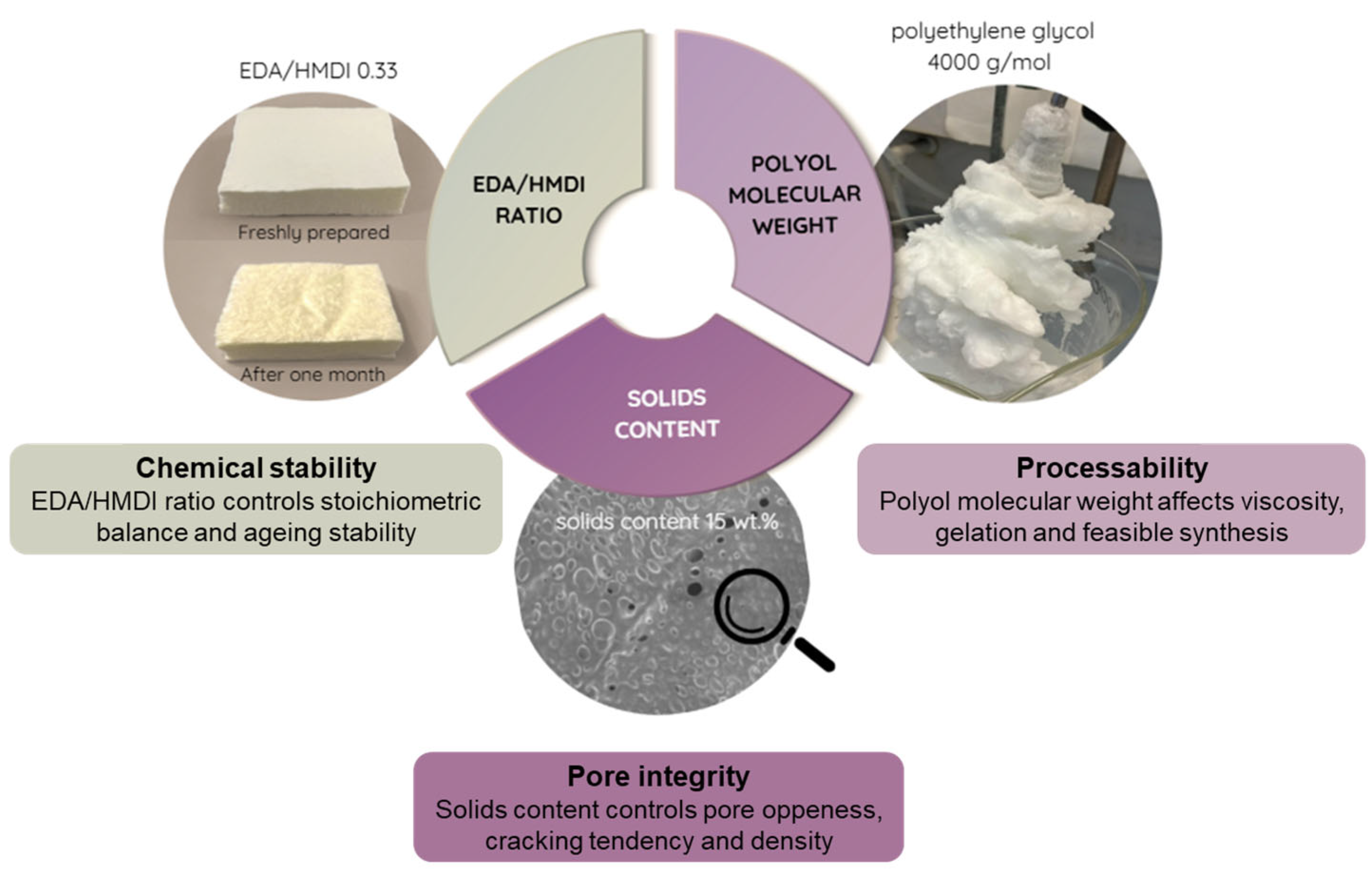
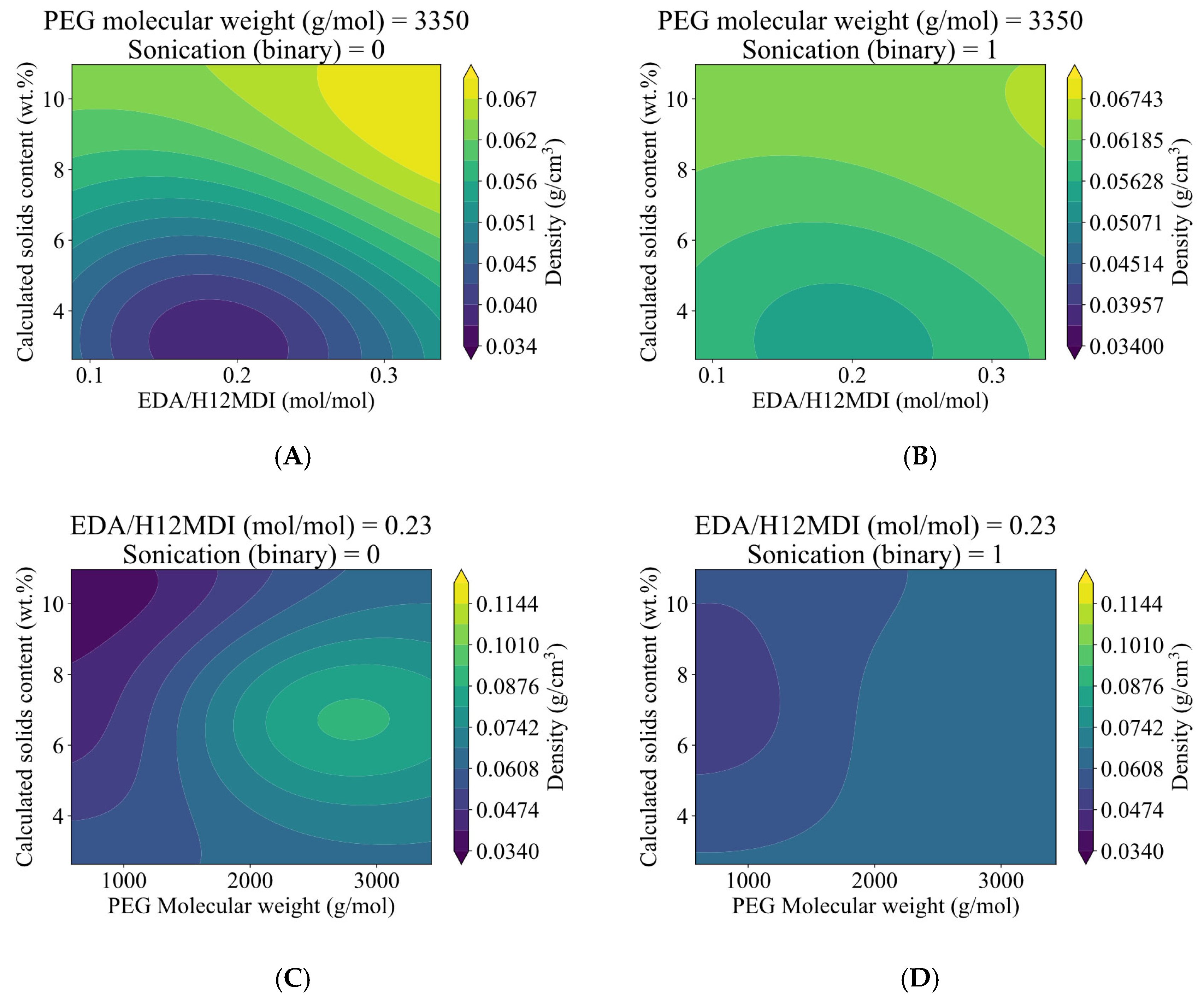
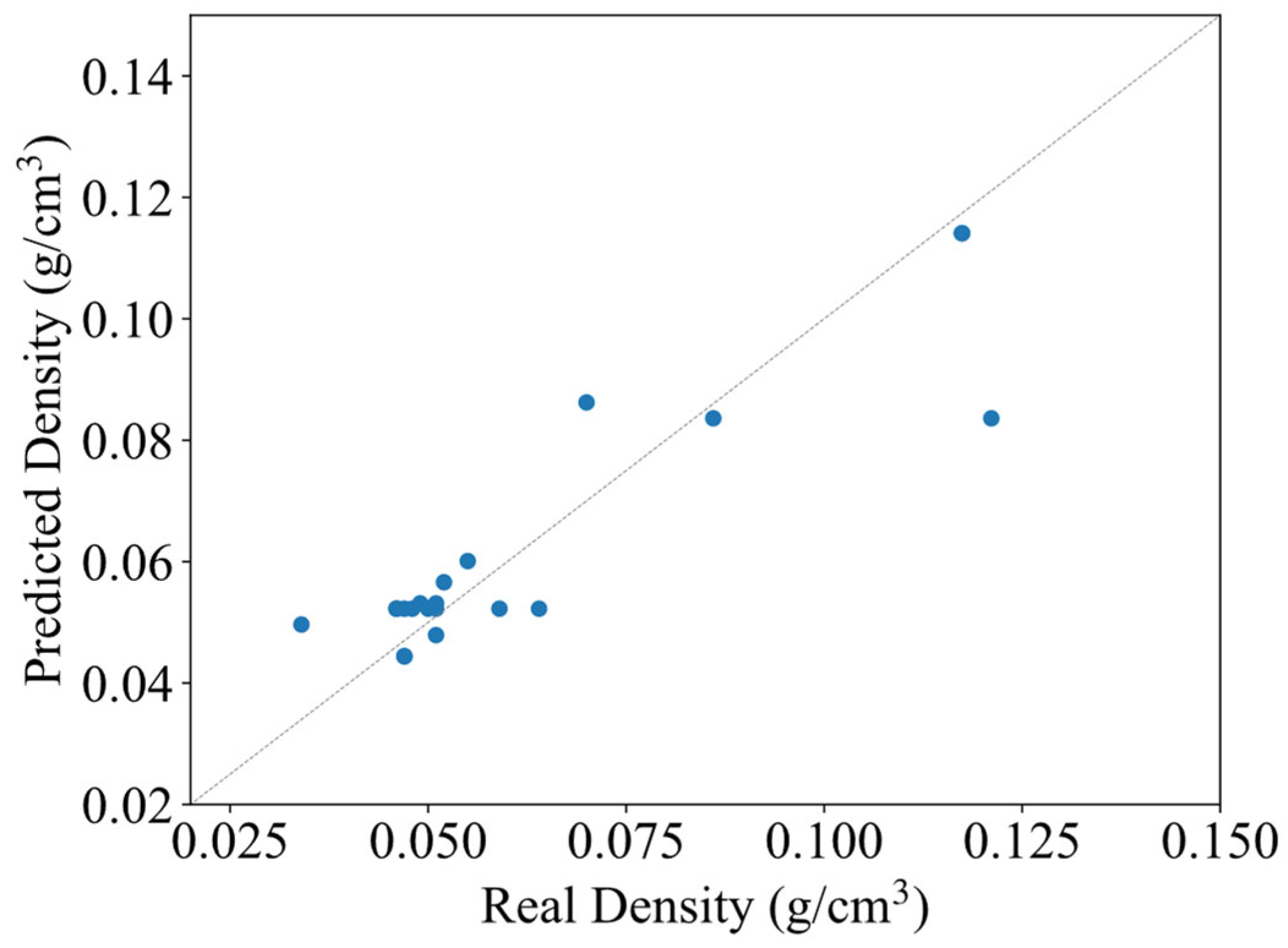
2.1. Density and Thermal Conductivity Results
2.2. Digital Twin as a Driver for Pilot Plants
2.3. Mathematical Modelling of the Process Performance
2.3.1. Elastic Net
2.3.2. Support Vector Regression
2.3.3. Elastic Net Model for Thermal Conductivity
3. Conclusions
4. Materials and Methods
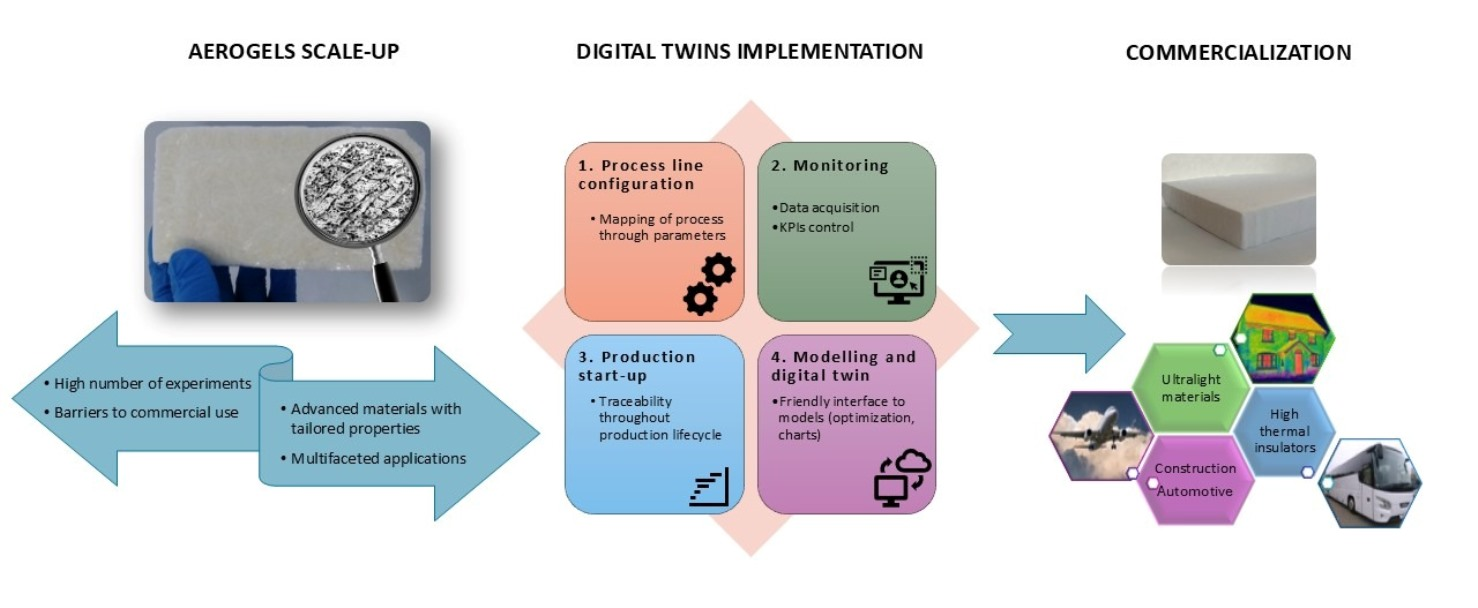
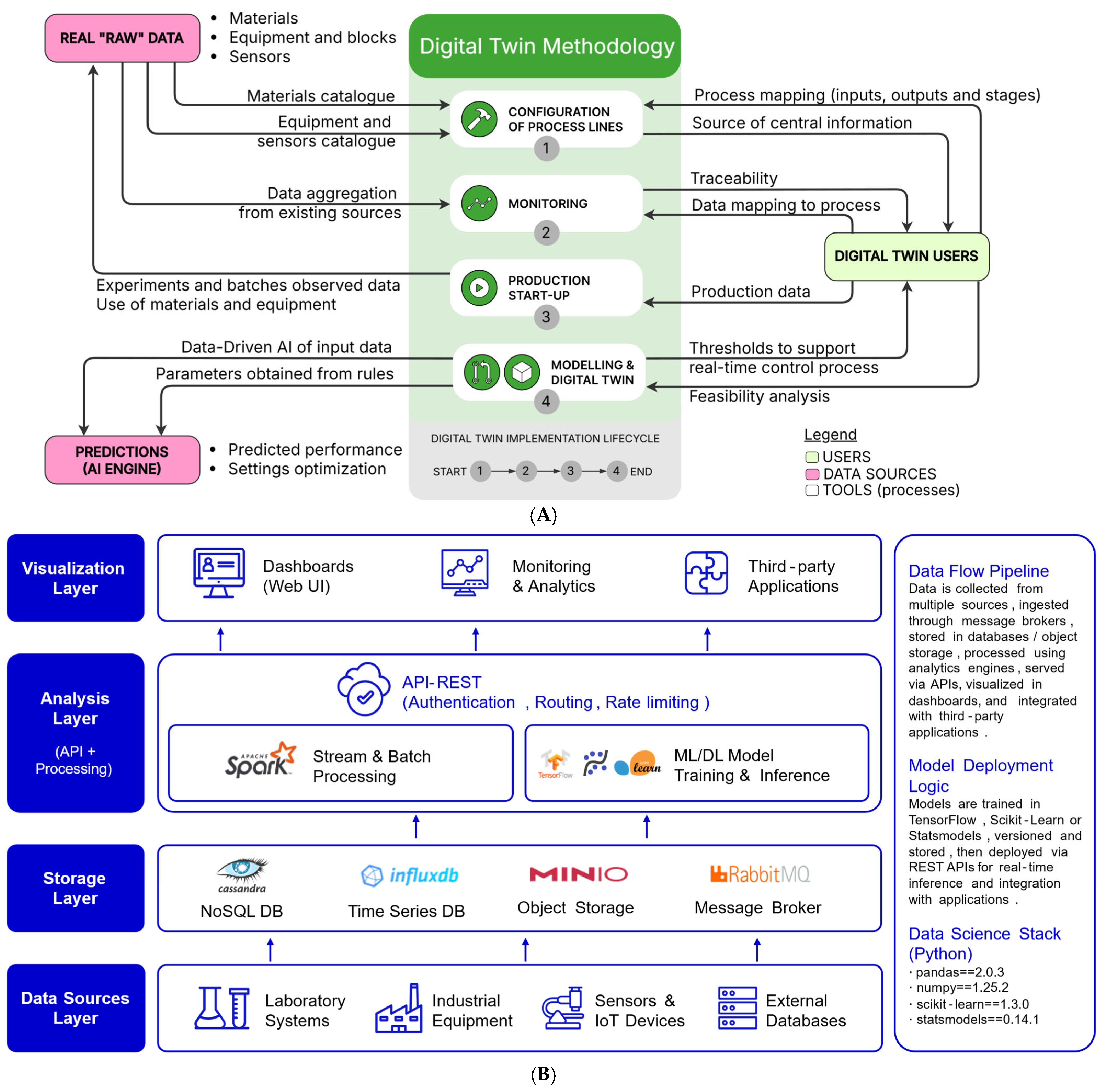
4.1. Digital Twin Methodology
4.1.1. Configuration of Process Lines
4.1.2. Monitoring
4.1.3. Production Start-Up
4.1.4. Modelling and Digital Twin
Modelling Strategy and Mathematical Toolbox
- OLS is a basic statistical method used to model the linear relationship between a dependent variable and one or more independent variables by minimizing the sum of squared differences between the observed and predicted values [40]. To avoid overfitting, especially when dealing with smaller datasets, it is recommended to add regularization terms to the sum of squared differences loss function. Lasso regression (which implements L1 regularization) includes a penalty term proportional to the absolute value of the sum of coefficients. Ridge regression (which implements L2 regularization) includes a penalty term proportional to the squared sum of coefficients. Elastic Net regression combines both L1 and L2 regularization. These techniques help to avoid overfitting by addressing multicollinearity issues among input features.
- SVR estimates continuous variables while maximizing the margin between predictions and actual data. In the context of this research, an SVR with a radial basis function kernel was employed to handle non-linear relationships between the input parameters and the target properties. Regularization parameters controlled the margin’s flexibility, balancing error tolerance and precision [41]. Compared to other non-linear regressors such as tree-based ensembles or neural networks, SVR is particularly appropriate for very small datasets, as its formulation is grounded in structural risk minimization, which explicitly bounds generalization error rather than minimizing only the training loss [42]. In addition, SVR methods are well known for their ability to handle nonlinear relationships and high-dimensional input spaces, which are common in polymer science applications [43].
Evaluation Metrics and Validation Strategy
4.2. Polyurethane Aerogel Design and Development Based on Digital Twin
4.2.1. Characterization Equipment
4.2.2. DT Data Management
4.2.3. DT Interface
Supplementary Materials
Author Contributions
Funding
Institutional Review Board Statement
Informed Consent Statement
Data Availability Statement
Conflicts of Interest
Abbreviations
| CAN | Acetonitrile |
| AI | Artificial Intelligence |
| ANOVA | Analysis of Variance |
| API REST | Application Programming Interface Representational State Transfer |
| CSV | Comma Separated Values |
| DMPA | Dimethylol propionic acid |
| DT | Digital Twin |
| EDA | Ethylenediamine |
| EtOAc | Ethyl acetate |
| HMDI | Hexamethylene Diisocyanate |
| KPI | Key Performance Indicator |
| MAE | Mean Absolute Error |
| ML | Machine Learning |
| MSE | Mean Squared Error |
| OPC UA | OLE (Object Linking and Embedding) for Process Control Unified Architecture |
| PEG | Poly(ethylene glycol) |
| PU | Polyurethane |
| QbC | Quality by Control |
| QbD | Quality by Design |
| QbDD | Quality by Digital Design |
| RMSE | Root Mean Squared Error |
| SVR | Support Vector Regression |
| SVM | Support Vector Machine |
| TEA | Triethylamine |
References
- Leventis, N. Polyurea Aerogels: Synthesis, Material Properties, and Applications. Polymers 2022, 14, 969. [Google Scholar] [CrossRef]
- Alwin, S.; Sahaya Shajan, X. Aerogels: Promising nanostructured materials for energy conversion and storage applications. Mater. Renew. Sustain. Energy 2020, 9, 7. [Google Scholar] [CrossRef]
- Hüsing, N.; Schubert, U. Aerogels—Airy Materials: Chemistry, Structure, and Properties. Angew. Chem. Int. Ed. 1998, 37, 22–45. [Google Scholar] [CrossRef]
- Randall, J.P.; Meador, M.A.B.; Jana, S.C. Tailoring Mechanical Properties of Aerogels for Aerospace Applications. ACS Appl. Mater. Interfaces 2011, 3, 613–626. [Google Scholar] [CrossRef] [PubMed]
- S, S.S.; Rai, N.; Chauhan, I. Multifunctional Aerogels: A comprehensive review on types, synthesis and applications of aerogels. J. Solgel Sci. Technol. 2023, 105, 324–336. [Google Scholar] [CrossRef]
- Członka, S.; Bertino, M.F.; Kośny, J.; Shukla, N. Freeze-drying method as a new approach to the synthesis of polyurea aerogels from isocyanate and water. J. Solgel Sci. Technol. 2018, 87, 685–695. [Google Scholar] [CrossRef]
- Tafreshi, O.A.; Saadatnia, Z.; Ghaffari-Mosanenzadeh, S.; Okhovatian, S.; Park, C.B.; Naguib, H.E. Machine learning-based model for predicting the material properties of nanostructured aerogels. SPE Polym. 2023, 4, 24–37. [Google Scholar] [CrossRef]
- Goodarzi, B.V.; Bahramian, A.R. Applying machine learning for predicting thermal conductivity coefficient of polymeric aerogels. J. Therm. Anal. Calorim. 2022, 147, 6227–6238. [Google Scholar] [CrossRef]
- Han, F. Exploring interpretable ensemble learning to predict mechanical strength and thermal conductivity of aerogel-incorporated concrete. Constr. Build. Mater. 2023, 392, 131781. [Google Scholar] [CrossRef]
- Yuan, C. Machine Learning Models for Predicting Thermal Properties of Radiative Cooling Aerogels. Gels 2025, 11, 70. [Google Scholar] [CrossRef]
- Malashin, I.; Tynchenko, V.; Gantimurov, A.; Nelyub, V.; Borodulin, A. Physics-Informed Neural Networks in Polymers: A Review. Polymers 2025, 17, 1108. [Google Scholar] [CrossRef]
- Zobel-Roos, S.; Schmidt, A.; Uhlenbrock, L.; Ditz, R.; Köster, D.; Strube, J. Digital Twins in Biomanufacturing. In Digital Twins: Tools and Concepts for Smart Biomanufacturing; Springer: Cham, Switzerland, 2020; pp. 181–262. [Google Scholar] [CrossRef]
- Lo, C.K.; Chen, C.H.; Zhong, R.Y. A review of digital twin in product design and development. Adv. Eng. Inform. 2021, 48, 101297. [Google Scholar] [CrossRef]
- Tao, F.; Cheng, J.; Qi, Q.; Zhang, M.; Zhang, H.; Sui, F. Digital twin-driven product design, manufacturing and service with big data. Int. J. Adv. Manuf. Technol. 2018, 94, 3563–3576. [Google Scholar] [CrossRef]
- Isoko, K.; Cordiner, J.L.; Kis, Z.; Moghadam, P.Z. Bioprocessing 4.0: A pragmatic review and future perspectives. Digit. Discov. 2024, 3, 1662–1681. [Google Scholar] [CrossRef]
- Qi, Q. Enabling technologies and tools for digital twin. J. Manuf. Syst. 2021, 58, 3–21. [Google Scholar] [CrossRef]
- Wang, Y.; Tao, F.; Zuo, Y.; Zhang, M.; Qi, Q. Digital-Twin-Enhanced Quality Prediction for the Composite Materials. Engineering 2023, 22, 23–33. [Google Scholar] [CrossRef]
- Fernández-León, J.; Keramati, K.; Baumela, L.; González, C. A digital twin for smart manufacturing of structural composites by liquid moulding. Int. J. Adv. Manuf. Technol. 2024, 130, 4679–4697. [Google Scholar] [CrossRef]
- Alajmi, A. Twinning the future: Implementing digital twin technology in the optimisation of fibre-reinforced polymers. MATEC Web Conf. 2024, 401, 11005. [Google Scholar] [CrossRef]
- Hürkamp, A.; Lorenz, R.; Ossowski, T.; Behrens, B.-A.; Dröder, K. Simulation-based digital twin for the manufacturing of thermoplastic composites. Procedia CIRP 2021, 100, 1–6. [Google Scholar] [CrossRef]
- Andronas, D.; Kokotinis, G.; Makris, S. On modelling and handling of flexible materials: A review on Digital Twins and planning systems. Procedia CIRP 2021, 97, 447–452. [Google Scholar] [CrossRef]
- Jaboviste, K.; Sadoulet-Reboul, E.; Teloli, R.O.; Chevallier, G. Characterizing the nonlinear behavior of viscoelastic materials: A Bayesian approach combining oberst beam experiments and digital-twin simulations. Mech. Syst. Signal Process. 2024, 208, 110978. [Google Scholar] [CrossRef]
- Stanko, M.; Stommel, M. Digital Twin of the Polyurethane Rotational Moulding Process. In Advances in Polymer Processing 2020; Springer: Berlin/Heidelberg, Germany, 2020; pp. 324–335. [Google Scholar] [CrossRef]
- Lebedev, I.V.; Ivanov, S.I.; Safarov, R.R.; Men’shutina, N.V. Digital Twins for the Porous Structures of Aerogels with the Use of the Cellular Automation Approach and Bezier Curves. Theor. Found. Chem. Eng. 2023, 57, 482–488. [Google Scholar] [CrossRef]
- Walker, R.C.; Hyer, A.P.; Guo, H.; Ferri, J.K. Silica Aerogel Synthesis/Process–Property Predictions by Machine Learning. Chem. Mater. 2023, 35, 4897–4910. [Google Scholar] [CrossRef]
- Hosseinpoor, S.; Sheikhmohammadi, A.; Rasoulzadeh, H.; Saadani, M.; Ghasemi, S.M.; Alipour, M.R.; Hadei, M.; Zarch, S.M.A. Comparison of modeling, optimization, and prediction of important parameters in the adsorption of cefixime onto sol-gel derived carbon aerogel and modified with nickel using ANN, RSM, GA, and SOLVER methods. Chemosphere 2024, 353, 141547. [Google Scholar] [CrossRef] [PubMed]
- Zhou, Y.; Zheng, S. Uncertainty study on thermal and energy performances of a deterministic parameters based optimal aerogel glazing system using machine-learning method. Energy 2020, 193, 116718. [Google Scholar] [CrossRef]
- Chattopadhyay, D.K.; Raju, K.V.S.N. Structural engineering of polyurethane coatings for high performance applications. Prog. Polym. Sci. 2007, 32, 352–418. [Google Scholar] [CrossRef]
- Pinilla-Peñalver, E.; Cantero, D.; Romero, A.; Sánchez-Silva, L. Exploring the Impact of the Synthesis Variables Involved in the Polyurethane Aerogels-like Materials Design. Gels 2024, 10, 209. [Google Scholar] [CrossRef] [PubMed]
- Odian, G. Principles of Polymerization; Wiley: Hoboken, NJ, USA, 2004. [Google Scholar] [CrossRef]
- Pinilla-Peñalver, E.; del Fresno, Ó.; Romero, A.; Sánchez-Silva, L. Tailored waterborne polyurethane aerogels for construction: Role of polyol molecular weight and nanoclay additive. J. Build. Eng. 2025, 114, 114360. [Google Scholar] [CrossRef]
- Szycher, M. (Ed.) Szycher’s Handbook of Polyurethanes; CRC Press: Boca Raton, FL, USA, 1999. [Google Scholar] [CrossRef]
- Groult, S.; Budtova, T. Thermal conductivity/structure correlations in thermal super-insulating pectin aerogels. Carbohydr. Polym. 2018, 196, 73–81. [Google Scholar] [CrossRef]
- Członka, S.; Bertino, M.F.; Kośny, J.; Shukla, N. Density and shrinkage as guiding criteria for the optimization of the thermal conductivity of poly(urethane)-class aerogels. J. Solgel Sci. Technol. 2020, 93, 149–167. [Google Scholar] [CrossRef]
- Cantero, D.; Pinilla-Peñalver, E.; Romero, A.; Sánchez-Silva, L. Synthesis of waterborne polyurethane aerogels-like materials via freeze-drying: An innovative approach. J. Mater. Sci. 2023, 58, 9087–9102. [Google Scholar] [CrossRef]
- Rong, C.; Zhou, L.; Zhang, B.; Xuan, F.-Z. Machine learning for mechanics prediction of 2D MXene-based aerogels. Compos. Commun. 2023, 38, 101474. [Google Scholar] [CrossRef]
- CEN and CENELEC. CEN and CENELEC Workshop Agreement: Methodology for the Data-Driven Management of Production Processes. 2024. Available online: https://www.cencenelec.eu/media/CEN-CENELEC/CWAs/RI/2024/cwa50751_2024.pdf (accessed on 19 December 2024).
- Gargalo, C.L.; Heras, S.C.d.L.; Jones, M.N.; Udugama, I.; Mansouri, S.S.; Krühne, U.; Gernaey, K.V. Towards the Development of Digital Twins for the Bio-manufacturing Industry. In Digital Twins: Tools and Concepts for Smart Biomanufacturing; Springer: Cham, Switzerland, 2020; pp. 1–34. [Google Scholar] [CrossRef]
- Sinner, P.; Daume, S.; Herwig, C.; Kager, J. Usage of Digital Twins Along a Typical Process Development Cycle. In Digital Twins; Advances in Biochemical Engineering/Biotechnology; Springer: Cham, Switzerland, 2020; pp. 71–96. [Google Scholar] [CrossRef]
- Shikhman, V.; Müller, D. Linear Regression. In Mathematical Foundations of Big Data Analytics; Springer: Berlin/Heidelberg, Germany, 2021; pp. 107–129. [Google Scholar] [CrossRef]
- James, G.; Witten, D.; Hastie, T.; Tibshirani, R.; Taylor, J. An Introduction to Statistical Learning; Springer International Publishing: Cham, Switzerland, 2023. [Google Scholar] [CrossRef]
- Smola, A.J.; Schölkopf, B. A tutorial on support vector regression. Stat. Comput. 2004, 14, 199–222. [Google Scholar] [CrossRef]
- Malashin, I.; Tynchenko, V.; Gantimurov, A.; Nelyub, V.; Borodulin, A. Support Vector Machines in Polymer Science: A Review. Polymers 2025, 17, 491. [Google Scholar] [CrossRef]
- Hyndman, R.J.; Koehler, A.B. Another look at measures of forecast accuracy. Int. J. Forecast. 2006, 22, 679–688. [Google Scholar] [CrossRef]
- Hastie, T.; Tibshirani, R.; Friedman, J. The Elements of Statistical Learning; Springer: New York, NY, USA, 2009. [Google Scholar] [CrossRef]




| PU Sample | Parameter | |
|---|---|---|
| Density (g/cm3) | Thermal Conductivity (W/m·K) | |
| PU-1 | 0.070 ± 0.001 | 0.042 ± 0.001 |
| PU-2 | 0.121 ± 0.002 | 0.051 ± 0.002 |
| PU-3 | 0.086 ± 0.002 | 0.045 ± 0.001 |
| PU-4 | 0.051 ± 0.002 | 0.041 ± 0.001 |
| PU-5 | 0.049 ± 0.003 | 0.037 ± 0.001 |
| PU-6 | 0.051 ± 0.002 | 0.040 ± 0.001 |
| PU-7 | 0.064 ± 0.002 | 0.034 ± 0.001 |
| PU-8 | 0.051 ± 0.002 | 0.034 ± 0.001 |
| PU-9 | 0.046 ± 0.002 | 0.032 ± 0.001 |
| PU-10 | 0.117 ± 0.002 | 0.038 ± 0.002 |
| PU-11 | 0.046 ± 0.002 | 0.031 ± 0.001 |
| PU-12 | 0.059 ± 0.002 | 0.030 ± 0.001 |
| PU-13 | 0.117 ± 0.003 | 0.038 ± 0.001 |
| PU-14 | 0.048 ± 0.002 | 0.033 ± 0.001 |
| PU-15 | 0.047 ± 0.002 | 0.033 ± 0.001 |
| PU-16 | 0.050 ± 0.002 | 0.033 ± 0.001 |
| PU-17 | 0.055 ± 0.003 | 0.034 ± 0.001 |
| PU-18 | 0.052 ± 0.002 | 0.035 ± 0.001 |
| PU-19 | 0.047 ± 0.002 | 0.037 ± 0.002 |
| PU-20 | 0.034 ± 0.001 | 0.031 ± 0.001 |
| PU-21 | 0.047 ± 0.002 | 0.033 ± 0.001 |
| Factor | Coefficient |
|---|---|
| EDA/H12MDI (mol/mol) | |
| Sonication (binary) | |
| PEG Molecular weight (g/mol) | |
| Solids content (wt. %) | 8.71 × 10⁻³ |
| Independent term | 2.09 × 10⁻² |
| Material type | Target Property | Dataset | Performance Metric | ||||
|---|---|---|---|---|---|---|---|
| Source | R2 | MSE | RMSE | MAE | |||
| Hosseinpoor et al. RSM [26] | Carbon aerogel | Cefixime adsorption efficiency | 31 experimental samples | 0.750 | 8.800 × 10⁻⁴ | 2.900 × 10⁻² | n.a. |
| Hosseinpoor et al. ANN [26] | Carbon aerogel | Cefixime adsorption efficiency | 31 experimental samples | 0.800 | 6.900 × 10⁻⁴ | 2.600 × 10⁻² | n.a. |
| Zhou et al. ANN [27] | Silica aerogel glazing | Heat flux | Mathematical model-generated | 0.740 | n.a. | 13.600 | 9.570 |
| Zhou et al. ANN [27] | Silica aerogel glazing | Total heat gain | Mathematical model-generated | 0.870 | n.a. | 11.200 | 8.020 |
| Chao et al. SVM [36] | MXene/nanocellulose Hybrid Aerogel | Compressive modulus | 34 experimental samples | 0.867 | 4.070 | 2.020 | n.a. |
| Chao et al. ANN [36] | MXene/nanocellulose Hybrid Aerogel | Compressive modulus | 34 experimental samples | 0.960 | 1.010 | 1.000 | n.a. |
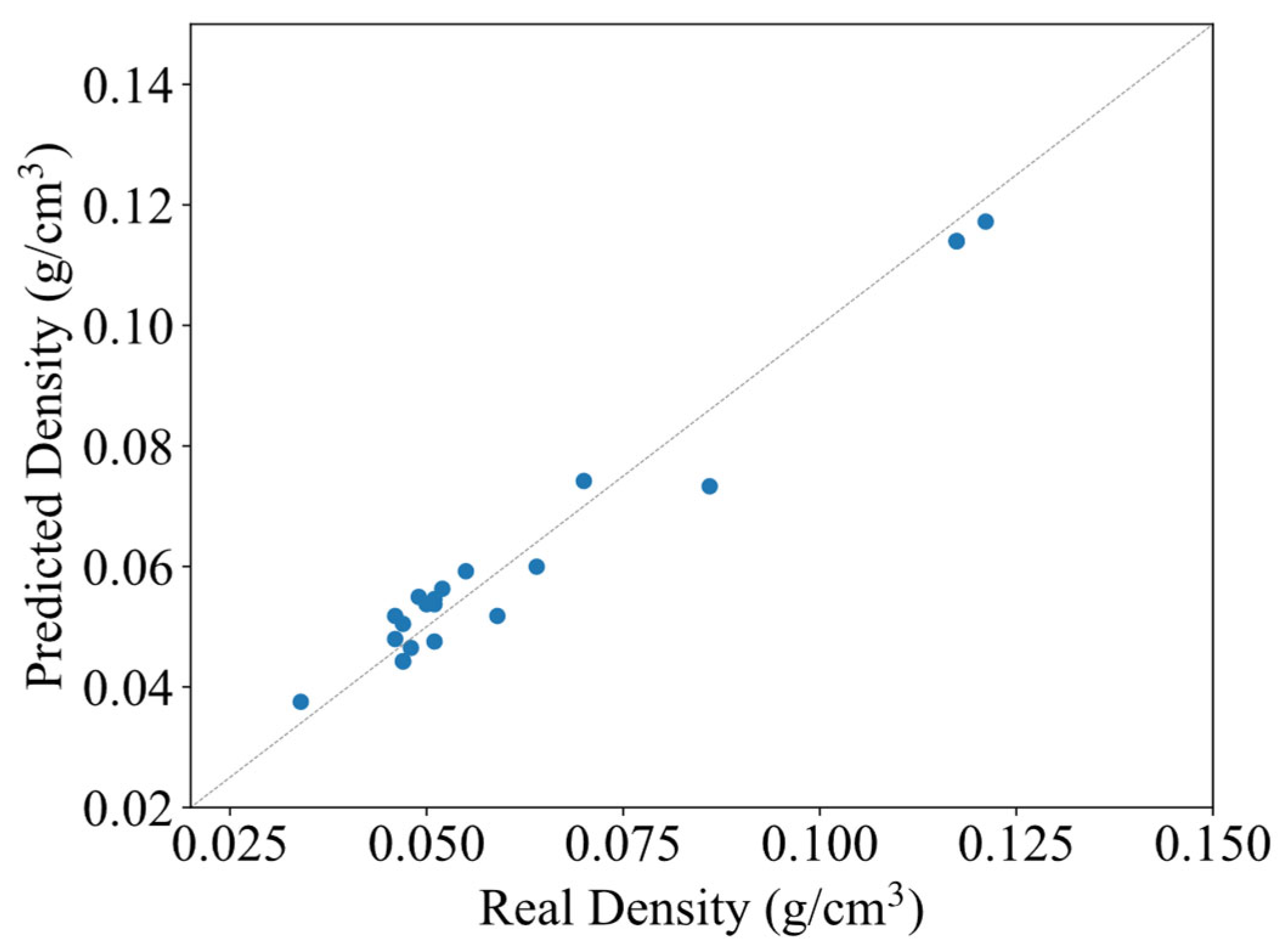
| This work SVR model | PUR aerogel | Density | 21 experimental samples | 0.964 | 2.300 × 10⁻⁵ | 4.800 × 10⁻³ | 4.200 × 10⁻³ |
| This work Elastic Net model | PUR aerogel | Density | 21 experimental samples | 0.820 | 1.200 × 10⁻⁴ | 1.100 × 10⁻² | 7.200 × 10⁻³ |
| Hyperparameter | Value |
|---|---|
| Kernel | RBF (Radial Basis Function) |
| C | 0.1 |
| ε | 3.79 × 10⁻³ |
| Factor | Coefficient |
|---|---|
| EDA/H12MDI (mol/mol) | 3.57 × 10⁻² |
| Sonication (binary) | |
| PEG Molecular weight (g/mol) | |
| Solids content (wt. %) | |
| Independent term | 2.80 × 10⁻² |
Disclaimer/Publisher’s Note: The statements, opinions and data contained in all publications are solely those of the individual author(s) and contributor(s) and not of MDPI and/or the editor(s). MDPI and/or the editor(s) disclaim responsibility for any injury to people or property resulting from any ideas, methods, instructions or products referred to in the content. |
© 2026 by the authors. Licensee MDPI, Basel, Switzerland. This article is an open access article distributed under the terms and conditions of the Creative Commons Attribution (CC BY) license.
Share and Cite
Brandón-Basdediós, Ó.; Miguélez-Riádigos, L.; Pinilla-Peñalver, E.; Alonso, M.; Sánchez, P.; Sánchez-Silva, L.; Sobreira-Seoane, J.L. Digital Twin-Driven Optimization of Pilot-Scale Polyurethane Aerogel Production Using SVR Modelling. Gels 2026, 12, 483. https://doi.org/10.3390/gels12060483
Brandón-Basdediós Ó, Miguélez-Riádigos L, Pinilla-Peñalver E, Alonso M, Sánchez P, Sánchez-Silva L, Sobreira-Seoane JL. Digital Twin-Driven Optimization of Pilot-Scale Polyurethane Aerogel Production Using SVR Modelling. Gels. 2026; 12(6):483. https://doi.org/10.3390/gels12060483
Chicago/Turabian StyleBrandón-Basdediós, Óscar, Laura Miguélez-Riádigos, Esther Pinilla-Peñalver, Mateo Alonso, Paula Sánchez, Luz Sánchez-Silva, and Juan Luis Sobreira-Seoane. 2026. "Digital Twin-Driven Optimization of Pilot-Scale Polyurethane Aerogel Production Using SVR Modelling" Gels 12, no. 6: 483. https://doi.org/10.3390/gels12060483
APA StyleBrandón-Basdediós, Ó., Miguélez-Riádigos, L., Pinilla-Peñalver, E., Alonso, M., Sánchez, P., Sánchez-Silva, L., & Sobreira-Seoane, J. L. (2026). Digital Twin-Driven Optimization of Pilot-Scale Polyurethane Aerogel Production Using SVR Modelling. Gels, 12(6), 483. https://doi.org/10.3390/gels12060483