
Hydrogel-Based Micro/Nanorobots for Advanced Biomedical Applications

Abstract
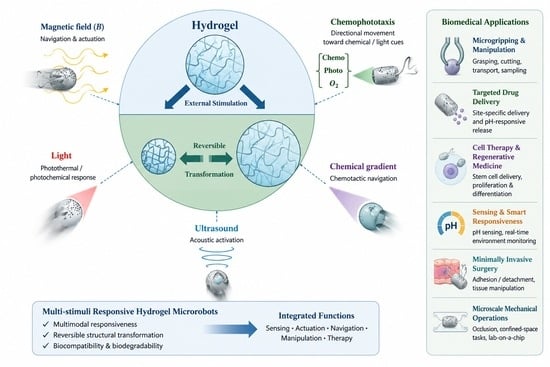
1. Introduction
2. Propulsion Mechanisms of Micro/Nanorobots
2.1. Magnetic Propulsion
2.2. Chemical Propulsion
2.2.1. Self-Diffusiophoresis
2.2.2. Self-Electrophoresis
2.3. Light-Driven Propulsion
2.4. Ultrasound Propulsion
2.5. Biohybrid Propulsion
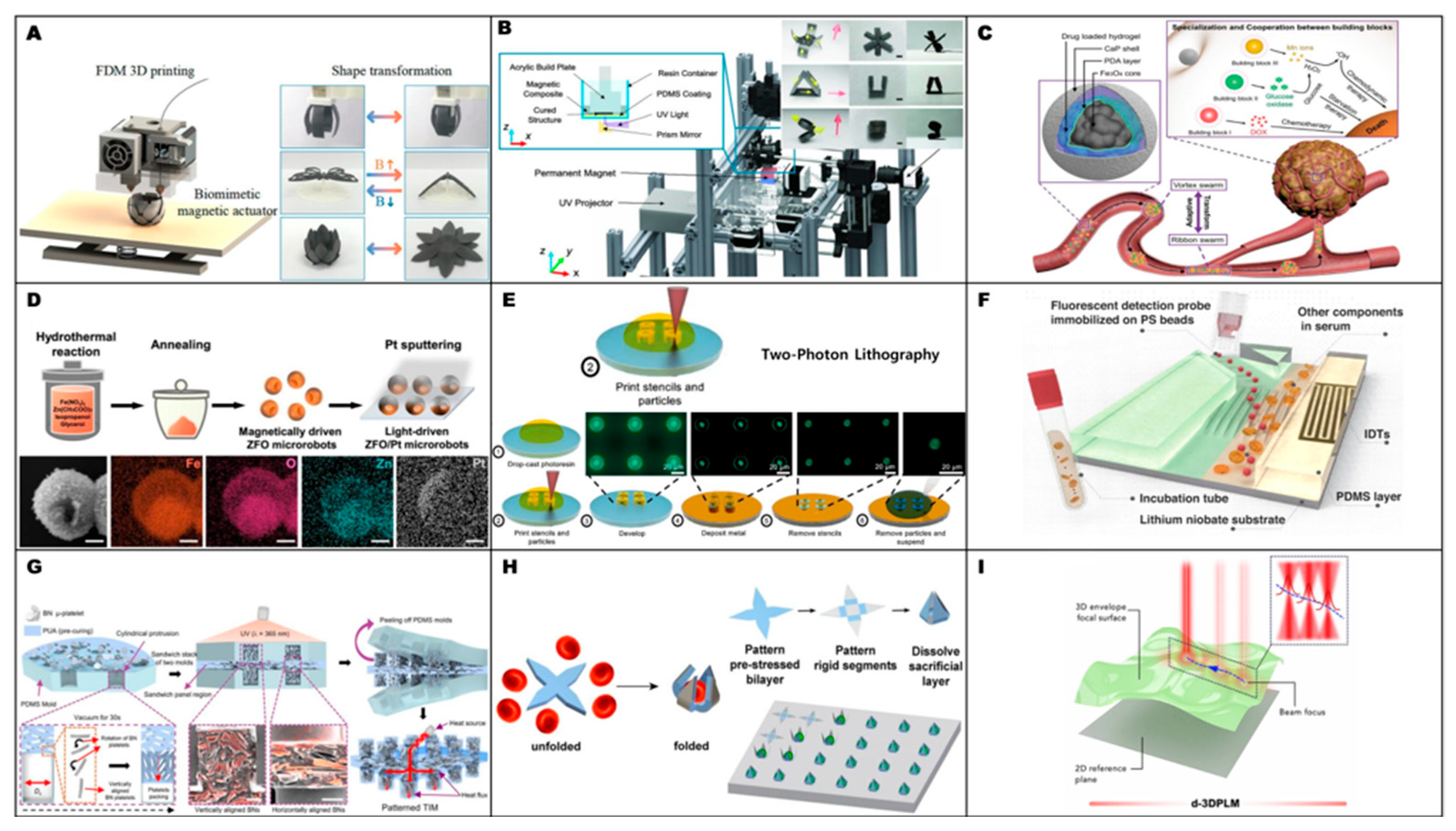
3. Fabrication Techniques for Micro/Nanorobots
4. Hydrogels as a Promising Material for Micro/Nanorobots
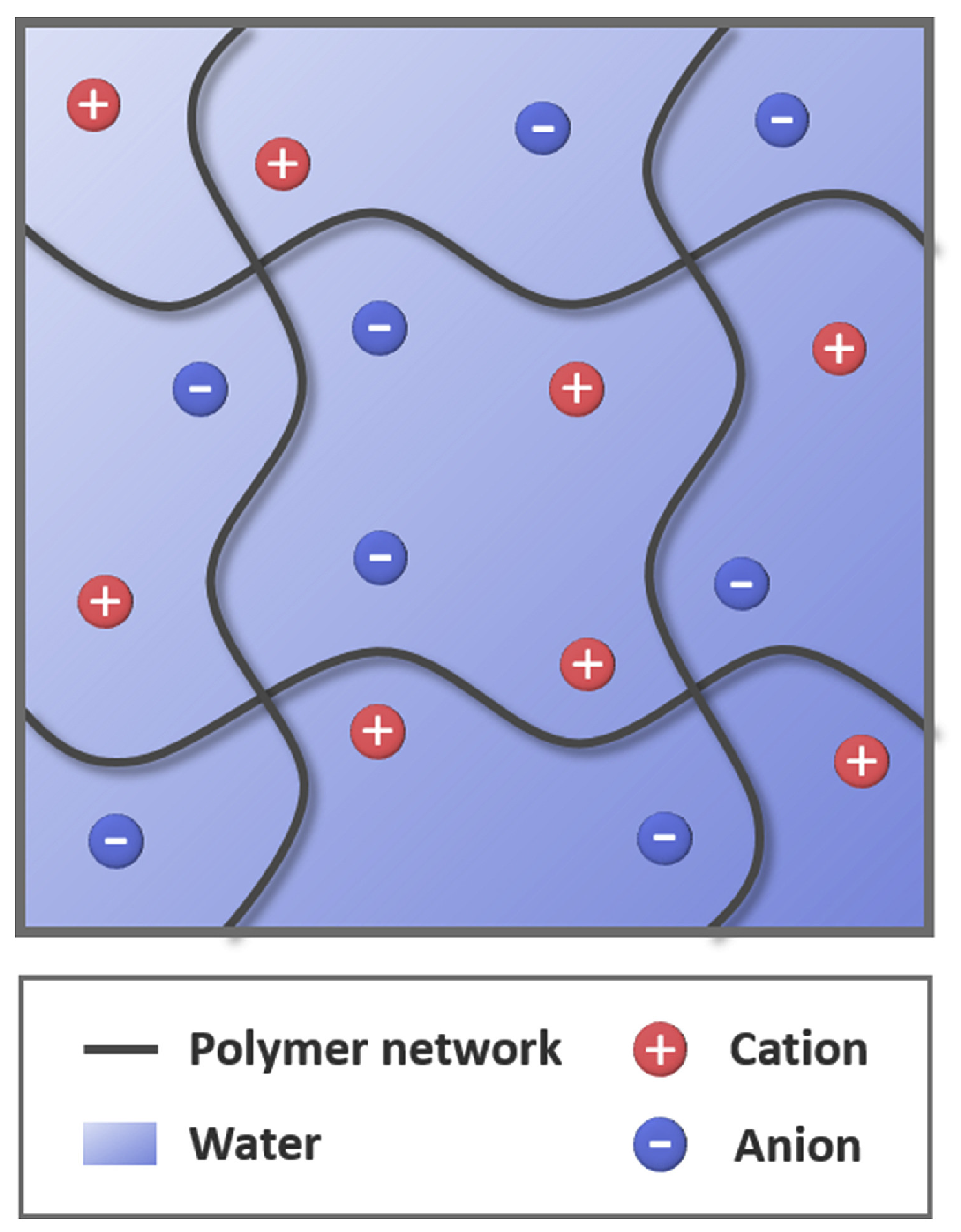
4.1. Fundamental Properties and Characteristics of Hydrogels
4.2. Actuation Mechanisms for Hydrogel-Based Microrobots
4.2.1. Magnetically Driven Hydrogel Microrobots
4.2.2. Chemically Driven Hydrogel Microrobots
4.2.3. Electrically Driven Hydrogel Microrobots
4.2.4. Light-Driven Hydrogel Microrobots
4.2.5. Thermally Driven Hydrogel Microrobots
4.3. Fabrication Methods of Hydrogel-Based Microrobots
5. Applications
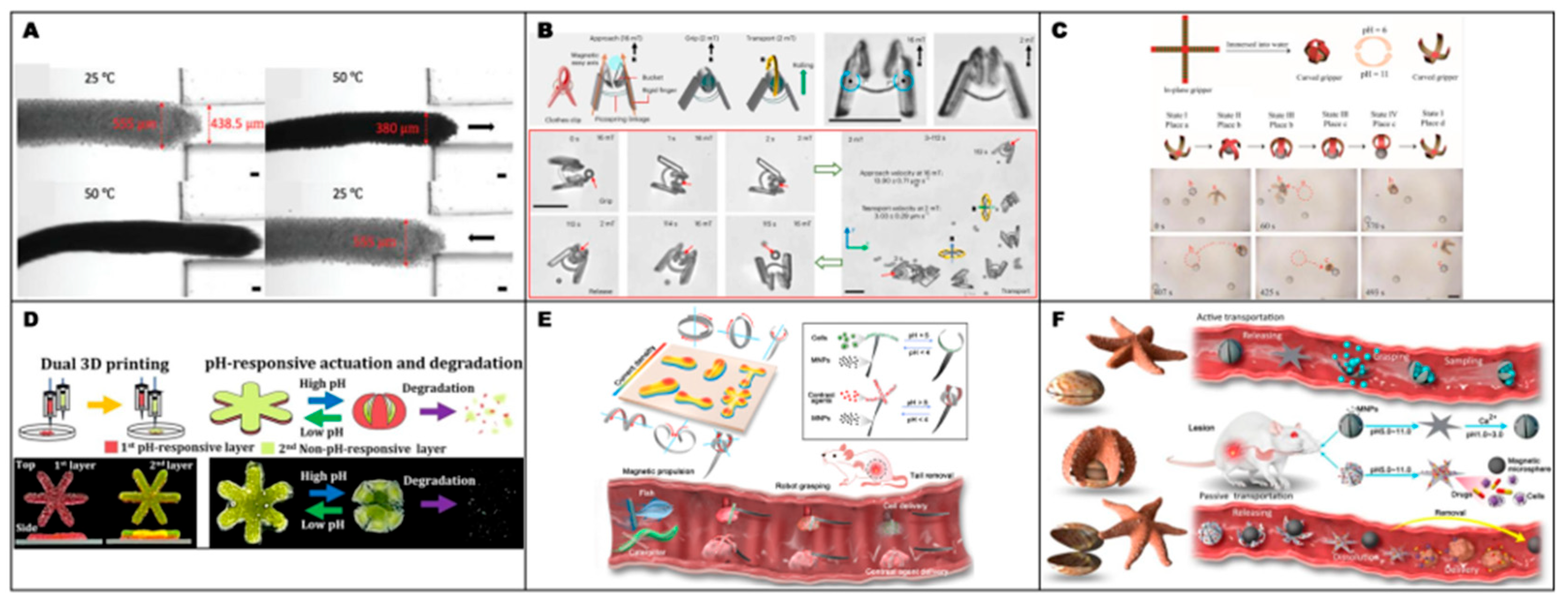
5.1. Hydrogel-Based Microgrippers and Stimuli-Responsive Systems
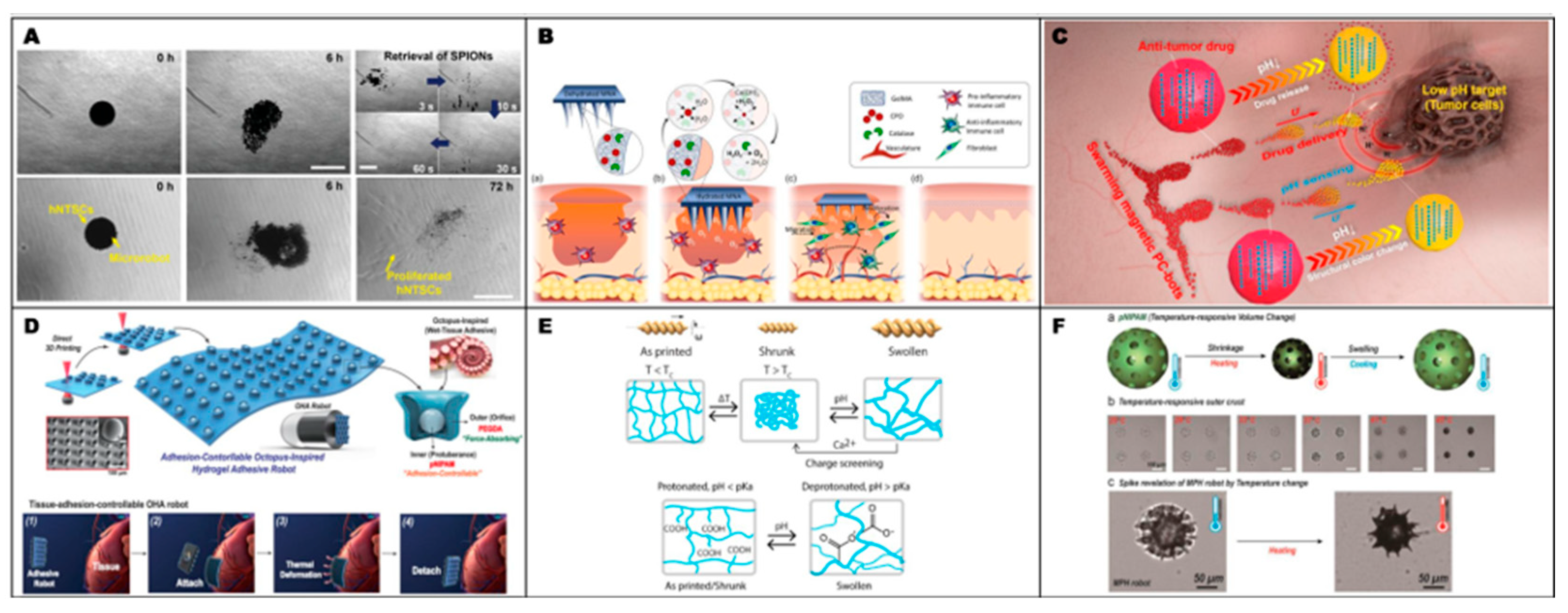
5.2. Hydrogel-Based Micro/Nanorobotic Systems and Their Potentials
5.3. Current Challenges and Limitations of Hydrogel Systems
6. Conclusions
Author Contributions
Funding
Data Availability Statement
Acknowledgments
Conflicts of Interest
References
- Ezike, T.C.; Okpala, U.S.; Onoja, U.L.; Nwike, C.P.; Ezeako, E.C.; Okpara, O.J.; Okoroafor, C.C.; Eze, S.C.; Kalu, O.L.; Odoh, E.C.; et al. Advances in drug delivery systems, challenges and future directions. Heliyon 2023, 9, e17488. [Google Scholar] [CrossRef] [PubMed]
- Kumar, V.; Barwal, A.; Sharma, N.; Mir, D.S.; Kumar, P.; Kumar, V. Therapeutic proteins: Developments, progress, challenges, and future perspectives. 3 Biotech 2024, 14, 112. [Google Scholar] [CrossRef]
- Mohs, R.C.; Greig, N.H. Drug discovery and development: Role of basic biological research. Alzheimers Dement. 2017, 3, 651–657. [Google Scholar] [CrossRef]
- Rasekh, M.; Arshad, M.S.; Ahmad, Z. Advances in Drug Delivery Integrated with Regenerative Medicine: Innovations, Challenges, and Future Frontiers. Pharmaceutics 2025, 17, 456. [Google Scholar] [CrossRef]
- Deeks, S.G.; Lewin, S.R.; Havlir, D.V. The end of AIDS: HIV infection as a chronic disease. Lancet 2013, 382, 1525–1533. [Google Scholar] [CrossRef] [PubMed]
- Hochhaus, A.; Larson, R.A.; Guilhot, F.; Radich, J.P.; Branford, S.; Hughes, T.P.; Baccarani, M.; Deininger, M.W.; Cervantes, F.; Fujihara, S.; et al. Long-Term Outcomes of Imatinib Treatment for Chronic Myeloid Leukemia. N. Engl. J. Med. 2017, 376, 917–927. [Google Scholar] [CrossRef]
- Sims, E.K.; Carr, A.L.J.; Oram, R.A.; DiMeglio, L.A.; Evans-Molina, C. 100 years of insulin: Celebrating the past, present and future of diabetes therapy. Nat. Med. 2021, 27, 1154–1164. [Google Scholar] [CrossRef]
- Adepu, S.; Ramakrishna, S. Controlled Drug Delivery Systems: Current Status and Future Directions. Molecules 2021, 26, 5905. [Google Scholar] [CrossRef]
- Senapati, S.; Mahanta, A.K.; Kumar, S.; Maiti, P. Controlled drug delivery vehicles for cancer treatment and their performance. Signal Transduct. Target. Ther. 2018, 3, 7. [Google Scholar] [CrossRef]
- Veselov, V.V.; Nosyrev, A.E.; Jicsinszky, L.; Alyautdin, R.N.; Cravotto, G. Targeted Delivery Methods for Anticancer Drugs. Cancers 2022, 14, 622. [Google Scholar] [CrossRef] [PubMed]
- Soto, F.; Wang, J.; Ahmed, R.; Demirci, U. Medical Micro/Nanorobots in Precision Medicine. Adv. Sci. 2020, 7, 2002203. [Google Scholar] [CrossRef] [PubMed]
- Schmidt, C.K.; Medina-Sanchez, M.; Edmondson, R.J.; Schmidt, O.G. Engineering microrobots for targeted cancer therapies from a medical perspective. Nat. Commun. 2020, 11, 5618. [Google Scholar] [CrossRef]
- Zhu, S.; Cheng, Y.; Wang, J.; Liu, G.; Luo, T.; Li, X.; Yang, S.; Yang, R. Biohybrid magnetic microrobots: An intriguing and promising platform in biomedicine. Acta Biomater. 2023, 169, 88–106. [Google Scholar] [CrossRef]
- Zhang, H.; Tang, J.; Cao, H.; Wang, C.; Shen, C.; Liu, J. Review of the Applications of Micro/Nanorobots in Biomedicine. ACS Appl. Nano Mater. 2024, 7, 17151–17192. [Google Scholar] [CrossRef]
- Elnaggar, A.; Kang, S.; Tian, M.; Han, B.; Keshavarz, M. State of the Art in Actuation of Micro/Nanorobots for Biomedical Applications. Small Sci. 2024, 4, 2300211. [Google Scholar] [CrossRef]
- Landers, F.C.; Hertle, L.; Pustovalov, V.; Sivakumaran, D.; Oral, C.M.; Brinkmann, O.; Meiners, K.; Theiler, P.; Gantenbein, V.; Veciana, A.; et al. Clinically ready magnetic microrobots for targeted therapies. Science 2025, 390, 710–715. [Google Scholar] [CrossRef]
- Bakenecker, A.C.; von Gladiss, A.; Schwenke, H.; Behrends, A.; Friedrich, T.; Ludtke-Buzug, K.; Neumann, A.; Barkhausen, J.; Wegner, F.; Buzug, T.M. Navigation of a magnetic micro-robot through a cerebral aneurysm phantom with magnetic particle imaging. Sci. Rep. 2021, 11, 14082. [Google Scholar] [CrossRef]
- Li, N.; Fei, P.; Tous, C.; Rezaei Adariani, M.; Hautot, M.-L.; Ouedraogo, I.; Hadjadj, A.; Dimov, I.P.; Zhang, Q.; Lessard, S.; et al. Human-scale navigation of magnetic microrobots in hepatic arteries. Sci. Robot. 2024, 9, eadh8702. [Google Scholar] [CrossRef] [PubMed]
- Wang, Q.; Zhang, L. External Power-Driven Microrobotic Swarm: From Fundamental Understanding to Imaging-Guided Delivery. ACS Nano 2021, 15, 149–174. [Google Scholar] [CrossRef] [PubMed]
- Yu, J.; Jin, D.; Chan, K.F.; Wang, Q.; Yuan, K.; Zhang, L. Active generation and magnetic actuation of microrobotic swarms in bio-fluids. Nat. Commun. 2019, 10, 5631. [Google Scholar] [CrossRef]
- Wang, X.; Cai, J.; Sun, L.; Zhang, S.; Gong, D.; Li, X.; Yue, S.; Feng, L.; Zhang, D. Facile Fabrication of Magnetic Microrobots Based on Spirulina Templates for Targeted Delivery and Synergistic Chemo-Photothermal Therapy. ACS Appl. Mater. Interfaces 2019, 11, 4745–4756. [Google Scholar] [CrossRef]
- Hoffman, A.S. Hydrogels for biomedical applications. Adv. Drug Deliv. Rev. 2012, 64, 18–23. [Google Scholar] [CrossRef]
- Chai, Q.; Jiao, Y.; Yu, X. Hydrogels for Biomedical Applications: Their Characteristics and the Mechanisms behind Them. Gels 2017, 3, 6. [Google Scholar] [CrossRef] [PubMed]
- Caló, E.; Khutoryanskiy, V.V. Biomedical applications of hydrogels: A review of patents and commercial products. Eur. Polym. J. 2015, 65, 252–267. [Google Scholar] [CrossRef]
- Peppas, N.A.; Hilt, J.Z.; Khademhosseini, A.; Langer, R. Hydrogels in Biology and Medicine: From Molecular Principles to Bionanotechnology. Adv. Mater. 2006, 18, 1345–1360. [Google Scholar] [CrossRef]
- Ye, M.; Zhou, Y.; Zhao, H.; Wang, Z.; Nelson, B.J.; Wang, X. A Review of Soft Microrobots: Material, Fabrication, and Actuation. Adv. Intell. Syst. 2023, 5, 2300311. [Google Scholar] [CrossRef]
- Nelson, B.J.; Kaliakatsos, I.K.; Abbott, J.J. Microrobots for minimally invasive medicine. Annu. Rev. Biomed. Eng. 2010, 12, 55–85. [Google Scholar] [CrossRef] [PubMed]
- Peyer, K.E.; Zhang, L.; Nelson, B.J. Bio-inspired magnetic swimming microrobots for biomedical applications. Nanoscale 2013, 5, 1259–1272. [Google Scholar] [CrossRef]
- Li, Y.; Huo, Y.; Chu, X.; Yang, L. Automated Magnetic Microrobot Control: From Mathematical Modeling to Machine Learning. Mathematics 2024, 12, 2180. [Google Scholar] [CrossRef]
- Xu, T.; Yu, J.; Yan, X.; Choi, H.; Zhang, L. Magnetic Actuation Based Motion Control for Microrobots: An Overview. Micromachines 2015, 6, 1346–1364. [Google Scholar] [CrossRef]
- Venezian, R.; Khalil, I.S.M. Understanding Robustness of Magnetically Driven Helical Propulsion in Viscous Fluids Using Sensitivity Analysis. Adv. Theory Simul. 2022, 5, 2100519. [Google Scholar] [CrossRef]
- Piranfar, P.; Naraghi, M.; Egoli, A.K. Design and analysis of a novel magnetic helical swimmer. J. Fluids Struct. 2024, 126, 104093. [Google Scholar] [CrossRef]
- Zhang, C.; Ma, S.; Xu, L. Velocity and Out-Step Frequencies for a Micro-Swimmer Based on Spiral Carbon Nanotubes. Micromachines 2023, 14, 1320. [Google Scholar] [CrossRef] [PubMed]
- Gupta, A.K.; Gupta, M. Cytotoxicity suppression and cellular uptake enhancement of surface modified magnetic nanoparticles. Biomaterials 2005, 26, 1565–1573. [Google Scholar] [CrossRef] [PubMed]
- Hopp, M.; Rogaschewski, S.; Groth, T. Testing the cytotoxicity of metal alloys used as magnetic prosthetic devices. J. Mater. Sci. Mater. Med. 2003, 14, 335–345. [Google Scholar] [CrossRef]
- Karlsson, H.L.; Gustafsson, J.; Cronholm, P.; Moller, L. Size-dependent toxicity of metal oxide particles—A comparison between nano- and micrometer size. Toxicol. Lett. 2009, 188, 112–118. [Google Scholar] [CrossRef]
- Kostevsek, N.; Hudoklin, S.; Kreft, M.E.; Sersa, I.; Sepe, A.; Jaglicic, Z.; Vidmar, J.; Scancar, J.; Sturm, S.; Kobe, S.; et al. Magnetic interactions and in vitro study of biocompatible hydrocaffeic acid-stabilized Fe-Pt clusters as MRI contrast agents. RSC Adv. 2018, 8, 14694–14704. [Google Scholar] [CrossRef]
- Meng, X.; Seton, H.C.; Lu, L.T.; Prior, I.A.; Thanh, N.T.; Song, B. Magnetic CoPt nanoparticles as MRI contrast agent for transplanted neural stem cells detection. Nanoscale 2011, 3, 977–984. [Google Scholar] [CrossRef]
- Mo, Y.; Zhang, Y.; Zhang, Q. The pulmonary effects of nickel-containing nanoparticles: Cytotoxicity, genotoxicity, carcinogenicity, and their underlying mechanisms. Environ. Sci. Nano 2024, 11, 1817–1846. [Google Scholar] [CrossRef]
- Smith, L.J.; Holmes, A.L.; Kandpal, S.K.; Mason, M.D.; Zheng, T.; Wise, J.P., Sr. The cytotoxicity and genotoxicity of soluble and particulate cobalt in human lung fibroblast cells. Toxicol. Appl. Pharmacol. 2014, 278, 259–265. [Google Scholar] [CrossRef]
- Wan, R.; Mo, Y.; Zhang, Z.; Jiang, M.; Tang, S.; Zhang, Q. Cobalt nanoparticles induce lung injury, DNA damage and mutations in mice. Part. Fibre Toxicol. 2017, 14, 38. [Google Scholar] [CrossRef]
- Zhang, Q.; Sun, D. Micro/Nanorobots for Combating Brain Disorders: Challenges, Advances, and Perspectives. Adv. Sci. 2025, 12, e16592. [Google Scholar] [CrossRef]
- Kuron, M.; Kreissl, P.; Holm, C. Toward Understanding of Self-Electrophoretic Propulsion under Realistic Conditions: From Bulk Reactions to Confinement Effects. Acc. Chem. Res. 2018, 51, 2998–3005. [Google Scholar] [CrossRef]
- Li, M.; Hu, X.; Zhao, Y.; Jiao, N. An Overview of Recent Progress in Micro/Nanorobots for Biomedical Applications. Adv. Mater. Technol. 2023, 8, 2201928. [Google Scholar] [CrossRef]
- Moran, J.L.; Posner, J.D. Phoretic Self-Propulsion. Annu. Rev. Fluid. Mech. 2017, 49, 511–540. [Google Scholar] [CrossRef]
- Zhu, G.; van Gogh, B.; Zhu, L.; Pak, O.S.; Man, Y. Self-diffusiophoretic propulsion of a spheroidal particle in a shear-thinning fluid. J. Fluid Mech. 2024, 986, A39. [Google Scholar] [CrossRef]
- Wang, W.; Chiang, T.-Y.; Velegol, D.; Mallouk, T.E. Understanding the Efficiency of Autonomous Nano- and Microscale Motors. J. Am. Chem. Soc. 2013, 135, 10557–10565. [Google Scholar] [CrossRef] [PubMed]
- Wang, Y.; Tu, Y.; Peng, F. The Energy Conversion behind Micro-and Nanomotors. Micromachines 2021, 12, 222. [Google Scholar] [CrossRef] [PubMed]
- Paxton, W.F.; Baker, P.T.; Kline, T.R.; Wang, Y.; Mallouk, T.E.; Sen, A. Catalytically Induced Electrokinetics for Motors and Micropumps. J. Am. Chem. Soc. 2006, 128, 14881–14888. [Google Scholar] [CrossRef]
- Xu, L.; Mou, F.; Gong, H.; Luo, M.; Guan, J. Light-driven micro/nanomotors: From fundamentals to applications. Chem. Soc. Rev. 2017, 46, 6905–6926. [Google Scholar] [CrossRef] [PubMed]
- Gao, Y.; Wang, X.; Chen, Y. Light-driven soft microrobots based on hydrogels and LCEs: Development and prospects. RSC Adv. 2024, 14, 14278–14288. [Google Scholar] [CrossRef]
- He, L.; He, T.; Yang, Y.; Chen, X.B. Material selection, preparation, driving and applications of light-driven micro/nano motors: A review. Nanoscale 2025, 17, 11894–11933. [Google Scholar] [CrossRef]
- Jiang, H.R.; Yoshinaga, N.; Sano, M. Active motion of a Janus particle by self-thermophoresis in a defocused laser beam. Phys. Rev. Lett. 2010, 105, 268302. [Google Scholar] [CrossRef]
- Zhang, X.; Wang, Z.; Lyu, Y.; Li, J.; Song, K.; Xing, N.; Ng, D.H.L. NIR light-powered halloysite-based nanomotors for CT imaging diagnosis and synergistic chemo-photothermal cancer therapy. J. Ind. Eng. Chem. 2022, 116, 180–190. [Google Scholar] [CrossRef]
- Mou, F.; Zhang, J.; Wu, Z.; Du, S.; Zhang, Z.; Xu, L.; Guan, J. Phototactic Flocking of Photochemical Micromotors. iScience 2019, 19, 415–424. [Google Scholar] [CrossRef]
- Huang, D.; Cai, L.; Li, N.; Zhao, Y. Ultrasound-trigged micro/nanorobots for biomedical applications. Smart Med. 2023, 2, e20230003. [Google Scholar] [CrossRef]
- Del Campo Fonseca, A.; Gluck, C.; Droux, J.; Ferry, Y.; Frei, C.; Wegener, S.; Weber, B.; El Amki, M.; Ahmed, D. Ultrasound trapping and navigation of microrobots in the mouse brain vasculature. Nat. Commun. 2023, 14, 5889. [Google Scholar] [CrossRef]
- Garcia-Gradilla, V.; Sattayasamitsathit, S.; Soto, F.; Kuralay, F.; Yardimci, C.; Wiitala, D.; Galarnyk, M.; Wang, J. Ultrasound-propelled nanoporous gold wire for efficient drug loading and release. Small 2014, 10, 4154–4159. [Google Scholar] [CrossRef]
- Garcia-Gradilla, V.; Orozco, J.; Sattayasamitsathit, S.; Soto, F.; Kuralay, F.; Pourazary, A.; Katzenberg, A.; Gao, W.; Shen, Y.; Wang, J. Functionalized Ultrasound-Propelled Magnetically Guided Nanomotors: Toward Practical Biomedical Applications. ACS Nano 2013, 7, 9232–9240. [Google Scholar] [CrossRef]
- Wang, D.; Gao, C.; Zhou, C.; Lin, Z.; He, Q. Leukocyte Membrane-Coated Liquid Metal Nanoswimmers for Actively Targeted Delivery and Synergistic Chemophotothermal Therapy. Research 2020, 2020, 3676954. [Google Scholar] [CrossRef]
- Li, J.; Mayorga-Martinez, C.C.; Ohl, C.D.; Pumera, M. Ultrasonically Propelled Micro- and Nanorobots. Adv. Funct. Mater. 2021, 32, 2102265. [Google Scholar] [CrossRef]
- Wu, G.; Xian, W.; You, Q.; Zhang, J.; Chen, X. AcousticRobots: Smart acoustically powered micro-/nanoswimmers for precise biomedical applications. Adv. Drug Deliv. Rev. 2024, 207, 115201. [Google Scholar] [CrossRef] [PubMed]
- Buss, N.; Yasa, O.; Alapan, Y.; Akolpoglu, M.B.; Sitti, M. Nanoerythrosome-functionalized biohybrid microswimmers. APL Bioeng. 2020, 4, 026103. [Google Scholar] [CrossRef] [PubMed]
- Felfoul, O.; Mohammadi, M.; Taherkhani, S.; de Lanauze, D.; Zhong Xu, Y.; Loghin, D.; Essa, S.; Jancik, S.; Houle, D.; Lafleur, M.; et al. Magneto-aerotactic bacteria deliver drug-containing nanoliposomes to tumour hypoxic regions. Nat. Nanotechnol. 2016, 11, 941–947. [Google Scholar] [CrossRef]
- Magdanz, V.; Sanchez, S.; Schmidt, O.G. Development of a sperm-flagella driven micro-bio-robot. Adv. Mater. 2013, 25, 6581–6588. [Google Scholar] [CrossRef]
- Striggow, F.; Ribeiro, C.; Aziz, A.; Nauber, R.; Hebenstreit, F.; Schmidt, O.G.; Medina-Sanchez, M. Magnetotactic Sperm Cells for Assisted Reproduction. Small 2024, 20, e2310288. [Google Scholar] [CrossRef]
- Gwisai, T.; Mirkhani, N.; Christiansen, M.G.; Nguyen, T.T.; Ling, V.; Schuerle, S. Magnetic torque–driven living microrobots for increased tumor infiltration. Sci. Robot. 2022, 7, eabo0665. [Google Scholar] [CrossRef] [PubMed]
- Wang, B.; Kostarelos, K.; Nelson, B.J.; Zhang, L. Trends in Micro-/Nanorobotics: Materials Development, Actuation, Localization, and System Integration for Biomedical Applications. Adv. Mater. 2021, 33, e2002047. [Google Scholar] [CrossRef]
- Xu, H.; Medina-Sanchez, M.; Magdanz, V.; Schwarz, L.; Hebenstreit, F.; Schmidt, O.G. Sperm-Hybrid Micromotor for Targeted Drug Delivery. ACS Nano 2018, 12, 327–337. [Google Scholar] [CrossRef]
- Magdanz, V.; Khalil, I.S.M.; Simmchen, J.; Furtado, G.P.; Mohanty, S.; Gebauer, J.; Xu, H.; Klingner, A.; Aziz, A.; Medina-Sánchez, M.; et al. IRONSperm: Sperm-templated soft magnetic microrobots. Sci. Adv. 2020, 6, eaba5855. [Google Scholar] [CrossRef]
- Park, B.W.; Zhuang, J.; Yasa, O.; Sitti, M. Multifunctional Bacteria-Driven Microswimmers for Targeted Active Drug Delivery. ACS Nano 2017, 11, 8910–8923. [Google Scholar] [CrossRef] [PubMed]
- Suh, S.; Jo, A.; Traore, M.A.; Zhan, Y.; Coutermarsh-Ott, S.L.; Ringel-Scaia, V.M.; Allen, I.C.; Davis, R.M.; Behkam, B. Nanoscale Bacteria-Enabled Autonomous Drug Delivery System (NanoBEADS) Enhances Intratumoral Transport of Nanomedicine. Adv. Sci. 2019, 6, 1801309. [Google Scholar] [CrossRef]
- Wang, J.; Xing, Y.; Ngatio, M.; Bies, P.; Xu, L.L.; Xing, L.; Zarea, A.; Makela, A.V.; Contag, C.H.; Li, J. Engineering Magnetotactic Bacteria as Medical Microrobots. Adv. Mater. 2025, 37, e2416966. [Google Scholar] [CrossRef]
- Taherkhani, S.; Mohammadi, M.; Daoud, J.; Martel, S.; Tabrizian, M. Covalent Binding of Nanoliposomes to the Surface of Magnetotactic Bacteria for the Synthesis of Self-Propelled Therapeutic Agents. ACS Nano 2014, 8, 5049–5060. [Google Scholar] [CrossRef] [PubMed]
- den Hoed, F.M.; Carlotti, M.; Palagi, S.; Raffa, P.; Mattoli, V. Evolution of the Microrobots: Stimuli-Responsive Materials and Additive Manufacturing Technologies Turn Small Structures into Microscale Robots. Micromachines 2024, 15, 275. [Google Scholar] [CrossRef]
- Cao, X.; Xuan, S.; Sun, S.; Xu, Z.; Li, J.; Gong, X. 3D Printing Magnetic Actuators for Biomimetic Applications. ACS Appl. Mater. Interfaces 2021, 13, 30127–30136. [Google Scholar] [CrossRef]
- Li, Z.; Lai, Y.P.; Diller, E. 3D Printing of Multilayer Magnetic Miniature Soft Robots with Programmable Magnetization. Adv. Intell. Syst. 2023, 6, 2300052. [Google Scholar] [CrossRef]
- Jin, D.; Yuan, K.; Du, X.; Wang, Q.; Wang, S.; Zhang, L. Domino Reaction Encoded Heterogeneous Colloidal Microswarm with On-Demand Morphological Adaptability. Adv. Mater. 2021, 33, e2100070. [Google Scholar] [CrossRef] [PubMed]
- Peng, X.; Oral, C.M.; Urso, M.; Ussia, M.; Pumera, M. Active Microrobots for Dual Removal of Biofilms via Chemical and Physical Mechanisms. ACS Appl. Mater. Interfaces 2025, 17, 3608–3619. [Google Scholar] [CrossRef]
- Kreienbrink, K.M.; Cruse, Z.A.; Kumari, A.; Shields, C.W.t. Precise surface patches on active particles of arbitrary shape through microstenciling. Nat. Commun. 2025, 16, 6062. [Google Scholar] [CrossRef]
- Chen, X.; Zhang, C.; Liu, X.; Dong, Y.; Meng, H.; Qin, X.; Jiang, Z.; Wei, X. Low-noise fluorescent detection of cardiac troponin I in human serum based on surface acoustic wave separation. Microsyst. Nanoeng. 2023, 9, 141. [Google Scholar] [CrossRef] [PubMed]
- Kim, Y.G.; Jung, I.Y.; Mun, Y.; Shin, J.H.; Lee, S.G.; Koirala, G.R.; Kang, T.; Ok, J.; Choi, H.; Kim, J.; et al. Bi-Directional Assembly of Boron Nitride µ-Platelets by Micro-Molding for Advanced Thermal Interface Materials. Adv. Funct. Mater. 2025, 35, 2421607. [Google Scholar] [CrossRef]
- Malachowski, K.; Jamal, M.; Jin, Q.; Polat, B.; Morris, C.J.; Gracias, D.H. Self-folding single cell grippers. Nano Lett. 2014, 14, 4164–4170. [Google Scholar] [CrossRef] [PubMed]
- Mariello, M.; Troughton, J.G.; Leng, Y.; Wang, Z.; Karam, N.; Coles, L.; González-Martínez, J.; Ali, K.; Rogers, D.J.; Lancaster, M.; et al. Dynamically autofocused 3D pulsed laser micromachining enables advanced 3D bioelectronics. Sci. Adv. 2025, 11, eadz4084. [Google Scholar] [CrossRef]
- Zhang, Q.; Zhang, H.; Ma, Z.; Lan, X.; Luo, Y. Magnetron Sputtering Preparation of High-Capacity and Long-Life a-SiC Thin-Film Anode and Its Application in Proton Batteries. ACS Appl. Energy Mater. 2025, 8, 15863–15876. [Google Scholar] [CrossRef]
- Grigorianaite, G.; Borodinas, S.; Zigmantaite, V.; Limanovskaja, K.; Andrijec, D.; Kilikevicius, A.; Vainorius, D.; Pautienius, A.; Jonusauskas, L. 3D printing of stents via two-photon polymerization. Sci. Rep. 2025, 15, 22736. [Google Scholar] [CrossRef]
- Zhang, T.; Zhou, T.; Cui, Q.; Feng, X.; Feng, S.; Li, M.; Yang, Y.; Hosokawa, Y.; Tian, G.; Shen, A.Q.; et al. Active Microfluidic Platforms for Particle Separation and Integrated Sensing Applications. ACS Sens. 2025, 10, 5299–5313. [Google Scholar] [CrossRef] [PubMed]
- Hassan, M.; Mahajan, A.; Gao, X.; Quinn, D.D.; Farhad, S. Scalable Gecko-Inspired Adhesives via Diffraction-Grated Molds: A Low-Cost, Directional PDMS System. Eng. Rep. 2025, 7, e70352. [Google Scholar] [CrossRef]
- Gao, Q.; Kim, M.; von Arx, D.; Zhang, E.; Zhang, X.; Ye, H.; Vogt, C.; Ehmke, C.; Corsino, D.; Catania, F.; et al. Soft magnetic microrobots with remote sensing and communication capabilities. Nat. Commun. 2025, 16, 10489. [Google Scholar] [CrossRef]
- Munteanu, C.; Prifti, E.; Surd, A.; Mârza, S.M. Tailoring Therapy: Hydrogels as Tunable Platforms for Regenerative Medicine and Cancer Intervention. Gels 2025, 11, 679. [Google Scholar] [CrossRef]
- López-Díaz, A.; Vázquez, A.S.; Vázquez, E. Hydrogels in Soft Robotics: Past, Present, and Future. ACS Nano 2024, 18, 20817–20826. [Google Scholar] [CrossRef]
- González-Díaz, E.C.; Varghese, S. Hydrogels as Extracellular Matrix Analogs. Gels 2016, 2, 20. [Google Scholar] [CrossRef]
- Cao, Q.; Chen, W.; Zhong, Y.; Ma, X.; Wang, B. Biomedical Applications of Deformable Hydrogel Microrobots. Micromachines 2023, 14, 1824. [Google Scholar] [CrossRef]
- Song, W.; Li, L.; Liu, X.; Zhu, Y.; Yu, S.; Wang, H.; Wang, L. Hydrogel microrobots for biomedical applications. Front. Chem. 2024, 12, 1416314. [Google Scholar] [CrossRef] [PubMed]
- Lee, H.R.; Kim, C.C.; Sun, J.Y. Stretchable Ionics-A Promising Candidate for Upcoming Wearable Devices. Adv. Mater. 2018, 30, e1704403. [Google Scholar] [CrossRef]
- Yang, C.; Suo, Z. Hydrogel ionotronics. Nat. Rev. Mater. 2018, 3, 125–142. [Google Scholar] [CrossRef]
- Lee, Y.; Song, W.J.; Sun, J.Y. Hydrogel soft robotics. Mater. Today Phys. 2020, 15, 100258. [Google Scholar] [CrossRef]
- Sun, J.Y.; Zhao, X.; Illeperuma, W.R.; Chaudhuri, O.; Oh, K.H.; Mooney, D.J.; Vlassak, J.J.; Suo, Z. Highly stretchable and tough hydrogels. Nature 2012, 489, 133–136. [Google Scholar] [CrossRef]
- Ouyang, Y.; Huang, G.; Cui, J.; Zhu, H.; Yan, G.; Mei, Y. Advances and Challenges of Hydrogel Materials for Robotic and Sensing Applications. Chem. Mater. 2022, 34, 9307–9328. [Google Scholar] [CrossRef]
- Hassan, R.U.; Abbas, N.; Ko, J. Toward Customizable Smart Gels: A Comprehensive Review of Innovative Printing Techniques and Applications. Gels 2025, 11, 32. [Google Scholar] [CrossRef] [PubMed]
- Thirumalai, D.; Santhamoorthy, M.; Kim, S.-C.; Lim, H.-R. Conductive Polymer-Based Hydrogels for Wearable Electrochemical Biosensors. Gels 2024, 10, 459. [Google Scholar] [CrossRef]
- Keplinger, C.; Sun, J.-Y.; Foo, C.C.; Rothemund, P.; Whitesides, G.M.; Suo, Z. Stretchable, Transparent, Ionic Conductors. Science 2013, 341, 984–987. [Google Scholar] [CrossRef]
- Uyanga, K.A.; Onyeukwu, E.J.; Han, J. Advancing Wearable Technologies with Hydrogels: Innovations and Future Perspectives. Gels 2025, 11, 988. [Google Scholar] [CrossRef]
- Wang, H.; Du, J.; Mao, Y. Hydrogel-Based Continuum Soft Robots. Gels 2025, 11, 254. [Google Scholar] [CrossRef] [PubMed]
- Song, J.; Guo, Y. Magnetic Field Driven Microrobot Based on Hydrogels. Adv. Robot. Res. 2025, 2, 202500103. [Google Scholar] [CrossRef]
- Sanchis-Gual, R.; Ye, H.; Ueno, T.; Landers, F.C.; Hertle, L.; Deng, S.; Veciana, A.; Xia, Y.; Franco, C.; Choi, H.; et al. 3D Printed Template-Assisted Casting of Biocompatible Polyvinyl Alcohol-Based Soft Microswimmers with Tunable Stability. Adv. Funct. Mater. 2023, 33, 2212952. [Google Scholar] [CrossRef]
- Xu, Z.; Wu, Z.; Yuan, M.; Chen, Y.; Ge, W.; Xu, Q. Versatile magnetic hydrogel soft capsule microrobots for targeted delivery. iScience 2023, 26, 106727. [Google Scholar] [CrossRef]
- Ding, Z.; Cai, Y.; Sun, H.; Rong, X.; Ye, S.; Fan, J.; Lai, Y.; Liang, Z.; Huang, C.; Li, P.; et al. Janus hydrogel microrobots with bioactive ions for the regeneration of tendon-bone interface. Nat. Commun. 2025, 16, 2189. [Google Scholar] [CrossRef]
- Chen, X.; Zhang, H.; Tian, C.; Jia, J.; Xie, H. Multiscale Magnetic Hydrogel Robot with a Core–Shell Structure for Active Targeted Delivery. ACS Appl. Polym. Mater. 2022, 4, 8645–8655. [Google Scholar] [CrossRef]
- Kim, J.I.; Chun, C.; Kim, B.; Hong, J.M.; Cho, J.-K.; Lee, S.H.; Song, S.-C. Thermosensitive/magnetic poly(organophosphazene) hydrogel as a long-term magnetic resonance contrast platform. Biomaterials 2012, 33, 218–224. [Google Scholar] [CrossRef]
- Ribeiro, M.; Boudoukhani, M.; Belmonte-Reche, E.; Genicio, N.; Sillankorva, S.; Gallo, J.; Rodríguez-Abreu, C.; Moulai-Mostefa, N.; Bañobre-López, M. Xanthan-Fe3O4 Nanoparticle Composite Hydrogels for Non-Invasive Magnetic Resonance Imaging and Magnetically Assisted Drug Delivery. ACS Appl. Nano Mater. 2021, 4, 7712–7729. [Google Scholar] [CrossRef]
- Ganguly, S.; Margel, S. Design of Magnetic Hydrogels for Hyperthermia and Drug Delivery. Polymers 2021, 13, 4259. [Google Scholar] [CrossRef]
- Tang, J.; Yin, Q.; Qiao, Y.; Wang, T. Shape Morphing of Hydrogels in Alternating Magnetic Field. ACS Appl. Mater. Interfaces 2019, 11, 21194–21200. [Google Scholar] [CrossRef]
- Kim, J.; Choi, J.; Park, H.; Lee, J.; Lee, H.-J.; Park, J.D.; Lee, J.B.; Na, Y.; Yoon, C. Stimuli-responsive biodegradable soft gripper composed of pH-responsive alginate/gelatin/acrylic acid and non-pH-responsive acrylamide bilayer. Eur. Polym. J. 2025, 226, 113742. [Google Scholar] [CrossRef]
- Chung, T.; Choi, J.; Enomoto, T.; Park, S.; Kim, S.; Kim, Y.S. Self-Regulating Hydrogel Actuators. Chem. Rev. 2025, 125, 9053–9088. [Google Scholar] [CrossRef]
- Singh, J.; Nayak, P. pH-responsive polymers for drug delivery: Trends and opportunities. J. Polym. Sci. 2023, 61, 2828–2850. [Google Scholar] [CrossRef]
- Marcombe, R.; Cai, S.; Hong, W.; Zhao, X.; Lapusta, Y.; Suo, Z. A theory of constrained swelling of a pH-sensitive hydrogel. Soft Matter 2010, 6, 784–793. [Google Scholar] [CrossRef]
- van den Akker, W.P.; van Benthem, R.A.T.M.; Voets, I.K.; van Hest, J.C.M. Dampened Transient Actuation of Hydrogels Autonomously Controlled by pH-Responsive Bicontinuous Nanospheres. ACS Appl. Mater. Interfaces 2024, 16, 19642–19650. [Google Scholar] [CrossRef]
- Park, H.; Kim, M.; Lee, Y.; Lee, S.; Kim, J.; Yoon, J.; Jeong, E.H.; Kim, J.; Park, J.D.; Lee, J.B.; et al. Ecoflex-hydrogel bilayer soft robot for pH-controlled drug protection and delivery. Mater. Today Bio 2026, 38, 103093. [Google Scholar] [CrossRef]
- Wang, J.-Y.; Jin, F.; Dong, X.-Z.; Liu, J.; Zheng, M.-L. Flytrap Inspired pH-Driven 3D Hydrogel Actuator by Femtosecond Laser Microfabrication. Adv. Mater. Technol. 2022, 7, 2200276. [Google Scholar] [CrossRef]
- Yu, Z.; Li, L.; Mou, F.; Yu, S.; Zhang, D.; Yang, M.; Zhao, Q.; Ma, H.; Luo, W.; Li, T.; et al. Swarming magnetic photonic-crystal microrobots with on-the-fly visual pH detection and self-regulated drug delivery. InfoMat 2023, 5, e12464. [Google Scholar] [CrossRef]
- Wang, Y.; Liu, H.; Yang, X.; Shi, Z.; Li, J.; Xue, L.; Liu, S.; Lei, Y. A responsive hydrogel-based microneedle system for minimally invasive glucose monitoring. Smart Mater. Med. 2023, 4, 69–77. [Google Scholar] [CrossRef]
- Sobczak, M. Enzyme-Responsive Hydrogels as Potential Drug Delivery Systems-State of Knowledge and Future Prospects. Int. J. Mol. Sci. 2022, 23, 4421. [Google Scholar] [CrossRef]
- Dai, W.; Zhou, X.; Guo, H. A Metal Ion and Thermal-Responsive Bilayer Hydrogel Actuator Achieved by the Asymmetric Osmotic Flow of Water between Two Layers under Stimuli. Polymers 2022, 14, 4019. [Google Scholar] [CrossRef]
- Kim, S.J.; Kim, H.I.; Park, S.J.; Kim, I.Y.; Lee, S.H.; Lee, T.S.; Kim, S.I. Behavior in electric fields of smart hydrogels with potential application as bio-inspired actuators. Smart Mater. Struct. 2005, 14, 511. [Google Scholar] [CrossRef]
- Shin, Y.; Choi, M.-Y.; Choi, J.; Na, J.-H.; Kim, S.Y. Design of an Electro-Stimulated Hydrogel Actuator System with Fast Flexible Folding Deformation under a Low Electric Field. ACS Appl. Mater. Interfaces 2021, 13, 15633–15646. [Google Scholar] [CrossRef]
- Han, D.; Farino, C.; Yang, C.; Scott, T.; Browe, D.; Choi, W.; Freeman, J.W.; Lee, H. Soft Robotic Manipulation and Locomotion with a 3D Printed Electroactive Hydrogel. ACS Appl. Mater. Interfaces 2018, 10, 17512–17518. [Google Scholar] [CrossRef]
- Zheng, Z.; Wang, H.; Demir, S.O.; Huang, Q.; Fukuda, T.; Sitti, M. Programmable aniso-electrodeposited modular hydrogel microrobots. Sci. Adv. 2022, 8, eade6135. [Google Scholar] [CrossRef] [PubMed]
- O’Grady, M.L.; Kuo, P.-l.; Parker, K.K. Optimization of Electroactive Hydrogel Actuators. ACS Appl. Mater. Interfaces 2010, 2, 343–346. [Google Scholar] [CrossRef]
- Li, Y.; Sun, Y.; Xiao, Y.; Gao, G.; Liu, S.; Zhang, J.; Fu, J. Electric Field Actuation of Tough Electroactive Hydrogels Cross-Linked by Functional Triblock Copolymer Micelles. ACS Appl. Mater. Interfaces 2016, 8, 26326–26331. [Google Scholar] [CrossRef] [PubMed]
- Choi, M.-Y.; Shin, Y.; Lee, H.S.; Kim, S.Y.; Na, J.-H. Multipolar spatial electric field modulation for freeform electroactive hydrogel actuation. Sci. Rep. 2020, 10, 2482. [Google Scholar] [CrossRef]
- Tungkavet, T.; Seetapan, N.; Pattavarakorn, D.; Sirivat, A. Graphene/gelatin hydrogel composites with high storage modulus sensitivity for using as electroactive actuator: Effects of surface area and electric field strength. Polymer 2015, 70, 242–251. [Google Scholar] [CrossRef]
- Yang, K.; Dong, Q.; Liu, H.; Wu, L.; Zong, S.; Wang, Z. A MXene Hydrogel-Based Versatile Microrobot for Controllable Water Pollution Management. Adv. Sci. 2024, 11, 2309257. [Google Scholar] [CrossRef]
- Zhao, Y.; Lo, C.-Y.; Ruan, L.; Pi, C.-H.; Kim, C.; Alsaid, Y.; Frenkel, I.; Rico, R.; Tsao, T.-C.; He, X. Somatosensory actuator based on stretchable conductive photothermally responsive hydrogel. Sci. Robot. 2021, 6, eabd5483. [Google Scholar] [CrossRef] [PubMed]
- Jiang, J.; Xu, S.; Ma, H.; Li, C.; Huang, Z. Photoresponsive hydrogel-based soft robot: A review. Mater. Today Bio 2023, 20, 100657. [Google Scholar] [CrossRef]
- Zhao, Y.-L.; Stoddart, J.F. Azobenzene-Based Light-Responsive Hydrogel System. Langmuir 2009, 25, 8442–8446. [Google Scholar] [CrossRef]
- Francis, W.; Dunne, A.; Delaney, C.; Florea, L.; Diamond, D. Spiropyran based hydrogels actuators—Walking in the light. Sens. Actuators B Chem. 2017, 250, 608–616. [Google Scholar] [CrossRef]
- Chen, Y.; Li, M.; Tang, Q.; Cheng, Y.; Miao, A.; Cheng, L.; Zhu, S.; Luo, T.; Liu, G.; Zhang, L.; et al. High-Speed NIR-Driven Untethered 3D-Printed Hydrogel Microrobots in High-Viscosity Liquids. Adv. Intell. Syst. 2023, 5, 2200311. [Google Scholar] [CrossRef]
- Cheng, Q.; Lu, X.; Tai, Y.; Luo, T.; Yang, R. Light-Driven Microrobots for Targeted Drug Delivery. ACS Biomater. Sci. Eng. 2024, 10, 5562–5594. [Google Scholar] [CrossRef]
- Zhang, M.; Liu, Y.; Deng, C.; Fan, X.; Zhang, Z.; Shi, S.; Chen, F.; Hu, H.; Xue, S.; Deng, L.; et al. Light-driven lattice soft microrobot with multimodal locomotion. Nat. Commun. 2025, 16, 8059. [Google Scholar] [CrossRef]
- Tang, L.; Wang, L.; Yang, X.; Feng, Y.; Li, Y.; Feng, W. Poly(N-isopropylacrylamide)-based smart hydrogels: Design, properties and applications. Progress. Mater. Sci. 2021, 115, 100702. [Google Scholar] [CrossRef]
- Lee, Y.-W.; Chun, S.; Son, D.; Hu, X.; Schneider, M.; Sitti, M. A Tissue Adhesion-Controllable and Biocompatible Small-Scale Hydrogel Adhesive Robot. Adv. Mater. 2022, 34, 2109325. [Google Scholar] [CrossRef]
- Choi, J.G.; Hyeon, J.S.; Kim, S.J. Thermally driven phase transition for reversible diving/surfacing hydrogel devices. In Proceedings of the 2022 IEEE Sensors, Dallas, TX, USA, 30 October–2 November 2022; IEEE: New York, NY, USA, 2022; pp. 1–4. [Google Scholar]
- Shi, Q.; Liu, H.; Tang, D.; Li, Y.; Li, X.; Xu, F. Bioactuators based on stimulus-responsive hydrogels and their emerging biomedical applications. NPG Asia Mater. 2019, 11, 64. [Google Scholar] [CrossRef]
- Breger, J.C.; Yoon, C.; Xiao, R.; Kwag, H.R.; Wang, M.O.; Fisher, J.P.; Nguyen, T.D.; Gracias, D.H. Self-Folding Thermo-Magnetically Responsive Soft Microgrippers. ACS Appl. Mater. Interfaces 2015, 7, 3398–3405. [Google Scholar] [CrossRef]
- Lee, Y.-W.; Ceylan, H.; Yasa, I.C.; Kilic, U.; Sitti, M. 3D-Printed Multi-Stimuli-Responsive Mobile Micromachines. ACS Appl. Mater. Interfaces 2021, 13, 12759–12766. [Google Scholar] [CrossRef] [PubMed]
- Lee, Y.W.; Kim, J.K.; Bozuyuk, U.; Dogan, N.O.; Khan, M.T.A.; Shiva, A.; Wild, A.M.; Sitti, M. Multifunctional 3D-Printed Pollen Grain-Inspired Hydrogel Microrobots for On-Demand Anchoring and Cargo Delivery. Adv. Mater. 2023, 35, e2209812. [Google Scholar] [CrossRef] [PubMed]
- Kuo, J.-C.; Huang, H.-W.; Tung, S.-W.; Yang, Y.-J. A hydrogel-based intravascular microgripper manipulated using magnetic fields. Sens. Actuators A Phys. 2014, 211, 121–130. [Google Scholar] [CrossRef]
- Levato, R.; Lim, K.S.; Li, W.; Asua, A.U.; Peña, L.B.; Wang, M.; Falandt, M.; Bernal, P.N.; Gawlitta, D.; Zhang, Y.S.; et al. High-resolution lithographic biofabrication of hydrogels with complex microchannels from low-temperature-soluble gelatin bioresins. Mater. Today Bio 2021, 12, 100162. [Google Scholar] [CrossRef]
- Shi, X.; Zhang, L.; Cheng, L.; Xiang, C.; Lee, A.; Ning, H.; Huang, K.; Liu, H.; Liao, H.; An, K.; et al. Multilayer self-sensing hydrogel soft robot prepared via stereolithography for on-demand drug delivery. Chem. Eng. J. 2025, 519, 164352. [Google Scholar] [CrossRef]
- Zheng, C.; Jin, F.; Zhao, Y.; Zheng, M.; Liu, J.; Dong, X.; Xiong, Z.; Xia, Y.; Duan, X. Light-driven micron-scale 3D hydrogel actuator produced by two-photon polymerization microfabrication. Sens. Actuators B Chem. 2020, 304, 127345. [Google Scholar] [CrossRef]
- Wang, J.; Zheng, J.; Zhang, C.; Duan, Y.; Zhang, Y.; Guo, H.; Qiu, Y.; Wang, X.; Liu, L.; Yu, H. 4D-Printed Microrobots with Synergistic Integration of Magnetic Actuation, Diffractive Optical Sensing, and pH-Adaptive Morphing. Adv. Funct. Mater. 2026, 36, e18838. [Google Scholar] [CrossRef]
- Sheng, J.; Fang, H.; Qiao, S.; Ma, L. Microfluidics-based fabrication and targeted motion control of multimodal therapeutic hydrogel capsule microrobots. J. Mater. Chem. B 2025, 13, 15067–15076. [Google Scholar] [CrossRef]
- Chen, Y.; Xu, Z.; Qiu, X.; Xu, Q. Polarized Magnetic Hydrogel Microrobot Collectives for Efficient Cooperation and Self-Assembly. In Proceedings of the 2025 IEEE 21st International Conference on Automation Science and Engineering (CASE), Los Angeles, CA, USA, 17–21 August 2025; IEEE: New York, NY, USA, 2025; pp. 3325–3330. [Google Scholar]
- Wang, S.; Liu, K.; Zhou, Q.; Xu, C.; Gao, J.; Wang, Z.; Wang, F.; Chen, B.; Ye, Y.; Ou, J.; et al. Hydrogen-Powered Microswimmers for Precise and Active Hydrogen Therapy Towards Acute Ischemic Stroke. Adv. Funct. Mater. 2021, 31, 2009475. [Google Scholar] [CrossRef]
- Jia, H.; Mailand, E.; Zhou, J.; Huang, Z.; Dietler, G.; Kolinski, J.M.; Wang, X.; Sakar, M.S. Universal Soft Robotic Microgripper. Small 2019, 15, 1803870. [Google Scholar] [CrossRef] [PubMed]
- Shim, T.S.; Kim, S.-H.; Heo, C.-J.; Jeon, H.C.; Yang, S.-M. Controlled Origami Folding of Hydrogel Bilayers with Sustained Reversibility for Robust Microcarriers. Angew. Chem. Int. Ed. 2012, 51, 1420–1423. [Google Scholar] [CrossRef]
- Zhu, S.; Cui, H.; Pan, Y.; Popple, D.; Xie, G.; Fink, Z.; Han, J.; Zettl, A.; Cheung Shum, H.; Russell, T.P. Responsive-Hydrogel Aquabots. Adv. Sci. 2024, 11, 2401215. [Google Scholar] [CrossRef] [PubMed]
- Xu, H.; Wu, S.; Liu, Y.; Wang, X.; Efremov, A.K.; Wang, L.; McCaskill, J.S.; Medina-Sanchez, M.; Schmidt, O.G. 3D nanofabricated soft microrobots with super-compliant picoforce springs as onboard sensors and actuators. Nat. Nanotechnol. 2024, 19, 494–503. [Google Scholar] [CrossRef]
- Ji, S.; Li, X.; Chen, Q.; Lv, P.; Duan, H. Enhanced Locomotion of Shape Morphing Microrobots by Surface Coating. Adv. Intell. Syst. 2021, 3, 2000270. [Google Scholar] [CrossRef]
- Zheng, Z.; Wang, H.; Dong, L.; Shi, Q.; Li, J.; Sun, T.; Huang, Q.; Fukuda, T. Ionic shape-morphing microrobotic end-effectors for environmentally adaptive targeting, releasing, and sampling. Nat. Commun. 2021, 12, 411. [Google Scholar] [CrossRef]
- Zhang, X.; Chen, G.; Fu, X.; Wang, Y.; Zhao, Y. Magneto-Responsive Microneedle Robots for Intestinal Macromolecule Delivery. Adv. Mater. 2021, 33, e2104932. [Google Scholar] [CrossRef]
- Jansen, L.E.; Amer, L.D.; Chen, E.Y.T.; Nguyen, T.V.; Saleh, L.S.; Emrick, T.; Liu, W.F.; Bryant, S.J.; Peyton, S.R. Zwitterionic PEG-PC Hydrogels Modulate the Foreign Body Response in a Modulus-Dependent Manner. Biomacromolecules 2018, 19, 2880–2888. [Google Scholar] [CrossRef]
- Nie, R.; Zhang, Q.-Y.; Feng, Z.-Y.; Huang, K.; Zou, C.-Y.; Fan, M.-H.; Zhang, Y.-Q.; Zhang, J.-Y.; Li-Ling, J.; Tan, B.; et al. Hydrogel-based immunoregulation of macrophages for tissue repair and regeneration. Int. J. Biol. Macromol. 2024, 268, 131643. [Google Scholar] [CrossRef]
- Li, J.; Yu, J. Biodegradable Microrobots and Their Biomedical Applications: A Review. Nanomaterials 2023, 13, 1590. [Google Scholar] [CrossRef]
- Noh, S.; Jeon, S.; Kim, E.; Oh, U.; Park, D.; Park, S.H.; Kim, S.W.; Pane, S.; Nelson, B.J.; Kim, J.Y.; et al. A Biodegradable Magnetic Microrobot Based on Gelatin Methacrylate for Precise Delivery of Stem Cells with Mass Production Capability. Small 2022, 18, e2107888. [Google Scholar] [CrossRef]
- Barnum, L.; Samandari, M.; Suhail, Y.; Toro, S.; Novin, A.; Ghelich, P.; Quint, J.; Saeedinejad, F.; Komma, M.; Kshitiz; et al. Biodegradable Oxygen-Generating Microneedle Patches for Regenerative Medicine Applications. Adv. Nanobiomed Res. 2025, 5, 2400093. [Google Scholar] [CrossRef] [PubMed]
- Feng, W.; Wang, Z. Tailoring the Swelling-Shrinkable Behavior of Hydrogels for Biomedical Applications. Adv. Sci. 2023, 10, e2303326. [Google Scholar] [CrossRef]
- Zhao, S.; Zuo, Y.; Liu, T.; Zhai, S.; Dai, Y.; Guo, Z.; Wang, Y.; He, Q.; Xia, L.; Zhi, C.; et al. Multi-Functional Hydrogels for Flexible Zinc-Based Batteries Working under Extreme Conditions. Adv. Energy Mater. 2021, 11, 2101749. [Google Scholar] [CrossRef]
- Banerjee, H.; Suhail, M.; Ren, H. Hydrogel Actuators and Sensors for Biomedical Soft Robots: Brief Overview with Impending Challenges. Biomimetics 2018, 3, 15. [Google Scholar] [CrossRef] [PubMed]
- Chen, Q.; Zhu, L.; Zhao, C.; Wang, Q.; Zheng, J. A robust, one-pot synthesis of highly mechanical and recoverable double network hydrogels using thermoreversible sol-gel polysaccharide. Adv. Mater. 2013, 25, 4171–4176. [Google Scholar] [CrossRef] [PubMed]
- Salahuddin, B.; Warren, H.; Spinks, G.M. Thermally actuated hydrogel bead based braided artificial muscle. Smart Mater. Struct. 2020, 29, 055042. [Google Scholar] [CrossRef]
- Sangwan, W.; Petcharoen, K.; Paradee, N.; Lerdwijitjarud, W.; Sirivat, A. Electrically responsive materials based on polycarbazole/sodium alginate hydrogel blend for soft and flexible actuator application. Carbohydr. Polym. 2016, 151, 213–222. [Google Scholar] [CrossRef]
- Fusco, S.; Sakar, M.S.; Kennedy, S.; Peters, C.; Pane, S.; Mooney, D.; Nelson, B.J. Self-folding mobile microrobots for biomedical applications. In Proceedings of the 2014 IEEE International Conference on Robotics and Automation (ICRA), Hong Kong, China, 31 May–7 June 2014; IEEE: New York, NY, USA, 2014; pp. 3777–3782. [Google Scholar]
- Li, T.; Yu, S.; Sun, B.; Li, Y.; Wang, X.; Pan, Y.; Song, C.; Ren, Y.; Zhang, Z.; Grattan, K.T.V.; et al. Bioinspired claw-engaged and biolubricated swimming microrobots creating active retention in blood vessels. Sci. Adv. 2023, 9, eadg4501. [Google Scholar] [CrossRef]
- Li, J.; Li, X.; Luo, T.; Wang, R.; Liu, C.; Chen, S.; Li, D.; Yue, J.; Cheng, S.-h.; Sun, D. Development of a magnetic microrobot for carrying and delivering targeted cells. Sci. Robot. 2018, 3, eaat8829. [Google Scholar] [CrossRef]
- Singh, A.; Kar, A.K.; Singh, D.; Verma, R.; Shraogi, N.; Zehra, A.; Gautam, K.; Anbumani, S.; Ghosh, D.; Patnaik, S. pH-responsive eco-friendly chitosan modified cenosphere/alginate composite hydrogel beads as carrier for controlled release of Imidacloprid towards sustainable pest control. Chem. Eng. J. 2022, 427, 131215. [Google Scholar] [CrossRef]
- Ahmad, A.; Ahmad, I.; Kamal, T.; Asiri, A.M.; Tabassum, S. Sodium Alginate-Based Nanomaterials for Wastewater Treatment; Elsevier: Amsterdam, The Netherlands, 2022. [Google Scholar]
- İncel, A.; Demir, M.M. Triboluminescent composite microspheres consisting of alginate and EuD4TEA crystals. Sens. Actuators A Phys. 2018, 269, 556–562. [Google Scholar] [CrossRef]
- Li, K.; Sun, J.; He, S.; Zhou, X.; Li, H.; Liu, Y. On-demand preparation of calcium alginate microspheres via piezoelectric microfluidics. Sens. Actuators A Phys. 2022, 347, 113925. [Google Scholar] [CrossRef]



| Actuation Method | Advantages | Disadvantages |
|---|---|---|
| Magnetic field | Powerful penetrating power, no harm to living biological systems, fast actuation speed | Unavoidable safety problems when applying high intensity magnetic fields over 8 T |
| Electric field | Adjustable electric field intensity, powerful penetrating power | Imitations on biomedical applications of electrodes |
| Light field | Precise targeting, various controlling parameters, such as power density, wavelength, pulse frequency, polarities and so on | Irreversible harm to biological materials, poor light transmission |
| Acoustic field | Adjustable for different heights, biocompatible within a certain frequency range, powerful penetrating power, and actuation force | Prolonged actuation time may cause thermal effects, low imaging, and cavitation effect |
| Chemical | Larger and faster spread | Lack of feedback fuel safety issues, nontoxic urea, biocompatibility |
| Biological | Good biocompatibility, cause little rejection reaction | Need to maintain activity, limited range, need ultra-clean operating environment |
| System/Material | Stimulus | Max Actuation Strain (%) | Blocking Force (N) | Response Time | Actuation Mode | Application Domain | Reversibility/Cyclic Use | Reference |
|---|---|---|---|---|---|---|---|---|
| P(NIPAm-co-NDEAm) | Temperature, pH, light | ~50% | Not reported | 1–3 min | Volumetric swelling/deswelling | Controlled agrochemical release | High, multi-cycle-tested | [169] |
| Magnetic alginate beads | Magnetic field | ~10% | Not reported | Instantaneous | Magnetic rotation/translation | Targeted drug delivery | High, magnetic field-controlled | [91,170,171] |
| Braided hydrogel muscle | Temperature (cooling from 60 °C) | 7–8% | 5–6 N | Slow (minutes) | Contraction due to swelling | Artificial muscles/soft robotics | Moderate (fatigue observed) | [172] |
| Electroactive polycarbazole | Electric field (low voltage) | 1–2% | Low (µN-mN) | Seconds | Voltage-induced deformation | Electroactive sensing or actuation | Limited (electrochemical fatigue) | [173] |
| Photothermal GO–based bilayers | NIR light | 15–20% | Not reported | Fast (~seconds) | Bending/folding due to heating | Microrobotics, biomedical folding | Good, NIR-cycled | [174] |
| Magnetic micromotors | Magnetic field | ~12% | Not reported | Sub-second rotation | Magnetic propulsion | Remote-controlled microswimmers | Yes, in fluid environment | [175,176] |
| pH-responsive Ca–based beads | pH variation (acidic) | 5–10% | Not applicable | 2–5 min | Swelling and gel softening | Environmental remediation | Yes, but pH-limited | [177,178] |
| Triboluminescent EuD4TEA–based beads | Mechanical impact | Swelling-dependent | Not applicable | Instantaneous flash | Optical emission due to deformation | Mechanical sensing and diagnostics | No, single flash | [179] |
| Piezoelectric microspheres | Electric field (piezoelectric) | 0.5–1% | Very low | Milliseconds | Electric field-induced deformation | Biosignal-responsive systems | Yes, piezoelectric loop | [180] |
Disclaimer/Publisher’s Note: The statements, opinions and data contained in all publications are solely those of the individual author(s) and contributor(s) and not of MDPI and/or the editor(s). MDPI and/or the editor(s) disclaim responsibility for any injury to people or property resulting from any ideas, methods, instructions or products referred to in the content. |
© 2026 by the authors. Licensee MDPI, Basel, Switzerland. This article is an open access article distributed under the terms and conditions of the Creative Commons Attribution (CC BY) license.
Share and Cite
Cho, G.; Ko, J.; Lee, Y. Hydrogel-Based Micro/Nanorobots for Advanced Biomedical Applications. Gels 2026, 12, 451. https://doi.org/10.3390/gels12050451
Cho G, Ko J, Lee Y. Hydrogel-Based Micro/Nanorobots for Advanced Biomedical Applications. Gels. 2026; 12(5):451. https://doi.org/10.3390/gels12050451
Chicago/Turabian StyleCho, Gyunhee, Jongkuk Ko, and Yunwoo Lee. 2026. "Hydrogel-Based Micro/Nanorobots for Advanced Biomedical Applications" Gels 12, no. 5: 451. https://doi.org/10.3390/gels12050451
APA StyleCho, G., Ko, J., & Lee, Y. (2026). Hydrogel-Based Micro/Nanorobots for Advanced Biomedical Applications. Gels, 12(5), 451. https://doi.org/10.3390/gels12050451