This is an early access version, the complete PDF, HTML, and XML versions will be available soon.
Article

Comparative Study of Ni-Impregnated Alumina Aerogels and Ni-Al Xerogels for Light-Irradiation-Assisted CO2 Methanation


by
Daniel Estevez
,
Haritz Etxeberria
and
Victoria Laura Barrio
*
School of Engineering of Bilbao, University of the Basque Country (UPV/EHU), Plaza Ingeniero Torres Quevedo 1, 48013 Bilbao, Spain
*
Author to whom correspondence should be addressed.
Gels 2026, 12(5), 420; https://doi.org/10.3390/gels12050420
Submission received: 12 March 2026 / Revised: 6 May 2026 / Accepted: 8 May 2026 / Published: 11 May 2026
(This article belongs to the Special Issue Aerogels and Composites Aerogels)

Abstract

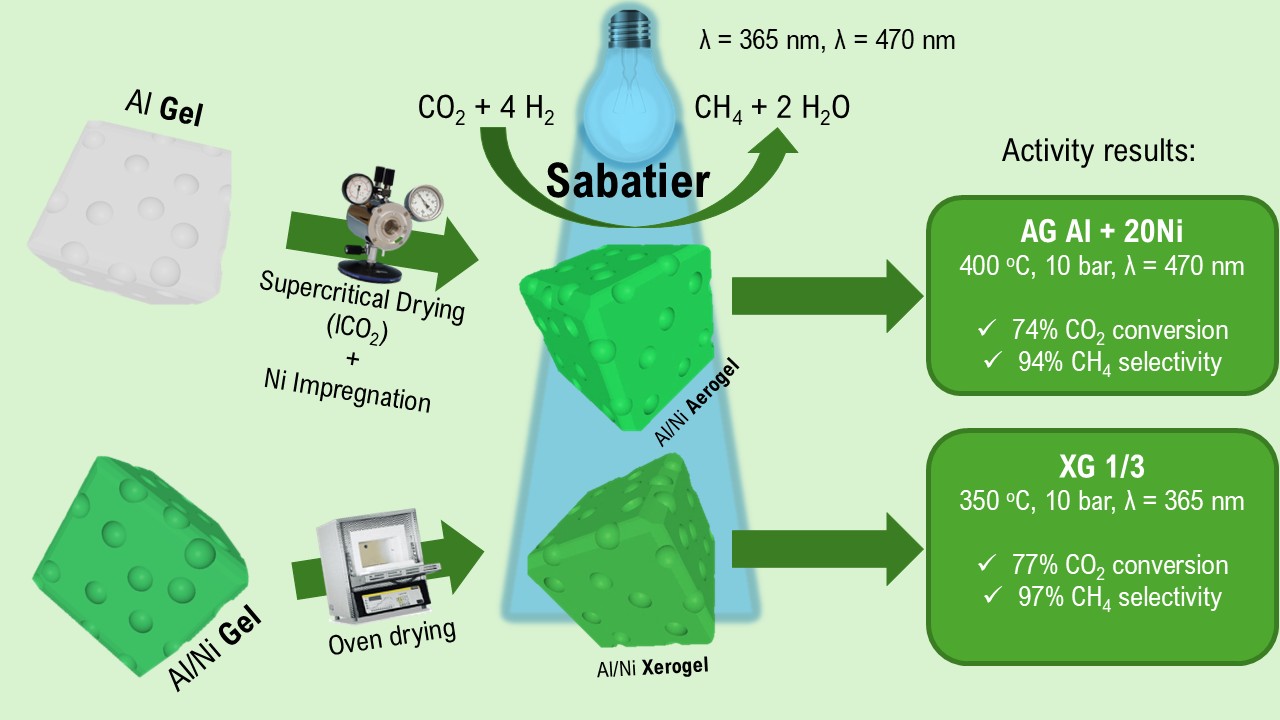
CO2 methanation is considered a key process in achieving carbon neutrality. Expanding on our previous study of supercritically dried Ni-Al aerogels, this work compares two gel-based catalyst families prepared via two different routes—supercritically dried Ni impregnated Al aerogel-based catalysts and oven-dried one-pot Ni-Al xerogel-based catalysts—to assess how the synthesis route affects catalyst structure and CO2 methanation performance under light irradiation. The catalysts were subsequently characterized via different techniques, such as ICP-OES, N2 adsorption–desorption isotherms, XRD, H2-TPR, UV-vis DRS, XPS, and TEM. Catalytic activity was tested in a photoreactor at a range of temperatures from 300 °C to 450 °C and 10 bar pressure, and two different light sources were used (λ = 365 nm, λ = 470 nm). Both light sources enhanced catalytic activity in most cases; the xerogels with higher Ni loadings were the most active materials. These catalysts reached CO2 conversions and CH4 selectivities near 70% and 100%, respectively. The results indicate that drying gels is a promising method for synthesizing catalysts active in the Sabatier reaction, given the properties of the materials.
Keywords: CO2 methanation; Sabatier reaction; power-to-gas; greenhouse gas emissions; nickel; alumina; xerogel; aerogel; light-assisted CO2 methanation CO2 methanation; Sabatier reaction; power-to-gas; greenhouse gas emissions; nickel; alumina; xerogel; aerogel; light-assisted CO2 methanation
Graphical Abstract