1. Introduction
Deep-water tight reservoirs are characterized by ultralow porosity and permeability, strong heterogeneity, and complex multiscale pore–throat architectures, all of which have long constrained effective stimulation and stable production. Numerous studies have shown that the pore systems of such reservoirs are dominated by micropores and mesopores, while their pore–throat networks exhibit pronounced fractal and hierarchical features. Connectivity is highly dependent on a limited number of dominant channels, resulting in extremely focused flow pathways and pronounced sensitivity to completion fluids and plugging agents [
1,
2,
3]. Systematic characterization using MICP, N
2 adsorption, and μCT has revealed the pore structure, throat-size distribution, and connectivity of deep-water and continental tight sandstones, highlighting a multilevel coupling pattern of “micropore storage–mesopore transition–fine-throat flow control” and clarifying pore–throat evolutionary behaviors under varying differential pressure, salinity, and stress conditions [
4,
5,
6,
7]. Beyond purely structural description, recent reservoir-engineering studies have emphasized that micro-scale pore–throat attributes directly govern seepage regimes, permeability evolution, and flow nonlinearity in tight reservoirs. In particular, quantitative analyses have demonstrated that variations in throat size distribution, coordination number, and dominant-channel continuity can induce orders-of-magnitude changes in effective permeability and micro-scale seepage characteristics, even when porosity remains nearly constant.
These findings underscore that pore–throat structure is not only a microscopic descriptor but also a fundamental control parameter linking material-scale modification to macroscopic permeability response and reservoir productivity, providing an essential bridge between pore-scale characterization and field-scale flow behavior. However, these studies primarily focus on natural pore–throat features, and quantitative insights into the coupling among chemical regulation, structural response, and flow-path reconstruction remain limited.
Polymer/weak-gel profile-control and water-plugging systems have been extensively applied in high-water-cut oil and gas reservoirs to mitigate water channeling, fingering, and post-stimulation instability in deep-water tight formations [
8,
9,
10,
11]. Previous research has investigated polyacrylamide-based gels [
12,
13], organically crosslinked Cr/Al gels [
14,
15], and three-dimensional network elastic gels [
16] in terms of formulation optimization, thermal stability, salt sensitivity, and mechanical performance, confirming their effectiveness in enhancing sweep efficiency and suppressing high-permeability channels. Nonetheless, traditional gel systems often suffer from crosslink-ageing, insufficient volumetric stability, and poor injectivity in fine pore–throat networks under high-temperature and high-salinity conditions, leading to “strong plugging but easy damage”, near-well overblocking, and secondary formation impairment. These limitations make them poorly suited for deep-water tight reservoirs, where strong stress fields, high salinity, and ultrafine pore–throat structures coexist [
17,
18].
In recent years, nanoparticle-reinforced composite gels have emerged as a promising direction for reservoir regulation and completion fluids due to their designable microstructures, high specific surface area, and tunable interfacial properties. Studies have demonstrated that incorporating SiO
2, TiO
2, clay nanosheets, or organic nanomicelles into polymer networks can significantly improve gel thermal stability, shear resistance, and mechanical strength while enhancing migration and retention within fine pore–throat systems [
19,
20,
21,
22]. Although SEM, AFM, NMR, DMA, and rheological analyses have clarified how nanofiller content, surface modification, and crosslink density affect gel network structure and material-scale mechanics, most research remains focused on the relationship between bulk structure and macroscopic properties.
Recent advances in reservoir-scale modeling further suggest that microstructural regulation of pore–throat systems can propagate upward to influence macroscopic permeability and flow efficiency through multiscale coupling mechanisms [
23,
24]. Hybrid-dimensional and dual-porosity–dual-permeability models explicitly incorporate pore–fracture or pore–cavity flux interactions, demonstrating that micro-scale structural modification can significantly alter effective permeability tensors and flow partitioning in heterogeneous reservoirs.
Systematic understanding of how such gels achieve selective occupation, controllable plugging, and reversible unblocking within real tight-rock pore networks is still lacking [
25,
26]. Recent studies have further extended nanoparticle-reinforced composite gels toward enhanced oil recovery and reservoir conformance applications. It has been reported that polymer–nanoparticle composite systems can improve sweep efficiency and flow conformance by strengthening gel networks, modifying interfacial wettability, and selectively restricting high-permeability channels under reservoir conditions [
27,
28,
29]. These macroscopic performance improvements are increasingly interpreted as emergent outcomes of pore–throat-scale structural regulation, dominant-channel redistribution, and permeability rebalancing across heterogeneous flow units. However, existing studies predominantly emphasize macroscopic recovery performance or qualitative plugging behavior, while quantitative understanding of how nanofiller-induced structural regulation translates into pore–throat reconstruction and multiscale flow responses remains insufficient, particularly for deep-water tight reservoirs.
On the pore-scale characterization front, X-ray μCT and microfluidic visualization techniques have provided critical tools for examining gel–porous media interactions. Some studies using μCT have mapped the three-dimensional distribution of polymer gels within sandstone cores and revealed mechanisms of relative permeability alteration, suggesting that gels preferentially invade high-permeability channels and form “bridging–constriction” structures at pore–throat intersections, thereby explaining asymmetric oil–water permeability responses [
30,
31,
32,
33]. Other researchers have used glass microfluidic chips to visualize displacement processes of polymer gels and nanogel systems, observing transitions from “coarse continuous channels” to “multibranch fine networks” during injection and proposing the concept of “dominant-channel redistribution” [
34,
35]. However, these studies typically focus on moderate permeability rocks or ambient conditions and often rely on a single characterization technique, making it difficult to quantify multiscale relationships among pore–throat parameters, interfacial chemistry, mechanical stability, and flow responses within a unified framework.
A synthesis of existing literature reveals three major gaps:
(1) Nanocomposite gel systems tailored for the extreme conditions of deep-water tight reservoirs (high temperature, high salinity, strong confinement) remain scarce, and few studies have systematically examined the quantitative links between material structural parameters and pore–throat regulatory behavior.
(2) Cross-scale coupling research on gel structure/composition–pore network reconstruction–flow behavior evolution is insufficient; most studies address plugging or profile control at a single scale or under a single scenario, lacking continuous evidence chains that span from material microstructure to three-dimensional pore networks and macroscopic permeability responses.
(3) Evaluation systems for reversible or degradable gels—particularly regarding their “plugging–unplugging” processes and reversible pore–throat regulation—have not been established, leaving the mechanisms underlying low-damage and highly controllable completion fluids inadequately understood.
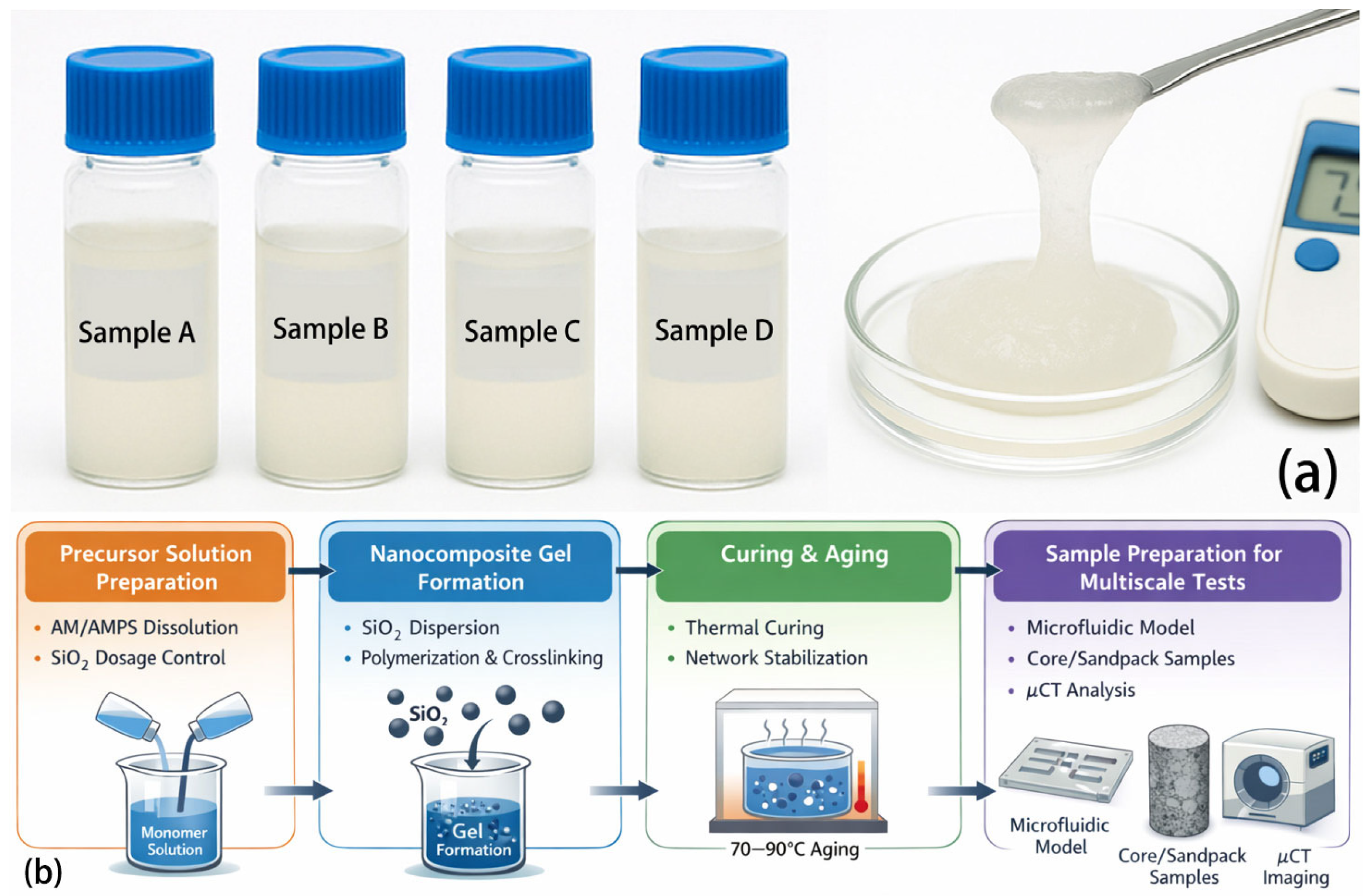
To address these gaps, this study proposes a multiscale experimental and analytical framework—from material structure to pore–throat regulation and seepage behavior—based on the nanocomposite gel DSRC-NCG. The work proceeds across three interconnected levels. First, at the material scale, SEM/AFM, FTIR/XPS, rheological and mechanical tests, and N2 adsorption are employed to quantitatively characterize the effects of nano-SiO2 content on gel multiscale pore structure, interfacial chemistry, and mechanical stability. A structural regulation index (SRI) is proposed to collectively evaluate the synergistic effects of throat refinement, distribution convergence, and specific surface area enhancement. Second, at the rock and model scales, microfluidic devices, multigrade-permeability artificial cores, and dry-gel-coated sandstone packings are used to conduct combined flow experiments. Indicators such as the pore–flow matching index (HCI) and residual resistance factor (RRF) are introduced to systematically assess the capacity of nanocomposite gels to regulate dominant channels and cross-permeability pathways under different heterogeneity conditions. Third, at the in situ μCT scale, time-sequence scanning and lattice Boltzmann inversion are used to obtain network parameters including connected porosity φc, dominant-channel volume fraction Vdom, coordination number Z, tortuosity τ, and Euler characteristic χ, establishing quantitative relationships between pore–throat evolution and seepage capability (kimg, kexp) during gel injection, curing, and degradation.
Through these multiscale characterizations and flow experiments, this study aims to identify the optimal compositional window of DSRC-NCG under deep-water tight reservoir conditions and elucidate the mechanisms enabling dominant-channel reconstruction, preferential occupation of fine pores, and reversible plugging. The results provide an integrated materials–structure–flow framework for designing completion fluids and profile-control systems for deep-water tight reservoirs, offering theoretical foundations and parameter references for low-damage and high-efficiency reservoir stimulation. Therefore, this study aims to design a dual-structure-regulated nanocomposite gel for deep-water tight reservoirs and to quantitatively reveal the coupling between gel structural regulation, pore–throat reconstruction, and multiscale flow behavior during injection and degradation.
2. Results and Discussion
2.1. Structural and Performance Characterization of the Gel
2.1.1. Multiscale Network Structure and Morphological Evolution
The multiscale pore-network architecture of DSRC-NCG was systematically characterized using SEM, AFM, nitrogen adsorption–desorption analysis, and three-dimensional μCT reconstruction to elucidate the structural evolution induced by SiO
2 incorporation. The quantitative parameters extracted from these analyses are summarized in
Table 1,
Table 2,
Table 3 and
Table 4, with representative micrographs shown in
Figure 1 and
Figure 2.
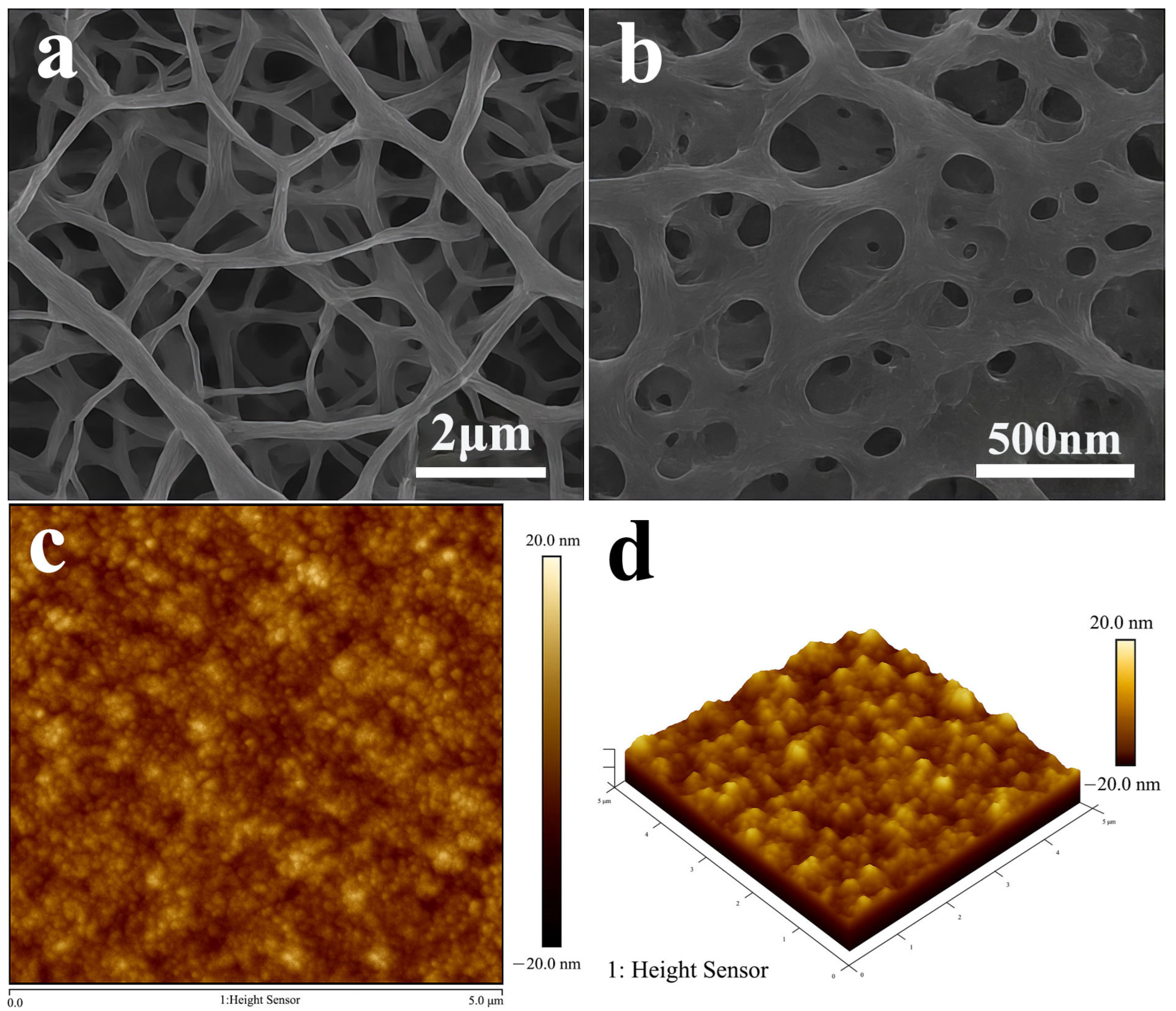
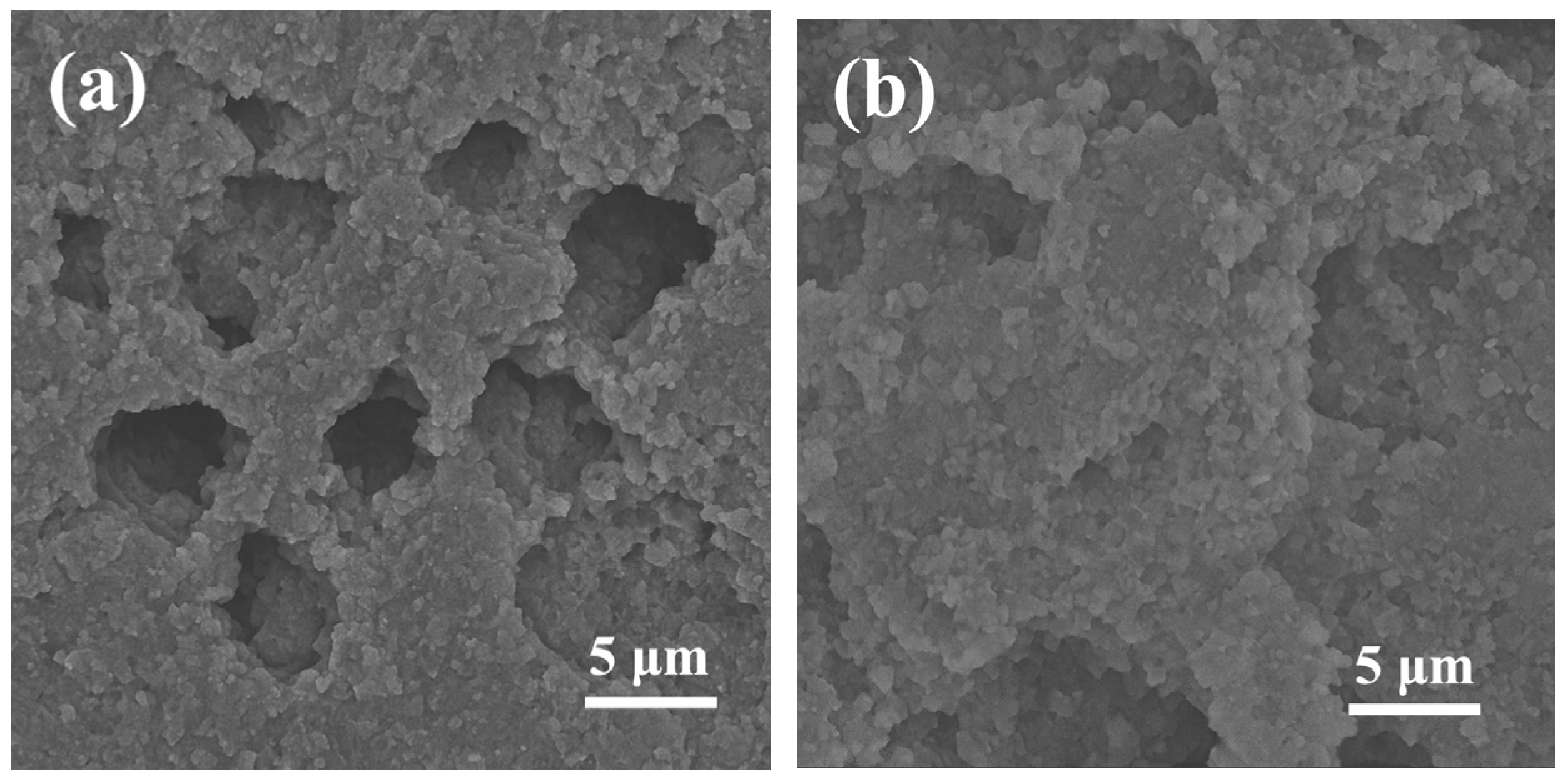
At the microscale, SEM observations reveal that DSRC-NCG forms an irregular sponge-like framework after freeze-drying, accompanied by local shrinkage-induced cracking. Large pores are primarily distributed within the 20–80 μm range (
Figure 1a). At higher magnification, a honeycomb-like porous network with pore sizes concentrated at 0.2–2.0 μm and wall thicknesses of approximately 70–180 nm is observed, indicating a partially interconnected skeleton. High-resolution SEM images (
Figure 1b) further show that SiO
2 nanoparticles (60–120 nm) are uniformly embedded within the pore walls, with bright protrusions appearing at junctions, suggesting localized reinforcement arising from particle–polymer interactions.
AFM analysis provides complementary insight into nanoscale surface topography. The two-dimensional height maps (
Figure 1c) exhibit granular features and shallow grooves, with arithmetic roughness (Ra) values increasing from 9.8 to 14.9 nm as the SiO
2 content rises from 0.08 to 0.20 wt% (
Table 1 and
Table 2). Three-dimensional height maps (
Figure 1d) reveal more pronounced protrusions and fine agglomerates, highlighting the formation of a composite “matrix–particle” interface where nanoscale SiO
2 domains integrate with the polymer backbone.
Quantitative SEM/AFM analysis indicates that increasing SiO
2 content from 0.08 to 0.20 wt% leads to continuous refinement of the network structure, manifested by reduced fiber diameters (
df), increased node densities (
ρnode), and shortened mesh characteristic lengths (
ξ). The network becomes most compact and uniform at 0.16–0.20 wt%, where
df stabilizes at 78–83 nm and ρ_node reaches 1.98–2.15 μm
−2 (
Table 1). Beyond this range (≥0.22 wt%), partial nanoparticle aggregation induces slight coarsening, consistent with the observed increase in
ξ and
Dc.
At the mesoscale, nitrogen adsorption–desorption analysis further confirms the structural optimization induced by moderate SiO
2 loading. As shown in
Table 3, the specific surface area increases from 112.4 to 152.9 m
2/g and pore volume from 0.382 to 0.495 cm
3/g as SiO
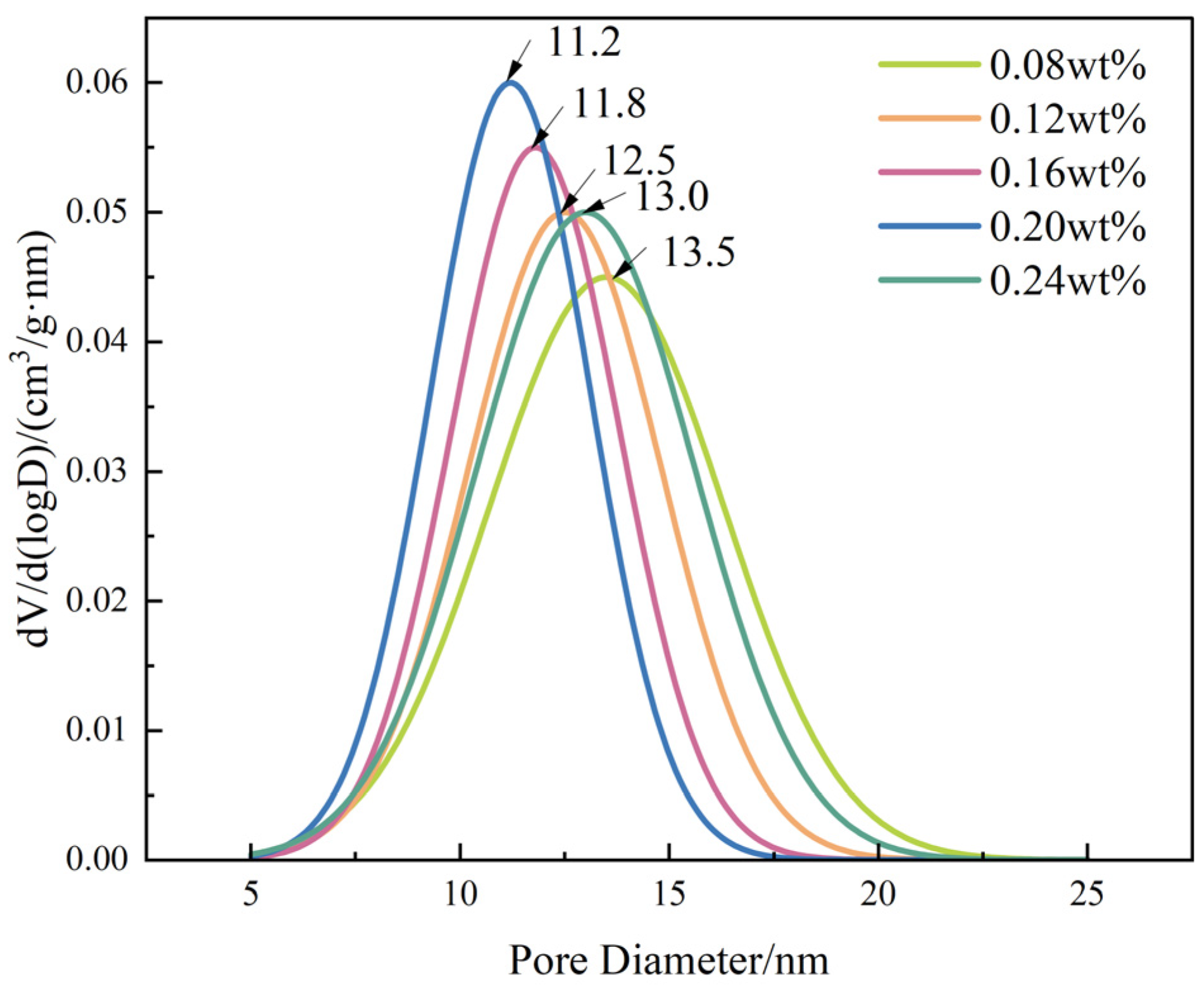
2 content increases to 0.20 wt%, while the average pore size decreases from 13.6 to 11.2 nm. The pore-size distribution curves (
Figure 2) evolve from a broad distribution at low SiO
2 content toward a narrower and more uniform profile within the 0.16–0.20 wt% range, indicating effective pore refinement. At 0.24 wt%, both surface area and pore volume decrease and the distribution broadens again, reflecting aggregation-induced structural heterogeneity.
At the three-dimensional scale, μCT-based pore-network reconstruction reveals a consistent connectivity evolution trend (
Table 4). As the SiO
2 content increases from 0.08 to 0.20 wt%, the connectivity index rises from 0.46 to 0.67, the dominant-channel proportion increases from 34.2% to 51.9%, and the average channel length extends from 18.6 to 24.1 μm. These changes indicate a transition from a “discrete short-chain” pore network to a more continuous and efficient transport pathway. Further increasing the SiO
2 content to 0.24 wt% leads to a pronounced decline in all connectivity metrics, attributed to nanoparticle aggregation causing local pore blockage and pathway interruption.
Overall, multiscale structural characterization consistently demonstrates that DSRC-NCG exhibits an optimal “fine-fiber, high-node-density, uniformly connected” network within the SiO2 content range of 0.16–0.20 wt%. This hierarchical structural optimization provides a robust physical basis for subsequent interfacial regulation and flow-response behavior.
2.1.2. Surface Chemical Characteristics and Interfacial Wettability
To elucidate the surface chemical composition and interfacial properties of DSRC-NCG, FTIR, XPS, and static contact-angle measurements were conducted on samples containing varying SiO
2 contents. The results are summarized in
Table 5 and
Table 6 and
Figure 3 and
Figure 4.
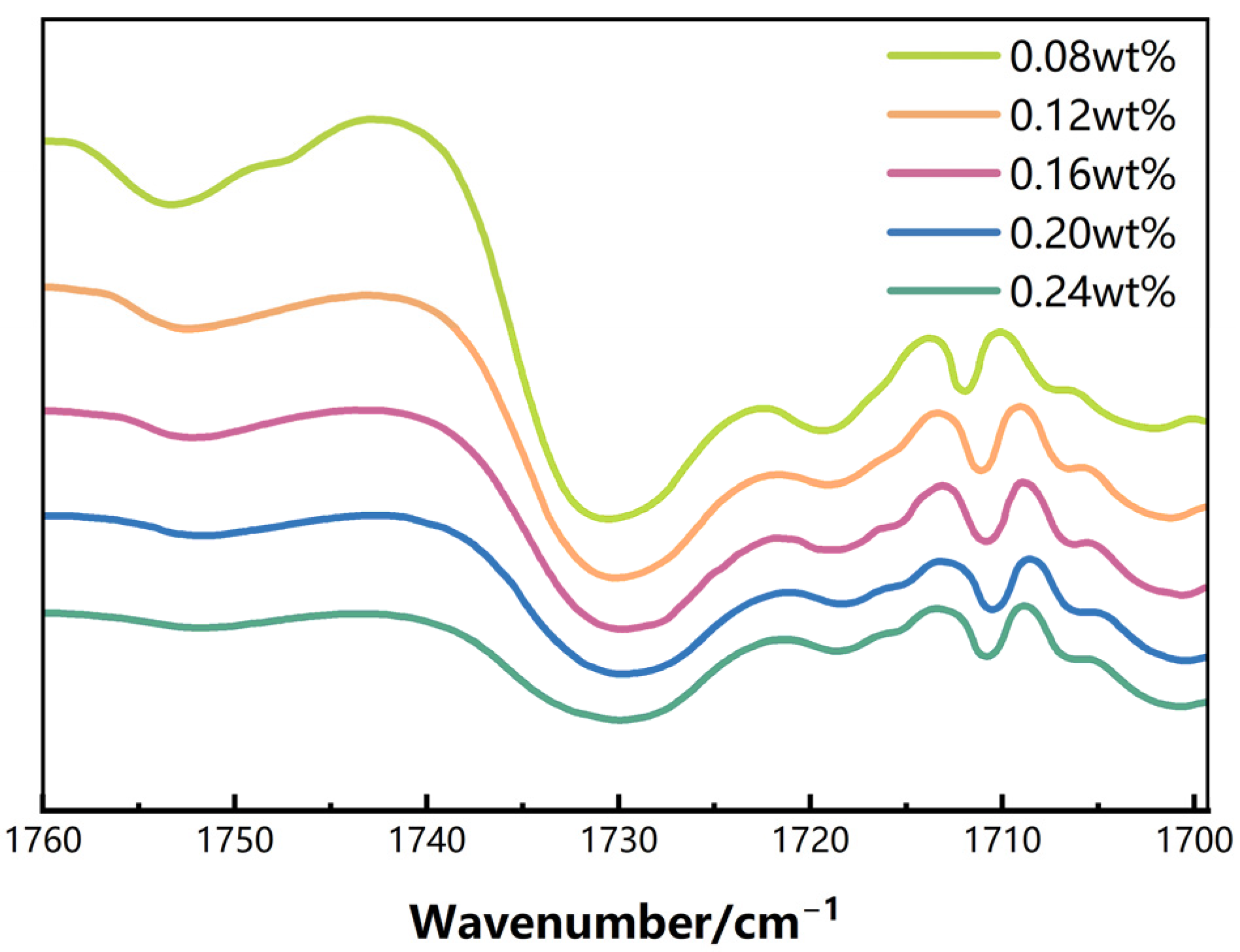
FTIR spectra (
Figure 3,
Table 5) reveal that the C=O stretching vibration peak gradually shifts from 1731.4 cm
−1 to 1726.1 cm
−1 as the SiO
2 content increases from 0.08 wt% to 0.20 wt%. Meanwhile, the intensity of the Si–O–Si absorption band increases from 0.84 to 1.24 (
Table 2). These changes indicate enhanced dispersion of SiO
2 within the polymer matrix and strengthening of polymer–particle interfacial interactions. When the filler content is further increased to 0.24 wt%, the C=O peak shifts back to 1727.5 cm
−1 and the Si–O–Si intensity decreases to 1.10, suggesting that excessive nanoparticles lead to aggregation and a reduction in effective interfacial contact area.
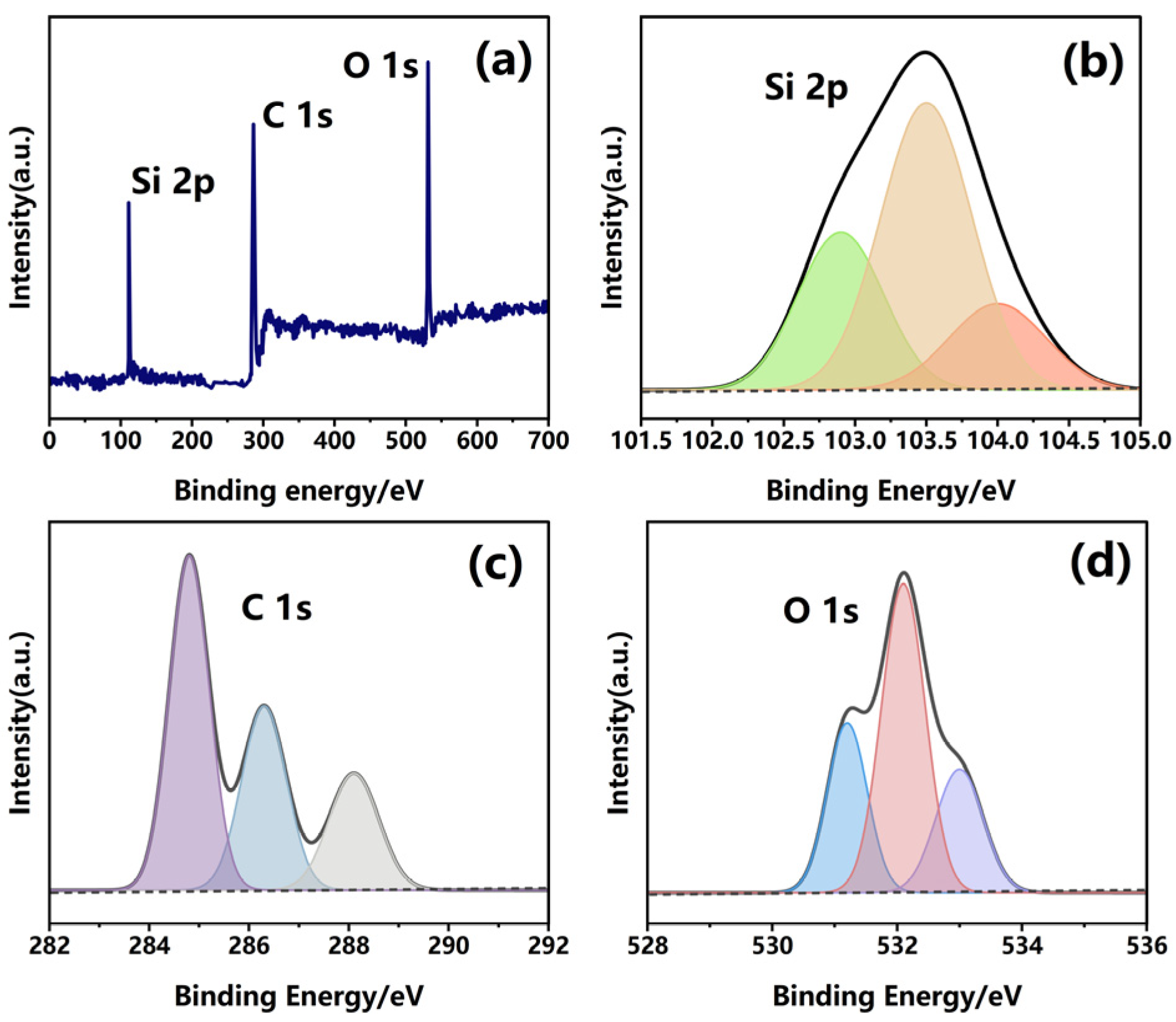
XPS analysis of a representative DSRC-NCG sample with an SiO
2 content of 0.20 wt% (
Figure 4) corroborates these observations. With increasing SiO
2 content, the O/C atomic ratio increases from 0.36 to 0.51, indicating progressive enrichment of oxygen-containing functional groups at the surface. The Si 2p peak area also increases consistently, implying enhanced exposure of SiO
2 on the material surface. At 0.24 wt%, however, the O/C ratio decreases to 0.47, consistent with the aggregation-induced reduction in accessible polar groups observed in FTIR (
Table 6).
Contact-angle measurements further demonstrate that incorporation of SiO2 modifies the surface wettability of DSRC-NCG from hydrophobic to increasingly hydrophilic, with the contact angle decreasing from 92.5° to 78.4° as the SiO2 content increases to 0.20 wt%. A subsequent rise to 83.2° at 0.24 wt% is again attributed to nanoparticle clustering and the associated decrease in exposed polar groups.
Overall, DSRC-NCG exhibits the most favorable surface chemical stability and hydrophilicity within the SiO2 content range of 0.16–0.20 wt%. At higher filler loadings, nanoparticle aggregation disrupts interfacial homogeneity and weakens these beneficial effects. These findings establish a solid basis for understanding the interfacial interactions between the gel and pore–throat structures in subsequent analyses.
2.1.3. Rheological Behavior and Mechanical Stability
To comprehensively evaluate the rheological characteristics and mechanical stability of DSRC-NCG, rotational rheometry, DMA analysis, and compression–swelling coupling experiments were conducted on samples containing different SiO
2 loadings. The corresponding results are summarized in
Table 7 and
Figure 5.
Rheological measurements show that both viscosity and storage modulus (G′) increase substantially as the SiO
2 content rises from 0.08 wt% to 0.20 wt%. Specifically, viscosity increases from 12.4 Pa·s to 32.5 Pa·s, and G′ increases from 1860 Pa to 4120 Pa, while the G′/G″ ratio increases from 1.49 to 2.56 (
Table 7). These trends indicate a progressive enhancement of the elastic contribution and a transition of the network structure from a “loosely connected” to a “reinforced” configuration. When the filler loading is further increased to 0.24 wt%, both viscosity and G′ decrease (29.1 Pa·s and 3650 Pa, respectively), accompanied by a drop in modulus retention from 91.7% to 85.2%, which is attributed to diminished load-transfer efficiency caused by nanoparticle aggregation.
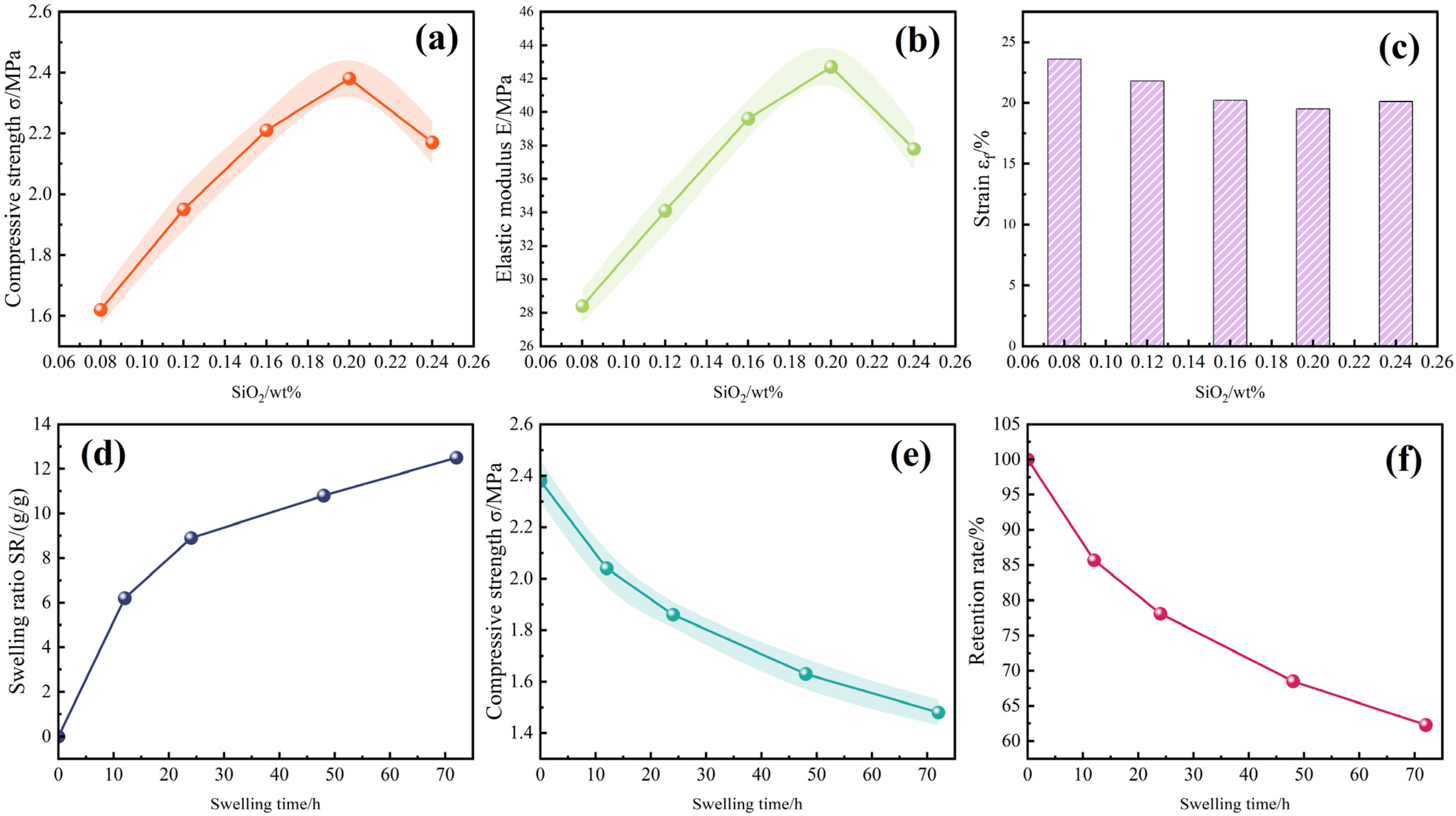
Compression testing further validates these observations. As the SiO
2 content increases from 0.08 wt% to 0.20 wt%, compressive strength increases from 1.62 MPa to 2.38 MPa, elastic modulus increases from 28.4 MPa to 42.7 MPa, and failure strain (
εf) decreases from 23.6% to 19.5% (
Figure 5a–c). These results reflect a transition from a compliant to a densified network structure, consistent with the modulus-enhancing effect observed in the rheological tests. When the filler content is raised to 0.24 wt%, both strength and modulus decline, while
εf slightly increases to 20.1%, indicating that aggregation creates structural discontinuities.
Swelling–mechanical coupling experiments reveal that the swelling ratio (SR) increases from 0 to 12.5 g/g over 72 h, whereas the mechanical response exhibits nonlinear degradation. During the rapid swelling stage (0–12 h), compressive strength decreases to 2.04 MPa, yet the strength retention remains above 85%, indicating that the network maintains considerable load-bearing capacity even while hydrating. At prolonged swelling durations (72 h), compressive strength decreases to 1.48 MPa (retention of 62.3%), reflecting network rearrangement and reduced toughness during long-term immersion (
Figure 5d–f).
Overall, both the rheological and mechanical properties of DSRC-NCG exhibit a continuous “enhancement–optimization–degradation” evolution with increasing SiO2 content, with the optimal performance occurring at 0.16–0.20 wt%. Moderate SiO2 loadings promote network densification and strengthen interfacial bonding, significantly improving load-bearing capacity, elasticity, and environmental stability. Excessive filler content, however, leads to aggregation-induced heterogeneity, diminishing these enhancements.
From a field-injectivity perspective, the observed rheological evolution has direct implications for DSRC-NCG deployment under practical shear conditions. During surface pumping and near-wellbore injection, the gel experiences relatively high shear rates, under which the moderate viscosities measured at 10 s−1 (12.4–32.5 Pa·s) indicate that DSRC-NCG remains injectable without excessive pressure buildup. The progressive increase in G′/G″ with SiO2 content reflects enhanced elastic dominance, which is beneficial for post-injection structural integrity but does not preclude flow under shear-dominated injection regimes.
Importantly, the optimal SiO2 range (0.16–0.20 wt%) represents a balance between injectivity and in situ plugging efficiency. At this compositional window, the gel exhibits sufficient shear resistance to maintain network integrity after placement, while avoiding the excessive viscosity or structural heterogeneity that could impair injectivity. In contrast, higher SiO2 loading (0.24 wt%) leads to aggregation-induced heterogeneity, which may increase flow resistance under variable shear conditions and reduce effective injectivity in tight pore–throat systems. These results suggest that DSRC-NCG can achieve favorable “pumpability–placement–stability” coordination under realistic field shear environments, supporting its applicability for deep-water tight reservoir flow regulation.
Collectively, these structural, interfacial, and mechanical characteristics define the multiscale structural basis required for understanding the subsequent pore–flow coupling and flow-regulation mechanisms discussed in
Section 2.3.
2.2. Pore-Throat Structure Regulation and Flow-Response Mechanisms
Building upon the structural characteristics identified in
Section 2.1, this section systematically examines how pore–throat regulation by DSRC-NCG translates into macroscopic flow responses, thereby providing direct experimental evidence for the structure–flow coupling mechanism.
2.2.1. Multiscale Flow Response Driven by Pore–Throat Structural Evolution
To assess the adaptability of DSRC-NCG across reservoir systems with different permeability levels, three multiscale flow configurations—microfluidic models (pore-scale pore–flow interaction), artificial cores (core-scale flow matching), and dry-gel-coated sandpacks (near-wellbore heterogeneity adaptation)—were established to systematically evaluate pore–flow matching and heterogeneity adaptation under increasing SiO2 content. The comprehensive flow response was quantified using dominant-channel fraction (fdom), pore–flow matching index (HCI), residual resistance factor (RRF), injectivity index (J), and pressure-decay behavior. The combined indicators consistently reveal a “progressive optimization–subsequent attenuation” pattern with increasing SiO2 content, reflecting the gel’s structure–flow coupling mechanism.
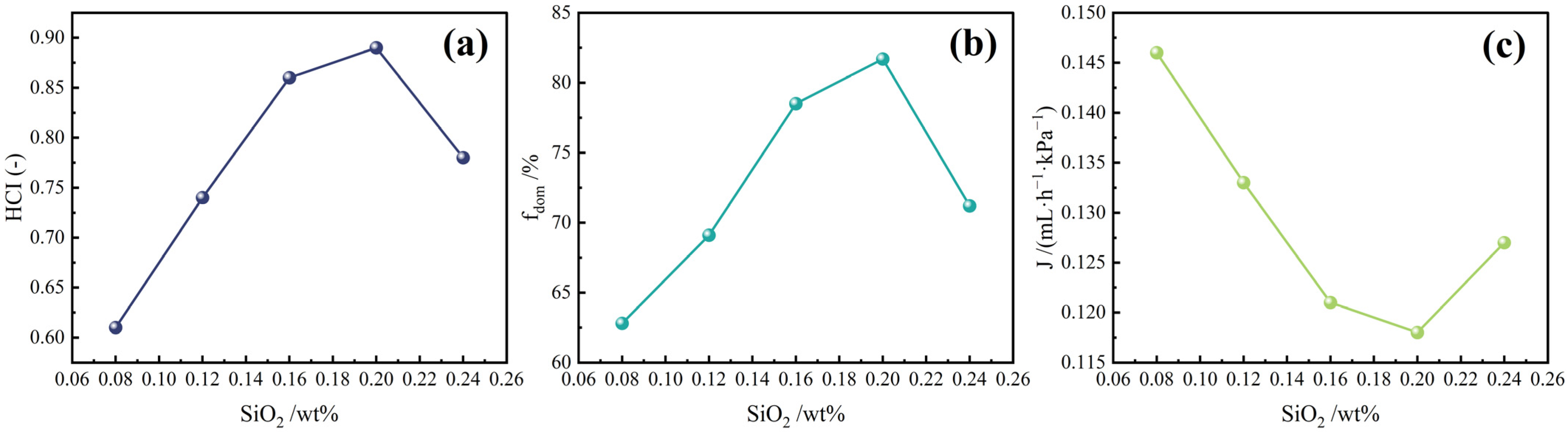
As shown in
Figure 6,
fdom increases from 62.8% to 81.7% and HCI rises from 0.61 to 0.89 as the SiO
2 content increases from 0.08 wt% to 0.20 wt%. The dominant transport pathways evolve from “coarse and highly connected” channels to “multi-branch, fine-scale” networks, indicating a more uniform flux distribution. The increase in
fdom confirms that the primary flow channels are effectively refined and subdivided, while the simultaneous improvement in HCI indicates that blocking efficiency in low-, medium-, and high-permeability zones becomes more balanced, representing optimal overall matching performance.
At 0.24 wt% SiO2, however, fdom decreases to 71.2% and HCI drops to 0.78, suggesting that excessive nanoparticle loading induces aggregation, disrupts fine-pore connectivity, and increases bypass pathways, thereby reducing the system’s ability to regulate heterogeneous reservoirs uniformly.
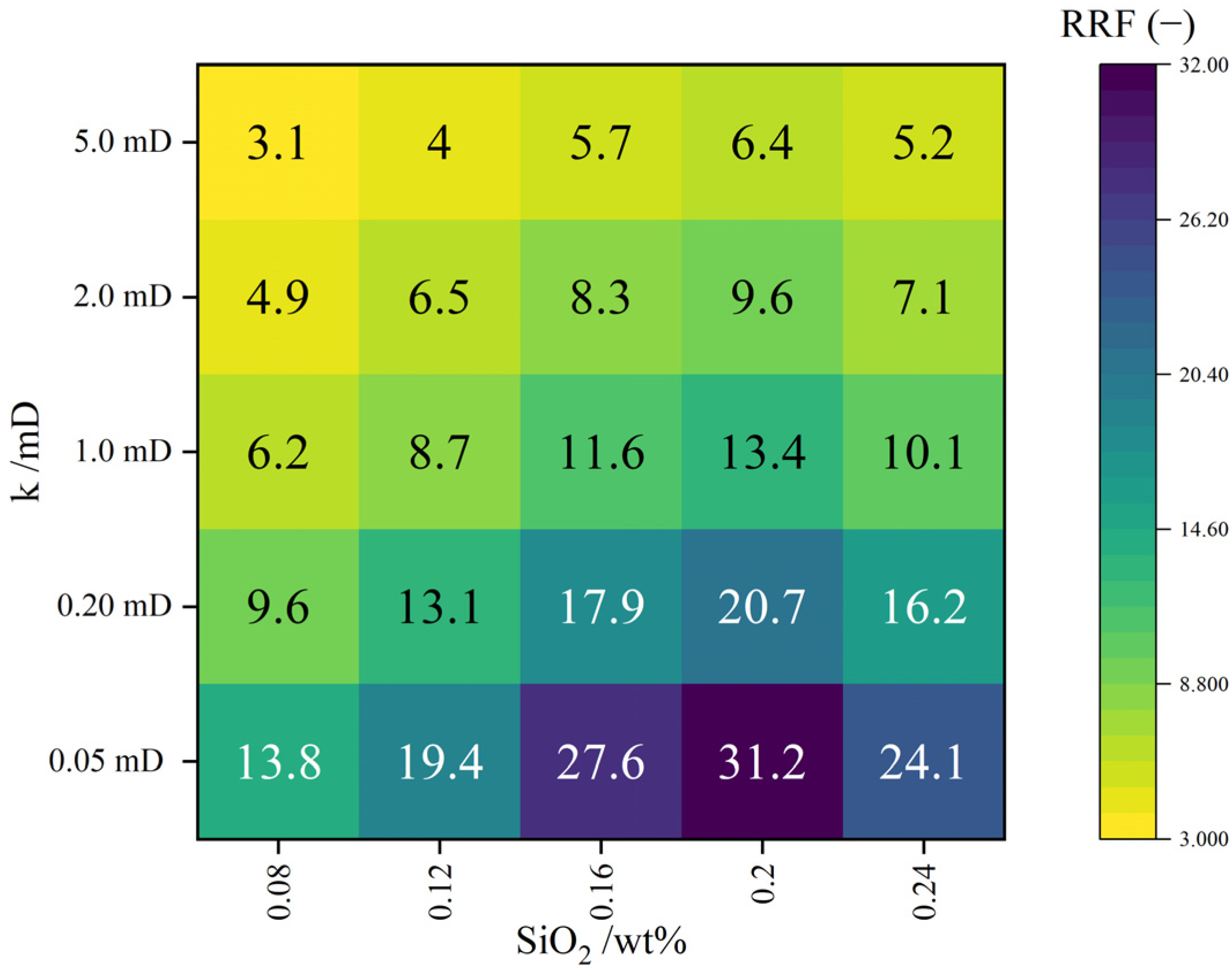
The RRF–K heat map (
Figure 7) further reveals a distinct two-dimensional distribution pattern. Along the SiO
2-content direction, RRF increases across all permeability intervals and forms a continuous “high-response band” within the optimal window of 0.16–0.20 wt%. Along the permeability direction, RRF increases most significantly in the low-permeability region (0.05–0.20 mD), indicating that nanoparticles preferentially form denser networks within fine pores, enhancing flow resistance. In the medium-to-high permeability region (1.0–5.0 mD), RRF also increases but with a gentler gradient, reflecting the “refinement of coarse channels.”
At the optimal 0.20 wt% SiO2, the highest RRF values are obtained across all permeability levels (31.2 → 6.4 with increasing K), confirming strong cross-permeability control. At 0.24 wt%, however, a local “cold zone” reappears, with reduced RRF in low-permeability cores due to aggregation-induced pore blockage and bypass flow.
This two-dimensional pattern indicates that the 0.16–0.20 wt% interval is the optimal range for achieving “fine-pore connection, coarse-channel refinement, and cross-permeability balance,” consistent with the microfluidic observations.
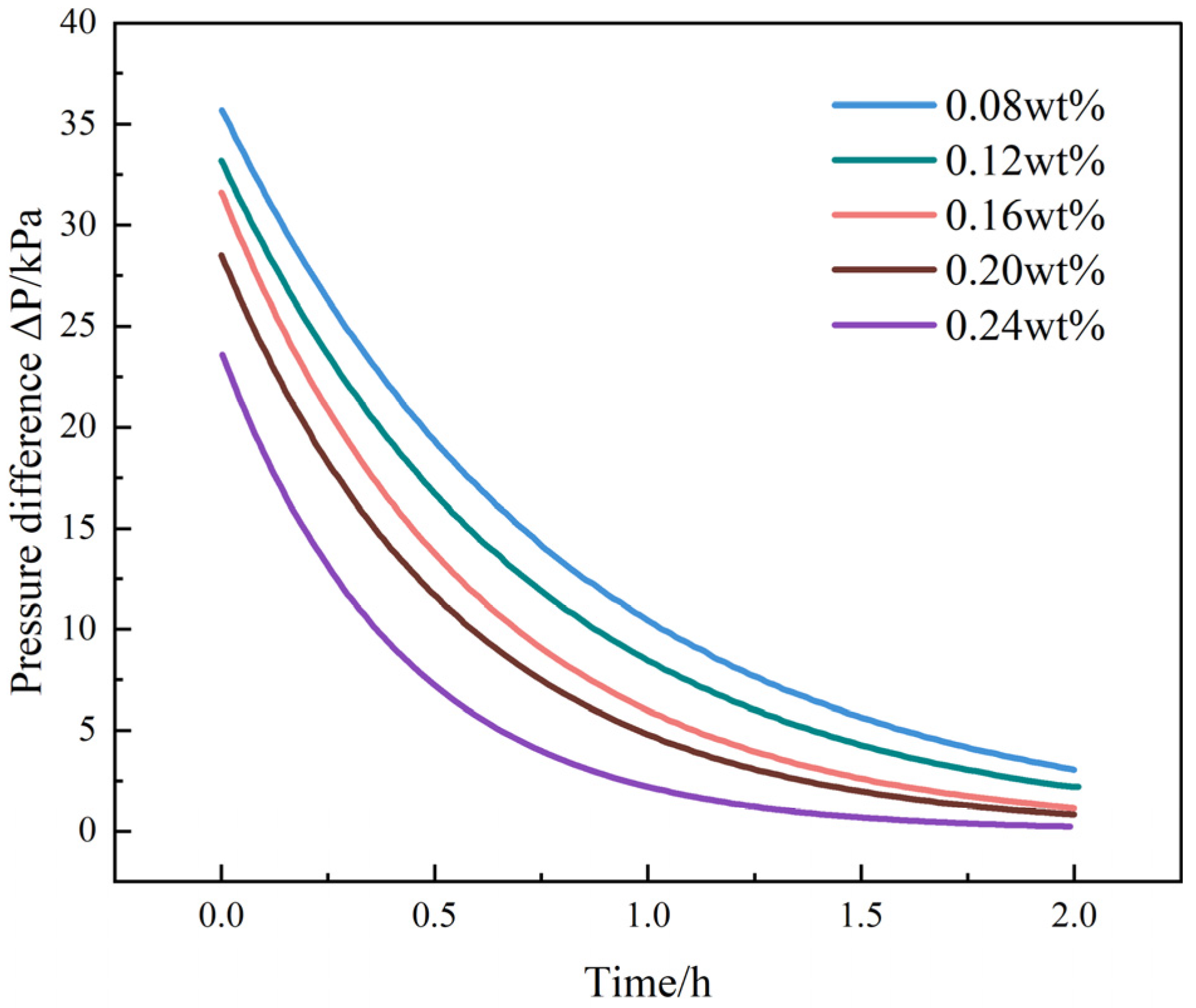
Injectivity index (J) and pressure–time curves (
Figure 8,
Table 8) further confirm the “blocking–injectivity balance” within the optimal nanoparticle range. Both initial and steady-state J values decrease as SiO
2 content increases, yet at 0.20 wt%, the system still maintains a practical injectivity window (steady-state J = 0.121 mL·h
−1·kPa
−1), indicating no injection difficulties. Meanwhile, the peak pressure reaches its maximum (35.7 kPa), and the half-decay time is the longest (0.81 h), reflecting strengthened gel network stability, reduced leak-off, and the highest blocking intensity.
At 0.24 wt%, although the peak pressure remains high, the sharper pressure decay (0.60 h) suggests “localized plugging + bypass flow,” consistent with the reductions in fdom and HCI.
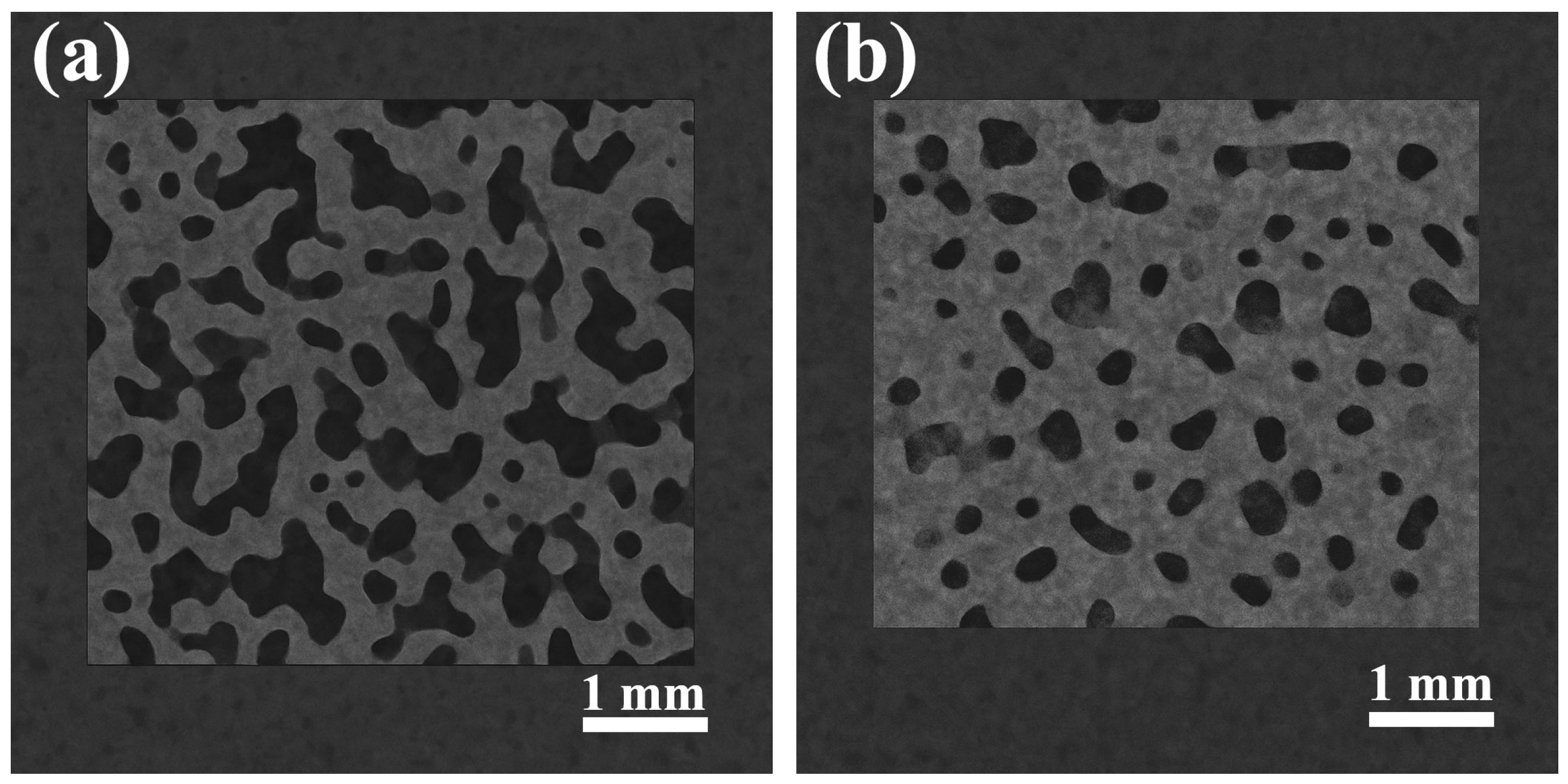
To directly link flow behavior with structural evolution, SEM and micro-CT observations before and after gel treatment are shown in
Figure 9 and
Figure 10. At the microscale, gel treatment smooths grain surfaces, fills or bridges pore throats, and reduces pore-edge roughness. At the mesoscale, micro-CT images reveal partial occupation and disruption of dominant flow channels, resulting in reduced pore connectivity and more homogeneous grayscale distributions. These multiscale morphological changes provide direct structural evidence for the observed redistribution of flow pathways and enhancement of pore–flow matching.
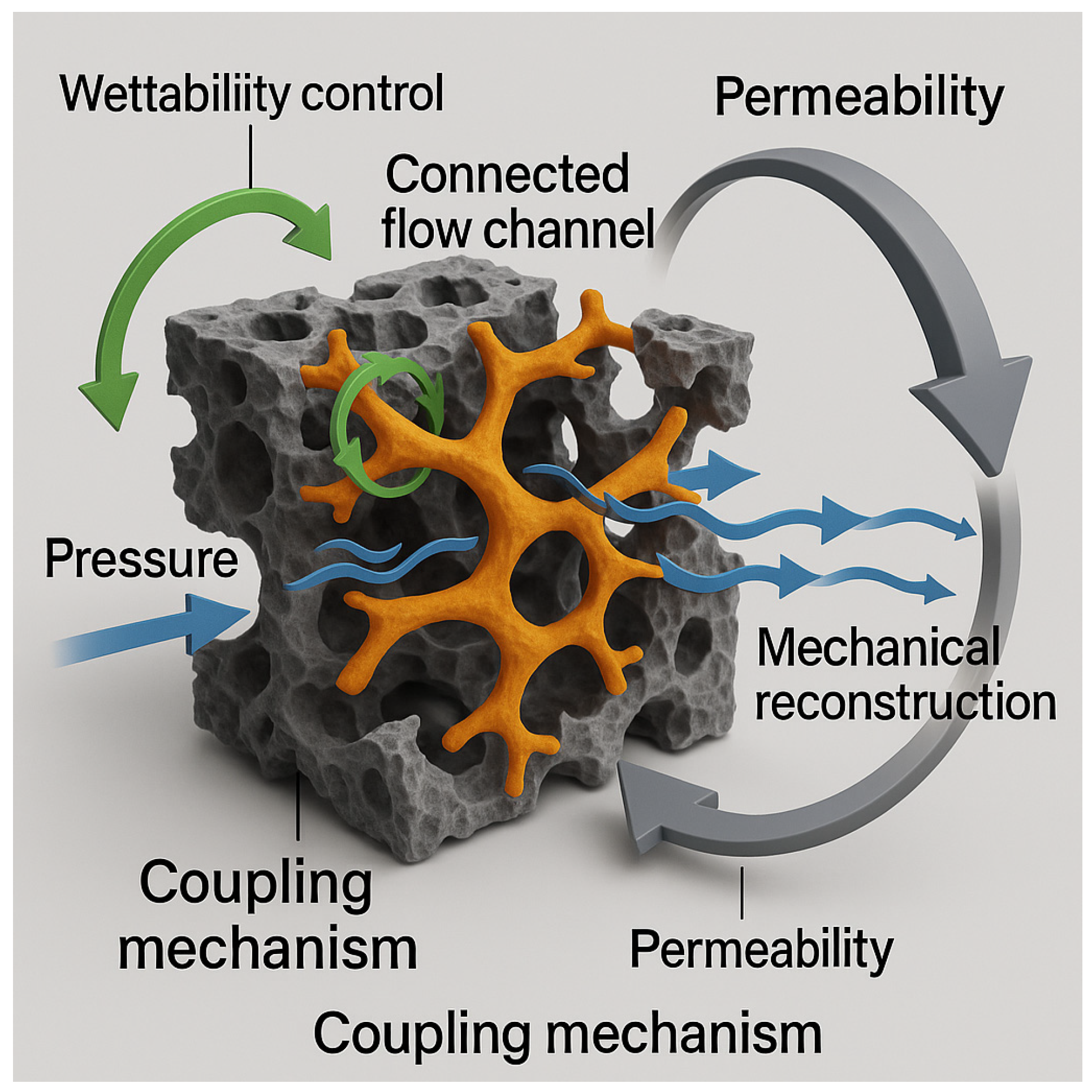
These multiscale flow responses collectively indicate that DSRC-NCG does not simply block pores, but actively reconstructs dominant flow pathways through structure–flow coupling, which is further integrated and conceptualized in
Section 2.3.
2.2.2. Quantitative Structural Regulation, Network Evolution, and Reversibility
Under simulated deep-water tight-reservoir conditions of 90 °C, 35 MPa, and a salinity of 30.0 g/L, in situ micro-CT sequential imaging revealed a typical three-stage structural evolution during the injection of DSRC-NCG. As the injected pore volume increased from 0.3 PV to 0.6 PV, the connected porosity
φc increased from 12.1% to 12.9%, the dominant-channel volume fraction
Vdom increased from 9.4% to 10.7%, the coordination number Z rose from 2.71 to 2.96, and the tortuosity
τ decreased from 1.63 to 1.55 (
Table 9). These changes indicate preferential occupation of dominant channels by the gel, driving the pore network toward a state characterized by high connectivity and low tortuosity.
During the subsequent gel-setting stage (2 h), the structural parameters were further optimized, with φc reaching 13.1%, Vdom 11.0%, Z 3.04, and τ 1.52. Correspondingly, the permeability values obtained from LBM inversion and steady-state testing decreased to 0.20 mD and 0.19 mD, respectively. This suggests selective filling of dominant channels and the formation of stable localized blockage zones. During chemical degradation, the experimentally measured permeability kexp increased to 0.35 mD at 12 h and further to 0.43 mD at 24 h, while φc and τ partially returned toward their initial values (12.5%, 1.58 at 12 h; 11.8%, 1.66 at 24 h). This reflects a reversible flow-response behavior consisting of blockage followed by partial reopening.
The structural parameters obtained under different SiO
2 contents further demonstrate a clear composition-window effect (
Table 10). Within the range of 0.16 to 0.20 wt%,
Vdom reached its highest values (11.5–11.8%),
τ reached its lowest values (1.51–1.49), and
kexp reached its minimum values (0.22–0.19 mD). This indicates that the gel network in this range can simultaneously enhance channel coordination, reduce flow-path tortuosity, and effectively suppress bypass flow. In contrast, when SiO
2 content exceeded 0.24 wt%, particle aggregation reduced throat radius rth, caused
χ to decrease sharply (more negative), and resulted in the passivation of dominant channels, thereby increasing
kexp (0.27–0.38 mD).
Overall, the pore–throat network parameters (φc, Vdom, Z, τ, χ) and flow properties (kimg, kexp) exhibit synchronized evolution and strong composition dependence. This forms a continuous response process that includes channel restructuring, localized blockage, and partial reopening, supporting the coupled mechanism by which DSRC-NCG regulates seepage behavior through structural modification.
Following gel degradation, both micron- and nanometer-scale parameters recover toward their original states, with recovery ratios exceeding 90%, demonstrating that the structural regulation induced by DSRC-NCG is predominantly reversible. Based on the combined evaluation of throat contraction, distribution convergence, and surface-area enhancement, the structural regulation index (SRI) reaches its highest values at 0.16–0.20 wt%, confirming this compositional window as optimal for achieving stable, balanced, and reversible pore–throat regulation.
Overall, the coupled evolution of pore–throat structure and flow response reveals a continuous mechanism involving dominant-channel refinement, selective blockage, and partial reopening. This structure–flow coupling explains the observed balance between strong conformance control and maintained injectivity, providing a mechanistic foundation for the application of DSRC-NCG in tight-reservoir flow regulation.
At the micron scale, the dominant throat radius decreases progressively from the untreated value of 0.353 µm to 0.308, 0.271, and 0.248 µm, corresponding to reductions of 12.7%, 23.2%, and 29.7%, respectively. Meanwhile, the distribution width (FWHM) narrows from 0.212 µm to 0.187, 0.171, and 0.163 µm, indicating an evolution from dispersed to concentrated throat dimensions. Within this concentration range, the bimodality index remains stable at 0.09–0.10, with no indication of structural divergence. By contrast, at 0.24 wt%, the emergence of two dominant throat radii (0.236 µm and 0.381 µm), along with the increase in FWHM to 0.272 µm and BI to 0.34, demonstrates clear non-uniformity introduced by high gel concentration (
Table 11).
At the nanometer scale, mesopore structure evolution mirrors the micron-scale trend. The BJH dominant peak decreases from 11.82 nm to 10.73, 9.86, and 9.62 nm; the distribution width narrows from 5.62 nm to 5.27, 4.81, and 4.56 nm; and the specific surface area increases from 7.42 m2/g to 8.15, 8.94, and 9.18 m2/g, corresponding to increases of 9.8 percent, 20.5 percent, and 23.7%, respectively. However, at 0.24 wt%, dual mesopore peaks (9.47 nm and 12.21 nm) reappear, the distribution width increases to 6.13 nm, and the specific surface area decreases to 9.02 m2/g, consistent with the non-uniform behavior observed at the micron scale.
Following gel degradation, the pore–throat structure exhibits a clear reversible recovery. The dominant throat radius returns to 0.331 µm, equivalent to 93.8% of the untreated sample. The BJH dominant peak returns to 11.33 nm (95.8% recovery), and the specific surface area decreases to 7.88 m2/g (106% recovery). This recovery indicates that the structural regulation induced by the gel is primarily governed by reversible adhesion, filling, and interface-modification mechanisms, rather than irreversible damage to the mineral framework.
Based on the combined evaluation of throat contraction, distribution convergence, and surface-area enhancement, the structural regulation index (SRI) demonstrates that the 0.16 wt% and 0.20 wt% samples achieve the highest values of 0.29 and 0.33, reflecting the most effective structural adjustment. In contrast, the SRI of the 0.24 wt% sample decreases to 0.05, consistent with the bimodal patterns observed at both scales. Collectively, these findings indicate that nanocomposite gel at moderate concentrations (0.16–0.20 wt%) can achieve simultaneous throat refinement, distribution convergence, and surface-area gain, whereas excessive concentrations lead to particle aggregation, reduced structural uniformity, and diminished stability of flow pathways.
2.3. Field-Scale Implications for Improved Oil Recovery
From a reservoir engineering perspective, the multiscale pore–flow regulation behavior of DSRC-NCG observed in this study has direct implications for improved oil recovery in deep-water tight reservoirs. The refinement and redistribution of dominant flow channels, as evidenced by increased HCI and optimized RRF distributions, are expected to enhance sweep efficiency by mitigating early breakthrough through high-permeability streaks while maintaining connectivity within low-permeability zones. This balanced cross-permeability control is particularly critical for tight reservoirs, where production is often governed by a limited number of preferential flow paths.
At the field scale, such pore–flow matching behavior translates into more uniform displacement fronts during waterflooding or gas injection, delayed water cut rise, and improved utilization of previously unswept reservoir volumes. The identification of an optimal SiO2 content window (0.16–0.20 wt%) further suggests that DSRC-NCG can be designed to achieve effective conformance control without compromising injectivity, thereby supporting sustained production and incremental oil recovery. While the present study focuses on mechanistic and multiscale experimental evaluation, the established structure–flow coupling framework provides a quantitative basis for subsequent reservoir-scale simulation and pilot implementation.
2.4. Coupled Mechanism of Flow Behavior
The abbreviations used in this study are summarized in
Appendix A. Based on the multi-scale structural descriptors (including
rmode, FWHM,
Z,
τ, and
Vdom) and the flow-response indicators (such as
fdom, HCI, RRF, and J), the flow behavior of DSRC-NCG in deepwater tight reservoirs can be interpreted as a continuous coupling process consisting of pore-throat network reconstruction, flow-path redistribution, and reversible flow regulation (
Figure 11).
First, pore-throat restructuring provides the fundamental basis for flow evolution. Within the optimal concentration window of 0.16–0.20 wt%, the MICP–BET results show that the dominant throat size decreases from 0.353 μm to 0.248 μm, while the specific surface area increases to 9.18 m2/g. Correspondingly, the μCT-derived connectivity Z increases from 2.42 to 3.04, tortuosity τ decreases from 1.78 to 1.52, and the dominant-channel volume fraction Vdom increases from 7.6% to 11.0%. These coordinated changes indicate that the gel produces a combined “refinement–bridging” effect across the micro–nano scales, transforming a network previously governed by a few coarse channels into a more uniform and low-tortuosity flow pathway.
Second, the structural restructuring directly drives selective flow-path regulation. Microfluidic and core-flooding experiments show that fdom increases from 62.8% to 81.7% within the optimal concentration range, while HCI rises from 0.61 to 0.89. The RRF values for the low-, medium-, and high-permeability cores simultaneously increase and form a continuous high-response zone, demonstrating that coarse channels are effectively refined and fine channels are reconnected. Although the injectivity index J decreases with increasing concentration, it remains within an acceptable injection window at 0.20 wt% (steady J = 0.121 mL·h−1·kPa−1), indicating a balanced state where sealing strength is enhanced without compromising injectivity.
When the SiO2 content reaches or exceeds 0.24 wt%, the structural–flow coupling relationship reverses. μCT reveals the reappearance of peak splitting and an increase in τ, while fdom and HCI decline and RRF exhibits cold zones. These phenomena indicate localized plugging accompanied by enhanced bypass flow, confirming that particle agglomeration disrupts the uniform regulation capability of the network.
Finally, during the degradation stage, both structural parameters and flow indicators show substantial recoverability. For example, kexp rises from 0.19 mD to 0.43 mD, demonstrating that the gel primarily regulates flow through reversible adhesion and bridging effects rather than permanent pore-structure damage.
Overall, the coupled mechanism of DSRC-NCG can be summarized as follows: appropriate SiO2 content enables a refinement- and bridging-driven restructuring of the pore-throat network, guiding the flow paths toward uniformity and achieving cross-permeability collaborative control. Excessive SiO2 disrupts this coupling due to particle agglomeration. This mechanism is consistently supported by both structural parameters and flow-response functions.
3. Conclusions
(1) A narrow and operational compositional window (SiO2 = 0.16–0.20 wt%) is identified as the design rule for DSRC-NCG under deep-water tight-reservoir conditions. In this window, the gel simultaneously maximizes (i) network continuity and stability, (ii) surface polarity/wettability, and (iii) rheological/mechanical robustness, whereas over-loading (≥0.24 wt%) triggers aggregation-driven heterogeneity that systematically degrades these coupled properties.
(2) Cross-scale evidence establishes a quantitative “structure → pore–throat → flow” linkage for DSRC-NCG. Moderate SiO2 loading produces coordinated throat refinement and distribution convergence (micro–nano pore metrics), which translates into dominant-channel redistribution and improved cross-permeability conformance (fdom, HCI, RRF), while maintaining a practical injectivity window (J). This verifies that the optimal formulation achieves “plugging strength–injectivity coordination”, rather than pursuing plugging at the expense of placement.
(3) A reversible structure–flow coupling mechanism is confirmed and can be summarized as selective adsorption/filling → dominant-channel refinement and stabilization → chemically triggered partial reopening. Time-resolved μCT and permeability responses show synchronized evolution of connectivity/topology (ϕc, Vdom, Z, τ, χ) with (kimg, kexp), demonstrating that regulation is dominated by reversible interfacial adhesion and occupancy instead of irreversible pore damage. This mechanism provides the central rationale for low-damage, controllable conformance control in tight pore–throat networks.
(4) Field-scale implications: the identified window (0.16–0.20 wt% SiO2) offers a deployable balance among placement (injectivity), in situ conformance (cross-permeability control), and post-treatment reversibility, which is essential for improved sweep efficiency in heterogeneous tight reservoirs. The formulation and pumping workflow are compatible with conventional operations, supporting scalability. Key implementation challenges are expected to be dominated by reservoir-scale heterogeneity, long-term thermal exposure, and injection–production coupling that may affect placement uniformity and degradation controllability. Accordingly, future work should prioritize long-duration coreflooding, large-scale physical modeling, and pilot validation to quantify placement efficiency, longevity, and controllable reopening under representative field boundary conditions.