Research Progress of Natural Polysaccharide-Based Hydrogels in Skin Tissue Regeneration

 ,
,
Abstract
1. Introduction
2. Pathogenesis of Impaired Skin Wound Healing and Therapeutic Targets
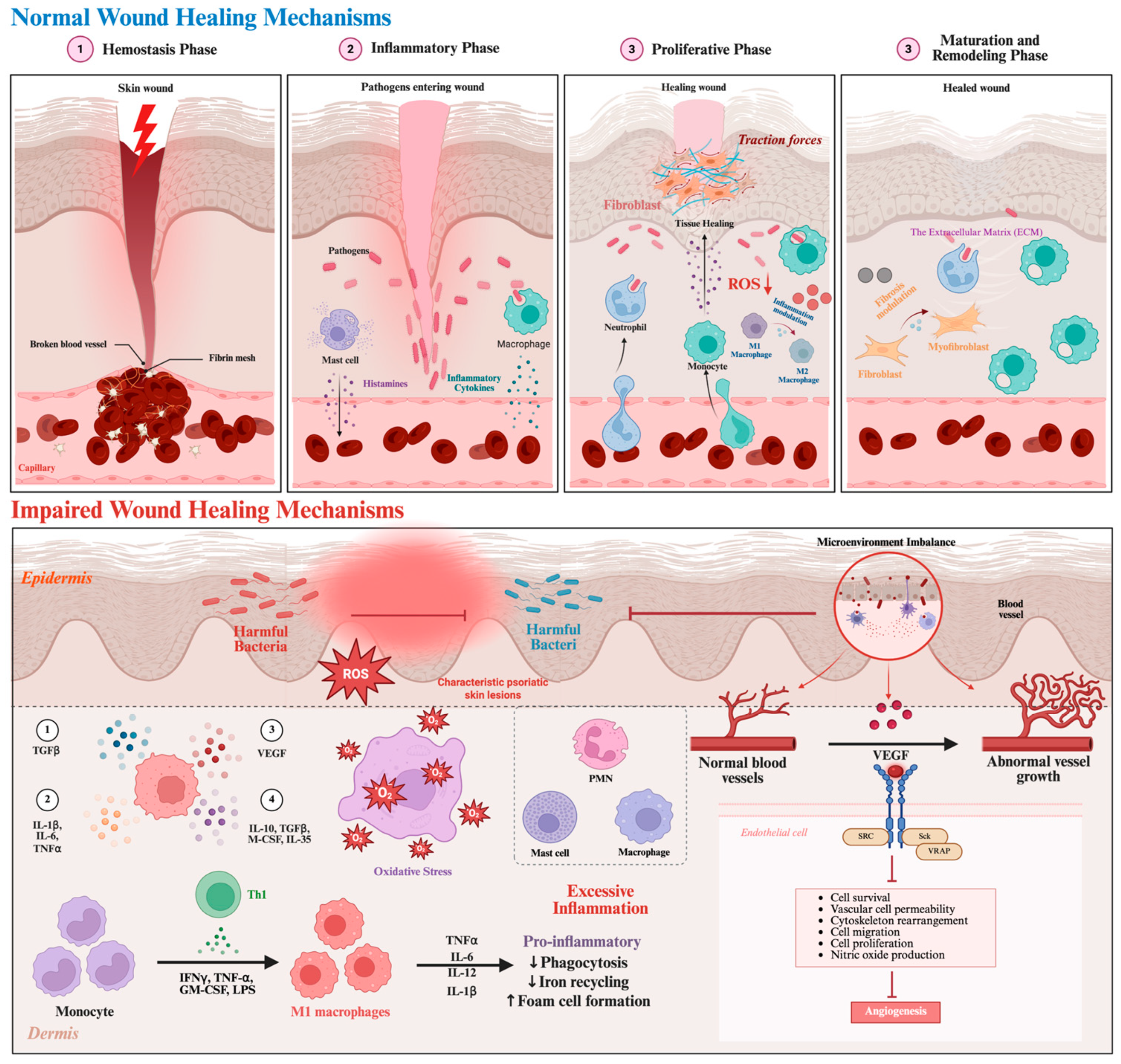
2.1. Normal Cascade Reactions of Wound Healing
2.2. Pathological Mechanisms of Chronic Wounds
2.3. Key Biological Targets in Skin Regeneration
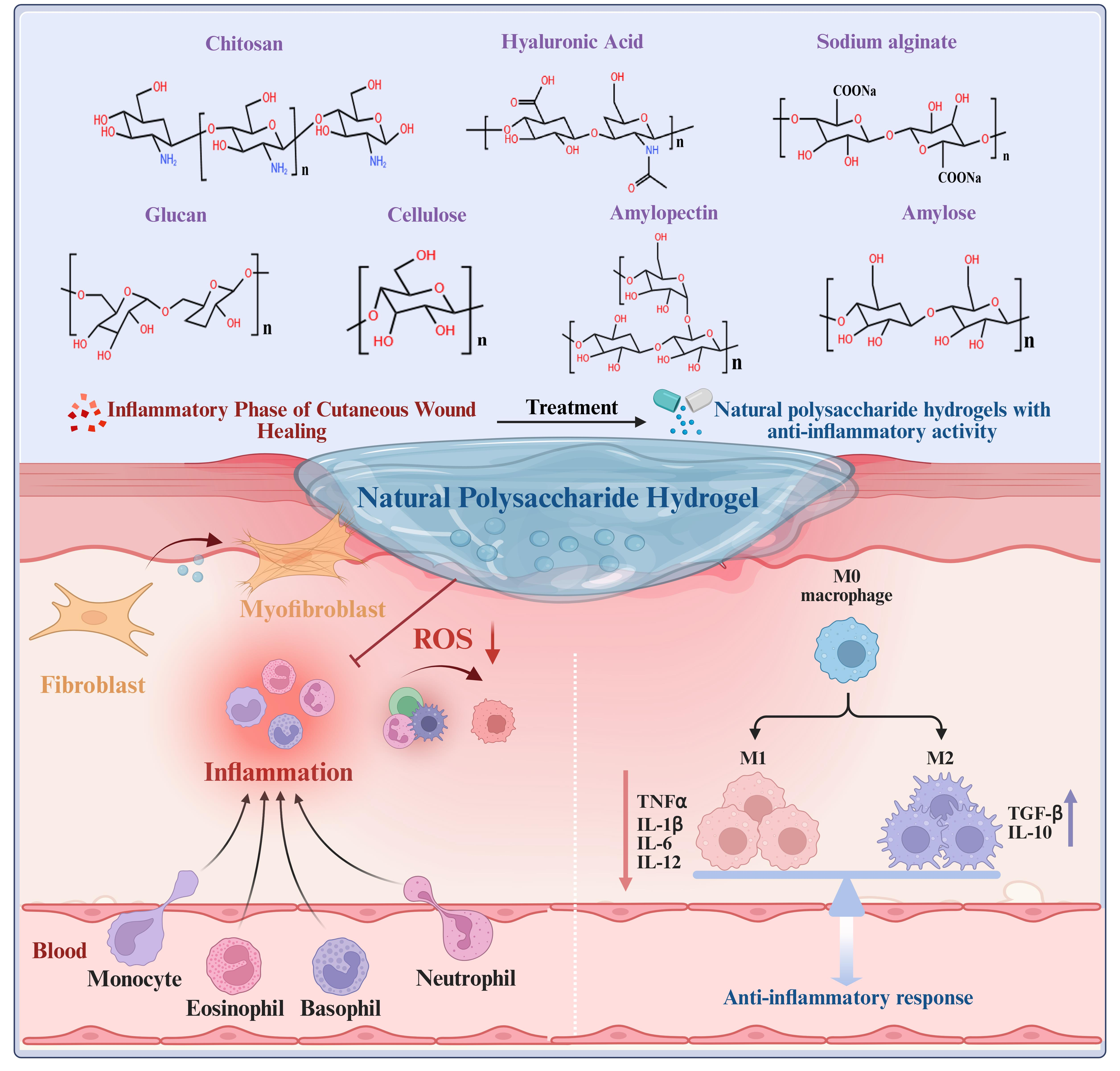
2.4. Theoretical Basis for Wound Repair by Natural Polysaccharide Hydrogels
2.4.1. Synergistic Multi-Bioactivity to Improve the Wound Microenvironment
2.4.2. Regulation of Cellular Signaling Pathways to Support Repair Mechanisms
2.4.3. Structural Design to Enhance Biological Effects and Clinical Adaptability
3. Natural Polysaccharide-Based Hydrogels: Material and Engineering Toolbox
3.1. Natural Polysaccharide Materials
3.1.1. Chitosan
3.1.2. Hyaluronic Acid
3.1.3. Sodium Alginate
3.1.4. Starch
3.1.5. Cellulose
3.1.6. Dextran
3.1.7. Other Natural Polysaccharide Materials

| Natural Polysaccharide | Source | Key Functions | Mechanism of Action | Typical Applications | Representative References |
|---|---|---|---|---|---|
| Chitosan (CS) | Crustacean exoskeletons, fungal cell walls | Rapid hemostasis, antibacterial, immunomodulation | Positively charged amino groups bind to red blood cells/platelets to promote coagulation; disrupt bacterial membranes; regulate macrophage M1→M2 polarization | Acute wounds, burns, surgical incisions | [128,129] |
| Sodium Alginate (SA) | Marine algae | Hemostasis, exudate absorption, moist wound healing environment | Forms an “egg-box” network with Ca2+; high water absorption and swelling; maintains a moist microenvironment | Acute wounds, moist wound dressings | [130] |
| Hyaluronic Acid (HA) | Human tissues (e.g., skin, synovial fluid), microbial fermentation | Promotes re-epithelialization, angiogenesis, anti-inflammatory | Regulates keratinocyte migration; promotes M2 macrophage polarization; can deliver drugs/VEGF/growth factors | Full-thickness skin defects, chronic ulcers | [4,131,132] |
| Gelatin (GEL) | Hydrolysis of animal collagen | Angiogenesis, cell adhesion, scaffold formation | Mimics the natural extracellular matrix (ECM), supports fibroblast and endothelial cell adhesion and proliferation | Skin tissue engineering scaffolds, chronic wounds | [133] |
| Chitosan-Gelatin Composite (CS/GEL) | Composite of chitosan and gelatin | Integrated mechanical reinforcement, angiogenesis, immunomodulation | Multi-network/gradient structure provides mechanical support and energy dissipation; composite network promotes vascularization | Skin tissue engineering, wound repair | [134] |
| Bletilla striata Polysaccharide (BSP) | Tubers of Bletilla striata | Anti-biofilm, anti-inflammatory, promotes healing | Inhibits bacterial biofilm formation; modulates inflammatory cytokines; promotes fibroblast proliferation | Diabetic foot ulcers, chronic wounds | [135] |
| Berberine-BSP Composite Hydrogel | Composite of BSP and berberine | Antibacterial, anti-inflammatory, promotes angiogenesis | Berberine provides antibacterial/anti-inflammatory effects; BSP provides a 3D scaffold structure to promote vascularization | Chronic ulcers, pressure sores | [135] |
| HPCS-C (Hydroxypropyl Chitosan-Catechol Conjugate) | Chemically modified chitosan | Injectable, self-healing hydrogel, rapid hemostasis | Dynamic Schiff base cross-linking imparts self-healing properties; rapidly forms a hemostatic barrier | Acute wounds, non-compressible wounds | [128] |
| Polysaccharide-Nanoparticle Composite Hydrogel | Composite of polysaccharides and nanoparticles (e.g., silver nanoparticles) | Antibacterial, antioxidant, intelligent drug delivery | Nanoparticles enable controlled release of silver ions or drugs; polysaccharide network provides a moist environment | Chronic wounds, infected wounds | [20,130,136] |
| Polysaccharide-Protein Composite Hydrogel | Composite of polysaccharides and proteins (e.g., collagen) | Mechanical reinforcement, angiogenesis, re-epithelialization | Multi-network structure enhances toughness and self-healing; proteins provide cell adhesion sites | Skin tissue engineering, full-thickness skin defects | [133,137] |
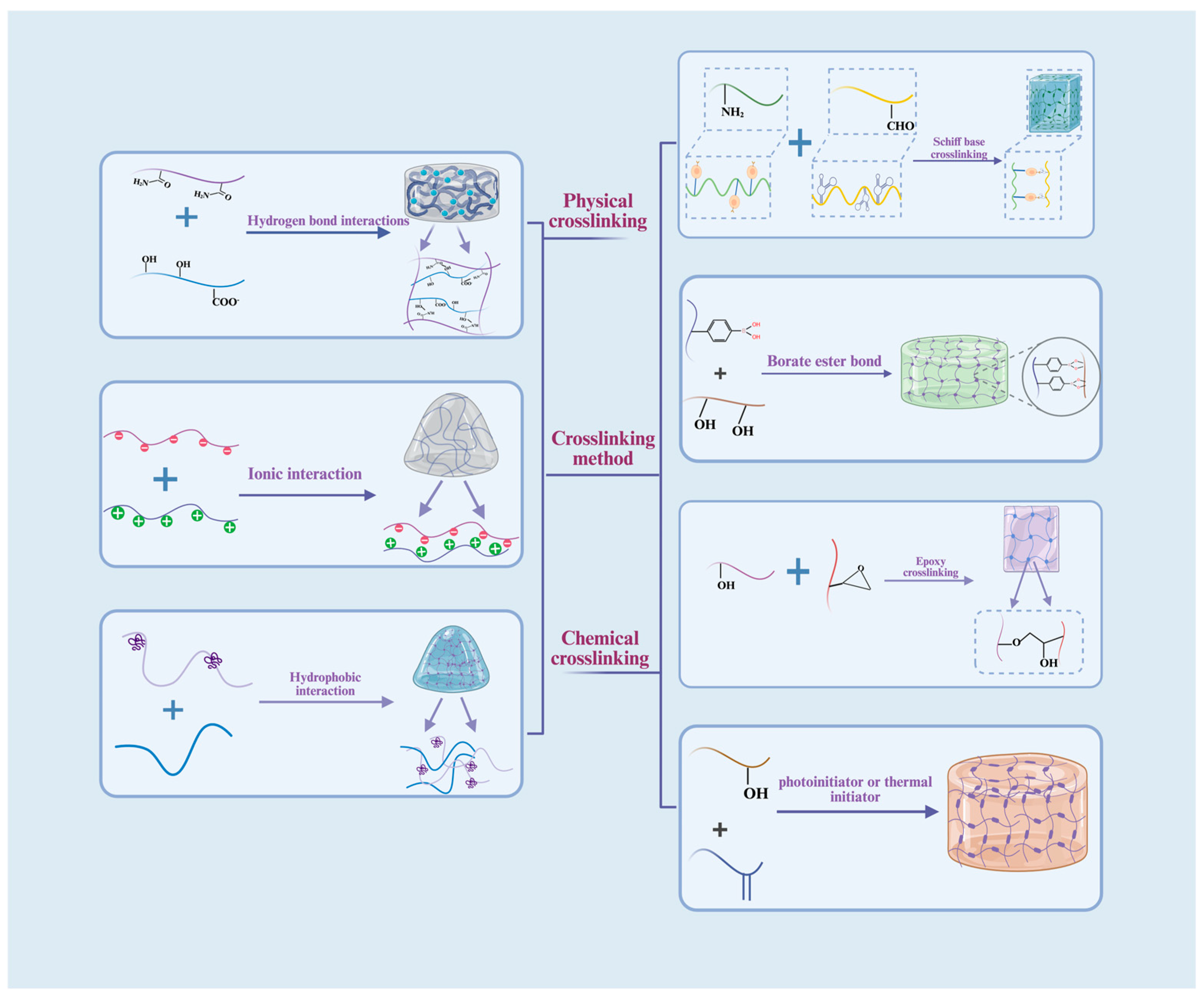
3.2. Crosslinking Strategies and Key Characterization Techniques
3.2.1. Physical Crosslinking
Hydrogen Bond Interactions
Hydrophobic Interactions
Ionic Interactions
3.2.2. Chemical Crosslinking
Schiff Base (Imine) Crosslinking
Boronate Ester Crosslinking
Epoxy Crosslinking
Free Radical Polymerization Crosslinking
3.3. Structural Design and Functional Enhancement Strategies
- (1)
- Network topology engineering, such as constructing double networks, interpenetrating networks, or gradient networks, to synergistically enhance strength, toughness, and dynamic adaptability;
- (2)
- Spatial biomimetic configurations, precisely controlling pore size, pore connectivity, and anisotropy to guide cell migration, angiogenesis, and tissue reconstruction;
- (3)
- Functional module integration, introducing antibacterial, antioxidant, and immunomodulatory components to establish multi-mechanism therapeutic systems;
- (4)
- Coupled smart responsiveness and delivery, combining stimulus-responsive behaviors to achieve spatiotemporally precise release of drugs or bioactive factors.
3.3.1. Multi-Network Topology: Synergy of Mechanical Enhancement and Dynamic Adaptability
3.3.2. Spatial and Pore Structure Control: Constructing Biomimetic Microenvironments
3.3.3. Functional Module Integration: Multi-Target Synergistic Therapy
3.3.4. Coupled Delivery and Stimulus-Responsive Design: Spatiotemporally Precise Therapeutic Intervention
4. Applications of Natural Polysaccharide Hydrogels in Skin Regeneration
4.1. Acute Wound Healing (Burns and Traumatic Injuries)
4.1.1. Rapid Hemostasis and Barrier Formation
4.1.2. Antimicrobial Activity and Inflammation Modulation
4.1.3. Promotion of Re-Epithelialization and Tissue Reconstruction
4.2. Chronic Wound Healing (Diabetic Foot Ulcers and Pressure Ulcers)
4.2.1. Anti-Biofilm Activity and Immune Regulation
4.2.2. Oxidative Stress Regulation and Angiogenesis
4.3. Skin Tissue Engineering Scaffolds
4.3.1. Biomimetic Structure and Regulation of Cellular Behavior
4.3.2. Vascular Network Construction
4.3.3. Dynamic Mechanical Property Regulation
5. Translational Perspective: Market Landscape, Patents, and Challenges
5.1. Market Landscape and Commercialization Drivers
5.2. Representative Patents of Polysaccharide-Based Hydrogels for Skin Regeneration
5.3. Current Challenges and Translational Barriers
6. Conclusions
Author Contributions
Funding
Institutional Review Board Statement
Informed Consent Statement
Data Availability Statement
Acknowledgments
Conflicts of Interest
References
- Takeo, M.; Lee, W.; Ito, M. Wound healing and skin regeneration. Cold Spring Harb. Perspect. Med. 2015, 5, a023267. [Google Scholar] [CrossRef] [PubMed]
- Kremer, M.; Burkemper, N. Aging Skin and Wound Healing. Clin. Geriatr. Med. 2024, 40, 1–10. [Google Scholar] [CrossRef] [PubMed]
- Song, Y.; You, Y.; Xu, X.; Lu, J.; Huang, X.; Zhang, J.; Zhu, L.; Hu, J.; Wu, X.; Xu, X.; et al. Adipose-Derived Mesenchymal Stem Cell-Derived Exosomes Biopotentiated Extracellular Matrix Hydrogels Accelerate Diabetic Wound Healing and Skin Regeneration. Adv. Sci. 2023, 10, e2304023. [Google Scholar] [CrossRef] [PubMed]
- Graca, M.F.P.; Miguel, S.P.; Cabral, C.S.D.; Correia, I.J. Hyaluronic acid-Based wound dressings: A review. Carbohydr. Polym. 2020, 241, 116364. [Google Scholar] [CrossRef]
- Yao, W.D.; Zhou, J.N.; Tang, C.; Zhang, J.L.; Chen, Z.Y.; Li, Y.; Gong, X.J.; Qu, M.Y.; Zeng, Q.; Jia, Y.L.; et al. Hydrogel Microneedle Patches Loaded with Stem Cell Mitochondria-Enriched Microvesicles Boost the Chronic Wound Healing. ACS Nano 2024, 18, 26733–26750. [Google Scholar] [CrossRef]
- Qi, L.; Zhang, C.; Wang, B.; Yin, J.; Yan, S. Progress in Hydrogels for Skin Wound Repair. Macromol. Biosci. 2022, 22, e2100475. [Google Scholar] [CrossRef] [PubMed]
- Siddiqua Prova, O.; Afrin, S.; Tabish, T.A.; Rizwan, M. Fucoidan based hydrogel biomaterials for tissue engineering. Biomater. Sci. 2025, 13, 6572–6597. [Google Scholar] [CrossRef]
- Xiong, Y.; Hao, Y.; Ding, L.; Li, J.; Cao, Y.; Fan, S.; Guan, F.; He, L. Hesperidin-loaded self-assembled supramolecular hydrogel based on quaternized chitosan as efficient photothermal antibacterial dressing for MRSA-infected wound healing. Carbohydr. Polym. 2025, 359, 123577. [Google Scholar] [CrossRef]
- Shi, C.; Zhang, Y.; Wu, G.; Zhu, Z.; Zheng, H.; Sun, X.; Heng, Y.; Pan, S.; Xiu, H.; Zhang, J.; et al. Hyaluronic Acid-Based Reactive Oxygen Species-Responsive Multifunctional Injectable Hydrogel Platform Accelerating Diabetic Wound Healing. Adv. Healthc. Mater. 2024, 13, e2302626. [Google Scholar] [CrossRef]
- Liu, T.; Lei, H.; Qu, L.; Zhu, C.; Ma, X.; Fan, D. Algae-inspired chitosan-pullulan-based multifunctional hydrogel for enhanced wound healing. Carbohydr. Polym. 2025, 347, 122751. [Google Scholar] [CrossRef]
- Hao, Y.; Wang, J.; Zhang, H.; Liu, Q.; Wang, X.; Wei, Y.; Liang, Z.; Hu, Y.; Huang, D. Konjac glucomannan/Bletilla striata polysaccharide composite hydrogel: A promising anti-inflammatory dressing for accelerated wound healing. Carbohydr. Polym. 2025, 361, 123639. [Google Scholar] [CrossRef] [PubMed]
- Yuan, N.; Shao, K.; Huang, S.; Chen, C. Chitosan, alginate, hyaluronic acid and other novel multifunctional hydrogel dressings for wound healing: A review. Int. J. Biol. Macromol. 2023, 240, 124321. [Google Scholar] [CrossRef]
- Zhang, M.; Zhao, X. Alginate hydrogel dressings for advanced wound management. Int. J. Biol. Macromol. 2020, 162, 1414–1428. [Google Scholar] [CrossRef]
- Peng, W.; Li, D.; Dai, K.; Wang, Y.; Song, P.; Li, H.; Tang, P.; Zhang, Z.; Li, Z.; Zhou, Y.; et al. Recent progress of collagen, chitosan, alginate and other hydrogels in skin repair and wound dressing applications. Int. J. Biol. Macromol. 2022, 208, 400–408. [Google Scholar] [CrossRef] [PubMed]
- Jiang, Z.; Li, J.; Wang, J.; Pan, Y.; Liang, S.; Hu, Y.; Wang, L. Multifunctional fucoidan-loaded Zn-MOF-encapsulated microneedles for MRSA-infected wound healing. J. Nanobiotechnology 2024, 22, 152. [Google Scholar] [CrossRef]
- Li, C.-X.; Liu, Y.; Zhang, Y.-Z.; Li, J.-C.; Lai, J. Astragalus polysaccharide: A review of its immunomodulatory effect. Arch. Pharmacal Res. 2022, 45, 367–389. [Google Scholar] [CrossRef]
- Zou, Y.; Yang, Y.; Pei, J.; Sun, P.; Wang, Y. Ganoderma lucidum Polysaccharide/carboxymethyl Chitosan Hydrogels Modulate Macrophage Polarization for Wound Healing. Biomacromolecules 2025, 26, 2675–2689. [Google Scholar] [CrossRef]
- Li, Q.; Zhang, S.; Du, R.; Yang, Y.; Liu, Y.; Wan, Z.; Yang, X. Injectable Self-Healing Adhesive Natural Glycyrrhizic Acid Bioactive Hydrogel for Bacteria-Infected Wound Healing. ACS Appl. Mater. Interfaces 2023, 15, 17562–17576. [Google Scholar] [CrossRef] [PubMed]
- Gao, L.T.; Chen, Y.M.; Aziz, Y.; Wei, W.; Zhao, X.Y.; He, Y.; Li, J.; Li, H.; Miyatake, H.; Ito, Y. Tough, self-healing and injectable dynamic nanocomposite hydrogel based on gelatin and sodium alginate. Carbohydr. Polym. 2024, 330, 121812. [Google Scholar] [CrossRef]
- Wang, Y.; Xie, R.; Li, Q.; Dai, F.; Lan, G.; Shang, S.; Lu, F. A self-adapting hydrogel based on chitosan/oxidized konjac glucomannan/AgNPs for repairing irregular wounds. Biomater. Sci. 2020, 8, 1910–1922. [Google Scholar] [CrossRef]
- Jiang, X.; Yang, X.; Yang, B.; Zhang, L.; Lu, A. Highly self-healable and injectable cellulose hydrogels via rapid hydrazone linkage for drug delivery and 3D cell culture. Carbohydr. Polym. 2021, 273, 118547. [Google Scholar] [CrossRef]
- Shang, S.; Zhuang, K.; Chen, J.; Zhang, M.; Jiang, S.; Li, W. A bioactive composite hydrogel dressing that promotes healing of both acute and chronic diabetic skin wounds. Bioact. Mater. 2024, 34, 298–310. [Google Scholar] [CrossRef]
- Ma, W.; Zhang, X.; Liu, Y.; Fan, L.; Gan, J.; Liu, W.; Zhao, Y.; Sun, L. Polydopamine Decorated Microneedles with Fe-MSC-Derived Nanovesicles Encapsulation for Wound Healing. Adv. Sci. 2022, 9, e2103317. [Google Scholar] [CrossRef]
- Lei, L.; Li, W.; Wang, J.; Liu, Q.; Zeng, F.; Xiang, Y.; Fu, X.; Tao, R.; Yang, Z. A rapid and efficient microenvironment improving hyaluronic acid microneedle dressing for burn wound synergistic treatment. Carbohydr. Polym. 2025, 363, 123707. [Google Scholar] [CrossRef]
- Zhong, Y.; Seidi, F.; Wang, Y.; Zheng, L.; Jin, Y.; Xiao, H. Injectable chitosan hydrogels tailored with antibacterial and antioxidant dual functions for regenerative wound healing. Carbohydr. Polym. 2022, 298, 120103. [Google Scholar] [CrossRef]
- Liu, X.; Chen, H.; Lei, L.; Yang, P.; Ju, Y.; Fan, X.; Fang, B. Exosomes-carried curcumin based on polysaccharide hydrogel promote flap survival. Int. J. Biol. Macromol. 2024, 270, 132367. [Google Scholar] [CrossRef] [PubMed]
- Yang, Y.; Zhang, J.; Wu, S.; Deng, Y.; Wang, S.; Xie, L.; Li, X.; Yang, L. Exosome/antimicrobial peptide laden hydrogel wound dressings promote scarless wound healing through miR-21-5p-mediated multiple functions. Biomaterials 2024, 308, 122558. [Google Scholar] [CrossRef] [PubMed]
- Sun, Y.; Li, Y.; Ding, X.; Xu, P.; Jing, X.; Cong, H.; Hu, H.; Yu, B.; Xu, F.J. An NIR-responsive hydrogel loaded with polydeoxyribonucleotide nano-vectors for enhanced chronic wound healing. Biomaterials 2025, 314, 122789. [Google Scholar] [CrossRef]
- Wei, X.; Liu, C.; Li, Z.; Gu, Z.; Yang, J.; Luo, K. Chitosan-based hydrogel dressings for diabetic wound healing via promoting M2 macrophage-polarization. Carbohydr. Polym. 2024, 331, 121873. [Google Scholar] [CrossRef]
- Zhang, H.; Zhou, W.; Wang, H.; Zhang, J.; Yang, H.; Chen, J.; Wang, S.; Zhao, W.; Li, M.; Luo, Z. Hydrogel-Based Bioactive Synthetic Skin Stimulates Regenerative Gas Signaling and Eliminates Interfacial Pathogens to Promote Burn Wound Healing. ACS Nano 2025, 19, 15002–15017. [Google Scholar] [CrossRef] [PubMed]
- Nithya, S.; Nimal, T.R.; Baranwal, G.; Suresh, M.K.; C.P., A.; Anil Kumar, V.; Gopi Mohan, C.; Jayakumar, R.; Biswas, R. Preparation, characterization and efficacy of lysostaphin-chitosan gel against Staphylococcus aureus. Int. J. Biol. Macromol. 2018, 110, 157–166. [Google Scholar] [CrossRef] [PubMed]
- Gao, Q.; Hu, F.; Chai, Z.; Zheng, C.; Zhang, W.; Pu, K.; Yang, Z.; Zhang, Y.; Ramrkrishna, S.; Wu, X.; et al. Multifunctional hydrogel with mild photothermal properties enhances diabetic wound repair by targeting MRSA energy metabolism. J. Nanobiotechnology 2025, 23, 380. [Google Scholar] [CrossRef]
- Wang, Y.; Cao, Z.; Wei, Q.; Ma, K.; Hu, W.; Huang, Q.; Su, J.; Li, H.; Zhang, C.; Fu, X. VH298-loaded extracellular vesicles released from gelatin methacryloyl hydrogel facilitate diabetic wound healing by HIF-1alpha-mediated enhancement of angiogenesis. Acta Biomater. 2022, 147, 342–355. [Google Scholar] [CrossRef] [PubMed]
- Huang, Y.; Xing, H.; Naud, S.; Kyriakides, T.R. Targeting hypoxia and thrombospondin-2 in diabetic wound healing. FASEB J. 2024, 38, e70091. [Google Scholar] [CrossRef]
- Yu, H.; Zhang, J.; Yang, L.; Tian, Y.; Milne, C.; Jin, P.; Li, Q.; Song, R.; Wang, W. MSC-derived exosomes injectable hyaluronic acid hydrogel for enhanced chronic wound healing. J. Control. Release 2025, 385, 113985. [Google Scholar] [CrossRef]
- Kuan, C.H.; Chang, L.; Ho, C.Y.; Tsai, C.H.; Liu, Y.C.; Huang, W.Y.; Wang, Y.N.; Wang, W.H.; Wang, T.W. Immunomodulatory hydrogel orchestrates pro-regenerative response of macrophages and angiogenesis for chronic wound healing. Biomaterials 2025, 314, 122848. [Google Scholar] [CrossRef]
- Niu, X.; Xiao, S.; Huang, R.; Huang, D.; Aifantis, K.E.; Yu, H.; Xue, C.; Yin, L.; Dunne, N.; Li, X. ZIF-8-modified hydrogel sequentially delivers angiogenic and osteogenic growth factors to accelerate vascularized bone regeneration. J. Control. Release 2024, 374, 154–170. [Google Scholar] [CrossRef]
- Zhou, Z.; Deng, T.; Tao, M.; Lin, L.; Sun, L.; Song, X.; Gao, D.; Li, J.; Wang, Z.; Wang, X.; et al. Snail-inspired AFG/GelMA hydrogel accelerates diabetic wound healing via inflammatory cytokines suppression and macrophage polarization. Biomaterials 2023, 299, 122141. [Google Scholar] [CrossRef]
- Tan, Y.; Ma, L.; Wu, Y.; Yi, Z.; Ma, X.; Liu, J.; Cao, Y.; Li, X. Responsive hydrogel modulator with self-regulated polyphenol release for accelerating diabetic wound healing via precise immunoregulation. J. Mater. Chem. B 2025, 13, 3700–3715. [Google Scholar] [CrossRef] [PubMed]
- Yang, P.; Lu, Y.; Gou, W.; Qin, Y.; Zhang, X.; Li, J.; Zhang, Q.; Zhang, X.; He, D.; Wang, Y.; et al. Andrias davidianus Derived Glycosaminoglycans Direct Diabetic Wound Repair by Reprogramming Reparative Macrophage Glucolipid Metabolism. Adv. Mater. 2025, 37, e2417801. [Google Scholar] [CrossRef]
- Tan, Y.; Xu, C.; Liu, Y.; Bai, Y.; Li, X.; Wang, X. Sprayable and self-healing chitosan-based hydrogels for promoting healing of infected wound via anti-bacteria, anti-inflammation and angiogenesis. Carbohydr. Polym. 2024, 337, 122147. [Google Scholar] [CrossRef]
- Tao, M.; Sun, Z.; Wang, H.; Meng, N.; Chen, X.; Mao, J.; Huang, H.; Huang, Y.; Liu, J.; Wang, Z.; et al. An NIR-responsive “4A hydrogel” encapsulating wormwood essential oil: Through antibacterial, antioxidant, anti-inflammation, and angiogenic to promote diabetic wound healing. Mater. Today Bio 2025, 32, 101751. [Google Scholar] [CrossRef] [PubMed]
- Rasouli, M.; Rahimi, A.; Soleimani, M.; Keshel, S.H. The interplay between extracellular matrix and progenitor/stem cells during wound healing: Opportunities and future directions. Acta Histochem. 2021, 123, 151785. [Google Scholar] [CrossRef]
- Peña, O.A.; Martin, P. Cellular and molecular mechanisms of skin wound healing. Nat. Rev. Mol. Cell Biol. 2024, 25, 599–616. [Google Scholar] [CrossRef] [PubMed]
- Sorrentino, S.; Studt, J.D.; Medalia, O.; Tanuj Sapra, K. Roll, adhere, spread and contract: Structural mechanics of platelet function. Eur. J. Cell Biol. 2015, 94, 129–138. [Google Scholar] [CrossRef] [PubMed]
- Blair, P.; Flaumenhaft, R. Platelet alpha-granules: Basic biology and clinical correlates. Blood Rev. 2009, 23, 177–189. [Google Scholar] [CrossRef]
- Su, Y.; Richmond, A. Chemokine Regulation of Neutrophil Infiltration of Skin Wounds. Adv. Wound Care 2015, 4, 631–640. [Google Scholar] [CrossRef]
- Jorch, S.K.; Kubes, P. An emerging role for neutrophil extracellular traps in noninfectious disease. Nat. Med. 2017, 23, 279–287. [Google Scholar] [CrossRef]
- Lucas, T.; Waisman, A.; Ranjan, R.; Roes, J.; Krieg, T.; Muller, W.; Roers, A.; Eming, S.A. Differential roles of macrophages in diverse phases of skin repair. J. Immunol. 2010, 184, 3964–3977. [Google Scholar] [CrossRef]
- Sindrilaru, A.; Scharffetter-Kochanek, K. Disclosure of the Culprits: Macrophages-Versatile Regulators of Wound Healing. Adv. Wound Care 2013, 2, 357–368. [Google Scholar] [CrossRef]
- Tomasek, J.J.; Gabbiani, G.; Hinz, B.; Chaponnier, C.; Brown, R.A. Myofibroblasts and mechano-regulation of connective tissue remodelling. Nat. Rev. Mol. Cell Biol. 2002, 3, 349–363. [Google Scholar] [CrossRef]
- Gerhardt, H.; Golding, M.; Fruttiger, M.; Ruhrberg, C.; Lundkvist, A.; Abramsson, A.; Jeltsch, M.; Mitchell, C.; Alitalo, K.; Shima, D.; et al. VEGF guides angiogenic sprouting utilizing endothelial tip cell filopodia. J. Cell Biol. 2003, 161, 1163–1177. [Google Scholar] [CrossRef] [PubMed]
- Hinz, B. The myofibroblast: Paradigm for a mechanically active cell. J. Biomech. 2010, 43, 146–155. [Google Scholar] [CrossRef] [PubMed]
- Pastar, I.; Stojadinovic, O.; Yin, N.C.; Ramirez, H.; Nusbaum, A.G.; Sawaya, A.; Patel, S.B.; Khalid, L.; Isseroff, R.R.; Tomic-Canic, M. Epithelialization in Wound Healing: A Comprehensive Review. Adv. Wound Care 2014, 3, 445–464. [Google Scholar] [CrossRef] [PubMed]
- Ito, M.; Liu, Y.; Yang, Z.; Nguyen, J.; Liang, F.; Morris, R.J.; Cotsarelis, G. Stem cells in the hair follicle bulge contribute to wound repair but not to homeostasis of the epidermis. Nat. Med. 2005, 11, 1351–1354. [Google Scholar] [CrossRef]
- Rodrigues, M.; Kosaric, N.; Bonham, C.A.; Gurtner, G.C. Wound Healing: A Cellular Perspective. Physiol. Rev. 2019, 99, 665–706. [Google Scholar] [CrossRef]
- Desmouliere, A.; Redard, M.; Darby, I.; Gabbiani, G. Apoptosis mediates the decrease in cellularity during the transition between granulation tissue and scar. Am. J. Pathol. 1995, 146, 56–66. [Google Scholar]
- Hofmann, E.; Fink, J.; Pignet, A.L.; Schwarz, A.; Schellnegger, M.; Nischwitz, S.P.; Holzer-Geissler, J.C.J.; Kamolz, L.P.; Kotzbeck, P. Human In Vitro Skin Models for Wound Healing and Wound Healing Disorders. Biomedicines 2023, 11, 1056. [Google Scholar] [CrossRef]
- Ning, J.; Zhao, H.; Chen, B.; Mi, E.Z.; Yang, Z.; Qing, W.; Lam, K.W.J.; Yi, B.; Chen, Q.; Gu, J.; et al. Argon Mitigates Impaired Wound Healing Process and Enhances Wound Healing In Vitro and In Vivo. Theranostics 2019, 9, 477–490. [Google Scholar] [CrossRef]
- Nowak, N.C.; Menichella, D.M.; Miller, R.; Paller, A.S. Cutaneous innervation in impaired diabetic wound healing. Transl. Res. 2021, 236, 87–108. [Google Scholar] [CrossRef]
- Uberoi, A.; McCready-Vangi, A.; Grice, E.A. The wound microbiota: Microbial mechanisms of impaired wound healing and infection. Nat. Rev. Microbiol. 2024, 22, 507–521. [Google Scholar] [CrossRef]
- Falanga, V.; Isseroff, R.R.; Soulika, A.M.; Romanelli, M.; Margolis, D.; Kapp, S.; Granick, M.; Harding, K. Chronic wounds. Nat. Rev. Dis. Primers 2022, 8, 50. [Google Scholar] [CrossRef]
- Barik, S.; Keswani, K.; Ray, P.; Chakraborty, R.; Mohini, S.; Banoth, E.; Kumar, P. Emerging Smart Biomaterials/Devices to Accelerate Chronic Wound Healing by Modulating Wound Microenvironments. Small 2025, e06791. [Google Scholar] [CrossRef]
- Raziyeva, K.; Kim, Y.; Zharkinbekov, Z.; Kassymbek, K.; Jimi, S.; Saparov, A. Immunology of Acute and Chronic Wound Healing. Biomolecules 2021, 11, 700. [Google Scholar] [CrossRef]
- Hu, D.H.; Li, M.Y.; Wang, P. Frontier progress in complex wound repair: From microenvironment regulation to precision medical practice. Zhonghua Shao Shang Yu Chuang Mian Xiu Fu Za Zhi 2025, 41, 417–425. [Google Scholar] [CrossRef]
- Dawi, J.; Tumanyan, K.; Tomas, K.; Misakyan, Y.; Gargaloyan, A.; Gonzalez, E.; Hammi, M.; Tomas, S.; Venketaraman, V. Diabetic Foot Ulcers: Pathophysiology, Immune Dysregulation, and Emerging Therapeutic Strategies. Biomedicines 2025, 13, 1076. [Google Scholar] [CrossRef] [PubMed]
- Willenborg, S.; Sanin, D.E.; Jais, A.; Ding, X.; Ulas, T.; Nuchel, J.; Popovic, M.; MacVicar, T.; Langer, T.; Schultze, J.L.; et al. Mitochondrial metabolism coordinates stage-specific repair processes in macrophages during wound healing. Cell Metab. 2021, 33, 2398–2414.e9. [Google Scholar] [CrossRef]
- Sharifiaghdam, M.; Shaabani, E.; Faridi-Majidi, R.; De Smedt, S.C.; Braeckmans, K.; Fraire, J.C. Macrophages as a therapeutic target to promote diabetic wound healing. Mol. Ther. 2022, 30, 2891–2908. [Google Scholar] [CrossRef]
- Willenborg, S.; Injarabian, L.; Eming, S.A. Role of Macrophages in Wound Healing. Cold Spring Harb. Perspect. Biol. 2022, 14, a041216. [Google Scholar] [CrossRef] [PubMed]
- Asci, H.; Savran, M.; Comlekci, S.; Sofu, M.M.; Erzurumlu, Y.; Ozmen, O.; Kaynak, M.; Sahin, M.E.; Taner, R.; Gecin, M. Combined Pulsed Magnetic Field and Radiofrequency Electromagnetic Field Enhances MMP-9, Collagen-4, VEGF Synthesis to Improve Wound Healing Via Hif-1alpha/eNOS Pathway. Aesthetic Plast. Surg. 2023, 47, 2841–2852. [Google Scholar] [CrossRef] [PubMed]
- Lee, C.; Kim, M.J.; Kumar, A.; Lee, H.W.; Yang, Y.; Kim, Y. Vascular endothelial growth factor signaling in health and disease: From molecular mechanisms to therapeutic perspectives. Signal Transduct. Target. Ther. 2025, 10, 170. [Google Scholar] [CrossRef]
- Juan, C.A.; Pérez de la Lastra, J.M.; Plou, F.J.; Pérez-Lebeña, E. The Chemistry of Reactive Oxygen Species (ROS) Revisited: Outlining Their Role in Biological Macromolecules (DNA, Lipids and Proteins) and Induced Pathologies. Int. J. Mol. Sci. 2021, 22, 4642. [Google Scholar] [CrossRef]
- Wang, G.; Yang, F.; Zhou, W.; Xiao, N.; Luo, M.; Tang, Z. The initiation of oxidative stress and therapeutic strategies in wound healing. Biomed. Pharmacother. 2023, 157, 114004. [Google Scholar] [CrossRef]
- Salvo, J.; Sandoval, C. Role of copper nanoparticles in wound healing for chronic wounds: Literature review. Burn. Trauma 2022, 10, tkab047. [Google Scholar] [CrossRef]
- Chang, M. Restructuring of the extracellular matrix in diabetic wounds and healing: A perspective. Pharmacol. Res. 2016, 107, 243–248. [Google Scholar] [CrossRef] [PubMed]
- Li, S.; Yao, F.; Liu, Q.; Tang, C.; Zhuo, Y.; Dai, M.; Lv, Q.; Zhong, X. Natural polysaccharide hydrogels: Design, preparation, and tissue engineering applications. Mater. Des. 2025, 259, 114876. [Google Scholar] [CrossRef]
- Chen, S.; Hou, Z.; Xiao, M.; Wu, P.; Yang, Y.; Han, S.; Xia, J.; Hu, J.; Zhang, K.; Yang, L. Quaternized chitosan-based photothermal antibacterial hydrogel with pro-vascularization and on-demand degradation properties for enhanced infected wound healing. Carbohydr. Polym. 2025, 355, 123350. [Google Scholar] [CrossRef] [PubMed]
- Wang, R.; Qi, Y.; Liu, W.; Cheng, Z.; Li, W.; Zhu, H.; Zhao, Y.; Han, J. Multifunctional Gastrodia elata polysaccharide-based triple-network hydrogel promotes Staphylococcus aureus infected diabetes wound. Carbohydr. Polym. 2025, 367, 123983. [Google Scholar] [CrossRef] [PubMed]
- Zhao, M.; Xiang, J.; Meng, Y.; Sun, H.; Yang, W.; Li, Z.; Li, K.; Zhang, Q.; Ao, Z.; Han, D. Astragalus Polysaccharide Hydrogels with Drug-Carrying Super Self-Assembly from Natural Herbs Promote Wound Healing. ACS Nano 2025, 19, 21571–21588. [Google Scholar] [CrossRef]
- Hu, B.; Ouyang, Y.; Zhao, T.; Wang, Z.; Yan, Q.; Qian, Q.; Wang, W.; Wang, S. Antioxidant Hydrogels: Antioxidant Mechanisms, Design Strategies, and Applications in the Treatment of Oxidative Stress-Related Diseases. Adv. Healthc. Mater. 2024, 13, e2303817. [Google Scholar] [CrossRef]
- Shen, J.; Jiao, W.; Yang, J.; Zhuang, B.; Du, S.; Wu, Y.; Huang, G.; Zhang, Y.; Wang, Y.; Xu, C.; et al. In situ photocrosslinkable hydrogel treats radiation-induced skin injury by ROS elimination and inflammation regulation. Biomaterials 2024, 314, 122891. [Google Scholar] [CrossRef]
- He, C.; Bi, S.; Zhang, L.; Gu, J.; Yan, B. An antioxidative sodium alginate hybrid hydrogel with NIR-controlled NO releasing for diabetic wound healing via reduced inflammation and enhanced angiogenesis. Carbohydr. Polym. 2025, 366, 123913. [Google Scholar] [CrossRef]
- Jin, C.; Zhao, R.; Hu, W.; Wu, X.; Zhou, L.; Shan, L.; Wu, H. Topical hADSCs-HA Gel Promotes Skin Regeneration and Angiogenesis in Pressure Ulcers by Paracrine Activating PPARβ/δ Pathway. Drug Des. Dev. Ther. 2024, 18, 4799–4824. [Google Scholar] [CrossRef]
- Zhang, K.; Zhu, J.; Sun, W.; Zhang, Y.; Li, W.; Wang, Y.; Zhou, C.; He, Y.; Qin, J. Antibacterial betaine modified chitosan-based hydrogel with angiogenic property for photothermal enhanced diabetic wound repairing. Carbohydr. Polym. 2025, 349, 123033. [Google Scholar] [CrossRef]
- Tang, L.; Xie, S.; Wang, D.; Wei, Y.; Ji, X.; Wang, Y.; Zhao, N.; Mou, Z.; Li, B.; Sun, W.R.; et al. Astragalus polysaccharide/carboxymethyl chitosan/sodium alginate based electroconductive hydrogels for diabetic wound healing and muscle function assessment. Carbohydr. Polym. 2025, 350, 123058. [Google Scholar] [CrossRef]
- Wang, Z.; An, Z.; Richel, A.; Huang, M.; Gou, X.; Xu, D.; Zhang, M.; Mo, H.; Hu, L.; Zhou, X. Ferrous sulfate remodels the properties of sodium alginate-based hydrogel and facilitates the healing of wound infection caused by MRSA. Carbohydr. Polym. 2024, 346, 122554. [Google Scholar] [CrossRef] [PubMed]
- Yin, L.; Cui, Z.; Ma, J.; Sun, W.; Zhang, Y.; Wang, Y.; Li, W.; Wang, X.; Qin, J. Mussel inspired carboxymethyl cellulose/pectin composite hydrogel with photothermal enhanced antibacterial property for burn wound healing. Carbohydr. Polym. 2025, 364, 123780. [Google Scholar] [CrossRef] [PubMed]
- Bai, Q.; Gao, Q.; Hu, F.; Zheng, C.; Chen, W.; Sun, N.; Liu, J.; Zhang, Y.; Wu, X.; Lu, T. Chitosan and hyaluronic-based hydrogels could promote the infected wound healing. Int. J. Biol. Macromol. 2023, 232, 123271. [Google Scholar] [CrossRef] [PubMed]
- Nasr, M.; Cavalu, S.; Saber, S.; Youssef, M.E.; Abdelhamid, A.M.; Elagamy, H.I.; Kamal, I.; Gaafar, A.G.A.; El-Ahwany, E.; Amin, N.A.; et al. Canagliflozin-loaded chitosan-hyaluronic acid microspheres modulate AMPK/NF-κB/NLRP3 axis: A new paradigm in the rectal therapy of ulcerative colitis. Biomed. Pharmacother. 2022, 153, 113409. [Google Scholar] [CrossRef]
- Liu, X.; Guo, C.; Yang, W.; Wang, W.; Diao, N.; Cao, M.; Cao, Y.; Wang, X.; Wang, X.; Pei, H.; et al. Composite microneedles loaded with Astragalus membranaceus polysaccharide nanoparticles promote wound healing by curbing the ROS/NF-κB pathway to regulate macrophage polarization. Carbohydr. Polym. 2024, 345, 122574. [Google Scholar] [CrossRef]
- Wu, Y.; Wang, Y.; Zheng, C.; Hu, C.; Yang, L.; Kong, Q.; Zhang, H.; Wang, Y. A Versatile Glycopeptide Hydrogel Promotes Chronic Refractory Wound Healing Through Bacterial Elimination, Sustained Oxygenation, Immunoregulation, and Neovascularization. Adv. Funct. Mater. 2023, 33, 2305992. [Google Scholar] [CrossRef]
- Fan, X.; Xiao, X.; Yu, W.; Yu, B.; He, J.; Zheng, P.; Yu, J.; Luo, J.; Luo, Y.; Yan, H.; et al. Yucca schidigera purpurea-sourced arabinogalactan polysaccharides augments antioxidant capacity facilitating intestinal antioxidant functions. Carbohydr. Polym. 2023, 326, 121613. [Google Scholar] [CrossRef]
- Guo, H.; Luo, H.; Ou, J.; Zheng, J.; Huang, C.; Liu, F.; Ou, S. Preparation of a chitosan/polyvinyl alcohol-based dual-network hydrogel for use as a potential wound-healing material for the sustainable release of drugs. Carbohydr. Polym. 2025, 348, 122822. [Google Scholar] [CrossRef] [PubMed]
- Chen, S.; Chen, J.; Wang, X.; Yang, Z.; Lan, J.; Wang, L.; Ji, B.; Yuan, Y. Glucose-activated self-cascade antibacterial and pro-angiogenesis nanozyme-functionalized chitosan-arginine thermosensitive hydrogel for chronic diabetic wounds healing. Carbohydr. Polym. 2025, 348, 122894. [Google Scholar] [CrossRef] [PubMed]
- Hong, G.; Li, J.; Wei, W.; Wu, Y.; Li, L.; Chen, Y.; Xie, D.; Qu, Q.; Rojas, O.J.; Hu, G.; et al. Starfish-Inspired Synergistic Reinforced Hydrogel Wound Dressing: Dual Responsiveness and Enhanced Bioactive Compound Delivery for Advanced Skin Regeneration and Management. ACS Nano 2025, 19, 10180–10198. [Google Scholar] [CrossRef]
- Raina, N.; Pahwa, R.; Thakur, V.K.; Gupta, M. Polysaccharide-based hydrogels: New insights and futuristic prospects in wound healing. Int. J. Biol. Macromol. 2022, 223, 1586–1603. [Google Scholar] [CrossRef] [PubMed]
- Knorr, D. Food processing of chitin and chitosan: From waste to opportunities. J. Food Eng. 2025, 400, 112634. [Google Scholar] [CrossRef]
- Harugade, A.; Sherje, A.P.; Pethe, A. Chitosan: A review on properties, biological activities and recent progress in biomedical applications. React. Funct. Polym. 2023, 191, 105634. [Google Scholar] [CrossRef]
- Zhao, H.; Zhang, Y.; Zhou, C.; Zhang, C.; Liu, B. Engineering pH responsive carboxyethyl chitosan and oxidized pectin -based hydrogels with self-healing, biodegradable and antibacterial properties for wound healing. Int. J. Biol. Macromol. 2023, 253, 127364. [Google Scholar] [CrossRef]
- Arif, M.; Ahmad, R.; Sharaf, M.; Samreen, N.; Muhammad, J.; Abdalla, M.; Eltayb, W.A.; Liu, C.-G. Antibacterial and antibiofilm activity of mannose-modified chitosan/PMLA nanoparticles against multidrug-resistant Helicobacter pylori. Int. J. Biol. Macromol. 2022, 223, 418–432. [Google Scholar] [CrossRef]
- Guru, P.R.; Kar, R.K.; Nayak, A.K.; Mohapatra, S. A comprehensive review on pharmaceutical uses of plant-derived biopolysaccharides. Int. J. Biol. Macromol. 2023, 233, 123454. [Google Scholar] [CrossRef]
- Cooney, O.C.; Morrin, S.T.; Buck, R.H.; Owens, R.A.; Hickey, R.M. Seaweed-derived polysaccharides as antibacterial and antiviral ingredients. Int. J. Biol. Macromol. 2025, 321, 145823. [Google Scholar] [CrossRef]
- Miao, W.; Li, N.; Wu, J.-L. Food-polysaccharide utilization via in vitro fermentation: Microbiota, structure, and function. Curr. Opin. Food Sci. 2022, 48, 100911. [Google Scholar] [CrossRef]
- Iaconisi, G.N.; Lunetti, P.; Gallo, N.; Cappello, A.R.; Fiermonte, G.; Dolce, V.; Capobianco, L. Hyaluronic Acid: A Powerful Biomolecule with Wide-Ranging Applications-A Comprehensive Review. Int. J. Mol. Sci. 2023, 24, 10296. [Google Scholar] [CrossRef]
- Luo, Y.; Tan, J.; Zhou, Y.; Guo, Y.; Liao, X.; He, L.; Li, D.; Li, X.; Liu, Y. From crosslinking strategies to biomedical applications of hyaluronic acid-based hydrogels: A review. Int. J. Biol. Macromol. 2023, 231, 123308. [Google Scholar] [CrossRef]
- Li, S.; Dong, Q.; Peng, X.; Chen, Y.; Yang, H.; Xu, W.; Zhao, Y.; Xiao, P.; Zhou, Y. Self-Healing Hyaluronic Acid Nanocomposite Hydrogels with Platelet-Rich Plasma Impregnated for Skin Regeneration. ACS Nano 2022, 16, 11346–11359. [Google Scholar] [CrossRef]
- Ni, C.; Zhang, Z.; Wang, Y.; Zhang, Z.; Guo, X.; Lv, H. Hyaluronic acid and HA-modified cationic liposomes for promoting skin penetration and retention. J. Control. Release 2023, 357, 432–443. [Google Scholar] [CrossRef] [PubMed]
- Chi, J.; Li, A.; Zou, M.; Wang, S.; Liu, C.; Hu, R.; Jiang, Z.; Liu, W.; Sun, R.; Han, B. Novel dopamine-modified oxidized sodium alginate hydrogels promote angiogenesis and accelerate healing of chronic diabetic wounds. Int. J. Biol. Macromol. 2022, 203, 492–504. [Google Scholar] [CrossRef] [PubMed]
- Apriyanto, A.; Compart, J.; Fettke, J. A review of starch, a unique biopolymer—Structure, metabolism and in planta modifications. Plant Sci. 2022, 318, 111223. [Google Scholar] [CrossRef] [PubMed]
- Brhane, Y.; Gebre-Mariam, T.; Belete, A. Synthesis, characterization, and in vivo safety evaluation of propylated Dioscorea abyssinica starch. PLoS ONE 2022, 17, e0276965. [Google Scholar] [CrossRef]
- Rostamabadi, H.; Bajer, D.; Demirkesen, I.; Kumar, Y.; Su, C.; Wang, Y.; Nowacka, M.; Singha, P.; Falsafi, S.R. Starch modification through its combination with other molecules: Gums, mucilages, polyphenols and salts. Carbohydr. Polym. 2023, 314, 120905. [Google Scholar] [CrossRef]
- Valipour, F.; Rahimabadi, E.Z.; Rostamzad, H. Preparation and characterization of wound healing hydrogel based on fish skin collagen and chitosan cross-linked by dialdehyde starch. Int. J. Biol. Macromol. 2023, 253, 126704. [Google Scholar] [CrossRef]
- Jin, E.; Yang, Y.; Cong, S.; Chen, D.; Chen, R.; Zhang, J.; Hu, Y.; Chen, W. Lemon-derived nanoparticle-functionalized hydrogels regulate macrophage reprogramming to promote diabetic wound healing. J. Nanobiotechnology 2025, 23, 68. [Google Scholar] [CrossRef]
- Punia Bangar, S.; Ashogbon, A.O.; Singh, A.; Chaudhary, V.; Whiteside, W.S. Enzymatic modification of starch: A green approach for starch applications. Carbohydr. Polym. 2022, 287, 119265. [Google Scholar] [CrossRef] [PubMed]
- Kausar, A.; Zohra, S.T.; Ijaz, S.; Iqbal, M.; Iqbal, J.; Bibi, I.; Nouren, S.; El Messaoudi, N.; Nazir, A. Cellulose-based materials and their adsorptive removal efficiency for dyes: A review. Int. J. Biol. Macromol. 2022, 224, 1337–1355. [Google Scholar] [CrossRef] [PubMed]
- Shamshina, J.L.; Acharya, S.; Rumi, S.S.; Liyanage, S.; Parajuli, P.; Abidi, N. Cryogenic grinding of cotton fiber cellulose: The effect on physicochemical properties. Carbohydr. Polym. 2022, 289, 119408. [Google Scholar] [CrossRef] [PubMed]
- Abdul Khalil, H.P.S.; Davoudpour, Y.; Islam, M.N.; Mustapha, A.; Sudesh, K.; Dungani, R.; Jawaid, M. Production and modification of nanofibrillated cellulose using various mechanical processes: A review. Carbohydr. Polym. 2013, 99, 649–665. [Google Scholar] [CrossRef]
- Chang, G.; Dang, Q.; Liu, C.; Wang, X.; Song, H.; Gao, H.; Sun, H.; Zhang, B.; Cha, D. Carboxymethyl chitosan and carboxymethyl cellulose based self-healing hydrogel for accelerating diabetic wound healing. Carbohydr. Polym. 2022, 292, 119687. [Google Scholar] [CrossRef]
- Dai, L.; Geng, Y.; Ding, X.; Zhang, Z.; Lai, C.; Zhang, D.; Xia, C.; Lai, Y. Highly stretchable, self-adhesive, and biocompatible cellulose/chitosan based double network hydrogel for wound dressing. Carbohydr. Polym. 2025, 366, 123869. [Google Scholar] [CrossRef]
- Ramakrishnan, R.; Kim, J.T.; Roy, S.; Jayakumar, A. Recent advances in carboxymethyl cellulose-based active and intelligent packaging materials: A comprehensive review. Int. J. Biol. Macromol. 2024, 259, 129194. [Google Scholar] [CrossRef]
- Ridella, F.; Carpintero, M.; Marcet, I.; Matos, M.; Gutiérrez, G.; Rendueles, M.; Díaz, M. Esterification of dextran by octenyl succinic anhydride (OSA): Physicochemical characterization and functional properties assessment. Carbohydr. Polym. 2024, 340, 122300. [Google Scholar] [CrossRef]
- Hyon, W.; Shibata, S.; Ozaki, E.; Fujimura, M.; Hyon, S.-H.; Matsumura, K. Elucidating the degradation mechanism of a self-degradable dextran-based medical adhesive. Carbohydr. Polym. 2021, 278, 118949. [Google Scholar] [CrossRef]
- Shen, J.; Jiao, W.; Chen, Z.; Wang, C.; Song, X.; Ma, L.; Tang, Z.; Yan, W.; Xie, H.; Yuan, B.; et al. Injectable multifunctional chitosan/dextran-based hydrogel accelerates wound healing in combined radiation and burn injury. Carbohydr. Polym. 2023, 316, 121024. [Google Scholar] [CrossRef] [PubMed]
- Dai, F.; Zhang, J.; Chen, F.; Chen, X.; Lee, C.J.; Liang, H.; Zhao, L.; Tan, H. A Multi-Responsive Hydrogel Combined with Mild Heat Stimulation Promotes Diabetic Wound Healing by Regulating Inflammatory and Enhancing Angiogenesis. Adv. Sci. 2024, 11, e2408783. [Google Scholar] [CrossRef]
- Li, M.; Tang, H.; Geng, X.; Zhou, J.; Mou, S.; Li, C.; Chang, J.; Xu, M.; Wang, C.; Fu, R.; et al. All-natural hydrogel composed of carboxymethyl chitosan and oxidized dextran for promoting wound healing by immune-microenvironment regulation. Carbohydr. Polym. 2024, 347, 122731. [Google Scholar] [CrossRef]
- Sun, G.; Mao, J.J. Engineering dextran-based scaffolds for drug delivery and tissue repair. Nanomedicine 2012, 7, 1771–1784. [Google Scholar] [CrossRef]
- Wu, Q.; Lu, Z.; Wang, L.; Peng, S.; Wang, Z.; Qiu, Y.; Liao, Z.; Wang, Y.; Qin, X. Konjac glucomannan/xanthan gum hydrogels loaded with metal-phenolic networks encapsulated probiotic to promote infected wound healing. Carbohydr. Polym. 2025, 353, 123243. [Google Scholar] [CrossRef] [PubMed]
- Tian, R.; Luo, F.; Yu, Y.; Mi, J.; Gao, X.; Wang, Z.; Xie, Y. Injectable self-healing hydrogels loaded with Crinis Carbonisatus nanoparticles for rapid hemostasis and wound healing. J. Mater. Chem. B 2025, 13, 6855–6872. [Google Scholar] [CrossRef] [PubMed]
- Guo, S.; Ren, Y.; Chang, R.; He, Y.; Zhang, D.; Guan, F.; Yao, M. Injectable Self-Healing Adhesive Chitosan Hydrogel with Antioxidative, Antibacterial, and Hemostatic Activities for Rapid Hemostasis and Skin Wound Healing. ACS Appl. Mater. Interfaces 2022, 14, 34455–34469. [Google Scholar] [CrossRef]
- Diniz, F.R.; Maia, R.; Rannier, L.; Andrade, L.N.; Chaud, M.V.; da Silva, C.F.; Correa, C.B.; de Albuquerque Junior, R.L.C.; Da Costa, L.P.; Shin, S.R.; et al. Silver Nanoparticles-Composing Alginate/Gelatine Hydrogel Improves Wound Healing In Vivo. Nanomaterials 2020, 10, 390. [Google Scholar] [CrossRef]
- Zhang, W.; Liu, Y.; Zhang, L.; Shen, X. Development of hyaluronic acid-based hydrogels for chronic diabetic wound healing: A review. Int. J. Biol. Macromol. 2025, 308, 142273. [Google Scholar] [CrossRef]
- Duan, W.; Jin, X.; Zhao, Y.; Martin-Saldana, S.; Li, S.; Qiao, L.; Shao, L.; Zhu, B.; Hu, S.; Li, F.; et al. Engineering injectable hyaluronic acid-based adhesive hydrogels with anchored PRP to pattern the micro-environment to accelerate diabetic wound healing. Carbohydr. Polym. 2024, 337, 122146. [Google Scholar] [CrossRef] [PubMed]
- Yang, H.; Chen, Y.; Rong, Y.; Zhou, Y.; Li, S.; Li, X.; Wu, H.; Lv, D.; Cao, X.; Wang, P.; et al. Multifunctional hydrogel targeting senescence to accelerate diabetic wound healing through promoting angiogenesis. J. Nanobiotechnology 2025, 23, 177. [Google Scholar] [CrossRef] [PubMed]
- Li, K.; Wang, J.; Xu, J.; Sun, X.; Li, P.; Fan, Y. Construction of chitosan-gelatin polysaccharide-protein composite hydrogel via mechanical stretching and its biocompatibility in vivo. Int. J. Biol. Macromol. 2024, 264, 130357. [Google Scholar] [CrossRef] [PubMed]
- Chen, X.; Hu, Z.; Zhao, K.; Rao, X.; Shen, C.; Chen, Y.; Ye, X.; Fang, C.; Zhou, F.; Ding, Z.; et al. Microenvironment-responsive, multimodulated herbal polysaccharide hydrogel for diabetic foot ulcer healing. Sci. Rep. 2024, 14, 22135. [Google Scholar] [CrossRef] [PubMed]
- Wang, Y.; Gao, C.; Cheng, S.; Li, Y.; Huang, Y.; Cao, X.; Zhang, Z.; Huang, J. 3D Bioprinting of Double-Layer Conductive Skin for Wound Healing. Adv. Healthc. Mater. 2025, 14, e2404388. [Google Scholar] [CrossRef]
- Liu, Q.; Wang, C.; Cheng, M.; Hu, L.; Zhang, Z.; Sun, Q.; Wang, S.; Fan, Y.; Pan, P.; Chen, J. Self-Healing Conductive Hydrogels with Dynamic Dual Network Structure Accelerate Infected Wound Healing via Photothermal Antimicrobial and Regulating Inflammatory Response. ACS Appl. Mater. Interfaces 2024, 16, 30776–30792. [Google Scholar] [CrossRef]
- Jiang, M.; Fu, Q.; Li, T.; Hou, R.; Cheng, K.; Lv, S.; Yang, X.; Xue, P. Natural polysaccharide and protein-based hydrogels: A novel class of materials for sustainable agricultural development. Int. J. Biol. Macromol. 2025, 314, 144435. [Google Scholar] [CrossRef]
- Muir, V.G.; Burdick, J.A. Chemically Modified Biopolymers for the Formation of Biomedical Hydrogels. Chem. Rev. 2020, 121, 10908–10949. [Google Scholar] [CrossRef]
- Hennink, W.E.; van Nostrum, C.F. Novel crosslinking methods to design hydrogels. Adv. Drug Deliv. Rev. 2012, 64, 223–236. [Google Scholar] [CrossRef]
- Hu, W.; Wang, Z.; Xiao, Y.; Zhang, S.; Wang, J. Advances in crosslinking strategies of biomedical hydrogels. Biomater. Sci. 2018, 7, 843–855. [Google Scholar] [CrossRef] [PubMed]
- Simončič, M.; Urbic, T. Hydrogen bonding between hydrides of the upper-right part of the periodic table. Chem. Phys. 2018, 507, 34–43. [Google Scholar] [CrossRef] [PubMed]
- Sánchez, G. Introduction to “Intramolecular Hydrogen Bonding 2018”. Molecules 2019, 24, 2858. [Google Scholar] [CrossRef]
- Zhao, J.; Chen, R.; Cheng, D.; Yang, X.; Zhang, H.; Zheng, J.; Hu, R. Extremely Ultrahigh Stretchable Starch-Based Hydrogels with Continuous Hydrogen Bonding. Adv. Funct. Mater. 2024, 35, 2415530. [Google Scholar] [CrossRef]
- Ye, Y.; Niu, X.; Zheng, K.; Wan, Z.; Zhang, W.; Hua, Q.; Zhu, J.; Qiu, Z.; Wang, S.; Liu, H.; et al. Toughening hydrogels through a multiscale hydrogen bonding network enabled by saccharides for a bio-machine interface. Mater. Horiz. 2025, 12, 1878–1890. [Google Scholar] [CrossRef]
- Sojdeh, S.; Panjipour, A.; Bejandi, Z.B.; Salehi, M.; Yaghmour, A.; Arabpour, Z.; Djalilian, A.R.; Chan, R.V.P. Hydrogel-Based Vitreous Substitutes. Int. J. Mol. Sci. 2025, 26, 8406. [Google Scholar] [CrossRef]
- Parvin, N.; Joo, S.W.; Mandal, T.K. Injectable Biopolymer-Based Hydrogels: A Next-Generation Platform for Minimally Invasive Therapeutics. Gels 2025, 11, 383. [Google Scholar] [CrossRef] [PubMed]
- Wang, T.; Chen, L.; Shen, T.; Wu, D. Preparation and properties of a novel thermo-sensitive hydrogel based on chitosan/hydroxypropyl methylcellulose/glycerol. Int. J. Biol. Macromol. 2016, 93, 775–782. [Google Scholar] [CrossRef]
- Li, X.; Sun, Q.; Li, Q.; Kawazoe, N.; Chen, G. Functional Hydrogels with Tunable Structures and Properties for Tissue Engineering Applications. Front. Chem. 2018, 6, 499. [Google Scholar] [CrossRef]
- Richter, Ł.; Żuk, P.J.; Szymczak, P.; Paczesny, J.; Bąk, K.M.; Szymborski, T.; Garstecki, P.; Stone, H.A.; Hołyst, R.; Drummond, C. Ions in an AC Electric Field: Strong Long-Range Repulsion between Oppositely Charged Surfaces. Phys. Rev. Lett. 2020, 125, 056001. [Google Scholar] [CrossRef]
- Ishihara, M.; Kishimoto, S.; Nakamura, S.; Sato, Y.; Hattori, H. Polyelectrolyte Complexes of Natural Polymers and Their Biomedical Applications. Polymers 2019, 11, 672. [Google Scholar] [CrossRef]
- Yuan, D.; Jacquier, J.C.; O’Riordan, E.D. Entrapment of protein in chitosan-tripolyphosphate beads and its release in an in vitro digestive model. Food Chem. 2017, 229, 495–501. [Google Scholar] [CrossRef]
- Yamauchi, K.; Yoshihara, T.; Suzuki, S.; Sugawara, H.; Maehara, S.; Sato, M.; Nishida, R.; Azuma, T.; Yamamoto, J.; Nakajima, K. Swelling behavior of calcium ion-crosslinked sodium alginate in an in vitro hemostatic tamponade model. Int. J. Biol. Macromol. 2024, 265, 131060. [Google Scholar] [CrossRef]
- Wang, L.; Zhang, X.; Xia, Y.; Zhao, X.; Xue, Z.; Sui, K.; Dong, X.; Wang, D. Cooking-Inspired Versatile Design of an Ultrastrong and Tough Polysaccharide Hydrogel through Programmed Supramolecular Interactions. Adv. Mater. 2019, 31, e1902381. [Google Scholar] [CrossRef] [PubMed]
- Yang, Y.; Yu, M.; Mo, Y.; Cheng, Y.; Huang, B.; Wang, W.; Zhu, M.; Jia, X.; Feng, L.; Yang, B. Metal-ion-binding properties of glycyrrhiza polysaccharide extracted from Licorice: Structural characterization and potential application in drug delivery. Carbohydr. Polym. 2024, 346, 122658. [Google Scholar] [CrossRef] [PubMed]
- Hu, X.; Zhang, L.; Yan, L.; Tang, L. Recent Advances in Polysaccharide-Based Physical Hydrogels and Their Potential Applications for Biomedical and Wastewater Treatment. Macromol. Biosci. 2022, 22, e2200153. [Google Scholar] [CrossRef]
- Thakur, G.; Rodrigues, F.C.; Singh, K. Crosslinking Biopolymers for Advanced Drug Delivery and Tissue Engineering Applications. Adv. Exp. Med. Biol. 2018, 1078, 213–231. [Google Scholar] [CrossRef] [PubMed]
- Xu, J.; Liu, Y.; Hsu, S.-H. Hydrogels Based on Schiff Base Linkages for Biomedical Applications. Molecules 2019, 24, 3005. [Google Scholar] [CrossRef]
- Li, S.; Pei, M.; Wan, T.; Yang, H.; Gu, S.; Tao, Y.; Liu, X.; Zhou, Y.; Xu, W.; Xiao, P. Self-healing hyaluronic acid hydrogels based on dynamic Schiff base linkages as biomaterials. Carbohydr. Polym. 2020, 250, 116922. [Google Scholar] [CrossRef]
- He, C.; Bi, S.; Zhang, R.; Chen, C.; Liu, R.; Zhao, X.; Gu, J.; Yan, B. A hyaluronic acid hydrogel as a mild photothermal antibacterial, antioxidant, and nitric oxide release platform for diabetic wound healing. J. Control. Release 2024, 370, 543–555. [Google Scholar] [CrossRef]
- Figueiredo, T.; Jing, J.; Jeacomine, I.; Olsson, J.; Gerfaud, T.; Boiteau, J.-G.; Rome, C.; Harris, C.; Auzély-Velty, R. Injectable Self-Healing Hydrogels Based on Boronate Ester Formation between Hyaluronic Acid Partners Modified with Benzoxaborin Derivatives and Saccharides. Biomacromolecules 2019, 21, 230–239. [Google Scholar] [CrossRef]
- Liu, Y.; Yang, X.; Wu, K.; Feng, J.; Zhang, X.; Li, A.; Cheng, C.; Zhu, Y.Z.; Guo, H.; Wang, X. Skin-Inspired and Self-Regulated Hydrophobic Hydrogel for Diabetic Wound Therapy. Adv. Mater. 2025, 37, e2414989. [Google Scholar] [CrossRef] [PubMed]
- Yu, Y.; Zhang, L.; Hu, B.; Wang, Z.; Gu, Q.; Wang, W.; Zhu, C.; Wang, S. Borate bonds-containing pH-responsive chitosan hydrogel for postoperative tumor recurrence and wound infection prevention. Carbohydr. Polym. 2024, 339, 122262. [Google Scholar] [CrossRef]
- Wei, P.; Yu, X.; Fang, Y.; Wang, L.; Zhang, H.; Zhu, C.; Cai, J. Strong and Tough Cellulose Hydrogels via Solution Annealing and Dual Cross-Linking. Small 2023, 19, e2301204. [Google Scholar] [CrossRef]
- Yue, K.; Trujillo-de Santiago, G.; Alvarez, M.M.; Tamayol, A.; Annabi, N.; Khademhosseini, A. Synthesis, properties, and biomedical applications of gelatin methacryloyl (GelMA) hydrogels. Biomaterials 2015, 73, 254–271. [Google Scholar] [CrossRef] [PubMed]
- Li, Y.; Lu, J.; Shi, J.; Zhang, L.; Mu, H.; Cui, T. Carboxymethyl chitosan nanoparticle-modulated cationic hydrogels doped with copper ions for combating bacteria and facilitating wound healing. Front. Bioeng. Biotechnol. 2024, 12, 1429771. [Google Scholar] [CrossRef]
- Berradi, A.; Aziz, F.; Achaby, M.E.; Ouazzani, N.; Mandi, L. A Comprehensive Review of Polysaccharide-Based Hydrogels as Promising Biomaterials. Polymers 2023, 15, 2908. [Google Scholar] [CrossRef]
- Chen, X.; Shen, M.; Yu, Q.; Chen, Y.; Xie, J. Recent advance in chemistry modified methods of natural polysaccharides and their applications. Trends Food Sci. Technol. 2023, 144, 104317. [Google Scholar] [CrossRef]
- Luo, Z.; Wang, Y.; Xu, Y.; Wang, J.; Yu, Y. Modification and crosslinking strategies for hyaluronic acid-based hydrogel biomaterials. Smart Med. 2023, 2, e20230029. [Google Scholar] [CrossRef]
- Xu, L.; Zhang, J.; Luo, J.; Cui, Y.; Chen, J.; Zeng, B.; Deng, Z.; Shao, L. “Double-sided protector” Janus hydrogels for skin and mucosal wound repair: Applications, mechanisms, and prospects. J. Nanobiotechnology 2025, 23, 387. [Google Scholar] [CrossRef] [PubMed]
- Najihah, A.Z.; Hassan, M.Z.; Ismail, Z. Current trend on preparation, characterization and biomedical applications of natural polysaccharide-based nanomaterial reinforcement hydrogels: A review. Int. J. Biol. Macromol. 2024, 271, 132411. [Google Scholar] [CrossRef] [PubMed]
- Rumon, M.M.H.; Akib, A.A.; Sarkar, S.D.; Khan, M.A.R.; Uddin, M.M.; Nasrin, D.; Roy, C.K. Polysaccharide-Based Hydrogels for Advanced Biomedical Engineering Applications. ACS Polym. Au 2024, 4, 463–486. [Google Scholar] [CrossRef]
- Zhang, R.; Liu, X.; Zhang, W.; Cui, B.; Du, Y.; Huang, Y.; Li, W.; Liu, Q.; Ren, C.; Tang, Z. A review of polysaccharide-based hydrogels: From structural modification to biomedical applications. Int. J. Biol. Macromol. 2025, 310, 143519. [Google Scholar] [CrossRef]
- Guo, X.; Li, J.; Wu, Y.; Xu, L. Recent advancements in hydrogels as novel tissue engineering scaffolds for dental pulp regeneration. Int. J. Biol. Macromol. 2024, 264, 130708. [Google Scholar] [CrossRef]
- Dattilo, M.; Patitucci, F.; Prete, S.; Parisi, O.I.; Puoci, F. Polysaccharide-Based Hydrogels and Their Application as Drug Delivery Systems in Cancer Treatment: A Review. J. Funct. Biomater. 2023, 14, 55. [Google Scholar] [CrossRef]
- Wang, X.F.; Chen, X.; Tang, Y.; Wu, J.M.; Qin, D.L.; Yu, L.; Yu, C.L.; Zhou, X.G.; Wu, A.G. The Therapeutic Potential of Plant Polysaccharides in Metabolic Diseases. Pharmaceuticals 2022, 15, 1329. [Google Scholar] [CrossRef] [PubMed]
- Zhou, F.; Wu, S.; Rader, C.; Ma, J.; Chen, S.; Yuan, X.; Foster, E.J. Crosslinked Ionic Alginate and Cellulose-based Hydrogels for Photoresponsive Drug Release Systems. Fibers Polym. 2020, 21, 45–54. [Google Scholar] [CrossRef]
- Ding, Y.-W.; Wang, Z.-Y.; Ren, Z.-W.; Zhang, X.-W.; Wei, D.-X. Advances in modified hyaluronic acid-based hydrogels for skin wound healing. Biomater. Sci. 2022, 10, 3393–3409. [Google Scholar] [CrossRef]
- Dong, Q.; Shi, K.; Ai, J.; Yang, J.; Yang, K.; Chen, R.; Wang, Y.; Zhou, Y. Rapid Forming, Robust Adhesive Fungal-Sourced Chitosan Hydrogels Loaded with Deferoxamine for Sutureless Short-Gap Peripheral Nerve Repair. Adv. Healthc. Mater. 2024, 13, e2401412. [Google Scholar] [CrossRef]
- Liu, X.; Wang, W.; Wang, Y.; Duan, W.; Liu, C.; Quan, P.; Xiao, J.; Zhang, Y.; Hao, Y.; Fang, L.; et al. Biochemical strategy-based hybrid hydrogel dressing-mediated in situ synthesis of selenoproteins for DFU immunity-microbiota homeostasis regulation. Biomaterials 2025, 317, 123114. [Google Scholar] [CrossRef] [PubMed]
- Kuo, C.K.; Ma, P.X. Ionically crosslinked alginate hydrogels as scaffolds for tissue engineering: Part 1. Structure, gelation rate and mechanical properties. Biomaterials 2001, 22, 511–521. [Google Scholar] [CrossRef] [PubMed]
- Roy, S.; Mondal, A.; Yadav, V.; Sarkar, A.; Banerjee, R.; Sanpui, P.; Jaiswal, A. Mechanistic Insight into the Antibacterial Activity of Chitosan Exfoliated MoS2 Nanosheets: Membrane Damage, Metabolic Inactivation, and Oxidative Stress. ACS Appl. Bio Mater. 2019, 2, 2738–2755. [Google Scholar] [CrossRef] [PubMed]
- Wang, C.; Fan, J.; Xu, R.; Zhang, L.; Zhong, S.; Wang, W.; Yu, D. Quaternary ammonium chitosan/polyvinyl alcohol composites prepared by electrospinning with high antibacterial properties and filtration efficiency. J. Mater. Sci. 2019, 54, 12522–12532. [Google Scholar] [CrossRef]
- Deng, Q.-S.; Gao, Y.; Rui, B.-Y.; Li, X.-R.; Liu, P.-L.; Han, Z.-Y.; Wei, Z.-Y.; Zhang, C.-R.; Wang, F.; Dawes, H.; et al. Double-network hydrogel enhanced by SS31-loaded mesoporous polydopamine nanoparticles: Symphonic collaboration of near-infrared photothermal antibacterial effect and mitochondrial maintenance for full-thickness wound healing in diabetes mellitus. Bioact. Mater. 2023, 27, 409–428. [Google Scholar] [CrossRef]
- Chu, Z.; Liu, X.; Zhao, T.; Jiang, D.; Zhao, J.; Dong, X.; Yeung, K.W.K.; Liu, X.; Liao, Y.; Ouyang, L. Self-healing Ppy-hydrogel promotes diabetic skin wound healing through enhanced sterilization and macrophage orchestration triggered by NIR. Biomaterials 2025, 315, 122964. [Google Scholar] [CrossRef]
- Tang, J.; Zhang, P.; Liu, Y.; Hou, D.; Chen, Y.; Cheng, L.; Xue, Y.; Liu, J. Revolutionizing pressure ulcer regeneration: Unleashing the potential of extracellular matrix-derived temperature-sensitive injectable antioxidant hydrogel for superior stem cell therapy. Biomaterials 2024, 314, 122880. [Google Scholar] [CrossRef]
- Yang, Y.; Xu, Q.; Wang, X.; Bai, Z.; Xu, X.; Ma, J. Casein-based hydrogels: Advances and prospects. Food Chem. 2024, 447, 138956. [Google Scholar] [CrossRef]
- Fatimi, A.; Damiri, F.; El Arrach, N.; Hemdani, H.; Musuc, A.M.; Berrada, M. Hydrogel-Based Biomaterials: A Patent Landscape on Innovation Trends and Patterns. Gels 2025, 11, 216. [Google Scholar] [CrossRef] [PubMed]
- ISO 10993-1; Biological evaluation of MEDICAL Devices. Part 1: Requirements and General Principles for the Evaluation of Biological Safety Within a Risk Management Process. ISO: Geneva, Switzerland, 2025.


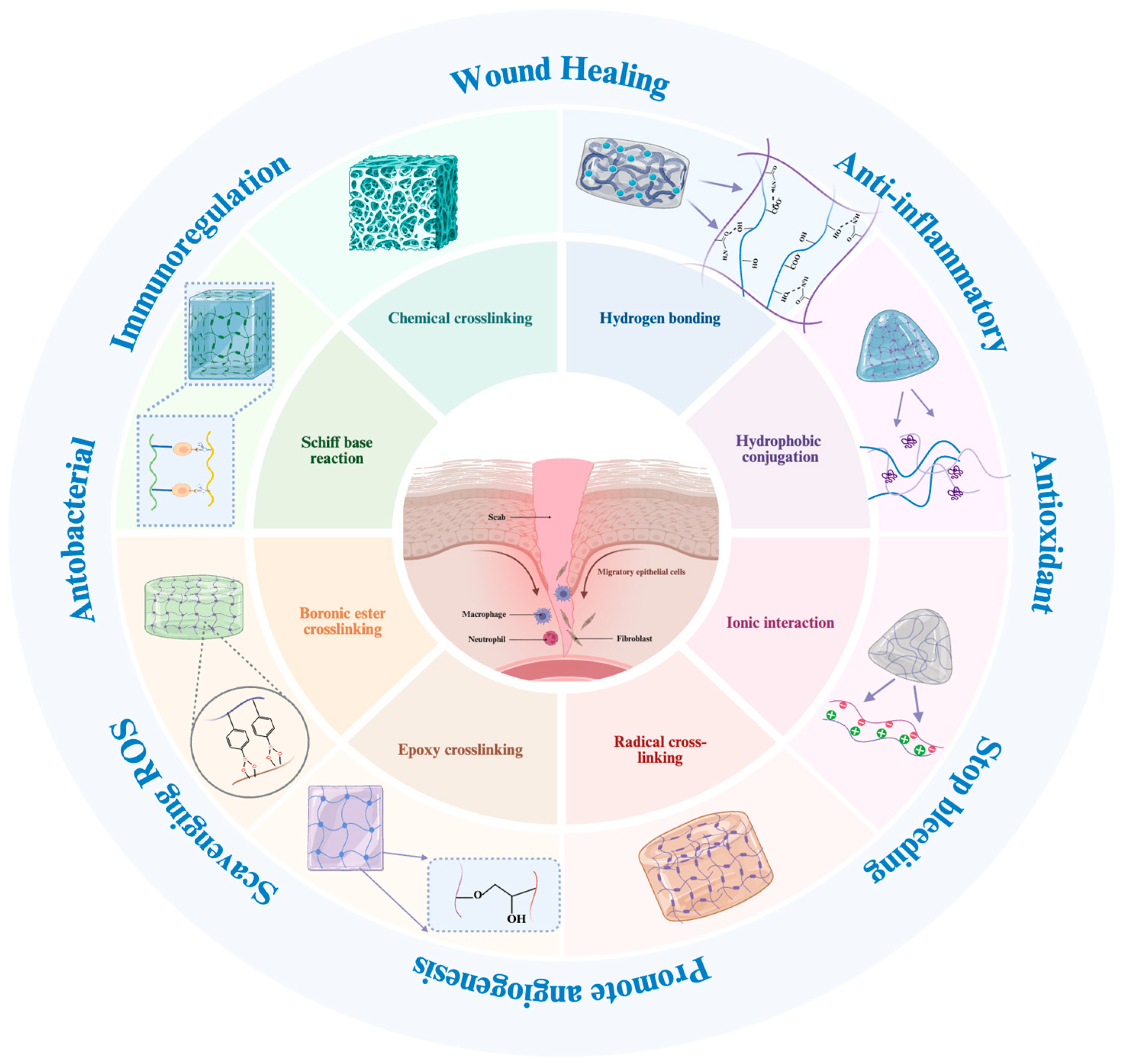
| Function | Material | Design Strategy | Mechanism | Application Example | Key References |
|---|---|---|---|---|---|
| Rapid Hemostasis | Chitosan, Sodium alginate | Dynamic crosslinking (Schiff base bonds, ionic crosslinking), nanoparticle reinforcement | Aggregation of red blood cells and platelets; activation of coagulation pathways | Traumatic wounds, surgical incisions, burn-related bleeding | [128,177] |
| Antimicrobial | Chitosan derivatives, silver nanoparticles, photothermal agents | Cationic charge interaction, controlled release, photothermal responsiveness | Disruption of bacterial membranes; inhibition of biofilm formation | Acute wounds, chronically infected wounds | [128,133] |
| Immunomodulation | Hyaluronic acid, platelet-rich plasma (PRP) | Immune signaling regulation, macrophage polarization (M1→M2) | Modulation of macrophage phenotype; suppression of excessive inflammation | Accelerated wound healing | [132,154] |
| Re-epithelialization | Hyaluronic acid, gelatin | Three-dimensional porous architecture, cell-adhesive motifs | Promotion of keratinocyte migration and proliferation | Full-thickness skin wound repair | [178,179] |
| Angiogenesis | VEGF, DFO, oxidized hyaluronic acid | Sustained release, hypoxia-responsive design | Stimulation of endothelial cell proliferation and neovascularization | Diabetic foot ulcers, chronic wounds | [179] |
| Anti-oxidative | Hydroxybutyl chitosan (GA-modified) | Sustained release of therapeutic agents, free radical scavenging | Reduction in ROS levels and mitigation of oxidative stress | Pressure ulcers, chronic ulcers | [139,180] |
| Tissue Engineering Scaffold | GelMA, chitosan/gelatin composites, CMCS | Biomimetic fibrous structure, electrical conductivity, dynamic mechanical tuning | Support of cell adhesion, migration, and differentiation | Artificial skin, functional skin regeneration | [42,136,144] |
| Self-healing | Schiff base/catechol–Fe3+ dual networks | Reversible crosslinking, dynamic network architecture | Restoration of mechanical integrity and adaptation to skin motion | Stretchable wounds, dynamic wound environments | [136,144] |
| Patent No. | Publication/Grant Year | Country/Region | Main Technology | Key Innovation and Application |
|---|---|---|---|---|
| WO2020225336A1 | 2020 | International (PCT/WIPO) | Polysaccharide–collagen composite hydrogel scaffold | An interpenetrating network hydrogel composed of polysaccharides and collagen, designed to accelerate wound healing and for wound dressing fabrication. |
| US20220218868A1 | 2022 | United States | Polysaccharide–collagen hydrogel | U.S. family member of WO2020225336A1, applied in wound treatment and cell culture applications. |
| AU2020267858B2 | 2025 | Australia | Polysaccharide–collagen hydrogel dressing | A polysaccharide–collagen composite system for wound management and enhancement of cellular activity. |
| US11254754B2 | 2022 | United States | Rapid-gelling biocompatible hydrogel | Photo-initiated crosslinking enables rapid gelation; suitable for drug loading to promote wound healing. |
| US20210244846A1 | 2021 | United States | Anti-biofilm hydrogel | A functional hydrogel system targeting biofilm-associated infections in chronic wounds. |
| WO2025011657A1 | 2025 | International (PCT/WIPO) | Multifunctional chronic wound dressing | Polysaccharide-based hydrogel integrated with bioactive components for multi-target repair of chronic wounds. |
| US9700650B2 | 2017 | United States | Polysaccharide-based hydrogel composition | Composite hydrogels combining polysaccharides and hydrophilic polymers for moist wound management. |
| WO2010132857A1 | 2010 | International (WIPO) | Biodegradable hydrogel skin scaffold | Polysaccharide-based biodegradable hydrogel scaffold for skin regeneration and wound healing. |
| US8524271B2 | 2013 | United States | Polysaccharide foam/gel dressing | Tremella polysaccharide/alginate composite wound dressing to reduce infection risk. |
| CN104415049A | 2015 | China | Wound healing composition | Hyaluronic acid–based wound healing compositions for skin defects and ulcer treatment. |
| CN111450312B | 2022 | China | Heparin–bFGF delivery hydrogel dressing | A polysaccharide-based hydrogel incorporating heparin and bFGF for sustained growth factor release and enhanced chronic wound healing. |
| CN118217445A | 2024 | China | Preparation and application of composite hydrogels | Gelatin-based composite hydrogel for skin wound repair, highlighting polysaccharide/protein hybrid characteristics. |
| CN113924132A | 2023 | China | Polysaccharide/collagen network hydrogel | Polysaccharide-based composite hydrogel and dressing for wound care applications. |
| CN112316108B | 2025 | China | Multicomponent immunomodulatory composition | A hydrogel composition containing polysaccharides (e.g., chitosan, alginate, hyaluronic acid) combined with immunomodulatory proteins. |
Disclaimer/Publisher’s Note: The statements, opinions and data contained in all publications are solely those of the individual author(s) and contributor(s) and not of MDPI and/or the editor(s). MDPI and/or the editor(s) disclaim responsibility for any injury to people or property resulting from any ideas, methods, instructions or products referred to in the content. |
© 2025 by the authors. Licensee MDPI, Basel, Switzerland. This article is an open access article distributed under the terms and conditions of the Creative Commons Attribution (CC BY) license.
Share and Cite
Jia, X.; Fan, D.; Yang, Z.; Chang, J.; Wang, Q.; Cui, X.; Liu, D.; Cui, N.; Jin, Y. Research Progress of Natural Polysaccharide-Based Hydrogels in Skin Tissue Regeneration. Gels 2026, 12, 21. https://doi.org/10.3390/gels12010021
Jia X, Fan D, Yang Z, Chang J, Wang Q, Cui X, Liu D, Cui N, Jin Y. Research Progress of Natural Polysaccharide-Based Hydrogels in Skin Tissue Regeneration. Gels. 2026; 12(1):21. https://doi.org/10.3390/gels12010021
Chicago/Turabian StyleJia, Xushuang, Dongmei Fan, Zhuoya Yang, Junjie Chang, Qi Wang, Xiaohan Cui, Da Liu, Ning Cui, and Ye Jin. 2026. "Research Progress of Natural Polysaccharide-Based Hydrogels in Skin Tissue Regeneration" Gels 12, no. 1: 21. https://doi.org/10.3390/gels12010021
APA StyleJia, X., Fan, D., Yang, Z., Chang, J., Wang, Q., Cui, X., Liu, D., Cui, N., & Jin, Y. (2026). Research Progress of Natural Polysaccharide-Based Hydrogels in Skin Tissue Regeneration. Gels, 12(1), 21. https://doi.org/10.3390/gels12010021