Review

Progress of Research on Conductive Hydrogels in Flexible Wearable Sensors

by
Juan Cao
1,
Bo Wu
2,
Ping Yuan
3,
Yeqi Liu
2 and
Cheng Hu
4,*
1
School of Fashion and Design Art, Sichuan Normal University, Chengdu 610066, China
2
School of Mechanical Engineering, Sichuan University, Chengdu 610065, China
3
School of Mechanical Engineering, Chengdu University, Chengdu 610106, China
4
National Engineering Research Center for Biomaterials, College of Biomedical Engineering, Sichuan University, Chengdu 610065, China
*
Author to whom correspondence should be addressed.
Gels 2024, 10(2), 144; https://doi.org/10.3390/gels10020144
Submission received: 25 January 2024 / Revised: 5 February 2024 / Accepted: 10 February 2024 / Published: 14 February 2024
(This article belongs to the Special Issue Gels for Flexible Electronics and Energy Devices)

Abstract

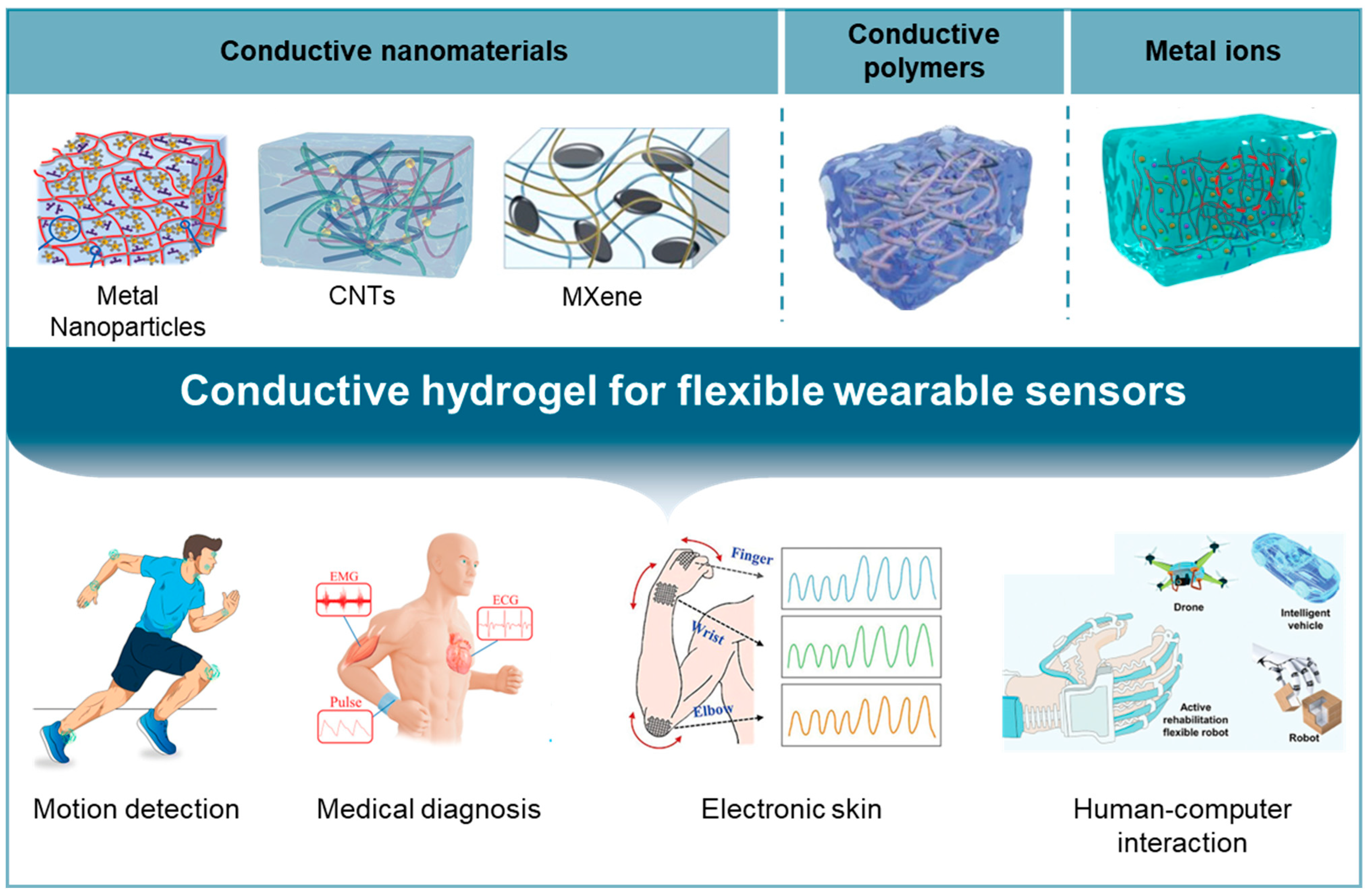
Conductive hydrogels, characterized by their excellent conductivity and flexibility, have attracted widespread attention and research in the field of flexible wearable sensors. This paper reviews the application progress, related challenges, and future prospects of conductive hydrogels in flexible wearable sensors. Initially, the basic properties and classifications of conductive hydrogels are introduced. Subsequently, this paper discusses in detail the specific applications of conductive hydrogels in different sensor applications, such as motion detection, medical diagnostics, electronic skin, and human–computer interactions. Finally, the application prospects and challenges are summarized. Overall, the exceptional performance and multifunctionality of conductive hydrogels make them one of the most important materials for future wearable technologies. However, further research and innovation are needed to overcome the challenges faced and to realize the wider application of conductive hydrogels in flexible sensors.
Keywords: conductive hydrogel; biomaterials; flexible sensors conductive hydrogel; biomaterials; flexible sensors