
Article

Identification of Volatile Sulfur Compounds Produced by Schizophyllum commune
1
Department of Veterinary Medicine, Obihiro University of Agriculture and Veterinary Medicine, 2-1 Inada-cho Nishi, Obihiro, Hokkaido 080-8555, Japan
2
Diagnostic Center for Animal Health and Food Safety, Obihiro University of Agriculture and Veterinary Medicine, Inada-cho, Obihiro, Hokkaido 080-8555, Japan
3
Medical Mycology Research Center, Chiba University, 1-8-1 Inohana, Chuo-ku, Chiba, Chiba 260-8673, Japan
4
Japan Application Center, Life Sciences and Chemical Analysis, Agilent Technologies Japan, Ltd., 9-1 Takakura-cho, Hachioji, Tokyo 192-8510, Japan
5
The Tokachi Foundation, Obihiro, Hokkaido 080-2462, Japan
6
Graduate School of Animal and Veterinary Sciences and Agriculture, Obihiro University of Agriculture and Veterinary Medicine, Inada-cho, Obihiro, Hokkaido 080-8555, Japan
*
Author to whom correspondence should be addressed.
J. Fungi 2021, 7(6), 465; https://doi.org/10.3390/jof7060465
Submission received: 29 May 2021 / Revised: 5 June 2021 / Accepted: 6 June 2021 / Published: 8 June 2021
(This article belongs to the Section Fungal Cell Biology, Metabolism and Physiology)

Abstract

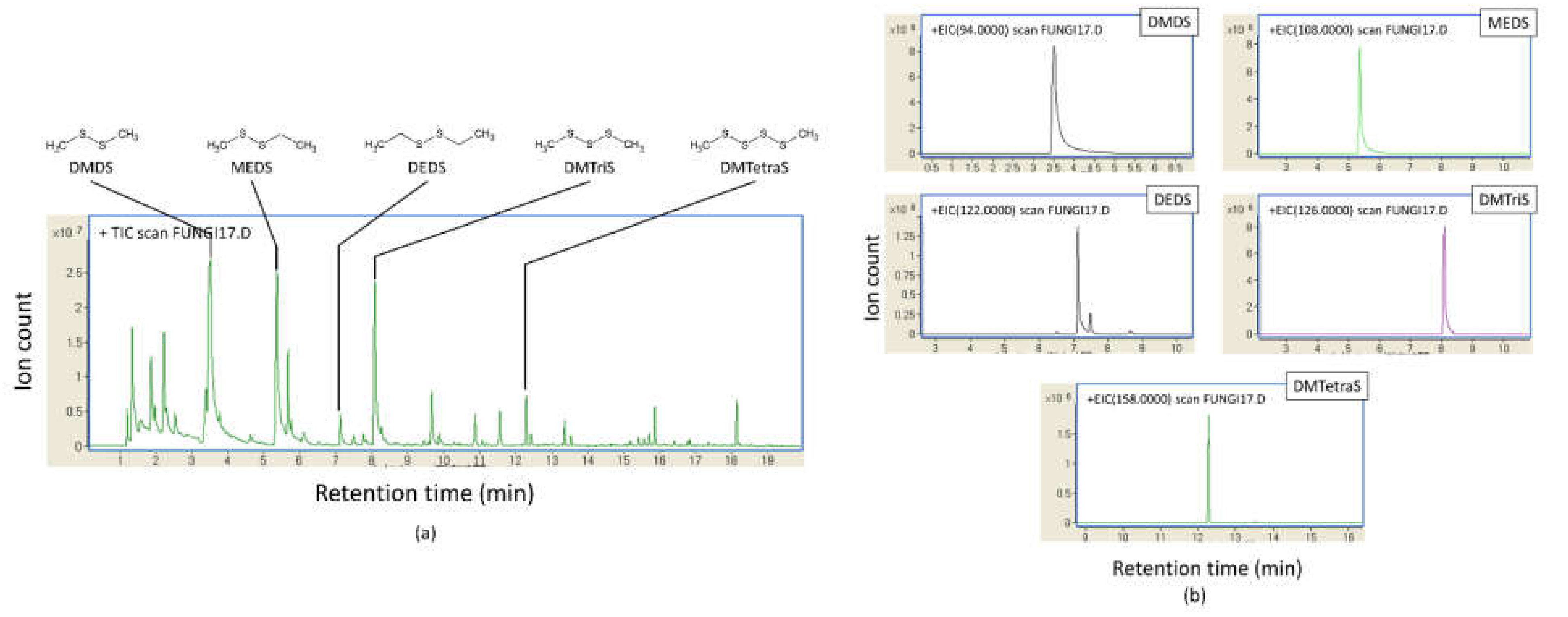
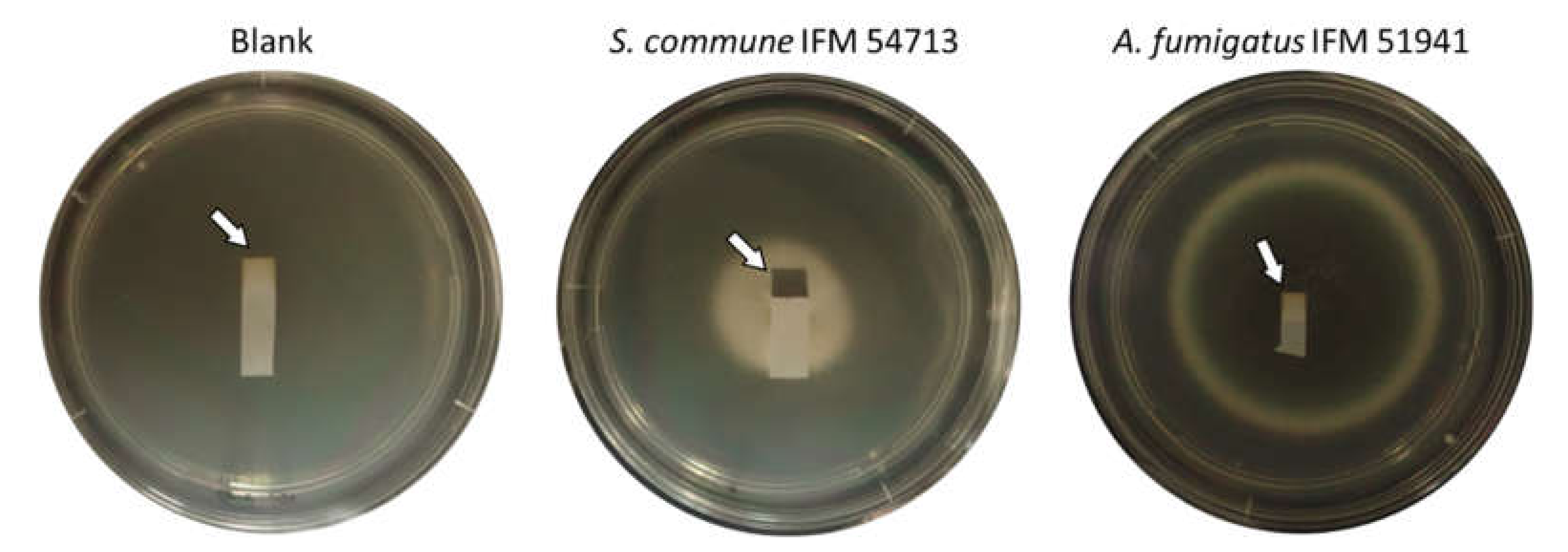
Schizophyllum commune is a causative agent of allergic bronchopulmonary mycosis, allergic fungal rhinosinusitis, and basidiomycosis. Diagnosis of these diseases remains difficult because no commercially available tool exists to identify the pathogen. Unique volatile organic compounds produced by a pathogen might be useful for non-invasive diagnosis. Here, we explored microbial volatile organic compounds produced by S. commune. Volatile sulfur compounds, dimethyl disulfide (48 of 49 strains) and methyl ethyl disulfide (49 of 49 strains), diethyl disulfide (34 of 49 strains), dimethyl trisulfide (40 of 49 strains), and dimethyl tetrasulfide (32 of 49 strains) were detected from headspace air in S. commune cultured vials. Every S. commune strain produced at least one volatile sulfur compound analyzed in this study. Those volatile sulfur compounds were not detected from the cultures of Aspergillus spp. (A. fumigatus, A. flavus, A. niger, and A. terreus), which are other major causative agents of allergic bronchopulmonary mycosis. The last, we examined H2S detection using lead acetate paper. Headspace air from S. commune rapidly turned the lead acetate paper black. These results suggest that those volatile sulfur compounds are potent targets for the diagnosis of S. commune and infectious diseases.
Keywords: allergic bronchopulmonary mycosis; microbial volatile organic compounds; Schizophyllum commune; volatile sulfur compounds allergic bronchopulmonary mycosis; microbial volatile organic compounds; Schizophyllum commune; volatile sulfur compounds